the Creative Commons Attribution 4.0 License.
the Creative Commons Attribution 4.0 License.
 | 13 Aug 2026
Rapid Evaluation Framework for the CMIP7 Assessment Fast Track

Ranjini Swaminathan
Jared Lewis
Bouwe Andela
Nathan Collier
Dóra Hegedűs
Jiwoo Lee
Charlotte Pascoe
Mika Pflüger
Martina Stockhause
Paul Ullrich
Min Xu
Lisa Bock
Felicity Chun
Bettina K. Gier
Douglas I. Kelley
Axel Lauer
Julien Lenhardt
Manuel Schlund
Mohanan G. Sreeush
Katja Weigel
Ed Blockley
Rebecca Beadling
Romain Beucher
Demiso D. Dugassa
Valerio Lembo
Jianhua Lu
Swen Brands
Jerry Tjiputra
Elizaveta Malinina
Brian Medeiros
Enrico Scoccimarro
Jeremy Walton
Phil Kershaw
André Lanfer Marquez
Malcolm J. Roberts
Eleanor O'Rourke
Beth Dingley
Briony Turner
Helene Hewitt
John P. Dunne
Related authors
Plants send about a third of their captured carbon below ground, to roots and soil fungi that take up water and nutrients. Most climate models still treat the entire root system as one uniform mass. We built a new land-model version that separates roots into three types: transport roots, absorptive roots, and fungal partners. Tested at twenty sites worldwide, it cut errors in simulated ecosystem carbon exchange by more than half, sharpening projections of how land will respond to climate change.
Plants send about a third of their captured carbon below ground, to roots and soil fungi that take up water and nutrients. Most climate models still treat the entire root system as one uniform mass. We built a new land-model version that separates roots into three types: transport roots, absorptive roots, and fungal partners. Tested at twenty sites worldwide, it cut errors in simulated ecosystem carbon exchange by more than half, sharpening projections of how land will respond to climate change.


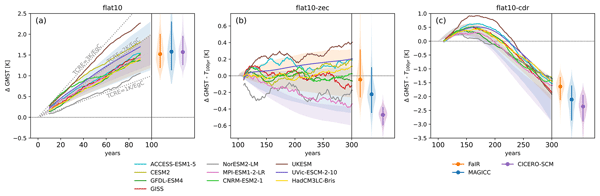





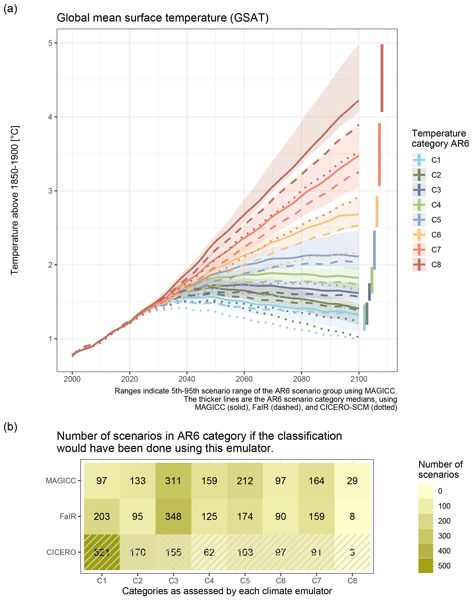
climate-assessmentworkflow that was used in the IPCC AR6 Working Group III report. The paper provides key insight for anyone wishing to understand the assessment of climate outcomes of mitigation pathways in the context of the Paris Agreement.