
the Creative Commons Attribution 4.0 License.
the Creative Commons Attribution 4.0 License.
 | 17 Apr 2026
CMIP7 Data Request: atmosphere priorities and opportunities
Beth Dingley

James A. Anstey
Marta Abalos
Carsten Abraham
Tommi Bergman
Lisa Bock
Sonya Fiddes
Birgit Hassler
Ryan J. Kramer
Fiona M. O'Connor
Petr Šácha
Isla R. Simpson
Laura J. Wilcox
Mark D. Zelinka
This paper presents a comprehensive overview of the Coupled Model Intercomparison Project Phase 7 (CMIP7) request for data unlocking key research avenues in atmospheric science and provides justification for the resources needed to produce this data. Topics within the CMIP7 Atmosphere Theme centre around processes and feedbacks in atmospheric science such as clouds, aerosols and atmospheric chemistry, atmospheric circulation, temperature variability and extremes, radiative forcings, and Earth system model evaluation. These topics are summarised in this paper as scientific “opportunities” which will be realised through CMIP7 experiments and Earth system model outputs. These opportunities were submitted by a thematic group of atmospheric science community representatives combined with an extended consultation process. The production of these variables will close key gaps and uncertainties identified during previous rounds of CMIP, and will be broadly used by scientific, policy, governmental, industry, and other communities that rely on climate model projections for research and decision making, including supporting the 7th Intergovernmental Panel on Climate Change Assessment Report (AR7). As an author group, we also reflect on the process used to collate this data request and make recommendations to future CMIP governance on implementing a consultation on this scale in the future.
- Article
(1976 KB) - Full-text XML
- BibTeX
- EndNote


Atmospheric processes play fundamental and wide-ranging roles in the climate system. Global-mean surface temperature is primarily determined by radiative fluxes through the atmosphere, governed by the distribution of radiatively active trace gases, aerosols, and clouds. Dynamical processes redistribute energy, momentum and moisture from the tropics to higher latitudes and vertically across layers, and cause variability ranging from localised thunderstorms to large-scale meanders of the jet streams (e.g. Peixóto and Oort, 1984). Chemical, radiative, and dynamical processes interact to determine the distribution of ozone and other important trace constituents that impact climate.
The origin of Atmospheric General Circulation Models (AGCMs) dates from the 1950s, when the Numerical Weather Prediction (NWP) approach was adapted to longer timescales by solving simplified equations on a limited domain in the presence of heating and friction (Phillips, 1956). With model developments over time, AGCMs expanded their domain to the whole atmosphere, simulating the global circulation of air, moisture, and trace constituents such as carbon dioxide, ozone, and aerosols (Edwards, 2000; Weart, 2010; Durack et al., 2025). With increasing understanding of a wider range of physical processes, combined with the advancement in high performance computing power, climate models have evolved to couple AGCMs with ocean, cryosphere, and land surface models in order to simulate the whole Earth System with increasing realism (Randall et al., 2019). Over time, these Earth System models have incorporated an increasingly wide range of physical and biogeochemical processes spanning a multitude of spatial and temporal scales. Concomitantly with their increase in complexity and spatial resolution, the scope of atmospheric output requested from them has grown. The scientific community analysing these outputs has also broadened (e.g. Ruane et al., 2016) beyond practitioners researching the fundamental principles of atmospheric science (e.g., the role of clouds in climate change) as well as those investigating regional-scale human impacts of climate change (e.g., heat waves or other extreme events).
Since the 1990s, the Coupled Model Intercomparison Project (CMIP) has been coordinating climate simulations to enhance understanding of past, present, and future climate change (Meehl, 1995; Durack et al., 2025). The analysis and studies based on the model output from CMIP have laid foundations for the Intergovernmental Panel on Climate Change (IPCC) working group assessments (e.g. IPCC, 2023), as well as other national and international climate change assessment efforts. Atmospheric variables have formed a core component of CMIP output since the project's beginning. According to statistics from the Earth System Grid Federation (ESGF) Dashboard (Fiore et al., 2021), the top 3 most downloaded variables from Phase 6 of CMIP (CMIP6; Eyring et al., 2016) at the time of this publication are the atmospheric variables eastward wind (ua), near-surface air temperature (tas), and precipitation (pr) (ESGF Data Statistics: https://esgf-ui.cmcc.it/esgf-dashboard-ui/cmip6.html, last access: 6 December 2025).
In the current phase of CMIP, CMIP7 (Dunne et al., 2025), the Data Request Task Team has structured the data request into groups of scientific objectives, termed “Opportunities”. The version 1.2 of the Data Request contains a set of 48 “Opportunities”, each of which is associated with one or more of five data request “themes”: Atmosphere, Ocean and Sea-Ice, Land and Land-Ice, Earth System, and Impacts and Adaptation (Mackallah et al., 2026). Each Opportunity can be thought of as a coherent data request, containing a concise but informative description of its scientific goals and a list of the specific variables (organised into Variable Groups) that are required from CMIP coordinated experiments to achieve these goals. A core set of highest priority variables, many of which have been consistently provided in past phases of CMIP (e.g., the aforementioned ua, tas, and pr) are collected in the data request within the “Baseline Climate Variables for Earth System Modelling” Opportunity. These variables, known as the “BCVs”, are requested from all experiments, are expected to be of interest to a wide range of users, and most are practical to provide because of their modest data volume and history of being commonly produced by modelling centres (Juckes et al., 2025). Other Opportunities encapsulate more specialised scientific goals, and correspondingly may request higher resolution data, variables that may be more complex to produce, and different priority levels and/or applications for different Variable Groups. Structuring the data request into Opportunities is intended to help modelling centres align their data production with their own scientific goals (by choosing which Opportunities to support) while maintaining a coordinated approach to ensure an Earth System Grid Federation (ESGF) data archive that provides as consistent a set of output variables across as many climate models as possible. In this paper, we document the 11 Opportunities that are primarily associated with the Atmosphere theme of the data request.
The Atmosphere author team was recruited via an open call between 13 February and 8 March 2024 (CMIP7 Data Request: Call for Atmosphere theme paper co-authors: https://wcrp-cmip.org/cmip7-atmosphere-call/, last access: 6 December 2025; WCRP-CMIP, 2025). Members were sought across the atmospheric science, clouds, and atmospheric chemistry and aerosol communities to gather variable requirements for the CMIP7 Data Request, organised in the online cloud-based database platform Airtable (Airtable: https://www.airtable.com/platform, last access: 6 December 2025; Mackallah et al., 2026). Applications were reviewed by invited members of the Detection and Attribution Model Intercomparison Project (DAMIP), Radiative Forcing Model Intercomparison Project (RFMIP), and Cloud Feedbacks Model Intercomparison Project (CFMIP), alongside two members of the Data Request Task Team. A diverse final group of 19 authors were chosen, including representatives from the three MIPs above as well as Phase 2 of the Aerosol and Chemistry Model Intercomparison Project (AerChemMIP2), the Regional Aerosol Model Intercomparison Project (RAMIP), the Geoengineering Model Intercomparison Project (GeoMIP), and the Dynamics and Variability Model Intercomparison Project (DynVarMIP) with authors spanning a range of geographical regions, career stages, and CMIP experiences. In addition, the Atmosphere team was assigned to liaise with the proposers of the cross-thematic Rapid Evaluation Framework Opportunity (REF; Hoffman et al., 2025) due to professional links between existing Atmosphere team members and those leading the development of the Rapid Evaluation Framework. Figure 1 outlines the processes within the scope of the Atmospheric Theme Data Request.
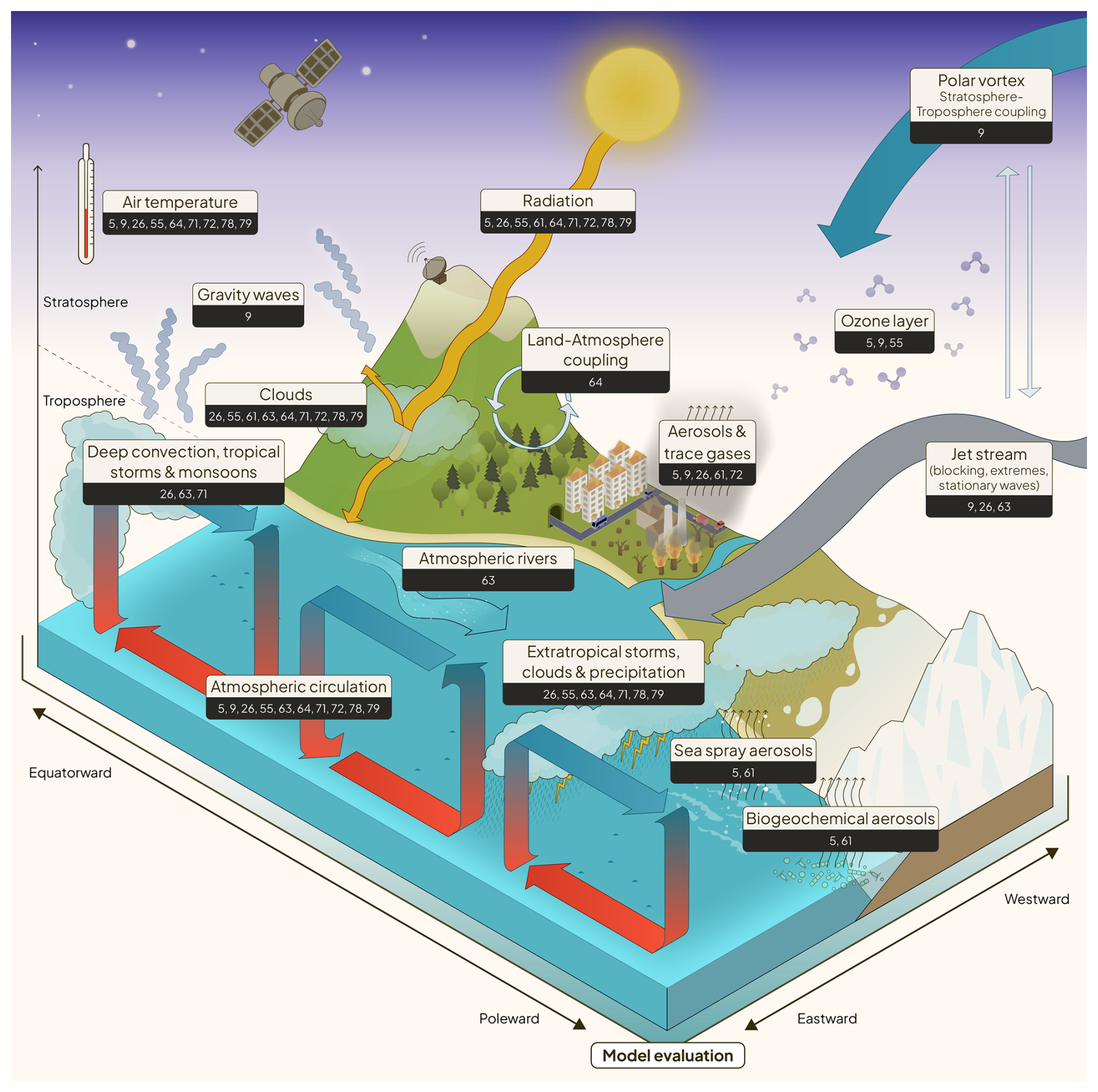
Figure 1Processes covered by the Atmospheric theme opportunities. The “Model evaluation” label and box implies that model evaluation encompasses all atmospheric processes. The numbers beneath each process indicate which Opportunity IDs in the Atmosphere theme address that process. Figure originally published at Dingley et al. (2025) (see https://doi.org/10.5281/zenodo.15681839).
The team first convened on 16 July 2024, with community engagement activities beginning subsequently alongside the first data request open public consultation (Turner et al., 2024). Author team members used their networks as community representatives to gather scientific requirements for the atmospheric data to be requested from modelling centres performing CMIP7 simulations. Through this engagement process, a number of Opportunities were submitted to gather the necessary variables and their technical definitions. In the CMIP Data Request, variables are constructed by combining a “physical parameter” (with an attached CF standard name (Hassell et al., 2017)) with additional metadata to describe its spatial and temporal sampling (Mackallah et al., 2026). For example, the aforementioned tas (near-surface air temperature) is a physical parameter, which may be sampled in different ways (e.g., monthly means on a global grid) to define a data request variable (sometimes referred to as a CMOR variable). A number of atmospheric MIP representatives defined new physical parameters to take advantage of the increased model complexities expected in CMIP7, particularly in atmospheric chemistry and aerosol model components (Fiedler et al., 2025). The author team met biweekly through to the v1.0 release in November 2024 to share progress and address questions and comments raised during the consultation. Prior to the v1.0 release, team members decided to gather the early drafts of the Atmosphere Opportunities rapidly, so the team could ensure sufficient coverage of relevant atmospheric scientific questions were addressed by the request.
Following the v1.0 release, work shifted into a harmonisation phase to ensure Opportunities requested were sufficient and consistent across the request. Where Opportunities were found to have an unreasonably high data volume, Opportunity proposers were requested to rework their request. Common approaches for reducing data volume were to select time subsets (i.e., an output period less than the whole duration of an experiment) or by separating out “basic” and “extension” science of the Opportunity. Refinement of the Opportunities continued through to the v1.2 release in March 2025.
A number of wider discussions were also held during meetings to improve the Data Request, such as the harmonisation of pressure levels (see Sect. 5.1.1). A collaborative spreadsheet was used to track progress across the request, with the IPO support and Data Request Task Team liaison members updating the Airtable records as needed. Author team members also contributed to cross-thematic meetings as required and fed back key actions and considerations to the author team.
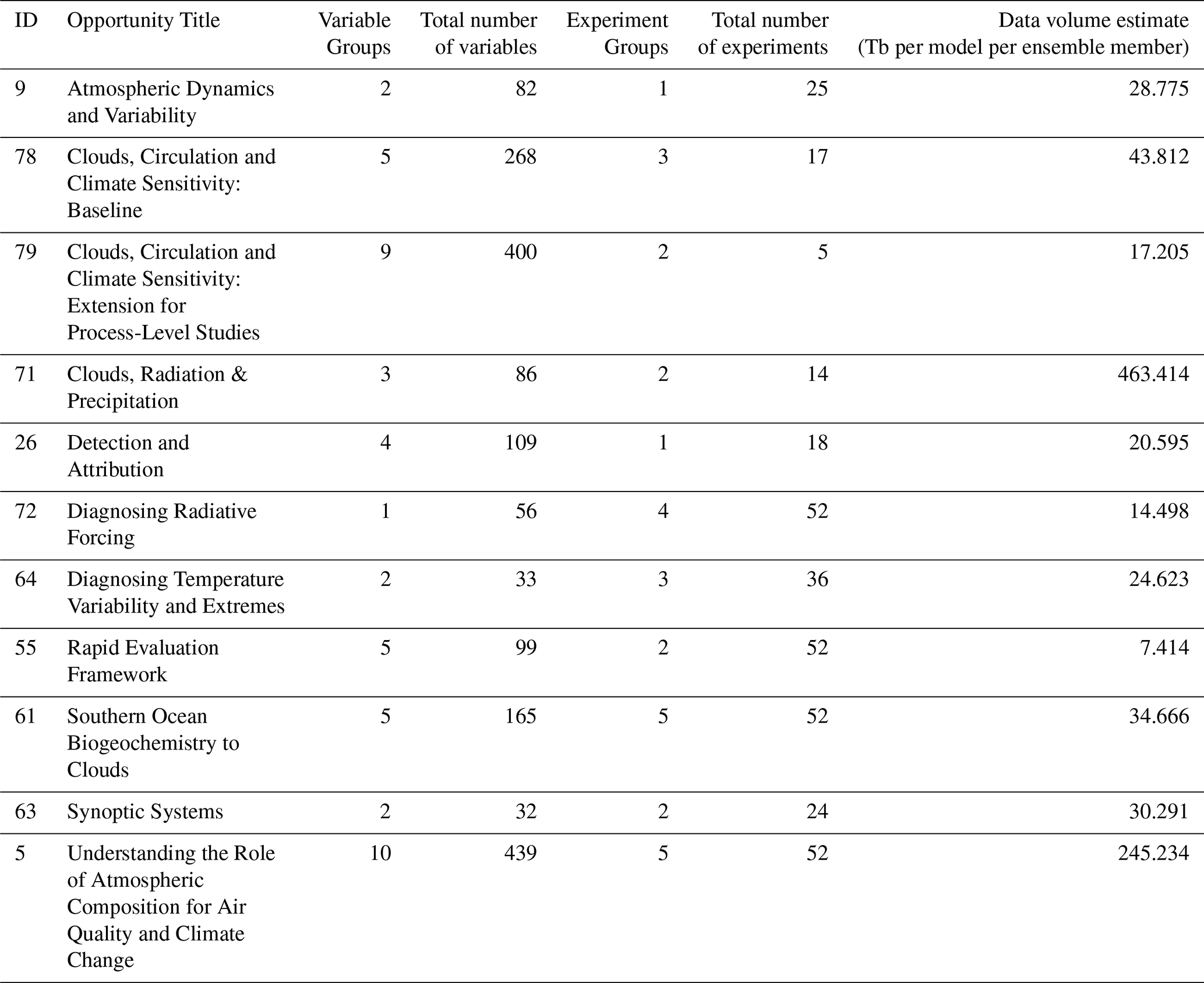
The final list of Atmospheric Opportunities can be found in Table 1.
Table 1Data Request Opportunities primarily accounted within the Atmospheric theme scientific objectives, including the total numbers of Variable Groups, variables, Experiment Groups, experiments requested, and an estimate of the data volume for each Opportunity. Note, 52 experiments requested corresponds to requesting all DECK, Assessment Fast Track, and scenario experiments (excluding scenario extensions). The data volume estimate is a crude estimation of the volume which would be produced by one ensemble member producing all experiments and variables for that Opportunity, given in Terabytes per model per ensemble member, and assuming 2 bytes per floating point after compression. The volume estimate cannot be added to calculate an overall estimation of the Atmosphere Data Request, as variables and experiments are not exclusive to Opportunities. Opportunities are listed alphabetically. The Opportunity IDs were assigned to all Opportunities across the five themes of the CMIP7 Data Request to help the ease the consolation process and as a method for Data Request users to refer to Opportunities quickly.
2.1 Prioritisation
Following the prioritisation definitions outlined by the Data Request Task Team in Mackallah et al. (2026), the Atmosphere team decided the scientific community proposing Opportunities and Variable Groups were best placed to determine the relative priority levels of their Variable Groups. Only for Opportunities requesting higher data volumes did we, as an author team, recommend that the proposers lower the priority of one or more variable groups. This will aid modelling centres to ensure the most essential variables are produced and published for the Opportunities they elect to support.
2.2 Harmonisation of pressure levels in the request
Due to the “bottom-up” nature of the CMIP6 Data Request, in which data users requested data based on their requirements with minimal restriction, vertically resolved variables were provided on a variety of different pressure level sets. An area of possible harmonisation in the CMIP7 request was to consolidate the different pressure levels requested to make data production easier for modelling centres.
Following an early v1.0beta release (Data Request Task Team, 2024a), we analysed which pressure level sets had been requested in the earliest stages of the CMIP7 Data Request and explored avenues for consolidation. Options explored included (a) moving all data on plev7h, plev8, and plev19 onto a new pressure level set with 14 levels, (b) moving variables requested on plev7h and plev8 onto the existing plev19 set, or (c) leaving all pressure levels as they were. Given that data in the upper-troposphere lower-stratosphere (UTLS) region is relevant for many scientific questions, we decided not to adopt the proposed plev14 set, which would have removed multiple pressure levels in this region. We performed a brief volume impact assessment on the Data Request of the different options, after which we provided a recommendation to the cross-thematic steering group that all data on plev7h and plev8 should be moved to plev19. Following a cross-thematic discussion, it was decided that all daily and monthly data on plev7h and plev8 should be moved to plev19, but the high volume sub-daily data should be requested on a lower number of pressure levels, due to the potential data volume bloat that a move to 19 levels could cause. This was implemented in the Data Request from v1.0 onwards (Data Request Task Team, 2024b). The CMIP6 and CMIP7 pressure levels are outlined in below, with the CMIP7 pressure levels visually represented in Fig. 2. Variables requested in CMIP6 on the plev3 and plev7c sets remain unchanged.
In addition, due to new requirements identified by the Land Theme in land-atmosphere coupling, a new pressure level set plev6 was created for the lower troposphere, and due to requirements from the Impacts and Adaptation Theme surrounding the impacts of climate change on aviation (see Ruane et al., 2025), the new pressure level set plev5u was created that contains pressures in the UTLS region.
Table 2Definitions of the pressure levels requested in CMIP6 and CMIP7 in hPa, as well as the number of variables requesting each set (Column 4). Pressure level sets with the same name in both CMIP phases contain the same levels.
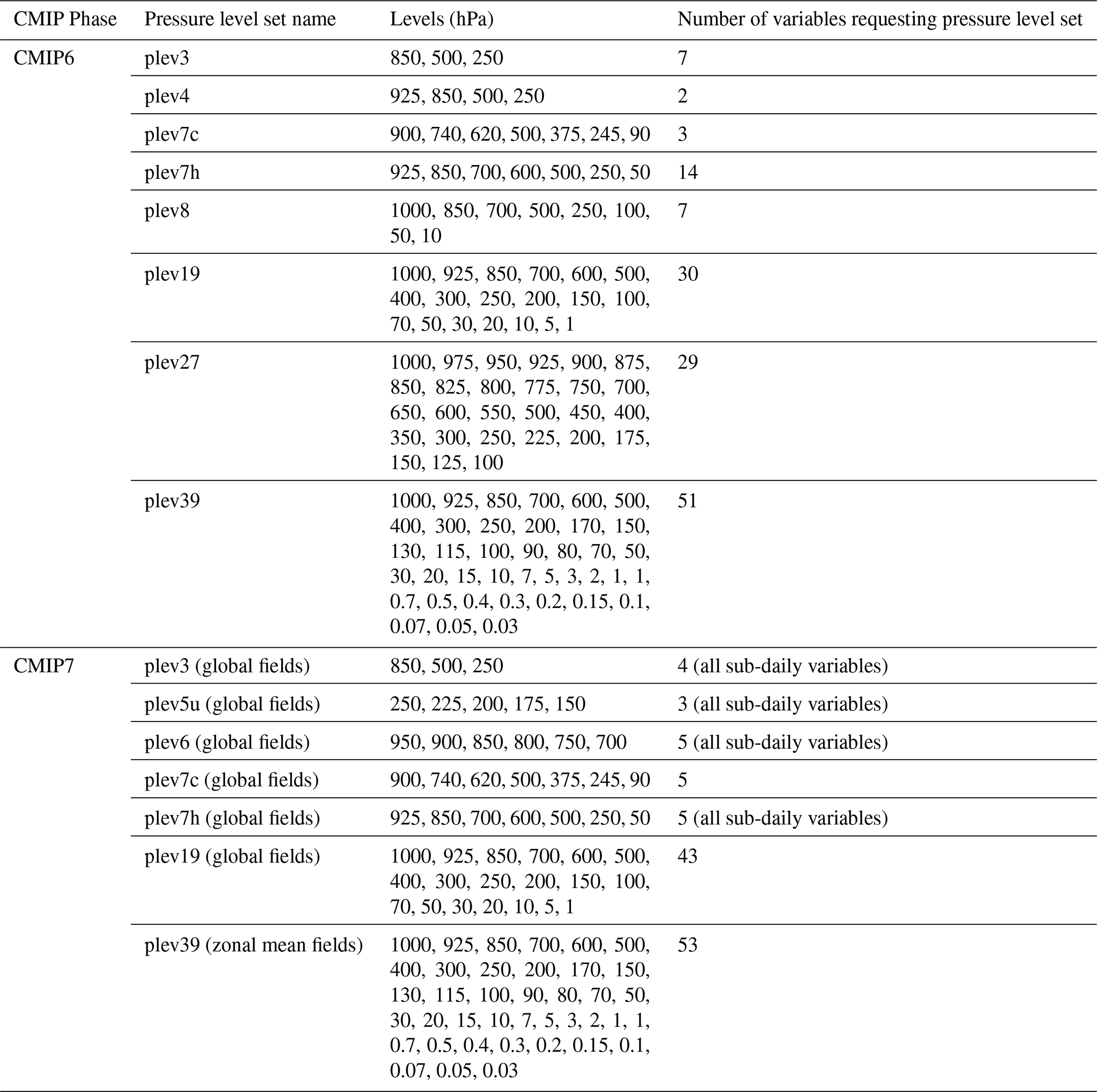
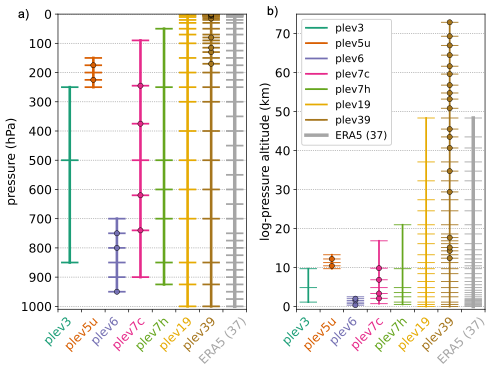
Figure 2Pressure level sets utilised in the CMIP7 Data Request. Pressure level set names shown on the x-axis are ordered from fewest to most pressure levels. For comparison the standard pressure levels from the ERA5 reanalysis are also shown as the right-most line (light grey). The y-axis shows (a) pressure altitude in hectopascals, and (b) the log-pressure altitude in kilometres, in order to clearly show levels above the troposphere. The log-pressure altitude is , where p is the pressure, p0=1000 hPa, and H=7 km. Pressure levels that occur in only one set are indicated by circles.
2.3 New Physical Parameters in CMIP7
Many of the proposed Opportunities, described in Sect. 4, were accompanied by requests for the inclusion of new physical parameters (physical quantities that were not previously requested in CMIP6), as well as new variables (combination of physical parameters with additional information about spatial and temporal resolution). In Appendix B, we provide a list of the newly proposed physical parameters, including brief descriptions of their meaning and dimensionality. Note that this table includes only new physical parameters, and does not cover newly requested variables. The full list of requested variables can be found in the v1.2 release of the CMIP7 Data Request (Data Request Task Team, 2025b). Please note, v1.2 is the latest major release at the time of this publication. Please ensure you are using the latest minor release when using the Data Request.
3.1 Atmospheric dynamics and variability (ID 9)
Atmospheric circulation has been flagged as a major source of uncertainty of model projections both on global and regional scales (Shepherd, 2014; Shaw et al., 2024a), hampering our ability to predict the evolution of important features such as storm tracks, blocking and monsoons (Shaw et al., 2024b). This uncertainty is linked to dynamical interactions across scales, including unresolved processes, and to the complex coupling between atmospheric layers. In particular, the stratospheric circulation is increasingly being recognized to play a key role in both the long-term forced surface climate response and year-to-year variability, including extremes (Domeisen and Butler, 2020). Notable examples include the Quasi-Biennial Oscillation, internally generated in a growing number of climate models (Anstey et al., 2022), which influences organized convection in the tropics (Haynes et al., 2021; Martin et al., 2021), the pronounced role of stratospheric ozone depletion on Southern Hemisphere tropospheric circulation trends (WMO, 2022, Ch5) and the impacts of Sudden Stratospheric Warmings and other stratospheric polar vortex extremes on surface weather (Baldwin et al., 2021). The representation of stratospheric circulation is notably improving in CMIP models and the DynVar opportunity provides the means to leverage these capabilities and foster this expanding area of research.
Building upon the CMIP6-endorsed DynVarMIP, this opportunity includes the most relevant variables and experiments to address the main goals of the Dynamical Variability (DynVar) activity of the Atmospheric Processes And their Role in Climate (APARC) project (DynVar, 2026) that focuses on the dynamics and variability of the stratosphere-troposphere system. The requested variables permit the analysis of dynamical processes key to advance understanding of atmospheric natural variability, including the occurrence of extreme events and its response to anthropogenic forcing. The dynamical diagnostics can help identify the sources of circulation biases in climate models that cause large uncertainties in regional circulation and precipitation variability and trends.
The overarching open questions to be addressed with the CMIP7 requested experiments are:
-
In what ways do dynamical processes lead to persistent atmospheric circulation biases in climate models, such as in blocking events, storm tracks, and the stratospheric polar vortex?
-
How does stratosphere-troposphere coupling influence climate variability, including extreme weather and climate events?
-
How do atmospheric dynamics shape the climate's response to human-induced changes, such as global warming and ozone depletion, and what is their contribution to the uncertainty in future climate projections?
The variables included in this Opportunity mainly follow the CMIP6 DynVarMIP data request (Gerber and Manzini, 2016; a summary of the data availability in the CMIP6 archive is given in Karpechko et al., 2022), which has already allowed the assessment of the stratosphere-troposphere circulation variability and change, being particularly helpful for detecting inter-model differences and identifying the underlying physical processes causing this spread. As evidenced by the previous CMIP phase, the studies that can benefit from this data request cover a wide range of topics, such as stratospheric polar vortex biases (Rao et al., 2022; Zhao et al., 2022; Hall et al., 2021) and their highly uncertain future trends (Rao and Garfinkel, 2021a; Karpechko et al., 2022, 2024), Sudden Stratospheric Warmings (Ayarzagüena et al., 2020; Wu and Reichler, 2020; Rao and Garfinkel, 2021b), large-scale atmospheric circulation (Simpson et al., 2020; De et al., 2022; Castanheira and Marques, 2022), Brewer-Dobson circulation and wave driving, both resolved and parameterized (Abalos et al., 2021; Hájková and Šácha, 2024), or stratosphere-troposphere coupling (Ding et al., 2023), among others.
Two groups of variables are included: dynvar_basic with high priority, and dynvar_advanced with medium priority. The dynvar_basic group largely follows the DynVarMIP variables defined in Gerber and Manzini (2016). It includes the variables necessary to quantify the dynamics of the troposphere and stratosphere using standard diagnostics, including Transformed Eulerian Mean (TEM) diagnostics such as the residual mean circulation and the Eliassen-Palm flux, as well as the mean age of air, and zonal mean parametrised tendencies from unresolved processes to close the momentum and energy budgets. The group includes mainly zonal mean fields and thus implies a reduced storage burden. The zonal mean fields are requested on an extended set of 39 levels and the 3D fields on 19 pressure levels (see Table 2 and Fig. 2). Several of the variables are already requested in other more general variable groups on a coarser set of vertical levels. Here, fine vertical spacing is crucial for the stratosphere-troposphere coupling studies. The dynvar_advanced group extends the set of dynvar_basic variables with more detailed information on the parametrised forcings. The group follows the priority two variable group defined in Gerber and Manzini (2016) including a combination of zonal mean fields with 3D fields on fewer vertical levels, and thus implies a reduced storage burden. This group includes a set of new parameters (tauunoegw, tauunowgw, tauuogw, tauvnogw, and tauvogw; see Appendix B) that were included based on a consultation with the gravity wave research community with the goal of enabling observational validation of directional momentum fluxes within gravity wave parametrisations against satellite-derived estimates. Although medium priority, we highly recommend this group of variables for the attention of the modelling centres, because at a low storage burden this variable group has a potential to significantly contribute to the elucidation of the role of unresolved processes in model circulation biases in the free atmosphere.
Including data from this opportunity in a sufficiently large set of models is needed to advance understanding of large-scale stratospheric and tropospheric circulation features, their variability, their connections to surface climate extremes, and the underlying dynamical processes in future climate projections.
3.2 Clouds, circulation and climate sensitivity: baseline (ID 78)
A key objective of climate science is to characterise and reduce uncertainty in future climate. Much of this uncertainty has its roots in our imperfect understanding of how clouds will respond to perturbations. In particular, cloud feedbacks are primarily responsible for the large inter-model spread in how effectively Earth sheds radiation to space per degree of warming, which drives the substantial spread in equilibrium climate sensitivity that has persisted over many decades (Cess et al., 1989; Bony and Dufresne, 2005; Vial et al., 2013; Zelinka et al., 2020), Rapid cloud adjustments are an important but highly uncertain modulator of the effective radiative forcing (Gregory and Webb, 2008; Zelinka et al., 2013; Kamae et al., 2015; Smith et al., 2020). Cross-model correlations between cloud feedbacks and rapid cloud adjustments to CO2 forcing affect the range of climate sensitivities across models, but the physical processes linking these remain unknown (Lutsko et al., 2022). Recent work has also demonstrated that cloud feedbacks are not invariant; rather, they exhibit substantial dependence on climate base state and on the nature of the forcing (e.g., doubling versus quadrupling CO2, surface warming versus surface cooling) (Bjordal et al., 2020; Bloch-Johnson et al., 2021; Poletti et al., 2024). Relatedly, cloud feedbacks depend sensitively on the spatial pattern of the surface temperature anomaly; understanding such “pattern effects” is a major research area with implications across a broad range of topics (Armour et al., 2013; Andrews et al., 2022; Rugenstein et al., 2023). Beyond implications of clouds for climate sensitivity, interactions between clouds and atmospheric circulation, regional precipitation, and oceanic processes are increasingly being explored, yet many uncertainties remain (Grise and Polvani, 2014; Bony et al., 2015; Ceppi and Hartmann, 2016; Myers et al., 2018; Kim et al., 2022; Breul et al., 2025).
This motivates the creation of two opportunities related to clouds, circulation, and climate sensitivity. Both of these are intended to address the three primary objectives of the Cloud Feedback Model Intercomparison Project (CFMIP), which are to advance diagnosis and understanding of cloud feedbacks and rapid cloud adjustments in past, present and future climates; to assess representations of clouds, their radiative properties, and their feedback mechanisms in climate models to inform model development; and to understand and evaluate other aspects of climate change that depend on cloud processes, such as climate sensitivity, circulation and precipitation, regional patterns and extremes, and nonlinear behaviour.
These two opportunities will facilitate the community's ability to answer the key science questions of CFMIP:
-
What are the physical mechanisms underlying cloud feedbacks and rapid adjustments in nature, and how credibly do models represent these?
-
How and why do cloud feedbacks and adjustments depend on climate base state and on the nature of the climate forcing?
-
What coupled processes underlie the SST pattern effect, and how does this affect cloud feedback?
-
What are the mechanisms underlying cloud-circulation coupling and regional precipitation change, and how credibly do models represent these?
This first “baseline” flavour of the Clouds, circulation and climate sensitivity opportunity is intended to capture the base set of variables that is essential for performing analyses that can answer the key CFMIP questions. Despite including a large number of variables, we do not envision this being overly burdensome because (1) many variables are already included in the Baseline Climate Variables (BCVs), and (2) only monthly 2D and 3D fields, daily 2D fields, and fixed fields are requested. No sub-monthly 3D fields are requested. Data is requested only from the 10 DECK experiments and the CFMIP subset of the CMIP7 AFT (four experiments: abrupt-0p5CO2, abrupt-2xCO2, amip-p4k, and amip-piForcing). For modelling centres participating in CFMIP, these data are also requested from other non-AFT experiments (collected in the cfmip-additional-nonfasttrack experiment group).
Producing data from this opportunity across a large collection of climate models will allow major progress across the topics of interest to the CFMIP community, including rigorous evaluation of modelled clouds against observations, detailed and careful diagnosis of cloud-radiative feedbacks, improved understanding of physical processes governing feedbacks and adjustments, and identification of sources of model bias.
3.3 Clouds, circulation and climate sensitivity: extension for process-level studies (ID 79)
This second of the two Clouds, circulation and climate sensitivity opportunities is intended to capture variables crucial for advanced diagnosis and evaluation of cloud, radiation, and precipitation processes in the present-day and warmed climate. In addition to requesting the same variable groups as the baseline opportunity (ID 78), this opportunity requests daily 3D fields; sub-hourly fields at specified “cfSites” locations (Webb et al., 2024); additional output from the CFMIP Observation Simulator Package (COSP; Bodas-Salcedo et al., 2011; Swales et al., 2018); and monthly climatologies of hourly-resolved top-of-atmosphere (TOA) fluxes (Russell et al., 2024). These fields augment our ability to investigate clouds and cloud feedbacks at the process level, to rigorously compare modelled cloud properties to a suite of satellite observations, and to characterise the diurnal cycle of clouds and related fields. For example, new liquid-only and ice-only cloud fraction histograms produced by the MODIS simulator are now requested (Wall et al., 2025). These are highly valuable for diagnosing cloud phase feedbacks, building upon an established methodology to detail cloud property feedbacks from satellite simulator output (Zelinka et al., 2012a, b). Despite the large number of requested variables, some of which are at sub-monthly and 3D resolution, these data are requested for only 2 experiments (amip and amip-p4K). Modelling centres participating in CFMIP are encouraged to output these data from additional non-AFT experiments (collected in the cfmip-additional-nonfasttrack experiment group). Note that this opportunity is intended to supplement the baseline opportunity. A modelling centre interested in a deeper understanding of clouds, circulation, and climate sensitivity should choose this opportunity in addition to the baseline opportunity. Producing data from this opportunity across a large collection of climate models will facilitate advanced diagnosis and understanding of cloud processes, feedbacks, adjustments, and biases beyond what is possible with the baseline variables.
3.4 Clouds, radiation & precipitation (ID 71)
As key components of the hydrological cycle and the climate system, an evaluation of clouds from models used for climate projections is an important prerequisite for assessing the confidence in the results from these models. However, simulating clouds with global climate models is challenging as the relevant physics involves many non-linear processes covering a wide range of spatial and temporal scales. So far, a quantitative evaluation of the representation of clouds in CMIP models with satellite observations has been challenging as only a limited number of parameters from a limited number of models have been available from satellite simulators.
The goal of this opportunity is to address the following science questions, given that a sufficient number of CMIP7 models provide the requested variables:
-
How well are clouds represented in the latest model generation on different spatial and temporal scales in the coupled model configurations used for the projections?
-
How well can climate models reproduce the observed daily cycle of cloud properties, radiation fields and precipitation, and how are biases connected to the dominating physical processes?
-
How do the sensitivity of cloud properties and the dominating physical processes change under different scenarios of climate change?
This opportunity aims to quantitatively evaluate cloud parameters, radiation and precipitation with different observational and reanalysis datasets using output from satellite simulators that have not been available in CMIP6. The focus will be on the coupled historical experiment to assess how well clouds are represented in the model configurations used for the projections comparable with the study of Lauer et al. (2023) on CMIP5 and CMIP6. This is crucial to understand their potential biases and uncertainties. Combining the daily cycle of cloud properties with precipitation and radiation fields will allow for a more process-based analysis and improved understanding of biases in and sensitivities of clouds in the coupled models. Instantaneous data are used to reveal correlations between clouds, radiation and precipitation, shedding new light on these complex processes. Data from the scenario experiments are used to investigate the sensitivity of cloud properties to climate change. Here, we build on the study by Bock and Lauer (2024), in which they investigated cloud properties and their projected changes in CMIP models with low to high climate sensitivity.
Contributing to this opportunity will ensure a comprehensive evaluation of the representation of clouds, radiation and precipitation in comparison to observations and other climate models. Additionally, it enables a valid analysis of the sensitivities of cloud properties and the dominant physical processes to climate change.
3.5 Detection and Attribution (ID 26)
The detection and attribution of climate change is the process of determining if observed climate changes can be attributed to human influences on the climate or to natural variability. A key question to be addressed by CMIP simulations is which signals in the historical record can be attributable to external forcings and which external forcings are responsible? Such attribution studies are critical to determining which observed signals can be attributed to anthropogenic greenhouse gas emissions and are expected to continue, which are attributable to anthropogenic aerosol emissions which are evolving considerably in space, and which are due to other forcings or natural variability. Gaining this understanding improve confidence in modelled future projections. It is particularly important to update attribution efforts and bring them into near real-time with updated forcings, given that we are in a time of rapid growth of forced signals but also rapid changes in the forcings themselves (e.g., Schmidt et al., 2023) The Detection and Attribution Model Intercomparison Project (DAMIP) coordinates single forcing simulations as part of CMIP. These simulations can be used to attribute historical and future changes in the climate system to individual forcings. The DAMIP experiments proposed for CMIP7 are fully described in Gillett et al. (2025) and three of these experiments are prioritised for the CMIP7 AFT (Dunne et al., 2025). The Detection and Attribution Opportunity consists of a suite of basic variables that can be used to quantify how the mean climate and its variability are changing over time and to understand the mechanisms involved.
On the monthly timescale, this Opportunity includes fields that are necessary to assess global mean temperature, hydrological cycle, sea level, and both atmospheric and oceanic circulation changes. To aid in understanding of these changes, the top of atmosphere and surface fluxes are requested to diagnose energy balances, and fields are also requested for understanding the role of clouds in the climate system. This opportunity also requests zonal mean atmospheric temperature at high vertical resolution to aid in the comparison with observed temperatures derived using satellite weighting functions. While concentration-driven simulations are the highest priority for DAMIP, emissions-driven simulations will also have value to diagnose how individual forcings are modifying the carbon cycle, and hence some variables are requested in diagnosing the origins of changes in atmospheric CO2 concentrations for emissions-driven simulations. Many of the variables requested at monthly frequency overlap with the baseline variables for climate simulations.
This opportunity also requests a series of daily fields that can be used to quantify and understand the time evolution of compound extremes and variability in general. Fields such as surface fluxes and other fields that are useful for tracking synoptic features are requested to allow researchers to understand the dynamical origins and physical mechanisms behind such variability. A recent example of the utility of such high frequency data in single forcing simulations is the analysis of Chemke and Coumou (2024) who demonstrated an improved representation of the observed weakening of the summertime storm track in CMIP6 models compared to CMIP5, which they then argued had an important contribution from aerosol forcing.
Since the variables requested through this variable group are of broad use for diagnosing changes in the climate system, we suggest that they be produced for a wide range of experiments. A focus is obviously on the historical simulations within the CMIP7 AFT and the accompanying Fast Track DAMIP simulations (hist-aer, hist-GHG, hist-nat) but it is also recommended that they be output for the pre-industrial control (piControl and/or esm-piControl) to allow the natural variability to be diagnosed and quantified. We also recommend that they be outputted for the more idealised simulations to diagnose the effects of rising CO2 (1pctCO2, 1pctCO2-bgc, 1pctCO2-rad, abrupt-4xCO2) for assessments of changes under different transient CO2 evolution and the equilibrium response to a large CO2 perturbation. We also recommend they be output for the amip experiments that can allow for assessing the role of the observed evolution of SSTs in producing historical changes, the amip-p4k experiments to compare the coupled simulations with a more idealised uniform warming, and the amip-piForcing and piClim-anthro experiments which can be used to diagnose the direct influences of radiative forcings. Experiments hist-piAer and hist-piSLCF are complementary to the DAMIP experiments and can be used to explore the sensitivity of conclusions to the methodology (i.e., only impose a forcing or impose everything but the forcing). Finally, the initialised-prediction-2025-2035 experiments can be compared with the uninitialised historical simulations to explore the impacts of initialisation on near term change.
There is a substantial overlap between the fields requested by this opportunity and those proposed as the CMIP7 baseline variables and ensuring that they are provided for the experiments that can be used to understand the role of forcings in the climate system will maximize the utility of these simulations for understanding the historical evolution of the climate system and the role of external forcings in that evolution as well as the representation of forced responses within models and how that may have evolved in this model generation compared to previous generations.
3.6 Diagnosing Radiative Forcing (ID 72)
Radiative forcing is the perturbation in Earth's radiative energy budget directly due to a change in atmospheric composition, such as rising greenhouse gas concentrations or aerosol emissions. Fundamentally, all anthropogenically-induced climate change is a response to the energy imbalance caused by the radiative forcing. Therefore, the systematic diagnosis of radiative forcing in climate models is crucial for interpreting projections of climate change and attributing past changes, evaluating the climate impacts of proposed emission reduction strategies, and for understanding and ultimately reducing climate model uncertainty. This opportunity is dedicated to quantifying the total or “effective” radiative forcing in CMIP simulations, along with its components: the instantaneous radiative forcing and radiative adjustments. The contents of the opportunity will enable users to employ common, well-established methods for diagnosing radiative forcing and is particularly relevant for participation in the Radiative Forcing Model Intercomparison Project (RFMIP) and associated CMIP7 AFT experiments. The CMIP7 Diagnostic, Evaluation and Characterization of Klima (DECK) will also include a set of fixed-SST experiments, adopted from the previous iteration of RFMIP, designed for diagnosing a model's effective radiative forcing and its components.
The variable groups in this opportunity consist of common radiation, atmospheric and surface state variables at monthly-mean temporal resolution. Since radiative forcing is usually diagnosed from multi-year and multi-decade climatologies, monthly-mean data will typically suffice. The variables included allow one to diagnose radiative forcing terms using popular methods such as the radiative kernel technique (Soden et al., 2008; Smith et al., 2020). The variable groups additionally include more specialised radiation variables from so-called “double-call” radiative transfer calculations used to diagnose the instantaneous radiative forcing. In this approach, the model makes its traditional, online call to the radiation code to compute fluxes, but then makes a second, offline call with all climate state input variables left the same except for a perturbation to a single forcing agent such as CO2 or aerosol concentration. The request also includes some specialized, but increasingly used cloud variables from COSP satellite simulators, allowing one to diagnose the contribution of cloud type changes and aerosol-cloud interactions to the total cloud radiative adjustment. Since radiative forcing is a ubiquitous calculation across climate modelling activities, this opportunity is being requested for all DECK, CMIP7 AFT, AerChemMIP2 and scenario experiments.
3.7 Diagnosing temperature variability and extremes (ID 64)
Changing temperature variability is one of the important ways in which climate change will impact society so it is important that the representation of temperature variability and the processes involved be validated in models. Accurate representation of near surface temperature variability and its changes requires both accurate representation of atmospheric processes that generate temperature variability and accurate representation of the land-atmosphere coupling processes that modulate it. This opportunity contains a suite of daily variables that are useful for diagnosing temperature variability and the processes involved. These variables can be used to diagnose and understand how temperature variability is evolving under external forcing and also to validate the representation of temperature variability and the processes involved in models. The variables proposed in this opportunity can be used to both quantify present day and projected changes in near surface temperature variability in models and to intercompare the representation of temperature variability across models as well as compare them with observations. They also allow for research that can go beyond quantification of temperature variability to additionally understand the processes involved. For example, the surface energy balance fields and circulation related fields can be used to diagnose the different factors that contributed to temperature variability and the proposed land-surface variables can be used to understand how changing water limitations might impact on temperature variability, including assessment of the relative roles of changes in evaporation from soil versus changes in transpiration.
The variables requested include daily average, minimum, and maximum surface temperature to quantify temperature variability and identify extremes, daily circulation-related variables to diagnose the synoptic conditions associated with heat extremes (note the connection with the synoptic systems opportunity above), quantities to diagnose the mid-tropospheric moist static energy which has been used in recent theories that describe temperature variability and change (Byrne, 2021; Zhang and Boos, 2023), variables that can be used to examine how water limitations are impacting heat extremes, variables that can be used to diagnose the surface energy balance to aid in the interpretation of the underlying causes of temperature variability change, as well as quantities that can be useful for diagnosing the behaviour of the atmospheric boundary layer and clouds during heat extremes.
This opportunity will maximize the utility of the CMIP7 simulations for diagnosing changing temperature extremes and the processes involved and for assessing their representation in Earth System Models. It is recommended that these variables be output for the DECK experiments and the following components of the CMIP7 AFT: DCPP, ScenarioMIP, GeoMIP, DAMIP, LMIP, and the 1pctCO2-bgc and 1pctCO2-rad experiments of C4MIP.
3.8 Rapid Evaluation Framework (ID 55)
The CMIP Model Benchmarking Task Team (Climate Model Benchmarking Task Team: https://wcrp-cmip.org/cmip7-task-teams/model-benchmarking/, last access: 6 December 2025) initiated, with the agreement of the CMIP Panel, the Rapid Evaluation Framework (REF; Hoffman et al., 2025) after the CMIP6 Community Survey (O'Rourke, 2024) had revealed that such a framework would be very interesting to the community. The main idea of this first REF version is to evaluate and benchmark the newly available CMIP7 AFT simulations as soon as they are uploaded to ESGF with metrics and diagnostics that are available through different open-source evaluation and benchmarking tools. Due to the fixed timeline for the CMIP7 AFT simulations, there is only a short time period for the technical implementation of the REF and therefore the available metrics and diagnostics in this first version of the REF will be limited to a temporal resolution of monthly mean data and about five metrics/diagnostics per realm based on a community selection. The realms were chosen specifically to be consistent with the themes used for the data request: atmosphere, ocean and sea ice, land and land ice, Earth system, and impacts and adaptation. Note that the REF Opportunity covers all themes, even though it is described here in the Atmosphere theme paper. Observations needed for the evaluation are obtained either via obs4MIPs (obs4MIPs – Observations for Model Intercomparison Projects: https://pcmdi.github.io/obs4MIPs/, last access: 6 December 2025) that are provided on ESGF, or are stored separately, available only for the REF diagnostics and metrics. Results produced by the REF will then be publicly displayed for the community to browse through. A second option for using the REF is by running it using containerised software (including the observational data). This option is mainly targeted for use by modelling groups in their simulation production pipeline.
This Opportunity contains the set of variables that would be needed for the planned diagnostics and metrics for the Rapid Evaluation Framework (CMIP Model Benchmarking Task Team, 2024). The suggested metrics/diagnostics for the REF to be available for all CMIP7 AFT experiments are in the first instance very basic evaluations and are not expected to require very specific variables. The exact selection of variables was also made consistent with the model evaluation diagnostics in Chapter 3 of the latest IPCC report (Eyring et al., 2021).
The impact of the publicly available evaluation and benchmarking results and therefore the interest in participating in this opportunity by the modelling groups is expected to be substantial since the community will be able to get a quick overview of available simulations and their characteristics that might be interesting for many different applications and analyses. This could be in particular interest for studies feeding into the next IPCC assessment report.
3.9 Southern Ocean Biogeochemistry to Clouds (ID 61)
The Southern Ocean and Antarctic represent the best region on the planet to study near “pre-industrial” conditions in terms of aerosol-cloud-climate interactions due to its distance from human sources of atmospheric pollutants, providing near-pristine conditions. It is also one of the most poorly modelled regions on the planet in terms of aerosol and cloud interactions, has been identified as a region of great uncertainty with respect to cloud feedbacks and aerosol-cloud radiative forcing that contribute to uncertainties in climate equilibrium, and is a difficult region in which to evaluate models due to sparse observations (Regayre et al., 2020; Zelinka et al., 2020). The goal of this Opportunity is to better coordinate modelling efforts to understand how natural aerosol in this region impact clouds and radiation. This opportunity will cross disciplines and experiments, taking advantage of existing MIPs and centralising information for efficient use by end users. This opportunity aligns with initiatives to consolidate observational efforts in the Southern Ocean to understand these same issues (Mallet et al., 2023).
CMIP models have had a long-standing radiative bias over the Southern Ocean, which has been attributed in part to challenges in simulating the commonly occurring and radiatively important low-level clouds that contain both ice and liquid phases (e.g. Bodas-Salcedo et al., 2016; Hyder et al., 2018; Schuddeboom and McDonald, 2021). One reason for this is the lack of Southern Ocean/Antarctic-informed parametrisations relating clouds to aerosol and aerosol to biogeochemistry (Mallet et al., 2023). Furthermore, increasing observational evidence indicates complex interaction between clouds and in-situ biogeochemical and sea spray aerosol as well as long rang transport of aerosol over the Antarctic continent (Mace et al., 2023, 2024). Models routinely show a strong lack of cloud-relevant particles over the region, indicating missing sources or processes (Niu et al., 2025; Fiddes et al., 2025). As models become more aerosol-aware, the interaction of biogeochemistry, aerosol and cloud becomes more important to understand and evaluate.
This combination of biogeochemical, aerosol (including their precursors) and cloud data will allow us to evaluate this system in a holistic way. By taking advantage of the proposed Experiment Groups, we can understand how this system might respond to different forcings.
The Southern Ocean biogeochemistry to clouds opportunity aims to address the following key questions:
-
How well are aerosol-cloud interaction processes modelled over the Southern Ocean in this new generation of models, and how does this impact the energy balance?
-
How do natural marine aerosol influence cloud properties in the Southern Ocean in current and future climates?
-
How can observations guide us in understanding what biogeochemical, chemical, physical and microphysical processes are missing in our models?
Having a concentrated effort on understanding this system will be of great benefit to both understanding the past, present and future of our planet, as well as for future model development. Historically, the Southern Ocean radiative bias has been tackled with a disciplinary approach. With the complexity of models increasing, the need to understand this problem from an interdisciplinary perspective is essential. To aid this endeavour, this opportunity will reduce barriers to end users who are investigating this system, who often work in interdisciplinary teams and are not necessarily modellers themselves.
We have aimed to reduce the burden on data resources by requesting new variable groups only for the Southern Ocean and Antarctic, limiting the number of fields that use full model height, and only requesting monthly means.
3.10 Synoptic systems (ID 63)
Given their role in temperature and precipitation extremes, it is important to assess how weather systems and their impacts are expected to evolve in the future and to understand how they have changed in the past. It is also important to ensure accurate representation of these weather systems in Earth System Model's, including how they influence other atmospheric processes such as cloud radiative effects. The synoptic systems opportunity represents variables that can be used to identify synoptic systems through a variety of standard feature tracking approaches as well as quantify the characteristics of storm tracks using Eulerian metrics. It also contains variables that can be used to quantify the surface impacts of synoptic systems as well as quantify the cloud radiative effects associated with synoptic systems, which can be a useful way of validating model representation of cloud processes (e.g., Kelleher and Grise, 2019).
The opportunity consists of two variable groups: a higher priority group that contains all the basic fields that are needed to diagnose and understand the representation of synoptic systems in models, and then a lower priority group that contains additional variables that can be used to further sub-classify synoptic systems.
The high priority variable group contains variables that are necessary for basic storm tracking algorithms, or for methods to identify blocking and the MJO, as well as variables that are used for Eulerian storm track metrics and for quantifying cloud radiative effects. The high priority list also contains vertically-integrated water vapour transports for tracking atmospheric rivers as well as high frequency precipitation and temperature to quantify the impacts of synoptic systems. The medium priority variable group contains other high frequency variables that can be useful for classifying different synoptic systems, such as distinguishing tropical from extra-tropical cyclones, identifying monsoon low pressure systems, and computing upper-level shear.
It is recommended that these variables be output for the pre-industrial controls (piControl and esm-piControl) to allow for characterisation of internal variability in synoptic systems, the historical simulations (historical and esm-hist) to compare with observed change, the DAMIP CMIP7 AFT experiments (hist-aer, hist-GHG, hist-nat) to diagnose the relative contributions of these individual forcings to historical change, and the future scenarios to explore future projected storm track and synoptic systems change. It is also recommended that these variables be output within the idealised experiments that can be used to look at responses under varying magnitudes of CO2 forcing and degrees of equilibration (1pctCO2, abrupt-4xCO2), simulations with prescribed SSTs (amip, amip-p4k) for comparison with the observational record and for identifying storm track changes in the absence of SST pattern change. These variables will also be useful for exploring the storm track response to stratospheric aerosol injection in g7-15k-sai.
3.11 Understanding the role of atmospheric composition for air quality and climate change (ID 5)
Short-lived climate forcers (SLCFs) are atmospheric constituents whose effects on climate are felt predominantly in the 1–2 decades after emission/production. They include aerosols (e.g., ammonium, nitrate, sea salt) and chemically reactive trace gases (e.g., ozone, halogenated compounds). Some SLCFs warm (e.g., methane, black carbon aerosol) or cool (e.g., sulphate aerosol) the climate directly, while others influence climate indirectly via their effect on radiatively active constituents (e.g., nitrogen oxides). With some exceptions (e.g., methane), the atmospheric lifetimes of SLCFs are relatively short compared to long-lived greenhouse gases, leading to atmospheric distributions and climate responses that are highly variable both spatially and temporally. Some SLCFs also contribute to poor air quality. For example, surface ozone and aerosols with a diameter of less than 2.5 µm (also known as fine particulate matter or PM2.5) are damaging to human health. Strategies to improve air quality by reducing SLCF emissions (e.g., aerosols) may yield global- and regional-scale climate responses due to their short atmospheric lifetimes. It means that there is an inter-connectedness between air quality and climate change policies. However, the impact of SLCFs on radiative forcing, climate responses, and their role in climate feedbacks remains insufficiently understood (e.g., Bellouin et al., 2020; Schaeffer et al., 2025). For example, aerosols remain a key uncertainty in past and future climate (e.g., Forster et al., 2021; Watson-Parris and Smith, 2022). This opportunity aims to advance our scientific understanding of the interactions between changing natural and anthropogenic SLCF emissions and atmospheric composition, air quality, climate forcing, and climate responses from the past to the future.
This opportunity builds on the CMIP6-endorsed AerChemMIP (Collins et al., 2017) that was designed to quantify the impacts of aerosols and reactive gases on climate and air quality. AerChemMIP contributed to the IPCC's 6th Assessment Report (AR6) by providing present-day effective radiative forcings for speciated aerosols and trace gases, by estimating multi-model feedback parameters for a range of biogeochemical feedbacks, and by assessing the impact of diverse climate mitigation and air quality improvement measures on climate and air quality (Griffiths et al., 2025). AerChemMIP also benefitted from being part of a wider community involving other model intercomparison projects (Fiedler et al., 2024). Here, the aim is to build on those successes by addressing new scientific questions and exploiting new modelling capability.
Also known as Phase 2 of AerChemMIP (AerChemMIP2), this Opportunity will address the following scientific questions:
-
How do advances in process representation and understanding of SLCFs affect assessments of changes in global and regional atmospheric composition, radiative forcing estimates, and climate responses?
-
How important are climate feedbacks on natural emissions of SLCFs in atmospheric composition, air quality, and radiative effects?
-
Over the historical and future periods, what are the relative roles of climate change and emissions of SLCFs in determining atmospheric composition and air quality?
-
What are the co-benefits and trade-offs associated with emission changes arising from future policies?
The experiments align well with the overall CMIP7 goals (Dunne et al., 2025) and consist of atmosphere-only and atmosphere-ocean coupled simulations across 5 experiment groups (fast-track, DECK, historical, scenarios, and AerChemMIP), with modelling centres encouraged to include as much process representation of atmospheric chemistry and aerosols as possible (Fiedler et al., 2025).
Alongside the proposed experiments for AerChemMIP2 sits a comprehensive data request, which builds on that used in CMIP6 and RAMIP. In compiling the data request, every effort was made to minimise the burden on modelling centres with some entries in the original CMIP6 request removed. Nevertheless, new entries were added to reflect AerChemMIP2's aims and to fully exploit new model capability (Appendix B). The majority of variables required to support this opportunity are in v1.2 (Data Request Task Team, 2025b), thus ensuring that relevant diagnostics are requested from the CMIP7 Assessment Fast Track (CMIP7 AFT) simulations (Dunne et al., 2025), including ScenarioMIP (van Vuuren et al., 2026). However, a minority of variables will be added to later versions than v1.2 – these are lower in priority (Priority 3/low), will be requested from a very small subset of simulations from 1 or 2 models to drive simulations with offline chemical transport models (e.g., GEOS-Chem). The requested variables sit in v1.2 across 10 variable groups based on their spatial and/or temporal sampling and will be used in model evaluation (e.g., aerchemmip_CFsites) and in analyses on atmospheric dynamics (e.g., aerchemmip_3d_daily, aerchemmip_2dZ_monthly), concentrations of atmospheric trace gases and aerosols including budget terms (e.g., aerchemmip_2d_monthly, aerchemmip_3d_monthly), air quality (e.g., aerchemmip_2d_daily, aerchemmip_2d_subdaily), radiative fluxes for climate forcings (e.g., aerchemmip_fixed, aerchemmip_2d_monthly), and climate responses (e.g., aerchemmip_ocean_salt_and_heat_transport_variables_monthly, aerchemmip_3d_monthly). These variables will be complemented by the most commonly used variables in CMIP6 (in the baseline_monthly variable group) and will aid AerChemMIP2 analysis.
This opportunity will enhance the utility of the CMIP7 simulations for diagnosing present-day effective radiative forcing from changes in anthropogenic speciated emissions, for quantifying the role of SLCFs in atmospheric composition, air quality, and climate, and for advancing our understanding of the interactions between natural and anthropogenic emission changes with climate and air quality responses.
4.1 Outstanding gaps in Earth system processes
While the data request was constructed using expert input from across the atmospheric sciences, and care was taken to ensure major Earth system processes were represented in the request, we are still left with gaps. In some cases, an Earth system process may not be well represented in current Earth system models and thus no relevant data request can be made. More common, however, is the process may be represented in models, but the nature of the process makes data requests unfeasible for a large intercomparison project like CMIP. This falls in line with the prioritisation process noted above (see Sect. 2.1). For instance, a given Earth system process may rely on high vertical resolution information that was deemed too heavy a computational burden to be included. This is true for some variables related to atmospheric dynamical processes through the DynVar project, which were only requested on a reduced vertical grid (plev19) to reduce burden. On the other hand, the zonally-averaged dynamical variables have been requested on the higher resolution (plev39), as they imply a much lower storage burden. It is worth mentioning the case of variables related to the transformed Eulerian mean (TEM) framework, which need to be calculated by the modelling centres from daily or sub-daily output of three-dimensional fields on a high vertical resolution grid as they involve horizontal and vertical derivatives on pressure levels (Gerber and Manzini, 2016). However, the resulting TEM variables are zonal means by definition and thus were requested on the high vertical resolution grid (plev39). In addition, 3D variables related to the tendencies from gravity wave effects have been moved from priority 1 to priority 2 and reduced the requested vertical resolution, while the temporal resolution was enhanced from monthly to daily, which better reflects the timescale of their impacts.
In some cases, the process may be represented in models, but models cannot diagnose the relevant variables due to technical limitations. For instance, all models represent the instantaneous radiative forcing for changes in a variety of greenhouse gases, but for historical reasons often a model can only provide the necessary double-call radiative transfer output for the radiative forcing of CO2. Therefore, requests relevant to most other gases have been omitted, or dropped down in priority. Likewise, most models generate subgrid cloud properties as part of their cloud scheme computations but are not designed to output this information by default. And while satellite simulators are often used to output cloud properties analogous to those retrieved from space, not all variables are represented in these simulators yet, and many models do not yet implement satellite simulators. Consequently, the current request of subgrid cloud statistics is quite limited.
While some gaps in the data request will be present by default if the process is not represented in models, some gaps exist because the process requires a burdensome amount of output to be properly analysed, or the model setup and availability of tools to create the relevant variables are not yet widely adopted. With improvements in computational efficiency, increased storage capacity, or concerted efforts by the community to create the technical capabilities to output relevant variables, many of these gaps could be addressed in future CMIP phases.
4.2 Key reflections from data request process
While decentralisation avoids a rigid top-down control of the data request process, it raises the importance of getting input from broad communities working on atmospheric problems. This is necessary to ensure that certain scientific areas do not get neglected and that every field needed to practicably address the scientific questions of the various Opportunities is included. In addition to including diverse community representation among Opportunity proposers, the process was further enhanced through coordination with other thematic areas as well as through public consultations. These provided something of a sanity check on the Opportunities and to identify potential gaps, redundancies, inconsistencies, etc. A potential consequence of this decentralised approach, however, is communities that are more engaged or more vocal within the CMIP context, or those with additional time resources may get outsized representation in the data request compared to other communities with equal scientific importance. If a similar process is utilised in the future, an increasingly broad range of communities will gain familiarity with the process, and thus the Data Request engagement could be progressively diversified.
Additionally, throughout the process of developing this Data Request, it was noted that gathering variable requests which included the BCVs incurred more work, than if Opportunity proposers were only required to request variables they needed in addition to the BCVs. Given that it has been requested that the BCVs are produced for all CMIP experiments, it seems extraneous to also include them individually in each Opportunity request. While we appreciate that including the BCVs in individual Opportunity requests emphasises the need for variables to be produced, and to help users understand which scientific questions are being addressed by each BCV, it may simplify future data request processes to ask Opportunity and Variable Group proposers to only outline the variables they need in addition to the BCVs.
In light of discussions of making CMIP more operational (Jakob et al., 2023; Stevens, 2024), it remains an open question as to whether future prioritisation activities should be more top-down based on CMIP strategic priorities, particularly for routine analysis of recurring experiments that support international and national climate change assessments. In this case, the more bottom-up grass-roots approach employed here could be reserved for non-operational activities that serve to advance hypothesis-based science and exploration, which rely on the scientific community routinely defining and refining opportunities.
4.3 Conclusions
The Atmosphere theme of the CMIP7 Data Request for the CMIP7 AFT comprises 906 variables, including 152 that are new since CMIP6. The CMIP7 Data Request is organised into Opportunities, each of which specifies a set of scientific goals and the CMIP7 model output needed to achieve them (Mackallah et al., 2026). We have documented the community consultation and harmonisation process that resulted in the 11 Opportunities, described in this paper, that are primarily associated with atmospheric science topics. One overarching Opportunities that cut across all themes have also been described: the Rapid Evaluation Framework (REF) Opportunity requests variables that are needed for foundational and early evaluation of model output by the REF community software package, with results made publicly available so as to inform further analyses and applications of the data (Hassler et al., 2026). A concise overview of the scientific scope of each of the 11 Opportunities has been given here, and further details for each Opportunity are included in the Data Request database (currently hosted on the Airtable cloud platform). It is hoped that this overview will help guide modelling centres in deciding which Opportunities they can support, based on their scientific priorities and available resources.
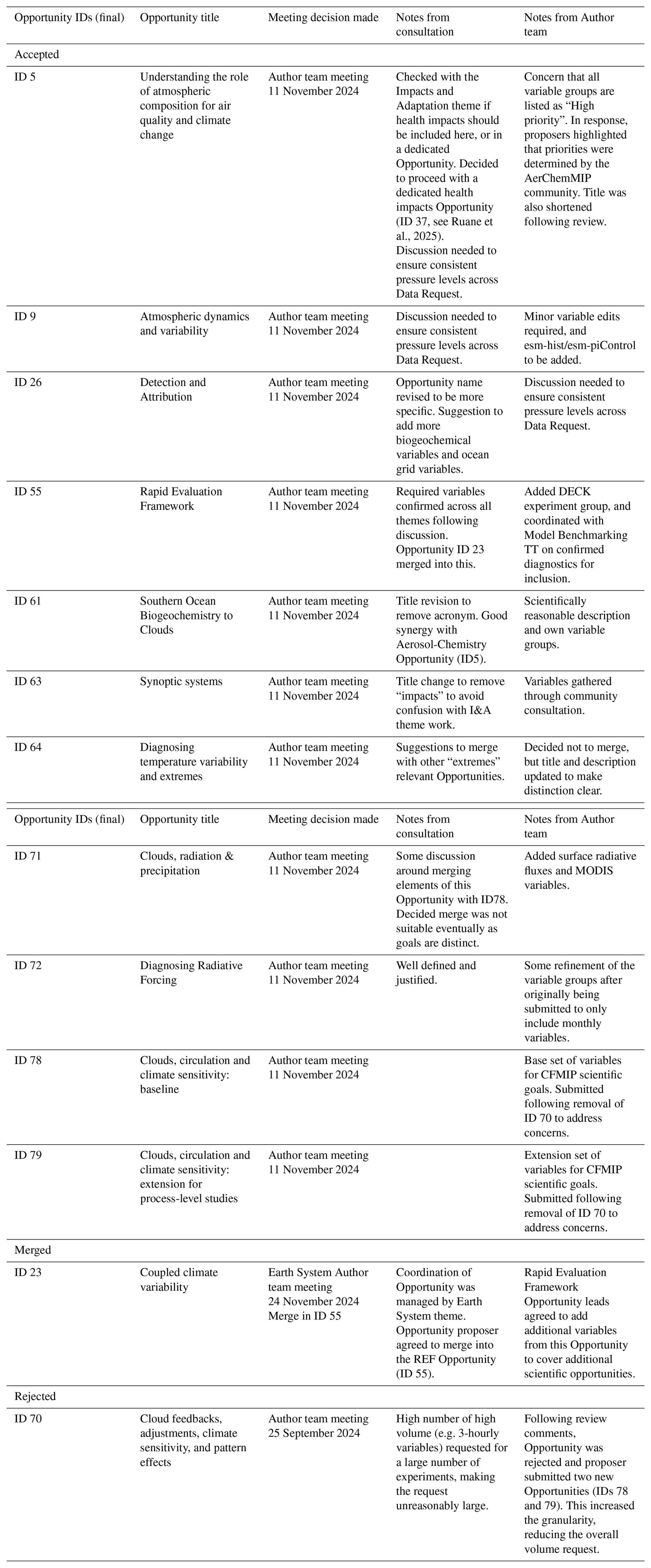
Opportunities proposed in the open call of August 2024 were evaluated by thematic author teams and subsequently reviewed in a September 2024 cross-thematic meeting. Each proposed Opportunity was either accepted, or merged into an accepted Opportunity, or rejected. Subsequent discussions between thematic author teams and Opportunity proposers led to further refinement, improving the Opportunity descriptions and harmonising their data requirements where feasible. In the Atmosphere team, following these discussions, it was decided to keep all Opportunities distinct and not perform any merging of Atmosphere led Opportunities although one Opportunity led by Earth System was merged into ID 55 Rapid Evaluation Framework.
The following table summarises the key processing actions and decisions with specific reference to a working copy Airtable database available at the following URL https://bit.ly/CMIP-DR-Opportunities (last access: 14 April 2026).
Table A1Key processing actions and decisions, outcomes, and the dates actions were taken for Atmosphere Theme Opportunities.
The variables that are newly introduced in CMIP7 are tabulated below. The Coordinate Specifications column is lists special aspects of the temporal and spatial requirements for each variable. The full grid specifications can be found in v1.2 of the CMIP7 Data Request (Data Request Task Team, 2025b).

The variables and their metadata included latest CMIP7 Assessment Fast Track Data Request can be accessed at https://doi.org/10.5281/zenodo.14774070 (Data Request Task Team, 2025a). At the time of this publication, the latest major release is v1.2 (Data Request Task Team, 2025b; accessed at https://doi.org/10.5281/zenodo.15116894), and the latest minor release is v1.2.2.3 (Data Request Task Team, 2025c; accessed at https://doi.org/10.5281/zenodo.17986580).
BD and JA led the conceptualization, investigation, methodology, supervision and visualization with support from all authors. All authors contributed to writing, editing, and reviewing the manuscript and the data curation. BD provided resources and project administration support.
At least one of the (co-)authors is a member of the editorial board of Geoscientific Model Development. The peer-review process was guided by an independent editor, and the authors also have no other competing interests to declare.
Publisher's note: Copernicus Publications remains neutral with regard to jurisdictional claims made in the text, published maps, institutional affiliations, or any other geographical representation in this paper. The authors bear the ultimate responsibility for providing appropriate place names. Views expressed in the text are those of the authors and do not necessarily reflect the views of the publisher.
The authors would like to acknowledge the contributions to all Opportunities. AerChemMIP Opportunity (Understanding the role of atmospheric composition for air quality and climate change) received contributions from the following people: Olivia Clifton, Bill Collins, Mathew Evans, Stephanie Fiedler, Gerd Folberth, Paul Griffiths, Daniel Grosvenor, Larry Horowitz, Matt Kasoar, Martine Michou, Lee Murray, Pierre Nabat, Vaishali Naik, Dirk Olivié, Naga Oshima, Michael Prather, Vichawan Sakulsupich, Michael Schulz, Toshihiko Takemura, Steven Turnock, and Duncan Watson-Parris. Karen McKinno and Osamu Miyawaki contributed to the diagnosing temperature variability and extremes opportunity. Brian Medeiros, David Battisti, Paul Ulrich, Christine Sheilds and Kevin Grise contributed to the synoptic systems and impacts opportunity. Nathan Gillett, Gabi Hegerl, Reto Knutto, Dann Mitchell, Aurelian Ribes, Hideo Shiogama, Daithi Stone, Wolski Piotr, Claudia Tibaldi, and Wenxia Zhang contributed to the DAMIP opportunity. Axel Lauer contributed to the Clouds, radiation & precipitation opportunity. Mark Webb, Alejandro Bodas-Salcedo, and Paulo Ceppi provided input for the two Clouds, circulation and climate sensitivity opportunities. Marc Mallet, Christina McCluskey, Kristen Krumhardt and Alice DuVivier provided input to the Southern Ocean biogeochemistry to clouds opportunity. The CMIP IPO is hosted by the European Space Agency, with staff provided on contract by HE Space Operations Ltd.
Marta Abalos acknowledges funding from the Spanish national project RecO3very (PID2021-124772OB-I00). The work of Lisa Bock and Birgit Hassler was supported by the European Union's Horizon 2020 research and innovation program (grant no. 101003536; ESM2025–Earth System Models for the Future) and by the BMBF under CAP7 project, Grant Agreement no. 01LP2401C. Fiona M. O'Connor was supported by the Met Office Hadley Centre Climate Programme funded by DSIT and the European Union Horizon 2020 Research Programme ESM2025 (grant agreement number 101003536) project. The work of Petr Sacha was supported by the Czech Science Agency under the project no. 23-04921M and by the Charles University Research Centre program No. UNCE/24/SCI/005. Isla Simpson was supported by the NSF National Center for Atmospheric Research, which is a major facility sponsored by the NSF under Cooperative Agreement no. 1852977. Laura Wilcox was supported by the Natural Environment Research Council (NERC; grant NE/W004895/1, TerraFIRMA). The work of Mark Zelinka was supported by the U.S. Department of Energy (DOE) Regional and Global Model Analysis program area and was performed under the auspices of the DOE by Lawrence Livermore National Laboratory under Contract DE-AC52-07NA27344. The work by Tommi Bergman was supported by the Research Council of Finland through the ACCC flagship (decision numbers 357904 and 359342). Sonya Fiddes is supported by the Australian Antarctic Program Partnership, ASCI000002, an Antarctic Science Collaboration Initiative by the Australian Government.
This paper was edited by Lele Shu and reviewed by two anonymous referees.
Abalos, M., Calvo, N., Benito-Barca, S., Garny, H., Hardiman, S. C., Lin, P., Andrews, M. B., Butchart, N., Garcia, R., Orbe, C., Saint-Martin, D., Watanabe, S., and Yoshida, K.: The Brewer–Dobson circulation in CMIP6, Atmos. Chem. Phys., 21, 13571–13591, https://doi.org/10.5194/acp-21-13571-2021, 2021.
Andrews, T., Bodas-Salcedo, A., Gregory, J. M., Dong, Y., Armour, K. C., Paynter, D., Lin, P., Modak, A., Mauritsen, T., Cole, J. N. S., Medeiros, B., Benedict, J. J., Douville, H., Roehrig, R., Koshiro, T., Kawai, H., Ogura, T., Dufresne, J., Allan, R. P., and Liu, C.: On the Effect of Historical SST Patterns on Radiative Feedback, J. Geophys. Res.-Atmos., 127, e2022JD036675, https://doi.org/10.1029/2022JD036675, 2022.
Anstey, J. A., Butchart, N., Hamilton, K., and Osprey, S. M.: The SPARC Quasi-Biennial Oscillation initiative, Q. J. Roy. Meteor. Soc., 148, 1455–1458, https://doi.org/10.1002/qj.3820, 2022.
Armour, K. C., Bitz, C. M., and Roe, G. H.: Time-Varying Climate Sensitivity from Regional Feedbacks, J. Climate, 26, 4518–4534, https://doi.org/10.1175/JCLI-D-12-00544.1, 2013.
Ayarzagüena, B., Charlton-Perez, A. J., Butler, A. H., Hitchcock, P., Simpson, I. R., Polvani, L. M., Butchart, N., Gerber, E. P., Gray, L., Hassler, B., Lin, P., Lott, F., Manzini, E., Mizuta, R., Orbe, C., Osprey, S., Saint-Martin, D., Sigmond, M., Taguchi, M., Volodin, E. M., and Watanabe, S.: Uncertainty in the Response of Sudden Stratospheric Warmings and Stratosphere-Troposphere Coupling to Quadrupled CO2 Concentrations in CMIP6 Models, J. Geophys. Res.-Atmos., 125, e2019JD032345, https://doi.org/10.1029/2019JD032345, 2020.
Baldwin, M. P., Ayarzagüena, B., Birner, T., Butchart, N., Butler, A. H., Charlton-Perez, A. J., Domeisen, D. I. V., Garfinkel, C. I., Garny, H., Gerber, E. P., Hegglin, M. I., Langematz, U., and Pedatella, N. M.: Sudden Stratospheric Warmings, Rev. Geophys., 59, e2020RG000708, https://doi.org/10.1029/2020RG000708, 2021.
Bellouin, N., Quaas, J., Gryspeerdt, E., Kinne, S., Stier, P., Watson-Parris, D., Boucher, O., Carslaw, K. S., Christensen, M., Daniau, A. -L., Dufresne, J. -L., Feingold, G., Fiedler, S., Forster, P., Gettelman, A., Haywood, J. M., Lohmann, U., Malavelle, F., Mauritsen, T., McCoy, D. T., Myhre, G., Mülmenstädt, J., Neubauer, D., Possner, A., Rugenstein, M., Sato, Y., Schulz, M., Schwartz, S. E., Sourdeval, O., Storelvmo, T., Toll, V., Winker, D., and Stevens, B.: Bounding Global Aerosol Radiative Forcing of Climate Change, Rev. Geophys., 58, e2019RG000660, https://doi.org/10.1029/2019RG000660, 2020.
Bjordal, J., Storelvmo, T., Alterskjær, K., and Carlsen, T.: Equilibrium climate sensitivity above 5 °C plausible due to state-dependent cloud feedback, Nat. Geosci., 13, 718–721, https://doi.org/10.1038/s41561-020-00649-1, 2020.
Bloch-Johnson, J., Rugenstein, M., Stolpe, M. B., Rohrschneider, T., Zheng, Y., and Gregory, J. M.: Climate Sensitivity Increases Under Higher CO2 Levels Due to Feedback Temperature Dependence, Geophys. Res. Lett., 48, e2020GL089074, https://doi.org/10.1029/2020GL089074, 2021.
Bock, L. and Lauer, A.: Cloud properties and their projected changes in CMIP models with low to high climate sensitivity, Atmos. Chem. Phys., 24, 1587–1605, https://doi.org/10.5194/acp-24-1587-2024, 2024.
Bodas-Salcedo, A., Webb, M. J., Bony, S., Chepfer, H., Dufresne, J.-L., Klein, S. A., Zhang, Y., Marchand, R., Haynes, J. M., Pincus, R., and John, V. O.: COSP: Satellite simulation software for model assessment, B. Am. Meteorol. Soc., 92, 1023–1043, https://doi.org/10.1175/2011BAMS2856.1, 2011.
Bodas-Salcedo, A., Hill, P. G., Furtado, K., Williams, K. D., Field, P. R., Manners, J. C., Hyder, P., and Kato, S.: Large Contribution of Supercooled Liquid Clouds to the Solar Radiation Budget of the Southern Ocean, J. Climate, 29, 4213–4228, https://doi.org/10.1175/JCLI-D-15-0564.1, 2016.
Bony, S. and Dufresne, J.: Marine boundary layer clouds at the heart of tropical cloud feedback uncertainties in climate models, Geophys. Res. Lett., 32, 2005GL023851, https://doi.org/10.1029/2005GL023851, 2005.
Bony, S., Stevens, B., Frierson, D. M. W., Jakob, C., Kageyama, M., Pincus, R., Shepherd, T. G., Sherwood, S. C., Siebesma, A. P., Sobel, A. H., Watanabe, M., and Webb, M. J.: Clouds, circulation and climate sensitivity, Nat. Geosci., 8, 261–268, https://doi.org/10.1038/ngeo2398, 2015.
Breul, P., Ceppi, P., and Nowack, P.: The importance of stratocumulus clouds for projected warming patterns and circulation changes, Atmos. Chem. Phys., 25, 11991–12005, https://doi.org/10.5194/acp-25-11991-2025, 2025.
Byrne, M. P.: Amplified warming of extreme temperatures over tropical land, Nat. Geosci., 14, 837–841, https://doi.org/10.1038/s41561-021-00828-8, 2021.
Castanheira, J. M. and Marques, C. A. F.: Biases of the Barotropic Atmospheric Circulation Variability in CMIP6 Models, J. Climate, 35, 5071–5085, https://doi.org/10.1175/JCLI-D-21-0581.1, 2022.
Ceppi, P. and Hartmann, D. L.: Clouds and the Atmospheric Circulation Response to Warming, J. Climate, 29, 783–799, https://doi.org/10.1175/JCLI-D-15-0394.1, 2016.
Cess, R. D., Potter, G. L., Blanchet, J. P., Boer, G. J., Ghan, S. J., Kiehl, J. T., Le Treut, H., Li, Z.-X., Liang, X.-Z., Mitchell, J. F. B., Morcrette, J.-J., Randall, D. A., Riches, M. R., Roeckner, E., Schlese, U., Slingo, A., Taylor, K. E., Washington, W. M., Wetherald, R. T., and Yagai, I.: Interpretation of Cloud-Climate Feedback as Produced by 14 Atmospheric General Circulation Models, Science, 245, 513–516, https://doi.org/10.1126/science.245.4917.513, 1989.
Chemke, R. and Coumou, D.: Human influence on the recent weakening of storm tracks in boreal summer, npj Clim. Atmos. Sci., 7, 86, https://doi.org/10.1038/s41612-024-00640-2, 2024.
CMIP Model Benchmarking Task Team: CMIP7 Assessment Fast Track Diagnostics list for the Rapid Evaluation Framework, Zenodo [data set], https://doi.org/10.5281/ZENODO.14284375, 2024.
Climate Model Benchmarking Task Team: Climate Model Benchmarking, https://wcrp-cmip.org/cmip7-task-teams/model-benchmarking/, last access: 24 November 2025.
Collins, W. J., Lamarque, J.-F., Schulz, M., Boucher, O., Eyring, V., Hegglin, M. I., Maycock, A., Myhre, G., Prather, M., Shindell, D., and Smith, S. J.: AerChemMIP: quantifying the effects of chemistry and aerosols in CMIP6, Geosci. Model Dev., 10, 585–607, https://doi.org/10.5194/gmd-10-585-2017, 2017.
Data Request Task Team: CMIP-Data-Request/CMIP7_DReq_Content: Data request content for v1.0 (released 22 Nov 2024), Zenodo [data set], https://doi.org/10.5281/ZENODO.14832541, 2024a.
Data Request Task Team: CMIP-Data-Request/CMIP7_DReq_Content: Data request content for v1.0beta (released 21 Oct 2024), Zenodo [data set], https://doi.org/10.5281/ZENODO.14832540, 2024b.
Data Request Task Team: CMIP-Data-Request/CMIP7_DReq_Content, Zenodo [data set], https://doi.org/10.5281/zenodo.14774070, 2025a.
Data Request Task Team: CMIP-Data-Request/CMIP7_DReq_Content: Data request content for v1.2, Zenodo [data set], https://doi.org/10.5281/ZENODO.15116894, 2025b.
Data Request Task Team: CMIP-Data-Request/CMIP7_DReq_Content: Data request content for v1.2.2.3, Zenodo [data set], https://doi.org/10.5281/zenodo.17986580, 2025c.
De, B., Tselioudis, G., and Polvani, L. M.: Improved representation of atmospheric dynamics in CMIP6 models removes climate sensitivity dependence on Hadley cell climatological extent, Atmos. Sci. Lett., 23, e1073, https://doi.org/10.1002/asl.1073, 2022.
Ding, X., Chen, G., and Ma, W.: Stratosphere-Troposphere Coupling of Extreme Stratospheric Wave Activity in CMIP6 Models, J. Geophys. Res.-Atmos., 128, e2023JD038811, https://doi.org/10.1029/2023JD038811, 2023.
Dingley, B., Anstey, J., and CMIP Data Request Atmosphere author team members: Atmospheric processes included in the CMIP7 Assessment Fast Track Data Request, Zenodo [data set], https://doi.org/10.5281/ZENODO.15681840, 2025.
Domeisen, D. I. V. and Butler, A. H.: Stratospheric drivers of extreme events at the Earth's surface, Commun. Earth Environ., 1, 59, https://doi.org/10.1038/s43247-020-00060-z, 2020.
Dunne, J. P., Hewitt, H. T., Arblaster, J. M., Bonou, F., Boucher, O., Cavazos, T., Dingley, B., Durack, P. J., Hassler, B., Juckes, M., Miyakawa, T., Mizielinski, M., Naik, V., Nicholls, Z., O'Rourke, E., Pincus, R., Sanderson, B. M., Simpson, I. R., and Taylor, K. E.: An evolving Coupled Model Intercomparison Project phase 7 (CMIP7) and Fast Track in support of future climate assessment, Geosci. Model Dev., 18, 6671–6700, https://doi.org/10.5194/gmd-18-6671-2025, 2025.
Durack, P. J., Taylor, K. E., Gleckler, P. J., Meehl, G. A., Lawrence, B. N., Covey, C., Stouffer, R. J., Levavasseur, G., Ben-Nasser, A., Denvil, S., Stockhause, M., Gregory, J. M., Juckes, M., Ames, S. K., Antonio, F., Bader, D. C., Dunne, J. P., Ellis, D., Eyring, V., Fiore, S. L., Joussaume, S., Kershaw, P., Lamarque, J.-F., Lautenschlager, M., Lee, J., Mauzey, C. F., Mizielinski, M., Nassisi, P., Nuzzo, A., O’Rourke, E., Painter, J., Potter, G. L., Rodriguez, S., and Williams, D. N.: The Coupled Model Intercomparison Project (CMIP): Reviewing project history, evolution, infrastructure and implementation, EGUsphere [preprint], https://doi.org/10.5194/egusphere-2024-3729, 2025.
DynVar: WCRP-APARC – DynVarMIP data availability, https://aparc-climate.org/activities/dynvar/, last access: 14 April 2026.
Edwards, P. N.: A Brief History of Atmospheric General Circulation Modeling, in: International Geophysics, Academic Press, 70, 67–90, https://doi.org/10.1016/S0074-6142(00)80050-9, 2000.
ESGF Data Statistics: https://esgf-ui.cmcc.it/esgf-dashboard-ui/cmip6.html, last access: 6 December 2025.
Eyring, V., Bony, S., Meehl, G. A., Senior, C. A., Stevens, B., Stouffer, R. J., and Taylor, K. E.: Overview of the Coupled Model Intercomparison Project Phase 6 (CMIP6) experimental design and organization, Geosci. Model Dev., 9, 1937–1958, https://doi.org/10.5194/gmd-9-1937-2016, 2016.
Eyring, V., Gillett, N. P., Achuta Rao, K. M., Barimalala, R., Barreiro Parrillo, M., Bellouin, N., Cassou, C., Durack, P. J., Kosaka, Y., McGregor, S., Min, S., Morgenstern, O., and Sun, Y.: Human Influence on the Climate System, in: Climate Change 2021: The Physical Science Basis. Contribution of Working Group I to the Sixth Assessment Report of the Intergovernmental Panel on Climate Change, edited by: Masson-Delmotte, V., Zhai, P., Pirani, A., Connors, S. L., Péan, C., Berger, S., Caud, N., Chen, Y., Goldfarb, L., Gomis, M. I., Huang, M., Leitzell, K., Lonnoy, E., Matthews, J. B. R., Maycock, T. K., Waterfield, T., Yelekçi, O., Yu, R., and Zhou, B., Cambridge University Press, Cambridge, United Kingdom and New York, NY, USA, 423–552, https://doi.org/10.1017/9781009157896.005, 2021.
Fiddes, S. L., Woodhouse, M. T., Mallet, M. D., Lamprey, L. J., Humphries, R. S., Protat, A., Alexander, S. P., Hayashida, H., Putland, S., Miljevic, B., and Schofield, R.: The ACCESS-AM2 climate model underestimates aerosol concentration in the Southern Ocean; improving aerosol representation could be problematic for the global energy balance, Atmos. Chem. Phys., 25, 16451–16477, https://doi.org/10.5194/acp-25-16451-2025, 2025.
Fiedler, S., Naik, V., O'Connor, F. M., Smith, C. J., Griffiths, P., Kramer, R. J., Takemura, T., Allen, R. J., Im, U., Kasoar, M., Modak, A., Turnock, S., Voulgarakis, A., Watson-Parris, D., Westervelt, D. M., Wilcox, L. J., Zhao, A., Collins, W. J., Schulz, M., Myhre, G., and Forster, P. M.: Interactions between atmospheric composition and climate change – progress in understanding and future opportunities from AerChemMIP, PDRMIP, and RFMIP, Geosci. Model Dev., 17, 2387–2417, https://doi.org/10.5194/gmd-17-2387-2024, 2024.
Fiedler, S., O'Connor, F. M., Watson-Parris, D., Allen, R. J., Collins, W. J., Griffiths, P. T., Kasoar, M., Kikstra, J., Kok, J. F., Murray, L. T., Paulot, F., Sand, M., Turnock, S., Weber, J., Wilcox, L. J., and Naik, V.: AerChemMIP2 – Unraveling the role of reactive gases, aerosol particles, and land use for air quality and climate change in CMIP7, EGUsphere [preprint], https://doi.org/10.5194/egusphere-2025-5669, 2025.
Fiore, S., Nassisi, P., Nuzzo, A., Mirto, M., Cinquini, L., Williams, D., and Aliosio, G.: A climate change community gateway for data usage & data archive metrics across the earth system grid federation, in: CEUR WORKSHOP PROCEEDING, CEUR-WS, https://hdl.handle.net/11572/329932 (last access: 14 April 2026), 2021.
Forster, P., Storelvmo, T., Armour, K., Collins, W., Dufresne, J.-L., Frame, D., Lunt, D. J., Mauritsen, T., Palmer, M. D., Watanabe, M., Wild, M., and Zhang, H.: The Earth's Energy Budget, Climate Feedbacks, and Climate Sensitivity, in: Climate Change 2021: The Physical Science Basis. Contribution of Working Group I to the Sixth Assessment Report of the Intergovernmental Panel on Climate Change, edited by: Masson-Delmotte, V., Zhai, P., Pirani, A., Connors, S. L., Péan, C., Berger, S., Caud, N., Chen, Y., Goldfarb, L., Gomis, M. I., Huang, M., Leitzell, K., Lonnoy, E., Matthews, J. B. R., Maycock, T. K., Waterfield, T., Yelekçi, O., Yu, R., and Zhou, B., Cambridge University Press, Cambridge, United Kingdom and New York, NY, USA, 923–1054, https://doi.org/10.1017/9781009157896.009, 2021.
Gerber, E. P. and Manzini, E.: The Dynamics and Variability Model Intercomparison Project (DynVarMIP) for CMIP6: assessing the stratosphere–troposphere system, Geosci. Model Dev., 9, 3413–3425, https://doi.org/10.5194/gmd-9-3413-2016, 2016.
Gillett, N. P., Simpson, I. R., Hegerl, G., Knutti, R., Mitchell, D., Ribes, A., Shiogama, H., Stone, D., Tebaldi, C., Wolski, P., Zhang, W., and Arora, V. K.: The Detection and Attribution Model Intercomparison Project (DAMIP v2.0) contribution to CMIP7, Geosci. Model Dev., 18, 4399–4416, https://doi.org/10.5194/gmd-18-4399-2025, 2025.
Gregory, J. and Webb, M.: Tropospheric Adjustment Induces a Cloud Component in CO2 Forcing, J. Climate, 21, 58–71, https://doi.org/10.1175/2007JCLI1834.1, 2008.
Griffiths, P. T., Wilcox, L. J., Allen, R. J., Naik, V., O'Connor, F. M., Prather, M., Archibald, A., Brown, F., Deushi, M., Collins, W., Fiedler, S., Oshima, N., Murray, L. T., Samset, B. H., Smith, C., Turnock, S., Watson-Parris, D., and Young, P. J.: Opinion: The role of AerChemMIP in advancing climate and air quality research, Atmos. Chem. Phys., 25, 8289–8328, https://doi.org/10.5194/acp-25-8289-2025, 2025.
Grise, K. M. and Polvani, L. M.: Southern Hemisphere Cloud–Dynamics Biases in CMIP5 Models and Their Implications for Climate Projections, J. Climate, 27, 6074–6092, https://doi.org/10.1175/JCLI-D-14-00113.1, 2014.
Hájková, D. and Šácha, P.: Parameterized orographic gravity wave drag and dynamical effects in CMIP6 models, Clim. Dynam., 62, 2259–2284, https://doi.org/10.1007/s00382-023-07021-0, 2024.
Hall, R. J., Mitchell, D. M., Seviour, W. J. M., and Wright, C. J.: Persistent Model Biases in the CMIP6 Representation of Stratospheric Polar Vortex Variability, J. Geophys. Res.-Atmos., 126, e2021JD034759, https://doi.org/10.1029/2021JD034759, 2021.
Hassell, D., Gregory, J., Blower, J., Lawrence, B. N., and Taylor, K. E.: A data model of the Climate and Forecast metadata conventions (CF-1.6) with a software implementation (cf-python v2.1), Geosci. Model Dev., 10, 4619–4646, https://doi.org/10.5194/gmd-10-4619-2017, 2017.
Hassler, B., Hoffman, F. M., Beadling, R., Blockley, E., Huang, B., Lee, J., Lembo, V., Lewis, J., Lu, J., Madaus, L., Malinina, E., Medeiros, B., Pokam, W., Scoccimarro, E., and Swaminathan, R.: Systematic benchmarking of climate models: Methodologies, applications, and new directions, Rev. Geophys., 64, e2025RG000891, https://doi.org/10.1029/2025RG000891, 2026.
Haynes, P., Hitchcock, P., Hitchman, M., Yoden, S., Hendon, H., Kiladis, G., Kodera, K., and Simpson, I.: The Influence of the Stratosphere on the Tropical Troposphere, J. Meteorol. Soc. Jpn., 99, 803–845, https://doi.org/10.2151/jmsj.2021-040, 2021.
Hoffman, F. M., Hassler, B., Swaminathan, R., Lewis, J., Andela, B., Collier, N., Hegedűs, D., Lee, J., Pascoe, C., Pflüger, M., Stockhause, M., Ullrich, P., Xu, M., Bock, L., Chun, F., Gier, B. K., Kelley, D. I., Lauer, A., Lenhardt, J., Schlund, M., Sreeush, M. G., Weigel, K., Blockley, E., Beadling, R., Beucher, R., Dugassa, D. D., Lembo, V., Lu, J., Brands, S., Tjiputra, J., Malinina, E., Mederios, B., Scoccimarro, E., Walton, J., Kershaw, P., Marquez, A. L., Roberts, M. J., O’Rourke, E., Dingley, E., Turner, B., Hewitt, H., and Dunne, J. P.: Rapid Evaluation Framework for the CMIP7 Assessment Fast Track, EGUsphere [preprint], https://doi.org/10.5194/egusphere-2025-2685, 2025.
Hyder, P., Edwards, J. M., Allan, R. P., Hewitt, H. T., Bracegirdle, T. J., Gregory, J. M., Wood, R. A., Meijers, A. J. S., Mulcahy, J., Field, P., Furtado, K., Bodas-Salcedo, A., Williams, K. D., Copsey, D., Josey, S. A., Liu, C., Roberts, C. D., Sanchez, C., Ridley, J., Thorpe, L., Hardiman, S. C., Mayer, M., Berry, D. I., and Belcher, S. E.: Critical Southern Ocean climate model biases traced to atmospheric model cloud errors, Nat. Commun., 9, 3625, https://doi.org/10.1038/s41467-018-05634-2, 2018.
Intergovernmental Panel On Climate Change (IPCC): Climate Change 2021 – The Physical Science Basis: Working Group I Contribution to the Sixth Assessment Report of the Intergovernmental Panel on Climate Change, 1st Edn., Cambridge University Press, https://doi.org/10.1017/9781009157896, 2023.
Jakob, C., Gettelman, A., and Pitman, A.: The need to operationalize climate modelling, Nat. Clim. Change, 13, 1158–1160, https://doi.org/10.1038/s41558-023-01849-4, 2023.
Juckes, M., Taylor, K. E., Antonio, F., Brayshaw, D., Buontempo, C., Cao, J., Durack, P. J., Kawamiya, M., Kim, H., Lovato, T., Mackallah, C., Mizielinski, M., Nuzzo, A., Stockhause, M., Visioni, D., Walton, J., Turner, B., O'Rourke, E., and Dingley, B.: Baseline Climate Variables for Earth System Modelling, Geosci. Model Dev., 18, 2639–2663, https://doi.org/10.5194/gmd-18-2639-2025, 2025.
Kamae, Y., Watanabe, M., Ogura, T., Yoshimori, M., and Shiogama, H.: Rapid Adjustments of Cloud and Hydrological Cycle to Increasing CO2: a Review, Curr. Clim. Change Rep., 1, 103–113, https://doi.org/10.1007/s40641-015-0007-5, 2015.
Karpechko, A. Yu., Afargan-Gerstman, H., Butler, A. H., Domeisen, D. I. V., Kretschmer, M., Lawrence, Z., Manzini, E., Sigmond, M., Simpson, I. R., and Wu, Z.: Northern Hemisphere Stratosphere-Troposphere Circulation Change in CMIP6 Models: 1. Inter-Model Spread and Scenario Sensitivity, J. Geophys. Res.-Atmos., 127, e2022JD036992, https://doi.org/10.1029/2022JD036992, 2022.
Karpechko, A. Yu., Wu, Z., Simpson, I. R., Kretschmer, M., Afargan-Gerstman, H., Butler, A. H., Domeisen, D. I. V., Garny, H., Lawrence, Z., Manzini, E., and Sigmond, M.: Northern Hemisphere Stratosphere-Troposphere Circulation Change in CMIP6 Models: 2. Mechanisms and Sources of the Spread, J. Geophys. Res.-Atmos., 129, e2024JD040823, https://doi.org/10.1029/2024JD040823, 2024.
Kelleher, M. K. and Grise, K. M.: Examining Southern Ocean Cloud Controlling Factors on Daily Time Scales and Their Connections to Midlatitude Weather Systems, J. Climate, 32, 5145–5160, https://doi.org/10.1175/JCLI-D-18-0840.1, 2019.
Kim, H., Kang, S. M., Kay, J. E., and Xie, S.-P.: Subtropical clouds key to Southern Ocean teleconnections to the tropical Pacific, P. Natl. Acad. Sci. USA, 119, e2200514119, https://doi.org/10.1073/pnas.2200514119, 2022.
Lauer, A., Bock, L., Hassler, B., Schröder, M., and Stengel, M.: Cloud Climatologies from Global Climate Models – A Comparison of CMIP5 and CMIP6 Models with Satellite Data, J. Climate, 36, 281–311, https://doi.org/10.1175/JCLI-D-22-0181.1, 2023.
Lutsko, N. J., Luongo, M. T., Wall, C. J., and Myers, T. A.: Correlation Between Cloud Adjustments and Cloud Feedbacks Responsible for Larger Range of Climate Sensitivities in CMIP6, J. Geophys. Res.-Atmos., 127, e2022JD037486, https://doi.org/10.1029/2022JD037486, 2022.
Mace, G. G., Benson, S., Humphries, R., Gombert, P. M., and Sterner, E.: Natural marine cloud brightening in the Southern Ocean, Atmos. Chem. Phys., 23, 1677–1685, https://doi.org/10.5194/acp-23-1677-2023, 2023.
Mace, G. G., Benson, S., Sterner, E., Protat, A., Humphries, R., and Hallar, A. G.: The Association Between Cloud Droplet Number over the Summer Southern Ocean and Air Mass History, J. Geophys. Res.-Atmos., 129, e2023JD040673, https://doi.org/10.1029/2023JD040673, 2024.
Mackallah, C., Juckes, M., Anstey, J., Dingley, B., Pascoe, C., Rigoudy, G., Moine, M.-P., Lovato, T., Pamment, A., Schupfner, M., Kawamiya, M., Bergman, T., Koven, C., O'Rourke, E., Turner, B., Ellis, D., and Mizielinski, M.: CMIP7 Data Request: co-created guidance for the production of CMIP7 data [v1.2.2.3], EGUsphere [preprint], https://doi.org/10.5194/egusphere-2026-1641, 2026.
Mallet, M. D., Humphries, R. S., Fiddes, S. L., Alexander, S. P., Altieri, K., Angot, H., Anilkumar, N., Bartels-Rausch, T., Creamean, J., Dall'Osto, M., Dommergue, A., Frey, M., Henning, S., Lannuzel, D., Lapere, R., Mace, G. G., Mahajan, A. S., McFarquhar, G. M., Meiners, K. M., Miljevic, B., Peeken, I., Protat, A., Schmale, J., Steiner, N., Sellegri, K., Simó, R., Thomas, J. L., Willis, M. D., Winton, V. H. L., and Woodhouse, M. T.: Untangling the influence of Antarctic and Southern Ocean life on clouds, Elem. Sci. Anth., 11, 00130, https://doi.org/10.1525/elementa.2022.00130, 2023.
Martin, Z., Son, S.-W., Butler, A., Hendon, H., Kim, H., Sobel, A., Yoden, S., and Zhang, C.: The influence of the quasi-biennial oscillation on the Madden–Julian oscillation, Nat. Rev. Earth Environ., 2, 477–489, https://doi.org/10.1038/s43017-021-00173-9, 2021.
Meehl, G. A.: Global Coupled General Circulation Models, B. Am. Meteorol. Soc., 76, 951–957, https://doi.org/10.1175/1520-0477-76.6.951, 1995.
Myers, T. A., Mechoso, C. R., and DeFlorio, M. J.: Importance of positive cloud feedback for tropical Atlantic interhemispheric climate variability, Clim. Dynam., 51, 1707–1717, https://doi.org/10.1007/s00382-017-3978-1, 2018.
Niu, Q., McCluskey, C., and McFarquhar, G. M.: Marine Boundary Layer Cloud Condensation Nuclei Bias Over the Southern Ocean: Comparisons Between the Community Atmosphere Model 6 and Field Observations, J. Geophys. Res.-Atmos., 130, e2024JD042734, https://doi.org/10.1029/2024JD042734, 2025.
obs4MIPs – Observations for Model Intercomparison Projects: https://pcmdi.github.io/obs4MIPs/, last access: 24 November 2025.
O'Rourke, E.: CMIP6 Community Survey Results, Zenodo, https://doi.org/10.5281/ZENODO.11654909, 2024.
Peixóto, J. P. and Oort, A. H.: Physics of climate, Rev. Mod. Phys., 56, 365–429, https://doi.org/10.1103/RevModPhys.56.365, 1984.
Phillips, N. A.: The general circulation of the atmosphere: A numerical experiment, Q. J. Roy. Meteor. Soc., 82, 535–539, https://doi.org/10.1002/qj.49708235422, 1956.
Poletti, A. N., Frierson, D. M. W., and Armour, K. C.: Why Do CO2 Quadrupling Simulations Warm More Than Twice as Much as CO2 Doubling Simulations in CMIP6?, Geophys. Res. Lett., 51, e2023GL107320, https://doi.org/10.1029/2023GL107320, 2024.
Randall, D. A., Bitz, C. M., Danabasoglu, G., Denning, A. S., Gent, P. R., Gettelman, A., Griffies, S. M., Lynch, P., Morrison, H., Pincus, R., and Thuburn, J.: 100 Years of Earth System Model Development, Meteorol. Monogr., 59, 12.1–12.66, https://doi.org/10.1175/AMSMONOGRAPHS-D-18-0018.1, 2019.
Rao, J. and Garfinkel, C. I.: CMIP5/6 models project little change in the statistical characteristics of sudden stratospheric warmings in the 21st century, Environ. Res. Lett., 16, 034024, https://doi.org/10.1088/1748-9326/abd4fe, 2021a.
Rao, J. and Garfinkel, C. I.: Projected changes of stratospheric final warmings in the Northern and Southern Hemispheres by CMIP5/6 models, Clim. Dynam., 56, 3353–3371, https://doi.org/10.1007/s00382-021-05647-6, 2021b.
Rao, J., Garfinkel, C. I., Wu, T., Lu, Y., and Chu, M.: Mean State of the Northern Hemisphere Stratospheric Polar Vortex in Three Generations of CMIP Models, J. Climate, 35, 4603–4625, https://doi.org/10.1175/JCLI-D-21-0694.1, 2022.
Regayre, L. A., Schmale, J., Johnson, J. S., Tatzelt, C., Baccarini, A., Henning, S., Yoshioka, M., Stratmann, F., Gysel-Beer, M., Grosvenor, D. P., and Carslaw, K. S.: The value of remote marine aerosol measurements for constraining radiative forcing uncertainty, Atmos. Chem. Phys., 20, 10063–10072, https://doi.org/10.5194/acp-20-10063-2020, 2020.
Ruane, A. C., Teichmann, C., Arnell, N. W., Carter, T. R., Ebi, K. L., Frieler, K., Goodess, C. M., Hewitson, B., Horton, R., Kovats, R. S., Lotze, H. K., Mearns, L. O., Navarra, A., Ojima, D. S., Riahi, K., Rosenzweig, C., Themessl, M., and Vincent, K.: The Vulnerability, Impacts, Adaptation and Climate Services Advisory Board (VIACS AB v1.0) contribution to CMIP6, Geosci. Model Dev., 9, 3493–3515, https://doi.org/10.5194/gmd-9-3493-2016, 2016.
Ruane, A. C., Pascoe, C. L., Teichmann, C., Brayshaw, D. J., Buontempo, C., Diouf, I., Fernandez, J., Gonzalez, P. L. M., Hassler, B., Hernaman, V., Im, U., Iovino, D., Juckes, M., Lake, I. L., Lam, T., Lin, X., Mao, J., Nazarian, N., Parey, S., Roy, I., Tseng, W.-L., Turner, B., Wiebe, A., Zhao, L., and Zurell, D.: CMIP7 data request: impacts and adaptation priorities and opportunities, Geosci. Model Dev., 18, 9497–9540, https://doi.org/10.5194/gmd-18-9497-2025, 2025.
Rugenstein, M., Zelinka, M., Karnauskas, K., Ceppi, P., and Andrews, T.: Patterns of Surface Warming Matter for Climate Sensitivity, Eos, 104, https://doi.org/10.1029/2023EO230411, 2023.
Russell, J. E., Bantges, R. J., Brindley, H. E., and Bodas-Salcedo, A.: GERB Obs4MIPs: a dataset for evaluating diurnal and monthly variations in top-of-atmosphere radiative fluxes in climate models, Earth Syst. Sci. Data, 16, 4243–4266, https://doi.org/10.5194/essd-16-4243-2024, 2024.
Schaeffer, R., Schipper, E. L. F., Ospina, D., Mirazo, P., Alencar, A., Anvari, M., Artaxo, P., Biresselioglu, M. E., Blome, T., Boeckmann, M., Brink, E., Broadgate, W., Bustamante, M., Cai, W., Canadell, J. G., Cardinale, R., Chidichimo, M. P., Ditlevsen, P., Eicker, U., Feron, S., Fikru, M. G., Fuss, S., Gaye, A. T., Gustafsson, Ö., Harring, N., He, C., Hebden, S., Heilemann, A., Hirota, M., Janardhanan, N., Juhola, S., Jung, T. Y., Kejun, J., Kilki?, Ş., Kumarasinghe, N., Lapola, D., Lee, J.-Y., Levis, C., Lusambili, A., Maasakkers, J. D., MacIntosh, C., Mahmood, J., Mankin, J. S., Marchegiani, P., Martin, M., Mukherji, A., Muñoz-Erickson, T. A., Niazi, Z., Nyangon, J., Pandipati, S., Perera, A. T. D., Persad, G., Persson, Å., Redman, A., Riipinen, I., Rockström, J., Roffe, S., Roy, J., Sakschewski, B., Samset, B. H., Schlosser, P., Sharifi, A., Shih, W.-Y., Sioen, G. B., Sokona, Y., Stammer, D., Suk, S., Thiam, D., Thompson, V., Tullos, E., Van Westen, R. M., Vargas Falla, A. M., Vecellio, D. J., Worden, J., Wu, H. C., Xu, C., Yang, Y., Zachariah, M., Zhang, Z., and Ziervogel, G.: Ten new insights in climate science 2024, One Earth, 8, 101285, https://doi.org/10.1016/j.oneear.2025.101285, 2025.
Schmidt, G. A., Andrews, T., Bauer, S. E., Durack, P. J., Loeb, N. G., Ramaswamy, V., Arnold, N. P., Bosilovich, M. G., Cole, J., Horowitz, L. W., Johnson, G. C., Lyman, J. M., Medeiros, B., Michibata, T., Olonscheck, D., Paynter, D., Raghuraman, S. P., Schulz, M., Takasuka, D., Tallapragada, V., Taylor, P. C., and Ziehn, T.: CERESMIP: a climate modeling protocol to investigate recent trends in the Earth's Energy Imbalance, Front. Clim., 5, 1202161, https://doi.org/10.3389/fclim.2023.1202161, 2023.
Schuddeboom, A. J. and McDonald, A. J.: The Southern Ocean Radiative Bias, Cloud Compensating Errors, and Equilibrium Climate Sensitivity in CMIP6 Models, J. Geophys. Res.-Atmos., 126, e2021JD035310, https://doi.org/10.1029/2021JD035310, 2021.
Shaw, T. A., Arblaster, J. M., Birner, T., Butler, A. H., Domeisen, D. I. V., Garfinkel, C. I., Garny, H., Grise, K. M., and Karpechko, A. Yu.: Emerging Climate Change Signals in Atmospheric Circulation, AGU Adv., 5, e2024AV001297, https://doi.org/10.1029/2024AV001297, 2024a.
Shaw, T. A., Arias, P. A., Collins, M., Coumou, D., Diedhiou, A., Garfinkel, C. I., Jain, S., Roxy, M. K., Kretschmer, M., Leung, L. R., Narsey, S., Martius, O., Seager, R., Shepherd, T. G., Sörensson, A. A., Stephenson, T., Taylor, M., and Wang, L.: Regional climate change: consensus, discrepancies, and ways forward, Front. Clim., 6, 1391634, https://doi.org/10.3389/fclim.2024.1391634, 2024b.
Shepherd, T. G.: Atmospheric circulation as a source of uncertainty in climate change projections, Nat. Geosci., 7, 703–708, https://doi.org/10.1038/ngeo2253, 2014.
Simpson, I. R., Bacmeister, J., Neale, R. B., Hannay, C., Gettelman, A., Garcia, R. R., Lauritzen, P. H., Marsh, D. R., Mills, M. J., Medeiros, B., and Richter, J. H.: An Evaluation of the Large-Scale Atmospheric Circulation and Its Variability in CESM2 and Other CMIP Models, J. Geophys. Res.-Atmos., 125, e2020JD032835, https://doi.org/10.1029/2020JD032835, 2020.
Smith, C. J., Kramer, R. J., Myhre, G., Alterskjær, K., Collins, W., Sima, A., Boucher, O., Dufresne, J.-L., Nabat, P., Michou, M., Yukimoto, S., Cole, J., Paynter, D., Shiogama, H., O'Connor, F. M., Robertson, E., Wiltshire, A., Andrews, T., Hannay, C., Miller, R., Nazarenko, L., Kirkevåg, A., Olivié, D., Fiedler, S., Lewinschal, A., Mackallah, C., Dix, M., Pincus, R., and Forster, P. M.: Effective radiative forcing and adjustments in CMIP6 models, Atmos. Chem. Phys., 20, 9591–9618, https://doi.org/10.5194/acp-20-9591-2020, 2020.
Soden, B. J., Held, I. M., Colman, R., Shell, K. M., Kiehl, J. T., and Shields, C. A.: Quantifying Climate Feedbacks Using Radiative Kernels, J. Climate, 21, 3504–3520, https://doi.org/10.1175/2007JCLI2110.1, 2008.
Stevens, B.: A Perspective on the Future of CMIP, AGU Adv., 5, e2023AV001086, https://doi.org/10.1029/2023AV001086, 2024.
Swales, D. J., Pincus, R., and Bodas-Salcedo, A.: The Cloud Feedback Model Intercomparison Project Observational Simulator Package: Version 2, Geosci. Model Dev., 11, 77–81, https://doi.org/10.5194/gmd-11-77-2018, 2018.
Turner, B., Dingley, B., O'Rourke, E., Juckes, M., Mackallah, C., and Anstey, J.: CMIP7 Data Request: Public Consultation Guidance supporting information, Zenodo [data set], https://doi.org/10.5281/ZENODO.13224743, 2024.
Van Vuuren, D. P., O'Neill, B. C., Tebaldi, C., Sanderson, B. M., Chini, L. P., Friedlingstein, P., Hasegawa, T., Riahi, K., Govindasamy, B., Bauer, N., Eyring, V., Fall, C. M. N., Frieler, K., Gidden, M. J., Gohar, L. K., Högner, A., Jones, A. D., Kikstra, J., King, A., Knutti, R., Kriegler, E., Lawrence, P., Lennard, C., Lowe, J., Mathison, C., Mehmood, S., Nicholls, Z., Prado, L. F., Zhang, Q., Rose, S. K., Ruane, A. C., Sandstad, M., Schleussner, C.-F., Seferian, R., Sillmann, J., Smith, C., Sörensson, A. A., Panickal, S., Tachiiri, K., Vaughan, N., Vishwanathan, S. S., Yokohata, T., Zecchetto, M., and Ziehn, T.: The Scenario Model Intercomparison Project for CMIP7 (ScenarioMIP-CMIP7), Geosci. Model Dev., 19, 2627–2656, https://doi.org/10.5194/gmd-19-2627-2026, 2026.
Vial, J., Dufresne, J.-L., and Bony, S.: On the interpretation of inter-model spread in CMIP5 climate sensitivity estimates, Clim. Dynam., 41, 3339–3362, https://doi.org/10.1007/s00382-013-1725-9, 2013.
Wall, C. J., Paynter, D., Qin, Y., Debolskiy, M., Duffy, M. L., Michibata, T., Duran, B. M., Lutsko, N. J., Ma, P.-L., Medeiros, B., Storelvmo, T., and Zhao, M.: Decomposing Cloud Radiative Feedbacks by Cloud-Top Phase, J. Climate, 38, 4023–4043, https://doi.org/10.1175/JCLI-D-24-0538.1, 2025.
Watson-Parris, D. and Smith, C. J.: Large uncertainty in future warming due to aerosol forcing, Nat. Clim. Change, 12, 1111–1113, https://doi.org/10.1038/s41558-022-01516-0, 2022.
Weart, S.: The development of general circulation models of climate, St. Hist. Phil. Sci., 41, 208–217, https://doi.org/10.1016/j.shpsb.2010.06.002, 2010.
Webb, M. J., Lock, A. P., and Ogura, T.: What Are the Main Causes of Positive Subtropical Low Cloud Feedbacks in Climate Models?, J. Adv. Model. Earth Sy., 16, e2023MS003716, https://doi.org/10.1029/2023MS003716, 2024.
WCRP-CMIP: CMIP7 Data Request: Call for Atmosphere theme paper co-authors, https://wcrp-cmip.org/cmip7-atmosphere-call/, last access: 6 December 2025.
WMO (World Meteorological Organization): Scientific Assessment of Ozone Depletion: 2022, WMO, Geneva, ISBN 978-9914-733-97-6, 2022.
Wu, Z. and Reichler, T.: Variations in the Frequency of Stratospheric Sudden Warmings in CMIP5 and CMIP6 and Possible Causes, J. Climate, 33, 10305–10320, https://doi.org/10.1175/JCLI-D-20-0104.1, 2020.
Zelinka, M. D., Klein, S. A., and Hartmann, D. L.: Computing and Partitioning Cloud Feedbacks Using Cloud Property Histograms. Part I: Cloud Radiative Kernels, J. Climate, 25, 3715–3735, https://doi.org/10.1175/JCLI-D-11-00248.1, 2012a.
Zelinka, M. D., Klein, S. A., and Hartmann, D. L.: Computing and Partitioning Cloud Feedbacks Using Cloud Property Histograms. Part II: Attribution to Changes in Cloud Amount, Altitude, and Optical Depth, J. Climate, 25, 3736–3754, https://doi.org/10.1175/JCLI-D-11-00249.1, 2012b.
Zelinka, M. D., Klein, S. A., Taylor, K. E., Andrews, T., Webb, M. J., Gregory, J. M., and Forster, P. M.: Contributions of Different Cloud Types to Feedbacks and Rapid Adjustments in CMIP5, J. Climate, 26, 5007–5027, https://doi.org/10.1175/JCLI-D-12-00555.1, 2013.
Zelinka, M. D., Myers, T. A., McCoy, D. T., Po-Chedley, S., Caldwell, P. M., Ceppi, P., Klein, S. A., and Taylor, K. E.: Causes of Higher Climate Sensitivity in CMIP6 Models, Geophys. Res. Lett., 47, e2019GL085782, https://doi.org/10.1029/2019GL085782, 2020.
Zhang, Y. and Boos, W. R.: An upper bound for extreme temperatures over midlatitude land, P. Natl. Acad. Sci. USA, 120, e2215278120, https://doi.org/10.1073/pnas.2215278120, 2023.
Zhao, S., Zhang, J., Zhang, C., Xu, M., Keeble, J., Wang, Z., and Xia, X.: Evaluating Long-Term Variability of the Arctic Stratospheric Polar Vortex Simulated by CMIP6 Models, Remote Sens., 14, 4701, https://doi.org/10.3390/rs14194701, 2022.
- Abstract
- Introduction
- Approach and methodology
- Atmosphere Opportunities included in the CMIP7 Data Request
- Discussion and Conclusions
- Appendix A: Opportunity processing
- Appendix B: Variable description
- Code and data availability
- Author contributions
- Competing interests
- Disclaimer
- Acknowledgements
- Financial support
- Review statement
- References
- Abstract
- Introduction
- Approach and methodology
- Atmosphere Opportunities included in the CMIP7 Data Request
- Discussion and Conclusions
- Appendix A: Opportunity processing
- Appendix B: Variable description
- Code and data availability
- Author contributions
- Competing interests
- Disclaimer
- Acknowledgements
- Financial support
- Review statement
- References