
the Creative Commons Attribution 4.0 License.
the Creative Commons Attribution 4.0 License.
 | 15 Apr 2026
CMIP7 data request: Earth system priorities and opportunities
Mara Y. McPartland
Tomas Lovato
Charles Koven
Jamie D. Wilson
Briony Turner
Colleen M. Petrik
José Licón-Saláiz
Fanny Lhardy
Jaclyn Clement Kinney
Michio Kawamiya
Birgit Hassler
Nathan P. Gillett
Cheikh Modou Noreyni Fall
Christopher Danek
Chris M. Brierley
Ana Bastos
Oliver Andrews
This paper presents a comprehensive overview of the Coupled Model Intercomparison Project Phase 7 (CMIP7) request for data pertaining to Earth systems science, and provides justification for the resources needed to produce this data. Topics within the CMIP7 Earth System (CMIP7-ES) theme centre around tracking of flows of energy, carbon, water and other fluxes across domains, and constraining feedbacks between these cycles and the climate system. These topics are summarized in this paper as scientific “opportunities” describing specific model intercomparison experiments and use cases for next-generation Earth System Model (ESM) output. These opportunities were submitted by modelling groups and scientific consortia following an extended public consultation process. Contained within each opportunity are requests for groups of Climate & Forecasting (CF) variables, which are bundled into variable groups representing all data required to address the opportunities' needs. Novel opportunities in CMIP7 compared with previous phases will include running `emissions-driven' simulations that integrate carbon emissions and removal scenarios with updated representations of the global carbon cycle, expanded variable groups needed to model marine trophic interactions and biogeochemistry, and data needed to understand the risk of global tipping points, among others. The production of these variables will close key gaps and uncertainties identified during previous rounds of CMIP, and support the 7th Intergovernmental Panel on Climate Change Assessment Report (AR7). We argue that CMIP7-ES data will be broadly used by scientific, policy, governmental, industry, and other communities that rely on climate model projections for research and decision making. As an author group we also reflect on the evolution of the CMIP7-ES data request as a part of a deliberative process in support of the global CMIP program.
- Article
(1317 KB) - Full-text XML
- BibTeX
- EndNote


1.1 Background
Based on a physical climate “core”, Earth system models (ESMs) simulate numerous complex relationships and feedbacks among the atmosphere, biosphere and cryosphere to model energy and mass transfer across domains (Séférian et al., 2019; Jones, 2020). ESMs are critical tools for studying the role of anthropogenic forcing on interacting biogeochemical systems, and for predicting cascades of physical and ecological responses to global warming (Steffen et al., 2018; Gillett et al., 2016; Zhang et al., 2024). Developed based upon a broad consultation process, the Coupled Model Intercomparison Phase 7 Earth System (CMIP7-ES) data request contains the requirements needed for the analysis of carbon, nitrogen, water and other cycles and their interactions with the physical climate, the biosphere and reservoirs (Juckes et al., 2025; Friedlingstein et al., 2025; Dunne et al., 2025; Jones et al., 2024). The data request is organized into scientific `opportunities' representing specific research foci that each contain a variable group representing the data needed to fulfill the scientific objectives of each opportunity (Mackallah et al., 2026; Data Request Task Team, 2025). While many of these variables were produced as part of CMIP6, the new variables will enable the evaluation of climate sensitivity to forcing, detection and attribution of climate change, and prediction of the likelihood of major tipping points under different emissions scenarios (Wunderling et al., 2023; Steffen et al., 2018). Moreover, while the CMIP6 data request included a large number of variables, most models did not output most variables meaning that many studies analysing multiple variables were often restricted to small subsets of models. By organising the CMIP7 data request around scientific opportunities, and omitting variables that were little used in CMIP6, the intention is that studies addressing these key opportunities will be able to draw on a much more complete set of CMIP7 data. Fulfillment of the CMIP7-ES data request will enable the study of a large number of terrestrial and marine ecological dynamics and their implications in the carbon cycle and climate system (Sanderson et al., 2024). This will allow for ESMs to be benchmarked against observations, serving both as validation of the processes represented by the models and their skill at predicting trajectories of global change (Fu et al., 2022; Collier et al., 2018).
Projecting Earth systems' responses to further forcing from anthropogenic emissions is at the centre of the CMIP7-ES data request. Emissions-driven, as opposed to concentration-driven, simulations that incorporate processes for additional release and removal of atmospheric carbon and reflect an advanced understanding of natural source-sink dynamics will explore the response of the climate system to human activities (Arora et al., 2020; Sanderson et al., 2024). Whereas in CMIP6, almost all scenario simulations were run with a single set of projected atmospheric CO2 concentrations derived from an emulator (Meinshausen et al., 2011a, b; O'Neill et al., 2016), meaning that carbon cycle uncertainty was typically neglected when discussing uncertainties of the climate response to emissions. The new emissions-driven interactive CO2 simulations proposed as part of the Scenario Model Intercomparison Project for CMIP7 will allow the effects of carbon cycle uncertainty on future projections to be fully characterised (Van Vuuren et al., 2026). As carbon dioxide removal (CDR) technologies are becoming more feasible and necessary to avoid the worst climate impacts, modelling a range of Shared Socioeconomic Pathways (SSPs) that reflect up-to-date industrial and agricultural emissions and include mitigation to net-zero and net-negative emissions is a priority (Van Vuuren et al., 2026; Riahi et al., 2017). For example, these simulations will include explicit representation of the carbon cycle effects of afforestation and reforestation in ESMs (Van Vuuren et al., 2026). An improved representation of the flux of CO2, in particular into the oceans, will account for missing fluxes and reduce existing mass imbalances in models (Henson et al., 2022; Jones et al., 2016; Liddicoat et al., 2021; Planchat et al., 2023; Tang et al., 2025). Adding nitrogen and phosphorous cycling to terrestrial ESMs will improve estimates of photosynthesis (Gier et al., 2024), and adding methane emissions will ensure that major contributors to the greenhouse effect are represented (Davies-Bernard et al., 2020; Lovato et al., 2022; Sanderson et al., 2024). Progress on these aspects of ESMs will help create wholistic representations of the climate-carbon system and improve predictions of near- and long-term climate impacts in response to future emissions.
Reducing uncertainty around marine and terrestrial carbon fluxes is critical to emissions-driven model deployment. The oceanic “pump” of carbon export represents a crucial sink for atmospheric carbon, removing ∼25 % of the carbon added to the atmosphere since the start of the industrial revolution (DeVries, 2022; Friedlingstein et al., 2025). The response of the marine carbon flux to additional warming is uncertain reflecting differences in the simulated dynamics and parameterizations in ocean biogeochemical modules (Rohr et al., 2023; Wilson et al., 2022). The “solubility pump” of CO2 into dissolved inorganic carbon (DIC) accounts for the majority of carbon present in seawater, functioning as a result of the disequilibrium concentration of carbon in the oceans and atmosphere (Egleston et al., 2010; DeVries, 2022). The rate at which the ocean and atmosphere equilibrate and remove anthropogenic carbon depends on water pH levels and sea surface temperatures (Weiss, 1974). It is estimated that the oceans' buffering capacity has decreased substantially, but a large source of uncertainty remains in how seawater circulation will be affected by a warmer atmosphere, thereby influencing the ocean-atmosphere CO2 flux (Archer, 2005; Liao et al., 2021). The “biological pump” of carbon export via marine organisms, both as DIC from dissolved carbonate skeletons and as larger particles that precipitate into sediments, sequesters anthropogenic carbon at a rate of approximately 10 gt (gigatons) of carbon per year (DeVries, 2022). Biological activity in the upper ocean is contingent on water chemistry (i.e. pH and nutrient availability), regional upwelling, and hemispheric-scale circulation patterns (Planchat et al., 2023). Improved modelling of trophic interactions in the upper ocean from primary producers to higher trophic levels, responses to changing water chemistry, and factors affecting carbon export to deeper ocean reservoirs are critical for estimating the magnitude of ocean carbon storage in the future (Wilson et al., 2022). Deliberately altering ocean water chemistry and circulation to enhance rates of carbon dissolution in seawater have been proposed as a method of reducing the greenhouse effect. More studies are needed to assess the feasibility, and estimate the impacts of ocean-based CDR on ecosystems, fisheries, and climate (Doney et al., 2025).
Over land, Jones et al. (2023) have shown that CMIP6 ESMs generally agree well with observations of regional mean fluxes and carbon stocks, although large spread across models is found. While improvements have been made in simulating terrestrial gross primary productivity (GPP), especially when including the nitrogen cycle, the net land-atmosphere carbon flux remains an uncertain component of ESMs (Gier et al., 2024). ESMs without an interactive nitrogen cycle tend to overestimate the effect of elevated CO2 on the land carbon sink (Kou-Giesbrecht and Arora, 2023). A broader representation of the interactive nitrogen cycle and inclusion of other limiting factors such as phosphorus (Fleischer et al., 2019) are needed to better constrain the magnitude of the future land carbon sink (Kou-Giesbrecht and Arora, 2023; Gier et al., 2024). The spatial distribution of the land carbon sink is still poorly represented with an underestimation of the sink in the Northern Hemisphere, and poor agreement between ESMs and observations of carbon fluxes and stocks over permafrost-covered regions (Jones et al., 2023; Qiu et al., 2023). Representing permafrost biogeochemistry is crucial to better represent future carbon fluxes, including methane, and feedbacks between fluxes and climate (Kleinen et al., 2021; Schuur et al., 2022). Improvements in net land-atmosphere carbon fluxes are mainly attributed to improvements in the representation of GPP (Gier et al., 2024), while carbon turnover (including processes such as respiration, mortality and soil carbon decomposition) remains a large source of uncertainty (Koven et al., 2017; Canadell et al., 2021; Spafford and MacDougal, 2021; Pugh et al., 2020). With the exception of fire, tree mortality and demographic changes associated with climate-driven disturbances are poorly or not represented in ESMs resulting in uncertainties in the future response of the land carbon sink to climate change (Fisher and Koven, 2020; Pugh et al., 2020; Bonan et al., 2024). Although fire processes are represented in some ESMs, changes in fire regimes constitute a significant source of uncertainty in simulating the carbon cycle. CMIP6 models systematically underestimate the total burned area observed via satellites, instead tending to estimate an increase in burned area and fire emissions, contrary to observations (Zheng et al., 2021; Li et al., 2024). Running ESM simulations assuming different levels of fire prevalence and comparing the output to satellite records and charcoal reconstructions will help to constrain its role in the carbon cycle and improve predictions for future fire prevalence worldwide (Rabin et al., 2017; Li et al., 2024). Soil respiration represents another source of uncertainty in terrestrial ESMs, reflecting a need for better representations of below-ground processes in CMIP7 (Ito et al., 2020; Varney et al., 2022). Closing nitrogen and phosphorous cycles, modelling carbon fluxes from soil respiration and vegetation uptake, ecological responses to fire and drought, and the interactions between the land and ocean components of the biogeochemical cycles will all help to improve the representation of net primary production and its feedbacks to climate (Boysen et al., 2021; Song et al., 2021; Qiu et al., 2023). Finally, reducing uncertainties on land-use and land-cover changes (LULCC) and corresponding emissions will be crucial for emissions-driven runs. For example, Egerer et al. (2025) found large spread in afforested and reforested area in CMIP6 models forced by the same underlying LULCC scenarios. Differences in the consideration of land-use transitions (gross vs. net) and of management processes can result in large spread in LULCC fluxes (Arneth et al., 2017; Hartung et al., 2021). Models should clearly report the underlying assumptions for estimating LULCC transitions and fluxes.
Beyond carbon cycle characterizations the CMIP7-ES data request will provide new insights into how changes in Earth's energy balance affect climate and biogeochemical cycling. In particular, it will enable study of how aerosol transport, deposition, and reactions with other heat-trapping gases within the atmosphere affect climate, the carbon cycle and ecosystems. How aerosol particulates and trace gases, stemming both from industrial processes and volcanism, modify global temperatures have been major source of uncertainty in transient simulations (Fyfe et al., 2021; Hansen et al., 2023; Clyne et al., 2021). Improvements in the representation of aerosol forcing over multiple phases of CMIP had a large impact on temperature trends derived from models. Exclusion of forcing from volcanoes in early phases of CMIP5 resulted in simulations of global temperature that were significantly greater than observed trends (Domingues et al., 2008; Schmidt et al., 2014). CMIP6 experiments brought models into better agreement with respect to natural (i.e. volcanic) forcing, and indicated that anthropogenic aerosol emissions likely switched from driving a cooling trend over the 20th century to driving a warming trend in the 21st century, due to improvements in air quality (Quaas et al., 2022; Fiedler et al., 2023; Bellouin et al., 2020; Zanchettin et al., 2022; Bauer et al., 2022). Although globally the cooling effect of aerosols has decreased (Bauer et al., 2022), the spatial distribution of these changes is determined by regional emissions and meteorological dynamics (Williams et al., 2022; Stier et al., 2024). Downscaled and high-resolution models are needed to tie improvements in air quality with local and regional temperature trends and weather events (Roberts et al., 2025). Although aerosol forcing as a physical process falls primarily within the Atmosphere theme (Dingley et al., 2025), there are also direct and indirect interactions between atmospheres, oceans, and land. As examples, how aerosols nucleate moisture in the atmosphere, thus affecting regional hydroclimate, or how transport of dust particles fertilizes remote ecosystems are potential research topics that could be addressed by the data request (Samset et al., 2024; Iles et al., 2024; Bellouin et al., 2020; Richardson et al., 2016; Persad, 2023).
Next-generation ESMs will deepen our understanding of how anthropogenic and natural forcing drive climate variability, affect ocean-atmosphere circulation, and alter the risk of extreme events. It remains poorly-understood how changes in Earth's radiative balance translate into internal climate variability and affect climate on local to regional spatial scales (Boer et al., 2016; Jain et al., 2023). The inaccurate representation of patterns of internal variability on timescales ranging from days to decades hinders adaptation efforts when the full range of values for critical climate variables such as daily temperature and precipitation are not well-constrained (Degroot et al., 2021; Laepple et al., 2023). Understanding the relationship between variability and forcing is a critical component of climate change detection and attribution (D&A), which is needed to diagnose how anthropogenic emissions affect dynamical systems, such as the jet stream, Atlantic meridional overturning circulation (AMOC), and other ocean-atmosphere circulation patterns (Gillett et al., 2016, 2025). The Detection and Attribution Model Intercomparison Project (DAMIP v2.0) will include simulations with only land use change prescribed and simulations with only aerosol changes prescribed, in which atmospheric CO2 is interactively modulated to allow for the effects of biogeochemical feedbacks on the responses to individual forcings to be analysed (Gillett et al., 2025). Longer simulations will be used by the Paleoclimate Model Intercomparison Project (PMIP) for constraining natural and forced variability on decadal to millennial timescales (Kageyama et al., 2018). The data request will also address the research needs of geoengineering experiments such as the Geoengineering Model Intercomparison Project (GEOMIP), enabling important research into the potential effects of direct intervention into radiative forcing (i.e. solar radiation management) and carbon dioxide removal on physical climate, ecosystems, and society (Visioni et al., 2023).
Scenarios with higher warming levels raise the likelihood of triggering tipping points within the Earth system (Schleussner et al., 2024; Ritchie et al., 2021; Armstrong McKay et al., 2022). Tipping elements of concern include the aridification of the Amazon basin, ratcheted loss of mass of the Greenland and West Antarctic ice sheets leading to rapid sea level rise, and a slowed AMOC due to the weakened oceanic thermal gradients (Wunderling et al., 2024). If any of these thresholds are reached within the next century it would result in widespread social and economic damage (Dietz et al., 2021). ESMs are the best source of information that we have about what tipping points might be reached under different warming scenarios. Building an understanding of the risk of tipping points, and of what cascades of impacts may result from them is crucial for building climate adaptation policies that accounts for uncertain but high-risk outcomes.
1.2 Scientific questions
The substantial knowledge on Earth system dynamics is built on the incremental progress made in previous CMIP iterations, leading to the current potential to predict natural systems evolution and its connections with human activities and elucidate manifold scientific dimensions. Answering the following scientific questions are considered to be a high priority for CMIP7-ES. These questions flow from a series of opportunities (described in Sect. 4) proposed by members of the ES author group with community consultation, and are summarized in Fig. 1.
-
Cycles: how do the global carbon and other biogeochemical cycles respond to and feedback into changes in radiative forcing, and how does carbon cycle uncertainty contribute to uncertainty in projected warming? Which are the biogeochemical compounds that are still lacking or under-represented in exchanges and flows across ESMs realms?
-
Ecosystems: how will climate change and/or mitigation influence the ocean biological carbon pump, and how will marine ecosystems be affected? What dynamics and feedbacks govern the prevalence of fire on a global scale, and how do changing fire regimes alter the terrestrial carbon cycle? What viable model solutions exist to map flows of matter and energy, and monitor trophic regimes under future climate evolution.
-
Energy: how does energy move across realms (ocean, land, cryosphere, atmosphere), and can we optimize model output of the Earth's energy budget in a way that can be compared to observations? Can we keep track of the energy fluxes represented in water as it transfers between phase states and domains? How is energy stored and propagated between the atmosphere and oceans systems to produce internal climate variability on daily to decadal timescales, and can model hindcasts be used to improve multi-annual to decadal-scale predictability and the prediction of extremes?
-
Thresholds: under what climate forcing scenarios could major tipping points within the Earth system be reached? What are the critical thresholds for these regime shifts to occur, and how consistent are these across different models? How consistently do different models represent the feedback mechanisms leading to tipping points?
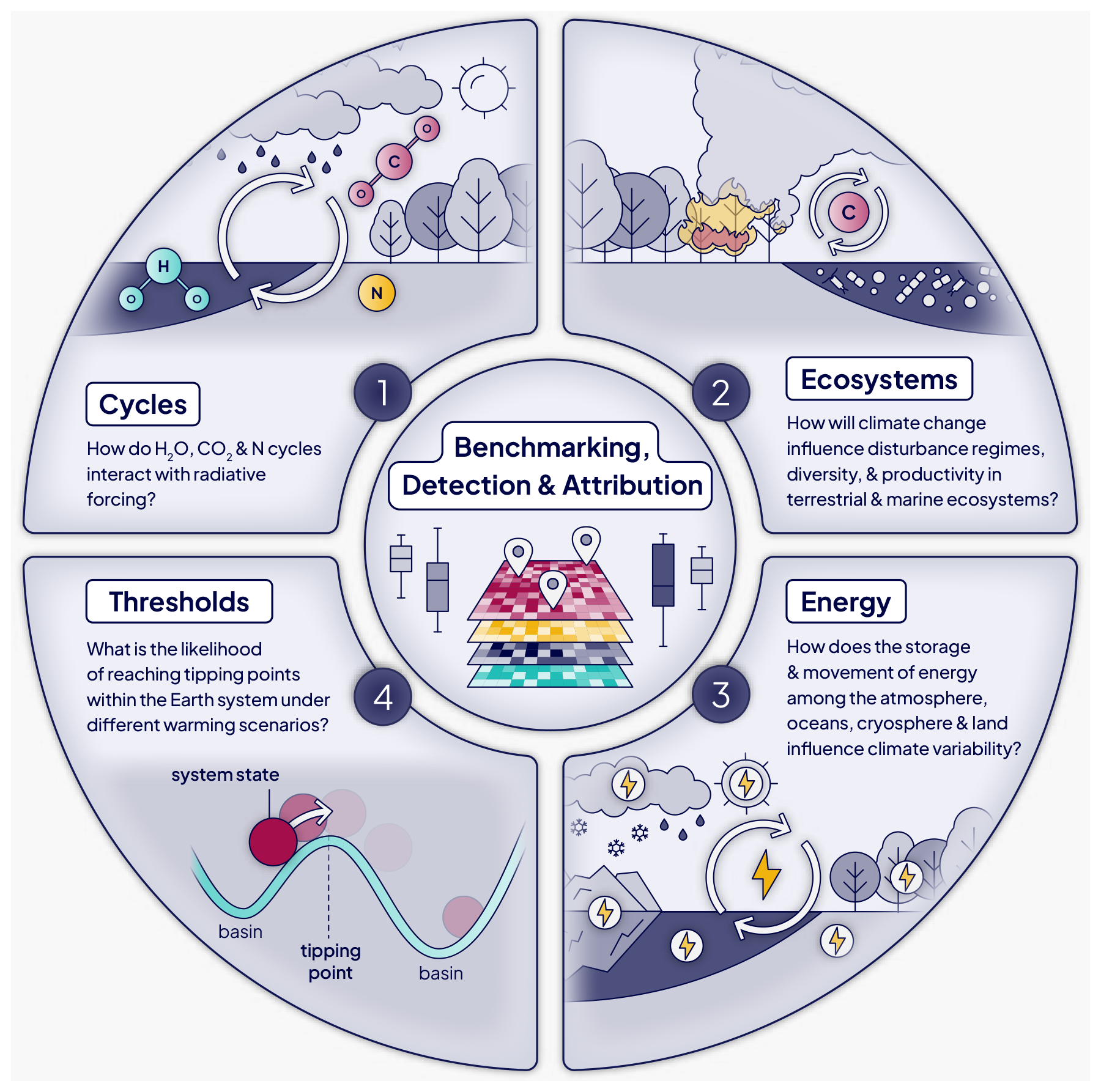
Figure 1Schematic diagram outlining questions at the centre of the CMIP7 Data Request for Earth systems research.
1.3 Scope of the data request
The CMIP7-ES theme deals primarily with Earth system cycles and interactions across domains, not with the physical climate itself (i.e., atmospheric dynamics and general circulation), which falls under the Atmosphere & Ocean and Sea Ice themes (Li et al., 2025b; Dingley et al., 2025). Although related (e.g., marine ecosystems and fisheries), opportunities that deal with the social impacts of climate change were determined best suited for the Impacts and Adaptation theme (Ruane et al., 2025). Overlap exists with other themes in the area of ecological change and its associated impacts on biodiversity and ecosystem function. Any opportunity dealing chiefly with a single domain, i.e., cryosphere, land, or atmosphere, falls within other thematic areas as the ES theme emphasizes the transfer of energy and mass across domains.
1.4 Audience
The audience for the data request includes modelling centres with the expertise and capacity to generate ESM simulations, as well as a larger community of scientists and stakeholders who use model data for a variety of applications. Opportunities under the CMIP7-ES umbrella flow from the CMIP6 community of endorsed MIPs and research consortia, which represent both modelling centers and independent research activities (Eyring et al., 2016). These include the Coupled Climate-Carbon Cycle Model Intercomparison Project (C4MIP), Fire Model Intercomparison Experiment (FireMIP), Fisheries and Marine Ecosystem Model Intercomparison Project (FishMIP), Paleoclimate Model Intercomparison Project (PMIP), Geoengineering Model Intercomparison Project (GEOMIP), Tipping Point Model Intercomparison Project (TIPMIP), Detection and Attribution Model Intercomparison Project (DAMIP), Decadal Climate Prediction Project (DCPP), (ScenarioMIP) and others. The opportunities described below, with their attendant requests for data from the modelling centres, have been contributed by the members of these experiments. Fulfilment of the data requirements described below is critical for the advancement of research activities within these longstanding research groups.
CMIP7-ES data will also be useful to the community of climate model data users. These include researchers involved in data-model comparison of observational, remotely sensed, and paleoclimate data. For data-model comparisons, CMIP data serves as an independent source of climate information, and findings from these activities cyclically drive model development by identifying areas of data-model disagreement. Non-academic audiences for ES model data include non-profit organizations, climate policy makers and private sector stakeholders, for example insurers involved in catastrophe risk modelling (Stoffel et al., 2024). CMIP will continue to be an integral part of designing climate adaptation polity on national and international levels (IPCC, 2021), and is increasingly being used by state and local governments to guide municipal planning for future climate impacts.
The CMIP7 Earth System thematic group was initiated through an open recruitment process that started with a public call that opened between February and March 2024 (https://wcrp-cmip.org/cmip7-earth-system-call/, last access: 8 March 2024). This call specifically addressed the engagement of representatives from the wider Earth system science communities with expertise on the carbon and nitrogen global cycles and the biogeochemical interactions between the physical climate and the biosphere. All the applications were collaboratively evaluated by representatives of selected MIPs (GEOMIP, DAMIP, PMIP) and Data Request Task Team leaders and liaison members. A diverse team of 18 members was selected that included a spread of different scientific foci and encompassed a wide range of CMIP experiences, nationalities and career stages.
The author team was officially formed in late August 2024 and its activity began immediately after the closing of the first public consultation phase on the collection of community-based data request opportunities for the CMIP7 Fast Track (Turner et al., 2024). Members were requested to address the scientific groundings and data requirements of the proposed opportunities, as well as a proactive engagement with the reference communities and networks to sustain an effective participation in the composition of the Data Request. The team agreed on the use of a shared online spreadsheet to allow for the asynchronous completion of individual tasks, while periodic virtual meetings with a two to three-week frequency were devoted to summarizing ongoing activities and discussing shared, common responses to the actions emerging from each iteration of the evaluation process. CMIP7-ES Task Team liaisons edited the content of an Airtable database on behalf of the author team and returned to the group key outcomes emerging from the cross-thematic and Task Team meetings, and outlined actions to be undertaken after each public consultation phase.
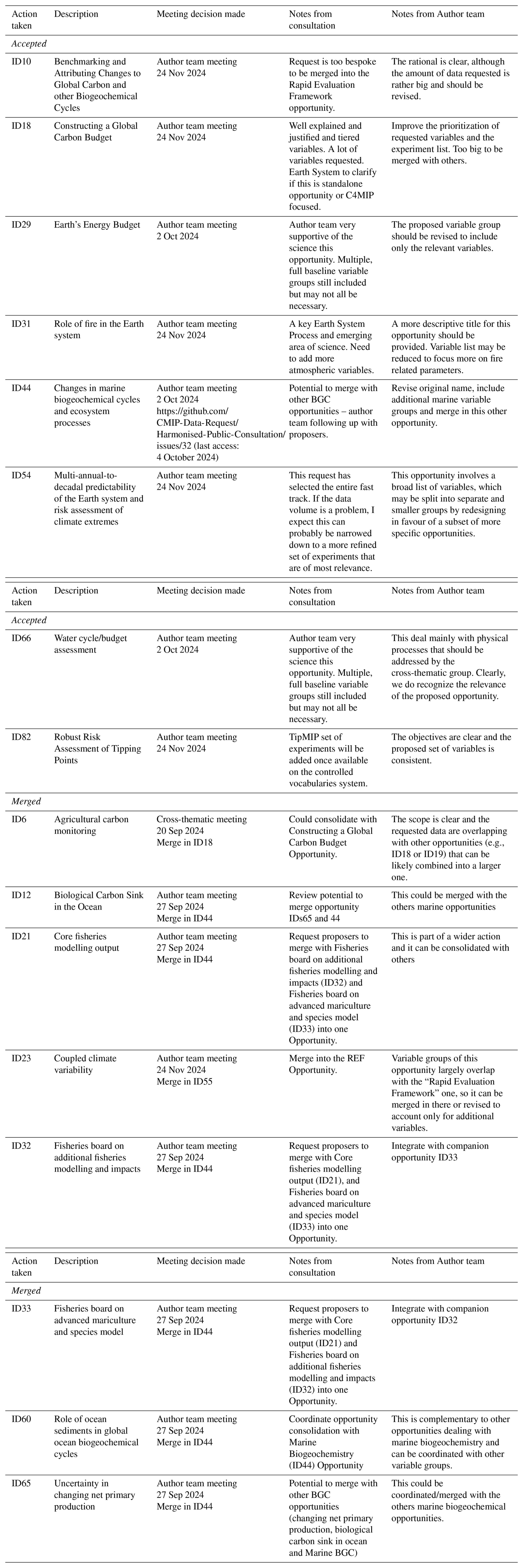
After the closing of the first consultation phase in the end of August 2024, the main activity of the CMIP7-ES thematic team was to evaluate the clarity of the scientific scope presented in each opportunity and the consistency of requested variables and experiments groups. In a shared online spreadsheet, each member indicated the acceptance or rejection of an opportunity, along with comments related to scoping issues, requested variables, or potential overlaps with other themes. In the following online meetings, the team finalized the evaluation of those opportunities associated with the Earth System theme by pooling individual scores and the agreed responses were transferred to the public Airtable database. The review of all the comments raised by each thematic group was carried out in a coordinated cross-thematic effort in the middle of September 2024 to achieve a more consolidated set of opportunities by indicating potential aggregations or requesting revisions of proposed variable groups. In turn, the CMIP7-ES author team took charge of reporting back the outcomes of the cross-thematic activity to the proposers of opportunities to resolve identified criticalities and to interact with the reference science community when multiple instances had to be aggregated into a single coordinated action. A summary of the main decisions and comments that arose in the consultation phase of the initially proposed opportunities is reported in Appendix A (Table A1).
Before the release of DR v1.0, the author team revised the consistency of experiments associated with each opportunity, along with time subset specifications and prioritization of variable groups by interacting with proposers and reference communities to better frame the requests. At the end of the public consultation on the first version of the Data Request (mid January 2025) an in depth revision of newly proposed variables was carried out by the liaison members of the thematic group in preparation of the following sub-releases to fill technical gaps (e.g. missing CF definitions) and by including items proposed by the community consultation held in February and March 2025.
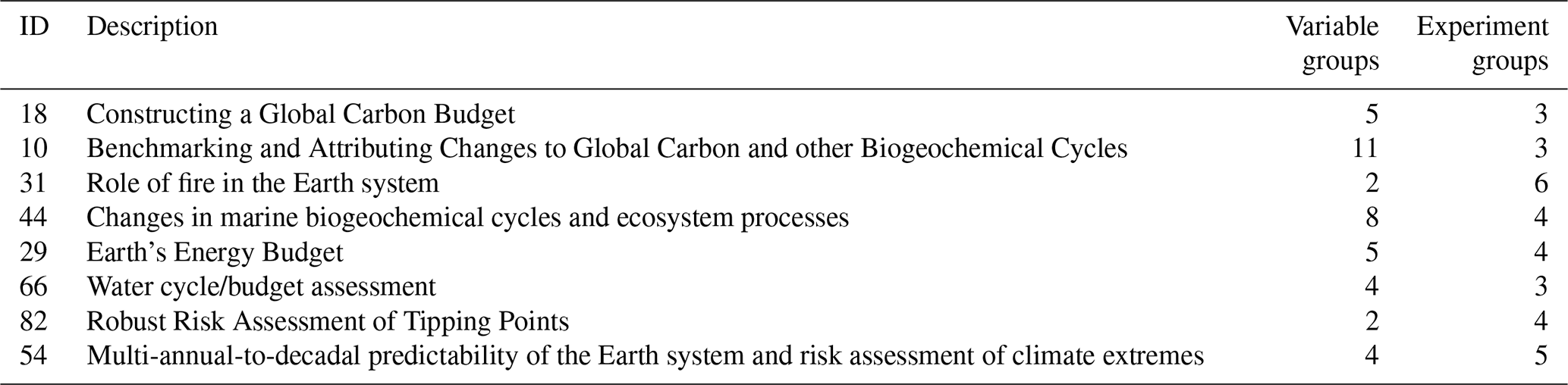
In the finalized Data Request at v1.2.1, the CMIP7-ES theme primarily accounts for 8 opportunities (Table 1) and it shares overlapping scientific objectives with 13 opportunities led by other thematic teams (CMIP Data Request Task Team; 2025). The details of the other thematic areas and variable groups included in the Data Request are provided in the companion manuscripts under the Rapid Evaluation Framework (CMIP Model Benchmarking Task Team, 2024; Dunne et al., 2025), Atmosphere (Dingley et al., 2025), Land and Land Ice (Li et al., 2025b), Impacts & Adaptation (Ruane et al., 2025), and Ocean and Sea Ice (Fox-Kemper et al., 2025) themes.
Table 1Data Request opportunities primarily accounted within the Earth System theme scientific objectives, including total numbers of variable groups and experiments requested.
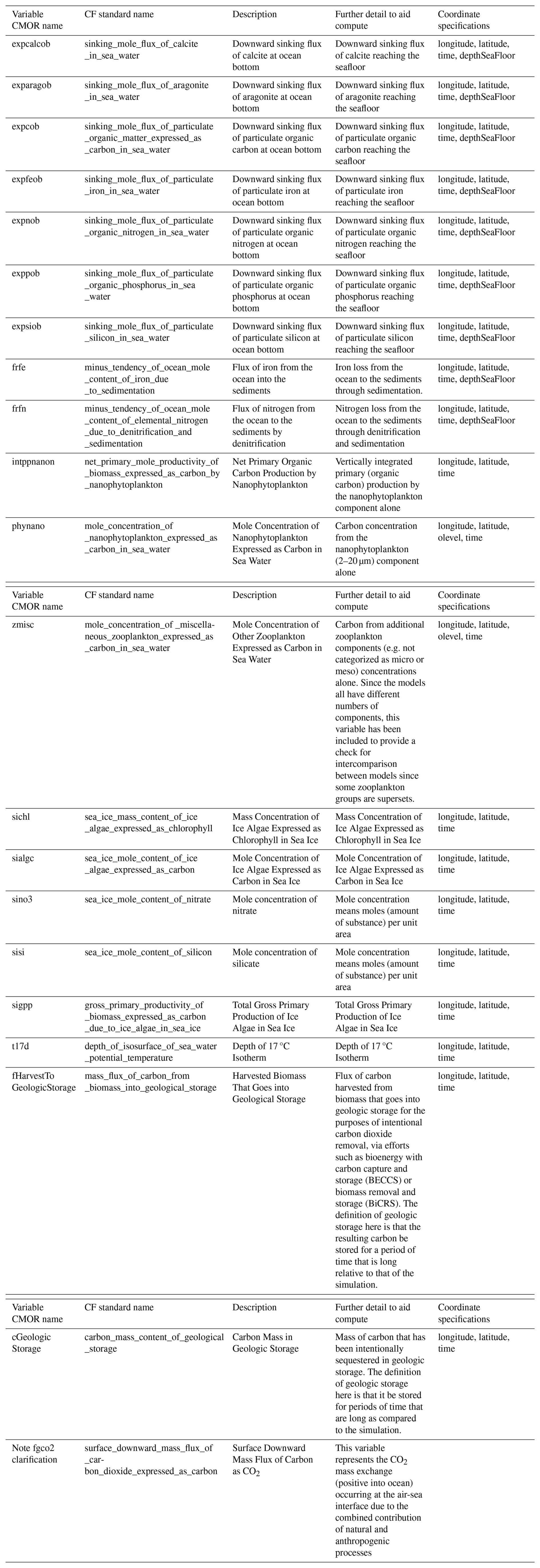
In the following sections, the community-led scientific opportunities are illustrated accounting for both the consolidated science basis and the expected advances toward a better comprehension of the ES processes. The scope of the selected variable groups is addressed for each opportunity, while details on newly proposed variables and recommendations about the use of existing ones are provided in Appendix B (Table B1).
4.1 Constructing a global carbon budget (ID18)
A defining trait of an Earth system model is the ability to consider interactions between the physical climate system and the global carbon cycle. This coupling between carbon and climate can be represented in two main ways. The first is by allowing the atmospheric CO2 concentration to be prognostic in response to imposed emissions with land and ocean carbon reservoirs freely exchanging CO2 with the atmosphere, in an “emissions-driven” configuration. The second is to specify atmospheric CO2 concentrations, such that fossil fuel CO2 emissions are inferred as what is needed to balance out the change in carbon masses in the total land, ocean, and atmosphere system (a “concentration-driven” configuration) (see Fig. 2 in Jones et al., 2016). In both emissions-driven and concentration-driven configurations, it is necessary to quantify changes to all of the carbon pools in the biosphere in order to ensure carbon mass conservation. The central goal of this opportunity is thus to track all carbon throughout the Earth system, ensure a closed carbon budget, and allow for the calculation of compatible fossil fuel CO2 emissions in concentration-driven experiments.
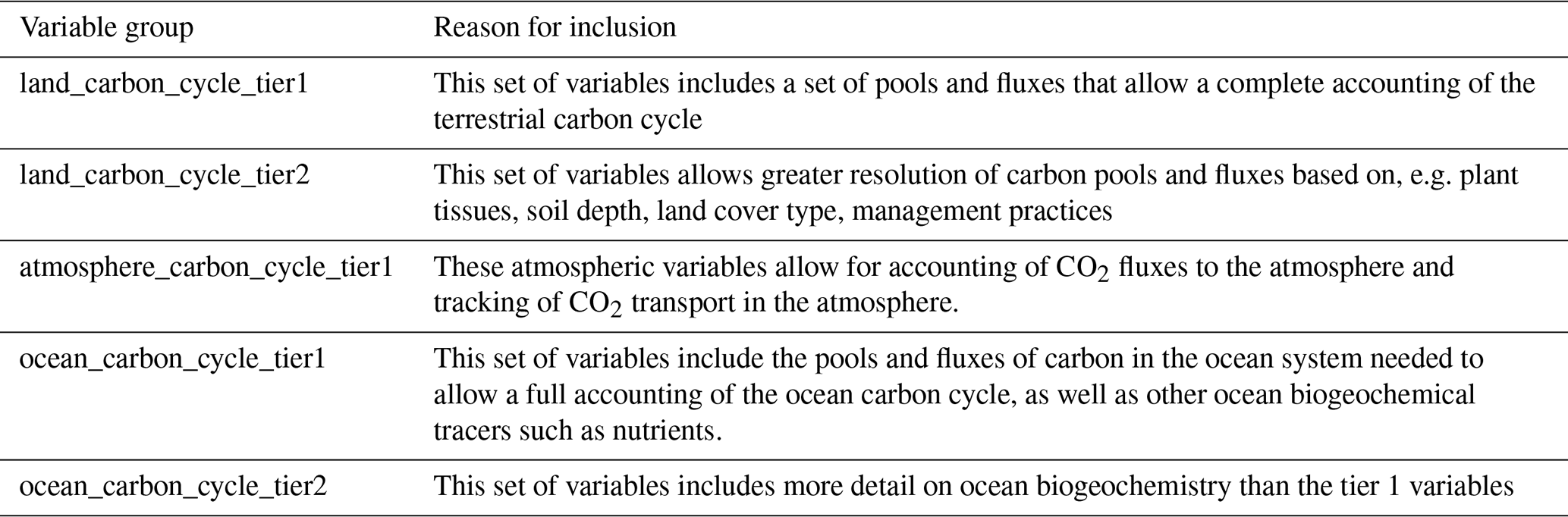
The land and ocean variable groups for this opportunity are based on the variables defined following the CMIP6 C4MIP experiment described in Jones et al. (2016), their Fig. 5 (land carbon cycle) and Fig. 13 (ocean carbon cycle) (Table 2). On land, two new variables (Lmon.cGeologicStorage and Lmon.fHarvestToGeologicStorage), which were not present in the CMIP6 variable request, will allow tracking of carbon under intentional CDR such as bioenergy with carbon capture and storage (BECCS). In CMIP6, CDR fluxes were specified as forcings rather than simulated endogenously, and this is anticipated to be the case for most CDR methods in CMIP7 Fast Track experiments as well, with the exception of reforestation and afforestation fluxes (Van Vuuren et al., 2026). Moreover, some modelling centres are experimenting with CDR representation for other approaches (e.g., Sanderson et al., 2024), and these new variables will allow the reporting of these fluxes for models and scenarios that treat them prognostically.
Table 2Variable groups needed for ID18: Constructing a Global Carbon Budget.
In addition to the land and ocean carbon cycle variables, atmospheric mole fractions of CO2, as well as total fluxes of CO2 between the atmosphere and the land and ocean, are needed to close the global carbon budget, particularly for emissions-driven ESM scenarios.
An emergent linear and path-independent relationship between global warming and cumulative CO2 emissions (Allen et al., 2009; Matthews et al., 2009; Zickfeld et al., 2009) underlies much of global climate policy, including the concept of a remained carbon budget for climate stabilization (IPCC, 2021). In concentration-driven ESMs, fossil fuel CO2 emissions must be inferred as the difference in the total stock of carbon in the combined land, atmosphere, and ocean systems over time. Thus, one key goal of tracking the carbon cycles through each of these systems is to infer the implied emissions for a given CO2 concentration forcing pathway, and to diagnose relationships such as the Transient Climate Response to cumulative CO2 emissions (TCRE, Arora et al., 2020), which is the slope of the relationship between warming and cumulative emissions. Under emissions-driven ESM simulations, CO2 emissions are specified rather than diagnosed, and it is necessary to have similar information about the response of the carbon cycle to the emissions. Such information will allow us to characterise the contribution of carbon cycle uncertainty to uncertainty in projections of future climate change under particular emissions scenarios. Moreover, this information could help us understand the processes contributing to, and help to narrow such an uncertainty using emergent constraints, based for example on changes in carbon pools over the historical period.
4.2 Benchmarking and attributing changes to global carbon and other biogeochemical cycles (ID10)
Earth system models simulate a broad suite of carbon cycle feedbacks in response to changing climate and atmospheric CO2 emissions, which are central to the projections of Earth system change into the future. Across several generations of coupled carbon-climate models, the carbon cycle feedbacks act as a large source of uncertainty in these projections (Friedlingstein et al., 2006; Arora et al., 2013, 2020). Reducing the uncertainty in these feedbacks is thus a key goal in narrowing projections of climate change in response to future CO2 emissions, especially in the context of evolving ESMs (e.g. inclusion of N and CH4 cycles) and more systematic use of emission-driven experiments. One approach to reducing this uncertainty is systematic benchmarking of land and ocean models against a broad range of historical observations at site to global scales, so that model fidelity can be assessed and tracked over time (Collier et al., 2018; Fu et al., 2022; Gier et al., 2024) (Table 3). In particular, tier1 variable groups include metrics from diverse ES realms that would enable for a direct or as close as possible comparison with available observations.
Table 3Variables needed for ID10: Benchmarking and Attributing Changes to Global Carbon and other Biogeochemical Cycles.
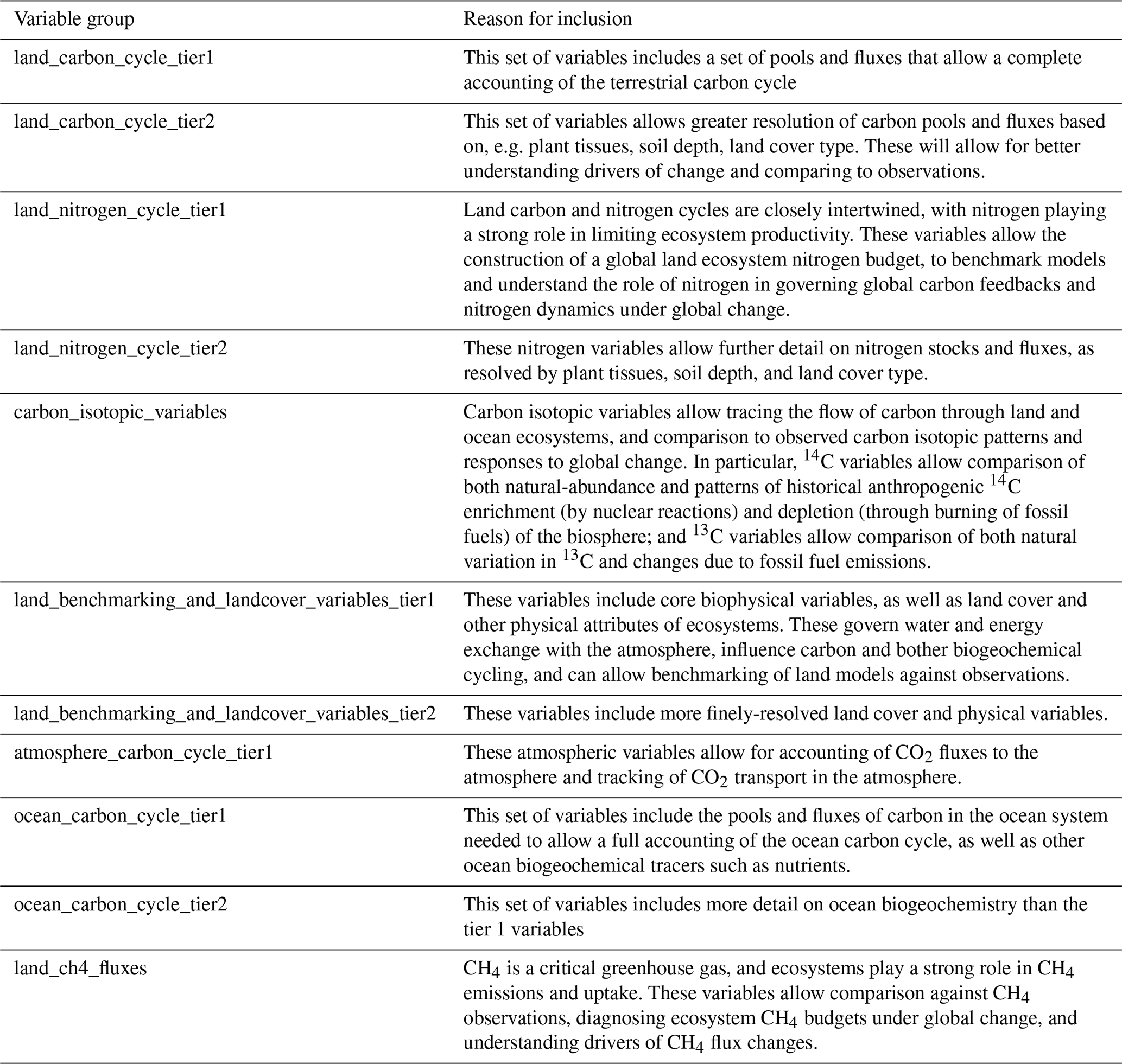
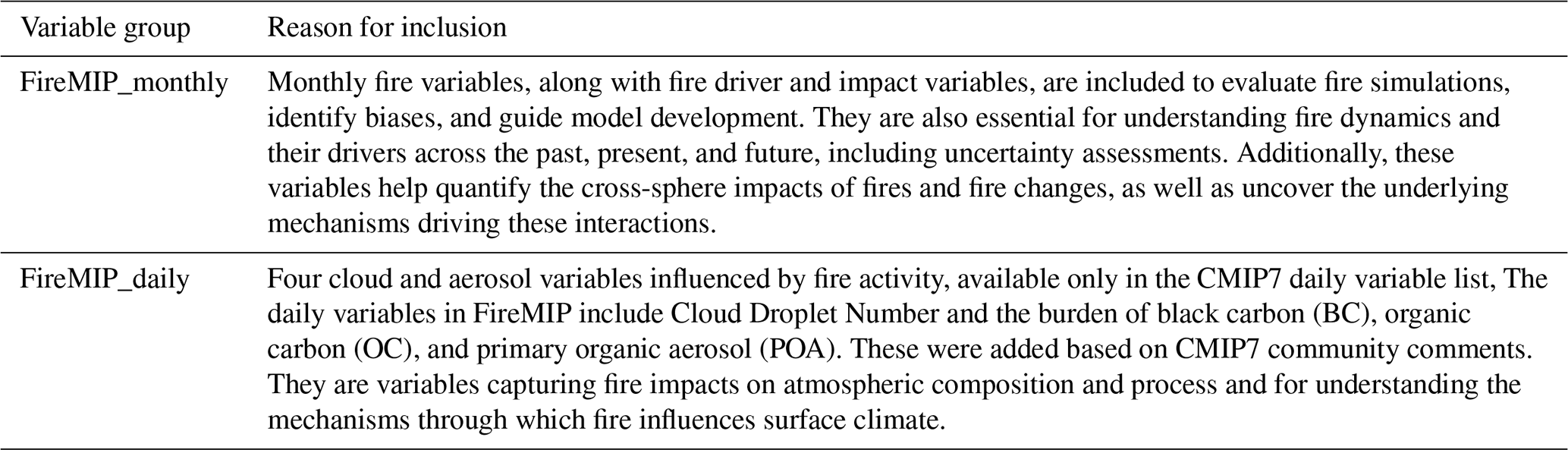
Table 4Variable groups for role of fire in the Earth system (ID31).
4.3 Role of fire in the Earth system (ID31)
Fire is the primary terrestrial ecosystem disturbance globally and a critical Earth system process (Bowman et al., 2009; Li and Lawrence, 2017; Li et al., 2024, 2025a). This opportunity enhances our understanding of past, present, and future fire changes and the role of fire in the Earth system. The proposed variables are divided into two categories: fire variables and fire driver/impact variables. The fire variables (Table 4), (i.e., burned area fraction and fire carbon emissions) are of the highest priority and essential for understanding fire behavior in ESMs. They serve two main aims: (a) analysing historical fire patterns and projecting future fire regimes under varying climate and socio-economic scenarios to inform long-term environmental planning and policy making; (b) benchmarking and evaluating fire simulations in coupled Earth system models, leading to improvements in future modelling systems to support more precise climate predictions and a deeper understanding of Earth system complexities. The fire driver and impact variables are currently used in Earth system modelling and strongly overlap with baseline variables. These include variables related to carbon, nitrogen, water, and energy cycles; vegetation distribution and structure; climate indicators (e.g., temperature, precipitation, wind speed, permafrost extent, active layer thickness, sea ice and snow coverage, sea surface temperature); and atmospheric circulation, composition, and chemistry. These variables will be analysed to: (a) assess the accuracy of models in capturing the relationship between fire and climate, ecosystems, and environmental factors; (b) understand the drivers of fire regime changes, the impacts of fire, and cross-sphere feedbacks between fire and various Earth system components. In addition, daily maximum temperature, precipitation, wind speed, and minimum relative humidity are required to calculate the Canadian Fire Weather Index (Quilcaille et al., 2023). FWI is a method to represent the impact of weather and is related to fire's drivers. These variables are available in biodiv_land_daily, CFMIP-daily, and AgModelExpandedDaily.
4.4 Changes in marine biogeochemical cycles and ecosystem processes (ID44)
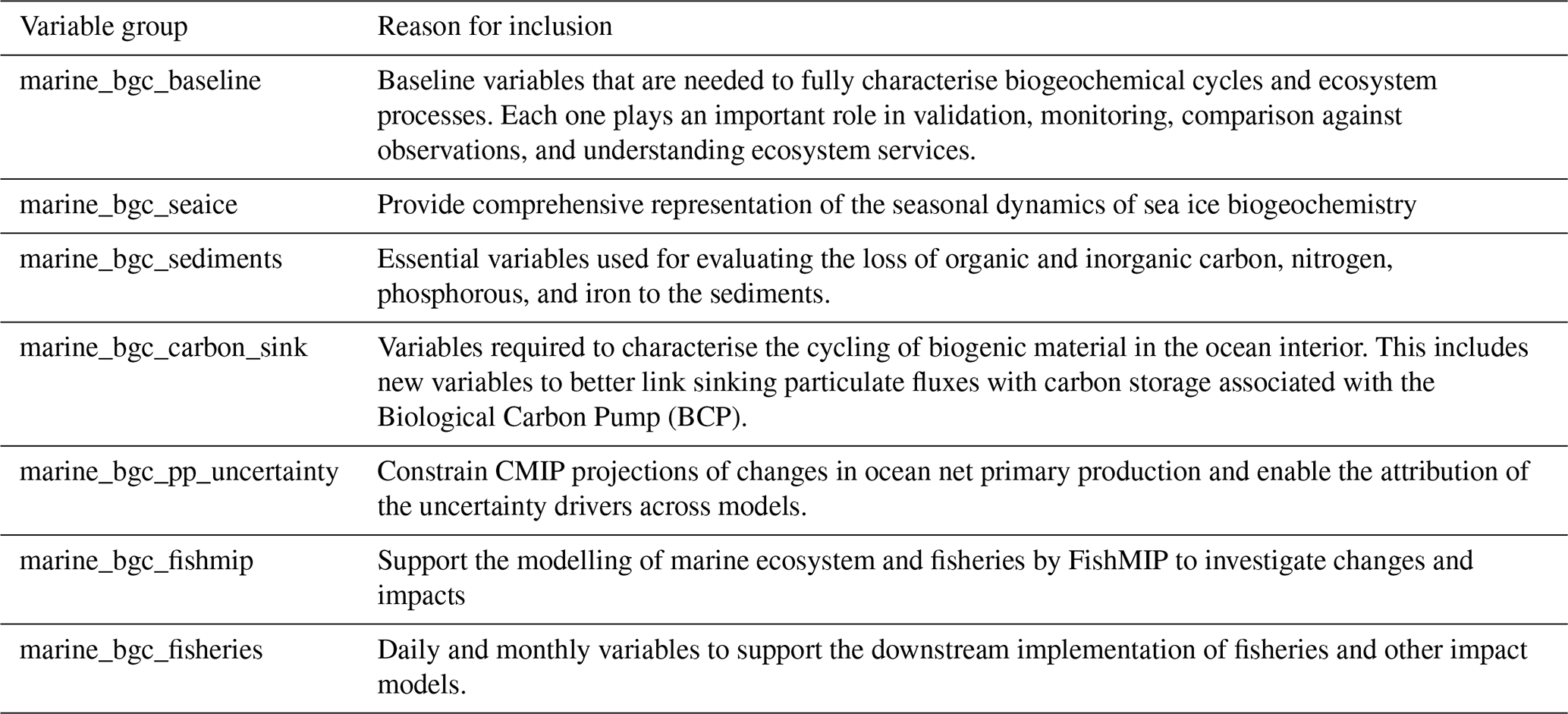
This opportunity is composed of a baseline set of variables that have already been widely used in CMIP6 and exist in most ESMs, along with a number of selected variable groups whose inclusion in the Data Request (Table 5) (see details in Appendix A) will extend the scientific purpose toward relevant ecosystem processes and downstream applications. The new variables requested will provide additional constraints on the ocean carbon pump both historically and under climate scenario projections.
Table 5Variable groups for changes in marine biogeochemical cycles and ecosystem processes (ID44).
4.4.1 Baseline BGC variables
The baseline BGC variables represent the informational backbone of marine biogeochemical research, as carried out using previous generations of CMIP simulations. These variables allow us to examine how projected biogeochemical quantities and their level of uncertainty have changed with each CMIP iteration (e.g. Doney et al., 2012; Bopp et al., 2013; Kwiatkowski et al., 2020), and if there have been improvements in simulated historical values in comparison to observations (e.g., Séférian et al., 2020). This variable group contains the necessary variables to calculate the air-sea flux of carbon via abiotic carbon cycling (i.e. “the solubility pump”) (DeVries, 2022). Furthermore, these variables allow continued research on the role of marine biogeochemical cycles in relation to the inner ocean carbon inventories and acidification (Gehlen et al., 2014; Kwiatkowski and Orr, 2018; Jiang et al., 2023), trends in oxygen consumption (Cocco et al., 2013; Buchanan and Tagliabue, 2021, Takano et al., 2023), and lower ecosystem dynamics represented by ESMs (Henson et al., 2021; Petrik et al., 2022; Kim et al., 2023).
4.4.2 Ecological and biogeochemical processes in the surface ocean
Marine ecosystems in the upper ocean provide key ecosystem services such as food production and tourism. Additionally, ecosystems form the basis for net primary production (NPP) and generation of organic matter that leads to carbon sequestration in the ocean. CMIP6 model projections of NPP are uncertain in both direction and magnitude, as demonstrated by Ryan-Keogh et al. (2025). One of the largest sources of inter-model uncertainty in the marine biogeochemistry realm in CMIP6 was found to be phytoplankton-specific loss rates to zooplankton grazing (Rohr et al., 2023). Grazing affects both the transfer of energy to higher trophic levels and the export of carbon to the seafloor, where it can be sequestered long-term.
An additional set of variables have been defined, such that when combined with marine_bgc_baseline (Sect. 4.4.1), they contain the minimum set of variables needed to perform an assessment of climate impacts on marine ecosystems. These variables allow projections of the effects of climate change on marine ecosystems and biodiversity, as well as a process-based understanding, which align with the goals of FishMIP under Inter-sectoral Impact Model Intercomparsion Project (ISIMIP). The CMIP6 FishMIP ensemble included 9 global models and >40 regional models that vary with respect to their input forcing (Tittensor et al., 2018, 2021; Ortega-Cisneros et al., 2025). Surface and/or depth-integrated variables were shown to be not sufficient because some models represent distinct epipelagic, mesopelagic, and seafloor communities. Also, 3D is needed over 2D integrations because the vertical habitats (e.g. 0–200, 200–2000 m) of these communities differ by model. The full water column also provides the opportunity for potential future studies of deep-sea organisms and processes that have so far been ignored (bathypelagic and bathybenthic communities, deep-sea carbon export, seafloor mining, etc.). A few new variables have been included in this variable group. The carbon concentration of all the phytoplankton and zooplankton types are needed because many models use, e.g. small and large phytoplankton, as input forcing and these vary by individual biogeochemical model. A devoted nanophytoplankton group was requested as some BGC models' small phytoplankton are picoplankton, while others are nanoplankton. The variables “phynano” and “intppnano” explicitly track nanophytoplankton biomass and NPP, rather than putting it in the vague “phymisc” variables. Similarly, “zmisc” was created to account for the few BGC models that have zooplankton groups that they would categorize as neither microzooplankton nor mesozooplankton. The downward flux of particulate organic carbon to the ocean seafloor (“expcob”, Sect. 4.4.3) is necessary for many models that simulate seabed communities of fishes and invertebrates.
The variable group “ISIMIP_oceanforcing_3hr” is needed to bias-adjust oceanic forcing. The bias adjustment is particularly critical for the regional marine ecosystem and fisheries models in FishMIP that are calibrated by observational data. We expect this variable group to be useful for driving a much larger set of impact models for uses beyond fish modelling.
Although sea ice was considered biogeochemically inert within most of CMIP6 ESMs (Lannuzel et al., 2020) but not all of them (Boucher et al., 2020; Stock et al., 2020), the role of polar marine biogeochemical cycles has been shown to impact specific pathways of air-ice-sea carbon exchange on the global carbon cycle and to significantly interact with the pelagic ecosystem (Vancoppenolle and Tedesco, 2017; Hayashida et al., 2021; Willis et al., 2023). An essential set of metrics was selected for the variable group “marine_bgc_seaice” to enable the possibility of storing novel sea ice biogeochemical data within Earth System Grid Federation (ESGF) and enable the scientific community to analyse and attribute the seasonal dynamics of polar sympagic ecosystems.
4.4.3 Biogeochemical cycling in the ocean interior and sediments
The cycling of organic and biogenic inorganic matter fluxes from the surface across the ocean interior, collectively known as the “Biological (Carbon) Pump”, and within seafloor sediments contributes to carbon sequestration over centennial to millennial timescales and impacts major biogeochemical cycles such as dissolved oxygen. With fluxes expected to be sensitive to climate change in both magnitude and direction, as well as forming the basis for proposed marine carbon dioxide removal (mCDR) actions, we need to better understand the role that the ocean interior and sediments play in biogeochemical cycles and the wider carbon-climate system.
In CMIP6, downward particulate fluxes were typically quantified across a 100 m depth horizon (epc100, epcalc100 for organic carbon and calcite respectively), equating to “export production” (e.g., Henson et al., 2022). Export production of organic carbon is a good proxy for new production under the steady-state assumption that exported nutrients are balanced by an influx of nutrients, rather than nutrients regenerated within the euphotic zone by the microbial loop that support recycled production (Dugdale and Goering, 1967; Eppley and Peterson, 1979). New production quantifies the energy available for higher trophic levels (fishes, squids, benthic invertebrates) and export production fuels mesopelagic, bathypelagic and benthic food webs (see Sect. 4.4.2). However, export production has been shown to be a poor predictor of carbon storage (Wilson et al., 2022) because the cycling of organic carbon within the ocean interior can be decoupled from export production (Henson et al., 2024). Additionally, fluxes at 100 m give little to no insight into fluxes at the seafloor. 3D fields of fluxes (such as expc) were available in CMIP6 but assigned a lower priority output than fluxes at 100 m (Orr et al., 2017). As such, depth-resolved particulate fluxes were only available from a subset of models limiting the applicability of outputs. There were no seafloor-related variables available in CMIP6.
A series of new CF variables have been defined to address the scientific questions around interior and seafloor fluxes (Table A2). These replicate the export production variables in CMIP6 across key depth horizons. They have been defined such that modelling centres are likely to already generate as diagnostics or are modest in requirements to create and store (e.g., 2D instead of 3D). Alongside the previous fluxes defined at 100 m, variables have been added at 1000 m to better characterize carbon storage by the biological pump (Wilson et al., 2022) and fluxes at the ocean bottom (Table A2). New CF variables for sediments (expcalcob, expcob, expfeob, expnob, exppob, expsiob, exparagob) have abbreviations that include “ob” (= ocean bottom) to delineate the bottom of the grid cell instead of its centre. Dissolved oxygen concentration (“O2”) and dissolved oxygen concentration at saturation (“O2sat”) are needed to calculate Apparent Oxygen Utilisation (AOU), which can be used to estimate carbon storage by the biological carbon pump.
4.5 Earth's energy budget (ID29) and water cycle/budget assessment (ID66)
The consistent simulation of the energy and water cycles by numerical models of the Earth system is fundamental as their flows across atmosphere, land, cryosphere and oceans tightly interact to shape the climate and its future changes (Trenberth, 2014). It is well established that global precipitation and evaporation changes are controlled by Earth's energy balance, while water vapour is a relevant gaseous absorber in the atmosphere that in turn plays a primary role in the global radiative budget (Allan et al., 2020). The very large latent energy fluxes also tie together Earth's energy and water cycles, meaning that they should be considered in concert. The growing volume of information provided by satellite Earth observation systems will increase our capability to understand and better constrain the uncertainties related to water and energy budgets in modelled historical changes (Stephens et al., 2023).
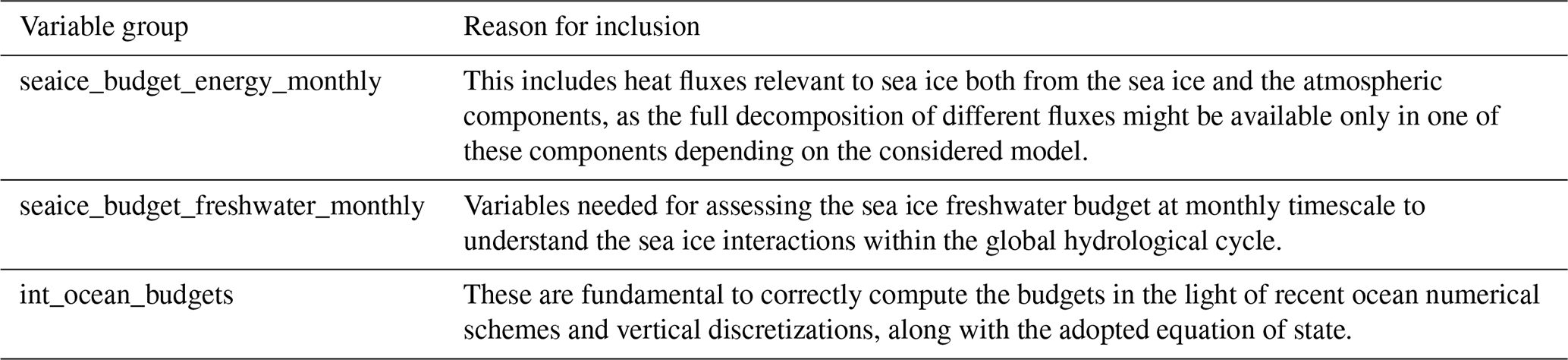
These two interconnected opportunities primarily rely on the production of the baseline_climate_variables group, which contains the main variables central to the implementation of the energy budget framework and the water cycle analyses as described in the Sixth IPCC Assessment Report (Forster et al., 2021; Douville et al., 2021) (Table 6). Similarly, the core variable groups requested by other ES opportunities (Sect. 4.1 and 4.2) could be further exploited to closely investigate the land surface heat and energy budgets. Complementary variable groups, namely seaice_budget_energy_monthly and seaice_budget_freshwater_monthly, address the need to specifically describe the flows of energy and water in sea ice to reach a better closure of the global budgets, while the int_ocean_budgets variables set was designed to refine the computation of oceanic budgets in the light of recent model advancements and to improve the comparison with observations on non-hydrostatic pressure levels.
Table 6Earth's Energy Budget (ID29) and Water cycle/budget assessment (ID66).
4.6 Rapid evaluation framework (ID55)
The CMIP Rapid Evaluation Framework (REF) was created to evaluate and benchmark the CMIP7 Assessment Fast Track (CMIP7 AFT) simulations as soon as they are uploaded to the ESGF with metrics and diagnostics that are available through different open-source evaluation and benchmarking tools (Hoffman et al., 2025) (Table 7). This opportunity contains the set of variables that are needed for the planned diagnostics and metrics for the REF (CMIP Model Benchmarking Task Team, 2024). The suggested metrics/diagnostics for the REF to be available for all CMIP7 AFT experiments will allow basic evaluations. The exact selection of variables was also made consistent with the model evaluation diagnostics in Chapter 3 of the latest IPCC report (Eyring et al., 2021). Due to the fixed timeline for the CMIP7 AFT simulations there is only a short time period for the technical implementation of the REF, and therefore the available metrics and diagnostics in this first version of the REF will be limited to a temporal resolution of monthly mean data and about five metrics/diagnostics per realm based on a community selection. The realms were chosen specifically to be consistent with the realms used for the data request.

4.7 Robust risk assessment of tipping points (ID82)
This opportunity has been submitted by the Tipping Point Modelling Intercomparison Project (TIPMIP) (Jones et al., 2025). As part of the CMIP7-ES theme, this opportunity comprises two variable groups which are also relevant to the Atmosphere, Land & Land Ice, Ocean & Sea Ice themes (Table 8).
Table 8Variable groups for Robust Risk Assessment of Tipping Points (ID82).

The concept of “tipping point” or “critical transition” appears in several fields of science: in ecology, for example, it appears in the form of mass extinction and rapid desertification (Scheffer et al., 2001; Arumugam et al., 2024); human physiology offers examples such as seizures and the abrupt increase in inflammatory response (Scheff et al., 2013); examples from the geosciences include potential events such as the dieback in the Amazon rainforest or the decline and collapse of polar ice sheets (Lenton et al., 2008). These seemingly disparate events share phenomenological attributes, which are understood to be defining characteristics of a tipping point or critical transition (Scheffer et al., 2009; Kuehn, 2011). A tipping point is reached when there is an abrupt qualitative change in the system's dynamics which is rapid compared to the system's normal evolution, and beyond this threshold the system enters a new dynamical state which is qualitatively different from the previous state. More recent studies have supported the existence of tipping points for certain Earth system components, example in Lenton et al. (2008) such as polar ice sheets (Bradley and Hewitt, 2024; Petrini et al., 2025), and the AMOC (van Westen et al., 2024; Ditlevsen and Ditlevsen, 2023). Wunderling et al. (2024) have also highlighted the possibility of interactions between these components of the Earth system, whereby one component crossing its tipping threshold could destabilize other components, triggering a so-called “tipping cascade”.
Given the fact that Earth system components are complex non-linear systems in their own right, that they are coupled to one another, and interact across many different spatio-temporal scales, giving a precise characterization of what critical transitions (or tipping events) could occur, or when they could occur, is at present very difficult (Ben-Yami et al., 2024). Yet the fact that such transitions might occur cannot be excluded, as several components of the Earth system may be susceptible to reaching a critical threshold beyond which amplifying feedbacks could result in abrupt and/or irreversible changes (Armstrong McKay et al., 2022). This could have far-reaching impacts on the global climate, ecosystems, and humankind. Recent assessments have highlighted the increasing risk for potential tipping events, in particular beyond 1.5 °C global warming, and also stressed the large uncertainties involved in any projection regarding the future occurrence of such events (IPCC AR6, Eyring et al., 2021). Addressing these uncertainties will necessitate a systematic effort to evaluate our understanding of Earth system dynamics and their evolution under sustained exogenous forcing, so that we may be better able to quantify the likelihood of tipping events and therefore the risks and impacts associated to them. This will be crucial for developing effective strategies to mitigate and adapt to the impacts of global environmental change.
The variables included in this opportunity will serve two major purposes: (1) the analysis of ESMs with respect to tipping points, and (2) serving as forcing input for uncoupled/offline component models (e.g. standalone ice sheet models) in follow-up tailored tipping experiments. There is a strong overlap between the variables in the opportunity and existing baseline_climate_variables, minimising additional computational costs while providing the base for a cross-domain analysis of tipping points.
There is empirical evidence from CMIP6 simulations of the existence of critical thresholds in ESMs, for example in rapid cooling events in the North Atlantic subpolar gyre (Swingedouw et al., 2021), decay and shutdown of the Atlantic meridional overturning circulation (Drijfhout et al., 2025), and dieback events in the Amazon rainforest (Parry et al., 2022), as well as more general abrupt shift events which could correspond to various tipping points (Terpstra et al., 2025). These phenomena were also reported in CMIP5 models by Drijfhout et al. (2025). Significant uncertainty remains around the mechanisms behind these regime shift events, as well as the critical thresholds that would trigger them once crossed.
This opportunity will allow the evaluation of key large-scale tipping elements such as ice-sheet collapse, permafrost carbon release, tropical forest dieback and shutdown of the AMOC, as well as possible feedbacks associated with each individual tipping element. Outputs will be used to evaluate the uncertainties associated with identifying the existence of tipping points in the biogeophysical Earth system; the critical thresholds and warming levels that may induce tipping; as well as the interactions and feedbacks between (possible) tipping elements. Outputs may be then used by impact models and other end-user groups to evaluate the downstream consequences of tipping points in the Earth system on human society.
4.8 Multi-annual-to-decadal predictability of the Earth system and risk assessment of climate extremes (ID54)
As the magnitude of climate changes are strongly determined by cumulative emissions (Allen et al., 2009; Notz and SIMIP Community, 2020), differences between various emission scenarios will have relatively little impact in the near term. This makes the prediction of climate over the next few decades an initial value problem, and decadal predictions are created operationally (Smith et al., 2013). Such predictions are made not only for atmospheric variables, but across earth systems, including for ocean variables such as the AMOC (WMO, 2024), cryospheric variables such as sea ice concentration (WMO, 2024), and biogeochemical variables such as CO2 uptake (Li et al., 2016; Gooya et al., 2024) (Table 9). Understanding the nature and limits of the predictability across the Earth system is key to delivering the maximum skill in these forecasts. The Decadal Climate Prediction Project (DCPP) defines experiments to allow the quality of climate prediction systems to be assessed through the use of hindcasts, as well as to assess as the inherent predictability of the Earth system (Boer et al., 2016). As part of the CMIP7 Fast Track, a prediction initialised in 2025 and comprising of 10 ensemble members is requested (dcppB-forecast-cmip6), but only from models who have also performed a hindcast.
This opportunity was submitted by DCPP, and incorporates two different variable groups that both span multiple themes. The essential variable group will allow analysis of key climate aspects of the decadal forecast, including modes of climate variability such as the Pacific Decadal Oscillation and AMOC that have substantial low-frequency components. The wider opportunity pushes beyond mean climates to assess the predictability of climate extremes.
Table 9Variable groups for multi-annual-to-decadal predictability of the Earth system and risk assessment of climate extremes (ID54).

5.1 Reflections from the data request process
5.1.1 Prioritization process
The Earth System Author Team was tasked with harmonizing among different the author teams for preparation of the CMIP7 AFT. The main goal of this process was to streamline the variable list presented in the data request, so that most modelling centres will be able to output the core variables. As part of streamlining, several opportunities needed to be merged into larger, more general opportunities (more details in Appendix A). These included agricultural carbon monitoring, which was merged into the global carbon cycle, and several opportunities related to ocean biodiversity and fisheries, which were merged into on opportunity focused on marine biogeochemistry and ecology. Opportunities related to climate variability and extreme events were effectively split between Earth Systems, Ocean and Sea-ice and Impacts & Adaptation, where Paleodata assimilation (ID52), Robust risk assessments of extreme climate (ID59), and Coupled climate variability (ID23) were transferred, but Multi-annual-to-decadal predictability of the Earth system and risk assessment of climate extreme (ID54) remained.
5.1.2 Challenges
By its very nature the CMIP7-ES theme has links and overlaps with several other themes, requiring careful consideration of scope. The push towards running scenarios in emissions mode, with full representation of the carbon cycle, means that all CMIP7 activities could interact with the Earth system theme. For example, atmospheric chemistry, which is included in the Atmosphere theme, also has impacts on water and carbon cycles, thus overlapping with the Earth system domain. Many of the impacts of warming, for example on ecosystem function and biodiversity overlap with the Impacts and Adaptation area. These overlaps were a challenge during the data request process, as they made it difficult to determine when exactly an opportunity falls within the ES theme, and which were better suited for other thematic areas.
Participants listed the time constraints for proposing new variables as a barrier to contributing opportunities. Opportunity proposers found the process of creating new CF variables to be challenging and unintuitive, requiring first the creation of a new physical parameter and then a new variable. If one was unfamiliar with CF naming conventions, this also posed a problem. For example, some participants were not able to complete this process before the Data Request closed. Authors suggest that in the future, the proposal of new CF variables should be separate from the Data Request and occur much in advance of it, so that the new variables can be included in proposed opportunities.
Another challenge of the data request process was weighing of large volume of data requested against the scientific interests of the community. We recognize the pressure of a large data request on modelling centres, especially when multiple tracers are needed from ESMs including biogeochemical cycles (with the associated storage and computing costs). Yet it is also critical to carry out CMIP7 experiments to their fullest potential, leveraging the efforts of modelling groups into recent model developments, and providing researchers and policymakers with up-to-date climate information. To reflect these considerations, priority levels of variable groups were attributed based on the diverse expertise of the ES thematic group. Variable groups containing variables not output by any centres in CMIP6 were given lower priority.
5.2 Outstanding gaps and applications of Earth system process knowledge
Activities associated with CMIP7 will close critical gaps in our knowledge of the Earth system and its response to anthropogenic perturbation. This will set the stage for research in the event of significant mitigation efforts to slow the rate of warming. At present, there are still many sources of uncertainty in ESM simulations surrounding interactions among emissions, radiative forcing, and elemental cycling. In ocean models, there is uncertainty in how marine primary productivity drives to carbon storage, in particular surrounding the role of biogeochemical and ecological processes in deep ocean sediments (DeVries, 2022). Coastal processes, which have highly heterogeneous carbon flux dynamics, are not well-represented in global climate models (Laruelle et al., 2018; Dai et al., 2022). Increased spatial resolution and improvements in biogeochemical modules may reduce uncertainty surrounding the land-ocean continuum and clarify the unique features of the ocean carbon pump in coastal regions (Bourgeois et al., 2016; Friedlingstein et al., 2025). In terrestrial models, soil and plant respiration, their interactions with the nitrogen cycle and response to warming and rising CO2 are sources of model disagreement (Jones et al., 2016). Together, differences in the parametrization of carbon-climate feedbacks over land account for an order of magnitude greater uncertainty than ocean carbon-climate feedbacks (Arora et al., 2020) representing uncertainty in land use and biophysical processes. The possibility of CDR raises questions regarding carbon cycle responses to rapid drawdown in atmospheric CO2 concentrations under net-zero or net negative scenarios (Van Vuuren et al., 2026; Koven et al., 2022). Variables requested here will also support analysis of the carbon uptake effects of reforestation and afforestation, which will be simulated explicitly in ScenarioMIP simulations in CMIP7 (Van Vuuren et al., 2026). As efforts to better represent CDR processes continue to improve in ESMs (e.g., Sanderson et al., 2024), it will be critical to update data requests so that assessment of the realism of these processes, as well as consistency between ESMs and the integrated assessment models used to generate scenarios, can be assessed. This will require sustained efforts of the CDR community to identify key variables relevant to CDR processes alongside new model developments. How changes in radiative forcing, not only from CO2 but also associated with aerosols (e.g. dust, industrial pollutants and trace gases) are transported from point-source and distributed, and how this feeds back in to climate is another source of uncertainty in warming trajectories, especially at local to hemispheric spatial scales (Hansen et al., 2025; Zhao et al., 2022; Bauer et al., 2022). In the event of interference with solar forcing via solar radiation management having a strong understanding of how aerosols propagate through Earth systems will help anticipate potential effects. Regardless of future mitigation efforts, model downscaling, regional climate modelling, and detection and attribution will link anthropogenic forcing to impacts with increased specificity. Finally, tying ecosystem changes, severe weather events, and atmospheric dynamics to satellite observations will help track impacts in real time and serve as external validation of model performance.
Sustained efforts in these areas will address the needs of a diverse community of stakeholders. The scientific community has an interest in basic climate research, but CMIP7 should also support provision of ESM data to a variety of non-academic sectors (Lea et al., 2024). Climate policymakers have relied on scenario-based simulations to predict some probable range of outcomes that can be built into policy and planning for decades (IPCC, 2021; Durack et al., 2025a, b). While this has been true at the national and international levels, industry and local and regional governments represent new users of ESM output. For example, fire risk predictions serve the insurance industry by providing scientific basis for risk assessment models. In the context of marine ecosystems, the biological carbon pump of carbon sequestration in microorganisms is related to trophic dynamics at higher levels. Thus, modelling primary and secondary producers in the surface ocean supports fisheries management (Blanchard et al., 2024). Participants in international carbon markets, such as those mandated under the European Union Emissions Trading scheme could use CMIP7 variables that model rates of carbon cycling. Carbon sequestration data from soils, forests and oceans and coastlines (i.e. “blue carbon”) could be leveraged for use in these markets, although constraints remain regarding output resolution and flux uncertainty (Hilmi et al., 2021; Michaelowa et al., 2023). Improvements in model water budgets for fresh water are useful for water managers (Shao et al., 2023; Onyutha et al., 2021). Regional climate models and dynamical downscaling of coarser-resolution products will allow for CMIP7 data to be used on socially and politically-relevant spatial scales, for example cities, municipalities, and states.
The ES author team was tasked with identifying the model variables needed to fully represent the carbon cycle and achieve greater clarity surrounding how changes in radiative forcing propagate through the Earth system. These include the core set of baseline variables along with specialized variables that may receive less attention from modelling centres, but will be necessary for achieving a detailed picture of ES responses to forcing. As the number of climate variables and model outputs continues to grow, it is important to establish clear guidelines for selecting which variables should be included in future requests. Rather than having a fixed set of variables, future CMIP requests could be more dynamic, allowing the inclusion of new variables as research needs evolve. Future work under CMIP7 may focus on improving model resolution, integrating new climate processes and strengthening collaboration across sectors. Next steps could prioritize data management and accessibility, including the adoption of cloud-based systems and artificial intelligence and standardized variable definitions. Recommendations for variable management include broadening the range of model outputs, improving the integration of observations and ensuring robust quantification of uncertainty. These efforts will ultimately improve the accessibility of CMIP data, enabling better decision-making for climate adaptation and mitigation strategies.
As we transition into the next generation of climate models (e.g., CMIP7+ and CMIP8), advancements in model complexity, resolution, and process representation have the potential to further improve our understanding of biological feedbacks to the climate system. For example, interactive simulations of nitrogen and methane dynamics is in development in some models and it is anticipated that these may not be complete in CMIP7. As computational power increases combined with the development of AI, next-generation models will likely have much higher spatial and temporal resolution and will incorporate better Earth system components, allowing for fine-scale representations of the relationship between human activities and the climate system. Carbon fluxes associated land-use change, deforestation, and ocean upwelling patterns could all be better constrained using finer-scaled model products. Benchmarking ecological and climate changes against observational data and model hindcasts will help to assess model skill, and improve our fundamental understanding of the carbon-climate system. With benchmarking and downscaled data, CMIP7 will continue to play an essential role in bridging the gap between scientific research and public policy.
The processing of opportunities proposed in the open call of August 2024 was carried out by revising the evaluation of each thematic author team within a cross-thematic meeting in mid of September 2024 (Table A1). The indications and comments resulted in the acceptance or rejection of certain opportunities as well as the request to evaluate the merging of those with commonalities in the scientific objectives and research domain. In a subsequent step, an interactive discussion was held between the leading author teams and the proposers or reference communities to harmonize the initially proposed opportunities and improve their description and data requirement.
Table A1Summary of the key processing actions and decisions with specific reference to a working copy Airtable database available at the following link https://bit.ly/CMIP-DR-Opportunities (last access: 9 April 2026).
B1 New variable description
Table B1Description of variables newly introduced in CMIP7. The Coordinate Specifications column lists special aspects of the time and spatial requirements for each variable. The full grid specifications can be found in v1.2 of the CMIP7 Data Request (Data Request Task Team, 2025).
The variables and their metadata included latest CMIP7 Assessment Fast Track Data Request can be accessed at https://doi.org/10.5281/zenodo.17986580 (Anstey et al., 2025). At the time of this publication, the latest major release is v1.2 (Data Request Team, 2025; accessed at https://doi.org/10.5281/zenodo.15116894), and the latest minor release is v1.2.1 (Data Request Task Team, 2025; accessed at https://doi.org/10.5281/zenodo.15288187).
MM led the writing of this manuscript with support in writing of the original draft from AB, CD, CMB, CMP, FLh, JDW, JLS, OA, FL, BH, and TL. Review and editing support from CDK, CMB, CMP, JCK, JDW, JLS, MM, NPG, OA and TL. CDK and TL led the conceptualization, investigation, methodology, and data curation with contributions from CD, CMB, CMP, FLh, JCK, JDW, JLS, MK, and OA. The visualisation was contributed by CMP, FL, FLh, JCK and MM. BT provided resources and project administration support.
The Earth Systems Author Team acknowledges the contributions of a number of individuals and organizations. In particular, we thank the members of the Earth Systems Steering Committee, including Daniele Visioni, Donovan Dennis, Brady Ferster and Yue Li. We thank Elisabeth Dingley, Robert Fajber, Baylor Fox-Kemper and Yue Li for helpful comments on the draft and Elisabeth Dingley for her support with figure development. We thank Eleanor O'Rourke for logistical support. We acknowledge Alessandro Tagliabue, Vanessa Hernaman, Chris Jones, Vivek Arora, Tatyana Ilyina, Jon Robson, Wan-Ling Tseng, Alex Ruane, Jessica Luo, Paul Durack, Lee de Mora, Sina Loriani, Donovan Dennis, Ricarda Winkelmann and Jonathan Donges for contributing scientific opportunities during the public consultation phase of the data request process.
The contact author has declared that none of the authors has any competing interests.
Publisher's note: Copernicus Publications remains neutral with regard to jurisdictional claims made in the text, published maps, institutional affiliations, or any other geographical representation in this paper. The authors bear the ultimate responsibility for providing appropriate place names. Views expressed in the text are those of the authors and do not necessarily reflect the views of the publisher.
Mara Y. McPartland and Christopher Danek acknowledge support from the Alfred Wegener Institute, Helmholtz Center for Polar and Marine Science (AWI). Tomas Lovato acknowledges funding from the European Union's Horizon 2020 research and innovation programmes (grant agreement no. 101056939) (RESCUE). Charles Koven and Jaclyn Clement Kinney acknowledge support from the Regional and Global Model Analysis (RGMA) component of the Earth and Environmental System Modeling (EESM) program of the US Department of Energy's Office of Science, as a contribution to the HiLAT-RASM project (Jaclyn Clement Kinney) (award number 89243024SSC000119) and RUBISCO SFA (Charles Koven). Fang Li acknowledges support from the National Key Research and Development Program of China (grant no. 2022YFE0106500) and the National Key Scientific and Technological Infrastructure project “Earth System Science Numerical Simulator Facility” (EarthLab). Jamie D. Wilson acknowledges support from the UKRI Future Leaders Fellowship (grant no. MR/Y016629/1). Briony Turner is a staff member of the CMIP IPO which is hosted by the European Space Agency, with staff provided on contract by HE Space Operations Ltd. Colleen M. Petrik acknowledges support from the National Oceanic and Atmospheric Administration CPO MAPP award NA20OAR4310441. Fanny Lhardy acknowledges funding from ENS de Lyon (projet émergent, fonds recherche). Michio Kawamiya acknowledges support from the MEXT-Program SENTAN Program JPMXD0722681344. Chris M. Brierley acknowledges support from by the Natural Environment Research Council (grant no. NE/Y001443/1) and the Advanced Research + Invention Agency (ARIA; through project code SCOP-PR01-P007). Christopher Danek acknowledges funding from the ERC-2022-STG OceanPeak (grant no. 101077209).
For the EU projects, views and opinions expressed are however those of the author(s) only and do not necessarily reflect those of the European Union or the European Research Council Executive Agency, European Climate Infrastructure and Environment Executive Agency (CINEA), or European Research Council Executive Agency. Neither the European Union nor the granting authority can be held responsible for them.
This paper was edited by Tatiana Egorova and reviewed by Yanchun He and Raphael Savelli.
Allan, R. P., Barlow, M., Byrne, M. P., Cherchi, A., Douville, H., Fowler, H. J., Gan, T. Y., Pendergrass, A. G., Rosenfeld, D., Swann, A. L. S., Wilcox, L. J., and Zolina, O.: Advances in understanding large-scale responses of the water cycle to climate change, Ann. NY Acad. Sci., 1472, 49–75, https://doi.org/10.1111/nyas.14337, 2020.
Allen, M. R., Frame, D. J., Huntingford, C., Jones, C. D., Lowe, J. A., Meinshausen, M., and Meinshausen, N.: Warming caused by cumulative carbon emissions towards the trillionth tonne, Nature, 458, 1163–1166, https://doi.org/10.1038/nature08019, 2009.
Anstey, J., Dingley, B., and Ellis, D.: CMIP-Data-Request/CMIP7_DReq_Content: Data request content for v1.2.2.3, Zenodo [data set], https://doi.org/10.5281/zenodo.17986580, 2025.
Archer, D.: Fate of fossil fuel CO2 in geologic time, J. Geophys. Res.-Oceans, 110, https://doi.org/10.1029/2004JC002625, 2005.
Armstrong McKay, D. I., Staal, A., Abrams, J. F., Winkelmann, R., Sakschewski, B., Loriani, S., Fetzer, I., Cornell, S. E., Rockström, J., and Lenton, T. M.: Exceeding 1.5 °C global warming could trigger multiple climate tipping points, Science, 377, eabn7950, https://doi.org/10.1126/science.abn7950, 2022.
Arneth, A., Sitch, S., Pongratz, J., Stocker, B. D., Ciais, P., Poulter, B., Bayer, A. D., Bondeau, A., Calle, L., Chini, L. P., Gasser, T., Fader, M., Friedlingstein, P., Kato, E., Li, W., Lindeskog, M., Nabel, J. E. M. S., Pugh, T. a. M., Robertson, E., Viovy, N., Yue, C., and Zaehle, S.: Historical carbon dioxide emissions caused by land-use changes are possibly larger than assumed, Nat. Geosci., 10, 79–84, https://doi.org/10.1038/ngeo2882, 2017.
Arora, V. K., Boer, G. J., Friedlingstein, P., Eby, M., Jones, C. D., Christian, J. R., Bonan, G., Bopp, L., Brovkin, V., Cadule, P., Hajima, T., Ilyina, T., Lindsay, K., Tjiputra, J. F., and Wu, T.: Carbon–Concentration and Carbon–Climate Feedbacks in CMIP5 Earth System Models, J. Climate, 26, 5289–5314, https://doi.org/10.1175/JCLI-D-12-00494.1, 2013.
Arora, V. K., Katavouta, A., Williams, R. G., Jones, C. D., Brovkin, V., Friedlingstein, P., Schwinger, J., Bopp, L., Boucher, O., Cadule, P., Chamberlain, M. A., Christian, J. R., Delire, C., Fisher, R. A., Hajima, T., Ilyina, T., Joetzjer, E., Kawamiya, M., Koven, C. D., Krasting, J. P., Law, R. M., Lawrence, D. M., Lenton, A., Lindsay, K., Pongratz, J., Raddatz, T., Séférian, R., Tachiiri, K., Tjiputra, J. F., Wiltshire, A., Wu, T., and Ziehn, T.: Carbon–concentration and carbon–climate feedbacks in CMIP6 models and their comparison to CMIP5 models, Biogeosciences, 17, 4173–4222, https://doi.org/10.5194/bg-17-4173-2020, 2020.
Arumugam, R., Guichard, F., and Lutscher, F.: Early warning indicators capture catastrophic transitions driven by explicit rates of environmental change, Ecology, 105, e4240, https://doi.org/10.1002/ecy.4240, 2024.
Bauer, S. E., Tsigaridis, K., Faluvegi, G., Nazarenko, L., Miller, R. L., Kelley, M., and Schmidt, G.: The Turning Point of the Aerosol Era, J. Adv. Model. Earth Syst., 14, e2022MS003070, https://doi.org/10.1029/2022MS003070, 2022.
Bellouin, N., Quaas, J., Gryspeerdt, E., Kinne, S., Stier, P., Watson-Parris, D., Boucher, O., Carslaw, K. S., Christensen, M., Daniau, A.-L., Dufresne, J.-L., Feingold, G., Fiedler, S., Forster, P., Gettelman, A., Haywood, J. M., Lohmann, U., Malavelle, F., Mauritsen, T., McCoy, D. T., Myhre, G., Mülmenstädt, J., Neubauer, D., Possner, A., Rugenstein, M., Sato, Y., Schulz, M., Schwartz, S. E., Sourdeval, O., Storelvmo, T., Toll, V., Winker, D., and Stevens, B.: Bounding Global Aerosol Radiative Forcing of Climate Change, Rev. Geophys., 58, e2019RG000660, https://doi.org/10.1029/2019RG000660, 2020.
Ben-Yami, M., Morr, A., Bathiany, S., and Boers, N.: Uncertainties too large to predict tipping times of major Earth system components from historical data, Sci. Adv., 10, eadl4841, https://doi.org/10.1126/sciadv.adl4841, 2024.
Blanchard, J. L., Novaglio, C., Maury, O., Harrison, C. S., Petrik, C. M., Fierro-Arcos, D., Ortega-Cisneros, K., Bryndum-Buchholz, A., Eddy, T. D., Heneghan, R., Roberts, K., Schewe, J., Bianchi, D., Guiet, J., Daniel van Denderen, P., Palacios-Abrantes, J., Liu, X., Stock, C. A., Rousseau, Y., Büchner, M., Adekoya, E. O., Bulman, C., Cheung, W., Christensen, V., Coll, M., Capitani, L., Datta, S., Fulton, E. A., Fuster, A., Garza, V., Lengaigne, M., Lindmark, M., Murphy, K., Ouled-Cheikh, J., Prasad, S. S., Oliveros-Ramos, R., Reum, J. C., Rynne, N., Scherrer, K. J. N., Shin, Y.-J., Steenbeek, J., Woodworth-Jefcoats, P., Wu, Y.-L., and Tittensor, D. P.: Detecting, Attributing, and Projecting Global Marine Ecosystem and Fisheries Change: FishMIP 2.0, Earth's Future, 12, e2023EF004402, https://doi.org/10.1029/2023EF004402, 2024.
Boer, G. J., Smith, D. M., Cassou, C., Doblas-Reyes, F., Danabasoglu, G., Kirtman, B., Kushnir, Y., Kimoto, M., Meehl, G. A., Msadek, R., Mueller, W. A., Taylor, K. E., Zwiers, F., Rixen, M., Ruprich-Robert, Y., and Eade, R.: The Decadal Climate Prediction Project (DCPP) contribution to CMIP6, Geosci. Model Dev., 9, 3751–3777, https://doi.org/10.5194/gmd-9-3751-2016, 2016.
Bonan, G. B., Lucier, O., Coen, D. R., Foster, A. C., Shuman, J. K., Laguë, M. M., Swann, A. L. S., Lombardozzi, D. L., Wieder, W. R., Dahlin, K. M., Rocha, A. V., and SanClements, M. D.: Reimagining Earth in the Earth System, J. Adv. Model. Earth Syst., 16, e2023MS004017, https://doi.org/10.1029/2023MS004017, 2024.
Bopp, L., Resplandy, L., Orr, J. C., Doney, S. C., Dunne, J. P., Gehlen, M., Halloran, P., Heinze, C., Ilyina, T., Séférian, R., Tjiputra, J., and Vichi, M.: Multiple stressors of ocean ecosystems in the 21st century: projections with CMIP5 models, Biogeosciences, 10, 6225–6245, https://doi.org/10.5194/bg-10-6225-2013, 2013.
Boucher, O., Servonnat, J., Albright, A. L., Aumont, O., Balkanski, Y., Bastrikov, V., Bekki, S., Bonnet, R., Bony, S., Bopp, L., Braconnot, P., Brockmann, P., Cadule, P., Caubel, A., Cheruy, F., Codron, F., Cozic, A., Cugnet, D., D'Andrea, F., Davini, P., de Lavergne, C., Denvil, S., Deshayes, J., Devilliers, M., Ducharne, A., Dufresne, J.-L., Dupont, E., Éthé, C., Fairhead, L., Falletti, L., Flavoni, S., Foujols, M.-A., Gardoll, S., Gastineau, G., Ghattas, J., Grandpeix, J.-Y., Guenet, B., Guez, E., Lionel, Guilyardi, E., Guimberteau, M., Hauglustaine, D., Hourdin, F., Idelkadi, A., Joussaume, S., Kageyama, M., Khodri, M., Krinner, G., Lebas, N., Levavasseur, G., Lévy, C., Li, L., Lott, F., Lurton, T., Luyssaert, S., Madec, G., Madeleine, J.-B., Maignan, F., Marchand, M., Marti, O., Mellul, L., Meurdesoif, Y., Mignot, J., Musat, I., Ottlé, C., Peylin, P., Planton, Y., Polcher, J., Rio, C., Rochetin, N., Rousset, C., Sepulchre, P., Sima, A., Swingedouw, D., Thiéblemont, R., Traore, A. K., Vancoppenolle, M., Vial, J., Vialard, J., Viovy, N., and Vuichard, N.: Presentation and Evaluation of the IPSL-CM6A-LR Climate Model, J. Adv. Model. Earth Syst., 12, e2019MS002010, https://doi.org/10.1029/2019MS002010, 2020.
Bourgeois, T., Orr, J. C., Resplandy, L., Terhaar, J., Ethé, C., Gehlen, M., and Bopp, L.: Coastal-ocean uptake of anthropogenic carbon, Biogeosciences, 13, 4167–4185, https://doi.org/10.5194/bg-13-4167-2016, 2016.
Bowman, D. M. J. S., Balch, J. K., Artaxo, P., Bond, W. J., Carlson, J. M., Cochrane, M. A., D'Antonio, C. M., DeFries, R. S., Doyle, J. C., Harrison, S. P., Johnston, F. H., Keeley, J. E., Krawchuk, M. A., Kull, C. A., Marston, J. B., Moritz, M. A., Prentice, I. C., Roos, C. I., Scott, A. C., Swetnam, T. W., van der Werf, G. R., and Pyne, S. J.: Fire in the Earth System, Science, 324, 481–484, https://doi.org/10.1126/science.1163886, 2009.
Boysen, L. R., Brovkin, V., Wårlind, D., Peano, D., Lansø, A. S., Delire, C., Burke, E., Poeplau, C., and Don, A.: Evaluation of soil carbon dynamics after forest cover change in CMIP6 land models using chronosequences, Environ. Res. Lett., 16, 074030, https://doi.org/10.1088/1748-9326/ac0be1, 2021.
Bradley, A. T. and Hewitt, I. J.: Tipping point in ice-sheet grounding-zone melting due to ocean water intrusion, Nat. Geosci., 17, 631–637, https://doi.org/10.1038/s41561-024-01465-7, 2024.
Buchanan, P. J. and Tagliabue, A.: The Regional Importance of Oxygen Demand and Supply for Historical Ocean Oxygen Trends, Geophys. Res. Lett., 48, e2021GL094797, https://doi.org/10.1029/2021GL094797, 2021.
Canadell, J. G., Monteiro, P. M. S., Costa, M. H., Cotrim da Cunha, L., Cox, P. M., Eliseev, A. V., Henson, S., Ishii, M., Jaccard, S., Koven, C., Lohila, A., Patra, P. K., Piao, S., Rogelj, J., Syampungani, S., Zaehle, S., and Zickfeld, K.: Global Carbon and other Biogeochemical Cycles and Feedbacks, in: Climate Change 2021: The Physical Science Basis. Contribution of Working Group I to the Sixth Assessment Report of the Intergovernmental Panel on Climate Change, edited by: Masson-Delmotte, V., Zhai, P., Pirani, A., Connors, S. L., Péan, C., Berger, S., Caud, N., Chen, Y., Goldfarb, L., Gomis, M. I., Huang, M., Leitzell, K., Lonnoy, E., Matthews, J. B. R., Maycock, T. K., Waterfield, T., Yelekçi, O., Yu, R., and Zhou, B., Cambridge University Press, Cambridge, UK and New York, NY, USA, 673–816, https://doi.org/10.1017/9781009157896.007, 2021.
Clyne, M., Lamarque, J.-F., Mills, M. J., Khodri, M., Ball, W., Bekki, S., Dhomse, S. S., Lebas, N., Mann, G., Marshall, L., Niemeier, U., Poulain, V., Robock, A., Rozanov, E., Schmidt, A., Stenke, A., Sukhodolov, T., Timmreck, C., Toohey, M., Tummon, F., Zanchettin, D., Zhu, Y., and Toon, O. B.: Model physics and chemistry causing intermodel disagreement within the VolMIP-Tambora Interactive Stratospheric Aerosol ensemble, Atmos. Chem. Phys., 21, 3317–3343, https://doi.org/10.5194/acp-21-3317-2021, 2021.
CMIP Model Benchmarking Task Team: CMIP AR7 Fast Track Diagnostics list for the Rapid Evaluation Framework, Zenodo [data set], https://doi.org/10.5281/zenodo.14284375, 2024.
Cocco, V., Joos, F., Steinacher, M., Frölicher, T. L., Bopp, L., Dunne, J., Gehlen, M., Heinze, C., Orr, J., Oschlies, A., Schneider, B., Segschneider, J., and Tjiputra, J.: Oxygen and indicators of stress for marine life in multi-model global warming projections, Biogeosciences, 10, 1849–1868, https://doi.org/10.5194/bg-10-1849-2013, 2013.
Collier, N., Hoffman, F. M., Lawrence, D. M., Keppel-Aleks, G., Koven, C. D., Riley, W. J., Mu, M., and Randerson, J. T.: The International Land Model Benchmarking (ILAMB) System: Design, Theory, and Implementation, J. Adv. Model. Earth Syst., 10, 2731–2754, https://doi.org/10.1029/2018MS001354, 2018.
Dai, M., Su, J., Zhao, Y., Hofmann, E. E., Cao, Z., Cai, W.-J., Gan, J., Lacroix, F., Laruelle, G. G., Meng, F., Müller, J. D., Regnier, P. A. G., Wang, G., and Wang, Z.: Carbon Fluxes in the Coastal Ocean: Synthesis, Boundary Processes, and Future Trends, Annu. Rev. Earth Planet. Sci., 50, 593–626, https://doi.org/10.1146/annurev-earth-032320-090746, 2022.
Data Request Task Team: CMIP-Data-Request/CMIP7_DReq_Content: Data request content for v1.2.1, Zenodo [data set], https://doi.org/10.5281/zenodo.15288187, 2025.
Data Request Team: CMIP-Data-Request/CMIP7_DReq_Content: Data request content for v1.2, Zenodo [data set], https://doi.org/10.5281/zenodo.15116894, 2025.
Davies-Barnard, T., Meyerholt, J., Zaehle, S., Friedlingstein, P., Brovkin, V., Fan, Y., Fisher, R. A., Jones, C. D., Lee, H., Peano, D., Smith, B., Wårlind, D., and Wiltshire, A. J.: Nitrogen cycling in CMIP6 land surface models: progress and limitations, Biogeosciences, 17, 5129–5148, https://doi.org/10.5194/bg-17-5129-2020, 2020.
Degroot, D., Anchukaitis, K., Bauch, M., Burnham, J., Carnegy, F., Cui, J., de Luna, K., Guzowski, P., Hambrecht, G., Huhtamaa, H., Izdebski, A., Kleemann, K., Moesswilde, E., Neupane, N., Newfield, T., Pei, Q., Xoplaki, E., and Zappia, N.: Towards a rigorous understanding of societal responses to climate change, Nature, 591, 539–550, https://doi.org/10.1038/s41586-021-03190-2, 2021.
DeVries, T.: The Ocean Carbon Cycle, Annu. Rev. Environ. Resour., 47, 317–341, https://doi.org/10.1146/annurev-environ-120920-111307, 2022.
Dietz, S., Rising, J., Stoerk, T., and Wagner, G.: Economic impacts of tipping points in the climate system, P. Natl. Acad. Sci. USA, 118, e2103081118, https://doi.org/10.1073/pnas.2103081118, 2021.
Dingley, B., Anstey, J. A., Abalos, M., Abraham, C., Bergman, T., Bock, L., Fiddes, S., Hassler, B., Kramer, R. J., Luo, F., O'Connor, F. M., Šácha, P., Simpson, I. R., Wilcox, L. J., and Zelinka, M. D.: CMIP7 Data Request: Atmosphere Priorities and Opportunities, EGUsphere [preprint], https://doi.org/10.5194/egusphere-2025-3189, 2025.
Ditlevsen, P. and Ditlevsen, S.: Warning of a forthcoming collapse of the Atlantic meridional overturning circulation, Nat. Commun., 14, 4254, https://doi.org/10.1038/s41467-023-39810-w, 2023.
Domingues, C. M., Church, J. A., White, N. J., Gleckler, P. J., Wijffels, S. E., Barker, P. M., and Dunn, J. R.: Improved estimates of upper-ocean warming and multi-decadal sea-level rise, Nature, 453, 1090–1093, https://doi.org/10.1038/nature07080, 2008.
Doney, S. C., Ruckelshaus, M., Duffy, J. E., Barry, J. P., Chan, F., English, C. A., Galindo, H. M., Grebmeier, J. M., Hollowed, A. B., Knowlton, N., Polovina, J., Rabalais, N. N., Sydeman, W. J., and Talley, L. D.: Climate Change Impacts on Marine Ecosystems, Annu. Rev. Mar. Sci., 4, 11–37, https://doi.org/10.1146/annurev-marine-041911-111611, 2012.
Doney, S. C., Wolfe, W. H., McKee, D. C., and Fuhrman, J. G.: The Science, Engineering, and Validation of Marine Carbon Dioxide Removal and Storage, Annu. Rev. Mar. Sci., 17, 55–81, https://doi.org/10.1146/annurev-marine-040523-014702, 2025.
Douville, H., Raghavan, K., Renwick, J., Allan, R. P., Arias, P. A., Barlow, M., Cerezo-Mota, R., Cherchi, A., Gan, T. Y., Gergis, J., Jiang, D., Khan, A., Pokam Mba, W., Rosenfeld, D., Tierney, J., and Zolina, O.: Water Cycle Changes, in: Climate Change 2021: The Physical Science Basis, Contribution of Working Group I to the Sixth Assessment Report of the Intergovernmental Panel on Climate Change, edited by: Masson-Delmotte, V., Zhai, P., Pirani, A., Connors, S. L., Péan, C., Berger, S., Caud, N., Chen, Y., Goldfarb, L., Gomis, M. I., Huang, M., Leitzell, K., Lonnoy, E., Matthews, J. B. R., Maycock, T. K., Waterfield, T., Yelekçi, O., Yu, R., and Zhou, B., Cambridge University Press, Cambridge, UK and New York, NY, USA, 1055–1210, https://doi.org/10.1017/9781009157896.010, 2021.
Drijfhout, S., Angevaare, J. R., Mecking, J., van Westen, R. M., and Rahmstorf, S.: Shutdown of northern Atlantic overturning after 2100 following deep mixing collapse in CMIP6 projections, Environ. Res. Lett., 20, 094062, https://doi.org/10.1088/1748-9326/adfa3b, 2025.
Dugdale, R. C. and Goering, J. J.: Uptake of New and Regenerated Forms of Nitrogen in Primary Productivity, Limnol. Oceanogr., 12, 196–206, https://doi.org/10.4319/lo.1967.12.2.0196, 1967.
Dunne, J. P., Hewitt, H. T., Arblaster, J. M., Bonou, F., Boucher, O., Cavazos, T., Dingley, B., Durack, P. J., Hassler, B., Juckes, M., Miyakawa, T., Mizielinski, M., Naik, V., Nicholls, Z., O'Rourke, E., Pincus, R., Sanderson, B. M., Simpson, I. R., and Taylor, K. E.: An evolving Coupled Model Intercomparison Project phase 7 (CMIP7) and Fast Track in support of future climate assessment, Geosci. Model Dev., 18, 6671–6700, https://doi.org/10.5194/gmd-18-6671-2025, 2025.
Durack, P. J., Naik, V., Nicholls, Z., O'Rourke, E., Turner, B., Buontempo, C., Brookshaw, A., Goddard, C., MacIntosh, C., Hewitt, H., and Dunne, J.: Earth system forcing for CMIP7 and beyond, B. Am. Meteorol. Soc., 106, E1580–E1588, https://doi.org/10.1175/BAMS-D-25-0119.1, 2025a.
Durack, P. J., Taylor, K. E., Gleckler, P. J., Meehl, G. A., Lawrence, B. N., Covey, C., Stouffer, R. J., Levavasseur, G., Ben-Nasser, A., Denvil, S., Stockhause, M., Gregory, J. M., Juckes, M., Ames, S. K., Antonio, F., Bader, D. C., Dunne, J. P., Ellis, D., Eyring, V., Fiore, S. L., Joussaume, S., Kershaw, P., Lamarque, J.-F., Lautenschlager, M., Lee, J., Mauzey, C. F., Mizielinski, M., Nassisi, P., Nuzzo, A., O'Rourke, E., Painter, J., Potter, G. L., Rodriguez, S., and Williams, D. N.: The Coupled Model Intercomparison Project (CMIP): Reviewing project history, evolution, infrastructure and implementation, EGUsphere [preprint], https://doi.org/10.5194/egusphere-2024-3729, 2025b.
Egerer, S., Lawrence, D. M., Lawrence, P. J., Argles, A., Arora, V., Barbu, A. L., Harman, I. N., Miller, P. A., Raddatz, T., Vuichard, N., Wårlind, D., Ziehn, T., and Pongratz, J.: Forestation in CMIP6: wide model spread in tree cover and land carbon uptake, Environ. Res. Lett., 20, 054033, https://doi.org/10.1088/1748-9326/adc93e, 2025.
Egleston, E. S., Sabine, C. L., and Morel, F. M. M.: Revelle revisited: Buffer factors that quantify the response of ocean chemistry to changes in DIC and alkalinity, Global Biogeochem. Cy., 24, https://doi.org/10.1029/2008GB003407, 2010.
Eppley, R. W. and Peterson, B. J.: Particulate organic matter flux and planktonic new production in the deep ocean, Nature, 282, 677–680, https://doi.org/10.1038/282677a0, 1979.
Eyring, V., Bony, S., Meehl, G. A., Senior, C. A., Stevens, B., Stouffer, R. J., and Taylor, K. E.: Overview of the Coupled Model Intercomparison Project Phase 6 (CMIP6) experimental design and organization, Geosci. Model Dev., 9, 1937–1958, https://doi.org/10.5194/gmd-9-1937-2016, 2016.
Eyring, V., Gillett, N. P., Achuta Rao, K. M., Barimalala, R., Barreiro Parrillo, M., Bellouin, N., Cassou, C., Durack, P. J., Kosaka, Y., McGregor, S., M, in: Climate Change 2021: The Physical Science Basis, Contribution of Working Group I to the Sixth Assessment Report of the Intergovernmental Panel on Climate Change, edited by: Masson-Delmotte, V., Zhai, P., Pirani, A., Connors, S. L., Péan, C., Berger, S., Caud, N., Chen, Y., Goldfarb, L., Gomis, M. I., Huang, M., Leitzell, K., Lonnoy, E., Matthews, J. B. R., Maycock, T. K., Waterfield, T., Yelekçi, O., Yu, R., and Zhou, B., Cambridge University Press, Cambridge, UK and New York, NY, USA, 423–552, https://doi.org/10.1017/9781009157896.00, 2021.
Fiedler, S., van Noije, T., Smith, C. J., Boucher, O., Dufresne, J.-L., Kirkevåg, A., Olivié, D., Pinto, R., Reerink, T., Sima, A., and Schulz, M.: Historical Changes and Reasons for Model Differences in Anthropogenic Aerosol Forcing in CMIP6, Geophys. Res. Lett., 50, e2023GL104848, https://doi.org/10.1029/2023GL104848, 2023.
Fisher, R. A. and Koven, C. D.: Perspectives on the Future of Land Surface Models and the Challenges of Representing Complex Terrestrial Systems, J. Adv. Model. Earth Syst., 12, e2018MS001453, https://doi.org/10.1029/2018MS001453, 2020.
Fleischer, K., Rammig, A., De Kauwe, M. G., Walker, A. P., Domingues, T. F., Fuchslueger, L., Garcia, S., Goll, D. S., Grandis, A., Jiang, M., Haverd, V., Hofhansl, F., Holm, J. A., Kruijt, B., Leung, F., Medlyn, B. E., Mercado, L. M., Norby, R. J., Pak, B., von Randow, C., Quesada, C. A., Schaap, K. J., Valverde-Barrantes, O. J., Wang, Y.-P., Yang, X., Zaehle, S., Zhu, Q., and Lapola, D. M.: Amazon forest response to CO2 fertilization dependent on plant phosphorus acquisition, Nat. Geosci., 12, 736–741, https://doi.org/10.1038/s41561-019-0404-9, 2019.
Forster, P., Storelvmo, T., Armour, K., Collins, W., Dufresne, J.-L., Frame, D., Lunt, D. J., Mauritsen, T., Palmer, M. D., Watanabe, M., Wild, M., and Zhang, H.: The Earth's Energy Budget, Climate Feedbacks, and Climate Sensitivity, in: Climate Change 2021: The Physical Science Basis, Contribution of Working Group I to the Sixth Assessment Report of the Intergovernmental Panel on Climate Change, edited by: Masson-Delmotte, V., Zhai, P., Pirani, A., Connors, S. L., Péan, C., Berger, S., Caud, N., Chen, Y., Goldfarb, L., Gomis, M. I., Huang, M., Leitzell, K., Lonnoy, E., Matthews, J. B. R., Maycock, T. K., Waterfield, T., Yelekçi, O., Yu, R., and Zhou, B., Cambridge University Press, Cambridge, UK and New York, NY, USA, 923–1054, https://doi.org/10.1017/9781009157896.009, 2021.
Fox-Kemper, B., DeRepentigny, P., Treguier, A. M., Stepanek, C., O'Rourke, E., Mackallah, C., Meucci, A., Aksenov, Y., Durack, P. J., Feldl, N., Hernaman, V., Heuzé, C., Iovino, D., Madan, G., Marquez, A. L., Massonnet, F., Mecking, J., Samanta, D., Taylor, P. C., Tseng, W.-L., and Vancoppenolle, M.: CMIP7 Data Request: Ocean and Sea Ice Priorities and Opportunities, EGUsphere [preprint], https://doi.org/10.5194/egusphere-2025-3083, 2025.
Friedlingstein, P., Cox, P., Betts, R., Bopp, L., Bloh, W. von, Brovkin, V., Cadule, P., Doney, S., Eby, M., Fung, I., Bala, G., John, J., Jones, C., Joos, F., Kato, T., Kawamiya, M., Knorr, W., Lindsay, K., Matthews, H. D., Raddatz, T., Rayner, P., Reick, C., Roeckner, E., Schnitzler, K.-G., Schnur, R., Strassmann, K., Weaver, A. J., Yoshikawa, C., and Zeng, N.: Climate–Carbon Cycle Feedback Analysis: Results from the C4MIP Model Intercomparison, J. Climate, 19, 3337–3353, https://doi.org/10.1175/JCLI3800.1, 2006.
Friedlingstein, P., O'Sullivan, M., Jones, M. W., Andrew, R. M., Hauck, J., Landschützer, P., Le Quéré, C., Li, H., Luijkx, I. T., Olsen, A., Peters, G. P., Peters, W., Pongratz, J., Schwingshackl, C., Sitch, S., Canadell, J. G., Ciais, P., Jackson, R. B., Alin, S. R., Arneth, A., Arora, V., Bates, N. R., Becker, M., Bellouin, N., Berghoff, C. F., Bittig, H. C., Bopp, L., Cadule, P., Campbell, K., Chamberlain, M. A., Chandra, N., Chevallier, F., Chini, L. P., Colligan, T., Decayeux, J., Djeutchouang, L. M., Dou, X., Duran Rojas, C., Enyo, K., Evans, W., Fay, A. R., Feely, R. A., Ford, D. J., Foster, A., Gasser, T., Gehlen, M., Gkritzalis, T., Grassi, G., Gregor, L., Gruber, N., Gürses, Ö., Harris, I., Hefner, M., Heinke, J., Hurtt, G. C., Iida, Y., Ilyina, T., Jacobson, A. R., Jain, A. K., Jarníková, T., Jersild, A., Jiang, F., Jin, Z., Kato, E., Keeling, R. F., Klein Goldewijk, K., Knauer, J., Korsbakken, J. I., Lan, X., Lauvset, S. K., Lefèèvre, N., Liu, Z., Liu, J., Ma, L., Maksyutov, S., Marland, G., Mayot, N., McGuire, P. C., Metzl, N., Monacci, N. M., Morgan, E. J., Nakaoka, S.-I., Neill, C., Niwa, Y., Nützel, T., Olivier, L., Ono, T., Palmer, P. I., Pierrot, D., Qin, Z., Resplandy, L., Roobaert, A., Rosan, T. M., Rödenbeck, C., Schwinger, J., Smallman, T. L., Smith, S. M., Sospedra-Alfonso, R., Steinhoff, T., Sun, Q., Sutton, A. J., Séférian, R., Takao, S., Tatebe, H., Tian, H., Tilbrook, B., Torres, O., Tourigny, E., Tsujino, H., Tubiello, F., van der Werf, G., Wanninkhof, R., Wang, X., Yang, D., Yang, X., Yu, Z., Yuan, W., Yue, X., Zaehle, S., Zeng, N., and Zeng, J.: Global Carbon Budget 2024, Earth Syst. Sci. Data, 17, 965–1039, https://doi.org/10.5194/essd-17-965-2025, 2025.
Fu, W., Moore, J. K., Primeau, F., Collier, N., Ogunro, O. O., Hoffman, F. M., and Randerson, J. T.: Evaluation of Ocean Biogeochemistry and Carbon Cycling in CMIP Earth System Models With the International Ocean Model Benchmarking (IOMB) Software System, J. Geophys. Res.-Oceans, 127, e2022JC018965, https://doi.org/10.1029/2022JC018965, 2022.
Fyfe, J. C., Kharin, V. V., Santer, B. D., Cole, J. N. S., and Gillett, N. P.: Significant impact of forcing uncertainty in a large ensemble of climate model simulations, P. Natl. Acad. Sci. USA, 118, e2016549118, https://doi.org/10.1073/pnas.2016549118, 2021.
Gehlen, M., Séférian, R., Jones, D. O. B., Roy, T., Roth, R., Barry, J., Bopp, L., Doney, S. C., Dunne, J. P., Heinze, C., Joos, F., Orr, J. C., Resplandy, L., Segschneider, J., and Tjiputra, J.: Projected pH reductions by 2100 might put deep North Atlantic biodiversity at risk, Biogeosciences, 11, 6955–6967, https://doi.org/10.5194/bg-11-6955-2014, 2014.
Gier, B. K., Schlund, M., Friedlingstein, P., Jones, C. D., Jones, C., Zaehle, S., and Eyring, V.: Representation of the terrestrial carbon cycle in CMIP6, Biogeosciences, 21, 5321–5360, https://doi.org/10.5194/bg-21-5321-2024, 2024.
Gillett, N. P., Shiogama, H., Funke, B., Hegerl, G., Knutti, R., Matthes, K., Santer, B. D., Stone, D., and Tebaldi, C.: The Detection and Attribution Model Intercomparison Project (DAMIP v1.0) contribution to CMIP6, Geosci. Model Dev., 9, 3685–3697, https://doi.org/10.5194/gmd-9-3685-2016, 2016.
Gillett, N. P., Simpson, I. R., Hegerl, G., Knutti, R., Mitchell, D., Ribes, A., Shiogama, H., Stone, D., Tebaldi, C., Wolski, P., Zhang, W., and Arora, V. K.: The Detection and Attribution Model Intercomparison Project (DAMIP v2.0) contribution to CMIP7, Geosci. Model Dev., 18, 4399–4416, https://doi.org/10.5194/gmd-18-4399-2025, 2025.
Gooya, P., Swart, N. C., and Landschützer, P.: Improving GCM-Based Decadal Ocean Carbon Flux Predictions Using Observationally-Constrained Statistical Models, Earth's Future, 12, e2023EF004204, https://doi.org/10.1029/2023EF004204, 2024.
Hansen, J. E., Sato, M., Simons, L., Nazarenko, L. S., Sangha, I., Kharecha, P., Zachos, J. C., von Schuckmann, K., Loeb, N. G., Osman, M. B., Jin, Q., Tselioudis, G., Jeong, E., Lacis, A., Ruedy, R., Russell, G., Cao, J., and Li, J.: Global warming in the pipeline, Oxford Open Clim. Change, 3, kgad008, https://doi.org/10.1093/oxfclm/kgad008, 2023.
Hansen, J. E., Kharecha, P., Sato, M., Tselioudis, G., Kelly, J., Bauer, S. E., Ruedy, R., Jeong, E., Jin, Q., Rignot, E., Velicogna, I., Schoeberl, M. R., von Schuckmann, K., Amponsem, J., Cao, J., Keskinen, A., Li, J., and Pokela, A.: Global Warming Has Accelerated: Are the United Nations and the Public Well-Informed?, Environment: Sci. Policy Sustain. Dev., 67, 6–44, https://doi.org/10.1080/00139157.2025.2434494, 2025.
Hartung, K., Bastos, A., Chini, L., Ganzenmüller, R., Havermann, F., Hurtt, G. C., Loughran, T., Nabel, J. E. M. S., Nützel, T., Obermeier, W. A., and Pongratz, J.: Bookkeeping estimates of the net land-use change flux – a sensitivity study with the CMIP6 land-use dataset, Earth Syst. Dynam., 12, 763–782, https://doi.org/10.5194/esd-12-763-2021, 2021.
Hayashida, H., Jin, M., Steiner, N. S., Swart, N. C., Watanabe, E., Fiedler, R., Hogg, A. M., Kiss, A. E., Matear, R. J., and Strutton, P. G.: Ice Algae Model Intercomparison Project phase 2 (IAMIP2), Geosci. Model Dev., 14, 6847–6861, https://doi.org/10.5194/gmd-14-6847-2021, 2021.
Henson, S., Baker, C. A., Halloran, P., McQuatters-Gollop, A., Painter, S., Planchat, A., and Tagliabue, A.: Knowledge Gaps in Quantifying the Climate Change Response of Biological Storage of Carbon in the Ocean, Earth's Future, 12, e2023EF004375, https://doi.org/10.1029/2023EF004375, 2024.
Henson, S. A., Cael, B. B., Allen, S. R., and Dutkiewicz, S.: Future phytoplankton diversity in a changing climate, Nat. Commun., 12, 5372, https://doi.org/10.1038/s41467-021-25699-w, 2021.
Henson, S. A., Laufkötter, C., Leung, S., Giering, S. L. C., Palevsky, H. I., and Cavan, E. L.: Uncertain response of ocean biological carbon export in a changing world, Nat. Geosci., 15, 248–254, https://doi.org/10.1038/s41561-022-00927-0, 2022.
Hilmi, N., Chami, R., Sutherland, M. D., Hall-Spencer, J. M., Lebleu, L., Benitez, M. B., and Levin, L. A.: The Role of Blue Carbon in Climate Change Mitigation and Carbon Stock Conservation, Front. Clim., 3, https://doi.org/10.3389/fclim.2021.710546, 2021.
Hoffman, F. M., Hassler, B., Swaminathan, R., Lewis, J., Andela, B., Collier, N., Hegedűs, D., Lee, J., Pascoe, C., Pflüger, M., Stockhause, M., Ullrich, P., Xu, M., Bock, L., Chun, F., Gier, B. K., Kelley, D. I., Lauer, A., Lenhardt, J., Schlund, M., Sreeush, M. G., Weigel, K., Blockley, E., Beadling, R., Beucher, R., Dugassa, D. D., Lembo, V., Lu, J., Brands, S., Tjiputra, J., Malinina, E., Mederios, B., Scoccimarro, E., Walton, J., Kershaw, P., Marquez, A. L., Roberts, M. J., O'Rourke, E., Dingley, E., Turner, B., Hewitt, H., and Dunne, J. P.: Rapid Evaluation Framework for the CMIP7 Assessment Fast Track, EGUsphere [preprint], https://doi.org/10.5194/egusphere-2025-2685, 2025.
Iles, C. E., Samset, B. H., Sandstad, M., Schuhen, N., Wilcox, L. J., and Lund, M. T.: Strong regional trends in extreme weather over the next two decades under high- and low-emissions pathways, Nat. Geosci., 17, 845–850, https://doi.org/10.1038/s41561-024-01511-4, 2024.
IPCC – Intergovernmental Panel on Climate Change: Climate Change 2021 – The Physical Science Basis: Working Group I Contribution to the Sixth Assessment Report of the Intergovernmental Panel on Climate Change, Cambridge University Press, Cambridge, https://doi.org/10.1017/9781009157896, 2021.
Ito, A., Hajima, T., Lawrence, D. M., Brovkin, V., Delire, C., Guenet, B., Jones, C. D., Malyshev, S., Materia, S., McDermid, S. P., Peano, D., Pongratz, J., Robertson, E., Shevliakova, E., Vuichard, N., Wårlind, D., Wiltshire, A., and Ziehn, T.: Soil carbon sequestration simulated in CMIP6-LUMIP models: implications for climatic mitigation, Environ. Res. Lett., 15, 124061, https://doi.org/10.1088/1748-9326/abc912, 2020.
Jain, S., Scaife, A. A., Shepherd, T. G., Deser, C., Dunstone, N., Schmidt, G. A., Trenberth, K. E., and Turkington, T.: Importance of internal variability for climate model assessment, npj Clim. Atmos. Sci., 6, 1–7, https://doi.org/10.1038/s41612-023-00389-0, 2023.
Jiang, L.-Q., Dunne, J., Carter, B. R., Tjiputra, J. F., Terhaar, J., Sharp, J. D., Olsen, A., Alin, S., Bakker, D. C. E., Feely, R. A., Gattuso, J.-P., Hogan, P., Ilyina, T., Lange, N., Lauvset, S. K., Lewis, E. R., Lovato, T., Palmieri, J., Santana-Falcón, Y., Schwinger, J., Séférian, R., Strand, G., Swart, N., Tanhua, T., Tsujino, H., Wanninkhof, R., Watanabe, M., Yamamoto, A., and Ziehn, T.: Global Surface Ocean Acidification Indicators From 1750 to 2100, J. Adv. Model. Earth Syst., 15, e2022MS003563, https://doi.org/10.1029/2022MS003563, 2023.
Jones, C., Bossert, I., Dennis, D. P., Jeffery, H., Jones, C. D., Koenigk, T., Loriani, S., Sanderson, B., Séférian, R., Wyser, K., Yang, S., Abe, M., Bathiany, S., Braconnot, P., Brovkin, V., Burger, F. A., Cadule, P., Castruccio, F. S., Danabasoglu, G., Dittus, A., Donges, J. F., Fröb, F., Frölicher, T., Georgievski, G., Guo, C., Hu, A., Lawrence, P., Lerner, P., Licón-Saláiz, J., Otto-Bliesner, B., Romanou, A., Shevliakova, E., Silvy, Y., Swingedouw, D., Tjiputra, J., Walton, J., Wiltshire, A., Winkelmann, R., Wood, R., Yokohata, T., and Ziehn, T.: The TIPMIP Earth system model experiment protocol: phase 1, EGUsphere [preprint], https://doi.org/10.5194/egusphere-2025-3604, 2025.
Jones, C. D.: So What Is in an Earth System Model?, J. Adv. Model. Earth Syst., 12, e2019MS001967, https://doi.org/10.1029/2019MS001967, 2020.
Jones, C. D., Arora, V., Friedlingstein, P., Bopp, L., Brovkin, V., Dunne, J., Graven, H., Hoffman, F., Ilyina, T., John, J. G., Jung, M., Kawamiya, M., Koven, C., Pongratz, J., Raddatz, T., Randerson, J. T., and Zaehle, S.: C4MIP – The Coupled Climate–Carbon Cycle Model Intercomparison Project: experimental protocol for CMIP6, Geosci. Model Dev., 9, 2853–2880, https://doi.org/10.5194/gmd-9-2853-2016, 2016.
Jones, C. D., Ziehn, T., Anand, J., Bastos, A., Burke, E., Canadell, J. G., Cardoso, M., Ernst, Y., Jain, A. K., Jeong, S., Keller, E. D., Kondo, M., Lauerwald, R., Lin, T.-S., Murray-Tortarolo, G., Nabuurs, G.-J., O'Sullivan, M., Poulter, B., Qin, X., von Randow, C., Sanches, M., Schepaschenko, D., Shvidenko, A., Smallman, T. L., Tian, H., Villalobos, Y., Wang, X., and Yun, J.: RECCAP2 Future Component: Consistency and Potential for Regional Assessment to Constrain Global Projections, AGU Adv., 4, e2023AV001024, https://doi.org/10.1029/2023AV001024, 2023.
Jones, C. G., Adloff, F., Booth, B. B. B., Cox, P. M., Eyring, V., Friedlingstein, P., Frieler, K., Hewitt, H. T., Jeffery, H. A., Joussaume, S., Koenigk, T., Lawrence, B. N., O'Rourke, E., Roberts, M. J., Sanderson, B. M., Séférian, R., Somot, S., Vidale, P. L., van Vuuren, D., Acosta, M., Bentsen, M., Bernardello, R., Betts, R., Blockley, E., Boé, J., Bracegirdle, T., Braconnot, P., Brovkin, V., Buontempo, C., Doblas-Reyes, F., Donat, M., Epicoco, I., Falloon, P., Fiore, S., Frölicher, T., Fučkar, N. S., Gidden, M. J., Goessling, H. F., Graversen, R. G., Gualdi, S., Gutiérrez, J. M., Ilyina, T., Jacob, D., Jones, C. D., Juckes, M., Kendon, E., Kjellström, E., Knutti, R., Lowe, J., Mizielinski, M., Nassisi, P., Obersteiner, M., Regnier, P., Roehrig, R., Salas y Mélia, D., Schleussner, C.-F., Schulz, M., Scoccimarro, E., Terray, L., Thiemann, H., Wood, R. A., Yang, S., and Zaehle, S.: Bringing it all together: science priorities for improved understanding of Earth system change and to support international climate policy, Earth Syst. Dynam., 15, 1319–1351, https://doi.org/10.5194/esd-15-1319-2024, 2024.
Juckes, M., Taylor, K. E., Antonio, F., Brayshaw, D., Buontempo, C., Cao, J., Durack, P. J., Kawamiya, M., Kim, H., Lovato, T., Mackallah, C., Mizielinski, M., Nuzzo, A., Stockhause, M., Visioni, D., Walton, J., Turner, B., O'Rourke, E., and Dingley, B.: Baseline Climate Variables for Earth System Modelling, Geosci. Model Dev., 18, 2639–2663, https://doi.org/10.5194/gmd-18-2639-2025, 2025.
Kageyama, M., Braconnot, P., Harrison, S. P., Haywood, A. M., Jungclaus, J. H., Otto-Bliesner, B. L., Peterschmitt, J.-Y., Abe-Ouchi, A., Albani, S., Bartlein, P. J., Brierley, C., Crucifix, M., Dolan, A., Fernandez-Donado, L., Fischer, H., Hopcroft, P. O., Ivanovic, R. F., Lambert, F., Lunt, D. J., Mahowald, N. M., Peltier, W. R., Phipps, S. J., Roche, D. M., Schmidt, G. A., Tarasov, L., Valdes, P. J., Zhang, Q., and Zhou, T.: The PMIP4 contribution to CMIP6 – Part 1: Overview and over-arching analysis plan, Geosci. Model Dev., 11, 1033–1057, https://doi.org/10.5194/gmd-11-1033-2018, 2018.
Kim, H. H., Laufkötter, C., Lovato, T., Doney, S. C., and Ducklow, H. W.: Projected 21st-century changes in marine heterotrophic bacteria under climate change, Front. Microbiol., 14, https://doi.org/10.3389/fmicb.2023.1049579, 2023.
Kleinen, T., Gromov, S., Steil, B., and Brovkin, V.: Atmospheric methane underestimated in future climate projections, Environ. Res. Lett., 16, 094006, https://doi.org/10.1088/1748-9326/ac1814, 2021.
Kou-Giesbrecht, S. and Arora, V. K.: Compensatory Effects Between CO2, Nitrogen Deposition, and Nitrogen Fertilization in Terrestrial Biosphere Models Without Nitrogen Compromise Projections of the Future Terrestrial Carbon Sink, Geophys. Res. Lett., 50, e2022GL102618, https://doi.org/10.1029/2022GL102618, 2023.
Koven, C. D., Hugelius, G., Lawrence, D. M., and Wieder, W. R.: Higher climatological temperature sensitivity of soil carbon in cold than warm climates, Nat. Clim. Change, 7, 817–822, https://doi.org/10.1038/nclimate3421, 2017.
Koven, C. D., Arora, V. K., Cadule, P., Fisher, R. A., Jones, C. D., Lawrence, D. M., Lewis, J., Lindsay, K., Mathesius, S., Meinshausen, M., Mills, M., Nicholls, Z., Sanderson, B. M., Séférian, R., Swart, N. C., Wieder, W. R., and Zickfeld, K.: Multi-century dynamics of the climate and carbon cycle under both high and net negative emissions scenarios, Earth Syst. Dynam., 13, 885–909, https://doi.org/10.5194/esd-13-885-2022, 2022.
Kuehn, C.: A mathematical framework for critical transitions: Bifurcations, fast–slow systems and stochastic dynamics, Physica D, 240, 1020–1035, https://doi.org/10.1016/j.physd.2011.02.012, 2011.
Kwiatkowski, L. and Orr, J. C.: Diverging seasonal extremes for ocean acidification during the twenty-first century, Nat. Clim. Change, 8, 141–145, https://doi.org/10.1038/s41558-017-0054-0, 2018.
Kwiatkowski, L., Torres, O., Bopp, L., Aumont, O., Chamberlain, M., Christian, J. R., Dunne, J. P., Gehlen, M., Ilyina, T., John, J. G., Lenton, A., Li, H., Lovenduski, N. S., Orr, J. C., Palmieri, J., Santana-Falcón, Y., Schwinger, J., Séférian, R., Stock, C. A., Tagliabue, A., Takano, Y., Tjiputra, J., Toyama, K., Tsujino, H., Watanabe, M., Yamamoto, A., Yool, A., and Ziehn, T.: Twenty-first century ocean warming, acidification, deoxygenation, and upper-ocean nutrient and primary production decline from CMIP6 model projections, Biogeosciences, 17, 3439–3470, https://doi.org/10.5194/bg-17-3439-2020, 2020.
Laepple, T., Ziegler, E., Weitzel, N., Hébert, R., Ellerhoff, B., Schoch, P., Martrat, B., Bothe, O., Moreno-Chamarro, E., Chevalier, M., Herbert, A., and Rehfeld, K.: Regional but not global temperature variability underestimated by climate models at supradecadal timescales, Nat. Geosci., 16, 958–966, https://doi.org/10.1038/s41561-023-01299-9, 2023.
Lannuzel, D., Tedesco, L., van Leeuwe, M., Campbell, K., Flores, H., Delille, B., Miller, L., Stefels, J., Assmy, P., Bowman, J., Brown, K., Castellani, G., Chierici, M., Crabeck, O., Damm, E., Else, B., Fransson, A., Fripiat, F., Geilfus, N.-X., Jacques, C., Jones, E., Kaartokallio, H., Kotovitch, M., Meiners, K., Moreau, S., Nomura, D., Peeken, I., Rintala, J.-M., Steiner, N., Tison, J.-L., Vancoppenolle, M., Van der Linden, F., Vichi, M., and Wongpan, P.: The future of Arctic sea-ice biogeochemistry and ice-associated ecosystems, Nat. Clim. Change, 10, 983–992, https://doi.org/10.1038/s41558-020-00940-4, 2020.
Laruelle, G. G., Cai, W.-J., Hu, X., Gruber, N., Mackenzie, F. T., and Regnier, P.: Continental shelves as a variable but increasing global sink for atmospheric carbon dioxide, Nat. Commun., 9, 454, https://doi.org/10.1038/s41467-017-02738-z, 2018.
Lea, J. M., Fitt, R. N. L., Brough, S., Carr, G., Dick, J., Jones, N., and Webster, R. J.: Making climate reanalysis and CMIP6 data processing easy: two “point-and-click” cloud based user interfaces for environmental and ecological studies, Front. Environ. Sci., 12, https://doi.org/10.3389/fenvs.2024.1294446, 2024.
Lenton, T. M., Held, H., Kriegler, E., Hall, J. W., Lucht, W., Rahmstorf, S., and Schellnhuber, H. J.: Tipping elements in the Earth's climate system, P. Natl. Acad. Sci. USA, 105, 1786–1793, https://doi.org/10.1073/pnas.0705414105, 2008.
Li, F. and Lawrence, D. M.: Role of Fire in the Global Land Water Budget during the Twentieth Century due to Changing Ecosystems, J. Climate, 30, 1893–1908, https://doi.org/10.1175/JCLI-D-16-0460.1, 2017.
Li, F., Song, X., Harrison, S. P., Marlon, J. R., Lin, Z., Leung, L. R., Schwinger, J., Marécal, V., Wang, S., Ward, D. S., Dong, X., Lee, H., Nieradzik, L., Rabin, S. S., and Séférian, R.: Evaluation of global fire simulations in CMIP6 Earth system models, Geosci. Model Dev., 17, 8751–8771, https://doi.org/10.5194/gmd-17-8751-2024, 2024.
Li, F., Lawrence, D., Rogers, B., Burton, C., Huang, H., Jiang, Y., Kaiser, J., Kasoar, M., Lee, H., Leung, R., Nieradzik, L., Wang, A., Ward, D., Ce, L., Li, Y., Lin, Z., Voulgarakis, A., and Xue, Y.: The Fire Modeling Intercomparison Project (FireMIP) for CMIP7, EGUsphere [preprint], https://doi.org/10.5194/egusphere-2025-6115, 2025a.
Li, H., Ilyina, T., Müller, W. A., and Sienz, F.: Decadal predictions of the North Atlantic CO2 uptake, Nat. Commun., 7, 11076, https://doi.org/10.1038/ncomms11076, 2016.
Li, Y., Tang, G., O'Rourke, E., Minallah, S., e Braga, M. M., Nowicki, S., Smith, R. S., Lawrence, D. M., Hurtt, G. C., Peano, D., Meyer, G., Hassler, B., Mao, J., Xue, Y., and Juckes, M.: CMIP7 Data Request: Land and Land Ice Priorities and Opportunities, EGUsphere [preprint], https://doi.org/10.5194/egusphere-2025-3207, 2025b.
Liao, E., Resplandy, L., Liu, J., and Bowman, K. W.: Future Weakening of the ENSO Ocean Carbon Buffer Under Anthropogenic Forcing, Geophys. Res. Lett., 48, e2021GL094021, https://doi.org/10.1029/2021GL094021, 2021.
Liddicoat, S. K., Wiltshire, A. J., Jones, C. D., Arora, V. K., Brovkin, V., Cadule, P., Hajima, T., Lawrence, D. M., Pongratz, J., Schwinger, J., Séférian, R., Tjiputra, J. F., and Ziehn, T.: Compatible Fossil Fuel CO2 Emissions in the CMIP6 Earth System Models' Historical and Shared Socioeconomic Pathway Experiments of the Twenty-First Century, J. Climate, 34, 2853–2875, https://doi.org/10.1175/JCLI-D-19-0991.1, 2021.
Lovato, T., Peano, D., Butenschön, M., Materia, S., Iovino, D., Scoccimarro, E., Fogli, P. G., Cherchi, A., Bellucci, A., Gualdi, S., Masina, S., and Navarra, A.: CMIP6 Simulations With the CMCC Earth System Model (CMCC-ESM2), J. Adv. Model. Earth Syst., 14, e2021MS002814, https://doi.org/10.1029/2021MS002814, 2022.
Mackallah, C., Juckes, M., Anstey, J., Dingley, B., Pascoe, C., Rigoudy, G., Moine, M.-P., Lovato, T., Pamment, A., Schupfner, M., Kawamiya, M., Bergman, T., Koven, C., O'Rourke, E., Turner, B., Ellis, D., and Mizielinski, M.: CMIP7 Data Request: co-created guidance for the production of CMIP7 data [v1.2.2.3], EGUsphere [preprint], https://doi.org/10.5194/egusphere-2026-1641, 2026.
Matthews, H. D., Gillett, N. P., Stott, P. A., and Zickfeld, K.: The proportionality of global warming to cumulative carbon emissions, Nature, 459, 829–832, https://doi.org/10.1038/nature08047, 2009.
Meinshausen, M., Wigley, T. M. L., and Raper, S. C. B.: Emulating atmosphere-ocean and carbon cycle models with a simpler model, MAGICC6 – Part 2: Applications, Atmos. Chem. Phys., 11, 1457–1471, https://doi.org/10.5194/acp-11-1457-2011, 2011a.
Meinshausen, M., Raper, S. C. B., and Wigley, T. M. L.: Emulating coupled atmosphere-ocean and carbon cycle models with a simpler model, MAGICC6 – Part 1: Model description and calibration, Atmos. Chem. Phys., 11, 1417–1456, https://doi.org/10.5194/acp-11-1417-2011, 2011b.
Michaelowa, A., Honegger, M., Poralla, M., Winkler, M., Dalfiume, S., and Nayak, A.: International carbon markets for carbon dioxide removal, PLOS Clim., 2, e0000118, https://doi.org/10.1371/journal.pclm.0000118, 2023.
Notz, D. and SIMIP Community: Arctic Sea Ice in CMIP6, Geophys. Res. Lett., 47, e2019GL086749, https://doi.org/10.1029/2019GL086749, 2020.
O'Neill, B. C., Tebaldi, C., van Vuuren, D. P., Eyring, V., Friedlingstein, P., Hurtt, G., Knutti, R., Kriegler, E., Lamarque, J.-F., Lowe, J., Meehl, G. A., Moss, R., Riahi, K., and Sanderson, B. M.: The Scenario Model Intercomparison Project (ScenarioMIP) for CMIP6, Geosci. Model Dev., 9, 3461–3482, https://doi.org/10.5194/gmd-9-3461-2016, 2016.
Onyutha, C., Asiimwe, A., Ayugi, B., Ngoma, H., Ongoma, V., and Tabari, H.: Observed and Future Precipitation and Evapotranspiration in Water Management Zones of Uganda: CMIP6 Projections, Atmosphere, 12, 887, https://doi.org/10.3390/atmos12070887, 2021.
Orr, J. C., Najjar, R. G., Aumont, O., Bopp, L., Bullister, J. L., Danabasoglu, G., Doney, S. C., Dunne, J. P., Dutay, J.-C., Graven, H., Griffies, S. M., John, J. G., Joos, F., Levin, I., Lindsay, K., Matear, R. J., McKinley, G. A., Mouchet, A., Oschlies, A., Romanou, A., Schlitzer, R., Tagliabue, A., Tanhua, T., and Yool, A.: Biogeochemical protocols and diagnostics for the CMIP6 Ocean Model Intercomparison Project (OMIP), Geosci. Model Dev., 10, 2169–2199, https://doi.org/10.5194/gmd-10-2169-2017, 2017.
Ortega-Cisneros, K., Fierros-Arcos, D., Lindmark, M., Novaglio, C., Woodworth-Jefcoats, P., Eddy, T. D., Coll, M., Fulton, E., Oliveros-Ramos, R., Reum, J., Shin, Y.-J., Bulman, C., Capitani, L., Datta, S., Murphy, K., Rogers, A., Shannon, L., Whitehouse, G. A., Adekoya, E., Dias, B. S., Fuster-Alonso, A., Hansen, C., Husson, B., McGregor, V., Morell, A., Morzaria Luna, H.-N., Ouled-Cheikh, J., Ruzicka, J., Steenbeek, J., Stollberg, I., Subramaniam, R. C., Tulloch, V., Bryndum-Buchholz, A., Harrison, C. S., Heneghan, R., Maury, O., Pozo Buil, M., Schewe, J., Tittensor, D. P., Townsend, H., and Blanchard, J. L.: An Integrated Global-To-Regional Scale Workflow for Simulating Climate Change Impacts on Marine Ecosystems, Earth's Future, 13, e2024EF004826, https://doi.org/10.1029/2024EF004826, 2025.
Parry, I. M., Ritchie, P. D. L., and Cox, P. M.: Evidence of localised Amazon rainforest dieback in CMIP6 models, Earth Syst. Dynam., 13, 1667–1675, https://doi.org/10.5194/esd-13-1667-2022, 2022.
Persad, G. G.: The dependence of aerosols' global and local precipitation impacts on the emitting region, Atmos. Chem. Phys., 23, 3435–3452, https://doi.org/10.5194/acp-23-3435-2023, 2023.
Petrik, C. M., Luo, J. Y., Heneghan, R. F., Everett, J. D., Harrison, C. S., and Richardson, A. J.: Assessment and Constraint of Mesozooplankton in CMIP6 Earth System Models, Global Biogeochem. Cy., 36, e2022GB007367, https://doi.org/10.1029/2022GB007367, 2022.
Petrini, M., Scherrenberg, M. D. W., Muntjewerf, L., Vizcaino, M., Sellevold, R., Leguy, G. R., Lipscomb, W. H., and Goelzer, H.: A topographically controlled tipping point for complete Greenland ice sheet melt, The Cryosphere, 19, 63–81, https://doi.org/10.5194/tc-19-63-2025, 2025.
Planchat, A., Kwiatkowski, L., Bopp, L., Torres, O., Christian, J. R., Butenschön, M., Lovato, T., Séférian, R., Chamberlain, M. A., Aumont, O., Watanabe, M., Yamamoto, A., Yool, A., Ilyina, T., Tsujino, H., Krumhardt, K. M., Schwinger, J., Tjiputra, J., Dunne, J. P., and Stock, C.: The representation of alkalinity and the carbonate pump from CMIP5 to CMIP6 Earth system models and implications for the carbon cycle, Biogeosciences, 20, 1195–1257, https://doi.org/10.5194/bg-20-1195-2023, 2023.
Pugh, T. A. M., Rademacher, T., Shafer, S. L., Steinkamp, J., Barichivich, J., Beckage, B., Haverd, V., Harper, A., Heinke, J., Nishina, K., Rammig, A., Sato, H., Arneth, A., Hantson, S., Hickler, T., Kautz, M., Quesada, B., Smith, B., and Thonicke, K.: Understanding the uncertainty in global forest carbon turnover, Biogeosciences, 17, 3961–3989, https://doi.org/10.5194/bg-17-3961-2020, 2020.
Qiu, H., Hao, D., Zeng, Y., Zhang, X., and Chen, M.: Global and northern-high-latitude net ecosystem production in the 21st century from CMIP6 experiments, Earth Syst. Dynam., 14, 1–16, https://doi.org/10.5194/esd-14-1-2023, 2023.
Quaas, J., Jia, H., Smith, C., Albright, A. L., Aas, W., Bellouin, N., Boucher, O., Doutriaux-Boucher, M., Forster, P. M., Grosvenor, D., Jenkins, S., Klimont, Z., Loeb, N. G., Ma, X., Naik, V., Paulot, F., Stier, P., Wild, M., Myhre, G., and Schulz, M.: Robust evidence for reversal of the trend in aerosol effective climate forcing, Atmos. Chem. Phys., 22, 12221–12239, https://doi.org/10.5194/acp-22-12221-2022, 2022.
Quilcaille, Y., Batibeniz, F., Ribeiro, A. F. S., Padrón, R. S., and Seneviratne, S. I.: Fire weather index data under historical and shared socioeconomic pathway projections in the 6th phase of the Coupled Model Intercomparison Project from 1850 to 2100, Earth Syst. Sci. Data, 15, 2153–2177, https://doi.org/10.5194/essd-15-2153-2023, 2023.
Rabin, S. S., Melton, J. R., Lasslop, G., Bachelet, D., Forrest, M., Hantson, S., Kaplan, J. O., Li, F., Mangeon, S., Ward, D. S., Yue, C., Arora, V. K., Hickler, T., Kloster, S., Knorr, W., Nieradzik, L., Spessa, A., Folberth, G. A., Sheehan, T., Voulgarakis, A., Kelley, D. I., Prentice, I. C., Sitch, S., Harrison, S., and Arneth, A.: The Fire Modeling Intercomparison Project (FireMIP), phase 1: experimental and analytical protocols with detailed model descriptions, Geosci. Model Dev., 10, 1175–1197, https://doi.org/10.5194/gmd-10-1175-2017, 2017.
Riahi, K., van Vuuren, D. P., Kriegler, E., Edmonds, J., O'Neill, B. C., Fujimori, S., Bauer, N., Calvin, K., Dellink, R., Fricko, O., Lutz, W., Popp, A., Cuaresma, J. C., Kc, S., Leimbach, M., Jiang, L., Kram, T., Rao, S., Emmerling, J., Ebi, K., Hasegawa, T., Havlik, P., Humpenöder, F., Da Silva, L. A., Smith, S., Stehfest, E., Bosetti, V., Eom, J., Gernaat, D., Masui, T., Rogelj, J., Strefler, J., Drouet, L., Krey, V., Luderer, G., Harmsen, M., Takahashi, K., Baumstark, L., Doelman, J. C., Kainuma, M., Klimont, Z., Marangoni, G., Lotze-Campen, H., Obersteiner, M., Tabeau, A., and Tavoni, M.: The Shared Socioeconomic Pathways and their energy, land use, and greenhouse gas emissions implications: An overview, Global Environ. Change, 42, 153–168, https://doi.org/10.1016/j.gloenvcha.2016.05.009, 2017.
Richardson, T. B., Forster, P. M., Andrews, T., and Parker, D. J.: Understanding the Rapid Precipitation Response to CO2 and Aerosol Forcing on a Regional Scale, J. Climate, 29, 583–594, https://doi.org/10.1175/JCLI-D-15-0174.1, 2016.
Ritchie, P. D. L., Clarke, J. J., Cox, P. M., and Huntingford, C.: Overshooting tipping point thresholds in a changing climate, Nature, 592, 517–523, https://doi.org/10.1038/s41586-021-03263-2, 2021.
Roberts, M. J., Reed, K. A., Bao, Q., Barsugli, J. J., Camargo, S. J., Caron, L.-P., Chang, P., Chen, C.-T., Christensen, H. M., Danabasoglu, G., Frenger, I., Fučkar, N. S., ul Hasson, S., Hewitt, H. T., Huang, H., Kim, D., Kodama, C., Lai, M., Leung, L.-Y. R., Mizuta, R., Nobre, P., Ortega, P., Paquin, D., Roberts, C. D., Scoccimarro, E., Seddon, J., Treguier, A. M., Tu, C.-Y., Ullrich, P. A., Vidale, P. L., Wehner, M. F., Zarzycki, C. M., Zhang, B., Zhang, W., and Zhao, M.: High-Resolution Model Intercomparison Project phase 2 (HighResMIP2) towards CMIP7, Geosci. Model Dev., 18, 1307–1332, https://doi.org/10.5194/gmd-18-1307-2025, 2025.
Rohr, T., Richardson, A. J., Lenton, A., Chamberlain, M. A., and Shadwick, E. H.: Zooplankton grazing is the largest source of uncertainty for marine carbon cycling in CMIP6 models, Commun. Earth Environ., 4, 1–22, https://doi.org/10.1038/s43247-023-00871-w, 2023.
Ruane, A. C., Pascoe, C. L., Teichmann, C., Brayshaw, D. J., Buontempo, C., Diouf, I., Fernandez, J., Gonzalez, P. L. M., Hassler, B., Hernaman, V., Im, U., Iovino, D., Juckes, M., Lake, I. L., Lam, T., Lin, X., Mao, J., Nazarian, N., Parey, S., Roy, I., Tseng, W.-L., Turner, B., Wiebe, A., Zhao, L., and Zurell, D.: CMIP7 data request: impacts and adaptation priorities and opportunities, Geosci. Model Dev., 18, 9497–9540, https://doi.org/10.5194/gmd-18-9497-2025, 2025.
Ryan-Keogh, T. J., Tagliabue, A., and Thomalla, S. J.: Global decline in net primary production underestimated by climate models, Commun. Earth Environ., 6, 75, https://doi.org/10.1038/s43247-025-02051-4, 2025.
Samset, B. H., Wilcox, L. J., and Allen, R. J.: Broader research efforts and assessments needed to uncover the complex climate effects of regional changes in aerosol emissions, PLOS Clim., 3, e0000508, https://doi.org/10.1371/journal.pclm.0000508, 2024.
Sanderson, B. M., Booth, B. B. B., Dunne, J., Eyring, V., Fisher, R. A., Friedlingstein, P., Gidden, M. J., Hajima, T., Jones, C. D., Jones, C. G., King, A., Koven, C. D., Lawrence, D. M., Lowe, J., Mengis, N., Peters, G. P., Rogelj, J., Smith, C., Snyder, A. C., Simpson, I. R., Swann, A. L. S., Tebaldi, C., Ilyina, T., Schleussner, C.-F., Séférian, R., Samset, B. H., van Vuuren, D., and Zaehle, S.: The need for carbon-emissions-driven climate projections in CMIP7, Geosci. Model Dev., 17, 8141–8172, https://doi.org/10.5194/gmd-17-8141-2024, 2024.
Scheff, J. D., Calvano, S. E., and Androulakis, I. P.: Predicting critical transitions in a model of systemic inflammation, J. Theor. Biol., 338, 9–15, https://doi.org/10.1016/j.jtbi.2013.08.011, 2013.
Scheffer, M., Carpenter, S., Foley, J. A., Folke, C., and Walker, B.: Catastrophic shifts in ecosystems, Nature, 413, 591–596, https://doi.org/10.1038/35098000, 2001.
Scheffer, M., Bascompte, J., Brock, W. A., Brovkin, V., Carpenter, S. R., Dakos, V., Held, H., van Nes, E. H., Rietkerk, M., and Sugihara, G.: Early-warning signals for critical transitions, Nature, 461, 53–59, https://doi.org/10.1038/nature08227, 2009.
Schleussner, C.-F., Ganti, G., Lejeune, Q., Zhu, B., Pfleiderer, P., Prütz, R., Ciais, P., Frölicher, T. L., Fuss, S., Gasser, T., Gidden, M. J., Kropf, C. M., Lacroix, F., Lamboll, R., Martyr, R., Maussion, F., McCaughey, J. W., Meinshausen, M., Mengel, M., Nicholls, Z., Quilcaille, Y., Sanderson, B., Seneviratne, S. I., Sillmann, J., Smith, C. J., Steinert, N. J., Theokritoff, E., Warren, R., Price, J., and Rogelj, J.: Overconfidence in climate overshoot, Nature, 634, 366–373, https://doi.org/10.1038/s41586-024-08020-9, 2024.
Schmidt, G. A., Shindell, D. T., and Tsigaridis, K.: Reconciling warming trends, Nat. Geosci., 7, 158–160, https://doi.org/10.1038/ngeo2105, 2014.
Schuur, E. A. G., Abbott, B. W., Commane, R., Ernakovich, J., Euskirchen, E., Hugelius, G., Grosse, G., Jones, M., Koven, C., Leshyk, V., Lawrence, D., Loranty, M. M., Mauritz, M., Olefeldt, D., Natali, S., Rodenhizer, H., Salmon, V., Schädel, C., Strauss, J., Treat, C., and Turetsky, M.: Permafrost and Climate Change: Carbon Cycle Feedbacks From the Warming Arctic, Annu. Rev. Environ. Resour., 47, 343–371, https://doi.org/10.1146/annurev-environ-012220-011847, 2022.
Séférian, R., Nabat, P., Michou, M., Saint-Martin, D., Voldoire, A., Colin, J., Decharme, B., Delire, C., Berthet, S., Chevallier, M., Sénési, S., Franchisteguy, L., Vial, J., Mallet, M., Joetzjer, E., Geoffroy, O., Guérémy, J.-F., Moine, M.-P., Msadek, R., Ribes, A., Rocher, M., Roehrig, R., Salas-y-Mélia, D., Sanchez, E., Terray, L., Valcke, S., Waldman, R., Aumont, O., Bopp, L., Deshayes, J., Éthé, C., and Madec, G.: Evaluation of CNRM Earth System Model, CNRM-ESM2-1: Role of Earth System Processes in Present-Day and Future Climate, J. Adv. Model. Earth Syst., 11, 4182–4227, https://doi.org/10.1029/2019MS001791, 2019.
Séférian, R., Berthet, S., Yool, A., Palmiéri, J., Bopp, L., Tagliabue, A., Kwiatkowski, L., Aumont, O., Christian, J., Dunne, J., Gehlen, M., Ilyina, T., John, J. G., Li, H., Long, M. C., Luo, J. Y., Nakano, H., Romanou, A., Schwinger, J., Stock, C., Santana-Falcón, Y., Takano, Y., Tjiputra, J., Tsujino, H., Watanabe, M., Wu, T., Wu, F., and Yamamoto, A.: Tracking Improvement in Simulated Marine Biogeochemistry Between CMIP5 and CMIP6, Curr. Clim. Change Rep., 6, 95–119, https://doi.org/10.1007/s40641-020-00160-0, 2020.
Shao, M., Fernando, N., Zhu, J., Zhao, G., Kao, S.-C., Zhao, B., Roberts, E., and Gao, H.: Estimating Future Surface Water Availability Through an Integrated Climate-Hydrology-Management Modeling Framework at a Basin Scale Under CMIP6 Scenarios, Water Resour. Res., 59, e2022WR034099, https://doi.org/10.1029/2022WR034099, 2023.
Smith, D. M., Scaife, A. A., Boer, G. J., Caian, M., Doblas-Reyes, F. J., Guemas, V., Hawkins, E., Hazeleger, W., Hermanson, L., Ho, C. K., Ishii, M., Kharin, V., Kimoto, M., Kirtman, B., Lean, J., Matei, D., Merryfield, W. J., Müller, W. A., Pohlmann, H., Rosati, A., Wouters, B., and Wyser, K.: Real-time multi-model decadal climate predictions, Clim. Dynam., 41, 2875–2888, https://doi.org/10.1007/s00382-012-1600-0, 2013.
Song, X., Wang, D.-Y., Li, F., and Zeng, X.-D.: Evaluating the performance of CMIP6 Earth system models in simulating global vegetation structure and distribution, Adv. Clim. Change Res., 12, 584–595, https://doi.org/10.1016/j.accre.2021.06.008, 2021.
Spafford, L. and MacDougall, A. H.: Validation of terrestrial biogeochemistry in CMIP6 Earth system models: a review, Geosci. Model Dev., 14, 5863–5889, https://doi.org/10.5194/gmd-14-5863-2021, 2021.
Steffen, W., Rockström, J., Richardson, K., Lenton, T. M., Folke, C., Liverman, D., Summerhayes, C. P., Barnosky, A. D., Cornell, S. E., Crucifix, M., Donges, J. F., Fetzer, I., Lade, S. J., Scheffer, M., Winkelmann, R., and Schellnhuber, H. J.: Trajectories of the Earth System in the Anthropocene, P. Natl. Acad. Sci. USA, 115, 8252–8259, https://doi.org/10.1073/pnas.1810141115, 2018.
Stephens, G., Polcher, J., Zeng, X., van Oevelen, P., Poveda, G., Bosilovich, M., Ahn, M.-H., Balsamo, G., Duan, Q., Hegerl, G., Jakob, C., Lamptey, B., Leung, R., Piles, M., Su, Z., Dirmeyer, P., Findell, K. L., Verhoef, A., Ek, M., L'Ecuyer, T., Roca, R., Nazemi, A., Dominguez, F., Klocke, D., and Bony, S.: The First 30 Years of GEWEX, B. Am. Meteorol. Soc., 104, E126–E157, https://doi.org/10.1175/BAMS-D-22-0061.1, 2023.
Stier, P., van den Heever, S. C., Christensen, M. W., Gryspeerdt, E., Dagan, G., Saleeby, S. M., Bollasina, M., Donner, L., Emanuel, K., Ekman, A. M. L., Feingold, G., Field, P., Forster, P., Haywood, J., Kahn, R., Koren, I., Kummerow, C., L'Ecuyer, T., Lohmann, U., Ming, Y., Myhre, G., Quaas, J., Rosenfeld, D., Samset, B., Seifert, A., Stephens, G., and Tao, W.-K.: Multifaceted aerosol effects on precipitation, Nat. Geosci., 17, 719–732, https://doi.org/10.1038/s41561-024-01482-6, 2024.
Stock, C. A., Dunne, J. P., Fan, S., Ginoux, P., John, J., Krasting, J. P., Laufkötter, C., Paulot, F., and Zadeh, N.: Ocean Biogeochemistry in GFDL's Earth System Model 4.1 and Its Response to Increasing Atmospheric CO2, J. Adv. Model. Earth Syst., 12, e2019MS002043, https://doi.org/10.1029/2019MS002043, 2020.
Stoffel, M., Corona, C., and St. George, S.: The next massive volcano eruption will cause climate chaos – and we are unprepared, Nature, 635, 286–289, https://doi.org/10.1038/d41586-024-03680-z, 2024.
Swingedouw, D., Bily, A., Esquerdo, C., Borchert, L. F., Sgubin, G., Mignot, J., and Menary, M.: On the risk of abrupt changes in the North Atlantic subpolar gyre in CMIP6 models, Ann. NY Acad. Sci., 1504, 187–201, https://doi.org/10.1111/nyas.14659, 2021.
Takano, Y., Ilyina, T., Tjiputra, J., Eddebbar, Y. A., Berthet, S., Bopp, L., Buitenhuis, E., Butenschön, M., Christian, J. R., Dunne, J. P., Gröger, M., Hayashida, H., Hieronymus, J., Koenigk, T., Krasting, J. P., Long, M. C., Lovato, T., Nakano, H., Palmieri, J., Schwinger, J., Séférian, R., Suntharalingam, P., Tatebe, H., Tsujino, H., Urakawa, S., Watanabe, M., and Yool, A.: Simulations of ocean deoxygenation in the historical era: insights from forced and coupled models, Front. Mar. Sci., 10, https://doi.org/10.3389/fmars.2023.1139917, 2023.
Tang, G., Nicholls, Z., Jones, C., Gasser, T., Norton, A., Ziehn, T., Romero-Prieto, A., and Meinshausen, M.: Investigating carbon and nitrogen conservation in reported CMIP6 Earth system model data, Geosci. Model Dev., 18, 2111–2136, https://doi.org/10.5194/gmd-18-2111-2025, 2025.
Terpstra, S., Falkena, S. K. J., Bastiaansen, R., Bathiany, S., Dijkstra, H. A., and von der Heydt, A. S.: Assessment of Abrupt Shifts in CMIP6 Models Using Edge Detection, AGU Adv., 6, e2025AV001698, https://doi.org/10.1029/2025AV001698, 2025.
Tittensor, D. P., Eddy, T. D., Lotze, H. K., Galbraith, E. D., Cheung, W., Barange, M., Blanchard, J. L., Bopp, L., Bryndum-Buchholz, A., Büchner, M., Bulman, C., Carozza, D. A., Christensen, V., Coll, M., Dunne, J. P., Fernandes, J. A., Fulton, E. A., Hobday, A. J., Huber, V., Jennings, S., Jones, M., Lehodey, P., Link, J. S., Mackinson, S., Maury, O., Niiranen, S., Oliveros-Ramos, R., Roy, T., Schewe, J., Shin, Y.-J., Silva, T., Stock, C. A., Steenbeek, J., Underwood, P. J., Volkholz, J., Watson, J. R., and Walker, N. D.: A protocol for the intercomparison of marine fishery and ecosystem models: Fish-MIP v1.0, Geosci. Model Dev., 11, 1421–1442, https://doi.org/10.5194/gmd-11-1421-2018, 2018.
Tittensor, D. P., Novaglio, C., Harrison, C. S., Heneghan, R. F., Barrier, N., Bianchi, D., Bopp, L., Bryndum-Buchholz, A., Britten, G. L., Büchner, M., Cheung, W. W. L., Christensen, V., Coll, M., Dunne, J. P., Eddy, T. D., Everett, J. D., Fernandes-Salvador, J. A., Fulton, E. A., Galbraith, E. D., Gascuel, D., Guiet, J., John, J. G., Link, J. S., Lotze, H. K., Maury, O., Ortega-Cisneros, K., Palacios-Abrantes, J., Petrik, C. M., du Pontavice, H., Rault, J., Richardson, A. J., Shannon, L., Shin, Y.-J., Steenbeek, J., Stock, C. A., and Blanchard, J. L.: Next-generation ensemble projections reveal higher climate risks for marine ecosystems, Nat. Clim. Change, 11, 973–981, https://doi.org/10.1038/s41558-021-01173-9, 2021.
Trenberth, K. E.: Water Cycles and Climate Change, in: Global Environmental Change, edited by: Freedman, B., Springer Netherlands, Dordrecht, 31–37, https://doi.org/10.1007/978-94-007-5784-4_30, 2014.
Turner, B., Dingley, B., and O'Rourke, E.: CMIP7 Data Request: Public Consultation Guidance supporting information, Zenodo [data set], https://doi.org/10.5281/zenodo.13150954, 2024.
Vancoppenolle, M. and Tedesco, L.: Numerical models of sea ice biogeochemistry, in: Sea Ice, John Wiley & Sons, Ltd, 492–515, https://doi.org/10.1002/9781118778371.ch20, 2017.
Van Vuuren, D. P., O'Neill, B. C., Tebaldi, C., Sanderson, B. M., Chini, L. P., Friedlingstein, P., Hasegawa, T., Riahi, K., Govindasamy, B., Bauer, N., Eyring, V., Fall, C. M. N., Frieler, K., Gidden, M. J., Gohar, L. K., Högner, A., Jones, A. D., Kikstra, J., King, A., Knutti, R., Kriegler, E., Lawrence, P., Lennard, C., Lowe, J., Mathison, C., Mehmood, S., Nicholls, Z., Prado, L. F., Zhang, Q., Rose, S. K., Ruane, A. C., Sandstad, M., Schleussner, C.-F., Seferian, R., Sillmann, J., Smith, C., Sörensson, A. A., Panickal, S., Tachiiri, K., Vaughan, N., Vishwanathan, S. S., Yokohata, T., Zecchetto, M., and Ziehn, T.: The Scenario Model Intercomparison Project for CMIP7 (ScenarioMIP-CMIP7), Geosci. Model Dev., 19, 2627–2656, https://doi.org/10.5194/gmd-19-2627-2026, 2026.
van Westen, R. M., Kliphuis, M., and Dijkstra, H. A.: Physics-based early warning signal shows that AMOC is on tipping course, Sci. Adv., 10, eadk1189, https://doi.org/10.1126/sciadv.adk1189, 2024.
Varney, R. M., Chadburn, S. E., Burke, E. J., and Cox, P. M.: Evaluation of soil carbon simulation in CMIP6 Earth system models, Biogeosciences, 19, 4671–4704, https://doi.org/10.5194/bg-19-4671-2022, 2022.
Visioni, D., Kravitz, B., Robock, A., Tilmes, S., Haywood, J., Boucher, O., Lawrence, M., Irvine, P., Niemeier, U., Xia, L., Chiodo, G., Lennard, C., Watanabe, S., Moore, J. C., and Muri, H.: Opinion: The scientific and community-building roles of the Geoengineering Model Intercomparison Project (GeoMIP) – past, present, and future, Atmos. Chem. Phys., 23, 5149–5176, https://doi.org/10.5194/acp-23-5149-2023, 2023.
Weiss, R. F.: Carbon dioxide in water and seawater: the solubility of a non-ideal gas, Mar. Chem., 2, 203–215, https://doi.org/10.1016/0304-4203(74)90015-2, 1974.
Williams, A. I. L., Stier, P., Dagan, G., and Watson-Parris, D.: Strong control of effective radiative forcing by the spatial pattern of absorbing aerosol, Nat. Clim. Change, 12, 735–742, https://doi.org/10.1038/s41558-022-01415-4, 2022.
Willis, M., Lannuzel, D., Else, B., Angot, H., Campbell, K., Crabeck, O., Delille, B., Hayashida, H., Lizotte, M., Loose, B., Meiners, K., Miller, L., Moreau, S., Nomura, D., Prytherch, J., Schmale, J., Steiner, N., Tedesco, L., and Thomas, J.: Polar oceans and sea ice in a changing climate, Elementa, 11, https://doi.org/10.1525/elementa.2023.00056, 2023.
Wilson, J. D., Andrews, O., Katavouta, A., de Melo Viríssimo, F., Death, R. M., Adloff, M., Baker, C. A., Blackledge, B., Goldsworth, F. W., Kennedy-Asser, A. T., Liu, Q., Sieradzan, K. R., Vosper, E., and Ying, R.: The biological carbon pump in CMIP6 models: 21st century trends and uncertainties, P. Natl. Acad. Sci. USA, 119, e2204369119, https://doi.org/10.1073/pnas.2204369119, 2022.
WMO: Global Annual to Decadal Climate Update (2024–2028), https://wmo.int/publication-series/wmo-global-annual-decadal-climate-update-2024-2028 (last access: 5 March 2025), 2024.
Wunderling, N., Winkelmann, R., Rockström, J., Loriani, S., Armstrong McKay, D. I., Ritchie, P. D. L., Sakschewski, B., and Donges, J. F.: Global warming overshoots increase risks of climate tipping cascades in a network model, Nat. Clim. Change, 13, 75–82, https://doi.org/10.1038/s41558-022-01545-9, 2023.
Wunderling, N., von der Heydt, A. S., Aksenov, Y., Barker, S., Bastiaansen, R., Brovkin, V., Brunetti, M., Couplet, V., Kleinen, T., Lear, C. H., Lohmann, J., Roman-Cuesta, R. M., Sinet, S., Swingedouw, D., Winkelmann, R., Anand, P., Barichivich, J., Bathiany, S., Baudena, M., Bruun, J. T., Chiessi, C. M., Coxall, H. K., Docquier, D., Donges, J. F., Falkena, S. K. J., Klose, A. K., Obura, D., Rocha, J., Rynders, S., Steinert, N. J., and Willeit, M.: Climate tipping point interactions and cascades: a review, Earth Syst. Dynam., 15, 41–74, https://doi.org/10.5194/esd-15-41-2024, 2024.
Zanchettin, D., Timmreck, C., Khodri, M., Schmidt, A., Toohey, M., Abe, M., Bekki, S., Cole, J., Fang, S.-W., Feng, W., Hegerl, G., Johnson, B., Lebas, N., LeGrande, A. N., Mann, G. W., Marshall, L., Rieger, L., Robock, A., Rubinetti, S., Tsigaridis, K., and Weierbach, H.: Effects of forcing differences and initial conditions on inter-model agreement in the VolMIP volc-pinatubo-full experiment, Geosci. Model Dev., 15, 2265–2292, https://doi.org/10.5194/gmd-15-2265-2022, 2022.
Zhang, W., Zhou, T., and Wu, P.: Anthropogenic amplification of precipitation variability over the past century, Science, 385, 427–432, https://doi.org/10.1126/science.adp0212, 2024.
Zhao, A., Ryder, C. L., and Wilcox, L. J.: How well do the CMIP6 models simulate dust aerosols?, Atmos. Chem. Phys., 22, 2095–2119, https://doi.org/10.5194/acp-22-2095-2022, 2022.
Zheng, B., Ciais, P., Chevallier, F., Chuvieco, E., Chen, Y., and Yang, H.: Increasing forest fire emissions despite the decline in global burned area, Sci. Adv., 7, eabh2646, https://doi.org/10.1126/sciadv.abh2646, 2021.
Zickfeld, K., Eby, M., Matthews, H. D., and Weaver, A. J.: Setting cumulative emissions targets to reduce the risk of dangerous climate change, P. Natl. Acad. Sci. USA, 106, 16129–16134, https://doi.org/10.1073/pnas.0805800106, 2009.
- Abstract
- Modelling Earth system cycles, feedbacks, and thresholds in CMIP7
- Approach and methodology
- Information management and decision making
- Earth system opportunities included in the CMIP7 data request
- Discussion
- Conclusions
- Appendix A: Opportunity processing
- Appendix B
- Code and data availability
- Author contributions
- Acknowledgements
- Competing interests
- Disclaimer
- Financial support
- Review statement
- References
- Abstract
- Modelling Earth system cycles, feedbacks, and thresholds in CMIP7
- Approach and methodology
- Information management and decision making
- Earth system opportunities included in the CMIP7 data request
- Discussion
- Conclusions
- Appendix A: Opportunity processing
- Appendix B
- Code and data availability
- Author contributions
- Acknowledgements
- Competing interests
- Disclaimer
- Financial support
- Review statement
- References