Articles | Volume 18, issue 5
https://doi.org/10.5194/gmd-18-1357-2025
© Author(s) 2025. This work is distributed under
the Creative Commons Attribution 4.0 License.
https://doi.org/10.5194/gmd-18-1357-2025
© Author(s) 2025. This work is distributed under
the Creative Commons Attribution 4.0 License.
Modelling rainfall with a Bartlett–Lewis process: pyBL (v1.0.0), a Python software package and an application with short records

Chi-Ling Wei
Department of Civil Engineering, National Taiwan University, Taipei 10617, Taiwan
Pei-Chun Chen
Department of Civil Engineering, National Taiwan University, Taipei 10617, Taiwan
Chien-Yu Tseng
Department of Civil Engineering, National Taiwan University, Taipei 10617, Taiwan
Ting-Yu Dai
Department of Civil Engineering, National Taiwan University, Taipei 10617, Taiwan
Department of Civil, Architectural and Environmental Engineering, University of Texas at Austin, Austin, TX 78705, USA
Yun-Ting Ho
Department of Civil Engineering, National Taiwan University, Taipei 10617, Taiwan
Ching-Chun Chou
Department of Civil Engineering, National Taiwan University, Taipei 10617, Taiwan
Christian Onof
Department of Civil and Environmental Engineering, Imperial College London, London SW7 2AZ, UK
Department of Civil Engineering, National Taiwan University, Taipei 10617, Taiwan
Department of Civil and Environmental Engineering, Imperial College London, London SW7 2AZ, UK
Related authors
No articles found.
Hung-Ming Lin, Li-Pen Wang, and Jen-Yu Han
EGUsphere, https://doi.org/10.5194/egusphere-2025-4590, https://doi.org/10.5194/egusphere-2025-4590, 2026
This preprint is open for discussion and under review for Geoscientific Model Development (GMD).
Short summary
Short summary
We developed a framework to improve short-term rainfall forecasts by combining radar data with rain gauge observations. This approach reduces errors and uncertainty, giving more reliable predictions of when and where rain will fall. Such improvements are valuable for flood warnings, stormwater management, and other decisions that depend on timely and accurate rainfall information.
Chien-Yu Tseng, Li-Pen Wang, and Christian Onof
Hydrol. Earth Syst. Sci., 29, 1–25, https://doi.org/10.5194/hess-29-1-2025, https://doi.org/10.5194/hess-29-1-2025, 2025
Short summary
Short summary
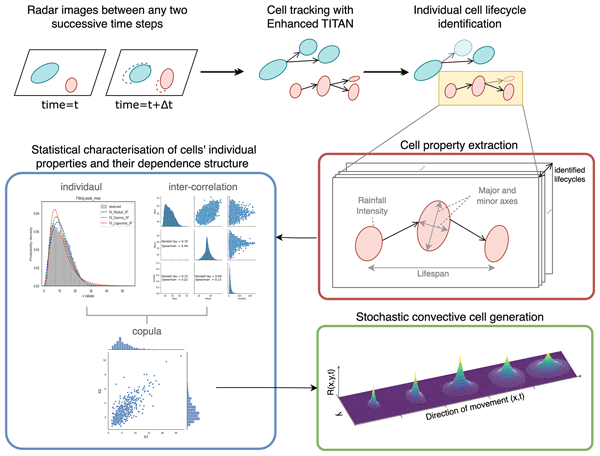
This study presents a new algorithm to model convective storms. We used advanced tracking methods to analyse 165 storm events in Birmingham (UK) and reconstruct storm cell life cycles. We found that cell properties like intensity and size are interrelated and vary over time. The new algorithm, based on vine copulas, accurately simulates these properties and their evolution. It also integrates an exponential shape function for realistic rainfall patterns, enhancing its hydrological applicability.
Abrar Habib, Athanasios Paschalis, Adrian P. Butler, Christian Onof, John P. Bloomfield, and James P. R. Sorensen
Hydrol. Earth Syst. Sci. Discuss., https://doi.org/10.5194/hess-2023-27, https://doi.org/10.5194/hess-2023-27, 2023
Preprint withdrawn
Short summary
Short summary
Components of the hydrological cycle exhibit a “memory” in their behaviour which quantifies how long a variable would stay at high/low values. Being able to model and understand what affects it is vital for an accurate representation of the hydrological elements. In the current work, it is found that rainfall affects the fractal behaviour of groundwater levels, which implies that changes to rainfall due to climate change will change the periods of flood and drought in groundwater-fed catchments.
Y. K. Chen, Y. T. Lin, H. Y. Yen, N. H. Chang, H. M. Lin, K. H. Yang, C. S. Chen, L. P. Wang, H. K. Cheng, H. H. Wu, and J. Y. Han
Int. Arch. Photogramm. Remote Sens. Spatial Inf. Sci., XLIII-B3-2022, 1091–1096, https://doi.org/10.5194/isprs-archives-XLIII-B3-2022-1091-2022, https://doi.org/10.5194/isprs-archives-XLIII-B3-2022-1091-2022, 2022
Cited articles
Baioletti, M., Santucci, V., and Tomassini, M.: A performance analysis of Basin hopping compared to established metaheuristics for global optimization, J. Global. Optim., 89, 803–832, https://doi.org/10.1007/s10898-024-01373-5, 2024. a
Cannon, A. J., Jeong, D.-I., and Yau, K.-H.: Updated observations provide stronger evidence for increases in sub-hourly to hourly extreme rainfall in Canada, J. Climate, 37, 3393–3411, https://doi.org/10.1175/JCLI-D-23-0501.1, 2024. a
Chan, S., Kendon, E., Roberts, N., Fowler, H., and Blenkinsop, S.: The characteristics of summer sub-hourly rainfall over the southern UK in a high-resolution convective permitting model, Environ. Res. Lett., 11, 094024, https://doi.org/10.1088/1748-9326/11/9/094024, 2016. a
Cross, D., Onof, C., Winter, H., and Bernardara, P.: Censored rainfall modelling for estimation of fine-scale extremes, Hydrol. Earth Syst. Sci., 22, 727–756, https://doi.org/10.5194/hess-22-727-2018, 2018. a
Cross, D., Onof, C., and Winter, H.: Ensemble simulation of future rainfall extremes with temperature dependent censored simulation, Adv. Meteorol., 136, 103479, https://doi.org/10.1016/j.advwatres.2019.103479, 2019. a
Ebers, N., Schröter, K., and Müller-Thomy, H.: Estimation of future rainfall extreme values by temperature-dependent disaggregation of climate model data, Nat. Hazards Earth Syst. Sci., 24, 2025–2043, https://doi.org/10.5194/nhess-24-2025-2024, 2024. a
Efstratiadis, A., Koutsoyiannis, D., and Polytechniou, H.: An evolutionary annealing-simplex algorithm for global optimisation of water resource systems, in: Hydroinformatics 2002: Proceedings of the Fifth International Conference on Hydroinformatics, International Water Association Cardiff, UK, 431–441, 2002. a
Fowler, H. J., Ali, H., Allan, R. P., Ban, N., Barbero, R., Berg, P., Blenkinsop, S., Cabi, N. S., Chan, S., Dale, M., Dunn, R. J. H., Ekström, M., Evans, J. P., Fosser, G., Golding, B., Guerreiro, S. B., Hegerl, G. C., Kahraman, A., Kendon, E. J., Lenderink, G., Lewis, E., Li, X., O'Gorman, P. A., Orr, H. G., Peat, K. L., Prein, A. F., Pritchard, D., Schär, C., Sharma, A., Stott, P. A., Villalobos-Herrera, R., Villarini, G., Wasko, C., Wehner, M. F., Westra, S., and Whitford, A.: Towards advancing scientific knowledge of climate change impacts on short-duration rainfall extremes, Philos. T. Roy. Soc. A, 379, 20190542, https://doi.org/10.1098/rsta.2019.0542, 2021. a
Gires, A., Onof, C., Maksimovic, C., Schertzer, D., Tchiguirinskaia, I., and Simoes, N.: Quantifying the impact of small scale unmeasured rainfall variability on urban runoff through multifractal downscaling: a case study, J. Hydrol., 442, 117–128, 2012. a
Harris, C. R., Millman, K. J., van der Walt, S. J., Gommers, R., Virtanen, P., Cournapeau, D., Wieser, E., Taylor, J., Berg, S., Smith, N. J., Kern, R., Picus, M., Hoyer, S., van Kerkwijk, M. H., Brett, M., Haldane, A., del Río, J. F., Wiebe, M., Peterson, P., Gérard-Marchant, P., Sheppard, K., Reddy, T., Weckesser, W., Abbasi, H., Gohlke, C., and Oliphant, T. E.: Array programming with NumPy, Nature, 585, 357–362, https://doi.org/10.1038/s41586-020-2649-2, 2020. a
Huang, J., Fatichi, S., Mascaro, G., Manoli, G., and Peleg, N.: Intensification of sub-daily rainfall extremes in a low-rise urban area, Urban Climate, 42, 101124, https://doi.org/10.1016/j.uclim.2022.101124, 2022. a
Islam, M. A., Yu, B., and Cartwright, N.: Coupling of satellite-derived precipitation products with Bartlett-Lewis model to estimate intensity-frequency-duration curves for remote areas, J. Hydrol., 609, 127743, https://doi.org/10.1016/j.jhydrol.2022.127743, 2022. a
Islam, M. A., Yu, B., and Cartwright, N.: Bartlett–Lewis model calibrated with satellite-derived precipitation data to estimate daily peak 15 min rainfall intensity, Atmosphere, 14, 985, https://doi.org/10.3390/atmos14060985, 2023. a
Khaliq, M. and Cunnane, C.: Modelling point rainfall occurrences with the modified Bartlett-Lewis rectangular pulses model, J. Hydrol., 180, 109–138, https://doi.org/10.1016/0022-1694(95)02894-3, 1996. a
Kim, D., Cho, H., Onof, C., and Choi, M.: Let-It-Rain: a web application for stochastic point rainfall generation at ungaged basins and its applicability in runoff and flood modeling, Stoch. Env. Res. Risk. A., 31, 1023–1043, https://doi.org/10.1007/s00477-016-1234-6, 2017a. a, b
Kim, J.-G., Kwon, H.-H., and Kim, D.: A hierarchical Bayesian approach to the modified Bartlett-Lewis rectangular pulse model for a joint estimation of model parameters across stations, J. Hydrol., 544, 210–223, https://doi.org//10.1016/j.jhydrol.2016.11.031, 2017b. a
Kossieris, P., Makropoulos, C., Onof, C., and Koutsoyiannis, D.: A rainfall disaggregation scheme for sub-hourly time scales: coupling a Bartlett-Lewis based model with adjusting procedures, J. Hydrol., 556, 980–992, https://doi.org/10.1016/j.jhydrol.2016.07.015, 2018. a
Koutsoyiannis, D., Onof, C., and Wheater, H. S.: Multivariate rainfall disaggregation at a fine timescale, Water Resour. Res., 39, 1173, https://doi.org/10.1029/2002WR001600, 2003. a
Marani, M.: On the correlation structure of continuous and discrete point rainfall, Water Resour. Res., 39, 1128, https://doi.org/10.1029/2002WR001456, 2003. a
McKinney, W.: Data Structures for Statistical Computing in Python, Proceedings of the 9th Python in Science Conference, edited by: van der Walt, S. and Millman, J., 56–61, https://doi.org/10.25080/Majora-92bf1922-00a, 2010. a
Onof, C. and Arnbjerg-Nielsen, K.: Quantification of anticipated future changes in high resolution design rainfall for urban areas, Atmos. Res., 92, 350–363, https://doi.org/10.1016/j.atmosres.2009.01.014, 2009. a
Onof, C. and Wheater, H. S.: Modelling of British rainfall using a random parameter Bartlett-Lewis Rectangular Pulse Model, J. Hydrol., 149, 67–95, https://doi.org/10.1016/0022-1694(93)90100-N, 1993. a, b
Onof, C. and Wheater, H. S.: Improvements to the modelling of British rainfall using a modified random parameter Bartlett-Lewis rectangular pulse model, J. Hydrol., 157, 177–195, https://doi.org/10.1016/0022-1694(94)90104-X, 1994. a
Onof, C., Chandler, R. E., Kakou, A., Northrop, P., Wheater, H. S., and Isham, V.: Rainfall modelling using Poisson-cluster processes: a review of developments, Stoch. Env. Res. Risk. A., 14, 384–411, https://doi.org/10.1007/s004770000043, 2000. a, b
Papalexiou, S. M.: Rainfall generation revisited: introducing CoSMoS-2s and advancing copula-based intermittent time series modeling, Water Resour. Res., 58, e2021WR031641, https://doi.org/10.1029/2021WR031641, 2022. a
Park, J., Onof, C., and Kim, D.: A hybrid stochastic rainfall model that reproduces some important rainfall characteristics at hourly to yearly timescales, Hydrol. Earth Syst. Sci., 23, 989–1014, https://doi.org/10.5194/hess-23-989-2019, 2019. a
Rodriguez-Iturbe, I., Cox, D. R., and Isham, V.: Some models for rainfall based on stochastic point processes, P. Roy. Soc. A-Math. Phy., 410, 269–288, https://doi.org/10.1098/rspa.1987.0039, 1987. a, b
Rodriguez-Iturbe, I., Cox, D. R., and Isham, V.: A point process model for rainfall: further developments, P. Roy. Soc. A-Math. Phy., 417, 283–298, https://doi.org/10.1098/rspa.1988.0061, 1988. a, b
Verhoest, N., Troch, P. A., and Troch, F. P. D.: On the applicability of Bartlett–Lewis rectangular pulses models in the modeling of design storms at a point, J. Hydrol., 202, 108–120, https://doi.org/10.1016/S0022-1694(97)00060-7, 1997. a
Verhoest, N. E. C., Vandenberghe, S., Cabus, P., Onof, C., Meca-Figueras, T., and Jameleddine, S.: Are stochastic point rainfall models able to preserve extreme flood statistics?, Hydrol. Process., 24, 3439–3445, https://doi.org/10.1002/hyp.7867, 2010. a, b
Virtanen, P., Gommers, R., Oliphant, T. E., Haberland, M., Reddy, T., Cournapeau, D., Burovski, E., Peterson, P., Weckesser, W., Bright, J., van der Walt, S. J., Brett, M., Wilson, J., Millman, K. J., Mayorov, N., Nelson, A. R. J., Jones, E., Kern, R., Larson, E., Carey, C. J., Polat, İ., Feng, Y., Moore, E. W., VanderPlas, J., Laxalde, D., Perktold, J., Cimrman, R., Henriksen, I., Quintero, E. A., Harris, C. R., Archibald, A. M., Ribeiro, A. H., Pedregosa, F., van Mulbregt, P., and SciPy 1.0 Contributors: SciPy 1.0: fundamental algorithms for scientific computing in Python, Nat. Methods, 17, 261–272, https://doi.org/10.1038/s41592-019-0686-2, 2020. a
Wang, L.-P., Marra, F., and Onof, C.: Modelling sub-hourly rainfall extremes with short records – a comparison of MEV, Simplified MEV and point process methods, EGU General Assembly 2020, Online, 4–8 May 2020, EGU2020-6061, https://doi.org/10.5194/egusphere-egu2020-6061, 2020 a
Wei, C.-L., Chen, P.-C., Dai, T.-Y., Wang, L.-P., Tseng, C.-Y., and Chou, C.-C.: NTU-CompHydroMet-Lab/pyBL: v1.0.0, Zenodo [code, data set], https://doi.org/10.5281/zenodo.12605935, 2024. a, b, c
Short summary
pyBL is an open-source package for generating realistic rainfall time series based on the Bartlett–Lewis (BL) model. It can preserve not only standard but also extreme rainfall statistics across various timescales. Notably, compared to traditional frequency analysis methods, the BL model requires only half the record length (or even shorter) to achieve similar consistency in estimating sub-hourly rainfall extremes. This makes it a valuable tool for modelling rainfall extremes with short records.
pyBL is an open-source package for generating realistic rainfall time series based on the...