
Articles | Volume 19, issue 6
https://doi.org/10.5194/gmd-19-2407-2026
© Author(s) 2026. This work is distributed under
the Creative Commons Attribution 4.0 License.
the Creative Commons Attribution 4.0 License.
https://doi.org/10.5194/gmd-19-2407-2026
© Author(s) 2026. This work is distributed under
the Creative Commons Attribution 4.0 License.
the Creative Commons Attribution 4.0 License.
Review and perspective paper
| 
25 Mar 2026
Review and perspective paper |
| 25 Mar 2026
| 25 Mar 2026
Best practices in software development for robust and reproducible geoscientific models based on insights from the Global Carbon Budget's dynamic vegetation models
Konstantin Gregor
CORRESPONDING AUTHOR

TUM School of Life Sciences, Technical University of Munich, Freising, Germany
Benjamin F. Meyer
TUM School of Life Sciences, Technical University of Munich, Freising, Germany
Tillmann Gaida
Goto10 GmbH, Munich, Germany
Victor Justo Vasquez
Thoughtworks GmbH, Hamburg, Germany
Karina Bett-Williams
Global Systems Institute, University of Exeter, Exeter EX4 4PY, UK
UK Met Office, Fitzroy Road, Exeter EX1 3PB, UK
Matthew Forrest
Seckenberg Biodiversity and Climate Research Centre, Frankfurt, Germany
João P. Darela-Filho
TUM School of Life Sciences, Technical University of Munich, Freising, Germany
Sam Rabin
NSF National Center for Atmospheric Research, Boulder, Colorado, USA
Marcos Longo
Climate and Ecosystem Sciences Division, Lawrence Berkeley National Laboratory, Berkeley, CA 94720, USA
Division of Numerical Modelling of the Earth System, General Coordination of Earth Sciences, National Institute for Space Research (INPE), Cachoeira Paulista, SP, Brazil
Joe R. Melton
Climate Research Division, Environment, and Climate Change Canada, Victoria, BC, V8N 1V8, Canada
Johan Nord
Department of Physical Geography and Ecosystem Science, Lund University, Sölvegatan 12, 22362 Lund, Sweden
Peter Anthoni
Karlsruhe Institute of Technology, Institute of Meteorology and Climate, Research/Atmospheric Environmental Research, 82467 Garmisch-Partenkirchen, Germany
Vladislav Bastrikov
Science Partners, Paris 75010, France
Thomas Colligan
University of Maryland, College Park, MD 20742, USA
NASA Goddard Space Flight Center, Earth Sciences Division, Biospheric Sciences Lab, 6 Greenbelt, MD 20771, USA
Christine Delire
CNRM, Météo-France, CNRS, Université de Toulouse, Toulouse, France
Michael C. Dietze
Department of Earth & Environment, Boston University, Boston, MA 02215, USA
George Hurtt
Department of Geographical Sciences, University of Maryland, College Park, MD 20770, USA
Akihiko Ito
The University of Tokyo, Tokyo, Japan
Lasse T. Keetz
Department of Geosciences, University of Oslo, Oslo, Norway
Jürgen Knauer
School of Life Sciences, Faculty of Science, University of Technology Sydney, Ultimo, NSW 2007, Australia
Johannes Köster
Bioinformatics and Computational Oncology, Institute for AI in Medicine (IKIM), University Hospital Essen, University of Duisburg-Essen, Essen, Germany
Tzu-Shun Lin
NSF National Center for Atmospheric Research, Boulder, Colorado, USA
Lei Ma
Department of Geographical Sciences, University of Maryland, College Park, MD 20770, USA
Marie Minvielle
CNRM, Météo-France, CNRS, Université de Toulouse, Toulouse, France
Stefan Olin
Department of Physical Geography and Ecosystem Science, Lund University, Sölvegatan 12, 22362 Lund, Sweden
Sebastian Ostberg
Potsdam Institute for Climate Impact Research (PIK), Member of the Leibniz Association, Potsdam, Germany
State Key Laboratory for Ecological Security of Regions and Cities, Research Center for Eco-Environmental Sciences, Chinese Academy of Sciences, Beijing 100085, China
Reiner Schnur
Max Planck Institute for Meteorology, Hamburg, Germany
Climate and Environmental Physics, Physics Institute, University of Bern, Bern, Switzerland
Wyss Academy for Nature, University of Bern, Bern, Switzerland
Oeschger Centre for Climate Change Research, University of Bern, Bern, Switzerland
Peter E. Thornton
Environmental Sciences Division, Oak Ridge National Laboratory, Oak Ridge, TN, USA
Anja Rammig
TUM School of Life Sciences, Technical University of Munich, Freising, Germany
Related authors
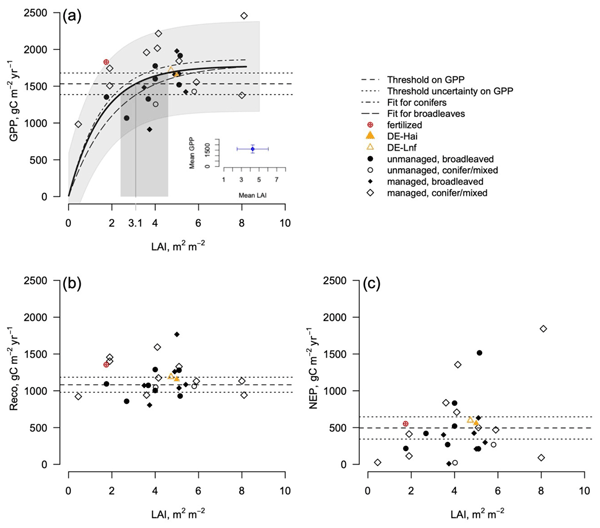
Olivier Bouriaud, Ernst-Detlef Schulze, Konstantin Gregor, Issam Boukhris, Peter Högberg, Roland Irslinger, Phillip Papastefanou, Julia Pongratz, Anja Rammig, Riccardo Valentini, and Christian Körner
Biogeosciences, 22, 4729–4741, https://doi.org/10.5194/bg-22-4729-2025, https://doi.org/10.5194/bg-22-4729-2025, 2025
Short summary
Short summary
The impact of harvesting on forests' carbon sink capacities is debated. One view is that their sink strength is resilient to harvesting, and the other is that it disrupts these capacities. Our work shows that leaf area index (LAI) has been overlooked in this discussion. We found that temperate forests' carbon uptake is largely insensitive to variations in LAI beyond 4.5 m² m-² but that forests operate at higher levels.
This article is included in the Encyclopedia of Geosciences
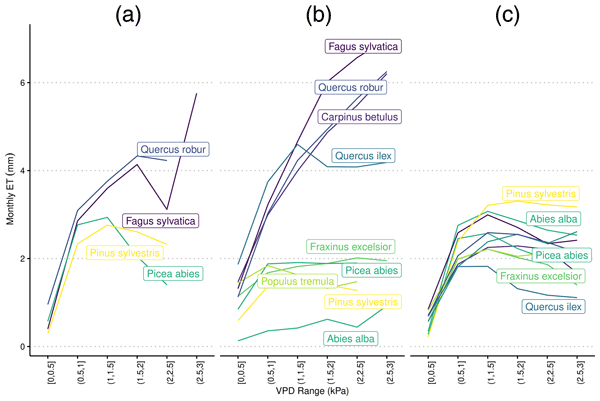
Benjamin F. Meyer, João P. Darela-Filho, Konstantin Gregor, Allan Buras, Qiao-Lin Gu, Andreas Krause, Daijun Liu, Phillip Papastefanou, Sijeh Asuk, Thorsten E. E. Grams, Christian S. Zang, and Anja Rammig
Geosci. Model Dev., 18, 4643–4666, https://doi.org/10.5194/gmd-18-4643-2025, https://doi.org/10.5194/gmd-18-4643-2025, 2025
Short summary
Short summary
Climate change has increased the likelihood of drought events across Europe, potentially threatening the European forest carbon sink. Dynamic vegetation models with mechanistic plant hydraulic architecture are needed to model these developments. We evaluate the plant hydraulic architecture version of LPJ-GUESS and show its ability to capture species-specific evapotranspiration responses to drought and to reproduce flux observations of both gross primary production and evapotranspiration.
This article is included in the Encyclopedia of Geosciences
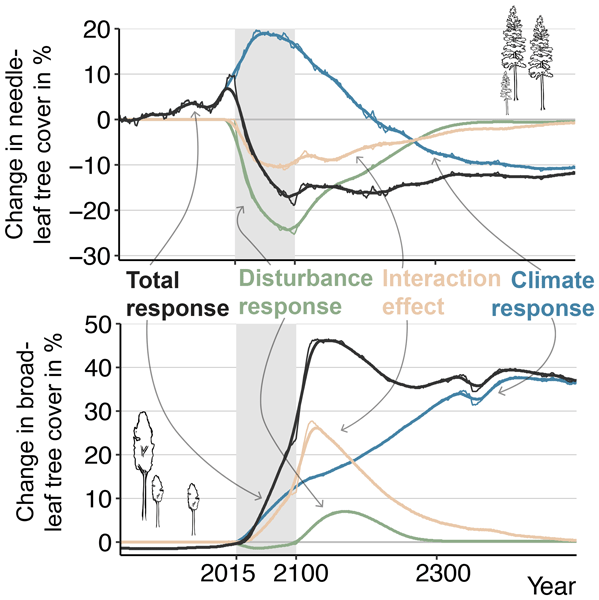
Lucia S. Layritz, Konstantin Gregor, Andreas Krause, Stefan Kruse, Benjamin F. Meyer, Thomas A. M. Pugh, and Anja Rammig
Biogeosciences, 22, 3635–3660, https://doi.org/10.5194/bg-22-3635-2025, https://doi.org/10.5194/bg-22-3635-2025, 2025
Short summary
Short summary
Disturbances, such as fire, can change which vegetation grows in a forest, affecting water and carbon flows and, thus, the climate. Disturbances are expected to increase with climate change, but it is uncertain by how much. Using a simulation model, we studied how future climate, disturbances, and their combined effect impact northern (high-latitude) forest ecosystems. Our findings highlight the importance of considering these factors and the need to better understand how disturbances will change in the future.
This article is included in the Encyclopedia of Geosciences
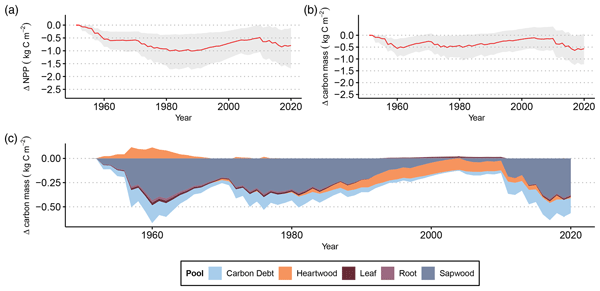
Benjamin F. Meyer, Allan Buras, Konstantin Gregor, Lucia S. Layritz, Adriana Principe, Jürgen Kreyling, Anja Rammig, and Christian S. Zang
Biogeosciences, 21, 1355–1370, https://doi.org/10.5194/bg-21-1355-2024, https://doi.org/10.5194/bg-21-1355-2024, 2024
Short summary
Short summary
Late-spring frost (LSF), critically low temperatures when trees have already flushed their leaves, results in freezing damage leaving trees with reduced ability to perform photosynthesis. Forests with a high proportion of susceptible species like European beech are particularly vulnerable. However, this process is rarely included in dynamic vegetation models (DVMs). We show that the effect on simulated productivity and biomass is substantial, warranting more widespread inclusion of LSF in DVMs.
This article is included in the Encyclopedia of Geosciences
Wensu Hao, Hanqin Tian, Hao Shi, Xing Yu, Naiqing Pan, Shufen Pan, Francesco N. Tubiello, Wulahati Adalibieke, Martial Bernoux, Philippe Ciais, Federico Maggi, Kazuya Nishina, Aimable Uwizeye, and Feng Zhou
Earth Syst. Sci. Data Discuss., https://doi.org/10.5194/essd-2026-595, https://doi.org/10.5194/essd-2026-595, 2026
Preprint under review for ESSD
Short summary
Short summary
HaNi-Crop dataset presents a long-term global dataset of nitrogen inputs from synthetic fertilizers and animal manure for different crops from 1961 to 2023. Built by combining agricultural statistics with crop distribution information, the dataset reveals how nutrient use has changed over time and provides a valuable resource for improving food production, environmental protection, climate change, and more sustainable agricultural management.
This article is included in the Encyclopedia of Geosciences
Jens Krause, Peter Anthoni, Mike Harfoot, Jens-Christian Svenning, and Almut Arneth
EGUsphere, https://doi.org/10.5194/egusphere-2026-5593, https://doi.org/10.5194/egusphere-2026-5593, 2026
This preprint is open for discussion and under review for Biogeosciences (BG).
Short summary
Short summary
In our novel study, we present the first usage of our ecosystem model system, that models the entire food web that lives within an ecosystem. Animals have control over the vegetation, which reacts to the exerted pressure. We model the removal of large herbivores or carnivore to investigate how their absence affect other ecosystem processes. We also analyse how fast ecosystems can recover from large removal events and how the presence of protected areas can enhance the recovery.
This article is included in the Encyclopedia of Geosciences
Shannon de Roos, Sam Rabin, Danica Lombardozzi, and Wim Thiery
EGUsphere, https://doi.org/10.5194/egusphere-2026-5484, https://doi.org/10.5194/egusphere-2026-5484, 2026
This preprint is open for discussion and under review for Geoscientific Model Development (GMD).
Short summary
Short summary
In this study, we introduce crop heat stress effects in the Community Land Model v5 (CLM5), a model that simulates processes on the land surface, including crops. Different heat stress temperature thresholds are tested, along with two different methods to affect crop grain development; by accelerating leaf fall, or by directly reducing grain production. The heat stress implementation is a step forward to improving simulated impact of climate extremes on crops in global models.
This article is included in the Encyclopedia of Geosciences
Zihao Bian, Hao Shi, Rui Li, Fei Lun, Francesco N. Tubiello, Nathaniel D. Mueller, Shiyu You, Rong Hao, Jiageng Ma, Longhui Li, Changchun Huang, Bing He, Yuanzhi Yao, and Hanqin Tian
Earth Syst. Sci. Data, 18, 7125–7141, https://doi.org/10.5194/essd-18-7125-2026, https://doi.org/10.5194/essd-18-7125-2026, 2026
Short summary
Short summary
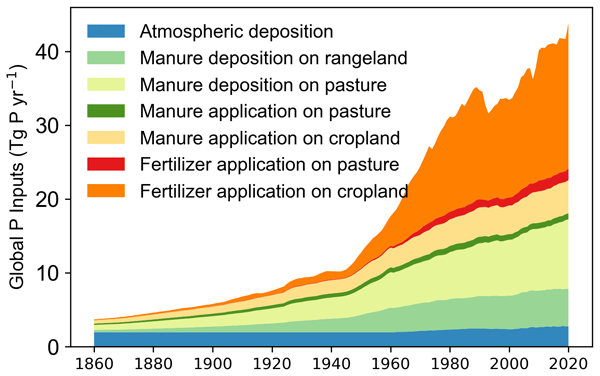
The History of Anthropogenic Phosphorus Inputs (HaPi) provides a dataset of global human-driven phosphorus fluxes to terrestrial biosphere from 1860–2020 at a resolution of 5 arcmin. This comprehensive dataset consists of phosphorus fertilizer/manure application to cropland, manure application/deposition to pasture, manure deposition to rangeland, and atmospheric phosphorus deposition. It supports analyses of nutrient budgets and provides essential forcing data for Earth system models.
This article is included in the Encyclopedia of Geosciences
Fenjuan Wang, Shamil Maksyutov, Rajesh Janardanan, Dmitry A. Belikov, Prabir K. Patra, Ruosi Liang, Yuzhong Zhang, Ge Ren, Hong Lin, Nicole Montenegro, Antoine Berchet, Marielle Saunois, Adrien Martinez, Sara Hyvärinen, Aki Tsuruta, Samuel Takele Kenea, Miao Liang, Xin Lan, Yukio Terao, M. Kawser Ahmed, Manish Naja, Akihiko Ito, Isamu Morino, Yukio Yoshida, Yu Someya, Tazu Saeki, and Tsuneo Matsunaga
Earth Syst. Sci. Data Discuss., https://doi.org/10.5194/essd-2026-420, https://doi.org/10.5194/essd-2026-420, 2026
Preprint under review for ESSD
Short summary
Short summary
Methane is a potent greenhouse gas driving climate change, yet Asian emissions remain highly uncertain. We conducted the first Methane Inversion inter-Comparison for Asia (MICA) combining seven models to estimate methane across Asia from 2010 to 2021 using satellite and ground data. We found that emissions are generally lower than prior inventories, though some countries underreport. This study provides a comprehensive, transparent dataset to quantify regional methane budgets across Asia.
This article is included in the Encyclopedia of Geosciences
Anna Kirchner, Efrén López-Blanco, Vladislav Bastrikov, Sebastiaan Luyssaert, Philippe Peylin, and Anne Sofie Lansø
Biogeosciences, 23, 6521–6555, https://doi.org/10.5194/bg-23-6521-2026, https://doi.org/10.5194/bg-23-6521-2026, 2026
Short summary
Short summary
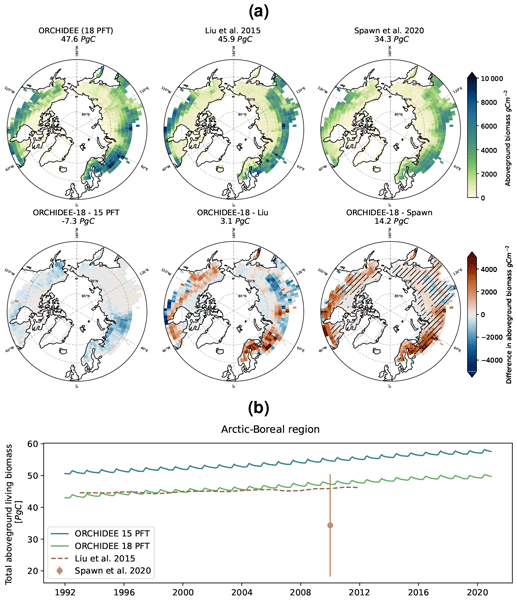
Shrubs need to be represented in climate models, because they shape the response of high-latitude regions to climate change. We added three shrub types to the ORCHIDEE (Organising Carbon and Hydrology In Dynamic Ecosystems) land surface model using Arctic observations. Including shrubs reduces simulated biomass and carbon uptake, improving model agreement with measurements. This is a simple, observation-based approach and an important step towards better representations of shrubs and their climate change response in models.
This article is included in the Encyclopedia of Geosciences
Qing Sun and Édouard Davin
EGUsphere, https://doi.org/10.5194/egusphere-2026-5196, https://doi.org/10.5194/egusphere-2026-5196, 2026
This preprint is open for discussion and under review for Biogeosciences (BG).
Short summary
Short summary
We developed a process-based reconstruction of how peatlands and their carbon stocks changed over the past three centuries in Switzerland. Combining historical records with peatland modelling, we traced where peat carbon remains today. Most peat carbon is currently stored outside intact peatlands, showing the opportunities to reduce future carbon losses extend beyond the small fraction of remaining near-natural peatlands.
This article is included in the Encyclopedia of Geosciences
Simon Scheiter, Jinfeng Chang, Philippe Ciais, Marie Dury, Louis Francois, Matthew Forrest, Alexandra Henrot, Christopher P. O. Reyer, Sonia Seneviratne, Jörg Steinkamp, Wim Thiery, Wenfang Xu, and Thomas Hickler
Biogeosciences, 23, 6409–6430, https://doi.org/10.5194/bg-23-6409-2026, https://doi.org/10.5194/bg-23-6409-2026, 2026
Short summary
Short summary
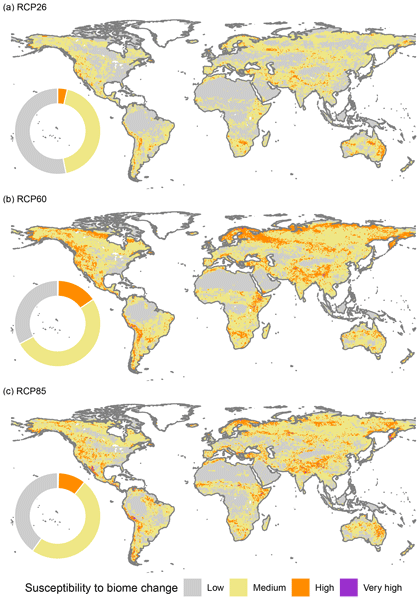
We show how climate change may reshape the world's major biomes, such as forests, grasslands, and tundra. Therefore, we combined dynamic vegetation models, machine learning and observation-based biome maps. We found that many biomes are likely to shift polewards as temperatures rise. Even under low-emission scenarios, large areas could change. These results help identify regions most susceptible to climate change and support global efforts to protect and manage natural ecosystems in the future.
This article is included in the Encyclopedia of Geosciences
Inika Taylor, Douglas I. Kelley, Camilla Mathison, Karina E. Bett-Williams, Andrew J. Hartley, Richard A. Betts, Chantelle Burton, and Maria L. F. Barbosa
Nat. Hazards Earth Syst. Sci., 26, 4257–4289, https://doi.org/10.5194/nhess-26-4257-2026, https://doi.org/10.5194/nhess-26-4257-2026, 2026
Short summary
Short summary
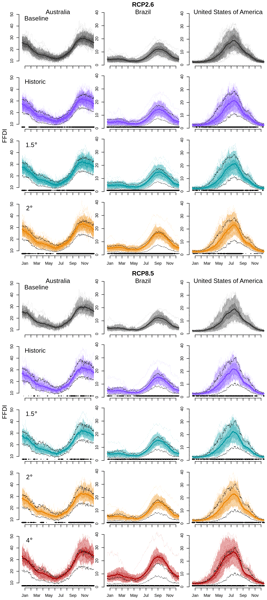
We present future climate change projections that show increasing fire danger worldwide. Focusing on Australia, Brazil, and the USA, we show that limiting warming to 2 °C reduces the increase in fire danger. However, fire seasons still lengthen and intensify even at 1.5 °C, demonstrating the need for mitigation to limit impacts and adaptation to manage residual risk. Low-fire danger periods persist, but we show their timing and duration will shift and must be considered in fire management.
This article is included in the Encyclopedia of Geosciences
Xiaoying Shi, Daniel M. Ricciuto, Yaoping Wang, Joe R. Melton, Fortunat Joos, Yiqi Luo, Xiaofeng Xu, Dafeng Hui, Qianlai Zhuang, Chunjing Qiu, Hongxing He, Siya Shao, Xingjie Lu, Yongjiu Dai, Akihiko Ito, Qing Sun, Nitin Chaudhary, Ayesha Hussain, Mousong Wu, Jian Zhou, Jingwei Zhang, Ye Yuan, Rachael H. Turton, Eleanor J. Burke, Jiafu Mao, Yuefeng Hao, Natalie A. Griffiths, Verity Salmon, Paul J. Hanson, Melanie A. Mayes, and Peter E. Thornton
EGUsphere, https://doi.org/10.5194/egusphere-2026-5193, https://doi.org/10.5194/egusphere-2026-5193, 2026
This preprint is open for discussion and under review for Biogeosciences (BG).
Short summary
Short summary
Northern peatlands store vast amounts of carbon, but their response to climate change remains uncertain. We compared 15 ecosystem models with observations from a long-term warming and elevated carbon dioxide experiment in Minnesota. Models differed widely in their carbon responses, reflecting differences in ecosystem processes and model parameters. The results identify priorities for improving peatland models and projections of future carbon–climate feedbacks.
This article is included in the Encyclopedia of Geosciences
Jeanne Decayeux, Bertrand Decharme, Romain Darnajoux, and Christine Delire
Geosci. Model Dev., 19, 7787–7815, https://doi.org/10.5194/gmd-19-7787-2026, https://doi.org/10.5194/gmd-19-7787-2026, 2026
Short summary
Short summary
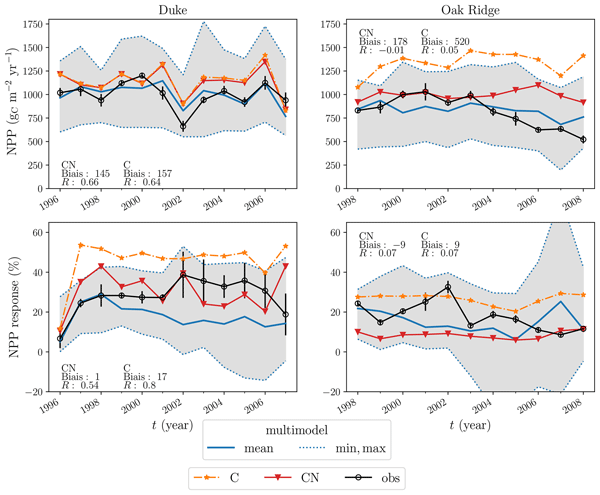
The article describes the implementation of the nitrogen cycle in the land surface model ISBA (Interaction-Soil-Biosphere-Atmosphere). The model is evaluated using Free Air CO2 Enrichment experiments. A comparison with a multi-model analysis shows that the nitrogen model version performs better than the carbon-only version, notably a reduced sensitivity to elevated CO2, and smaller C stocks. We also present a detailed analysis of the simulated N dynamics in the soil.
This article is included in the Encyclopedia of Geosciences
Sibyll Schaphoff, David Hötten, Christoph Müller, Dieter Gerten, Sebastian Ostberg, and Werner von Bloh
Geosci. Model Dev., 19, 7615–7651, https://doi.org/10.5194/gmd-19-7615-2026, https://doi.org/10.5194/gmd-19-7615-2026, 2026
Short summary
Short summary
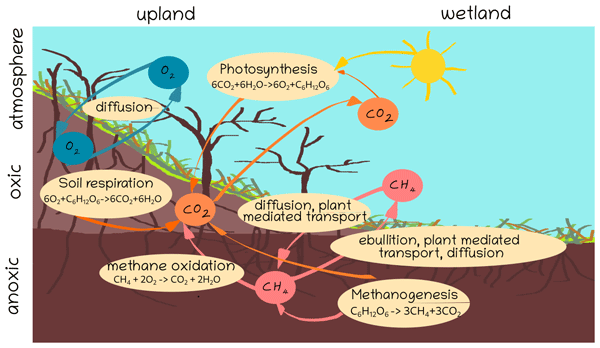
Methane is a powerful driver of climate change, yet emissions from wetlands and farming remain uncertain. We improved a global vegetation model that links water, plants and soils to methane production and release. The model now captures waterlogged areas, methane creation and escape, and flood-tolerant plants. It reproduces global wetland patterns and emissions more realistically, helping assess how climate and land-use change may affect future methane release and improve climate projections.
This article is included in the Encyclopedia of Geosciences
Bertrand Decharme, Diane Tzanos, Lucas Hardouin, Aaron Boone, Marie Minvielle, Patrick Le Moigne, and Rémi Gaillard
Geosci. Model Dev., 19, 7239–7277, https://doi.org/10.5194/gmd-19-7239-2026, https://doi.org/10.5194/gmd-19-7239-2026, 2026
Short summary
Short summary
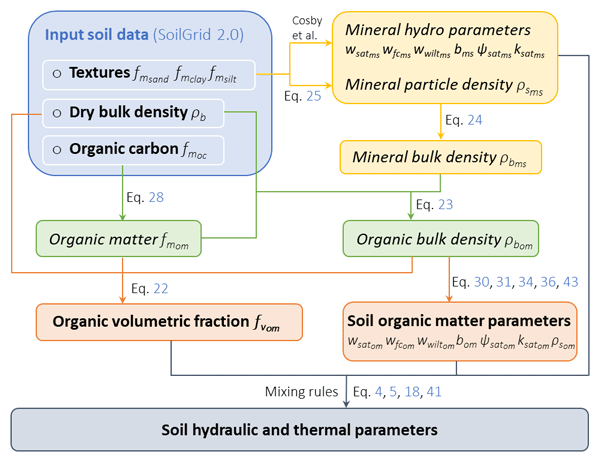
We developed a new method to represent how organic matter in soils, together with a mineral soil compactness adjustment, influences the movement of water and heat in land models. We implemented this approach in a global model and performed long-term simulations driven by weather data and global soil maps. Compared with an older empirical method, it produces more consistent soil moisture, runoff, evaporation, and ground temperature and shows closer agreement with observations.
This article is included in the Encyclopedia of Geosciences
Kristian Schufft, Katrin Fleischer, Anja Rammig, Belinda E. Medlyn, Min Zhao, Lin Yu, Catriona A. Macdonald, and Sönke Zaehle
EGUsphere, https://doi.org/10.5194/egusphere-2026-3553, https://doi.org/10.5194/egusphere-2026-3553, 2026
This preprint is open for discussion and under review for Biogeosciences (BG).
Short summary
Short summary
Soil respiration and its underlying drivers are heavily influenced by nutrient availability. We used a computer model that simulates ecosystem processes to investigate how phosphorus (P) addition influences soil respiration and its underlying drivers. Our model suggests that, reduced root exudation, the labile C flux from roots into soils, causes reduced soil respiration under P addition. Our results bring a new perspective in the dependence of soil respiration on nutrient availability.
This article is included in the Encyclopedia of Geosciences
Prashant Paudel, Stefan Olin, Mark Tjoelker, Mikael Pontarp, Daniel Metcalfe, and Benjamin Smith
Biogeosciences, 23, 4999–5018, https://doi.org/10.5194/bg-23-4999-2026, https://doi.org/10.5194/bg-23-4999-2026, 2026
Short summary
Short summary
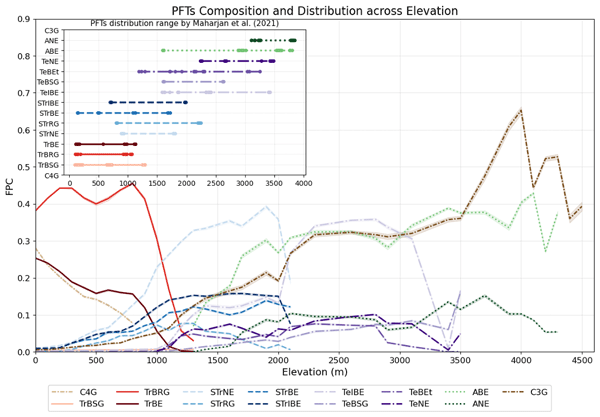
We used computer simulations to study how vegetation changes from low to high elevations in the Himalayas. We found that competition between plants is more important in warm lowlands, while cold conditions limit plant growth at high elevations. These differences influence plant diversity, vegetation structure, and the amount of plant growth across mountain landscapes, showing how climate and plant strategies together shape ecosystems.
This article is included in the Encyclopedia of Geosciences
Pin-Hsin Hu, Christian H. Reick, Reiner Schnur, Axel Kleidon, and Martin Claussen
Geosci. Model Dev., 19, 6357–6402, https://doi.org/10.5194/gmd-19-6357-2026, https://doi.org/10.5194/gmd-19-6357-2026, 2026
Short summary
Short summary
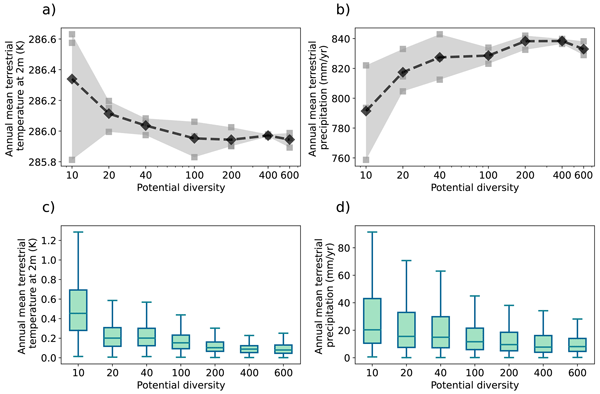
We introduce the new plant functional diversity model JeDi-BACH, a novel tool that integrates the Jena Diversity Model (JeDi) within the land component of the ICON Earth System Model. JeDi-BACH captures a richer set of plant trait variations based on environmental filtering and functional tradeoffs without a priori knowledge of the vegetation types. JeDi-BACH represents a significant advancement in modeling the complex interactions between plant functional diversity and climate.
This article is included in the Encyclopedia of Geosciences
Matthieu Lafaysse, Marie Dumont, Basile De Fleurian, Mathieu Fructus, Rafife Nheili, Léo Viallon-Galinier, Matthieu Baron, Aaron Boone, Axel Bouchet, Julien Brondex, Carlo Carmagnola, Bertrand Cluzet, Kévin Fourteau, Ange Haddjeri, Pascal Hagenmuller, Giulia Mazzotti, Marie Minvielle, Samuel Morin, Louis Quéno, Léon Roussel, Pierre Spandre, François Tuzet, and Vincent Vionnet
Geosci. Model Dev., 19, 6273–6334, https://doi.org/10.5194/gmd-19-6273-2026, https://doi.org/10.5194/gmd-19-6273-2026, 2026
Short summary
Short summary
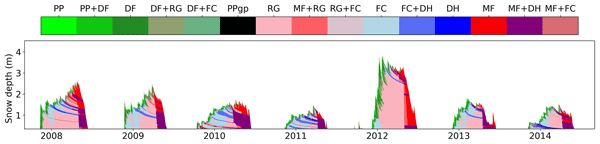
This article is a comprehensive description of the 3.0.2 stable release of the Crocus snowpack model. It describes various new implementations since the last reference article in 2012 and a review of the available scientific evaluations and applications of the model. This provides guidance for the future of numerical snow modelling.
This article is included in the Encyclopedia of Geosciences
Andreas Krause, Francisco Javier Pérez-Invernón, and Anja Rammig
EGUsphere, https://doi.org/10.5194/egusphere-2026-3212, https://doi.org/10.5194/egusphere-2026-3212, 2026
Short summary
Short summary
Lightning activity may change as the world warms, but estimates vary widely because lightning cannot be directly represented in global climate models. We reviewed 16 methods used to estimate lightning and compared how well they reproduce present-day patterns. Some methods perform much better than others, yet all have limitations. Future projections range from decreases to large increases in lightning activity, highlighting substantial uncertainty, especially in the tropics.
This article is included in the Encyclopedia of Geosciences
Kristian Schufft, Katrin Fleischer, Anja Rammig, Lin Yu, Mingkai Jiang, Belinda E. Medlyn, and Sönke Zaehle
Biogeosciences, 23, 4529–4559, https://doi.org/10.5194/bg-23-4529-2026, https://doi.org/10.5194/bg-23-4529-2026, 2026
Short summary
Short summary
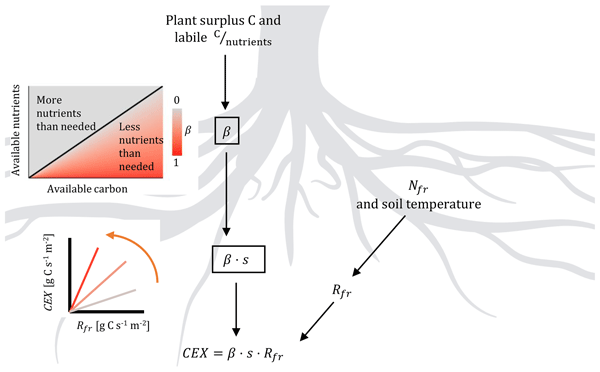
Root exudation describes a process in which plants allocate labile carbon (C) through roots into soils, thereby influencing microbial C and nutrient cycling. We implemented root exudation in a computer model that simulates ecosystem processes. Increased atmospheric CO2 increased root exudation, but the additional input was partially offset by enhanced microbial respiration. Our research brings new perspectives in modelling soil C and nutrient cycling in forests under increasing CO2.
This article is included in the Encyclopedia of Geosciences
Yaoping Wang, Daniel M. Ricciuto, Jiafu Mao, Sören E. Weber, Verity G. Salmon, Xiaoying Shi, Xiaojuan Yang, Natalie A. Griffiths, Paul J. Hanson, Anthony P. Walker, Jonathan Stelling, Katherine Duchesneau, Camille E. Defrenne, Jeffrey M. Warren, Stephen D. Sebestyen, Kyle J. Pearson, Keith Oleheiser, Joshua M. Birkebak, Mark Guilliams, Misha B. Krassovski, Melanie A. Mayes, and Peter E. Thornton
Geosci. Model Dev., 19, 5827–5855, https://doi.org/10.5194/gmd-19-5827-2026, https://doi.org/10.5194/gmd-19-5827-2026, 2026
Short summary
Short summary
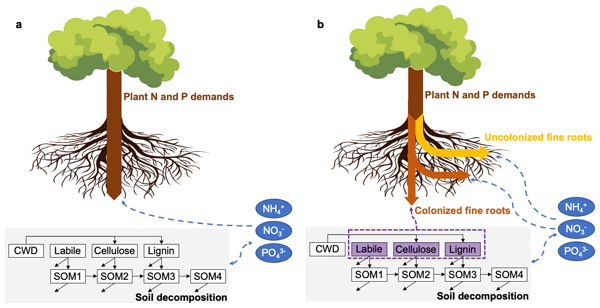
Boreal peatlands store much of the global soil carbon and the service is closely related to nutrient cycling. This study improved a major land surface model to better represent how plants gain nitrogen and phosphorus through fine roots and mycorrhizal association. The new model more accurately captured observed carbon fluxes than the default model at an experimental site in Minnesota, and suggests shifts in nutrient uptake strategy mitigates transition from carbon sink to source under warming.
This article is included in the Encyclopedia of Geosciences
Tim Stripp, Zhixuan Guo, Pierre Friedlingstein, Michael O’Sullivan, Stephen Sitch, Ana Bastos, Philippe Ciais, Jefferson Goncalves de Souza, Akihiko Ito, Wei Li, and Lei Ma
EGUsphere, https://doi.org/10.5194/egusphere-2026-3584, https://doi.org/10.5194/egusphere-2026-3584, 2026
Short summary
Short summary
Fire is a key process within the Earth system, yet it is often poorly represented in land carbon cycle models used to estimate how much carbon land ecosystems absorb from the atmosphere. We improved these models by applying long-term burned area data reconstructed from satellite observations. This reduced biases and uncertainty in fire carbon emission estimates and improved estimates of land carbon uptake, implying this method could enhance global and regional carbon budget estimates.
This article is included in the Encyclopedia of Geosciences
Matthew Forrest, Mateus Dantas de Paula, Filipe Gomes de Almeida, Sandy P. Harrison, I. Colin Prentice, and Thomas Hickler
EGUsphere, https://doi.org/10.5194/egusphere-2026-3273, https://doi.org/10.5194/egusphere-2026-3273, 2026
Short summary
Short summary
Global photosynthesis on land is a large flow of carbon in the Earth system which underpins food production and ecosystems. It is particularly important to know how it responds to climate change, but current vegetation models do not agree on this. We implemented a new photosynthesis model based on recent theoretical advances into a vegetation model. We found that it improved the representation of photosynthesis when compared both to global data from satellites and detailed site measurements.
This article is included in the Encyclopedia of Geosciences
April Sue Dalton, Michelle Garneau, and Joe R. Melton
Earth Syst. Sci. Data Discuss., https://doi.org/10.5194/essd-2026-169, https://doi.org/10.5194/essd-2026-169, 2026
Preprint under review for ESSD
Short summary
Short summary
Canadian peatlands store about 25 % of the world’s peat carbon. To better estimate this carbon, we compiled two large datasets: 88,763 peat-depth measurements from 844 sources and 436,923 locations where no peat was found. These data span nearly 100 years of studies and include many newly digitized records.
This article is included in the Encyclopedia of Geosciences
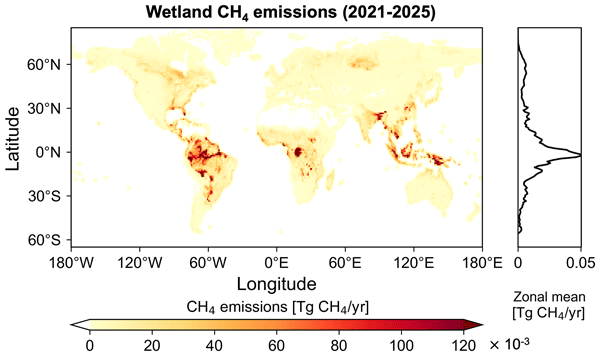
Mengze Li, Robert B. Jackson, Marielle Saunois, Philippe Ciais, Ben Poulter, Josep G. Canadell, Prabir K. Patra, Hanqin Tian, Zhen Zhang, Etienne Fluet-Chouinard, Zutao Ouyang, Ting Zhang, David J. Beerling, Dmitry A. Belikov, Philippe Bousquet, Danilo Custodio, Naveen Chandra, Xinyu Dou, Nicola Gedney, Peter O. Hopcroft, Alison M. Hoyt, Kazuhito Ichii, Akihito Ito, Atul K. Jain, Katherine Jensen, Fortunat Joos, Thomas Kleinen, Masayuki Kondo, Fa Li, Tingting Li, Xiangyu Liu, Shamil Maksyutov, Avni Malhotra, Adrien Martinez, Kyle McDonald, Joe R. Melton, Jurek Müller, Yosuke Niwa, Shufen Pan, Shushi Peng, Changhui Peng, Zhangcai Qin, Peter Raymond, William Riley, Arjo Segers, Rona L. Thompson, Aki Tsuruta, Yi Xi, Kunxiaojia Yuan, Wenxin Zhang, Bo Zheng, Qing Zhu, Qiuan Zhu, and Qianlai Zhuang
Earth Syst. Sci. Data, 18, 3507–3524, https://doi.org/10.5194/essd-18-3507-2026, https://doi.org/10.5194/essd-18-3507-2026, 2026
Short summary
Short summary
We proposed a framework that combines machine-learning and climate data to predict global natural vegetated wetland methane emissions for 2000–2025. We found that although total global emissions remained stable in the post-2020s, Northern Hemisphere emissions surged whilst tropical emissions fell. This approach allows us to rapidly monitor emissions and provides early warnings for climate impacts.
This article is included in the Encyclopedia of Geosciences
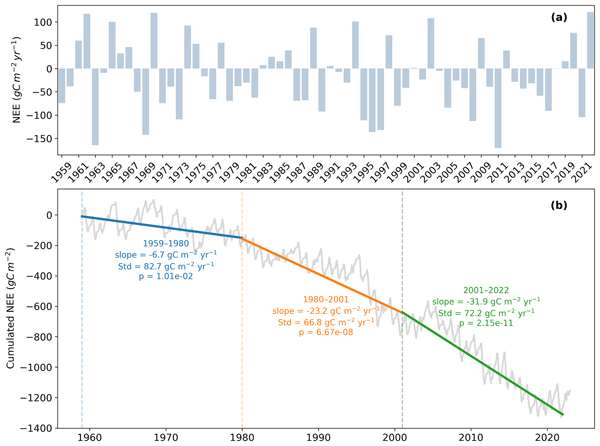
Raphael Garisoain, Christine Delire, Bertrand Decharme, and Laure Gandois
Biogeosciences, 23, 3407–3431, https://doi.org/10.5194/bg-23-3407-2026, https://doi.org/10.5194/bg-23-3407-2026, 2026
Short summary
Short summary
Peatlands store vast amounts of carbon, helping to slow climate change. We studied a mountain peatland in the Pyrenees to understand how warming and drought affect its ability to retain carbon. Using land surface modeling and field data from the past 64 years, we found that higher temperatures increase plant growth, but frequent and intense droughts cause large carbon losses, threatening peatlands' role as long-term carbon sinks.
This article is included in the Encyclopedia of Geosciences
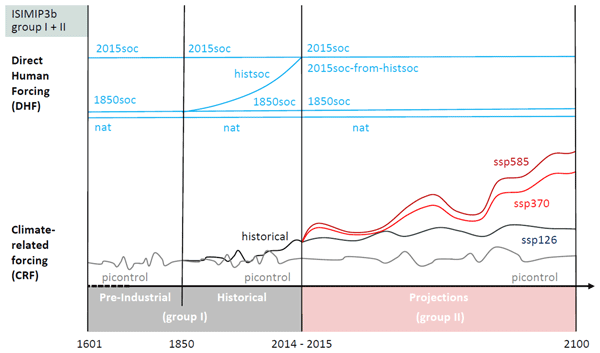
Katja Frieler, Stefan Lange, Jacob Schewe, Matthias Mengel, Simon Treu, Christian Otto, Jan Volkholz, Christopher P. O. Reyer, Stefanie Heinicke, Colin Jones, Julia L. Blanchard, Cheryl S. Harrison, Colleen M. Petrik, Tyler D. Eddy, Kelly Ortega-Cisneros, Camilla Novaglio, Ryan Heneghan, Derek P. Tittensor, Olivier Maury, Matthias Büchner, Thomas Vogt, Dánnell Quesada-Chacón, Kerry Emanuel, Chia-Ying Lee, Suzana J. Camargo, Linn Hamester, Jonas Jägermeyr, Sam Rabin, Jochen Klar, Iliusi D. Vega del Valle, Lisa Novak, Inga J. Sauer, Gitta Lasslop, Sarah Chadburn, Eleanor Burke, Angela Gallego-Sala, Noah Smith, Jinfeng Chang, Stijn Hantson, Chantelle Burton, Anne Gädeke, Fang Li, Simon N. Gosling, Hannes Müller Schmied, Fred Hattermann, Thomas Hickler, Rafael Marcé, Don Pierson, Wim Thiery, Daniel Mercado-Bettín, Robert Ladwig, Ana Isabel Ayala, Matthew Forrest, Michel Bechtold, Robert Reinecke, Inge de Graaf, Jed O. Kaplan, Alexander Koch, Matthieu Lengaigne, Rohini Kumar, and Maryna Strokal
Geosci. Model Dev., 19, 4095–4135, https://doi.org/10.5194/gmd-19-4095-2026, https://doi.org/10.5194/gmd-19-4095-2026, 2026
Short summary
Short summary
This paper describes the experiments and data sets necessary to run historic and future impact projections, and the underlying assumptions of future climate change as defined by the 3rd round of the ISIMIP Project (Inter-sectoral Impactmodel Intercomparison Project, isimip.org). ISIMIP provides a framework for cross-sectorally consistent climate impact simulations to contribute to a comprehensive and consistent picture of the world under different climate-change scenarios.
This article is included in the Encyclopedia of Geosciences
Emmanuel Okiria, Naota Hanasaki, Simon N. Gosling, Emmanuel Nyenah, Peter Burek, Yusuke Satoh, Sebastian Ostberg, Kedar Otta, and Luca Guillaumot
EGUsphere, https://doi.org/10.5194/egusphere-2026-2043, https://doi.org/10.5194/egusphere-2026-2043, 2026
Short summary
Short summary
We investigated why global hydrological models struggle to simulate reservoir storage. By comparing five models against satellite data from 424 dams, we found they often exaggerate seasonal storage fluctuations due to simple one-size-fits-all global rules. Customising these settings significantly improved accuracy. This proves generic rules are a major flaw. Future models must combine traditional physics with real satellite observations to better predict global water resources.
This article is included in the Encyclopedia of Geosciences
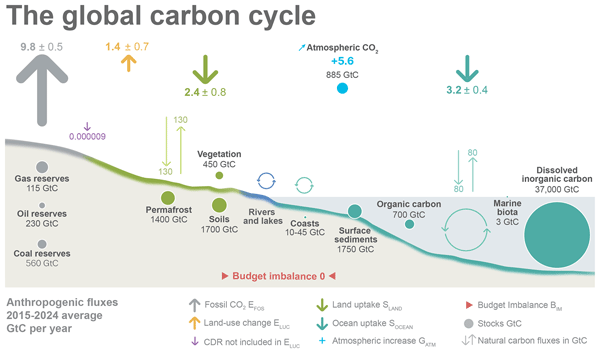
Pierre Friedlingstein, Michael O'Sullivan, Matthew W. Jones, Robbie M. Andrew, Dorothee C. E. Bakker, Judith Hauck, Peter Landschützer, Corinne Le Quéré, Hongmei Li, Ingrid T. Luijkx, Glen P. Peters, Wouter Peters, Julia Pongratz, Clemens Schwingshackl, Stephen Sitch, Josep G. Canadell, Philippe Ciais, Kjetil Aas, Simone R. Alin, Peter Anthoni, Leticia Barbero, Nicholas R. Bates, Nicolas Bellouin, Alice Benoit-Cattin, Carla F. Berghoff, Raffaele Bernardello, Laurent Bopp, Ida Bagus Mandhara Brasika, Matthew A. Chamberlain, Naveen Chandra, Frédéric Chevallier, Louise P. Chini, Nathan O. Collier, Thomas H. Colligan, Margot Cronin, Laique M. Djeutchouang, Xinyu Dou, Matt P. Enright, Kazutaka Enyo, Michael Erb, Wiley Evans, Richard A. Feely, Liang Feng, Daniel J. Ford, Adrianna Foster, Filippa Fransner, Thomas Gasser, Marion Gehlen, Thanos Gkritzalis, Jefferson Goncalves De Souza, Giacomo Grassi, Luke Gregor, Nicolas Gruber, Bertrand Guenet, Özgür Gürses, Kirsty Harrington, Ian Harris, Jens Heinke, George C. Hurtt, Yosuke Iida, Tatiana Ilyina, Akihiko Ito, Andrew R. Jacobson, Atul K. Jain, Tereza Jarníková, Annika Jersild, Fei Jiang, Steve D. Jones, Etsushi Kato, Ralph F. Keeling, Kees Klein Goldewijk, Jürgen Knauer, Yawen Kong, Jan Ivar Korsbakken, Charles Koven, Taro Kunimitsu, Xin Lan, Junjie Liu, Zhiqiang Liu, Zhu Liu, Claire Lo Monaco, Lei Ma, Gregg Marland, Patrick C. McGuire, Galen A. McKinley, Joe R. Melton, Natalie Monacci, Erwan Monier, Eric J. Morgan, David R. Munro, Jens D. Müller, Shin-Ichiro Nakaoka, Lorna R. Nayagam, Yosuke Niwa, Tobias Nutzel, Are Olsen, Abdirahman M. Omar, Naiqing Pan, Sudhanshu Pandey, Denis Pierrot, Zhangcai Qin, Pierre Regnier, Gregor Rehder, Laure Resplandy, Alizée Roobaert, Thais M. Rosan, Christian Rödenbeck, Jörg Schwinger, Ingunn Skjelvan, T. Luke Smallman, Victoria Spada, Mohanan G. Sreeush, Qing Sun, Adrienne J. Sutton, Colm Sweeney, Didier Swingedouw, Roland Séférian, Shintaro Takao, Hiroaki Tatebe, Hanqin Tian, Xiangjun Tian, Bronte Tilbrook, Hiroyuki Tsujino, Francesco Tubiello, Erik van Ooijen, Guido R. van der Werf, Sebastiaan J. van de Velde, Anthony P. Walker, Rik Wanninkhof, Xiaojuan Yang, Wenping Yuan, Xu Yue, and Jiye Zeng
Earth Syst. Sci. Data, 18, 3211–3288, https://doi.org/10.5194/essd-18-3211-2026, https://doi.org/10.5194/essd-18-3211-2026, 2026
Short summary
Short summary
The Global Carbon Budget 2025 describes the methodology, main results, and datasets used to quantify the anthropogenic emissions of carbon dioxide (CO2) and their partitioning among the atmosphere, land ecosystems, and the ocean over the historical period (1750–2025). These living datasets are updated every year to provide the highest transparency and traceability in the reporting of CO2, the key driver of climate change.
This article is included in the Encyclopedia of Geosciences
Jade Skye, Joe R. Melton, Colin Goldblatt, Angela Gallego-Sala, Michelle Garneau, and Scott Winton
Biogeosciences, 23, 2959–2983, https://doi.org/10.5194/bg-23-2959-2026, https://doi.org/10.5194/bg-23-2959-2026, 2026
Short summary
Short summary
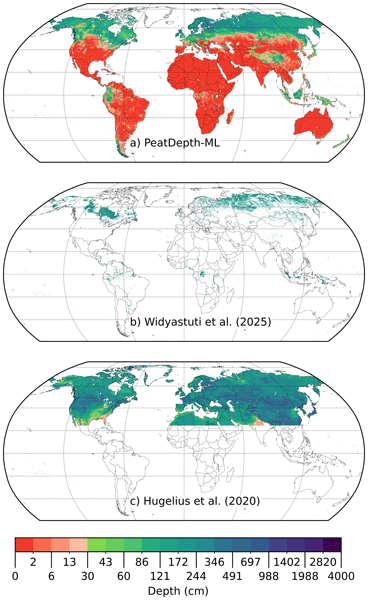
We developed PeatDepth-ML, a machine learning model predicting peat depth worldwide to help estimate carbon stocks in these climate-critical ecosystems. Our model predicts median depths of 134 cm in peatlands. Using bootstrapping, we rigorously assessed how sampling bias affects predictions. This revealed predictor selection and regional accuracy can vary greatly with different data subsets, demonstrating model reliability fundamentally depends on training data quality and geographic coverage.
This article is included in the Encyclopedia of Geosciences
Jette Elena Stoebke, David Wårlind, Stefan Olin, Annemarie Eckes-Shephard, Bogdan Brzeziecki, Mikko Peltoniemi, and Thomas A. M. Pugh
Geosci. Model Dev., 19, 3595–3615, https://doi.org/10.5194/gmd-19-3595-2026, https://doi.org/10.5194/gmd-19-3595-2026, 2026
Short summary
Short summary
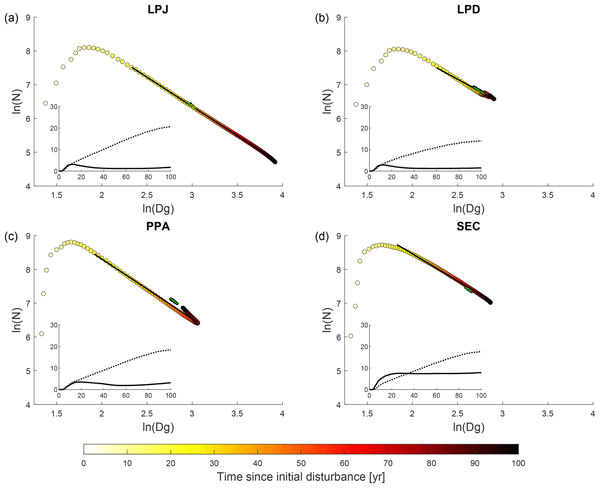
Forests are shaped by how trees compete for light. We improved a widely used vegetation model by introducing spatially explicit canopies, allowing light distribution to vary realistically, especially after disturbances like tree death or harvest. This enhances the simulation of forest structure, tree coexistence, and regeneration, providing a better model for predicting forest dynamics and responses to management and environmental change.
This article is included in the Encyclopedia of Geosciences
Yue Li, Gang Tang, Eleanor O'Rourke, Samar Minallah, Martim Mas e Braga, Sophie Nowicki, Robin S. Smith, David M. Lawrence, George C. Hurtt, Daniele Peano, Gesa Meyer, Birgit Hassler, Jiafu Mao, Yongkang Xue, and Martin Juckes
Geosci. Model Dev., 19, 3129–3155, https://doi.org/10.5194/gmd-19-3129-2026, https://doi.org/10.5194/gmd-19-3129-2026, 2026
Short summary
Short summary
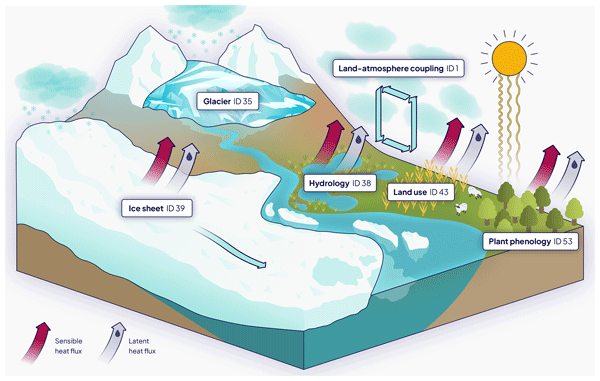
Land and Land Ice Theme Opportunities describe a list that contains 25 variable groups with 716 variables, which are potentially available to the broad scientific audience for performing analysis in land–atmosphere coupling, hydrological processes and freshwater systems, glacier and ice sheet mass balance and their influence on the sea levels, land use, and plant phenology.
This article is included in the Encyclopedia of Geosciences
Francisco J. Doblas-Reyes, Jenni Kontkanen, Irina Sandu, Mario Acosta, Mohammed Hussam Al Turjmam, Ivan Alsina-Ferrer, Miguel Andrés-Martínez, Costanza Anerdi, Leo Arriola, Marvin Axness, Marc Batlle Martín, Peter Bauer, Tobias Becker, Daniel Beltrán, Sebastian Beyer, Hendryk Bockelmann, Pierre-Antoine Bretonnière, Sebastien Cabaniols, Silvia Caprioli, Miguel Castrillo, Aparna Chandrasekar, Suvarchal Cheedela, Victor Correal, Emanuele Danovaro, Paolo Davini, Jussi Enkovaara, Claudia Frauen, Barbara Früh, Aina Gaya Àvila, Paolo Ghinassi, Rohit Ghosh, Supriyo Ghosh, Iker González, Katherine Grayson, Matthew Griffith, Ioan Hadade, Christopher Haine, Carl Hartick, Utz-Uwe Haus, Shane Hearne, Heikki Järvinen, Bernat Jiménez, Amal John, Marlin Juchem, Thomas Jung, Jessica Kegel, Matthias Kelbling, Kai Keller, Bruno Kinoshita, Theresa Kiszler, Daniel Klocke, Lukas Kluft, Nikolay Koldunov, Tobias Kölling, Joonas Kolstela, Luis Kornblueh, Sergey Kosukhin, Aleksander Lacima-Nadolnik, Jeisson Javier Leal Rojas, Jonni Lehtiranta, Tuomas Lunttila, Anna Luoma, Pekka Manninen, Alexey Medvedev, Sebastian Milinski, Ali Mohammed, Sebastian Müller, Devaraju Naryanappa, Natalia Nazarova, Sami Niemelä, Bimochan Niraula, Henrik Nortamo, Aleksi Nummelin, Matteo Nurisso, Pablo Ortega, Stella Paronuzzi, Xabier Pedruzo-Bagazgoitia, Charles Pelletier, Carlos Peña, Suraj Polade, Himansu Kesari Pradhan, Rommel Quintanilla, Tiago Quintino, Thomas Rackow, Jouni Räisänen, Maqsood Mubarak Rajput, René Redler, Balthasar Reuter, Nuno Rocha Monteiro, Francesc Roura-Adserias, Silva Ruppert, Susan Sayed, Reiner Schnur, Tanvi Sharma, Dmitry Sidorenko, Outi Sievi-Korte, Albert Soret, Christian Steger, Bjorn Stevens, Jan Streffing, Jaleena Sunny, Luiggi Tenorio, Stephan Thober, Ulf Tigerstedt, Oriol Tinto, Juha Tonttila, Heikki Tuomenvirta, Lauri Tuppi, Ginka Van Thielen, Emanuele Vitali, Jost von Hardenberg, Ingo Wagner, Nils Wedi, Jan Wehner, Sven Willner, Xavier Yepes-Arbós, Florian Ziemen, and Janos Zimmermann
Geosci. Model Dev., 19, 2821–2848, https://doi.org/10.5194/gmd-19-2821-2026, https://doi.org/10.5194/gmd-19-2821-2026, 2026
Short summary
Short summary
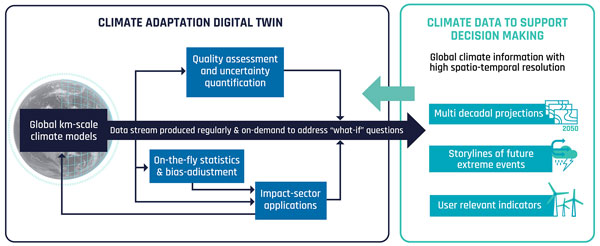
The Climate Change Adaptation Digital Twin (Climate DT) pioneers the operationalisation of global climate projections. It produces global simulations with local granularity for adaptation decision-making. Applications are embedded to generate tailored indicators. A unified workflow orchestrates all components in several supercomputers. Data management ensures consistency and streaming enables real-time use. It is a complementary innovation to initiatives like CMIP, CORDEX, and climate services.
This article is included in the Encyclopedia of Geosciences
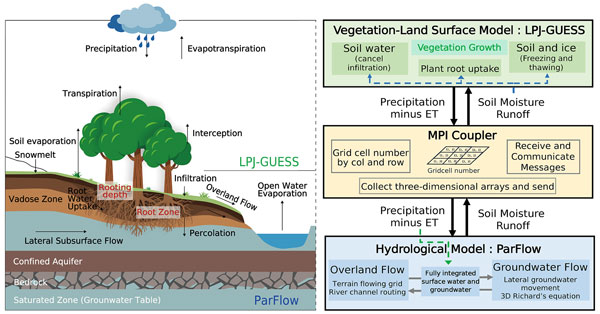
Zitong Jia, Shouzhi Chen, Yongshuo H. Fu, David Martín Belda, David Wårlind, Stefan Olin, Chongyu Xu, and Jing Tang
Geosci. Model Dev., 19, 1727–1747, https://doi.org/10.5194/gmd-19-1727-2026, https://doi.org/10.5194/gmd-19-1727-2026, 2026
Short summary
Short summary
Groundwater sustains vegetation and regulates land-atmosphere exchanges, yet most Earth system models oversimplify its dynamics. Our study develops an integrated framework coupling a dynamic vegetation model with the three-dimensional hydrological model ParFlow to explicitly represent groundwater-vegetation interactions. The results provide evidence that groundwater flow strongly regulates water exchanges and provides a powerful tool to improve simulations of water cycles in Earth system models.
This article is included in the Encyclopedia of Geosciences
Mazen Nakad, Mahmoud Mbarak, Jihad Karaki, Tehreem Qureshi, Matteo Detto, Benjamin I. Cook, Marcos Longo, Géraldine Derroire, Xiangtao Xu, Jeremy Lichstein, Zong-Liang Yang, Pierre Gentine, and Ensheng Weng
EGUsphere, https://doi.org/10.5194/egusphere-2026-145, https://doi.org/10.5194/egusphere-2026-145, 2026
Short summary
Short summary
Because long-term drought and heat experiments are hard to run in tropical forests, we used a computer model to test how less rain and warmer, drier air affect forest growth and water loss at three sites. Forest productivity stayed stable until rainfall dropped below a threshold, but warmer air reduced carbon uptake even when soils were moist. Persistent heat and drought caused far larger declines than brief pulses, raising risks for future carbon storage.
This article is included in the Encyclopedia of Geosciences
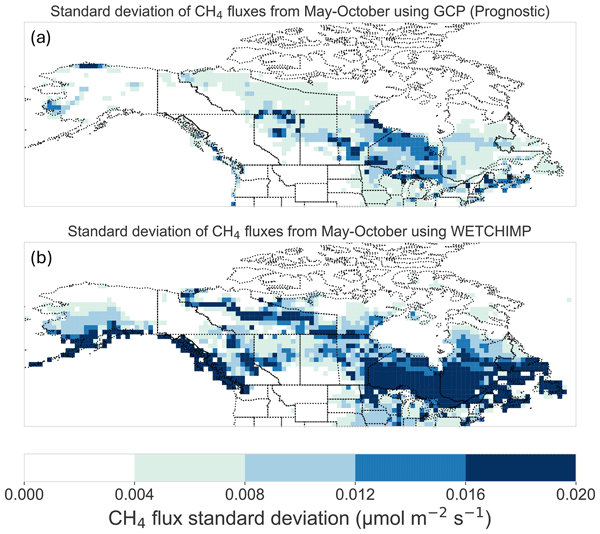
Hanyu Liu, Misa Ishizawa, Felix R. Vogel, Zhen Zhang, Benjamin Poulter, Leyang Feng, Ao Chen, Anna L. Gagné-Landmann, Deborah N. Huntzinger, Joe R. Melton, Vineet Yadav, Dylan C. Gaeta, Ziting Huang, Douglas E. J. Worthy, Douglas Chan, and Scot M. Miller
Atmos. Chem. Phys., 26, 1229–1247, https://doi.org/10.5194/acp-26-1229-2026, https://doi.org/10.5194/acp-26-1229-2026, 2026
Short summary
Short summary
We find that the state-of-the-art process-based methane flux models have both lower flux magnitude and reduced inter-model uncertainty compared to a previous model inter-comparison from over a decade ago. Despite these improvements, methane flux estimates from process-based models are still likely too high compared to atmospheric observations. We also find that models with simpler parameterizations often result in better agreement with atmospheric observations in high-latitude North America.
This article is included in the Encyclopedia of Geosciences

Jon Cranko Page, Martin G. De Kauwe, Andy J. Pitman, Isaac R. Towers, Gabriele Arduini, Martin J. Best, Craig R. Ferguson, Jürgen Knauer, Hyungjun Kim, David M. Lawrence, Tomoko Nitta, Keith W. Oleson, Catherine Ottlé, Anna Ukkola, Nicholas Vuichard, Xiaoni Wang-Faivre, and Gab Abramowitz
Biogeosciences, 23, 263–282, https://doi.org/10.5194/bg-23-263-2026, https://doi.org/10.5194/bg-23-263-2026, 2026
Short summary
Short summary
This paper used a large dataset of observations, machine learning predictions, and computer model simulations to test how well land surface models represent the water, energy, and carbon cycles. We found that the models work well under "normal" weather but do not meet performance expectations during coinciding extreme conditions. Since these extremes are relatively rare, targeted model improvements could deliver major performance gains.
This article is included in the Encyclopedia of Geosciences
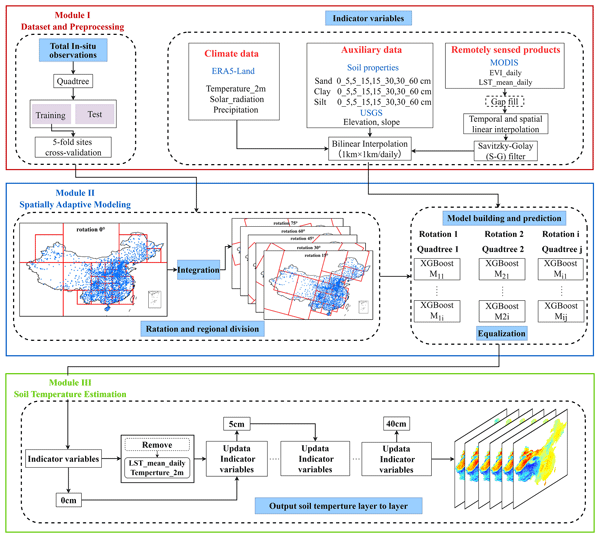
Xuetong Wang, Liang He, Peng Li, Jiageng Ma, Yu Shi, Qi Tian, Gang Zhao, Jianqiang He, Hao Feng, Hao Shi, and Qiang Yu
Earth Syst. Sci. Data, 18, 97–116, https://doi.org/10.5194/essd-18-97-2026, https://doi.org/10.5194/essd-18-97-2026, 2026
Short summary
Short summary
This study integrates ground observations, satellite remote sensing, and reanalysis data, applying machine learning techniques to generate a high-resolution, daily multi-layer soil temperature dataset in China from 2010 to 2020. The dataset accurately captures the spatiotemporal variations in soil temperature at multiple depths, offering valuable scientific insights for agricultural management and ecological research.
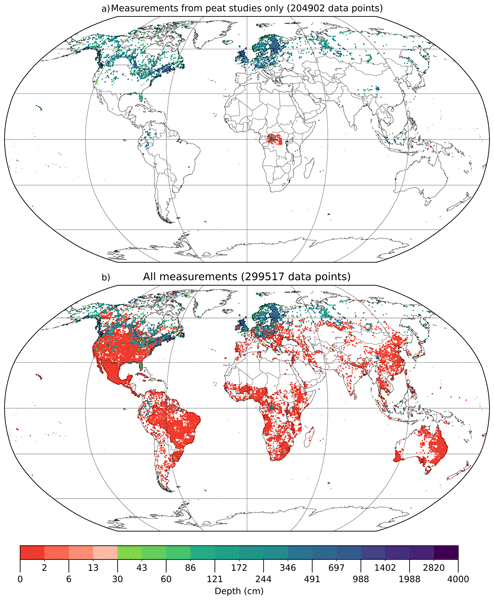
Jade Skye, Joe R. Melton, Colin Goldblatt, Louis Saumier, Angela Gallego-Sala, Michelle Garneau, R. Scott Winton, Erick B. Bahati, Juan C. Benavides, Lee Fedorchuk, Gérard Imani, Carol Kagaba Kairumba, Frank Kansiime, Mariusz Lamentowicz, Michel Mbasi, Daria Wochal, Sambor Czerwiński, Jacek Landowski, Joanna Landowska, Vincent Maire, Minna M. Väliranta, Matthew Warren, Lydia E. S. Cole, Marissa A. Davies, Erik A. Lilleskov, Jingjing Sun, and Yuwan Wang
Earth Syst. Sci. Data, 17, 7313–7330, https://doi.org/10.5194/essd-17-7313-2025, https://doi.org/10.5194/essd-17-7313-2025, 2025
Short summary
Short summary
Peatlands are large stores of carbon but are vulnerable to human activities and climate change. Comprehensive peatland data are vital to understand these ecosystems, but existing datasets are fragmented and contain errors. To address this, we created Peat-DBase – a standardized global database of peat depth measurements with > 200 000 measurements worldwide, showing median depths of 130 cm. Peat-DBase avoids overlapping data compilation efforts while identifying critical observational gaps.
This article is included in the Encyclopedia of Geosciences
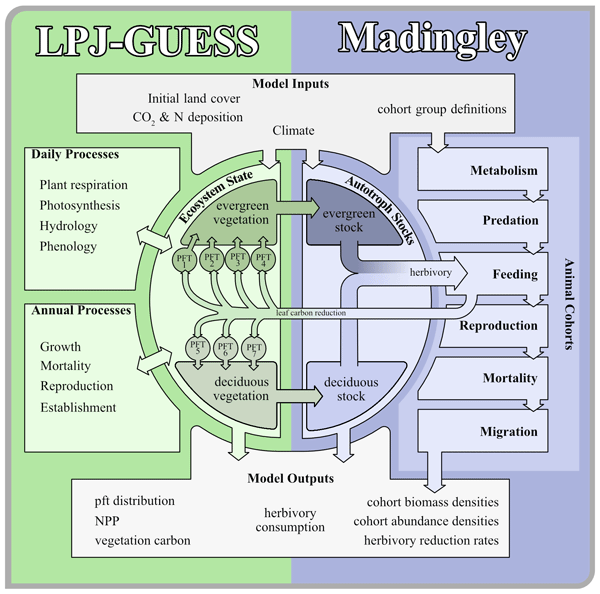
Jens Krause, Peter Anthoni, Mike Harfoot, Moritz Kupisch, and Almut Arneth
Geosci. Model Dev., 18, 9633–9651, https://doi.org/10.5194/gmd-18-9633-2025, https://doi.org/10.5194/gmd-18-9633-2025, 2025
Short summary
Short summary
While animal biodiversity is facing a global crisis as more and more species are becoming endangered or extinct, the role of animals for the functioning of ecosystems is still not fully understood. We contribute to bridging this gap by coupling a animal population model with a vegetation and thus enable future research in this topic.
This article is included in the Encyclopedia of Geosciences
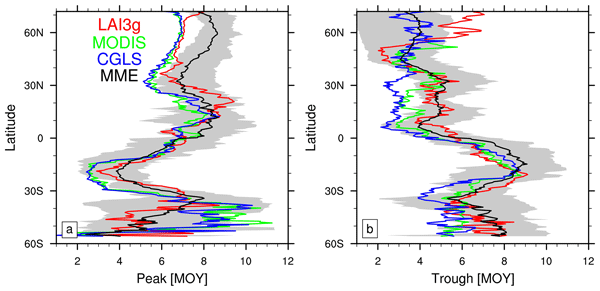
Daniele Peano, Deborah Hemming, Christine Delire, Yuanchao Fan, Hanna Lee, Stefano Materia, Julia E. M. S. Nabel, Taejin Park, David Wårlind, Andy Wiltshire, and Sönke Zaehle
Biogeosciences, 22, 7117–7135, https://doi.org/10.5194/bg-22-7117-2025, https://doi.org/10.5194/bg-22-7117-2025, 2025
Short summary
Short summary
Earth System Models are the principal tools for scientists to study past, present, and future climate changes. This work investigates the ability of a set of them to represent the observed changes in vegetation, which are vital to estimating the impact of future climate mitigation and adaptation strategies. This study highlights the main limitations in correctly representing vegetation variability. These tools still need further development to improve our understanding of future changes.
This article is included in the Encyclopedia of Geosciences
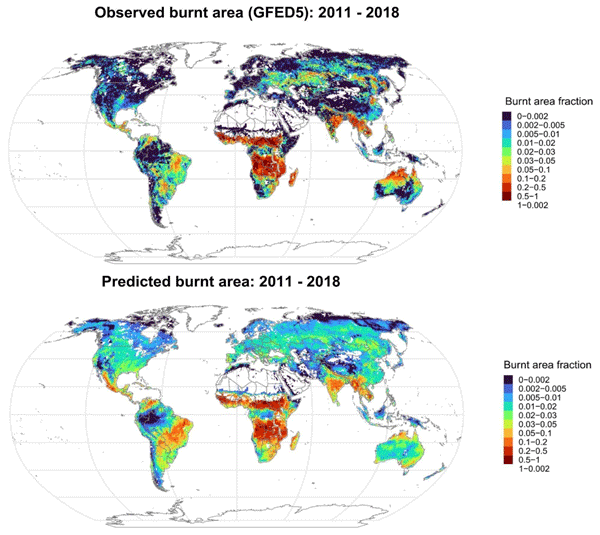
Blessing Kavhu, Matthew Forrest, and Thomas Hickler
Biogeosciences, 22, 7001–7030, https://doi.org/10.5194/bg-22-7001-2025, https://doi.org/10.5194/bg-22-7001-2025, 2025
Short summary
Short summary
We developed a statistical model to predict global wildfire patterns based on a parsimonious set of weather, vegetation, and anthropogenic variables. This model is designed within a DGVM (Dynamic Global Vegetation Model)-compatible framework and helps to forecast seasonal fire patterns across diverse regions. It's simplicity makes it valuable for climate and fire management planning, helping communities better prepare for and adapt to rising wildfire threats.
This article is included in the Encyclopedia of Geosciences
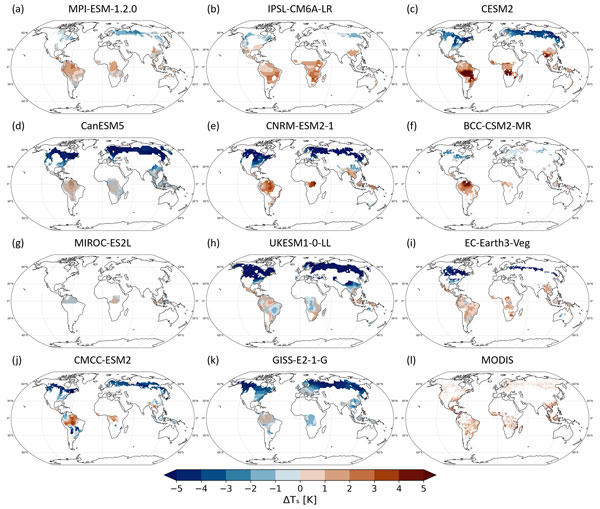
Nikolina Mileva, Julia Pongratz, Vivek K. Arora, Akihiko Ito, Sebastiaan Luyssaert, Sonali S. McDermid, Paul A. Miller, Daniele Peano, Roland Séférian, Yanwu Zhang, and Wolfgang Buermann
Earth Syst. Dynam., 16, 2137–2160, https://doi.org/10.5194/esd-16-2137-2025, https://doi.org/10.5194/esd-16-2137-2025, 2025
Short summary
Short summary
Despite forests being so important for mitigating climate change, there are still uncertainties about how much the changes in forest cover contribute to the cooling/warming of the climate. Climate models and real-world observations often disagree about the magnitude and even the direction of these changes. We constrain climate models scenarios of widespread deforestation with satellite and in-situ data and show that models still have difficulties representing the movement of heat and water.
This article is included in the Encyclopedia of Geosciences
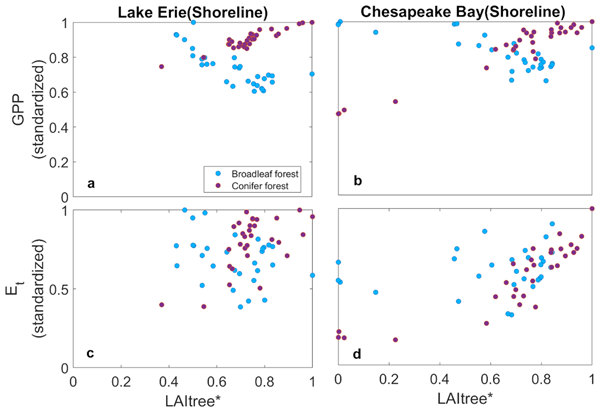
Junyan Ding, Nate McDowell, Vanessa Bailey, Nate Conroy, Donnie J. Day, Yilin Fang, Kenneth M. Kemner, Matthew L. Kirwan, Charlie D. Koven, Matthew Kovach, Patrick Megonigal, Kendalynn A. Morris, Teri O'Meara, Stephanie C. Pennington, Roberta B. Peixoto, Peter Thornton, Mike Weintraub, Peter Regier, Leticia Sandoval, Fausto Machado-Silva, Alice Stearns, Nick Ward, and Stephanie J. Wilson
Biogeosciences, 22, 6963–6978, https://doi.org/10.5194/bg-22-6963-2025, https://doi.org/10.5194/bg-22-6963-2025, 2025
Short summary
Short summary
We used a vegetation model to study why coastal forests are dying due to rising water levels and what happens to the ecosystem when marshes take over. We found that tree death is mainly caused by water-damaged roots, leading to major changes in the environment, such as reduced water use and carbon storage. Our study helps explain how coastal ecosystems are shifting and offers new ideas to explore in future field research.
This article is included in the Encyclopedia of Geosciences
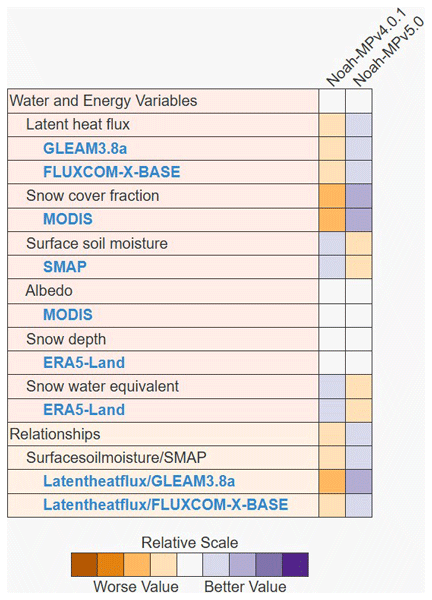
Cenlin He, Tzu-Shun Lin, David M. Mocko, Ronnie Abolafia-Rosenzweig, Jerry W. Wegiel, and Sujay V. Kumar
Geosci. Model Dev., 18, 8439–8460, https://doi.org/10.5194/gmd-18-8439-2025, https://doi.org/10.5194/gmd-18-8439-2025, 2025
Short summary
Short summary
This study integrates the refactored community Noah-MP version 5.0 model with the NASA Land Information System (LIS) version 7.5.2 to streamline the synchronization, development, and maintenance of Noah-MP within LIS and to enhance their interoperability and applicability. The model benchmarking and evaluation results reveal key model strengths and weaknesses in simulating land surface quantities and show implications for future model improvements.
This article is included in the Encyclopedia of Geosciences
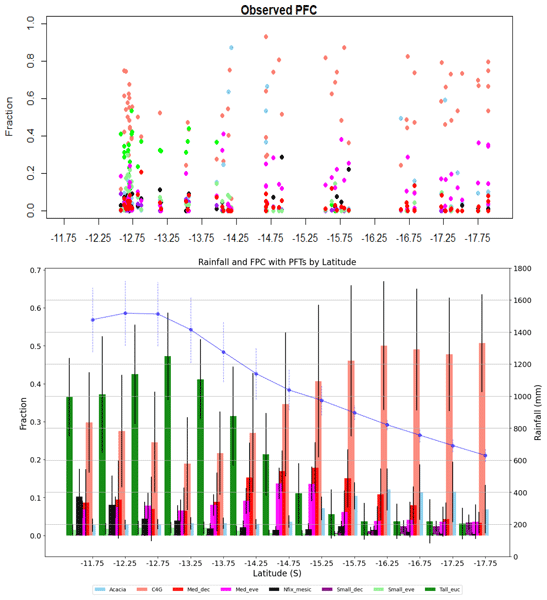
Prashant Paudel, Stefan Olin, Mark Tjoelker, Mikael Pontarp, Daniel Metcalfe, and Benjamin Smith
Biogeosciences, 22, 6153–6171, https://doi.org/10.5194/bg-22-6153-2025, https://doi.org/10.5194/bg-22-6153-2025, 2025
Short summary
Short summary
Ecological processes respond to changes in rainfall conditions. Competition and stress created by water availability are two primary components at two ends of the rainfall gradient. In wetter areas, plants compete for resources, while in drier regions, stress limits growth. The complex interaction between plant characters and their response to growth conditions governs ecosystem processes. These findings can be used to understand how future rainfall changes could impact ecosystems.
This article is included in the Encyclopedia of Geosciences
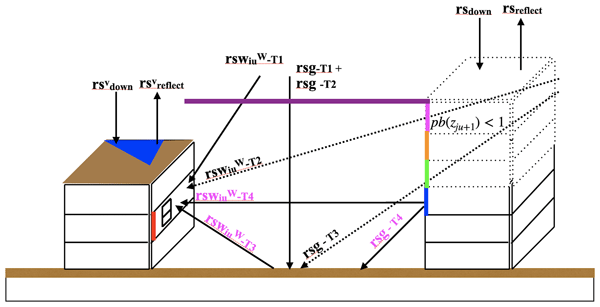
Parag Joshi, Tzu-Shun Lin, Cenlin He, and Katia Lamer
Geosci. Model Dev., 18, 7869–7890, https://doi.org/10.5194/gmd-18-7869-2025, https://doi.org/10.5194/gmd-18-7869-2025, 2025
Short summary
Short summary
Present study revisits model that represent urban effects in the Weather Research & Forecasting model. We propose methods to identify evaluable parameters via field measurements and found inconsistencies between physics and its code implementation. Simulations reveal small errors can significantly impact outputs.
This article is included in the Encyclopedia of Geosciences
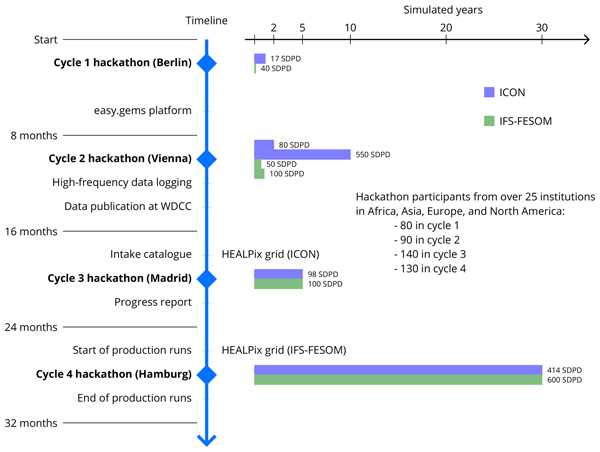
Hans Segura, Xabier Pedruzo-Bagazgoitia, Philipp Weiss, Sebastian K. Müller, Thomas Rackow, Junhong Lee, Edgar Dolores-Tesillos, Imme Benedict, Matthias Aengenheyster, Razvan Aguridan, Gabriele Arduini, Alexander J. Baker, Jiawei Bao, Swantje Bastin, Eulàlia Baulenas, Tobias Becker, Sebastian Beyer, Hendryk Bockelmann, Nils Brüggemann, Lukas Brunner, Suvarchal K. Cheedela, Sushant Das, Jasper Denissen, Ian Dragaud, Piotr Dziekan, Madeleine Ekblom, Jan Frederik Engels, Monika Esch, Richard Forbes, Claudia Frauen, Lilli Freischem, Diego García-Maroto, Philipp Geier, Paul Gierz, Álvaro González-Cervera, Katherine Grayson, Matthew Griffith, Oliver Gutjahr, Helmuth Haak, Ioan Hadade, Kerstin Haslehner, Shabeh ul Hasson, Jan Hegewald, Lukas Kluft, Aleksei Koldunov, Nikolay Koldunov, Tobias Kölling, Shunya Koseki, Sergey Kosukhin, Josh Kousal, Peter Kuma, Arjun U. Kumar, Rumeng Li, Nicolas Maury, Maximilian Meindl, Sebastian Milinski, Kristian Mogensen, Bimochan Niraula, Jakub Nowak, Divya Sri Praturi, Ulrike Proske, Dian Putrasahan, René Redler, David Santuy, Domokos Sármány, Reiner Schnur, Patrick Scholz, Dmitry Sidorenko, Dorian Spät, Birgit Sützl, Daisuke Takasuka, Adrian Tompkins, Alejandro Uribe, Mirco Valentini, Menno Veerman, Aiko Voigt, Sarah Warnau, Fabian Wachsmann, Marta Wacławczyk, Nils Wedi, Karl-Hermann Wieners, Jonathan Wille, Marius Winkler, Yuting Wu, Florian Ziemen, Janos Zimmermann, Frida A.-M. Bender, Dragana Bojovic, Sandrine Bony, Simona Bordoni, Patrice Brehmer, Marcus Dengler, Emanuel Dutra, Saliou Faye, Erich Fischer, Chiel van Heerwaarden, Cathy Hohenegger, Heikki Järvinen, Markus Jochum, Thomas Jung, Johann H. Jungclaus, Noel S. Keenlyside, Daniel Klocke, Heike Konow, Martina Klose, Szymon Malinowski, Olivia Martius, Thorsten Mauritsen, Juan Pedro Mellado, Theresa Mieslinger, Elsa Mohino, Hanna Pawłowska, Karsten Peters-von Gehlen, Abdoulaye Sarré, Pajam Sobhani, Philip Stier, Lauri Tuppi, Pier Luigi Vidale, Irina Sandu, and Bjorn Stevens
Geosci. Model Dev., 18, 7735–7761, https://doi.org/10.5194/gmd-18-7735-2025, https://doi.org/10.5194/gmd-18-7735-2025, 2025
Short summary
Short summary
The Next Generation of Earth Modeling Systems project (nextGEMS) developed two Earth system models that use horizontal grid spacing of 10 km and finer, giving more fidelity to the representation of local phenomena, globally. In its fourth cycle, nextGEMS simulated the Earth System climate over the 2020–2049 period under the SSP3-7.0 scenario. Here, we provide an overview of nextGEMS, insights into the model development, and the realism of multi-decadal, kilometer-scale simulations.
This article is included in the Encyclopedia of Geosciences
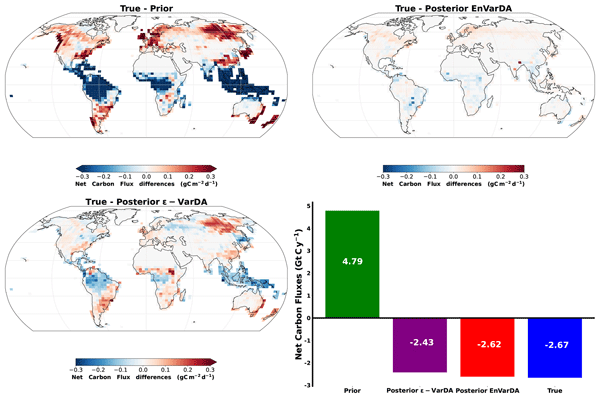
Simon Beylat, Nina Raoult, Cédric Bacour, Natalie Douglas, Tristan Quaife, Vladislav Bastrikov, Peter J. Rayner, and Philippe Peylin
Geosci. Model Dev., 18, 7501–7527, https://doi.org/10.5194/gmd-18-7501-2025, https://doi.org/10.5194/gmd-18-7501-2025, 2025
Short summary
Short summary
Land surface models are important tools for understanding and predicting the land components of the carbon cycle. Atmospheric CO2 concentration data are a valuable source of information that can be used to improve the accuracy of these models. In this study, we present a statistical ensemble-variational data assimilation method named EnVarDA to calibrate parameters of a land surface model using these data. We show that this method is easy to implement and more efficient and accurate than traditional methods.
This article is included in the Encyclopedia of Geosciences
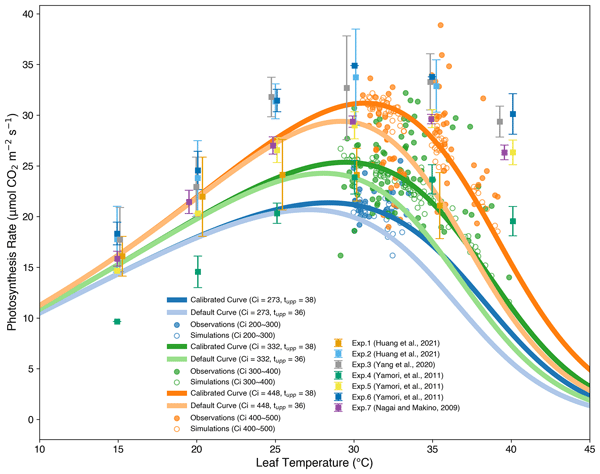
Beiyao Xu, Steven Dobbie, Huiyi Yang, Lianxin Yang, Yu Jiang, Andrew Challinor, Karina Williams, Yunxia Wang, and Tijian Wang
Geosci. Model Dev., 18, 7257–7273, https://doi.org/10.5194/gmd-18-7257-2025, https://doi.org/10.5194/gmd-18-7257-2025, 2025
Short summary
Short summary
Ozone (O3) pollution harms rice production and threatens food security. To understand these impacts, we calibrated a crop model using unique data from experiments where rice was grown in open fields under controlled O3 exposure (free air). This is the first time such data have been used to improve a model's ability to predict how rice responds to O3 pollution. Our work provides a more accurate tool to study O3's effects and guide strategies to protect agriculture.
This article is included in the Encyclopedia of Geosciences
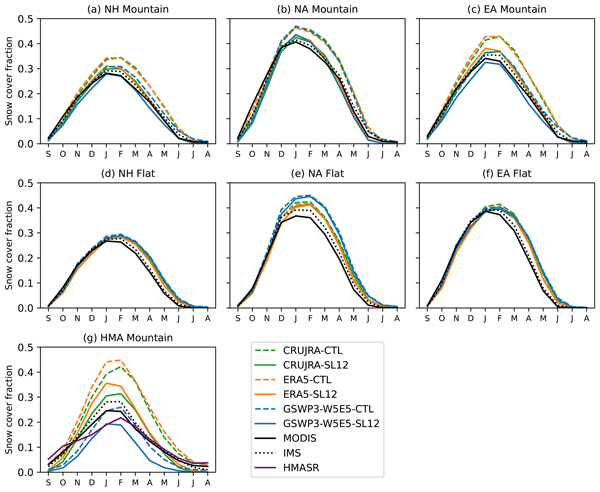
Libo Wang, Lawrence Mudryk, Joe R. Melton, Colleen Mortimer, Jason Cole, Gesa Meyer, Paul Bartlett, and Mickaël Lalande
Geosci. Model Dev., 18, 6597–6621, https://doi.org/10.5194/gmd-18-6597-2025, https://doi.org/10.5194/gmd-18-6597-2025, 2025
Short summary
Short summary
This study shows that an alternate snow cover fraction parameterization significantly improves snow simulation by CLASSIC in mountainous areas for all three choices of meteorological datasets. Annual mean bias, unbiased root mean squared area, and correlation improve by 75 %, 32 %, and 7 % when evaluated with MODIS observations over the Northern Hemisphere. We also link relative biases in the meteorological forcing data to differences in simulated snow water equivalent and snow cover fraction.
This article is included in the Encyclopedia of Geosciences
Friedrich J. Bohn, Giles B. Sioen, Ana Bastos, Yolandi Ernst, Marcin P. Jarzebski, Niak S. Koh, Romina Martin, Anja Rammig, Alex Godoy-Faúndez, Alexandros Gasparatos, Alvaro G. Gutiérrez, Amanda J. Aceituno, Andra-Ioana Horcea-Milcu, Andrea Marais-Potgieter, Ayyoob Sharifi, Caroline Howe, Cornelia B. Krug, Eduardo E. Acosta, Emmanuel F. Nzunda, Erik Andersson, Hans-Otto Pörtner, Helen Sooväli-Sepping, Ishihara Hiroe, Ivan Palmegiani, Kaera Coetzer, Kirsten Thonike, Krizler Tanalgo, Lisa Biber-Freudenberger, Nicholas O. Oguge, Mi S. Park, Milena Gross, Pablo De La Cruz, Paula R. Prist, Peng Bi, Rivera Diego, Roman Isaac, Rosemary McFarlane, Sinikka J. Paulus, Stefanie Burkhart, Sung-Ching Lee, Susanne Müller, Uchi D. Terhile, Wan-Yu Shih, William K. Smith, Viola Hakkarainen, Virginia Murray, Yuki Yoshida, Yohannes T. Damtew, and Zeenat Niazi
EGUsphere, https://doi.org/10.5194/egusphere-2025-3619, https://doi.org/10.5194/egusphere-2025-3619, 2025
Short summary
Short summary
The aim of this series is to provide decision-makers with valuable insights into the current state of biosphere research. Firstly, it is intended to ensure the flow of information between the comprehensive assessment reports of the IPCC and IPBES. On the other hand, it is intended to support economic and political decisions closely related to the biosphere with scientifically sound findings – including uncertainties – and comprehensive polysolutions, helping to solve the earth system polycrisis.
This article is included in the Encyclopedia of Geosciences
Olivier Bouriaud, Ernst-Detlef Schulze, Konstantin Gregor, Issam Boukhris, Peter Högberg, Roland Irslinger, Phillip Papastefanou, Julia Pongratz, Anja Rammig, Riccardo Valentini, and Christian Körner
Biogeosciences, 22, 4729–4741, https://doi.org/10.5194/bg-22-4729-2025, https://doi.org/10.5194/bg-22-4729-2025, 2025
Short summary
Short summary
The impact of harvesting on forests' carbon sink capacities is debated. One view is that their sink strength is resilient to harvesting, and the other is that it disrupts these capacities. Our work shows that leaf area index (LAI) has been overlooked in this discussion. We found that temperate forests' carbon uptake is largely insensitive to variations in LAI beyond 4.5 m² m-² but that forests operate at higher levels.
This article is included in the Encyclopedia of Geosciences
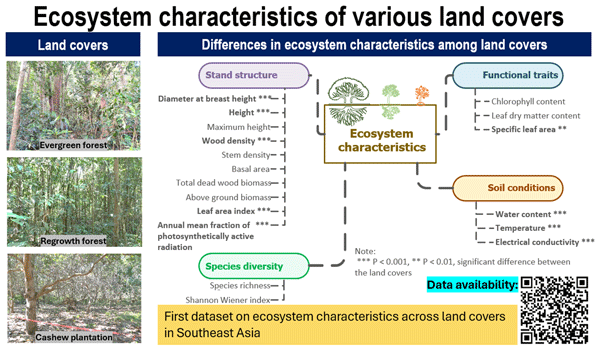
Chansopheaktra Sovann, Torbern Tagesson, Patrik Vestin, Sakada Sakhoeun, Soben Kim, Sothea Kok, and Stefan Olin
Biogeosciences, 22, 4649–4677, https://doi.org/10.5194/bg-22-4649-2025, https://doi.org/10.5194/bg-22-4649-2025, 2025
Short summary
Short summary
We offer pairwise observed datasets that compare the characteristics of tropical ecosystems, specifically pristine forests, regrowth forests, and cashew plantations. Our findings uncover some key differences in their characteristics, emphasizing the influence of human activities on these ecosystems. By sharing our unique datasets, we hope to improve the knowledge of tropical forest ecosystems in Southeast Asia, advancing tropical research and tackling global environmental challenges.
This article is included in the Encyclopedia of Geosciences
Aurélien Mirebeau, Cécile de Munck, Bertrand Bonan, Christine Delire, Aude Lemonsu, Valéry Masson, and Stephan Weber
Geosci. Model Dev., 18, 5329–5349, https://doi.org/10.5194/gmd-18-5329-2025, https://doi.org/10.5194/gmd-18-5329-2025, 2025
Short summary
Short summary
The greening of cities is recommended to limit the effects of climate change. In particular, green roofs can provide numerous environmental benefits, such as urban cooling, water retention, and carbon sequestration. The aim of this research is to develop a new module for calculating green roof CO2 fluxes within a model that can already simulate hydrological and thermal processes of such roofs. The calibration and evaluation of this module take advantage of long-term experimental data.
This article is included in the Encyclopedia of Geosciences
Rubaya Pervin, Scott Robeson, Mallory Barnes, Stephen Sitch, Anthony Walker, Ben Poulter, Fabienne Maignan, Qing Sun, Thomas Colligan, Sönke Zaehle, Kashif Mahmud, Peter Anthoni, Almut Arneth, Vivek Arora, Vladislav Bastrikov, Liam Bogucki, Bertrand Decharme, Christine Delire, Stefanie Falk, Akihiko Ito, Etsushi Kato, Daniel Kennedy, Jürgen Knauer, Michael O’Sullivan, Wenping Yuan, and Natasha MacBean
EGUsphere, https://doi.org/10.5194/egusphere-2025-2841, https://doi.org/10.5194/egusphere-2025-2841, 2025
Short summary
Short summary
Drylands contribute more than a third of the global vegetation productivity. Yet, these regions are not well represented in global vegetation models. Here, we tested how well 15 global models capture annual changes in dryland vegetation productivity. Models that didn’t have vegetation change over time or fire have lower variability in vegetation productivity. Models need better representation of grass cover types and their coverage. Our work highlights where and how these models need to improve.
This article is included in the Encyclopedia of Geosciences
Benjamin F. Meyer, João P. Darela-Filho, Konstantin Gregor, Allan Buras, Qiao-Lin Gu, Andreas Krause, Daijun Liu, Phillip Papastefanou, Sijeh Asuk, Thorsten E. E. Grams, Christian S. Zang, and Anja Rammig
Geosci. Model Dev., 18, 4643–4666, https://doi.org/10.5194/gmd-18-4643-2025, https://doi.org/10.5194/gmd-18-4643-2025, 2025
Short summary
Short summary
Climate change has increased the likelihood of drought events across Europe, potentially threatening the European forest carbon sink. Dynamic vegetation models with mechanistic plant hydraulic architecture are needed to model these developments. We evaluate the plant hydraulic architecture version of LPJ-GUESS and show its ability to capture species-specific evapotranspiration responses to drought and to reproduce flux observations of both gross primary production and evapotranspiration.
This article is included in the Encyclopedia of Geosciences
Lucia S. Layritz, Konstantin Gregor, Andreas Krause, Stefan Kruse, Benjamin F. Meyer, Thomas A. M. Pugh, and Anja Rammig
Biogeosciences, 22, 3635–3660, https://doi.org/10.5194/bg-22-3635-2025, https://doi.org/10.5194/bg-22-3635-2025, 2025
Short summary
Short summary
Disturbances, such as fire, can change which vegetation grows in a forest, affecting water and carbon flows and, thus, the climate. Disturbances are expected to increase with climate change, but it is uncertain by how much. Using a simulation model, we studied how future climate, disturbances, and their combined effect impact northern (high-latitude) forest ecosystems. Our findings highlight the importance of considering these factors and the need to better understand how disturbances will change in the future.
This article is included in the Encyclopedia of Geosciences
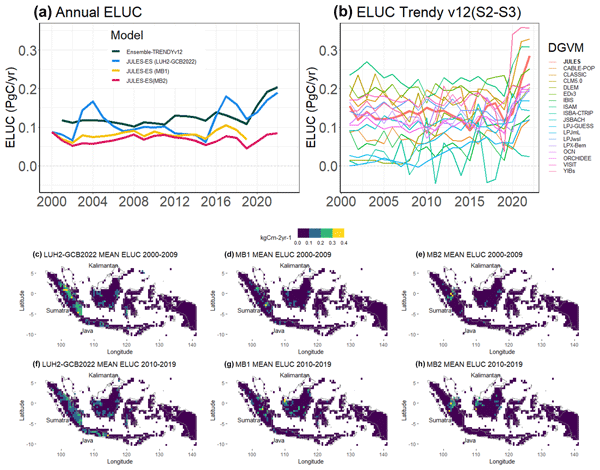
Ida Bagus Mandhara Brasika, Pierre Friedlingstein, Stephen Sitch, Michael O'Sullivan, Maria Carolina Duran-Rojas, Thais Michele Rosan, Kees Klein Goldewijk, Julia Pongratz, Clemens Schwingshackl, Louise P. Chini, and George C. Hurtt
Biogeosciences, 22, 3547–3561, https://doi.org/10.5194/bg-22-3547-2025, https://doi.org/10.5194/bg-22-3547-2025, 2025
Short summary
Short summary
Indonesia is the world's third-highest carbon emitter from land use change. However, there are uncertainties in the carbon emissions of Indonesia. Our best estimate of carbon emissions from land use change in Indonesia is 0.12 ± 0.02 PgC/yr with a steady trend. Despite many uncertainties created by drivers, models, and products, we also found robust agreements between these models and products. All agree that Indonesian carbon emissions from LULCC (land use and land cover change) have had no decreasing trend for the last 2 decades.
This article is included in the Encyclopedia of Geosciences

Carolina Natel, David Martín Belda, Peter Anthoni, Neele Haß, Sam Rabin, and Almut Arneth
Geosci. Model Dev., 18, 4317–4333, https://doi.org/10.5194/gmd-18-4317-2025, https://doi.org/10.5194/gmd-18-4317-2025, 2025
Short summary
Short summary
We developed fast machine learning models to predict forest regrowth and carbon dynamics under climate change. These models mimic the outputs of a complex vegetation model but run 95 % faster, enabling global analyses and supporting climate solutions in large modeling frameworks such as LandSyMM.
This article is included in the Encyclopedia of Geosciences
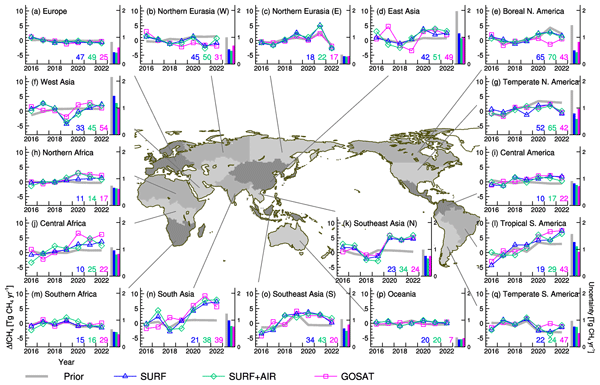
Yosuke Niwa, Yasunori Tohjima, Yukio Terao, Tazu Saeki, Akihiko Ito, Taku Umezawa, Kyohei Yamada, Motoki Sasakawa, Toshinobu Machida, Shin-Ichiro Nakaoka, Hideki Nara, Hiroshi Tanimoto, Hitoshi Mukai, Yukio Yoshida, Shinji Morimoto, Shinya Takatsuji, Kazuhiro Tsuboi, Yousuke Sawa, Hidekazu Matsueda, Kentaro Ishijima, Ryo Fujita, Daisuke Goto, Xin Lan, Kenneth Schuldt, Michal Heliasz, Tobias Biermann, Lukasz Chmura, Jarsolaw Necki, Irène Xueref-Remy, and Damiano Sferlazzo
Atmos. Chem. Phys., 25, 6757–6785, https://doi.org/10.5194/acp-25-6757-2025, https://doi.org/10.5194/acp-25-6757-2025, 2025
Short summary
Short summary
This study estimated regional and sectoral emission contributions to the unprecedented surge of atmospheric methane for 2020–2022. The methane is the second most important greenhouse gas, and its emissions reduction is urgently required to mitigate global warming. Numerical modeling-based estimates with three different sets of atmospheric observations consistently suggested large contributions of biogenic emissions from South Asia and Southeast Asia to the surge of atmospheric methane.
This article is included in the Encyclopedia of Geosciences
Lingbo Li, Hong-Yi Li, Guta Abeshu, Jinyun Tang, L. Ruby Leung, Chang Liao, Zeli Tan, Hanqin Tian, Peter Thornton, and Xiaojuan Yang
Earth Syst. Sci. Data, 17, 2713–2733, https://doi.org/10.5194/essd-17-2713-2025, https://doi.org/10.5194/essd-17-2713-2025, 2025
Short summary
Short summary
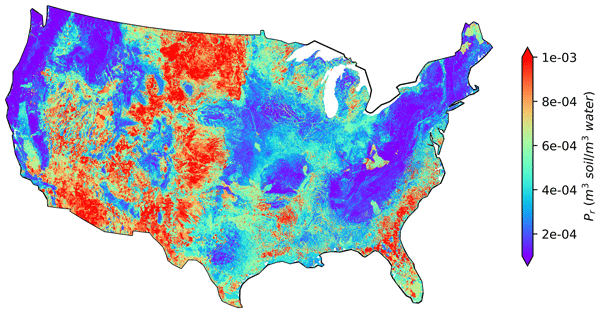
We have developed new maps that reveal how organic carbon from soil leaches into headwater streams over the contiguous United States. We use advanced artificial intelligence techniques and a massive amount of data, including observations at over 2500 gauges and a wealth of climate and environmental information. The maps are a critical step in understanding and predicting how carbon moves through our environment, hence making them a useful tool for tackling climate challenges.
This article is included in the Encyclopedia of Geosciences
Mateus Dantas de Paula, Tatiana Reichert, Laynara F. Lugli, Erica McGale, Kerstin Pierick, João Paulo Darela-Filho, Liam Langan, Jürgen Homeier, Anja Rammig, and Thomas Hickler
Biogeosciences, 22, 2707–2732, https://doi.org/10.5194/bg-22-2707-2025, https://doi.org/10.5194/bg-22-2707-2025, 2025
Short summary
Short summary
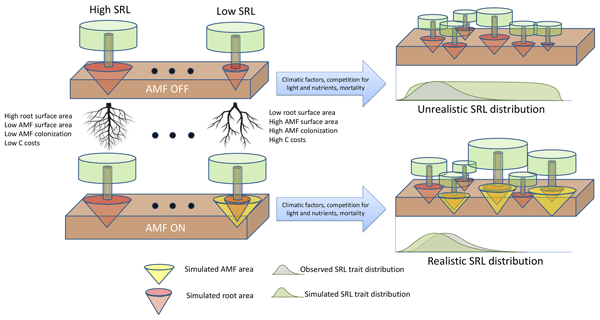
This study explores how plant roots with different forms and functions rely on fungal partnerships for nutrient uptake. This relationship was integrated into a vegetation model and was tested in a tropical forest in Ecuador. The model accurately predicted root traits and showed that without fungi, biomass decreased by up to 80 %. The findings highlight the critical role of fungi in ecosystem processes and suggest that root–fungal interactions should be considered in vegetation models.
This article is included in the Encyclopedia of Geosciences
Amali A. Amali, Clemens Schwingshackl, Akihiko Ito, Alina Barbu, Christine Delire, Daniele Peano, David M. Lawrence, David Wårlind, Eddy Robertson, Edouard L. Davin, Elena Shevliakova, Ian N. Harman, Nicolas Vuichard, Paul A. Miller, Peter J. Lawrence, Tilo Ziehn, Tomohiro Hajima, Victor Brovkin, Yanwu Zhang, Vivek K. Arora, and Julia Pongratz
Earth Syst. Dynam., 16, 803–840, https://doi.org/10.5194/esd-16-803-2025, https://doi.org/10.5194/esd-16-803-2025, 2025
Short summary
Short summary
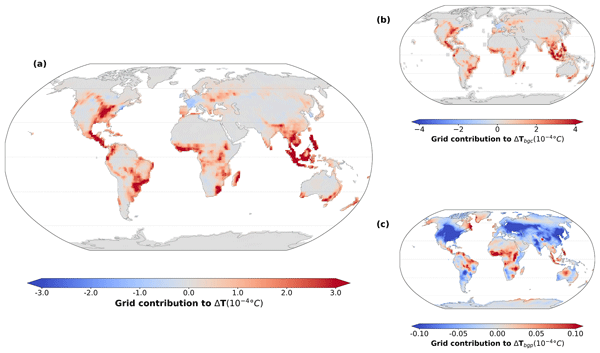
Our study explored the impact of anthropogenic land-use change (LUC) on climate dynamics, focusing on biogeophysical (BGP) and biogeochemical (BGC) effects using data from the Land Use Model Intercomparison Project (LUMIP) and the Coupled Model Intercomparison Project Phase 6 (CMIP6). We found that LUC-induced carbon emissions contribute to a BGC warming of 0.21 °C, with BGC effects dominating globally over BGP effects, which show regional variability. Our findings highlight discrepancies in model simulations and emphasize the need for improved representations of LUC processes.
This article is included in the Encyclopedia of Geosciences
Edna Johanna Molina Bacca, Miodrag Stevanović, Benjamin Leon Bodirsky, Jonathan Cornelis Doelman, Louise Parsons Chini, Jan Volkholz, Katja Frieler, Christopher Paul Oliver Reyer, George Hurtt, Florian Humpenöder, Kristine Karstens, Jens Heinke, Christoph Müller, Jan Philipp Dietrich, Hermann Lotze-Campen, Elke Stehfest, and Alexander Popp
Earth Syst. Dynam., 16, 753–801, https://doi.org/10.5194/esd-16-753-2025, https://doi.org/10.5194/esd-16-753-2025, 2025
Short summary
Short summary
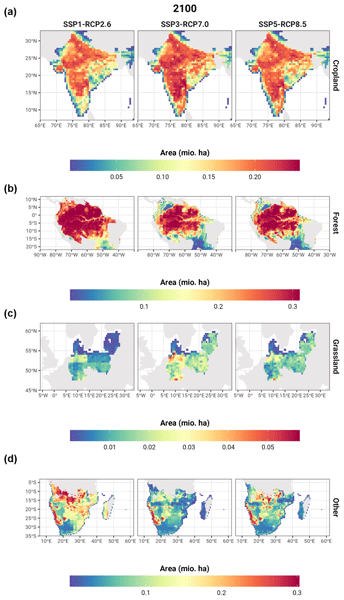
Land-use change projections are vital for impact studies. This study compares updated land-use model projections, including CO2 fertilization among other upgrades, from the MAgPIE and IMAGE models under three scenarios, highlighting differences, uncertainty hotspots, and harmonization effects. Key findings include reduced bioenergy crop demand projections and differences in grassland area allocation and sizes, with socioeconomic–climate scenarios' largest effect on variance starting in 2030.
This article is included in the Encyclopedia of Geosciences
Friedrich J. Bohn, Ana Bastos, Romina Martin, Anja Rammig, Niak Sian Koh, Giles B. Sioen, Bram Buscher, Louise Carver, Fabrice DeClerck, Moritz Drupp, Robert Fletcher, Matthew Forrest, Alexandros Gasparatos, Alex Godoy-Faúndez, Gregor Hagedorn, Martin C. Hänsel, Jessica Hetzer, Thomas Hickler, Cornelia B. Krug, Stasja Koot, Xiuzhen Li, Amy Luers, Shelby Matevich, H. Damon Matthews, Ina C. Meier, Mirco Migliavacca, Awaz Mohamed, Sungmin O, David Obura, Ben Orlove, Rene Orth, Laura Pereira, Markus Reichstein, Lerato Thakholi, Peter H. Verburg, and Yuki Yoshida
Biogeosciences, 22, 2425–2460, https://doi.org/10.5194/bg-22-2425-2025, https://doi.org/10.5194/bg-22-2425-2025, 2025
Short summary
Short summary
An interdisciplinary collaboration of 36 international researchers from 35 institutions highlights recent findings in biosphere research. Within eight themes, they discuss issues arising from climate change and other anthropogenic stressors and highlight the co-benefits of nature-based solutions and ecosystem services. Based on an analysis of these eight topics, we have synthesized four overarching insights.
This article is included in the Encyclopedia of Geosciences
Jianyong Ma, Almut Arneth, Benjamin Smith, Peter Anthoni, Xu-Ri, Peter Eliasson, David Wårlind, Martin Wittenbrink, and Stefan Olin
Geosci. Model Dev., 18, 3131–3155, https://doi.org/10.5194/gmd-18-3131-2025, https://doi.org/10.5194/gmd-18-3131-2025, 2025
Short summary
Short summary
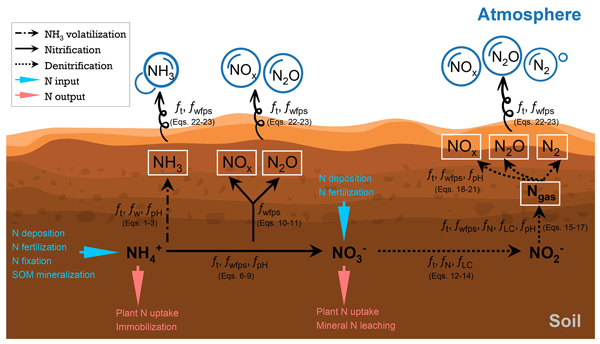
Nitrous oxide (N2O) is a powerful greenhouse gas mainly released from natural and agricultural soils. This study examines how global soil N2O emissions changed from 1961 to 2020 and identifies key factors driving these changes using an ecological model. The findings highlight croplands as the largest source, with factors like fertilizer use and climate change enhancing emissions. Rising CO2 levels, however, can partially mitigate N2O emissions through increased plant nitrogen uptake.
This article is included in the Encyclopedia of Geosciences
Marielle Saunois, Adrien Martinez, Benjamin Poulter, Zhen Zhang, Peter A. Raymond, Pierre Regnier, Josep G. Canadell, Robert B. Jackson, Prabir K. Patra, Philippe Bousquet, Philippe Ciais, Edward J. Dlugokencky, Xin Lan, George H. Allen, David Bastviken, David J. Beerling, Dmitry A. Belikov, Donald R. Blake, Simona Castaldi, Monica Crippa, Bridget R. Deemer, Fraser Dennison, Giuseppe Etiope, Nicola Gedney, Lena Höglund-Isaksson, Meredith A. Holgerson, Peter O. Hopcroft, Gustaf Hugelius, Akihiko Ito, Atul K. Jain, Rajesh Janardanan, Matthew S. Johnson, Thomas Kleinen, Paul B. Krummel, Ronny Lauerwald, Tingting Li, Xiangyu Liu, Kyle C. McDonald, Joe R. Melton, Jens Mühle, Jurek Müller, Fabiola Murguia-Flores, Yosuke Niwa, Sergio Noce, Shufen Pan, Robert J. Parker, Changhui Peng, Michel Ramonet, William J. Riley, Gerard Rocher-Ros, Judith A. Rosentreter, Motoki Sasakawa, Arjo Segers, Steven J. Smith, Emily H. Stanley, Joël Thanwerdas, Hanqin Tian, Aki Tsuruta, Francesco N. Tubiello, Thomas S. Weber, Guido R. van der Werf, Douglas E. J. Worthy, Yi Xi, Yukio Yoshida, Wenxin Zhang, Bo Zheng, Qing Zhu, Qiuan Zhu, and Qianlai Zhuang
Earth Syst. Sci. Data, 17, 1873–1958, https://doi.org/10.5194/essd-17-1873-2025, https://doi.org/10.5194/essd-17-1873-2025, 2025
Short summary
Short summary
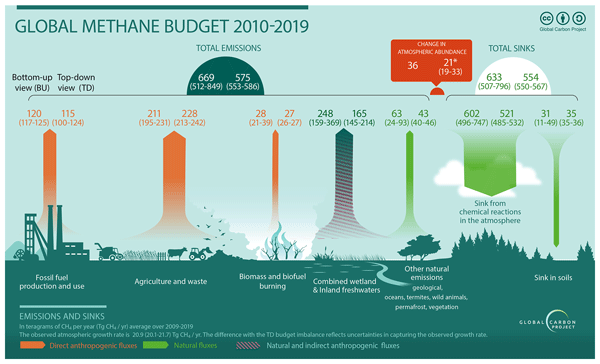
Methane (CH4) is the second most important human-influenced greenhouse gas in terms of climate forcing after carbon dioxide (CO2). A consortium of multi-disciplinary scientists synthesise and update the budget of the sources and sinks of CH4. This edition benefits from important progress in estimating emissions from lakes and ponds, reservoirs, and streams and rivers. For the 2010s decade, global CH4 emissions are estimated at 575 Tg CH4 yr-1, including ~65 % from anthropogenic sources.
This article is included in the Encyclopedia of Geosciences
Tatsuya Miyauchi, Makoto Saito, Hibiki M. Noda, Akihiko Ito, Tomomichi Kato, and Tsuneo Matsunaga
Geosci. Model Dev., 18, 2329–2347, https://doi.org/10.5194/gmd-18-2329-2025, https://doi.org/10.5194/gmd-18-2329-2025, 2025
Short summary
Short summary
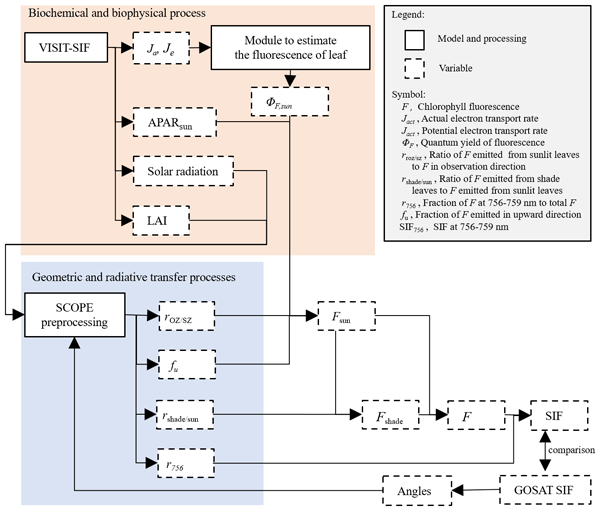
Solar-induced chlorophyll fluorescence (SIF) is an effective indicator for monitoring photosynthetic activity. This paper introduces VISIT-SIF, a biogeochemical model developed based on the Vegetation Integrative Simulator for Trace gases (VISIT) to represent satellite-observed SIF. Our simulations reproduced the global distribution and seasonal variations in observed SIF. VISIT-SIF helps to improve photosynthetic processes through a combination of biogeochemical modeling and observed SIF.
This article is included in the Encyclopedia of Geosciences
Mateus Dantas de Paula, Matthew Forrest, David Warlind, João Paulo Darela Filho, Katrin Fleischer, Anja Rammig, and Thomas Hickler
Geosci. Model Dev., 18, 2249–2274, https://doi.org/10.5194/gmd-18-2249-2025, https://doi.org/10.5194/gmd-18-2249-2025, 2025
Short summary
Short summary
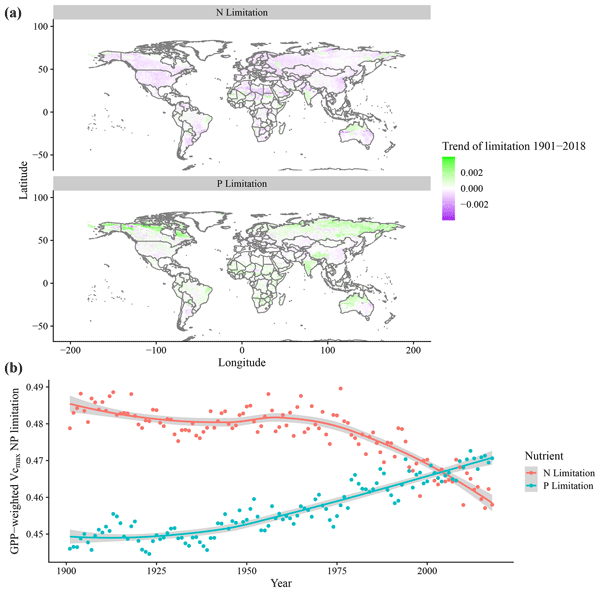
Our study maps global nitrogen (N) and phosphorus (P) availability and how they changed from 1901 to 2018. We find that tropical regions are mostly P-limited, while temperate and boreal areas face N limitations. Over time, P limitation increased, especially in the tropics, while N limitation decreased. These shifts are key to understanding global plant growth and carbon storage, highlighting the importance of including P dynamics in ecosystem models.
This article is included in the Encyclopedia of Geosciences
Ngoc Thi Nhu Do, Kengo Sudo, Akihiko Ito, Louisa K. Emmons, Vaishali Naik, Kostas Tsigaridis, Øyvind Seland, Gerd A. Folberth, and Douglas I. Kelley
Geosci. Model Dev., 18, 2079–2109, https://doi.org/10.5194/gmd-18-2079-2025, https://doi.org/10.5194/gmd-18-2079-2025, 2025
Short summary
Short summary
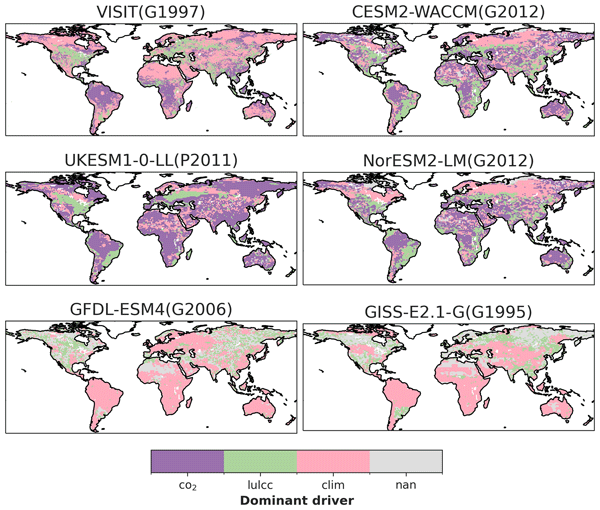
Understanding historical isoprene emission changes is important for predicting future climate, but trends and their controlling factors remain uncertain. This study shows that long-term isoprene trends vary among Earth system models mainly due to partially incorporating CO2 effects and land cover changes rather than to climate. Future models that refine these factors’ effects on isoprene emissions, along with long-term observations, are essential for better understanding plant–climate interactions.
This article is included in the Encyclopedia of Geosciences
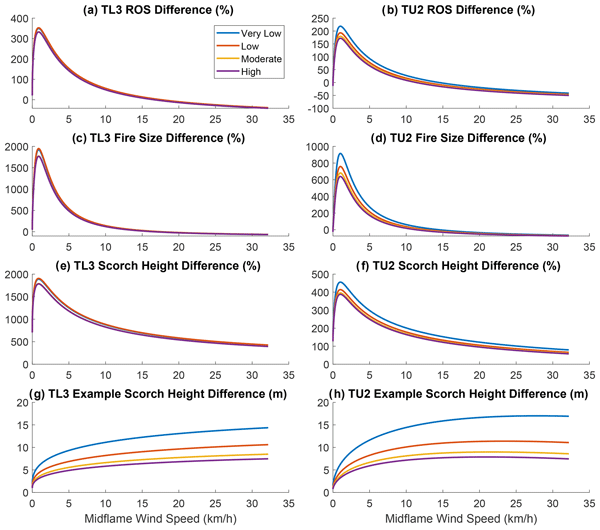
Luke Oberhagemann, Maik Billing, Werner von Bloh, Markus Drüke, Matthew Forrest, Simon P. K. Bowring, Jessica Hetzer, Jaime Ribalaygua Batalla, and Kirsten Thonicke
Geosci. Model Dev., 18, 2021–2050, https://doi.org/10.5194/gmd-18-2021-2025, https://doi.org/10.5194/gmd-18-2021-2025, 2025
Short summary
Short summary
Under climate change, the conditions necessary for wildfires to form are occurring more frequently in many parts of the world. To help predict how wildfires will change in future, global fire models are being developed. We analyze and further develop one such model, SPITFIRE. Our work identifies and corrects sources of substantial bias in the model that are important to the global fire modelling field. With this analysis and these developments, we help to provide a basis for future improvements.
This article is included in the Encyclopedia of Geosciences
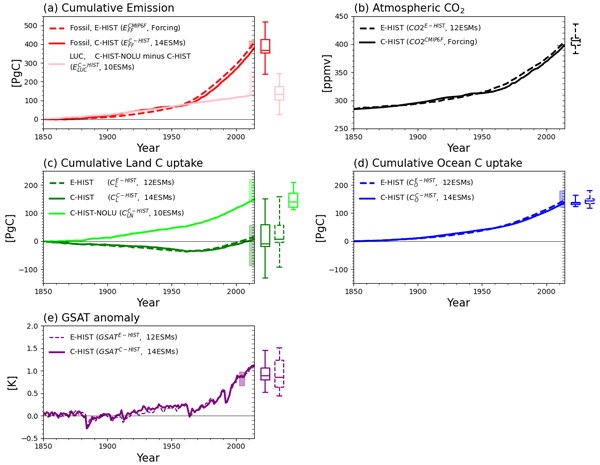
Tomohiro Hajima, Michio Kawamiya, Akihiko Ito, Kaoru Tachiiri, Chris D. Jones, Vivek Arora, Victor Brovkin, Roland Séférian, Spencer Liddicoat, Pierre Friedlingstein, and Elena Shevliakova
Biogeosciences, 22, 1447–1473, https://doi.org/10.5194/bg-22-1447-2025, https://doi.org/10.5194/bg-22-1447-2025, 2025
Short summary
Short summary
This study analyzes atmospheric CO2 concentrations and global carbon budgets simulated by multiple Earth system models, using several types of simulations (CO2 concentration- and emission-driven experiments). We successfully identified problems with regard to the global carbon budget in each model. We also found urgent issues with regard to land use change CO2 emissions that should be solved in the latest generation of models.
This article is included in the Encyclopedia of Geosciences
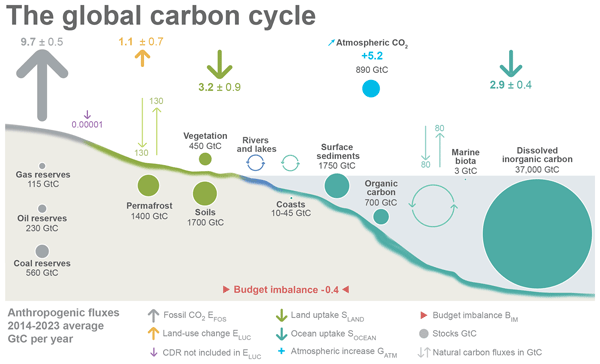
Pierre Friedlingstein, Michael O'Sullivan, Matthew W. Jones, Robbie M. Andrew, Judith Hauck, Peter Landschützer, Corinne Le Quéré, Hongmei Li, Ingrid T. Luijkx, Are Olsen, Glen P. Peters, Wouter Peters, Julia Pongratz, Clemens Schwingshackl, Stephen Sitch, Josep G. Canadell, Philippe Ciais, Robert B. Jackson, Simone R. Alin, Almut Arneth, Vivek Arora, Nicholas R. Bates, Meike Becker, Nicolas Bellouin, Carla F. Berghoff, Henry C. Bittig, Laurent Bopp, Patricia Cadule, Katie Campbell, Matthew A. Chamberlain, Naveen Chandra, Frédéric Chevallier, Louise P. Chini, Thomas Colligan, Jeanne Decayeux, Laique M. Djeutchouang, Xinyu Dou, Carolina Duran Rojas, Kazutaka Enyo, Wiley Evans, Amanda R. Fay, Richard A. Feely, Daniel J. Ford, Adrianna Foster, Thomas Gasser, Marion Gehlen, Thanos Gkritzalis, Giacomo Grassi, Luke Gregor, Nicolas Gruber, Özgür Gürses, Ian Harris, Matthew Hefner, Jens Heinke, George C. Hurtt, Yosuke Iida, Tatiana Ilyina, Andrew R. Jacobson, Atul K. Jain, Tereza Jarníková, Annika Jersild, Fei Jiang, Zhe Jin, Etsushi Kato, Ralph F. Keeling, Kees Klein Goldewijk, Jürgen Knauer, Jan Ivar Korsbakken, Xin Lan, Siv K. Lauvset, Nathalie Lefèvre, Zhu Liu, Junjie Liu, Lei Ma, Shamil Maksyutov, Gregg Marland, Nicolas Mayot, Patrick C. McGuire, Nicolas Metzl, Natalie M. Monacci, Eric J. Morgan, Shin-Ichiro Nakaoka, Craig Neill, Yosuke Niwa, Tobias Nützel, Lea Olivier, Tsuneo Ono, Paul I. Palmer, Denis Pierrot, Zhangcai Qin, Laure Resplandy, Alizée Roobaert, Thais M. Rosan, Christian Rödenbeck, Jörg Schwinger, T. Luke Smallman, Stephen M. Smith, Reinel Sospedra-Alfonso, Tobias Steinhoff, Qing Sun, Adrienne J. Sutton, Roland Séférian, Shintaro Takao, Hiroaki Tatebe, Hanqin Tian, Bronte Tilbrook, Olivier Torres, Etienne Tourigny, Hiroyuki Tsujino, Francesco Tubiello, Guido van der Werf, Rik Wanninkhof, Xuhui Wang, Dongxu Yang, Xiaojuan Yang, Zhen Yu, Wenping Yuan, Xu Yue, Sönke Zaehle, Ning Zeng, and Jiye Zeng
Earth Syst. Sci. Data, 17, 965–1039, https://doi.org/10.5194/essd-17-965-2025, https://doi.org/10.5194/essd-17-965-2025, 2025
Short summary
Short summary
The Global Carbon Budget 2024 describes the methodology, main results, and datasets used to quantify the anthropogenic emissions of carbon dioxide (CO2) and their partitioning among the atmosphere, land ecosystems, and the ocean over the historical period (1750–2024). These living datasets are updated every year to provide the highest transparency and traceability in the reporting of CO2, the key driver of climate change.
This article is included in the Encyclopedia of Geosciences
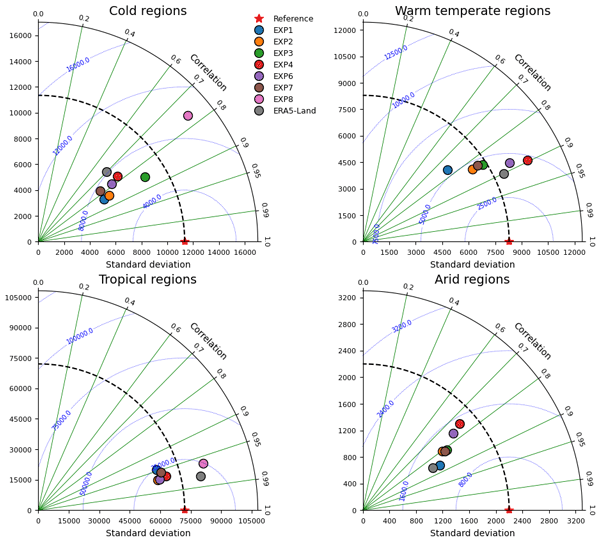
Mohamed Hamitouche, Giorgia Fosser, Alessandro Anav, Cenlin He, and Tzu-Shun Lin
Hydrol. Earth Syst. Sci., 29, 1221–1240, https://doi.org/10.5194/hess-29-1221-2025, https://doi.org/10.5194/hess-29-1221-2025, 2025
Short summary
Short summary
This study evaluates how different methods of simulating runoff impact river flow predictions globally. By comparing seven approaches within the Noah-Multi-parameterisation (Noah-MP) land surface model, we found significant differences in accuracy, with some methods underestimating or overestimating runoff. The results are crucial for improving water resource management and flood prediction. Our work highlights the need for precise modelling to better prepare for climate-related challenges.
This article is included in the Encyclopedia of Geosciences
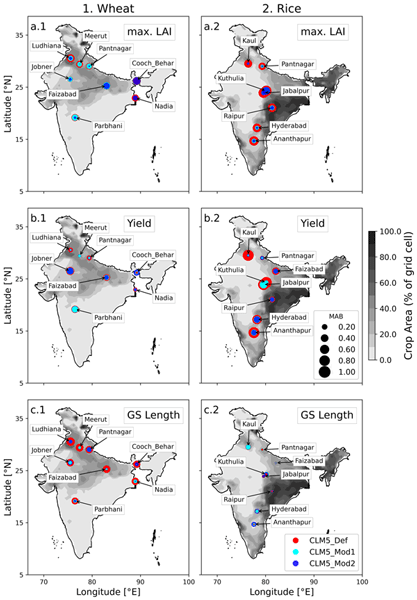
Narender Reddy Kangari, Somnath Baidya Roy, Sam S. Rabin, Danica L. Lombardozzi, Gudimetla Venkateswara Varma, Ruchira Biswas, and Devavat Chiru Naik
Geosci. Model Dev., 18, 763–785, https://doi.org/10.5194/gmd-18-763-2025, https://doi.org/10.5194/gmd-18-763-2025, 2025
Short summary
Short summary
The study aimed to improve the representation of wheat and rice in a land model for the Indian region. The modified model performed significantly better than the default model in simulating crop phenology, yield, and carbon, water, and energy fluxes compared to observations. The study highlights the need for global land models to use region-specific crop parameters for accurately simulating vegetation processes and land surface processes.
This article is included in the Encyclopedia of Geosciences
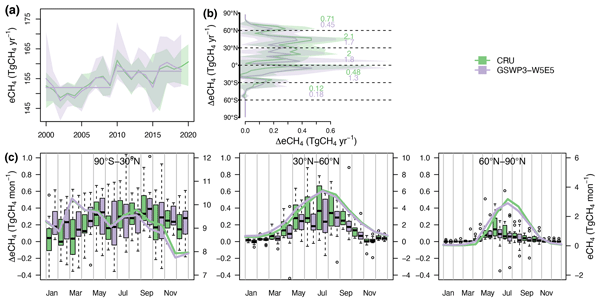
Zhen Zhang, Benjamin Poulter, Joe R. Melton, William J. Riley, George H. Allen, David J. Beerling, Philippe Bousquet, Josep G. Canadell, Etienne Fluet-Chouinard, Philippe Ciais, Nicola Gedney, Peter O. Hopcroft, Akihiko Ito, Robert B. Jackson, Atul K. Jain, Katherine Jensen, Fortunat Joos, Thomas Kleinen, Sara H. Knox, Tingting Li, Xin Li, Xiangyu Liu, Kyle McDonald, Gavin McNicol, Paul A. Miller, Jurek Müller, Prabir K. Patra, Changhui Peng, Shushi Peng, Zhangcai Qin, Ryan M. Riggs, Marielle Saunois, Qing Sun, Hanqin Tian, Xiaoming Xu, Yuanzhi Yao, Yi Xi, Wenxin Zhang, Qing Zhu, Qiuan Zhu, and Qianlai Zhuang
Biogeosciences, 22, 305–321, https://doi.org/10.5194/bg-22-305-2025, https://doi.org/10.5194/bg-22-305-2025, 2025
Short summary
Short summary
This study assesses global methane emissions from wetlands between 2000 and 2020 using multiple models. We found that wetland emissions increased by 6–7 Tg CH4 yr-1 in the 2010s compared to the 2000s. Rising temperatures primarily drove this increase, while changes in precipitation and CO2 levels also played roles. Our findings highlight the importance of wetlands in the global methane budget and the need for continuous monitoring to understand their impact on climate change.
This article is included in the Encyclopedia of Geosciences
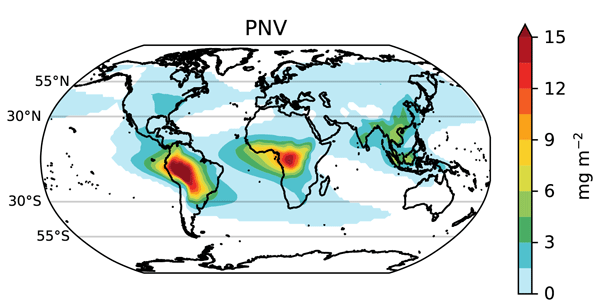
Ryan Vella, Matthew Forrest, Andrea Pozzer, Alexandra P. Tsimpidi, Thomas Hickler, Jos Lelieveld, and Holger Tost
Atmos. Chem. Phys., 25, 243–262, https://doi.org/10.5194/acp-25-243-2025, https://doi.org/10.5194/acp-25-243-2025, 2025
Short summary
Short summary
This study examines how land cover changes influence biogenic volatile organic compound (BVOC) emissions and atmospheric states. Using a coupled chemistry–climate–vegetation model, we compare present-day land cover (deforested for crops and grazing) with natural vegetation and an extreme reforestation scenario. We find that vegetation changes significantly impact global BVOC emissions and organic aerosols but have a relatively small effect on total aerosols, clouds, and radiative effects.
This article is included in the Encyclopedia of Geosciences
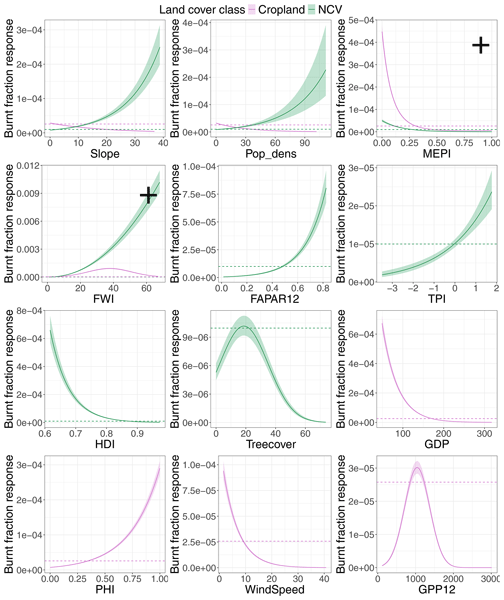
Matthew Forrest, Jessica Hetzer, Maik Billing, Simon P. K. Bowring, Eric Kosczor, Luke Oberhagemann, Oliver Perkins, Dan Warren, Fátima Arrogante-Funes, Kirsten Thonicke, and Thomas Hickler
Biogeosciences, 21, 5539–5560, https://doi.org/10.5194/bg-21-5539-2024, https://doi.org/10.5194/bg-21-5539-2024, 2024
Short summary
Short summary
Climate change is causing an increase in extreme wildfires in Europe, but drivers of fire are not well understood, especially across different land cover types. We used statistical models with satellite data, climate data, and socioeconomic data to determine what affects burning in cropland and non-cropland areas of Europe. We found different drivers of burning in cropland burning vs. non-cropland to the point that some variables, e.g. population density, had the complete opposite effects.
This article is included in the Encyclopedia of Geosciences
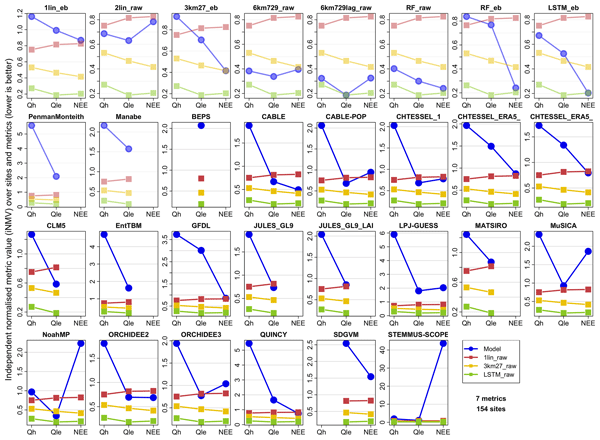
Gab Abramowitz, Anna Ukkola, Sanaa Hobeichi, Jon Cranko Page, Mathew Lipson, Martin G. De Kauwe, Samuel Green, Claire Brenner, Jonathan Frame, Grey Nearing, Martyn Clark, Martin Best, Peter Anthoni, Gabriele Arduini, Souhail Boussetta, Silvia Caldararu, Kyeungwoo Cho, Matthias Cuntz, David Fairbairn, Craig R. Ferguson, Hyungjun Kim, Yeonjoo Kim, Jürgen Knauer, David Lawrence, Xiangzhong Luo, Sergey Malyshev, Tomoko Nitta, Jerome Ogee, Keith Oleson, Catherine Ottlé, Phillipe Peylin, Patricia de Rosnay, Heather Rumbold, Bob Su, Nicolas Vuichard, Anthony P. Walker, Xiaoni Wang-Faivre, Yunfei Wang, and Yijian Zeng
Biogeosciences, 21, 5517–5538, https://doi.org/10.5194/bg-21-5517-2024, https://doi.org/10.5194/bg-21-5517-2024, 2024
Short summary
Short summary
This paper evaluates land models – computer-based models that simulate ecosystem dynamics; land carbon, water, and energy cycles; and the role of land in the climate system. It uses machine learning and AI approaches to show that, despite the complexity of land models, they do not perform nearly as well as they could given the amount of information they are provided with about the prediction problem.
This article is included in the Encyclopedia of Geosciences
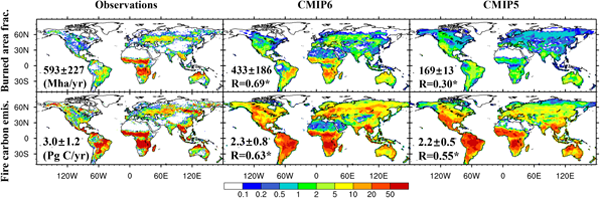
Fang Li, Xiang Song, Sandy P. Harrison, Jennifer R. Marlon, Zhongda Lin, L. Ruby Leung, Jörg Schwinger, Virginie Marécal, Shiyu Wang, Daniel S. Ward, Xiao Dong, Hanna Lee, Lars Nieradzik, Sam S. Rabin, and Roland Séférian
Geosci. Model Dev., 17, 8751–8771, https://doi.org/10.5194/gmd-17-8751-2024, https://doi.org/10.5194/gmd-17-8751-2024, 2024
Short summary
Short summary
This study provides the first comprehensive assessment of historical fire simulations from 19 Earth system models in phase 6 of the Coupled Model Intercomparison Project (CMIP6). Most models reproduce global totals, spatial patterns, seasonality, and regional historical changes well but fail to simulate the recent decline in global burned area and underestimate the fire response to climate variability. CMIP6 simulations address three critical issues of phase-5 models.
This article is included in the Encyclopedia of Geosciences
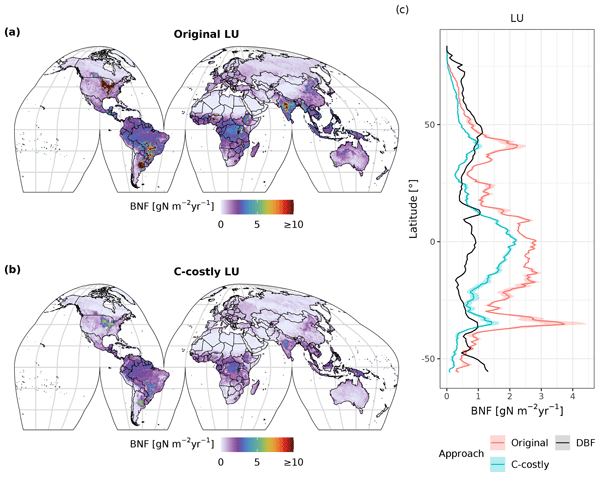
Stephen Björn Wirth, Johanna Braun, Jens Heinke, Sebastian Ostberg, Susanne Rolinski, Sibyll Schaphoff, Fabian Stenzel, Werner von Bloh, Friedhelm Taube, and Christoph Müller
Geosci. Model Dev., 17, 7889–7914, https://doi.org/10.5194/gmd-17-7889-2024, https://doi.org/10.5194/gmd-17-7889-2024, 2024
Short summary
Short summary
We present a new approach to modelling biological nitrogen fixation (BNF) in the Lund–Potsdam–Jena managed Land dynamic global vegetation model. While in the original approach BNF depended on actual evapotranspiration, the new approach considers soil water content and temperature, vertical root distribution, the nitrogen (N) deficit and carbon (C) costs. The new approach improved simulated BNF compared to the scientific literature and the model ability to project future C and N cycle dynamics.
This article is included in the Encyclopedia of Geosciences
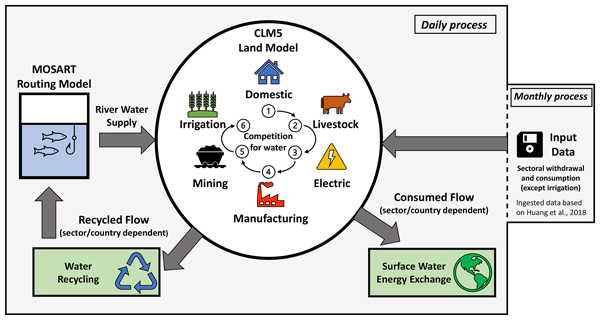
Sabin I. Taranu, David M. Lawrence, Yoshihide Wada, Ting Tang, Erik Kluzek, Sam Rabin, Yi Yao, Steven J. De Hertog, Inne Vanderkelen, and Wim Thiery
Geosci. Model Dev., 17, 7365–7399, https://doi.org/10.5194/gmd-17-7365-2024, https://doi.org/10.5194/gmd-17-7365-2024, 2024
Short summary
Short summary
In this study, we improved a climate model by adding the representation of water use sectors such as domestic, industry, and agriculture. This new feature helps us understand how water is used and supplied in various areas. We tested our model from 1971 to 2010 and found that it accurately identifies areas with water scarcity. By modelling the competition between sectors when water availability is limited, the model helps estimate the intensity and extent of individual sectors' water shortages.
This article is included in the Encyclopedia of Geosciences
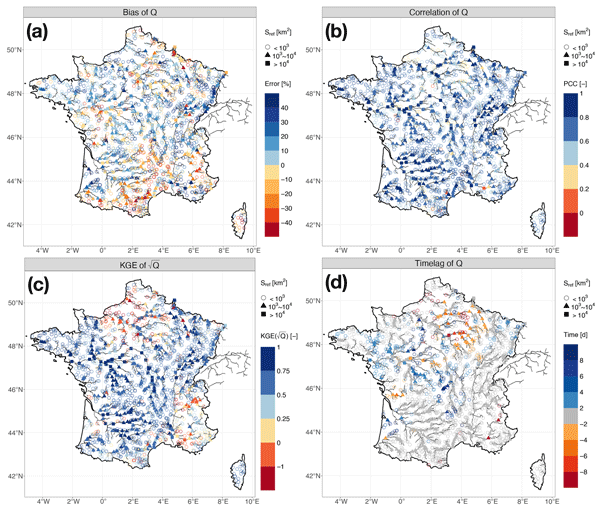
Peng Huang, Agnès Ducharne, Lucia Rinchiuso, Jan Polcher, Laure Baratgin, Vladislav Bastrikov, and Eric Sauquet
Hydrol. Earth Syst. Sci., 28, 4455–4476, https://doi.org/10.5194/hess-28-4455-2024, https://doi.org/10.5194/hess-28-4455-2024, 2024
Short summary
Short summary
We conducted a high-resolution hydrological simulation from 1959 to 2020 across France. We used a simple trial-and-error calibration to reduce the biases of the simulated water budget compared to observations. The selected simulation satisfactorily reproduces water fluxes, including their spatial contrasts and temporal trends. This work offers a reliable historical overview of water resources and a robust configuration for climate change impact analysis at the nationwide scale of France.
This article is included in the Encyclopedia of Geosciences
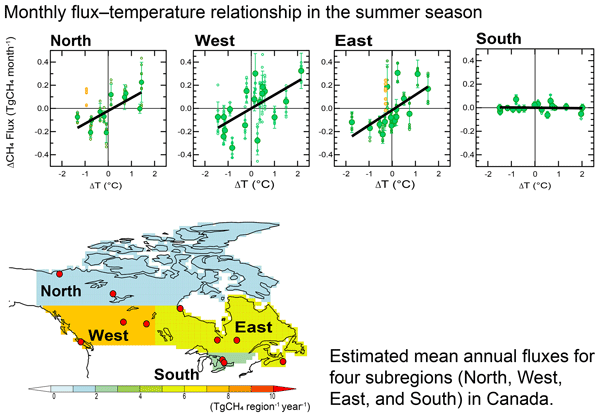
Misa Ishizawa, Douglas Chan, Doug Worthy, Elton Chan, Felix Vogel, Joe R. Melton, and Vivek K. Arora
Atmos. Chem. Phys., 24, 10013–10038, https://doi.org/10.5194/acp-24-10013-2024, https://doi.org/10.5194/acp-24-10013-2024, 2024
Short summary
Short summary
Methane (CH4) emissions in Canada for 2007–2017 were estimated using Canada’s surface greenhouse gas measurements. The estimated emissions show no significant trend, but emission uncertainty was reduced as more measurement sites became available. Notably for climate change, we find the wetland CH4 emissions show a positive correlation with surface air temperature in summer. Canada’s measurement network could monitor future CH4 emission changes and compliance with climate change mitigation goals.
This article is included in the Encyclopedia of Geosciences

Hanqin Tian, Naiqing Pan, Rona L. Thompson, Josep G. Canadell, Parvadha Suntharalingam, Pierre Regnier, Eric A. Davidson, Michael Prather, Philippe Ciais, Marilena Muntean, Shufen Pan, Wilfried Winiwarter, Sönke Zaehle, Feng Zhou, Robert B. Jackson, Hermann W. Bange, Sarah Berthet, Zihao Bian, Daniele Bianchi, Alexander F. Bouwman, Erik T. Buitenhuis, Geoffrey Dutton, Minpeng Hu, Akihiko Ito, Atul K. Jain, Aurich Jeltsch-Thömmes, Fortunat Joos, Sian Kou-Giesbrecht, Paul B. Krummel, Xin Lan, Angela Landolfi, Ronny Lauerwald, Ya Li, Chaoqun Lu, Taylor Maavara, Manfredi Manizza, Dylan B. Millet, Jens Mühle, Prabir K. Patra, Glen P. Peters, Xiaoyu Qin, Peter Raymond, Laure Resplandy, Judith A. Rosentreter, Hao Shi, Qing Sun, Daniele Tonina, Francesco N. Tubiello, Guido R. van der Werf, Nicolas Vuichard, Junjie Wang, Kelley C. Wells, Luke M. Western, Chris Wilson, Jia Yang, Yuanzhi Yao, Yongfa You, and Qing Zhu
Earth Syst. Sci. Data, 16, 2543–2604, https://doi.org/10.5194/essd-16-2543-2024, https://doi.org/10.5194/essd-16-2543-2024, 2024
Short summary
Short summary
Atmospheric concentrations of nitrous oxide (N2O), a greenhouse gas 273 times more potent than carbon dioxide, have increased by 25 % since the preindustrial period, with the highest observed growth rate in 2020 and 2021. This rapid growth rate has primarily been due to a 40 % increase in anthropogenic emissions since 1980. Observed atmospheric N2O concentrations in recent years have exceeded the worst-case climate scenario, underscoring the importance of reducing anthropogenic N2O emissions.
This article is included in the Encyclopedia of Geosciences
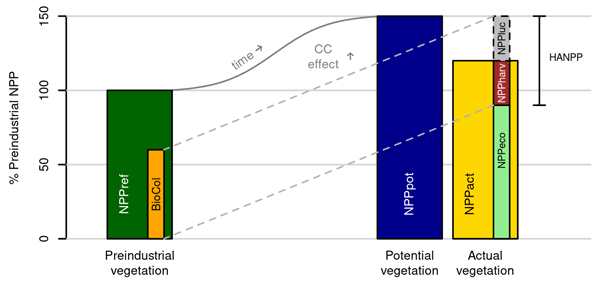
Fabian Stenzel, Johanna Braun, Jannes Breier, Karlheinz Erb, Dieter Gerten, Jens Heinke, Sarah Matej, Sebastian Ostberg, Sibyll Schaphoff, and Wolfgang Lucht
Geosci. Model Dev., 17, 3235–3258, https://doi.org/10.5194/gmd-17-3235-2024, https://doi.org/10.5194/gmd-17-3235-2024, 2024
Short summary
Short summary
We provide an R package to compute two biosphere integrity metrics that can be applied to simulations of vegetation growth from the dynamic global vegetation model LPJmL. The pressure metric BioCol indicates that we humans modify and extract > 20 % of the potential preindustrial natural biomass production. The ecosystems state metric EcoRisk shows a high risk of ecosystem destabilization in many regions as a result of climate change and land, water, and fertilizer use.
This article is included in the Encyclopedia of Geosciences
Chansopheaktra Sovann, Torbern Tagesson, Patrik Vestin, Sakada Sakhoeun, Soben Kim, Sothea Kok, and Stefan Olin
Earth Syst. Sci. Data Discuss., https://doi.org/10.5194/essd-2024-98, https://doi.org/10.5194/essd-2024-98, 2024
Revised manuscript not accepted
Short summary
Short summary
We offer pairwise observed datasets that compare the characteristics of tropical ecosystems, specifically pristine forests, regrowth forests, and cashew plantations. Our findings uncover some key differences in their characteristics, emphasizing the influence of human activities on these ecosystems. By sharing our unique datasets, we hope to improve the knowledge of tropical forest ecosystems in Southeast Asia, advancing tropical research, and tackling global environmental challenges.
This article is included in the Encyclopedia of Geosciences
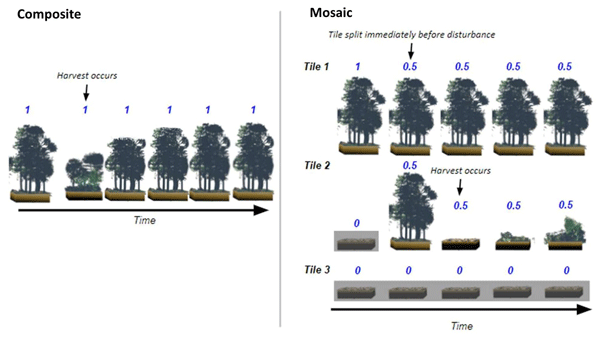
Salvatore R. Curasi, Joe R. Melton, Elyn R. Humphreys, Txomin Hermosilla, and Michael A. Wulder
Geosci. Model Dev., 17, 2683–2704, https://doi.org/10.5194/gmd-17-2683-2024, https://doi.org/10.5194/gmd-17-2683-2024, 2024
Short summary
Short summary
Canadian forests are responding to fire, harvest, and climate change. Models need to quantify these processes and their carbon and energy cycling impacts. We develop a scheme that, based on satellite records, represents fire, harvest, and the sparsely vegetated areas that these processes generate. We evaluate model performance and demonstrate the impacts of disturbance on carbon and energy cycling. This work has implications for land surface modeling and assessing Canada’s terrestrial C cycle.
This article is included in the Encyclopedia of Geosciences
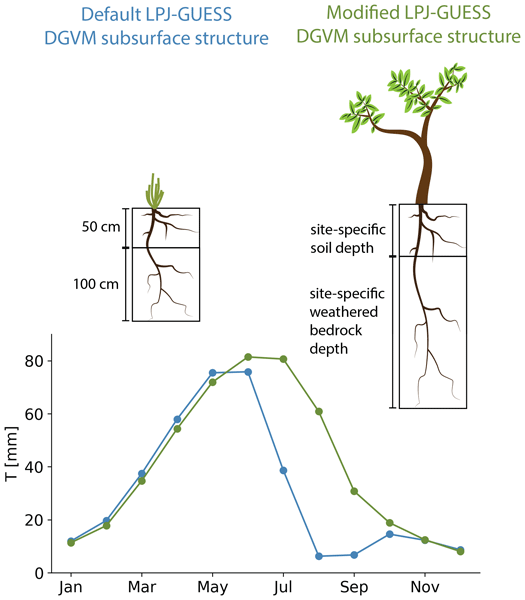
Dana A. Lapides, W. Jesse Hahm, Matthew Forrest, Daniella M. Rempe, Thomas Hickler, and David N. Dralle
Biogeosciences, 21, 1801–1826, https://doi.org/10.5194/bg-21-1801-2024, https://doi.org/10.5194/bg-21-1801-2024, 2024
Short summary
Short summary
Water stored in weathered bedrock is rarely incorporated into vegetation and Earth system models despite increasing recognition of its importance. Here, we add a weathered bedrock component to a widely used vegetation model. Using a case study of two sites in California and model runs across the United States, we show that more accurately representing subsurface water storage and hydrology increases summer plant water use so that it better matches patterns in distributed data products.
This article is included in the Encyclopedia of Geosciences
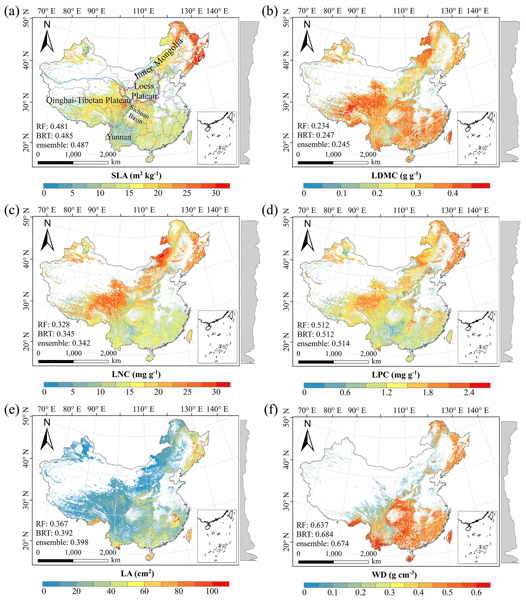
Nannan An, Nan Lu, Weiliang Chen, Yongzhe Chen, Hao Shi, Fuzhong Wu, and Bojie Fu
Earth Syst. Sci. Data, 16, 1771–1810, https://doi.org/10.5194/essd-16-1771-2024, https://doi.org/10.5194/essd-16-1771-2024, 2024
Short summary
Short summary
This study generated a spatially continuous plant functional trait dataset (~1 km) in China in combination with field observations, environmental variables and vegetation indices using machine learning methods. Results showed that wood density, leaf P concentration and specific leaf area showed good accuracy with an average R2 of higher than 0.45. This dataset could provide data support for development of Earth system models to predict vegetation distribution and ecosystem functions.
This article is included in the Encyclopedia of Geosciences
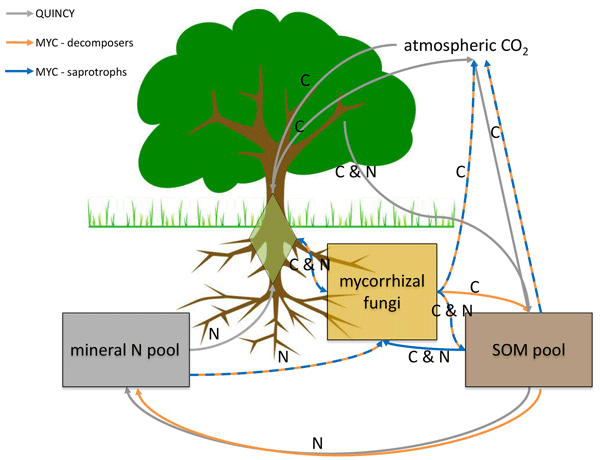
Melanie A. Thurner, Silvia Caldararu, Jan Engel, Anja Rammig, and Sönke Zaehle
Biogeosciences, 21, 1391–1410, https://doi.org/10.5194/bg-21-1391-2024, https://doi.org/10.5194/bg-21-1391-2024, 2024
Short summary
Short summary
Due to their crucial role in terrestrial ecosystems, we implemented mycorrhizal fungi into the QUINCY terrestrial biosphere model. Fungi interact with mineral and organic soil to support plant N uptake and, thus, plant growth. Our results suggest that the effect of mycorrhizal interactions on simulated ecosystem dynamics is minor under constant environmental conditions but necessary to reproduce and understand observed patterns under changing conditions, such as rising atmospheric CO2.
This article is included in the Encyclopedia of Geosciences
Benjamin F. Meyer, Allan Buras, Konstantin Gregor, Lucia S. Layritz, Adriana Principe, Jürgen Kreyling, Anja Rammig, and Christian S. Zang
Biogeosciences, 21, 1355–1370, https://doi.org/10.5194/bg-21-1355-2024, https://doi.org/10.5194/bg-21-1355-2024, 2024
Short summary
Short summary
Late-spring frost (LSF), critically low temperatures when trees have already flushed their leaves, results in freezing damage leaving trees with reduced ability to perform photosynthesis. Forests with a high proportion of susceptible species like European beech are particularly vulnerable. However, this process is rarely included in dynamic vegetation models (DVMs). We show that the effect on simulated productivity and biomass is substantial, warranting more widespread inclusion of LSF in DVMs.
This article is included in the Encyclopedia of Geosciences
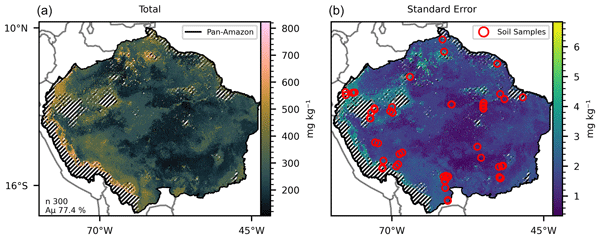
João Paulo Darela-Filho, Anja Rammig, Katrin Fleischer, Tatiana Reichert, Laynara Figueiredo Lugli, Carlos Alberto Quesada, Luis Carlos Colocho Hurtarte, Mateus Dantas de Paula, and David M. Lapola
Earth Syst. Sci. Data, 16, 715–729, https://doi.org/10.5194/essd-16-715-2024, https://doi.org/10.5194/essd-16-715-2024, 2024
Short summary
Short summary
Phosphorus (P) is crucial for plant growth, and scientists have created models to study how it interacts with carbon cycle in ecosystems. To apply these models, it is important to know the distribution of phosphorus in soil. In this study we estimated the distribution of phosphorus in the Amazon region. The results showed a clear gradient of soil development and P content. These maps can help improve ecosystem models and generate new hypotheses about phosphorus availability in the Amazon.
This article is included in the Encyclopedia of Geosciences
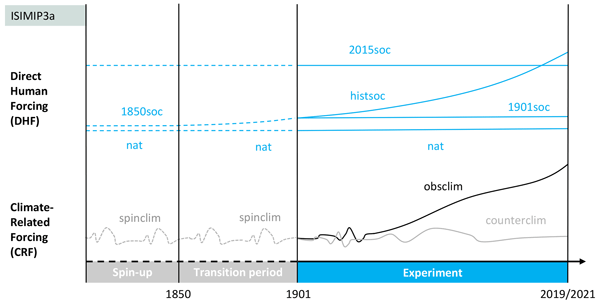
Katja Frieler, Jan Volkholz, Stefan Lange, Jacob Schewe, Matthias Mengel, María del Rocío Rivas López, Christian Otto, Christopher P. O. Reyer, Dirk Nikolaus Karger, Johanna T. Malle, Simon Treu, Christoph Menz, Julia L. Blanchard, Cheryl S. Harrison, Colleen M. Petrik, Tyler D. Eddy, Kelly Ortega-Cisneros, Camilla Novaglio, Yannick Rousseau, Reg A. Watson, Charles Stock, Xiao Liu, Ryan Heneghan, Derek Tittensor, Olivier Maury, Matthias Büchner, Thomas Vogt, Tingting Wang, Fubao Sun, Inga J. Sauer, Johannes Koch, Inne Vanderkelen, Jonas Jägermeyr, Christoph Müller, Sam Rabin, Jochen Klar, Iliusi D. Vega del Valle, Gitta Lasslop, Sarah Chadburn, Eleanor Burke, Angela Gallego-Sala, Noah Smith, Jinfeng Chang, Stijn Hantson, Chantelle Burton, Anne Gädeke, Fang Li, Simon N. Gosling, Hannes Müller Schmied, Fred Hattermann, Jida Wang, Fangfang Yao, Thomas Hickler, Rafael Marcé, Don Pierson, Wim Thiery, Daniel Mercado-Bettín, Robert Ladwig, Ana Isabel Ayala-Zamora, Matthew Forrest, and Michel Bechtold
Geosci. Model Dev., 17, 1–51, https://doi.org/10.5194/gmd-17-1-2024, https://doi.org/10.5194/gmd-17-1-2024, 2024
Short summary
Short summary
Our paper provides an overview of all observational climate-related and socioeconomic forcing data used as input for the impact model evaluation and impact attribution experiments within the third round of the Inter-Sectoral Impact Model Intercomparison Project. The experiments are designed to test our understanding of observed changes in natural and human systems and to quantify to what degree these changes have already been induced by climate change.
This article is included in the Encyclopedia of Geosciences
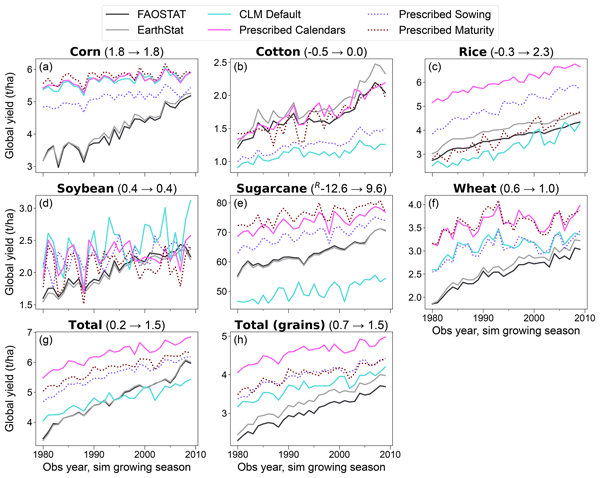
Sam S. Rabin, William J. Sacks, Danica L. Lombardozzi, Lili Xia, and Alan Robock
Geosci. Model Dev., 16, 7253–7273, https://doi.org/10.5194/gmd-16-7253-2023, https://doi.org/10.5194/gmd-16-7253-2023, 2023
Short summary
Short summary
Climate models can help us simulate how the agricultural system will be affected by and respond to environmental change, but to be trustworthy they must realistically reproduce historical patterns. When farmers plant their crops and what varieties they choose will be important aspects of future adaptation. Here, we improve the crop component of a global model to better simulate observed growing seasons and examine the impacts on simulated crop yields and irrigation demand.
This article is included in the Encyclopedia of Geosciences
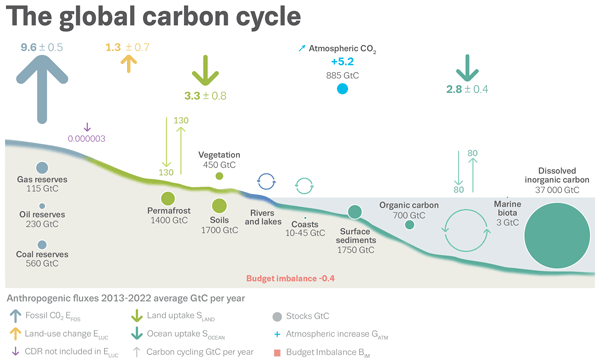
Pierre Friedlingstein, Michael O'Sullivan, Matthew W. Jones, Robbie M. Andrew, Dorothee C. E. Bakker, Judith Hauck, Peter Landschützer, Corinne Le Quéré, Ingrid T. Luijkx, Glen P. Peters, Wouter Peters, Julia Pongratz, Clemens Schwingshackl, Stephen Sitch, Josep G. Canadell, Philippe Ciais, Robert B. Jackson, Simone R. Alin, Peter Anthoni, Leticia Barbero, Nicholas R. Bates, Meike Becker, Nicolas Bellouin, Bertrand Decharme, Laurent Bopp, Ida Bagus Mandhara Brasika, Patricia Cadule, Matthew A. Chamberlain, Naveen Chandra, Thi-Tuyet-Trang Chau, Frédéric Chevallier, Louise P. Chini, Margot Cronin, Xinyu Dou, Kazutaka Enyo, Wiley Evans, Stefanie Falk, Richard A. Feely, Liang Feng, Daniel J. Ford, Thomas Gasser, Josefine Ghattas, Thanos Gkritzalis, Giacomo Grassi, Luke Gregor, Nicolas Gruber, Özgür Gürses, Ian Harris, Matthew Hefner, Jens Heinke, Richard A. Houghton, George C. Hurtt, Yosuke Iida, Tatiana Ilyina, Andrew R. Jacobson, Atul Jain, Tereza Jarníková, Annika Jersild, Fei Jiang, Zhe Jin, Fortunat Joos, Etsushi Kato, Ralph F. Keeling, Daniel Kennedy, Kees Klein Goldewijk, Jürgen Knauer, Jan Ivar Korsbakken, Arne Körtzinger, Xin Lan, Nathalie Lefèvre, Hongmei Li, Junjie Liu, Zhiqiang Liu, Lei Ma, Greg Marland, Nicolas Mayot, Patrick C. McGuire, Galen A. McKinley, Gesa Meyer, Eric J. Morgan, David R. Munro, Shin-Ichiro Nakaoka, Yosuke Niwa, Kevin M. O'Brien, Are Olsen, Abdirahman M. Omar, Tsuneo Ono, Melf Paulsen, Denis Pierrot, Katie Pocock, Benjamin Poulter, Carter M. Powis, Gregor Rehder, Laure Resplandy, Eddy Robertson, Christian Rödenbeck, Thais M. Rosan, Jörg Schwinger, Roland Séférian, T. Luke Smallman, Stephen M. Smith, Reinel Sospedra-Alfonso, Qing Sun, Adrienne J. Sutton, Colm Sweeney, Shintaro Takao, Pieter P. Tans, Hanqin Tian, Bronte Tilbrook, Hiroyuki Tsujino, Francesco Tubiello, Guido R. van der Werf, Erik van Ooijen, Rik Wanninkhof, Michio Watanabe, Cathy Wimart-Rousseau, Dongxu Yang, Xiaojuan Yang, Wenping Yuan, Xu Yue, Sönke Zaehle, Jiye Zeng, and Bo Zheng
Earth Syst. Sci. Data, 15, 5301–5369, https://doi.org/10.5194/essd-15-5301-2023, https://doi.org/10.5194/essd-15-5301-2023, 2023
Short summary
Short summary
The Global Carbon Budget 2023 describes the methodology, main results, and data sets used to quantify the anthropogenic emissions of carbon dioxide (CO2) and their partitioning among the atmosphere, land ecosystems, and the ocean over the historical period (1750–2023). These living datasets are updated every year to provide the highest transparency and traceability in the reporting of CO2, the key driver of climate change.
This article is included in the Encyclopedia of Geosciences
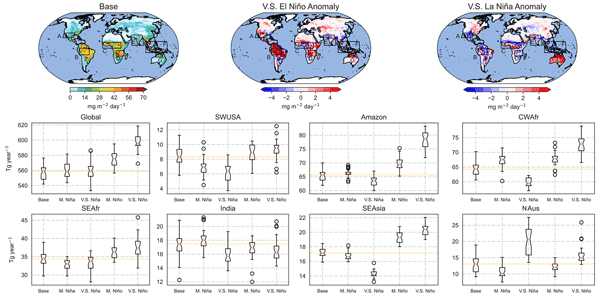
Ryan Vella, Andrea Pozzer, Matthew Forrest, Jos Lelieveld, Thomas Hickler, and Holger Tost
Biogeosciences, 20, 4391–4412, https://doi.org/10.5194/bg-20-4391-2023, https://doi.org/10.5194/bg-20-4391-2023, 2023
Short summary
Short summary
We investigated the effect of the El Niño–Southern Oscillation (ENSO) on biogenic volatile organic compound (BVOC) emissions from plants. ENSO events can cause a significant increase in these emissions, which have a long-term impact on the Earth's atmosphere. Persistent ENSO conditions can cause long-term changes in vegetation, resulting in even higher BVOC emissions. We link ENSO-induced emission anomalies with driving atmospheric and vegetational variables.
This article is included in the Encyclopedia of Geosciences
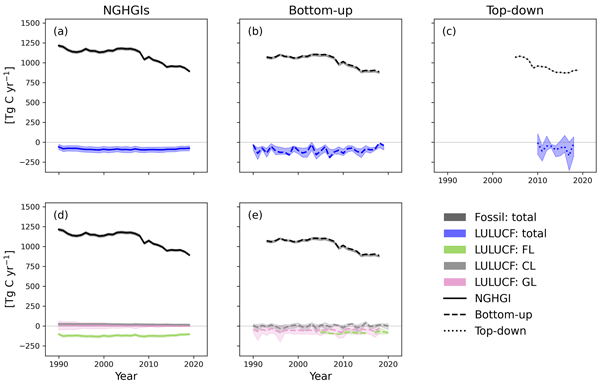
Matthew J. McGrath, Ana Maria Roxana Petrescu, Philippe Peylin, Robbie M. Andrew, Bradley Matthews, Frank Dentener, Juraj Balkovič, Vladislav Bastrikov, Meike Becker, Gregoire Broquet, Philippe Ciais, Audrey Fortems-Cheiney, Raphael Ganzenmüller, Giacomo Grassi, Ian Harris, Matthew Jones, Jürgen Knauer, Matthias Kuhnert, Guillaume Monteil, Saqr Munassar, Paul I. Palmer, Glen P. Peters, Chunjing Qiu, Mart-Jan Schelhaas, Oksana Tarasova, Matteo Vizzarri, Karina Winkler, Gianpaolo Balsamo, Antoine Berchet, Peter Briggs, Patrick Brockmann, Frédéric Chevallier, Giulia Conchedda, Monica Crippa, Stijn N. C. Dellaert, Hugo A. C. Denier van der Gon, Sara Filipek, Pierre Friedlingstein, Richard Fuchs, Michael Gauss, Christoph Gerbig, Diego Guizzardi, Dirk Günther, Richard A. Houghton, Greet Janssens-Maenhout, Ronny Lauerwald, Bas Lerink, Ingrid T. Luijkx, Géraud Moulas, Marilena Muntean, Gert-Jan Nabuurs, Aurélie Paquirissamy, Lucia Perugini, Wouter Peters, Roberto Pilli, Julia Pongratz, Pierre Regnier, Marko Scholze, Yusuf Serengil, Pete Smith, Efisio Solazzo, Rona L. Thompson, Francesco N. Tubiello, Timo Vesala, and Sophia Walther
Earth Syst. Sci. Data, 15, 4295–4370, https://doi.org/10.5194/essd-15-4295-2023, https://doi.org/10.5194/essd-15-4295-2023, 2023
Short summary
Short summary
Accurate estimation of fluxes of carbon dioxide from the land surface is essential for understanding future impacts of greenhouse gas emissions on the climate system. A wide variety of methods currently exist to estimate these sources and sinks. We are continuing work to develop annual comparisons of these diverse methods in order to clarify what they all actually calculate and to resolve apparent disagreement, in addition to highlighting opportunities for increased understanding.
This article is included in the Encyclopedia of Geosciences
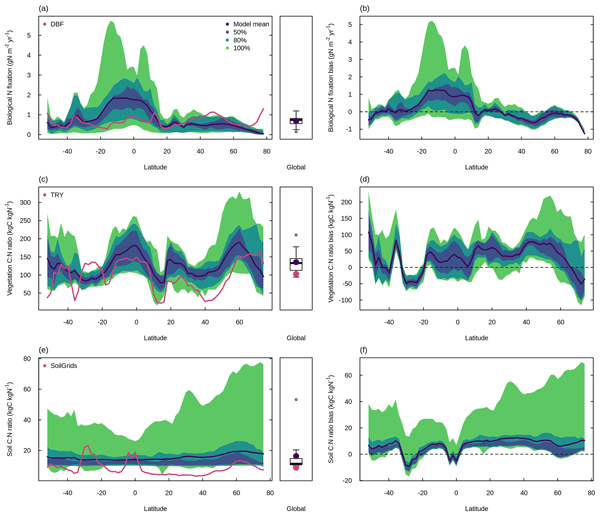
Sian Kou-Giesbrecht, Vivek K. Arora, Christian Seiler, Almut Arneth, Stefanie Falk, Atul K. Jain, Fortunat Joos, Daniel Kennedy, Jürgen Knauer, Stephen Sitch, Michael O'Sullivan, Naiqing Pan, Qing Sun, Hanqin Tian, Nicolas Vuichard, and Sönke Zaehle
Earth Syst. Dynam., 14, 767–795, https://doi.org/10.5194/esd-14-767-2023, https://doi.org/10.5194/esd-14-767-2023, 2023
Short summary
Short summary
Nitrogen (N) is an essential limiting nutrient to terrestrial carbon (C) sequestration. We evaluate N cycling in an ensemble of terrestrial biosphere models. We find that variability in N processes across models is large. Models tended to overestimate C storage per unit N in vegetation and soil, which could have consequences for projecting the future terrestrial C sink. However, N cycling measurements are highly uncertain, and more are necessary to guide the development of N cycling in models.
This article is included in the Encyclopedia of Geosciences
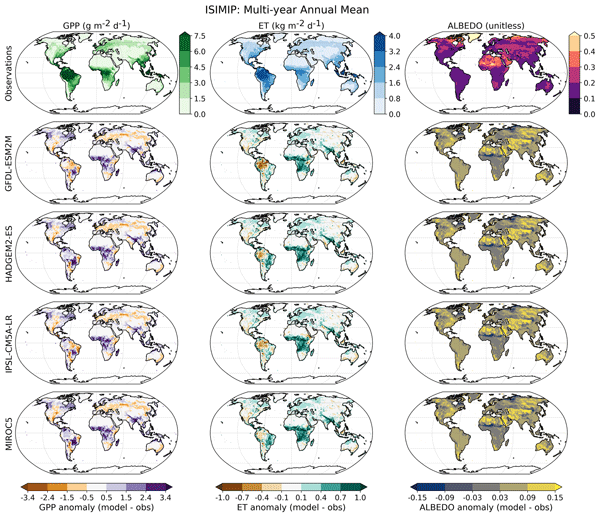
Camilla Mathison, Eleanor Burke, Andrew J. Hartley, Douglas I. Kelley, Chantelle Burton, Eddy Robertson, Nicola Gedney, Karina Williams, Andy Wiltshire, Richard J. Ellis, Alistair A. Sellar, and Chris D. Jones
Geosci. Model Dev., 16, 4249–4264, https://doi.org/10.5194/gmd-16-4249-2023, https://doi.org/10.5194/gmd-16-4249-2023, 2023
Short summary
Short summary
This paper describes and evaluates a new modelling methodology to quantify the impacts of climate change on water, biomes and the carbon cycle. We have created a new configuration and set-up for the JULES-ES land surface model, driven by bias-corrected historical and future climate model output provided by the Inter-Sectoral Impacts Model Intercomparison Project (ISIMIP). This allows us to compare projections of the impacts of climate change across multiple impact models and multiple sectors.
This article is included in the Encyclopedia of Geosciences
Bo Qu, Alexandre Roy, Joe R. Melton, Jennifer L. Baltzer, Youngryel Ryu, Matteo Detto, and Oliver Sonnentag
EGUsphere, https://doi.org/10.5194/egusphere-2023-1167, https://doi.org/10.5194/egusphere-2023-1167, 2023
Preprint archived
Short summary
Short summary
Accurately simulating photosynthesis and evapotranspiration challenges terrestrial biosphere models across North America’s boreal biome, in part due to uncertain representation of the maximum rate of photosynthetic carboxylation (Vcmax). This study used forest stand scale observations in an optimization framework to improve Vcmax values for representative vegetation types. Several stand characteristics well explained spatial Vcmax variability and were useful to improve boreal forest modelling.
This article is included in the Encyclopedia of Geosciences
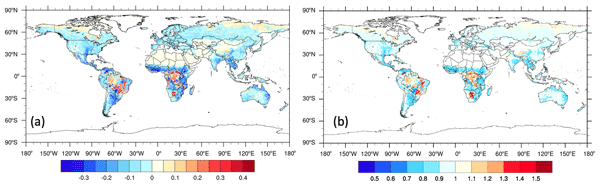
Xiaojuan Yang, Peter Thornton, Daniel Ricciuto, Yilong Wang, and Forrest Hoffman
Biogeosciences, 20, 2813–2836, https://doi.org/10.5194/bg-20-2813-2023, https://doi.org/10.5194/bg-20-2813-2023, 2023
Short summary
Short summary
We evaluated the performance of a land surface model (ELMv1-CNP) that includes both nitrogen (N) and phosphorus (P) limitation on carbon cycle processes. We show that ELMv1-CNP produces realistic estimates of present-day carbon pools and fluxes. We show that global C sources and sinks are significantly affected by P limitation. Our study suggests that introduction of P limitation in land surface models is likely to have substantial consequences for projections of future carbon uptake.
This article is included in the Encyclopedia of Geosciences
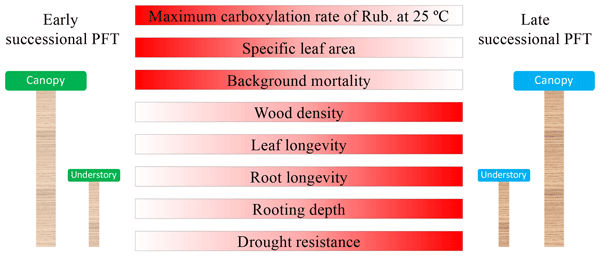
Lingcheng Li, Yilin Fang, Zhonghua Zheng, Mingjie Shi, Marcos Longo, Charles D. Koven, Jennifer A. Holm, Rosie A. Fisher, Nate G. McDowell, Jeffrey Chambers, and L. Ruby Leung
Geosci. Model Dev., 16, 4017–4040, https://doi.org/10.5194/gmd-16-4017-2023, https://doi.org/10.5194/gmd-16-4017-2023, 2023
Short summary
Short summary
Accurately modeling plant coexistence in vegetation demographic models like ELM-FATES is challenging. This study proposes a repeatable method that uses machine-learning-based surrogate models to optimize plant trait parameters in ELM-FATES. Our approach significantly improves plant coexistence modeling, thus reducing errors. It has important implications for modeling ecosystem dynamics in response to climate change.
This article is included in the Encyclopedia of Geosciences
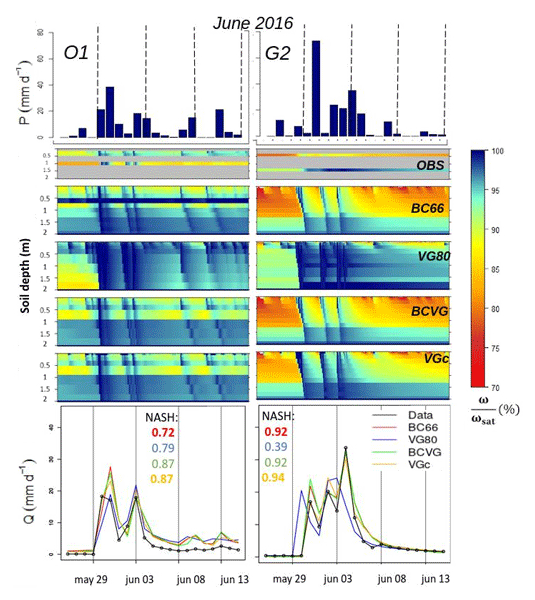
Antoine Sobaga, Bertrand Decharme, Florence Habets, Christine Delire, Noële Enjelvin, Paul-Olivier Redon, Pierre Faure-Catteloin, and Patrick Le Moigne
Hydrol. Earth Syst. Sci., 27, 2437–2461, https://doi.org/10.5194/hess-27-2437-2023, https://doi.org/10.5194/hess-27-2437-2023, 2023
Short summary
Short summary
Seven instrumented lysimeters are used to assess the simulation of the soil water dynamic in one land surface model. Four water potential and hydraulic conductivity closed-form equations, including one mixed form, are evaluated. One form is more relevant for simulating drainage, especially during intense drainage events. The soil profile heterogeneity of one parameter of the closed-form equations is shown to be important.
This article is included in the Encyclopedia of Geosciences
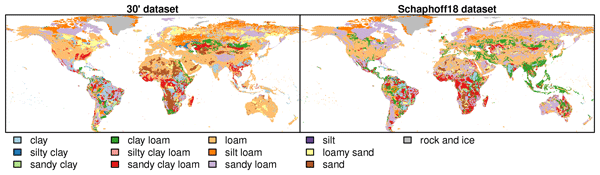
Sebastian Ostberg, Christoph Müller, Jens Heinke, and Sibyll Schaphoff
Geosci. Model Dev., 16, 3375–3406, https://doi.org/10.5194/gmd-16-3375-2023, https://doi.org/10.5194/gmd-16-3375-2023, 2023
Short summary
Short summary
We present a new toolbox for generating input datasets for terrestrial ecosystem models from diverse and partially conflicting data sources. The toolbox documents the sources and processing of data and is designed to make inconsistencies between source datasets transparent so that users can make their own decisions on how to resolve these should they not be content with our default assumptions. As an example, we use the toolbox to create input datasets at two different spatial resolutions.
This article is included in the Encyclopedia of Geosciences
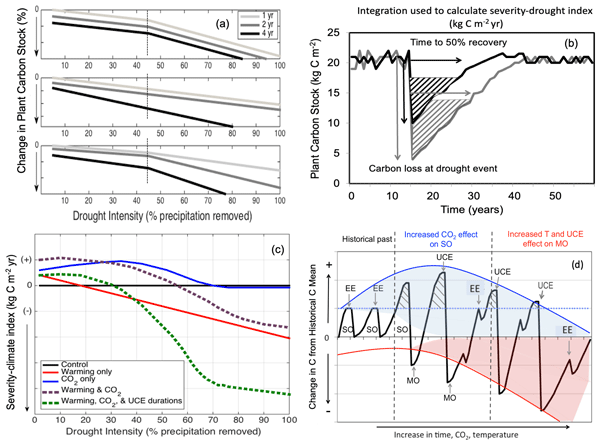
Jennifer A. Holm, David M. Medvigy, Benjamin Smith, Jeffrey S. Dukes, Claus Beier, Mikhail Mishurov, Xiangtao Xu, Jeremy W. Lichstein, Craig D. Allen, Klaus S. Larsen, Yiqi Luo, Cari Ficken, William T. Pockman, William R. L. Anderegg, and Anja Rammig
Biogeosciences, 20, 2117–2142, https://doi.org/10.5194/bg-20-2117-2023, https://doi.org/10.5194/bg-20-2117-2023, 2023
Short summary
Short summary
Unprecedented climate extremes (UCEs) are expected to have dramatic impacts on ecosystems. We present a road map of how dynamic vegetation models can explore extreme drought and climate change and assess ecological processes to measure and reduce model uncertainties. The models predict strong nonlinear responses to UCEs. Due to different model representations, the models differ in magnitude and trajectory of forest loss. Therefore, we explore specific plant responses that reflect knowledge gaps.
This article is included in the Encyclopedia of Geosciences
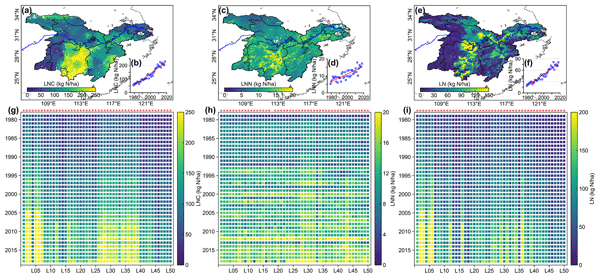
Qi Guan, Jing Tang, Lian Feng, Stefan Olin, and Guy Schurgers
Biogeosciences, 20, 1635–1648, https://doi.org/10.5194/bg-20-1635-2023, https://doi.org/10.5194/bg-20-1635-2023, 2023
Short summary
Short summary
Understanding terrestrial sources of nitrogen is vital to examine lake eutrophication changes. Combining process-based ecosystem modeling and satellite observations, we found that land-leached nitrogen in the Yangtze Plain significantly increased from 1979 to 2018, and terrestrial nutrient sources were positively correlated with eutrophication trends observed in most lakes, demonstrating the necessity of sustainable nitrogen management to control eutrophication.
This article is included in the Encyclopedia of Geosciences
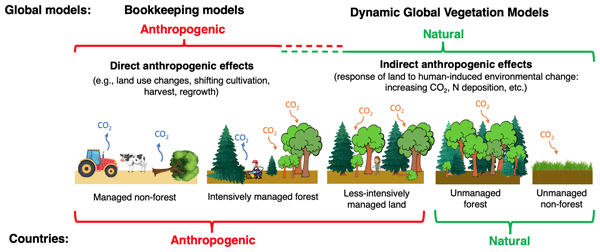
Giacomo Grassi, Clemens Schwingshackl, Thomas Gasser, Richard A. Houghton, Stephen Sitch, Josep G. Canadell, Alessandro Cescatti, Philippe Ciais, Sandro Federici, Pierre Friedlingstein, Werner A. Kurz, Maria J. Sanz Sanchez, Raúl Abad Viñas, Ramdane Alkama, Selma Bultan, Guido Ceccherini, Stefanie Falk, Etsushi Kato, Daniel Kennedy, Jürgen Knauer, Anu Korosuo, Joana Melo, Matthew J. McGrath, Julia E. M. S. Nabel, Benjamin Poulter, Anna A. Romanovskaya, Simone Rossi, Hanqin Tian, Anthony P. Walker, Wenping Yuan, Xu Yue, and Julia Pongratz
Earth Syst. Sci. Data, 15, 1093–1114, https://doi.org/10.5194/essd-15-1093-2023, https://doi.org/10.5194/essd-15-1093-2023, 2023
Short summary
Short summary
Striking differences exist in estimates of land-use CO2 fluxes between the national greenhouse gas inventories and the IPCC assessment reports. These differences hamper an accurate assessment of the collective progress under the Paris Agreement. By implementing an approach that conceptually reconciles land-use CO2 flux from national inventories and the global models used by the IPCC, our study is an important step forward for increasing confidence in land-use CO2 flux estimates.
This article is included in the Encyclopedia of Geosciences
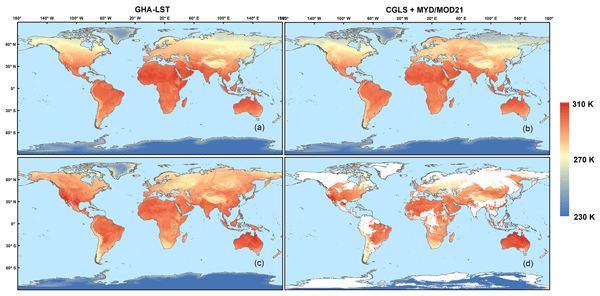
Aolin Jia, Shunlin Liang, Dongdong Wang, Lei Ma, Zhihao Wang, and Shuo Xu
Earth Syst. Sci. Data, 15, 869–895, https://doi.org/10.5194/essd-15-869-2023, https://doi.org/10.5194/essd-15-869-2023, 2023
Short summary
Short summary
Satellites are now producing multiple global land surface temperature (LST) products; however, they suffer from data gaps caused by cloud cover, seriously restricting the applications, and few products provide gap-free global hourly LST. We produced global hourly, 5 km, all-sky LST data from 2011 to 2021 using geostationary and polar-orbiting satellite data. Based on the assessment, it has high accuracy and can be used to estimate evapotranspiration, drought, etc.
This article is included in the Encyclopedia of Geosciences
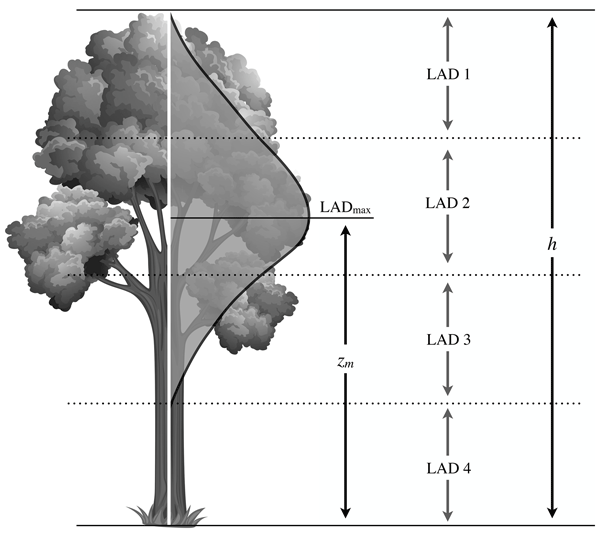
Ryan Vella, Matthew Forrest, Jos Lelieveld, and Holger Tost
Geosci. Model Dev., 16, 885–906, https://doi.org/10.5194/gmd-16-885-2023, https://doi.org/10.5194/gmd-16-885-2023, 2023
Short summary
Short summary
Biogenic volatile organic compounds (BVOCs) are released by vegetation and have a major impact on atmospheric chemistry and aerosol formation. Non-interacting vegetation constrains the majority of numerical models used to estimate global BVOC emissions, and thus, the effects of changing vegetation on emissions are not addressed. In this work, we replace the offline vegetation with dynamic vegetation states by linking a chemistry–climate model with a global dynamic vegetation model.
This article is included in the Encyclopedia of Geosciences
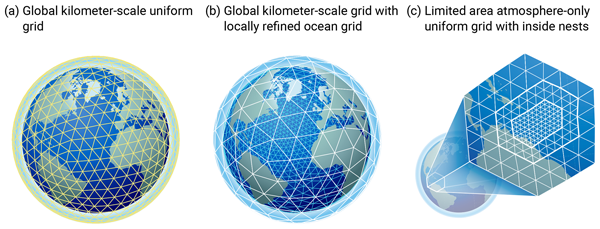
Cathy Hohenegger, Peter Korn, Leonidas Linardakis, René Redler, Reiner Schnur, Panagiotis Adamidis, Jiawei Bao, Swantje Bastin, Milad Behravesh, Martin Bergemann, Joachim Biercamp, Hendryk Bockelmann, Renate Brokopf, Nils Brüggemann, Lucas Casaroli, Fatemeh Chegini, George Datseris, Monika Esch, Geet George, Marco Giorgetta, Oliver Gutjahr, Helmuth Haak, Moritz Hanke, Tatiana Ilyina, Thomas Jahns, Johann Jungclaus, Marcel Kern, Daniel Klocke, Lukas Kluft, Tobias Kölling, Luis Kornblueh, Sergey Kosukhin, Clarissa Kroll, Junhong Lee, Thorsten Mauritsen, Carolin Mehlmann, Theresa Mieslinger, Ann Kristin Naumann, Laura Paccini, Angel Peinado, Divya Sri Praturi, Dian Putrasahan, Sebastian Rast, Thomas Riddick, Niklas Roeber, Hauke Schmidt, Uwe Schulzweida, Florian Schütte, Hans Segura, Radomyra Shevchenko, Vikram Singh, Mia Specht, Claudia Christine Stephan, Jin-Song von Storch, Raphaela Vogel, Christian Wengel, Marius Winkler, Florian Ziemen, Jochem Marotzke, and Bjorn Stevens
Geosci. Model Dev., 16, 779–811, https://doi.org/10.5194/gmd-16-779-2023, https://doi.org/10.5194/gmd-16-779-2023, 2023
Short summary
Short summary
Models of the Earth system used to understand climate and predict its change typically employ a grid spacing of about 100 km. Yet, many atmospheric and oceanic processes occur on much smaller scales. In this study, we present a new model configuration designed for the simulation of the components of the Earth system and their interactions at kilometer and smaller scales, allowing an explicit representation of the main drivers of the flow of energy and matter by solving the underlying equations.
This article is included in the Encyclopedia of Geosciences
Wenxiu Zhang, Di Liu, Hanqin Tian, Naiqin Pan, Ruqi Yang, Wenhan Tang, Jia Yang, Fei Lu, Buddhi Dayananda, Han Mei, Siyuan Wang, and Hao Shi
Earth Syst. Sci. Data Discuss., https://doi.org/10.5194/essd-2022-428, https://doi.org/10.5194/essd-2022-428, 2022
Manuscript not accepted for further review
Short summary
Short summary
High temporal resolution surface ozone concentration data is still lacking in China, so we used deep learning to generate hourly surface ozone data (HrSOD) during 2005–2020 across China. HrSOD showed that surface O3 in China tended to increase from 2016 to 2019, despite a decrease in 2020. HrSOD had high spatial and temporal accuracies, long time ranges and high temporal resolution, enabling it to be easily converted to various evaluation indicators for ecosystem and human health assessments.
This article is included in the Encyclopedia of Geosciences

Rainer Schneck, Veronika Gayler, Julia E. M. S. Nabel, Thomas Raddatz, Christian H. Reick, and Reiner Schnur
Geosci. Model Dev., 15, 8581–8611, https://doi.org/10.5194/gmd-15-8581-2022, https://doi.org/10.5194/gmd-15-8581-2022, 2022
Short summary
Short summary
The versions of ICON-A and ICON-Land/JSBACHv4 used for this study constitute the first milestone in the development of the new ICON Earth System Model ICON-ESM. JSBACHv4 is the successor of JSBACHv3, and most of the parameterizations of JSBACHv4 are re-implementations from JSBACHv3. We assess and compare the performance of JSBACHv4 and JSBACHv3. Overall, the JSBACHv4 results are as good as JSBACHv3, but both models reveal the same main shortcomings, e.g. the depiction of the leaf area index.
This article is included in the Encyclopedia of Geosciences
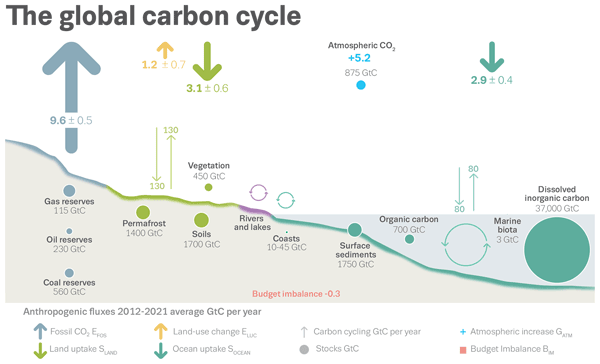
Pierre Friedlingstein, Michael O'Sullivan, Matthew W. Jones, Robbie M. Andrew, Luke Gregor, Judith Hauck, Corinne Le Quéré, Ingrid T. Luijkx, Are Olsen, Glen P. Peters, Wouter Peters, Julia Pongratz, Clemens Schwingshackl, Stephen Sitch, Josep G. Canadell, Philippe Ciais, Robert B. Jackson, Simone R. Alin, Ramdane Alkama, Almut Arneth, Vivek K. Arora, Nicholas R. Bates, Meike Becker, Nicolas Bellouin, Henry C. Bittig, Laurent Bopp, Frédéric Chevallier, Louise P. Chini, Margot Cronin, Wiley Evans, Stefanie Falk, Richard A. Feely, Thomas Gasser, Marion Gehlen, Thanos Gkritzalis, Lucas Gloege, Giacomo Grassi, Nicolas Gruber, Özgür Gürses, Ian Harris, Matthew Hefner, Richard A. Houghton, George C. Hurtt, Yosuke Iida, Tatiana Ilyina, Atul K. Jain, Annika Jersild, Koji Kadono, Etsushi Kato, Daniel Kennedy, Kees Klein Goldewijk, Jürgen Knauer, Jan Ivar Korsbakken, Peter Landschützer, Nathalie Lefèvre, Keith Lindsay, Junjie Liu, Zhu Liu, Gregg Marland, Nicolas Mayot, Matthew J. McGrath, Nicolas Metzl, Natalie M. Monacci, David R. Munro, Shin-Ichiro Nakaoka, Yosuke Niwa, Kevin O'Brien, Tsuneo Ono, Paul I. Palmer, Naiqing Pan, Denis Pierrot, Katie Pocock, Benjamin Poulter, Laure Resplandy, Eddy Robertson, Christian Rödenbeck, Carmen Rodriguez, Thais M. Rosan, Jörg Schwinger, Roland Séférian, Jamie D. Shutler, Ingunn Skjelvan, Tobias Steinhoff, Qing Sun, Adrienne J. Sutton, Colm Sweeney, Shintaro Takao, Toste Tanhua, Pieter P. Tans, Xiangjun Tian, Hanqin Tian, Bronte Tilbrook, Hiroyuki Tsujino, Francesco Tubiello, Guido R. van der Werf, Anthony P. Walker, Rik Wanninkhof, Chris Whitehead, Anna Willstrand Wranne, Rebecca Wright, Wenping Yuan, Chao Yue, Xu Yue, Sönke Zaehle, Jiye Zeng, and Bo Zheng
Earth Syst. Sci. Data, 14, 4811–4900, https://doi.org/10.5194/essd-14-4811-2022, https://doi.org/10.5194/essd-14-4811-2022, 2022
Short summary
Short summary
The Global Carbon Budget 2022 describes the datasets and methodology used to quantify the anthropogenic emissions of carbon dioxide (CO2) and their partitioning among the atmosphere, the land ecosystems, and the ocean. These living datasets are updated every year to provide the highest transparency and traceability in the reporting of CO2, the key driver of climate change.
This article is included in the Encyclopedia of Geosciences

Hanqin Tian, Zihao Bian, Hao Shi, Xiaoyu Qin, Naiqing Pan, Chaoqun Lu, Shufen Pan, Francesco N. Tubiello, Jinfeng Chang, Giulia Conchedda, Junguo Liu, Nathaniel Mueller, Kazuya Nishina, Rongting Xu, Jia Yang, Liangzhi You, and Bowen Zhang
Earth Syst. Sci. Data, 14, 4551–4568, https://doi.org/10.5194/essd-14-4551-2022, https://doi.org/10.5194/essd-14-4551-2022, 2022
Short summary
Short summary
Nitrogen is one of the critical nutrients for growth. Evaluating the change in nitrogen inputs due to human activity is necessary for nutrient management and pollution control. In this study, we generated a historical dataset of nitrogen input to land at the global scale. This dataset consists of nitrogen fertilizer, manure, and atmospheric deposition inputs to cropland, pasture, and rangeland at high resolution from 1860 to 2019.
This article is included in the Encyclopedia of Geosciences
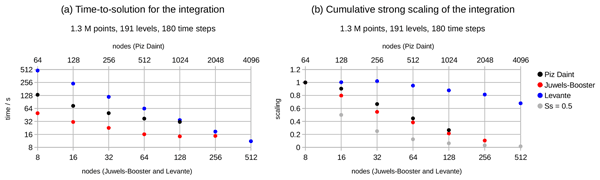
Marco A. Giorgetta, William Sawyer, Xavier Lapillonne, Panagiotis Adamidis, Dmitry Alexeev, Valentin Clément, Remo Dietlicher, Jan Frederik Engels, Monika Esch, Henning Franke, Claudia Frauen, Walter M. Hannah, Benjamin R. Hillman, Luis Kornblueh, Philippe Marti, Matthew R. Norman, Robert Pincus, Sebastian Rast, Daniel Reinert, Reiner Schnur, Uwe Schulzweida, and Bjorn Stevens
Geosci. Model Dev., 15, 6985–7016, https://doi.org/10.5194/gmd-15-6985-2022, https://doi.org/10.5194/gmd-15-6985-2022, 2022
Short summary
Short summary
This work presents a first version of the ICON atmosphere model that works not only on CPUs, but also on GPUs. This GPU-enabled ICON version is benchmarked on two GPU machines and a CPU machine. While the weak scaling is very good on CPUs and GPUs, the strong scaling is poor on GPUs. But the high performance of GPU machines allowed for first simulations of a short period of the quasi-biennial oscillation at very high resolution with explicit convection and gravity wave forcing.
This article is included in the Encyclopedia of Geosciences
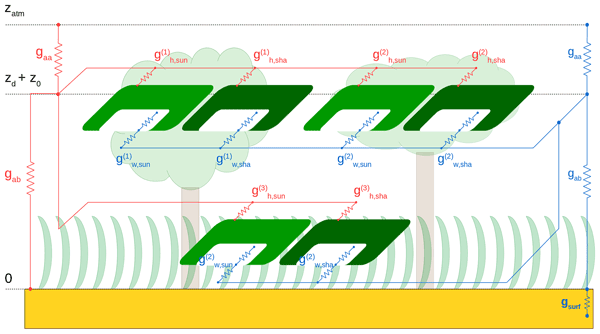
David Martín Belda, Peter Anthoni, David Wårlind, Stefan Olin, Guy Schurgers, Jing Tang, Benjamin Smith, and Almut Arneth
Geosci. Model Dev., 15, 6709–6745, https://doi.org/10.5194/gmd-15-6709-2022, https://doi.org/10.5194/gmd-15-6709-2022, 2022
Short summary
Short summary
We present a number of augmentations to the ecosystem model LPJ-GUESS, which will allow us to use it in studies of the interactions between the land biosphere and the climate. The new module enables calculation of fluxes of energy and water into the atmosphere that are consistent with the modelled vegetation processes. The modelled fluxes are in fair agreement with observations across 21 sites from the FLUXNET network.
This article is included in the Encyclopedia of Geosciences
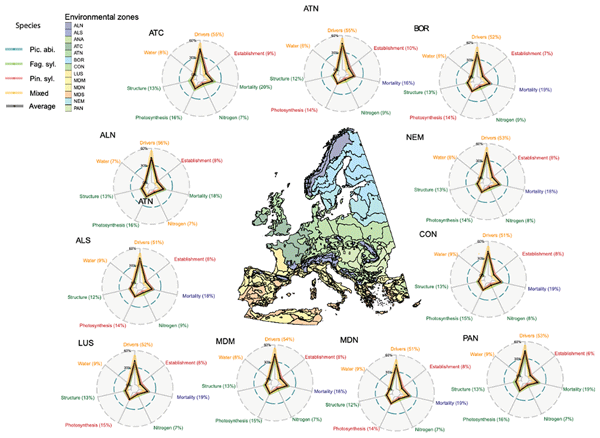
Johannes Oberpriller, Christine Herschlein, Peter Anthoni, Almut Arneth, Andreas Krause, Anja Rammig, Mats Lindeskog, Stefan Olin, and Florian Hartig
Geosci. Model Dev., 15, 6495–6519, https://doi.org/10.5194/gmd-15-6495-2022, https://doi.org/10.5194/gmd-15-6495-2022, 2022
Short summary
Short summary
Understanding uncertainties of projected ecosystem dynamics under environmental change is of immense value for research and climate change policy. Here, we analyzed these across European forests. We find that uncertainties are dominantly induced by parameters related to water, mortality, and climate, with an increasing importance of climate from north to south. These results highlight that climate not only contributes uncertainty but also modifies uncertainties in other ecosystem processes.
This article is included in the Encyclopedia of Geosciences
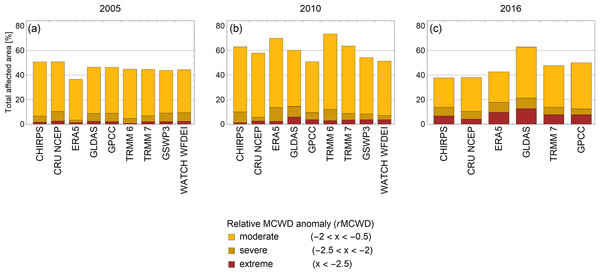
Phillip Papastefanou, Christian S. Zang, Zlatan Angelov, Aline Anderson de Castro, Juan Carlos Jimenez, Luiz Felipe Campos De Rezende, Romina C. Ruscica, Boris Sakschewski, Anna A. Sörensson, Kirsten Thonicke, Carolina Vera, Nicolas Viovy, Celso Von Randow, and Anja Rammig
Biogeosciences, 19, 3843–3861, https://doi.org/10.5194/bg-19-3843-2022, https://doi.org/10.5194/bg-19-3843-2022, 2022
Short summary
Short summary
The Amazon rainforest has been hit by multiple severe drought events. In this study, we assess the severity and spatial extent of the extreme drought years 2005, 2010 and 2015/16 in the Amazon. Using nine different precipitation datasets and three drought indicators we find large differences in drought stress across the Amazon region. We conclude that future studies should use multiple rainfall datasets and drought indicators when estimating the impact of drought stress in the Amazon region.
This article is included in the Encyclopedia of Geosciences
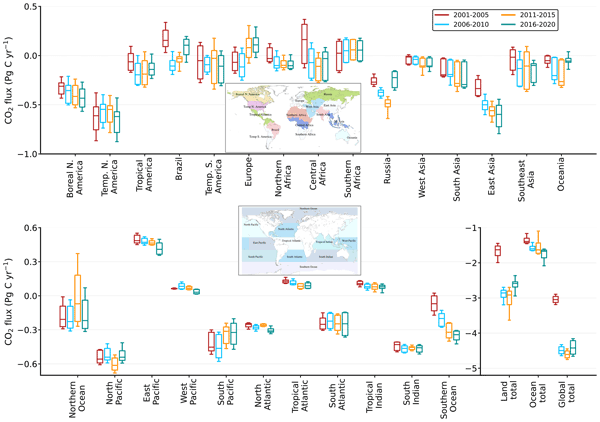
Naveen Chandra, Prabir K. Patra, Yousuke Niwa, Akihiko Ito, Yosuke Iida, Daisuke Goto, Shinji Morimoto, Masayuki Kondo, Masayuki Takigawa, Tomohiro Hajima, and Michio Watanabe
Atmos. Chem. Phys., 22, 9215–9243, https://doi.org/10.5194/acp-22-9215-2022, https://doi.org/10.5194/acp-22-9215-2022, 2022
Short summary
Short summary
This paper is intended to accomplish two goals: (1) quantify mean and uncertainty in non-fossil-fuel CO2 fluxes estimated by inverse modeling and (2) provide in-depth analyses of regional CO2 fluxes in support of emission mitigation policymaking. CO2 flux variability and trends are discussed concerning natural climate variability and human disturbances using multiple lines of evidence.
This article is included in the Encyclopedia of Geosciences
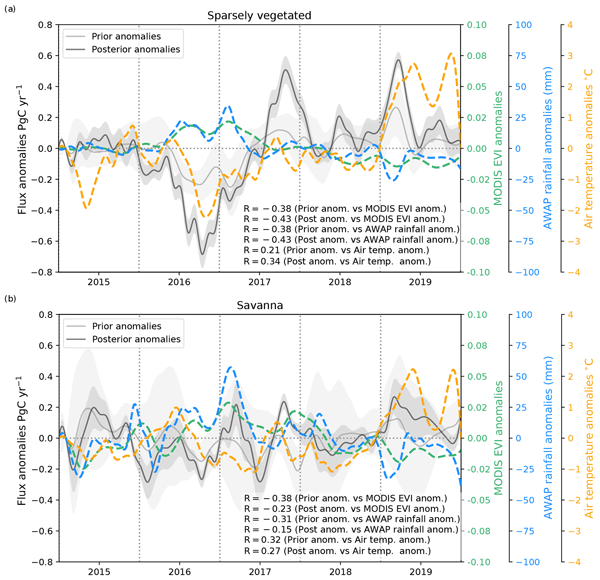
Yohanna Villalobos, Peter J. Rayner, Jeremy D. Silver, Steven Thomas, Vanessa Haverd, Jürgen Knauer, Zoë M. Loh, Nicholas M. Deutscher, David W. T. Griffith, and David F. Pollard
Atmos. Chem. Phys., 22, 8897–8934, https://doi.org/10.5194/acp-22-8897-2022, https://doi.org/10.5194/acp-22-8897-2022, 2022
Short summary
Short summary
We study the interannual variability in Australian carbon fluxes for 2015–2019 derived from OCO-2 satellite data. Our results suggest that Australia's semi-arid ecosystems are highly responsive to variations in climate drivers such as rainfall and temperature. We found that high rainfall and low temperatures recorded in 2016 led to an anomalous carbon sink over savanna and sparsely vegetated regions, while unprecedented dry and hot weather in 2019 led to anomalous carbon release.
This article is included in the Encyclopedia of Geosciences
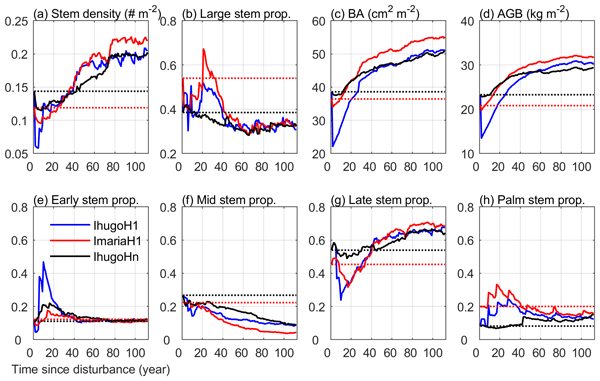
Jiaying Zhang, Rafael L. Bras, Marcos Longo, and Tamara Heartsill Scalley
Geosci. Model Dev., 15, 5107–5126, https://doi.org/10.5194/gmd-15-5107-2022, https://doi.org/10.5194/gmd-15-5107-2022, 2022
Short summary
Short summary
We implemented hurricane disturbance in a vegetation dynamics model and calibrated the model with observations of a tropical forest. We used the model to study forest recovery from hurricane disturbance and found that a single hurricane disturbance enhances AGB and BA in the long term compared with a no-hurricane situation. The model developed and results presented in this study can be utilized to understand the impact of hurricane disturbances on forest recovery under the changing climate.
This article is included in the Encyclopedia of Geosciences

Joe R. Melton, Ed Chan, Koreen Millard, Matthew Fortier, R. Scott Winton, Javier M. Martín-López, Hinsby Cadillo-Quiroz, Darren Kidd, and Louis V. Verchot
Geosci. Model Dev., 15, 4709–4738, https://doi.org/10.5194/gmd-15-4709-2022, https://doi.org/10.5194/gmd-15-4709-2022, 2022
Short summary
Short summary
Peat-ML is a high-resolution global peatland extent map generated using machine learning techniques. Peatlands are important in the global carbon and water cycles, but their extent is poorly known. We generated Peat-ML using drivers of peatland formation including climate, soil, geomorphology, and vegetation data, and we train the model with regional peatland maps. Our accuracy estimation approaches suggest Peat-ML is of similar or higher quality than other available peatland mapping products.
This article is included in the Encyclopedia of Geosciences
Antoine Sobaga, Bertrand Decharme, Florence Habets, Christine Delire, Noële Enjelvin, Paul-Olivier Redon, Pierre Faure-Catteloin, and Patrick Le Moigne
EGUsphere, https://doi.org/10.5194/egusphere-2022-274, https://doi.org/10.5194/egusphere-2022-274, 2022
Preprint archived
Short summary
Short summary
Seven instrumented lysimeters are used to assess the simulation of the soil water dynamic in one land surface model. Three water potential and hydraulic conductivity closed-form equations including one mixed form are evaluated. The mixed form is more relevant to simulate drainage especially during intense drainage events. Soil profile heterogeneity of one parameter of the closed-form equations is shown to be important.
This article is included in the Encyclopedia of Geosciences
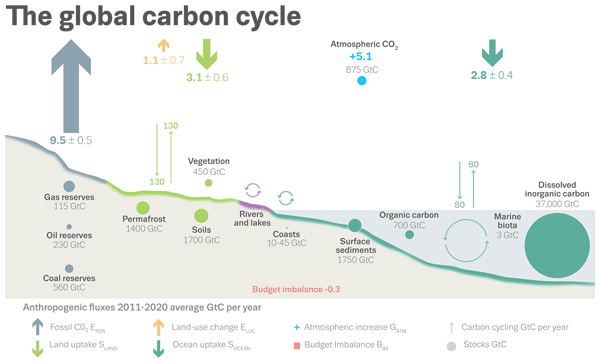
Pierre Friedlingstein, Matthew W. Jones, Michael O'Sullivan, Robbie M. Andrew, Dorothee C. E. Bakker, Judith Hauck, Corinne Le Quéré, Glen P. Peters, Wouter Peters, Julia Pongratz, Stephen Sitch, Josep G. Canadell, Philippe Ciais, Rob B. Jackson, Simone R. Alin, Peter Anthoni, Nicholas R. Bates, Meike Becker, Nicolas Bellouin, Laurent Bopp, Thi Tuyet Trang Chau, Frédéric Chevallier, Louise P. Chini, Margot Cronin, Kim I. Currie, Bertrand Decharme, Laique M. Djeutchouang, Xinyu Dou, Wiley Evans, Richard A. Feely, Liang Feng, Thomas Gasser, Dennis Gilfillan, Thanos Gkritzalis, Giacomo Grassi, Luke Gregor, Nicolas Gruber, Özgür Gürses, Ian Harris, Richard A. Houghton, George C. Hurtt, Yosuke Iida, Tatiana Ilyina, Ingrid T. Luijkx, Atul Jain, Steve D. Jones, Etsushi Kato, Daniel Kennedy, Kees Klein Goldewijk, Jürgen Knauer, Jan Ivar Korsbakken, Arne Körtzinger, Peter Landschützer, Siv K. Lauvset, Nathalie Lefèvre, Sebastian Lienert, Junjie Liu, Gregg Marland, Patrick C. McGuire, Joe R. Melton, David R. Munro, Julia E. M. S. Nabel, Shin-Ichiro Nakaoka, Yosuke Niwa, Tsuneo Ono, Denis Pierrot, Benjamin Poulter, Gregor Rehder, Laure Resplandy, Eddy Robertson, Christian Rödenbeck, Thais M. Rosan, Jörg Schwinger, Clemens Schwingshackl, Roland Séférian, Adrienne J. Sutton, Colm Sweeney, Toste Tanhua, Pieter P. Tans, Hanqin Tian, Bronte Tilbrook, Francesco Tubiello, Guido R. van der Werf, Nicolas Vuichard, Chisato Wada, Rik Wanninkhof, Andrew J. Watson, David Willis, Andrew J. Wiltshire, Wenping Yuan, Chao Yue, Xu Yue, Sönke Zaehle, and Jiye Zeng
Earth Syst. Sci. Data, 14, 1917–2005, https://doi.org/10.5194/essd-14-1917-2022, https://doi.org/10.5194/essd-14-1917-2022, 2022
Short summary
Short summary
The Global Carbon Budget 2021 describes the data sets and methodology used to quantify the emissions of carbon dioxide and their partitioning among the atmosphere, land, and ocean. These living data are updated every year to provide the highest transparency and traceability in the reporting of CO2, the key driver of climate change.
This article is included in the Encyclopedia of Geosciences
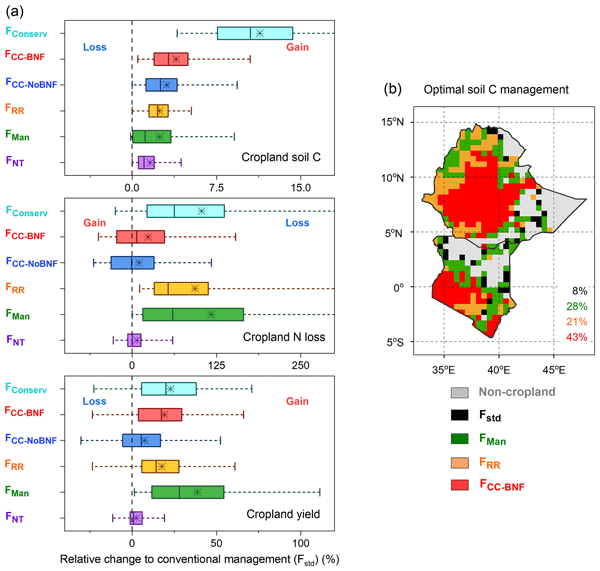
Jianyong Ma, Sam S. Rabin, Peter Anthoni, Anita D. Bayer, Sylvia S. Nyawira, Stefan Olin, Longlong Xia, and Almut Arneth
Biogeosciences, 19, 2145–2169, https://doi.org/10.5194/bg-19-2145-2022, https://doi.org/10.5194/bg-19-2145-2022, 2022
Short summary
Short summary
Improved agricultural management plays a vital role in protecting soils from degradation in eastern Africa. We simulated the impacts of seven management practices on soil carbon pools, nitrogen loss, and crop yield under different climate scenarios in this region. This study highlights the possibilities of conservation agriculture when targeting long-term environmental sustainability and food security in crop ecosystems, particularly for those with poor soil conditions in tropical climates.
This article is included in the Encyclopedia of Geosciences
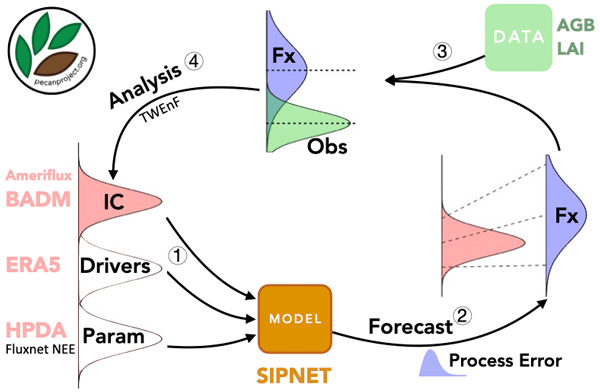
Hamze Dokoohaki, Bailey D. Morrison, Ann Raiho, Shawn P. Serbin, Katie Zarada, Luke Dramko, and Michael Dietze
Geosci. Model Dev., 15, 3233–3252, https://doi.org/10.5194/gmd-15-3233-2022, https://doi.org/10.5194/gmd-15-3233-2022, 2022
Short summary
Short summary
We present a new terrestrial carbon cycle data assimilation system, built on the PEcAn model–data eco-informatics system, and its application for the development of a proof-of-concept carbon
This article is included in the Encyclopedia of Geosciences
reanalysisproduct that harmonizes carbon pools (leaf, wood, soil) and fluxes (GPP, Ra, Rh, NEE) across the contiguous United States from 1986–2019. Here, we build on a decade of work on uncertainty propagation to generate the most complete and robust uncertainty accounting available to date.
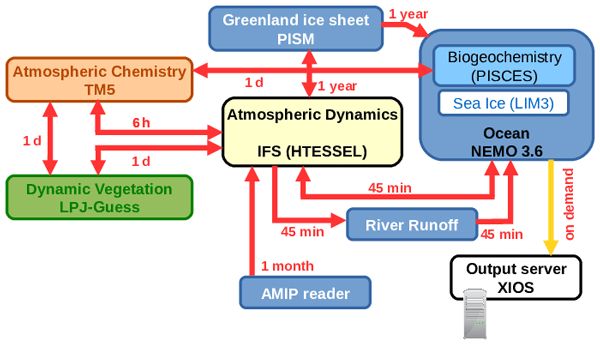
Ralf Döscher, Mario Acosta, Andrea Alessandri, Peter Anthoni, Thomas Arsouze, Tommi Bergman, Raffaele Bernardello, Souhail Boussetta, Louis-Philippe Caron, Glenn Carver, Miguel Castrillo, Franco Catalano, Ivana Cvijanovic, Paolo Davini, Evelien Dekker, Francisco J. Doblas-Reyes, David Docquier, Pablo Echevarria, Uwe Fladrich, Ramon Fuentes-Franco, Matthias Gröger, Jost v. Hardenberg, Jenny Hieronymus, M. Pasha Karami, Jukka-Pekka Keskinen, Torben Koenigk, Risto Makkonen, François Massonnet, Martin Ménégoz, Paul A. Miller, Eduardo Moreno-Chamarro, Lars Nieradzik, Twan van Noije, Paul Nolan, Declan O'Donnell, Pirkka Ollinaho, Gijs van den Oord, Pablo Ortega, Oriol Tintó Prims, Arthur Ramos, Thomas Reerink, Clement Rousset, Yohan Ruprich-Robert, Philippe Le Sager, Torben Schmith, Roland Schrödner, Federico Serva, Valentina Sicardi, Marianne Sloth Madsen, Benjamin Smith, Tian Tian, Etienne Tourigny, Petteri Uotila, Martin Vancoppenolle, Shiyu Wang, David Wårlind, Ulrika Willén, Klaus Wyser, Shuting Yang, Xavier Yepes-Arbós, and Qiong Zhang
Geosci. Model Dev., 15, 2973–3020, https://doi.org/10.5194/gmd-15-2973-2022, https://doi.org/10.5194/gmd-15-2973-2022, 2022
Short summary
Short summary
The Earth system model EC-Earth3 is documented here. Key performance metrics show physical behavior and biases well within the frame known from recent models. With improved physical and dynamic features, new ESM components, community tools, and largely improved physical performance compared to the CMIP5 version, EC-Earth3 represents a clear step forward for the only European community ESM. We demonstrate here that EC-Earth3 is suited for a range of tasks in CMIP6 and beyond.
This article is included in the Encyclopedia of Geosciences
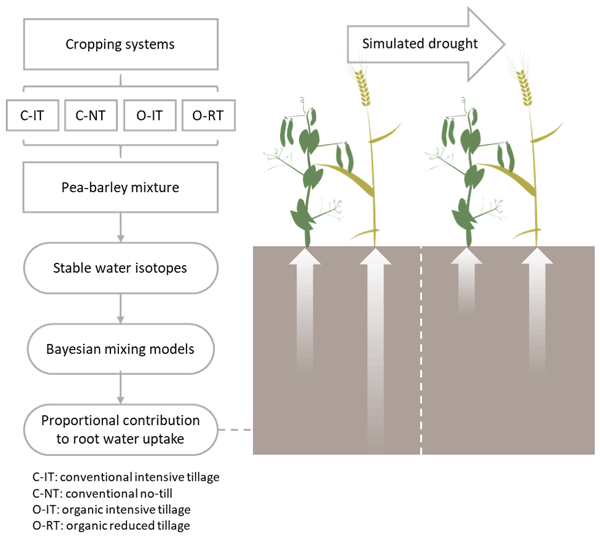
Qing Sun, Valentin H. Klaus, Raphaël Wittwer, Yujie Liu, Marcel G. A. van der Heijden, Anna K. Gilgen, and Nina Buchmann
Biogeosciences, 19, 1853–1869, https://doi.org/10.5194/bg-19-1853-2022, https://doi.org/10.5194/bg-19-1853-2022, 2022
Short summary
Short summary
Drought is one of the biggest challenges for future food production globally. During a simulated drought, pea and barley mainly relied on water from shallow soil depths, independent of different cropping systems.
This article is included in the Encyclopedia of Geosciences

Elias C. Massoud, A. Anthony Bloom, Marcos Longo, John T. Reager, Paul A. Levine, and John R. Worden
Hydrol. Earth Syst. Sci., 26, 1407–1423, https://doi.org/10.5194/hess-26-1407-2022, https://doi.org/10.5194/hess-26-1407-2022, 2022
Short summary
Short summary
The water balance on river basin scales depends on a number of soil physical processes. Gaining information on these quantities using observations is a key step toward improving the skill of land surface hydrology models. In this study, we use data from the Gravity Recovery and Climate Experiment (NASA-GRACE) to inform and constrain these hydrologic processes. We show that our model is able to simulate the land hydrologic cycle for a watershed in the Amazon from January 2003 to December 2012.
This article is included in the Encyclopedia of Geosciences

Dóra Hidy, Zoltán Barcza, Roland Hollós, Laura Dobor, Tamás Ács, Dóra Zacháry, Tibor Filep, László Pásztor, Dóra Incze, Márton Dencső, Eszter Tóth, Katarína Merganičová, Peter Thornton, Steven Running, and Nándor Fodor
Geosci. Model Dev., 15, 2157–2181, https://doi.org/10.5194/gmd-15-2157-2022, https://doi.org/10.5194/gmd-15-2157-2022, 2022
Short summary
Short summary
Biogeochemical models used by the scientific community can support society in the quantification of the expected environmental impacts caused by global climate change. The Biome-BGCMuSo v6.2 biogeochemical model has been created by implementing a lot of developments related to soil hydrology as well as the soil carbon and nitrogen cycle and by integrating crop model components. Detailed descriptions of developments with case studies are presented in this paper.
This article is included in the Encyclopedia of Geosciences
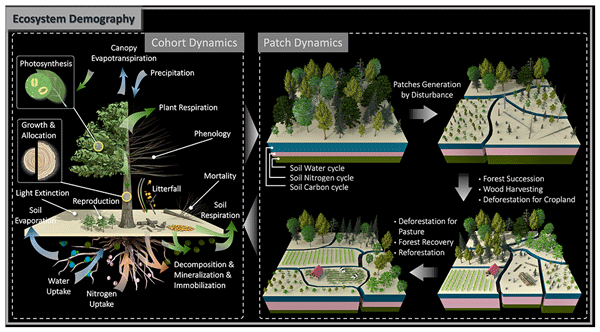
Lei Ma, George Hurtt, Lesley Ott, Ritvik Sahajpal, Justin Fisk, Rachel Lamb, Hao Tang, Steve Flanagan, Louise Chini, Abhishek Chatterjee, and Joseph Sullivan
Geosci. Model Dev., 15, 1971–1994, https://doi.org/10.5194/gmd-15-1971-2022, https://doi.org/10.5194/gmd-15-1971-2022, 2022
Short summary
Short summary
We present a global version of the Ecosystem Demography (ED) model which can track vegetation 3-D structure and scale up ecological processes from individual vegetation to ecosystem scale. Model evaluation against multiple benchmarking datasets demonstrated the model’s capability to simulate global vegetation dynamics across a range of temporal and spatial scales. With this version, ED has the potential to be linked with remote sensing observations to address key scientific questions.
This article is included in the Encyclopedia of Geosciences
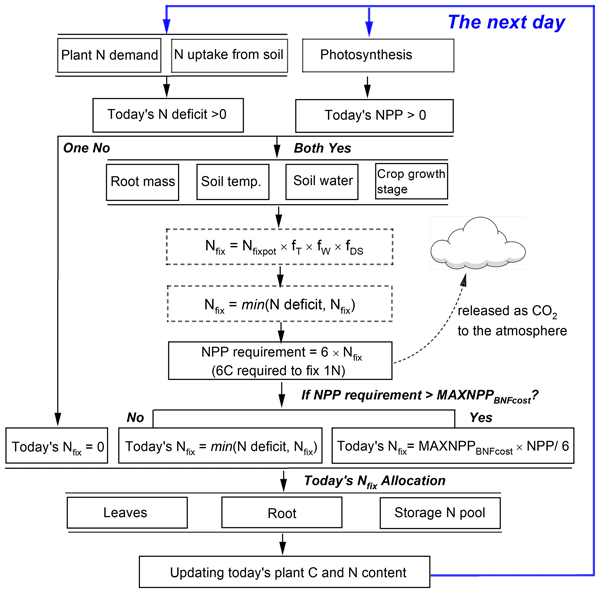
Jianyong Ma, Stefan Olin, Peter Anthoni, Sam S. Rabin, Anita D. Bayer, Sylvia S. Nyawira, and Almut Arneth
Geosci. Model Dev., 15, 815–839, https://doi.org/10.5194/gmd-15-815-2022, https://doi.org/10.5194/gmd-15-815-2022, 2022
Short summary
Short summary
The implementation of the biological N fixation process in LPJ-GUESS in this study provides an opportunity to quantify N fixation rates between legumes and to better estimate grain legume production on a global scale. It also helps to predict and detect the potential contribution of N-fixing plants as
This article is included in the Encyclopedia of Geosciences
green manureto reducing or removing the use of N fertilizer in global agricultural systems, considering different climate conditions, management practices, and land-use change scenarios.
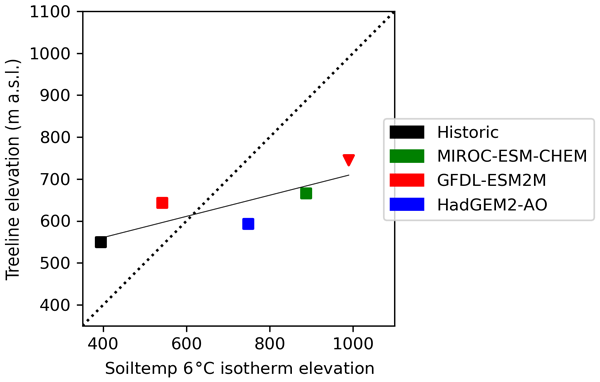
Adrian Gustafson, Paul A. Miller, Robert G. Björk, Stefan Olin, and Benjamin Smith
Biogeosciences, 18, 6329–6347, https://doi.org/10.5194/bg-18-6329-2021, https://doi.org/10.5194/bg-18-6329-2021, 2021
Short summary
Short summary
We performed model simulations of vegetation change for a historic period and a range of climate change scenarios at a high spatial resolution. Projected treeline advance continued at the same or increased rates compared to our historic simulation. Temperature isotherms advanced faster than treelines, revealing a lag in potential vegetation shifts that was modulated by nitrogen availability. At the year 2100 projected treelines had advanced by 45–195 elevational metres depending on the scenario.
This article is included in the Encyclopedia of Geosciences
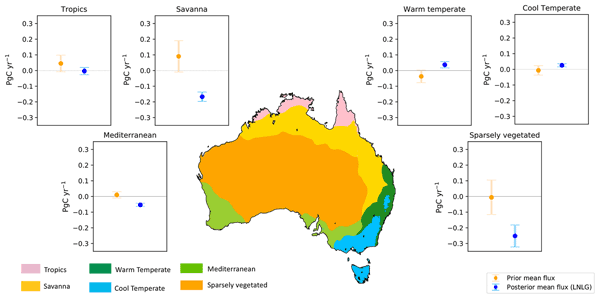
Yohanna Villalobos, Peter J. Rayner, Jeremy D. Silver, Steven Thomas, Vanessa Haverd, Jürgen Knauer, Zoë M. Loh, Nicholas M. Deutscher, David W. T. Griffith, and David F. Pollard
Atmos. Chem. Phys., 21, 17453–17494, https://doi.org/10.5194/acp-21-17453-2021, https://doi.org/10.5194/acp-21-17453-2021, 2021
Short summary
Short summary
Semi-arid ecosystems such as those in Australia are evolving and might play an essential role in the future of climate change. We use carbon dioxide concentrations derived from the OCO-2 satellite instrument and a regional transport model to understand if Australia was a carbon sink or source of CO2 in 2015. Our research's main findings suggest that Australia acted as a carbon sink of about −0.41 ± 0.08 petagrams of carbon in 2015, driven primarily by savanna and sparsely vegetated ecosystems.
This article is included in the Encyclopedia of Geosciences
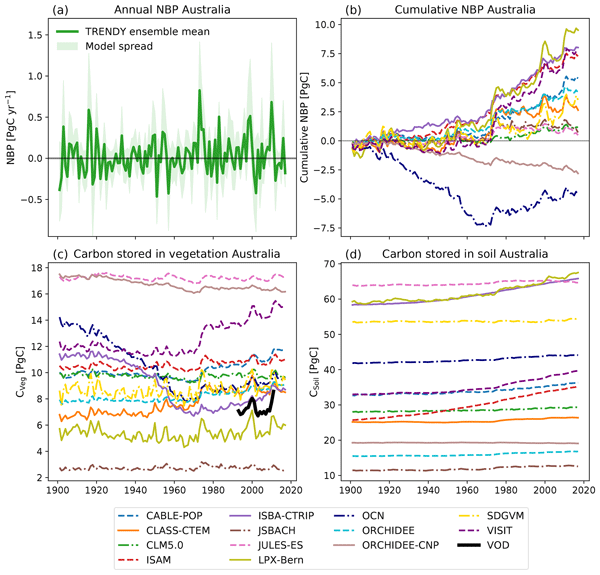
Lina Teckentrup, Martin G. De Kauwe, Andrew J. Pitman, Daniel S. Goll, Vanessa Haverd, Atul K. Jain, Emilie Joetzjer, Etsushi Kato, Sebastian Lienert, Danica Lombardozzi, Patrick C. McGuire, Joe R. Melton, Julia E. M. S. Nabel, Julia Pongratz, Stephen Sitch, Anthony P. Walker, and Sönke Zaehle
Biogeosciences, 18, 5639–5668, https://doi.org/10.5194/bg-18-5639-2021, https://doi.org/10.5194/bg-18-5639-2021, 2021
Short summary
Short summary
The Australian continent is included in global assessments of the carbon cycle such as the global carbon budget, yet the performance of dynamic global vegetation models (DGVMs) over Australia has rarely been evaluated. We assessed simulations by an ensemble of dynamic global vegetation models over Australia and highlighted a number of key areas that lead to model divergence on both short (inter-annual) and long (decadal) timescales.
This article is included in the Encyclopedia of Geosciences
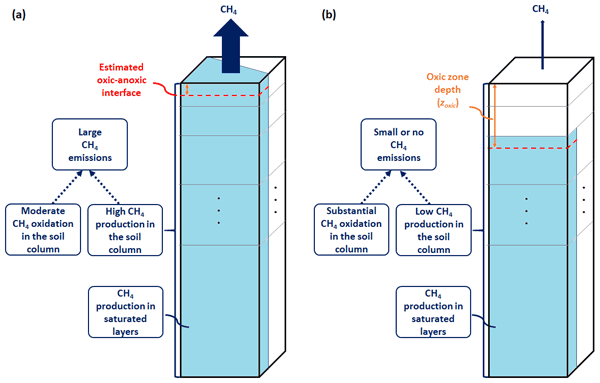
Claude-Michel Nzotungicimpaye, Kirsten Zickfeld, Andrew H. MacDougall, Joe R. Melton, Claire C. Treat, Michael Eby, and Lance F. W. Lesack
Geosci. Model Dev., 14, 6215–6240, https://doi.org/10.5194/gmd-14-6215-2021, https://doi.org/10.5194/gmd-14-6215-2021, 2021
Short summary
Short summary
In this paper, we describe a new wetland methane model (WETMETH) developed for use in Earth system models. WETMETH consists of simple formulations to represent methane production and oxidation in wetlands. We also present an evaluation of the model performance as embedded in the University of Victoria Earth System Climate Model (UVic ESCM). WETMETH is capable of reproducing mean annual methane emissions consistent with present-day estimates from the regional to the global scale.
This article is included in the Encyclopedia of Geosciences
Cited articles
Añel, J. A., García-Rodríguez, M., and Rodeiro, J.: Current status on the need for improved accessibility to climate models code, Geosci. Model Dev., 14, 923–934, https://doi.org/10.5194/gmd-14-923-2021, 2021. a
Baker, M.: 1,500 Scientists Lift the Lid on Reproducibility, Nature, 533, 452–454, https://doi.org/10.1038/533452a, 2016. a
Barton, C. M., Lee, A., Janssen, M. A., Van Der Leeuw, S., Tucker, G. E., Porter, C., Greenberg, J., Swantek, L., Frank, K., Chen, M., and Jagers, H. R. A.: How to Make Models More Useful, P. Natl. Acad. Sci., 119, e2202112119, https://doi.org/10.1073/pnas.2202112119, 2022. a, b
Best, M. J., Pryor, M., Clark, D. B., Rooney, G. G., Essery, R. L. H., Ménard, C. B., Edwards, J. M., Hendry, M. A., Porson, A., Gedney, N., Mercado, L. M., Sitch, S., Blyth, E., Boucher, O., Cox, P. M., Grimmond, C. S. B., and Harding, R. J.: The Joint UK Land Environment Simulator (JULES), model description – Part 1: Energy and water fluxes, Geosci. Model Dev., 4, 677–699, https://doi.org/10.5194/gmd-4-677-2011, 2011. a
Breier, J., Ostberg, S., Wirth, S. B., Minoli, S., Stenzel, F., Hötten, D., and Müller, C.: lpjmlkit: Toolkit for Basic LPJmL Handling, Zenodo, https://doi.org/10.5281/zenodo.7773134, 2025. a
Boettiger, C.: An Introduction to Docker for Reproducible Research, ACM SIGOPS Operating Systems Review, 49, 71–79, https://doi.org/10.1145/2723872.2723882, 2015. a
Braga, P. H. P., Hébert, K., Hudgins, E. J., Scott, E. R., Edwards, B. P. M., Sánchez Reyes, L. L., Grainger, M. J., Foroughirad, V., Hillemann, F., Binley, A. D., Brookson, C. B., Gaynor, K. M., Shafiei Sabet, S., Güncan, A., Weierbach, H., Gomes, D. G. E., and Crystal-Ornelas, R.: Not Just for Programmers: How GitHub Can Accelerate Collaborative and Reproducible Research in Ecology and Evolution, Methods Ecol. Evol., 14, 1364–1380, https://doi.org/10.1111/2041-210X.14108, 2023. a
Bryan, J.: Excuse Me, Do You Have a Moment to Talk About Version Control?, Am. Stat., 72, 20–27, https://doi.org/10.1080/00031305.2017.1399928, 2018. a
Burrows, S. M., Maltrud, M., Yang, X., Zhu, Q., Jeffery, N., Shi, X., Ricciuto, D., Wang, S., Bisht, G., Tang, J., Wolfe, J., Harrop, B. E., Singh, B., Brent, L., Baldwin, S., Zhou, T., Cameron-Smith, P., Keen, N., Collier, N., Xu, M., Hunke, E. C., Elliott, S. M., Turner, A. K., Li, H., Wang, H., Golaz, J.-C., Bond-Lamberty, B., Hoffman, F. M., Riley, W. J., Thornton, P. E., Calvin, K., and Leung, L. R.: The DOE E3SM v1.1 Biogeochemistry Configuration: Description and Simulated Ecosystem-Climate Responses to Historical Changes in Forcing, J. Adv. Model. Earth Sy., 12, e2019MS001766, https://doi.org/10.1029/2019MS001766, 2020. a
Burton, C., Betts, R., Cardoso, M., Feldpausch, T. R., Harper, A., Jones, C. D., Kelley, D. I., Robertson, E., and Wiltshire, A.: Representation of fire, land-use change and vegetation dynamics in the Joint UK Land Environment Simulator vn4.9 (JULES), Geosci. Model Dev., 12, 179–193, https://doi.org/10.5194/gmd-12-179-2019, 2019. a
Chauviere, A., Preziosi, L., and Verdier, C. (Eds.): Cell Mechanics: From Single Scale-Based Models to Multiscale Modeling, Chapman and Hall/CRC, ISBN 978-0-429-14709-8, https://doi.org/10.1201/9781420094558, 2010. a
Clark, D. B., Mercado, L. M., Sitch, S., Jones, C. D., Gedney, N., Best, M. J., Pryor, M., Rooney, G. G., Essery, R. L. H., Blyth, E., Boucher, O., Harding, R. J., Huntingford, C., and Cox, P. M.: The Joint UK Land Environment Simulator (JULES), model description – Part 2: Carbon fluxes and vegetation dynamics, Geosci. Model Dev., 4, 701–722, https://doi.org/10.5194/gmd-4-701-2011, 2011. a
Collier, N., Hoffman, F. M., Mu, M., Randerson, J. T., and Riley, W. J.: International land Model Benchmarking (ILAMB) Package v002.00, BGCF-DATA (Biogeochemistry (BGC) Feedbacks) [data set], https://doi.org/10.18139/ILAMB.v002.00/1251621, 2016. a
Collier, N., Hoffman, F. M., Lawrence, D. M., Keppel-Aleks, G., Koven, C. D., Riley, W. J., Mu, M., and Randerson, J. T.: The International Land Model Benchmarking (ILAMB) System: Design, Theory, and Implementation, J. Adv. Model. Earth Sy., 10, 2731–2754, https://doi.org/10.1029/2018MS001354, 2018a. a
Collier, N., Hoffman, F. M., Lawrence, D. M., Keppel‐Aleks, G., Koven, C. D., Riley, W. J., Mu, M., and Randerson, J. T.: The International Land Model Benchmarking (ILAMB) System: Design, Theory, and Implementation, J. Adv. Model. Earth Sy., 10, 2731–2754, https://doi.org/10.1029/2018ms001354, 2018b. a
Contrastin, M., Charman, R. H., Danish, M., Orchard, B., Orchard, D., Rice, A., and Xu, J.: Fortran-Src: Fortran Static Analysis Infrastructure, Journal of Open Source Software, 10, 7571, https://doi.org/10.21105/joss.07571, 2025. a
Delire, C., Séférian, R., Decharme, B., Alkama, R., Calvet, J.-C., Carrer, D., Gibelin, A.-L., Joetzjer, E., Morel, X., Rocher, M., and Tzanos, D.: The Global Land Carbon Cycle Simulated With ISBA-CTRIP: Improvements Over the Last Decade, J. Adv. Model. Earth Sy., 12, e2019MS001886, https://doi.org/10.1029/2019MS001886, 2020. a
Dietze, M. C., Lebauer, D. S., and Kooper, R.: On Improving the Communication between Models and Data, Plant Cell Environ., 36, 1575–1585, https://doi.org/10.1111/pce.12043, 2013. a
Dokoohaki, H., Morrison, B. D., Raiho, A., Serbin, S. P., Zarada, K., Dramko, L., and Dietze, M.: Development of an open-source regional data assimilation system in PEcAn v. 1.7.2: application to carbon cycle reanalysis across the contiguous US using SIPNET, Geosci. Model Dev., 15, 3233–3252, https://doi.org/10.5194/gmd-15-3233-2022, 2022. a
Easterbrook, S. M.: Climate Change: A Grand Software Challenge, in: Proceedings of the FSE/SDP Workshop on Future of Software Engineering Research, 99–104, ACM, Santa Fe New Mexico USA, ISBN 978-1-4503-0427-6, https://doi.org/10.1145/1882362.1882383, 2010. a, b
Easterbrook, S. M. and Johns, T. C.: Engineering the Software for Understanding Climate Change, Comput. Sci. Eng., 11, 65–74, https://doi.org/10.1109/MCSE.2009.193, 2009. a, b, c, d
Edelmann, A., Wolff, T., Montagne, D., and Bail, C. A.: Computational Social Science and Sociology, Annu. Rev. Sociol., 46, 61–81, https://doi.org/10.1146/annurev-soc-121919-054621, 2020. a
Eyring, V., Bony, S., Meehl, G. A., Senior, C. A., Stevens, B., Stouffer, R. J., and Taylor, K. E.: Overview of the Coupled Model Intercomparison Project Phase 6 (CMIP6) experimental design and organization, Geosci. Model Dev., 9, 1937–1958, https://doi.org/10.5194/gmd-9-1937-2016, 2016. a
Eyring, V., Bock, L., Lauer, A., Righi, M., Schlund, M., Andela, B., Arnone, E., Bellprat, O., Brötz, B., Caron, L.-P., Carvalhais, N., Cionni, I., Cortesi, N., Crezee, B., Davin, E. L., Davini, P., Debeire, K., de Mora, L., Deser, C., Docquier, D., Earnshaw, P., Ehbrecht, C., Gier, B. K., Gonzalez-Reviriego, N., Goodman, P., Hagemann, S., Hardiman, S., Hassler, B., Hunter, A., Kadow, C., Kindermann, S., Koirala, S., Koldunov, N., Lejeune, Q., Lembo, V., Lovato, T., Lucarini, V., Massonnet, F., Müller, B., Pandde, A., Pérez-Zanón, N., Phillips, A., Predoi, V., Russell, J., Sellar, A., Serva, F., Stacke, T., Swaminathan, R., Torralba, V., Vegas-Regidor, J., von Hardenberg, J., Weigel, K., and Zimmermann, K.: Earth System Model Evaluation Tool (ESMValTool) v2.0 – an extended set of large-scale diagnostics for quasi-operational and comprehensive evaluation of Earth system models in CMIP, Geosci. Model Dev., 13, 3383–3438, https://doi.org/10.5194/gmd-13-3383-2020, 2020. a
Fanelli, D.: Is Science Really Facing a Reproducibility Crisis, and Do We Need It To?, P. Natl. Acad. Sci., 115, 2628–2631, https://doi.org/10.1073/pnas.1708272114, 2018. a
Fer, I., Kelly, R., Moorcroft, P. R., Richardson, A. D., Cowdery, E. M., and Dietze, M. C.: Linking big models to big data: efficient ecosystem model calibration through Bayesian model emulation, Biogeosciences, 15, 5801–5830, https://doi.org/10.5194/bg-15-5801-2018, 2018. a
Fer, I., Gardella, A. K., Shiklomanov, A. N., Campbell, E. E., Cowdery, E. M., De Kauwe, M. G., Desai, A., Duveneck, M. J., Fisher, J. B., Haynes, K. D., Hoffman, F. M., Johnston, M. R., Kooper, R., LeBauer, D. S., Mantooth, J., Parton, W. J., Poulter, B., Quaife, T., Raiho, A., Schaefer, K., Serbin, S. P., Simkins, J., Wilcox, K. R., Viskari, T., and Dietze, M. C.: Beyond Ecosystem Modeling: A Roadmap to Community Cyberinfrastructure for Ecological Data-model Integration, Glob. Change Biol., 27, 13–26, https://doi.org/10.1111/gcb.15409, 2021. a, b, c
Fowler, M.: Continuous Integration, https://martinfowler.com/articles/continuousIntegration.html (last access: 18 March 2026), 2024. a
Friedlingstein, P., O'Sullivan, M., Jones, M. W., Andrew, R. M., Bakker, D. C. E., Hauck, J., Landschützer, P., Le Quéré, C., Luijkx, I. T., Peters, G. P., Peters, W., Pongratz, J., Schwingshackl, C., Sitch, S., Canadell, J. G., Ciais, P., Jackson, R. B., Alin, S. R., Anthoni, P., Barbero, L., Bates, N. R., Becker, M., Bellouin, N., Decharme, B., Bopp, L., Brasika, I. B. M., Cadule, P., Chamberlain, M. A., Chandra, N., Chau, T.-T.-T., Chevallier, F., Chini, L. P., Cronin, M., Dou, X., Enyo, K., Evans, W., Falk, S., Feely, R. A., Feng, L., Ford, D. J., Gasser, T., Ghattas, J., Gkritzalis, T., Grassi, G., Gregor, L., Gruber, N., Gürses, Ö., Harris, I., Hefner, M., Heinke, J., Houghton, R. A., Hurtt, G. C., Iida, Y., Ilyina, T., Jacobson, A. R., Jain, A., Jarníková, T., Jersild, A., Jiang, F., Jin, Z., Joos, F., Kato, E., Keeling, R. F., Kennedy, D., Klein Goldewijk, K., Knauer, J., Korsbakken, J. I., Körtzinger, A., Lan, X., Lefèvre, N., Li, H., Liu, J., Liu, Z., Ma, L., Marland, G., Mayot, N., McGuire, P. C., McKinley, G. A., Meyer, G., Morgan, E. J., Munro, D. R., Nakaoka, S.-I., Niwa, Y., O'Brien, K. M., Olsen, A., Omar, A. M., Ono, T., Paulsen, M., Pierrot, D., Pocock, K., Poulter, B., Powis, C. M., Rehder, G., Resplandy, L., Robertson, E., Rödenbeck, C., Rosan, T. M., Schwinger, J., Séférian, R., Smallman, T. L., Smith, S. M., Sospedra-Alfonso, R., Sun, Q., Sutton, A. J., Sweeney, C., Takao, S., Tans, P. P., Tian, H., Tilbrook, B., Tsujino, H., Tubiello, F., van der Werf, G. R., van Ooijen, E., Wanninkhof, R., Watanabe, M., Wimart-Rousseau, C., Yang, D., Yang, X., Yuan, W., Yue, X., Zaehle, S., Zeng, J., and Zheng, B.: Global Carbon Budget 2023, Earth Syst. Sci. Data, 15, 5301–5369, https://doi.org/10.5194/essd-15-5301-2023, 2023. a, b, c
Frieler, K., Volkholz, J., Lange, S., Schewe, J., Mengel, M., del Rocío Rivas López, M., Otto, C., Reyer, C. P. O., Karger, D. N., Malle, J. T., Treu, S., Menz, C., Blanchard, J. L., Harrison, C. S., Petrik, C. M., Eddy, T. D., Ortega-Cisneros, K., Novaglio, C., Rousseau, Y., Watson, R. A., Stock, C., Liu, X., Heneghan, R., Tittensor, D., Maury, O., Büchner, M., Vogt, T., Wang, T., Sun, F., Sauer, I. J., Koch, J., Vanderkelen, I., Jägermeyr, J., Müller, C., Rabin, S., Klar, J., Vega del Valle, I. D., Lasslop, G., Chadburn, S., Burke, E., Gallego-Sala, A., Smith, N., Chang, J., Hantson, S., Burton, C., Gädeke, A., Li, F., Gosling, S. N., Müller Schmied, H., Hattermann, F., Wang, J., Yao, F., Hickler, T., Marcé, R., Pierson, D., Thiery, W., Mercado-Bettín, D., Ladwig, R., Ayala-Zamora, A. I., Forrest, M., and Bechtold, M.: Scenario setup and forcing data for impact model evaluation and impact attribution within the third round of the Inter-Sectoral Impact Model Intercomparison Project (ISIMIP3a), Geosci. Model Dev., 17, 1–51, https://doi.org/10.5194/gmd-17-1-2024, 2024. a
García-Rodríguez, M., Añel, J. A., and Rodeiro-Iglesias, J.: Assessing and Improving the Quality of Fortran Code in Scientific Software: FortranAnalyser, Software Impacts, 21, 100692, https://doi.org/10.1016/j.simpa.2024.100692, 2024. a
Gregor, K.: K-Gregor/Modeling-Software-Tools: Initial Release for Submission in GMD, Zenodo [code], https://doi.org/10.5281/zenodo.15191115, 2025. a
Hannay, J. E., Dybå, T., Arisholm, E., and Sjøberg, D. I.: The Effectiveness of Pair Programming: A Meta-Analysis, Inform. Software Tech., 51, 1110–1122, https://doi.org/10.1016/j.infsof.2009.02.001, 2009. a
Hassell, D., Gregory, J., Blower, J., Lawrence, B. N., and Taylor, K. E.: A data model of the Climate and Forecast metadata conventions (CF-1.6) with a software implementation (cf-python v2.1), Geosci. Model Dev., 10, 4619–4646, https://doi.org/10.5194/gmd-10-4619-2017, 2017. a
Haverd, V., Smith, B., Nieradzik, L., Briggs, P. R., Woodgate, W., Trudinger, C. M., Canadell, J. G., and Cuntz, M.: A new version of the CABLE land surface model (Subversion revision r4601) incorporating land use and land cover change, woody vegetation demography, and a novel optimisation-based approach to plant coordination of photosynthesis, Geosci. Model Dev., 11, 2995–3026, https://doi.org/10.5194/gmd-11-2995-2018, 2018. a
Heinke, J., Rolinski, S., and Müller, C.: Modelling the role of livestock grazing in C and N cycling in grasslands with LPJmL5.0-grazing, Geosci. Model Dev., 16, 2455–2475, https://doi.org/10.5194/gmd-16-2455-2023, 2023. a
Hoffman, F. M., Randerson, J. T., Fung, I. Y., Thornton, P. E., Lee, Y. H., Covey, C. C., Bonan, G. B., and Running, S. W.: The Carbon-Land Model Intercomparison Project (C-LAMP): A protocol and evaluation metrics for global terrestrial biogeochemistry models, Proc. iEMSs 4th Biennial Meeting – Int. Congress on Environmental Modelling and Software: Integrating Sciences and Information Technology for Environmental Assessment and Decision Making, iEMSs 2008, Vol. 2, 1039–1046, ISBN 9788476530740, 2008. a
Hohenegger, C., Korn, P., Linardakis, L., Redler, R., Schnur, R., Adamidis, P., Bao, J., Bastin, S., Behravesh, M., Bergemann, M., Biercamp, J., Bockelmann, H., Brokopf, R., Brüggemann, N., Casaroli, L., Chegini, F., Datseris, G., Esch, M., George, G., Giorgetta, M., Gutjahr, O., Haak, H., Hanke, M., Ilyina, T., Jahns, T., Jungclaus, J., Kern, M., Klocke, D., Kluft, L., Kölling, T., Kornblueh, L., Kosukhin, S., Kroll, C., Lee, J., Mauritsen, T., Mehlmann, C., Mieslinger, T., Naumann, A. K., Paccini, L., Peinado, A., Praturi, D. S., Putrasahan, D., Rast, S., Riddick, T., Roeber, N., Schmidt, H., Schulzweida, U., Schütte, F., Segura, H., Shevchenko, R., Singh, V., Specht, M., Stephan, C. C., von Storch, J.-S., Vogel, R., Wengel, C., Winkler, M., Ziemen, F., Marotzke, J., and Stevens, B.: ICON-Sapphire: simulating the components of the Earth system and their interactions at kilometer and subkilometer scales, Geosci. Model Dev., 16, 779–811, https://doi.org/10.5194/gmd-16-779-2023, 2023. a
Hötten, D., Breier, J., and Müller, C.: lpjmlstats: Statistical tools for LPJmL data analysis, GitHub, https://github.com/PIK-LPJmL/lpjmlstats (last access: 20 December 2024), 2024. a
Hugh-Jones, D.: Doctest: Generate Tests from Examples Using “roxygen” and “Testthat”, https://hughjonesd.github.io/doctest/ (last access: 18 March 2026), 2024. a
ICON partnership: ICON release 2024.10, World Data Center for Climate (WDCC) at DKRZ, ICON partnership (MPI-M; DWD; DKRZ; KIT; C2SM), https://doi.org/10.35089/WDCC/IconRelease2024.10, 2024. a
IPCC (Intergovernmental Panel On Climate Change): Climate Change 2021 – The Physical Science Basis: Working Group I Contribution to the Sixth Assessment Report of the Intergovernmental Panel on Climate Change, Cambridge University Press, 1st edn., ISBN 978-1-009-15789-6, https://doi.org/10.1017/9781009157896, 2023. a
Ito, A. and Inatomi, M.: Use of a process-based model for assessing the methane budgets of global terrestrial ecosystems and evaluation of uncertainty, Biogeosciences, 9, 759–773, https://doi.org/10.5194/bg-9-759-2012, 2012. a
Jain, A. K., Meiyappan, P., Song, Y., and House, J. I.: CO2 Emissions from Land-use Change Affected More by Nitrogen Cycle, than by the Choice of Land-cover Data, Glob. Change Biol., 19, 2893–2906, https://doi.org/10.1111/gcb.12207, 2013. a
Kato, E., Kinoshita, T., Ito, A., Kawamiya, M., and Yamagata, Y.: Evaluation of Spatially Explicit Emission Scenario of Land-Use Change and Biomass Burning Using a Process-Based Biogeochemical Model, Journal of Land Use Science, 8, 104–122, https://doi.org/10.1080/1747423X.2011.628705, 2013. a
Keetz, L. T., Lieungh, E., Karimi-Asli, K., Geange, S. R., Gelati, E., Tang, H., Yilmaz, Y. A., Aas, K. S., Althuizen, I. H. J., Bryn, A., Falk, S., Fisher, R., Fouilloux, A., Horvath, P., Indrehus, S., Lee, H., Lombardozzi, D., Parmentier, F.-J. W., Pirk, N., Vandvik, V., Vollsnes, A. V., Skarpaas, O., Stordal, F., and Tallaksen, L. M.: Climate–Ecosystem Modelling Made Easy: The Land Sites Platform, Glob. Change Biol., 29, 4440–4452, https://doi.org/10.1111/gcb.16808, 2023. a, b
Kleijnen, J. P.: An Overview of the Design and Analysis of Simulation Experiments for Sensitivity Analysis, Eur. J. Oper. Res., 164, 287–300, https://doi.org/10.1016/j.ejor.2004.02.005, 2005. a
Kou-Giesbrecht, S., Arora, V. K., Seiler, C., Arneth, A., Falk, S., Jain, A. K., Joos, F., Kennedy, D., Knauer, J., Sitch, S., O'Sullivan, M., Pan, N., Sun, Q., Tian, H., Vuichard, N., and Zaehle, S.: Evaluating nitrogen cycling in terrestrial biosphere models: a disconnect between the carbon and nitrogen cycles, Earth Syst. Dynam., 14, 767–795, https://doi.org/10.5194/esd-14-767-2023, 2023. a
Krayenhoff, E. S., Broadbent, A. M., Zhao, L., Georgescu, M., Middel, A., Voogt, J. A., Martilli, A., Sailor, D. J., and Erell, E.: Cooling Hot Cities: A Systematic and Critical Review of the Numerical Modelling Literature, Environ. Res. Lett., 16, 053007, https://doi.org/10.1088/1748-9326/abdcf1, 2021. a
Kringelbach, M. L. and Deco, G.: Brain States and Transitions: Insights from Computational Neuroscience, Cell Rep., 32, 108128, https://doi.org/10.1016/j.celrep.2020.108128, 2020. a
Krinner, G., Viovy, N., De Noblet-Ducoudré, N., Ogée, J., Polcher, J., Friedlingstein, P., Ciais, P., Sitch, S., and Prentice, I. C.: A Dynamic Global Vegetation Model for Studies of the Coupled Atmosphere-biosphere System, Global Biogeochem. Cy., 19, 2003GB002199, https://doi.org/10.1029/2003GB002199, 2005. a
Kumar, S. V., Peters-Lidard, C. D., Santanello, J., Harrison, K., Liu, Y., and Shaw, M.: Land surface Verification Toolkit (LVT) – a generalized framework for land surface model evaluation, Geosci. Model Dev., 5, 869–886, https://doi.org/10.5194/gmd-5-869-2012, 2012. a
Landau, W.: The Targets R Package: A Dynamic Make-like Function-Oriented Pipeline Toolkit for Reproducibility and High-Performance Computing, Journal of Open Source Software, 6, 2959, https://doi.org/10.21105/joss.02959, 2021. a, b, c
Lawrence, D. M., Hurtt, G. C., Arneth, A., Brovkin, V., Calvin, K. V., Jones, A. D., Jones, C. D., Lawrence, P. J., de Noblet-Ducoudré, N., Pongratz, J., Seneviratne, S. I., and Shevliakova, E.: The Land Use Model Intercomparison Project (LUMIP) contribution to CMIP6: rationale and experimental design, Geosci. Model Dev., 9, 2973–2998, https://doi.org/10.5194/gmd-9-2973-2016, 2016. a
Lawrence, D. M., Fisher, R. A., Koven, C. D., Oleson, K. W., Swenson, S. C., Bonan, G., Collier, N., Ghimire, B., Van Kampenhout, L., Kennedy, D., Kluzek, E., Lawrence, P. J., Li, F., Li, H., Lombardozzi, D., Riley, W. J., Sacks, W. J., Shi, M., Vertenstein, M., Wieder, W. R., Xu, C., Ali, A. A., Badger, A. M., Bisht, G., Van Den Broeke, M., Brunke, M. A., Burns, S. P., Buzan, J., Clark, M., Craig, A., Dahlin, K., Drewniak, B., Fisher, J. B., Flanner, M., Fox, A. M., Gentine, P., Hoffman, F., Keppel-Aleks, G., Knox, R., Kumar, S., Lenaerts, J., Leung, L. R., Lipscomb, W. H., Lu, Y., Pandey, A., Pelletier, J. D., Perket, J., Randerson, J. T., Ricciuto, D. M., Sanderson, B. M., Slater, A., Subin, Z. M., Tang, J., Thomas, R. Q., Val Martin, M., and Zeng, X.: The Community Land Model Version 5: Description of New Features, Benchmarking, and Impact of Forcing Uncertainty, J. Adv. Model. Earth Sy., 11, 4245–4287, https://doi.org/10.1029/2018MS001583, 2019. a, b
LeBauer, D. S., Wang, D., Richter, K. T., Davidson, C. C., and Dietze, M. C.: Facilitating Feedbacks between Field Measurements and Ecosystem Models, Ecol. Monogr., 83, 133–154, https://doi.org/10.1890/12-0137.1, 2013. a
Lee, J., Gleckler, P. J., Ahn, M.-S., Ordonez, A., Ullrich, P. A., Sperber, K. R., Taylor, K. E., Planton, Y. Y., Guilyardi, E., Durack, P., Bonfils, C., Zelinka, M. D., Chao, L.-W., Dong, B., Doutriaux, C., Zhang, C., Vo, T., Boutte, J., Wehner, M. F., Pendergrass, A. G., Kim, D., Xue, Z., Wittenberg, A. T., and Krasting, J.: Systematic and objective evaluation of Earth system models: PCMDI Metrics Package (PMP) version 3, Geosci. Model Dev., 17, 3919–3948, https://doi.org/10.5194/gmd-17-3919-2024, 2024. a
Lienert, S. and Joos, F.: A Bayesian ensemble data assimilation to constrain model parameters and land-use carbon emissions, Biogeosciences, 15, 2909–2930, https://doi.org/10.5194/bg-15-2909-2018, 2018. a
Lindeskog, M., Smith, B., Lagergren, F., Sycheva, E., Ficko, A., Pretzsch, H., and Rammig, A.: Accounting for forest management in the estimation of forest carbon balance using the dynamic vegetation model LPJ-GUESS (v4.0, r9710): implementation and evaluation of simulations for Europe, Geosci. Model Dev., 14, 6071–6112, https://doi.org/10.5194/gmd-14-6071-2021, 2021. a
Lombardozzi, D. L., Wieder, W. R., Sobhani, N., Bonan, G. B., Durden, D., Lenz, D., SanClements, M., Weintraub-Leff, S., Ayres, E., Florian, C. R., Dahlin, K., Kumar, S., Swann, A. L. S., Zarakas, C. M., Vardeman, C., and Pascucci, V.: Overcoming barriers to enable convergence research by integrating ecological and climate sciences: the NCAR–NEON system Version 1, Geosci. Model Dev., 16, 5979–6000, https://doi.org/10.5194/gmd-16-5979-2023, 2023. a
Lutz, F., Herzfeld, T., Heinke, J., Rolinski, S., Schaphoff, S., von Bloh, W., Stoorvogel, J. J., and Müller, C.: Simulating the effect of tillage practices with the global ecosystem model LPJmL (version 5.0-tillage), Geosci. Model Dev., 12, 2419–2440, https://doi.org/10.5194/gmd-12-2419-2019, 2019. a
Ma, L., Hurtt, G., Ott, L., Sahajpal, R., Fisk, J., Lamb, R., Tang, H., Flanagan, S., Chini, L., Chatterjee, A., and Sullivan, J.: Global evaluation of the Ecosystem Demography model (ED v3.0), Zenodo, https://doi.org/10.5281/zenodo.6901510, 2021. a
Ma, L., Hurtt, G., Ott, L., Sahajpal, R., Fisk, J., Lamb, R., Tang, H., Flanagan, S., Chini, L., Chatterjee, A., and Sullivan, J.: Global evaluation of the Ecosystem Demography model (ED v3.0), Geosci. Model Dev., 15, 1971–1994, https://doi.org/10.5194/gmd-15-1971-2022, 2022. a
Martin, R. C.: Clean Code: A Handbook of Agile Software Craftsmanship, Robert C. Martin Series, Prentice Hall, Upper Saddle River, NJ Munich, repr. edn., ISBN 978-0-13-235088-4, 2012. a
Masson, V., Le Moigne, P., Martin, E., Faroux, S., Alias, A., Alkama, R., Belamari, S., Barbu, A., Boone, A., Bouyssel, F., Brousseau, P., Brun, E., Calvet, J.-C., Carrer, D., Decharme, B., Delire, C., Donier, S., Essaouini, K., Gibelin, A.-L., Giordani, H., Habets, F., Jidane, M., Kerdraon, G., Kourzeneva, E., Lafaysse, M., Lafont, S., Lebeaupin Brossier, C., Lemonsu, A., Mahfouf, J.-F., Marguinaud, P., Mokhtari, M., Morin, S., Pigeon, G., Salgado, R., Seity, Y., Taillefer, F., Tanguy, G., Tulet, P., Vincendon, B., Vionnet, V., and Voldoire, A.: The SURFEXv7.2 land and ocean surface platform for coupled or offline simulation of earth surface variables and fluxes, Geosci. Model Dev., 6, 929–960, https://doi.org/10.5194/gmd-6-929-2013, 2013. a
Massonnet, F., Ménégoz, M., Acosta, M., Yepes-Arbós, X., Exarchou, E., and Doblas-Reyes, F. J.: Replicability of the EC-Earth3 Earth system model under a change in computing environment, Geosci. Model Dev., 13, 1165–1178, https://doi.org/10.5194/gmd-13-1165-2020, 2020. a
Mauritsen, T., Bader, J., Becker, T., Behrens, J., Bittner, M., and Brokopf, R.: Developments in the MPI-M Earth System Model version 1.2 (MPI-ESM1.2) and Its Response to Increasing CO2 Developments in the MPI-M Earth System Model version 1.2 (MPI-ESM1.2) and its response to increasing CO, J. Adv. Model. Earth Sy., https://doi.org/10.1029/2018MS001400, 2019. a
McBain, M.: Before I Sleep: How to Be Assertive about Not Testing Your Data Science Pipeline, https://milesmcbain.com/posts/assertive-programming-for-pipelines/ (last access: 18 March 2026), 2023. a
Meiyappan, P., Jain, A. K., and House, J. I.: Increased Influence of Nitrogen Limitation on CO2 Emissions from Future Land Use and Land Use Change, Global Biogeochem. Cy., 29, 1524–1548, https://doi.org/10.1002/2015GB005086, 2015. a
Melton, J. R., Seiler, C., and Fortier, M.: Singularity Software Container for the Canadian Land Surface Scheme Including Biogeochemical Cycles (CLASSIC), Zenodo, https://doi.org/10.5281/zenodo.3525249, 2019a. a
Melton, J. R., Teckentrup, L., and Fortier, M.: Benchmarking Data and Outputs for CLASSIC v. 1.0, Zenodo, https://doi.org/10.5281/zenodo.3525336, 2019b. a
Melton, J. R., Arora, V. K., Wisernig-Cojoc, E., Seiler, C., Fortier, M., Chan, E., and Teckentrup, L.: CLASSIC v1.0: the open-source community successor to the Canadian Land Surface Scheme (CLASS) and the Canadian Terrestrial Ecosystem Model (CTEM) – Part 1: Model framework and site-level performance, Geosci. Model Dev., 13, 2825–2850, https://doi.org/10.5194/gmd-13-2825-2020, 2020. a, b
Merow, C., Boyle, B., Enquist, B. J., Feng, X., Kass, J. M., Maitner, B. S., McGill, B., Owens, H., Park, D. S., Paz, A., Pinilla-Buitrago, G. E., Urban, M. C., Varela, S., and Wilson, A. M.: Better Incentives Are Needed to Reward Academic Software Development, Nature Ecology & Evolution, 7, 626–627, https://doi.org/10.1038/s41559-023-02008-w, 2023. a, b, c, d
Meszaros, G.: XUnit Test Patterns: Refactoring Test Code, The Addison-Wesley Signature Series, Addison-Wesley, Upper Saddle River, NJ Munich, 3rd printing edn., ISBN 978-0-13-149505-0, 2009. a
Meyer, M.: Continuous Integration and Its Tools, IEEE Software, 31, 14–16, https://doi.org/10.1109/MS.2014.58, 2014. a
Mölder, F., Jablonski, K. P., Letcher, B., Hall, M. B., Tomkins-Tinch, C. H., Sochat, V., Forster, J., Lee, S., Twardziok, S. O., Kanitz, A., Wilm, A., Holtgrewe, M., Rahmann, S., Nahnsen, S., and Köster, J.: Sustainable Data Analysis with Snakemake, F1000Research, 10, 33, https://doi.org/10.12688/f1000research.29032.2, 2021. a, b, c, d, e
Moorcroft, P. R., Hurtt, G. C., and Pacala, S. W.: A METHOD FOR SCALING VEGETATION DYNAMICS: THE ECOSYSTEM DEMOGRAPHY MODEL (ED), Ecol. Monogr., 71, 557–586, https://doi.org/10.1890/0012-9615(2001)071[0557:AMFSVD]2.0.CO;2, 2001. a
Mu, Q., Zhao, M., and Running, S. W.: MODIS Global Terrestrial Evapotranspiration (ET) Product (NASA MOD16A2/A3) Algorithm Theoretical Basis Document, NASA, https://modis-land.gsfc.nasa.gov/pdf/MOD16ATBD.pdf (last access: 18 March 2026), 2013. a
Olin, S., Schurgers, G., Lindeskog, M., Wårlind, D., Smith, B., Bodin, P., Holmér, J., and Arneth, A.: Modelling the response of yields and tissue C : N to changes in atmospheric CO2 and N management in the main wheat regions of western Europe, Biogeosciences, 12, 2489–2515, https://doi.org/10.5194/bg-12-2489-2015, 2015. a
Pastorello, G., Trotta, C., Canfora, E., Chu, H., Christianson, D., Cheah, Y.-W., Poindexter, C., Chen, J., Elbashandy, A., Humphrey, M., Isaac, P., Polidori, D., Reichstein, M., Ribeca, A., van Ingen, C., Vuichard, N., Zhang, L., Amiro, B., Ammann, C., Arain, M. A., Ardö, J., Arkebauer, T., Arndt, S. K., Arriga, N., Aubinet, M., Aurela, M., Baldocchi, D., Barr, A., Beamesderfer, E., Marchesini, L. B., Bergeron, O., Beringer, J., Bernhofer, C., Berveiller, D., Billesbach, D., Black, T. A., Blanken, P. D., Bohrer, G., Boike, J., Bolstad, P. V., Bonal, D., Bonnefond, J.-M., Bowling, D. R., Bracho, R., Brodeur, J., Brümmer, C., Buchmann, N., Burban, B., Burns, S. P., Buysse, P., Cale, P., Cavagna, M., Cellier, P., Chen, S., Chini, I., Christensen, T. R., Cleverly, J., Collalti, A., Consalvo, C., Cook, B. D., Cook, D., Coursolle, C., Cremonese, E., Curtis, P. S., D'Andrea, E., da Rocha, H., Dai, X., Davis, K. J., Cinti, B. D., de Grandcourt, A., Ligne, A. D., De Oliveira, R. C., Delpierre, N., Desai, A. R., Di Bella, C. M., di Tommasi, P., Dolman, H., Domingo, F., Dong, G., Dore, S., Duce, P., Dufrêne, E., Dunn, A., Dušek, J., Eamus, D., Eichelmann, U., ElKhidir, H. A. M., Eugster, W., Ewenz, C. M., Ewers, B., Famulari, D., Fares, S., Feigenwinter, I., Feitz, A., Fensholt, R., Filippa, G., Fischer, M., Frank, J., Galvagno, M., Gharun, M., Gianelle, D., Gielen, B., Gioli, B., Gitelson, A., Goded, I., Goeckede, M., Goldstein, A. H., Gough, C. M., Goulden, M. L., Graf, A., Griebel, A., Gruening, C., Grünwald, T., Hammerle, A., Han, S., Han, X., Hansen, B. U., Hanson, C., Hatakka, J., He, Y., Hehn, M., Heinesch, B., Hinko-Najera, N., Hörtnagl, L., Hutley, L., Ibrom, A., Ikawa, H., Jackowicz-Korczynski, M., Janouš, D., Jans, W., Jassal, R., Jiang, S., Kato, T., Khomik, M., Klatt, J., Knohl, A., Knox, S., Kobayashi, H., Koerber, G., Kolle, O., Kosugi, Y., Kotani, A., Kowalski, A., Kruijt, B., Kurbatova, J., Kutsch, W. L., Kwon, H., Launiainen, S., Laurila, T., Law, B., Leuning, R., Li, Y., Liddell, M., Limousin, J.-M., Lion, M., Liska, A. J., Lohila, A., López-Ballesteros, A., López-Blanco, E., Loubet, B., Loustau, D., Lucas-Moffat, A., Lüers, J., Ma, S., Macfarlane, C., Magliulo, V., Maier, R., Mammarella, I., Manca, G., Marcolla, B., Margolis, H. A., Marras, S., Massman, W., Mastepanov, M., Matamala, R., Matthes, J. H., Mazzenga, F., McCaughey, H., McHugh, I., McMillan, A. M. S., Merbold, L., Meyer, W., Meyers, T., Miller, S. D., Minerbi, S., Moderow, U., Monson, R. K., Montagnani, L., Moore, C. E., Moors, E., Moreaux, V., Moureaux, C., Munger, J. W., Nakai, T., Neirynck, J., Nesic, Z., Nicolini, G., Noormets, A., Northwood, M., Nosetto, M., Nouvellon, Y., Novick, K., Oechel, W., Olesen, J. E., Ourcival, J.-M., Papuga, S. A., Parmentier, F.-J., Paul-Limoges, E., Pavelka, M., Peichl, M., Pendall, E., Phillips, R. P., Pilegaard, K., Pirk, N., Posse, G., Powell, T., Prasse, H., Prober, S. M., Rambal, S., Rannik, Ü., Raz-Yaseef, N., Rebmann, C., Reed, D., de Dios, V. R., Restrepo-Coupe, N., Reverter, B. R., Roland, M., Sabbatini, S., Sachs, T., Saleska, S. R., Sánchez-Cañete, E. P., Sanchez-Mejia, Z. M., Schmid, H. P., Schmidt, M., Schneider, K., Schrader, F., Schroder, I., Scott, R. L., Sedlák, P., Serrano-Ortíz, P., Shao, C., Shi, P., Shironya, I., Siebicke, L., Šigut, L., Silberstein, R., Sirca, C., Spano, D., Steinbrecher, R., Stevens, R. M., Sturtevant, C., Suyker, A., Tagesson, T., Takanashi, S., Tang, Y., Tapper, N., Thom, J., Tomassucci, M., Tuovinen, J.-P., Urbanski, S., Valentini, R., van der Molen, M., van Gorsel, E., van Huissteden, K., Varlagin, A., Verfaillie, J., Vesala, T., Vincke, C., Vitale, D., Vygodskaya, N., Walker, J. P., Walter-Shea, E., Wang, H., Weber, R., Westermann, S., Wille, C., Wofsy, S., Wohlfahrt, G., Wolf, S., Woodgate, W., Li, Y., Zampedri, R., Zhang, J., Zhou, G., Zona, D., Agarwal, D., Biraud, S., Torn, M., and Papale, D.: The FLUXNET2015 Dataset and the ONEFlux Processing Pipeline for Eddy Covariance Data, Sci. Data, 7, 225, https://doi.org/10.1038/s41597-020-0534-3, 2020. a
Pipitone, J. and Easterbrook, S.: Assessing climate model software quality: a defect density analysis of three models, Geosci. Model Dev., 5, 1009–1022, https://doi.org/10.5194/gmd-5-1009-2012, 2012. a
Poulter, B., Frank, D. C., Hodson, E. L., and Zimmermann, N. E.: Impacts of land cover and climate data selection on understanding terrestrial carbon dynamics and the CO2 airborne fraction, Biogeosciences, 8, 2027–2036, https://doi.org/10.5194/bg-8-2027-2011, 2011. a
Preston-Werner, T.: Semantic Versioning 2.0.0, https://semver.org/ (last access: 18 March 2026), 2013. a
Pucher, C., Neumann, M., and Hasenauer, H.: An Improved Forest Structure Data Set for Europe, Remote Sens., 14, 395, https://doi.org/10.3390/rs14020395, 2022. a
Python Software Foundation: Doctest – Test Interactive Python Examples. Python 3.9.7 Documentation, https://docs.python.org/3/library/doctest.html (last access: 18 March 2026), 2024. a
Reick, C. H., Gayler, V., Goll, D., Hagemann, S., Heidkamp, M., Nabel, J. E. M. S., Raddatz, T., Roeckner, E., Schnur, R., and Wilkenskjeld, S.: JSBACH 3 – The land component of the MPI Earth System Model: documentation of version 3.2, in: Berichte zur Erdsystemforschung, MPI für Meteorologie, https://doi.org/10.17617/2.3279802, 2021. a
Saltelli, A., Ratto, M., Andres, T., Campolongo, F., Cariboni, J., Gatelli, D., Saisana, M., and Tarantola, S.: Global Sensitivity Analysis. The Primer, John Wiley & Sons Ltd, https://doi.org/10.1002/9780470725184, 2007. a
Saunois, M., Martinez, A., Poulter, B., Zhang, Z., Raymond, P. A., Regnier, P., Canadell, J. G., Jackson, R. B., Patra, P. K., Bousquet, P., Ciais, P., Dlugokencky, E. J., Lan, X., Allen, G. H., Bastviken, D., Beerling, D. J., Belikov, D. A., Blake, D. R., Castaldi, S., Crippa, M., Deemer, B. R., Dennison, F., Etiope, G., Gedney, N., Höglund-Isaksson, L., Holgerson, M. A., Hopcroft, P. O., Hugelius, G., Ito, A., Jain, A. K., Janardanan, R., Johnson, M. S., Kleinen, T., Krummel, P. B., Lauerwald, R., Li, T., Liu, X., McDonald, K. C., Melton, J. R., Mühle, J., Müller, J., Murguia-Flores, F., Niwa, Y., Noce, S., Pan, S., Parker, R. J., Peng, C., Ramonet, M., Riley, W. J., Rocher-Ros, G., Rosentreter, J. A., Sasakawa, M., Segers, A., Smith, S. J., Stanley, E. H., Thanwerdas, J., Tian, H., Tsuruta, A., Tubiello, F. N., Weber, T. S., van der Werf, G. R., Worthy, D. E. J., Xi, Y., Yoshida, Y., Zhang, W., Zheng, B., Zhu, Q., Zhu, Q., and Zhuang, Q.: Global Methane Budget 2000–2020, Earth Syst. Sci. Data, 17, 1873–1958, https://doi.org/10.5194/essd-17-1873-2025, 2025. a
Schaphoff, S., von Bloh, W., Rammig, A., Thonicke, K., Biemans, H., Forkel, M., Gerten, D., Heinke, J., Jägermeyr, J., Knauer, J., Langerwisch, F., Lucht, W., Müller, C., Rolinski, S., and Waha, K.: LPJmL4 – a dynamic global vegetation model with managed land – Part 1: Model description, Geosci. Model Dev., 11, 1343–1375, https://doi.org/10.5194/gmd-11-1343-2018, 2018. a
Schneck, R., Gayler, V., Nabel, J. E. M. S., Raddatz, T., Reick, C. H., and Schnur, R.: Assessment of JSBACHv4.30 as a land component of ICON-ESM-V1 in comparison to its predecessor JSBACHv3.2 of MPI-ESM1.2, Geosci. Model Dev., 15, 8581–8611, https://doi.org/10.5194/gmd-15-8581-2022, 2022. a
Seiler, C., Melton, J. R., Arora, V. K., and Wang, L.: CLASSIC v1.0: the open-source community successor to the Canadian Land Surface Scheme (CLASS) and the Canadian Terrestrial Ecosystem Model (CTEM) – Part 2: Global benchmarking, Geosci. Model Dev., 14, 2371–2417, https://doi.org/10.5194/gmd-14-2371-2021, 2021. a
Seiler, C., Melton, J. R., Arora, V. K., Sitch, S., Friedlingstein, P., Anthoni, P., Goll, D., Jain, A. K., Joetzjer, E., Lienert, S., Lombardozzi, D., Luyssaert, S., Nabel, J. E. M. S., Tian, H., Vuichard, N., Walker, A. P., Yuan, W., and Zaehle, S.: Are Terrestrial Biosphere Models Fit for Simulating the Global Land Carbon Sink?, J. Adv. Model. Earth Sy., 14, e2021MS002946, https://doi.org/10.1029/2021MS002946, 2022. a
Sellar, A. A., Jones, C. G., Mulcahy, J. P., Tang, Y., Yool, A., Wiltshire, A., O'Connor, F. M., Stringer, M., Hill, R., Palmieri, J., Woodward, S., De Mora, L., Kuhlbrodt, T., Rumbold, S. T., Kelley, D. I., Ellis, R., Johnson, C. E., Walton, J., Abraham, N. L., Andrews, M. B., Andrews, T., Archibald, A. T., Berthou, S., Burke, E., Blockley, E., Carslaw, K., Dalvi, M., Edwards, J., Folberth, G. A., Gedney, N., Griffiths, P. T., Harper, A. B., Hendry, M. A., Hewitt, A. J., Johnson, B., Jones, A., Jones, C. D., Keeble, J., Liddicoat, S., Morgenstern, O., Parker, R. J., Predoi, V., Robertson, E., Siahaan, A., Smith, R. S., Swaminathan, R., Woodhouse, M. T., Zeng, G., and Zerroukat, M.: UKESM1: Description and Evaluation of the U.K. Earth System Model, J. Adv. Model. Earth Sy., 11, 4513–4558, https://doi.org/10.1029/2019MS001739, 2019. a
Shu, S., Jain, A. K., Koven, C. D., and Mishra, U.: Estimation of Permafrost SOC Stock and Turnover Time Using a Land Surface Model With Vertical Heterogeneity of Permafrost Soils, Global Biogeochem. Cy., 34, https://doi.org/10.1029/2020gb006585, 2020. a
Smith, B., Wårlind, D., Arneth, A., Hickler, T., Leadley, P., Siltberg, J., and Zaehle, S.: Implications of incorporating N cycling and N limitations on primary production in an individual-based dynamic vegetation model, Biogeosciences, 11, 2027–2054, https://doi.org/10.5194/bg-11-2027-2014, 2014. a
Snell, R. S., Huth, A., Nabel, J. E. M. S., Bocedi, G., Travis, J. M. J., Gravel, D., Bugmann, H., Gutiérrez, A. G., Hickler, T., Higgins, S. I., Reineking, B., Scherstjanoi, M., Zurbriggen, N., and Lischke, H.: Using Dynamic Vegetation Models to Simulate Plant Range Shifts, Ecography, 37, 1184–1197, https://doi.org/10.1111/ecog.00580, 2014. a
Sphinx: Sphinx Documentation, https://www.sphinx-doc.org/ (last access: 18 March 2026), 2024. a
Tian, H., Xu, X., Lu, C., Liu, M., Ren, W., Chen, G., Melillo, J., and Liu, J.: Net Exchanges of CO2, CH4, and N2O between China's Terrestrial Ecosystems and the Atmosphere and Their Contributions to Global Climate Warming, J. Geophys. Res., 116, G02011, https://doi.org/10.1029/2010JG001393, 2011. a
Tian, H., Chen, G., Lu, C., Xu, X., Hayes, D. J., Ren, W., Pan, S., Huntzinger, D. N., and Wofsy, S. C.: North American Terrestrial CO2 Uptake Largely Offset by CH4 and N2O Emissions: Toward a Full Accounting of the Greenhouse Gas Budget, Climatic Change, 129, 413–426, https://doi.org/10.1007/s10584-014-1072-9, 2015. a
Tian, H., Pan, N., Thompson, R. L., Canadell, J. G., Suntharalingam, P., Regnier, P., Davidson, E. A., Prather, M., Ciais, P., Muntean, M., Pan, S., Winiwarter, W., Zaehle, S., Zhou, F., Jackson, R. B., Bange, H. W., Berthet, S., Bian, Z., Bianchi, D., Bouwman, A. F., Buitenhuis, E. T., Dutton, G., Hu, M., Ito, A., Jain, A. K., Jeltsch-Thömmes, A., Joos, F., Kou-Giesbrecht, S., Krummel, P. B., Lan, X., Landolfi, A., Lauerwald, R., Li, Y., Lu, C., Maavara, T., Manizza, M., Millet, D. B., Mühle, J., Patra, P. K., Peters, G. P., Qin, X., Raymond, P., Resplandy, L., Rosentreter, J. A., Shi, H., Sun, Q., Tonina, D., Tubiello, F. N., van der Werf, G. R., Vuichard, N., Wang, J., Wells, K. C., Western, L. M., Wilson, C., Yang, J., Yao, Y., You, Y., and Zhu, Q.: Global nitrous oxide budget (1980–2020), Earth Syst. Sci. Data, 16, 2543–2604, https://doi.org/10.5194/essd-16-2543-2024, 2024. a
Unidata: Network Common Data Format, University Corporation for Atmospheric Research, https://doi.org/10.5065/D6H70CW6, 2025. a
Voldoire, A., Decharme, B., Pianezze, J., Lebeaupin Brossier, C., Sevault, F., Seyfried, L., Garnier, V., Bielli, S., Valcke, S., Alias, A., Accensi, M., Ardhuin, F., Bouin, M.-N., Ducrocq, V., Faroux, S., Giordani, H., Léger, F., Marsaleix, P., Rainaud, R., Redelsperger, J.-L., Richard, E., and Riette, S.: SURFEX v8.0 interface with OASIS3-MCT to couple atmosphere with hydrology, ocean, waves and sea-ice models, from coastal to global scales, Geosci. Model Dev., 10, 4207–4227, https://doi.org/10.5194/gmd-10-4207-2017, 2017. a
von Bloh, W., Schaphoff, S., Müller, C., Rolinski, S., Waha, K., and Zaehle, S.: Implementing the nitrogen cycle into the dynamic global vegetation, hydrology, and crop growth model LPJmL (version 5.0), Geosci. Model Dev., 11, 2789–2812, https://doi.org/10.5194/gmd-11-2789-2018, 2018. a
Vuichard, N., Messina, P., Luyssaert, S., Guenet, B., Zaehle, S., Ghattas, J., Bastrikov, V., and Peylin, P.: Accounting for carbon and nitrogen interactions in the global terrestrial ecosystem model ORCHIDEE (trunk version, rev 4999): multi-scale evaluation of gross primary production, Geosci. Model Dev., 12, 4751–4779, https://doi.org/10.5194/gmd-12-4751-2019, 2019. a
Walker, A. P., Quaife, T., Van Bodegom, P. M., De Kauwe, M. G., Keenan, T. F., Joiner, J., Lomas, M. R., MacBean, N., Xu, C., Yang, X., and Woodward, F. I.: The Impact of Alternative Trait-scaling Hypotheses for the Maximum Photosynthetic Carboxylation Rate (Vcmax) on Global Gross Primary Production, New Phytol., 215, 1370–1386, https://doi.org/10.1111/nph.14623, 2017. a, b
Walker, A. P., De Kauwe, M. G., Bastos, A., Belmecheri, S., Georgiou, K., Keeling, R. F., McMahon, S. M., Medlyn, B. E., Moore, D. J. P., Norby, R. J., Zaehle, S., Anderson-Teixeira, K. J., Battipaglia, G., Brienen, R. J. W., Cabugao, K. G., Cailleret, M., Campbell, E., Canadell, J. G., Ciais, P., Craig, M. E., Ellsworth, D. S., Farquhar, G. D., Fatichi, S., Fisher, J. B., Frank, D. C., Graven, H., Gu, L., Haverd, V., Heilman, K., Heimann, M., Hungate, B. A., Iversen, C. M., Joos, F., Jiang, M., Keenan, T. F., Knauer, J., Körner, C., Leshyk, V. O., Leuzinger, S., Liu, Y., MacBean, N., Malhi, Y., McVicar, T. R., Penuelas, J., Pongratz, J., Powell, A. S., Riutta, T., Sabot, M. E. B., Schleucher, J., Sitch, S., Smith, W. K., Sulman, B., Taylor, B., Terrer, C., Torn, M. S., Treseder, K. K., Trugman, A. T., Trumbore, S. E., Mantgem, P. J., Voelker, S. L., Whelan, M. E., and Zuidema, P. A.: Integrating the Evidence for a Terrestrial Carbon Sink Caused by Increasing Atmospheric CO2, New Phytol., 229, 2413–2445, https://doi.org/10.1111/nph.16866, 2021. a
Wiggins, G. M., Cage, G., Smith, R., Hitefield, S., McDonnell, M., Drane, L., McGaha, J., Brim, M., Abraham, M., Archibald, R., and Malviya-Thakur, A.: Best Practices for Documenting a Scientific Python Project, https://www.osti.gov/servlets/purl/2305819 (last access: 18 March 2026), 2023. a
Wilkinson, M. D., Dumontier, M., Aalbersberg, I. J., Appleton, G., Axton, M., Baak, A., Blomberg, N., Boiten, J.-W., Da Silva Santos, L. B., Bourne, P. E., Bouwman, J., Brookes, A. J., Clark, T., Crosas, M., Dillo, I., Dumon, O., Edmunds, S., Evelo, C. T., Finkers, R., Gonzalez-Beltran, A., Gray, A. J., Groth, P., Goble, C., Grethe, J. S., Heringa, J., 'T Hoen, P. A., Hooft, R., Kuhn, T., Kok, R., Kok, J., Lusher, S. J., Martone, M. E., Mons, A., Packer, A. L., Persson, B., Rocca-Serra, P., Roos, M., Van Schaik, R., Sansone, S.-A., Schultes, E., Sengstag, T., Slater, T., Strawn, G., Swertz, M. A., Thompson, M., Van Der Lei, J., Van Mulligen, E., Velterop, J., Waagmeester, A., Wittenburg, P., Wolstencroft, K., Zhao, J., and Mons, B.: The FAIR Guiding Principles for Scientific Data Management and Stewardship, Sci. Data, 3, 160018, https://doi.org/10.1038/sdata.2016.18, 2016. a, b
Williams, L.: Pair programming, in: Making Software: What Really Works, and Why We Believe It, edited by: Oram, A. and Wilson, G., 311–328, O'Reilly Media, ISBN 9780596808327, 2011. a
Wilson, G., Aruliah, D. A., Brown, C. T., Chue Hong, N. P., Davis, M., Guy, R. T., Haddock, S. H. D., Huff, K. D., Mitchell, I. M., Plumbley, M. D., Waugh, B., White, E. P., and Wilson, P.: Best Practices for Scientific Computing, PLoS Biol., 12, e1001745, https://doi.org/10.1371/journal.pbio.1001745, 2014. a, b
Wilson, G., Bryan, J., Cranston, K., Kitzes, J., Nederbragt, L., and Teal, T. K.: Good Enough Practices in Scientific Computing, PLOS Comput. Biol., 13, e1005510, https://doi.org/10.1371/journal.pcbi.1005510, 2017. a
Wiltshire, A. J., Burke, E. J., Chadburn, S. E., Jones, C. D., Cox, P. M., Davies-Barnard, T., Friedlingstein, P., Harper, A. B., Liddicoat, S., Sitch, S., and Zaehle, S.: JULES-CN: a coupled terrestrial carbon–nitrogen scheme (JULES vn5.1), Geosci. Model Dev., 14, 2161–2186, https://doi.org/10.5194/gmd-14-2161-2021, 2021. a
Woodward, F. I. and Lomas, M. R.: Vegetation Dynamics – Simulating Responses to Climatic Change, Biol. Rev., 79, 643–670, https://doi.org/10.1017/S1464793103006419, 2004. a
Woolston, C.: Stagnating Salaries Present Hurdles to Career Satisfaction, Nature, 599, 519–521, https://doi.org/10.1038/d41586-021-03041-0, 2021. a
Yang, X., Thornton, P., Ricciuto, D., Wang, Y., and Hoffman, F.: Global evaluation of terrestrial biogeochemistry in the Energy Exascale Earth System Model (E3SM) and the role of the phosphorus cycle in the historical terrestrial carbon balance, Biogeosciences, 20, 2813–2836, https://doi.org/10.5194/bg-20-2813-2023, 2023. a
Yuan, W., Liu, D., Dong, W., Liu, S., Zhou, G., Yu, G., Zhao, T., Feng, J., Ma, Z., Chen, J., Chen, Y., Chen, S., Han, S., Huang, J., Li, L., Liu, H., Liu, S., Ma, M., Wang, Y., Xia, J., Xu, W., Zhang, Q., Zhao, X., and Zhao, L.: Multiyear Precipitation Reduction Strongly Decreases Carbon Uptake over Northern China, J. Geophys. Res.-Biogeo., 119, 881–896, https://doi.org/10.1002/2014JG002608, 2014. a
Yue, X. and Unger, N.: The Yale Interactive terrestrial Biosphere model version 1.0: description, evaluation and implementation into NASA GISS ModelE2, Geosci. Model Dev., 8, 2399–2417, https://doi.org/10.5194/gmd-8-2399-2015, 2015. a
Zaehle, S. and Friend, A. D.: Carbon and Nitrogen Cycle Dynamics in the O-CN Land Surface Model: 1. Model Description, Site-scale Evaluation, and Sensitivity to Parameter Estimates, Global Biogeochem. Cy., 24, 2009GB003521, https://doi.org/10.1029/2009GB003521, 2010. a, b
Zaehle, S., Ciais, P., Friend, A. D., and Prieur, V.: Carbon Benefits of Anthropogenic Reactive Nitrogen Offset by Nitrous Oxide Emissions, Nat. Geosci., 4, 601–605, https://doi.org/10.1038/ngeo1207, 2011. a
Zolkifli, N. N., Ngah, A., and Deraman, A.: Version Control System: A Review, Procedia Comput. Sci., 135, 408–415, https://doi.org/10.1016/j.procs.2018.08.191, 2018. a
Editorial statement
The manuscript presents a perspective on the reproducibility of geoscientific models, which fits in the type of manuscript.
The manuscript presents a perspective on the reproducibility of geoscientific models, which fits...
Short summary
Geoscientific models are crucial for understanding Earth’s processes. However, they sometimes do not adhere to highest software quality standards, and scientific results are often hard to reproduce due to the complexity of the workflows. Here we gather the expertise of 20 modeling groups and software engineers to define best practices for making geoscientific models maintainable, usable, and reproducible. We conclude with an open-source example serving as a reference for modeling communities.
Geoscientific models are crucial for understanding Earth’s processes. However, they sometimes do...


