
Articles | Volume 16, issue 1
https://doi.org/10.5194/gmd-16-211-2023
© Author(s) 2023. This work is distributed under
the Creative Commons Attribution 4.0 License.
the Creative Commons Attribution 4.0 License.
https://doi.org/10.5194/gmd-16-211-2023
© Author(s) 2023. This work is distributed under
the Creative Commons Attribution 4.0 License.
the Creative Commons Attribution 4.0 License.
Model experiment description paper
| 
09 Jan 2023
Model experiment description paper |
| 09 Jan 2023
| 09 Jan 2023
Moana Ocean Hindcast – a > 25-year simulation for New Zealand waters using the Regional Ocean Modeling System (ROMS) v3.9 model
Joao Marcos Azevedo Correia de Souza
CORRESPONDING AUTHOR
MetOcean Solutions, Meteorological Service of New Zealand, Raglan 3225, New Zealand
Sutara H. Suanda
Department of Physics and Physical Oceanography, University of North Carolina Wilmington, Wilmington, North Carolina, USA
Department of Marine Science, University of Otago, Otago 9016, New Zealand
Phellipe P. Couto
MetOcean Solutions, Meteorological Service of New Zealand, Raglan 3225, New Zealand
Department of Marine Science, University of Otago, Otago 9016, New Zealand
Robert O. Smith
Department of Marine Science, University of Otago, Otago 9016, New Zealand
Colette Kerry
School of Biological, Earth & Environmental Sciences, UNSW Sydney, Sydney, NSW 2052, Australia
Moninya Roughan
School of Biological, Earth & Environmental Sciences, UNSW Sydney, Sydney, NSW 2052, Australia
Related authors
Christopher J. Roach, Joao Marcos A. C. de Souza, Erik Behrens, and Stephen J. Stuart
EGUsphere, https://doi.org/10.5194/egusphere-2024-1962, https://doi.org/10.5194/egusphere-2024-1962, 2024
Preprint archived
Short summary
Short summary
We have used a 5 km regional ocean model for New Zealand forced with a coarser resolution global model to project changes in under medium and high emissions scenarios. This is necessary since the global model is unable to resolve the small scale processes on the continental shelf which determine climate change may influence fisheries and aquaculture. We see the upper ocean warms at similar rates all around New Zealand, but that the deep ocean shows more rapid warming in the west and south.
Colette Gabrielle Kerry, Moninya Roughan, Shane Keating, David Gwyther, Gary Brassington, Adil Siripatana, and Joao Marcos A. C. Souza
Geosci. Model Dev., 17, 2359–2386, https://doi.org/10.5194/gmd-17-2359-2024, https://doi.org/10.5194/gmd-17-2359-2024, 2024
Short summary
Short summary
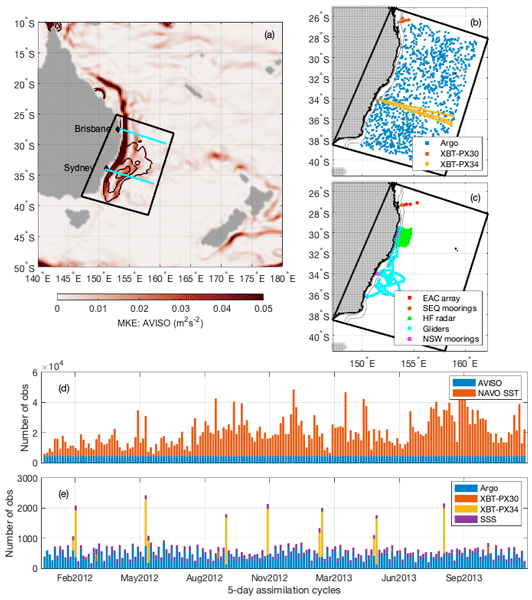
Ocean forecasting relies on the combination of numerical models and ocean observations through data assimilation (DA). Here we assess the performance of two DA systems in a dynamic western boundary current, the East Australian Current, across a common modelling and observational framework. We show that the more advanced, time-dependent method outperforms the time-independent method for forecast horizons of 5 d. This advocates the use of advanced methods for highly variable oceanic regions.
Colette Kerry, Moninya Roughan, and Shane Keating
EGUsphere, https://doi.org/10.5194/egusphere-2026-4125, https://doi.org/10.5194/egusphere-2026-4125, 2026
This preprint is open for discussion and under review for Geoscientific Model Development (GMD).
Short summary
Short summary
We demonstrate how novel ocean observation platforms can provide advances in regional ocean prediction. Recently available ocean data provide an unprecedented view of the ocean's fine-scale structure at the surface (a novel satellite mission) and below the surface (data collected from fishing vessels). Using specific case studies, we show how these new observations improve prediction of complex fine-scale structures, crucial to support a range of economic and ecological needs.
Colette G. Kerry, Moninya Roughan, Shane Keating, and Gary B. Brassington
EGUsphere, https://doi.org/10.5194/egusphere-2026-2467, https://doi.org/10.5194/egusphere-2026-2467, 2026
This preprint is open for discussion and under review for Geoscientific Model Development (GMD).
Short summary
Short summary
We demonstrate how novel ocean observation platforms can provide advances in regional ocean prediction. Recently available ocean data provide an unprecedented view of the ocean's fine-scale structure at the surface (a novel satellite mission) and below the surface (data collected from fishing vessels). We show how these new observations improve prediction in a dynamic oceanic region that directly influences coastal climate, fisheries and navigation over Australia's most highly populated zone.
Reg Watson Dowse, Shane R. Keating, and Moninya Roughan
EGUsphere, https://doi.org/10.5194/egusphere-2026-3599, https://doi.org/10.5194/egusphere-2026-3599, 2026
Short summary
Short summary
Ocean eddies are swirling currents that play an important role in moving heat, carbon, nutrients, and marine organisms around the ocean. We developed a new geometric framework that reconstructs eddy structure from velocity measurements, even when observations are limited. Tests using observations and numerical simulations show that the method can reliably estimate eddy properties and structure, providing a valuable tool for studying ocean circulation and transport.
Arnaud F. Valcarcel, Craig L. Stevens, Joanne M. O'Callaghan, and Sutara H. Suanda
Ocean Sci., 21, 965–987, https://doi.org/10.5194/os-21-965-2025, https://doi.org/10.5194/os-21-965-2025, 2025
Short summary
Short summary
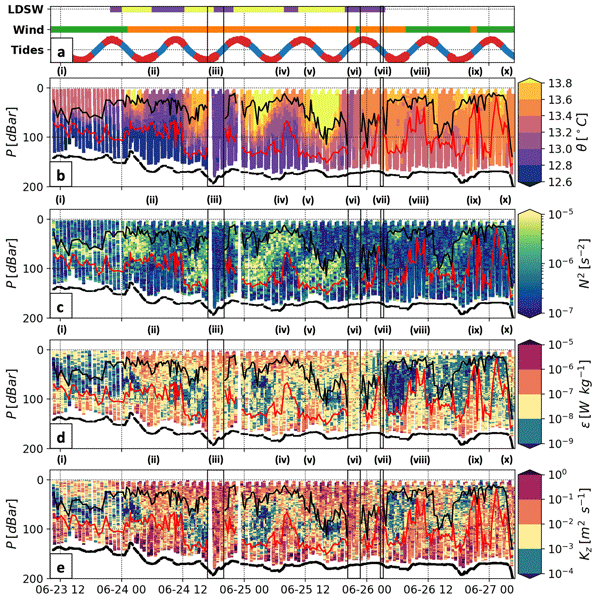
This paper describes underwater robotic measurements in an energetic strait. The data show how energy is transferred from winds and tides to turbulent processes. Boundary layers of strong turbulence affected the water from surface to seafloor across an unusually deep extent, except when fresher or warmer waters moved into the region. Numerical models revealed that turbulent energy transport allowed boundary layers to interact. This phenomenon may impact the biological structure of coastal seas.
Manh Cuong Tran, Moninya Roughan, and Amandine Schaeffer
Earth Syst. Sci. Data, 17, 937–963, https://doi.org/10.5194/essd-17-937-2025, https://doi.org/10.5194/essd-17-937-2025, 2025
Short summary
Short summary
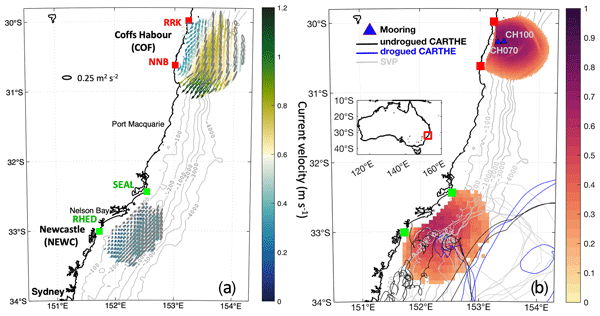
The East Australian Current (EAC) plays an important role in the marine ecosystem and climate of the region. To understand the EAC regime and the inner shelf dynamics, we implement a variational approach to produce the first multiyear coastal radar dataset (2012–2023) in this region. The validated data allow for a comprehensive investigation of the EAC dynamics. This dataset will be useful for understanding the complex EAC regime and its far-reaching impacts on the shelf environment.
Christopher J. Roach, Joao Marcos A. C. de Souza, Erik Behrens, and Stephen J. Stuart
EGUsphere, https://doi.org/10.5194/egusphere-2024-1962, https://doi.org/10.5194/egusphere-2024-1962, 2024
Preprint archived
Short summary
Short summary
We have used a 5 km regional ocean model for New Zealand forced with a coarser resolution global model to project changes in under medium and high emissions scenarios. This is necessary since the global model is unable to resolve the small scale processes on the continental shelf which determine climate change may influence fisheries and aquaculture. We see the upper ocean warms at similar rates all around New Zealand, but that the deep ocean shows more rapid warming in the west and south.
Colette Gabrielle Kerry, Moninya Roughan, Shane Keating, David Gwyther, Gary Brassington, Adil Siripatana, and Joao Marcos A. C. Souza
Geosci. Model Dev., 17, 2359–2386, https://doi.org/10.5194/gmd-17-2359-2024, https://doi.org/10.5194/gmd-17-2359-2024, 2024
Short summary
Short summary
Ocean forecasting relies on the combination of numerical models and ocean observations through data assimilation (DA). Here we assess the performance of two DA systems in a dynamic western boundary current, the East Australian Current, across a common modelling and observational framework. We show that the more advanced, time-dependent method outperforms the time-independent method for forecast horizons of 5 d. This advocates the use of advanced methods for highly variable oceanic regions.
Michael Hemming, Moninya Roughan, and Amandine Schaeffer
Earth Syst. Sci. Data, 16, 887–901, https://doi.org/10.5194/essd-16-887-2024, https://doi.org/10.5194/essd-16-887-2024, 2024
Short summary
Short summary
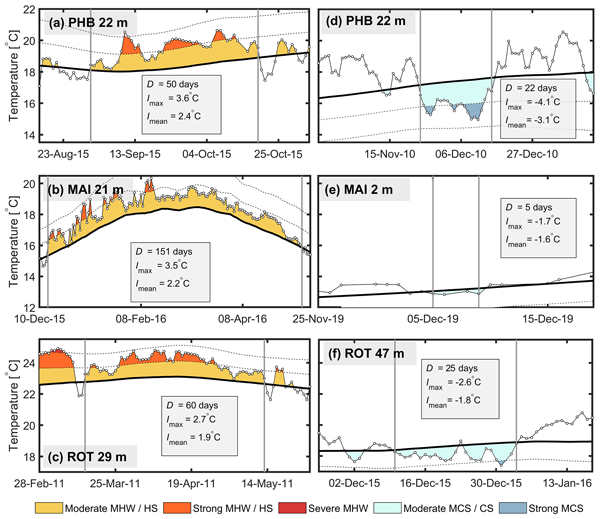
We present new datasets that are useful for exploring extreme ocean temperature events in Australian coastal waters. These datasets span multiple decades, starting from the 1940s and 1950s, and include observations from the surface to the bottom at four coastal sites. The datasets provide valuable insights into the intensity, frequency and timing of extreme warm and cold temperature events and include event characteristics such as duration, onset and decline rates and their categorisation.
Michael P. Hemming, Moninya Roughan, Neil Malan, and Amandine Schaeffer
Ocean Sci., 19, 1145–1162, https://doi.org/10.5194/os-19-1145-2023, https://doi.org/10.5194/os-19-1145-2023, 2023
Short summary
Short summary
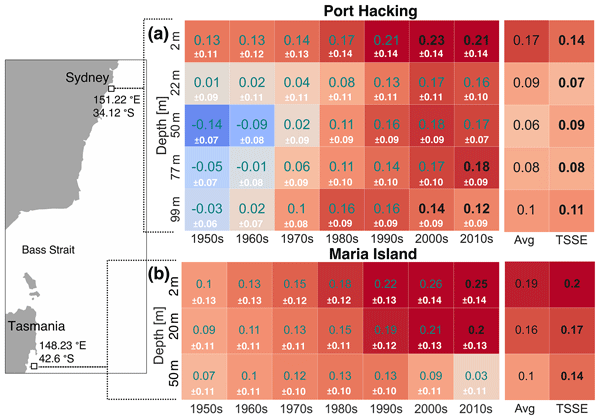
We estimate subsurface linear and non-linear temperature trends at five coastal sites adjacent to the East Australian Current (EAC). We see accelerating trends at both 34.1 and 42.6 °S and place our results in the context of previously reported trends, highlighting that magnitudes are depth-dependent and vary across latitude. Our results indicate the important role of regional dynamics and show the necessity of subsurface data for the improved understanding of regional climate change impacts.
Rafael Santana, Helen Macdonald, Joanne O'Callaghan, Brian Powell, Sarah Wakes, and Sutara H. Suanda
Geosci. Model Dev., 16, 3675–3698, https://doi.org/10.5194/gmd-16-3675-2023, https://doi.org/10.5194/gmd-16-3675-2023, 2023
Short summary
Short summary
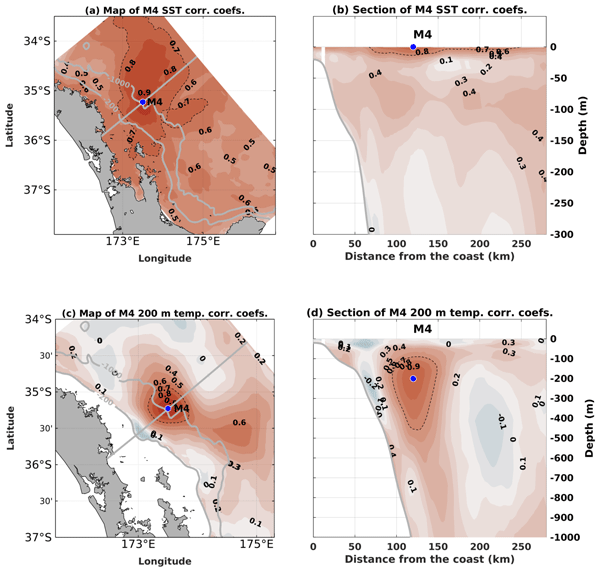
We show the importance of assimilating subsurface temperature and velocity data in a model of the East Auckland Current. Assimilation of velocity increased the representation of large oceanic vortexes. Assimilation of temperature is needed to correctly simulate temperatures around 100 m depth, which is the most difficult region to simulate in ocean models. Our simulations showed improved results in comparison to the US Navy global model and highlight the importance of regional models.

David E. Gwyther, Shane R. Keating, Colette Kerry, and Moninya Roughan
Geosci. Model Dev., 16, 157–178, https://doi.org/10.5194/gmd-16-157-2023, https://doi.org/10.5194/gmd-16-157-2023, 2023
Short summary
Short summary
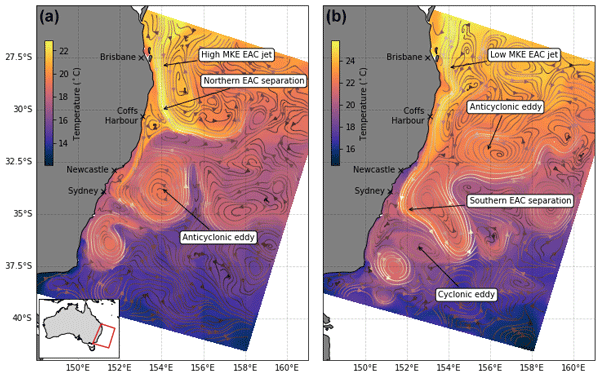
Ocean eddies are important for weather, climate, biology, navigation, and search and rescue. Since eddies change rapidly, models that incorporate or assimilate observations are required to produce accurate eddy timings and locations, yet the model accuracy is rarely assessed below the surface. We use a unique type of ocean model experiment to assess three-dimensional eddy structure in the East Australian Current and explore two pathways in which this subsurface structure is being degraded.
David E. Gwyther, Colette Kerry, Moninya Roughan, and Shane R. Keating
Geosci. Model Dev., 15, 6541–6565, https://doi.org/10.5194/gmd-15-6541-2022, https://doi.org/10.5194/gmd-15-6541-2022, 2022
Short summary
Short summary
The ocean current flowing along the southeastern coast of Australia is called the East Australian Current (EAC). Using computer simulations, we tested how surface and subsurface observations might improve models of the EAC. Subsurface observations are particularly important for improving simulations, and if made in the correct location and time, can have impact 600 km upstream. The stability of the current affects model estimates could be capitalized upon in future observing strategies.
Cited articles
Ballarotta, M., Ubelmann, C., Pujol, M.-I., Taburet, G., Fournier, F., Legeais, J.-F., Faugère, Y., Delepoulle, A., Chelton, D., Dibarboure, G., and Picot, N.: On the resolutions of ocean altimetry maps, Ocean Sci., 15, 1091–1109, https://doi.org/10.5194/os-15-1091-2019, 2019. a, b
Baxter, T.: The Impact of Tidal Forcing on the Oceanography of the Northern
Continental Shelf of New Zealand, Master's thesis, Department of Marine
Science, University of Otago, New Zealand, http://hdl.handle.net/10523/12649, 2022. a
Bowen, M., Sutton, P., and Roemmich, D.: Estimating mean dynamic topography in
boundary currents and the use of Argo trajectories,
J. Geophys. Res.-Oceans, 119, 8422–8437,
https://doi.org/10.1002/2014JC010281, 2014. a
Callaghan, J. O., Stevens, C., Roughan, M., Cornelisen, C., Sutton, P.,
Garrett, S., Giorli, G., Smith, R. O., Currie, K. I., Suanda, S. H.,
Williams, M., Bowen, M., Fernandez, D., Vennell, R., Knight, B. R., Barter,
P., Mccomb, P., Oliver, M., Livingston, M., Tellier, P., Meissner, A.,
Brewer, M., Gall, M., Nodder, S. D., Decima, M., Souza, J.,
Forcén-vazquez, A., Gardiner, S., Paul-burke, K., Chiswell, S.,
Roberts, J., Hayden, B., Biggs, B., Macdonald, H., and Fishwick, J. R.:
Developing an Integrated Ocean Observing System for New Zealand, Front. Mar. Sci., 6, 1–7, https://doi.org/10.3389/fmars.2019.00143, 2019. a
Chaput, R., Sochala, P., Miron, P., Kourafalou, p. H., and Iskandarani, M.:
Quantitative uncertainty estimation in biophysical models of fish larval
connectivity in the Florida Keys, ICES J. Mar. Sci., 00, 1–24,
https://doi.org/10.1093/icesjms/fsac021, 2022. a
Chiswell, S.: Circulation within the Wairarapa Eddy, New Zealand, New Zeal. J. Mar. Fresh., 37, 691–704,
https://doi.org/10.1080/00288330.2003.9517199, 2003. a
Chiswell, S. M.: Variability in the Southland Current, New Zealand, New Zeal. J. Mar. Fresh., 30, 1–17,
https://doi.org/10.1080/00288330.1996.9516693, 1996. a
Chiswell, S. M.: Mean and variability in the Wairarapa and Hikurangi Eddies,
New Zealand, New Zeal. J. Mar. Fresh., 39,
121–134, https://doi.org/10.1080/00288330.2005.9517295, 2005. a
Chiswell, S. M., Bostock, H. C., Sutton, P. J. H., and Williams, M. J. M.:
Physical oceanography of the deep seas around New Zealand: a review, New Zeal. J. Mar. Fresh., 49, 286–317,
https://doi.org/10.1080/00288330.2014.992918, 2015. a, b
CLS (France):
Global Ocean Gridded L 4 Sea Surface Heights And Derived Variables Reprocessed 1993 Ongoing,
https://doi.org/10.48670/moi-00148, 2022. a
de Boyer Montégut, C., Madec, G., Fischer, A. S., Lazar, A., and Iudicone, D.:
Mixed layer depth over the global ocean: An examination of profile data and a
profile-based climatology, J. Geophys. Res., 109, C12003, https://doi.org/10.1029/2004JC002378,
2004. a
Elzahaby, Y., Schaeffer, A., Roughan, M., and Delaux, S.: Oceanic Circulation
Drives the Deepest and Longest Marine Heatwaves in the East
Australian Current System, Geophys. Res. Lett., 48,
e2021GL094785, https://doi.org/10.1029/2021GL094785, 2021. a, b
GEBCO: GEBCO_2021 Grid, GEBCO [data set], https://doi.org/10.5285/c6612cbe-50b3-0cff-e053-6c86abc09f8f, 2022. a
Hadfield, M. G. and Stevens, C. L.: A modelling synthesis of the volume flux
through Cook Strait, New Zeal. J. Mar. Fresh.,
55, 65–93, https://doi.org/10.1080/00288330.2020.1784963, 2021. a
Holte, J., Talley, L. D., Gilson, J., and Roemmich, D.: An Argo mixed layer
climatology and database, Geophys. Res. Lett., 44, 5618–5626,
2017. a
Howes, K. E., Fowler, A. M., and S., L. A.: Accounting for model error in
strong-constraint 4D-Var data assimilation,
Q. J. Roy. Meteor. Soc., 143, 1227–1240, https://doi.org/10.1002/qj.2996, 2017. a
,
Huang, B., Liu, C., Banzon, V., Freeman, E., Graham, G., Hankins, B., Smith, T., and Zhang, H.-M.: Improvements of the Daily Optimum Interpolation Sea Surface Temperature (DOISST) Version 2.1,
J. Climate,
34, 2923–2939,
https://doi.org/10.1175/JCLI-D-20-0166.1, 2021 (data available at: https://www.ncei.noaa.gov/data/sea-surface-temperature-optimum-interpolation/v2.1/access/avhrr/, last access: 19 December 2022). a
Janekovic, I. and Powell, B.: Analysis of imposing tidal dynamics to nested
numerical models, Cont. Shelf Res., 34, 30–40,
https://doi.org/10.1016/j.csr.2011.11.017, 2012. a, b
Kerry, C. and Roughan, M.: Downstream Evolution of the East Australian Current
System: Mean Flow, Seasonal and Intra-annual Variability, J. Geophys. Res.-Oceans, 125, e2019JC015227, https://doi.org/10.1029/2019JC015227,
2020. a, b
Kerry, C., Powell, B., Roughan, M., and Oke, P.: Development and evaluation of a high-resolution reanalysis of the East Australian Current region using the Regional Ocean Modelling System (ROMS 3.4) and Incremental Strong-Constraint 4-Dimensional Variational (IS4D-Var) data assimilation, Geosci. Model Dev., 9, 3779–3801, https://doi.org/10.5194/gmd-9-3779-2016, 2016. a
Kerry, C., Roughan, M., and Azevedo Correia de Souza, J.: Variability of
Boundary Currents and Ocean Heat Content around New Zealand, J.
Geophys. Res.-Oceans, accepted, 2022. a
Lane, E. M., Walters, R. A., Gillibrand, P. A., and Uddstrom, M.: Operational
forecasting of sea level height using an unstructured grid ocean model, Ocean Model., 28, 88–96, https://doi.org/10.1016/j.ocemod.2008.11.004, 2009. a, b
Lellouche, J. M., Greiner, E., Bourdalle-Badie, R., Garric, G., Melet, A.,
Drevillon, M., Bricaud, C., Hamon, M., Le Galloudec, O., Rengier, C.,
Candela, T., Testut, C. E., Gasparin, F., Ruggiero, G., Benkiran, M.,
Drillet, Y., and Le Traon, P. Y.: The Copernicus Global 1/12° Oceanic and
Sea Ice GLORYS12 Reanalysis, Front. Earth Sci., 9, 698876,
https://doi.org/10.3389/feart.2021.698876, 2021. a, b
Lewis, K. B. and Barnes, P. M.: Kaikoura Canyon, New Zealand: active conduit
from near-shore sediment zones to trench-axis channel, Mar. Geol., 162,
39–69, https://doi.org/10.1016/S0025-3227(99)00075-4, 1999. a
Marchesiello, P., Debreu, L., and Couvelard, X.: Spurious diapycnal mixing in
terrain-following coordinate models: The problem and a solution, Ocean Model., 26, 156–169, https://doi.org/10.1016/j.ocemod.2008.09.004, 2009. a
Maslo, A., Souza, J. M. A. C., Perez-Brunius, P., Andrade-Canto, F., and
Outerelo, J. R.: Connectivity of deep waters in the Gulf of Mexico,
J. Marine Syst., 203, 103267, https://doi.org/10.1016/j.jmarsys.2019.103267, 2020. a
Matthews, D., Powell, B. S., and Janekovic, I.: Analysis of four-dimensional
variational state estimation of the Hawaiian waters,
J. Geophys. Res., 117, C03013, https://doi.org/10.1029/2011JC007575, 2012. a
McWilliams, J. C.: Targeted coastal circulation phenomena in diagnostic
analyses and forecast, Dynam. Atmos. Oceans, 49, 3–15,
https://doi.org/10.1016/j.dynatmoce.2008.12.004, 2009. a
Mercator Océan (France):
Global Ocean Physics Reanalysis,
https://doi.org/10.48670/moi-00021, 2021. a, b
Moore, A. M., Martin, M. J., Akella, S., Arango, H. G., Balmaseda, M., Bertino,
L., Ciavatta, S., Cornuelle, B., Cummings, J., Frolov, S., Lermusiaux, P.,
Oddo, P., Oke, P. R., Storto, A., Teruzzi, A., Vidard, A., Weaver, A. T., and
on behalf of GODAE OceanView Data Assimilation Task Team: Synthesis of
Ocean Observations Using Data Assimilation for Operational,
Real-Time and Reanalysis Systems: A More Complete Picture of
the State of the Ocean, Front. Mar. Sci., 6, 90,
https://doi.org/10.3389/fmars.2019.00090, 2019. a
O'Calaghan, J. M. and Stevens, C. L.: Evaluating the Surface Response of
Discharge Events in a New Zealand Gulf-ROFI, Front. Mar.
Sci., 6, 143, https://doi.org/10.3389/fmars.2017.00232, 2017. a
OCEANSCOPE:
Global Ocean- CORA- In-situ Observations Yearly Delivery in Delayed Mode,
[data set], https://doi.org/10.17882/46219, 2022. a
Paulik, R., Stephens, S., Wild, A., Wadhwa, S., and Bell, R. G.: Cumulative
building exposure to extreme sea level flooding in coastal urban areas,
Int. J. Disast. Risk Re., 66, 102612,
https://doi.org/10.1016/j.ijdrr.2021.102612, 2021. a
Pawlowicz, R., Beardsley, B., and Lentz, S.: Classical tidal harmonic analysis
including error estimates in MATLAB using T-TIDE, Comput.
Geosci., 28, 929–937, https://doi.org/10.1016/S0098-3004(02)00013-4, 2002. a
Pujol, M. I. and Mertz, F.: PRODUCT USER MANUAL For Sea Level SLA products,
Tech. rep., EU Copernicus Marine Service,
https://catalogue.marine.copernicus.eu/documents/PUM/CMEMS-SL-PUM-008-032-062.pdf (last access: 19 December 2022),
2019. a
Reynolds, R. W., Smith, T. M., Liu, C., Chelton, D. B., Casey, K. S., and
Schalax, M. G.: Daily High-Resolution-Blended Analyses for Sea Surface
Temperature, J. Climate, 20, 5473–5496,
https://doi.org/10.1175/2007JCLI1824.1, 2007. a
Roemmich, D. and Sutton, P.: The mean and variability of ocean circulation past
northern New Zealand: Determining the representativeness of hydrographic
climatologies, J. Geophys. Res.-Oceans, 103,
13041–13054, https://doi.org/10.1080/00288330.2003.9517157, 1998. a
Salinger, M. J., Diamond, H. J., Behrens, E., Fernandez, D., Fitzharris, B. B.,
Herols, N., Johnstone, P., Kerckhoffs, H., Mullan, A. B., Parker, A. K.,
Renwick, J., Scofield, C., Siano, A., Smith, R. O., South, P. M., Sutton,
P. J., Teixeira, E., Thomsen, M. S., and Trought, M. C. T.: Unparalleled
coupled ocean-atmosphere summer heatwaves in the New Zealand region:
drivers, mechanisms and impacts, Clim. Change, 162, 485–506,
https://doi.org/10.1007/s10584-020-02730-5, 2020. a
Shchepetkin, A. F. and McWilliams, J. C.: The regional oceanic modeling system
(ROMS): a split-explicit, free-surface, topography-following-coordinate
oceanic model, Ocean Model., 9, 347–404,
https://doi.org/10.1016/j.ocemod.2004.08.002, 2005. a, b
Shears, N. T. and Bowen, M. M.: Half a century of coastal temperature records
reveal complex warming trends in western boundary currents, Sci.
Rep., 7, 14527, https://doi.org/10.1038/s41598-017-14944-2, 2017. a
Silva, C. N. S., McDonald, H. S., Hadfiled, M., Cyer, M., and Gardner, J.
P. A.: Ocean currents predict fine-scale genetic structure and source-sink
dynamics in a marine invertebrate coastal fishery, ICES J. Mar. Sci., 76, 1007–1018, https://doi.org/10.1093/icesjms/fsy201, 2019. a
Solano, M., Canals, M., and Leonardi, S.: Barotropic boundary conditions and
tide forcing in split-explicit high resolution coastal ocean models, Journal of Ocean Engineering and Science, 5, 249–260,
https://doi.org/10.1016/j.joes.2019.12.002, 2020. a
Souza, J. M. A. C.: joaometocean/moana_hindcast: Moana Ocean Hindcast (v1.0), Zenodo [code], https://doi.org/10.5281/zenodo.6484908, 2022a. a
Souza, J. M. A. C.: Moana Ocean Hindcast, Zenodo [data set], https://doi.org/10.5281/zenodo.5895265, 2022b. a, b
Souza, J. M. A. C.:
joaometocean/moana_hindcast: Moana Ocean Hindcast, Zenodo [code],
https://doi.org/10.5281/zenodo.6484908, 2022c. a
Souza, J. M. A. C., Powell, B., Castillo-Trujillo, A. C., and Flament, P.: The
Vorticity Balance of the Ocean Surface in Hawaii from a Regional
Reanalysis, J. Phys. Oceanogr., 45, 424–440,
https://doi.org/10.1175/JPO-D-14-0074.1, 2015. a, b
Stanton, B. and Sutton, P.: Velocity measurements in the East Auckland Current
north-east of North Cape, New Zealand, New Zeal. J. Mar. Fresh., 37, 195–204, https://doi.org/10.1080/00288330.2003.9517157, 2003. a
Stevens, C.: Residual flows in Cook Strait, a large tidally dominated strait,
J. Phys. Oceanogr., 44, 1654–1670,
https://doi.org/10.1175/JPO-D-13-041.1, 2014. a
Stevens, C., O'Callaghan, J. M., Chiswell, S. M., and Hadfield, M. G.: Physical
oceanography of New Zealand/Aotearoa shelf seas – a review, New Zeal. J. Mar. Fresh., 53, 201–221,
https://doi.org/10.1080/00288330.2019.1588746, 2019. a, b, c, d
Suanda, S., Smith, R., and Souza, J. M. A. C.:
New Zealand coastal station sea temperature time series,
Zenodo [data set], https://doi.org/10.5281/zenodo.6399921, 2022. a
Sutton, P. J. H.: The Southland Current: A subantarctic current, New Zeal. J. Mar. Fresh., 37, 645–652,
https://doi.org/10.1080/00288330.2003.9517195, 2003. a
Sutton, P. J. H. and Bowen, M.: Ocean temperature change around New Zealand
over the last 36 years, New Zeal. J. Mar. Fresh., 53, 305–326, https://doi.org/10.1080/00288330.2018.1562945, 2019. a
Szekely, T., Gourrion, J., Pouliquen, S., and Reverdin, G.: The CORA 5.2 dataset for global in situ temperature and salinity measurements: data description and validation, Ocean Sci., 15, 1601–1614, https://doi.org/10.5194/os-15-1601-2019, 2019. a, b
Vennel, R., Scheel, M., Weppe, S., Knight, B., and Smeaton, M.: Fast lagrangian
particle tracking in unstructured ocean model grids, Ocean Dynam., 71,
423–437, https://doi.org/10.1007/s10236-020-01436-7, 2021. a
Walters, R. A., Goring, D. G., and Bell, R. G.: Ocean tides around New
Zealand, New Zeal. J. Mar. Fresh., 35,
567–579, https://doi.org/10.1080/00288330.2001.9517023, 2001. a, b
Wang, X., Chao, Y., Dong, C., Farrara, J., Li, Z., McWilliams, J. C., Paduan,
J. D., and Rosenfeld, L. K.: Modeling tides in Monterey Bay,
California, Deep-Sea Res. Pt. II, 56,
219–231, https://doi.org/10.1016/j.dsr2.2008.08.012, 2009. a
Warner, J. C., Sherwood, C. R., Arango, H. G., and Signell, R. P.: Performance
of four turbulence closure models implemented using a generic length scale
method, Ocean Model., 8, 81–113, https://doi.org/10.1016/j.ocemod.2003.12.003,
2005. a
Wijffels, S. E., Beggs, H., Griffin, C., Middleton, J. F., Cahill, M., King,
E., Jones, E., Feng, M., Benthuysen, J. A., Steinberg, C. R., and Sutton, P.:
A fine spatial-scale sea surface temperature atlas of the Australian
regional seas (SSTAARS): Seasonal variability and trends around
Australasia and New Zealand revisited, J. Marine Syst.,
187, 156–196, https://doi.org/10.1016/j.jmarsys.2018.07.005, 2018. a
Willmott, C. J.: On the Validation of Models, Phys. Geogr., 2,
184–194, https://doi.org/10.1080/02723646.1981.10642213, 1981. a
Short summary
The current paper describes the configuration and evaluation of the Moana Ocean Hindcast, a > 25-year simulation of the ocean state around New Zealand using the Regional Ocean Modeling System v3.9. This is the first open-access, long-term, continuous, realistic ocean simulation for this region and provides information for improving the understanding of the ocean processes that affect the New Zealand exclusive economic zone.
The current paper describes the configuration and evaluation of the Moana Ocean Hindcast, a...


