Articles | Volume 19, issue 9
https://doi.org/10.5194/gmd-19-3643-2026
© Author(s) 2026. This work is distributed under
the Creative Commons Attribution 4.0 License.

https://doi.org/10.5194/gmd-19-3643-2026
© Author(s) 2026. This work is distributed under
the Creative Commons Attribution 4.0 License.
Process-oriented evaluation of quasi-stationary Rossby waves and their impact on surface air temperature extremes in dynamical downscaling over North America
Koichi Sakaguchi

CORRESPONDING AUTHOR
Pacific Northwest National Laboratory, Richland, Washington, USA
Seth A. McGinnis
NSF National Center for Atmospheric Research, Boulder, Colorado, USA
L. Ruby Leung
Pacific Northwest National Laboratory, Richland, Washington, USA
Melissa S. Bukovsky
University of Wyoming, Laramie, WY, USA
Rachel R. McCrary
NSF National Center for Atmospheric Research, Boulder, Colorado, USA
Ziming Chen
Pacific Northwest National Laboratory, Richland, Washington, USA
Chuan-Chieh Chang
Pacific Northwest National Laboratory, Richland, Washington, USA
Yanjie Li
Institute of Atmospheric Physics, Chinese Academy of Sciences, Beijing, China
Related authors
Sheng-Lun Tai, Zhao Yang, Brian Gaudet, Koichi Sakaguchi, Larry Berg, Colleen Kaul, Yun Qian, Ye Liu, and Jerome Fast
Earth Syst. Sci. Data, 17, 4587–4611, https://doi.org/10.5194/essd-17-4587-2025, https://doi.org/10.5194/essd-17-4587-2025, 2025
Short summary
Short summary
Our study created a high-resolution soil moisture dataset for the eastern US by integrating satellite data with a land surface model and advanced algorithms, achieving 1 km scale analyses. Validated against multiple in situ networks and analysis datasets, it demonstrated superior accuracy. This dataset is vital for understanding soil moisture dynamics, especially during droughts, and highlights the need to mitigate soil-type-dependent biases in the model.
Koichi Sakaguchi, L. Ruby Leung, Colin M. Zarzycki, Jihyeon Jang, Seth McGinnis, Bryce E. Harrop, William C. Skamarock, Andrew Gettelman, Chun Zhao, William J. Gutowski, Stephen Leak, and Linda Mearns
Geosci. Model Dev., 16, 3029–3081, https://doi.org/10.5194/gmd-16-3029-2023, https://doi.org/10.5194/gmd-16-3029-2023, 2023
Short summary
Short summary
We document details of the regional climate downscaling dataset produced by a global variable-resolution model. The experiment is unique in that it follows a standard protocol designed for coordinated experiments of regional models. We found negligible influence of post-processing on statistical analysis, importance of simulation quality outside of the target region, and computational challenges that our model code faced due to rapidly changing super computer systems.
Tian Zhou, Yun Qian, and L. Ruby Leung
EGUsphere, https://doi.org/10.5194/egusphere-2026-2237, https://doi.org/10.5194/egusphere-2026-2237, 2026
This preprint is open for discussion and under review for Geoscientific Model Development (GMD).
Short summary
Short summary
AI can now write scientific analysis code that looks correct but quietly produces wrong results. We tested whether asking the assistant to assemble analyses from a library of validated building blocks, rather than write code from scratch, makes it more reliable. Across six language models and seven Earth science tasks, free code writing succeeded only about five percent of the time while the constrained approach exceeded eighty percent, suggesting trust needs guardrails.
Shixuan Zhang, L. Ruby Leung, Bryce E. Harrop, Aniruddha Bora, George Karniadakis, Khemraj Shukla, and Kai Zhang
Geosci. Model Dev., 19, 1937–1964, https://doi.org/10.5194/gmd-19-1937-2026, https://doi.org/10.5194/gmd-19-1937-2026, 2026
Short summary
Short summary
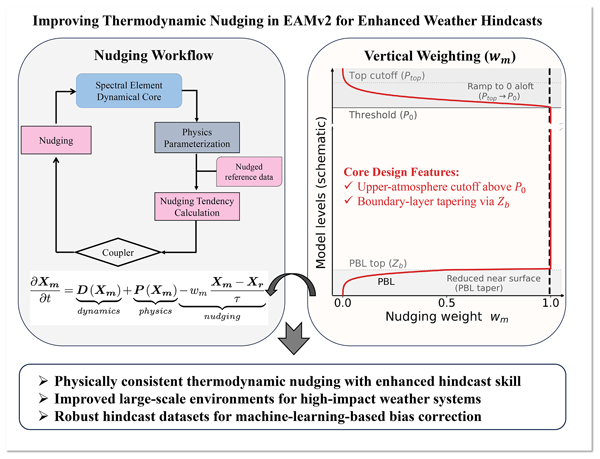
We developed a new method to guide the simulated atmosphere in an Earth system model so it better reflects real-world weather. By adjusting temperature and humidity, it reduces unwanted side effects and improves the realism of rainfall, energy flows, land–surface conditions, and extreme storms such as cyclones and atmospheric rivers. This makes the model more useful for testing its performance, understanding high-impact weather events, and creating reliable training data for machine learning.
Fang Li, David Lawrence, Brendan Rogers, Chantelle Burton, Huilin Huang, Yiquan Jiang, Johannes Kaiser, Matthew Kasoar, Hanna Lee, Ruby Leung, Lars Nieradzik, Aihui Wang, Daniel Ward, Ligeer Ce, Yangchun Li, Zhongda Lin, Apostolos Voulgarakis, and Yongkang Xue
EGUsphere, https://doi.org/10.5194/egusphere-2025-6115, https://doi.org/10.5194/egusphere-2025-6115, 2025
Short summary
Short summary
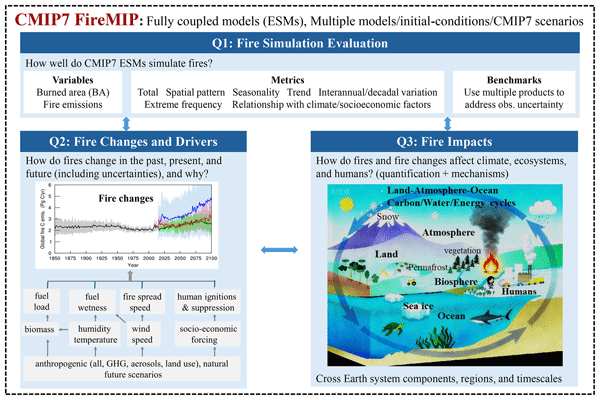
Extreme fire events are increasing, and fires are projected to rise across most regions, posing growing risks to ecosystems and society. As a key Earth system process, fire is now modeled in most Earth System Models (ESMs). FireMIP within CMIP7 will evaluate fire simulations in state‑of‑the‑art ESMs, project future fire changes, and provide quantitative, process‑based understanding of fire's role in the Earth system.
Pengfei Shi, L. Ruby Leung, Zhaoxia Pu, Samson Hagos, and Karthik Balaguru
EGUsphere, https://doi.org/10.5194/egusphere-2025-4910, https://doi.org/10.5194/egusphere-2025-4910, 2025
Short summary
Short summary
Reliable climate prediction requires accurate initialization of the ocean state. We developed a new data assimilation system that incorporates ocean temperature and salinity observations into a fully coupled climate model. This system improves simulations of Earth system variability from years to decades, and enhances skills in simulating winter temperature and precipitation variability over the United States. The results advance more reliable and skillful climate predictions.
Naser Mahfouz, Hassan Beydoun, Johannes Mülmenstädt, Noel Keen, Adam C. Varble, Luca Bertagna, Peter Bogenschutz, Andrew Bradley, Matthew W. Christensen, T. Conrad Clevenger, Aaron Donahue, Jerome Fast, James Foucar, Jean-Christophe Golaz, Oksana Guba, Walter Hannah, Benjamin Hillman, Robert Jacob, Wuyin Lin, Po-Lun Ma, Yun Qian, Balwinder Singh, Christopher Terai, Hailong Wang, Mingxuan Wu, Kai Zhang, Andrew Gettelman, Mark Taylor, L. Ruby Leung, Peter Caldwell, and Susannah Burrows
Atmos. Chem. Phys., 25, 15105–15120, https://doi.org/10.5194/acp-25-15105-2025, https://doi.org/10.5194/acp-25-15105-2025, 2025
Short summary
Short summary
Our study assesses the aerosol effective radiative forcing in a global cloud-resolving atmosphere model at ultra-high resolution. We demonstrate that global aerosol forcing signal can be robustly reproduced across resolutions when aerosol activation processes are carefully parameterized. Further, we argue that simplified prescribed aerosol schemes will open the door for further process/mechanism studies under controlled conditions.
Yuanqi Hong, Guta Abeshu, Hong-Yi Li, Dingbao Wang, Mengqi Zhao, Thomas Wild, Günter Blöschl, and Ruby Leung
EGUsphere, https://doi.org/10.5194/egusphere-2025-5039, https://doi.org/10.5194/egusphere-2025-5039, 2025
Short summary
Short summary
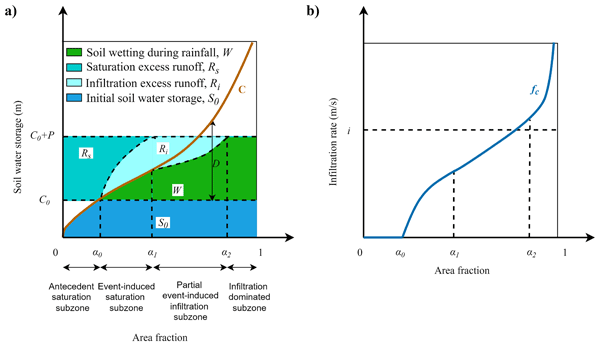
Rain runs off in two main ways: saturation excess when soil is full, and infiltration excess when rain exceeds infiltration. They often occur simultaneously in a watershed, but most models treat them separately. We introduce a new theory that captures both processes within a single framework, tracking their shift over space and time. Tested over 181 U.S. watersheds, the theory well predicts streamflow in most watersheds and improves understanding of runoff under diverse climates.
Dongyu Feng, Zeli Tan, Darren Engwirda, Jonathan D. Wolfe, Donghui Xu, Chang Liao, Gautam Bisht, James J. Benedict, Tian Zhou, Mithun Deb, Hong-Yi Li, and L. Ruby Leung
Nat. Hazards Earth Syst. Sci., 25, 3619–3639, https://doi.org/10.5194/nhess-25-3619-2025, https://doi.org/10.5194/nhess-25-3619-2025, 2025
Short summary
Short summary
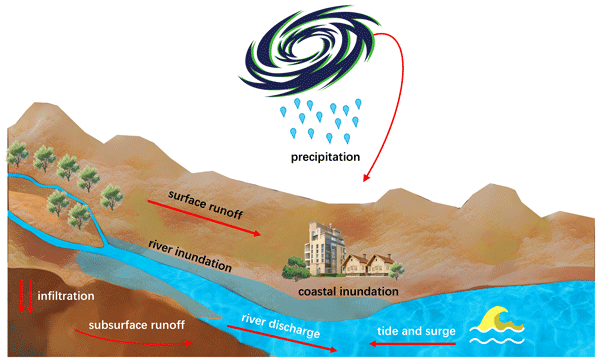
Our study explores how riverine and coastal flooding during hurricanes is influenced by the interaction of atmosphere, land, river, and ocean conditions. Using an advanced Earth system model, we simulate Hurricane Irene to evaluate how meteorological and hydrological uncertainties affect flood modeling. Our findings reveal the importance of a multi-component modeling system, how hydrological conditions play critical roles in flood modeling, and greater flood risks if multiple factors are present.
Sheng-Lun Tai, Zhao Yang, Brian Gaudet, Koichi Sakaguchi, Larry Berg, Colleen Kaul, Yun Qian, Ye Liu, and Jerome Fast
Earth Syst. Sci. Data, 17, 4587–4611, https://doi.org/10.5194/essd-17-4587-2025, https://doi.org/10.5194/essd-17-4587-2025, 2025
Short summary
Short summary
Our study created a high-resolution soil moisture dataset for the eastern US by integrating satellite data with a land surface model and advanced algorithms, achieving 1 km scale analyses. Validated against multiple in situ networks and analysis datasets, it demonstrated superior accuracy. This dataset is vital for understanding soil moisture dynamics, especially during droughts, and highlights the need to mitigate soil-type-dependent biases in the model.
Zeli Tan, Donghui Xu, Sourav Taraphdar, Jiangqin Ma, Gautam Bisht, and L. Ruby Leung
Hydrol. Earth Syst. Sci., 29, 3833–3852, https://doi.org/10.5194/hess-29-3833-2025, https://doi.org/10.5194/hess-29-3833-2025, 2025
Short summary
Short summary
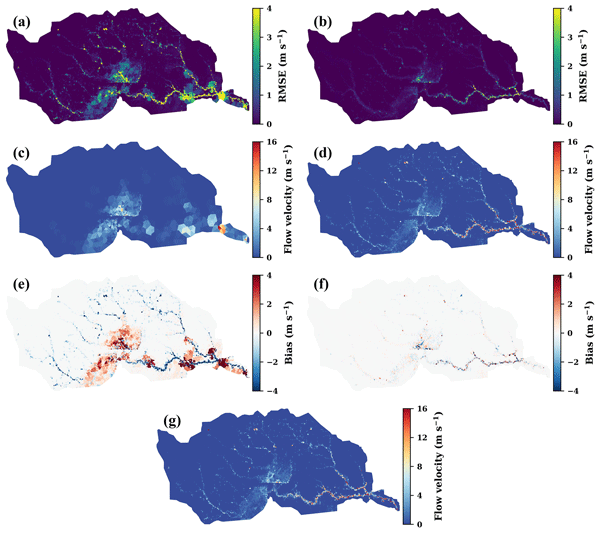
Flow depth and velocity determine various river functions, but their high-resolution simulations are expensive. Here, we developed a downscaling approach that can provide fast and accurate estimation of high-resolution river hydrodynamics. The 84-fold acceleration achieved by the method makes reliable flood risk analysis that needs hundreds or thousands of model runs feasible. More importantly, it provides an opportunity to couple large-scale hydrodynamics with local processes in river models.
Jianfeng Li, Andrew Geiss, Zhe Feng, L. Ruby Leung, Yun Qian, and Wenjun Cui
Earth Syst. Sci. Data, 17, 3721–3740, https://doi.org/10.5194/essd-17-3721-2025, https://doi.org/10.5194/essd-17-3721-2025, 2025
Short summary
Short summary
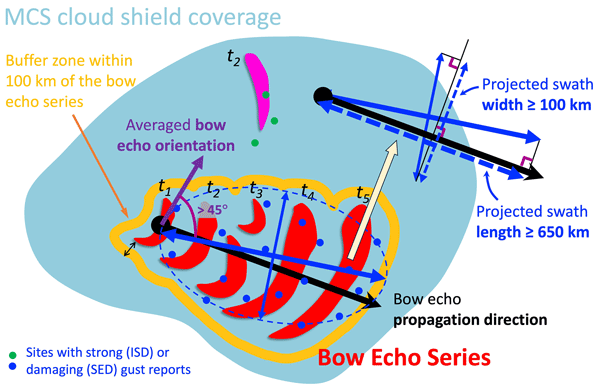
We developed a high-resolution (4 km and hourly) observational derecho dataset over the United States east of the Rocky Mountains from 2004 to 2021 by using a mesoscale convective system dataset, bow echoes detected by a machine learning method, hourly gust speeds, and physically based identification criteria.
Chang Liao, L. Ruby Leung, Yilin Fang, Teklu Tesfa, and Robinson Negron-Juarez
Geosci. Model Dev., 18, 4601–4624, https://doi.org/10.5194/gmd-18-4601-2025, https://doi.org/10.5194/gmd-18-4601-2025, 2025
Short summary
Short summary
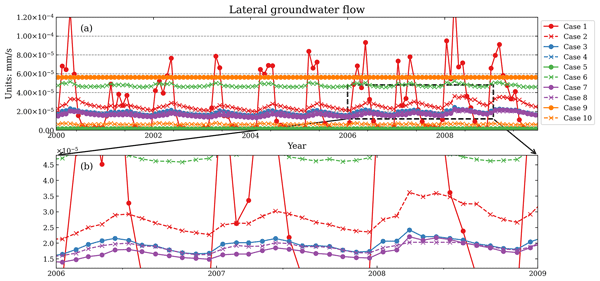
Understanding horizontal groundwater flow is important for understanding how water moves through the ground. Current climate models often simplify this process because they do not have information about the land surface that is detailed enough. Our study developed a new model that divides the land surface into hillslopes to better represent how groundwater flows. This model can help improve predictions of water availability and how it affects ecosystems.
Lingbo Li, Hong-Yi Li, Guta Abeshu, Jinyun Tang, L. Ruby Leung, Chang Liao, Zeli Tan, Hanqin Tian, Peter Thornton, and Xiaojuan Yang
Earth Syst. Sci. Data, 17, 2713–2733, https://doi.org/10.5194/essd-17-2713-2025, https://doi.org/10.5194/essd-17-2713-2025, 2025
Short summary
Short summary
We have developed new maps that reveal how organic carbon from soil leaches into headwater streams over the contiguous United States. We use advanced artificial intelligence techniques and a massive amount of data, including observations at over 2500 gauges and a wealth of climate and environmental information. The maps are a critical step in understanding and predicting how carbon moves through our environment, hence making them a useful tool for tackling climate challenges.
Pengfei Shi, L. Ruby Leung, and Bin Wang
Geosci. Model Dev., 18, 2443–2460, https://doi.org/10.5194/gmd-18-2443-2025, https://doi.org/10.5194/gmd-18-2443-2025, 2025
Short summary
Short summary
Improving climate predictions has significant socio-economic impacts. In this study, we develop and apply a new weakly coupled ocean data assimilation (WCODA) system to a coupled climate model. The WCODA system improves simulations of ocean temperature and salinity across many global regions. This system is meant to advance our understanding of the ocean's role in climate predictability.
Guta Wakbulcho Abeshu, Hong-Yi Li, Mingjie Shi, and L. Ruby Leung
Hydrol. Earth Syst. Sci., 29, 1847–1864, https://doi.org/10.5194/hess-29-1847-2025, https://doi.org/10.5194/hess-29-1847-2025, 2025
Short summary
Short summary
This study examined how water availability, climate dryness, and plant productivity interact at the catchment scale. Using various indices and statistical methods, we found a 0–2-month lag in these interactions. Strong correlations during peak-productivity months were observed, with a notable hysteresis effect in vegetation response to changes in water availability and climate dryness. The findings help better understand catchment responses to climate variability.
Malcolm J. Roberts, Kevin A. Reed, Qing Bao, Joseph J. Barsugli, Suzana J. Camargo, Louis-Philippe Caron, Ping Chang, Cheng-Ta Chen, Hannah M. Christensen, Gokhan Danabasoglu, Ivy Frenger, Neven S. Fučkar, Shabeh ul Hasson, Helene T. Hewitt, Huanping Huang, Daehyun Kim, Chihiro Kodama, Michael Lai, Lai-Yung Ruby Leung, Ryo Mizuta, Paulo Nobre, Pablo Ortega, Dominique Paquin, Christopher D. Roberts, Enrico Scoccimarro, Jon Seddon, Anne Marie Treguier, Chia-Ying Tu, Paul A. Ullrich, Pier Luigi Vidale, Michael F. Wehner, Colin M. Zarzycki, Bosong Zhang, Wei Zhang, and Ming Zhao
Geosci. Model Dev., 18, 1307–1332, https://doi.org/10.5194/gmd-18-1307-2025, https://doi.org/10.5194/gmd-18-1307-2025, 2025
Short summary
Short summary
HighResMIP2 is a model intercomparison project focusing on high-resolution global climate models, that is, those with grid spacings of 25 km or less in the atmosphere and ocean, using simulations of decades to a century in length. We are proposing an update of our simulation protocol to make the models more applicable to key questions for climate variability and hazard in present-day and future projections and to build links with other communities to provide more robust climate information.
Mari R. Tye, Ming Ge, Jadwiga H. Richter, Ethan D. Gutmann, Allyson Rugg, Cindy L. Bruyère, Sue Ellen Haupt, Flavio Lehner, Rachel McCrary, Andrew J. Newman, and Andy Wood
Hydrol. Earth Syst. Sci., 29, 1117–1133, https://doi.org/10.5194/hess-29-1117-2025, https://doi.org/10.5194/hess-29-1117-2025, 2025
Short summary
Short summary
There is a perceived mismatch between the spatial scales on which global climate models can produce data and those needed for water management decisions. However, poor communication of specific metrics relevant to local decisions is also a problem. We assessed the credibility of a set of water management decision metrics in the Community Earth System Model v2 (CESM2). CESM2 shows potentially greater use of its output in long-range water management decisions.
Yilin Fang, Hoang Viet Tran, and L. Ruby Leung
Geosci. Model Dev., 18, 19–32, https://doi.org/10.5194/gmd-18-19-2025, https://doi.org/10.5194/gmd-18-19-2025, 2025
Short summary
Short summary
Hurricanes may worsen water quality in the lower Mississippi River basin (LMRB) by increasing nutrient runoff. We found that runoff parameterizations greatly affect nitrate–nitrogen runoff simulated using an Earth system land model. Our simulations predicted increased nitrogen runoff in the LMRB during Hurricane Ida in 2021, albeit less pronounced than the observations, indicating areas for model improvement to better understand and manage nutrient runoff loss during hurricanes in the region.
Fang Li, Xiang Song, Sandy P. Harrison, Jennifer R. Marlon, Zhongda Lin, L. Ruby Leung, Jörg Schwinger, Virginie Marécal, Shiyu Wang, Daniel S. Ward, Xiao Dong, Hanna Lee, Lars Nieradzik, Sam S. Rabin, and Roland Séférian
Geosci. Model Dev., 17, 8751–8771, https://doi.org/10.5194/gmd-17-8751-2024, https://doi.org/10.5194/gmd-17-8751-2024, 2024
Short summary
Short summary
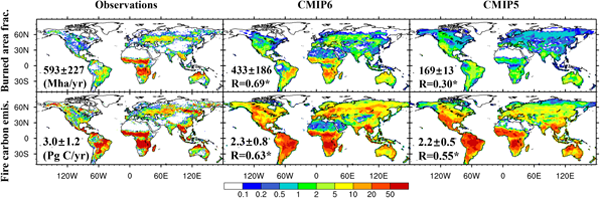
This study provides the first comprehensive assessment of historical fire simulations from 19 Earth system models in phase 6 of the Coupled Model Intercomparison Project (CMIP6). Most models reproduce global totals, spatial patterns, seasonality, and regional historical changes well but fail to simulate the recent decline in global burned area and underestimate the fire response to climate variability. CMIP6 simulations address three critical issues of phase-5 models.
Johannes Mülmenstädt, Andrew S. Ackerman, Ann M. Fridlind, Meng Huang, Po-Lun Ma, Naser Mahfouz, Susanne E. Bauer, Susannah M. Burrows, Matthew W. Christensen, Sudhakar Dipu, Andrew Gettelman, L. Ruby Leung, Florian Tornow, Johannes Quaas, Adam C. Varble, Hailong Wang, Kai Zhang, and Youtong Zheng
Atmos. Chem. Phys., 24, 13633–13652, https://doi.org/10.5194/acp-24-13633-2024, https://doi.org/10.5194/acp-24-13633-2024, 2024
Short summary
Short summary
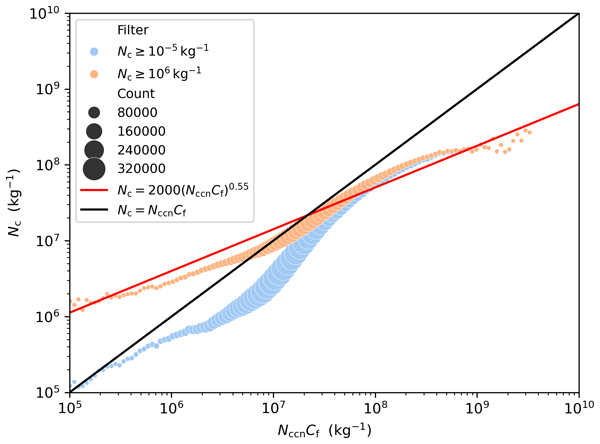
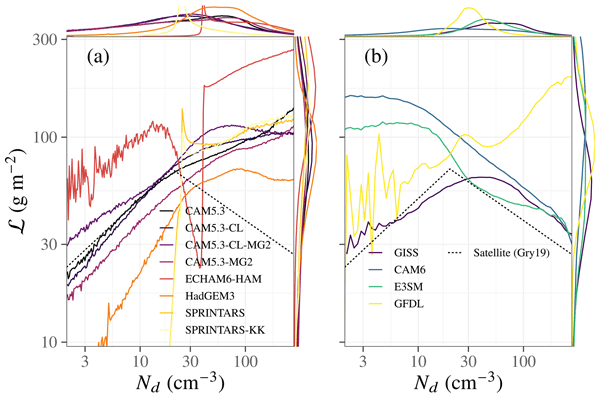
Stratocumulus clouds play a large role in Earth's climate by reflecting incoming solar energy back to space. Turbulence at stratocumulus cloud top mixes in dry, warm air, which can lead to cloud dissipation. This process is challenging for coarse-resolution global models to represent. We show that global models nevertheless agree well with our process understanding. Global models also think the process is less important for the climate than other lines of evidence have led us to conclude.
Fan Mei, Jennifer M. Comstock, Mikhail S. Pekour, Jerome D. Fast, Krista L. Gaustad, Beat Schmid, Shuaiqi Tang, Damao Zhang, John E. Shilling, Jason M. Tomlinson, Adam C. Varble, Jian Wang, L. Ruby Leung, Lawrence Kleinman, Scot Martin, Sebastien C. Biraud, Brian D. Ermold, and Kenneth W. Burk
Earth Syst. Sci. Data, 16, 5429–5448, https://doi.org/10.5194/essd-16-5429-2024, https://doi.org/10.5194/essd-16-5429-2024, 2024
Short summary
Short summary
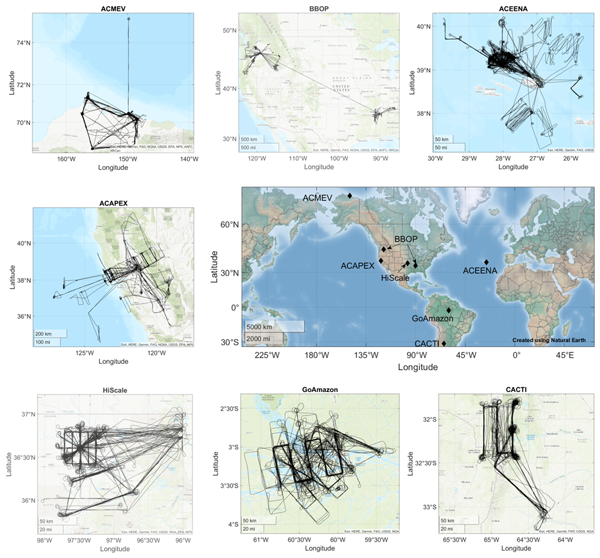
Our study explores a comprehensive dataset from airborne field studies (2013–2018) conducted using the US Department of Energy's Gulfstream 1 (G-1). The 236 flights span diverse regions, including the Arctic, US Southern Great Plains, US West Coast, eastern North Atlantic, Amazon Basin in Brazil, and Sierras de Córdoba range in Argentina. This dataset provides unique insights into atmospheric dynamics, aerosols, and clouds and makes data available in a more accessible format.
Joshua P. French, Piotr S. Kokoszka, and Seth McGinnis
Adv. Stat. Clim. Meteorol. Oceanogr., 10, 123–141, https://doi.org/10.5194/ascmo-10-123-2024, https://doi.org/10.5194/ascmo-10-123-2024, 2024
Short summary
Short summary
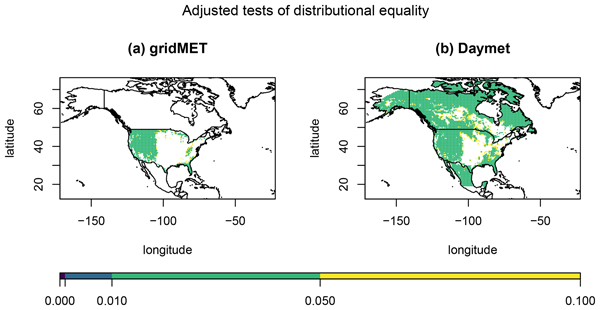
Future climate behavior is typically modeled using computer-based simulations, which are generated for both historical and future time periods. The trustworthiness of these models can be assessed by determining whether the simulated historical climate matches what was observed. We provide a tool that allows researchers to identify major differences between observed climate and climate model predictions, which will hopefully lead to further model refinements.
Colin M. Zarzycki, Benjamin D. Ascher, Alan M. Rhoades, and Rachel R. McCrary
Nat. Hazards Earth Syst. Sci., 24, 3315–3335, https://doi.org/10.5194/nhess-24-3315-2024, https://doi.org/10.5194/nhess-24-3315-2024, 2024
Short summary
Short summary
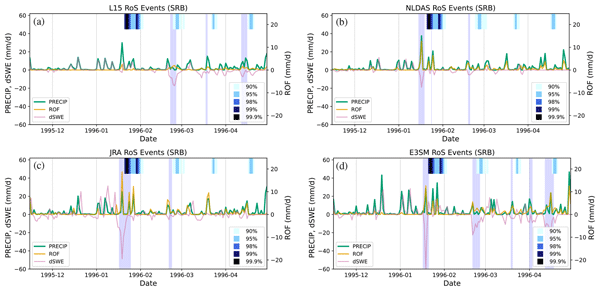
We developed an automated workflow to detect rain-on-snow events, which cause flooding in the northeastern United States, in climate data. Analyzing the Susquehanna River basin, this technique identified known events affecting river flow. Comparing four gridded datasets revealed variations in event frequency and severity, driven by different snowmelt and runoff estimates. This highlights the need for accurate climate data in flood management and risk prediction for these compound extremes.
Johannes Mülmenstädt, Edward Gryspeerdt, Sudhakar Dipu, Johannes Quaas, Andrew S. Ackerman, Ann M. Fridlind, Florian Tornow, Susanne E. Bauer, Andrew Gettelman, Yi Ming, Youtong Zheng, Po-Lun Ma, Hailong Wang, Kai Zhang, Matthew W. Christensen, Adam C. Varble, L. Ruby Leung, Xiaohong Liu, David Neubauer, Daniel G. Partridge, Philip Stier, and Toshihiko Takemura
Atmos. Chem. Phys., 24, 7331–7345, https://doi.org/10.5194/acp-24-7331-2024, https://doi.org/10.5194/acp-24-7331-2024, 2024
Short summary
Short summary
Human activities release copious amounts of small particles called aerosols into the atmosphere. These particles change how much sunlight clouds reflect to space, an important human perturbation of the climate, whose magnitude is highly uncertain. We found that the latest climate models show a negative correlation but a positive causal relationship between aerosols and cloud water. This means we need to be very careful when we interpret observational studies that can only see correlation.
Tapio Schneider, L. Ruby Leung, and Robert C. J. Wills
Atmos. Chem. Phys., 24, 7041–7062, https://doi.org/10.5194/acp-24-7041-2024, https://doi.org/10.5194/acp-24-7041-2024, 2024
Short summary
Short summary
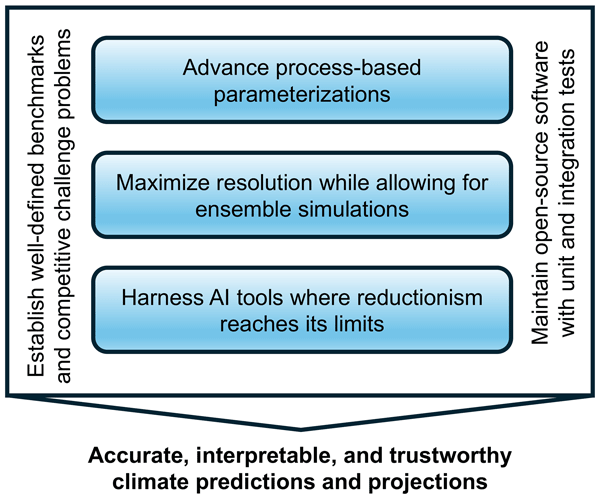
Climate models are crucial for predicting climate change in detail. This paper proposes a balanced approach to improving their accuracy by combining traditional process-based methods with modern artificial intelligence (AI) techniques while maximizing the resolution to allow for ensemble simulations. The authors propose using AI to learn from both observational and simulated data while incorporating existing physical knowledge to reduce data demands and improve climate prediction reliability.
Lingcheng Li, Gautam Bisht, Dalei Hao, and L. Ruby Leung
Earth Syst. Sci. Data, 16, 2007–2032, https://doi.org/10.5194/essd-16-2007-2024, https://doi.org/10.5194/essd-16-2007-2024, 2024
Short summary
Short summary
This study fills a gap to meet the emerging needs of kilometer-scale Earth system modeling by developing global 1 km land surface parameters for land use, vegetation, soil, and topography. Our demonstration simulations highlight the substantial impacts of these parameters on spatial variability and information loss in water and energy simulations. Using advanced explainable machine learning methods, we identified influential factors driving spatial variability and information loss.
Bryce E. Harrop, Jian Lu, L. Ruby Leung, William K. M. Lau, Kyu-Myong Kim, Brian Medeiros, Brian J. Soden, Gabriel A. Vecchi, Bosong Zhang, and Balwinder Singh
Geosci. Model Dev., 17, 3111–3135, https://doi.org/10.5194/gmd-17-3111-2024, https://doi.org/10.5194/gmd-17-3111-2024, 2024
Short summary
Short summary
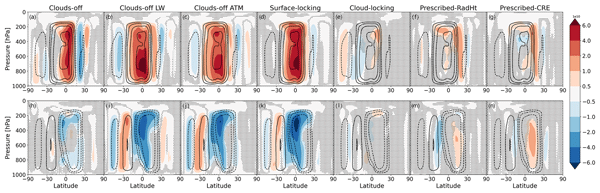
Seven new experimental setups designed to interfere with cloud radiative heating have been added to the Energy Exascale Earth System Model (E3SM). These experiments include both those that test the mean impact of cloud radiative heating and those examining its covariance with circulations. This paper documents the code changes and steps needed to run these experiments. Results corroborate prior findings for how cloud radiative heating impacts circulations and rainfall patterns.
Pengfei Shi, L. Ruby Leung, Bin Wang, Kai Zhang, Samson M. Hagos, and Shixuan Zhang
Geosci. Model Dev., 17, 3025–3040, https://doi.org/10.5194/gmd-17-3025-2024, https://doi.org/10.5194/gmd-17-3025-2024, 2024
Short summary
Short summary
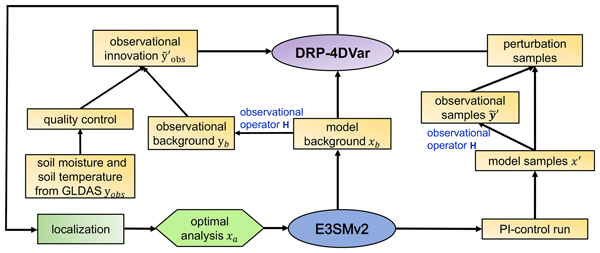
Improving climate predictions have profound socio-economic impacts. This study introduces a new weakly coupled land data assimilation (WCLDA) system for a coupled climate model. We demonstrate improved simulation of soil moisture and temperature in many global regions and throughout the soil layers. Furthermore, significant improvements are also found in reproducing the time evolution of the 2012 US Midwest drought. The WCLDA system provides the groundwork for future predictability studies.
Yawen Liu, Yun Qian, Philip J. Rasch, Kai Zhang, Lai-yung Ruby Leung, Yuhang Wang, Minghuai Wang, Hailong Wang, Xin Huang, and Xiu-Qun Yang
Atmos. Chem. Phys., 24, 3115–3128, https://doi.org/10.5194/acp-24-3115-2024, https://doi.org/10.5194/acp-24-3115-2024, 2024
Short summary
Short summary
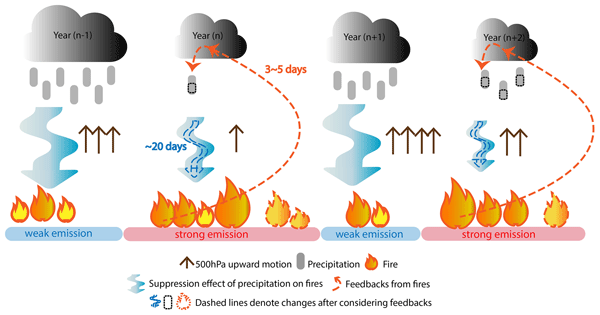
Fire management has long been a challenge. Here we report that spring-peak fire activity over southern Mexico and Central America (SMCA) has a distinct quasi-biennial signal by measuring multiple fire metrics. This signal is initially driven by quasi-biennial variability in precipitation and is further amplified by positive feedback of fire–precipitation interaction at short timescales. This work highlights the importance of fire–climate interactions in shaping fires on an interannual scale.
Donghui Xu, Gautam Bisht, Zeli Tan, Chang Liao, Tian Zhou, Hong-Yi Li, and L. Ruby Leung
Geosci. Model Dev., 17, 1197–1215, https://doi.org/10.5194/gmd-17-1197-2024, https://doi.org/10.5194/gmd-17-1197-2024, 2024
Short summary
Short summary
We aim to disentangle the hydrological and hydraulic controls on streamflow variability in a fully coupled earth system model. We found that calibrating only one process (i.e., traditional calibration procedure) will result in unrealistic parameter values and poor performance of the water cycle, while the simulated streamflow is improved. To address this issue, we further proposed a two-step calibration procedure to reconcile the impacts from hydrological and hydraulic processes on streamflow.
Calvin Howes, Pablo E. Saide, Hugh Coe, Amie Dobracki, Steffen Freitag, Jim M. Haywood, Steven G. Howell, Siddhant Gupta, Janek Uin, Mary Kacarab, Chongai Kuang, L. Ruby Leung, Athanasios Nenes, Greg M. McFarquhar, James Podolske, Jens Redemann, Arthur J. Sedlacek, Kenneth L. Thornhill, Jenny P. S. Wong, Robert Wood, Huihui Wu, Yang Zhang, Jianhao Zhang, and Paquita Zuidema
Atmos. Chem. Phys., 23, 13911–13940, https://doi.org/10.5194/acp-23-13911-2023, https://doi.org/10.5194/acp-23-13911-2023, 2023
Short summary
Short summary
To better understand smoke properties and its interactions with clouds, we compare the WRF-CAM5 model with observations from ORACLES, CLARIFY, and LASIC field campaigns in the southeastern Atlantic in August 2017. The model transports and mixes smoke well but does not fully capture some important processes. These include smoke chemical and physical aging over 4–12 days, smoke removal by rain, sulfate particle formation, aerosol activation into cloud droplets, and boundary layer turbulence.
Dongyu Feng, Zeli Tan, Donghui Xu, and L. Ruby Leung
Hydrol. Earth Syst. Sci., 27, 3911–3934, https://doi.org/10.5194/hess-27-3911-2023, https://doi.org/10.5194/hess-27-3911-2023, 2023
Short summary
Short summary
This study assesses the flood risks concurrently induced by river flooding and coastal storm surge along the coast of the contiguous United States using statistical and numerical models. We reveal a few hotspots of such risks, the critical spatial variabilities within a river basin and over the whole US coast, and the uncertainties of the risk assessment. We highlight the importance of weighing different risk measures to avoid underestimating or exaggerating the compound flood impacts.
Lingcheng Li, Yilin Fang, Zhonghua Zheng, Mingjie Shi, Marcos Longo, Charles D. Koven, Jennifer A. Holm, Rosie A. Fisher, Nate G. McDowell, Jeffrey Chambers, and L. Ruby Leung
Geosci. Model Dev., 16, 4017–4040, https://doi.org/10.5194/gmd-16-4017-2023, https://doi.org/10.5194/gmd-16-4017-2023, 2023
Short summary
Short summary
Accurately modeling plant coexistence in vegetation demographic models like ELM-FATES is challenging. This study proposes a repeatable method that uses machine-learning-based surrogate models to optimize plant trait parameters in ELM-FATES. Our approach significantly improves plant coexistence modeling, thus reducing errors. It has important implications for modeling ecosystem dynamics in response to climate change.
Qi Tang, Jean-Christophe Golaz, Luke P. Van Roekel, Mark A. Taylor, Wuyin Lin, Benjamin R. Hillman, Paul A. Ullrich, Andrew M. Bradley, Oksana Guba, Jonathan D. Wolfe, Tian Zhou, Kai Zhang, Xue Zheng, Yunyan Zhang, Meng Zhang, Mingxuan Wu, Hailong Wang, Cheng Tao, Balwinder Singh, Alan M. Rhoades, Yi Qin, Hong-Yi Li, Yan Feng, Yuying Zhang, Chengzhu Zhang, Charles S. Zender, Shaocheng Xie, Erika L. Roesler, Andrew F. Roberts, Azamat Mametjanov, Mathew E. Maltrud, Noel D. Keen, Robert L. Jacob, Christiane Jablonowski, Owen K. Hughes, Ryan M. Forsyth, Alan V. Di Vittorio, Peter M. Caldwell, Gautam Bisht, Renata B. McCoy, L. Ruby Leung, and David C. Bader
Geosci. Model Dev., 16, 3953–3995, https://doi.org/10.5194/gmd-16-3953-2023, https://doi.org/10.5194/gmd-16-3953-2023, 2023
Short summary
Short summary
High-resolution simulations are superior to low-resolution ones in capturing regional climate changes and climate extremes. However, uniformly reducing the grid size of a global Earth system model is too computationally expensive. We provide an overview of the fully coupled regionally refined model (RRM) of E3SMv2 and document a first-of-its-kind set of climate production simulations using RRM at an economic cost. The key to this success is our innovative hybrid time step method.
Koichi Sakaguchi, L. Ruby Leung, Colin M. Zarzycki, Jihyeon Jang, Seth McGinnis, Bryce E. Harrop, William C. Skamarock, Andrew Gettelman, Chun Zhao, William J. Gutowski, Stephen Leak, and Linda Mearns
Geosci. Model Dev., 16, 3029–3081, https://doi.org/10.5194/gmd-16-3029-2023, https://doi.org/10.5194/gmd-16-3029-2023, 2023
Short summary
Short summary
We document details of the regional climate downscaling dataset produced by a global variable-resolution model. The experiment is unique in that it follows a standard protocol designed for coordinated experiments of regional models. We found negligible influence of post-processing on statistical analysis, importance of simulation quality outside of the target region, and computational challenges that our model code faced due to rapidly changing super computer systems.
Zhe Feng, Joseph Hardin, Hannah C. Barnes, Jianfeng Li, L. Ruby Leung, Adam Varble, and Zhixiao Zhang
Geosci. Model Dev., 16, 2753–2776, https://doi.org/10.5194/gmd-16-2753-2023, https://doi.org/10.5194/gmd-16-2753-2023, 2023
Short summary
Short summary
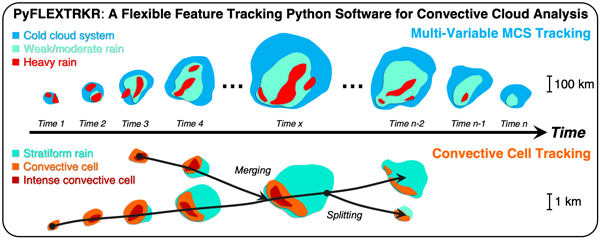
PyFLEXTRKR is a flexible atmospheric feature tracking framework with specific capabilities to track convective clouds from a variety of observations and model simulations. The package has a collection of multi-object identification algorithms and has been optimized for large datasets. This paper describes the algorithms and demonstrates applications for tracking deep convective cells and mesoscale convective systems from observations and model simulations at a wide range of scales.
Zeyu Xue, Paul Ullrich, and Lai-Yung Ruby Leung
Hydrol. Earth Syst. Sci., 27, 1909–1927, https://doi.org/10.5194/hess-27-1909-2023, https://doi.org/10.5194/hess-27-1909-2023, 2023
Short summary
Short summary
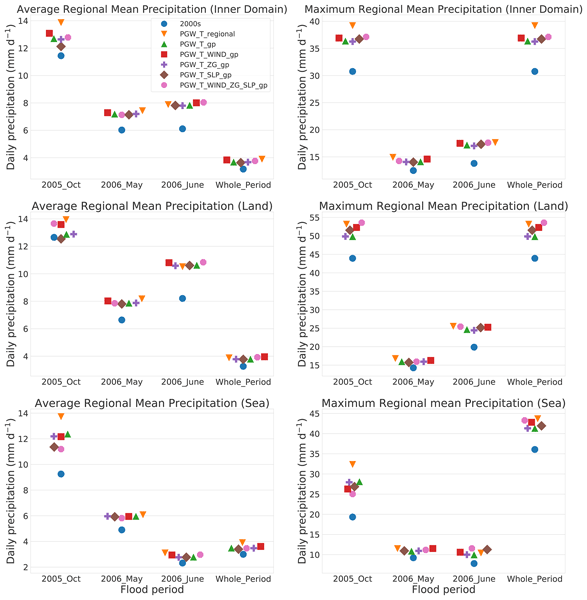
We examine the sensitivity and robustness of conclusions drawn from the PGW method over the NEUS by conducting multiple PGW experiments and varying the perturbation spatial scales and choice of perturbed meteorological variables to provide a guideline for this increasingly popular regional modeling method. Overall, we recommend PGW experiments be performed with perturbations to temperature or the combination of temperature and wind at the gridpoint scale, depending on the research question.
Dalei Hao, Gautam Bisht, Karl Rittger, Timbo Stillinger, Edward Bair, Yu Gu, and L. Ruby Leung
The Cryosphere, 17, 673–697, https://doi.org/10.5194/tc-17-673-2023, https://doi.org/10.5194/tc-17-673-2023, 2023
Short summary
Short summary
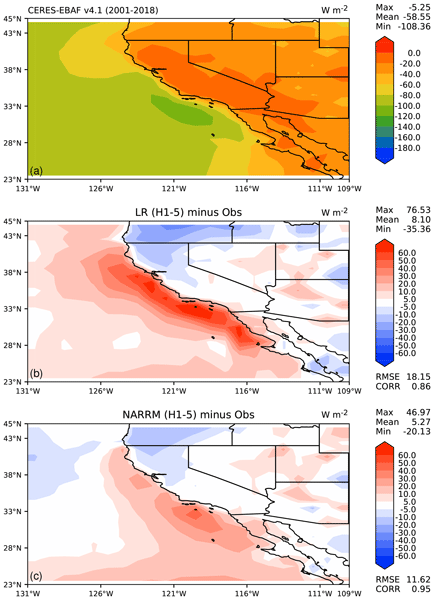
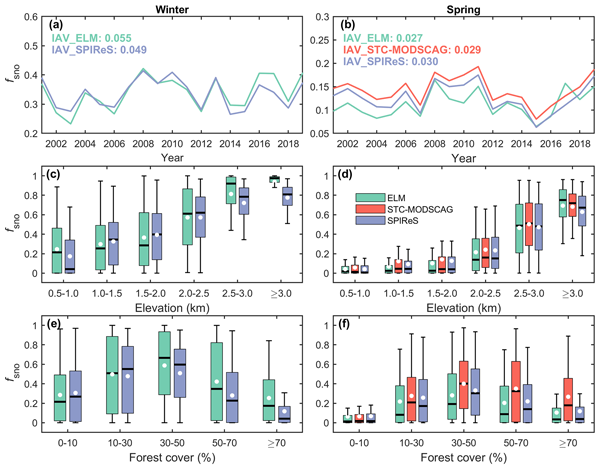
We comprehensively evaluated the snow simulations in E3SM land model over the western United States in terms of spatial patterns, temporal correlations, interannual variabilities, elevation gradients, and change with forest cover of snow properties and snow phenology. Our study underscores the need for diagnosing model biases and improving the model representations of snow properties and snow phenology in mountainous areas for more credible simulation and future projection of mountain snowpack.
Chandan Sarangi, Yun Qian, L. Ruby Leung, Yang Zhang, Yufei Zou, and Yuhang Wang
Atmos. Chem. Phys., 23, 1769–1783, https://doi.org/10.5194/acp-23-1769-2023, https://doi.org/10.5194/acp-23-1769-2023, 2023
Short summary
Short summary
We show that for air quality, the densely populated eastern US may see even larger impacts of wildfires due to long-distance smoke transport and associated positive climatic impacts, partially compensating the improvements from regulations on anthropogenic emissions. This study highlights the tension between natural and anthropogenic contributions and the non-local nature of air pollution that complicate regulatory strategies for improving future regional air quality for human health.
Jin Feng, Yanjie Li, Yulu Qiu, and Fuxin Zhu
Atmos. Chem. Phys., 23, 375–388, https://doi.org/10.5194/acp-23-375-2023, https://doi.org/10.5194/acp-23-375-2023, 2023
Short summary
Short summary
It is important to use weather data to estimate aerosol concentrations. Here, a weather index for aerosol concentration based on deep learning was developed, linking weather and short-term variations in aerosol concentrations over China. The index provides better performance than chemical transport model simulation and other data-based estimation approaches. It can be used as a robust tool for estimating daily variations in aerosol concentrations.
Dalei Hao, Gautam Bisht, Karl Rittger, Edward Bair, Cenlin He, Huilin Huang, Cheng Dang, Timbo Stillinger, Yu Gu, Hailong Wang, Yun Qian, and L. Ruby Leung
Geosci. Model Dev., 16, 75–94, https://doi.org/10.5194/gmd-16-75-2023, https://doi.org/10.5194/gmd-16-75-2023, 2023
Short summary
Short summary
Snow with the highest albedo of land surface plays a vital role in Earth’s surface energy budget and water cycle. This study accounts for the impacts of snow grain shape and mixing state of light-absorbing particles with snow on snow albedo in the E3SM land model. The findings advance our understanding of the role of snow grain shape and mixing state of LAP–snow in land surface processes and offer guidance for improving snow simulations and radiative forcing estimates in Earth system models.
Dongyu Feng, Zeli Tan, Darren Engwirda, Chang Liao, Donghui Xu, Gautam Bisht, Tian Zhou, Hong-Yi Li, and L. Ruby Leung
Hydrol. Earth Syst. Sci., 26, 5473–5491, https://doi.org/10.5194/hess-26-5473-2022, https://doi.org/10.5194/hess-26-5473-2022, 2022
Short summary
Short summary
Sea level rise, storm surge and river discharge can cause coastal backwater effects in downstream sections of rivers, creating critical flood risks. This study simulates the backwater effects using a large-scale river model on a coastal-refined computational mesh. By decomposing the backwater drivers, we revealed their relative importance and long-term variations. Our analysis highlights the increasing strength of backwater effects due to sea level rise and more frequent storm surge.
Yilin Fang, L. Ruby Leung, Charles D. Koven, Gautam Bisht, Matteo Detto, Yanyan Cheng, Nate McDowell, Helene Muller-Landau, S. Joseph Wright, and Jeffrey Q. Chambers
Geosci. Model Dev., 15, 7879–7901, https://doi.org/10.5194/gmd-15-7879-2022, https://doi.org/10.5194/gmd-15-7879-2022, 2022
Short summary
Short summary
We develop a model that integrates an Earth system model with a three-dimensional hydrology model to explicitly resolve hillslope topography and water flow underneath the land surface to understand how local-scale hydrologic processes modulate vegetation along water availability gradients. Our coupled model can be used to improve the understanding of the diverse impact of local heterogeneity and water flux on nutrient availability and plant communities.
Yilin Fang, L. Ruby Leung, Ryan Knox, Charlie Koven, and Ben Bond-Lamberty
Geosci. Model Dev., 15, 6385–6398, https://doi.org/10.5194/gmd-15-6385-2022, https://doi.org/10.5194/gmd-15-6385-2022, 2022
Short summary
Short summary
Accounting for water movement in the soil and water transport within the plant is important for plant growth in Earth system modeling. We implemented different numerical approaches for a plant hydrodynamic model and compared their impacts on the simulated aboveground biomass (AGB) at single points and globally. We found care should be taken when discretizing the number of soil layers for numerical simulations as it can significantly affect AGB if accuracy and computational costs are of concern.
Meng Huang, Po-Lun Ma, Nathaniel W. Chaney, Dalei Hao, Gautam Bisht, Megan D. Fowler, Vincent E. Larson, and L. Ruby Leung
Geosci. Model Dev., 15, 6371–6384, https://doi.org/10.5194/gmd-15-6371-2022, https://doi.org/10.5194/gmd-15-6371-2022, 2022
Short summary
Short summary
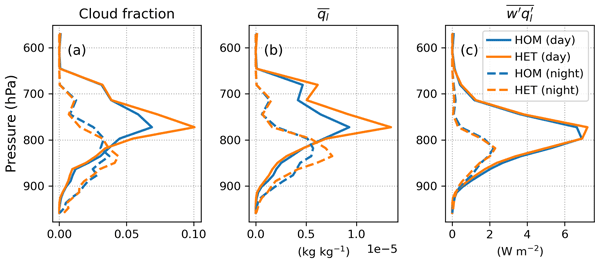
The land surface in one grid cell may be diverse in character. This study uses an explicit way to account for that subgrid diversity in a state-of-the-art Earth system model (ESM) and explores its implications for the overlying atmosphere. We find that the shallow clouds are increased significantly with the land surface diversity. Our work highlights the importance of accurately representing the land surface and its interaction with the atmosphere in next-generation ESMs.
Sol Kim, L. Ruby Leung, Bin Guan, and John C. H. Chiang
Geosci. Model Dev., 15, 5461–5480, https://doi.org/10.5194/gmd-15-5461-2022, https://doi.org/10.5194/gmd-15-5461-2022, 2022
Short summary
Short summary
The Energy Exascale Earth System Model (E3SM) project is a state-of-the-science Earth system model developed by the US Department of Energy (DOE). Understanding how the water cycle behaves in this model is of particular importance to the DOE’s mission. Atmospheric rivers (ARs) – which are crucial to the global water cycle – move vast amounts of water vapor through the sky and produce rain and snow. We find that this model reliably represents atmospheric rivers around the world.
Lingcheng Li, Gautam Bisht, and L. Ruby Leung
Geosci. Model Dev., 15, 5489–5510, https://doi.org/10.5194/gmd-15-5489-2022, https://doi.org/10.5194/gmd-15-5489-2022, 2022
Short summary
Short summary
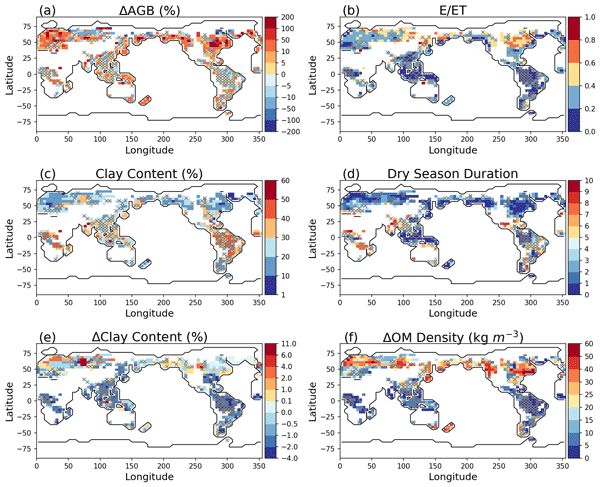
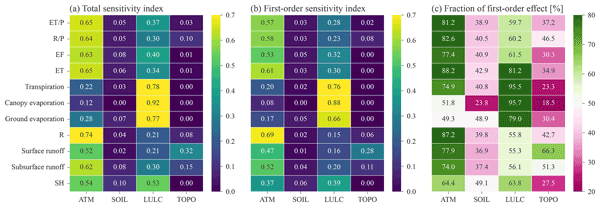
Land surface heterogeneity plays a critical role in the terrestrial water, energy, and biogeochemical cycles. Our study systematically quantified the effects of four dominant heterogeneity sources on water and energy partitioning via Sobol' indices. We found that atmospheric forcing and land use land cover are the most dominant heterogeneity sources in determining spatial variability of water and energy partitioning. Our findings can help prioritize the future development of land surface models.
Kai Zhang, Wentao Zhang, Hui Wan, Philip J. Rasch, Steven J. Ghan, Richard C. Easter, Xiangjun Shi, Yong Wang, Hailong Wang, Po-Lun Ma, Shixuan Zhang, Jian Sun, Susannah M. Burrows, Manish Shrivastava, Balwinder Singh, Yun Qian, Xiaohong Liu, Jean-Christophe Golaz, Qi Tang, Xue Zheng, Shaocheng Xie, Wuyin Lin, Yan Feng, Minghuai Wang, Jin-Ho Yoon, and L. Ruby Leung
Atmos. Chem. Phys., 22, 9129–9160, https://doi.org/10.5194/acp-22-9129-2022, https://doi.org/10.5194/acp-22-9129-2022, 2022
Short summary
Short summary
Here we analyze the effective aerosol forcing simulated by E3SM version 1 using both century-long free-running and short nudged simulations. The aerosol forcing in E3SMv1 is relatively large compared to other models, mainly due to the large indirect aerosol effect. Aerosol-induced changes in liquid and ice cloud properties in E3SMv1 have a strong correlation. The aerosol forcing estimates in E3SMv1 are sensitive to the parameterization changes in both liquid and ice cloud processes.
Donghui Xu, Gautam Bisht, Khachik Sargsyan, Chang Liao, and L. Ruby Leung
Geosci. Model Dev., 15, 5021–5043, https://doi.org/10.5194/gmd-15-5021-2022, https://doi.org/10.5194/gmd-15-5021-2022, 2022
Short summary
Short summary
The runoff outputs in Earth system model simulations involve high uncertainty, which needs to be constrained by parameter calibration. In this work, we used a surrogate-assisted Bayesian framework to efficiently calibrate the runoff-generation processes in the Energy Exascale Earth System Model v1 at a global scale. The model performance was improved compared to the default parameter after calibration, and the associated parametric uncertainty was significantly constrained.
Yun Lin, Jiwen Fan, Pengfei Li, Lai-yung Ruby Leung, Paul J. DeMott, Lexie Goldberger, Jennifer Comstock, Ying Liu, Jong-Hoon Jeong, and Jason Tomlinson
Atmos. Chem. Phys., 22, 6749–6771, https://doi.org/10.5194/acp-22-6749-2022, https://doi.org/10.5194/acp-22-6749-2022, 2022
Short summary
Short summary
How sea spray aerosols may affect cloud and precipitation over the region by acting as ice-nucleating particles (INPs) is unknown. We explored the effects of INPs from marine aerosols on orographic cloud and precipitation for an atmospheric river event observed during the 2015 ACAPEX field campaign. The marine INPs enhance the formation of ice and snow, leading to less shallow warm clouds but more mixed-phase and deep clouds. This work suggests models need to consider the impacts of marine INPs.
Olivier Asselin, Martin Leduc, Dominique Paquin, Katja Winger, Alejandro Di Luca, Melissa Bukovsky, Biljana Music, and Michel Giguère
EGUsphere, https://doi.org/10.5194/egusphere-2022-291, https://doi.org/10.5194/egusphere-2022-291, 2022
Preprint archived
Short summary
Short summary
Planting trees cools the climate by removing CO2 from the atmosphere, but may also cool or warm the climate by altering the albedo, roughness and evapotranspiration efficiency of the surface. To quantify these biogeophysical effects, we ran regional climate models over two idealized worlds, FOREST and GRASS, respectively representing maximum and minimum tree cover over North America and Europe. We find that these effects must be taken into account to successfully mitigate climate change.
Pinya Wang, Yang Yang, Huimin Li, Lei Chen, Ruijun Dang, Daokai Xue, Baojie Li, Jianping Tang, L. Ruby Leung, and Hong Liao
Atmos. Chem. Phys., 22, 4705–4719, https://doi.org/10.5194/acp-22-4705-2022, https://doi.org/10.5194/acp-22-4705-2022, 2022
Short summary
Short summary
China is now suffering from both severe ozone (O3) pollution and heat events. We highlight that North China Plain is the hot spot of the co-occurrences of extremes in O3 and high temperatures in China. Such coupled extremes exhibit an increasing trend during 2014–2019 and will continue to increase until the middle of this century. And the coupled extremes impose more severe health impacts to human than O3 pollution occurring alone because of elevated O3 levels and temperatures.
Po-Lun Ma, Bryce E. Harrop, Vincent E. Larson, Richard B. Neale, Andrew Gettelman, Hugh Morrison, Hailong Wang, Kai Zhang, Stephen A. Klein, Mark D. Zelinka, Yuying Zhang, Yun Qian, Jin-Ho Yoon, Christopher R. Jones, Meng Huang, Sheng-Lun Tai, Balwinder Singh, Peter A. Bogenschutz, Xue Zheng, Wuyin Lin, Johannes Quaas, Hélène Chepfer, Michael A. Brunke, Xubin Zeng, Johannes Mülmenstädt, Samson Hagos, Zhibo Zhang, Hua Song, Xiaohong Liu, Michael S. Pritchard, Hui Wan, Jingyu Wang, Qi Tang, Peter M. Caldwell, Jiwen Fan, Larry K. Berg, Jerome D. Fast, Mark A. Taylor, Jean-Christophe Golaz, Shaocheng Xie, Philip J. Rasch, and L. Ruby Leung
Geosci. Model Dev., 15, 2881–2916, https://doi.org/10.5194/gmd-15-2881-2022, https://doi.org/10.5194/gmd-15-2881-2022, 2022
Short summary
Short summary
An alternative set of parameters for E3SM Atmospheric Model version 1 has been developed based on a tuning strategy that focuses on clouds. When clouds in every regime are improved, other aspects of the model are also improved, even though they are not the direct targets for calibration. The recalibrated model shows a lower sensitivity to anthropogenic aerosols and surface warming, suggesting potential improvements to the simulated climate in the past and future.
Sally S.-C. Wang, Yun Qian, L. Ruby Leung, and Yang Zhang
Atmos. Chem. Phys., 22, 3445–3468, https://doi.org/10.5194/acp-22-3445-2022, https://doi.org/10.5194/acp-22-3445-2022, 2022
Short summary
Short summary
This study develops an interpretable machine learning (ML) model predicting monthly PM2.5 fire emission over the contiguous US at 0.25° resolution and compares the prediction skills of the ML and process-based models. The comparison facilitates attributions of model biases and better understanding of the strengths and uncertainties in the two types of models at regional scales, for informing future model development and their applications in fire emission projection.
Guta Wakbulcho Abeshu, Hong-Yi Li, Zhenduo Zhu, Zeli Tan, and L. Ruby Leung
Earth Syst. Sci. Data, 14, 929–942, https://doi.org/10.5194/essd-14-929-2022, https://doi.org/10.5194/essd-14-929-2022, 2022
Short summary
Short summary
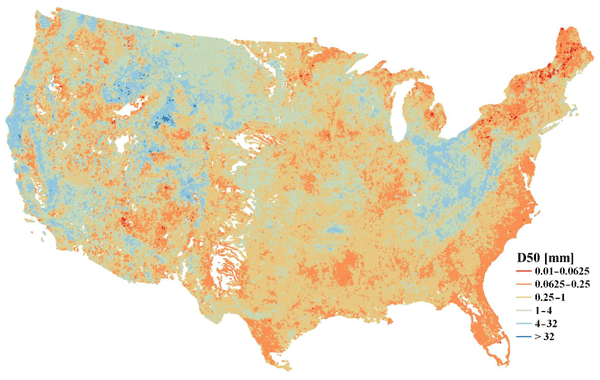
Existing riverbed sediment particle size data are sparsely available at individual sites. We develop a continuous map of median riverbed sediment particle size over the contiguous US corresponding to millions of river segments based on the existing observations and machine learning methods. This map is useful for research in large-scale river sediment using model- and data-driven approaches, teaching environmental and earth system sciences, planning and managing floodplain zones, etc.
Hong-Yi Li, Zeli Tan, Hongbo Ma, Zhenduo Zhu, Guta Wakbulcho Abeshu, Senlin Zhu, Sagy Cohen, Tian Zhou, Donghui Xu, and L. Ruby Leung
Hydrol. Earth Syst. Sci., 26, 665–688, https://doi.org/10.5194/hess-26-665-2022, https://doi.org/10.5194/hess-26-665-2022, 2022
Short summary
Short summary
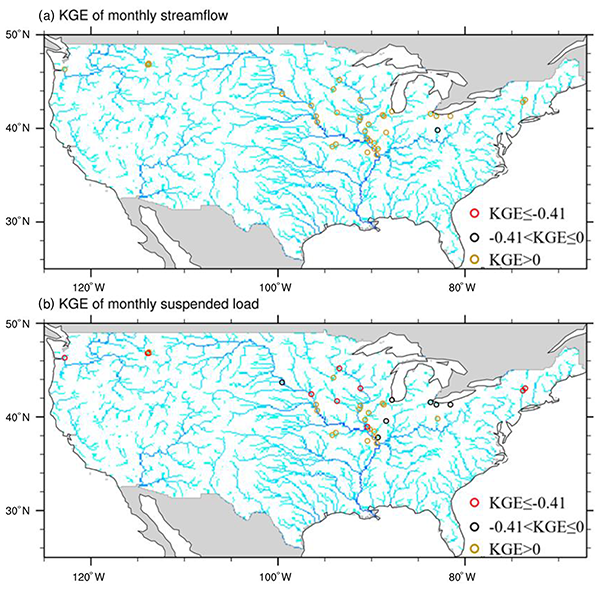
We introduce a new multi-process river sediment module for Earth system models. Application and validation over the contiguous US indicate a satisfactory model performance over large river systems, including those heavily regulated by reservoirs. This new sediment module enables future modeling of the transportation and transformation of carbon and nutrients carried by the fine sediment along the river–ocean continuum to close the global carbon and nutrient cycles.
Claudia Tebaldi, Kalyn Dorheim, Michael Wehner, and Ruby Leung
Earth Syst. Dynam., 12, 1427–1501, https://doi.org/10.5194/esd-12-1427-2021, https://doi.org/10.5194/esd-12-1427-2021, 2021
Short summary
Short summary
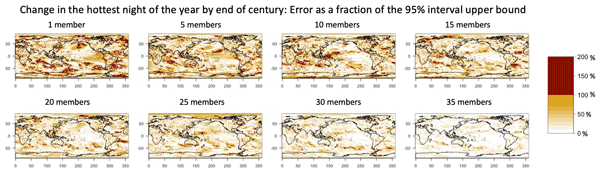
We address the question of how large an initial condition ensemble of climate model simulations should be if we are concerned with accurately projecting future changes in temperature and precipitation extremes. We find that for most cases (and both models considered), an ensemble of 20–25 members is sufficient for many extreme metrics, spatial scales and time horizons. This may leave computational resources to tackle other uncertainties in climate model simulations with our ensembles.
Dalei Hao, Gautam Bisht, Yu Gu, Wei-Liang Lee, Kuo-Nan Liou, and L. Ruby Leung
Geosci. Model Dev., 14, 6273–6289, https://doi.org/10.5194/gmd-14-6273-2021, https://doi.org/10.5194/gmd-14-6273-2021, 2021
Short summary
Short summary
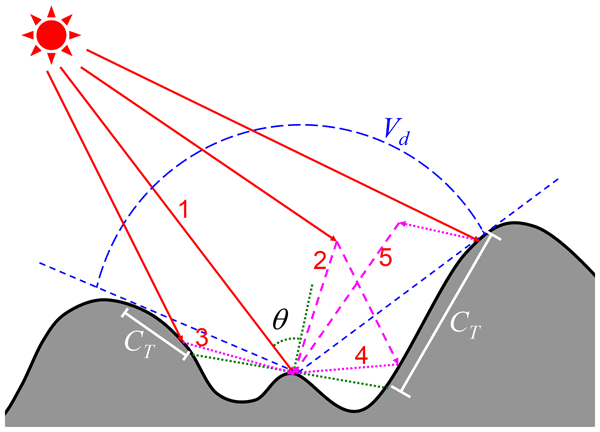
Topography exerts significant influence on the incoming solar radiation at the land surface. This study incorporated a well-validated sub-grid topographic parameterization in E3SM land model (ELM) version 1.0. The results demonstrate that sub-grid topography has non-negligible effects on surface energy budget, snow cover, and surface temperature over the Tibetan Plateau and that the ELM simulations are sensitive to season, elevation, and spatial scale.
Yongkang Xue, Tandong Yao, Aaron A. Boone, Ismaila Diallo, Ye Liu, Xubin Zeng, William K. M. Lau, Shiori Sugimoto, Qi Tang, Xiaoduo Pan, Peter J. van Oevelen, Daniel Klocke, Myung-Seo Koo, Tomonori Sato, Zhaohui Lin, Yuhei Takaya, Constantin Ardilouze, Stefano Materia, Subodh K. Saha, Retish Senan, Tetsu Nakamura, Hailan Wang, Jing Yang, Hongliang Zhang, Mei Zhao, Xin-Zhong Liang, J. David Neelin, Frederic Vitart, Xin Li, Ping Zhao, Chunxiang Shi, Weidong Guo, Jianping Tang, Miao Yu, Yun Qian, Samuel S. P. Shen, Yang Zhang, Kun Yang, Ruby Leung, Yuan Qiu, Daniele Peano, Xin Qi, Yanling Zhan, Michael A. Brunke, Sin Chan Chou, Michael Ek, Tianyi Fan, Hong Guan, Hai Lin, Shunlin Liang, Helin Wei, Shaocheng Xie, Haoran Xu, Weiping Li, Xueli Shi, Paulo Nobre, Yan Pan, Yi Qin, Jeff Dozier, Craig R. Ferguson, Gianpaolo Balsamo, Qing Bao, Jinming Feng, Jinkyu Hong, Songyou Hong, Huilin Huang, Duoying Ji, Zhenming Ji, Shichang Kang, Yanluan Lin, Weiguang Liu, Ryan Muncaster, Patricia de Rosnay, Hiroshi G. Takahashi, Guiling Wang, Shuyu Wang, Weicai Wang, Xu Zhou, and Yuejian Zhu
Geosci. Model Dev., 14, 4465–4494, https://doi.org/10.5194/gmd-14-4465-2021, https://doi.org/10.5194/gmd-14-4465-2021, 2021
Short summary
Short summary
The subseasonal prediction of extreme hydroclimate events such as droughts/floods has remained stubbornly low for years. This paper presents a new international initiative which, for the first time, introduces spring land surface temperature anomalies over high mountains to improve precipitation prediction through remote effects of land–atmosphere interactions. More than 40 institutions worldwide are participating in this effort. The experimental protocol and preliminary results are presented.
Cited articles
Abatzoglou, J. T. and Magnusdottir, G.: Planetary Wave Breaking and Nonlinear Reflection: Seasonal Cycle and Interannual Variability, J. Climate, 19, 6139–6152, https://doi.org/10.1175/JCLI3968.1, 2006. a
Alexandru, A., de Elia, R., Laprise, R., Separovic, L., and Biner, S.: Sensitivity Study of Regional Climate Model Simulations to Large-Scale Nudging Parameters, Mon. Weather Rev., 137, 1666–1686, https://doi.org/10.1175/2008MWR2620.1, 2009. a
Ambrizzi, T., Hoskins, B. J., and Hsu, H.-H.: Rossby Wave Propagation and Teleconnection Patterns in the Austral Winter, J. Atmos. Sci., 52, 3661–3672, https://doi.org/10.1175/1520-0469(1995)052<3661:RWPATP>2.0.CO;2, 1995. a, b
Bacmeister, J. T., Wehner, M. F., Neale, R. B., Gettelman, A., Hannay, C., Lauritzen, P. H., Caron, J. M., and Truesdale, J. E.: Exploratory High-Resolution Climate Simulations using the Community Atmosphere Model (CAM), J. Climate, 27, 3073–3099, https://doi.org/10.1175/JCLI-D-13-00387.1, 2014. a
Balaji, V., Boville, B., Cheung, S., Collins, N., Cruz, C., Silva, A., Deluca, C., Fainchtein, R. D., Eaton, B., Hallberg, B., Henderson, T., Hill, C., Iredell, M., Jacob, R., Jones, P., Kluzek, E., Kauffman, B., Larson, J., Li, P., Liu, F., Michalakes, J., Murphy, S., Neckels, D., Kuinghttons, R. O., Oehmke, B., Panaccione, C., Rosinski, J., Sawyer, W., Schwab, E., Smithline, S., Spector, W., Stark, D., Suarez, M., Swift, S., Theurich, G., Trayanov, A., Vasquez, S., Wolfe, J., Yang, W., Young, M., and Zaslavsky, L.: Earth System Modeling Framework ESMF Reference Manual for Fortran Version 7.1.0r, Tech. rep., The Earth System Modeling Framework, 2018. a, b
Barriopedro, D., García-Herrera, R., Ordóñez, C., Miralles, D. G., and Salcedo-Sanz, S.: Heat Waves: Physical Understanding and Scientific Challenges, Rev. Geophys., 61, e2022RG000780, https://doi.org/10.1029/2022RG000780, 2023. a, b
Bell, G. D. and Janowiak, J. E.: Atmospheric Circulation Associated With the Midwest Floods of 1993, B. Am. Meteorol. Soc., 76, 681–696, 1995. a
Bogenschutz, P. A., Gettelman, A., Hannay, C., Larson, V. E., Neale, R. B., Craig, C., and Chen, C. C.: The path to CAM6: coupled simulations with CAM5.4 and CAM5.5, Geosci. Model Dev., 11, 235–255, https://doi.org/10.5194/gmd-11-235-2018, 2018. a
Branstator, G.: Long-Lived Response of the Midlatitude Circulation and Storm Tracks to Pulses of Tropical Heating, J. Climate, 27, 8809–8826, https://doi.org/10.1175/JCLI-D-14-00312.1, 2014. a
Branstator, G. and Teng, H.: Tropospheric Waveguide Teleconnections and Their Seasonality, J. Atmos. Sci., 74, 1513–1532, https://doi.org/10.1175/JAS-D-16-0305.1, 2017. a, b
Bukovsky, M. S. and Mearns, L. O.: Regional climate change projections from NA-CORDEX and their relation to climate sensitivity, Climatic Change, 162, 645–665, https://doi.org/10.1007/s10584-020-02835-x, 2020. a
Bukovsky, M. S., McCrary, R. R., Seth, A., and Mearns, L. O.: A mechanistically credible, poleward shift in warm-season precipitation projected for the U.S. Southern Great Plains?, J. Climate, 30, 8275–8298, https://doi.org/10.1175/JCLI-D-16-0316.1, 2017. a
Bumbaco, K. A., Dello, K. D., and Bond, N. A.: History of Pacific Northwest Heat Waves: Synoptic Pattern and Trends, J. Appl. Meteorol. Cli., 52, 1618–1631, https://doi.org/10.1175/JAMC-D-12-094.1, 2013. a, b
Castro, C. L., Pielke, R. A., and Leoncini, G.: Dynamical downscaling: Assessment of value retained and added using the Regional Atmopsheric Modeling System (RAMS), J. Geophys. Res.-Atmos., 110, 1–21, https://doi.org/10.1029/2004JD004721, 2005. a
Castro, C. L., Pielke, R. A., Adegoke, J. O., Schubert, S. D., and Pegion, P. J.: Investigation of the summer climate of the contiguous United States and Mexico using the Regional Atmospheric Modeling System (RAMS). Part II: Model climate variability, J. Climate, 20, 3866–3887, https://doi.org/10.1175/JCLI4212.1, 2007. a
Castro, C. L., Chang, H. I., Dominguez, F., Carrillo, C., Schemm, J. K., and Juang, H. M. H.: Can a regional climate model improve the ability to forecast the North American monsoon?, J. Climate, 25, 8212–8237, https://doi.org/10.1175/JCLI-D-11-00441.1, 2012. a, b, c
Chang, C.-C., Lubis, S. W., Balaguru, K., Leung, L. R., Hagos, S. M., and Klotzbach, P. J.: An Extratropical Pathway for the Madden–Julian Oscillation's Influence on North Atlantic Tropical Cyclones, J. Climate, 36, 8539–8559, https://doi.org/10.1175/JCLI-D-23-0251.1, 2023a. a, b, c
Chang, C.-C., Wang, Z., Ting, M., and Ming, Z.: Summertime Subtropical Stationary Waves in the Northern Hemisphere: Variability, Forcing Mechanisms, and Impacts on Tropical Cyclone Activity, J. Climate, 36, 753–773, https://doi.org/10.1175/JCLI-D-22-0233.1, 2023b. a
Chang, C.-C., Zhao, M., Lubis, S. W., Chen, Z., Balaguru, K., Hagos, S., Leung, L. R., and Zhou, W.: Are North Atlantic Tropical Cyclones Modulated by the Madden–Julian Oscillation in HighResMIP AGCMs?, J. Climate, 38, 2891–2916, https://doi.org/10.1175/JCLI-D-24-0509.1, 2025. a
Chang, H.-I., Castro, C. L., Carrillo, C. M., and Dominguez, F.: The more extreme nature of U.S. warm season climate in the recent observational record and two “well-performing” dynamically downscaled CMIP3 models, J. Geophys. Res.-Atmos., 120, 8244–8263, https://doi.org/10.1002/2015JD023333, 2015. a, b, c
Chen, T.-C. and Chen, J.-M.: On the Maintenance of Stationary Eddies in Terms of the Streamfunction Budget Analysis, J. Atmos. Sci., 47, 2818–2824, 1990. a
Chen, X., Leung, L. R., Wigmosta, M., and Richmond, M.: Impact of Atmospheric Rivers on Surface Hydrological Processes in Western U.S. Watersheds, J. Geophys. Res.-Atmos., 124, 8896–8916, https://doi.org/10.1029/2019JD030468, 2019. a
Chen, Z., Lu, J., Chang, C. C., Lubis, S. W., and Leung, L. R.: Projected increase in summer heat-dome-like stationary waves over Northwestern North America, npj Clim. Atmos. Sci., 6, 1–10, https://doi.org/10.1038/s41612-023-00511-2, 2023. a, b
Choi, N. and Stan, C.: Large-Scale Surface Air Temperature Bias in Summer over the CONUS and Its Relationship to Tropical Central Pacific Convection in the UFS Prototype 8, J. Climate, 38, 129, https://doi.org/10.1175/JCLI-D-24-0078.1, 2024. a
Coumou, D., Petoukhov, V., Rahmstorf, S., Petri, S., and Schellnhuber, H. J.: Quasi-resonant circulation regimes and hemispheric synchronization of extreme weather in boreal summer, P. Natl. Acad. Sci. USA, 111, 12331–12336, https://doi.org/10.1073/pnas.1412797111, 2014. a, b
Dai, A.: Precipitation Characteristics in Eighteen Coupled Climate Models, J. Climate, 19, 4605–4630, 2006. a
Denis, B., Côté, J., and Laprise, R.: Spectral decomposition of two-dimensional atmospheric fields on limited-area domains using the discrete cosine transform (DCT), Mon. Weather Rev., 130, 1812–1829, https://doi.org/10.1175/1520-0493(2002)130<1812:SDOTDA>2.0.CO;2, 2002a. a
Denis, B., Laprise, R., Caya, D., and Côté, J.: Downscaling ability of one-way nested regional climate models: the Big-Brother Experiment, Clim. Dynam., 18, 627–646, https://doi.org/10.1007/s00382-001-0201-0, 2002b. a, b, c
Denis, B., Laprise, R., and Caya, D.: Sensitivity of a regional climate model to the resolution of the lateral boundary conditions, Clim. Dynam., 20, 107–126, https://doi.org/10.1007/s00382-002-0264-6, 2003. a
Diez-Sierra, J., Iturbide, M., Gutiérrez, J. M., Fernández, J., Milovac, J., Cofiño, A. S., Cimadevilla, E., Nikulin, G., Levavasseur, G., Kjellström, E., Bülow, K., Horányi, A., Brookshaw, A., García-Díez, M., Pérez, A., Baño-Medina, J., Ahrens, B., Alias, A., Ashfaq, M., Bukovsky, M., Buonomo, E., Caluwaerts, S., Chou, S. C., Christensen, O. B., Ciarlò, J. M., Coppola, E., Corre, L., Demory, M.-E., Djurdjevic, V., Evans, J. P., Fealy, R., Feldmann, H., Jacob, D., Jayanarayanan, S., Katzfey, J., Keuler, K., Kittel, C., Kurnaz, M. L., Laprise, R., Lionello, P., McGinnis, S., Mercogliano, P., Nabat, P., Önol, B., Ozturk, T., Panitz, H.-J., Paquin, D., Pieczka, I., Raffaele, F., Remedio, A. R., Scinocca, J., Sevault, F., Somot, S., Steger, C., Tangang, F., Teichmann, C., Termonia, P., Thatcher, M., Torma, C., v. Meijgaard, E., Vautard, R., Warrach-Sagi, K., Winger, K., and Zittis, G.: The Worldwide C3S CORDEX Grand Ensemble: A Major Contribution to Assess Regional Climate Change in the IPCC AR6 Atlas, B. Am. Meteorol. Soc., 103, E2804–E2826, https://doi.org/10.1175/BAMS-D-22-0111.1, 2022a. a
Diez-Sierra, J., Iturbide, M., Gutiérrez, J. M., Fernández, J., Milovac, J., Cofiño, A. S., Cimadevilla, E., Nikulin, G., Levavasseur, G., Kjellström, E., Bülow, K., Horányi, A., Brookshaw, A., García-Díez, M., Pérez, A., Baño-Medina, J., Ahrens, B., Alias, A., Ashfaq, M., Bukovsky, M., Buonomo, E., Cabos, W. D., Caluwaerts, S., Chou, S. C., Christensen, O. B., Ciarlò, J. M., Coppola, E., Corre, L., Demory, M.-E., Djurdjevic, V., Evans, J. P., Fealy, R., Feldmann, H., Jacob, D., Jayanarayanan, S., Katzfey, J., Keuler, K., Kittel, C., Kurnaz, M. L., Laprise, R., Lionello, P., McGinnis, S., Mercogliano, P., Nabat, P., Önol, B., Ozturk, T., Panitz, H.-J., Paquin, D., Pieczka, I., Raffaele, F., Remedio, A. R., Scinocca, J., Sevault, F., Somot, S., Steger, C., Tangang, F., Teichmann, C., Termonia, P., Thatcher, M., Torma, C., van Meijgaard, E., Vautard, R., Warrach-Sagi, K., Winger, K., and Zittis, G.: CORDEX model component description, Zenodo [technical report], https://doi.org/10.5281/zenodo.6553526, 2022b. a, b, c, d
Dimitrijevic, M. and Laprise, R.: Validation of the nesting technique in a regional climate modeland sensitivity tests to the resolution of the lateral boundary conditionsduring summer, Clim. Dynam., 25, 555–580, https://doi.org/10.1007/s00382-005-0023-6, 2005. a
Ding, Q. and Wang, B.: Circumglobal Teleconnection in the Northern Hemisphere Summer, J. Climate, 18, 3483–3505, https://doi.org/10.1175/JCLI3473.1, 2005. a
Dirmeyer, P. A. and Halder, S.: Application of the Land–Atmosphere Coupling Paradigm to the Operational Coupled Forecast System, Version 2 (CFSv2), J. Hydrometeorol., 18, 85–108, https://doi.org/10.1175/JHM-D-16-0064.1, 2017. a
ECMWF: ERA-Interim Project, ECMWF [data set], https://doi.org/10.5065/D6CR5RD9, 2009. a
Elguindi, N., Bi, X., Giorgi, F., Nagarajan, B., Pal, J. S., Solmon, F., Rauscher, S. A., Zakey, A., O'Brien, T. A., Nogherotto, R., and Giuliani, G.: Regional Climate Model RegCM Reference Manual Version 4.7, Tech. rep., The Abdus Salam International Centre for Theoretical Physics, Trieste, Italy, Zenodo, https://doi.org/10.5281/zenodo.4603616, 2017. a
Eyring, V., Bock, L., Lauer, A., Righi, M., Schlund, M., Andela, B., Arnone, E., Bellprat, O., Brötz, B., Caron, L.-P., Carvalhais, N., Cionni, I., Cortesi, N., Crezee, B., Davin, E. L., Davini, P., Debeire, K., de Mora, L., Deser, C., Docquier, D., Earnshaw, P., Ehbrecht, C., Gier, B. K., Gonzalez-Reviriego, N., Goodman, P., Hagemann, S., Hardiman, S., Hassler, B., Hunter, A., Kadow, C., Kindermann, S., Koirala, S., Koldunov, N., Lejeune, Q., Lembo, V., Lovato, T., Lucarini, V., Massonnet, F., Müller, B., Pandde, A., Pérez-Zanón, N., Phillips, A., Predoi, V., Russell, J., Sellar, A., Serva, F., Stacke, T., Swaminathan, R., Torralba, V., Vegas-Regidor, J., von Hardenberg, J., Weigel, K., and Zimmermann, K.: Earth System Model Evaluation Tool (ESMValTool) v2.0 – an extended set of large-scale diagnostics for quasi-operational and comprehensive evaluation of Earth system models in CMIP, Geosci. Model Dev., 13, 3383–3438, https://doi.org/10.5194/gmd-13-3383-2020, 2020. a
Gao, Y., Leung, L. R., Zhao, C., and Hagos, S.: Sensitivity of U.S. summer precipitation to model resolution and convective parameterizations across gray zone resolutions, J. Geophys. Res., 122, 2714–2733, https://doi.org/10.1002/2016JD025896, 2017. a
Garfinkel, C. I., Chen, W., Li, Y., Schwartz, C., Yadav, P., and Domeisen, D.: The Winter North Pacific Teleconnection in Response to ENSO and the MJO in Operational Subseasonal Forecasting Models Is Too Weak, J. Climate, 35, 8013–8030, https://doi.org/10.1175/JCLI-D-22-0179.1, 2022. a, b
Giorgi, F. and Anyah, R. O.: The road towards RegCM4, Clim. Res., 52, 3–6, https://doi.org/10.3354/cr01089, 2012. a
Giorgi, F., Marinucci, M. R., Bates, G. T., and De Canio, G.: Development of a Second-Generation Regional Climate Model (RegCM2). Part II: Convective Processes and Assimilation of Lateral Boundary Conditions, Mon. Weather Rev., 121, 2814–2832, https://doi.org/10.1175/1520-0493(1993)121<2814:DOASGR>2.0.CO;2, 1993. a, b
Giorgi, F., Coppola, E., Solmon, F., Mariotti, L., Sylla, M. B., Bi, X., Elguindi, N., Diro, G. T. G., Nair, V., Giuliani, G., Turuncoglu, U. U. U., Cozzini, S., Güttler, I., O'Brien, T., Tawfik, A., Shalaby, A., Zakey, A., Steiner, A., Stordal, F., Sloan, L., and Brankovic, C.: RegCM4: model description and preliminary tests over multiple CORDEX domains, Clim. Res., 52, 7–29, https://doi.org/10.3354/cr01018, 2012. a
Goldenson, N., Leung, L. R., Mearns, L. O., Pierce, D. W., Reed, K. A., Simpson, I. R., Ullrich, P., Krantz, W., Hall, A., Jones, A., and Rahimi, S.: Use-Inspired, Process-Oriented GCM Selection: Prioritizing Models for Regional Dynamical Downscaling, B. Am. Meteorol. Soc., 104, E1619–E1629, https://doi.org/10.1175/BAMS-D-23-0100.1, 2023. a
Grell, G. A., Dudhia, J., and Stauffer, D. R.: A description of the fifth-generation Penn State/NCAR Mesoscale Model (MM5), Tech. rep., University Corporation for Atmospheric Research, Boulder, CO, https://doi.org/10.5065/D60Z716B, 1994. a
Harvey, B. J., Cook, P., Shaffrey, L. C., and Schiemann, R.: The Response of the Northern Hemisphere Storm Tracks and Jet Streams to Climate Change in the CMIP3, CMIP5, and CMIP6 Climate Models, J. Geophys. Res.-Atmos., 125, 1–10, https://doi.org/10.1029/2020JD032701, 2020. a
Henderson, S. A., Maloney, E. D., and Son, S.-W.: Madden–Julian Oscillation Pacific Teleconnections: The Impact of the Basic State and MJO Representation in General Circulation Models, J. Climate, 30, 4567–4587, https://doi.org/10.1175/JCLI-D-16-0789.1, 2017. a, b
Hersbach, H., Bell, B., Berrisford, P., Hirahara, S., Horányi, A., Muñoz-Sabater, J., Nicolas, J., Peubey, C., Radu, R., Schepers, D., Simmons, A., Soci, C., Abdalla, S., Abellan, X., Balsamo, G., Bechtold, P., Biavati, G., Bidlot, J., Bonavita, M., De Chiara, G., Dahlgren, P., Dee, D., Diamantakis, M., Dragani, R., Flemming, J., Forbes, R., Fuentes, M., Geer, A., Haimberger, L., Healy, S., Hogan, R. J., Hólm, E., Janisková, M., Keeley, S., Laloyaux, P., Lopez, P., Lupu, C., Radnoti, G., de Rosnay, P., Rozum, I., Vamborg, F., Villaume, S., and Thépaut, J. N.: The ERA5 global reanalysis, Q. J. Roy. Meteorol. Soc., 146, 1999–2049, https://doi.org/10.1002/qj.3803, 2020. a
Holman, K. D., Lorenz, D. J., and Notaro, M.: Influence of the Background State on Rossby Wave Propagation into the Great Lakes Region Based on Observations and Model Simulations, J. Climate, 27, 9302–9322, https://doi.org/10.1175/JCLI-D-13-00758.1, 2014. a
Hoskins, B. and Woollings, T.: Persistent Extratropical Regimes and Climate Extremes, Curr. Clim. Change Rep., 1, 115–124, https://doi.org/10.1007/s40641-015-0020-8, 2015. a, b, c
Hoskins, B. J. and Karoly, D. J.: The steady linear response of a spherical atmosphere to thermal and orographic forcing, J. Atmos. Sci., 38, 1179–1196, https://doi.org/10.1175/1520-0469(1981)038<1179:TSLROA>2.0.CO;2, 1981. a, b, c
Hu, X.-M., Xue, M., McPherson, R. A., Martin, E., Rosendahl, D. H., and Qiao, L.: Precipitation Dynamical Downscaling Over the Great Plains, J. Adv. Model. Earth Syst., 10, 421–447, https://doi.org/10.1002/2017MS001154, 2018. a
Huang, C. S. Y. and Nakamura, N.: Local wave activity budgets of the wintertime Northern Hemisphere: Implication for the Pacific and Atlantic storm tracks, Geophys. Res. Lett., 44, 5673–5682, https://doi.org/10.1002/2017GL073760, 2017. a
Imberger, M., Guo Larsén, X., Davis, N., and Du, J.: Approaches toward improving the modelling of midlatitude cyclones entering at the lateral boundary corner in the limited area WRF model, Q. J. Roy. Meteorol. Soc., 146, 3225–3244, https://doi.org/10.1002/qj.3843, 2020. a
Jin, F. and Hoskins, B. J.: The direct response to tropical heating in a baroclinic atmosphere, J. Atmos. Sci., 52, 307–319, https://doi.org/10.1175/1520-0469(1995)052<0307:TDRTTH>2.0.CO;2, 1995. a, b
Joseph, P. V. and Srinivasan, J.: Rossby waves in May and the Indian summer monsoon rainfall, Tellus A, 51, 854–864, https://doi.org/10.1034/j.1600-0870.1999.00021.x, 1999. a
Kang, I.-S. and Held, I. M.: Linear and Nonlinear Diagnostic Models of Stationary Eddies in the Upper Troposphere during Northern Summer, J. Atmos. Sci., 43, 3045–3057, 1986. a
Karoly, D. J.: Rossby wave propagation in a barotropic atmosphere, Dynam. Atmos. Oceans, 7, 111–125, https://doi.org/10.1016/0377-0265(83)90013-1, 1983. a, b, c
Kornhuber, K., Petoukhov, V., Petri, S., Rahmstorf, S., and Coumou, D.: Evidence for wave resonance as a key mechanism for generating high-amplitude quasi-stationary waves in boreal summer, Clim. Dynam., 49, 1961–1979, https://doi.org/10.1007/s00382-016-3399-6, 2017. a
Laprise, R., de Elía, R., Caya, D., Biner, S., Lucas-Picher, P., Diaconescu, E., Leduc, M., Alexandru, a., and Separovic, L.: Challenging some tenets of Regional Climate Modelling, Meteorol. Atmos. Phys., 100, 3–22, https://doi.org/10.1007/s00703-008-0292-9, 2008. a
Lau, K.-M. and Weng, H.: Recurrent Teleconnection Patterns Linking Summertime Precipitation Variability over East Asia and North America, J. Meteorol. Soc. Jpn. Ser. II, 80, 1309–1324, https://doi.org/10.2151/jmsj.80.1309, 2002. a
Leung, L. R., Ringler, T. D., Collins, W. D., Taylor, M. A., Ashfaq, M., and Framework, A. H. E.: A hierarchical evaluation of regional climate simulations, EOS, 94, 297–298, https://doi.org/10.1002/2013EO340001, 2013. a
Li, Y.: Enhanced Poleward Propagation of Barotropic Rossby Waves by the Free-Surface Divergent Effect, Sci. Online Lett. Atmos., 16, 92–96, https://doi.org/10.2151/sola.2020-016, 2020. a, b, c
Li, Y., Feng, J., Li, J., and Zhao, S.: The circle diagram in the group velocity domain for Rossby wave under the horizontally non-uniform flow, Sci. Online Lett. Atmos., 14, 121–125, https://doi.org/10.2151/SOLA.2018-021, 2018. a
Lin, H.: Global Extratropical Response to Diabatic Heating Variability of the Asian Summer Monsoon, J. Atmos. Sci., 66, 2697–2713, https://doi.org/10.1175/2009JAS3008.1, 2009. a, b
Liu, C., Ikeda, K., Rasmussen, R., Barlage, M., Newman, A. J., Prein, A. F., Chen, F., Chen, L., Clark, M., Dai, A., Dudhia, J., Eidhammer, T., Gochis, D., Gutmann, E., Kurkute, S., Li, Y., Thompson, G., and Yates, D.: Continental-scale convection-permitting modeling of the current and future climate of North America, Clim. Dynam., 49, 71–95, https://doi.org/10.1007/s00382-016-3327-9, 2017. a
Lubis, S. W., Chen, Z., Lu, J., Hagos, S., Chang, C.-C., and Leung, L. R.: Enhanced Pacific Northwest heat extremes and wildfire risks induced by the boreal summer intraseasonal oscillation, npj Clim. Atmos. Sci., 7, 232, https://doi.org/10.1038/s41612-024-00766-3, 2024. a, b
Luo, F., Selten, F., Wehrli, K., Kornhuber, K., Le Sager, P., May, W., Reerink, T., Seneviratne, S. I., Shiogama, H., Tokuda, D., Kim, H., and Coumou, D.: Summertime Rossby waves in climate models: substantial biases in surface imprint associated with small biases in upper-level circulation, Weather Clim. Dynam., 3, 905–935, https://doi.org/10.5194/wcd-3-905-2022, 2022. a, b
Ma, H. Y., Klein, S. A., Xie, S., Zhang, C., Tang, S., Tang, Q., Morcrette, C. J., Van Weverberg, K., Petch, J., Ahlgrimm, M., Berg, L. K., Cheruy, F., Cole, J., Forbes, R., Gustafson, W. I., Huang, M., Liu, Y., Merryfield, W., Qian, Y., Roehrig, R., and Wang, Y. C.: CAUSES: On the Role of Surface Energy Budget Errors to the Warm Surface Air Temperature Error Over the Central United States, J. Geophys. Res.-Atmos., 123, 2888–2909, https://doi.org/10.1002/2017JD027194, 2018. a
Manola, I., Selten, F., De Vries, H., and Hazeleger, W.: “Waveguidability” of idealized jets, J. Geophys. Res.-Atmos., 118, 10432–10440, https://doi.org/10.1002/jgrd.50758, 2013. a, b
McGinnis, S. and Mearns, L.: Building a climate service for North America based on the NA-CORDEX data archive, Clim. Serv., 22, 100233, https://doi.org/10.1016/j.cliser.2021.100233, 2021. a
Mearns, L. O., McGinnis, S., Korytina, D., Scinocca, J. F., Kharin, S., Jiao, Y., Qian, M., Lazare, M., Winger, K., Christensen, O. B., Nikulin, G., Arritt, R. W., Herzmann, D., Bukovsky, M. S., Chang, H.-I., Castro, C., Frigon, A., and Gutowski, W. J. J.: The NA-CORDEX dataset, version 1.0, WCRP [data set], https://doi.org/10.5065/D6SJ1JCH, 2017. a, b, c, d, e
Miguez-Macho, G., Stenchikov, G. L., and Robock, A.: Spectral nudging to eliminate the effects of domain position and geometry in regional climate model simulations, J. Geophys. Res.-Atmos., 109, 1–15, https://doi.org/10.1029/2003JD004495, 2004. a, b
Morcrette, C. J., Van Weverberg, K., Ma, H. Y., Ahlgrimm, M., Bazile, E., Berg, L. K., Cheng, A., Cheruy, F., Cole, J., Forbes, R., Gustafson, W. I., Huang, M., Lee, W. S., Liu, Y., Mellul, L., Merryfield, W. J., Qian, Y., Roehrig, R., Wang, Y. C., Xie, S., Xu, K. M., Zhang, C., Klein, S., and Petch, J.: Introduction to CAUSES: Description of Weather and Climate Models and Their Near-Surface Temperature Errors in 5 day Hindcasts Near the Southern Great Plains, J. Geophys. Res.-Atmos., 123, 2655–2683, https://doi.org/10.1002/2017JD027199, 2018. a, b
Nakamura, N. and Huang, C. S.: Atmospheric blocking as a traffic jam in the jet stream, Science, 361, 42–47, https://doi.org/10.1126/science.aat0721, 2018. a
NCAR: The NCAR Command Language, https://doi.org/10.5065/D6WD3XH5, 2017. a
Neduhal, V., Žagar, N., Lunkeit, F., Polichtchouk, I., and Zaplotnik, Ž.: Decomposition of the Horizontal Wind Divergence Associated With the Rossby, Mixed Rossby-Gravity, Inertia-Gravity, and Kelvin Waves on the Sphere, J. Geophys. Res.-Atmos., 129, e2023JD040427, https://doi.org/10.1029/2023JD040427, 2024. a, b
Nie, Y., Zhang, Y., Yang, X.-Q., and Ren, H.-L.: Winter and summer rossby wave sources in the CMIP5 models, Earth Space Sci., 6, 1831–1846, https://doi.org/10.1029/2019EA000674, 2019. a
Park, H.-S., Xie, S.-P., and Son, S.-W.: Poleward Stationary Eddy Heat Transport by the Tibetan Plateau and Equatorward Shift of Westerlies during Northern Winter, J. Atmos. Sci., 70, 3288–3301, https://doi.org/10.1175/JAS-D-13-039.1, 2013. a
Park, M. and Lee, S.: Is the Stationary Wave Bias in CMIP5 Simulations Driven by Latent Heating Biases?, Geophys. Res. Lett., 48, e2020GL091678, https://doi.org/10.1029/2020GL091678, 2021. a
Park, S.-H., Klemp, J. B., and Skamarock, W. C.: A Comparison of Mesh Refinement in the Global MPAS-A and WRF Models Using an Idealized Normal-Mode Baroclinic Wave Simulation, Mon. Weather Rev., 142, 3614–3634, https://doi.org/10.1175/MWR-D-14-00004.1, 2014. a, b, c
Petoukhov, V., Rahmstorf, S., Petri, S., and Schellnhuber, H. J.: Quasiresonant amplification of planetary waves and recent Northern Hemisphere weather extremes, P. Natl. Acad. Sci. USA, 110, 5336–5341, https://doi.org/10.1073/pnas.1222000110, 2013. a
Pyper, B. J. and Peterman, R. M.: Comparison of methods to account for autocorrelation in correlation analyses of fish data, Can. J. Fish. Aquat. Sci., 55, 2127–2140, https://doi.org/10.1139/f98-104, 1998. a
Qin, H., Klein, S. A., Ma, H.-Y., Van Weverberg, K., Feng, Z., Chen, X., Best, M., Hu, H., Leung, L. R., Morcrette, C. J., Rumbold, H., and Webster, S.: Summertime Near-Surface Temperature Biases Over the Central United States in Convection-Permitting Simulations, J. Geophys. Res.-Atmos., 128, e2023JD038624, https://doi.org/10.1029/2023JD038624, 2023. a
Robock, A. and Mao, J.: The Volcanic Signal in Surface Temperature Observations, J. Climate, 8, 1086–1103, 1995. a
Rodwell, M. J. and Hoskins, B. J.: Monsoons and the dynamics of deserts, Q. J. Roy. Meteorol. Soc., 122, 1385–1404, 1996. a
Rodwell, M. J., Magnusson, L., Bauer, P., Bechtold, P., Bonavita, M., Cardinali, C., Diamantakis, M., Earnshaw, P., Garcia-Mendez, A., Isaksen, L., Källén, E., Klocke, D., Lopez, P., McNally, T., Persson, A., Prates, F., and Wedi, N.: Characteristics of Occasional Poor Medium-Range Weather Forecasts for Europe, B. Am. Meteorol. Soc., 94, 1393–1405, https://doi.org/10.1175/BAMS-D-12-00099.1, 2013. a
Sakaguchi, K.: Scripts for Rossby Wave Evaluation of Dynamical Downscaling over North America, Zenodo [code], https://doi.org/10.5281/zenodo.17458434, 2025. a, b
Sakaguchi, K., Lu, J., Leung, L. R., Zhao, C., Li, Y., and Hagos, S.: Sources and pathways of the upscale effects on the Southern Hemisphere jet in MPAS-CAM4 variable-Resolution simulations, J. Adv. Model. Earth Syst., 8, 1786–1805, https://doi.org/10.1002/2016MS000743, 2016. a, b
Sakaguchi, K., McGinnis, S. A., Leung, L. R., Gutowski, W. J., and Dong, L.: FACETS Dynamical Downscaling Simulations over North America by the CAM-MPAS Variable-Resolution Model, DATAHUB [data set], https://doi.org/10.25584/PNNL.data/1895153, 2022. a
Sakaguchi, K., Leung, L. R., Zarzycki, C. M., Jang, J., McGinnis, S., Harrop, B. E., Skamarock, W. C., Gettelman, A., Zhao, C., Gutowski, W. J., Leak, S., and Mearns, L.: Technical descriptions of the experimental dynamical downscaling simulations over North America by the CAM–MPAS variable-resolution model, Geosci. Model Dev., 16, 3029–3081, https://doi.org/10.5194/gmd-16-3029-2023, 2023. a, b, c, d, e
Schneidereit, A., Schubert, S., Vargin, P., Lunkeit, F., Zhu, X., Peters, D. H. W., and Fraedrich, K.: Large-Scale Flow and the Long-Lasting Blocking High over Russia: Summer 2010, Mon. Weather Rev., 140, 2967–2981, https://doi.org/10.1175/MWR-D-11-00249.1, 2012. a
Schubert, S., Wang, H., and Suarez, M.: Warm Season Subseasonal Variability and Climate Extremes in the Northern Hemisphere: The Role of Stationary Rossby Waves, J. Climate, 24, 4773–4792, https://doi.org/10.1175/JCLI-D-10-05035.1, 2011. a
Simpson, I. R., Bacmeister, J., Neale, R. B., Hannay, C., Gettelman, A., Garcia, R. R., Lauritzen, P. H., Marsh, D. R., Mills, M. J., Medeiros, B., and Richter, J. H.: An Evaluation of the Large-Scale Atmospheric Circulation and Its Variability in CESM2 and Other CMIP Models, J. Geophys. Res.-Atmos., 125, 1–42, https://doi.org/10.1029/2020JD032835, 2020. a, b
Skamarock, W. C., Klemp, J. B., Dudhi, J., Gill, D. O., Barker, D. M., Duda, M. G., Huang, X.-Y., Wang, W., and Powers, J. G.: A Description of the Advanced Research WRF Version 3, Tech. rep., NCAR/TN–468+STR, University Corporation for Atmospheric Research, Boulder, CO, USA, doi10.5065/D6DZ069T, 2008. a, b, c
Skamarock, W. C., Klemp, J. B., Duda, M. G., Fowler, L. D., Park, S.-H., and Ringler, T. D.: A multiscale nonhydrostatic atmospheric model using Centroidal Voronoi Tesselations and C-grid staggering, Mont. Weather Rev., 140, 3090–3105, https://doi.org/10.1175/MWR-D-11-00215.1, 2012. a, b
Skamarock, W. C., Klemp, J. B., Dudhia, J., Gill, D. O., Liu, Z., Berner, J., Wang, W., Powers, J. G., Duda, M. G., Barker, D. M., and Huang, X.-Y.: A Description of the Advanced Research WRF Version 4, Tech. rep., NCAR Technical Note, National Center for Atmospheric Research, Boulder, Colorado, https://doi.org/10.5065/1dfh-6p97, 2019. a
Srivastava, A. K., Ullrich, P. A., Rastogi, D., Vahmani, P., Jones, A., and Grotjahn, R.: Assessment of WRF (v 4.2.1) dynamically downscaled precipitation on subdaily and daily timescales over CONUS, Geosci. Model Dev., 16, 3699–3722, https://doi.org/10.5194/gmd-16-3699-2023, 2023. a
Stan, C., Kollapaneni, S., Jenney, A. M., Wang, J., Wu, Z., Zheng, C., Kim, H., Garfinkel, C. I., and Singh, A.: A Python diagnostics package for evaluation of Madden–Julian Oscillation (MJO) teleconnections in subseasonal-to-seasonal (S2S) forecast systems, Geosci. Model Dev., 18, 7969–7985, https://doi.org/10.5194/gmd-18-7969-2025, 2025. a
Staniforth, A.: Meteorology and Atmospheric Physics Regional Modeling: A Theoretical Discussion, Meteorol. Atmos. Phys., 63, 15–29, 1997. a
Stensrud, D. J.: Upscale Effects of Deep Convection during the North American Monsoon, J. Atmos. Sci., 70, 2681–2695, https://doi.org/10.1175/JAS-D-13-063.1, 2013. a
Sy, S., Madonna, F., Serva, F., Diallo, I., and Quesada, B.: Assessment of NA-CORDEX regional climate models, reanalysis and in situ gridded-observational data sets against the U.S. Climate Reference Network, Int. J. Climatol., 44, 305–327, https://doi.org/10.1002/joc.8331, 2024. a
Takaya, K. and Nakamura, H.: A formulation of a wave-activity flux for stationary Rossby waves on a zonally varying basic flow, Geophys. Res. Lett., 24, 2985–2988, https://doi.org/10.1029/97GL03094, 1997. a
Teng, H. and Branstator, G.: Connections Between Heat Waves and Circumglobal Teleconnection Patterns in the Northern Hemisphere Summer, in: Climate Extremes, AGU – American Geophysical Union, 177–193, ISBN 978-1-119-06802-0, https://doi.org/10.1002/9781119068020.ch11, 2017. a
Teng, H. and Branstator, G.: Amplification of Waveguide Teleconnections in the Boreal Summer, Curr. Clim. Change Rep., 5, 421–432, https://doi.org/10.1007/s40641-019-00150-x, 2019. a
Teng, H., Branstator, G., Wang, H., Meehl, G. A., and Washington, W. M.: Probability of US heat waves affected by a subseasonal planetary wave pattern, Nat. Geosci., 6, 1056–1061, https://doi.org/10.1038/ngeo1988, 2013. a
Teng, H., Branstator, G., Tawfik, A. B., and Callaghan, P.: Circumglobal Response to Prescribed Soil Moisture over North America, J. Climate, 32, 4525–4545, https://doi.org/10.1175/JCLI-D-18-0823.1, 2019. a
Ting, M.: Maintenance of Northern Summer Stationary Waves in a GCM, J. Atmos. Sci., 51, 3286–3308, https://doi.org/10.1175/1520-0469(1994)051<3286:MONSSW>2.0.CO;2, 1994. a, b
Trenberth, K. E., Branstator, G. W., Karoly, D., Kumar, A., Lau, N.-C., and Ropelewski, C.: Progress during TOGA in understanding and modeling global teleconnections associated with tropical sea surface temperatures, J. Geophys. Res.-Oceans, 103, 14291–14324, https://doi.org/10.1029/97JC01444, 1998. a
Vallis, G. K.: Atmospheric and Oceanic Fluid Dynamics, in: 2nd Edn., Cambridge University Press, ISBN 978-1-107-06550-5, https://doi.org/10.1017/9781107588417, 2017. a, b, c
Wallace, J. M. and Gutzler, D. S.: Teleconnections in the Geopotential Height Field during the Northern Hemisphere Winter, Mon. Weather Rev., 109, 784–812, https://doi.org/10.1175/1520-0493(1981)109<0784:TITGHF>2.0.CO;2, 1981. a
Wang, B., Wu, R., and Lau, K.-M.: Interannual Variability of the Asian Summer Monsoon: Contrasts between the Indian and the Western North Pacific–East Asian Monsoons, J. Climate, 14, 4073–4090, https://doi.org/10.1175/1520-0442(2001)014<4073:IVOTAS>2.0.CO;2, 2001. a
Wang, Z., Chang, C.-P., and Wang, B.: Impacts of El Niño and La Niña on the U.S. Climate during Northern Summer, J. Climate, 20, 2165–2177, https://doi.org/10.1175/JCLI4118.1, 2007. a
Wang, Z., Wu, R., Duan, A., and Qu, X.: Influence of eastern tibetan plateau spring snow cover on north american air temperature and its interdecadal change, J. Climate, 33, 5123–5139, https://doi.org/10.1175/JCLI-D-19-0455.1, 2020. a
Weaver, S. J. and Nigam, S.: Variability of the Great Plains Low-Level Jet: Large-Scale Circulation Context and Hydroclimate Impacts, J. Climate, 21, 1532–1551, https://doi.org/10.1175/2007JCLI1586.1, 2008. a
White, R. H. and Mareshet Admasu, L.: Temporally and zonally varying atmospheric waveguides – climatologies and connections to quasi-stationary waves, Weather Clim. Dynam., 6, 549–570, https://doi.org/10.5194/wcd-6-549-2025, 2025. a, b
White, R. H., Kornhuber, K., Martius, O., and Wirth, V.: From Atmospheric Waves to Heatwaves: A Waveguide Perspective for Understanding and Predicting Concurrent, Persistent, and Extreme Extratropical Weather, B. Am. Meteorol. Soc., 103, E923–E935, https://doi.org/10.1175/BAMS-D-21-0170.1, 2022. a
White, R. H., Anderson, S., Booth, J. F., Braich, G., Draeger, C., Fei, C., Harley, C. D. G., Henderson, S. B., Jakob, M., Lau, C.-A., Mareshet Admasu, L., Narinesingh, V., Rodell, C., Roocroft, E., Weinberger, K. R., and West, G.: The unprecedented Pacific Northwest heatwave of June 2021, Nat. Commun., 14, 727, https://doi.org/10.1038/s41467-023-36289-3, 2023. a
Whitham, G. B.: A note on group velocity, J. Fluid Mech., 9, 347–352, https://doi.org/10.1017/S0022112060001158, 1960. a, b
Wills, R. C., White, R. H., and Levine, X. J.: Northern Hemisphere tationary Waves in a Changing Climate, Curr. Clim. Change Rep., 5, 372–389, https://doi.org/10.1007/s40641-019-00147-6, 2019. a
Wirth, V.: Waveguidability of idealized midlatitude jets and the limitations of ray tracing theory, Weather Clim. Dynam., 1, 111–125, https://doi.org/10.5194/wcd-1-111-2020, 2020. a, b
Wirth, V., Riemer, M., Chang, E. K. M., and Martius, O.: Rossby Wave Packets on the Midlatitude Waveguide – A Review, Mon. Weather Rev., 146, 1965–2001, https://doi.org/10.1175/MWR-D-16-0483.1, 2018. a
Wolf, G., Brayshaw, D. J., Klingaman, N. P., and Czaja, A.: Quasi-stationary waves and their impact on European weather and extreme events, Q. J. Roy. Meteorol. Soc., 144, 2431–2448, https://doi.org/10.1002/qj.3310, 2018. a
Yang, Y.: Rossby Wave Ray Tracing and Ray Flux, https://github.com/yinan-codes/Rossby-wave-ray-tracing (last access: 21 October 2025), 2025. a
Yang, Y. and Li, J.: Novel monsoon indices based on vector projection and directed angle for measuring the East Asian summer monsoon, Clim. Dynam., 63, 210, https://doi.org/10.1007/s00382-025-07696-7, 2025. a, b
Yuan, J., Li, W., and Deng, Y.: Amplified subtropical stationary waves in boreal summer and their implications for regional water extremes, Environ. Res. Lett., 10, 104009, https://doi.org/10.1088/1748-9326/10/10/104009, 2015. a
Zhang, C., Golaz, J.-C., Forsyth, R., Vo, T., Xie, S., Shaheen, Z., Potter, G. L., Asay-Davis, X. S., Zender, C. S., Lin, W., Chen, C.-C., Terai, C. R., Mahajan, S., Zhou, T., Balaguru, K., Tang, Q., Tao, C., Zhang, Y., Emmenegger, T., Burrows, S., and Ullrich, P. A.: The E3SM Diagnostics Package (E3SM Diags v2.7): a Python-based diagnostics package for Earth system model evaluation, Geosci. Model Dev., 15, 9031–9056, https://doi.org/10.5194/gmd-15-9031-2022, 2022. a
Zhang, G. and Wang, Z.: North Atlantic Extratropical Rossby Wave Breaking during the Warm Season: Wave Life Cycle and Role of Diabatic Heating, Mon. Weather Rev., 146, 695–712, https://doi.org/10.1175/MWR-D-17-0204.1, 2018. a
Zhang, Y., Pan, Y., Xue, Y., Diallo, I., Zeng, X., Li, S., Neelin, J. D., Lau, W. K. M., Boone, A. A., Vitart, F., Yao, T., Tang, Q., Sato, T., Koo, M.-S., Ardilouze, C., Saha, S. K., Yang, J., Materia, S., Lin, Z., Qi, X., Qin, Y., Nakamura, T., Nobre, P., Peano, D., Senan, R., Takaya, Y., Wang, H., Zhang, H., Zhan, Y., Zhao, M., Mechoso, C. R., Bao, Q., Bottino, M. J., Hong, S., Lin, Y., Xie, S., Pan, X., Nayak, H. P., Chou, S. C., and Guo, W.: Near-global summer circulation response to the spring surface temperature anomaly in Tibetan Plateau – the GEWEX/LS4P first phase experiment, Clim. Dynam., 62, 2907–2924, https://doi.org/10.1007/s00382-024-07210-5, 2024. a, b
Zhao, S., Li, J., and Li, Y.: Dynamics of an interhemispheric teleconnection across the critical latitude through a southerly duct during boreal winter, J. Climate, 28, 7437–7456, https://doi.org/10.1175/JCLI-D-14-00425.1, 2015. a
Zhou, W., Leung, L. R., and Lu, J.: Linking Large-Scale Double-ITCZ Bias to Local-Scale Drizzling Bias in Climate Models, J. Climate, 35, 7965–7979, https://doi.org/10.1175/JCLI-D-22-0336.1, 2022. a
Zienkiewicz, O. C. and Zhu, J. Z.: Superconvergence and the superconvergent patch recovery, Finite Elem. Anal. Design, 19, 11–23, https://doi.org/10.1016/0168-874X(94)00054-J, 1995. a
Short summary
We evaluated Rossby waves in dynamical downscaling simulations over North America, and their connections to surface air temperature variability and heatwaves. Simulated Rossby wave propagation is distorted by flow discontinuities at lateral boundaries and by biased mean wind patterns, thereby breaking the region-specific connections between Rossby waves and surface temperature. Adjusting simulated large-scale winds to match the forcing data can reduce these biases.
We evaluated Rossby waves in dynamical downscaling simulations over North America, and their...