
Articles | Volume 19, issue 8
https://doi.org/10.5194/gmd-19-3455-2026
© Author(s) 2026. This work is distributed under
the Creative Commons Attribution 4.0 License.
the Creative Commons Attribution 4.0 License.
https://doi.org/10.5194/gmd-19-3455-2026
© Author(s) 2026. This work is distributed under
the Creative Commons Attribution 4.0 License.
the Creative Commons Attribution 4.0 License.
Development and technical paper
| 
27 Apr 2026
Development and technical paper |
| 27 Apr 2026
| 27 Apr 2026
Curlew 1.0: Spatio-temporal implicit geological modelling with neural fields in python

Helmholtz-Zentrum Dresden-Rossendorf, Helmholtz Institute Freiberg, Chemnitzer Str. 40, 09599 Freiberg, Germany
Institute of Computational Geoscience, Geothermics and Reservoir Geophysics (CG3), RWTH Aachen University, 52074 Aachen, Germany
Samuel T. Thiele
Helmholtz-Zentrum Dresden-Rossendorf, Helmholtz Institute Freiberg, Chemnitzer Str. 40, 09599 Freiberg, Germany
Marie Moulard
École Nationale Supérieure de Géologie (ENSG), Université de Lorraine, 54000 Nancy, France
Lachlan Grose
School of Earth, Atmosphere and Environment, Monash University, Clayton, VIC, Australia
Raimon Tolosana-Delgado
Helmholtz-Zentrum Dresden-Rossendorf, Helmholtz Institute Freiberg, Chemnitzer Str. 40, 09599 Freiberg, Germany
Michael J. Hillier
Geological Survey of Canada, Natural Resources Canada, 601 Booth Street, Ottawa, ON K1A 0E8, Canada
Florian Wellmann
Institute of Computational Geoscience, Geothermics and Reservoir Geophysics (CG3), RWTH Aachen University, 52074 Aachen, Germany
Fraunhofer Research Institution for Energy Infrastructures and Geothermal Systems (IEG), 44801 Bochum, Germany
Richard Gloaguen
Helmholtz-Zentrum Dresden-Rossendorf, Helmholtz Institute Freiberg, Chemnitzer Str. 40, 09599 Freiberg, Germany
Related authors
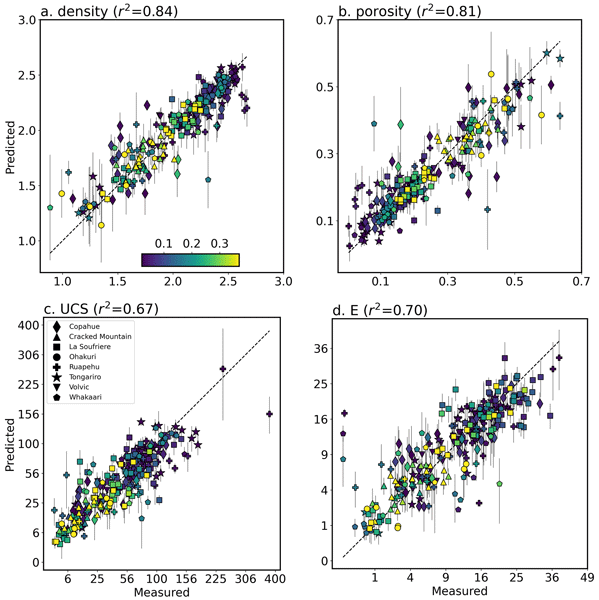
Samuel T. Thiele, Gabor Kereszturi, Michael J. Heap, Andréa de Lima Ribeiro, Akshay V. Kamath, Maia Kidd, Matías Tramontini, Marina Rosas-Carbajal, and Richard Gloaguen
Solid Earth, 16, 1249–1267, https://doi.org/10.5194/se-16-1249-2025, https://doi.org/10.5194/se-16-1249-2025, 2025
Short summary
Short summary
Volcanic rocks are shaped by many processes, including volcanism, chemical alteration and weathering. These processes change the rock's properties, making it difficult to predict volcanic hazards or design tunnels and mines in volcanic areas. In this study, we build on earlier research to connect unique spectral signatures that can be remotely imaged using hyperspectral cameras to the density, porosity, strength, and stiffness of volcanic rocks.
Akshay V. Kamath, Samuel T. Thiele, Hernan Ugalde, Bill Morris, Raimon Tolosana-Delgado, Moritz Kirsch, and Richard Gloaguen
Geosci. Model Dev., 18, 7951–7968, https://doi.org/10.5194/gmd-18-7951-2025, https://doi.org/10.5194/gmd-18-7951-2025, 2025
Short summary
Short summary
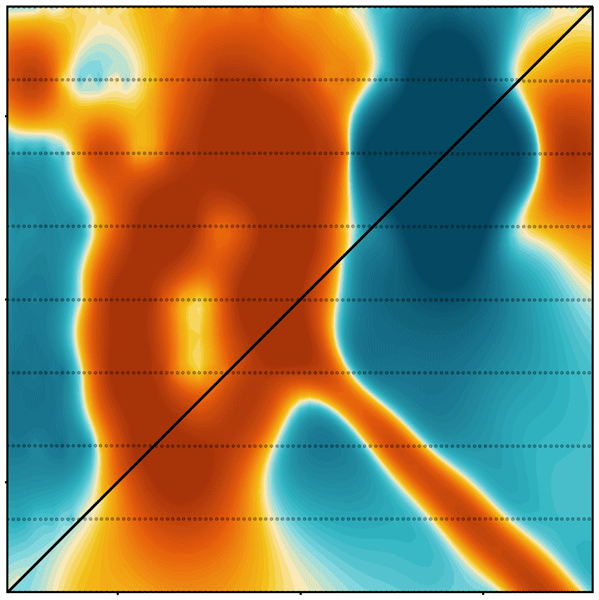
We present a new machine learning approach to reconstruct gravity and magnetic tensor data from sparse airborne surveys. By treating the data as derivatives of a hidden potential field and enforcing physical laws, our method improves accuracy and captures geological features more clearly. This enables better subsurface imaging in regions where traditional interpolation methods fall short.
Akshay V. Kamath, Samuel T. Thiele, Moritz Kirsch, and Richard Gloaguen
Solid Earth, 16, 351–365, https://doi.org/10.5194/se-16-351-2025, https://doi.org/10.5194/se-16-351-2025, 2025
Short summary
Short summary
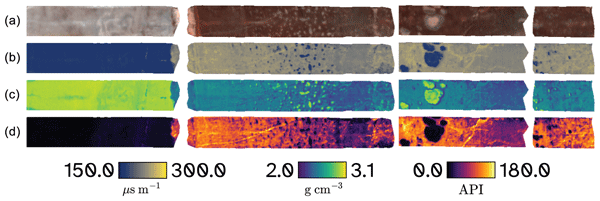
We developed a deep learning model that uses hyperspectral imaging data to predict key physical rock properties, specifically density, slowness, and gamma-ray values. Our model successfully learned to translate hyperspectral information into predicted physical properties. Tests on independent data gave accurate results, demonstrating the potential of hyperspectral data for mapping physical rock properties.
Ayoub Fatihi, Jefter Caldeira, Tom Beucler, Samuel T. Thiele, and Anindita Samsu
Solid Earth, 17, 1087–1115, https://doi.org/10.5194/se-17-1087-2026, https://doi.org/10.5194/se-17-1087-2026, 2026
Short summary
Short summary
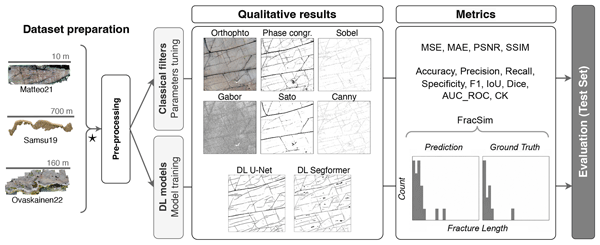
Mapping rock fractures in high resolution aerial images is essential for understanding Earth processes and managing resources, but manual tracing is slow and inconsistent. We created FraXet, a large harmonized dataset of nearly nine thousand images, and compared standard image filters with modern deep learning models. The deep learning methods were far more accurate and produced smoother, more reliable maps, while also showing where results are uncertain.
Marilina Valatsou, Denise Degen, Juliane Dannberg, Rene Gassmöller, and Florian Wellmann
EGUsphere, https://doi.org/10.5194/egusphere-2026-4171, https://doi.org/10.5194/egusphere-2026-4171, 2026
This preprint is open for discussion and under review for Solid Earth (SE).
Short summary
Short summary
The Earth's deep interior flows slowly over millions of years, shaping the surface. Simulating this flow with full physics is computationally costly. Hence, only few scenarios can be tested. Machine learning can help, but usually needs many costly simulations. We build physics into a machine learning method and train fast substitute models on far fewer examples than usual, reproducing the mantle's temperature patterns at a fraction of the cost. This makes previously impractical studies feasible.
Friedrich Carl, Jian Yang, Marlise Colling Cassel, Florian Wellmann, and Peter Achtziger-Zupančič
Solid Earth, 17, 155–178, https://doi.org/10.5194/se-17-155-2026, https://doi.org/10.5194/se-17-155-2026, 2026
Short summary
Short summary
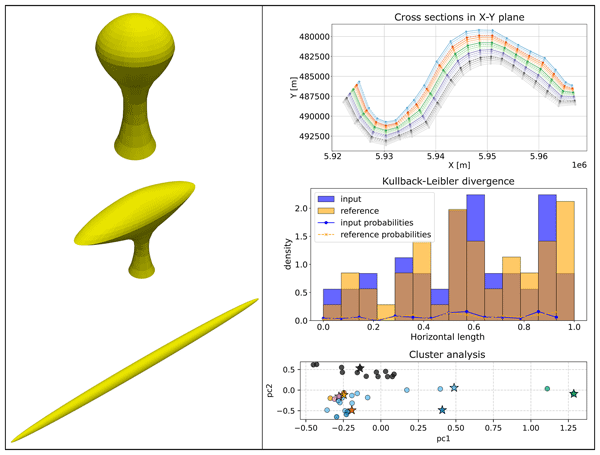
A method for shape quantification based on geometrical parameters is proposed alongside a set of regular geometries established as geomodeling benchmarks. Dimensions, gradient and curvature data is obtained on cross-sections. Data analyses provide insight into the main geometrical characteristics of the benchmark models and visualizes geometrical dis-/similarities between bodies. The method and benchmarks are usable in geomodeling workflows and structural comparisons based on sparse data.
Samuel T. Thiele, Gabor Kereszturi, Michael J. Heap, Andréa de Lima Ribeiro, Akshay V. Kamath, Maia Kidd, Matías Tramontini, Marina Rosas-Carbajal, and Richard Gloaguen
Solid Earth, 16, 1249–1267, https://doi.org/10.5194/se-16-1249-2025, https://doi.org/10.5194/se-16-1249-2025, 2025
Short summary
Short summary
Volcanic rocks are shaped by many processes, including volcanism, chemical alteration and weathering. These processes change the rock's properties, making it difficult to predict volcanic hazards or design tunnels and mines in volcanic areas. In this study, we build on earlier research to connect unique spectral signatures that can be remotely imaged using hyperspectral cameras to the density, porosity, strength, and stiffness of volcanic rocks.
Akshay V. Kamath, Samuel T. Thiele, Hernan Ugalde, Bill Morris, Raimon Tolosana-Delgado, Moritz Kirsch, and Richard Gloaguen
Geosci. Model Dev., 18, 7951–7968, https://doi.org/10.5194/gmd-18-7951-2025, https://doi.org/10.5194/gmd-18-7951-2025, 2025
Short summary
Short summary
We present a new machine learning approach to reconstruct gravity and magnetic tensor data from sparse airborne surveys. By treating the data as derivatives of a hidden potential field and enforcing physical laws, our method improves accuracy and captures geological features more clearly. This enables better subsurface imaging in regions where traditional interpolation methods fall short.
Lawrence A. Bird, Vitaliy Ogarko, Laurent Ailleres, Lachlan Grose, Jérémie Giraud, Felicity S. McCormack, David E. Gwyther, Jason L. Roberts, Richard S. Jones, and Andrew N. Mackintosh
The Cryosphere, 19, 3355–3380, https://doi.org/10.5194/tc-19-3355-2025, https://doi.org/10.5194/tc-19-3355-2025, 2025
Short summary
Short summary
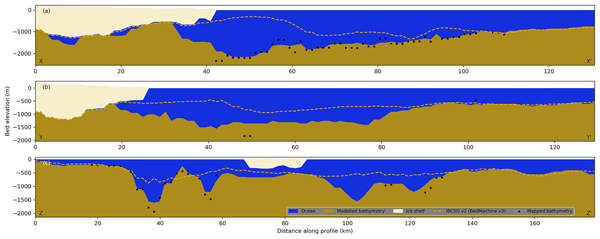
The terrain of the seafloor has important controls on the access of warm water below floating ice shelves around Antarctica. Here, we present an open-source method to infer what the seafloor looks like around the Antarctic continent and within these ice shelf cavities, using measurements of the Earth's gravitational field. We present an improved seafloor map for the Vincennes Bay region in East Antarctica and assess its impact on ice melt rates.
Denise Degen, Moritz Ziegler, Oliver Heidbach, Andreas Henk, Karsten Reiter, and Florian Wellmann
Solid Earth, 16, 477–502, https://doi.org/10.5194/se-16-477-2025, https://doi.org/10.5194/se-16-477-2025, 2025
Short summary
Short summary
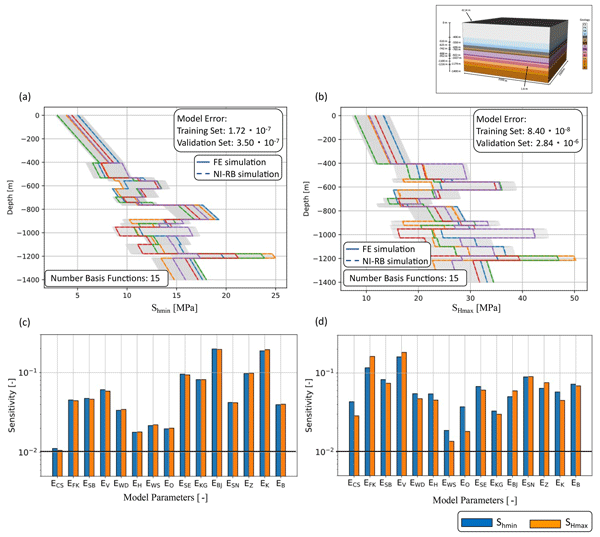
Obtaining reliable estimates of the subsurface state distributions is essential to determine the location of, e.g., potential nuclear waste disposal sites. However, providing these is challenging since it requires solving the problem numerous times, yielding high computational cost. To overcome this, we use a physics-based machine learning method to construct surrogate models. We demonstrate how it produces physics-preserving predictions, which differentiates it from purely data-driven approaches.
Akshay V. Kamath, Samuel T. Thiele, Moritz Kirsch, and Richard Gloaguen
Solid Earth, 16, 351–365, https://doi.org/10.5194/se-16-351-2025, https://doi.org/10.5194/se-16-351-2025, 2025
Short summary
Short summary
We developed a deep learning model that uses hyperspectral imaging data to predict key physical rock properties, specifically density, slowness, and gamma-ray values. Our model successfully learned to translate hyperspectral information into predicted physical properties. Tests on independent data gave accurate results, demonstrating the potential of hyperspectral data for mapping physical rock properties.
Marion N. Parquer, Eric A. de Kemp, Boyan Brodaric, and Michael J. Hillier
Geosci. Model Dev., 18, 71–100, https://doi.org/10.5194/gmd-18-71-2025, https://doi.org/10.5194/gmd-18-71-2025, 2025
Short summary
Short summary
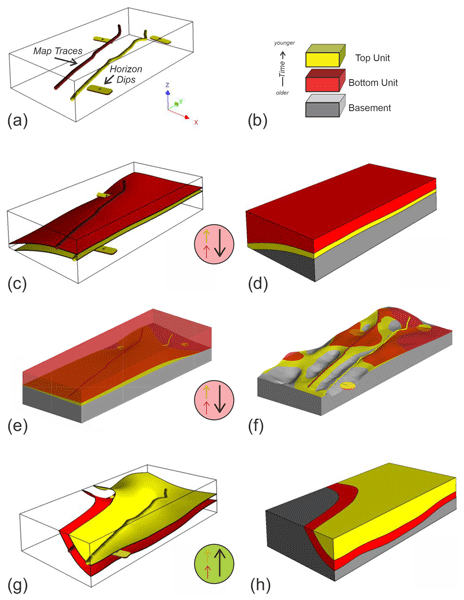
This is a proof-of-concept paper outlining a general approach to how 3D geological models would be checked to be geologically
reasonable. We do this with a consistency-checking tool that looks at geological feature pairs and their spatial, temporal, and internal polarity characteristics. The idea is to assess if geological relationships from a specific 3D geological model match what is allowed in the real world from the perspective of geological principles.
Aldino Rizaldy, Pedram Ghamisi, and Richard Gloaguen
Int. Arch. Photogramm. Remote Sens. Spatial Inf. Sci., XLVIII-4-W11-2024, 103–109, https://doi.org/10.5194/isprs-archives-XLVIII-4-W11-2024-103-2024, https://doi.org/10.5194/isprs-archives-XLVIII-4-W11-2024-103-2024, 2024
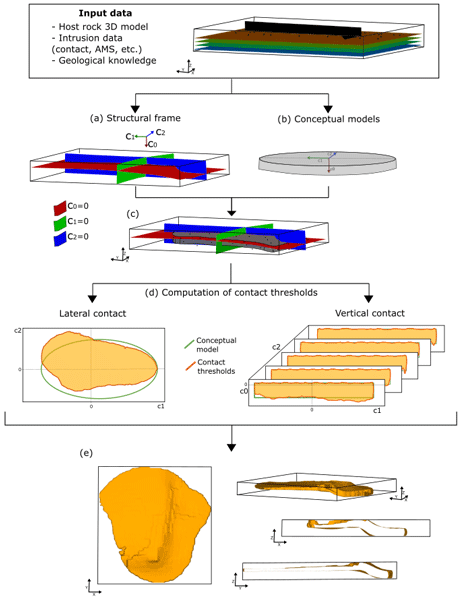
Fernanda Alvarado-Neves, Laurent Ailleres, Lachlan Grose, Alexander R. Cruden, and Robin Armit
Geosci. Model Dev., 17, 1975–1993, https://doi.org/10.5194/gmd-17-1975-2024, https://doi.org/10.5194/gmd-17-1975-2024, 2024
Short summary
Short summary
Previous work has demonstrated that adding geological knowledge to modelling methods creates more accurate and reliable models. Following this reasoning, we added constraints from magma emplacement mechanisms into existing modelling frameworks to improve the 3D characterisation of igneous intrusions. We tested the method on synthetic and real-world case studies, and the results show that our method can reproduce intrusion morphologies with no manual processing and using realistic datasets.
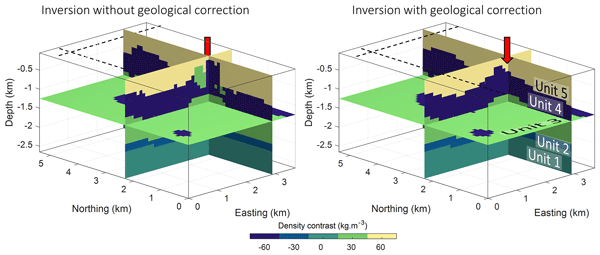
Jérémie Giraud, Guillaume Caumon, Lachlan Grose, Vitaliy Ogarko, and Paul Cupillard
Solid Earth, 15, 63–89, https://doi.org/10.5194/se-15-63-2024, https://doi.org/10.5194/se-15-63-2024, 2024
Short summary
Short summary
We present and test an algorithm that integrates geological modelling into deterministic geophysical inversion. This is motivated by the need to model the Earth using all available data and to reconcile the different types of measurements. We introduce the methodology and test our algorithm using two idealised scenarios. Results suggest that the method we propose is effectively capable of improving the models recovered by geophysical inversion and may be applied in real-world scenarios.
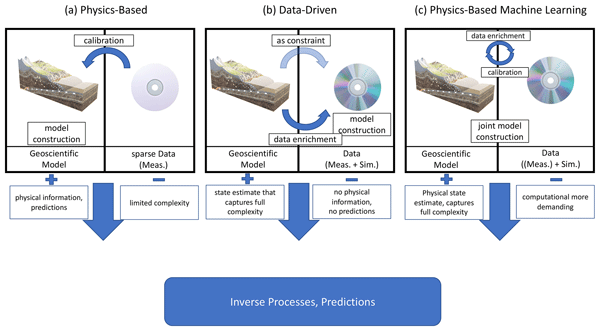
Denise Degen, Daniel Caviedes Voullième, Susanne Buiter, Harrie-Jan Hendricks Franssen, Harry Vereecken, Ana González-Nicolás, and Florian Wellmann
Geosci. Model Dev., 16, 7375–7409, https://doi.org/10.5194/gmd-16-7375-2023, https://doi.org/10.5194/gmd-16-7375-2023, 2023
Short summary
Short summary
In geosciences, we often use simulations based on physical laws. These simulations can be computationally expensive, which is a problem if simulations must be performed many times (e.g., to add error bounds). We show how a novel machine learning method helps to reduce simulation time. In comparison to other approaches, which typically only look at the output of a simulation, the method considers physical laws in the simulation itself. The method provides reliable results faster than standard.
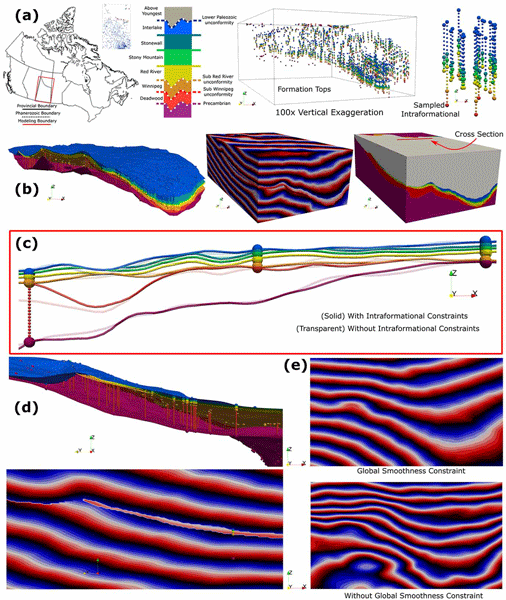
Michael Hillier, Florian Wellmann, Eric A. de Kemp, Boyan Brodaric, Ernst Schetselaar, and Karine Bédard
Geosci. Model Dev., 16, 6987–7012, https://doi.org/10.5194/gmd-16-6987-2023, https://doi.org/10.5194/gmd-16-6987-2023, 2023
Short summary
Short summary
Neural networks can be used effectively to model three-dimensional geological structures from point data, sampling geological interfaces, units, and structural orientations. Existing neural network approaches for this type of modelling are advanced by the efficient incorporation of unconformities, new knowledge inputs, and improved data fitting techniques. These advances permit the modelling of more complex geology in diverse geological settings, different-sized areas, and various data regimes.
Mohammad Moulaeifard, Simon Bernard, and Florian Wellmann
Geosci. Model Dev., 16, 3565–3579, https://doi.org/10.5194/gmd-16-3565-2023, https://doi.org/10.5194/gmd-16-3565-2023, 2023
Short summary
Short summary
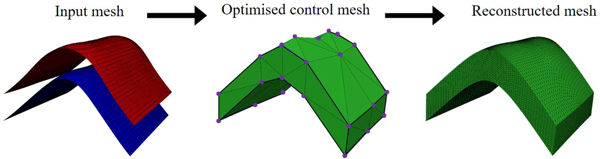
In this work, we propose a flexible framework to generate and interact with geological models using explicit surface representations. The essence of the work lies in the determination of the flexible control mesh, topologically similar to the main geological structure, watertight and controllable with few control points, to manage the geological structures. We exploited the subdivision surface method in our work, which is commonly used in the animation and gaming industry.
Léa Géring, Moritz Kirsch, Samuel Thiele, Andréa De Lima Ribeiro, Richard Gloaguen, and Jens Gutzmer
Solid Earth, 14, 463–484, https://doi.org/10.5194/se-14-463-2023, https://doi.org/10.5194/se-14-463-2023, 2023
Short summary
Short summary
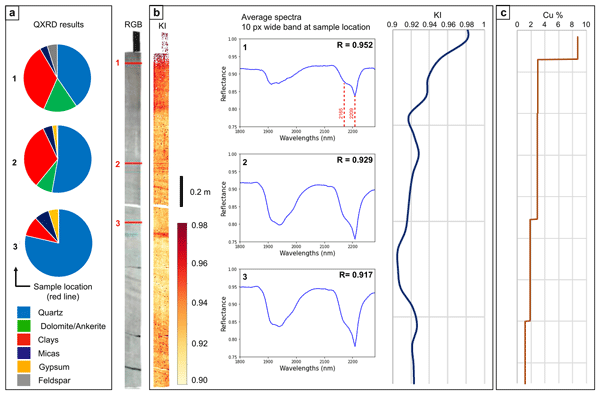
We apply multi-range hyperspectral imaging on drill core material from a Kupferschiefer-type Cu–Ag deposit in Germany, mapping minerals such as iron oxides, kaolinite, sulfate, and carbonates at millimetre resolution and in a rapid, cost-efficient, and continuous manner to track hydrothermal fluid flow paths and vectors towards base metal deposits in sedimentary basins.
Michał P. Michalak, Lesław Teper, Florian Wellmann, Jerzy Żaba, Krzysztof Gaidzik, Marcin Kostur, Yuriy P. Maystrenko, and Paulina Leonowicz
Solid Earth, 13, 1697–1720, https://doi.org/10.5194/se-13-1697-2022, https://doi.org/10.5194/se-13-1697-2022, 2022
Short summary
Short summary
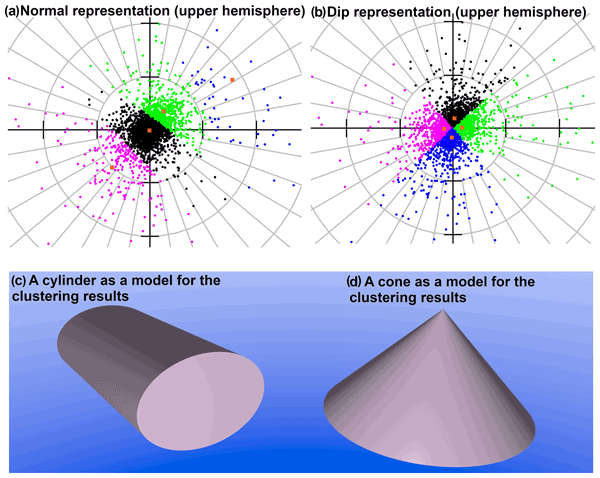
When characterizing geological/geophysical surfaces, various geometric attributes are calculated, such as dip angle (1D) or dip direction (2D). However, the boundaries between specific values may be subjective and without optimization significance, resulting from using default color palletes. This study proposes minimizing cosine distance among within-cluster observations to detect 3D anomalies. Our results suggest that the method holds promise for identification of megacylinders or megacones.
Fernanda Alvarado-Neves, Laurent Ailleres, Lachlan Grose, Alexander R. Cruden, and Robin Armit
Geosci. Model Dev. Discuss., https://doi.org/10.5194/gmd-2022-88, https://doi.org/10.5194/gmd-2022-88, 2022
Preprint withdrawn
Short summary
Short summary
We introduce a method to model igneous intrusions for 3D geological modelling. We use a parameterization of the intrusion body geometry that could be constrained using field observations. Using this parametrization, we simulate distance thresholds that represent the lateral and vertical extent of the intrusion body. We demonstrate the method with two case studies, and we present a comparison with Radial Basis Function interpolation using a case study of a sill complex located in NW Australia.
Trond Ryberg, Moritz Kirsch, Christian Haberland, Raimon Tolosana-Delgado, Andrea Viezzoli, and Richard Gloaguen
Solid Earth, 13, 519–533, https://doi.org/10.5194/se-13-519-2022, https://doi.org/10.5194/se-13-519-2022, 2022
Short summary
Short summary
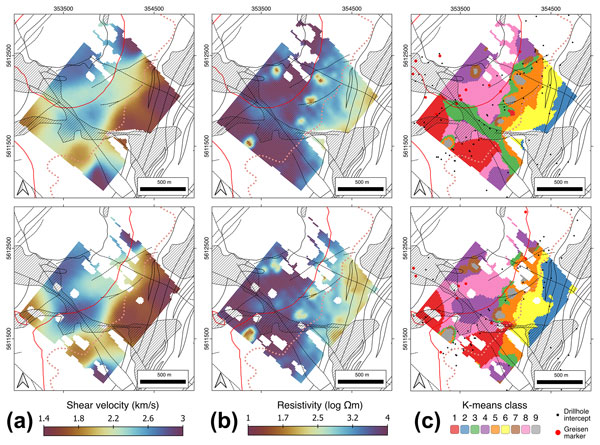
Novel methods for mineral exploration play an important role in future resource exploration. The methods have to be environmentally friendly, socially accepted and cost effective by integrating multidisciplinary methodologies. We investigate the potential of passive, ambient noise tomography combined with 3D airborne electromagnetics for mineral exploration in Geyer, Germany. We show that the combination of the two geophysical data sets has promising potential for future mineral exploration.

Lachlan Grose, Laurent Ailleres, Gautier Laurent, Guillaume Caumon, Mark Jessell, and Robin Armit
Geosci. Model Dev., 14, 6197–6213, https://doi.org/10.5194/gmd-14-6197-2021, https://doi.org/10.5194/gmd-14-6197-2021, 2021
Short summary
Short summary
Fault discontinuities in rock packages represent the plane where two blocks of rock have moved. They are challenging to incorporate into geological models because the geometry of the faulted rock units are defined by not only the location of the discontinuity but also the kinematics of the fault. In this paper, we outline a structural geology framework for incorporating faults into geological models by directly incorporating kinematics into the mathematical framework of the model.
Cited articles
Beatson, R. K., Light, W. A., and Billings, S.: Fast Solution of the Radial Basis Function Interpolation Equations: Domain Decomposition Methods, SIAM J. Sci. Comput., 22, 1717–1740, https://doi.org/10.1137/s1064827599361771, 2001. a
Bjerre, E., Kristensen, L. S., Engesgaard, P., and Højberg, A. L.: Drivers and barriers for taking account of geological uncertainty in decision making for groundwater protection, Sci. Total Environ., 746, 141045, https://doi.org/10.1016/j.scitotenv.2020.141045, 2020. a
Bochner, S.: Harmonic Analysis and the Theory of Probability, University of California Press, https://doi.org/10.1525/9780520345294, 1955. a
Bond, C. E.: Uncertainty in structural interpretation: Lessons to be learnt, J. Struct. Geol., 74, 185–200, https://doi.org/10.1016/j.jsg.2015.03.003, 2015. a
Briggs, I. C.: Machine contouring using minimum curvature, Geophysics, 39, 39–48, https://doi.org/10.1190/1.1440410, 1974. a
Calcagno, P., Chilès, J., Courrioux, G., and Guillen, A.: Geological modelling from field data and geological knowledge, Phys. Earth Planet. In., 171, 147–157, https://doi.org/10.1016/j.pepi.2008.06.013, 2008. a, b, c
Caumon, G., Gray, G., Antoine, C., and Titeux, M.-O.: Three-Dimensional Implicit Stratigraphic Model Building From Remote Sensing Data on Tetrahedral Meshes: Theory and Application to a Regional Model of La Popa Basin, NE Mexico, IEEE T. Geosci. Remote, 51, 1613–1621, https://doi.org/10.1109/tgrs.2012.2207727, 2013. a
Cavoretto, R., De Rossi, A., and Perracchione, E.: Efficient computation of partition of unity interpolants through a block-based searching technique, arXiv [preprint], https://doi.org/10.48550/arXiv.1604.04585, 2016. a
Czarnecki, W. M., Osindero, S., Jaderberg, M., Świrszcz, G., and Pascanu, R.: Sobolev Training for Neural Networks, arXiv [preprint], https://doi.org/10.48550/arXiv.1706.04859, 2017. a
de la Varga, M. and Wellmann, J. F.: Structural geologic modeling as an inference problem: A Bayesian perspective, Interpretation, 4, SM1–SM16, https://doi.org/10.1190/int-2015-0188.1, 2016. a
de la Varga, M., Schaaf, A., and Wellmann, F.: GemPy 1.0: open-source stochastic geological modeling and inversion, Geosci. Model Dev., 12, 1–32, https://doi.org/10.5194/gmd-12-1-2019, 2019. a, b
Emery, X. and Lantuéjoul, C.: TBSIM: A computer program for conditional simulation of three-dimensional Gaussian random fields via the turning bands method, Comput. Geosci., 32, 1615–1628, https://doi.org/10.1016/j.cageo.2006.03.001, 2006. a
Frank, T., Tertois, A.-L., and Mallet, J.-L.: 3D-reconstruction of complex geological interfaces from irregularly distributed and noisy point data, Comput. Geosci., 33, 932–943, https://doi.org/10.1016/j.cageo.2006.11.014, 2007. a
Gao, K. and Wellmann, F.: Fault representation in structural modelling with implicit neural representations, Comput. Geosci., 199, 105911, https://doi.org/10.1016/j.cageo.2025.105911, 2025. a
Gao, K., Hillier, M., and Wellmann, F.: Uncertainty quantification using Hamiltonian Monte Carlo for structural geological modelling with implicit neural representations (INR), Comput. Geosci., 209, 106123, https://doi.org/10.1016/j.cageo.2026.106123, 2026. a
Goan, E. and Fookes, C.: Bayesian Neural Networks: An Introduction and Survey, Springer International Publishing, 45–87, https://doi.org/10.1007/978-3-030-42553-1_3, 2020. a
Godefroy, G., Caumon, G., Ford, M., Laurent, G., and Jackson, C. A.-L.: A parametric fault displacement model to introduce kinematic control into modeling faults from sparse data, Interpretation, 6, B1–B13, https://doi.org/10.1190/int-2017-0059.1, 2018. a
Gropp, A., Yariv, L., Haim, N., Atzmon, M., and Lipman, Y.: Implicit Geometric Regularization for Learning Shapes, arXiv [preprint], https://doi.org/10.48550/arXiv.2002.10099, 2020. a
Grose, L., Laurent, G., Aillères, L., Armit, R., Jessell, M., and Caumon, G.: Structural data constraints for implicit modeling of folds, J. Struct. Geol., 104, 80–92, https://doi.org/10.1016/j.jsg.2017.09.013, 2017. a
Grose, L., Ailleres, L., Laurent, G., and Jessell, M.: LoopStructural 1.0: time-aware geological modelling, Geosci. Model Dev., 14, 3915–3937, https://doi.org/10.5194/gmd-14-3915-2021, 2021b. a, b, c, d
Hasan, M., Khosravi, A., Hossain, I., Rahman, A., and Nahavandi, S.: Controlled Dropout for Uncertainty Estimation, arXiv [preprint], https://doi.org/10.48550/arXiv.2205.03109, 2022. a
Heydari, A. A., Thompson, C. A., and Mehmood, A.: SoftAdapt: Techniques for Adaptive Loss Weighting of Neural Networks with Multi-Part Loss Functions, arXiv [preprint], https://doi.org/10.48550/arXiv.1912.12355, 2019. a
Hillier, M., Wellmann, F., de Kemp, E. A., Brodaric, B., Schetselaar, E., and Bédard, K.: GeoINR 1.0: an implicit neural network approach to three-dimensional geological modelling, Geosci. Model Dev., 16, 6987–7012, https://doi.org/10.5194/gmd-16-6987-2023, 2023. a, b, c, d, e, f, g, h, i, j, k, l, m
Hillier, M. J., Schetselaar, E. M., de Kemp, E. A., and Perron, G.: Three-Dimensional Modelling of Geological Surfaces Using Generalized Interpolation with Radial Basis Functions, Math. Geosci., 46, 931–953, https://doi.org/10.1007/s11004-014-9540-3, 2014. a
Irakarama, M., Laurent, G., Renaudeau, J., and Caumon, G.: Finite Difference Implicit Modeling of Geological Structures, in: Proceedings, EAGE Publications BV, Copenhagen, Denmark, https://doi.org/10.3997/2214-4609.201800794, 2018. a
Kamath, A. and Thiele, S.: k4m4th/curlew_examples: curlew_examples, Zenodo [code], https://doi.org/10.5281/ZENODO.19002735, 2026. a
Kamath, A. V., Thiele, S. T., Ugalde, H., Morris, B., Tolosana-Delgado, R., Kirsch, M., and Gloaguen, R.: TensorWeave 1.0: Interpolating geophysical tensor fields with spatial neural networks, EGUsphere [preprint], https://doi.org/10.5194/egusphere-2025-2345, 2025. a
Lajaunie, C., Courrioux, G., and Manuel, L.: Foliation fields and 3D cartography in geology: Principles of a method based on potential interpolation, Math. Geol., 29, 571–584, https://doi.org/10.1007/BF02775087, 1997. a
Landgraf, Z., Hornung, A. S., and Cabral, R. S.: PINs: Progressive Implicit Networks for Multi-Scale Neural Representations, arXiv [preprint], https://doi.org/10.48550/arXiv.2202.04713, 2022. a
Laurent, G.: Iterative Thickness Regularization of Stratigraphic Layers in Discrete Implicit Modeling, Math. Geosci., 48, 811–833, https://doi.org/10.1007/s11004-016-9637-y, publisher: Springer Science and Business Media LLC, 2016. a, b
Laurent, G., Caumon, G., Bouziat, A., and Jessell, M.: A parametric method to model 3D displacements around faults with volumetric vector fields, Tectonophysics, 590, 83–93, https://doi.org/10.1016/j.tecto.2013.01.015, 2013. a
Li, H., Xu, Z., Taylor, G., Studer, C., and Goldstein, T.: Visualizing the Loss Landscape of Neural Nets, arXiv [preprint], https://doi.org/10.48550/arXiv.1712.09913, 2017. a
Lindi, O. T., Aladejare, A. E., Ozoji, T. M., and Ranta, J.-P.: Uncertainty Quantification in Mineral Resource Estimation, Natural Resources Research, 33, 2503–2526, https://doi.org/10.1007/s11053-024-10394-6, 2024. a
Lindsay, M., Jessell, M., Ailleres, L., Perrouty, S., De Kemp, E., and Betts, P.: Geodiversity: Exploration of 3D geological model space, Tectonophysics, 594, 27–37, https://doi.org/10.1016/j.tecto.2013.03.013, 2013. a
Mallet, J.-L.: Discrete smooth interpolation, ACM T. Graphic., 8, 121–144, https://doi.org/10.1145/62054.62057, 1989. a
Mantoglou, A. and Wilson, J. L.: The Turning Bands Method for simulation of random fields using line generation by a spectral method, Water Resour. Res., 18, 1379–1394, https://doi.org/10.1029/WR018i005p01379, 1982. a
Margossian, C. C.: A Review of automatic differentiation and its efficient implementation, WIREs, 9, e1305, https://doi.org/10.1002/WIDM.1305, 2019. a
Misra, D.: Mish: A Self Regularized Non-Monotonic Activation Function, arXiv [preprint], https://doi.org/10.48550/arXiv.1908.08681, 2019. a
Osher, S. and Sethian, J. A.: Fronts propagating with curvature-dependent speed: Algorithms based on Hamilton-Jacobi formulations, J. Comput. Phys., 79, 12–49, https://doi.org/10.1016/0021-9991(88)90002-2, 1988. a
Paszke, A., Gross, S., Massa, F., Lerer, A., Bradbury, J., Chanan, G., Killeen, T., Lin, Z., Gimelshein, N., Antiga, L., Desmaison, A., Köpf, A., Yang, E., DeVito, Z., Raison, M., Tejani, A., Chilamkurthy, S., Steiner, B., Fang, L., Bai, J., and Chintala, S.: PyTorch: An Imperative Style, High-Performance Deep Learning Library, arXiv [preprint], https://doi.org/10.48550/arXiv.1912.01703, 2019. a
Pérez-Díaz, L., Alcalde, J., and Bond, C. E.: Introduction: Handling uncertainty in the geosciences: identification, mitigation and communication, Solid Earth, 11, 889–897, https://doi.org/10.5194/se-11-889-2020, 2020. a, b, c
Rahaman, N., Baratin, A., Arpit, D., Draxler, F., Lin, M., Hamprecht, F. A., Bengio, Y., and Courville, A.: On the Spectral Bias of Neural Networks, in: Proceedings of the 36th International Conference on Machine Learning (ICML), in: Proceedings of Machine Learning Research, vol. 97, 5301–5310, https://doi.org/10.48550/arXiv.1806.08734, 2019. a
Rahimi, A. and Recht, B.: Random Features for Large-Scale Kernel Machines, in: Advances in Neural Information Processing Systems, edited by: Platt, J., Koller, D., Singer, Y., and Roweis, S., vol. 20, Curran Associates, Inc., https://proceedings.neurips.cc/paper_files/paper/2007/file/013a006f03dbc5392effeb8f18fda755-Paper.pdf, 2007. a
Raissi, M., Perdikaris, P., and Karniadakis, G. E.: Physics-informed neural networks: A deep learning framework for solving forward and inverse problems involving nonlinear partial differential equations, J. Comput. Phys., 378, 686–707, https://doi.org/10.1016/j.jcp.2018.10.045, 2019. a
Ramachandran, P., Zoph, B., and Le, Q. V.: Searching for Activation Functions, arXiv [preprint], https://doi.org/10.48550/arXiv.1710.05941, 2017. a
Rasmussen, C. E. and Williams, C. K. I.: Gaussian Processes for Machine Learning, The MIT Press, https://doi.org/10.7551/mitpress/3206.001.0001, 2005. a
Rudin, L. I., Osher, S., and Fatemi, E.: Nonlinear total variation based noise removal algorithms, Physica D, 60, 259–268, https://doi.org/10.1016/0167-2789(92)90242-F, 1992. a
Sandwell, D. T.: Biharmonic spline interpolation of GEOS-3 and SEASAT altimeter data, Geophys. Res. Lett., 14, 139–142, https://doi.org/10.1029/gl014i002p00139, 1987. a
Shannon, C. E.: A Mathematical Theory of Communication, Bell Syst. Tech. J., 27, 379–423, https://doi.org/10.1002/j.1538-7305.1948.tb01338.x, 1948. a
Sitzmann, V., Martel, J. N. P., Bergman, A. W., Lindell, D. B., and Wetzstein, G.: Implicit Neural Representations with Periodic Activation Functions, arXiv [preprint], https://doi.org/10.48550/arXiv.2006.09661, 2020. a, b
Smith, L. T., Horrocks, T., Akhtar, N., Holden, E.-J., and Wedge, D.: Implicit neural representation for potential field geophysics, Sci. Rep., 15, https://doi.org/10.1038/s41598-024-83979-z, 2025. a
Smith, W. H. F. and Wessel, P.: Gridding with continuous curvature splines in tension, Geophysics, 55, 293–305, https://doi.org/10.1190/1.1442837, 1990. a
Steno, N. and Oldenburg, H.: The prodromus to a dissertation concerning solids naturally contained within solids: laying a foundation for the rendering a rational accompt both of the frame and the several changes of the masse of the Earth, as also of the various productions in the same, Printed by F. Winter, and are to be sold by Moses Pitt, https://doi.org/10.5962/bhl.title.145115, 1671. a
Tacher, L., Pomian-Srzednicki, I., and Parriaux, A.: Geological uncertainties associated with 3-D subsurface models, Comput. Geosci., 32, 212–221, https://doi.org/10.1016/j.cageo.2005.06.010, 2006. a
Tancik, M., Srinivasan, P. P., Mildenhall, B., Fridovich-Keil, S., Raghavan, N., Singhal, U., Ramamoorthi, R., Barron, J. T., and Ng, R.: Fourier Features Let Networks Learn High Frequency Functions in Low Dimensional Domains, arXiv [preprint], https://doi.org/10.48550/arXiv.2006.10739, 2020. a
Thiele, S. and Kamath, A.: samthiele/curlew: Curlew 1.00, Zenodo [code], https://doi.org/10.5281/ZENODO.17187731, 2025. a
Thiele, S. T., Jessell, M. W., Lindsay, M., Ogarko, V., Wellmann, J. F., and Pakyuz-Charrier, E.: The topology of geology 1: Topological analysis, J. Struct. Geol., 91, 27–38, https://doi.org/10.1016/j.jsg.2016.08.009, 2016a. a, b, c
Thiele, S. T., Jessell, M. W., Lindsay, M., Wellmann, J. F., and Pakyuz-Charrier, E.: The topology of geology 2: Topological uncertainty, J. Struct. Geol., 91, 74–87, https://doi.org/10.1016/j.jsg.2016.08.010, 2016b. a, b
Thiele, S. T., Grose, L., Samsu, A., Micklethwaite, S., Vollgger, S. A., and Cruden, A. R.: Rapid, semi-automatic fracture and contact mapping for point clouds, images and geophysical data, Solid Earth, 8, 1241–1253, https://doi.org/10.5194/se-8-1241-2017, 2017. a
Wellmann, J. F. and Regenauer-Lieb, K.: Uncertainties have a meaning: Information entropy as a quality measure for 3-D geological models, Tectonophysics, 526–529, 207–216, https://doi.org/10.1016/j.tecto.2011.05.001, 2012. a, b
Wellmann, J. F., Horowitz, F. G., Schill, E., and Regenauer-Lieb, K.: Towards incorporating uncertainty of structural data in 3D geological inversion, Tectonophysics, 490, 141–151, https://doi.org/10.1016/j.tecto.2010.04.022, 2010. a
Wellmann, J. F., Lindsay, M., Poh, J., and Jessell, M.: Validating 3-D Structural Models with Geological Knowledge for Improved Uncertainty Evaluations, Energ. Proced., 59, 374–381, https://doi.org/10.1016/j.egypro.2014.10.391, 2014. a
Wendland, H.: Piecewise polynomial, positive definite and compactly supported radial functions of minimal degree, Adv. Comput. Math., 4, 389–396, https://doi.org/10.1007/bf02123482, 1995. a
Xie, Y., Takikawa, T., Saito, S., Litany, O., Yan, S., Khan, N., Tombari, F., Tompkin, J., Sitzmann, V., and Sridhar, S.: Neural Fields in Visual Computing and Beyond, Comput. Graph. Forum, 41, 641–676, https://doi.org/10.1111/cgf.14505, 2022. a
Xu, A. and Heagy, L. J.: Toward Understanding the Benefits of Neural Network Parameterizations in Geophysical Inversions: A Study With Neural Fields, IEEE T. Geosci. Remote, 63, 1–14, https://doi.org/10.1109/tgrs.2025.3583970, 2025. a
Yu, T., Kumar, S., Gupta, A., Levine, S., Hausman, K., and Finn, C.: Gradient Surgery for Multi-Task Learning, arXiv [preprint], https://doi.org/10.48550/arXiv.2001.06782, 2020. a
Zhang, X., Zhao, L., Yu, Y., Lin, X., Chen, Y., Zhao, H., and Zhang, Q.: LibMOON: A Gradient-based MultiObjective OptimizatioN Library in PyTorch, arXiv [preprint], https://doi.org/10.48550/arXiv.2409.02969, 2024. a
Short summary
We present Curlew, an open-source Python tool for constructing 3D geological models using machine learning. It integrates diverse spatial data and structural observations into a flexible, event-based framework. Curlew captures complex features like folds and faults, handles uncertainty, and supports learning from sparse or unlabelled data. We demonstrate its capabilities on synthetic and real-world examples.
We present Curlew, an open-source Python tool for constructing 3D geological models using...


