Articles | Volume 19, issue 2
https://doi.org/10.5194/gmd-19-955-2026
© Author(s) 2026. This work is distributed under
the Creative Commons Attribution 4.0 License.

https://doi.org/10.5194/gmd-19-955-2026
© Author(s) 2026. This work is distributed under
the Creative Commons Attribution 4.0 License.
BuRNN (v1.0): a data-driven fire model

Department of Water and Climate, Vrije Universiteit Brussel, Brussels, Belgium
Lukas Gudmundsson
Institute for Atmospheric and Climate Science, ETH Zürich, Zürich, Switzerland
Basil Kraft
Institute for Atmospheric and Climate Science, ETH Zürich, Zürich, Switzerland
Stijn Hantson
School of Sciences and Engineering, Universidad del Rosario, Bogotá, Colombia
Douglas Kelley
Centre for Ecology and Hydrology, Wallingford, UK
Vincent Humphrey
Federal Office of Meteorology and Climatology MeteoSwiss, Zürich, Switzerland
Bertrand Le Saux
Φ-lab, European Space Agency, Frascati, Italy
Emilio Chuvieco
Environmental Remote Sensing Research Group, Universidad de Alcalá, Alcalá de Henares, Spain
Wim Thiery
Department of Water and Climate, Vrije Universiteit Brussel, Brussels, Belgium
Related authors
Ni Li, Wim Thiery, Shorouq Zahra, Mariana Madruga de Brito, Koffi Worou, Murathan Kurfalı, Seppe Lampe, Paul Muñoz, Clare Flynn, Camila Trigoso, Joakim Nivre, Jakob Zscheischler, and Gabriele Messori
EGUsphere, https://doi.org/10.5194/egusphere-2025-4891, https://doi.org/10.5194/egusphere-2025-4891, 2025
Short summary
Short summary
Climate extremes threaten society and ecosystems. Understanding impacts is critical, despite open databases like EM-DAT and DesInventar, reliable impact data remain scattered across various text sources. Wikimpacts 1.0, using GPT4o, provides comprehensive socio-economic impact data on 2,928 events from 1034 to 2024. It offers broader storm coverage and finer spatial resolution impact data than EM-DAT, showcasing the potential of natural language processing to enhance climate impact datasets.
Douglas I. Kelley, Chantelle Burton, Francesca Di Giuseppe, Matthew W. Jones, Maria L. F. Barbosa, Esther Brambleby, Joe R. McNorton, Zhongwei Liu, Anna S. I. Bradley, Katie Blackford, Eleanor Burke, Andrew Ciavarella, Enza Di Tomaso, Jonathan Eden, Igor José M. Ferreira, Lukas Fiedler, Andrew J. Hartley, Theodore R. Keeping, Seppe Lampe, Anna Lombardi, Guilherme Mataveli, Yuquan Qu, Patrícia S. Silva, Fiona R. Spuler, Carmen B. Steinmann, Miguel Ángel Torres-Vázquez, Renata Veiga, Dave van Wees, Jakob B. Wessel, Emily Wright, Bibiana Bilbao, Mathieu Bourbonnais, Cong Gao, Carlos M. Di Bella, Kebonye Dintwe, Victoria M. Donovan, Sarah Harris, Elena A. Kukavskaya, Aya Brigitte N'Dri, Cristina Santín, Galia Selaya, Johan Sjöström, John T. Abatzoglou, Niels Andela, Rachel Carmenta, Emilio Chuvieco, Louis Giglio, Douglas S. Hamilton, Stijn Hantson, Sarah Meier, Mark Parrington, Mojtaba Sadegh, Jesus San-Miguel-Ayanz, Fernando Sedano, Marco Turco, Guido R. van der Werf, Sander Veraverbeke, Liana O. Anderson, Hamish Clarke, Paulo M. Fernandes, and Crystal A. Kolden
Earth Syst. Sci. Data, 17, 5377–5488, https://doi.org/10.5194/essd-17-5377-2025, https://doi.org/10.5194/essd-17-5377-2025, 2025
Short summary
Short summary
The second State of Wildfires report examines extreme wildfire events from 2024 to early 2025. It analyses key regional events in Southern California, Northeast Amazonia, Pantanal–Chiquitano, and the Congo Basin, assessing their drivers and predictability and attributing them to climate change and land use. Seasonal outlooks and decadal projections are provided. Climate change greatly increased the likelihood of these fires, and without strong mitigation, such events will become more frequent.
Derrick Muheki, Bas Vercruysse, Krishna Kumar Thirukokaranam Chandrasekar, Christophe Verbruggen, Julie M. Birkholz, Koen Hufkens, Hans Verbeeck, Pascal Boeckx, Seppe Lampe, Ed Hawkins, Peter Thorne, Dominique Kankonde Ntumba, Olivier Kapalay Moulasa, and Wim Thiery
EGUsphere, https://doi.org/10.5194/egusphere-2024-3779, https://doi.org/10.5194/egusphere-2024-3779, 2025
This preprint is open for discussion and under review for Geoscientific Model Development (GMD).
Short summary
Short summary
Archives worldwide host vast records of observed weather data crucial for understanding climate variability. However, most of these records are still in paper form, limiting their use. To address this, we developed MeteoSaver, an open-source tool, to transcribe these records to machine-readable format. Applied to ten handwritten temperature sheets, it achieved a median accuracy of 74%. This tool offers a promising solution to preserve records from archives and unlock historical weather insights.
Matthew W. Jones, Douglas I. Kelley, Chantelle A. Burton, Francesca Di Giuseppe, Maria Lucia F. Barbosa, Esther Brambleby, Andrew J. Hartley, Anna Lombardi, Guilherme Mataveli, Joe R. McNorton, Fiona R. Spuler, Jakob B. Wessel, John T. Abatzoglou, Liana O. Anderson, Niels Andela, Sally Archibald, Dolors Armenteras, Eleanor Burke, Rachel Carmenta, Emilio Chuvieco, Hamish Clarke, Stefan H. Doerr, Paulo M. Fernandes, Louis Giglio, Douglas S. Hamilton, Stijn Hantson, Sarah Harris, Piyush Jain, Crystal A. Kolden, Tiina Kurvits, Seppe Lampe, Sarah Meier, Stacey New, Mark Parrington, Morgane M. G. Perron, Yuquan Qu, Natasha S. Ribeiro, Bambang H. Saharjo, Jesus San-Miguel-Ayanz, Jacquelyn K. Shuman, Veerachai Tanpipat, Guido R. van der Werf, Sander Veraverbeke, and Gavriil Xanthopoulos
Earth Syst. Sci. Data, 16, 3601–3685, https://doi.org/10.5194/essd-16-3601-2024, https://doi.org/10.5194/essd-16-3601-2024, 2024
Short summary
Short summary
This inaugural State of Wildfires report catalogues extreme fires of the 2023–2024 fire season. For key events, we analyse their predictability and drivers and attribute them to climate change and land use. We provide a seasonal outlook and decadal projections. Key anomalies occurred in Canada, Greece, and western Amazonia, with other high-impact events catalogued worldwide. Climate change significantly increased the likelihood of extreme fires, and mitigation is required to lessen future risk.
Simon Scheiter, Jinfeng Chang, Philippe Ciais, Marie Dury, Louis Francois, Matthew Forrest, Alexandra Henrot, Christopher P. O. Reyer, Sonia Seneviratne, Jörg Steinkamp, Wim Thiery, Wenfang Xu, and Thomas Hickler
EGUsphere, https://doi.org/10.5194/egusphere-2026-221, https://doi.org/10.5194/egusphere-2026-221, 2026
This preprint is open for discussion and under review for Biogeosciences (BG).
Short summary
Short summary
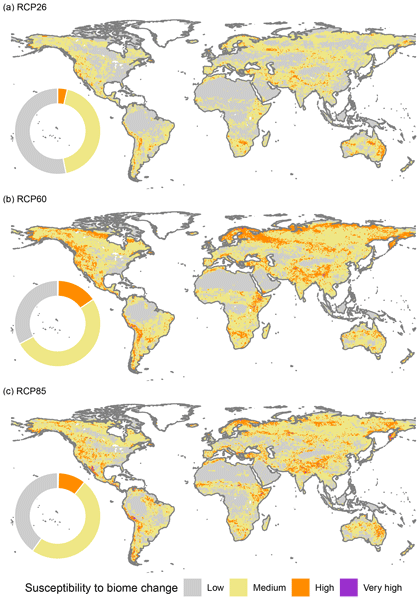
Our study shows how climate change may reshape the world's major biomes, such as forests, grasslands, and tundra. Using dynamic vegetation models, machine learning and real-world observations, we found that many biomes are likely to shift toward the poles as temperatures rise. Even under low-emission scenarios, large areas could change. These results help identify regions most susceptible to climate change and support global efforts to protect and manage natural ecosystems in the future.
Robert Reinecke, Tanjila Akhter, Annemarie Bäthge, Ricarda Dietrich, Sebastian Gnann, Simon N. Gosling, Danielle Grogan, Andreas Hartmann, Stefan Kollet, Rohini Kumar, Richard Lammers, Sida Liu, Yan Liu, Nils Moosdorf, Bibi Naz, Sara Nazari, Chibuike Orazulike, Yadu Pokhrel, Jacob Schewe, Mikhail Smilovic, Maryna Strokal, Wim Thiery, Yoshihide Wada, Shan Zuidema, and Inge de Graaf
Geosci. Model Dev., 19, 523–542, https://doi.org/10.5194/gmd-19-523-2026, https://doi.org/10.5194/gmd-19-523-2026, 2026
Short summary
Short summary
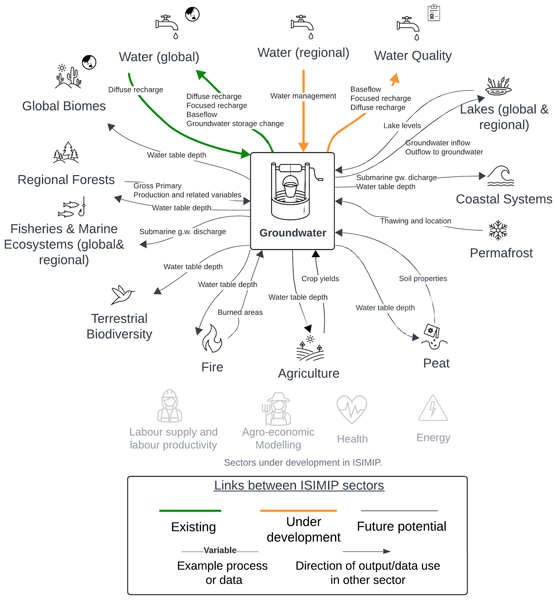
Here we describe a collaborative effort to improve predictions of how climate change will affect groundwater. The ISIMIP (The Inter-Sectoral Impact Model Intercomparison Project) groundwater sector combines multiple global groundwater models to capture a range of possible outcomes and reduce uncertainty. Initial comparisons reveal significant differences between models in key metrics like water table depth and recharge rates, highlighting the need for structured model intercomparisons.
Fabien Courvoisier, Basil Kraft, Yann Yasser Haddad, Massimiliano Zappa, and Lukas Gudmundsson
EGUsphere, https://doi.org/10.5194/egusphere-2025-6058, https://doi.org/10.5194/egusphere-2025-6058, 2025
Short summary
Short summary
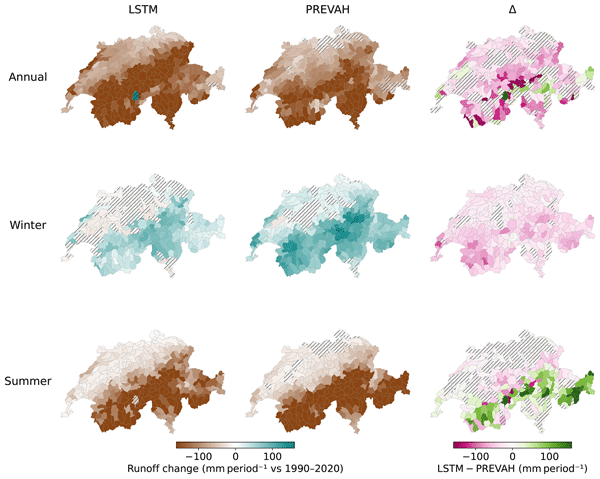
Climate change strongly modifies runoff in alpine regions like Switzerland, altering water supply and affecting both human sectors and natural ecosystems. We test whether a model that learns only from past observations can credibly project future runoff under climate scenarios. It captures major expected shifts and reveals known limits for extremes. Its speed and ability to generalize across catchments make it a promising tool for assessing climate impacts on water resources.
Pere Joan Gelabert, Adrián Jiménez-Ruano, Clara Ochoa, Fermín Alcasena, Johan Sjöström, Christopher Marrs, Luís Mário Ribeiro, Palaiologos Palaiologou, Carmen Bentué Martínez, Emilio Chuvieco, Cristina Vega-García, and Marcos Rodrigues
Nat. Hazards Earth Syst. Sci., 25, 4713–4729, https://doi.org/10.5194/nhess-25-4713-2025, https://doi.org/10.5194/nhess-25-4713-2025, 2025
Short summary
Short summary
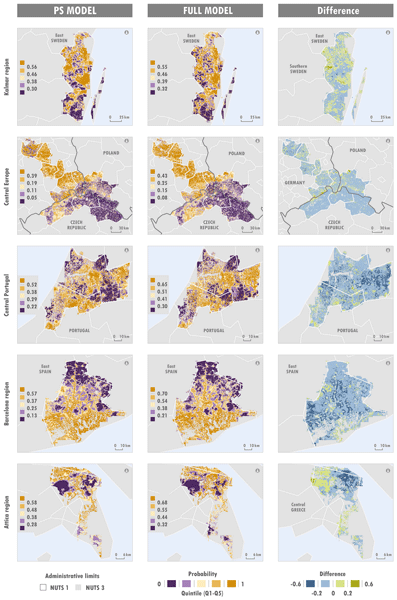
Wildfires threaten ecosystems and communities across Europe. Our study developed models to predict where and why these ignitions occur in different European environments. We found that weather anomalies and human factors, like proximity to urban areas and roads, are key drivers. Using Machine Learning our models achieved strong predictive accuracy. These insights help design better wildfire prevention strategies, ensuring safer landscapes and communities as fire risks grow with climate change.
Ni Li, Wim Thiery, Shorouq Zahra, Mariana Madruga de Brito, Koffi Worou, Murathan Kurfalı, Seppe Lampe, Paul Muñoz, Clare Flynn, Camila Trigoso, Joakim Nivre, Jakob Zscheischler, and Gabriele Messori
EGUsphere, https://doi.org/10.5194/egusphere-2025-4891, https://doi.org/10.5194/egusphere-2025-4891, 2025
Short summary
Short summary
Climate extremes threaten society and ecosystems. Understanding impacts is critical, despite open databases like EM-DAT and DesInventar, reliable impact data remain scattered across various text sources. Wikimpacts 1.0, using GPT4o, provides comprehensive socio-economic impact data on 2,928 events from 1034 to 2024. It offers broader storm coverage and finer spatial resolution impact data than EM-DAT, showcasing the potential of natural language processing to enhance climate impact datasets.
Luna Bloin-Wibe, Robin Noyelle, Vincent Humphrey, Urs Beyerle, Reto Knutti, and Erich Fischer
Weather Clim. Dynam., 6, 1147–1177, https://doi.org/10.5194/wcd-6-1147-2025, https://doi.org/10.5194/wcd-6-1147-2025, 2025
Short summary
Short summary
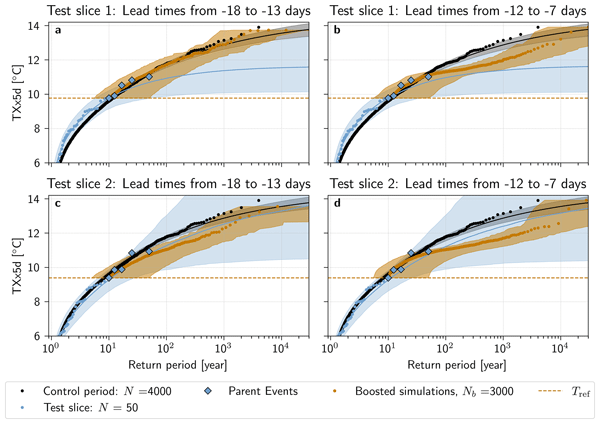
Weather extremes have become more frequent due to climate change. It is therefore crucial to understand them, but since they are rarer than average weather, they are challenging to study. Ensemble Boosting (EB) is a tool that generates extreme climate model events efficiently, but without directly estimating their probability. Here, we present a method to recover these probabilities for a global climate model. EB can thus now be used to find extremes with meaningful statistical information.
Sean P. Burns, Vincent Humphrey, Ethan D. Gutmann, Mark S. Raleigh, David R. Bowling, and Peter D. Blanken
Biogeosciences, 22, 5741–5769, https://doi.org/10.5194/bg-22-5741-2025, https://doi.org/10.5194/bg-22-5741-2025, 2025
Short summary
Short summary
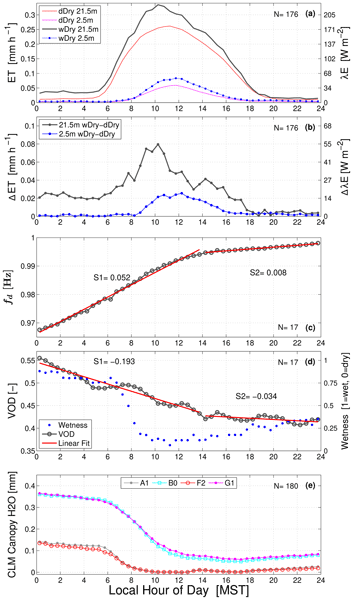
We compared two techniques that are affected by the amount of liquid water in a forest canopy. One technique relies on remote sensing (a pair of GPSs) and the other uses tree motion generated by the wind. Though completely different, these two techniques show strikingly similar changes when rain falls on an evergreen forest. We combine these measurements with eddy covariance fluxes of water vapor to provide insight into the evaporation of canopy-intercepted precipitation.
Manon Maisonnier, Maoyuan Feng, David Bastviken, Sandra Arndt, Ronny Lauerwald, Aidin Jabbari, Goulven Gildas Laruelle, Murray D. MacKay, Zeli Tan, Wim Thiery, and Pierre Regnier
Earth Syst. Dynam., 16, 1779–1808, https://doi.org/10.5194/esd-16-1779-2025, https://doi.org/10.5194/esd-16-1779-2025, 2025
Short summary
Short summary
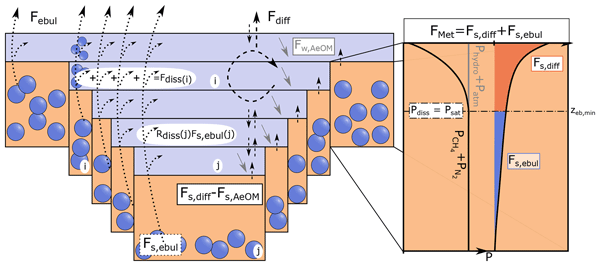
A new process-based modelling framework, FLaMe-v1.0 (Fluxes of Lake Methane version 1.0), is developed to simulate methane (CH4) emissions from lakes at large scales. FLaMe couples the dynamics of organic carbon, oxygen and methane in lakes and rests on an innovative, computationally efficient lake clustering approach for the simulation of CH4 emissions across a large number of lakes. The model evaluation suggests that FLaMe captures the sub-annual and spatial variability of CH4 emissions well.
Douglas I. Kelley, Chantelle Burton, Francesca Di Giuseppe, Matthew W. Jones, Maria L. F. Barbosa, Esther Brambleby, Joe R. McNorton, Zhongwei Liu, Anna S. I. Bradley, Katie Blackford, Eleanor Burke, Andrew Ciavarella, Enza Di Tomaso, Jonathan Eden, Igor José M. Ferreira, Lukas Fiedler, Andrew J. Hartley, Theodore R. Keeping, Seppe Lampe, Anna Lombardi, Guilherme Mataveli, Yuquan Qu, Patrícia S. Silva, Fiona R. Spuler, Carmen B. Steinmann, Miguel Ángel Torres-Vázquez, Renata Veiga, Dave van Wees, Jakob B. Wessel, Emily Wright, Bibiana Bilbao, Mathieu Bourbonnais, Cong Gao, Carlos M. Di Bella, Kebonye Dintwe, Victoria M. Donovan, Sarah Harris, Elena A. Kukavskaya, Aya Brigitte N'Dri, Cristina Santín, Galia Selaya, Johan Sjöström, John T. Abatzoglou, Niels Andela, Rachel Carmenta, Emilio Chuvieco, Louis Giglio, Douglas S. Hamilton, Stijn Hantson, Sarah Meier, Mark Parrington, Mojtaba Sadegh, Jesus San-Miguel-Ayanz, Fernando Sedano, Marco Turco, Guido R. van der Werf, Sander Veraverbeke, Liana O. Anderson, Hamish Clarke, Paulo M. Fernandes, and Crystal A. Kolden
Earth Syst. Sci. Data, 17, 5377–5488, https://doi.org/10.5194/essd-17-5377-2025, https://doi.org/10.5194/essd-17-5377-2025, 2025
Short summary
Short summary
The second State of Wildfires report examines extreme wildfire events from 2024 to early 2025. It analyses key regional events in Southern California, Northeast Amazonia, Pantanal–Chiquitano, and the Congo Basin, assessing their drivers and predictability and attributing them to climate change and land use. Seasonal outlooks and decadal projections are provided. Climate change greatly increased the likelihood of these fires, and without strong mitigation, such events will become more frequent.
Renata Moura da Veiga, Celso von Randow, Chantelle Burton, Douglas I. Kelley, Manoel Cardoso, and Fabiano Morelli
Nat. Hazards Earth Syst. Sci., 25, 3581–3601, https://doi.org/10.5194/nhess-25-3581-2025, https://doi.org/10.5194/nhess-25-3581-2025, 2025
Short summary
Short summary
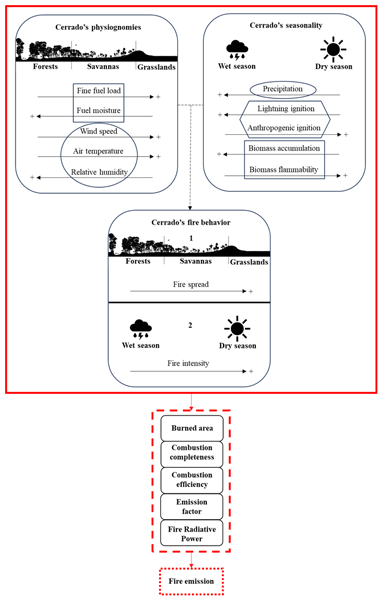
We systematically reviewed 77 papers to understand the Cerrado’s fire emissions within the global carbon budget by evaluating how fire parameters can inform emission estimates and mitigation strategies. Estimating fire emissions in the Cerrado requires a holistic approach, combining fire carbon emission estimates, fire dynamic parameters, and fire management and policy. We highlight key research gaps that could provide more comprehensive insights into accounting for fire emissions in the Cerrado.
Basil Kraft, Jacob A. Nelson, Sophia Walther, Fabian Gans, Ulrich Weber, Gregory Duveiller, Markus Reichstein, Weijie Zhang, Marc Rußwurm, Devis Tuia, Marco Körner, Zayd Hamdi, and Martin Jung
Biogeosciences, 22, 3965–3987, https://doi.org/10.5194/bg-22-3965-2025, https://doi.org/10.5194/bg-22-3965-2025, 2025
Short summary
Short summary
This study evaluates machine learning approaches for upscaling evapotranspiration from the site to the global scale. Sequential models capture temporal dynamics better, especially with precipitation data, but all models show biases in data-scarce regions. Improved upscaling requires richer training data, informed covariate selection, and physical constraints to enhance robustness and reduce extrapolation errors.
Forrest M. Hoffman, Birgit Hassler, Ranjini Swaminathan, Jared Lewis, Bouwe Andela, Nathaniel Collier, Dóra Hegedűs, Jiwoo Lee, Charlotte Pascoe, Mika Pflüger, Martina Stockhause, Paul Ullrich, Min Xu, Lisa Bock, Felicity Chun, Bettina K. Gier, Douglas I. Kelley, Axel Lauer, Julien Lenhardt, Manuel Schlund, Mohanan G. Sreeush, Katja Weigel, Ed Blockley, Rebecca Beadling, Romain Beucher, Demiso D. Dugassa, Valerio Lembo, Jianhua Lu, Swen Brands, Jerry Tjiputra, Elizaveta Malinina, Brian Mederios, Enrico Scoccimarro, Jeremy Walton, Philip Kershaw, André L. Marquez, Malcolm J. Roberts, Eleanor O’Rourke, Elisabeth Dingley, Briony Turner, Helene Hewitt, and John P. Dunne
EGUsphere, https://doi.org/10.5194/egusphere-2025-2685, https://doi.org/10.5194/egusphere-2025-2685, 2025
Short summary
Short summary
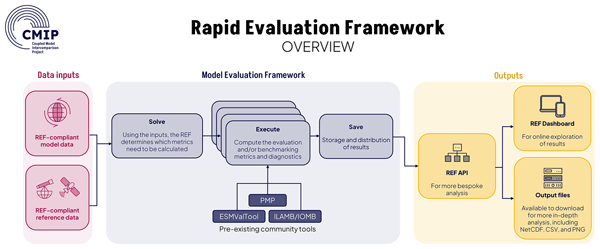
As Earth system models become more complex, rapid and comprehensive evaluation through comparison with observational data is necessary. The upcoming Assessment Fast Track for the Seventh Phase of the Coupled Model Intercomparison Project (CMIP7) will require fast analysis. This paper describes a new Rapid Evaluation Framework (REF) that was developed for the Assessment Fast Track that will be run at the Earth System Grid Federation (ESGF) to inform the community about the performance of models.
Zavud Baghirov, Markus Reichstein, Basil Kraft, Bernhard Ahrens, Marco Körner, and Martin Jung
EGUsphere, https://doi.org/10.5194/egusphere-2025-3123, https://doi.org/10.5194/egusphere-2025-3123, 2025
Short summary
Short summary
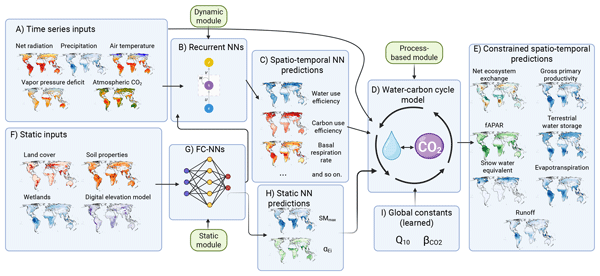
We introduce a new global model that links how water and carbon move through land ecosystems. By combining process knowledge with artificial intelligence that learns from observations, we model daily changes in vegetation, water and carbon cycle processes. This model outperforms both purely data-driven and traditional process models, especially in dry and tropical regions. This advance could improve current understanding of water-carbon cycle relationships.
Joao C. M. Teixeira, Chantelle Burton, Douglas I. Kelley, Gerd A. Folberth, Fiona M. O'Connor, Richard A. Betts, and Apostolos Voulgarakis
EGUsphere, https://doi.org/10.5194/egusphere-2025-3066, https://doi.org/10.5194/egusphere-2025-3066, 2025
Short summary
Short summary
Burnt areas produced by wildfires around the world are decreasing, especially in tropical regions, but many climate models fail to show this trend. Our study looks at whether adding a measure of human development to a fire model could improve its representation of these processes. We found that including these factors helped the model better match observations in many regions. This shows that human activity plays a key role in shaping fire trends.
Santiago Botía, Saqr Munassar, Thomas Koch, Danilo Custodio, Luana S. Basso, Shujiro Komiya, Jost V. Lavric, David Walter, Manuel Gloor, Giordane Martins, Stijn Naus, Gerbrand Koren, Ingrid T. Luijkx, Stijn Hantson, John B. Miller, Wouter Peters, Christian Rödenbeck, and Christoph Gerbig
Atmos. Chem. Phys., 25, 6219–6255, https://doi.org/10.5194/acp-25-6219-2025, https://doi.org/10.5194/acp-25-6219-2025, 2025
Short summary
Short summary
This study uses dry CO2 mole fractions from the Amazon Tall Tower Observatory together with airborne profiles to estimate net carbon exchange in tropical South America. We found that the biogeographic Amazon is a net carbon sink, while the Cerrado and Caatinga biomes are net carbon sources, resulting in an overall neutral balance. Finally, to further reduce the uncertainty in our estimates we call for an expansion of the monitoring capacity, especially in the Amazon–Andes foothills.
Maria Lucia Ferreira Barbosa, Douglas I. Kelley, Chantelle A. Burton, Igor J. M. Ferreira, Renata Moura da Veiga, Anna Bradley, Paulo Guilherme Molin, and Liana O. Anderson
Geosci. Model Dev., 18, 3533–3557, https://doi.org/10.5194/gmd-18-3533-2025, https://doi.org/10.5194/gmd-18-3533-2025, 2025
Short summary
Short summary
As fire seasons in Brazil become increasingly severe, confidently understanding the factors driving fires is more critical than ever. To address this challenge, we developed FLAME (Fire Landscape Analysis using Maximum Entropy), a new model designed to predict fires and to analyse the spatial influence of both environmental and human factors while accounting for uncertainties. By adapting the model to different regions, we can enhance fire management strategies, making FLAME a powerful tool for protecting landscapes in Brazil and beyond.
Derrick Muheki, Bas Vercruysse, Krishna Kumar Thirukokaranam Chandrasekar, Christophe Verbruggen, Julie M. Birkholz, Koen Hufkens, Hans Verbeeck, Pascal Boeckx, Seppe Lampe, Ed Hawkins, Peter Thorne, Dominique Kankonde Ntumba, Olivier Kapalay Moulasa, and Wim Thiery
EGUsphere, https://doi.org/10.5194/egusphere-2024-3779, https://doi.org/10.5194/egusphere-2024-3779, 2025
This preprint is open for discussion and under review for Geoscientific Model Development (GMD).
Short summary
Short summary
Archives worldwide host vast records of observed weather data crucial for understanding climate variability. However, most of these records are still in paper form, limiting their use. To address this, we developed MeteoSaver, an open-source tool, to transcribe these records to machine-readable format. Applied to ten handwritten temperature sheets, it achieved a median accuracy of 74%. This tool offers a promising solution to preserve records from archives and unlock historical weather insights.
Katja Frieler, Stefan Lange, Jacob Schewe, Matthias Mengel, Simon Treu, Christian Otto, Jan Volkholz, Christopher P. O. Reyer, Stefanie Heinicke, Colin Jones, Julia L. Blanchard, Cheryl S. Harrison, Colleen M. Petrik, Tyler D. Eddy, Kelly Ortega-Cisneros, Camilla Novaglio, Ryan Heneghan, Derek P. Tittensor, Olivier Maury, Matthias Büchner, Thomas Vogt, Dánnell Quesada Chacón, Kerry Emanuel, Chia-Ying Lee, Suzana J. Camargo, Jonas Jägermeyr, Sam Rabin, Jochen Klar, Iliusi D. Vega del Valle, Lisa Novak, Inga J. Sauer, Gitta Lasslop, Sarah Chadburn, Eleanor Burke, Angela Gallego-Sala, Noah Smith, Jinfeng Chang, Stijn Hantson, Chantelle Burton, Anne Gädeke, Fang Li, Simon N. Gosling, Hannes Müller Schmied, Fred Hattermann, Thomas Hickler, Rafael Marcé, Don Pierson, Wim Thiery, Daniel Mercado-Bettín, Robert Ladwig, Ana Isabel Ayala-Zamora, Matthew Forrest, Michel Bechtold, Robert Reinecke, Inge de Graaf, Jed O. Kaplan, Alexander Koch, and Matthieu Lengaigne
EGUsphere, https://doi.org/10.5194/egusphere-2025-2103, https://doi.org/10.5194/egusphere-2025-2103, 2025
Short summary
Short summary
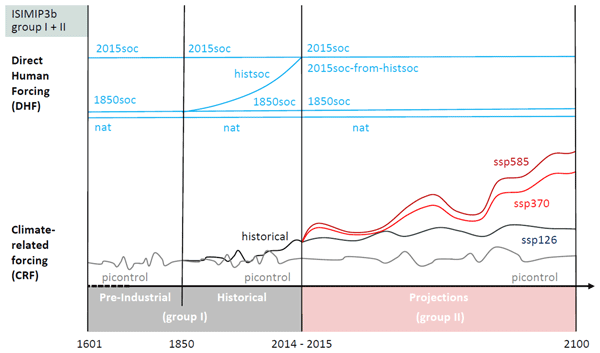
This paper describes the experiments and data sets necessary to run historic and future impact projections, and the underlying assumptions of future climate change as defined by the 3rd round of the ISIMIP Project (Inter-sectoral Impactmodel Intercomparison Project, isimip.org). ISIMIP provides a framework for cross-sectorally consistent climate impact simulations to contribute to a comprehensive and consistent picture of the world under different climate-change scenarios.
Zavud Baghirov, Martin Jung, Markus Reichstein, Marco Körner, and Basil Kraft
Geosci. Model Dev., 18, 2921–2943, https://doi.org/10.5194/gmd-18-2921-2025, https://doi.org/10.5194/gmd-18-2921-2025, 2025
Short summary
Short summary
We use an innovative approach to studying the Earth's water cycle by integrating advanced machine learning techniques with a traditional water cycle model. Our model is designed to learn from observational data, with a particular emphasis on understanding the influence of vegetation on water movement. By closely aligning with real-world observations, our model offers new possibilities for enhancing our understanding of the water cycle and its interactions with vegetation.
Suqi Guo, Felix Havermann, Steven J. De Hertog, Fei Luo, Iris Manola, Thomas Raddatz, Hongmei Li, Wim Thiery, Quentin Lejeune, Carl-Friedrich Schleussner, David Wårlind, Lars Nieradzik, and Julia Pongratz
Earth Syst. Dynam., 16, 631–666, https://doi.org/10.5194/esd-16-631-2025, https://doi.org/10.5194/esd-16-631-2025, 2025
Short summary
Short summary
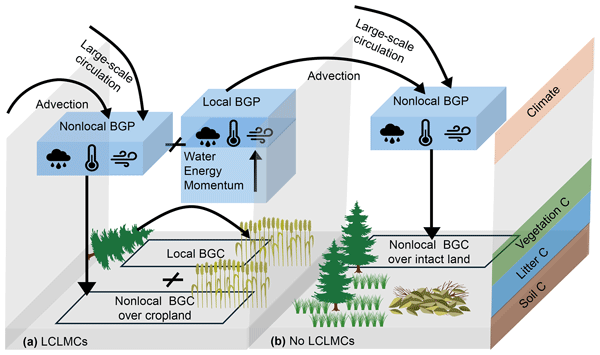
Land cover and land management changes (LCLMCs) can alter climate even in intact areas, causing carbon changes in remote areas. This study is the first to assess these effects, finding they substantially alter global carbon dynamics, changing terrestrial stocks by up to dozens of gigatonnes. These results are vital for scientific and policy assessments, given the expected role of LCLMCs in achieving the Paris Agreement's goal to limit global warming below 1.5 °C.
Hannes Müller Schmied, Simon Newland Gosling, Marlo Garnsworthy, Laura Müller, Camelia-Eliza Telteu, Atiq Kainan Ahmed, Lauren Seaby Andersen, Julien Boulange, Peter Burek, Jinfeng Chang, He Chen, Lukas Gudmundsson, Manolis Grillakis, Luca Guillaumot, Naota Hanasaki, Aristeidis Koutroulis, Rohini Kumar, Guoyong Leng, Junguo Liu, Xingcai Liu, Inga Menke, Vimal Mishra, Yadu Pokhrel, Oldrich Rakovec, Luis Samaniego, Yusuke Satoh, Harsh Lovekumar Shah, Mikhail Smilovic, Tobias Stacke, Edwin Sutanudjaja, Wim Thiery, Athanasios Tsilimigkras, Yoshihide Wada, Niko Wanders, and Tokuta Yokohata
Geosci. Model Dev., 18, 2409–2425, https://doi.org/10.5194/gmd-18-2409-2025, https://doi.org/10.5194/gmd-18-2409-2025, 2025
Short summary
Short summary
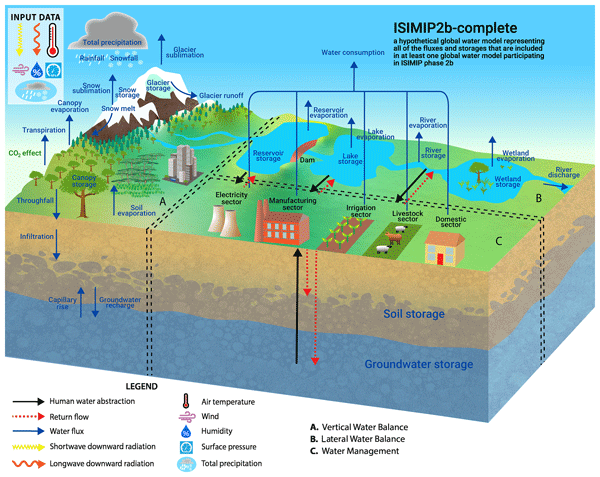
Global water models contribute to the evaluation of important natural and societal issues but are – as all models – simplified representation of reality. So, there are many ways to calculate the water fluxes and storages. This paper presents a visualization of 16 global water models using a standardized visualization and the pathway towards this common understanding. Next to academic education purposes, we envisage that these diagrams will help researchers, model developers, and data users.
Cristina Deidda, Arpita Khanna, Wolfgang Schade, and Wim Thiery
EGUsphere, https://doi.org/10.5194/egusphere-2025-1697, https://doi.org/10.5194/egusphere-2025-1697, 2025
Short summary
Short summary
Climate extremes like floods, heatwaves, droughts, and wildfires are disrupting Europe’s transport. This study combines a review of past events and future projections to assess current losses and the future exposure of transport infrastructure. Exposure to extremes is projected to rise, but lower emissions can reduce it. Urgent action is needed to adapt the Trans-European Transport Network to a changing climate.
Ngoc Thi Nhu Do, Kengo Sudo, Akihiko Ito, Louisa K. Emmons, Vaishali Naik, Kostas Tsigaridis, Øyvind Seland, Gerd A. Folberth, and Douglas I. Kelley
Geosci. Model Dev., 18, 2079–2109, https://doi.org/10.5194/gmd-18-2079-2025, https://doi.org/10.5194/gmd-18-2079-2025, 2025
Short summary
Short summary
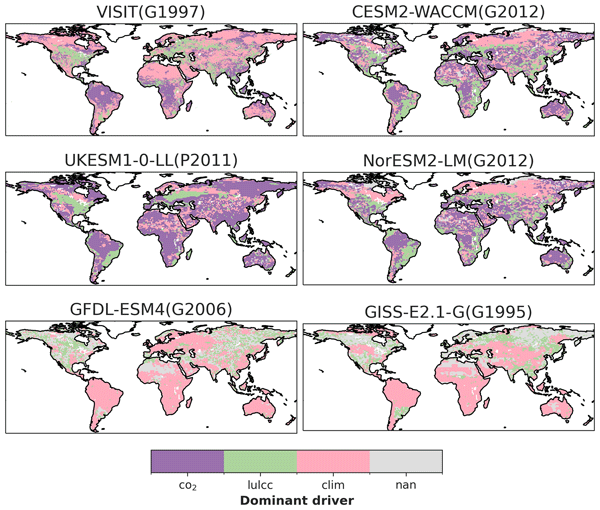
Understanding historical isoprene emission changes is important for predicting future climate, but trends and their controlling factors remain uncertain. This study shows that long-term isoprene trends vary among Earth system models mainly due to partially incorporating CO2 effects and land cover changes rather than to climate. Future models that refine these factors’ effects on isoprene emissions, along with long-term observations, are essential for better understanding plant–climate interactions.
Inika Taylor, Douglas I. Kelley, Camilla Mathison, Karina E. Williams, Andrew J. Hartley, Richard A. Betts, and Chantelle Burton
EGUsphere, https://doi.org/10.5194/egusphere-2025-720, https://doi.org/10.5194/egusphere-2025-720, 2025
Short summary
Short summary
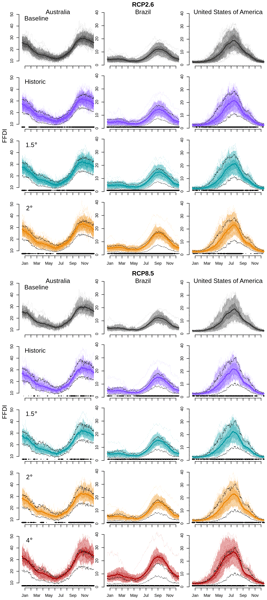
Climate change is reshaping fire seasons worldwide and, in many places, increasing fire weather risk. We use climate model simulations to project future changes in fire danger at different levels of global warming, focusing on Australia, Brazil, and the USA. Keeping warming below 2 °C significantly limits the increase in fire risk, but even at 1.5 °C, fire seasons lengthen, with more extreme conditions. However, low-fire weather periods remain, offering critical windows for fire management.
Basil Kraft, Michael Schirmer, William H. Aeberhard, Massimiliano Zappa, Sonia I. Seneviratne, and Lukas Gudmundsson
Hydrol. Earth Syst. Sci., 29, 1061–1082, https://doi.org/10.5194/hess-29-1061-2025, https://doi.org/10.5194/hess-29-1061-2025, 2025
Short summary
Short summary
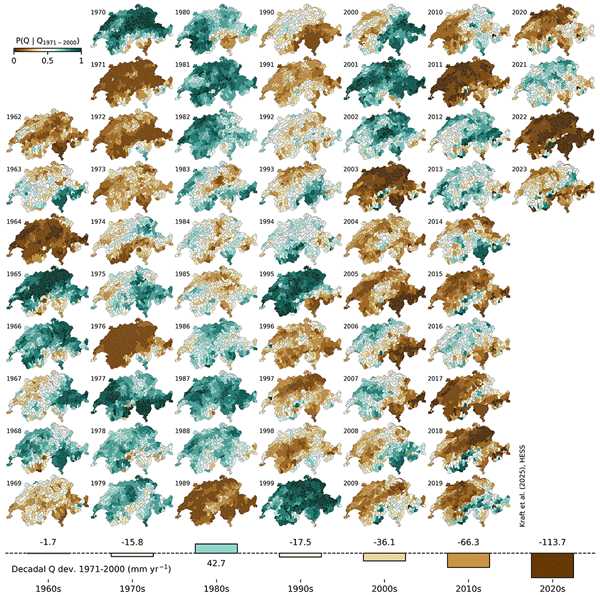
This study reconstructs daily runoff in Switzerland (1962–2023) using a deep-learning model, providing a spatially contiguous dataset on a medium-sized catchment grid. The model outperforms traditional hydrological methods, revealing shifts in Swiss water resources, including more frequent dry years and declining summer runoff. The reconstruction is publicly available.
Sabin I. Taranu, David M. Lawrence, Yoshihide Wada, Ting Tang, Erik Kluzek, Sam Rabin, Yi Yao, Steven J. De Hertog, Inne Vanderkelen, and Wim Thiery
Geosci. Model Dev., 17, 7365–7399, https://doi.org/10.5194/gmd-17-7365-2024, https://doi.org/10.5194/gmd-17-7365-2024, 2024
Short summary
Short summary
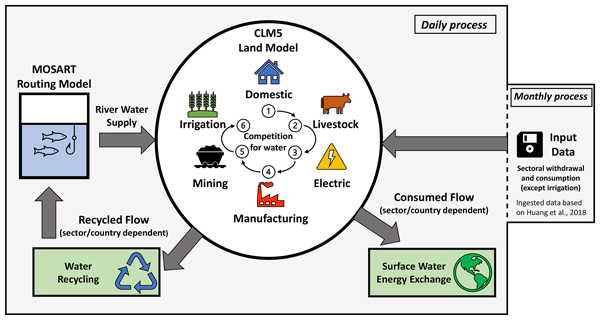
In this study, we improved a climate model by adding the representation of water use sectors such as domestic, industry, and agriculture. This new feature helps us understand how water is used and supplied in various areas. We tested our model from 1971 to 2010 and found that it accurately identifies areas with water scarcity. By modelling the competition between sectors when water availability is limited, the model helps estimate the intensity and extent of individual sectors' water shortages.
Matthew W. Jones, Douglas I. Kelley, Chantelle A. Burton, Francesca Di Giuseppe, Maria Lucia F. Barbosa, Esther Brambleby, Andrew J. Hartley, Anna Lombardi, Guilherme Mataveli, Joe R. McNorton, Fiona R. Spuler, Jakob B. Wessel, John T. Abatzoglou, Liana O. Anderson, Niels Andela, Sally Archibald, Dolors Armenteras, Eleanor Burke, Rachel Carmenta, Emilio Chuvieco, Hamish Clarke, Stefan H. Doerr, Paulo M. Fernandes, Louis Giglio, Douglas S. Hamilton, Stijn Hantson, Sarah Harris, Piyush Jain, Crystal A. Kolden, Tiina Kurvits, Seppe Lampe, Sarah Meier, Stacey New, Mark Parrington, Morgane M. G. Perron, Yuquan Qu, Natasha S. Ribeiro, Bambang H. Saharjo, Jesus San-Miguel-Ayanz, Jacquelyn K. Shuman, Veerachai Tanpipat, Guido R. van der Werf, Sander Veraverbeke, and Gavriil Xanthopoulos
Earth Syst. Sci. Data, 16, 3601–3685, https://doi.org/10.5194/essd-16-3601-2024, https://doi.org/10.5194/essd-16-3601-2024, 2024
Short summary
Short summary
This inaugural State of Wildfires report catalogues extreme fires of the 2023–2024 fire season. For key events, we analyse their predictability and drivers and attribute them to climate change and land use. We provide a seasonal outlook and decadal projections. Key anomalies occurred in Canada, Greece, and western Amazonia, with other high-impact events catalogued worldwide. Climate change significantly increased the likelihood of extreme fires, and mitigation is required to lessen future risk.
Derrick Muheki, Axel A. J. Deijns, Emanuele Bevacqua, Gabriele Messori, Jakob Zscheischler, and Wim Thiery
Earth Syst. Dynam., 15, 429–466, https://doi.org/10.5194/esd-15-429-2024, https://doi.org/10.5194/esd-15-429-2024, 2024
Short summary
Short summary
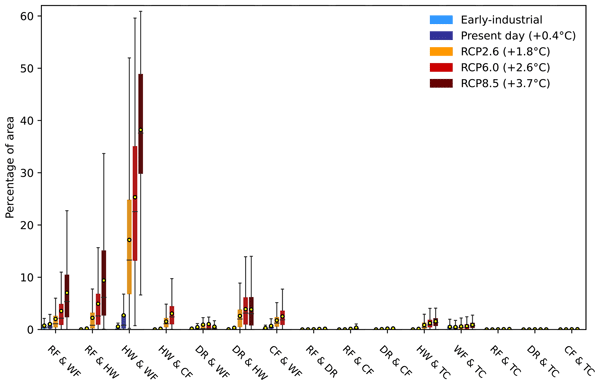
Climate change affects the interaction, dependence, and joint occurrence of climate extremes. Here we investigate the joint occurrence of pairs of river floods, droughts, heatwaves, crop failures, wildfires, and tropical cyclones in East Africa under past and future climate conditions. Our results show that, across all future warming scenarios, the frequency and spatial extent of these co-occurring extremes will increase in this region, particularly in areas close to the Nile and Congo rivers.
Steven J. De Hertog, Carmen E. Lopez-Fabara, Ruud van der Ent, Jessica Keune, Diego G. Miralles, Raphael Portmann, Sebastian Schemm, Felix Havermann, Suqi Guo, Fei Luo, Iris Manola, Quentin Lejeune, Julia Pongratz, Carl-Friedrich Schleussner, Sonia I. Seneviratne, and Wim Thiery
Earth Syst. Dynam., 15, 265–291, https://doi.org/10.5194/esd-15-265-2024, https://doi.org/10.5194/esd-15-265-2024, 2024
Short summary
Short summary
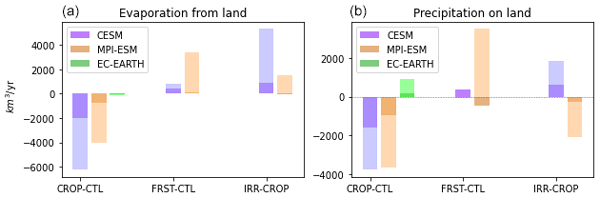
Changes in land use are crucial to achieve lower global warming. However, despite their importance, the effects of these changes on moisture fluxes are poorly understood. We analyse land cover and management scenarios in three climate models involving cropland expansion, afforestation, and irrigation. Results show largely consistent influences on moisture fluxes, with cropland expansion causing a drying and reduced local moisture recycling, while afforestation and irrigation show the opposite.
Rosa Pietroiusti, Inne Vanderkelen, Friederike E. L. Otto, Clair Barnes, Lucy Temple, Mary Akurut, Philippe Bally, Nicole P. M. van Lipzig, and Wim Thiery
Earth Syst. Dynam., 15, 225–264, https://doi.org/10.5194/esd-15-225-2024, https://doi.org/10.5194/esd-15-225-2024, 2024
Short summary
Short summary
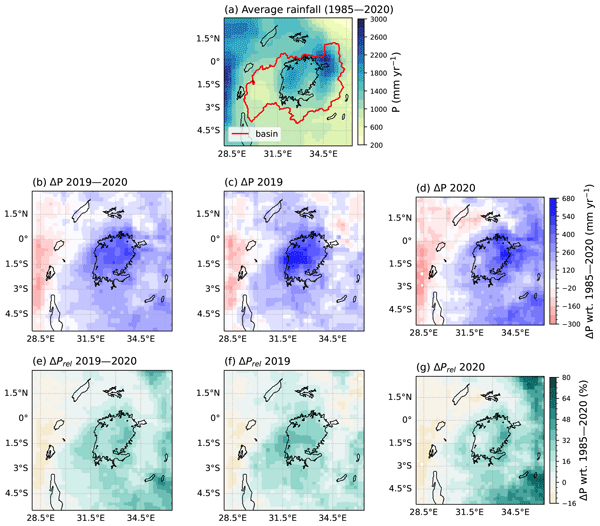
Heavy rainfall in eastern Africa between late 2019 and mid 2020 caused devastating floods and landslides and drove the levels of Lake Victoria to a record-breaking maximum in May 2020. In this study, we characterize the spatial extent and impacts of the floods in the Lake Victoria basin and investigate how human-induced climate change influenced the probability and intensity of the record-breaking lake levels and flooding by applying a multi-model extreme event attribution methodology.
Samuel Upton, Markus Reichstein, Fabian Gans, Wouter Peters, Basil Kraft, and Ana Bastos
Atmos. Chem. Phys., 24, 2555–2582, https://doi.org/10.5194/acp-24-2555-2024, https://doi.org/10.5194/acp-24-2555-2024, 2024
Short summary
Short summary
Data-driven eddy-covariance upscaled estimates of the global land–atmosphere net CO2 exchange (NEE) show important mismatches with regional and global estimates based on atmospheric information. To address this, we create a model with a dual constraint based on bottom-up eddy-covariance data and top-down atmospheric inversion data. Our model overcomes shortcomings of each approach, producing improved NEE estimates from local to global scale, helping to reduce uncertainty in the carbon budget.
Celray James Chawanda, Albert Nkwasa, Wim Thiery, and Ann van Griensven
Hydrol. Earth Syst. Sci., 28, 117–138, https://doi.org/10.5194/hess-28-117-2024, https://doi.org/10.5194/hess-28-117-2024, 2024
Short summary
Short summary
Africa's water resources are being negatively impacted by climate change and land-use change. The SWAT+ hydrological model was used to simulate the hydrological cycle in Africa, and results show likely decreases in river flows in the Zambezi and Congo rivers and highest flows in the Niger River basins due to climate change. Land cover change had the biggest impact in the Congo River basin, emphasizing the importance of including land-use change in studies.
Katja Frieler, Jan Volkholz, Stefan Lange, Jacob Schewe, Matthias Mengel, María del Rocío Rivas López, Christian Otto, Christopher P. O. Reyer, Dirk Nikolaus Karger, Johanna T. Malle, Simon Treu, Christoph Menz, Julia L. Blanchard, Cheryl S. Harrison, Colleen M. Petrik, Tyler D. Eddy, Kelly Ortega-Cisneros, Camilla Novaglio, Yannick Rousseau, Reg A. Watson, Charles Stock, Xiao Liu, Ryan Heneghan, Derek Tittensor, Olivier Maury, Matthias Büchner, Thomas Vogt, Tingting Wang, Fubao Sun, Inga J. Sauer, Johannes Koch, Inne Vanderkelen, Jonas Jägermeyr, Christoph Müller, Sam Rabin, Jochen Klar, Iliusi D. Vega del Valle, Gitta Lasslop, Sarah Chadburn, Eleanor Burke, Angela Gallego-Sala, Noah Smith, Jinfeng Chang, Stijn Hantson, Chantelle Burton, Anne Gädeke, Fang Li, Simon N. Gosling, Hannes Müller Schmied, Fred Hattermann, Jida Wang, Fangfang Yao, Thomas Hickler, Rafael Marcé, Don Pierson, Wim Thiery, Daniel Mercado-Bettín, Robert Ladwig, Ana Isabel Ayala-Zamora, Matthew Forrest, and Michel Bechtold
Geosci. Model Dev., 17, 1–51, https://doi.org/10.5194/gmd-17-1-2024, https://doi.org/10.5194/gmd-17-1-2024, 2024
Short summary
Short summary
Our paper provides an overview of all observational climate-related and socioeconomic forcing data used as input for the impact model evaluation and impact attribution experiments within the third round of the Inter-Sectoral Impact Model Intercomparison Project. The experiments are designed to test our understanding of observed changes in natural and human systems and to quantify to what degree these changes have already been induced by climate change.
Lee de Mora, Ranjini Swaminathan, Richard P. Allan, Jerry C. Blackford, Douglas I. Kelley, Phil Harris, Chris D. Jones, Colin G. Jones, Spencer Liddicoat, Robert J. Parker, Tristan Quaife, Jeremy Walton, and Andrew Yool
Earth Syst. Dynam., 14, 1295–1315, https://doi.org/10.5194/esd-14-1295-2023, https://doi.org/10.5194/esd-14-1295-2023, 2023
Short summary
Short summary
We investigate the flux of carbon from the atmosphere into the land surface and ocean for multiple models and over a range of future scenarios. We did this by comparing simulations after the same change in the global-mean near-surface temperature. Using this method, we show that the choice of scenario can impact the carbon allocation to the land, ocean, and atmosphere. Scenarios with higher emissions reach the same warming levels sooner, but also with relatively more carbon in the atmosphere.
Yang Chen, Joanne Hall, Dave van Wees, Niels Andela, Stijn Hantson, Louis Giglio, Guido R. van der Werf, Douglas C. Morton, and James T. Randerson
Earth Syst. Sci. Data, 15, 5227–5259, https://doi.org/10.5194/essd-15-5227-2023, https://doi.org/10.5194/essd-15-5227-2023, 2023
Short summary
Short summary
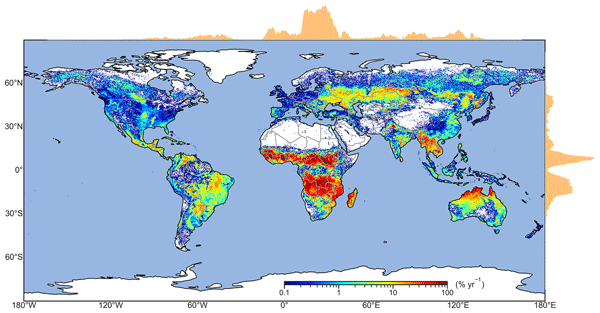
Using multiple sets of remotely sensed data, we created a dataset of monthly global burned area from 1997 to 2020. The estimated annual global burned area is 774 million hectares, significantly higher than previous estimates. Burned area declined by 1.21% per year due to extensive fire loss in savanna, grassland, and cropland ecosystems. This study enhances our understanding of the impact of fire on the carbon cycle and climate system, and may improve the predictions of future fire changes.
Joao Carlos Martins Teixeira, Chantelle Burton, Douglas I. Kelly, Gerd A. Folberth, Fiona M. O'Connor, Richard A. Betts, and Apostolos Voulgarakis
Biogeosciences Discuss., https://doi.org/10.5194/bg-2023-136, https://doi.org/10.5194/bg-2023-136, 2023
Revised manuscript not accepted
Short summary
Short summary
Representing socio-economic impacts on fires is crucial to underpin the confidence in global fire models. Introducing these into INFERNO, reduces biases and improves the modelled burnt area (BA) trends when compared to observations. Including socio-economic factors in the representation of fires in Earth System Models is important for realistically simulating BA, quantifying trends in the recent past, and for understanding the main drivers of those at regional scales.
Anna L. Merrifield, Lukas Brunner, Ruth Lorenz, Vincent Humphrey, and Reto Knutti
Geosci. Model Dev., 16, 4715–4747, https://doi.org/10.5194/gmd-16-4715-2023, https://doi.org/10.5194/gmd-16-4715-2023, 2023
Short summary
Short summary
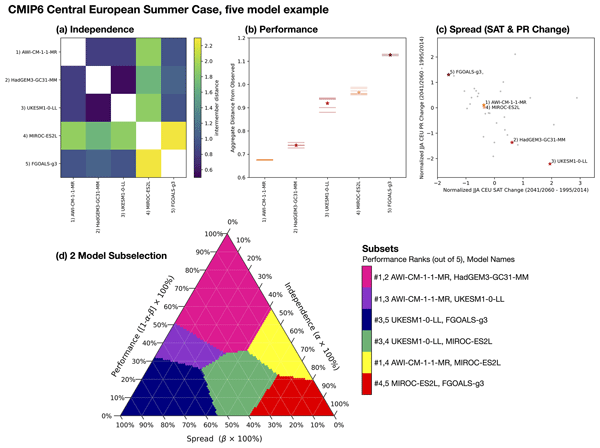
Using all Coupled Model Intercomparison Project (CMIP) models is unfeasible for many applications. We provide a subselection protocol that balances user needs for model independence, performance, and spread capturing CMIP’s projection uncertainty simultaneously. We show how sets of three to five models selected for European applications map to user priorities. An audit of model independence and its influence on equilibrium climate sensitivity uncertainty in CMIP is also presented.
Shruti Nath, Lukas Gudmundsson, Jonas Schwaab, Gregory Duveiller, Steven J. De Hertog, Suqi Guo, Felix Havermann, Fei Luo, Iris Manola, Julia Pongratz, Sonia I. Seneviratne, Carl F. Schleussner, Wim Thiery, and Quentin Lejeune
Geosci. Model Dev., 16, 4283–4313, https://doi.org/10.5194/gmd-16-4283-2023, https://doi.org/10.5194/gmd-16-4283-2023, 2023
Short summary
Short summary
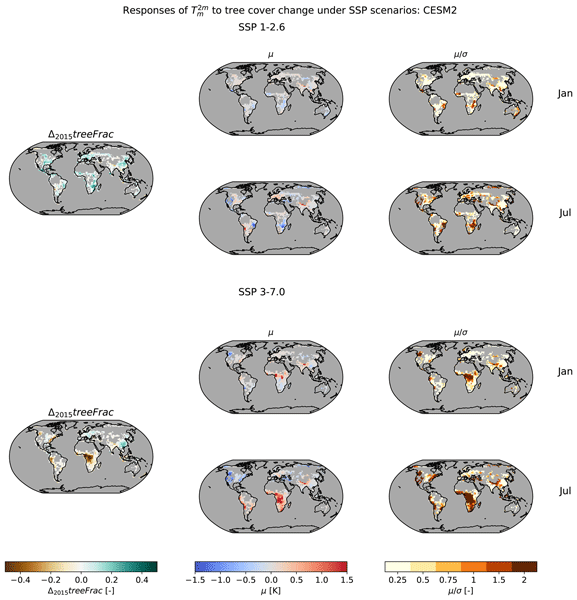
Tree cover changes play a significant role in climate mitigation and adaptation. Their regional impacts are key in informing national-level decisions and prioritising areas for conservation efforts. We present a first step towards exploring these regional impacts using a simple statistical device, i.e. emulator. The emulator only needs to train on climate model outputs representing the maximal impacts of aff-, re-, and deforestation, from which it explores plausible in-between outcomes itself.
Camilla Mathison, Eleanor Burke, Andrew J. Hartley, Douglas I. Kelley, Chantelle Burton, Eddy Robertson, Nicola Gedney, Karina Williams, Andy Wiltshire, Richard J. Ellis, Alistair A. Sellar, and Chris D. Jones
Geosci. Model Dev., 16, 4249–4264, https://doi.org/10.5194/gmd-16-4249-2023, https://doi.org/10.5194/gmd-16-4249-2023, 2023
Short summary
Short summary
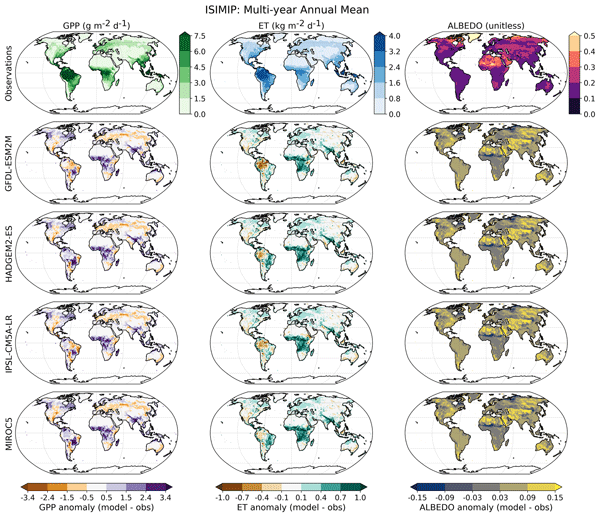
This paper describes and evaluates a new modelling methodology to quantify the impacts of climate change on water, biomes and the carbon cycle. We have created a new configuration and set-up for the JULES-ES land surface model, driven by bias-corrected historical and future climate model output provided by the Inter-Sectoral Impacts Model Intercomparison Project (ISIMIP). This allows us to compare projections of the impacts of climate change across multiple impact models and multiple sectors.
Stefano Potter, Sol Cooperdock, Sander Veraverbeke, Xanthe Walker, Michelle C. Mack, Scott J. Goetz, Jennifer Baltzer, Laura Bourgeau-Chavez, Arden Burrell, Catherine Dieleman, Nancy French, Stijn Hantson, Elizabeth E. Hoy, Liza Jenkins, Jill F. Johnstone, Evan S. Kane, Susan M. Natali, James T. Randerson, Merritt R. Turetsky, Ellen Whitman, Elizabeth Wiggins, and Brendan M. Rogers
Biogeosciences, 20, 2785–2804, https://doi.org/10.5194/bg-20-2785-2023, https://doi.org/10.5194/bg-20-2785-2023, 2023
Short summary
Short summary
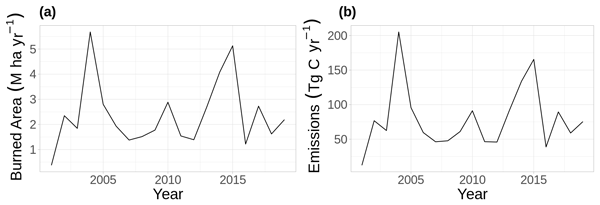
Here we developed a new burned-area detection algorithm between 2001–2019 across Alaska and Canada at 500 m resolution. We estimate 2.37 Mha burned annually between 2001–2019 over the domain, emitting 79.3 Tg C per year, with a mean combustion rate of 3.13 kg C m−2. We found larger-fire years were generally associated with greater mean combustion. The burned-area and combustion datasets described here can be used for local- to continental-scale applications of boreal fire science.
Steven J. De Hertog, Felix Havermann, Inne Vanderkelen, Suqi Guo, Fei Luo, Iris Manola, Dim Coumou, Edouard L. Davin, Gregory Duveiller, Quentin Lejeune, Julia Pongratz, Carl-Friedrich Schleussner, Sonia I. Seneviratne, and Wim Thiery
Earth Syst. Dynam., 14, 629–667, https://doi.org/10.5194/esd-14-629-2023, https://doi.org/10.5194/esd-14-629-2023, 2023
Short summary
Short summary
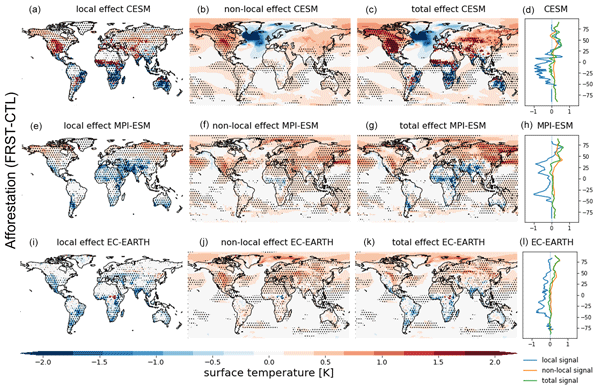
Land cover and land management changes are important strategies for future land-based mitigation. We investigate the climate effects of cropland expansion, afforestation, irrigation and wood harvesting using three Earth system models. Results show that these have important implications for surface temperature where the land cover and/or management change occur and in remote areas. Idealized afforestation causes global warming, which might offset the cooling effect from enhanced carbon uptake.
Steven J. De Hertog, Carmen E. Lopez-Fabara, Ruud van der Ent, Jessica Keune, Diego G. Miralles, Raphael Portmann, Sebastian Schemm, Felix Havermann, Suqi Guo, Fei Luo, Iris Manola, Quentin Lejeune, Julia Pongratz, Carl-Friedrich Schleussner, Sonia I. Seneviratne, and Wim Thiery
EGUsphere, https://doi.org/10.5194/egusphere-2023-953, https://doi.org/10.5194/egusphere-2023-953, 2023
Preprint archived
Short summary
Short summary
Land cover and management changes can affect the climate and water availability. In this study we use climate model simulations of extreme global land cover changes (afforestation, deforestation) and land management changes (irrigation) to understand the effects on the global water cycle and local to continental water availability. We show that cropland expansion generally leads to higher evaporation and lower amounts of precipitation and afforestation and irrigation expansion to the opposite.
Vincent Humphrey and Christian Frankenberg
Biogeosciences, 20, 1789–1811, https://doi.org/10.5194/bg-20-1789-2023, https://doi.org/10.5194/bg-20-1789-2023, 2023
Short summary
Short summary
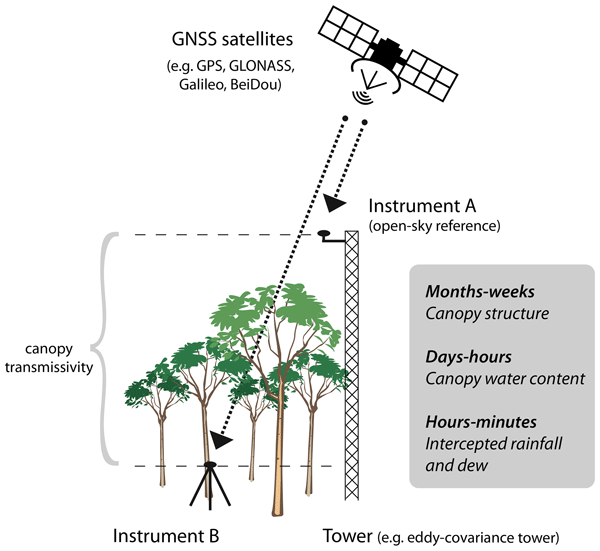
Microwave satellites can be used to monitor how vegetation biomass changes over time or how droughts affect the world's forests. However, such satellite data are still difficult to validate and interpret because of a lack of comparable field observations. Here, we present a remote sensing technique that uses the Global Navigation Satellite System (GNSS) as a makeshift radar, making it possible to observe canopy transmissivity at any existing environmental research site in a cost-efficient way.
Francisco José Cuesta-Valero, Hugo Beltrami, Almudena García-García, Gerhard Krinner, Moritz Langer, Andrew H. MacDougall, Jan Nitzbon, Jian Peng, Karina von Schuckmann, Sonia I. Seneviratne, Wim Thiery, Inne Vanderkelen, and Tonghua Wu
Earth Syst. Dynam., 14, 609–627, https://doi.org/10.5194/esd-14-609-2023, https://doi.org/10.5194/esd-14-609-2023, 2023
Short summary
Short summary
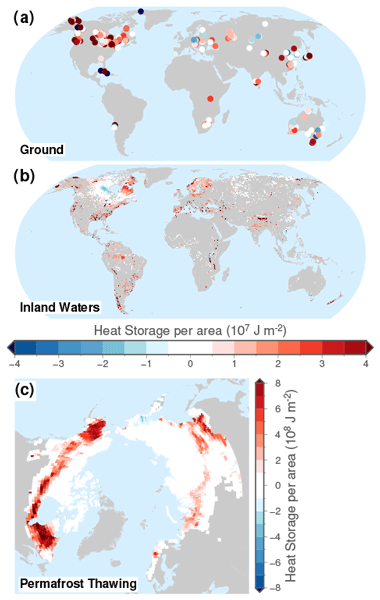
Climate change is caused by the accumulated heat in the Earth system, with the land storing the second largest amount of this extra heat. Here, new estimates of continental heat storage are obtained, including changes in inland-water heat storage and permafrost heat storage in addition to changes in ground heat storage. We also argue that heat gains in all three components should be monitored independently of their magnitude due to heat-dependent processes affecting society and ecosystems.
Karina von Schuckmann, Audrey Minière, Flora Gues, Francisco José Cuesta-Valero, Gottfried Kirchengast, Susheel Adusumilli, Fiammetta Straneo, Michaël Ablain, Richard P. Allan, Paul M. Barker, Hugo Beltrami, Alejandro Blazquez, Tim Boyer, Lijing Cheng, John Church, Damien Desbruyeres, Han Dolman, Catia M. Domingues, Almudena García-García, Donata Giglio, John E. Gilson, Maximilian Gorfer, Leopold Haimberger, Maria Z. Hakuba, Stefan Hendricks, Shigeki Hosoda, Gregory C. Johnson, Rachel Killick, Brian King, Nicolas Kolodziejczyk, Anton Korosov, Gerhard Krinner, Mikael Kuusela, Felix W. Landerer, Moritz Langer, Thomas Lavergne, Isobel Lawrence, Yuehua Li, John Lyman, Florence Marti, Ben Marzeion, Michael Mayer, Andrew H. MacDougall, Trevor McDougall, Didier Paolo Monselesan, Jan Nitzbon, Inès Otosaka, Jian Peng, Sarah Purkey, Dean Roemmich, Kanako Sato, Katsunari Sato, Abhishek Savita, Axel Schweiger, Andrew Shepherd, Sonia I. Seneviratne, Leon Simons, Donald A. Slater, Thomas Slater, Andrea K. Steiner, Toshio Suga, Tanguy Szekely, Wim Thiery, Mary-Louise Timmermans, Inne Vanderkelen, Susan E. Wjiffels, Tonghua Wu, and Michael Zemp
Earth Syst. Sci. Data, 15, 1675–1709, https://doi.org/10.5194/essd-15-1675-2023, https://doi.org/10.5194/essd-15-1675-2023, 2023
Short summary
Short summary
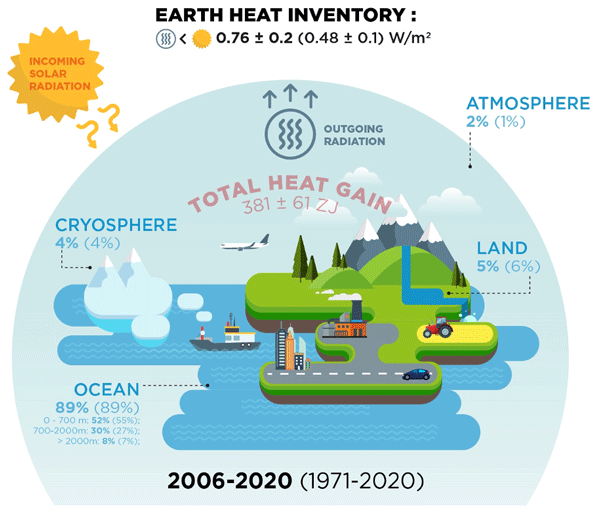
Earth's climate is out of energy balance, and this study quantifies how much heat has consequently accumulated over the past decades (ocean: 89 %, land: 6 %, cryosphere: 4 %, atmosphere: 1 %). Since 1971, this accumulated heat reached record values at an increasing pace. The Earth heat inventory provides a comprehensive view on the status and expectation of global warming, and we call for an implementation of this global climate indicator into the Paris Agreement’s Global Stocktake.
Hoontaek Lee, Martin Jung, Nuno Carvalhais, Tina Trautmann, Basil Kraft, Markus Reichstein, Matthias Forkel, and Sujan Koirala
Hydrol. Earth Syst. Sci., 27, 1531–1563, https://doi.org/10.5194/hess-27-1531-2023, https://doi.org/10.5194/hess-27-1531-2023, 2023
Short summary
Short summary
We spatially attribute the variance in global terrestrial water storage (TWS) interannual variability (IAV) and its modeling error with two data-driven hydrological models. We find error hotspot regions that show a disproportionately large significance in the global mismatch and the association of the error regions with a smaller-scale lateral convergence of water. Our findings imply that TWS IAV modeling can be efficiently improved by focusing on model representations for the error hotspots.
Elena Aragoneses, Mariano García, Michele Salis, Luís M. Ribeiro, and Emilio Chuvieco
Earth Syst. Sci. Data, 15, 1287–1315, https://doi.org/10.5194/essd-15-1287-2023, https://doi.org/10.5194/essd-15-1287-2023, 2023
Short summary
Short summary
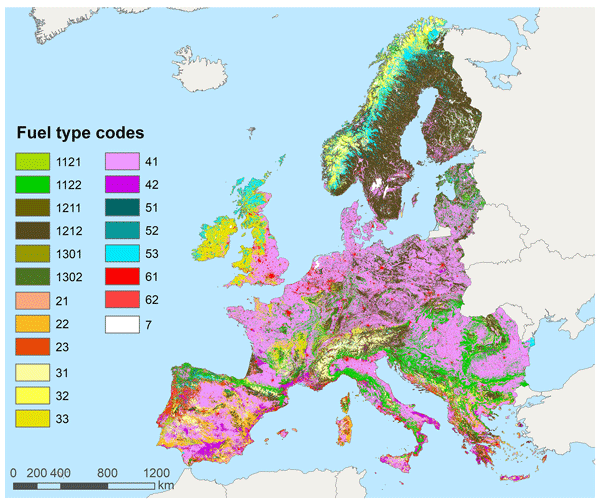
We present a new hierarchical fuel classification system with a total of 85 fuels that is useful for preventing fire risk at different spatial scales. Based on this, we developed a European fuel map (1 km resolution) using land cover datasets, biogeographic datasets, and bioclimatic modelling. We validated the map by comparing it to high-resolution data, obtaining high overall accuracy. Finally, we developed a crosswalk for standard fuel models as a first assignment of fuel parameters.
Jane P. Mulcahy, Colin G. Jones, Steven T. Rumbold, Till Kuhlbrodt, Andrea J. Dittus, Edward W. Blockley, Andrew Yool, Jeremy Walton, Catherine Hardacre, Timothy Andrews, Alejandro Bodas-Salcedo, Marc Stringer, Lee de Mora, Phil Harris, Richard Hill, Doug Kelley, Eddy Robertson, and Yongming Tang
Geosci. Model Dev., 16, 1569–1600, https://doi.org/10.5194/gmd-16-1569-2023, https://doi.org/10.5194/gmd-16-1569-2023, 2023
Short summary
Short summary
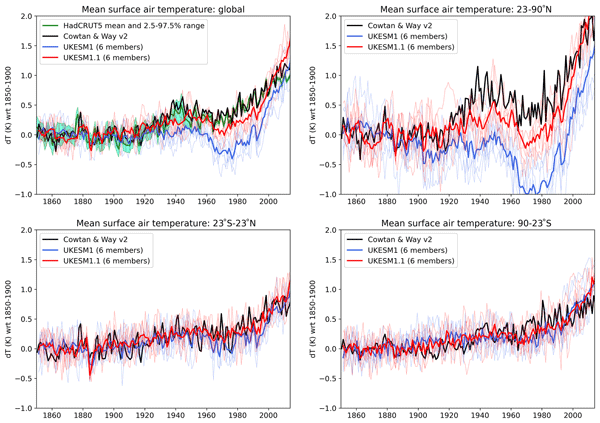
Recent global climate models simulate historical global mean surface temperatures which are too cold, possibly to due to excessive aerosol cooling. This raises questions about the models' ability to simulate important climate processes and reduces confidence in future climate predictions. We present a new version of the UK Earth System Model, which has an improved aerosols simulation and a historical temperature record. Interestingly, the long-term response to CO2 remains largely unchanged.
Ryan S. Padrón, Lukas Gudmundsson, Laibao Liu, Vincent Humphrey, and Sonia I. Seneviratne
Biogeosciences, 19, 5435–5448, https://doi.org/10.5194/bg-19-5435-2022, https://doi.org/10.5194/bg-19-5435-2022, 2022
Short summary
Short summary
The answer to how much carbon land ecosystems are projected to remove from the atmosphere until 2100 is different for each Earth system model. We find that differences across models are primarily explained by the annual land carbon sink dependence on temperature and soil moisture, followed by the dependence on CO2 air concentration, and by average climate conditions. Our insights on why each model projects a relatively high or low land carbon sink can help to reduce the underlying uncertainty.
Axel A. J. Deijns, Olivier Dewitte, Wim Thiery, Nicolas d'Oreye, Jean-Philippe Malet, and François Kervyn
Nat. Hazards Earth Syst. Sci., 22, 3679–3700, https://doi.org/10.5194/nhess-22-3679-2022, https://doi.org/10.5194/nhess-22-3679-2022, 2022
Short summary
Short summary
Landslides and flash floods are rainfall-induced processes that often co-occur and interact, generally very quickly. In mountainous cloud-covered environments, determining when these processes occur remains challenging. We propose a regional methodology using open-access satellite radar images that allow for the timing of landslide and flash floods events, in the contrasting landscapes of tropical Africa, with an accuracy of up to a few days. The methodology shows potential for transferability.
Steven J. De Hertog, Felix Havermann, Inne Vanderkelen, Suqi Guo, Fei Luo, Iris Manola, Dim Coumou, Edouard L. Davin, Gregory Duveiller, Quentin Lejeune, Julia Pongratz, Carl-Friedrich Schleussner, Sonia I. Seneviratne, and Wim Thiery
Earth Syst. Dynam., 13, 1305–1350, https://doi.org/10.5194/esd-13-1305-2022, https://doi.org/10.5194/esd-13-1305-2022, 2022
Short summary
Short summary
Land cover and land management changes are important strategies for future land-based mitigation. We investigate the climate effects of cropland expansion, afforestation, irrigation, and wood harvesting using three Earth system models. Results show that these have important implications for surface temperature where the land cover and/or management change occurs and in remote areas. Idealized afforestation causes global warming, which might offset the cooling effect from enhanced carbon uptake.
Fátima Arrogante-Funes, Inmaculada Aguado, and Emilio Chuvieco
Nat. Hazards Earth Syst. Sci., 22, 2981–3003, https://doi.org/10.5194/nhess-22-2981-2022, https://doi.org/10.5194/nhess-22-2981-2022, 2022
Short summary
Short summary
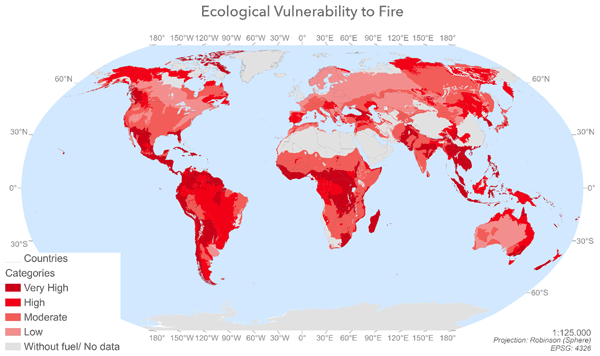
We show that ecological value might be reduced by 50 % due to fire perturbation in ecosystems that have not developed in the presence of fire and/or that present changes in the fire regime. The biomes most affected are tropical and subtropical forests, tundra, and mangroves. Integration of biotic and abiotic fire regime and regeneration factors resulted in a powerful way to map ecological vulnerability to fire and develop assessments to generate adaptation plans of management in forest masses.
Louise Busschaert, Shannon de Roos, Wim Thiery, Dirk Raes, and Gabriëlle J. M. De Lannoy
Hydrol. Earth Syst. Sci., 26, 3731–3752, https://doi.org/10.5194/hess-26-3731-2022, https://doi.org/10.5194/hess-26-3731-2022, 2022
Short summary
Short summary
Increasing amounts of water are used for agriculture. Therefore, we looked into how irrigation requirements will evolve under a changing climate over Europe. Our results show that, by the end of the century and under high emissions, irrigation water will increase by 30 % on average compared to the year 2000. Also, the irrigation requirement is likely to vary more from 1 year to another. However, if emissions are mitigated, these effects are reduced.
Malgorzata Golub, Wim Thiery, Rafael Marcé, Don Pierson, Inne Vanderkelen, Daniel Mercado-Bettin, R. Iestyn Woolway, Luke Grant, Eleanor Jennings, Benjamin M. Kraemer, Jacob Schewe, Fang Zhao, Katja Frieler, Matthias Mengel, Vasiliy Y. Bogomolov, Damien Bouffard, Marianne Côté, Raoul-Marie Couture, Andrey V. Debolskiy, Bram Droppers, Gideon Gal, Mingyang Guo, Annette B. G. Janssen, Georgiy Kirillin, Robert Ladwig, Madeline Magee, Tadhg Moore, Marjorie Perroud, Sebastiano Piccolroaz, Love Raaman Vinnaa, Martin Schmid, Tom Shatwell, Victor M. Stepanenko, Zeli Tan, Bronwyn Woodward, Huaxia Yao, Rita Adrian, Mathew Allan, Orlane Anneville, Lauri Arvola, Karen Atkins, Leon Boegman, Cayelan Carey, Kyle Christianson, Elvira de Eyto, Curtis DeGasperi, Maria Grechushnikova, Josef Hejzlar, Klaus Joehnk, Ian D. Jones, Alo Laas, Eleanor B. Mackay, Ivan Mammarella, Hampus Markensten, Chris McBride, Deniz Özkundakci, Miguel Potes, Karsten Rinke, Dale Robertson, James A. Rusak, Rui Salgado, Leon van der Linden, Piet Verburg, Danielle Wain, Nicole K. Ward, Sabine Wollrab, and Galina Zdorovennova
Geosci. Model Dev., 15, 4597–4623, https://doi.org/10.5194/gmd-15-4597-2022, https://doi.org/10.5194/gmd-15-4597-2022, 2022
Short summary
Short summary
Lakes and reservoirs are warming across the globe. To better understand how lakes are changing and to project their future behavior amidst various sources of uncertainty, simulations with a range of lake models are required. This in turn requires international coordination across different lake modelling teams worldwide. Here we present a protocol for and results from coordinated simulations of climate change impacts on lakes worldwide.
Inne Vanderkelen, Shervan Gharari, Naoki Mizukami, Martyn P. Clark, David M. Lawrence, Sean Swenson, Yadu Pokhrel, Naota Hanasaki, Ann van Griensven, and Wim Thiery
Geosci. Model Dev., 15, 4163–4192, https://doi.org/10.5194/gmd-15-4163-2022, https://doi.org/10.5194/gmd-15-4163-2022, 2022
Short summary
Short summary
Human-controlled reservoirs have a large influence on the global water cycle. However, dam operations are rarely represented in Earth system models. We implement and evaluate a widely used reservoir parametrization in a global river-routing model. Using observations of individual reservoirs, the reservoir scheme outperforms the natural lake scheme. However, both schemes show a similar performance due to biases in runoff timing and magnitude when using simulated runoff.
M. L. Marszalek, B. Le Saux, P.-P. Mathieu, A. Nowakowski, and D. Springer
Int. Arch. Photogramm. Remote Sens. Spatial Inf. Sci., XLIII-B3-2022, 1327–1333, https://doi.org/10.5194/isprs-archives-XLIII-B3-2022-1327-2022, https://doi.org/10.5194/isprs-archives-XLIII-B3-2022-1327-2022, 2022
Basil Kraft, Martin Jung, Marco Körner, Sujan Koirala, and Markus Reichstein
Hydrol. Earth Syst. Sci., 26, 1579–1614, https://doi.org/10.5194/hess-26-1579-2022, https://doi.org/10.5194/hess-26-1579-2022, 2022
Short summary
Short summary
We present a physics-aware machine learning model of the global hydrological cycle. As the model uses neural networks under the hood, the simulations of the water cycle are learned from data, and yet they are informed and constrained by physical knowledge. The simulated patterns lie within the range of existing hydrological models and are plausible. The hybrid modeling approach has the potential to tackle key environmental questions from a novel perspective.
Rahayu Adzhar, Douglas I. Kelley, Ning Dong, Charles George, Mireia Torello Raventos, Elmar Veenendaal, Ted R. Feldpausch, Oliver L. Phillips, Simon L. Lewis, Bonaventure Sonké, Herman Taedoumg, Beatriz Schwantes Marimon, Tomas Domingues, Luzmila Arroyo, Gloria Djagbletey, Gustavo Saiz, and France Gerard
Biogeosciences, 19, 1377–1394, https://doi.org/10.5194/bg-19-1377-2022, https://doi.org/10.5194/bg-19-1377-2022, 2022
Short summary
Short summary
The MODIS Vegetation Continuous Fields (VCF) product underestimates tree cover compared to field data and could be underestimating tree cover significantly across the tropics. VCF is used to represent land cover or validate model performance in many land surface and global vegetation models and to train finer-scaled Earth observation products. Because underestimation in VCF may render it unsuitable for training data and bias model predictions, it should be calibrated before use in the tropics.
Aine M. Gormley-Gallagher, Sebastian Sterl, Annette L. Hirsch, Sonia I. Seneviratne, Edouard L. Davin, and Wim Thiery
Earth Syst. Dynam., 13, 419–438, https://doi.org/10.5194/esd-13-419-2022, https://doi.org/10.5194/esd-13-419-2022, 2022
Short summary
Short summary
Our results show that agricultural management can impact the local climate and highlight the need to evaluate land management in climate models. We use regression analysis on climate simulations and observations to assess irrigation and conservation agriculture impacts on warming trends. This allowed us to distinguish between the effects of land management and large-scale climate forcings such as rising CO2 concentrations and thus gain insight into the impacts under different climate regimes.
Silje Lund Sørland, Roman Brogli, Praveen Kumar Pothapakula, Emmanuele Russo, Jonas Van de Walle, Bodo Ahrens, Ivonne Anders, Edoardo Bucchignani, Edouard L. Davin, Marie-Estelle Demory, Alessandro Dosio, Hendrik Feldmann, Barbara Früh, Beate Geyer, Klaus Keuler, Donghyun Lee, Delei Li, Nicole P. M. van Lipzig, Seung-Ki Min, Hans-Jürgen Panitz, Burkhardt Rockel, Christoph Schär, Christian Steger, and Wim Thiery
Geosci. Model Dev., 14, 5125–5154, https://doi.org/10.5194/gmd-14-5125-2021, https://doi.org/10.5194/gmd-14-5125-2021, 2021
Short summary
Short summary
We review the contribution from the CLM-Community to regional climate projections following the CORDEX framework over Europe, South Asia, East Asia, Australasia, and Africa. How the model configuration, horizontal and vertical resolutions, and choice of driving data influence the model results for the five domains is assessed, with the purpose of aiding the planning and design of regional climate simulations in the future.
Camelia-Eliza Telteu, Hannes Müller Schmied, Wim Thiery, Guoyong Leng, Peter Burek, Xingcai Liu, Julien Eric Stanislas Boulange, Lauren Seaby Andersen, Manolis Grillakis, Simon Newland Gosling, Yusuke Satoh, Oldrich Rakovec, Tobias Stacke, Jinfeng Chang, Niko Wanders, Harsh Lovekumar Shah, Tim Trautmann, Ganquan Mao, Naota Hanasaki, Aristeidis Koutroulis, Yadu Pokhrel, Luis Samaniego, Yoshihide Wada, Vimal Mishra, Junguo Liu, Petra Döll, Fang Zhao, Anne Gädeke, Sam S. Rabin, and Florian Herz
Geosci. Model Dev., 14, 3843–3878, https://doi.org/10.5194/gmd-14-3843-2021, https://doi.org/10.5194/gmd-14-3843-2021, 2021
Short summary
Short summary
We analyse water storage compartments, water flows, and human water use sectors included in 16 global water models that provide simulations for the Inter-Sectoral Impact Model Intercomparison Project phase 2b. We develop a standard writing style for the model equations. We conclude that even though hydrologic processes are often based on similar equations, in the end these equations have been adjusted, or the models have used different values for specific parameters or specific variables.
Robert Reinecke, Hannes Müller Schmied, Tim Trautmann, Lauren Seaby Andersen, Peter Burek, Martina Flörke, Simon N. Gosling, Manolis Grillakis, Naota Hanasaki, Aristeidis Koutroulis, Yadu Pokhrel, Wim Thiery, Yoshihide Wada, Satoh Yusuke, and Petra Döll
Hydrol. Earth Syst. Sci., 25, 787–810, https://doi.org/10.5194/hess-25-787-2021, https://doi.org/10.5194/hess-25-787-2021, 2021
Short summary
Short summary
Billions of people rely on groundwater as an accessible source of drinking water and for irrigation, especially in times of drought. Groundwater recharge is the primary process of regenerating groundwater resources. We find that groundwater recharge will increase in northern Europe by about 19 % and decrease by 10 % in the Amazon with 3 °C global warming. In the Mediterranean, a 2 °C warming has already lead to a reduction in recharge by 38 %. However, these model predictions are uncertain.
Douglas I. Kelley, Chantelle Burton, Chris Huntingford, Megan A. J. Brown, Rhys Whitley, and Ning Dong
Biogeosciences, 18, 787–804, https://doi.org/10.5194/bg-18-787-2021, https://doi.org/10.5194/bg-18-787-2021, 2021
Short summary
Short summary
Initial evidence suggests human ignitions or landscape changes caused most Amazon fires during August 2019. However, confirmation is needed that meteorological conditions did not have a substantial role. Assessing the influence of historical weather on burning in an uncertainty framework, we find that 2019 meteorological conditions alone should have resulted in much less fire than observed. We conclude socio-economic factors likely had a strong role in the high recorded 2019 fire activity.
Cited articles
Akiba, T., Sano, S., Yanase, T., Ohta, T., and Koyama, M.: Optuna: A Next-generation Hyperparameter Optimization Framework, in: Proceedings of the 25th ACM SIGKDD International Conference on Knowledge Discovery and Data Mining, arXiv [preprint], https://doi.org/10.48550/arXiv.1907.10902, 25 July 2019. a
Archibald, S., Lehmann, C. E. R., Belcher, C. M., Bond, W. J., Bradstock, R. A., Daniau, A.-L., Dexter, K. G., Forrestel, E. J., Greve, M., He, T., Higgins, S. I., Hoffmann, W. A., Lamont, B. B., McGlinn, D. J., Moncrieff, G. R., Osborne, C. P., Pausas, J. G., Price, O., Ripley, B. S., Rogers, B. M., Schwilk, D. W., Simon, M. F., Turetsky, M. R., der Werf, G. R. V., and Zanne, A. E.: Biological and geophysical feedbacks with fire in the Earth system, Environmental Research Letters, 13, 033003, https://doi.org/10.1088/1748-9326/aa9ead, 2018. a
Bauters, M., Drake, T. W., Wagner, S., Baumgartner, S., Makelele, I. A., Bodé, S., Verheyen, K., Verbeeck, H., Ewango, C., Cizungu, L., Van Oost, K., and Boeckx, P.: Fire-derived phosphorus fertilization of African tropical forests, Nature Communications, 12, 5129, https://doi.org/10.1038/s41467-021-25428-3, 2021. a
Beck, P. S., Goetz, S. J., Mack, M. C., Alexander, H. D., Jin, Y., Randerson, J. T., and Loranty, M. M.: The impacts and implications of an intensifying fire regime on Alaskan boreal forest composition and albedo, Global Change Biology, 17, 2853–2866, 2011. a
Bergstra, J., Bardenet, R., Bengio, Y., and Kégl, B.: Algorithms for hyper-parameter optimization, Advances in neural information processing systems, 24, https://proceedings.neurips.cc/paper_files/paper/2011/file/86e8f7ab32cfd12577bc2619bc635690-Paper.pdf (last access: 10 April 2025), 2011. a
Bowman, D.: Wildfire science is at a loss for comprehensive data, Nature, 560, 7–8, 2018. a
Bowman, D. M., Kolden, C. A., Abatzoglou, J. T., Johnston, F. H., van der Werf, G. R., and Flannigan, M.: Vegetation fires in the Anthropocene, Nature Reviews Earth & Environment, 1, 500–515, 2020. a
Bowman, D. M. J. S., Balch, J. K., Artaxo, P., Bond, W. J., Carlson, J. M., Cochrane, M. A., D’Antonio, C. M., DeFries, R. S., Doyle, J. C., Harrison, S. P., Johnston, F. H., Keeley, J. E., Krawchuk, M. A., Kull, C. A., Marston, J. B., Moritz, M. A., Prentice, I. C., Roos, C. I., Scott, A. C., Swetnam, T. W., van der Werf, G. R., and Pyne, S. J.: Fire in the Earth System, Science, 324, 481–484, https://doi.org/10.1126/science.1163886, 2009. a
Brogan, D. J., Nelson, P. A., and MacDonald, L. H.: Reconstructing extreme post-wildfire floods: A comparison of convective and mesoscale events, Earth Surface Processes and Landforms, 42, 2505–2522, 2017. a
Burton, C., Lampe, S., Kelley, D. I., Thiery, W., Hantson, S., Christidis, N., Gudmundsson, L., Forrest, M., Burke, E., Chang, J., Huang, H., Ito, A., Kou-Giesbrecht, S., Lasslop, G., Li, W., Nieradzik, L., Li, F., Chen, Y., Randerson, J., Reyer, C. P. O., and Mengel, M.: Global burned area increasingly explained by climate change, Nature Climate Change, 14, 1186–1192, https://doi.org/10.1038/s41558-024-02140-w, 2024. a, b, c, d
Canadian Forest Service: National Burned Area Composite (NBAC), https://cwfis.cfs.nrcan.gc.ca (last access: 10 April 2025), 2024. a
Cao, Y., Yang, F., Tang, Q., and Lu, X.: An attention enhanced bidirectional LSTM for early forest fire smoke recognition, IEEE Access, 7, 154732–154742, 2019. a
Carvalho, A., Monteiro, A., Flannigan, M., Solman, S., Miranda, A. I., and Borrego, C.: Forest fires in a changing climate and their impacts on air quality, Atmospheric Environment, 45, 5545–5553, 2011. a
Chakrabarty, R. K., Shetty, N. J., Thind, A. S., Beeler, P., Sumlin, B. J., Zhang, C., Liu, P., Idrobo, J. C., Adachi, K., Wagner, N. L., Schwarz, J. P., Ahern, A., Sedlacek, A. J., Lambe, A., Daube, C., Lyu, M., Liu, C., Herndon, S., Onasch, T. B., and Mishra, R.: Shortwave absorption by wildfire smoke dominated by dark brown carbon, Nature Geoscience, 16, 683–688, 2023. a
Chen, J., Li, C., Ristovski, Z., Milic, A., Gu, Y., Islam, M. S., Wang, S., Hao, J., Zhang, H., He, C., Guo, H., Fu, H., Miljevic, B., Morawska, L., Thai, P., LAM, Y. F., Pereira, G., Ding, A., Huang, X., and Dumka, U. C.: A review of biomass burning: Emissions and impacts on air quality, health and climate in China, Science of the Total Environment, 579, 1000–1034, 2017. a
Chen, Y., Hall, J., van Wees, D., Andela, N., Hantson, S., Giglio, L., van der Werf, G., Morton, D., and Randerson, J.: Global Fire Emissions Database (GFED5) Burned Area (0.1), Zenodo [data set], https://doi.org/10.5281/zenodo.7668424, 2023a. a
Chen, Y., Hall, J., van Wees, D., Andela, N., Hantson, S., Giglio, L., van der Werf, G. R., Morton, D. C., and Randerson, J. T.: Multi-decadal trends and variability in burned area from the fifth version of the Global Fire Emissions Database (GFED5), Earth System Science Data, 15, 5227–5259, https://doi.org/10.5194/essd-15-5227-2023, 2023b. a, b, c, d, e, f
Chuvieco, E., Roteta, E., Sali, M., Stroppiana, D., Boettcher, M., Kirches, G., Storm, T., Khairoun, A., Pettinari, M. L., Franquesa, M., and Albergel, C.: Building a small fire database for Sub-Saharan Africa from Sentinel-2 high-resolution images, Science of the Total Environment, 845, 157139, https://doi.org/10.1016/j.scitotenv.2022.157139, 2022. a
Compo, G. P., Whitaker, J. S., Sardeshmukh, P. D., Matsui, N., Allan, R. J., Yin, X., Gleason, B. E., Vose, R. S., Rutledge, G., Bessemoulin, P., Brönnimann, S., Brunet, M., Crouthamel, R.I., Grant, A.N., Groisman, P.Y., Jones, P. D., Kruk, M. C., Kruger, A. C., Marshall, G. J., Maugeri, M., Mok, H. Y., Nordli, Ø., Ross, T. F., Trigo, R. M., Wang, X. L., Woodruff, S. D.. and Worley, S. J.: The twentieth century reanalysis project, Quarterly Journal of the Royal Meteorological Society, 137, 1–28, 2011. a
Diniz-Filho, J. A. F., Rangel, T. F. L. V. B., and Bini, L. M.: Model selection and information theory in geographical ecology, Global Ecology and Biogeography, 17, 479–488, https://doi.org/10.1111/j.1466-8238.2008.00395.x, 2008. a
Falcon, W. and The PyTorch Lightning team: PyTorch Lightning, Zenodo [code], https://doi.org/10.5281/zenodo.3828935, 2019. a
Franquesa, M., Stehman, S. V., and Chuvieco, E.: Assessment and characterization of sources of error impacting the accuracy of global burned area products, Remote Sensing of Environment, 280, 113214, https://doi.org/10.1016/j.rse.2022.113214, 2022. a
Friedlingstein, P., O'Sullivan, M., Jones, M. W., Andrew, R. M., Hauck, J., Landschützer, P., Le Quéré, C., Li, H., Luijkx, I. T., Olsen, A., Peters, G. P., Peters, W., Pongratz, J., Schwingshackl, C., Sitch, S., Canadell, J. G., Ciais, P., Jackson, R. B., Alin, S. R., Arneth, A., Arora, V., Bates, N. R., Becker, M., Bellouin, N., Berghoff, C. F., Bittig, H. C., Bopp, L., Cadule, P., Campbell, K., Chamberlain, M. A., Chandra, N., Chevallier, F., Chini, L. P., Colligan, T., Decayeux, J., Djeutchouang, L. M., Dou, X., Duran Rojas, C., Enyo, K., Evans, W., Fay, A. R., Feely, R. A., Ford, D. J., Foster, A., Gasser, T., Gehlen, M., Gkritzalis, T., Grassi, G., Gregor, L., Gruber, N., Gürses, Ö., Harris, I., Hefner, M., Heinke, J., Hurtt, G. C., Iida, Y., Ilyina, T., Jacobson, A. R., Jain, A. K., Jarníková, T., Jersild, A., Jiang, F., Jin, Z., Kato, E., Keeling, R. F., Klein Goldewijk, K., Knauer, J., Korsbakken, J. I., Lan, X., Lauvset, S. K., Lefèvre, N., Liu, Z., Liu, J., Ma, L., Maksyutov, S., Marland, G., Mayot, N., McGuire, P. C., Metzl, N., Monacci, N. M., Morgan, E. J., Nakaoka, S.-I., Neill, C., Niwa, Y., Nützel, T., Olivier, L., Ono, T., Palmer, P. I., Pierrot, D., Qin, Z., Resplandy, L., Roobaert, A., Rosan, T. M., Rödenbeck, C., Schwinger, J., Smallman, T. L., Smith, S. M., Sospedra-Alfonso, R., Steinhoff, T., Sun, Q., Sutton, A. J., Séférian, R., Takao, S., Tatebe, H., Tian, H., Tilbrook, B., Torres, O., Tourigny, E., Tsujino, H., Tubiello, F., van der Werf, G., Wanninkhof, R., Wang, X., Yang, D., Yang, X., Yu, Z., Yuan, W., Yue, X., Zaehle, S., Zeng, N., and Zeng, J.: Global Carbon Budget 2024, Earth System Science Data, 17, 965–1039, https://doi.org/10.5194/essd-17-965-2025, 2025. a
Frieler, K., Volkholz, J., Lange, S., Schewe, J., Mengel, M., del Rocío Rivas López, M., Otto, C., Reyer, C. P. O., Karger, D. N., Malle, J. T., Treu, S., Menz, C., Blanchard, J. L., Harrison, C. S., Petrik, C. M., Eddy, T. D., Ortega-Cisneros, K., Novaglio, C., Rousseau, Y., Watson, R. A., Stock, C., Liu, X., Heneghan, R., Tittensor, D., Maury, O., Büchner, M., Vogt, T., Wang, T., Sun, F., Sauer, I. J., Koch, J., Vanderkelen, I., Jägermeyr, J., Müller, C., Rabin, S., Klar, J., Vega del Valle, I. D., Lasslop, G., Chadburn, S., Burke, E., Gallego-Sala, A., Smith, N., Chang, J., Hantson, S., Burton, C., Gädeke, A., Li, F., Gosling, S. N., Müller Schmied, H., Hattermann, F., Wang, J., Yao, F., Hickler, T., Marcé, R., Pierson, D., Thiery, W., Mercado-Bettín, D., Ladwig, R., Ayala-Zamora, A. I., Forrest, M., and Bechtold, M.: Scenario setup and forcing data for impact model evaluation and impact attribution within the third round of the Inter-Sectoral Impact Model Intercomparison Project (ISIMIP3a), Geoscientific Model Development, 17, 1–51, https://doi.org/10.5194/gmd-17-1-2024, 2024. a
Fritze, H., Smolander, A., Levula, T., Kitunen, V., and Mälkönen, E.: Wood-ash fertilization and fire treatments in a Scots pine forest stand: Effects on the organic layer, microbial biomass, and microbial activity, Biology and Fertility of Soils, 17, 57–63, 1994. a
Gers, F. A., Schmidhuber, J., and Cummins, F.: Learning to forget: Continual prediction with LSTM, Neural Computation, 12, 2451–2471, 2000. a
Giglio, L., Randerson, J. T., van der Werf, G. R., Kasibhatla, P. S., Collatz, G. J., Morton, D. C., and DeFries, R. S.: Assessing variability and long-term trends in burned area by merging multiple satellite fire products, Biogeosciences, 7, 1171–1186, https://doi.org/10.5194/bg-7-1171-2010, 2010. a
Giglio, L., Schroeder, W., and Justice, C. O.: The collection 6 MODIS active fire detection algorithm and fire products, Remote Sensing of Environment, 178, 31–41, 2016. a
Gincheva, A., Pausas, J. G., Edwards, A., Provenzale, A., Cerdà, A., Hanes, C., Royé, D., Chuvieco, E., Mouillot, F., Vissio, G., Rodrigo, J., Bedía, J., Abatzoglou, J. T., Senciales González, J. M., Short, K. C., Baudena, M., Llasat, M. C., Magnani, M., Boer, M. M., González, M. E., Torres-Vázquez, M. Á., Fiorucci, P., Jacklyn, P., Libonati, R., Trigo, R. M., Herrera, S., Jerez, S., Wang, X., and Turco, M.: A monthly gridded burned area database of national wildland fire data, Scientific Data, 11, 352, https://doi.org/10.1038/s41597-024-03141-2, 2024. a, b, c, d
Girona-García, A., Vieira, D. C., Silva, J., Fernández, C., Robichaud, P. R., and Keizer, J. J.: Effectiveness of post-fire soil erosion mitigation treatments: A systematic review and meta-analysis, Earth-Science Reviews, 217, 103611, https://doi.org/10.1016/j.earscirev.2021.103611, 2021. a
Grant, L., Vanderkelen, I., Gudmundsson, L., Fischer, E., Seneviratne, S. I., and Thiery, W.: Global emergence of unprecedented lifetime exposure to climate extremes, Nature, 641, 374–379, 2025. a
Hall, J. V., Argueta, F., Zubkova, M., Chen, Y., Randerson, J. T., and Giglio, L.: GloCAB: global cropland burned area from mid-2002 to 2020, Earth System Science Data, 16, 867–885, https://doi.org/10.5194/essd-16-867-2024, 2024. a, b
Hanes, C. C., Wang, X., Jain, P., Parisien, M.-A., Little, J. M., and Flannigan, M. D.: Fire-regime changes in Canada over the last half century, Canadian Journal of Forest Research, 49, 256–269, 2019. a
Hantson, S., Arneth, A., Harrison, S. P., Kelley, D. I., Prentice, I. C., Rabin, S. S., Archibald, S., Mouillot, F., Arnold, S. R., Artaxo, P., Bachelet, D., Ciais, P., Forrest, M., Friedlingstein, P., Hickler, T., Kaplan, J. O., Kloster, S., Knorr, W., Lasslop, G., Li, F., Mangeon, S., Melton, J. R., Meyn, A., Sitch, S., Spessa, A., van der Werf, G. R., Voulgarakis, A., and Yue, C.: The status and challenge of global fire modelling, Biogeosciences, 13, 3359–3375, https://doi.org/10.5194/bg-13-3359-2016, 2016. a
Hantson, S., Kelley, D. I., Arneth, A., Harrison, S. P., Archibald, S., Bachelet, D., Forrest, M., Hickler, T., Lasslop, G., Li, F., Mangeon, S., Melton, J. R., Nieradzik, L., Rabin, S. S., Prentice, I. C., Sheehan, T., Sitch, S., Teckentrup, L., Voulgarakis, A., and Yue, C.: Quantitative assessment of fire and vegetation properties in simulations with fire-enabled vegetation models from the Fire Model Intercomparison Project, Geoscientific Model Development, 13, 3299–3318, https://doi.org/10.5194/gmd-13-3299-2020, 2020. a, b
Hochreiter, S. and Schmidhuber, J.: Long short-term memory, Neural Computation, 9, 1735–1780, 1997. a
Hodzic, A., Madronich, S., Bohn, B., Massie, S., Menut, L., and Wiedinmyer, C.: Wildfire particulate matter in Europe during summer 2003: meso-scale modeling of smoke emissions, transport and radiative effects, Atmospheric Chemistry and Physics, 7, 4043–4064, https://doi.org/10.5194/acp-7-4043-2007, 2007. a
Hunt, K. M. R., Matthews, G. R., Pappenberger, F., and Prudhomme, C.: Using a long short-term memory (LSTM) neural network to boost river streamflow forecasts over the western United States, Hydrology and Earth System Sciences, 26, 5449–5472, https://doi.org/10.5194/hess-26-5449-2022, 2022. a
Hurtt, G. C., Chini, L., Sahajpal, R., Frolking, S., Bodirsky, B. L., Calvin, K., Doelman, J. C., Fisk, J., Fujimori, S., Klein Goldewijk, K., Hasegawa, T., Havlik, P., Heinimann, A., Humpenöder, F., Jungclaus, J., Kaplan, J. O., Kennedy, J., Krisztin, T., Lawrence, D., Lawrence, P., Ma, L., Mertz, O., Pongratz, J., Popp, A., Poulter, B., Riahi, K., Shevliakova, E., Stehfest, E., Thornton, P., Tubiello, F. N., van Vuuren, D. P., and Zhang, X.: Harmonization of global land use change and management for the period 850–2100 (LUH2) for CMIP6, Geoscientific Model Development, 13, 5425–5464, https://doi.org/10.5194/gmd-13-5425-2020, 2020. a, b
Iturbide, M., Gutiérrez, J. M., Alves, L. M., Bedia, J., Cerezo-Mota, R., Cimadevilla, E., Cofiño, A. S., Di Luca, A., Faria, S. H., Gorodetskaya, I. V., Hauser, M., Herrera, S., Hennessy, K., Hewitt, H. T., Jones, R. G., Krakovska, S., Manzanas, R., Martínez-Castro, D., Narisma, G. T., Nurhati, I. S., Pinto, I., Seneviratne, S. I., van den Hurk, B., and Vera, C. S.: An update of IPCC climate reference regions for subcontinental analysis of climate model data: definition and aggregated datasets, Earth System Science Data, 12, 2959–2970, https://doi.org/10.5194/essd-12-2959-2020, 2020. a
Jacobs, L., Maes, J., Mertens, K., Sekajugo, J., Thiery, W., Van Lipzig, N., Poesen, J., Kervyn, M., and Dewitte, O.: Reconstruction of a flash flood event through a multi-hazard approach: focus on the Rwenzori Mountains, Uganda, Natural Hazards, 84, 851–876, 2016. a
Kaplan, J. O.: The World Wide Lightning Location Network (WWLLN) Global Lightning Climatology (WGLC) and time series, Zenodo [data set], https://doi.org/10.5281/zenodo.15215319, 2025. a
Kaplan, J. O. and Lau, K. H.-K.: World Wide Lightning Location Network (WWLLN) Global Lightning Climatology (WGLC) and time series, 2022 update, Earth System Science Data, 14, 5665–5670, https://doi.org/10.5194/essd-14-5665-2022, 2022a. a
Kaplan, J. O. and Lau, K. H.-K.: The HistLight global lightning stroke density reconstruction (1836–2015), Zenodo [data set], https://doi.org/10.5281/zenodo.6405395, 2022b. a, b
Karevan, Z. and Suykens, J. A.: Transductive LSTM for time-series prediction: An application to weather forecasting, Neural Networks, 125, 1–9, 2020. a
Khairoun, A., Mouillot, F., Chen, W., Ciais, P., and Chuvieco, E.: Coarse-resolution burned area datasets severely underestimate fire-related forest loss, Science of the Total Environment, 920, 170599, https://doi.org/10.1016/j.scitotenv.2024.170599, 2024. a
Lampe, S.: VUB-HYDR/BuRNN: Version 1.1, Zenodo [code], https://doi.org/10.5281/zenodo.17834206, 2025a. a
Lampe, S.: BuRNN: A Data-Driven Fire Model, Zenodo [data set], https://doi.org/10.5281/zenodo.17778519, 2025b. a
Lange, S.: Trend-preserving bias adjustment and statistical downscaling with ISIMIP3BASD (v1.0), Geoscientific Model Development, 12, 3055–3070, https://doi.org/10.5194/gmd-12-3055-2019, 2019. a
Lange, S., Volkholz, J., Geiger, T., Zhao, F., Vega, I., Veldkamp, T., Reyer, C. P., Warszawski, L., Huber, V., Jägermeyr, J., Schewe, J., Bresch, D. N., Büchner, M., Chang, J., Ciais, P., Dury, M., Emanuel, K., Folberth, C., Gerten, D., Gosling, S. N., Grillakis, M., Hanasaki, N., Henrot, A.-J., Hickler, T., Honda, Y., Ito, A., Khabarov, N., Koutroulis, A., Liu, W., Müller, C., Nishina, K., Ostberg, S., Müller Schmied, H., Seneviratne, S. I., Stacke, T., Steinkamp, J., Thiery, W., Wada, Y., Willner, S., Yang, H., Yoshikawa, M., Yue, C., and Frieler, K.: Projecting exposure to extreme climate impact events across six event categories and three spatial scales, Earth's Future, 8, e2020EF001616, https://doi.org/10.1029/2020EF001616, 2020. a
Lange, S., Menz, C., Gleixner, S., Cucchi, M., Weedon, G. P., Amici, A., Bellouin, N., Schmied, H. M., Hersbach, H., Buontempo, C., and Cagnazzo, C.: WFDE5 over land merged with ERA5 over the ocean (W5E5 v2.0), ISIMIP Repository [data set], https://doi.org/10.48364/ISIMIP.342217, 2021. a
Lawrence, D. M., Fisher, R. A., Koven, C. D., Oleson, K. W., Swenson, S. C., Bonan, G., Collier, N., Ghimire, B., Van Kampenhout, L., Kennedy, D., Kluzek, E., Lawrence, P. J., Li, F., Li, H., Lombardozzi, D., Riley, W. J., Sacks, W. J., Shi, M., Vertenstein, M., Wieder, W. R., Xu, C., Ali, A. A., Badger, A. M., Bisht, G., van den Broeke, M., Brunke, M. A., Burns, S. P., Buzan, J., Clark, M., Craig, A., Dahlin, K., Drewniak, B., Fisher, J. B., Flanner, M., Fox, A. M. Gentine, P., Hoffman, F., Keppel-Aleks, G., Knox, R., Kumar, S., Lenaerts, J., Leung, L. R., Lipscomb, W. H., Lu, Y., Pandey, A., Pelletier, J. D., Perket, J., Randerson, J. T., Ricciuto, D. M., Sanderson, B. M., Slater, A., Subin, Z. M., Tang, J., Thomas, R. Q., Val Martin, M., and Zeng, X.: The Community Land Model version 5: Description of new features, benchmarking, and impact of forcing uncertainty, Journal of Advances in Modeling Earth Systems, 11, 4245–4287, 2019. a
Lawrence, P. J. and Chase, T. N.: Representing a new MODIS consistent land surface in the Community Land Model (CLM 3.0), Journal of Geophysical Research: Biogeosciences, 112, https://doi.org/10.1029/2006JG000168, 2007. a
Le Rest, K., Pinaud, D., Monestiez, P., Chadoeuf, J., and Bretagnolle, V.: Spatial leave-one-out cross-validation for variable selection in the presence of spatial autocorrelation, Global Ecology and Biogeography, 23, 811–820, https://doi.org/10.1111/geb.12161, 2014. a
Li, F., Val Martin, M., Andreae, M. O., Arneth, A., Hantson, S., Kaiser, J. W., Lasslop, G., Yue, C., Bachelet, D., Forrest, M., Kluzek, E., Liu, X., Mangeon, S., Melton, J. R., Ward, D. S., Darmenov, A., Hickler, T., Ichoku, C., Magi, B. I., Sitch, S., van der Werf, G. R., Wiedinmyer, C., and Rabin, S. S.: Historical (1700–2012) global multi-model estimates of the fire emissions from the Fire Modeling Intercomparison Project (FireMIP), Atmospheric Chemistry and Physics, 19, 12545–12567, https://doi.org/10.5194/acp-19-12545-2019, 2019. a
Lizundia-Loiola, J., Otón, G., Ramo, R., and Chuvieco, E.: A spatio-temporal active-fire clustering approach for global burned area mapping at 250 m from MODIS data, Remote Sensing of Environment, 236, 111493, https://doi.org/10.1016/j.rse.2019.111493, 2020. a, b
McLauchlan, K. K., Higuera, P. E., Miesel, J., Rogers, B. M., Schweitzer, J., Shuman, J. K., Tepley, A. J., Varner, J. M., Veblen, T. T., Adalsteinsson, S. A., Balch, J. K., Baker, P., Batllori, E., Bigio, E., Brando, P., Cattau, M., Chipman, M. L., Coen, J., Crandall, R., Daniels, L., Enright, N., Gross, W. S., Harvey, B. J., Hatten, J. A., Hermann, S., Hewitt, R. E., Kobziar, L. N., Landesmann, J. B., Loranty, M. M., Maezumi, S. Y., Mearns, L., Moritz, M., Myers, J. A., Pausas, J. G., Pellegrini, A. F. A., Platt, W. J., Roozeboom, J., Safford, H., Santos, F., Scheller, R. M., Sherriff, R. L., Smith, K. G., Smith, M. D., and Watts, A. C.: Fire as a fundamental ecological process: Research advances and frontiers, Journal of Ecology, 108, 2047–2069, https://doi.org/10.1111/1365-2745.13403, 2020. a
Meyer, H., Reudenbach, C., Wöllauer, S., and Nauss, T.: Importance of spatial predictor variable selection in machine learning applications – Moving from data reproduction to spatial prediction, Ecological Modelling, 411, 108815, https://doi.org/10.1016/j.ecolmodel.2019.108815, 2019. a
Otón, G., Lizundia-Loiola, J., Pettinari, M. L., and Chuvieco, E.: Development of a consistent global long-term burned area product (1982–2018) based on AVHRR-LTDR data, International Journal of Applied Earth Observation and Geoinformation, 103, 102473, https://doi.org/10.1016/j.jag.2021.102473, 2021. a
Park, C. Y., Takahashi, K., Fujimori, S., Jansakoo, T., Burton, C., Huang, H., Kou-Giesbrecht, S., Reyer, C. P., Mengel, M., Burke, E., Li, F., Hantson, S., Takakura, J., Lee, D. K., and Hasegawa, T.: Attributing human mortality from fire PM2.5 to climate change, Nature Climate Change, 14, 1193–1200, https://doi.org/10.1038/s41558-024-02149-1, 2024. a, b
Paszke, A., Gross, S., Massa, F., Lerer, A., Bradbury, J., Chanan, G., Killeen, T., Lin, Z., Gimelshein, N., Antiga, L., Desmaison, A., Köpf, A., Yang, E., DeVito, Z., Raison, M., Tejani, A., Chilamkurthy, S., Steiner, B., Fang, L., Bai, J., and Chintala, S.: PyTorch: An Imperative Style, arXiv [preprint], https://doi.org/10.48550/arXiv.1912.01703, 2019. a
Picotte, J. J., Bhattarai, K., Howard, D., Lecker, J., Epting, J., Quayle, B., Benson, N., and Nelson, K.: Changes to the Monitoring Trends in Burn Severity program mapping production procedures and data products, Fire Ecology, 16, 1–12, 2020. a
Qi, D. and Majda, A. J.: Using machine learning to predict extreme events in complex systems, Proceedings of the National Academy of Sciences, 117, 52–59, 2020. a
Rabin, S. S., Melton, J. R., Lasslop, G., Bachelet, D., Forrest, M., Hantson, S., Kaplan, J. O., Li, F., Mangeon, S., Ward, D. S., Yue, C., Arora, V. K., Hickler, T., Kloster, S., Knorr, W., Nieradzik, L., Spessa, A., Folberth, G. A., Sheehan, T., Voulgarakis, A., Kelley, D. I., Prentice, I. C., Sitch, S., Harrison, S., and Arneth, A.: The Fire Modeling Intercomparison Project (FireMIP), phase 1: experimental and analytical protocols with detailed model descriptions, Geoscientific Model Development, 10, 1175–1197, https://doi.org/10.5194/gmd-10-1175-2017, 2017. a
Reddy, D. S. and Prasad, P. R. C.: Prediction of vegetation dynamics using NDVI time series data and LSTM, Modeling Earth Systems and Environment, 4, 409–419, 2018. a
Rodrigues, M., San Miguel, J., Oliveira, S., Moreira, F., and Camia, A.: An insight into spatial-temporal trends of fire ignitions and burned areas in the European Mediterranean countries, Journal of Earth Science and Engineering, 3, 497–505, 2013. a
Rudin, C.: Stop explaining black box machine learning models for high stakes decisions and use interpretable models instead, Nature Machine Intelligence, 1, 206–215, 2019. a
Santurkar, S., Tsipras, D., Ilyas, A., and Madry, A.: How does batch normalization help optimization?, arXiv [preprint], https://doi.org/10.48550/arXiv.1805.11604, 2018. a
Sauer, I., Koch, J., Otto, C., and Volkholz, J.: ISIMIP3a GDP input data, ISIMIP Repository [data set], https://doi.org/10.48364/ISIMIP.824555.1, 2024. a
Shakesby, R. A.: Post-wildfire soil erosion in the Mediterranean: Review and future research directions, Earth-Science Reviews, 105, 71–100, 2011. a
Short, K. C.: Spatial wildfire occurrence data for the United States, 1992–2020 [FPA_FOD_20221014], Forest Service Research Data Archive [data set], https://doi.org/10.2737/RDS-2013-0009.6, 2022. a
Simon, M. F., Grether, R., de Queiroz, L. P., Skema, C., Pennington, R. T., and Hughes, C. E.: Recent assembly of the Cerrado, a neotropical plant diversity hotspot, by in situ evolution of adaptations to fire, Proceedings of the National Academy of Sciences, 106, 20359–20364, 2009. a
Slivinski, L. C., Compo, G. P., Sardeshmukh, P. D., Whitaker, J., McColl, C., Allan, R., Brohan, P., Yin, X., Smith, C., Spencer, L., Vose, R. S., Rohrer, M., Conroy, R. P., Schuster, D. C., Kennedy, J. J., Ashcroft, L., Brönnimann, S., Brunet, M., Camuffo, D., Cornes, R., Cram, T. A., Domínguez-Castro, F., Freeman, J. E., Gergis, J., Hawkins, E., Jones, P. D., Kubota, H., Lee, T. C., Lorrey, A. M., Luterbacher, J., Mock, C. J., Przybylak, R. K., Pudmenzky, C., Slonosky, V. C., Tinz, B., Trewin, B., Wang, X. L., Wilkinson, C., Wood, K., and Wyszyński, P.: An evaluation of the performance of the twentieth century reanalysis version 3, Journal of Climate, 34, 1417–1438, 2021. a
Souza Jr., C. M., Z. Shimbo, J., Rosa, M. R., Parente, L. L., A. Alencar, A., Rudorff, B. F., Hasenack, H., Matsumoto, M., G. Ferreira, L., Souza-Filho, P. W. M., de Oliveira, S. W., Rocha, W. F., Fonseca, A. V., Marques, C. B., Diniz, C. G., Costa, D., Monteiro, D., Rosa, E. R., Vélez-Martin, E., Weber, E. J., Lenti, F. E. B., Paternost, F. F., Pareyn, F. G. C., Siqueira, J. V., Viera, J. L., Neto, L. C. F., Saraiva, M. M., Sales, M. H., Salgado, M. P. G., Vasconcelos, R., Galano, S., Mesquita, V. V., and Azevedo, T.: Reconstructing three decades of land use and land cover changes in brazilian biomes with landsat archive and earth engine, Remote Sensing, 12, 2735, https://doi.org/10.3390/rs12172735, 2020. a
Srivastava, N., Hinton, G., Krizhevsky, A., Sutskever, I., and Salakhutdinov, R.: Dropout: a simple way to prevent neural networks from overfitting, The Journal of Machine Learning Research, 15, 1929–1958, 2014. a
Sundararajan, M., Taly, A., and Yan, Q.: Axiomatic attribution for deep networks, in: International conference on machine learning, PMLR, 3319–3328, 2017. a
Teckentrup, L., Harrison, S. P., Hantson, S., Heil, A., Melton, J. R., Forrest, M., Li, F., Yue, C., Arneth, A., Hickler, T., Sitch, S., and Lasslop, G.: Response of simulated burned area to historical changes in environmental and anthropogenic factors: a comparison of seven fire models, Biogeosciences, 16, 3883–3910, https://doi.org/10.5194/bg-16-3883-2019, 2019. a
Thiery, W., Lange, S., Rogelj, J., Schleussner, C.-F., Gudmundsson, L., Seneviratne, S. I., Andrijevic, M., Frieler, K., Emanuel, K., Geiger, T., Bresch, D. N., Zhao, F., Willner, S. N., Büchner, M., Volkholz, J., Bauer, N., Chang, J., Ciais, P., Dury, M., François, L., Grillakis, M., Gosling, S. N., Hanasaki, N., Hickler, T., Huber, V., Ito, A., Jägermeyr, J., Khabarov, N., Koutroulis, A., Liu, W., Lutz, W., Mengel, M., Müller, C., Ostberg, S., Reyer, C. P. O., Stacke, T., and Wada, Y.: Intergenerational inequities in exposure to climate extremes, Science, 374, 158–160, 2021. a
Turco, M., Bedia, J., Di Liberto, F., Fiorucci, P., von Hardenberg, J., Koutsias, N., Llasat, M.-C., Xystrakis, F., and Provenzale, A.: Decreasing fires in mediterranean Europe, PLoS one, 11, e0150663, https://doi.org/10.1371/journal.pone.0150663, 2016. a
van der Werf, G. R., Randerson, J. T., Giglio, L., van Leeuwen, T. T., Chen, Y., Rogers, B. M., Mu, M., van Marle, M. J. E., Morton, D. C., Collatz, G. J., Yokelson, R. J., and Kasibhatla, P. S.: Global fire emissions estimates during 1997–2016, Earth System Science Data, 9, 697–720, https://doi.org/10.5194/essd-9-697-2017, 2017. a
van Wagner, C.: Development and structure of the Canadian forest fire weather index system, 35, Canadian Forestry Service, ISBN 0-662-15198-4, 1987. a
Veraverbeke, S., Verstraeten, W. W., Lhermitte, S., Van De Kerchove, R., and Goossens, R.: Assessment of post-fire changes in land surface temperature and surface albedo, and their relation with fire–burn severity using multitemporal MODIS imagery, International Journal of Wildland Fire, 21, 243–256, 2012. a
Volkholz, J. and Ostberg, S.: ISIMIP3a landuse input data, ISIMIP Repository [data set], https://doi.org/10.48364/ISIMIP.571261.1, 2022. a
Volkholz, J., Lange, S., Sauer, I., and Otto, C.: ISIMIP3a population input data, ISIMIP Repository [data set], https://doi.org/10.48364/ISIMIP.822480.3, 2024. a
Ward, D. S., Kloster, S., Mahowald, N. M., Rogers, B. M., Randerson, J. T., and Hess, P. G.: The changing radiative forcing of fires: global model estimates for past, present and future, Atmospheric Chemistry and Physics, 12, 10857–10886, https://doi.org/10.5194/acp-12-10857-2012, 2012. a
Yang, R., Hu, J., Li, Z., Mu, J., Yu, T., Xia, J., Li, X., Dasgupta, A., and Xiong, H.: Interpretable machine learning for weather and climate prediction: A review, Atmospheric Environment, 338, 120797, https://doi.org/10.1016/j.atmosenv.2024.120797, 2024. a
Zhu, C., Kobayashi, H., Kanaya, Y., and Saito, M.: Size-dependent validation of MODIS MCD64A1 burned area over six vegetation types in boreal Eurasia: Large underestimation in croplands, Scientific Reports, 7, 4181, https://doi.org/10.1038/s41598-017-03739-0, 2017. a
Zscheischler, J., Martius, O., Westra, S., Bevacqua, E., Raymond, C., Horton, R. M., van den Hurk, B., AghaKouchak, A., Jézéquel, A., Mahecha, M. D., Maraun, D., Ramos, A. M., Ridder, N. N., Thiery, W., and Vignotto, E.: A typology of compound weather and climate events, Nature Reviews Earth & Environment, 1, 333–347, https://doi.org/10.1038/s43017-020-0060-z,2020. a
Short summary
We introduce BuRNN (BUrned area modelling by Recurrent Neural Networks), a model which estimates monthly burned area based on satellite observations and climate, vegetation, and socio-economic data using machine learning. BuRNN outperforms existing process-based fire models, which improves our capabilities of modelling past and future burned areas.
We introduce BuRNN (BUrned area modelling by Recurrent Neural Networks), a model which estimates...