
Articles | Volume 19, issue 8
https://doi.org/10.5194/gmd-19-3551-2026
© Author(s) 2026. This work is distributed under
the Creative Commons Attribution 4.0 License.
the Creative Commons Attribution 4.0 License.
https://doi.org/10.5194/gmd-19-3551-2026
© Author(s) 2026. This work is distributed under
the Creative Commons Attribution 4.0 License.
the Creative Commons Attribution 4.0 License.
Model description paper
| 
30 Apr 2026
Model description paper |
| 30 Apr 2026
| 30 Apr 2026
The DLR CO2-equivalent estimator FlightClim v1.0: an easy-to-use estimation of per flight CO2 and non-CO2 climate effects
Hannes Bruder
CORRESPONDING AUTHOR

Deutsches Zentrum für Luft- und Raumfahrt (DLR), Institut für Luftverkehr, Hamburg, Germany
Robin N. Thor
Deutsches Zentrum für Luft- und Raumfahrt (DLR), Institut für Physik der Atmosphäre, Oberpfaffenhofen, Germany
Malte Niklaß
Deutsches Zentrum für Luft- und Raumfahrt (DLR), Institut für Luftverkehr, Hamburg, Germany
Katrin Dahlmann
Deutsches Zentrum für Luft- und Raumfahrt (DLR), Institut für Physik der Atmosphäre, Oberpfaffenhofen, Germany
Roland Eichinger
Deutsches Zentrum für Luft- und Raumfahrt (DLR), Institut für Physik der Atmosphäre, Oberpfaffenhofen, Germany
Florian Linke
Deutsches Zentrum für Luft- und Raumfahrt (DLR), Institut für Luftverkehr, Hamburg, Germany
Volker Grewe
Deutsches Zentrum für Luft- und Raumfahrt (DLR), Institut für Physik der Atmosphäre, Oberpfaffenhofen, Germany
Faculty of Aerospace Engineering, Operations and Environment, Delft University of Technology, Delft, the Netherlands
Sigrun Matthes
Deutsches Zentrum für Luft- und Raumfahrt (DLR), Institut für Physik der Atmosphäre, Oberpfaffenhofen, Germany
Simon Unterstrasser
Deutsches Zentrum für Luft- und Raumfahrt (DLR), Institut für Physik der Atmosphäre, Oberpfaffenhofen, Germany
Related authors
Roland Eichinger, Katrin Dahlmann, Volker Grewe, Benedict Enderle, Sven Maertens, Shravana Kumar, Christian Weder, Wolfgang Grimme, Leon Müller, Malte Niklaß, and Hannes Bruder
J. Env. Com. Air Transp. Sys. Discuss., https://doi.org/10.5194/jecats-2026-15, https://doi.org/10.5194/jecats-2026-15, 2026
Preprint under review for JECATS
Short summary
Short summary
Sustainable aviation fuels (SAFs) reduce the climate effect of contrail-induced cirrus cloudiness (CiC). We assess the climate-optimal SAF distribution for flights departing from Copenhagen Airport in 2030. We determine the potential climate benefit of 6 % available SAF by allocating it to flights with climatologically largest CiC climate effect to fuel use ratio. Targeted SAF use can here increase the CO2e benefit by 60 kt and enhance the CiC share in climate benefit from 20 % to almost 50 %.
Sean M. Davis, William T. Ball, Yue Jia, Gabriel Chiodo, Justin A. Alsing, James Keeble, Hideharu Akiyoshi, Carlo Arosio, Ewa M. Bednarz, Andreas Chrysanthou, Melanie Coldewey-Egbers, Robert Damadeo, Sandip Dhomse, Mohamadou A. Diallo, Simone Dietmuller, Roland Eichinger, Stacey Frith, Birgit Hassler, Michaela I. Hegglin, Daan Hubert, Patrick Jöckel, Béatrice Josse, Natalya Kramarova, Diego Loyola, Eliane Maillard Barras, Marion Marchand, Olaf Morgenstern, David Plummer, Robert W. Portmann, Karen H. Rosenlof, Alexei Rozanov, Viktoria F. Sofieva, Johannes Staehelin, Timofei Sukhodolov, Kleareti Tourpali, Ronald J. Van der A, H. J. Ray Wang, Krzysztof Wargan, Shingo Watanabe, Mark Weber, Jeannette D. Wild, Yousuke Yamashita, and Jerry Ziemke
Atmos. Chem. Phys., 26, 13817–13843, https://doi.org/10.5194/acp-26-13817-2026, https://doi.org/10.5194/acp-26-13817-2026, 2026
Short summary
Short summary
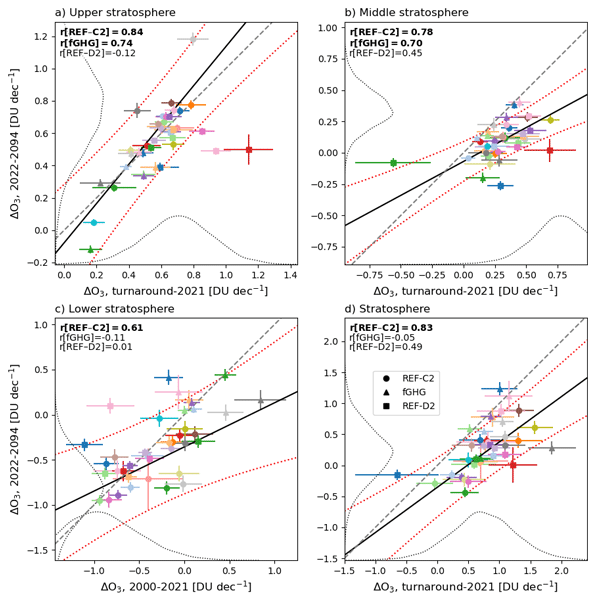
This study investigates tropical ozone changes in models and satellite observations to determine how well they agree and whether observations can constrain model projections. At some levels, satellite records disagree significantly on the magnitude of ozone changes. While early and late 21st century trends are correlated across models, suggesting a potential emergent constraint, the spread in observations means they are unable to provide guidance on the credibility of model projections.
Dennis Hillenbrand and Simon Unterstrasser
J. Env. Com. Air Transp. Sys. Discuss., https://doi.org/10.5194/jecats-2026-16, https://doi.org/10.5194/jecats-2026-16, 2026
Preprint under review for JECATS
Short summary
Short summary
We study contrail formation behind future fuel cell-based aircraft fueled by hydrogen. Simulations show that, under certain conditions, small droplets can form via a process not occurring in current plumes. This can increase ice crystal numbers in contrails, boosting their climate impact. The effect is strongest in cold air and for high plume mixing rates with air. We suggest to decrease the mixing rate and exhaust humidity by technical design to reduce the climate impact of such aircraft.
Roland Eichinger, Katrin Dahlmann, Volker Grewe, Benedict Enderle, Sven Maertens, Shravana Kumar, Christian Weder, Wolfgang Grimme, Leon Müller, Malte Niklaß, and Hannes Bruder
J. Env. Com. Air Transp. Sys. Discuss., https://doi.org/10.5194/jecats-2026-15, https://doi.org/10.5194/jecats-2026-15, 2026
Preprint under review for JECATS
Short summary
Short summary
Sustainable aviation fuels (SAFs) reduce the climate effect of contrail-induced cirrus cloudiness (CiC). We assess the climate-optimal SAF distribution for flights departing from Copenhagen Airport in 2030. We determine the potential climate benefit of 6 % available SAF by allocating it to flights with climatologically largest CiC climate effect to fuel use ratio. Targeted SAF use can here increase the CO2e benefit by 60 kt and enhance the CiC share in climate benefit from 20 % to almost 50 %.
Dennis Piontek, Kai Widmaier, Simon Kirschler, Joël Clément, Jacques Edeline, Jakob Smretschnig, David Antonello, Tarmo Pihlak, Simone Dietmüller, Sigrun Matthes, Katrin Dahlmann, Feijia Yin, and Christiane Voigt
J. Env. Com. Air Transp. Sys. Discuss., https://doi.org/10.5194/jecats-2026-14, https://doi.org/10.5194/jecats-2026-14, 2026
Preprint under review for JECATS
Short summary
Short summary
Model simulations were used to study all air traffic over Northern Europe during 16 days in 2023, following the European Union's planned framework (using CoCiP and aCCFs) for monitoring aviation’s non-CO2 climate effects. Small changes in flight altitude reduced the climate impact of contrails by 48 % while increasing the fleet-wide fuel use by only 0.4 %. The changes had only limited effects on air traffic density and aircraft spacing, showing that climate-optimized flight planning is feasible.
Jakob Smretschnig, Feijia Yin, Dennis Piontek, Joël Clément, Sergio Núñez Arribas, Katrin Dahlmann, Federica Castino, and Volker Grewe
J. Env. Com. Air Transp. Sys. Discuss., https://doi.org/10.5194/jecats-2026-13, https://doi.org/10.5194/jecats-2026-13, 2026
Preprint under review for JECATS
Short summary
Short summary
Commercial flights usually follow routes that minimise travel time and fuel use, but these routes are not always best for the climate. Using simulations of 4,000 flights forming condensation trails over northern Europe in 2023, we show that small altitude changes can reduce climate impact by 11 to 16% for only 1.2% more fuel. The benefits of avoiding warming from condensation trails outweigh the additional climate effect from nitrogen oxides and water vapour emissions.
Simon Braun, Magdalena Pühl, Andreas Marsing, Daniel Sauer, Gregor Neumann, Elena de la Torre Castro, Valerian Hahn, Michael Lichtenstern, Paul Stock, Christopher Heckl, Dennis Hillenbrand, Anke Roiger, Christiane Voigt, Simon Unterstraßer, Arne Vasenden, Roberta Vasenden, Jean Cammas, Florian Thorey, Catherine Mackay, Charles Renard, and Tina Jurkat-Witschas
EGUsphere, https://doi.org/10.5194/egusphere-2026-2887, https://doi.org/10.5194/egusphere-2026-2887, 2026
Short summary
Short summary
In this work, we share the results of first in-flight emission and contrail measurements behind a fuel cell exhaust emulator, with the goal of quantifying the contrail properties for this new aviation propulsion concept. An artificial dilution tracer system was used to assess plume dilution and derive emission indices. At ambient temperatures close to the homogeneous freezing threshold, a strong temperature-dependence of the number of contrail ice crystals, due to droplet freezing, was observed.
Zosia Staniaszek, Didier A. Hauglustaine, Yann Cohen, Agnieszka Skowron, Sigrun Matthes, Robin Thor, and Marianne T. Lund
Atmos. Chem. Phys., 26, 7985–7999, https://doi.org/10.5194/acp-26-7985-2026, https://doi.org/10.5194/acp-26-7985-2026, 2026
Short summary
Short summary
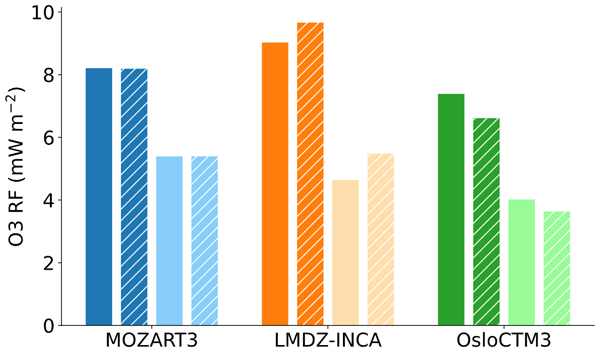
NOx emissions from aircraft affect the climate indirectly, by changing greenhouse gas concentrations. We explore whether the NOx emissions from aviation would have a different effect in different potential future climate states, i.e. a high pollution and low pollution case. The three models we use show varied responses for how this background state alters the climate effects of the NOx emissions. This shows the continuing need to improve our understanding of non-CO2 aviation impacts.
Christine Frömming, Volker Grewe, Sigrun Matthes, Simone Dietmüller, Patrick Peter, Katrin Dahlmann, and Patrick Jöckel
J. Env. Com. Air Transp. Sys. Discuss., https://doi.org/10.5194/jecats-2026-7, https://doi.org/10.5194/jecats-2026-7, 2026
Preprint under review for JECATS
Short summary
Short summary
Aviation non-CO2 climate effects could be reduced through rerouting using Climate Change Functions (CCFs) and its surrogate aCCFs. This study expands CCFs regionally and seasonally and enables a comparison with aCCFs. ACCFs simplify complex processes but reproduce magnitudes and most gradients, though they underestimate variability compared to detailed CCF simulations and limitations to certain altitudes were revealed. The present study promotes future development of refined and extended aCCFs.
Yann Cohen, Didier Hauglustaine, Zosia Staniaszek, Marianne Tronstad Lund, Irene Dedoussi, Sigrun Matthes, Flávio Quadros, Mattia Righi, Agnieszka Skowron, and Robin Thor
Atmos. Chem. Phys., 26, 5983–6013, https://doi.org/10.5194/acp-26-5983-2026, https://doi.org/10.5194/acp-26-5983-2026, 2026
Short summary
Short summary
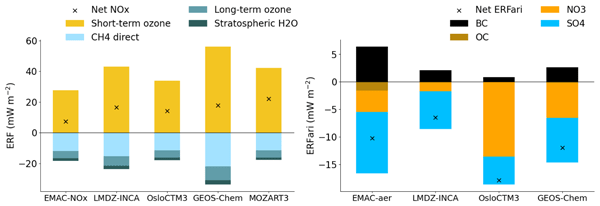
Non-CO2 effects from aviation on climate show large uncertainties. Among them, this study investigates the present-day impact of nitrogen oxides (through ozone and methane) and aerosols produced by aviation on atmospheric composition and therefore on climate, using a global-model intercomparison. Our results show a good consistency between the models for gaseous chemistry, but they also highlight the need for more accurate comparisons and further model development for aerosol parameterization.
Jin Maruhashi, Mattia Righi, Monica Sharma, Johannes Hendricks, Patrick Jöckel, Volker Grewe, and Irene C. Dedoussi
Geosci. Model Dev., 19, 2747–2784, https://doi.org/10.5194/gmd-19-2747-2026, https://doi.org/10.5194/gmd-19-2747-2026, 2026
Short summary
Short summary
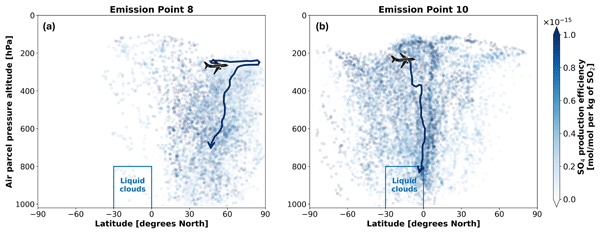
Aerosol-cloud interactions remain a major source of uncertainty in assessing aviation's net climate impact. We develop and evaluate a new Lagrangian tagging model that tracks aviation-emitted SO2 and H2SO4 as they are chemically transformed into SO4 aerosols and transported throughout the atmosphere. This development allows the identification of atmospheric regions with elevated potential for aerosol–cloud interactions driven by SO4 from aircraft.
Josef Zink, Cornelius Weiß-Rehm, Simon Unterstrasser, and Ulrike Burkhardt
EGUsphere, https://doi.org/10.5194/egusphere-2026-1088, https://doi.org/10.5194/egusphere-2026-1088, 2026
Short summary
Short summary
The study introduces a novel parameterization for the number of contrail ice crystals formed on ambient aerosols entrained into the exhaust plume behind aircraft burning hydrogen. This parameterization can be integrated into large-scale models to assess the radiative impacts of contrails originating from a fleet of aircraft with hydrogen combustion.
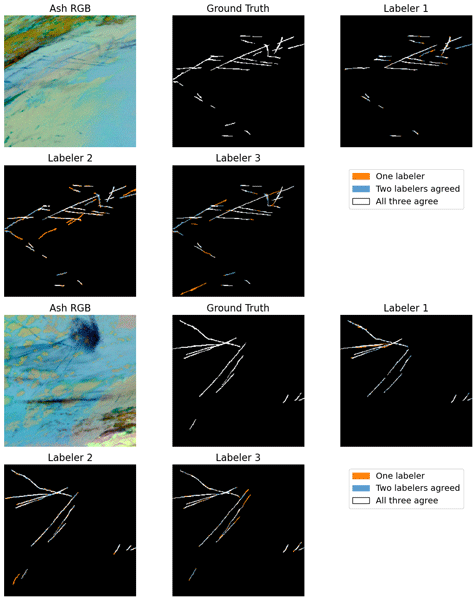
Vanessa Santos Gabriel, Luca Bugliaro, Mara Montag, Sabrina Ries, Ziming Wang, Kai Widmaier, Matteo Arico, Simon Unterstrasser, Johanna Mayer, Deniz Menekay, Andreas Marsing, Elena de la Torre Castro, Liam Megill, Monika Scheibe, and Christiane Voigt
Earth Syst. Sci. Data, 18, 2397–2412, https://doi.org/10.5194/essd-18-2397-2026, https://doi.org/10.5194/essd-18-2397-2026, 2026
Short summary
Short summary
We provide observations of the geostationary Meteosat satellite with contrails labeled by three people complemented with detailed cloud information. Contrails influence climate but are hard to identify in satellite imagery. With this study, we support contrail detection development and evaluation, stress the subjectivity of human labeling and reveal which meteorological conditions highlight or hide contrails. This dataset contributes to a better understanding of aviation’s climate impact.
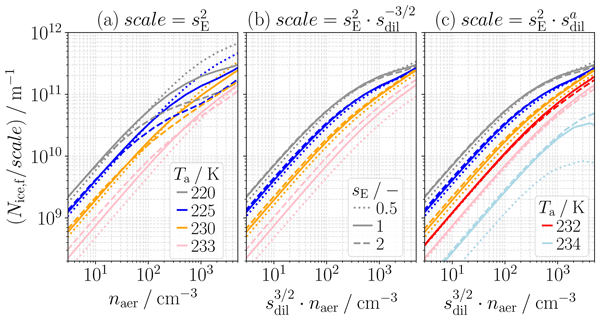
Josef Zink and Simon Unterstrasser
Atmos. Chem. Phys., 26, 3145–3165, https://doi.org/10.5194/acp-26-3145-2026, https://doi.org/10.5194/acp-26-3145-2026, 2026
Short summary
Short summary
The climate impact of aviation-induced contrail cirrus clouds is strongly influenced by the number of ice crystals that form in the wake of an aircraft under certain conditions. In this study, we investigate how engine-related aspects influence the number of ice crystals formed for hydrogen combustion. We derive suitable (scaling) relations that can be integrated into large-scale models used to estimate the climate impact of contrail cirrus clouds.
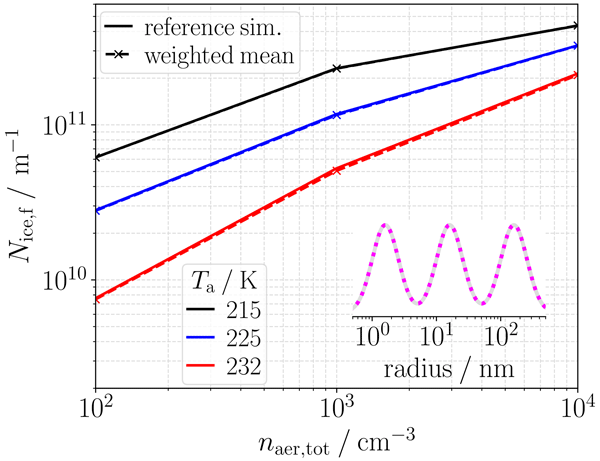
Josef Zink, Simon Unterstrasser, and Ulrike Burkhardt
Atmos. Chem. Phys., 26, 3125–3143, https://doi.org/10.5194/acp-26-3125-2026, https://doi.org/10.5194/acp-26-3125-2026, 2026
Short summary
Short summary
The climate impact of aviation-induced contrail cirrus is strongly influenced by the number of ice crystals that form in an aircraft's exhaust plume. In this study, we systematically investigate the key microphysical processes of contrail formation for hydrogen combustion. A large simulation data set provides the basis for a data-driven parameterization of ice crystal number that can be integrated into large-scale models.
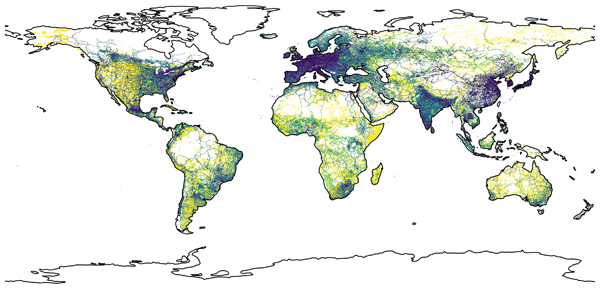
Mattia Righi, Simone Ehrenberger, Sabine Brinkop, Johannes Hendricks, Jens Hellekes, Paweł Banyś, Isheeka Dasgupta, Patrick Draheim, Annika Fitz, Manuel Löber, Thomas Pregger, Yvonne Scholz, Angelika Schulz, Birgit Suhr, Nina Thomsen, Christian Martin Weder, Peter Berster, Maximilian Clococeanu, Marc Gelhausen, Alexander Lau, Florian Linke, Sigrun Matthes, and Zarah Lea Zengerling
Earth Syst. Sci. Data, 18, 1619–1664, https://doi.org/10.5194/essd-18-1619-2026, https://doi.org/10.5194/essd-18-1619-2026, 2026
Short summary
Short summary
The ELK (EmissionsLandKarte) emission inventory provides global emissions for the three transport sectors (land transport, shipping and aviation) and transport-related emissions for the energy sector (oil refineries). It features a detailed resolution of the emissions in different subsectors, transport-specific quantities like non-exhaust emissions, and aviation-specific parameters. The inventory is complemented with uncertainty scores and validated against well-established global inventories.
Sigrun Matthes, Klaus Gierens, Björn Beckmann, Luca Bugliaro, Simone Dietmüller, Christine Frömming, Maleen Hanst, Sina Hofer, Julian Jene, Simon Kirschler, Carmen G. Köhler, Alexander Lau, Ralph Leemüller, Aline Liedtke, Max Mendiguchia Meuser, Patrick Peter, Vanessa Santos Gabriel, Ines Köhler, Gerd Saueressig, Linda Schlemmer, Jonas Sperling, Swen Schlobach, Ralph Schultz, Kristina von Sack, and Nathalie Waltenberg
J. Env. Com. Air Transp. Sys. Discuss., https://doi.org/10.5194/jecats-2026-3, https://doi.org/10.5194/jecats-2026-3, 2026
Revised manuscript accepted for JECATS
Short summary
Short summary
Operational strategies such as eco-efficient flight routing have potential to reduce aviation’s climate effect. A collaborative workflow integrating aviation weather forecasting, flight planning, air traffic control, and climate benefit assessment was developed and tested in D-KULT. Innovative developments demonstrate substantial progress on how to identify alternative trajectories but also highlight remaining challenges, including uncertainties in weather forecast and non-CO2 climate effects.
Volker Grewe, Simon Blakey, Florian Linke, Sigrun Matthes, Jan Middel, Radu Mirea, Ayce Celikel, David Raper, Feijia Yin, and Xin Zhao
J. Env. Com. Air Transp. Sys., 1, 1, https://doi.org/10.5194/jecats-1-1-2026, https://doi.org/10.5194/jecats-1-1-2026, 2026
Short summary
Short summary
The Journal of Environmentally Compatible Air Transport System (JECATS) is a not-for-profit international scientific journal dedicated to aspects of the air transport system with a focus on the environmental implications. JECATS combines areas of aerospace engineering, fuels, environmental analysis, climate change, economics, aviation climate mitigation, circularity and policy analysis. It includes aviation transport-related aspects and environmental effects from local to global scales.
Sarah Vervalcke, Quentin Errera, Roland Eichinger, Thomas Reddmann, Simon Chabrillat, Marc Op de beeck, Gabriele Stiller, and Emmanuel Mahieu
Atmos. Chem. Phys., 26, 391–409, https://doi.org/10.5194/acp-26-391-2026, https://doi.org/10.5194/acp-26-391-2026, 2026
Short summary
Short summary
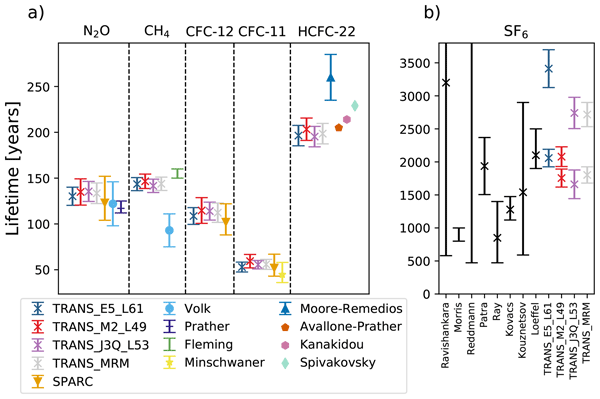
This study presents three simulations of atmospheric chemistry with the Belgian Assimilation System for Chemical Observations chemistry transport model, driven by different meteorological data sets. Newly implemented SF6 chemistry enables stratospheric transport studies. Results agree with satellite observations. The derived lifetimes of six trace gases agree with the literature, but SF6 shows larger sensitivity to the choice of meteorology. The lifetime of SF6 ranges from 1900 to 2600 years.
Gregor Neumann, Andreas Marsing, Theresa Harlass, Daniel Sauer, Simon Braun, Magdalena Pühl, Christopher Heckl, Paul Stock, Elena De La Torre Castro, Valerian Hahn, Anke Roiger, Christiane Voigt, Simon Unterstraßer, Jean Cammas, Charles Renard, Roberta Vasenden, Arnold Vasenden, and Tina Jurkat-Witschas
Atmos. Meas. Tech., 18, 6795–6816, https://doi.org/10.5194/amt-18-6795-2025, https://doi.org/10.5194/amt-18-6795-2025, 2025
Short summary
Short summary
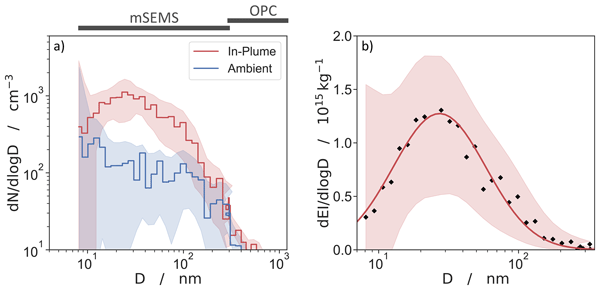
This study presents the first successful in-flight emission characterization of a turboprop engine using a fully autonomous airborne measurement platform, offering new insights into the atmospheric impacts of regional aviation. By equipping the high-altitude Grob G 520 Egrett with a suite of custom and modified commercial instruments, we demonstrate precise, high-resolution measurements of aerosol particles, trace gases, and contrail ice in the engine exhaust plume at cruise altitudes.
Monica Sharma, Mattia Righi, Johannes Hendricks, Anja Schmidt, Daniel Sauer, and Volker Grewe
Geosci. Model Dev., 18, 8485–8510, https://doi.org/10.5194/gmd-18-8485-2025, https://doi.org/10.5194/gmd-18-8485-2025, 2025
Short summary
Short summary
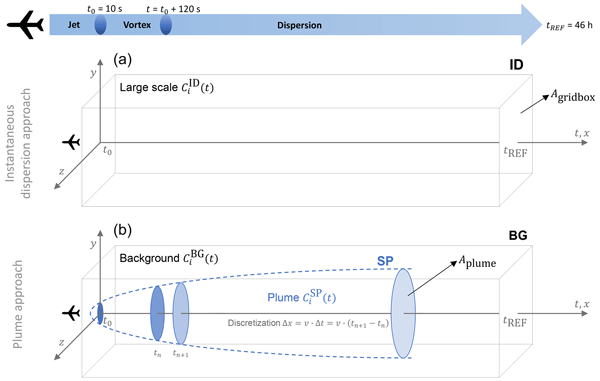
A plume model is developed to simulate aerosol microphysics in a dispersing aircraft plume, including interactions between ice crystals and aerosols in vortex regime. Compared to an instantaneous dispersion approach, the plume approach estimates 15 % lower aviation aerosol number concentrations, due to more efficient coagulation at plume scale. The model is sensitive to background conditions and initialization parameters, such as ice crystal number concentration and fuel sulfur content.
Annemarie Lottermoser and Simon Unterstrasser
Atmos. Chem. Phys., 25, 7903–7924, https://doi.org/10.5194/acp-25-7903-2025, https://doi.org/10.5194/acp-25-7903-2025, 2025
Short summary
Short summary
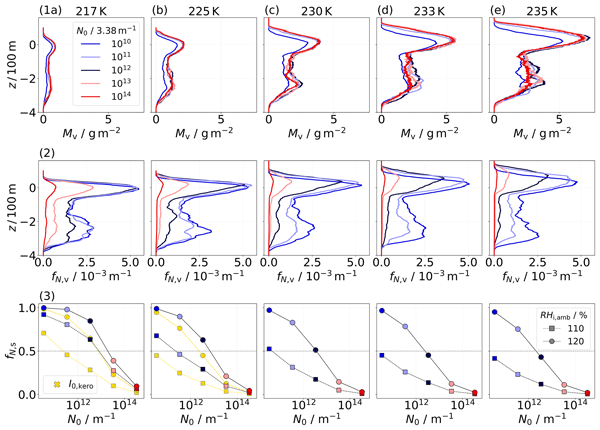
Contrail cirrus significantly contributes to aviation's overall climate impact. As hydrogen combustion and fuel cell use are emerging technologies for aircraft propulsion, we simulated individual contrails from hydrogen propulsion during the first 6 min after exhaust emission, termed the vortex phase. The ice crystal loss during that stage is crucial, as the number of ice crystals has a large impact on the further evolution of contrails into contrail cirrus and their radiative forcing.
Yann Cohen, Didier Hauglustaine, Nicolas Bellouin, Marianne Tronstad Lund, Sigrun Matthes, Agnieszka Skowron, Robin Thor, Ulrich Bundke, Andreas Petzold, Susanne Rohs, Valérie Thouret, Andreas Zahn, and Helmut Ziereis
Atmos. Chem. Phys., 25, 5793–5836, https://doi.org/10.5194/acp-25-5793-2025, https://doi.org/10.5194/acp-25-5793-2025, 2025
Short summary
Short summary
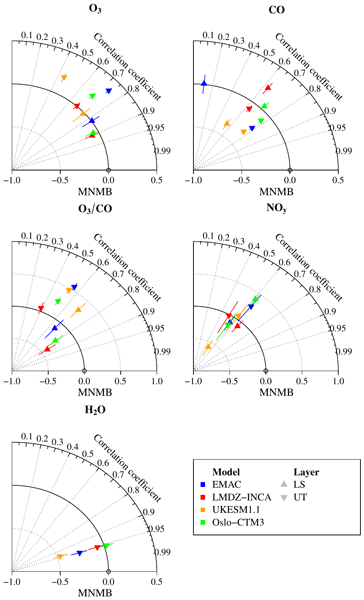
The chemical composition of the atmosphere near the tropopause is a key parameter for evaluating the climate impact of subsonic aviation pollutants. This study uses in situ data collected aboard passenger aircraft to assess the ability of four chemistry–climate models to reproduce (bi-)decadal climatologies of ozone, carbon monoxide, water vapour, and reactive nitrogen in this region. The models reproduce the very distinct ozone seasonality in the upper troposphere and in the lower stratosphere well.
Patrick Peter, Sigrun Matthes, Christine Frömming, Patrick Jöckel, Luca Bugliaro, Andreas Giez, Martina Krämer, and Volker Grewe
Atmos. Chem. Phys., 25, 5911–5934, https://doi.org/10.5194/acp-25-5911-2025, https://doi.org/10.5194/acp-25-5911-2025, 2025
Short summary
Short summary
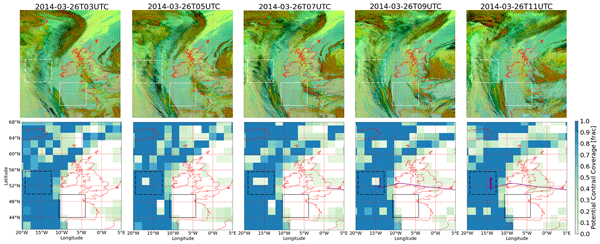
Our study examines how well the global climate model EMAC (ECHAM/MESSy Atmospheric Chemistry) predicts contrail formation by analysing temperature and humidity – two key factors for contrail development and persistence. The model underestimates temperature, leading to an overprediction of contrail formation and larger ice-supersaturated regions. Adjusting the model improves temperature accuracy but adds uncertainties. Better predictions of contrail formation areas can help optimise flight tracks to reduce aviation's climate effect.
Liam Megill and Volker Grewe
Atmos. Chem. Phys., 25, 4131–4149, https://doi.org/10.5194/acp-25-4131-2025, https://doi.org/10.5194/acp-25-4131-2025, 2025
Short summary
Short summary
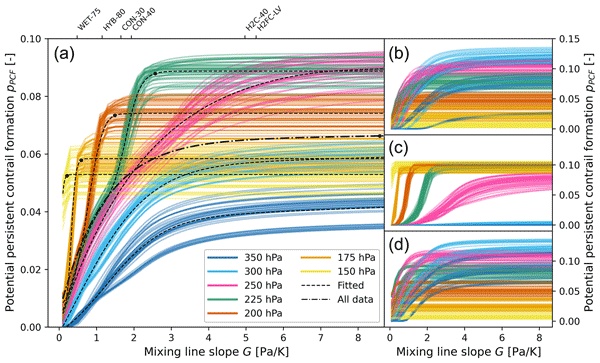
This study uses ERA5 data to better understand the relative importance of the factors limiting persistent contrail formation. We develop climatological relationships to estimate potential persistent contrail formation for existing as well as future aircraft and propulsion system designs. We identify latitudes and pressure levels where the introduction of novel aircraft designs would result in significant changes in potential persistent contrail formation compared to existing conventional aircraft.
Jurriaan A. van 't Hoff, Didier Hauglustaine, Johannes Pletzer, Agnieszka Skowron, Volker Grewe, Sigrun Matthes, Maximilian M. Meuser, Robin N. Thor, and Irene C. Dedoussi
Atmos. Chem. Phys., 25, 2515–2550, https://doi.org/10.5194/acp-25-2515-2025, https://doi.org/10.5194/acp-25-2515-2025, 2025
Short summary
Short summary
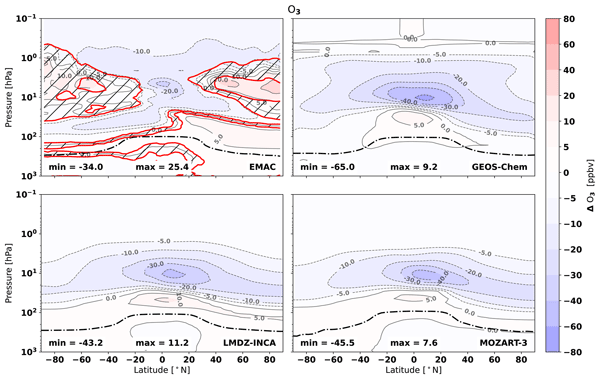
Civil supersonic aircraft may return in the near future, and their emissions could lead to atmospheric changes which are detrimental to public health and the climate. We use four atmospheric chemistry models and show that emissions from a future supersonic aircraft fleet increase stratospheric nitrogen and water vapor levels, while depleting the global ozone column and leading to increases in radiative forcing. Their impacts can be reduced by reducing NOx emissions or the cruise altitude.
Markus Kilian, Volker Grewe, Patrick Jöckel, Astrid Kerkweg, Mariano Mertens, Andreas Zahn, and Helmut Ziereis
Atmos. Chem. Phys., 24, 13503–13523, https://doi.org/10.5194/acp-24-13503-2024, https://doi.org/10.5194/acp-24-13503-2024, 2024
Short summary
Short summary
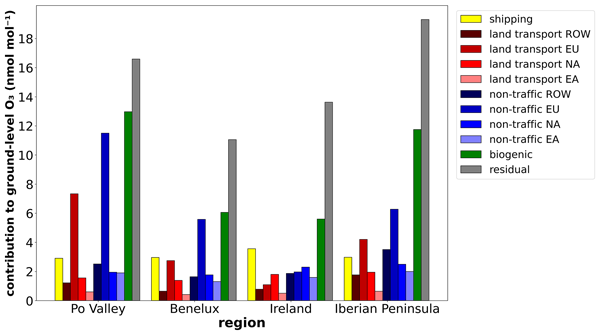
Anthropogenic emissions are a major source of precursors of tropospheric ozone. As ozone formation is highly non-linear, we apply a global–regional chemistry–climate model with a source attribution method (tagging) to quantify the contribution of anthropogenic emissions to ozone. Our analysis shows that the contribution of European anthropogenic emissions largely increases during large ozone periods, indicating that emissions from these sectors drive ozone values.
Mariano Mertens, Sabine Brinkop, Phoebe Graf, Volker Grewe, Johannes Hendricks, Patrick Jöckel, Anna Lanteri, Sigrun Matthes, Vanessa S. Rieger, Mattia Righi, and Robin N. Thor
Atmos. Chem. Phys., 24, 12079–12106, https://doi.org/10.5194/acp-24-12079-2024, https://doi.org/10.5194/acp-24-12079-2024, 2024
Short summary
Short summary
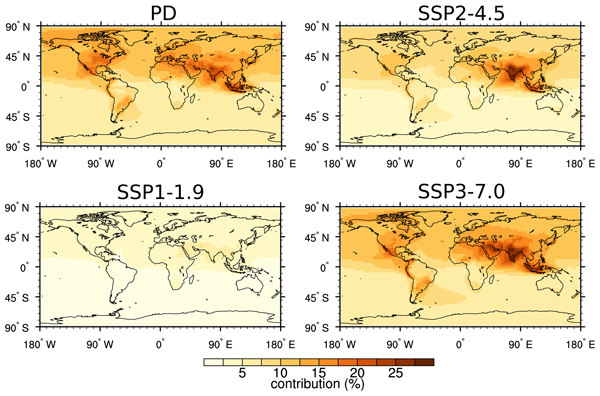
We quantified the contributions of land transport, shipping, and aviation emissions to tropospheric ozone; its radiative forcing; and the reductions of the methane lifetime using chemistry-climate model simulations. The contributions were analysed for the conditions of 2015 and for three projections for the year 2050. The results highlight the challenges of mitigating ozone formed by emissions of the transport sector, caused by the non-linearitiy of the ozone chemistry and the long lifetime.
Ales Kuchar, Maurice Öhlert, Roland Eichinger, and Christoph Jacobi
Weather Clim. Dynam., 5, 895–912, https://doi.org/10.5194/wcd-5-895-2024, https://doi.org/10.5194/wcd-5-895-2024, 2024
Short summary
Short summary
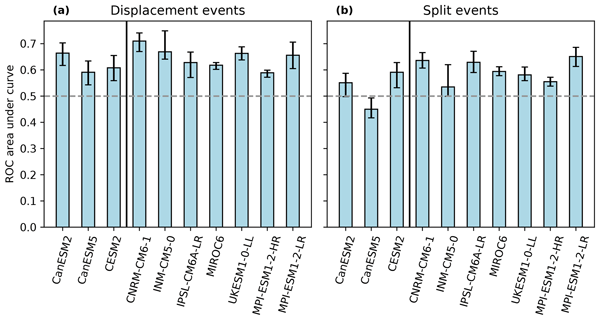
Exploring the polar vortex's impact on climate, the study evaluates model simulations against the ERA5 reanalysis data. Revelations about model discrepancies in simulating disruptive stratospheric warmings and vortex behavior highlight the need for refined model simulations of past climate. By enhancing our understanding of these dynamics, the research contributes to more reliable climate projections of the polar vortex with the impact on surface climate.
Federica Castino, Feijia Yin, Volker Grewe, Hiroshi Yamashita, Sigrun Matthes, Simone Dietmüller, Sabine Baumann, Manuel Soler, Abolfazl Simorgh, Maximilian Mendiguchia Meuser, Florian Linke, and Benjamin Lührs
Geosci. Model Dev., 17, 4031–4052, https://doi.org/10.5194/gmd-17-4031-2024, https://doi.org/10.5194/gmd-17-4031-2024, 2024
Short summary
Short summary
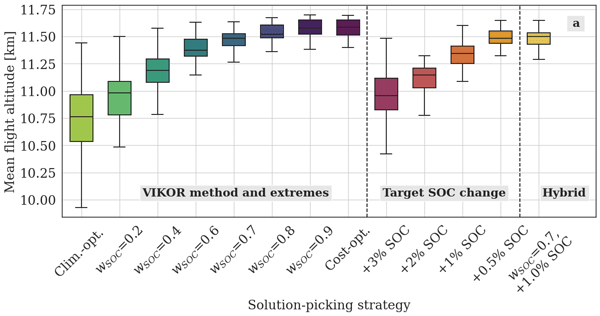
We introduce SolFinder 1.0, a decision-making tool to select trade-offs between different objective functions for optimal aircraft trajectories, including fuel use, flight time, NOx emissions, contrail distance, and climate impact. The module is included in the AirTraf 3.0 submodel and uses weather conditions simulated by the EMAC atmospheric model. This paper focuses on the ability of SolFinder to identify eco-efficient trajectories, reducing a flight's climate impact at limited cost penalties.
Hella Garny, Roland Eichinger, Johannes C. Laube, Eric A. Ray, Gabriele P. Stiller, Harald Bönisch, Laura Saunders, and Marianna Linz
Atmos. Chem. Phys., 24, 4193–4215, https://doi.org/10.5194/acp-24-4193-2024, https://doi.org/10.5194/acp-24-4193-2024, 2024
Short summary
Short summary
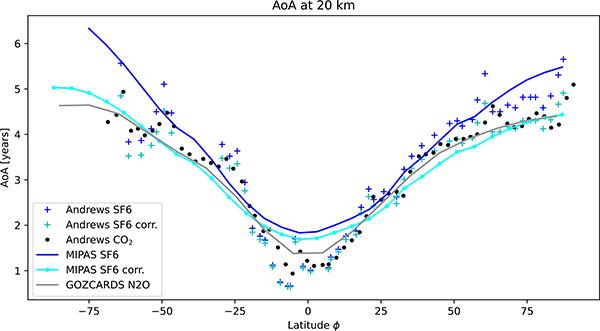
Transport circulation in the stratosphere is important for the distribution of tracers, but its strength is hard to measure. Mean transport times can be inferred from observations of trace gases with certain properties, such as sulfur hexafluoride (SF6). However, this gas has a chemical sink in the high atmosphere, which can lead to substantial biases in inferred transport times. In this paper we present a method to correct mean transport times derived from SF6 for the effects of chemical sinks.
Andreas Bier, Simon Unterstrasser, Josef Zink, Dennis Hillenbrand, Tina Jurkat-Witschas, and Annemarie Lottermoser
Atmos. Chem. Phys., 24, 2319–2344, https://doi.org/10.5194/acp-24-2319-2024, https://doi.org/10.5194/acp-24-2319-2024, 2024
Short summary
Short summary
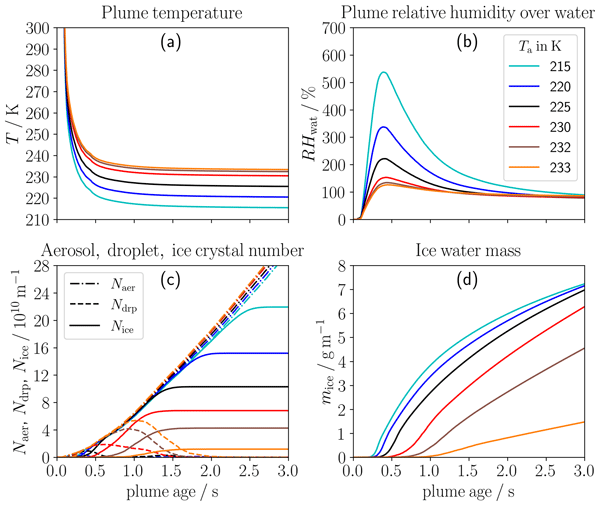
Using hydrogen as aviation fuel affects contrails' climate impact. We study contrail formation behind aircraft with H2 combustion. Due to the absence of soot emissions, contrail ice crystals are assumed to form only on ambient particles mixed into the plume. The ice crystal number, which strongly varies with temperature and aerosol number density, is decreased by more than 80 %–90 % compared to kerosene contrails. However H2 contrails can form at lower altitudes due to higher H2O emissions.
Johannes Pletzer and Volker Grewe
Atmos. Chem. Phys., 24, 1743–1775, https://doi.org/10.5194/acp-24-1743-2024, https://doi.org/10.5194/acp-24-1743-2024, 2024
Short summary
Short summary
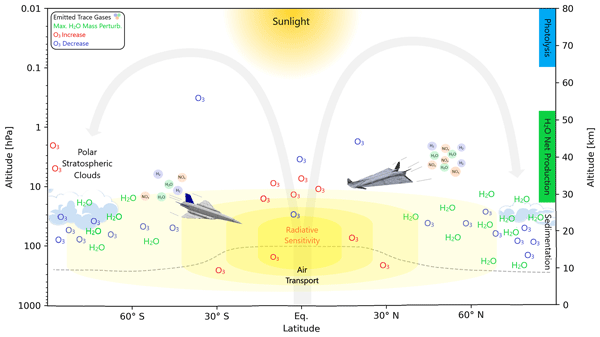
Very fast aircraft can travel at 30–40 km altitude and are designed to use liquid hydrogen as fuel instead of kerosene. Depending on their flight altitude, the impact of these aircraft on the atmosphere and climate can change very much. Our results show that a variation inflight latitude can have a considerably higher change in impact compared to a variation in flight altitude. Atmospheric air transport and polar stratospheric clouds play an important role in hypersonic aircraft emissions.
Sigrun Matthes, Simone Dietmüller, Katrin Dahlmann, Christine Frömming, Patrick Peter, Hiroshi Yamashita, Volker Grewe, Feijia Yin, and Federica Castino
Geosci. Model Dev. Discuss., https://doi.org/10.5194/gmd-2023-92, https://doi.org/10.5194/gmd-2023-92, 2023
Revised manuscript not accepted
Short summary
Short summary
Aviation aims to reduce its climate effect by identifying alternative climate-optimized aircraft trajectories. Such routing strategies requires a dedicated meteorological service in order to inform on regions of the atmosphere where aviation non-CO2 emissions have a large climate effect, e.g. by contrail formation or nitrogen-oxide (NOx)-induced ozone formation. This study presents calibration factors for individual non-CO2 effects by comparing with the climate response model AirClim.
Elena De La Torre Castro, Tina Jurkat-Witschas, Armin Afchine, Volker Grewe, Valerian Hahn, Simon Kirschler, Martina Krämer, Johannes Lucke, Nicole Spelten, Heini Wernli, Martin Zöger, and Christiane Voigt
Atmos. Chem. Phys., 23, 13167–13189, https://doi.org/10.5194/acp-23-13167-2023, https://doi.org/10.5194/acp-23-13167-2023, 2023
Short summary
Short summary
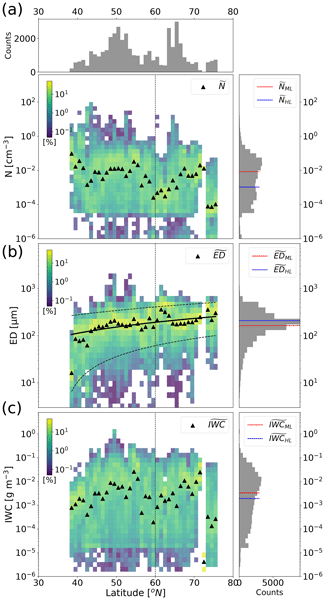
In this study, we show the differences in the microphysical properties between high-latitude (HL) cirrus and mid-latitude (ML) cirrus over the Arctic, North Atlantic, and central Europe during summer. The in situ measurements are combined with backward trajectories to investigate the influence of the region on cloud formation. We show that HL cirrus are characterized by a lower concentration of larger ice crystals when compared to ML cirrus.
Roland Eichinger, Sebastian Rhode, Hella Garny, Peter Preusse, Petr Pisoft, Aleš Kuchař, Patrick Jöckel, Astrid Kerkweg, and Bastian Kern
Geosci. Model Dev., 16, 5561–5583, https://doi.org/10.5194/gmd-16-5561-2023, https://doi.org/10.5194/gmd-16-5561-2023, 2023
Short summary
Short summary
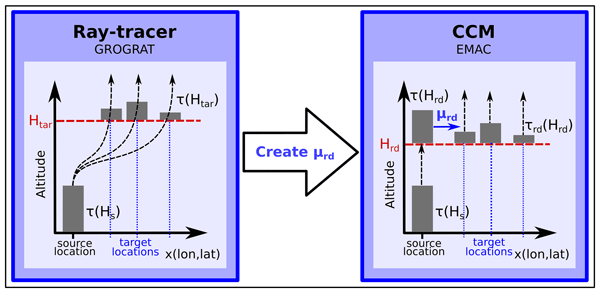
The columnar approach of gravity wave (GW) schemes results in dynamical model biases, but parallel decomposition makes horizontal GW propagation computationally unfeasible. In the global model EMAC, we approximate it by GW redistribution at one altitude using tailor-made redistribution maps generated with a ray tracer. More spread-out GW drag helps reconcile the model with observations and close the 60°S GW gap. Polar vortex dynamics are improved, enhancing climate model credibility.
Simone Dietmüller, Sigrun Matthes, Katrin Dahlmann, Hiroshi Yamashita, Abolfazl Simorgh, Manuel Soler, Florian Linke, Benjamin Lührs, Maximilian M. Meuser, Christian Weder, Volker Grewe, Feijia Yin, and Federica Castino
Geosci. Model Dev., 16, 4405–4425, https://doi.org/10.5194/gmd-16-4405-2023, https://doi.org/10.5194/gmd-16-4405-2023, 2023
Short summary
Short summary
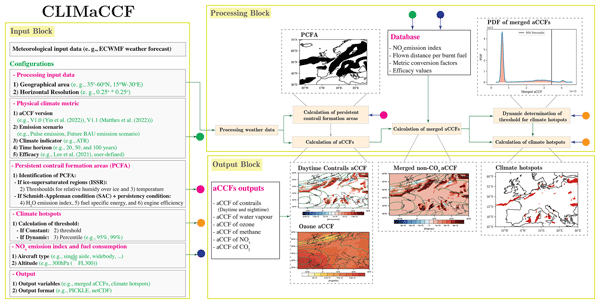
Climate-optimized aircraft trajectories avoid atmospheric regions with a large climate impact due to aviation emissions. This requires spatially and temporally resolved information on aviation's climate impact. We propose using algorithmic climate change functions (aCCFs) for CO2 and non-CO2 effects (ozone, methane, water vapor, contrail cirrus). Merged aCCFs combine individual aCCFs by assuming aircraft-specific parameters and climate metrics. Technically this is done with a Python library.
Abolfazl Simorgh, Manuel Soler, Daniel González-Arribas, Florian Linke, Benjamin Lührs, Maximilian M. Meuser, Simone Dietmüller, Sigrun Matthes, Hiroshi Yamashita, Feijia Yin, Federica Castino, Volker Grewe, and Sabine Baumann
Geosci. Model Dev., 16, 3723–3748, https://doi.org/10.5194/gmd-16-3723-2023, https://doi.org/10.5194/gmd-16-3723-2023, 2023
Short summary
Short summary
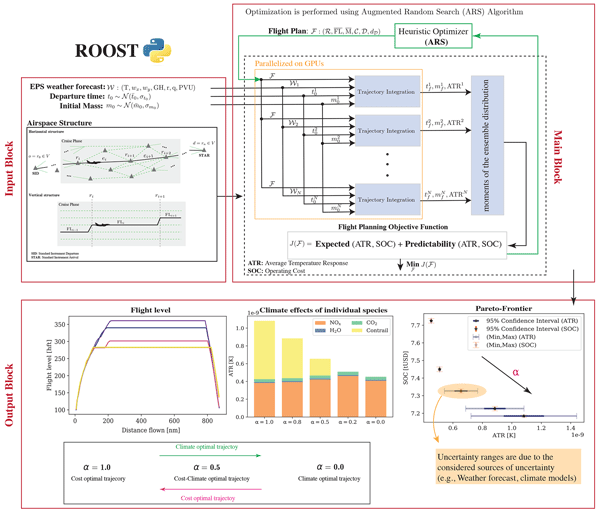
This paper addresses the robust climate optimal trajectory planning problem under uncertain meteorological conditions within the structured airspace. Based on the optimization methodology, a Python library has been developed, which can be accessed using the following DOI: https://doi.org/10.5281/zenodo.7121862. The developed tool is capable of providing robust trajectories taking into account all probable realizations of meteorological conditions provided by an EPS computationally very fast.
Robin N. Thor, Malte Niklaß, Katrin Dahlmann, Florian Linke, Volker Grewe, and Sigrun Matthes
Geosci. Model Dev. Discuss., https://doi.org/10.5194/gmd-2023-126, https://doi.org/10.5194/gmd-2023-126, 2023
Preprint withdrawn
Short summary
Short summary
We develop a simplied method to estimate the climate effects of single flights through CO2 and non-CO2 effects, exclusively based on the aircraft seat category as well as the origin and destination airports. The derived climate effect functions exhibit a mean relative error of only 15 % with respect to results from a climate response model. The method is designed for climate footprint assessments and covers most commerical airlines with seat capacities starting from 101 passengers.
Feijia Yin, Volker Grewe, Federica Castino, Pratik Rao, Sigrun Matthes, Katrin Dahlmann, Simone Dietmüller, Christine Frömming, Hiroshi Yamashita, Patrick Peter, Emma Klingaman, Keith P. Shine, Benjamin Lührs, and Florian Linke
Geosci. Model Dev., 16, 3313–3334, https://doi.org/10.5194/gmd-16-3313-2023, https://doi.org/10.5194/gmd-16-3313-2023, 2023
Short summary
Short summary
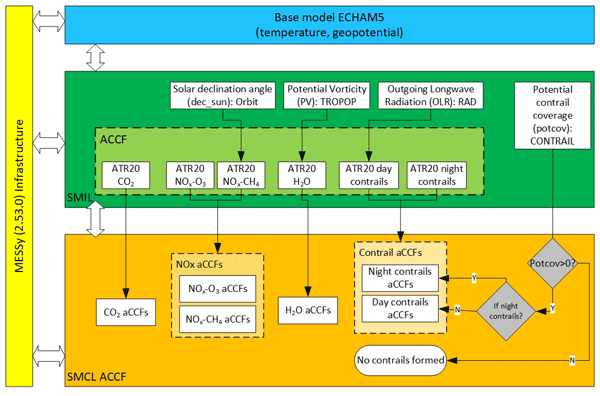
This paper describes a newly developed submodel ACCF V1.0 based on the MESSy 2.53.0 infrastructure. The ACCF V1.0 is based on the prototype algorithmic climate change functions (aCCFs) v1.0 to enable climate-optimized flight trajectories. One highlight of this paper is that we describe a consistent full set of aCCFs formulas with respect to fuel scenario and metrics. We demonstrate the usage of the ACCF submodel using AirTraf V2.0 to optimize trajectories for cost and climate impact.
Robin N. Thor, Mariano Mertens, Sigrun Matthes, Mattia Righi, Johannes Hendricks, Sabine Brinkop, Phoebe Graf, Volker Grewe, Patrick Jöckel, and Steven Smith
Geosci. Model Dev., 16, 1459–1466, https://doi.org/10.5194/gmd-16-1459-2023, https://doi.org/10.5194/gmd-16-1459-2023, 2023
Short summary
Short summary
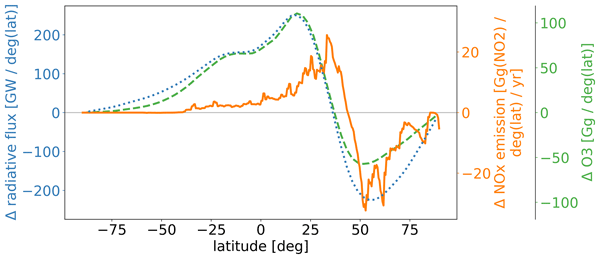
We report on an inconsistency in the latitudinal distribution of aviation emissions between two versions of a data product which is widely used by researchers. From the available documentation, we do not expect such an inconsistency. We run a chemistry–climate model to compute the effect of the inconsistency in emissions on atmospheric chemistry and radiation and find that the radiative forcing associated with aviation ozone is 7.6 % higher when using the less recent version of the data.
Jin Maruhashi, Volker Grewe, Christine Frömming, Patrick Jöckel, and Irene C. Dedoussi
Atmos. Chem. Phys., 22, 14253–14282, https://doi.org/10.5194/acp-22-14253-2022, https://doi.org/10.5194/acp-22-14253-2022, 2022
Short summary
Short summary
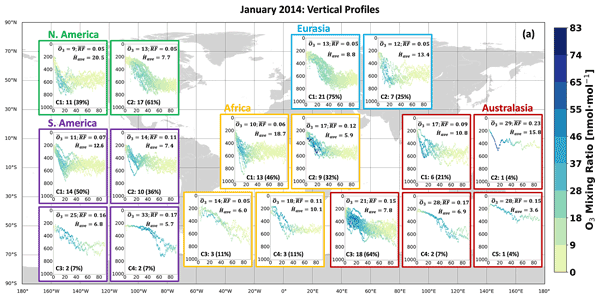
Aviation NOx emissions lead to the formation of ozone in the atmosphere in the short term, which has a climate warming effect. This study uses global-scale simulations to characterize the transport patterns between NOx emissions at an altitude of ~ 10.4 km and the resulting ozone. Results show a strong spatial and temporal dependence of NOx in disturbing atmospheric O3 concentrations, with the location that is most impacted in terms of warming not necessarily coinciding with the emission region.

Johannes Pletzer, Didier Hauglustaine, Yann Cohen, Patrick Jöckel, and Volker Grewe
Atmos. Chem. Phys., 22, 14323–14354, https://doi.org/10.5194/acp-22-14323-2022, https://doi.org/10.5194/acp-22-14323-2022, 2022
Short summary
Short summary
Very fast aircraft can travel long distances in extremely short times and can fly at high altitudes (15 to 35 km). These aircraft emit water vapour, nitrogen oxides, and hydrogen. Water vapour emissions remain for months to several years at these altitudes and have an important impact on temperature. We investigate two aircraft fleets flying at 26 and 35 km. Ozone is depleted more, and the water vapour perturbation and temperature change are larger for the aircraft flying at 35 km.
Etienne Terrenoire, Didier A. Hauglustaine, Yann Cohen, Anne Cozic, Richard Valorso, Franck Lefèvre, and Sigrun Matthes
Atmos. Chem. Phys., 22, 11987–12023, https://doi.org/10.5194/acp-22-11987-2022, https://doi.org/10.5194/acp-22-11987-2022, 2022
Short summary
Short summary
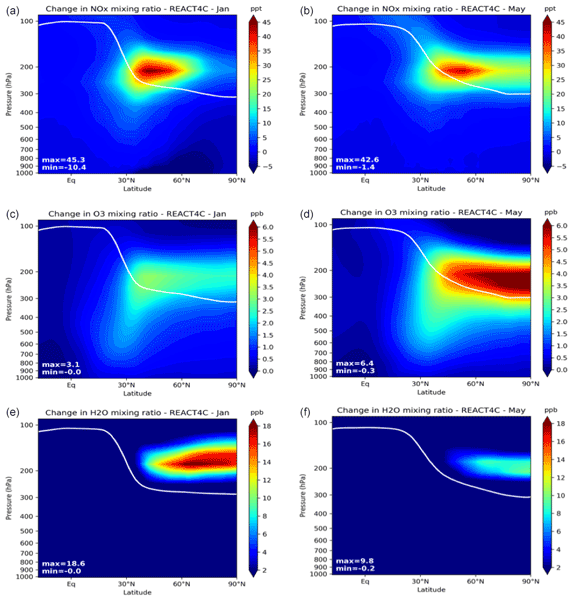
Aviation NOx emissions not only have an impact on global climate by changing ozone and methane levels in the atmosphere, but also contribute to the deterioration of local air quality. The LMDZ-INCA global model is applied to re-evaluate the impact of aircraft NOx and aerosol emissions on climate. We investigate the impact of present-day and future (2050) aircraft emissions on atmospheric composition and the associated radiative forcings of climate for ozone, methane and aerosol direct forcings.
Vanessa Simone Rieger and Volker Grewe
Geosci. Model Dev., 15, 5883–5903, https://doi.org/10.5194/gmd-15-5883-2022, https://doi.org/10.5194/gmd-15-5883-2022, 2022
Short summary
Short summary
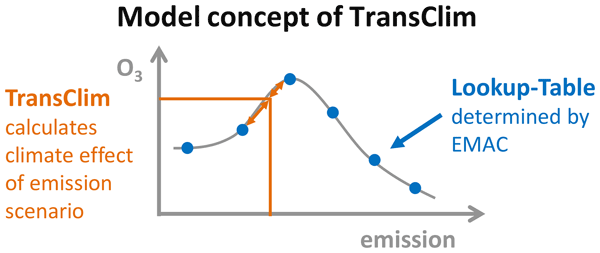
Road traffic emissions of nitrogen oxides, volatile organic compounds and carbon monoxide produce ozone in the troposphere and thus influence Earth's climate. To assess the ozone response to a broad range of mitigation strategies for road traffic, we developed a new chemistry–climate response model called TransClim. It is based on lookup tables containing climate–response relations and thus is able to quickly determine the climate response of a mitigation option.
Ales Kuchar, Petr Sacha, Roland Eichinger, Christoph Jacobi, Petr Pisoft, and Harald Rieder
EGUsphere, https://doi.org/10.5194/egusphere-2022-474, https://doi.org/10.5194/egusphere-2022-474, 2022
Preprint archived
Short summary
Short summary
We focus on the impact of small-scale orographic gravity waves (OGWs) above the Himalayas. The interaction of GWs with the large-scale circulation in the stratosphere is not still well understood and can have implications on climate projections. We use a chemistry-climate model to show that these strong OGW events are associated with anomalously increased upward planetary-scale waves and in turn affect the circumpolar circulation and have the potential to alter ozone variability as well.

Michael A. Olesik, Jakub Banaśkiewicz, Piotr Bartman, Manuel Baumgartner, Simon Unterstrasser, and Sylwester Arabas
Geosci. Model Dev., 15, 3879–3899, https://doi.org/10.5194/gmd-15-3879-2022, https://doi.org/10.5194/gmd-15-3879-2022, 2022
Short summary
Short summary
In systems such as atmospheric clouds, droplets undergo growth through condensation of vapor. The broadness of the resultant size spectrum of droplets influences precipitation likelihood and the radiative properties of clouds. One of the inherent limitations of simulations of the problem is the so-called numerical diffusion causing overestimation of the spectrum width, hence the term numerical broadening. In the paper, we take a closer look at one of the algorithms used in this context: MPDATA.

Sheena Loeffel, Roland Eichinger, Hella Garny, Thomas Reddmann, Frauke Fritsch, Stefan Versick, Gabriele Stiller, and Florian Haenel
Atmos. Chem. Phys., 22, 1175–1193, https://doi.org/10.5194/acp-22-1175-2022, https://doi.org/10.5194/acp-22-1175-2022, 2022
Short summary
Short summary
SF6-derived trends of stratospheric AoA from observations and model simulations disagree in sign. SF6 experiences chemical degradation, which we explicitly integrate in a global climate model. In our simulations, the AoA trend changes sign when SF6 sinks are considered; thus, the process has the potential to reconcile simulated with observed AoA trends. We show that the positive AoA trend is due to the SF6 sinks themselves and provide a first approach for a correction to account for SF6 loss.

Andreas Bier, Simon Unterstrasser, and Xavier Vancassel
Atmos. Chem. Phys., 22, 823–845, https://doi.org/10.5194/acp-22-823-2022, https://doi.org/10.5194/acp-22-823-2022, 2022
Short summary
Short summary
We investigate contrail formation in an aircraft plume with a particle-based multi-trajectory 0D model. Due to the high plume heterogeneity, contrail ice crystals form first near the plume edge and then in the plume centre. The number of ice crystals varies strongly with ambient conditions and soot properties near the contrail formation threshold. Our results imply that the multi-trajectory approach does not necessarily lead to improved scientific results compared to a single mean trajectory.
Cited articles
Bruder, H., Thor, R. N., Niklaß, M., Dahlmann, K., Eichinger, R., Linke, F., Grewe, V., Unterstrasser, S., and Matthes, S.: Code used in “The DLR CO2-equivalent estimator FlightClim v1.0: an easy-to-use estimation of per flight CO2 and non-CO2 climate effects” (Bruder et al., GMD, 2025), Zenodo [code, data set], https://doi.org/10.5281/zenodo.17184041, 2025. a, b
Burkhardt, U. and Kärcher, B.: Global radiative forcing from contrail cirrus, Nat. Clim. Change, 1, 54–58, https://doi.org/10.1038/nclimate1068, 2011. a
Cames, M., Graichen, J., Siemons, A., and Cook, V.: Emission reduction targets for international aviation and shipping, Tech. Rep. IP/A/ENVI/2015-11, Policy Department A for the Committee on Environment, Public Health and Food Safety (ENVI), https://www.europarl.europa.eu/RegData/etudes/STUD/2015/569964/IPOL_STU(2015)569964_EN.pdf (last access: 24 April 2026), 2015. a
Dahlmann, K., Grewe, V., Frömming, C., and Burkhardt, U.: Can we reliably assess climate mitigation options for air traffic scenarios despite large uncertainties in atmospheric processes?, Transport. Res. D-Tr. E., 46, 40–55, https://doi.org/10.1016/j.trd.2016.03.006, 2016a. a, b
Dahlmann, K., Koch, A., Linke, F., Lührs, B., Grewe, V., Otten, T., Seider, D., Gollnick, V., and Schumann, U.: Climate-Compatible Air Transport System – Climate Impact Mitigation Potential for Actual and Future Aircraft, Aerospace, 3, 38, https://doi.org/10.3390/aerospace3040038, 2016b. a
Delbecq, S., Fontane, J., Gourdain, N., Planès, T., and Simatos, F.: Sustainable aviation in the context of the Paris Agreement: A review of prospective scenarios and their technological mitigation levers, Prog. Aerosp. Sci., 141, 100920, https://doi.org/10.1016/j.paerosci.2023.100920, 2023. a
DuBois, D. and Paynter, G. C.: “Fuel Flow Method 2” for Estimating Aircraft Emissions, SAE Transactions, 115, 1–14, https://doi.org/10.4271/2006-01-1987, 2006. a
EASA: EU FLIGHT EMISSIONS LABEL (FEL) – Draft manual version 0.2, https://www.flightemissions.eu/sites/default/files/media/files/2025-07/FEL_Public_Manual_2025-v0.2.pdf (last access: 21 August 2025), 2025. a
EEA: EMEP/EEA air pollutant emission inventory guidebook 2023, EEA, https://doi.org/10.2800/795737, 2023. a
Faber, J., Greenwood, D., Lee, D., Mann, M., de Leon, P. M., Nelissen, D., Owen, B., Ralph, M., Tilston, J., van Velzen, A., and van de Vreede, G.: Lower NOx at higher altitudes policies to reduce the climate impact of aviation NOx emission, Tech. Rep. 08.7536.32, CE Delft, https://cedelft.eu/wp-content/uploads/sites/2/2024/03/7536_FinalReportJFMV.pdf (last access: 24 April 2026), 2008. a
Fichter, C.: Climate Impact of Air Traffic Emissions in Dependency of the Emission Location, PhD thesis, Manchester Metropolitan University, Manchester, UK, https://www.researchgate.net/publication/225004292_Climate_impact_of_air_traffic_emissions_in_dependency_of_the_emission_location_and_altitude#full-text (last access: 24 April 2026), 2009. a
Forster, P. M. d. F., Shine, K. P., and Stuber, N.: It is premature to include non-CO2 effects of aviation in emission trading schemes, Atmos. Environ., 40, 1117–1121, https://doi.org/10.1016/j.atmosenv.2005.11.005, 2006. a
Foundation myclimate: CO2 Flight Calculator, https://co2.myclimate.org/en/flight_calculators/new (last access: 21 August 2025), 2025. a
Ghosh, R., Wicke, K., Kölker, K., Terekhov, I., Linke, F., Niklaß, M., Lührs, B., and Grewe, V.: An Integrated Modelling Approach for Climate Impact Assessments in the Future Air Transportation System – Findings from the WeCare Project, in: 2nd ECATS Conference 2016, https://elib.dlr.de/107788/1/ECATS2016_Extended_Abstract_V1.pdf (last access: 24 April 2026), 2016. a
Google: Travel Impact Module, https://travelimpactmodel.org/ (last access: 21 August 2025), 2025. a
Grewe, V. and Stenke, A.: AirClim: an efficient tool for climate evaluation of aircraft technology, Atmos. Chem. Phys., 8, 4621–4639, https://doi.org/10.5194/acp-8-4621-2008, 2008. a, b
Grewe, V., Frömming, C., Matthes, S., Brinkop, S., Ponater, M., Dietmüller, S., Jöckel, P., Garny, H., Tsati, E., Dahlmann, K., Søvde, O. A., Fuglestvedt, J., Berntsen, T. K., Shine, K. P., Irvine, E. A., Champougny, T., and Hullah, P.: Aircraft routing with minimal climate impact: the REACT4C climate cost function modelling approach (V1.0), Geosci. Model Dev., 7, 175–201, https://doi.org/10.5194/gmd-7-175-2014, 2014. a
Grewe, V., Dahlmann, K., Flink, J., Frömming, C., Ghosh, R., Gierens, K., Heller, R., Hendricks, J., Jöckel, P., Kaufmann, S., Kölker, K., Linke, F., Luchkova, T., Lührs, B., Van Manen, J., Matthes, S., Minikin, A., Niklaß, M., Plohr, M., Righi, M., Rosanka, S., Schmitt, A., Schumann, U., Terekhov, I., Unterstrasser, S., Vázquez-Navarro, M., Voigt, C., Wicke, K., Yamashita, H., Zahn, A., and Ziereis, H.: Mitigating the climate impact from aviation: Achievements and results of the DLR WeCare project, Aerospace, 4, 34, https://doi.org/10.3390/aerospace4030034, 2017a. a, b
Grewe, V., Matthes, S., Frömming, C., Brinkop, S., Jöckel, P., Gierens, K., Champougny, T., Fuglestvedt, J., Haslerud, A., Irvine, E., and Shine, K.: Feasibility of climate-optimized air traffic routing for trans-Atlantic flights, Environ. Res. Lett., 12, 034003, https://doi.org/10.1088/1748-9326/aa5ba0, 2017b. a
Grewe, V., Gangoli Rao, A., Grönstedt, T., Xisto, C., Linke, F., Melkert, J., Middel, J., Ohlenforst, B., Blakey, S., Christie, S., Matthes, S., and Dahlmann, K.: Evaluating the climate impact of aviation emission scenarios towards the Paris agreement including COVID-19 effects, Nat. Commun., 12, 3841, https://doi.org/10.1038/s41467-021-24091-y, 2021. a
IATA Sustainability & Economics: Air Passenger Market Analysis: November 2023, https://www.iata.org/en/iata-repository/publications/economic-reports/air-passenger-market-analysis---november-2023/ (last access: 5 June 2025), 2024. a
ICAO: Annual Report of the ICAO Council: 2015, https://www.icao.int/annual-report-2015/Documents/Appendix_1_en.pdf (last access: 22 February 2023), 2015. a
ICAO: Annual Report of the ICAO Council: 2021, https://www.icao.int/annual-report-2021/Documents/ARC_2021_Air%20Transport%20Statistics_final_sched.pdf (last access: 22 February 2023), 2021. a
ICAO: Aircraft Engine Emissions Data Bank, Version 29B, http://easa.europa.eu/document-library/icao-aircraft-engine-emissions-databank (last access: 22 January 2024), 2023. a
ICAO: ICAO Carbon Emissions Calculator, https://www.icao.int/environmental-protection/CarbonOffset (last access: 21 August 2025), 2025. a
IEA: Aviation, https://www.iea.org/reports/aviation (last access: 17 May 2023), 2022. a
IPCC: The Supplementary Report to the IPCC Scientific Assessment, in: Climate Change 1992, edited by: Houghton, J. T., Callander, B. A., and Varney, S. K., WMO/UNEP, Cambridge University Press, Cambridge, UK, 200 pp., ISBN 0521438292, 1992. a
Kärcher, B.: Formation and radiative forcing of contrail cirrus, Nat. Commun., 9, 1824, https://doi.org/10.1038/s41467-018-04068-0, 2018. a
Larsson, J., Elofsson, A., Sterner, T., and Akerman, J.: International and national climate policies for aviation: a review, Clim. Policy, 19, 787–799, https://doi.org/10.1080/14693062.2018.1562871, 2019. a
Lee, D., Fahey, D., Skowron, A., Allen, M., Burkhardt, U., Chen, Q., Doherty, S., Freeman, S., Forster, P., Fuglestvedt, J., Gettelman, A., De León, R., Lim, L., Lund, M., Millar, R., Owen, B., Penner, J., Pitari, G., Prather, M., Sausen, R., and Wilcox, L.: The contribution of global aviation to anthropogenic climate forcing for 2000 to 2018, Atmos. Environ., 244, 117834, https://doi.org/10.1016/j.atmosenv.2020.117834, 2021. a, b, c, d, e, f, g, h, i, j, k, l
Linke, F.: Ökologische Analyse operationeller Lufttransportkonzepte, PhD thesis, Hamburg University of Technology, https://www.gbv.de/dms/tib-ub-hannover/854146539.pdf (last access: 24 April 2026), 2016. a
Lührs, B., Linke, F., and Gollnick, V.: Erweiterung eines Trajektorienrechners zur Nutzung meteorologischer Daten für die Optimierung von Flugzeugtrajektorien, in: 63. Deutscher Luft- und Raumfahrtkongress 2014 (DLRK), https://elib.dlr.de/90935/ (last access: 24 April 2026), 2014. a
Lührs, B., Niklaß, M., Froemming, C., Grewe, V., and Gollnick, V.: Cost-Benefit Assessment of 2D- and 3D Climate and Weather Optimized Trajectories, ATIO, 16, https://doi.org/10.2514/6.2016-3758, 2016. a
Lührs, B., Linke, F., Matthes, S., Grewe, V., and Yin, F.: Climate Impact Mitigation Potential of European Air Traffic in a Weather Situation with Strong Contrail Formation, Aerospace, 8, https://doi.org/10.3390/aerospace8020050, 2021. a
Märkl, R. S., Voigt, C., Sauer, D., Dischl, R. K., Kaufmann, S., Harlaß, T., Hahn, V., Roiger, A., Weiß-Rehm, C., Burkhardt, U., Schumann, U., Marsing, A., Scheibe, M., Dörnbrack, A., Renard, C., Gauthier, M., Swann, P., Madden, P., Luff, D., Sallinen, R., Schripp, T., and Le Clercq, P.: Powering aircraft with 100 % sustainable aviation fuel reduces ice crystals in contrails, Atmos. Chem. Phys., 24, 3813–3837, https://doi.org/10.5194/acp-24-3813-2024, 2024. a
Martin Frias, A., Shapiro, M. L., Engberg, Z., Zopp, R., Soler, M., and Stettler, M. E. J.: Feasibility of contrail avoidance in a commercial flight planning system: an operational analysis, Environ. Res.: Infrastruct. Sustain., 4, 015013, https://doi.org/10.1088/2634-4505/ad310c, 2024. a
Matthes, S., Lim, L., Burkhardt, U., Dahlmann, K., Dietmüller, S., Grewe, V., Haslerud, A. S., Hendricks, J., Owen, B., Pitari, G., Righi, M., and Skowron, A.: Mitigation of non-CO2 aviation’s climate impact by changing cruise altitudes, Aerospace, 8, 36, https://doi.org/10.3390/aerospace8020036, 2021. a
Megill, L., Deck, K., and Grewe, V.: Alternative Climate Metrics to the Global Warming Potential Are More Suitable for Assessing Aviation Non-CO2 Effects, Communications Earth & Environment, 5, 249, https://doi.org/10.1038/s43247-024-01423-6, 2024. a, b
Meinshausen, M., Smith, S. J., Calvin, K., Daniel, J. S., Kainuma, M. L. T., Lamarque, J.-F., Matsumoto, K., Montzka, S. A., Raper, S. C. B., Riahi, K., Thomson, A., Velders, G. J. M., and van Vuuren, D. P. P.: The RCP greenhouse gas concentrations and their extensions from 1765 to 2300, Climatic Change, 109, 213–241, https://doi.org/10.1007/s10584-011-0156-z, 2011. a
Niklaß, M., Dahlmann, K., Grewe, V., Maertens, S., Plohr, M., Scheelhaase, J., Schwieger, J., Brodmann, U., Kurzböck, C., Repmann, M., Schweizer, N., and von Unger, M.: Integration of Non-CO2 Effects of Aviation in the EU ETS and under CORSIA, Tech. Rep. (UBA-FB) FB000270/ENG, German Environment Agency, https://www.umweltbundesamt.de/system/files/medien/1410/publikationen/2020-07-28_climatechange_20-2020_integrationofnonco2effects_finalreport_.pdf (last access: 24 April 2026), 2019. a
Niklaß, M., Grewe, V., Gollnick, V., and Dahlmann, K.: Concept of climate-charged airspaces: a potential policy instrument for internalizing aviation's climate impact of non-CO2 effects, Clim. Policy, 21, 1066, https://doi.org/10.1080/14693062.2021.1950602, 2021. a
Niklaß, M., Zengerling, Z., Mendiguchia Meuser, M., Eichinger, R., Ehlers, T., Lau, A., Yin, F., Stefanidi, A., and Grewe, V.: Impact of Non-CO2 Pricing on Routing and Ticket Fares in Aviation: Strategies to Address Uncertainties in Climate Policies, Zenodo, https://doi.org/10.5281/zenodo.15438171, 2025. a
Pedregosa, F., Varoquaux, G., Gramfort, A., Michel, V., Thirion, B., Grisel, O., Blondel, M., Prettenhofer, P., Weiss, R., Dubourg, V., Vanderplas, J., Passos, A., Cournapeau, D., Brucher, M., Perrot, M., and Duchesnay, E.: Scikit-learn: Machine Learning in Python, J. Mach. Learn. Res., 12, 2825–2830, 2011. a
Prather, M. J., Gettelman, A., and Penner, J. E.: Trade-offs in aviation impacts on climate favour non-CO2 mitigation, Nature, 643, 988–993, https://doi.org/10.1038/s41586-025-09198-2, 2025. a
Quante, G., Enderle, B., Laybourn, P., Holm, P. W., Andersen, L. W., Voigt, C., and Kaltschmitt, M.: Segregated supply of Sustainable Aviation Fuel to reduce contrail energy forcing – demonstration and potentials, Journal of the Air Transport Research Society, 4, 100049, https://doi.org/10.1016/j.jatrs.2024.100049, 2025. a
Sausen, R., Hofer, S., Gierens, K., Bugliaro, L., Ehrmanntraut, R., Sitova, I., Walczak, K., Burridge-Diesing, A., Bowman, M., and Miller, N.: Can we successfully avoid persistent contrails by small altitude adjustments of flights in the real world?, Meteorol. Z., 33, 83–98, https://doi.org/10.1127/metz/2023/1157, 2024. a
Scheelhaase, J. D., Dahlmann, K., Jung, M., Keimel, H., Nieße, H., Sausen, R., Schaefer, M., and Wolters, F.: How to best address aviation’s full climate impact from an economic policy point of view? – Main results from AviClim research project, Transport. Res. D-Tr. E., 45, 112–125, https://doi.org/10.1016/j.trd.2015.09.002, 2016. a, b
Searson, D. P.: GPTIPS 2: An Open-Source Software Platform for Symbolic Data Mining, in: Handbook of Genetic Programming Applications, edited by: Gandomi, A. H., Alavi, A. H., and Ryan, C., Springer International Publishing, Cham, 551–573, ISBN 978-3-319-20882-4, https://doi.org/10.1007/978-3-319-20883-1_22, 2015. a
Silberhorn, D., Dahlmann, K., Görtz, A., Linke, F., Zanger, J., Rauch, B., Methling, T., Janzer, C., and Hartmann, J.: Climate Impact Reduction Potentials of Synthetic Kerosene and Green Hydrogen Powered Mid-Range Aircraft Concepts, Appl. Sci., 12, https://doi.org/10.3390/app12125950, 2022. a
Stenke, A., Dameris, M., Grewe, V., and Garny, H.: Implications of Lagrangian transport for simulations with a coupled chemistry-climate model, Atmos. Chem. Phys., 9, 5489–5504, https://doi.org/10.5194/acp-9-5489-2009, 2009. a
Teoh, R., Schumann, U., Majumdar, A., and Stettler, M.: Mitigating the Climate Forcing of Aircraft Contrails by Small-Scale Diversions and Technology Adoption, Environ. Sci. Technol., 54, https://doi.org/10.1021/acs.est.9b05608, 2020. a
Teoh, R., Schumann, U., Voigt, C., Schripp, T., Shapiro, M., Engberg, Z., Molloy, J., Koudis, G., and Stettler, M.: Targeted Use of Sustainable Aviation Fuel to Maximize Climate Benefits, Environ. Sci. Technol., 56, https://doi.org/10.1021/acs.est.2c05781, 2022. a
Unterstrasser, S. and Görsch, N.: Aircraft-type dependency of contrail evolution, J. Geophys. Res.-Atmos., 119, 14015–14027, https://doi.org/10.1002/2014JD022642, 2014. a
Yin, F., Grewe, V., Castino, F., Rao, P., Matthes, S., Dahlmann, K., Dietmüller, S., Frömming, C., Yamashita, H., Peter, P., Klingaman, E., Shine, K. P., Lührs, B., and Linke, F.: Predicting the climate impact of aviation for en-route emissions: the algorithmic climate change function submodel ACCF 1.0 of EMAC 2.53, Geosci. Model Dev., 16, 3313–3334, https://doi.org/10.5194/gmd-16-3313-2023, 2023. a
Short summary
We develop an easy-to-use tool to estimate the per-flight climate effect of CO2 and non-CO2 emissions, based only on aircraft size as well as origin and destination airports. The implemented model results from a comparison of Multiple and Symbolic Regression approaches and exhibits a mean relative error of 21 % with respect to climate response model results. The simplified method is designed for climate footprint assessment and covers jet-powered passenger aircraft with over 20 seats.
We develop an easy-to-use tool to estimate the per-flight climate effect of CO2 and non-CO2...


