
Articles | Volume 19, issue 4
https://doi.org/10.5194/gmd-19-1473-2026
© Author(s) 2026. This work is distributed under
the Creative Commons Attribution 4.0 License.
the Creative Commons Attribution 4.0 License.
Special issue:
https://doi.org/10.5194/gmd-19-1473-2026
© Author(s) 2026. This work is distributed under
the Creative Commons Attribution 4.0 License.
the Creative Commons Attribution 4.0 License.
Model description paper
| 
20 Feb 2026
Model description paper |
| 20 Feb 2026
| 20 Feb 2026
The Met Office Unified Model Global Atmosphere 8.0 and JULES Global Land 9.0 configurations
Martin Willett
CORRESPONDING AUTHOR

Met Office, FitzRoy Road, Exeter, Devon, EX1 3PB, United Kingdom
Melissa Brooks
Met Office, FitzRoy Road, Exeter, Devon, EX1 3PB, United Kingdom
Andrew Bushell
Met Office, FitzRoy Road, Exeter, Devon, EX1 3PB, United Kingdom
Paul Earnshaw
Met Office, FitzRoy Road, Exeter, Devon, EX1 3PB, United Kingdom
Samantha Smith
Met Office, FitzRoy Road, Exeter, Devon, EX1 3PB, United Kingdom
Lorenzo Tomassini
Met Office, FitzRoy Road, Exeter, Devon, EX1 3PB, United Kingdom
Martin Best
Met Office, FitzRoy Road, Exeter, Devon, EX1 3PB, United Kingdom
Ian Boutle
Met Office, FitzRoy Road, Exeter, Devon, EX1 3PB, United Kingdom
Jennifer Brooke
Met Office, FitzRoy Road, Exeter, Devon, EX1 3PB, United Kingdom
John M. Edwards
Met Office, FitzRoy Road, Exeter, Devon, EX1 3PB, United Kingdom
Andrew D. Elvidge
School of Environmental Sciences, University of East Anglia, Norwich, NR4 7TJ, United Kingdom
Kalli Furtado
Met Office, FitzRoy Road, Exeter, Devon, EX1 3PB, United Kingdom
now at: National Oceanography Center, European Way, Southampton, SO14 3ZH, United Kingdom
Catherine Hardacre
Met Office, FitzRoy Road, Exeter, Devon, EX1 3PB, United Kingdom
now at: School of Physical and Chemical Sciences, University of Canterbury, Canterbury, New Zealand
Andrew J. Hartley
Met Office, FitzRoy Road, Exeter, Devon, EX1 3PB, United Kingdom
Alan J. Hewitt
Met Office, FitzRoy Road, Exeter, Devon, EX1 3PB, United Kingdom
Ben Johnson
Met Office, FitzRoy Road, Exeter, Devon, EX1 3PB, United Kingdom
Adrian Lock
Met Office, FitzRoy Road, Exeter, Devon, EX1 3PB, United Kingdom
Andy Malcolm
Met Office, FitzRoy Road, Exeter, Devon, EX1 3PB, United Kingdom
Jane Mulcahy
Met Office, FitzRoy Road, Exeter, Devon, EX1 3PB, United Kingdom
Eike Müller
Department of Mathematical Sciences, University of Bath, Bath, BA2 7AY, United Kingdom
Ian A. Renfrew
School of Environmental Sciences, University of East Anglia, Norwich, NR4 7TJ, United Kingdom
Heather Rumbold
Met Office, FitzRoy Road, Exeter, Devon, EX1 3PB, United Kingdom
Gabriel G. Rooney
Met Office, FitzRoy Road, Exeter, Devon, EX1 3PB, United Kingdom
Alistair Sellar
Met Office, FitzRoy Road, Exeter, Devon, EX1 3PB, United Kingdom
Masashi Ujiie
Japanese Meteorological Agency, Tokyo, Japan
Annelize van Niekerk
Met Office, FitzRoy Road, Exeter, Devon, EX1 3PB, United Kingdom
now at: ECMWF, Shinfield Park, Reading, RG2 9AX, United Kingdom
Andy Wiltshire
Met Office, FitzRoy Road, Exeter, Devon, EX1 3PB, United Kingdom
Michael Whitall
Met Office, FitzRoy Road, Exeter, Devon, EX1 3PB, United Kingdom
Related authors
Prince Xavier, Martin Willett, Tim Graham, Paul Earnshaw, Dan Copsey, Nikesh Narayan, Charline Marzin, Alistair Sellar, Duncan Ackerley, Adam Blaker, Ed Blockley, Alejandro Bodas-Salcedo, Andrew Bushell, Nakbin Choi, Xin Rong Chua, Catherine Guiavarc'h, Muhammad Hassim, Julian Heming, Debra Hudson, Sarah Ineson, Anthony Jones, Colin Jones, Richard Keane, Kiwook Kim, Jiyeong Kim, Till Kuhlbrodt, Myong-In Lee, Richard Levine, Chen Li, Gill Martin, Alex Megann, Anne Mccabe, Aurel Moise, Leighton Regayre, Jeff Ridley, Luke Roberts, Sandeep Sahany, Reinhard K. H. Schiemann, David Storkey, Warren Tennant, Lorenzo Tomassini, Yoko Tsushima, Graham P. Weedon, Alex West, Matthew C. Wheeler, Keith Williams, Xiaobing Zhou, and Hongyan Zhu
EGUsphere, https://doi.org/10.5194/egusphere-2026-4281, https://doi.org/10.5194/egusphere-2026-4281, 2026
Short summary
Short summary
GC5 is the Met Office's newest climate and weather model, combining an updated atmosphere/land component with an improved ocean and sea-ice component. Compared to its predecessor GC4, it better simulates global temperatures, winds, monsoons over India and SE Asia, and African weather, and forecasts tropical cyclones more accurately. Southern Ocean errors shrank too. Some tropical patterns and regional biases worsened slightly. A lower-resolution version will underpin the UK's Earth System Model.
Martin R. Willett, Melissa E. Brooks, Andrew Bushell, Paul Earnshaw, Charline Marzin, Samantha Smith, Lorenzo Tomassini, Nathan Luke Abraham, Martin Best, John M. Edwards, Kalli Furtado, Catherine Hardacre, Alan J. Hewitt, Ben Johnson, Adrian Lock, Jane P. Mulcahy, James Manners, Alistair Sellar, Peter Sheridan, Warren Tennant, Kwinten Van Weverberg, Vidya Varma, and Michael Whitall
EGUsphere, https://doi.org/10.5194/egusphere-2026-2425, https://doi.org/10.5194/egusphere-2026-2425, 2026
Short summary
Short summary
Global Atmosphere and Land (GAL) configurations of the Unified Model (UM) and JULES are developed for use in any global atmospheric modelling application. We describe the latest version, GAL9. We compare GAL9 with its predecessor and show that it gives improved forecasts of weather and climate. GAL9 has been used for weather forecasts in the UK from early 2026 and it will be used to study the Earth's climate.
John W. Rostron, Alejandro Bodas-Salcedo, David M. H. Sexton, Colin G. Jones, Edward W. Blockley, Till Kuhlbrodt, Jane P. Mulcahy, Tamzin E. Palmer, Saloua Peatier, Mark A. Ringer, Steven T. Rumbold, Benjamin M. Sanderson, Yongming Tang, and Martin R. Willet
EGUsphere, https://doi.org/10.5194/egusphere-2026-1676, https://doi.org/10.5194/egusphere-2026-1676, 2026
Short summary
Short summary
The Met Office’s latest weather and climate model warms very strongly in response to increases in carbon dioxide. We created a modified version of the model with a more moderate warming response by adjusting key model parameters, using both automated methods and expert judgement. The new model matches historical temperatures more closely and is better suited for studies of long‑term climate, but has reduced overall accuracy when simulating the baseline climate.
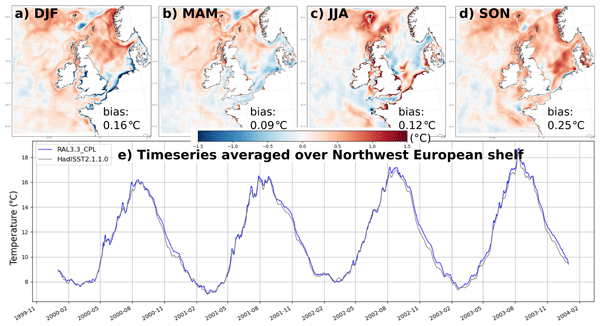
Ségolène Berthou, Juan Manuel Castillo, Vivian Fraser-Leonhardt, Sana Mahmood, Nefeli Makrygianni, Alex Arnold, Claudio Sanchez, Huw W. Lewis, Dale Partridge, Martin Best, Lucy Bricheno, Helen Davies, Douglas B. Clark, James R. Clark, Jeff A. Polton, Andrew Saulter, Chris J. Short, Jonathan Tinker, Simon Tucker, and Maisie Wright
Geosci. Model Dev., 19, 8535–8564, https://doi.org/10.5194/gmd-19-8535-2026, https://doi.org/10.5194/gmd-19-8535-2026, 2026
Short summary
Short summary
The UK’s new RCS-UKC4 (Regional Coupled Suite – UK Coupled domain version 4) system combines atmosphere, ocean, waves, land, rivers, and biogeochemistry models to improve coastal weather and climate predictions. It offers better storm wave predictions, more accurate river flows, and captures rapid sea-level changes. These advances help predict multiple hazards more reliably, supporting safer communities and helping better planning.
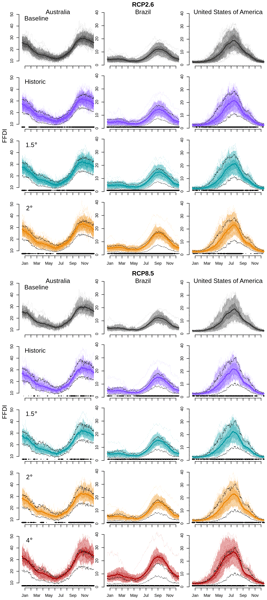
Inika Taylor, Douglas I. Kelley, Camilla Mathison, Karina E. Bett-Williams, Andrew J. Hartley, Richard A. Betts, Chantelle Burton, and Maria L. F. Barbosa
Nat. Hazards Earth Syst. Sci., 26, 4257–4289, https://doi.org/10.5194/nhess-26-4257-2026, https://doi.org/10.5194/nhess-26-4257-2026, 2026
Short summary
Short summary
We present future climate change projections that show increasing fire danger worldwide. Focusing on Australia, Brazil, and the USA, we show that limiting warming to 2 °C reduces the increase in fire danger. However, fire seasons still lengthen and intensify even at 1.5 °C, demonstrating the need for mitigation to limit impacts and adaptation to manage residual risk. Low-fire danger periods persist, but we show their timing and duration will shift and must be considered in fire management.
An Yi, Jiping Liu, Ian Renfrew, Chaoyuan Yang, Changming Dong, Xiangzhou Song, and Qinghua Yang
Earth Syst. Sci. Data Discuss., https://doi.org/10.5194/essd-2026-476, https://doi.org/10.5194/essd-2026-476, 2026
Preprint under review for ESSD
Short summary
Short summary
This dataset quantifies the critical but overlooked role of sea spray in Southern Ocean air-sea heat exchange. We present a new gridded dataset of spray-mediated latent and sensible heat fluxes incorporating a full spray microphysical model, where spray generation depends on wind and wave states. Results show spray can double turbulent heat fluxes during extreme cyclones compared to bulk algorithms. This data is vital for understanding the Southern Ocean's impact on the global energy budget.
Chantelle Burton, Francesca Di Giuseppe, Matthew W. Jones, Douglas I. Kelley, Maria L. F. Barbosa, Joe McNorton, Robert Potts, Carlota Segura-Garcia, John T. Abatzoglou, Iulian Alin Rosu, Niels Andela, Liana O. Anderson, Sally Archibald, Esther Brambleby, Emilio Chuvieco, Andy Ciavarella, Hamish Clarke, Francisco de la Barrera, Carlos M. Di Bella, Enza Di Tomaso, Kebonye Dintwe, Tim S. Doherty, Victoria M. Donovan, Jonathan M. Eden, Paulo M. Fernandes, Lukas Fiedler, Louis Giglio, Olivia Haas, Douglas Hamilton, Stijn Hantson, Sarah Harris, Andrew J. Hartley, Theodore R. Keeping, Crystal A. Kolden, Jean-Luc Kouassi, Elena Kukavskaya, Seppe Lampe, Zhongwei Liu, Guilherme Mataveli, Sarah Meier, Duarte Oom, Mark Parrington, Yuquan Qu, Victor Resco de Dios, Julien Ruffault, Mojtaba Sadegh, Cristina Santín, Fernando Sedano, Jacquelyn K. Shuman, Patrícia S. Silva, Fiona R. Spuler, Carmen B. Steinmann, Veerachai Tanpipat, Miguel Ángel Torres-Vazquez, Marco Turco, Guido R. van der Werf, Dave van Wees, Sander Veraverbeke, Jakob B. Wessel, and Bo Zheng
Earth Syst. Sci. Data Discuss., https://doi.org/10.5194/essd-2026-587, https://doi.org/10.5194/essd-2026-587, 2026
Preprint under review for ESSD
Short summary
Short summary
The third State of Wildfires report examines extreme wildfire events from 2025 to early 2026. It analyses key regional events in Midwestern Canadian Shield Forests, Northwest Iberia, and Chilean Temperate Forests and Matorral, assessing their impacts, drivers, and attributing them to climate change. Climate change greatly increased the likelihood of these fires, and without strong mitigation, such events will become more frequent.
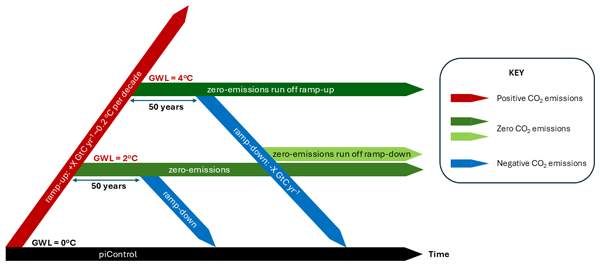
Colin Jones, Isaline Bossert, Donovan P. Dennis, Hazel A. Jeffery, Chris D. Jones, Torben Koenigk, Sina Loriani, Benjamin Sanderson, Roland Séférian, Klaus Wyser, Shuting Yang, Manabu Abe, Sebastian Bathiany, Pascale Braconnot, Victor Brovkin, Friedrich A. Burger, Patrica Cadule, Frederic S. Castruccio, Gokhan Danabasoglu, Andrea Dittus, Jonathan F. Donges, Friederike Fröb, Thomas L. Frölicher, Goran Georgievski, Chuncheng Guo, Aixue Hu, Peter Lawrence, Paul Lerner, José Licón-Saláiz, Bette Otto-Bliesner, Anastasia Romanou, Elena Shevliakova, Yona Silvy, Didier Swingedouw, Jerry Tjiputra, Jeremy Walton, Andy Wiltshire, Ricarda Winkelmann, Richard Wood, Tokuta Yokohata, and Tilo Ziehn
Geosci. Model Dev., 19, 6941–6966, https://doi.org/10.5194/gmd-19-6941-2026, https://doi.org/10.5194/gmd-19-6941-2026, 2026
Short summary
Short summary
We introduce a new Earth system model experiment protocol to help researchers understand how Earth might respond to positive, zero, and negative carbon emissions. This protocol enables different models to be compared following similar warming and cooling rates. Researchers use the models to explore how the Earth reacts to different climate futures, including the risk of tipping points being exceeded and whether changes can be reversed. The results will support improved long-term climate policy.
Wenyao Gan, Martin Best, Pier Luigi Vidale, I. Colin Prentice, and Sandy P. Harrison
EGUsphere, https://doi.org/10.5194/egusphere-2026-2804, https://doi.org/10.5194/egusphere-2026-2804, 2026
This preprint is open for discussion and under review for Geoscientific Model Development (GMD).
Short summary
Short summary
Plants dynamically adjust their photosynthetic capacity as environmental conditions change, but most land models represent this with fixed parameters set separately for each plant type. We added a simple optimality-based photosynthesis scheme to the Joint UK Land Environment Simulator, allowing photosynthetic capacity to acclimate, and tested it against flux-tower observations together with the standard setups. The new scheme improves simulated carbon uptake without worsening energy fluxes.
Prince Xavier, Martin Willett, Tim Graham, Paul Earnshaw, Dan Copsey, Nikesh Narayan, Charline Marzin, Alistair Sellar, Duncan Ackerley, Adam Blaker, Ed Blockley, Alejandro Bodas-Salcedo, Andrew Bushell, Nakbin Choi, Xin Rong Chua, Catherine Guiavarc'h, Muhammad Hassim, Julian Heming, Debra Hudson, Sarah Ineson, Anthony Jones, Colin Jones, Richard Keane, Kiwook Kim, Jiyeong Kim, Till Kuhlbrodt, Myong-In Lee, Richard Levine, Chen Li, Gill Martin, Alex Megann, Anne Mccabe, Aurel Moise, Leighton Regayre, Jeff Ridley, Luke Roberts, Sandeep Sahany, Reinhard K. H. Schiemann, David Storkey, Warren Tennant, Lorenzo Tomassini, Yoko Tsushima, Graham P. Weedon, Alex West, Matthew C. Wheeler, Keith Williams, Xiaobing Zhou, and Hongyan Zhu
EGUsphere, https://doi.org/10.5194/egusphere-2026-4281, https://doi.org/10.5194/egusphere-2026-4281, 2026
Short summary
Short summary
GC5 is the Met Office's newest climate and weather model, combining an updated atmosphere/land component with an improved ocean and sea-ice component. Compared to its predecessor GC4, it better simulates global temperatures, winds, monsoons over India and SE Asia, and African weather, and forecasts tropical cyclones more accurately. Southern Ocean errors shrank too. Some tropical patterns and regional biases worsened slightly. A lower-resolution version will underpin the UK's Earth System Model.
Rajesh Kumar, Claudio Sanchez, Juan Manuel Castillo, Jian-Guo Li, Bijoy Thompson, Pratiman Patel, Alvin Ng, Kaushik Sasmal, Kalli Furtado, Hailin Yan, Liu Jianyu, and Hugh Zhang
EGUsphere, https://doi.org/10.5194/egusphere-2026-2024, https://doi.org/10.5194/egusphere-2026-2024, 2026
Short summary
Short summary
Weather over Southeast Asia is shaped by complex interactions between the air, ocean, and waves. We developed a high-resolution model that links these processes to better understand and predict rainfall patterns in the region. The results show that ocean–atmosphere interactions improve the representation and prediction of squall events that affect daily life in Singapore and surrounding regions. This work supports more accurate weather forecasting in the region.
Zhangcheng Pei, Sonya L. Fiddes, Marc D. Mallet, Matthew T. Woodhouse, Simon P. Alexander, Alain Protat, Kalli Furtado, and Paul R. Field
EGUsphere, https://doi.org/10.5194/egusphere-2026-3541, https://doi.org/10.5194/egusphere-2026-3541, 2026
This preprint is open for discussion and under review for Atmospheric Chemistry and Physics (ACP).
Short summary
Short summary
Climate models misrepresent Southern Ocean clouds, causing warming biases. Using ship data, we updated a weather model to test how sea spray affects cloud ice. Adding realistic ocean particles prevents deep clouds from freezing too fast, correcting sunlight trasmissions. Yet, shallow clouds remain flawed due to missing moisture. Thus, accurate climate predictions require improving both aerosol-cloud interactions and large-scale weather dynamics.
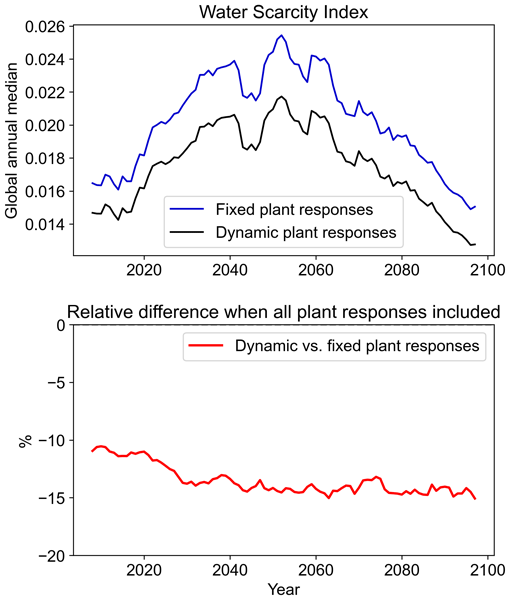
Jessica Stacey, Richard A. Betts, Andrew Hartley, Lina M. Mercado, and Nicola Gedney
Hydrol. Earth Syst. Sci., 30, 4225–4243, https://doi.org/10.5194/hess-30-4225-2026, https://doi.org/10.5194/hess-30-4225-2026, 2026
Short summary
Short summary
Plants typically transpire less with rising atmospheric carbon dioxide, leaving more water in the ground for human use, but many future water scarcity assessments ignore this effect. We use a land surface model to examine how plant responses to carbon dioxide and climate change affect future water scarcity. Our results suggest that including these plant responses increases overall water availability for most people, highlighting the importance of their inclusion in future water scarcity studies.
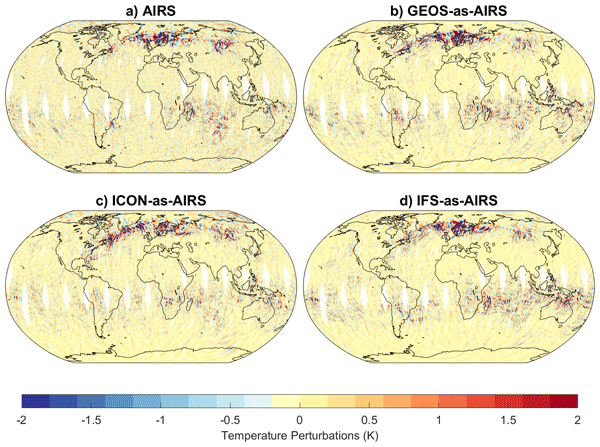
Phoebe Noble, Haruka Okui, Joan Alexander, Manfred Ern, Neil P. Hindley, Lars Hoffmann, Laura Holt, Annelize van Niekerk, Riwal Plougonven, Inna Polichtchouk, Claudia C. Stephan, Martina Bramberger, Milena Corcos, William Putnam, Christopher Kruse, and Corwin J. Wright
Atmos. Chem. Phys., 26, 7607–7630, https://doi.org/10.5194/acp-26-7607-2026, https://doi.org/10.5194/acp-26-7607-2026, 2026
Short summary
Short summary
Gravity waves are small-scale processes that drive the circulation in the middle and upper atmosphere. In this work, we assess 3 new high-resolution (3-5km horizontal resolution) models against satellite data. Generally, models capture the spatial patterns and represent stratospheric northern hemisphere mountain generated waves well. However, they still underestimate amplitudes globally and struggle with the representation of southern hemispheric convective waves.
Martin R. Willett, Melissa E. Brooks, Andrew Bushell, Paul Earnshaw, Charline Marzin, Samantha Smith, Lorenzo Tomassini, Nathan Luke Abraham, Martin Best, John M. Edwards, Kalli Furtado, Catherine Hardacre, Alan J. Hewitt, Ben Johnson, Adrian Lock, Jane P. Mulcahy, James Manners, Alistair Sellar, Peter Sheridan, Warren Tennant, Kwinten Van Weverberg, Vidya Varma, and Michael Whitall
EGUsphere, https://doi.org/10.5194/egusphere-2026-2425, https://doi.org/10.5194/egusphere-2026-2425, 2026
Short summary
Short summary
Global Atmosphere and Land (GAL) configurations of the Unified Model (UM) and JULES are developed for use in any global atmospheric modelling application. We describe the latest version, GAL9. We compare GAL9 with its predecessor and show that it gives improved forecasts of weather and climate. GAL9 has been used for weather forecasts in the UK from early 2026 and it will be used to study the Earth's climate.
Josh Smith, Matthew Henry, Masaru Yoshioka, Ben Johnson, and Jim Haywood
EGUsphere, https://doi.org/10.5194/egusphere-2026-2654, https://doi.org/10.5194/egusphere-2026-2654, 2026
Short summary
Short summary
In 2020, new international rules cut sulphur in shipping fuels by roughly eighty percent, removing particles that had been brightening clouds over the oceans and reflecting sunlight. Using a climate model, we tested how this loss of cooling has been calculated and found that recent studies have
likely underestimated the resulting warming by a factor of two to four. This means cleaner shipping fuels may be contributing more to recent global warming than previously recognised.
likely underestimated the resulting warming by a factor of two to four. This means cleaner shipping fuels may be contributing more to recent global warming than previously recognised.
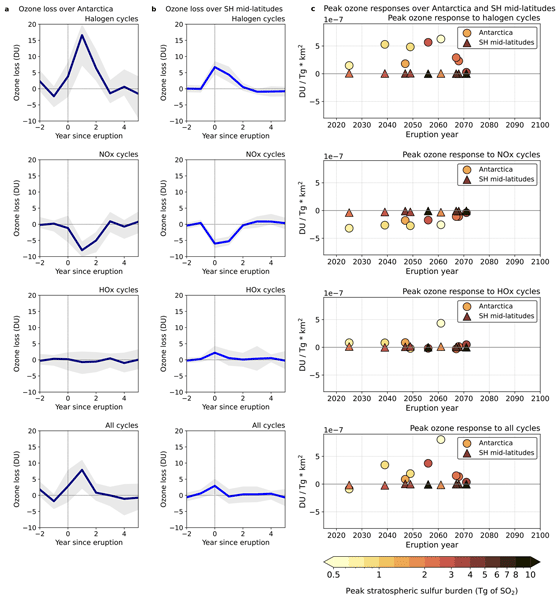
Man Mei Chim, Nathan Luke Abraham, Thomas J. Aubry, Ben Johnson, Hella Garny, Susan Solomon, and Anja Schmidt
Atmos. Chem. Phys., 26, 6781–6797, https://doi.org/10.5194/acp-26-6781-2026, https://doi.org/10.5194/acp-26-6781-2026, 2026
Short summary
Short summary
Sulfate aerosols from explosive eruptions can provide surfaces for chemical reactions destroying ozone. Assessing the effects of volcanic sulfate aerosols is crucial for understanding future ozone recovery. We find sporadic eruptions can induce a small delay in stratospheric ozone recovery by a few years over Antarctica and Southern Hemisphere mid-latitudes. Our results highlight the importance to continuously monitor atmospheric composition and processes to understand changes in ozone recovery.
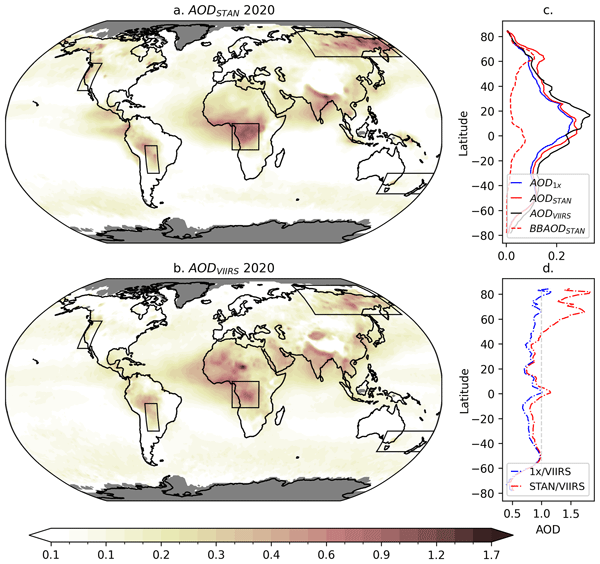
Elizabeth Quaye, Ben T. Johnson, James M. Haywood, Guido R. van der Werf, Roland Vernooij, Stephen A. Sitch, and Tom Eames
Atmos. Chem. Phys., 26, 6629–6654, https://doi.org/10.5194/acp-26-6629-2026, https://doi.org/10.5194/acp-26-6629-2026, 2026
Short summary
Short summary
We find aerosol optical depths in a global climate model are overestimated during extreme wildfire events if emissions are scaled up by a factor of two, typically applied to improve simulated aerosol on seasonal–annual timescales. We propose a technique where a variable scaling factor is determined by fuel consumption, improving correlation in five fire-affected areas. We explore the impact of this change on aerosol radiative effects, during extreme events and on broader space and time scales.
Eliza K. Duncan, George Jordan, Paul Kim, James M. Haywood, Duncan Watson-Parris, Ben Johnson, Alistair Sellar, Zak Kipling, João Teixeira, Florent Malavelle, and Daniel G. Partridge
EGUsphere, https://doi.org/10.5194/egusphere-2026-1043, https://doi.org/10.5194/egusphere-2026-1043, 2026
Short summary
Short summary
The 2014–15 Holuhraun eruption offers a natural experiment to assess how well climate models can capture the changes in aerosol associated with the plume. We investigate the aerosol lifecycle during transport to identify key differences in climate models' representation of aerosol processes, which could affect the models’ ability to capture changes in cloud properties. Our study highlights the importance of the representation of boundary layer nucleation processes in climate models.
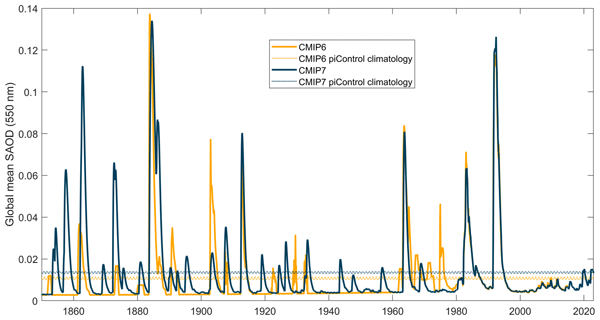
Thomas J. Aubry, Matthew Toohey, Sujan Khanal, Man Mei Chim, Magali Verkerk, Ben Johnson, Anja Schmidt, Mahesh Kovilakam, Michael Sigl, Zebedee Nicholls, Larry Thomason, Vaishali Naik, Landon Rieger, Dominik Stiller, Elisa Ziegler, Paul Durack, and Isabel H. Smith
Geosci. Model Dev., 19, 3725–3756, https://doi.org/10.5194/gmd-19-3725-2026, https://doi.org/10.5194/gmd-19-3725-2026, 2026
Short summary
Short summary
Climate forcings, such as solar radiation or anthropogenic greenhouse gases, are required to run global climate model simulations. Stratospheric aerosols, which mostly originate from large volcanic eruptions, are a key natural forcing. In this paper, we document the stratospheric aerosol forcing dataset that will feed the next generation (CMIP7) of climate models. Our dataset is very different from its predecessor (CMIP6), which might affect simulations of the 1850–2021 climate.
Robin S. Smith, Tarkan A. Bilge, Thomas J. Bracegirdle, Paul R. Holland, Till Kuhlbrodt, Charlotte Lang, Spencer Liddicoat, Tom Mitcham, Jane Mulcahy, Kaitlin A. Naughten, Andrew Orr, Julien Palmieri, Antony J. Payne, Steven Rumbold, Marc Stringer, Ranjini Swaminathan, Sarah Taylor, Jeremy Walton, and Colin Jones
Earth Syst. Dynam., 17, 475–493, https://doi.org/10.5194/esd-17-475-2026, https://doi.org/10.5194/esd-17-475-2026, 2026
Short summary
Short summary
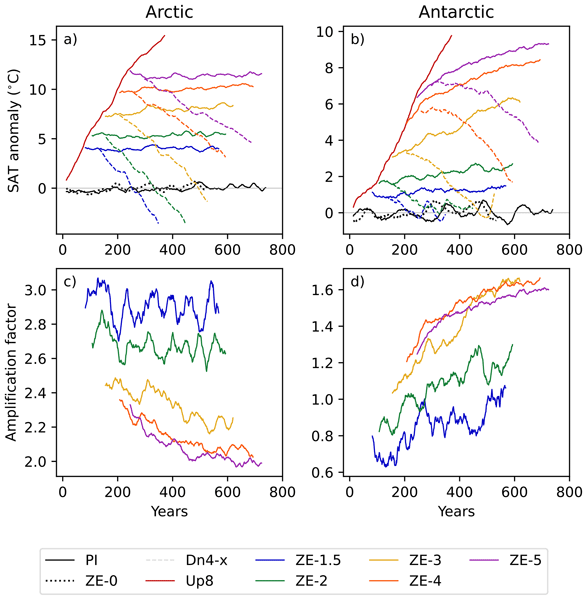
There is a dangerous amount of uncertainty in our predictions of climate change in polar regions because some of feedbacks that might lead to changes that are too rapid for us to adapt to, or that cannot be reversed. We have run a set of simulations with a state-of-the-art Earth System Model that helps improve our understanding of how climate in these regions might change. Some of the aspects we investigate are reversible but many are not, especially those affecting ice sheets and sea level.
John W. Rostron, Alejandro Bodas-Salcedo, David M. H. Sexton, Colin G. Jones, Edward W. Blockley, Till Kuhlbrodt, Jane P. Mulcahy, Tamzin E. Palmer, Saloua Peatier, Mark A. Ringer, Steven T. Rumbold, Benjamin M. Sanderson, Yongming Tang, and Martin R. Willet
EGUsphere, https://doi.org/10.5194/egusphere-2026-1676, https://doi.org/10.5194/egusphere-2026-1676, 2026
Short summary
Short summary
The Met Office’s latest weather and climate model warms very strongly in response to increases in carbon dioxide. We created a modified version of the model with a more moderate warming response by adjusting key model parameters, using both automated methods and expert judgement. The new model matches historical temperatures more closely and is better suited for studies of long‑term climate, but has reduced overall accuracy when simulating the baseline climate.
Yanyan Cheng, Yaomin Wang, Kalli Furtado, Cenlin He, Fei Chen, Alan D. Ziegler, Song Chen, Matteo Detto, Yuna Mao, Baoxiang Pan, Yoshiko Kosugi, Marryanna Lion, Shoji Noguchi, Satoru Takanashi, Lulie Melling, and Baoqing Zhang
Geosci. Model Dev., 19, 2197–2217, https://doi.org/10.5194/gmd-19-2197-2026, https://doi.org/10.5194/gmd-19-2197-2026, 2026
Short summary
Short summary
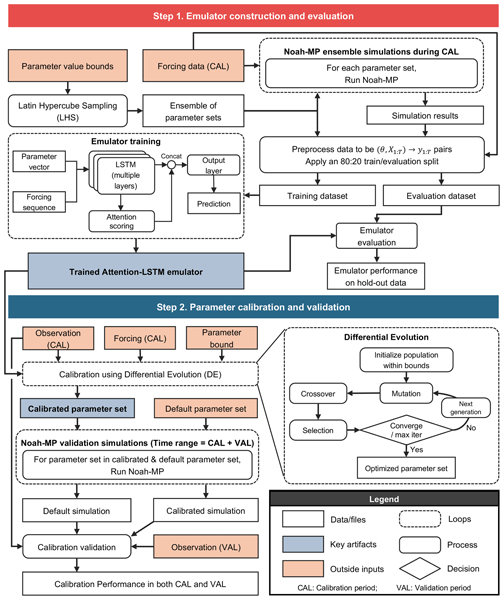
Tropical land surface processes shape the Earth's climate, but models often lack accuracy in the tropics due to limited data for validation. We improved the Noah with Multi-Parameterizations (Noah-MP) land surface model for the tropics using data from forests in Panama and Malaysia. Calibration enhanced simulations of energy and water fluxes, and revealed key vegetation and soil parameters, as well as future directions for model improvement in tropical regions.
Simon R. Osborne, Jennifer K. Brooke, Bernard M. Claxton, Tony Jones, Amanda M. Kerr-Munslow, James R. McGregor, Emily G. Norton, Nicola Phillips, Martyn A. Pickering, Jeremy D. Price, Jenna Thornton, and Graham P. Weedon
Earth Syst. Sci. Data, 18, 1575–1599, https://doi.org/10.5194/essd-18-1575-2026, https://doi.org/10.5194/essd-18-1575-2026, 2026
Short summary
Short summary
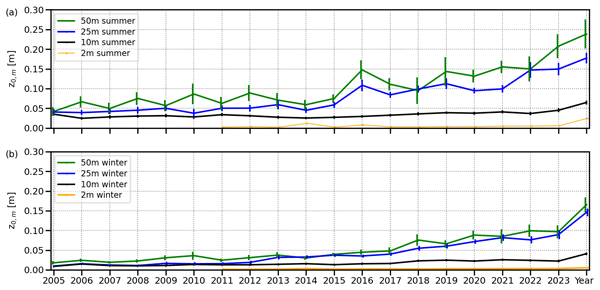
We describe a continuous 20-yr record of meteorological and soil water measurements from a semi-rural site in central England. The dataset is available at the Centre for Environmental Data Analysis (CEDA) UK repository. The data spans 2004 to 2024 in 1, 5, 10 and 30-min time steps for the core variables. Observations used turbulence masts at various heights up to 50m, visibility, weather balloon launches, and very near-surface and subsoil sensors. More specialist remote sensing instruments retrieved profiles through the boundary layer.
Jie Zhang, Kalli Furtado, Steven T. Turnock, Yixiong Lu, Tongwen Wu, Fang Zhang, Xiaoge Xin, and Yuyun Liu
Atmos. Chem. Phys., 26, 2175–2189, https://doi.org/10.5194/acp-26-2175-2026, https://doi.org/10.5194/acp-26-2175-2026, 2026
Short summary
Short summary
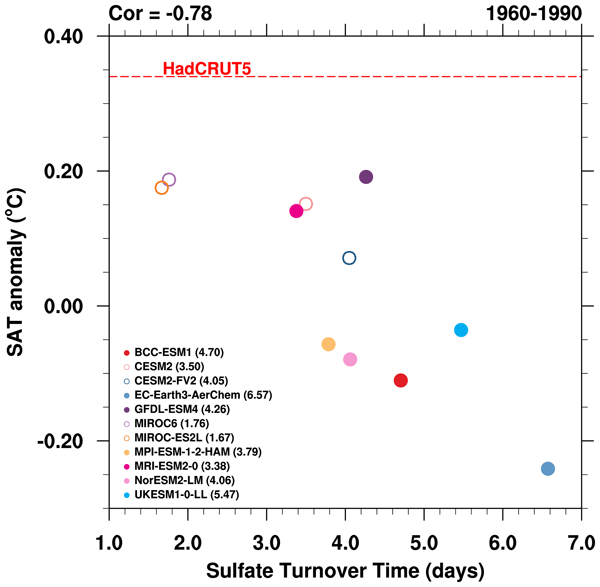
Aerosol cooling has been identified as a key driver of the cold biases in CMIP6 (sixth Coupled Model Inter-comparison Project) models. We demonstrate the critical role of sulfate burden anomaly and the contribution of sulfur removal processes. Faster sulfate deposition directly lowers atmospheric sulfate levels, while enhanced SO₂ deposition reduces the precursor for sulfate formation. The systematically short sulfate lifetime implies that model improvements should focus on SO₂ deposition processes, rather than sulfate deposition.

Jon Cranko Page, Martin G. De Kauwe, Andy J. Pitman, Isaac R. Towers, Gabriele Arduini, Martin J. Best, Craig R. Ferguson, Jürgen Knauer, Hyungjun Kim, David M. Lawrence, Tomoko Nitta, Keith W. Oleson, Catherine Ottlé, Anna Ukkola, Nicholas Vuichard, Xiaoni Wang-Faivre, and Gab Abramowitz
Biogeosciences, 23, 263–282, https://doi.org/10.5194/bg-23-263-2026, https://doi.org/10.5194/bg-23-263-2026, 2026
Short summary
Short summary
This paper used a large dataset of observations, machine learning predictions, and computer model simulations to test how well land surface models represent the water, energy, and carbon cycles. We found that the models work well under "normal" weather but do not meet performance expectations during coinciding extreme conditions. Since these extremes are relatively rare, targeted model improvements could deliver major performance gains.
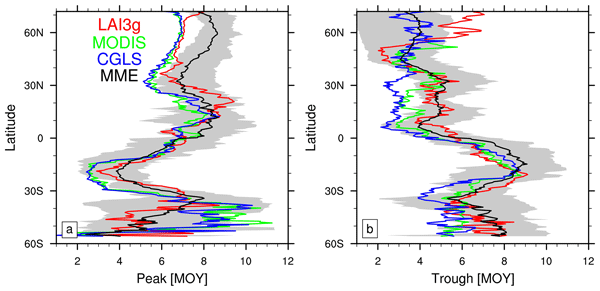
Daniele Peano, Deborah Hemming, Christine Delire, Yuanchao Fan, Hanna Lee, Stefano Materia, Julia E. M. S. Nabel, Taejin Park, David Wårlind, Andy Wiltshire, and Sönke Zaehle
Biogeosciences, 22, 7117–7135, https://doi.org/10.5194/bg-22-7117-2025, https://doi.org/10.5194/bg-22-7117-2025, 2025
Short summary
Short summary
Earth System Models are the principal tools for scientists to study past, present, and future climate changes. This work investigates the ability of a set of them to represent the observed changes in vegetation, which are vital to estimating the impact of future climate mitigation and adaptation strategies. This study highlights the main limitations in correctly representing vegetation variability. These tools still need further development to improve our understanding of future changes.
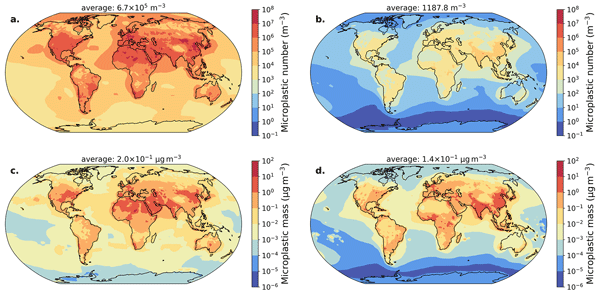
Cameron McErlich, Felix Goddard, Alex Aves, Catherine Hardacre, Nikolaos Evangeliou, Alan J. Hewitt, and Laura E. Revell
Geosci. Model Dev., 18, 8827–8854, https://doi.org/10.5194/gmd-18-8827-2025, https://doi.org/10.5194/gmd-18-8827-2025, 2025
Short summary
Short summary
Airborne microplastics are a new air pollutant but are not yet included in most global models. We add them to the UK Earth System Model to show how they move, change, and are removed from air. Smaller microplastics persist for longer and can travel further, even to Antarctica. While their current role in air pollution is small, their presence is expected to grow in future. This work offers a framework to assess future impacts of microplastics on air quality and climate.
Eliza K. Duncan, Jonathan E. Fieldsend, Alistair Sellar, Emanuele Tovazzi, Paul Kim, James M. Haywood, and Daniel G. Partridge
EGUsphere, https://doi.org/10.5194/egusphere-2025-4298, https://doi.org/10.5194/egusphere-2025-4298, 2025
Short summary
Short summary
Atmospheric aerosol particles are a major confounding factor in accurately representing climate change. We build a novel generic framework to untangle the role of complex processes focusing on a remote site in Antarctica as a case study in near-pristine conditions. Our machine-learning model predicts aerosol concentrations from an airmass history, considering the meteorology and potential sources and removal processes, enabling improved representation in climate models.
Natalie G. Ratcliffe, Claire L. Ryder, Nicolas Bellouin, Anthony Jones, Ben Johnson, Stephanie Woodward, Lisa-Maria Wieland, Josef Gasteiger, and Bernadett Weinzierl
EGUsphere, https://doi.org/10.5194/egusphere-2025-5143, https://doi.org/10.5194/egusphere-2025-5143, 2025
Short summary
Short summary
Observations show large dust particles travel much further than expected, which is not replicated in weather and climate models. We use a climate model to understand which processes dominantly impact large particle transport, and find that modelled large particle transport agrees with observations best after reducing the particle gravitational settling by ~ 80 %. We prove the presence of processes not represented accurately or at all in the model which act on large particles in the real-world.
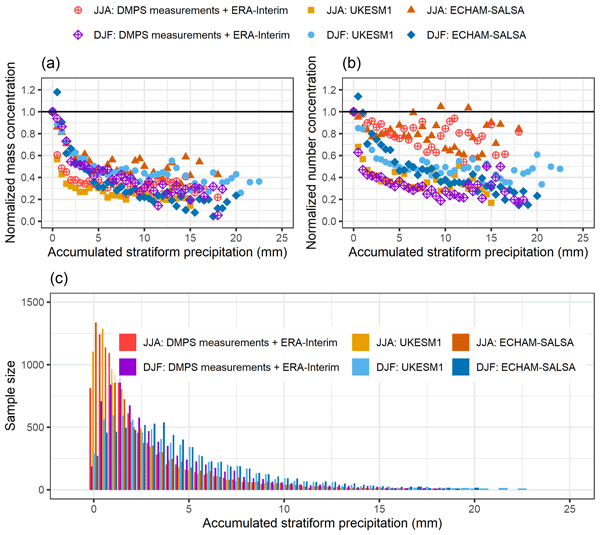
Sini Talvinen, Paul Kim, Emanuele Tovazzi, Eemeli Holopainen, Roxana Cremer, Thomas Kühn, Harri Kokkola, Zak Kipling, David Neubauer, João C. Teixeira, Alistair Sellar, Duncan Watson-Parris, Yang Yang, Jialei Zhu, Srinath Krishnan, Annele Virtanen, and Daniel G. Partridge
Atmos. Chem. Phys., 25, 14449–14478, https://doi.org/10.5194/acp-25-14449-2025, https://doi.org/10.5194/acp-25-14449-2025, 2025
Short summary
Short summary
Climate models struggle to predict how clouds and aerosols interact, affecting Earth’s energy balance. This study compares models to observations to see how they describe effects of clouds and rain on aerosols. While both models show similar overall trends, seasonal differences emerged. These, however, align with differences in key variables participating in cloud formation. The study provides insights on how to improve the representation of aerosol-cloud interactions in climate models.
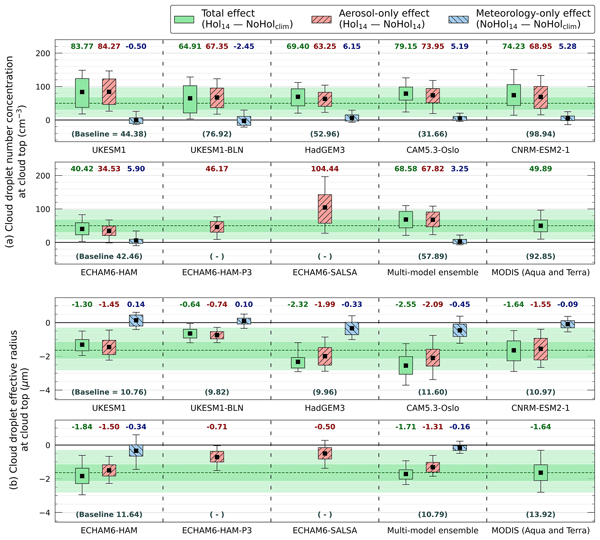
George Jordan, Florent Malavelle, Jim Haywood, Ying Chen, Ben Johnson, Daniel Partridge, Amy Peace, Eliza Duncan, Duncan Watson-Parris, David Neubauer, Anton Laakso, Martine Michou, and Pierre Nabat
Atmos. Chem. Phys., 25, 13393–13428, https://doi.org/10.5194/acp-25-13393-2025, https://doi.org/10.5194/acp-25-13393-2025, 2025
Short summary
Short summary
The 2014–15 Holuhraun eruption created a vast aerosol plume that acted as a natural experiment to assess how well climate models capture changes in cloud properties due to increased aerosol. We find that climate models represent the observed shift to smaller, more numerous cloud droplets well. However, climate models diverge in their aerosol-induced changes to large-scale cloud properties, particularly cloud liquid water content. Our study shows that Holuhraun had a cooling effect on the Earth.
Douglas I. Kelley, Chantelle Burton, Francesca Di Giuseppe, Matthew W. Jones, Maria L. F. Barbosa, Esther Brambleby, Joe R. McNorton, Zhongwei Liu, Anna S. I. Bradley, Katie Blackford, Eleanor Burke, Andrew Ciavarella, Enza Di Tomaso, Jonathan Eden, Igor José M. Ferreira, Lukas Fiedler, Andrew J. Hartley, Theodore R. Keeping, Seppe Lampe, Anna Lombardi, Guilherme Mataveli, Yuquan Qu, Patrícia S. Silva, Fiona R. Spuler, Carmen B. Steinmann, Miguel Ángel Torres-Vázquez, Renata Veiga, Dave van Wees, Jakob B. Wessel, Emily Wright, Bibiana Bilbao, Mathieu Bourbonnais, Cong Gao, Carlos M. Di Bella, Kebonye Dintwe, Victoria M. Donovan, Sarah Harris, Elena A. Kukavskaya, Aya Brigitte N'Dri, Cristina Santín, Galia Selaya, Johan Sjöström, John T. Abatzoglou, Niels Andela, Rachel Carmenta, Emilio Chuvieco, Louis Giglio, Douglas S. Hamilton, Stijn Hantson, Sarah Meier, Mark Parrington, Mojtaba Sadegh, Jesus San-Miguel-Ayanz, Fernando Sedano, Marco Turco, Guido R. van der Werf, Sander Veraverbeke, Liana O. Anderson, Hamish Clarke, Paulo M. Fernandes, and Crystal A. Kolden
Earth Syst. Sci. Data, 17, 5377–5488, https://doi.org/10.5194/essd-17-5377-2025, https://doi.org/10.5194/essd-17-5377-2025, 2025
Short summary
Short summary
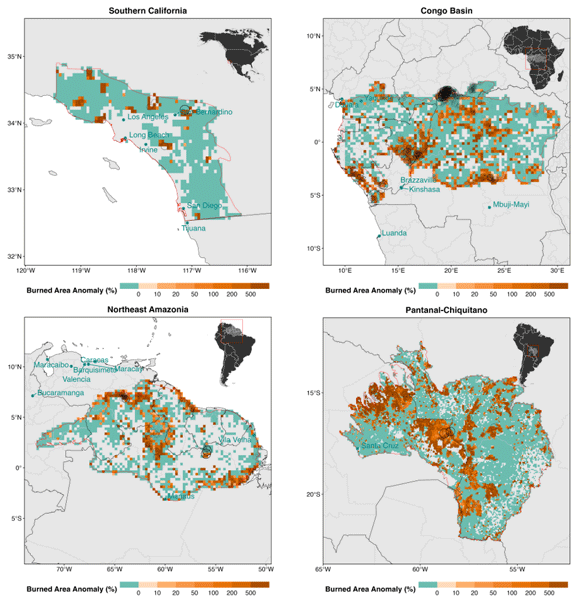
The second State of Wildfires report examines extreme wildfire events from 2024 to early 2025. It analyses key regional events in Southern California, Northeast Amazonia, Pantanal–Chiquitano, and the Congo Basin, assessing their drivers and predictability and attributing them to climate change and land use. Seasonal outlooks and decadal projections are provided. Climate change greatly increased the likelihood of these fires, and without strong mitigation, such events will become more frequent.
Pratapaditya Ghosh, Ian Boutle, Paul Field, Adrian Hill, Marie Mazoyer, Katherine J. Evans, Salil Mahajan, Hyun-Gyu Kang, Min Xu, Wei Zhang, and Hamish Gordon
Atmos. Chem. Phys., 25, 11157–11182, https://doi.org/10.5194/acp-25-11157-2025, https://doi.org/10.5194/acp-25-11157-2025, 2025
Short summary
Short summary
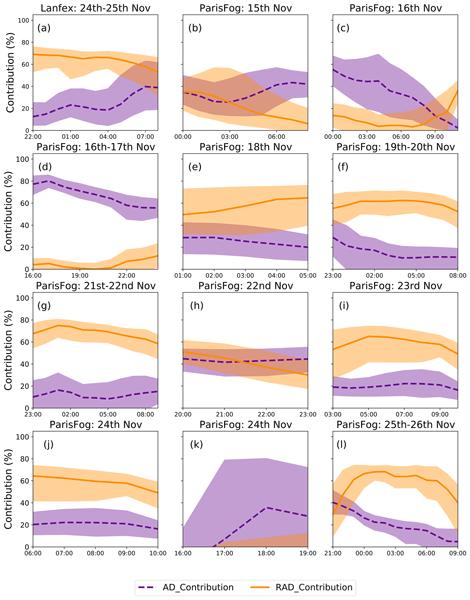
We study the life cycle of fog events in Europe using a weather and climate model. By incorporating droplet formation and growth driven by radiative cooling, our model better simulates the total liquid water in foggy atmospheric columns. We show that both adiabatic and radiative cooling play significant, often equally important, roles in driving droplet formation and growth. We discuss strategies to address droplet number overpredictions by improving model physics and addressing model artifacts.
Pratapaditya Ghosh, Ian Boutle, Paul Field, Adrian Hill, Anthony Jones, Marie Mazoyer, Katherine J. Evans, Salil Mahajan, Hyun-Gyu Kang, Min Xu, Wei Zhang, Noah Asch, and Hamish Gordon
Atmos. Chem. Phys., 25, 11129–11156, https://doi.org/10.5194/acp-25-11129-2025, https://doi.org/10.5194/acp-25-11129-2025, 2025
Short summary
Short summary
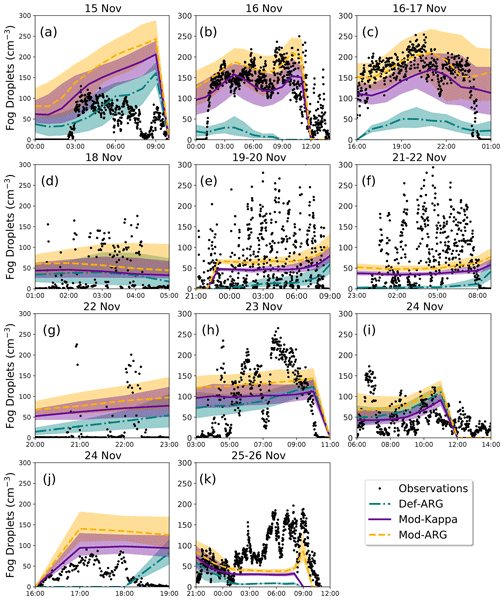
We study aerosol–fog interactions near Paris using a weather and climate model with high spatial resolution. We show that our model can simulate the fog life cycle effectively. We find that the fog droplet number concentrations, the amount of liquid water in the fog, and the vertical structure of the fog are highly sensitive to the parameterization that simulates droplet formation and growth. The changes we propose could improve fog forecasts significantly without increasing computational costs.
Yunqian Zhu, Hideharu Akiyoshi, Valentina Aquila, Elizabeth Asher, Ewa M. Bednarz, Slimane Bekki, Christoph Brühl, Amy H. Butler, Parker Case, Simon Chabrillat, Gabriel Chiodo, Margot Clyne, Peter R. Colarco, Sandip Dhomse, Lola Falletti, Eric Fleming, Ben Johnson, Andrin Jörimann, Mahesh Kovilakam, Gerbrand Koren, Ales Kuchar, Nicolas Lebas, Qing Liang, Cheng-Cheng Liu, Graham Mann, Michael Manyin, Marion Marchand, Olaf Morgenstern, Paul Newman, Luke D. Oman, Freja F. Østerstrøm, Yifeng Peng, David Plummer, Ilaria Quaglia, William Randel, Samuel Rémy, Takashi Sekiya, Stephen Steenrod, Timofei Sukhodolov, Simone Tilmes, Kostas Tsigaridis, Rei Ueyama, Daniele Visioni, Xinyue Wang, Shingo Watanabe, Yousuke Yamashita, Pengfei Yu, Wandi Yu, Jun Zhang, and Zhihong Zhuo
Geosci. Model Dev., 18, 5487–5512, https://doi.org/10.5194/gmd-18-5487-2025, https://doi.org/10.5194/gmd-18-5487-2025, 2025
Short summary
Short summary
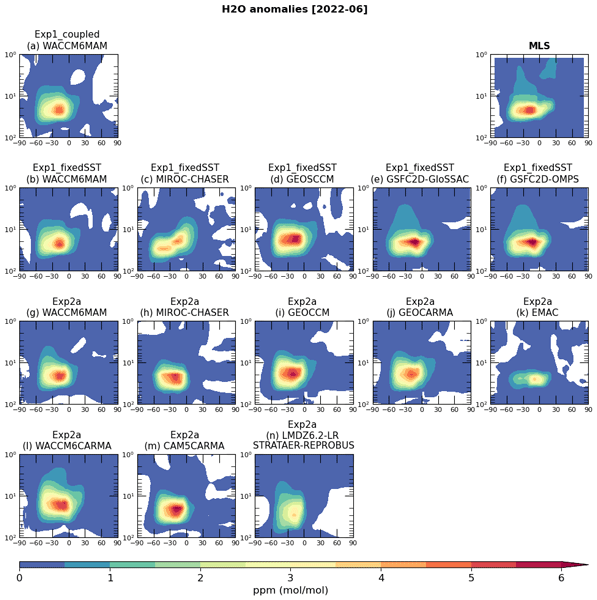
To understand the climate impact of the 2022 Hunga volcanic eruption, we developed a climate model–observation comparison project. The paper describes the protocols and models that participate in the experiments. We designed several experiments to achieve our goals of this activity: (1) to evaluate the climate model performance and (2) to understand the Earth system responses to this eruption.
Mike Bush, David L. A. Flack, Huw W. Lewis, Sylvia I. Bohnenstengel, Chris J. Short, Charmaine Franklin, Adrian P. Lock, Martin Best, Paul Field, Anne McCabe, Kwinten Van Weverberg, Segolene Berthou, Ian Boutle, Jennifer K. Brooke, Seb Cole, Shaun Cooper, Gareth Dow, John Edwards, Anke Finnenkoetter, Kalli Furtado, Kate Halladay, Kirsty Hanley, Margaret A. Hendry, Adrian Hill, Aravindakshan Jayakumar, Richard W. Jones, Humphrey Lean, Joshua C. K. Lee, Andy Malcolm, Marion Mittermaier, Saji Mohandas, Stuart Moore, Cyril Morcrette, Rachel North, Aurore Porson, Susan Rennie, Nigel Roberts, Belinda Roux, Claudio Sanchez, Chun-Hsu Su, Simon Tucker, Simon Vosper, David Walters, James Warner, Stuart Webster, Mark Weeks, Jonathan Wilkinson, Michael Whitall, Keith D. Williams, and Hugh Zhang
Geosci. Model Dev., 18, 3819–3855, https://doi.org/10.5194/gmd-18-3819-2025, https://doi.org/10.5194/gmd-18-3819-2025, 2025
Short summary
Short summary
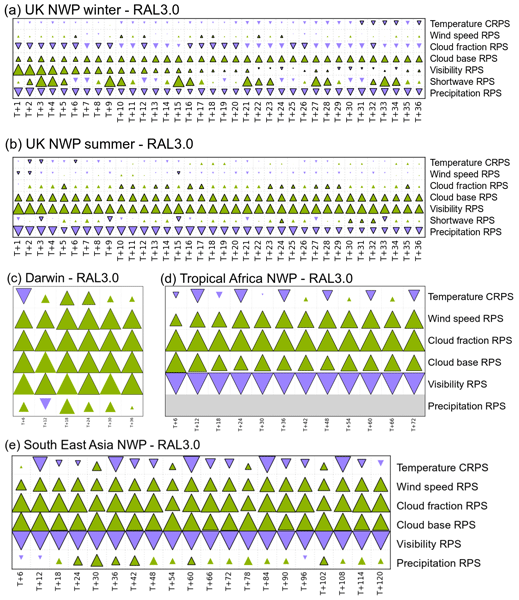
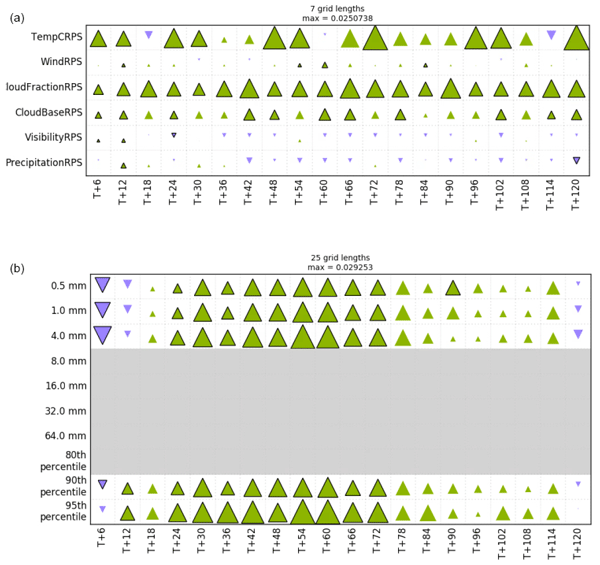
RAL configurations define settings for the Unified Model atmosphere and Joint UK Land Environment Simulator. The third version of the Regional Atmosphere and Land (RAL3) science configuration for kilometre- and sub-kilometre-scale modelling represents a major advance compared to previous versions (RAL2) by delivering a common science definition for applications in tropical and mid-latitude regions. RAL3 has more realistic precipitation distributions and an improved representation of clouds and visibility.
Joseph W. Gallear, Marcelo Valadares Galdos, Marcelo Zeri, and Andrew Hartley
Nat. Hazards Earth Syst. Sci., 25, 1521–1541, https://doi.org/10.5194/nhess-25-1521-2025, https://doi.org/10.5194/nhess-25-1521-2025, 2025
Short summary
Short summary
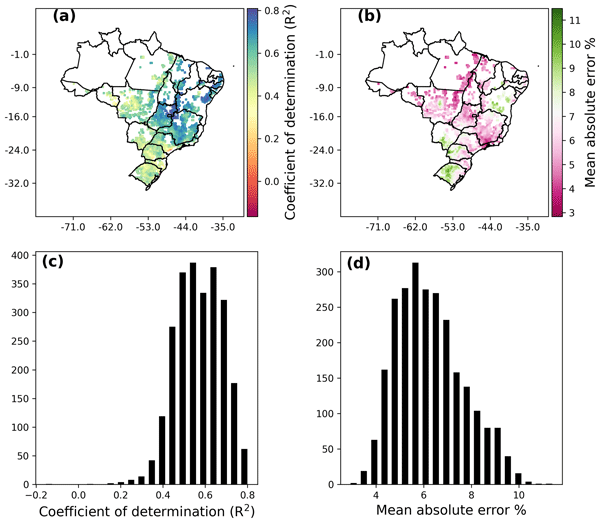
In Brazil, drought is of national concern and can have major consequences for agriculture. Here, we determine how to develop forecasts for drought stress on vegetation health using machine learning. Results aim to inform future developments in operational drought monitoring at the National Centre for Monitoring and Early Warning of Natural Disasters (CEMADEN) in Brazil. This information is essential for disaster preparedness and planning of future actions to support areas affected by drought.
Camilla Mathison, Eleanor J. Burke, Gregory Munday, Chris D. Jones, Chris J. Smith, Norman J. Steinert, Andy J. Wiltshire, Chris Huntingford, Eszter Kovacs, Laila K. Gohar, Rebecca M. Varney, and Douglas McNeall
Geosci. Model Dev., 18, 1785–1808, https://doi.org/10.5194/gmd-18-1785-2025, https://doi.org/10.5194/gmd-18-1785-2025, 2025
Short summary
Short summary
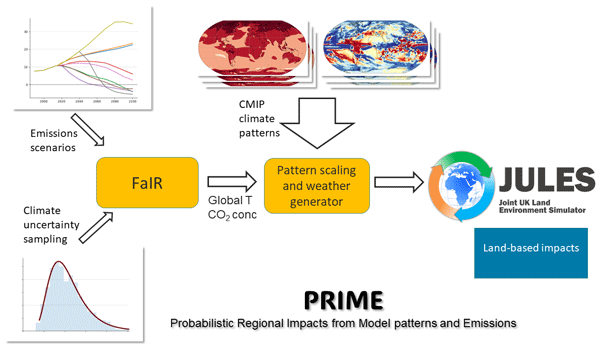
We present PRIME (Probabilistic Regional Impacts from Model patterns and Emissions), which is designed to take new emissions scenarios and rapidly provide regional impact information. PRIME allows large ensembles to be run on multi-centennial timescales, including the analysis of many important variables for impact assessments. Our evaluation shows that PRIME reproduces the climate response for known scenarios, providing confidence in using PRIME for novel scenarios.
Mariya Petrenko, Ralph Kahn, Mian Chin, Susanne E. Bauer, Tommi Bergman, Huisheng Bian, Gabriele Curci, Ben Johnson, Johannes W. Kaiser, Zak Kipling, Harri Kokkola, Xiaohong Liu, Keren Mezuman, Tero Mielonen, Gunnar Myhre, Xiaohua Pan, Anna Protonotariou, Samuel Remy, Ragnhild Bieltvedt Skeie, Philip Stier, Toshihiko Takemura, Kostas Tsigaridis, Hailong Wang, Duncan Watson-Parris, and Kai Zhang
Atmos. Chem. Phys., 25, 1545–1567, https://doi.org/10.5194/acp-25-1545-2025, https://doi.org/10.5194/acp-25-1545-2025, 2025
Short summary
Short summary
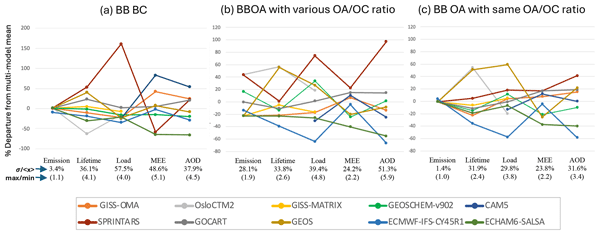
We compared smoke plume simulations from 11 global models to each other and to satellite smoke amount observations aimed at constraining smoke source strength. In regions where plumes are thick and background aerosol is low, models and satellites compare well. However, the input emission inventory tends to underestimate in many places, and particle property and loss rate assumptions vary enormously among models, causing uncertainties that require systematic in situ measurements to resolve.

Lauren R. Marshall, Anja Schmidt, Andrew P. Schurer, Nathan Luke Abraham, Lucie J. Lücke, Rob Wilson, Kevin J. Anchukaitis, Gabriele C. Hegerl, Ben Johnson, Bette L. Otto-Bliesner, Esther C. Brady, Myriam Khodri, and Kohei Yoshida
Clim. Past, 21, 161–184, https://doi.org/10.5194/cp-21-161-2025, https://doi.org/10.5194/cp-21-161-2025, 2025
Short summary
Short summary
Large volcanic eruptions have caused temperature deviations over the past 1000 years; however, climate model results and reconstructions of surface cooling using tree rings do not match. We explore this mismatch using the latest models and find a better match to tree-ring reconstructions for some eruptions. Our results show that the way in which eruptions are simulated in models matters for the comparison to tree-rings, particularly regarding the spatial spread of volcanic aerosol.
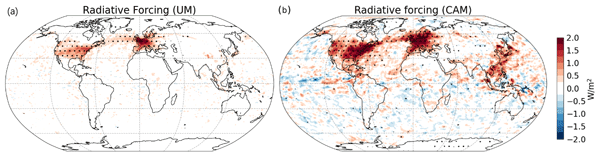
Weiyu Zhang, Kwinten Van Weverberg, Cyril J. Morcrette, Wuhu Feng, Kalli Furtado, Paul R. Field, Chih-Chieh Chen, Andrew Gettelman, Piers M. Forster, Daniel R. Marsh, and Alexandru Rap
Atmos. Chem. Phys., 25, 473–489, https://doi.org/10.5194/acp-25-473-2025, https://doi.org/10.5194/acp-25-473-2025, 2025
Short summary
Short summary
Contrail cirrus is the largest, but also most uncertain, contribution of aviation to global warming. We evaluate, for the first time, the impact of the host climate model on contrail cirrus properties. Substantial differences exist between contrail cirrus formation, persistence, and radiative effects in the host climate models. Reliable contrail cirrus simulations require advanced representation of cloud optical properties and microphysics, which should be better constrained by observations.
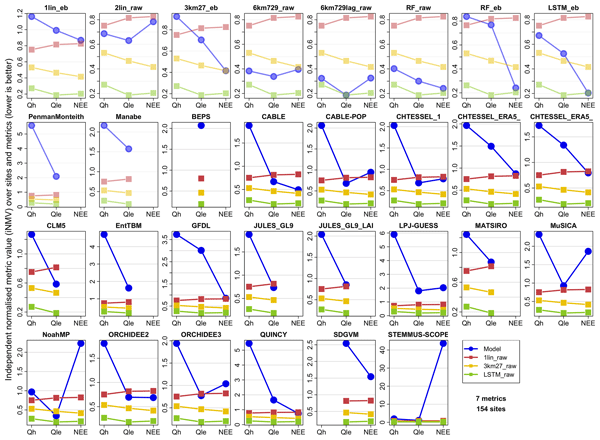
Gab Abramowitz, Anna Ukkola, Sanaa Hobeichi, Jon Cranko Page, Mathew Lipson, Martin G. De Kauwe, Samuel Green, Claire Brenner, Jonathan Frame, Grey Nearing, Martyn Clark, Martin Best, Peter Anthoni, Gabriele Arduini, Souhail Boussetta, Silvia Caldararu, Kyeungwoo Cho, Matthias Cuntz, David Fairbairn, Craig R. Ferguson, Hyungjun Kim, Yeonjoo Kim, Jürgen Knauer, David Lawrence, Xiangzhong Luo, Sergey Malyshev, Tomoko Nitta, Jerome Ogee, Keith Oleson, Catherine Ottlé, Phillipe Peylin, Patricia de Rosnay, Heather Rumbold, Bob Su, Nicolas Vuichard, Anthony P. Walker, Xiaoni Wang-Faivre, Yunfei Wang, and Yijian Zeng
Biogeosciences, 21, 5517–5538, https://doi.org/10.5194/bg-21-5517-2024, https://doi.org/10.5194/bg-21-5517-2024, 2024
Short summary
Short summary
This paper evaluates land models – computer-based models that simulate ecosystem dynamics; land carbon, water, and energy cycles; and the role of land in the climate system. It uses machine learning and AI approaches to show that, despite the complexity of land models, they do not perform nearly as well as they could given the amount of information they are provided with about the prediction problem.
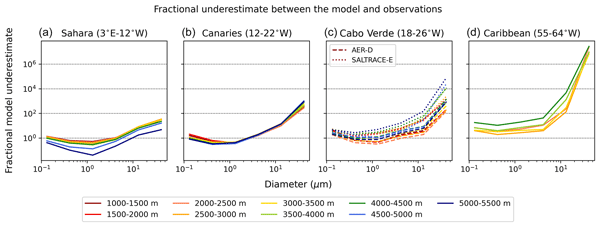
Natalie G. Ratcliffe, Claire L. Ryder, Nicolas Bellouin, Stephanie Woodward, Anthony Jones, Ben Johnson, Lisa-Maria Wieland, Maximilian Dollner, Josef Gasteiger, and Bernadett Weinzierl
Atmos. Chem. Phys., 24, 12161–12181, https://doi.org/10.5194/acp-24-12161-2024, https://doi.org/10.5194/acp-24-12161-2024, 2024
Short summary
Short summary
Large mineral dust particles are more abundant in the atmosphere than expected and have different impacts on the environment than small particles, which are better represented in climate models. We use aircraft measurements to assess a climate model representation of large-dust transport. We find that the model underestimates the amount of large dust at all stages of transport and that fast removal of the large particles increases this underestimation with distance from the Sahara.
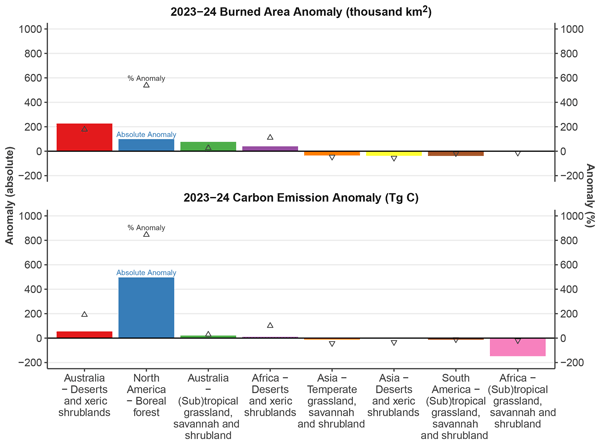
Matthew W. Jones, Douglas I. Kelley, Chantelle A. Burton, Francesca Di Giuseppe, Maria Lucia F. Barbosa, Esther Brambleby, Andrew J. Hartley, Anna Lombardi, Guilherme Mataveli, Joe R. McNorton, Fiona R. Spuler, Jakob B. Wessel, John T. Abatzoglou, Liana O. Anderson, Niels Andela, Sally Archibald, Dolors Armenteras, Eleanor Burke, Rachel Carmenta, Emilio Chuvieco, Hamish Clarke, Stefan H. Doerr, Paulo M. Fernandes, Louis Giglio, Douglas S. Hamilton, Stijn Hantson, Sarah Harris, Piyush Jain, Crystal A. Kolden, Tiina Kurvits, Seppe Lampe, Sarah Meier, Stacey New, Mark Parrington, Morgane M. G. Perron, Yuquan Qu, Natasha S. Ribeiro, Bambang H. Saharjo, Jesus San-Miguel-Ayanz, Jacquelyn K. Shuman, Veerachai Tanpipat, Guido R. van der Werf, Sander Veraverbeke, and Gavriil Xanthopoulos
Earth Syst. Sci. Data, 16, 3601–3685, https://doi.org/10.5194/essd-16-3601-2024, https://doi.org/10.5194/essd-16-3601-2024, 2024
Short summary
Short summary
This inaugural State of Wildfires report catalogues extreme fires of the 2023–2024 fire season. For key events, we analyse their predictability and drivers and attribute them to climate change and land use. We provide a seasonal outlook and decadal projections. Key anomalies occurred in Canada, Greece, and western Amazonia, with other high-impact events catalogued worldwide. Climate change significantly increased the likelihood of extreme fires, and mitigation is required to lessen future risk.
Alkiviadis Kalisoras, Aristeidis K. Georgoulias, Dimitris Akritidis, Robert J. Allen, Vaishali Naik, Chaincy Kuo, Sophie Szopa, Pierre Nabat, Dirk Olivié, Twan van Noije, Philippe Le Sager, David Neubauer, Naga Oshima, Jane Mulcahy, Larry W. Horowitz, and Prodromos Zanis
Atmos. Chem. Phys., 24, 7837–7872, https://doi.org/10.5194/acp-24-7837-2024, https://doi.org/10.5194/acp-24-7837-2024, 2024
Short summary
Short summary
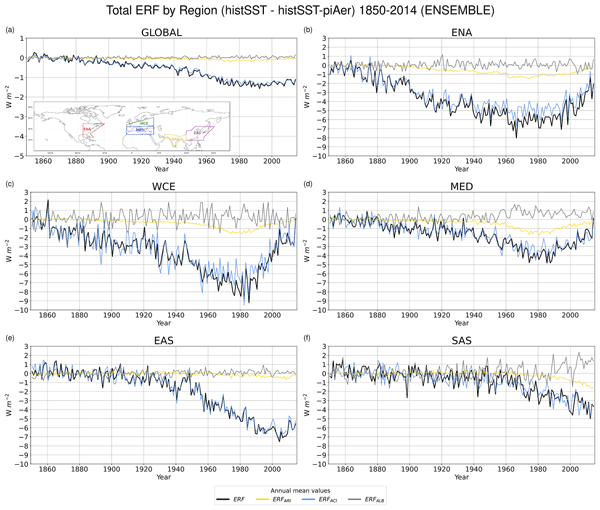
Effective radiative forcing (ERF) is a metric for estimating how human activities and natural agents change the energy flow into and out of the Earth’s climate system. We investigate the anthropogenic aerosol ERF, and we estimate the contribution of individual processes to the total ERF using simulations from Earth system models within the Coupled Model Intercomparison Project Phase 6 (CMIP6). Our findings highlight that aerosol–cloud interactions drive ERF variability during the last 150 years.
Sonya L. Fiddes, Marc D. Mallet, Alain Protat, Matthew T. Woodhouse, Simon P. Alexander, and Kalli Furtado
Geosci. Model Dev., 17, 2641–2662, https://doi.org/10.5194/gmd-17-2641-2024, https://doi.org/10.5194/gmd-17-2641-2024, 2024
Short summary
Short summary
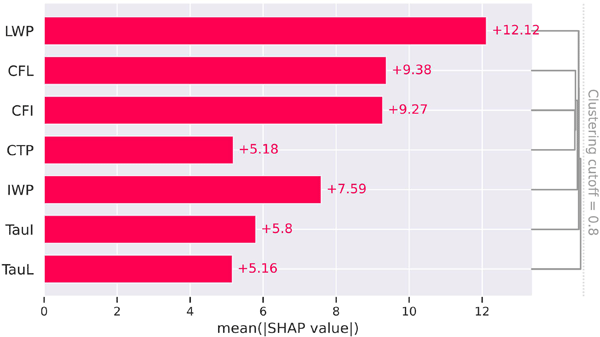
In this study we present an evaluation that considers complex, non-linear systems in a holistic manner. This study uses XGBoost, a machine learning algorithm, to predict the simulated Southern Ocean shortwave radiation bias in the ACCESS model using cloud property biases as predictors. We then used a novel feature importance analysis to quantify the role that each cloud bias plays in predicting the radiative bias, laying the foundation for advanced Earth system model evaluation and development.
Alban Philibert, Marie Lothon, Julien Amestoy, Pierre-Yves Meslin, Solène Derrien, Yannick Bezombes, Bernard Campistron, Fabienne Lohou, Antoine Vial, Guylaine Canut-Rocafort, Joachim Reuder, and Jennifer K. Brooke
Atmos. Meas. Tech., 17, 1679–1701, https://doi.org/10.5194/amt-17-1679-2024, https://doi.org/10.5194/amt-17-1679-2024, 2024
Short summary
Short summary
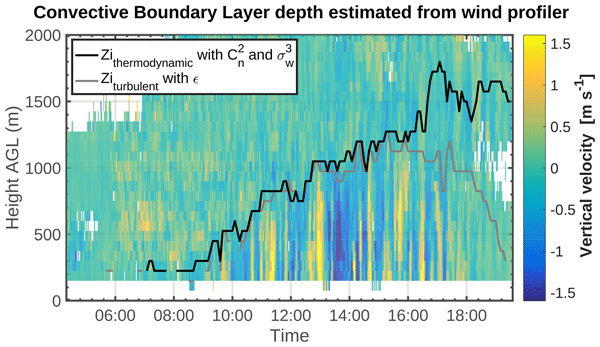
We present a new algorithm, CALOTRITON, for the retrieval of the convective boundary layer depth with ultra-high-frequency radar measurements. CALOTRITON is partly based on the principle that the top of the convective boundary layer is associated with an inversion and a decrease in turbulence. It is evaluated using ceilometer and radiosonde data. It is able to qualify the complexity of the vertical structure of the low troposphere and detect internal or residual layers.
Douglas McNeall, Eddy Robertson, and Andy Wiltshire
Geosci. Model Dev., 17, 1059–1089, https://doi.org/10.5194/gmd-17-1059-2024, https://doi.org/10.5194/gmd-17-1059-2024, 2024
Short summary
Short summary
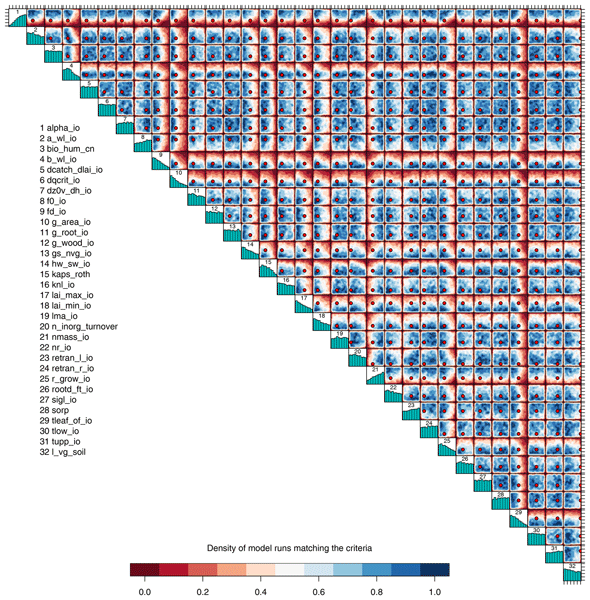
We can run simulations of the land surface and carbon cycle, using computer models to help us understand and predict climate change and its impacts. These simulations are not perfect reproductions of the real land surface, and that can make them less effective tools. We use new statistical and computational techniques to help us understand how different our models are from the real land surface, how to make them more realistic, and how well we can simulate past and future climate.
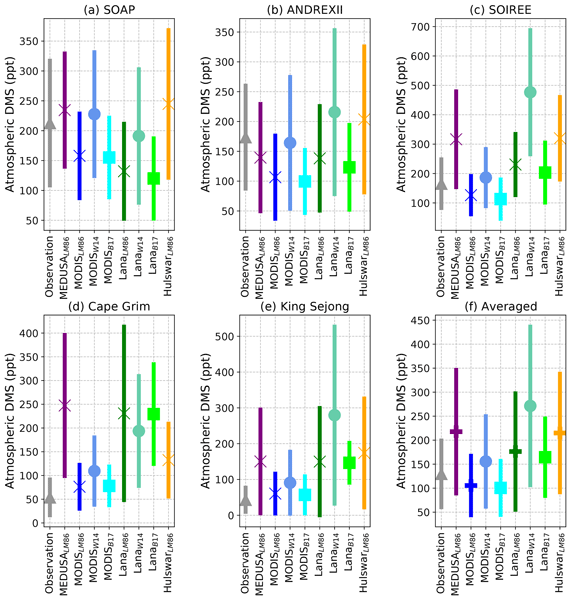
Yusuf A. Bhatti, Laura E. Revell, Alex J. Schuddeboom, Adrian J. McDonald, Alex T. Archibald, Jonny Williams, Abhijith U. Venugopal, Catherine Hardacre, and Erik Behrens
Atmos. Chem. Phys., 23, 15181–15196, https://doi.org/10.5194/acp-23-15181-2023, https://doi.org/10.5194/acp-23-15181-2023, 2023
Short summary
Short summary
Aerosols are a large source of uncertainty over the Southern Ocean. A dominant source of sulfate aerosol in this region is dimethyl sulfide (DMS), which is poorly simulated by climate models. We show the sensitivity of simulated atmospheric DMS to the choice of oceanic DMS data set and emission scheme. We show that oceanic DMS has twice the influence on atmospheric DMS than the emission scheme. Simulating DMS more accurately in climate models will help to constrain aerosol uncertainty.
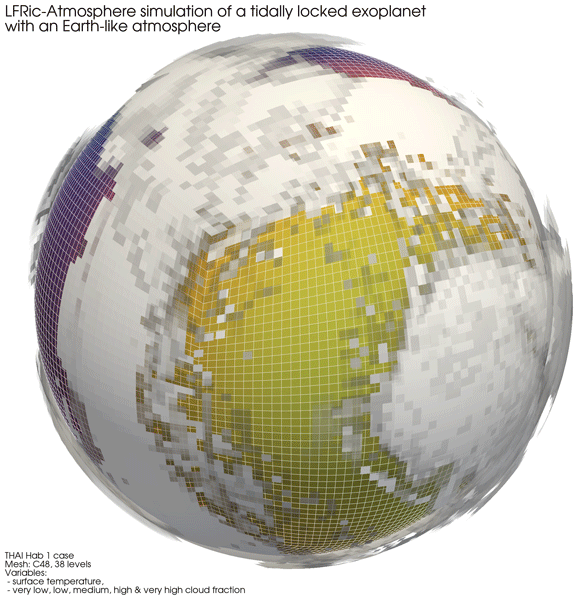
Denis E. Sergeev, Nathan J. Mayne, Thomas Bendall, Ian A. Boutle, Alex Brown, Iva Kavčič, James Kent, Krisztian Kohary, James Manners, Thomas Melvin, Enrico Olivier, Lokesh K. Ragta, Ben Shipway, Jon Wakelin, Nigel Wood, and Mohamed Zerroukat
Geosci. Model Dev., 16, 5601–5626, https://doi.org/10.5194/gmd-16-5601-2023, https://doi.org/10.5194/gmd-16-5601-2023, 2023
Short summary
Short summary
Three-dimensional climate models are one of the best tools we have to study planetary atmospheres. Here, we apply LFRic-Atmosphere, a new model developed by the Met Office, to seven different scenarios for terrestrial planetary climates, including four for the exoplanet TRAPPIST-1e, a primary target for future observations. LFRic-Atmosphere reproduces these scenarios within the spread of the existing models across a range of key climatic variables, justifying its use in future exoplanet studies.
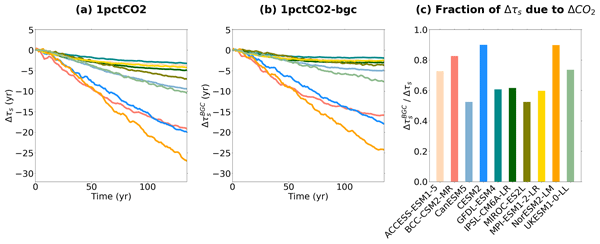
Rebecca M. Varney, Sarah E. Chadburn, Eleanor J. Burke, Simon Jones, Andy J. Wiltshire, and Peter M. Cox
Biogeosciences, 20, 3767–3790, https://doi.org/10.5194/bg-20-3767-2023, https://doi.org/10.5194/bg-20-3767-2023, 2023
Short summary
Short summary
This study evaluates soil carbon projections during the 21st century in CMIP6 Earth system models. In general, we find a reduced spread of changes in global soil carbon in CMIP6 compared to the previous CMIP5 generation. The reduced CMIP6 spread arises from an emergent relationship between soil carbon changes due to change in plant productivity and soil carbon changes due to changes in turnover time. We show that this relationship is consistent with false priming under transient climate change.
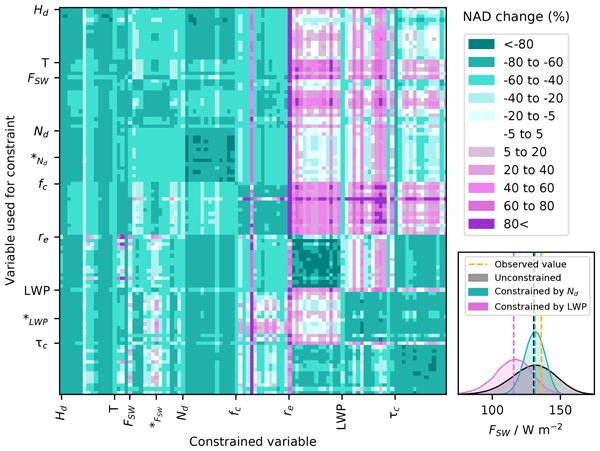
Leighton A. Regayre, Lucia Deaconu, Daniel P. Grosvenor, David M. H. Sexton, Christopher Symonds, Tom Langton, Duncan Watson-Paris, Jane P. Mulcahy, Kirsty J. Pringle, Mark Richardson, Jill S. Johnson, John W. Rostron, Hamish Gordon, Grenville Lister, Philip Stier, and Ken S. Carslaw
Atmos. Chem. Phys., 23, 8749–8768, https://doi.org/10.5194/acp-23-8749-2023, https://doi.org/10.5194/acp-23-8749-2023, 2023
Short summary
Short summary
Aerosol forcing of Earth’s energy balance has persisted as a major cause of uncertainty in climate simulations over generations of climate model development. We show that structural deficiencies in a climate model are exposed by comprehensively exploring parametric uncertainty and that these deficiencies limit how much the model uncertainty can be reduced through observational constraint. This provides a future pathway towards building models with greater physical realism and lower uncertainty.
Camilla Mathison, Eleanor Burke, Andrew J. Hartley, Douglas I. Kelley, Chantelle Burton, Eddy Robertson, Nicola Gedney, Karina Williams, Andy Wiltshire, Richard J. Ellis, Alistair A. Sellar, and Chris D. Jones
Geosci. Model Dev., 16, 4249–4264, https://doi.org/10.5194/gmd-16-4249-2023, https://doi.org/10.5194/gmd-16-4249-2023, 2023
Short summary
Short summary
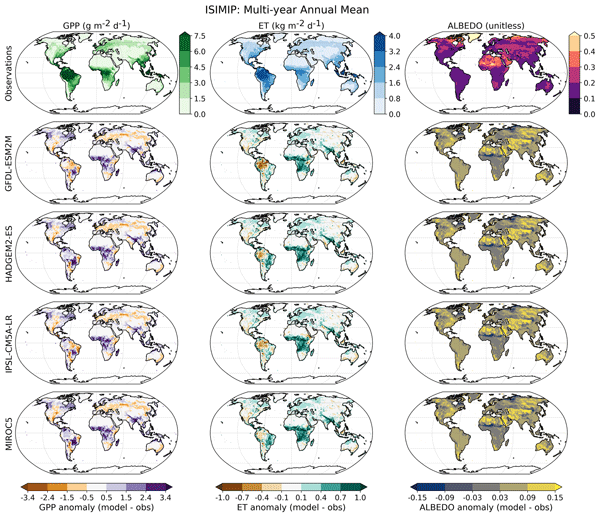
This paper describes and evaluates a new modelling methodology to quantify the impacts of climate change on water, biomes and the carbon cycle. We have created a new configuration and set-up for the JULES-ES land surface model, driven by bias-corrected historical and future climate model output provided by the Inter-Sectoral Impacts Model Intercomparison Project (ISIMIP). This allows us to compare projections of the impacts of climate change across multiple impact models and multiple sectors.
Chenwei Fang, Jim M. Haywood, Ju Liang, Ben T. Johnson, Ying Chen, and Bin Zhu
Atmos. Chem. Phys., 23, 8341–8368, https://doi.org/10.5194/acp-23-8341-2023, https://doi.org/10.5194/acp-23-8341-2023, 2023
Short summary
Short summary
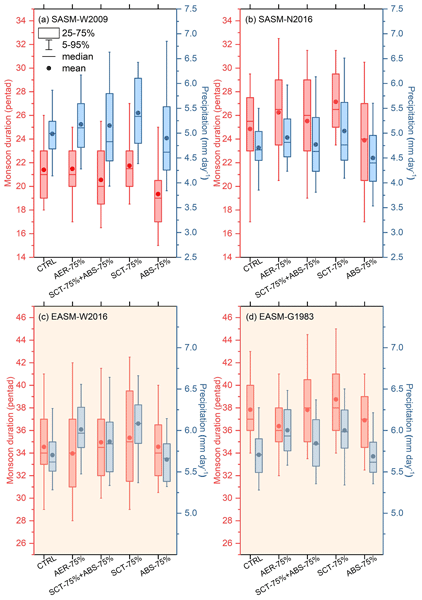
The responses of Asian summer monsoon duration and intensity to air pollution mitigation are identified given the net-zero future. We show that reducing scattering aerosols makes the rainy season longer and stronger across South Asia and East Asia but that absorbing aerosol reduction has the opposite effect. Our results hint at distinct monsoon responses to emission controls that target different aerosols.
George Manville, Thomas G. Bell, Jane P. Mulcahy, Rafel Simó, Martí Galí, Anoop S. Mahajan, Shrivardhan Hulswar, and Paul R. Halloran
Biogeosciences, 20, 1813–1828, https://doi.org/10.5194/bg-20-1813-2023, https://doi.org/10.5194/bg-20-1813-2023, 2023
Short summary
Short summary
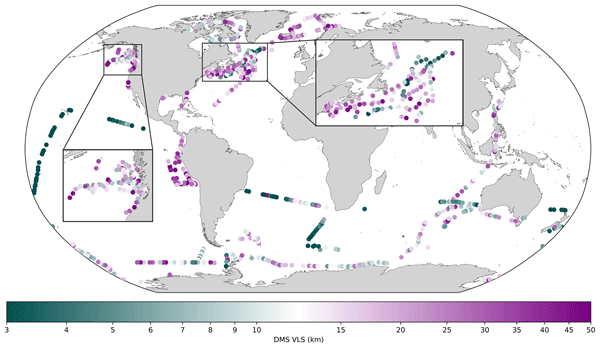
We present the first global investigation of controls on seawater dimethylsulfide (DMS) spatial variability over scales of up to 100 km. Sea surface height anomalies, density, and chlorophyll a help explain almost 80 % of DMS variability. The results suggest that physical and biogeochemical processes play an equally important role in controlling DMS variability. These data provide independent confirmation that existing parameterisations of seawater DMS concentration use appropriate variables.
Edward Gryspeerdt, Adam C. Povey, Roy G. Grainger, Otto Hasekamp, N. Christina Hsu, Jane P. Mulcahy, Andrew M. Sayer, and Armin Sorooshian
Atmos. Chem. Phys., 23, 4115–4122, https://doi.org/10.5194/acp-23-4115-2023, https://doi.org/10.5194/acp-23-4115-2023, 2023
Short summary
Short summary
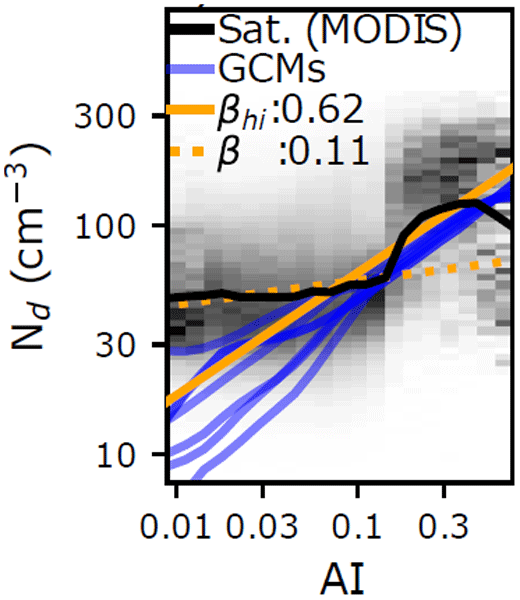
The impact of aerosols on clouds is one of the largest uncertainties in the human forcing of the climate. Aerosol can increase the concentrations of droplets in clouds, but observational and model studies produce widely varying estimates of this effect. We show that these estimates can be reconciled if only polluted clouds are studied, but this is insufficient to constrain the climate impact of aerosol. The uncertainty in aerosol impact on clouds is currently driven by cases with little aerosol.

Heather S. Rumbold, Richard J. J. Gilham, and Martin J. Best
Geosci. Model Dev., 16, 1875–1886, https://doi.org/10.5194/gmd-16-1875-2023, https://doi.org/10.5194/gmd-16-1875-2023, 2023
Short summary
Short summary
The Joint UK Land Environment Simulator (JULES) uses a tiled representation of land cover but can only model a single dominant soil type within a grid box; hence there is no representation of sub-grid soil heterogeneity. This paper evaluates a new surface–soil tiling scheme in JULES and demonstrates the impacts of the scheme using several soil tiling approaches. Results show that soil tiling has an impact on the water and energy exchanges due to the way vegetation accesses the soil moisture.
Kandice L. Harper, Céline Lamarche, Andrew Hartley, Philippe Peylin, Catherine Ottlé, Vladislav Bastrikov, Rodrigo San Martín, Sylvia I. Bohnenstengel, Grit Kirches, Martin Boettcher, Roman Shevchuk, Carsten Brockmann, and Pierre Defourny
Earth Syst. Sci. Data, 15, 1465–1499, https://doi.org/10.5194/essd-15-1465-2023, https://doi.org/10.5194/essd-15-1465-2023, 2023
Short summary
Short summary
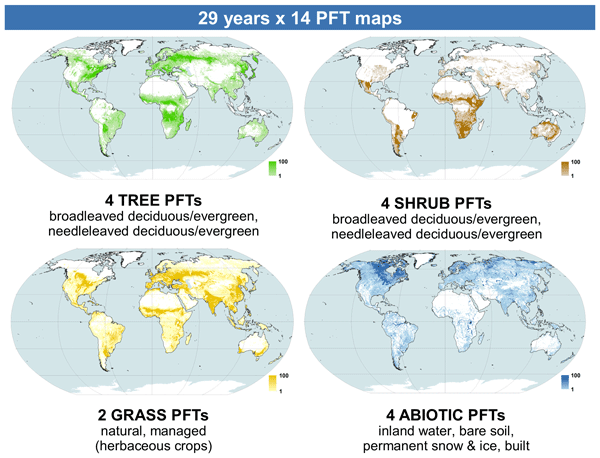
We built a spatially explicit annual plant-functional-type (PFT) dataset for 1992–2020 exhibiting intra-class spatial variability in PFT fractional cover at 300 m. For each year, 14 maps of percentage cover are produced: bare soil, water, permanent snow/ice, built, managed grasses, natural grasses, and trees and shrubs, each split into leaf type and seasonality. Model simulations indicate significant differences in simulated carbon, water, and energy fluxes in some regions using this new set.
Mike Bush, Ian Boutle, John Edwards, Anke Finnenkoetter, Charmaine Franklin, Kirsty Hanley, Aravindakshan Jayakumar, Huw Lewis, Adrian Lock, Marion Mittermaier, Saji Mohandas, Rachel North, Aurore Porson, Belinda Roux, Stuart Webster, and Mark Weeks
Geosci. Model Dev., 16, 1713–1734, https://doi.org/10.5194/gmd-16-1713-2023, https://doi.org/10.5194/gmd-16-1713-2023, 2023
Short summary
Short summary
Building on the baseline of RAL1, the RAL2 science configuration is used for regional modelling around the UM partnership and in operations at the Met Office. RAL2 has been tested in different parts of the world including Australia, India and the UK. RAL2 increases medium and low cloud amounts in the mid-latitudes compared to RAL1, leading to improved cloud forecasts and a reduced diurnal cycle of screen temperature. There is also a reduction in the frequency of heavier precipitation rates.
Jane P. Mulcahy, Colin G. Jones, Steven T. Rumbold, Till Kuhlbrodt, Andrea J. Dittus, Edward W. Blockley, Andrew Yool, Jeremy Walton, Catherine Hardacre, Timothy Andrews, Alejandro Bodas-Salcedo, Marc Stringer, Lee de Mora, Phil Harris, Richard Hill, Doug Kelley, Eddy Robertson, and Yongming Tang
Geosci. Model Dev., 16, 1569–1600, https://doi.org/10.5194/gmd-16-1569-2023, https://doi.org/10.5194/gmd-16-1569-2023, 2023
Short summary
Short summary
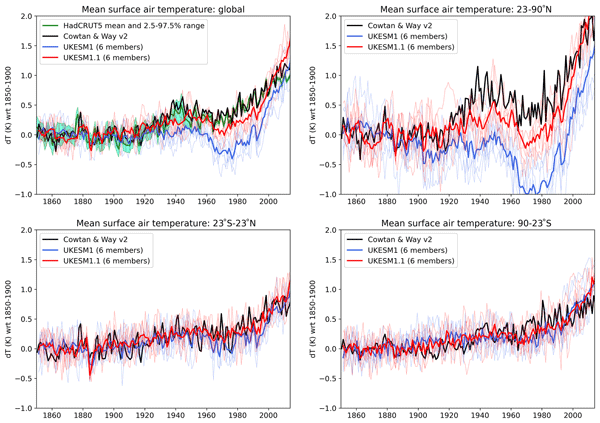
Recent global climate models simulate historical global mean surface temperatures which are too cold, possibly to due to excessive aerosol cooling. This raises questions about the models' ability to simulate important climate processes and reduces confidence in future climate predictions. We present a new version of the UK Earth System Model, which has an improved aerosols simulation and a historical temperature record. Interestingly, the long-term response to CO2 remains largely unchanged.
Danny McCulloch, Denis E. Sergeev, Nathan Mayne, Matthew Bate, James Manners, Ian Boutle, Benjamin Drummond, and Kristzian Kohary
Geosci. Model Dev., 16, 621–657, https://doi.org/10.5194/gmd-16-621-2023, https://doi.org/10.5194/gmd-16-621-2023, 2023
Short summary
Short summary
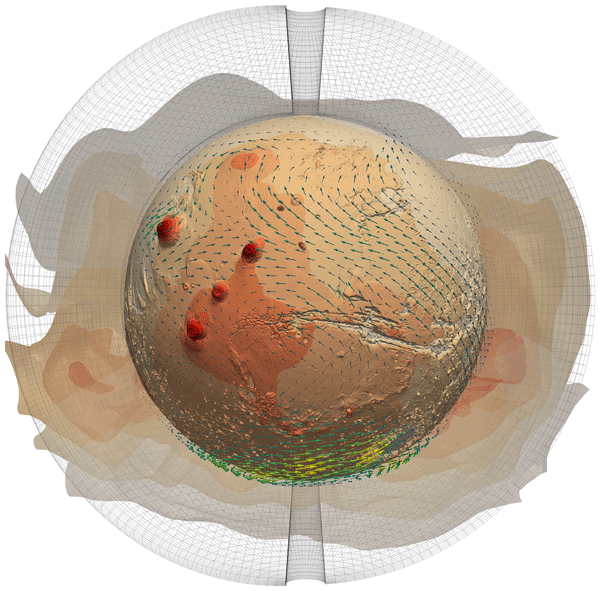
We present results from the Met Office Unified Model (UM) to study the dry Martian climate. We describe our model set-up conditions and run two scenarios, with radiatively active/inactive dust. We compare both scenarios to results from an existing Mars climate model, the planetary climate model. We find good agreement in winds and air temperatures, but dust amounts differ between models. This study highlights the importance of using the UM for future Mars research.
Leighton A. Regayre, Lucia Deaconu, Daniel P. Grosvenor, David Sexton, Christopher C. Symonds, Tom Langton, Duncan Watson-Paris, Jane P. Mulcahy, Kirsty J. Pringle, Mark Richardson, Jill S. Johnson, John Rostron, Hamish Gordon, Grenville Lister, Philip Stier, and Ken S. Carslaw
EGUsphere, https://doi.org/10.5194/egusphere-2022-1330, https://doi.org/10.5194/egusphere-2022-1330, 2022
Preprint archived
Short summary
Short summary
We show that potential structural deficiencies in a climate model can be exposed by comprehensively exploring its parametric uncertainty, and that these deficiencies limit how much the model uncertainty can be reduced through observational constraint. Combined consideration of parametric and structural uncertainties provides a future pathway towards building models that have greater physical realism and lower uncertainty.
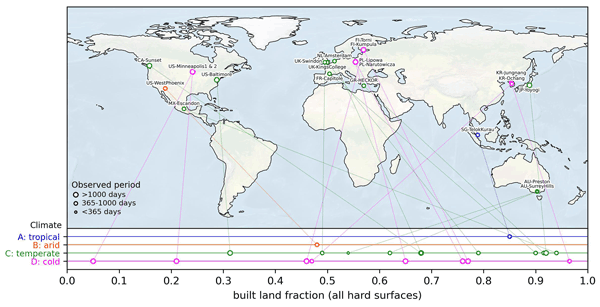
Mathew Lipson, Sue Grimmond, Martin Best, Winston T. L. Chow, Andreas Christen, Nektarios Chrysoulakis, Andrew Coutts, Ben Crawford, Stevan Earl, Jonathan Evans, Krzysztof Fortuniak, Bert G. Heusinkveld, Je-Woo Hong, Jinkyu Hong, Leena Järvi, Sungsoo Jo, Yeon-Hee Kim, Simone Kotthaus, Keunmin Lee, Valéry Masson, Joseph P. McFadden, Oliver Michels, Wlodzimierz Pawlak, Matthias Roth, Hirofumi Sugawara, Nigel Tapper, Erik Velasco, and Helen Claire Ward
Earth Syst. Sci. Data, 14, 5157–5178, https://doi.org/10.5194/essd-14-5157-2022, https://doi.org/10.5194/essd-14-5157-2022, 2022
Short summary
Short summary
We describe a new openly accessible collection of atmospheric observations from 20 cities around the world, capturing 50 site years. The observations capture local meteorology (temperature, humidity, wind, etc.) and the energy fluxes between the land and atmosphere (e.g. radiation and sensible and latent heat fluxes). These observations can be used to improve our understanding of urban climate processes and to test the accuracy of urban climate models.

Stephanie Woodward, Alistair A. Sellar, Yongming Tang, Marc Stringer, Andrew Yool, Eddy Robertson, and Andy Wiltshire
Atmos. Chem. Phys., 22, 14503–14528, https://doi.org/10.5194/acp-22-14503-2022, https://doi.org/10.5194/acp-22-14503-2022, 2022
Short summary
Short summary
We describe the dust scheme in the UKESM1 Earth system model and show generally good agreement with observations. Comparing with the closely related HadGEM3-GC3.1 model, we show that dust differences are not only due to inter-model differences but also to the dust size distribution. Under climate change, HadGEM3-GC3.1 dust hardly changes, but UKESM1 dust decreases because that model includes the vegetation response which, in our models, has a bigger impact on dust than climate change itself.
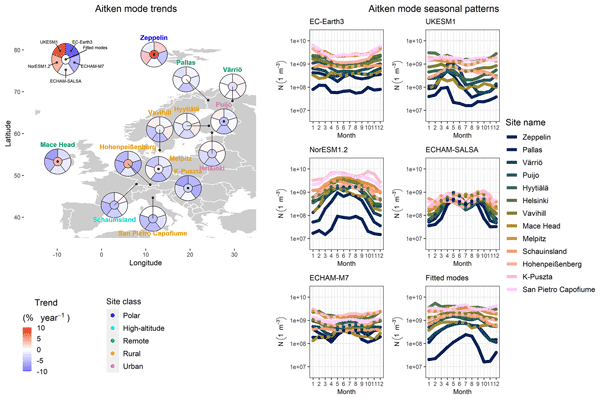
Ville Leinonen, Harri Kokkola, Taina Yli-Juuti, Tero Mielonen, Thomas Kühn, Tuomo Nieminen, Simo Heikkinen, Tuuli Miinalainen, Tommi Bergman, Ken Carslaw, Stefano Decesari, Markus Fiebig, Tareq Hussein, Niku Kivekäs, Radovan Krejci, Markku Kulmala, Ari Leskinen, Andreas Massling, Nikos Mihalopoulos, Jane P. Mulcahy, Steffen M. Noe, Twan van Noije, Fiona M. O'Connor, Colin O'Dowd, Dirk Olivie, Jakob B. Pernov, Tuukka Petäjä, Øyvind Seland, Michael Schulz, Catherine E. Scott, Henrik Skov, Erik Swietlicki, Thomas Tuch, Alfred Wiedensohler, Annele Virtanen, and Santtu Mikkonen
Atmos. Chem. Phys., 22, 12873–12905, https://doi.org/10.5194/acp-22-12873-2022, https://doi.org/10.5194/acp-22-12873-2022, 2022
Short summary
Short summary
We provide the first extensive comparison of detailed aerosol size distribution trends between in situ observations from Europe and five different earth system models. We investigated aerosol modes (nucleation, Aitken, and accumulation) separately and were able to show the differences between measured and modeled trends and especially their seasonal patterns. The differences in model results are likely due to complex effects of several processes instead of certain specific model features.
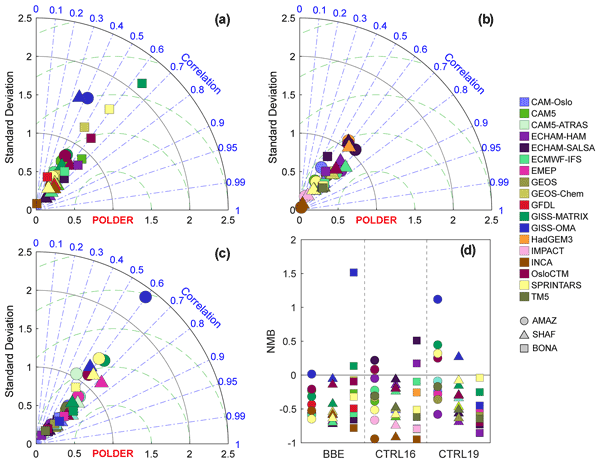
Qirui Zhong, Nick Schutgens, Guido van der Werf, Twan van Noije, Kostas Tsigaridis, Susanne E. Bauer, Tero Mielonen, Alf Kirkevåg, Øyvind Seland, Harri Kokkola, Ramiro Checa-Garcia, David Neubauer, Zak Kipling, Hitoshi Matsui, Paul Ginoux, Toshihiko Takemura, Philippe Le Sager, Samuel Rémy, Huisheng Bian, Mian Chin, Kai Zhang, Jialei Zhu, Svetlana G. Tsyro, Gabriele Curci, Anna Protonotariou, Ben Johnson, Joyce E. Penner, Nicolas Bellouin, Ragnhild B. Skeie, and Gunnar Myhre
Atmos. Chem. Phys., 22, 11009–11032, https://doi.org/10.5194/acp-22-11009-2022, https://doi.org/10.5194/acp-22-11009-2022, 2022
Short summary
Short summary
Aerosol optical depth (AOD) errors for biomass burning aerosol (BBA) are evaluated in 18 global models against satellite datasets. Notwithstanding biases in satellite products, they allow model evaluations. We observe large and diverse model biases due to errors in BBA. Further interpretations of AOD diversities suggest large biases exist in key processes for BBA which require better constraining. These results can contribute to further model improvement and development.
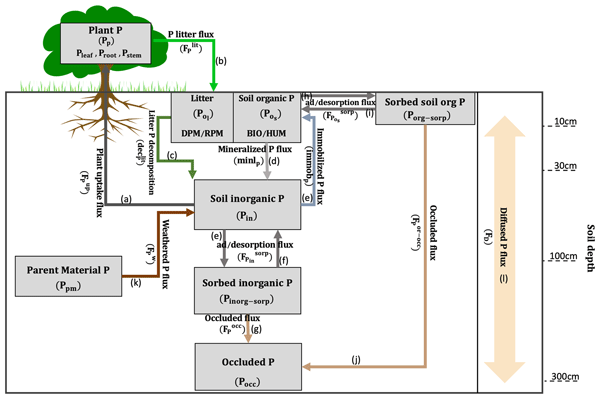
Mahdi André Nakhavali, Lina M. Mercado, Iain P. Hartley, Stephen Sitch, Fernanda V. Cunha, Raffaello di Ponzio, Laynara F. Lugli, Carlos A. Quesada, Kelly M. Andersen, Sarah E. Chadburn, Andy J. Wiltshire, Douglas B. Clark, Gyovanni Ribeiro, Lara Siebert, Anna C. M. Moraes, Jéssica Schmeisk Rosa, Rafael Assis, and José L. Camargo
Geosci. Model Dev., 15, 5241–5269, https://doi.org/10.5194/gmd-15-5241-2022, https://doi.org/10.5194/gmd-15-5241-2022, 2022
Short summary
Short summary
In tropical ecosystems, the availability of rock-derived elements such as P can be very low. Thus, without a representation of P cycling, tropical forest responses to rising atmospheric CO2 conditions in areas such as Amazonia remain highly uncertain. We introduced P dynamics and its interactions with the N and P cycles into the JULES model. Our results highlight the potential for high P limitation and therefore lower CO2 fertilization capacity in the Amazon forest with low-fertility soils.
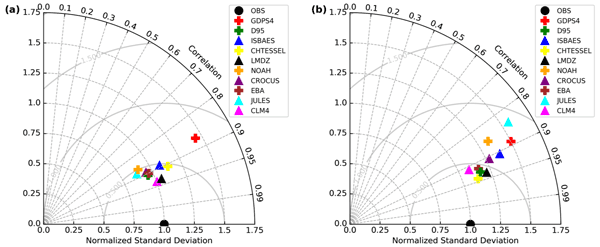
Patrick Le Moigne, Eric Bazile, Anning Cheng, Emanuel Dutra, John M. Edwards, William Maurel, Irina Sandu, Olivier Traullé, Etienne Vignon, Ayrton Zadra, and Weizhong Zheng
The Cryosphere, 16, 2183–2202, https://doi.org/10.5194/tc-16-2183-2022, https://doi.org/10.5194/tc-16-2183-2022, 2022
Short summary
Short summary
This paper describes an intercomparison of snow models, of varying complexity, used for numerical weather prediction or academic research. The results show that the simplest models are, under certain conditions, able to reproduce the surface temperature just as well as the most complex models. Moreover, the diversity of surface parameters of the models has a strong impact on the temporal variability of the components of the simulated surface energy balance.
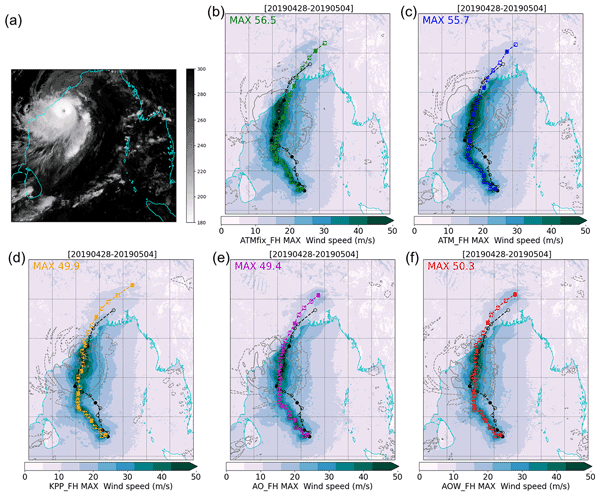
Juan Manuel Castillo, Huw W. Lewis, Akhilesh Mishra, Ashis Mitra, Jeff Polton, Ashley Brereton, Andrew Saulter, Alex Arnold, Segolene Berthou, Douglas Clark, Julia Crook, Ananda Das, John Edwards, Xiangbo Feng, Ankur Gupta, Sudheer Joseph, Nicholas Klingaman, Imranali Momin, Christine Pequignet, Claudio Sanchez, Jennifer Saxby, and Maria Valdivieso da Costa
Geosci. Model Dev., 15, 4193–4223, https://doi.org/10.5194/gmd-15-4193-2022, https://doi.org/10.5194/gmd-15-4193-2022, 2022
Short summary
Short summary
A new environmental modelling system has been developed to represent the effect of feedbacks between atmosphere, land, and ocean in the Indian region. Different approaches to simulating tropical cyclones Titli and Fani are demonstrated. It is shown that results are sensitive to the way in which the ocean response to cyclone evolution is captured in the system. Notably, we show how a more rigorous formulation for the near-surface energy budget can be included when air–sea coupling is included.
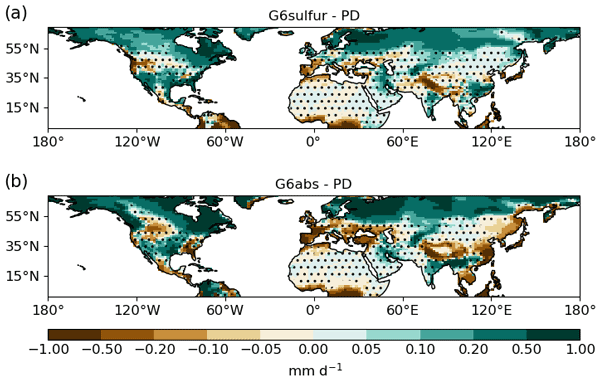
Jim M. Haywood, Andy Jones, Ben T. Johnson, and William McFarlane Smith
Atmos. Chem. Phys., 22, 6135–6150, https://doi.org/10.5194/acp-22-6135-2022, https://doi.org/10.5194/acp-22-6135-2022, 2022
Short summary
Short summary
Simulations are presented investigating the influence of moderately absorbing aerosol in the stratosphere to combat the impacts of climate change. A number of detrimental impacts are noted compared to sulfate aerosol, including (i) reduced cooling efficiency, (ii) increased deficits in global precipitation, (iii) delays in the recovery of the stratospheric ozone hole, and (iv) disruption of the stratospheric circulation and the wintertime storm tracks that impact European precipitation.
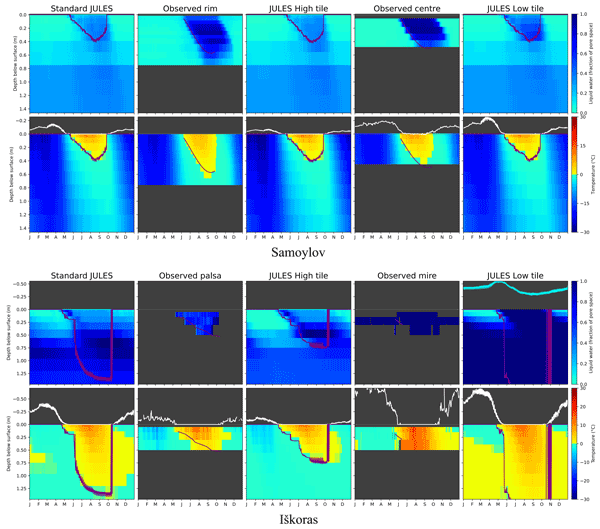
Noah D. Smith, Eleanor J. Burke, Kjetil Schanke Aas, Inge H. J. Althuizen, Julia Boike, Casper Tai Christiansen, Bernd Etzelmüller, Thomas Friborg, Hanna Lee, Heather Rumbold, Rachael H. Turton, Sebastian Westermann, and Sarah E. Chadburn
Geosci. Model Dev., 15, 3603–3639, https://doi.org/10.5194/gmd-15-3603-2022, https://doi.org/10.5194/gmd-15-3603-2022, 2022
Short summary
Short summary
The Arctic has large areas of small mounds that are caused by ice lifting up the soil. Snow blown by wind gathers in hollows next to these mounds, insulating them in winter. The hollows tend to be wetter, and thus the soil absorbs more heat in summer. The warm wet soil in the hollows decomposes, releasing methane. We have made a model of this, and we have tested how it behaves and whether it looks like sites in Scandinavia and Siberia. Sometimes we get more methane than a model without mounds.
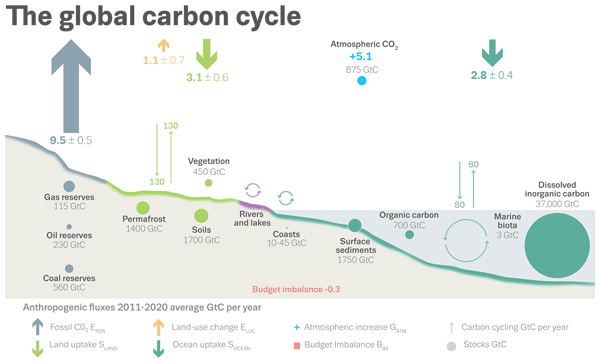
Pierre Friedlingstein, Matthew W. Jones, Michael O'Sullivan, Robbie M. Andrew, Dorothee C. E. Bakker, Judith Hauck, Corinne Le Quéré, Glen P. Peters, Wouter Peters, Julia Pongratz, Stephen Sitch, Josep G. Canadell, Philippe Ciais, Rob B. Jackson, Simone R. Alin, Peter Anthoni, Nicholas R. Bates, Meike Becker, Nicolas Bellouin, Laurent Bopp, Thi Tuyet Trang Chau, Frédéric Chevallier, Louise P. Chini, Margot Cronin, Kim I. Currie, Bertrand Decharme, Laique M. Djeutchouang, Xinyu Dou, Wiley Evans, Richard A. Feely, Liang Feng, Thomas Gasser, Dennis Gilfillan, Thanos Gkritzalis, Giacomo Grassi, Luke Gregor, Nicolas Gruber, Özgür Gürses, Ian Harris, Richard A. Houghton, George C. Hurtt, Yosuke Iida, Tatiana Ilyina, Ingrid T. Luijkx, Atul Jain, Steve D. Jones, Etsushi Kato, Daniel Kennedy, Kees Klein Goldewijk, Jürgen Knauer, Jan Ivar Korsbakken, Arne Körtzinger, Peter Landschützer, Siv K. Lauvset, Nathalie Lefèvre, Sebastian Lienert, Junjie Liu, Gregg Marland, Patrick C. McGuire, Joe R. Melton, David R. Munro, Julia E. M. S. Nabel, Shin-Ichiro Nakaoka, Yosuke Niwa, Tsuneo Ono, Denis Pierrot, Benjamin Poulter, Gregor Rehder, Laure Resplandy, Eddy Robertson, Christian Rödenbeck, Thais M. Rosan, Jörg Schwinger, Clemens Schwingshackl, Roland Séférian, Adrienne J. Sutton, Colm Sweeney, Toste Tanhua, Pieter P. Tans, Hanqin Tian, Bronte Tilbrook, Francesco Tubiello, Guido R. van der Werf, Nicolas Vuichard, Chisato Wada, Rik Wanninkhof, Andrew J. Watson, David Willis, Andrew J. Wiltshire, Wenping Yuan, Chao Yue, Xu Yue, Sönke Zaehle, and Jiye Zeng
Earth Syst. Sci. Data, 14, 1917–2005, https://doi.org/10.5194/essd-14-1917-2022, https://doi.org/10.5194/essd-14-1917-2022, 2022
Short summary
Short summary
The Global Carbon Budget 2021 describes the data sets and methodology used to quantify the emissions of carbon dioxide and their partitioning among the atmosphere, land, and ocean. These living data are updated every year to provide the highest transparency and traceability in the reporting of CO2, the key driver of climate change.
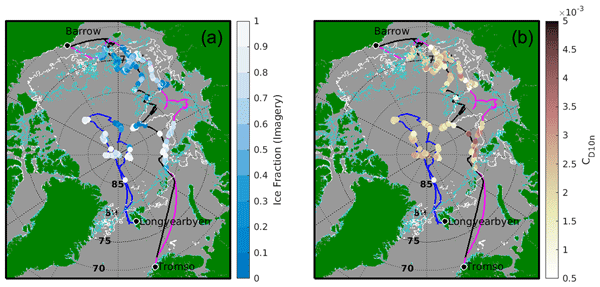
Piyush Srivastava, Ian M. Brooks, John Prytherch, Dominic J. Salisbury, Andrew D. Elvidge, Ian A. Renfrew, and Margaret J. Yelland
Atmos. Chem. Phys., 22, 4763–4778, https://doi.org/10.5194/acp-22-4763-2022, https://doi.org/10.5194/acp-22-4763-2022, 2022
Short summary
Short summary
The parameterization of surface turbulent fluxes over sea ice remains a weak point in weather forecast and climate models. Recent theoretical developments have introduced more extensive physics but these descriptions are poorly constrained due to a lack of observation data. Here we utilize a large dataset of measurements of turbulent fluxes over sea ice to tune the state-of-the-art parameterization of wind stress, and compare it with a previous scheme.
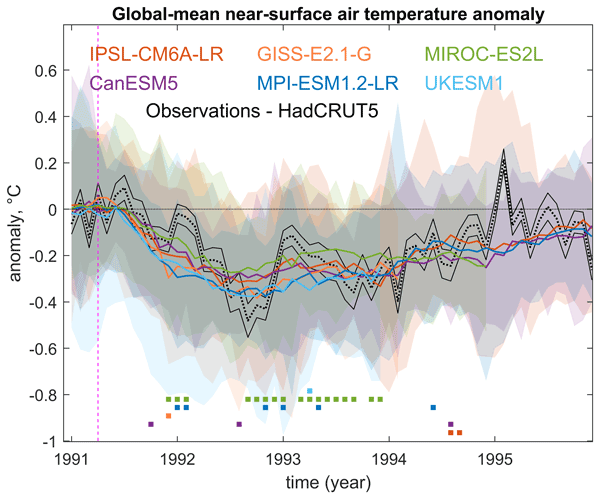
Davide Zanchettin, Claudia Timmreck, Myriam Khodri, Anja Schmidt, Matthew Toohey, Manabu Abe, Slimane Bekki, Jason Cole, Shih-Wei Fang, Wuhu Feng, Gabriele Hegerl, Ben Johnson, Nicolas Lebas, Allegra N. LeGrande, Graham W. Mann, Lauren Marshall, Landon Rieger, Alan Robock, Sara Rubinetti, Kostas Tsigaridis, and Helen Weierbach
Geosci. Model Dev., 15, 2265–2292, https://doi.org/10.5194/gmd-15-2265-2022, https://doi.org/10.5194/gmd-15-2265-2022, 2022
Short summary
Short summary
This paper provides metadata and first analyses of the volc-pinatubo-full experiment of CMIP6-VolMIP. Results from six Earth system models reveal significant differences in radiative flux anomalies that trace back to different implementations of volcanic forcing. Surface responses are in contrast overall consistent across models, reflecting the large spread due to internal variability. A second phase of VolMIP shall consider both aspects toward improved protocol for volc-pinatubo-full.
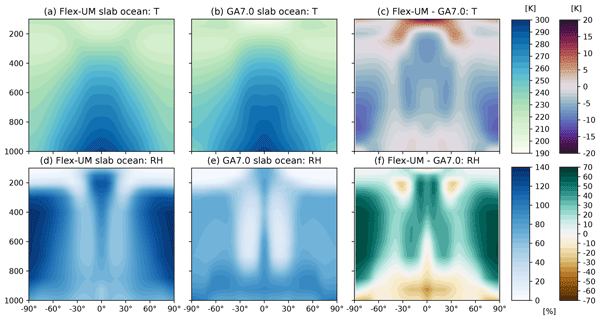
Penelope Maher and Paul Earnshaw
Geosci. Model Dev., 15, 1177–1194, https://doi.org/10.5194/gmd-15-1177-2022, https://doi.org/10.5194/gmd-15-1177-2022, 2022
Short summary
Short summary
Climate models do a pretty good job. But they are far from perfect. Fixing these imperfections is really hard because the models are complicated. One way to make progress is to create simpler models: think impressionism rather than realism in the art world. We changed the Met Office model to be intentionally simple and it still does a pretty good job. This will help to identify sources of model imperfections, develop new methods and improve our understanding of how the climate works.
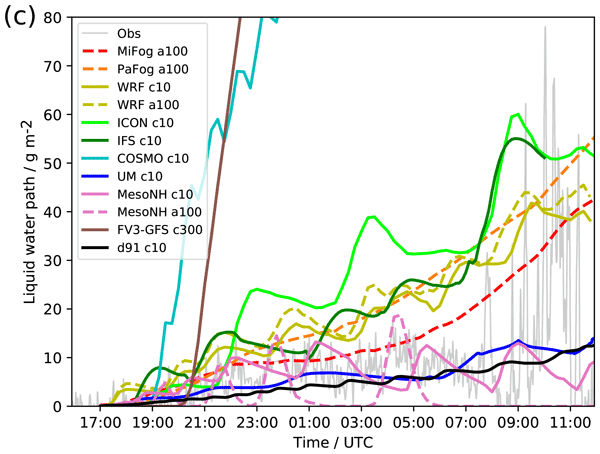
Ian Boutle, Wayne Angevine, Jian-Wen Bao, Thierry Bergot, Ritthik Bhattacharya, Andreas Bott, Leo Ducongé, Richard Forbes, Tobias Goecke, Evelyn Grell, Adrian Hill, Adele L. Igel, Innocent Kudzotsa, Christine Lac, Bjorn Maronga, Sami Romakkaniemi, Juerg Schmidli, Johannes Schwenkel, Gert-Jan Steeneveld, and Benoît Vié
Atmos. Chem. Phys., 22, 319–333, https://doi.org/10.5194/acp-22-319-2022, https://doi.org/10.5194/acp-22-319-2022, 2022
Short summary
Short summary
Fog forecasting is one of the biggest problems for numerical weather prediction. By comparing many models used for fog forecasting with others used for fog research, we hoped to help guide forecast improvements. We show some key processes that, if improved, will help improve fog forecasting, such as how water is deposited on the ground. We also showed that research models were not themselves a suitable baseline for comparison, and we discuss what future observations are required to improve them.
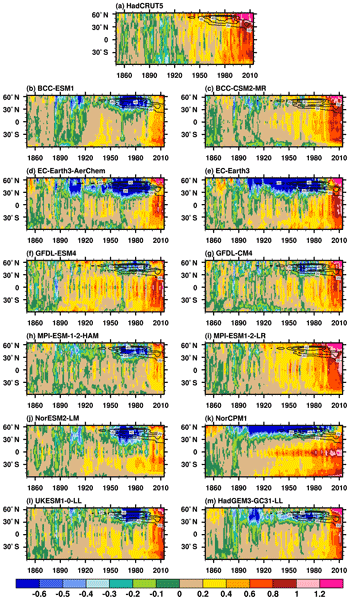
Jie Zhang, Kalli Furtado, Steven T. Turnock, Jane P. Mulcahy, Laura J. Wilcox, Ben B. Booth, David Sexton, Tongwen Wu, Fang Zhang, and Qianxia Liu
Atmos. Chem. Phys., 21, 18609–18627, https://doi.org/10.5194/acp-21-18609-2021, https://doi.org/10.5194/acp-21-18609-2021, 2021
Short summary
Short summary
The CMIP6 ESMs systematically underestimate TAS anomalies in the NH midlatitudes, especially from 1960 to 1990. The anomalous cooling is concurrent in time and space with anthropogenic SO2 emissions. The spurious drop in TAS is attributed to the overestimated aerosol concentrations. The aerosol forcing sensitivity cannot well explain the inter-model spread of PHC biases. And the cloud-amount term accounts for most of the inter-model spread in aerosol forcing sensitivity.
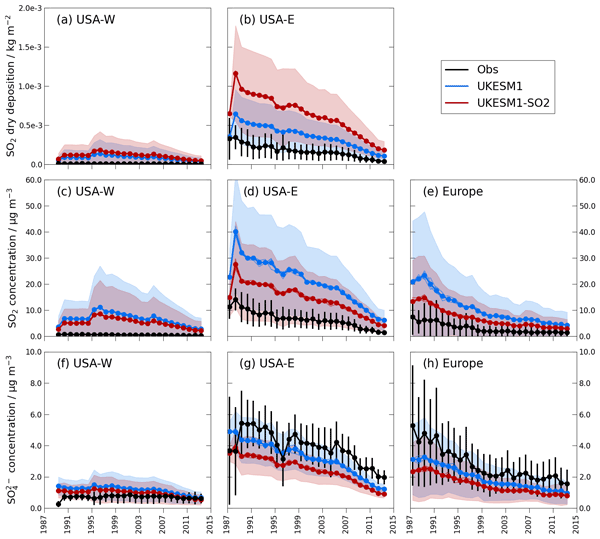
Catherine Hardacre, Jane P. Mulcahy, Richard J. Pope, Colin G. Jones, Steven T. Rumbold, Can Li, Colin Johnson, and Steven T. Turnock
Atmos. Chem. Phys., 21, 18465–18497, https://doi.org/10.5194/acp-21-18465-2021, https://doi.org/10.5194/acp-21-18465-2021, 2021
Short summary
Short summary
We investigate UKESM1's ability to represent the sulfur (S) cycle in the recent historical period. The S cycle is a key driver of historical radiative forcing. Earth system models such as UKESM1 should represent the S cycle well so that we can have confidence in their projections of future climate. We compare UKESM1 to observations of sulfur compounds, finding that the model generally performs well. We also identify areas for UKESM1’s development, focussing on how SO2 is removed from the air.
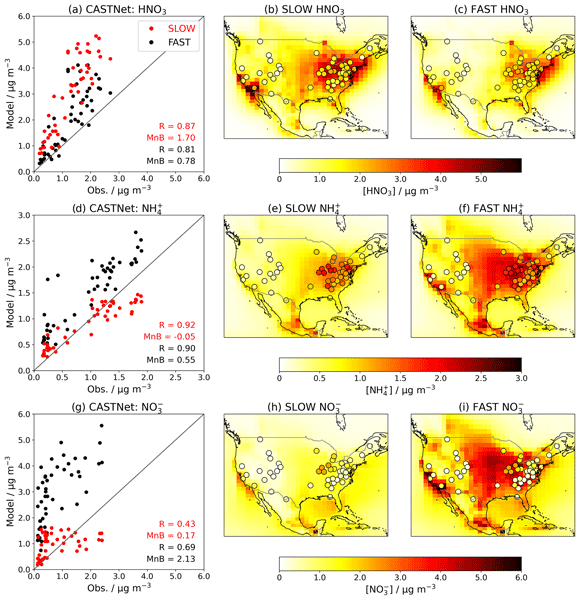
Anthony C. Jones, Adrian Hill, Samuel Remy, N. Luke Abraham, Mohit Dalvi, Catherine Hardacre, Alan J. Hewitt, Ben Johnson, Jane P. Mulcahy, and Steven T. Turnock
Atmos. Chem. Phys., 21, 15901–15927, https://doi.org/10.5194/acp-21-15901-2021, https://doi.org/10.5194/acp-21-15901-2021, 2021
Short summary
Short summary
Ammonium nitrate is hard to model because it forms and evaporates rapidly. One approach is to relate its equilibrium concentration to temperature, humidity, and the amount of nitric acid and ammonia gases. Using this approach, we limit the rate at which equilibrium is reached using various condensation rates in a climate model. We show that ammonium nitrate concentrations are highly sensitive to the condensation rate. Our results will help improve the representation of nitrate in climate models.
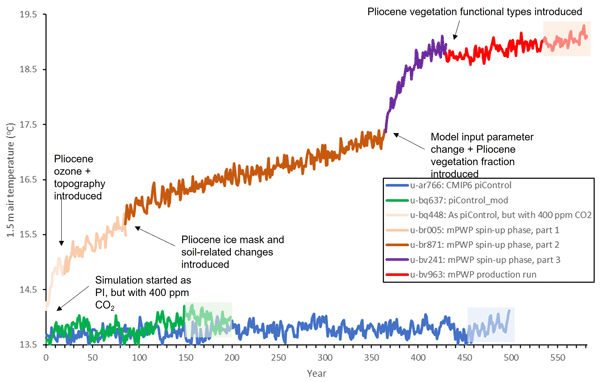
Charles J. R. Williams, Alistair A. Sellar, Xin Ren, Alan M. Haywood, Peter Hopcroft, Stephen J. Hunter, William H. G. Roberts, Robin S. Smith, Emma J. Stone, Julia C. Tindall, and Daniel J. Lunt
Clim. Past, 17, 2139–2163, https://doi.org/10.5194/cp-17-2139-2021, https://doi.org/10.5194/cp-17-2139-2021, 2021
Short summary
Short summary
Computer simulations of the geological past are an important tool to improve our understanding of climate change. We present results from a simulation of the mid-Pliocene (approximately 3 million years ago) using the latest version of the UK’s climate model. The simulation reproduces temperatures as expected and shows some improvement relative to previous versions of the same model. The simulation is, however, arguably too warm when compared to other models and available observations.
Cited articles
Abdul-Razzak, H. and Ghan, S. J.: A parameterization of aerosol activation: 2. Multiple aerosol types, J. Geophys. Res., 105, 6837–6844, https://doi.org/10.1029/1999JD901161, 2000. a
Abel, S. J. and Boutle, I. A.: An improved representation of the raindrop size distribution for single-moment microphysics schemes, Q. J. R. Meteorol. Soc., 138, 2151–2162, https://doi.org/10.1002/qj.1949, 2012. a
Abel, S. J. and Shipway, B. J.: A comparison of cloud-resolving model simulations of trade wind cumulus with aircraft observations taken during RICO, Q. J. R. Meteorol. Soc., 133, 781–794, https://doi.org/10.1002/qj.55, 2007. a
Adler, R. F., Huffman, G. J., Chang, A., Ferraro, R., Xie, P.-P., Janowiak, J., Rudolf, B., Schneider, U., Curtis, S., Bolvin, D., Gruber, A., Susskind, J., Arkin, P., and Nelkin, E.: The version-2 Global Precipitation Climatology Project (GPCP) monthly precipitation analysis (1979–present), J. Hydrometeor., 4, 1147–1167, https://doi.org/10.1175/1525-7541(2003)004<1147:TVGPCP>2.0.CO;2, 2003. a, b
Allan, R. and Ansell, T.: A new globally complete monthly historical gridded mean sea level pressure dataset (HadSLP2): 1850–2004, J. Climate, 19, 5816–5842, https://doi.org/10.1175/JCLI3937.1, 2006. a
Amundsen, D. S., Tremblin, P., Manners, J., Baraffe, I., and Mayne, N. J.: Treatment of overlapping gaseous absorption with the correlated-k method in hot Jupiter and brown dwarf atmosphere models, Astron. Astrophys., 598, A97, https://doi.org/10.1051/0004-6361/201629322, 2017. a
Andres, R. J. and Kasgnoc, A. D.: A time-averaged inventory of subaerial volcanic sulfur emissions, J. Geophys. Res., 103, 25251–25261, https://doi.org/10.1029/98JD02091, 1998. a
Arakawa, A. and Lamb, V. R.: Computational design of the basic dynamic processes of the UCLA general circulation model, Methods Comput. Phys., 17, 173–265, 1977. a
Baran, A. J., Hill, P., Walters, D., Hardman, S. C., Furtado, K., Field, P. R., and Manners, J.: The impact of two coupled cirrus microphysics-radiation parameterizations on the temperature and specific humidity biases in the tropical tropopause layer in a climate model, J. Climate, 29, 5299–5316, https://doi.org/10.1175/JCLI-D-15-0821.1, 2016. a
Batjes, N. H.: Harmonized soil profile data for applications at global and continental scales: updates to the WISE database, Soil Use Manage., 25, 124–127, https://doi.org/10.1111/j.1475-2743.2009.00202.x, 2009. a
Beare, R. J.: The role of shear in the morning transition boundary layer, Bound.-Lay. Meteorol., 129, 395–410, https://doi.org/10.1007/s10546-008-9324-8, 2008. a
Beljaars, A. C. M. and Holtslag, A. A. M.: Flux parametrization over land surfaces for atmospheric models, J. Appl. Meteorol., 30, 327–341, https://doi.org/10.1175/1520-0450(1991)030<0327:FPOLSF>2.0.CO;2, 1991. a
Bellouin, N., Rae, J., Jones, A., Johnson, C., Haywood, J., and Boucher, O.: Aerosol forcing in the Climate Model Intercomparison Project (CMIP5) simulations by HadGEM2-ES and the role of ammonium nitrate, J. Geophys. Res., 116, D20206, https://doi.org/10.1029/2011JD016074, 2011. a, b
Bellouin, N., Mann, G. W., Woodhouse, M. T., Johnson, C., Carslaw, K. S., and Dalvi, M.: Impact of the modal aerosol scheme GLOMAP-mode on aerosol forcing in the Hadley Centre Global Environmental Model, Atmos. Chem. Phys., 13, 3027–3044, https://doi.org/10.5194/acp-13-3027-2013, 2013. a
Berner, J., Jung, T., and Palmer, T. N.: Systematic error model error: the impact of increased horizontal resolution versus improved stochastic and deterministic parameterizations, J. Climate, 66, 603–626, https://doi.org/10.1175/JCLI-D-11-00297.1, 2012. a
Berrisford, P., Dee, D., Fielding, K., Fuentes, M., Kållberg, P., Kobayashi, S., and Uppala, S.: The ERA-Interim archive, Tech. Rep. 1, ERA report series, ECMWF, Reading, UK, 2009. a
Best, M. J.: Representing urban areas within operational numerical weather prediction models, Bound.-Lay. Meteorol., 114, 91–109, https://doi.org/10.1007/s10546-004-4834-5, 2005. a
Best, M. J., Pryor, M., Clark, D. B., Rooney, G. G., Essery, R. L. H., Ménard, C. B., Edwards, J. M., Hendry, M. A., Porson, A., Gedney, N., Mercado, L. M., Sitch, S., Blyth, E., Boucher, O., Cox, P. M., Grimmond, C. S. B., and Harding, R. J.: The Joint UK Land Environment Simulator (JULES), model description – Part 1: Energy and water fluxes, Geosci. Model Dev., 4, 677–699, https://doi.org/10.5194/gmd-4-677-2011, 2011. a, b, c
Beven, K. J. and Kirkby, M. J.: A physically based, variable contributing area model of basin hydrology, Hydrological Science Bulletin, 24, 43–69, https://doi.org/10.1080/02626667909491834, 1979. a
Bodas-Salcedo, A., Williams, K. D., Field, P. R., and Lock, A. P.: The surface downwelling solar radiation surplus over the Southern Ocean in the Met Office model: The role of midlatitude cyclone clouds, J. Clim., 25, 7467–7486, https://doi.org/10.1175/JCLI-D-11-00702.1, 2012. a
Bodas-Salcedo, A., Williams, K. D., Ringer, M. A., Beau, I., Cole, J. N. S., Dufresne, J.-L., Koshiro, T., Stevens, B., Wang, Z., and Yokohata, T.: Origins of the Solar Radiation Biases over the Southern Ocean in CFMIP2 Models, J. Clim., 27, 41–56, https://doi.org/10.1175/JCLI-D-13-00169.1, 2014. a
Bond, T. C. and Bergstrom, R. W.: Light Absorption by Carbonaceous Particles: An Investigative Review, Aerosol Science and Technology, 40, 27–67, https://doi.org/10.1080/02786820500421521, 2006. a
Bosilovich, M. G.: NASA's modern era retrospective-analysis for research and applications: Integrating Earth observations, Earthzine, https://earthzine.org/nasas-modern-era-retrospective-analysis/ (last access: 12 March 2019), 2008. a
Boutle, I. A., Abel, S. J., Hill, P. G., and Morcrette, C. J.: Spatial variability of liquid cloud and rain: observations and microphysical effects, Q. J. R. Meteorol. Soc., 140, 583–594, https://doi.org/10.1002/qj.2140, 2014a. a
Boutle, I. A., Eyre, J. E. J., and Lock, A. P.: Seamless stratocumulus simulation across the turbulent gray zone, Mon. Weather Rev., 142, 1655–1668, https://doi.org/10.1175/MWR-D-13-00229.1, 2014b. a
Brohan, P., Kennedy, J. J., Harris, I., Tett, S. F. B., and Jones, P. D.: Uncertainty estimates in regional and global observed temperature changes: a new dataset from 1850, J. Geophys. Res., 111, D12106, https://doi.org/10.1029/2005JD006548, 2006. a
Brown, A. R.: The sensitivity of large-eddy simulations of shallow cumulus convection to resolution and sub-grid model, Q. J. R. Meteorol. Soc., 125, 469–482, https://doi.org/10.1002/qj.49712555405, 1999. a
Brown, A. R., Beare, R. J., Edwards, J. M., Lock, A. P., Keogh, S. J., Milton, S. F., and Walters, D. N.: Upgrades to the boundary-layer scheme in the Met Office numerical weather prediction model, Bound.-Lay. Meteorol., 128, 117–132, https://doi.org/10.1007/s10546-008-9275-0, 2008. a, b
Buckeridge, S. and Scheichl, R.: Parallel geometric multigrid for global weather prediction, Numerical Linear Algebra with Applications, 17, 325–342, https://doi.org/10.1002/nla.699, 2010. a
Bushell, A. C., Wilson, D. R., and Gregory, D.: A description of cloud production by non-uniformly distributed processes, Q. J. R. Meteorol. Soc., 129, 1435–1455, https://doi.org/10.1256/qj.01.110, 2003. a
Calonne, N., Flin, F., Morin, S., Lesaffre, B., Rolland du Roscoat, S., and Geindreau, C.: Numerical and experimental investigations of the effective thermal conductivity of snow, Geophys. Res. Lett., 38, L23501, https://doi.org/10.1029/2011GL049234, 2011. a
Cameron, J. and Bell, W.: The testing and implementation of variational bias correction (VarBC) in the Met Office global NWP system, Forecasting Research Technical Report 631, Met Office, FitzRoy Road, Exeter, Devon EX1 3PB, UK, 2018. a
Charney, J. G. and Phillips, N. A.: Numerical integration of the quasi-geostrophic equations for barotropic and simple baroclinic flows, J. Meteor., 10, 71–99, https://doi.org/10.1175/1520-0469(1953)010<0071:NIOTQG>2.0.CO;2, 1953. a
Clark, D. B., Mercado, L. M., Sitch, S., Jones, C. D., Gedney, N., Best, M. J., Pryor, M., Rooney, G. G., Essery, R. L. H., Blyth, E., Boucher, O., Harding, R. J., Huntingford, C., and Cox, P. M.: The Joint UK Land Environment Simulator (JULES), model description – Part 2: Carbon fluxes and vegetation dynamics, Geosci. Model Dev., 4, 701–722, https://doi.org/10.5194/gmd-4-701-2011, 2011. a
Cotton, R. J., Field, P. R., Ulanowski, Z., Kaye, P. H., Hirst, E., Greenaway, R. S., Crawford, I., Crosier, J., and Dorsey, J.: The effective density of small ice particles obtained from in situ aircraft observations of mid-latitude cirrus, Q. J. R. Meteorol. Soc., 139, 1923–1934, https://doi.org/10.1002/qj.2058, 2013. a
Curcic, M. and Haus, B. K.: Revised Estimate of Ocean Surface Drag in Strong Winds, Geophys. Res. Lett., 47, https://doi.org/10.1029/2020GL087647, 2020. a
Cusack, S., Slingo, A., Edwards, J. M., and Wild, M.: The radiative impact of a simple aerosol climatology on the Hadley Centre atmospheric GCM, Q. J. R. Meteorol. Soc., 124, 2517–2526, https://doi.org/10.1002/qj.49712455117, 1998. a
Danielson, J. J. and Gesch, D. B.: Global multi-resolution terrain elevation data 2010 (GMTED2010), Tech. Rep. 1073, U.S. Geological Survey, https://doi.org/10.3133/ofr20111073, 2011. a, b
Daumont, D., Brion, J., Charbonnier, J., and Malicet, J.: Ozone UV spectroscopy I: Absorption cross-sections at room temperature, J. Atmos. Chem., 15, 145–155, https://doi.org/10.1007/BF00053756, 1992. a
Davies, L., Plant, R., and Derbyshire, S. H.: A simple model of convection with memory, J. Geophys. Res., 114, https://doi.org/10.1029/2008JD011653, 2009. a
Dawson, A. and Palmer, T. N.: Simulating weather regimes: impact of model resolution and stochastic parameterization, Clim. Dynam., 44, 2177–2193, https://doi.org/10.1007/s00382-014-2238-x, 2015. a
Dentener, F., Kinne, S., Bond, T., Boucher, O., Cofala, J., Generoso, S., Ginoux, P., Gong, S., Hoelzemann, J. J., Ito, A., Marelli, L., Penner, J. E., Putaud, J.-P., Textor, C., Schulz, M., van der Werf, G. R., and Wilson, J.: Emissions of primary aerosol and precursor gases in the years 2000 and 1750 prescribed data-sets for AeroCom, Atmos. Chem. Phys., 6, 4321–4344, https://doi.org/10.5194/acp-6-4321-2006, 2006. a, b, c
Derbyshire, S. H., Maidens, A. V., Milton, S. F., Stratton, R. A., and Willett, M. R.: Adaptive detrainment in a convection parametization, Q. J. R. Meteorol. Soc., 137, 1856–1871, https://doi.org/10.1002/qj.875, 2011. a, b, c
de Rooy, W. C., Bechtold, P., Frohlich, K., Hohenegger, C., Jonker, H., Mironov, D., Siebesma, A. P., Teixeira, J., and Yano, J.-I.: Entrainment and detrainment in cumulus convection: an overview, Q. J. R. Meteorol. Soc., 139, 1–19, https://doi.org/10.1002/qj.1959, 2013. a
Dharssi, I., Vidale, P. L., Verhoef, A., Macpherson, B., Jones, C., and Best, M.: New soil physical properties implemented in the Unified Model at PS18, Tech. Rep. 528, Forecasting R&D, Met Office, Exeter, UK, 2009. a
Doblas-Reyes, F. J., Weisheimer, A., Déqué, M., Keenlyside, N., McVean, M., Murphy, J. M., Rogel, P., Smith, D., and Palmer, T. N.: Addressing model uncertainty in seasonal and annual dynamical seasonal forecasts, Q. J. R. Meteorol. Soc., 135, 1538–1559, https://doi.org/10.1002/qj.464, 2009. a
Donelan, M. A.: On the Decrease of the Oceanic Drag Coefficient in High Winds, Journal of Geophysics Research: Oceans, 123, https://doi.org/10.1002/2017JC013394, 2018. a
Donelan, M. A., Haus, B. K., Reul, N., Plant, W. J., Stiassne, M., Graber, H. C., Brown, O. B., and Saltman, E. S.: On the limiting aerodynamic roughness of the ocean in very strong winds, Geophys. Res. Lett., 31, https://doi.org/10.1029/2004GL019460, 2004. a
Driedonks, A. G. M.: Sensitivity analysis of the equations for a convective mixed layer, Boundary-Layer Meteorology, 22, 475–480, 1982. a
Dyer, A. J. and Hicks, B. B.: Flux-gradient relationships in the constant flux layer, Q. J. R. Meteorol. Soc., 96, 715–721, https://doi.org/10.1002/qj.49709641012, 1970. a
Edson, J. B.: Review of air-sea transfer processes, in: ECMWF workshop on atmosphere-ocean interactions, Reading, UK, 10–12 November 2008, 7–24, European Centre for Medium-Range Weather Forecasts, 2009. a
Edwards, J. M.: Efficient calculation of infrared fluxes and cooling rates using the two-stream equations, J. Atmos. Sci., 53, 1921–1932, https://doi.org/10.1175/1520-0469(1996)053<1921:ECOIFA>2.0.CO;2, 1996. a
Edwards, J. M. and Slingo, A.: Studies with a flexible new radiation code. I: Choosing a configuration for a large-scale model, Q. J. R. Meteorol. Soc., 122, 689–719, https://doi.org/10.1002/qj.49712253107, 1996. a, b
Elvidge, A. D., Renfrew, I. A., Weiss, A. I., Brooks, I. M., Lachlan-Cope, T. A., and King, J. C.: Observations of surface momentum exchange over the marginal ice zone and recommendations for its parametrisation, Atmos. Chem. Phys., 16, 1545–1563, https://doi.org/10.5194/acp-16-1545-2016, 2016. a
Essery, R., Pomeroy, J., Parviainen, J., and Storck, P.: Sublimation of snow from coniferous forests in a climate model, J. Climate, 16, 1855–1864, https://doi.org/10.1175/1520-0442(2003)016<1855:SOSFCF>2.0.CO;2, 2003a. a
Essery, R. L. H., Best, M. J., Betts, R. A., Cox, P. M., and Taylor, C. M.: Explicit representation of subgrid heterogeneity in a GCM land surface scheme, J. Hydrometeor., 4, 530–543, https://doi.org/10.1175/1525-7541(2003)004<0530:EROSHI>2.0.CO;2, 2003b. a
Falloon, P. D. and Betts, R. A.: The impact of climate change on global river flow in HadGEM1 simulations, Atmos. Sci. Lett., 7, 62–68, https://doi.org/10.1002/asl.133, 2006. a
Field, P. R., Heymsfield, A. J., and Bansemer, A.: Snow Size Distribution Parameterization for Midlatitude and Tropical Ice Clouds, J. Atmos. Sci., 64, 4346–4365, https://doi.org/10.1175/2007JAS2344.1, 2007. a
Ford, D. A., Edwards, K. P., Lea, D., Barciela, R. M., Martin, M. J., and Demaria, J.: Assimilating GlobColour ocean colour data into a pre-operational physical-biogeochemical model, Ocean Sci., 8, 751–771, https://doi.org/10.5194/os-8-751-2012, 2012. a, b
Fritsch, J. M. and Chappell, C. F.: Numerical prediction of convectively driven mesoscale pressure systems. Part I: convective parameterization, J. Atmos. Sci., 37, 1722–1733, https://doi.org/10.1175/1520-0469(1980)037<1722:NPOCDM>2.0.CO;2, 1980. a
Fu, D., Di Girolamo, L., Rauber, R. M., McFarquhar, G. M., Nesbitt, S. W., Loveridge, J., Hong, Y., van Diedenhoven, B., Cairns, B., Alexandrov, M. D., Lawson, P., Woods, S., Tanelli, S., Schmidt, S., Hostetler, C., and Scarino, A. J.: An evaluation of the liquid cloud droplet effective radius derived from MODIS, airborne remote sensing, and in situ measurements from CAMP2Ex, Atmos. Chem. Phys., 22, 8259–8285, https://doi.org/10.5194/acp-22-8259-2022, 2022. a, b
Furtado, K. and Field, P.: The Role of Ice Microphysics Parametrizations in Determining the Prevalence of Supercooled Liquid Water in High-Resolution Simulations of a Southern Ocean Midlatitude Cyclone, J. Atmos. Sci., 74, 2001–2021, https://doi.org/10.1175/JAS-D-16-0165.1, 2017. a
Furtado, K., Field, P. R., Boutle, I. A., Morcrette, C. J., and Wilkinson, J. M.: A physically based subgrid parameterization for the production and maintenance of mixed-phase clouds in a general circulation model, J. Atmos. Sci., 73, 279–291, https://doi.org/10.1175/JAS-D-15-0021.1, 2016. a
Gantt, B., Meskhidze, N., Facchini, M. C., Rinaldi, M., Ceburnis, D., and O'Dowd, C. D.: Wind speed dependent size-resolved parameterization for the organic mass fraction of sea spray aerosol, Atmos. Chem. Phys., 11, 8777–8790, https://doi.org/10.5194/acp-11-8777-2011, 2011. a
Gantt, B., Johnson, M. S., Meskhidze, N., Sciare, J., Ovadnevaite, J., Ceburnis, D., and O'Dowd, C. D.: Model evaluation of marine primary organic aerosol emission schemes, Atmos. Chem. Phys., 12, 8553–8566, https://doi.org/10.5194/acp-12-8553-2012, 2012. a, b, c
Gedney, N. and Cox, P. M.: The sensitivity of global climate model simulations to the representation of soil moisture heterogeneity, J. Hydrometeor., 4, 1265–1275, https://doi.org/10.1175/1525-7541(2003)004<1265:TSOGCM>2.0.CO;2, 2003. a
Godfrey, J. S. and Beljaars, A. C. M.: On the turbulent fluxes of buoyancy, heat and moisture at the air-sea interface at low wind speeds, J. Geophys. Res., 96, 22043–22048, https://doi.org/10.1029/91JC02015, 1991. a
Gorshelev, V., Serdyuchenko, A., Weber, M., Chehade, W., and Burrows, J. P.: High spectral resolution ozone absorption cross-sections – Part 1: Measurements, data analysis and comparison with previous measurements around 293 K, Atmos. Meas. Tech., 7, 609–624, https://doi.org/10.5194/amt-7-609-2014, 2014. a
Grant, A. L. M.: Cloud-base fluxes in the cumulus-capped boundary layer, Q. J. R. Meteorol. Soc., 127, 407–421, https://doi.org/10.1002/qj.49712757209, 2001. a
Grant, A. L. M. and Brown, A. R.: A similarity hypothesis for shallow-cumulus transports, Q. J. R. Meteorol. Soc., 125, 1913–1936, https://doi.org/10.1002/qj.49712555802, 1999. a
Gregory, D. and Allen, S.: The effect of convective downdraughts upon NWP and climate simulations, in: Ninth conference on numerical weather prediction, Denver, Colorado, 122–123, American Meteorological Society, 1991. a
Gregory, D. and Rowntree, P. R.: A massflux convection scheme with representation of cloud ensemble characteristics and stability dependent closure, Mon. Weather Rev., 118, 1483–1506, https://doi.org/10.1175/1520-0493(1990)118<1483:AMFCSW>2.0.CO;2, 1990. a, b, c, d
Gregory, D., Kershaw, R., and Inness, P. M.: Parametrization of momentum transport by convection II: Tests in single-column and general circulation models, Q. J. R. Meteorol. Soc., 123, 1153–1183, https://doi.org/10.1002/qj.49712354103, 1997. a, b, c
Grimmond, C., Blackett, M., Best, M., Baik, J.-J., Belcher, S., Bohnenstengel, S., Calmet, I., Chen, F., Dandou, A., Fortuniak, K., Gouvea, M., Hamdi, R., Hendry, M., Kondo, H., Krayenhoff, S., Lee, S.-H., Loridan, T., Martilli, A., Masson, V., Miao, S., Oleson, K., Pigeon, G., Porson, A., Salamanca, F., Steeneveld, G.-J., Tombrou, M., Voogt, J., and Zhang, N.: Initial results from Phase 2 of the international urban energy balance model comparison, Int. J. Clim., 31, 244–272, https://doi.org/10.1002/joc.2227, 2011. a
Hardiman, S. C., Boutle, I. A., Bushell, A. C., Butchart, N., Cullen, M. J. P., Field, P. R., Furtado, K., Manners, J. C., Milton, S. F., Morcrette, C., O'Connor, F. M., Shipway, B. J., Smith, C., Walters, D. N., Willett, M. R., Williams, K. D., Wood, N., Abraham, N. L., Keeble, J., Maycock, A. C., Thuburn, J., and Woodhouse, M. T.: Processes Controlling Tropical Tropopause Temperature and Stratospheric Water Vapor in Climate Models, J. Clim., 28, 6516–6535, https://doi.org/10.1175/JCLI-D-15-0075.1, 2015. a
Harimaya, T.: The Riming Properties of Snow Crystals, J. Meteor. Soc. Japan, 53, 384–392, https://doi.org/10.1175/JCLI-D-15-0075.1, 1975. a
Hastings, D. A., Dunbar, P. K., Elphingstone, G. M., Bootz, M., Murakami, H., Maruyama, H., Masaharu, H., Holland, P., Payne, J., Bryant, N. A., Logan, T. L., Muller, J.-P., Schreier, G., and MacDonald, J. S.: The Global Land One-kilometer Base Elevation (GLOBE) Digital Elevation Model, Version 1.0, Digital data base on the World Wide Web, http://www.ngdc.noaa.gov/mgg/topo/globe.html (last access: 25 October 2017), 1999. a
Heymsfield, A. J. and Miloshevich, L. M.: Parameterizations for the Cross-Sectional Area and Extinction of Cirrus and Stratiform Ice Cloud Particles, J. Atmos. Sci., 60, 936–956, https://doi.org/10.1175/1520-0469(2003)060<0936:PFTCSA>2.0.CO;2, 2003. a
Hill, P. G., Manners, J., and Petch, J. C.: Reducing noise associated with the Monte Carlo Independent Column Approximation for weather forecasting models, Q. J. R. Meteorol. Soc., 137, 219–228, https://doi.org/10.1002/qj.732, 2011. a
Hill, P. G., Morcrette, C. J., and Boutle, I. A.: A regime-dependent parametrization of subgrid-scale cloud water content variability, Q. J. R. Meteorol. Soc., 141, 1975–1986, https://doi.org/10.1002/qj.2506, 2015. a
Hoesly, R. M., Smith, S. J., Feng, L., Klimont, Z., Janssens-Maenhout, G., Pitkanen, T., Seibert, J. J., Vu, L., Andres, R. J., Bolt, R. M., Bond, T. C., Dawidowski, L., Kholod, N., Kurokawa, J.-I., Li, M., Liu, L., Lu, Z., Moura, M. C. P., O'Rourke, P. R., and Zhang, Q.: Historical (1750–2014) anthropogenic emissions of reactive gases and aerosols from the Community Emissions Data System (CEDS), Geosci. Model Dev., 11, 369–408, https://doi.org/10.5194/gmd-11-369-2018, 2018. a
Hohenegger, C. and Stevens, B.: Preconditioning Deep Convection with Cumulus Congestus, J. Atmos. Sci., 70, 448–464, https://doi.org/10.1175/JAS-D-12-089.1, 2012. a
Houldcroft, C., Grey, W., Barnsley, M., Taylor, C., Los, S., and North, P.: New vegetation albedo parameters and global fields of background albedo derived from MODIS for use in a climate model, J. Hydrometeorology, 10, 183–198, https://doi.org/10.1175/2008JHM1021.1, 2008. a
Hourdin, F., Mauritsen, T., Gettelman, A., Golaz, J.-C., Balaji, V., Duan, Q., Folini, D., Ji, D., Klocke, D., Qian, Y., Rauser, F., Rio, C., Tomassini, L., Watanabe, M., and Williamson, D.: The art and science of climate model tuning, Bull. Amer. Meteorol. Soc., 98, 589–602, https://doi.org/10.1175/BAMS-D-15-00135.1, 2017. a
Huffman, G. J., Bolvin, D. T., Braithwaite, D., Hsu, K., Joyce, R., Kidd, C., Nelkin, E. J., Sorooshian, S., Tan, J., and Xie, P.: NASA Global Precipitation Measurement (GPM) Integrated Multi-satellitE Retrievals for GPM (IMERGE): Algorithm Theoretical Basis Document (ATBD) Version 06, Tech. rep., NASA/GSFC, https://gpm.nasa.gov/sites/default/files/2020-05/IMERG_ATBD_V06.3.pdf (last access: 2 February 2026), 2020a. a, b
Huffman, G. J., Bolvin, D. T., Braithwaite, D., Hsu, K.-L., Joyce, R. J., Kidd, C., Nelkin, E. J., Sorooshian, S., Stocker, E. F., Tan, J., Wolff, D. B., and Xie, P.: Integrated Multi-satellite Retrievals for the Global Precipitation Measurement (GPM) Mission (IMERG), 343–353, Springer International Publishing, Cham, ISBN 978-3-030-24568-9, https://doi.org/10.1007/978-3-030-24568-9_19, 2020b. a, b
Huffman, G. J., Adler, R., Behrangi, A., Bolvin, D. T., Nelkin, E. J., Gu, G., and Ehsani, M. R.: The New Version 3.2 Global Precipitation Climatology Project (GPCP) Monthly and Daily Precipitation Products, J. Clim., 36, 7635–7655, https://doi.org/10.1175/JCLI-D-23-0123.1, 2023. a, b
Jin, Z., Qiao, Y., Wang, Y., Fang, Y., and Yi, W.: A new parameterization of spectral and broadband ocean surface albedo, Opt. Expres., 19, 26429–26443, https://doi.org/10.1364/OE.19.026429, 2011. a
Johansen, O.: Thermal conductivity of soils, PhD thesis, University of Trondheim, Norway, 1975. a
Jones, A., Roberts, D. L., and Slingo, A.: A climate model study of indirect radiative forcing by anthropogenic sulphate aerosols, Nature, 370, 450–453, https://doi.org/10.1038/370450a0, 1994. a
Kershaw, R. and Gregory, D.: Parametrization of momentum transports by convection. I: Theory and cloud modelling results, Q. J. R. Meteorol. Soc., 123, 1133–1151, 1997. a
Kershaw, R., Grant, A. L. M., Derbyshire, S. H., and Cusack, S.: The numerical stability of a parametrization of convective momentum transport, Q. J. R. Meteorol. Soc., 126, 2981–2984, 2000. a
Kettle, A. J., Andreae, M. O., Amouroux, D., Andreae, T. W., Bates, T. S., Berresheim, H., Bingemer, H., Boniforti, R., Curran, M. A. J., DiTullio, G. R., Helas, G., Jones, G. B., Keller, M. D., Kiene, R. P., Leck, C., Levasseur, M., Malin, G., Maspero, M., Matrai, P., McTaggart, A. R., Mihalopoulos, N., Nguyen, B. C., Novo, A., Putaud, J. P., Rapsomanikis, S., Roberts, G., Schebeske, G., Sharma, S., Simó, R., Staubes, R., Turner, S., and Uher, G.: A global database of sea surface dimethyl sulfide (DMS) measurements and a procedure to predict sea surface DMS as a function of latitude, longitude, and month, Global Biogeochem. Cycles, 13, 399–444, https://doi.org/10.1029/1999GB900004, 1999. a
Lana, A., Bell, T. G., Simó, R., Vallina, S. M., Ballabrera-Poy, J., Kettle, A. J., Dachs, J., Bopp, L., Saltzman, E. S., Stefels, J., Johnson, J. E., and Liss, P. S.: An updated climatology of surface dimethlysulfide concentrations and emission fluxes in the global ocean, Global Biogeochem. Cycles, 25, GB1004, https://doi.org/10.1029/2010GB003850, 2011. a, b
Lean, J., Rottman, G., Harder, J., and Kopp, G.: SORCE Contributions to New Understanding of Global Change and Solar Variability, in: The Solar Radiation and Climate Experiment (SORCE): Mission Description and Early Results, edited by Rottman, G., Woods, T., and George, V., 27–53, Springer New York, New York, NY, https://doi.org/10.1007/0-387-37625-9_3, 2005. a
Legates, D. R. and Willmott, C. J.: Mean seasonal and spatial variability in global surface air temperature, Theor. Appl. Climatol., 41, 11–21, https://doi.org/10.1007/BF00866198, 1990. a
Lipson, M., Grimmond, S., Best, M., Abramowitz, G., Coutts, A., Tapper, N., Baik, J.-J., Beyers, M., Blunn, L., Boussetta, S., Bou-Zeid, E., De Kauwe, M., De Munck, C., Demuzere, M., Fatichi, S., Fortuniak, K., Han, B.-S., Hendry, M., Kikegawa, Y., Kondo, H., Lee, D.-I., Lee, S.-H., and Lemonsu, A.: Evaluation of 30 urban land surface models in the Urban- PLUMBER project: Phase 1 results, Q. J. R. Meteorol. Soc., 150, 126–169, https://doi.org/10.1002/qj.4589, 2023. a
Liu, H., Jezek, K. C., Li, B., and Zhao, Z.: Radarsat Antarctic Mapping Project Digital Elevation Model, Version 2, Tech. rep., NASA National Snow and Ice Data Center Distributed Active Archive Center, https://doi.org/10.5067/8JKNEW6BFRVD, 2015. a, b
Liu, Y., Daum, P. H., Guo, H., and Peng, Y.: Dispersion bias, dispersion effect, and the aerosol-cloud conundrum, Environ. Res. Lett., 3, https://doi.org/10.1088/1748-9326/3/4/045021, 2008. a
Lock, A. P.: The numerical representation of entrainment in parametrizations of boundary layer turbulent mixing, Mon. Weather Rev., 129, 1148–1163, https://doi.org/10.1175/1520-0493(2001)129<1148:TNROEI>2.0.CO;2, 2001. a
Lock, A. P., Brown, A. R., Bush, M. R., Martin, G. M., and Smith, R. N. B.: A new boundary layer mixing scheme. Part I: Scheme description and single-column model tests, Mon. Wea. Rev., 128, 3187–3199, https://doi.org/10.1175/1520-0493(2000)128<3187:ANBLMS>2.0.CO;2, 2000. a, b
Lock, A. P., Whitall, M., Stirling, A. J., Williams, K. D., Lavender, S. L., Morcrette, C., Matsubayashi, K., Field, P. R., Martin, G., Willett, M. R., and Heming, J.: The performance of the CoMorph-A convection package in global simulations with the Met Office Unified Model, Q. J. R. Meteorol. Soc., 150, 3527–3543, https://doi.org/10.1002/qj.4781, 2024. a
Loeb, N. G., Doelling, D. R., Wang, H., Su, W., Nguyen, C., Corbett, J. G., Liang, L., Mitrescu, C., Rose, F. G., and Kato, S.: Clouds and the Earth's Radiant Energy System (CERES) Energy Balanced and Filled (EBAF) Top-of-Atmosphere (TOA) Edition-4.0 Data Product, J. Clim., 31, 895–918, https://doi.org/10.1175/JCLI-D-17-0208.1, 2018. a, b
Lott, F. and Miller, M. J.: A new subgrid-scale orographic drag parametrization: Its formulation and testing, Q. J. R. Meteorol. Soc., 123, 101–127, https://doi.org/10.1002/qj.49712353704, 1997. a
Loveland, T. R., Reed, B. C., Brown, J. F., Ohlen, D. O., Zhu, Z., Yang, L., and Merchant, J. W.: Development of a global land cover characteristics database and IGBP DISCover from 1 km AVHRR data, Int. J. Remote Sens., 21, 1303–1330, https://doi.org/10.1080/014311600210191, 2000. a
Lupkes, C. and Gryanik, V. M.: A stability-dependent parametrization of transfer coefficients for momentum and heat over polar sea ice to be used in climate models, J. Geophys. Res. Atmos., 120, 552–581, https://doi.org/10.1002/2014JD022418, 2015. a
Lupkes, C., Gryanik, V. M., Hartmann, J., and Andreas, E. L.: A parametrization, based on sea ice morphology, of the neutralatmospheric drag coefficients for weather predictionand climate models, J. Geophys. Res. Atmos., 117, https://doi.org/10.1029/2012JD017630, 2012. a, b
Madden, R. A. and Julian, P. R.: Detection of a 40–50 day oscillation in the zonal wind in the tropical Pacific, J. Atmos. Sci., 28, 702–708, https://doi.org/10.1175/1520-0469(1971)028<0702:DOADOI>2.0.CO;2, 1971. a
Malicet, J., Daumont, D., Charbonnier, J., Parisse, C., Chakir, A., and Brion, J.: Ozone UV spectroscopy. II. Absorption cross-sections and temperature dependence, J. Atmos. Chem., 21, 263–273, https://doi.org/10.1007/BF00696758, 1995. a
Mann, G. W., Carslaw, K. S., Spracklen, D. V., Ridley, D. A., Manktelow, P. T., Chipperfield, M. P., Pickering, S. J., and Johnson, C. E.: Description and evaluation of GLOMAP-mode: a modal global aerosol microphysics model for the UKCA composition-climate model, Geosci. Model Dev., 3, 519–551, https://doi.org/10.5194/gmd-3-519-2010, 2010. a
Manners, J., Thelen, J.-C., Petch, J., Hill, P., and Edwards, J. M.: Two fast radiative transfer methods to improve the temporal sampling of clouds in numerical weather prediction and climate models, Q. J. R. Meteorol. Soc., 135, 457–468, https://doi.org/10.1002/qj.956, 2009. a
Manners, J., Vosper, S. B., and Roberts, N.: Radiative transfer over resolved topographic features for high-resolution weather prediction, Q. J. R. Meteorol. Soc., 138, 720–733, https://doi.org/10.1002/qj.956, 2012. a
Manners, J., Edwards, J. M., Hill, P., and Thelen, J.-C.: SOCRATES (Suite Of Community RAdiative Transfer codes based on Edwards and Slingo) Technical Guide, Met Office, UK, https://code.metoffice.gov.uk/trac/socrates (last access: 25 October 2017), 2015. a
Marshall, S. E.: A physical parameterization of snow albedo for use in climate models, PhD thesis, University of Colorado, Boulder, NCAR Cooperative thesis 123, 1989. a
Marthews, T. R., Dadson, S. J., Lehner, B., Abele, S., and Gedney, N.: High-resolution global topographic index values, dataset made available under the terms of the Open Government Licence, https://catalogue.ceh.ac.uk/documents/6b0c4358-2bf3-4924-aa8f-793d468b92be (last access: 25 October 2017), 2015. a
Martin, G. M., Johnson, D. W., and Spice, A.: The measurement and parameterization of effective radius of droplets in warm stratocumulus clouds, J. Atmos. Sci., 51, 1823–1942, https://doi.org/10.1175/1520-0469(1994)051<1823:TMAPOE>2.0.CO;2, 1994. a
McCabe, A. and Brown, A. R.: The role of surface heterogeneity in modelling the stable boundary layer, Bound.-Lay. Meteorol., 122, 517–534, https://doi.org/10.1007/s10546-006-9119-8, 2007. a
Mercado, L. M., Huntingford, C., Gash, J. H. C., Cox, P. M., and Jogireddy, V.: Improving the representation of radiative interception and photosynthesis for climate model applications, Tellus, B59, 553–565, https://doi.org/10.1111/j.1600-0889.2007.00256.x, 2007. a
Met Office: Cartopy: a cartographic python library with a matplotlib interface, Exeter, Devon, https://cartopy.readthedocs.io/stable (last access: 2 February 2026), 2010–2015. a
Miller, D. A. and White, R. A.: A conterminous United States multilayer soil characteristics dataset for regional climate and hydrology modeling, Earth Interact., 2, 1–26, https://doi.org/10.1175/1087-3562(1998)002<0001:ACUSMS>2.3.CO;2, 1998. a
Mlawer, E. J., Payne, V. H., Moncet, J.-L., Delamere, J. S., Alvarado, M. J., and Tobin, D. C.: Development and recent evaluation of the MT_CKD model of continuum absorption, Philos. Trans. R. Soc. Lond. A, 370, 2520–2556, https://doi.org/10.1098/rsta.2011.0295, 2012. a
Morcrette, C. J.: Improvements to a prognostic cloud scheme through changes to its cloud erosion parametrization, Atmos. Sci. Let., 13, 95–102, https://doi.org/10.1002/asl.374, 2012. a
Mulcahy, J. P., Jones, C., Sellar, A., Johnson, B., Boutle, I. A., Jones, A., Andrews, T., Rumbold, S. T., Mollard, J., Bellouin, N., Johnson, C. E., Williams, K. D., Grosvenor, D. P., and McCoy, D. T.: Improved Aerosol Processes and Effective Radiative Forcing in HadGEM3 and UKESM1, JAMES, 10, 2786–2805, https://doi.org/10.1029/2018MS001464, 2018. a, b, c, d, e, f, g
Mulcahy, J. P., Johnson, C., Jones, C. G., Povey, A. C., Scott, C. E., Sellar, A., Turnock, S. T., Woodhouse, M. T., Abraham, N. L., Andrews, M. B., Bellouin, N., Browse, J., Carslaw, K. S., Dalvi, M., Folberth, G. A., Glover, M., Grosvenor, D. P., Hardacre, C., Hill, R., Johnson, B., Jones, A., Kipling, Z., Mann, G., Mollard, J., O'Connor, F. M., Palmiéri, J., Reddington, C., Rumbold, S. T., Richardson, M., Schutgens, N. A. J., Stier, P., Stringer, M., Tang, Y., Walton, J., Woodward, S., and Yool, A.: Description and evaluation of aerosol in UKESM1 and HadGEM3-GC3.1 CMIP6 historical simulations, Geosci. Model Dev., 13, 6383–6423, https://doi.org/10.5194/gmd-13-6383-2020, 2020. a, b, c, d
Mulcahy, J. P., Jones, C. G., Rumbold, S. T., Kuhlbrodt, T., Dittus, A. J., Blockley, E. W., Yool, A., Walton, J., Hardacre, C., Andrews, T., Bodas-Salcedo, A., Stringer, M., de Mora, L., Harris, P., Hill, R., Kelley, D., Robertson, E., and Tang, Y.: UKESM1.1: development and evaluation of an updated configuration of the UK Earth System Model, Geosci. Model Dev., 16, 1569–1600, https://doi.org/10.5194/gmd-16-1569-2023, 2023. a
Müller, E. H. and Scheichl, R.: Massively parallel solvers for elliptic partial differential equations in numerical weather and climate prediction, Q. J. R. Meteorol. Soc., 140, 2608–2624, https://doi.org/10.1002/qj.2327, 2014. a
Muller, J.-P., López, G., Watson, G., Shane, N., Kennedy, T., Yuen, P., Lewis, P., Fischer, J., Guanter, L., Domench, C., Preusker, R., North, P., Heckel, A., Danne, O., Krämer, U., Zühlke, M., Brockmann, C., and Pinnock, S.: The ESA GlobAlbedo project for mapping the Earth's land surface albedo for 15 years from European sensors, presented at IEEE Geoscience and Remote Sensing Symposium (IGARSS) 2012, IEEE, Munich, Germany, 22–27 July 2012, http://www.mssl.ucl.ac.uk/~pcy/papers/Muller-GlobAlbedo-abstractV4.pdf (last access: 25 October 2017), 2012. a
Nachtergaele, F., van Velthuizen, H., Verelst, L., Batjes, N., Dijkshoorn, K., van Engelen, V., Fischer, G., Jones, A., Montanarella, L., Petri, M., Prieler, S., Teixeira, E., Wiberg, D., and Shi, X.: Harmonized World Soil Database (version 1.0), FAO, FAO, Rome, Italy and IIASA, Laxenburg, Austria, 2008. a
NASA/LARC/SD/ASDC: CERES Energy Balanced and Filled (EBAF) TOA and Surface Monthly means data in netCDF Edition 4.1, https://doi.org/10.5067/TERRA-AQUA/CERES/EBAF_L3B.004.1, 2019. a, b, c
Nicholls, S.: The dynamics of stratocumulus: Aircraft observations and comparisons with a mixed layer model, Q. J. R. Meteorol. Soc., 110, 783–820, https://doi.org/10.1002/qj.49711046603, 1984. a
O'Connor, F. M., Johnson, C. E., Morgenstern, O., Abraham, N. L., Braesicke, P., Dalvi, M., Folberth, G. A., Sanderson, M. G., Telford, P. J., Voulgarakis, A., Young, P. J., Zeng, G., Collins, W. J., and Pyle, J. A.: Evaluation of the new UKCA climate-composition model – Part 2: The Troposphere, Geosci. Model Dev., 7, 41–91, https://doi.org/10.5194/gmd-7-41-2014, 2014. a
Oki, T.: Validating the runoff from LSP-SVAT models using a global river routing network by one degree mesh, in: AMS 13th Conference on Hydrology, Long Beach, California, 2–7 February 1997, American Meteorological Society, 319–322, 1997. a
Oki, T. and Sud, Y. C.: Design of Total Runoff Integrating Pathways (TRIP) – A global river channel network, Earth Interact., 2, 1–36, https://doi.org/10.1175/1087-3562(1998)002<0001:DOTRIP>2.3.CO;2, 1998. a, b
Palmer, T. N., Buizza, R., Doblas-Reyes, F. J., Jung, T., Leutbecher, M., Shutts, G., Steinheimer, M., and Weisheimer, A.: Stochastic parametrization and model uncertainty, Tech. Rep. 598, ECMWF RD Technical Memorandum, ECMWF, Reading, UK, https://doi.org/10.21957/ps8gbwbdv, 2009. a
Pastorello, G., Trotta, C., Canfora, E., et al.: The FLUXNET2015 dataset and the ONEFlux processing pipeline for eddy covariance data, Sci. Data, 225, https://doi.org/10.1038/s41597-020-0534-3, 2020. a
Pincus, R., Barker, H. W., and Morcrette, J. J.: A fast, flexible, approximate technique for computing radiative transfer in inhomogeneous cloud fields, Journal of Geophysical Research, 108, https://doi.org/10.1029/2002JD003322, 2003. a
Pincus, R., Mlawer, E. J., Oreopoulos, L., Ackerman, A. S., Baek, S., Brath, M., Buehler, S. A., Cady-Pereira, K. E., Cole, J. N. S., Dufresne, J.-L., Kelley, M., Li, J., Manners, J., Paynter, D. J., Roehrig, R., Sekiguchi, M., and Schwarzkopf, D. M.: Radiative flux and forcing parameterization error in aerosol-free clear skies, Geophys. Res. Lett., 42, 5485–5492, https://doi.org/10.1002/2015GL064291, 2015. a
Poulter, B., MacBean, N., Hartley, A., Khlystova, I., Arino, O., Betts, R., Bontemps, S., Boettcher, M., Brockmann, C., Defourny, P., Hagemann, S., Herold, M., Kirches, G., Lamarche, C., Lederer, D., Ottlé, C., Peters, M., and Peylin, P.: Plant functional type classification for earth system models: results from the European Space Agency's Land Cover Climate Change Initiative, Geosci. Model Dev., 8, 2315–2328, https://doi.org/10.5194/gmd-8-2315-2015, 2015. a, b, c
Prigent, C., Jiménez, C., and Catherinot, J.: Comparison of satellite microwave backscattering (ASCAT) and visible/near-infrared reflectances (PARASOL) for the estimation of aeolian aerodynamic roughness length in arid and semi-arid regions, Atmos. Meas. Tech., 5, 2703–2712, https://doi.org/10.5194/amt-5-2703-2012, 2012. a, b
Ptashnik, I. V., McPheat, R. A., Shine, K. P., Smith, K. M., and Williams, R. G.: Water vapor self-continuum absorption in near-infrared windows derived from laboratory measurements, J. Geophys. Res.-Atmos., 116, D16305, https://doi.org/10.1029/2011JD015603, 2011. a
Ptashnik, I. V., McPheat, R. A., Shine, K. P., Smith, K. M., and Williams, R. G.: Water vapour foreign-continuum absorption in near-infrared windows from laboratory measurements, Philos. Trans. R. Soc. Lond. A, 370, 2557–2577, https://doi.org/10.1098/rsta.2011.0218, 2012. a
Rawlins, F., Ballard, S. P., Bovis, K. J., Clayton, A. M., Li, D., Inverarity, G. W., Lorenc, A. C., and Payne, T. J.: The Met Office global four-dimensional variational data assimilation system, Q. J. R. Meteorol. Soc., 133, 347–362, 2007. a
Raymond, W. H. and Garder, A.: A spatial filter for use in finite area calculations, Monthly Weather Review, 116, 209–222, 1988. a
Redelsperger, J.-L., Guichard, F., and Mondon, S.: A parametrization of mesoscale enhancement of surface fluxes for large-scale models, J. Climate, 13, 402–421, https://doi.org/10.1175/1520-0442(2000)013<0402:APOMEO>2.0.CO;2, 2000. a
Renfrew, I. A., Elvidge, A. D., and Edwards, J. M.: Atmospheric sensitivity to marginal-ice-zone drag: global and local responses, Q. J. R. Meteorol. Soc., 145, 1165–1179, https://doi.org/10.1002/qj.3486, 2019. a
Ridley, J. K., Blockley, E. W., Keen, A. B., Rae, J. G. L., West, A. E., and Schroeder, D.: The sea ice model component of HadGEM3-GC3.1, Geosci. Model Dev., 11, 713–723, https://doi.org/10.5194/gmd-11-713-2018, 2018. a
Rooney, G. G. and Bornemann, F. J.: The performance of FLake in the Met Office Unified Model, Tellus A: Dynamic Meteorology and Oceanography, 65, https://doi.org/10.3402/tellusa.v65i0.21363, 2013. a
Rooney, G. G. and Jones, I. D.: Coupling the 1-D lake model FLake to the community land-surface model JULES, Boreal Env. Res., 15, 501–512, 2010. a
Rothman, L. S., Gordon, I. E., Babikov, Y., Barbe, A., Chris Benner, D., Bernath, P. F., Birk, M., Bizzocchi, L., Boudon, V., Brown, L. R., Campargue, A., Chance, K., Cohen, E. A., Coudert, L. H., Devi, V. M., Drouin, B. J., Fayt, A., Flaud, J.-M., Gamache, R. R., Harrison, J. J., Hartmann, J.-M., Hill, C., Hodges, J. T., Jacquemart, D., Jolly, A., Lamouroux, J., Le Roy, R. J., Li, G., Long, D. A., Lyulin, O. M., Mackie, C. J., Massie, S. T., Mikhailenko, S., Müller, H. S. P., Naumenko, O. V., Nikitin, A. V., Orphal, J., Perevalov, V., Perrin, A., Polovtseva, E. R., Richard, C., Smith, M. A. H., Starikova, E., Sung, K., Tashkun, S., Tennyson, J., Toon, G. C., Tyuterev, V. G., and Wagner, G.: The HITRAN2012 molecular spectroscopic database, J. Quant. Spectrosc. Radiat. Transfer, 130, 4–50, https://doi.org/10.1016/j.jqsrt.2013.07.002, 2013. a
Samanta, A., Ganguly, S., Schull, M. A., Shabanov, N. V., Knyazikhin, Y., and Myneni, R. B.: Collection 5 MODIS LAI/FPAR Products, Presented at AGU Fall Meeting, San Francisco, USA, 15–19 December 2008, 2012. a
Sanchez, C., Williams, K. D., and Collins, M.: Improved stochastic physics schemes for global weather and climate models, Q. J. R. Meteorol. Soc., 142, 147–159, https://doi.org/10.1002/qj.2640, 2016. a, b
Scaife, A. A., Butchart, N., Warner, C. D., and Swinbank, R.: Impact of a spectral gravity wave parametrization on the stratosphere in the Met Office Unified Model, J. Atmos. Sci., 59, 1473–1489, https://doi.org/10.1175/1520-0469(2002)059<1473:IOASGW>2.0.CO;2, 2002. a
Schmidt, G. A., Bader, D., Donner, L. J., Elsaesser, G. S., Golaz, J.-C., Hannay, C., Molod, A., Neale, R. B., and Saha, S.: Practice and philosophy of climate model tuning across six US modeling centers, Geosci. Model Dev., 10, 3207–3223, https://doi.org/10.5194/gmd-10-3207-2017, 2017. a
Sellar, A. A., Jones, C. G., Mulcahy, J. P., Tang, Y., Wiltshire, A., O'Connor, F. M., Stringer, M., Hill, R., Palmieri, J., Woodward, S., de Mora, L., Kuhlbrodt, T., Rumbold, S. T., Kelley, D. I., Ellis, R., Johnson, C. E., Walton, J., Abraham, N. L., Andrews, M. B., Andrews, T., Archibald, A. T., Berthou, S., Burke, E., Blockley, E., Carslaw, K., Dalvi, M., Edwards, J., Folberth, G. A., Gedney, N., Griffiths, P. T., Harper, A. B., Hendry, M. A., Hewitt, A. J., Johnson, B., Jones, A., Jones, C. D., Keeble, J., Liddicoat, S., Morgenstern, O., Parker, R. J., Predoi, V., Robertson, E., Siahaan, A., Smith, R. S., Swaminathan, R., Woodhouse, M. T., Zeng, G., and Zerroukat, M.: UKESM1: Description and Evaluation of the U.K. Earth System Model, Journal of Advances in Modeling Earth Systems, 11, 4513–4558, https://doi.org/10.1029/2019MS001739, 2019. a
Sellar, A. A., Walton, J., Jones, C. G., Wood, R., Abraham, N. L., Andrejczuk, M., Andrews, M. B., Andrews, T., Archibald, A. T., Mora, L., Dyson, H., Elkington, M., Ellis, R., Florek, P., Good, P., Gohar, L., Haddad, S., Hardiman, S. C., Hogan, E., Iwi, A., Jones, C. D., Johnson, B., Kelley, D. I., Kettleborough, J., Knight, J. R., Köhler, M. O., Kuhlbrodt, T., Liddicoat, S., Linova-Pavlova, I., Mizielinski, M. S., Morgenstern, O., Mulcahy, J., Neininger, E., O'Connor, F. M., Petrie, R., Ridley, J., Rioual, J., Roberts, M., Robertson, E., Rumbold, S., Seddon, J., Shepherd, H., Shim, S., Stephens, A., Teixiera, J. C., Tang, Y., Williams, J., Wiltshire, A., and Griffiths, P. T.: Implementation of U.K. Earth System Models for CMIP6, Journal of Advances in Modeling Earth Systems, 12, https://doi.org/10.1029/2019MS001946, 2020. a
Serdyuchenko, A., Gorshelev, V., Weber, M., Chehade, W., and Burrows, J. P.: High spectral resolution ozone absorption cross-sections – Part 2: Temperature dependence, Atmos. Meas. Tech., 7, 625–636, https://doi.org/10.5194/amt-7-625-2014, 2014. a
Smith, R. N. B.: A scheme for predicting layer clouds and their water contents in a GCM, Q. J. R. Meteorol. Soc., 116, 435–460, https://doi.org/10.1002/qj.49711649210, 1990. a
Still, C. J., Berry, J. A., Collatz, G. J., and DeFries, R. S.: Global distribution of C3 and C4 vegetation: Carbon cycle implications, Global Biogeochem. Cycles, 17, https://doi.org/10.1029/2001GB001807, 2003. a
Stirling, A. J. and Stratton, R. A.: Entrainment processes in the diurnal cycle of deep convection over land, Q. J. R. Meteorol. Soc., 138, https://doi.org/10.1002/qj.1868, 2011. a
Storkey, D., Blaker, A. T., Mathiot, P., Megann, A., Aksenov, Y., Blockley, E. W., Calvert, D., Graham, T., Hewitt, H. T., Hyder, P., Kuhlbrodt, T., Rae, J. G. L., and Sinha, B.: UK Global Ocean GO6 and GO7: a traceable hierarchy of model resolutions, Geosci. Model Dev., 11, 3187–3213, https://doi.org/10.5194/gmd-11-3187-2018, 2018. a
Taillandier, A.-S., Domine, F., Simpson, W. R., Sturm, M., and Douglas, T. A.: Rate of decrease of the specific surface area of dry snow: Isothermal and temperature gradient conditions, J. Geophys. Res. Earth Surf., 112, F03003, https://doi.org/10.1029/2006JF000514, 2007. a
Tennant, W. J., Shutts, G. J., Arribas, A., and Thompson, S. A.: Using a stochastic kinetic energy backscatter scheme to improve MOGREPS probabilistic forecast skill, Mon. Weather Rev., 139, 1190–1206, https://doi.org/10.1175/2010MWR3430.1, 2011. a, b
Thomason, L. W., Ernest, N., Millán, L., Rieger, L., Bourassa, A., Vernier, J.-P., Manney, G., Luo, B., Arfeuille, F., and Peter, T.: A global space-based stratospheric aerosol climatology: 1979–2016, Earth Syst. Sci. Data, 10, 469–492, https://doi.org/10.5194/essd-10-469-2018, 2018. a
Untch, A. and Simmons, A. J.: Increased stratospheric resolution in the ECMWF forecasting system, Tech. Rep. 82, ECMWF Newsletter, ECMWF, Reading, UK, 1999. a
Uppala, S. M., Kallberg, P. W., Simmons, A. J., Andrae, U., da Costa Bechtold, V., Fiorino, M., Gibson, J. K., Haseler, J., Hernandez, A., Kelly, G. A., Li, X., Onogi, K., Saarinen, S., Sokka, N., Allan, R. P., Andersson, E., Arpe, K., Balmaseda, M. A., Beljaars, A. C. M., van de Berg, L., Bidlot, J., Bormann, N., Caires, S., Chevallier, F., Dethof, A., Dragosavac, M., Fisher, M., Fuentes, M., Hagemann, S., Holm, E., Hoskins, B. J., Isaksen, L., Janssen, P. A. E. M., Jenne, R., McNally, A. P., Mahfouf, J.-F., Morcrette, J.-J., Rayner, N. A., Saunders, R. W., Simon, P., Sterl, A., Trenberth, K., Untch, A., Vasiljevic, D., Viterbo, P., and Woollen, J.: The ERA-40 re-analysis, Q. J. R. Meteorol. Soc., 131, 2961–3012, https://doi.org/10.1256/qj.04.176, 2005. a
van der Vorst, H. A.: Bi-CGSTAB: A Fast and Smoothly Converging Variant of Bi-CG for the Solution of Nonsymmetric Linear Systems, SIAM J. Sci. Stat. Comput., 13, 631–644, https://doi.org/10.1137/0913035, 1992. a
van Genuchten, M. T.: A closed-form equation for predicting the hydraulic conductivity of unsaturated soils, Soil Sci. Soc. Am. J., 44, 892–898, https://doi.org/10.2136/sssaj1980.03615995004400050002x, 1980. a
van Marle, M. J. E., Kloster, S., Magi, B. I., Marlon, J. R., Daniau, A.-L., Field, R. D., Arneth, A., Forrest, M., Hantson, S., Kehrwald, N. M., Knorr, W., Lasslop, G., Li, F., Mangeon, S., Yue, C., Kaiser, J. W., and van der Werf, G. R.: Historic global biomass burning emissions for CMIP6 (BB4CMIP) based on merging satellite observations with proxies and fire models (1750–2015), Geosci. Model Dev., 10, 3329–3357, https://doi.org/10.5194/gmd-10-3329-2017, 2017. a
Van Weverberg, K., Boutle, I. A., Morcrette, C. J., and Newsom, R. K.: Towards retrieving critical relative humidity from ground-based remote-sensing observations, Q. J. R. Meteorol. Soc., 142, 2867–2881, https://doi.org/10.1002/qj.2874, 2016. a
Vosper, S. B.: Mountain waves and wakes generated by South Georgia: implications for drag parametrization, Q. J. R. Meteorol. Soc., 141, 2813–2827, https://doi.org/10.1002/qj.2566, 2015. a
Walters, D., Boutle, I., Brooks, M., Melvin, T., Stratton, R., Vosper, S., Wells, H., Williams, K., Wood, N., Allen, T., Bushell, A., Copsey, D., Earnshaw, P., Edwards, J., Gross, M., Hardiman, S., Harris, C., Heming, J., Klingaman, N., Levine, R., Manners, J., Martin, G., Milton, S., Mittermaier, M., Morcrette, C., Riddick, T., Roberts, M., Sanchez, C., Selwood, P., Stirling, A., Smith, C., Suri, D., Tennant, W., Vidale, P. L., Wilkinson, J., Willett, M., Woolnough, S., and Xavier, P.: The Met Office Unified Model Global Atmosphere 6.0/6.1 and JULES Global Land 6.0/6.1 configurations, Geosci. Model Dev., 10, 1487–1520, https://doi.org/10.5194/gmd-10-1487-2017, 2017. a, b, c, d, e
Walters, D., Baran, A. J., Boutle, I., Brooks, M., Earnshaw, P., Edwards, J., Furtado, K., Hill, P., Lock, A., Manners, J., Morcrette, C., Mulcahy, J., Sanchez, C., Smith, C., Stratton, R., Tennant, W., Tomassini, L., Van Weverberg, K., Vosper, S., Willett, M., Browse, J., Bushell, A., Carslaw, K., Dalvi, M., Essery, R., Gedney, N., Hardiman, S., Johnson, B., Johnson, C., Jones, A., Jones, C., Mann, G., Milton, S., Rumbold, H., Sellar, A., Ujiie, M., Whitall, M., Williams, K., and Zerroukat, M.: The Met Office Unified Model Global Atmosphere 7.0/7.1 and JULES Global Land 7.0 configurations, Geosci. Model Dev., 12, 1909–1963, https://doi.org/10.5194/gmd-12-1909-2019, 2019. a, b, c, d, e, f, g, h, i, j, k, l, m, n, o, p
Walters, D. N., Best, M. J., Bushell, A. C., Copsey, D., Edwards, J. M., Falloon, P. D., Harris, C. M., Lock, A. P., Manners, J. C., Morcrette, C. J., Roberts, M. J., Stratton, R. A., Webster, S., Wilkinson, J. M., Willett, M. R., Boutle, I. A., Earnshaw, P. D., Hill, P. G., MacLachlan, C., Martin, G. M., Moufouma-Okia, W., Palmer, M. D., Petch, J. C., Rooney, G. G., Scaife, A. A., and Williams, K. D.: The Met Office Unified Model Global Atmosphere 3.0/3.1 and JULES Global Land 3.0/3.1 configurations, Geosci. Model Dev., 4, 919–941, https://doi.org/10.5194/gmd-4-919-2011, 2011. a, b, c, d
Walters, D. N., Williams, K. D., Boutle, I. A., Bushell, A. C., Edwards, J. M., Field, P. R., Lock, A. P., Morcrette, C. J., Stratton, R. A., Wilkinson, J. M., Willett, M. R., Bellouin, N., Bodas-Salcedo, A., Brooks, M. E., Copsey, D., Earnshaw, P. D., Hardiman, S. C., Harris, C. M., Levine, R. C., MacLachlan, C., Manners, J. C., Martin, G. M., Milton, S. F., Palmer, M. D., Roberts, M. J., Rodríguez, J. M., Tennant, W. J., and Vidale, P. L.: The Met Office Unified Model Global Atmosphere 4.0 and JULES Global Land 4.0 configurations, Geosci. Model Dev., 7, 361–386, https://doi.org/10.5194/gmd-7-361-2014, 2014. a, b
Warner, C. D. and McIntyre, M. E.: An ultrasimple spectral parametrization for nonorographic gravity waves, J. Atmos. Sci., 58, 1837–1857, https://doi.org/10.1175/1520-0469(2001)058<1837:AUSPFN>2.0.CO;2, 2001. a
Weisheimer, A., Palmer, T. N., and Doblas-Reyes, F. J.: Assessment of representations of model uncertainty in monthly and seasonal forecast ensembles, Geophys. Res. Lett., 38, L16703, https://doi.org/10.1029/2011GL048123, 2011. a
Weisheimer, A., Cortia, S., Palmer, T., and Vitart, F.: Addressing model error through atmospheric stochastic physical parametrizations: impact on the coupled ECMWF seasonal forecasting system, Philos. Trans. R. Soc. Lond. A, 372, 20130290, https://doi.org/10.1098/rsta.2013.0290, 2014. a
Wentz, F. J. and Spencer, R. W.: SSM/I rain retrievals within a unified all-weather ocean algorithm, J. Atmos. Sci., 55, 1613–1627, https://doi.org/10.1175/1520-0469(1998)055<1613:SIRRWA>2.0.CO;2, 1998. a
Wesseling, P.: Introduction to multigrid methods, Contractor Report 195045, NASA, 1995. a
West, A. E., McLaren, A. J., Hewitt, H. T., and Best, M. J.: The location of the thermodynamic atmosphere–ice interface in fully coupled models – a case study using JULES and CICE, Geosci. Model Dev., 9, 1125–1141, https://doi.org/10.5194/gmd-9-1125-2016, 2016. a
West, R. E. L., Stier, P., Jones, A., Johnson, C. E., Mann, G. W., Bellouin, N., Partridge, D. G., and Kipling, Z.: The importance of vertical velocity variability for estimates of the indirect aerosol effects, Atmos. Chem. Phys., 14, 6369–6393, https://doi.org/10.5194/acp-14-6369-2014, 2014. a, b
Willett, M. R.: Supplementary material in support of manuscript “The Met Office Unified Model Global Atmosphere 8.0 and JULES Global Land 9.0 configurations”: Python scripts, Zenodo [code], https://doi.org/10.5281/zenodo.17649117, 2025a. a
Willett, M. R.: Supplementary material for manuscript “The Met Office Unified Model Global Atmosphere 8.0 and JULES Global Land 9.0 configurations”: AMIP, DA Trial, NWP case study and orography data, Zenodo [data set], https://doi.org/10.5281/zenodo.17569816, 2025b. a
Willett, M. R., Brooks, M. E., Edwards, J. M., Lock, A. P., Malcolm, A. J., Müller, E. H., and Tennant, W. J.: The Met Office Unified Model GA7.2GL8.1 and GA7.2.1GL8.1.1 configurations: Developments from GA7GL7, Forecasting Research Technical Report 654, Met Office, FitzRoy Road, Exeter, Devon EX1 3PB, UK, https://doi.org/10.62998/yrta1217, 2023. a, b, c, d
Williams, K. D., Bodas-Salcedo, A., Déqué, M., Fermepin, S., Medeiros, B., Watanabe, M., Jakob, C., Klein, S. A., Senior, C. A., and Williamson, D. L.: The Transpose-AMIP II experiment and its application to the understanding of Southern Ocean cloud biases in climate models, J. Clim., 26, 3258–3274, https://doi.org/10.1175/JCLI-D-12-00429.1, 2013. a
Williams, K. D., Copsey, D., Blockley, E. W., Bodas-Salcedo, A., Calvert, D., Comer, R., Davis, P., Graham, T., Hewitt, H. T., Hill, R., Hyder, P., Ineson, S., Johns, T. C., Keen, A. B., Lee, R. W., Megann, A., Milton, S. F., Rae, J. G. L., Roberts, M. J., Scaife, A. A., Schiemann, R., Storkey, D., Thorpe, L., Watterson, I. G., Walters, D. N., West, A., Wood, R. A., Woollings, T., and Xavier, P. K.: The Met Office Global Coupled model 3.0 and 3.1 (GC3.0 and GC3.1) configurations, Journal of Advances in Modeling Earth Systems, 10, 357–338, https://doi.org/10.1002/2017MS001115, 2017. a
Williams, K. D., van Niekerk, A., Best, M. J., Lock, A. P., Brooke, J. K., Caravalho, M. J., Derbyshire, S. H., Dunstan, T. D., Rumbold, H. S., Sandu, I., and Sexton, D. M. H.: Addressing the causes of large-scale circulation error in the Met Office Unified Model, Q. J. R. Meteorol. Soc., 146, 2597–2613, https://doi.org/10.1002/qj.3807, 2020. a
Wilson, D. R. and Ballard, S. P.: A microphysically based precipitation scheme for the U.K. Meteorological Office Unified Model, Q. J. R. Meteorol. Soc., 125, 1607–1636, https://doi.org/10.1002/qj.49712555707, 1999. a
Wilson, D. R., Bushell, A. C., Kerr-Munslow, A. M., Price, J. D., and Morcrette, C. J.: PC2: A prognostic cloud fraction and condensation scheme. I: Scheme description, Q. J. R. Meteorol. Soc., 134, 2093–2107, https://doi.org/10.1002/qj.333, 2008a. a, b
Wilson, D. R., Bushell, A. C., Kerr-Munslow, A. M., Price, J. D., Morcrette, C. J., and Bodas-Salcedo, A.: PC2: A prognostic cloud fraction and condensation scheme. II: Climate model simulations, Q. J. R. Meteorol. Soc., 134, 2109–2125, https://doi.org/10.1002/qj.332, 2008b. a
Wiltshire, A. J., Duran Rojas, M. C., Edwards, J. M., Gedney, N., Harper, A. B., Hartley, A. J., Hendry, M. A., Robertson, E., and Smout-Day, K.: JULES-GL7: the Global Land configuration of the Joint UK Land Environment Simulator version 7.0 and 7.2, Geosci. Model Dev., 13, 483–505, https://doi.org/10.5194/gmd-13-483-2020, 2020. a
Wood, N. and Mason, P. J.: The pressure force induced by neutral, turbulent flow over hills, Q. J. R. Meteorol. Soc., 127, 759–777, https://doi.org/10.1002/qj.49711951402, 1993. a
Wood, N., Brown, A. R., and Hewer, F. E.: Parametrizing the effects of orography on the boundary layer: An alternative to effective roughness lengths, Q. J. R. Meteorol. Soc., 127, 759–777, https://doi.org/10.1002/qj.49712757303, 2001. a, b
Wood, N., Diamantakis, M., and Staniforth, A.: A monotonically-damping second-order-accurate unconditionally-stable numerical scheme for diffusion, Q. J. R. Meteorol. Soc., 133, 1559–1573, https://doi.org/10.1002/qj.116, 2007. a, b
Wood, N., Staniforth, A., White, A., Allen, T., Diamantakis, M., Gross, M., Melvin, T., Smith, C., Vosper, S., Zerroukat, M., and Thuburn, J.: An inherently mass-conserving semi-implicit semi-Lagrangian discretization of the deep-atmosphere global non-hydrostatic equations, Q. J. R. Meteorol. Soc., 140, 1505–1520, https://doi.org/10.1002/qj.2235, 2014. a, b
Woodward, S.: Mineral dust in HadGEM2, Tech. Rep. 87, Hadley Centre, Met Office, Exeter, UK, 2011. a
Xavier, P., Willett, M., Graham, T., Earnshaw, P., Copsey, D., Marzin, C., Sellar, A., Ackerley, D., Alves, O., Blockley, E., Bodas-Salcedo, A., Bushell, A., Butchart, N., Calvert, D., Cho, J.-A., Copsey, D., de Burgh-Day, C., Edwards, J., Earnshaw, P., Furtado, K., Field, P., Guiavarch, C., Hardy, S., Harris, C., Heywood, K., Heming, J., Hendon, H., Hewitt, H., Hyder, P., Hyun, Y.-K., Hyun, S.-H., Ineson, S., Jones, R., Kim, J., Kim, K.-Y., Klingaman, N., Levine, R., Lee, S.-M., Lekakou, K., Lock, A., Martin, G., Mathiot, P., Megann, A., Meijers, A., Moon, J.-Y., Morgenstern, O., North, R., Nurser, G., Park, Y.-H., Regayre, L., Roberts, M., Rodriguez, J., Ridley, J., Rawlins, R., Sinha, B., Shin, B., Semple, A., Storkey, D., Stephens, D., Shim, T., Tomassini, L., Tsushima, Y., Titley, H., Tennant, W., Varma, V., Vellinga, M., Weedon, G., Williams, K., Yang, Y.-M., Zhao, M., Zhou, X., and Zhu, H.: Assessment of the Met Office Global Coupled model version 4 (GC4) configurations, Forecasting Research Technical Report 661, Met Office, FitzRoy Road, Exeter, Devon EX1 3PB, UK, https://doi.org/10.62998/uzui3766, 2024. a, b
Xie, P. and Arkin, P. A.: Global precipitation: A 17-year monthly analysis based on gauge observations, satellite estimates, and numerical model outputs, Bull. Amer. Meteorol. Soc., 78, 2539–2558, https://doi.org/10.1175/1520-0477(1997)078<2539:GPAYMA>2.0.CO;2, 1997. a
Zhong, W. and Haigh, J. D.: An efficient and accurate correlated-k parameterization of infrared radiative transfer for troposphere–stratosphere–mesosphere GCMs, Atmos. Sci. Lett., 1, 125–135, https://doi.org/10.1006/asle.2000.0022, 2000. a
Short summary
Global Atmosphere (GA) configurations of the Unified Model (UM) and Global Land (GL) configurations of Joint UK Land Environment Simulator (JULES) are developed for use in any global atmospheric modelling application. We describe a recent iteration of these configurations, GA8GL9, which includes improvements to the representation of convection and other physical processes. GA8GL9 is used for operational weather prediction in the UK and forms the basis for the next GA and GL configuration.
Global Atmosphere (GA) configurations of the Unified Model (UM) and Global Land (GL)...


