
Articles | Volume 19, issue 13
https://doi.org/10.5194/gmd-19-6001-2026
© Author(s) 2026. This work is distributed under
the Creative Commons Attribution 4.0 License.
the Creative Commons Attribution 4.0 License.
https://doi.org/10.5194/gmd-19-6001-2026
© Author(s) 2026. This work is distributed under
the Creative Commons Attribution 4.0 License.
the Creative Commons Attribution 4.0 License.
Model evaluation paper
| 
08 Jul 2026
Model evaluation paper |
| 08 Jul 2026
| 08 Jul 2026
Evaluating the radiative fidelity of WRF-driven PALM (v25.04) in high-resolution using RTM: impact of diverse urban morphology and vegetation on short-wave radiation
Jelena Radović
CORRESPONDING AUTHOR

Department of Atmospheric Physics, Faculty of Mathematics and Physics, Charles University Prague, V Holešovičkách 2, 180 00 Prague 8, Czech Republic
Michal Belda
Department of Atmospheric Physics, Faculty of Mathematics and Physics, Charles University Prague, V Holešovičkách 2, 180 00 Prague 8, Czech Republic
Martin Bureš
Department of Complex Systems, Institute of Computer Science of the Czech Academy of Sciences, Pod Vodárenskou věží 271/2, 182 00 Prague, Czech Republic
Kryštof Eben
Department of Complex Systems, Institute of Computer Science of the Czech Academy of Sciences, Pod Vodárenskou věží 271/2, 182 00 Prague, Czech Republic
Jan Geletič
Department of Atmospheric Physics, Faculty of Mathematics and Physics, Charles University Prague, V Holešovičkách 2, 180 00 Prague 8, Czech Republic
Department of Complex Systems, Institute of Computer Science of the Czech Academy of Sciences, Pod Vodárenskou věží 271/2, 182 00 Prague, Czech Republic
Jakub Jura
Department of Instrumentation and Control Engineering, Faculty of Mechanical Engineering, Czech Technical University in Prague, Technická 4, 166 07 Praha 6, Czech Republic
Pavel Krč
Department of Complex Systems, Institute of Computer Science of the Czech Academy of Sciences, Pod Vodárenskou věží 271/2, 182 00 Prague, Czech Republic
Hynek Řezníček
Department of Complex Systems, Institute of Computer Science of the Czech Academy of Sciences, Pod Vodárenskou věží 271/2, 182 00 Prague, Czech Republic
Jaroslav Resler
Department of Complex Systems, Institute of Computer Science of the Czech Academy of Sciences, Pod Vodárenskou věží 271/2, 182 00 Prague, Czech Republic
Related authors
Jaroslav Resler, Michal Belda, Martin Bureš, Kryštof Eben, Vladimír Fuka, Jan Geletič, Josef Keder, Pavel Krč, Veronika Květoňová, Tereza Pikousová, Jelena Radović, Hynek Řezníček, Petra Tesařová, and Ondřej Vlček
EGUsphere, https://doi.org/10.5194/egusphere-2026-5699, https://doi.org/10.5194/egusphere-2026-5699, 2026
This preprint is open for discussion and under review for Geoscientific Model Development (GMD).
Short summary
Short summary
Road traffic is a major source of air pollution in the cities but moving vehicles also strongly influence the air flow and temperature. The PALM model system enables detailed simulations of thermal comfort and air quality in urban environments. The new integrated PALM-Traffic model extends this with the impact of moving cars. By evaluating against observations we show that adding these processes significantly improves modelled wind flow and it also influences modelled air quality.
Pavel Krč, Michal Belda, Martin Bureš, Kryštof Eben, Jan Geletič, Jelena Radović, Hynek Řezníček, and Jaroslav Resler
Geosci. Model Dev., 19, 4071–4093, https://doi.org/10.5194/gmd-19-4071-2026, https://doi.org/10.5194/gmd-19-4071-2026, 2026
Short summary
Short summary
PALM is a highly versatile open-source microscale atmospheric modelling system. One of its most useful applications is modelling detailed street-level urban climate, e.g. for evaluation of climate change adaptation and mitigation measures in cities. However, to produce real-case microscale simulations, they need to be forced by real or realistic weather conditions. The presented tool enables PALM to use meteorological inputs from a large selection of meteorological models and other sources.
Petra Bauerová, Josef Keder, Adriana Šindelářová, Ondřej Vlček, William Patiño, Pavel Krč, Jan Geletič, Hynek Řezníček, Martin Bureš, Kryštof Eben, Michal Belda, Jelena Radović, Vladimír Fuka, Radek Jareš, Igor Esau, and Jaroslav Resler
Atmos. Chem. Phys., 25, 4477–4504, https://doi.org/10.5194/acp-25-4477-2025, https://doi.org/10.5194/acp-25-4477-2025, 2025
Short summary
Short summary
The study explored urban air quality in Prague using low-cost sensors and highlighted the multivariate adaptive regression splines (MARS) correction method's effectiveness in enhancing accuracy. Results showed traffic's impact on nitrogen dioxide levels and atmospheric dynamics on particulate matter. The research confirmed MARS-corrected sensors as cost-effective for monitoring, despite challenges like sensor ageing and data quality control.
Jaroslav Resler, Petra Bauerová, Michal Belda, Martin Bureš, Kryštof Eben, Vladimír Fuka, Jan Geletič, Radek Jareš, Jan Karel, Josef Keder, Pavel Krč, William Patiño, Jelena Radović, Hynek Řezníček, Matthias Sühring, Adriana Šindelářová, and Ondřej Vlček
Geosci. Model Dev., 17, 7513–7537, https://doi.org/10.5194/gmd-17-7513-2024, https://doi.org/10.5194/gmd-17-7513-2024, 2024
Short summary
Short summary
Detailed modeling of urban air quality in stable conditions is a challenge. We show the unprecedented sensitivity of a large eddy simulation (LES) model to meteorological boundary conditions and model parameters in an urban environment under stable conditions. We demonstrate the crucial role of boundary conditions for the comparability of results with observations. The study reveals a strong sensitivity of the results to model parameters and model numerical instabilities during such conditions.
Jelena Radović, Michal Belda, Jaroslav Resler, Kryštof Eben, Martin Bureš, Jan Geletič, Pavel Krč, Hynek Řezníček, and Vladimír Fuka
Geosci. Model Dev., 17, 2901–2927, https://doi.org/10.5194/gmd-17-2901-2024, https://doi.org/10.5194/gmd-17-2901-2024, 2024
Short summary
Short summary
Boundary conditions are of crucial importance for numerical model (e.g., PALM) validation studies and have a large influence on the model results, especially when studying the atmosphere of real, complex, and densely built urban environments. Our experiments with different driving conditions for the large-eddy simulation model PALM show its strong dependency on boundary conditions, which is important for the proper separation of errors coming from the boundary conditions and the model itself.
Jaroslav Resler, Michal Belda, Martin Bureš, Kryštof Eben, Vladimír Fuka, Jan Geletič, Josef Keder, Pavel Krč, Veronika Květoňová, Tereza Pikousová, Jelena Radović, Hynek Řezníček, Petra Tesařová, and Ondřej Vlček
EGUsphere, https://doi.org/10.5194/egusphere-2026-5699, https://doi.org/10.5194/egusphere-2026-5699, 2026
This preprint is open for discussion and under review for Geoscientific Model Development (GMD).
Short summary
Short summary
Road traffic is a major source of air pollution in the cities but moving vehicles also strongly influence the air flow and temperature. The PALM model system enables detailed simulations of thermal comfort and air quality in urban environments. The new integrated PALM-Traffic model extends this with the impact of moving cars. By evaluating against observations we show that adding these processes significantly improves modelled wind flow and it also influences modelled air quality.
Pavel Krč, Michal Belda, Martin Bureš, Kryštof Eben, Jan Geletič, Jelena Radović, Hynek Řezníček, and Jaroslav Resler
Geosci. Model Dev., 19, 4071–4093, https://doi.org/10.5194/gmd-19-4071-2026, https://doi.org/10.5194/gmd-19-4071-2026, 2026
Short summary
Short summary
PALM is a highly versatile open-source microscale atmospheric modelling system. One of its most useful applications is modelling detailed street-level urban climate, e.g. for evaluation of climate change adaptation and mitigation measures in cities. However, to produce real-case microscale simulations, they need to be forced by real or realistic weather conditions. The presented tool enables PALM to use meteorological inputs from a large selection of meteorological models and other sources.
Petra Bauerová, Josef Keder, Adriana Šindelářová, Ondřej Vlček, William Patiño, Pavel Krč, Jan Geletič, Hynek Řezníček, Martin Bureš, Kryštof Eben, Michal Belda, Jelena Radović, Vladimír Fuka, Radek Jareš, Igor Esau, and Jaroslav Resler
Atmos. Chem. Phys., 25, 4477–4504, https://doi.org/10.5194/acp-25-4477-2025, https://doi.org/10.5194/acp-25-4477-2025, 2025
Short summary
Short summary
The study explored urban air quality in Prague using low-cost sensors and highlighted the multivariate adaptive regression splines (MARS) correction method's effectiveness in enhancing accuracy. Results showed traffic's impact on nitrogen dioxide levels and atmospheric dynamics on particulate matter. The research confirmed MARS-corrected sensors as cost-effective for monitoring, despite challenges like sensor ageing and data quality control.
Jaroslav Resler, Petra Bauerová, Michal Belda, Martin Bureš, Kryštof Eben, Vladimír Fuka, Jan Geletič, Radek Jareš, Jan Karel, Josef Keder, Pavel Krč, William Patiño, Jelena Radović, Hynek Řezníček, Matthias Sühring, Adriana Šindelářová, and Ondřej Vlček
Geosci. Model Dev., 17, 7513–7537, https://doi.org/10.5194/gmd-17-7513-2024, https://doi.org/10.5194/gmd-17-7513-2024, 2024
Short summary
Short summary
Detailed modeling of urban air quality in stable conditions is a challenge. We show the unprecedented sensitivity of a large eddy simulation (LES) model to meteorological boundary conditions and model parameters in an urban environment under stable conditions. We demonstrate the crucial role of boundary conditions for the comparability of results with observations. The study reveals a strong sensitivity of the results to model parameters and model numerical instabilities during such conditions.
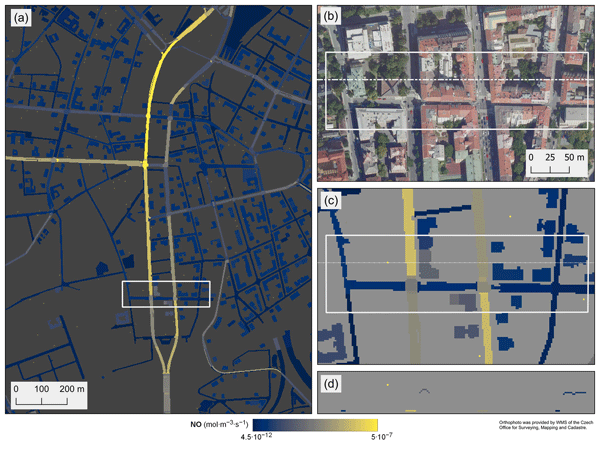
Michal Belda, Nina Benešová, Jaroslav Resler, Peter Huszár, Ondřej Vlček, Pavel Krč, Jan Karlický, Pavel Juruš, and Kryštof Eben
Geosci. Model Dev., 17, 3867–3878, https://doi.org/10.5194/gmd-17-3867-2024, https://doi.org/10.5194/gmd-17-3867-2024, 2024
Short summary
Short summary
For modeling atmospheric chemistry, it is necessary to provide data on emissions of pollutants. These can come from various sources and in various forms, and preprocessing of the data to be ingestible by chemistry models can be quite challenging. We developed the FUME processor to use a database layer that internally transforms all input data into a rigid structure, facilitating further processing to allow for emission processing from the continental to the street scale.
Jelena Radović, Michal Belda, Jaroslav Resler, Kryštof Eben, Martin Bureš, Jan Geletič, Pavel Krč, Hynek Řezníček, and Vladimír Fuka
Geosci. Model Dev., 17, 2901–2927, https://doi.org/10.5194/gmd-17-2901-2024, https://doi.org/10.5194/gmd-17-2901-2024, 2024
Short summary
Short summary
Boundary conditions are of crucial importance for numerical model (e.g., PALM) validation studies and have a large influence on the model results, especially when studying the atmosphere of real, complex, and densely built urban environments. Our experiments with different driving conditions for the large-eddy simulation model PALM show its strong dependency on boundary conditions, which is important for the proper separation of errors coming from the boundary conditions and the model itself.
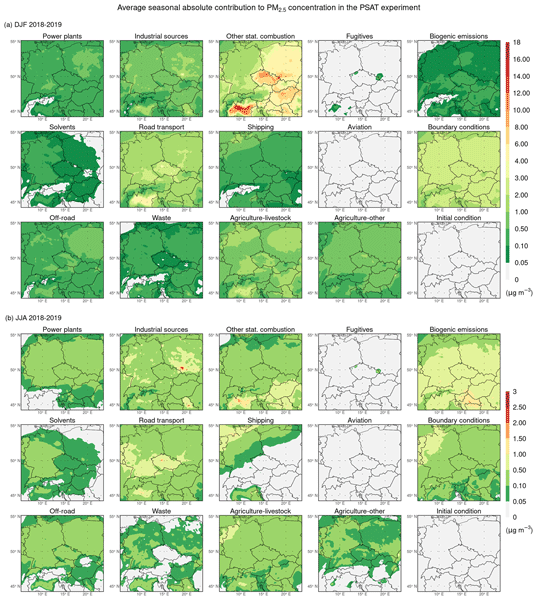
Lukáš Bartík, Peter Huszár, Jan Karlický, Ondřej Vlček, and Kryštof Eben
Atmos. Chem. Phys., 24, 4347–4387, https://doi.org/10.5194/acp-24-4347-2024, https://doi.org/10.5194/acp-24-4347-2024, 2024
Short summary
Short summary
The presented study deals with the attribution of fine particulate matter (PM2.5) concentrations to anthropogenic emissions over Central Europe using regional-scale models. It calculates the present-day contributions of different emissions sectors to concentrations of PM2.5 and its secondary components. Moreover, the study investigates the effect of chemical nonlinearities by using multiple source attribution methods and secondary organic aerosol calculation methods.
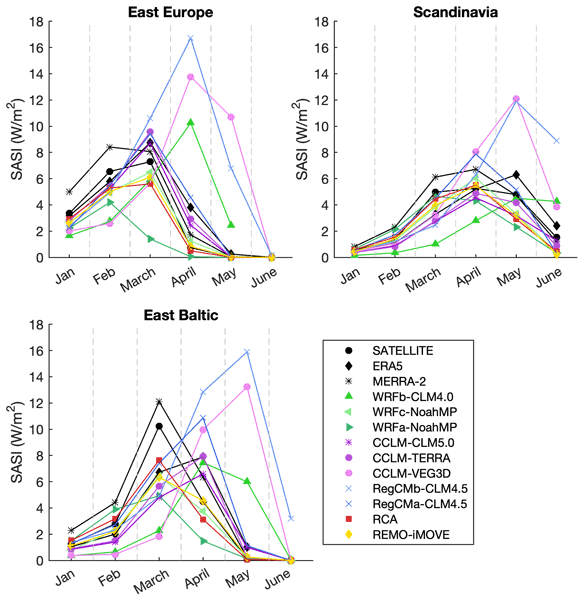
Anne Sophie Daloz, Clemens Schwingshackl, Priscilla Mooney, Susanna Strada, Diana Rechid, Edouard L. Davin, Eleni Katragkou, Nathalie de Noblet-Ducoudré, Michal Belda, Tomas Halenka, Marcus Breil, Rita M. Cardoso, Peter Hoffmann, Daniela C. A. Lima, Ronny Meier, Pedro M. M. Soares, Giannis Sofiadis, Gustav Strandberg, Merja H. Toelle, and Marianne T. Lund
The Cryosphere, 16, 2403–2419, https://doi.org/10.5194/tc-16-2403-2022, https://doi.org/10.5194/tc-16-2403-2022, 2022
Short summary
Short summary
Snow plays a major role in the regulation of the Earth's surface temperature. Together with climate change, rising temperatures are already altering snow in many ways. In this context, it is crucial to better understand the ability of climate models to represent snow and snow processes. This work focuses on Europe and shows that the melting season in spring still represents a challenge for climate models and that more work is needed to accurately simulate snow–atmosphere interactions.
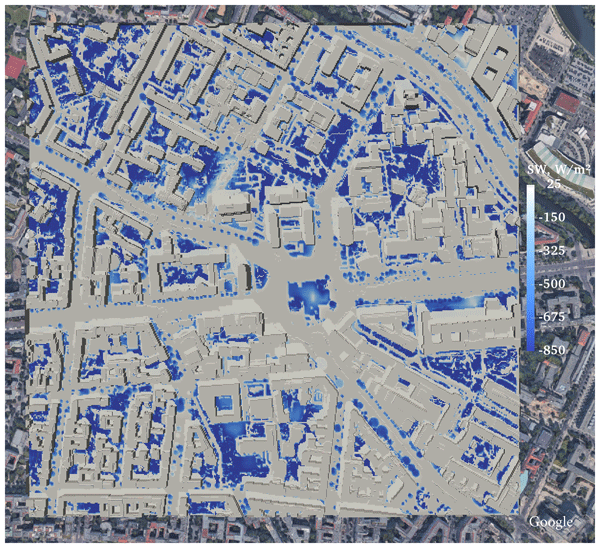
Mohamed H. Salim, Sebastian Schubert, Jaroslav Resler, Pavel Krč, Björn Maronga, Farah Kanani-Sühring, Matthias Sühring, and Christoph Schneider
Geosci. Model Dev., 15, 145–171, https://doi.org/10.5194/gmd-15-145-2022, https://doi.org/10.5194/gmd-15-145-2022, 2022
Short summary
Short summary
Radiative transfer processes are the main energy transport mechanism in urban areas which influence the surface energy budget and drive local convection. We show here the importance of each process to help modellers decide on how much detail they should include in their models to parameterize radiative transfer in urban areas. We showed how the flow field may change in response to these processes and the essential processes needed to assure acceptable quality of the numerical simulations.
Cited articles
Aminipouri, M., Knudby, A. J., Krayenhoff, E. S., Zickfeld, K., and Middel, A.: Modelling the impact of increased street tree cover on mean radiant temperature across Vancouver’s local climate zones, Urban For. Urban Gree., 39, 9–17, https://doi.org/10.1016/j.ufug.2019.01.016, 2019. a
Aoyagi, T. and Takahashi, S.: Development of an Urban Multilayer Radiation Scheme and Its Application to the Urban Surface Warming Potential, Bound.-Lay. Meteorol., 142, 305–328, https://doi.org/10.1007/s10546-011-9679-0, 2012. a
Baklanov, A., Grimmond, C. S. B., Carlson, D., Terblanche, D., Tang, X., Bouchet, V., Lee, B., Langendijk, G., Kolli, R. K., and Hovsepyan, A.: From urban meteorology, climate and environment research to integrated city services, Urban Clim., 23, 330–341, https://doi.org/10.1016/j.uclim.2017.05.004, 2018. a
Belda, M., Resler, J., Geletič, J., Krč, P., Maronga, B., Sühring, M., Kurppa, M., Kanani-Sühring, F., Fuka, V., Eben, K., Benešová, N., and Auvinen, M.: Sensitivity analysis of the PALM model system 6.0 in the urban environment, Geosci. Model Dev., 14, 4443–4464, https://doi.org/10.5194/gmd-14-4443-2021, 2021. a
Blocken, B.: Computational Fluid Dynamics for urban physics: Importance, scales, possibilities, limitations and ten tips and tricks towards accurate and reliable simulations, Build. Environ., 91, 219–245, https://doi.org/10.1016/j.buildenv.2015.02.015, 2015. a
Blocken, B.: LES over RANS in building simulation for outdoor and indoor applications: A foregone conclusion?, Build. Simul., 11, 821–870, https://doi.org/10.1007/s12273-018-0459-3, 2018. a
Bougeault, P. and Lacarrere, P.: Parameterization of Orography-Induced Turbulence in a Mesobeta–Scale Model, Mon. Weather Rev., 117, 1872–1890, https://doi.org/10.1175/1520-0493(1989)117<1872:POOITI>2.0.CO;2, 1989. a
Bruse, M., Simon, H., and Sinsel, T.: Development and implementation of a high-resolution dynamical wall and roof model for ENVI-met. Part 1: General model design and non-vegetated walls and roofs, ENVI-met, https://doi.org/10.13140/RG.2.2.29309.95207, 2023a. a, b
Bruse, M., Simon, H., and Sinsel, T.: Development and implementation of a high-resolution dynamical wall and roof model for ENVI-met. Part 2: Vegetated walls and roofs, ENVI-met, https://doi.org/10.13140/RG.2.2.36020.83842, 2023b. a, b
Chen, L., Yu, B., Yang, F., and Mayer, H.: Intra-urban differences of mean radiant temperature in different urban settings in Shanghai and implications for heat stress under heat waves: A GIS-based approach, Energ. Build., 130, 829–842, https://doi.org/10.1016/j.enbuild.2016.09.014, 2016. a
Chen, T., Pan, H., Lu, M., Hang, J., Lam, C. K. C., Yuan, C., and Pearlmutter, D.: Effects of tree plantings and aspect ratios on pedestrian visual and thermal comfort using scaled outdoor experiments, Sci.Total Environ., 801, 149527, https://doi.org/10.1016/j.scitotenv.2021.149527, 2021. a
Clough, S., Shephard, M., Mlawer, E., Delamere, J., Iacono, M., Cady-Pereira, K., Boukabara, S., and Brown, P.: Atmospheric radiative transfer modeling: a summary of the AER codes, J. Quant. Spectrosc. Ra., 91, 233–244, https://doi.org/10.1016/j.jqsrt.2004.05.058, 2005. a
Dirksen, M., Ronda, R., Theeuwes, N., and Pagani, G.: Sky view factor calculations and its application in urban heat island studies, Urban Clim., 30, 100498, https://doi.org/10.1016/j.uclim.2019.100498, 2019. a
Dudhia, J.: Numerical study of convection observed during the winter monsoon experiment using a mesoscale two-dimensional model, J. Atmos. Sci., 46, 3077–3107, https://doi.org/10.1016/j.uclim.2019.100498, 1989. a
Fanger, P. O.: Calculation of thermal comfort: Introduction of a basic comfort equation, ASHRAE T., 73, III4.1–III4.20, 1967. a
Freitas, S., Catita, C., Redweik, P., and Brito, M. C.: Modelling solar potential in the urban environment: State-of-the-art review, Renew. Sust. Energ. Rev., 41, 915–931, https://doi.org/10.1016/j.rser.2014.08.060, 2015. a
Fröhlich, D. and Matzarakis, A.: Spatial Estimation of Thermal Indices in Urban Areas – Basics of the SkyHelios Model, Atmosphere, 9, 209, https://doi.org/10.3390/atmos9060209, 2018. a
Fröhlich, D., Gangwisch, M., and Matzarakis, A.: Effect of radiation and wind on thermal comfort in urban environments - Application of the RayMan and SkyHelios model, Urban Clim., 27, 1–7, https://doi.org/10.1016/j.uclim.2018.10.006, 2019. a, b
Gál, C. V. and Kántor, N.: Modeling mean radiant temperature in outdoor spaces, A comparative numerical simulation and validation study, Urban Clim., 32, 100571, https://doi.org/10.1016/j.uclim.2019.100571, 2020. a, b
Gehrke, K. F., Sühring, M., and Maronga, B.: Modeling of land–surface interactions in the PALM model system 6.0: land surface model description, first evaluation, and sensitivity to model parameters, Geosci. Model Dev., 14, 5307–5329, https://doi.org/10.5194/gmd-14-5307-2021, 2021. a
Geletič, J., Lehnert, M., Resler, J., Krč, P., Middel, A., Krayenhoff, E., and Krüger, E.: High-fidelity simulation of the effects of street trees, green roofs and green walls on the distribution of thermal exposure in Prague-Dejvice, Build. Environ., 223, 109484, https://doi.org/10.1016/j.buildenv.2022.109484, 2022. a
Geletič, J., Lehnert, M., Resler, J., Krč, P., Bureš, M., Urban, A., and Krayenhoff, E.: Heat exposure variations and mitigation in a densely populated neighborhood during a hot day: Towards a people-oriented approach to urban climate management, Build. Environ., 242, 110564, https://doi.org/10.1016/j.buildenv.2023.110564, 2023. a
Geletič, J., Lehnert, M., Krč, P., Resler, J., and Krayenhoff, E.: High-Resolution Modelling of Thermal Exposure during a Hot Spell: A Case Study Using PALM-4U in Prague, Czech Republic, Atmosphere, 12, 175, https://doi.org/10.3390/atmos12020175, 2021. a
Grylls, T. and van Reeuwijk, M.: How trees affect urban air quality: It depends on the source, Atmos. Environ., 290, 119275, https://doi.org/10.1016/j.atmosenv.2022.119275, 2022. a
Hersbach, H., Bell, B., Berrisford, P., Hirahara, S., Horányi, A., Muñoz-Sabater, J., Nicolas, J., Peubey, C., Radu, R., Schepers, D., Simmons, A., Soci, C., Abdalla, S., Abellan, X., Balsamo, G., Bechtold, P., Biavati, G., Bidlot, J., Bonavita, M., De Chiara, G., Dahlgren, P., Dee, D., Diamantakis, M., Dragani, R., Flemming, J., Forbes, R., Fuentes, M., Geer, A., Haimberger, L., Healy, S., Hogan, J. R., Hólm, E., Janisková, M., Keeley, S., Laloyaux, P., Lopez, P., Lupu, C., Radnoti, G., de Rosnay, P., Rozum, I., Vamborg, F., Villaume, S., and Thépaut, J.-N.: The ERA5 global reanalysis, Q. J. Roy. Meteor. Soc., 146, 1999–2049, https://doi.org/10.1002/qj.3803, 2020. a
Hogan, R. J. and Bozzo, A.: A Flexible and Efficient Radiation Scheme for the ECMWF Model, J. Adv. Model. Earth Sy., 10, 1990–2008, https://doi.org/10.1029/2018MS001364, 2018. a
Holtanová, E., Belda, M., Randriatsara, H., Szabó, A. I., and Halenka, T.: Scenarios of Köppen-Trewartha climate types in Europe based on GCM-RCM combined projections, Theor. Appl. Climatol., 156, https://doi.org/10.1007/s00704-025-05806-3, 2025. a
Höppe, P. R.: The physiological equivalent temperature – a universal index for the biometeorological assessment of the thermal environment, Int. J. Biometeorol., 43, 71–75, https://doi.org/10.1007/s004840050118, 1999. a
Iacono, M. J., Delamere, J. S., Mlawer, E. J., Shephard, M. W., Clough, S. A., and Collins, W. D.: Radiative forcing by long-lived greenhouse gases: Calculations with the AER radiative transfer models, J. Geophys. Res.-Atmos., 113, https://doi.org/10.1029/2008JD009944, 2008. a, b, c, d
Jänicke, B., Meier, F., Hoelscher, M., and Scherer, D.: Evaluating the effects of façade greening on human bioclimate in a complex urban environment, Adv. Meteorol., 14, 747259, https://doi.org/10.1155/2015/747259, 2015. a, b
Jakub, F. and Mayer, B.: 3-D radiative transfer in large-eddy simulations – experiences coupling the TenStream solver to the UCLA-LES, Geosci. Model Dev., 9, 1413–1422, https://doi.org/10.5194/gmd-9-1413-2016, 2016. a
Jendritzky, G., de Dear, R., and Havenith, G.: UTCI – Why another thermal index?, Int. J. Biometeorol., 56, 421–428, https://doi.org/10.1007/s00484-011-0513-7, 2012. a
Jimenez, P. A., Dudhia, J., Gonzalez–Rouco, J. F., Navarro, J., Montavez, J. P., and Garcia–Bustamante, E.: A revised scheme for the WRF surface layer formulation, Mon. Weather Rev., 140, 898–918, https://doi.org/10.1175/MWR-D-11-00056.1, 2012. a, b
Jura, J., Novák, M., Bíla, J., Pokorný, J., and Jirka, V.: Hydrometeorological measurements to assess the effect of vegetation on urban microclimate, in: 2018 Smart City Symposium Prague, 1–5, https://doi.org/10.1109/SCSP.2018.8402653, 2018. a, b, c
Kadasch, E., Sühring, M., Gronemeier, T., and Raasch, S.: Mesoscale nesting interface of the PALM model system 6.0, Geosci. Model Dev., 14, 5435–5465, https://doi.org/10.5194/gmd-14-5435-2021, 2021. a
Kántor, N., Gál, C., Gulyás, Á., and Unger, J.: The impact of façade orientation and woody vegetation on summertime heat stress patterns in a central European square: comparison of radiation measurements and simulations, Adv. Meteorol., 2650642, https://doi.org/10.1155/2018/2650642, 2018. a
Krč, P., Belda, M., Bureš, M., Eben, K., Geletič, J., Radović, J., Řezníček, H., and Resler, J.: PALM-meteo 2.8: Processor of PALM meteorological input data, Geosci. Model Dev., 19, 4071–4093, https://doi.org/10.5194/gmd-19-4071-2026, 2026. a
Kubilay, A., Allegrini, J., Strebel, D., Zhao, Y., Derome, D., and Carmeliet, J.: Advancement in Urban Climate Modelling at Local Scale: Urban Heat Island Mitigation and Building Cooling Demand, Atmosphere, 11, https://doi.org/10.3390/atmos11121313, 2020. a
Kusaka, H., Ikeda, R., Sato, T., Iizuka, S., and Boku, T.: Development of a Multi-Scale Meteorological Large-Eddy Simulation Model for Urban Thermal Environmental Studies: The “City-LES” Model Version 2.0, J. Adv. Model. Earth Sy., 16, e2024MS004367, https://doi.org/10.1029/2024MS004367, 2024. a, b
Lee, H., Mayer, H., and Schindler, D.: Importance of 3-D radiant flux densities for outdoor human thermal comfort on clear-sky summer days in Freiburg, Southwest Germany, Meteorol. Z., 23, 315–330, https://doi.org/10.1127/0941-2948/2014/0536, 2014. a
Lehnert, M., Pánek, J., Kopp, J., Geletič, J., Květoňová, V., and Jurek, M.: Thermal comfort in urban areas on hot summer days and its improvement through participatory mapping: A case study of two Central European cities, Landscape Urban Plan., 233, 104713, https://doi.org/10.1016/j.landurbplan.2023.104713, 2023. a
Lindberg, F., Holmer, B., and Thorsson, S.: SOLWEIG 1.0 – Modelling spatial variations of 3D radiant fluxes and mean radiant temperature in complex urban settings, Int. J. Biometeorol., 52, 697–713, https://doi.org/10.1007/s00484-008-0162-7, 2008. a
Liu, D., Hu, S., and Liu, J.: Contrasting the performance capabilities of urban radiation field between three microclimate simulation tools, Build. Environ., 175, 106789, https://doi.org/10.1016/j.buildenv.2020.106789, 2020. a
Liu, Z., Zheng, S., and Zhao, L.: Evaluation of the ENVI-Met Vegetation Model of Four Common Tree Species in a Subtropical Hot-Humid Area, Atmosphere, 9, 198, https://doi.org/10.3390/atmos9050198, 2018. a
Maronga, B., Gryschka, M., Heinze, R., Hoffmann, F., Kanani-Sühring, F., Keck, M., Ketelsen, K., Letzel, M. O., Sühring, M., and Raasch, S.: The Parallelized Large-Eddy Simulation Model (PALM) version 4.0 for atmospheric and oceanic flows: model formulation, recent developments, and future perspectives, Geosci. Model Dev., 8, 2515–2551, https://doi.org/10.5194/gmd-8-2515-2015, 2015. a, b
Maronga, B., Banzhaf, S., Burmeister, C., Esch, T., Forkel, R., Fröhlich, D., Fuka, V., Gehrke, K. F., Geletič, J., Giersch, S., Gronemeier, T., Groß, G., Heldens, W., Hellsten, A., Hoffmann, F., Inagaki, A., Kadasch, E., Kanani-Sühring, F., Ketelsen, K., Khan, B. A., Knigge, C., Knoop, H., Krč, P., Kurppa, M., Maamari, H., Matzarakis, A., Mauder, M., Pallasch, M., Pavlik, D., Pfafferott, J., Resler, J., Rissmann, S., Russo, E., Salim, M., Schrempf, M., Schwenkel, J., Seckmeyer, G., Schubert, S., Sühring, M., von Tils, R., Vollmer, L., Ward, S., Witha, B., Wurps, H., Zeidler, J., and Raasch, S.: Overview of the PALM model system 6.0, Geosci. Model Dev., 13, 1335–1372, https://doi.org/10.5194/gmd-13-1335-2020, 2020. a, b, c, d, e, f, g
Martilli, A., Clappier, A., and Rotach, M.: An Urban Surface Exchange Parameterisation for Mesoscale Models, Bound.-Lay. Meteorol., 261–304, https://doi.org/10.1023/A:1016099921195, 2002. a
Matuschek, O. and Matzarakis, A.: A mapping tool for climatological applications, Meteorol. Appl., 18, 230–237, https://doi.org/10.1002/met.233, 2011. a
Matzarakis, A., Rutz, F., and Mayer, H.: Modelling radiation fluxes in simple and complex environments – Application of the RayMan model, International J. Biometeorol., 51, 323–334, https://doi.org/10.1007/s00484-006-0061-8, 2007. a
Matzarakis, A., Rutz, F., and Mayer, H.: Modelling radiation fluxes in simple and complex environments: basics of the RayMan model, Int. J. Biometeorol., 54, 131–139, https://doi.org/10.1007/s00484-009-0261-0, 2010. a, b, c
Middel, A., Lukasczyk, J., and Maciejewski, R.: Sky View Factors from Synthetic Fisheye Photos for Thermal Comfort Routing – A Case Study in Phoenix, Arizona, Urban Plann., 2, 19–30, https://doi.org/10.17645/up.v2i1.855, 2017. a
Mlawer, E. J., Taubman, S. J., Brown, P. D., Iacono, M. J., and Clough, S. A.: Radiative transfer for inhomogeneous atmospheres: RRTM, a validated correlated-k model for the longwave, J. Geophys. Res., 102, 16663–16682, https://doi.org/10.1029/97JD00237, 1997. a
Nakanishi, M. and Niino, H.: Development of an Improved Turbulence Closure Model for the Atmospheric Boundary Layer, J. Meteorol. Soc. Jpn. Ser. II, 87, 895–912, https://doi.org/10.2151/jmsj.87.895, 2009. a
Oke, T. R., Mills, G., Christen, A., and Voogt, J. A.: Urban climates, Cambridge University Press, https://doi.org/10.1017/9781139016476, 2017. a
Piselli, C., Castaldo, V., Pigliautile, I., Pisello, A., and Cotana, F.: Outdoor comfort conditions in urban areas: On citizens’ perspective about microclimate mitigation of urban transit areas, Sustain. Cities Soc., 39, 16–36, https://doi.org/10.1016/j.scs.2018.02.004, 2018. a
Radović, J., Belda, M., Resler, J., Eben, K., Bureš, M., Geletič, J., Krč, P., Řezníček, H., and Fuka, V.: Challenges of constructing and selecting the “perfect” boundary conditions for the large-eddy simulation model PALM, Geosci. Model Dev., 17, 2901–2927, https://doi.org/10.5194/gmd-17-2901-2024, 2024. a, b, c
Radović, J., Belda, M., Bureš, M., Eben, K., Jan, G., Jura, J., Krč, P., Řezníček, H., and Resler, J.: Dataset: Evaluating the radiative fidelity of PALM (v25.04) in high-resolution: impact of diverse urban morphology and vegetation on short-wave radiation, Zenodo [data set], https://doi.org/10.5281/zenodo.19231961, 2026. a
Rao, V. R. and Sastri, V. M. K.: Efficient evaluation of diffuse view factors for radiation, Int. J. Heat Mass Tran., 39, 1281–1286, https://doi.org/10.1016/0017-9310(95)00203-0, 1996. a
Resler, J., Krč, P., Belda, M., Juruš, P., Benešová, N., Lopata, J., Vlček, O., Damašková, D., Eben, K., Derbek, P., Maronga, B., and Kanani-Sühring, F.: PALM-USM v1.0: A new urban surface model integrated into the PALM large-eddy simulation model, Geosci. Model Dev., 10, 3635–3659, https://doi.org/10.5194/gmd-10-3635-2017, 2017. a, b, c, d, e
Resler, J., Eben, K., Geletič, J., Krč, P., Rosecký, M., Sühring, M., Belda, M., Fuka, V., Halenka, T., Huszár, P., Karlický, J., Benešová, N., Ďoubalová, J., Honzáková, K., Keder, J., Nápravníková, Š., and Vlček, O.: Validation of the PALM model system 6.0 in a real urban environment: a case study in Dejvice, Prague, the Czech Republic, Geosci. Model Dev., 14, 4797–4842, https://doi.org/10.5194/gmd-14-4797-2021, 2021. a, b, c, d
Resler, J., Bauerová, P., Belda, M., Bureš, M., Eben, K., Fuka, V., Geletič, J., Jareš, R., Karel, J., Keder, J., Krč, P., Patiño, W., Radović, J., Řezníček, H., Sühring, M., Šindelářová, A., and Vlček, O.: Challenges of high-fidelity air quality modeling in urban environments – PALM sensitivity study during stable conditions, Geosci. Model Dev., 17, 7513–7537, https://doi.org/10.5194/gmd-17-7513-2024, 2024. a
Salamanca, F. and Martilli, A.: A new Building Energy Model coupled with an Urban Canopy Parameterization for urban climate simulations – part II. Validation with one dimension off-line simulations, Theor. Applied Climatol., 99, 345–356, https://doi.org/10.1007/s00704-009-0143-8, 2009. a
Salim, M. H., Schubert, S., Resler, J., Krč, P., Maronga, B., Kanani-Sühring, F., Sühring, M., and Schneider, C.: Importance of radiative transfer processes in urban climate models: a study based on the PALM 6.0 model system, Geosci. Model Dev., 15, 145–171, https://doi.org/10.5194/gmd-15-145-2022, 2022. a, b, c
Schoetter, R., Caliot, C., Chung, T.-Y., Hogan, R. J., and Masson, V.: Local Climate Zones for Urban Temperature Studies, Bound.-Lay. Meteorol., 189, 103–138, https://doi.org/10.1007/s10546-023-00827-9, 2023. a
Skamarock, W. C., Klemp, J. B., Dudhia, J., Gill, D. O., Liu, Z., Berner, J., Wang, W., Powers, J. G., Duda, M. G., Barker, D. M., and Huang, X.-Y.: A Description of the Advanced Research WRF Version 4, NCAR technical note, https://doi.org/10.5065/1dfh-6p97, 2019. a
Stewart, I. D. and Oke, T. R.: Local Climate Zones for Urban Temperature Studies, B. Am. Meteorol. Soc., 93, 1879–1900, https://doi.org/10.1175/BAMS-D-11-00019.1, 2012. a
Suter, I., Grylls, T., Sützl, B. S., Owens, S. O., Wilson, C. E., and van Reeuwijk, M.: uDALES 1.0: a large-eddy simulation model for urban environments, Geosci. Model Dev., 15, 5309–5335, https://doi.org/10.5194/gmd-15-5309-2022, 2022. a
Tewari, M., Chen, F., Wang, W., Dudhia, J., LeMone, M. A., Mitchell, K., Ek, M., Gayno, G., Wegiel, J., and Cuenca, R. H.: Implementation and verification of the unified NOAH land surface model in the WRF model, in: 20th conference on weather analysis and forecasting/16th conference on numerical weather prediction, 11–15, https://www2.mmm.ucar.edu/wrf/users/physics/phys_refs/LAND_SURFACE/noah.pdf (last access: 10 January 2026), 2004. a, b
Thompson, G., Field, P. R., Rasmussen, R. M., and Hall, W. D.: Explicit Forecasts of Winter Precipitation Using an Improved Bulk Microphysics Scheme. Part II: Implementation of a New Snow Parameterization, Mon. Weather Rev., 136, 5095–5115, https://doi.org/10.1175/2008MWR2387.1, 2008. a, b
Toparlar, Y., Blocken, B., Maiheu, B., and van Heijst, G. J. F.: A review on the CFD analysis of urban microclimate, Renew. Sust. Energ. Rev., 80, 1613–1640, https://doi.org/10.1016/j.rser.2017.05.248, 2017. a
United Nations: World Population Prospects 2024: Summary of Results, UN DESA/POP/2024/TR/NO. 9, https://population.un.org/wpp/assets/Files/WPP2024_Summary-of-Results.pdf (last access: 8 October 2025), 2024. a
Vieira Zezzo, L., Pereira Coltri, P., and Dubreuil, V.: Microscale models and urban heat island studies: a systematic review, Environ. Monit. Asses., 195, 1284, https://doi.org/10.1007/s10661-023-11906-2, 2023. a
Wallenberg, N., Lindberg, F., Holmer, B., and Thorsson, S.: The influence of anisotropic diffuse shortwave radiation on mean radiant temperature in outdoor urban environments, Urban Clim., 31, 100589, https://doi.org/10.1016/j.uclim.2020.100589, 2020. a
Wang, Y. and Akbari, H.: The effects of street tree planting on Urban Heat Island mitigation in Montreal, Sustain. Cities Soc., 27, 122–128, https://doi.org/10.1016/j.scs.2016.04.013, 2016. a
Willmott, C. J.: On The Validation Of Models, Phys. Geogr., 2, 184–194, https://doi.org/10.1080/02723646.1981.10642213, 1981. a
World Meteorological Organization: Guide to Instruments and Methods of Observation, Volume III – Observing Systems, WMO-No. 8, https://doi.org/10.59327/WMO/CIMO/3, 2024. a
Yang, S., Wang, L., Stathopoulos, T., and Marey, A. M.: Urban microclimate and its impact on built environment – A review, Build. Environ., 238, 110334, https://doi.org/10.1016/j.buildenv.2023.110334, 2023. a
Short summary
In this experiment, the Parallelized Large-Eddy Simulation Model (PALM)’s performance in simulating incoming and outgoing short-wave radiation in a densely built, highly heterogeneous urban environment was validated. In particular, we assessed whether the micro-scale model realistically resolves the effects of three-dimensional urban morphology and vegetation on short-wave radiation, including its propagation, shading, reflection, and attenuation within the simulated domain.
In this experiment, the Parallelized Large-Eddy Simulation Model (PALM)’s performance in...


