Articles | Volume 19, issue 2
https://doi.org/10.5194/gmd-19-1007-2026
© Author(s) 2026. This work is distributed under
the Creative Commons Attribution 4.0 License.
https://doi.org/10.5194/gmd-19-1007-2026
© Author(s) 2026. This work is distributed under
the Creative Commons Attribution 4.0 License.
Automated stratigraphic interpretation from drillhole lithological descriptions with uncertainty quantification: litho2strat 1.0
Centre for Exploration Targeting (School of Earth and Oceans), The University of Western Australia, Crawley, 6009 WA, Australia
Mineral Exploration Cooperative Research Centre, The University of Western Australia, Crawley, 6009 WA, Australia
Mark Jessell
Centre for Exploration Targeting (School of Earth and Oceans), The University of Western Australia, Crawley, 6009 WA, Australia
Mineral Exploration Cooperative Research Centre, The University of Western Australia, Crawley, 6009 WA, Australia
Related authors
Lawrence A. Bird, Vitaliy Ogarko, Laurent Ailleres, Lachlan Grose, Jérémie Giraud, Felicity S. McCormack, David E. Gwyther, Jason L. Roberts, Richard S. Jones, and Andrew N. Mackintosh
The Cryosphere, 19, 3355–3380, https://doi.org/10.5194/tc-19-3355-2025, https://doi.org/10.5194/tc-19-3355-2025, 2025
Short summary
Short summary
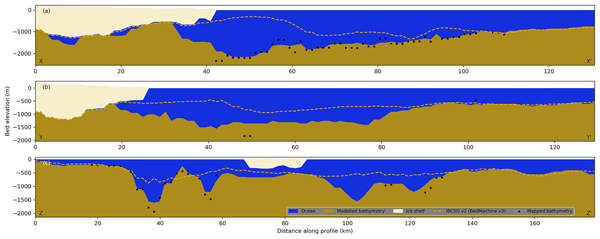
The terrain of the seafloor has important controls on the access of warm water below floating ice shelves around Antarctica. Here, we present an open-source method to infer what the seafloor looks like around the Antarctic continent and within these ice shelf cavities, using measurements of the Earth's gravitational field. We present an improved seafloor map for the Vincennes Bay region in East Antarctica and assess its impact on ice melt rates.
Mark Douglas Lindsay, Vitaliy Ogarko, Jeremie Giraud, and Mosayeb Khademi
EGUsphere, https://doi.org/10.5194/egusphere-2024-3754, https://doi.org/10.5194/egusphere-2024-3754, 2025
Preprint archived
Short summary
Short summary
Geophysical data is used to understand the Earth's structure. Geophysical inversion is an optimisation technique that constructs a model of the Earth using geophysical data. Inversion is complex and requires constraints to produce a plausible model. Overfitting is a disadvantageous effect that can affect techniques that rely on optimisation. A new feature in an inversion platform reduces overfitting by informing inversion of spatial uncertainty contained within the geophysical data.
Vitaliy Ogarko, Kim Frankcombe, Taige Liu, Jeremie Giraud, Roland Martin, and Mark Jessell
Geosci. Model Dev., 17, 2325–2345, https://doi.org/10.5194/gmd-17-2325-2024, https://doi.org/10.5194/gmd-17-2325-2024, 2024
Short summary
Short summary
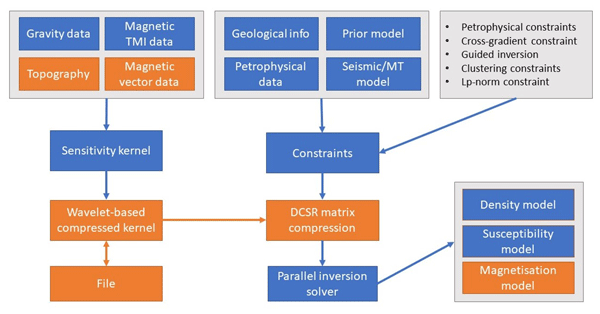
We present a major release of the Tomofast-x open-source gravity and magnetic inversion code that is enhancing its performance and applicability for both industrial and academic studies. We focus on real-world mineral exploration scenarios, while offering flexibility for applications at regional scale or for crustal studies. The optimisation work described in this paper is fundamental to allowing more complete descriptions of the controls on magnetisation, including remanence.
Jiateng Guo, Xuechuang Xu, Luyuan Wang, Xulei Wang, Lixin Wu, Mark Jessell, Vitaliy Ogarko, Zhibin Liu, and Yufei Zheng
Geosci. Model Dev., 17, 957–973, https://doi.org/10.5194/gmd-17-957-2024, https://doi.org/10.5194/gmd-17-957-2024, 2024
Short summary
Short summary
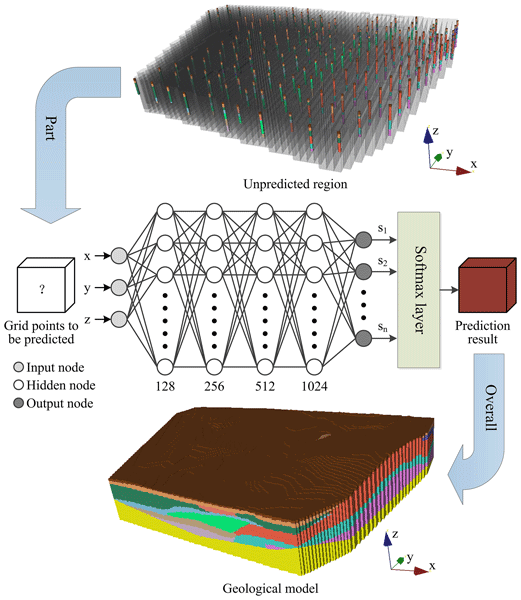
This study proposes a semi-supervised learning algorithm using pseudo-labels for 3D geological modelling. We establish a 3D geological model using borehole data from a complex real urban local survey area in Shenyang and make an uncertainty analysis of this model. The method effectively expands the sample space, which is suitable for geomodelling and uncertainty analysis from boreholes. The modelling results perform well in terms of spatial morphology and geological semantics.
Jérémie Giraud, Guillaume Caumon, Lachlan Grose, Vitaliy Ogarko, and Paul Cupillard
Solid Earth, 15, 63–89, https://doi.org/10.5194/se-15-63-2024, https://doi.org/10.5194/se-15-63-2024, 2024
Short summary
Short summary
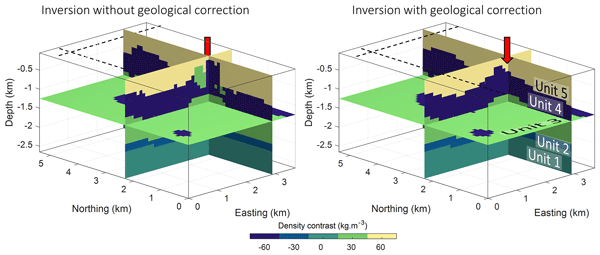
We present and test an algorithm that integrates geological modelling into deterministic geophysical inversion. This is motivated by the need to model the Earth using all available data and to reconcile the different types of measurements. We introduce the methodology and test our algorithm using two idealised scenarios. Results suggest that the method we propose is effectively capable of improving the models recovered by geophysical inversion and may be applied in real-world scenarios.
Jérémie Giraud, Hoël Seillé, Mark D. Lindsay, Gerhard Visser, Vitaliy Ogarko, and Mark W. Jessell
Solid Earth, 14, 43–68, https://doi.org/10.5194/se-14-43-2023, https://doi.org/10.5194/se-14-43-2023, 2023
Short summary
Short summary
We propose and apply a workflow to combine the modelling and interpretation of magnetic anomalies and resistivity anomalies to better image the basement. We test the method on a synthetic case study and apply it to real world data from the Cloncurry area (Queensland, Australia), which is prospective for economic minerals. Results suggest a new interpretation of the composition and structure towards to east of the profile that we modelled.
Mark Jessell, Jiateng Guo, Yunqiang Li, Mark Lindsay, Richard Scalzo, Jérémie Giraud, Guillaume Pirot, Ed Cripps, and Vitaliy Ogarko
Earth Syst. Sci. Data, 14, 381–392, https://doi.org/10.5194/essd-14-381-2022, https://doi.org/10.5194/essd-14-381-2022, 2022
Short summary
Short summary
To robustly train and test automated methods in the geosciences, we need to have access to large numbers of examples where we know
the answer. We present a suite of synthetic 3D geological models with their gravity and magnetic responses that allow researchers to test their methods on a whole range of geologically plausible models, thus overcoming one of the fundamental limitations of automation studies.
Jérémie Giraud, Vitaliy Ogarko, Roland Martin, Mark Jessell, and Mark Lindsay
Geosci. Model Dev., 14, 6681–6709, https://doi.org/10.5194/gmd-14-6681-2021, https://doi.org/10.5194/gmd-14-6681-2021, 2021
Short summary
Short summary
We review different techniques to model the Earth's subsurface from geophysical data (gravity field anomaly, magnetic field anomaly) using geological models and measurements of the rocks' properties. We show examples of application using idealised examples reproducing realistic features and provide theoretical details of the open-source algorithm we use.
Mahtab Rashidifard, Jérémie Giraud, Mark Lindsay, Mark Jessell, and Vitaliy Ogarko
Solid Earth, 12, 2387–2406, https://doi.org/10.5194/se-12-2387-2021, https://doi.org/10.5194/se-12-2387-2021, 2021
Short summary
Short summary
One motivation for this study is to develop a workflow that enables the integration of geophysical datasets with different coverages that are quite common in exploration geophysics. We have utilized a level set approach to achieve this goal. The utilized technique parameterizes the subsurface in the same fashion as geological models. Our results indicate that the approach is capable of integrating information from seismic data in 2D to guide the 3D inversion results of the gravity data.
Mark Jessell, Vitaliy Ogarko, Yohan de Rose, Mark Lindsay, Ranee Joshi, Agnieszka Piechocka, Lachlan Grose, Miguel de la Varga, Laurent Ailleres, and Guillaume Pirot
Geosci. Model Dev., 14, 5063–5092, https://doi.org/10.5194/gmd-14-5063-2021, https://doi.org/10.5194/gmd-14-5063-2021, 2021
Short summary
Short summary
We have developed software that allows the user to extract sufficient information from unmodified digital maps and associated datasets that we are able to use to automatically build 3D geological models. By automating the process we are able to remove human bias from the procedure, which makes the workflow reproducible.
Léonard Moracchini, Guillaume Pirot, Kerry Bardot, Mark W. Jessell, and James L. McCallum
Geosci. Model Dev., 18, 7147–7163, https://doi.org/10.5194/gmd-18-7147-2025, https://doi.org/10.5194/gmd-18-7147-2025, 2025
Short summary
Short summary
To facilitate the exploration of alternative hydrogeological scenarios, we propose approximating costly physical simulations of contaminant transport by means of more affordable shortest-distance computations. This enables us to accept or reject scenarios within a predefined confidence interval. In particular, this can allow us to estimate the probability of a fault acting as a preferential path or a barrier.
Lawrence A. Bird, Vitaliy Ogarko, Laurent Ailleres, Lachlan Grose, Jérémie Giraud, Felicity S. McCormack, David E. Gwyther, Jason L. Roberts, Richard S. Jones, and Andrew N. Mackintosh
The Cryosphere, 19, 3355–3380, https://doi.org/10.5194/tc-19-3355-2025, https://doi.org/10.5194/tc-19-3355-2025, 2025
Short summary
Short summary
The terrain of the seafloor has important controls on the access of warm water below floating ice shelves around Antarctica. Here, we present an open-source method to infer what the seafloor looks like around the Antarctic continent and within these ice shelf cavities, using measurements of the Earth's gravitational field. We present an improved seafloor map for the Vincennes Bay region in East Antarctica and assess its impact on ice melt rates.
Mark Douglas Lindsay, Vitaliy Ogarko, Jeremie Giraud, and Mosayeb Khademi
EGUsphere, https://doi.org/10.5194/egusphere-2024-3754, https://doi.org/10.5194/egusphere-2024-3754, 2025
Preprint archived
Short summary
Short summary
Geophysical data is used to understand the Earth's structure. Geophysical inversion is an optimisation technique that constructs a model of the Earth using geophysical data. Inversion is complex and requires constraints to produce a plausible model. Overfitting is a disadvantageous effect that can affect techniques that rely on optimisation. A new feature in an inversion platform reduces overfitting by informing inversion of spatial uncertainty contained within the geophysical data.
Vitaliy Ogarko, Kim Frankcombe, Taige Liu, Jeremie Giraud, Roland Martin, and Mark Jessell
Geosci. Model Dev., 17, 2325–2345, https://doi.org/10.5194/gmd-17-2325-2024, https://doi.org/10.5194/gmd-17-2325-2024, 2024
Short summary
Short summary
We present a major release of the Tomofast-x open-source gravity and magnetic inversion code that is enhancing its performance and applicability for both industrial and academic studies. We focus on real-world mineral exploration scenarios, while offering flexibility for applications at regional scale or for crustal studies. The optimisation work described in this paper is fundamental to allowing more complete descriptions of the controls on magnetisation, including remanence.
Jiateng Guo, Xuechuang Xu, Luyuan Wang, Xulei Wang, Lixin Wu, Mark Jessell, Vitaliy Ogarko, Zhibin Liu, and Yufei Zheng
Geosci. Model Dev., 17, 957–973, https://doi.org/10.5194/gmd-17-957-2024, https://doi.org/10.5194/gmd-17-957-2024, 2024
Short summary
Short summary
This study proposes a semi-supervised learning algorithm using pseudo-labels for 3D geological modelling. We establish a 3D geological model using borehole data from a complex real urban local survey area in Shenyang and make an uncertainty analysis of this model. The method effectively expands the sample space, which is suitable for geomodelling and uncertainty analysis from boreholes. The modelling results perform well in terms of spatial morphology and geological semantics.
Jérémie Giraud, Guillaume Caumon, Lachlan Grose, Vitaliy Ogarko, and Paul Cupillard
Solid Earth, 15, 63–89, https://doi.org/10.5194/se-15-63-2024, https://doi.org/10.5194/se-15-63-2024, 2024
Short summary
Short summary
We present and test an algorithm that integrates geological modelling into deterministic geophysical inversion. This is motivated by the need to model the Earth using all available data and to reconcile the different types of measurements. We introduce the methodology and test our algorithm using two idealised scenarios. Results suggest that the method we propose is effectively capable of improving the models recovered by geophysical inversion and may be applied in real-world scenarios.
Jérémie Giraud, Hoël Seillé, Mark D. Lindsay, Gerhard Visser, Vitaliy Ogarko, and Mark W. Jessell
Solid Earth, 14, 43–68, https://doi.org/10.5194/se-14-43-2023, https://doi.org/10.5194/se-14-43-2023, 2023
Short summary
Short summary
We propose and apply a workflow to combine the modelling and interpretation of magnetic anomalies and resistivity anomalies to better image the basement. We test the method on a synthetic case study and apply it to real world data from the Cloncurry area (Queensland, Australia), which is prospective for economic minerals. Results suggest a new interpretation of the composition and structure towards to east of the profile that we modelled.
Guillaume Pirot, Ranee Joshi, Jérémie Giraud, Mark Douglas Lindsay, and Mark Walter Jessell
Geosci. Model Dev., 15, 4689–4708, https://doi.org/10.5194/gmd-15-4689-2022, https://doi.org/10.5194/gmd-15-4689-2022, 2022
Short summary
Short summary
Results of a survey launched among practitioners in the mineral industry show that despite recognising the importance of uncertainty quantification it is not very well performed due to lack of data, time requirements, poor tracking of interpretations and relative complexity of uncertainty quantification. To alleviate the latter, we provide an open-source set of local and global indicators to measure geological uncertainty among an ensemble of geological models.
Richard Scalzo, Mark Lindsay, Mark Jessell, Guillaume Pirot, Jeremie Giraud, Edward Cripps, and Sally Cripps
Geosci. Model Dev., 15, 3641–3662, https://doi.org/10.5194/gmd-15-3641-2022, https://doi.org/10.5194/gmd-15-3641-2022, 2022
Short summary
Short summary
This paper addresses numerical challenges in reasoning about geological models constrained by sensor data, especially models that describe the history of an area in terms of a sequence of events. Our method ensures that small changes in simulated geological features, such as the position of a boundary between two rock layers, do not result in unrealistically large changes to resulting sensor measurements, as occur presently using several popular modeling packages.
Mark Jessell, Jiateng Guo, Yunqiang Li, Mark Lindsay, Richard Scalzo, Jérémie Giraud, Guillaume Pirot, Ed Cripps, and Vitaliy Ogarko
Earth Syst. Sci. Data, 14, 381–392, https://doi.org/10.5194/essd-14-381-2022, https://doi.org/10.5194/essd-14-381-2022, 2022
Short summary
Short summary
To robustly train and test automated methods in the geosciences, we need to have access to large numbers of examples where we know
the answer. We present a suite of synthetic 3D geological models with their gravity and magnetic responses that allow researchers to test their methods on a whole range of geologically plausible models, thus overcoming one of the fundamental limitations of automation studies.
Ranee Joshi, Kavitha Madaiah, Mark Jessell, Mark Lindsay, and Guillaume Pirot
Geosci. Model Dev., 14, 6711–6740, https://doi.org/10.5194/gmd-14-6711-2021, https://doi.org/10.5194/gmd-14-6711-2021, 2021
Short summary
Short summary
We have developed a software that allows the user to extract and standardize drill hole information from legacy datasets and/or different drilling campaigns. It also provides functionality to upscale the lithological information. These functionalities were possible by developing thesauri to identify and group geological terminologies together.
Jérémie Giraud, Vitaliy Ogarko, Roland Martin, Mark Jessell, and Mark Lindsay
Geosci. Model Dev., 14, 6681–6709, https://doi.org/10.5194/gmd-14-6681-2021, https://doi.org/10.5194/gmd-14-6681-2021, 2021
Short summary
Short summary
We review different techniques to model the Earth's subsurface from geophysical data (gravity field anomaly, magnetic field anomaly) using geological models and measurements of the rocks' properties. We show examples of application using idealised examples reproducing realistic features and provide theoretical details of the open-source algorithm we use.
Mahtab Rashidifard, Jérémie Giraud, Mark Lindsay, Mark Jessell, and Vitaliy Ogarko
Solid Earth, 12, 2387–2406, https://doi.org/10.5194/se-12-2387-2021, https://doi.org/10.5194/se-12-2387-2021, 2021
Short summary
Short summary
One motivation for this study is to develop a workflow that enables the integration of geophysical datasets with different coverages that are quite common in exploration geophysics. We have utilized a level set approach to achieve this goal. The utilized technique parameterizes the subsurface in the same fashion as geological models. Our results indicate that the approach is capable of integrating information from seismic data in 2D to guide the 3D inversion results of the gravity data.
Lachlan Grose, Laurent Ailleres, Gautier Laurent, Guillaume Caumon, Mark Jessell, and Robin Armit
Geosci. Model Dev., 14, 6197–6213, https://doi.org/10.5194/gmd-14-6197-2021, https://doi.org/10.5194/gmd-14-6197-2021, 2021
Short summary
Short summary
Fault discontinuities in rock packages represent the plane where two blocks of rock have moved. They are challenging to incorporate into geological models because the geometry of the faulted rock units are defined by not only the location of the discontinuity but also the kinematics of the fault. In this paper, we outline a structural geology framework for incorporating faults into geological models by directly incorporating kinematics into the mathematical framework of the model.
Mark Jessell, Vitaliy Ogarko, Yohan de Rose, Mark Lindsay, Ranee Joshi, Agnieszka Piechocka, Lachlan Grose, Miguel de la Varga, Laurent Ailleres, and Guillaume Pirot
Geosci. Model Dev., 14, 5063–5092, https://doi.org/10.5194/gmd-14-5063-2021, https://doi.org/10.5194/gmd-14-5063-2021, 2021
Short summary
Short summary
We have developed software that allows the user to extract sufficient information from unmodified digital maps and associated datasets that we are able to use to automatically build 3D geological models. By automating the process we are able to remove human bias from the procedure, which makes the workflow reproducible.
Lachlan Grose, Laurent Ailleres, Gautier Laurent, and Mark Jessell
Geosci. Model Dev., 14, 3915–3937, https://doi.org/10.5194/gmd-14-3915-2021, https://doi.org/10.5194/gmd-14-3915-2021, 2021
Short summary
Short summary
LoopStructural is an open-source 3D geological modelling library with a model design allowing for multiple different algorithms to be used for comparison for the same geology. Geological structures are modelled using structural geology concepts and techniques, allowing for complex structures such as overprinted folds and faults to be modelled. In the paper, we demonstrate automatically generating a 3-D model from map2loop-processed geological survey data of the Flinders Ranges, South Australia.
Cited articles
Alvarado-Neves, F., Ailleres, L., Grose, L., Cruden, A. R., and Armit, R.: Three-dimensional geological modelling of igneous intrusions in LoopStructural v1.5.10, Geoscientific Model Development, 17, 1975–1993, https://doi.org/10.5194/gmd-17-1975-2024, 2024.
Calcagno, P., Chilès, J. P., Courrioux, G., and Guillen, A.: Geological modelling from field data and geological knowledge, Physics of the Earth and Planetary Interiors, 171, 147–157, https://doi.org/10.1016/j.pepi.2008.06.013, 2008.
Caumon, G., Collon-Drouaillet, P., Le Carlier de Veslud, C., Viseur, S., and Sausse, J.: Surface-Based 3D Modeling of Geological Structures, Mathematical Geosciences, 41, 927–945, https://doi.org/10.1007/s11004-009-9244-2, 2009.
D'Affonseca, F. M., Finkel, M., and Cirpka, O. A.: Combining implicit geological modeling, field surveys, and hydrogeological modeling to describe groundwater flow in a karst aquifer, Hydrogeology Journal, 28, 2779–2802, https://doi.org/10.1007/s10040-020-02220-z, 2020.
Fullagar, P. K., Zhou, B., and Biggs, M.: Stratigraphically consistent autointerpretation of borehole data, Journal of Applied Geophysics, 55, 91–104, https://doi.org/10.1016/j.jappgeo.2003.06.010, 2004.
Geoscience Australia and Australian Stratigraphy Commission: Australian Stratigraphic Units Database, https://www.ga.gov.au/data-pubs/datastandards/stratigraphic-units (last access: 27 January 2026), 2017.
Giraud, J., Pakyuz-Charrier, E., Jessell, M., Lindsay, M., Martin, R., and Ogarko, V.: Uncertainty reduction through geologically conditioned petrophysical constraints in joint inversion, Geophysics, 82, ID19–ID34, https://doi.org/10.1190/geo2016-0615.1, 2017.
Guo, J., Wang, Z., Li, C., Li, F., Jessell, M. W., Wu, L., and Wang, J.: Multiple-Point Geostatistics-Based Three-Dimensional Automatic Geological Modeling and Uncertainty Analysis for Borehole Data, Natural Resources Research, 31, 2347–2367, https://doi.org/10.1007/s11053-022-10071-6, 2022.
Guo, J., Xu, X., Wang, L., Wang, X., Wu, L., Jessell, M., Ogarko, V., Liu, Z., and Zheng, Y.: GeoPDNN 1.0: a semi-supervised deep learning neural network using pseudo-labels for three-dimensional shallow strata modelling and uncertainty analysis in urban areas from borehole data, Geoscientific Model Development, 17, 957–973, https://doi.org/10.5194/gmd-17-957-2024, 2024.
Hagberg, A. A., Schult, D. A., and Swart, P. J.: Exploring Network Structure, Dynamics, and Function using NetworkX, 11–15, https://doi.org/10.25080/TCWV9851, 2008.
Hartmann, J. and Moosdorf, N.: The new global lithological map database GLiM: A representation of rock properties at the Earth surface, Geochemistry, Geophysics, Geosystems, 13, https://doi.org/10.1029/2012GC004370, 2012.
Hill, E. J. and Uvarova, Y.: Identifying the nature of lithogeochemical boundaries in drill holes, J. Geochem. Explor., 184, 167–178, https://doi.org/10.1016/j.gexplo.2017.10.023, 2018.
Hill, E. J., Pearce, M. A., and Stromberg, J. M.: Improving Automated Geological Logging of Drill Holes by Incorporating Multiscale Spatial Methods, Mathematical Geosciences, 53, 21–53, https://doi.org/10.1007/s11004-020-09859-0, 2021.
Himsolt, M.: GML: a portable graph file format, Technical Report, University of Passau, Passau, Germany, 1997.
Jessell, M., Aillères, L., Kemp, E. de, Lindsay, M., Wellmann, F., Hillier, M., Laurent, G., Carmichael, T., and Martin, R.: Next Generation Three-Dimensional Geologic Modeling and Inversion, in: Building Exploration Capability for the 21st Century, Society of Economic Geologists, https://doi.org/10.5382/SP.18.13, 2014.
Jessell, M., Ogarko, V., de Rose, Y., Lindsay, M., Joshi, R., Piechocka, A., Grose, L., de la Varga, M., Ailleres, L., and Pirot, G.: Automated geological map deconstruction for 3D model construction using map2loop 1.0 and map2model 1.0, Geoscientific Model Development, 14, 5063–5092, https://doi.org/10.5194/gmd-14-5063-2021, 2021.
Jessell, M. W., Ailleres, L., and de Kemp, E. A.: Towards an integrated inversion of geoscientific data: What price of geology?, Tectonophysics, 490, 294–306, https://doi.org/10.1016/j.tecto.2010.05.020, 2010.
Joshi, R., Madaiah, K., Jessell, M., Lindsay, M., and Pirot, G.: dh2loop 1.0: an open-source Python library for automated processing and classification of geological logs, Geoscientific Model Development, 14, 6711–6740, https://doi.org/10.5194/gmd-14-6711-2021, 2021.
Maldonado, A. and Mercer, K.: Comparison of the Laboratory and Barton-Bandis Derived Shear Strength of Bedding Partings in Fresh Shales of the Pilbara, Western Australia, All Days, ISRM-ARMS10-2018-204, https://onepetro.org/ISRMARMS/proceedings-abstract/ARMS1018/ARMS1018/ISRM-ARMS10-2018-204/43334 (last access: 27 January 2026), 2018.
Mallet, J.-L. L.: Geomodeling, Oxford University Press, Inc., ISBN-13 9780195144604, ISBN-10 0195144600, 2002.
Martin, R., Ogarko, V., Giraud, J., Plazolles, B., Angrand, P., Rousse, S., and Macouin, M.: Gravity data inversion of the Pyrenees range using Taguchi sensitivity analysis and ADMM bound constraints based on seismic data, Geophysical Journal International, 240, 829–858, https://doi.org/10.1093/gji/ggae410, 2024.
Ogarko, V. and Jessell, M.: litho2strat 1.0 source code, Zenodo [code], https://doi.org/10.5281/zenodo.15064469, 2025.
Ogarko, V., Giraud, J., Martin, R., and Jessell, M.: Disjoint interval bound constraints using the alternating direction method of multipliers for geologically constrained inversion: Application to gravity data, Geophysics, 86, G1–G11, https://doi.org/10.1190/geo2019-0633.1, 2021.
Pakyuz-Charrier, E., Giraud, J., Ogarko, V., Lindsay, M., and Jessell, M.: Drillhole uncertainty propagation for three-dimensional geological modeling using Monte Carlo, Tectonophysics, 747–748, 16–39, https://doi.org/10.1016/j.tecto.2018.09.005, 2018.
Schetselaar, E. M. and Lemieux, D.: A drill hole query algorithm for extracting lithostratigraphic contacts in support of 3D geologic modelling in crystalline basement, Computers and Geosciences, 44, 146–155, https://doi.org/10.1016/j.cageo.2011.10.015, 2012.
Silversides, K., Melkumyan, A., Wyman, D. A., and Hatherly, P.: Automated recognition of stratigraphic marker shales from geophysical logs in iron ore deposits, Computers and Geosciences, 77, 118–125, https://doi.org/10.1016/j.cageo.2015.02.002, 2015.
Tarantola, A.: Inverse Problem Theory and Methods for Model Parameter Estimation, Society for Industrial and Applied Mathematics, https://doi.org/10.1137/1.9780898717921, 2005.
The Department for Energy and Mining, the Government of South Australia: Geoscientific Data, South Australian Resources Information Gateway (SARIG) [data set], https://pid.sarig.sa.gov.au/application/mesac838 (last access: 27 January 2026), 2025.
Vollgger, S. A., Cruden, A. R., Ailleres, L., and Cowan, E. J.: Regional dome evolution and its control on ore-grade distribution: Insights from 3D implicit modelling of the Navachab gold deposit, Namibia, Ore Geology Reviews, 69, 268–284, https://doi.org/10.1016/j.oregeorev.2015.02.020, 2015.
Wedge, D., Hartley, O., McMickan, A., Green, T., and Holden, E.: Machine learning assisted geological interpretation of drillhole data: Examples from the Pilbara Region, Western Australia, Ore Geology Reviews, 114, 103118, https://doi.org/10.1016/j.oregeorev.2019.103118, 2019.
Wellmann, F. and Caumon, G.: 3-D Structural geological models: Concepts, methods, and uncertainties, Advances in Geophysics, 1–121, https://doi.org/10.1016/bs.agph.2018.09.001, 2018.
Wu, X. and Nyland, E.: Automated stratigraphic interpretation of well-log data, Geophysics, 52, 1665–1676, https://doi.org/10.1190/1.1442283, 1987.
Short summary
Millions of historical drillholes contain rock descriptions but lack stratigraphic information needed for subsurface modeling. We developed an automated method converting rock descriptions into stratigraphic interpretations by testing plausible sequences using regional maps. The approach quantifies uncertainty and correlates multiple drillholes. Testing on fifty-two South Australian drillholes successfully predicted correct sequences, unlocking legacy data value for geological surveys.
Millions of historical drillholes contain rock descriptions but lack stratigraphic information...