
Articles | Volume 19, issue 16
https://doi.org/10.5194/gmd-19-7725-2026
© Author(s) 2026. This work is distributed under
the Creative Commons Attribution 4.0 License.
the Creative Commons Attribution 4.0 License.
https://doi.org/10.5194/gmd-19-7725-2026
© Author(s) 2026. This work is distributed under
the Creative Commons Attribution 4.0 License.
the Creative Commons Attribution 4.0 License.
Methods for assessment of models
| 
20 Aug 2026
Methods for assessment of models |
| 20 Aug 2026
| 20 Aug 2026
AQUA v1.0.0: The Application for QUality Assessment for the Climate Change Adaptation Digital Twin – the core engine

Department of Environment, Land and Infrastructure Engineering (DIATI) Politecnico di Torino, Corso Duca degli Abruzzi 24, 10129 Torino, Italy
Istituto di Scienze dell'Atmosfera e del Clima, Consiglio Nazionale delle Ricerche (CNR-ISAC), Corso Fiume 4, 10133 Torino, Italy
Jost von Hardenberg
Department of Environment, Land and Infrastructure Engineering (DIATI) Politecnico di Torino, Corso Duca degli Abruzzi 24, 10129 Torino, Italy
Marco Cadau
Department of Environment, Land and Infrastructure Engineering (DIATI) Politecnico di Torino, Corso Duca degli Abruzzi 24, 10129 Torino, Italy
Silvia Caprioli
Department of Environment, Land and Infrastructure Engineering (DIATI) Politecnico di Torino, Corso Duca degli Abruzzi 24, 10129 Torino, Italy
Paolo Ghinassi
Istituto di Scienze dell'Atmosfera e del Clima, Consiglio Nazionale delle Ricerche (CNR-ISAC), Corso Fiume 4, 10133 Torino, Italy
Supriyo Ghosh
Barcelona Supercomputing Center (BSC), Plaça Eusebi Güell, 1–3, 08034 Barcelona, Spain
Nikolay Koldunov
Alfred Wegener Institute, Helmholtz Centre for Polar and Marine Research (AWI), Bremerhaven, Germany
Natalia Nazarova
Department of Environment, Land and Infrastructure Engineering (DIATI) Politecnico di Torino, Corso Duca degli Abruzzi 24, 10129 Torino, Italy
Maqsood Mubarak Rajput
Alfred Wegener Institute, Helmholtz Centre for Polar and Marine Research (AWI), Bremerhaven, Germany
Emanuele Tovazzi
Istituto di Scienze dell'Atmosfera e del Clima, Consiglio Nazionale delle Ricerche (CNR-ISAC), Corso Fiume 4, 10133 Torino, Italy
Paolo Davini
Istituto di Scienze dell'Atmosfera e del Clima, Consiglio Nazionale delle Ricerche (CNR-ISAC), Corso Fiume 4, 10133 Torino, Italy
Related authors
Heikki Järvinen, Jouni Räisänen, Lauri Tuppi, Clément Bouvier, Antonio Sanchez-Benitez, Juniper Tyree, Antti Toropainen, Paolo Davini, Francisco Doblas-Reyes, Thomas Jung, Daniel Klocke, Jenni Kontkanen, Sebastian Milinski, Matteo Nurisso, Himansu Kesari Pradhan, and Irina Sandu
EGUsphere, https://doi.org/10.5194/egusphere-2026-3364, https://doi.org/10.5194/egusphere-2026-3364, 2026
Short summary
Short summary
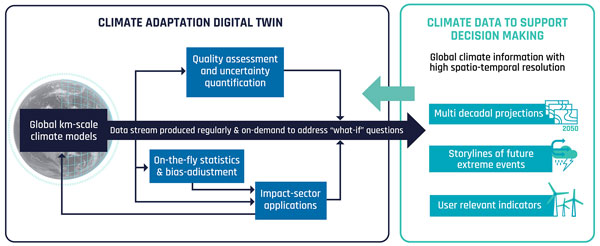
There is rich process-level variability present in the new-generation kilometre-scale climate simulations. The EU’s Climate Change Adaptation Digital Twin (Climate DT) integrates global Earth observing systems and observation modelling capabilities – until now common only in weather prediction – into operational climate simulation workflow. This provides a novel framework for precise evaluation of fine-scale details of simulation data and informing adaptation decisions at local (city) scales.
Francisco J. Doblas-Reyes, Jenni Kontkanen, Irina Sandu, Mario Acosta, Mohammed Hussam Al Turjmam, Ivan Alsina-Ferrer, Miguel Andrés-Martínez, Costanza Anerdi, Leo Arriola, Marvin Axness, Marc Batlle Martín, Peter Bauer, Tobias Becker, Daniel Beltrán, Sebastian Beyer, Hendryk Bockelmann, Pierre-Antoine Bretonnière, Sebastien Cabaniols, Silvia Caprioli, Miguel Castrillo, Aparna Chandrasekar, Suvarchal Cheedela, Victor Correal, Emanuele Danovaro, Paolo Davini, Jussi Enkovaara, Claudia Frauen, Barbara Früh, Aina Gaya Àvila, Paolo Ghinassi, Rohit Ghosh, Supriyo Ghosh, Iker González, Katherine Grayson, Matthew Griffith, Ioan Hadade, Christopher Haine, Carl Hartick, Utz-Uwe Haus, Shane Hearne, Heikki Järvinen, Bernat Jiménez, Amal John, Marlin Juchem, Thomas Jung, Jessica Kegel, Matthias Kelbling, Kai Keller, Bruno Kinoshita, Theresa Kiszler, Daniel Klocke, Lukas Kluft, Nikolay Koldunov, Tobias Kölling, Joonas Kolstela, Luis Kornblueh, Sergey Kosukhin, Aleksander Lacima-Nadolnik, Jeisson Javier Leal Rojas, Jonni Lehtiranta, Tuomas Lunttila, Anna Luoma, Pekka Manninen, Alexey Medvedev, Sebastian Milinski, Ali Mohammed, Sebastian Müller, Devaraju Naryanappa, Natalia Nazarova, Sami Niemelä, Bimochan Niraula, Henrik Nortamo, Aleksi Nummelin, Matteo Nurisso, Pablo Ortega, Stella Paronuzzi, Xabier Pedruzo-Bagazgoitia, Charles Pelletier, Carlos Peña, Suraj Polade, Himansu Kesari Pradhan, Rommel Quintanilla, Tiago Quintino, Thomas Rackow, Jouni Räisänen, Maqsood Mubarak Rajput, René Redler, Balthasar Reuter, Nuno Rocha Monteiro, Francesc Roura-Adserias, Silva Ruppert, Susan Sayed, Reiner Schnur, Tanvi Sharma, Dmitry Sidorenko, Outi Sievi-Korte, Albert Soret, Christian Steger, Bjorn Stevens, Jan Streffing, Jaleena Sunny, Luiggi Tenorio, Stephan Thober, Ulf Tigerstedt, Oriol Tinto, Juha Tonttila, Heikki Tuomenvirta, Lauri Tuppi, Ginka Van Thielen, Emanuele Vitali, Jost von Hardenberg, Ingo Wagner, Nils Wedi, Jan Wehner, Sven Willner, Xavier Yepes-Arbós, Florian Ziemen, and Janos Zimmermann
Geosci. Model Dev., 19, 2821–2848, https://doi.org/10.5194/gmd-19-2821-2026, https://doi.org/10.5194/gmd-19-2821-2026, 2026
Short summary
Short summary
The Climate Change Adaptation Digital Twin (Climate DT) pioneers the operationalisation of global climate projections. It produces global simulations with local granularity for adaptation decision-making. Applications are embedded to generate tailored indicators. A unified workflow orchestrates all components in several supercomputers. Data management ensures consistency and streaming enables real-time use. It is a complementary innovation to initiatives like CMIP, CORDEX, and climate services.
Heikki Järvinen, Jouni Räisänen, Lauri Tuppi, Clément Bouvier, Antonio Sanchez-Benitez, Juniper Tyree, Antti Toropainen, Paolo Davini, Francisco Doblas-Reyes, Thomas Jung, Daniel Klocke, Jenni Kontkanen, Sebastian Milinski, Matteo Nurisso, Himansu Kesari Pradhan, and Irina Sandu
EGUsphere, https://doi.org/10.5194/egusphere-2026-3364, https://doi.org/10.5194/egusphere-2026-3364, 2026
Short summary
Short summary
There is rich process-level variability present in the new-generation kilometre-scale climate simulations. The EU’s Climate Change Adaptation Digital Twin (Climate DT) integrates global Earth observing systems and observation modelling capabilities – until now common only in weather prediction – into operational climate simulation workflow. This provides a novel framework for precise evaluation of fine-scale details of simulation data and informing adaptation decisions at local (city) scales.
Brian Henn, Christopher S. Bretherton, Nikolay Koldunov, Christian Lessig, Maria J. Molina, Troy Arcomano, Oliver Watt-Meyer, Guillaume Couairon, Renu Singh, Robert Brunstein, Yana Hasson, Antonia Jost, Noah Brenowitz, Peter Manshausen, Nathaniel Cresswell-Clay, Dale Durran, Kyle Joseph Chen Hall, Janni Yuval, Dmitrii Kochkov, Stephan Hoyer, and Ignacio Lopez-Gomez
EGUsphere, https://doi.org/10.48550/arXiv.2605.06944, https://doi.org/10.48550/arXiv.2605.06944, 2026
Short summary
Short summary
AIMIP (AI Model Intercomparison Project) is a community effort to rigorously evaluate AI weather and climate models, which simulate Earth's climate with extraordinary efficiency compared to traditional systems. Phase 1 is an atmosphere-only standardized experiment, showing that AI models are competitive on average historical patterns but may struggle with long-term warming trends and generalizing to unseen scenarios. The AIMIP Phase 1 dataset is publicly available for open model evaluation.
Rohit Ghosh, Suvarchal Kumar Cheedela, Sebastian Beyer, Nikolay Koldunov, Stella Berzina, Audrey Delpech, Svetlana Loza, Chathurika Wikramage, Stephy Libera, Matthias Aengenheyster, Amal John, Armelle Remedio, Patrick Scholz, Dmitry Sidorenko, Jan Streffing, Fabian Wachsmann, and Thomas Jung
EGUsphere, https://doi.org/10.5194/egusphere-2026-1289, https://doi.org/10.5194/egusphere-2026-1289, 2026
Short summary
Short summary
Understanding climate change requires detailed computer simulations of the Earth system. Here we present one of the first century-long global simulations in which both the atmosphere and ocean are represented at kilometre-scale resolution. Such simulations are extremely computationally demanding, but we demonstrate their feasibility and show that they can capture key climate patterns while representing important small-scale ocean processes.
James A. Anstey, Neal Butchart, Scott Osprey, Yoshio Kawatani, Kevin Hamilton, Jadwiga H. Richter, Tim Stockdale, Martin B. Andrews, Zhaoyang Chai, Paolo Davini, Dong-Chan Hong, Kai Huang, Aleena M. Jaison, Tobias Kerzenmacher, Jeff R. Knight, Pu Lin, Francois Lott, Yixiong Lu, Hiroaki Naoe, Federico Serva, Isla Simpson, Seok-Woo Son, Qi Tang, Shingo Watanabe, Jinbo Xie, and Kohei Yoshida
EGUsphere, https://doi.org/10.5194/egusphere-2026-1165, https://doi.org/10.5194/egusphere-2026-1165, 2026
Short summary
Short summary
We describe experiments where modelled tropical stratosphere winds are adjusted by "nudging" them toward realistic time-evolving eastward and westward Quasi-Biennial Oscillation (QBO) winds. The effects of this bias correction on other atmospheric processes, such as the stratospheric polar vortex or tropical waves that force the QBO, can then be assessed. We describe details of the experiments, the multi-model ensemble that has performed them, and basic validation of the nudging response.
Francisco J. Doblas-Reyes, Jenni Kontkanen, Irina Sandu, Mario Acosta, Mohammed Hussam Al Turjmam, Ivan Alsina-Ferrer, Miguel Andrés-Martínez, Costanza Anerdi, Leo Arriola, Marvin Axness, Marc Batlle Martín, Peter Bauer, Tobias Becker, Daniel Beltrán, Sebastian Beyer, Hendryk Bockelmann, Pierre-Antoine Bretonnière, Sebastien Cabaniols, Silvia Caprioli, Miguel Castrillo, Aparna Chandrasekar, Suvarchal Cheedela, Victor Correal, Emanuele Danovaro, Paolo Davini, Jussi Enkovaara, Claudia Frauen, Barbara Früh, Aina Gaya Àvila, Paolo Ghinassi, Rohit Ghosh, Supriyo Ghosh, Iker González, Katherine Grayson, Matthew Griffith, Ioan Hadade, Christopher Haine, Carl Hartick, Utz-Uwe Haus, Shane Hearne, Heikki Järvinen, Bernat Jiménez, Amal John, Marlin Juchem, Thomas Jung, Jessica Kegel, Matthias Kelbling, Kai Keller, Bruno Kinoshita, Theresa Kiszler, Daniel Klocke, Lukas Kluft, Nikolay Koldunov, Tobias Kölling, Joonas Kolstela, Luis Kornblueh, Sergey Kosukhin, Aleksander Lacima-Nadolnik, Jeisson Javier Leal Rojas, Jonni Lehtiranta, Tuomas Lunttila, Anna Luoma, Pekka Manninen, Alexey Medvedev, Sebastian Milinski, Ali Mohammed, Sebastian Müller, Devaraju Naryanappa, Natalia Nazarova, Sami Niemelä, Bimochan Niraula, Henrik Nortamo, Aleksi Nummelin, Matteo Nurisso, Pablo Ortega, Stella Paronuzzi, Xabier Pedruzo-Bagazgoitia, Charles Pelletier, Carlos Peña, Suraj Polade, Himansu Kesari Pradhan, Rommel Quintanilla, Tiago Quintino, Thomas Rackow, Jouni Räisänen, Maqsood Mubarak Rajput, René Redler, Balthasar Reuter, Nuno Rocha Monteiro, Francesc Roura-Adserias, Silva Ruppert, Susan Sayed, Reiner Schnur, Tanvi Sharma, Dmitry Sidorenko, Outi Sievi-Korte, Albert Soret, Christian Steger, Bjorn Stevens, Jan Streffing, Jaleena Sunny, Luiggi Tenorio, Stephan Thober, Ulf Tigerstedt, Oriol Tinto, Juha Tonttila, Heikki Tuomenvirta, Lauri Tuppi, Ginka Van Thielen, Emanuele Vitali, Jost von Hardenberg, Ingo Wagner, Nils Wedi, Jan Wehner, Sven Willner, Xavier Yepes-Arbós, Florian Ziemen, and Janos Zimmermann
Geosci. Model Dev., 19, 2821–2848, https://doi.org/10.5194/gmd-19-2821-2026, https://doi.org/10.5194/gmd-19-2821-2026, 2026
Short summary
Short summary
The Climate Change Adaptation Digital Twin (Climate DT) pioneers the operationalisation of global climate projections. It produces global simulations with local granularity for adaptation decision-making. Applications are embedded to generate tailored indicators. A unified workflow orchestrates all components in several supercomputers. Data management ensures consistency and streaming enables real-time use. It is a complementary innovation to initiatives like CMIP, CORDEX, and climate services.
Johanna Beckmann, Giorgia Di Capua, and Paolo Davini
Weather Clim. Dynam., 6, 1875–1894, https://doi.org/10.5194/wcd-6-1875-2025, https://doi.org/10.5194/wcd-6-1875-2025, 2025
Short summary
Short summary
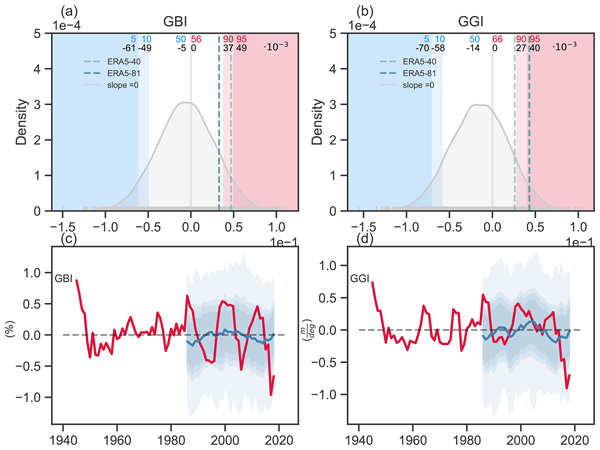
Greenland blocking, which enhances ice sheet melting, has increased, but climate models fail to capture this trend. Analysis with reanalysis data and a seasonal forecast system shows that model improvements help, but they still miss the role of early North American snowmelt in shaping blocking patterns. This gap may explain the discrepancy and suggests that future projections could underestimate Greenland blocking and its impact on melting.
Hans Segura, Xabier Pedruzo-Bagazgoitia, Philipp Weiss, Sebastian K. Müller, Thomas Rackow, Junhong Lee, Edgar Dolores-Tesillos, Imme Benedict, Matthias Aengenheyster, Razvan Aguridan, Gabriele Arduini, Alexander J. Baker, Jiawei Bao, Swantje Bastin, Eulàlia Baulenas, Tobias Becker, Sebastian Beyer, Hendryk Bockelmann, Nils Brüggemann, Lukas Brunner, Suvarchal K. Cheedela, Sushant Das, Jasper Denissen, Ian Dragaud, Piotr Dziekan, Madeleine Ekblom, Jan Frederik Engels, Monika Esch, Richard Forbes, Claudia Frauen, Lilli Freischem, Diego García-Maroto, Philipp Geier, Paul Gierz, Álvaro González-Cervera, Katherine Grayson, Matthew Griffith, Oliver Gutjahr, Helmuth Haak, Ioan Hadade, Kerstin Haslehner, Shabeh ul Hasson, Jan Hegewald, Lukas Kluft, Aleksei Koldunov, Nikolay Koldunov, Tobias Kölling, Shunya Koseki, Sergey Kosukhin, Josh Kousal, Peter Kuma, Arjun U. Kumar, Rumeng Li, Nicolas Maury, Maximilian Meindl, Sebastian Milinski, Kristian Mogensen, Bimochan Niraula, Jakub Nowak, Divya Sri Praturi, Ulrike Proske, Dian Putrasahan, René Redler, David Santuy, Domokos Sármány, Reiner Schnur, Patrick Scholz, Dmitry Sidorenko, Dorian Spät, Birgit Sützl, Daisuke Takasuka, Adrian Tompkins, Alejandro Uribe, Mirco Valentini, Menno Veerman, Aiko Voigt, Sarah Warnau, Fabian Wachsmann, Marta Wacławczyk, Nils Wedi, Karl-Hermann Wieners, Jonathan Wille, Marius Winkler, Yuting Wu, Florian Ziemen, Janos Zimmermann, Frida A.-M. Bender, Dragana Bojovic, Sandrine Bony, Simona Bordoni, Patrice Brehmer, Marcus Dengler, Emanuel Dutra, Saliou Faye, Erich Fischer, Chiel van Heerwaarden, Cathy Hohenegger, Heikki Järvinen, Markus Jochum, Thomas Jung, Johann H. Jungclaus, Noel S. Keenlyside, Daniel Klocke, Heike Konow, Martina Klose, Szymon Malinowski, Olivia Martius, Thorsten Mauritsen, Juan Pedro Mellado, Theresa Mieslinger, Elsa Mohino, Hanna Pawłowska, Karsten Peters-von Gehlen, Abdoulaye Sarré, Pajam Sobhani, Philip Stier, Lauri Tuppi, Pier Luigi Vidale, Irina Sandu, and Bjorn Stevens
Geosci. Model Dev., 18, 7735–7761, https://doi.org/10.5194/gmd-18-7735-2025, https://doi.org/10.5194/gmd-18-7735-2025, 2025
Short summary
Short summary
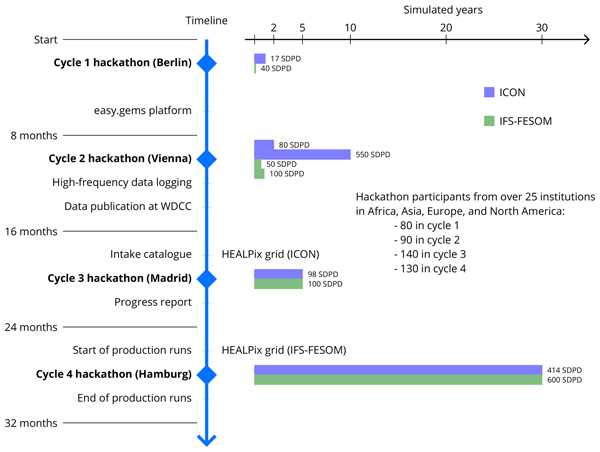
The Next Generation of Earth Modeling Systems project (nextGEMS) developed two Earth system models that use horizontal grid spacing of 10 km and finer, giving more fidelity to the representation of local phenomena, globally. In its fourth cycle, nextGEMS simulated the Earth System climate over the 2020–2049 period under the SSP3-7.0 scenario. Here, we provide an overview of nextGEMS, insights into the model development, and the realism of multi-decadal, kilometer-scale simulations.
Ja-Yeon Moon, Jan Streffing, Sun-Seon Lee, Tido Semmler, Miguel Andrés-Martínez, Jiao Chen, Eun-Byeoul Cho, Jung-Eun Chu, Christian L. E. Franzke, Jan P. Gärtner, Rohit Ghosh, Jan Hegewald, Songyee Hong, Dae-Won Kim, Nikolay Koldunov, June-Yi Lee, Zihao Lin, Chao Liu, Svetlana N. Loza, Wonsun Park, Woncheol Roh, Dmitry V. Sein, Sahil Sharma, Dmitry Sidorenko, Jun-Hyeok Son, Malte F. Stuecker, Qiang Wang, Gyuseok Yi, Martina Zapponini, Thomas Jung, and Axel Timmermann
Earth Syst. Dynam., 16, 1103–1134, https://doi.org/10.5194/esd-16-1103-2025, https://doi.org/10.5194/esd-16-1103-2025, 2025
Short summary
Short summary
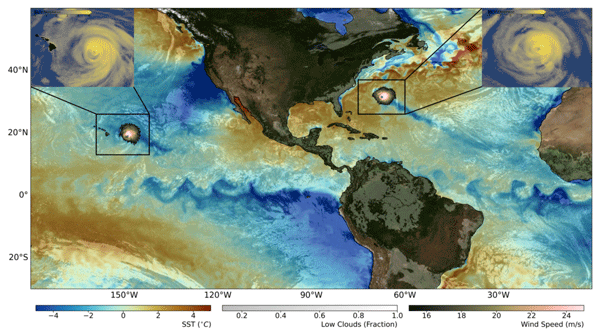
Based on a series of storm-resolving greenhouse warming simulations conducted with the AWI-CM3 model at 9 km global atmosphere and 4–25 km ocean resolution, we present new projections of regional climate change, modes of climate variability, and extreme events. The 10-year-long high-resolution simulations for the 2000s, 2030s, 2060s, and 2090s were initialized from a coarser-resolution transient run (31 km atmosphere) which follows the SSP5-8.5 greenhouse gas emission scenario from 1950–2100 CE.

Swantje Bastin, Aleksei Koldunov, Florian Schütte, Oliver Gutjahr, Marta Agnieszka Mrozowska, Tim Fischer, Radomyra Shevchenko, Arjun Kumar, Nikolay Koldunov, Helmuth Haak, Nils Brüggemann, Rebecca Hummels, Mia Sophie Specht, Johann Jungclaus, Sergey Danilov, Marcus Dengler, and Markus Jochum
Geosci. Model Dev., 18, 1189–1220, https://doi.org/10.5194/gmd-18-1189-2025, https://doi.org/10.5194/gmd-18-1189-2025, 2025
Short summary
Short summary
Vertical mixing is an important process, for example, for tropical sea surface temperature, but cannot be resolved by ocean models. Comparisons of mixing schemes and settings have usually been done with a single model, sometimes yielding conflicting results. We systematically compare two widely used schemes with different parameter settings in two different ocean models and show that most effects from mixing scheme parameter changes are model-dependent.
Thomas Rackow, Xabier Pedruzo-Bagazgoitia, Tobias Becker, Sebastian Milinski, Irina Sandu, Razvan Aguridan, Peter Bechtold, Sebastian Beyer, Jean Bidlot, Souhail Boussetta, Willem Deconinck, Michail Diamantakis, Peter Dueben, Emanuel Dutra, Richard Forbes, Rohit Ghosh, Helge F. Goessling, Ioan Hadade, Jan Hegewald, Thomas Jung, Sarah Keeley, Lukas Kluft, Nikolay Koldunov, Aleksei Koldunov, Tobias Kölling, Josh Kousal, Christian Kühnlein, Pedro Maciel, Kristian Mogensen, Tiago Quintino, Inna Polichtchouk, Balthasar Reuter, Domokos Sármány, Patrick Scholz, Dmitry Sidorenko, Jan Streffing, Birgit Sützl, Daisuke Takasuka, Steffen Tietsche, Mirco Valentini, Benoît Vannière, Nils Wedi, Lorenzo Zampieri, and Florian Ziemen
Geosci. Model Dev., 18, 33–69, https://doi.org/10.5194/gmd-18-33-2025, https://doi.org/10.5194/gmd-18-33-2025, 2025
Short summary
Short summary
Detailed global climate model simulations have been created based on a numerical weather prediction model, offering more accurate spatial detail down to the scale of individual cities ("kilometre-scale") and a better understanding of climate phenomena such as atmospheric storms, whirls in the ocean, and cracks in sea ice. The new model aims to provide globally consistent information on local climate change with greater precision, benefiting environmental planning and local impact modelling.
Michele Filippucci, Simona Bordoni, and Paolo Davini
Weather Clim. Dynam., 5, 1207–1222, https://doi.org/10.5194/wcd-5-1207-2024, https://doi.org/10.5194/wcd-5-1207-2024, 2024
Short summary
Short summary
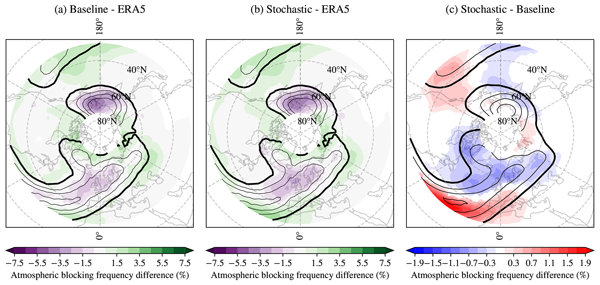
Atmospheric blocking is a recurring phenomenon in midlatitudes, causing winter cold spells and summer heat waves. Current models underestimate it, hindering understanding of global warming's impact on extremes. In this paper, we investigate whether stochastic parameterizations can improve blocking representation. We find that blocking frequency representation slightly deteriorates, following a change in midlatitude winds. We conclude by suggesting a direction for future model development.
Federico Fabiano, Paolo Davini, Virna L. Meccia, Giuseppe Zappa, Alessio Bellucci, Valerio Lembo, Katinka Bellomo, and Susanna Corti
Earth Syst. Dynam., 15, 527–546, https://doi.org/10.5194/esd-15-527-2024, https://doi.org/10.5194/esd-15-527-2024, 2024
Short summary
Short summary
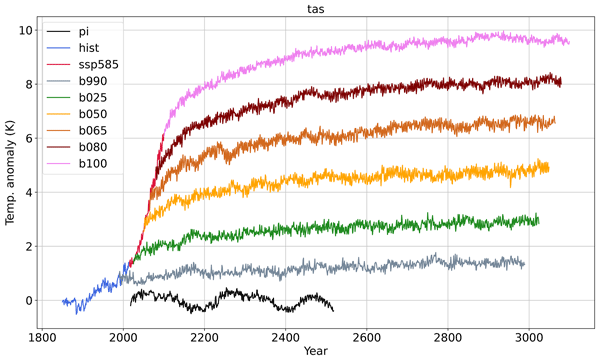
Even after the concentration of greenhouse gases is stabilized, the climate will continue to adapt, seeking a new equilibrium. We study this long-term stabilization through a set of 1000-year simulations, obtained by suddenly "freezing" the atmospheric composition at different levels. If frozen at the current state, global warming surpasses 3° in the long term with our model. We then study how climate impacts will change after various centuries and how the deep ocean will warm.
Matteo Pesce, Alberto Viglione, Jost von Hardenberg, Larisa Tarasova, Stefano Basso, Ralf Merz, Juraj Parajka, and Rui Tong
Proc. IAHS, 385, 65–69, https://doi.org/10.5194/piahs-385-65-2024, https://doi.org/10.5194/piahs-385-65-2024, 2024
Short summary
Short summary
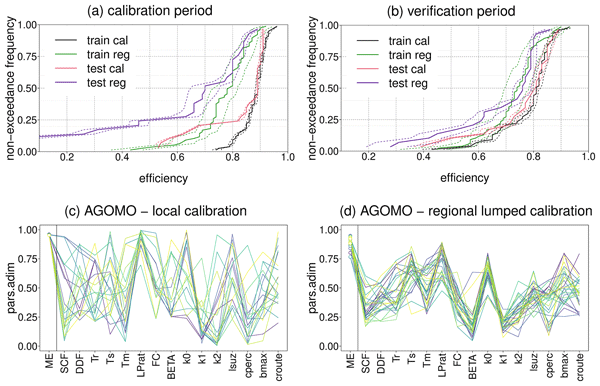
The manuscript describes an application of PArameter Set Shuffling (PASS) approach in the Alpine region. A machine learning decision-tree algorithm is applied for the regional calibration of a conceptual semi-distributed hydrological model. Regional model efficiencies don't decrease significantly when moving in space from catchments used for the regional calibration (training) to catchments used for the procedure validation (test) and, in time, from the calibration to the verification period.
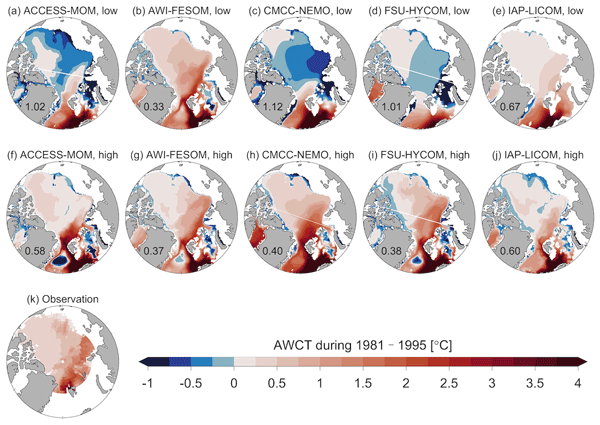
Qiang Wang, Qi Shu, Alexandra Bozec, Eric P. Chassignet, Pier Giuseppe Fogli, Baylor Fox-Kemper, Andy McC. Hogg, Doroteaciro Iovino, Andrew E. Kiss, Nikolay Koldunov, Julien Le Sommer, Yiwen Li, Pengfei Lin, Hailong Liu, Igor Polyakov, Patrick Scholz, Dmitry Sidorenko, Shizhu Wang, and Xiaobiao Xu
Geosci. Model Dev., 17, 347–379, https://doi.org/10.5194/gmd-17-347-2024, https://doi.org/10.5194/gmd-17-347-2024, 2024
Short summary
Short summary
Increasing resolution improves model skills in simulating the Arctic Ocean, but other factors such as parameterizations and numerics are at least of the same importance for obtaining reliable simulations.
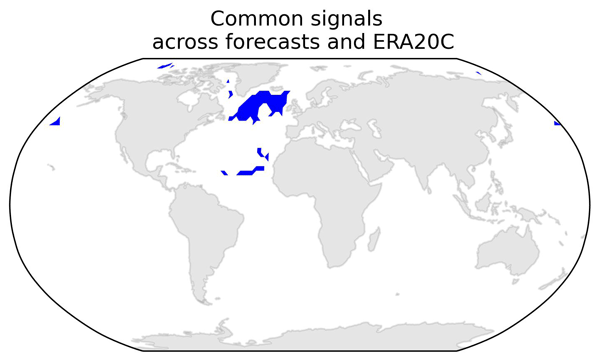
Kristian Strommen, Tim Woollings, Paolo Davini, Paolo Ruggieri, and Isla R. Simpson
Weather Clim. Dynam., 4, 853–874, https://doi.org/10.5194/wcd-4-853-2023, https://doi.org/10.5194/wcd-4-853-2023, 2023
Short summary
Short summary
We present evidence which strongly suggests that decadal variations in the intensity of the North Atlantic winter jet stream can be predicted by current forecast models but that decadal variations in its position appear to be unpredictable. It is argued that this skill at predicting jet intensity originates from the slow, predictable variability in sea surface temperatures in the sub-polar North Atlantic.
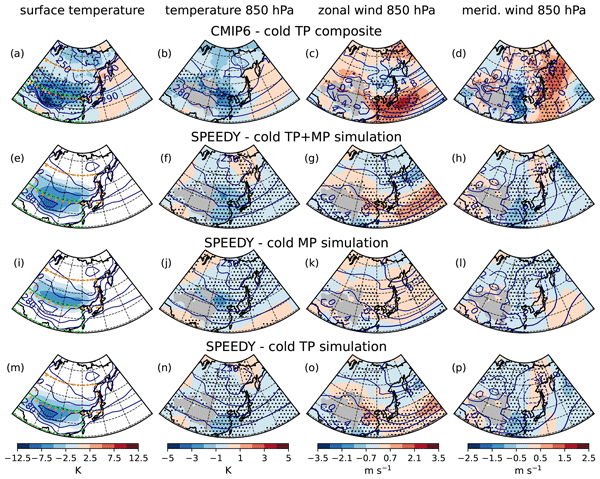
Alice Portal, Fabio D'Andrea, Paolo Davini, Mostafa E. Hamouda, and Claudia Pasquero
Weather Clim. Dynam., 4, 809–822, https://doi.org/10.5194/wcd-4-809-2023, https://doi.org/10.5194/wcd-4-809-2023, 2023
Short summary
Short summary
The differences between climate models can be exploited to infer how specific aspects of the climate influence the Earth system. This work analyses the effects of a negative temperature anomaly over the Tibetan Plateau on the winter atmospheric circulation. We show that models with a colder-than-average Tibetan Plateau present a reinforcement of the eastern Asian winter monsoon and discuss the atmospheric response to the enhanced transport of cold air from the continent toward the Pacific Ocean.
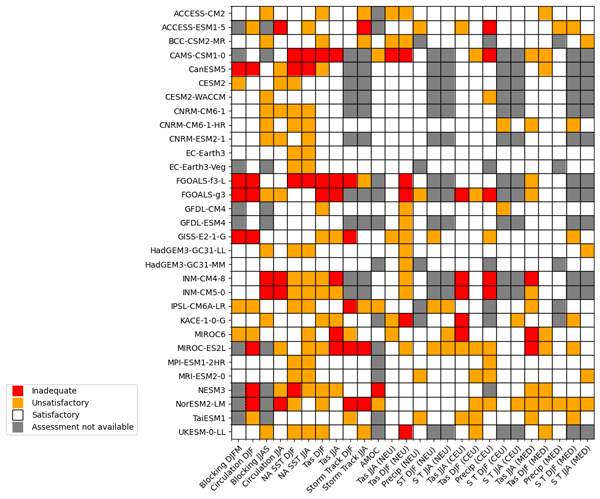
Tamzin E. Palmer, Carol F. McSweeney, Ben B. B. Booth, Matthew D. K. Priestley, Paolo Davini, Lukas Brunner, Leonard Borchert, and Matthew B. Menary
Earth Syst. Dynam., 14, 457–483, https://doi.org/10.5194/esd-14-457-2023, https://doi.org/10.5194/esd-14-457-2023, 2023
Short summary
Short summary
We carry out an assessment of an ensemble of general climate models (CMIP6) based on the ability of the models to represent the key physical processes that are important for representing European climate. Filtering the models with the assessment leads to more models with less global warming being removed, and this shifts the lower part of the projected temperature range towards greater warming. This is in contrast to the affect of weighting the ensemble using global temperature trends.
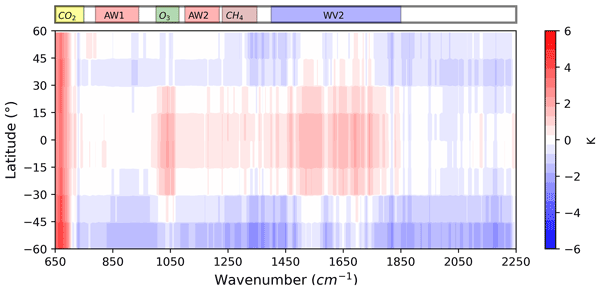
Stefano Della Fera, Federico Fabiano, Piera Raspollini, Marco Ridolfi, Ugo Cortesi, Flavio Barbara, and Jost von Hardenberg
Geosci. Model Dev., 16, 1379–1394, https://doi.org/10.5194/gmd-16-1379-2023, https://doi.org/10.5194/gmd-16-1379-2023, 2023
Short summary
Short summary
The long-term comparison between observed and simulated outgoing longwave radiances represents a strict test to evaluate climate model performance. In this work, 9 years of synthetic spectrally resolved radiances, simulated online on the basis of the atmospheric fields predicted by the EC-Earth global climate model (v3.3.3) in clear-sky conditions, are compared to IASI spectral radiance climatology in order to detect model biases in temperature and humidity at different atmospheric levels.
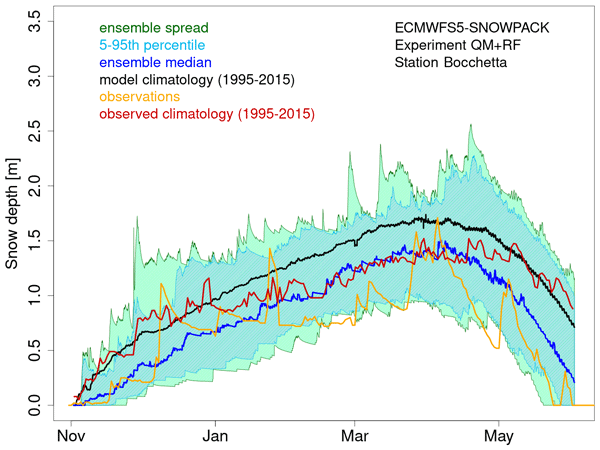
Silvia Terzago, Giulio Bongiovanni, and Jost von Hardenberg
Hydrol. Earth Syst. Sci., 27, 519–542, https://doi.org/10.5194/hess-27-519-2023, https://doi.org/10.5194/hess-27-519-2023, 2023
Short summary
Short summary
Reliable seasonal forecasts of the abundance of mountain snowpack over the winter/spring ahead provide valuable information for water management, hydropower production and ski tourism. We present a climate service prototype to generate multi-model ensemble seasonal forecasts of mountain snow depth, based on Copernicus seasonal forecast system meteorological data used to force the SNOWPACK model. The prototype shows skill at predicting snow depth below and above normal and extremely dry seasons.

Sergei Kirillov, Igor Dmitrenko, David G. Babb, Jens K. Ehn, Nikolay Koldunov, Søren Rysgaard, David Jensen, and David G. Barber
Ocean Sci., 18, 1535–1557, https://doi.org/10.5194/os-18-1535-2022, https://doi.org/10.5194/os-18-1535-2022, 2022
Short summary
Short summary
The sea ice bridge usually forms during winter in Nares Strait and prevents ice drifting south. However, this bridge has recently become unstable, and in this study we investigate the role of oceanic heat flux in this decline. Using satellite data, we identify areas where sea ice is relatively thin and further attribute those areas to the heat fluxes from the warm subsurface water masses. We also discuss the potential role of such an impact on ice bridge instability and earlier ice break up.
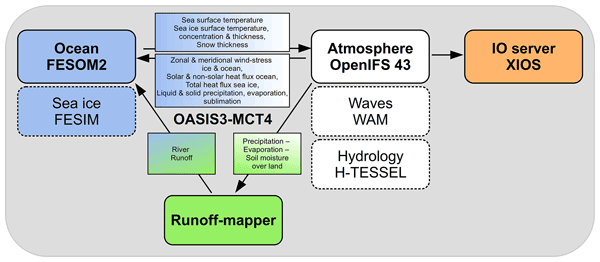
Jan Streffing, Dmitry Sidorenko, Tido Semmler, Lorenzo Zampieri, Patrick Scholz, Miguel Andrés-Martínez, Nikolay Koldunov, Thomas Rackow, Joakim Kjellsson, Helge Goessling, Marylou Athanase, Qiang Wang, Jan Hegewald, Dmitry V. Sein, Longjiang Mu, Uwe Fladrich, Dirk Barbi, Paul Gierz, Sergey Danilov, Stephan Juricke, Gerrit Lohmann, and Thomas Jung
Geosci. Model Dev., 15, 6399–6427, https://doi.org/10.5194/gmd-15-6399-2022, https://doi.org/10.5194/gmd-15-6399-2022, 2022
Short summary
Short summary
We developed a new atmosphere–ocean coupled climate model, AWI-CM3. Our model is significantly more computationally efficient than its predecessors AWI-CM1 and AWI-CM2. We show that the model, although cheaper to run, provides results of similar quality when modeling the historic period from 1850 to 2014. We identify the remaining weaknesses to outline future work. Finally we preview an improved simulation where the reduction in computational cost has to be invested in higher model resolution.
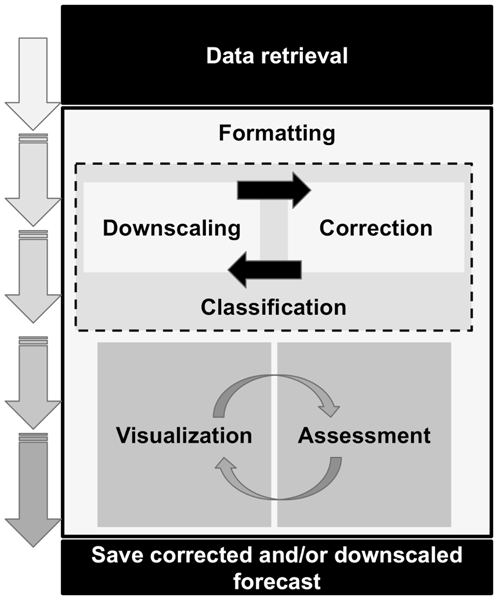
Núria Pérez-Zanón, Louis-Philippe Caron, Silvia Terzago, Bert Van Schaeybroeck, Llorenç Lledó, Nicolau Manubens, Emmanuel Roulin, M. Carmen Alvarez-Castro, Lauriane Batté, Pierre-Antoine Bretonnière, Susana Corti, Carlos Delgado-Torres, Marta Domínguez, Federico Fabiano, Ignazio Giuntoli, Jost von Hardenberg, Eroteida Sánchez-García, Verónica Torralba, and Deborah Verfaillie
Geosci. Model Dev., 15, 6115–6142, https://doi.org/10.5194/gmd-15-6115-2022, https://doi.org/10.5194/gmd-15-6115-2022, 2022
Short summary
Short summary
CSTools (short for Climate Service Tools) is an R package that contains process-based methods for climate forecast calibration, bias correction, statistical and stochastic downscaling, optimal forecast combination, and multivariate verification, as well as basic and advanced tools to obtain tailored products. In addition to describing the structure and methods in the package, we also present three use cases to illustrate the seasonal climate forecast post-processing for specific purposes.
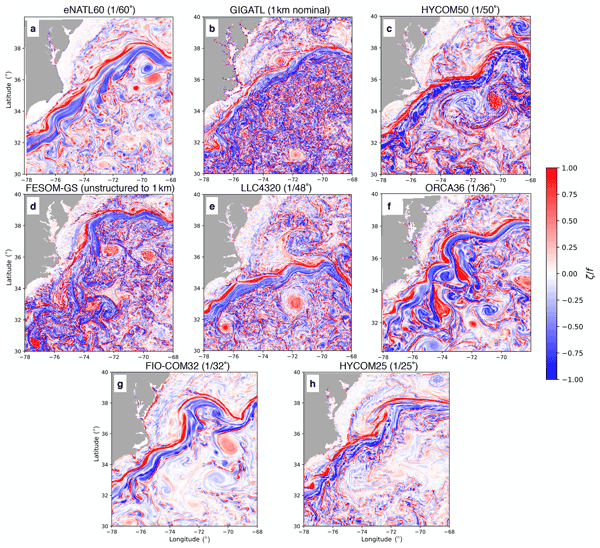
Takaya Uchida, Julien Le Sommer, Charles Stern, Ryan P. Abernathey, Chris Holdgraf, Aurélie Albert, Laurent Brodeau, Eric P. Chassignet, Xiaobiao Xu, Jonathan Gula, Guillaume Roullet, Nikolay Koldunov, Sergey Danilov, Qiang Wang, Dimitris Menemenlis, Clément Bricaud, Brian K. Arbic, Jay F. Shriver, Fangli Qiao, Bin Xiao, Arne Biastoch, René Schubert, Baylor Fox-Kemper, William K. Dewar, and Alan Wallcraft
Geosci. Model Dev., 15, 5829–5856, https://doi.org/10.5194/gmd-15-5829-2022, https://doi.org/10.5194/gmd-15-5829-2022, 2022
Short summary
Short summary
Ocean and climate scientists have used numerical simulations as a tool to examine the ocean and climate system since the 1970s. Since then, owing to the continuous increase in computational power and advances in numerical methods, we have been able to simulate increasing complex phenomena. However, the fidelity of the simulations in representing the phenomena remains a core issue in the ocean science community. Here we propose a cloud-based framework to inter-compare and assess such simulations.
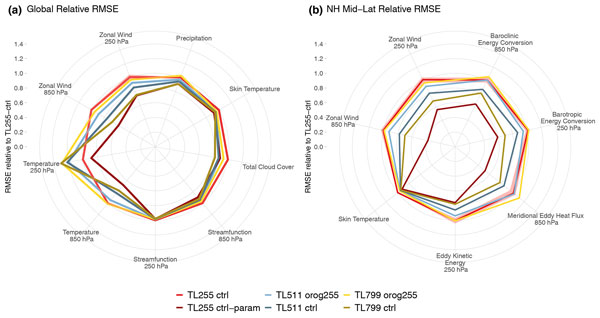
Paolo Davini, Federico Fabiano, and Irina Sandu
Weather Clim. Dynam., 3, 535–553, https://doi.org/10.5194/wcd-3-535-2022, https://doi.org/10.5194/wcd-3-535-2022, 2022
Short summary
Short summary
In climate models, improvements obtained in the winter mid-latitude circulation following horizontal resolution increase are mainly caused by the more detailed representation of the mean orography. A high-resolution climate model with low-resolution orography might underperform compared to a low-resolution model with low-resolution orography. The absence of proper model tuning at high resolution is considered the potential reason behind such lack of improvements.
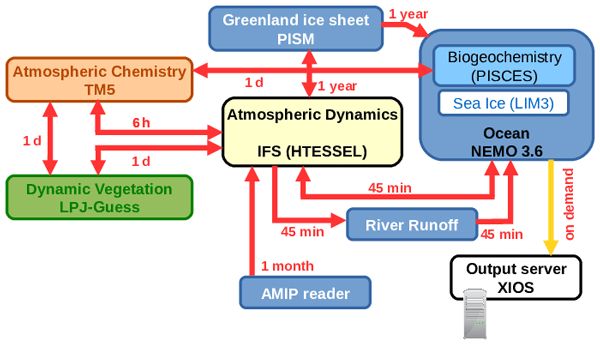
Ralf Döscher, Mario Acosta, Andrea Alessandri, Peter Anthoni, Thomas Arsouze, Tommi Bergman, Raffaele Bernardello, Souhail Boussetta, Louis-Philippe Caron, Glenn Carver, Miguel Castrillo, Franco Catalano, Ivana Cvijanovic, Paolo Davini, Evelien Dekker, Francisco J. Doblas-Reyes, David Docquier, Pablo Echevarria, Uwe Fladrich, Ramon Fuentes-Franco, Matthias Gröger, Jost v. Hardenberg, Jenny Hieronymus, M. Pasha Karami, Jukka-Pekka Keskinen, Torben Koenigk, Risto Makkonen, François Massonnet, Martin Ménégoz, Paul A. Miller, Eduardo Moreno-Chamarro, Lars Nieradzik, Twan van Noije, Paul Nolan, Declan O'Donnell, Pirkka Ollinaho, Gijs van den Oord, Pablo Ortega, Oriol Tintó Prims, Arthur Ramos, Thomas Reerink, Clement Rousset, Yohan Ruprich-Robert, Philippe Le Sager, Torben Schmith, Roland Schrödner, Federico Serva, Valentina Sicardi, Marianne Sloth Madsen, Benjamin Smith, Tian Tian, Etienne Tourigny, Petteri Uotila, Martin Vancoppenolle, Shiyu Wang, David Wårlind, Ulrika Willén, Klaus Wyser, Shuting Yang, Xavier Yepes-Arbós, and Qiong Zhang
Geosci. Model Dev., 15, 2973–3020, https://doi.org/10.5194/gmd-15-2973-2022, https://doi.org/10.5194/gmd-15-2973-2022, 2022
Short summary
Short summary
The Earth system model EC-Earth3 is documented here. Key performance metrics show physical behavior and biases well within the frame known from recent models. With improved physical and dynamic features, new ESM components, community tools, and largely improved physical performance compared to the CMIP5 version, EC-Earth3 represents a clear step forward for the only European community ESM. We demonstrate here that EC-Earth3 is suited for a range of tasks in CMIP6 and beyond.
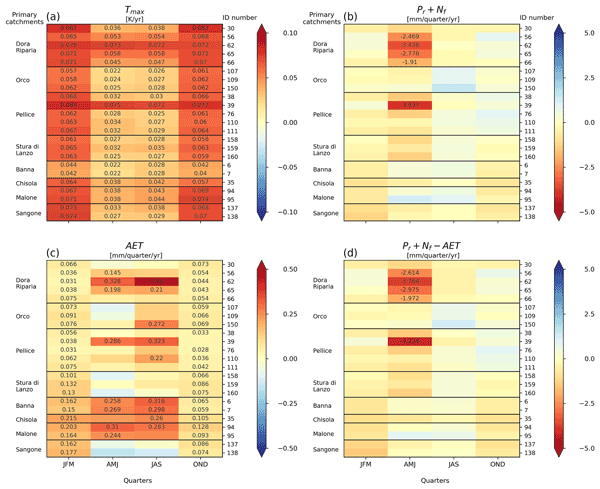
Elisa Brussolo, Elisa Palazzi, Jost von Hardenberg, Giulio Masetti, Gianna Vivaldo, Maurizio Previati, Davide Canone, Davide Gisolo, Ivan Bevilacqua, Antonello Provenzale, and Stefano Ferraris
Hydrol. Earth Syst. Sci., 26, 407–427, https://doi.org/10.5194/hess-26-407-2022, https://doi.org/10.5194/hess-26-407-2022, 2022
Short summary
Short summary
In this study, we evaluate the past, present and future quantity of groundwater potentially available for drinking purposes in the metropolitan area of Turin, north-western Italy. In order to effectively manage water resources, a knowledge of the water cycle components is necessary, including precipitation, evapotranspiration and subsurface reservoirs. All these components have been carefully evaluated in this paper, using observational datasets and modelling approaches.
Patrick Scholz, Dmitry Sidorenko, Sergey Danilov, Qiang Wang, Nikolay Koldunov, Dmitry Sein, and Thomas Jung
Geosci. Model Dev., 15, 335–363, https://doi.org/10.5194/gmd-15-335-2022, https://doi.org/10.5194/gmd-15-335-2022, 2022
Short summary
Short summary
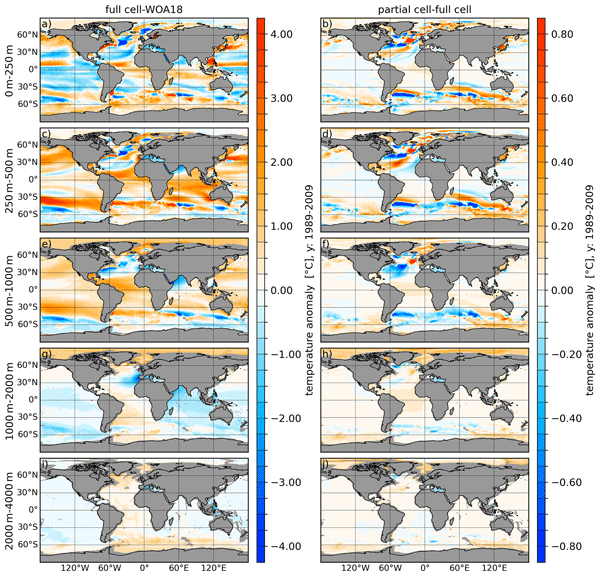
Structured-mesh ocean models are still the most mature in terms of functionality due to their long development history. However, unstructured-mesh ocean models have acquired new features and caught up in their functionality. This paper continues the work by Scholz et al. (2019) of documenting the features available in FESOM2.0. It focuses on the following two aspects: (i) partial bottom cells and embedded sea ice and (ii) dealing with mixing parameterisations enabled by using the CVMix package.
Cited articles
Acosta, M. C., Palomas, S., Paronuzzi Ticco, S. V., Utrera, G., Biercamp, J., Bretonniere, P.-A., Budich, R., Castrillo, M., Caubel, A., Doblas-Reyes, F., Epicoco, I., Fladrich, U., Joussaume, S., Kumar Gupta, A., Lawrence, B., Le Sager, P., Lister, G., Moine, M.-P., Rioual, J.-C., Valcke, S., Zadeh, N., and Balaji, V.: The computational and energy cost of simulation and storage for climate science: lessons from CMIP6, Geosci. Model Dev., 17, 3081–3098, https://doi.org/10.5194/gmd-17-3081-2024, 2024. a
Bauer, P., Dueben, P. D., Hoefler, T., Quintino, T., Schulthess, T. C., and Wedi, N. P.: The digital revolution of Earth-system science, Nature Computational Science, 1, 104–113, https://doi.org/10.1038/s43588-021-00023-0, 2021. a, b
Bishnoi, A., Stein, O., Meyer, C. I., Redler, R., Eicker, N., Haak, H., Hoffmann, L., Klocke, D., Kornblueh, L., and Suarez, E.: Earth system modeling on modular supercomputing architecture: coupled atmosphere–ocean simulations with ICON 2.6.6-rc, Geosci. Model Dev., 17, 261–273, https://doi.org/10.5194/gmd-17-261-2024, 2024. a
Cinquini, L., Crichton, D., Mattmann, C., Harney, J., Shipman, G., Wang, F., Ananthakrishnan, R., Miller, N., Denvil, S., Morgan, M., Pobre, Z., Bell, G. M., Doutriaux, C., Drach, R., Williams, D., Kershaw, P., Pascoe, S., Gonzalez, E., Fiore, S., and Schweitzer, R.: The Earth System Grid Federation: An open infrastructure for access to distributed geospatial data, Future Gener. Comp. Sy., 36, 400–417, https://doi.org/10.1016/j.future.2013.07.002, 2014. a, b
Czaja, A., Frankignoul, C., Minobe, S., and Vannière, B.: Simulating the Midlatitude Atmospheric Circulation: What Might We Gain From High-Resolution Modeling of Air-Sea Interactions?, Current Climate Change Reports, 5, 390–406, https://doi.org/10.1007/s40641-019-00148-5, 2019. a
Dask Development Team: Dask: Library for dynamic task scheduling, http://dask.pydata.org (last access: 17 August 2026), 2016. a
Davini, P., von Hardenberg, J., Nurisso, M., Tovazzi, E., and Wales, S.: smmregrid, Zenodo [code], https://doi.org/10.5281/zenodo.15553576, 2026. a, b
Doblas-Reyes, F. J., Kontkanen, J., Sandu, I., Acosta, M., Al Turjmam, M. H., Alsina-Ferrer, I., Andrés-Martínez, M., Anerdi, C., Arriola, L., Axness, M., Batlle Martín, M., Bauer, P., Becker, T., Beltrán, D., Beyer, S., Bockelmann, H., Bretonnière, P.-A., Cabaniols, S., Caprioli, S., Castrillo, M., Chandrasekar, A., Cheedela, S., Correal, V., Danovaro, E., Davini, P., Enkovaara, J., Frauen, C., Früh, B., Gaya Àvila, A., Ghinassi, P., Ghosh, R., Ghosh, S., González, I., Grayson, K., Griffith, M., Hadade, I., Haine, C., Hartick, C., Haus, U.-U., Hearne, S., Järvinen, H., Jiménez, B., John, A., Juchem, M., Jung, T., Kegel, J., Kelbling, M., Keller, K., Kinoshita, B., Kiszler, T., Klocke, D., Kluft, L., Koldunov, N., Kölling, T., Kolstela, J., Kornblueh, L., Kosukhin, S., Lacima-Nadolnik, A., Leal Rojas, J. J., Lehtiranta, J., Lunttila, T., Luoma, A., Manninen, P., Medvedev, A., Milinski, S., Mohammed, A., Müller, S., Naryanappa, D., Nazarova, N., Niemelä, S., Niraula, B., Nortamo, H., Nummelin, A., Nurisso, M., Ortega, P., Paronuzzi, S., Pedruzo-Bagazgoitia, X., Pelletier, C., Peña, C., Polade, S., Pradhan, H. K., Quintanilla, R., Quintino, T., Rackow, T., Räisänen, J., Rajput, M. M., Redler, R., Reuter, B., Rocha Monteiro, N., Roura-Adserias, F., Ruppert, S., Sayed, S., Schnur, R., Sharma, T., Sidorenko, D., Sievi-Korte, O., Soret, A., Steger, C., Stevens, B., Streffing, J., Sunny, J., Tenorio, L., Thober, S., Tigerstedt, U., Tinto, O., Tonttila, J., Tuomenvirta, H., Tuppi, L., Van Thielen, G., Vitali, E., von Hardenberg, J., Wagner, I., Wedi, N., Wehner, J., Willner, S., Yepes-Arbós, X., Ziemen, F., and Zimmermann, J.: The Destination Earth digital twin for climate change adaptation, Geosci. Model Dev., 19, 2821–2848, https://doi.org/10.5194/gmd-19-2821-2026, 2026. a, b, c, d, e
Dunne, J. P., Hewitt, H. T., Arblaster, J. M., Bonou, F., Boucher, O., Cavazos, T., Dingley, B., Durack, P. J., Hassler, B., Juckes, M., Miyakawa, T., Mizielinski, M., Naik, V., Nicholls, Z., O'Rourke, E., Pincus, R., Sanderson, B. M., Simpson, I. R., and Taylor, K. E.: An evolving Coupled Model Intercomparison Project phase 7 (CMIP7) and Fast Track in support of future climate assessment, Geosci. Model Dev., 18, 6671–6700, https://doi.org/10.5194/gmd-18-6671-2025, 2025. a
ECMWF and Climate DT consortium (led by CSC): Destination Earth Digital Twin for Climate Change Adaptation (DestinE Climate DT V1), ECMWF [data set], https://doi.org/10.21957/d3f982672e, 2024. a
Eyring, V., Bock, L., Lauer, A., Righi, M., Schlund, M., Andela, B., Arnone, E., Bellprat, O., Brötz, B., Caron, L.-P., Carvalhais, N., Cionni, I., Cortesi, N., Crezee, B., Davin, E. L., Davini, P., Debeire, K., de Mora, L., Deser, C., Docquier, D., Earnshaw, P., Ehbrecht, C., Gier, B. K., Gonzalez-Reviriego, N., Goodman, P., Hagemann, S., Hardiman, S., Hassler, B., Hunter, A., Kadow, C., Kindermann, S., Koirala, S., Koldunov, N., Lejeune, Q., Lembo, V., Lovato, T., Lucarini, V., Massonnet, F., Müller, B., Pandde, A., Pérez-Zanón, N., Phillips, A., Predoi, V., Russell, J., Sellar, A., Serva, F., Stacke, T., Swaminathan, R., Torralba, V., Vegas-Regidor, J., von Hardenberg, J., Weigel, K., and Zimmermann, K.: Earth System Model Evaluation Tool (ESMValTool) v2.0 – an extended set of large-scale diagnostics for quasi-operational and comprehensive evaluation of Earth system models in CMIP, Geosci. Model Dev., 13, 3383–3438, https://doi.org/10.5194/gmd-13-3383-2020, 2020. a
Fuhrer, O., Chadha, T., Hoefler, T., Kwasniewski, G., Lapillonne, X., Leutwyler, D., Lüthi, D., Osuna, C., Schär, C., Schulthess, T. C., and Vogt, H.: Near-global climate simulation at 1 km resolution: establishing a performance baseline on 4888 GPUs with COSMO 5.0, Geosci. Model Dev., 11, 1665–1681, https://doi.org/10.5194/gmd-11-1665-2018, 2018. a
Gorski, K. M., Hivon, E., Banday, A. J., Wandelt, B. D., Hansen, F. K., Reinecke, M., and Bartelmann, M.: HEALPix: A Framework for High‐Resolution Discretization and Fast Analysis of Data Distributed on the Sphere, The Astrophysical Journal, 622, 759–771, https://doi.org/10.1086/427976, 2005. a
Hoffman, F. M., Hassler, B., Swaminathan, R., Lewis, J., Andela, B., Collier, N., Hegedűs, D., Lee, J., Pascoe, C., Pflüger, M., Stockhause, M., Ullrich, P., Xu, M., Bock, L., Chun, F., Gier, B. K., Kelley, D. I., Lauer, A., Lenhardt, J., Schlund, M., Sreeush, M. G., Weigel, K., Blockley, E., Beadling, R., Beucher, R., Dugassa, D. D., Lembo, V., Lu, J., Brands, S., Tjiputra, J., Malinina, E., Medeiros, B., Scoccimarro, E., Walton, J., Kershaw, P., Lanfer Marquez, A., Roberts, M. J., O'Rourke, E., Dingley, B., Turner, B., Hewitt, H., and Dunne, J. P.: Rapid Evaluation Framework for the CMIP7 Assessment Fast Track, Geosci. Model Dev., 19, 7415–7455, https://doi.org/10.5194/gmd-19-7415-2026, 2026. a
Hoffmann, J., Bauer, P., Sandu, I., Wedi, N., Geenen, T., and Thiemert, D.: Destination Earth – A digital twin in support of climate services, Climate Services, 30, 100394, https://doi.org/10.1016/j.cliser.2023.100394, 2023. a
Hohenegger, C., Korn, P., Linardakis, L., Redler, R., Schnur, R., Adamidis, P., Bao, J., Bastin, S., Behravesh, M., Bergemann, M., Biercamp, J., Bockelmann, H., Brokopf, R., Brüggemann, N., Casaroli, L., Chegini, F., Datseris, G., Esch, M., George, G., Giorgetta, M., Gutjahr, O., Haak, H., Hanke, M., Ilyina, T., Jahns, T., Jungclaus, J., Kern, M., Klocke, D., Kluft, L., Kölling, T., Kornblueh, L., Kosukhin, S., Kroll, C., Lee, J., Mauritsen, T., Mehlmann, C., Mieslinger, T., Naumann, A. K., Paccini, L., Peinado, A., Praturi, D. S., Putrasahan, D., Rast, S., Riddick, T., Roeber, N., Schmidt, H., Schulzweida, U., Schütte, F., Segura, H., Shevchenko, R., Singh, V., Specht, M., Stephan, C. C., von Storch, J.-S., Vogel, R., Wengel, C., Winkler, M., Ziemen, F., Marotzke, J., and Stevens, B.: ICON-Sapphire: simulating the components of the Earth system and their interactions at kilometer and subkilometer scales, Geosci. Model Dev., 16, 779–811, https://doi.org/10.5194/gmd-16-779-2023, 2023. a, b
IPCC: Climate Change 2023: Synthesis Report. Contribution of Working Groups I, II and III to the Sixth Assessment Report of the Intergovernmental Panel on Climate Change, IPCC, Geneva, Switzerland, https://doi.org/10.59327/ipcc/ar6-9789291691647, 2023. a
Jacob, D., Petersen, J., Eggert, B., Alias, A., Christensen, O. B., Bouwer, L. M., Braun, A., Colette, A., Déqué, M., Georgievski, G., Georgopoulou, E., Gobiet, A., Menut, L., Nikulin, G., Haensler, A., Hempelmann, N., Jones, C., Keuler, K., Kovats, S., Kröner, N., Kotlarski, S., Kriegsmann, A., Martin, E., van Meijgaard, E., Moseley, C., Pfeifer, S., Preuschmann, S., Radermacher, C., Radtke, K., Rechid, D., Rounsevell, M., Samuelsson, P., Somot, S., Soussana, J.-F., Teichmann, C., Valentini, R., Vautard, R., Weber, B., and Yiou, P.: EURO-CORDEX: new high-resolution climate change projections for European impact research, Reg. Environ. Change, 14, 563–578, https://doi.org/10.1007/s10113-013-0499-2, 2013. a
John, A., Beyer, S., Athanase, M., Benítez, A. S., Goessling, H., Hossain, A., Nurisso, M., Aguridan, R., Andrés-Martínez, M., Gaya-Àvila, A., Cheedela, S. K., Geier, P., Ghosh, R., Hadade, I., Koldunov, N. V., Pedruzo-Bagazgoitia, X., Rackow, T., Sandu, I., Sidorenko, D., Streffing, J., Vitali, E., and Jung, T.: Global Storyline Simulations at the Kilometre-scale, ESS Open Archive [preprint], https://doi.org/10.22541/essoar.173160166.64258929/v1, 2024. a
Judt, F., Klocke, D., Rios-Berrios, R., Vanniere, B., Ziemen, F., Auger, L., Biercamp, J., Bretherton, C., Chen, X., Düben, P., Hohenegger, C., Khairoutdinov, M., Kodama, C., Kornblueh, L., Lin, S.-J., Nakano, M., Neumann, P., Putman, W., Röber, N., Roberts, M., Satoh, M., Shibuya, R., Stevens, B., Vidale, P. L., Wedi, N., and Zhou, L.: Tropical Cyclones in Global Storm-Resolving Models, J. Meteorol. Soc. Jpn., 99, 579–602, https://doi.org/10.2151/jmsj.2021-029, 2021. a
Lauer, A., Bock, L., Hassler, B., Jöckel, P., Ruhe, L., and Schlund, M.: Monitoring and benchmarking Earth system model simulations with ESMValTool v2.12.0, Geosci. Model Dev., 18, 1169–1188, https://doi.org/10.5194/gmd-18-1169-2025, 2025. a
Lee, J., Gleckler, P. J., Ahn, M.-S., Ordonez, A., Ullrich, P. A., Sperber, K. R., Taylor, K. E., Planton, Y. Y., Guilyardi, E., Durack, P., Bonfils, C., Zelinka, M. D., Chao, L.-W., Dong, B., Doutriaux, C., Zhang, C., Vo, T., Boutte, J., Wehner, M. F., Pendergrass, A. G., Kim, D., Xue, Z., Wittenberg, A. T., and Krasting, J.: Systematic and objective evaluation of Earth system models: PCMDI Metrics Package (PMP) version 3, Geosci. Model Dev., 17, 3919–3948, https://doi.org/10.5194/gmd-17-3919-2024, 2024. a
Lee, J., Gleckler, P., Ordonez, A., Dong, B., Chang, K., and Ullrich, P.: PCMDI Metrics Package, Zenodo [code], https://doi.org/10.5281/ZENODO.15013367, 2025. a
Leuridan, M., Hawkes, J., Smart, S., Danovaro, E., Schultz, M., and Quintino, T.: Polytope: an algorithm for efficient feature extraction on hypercubes, Journal of Big Data, 12, https://doi.org/10.1186/s40537-025-01306-3, 2025. a
Manubens-Gil, D., Vegas-Regidor, J., Prodhomme, C., Mula-Valls, O., and Doblas-Reyes, F. J.: Seamless management of ensemble climate prediction experiments on HPC platforms, in: 2016 International Conference on High Performance Computing and Simulation (HPCS), 895–900, IEEE, https://doi.org/10.1109/hpcsim.2016.7568429, 2016. a
Mauzey, C., Doutriaux, C., Nadeau, D., Taylor, K. E., Durack, P. J., Betts, E., Cofino, A. S., Florek, P., Hogan, E., Rodriguez Gonzalez, J. M., Kettleborough, J., Nicholls, Z., Ogochi, K., Seddon, J., Wachsmann, F., and Weigel, T.: The Climate Model Output Rewriter (CMOR), Zenodo [code], https://doi.org/10.5281/ZENODO.592733, 2026. a
Moreno-Chamarro, E., Caron, L.-P., Loosveldt Tomas, S., Vegas-Regidor, J., Gutjahr, O., Moine, M.-P., Putrasahan, D., Roberts, C. D., Roberts, M. J., Senan, R., Terray, L., Tourigny, E., and Vidale, P. L.: Impact of increased resolution on long-standing biases in HighResMIP-PRIMAVERA climate models, Geosci. Model Dev., 15, 269–289, https://doi.org/10.5194/gmd-15-269-2022, 2022. a
Nurisso, M. and Koldunov, N.: High resolution data access, Zenodo [code], https://doi.org/10.5281/zenodo.21905343, 2026. a
Nurisso, M., Caprioli, S., Davini, P., von Hardenberg, J., Nazarova, N., Ghosh, S., Ghinassi, P., Cadau, M., Tovazzi, E., Koldunov, N., Rajput, M. M., and Kinoshita, B.: AQUA-core, Zenodo [code], https://doi.org/10.5281/zenodo.21640464, 2026. a
Rackow, T., Pedruzo-Bagazgoitia, X., Becker, T., Milinski, S., Sandu, I., Aguridan, R., Bechtold, P., Beyer, S., Bidlot, J., Boussetta, S., Deconinck, W., Diamantakis, M., Dueben, P., Dutra, E., Forbes, R., Ghosh, R., Goessling, H. F., Hadade, I., Hegewald, J., Jung, T., Keeley, S., Kluft, L., Koldunov, N., Koldunov, A., Kölling, T., Kousal, J., Kühnlein, C., Maciel, P., Mogensen, K., Quintino, T., Polichtchouk, I., Reuter, B., Sármány, D., Scholz, P., Sidorenko, D., Streffing, J., Sützl, B., Takasuka, D., Tietsche, S., Valentini, M., Vannière, B., Wedi, N., Zampieri, L., and Ziemen, F.: Multi-year simulations at kilometre scale with the Integrated Forecasting System coupled to FESOM2.5 and NEMOv3.4, Geosci. Model Dev., 18, 33–69, https://doi.org/10.5194/gmd-18-33-2025, 2025. a, b
Righi, M., Andela, B., Eyring, V., Lauer, A., Predoi, V., Schlund, M., Vegas-Regidor, J., Bock, L., Brötz, B., de Mora, L., Diblen, F., Dreyer, L., Drost, N., Earnshaw, P., Hassler, B., Koldunov, N., Little, B., Loosveldt Tomas, S., and Zimmermann, K.: Earth System Model Evaluation Tool (ESMValTool) v2.0 – technical overview, Geosci. Model Dev., 13, 1179–1199, https://doi.org/10.5194/gmd-13-1179-2020, 2020. a
Roberts, M. J., Camp, J., Seddon, J., Vidale, P. L., Hodges, K., Vanniere, B., Mecking, J., Haarsma, R., Bellucci, A., Scoccimarro, E., Caron, L.-P., Chauvin, F., Terray, L., Valcke, S., Moine, M.-P., Putrasahan, D., Roberts, C., Senan, R., Zarzycki, C., and Ullrich, P.: Impact of Model Resolution on Tropical Cyclone Simulation Using the HighResMIP–PRIMAVERA Multimodel Ensemble, J. Climate, 33, 2557–2583, https://doi.org/10.1175/jcli-d-19-0639.1, 2020. a
Roberts, M. J., Reed, K. A., Bao, Q., Barsugli, J. J., Camargo, S. J., Caron, L.-P., Chang, P., Chen, C.-T., Christensen, H. M., Danabasoglu, G., Frenger, I., Fučkar, N. S., ul Hasson, S., Hewitt, H. T., Huang, H., Kim, D., Kodama, C., Lai, M., Leung, L.-Y. R., Mizuta, R., Nobre, P., Ortega, P., Paquin, D., Roberts, C. D., Scoccimarro, E., Seddon, J., Treguier, A. M., Tu, C.-Y., Ullrich, P. A., Vidale, P. L., Wehner, M. F., Zarzycki, C. M., Zhang, B., Zhang, W., and Zhao, M.: High-Resolution Model Intercomparison Project phase 2 (HighResMIP2) towards CMIP7, Geosci. Model Dev., 18, 1307–1332, https://doi.org/10.5194/gmd-18-1307-2025, 2025. a
Schlund, M., Andela, B., Benke, J., Comer, R., Hassler, B., Hogan, E., Kalverla, P., Lauer, A., Little, B., Loosveldt Tomas, S., Nattino, F., Peglar, P., Predoi, V., Smeets, S., Worsley, S., Yeo, M., and Zimmermann, K.: Advanced climate model evaluation with ESMValTool v2.11.0 using parallel, out-of-core, and distributed computing, Geosci. Model Dev., 18, 4009–4021, https://doi.org/10.5194/gmd-18-4009-2025, 2025. a
Schulzweida, U.: CDO User Guide, Zenodo [code], https://doi.org/10.5281/ZENODO.10020800, 2023. a
Smart, S. D., Quintino, T., and Raoult, B.: A Scalable Object Store for Meteorological and Climate Data, in: Proceedings of the Platform for Advanced Scientific Computing Conference, PASC '17, 1–8, ACM, https://doi.org/10.1145/3093172.3093238, 2017. a, b
Taylor, K. E., Stouffer, R. J., and Meehl, G. A.: An Overview of CMIP5 and the Experiment Design, Bull. Am. Meteorol. Soc., 93, 485–498, https://doi.org/10.1175/bams-d-11-00094.1, 2012. a
Vidale, P. L., Hodges, K., Vannière, B., Davini, P., Roberts, M. J., Strommen, K., Weisheimer, A., Plesca, E., and Corti, S.: Impact of Stochastic Physics and Model Resolution on the Simulation of Tropical Cyclones in Climate GCMs, J. Climate, 34, 4315–4341, https://doi.org/10.1175/jcli-d-20-0507.1, 2021. a
Wedi, N., Bauer, P., Sandu, I., Hoffmann, J., Sheridan, S., Cereceda, R., Quintino, T., Thiemert, D., and Geenen, T.: Destination Earth: High-Performance Computing for Weather and Climate, Computing in Science and Engineering, IEEE, 24, 29–37, https://doi.org/10.1109/mcse.2023.3260519, 2022. a
Wedi, N., Sandu, I., Bauer, P., Acosta, M., Andersen, R. C., Andrae, U., Auger, L., Balsamo, G., Baousis, V., Bennett, V., Bennett, A., Buontempo, C., Bretonnière, P.-A., Capell, R., Castrillo, M., Chantry, M., Chevallier, M., Correa, R., Davini, P., Denby, L., Doblas-Reyes, F., Dueben, P., Fischer, C., Frauen, C., Frogner, I.-L., Früh, B., Gascón, E., Gérard, E., Gorwits, O., Geenen, T., Grayson, K., Guenova-Rubio, N., Hadade, I., von Hardenberg, J., Haus, U.-U., Hawkes, J., Hirtl, M., Hoffmann, J., Horvath, K., Järvinen, H., Jung, T., Kann, A., Klocke, D., Koldunov, N., Kontkanen, J., Sievi-Korte, O., Kristiansen, J., Kuwertz, E., Mäkelä, J., Maljutenko, I., Manninen, P., McKnight, U. S., Milinski, S., Mueller, A., McNally, A., Modigliani, U., Narayanappa, D., Nielsen, K. P., Nipen, T., Nortamo, H., Peuch, V.-H., Polade, S., Quintino, T., Schicker, I., Reuter, B., Smart, S., Sleigh, M., Suttie, M., Termonia, P., Thober, S., Randriamampianina, R., Theeuwes, N., Thiemert, D., Vannière, B., Vannitsem, S., Wittmann, C., Yang, X., Pontaud, M., Stevens, B., and Pappenberger, F.: Implementing digital twin technology of the earth system in Destination Earth, J. Eur. Meteorol. Soc., 3, 100015, https://doi.org/10.1016/j.jemets.2025.100015, 2025. a, b
Zhang, C., Golaz, J.-C., Forsyth, R., Vo, T., Xie, S., Shaheen, Z., Potter, G. L., Asay-Davis, X. S., Zender, C. S., Lin, W., Chen, C.-C., Terai, C. R., Mahajan, S., Zhou, T., Balaguru, K., Tang, Q., Tao, C., Zhang, Y., Emmenegger, T., Burrows, S., and Ullrich, P. A.: The E3SM Diagnostics Package (E3SM Diags v2.7): a Python-based diagnostics package for Earth system model evaluation, Geosci. Model Dev., 15, 9031–9056, https://doi.org/10.5194/gmd-15-9031-2022, 2022. a
Zhang, S., Fu, H., Wu, L., Li, Y., Wang, H., Zeng, Y., Duan, X., Wan, W., Wang, L., Zhuang, Y., Meng, H., Xu, K., Xu, P., Gan, L., Liu, Z., Wu, S., Chen, Y., Yu, H., Shi, S., Wang, L., Xu, S., Xue, W., Liu, W., Guo, Q., Zhang, J., Zhu, G., Tu, Y., Edwards, J., Baker, A., Yong, J., Yuan, M., Yu, Y., Zhang, Q., Liu, Z., Li, M., Jia, D., Yang, G., Wei, Z., Pan, J., Chang, P., Danabasoglu, G., Yeager, S., Rosenbloom, N., and Guo, Y.: Optimizing high-resolution Community Earth System Model on a heterogeneous many-core supercomputing platform, Geosci. Model Dev., 13, 4809–4829, https://doi.org/10.5194/gmd-13-4809-2020, 2020. a
Short summary
We present a new open-source software called AQUA designed to handle and evaluate the vast amounts of data produced by high-resolution climate simulations. As climate models become more detailed, their output can become too large and complex for traditional analysis methods. We introduce a new framework for data access, processing, and comparison that is fast, reliable, and easy to automate. Our results show that it can efficiently manage very large datasets and support real-time quality checks.
We present a new open-source software called AQUA designed to handle and evaluate the vast...


