Articles | Volume 19, issue 1
https://doi.org/10.5194/gmd-19-523-2026
© Author(s) 2026. This work is distributed under
the Creative Commons Attribution 4.0 License.

https://doi.org/10.5194/gmd-19-523-2026
© Author(s) 2026. This work is distributed under
the Creative Commons Attribution 4.0 License.
The ISIMIP groundwater sector: a framework for ensemble modeling of global change impacts on groundwater

Institute of Geography, Johannes Gutenberg-University, Mainz, Mainz, Germany
Tanjila Akhter
Department of Civil and Environmental Engineering, Michigan State University, East Lansing, Michigan, USA
Annemarie Bäthge
Institute of Geography, Johannes Gutenberg-University, Mainz, Mainz, Germany
Ricarda Dietrich
Institute of Geography, Johannes Gutenberg-University, Mainz, Mainz, Germany
Sebastian Gnann
Chair of Hydrology, University of Freiburg, Freiburg, Germany
Simon N. Gosling
School of Geography, University of Nottingham, Nottingham, United Kingdom
Danielle Grogan
Institute for the Study of Earth, Oceans, and Space, University of New Hapshire, Durham, New Hampshire, USA
Andreas Hartmann
Institute of Groundwater Management, TU Dresden, Dresden, Germany
Stefan Kollet
Agrosphere (IBG-3), Institute for Bio- and Geosciences, Research Centre Juelich, Juelich, Germany
Rohini Kumar
Department Computational Hydrosystems, Helmholtz Centre for Environmental Research GmbH – UFZ, Leipzig, Germany
Richard Lammers
Institute for the Study of Earth, Oceans, and Space, University of New Hapshire, Durham, New Hampshire, USA
Earth Systems and Global Change Group, Wageningen University and Research, Wageningen, the Netherlands
Yan Liu
Agrosphere (IBG-3), Institute for Bio- and Geosciences, Research Centre Juelich, Juelich, Germany
Nils Moosdorf
Leibniz Centre for Tropical Marine Research (ZMT), Bremen, Germany
Institute of Geosciences, Kiel University, Kiel, Germany
Agrosphere (IBG-3), Institute for Bio- and Geosciences, Research Centre Juelich, Juelich, Germany
Sara Nazari
Leibniz Centre for Tropical Marine Research (ZMT), Bremen, Germany
Chibuike Orazulike
Institute of Groundwater Management, TU Dresden, Dresden, Germany
Yadu Pokhrel
Department of Civil and Environmental Engineering, Michigan State University, East Lansing, Michigan, USA
Jacob Schewe
Potsdam Institute for Climate Impact Research, Member of the Leibniz Association, Potsdam, Germany
Mikhail Smilovic
Water Security Research Group, International Institute for Applied Systems Analysis, Laxenburg, Austria
Chair of Hydrology and Water Resources, ETH Zurich, Zurich, Switzerland
Maryna Strokal
Earth Systems and Global Change Group, Wageningen University and Research, Wageningen, the Netherlands
Wim Thiery
Vrije Universiteit Brussel, Department of Water and Climate, Brussels, Belgium
Yoshihide Wada
Biological and Environmental Science and Engineering Division, King Abdullah University of Science and Technology, Thuwal, Saudi Arabia
Shan Zuidema
Institute for the Study of Earth, Oceans, and Space, University of New Hapshire, Durham, New Hampshire, USA
Inge de Graaf
Earth Systems and Global Change Group, Wageningen University and Research, Wageningen, the Netherlands
Related authors
Emmanuel Nyenah, Petra Döll, Martina Flörke, Leon Mühlenbruch, Lasse Nissen, and Robert Reinecke
Geosci. Model Dev., 18, 5635–5653, https://doi.org/10.5194/gmd-18-5635-2025, https://doi.org/10.5194/gmd-18-5635-2025, 2025
Short summary
Short summary
We reprogrammed the latest WaterGAP model (2.2e) to create a sustainable global hydrological model. By utilizing best software practices like modular design, version control, and clear documentation, the new WaterGAP supports collaboration across teams. It can be easily understood, applied, and enhanced by both novice and experienced modellers. Additionally, we share the reprogramming process to assist in the reprogramming of other large geoscientific research software.
Katja Frieler, Stefan Lange, Jacob Schewe, Matthias Mengel, Simon Treu, Christian Otto, Jan Volkholz, Christopher P. O. Reyer, Stefanie Heinicke, Colin Jones, Julia L. Blanchard, Cheryl S. Harrison, Colleen M. Petrik, Tyler D. Eddy, Kelly Ortega-Cisneros, Camilla Novaglio, Ryan Heneghan, Derek P. Tittensor, Olivier Maury, Matthias Büchner, Thomas Vogt, Dánnell Quesada Chacón, Kerry Emanuel, Chia-Ying Lee, Suzana J. Camargo, Jonas Jägermeyr, Sam Rabin, Jochen Klar, Iliusi D. Vega del Valle, Lisa Novak, Inga J. Sauer, Gitta Lasslop, Sarah Chadburn, Eleanor Burke, Angela Gallego-Sala, Noah Smith, Jinfeng Chang, Stijn Hantson, Chantelle Burton, Anne Gädeke, Fang Li, Simon N. Gosling, Hannes Müller Schmied, Fred Hattermann, Thomas Hickler, Rafael Marcé, Don Pierson, Wim Thiery, Daniel Mercado-Bettín, Robert Ladwig, Ana Isabel Ayala-Zamora, Matthew Forrest, Michel Bechtold, Robert Reinecke, Inge de Graaf, Jed O. Kaplan, Alexander Koch, and Matthieu Lengaigne
EGUsphere, https://doi.org/10.5194/egusphere-2025-2103, https://doi.org/10.5194/egusphere-2025-2103, 2025
Short summary
Short summary
This paper describes the experiments and data sets necessary to run historic and future impact projections, and the underlying assumptions of future climate change as defined by the 3rd round of the ISIMIP Project (Inter-sectoral Impactmodel Intercomparison Project, isimip.org). ISIMIP provides a framework for cross-sectorally consistent climate impact simulations to contribute to a comprehensive and consistent picture of the world under different climate-change scenarios.
Emmanuel Nyenah, Petra Döll, Daniel S. Katz, and Robert Reinecke
Geosci. Model Dev., 17, 8593–8611, https://doi.org/10.5194/gmd-17-8593-2024, https://doi.org/10.5194/gmd-17-8593-2024, 2024
Short summary
Short summary
Research software is vital for scientific progress but is often developed by scientists with limited skills, time, and funding, leading to challenges in usability and maintenance. Our study across 10 sectors shows strengths in version control, open-source licensing, and documentation while emphasizing the need for containerization and code quality. We recommend workshops; code quality metrics; funding; and following the findable, accessible, interoperable, and reusable (FAIR) standards.
Hannes Müller Schmied, Denise Cáceres, Stephanie Eisner, Martina Flörke, Claudia Herbert, Christoph Niemann, Thedini Asali Peiris, Eklavyya Popat, Felix Theodor Portmann, Robert Reinecke, Maike Schumacher, Somayeh Shadkam, Camelia-Eliza Telteu, Tim Trautmann, and Petra Döll
Geosci. Model Dev., 14, 1037–1079, https://doi.org/10.5194/gmd-14-1037-2021, https://doi.org/10.5194/gmd-14-1037-2021, 2021
Short summary
Short summary
In a globalized world with large flows of virtual water between river basins and international responsibilities for the sustainable development of the Earth system and its inhabitants, quantitative estimates of water flows and storages and of water demand by humans are required. Global hydrological models such as WaterGAP are developed to provide this information. Here we present a thorough description, evaluation and application examples of the most recent model version, WaterGAP v2.2d.
Robert Reinecke, Hannes Müller Schmied, Tim Trautmann, Lauren Seaby Andersen, Peter Burek, Martina Flörke, Simon N. Gosling, Manolis Grillakis, Naota Hanasaki, Aristeidis Koutroulis, Yadu Pokhrel, Wim Thiery, Yoshihide Wada, Satoh Yusuke, and Petra Döll
Hydrol. Earth Syst. Sci., 25, 787–810, https://doi.org/10.5194/hess-25-787-2021, https://doi.org/10.5194/hess-25-787-2021, 2021
Short summary
Short summary
Billions of people rely on groundwater as an accessible source of drinking water and for irrigation, especially in times of drought. Groundwater recharge is the primary process of regenerating groundwater resources. We find that groundwater recharge will increase in northern Europe by about 19 % and decrease by 10 % in the Amazon with 3 °C global warming. In the Mediterranean, a 2 °C warming has already lead to a reduction in recharge by 38 %. However, these model predictions are uncertain.
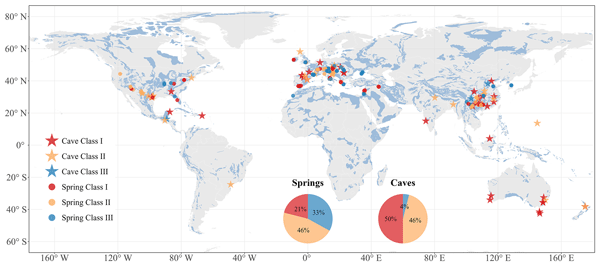
Yining Zang, Pauline C. Treble, Kei Yoshimura, Jayson Gabriel Pinza, Fengbo Zhang, Kübra Özdemir Çallı, Xiaojun Mei, Admin Husic, Alena Gessert, Andrej Stroj, Bartolomé Andreo, Bernard Ladouche, Christine Stumpp, Diana Mance, Eleni Zagana, Fen Huang, Giuseppe Sappa, Harald Kunstmann, Heike Brielmann, Hong Zhou, Huaying Wu, Jakob Garvelmann, James Berglund, Jean-Baptiste Charlier, Jens Lange, Juan Antonio Barberá Fornell, Junbing Pu, Konstantina Katsanou, Kun Ren, Laura Toran, Laurence Gill, Maria Filippini, Martin Kralik, Matías Mudarra Martínez, Min Zhao, Mingming Luo, Nico Goldscheider, Nikolaos Lambrakis, Pantaleone De Vita, Qiong Xiao, Shi Yu, Silvia Iacurto, Silvio Coda, Ted McCormack, Vincenzo Allocca, W. George Darling, Walter D’Alessandro, Xulei Guo, Yundi Hu, Zhijun Wang, Eva Kaminsky, Jiří Faimon, Marek Lang, Pavel Pracný, and Andreas Hartmann
Earth Syst. Sci. Data Discuss., https://doi.org/10.5194/essd-2025-812, https://doi.org/10.5194/essd-2025-812, 2026
Preprint under review for ESSD
Short summary
Short summary
We developed the first global database of water from karst springs and cave drips that records different forms of oxygen and hydrogen, which naturally trace how rainwater moves through rocks. By gathering and checking thousands of measurements from around the globe and linking them with flow and rainfall data, the database provides a comprehensive view of water movement, allows scientists to compare regions, understand groundwater processes, and support sustainable water management worldwide.
Ana I. Ayala, José L. Hinostroza, Daniel Mercado-Bettín, Rafael Marcé, Simon N. Gosling, Donald C. Pierson, and Sebastian Sobek
Geosci. Model Dev., 19, 41–56, https://doi.org/10.5194/gmd-19-41-2026, https://doi.org/10.5194/gmd-19-41-2026, 2026
Short summary
Short summary
Climate change affect lakes by including not just the lakes themselves but also the land areas that drain into them. These surrounding areas influence how much water and nutrients flow into lakes which in turn impact water quality. Here, water fluxes from land, derived from a global hydrological model where water fluxes are modelled at the grid scale, were used to estimate streamflow inputs to lakes from their catchments. Using data from 70 Swedish lakes, we showed that our method works well.
Thiago V. M. do Nascimento, Julia Rudlang, Sebastian Gnann, Jan Seibert, Markus Hrachowitz, and Fabrizio Fenicia
Hydrol. Earth Syst. Sci., 29, 7173–7200, https://doi.org/10.5194/hess-29-7173-2025, https://doi.org/10.5194/hess-29-7173-2025, 2025
Short summary
Short summary
We show that geological maps with varying levels of detail may influence the identification of geology–streamflow relationships across European catchments at multiple scales. At the large scale, controls varied between basins, with no map consistently superior. At the intermediate and small scales, however, higher geological detail consistently strengthened correlations, particularly for baseflow signatures, with the regional map highlighting controls more consistent with process understanding.
Malve Heinz, Annelie Holzkämper, Rohini Kumar, Sélène Ledain, Pascal Horton, and Bettina Schaefli
EGUsphere, https://doi.org/10.5194/egusphere-2025-5447, https://doi.org/10.5194/egusphere-2025-5447, 2025
Short summary
Short summary
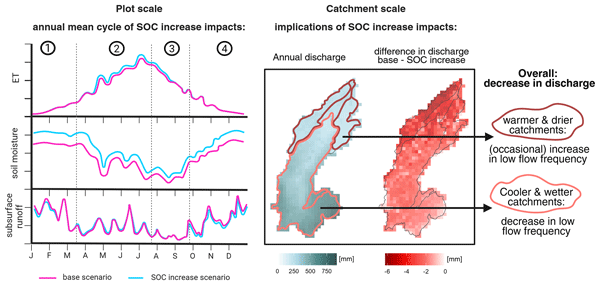
Droughts increasingly threaten agriculture. Improving soils to store more water, for example by increasing soil organic carbon, can help. We simulated this in a Swiss catchment and found that more soil carbon slightly increased soil water storage and evapotranspiration, modestly reduced floods, and shortened periods with very little streamflow. However in warmer, drier areas, these periods with little streamflow could sometimes last longer.
Stefan Poll, Paul Rigor, Slavko Brdar, Ha Thi Minh Ho-Hagemann, Carl Hartick, Marco van Hulten, Ana Gonzalez-Nicolas, Johannes Keller, Daniel Caviedes-Voullieme, Harrie-Jan Hendricks-Franssen, Klaus Goergen, and Stefan Kollet
EGUsphere, https://doi.org/10.5194/egusphere-2025-5468, https://doi.org/10.5194/egusphere-2025-5468, 2025
This preprint is open for discussion and under review for Hydrology and Earth System Sciences (HESS).
Short summary
Short summary
This paper presents TSMP2, a new version of an regional Earth system model that allows to simulate and analyze the complex interactions within terrestrial ecosystems from groundwater to atmosphere. TSMP2 links an atmospheric, a land surface model and an hydrological model through an external coupler and is fully open-source. We describe the TSMP2 model system, present the impact of coupling approaches, and outline our development strategy along with technical and performance aspects.
Taher Kahil, Safa Baccour, Julian Joseph, Reetik Sahu, Peter Burek, Jia Yi Ng, Samar Asad, Dor Fridman, Jose Albiac, Frank A. Ward, and Yoshihide Wada
Geosci. Model Dev., 18, 7987–8015, https://doi.org/10.5194/gmd-18-7987-2025, https://doi.org/10.5194/gmd-18-7987-2025, 2025
Short summary
Short summary
This study presents the development of the global version of the ECHO hydro-economic model for assessing the economic and environmental performance of water management options. This improved version covers a large number of basins worldwide, includes a detailed representation of irrigated agriculture, and accounts for economic benefits and costs of water use. Results of this study demonstrates the capacity of ECHO-Global to address emerging water-related research and practical questions.
Ni Li, Wim Thiery, Shorouq Zahra, Mariana Madruga de Brito, Koffi Worou, Murathan Kurfalı, Seppe Lampe, Paul Muñoz, Clare Flynn, Camila Trigoso, Joakim Nivre, Jakob Zscheischler, and Gabriele Messori
EGUsphere, https://doi.org/10.5194/egusphere-2025-4891, https://doi.org/10.5194/egusphere-2025-4891, 2025
Short summary
Short summary
Climate extremes threaten society and ecosystems. Understanding impacts is critical, despite open databases like EM-DAT and DesInventar, reliable impact data remain scattered across various text sources. Wikimpacts 1.0, using GPT4o, provides comprehensive socio-economic impact data on 2,928 events from 1034 to 2024. It offers broader storm coverage and finer spatial resolution impact data than EM-DAT, showcasing the potential of natural language processing to enhance climate impact datasets.
Pia Ebeling, Alexander Hubig, Alexander Wachholz, Ulrike Scharfenberger, Sarah Haug, Tam Nguyen, Fanny Sarrazin, Masooma Batool, Andreas Musolff, and Rohini Kumar
Earth Syst. Sci. Data Discuss., https://doi.org/10.5194/essd-2025-450, https://doi.org/10.5194/essd-2025-450, 2025
Revised manuscript accepted for ESSD
Short summary
Short summary
This update of the water quality dataset QUADICA for 1386 German catchments adds new data on water quality, flow, and drivers. Additions include water temperature and concentrations of oxygen and others, as well as catchment-wise time series on pollution sources and improved integration with other relevant datasets. This expanded dataset will help researchers and practitioners better understand how human activities affect water quality and ecosystems, and make more informed decisions.
Manon Maisonnier, Maoyuan Feng, David Bastviken, Sandra Arndt, Ronny Lauerwald, Aidin Jabbari, Goulven Gildas Laruelle, Murray D. MacKay, Zeli Tan, Wim Thiery, and Pierre Regnier
Earth Syst. Dynam., 16, 1779–1808, https://doi.org/10.5194/esd-16-1779-2025, https://doi.org/10.5194/esd-16-1779-2025, 2025
Short summary
Short summary
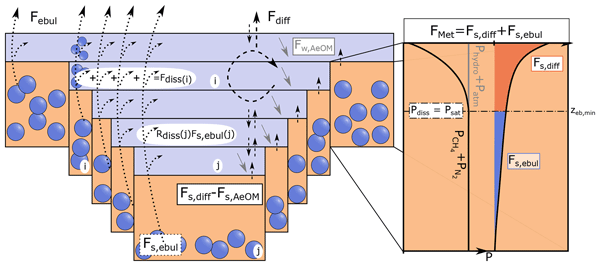
A new process-based modelling framework, FLaMe-v1.0 (Fluxes of Lake Methane version 1.0), is developed to simulate methane (CH4) emissions from lakes at large scales. FLaMe couples the dynamics of organic carbon, oxygen and methane in lakes and rests on an innovative, computationally efficient lake clustering approach for the simulation of CH4 emissions across a large number of lakes. The model evaluation suggests that FLaMe captures the sub-annual and spatial variability of CH4 emissions well.
Sebastian Gnann, Bailey J. Anderson, and Markus Weiler
EGUsphere, https://doi.org/10.5194/egusphere-2025-4527, https://doi.org/10.5194/egusphere-2025-4527, 2025
Short summary
Short summary
The extent to which streamflow varies in response to variability in precipitation and potential evaporation is essential for understanding climate change impacts on water resources. This so-called streamflow sensitivity is often estimated directly from observational data, but the robustness of these estimates remains unclear. Through systematic examination of existing approaches, we highlight uncertainties inherent in all approaches, discuss their origins, and propose potential alternatives.
Xuetong Wang, Raied S. Alharbi, Oscar M. Baez-Villanueva, Amy Green, Matthew F. McCabe, Yoshihide Wada, Albert I. J. M. Van Dijk, Muhammad A. Abid, and Hylke E. Beck
Hydrol. Earth Syst. Sci., 29, 4983–5003, https://doi.org/10.5194/hess-29-4983-2025, https://doi.org/10.5194/hess-29-4983-2025, 2025
Short summary
Short summary
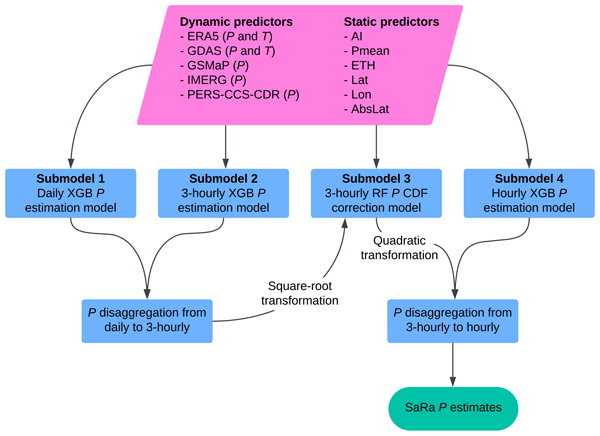
Our paper introduces Saudi Rainfall (SaRa), a high-resolution, near-real-time rainfall product for the Arabian Peninsula. Using machine learning, SaRa combines multiple satellite and (re)analysis datasets with static predictors, outperforming existing products in the region. With the fast development and continuing growth in water demand over this region, SaRa could help to address water challenges and support resource management.
Thomas Fichtner, Yuly Juliana Aguilar Avila, Andreas Hartmann, Stefan Seeger, Martin Maier, and Stephan Raspe
EGUsphere, https://doi.org/10.5194/egusphere-2025-4025, https://doi.org/10.5194/egusphere-2025-4025, 2025
Short summary
Short summary
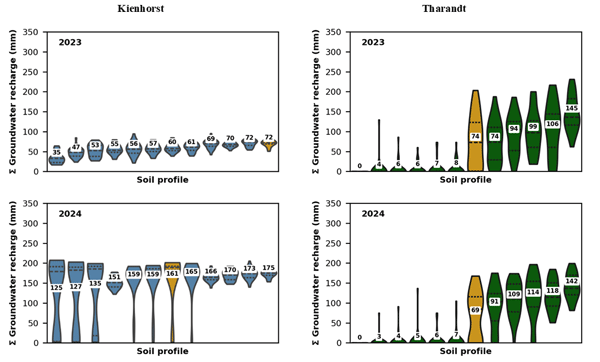
The study examines how spatial soil moisture variability influences SVAT model calibration and the estimation of groundwater recharge in forest ecosystems. We show that model-inherent uncertainties affect predictions more strongly than soil moisture variability itself. Our results demonstrate that reliable groundwater recharge can be achieved using data from just six to seven profiles, providing practical guidance for more efficient field monitoring and model calibration.
Chen Yang, Aoqi Sun, Shupeng Zhang, Yongjiu Dai, Stefan Kollet, and Reed Maxwell
EGUsphere, https://doi.org/10.5194/egusphere-2025-3935, https://doi.org/10.5194/egusphere-2025-3935, 2025
Short summary
Short summary
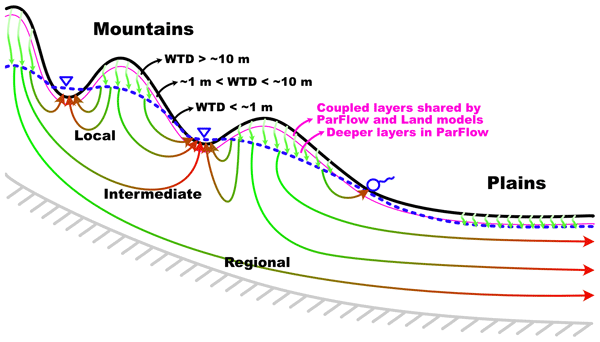
Groundwater strongly influences how water and energy move between land and air, yet most large-scale climate and Earth system models treat it too simply. We reviewed 20 years of work combining a detailed groundwater model, ParFlow, with land surface models, showing ways groundwater shapes energy and water cycles. We also updated this model link, improving its performance, and proposed a flexible framework to support future advances.
Theresa Blume, Peter Chifflard, Stefan Achleitner, Andreas Hartmann, Stefan Hergarten, Luisa Hopp, Bernhard Kohl, Florian Leese, Ilja van Meerveld, Christian Reinhardt-Imjela, and Markus Weiler
EGUsphere, https://doi.org/10.5194/egusphere-2025-4424, https://doi.org/10.5194/egusphere-2025-4424, 2025
Short summary
Short summary
Subsurface stormflow (SSF) is one of the least studied and therefore least understood runoff generation processes because detecting and quantifying SSF is extremely challenging. We present an ongoing concerted experimental effort to systematically investigate SSF across four catchments using a variety of methods covering different spatial scales. Centerpiece of this effort is the construction of 12 large trenches to capture and monitor SSF.
Katoria Lekarkar, Oldrich Rakovec, Rohini Kumar, Stefaan Dondeyne, and Ann van Griensven
EGUsphere, https://doi.org/10.5194/egusphere-2025-4526, https://doi.org/10.5194/egusphere-2025-4526, 2025
Short summary
Short summary
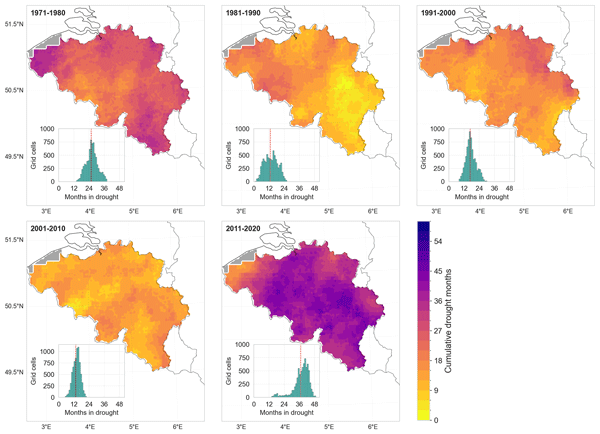
Belgium has faced intense droughts in recent years, causing major losses across sectors. To assess their rarity, we used a hydrological model to reconstruct fifty years of soil moisture in the country. We show that 2011–2020 experienced the most severe droughts since 1971, with nearly 30 % of the decade under drought. We also show that rainfall-based indicators underestimate soil moisture droughts, so including soil moisture monitoring can give decision-makers a clearer picture of drought risks.
Vishal Thakur, Yannis Markonis, Rohini Kumar, Johanna Ruth Thomson, Mijael Rodrigo Vargas Godoy, Martin Hanel, and Oldrich Rakovec
Hydrol. Earth Syst. Sci., 29, 4395–4416, https://doi.org/10.5194/hess-29-4395-2025, https://doi.org/10.5194/hess-29-4395-2025, 2025
Short summary
Short summary
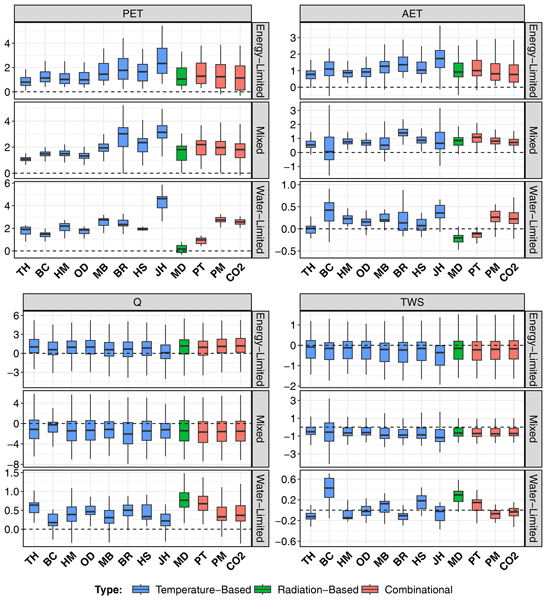
Understanding the changes in water movement in earth is crucial for everyone. To quantify this water movement there are several techniques. We examined how different methods of estimating evaporation impact predictions of various types of water movement across Europe. We found that, while these methods generally agree on whether changes are increasing or decreasing, they differ in magnitude. This means selecting the right evaporation method is crucial for accurate predictions of water movement.
Emmanuel Nyenah, Petra Döll, Martina Flörke, Leon Mühlenbruch, Lasse Nissen, and Robert Reinecke
Geosci. Model Dev., 18, 5635–5653, https://doi.org/10.5194/gmd-18-5635-2025, https://doi.org/10.5194/gmd-18-5635-2025, 2025
Short summary
Short summary
We reprogrammed the latest WaterGAP model (2.2e) to create a sustainable global hydrological model. By utilizing best software practices like modular design, version control, and clear documentation, the new WaterGAP supports collaboration across teams. It can be easily understood, applied, and enhanced by both novice and experienced modellers. Additionally, we share the reprogramming process to assist in the reprogramming of other large geoscientific research software.
Seppe Lampe, Lukas Gudmundsson, Basil Kraft, Stijn Hantson, Douglas Kelley, Vincent Humphrey, Bertrand Le Saux, Emilio Chuvieco, and Wim Thiery
EGUsphere, https://doi.org/10.5194/egusphere-2025-3550, https://doi.org/10.5194/egusphere-2025-3550, 2025
Short summary
Short summary
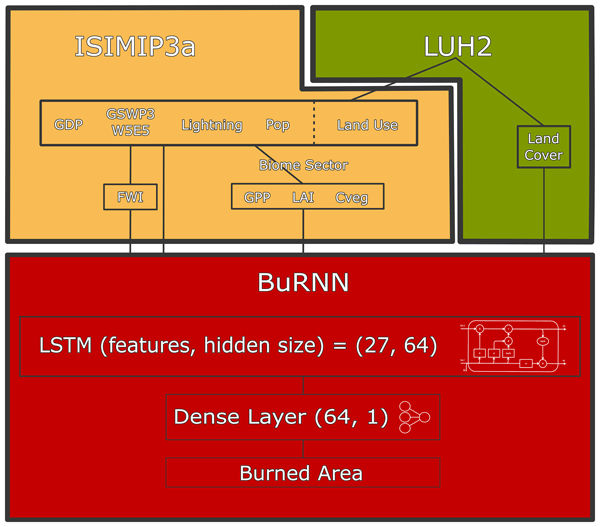
We introduce BuRNN, a model which estimates monthly burned area based on satellite observations and climate, vegetation, and socio-economic data using machine learning. BuRNN outperforms existing process-based fire models. However, the model tends to underestimate burned area in parts of Africa and Australia. We identify the extent of bare ground, the presence of grasses, and fire weather conditions (long periods of warm and dry weather) as key regional drivers of fire activity in BuRNN.
Jan Řehoř, Rudolf Brázdil, Oldřich Rakovec, Martin Hanel, Milan Fischer, Rohini Kumar, Jan Balek, Markéta Poděbradská, Vojtěch Moravec, Luis Samaniego, Yannis Markonis, and Miroslav Trnka
Hydrol. Earth Syst. Sci., 29, 3341–3358, https://doi.org/10.5194/hess-29-3341-2025, https://doi.org/10.5194/hess-29-3341-2025, 2025
Short summary
Short summary
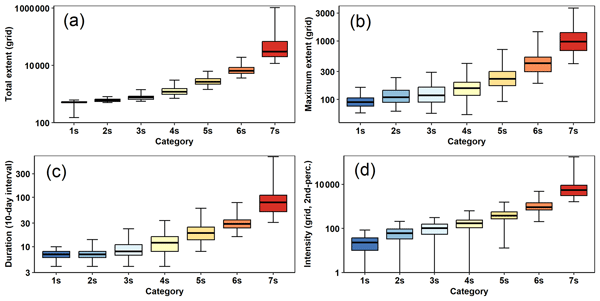
We present a robust method for identification and classification of global land drought events (GLDEs) based on soil moisture. Two models were used to calculate soil moisture and delimit soil drought over global land from 1980–2022, with clusters of 775 and 630 GLDEs. Using four spatiotemporal and three motion-related characteristics, we categorized GLDEs into seven severity and seven dynamic categories. The frequency of GLDEs has generally increased in recent decades.
Mateo Barco Largo, Meshal Alarifi, Sami D. Almalki, Shauna K. Rees, Benjamin P. Y.-H. Lee, Ahmed H. Mohamed, Abdalsamad Aldabaa, Kaoru Kakinuma, and Yoshihide Wada
Int. Arch. Photogramm. Remote Sens. Spatial Inf. Sci., XLVIII-G-2025, 183–188, https://doi.org/10.5194/isprs-archives-XLVIII-G-2025-183-2025, https://doi.org/10.5194/isprs-archives-XLVIII-G-2025-183-2025, 2025
Markus Giese, Yvan Caballero, Andreas Hartmann, and Jean-Baptiste Charlier
Hydrol. Earth Syst. Sci., 29, 3037–3054, https://doi.org/10.5194/hess-29-3037-2025, https://doi.org/10.5194/hess-29-3037-2025, 2025
Short summary
Short summary
Karst springs respond quickly to environmental changes, making them crucial to understanding climate impacts on groundwater. This study analyses long-term trends in precipitation, temperature, and discharge from more than 50 springs across Europe. Results show that while historical discharge trends align with those of rivers, recent changes are driven by rising temperatures rather than precipitation. These findings highlight climate-driven shifts in groundwater recharge and storage processes.
Pia Ebeling, Andreas Musolff, Rohini Kumar, Andreas Hartmann, and Jan H. Fleckenstein
Hydrol. Earth Syst. Sci., 29, 2925–2950, https://doi.org/10.5194/hess-29-2925-2025, https://doi.org/10.5194/hess-29-2925-2025, 2025
Short summary
Short summary
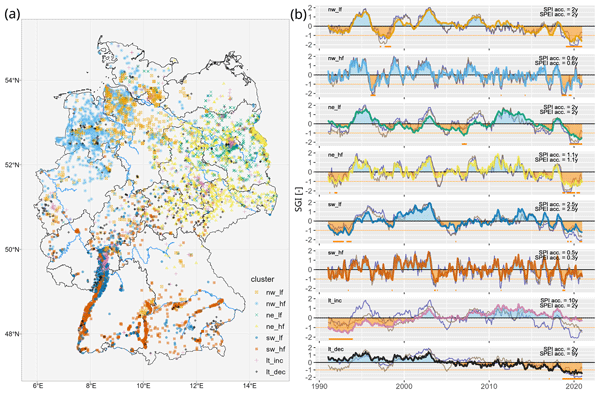
Groundwater is a crucial resource at risk due to droughts. To understand drought effects on groundwater levels in Germany, we grouped 6626 wells into six regional and two national patterns. Weather explained half of the level variations with varied response times. Shallow groundwater responds fast and is more vulnerable to short droughts (a few months). Dampened deep heads buffer short droughts but suffer from long droughts and recoveries. Two nationwide trend patterns were linked to human water use.
Dor Fridman, Mikhail Smilovic, Peter Burek, Sylvia Tramberend, and Taher Kahil
Geosci. Model Dev., 18, 3735–3754, https://doi.org/10.5194/gmd-18-3735-2025, https://doi.org/10.5194/gmd-18-3735-2025, 2025
Short summary
Short summary
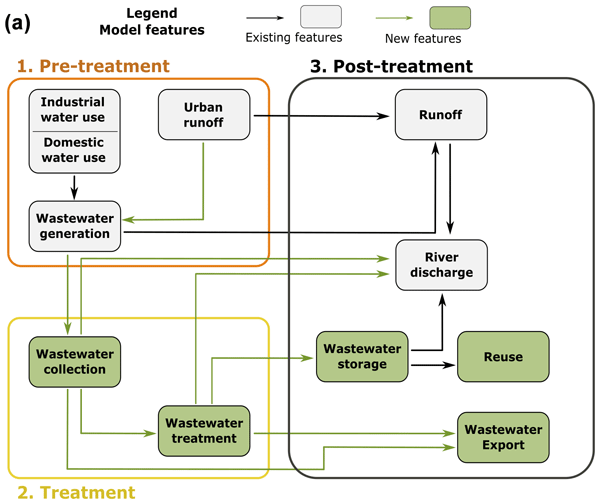
Global hydrological models are applied at high spatial resolutions to quantify water availability and evaluate water scarcity mitigation options. Yet, they mainly oversee critical local processes. This paper presents and demonstrates the inclusion of wastewater treatment and reuse into a global hydrological model. As a result, model performance improves, and models consider treated wastewater as an alternative water source.
Derrick Muheki, Bas Vercruysse, Krishna Kumar Thirukokaranam Chandrasekar, Christophe Verbruggen, Julie M. Birkholz, Koen Hufkens, Hans Verbeeck, Pascal Boeckx, Seppe Lampe, Ed Hawkins, Peter Thorne, Dominique Kankonde Ntumba, Olivier Kapalay Moulasa, and Wim Thiery
EGUsphere, https://doi.org/10.5194/egusphere-2024-3779, https://doi.org/10.5194/egusphere-2024-3779, 2025
This preprint is open for discussion and under review for Geoscientific Model Development (GMD).
Short summary
Short summary
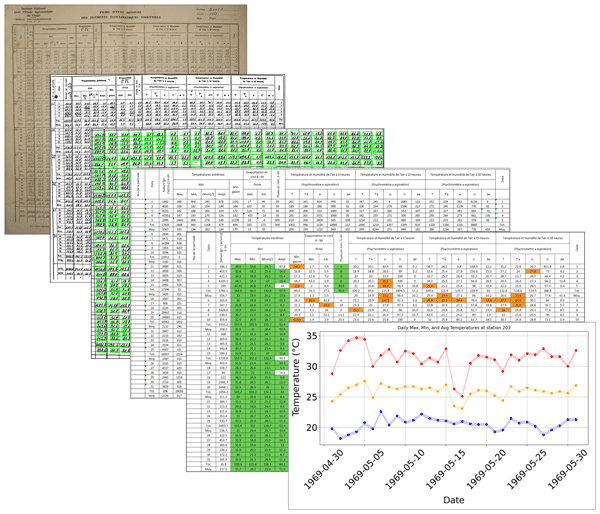
Archives worldwide host vast records of observed weather data crucial for understanding climate variability. However, most of these records are still in paper form, limiting their use. To address this, we developed MeteoSaver, an open-source tool, to transcribe these records to machine-readable format. Applied to ten handwritten temperature sheets, it achieved a median accuracy of 74%. This tool offers a promising solution to preserve records from archives and unlock historical weather insights.
Katja Frieler, Stefan Lange, Jacob Schewe, Matthias Mengel, Simon Treu, Christian Otto, Jan Volkholz, Christopher P. O. Reyer, Stefanie Heinicke, Colin Jones, Julia L. Blanchard, Cheryl S. Harrison, Colleen M. Petrik, Tyler D. Eddy, Kelly Ortega-Cisneros, Camilla Novaglio, Ryan Heneghan, Derek P. Tittensor, Olivier Maury, Matthias Büchner, Thomas Vogt, Dánnell Quesada Chacón, Kerry Emanuel, Chia-Ying Lee, Suzana J. Camargo, Jonas Jägermeyr, Sam Rabin, Jochen Klar, Iliusi D. Vega del Valle, Lisa Novak, Inga J. Sauer, Gitta Lasslop, Sarah Chadburn, Eleanor Burke, Angela Gallego-Sala, Noah Smith, Jinfeng Chang, Stijn Hantson, Chantelle Burton, Anne Gädeke, Fang Li, Simon N. Gosling, Hannes Müller Schmied, Fred Hattermann, Thomas Hickler, Rafael Marcé, Don Pierson, Wim Thiery, Daniel Mercado-Bettín, Robert Ladwig, Ana Isabel Ayala-Zamora, Matthew Forrest, Michel Bechtold, Robert Reinecke, Inge de Graaf, Jed O. Kaplan, Alexander Koch, and Matthieu Lengaigne
EGUsphere, https://doi.org/10.5194/egusphere-2025-2103, https://doi.org/10.5194/egusphere-2025-2103, 2025
Short summary
Short summary
This paper describes the experiments and data sets necessary to run historic and future impact projections, and the underlying assumptions of future climate change as defined by the 3rd round of the ISIMIP Project (Inter-sectoral Impactmodel Intercomparison Project, isimip.org). ISIMIP provides a framework for cross-sectorally consistent climate impact simulations to contribute to a comprehensive and consistent picture of the world under different climate-change scenarios.
Suqi Guo, Felix Havermann, Steven J. De Hertog, Fei Luo, Iris Manola, Thomas Raddatz, Hongmei Li, Wim Thiery, Quentin Lejeune, Carl-Friedrich Schleussner, David Wårlind, Lars Nieradzik, and Julia Pongratz
Earth Syst. Dynam., 16, 631–666, https://doi.org/10.5194/esd-16-631-2025, https://doi.org/10.5194/esd-16-631-2025, 2025
Short summary
Short summary
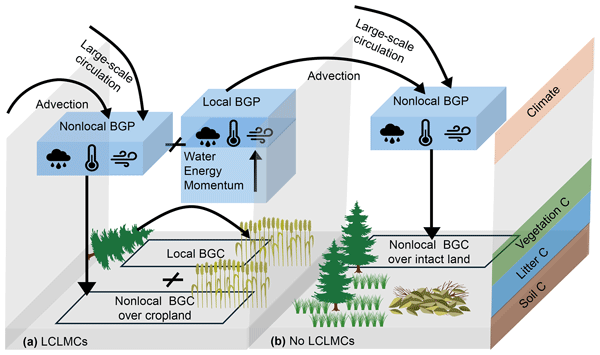
Land cover and land management changes (LCLMCs) can alter climate even in intact areas, causing carbon changes in remote areas. This study is the first to assess these effects, finding they substantially alter global carbon dynamics, changing terrestrial stocks by up to dozens of gigatonnes. These results are vital for scientific and policy assessments, given the expected role of LCLMCs in achieving the Paris Agreement's goal to limit global warming below 1.5 °C.
Hannes Müller Schmied, Simon Newland Gosling, Marlo Garnsworthy, Laura Müller, Camelia-Eliza Telteu, Atiq Kainan Ahmed, Lauren Seaby Andersen, Julien Boulange, Peter Burek, Jinfeng Chang, He Chen, Lukas Gudmundsson, Manolis Grillakis, Luca Guillaumot, Naota Hanasaki, Aristeidis Koutroulis, Rohini Kumar, Guoyong Leng, Junguo Liu, Xingcai Liu, Inga Menke, Vimal Mishra, Yadu Pokhrel, Oldrich Rakovec, Luis Samaniego, Yusuke Satoh, Harsh Lovekumar Shah, Mikhail Smilovic, Tobias Stacke, Edwin Sutanudjaja, Wim Thiery, Athanasios Tsilimigkras, Yoshihide Wada, Niko Wanders, and Tokuta Yokohata
Geosci. Model Dev., 18, 2409–2425, https://doi.org/10.5194/gmd-18-2409-2025, https://doi.org/10.5194/gmd-18-2409-2025, 2025
Short summary
Short summary
Global water models contribute to the evaluation of important natural and societal issues but are – as all models – simplified representation of reality. So, there are many ways to calculate the water fluxes and storages. This paper presents a visualization of 16 global water models using a standardized visualization and the pathway towards this common understanding. Next to academic education purposes, we envisage that these diagrams will help researchers, model developers, and data users.
Cristina Deidda, Arpita Khanna, Wolfgang Schade, and Wim Thiery
EGUsphere, https://doi.org/10.5194/egusphere-2025-1697, https://doi.org/10.5194/egusphere-2025-1697, 2025
Short summary
Short summary
Climate extremes like floods, heatwaves, droughts, and wildfires are disrupting Europe’s transport. This study combines a review of past events and future projections to assess current losses and the future exposure of transport infrastructure. Exposure to extremes is projected to rise, but lower emissions can reduce it. Urgent action is needed to adapt the Trans-European Transport Network to a changing climate.
Bamidele Oloruntoba, Stefan Kollet, Carsten Montzka, Harry Vereecken, and Harrie-Jan Hendricks Franssen
Hydrol. Earth Syst. Sci., 29, 1659–1683, https://doi.org/10.5194/hess-29-1659-2025, https://doi.org/10.5194/hess-29-1659-2025, 2025
Short summary
Short summary
We studied how soil and weather data affect land model simulations over Africa. By combining soil data processed in different ways with weather data of varying time intervals, we found that weather inputs had a greater impact on water processes than soil data type. However, the way soil data were processed became crucial when paired with high-frequency weather inputs, showing that detailed weather data can improve local and regional predictions of how water moves and interacts with the land.
Masooma Batool, Fanny J. Sarrazin, and Rohini Kumar
Earth Syst. Sci. Data, 17, 881–916, https://doi.org/10.5194/essd-17-881-2025, https://doi.org/10.5194/essd-17-881-2025, 2025
Short summary
Short summary
Our paper presents a reconstruction and analysis of the gridded P surplus in European landscapes from 1850 to 2019 at a 5 arcmin resolution. By utilizing 48 different estimates, we account for uncertainties in major components of the P surplus. Our findings highlight substantial historical changes, with the total P surplus in the EU 27 tripling over 170 years. Our dataset enables flexible aggregation at various spatial scales, providing critical insights for land and water management strategies.
Elena Xoplaki, Florian Ellsäßer, Jens Grieger, Katrin M. Nissen, Joaquim G. Pinto, Markus Augenstein, Ting-Chen Chen, Hendrik Feldmann, Petra Friederichs, Daniel Gliksman, Laura Goulier, Karsten Haustein, Jens Heinke, Lisa Jach, Florian Knutzen, Stefan Kollet, Jürg Luterbacher, Niklas Luther, Susanna Mohr, Christoph Mudersbach, Christoph Müller, Efi Rousi, Felix Simon, Laura Suarez-Gutierrez, Svenja Szemkus, Sara M. Vallejo-Bernal, Odysseas Vlachopoulos, and Frederik Wolf
Nat. Hazards Earth Syst. Sci., 25, 541–564, https://doi.org/10.5194/nhess-25-541-2025, https://doi.org/10.5194/nhess-25-541-2025, 2025
Short summary
Short summary
Europe frequently experiences compound events, with major impacts. We investigate these events’ interactions, characteristics, and changes over time, focusing on socio-economic impacts in Germany and central Europe. Highlighting 2018’s extreme events, this study reveals impacts on water, agriculture, and forests and stresses the need for impact-focused definitions and better future risk quantification to support adaptation planning.
Christian Poppe Terán, Bibi S. Naz, Harry Vereecken, Roland Baatz, Rosie A. Fisher, and Harrie-Jan Hendricks Franssen
Geosci. Model Dev., 18, 287–317, https://doi.org/10.5194/gmd-18-287-2025, https://doi.org/10.5194/gmd-18-287-2025, 2025
Short summary
Short summary
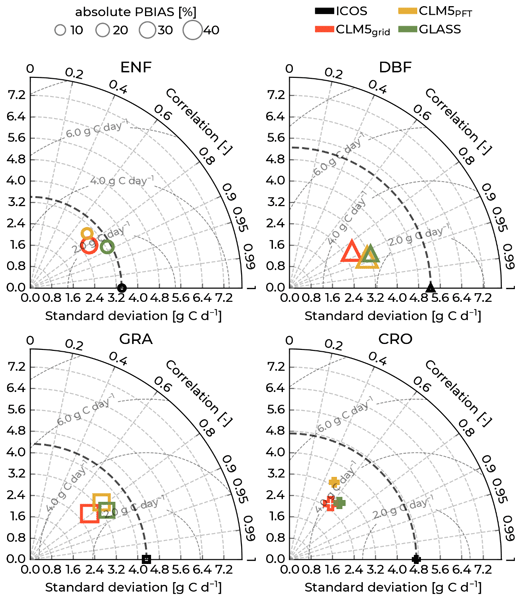
Carbon and water exchanges between the atmosphere and the land surface contribute to water resource availability and climate change mitigation. Land surface models, like the Community Land Model version 5 (CLM5), simulate these. This study finds that CLM5 and other data sets underestimate the magnitudes of and variability in carbon and water exchanges for the most abundant plant functional types compared to observations. It provides essential insights for further research into these processes.
Florian Knutzen, Paul Averbeck, Caterina Barrasso, Laurens M. Bouwer, Barry Gardiner, José M. Grünzweig, Sabine Hänel, Karsten Haustein, Marius Rohde Johannessen, Stefan Kollet, Mortimer M. Müller, Joni-Pekka Pietikäinen, Karolina Pietras-Couffignal, Joaquim G. Pinto, Diana Rechid, Efi Rousi, Ana Russo, Laura Suarez-Gutierrez, Sarah Veit, Julian Wendler, Elena Xoplaki, and Daniel Gliksman
Nat. Hazards Earth Syst. Sci., 25, 77–117, https://doi.org/10.5194/nhess-25-77-2025, https://doi.org/10.5194/nhess-25-77-2025, 2025
Short summary
Short summary
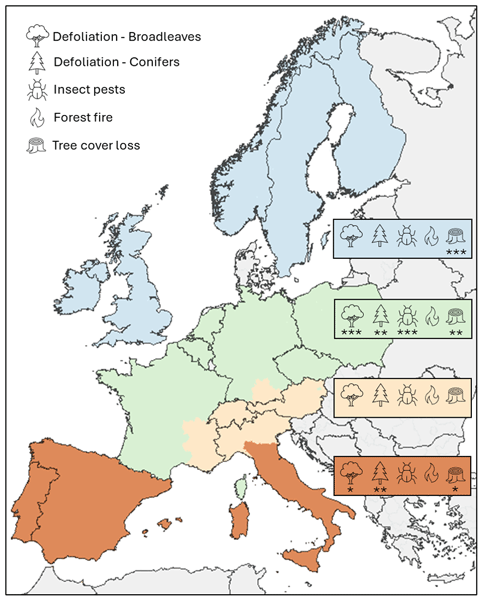
Our research, involving 22 European scientists, investigated drought and heat impacts on forests in 2018–2022. Findings reveal that climate extremes are intensifying, with central Europe being most severely impacted. The southern region showed resilience due to historical drought exposure, while northern and Alpine areas experienced emerging or minimal impacts. The study highlights the need for region-specific strategies, improved data collection, and sustainable practices to safeguard forests.
Eshrat Fatima, Rohini Kumar, Sabine Attinger, Maren Kaluza, Oldrich Rakovec, Corinna Rebmann, Rafael Rosolem, Sascha E. Oswald, Luis Samaniego, Steffen Zacharias, and Martin Schrön
Hydrol. Earth Syst. Sci., 28, 5419–5441, https://doi.org/10.5194/hess-28-5419-2024, https://doi.org/10.5194/hess-28-5419-2024, 2024
Short summary
Short summary
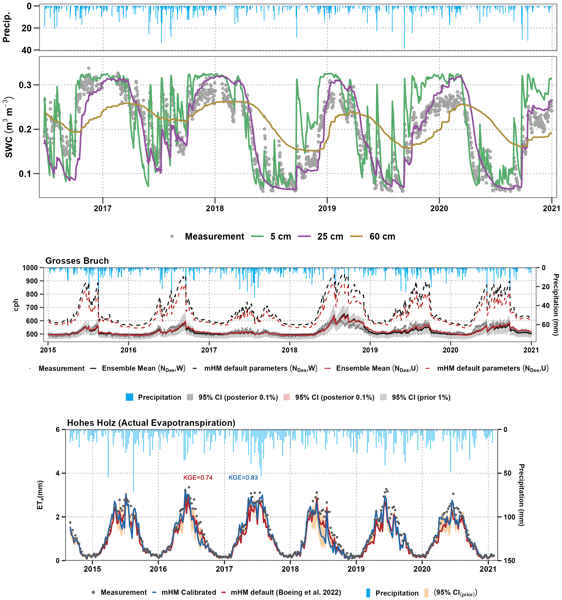
This study establishes a framework to incorporate cosmic-ray neutron measurements into the mesoscale Hydrological Model (mHM). We evaluate different approaches to estimate neutron counts within the mHM using the Desilets equation, with uniformly and non-uniformly weighted average soil moisture, and the physically based code COSMIC. The data improved not only soil moisture simulations but also the parameterisation of evapotranspiration in the model.
Emmanuel Nyenah, Petra Döll, Daniel S. Katz, and Robert Reinecke
Geosci. Model Dev., 17, 8593–8611, https://doi.org/10.5194/gmd-17-8593-2024, https://doi.org/10.5194/gmd-17-8593-2024, 2024
Short summary
Short summary
Research software is vital for scientific progress but is often developed by scientists with limited skills, time, and funding, leading to challenges in usability and maintenance. Our study across 10 sectors shows strengths in version control, open-source licensing, and documentation while emphasizing the need for containerization and code quality. We recommend workshops; code quality metrics; funding; and following the findable, accessible, interoperable, and reusable (FAIR) standards.
Khosro Morovati, Keer Zhang, Lidi Shi, Yadu Pokhrel, Maozhou Wu, Paradis Someth, Sarann Ly, and Fuqiang Tian
Hydrol. Earth Syst. Sci., 28, 5133–5147, https://doi.org/10.5194/hess-28-5133-2024, https://doi.org/10.5194/hess-28-5133-2024, 2024
Short summary
Short summary
This study examines large daily river flow fluctuations in the dammed Mekong River, developing integrated 3D hydrodynamic and response time models alongside a hydrological model with an embedded reservoir module. This approach allows estimation of travel times between hydrological stations and contributions of subbasins and upstream regions. Findings show a power correlation between upstream discharge and travel time, and significant fluctuations occurred even before dam construction.
Fanny J. Sarrazin, Sabine Attinger, and Rohini Kumar
Earth Syst. Sci. Data, 16, 4673–4708, https://doi.org/10.5194/essd-16-4673-2024, https://doi.org/10.5194/essd-16-4673-2024, 2024
Short summary
Short summary
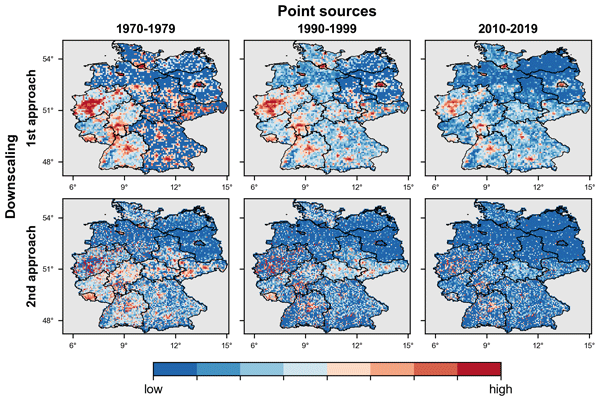
Nitrogen (N) and phosphorus (P) contamination of water bodies is a long-term issue due to the long history of N and P inputs to the environment and their persistence. Here, we introduce a long-term and high-resolution dataset of N and P inputs from wastewater (point sources) for Germany, combining data from different sources and conceptual understanding. We also account for uncertainties in modelling choices, thus facilitating robust long-term and large-scale water quality studies.
Sabin I. Taranu, David M. Lawrence, Yoshihide Wada, Ting Tang, Erik Kluzek, Sam Rabin, Yi Yao, Steven J. De Hertog, Inne Vanderkelen, and Wim Thiery
Geosci. Model Dev., 17, 7365–7399, https://doi.org/10.5194/gmd-17-7365-2024, https://doi.org/10.5194/gmd-17-7365-2024, 2024
Short summary
Short summary
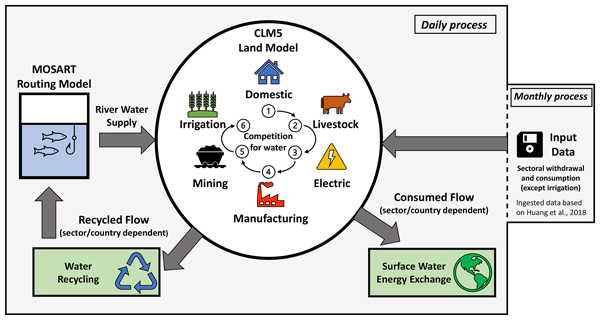
In this study, we improved a climate model by adding the representation of water use sectors such as domestic, industry, and agriculture. This new feature helps us understand how water is used and supplied in various areas. We tested our model from 1971 to 2010 and found that it accurately identifies areas with water scarcity. By modelling the competition between sectors when water availability is limited, the model helps estimate the intensity and extent of individual sectors' water shortages.
Mariana Gomez, Maximilian Nölscher, Andreas Hartmann, and Stefan Broda
Hydrol. Earth Syst. Sci., 28, 4407–4425, https://doi.org/10.5194/hess-28-4407-2024, https://doi.org/10.5194/hess-28-4407-2024, 2024
Short summary
Short summary
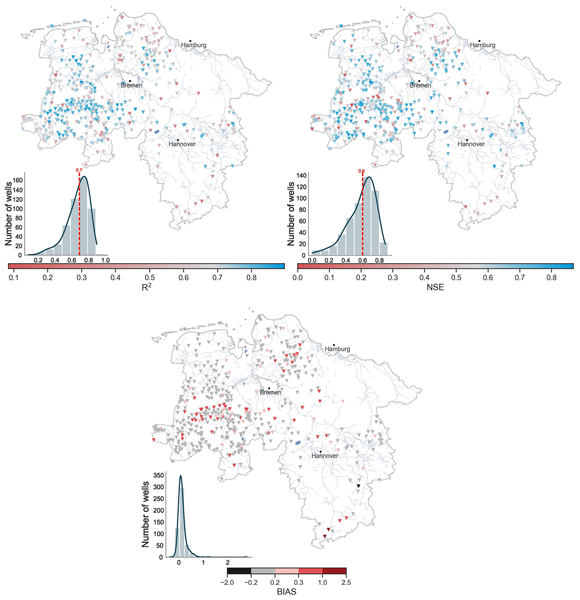
To understand the impact of external factors on groundwater level modelling using a 1-D convolutional neural network (CNN) model, we train, validate, and tune individual CNN models for 505 wells distributed across Lower Saxony, Germany. We then evaluate the performance of these models against available geospatial and time series features. This study provides new insights into the relationship between these factors and the accuracy of groundwater modelling.
Dapeng Feng, Hylke Beck, Jens de Bruijn, Reetik Kumar Sahu, Yusuke Satoh, Yoshihide Wada, Jiangtao Liu, Ming Pan, Kathryn Lawson, and Chaopeng Shen
Geosci. Model Dev., 17, 7181–7198, https://doi.org/10.5194/gmd-17-7181-2024, https://doi.org/10.5194/gmd-17-7181-2024, 2024
Short summary
Short summary
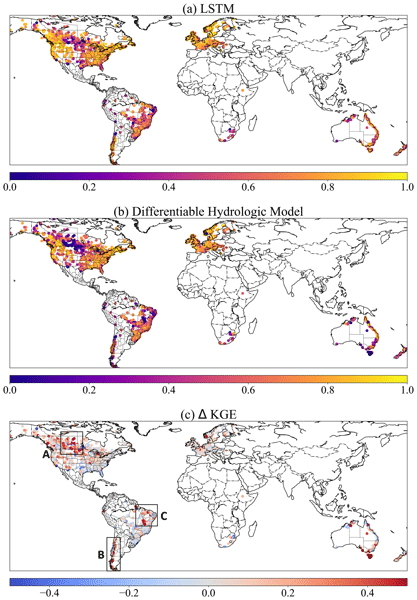
Accurate hydrologic modeling is vital to characterizing water cycle responses to climate change. For the first time at this scale, we use differentiable physics-informed machine learning hydrologic models to simulate rainfall–runoff processes for 3753 basins around the world and compare them with purely data-driven and traditional modeling approaches. This sets a benchmark for hydrologic estimates around the world and builds foundations for improving global hydrologic simulations.
Huy Dang and Yadu Pokhrel
Hydrol. Earth Syst. Sci., 28, 3347–3365, https://doi.org/10.5194/hess-28-3347-2024, https://doi.org/10.5194/hess-28-3347-2024, 2024
Short summary
Short summary
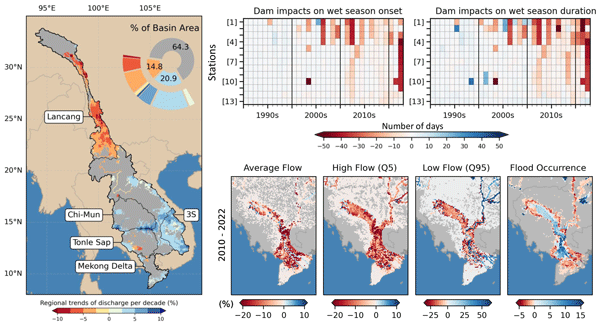
By examining basin-wide simulations of a river regime over 83 years with and without dams, we present evidence that climate variation was a key driver of hydrologic variabilities in the Mekong River basin (MRB) over the long term; however, dams have largely altered the seasonality of the Mekong’s flow regime and annual flooding patterns in major downstream areas in recent years. These findings could help us rethink the planning of future dams and water resource management in the MRB.
Bjorn Stevens, Stefan Adami, Tariq Ali, Hartwig Anzt, Zafer Aslan, Sabine Attinger, Jaana Bäck, Johanna Baehr, Peter Bauer, Natacha Bernier, Bob Bishop, Hendryk Bockelmann, Sandrine Bony, Guy Brasseur, David N. Bresch, Sean Breyer, Gilbert Brunet, Pier Luigi Buttigieg, Junji Cao, Christelle Castet, Yafang Cheng, Ayantika Dey Choudhury, Deborah Coen, Susanne Crewell, Atish Dabholkar, Qing Dai, Francisco Doblas-Reyes, Dale Durran, Ayoub El Gaidi, Charlie Ewen, Eleftheria Exarchou, Veronika Eyring, Florencia Falkinhoff, David Farrell, Piers M. Forster, Ariane Frassoni, Claudia Frauen, Oliver Fuhrer, Shahzad Gani, Edwin Gerber, Debra Goldfarb, Jens Grieger, Nicolas Gruber, Wilco Hazeleger, Rolf Herken, Chris Hewitt, Torsten Hoefler, Huang-Hsiung Hsu, Daniela Jacob, Alexandra Jahn, Christian Jakob, Thomas Jung, Christopher Kadow, In-Sik Kang, Sarah Kang, Karthik Kashinath, Katharina Kleinen-von Königslöw, Daniel Klocke, Uta Kloenne, Milan Klöwer, Chihiro Kodama, Stefan Kollet, Tobias Kölling, Jenni Kontkanen, Steve Kopp, Michal Koran, Markku Kulmala, Hanna Lappalainen, Fakhria Latifi, Bryan Lawrence, June Yi Lee, Quentin Lejeun, Christian Lessig, Chao Li, Thomas Lippert, Jürg Luterbacher, Pekka Manninen, Jochem Marotzke, Satoshi Matsouoka, Charlotte Merchant, Peter Messmer, Gero Michel, Kristel Michielsen, Tomoki Miyakawa, Jens Müller, Ramsha Munir, Sandeep Narayanasetti, Ousmane Ndiaye, Carlos Nobre, Achim Oberg, Riko Oki, Tuba Özkan-Haller, Tim Palmer, Stan Posey, Andreas Prein, Odessa Primus, Mike Pritchard, Julie Pullen, Dian Putrasahan, Johannes Quaas, Krishnan Raghavan, Venkatachalam Ramaswamy, Markus Rapp, Florian Rauser, Markus Reichstein, Aromar Revi, Sonakshi Saluja, Masaki Satoh, Vera Schemann, Sebastian Schemm, Christina Schnadt Poberaj, Thomas Schulthess, Cath Senior, Jagadish Shukla, Manmeet Singh, Julia Slingo, Adam Sobel, Silvina Solman, Jenna Spitzer, Philip Stier, Thomas Stocker, Sarah Strock, Hang Su, Petteri Taalas, John Taylor, Susann Tegtmeier, Georg Teutsch, Adrian Tompkins, Uwe Ulbrich, Pier-Luigi Vidale, Chien-Ming Wu, Hao Xu, Najibullah Zaki, Laure Zanna, Tianjun Zhou, and Florian Ziemen
Earth Syst. Sci. Data, 16, 2113–2122, https://doi.org/10.5194/essd-16-2113-2024, https://doi.org/10.5194/essd-16-2113-2024, 2024
Short summary
Short summary
To manage Earth in the Anthropocene, new tools, new institutions, and new forms of international cooperation will be required. Earth Virtualization Engines is proposed as an international federation of centers of excellence to empower all people to respond to the immense and urgent challenges posed by climate change.
Derrick Muheki, Axel A. J. Deijns, Emanuele Bevacqua, Gabriele Messori, Jakob Zscheischler, and Wim Thiery
Earth Syst. Dynam., 15, 429–466, https://doi.org/10.5194/esd-15-429-2024, https://doi.org/10.5194/esd-15-429-2024, 2024
Short summary
Short summary
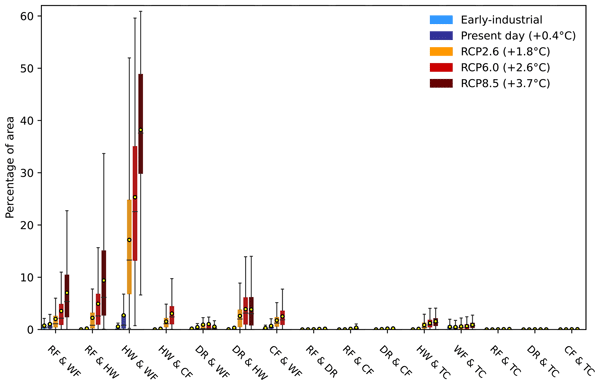
Climate change affects the interaction, dependence, and joint occurrence of climate extremes. Here we investigate the joint occurrence of pairs of river floods, droughts, heatwaves, crop failures, wildfires, and tropical cyclones in East Africa under past and future climate conditions. Our results show that, across all future warming scenarios, the frequency and spatial extent of these co-occurring extremes will increase in this region, particularly in areas close to the Nile and Congo rivers.
Steven J. De Hertog, Carmen E. Lopez-Fabara, Ruud van der Ent, Jessica Keune, Diego G. Miralles, Raphael Portmann, Sebastian Schemm, Felix Havermann, Suqi Guo, Fei Luo, Iris Manola, Quentin Lejeune, Julia Pongratz, Carl-Friedrich Schleussner, Sonia I. Seneviratne, and Wim Thiery
Earth Syst. Dynam., 15, 265–291, https://doi.org/10.5194/esd-15-265-2024, https://doi.org/10.5194/esd-15-265-2024, 2024
Short summary
Short summary
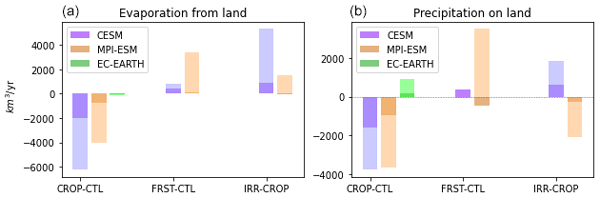
Changes in land use are crucial to achieve lower global warming. However, despite their importance, the effects of these changes on moisture fluxes are poorly understood. We analyse land cover and management scenarios in three climate models involving cropland expansion, afforestation, and irrigation. Results show largely consistent influences on moisture fluxes, with cropland expansion causing a drying and reduced local moisture recycling, while afforestation and irrigation show the opposite.
Rosa Pietroiusti, Inne Vanderkelen, Friederike E. L. Otto, Clair Barnes, Lucy Temple, Mary Akurut, Philippe Bally, Nicole P. M. van Lipzig, and Wim Thiery
Earth Syst. Dynam., 15, 225–264, https://doi.org/10.5194/esd-15-225-2024, https://doi.org/10.5194/esd-15-225-2024, 2024
Short summary
Short summary
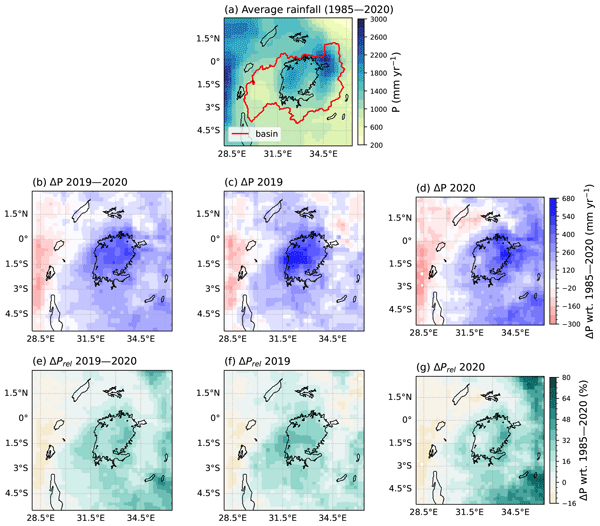
Heavy rainfall in eastern Africa between late 2019 and mid 2020 caused devastating floods and landslides and drove the levels of Lake Victoria to a record-breaking maximum in May 2020. In this study, we characterize the spatial extent and impacts of the floods in the Lake Victoria basin and investigate how human-induced climate change influenced the probability and intensity of the record-breaking lake levels and flooding by applying a multi-model extreme event attribution methodology.
Wei Jing Ang, Edward Park, Yadu Pokhrel, Dung Duc Tran, and Ho Huu Loc
Earth Syst. Sci. Data, 16, 1209–1228, https://doi.org/10.5194/essd-16-1209-2024, https://doi.org/10.5194/essd-16-1209-2024, 2024
Short summary
Short summary
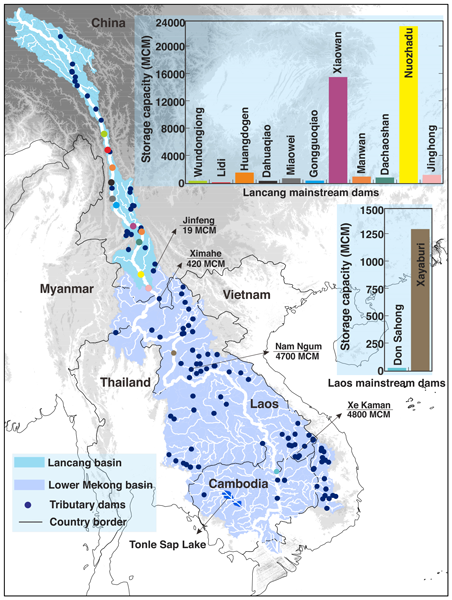
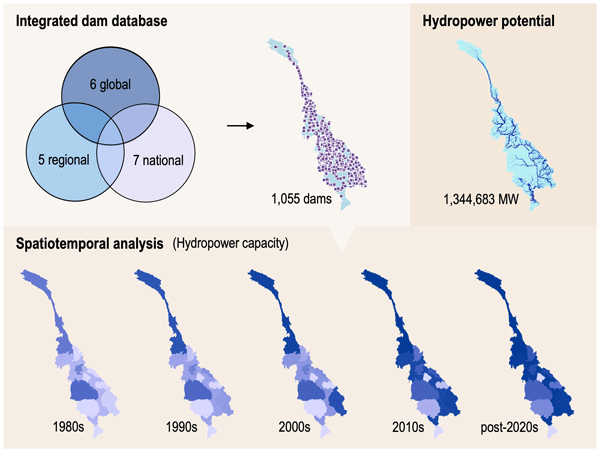
Dams have burgeoned in the Mekong, but information on dams is scattered and inconsistent. Up-to-date evaluation of dams is unavailable, and basin-wide hydropower potential has yet to be systematically assessed. We present a comprehensive database of 1055 dams, a spatiotemporal analysis of the dams, and a total hydropower potential of 1 334 683 MW. Considering projected dam development and hydropower potential, the vulnerability and the need for better dam management may be highest in Laos.
Liubov Poshyvailo-Strube, Niklas Wagner, Klaus Goergen, Carina Furusho-Percot, Carl Hartick, and Stefan Kollet
Earth Syst. Dynam., 15, 167–189, https://doi.org/10.5194/esd-15-167-2024, https://doi.org/10.5194/esd-15-167-2024, 2024
Short summary
Short summary
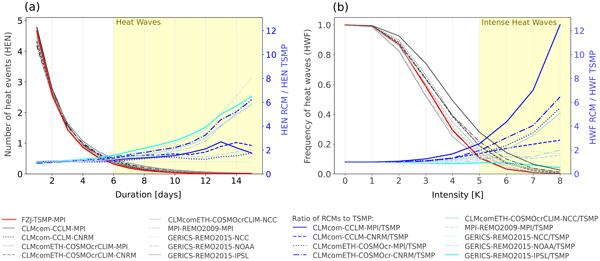
Groundwater (GW) representation is simplified in most regional climate models. Here, we introduce a unique Terrestrial Systems Modeling Platform (TSMP) dataset with an explicit representation of GW, in the context of dynamical downscaling of GCMs for climate change studies. We compare the heat events statistics of TSMP and the CORDEX ensemble. Our results show that TSMP systematically simulates fewer heat waves, and they are shorter and less intense.
Urmin Vegad, Yadu Pokhrel, and Vimal Mishra
Hydrol. Earth Syst. Sci., 28, 1107–1126, https://doi.org/10.5194/hess-28-1107-2024, https://doi.org/10.5194/hess-28-1107-2024, 2024
Short summary
Short summary
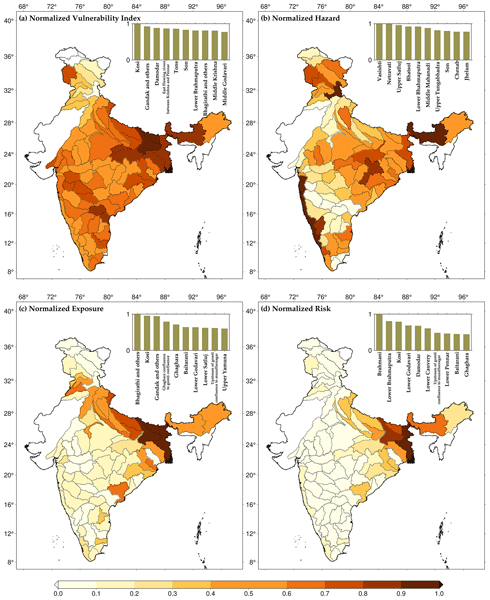
A large population is affected by floods, which leave their footprints through human mortality, migration, and damage to agriculture and infrastructure, during almost every summer monsoon season in India. Despite the massive damage of floods, sub-basin level flood risk assessment is still in its infancy and needs to be improved. Using hydrological and hydrodynamic models, we reconstructed sub-basin level observed floods for the 1901–2020 period.
Celray James Chawanda, Albert Nkwasa, Wim Thiery, and Ann van Griensven
Hydrol. Earth Syst. Sci., 28, 117–138, https://doi.org/10.5194/hess-28-117-2024, https://doi.org/10.5194/hess-28-117-2024, 2024
Short summary
Short summary
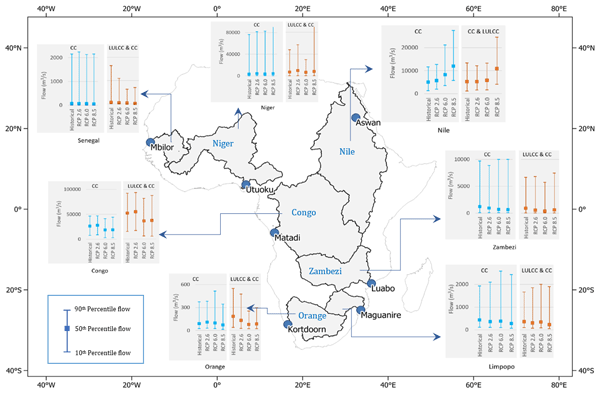
Africa's water resources are being negatively impacted by climate change and land-use change. The SWAT+ hydrological model was used to simulate the hydrological cycle in Africa, and results show likely decreases in river flows in the Zambezi and Congo rivers and highest flows in the Niger River basins due to climate change. Land cover change had the biggest impact in the Congo River basin, emphasizing the importance of including land-use change in studies.
Katja Frieler, Jan Volkholz, Stefan Lange, Jacob Schewe, Matthias Mengel, María del Rocío Rivas López, Christian Otto, Christopher P. O. Reyer, Dirk Nikolaus Karger, Johanna T. Malle, Simon Treu, Christoph Menz, Julia L. Blanchard, Cheryl S. Harrison, Colleen M. Petrik, Tyler D. Eddy, Kelly Ortega-Cisneros, Camilla Novaglio, Yannick Rousseau, Reg A. Watson, Charles Stock, Xiao Liu, Ryan Heneghan, Derek Tittensor, Olivier Maury, Matthias Büchner, Thomas Vogt, Tingting Wang, Fubao Sun, Inga J. Sauer, Johannes Koch, Inne Vanderkelen, Jonas Jägermeyr, Christoph Müller, Sam Rabin, Jochen Klar, Iliusi D. Vega del Valle, Gitta Lasslop, Sarah Chadburn, Eleanor Burke, Angela Gallego-Sala, Noah Smith, Jinfeng Chang, Stijn Hantson, Chantelle Burton, Anne Gädeke, Fang Li, Simon N. Gosling, Hannes Müller Schmied, Fred Hattermann, Jida Wang, Fangfang Yao, Thomas Hickler, Rafael Marcé, Don Pierson, Wim Thiery, Daniel Mercado-Bettín, Robert Ladwig, Ana Isabel Ayala-Zamora, Matthew Forrest, and Michel Bechtold
Geosci. Model Dev., 17, 1–51, https://doi.org/10.5194/gmd-17-1-2024, https://doi.org/10.5194/gmd-17-1-2024, 2024
Short summary
Short summary
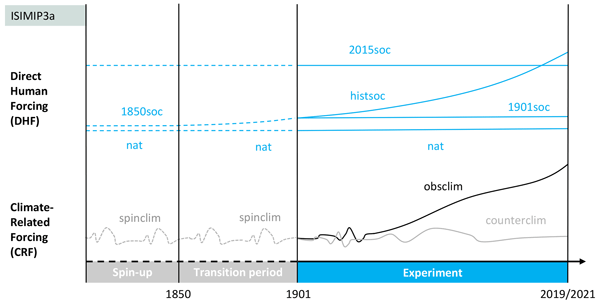
Our paper provides an overview of all observational climate-related and socioeconomic forcing data used as input for the impact model evaluation and impact attribution experiments within the third round of the Inter-Sectoral Impact Model Intercomparison Project. The experiments are designed to test our understanding of observed changes in natural and human systems and to quantify to what degree these changes have already been induced by climate change.
Peter Burek and Mikhail Smilovic
Earth Syst. Sci. Data, 15, 5617–5629, https://doi.org/10.5194/essd-15-5617-2023, https://doi.org/10.5194/essd-15-5617-2023, 2023
Short summary
Short summary
We address an annoying problem every grid-based hydrological model must solve to compare simulated and observed river discharge. First, station locations do not fit the high-resolution river network. We update the database with stations based on a new high-resolution network. Second, station locations do not work with a coarser grid-based network. We use a new basin shape similarity concept for station locations on a coarser grid, reducing the error of assigning stations to the wrong basin.
Jiabo Yin, Louise J. Slater, Abdou Khouakhi, Le Yu, Pan Liu, Fupeng Li, Yadu Pokhrel, and Pierre Gentine
Earth Syst. Sci. Data, 15, 5597–5615, https://doi.org/10.5194/essd-15-5597-2023, https://doi.org/10.5194/essd-15-5597-2023, 2023
Short summary
Short summary
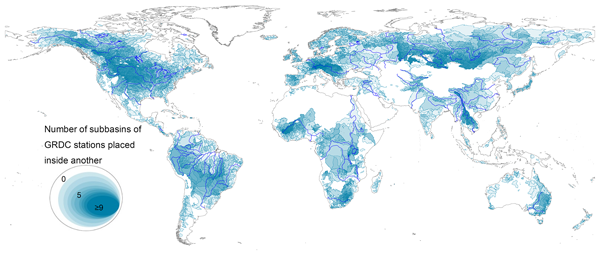
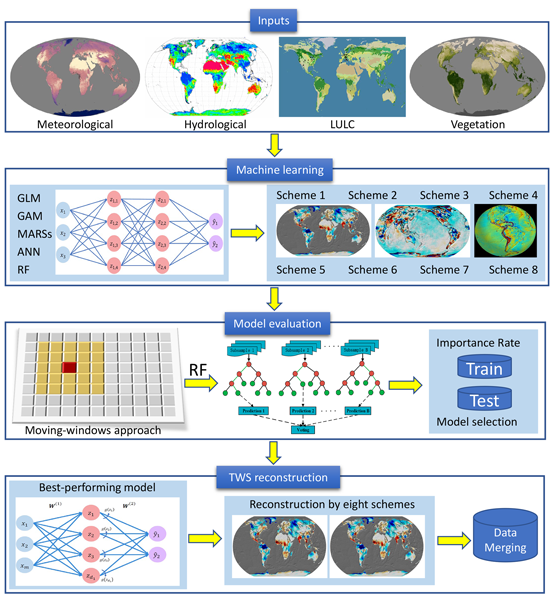
This study presents long-term (i.e., 1940–2022) and high-resolution (i.e., 0.25°) monthly time series of TWS anomalies over the global land surface. The reconstruction is achieved by using a set of machine learning models with a large number of predictors, including climatic and hydrological variables, land use/land cover data, and vegetation indicators (e.g., leaf area index). Our proposed GTWS-MLrec performs overall as well as, or is more reliable than, previous TWS datasets.
Benedikt Mester, Thomas Vogt, Seth Bryant, Christian Otto, Katja Frieler, and Jacob Schewe
Nat. Hazards Earth Syst. Sci., 23, 3467–3485, https://doi.org/10.5194/nhess-23-3467-2023, https://doi.org/10.5194/nhess-23-3467-2023, 2023
Short summary
Short summary
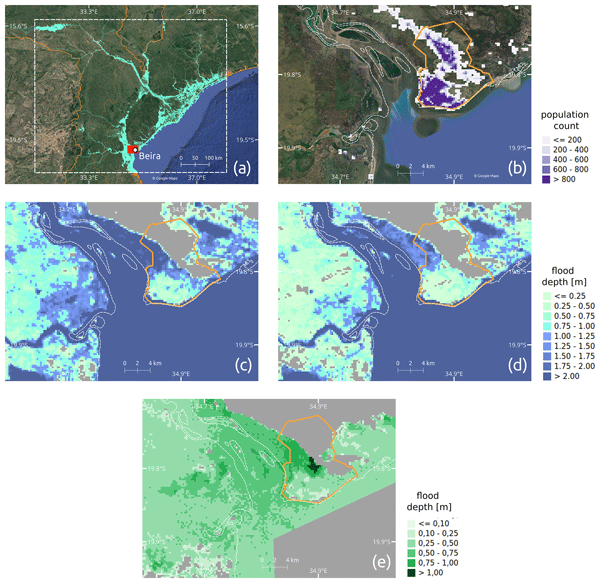
In 2019, Cyclone Idai displaced more than 478 000 people in Mozambique. In our study, we use coastal flood modeling and satellite imagery to construct a counterfactual cyclone event without the effects of climate change. We show that 12 600–14 900 displacements can be attributed to sea level rise and the intensification of storm wind speeds due to global warming. Our impact attribution study is the first one on human displacement and one of very few for a low-income country.
Kedar Otta, Hannes Müller Schmied, Simon N. Gosling, and Naota Hanasaki
Hydrol. Earth Syst. Sci. Discuss., https://doi.org/10.5194/hess-2023-215, https://doi.org/10.5194/hess-2023-215, 2023
Revised manuscript not accepted
Short summary
Short summary
Reservoirs play important roles in hydrology and water resources management globally and are incorporated into many Global Hydrological Models. Their simulations are, however, poorly validated due to the lack of available long-term in-situ observation data globally. Here we investigated the applicability of the latest satellite-based reservoir storage estimations in the contiguous US. We found that those products are useful for validating reservoir storage simulations when they are normalized.
Arianna Borriero, Rohini Kumar, Tam V. Nguyen, Jan H. Fleckenstein, and Stefanie R. Lutz
Hydrol. Earth Syst. Sci., 27, 2989–3004, https://doi.org/10.5194/hess-27-2989-2023, https://doi.org/10.5194/hess-27-2989-2023, 2023
Short summary
Short summary
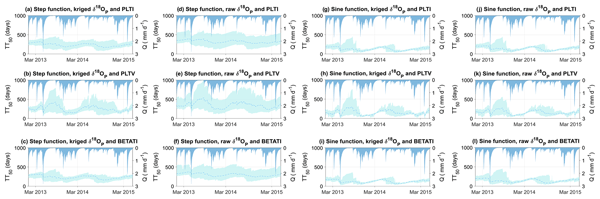
We analyzed the uncertainty of the water transit time distribution (TTD) arising from model input (interpolated tracer data) and structure (StorAge Selection, SAS, functions). We found that uncertainty was mainly associated with temporal interpolation, choice of SAS function, nonspatial interpolation, and low-flow conditions. It is important to characterize the specific uncertainty sources and their combined effects on TTD, as this has relevant implications for both water quantity and quality.
Zbigniew P. Piotrowski, Jaro Hokkanen, Daniel Caviedes-Voullieme, Olaf Stein, and Stefan Kollet
EGUsphere, https://doi.org/10.5194/egusphere-2023-1079, https://doi.org/10.5194/egusphere-2023-1079, 2023
Preprint withdrawn
Short summary
Short summary
The computer programs capable of simulation of Earth system components evolve, adapting new fundamental science concepts and more observational data on more and more powerful computer hardware. Adaptation of a large scientific program to a new type of hardware is costly. In this work we propose cheap and simple but effective strategy that enable computation using graphic processing units, based on automated program code modification. This results in better resolution and/or longer predictions.
Shruti Nath, Lukas Gudmundsson, Jonas Schwaab, Gregory Duveiller, Steven J. De Hertog, Suqi Guo, Felix Havermann, Fei Luo, Iris Manola, Julia Pongratz, Sonia I. Seneviratne, Carl F. Schleussner, Wim Thiery, and Quentin Lejeune
Geosci. Model Dev., 16, 4283–4313, https://doi.org/10.5194/gmd-16-4283-2023, https://doi.org/10.5194/gmd-16-4283-2023, 2023
Short summary
Short summary
Tree cover changes play a significant role in climate mitigation and adaptation. Their regional impacts are key in informing national-level decisions and prioritising areas for conservation efforts. We present a first step towards exploring these regional impacts using a simple statistical device, i.e. emulator. The emulator only needs to train on climate model outputs representing the maximal impacts of aff-, re-, and deforestation, from which it explores plausible in-between outcomes itself.
Steven J. De Hertog, Felix Havermann, Inne Vanderkelen, Suqi Guo, Fei Luo, Iris Manola, Dim Coumou, Edouard L. Davin, Gregory Duveiller, Quentin Lejeune, Julia Pongratz, Carl-Friedrich Schleussner, Sonia I. Seneviratne, and Wim Thiery
Earth Syst. Dynam., 14, 629–667, https://doi.org/10.5194/esd-14-629-2023, https://doi.org/10.5194/esd-14-629-2023, 2023
Short summary
Short summary
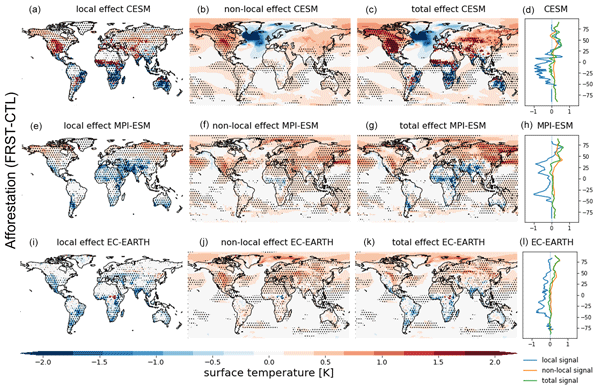
Land cover and land management changes are important strategies for future land-based mitigation. We investigate the climate effects of cropland expansion, afforestation, irrigation and wood harvesting using three Earth system models. Results show that these have important implications for surface temperature where the land cover and/or management change occur and in remote areas. Idealized afforestation causes global warming, which might offset the cooling effect from enhanced carbon uptake.
Steven J. De Hertog, Carmen E. Lopez-Fabara, Ruud van der Ent, Jessica Keune, Diego G. Miralles, Raphael Portmann, Sebastian Schemm, Felix Havermann, Suqi Guo, Fei Luo, Iris Manola, Quentin Lejeune, Julia Pongratz, Carl-Friedrich Schleussner, Sonia I. Seneviratne, and Wim Thiery
EGUsphere, https://doi.org/10.5194/egusphere-2023-953, https://doi.org/10.5194/egusphere-2023-953, 2023
Preprint archived
Short summary
Short summary
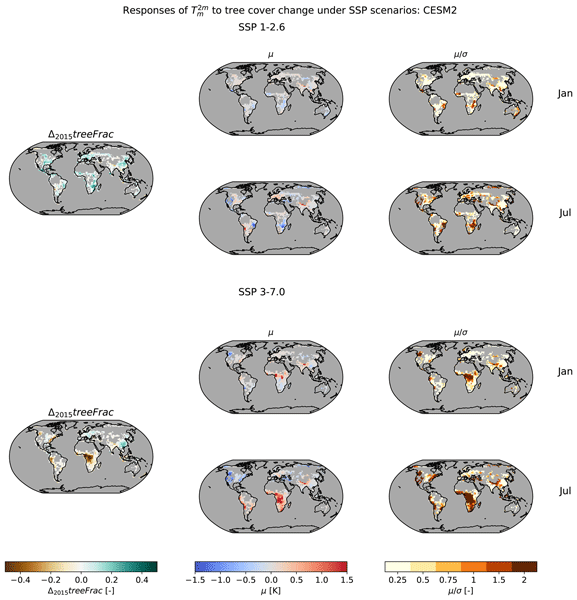
Land cover and management changes can affect the climate and water availability. In this study we use climate model simulations of extreme global land cover changes (afforestation, deforestation) and land management changes (irrigation) to understand the effects on the global water cycle and local to continental water availability. We show that cropland expansion generally leads to higher evaporation and lower amounts of precipitation and afforestation and irrigation expansion to the opposite.
Francisco José Cuesta-Valero, Hugo Beltrami, Almudena García-García, Gerhard Krinner, Moritz Langer, Andrew H. MacDougall, Jan Nitzbon, Jian Peng, Karina von Schuckmann, Sonia I. Seneviratne, Wim Thiery, Inne Vanderkelen, and Tonghua Wu
Earth Syst. Dynam., 14, 609–627, https://doi.org/10.5194/esd-14-609-2023, https://doi.org/10.5194/esd-14-609-2023, 2023
Short summary
Short summary
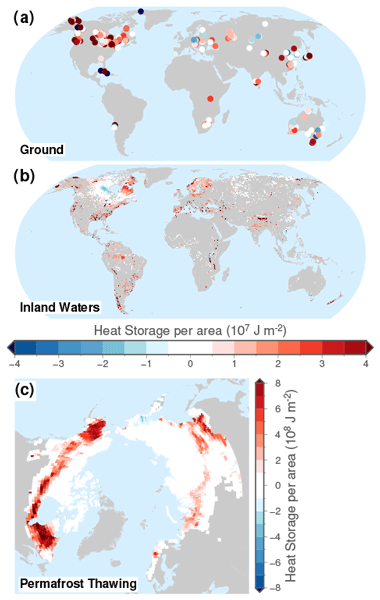
Climate change is caused by the accumulated heat in the Earth system, with the land storing the second largest amount of this extra heat. Here, new estimates of continental heat storage are obtained, including changes in inland-water heat storage and permafrost heat storage in addition to changes in ground heat storage. We also argue that heat gains in all three components should be monitored independently of their magnitude due to heat-dependent processes affecting society and ecosystems.
Jens A. de Bruijn, Mikhail Smilovic, Peter Burek, Luca Guillaumot, Yoshihide Wada, and Jeroen C. J. H. Aerts
Geosci. Model Dev., 16, 2437–2454, https://doi.org/10.5194/gmd-16-2437-2023, https://doi.org/10.5194/gmd-16-2437-2023, 2023
Short summary
Short summary
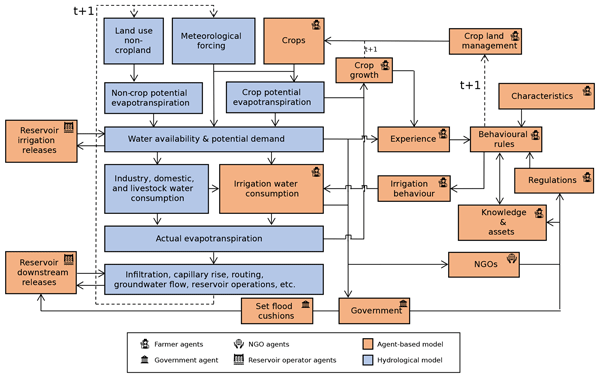
We present a computer simulation model of the hydrological system and human system, which can simulate the behaviour of individual farmers and their interactions with the water system at basin scale to assess how the systems have evolved and are projected to evolve in the future. For example, we can simulate the effect of subsidies provided on investment in adaptation measures and subsequent effects in the hydrological system, such as a lowering of the groundwater table or reservoir level.
Tobias Tesch, Stefan Kollet, and Jochen Garcke
Geosci. Model Dev., 16, 2149–2166, https://doi.org/10.5194/gmd-16-2149-2023, https://doi.org/10.5194/gmd-16-2149-2023, 2023
Short summary
Short summary
A recent statistical approach for studying relations in the Earth system is to train deep learning (DL) models to predict Earth system variables given one or several others and use interpretable DL to analyze the relations learned by the models. Here, we propose to combine the approach with a theorem from causality research to ensure that the deep learning model learns causal rather than spurious relations. As an example, we apply the method to study soil-moisture–precipitation coupling.
Karina von Schuckmann, Audrey Minière, Flora Gues, Francisco José Cuesta-Valero, Gottfried Kirchengast, Susheel Adusumilli, Fiammetta Straneo, Michaël Ablain, Richard P. Allan, Paul M. Barker, Hugo Beltrami, Alejandro Blazquez, Tim Boyer, Lijing Cheng, John Church, Damien Desbruyeres, Han Dolman, Catia M. Domingues, Almudena García-García, Donata Giglio, John E. Gilson, Maximilian Gorfer, Leopold Haimberger, Maria Z. Hakuba, Stefan Hendricks, Shigeki Hosoda, Gregory C. Johnson, Rachel Killick, Brian King, Nicolas Kolodziejczyk, Anton Korosov, Gerhard Krinner, Mikael Kuusela, Felix W. Landerer, Moritz Langer, Thomas Lavergne, Isobel Lawrence, Yuehua Li, John Lyman, Florence Marti, Ben Marzeion, Michael Mayer, Andrew H. MacDougall, Trevor McDougall, Didier Paolo Monselesan, Jan Nitzbon, Inès Otosaka, Jian Peng, Sarah Purkey, Dean Roemmich, Kanako Sato, Katsunari Sato, Abhishek Savita, Axel Schweiger, Andrew Shepherd, Sonia I. Seneviratne, Leon Simons, Donald A. Slater, Thomas Slater, Andrea K. Steiner, Toshio Suga, Tanguy Szekely, Wim Thiery, Mary-Louise Timmermans, Inne Vanderkelen, Susan E. Wjiffels, Tonghua Wu, and Michael Zemp
Earth Syst. Sci. Data, 15, 1675–1709, https://doi.org/10.5194/essd-15-1675-2023, https://doi.org/10.5194/essd-15-1675-2023, 2023
Short summary
Short summary
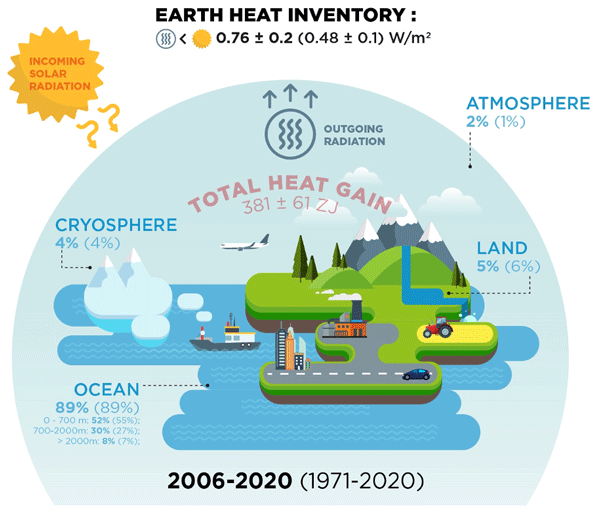
Earth's climate is out of energy balance, and this study quantifies how much heat has consequently accumulated over the past decades (ocean: 89 %, land: 6 %, cryosphere: 4 %, atmosphere: 1 %). Since 1971, this accumulated heat reached record values at an increasing pace. The Earth heat inventory provides a comprehensive view on the status and expectation of global warming, and we call for an implementation of this global climate indicator into the Paris Agreement’s Global Stocktake.
Andreas Hartmann, Jean-Lionel Payeur-Poirier, and Luisa Hopp
Hydrol. Earth Syst. Sci., 27, 1325–1341, https://doi.org/10.5194/hess-27-1325-2023, https://doi.org/10.5194/hess-27-1325-2023, 2023
Short summary
Short summary
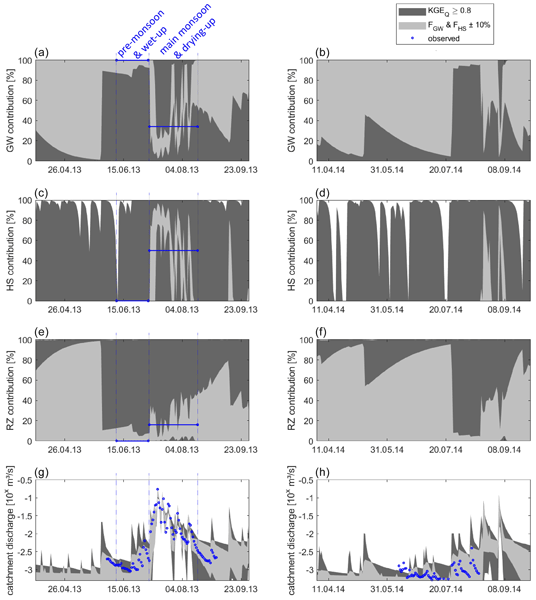
We advance our understanding of including information derived from environmental tracers into hydrological modeling. We present a simple approach that integrates streamflow observations and tracer-derived streamflow contributions for model parameter estimation. We consider multiple observed streamflow components and their variation over time to quantify the impact of their inclusion for streamflow prediction at the catchment scale.
Bibi S. Naz, Wendy Sharples, Yueling Ma, Klaus Goergen, and Stefan Kollet
Geosci. Model Dev., 16, 1617–1639, https://doi.org/10.5194/gmd-16-1617-2023, https://doi.org/10.5194/gmd-16-1617-2023, 2023
Short summary
Short summary
It is challenging to apply a high-resolution integrated land surface and groundwater model over large spatial scales. In this paper, we demonstrate the application of such a model over a pan-European domain at 3 km resolution and perform an extensive evaluation of simulated water states and fluxes by comparing with in situ and satellite data. This study can serve as a benchmark and baseline for future studies of climate change impact projections and for hydrological forecasting.
Damian L. Arévalo-Martínez, Amir Haroon, Hermann W. Bange, Ercan Erkul, Marion Jegen, Nils Moosdorf, Jens Schneider von Deimling, Christian Berndt, Michael Ernst Böttcher, Jasper Hoffmann, Volker Liebetrau, Ulf Mallast, Gudrun Massmann, Aaron Micallef, Holly A. Michael, Hendrik Paasche, Wolfgang Rabbel, Isaac Santos, Jan Scholten, Katrin Schwalenberg, Beata Szymczycha, Ariel T. Thomas, Joonas J. Virtasalo, Hannelore Waska, and Bradley A. Weymer
Biogeosciences, 20, 647–662, https://doi.org/10.5194/bg-20-647-2023, https://doi.org/10.5194/bg-20-647-2023, 2023
Short summary
Short summary
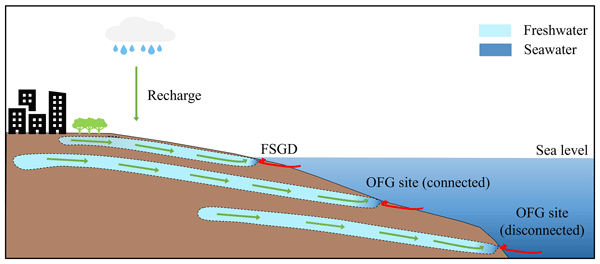
Groundwater flows at the land–ocean transition and the extent of freshened groundwater below the seafloor are increasingly relevant in marine sciences, both because they are a highly uncertain term of biogeochemical budgets and due to the emerging interest in the latter as a resource. Here, we discuss our perspectives on future research directions to better understand land–ocean connectivity through groundwater and its potential responses to natural and human-induced environmental changes.
Romane Berthelin, Tunde Olarinoye, Michael Rinderer, Matías Mudarra, Dominic Demand, Mirjam Scheller, and Andreas Hartmann
Hydrol. Earth Syst. Sci., 27, 385–400, https://doi.org/10.5194/hess-27-385-2023, https://doi.org/10.5194/hess-27-385-2023, 2023
Short summary
Short summary
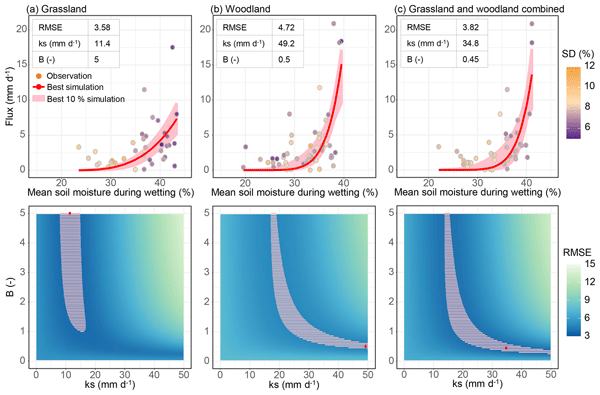
Karstic recharge processes have mainly been explored using discharge analysis despite the high influence of the heterogeneous surface on hydrological processes. In this paper, we introduce an event-based method which allows for recharge estimation from soil moisture measurements. The method was tested at a karst catchment in Germany but can be applied to other karst areas with precipitation and soil moisture data available. It will allow for a better characterization of karst recharge processes.
Mohamed Saadi, Carina Furusho-Percot, Alexandre Belleflamme, Ju-Yu Chen, Silke Trömel, and Stefan Kollet
Nat. Hazards Earth Syst. Sci., 23, 159–177, https://doi.org/10.5194/nhess-23-159-2023, https://doi.org/10.5194/nhess-23-159-2023, 2023
Short summary
Short summary
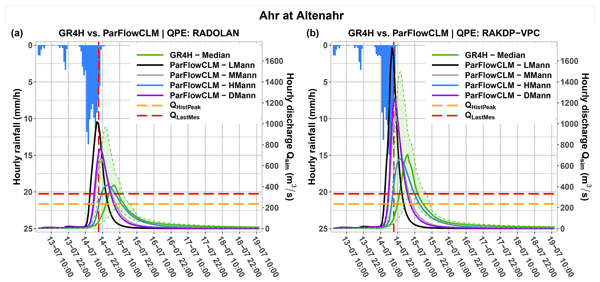
On 14 July 2021, heavy rainfall fell over central Europe, causing considerable damage and human fatalities. We analyzed how accurate our estimates of rainfall and peak flow were for these flooding events in western Germany. We found that the rainfall estimates from radar measurements were improved by including polarimetric variables and their vertical gradients. Peak flow estimates were highly uncertain due to uncertainties in hydrological model parameters and rainfall measurements.
Carolin Winter, Tam V. Nguyen, Andreas Musolff, Stefanie R. Lutz, Michael Rode, Rohini Kumar, and Jan H. Fleckenstein
Hydrol. Earth Syst. Sci., 27, 303–318, https://doi.org/10.5194/hess-27-303-2023, https://doi.org/10.5194/hess-27-303-2023, 2023
Short summary
Short summary
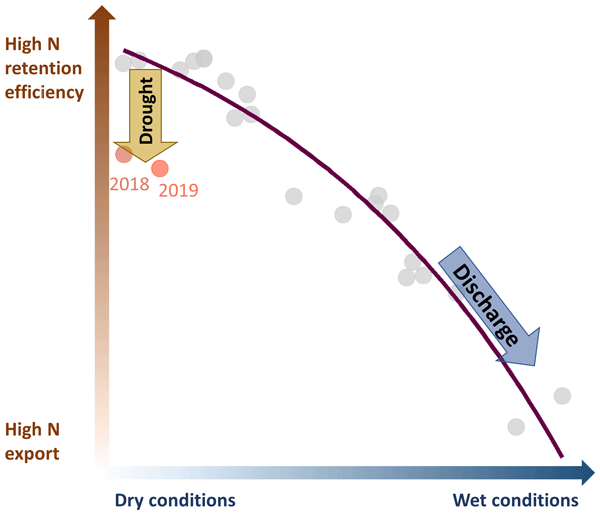
The increasing frequency of severe and prolonged droughts threatens our freshwater resources. While we understand drought impacts on water quantity, its effects on water quality remain largely unknown. Here, we studied the impact of the unprecedented 2018–2019 drought in Central Europe on nitrate export in a heterogeneous mesoscale catchment in Germany. We show that severe drought can reduce a catchment's capacity to retain nitrogen, intensifying the internal pollution and export of nitrate.
Axel A. J. Deijns, Olivier Dewitte, Wim Thiery, Nicolas d'Oreye, Jean-Philippe Malet, and François Kervyn
Nat. Hazards Earth Syst. Sci., 22, 3679–3700, https://doi.org/10.5194/nhess-22-3679-2022, https://doi.org/10.5194/nhess-22-3679-2022, 2022
Short summary
Short summary
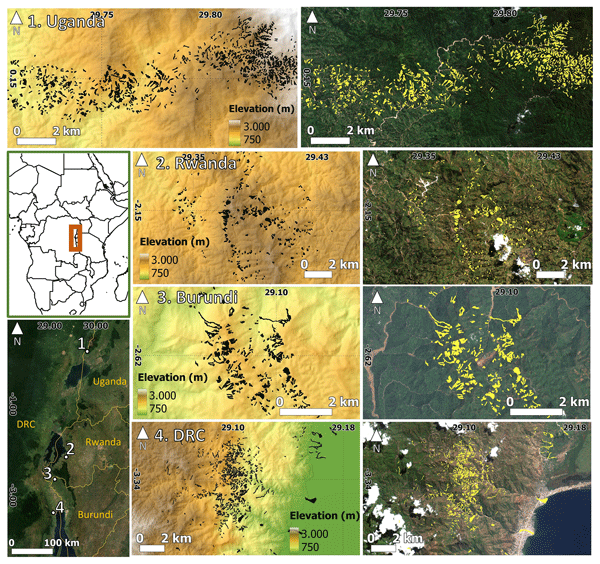
Landslides and flash floods are rainfall-induced processes that often co-occur and interact, generally very quickly. In mountainous cloud-covered environments, determining when these processes occur remains challenging. We propose a regional methodology using open-access satellite radar images that allow for the timing of landslide and flash floods events, in the contrasting landscapes of tropical Africa, with an accuracy of up to a few days. The methodology shows potential for transferability.
Tunde Olarinoye, Tom Gleeson, and Andreas Hartmann
Hydrol. Earth Syst. Sci., 26, 5431–5447, https://doi.org/10.5194/hess-26-5431-2022, https://doi.org/10.5194/hess-26-5431-2022, 2022
Short summary
Short summary
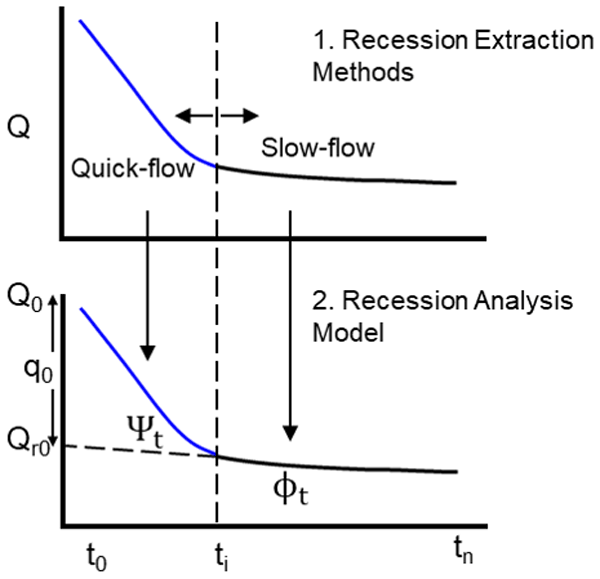
Analysis of karst spring recession is essential for management of groundwater. In karst, recession is dominated by slow and fast components; separating these components is by manual and subjective approaches. In our study, we tested the applicability of automated streamflow recession extraction procedures for a karst spring. Results showed that, by simple modification, streamflow extraction methods can identify slow and fast components: derived recession parameters are within reasonable ranges.
Yan Liu, Jaime Fernández-Ortega, Matías Mudarra, and Andreas Hartmann
Hydrol. Earth Syst. Sci., 26, 5341–5355, https://doi.org/10.5194/hess-26-5341-2022, https://doi.org/10.5194/hess-26-5341-2022, 2022
Short summary
Short summary
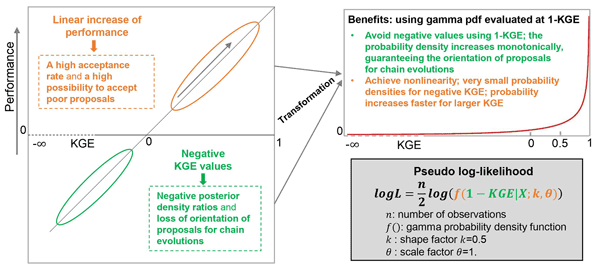
We adapt the informal Kling–Gupta efficiency (KGE) with a gamma distribution to apply it as an informal likelihood function in the DiffeRential Evolution Adaptive Metropolis DREAM(ZS) method. Our adapted approach performs as well as the formal likelihood function for exploring posterior distributions of model parameters. The adapted KGE is superior to the formal likelihood function for calibrations combining multiple observations with different lengths, frequencies and units.
Friedrich Boeing, Oldrich Rakovec, Rohini Kumar, Luis Samaniego, Martin Schrön, Anke Hildebrandt, Corinna Rebmann, Stephan Thober, Sebastian Müller, Steffen Zacharias, Heye Bogena, Katrin Schneider, Ralf Kiese, Sabine Attinger, and Andreas Marx
Hydrol. Earth Syst. Sci., 26, 5137–5161, https://doi.org/10.5194/hess-26-5137-2022, https://doi.org/10.5194/hess-26-5137-2022, 2022
Short summary
Short summary
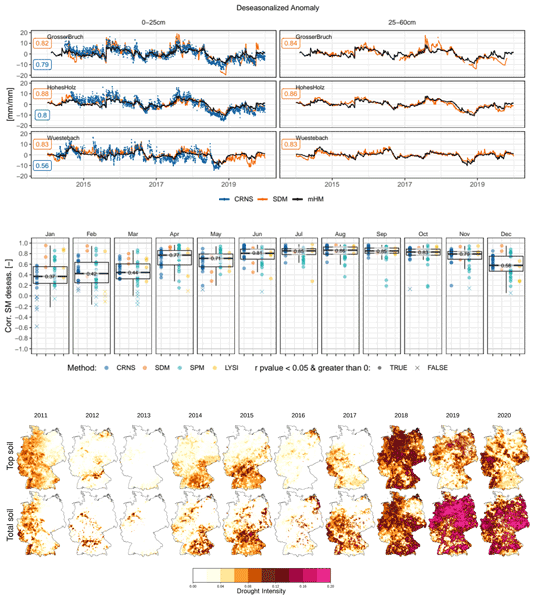
In this paper, we deliver an evaluation of the second generation operational German drought monitor (https://www.ufz.de/duerremonitor) with a state-of-the-art compilation of observed soil moisture data from 40 locations and four different measurement methods in Germany. We show that the expressed stakeholder needs for higher resolution drought information at the one-kilometer scale can be met and that the agreement of simulated and observed soil moisture dynamics can be moderately improved.
Danielle S. Grogan, Shan Zuidema, Alex Prusevich, Wilfred M. Wollheim, Stanley Glidden, and Richard B. Lammers
Geosci. Model Dev., 15, 7287–7323, https://doi.org/10.5194/gmd-15-7287-2022, https://doi.org/10.5194/gmd-15-7287-2022, 2022
Short summary
Short summary
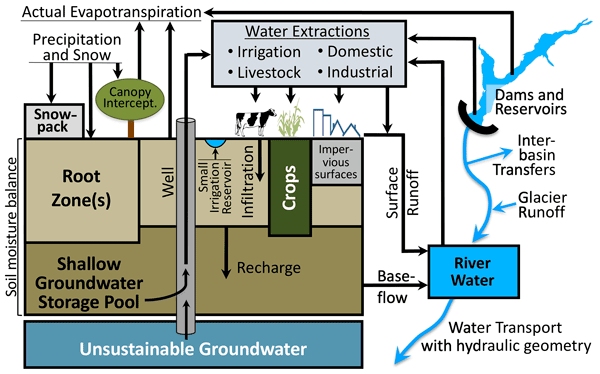
This paper describes the University of New Hampshire's water balance model (WBM). This model simulates the land surface components of the global water cycle and includes water extractions for use by humans for agricultural, domestic, and industrial purposes. A new feature is described that permits water source tracking through the water cycle, which has implications for water resource management. This paper was written to describe a long-used model and presents its first open-source version.
Steven J. De Hertog, Felix Havermann, Inne Vanderkelen, Suqi Guo, Fei Luo, Iris Manola, Dim Coumou, Edouard L. Davin, Gregory Duveiller, Quentin Lejeune, Julia Pongratz, Carl-Friedrich Schleussner, Sonia I. Seneviratne, and Wim Thiery
Earth Syst. Dynam., 13, 1305–1350, https://doi.org/10.5194/esd-13-1305-2022, https://doi.org/10.5194/esd-13-1305-2022, 2022
Short summary
Short summary
Land cover and land management changes are important strategies for future land-based mitigation. We investigate the climate effects of cropland expansion, afforestation, irrigation, and wood harvesting using three Earth system models. Results show that these have important implications for surface temperature where the land cover and/or management change occurs and in remote areas. Idealized afforestation causes global warming, which might offset the cooling effect from enhanced carbon uptake.
Luca Guillaumot, Mikhail Smilovic, Peter Burek, Jens de Bruijn, Peter Greve, Taher Kahil, and Yoshihide Wada
Geosci. Model Dev., 15, 7099–7120, https://doi.org/10.5194/gmd-15-7099-2022, https://doi.org/10.5194/gmd-15-7099-2022, 2022
Short summary
Short summary
We develop and test the first large-scale hydrological model at regional scale with a very high spatial resolution that includes a water management and groundwater flow model. This study infers the impact of surface and groundwater-based irrigation on groundwater recharge and on evapotranspiration in both irrigated and non-irrigated areas. We argue that water table recorded in boreholes can be used as validation data if water management is well implemented and spatial resolution is ≤ 100 m.
Bahar Bahrami, Anke Hildebrandt, Stephan Thober, Corinna Rebmann, Rico Fischer, Luis Samaniego, Oldrich Rakovec, and Rohini Kumar
Geosci. Model Dev., 15, 6957–6984, https://doi.org/10.5194/gmd-15-6957-2022, https://doi.org/10.5194/gmd-15-6957-2022, 2022
Short summary
Short summary
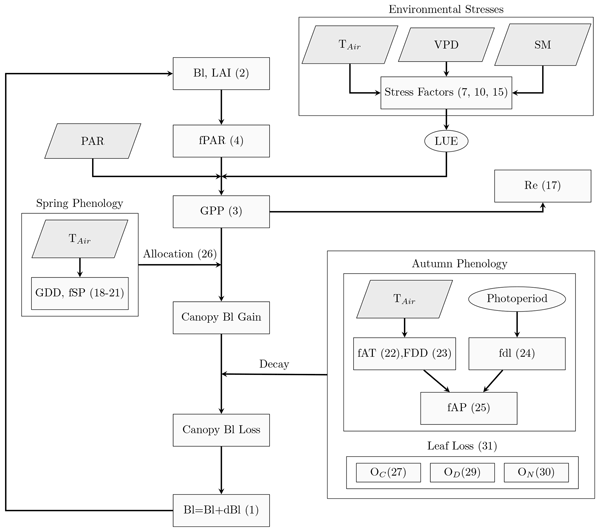
Leaf area index (LAI) and gross primary productivity (GPP) are crucial components to carbon cycle, and are closely linked to water cycle in many ways. We develop a Parsimonious Canopy Model (PCM) to simulate GPP and LAI at stand scale, and show its applicability over a diverse range of deciduous broad-leaved forest biomes. With its modular structure, the PCM is able to adapt with existing data requirements, and run in either a stand-alone mode or as an interface linked to hydrologic models.
Sadaf Nasreen, Markéta Součková, Mijael Rodrigo Vargas Godoy, Ujjwal Singh, Yannis Markonis, Rohini Kumar, Oldrich Rakovec, and Martin Hanel
Earth Syst. Sci. Data, 14, 4035–4056, https://doi.org/10.5194/essd-14-4035-2022, https://doi.org/10.5194/essd-14-4035-2022, 2022
Short summary
Short summary
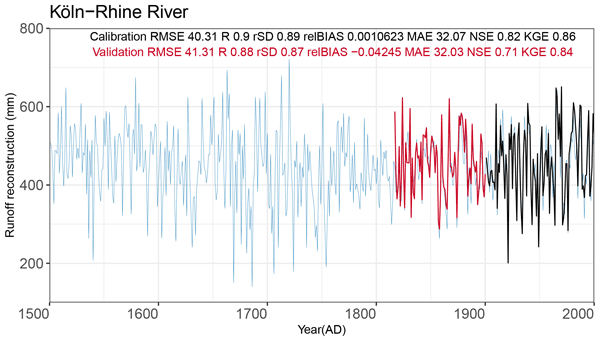
This article presents a 500-year reconstructed annual runoff dataset for several European catchments. Several data-driven and hydrological models were used to derive the runoff series using reconstructed precipitation and temperature and a set of proxy data. The simulated runoff was validated using independent observed runoff data and documentary evidence. The validation revealed a good fit between the observed and reconstructed series for 14 catchments, which are available for further analysis.
Pia Ebeling, Rohini Kumar, Stefanie R. Lutz, Tam Nguyen, Fanny Sarrazin, Michael Weber, Olaf Büttner, Sabine Attinger, and Andreas Musolff
Earth Syst. Sci. Data, 14, 3715–3741, https://doi.org/10.5194/essd-14-3715-2022, https://doi.org/10.5194/essd-14-3715-2022, 2022
Short summary
Short summary
Environmental data are critical for understanding and managing ecosystems, including the mitigation of water quality degradation. To increase data availability, we present the first large-sample water quality data set (QUADICA) of riverine macronutrient concentrations combined with water quantity, meteorological, and nutrient forcing data as well as catchment attributes. QUADICA covers 1386 German catchments to facilitate large-sample data-driven and modeling water quality assessments.
Louise Busschaert, Shannon de Roos, Wim Thiery, Dirk Raes, and Gabriëlle J. M. De Lannoy
Hydrol. Earth Syst. Sci., 26, 3731–3752, https://doi.org/10.5194/hess-26-3731-2022, https://doi.org/10.5194/hess-26-3731-2022, 2022
Short summary
Short summary
Increasing amounts of water are used for agriculture. Therefore, we looked into how irrigation requirements will evolve under a changing climate over Europe. Our results show that, by the end of the century and under high emissions, irrigation water will increase by 30 % on average compared to the year 2000. Also, the irrigation requirement is likely to vary more from 1 year to another. However, if emissions are mitigated, these effects are reduced.
Vili Virkki, Elina Alanärä, Miina Porkka, Lauri Ahopelto, Tom Gleeson, Chinchu Mohan, Lan Wang-Erlandsson, Martina Flörke, Dieter Gerten, Simon N. Gosling, Naota Hanasaki, Hannes Müller Schmied, Niko Wanders, and Matti Kummu
Hydrol. Earth Syst. Sci., 26, 3315–3336, https://doi.org/10.5194/hess-26-3315-2022, https://doi.org/10.5194/hess-26-3315-2022, 2022
Short summary
Short summary
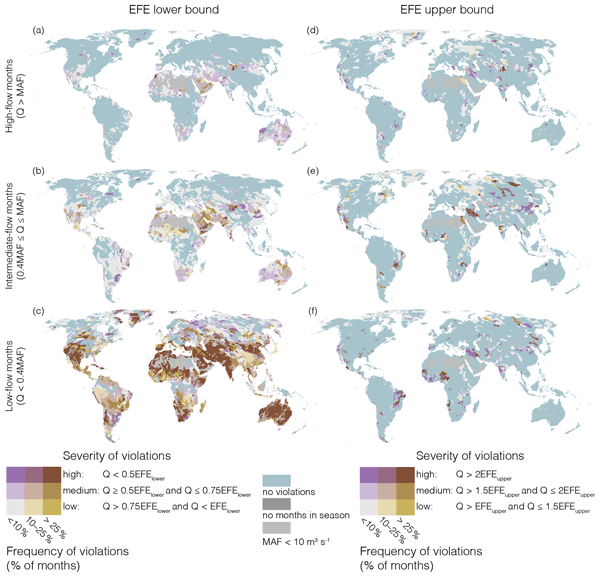
Direct and indirect human actions have altered streamflow across the world since pre-industrial times. Here, we apply a method of environmental flow envelopes (EFEs) that develops the existing global environmental flow assessments by methodological advances and better consideration of uncertainty. By assessing the violations of the EFE, we comprehensively quantify the frequency, severity, and trends of flow alteration during the past decades, illustrating anthropogenic effects on streamflow.
Malgorzata Golub, Wim Thiery, Rafael Marcé, Don Pierson, Inne Vanderkelen, Daniel Mercado-Bettin, R. Iestyn Woolway, Luke Grant, Eleanor Jennings, Benjamin M. Kraemer, Jacob Schewe, Fang Zhao, Katja Frieler, Matthias Mengel, Vasiliy Y. Bogomolov, Damien Bouffard, Marianne Côté, Raoul-Marie Couture, Andrey V. Debolskiy, Bram Droppers, Gideon Gal, Mingyang Guo, Annette B. G. Janssen, Georgiy Kirillin, Robert Ladwig, Madeline Magee, Tadhg Moore, Marjorie Perroud, Sebastiano Piccolroaz, Love Raaman Vinnaa, Martin Schmid, Tom Shatwell, Victor M. Stepanenko, Zeli Tan, Bronwyn Woodward, Huaxia Yao, Rita Adrian, Mathew Allan, Orlane Anneville, Lauri Arvola, Karen Atkins, Leon Boegman, Cayelan Carey, Kyle Christianson, Elvira de Eyto, Curtis DeGasperi, Maria Grechushnikova, Josef Hejzlar, Klaus Joehnk, Ian D. Jones, Alo Laas, Eleanor B. Mackay, Ivan Mammarella, Hampus Markensten, Chris McBride, Deniz Özkundakci, Miguel Potes, Karsten Rinke, Dale Robertson, James A. Rusak, Rui Salgado, Leon van der Linden, Piet Verburg, Danielle Wain, Nicole K. Ward, Sabine Wollrab, and Galina Zdorovennova
Geosci. Model Dev., 15, 4597–4623, https://doi.org/10.5194/gmd-15-4597-2022, https://doi.org/10.5194/gmd-15-4597-2022, 2022
Short summary
Short summary
Lakes and reservoirs are warming across the globe. To better understand how lakes are changing and to project their future behavior amidst various sources of uncertainty, simulations with a range of lake models are required. This in turn requires international coordination across different lake modelling teams worldwide. Here we present a protocol for and results from coordinated simulations of climate change impacts on lakes worldwide.
Inne Vanderkelen, Shervan Gharari, Naoki Mizukami, Martyn P. Clark, David M. Lawrence, Sean Swenson, Yadu Pokhrel, Naota Hanasaki, Ann van Griensven, and Wim Thiery
Geosci. Model Dev., 15, 4163–4192, https://doi.org/10.5194/gmd-15-4163-2022, https://doi.org/10.5194/gmd-15-4163-2022, 2022
Short summary
Short summary
Human-controlled reservoirs have a large influence on the global water cycle. However, dam operations are rarely represented in Earth system models. We implement and evaluate a widely used reservoir parametrization in a global river-routing model. Using observations of individual reservoirs, the reservoir scheme outperforms the natural lake scheme. However, both schemes show a similar performance due to biases in runoff timing and magnitude when using simulated runoff.
Yong Chang, Benjamin Mewes, and Andreas Hartmann
Hydrol. Earth Syst. Sci. Discuss., https://doi.org/10.5194/hess-2022-77, https://doi.org/10.5194/hess-2022-77, 2022
Preprint withdrawn
Short summary
Short summary
This study presents a work to investigate the feasibility of using EC to predict the discharge in a typical karst catchment. We found that the spring discharge can be well predicted by EC in storms using LSTM (Long Short Term Memory) model, while the prediction has relatively large uncertainties in small recharge events. To establish a roust LSTM model for long-term discharge prediction from EC in ungauged catchments, the random or fixed-interval discharge monitoring strategy is recommended.
Aine M. Gormley-Gallagher, Sebastian Sterl, Annette L. Hirsch, Sonia I. Seneviratne, Edouard L. Davin, and Wim Thiery
Earth Syst. Dynam., 13, 419–438, https://doi.org/10.5194/esd-13-419-2022, https://doi.org/10.5194/esd-13-419-2022, 2022
Short summary
Short summary
Our results show that agricultural management can impact the local climate and highlight the need to evaluate land management in climate models. We use regression analysis on climate simulations and observations to assess irrigation and conservation agriculture impacts on warming trends. This allowed us to distinguish between the effects of land management and large-scale climate forcings such as rising CO2 concentrations and thus gain insight into the impacts under different climate regimes.
Robert Schweppe, Stephan Thober, Sebastian Müller, Matthias Kelbling, Rohini Kumar, Sabine Attinger, and Luis Samaniego
Geosci. Model Dev., 15, 859–882, https://doi.org/10.5194/gmd-15-859-2022, https://doi.org/10.5194/gmd-15-859-2022, 2022
Short summary
Short summary
The recently released multiscale parameter regionalization (MPR) tool enables
environmental modelers to efficiently use extensive datasets for model setups.
It flexibly ingests the datasets using user-defined data–parameter relationships
and rescales parameter fields to given model resolutions. Modern
land surface models especially benefit from MPR through increased transparency and
flexibility in modeling decisions. Thus, MPR empowers more sound and robust
simulations of the Earth system.
Joni Dehaspe, Fanny Sarrazin, Rohini Kumar, Jan H. Fleckenstein, and Andreas Musolff
Hydrol. Earth Syst. Sci., 25, 6437–6463, https://doi.org/10.5194/hess-25-6437-2021, https://doi.org/10.5194/hess-25-6437-2021, 2021
Short summary
Short summary
Increased nitrate concentrations in surface waters can compromise river ecosystem health. As riverine nitrate uptake is hard to measure, we explore how low-frequency nitrate concentration and discharge observations (that are widely available) can help to identify (in)efficient uptake in river networks. We find that channel geometry and water velocity rather than the biological uptake capacity dominate the nitrate-discharge pattern at the outlet. The former can be used to predict uptake.
Tom Gleeson, Thorsten Wagener, Petra Döll, Samuel C. Zipper, Charles West, Yoshihide Wada, Richard Taylor, Bridget Scanlon, Rafael Rosolem, Shams Rahman, Nurudeen Oshinlaja, Reed Maxwell, Min-Hui Lo, Hyungjun Kim, Mary Hill, Andreas Hartmann, Graham Fogg, James S. Famiglietti, Agnès Ducharne, Inge de Graaf, Mark Cuthbert, Laura Condon, Etienne Bresciani, and Marc F. P. Bierkens
Geosci. Model Dev., 14, 7545–7571, https://doi.org/10.5194/gmd-14-7545-2021, https://doi.org/10.5194/gmd-14-7545-2021, 2021
Short summary
Short summary
Groundwater is increasingly being included in large-scale (continental to global) land surface and hydrologic simulations. However, it is challenging to evaluate these simulations because groundwater is
hiddenunderground and thus hard to measure. We suggest using multiple complementary strategies to assess the performance of a model (
model evaluation).
Bernd Schalge, Gabriele Baroni, Barbara Haese, Daniel Erdal, Gernot Geppert, Pablo Saavedra, Vincent Haefliger, Harry Vereecken, Sabine Attinger, Harald Kunstmann, Olaf A. Cirpka, Felix Ament, Stefan Kollet, Insa Neuweiler, Harrie-Jan Hendricks Franssen, and Clemens Simmer
Earth Syst. Sci. Data, 13, 4437–4464, https://doi.org/10.5194/essd-13-4437-2021, https://doi.org/10.5194/essd-13-4437-2021, 2021
Short summary
Short summary
In this study, a 9-year simulation of complete model output of a coupled atmosphere–land-surface–subsurface model on the catchment scale is discussed. We used the Neckar catchment in SW Germany as the basis of this simulation. Since the dataset includes the full model output, it is not only possible to investigate model behavior and interactions between the component models but also use it as a virtual truth for comparison of, for example, data assimilation experiments.
Silje Lund Sørland, Roman Brogli, Praveen Kumar Pothapakula, Emmanuele Russo, Jonas Van de Walle, Bodo Ahrens, Ivonne Anders, Edoardo Bucchignani, Edouard L. Davin, Marie-Estelle Demory, Alessandro Dosio, Hendrik Feldmann, Barbara Früh, Beate Geyer, Klaus Keuler, Donghyun Lee, Delei Li, Nicole P. M. van Lipzig, Seung-Ki Min, Hans-Jürgen Panitz, Burkhardt Rockel, Christoph Schär, Christian Steger, and Wim Thiery
Geosci. Model Dev., 14, 5125–5154, https://doi.org/10.5194/gmd-14-5125-2021, https://doi.org/10.5194/gmd-14-5125-2021, 2021
Short summary
Short summary
We review the contribution from the CLM-Community to regional climate projections following the CORDEX framework over Europe, South Asia, East Asia, Australasia, and Africa. How the model configuration, horizontal and vertical resolutions, and choice of driving data influence the model results for the five domains is assessed, with the purpose of aiding the planning and design of regional climate simulations in the future.
Tesfalem Abraham, Yan Liu, Sirak Tekleab, and Andreas Hartmann
Hydrol. Earth Syst. Sci. Discuss., https://doi.org/10.5194/hess-2021-271, https://doi.org/10.5194/hess-2021-271, 2021
Preprint withdrawn
Short summary
Short summary
In this study we demonstrate the use of global data products for the regionalization of model parameters. We combine three steps of uncertainty quantification from the parameter sampling, best parameter sets identification, and spatial cross-validation. Our results show the best validation parameters provide the most robust regionalization results, and the uncertainties from the regionalization in the ungauged catchments are higher than those obtained from simulations in the gauged catchments.
Camelia-Eliza Telteu, Hannes Müller Schmied, Wim Thiery, Guoyong Leng, Peter Burek, Xingcai Liu, Julien Eric Stanislas Boulange, Lauren Seaby Andersen, Manolis Grillakis, Simon Newland Gosling, Yusuke Satoh, Oldrich Rakovec, Tobias Stacke, Jinfeng Chang, Niko Wanders, Harsh Lovekumar Shah, Tim Trautmann, Ganquan Mao, Naota Hanasaki, Aristeidis Koutroulis, Yadu Pokhrel, Luis Samaniego, Yoshihide Wada, Vimal Mishra, Junguo Liu, Petra Döll, Fang Zhao, Anne Gädeke, Sam S. Rabin, and Florian Herz
Geosci. Model Dev., 14, 3843–3878, https://doi.org/10.5194/gmd-14-3843-2021, https://doi.org/10.5194/gmd-14-3843-2021, 2021
Short summary
Short summary
We analyse water storage compartments, water flows, and human water use sectors included in 16 global water models that provide simulations for the Inter-Sectoral Impact Model Intercomparison Project phase 2b. We develop a standard writing style for the model equations. We conclude that even though hydrologic processes are often based on similar equations, in the end these equations have been adjusted, or the models have used different values for specific parameters or specific variables.
Yueling Ma, Carsten Montzka, Bagher Bayat, and Stefan Kollet
Hydrol. Earth Syst. Sci., 25, 3555–3575, https://doi.org/10.5194/hess-25-3555-2021, https://doi.org/10.5194/hess-25-3555-2021, 2021
Short summary
Short summary
This study utilized spatiotemporally continuous precipitation anomaly (pra) and water table depth anomaly (wtda) data from integrated hydrologic simulation results over Europe in combination with Long Short-Term Memory (LSTM) networks to capture the time-varying and time-lagged relationship between pra and wtda in order to obtain reliable models to estimate wtda at the individual pixel level.
Anja Katzenberger, Jacob Schewe, Julia Pongratz, and Anders Levermann
Earth Syst. Dynam., 12, 367–386, https://doi.org/10.5194/esd-12-367-2021, https://doi.org/10.5194/esd-12-367-2021, 2021
Short summary
Short summary
All state-of-the-art global climate models that contributed to the latest Coupled Model Intercomparison Project (CMIP6) show a robust increase in Indian summer monsoon rainfall that is even stronger than in the previous intercomparison (CMIP5). Furthermore, they show an increase in the year-to-year variability of this seasonal rainfall that crucially influences the livelihood of more than 1 billion people in India.
Charles Rougé, Patrick M. Reed, Danielle S. Grogan, Shan Zuidema, Alexander Prusevich, Stanley Glidden, Jonathan R. Lamontagne, and Richard B. Lammers
Hydrol. Earth Syst. Sci., 25, 1365–1388, https://doi.org/10.5194/hess-25-1365-2021, https://doi.org/10.5194/hess-25-1365-2021, 2021
Short summary
Short summary
Amid growing interest in using large-scale hydrological models for flood and drought monitoring and forecasting, it is important to evaluate common assumptions these models make. We investigated the representation of reservoirs as separate (non-coordinated) infrastructure. We found that not appropriately representing coordination and control processes can lead a hydrological model to simulate flood and drought events that would not occur given the coordinated emergency response in the basin.
Hannes Müller Schmied, Denise Cáceres, Stephanie Eisner, Martina Flörke, Claudia Herbert, Christoph Niemann, Thedini Asali Peiris, Eklavyya Popat, Felix Theodor Portmann, Robert Reinecke, Maike Schumacher, Somayeh Shadkam, Camelia-Eliza Telteu, Tim Trautmann, and Petra Döll
Geosci. Model Dev., 14, 1037–1079, https://doi.org/10.5194/gmd-14-1037-2021, https://doi.org/10.5194/gmd-14-1037-2021, 2021
Short summary
Short summary
In a globalized world with large flows of virtual water between river basins and international responsibilities for the sustainable development of the Earth system and its inhabitants, quantitative estimates of water flows and storages and of water demand by humans are required. Global hydrological models such as WaterGAP are developed to provide this information. Here we present a thorough description, evaluation and application examples of the most recent model version, WaterGAP v2.2d.
Robert Reinecke, Hannes Müller Schmied, Tim Trautmann, Lauren Seaby Andersen, Peter Burek, Martina Flörke, Simon N. Gosling, Manolis Grillakis, Naota Hanasaki, Aristeidis Koutroulis, Yadu Pokhrel, Wim Thiery, Yoshihide Wada, Satoh Yusuke, and Petra Döll
Hydrol. Earth Syst. Sci., 25, 787–810, https://doi.org/10.5194/hess-25-787-2021, https://doi.org/10.5194/hess-25-787-2021, 2021
Short summary
Short summary
Billions of people rely on groundwater as an accessible source of drinking water and for irrigation, especially in times of drought. Groundwater recharge is the primary process of regenerating groundwater resources. We find that groundwater recharge will increase in northern Europe by about 19 % and decrease by 10 % in the Amazon with 3 °C global warming. In the Mediterranean, a 2 °C warming has already lead to a reduction in recharge by 38 %. However, these model predictions are uncertain.
Iman Haqiqi, Danielle S. Grogan, Thomas W. Hertel, and Wolfram Schlenker
Hydrol. Earth Syst. Sci., 25, 551–564, https://doi.org/10.5194/hess-25-551-2021, https://doi.org/10.5194/hess-25-551-2021, 2021
Short summary
Short summary
This study combines a fine-scale weather product with outputs of a hydrological model to construct functional metrics of individual and compound hydroclimatic extremes for agriculture. Then, a yield response function is estimated with individual and compound metrics focusing on corn in the United States during the 1981–2015 period. The findings suggest that metrics of compound hydroclimatic extremes are better predictors of corn yield variations than metrics of individual extremes.
Cited articles
Akhter, T., Pokhrel, Y., Felfelani, F., Ducharne, A., Lo, M.-H., and Reinecke, R.: Implications of lateral groundwater flow across varying spatial resolutions in global land surface modeling, Water Resources Research, 61, e2024WR038523, https://doi.org/10.1029/2024WR038523, 2025.
Beck, H. E., Wood, E. F., Pan, M., Fisher, C. K., Miralles, D. G., van Dijk, A. I. J. M., McVicar, T. R., and Adler, R. F.: MSWEP V2 Global 3-Hourly 0.1° Precipitation: Methodology and Quantitative Assessment, Bulletin of the American Meteorological Society, 100, 473–500, https://doi.org/10.1175/BAMS-D-17-0138.1, 2019.
Benz, S. A., Irvine, D. J., Rau, G. C., Bayer, P., Menberg, K., Blum, P., Jamieson, R. C., Griebler, C., and Kurylyk, B. L.: Global groundwater warming due to climate change, Nature Geoscience, 17, 545–551, https://doi.org/10.1038/s41561-024-01453-x, 2024.
Berghuijs, W. R., Collenteur, R. A., Jasechko, S., Jaramillo, F., Luijendijk, E., Moeck, C., van der Velde, Y., and Allen, S. T.: Groundwater recharge is sensitive to changing long-term aridity, Nature Climate Change, 14, 357–363, https://doi.org/10.1038/s41558-024-01953-z, 2024.
Bierkens, M. and Wada, Y.: Non-renewable groundwater use and groundwater depletion: a review, Environ. Res. Lett., 14, 63002, https://doi.org/10.1088/1748-9326/ab1a5f, 2019.
Burek, P., Satoh, Y., Kahil, T., Tang, T., Greve, P., Smilovic, M., Guillaumot, L., Zhao, F., and Wada, Y.: Development of the Community Water Model (CWatM v1.04) – a high-resolution hydrological model for global and regional assessment of integrated water resources management, Geoscientific Model Development, 13, 3267–3298, https://doi.org/10.5194/gmd-13-3267-2020, 2020.
Coll, J. R., Aguilar, E., and Ashcroft, L.: Drought variability and change across the Iberian Peninsula, Theoretical and Applied Climatology, 130, 901–916, https://doi.org/10.1007/s00704-016-1926-3, 2017.
Condon, L. E. and Maxwell, R. M.: Simulating the sensitivity of evapotranspiration and streamflow to large-scale groundwater depletion, Science Advances, 5, eaav4574, https://doi.org/10.1126/sciadv.aav4574, 2019.
Condon, L. E., Kollet, S., Bierkens, M. F. P., Fogg, G. E., Maxwell, R. M., Hill, M. C., Fransen, H.-J. H., Verhoef, A., van Loon, A. F., Sulis, M., and Abesser, C.: Global Groundwater Modeling and Monitoring: Opportunities and Challenges, Water Resources Research, 57, https://doi.org/10.1029/2020WR029500, 2021.
Costa, F. R. C., Schietti, J., Stark, S. C., and Smith, M. N.: The other side of tropical forest drought: do shallow water table regions of Amazonia act as large-scale hydrological refugia from drought?, The New Phytologist, 237, 714–733, https://doi.org/10.1111/nph.17914, 2023.
Cuthbert, M. O., Gleeson, T., Moosdorf, N., Befus, K. M., Schneider, A., Hartmann, J., and Lehner, B.: Global patterns and dynamics of climate-groundwater interactions, Nature Climate Change, 9, 137–141, https://doi.org/10.1038/s41558-018-0386-4, 2019.
Cuthbert, M. O., Gleeson, T., Bierkens, M. F. P., Ferguson, G., and Taylor, R. G.: Defining renewable groundwater use and its relevance to sustainable groundwater management, Water Resources Research, 59, e2022WR032831, https://doi.org/10.1029/2022WR032831, 2023.
Dalin, C., Wada, Y., Kastner, T., and Puma, M. J.: Groundwater depletion embedded in international food trade, Nature, 543, 700–704, https://doi.org/10.1038/nature21403, 2017.
de Graaf, I., van Beek, R. L. P. H., Gleeson, T., Moosdorf, N., Schmitz, O., Sutanudjaja, E. H., and Bierkens, M. F. P.: A global-scale two-layer transient groundwater model: Development and application to groundwater depletion, Advances in Water Resources, 102, 53–67, https://doi.org/10.1016/j.advwatres.2017.01.011, 2017.
de Graaf, I. E. M., Sutanudjaja, E. H., van Beek, L. P. H., and Bierkens, M. F. P.: A high-resolution global-scale groundwater model, Hydrology and Earth System Sciences, 19, 823–837, https://doi.org/10.5194/hess-19-823-2015, 2015.
de Graaf, I. E. M., Gleeson, T., van Rens Beek, L. P. H., Sutanudjaja, E. H., and Bierkens, M. F. P.: Environmental flow limits to global groundwater pumping, Nature, 574, 90–94, https://doi.org/10.1038/s41586-019-1594-4, 2019.
Döll, P. and Siebert, S.: Global modeling of irrigation water requirements, Water Resources Research, 38, https://doi.org/10.1029/2001WR000355, 2002.
Droppers, B., Franssen, W. H. P., van Vliet, M. T. H., Nijssen, B., and Ludwig, F.: Simulating human impacts on global water resources using VIC-5, Geoscientific Model Development, 13, 5029–5052, https://doi.org/10.5194/gmd-13-5029-2020, 2020.
Droppers, B., Supit, I., van Vliet, M. T. H., and Ludwig, F.: Worldwide water constraints on attainable irrigated production for major crops, Environ. Res. Lett., 16, 055016, https://doi.org/10.1088/1748-9326/abf527, 2021.
Dunne, J. P., Horowitz, L. W., Adcroft, A. J., Ginoux, P., Held, I. M., John, J. G., Krasting, J. P., Malyshev, S., Naik, V., Paulot, F., Shevliakova, E., Stock, C. A., Zadeh, N., Balaji, V., Blanton, C., Dunne, K. A., Dupuis, C., Durachta, J., Dussin, R., Gauthier, P. P. G., Griffies, S. M., Guo, H., Hallberg, R. W., Harrison, M., He, J., Hurlin, W., McHugh, C., Menzel, R., Milly, P. C. D., Nikonov, S., Paynter, D. J., Ploshay, J., Radhakrishnan, A., Rand, K., Reichl, B. G., Robinson, T., Schwarzkopf, D. M., Sentman, L. T., Underwood, S., Vahlenkamp, H., Winton, M., Wittenberg, A. T., Wyman, B., Zeng, Y., and Zhao, M.: The GFDL Earth System Model Version 4.1 (GFDL-ESM 4.1): Overall Coupled Model Description and Simulation Characteristics, Journal of Advances in Modeling Earth Systems, 12, e2019MS002015, https://doi.org/10.1029/2019MS002015, 2020.
Eilander, D., van Verseveld, W., Yamazaki, D., Weerts, A., Winsemius, H. C., and Ward, P. J.: A hydrography upscaling method for scale-invariant parametrization of distributed hydrological models, Hydrology and Earth System Sciences, 25, 5287–5313, https://doi.org/10.5194/hess-25-5287-2021, 2021.
Esteban, E. J. L., Castilho, C. V., Melgaço, K. L., and Costa, F. R. C.: The other side of droughts: wet extremes and topography as buffers of negative drought effects in an Amazonian forest, The New Phytologist, 229, 1995–2006, https://doi.org/10.1111/nph.17005, 2021.
European Environment Agency: European Climate Risk Assessment, EEA Report 01/2024, European Environment Agency, Luxembourg, ISBN 978-92-9480-678-9, https://doi.org/10.2800/8671471, 2024.
Eyring, V., Bony, S., Meehl, G. A., Senior, C. A., Stevens, B., Stouffer, R. J., and Taylor, K. E.: Overview of the Coupled Model Intercomparison Project Phase 6 (CMIP6) experimental design and organization, Geoscientific Model Development, 9, 1937–1958, https://doi.org/10.5194/gmd-9-1937-2016, 2016a.
Eyring, V., Righi, M., Lauer, A., Evaldsson, M., Wenzel, S., Jones, C., Anav, A., Andrews, O., Cionni, I., Davin, E. L., Deser, C., Ehbrecht, C., Friedlingstein, P., Gleckler, P., Gottschaldt, K.-D., Hagemann, S., Juckes, M., Kindermann, S., Krasting, J., Kunert, D., Levine, R., Loew, A., Mäkelä, J., Martin, G., Mason, E., Phillips, A. S., Read, S., Rio, C., Roehrig, R., Senftleben, D., Sterl, A., van Ulft, L. H., Walton, J., Wang, S., and Williams, K. D.: ESMValTool (v1.0) – a community diagnostic and performance metrics tool for routine evaluation of Earth system models in CMIP, Geoscientific Model Development, 9, 1747–1802, https://doi.org/10.5194/gmd-9-1747-2016, 2016b.
Fan, Y., Li, H., and Miguez-Macho, G.: Global patterns of groundwater table depth, Science, 339, 940–943, https://doi.org/10.1126/science.1229881, 2013.
Felfelani, F., Lawrence, D. M., and Pokhrel, Y.: Representing Intercell Lateral Groundwater Flow and Aquifer Pumping in the Community Land Model, Water Resources Research, 57, https://doi.org/10.1029/2020WR027531, 2021.
Foster, S. S. D. and Chilton, P. J.: Groundwater: the processes and global significance of aquifer degradation, Philosophical Transactions of the Royal Society of London. Series B, Biological Sciences, 358, 1957–1972, https://doi.org/10.1098/rstb.2003.1380, 2003.
Frieler, K., Lange, S., Piontek, F., Reyer, C. P. O., Schewe, J., Warszawski, L., Zhao, F., Chini, L., Denvil, S., Emanuel, K., Geiger, T., Halladay, K., Hurtt, G., Mengel, M., Murakami, D., Ostberg, S., Popp, A., Riva, R., Stevanovic, M., Suzuki, T., Volkholz, J., Burke, E., Ciais, P., Ebi, K., Eddy, T. D., Elliott, J., Galbraith, E., Gosling, S. N., Hattermann, F., Hickler, T., Hinkel, J., Hof, C., Huber, V., Jägermeyr, J., Krysanova, V., Marcé, R., Müller Schmied, H., Mouratiadou, I., Pierson, D., Tittensor, D. P., Vautard, R., van Vliet, M., Biber, M. F., Betts, R. A., Bodirsky, B. L., Deryng, D., Frolking, S., Jones, C. D., Lotze, H. K., Lotze-Campen, H., Sahajpal, R., Thonicke, K., Tian, H., and Yamagata, Y.: Assessing the impacts of 1.5 °C global warming – simulation protocol of the Inter-Sectoral Impact Model Intercomparison Project (ISIMIP2b), Geoscientific Model Development, 10, 4321–4345, https://doi.org/10.5194/gmd-10-4321-2017, 2017.
Frieler, K., Volkholz, J., Lange, S., Schewe, J., Mengel, M., del Rocío Rivas López, M., Otto, C., Reyer, C. P. O., Karger, D. N., Malle, J. T., Treu, S., Menz, C., Blanchard, J. L., Harrison, C. S., Petrik, C. M., Eddy, T. D., Ortega-Cisneros, K., Novaglio, C., Rousseau, Y., Watson, R. A., Stock, C., Liu, X., Heneghan, R., Tittensor, D., Maury, O., Büchner, M., Vogt, T., Wang, T., Sun, F., Sauer, I. J., Koch, J., Vanderkelen, I., Jägermeyr, J., Müller, C., Rabin, S., Klar, J., Vega del Valle, I. D., Lasslop, G., Chadburn, S., Burke, E., Gallego-Sala, A., Smith, N., Chang, J., Hantson, S., Burton, C., Gädeke, A., Li, F., Gosling, S. N., Müller Schmied, H., Hattermann, F., Wang, J., Yao, F., Hickler, T., Marcé, R., Pierson, D., Thiery, W., Mercado-Bettín, D., Ladwig, R., Ayala-Zamora, A. I., Forrest, M., and Bechtold, M.: Scenario setup and forcing data for impact model evaluation and impact attribution within the third round of the Inter-Sectoral Impact Model Intercomparison Project (ISIMIP3a), Geosci. Model Dev., 17, 1–51, https://doi.org/10.5194/gmd-17-1-2024, 2024.
Gasper, F., Goergen, K., Shrestha, P., Sulis, M., Rihani, J., Geimer, M., and Kollet, S.: Implementation and scaling of the fully coupled Terrestrial Systems Modeling Platform (TerrSysMP v1.0) in a massively parallel supercomputing environment – a case study on JUQUEEN (IBM Blue Gene/Q), Geoscientific Model Development, 7, 2531–2543, https://doi.org/10.5194/gmd-7-2531-2014, 2014.
Gilbert, M., Nicolas, G., Cinardi, G., van Boeckel, T. P., Vanwambeke, S. O., Wint, G. R. W., and Robinson, T. P.: Global distribution data for cattle, buffaloes, horses, sheep, goats, pigs, chickens and ducks in 2010, Scientific Data, 5, 180227, https://doi.org/10.1038/sdata.2018.227, 2018.
Gisser, M. and Sánchez, D. A.: Competition versus optimal control in groundwater pumping, Water Resources Research, 16, 638–642, https://doi.org/10.1029/WR016i004p00638, 1980.
Gleeson, T. and Paszkowski, D.: Perceptions of scale in hydrology: what do you mean by regional scale?, Hydrological Sciences Journal, 59, 99–107, https://doi.org/10.1080/02626667.2013.797581, 2014.
Gleeson, T., Cuthbert, M., Ferguson, G., and Perrone, D.: Global Groundwater Sustainability, Resources, and Systems in the Anthropocene, Annual Review Earth and Planetary Sciences, 48, 431–463, https://doi.org/10.1146/annurev-earth-071719-055251, 2020.
Gleeson, T., Wagener, T., Döll, P., Zipper, S. C., West, C., Wada, Y., Taylor, R., Scanlon, B., Rosolem, R., Rahman, S., Oshinlaja, N., Maxwell, R., Lo, M.-H., Kim, H., Hill, M., Hartmann, A., Fogg, G., Famiglietti, J. S., Ducharne, A., de Graaf, I., Cuthbert, M., Condon, L., Bresciani, E., and Bierkens, M. F. P.: GMD perspective: The quest to improve the evaluation of groundwater representation in continental- to global-scale models, Geoscientific Model Development, 14, 7545–7571, https://doi.org/10.5194/gmd-14-7545-2021, 2021.
Gnann, S., Reinecke, R., Stein, L., Wada, Y., Thiery, W., Müller Schmied, H., Satoh, Y., Pokhrel, Y., Ostberg, S., Koutroulis, A., Hanasaki, N., Grillakis, M., Gosling, S., Burek, P., Bierkens, M., and Wagener, T.: Functional relationships reveal differences in the water cycle representation of global water models, Nature Water, 1079–1090, https://doi.org/10.1038/s44221-023-00160-y, 2023.
Golub, M., Thiery, W., Marcé, R., Pierson, D., Vanderkelen, I., Mercado-Bettin, D., Woolway, R. I., Grant, L., Jennings, E., Kraemer, B. M., Schewe, J., Zhao, F., Frieler, K., Mengel, M., Bogomolov, V. Y., Bouffard, D., Côté, M., Couture, R.-M., Debolskiy, A. V., Droppers, B., Gal, G., Guo, M., Janssen, A. B. G., Kirillin, G., Ladwig, R., Magee, M., Moore, T., Perroud, M., Piccolroaz, S., Raaman Vinnaa, L., Schmid, M., Shatwell, T., Stepanenko, V. M., Tan, Z., Woodward, B., Yao, H., Adrian, R., Allan, M., Anneville, O., Arvola, L., Atkins, K., Boegman, L., Carey, C., Christianson, K., de Eyto, E., DeGasperi, C., Grechushnikova, M., Hejzlar, J., Joehnk, K., Jones, I. D., Laas, A., Mackay, E. B., Mammarella, I., Markensten, H., McBride, C., Özkundakci, D., Potes, M., Rinke, K., Robertson, D., Rusak, J. A., Salgado, R., van der Linden, L., Verburg, P., Wain, D., Ward, N. K., Wollrab, S., and Zdorovennova, G.: A framework for ensemble modelling of climate change impacts on lakes worldwide: the ISIMIP Lake Sector, Geoscientific Model Development, 15, 4597–4623, https://doi.org/10.5194/gmd-15-4597-2022, 2022.
Grogan, D. S., Zuidema, S., Prusevich, A., Wollheim, W. M., Glidden, S., and Lammers, R. B.: Water balance model (WBM) v.1.0.0: a scalable gridded global hydrologic model with water-tracking functionality, Geoscientific Model Development, 15, 7287–7323, https://doi.org/10.5194/gmd-15-7287-2022, 2022.
Guillaumot, L., Smilovic, M., Burek, P., de Bruijn, J., Greve, P., Kahil, T., and Wada, Y.: Coupling a large-scale hydrological model (CWatM v1.1) with a high-resolution groundwater flow model (MODFLOW 6) to assess the impact of irrigation at regional scale, Geoscientific Model Development, 15, 7099–7120, https://doi.org/10.5194/gmd-15-7099-2022, 2022.
Hansen, M. and Toftemann Thomsen, C.: An integrated public information system for geology, groundwater and drinking water in Denmark, GEUS Bulletin, 38, 69–72, https://doi.org/10.34194/geusb.v38.4423, 2020.
Haqiqi, I., Bowling, L., Jame, S., Baldos, U., Liu, J., and Hertel, T.: Global drivers of local water stresses and global responses to local water policies in the United States, Environmental Research Letters, 18, 65007, https://doi.org/10.1088/1748-9326/acd269, 2023.
Hartmann, A. Gleeson, T., Wada, Y., and Wagener, T.: Enhanced groundwater recharge rates and altered recharge sensitivity to climate variability through subsurface heterogeneity, Proceedings of the National Academy of Sciences, 114, 2842–2847, https://doi.org/10.1073/pnas.1614941114, 2017.
Holman, I. P., Whelan, M. J., Howden, N. J. K., Bellamy, P. H., Willby, N. J., Rivas-Casado, M., and McConvey, P.: Phosphorus in groundwater – an overlooked contributor to eutrophication?, Hydrological Processes, 22, 5121–5127, https://doi.org/10.1002/hyp.7198, 2008.
Huggins, X., Gleeson, T., Castilla-Rho, J., Holley, C., Re, V., and Famiglietti, J. S.: Groundwater Connections and Sustainability in Social-Ecological Systems, Ground Water, 61, 463–478, https://doi.org/10.1111/gwat.13305, 2023.
Hurtt, G. C., Chini, L., Sahajpal, R., Frolking, S., Bodirsky, B. L., Calvin, K., Doelman, J. C., Fisk, J., Fujimori, S., Klein Goldewijk, K., Hasegawa, T., Havlik, P., Heinimann, A., Humpenöder, F., Jungclaus, J., Kaplan, J. O., Kennedy, J., Krisztin, T., Lawrence, D., Lawrence, P., Ma, L., Mertz, O., Pongratz, J., Popp, A., Poulter, B., Riahi, K., Shevliakova, E., Stehfest, E., Thornton, P., Tubiello, F. N., van Vuuren, D. P., and Zhang, X.: Harmonization of global land use change and management for the period 850–2100 (LUH2) for CMIP6, Geoscientific Model Development, 13, 5425–5464, https://doi.org/10.5194/gmd-13-5425-2020, 2020.
IPCC: Summary for Policymakers, in: Climate Change 2023: Synthesis Report, Contribution of Working Groups I, II and III to the Sixth Assessment Report of the Intergovernmental Panel on Climate Change, edited by: Core Writing Team, Lee, H., and Romero, J., IPCC, Geneva, Switzerland, 1–34, https://doi.org/10.59327/IPCC/AR6-9789291691647.001, 2023.
Jasechko, S., Seybold, H., Perrone, D., Fan, Y., Shamsudduha, M., Taylor, R. G., Fallatah, O., and Kirchner, J. W.: Rapid groundwater decline and some cases of recovery in aquifers globally, Nature, 625, 715–721, https://doi.org/10.1038/s41586-023-06879-8, 2024.
Kahil, T., Baccour, S., Joseph, J., Sahu, R., Burek, P., Ng, J. Y., Asad, S., Fridman, D., Albiac, J., Ward, F. A., and Wada, Y.: Development of the global hydro-economic model (ECHO-Global version 1.0) for assessing the performance of water management options, Geoscientific Model Development, 18, 7987–8015, https://doi.org/10.5194/gmd-18-7987-2025, 2025.
Keune, J., Sulis, M., Kollet, S., Siebert, S., and Wada, Y.: Human Water Use Impacts on the Strength of the Continental Sink for Atmospheric Water, Geophysical Research Letters, 45, 4068–4076, https://doi.org/10.1029/2018GL077621, 2018.
Kollet, S. J. and Maxwell, R. M.: Capturing the influence of groundwater dynamics on land surface processes using an integrated, distributed watershed model, Water Resources Research, 44, https://doi.org/10.1029/2007WR006004, 2008.
Konar, M., Hussein, Z., Hanasaki, N., Mauzerall, D. L., and Rodriguez-Iturbe, I.: Virtual water trade flows and savings under climate change, Hydrology and Earth System Sciences, 17, 3219–3234, https://doi.org/10.5194/hess-17-3219-2013, 2013.
Kretschmer, D. V., Michael, H., Moosdorf, N., Essink, G. O., Bierkens, M. F. P., Wagener, T., and Reinecke, R.: Controls on coastal saline groundwater across North America, Environmental Research Letters, https://doi.org/10.1088/1748-9326/ada973, 2025.
Kuffour, B. N. O., Engdahl, N. B., Woodward, C. S., Condon, L. E., Kollet, S., and Maxwell, R. M.: Simulating coupled surface–subsurface flows with ParFlow v3.5.0: capabilities, applications, and ongoing development of an open-source, massively parallel, integrated hydrologic model, Geoscientific Model Development, 13, 1373–1397, https://doi.org/10.5194/gmd-13-1373-2020, 2020.
Kumar, R., Samaniego, L., Thober, S., Rakovec, O., Marx, A., Wanders, N., Pan, M., Hesse, F. and Attinger, S.: Multi-model assessment of groundwater recharge across Europe under warming climate, Earth's Future, 13, e2024EF005020, https://doi.org/10.1029/2024EF005020, 2025.
Lammers, R. B.: Global Inter-Basin Hydrological Transfer Database, https://doi.org/10.57931/1905995, 2022.
Lange, S.: Bias-correction fact sheet, https://www.isimip.org/gettingstarted/isimip3b-bias-adjustment/ (last access: 2 March 2025), 2021.
Lawrence, D. M., Fisher, R. A., Koven, C. D., Oleson, K. W., Swenson, S. C., Bonan, G., Collier, N., Ghimire, B., van Kampenhout, L., Kennedy, D., Kluzek, E., Lawrence, P. J., Li, F., Li, H., Lombardozzi, D., Riley, W. J., Sacks, W. J., Shi, M., Vertenstein, M., Wieder, W. R., Xu, C., Ali, A. A., Badger, A. M., Bisht, G., van den Broeke, M., Brunke, M. A., Burns, S. P., Buzan, J., Clark, M., Craig, A., Dahlin, K., Drewniak, B., Fisher, J. B., Flanner, M., Fox, A. M., Gentine, P., Hoffman, F., Keppel-Aleks, G., Knox, R., Kumar, S., Lenaerts, J., Leung, L. R., Lipscomb, W. H., Lu, Y., Pandey, A., Pelletier, J. D., Perket, J., Randerson, J. T., Ricciuto, D. M., Sanderson, B. M., Slater, A., Subin, Z. M., Tang, J., Thomas, R. Q., Val Martin, M., and Zeng, X.: The Community Land Model Version 5: Description of New Features, Benchmarking, and Impact of Forcing Uncertainty, Journal of Advances in Modeling Earth Systems, 11, 4245–4287, https://doi.org/10.1029/2018MS001583, 2019.
Lehner, B., Liermann, C. R., Revenga, C., Vörösmarty, C., Fekete, B., Crouzet, P., Döll, P., Endejan, M., Frenken, K., Magome, J., Nilsson, C., Robertson, J. C., Rödel, R., Sindorf, N., and Wisser, D.: High-resolution mapping of the world's reservoirs and dams for sustainable river-flow management, Frontiers in Ecology and the Environment, 9, 494–502, https://doi.org/10.1890/100125, 2011.
Li, B., Rodell, M., and Beaudoing, H.: GLDAS Catchment Land Surface Model L4 daily 0.25×0.25 degree, Version 2.0, https://doi.org/10.5067/LYHA9088MFWQ, 2018.
Liang, X., Lettenmaier, D. P., Wood, E. F., and Burges, S. J.: A simple hydrologically based model of land surface water and energy fluxes for general circulation models, Journal of Geophysical Research: Atmospheres, 99, 14415–14428, https://doi.org/10.1029/94JD00483, 1994.
Liu, Y., Wagener, T., Beck, H. E., and Hartmann, A.: What is the hydrologically effective area of a catchment?, Environmental Research Letters, 15, 104024, https://doi.org/10.1088/1748-9326/aba7e5, 2020.
Lloyd, C. T., Chamberlain, H., Kerr, D., Yetman, G., Pistolesi, L., Stevens, F. R., Gaughan, A. E., Nieves, J. J., Hornby, G., MacManus, K., Sinha, P., Bondarenko, M., Sorichetta, A., and Tatem, A. J.: Global spatio-temporally harmonised datasets for producing high-resolution gridded population distribution datasets, Big Earth Data, 3, 108–139, https://doi.org/10.1080/20964471.2019.1625151, 2019.
Maxwell, R. M. and Miller, N. L.: Development of a Coupled Land Surface and Groundwater Model, Journal of Hydrometeorology, 6, 233–247, https://doi.org/10.1175/JHM422.1, 2005.
Maxwell, R. M., Lundquist, J. K., Mirocha, J. D., Smith, S. G., Woodward, C. S., and Tompson, A. F. B.: Development of a Coupled Groundwater–Atmosphere Model, Monthly Weather Review, 139, 96–116, https://doi.org/10.1175/2010MWR3392.1, 2011.
Maxwell, R. M., Putti, M., Meyerhoff, S., Delfs, J.-O., Ferguson, I. M., Ivanov, V., Kim, J., Kolditz, O., Kollet, S. J., Kumar, M., Lopez, S., Niu, J., Paniconi, C., Park, Y.-J., Phanikumar, M. S., Shen, C., Sudicky, E. A., and Sulis, M.: Surface-subsurface model intercomparison: A first set of benchmark results to diagnose integrated hydrology and feedbacks, Water Resources Research, 50, 1531–1549, https://doi.org/10.1002/2013WR013725, 2014.
Maxwell, R. M., Condon, L. E., Kollet, S. J., Maher, K., Haggerty, R., and Forrester, M. M.: The imprint of climate and geology on the residence times of groundwater, Geophys. Res. Lett., 43, 701–708, https://doi.org/10.1002/2015GL066916, 2016.
Misstear, B., Vargas, C. R., Lapworth, D., Ouedraogo, I., and Podgorski, J.: A global perspective on assessing groundwater quality, Hydrogeol. J., 31, 11–14, https://doi.org/10.1007/s10040-022-02461-0, 2023.
Moeck, C., Collenteur, R. A., Berghuijs, W. R., Luijendijk, E., and Gurdak, J. J.: A Global Assessment of Groundwater Recharge Response to Infiltration Variability at Monthly to Decadal Timescales, Water Resources Research, 60, https://doi.org/10.1029/2023WR035828, 2024.
Müller Schmied, H., Adam, L., Eisner, S., Fink, G., Flörke, M., Kim, H., Oki, T., Portmann, F. T., Reinecke, R., Riedel, C., Song, Q., Zhang, J., and Döll, P.: Variations of global and continental water balance components as impacted by climate forcing uncertainty and human water use, Hydrology and Earth System Sciences, 20, 2877–2898, https://doi.org/10.5194/hess-20-2877-2016, 2016.
Müller Schmied, H., Cáceres, D., Eisner, S., Flörke, M., Herbert, C., Niemann, C., Peiris, T. A., Popat, E., Portmann, F. T., Reinecke, R., Schumacher, M., Shadkam, S., Telteu, C.-E., Trautmann, T., and Döll, P.: The global water resources and use model WaterGAP v2.2d: model description and evaluation, Geoscientific Model Development, 14, 1037–1079, https://doi.org/10.5194/gmd-14-1037-2021, 2021.
Naz, B. S., Sharples, W., Ma, Y., Goergen, K., and Kollet, S.: Continental-scale evaluation of a fully distributed coupled land surface and groundwater model, ParFlow-CLM (v3.6.0), over Europe, Geoscientific Model Development, 16, 1617–1639, https://doi.org/10.5194/gmd-16-1617-2023, 2023.
Nazari, S., Kruse, I. L., and Moosdorf, N.: Spatiotemporal dynamics of global rain-fed groundwater recharge from 2001 to 2020, Journal of Hydrology, 650, 132490, https://doi.org/10.1016/j.jhydrol.2024.132490, 2025.
Niazi, H., Wild, T. B., Turner, S. W. D., Graham, N. T., Hejazi, M., Msangi, S., Kim, S., Lamontagne, J. R. and Zha, M.: Global peak water limit of future groundwater withdrawals, Nature Sustainability, 7, 413–422, https://doi.org/10.1038/s41893-024-01306-w, 2024.
Niazi, H., Ferencz, S. B., Graham, N. T., Yoon, J., Wild, T. B., Hejazi, M., Watson, D. J., and Vernon, C. R.: Long-term hydro-economic analysis tool for evaluating global groundwater cost and supply: Superwell v1.1, Geoscientific Model Development, 18, 1737–1767, https://doi.org/10.5194/gmd-18-1737-2025, 2025.
Paneque Salgado, P. and Vargas Molina, J.: Drought, social agents and the construction of discourse in Andalusia, Environmental Hazards, 14, 224–235, https://doi.org/10.1080/17477891.2015.1058739, 2015.
Perez, N., Singh, V., Ringler, C., Xie, H., Zhu, T., Sutanudjaja, E. H., and Villholth, K. G.: Ending groundwater overdraft without affecting food security, Nature Sustainability, 7, 1007–1017, https://doi.org/10.1038/s41893-024-01376-w, 2024.
Pokhrel, Y., Felfelani, F., Satoh, Y., Boulange, J., Burek, P., Gädeke, A., Gerten, D., Gosling, S. N., Grillakis, M., Gudmundsson, L., Hanasaki, N., Kim, H., Koutroulis, A., Liu, J., Papadimitriou, L., Schewe, J., Müller Schmied, H., Stacke, T., Telteu, C.-E., Thiery, W., Veldkamp, T., Zhao, F., and Wada, Y.: Global terrestrial water storage and drought severity under climate change, Nature Climate Change, 11, 226–233, https://doi.org/10.1038/s41558-020-00972-w, 2021.
Porkka, M., Virkki, V., Wang-Erlandsson, L., Gerten, D., Gleeson, T., Mohan, C., Fetzer, I., Jaramillo, F., Staal, A., te Wierik, S., Tobian, A., van der Ent, R., Döll, P., Flörke, M., Gosling, S. N., Hanasaki, N., Satoh, Y., Müller Schmied, H., Wanders, N., Famiglietti, J. S., Rockström, J., and Kummu, M.: Notable shifts beyond pre-industrial streamflow and soil moisture conditions transgress the planetary boundary for freshwater change, Nature Water, 2, 262–273, https://doi.org/10.1038/s44221-024-00208-7, 2024.
Portmann, F., Döll, P., Eisner, S., and Flörke, M.: Impact of climate change on renewable groundwater resources: Assessing the benefits of avoided greenhouse gas emissions using selected CMIP5 climate projections, Environmental Research Letters, 8, 024023, https://doi.org/10.1088/1748-9326/8/2/024023, 2013.
Prusevich, A. A., Lammers, R. B., and Glidden, S. J.: Delineation of endorheic drainage basins in the MERIT-Plus dataset for 5 and 15 min upscaled river networks, Scientific Data, 11, 61, https://doi.org/10.1038/s41597-023-02875-9, 2024.
Reinecke, R., Foglia, L., Mehl, S., Trautmann, T., Cáceres, D., and Döll, P.: Challenges in developing a global gradient-based groundwater model (G3M v1.0) for the integration into a global hydrological model, Geoscientific Model Development, 12, 2401–2418, https://doi.org/10.5194/gmd-12-2401-2019, 2019.
Reinecke, R., Müller Schmied, H., Trautmann, T., Andersen, L. S., Burek, P., Flörke, M., Gosling, S. N., Grillakis, M., Hanasaki, N., Koutroulis, A., Pokhrel, Y., Thiery, W., Wada, Y., Yusuke, S., and Döll, P.: Uncertainty of simulated groundwater recharge at different global warming levels: a global-scale multi-model ensemble study, Hydrology and Earth System Sciences, 25, 787–810, https://doi.org/10.5194/hess-25-787-2021, 2021.
Reinecke, R., Gnann, S., Stein, L., Bierkens, M., de Graaf, I., Gleeson, T., Essink, G. O., Sutanudjaja, E. H., Ruz Vargas, C., Verkaik, J., and Wagener, T.: Uncertainty in model estimates of global groundwater depth, Environmental Research Letters, 19, 114066, https://doi.org/10.1088/1748-9326/ad8587, 2024.
Reinecke, R., Stein, L., Gnann, S., Andersson, J. C. M., Arheimer, B., Bierkens, M., Bonetti, S., Güntner, A., Kollet, S., Mishra, S., Moosdorf, N., Nazari, S., Pokhrel, Y., Prudhomme, C., Schewe, J., Shen, C., and Wagener, T.: Uncertainties as a Guide for Global Water Model Advancement, WIREs Water, 12, e70025, https://doi.org/10.1002/wat2.70025, 2025a.
Reinecke, R., Bäthge, A., Dietrich, R., Gnann, S., Gosling, S., Grogan, D., Hartmann, A., Kollet, S., Kumar, R., Lammers, R., Liu, S., Liu, Y., Moosdorf, N., Naz, B., Nazari, S., Orazulike, C., Pokhrel, Y., Schewe, J., Smilovic, M., Strokal, M, Wada, Y., Zuidema, S., and de Graaf, I.: The ISIMIP Groundwater Sector: A Framework for Ensemble Modeling of Global Change Impacts on Groundwater, Zenodo [code and data set], https://doi.org/10.5281/zenodo.14962511, 2025b.
Rodell, M., Velicogna, I., and Famiglietti, J. S.: Satellite-based estimates of groundwater depletion in India, Nature, 460, 999–1002, https://doi.org/10.1038/nature08238, 2009.
Rodella, A.-S., Zaveri, E., and Bertone, F.: The Hidden Wealth of Nations: The Economics of Groundwater in Times of Climate Change, World Bank, Washington, DC, https://www.worldbank.org/en/topic/water/publication/the-hidden-wealth-of-nations-groundwater-in-times-of-climate (last access: 13 January 2026), 2023.
Rounce, D., Hock, R., and Maussion, F.: Global PyGEM-OGGM Glacier Projections with RCP and SSP Scenarios. (HMA2_GGP, Version 1). [Data Set], NASA National Snow and Ice Data Center Distributed Active Archive Center [data set], https://doi.org/10.5067/P8BN9VO9N5C7, 2022.
Sarrazin, F., Hartmann, A., Pianosi, F., Rosolem, R., and Wagener, T.: V2Karst V1.1: a parsimonious large-scale integrated vegetation–recharge model to simulate the impact of climate and land cover change in karst regions, Geoscientific Model Development, 11, 4933–4964, https://doi.org/10.5194/gmd-11-4933-2018, 2018.
Scanlon, B. R., Fakhreddine, S., Rateb, A., de Graaf, I., Famiglietti, J., Gleeson, T., Grafton, R. Q., Jobbagy, E., Kebede, S., Kolusu, S. R., Konikow, L. F., Di Long, Mekonnen, M., Schmied, H. M., Mukherjee, A., MacDonald, A., Reedy, R. C., Shamsudduha, M., Simmons, C. T., Sun, A., Taylor, R. G., Villholth, K. G., Vörösmarty, C. J., and Zheng, C.: Global water resources and the role of groundwater in a resilient water future, Nature Reviews Earth & Environment, 4, 87–101, https://doi.org/10.1038/s43017-022-00378-6, 2023.
Schaller, M. F. and Fan, Y.: River basins as groundwater exporters and importers: Implications for water cycle and climate modeling, Journal of Geophysical Research, 114, https://doi.org/10.1029/2008JD010636, 2009.
Schwartz, F. W. and Ibaraki, M.: Groundwater: A Resource in Decline, Elements, 7, 175–179, https://doi.org/10.2113/gselements.7.3.175, 2011.
Smith, M. W., Willis, T., Mroz, E., James, W. H. M., Klaar, M. J., Gosling, S. N., and Thomas, C. J.: Future malaria environmental suitability in Africa is sensitive to hydrology, Science (New York, N. Y.), 384, 697–703, https://doi.org/10.1126/science.adk8755, 2024.
Strokal, M., Kumar, R., Bak, M. P., Jones, E. R., Beusen, A. H. W., Flörke, M., Grizzetti, B., Nkwasa, A., Schweden, K., Ural-Janssen, A., van Griensven, A., Vigiak, O., van Vliet, M. T. H., Wang, M., de Graaf, I., Dürr, H. H., Gosling, S. N., Hofstra, N., Nakkazi, M. T., Ouedraogo, I., Reinecke, R., Strokal, V., Suresh, K., Tang, T., Teuling, F. S. R., Tilahun, A. B., Troost, T. A., van Wijk. D., and Micella, I.: Advancing water quality model intercomparisons under global change: perspectives from the new ISIMIP water quality sector, Environmental Research: Water, 1, 035002, https://doi.org/10.1088/3033-4942/adf571, 2025.
Taylor, R. G., Scanlon, B., Döll, P., Rodell, M., van Beek, R., Wada, Y., Longuevergne, L., Leblanc, M., Famiglietti, J. S., Edmunds, M., Konikow, L., Green, T. R., Chen, J., Taniguchi, M., Bierkens, M. F. P., MacDonald, A., Fan, Y., Maxwell, R. M., Yechieli, Y., Gurdak, J. J., Allen, D. M., Shamsudduha, M., Hiscock, K., Yeh, P. J.-F., Holman, I., and Treidel, H.: Ground water and climate change, Nature Climate Change, 3, 322–329, https://doi.org/10.1038/nclimate1744, 2013.
Telteu, C.-E., Müller Schmied, H., Thiery, W., Leng, G., Burek, P., Liu, X., Boulange, J. E. S., Andersen, L. S., Grillakis, M., Gosling, S. N., Satoh, Y., Rakovec, O., Stacke, T., Chang, J., Wanders, N., Shah, H. L., Trautmann, T., Mao, G., Hanasaki, N., Koutroulis, A., Pokhrel, Y., Samaniego, L., Wada, Y., Mishra, V., Liu, J., Döll, P., Zhao, F., Gädeke, A., Rabin, S. S., and Herz, F.: Understanding each other's models: an introduction and a standard representation of 16 global water models to support intercomparison, improvement, and communication, Geoscientific Model Development, 14, 3843–3878, https://doi.org/10.5194/gmd-14-3843-2021, 2021.
Thompson, J. R., Gosling, S. N., Zaherpour, J., and Laizé, C. L. R.: Increasing Risk of Ecological Change to Major Rivers of the World With Global Warming, Earth's Future, 9, https://doi.org/10.1029/2021EF002048, 2021.
Trullenque-Blanco, V., Beguería, S., Vicente-Serrano, S. M., Peña-Angulo, D., and González-Hidalgo, C.: Catalogue of drought events in peninsular Spanish along 1916–2020 period, Scientific Data, 11, 703, https://doi.org/10.1038/s41597-024-03484-w, 2024.
United Nations: The United Nations World Water Development Report 2022: groundwater: making the invisible visible, UNESCO, Paris, ISBN 978-92-3-100507-7, 2022.
von Lampe, M., Willenbockel, D., Ahammad, H., Blanc, E., Cai, Y., Calvin, K., Fujimori, S., Hasegawa, T., Havlik, P., Heyhoe, E., Kyle, P., Lotze-Campen, H., Mason d'Croz, D., Nelson, G. C., Sands, R. D., Schmitz, C., Tabeau, A., Valin, H., van der Mensbrugghe, D., and van Meijl, H.: Why do global long-term scenarios for agriculture differ? An overview of the AgMIP Global Economic Model Intercomparison, Agricultural Economics, 45, 3–20, https://doi.org/10.1111/agec.12086, 2014.
Wada, Y., van Beek, L. P. H., and Bierkens, M. F. P.: Nonsustainable groundwater sustaining irrigation: A global assessment, Water Resources Research, 48, W00L06, https://doi.org/10.1029/2011WR010562, 2012.
Winter, T. C.: The Role of Ground Water in Generating Streamflow in Headwater Areas and in Maintaining Base Flow 1, Journal of the American Water Resources Association, 43, 15–25, https://doi.org/10.1111/j.1752-1688.2007.00003.x, 2007.
Xie, J., Liu, X., Jasechko, S., Berghuijs, W. R., Wang, K., Liu, C., Reichstein, M., Jung, M., and Koirala, S.: Majority of global river flow sustained by groundwater, Nature Geoscience, 17, 770–777, https://doi.org/10.1038/s41561-024-01483-5, 2024.
Yamazaki, D., Ikeshima, D., Sosa, J., Bates, P. D., Allen, G. H., and Pavelsky, T. M.: MERIT Hydro: A High-Resolution Global Hydrography Map Based on Latest Topography Dataset, Water Resources Research, 55, 5053–5073, https://doi.org/10.1029/2019WR024873, 2019.
Yang, Y., Donohue, R. J., and McVicar, T. R.: Global estimation of effective plant rooting depth: Implications for hydrological modeling, Water Resources Research, 52, 8260–8276, https://doi.org/10.1002/2016WR019392, 2016.
Zamrsky, D., Ruzzante, S., Compare, K., Kretschmer, D., Zipper, S., Befus, K. M., Reinecke, R., Pasner, Y., Gleeson, T., Jordan, K., Cuthbert, M., Castronova, A. M., Wagener, T., and Bierkens, M. F. P.: Current trends and biases in groundwater modelling using the community-driven groundwater model portal (GroMoPo), Hydrogeology Journal, 33, 355–366, https://doi.org/10.1007/s10040-025-02882-7, 2025.
Zipper, S., Befus, K. M., Reinecke, R., Zamrsky, D., Gleeson, T., Ruzzante, S., Jordan, K., Compare, K., Kretschmer, D., Cuthbert, M., Castronova, A. M., Wagener, T., and Bierkens, M. F. P.: GroMoPo: A Groundwater Model Portal for Findable, Accessible, Interoperable, and Reusable (FAIR) Modeling, Ground Water, https://doi.org/10.1111/gwat.13343, 2023.
Executive editor
Groundwater has long been a neglected dimension of hydrological cycle--both in large scale hydrological models and in global change research and models. Inclusion of a groundwater sector in ISIMIP is an important step toward bringing groundwater to the forefront of global change discussions.
Groundwater has long been a neglected dimension of hydrological cycle--both in large scale...
Short summary
Here we describe a collaborative effort to improve predictions of how climate change will affect groundwater. The ISIMIP (The Inter-Sectoral Impact Model Intercomparison Project) groundwater sector combines multiple global groundwater models to capture a range of possible outcomes and reduce uncertainty. Initial comparisons reveal significant differences between models in key metrics like water table depth and recharge rates, highlighting the need for structured model intercomparisons.
Here we describe a collaborative effort to improve predictions of how climate change will affect...