
Articles | Volume 19, issue 5
https://doi.org/10.5194/gmd-19-2077-2026
© Author(s) 2026. This work is distributed under
the Creative Commons Attribution 4.0 License.
the Creative Commons Attribution 4.0 License.
https://doi.org/10.5194/gmd-19-2077-2026
© Author(s) 2026. This work is distributed under
the Creative Commons Attribution 4.0 License.
the Creative Commons Attribution 4.0 License.
Model evaluation paper
| 
12 Mar 2026
Model evaluation paper |
| 12 Mar 2026
| 12 Mar 2026
Assessment of transparent exopolymer particles in the Arctic Ocean implemented into the coupled ocean–sea ice–biogeochemistry model FESOM2.1–REcoM3

Alfred Wegener Institute Helmholtz Center for Polar and Marine Research, Bremerhaven, Germany
Laurent Oziel
Alfred Wegener Institute Helmholtz Center for Polar and Marine Research, Bremerhaven, Germany
Silke Thoms
Alfred Wegener Institute Helmholtz Center for Polar and Marine Research, Bremerhaven, Germany
Özgür Gürses
Alfred Wegener Institute Helmholtz Center for Polar and Marine Research, Bremerhaven, Germany
Judith Hauck
Alfred Wegener Institute Helmholtz Center for Polar and Marine Research, Bremerhaven, Germany
Department 02 Biology/Chemistry, University of Bremen, Bremen, Germany
Bernd Heinold
Leibniz Institute for Tropospheric Research, Leipzig, Germany
Svetlana N. Losa
Alfred Wegener Institute Helmholtz Center for Polar and Marine Research, Bremerhaven, Germany
Shirshov Institute of Oceanology, Russian Academy of Sciences, Moscow, Russia
Manuela van Pinxteren
Leibniz Institute for Tropospheric Research, Leipzig, Germany
Christoph Völker
Alfred Wegener Institute Helmholtz Center for Polar and Marine Research, Bremerhaven, Germany
Sebastian Zeppenfeld
Leibniz Institute for Tropospheric Research, Leipzig, Germany
Astrid Bracher
Alfred Wegener Institute Helmholtz Center for Polar and Marine Research, Bremerhaven, Germany
Institute of Environmental Physics, University of Bremen, Bremen, Germany
Related authors
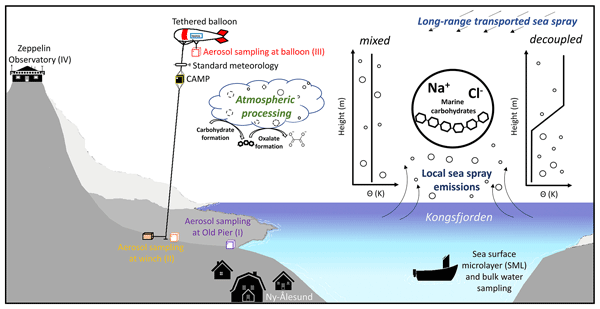
Sebastian Zeppenfeld, Jonas Schaefer, Christian Pilz, Kerstin Ebell, Moritz Zeising, Frank Stratmann, Holger Siebert, Birgit Wehner, Matthias Wietz, Astrid Bracher, and Manuela van Pinxteren
Atmos. Chem. Phys., 26, 7235–7260, https://doi.org/10.5194/acp-26-7235-2026, https://doi.org/10.5194/acp-26-7235-2026, 2026
Short summary
Short summary
Sea spray aerosol transports inorganic salts and carbohydrates from the ocean into the atmosphere. In this field study conducted in Svalbard, we found that carbohydrates reach elevated altitudes that are relevant for cloud formation and properties.
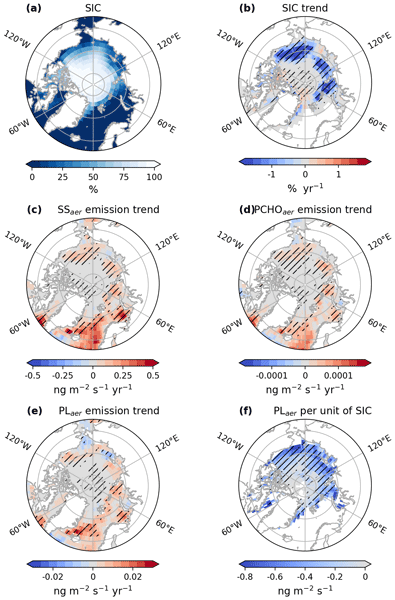
Anisbel Leon-Marcos, Manuela van Pinxteren, Sebastian Zeppenfeld, Moritz Zeising, Astrid Bracher, Laurent Oziel, Ina Tegen, and Bernd Heinold
Atmos. Chem. Phys., 26, 1109–1144, https://doi.org/10.5194/acp-26-1109-2026, https://doi.org/10.5194/acp-26-1109-2026, 2026
Short summary
Short summary
This study combines modelled ocean surface concentrations of major marine organic groups with the aerosol-climate model ECHAM-HAM to quantify species-resolved primary marine organic aerosol emissions from 1990 to 2019. Strong seasonality appears, driven by productivity and summer sea-ice loss. Emissions and burdens rise over time, with regional differences across the Arctic and aerosol species.
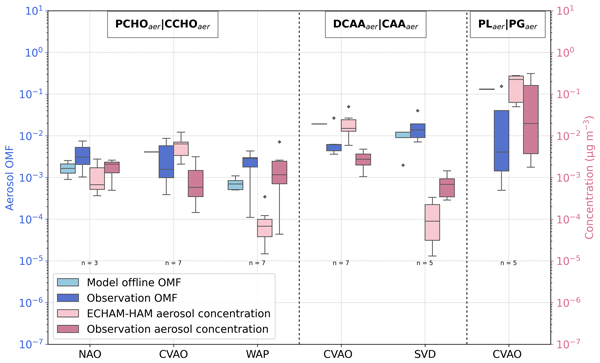
Anisbel Leon-Marcos, Moritz Zeising, Manuela van Pinxteren, Sebastian Zeppenfeld, Astrid Bracher, Elena Barbaro, Anja Engel, Matteo Feltracco, Ina Tegen, and Bernd Heinold
Geosci. Model Dev., 18, 4183–4213, https://doi.org/10.5194/gmd-18-4183-2025, https://doi.org/10.5194/gmd-18-4183-2025, 2025
Short summary
Short summary
This study represents the primary marine organic aerosol (PMOA) emissions, focusing on their sea–atmosphere transfer. Using the FESOM2.1–REcoM3 model, concentrations of key organic biomolecules were estimated and integrated into the ECHAM6.3–HAM2.3 aerosol–climate model. Results highlight the influence of marine biological activity and surface winds on PMOA emissions, with reasonably good agreement with observations improving aerosol representation in the southern oceans.
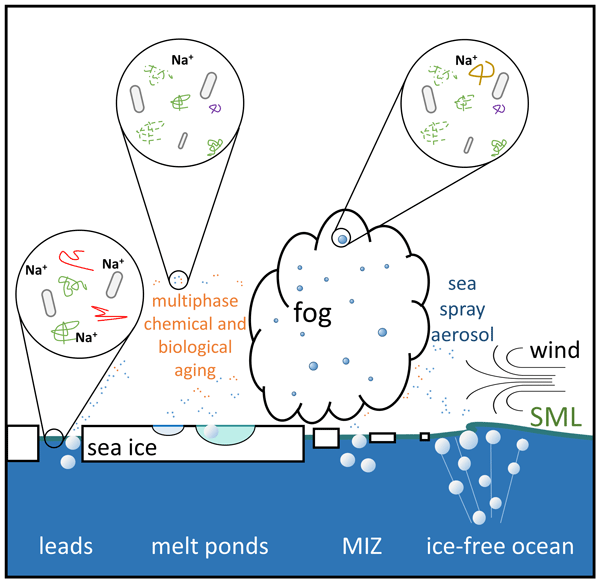
Sebastian Zeppenfeld, Manuela van Pinxteren, Markus Hartmann, Moritz Zeising, Astrid Bracher, and Hartmut Herrmann
Atmos. Chem. Phys., 23, 15561–15587, https://doi.org/10.5194/acp-23-15561-2023, https://doi.org/10.5194/acp-23-15561-2023, 2023
Short summary
Short summary
Marine carbohydrates are produced in the surface of the ocean, enter the atmophere as part of sea spray aerosol particles, and potentially contribute to the formation of fog and clouds. Here, we present the results of a sea–air transfer study of marine carbohydrates conducted in the high Arctic. Besides a chemo-selective transfer, we observed a quick atmospheric aging of carbohydrates, possibly as a result of both biotic and abiotic processes.
Özgür Gürses, Laurent Oziel, Onur Karakuş, Dmitry Sidorenko, Christoph Völker, Ying Ye, Moritz Zeising, Martin Butzin, and Judith Hauck
Geosci. Model Dev., 16, 4883–4936, https://doi.org/10.5194/gmd-16-4883-2023, https://doi.org/10.5194/gmd-16-4883-2023, 2023
Short summary
Short summary
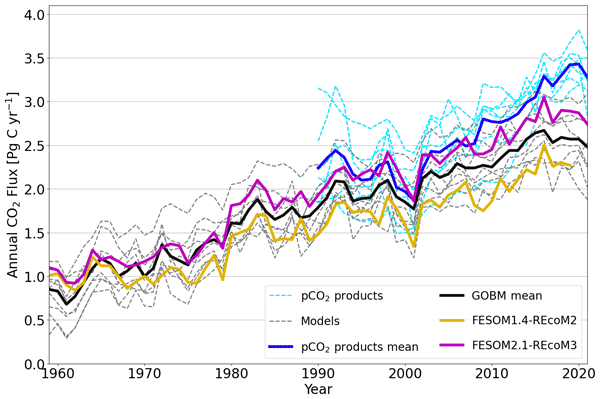
This paper assesses the biogeochemical model REcoM3 coupled to the ocean–sea ice model FESOM2.1. The model can be used to simulate the carbon uptake or release of the ocean on timescales of several hundred years. A detailed analysis of the nutrients, ocean productivity, and ecosystem is followed by the carbon cycle. The main conclusion is that the model performs well when simulating the observed mean biogeochemical state and variability and is comparable to other ocean–biogeochemical models.
Nicolas Stoll, Matthias Wietz, Stephan Juricke, Franziska Pausch, Corina Peter, Miriam Seifert, Jana C. Massing, Moritz Zeising, Rebecca A. McPherson, Melissa Käß, and Björn Suckow
Polarforschung, 91, 31–43, https://doi.org/10.5194/polf-91-31-2023, https://doi.org/10.5194/polf-91-31-2023, 2023
Short summary
Short summary
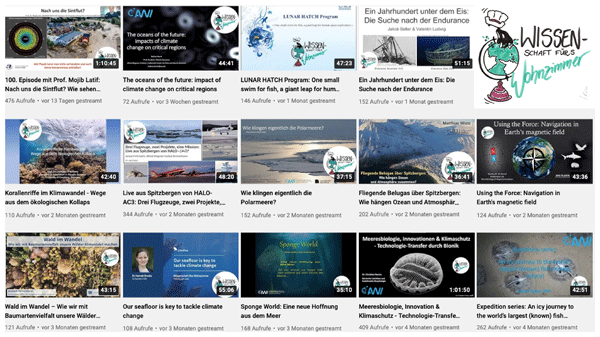
Global crises, such as climate change and the COVID-19 pandemic, show the importance of communicating science to the public. We introduce the YouTube channel "Wissenschaft fürs Wohnzimmer", which livestreams presentations on climate-related topics weekly and is accessible to all. The project encourages interaction between scientists and the public and has been running successfully for over 2 years. We present the concept, what we have learnt, and the challenges after 100 streamed episodes.
Anusha Sathyanadh, Jörg Schwinger, Tommi Bergman, Antti-Ilari Partanen, Timothée Bourgeois, Miriam Seifert, Judith Hauck, David Keller, Tronje Kemena, Claudia Eisenring, Phil Renforth, Spyros Foteinis, and Helene Muri
EGUsphere, https://doi.org/10.5194/egusphere-2026-5784, https://doi.org/10.5194/egusphere-2026-5784, 2026
This preprint is open for discussion and under review for Biogeosciences (BG).
Short summary
Short summary
We used four global Earth system models to test two ocean-based carbon removal methods along the coasts of the United States, Europe, and China. Both methods reduced atmospheric CO2, but their efficiency varied greatly between models, and much of the carbon removal occurred far from where it was deployed. Cooling emerged only slowly, and remained small, suggesting these methods could support long – term carbon removal but would contribute little to near-term temperature recovery.
Megan Malpas, Floortje van den Heuvel, Rachael H. Rhodes, Xin Yang, Shaun Miller, Manuela van Pinxteren, Sebastian Zeppenfeld, and Markus M. Frey
EGUsphere, https://doi.org/10.5194/egusphere-2026-5047, https://doi.org/10.5194/egusphere-2026-5047, 2026
Short summary
Short summary
We investigated a type of aerosol that facilitates the formation of ice in clouds, to understand whether snow on sea ice lifted by strong winds in the Arctic could be a source of this aerosol. We did not observe increases in the concentration of this aerosol during these strong wind events; however, we did observe the formation of ice on aerosol at warmer temperatures. We conclude that aerosol released during strong winds is influenced by both snow sublimation and transport from lower latitudes.
Salem Ibrahim Salem, Andre Valente, Shubha Sathyendranath, Andrei Chuprin, Théo Renard, Jaime Pitarch, Ruth Airs, Moreno Ana, Maria-Manuel Angelico, David Antoine, Robert Arnone, Florinda Artuso, Paulo O. Oliveira, William Balch, Kathryn Barker, Ray Barlow, Simon Bélanger, Marco Bellacicco, Jean-François Berthon, Şükrü Beşiktepe, Francesco Bignami, Yngve Borsheim, Astrid Bracher, Federica Braga, Vittorio Brando, Robert J. W. Brewin, Vanda Brotas, Elisabetta Canuti, Francisco P. Chavez, Andrés Cianca, Hervé Claustre, Lesley Clementson, Simone Colella, Raul Costa, Cristina Nunes, Richard Crout, Emmanuel Devred, Annalisa Di Cicco, Federico Falcini, Ivan Farace, Afonso Ferreira, Scott Freeman, Robert Frouin, Carlos García-Soto, Isabella Giardina, Stuart W. Gibb, Arthur Gleason, Ralf Goericke, Richard Gould, Michael Grant, Nathalie Guillocheau, Hiroto Higa, Stanford B. Hooker, Chuamin Hu, Joji Ishizaka, Thomas Jackson, Mati Kahru, Milton Kampel, Bokyung Kim, Holger Klein, Piotr Kowalczuk, Susanne Kratzer, Raphael Kudela, Antonia Lai, Rosario Lavezza, Jesus Ledesma, Huiwon Lee, Steven Lohrenz, Hubert Loisel, Vivian Lutz, Antonio Mannino, Francesca Margiotta, Victor Martinez-Vicente, Salvatore Marullo, Luca Massi, Patricia Matrai, Atsushi Matsuoka, David McKee, Chiara Melillo, Carlos B. Mendes, Brian G. Mitchell, Tiffany Moisan, Enrique Montes, Frank Muller-Karger, Aimee Neeley, Michael Novak, Leonie O'Dowd, Michael Ondrusek, Emanuele Organelli, Heeyoon Park, Trevor Platt, Francesca Polonelli, Alex Poulton, Mariella Ragni, Michel Repecaud, Maurizio Ribera d’Alcalà, Tamara Rodriguez-Ramos, Rüdiger Röttgers, Manuel Ruiz-Villarreal, Michela Sammartino, Rosalia Santoleri, Gian Marco Scarpa, Thomas Schroeder, Valeria Segura, Timothy Smyth, Denise Smythe-Wright, Heidi M. Sosik, Joanna Stoń-Egiert, Malcolm Taberner, Jing Tan, Rob Thomas, Crystal Thomas, Gavin Tilstone, Andreia Tracana, Michael Twardowski, Vincenzo Vellucci, Gianluca Volpe, Kenneth Voss, Jeremy Werdell, Marcel Wernand, Bozena Wojtasiewicz, Simon Wright, Sunmi Yang, Giuseppe Zibordi, Maria Laura Zoffoli, and Steve Groom
Earth Syst. Sci. Data Discuss., https://doi.org/10.5194/essd-2026-539, https://doi.org/10.5194/essd-2026-539, 2026
Preprint under review for ESSD
Short summary
Short summary
This paper presents the fourth version of the ESA Ocean Colour Climate Change Initiative global in situ bio-optical database. The updated compilation combines observations from many international data sources collected between 1996 and 2025 and includes major expansions in coverage and variables. The dataset provides a consistent reference for validating satellite ocean-colour products and supports algorithm development and long-term climate studies.
Friederike Keil, Markus Quante, Bernd Heinold, and Volker Matthias
Atmos. Chem. Phys., 26, 11561–11582, https://doi.org/10.5194/acp-26-11561-2026, https://doi.org/10.5194/acp-26-11561-2026, 2026
Short summary
Short summary
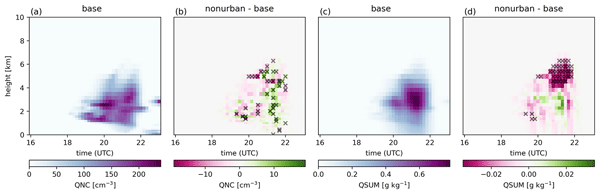
Using model simulations, we studied convective weather events to see how urban aerosol emissions influence cloud microphysics and precipitation. By tracing urban air volumes from convective clouds back to their emission sources, we could isolate the effects of emissions. The results show that urban emissions affect precipitation differently depending on the meteorological situation, highlighting the complex and case-dependent role of cities in shaping local rainfall.
Pascal Kunze, Bernd Heinold, and Ina Tegen
EGUsphere, https://doi.org/10.5194/egusphere-2026-2121, https://doi.org/10.5194/egusphere-2026-2121, 2026
Short summary
Short summary
Dust emission is mostly driven by wind speed and is often linked to convective events. However, the resolution of current climate models cannot resolve these events, which leads to uncertainties in dust emission modelling. This study compares global dust emissions in high-resolution and low-resolution models and shows large differences across major dust source regions. The results highlight that representing convection more realistically is crucial for improving global dust predictions.

Asta C. Heidemann, Alexander Hayward, Philipp Assmy, Atreya Basu, Astrid Bracher, Giulia Castellani, Giacomo Ditullio, Katarzyna Dragańska-Deja, Amane Fujiwara, Glaucia Moreira Fragoso, Jacob Høyer, Jiwoon Hwang, Morten Iversen, Anabel von Jackowski, Thomas Juul-Pedersen, Piotr Kowalczuk, Youngju Lee, Maria A. van Leeuwe, Atsushi Matsuoka, Alenya Merz, Christopher John Mundy, Else Ostermann, Ilka Peeken, Matt Pinkerton, Joanna Stoń-Egiert, Jacqueline Stefels, Antonia U. Thielecke, Gaëlle Veyssiere, Hongyan Xi, Eun Jin Yang, and Rafael Gonçalves-Araujo
Earth Syst. Sci. Data, 18, 5505–5529, https://doi.org/10.5194/essd-18-5505-2026, https://doi.org/10.5194/essd-18-5505-2026, 2026
Short summary
Short summary
Algal pigments are widely used to quantify algal biomass and composition. These organisms form the basis of marine food webs and are vital for the wider ecosystem. Here, we present a pan-Arctic dataset of algal pigments, containing 10 798 measurements collected between 2000 and 2024. This publicly available dataset represents an international collaborative effort and provides an important resource for assessing environmental change and advancing future Arctic ecological and modelling studies.
Sofía Gómez Maqueo Anaya, Sudharaj Aryasree, Konrad Kandler, Eduardo José dos Santos Souza, Khanneh Wadinga Fomba, Dietrich Althausen, Maria Kezoudi, Matthias Faust, Bernd Heinold, Ina Tegen, Moritz Haarig, Holger Baars, and Kerstin Schepanski
Atmos. Chem. Phys., 26, 9929–9966, https://doi.org/10.5194/acp-26-9929-2026, https://doi.org/10.5194/acp-26-9929-2026, 2026
Short summary
Short summary
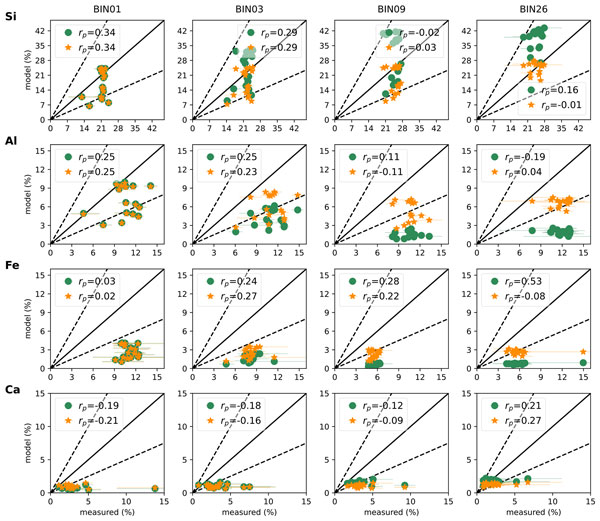
During two 2022 measurement campaigns in Cape Verde, Saharan dust aerosols were collected and analyzed for mineral composition. Mineralogy is crucial for dust–radiation and dust–cloud interactions. We improve dust representation in an atmospheric model by refining the translation of soil into aerosol particle size distributions. Validation with mineral and elemental measurements shows improved representation of some minerals and reveals biases missed by mineral-only comparisons.
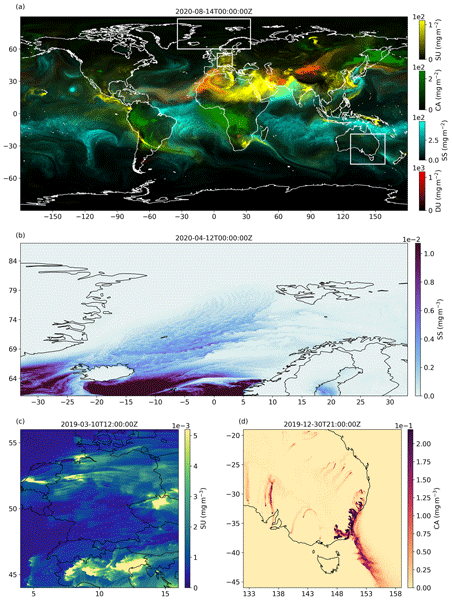
Bernd Heinold, Philipp Weiss, Sadhitro De, Anne Kubin, Jason Müller, Fabian Senf, Philip Stier, and Ina Tegen
Geosci. Model Dev., 19, 6167–6187, https://doi.org/10.5194/gmd-19-6167-2026, https://doi.org/10.5194/gmd-19-6167-2026, 2026
Short summary
Short summary
Understanding climate effects of airborne particles requires computer models that can represent small-scale dynamics. We introduce a new regional configuration of a kilometre-scale aerosol–climate model and apply it to air pollution in Central Europe, sea spray in the Atlantic Arctic, and smoke and dust over Australia. The simulations reproduce key particle patterns and variability, but also reveal limitations due to simplified sources and chemistry. The results guide future model improvements.
Friederike Keil, Markus Quante, Bernd Heinold, and Volker Matthias
EGUsphere, https://doi.org/10.5194/egusphere-2026-2934, https://doi.org/10.5194/egusphere-2026-2934, 2026
Short summary
Short summary
Using simulations of two differing rain events, we investigated how sensitive convective precipitation is to urban emission levels by varying emission strengths across a wide range. Low emissions produce only modest effects, but high levels can trigger systematic changes, including substantial increases in ice content and precipitation intensity accompanied by spatial and temporal shifts. The magnitude of these responses depends critically on the prevailing meteorological conditions.
Suki C. K. Wong, Galen A. McKinley, Richard Seager, Tess Wei-Ping Jacobson, Amanda Fay, Özgür Gürses, Nicolas Gruber, Tatiana Ilyina, Tereza Jarnikova, Laure Resplandy, Jörg Schwinger, and Roland Séférian
EGUsphere, https://doi.org/10.5194/egusphere-2026-3104, https://doi.org/10.5194/egusphere-2026-3104, 2026
Short summary
Short summary
The ocean absorbs nearly a third of human-made carbon dioxide, slowing climate change. This uptake varies from decade to decade for reasons we do not fully understand. Using a 66-year ocean carbon dataset, we found that the tropical Pacific and Southern Ocean drive this variability, in step with broader climate patterns across the Pacific. But these patterns cannot fully explain the recent weakening of the Southern Ocean sink, suggesting biological processes may also play an important role.
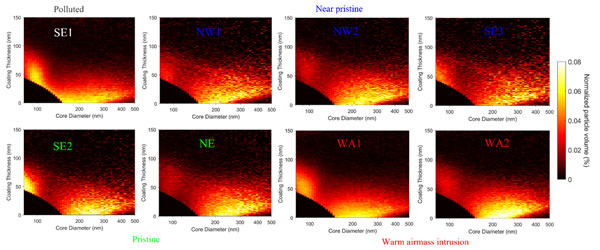
Babu Suja Arun, Thomas Müller, Mira L. Pöhlker, Andreas Held, Christopher Pöhlker, Manuela van Pinxteren, Yifan Yang, Sabine Lüchtrath, Andreas Walbröl, Janna E. Rückert, Philipp Oehlke, Maik Merkel, and Birgit Wehner
Atmos. Chem. Phys., 26, 7287–7310, https://doi.org/10.5194/acp-26-7287-2026, https://doi.org/10.5194/acp-26-7287-2026, 2026
Short summary
Short summary
Black carbon (BC) aerosols absorb solar radiation and perturb the Arctic energy budget, yet in-situ studies of their microphysical properties and mixing state in the Arctic remain scarce. Based on observations from a shipborne expedition in the Arctic Ocean, we found substantial BC concentrations and showed that warm airmass intrusions enhanced BC levels. Aged BC exhibited enhanced light absorption. These findings will help improve the representation of BC in climate models.
Sebastian Zeppenfeld, Jonas Schaefer, Christian Pilz, Kerstin Ebell, Moritz Zeising, Frank Stratmann, Holger Siebert, Birgit Wehner, Matthias Wietz, Astrid Bracher, and Manuela van Pinxteren
Atmos. Chem. Phys., 26, 7235–7260, https://doi.org/10.5194/acp-26-7235-2026, https://doi.org/10.5194/acp-26-7235-2026, 2026
Short summary
Short summary
Sea spray aerosol transports inorganic salts and carbohydrates from the ocean into the atmosphere. In this field study conducted in Svalbard, we found that carbohydrates reach elevated altitudes that are relevant for cloud formation and properties.
Rohit Ghosh, Suvarchal Kumar Cheedela, Sebastian Beyer, Nikolay Koldunov, Stella Berzina, Audrey Delpech, Svetlana Loza, Chathurika Wikramage, Stephy Libera, Matthias Aengenheyster, Amal John, Armelle Remedio, Patrick Scholz, Dmitry Sidorenko, Jan Streffing, Fabian Wachsmann, and Thomas Jung
EGUsphere, https://doi.org/10.5194/egusphere-2026-1289, https://doi.org/10.5194/egusphere-2026-1289, 2026
Short summary
Short summary
Understanding climate change requires detailed computer simulations of the Earth system. Here we present one of the first century-long global simulations in which both the atmosphere and ocean are represented at kilometre-scale resolution. Such simulations are extremely computationally demanding, but we demonstrate their feasibility and show that they can capture key climate patterns while representing important small-scale ocean processes.
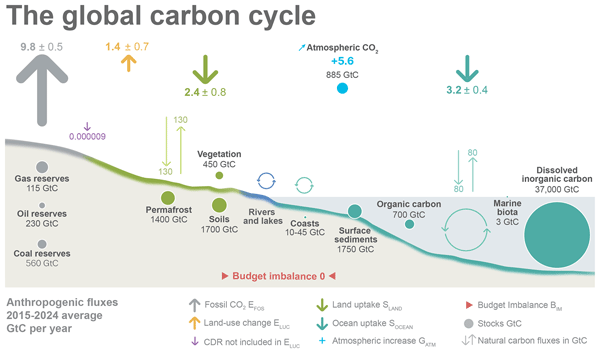
Pierre Friedlingstein, Michael O'Sullivan, Matthew W. Jones, Robbie M. Andrew, Dorothee C. E. Bakker, Judith Hauck, Peter Landschützer, Corinne Le Quéré, Hongmei Li, Ingrid T. Luijkx, Glen P. Peters, Wouter Peters, Julia Pongratz, Clemens Schwingshackl, Stephen Sitch, Josep G. Canadell, Philippe Ciais, Kjetil Aas, Simone R. Alin, Peter Anthoni, Leticia Barbero, Nicholas R. Bates, Nicolas Bellouin, Alice Benoit-Cattin, Carla F. Berghoff, Raffaele Bernardello, Laurent Bopp, Ida Bagus Mandhara Brasika, Matthew A. Chamberlain, Naveen Chandra, Frédéric Chevallier, Louise P. Chini, Nathan O. Collier, Thomas H. Colligan, Margot Cronin, Laique M. Djeutchouang, Xinyu Dou, Matt P. Enright, Kazutaka Enyo, Michael Erb, Wiley Evans, Richard A. Feely, Liang Feng, Daniel J. Ford, Adrianna Foster, Filippa Fransner, Thomas Gasser, Marion Gehlen, Thanos Gkritzalis, Jefferson Goncalves De Souza, Giacomo Grassi, Luke Gregor, Nicolas Gruber, Bertrand Guenet, Özgür Gürses, Kirsty Harrington, Ian Harris, Jens Heinke, George C. Hurtt, Yosuke Iida, Tatiana Ilyina, Akihiko Ito, Andrew R. Jacobson, Atul K. Jain, Tereza Jarníková, Annika Jersild, Fei Jiang, Steve D. Jones, Etsushi Kato, Ralph F. Keeling, Kees Klein Goldewijk, Jürgen Knauer, Yawen Kong, Jan Ivar Korsbakken, Charles Koven, Taro Kunimitsu, Xin Lan, Junjie Liu, Zhiqiang Liu, Zhu Liu, Claire Lo Monaco, Lei Ma, Gregg Marland, Patrick C. McGuire, Galen A. McKinley, Joe R. Melton, Natalie Monacci, Erwan Monier, Eric J. Morgan, David R. Munro, Jens D. Müller, Shin-Ichiro Nakaoka, Lorna R. Nayagam, Yosuke Niwa, Tobias Nutzel, Are Olsen, Abdirahman M. Omar, Naiqing Pan, Sudhanshu Pandey, Denis Pierrot, Zhangcai Qin, Pierre Regnier, Gregor Rehder, Laure Resplandy, Alizée Roobaert, Thais M. Rosan, Christian Rödenbeck, Jörg Schwinger, Ingunn Skjelvan, T. Luke Smallman, Victoria Spada, Mohanan G. Sreeush, Qing Sun, Adrienne J. Sutton, Colm Sweeney, Didier Swingedouw, Roland Séférian, Shintaro Takao, Hiroaki Tatebe, Hanqin Tian, Xiangjun Tian, Bronte Tilbrook, Hiroyuki Tsujino, Francesco Tubiello, Erik van Ooijen, Guido R. van der Werf, Sebastiaan J. van de Velde, Anthony P. Walker, Rik Wanninkhof, Xiaojuan Yang, Wenping Yuan, Xu Yue, and Jiye Zeng
Earth Syst. Sci. Data, 18, 3211–3288, https://doi.org/10.5194/essd-18-3211-2026, https://doi.org/10.5194/essd-18-3211-2026, 2026
Short summary
Short summary
The Global Carbon Budget 2025 describes the methodology, main results, and datasets used to quantify the anthropogenic emissions of carbon dioxide (CO2) and their partitioning among the atmosphere, land ecosystems, and the ocean over the historical period (1750–2025). These living datasets are updated every year to provide the highest transparency and traceability in the reporting of CO2, the key driver of climate change.
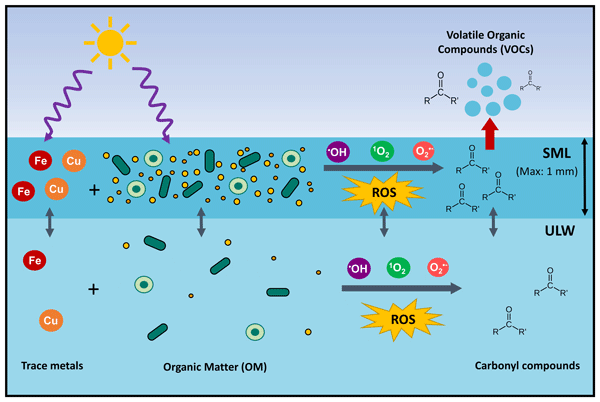
Olenka Jibaja Valderrama, Daniele Scheres Firak, Thomas Schaefer, Manuela van Pinxteren, Khanneh Wadinga Fomba, and Hartmut Herrmann
Biogeosciences, 23, 1965–1985, https://doi.org/10.5194/bg-23-1965-2026, https://doi.org/10.5194/bg-23-1965-2026, 2026
Short summary
Short summary
The present study explores the influence of biological activity in the photochemistry of the sea-surface microlayer (SML) and its implications for the emission of volatile organic compounds (VOCs) to the marine atmosphere. Experimental evidence of enhanced photochemical activity of carbonyl compounds in the SML is provided, particularly in periods of higher biological productivity, thereby offering new insights to integrate biological processes and photochemistry in the air-sea boundary.

Amavi Silva, Surandokht Nikzad, Theresa Barthelmeß, Anja Engel, Hartmut Herrmann, Manuela van Pinxteren, Kai Wirtz, Oliver Wurl, and Markus Schartau
Biogeosciences, 23, 1697–1718, https://doi.org/10.5194/bg-23-1697-2026, https://doi.org/10.5194/bg-23-1697-2026, 2026
Short summary
Short summary
We conducted the first meta-analysis combining marine and freshwater studies to understand organic matter enrichment in the surface microlayer. Nitrogen-rich, particulate compounds are often enriched, with patterns varying by multiple factors. We recommend tracking both absolute concentrations and normalized enrichment patterns to better assess ecological conditions. Our study also introduces improved statistical methods for analyzing and comparing surface microlayer data.

Ehsan Mehdipour, Hongyan Xi, Alexander Barth, Aida Alvera-Azcárate, Adalbert Wilhelm, and Astrid Bracher
Geosci. Model Dev., 19, 1619–1643, https://doi.org/10.5194/gmd-19-1619-2026, https://doi.org/10.5194/gmd-19-1619-2026, 2026
Short summary
Short summary
Phytoplankton are vital for marine ecosystems and nutrient cycling, detectable by optical satellites. Data gaps caused by clouds and other non-optimal conditions limit comprehensive analyses like trend monitoring. This study evaluated DINCAE and DINEOF gap-filling methods for reconstructing chlorophyll a datasets, including total chlorophyll a and five major phytoplankton groups. Both methods showed robust reconstruction capabilities, aiding pattern detection and long-term ocean colour analysis.
Li-Qing Jiang, Amanda Fay, Jens Daniel Müller, Luke Gregor, Alizée Roobaert, Lydia Keppler, Dustin Carroll, Siv K. Lauvset, Tim DeVries, Judith Hauck, Christian Rödenbeck, Nicolas Metzl, Andrea J. Fassbender, Jean-Pierre Gattuso, Peter Landschützer, Rik Wanninkhof, Christopher Sabine, Simone R. Alin, Mario Hoppema, Are Olsen, Matthew P. Humphreys, Kunal Chakraborty, Ana C. Franco, Kumiko Azetsu-Scott, Dorothee C. E. Bakker, Leticia Barbero, Nicholas R. Bates, Nicole Besemer, Henry C. Bittig, Albert E. Boyd, Daniel Broullón, Wei-Jun Cai, Brendan R. Carter, Thi-Tuyet-Trang Chau, Chen-Tung Arthur Chen, Frédéric Cyr, John E. Dore, Ian Enochs, Richard A. Feely, Hernan E. Garcia, Marion Gehlen, Prasanna Kanti Ghoshal, Lucas Gloege, Melchor González-Dávila, Nicolas Gruber, Debby Ianson, Yosuke Iida, Masao Ishii, Apurva Padamnabh Joshi, Esther Kennedy, Alex Kozyr, Nico Lange, Claire Lo Monaco, Derek P. Manzello, Galen A. McKinley, Natalie M. Monacci, Xose A. Padin, Ana M. Palacio-Castro, Fiz F. Pérez, J. Magdalena Santana-Casiano, Jonathan Sharp, Adrienne Sutton, Jim Swift, Toste Tanhua, Maciej Telszewski, Jens Terhaar, Ruben van Hooidonk, Anton Velo, Andrew J. Watson, Angelicque E. White, Zelun Wu, Liang Xue, Hyelim Yoo, Jiye Zeng, and Guorong Zhong
Earth Syst. Sci. Data, 18, 1405–1462, https://doi.org/10.5194/essd-18-1405-2026, https://doi.org/10.5194/essd-18-1405-2026, 2026
Short summary
Short summary
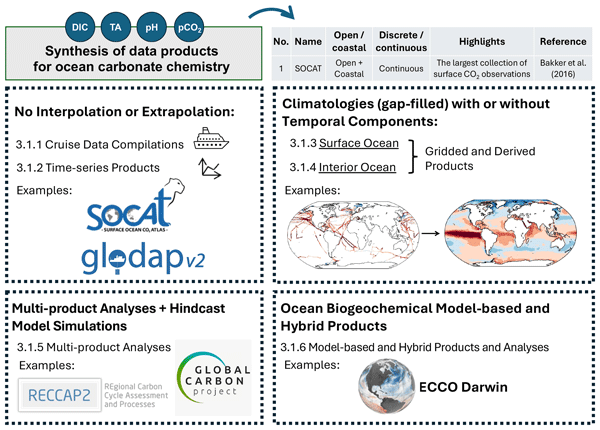
This review article provides an overview of 68 existing ocean carbonate chemistry data products and data product sets, encompassing a broad range of types, including compilations of cruise datasets, gap-filled observational products, model simulations, and more. It is designed to help researchers identify and access the data products that best support their scientific objectives, thereby facilitating progress in understanding the ocean's changing carbonate chemistry.
Anisbel Leon-Marcos, Manuela van Pinxteren, Sebastian Zeppenfeld, Moritz Zeising, Astrid Bracher, Laurent Oziel, Ina Tegen, and Bernd Heinold
Atmos. Chem. Phys., 26, 1109–1144, https://doi.org/10.5194/acp-26-1109-2026, https://doi.org/10.5194/acp-26-1109-2026, 2026
Short summary
Short summary
This study combines modelled ocean surface concentrations of major marine organic groups with the aerosol-climate model ECHAM-HAM to quantify species-resolved primary marine organic aerosol emissions from 1990 to 2019. Strong seasonality appears, driven by productivity and summer sea-ice loss. Emissions and burdens rise over time, with regional differences across the Arctic and aerosol species.
Miriam Seifert, Christopher Danek, Christoph Völker, and Judith Hauck
Biogeosciences, 22, 5897–5919, https://doi.org/10.5194/bg-22-5897-2025, https://doi.org/10.5194/bg-22-5897-2025, 2025
Short summary
Short summary
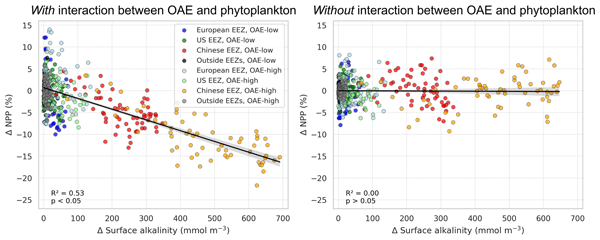
Ocean alkalinity enhancement (OAE) can help to remove CO2 from the atmosphere. Yet, our study is the first to investigate the link between OAE and phytoplankton in an Earth system model. We show that OAE can indirectly decrease primary production and that biological feedbacks can modify the efficiency of OAE. Our study provides hints for ecological risks of OAE and the quantification of carbon drawdown and can serve as a kick start for other models to consider OAE–ecosystem interactions.
Hongyan Xi, Marine Bretagnon, Ehsan Mehdipour, Julien Demaria, Antoine Mangin, and Astrid Bracher
State Planet, 6-osr9, 7, https://doi.org/10.5194/sp-6-osr9-7-2025, https://doi.org/10.5194/sp-6-osr9-7-2025, 2025
Short summary
Short summary
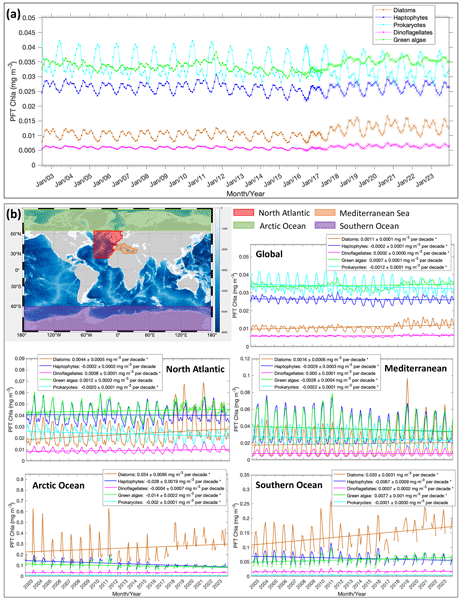
To better understand the marine phytoplankton variability on different scales in both space and time, this study proposes a machine-learning-based scheme to provide continuous and consistent long-term observations of various phytoplankton groups from space on a global scale, which enables time series analysis for further trend and anomaly investigations. This study provides an essential ocean variable to help assess the ocean health in the biogeochemical aspect.
Sofía Gómez Maqueo Anaya, Dietrich Althausen, Julian Hofer, Moritz Haarig, Ulla Wandinger, Bernd Heinold, Ina Tegen, Matthias Faust, Holger Baars, Albert Ansmann, Ronny Engelmann, Annett Skupin, Birgit Heese, and Kerstin Schepanski
Atmos. Chem. Phys., 25, 9737–9764, https://doi.org/10.5194/acp-25-9737-2025, https://doi.org/10.5194/acp-25-9737-2025, 2025
Short summary
Short summary
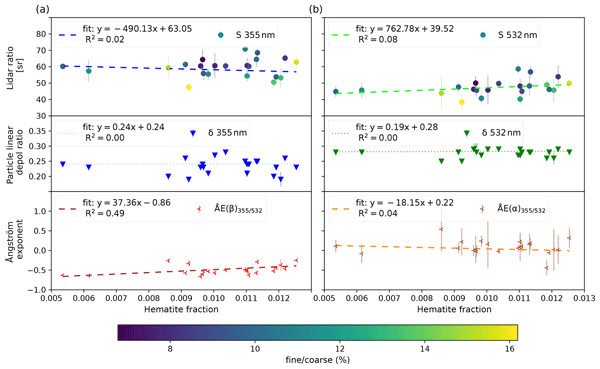
This study investigates how hematite in Sahara dust affects how dust particles interact with radiation. Using lidar data from Cabo Verde (2021–2022) and hematite content from atmospheric model simulations, the results show that a higher hematite fraction leads to a decrease in the particle backscattering coefficients in a spectrally different way. These findings can improve the representation of mineral dust in climate models, particularly regarding their radiative effect.
Ja-Yeon Moon, Jan Streffing, Sun-Seon Lee, Tido Semmler, Miguel Andrés-Martínez, Jiao Chen, Eun-Byeoul Cho, Jung-Eun Chu, Christian L. E. Franzke, Jan P. Gärtner, Rohit Ghosh, Jan Hegewald, Songyee Hong, Dae-Won Kim, Nikolay Koldunov, June-Yi Lee, Zihao Lin, Chao Liu, Svetlana N. Loza, Wonsun Park, Woncheol Roh, Dmitry V. Sein, Sahil Sharma, Dmitry Sidorenko, Jun-Hyeok Son, Malte F. Stuecker, Qiang Wang, Gyuseok Yi, Martina Zapponini, Thomas Jung, and Axel Timmermann
Earth Syst. Dynam., 16, 1103–1134, https://doi.org/10.5194/esd-16-1103-2025, https://doi.org/10.5194/esd-16-1103-2025, 2025
Short summary
Short summary
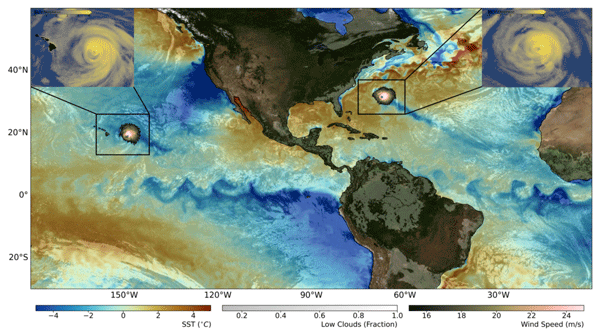
Based on a series of storm-resolving greenhouse warming simulations conducted with the AWI-CM3 model at 9 km global atmosphere and 4–25 km ocean resolution, we present new projections of regional climate change, modes of climate variability, and extreme events. The 10-year-long high-resolution simulations for the 2000s, 2030s, 2060s, and 2090s were initialized from a coarser-resolution transient run (31 km atmosphere) which follows the SSP5-8.5 greenhouse gas emission scenario from 1950–2100 CE.
Anisbel Leon-Marcos, Moritz Zeising, Manuela van Pinxteren, Sebastian Zeppenfeld, Astrid Bracher, Elena Barbaro, Anja Engel, Matteo Feltracco, Ina Tegen, and Bernd Heinold
Geosci. Model Dev., 18, 4183–4213, https://doi.org/10.5194/gmd-18-4183-2025, https://doi.org/10.5194/gmd-18-4183-2025, 2025
Short summary
Short summary
This study represents the primary marine organic aerosol (PMOA) emissions, focusing on their sea–atmosphere transfer. Using the FESOM2.1–REcoM3 model, concentrations of key organic biomolecules were estimated and integrated into the ECHAM6.3–HAM2.3 aerosol–climate model. Results highlight the influence of marine biological activity and surface winds on PMOA emissions, with reasonably good agreement with observations improving aerosol representation in the southern oceans.
Pierre Friedlingstein, Michael O'Sullivan, Matthew W. Jones, Robbie M. Andrew, Judith Hauck, Peter Landschützer, Corinne Le Quéré, Hongmei Li, Ingrid T. Luijkx, Are Olsen, Glen P. Peters, Wouter Peters, Julia Pongratz, Clemens Schwingshackl, Stephen Sitch, Josep G. Canadell, Philippe Ciais, Robert B. Jackson, Simone R. Alin, Almut Arneth, Vivek Arora, Nicholas R. Bates, Meike Becker, Nicolas Bellouin, Carla F. Berghoff, Henry C. Bittig, Laurent Bopp, Patricia Cadule, Katie Campbell, Matthew A. Chamberlain, Naveen Chandra, Frédéric Chevallier, Louise P. Chini, Thomas Colligan, Jeanne Decayeux, Laique M. Djeutchouang, Xinyu Dou, Carolina Duran Rojas, Kazutaka Enyo, Wiley Evans, Amanda R. Fay, Richard A. Feely, Daniel J. Ford, Adrianna Foster, Thomas Gasser, Marion Gehlen, Thanos Gkritzalis, Giacomo Grassi, Luke Gregor, Nicolas Gruber, Özgür Gürses, Ian Harris, Matthew Hefner, Jens Heinke, George C. Hurtt, Yosuke Iida, Tatiana Ilyina, Andrew R. Jacobson, Atul K. Jain, Tereza Jarníková, Annika Jersild, Fei Jiang, Zhe Jin, Etsushi Kato, Ralph F. Keeling, Kees Klein Goldewijk, Jürgen Knauer, Jan Ivar Korsbakken, Xin Lan, Siv K. Lauvset, Nathalie Lefèvre, Zhu Liu, Junjie Liu, Lei Ma, Shamil Maksyutov, Gregg Marland, Nicolas Mayot, Patrick C. McGuire, Nicolas Metzl, Natalie M. Monacci, Eric J. Morgan, Shin-Ichiro Nakaoka, Craig Neill, Yosuke Niwa, Tobias Nützel, Lea Olivier, Tsuneo Ono, Paul I. Palmer, Denis Pierrot, Zhangcai Qin, Laure Resplandy, Alizée Roobaert, Thais M. Rosan, Christian Rödenbeck, Jörg Schwinger, T. Luke Smallman, Stephen M. Smith, Reinel Sospedra-Alfonso, Tobias Steinhoff, Qing Sun, Adrienne J. Sutton, Roland Séférian, Shintaro Takao, Hiroaki Tatebe, Hanqin Tian, Bronte Tilbrook, Olivier Torres, Etienne Tourigny, Hiroyuki Tsujino, Francesco Tubiello, Guido van der Werf, Rik Wanninkhof, Xuhui Wang, Dongxu Yang, Xiaojuan Yang, Zhen Yu, Wenping Yuan, Xu Yue, Sönke Zaehle, Ning Zeng, and Jiye Zeng
Earth Syst. Sci. Data, 17, 965–1039, https://doi.org/10.5194/essd-17-965-2025, https://doi.org/10.5194/essd-17-965-2025, 2025
Short summary
Short summary
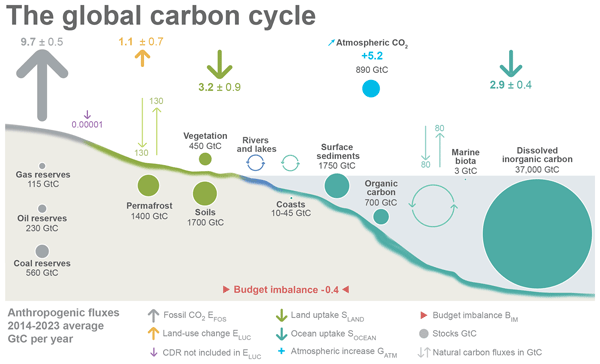
The Global Carbon Budget 2024 describes the methodology, main results, and datasets used to quantify the anthropogenic emissions of carbon dioxide (CO2) and their partitioning among the atmosphere, land ecosystems, and the ocean over the historical period (1750–2024). These living datasets are updated every year to provide the highest transparency and traceability in the reporting of CO2, the key driver of climate change.
Ying Ye, Guy Munhoven, Peter Köhler, Martin Butzin, Judith Hauck, Özgür Gürses, and Christoph Völker
Geosci. Model Dev., 18, 977–1000, https://doi.org/10.5194/gmd-18-977-2025, https://doi.org/10.5194/gmd-18-977-2025, 2025
Short summary
Short summary
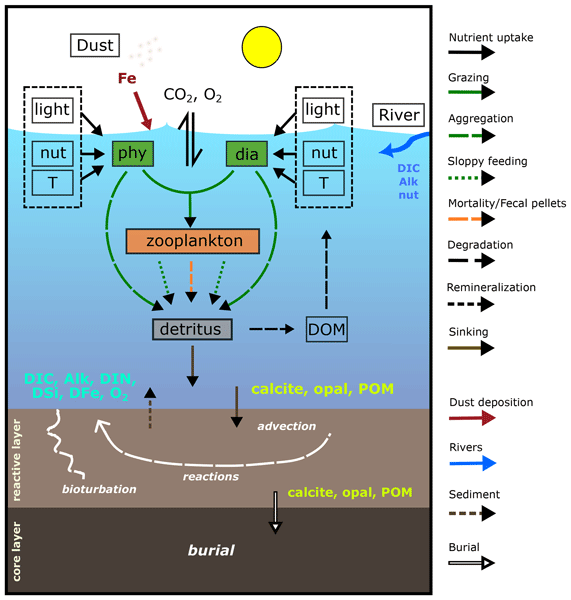
Many biogeochemistry models assume all material reaching the seafloor is remineralized and returned to solution, which is sufficient for studies on short-term climate change. Under long-term climate change, the carbon storage in sediments slows down carbon cycling and influences feedbacks in the atmosphere–ocean–sediment system. This paper describes the coupling of a sediment model to an ocean biogeochemistry model and presents results under the pre-industrial climate and under CO2 perturbation.
Frauke Bunsen, Judith Hauck, Sinhué Torres-Valdés, and Lars Nerger
Ocean Sci., 21, 437–471, https://doi.org/10.5194/os-21-437-2025, https://doi.org/10.5194/os-21-437-2025, 2025
Short summary
Short summary
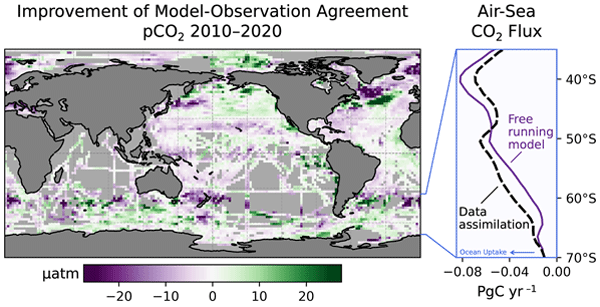
Computer models are often used to estimate the ocean's CO2 uptake due to a lack of direct observations. Because such idealized models do not match precisely with the real world, we combine real-world observations of ocean temperature and salinity with a model and study the effect on the modeled air–sea CO2 flux (2010–2020). The corrections of temperature and salinity have their largest effect on regional CO2 fluxes in the Southern Ocean in winter and a small effect on the global CO2 uptake.
Jamie R. Banks, Bernd Heinold, and Kerstin Schepanski
Atmos. Chem. Phys., 24, 11451–11475, https://doi.org/10.5194/acp-24-11451-2024, https://doi.org/10.5194/acp-24-11451-2024, 2024
Short summary
Short summary
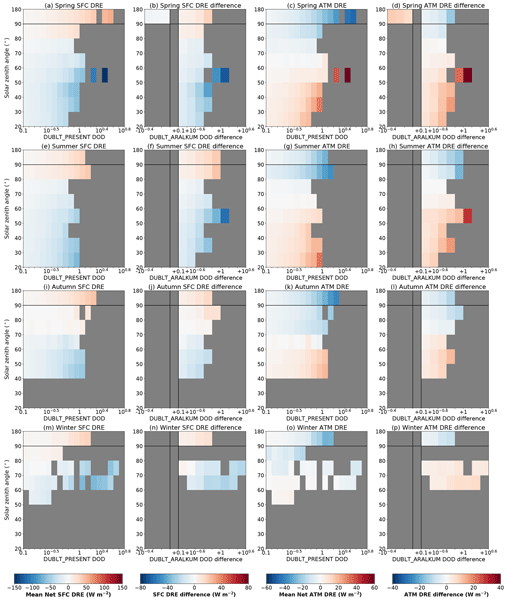
The Aralkum is a new desert in Central Asia formed by the desiccation of the Aral Sea. This has created a source of atmospheric dust, with implications for the balance of solar and thermal radiation. Simulating these effects using a dust transport model, we find that Aralkum dust adds radiative cooling effects to the surface and atmosphere on average but also adds heating events. Increases in surface pressure due to Aralkum dust strengthen the Siberian High and weaken the summer Asian heat low.
Andreas Walbröl, Janosch Michaelis, Sebastian Becker, Henning Dorff, Kerstin Ebell, Irina Gorodetskaya, Bernd Heinold, Benjamin Kirbus, Melanie Lauer, Nina Maherndl, Marion Maturilli, Johanna Mayer, Hanno Müller, Roel A. J. Neggers, Fiona M. Paulus, Johannes Röttenbacher, Janna E. Rückert, Imke Schirmacher, Nils Slättberg, André Ehrlich, Manfred Wendisch, and Susanne Crewell
Atmos. Chem. Phys., 24, 8007–8029, https://doi.org/10.5194/acp-24-8007-2024, https://doi.org/10.5194/acp-24-8007-2024, 2024
Short summary
Short summary
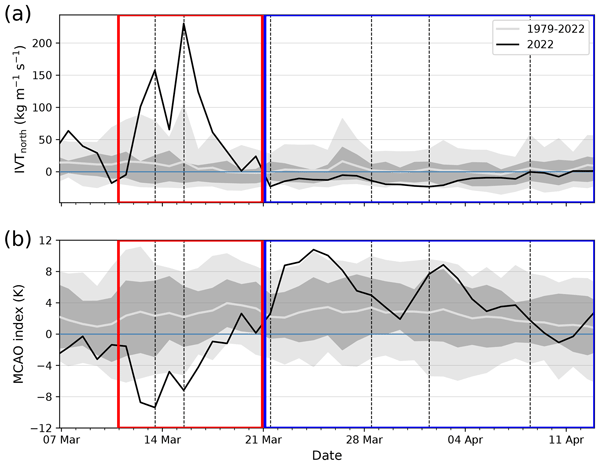
To support the interpretation of the data collected during the HALO-(AC)3 campaign, which took place in the North Atlantic sector of the Arctic from 7 March to 12 April 2022, we analyze how unusual the weather and sea ice conditions were with respect to the long-term climatology. From observations and ERA5 reanalysis, we found record-breaking warm air intrusions and a large variety of marine cold air outbreaks. Sea ice concentration was mostly within the climatological interquartile range.
Martin Butzin, Ying Ye, Christoph Völker, Özgür Gürses, Judith Hauck, and Peter Köhler
Geosci. Model Dev., 17, 1709–1727, https://doi.org/10.5194/gmd-17-1709-2024, https://doi.org/10.5194/gmd-17-1709-2024, 2024
Short summary
Short summary
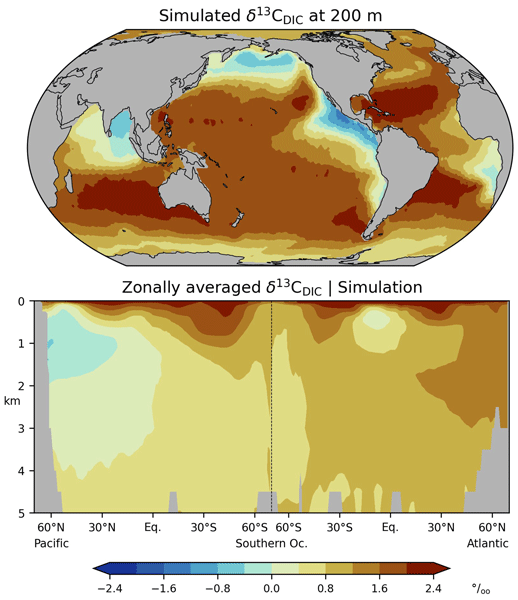
In this paper we describe the implementation of the carbon isotopes 13C and 14C into the marine biogeochemistry model FESOM2.1-REcoM3 and present results of long-term test simulations. Our model results are largely consistent with marine carbon isotope reconstructions for the pre-anthropogenic period, but also exhibit some discrepancies.
Sofía Gómez Maqueo Anaya, Dietrich Althausen, Matthias Faust, Holger Baars, Bernd Heinold, Julian Hofer, Ina Tegen, Albert Ansmann, Ronny Engelmann, Annett Skupin, Birgit Heese, and Kerstin Schepanski
Geosci. Model Dev., 17, 1271–1295, https://doi.org/10.5194/gmd-17-1271-2024, https://doi.org/10.5194/gmd-17-1271-2024, 2024
Short summary
Short summary
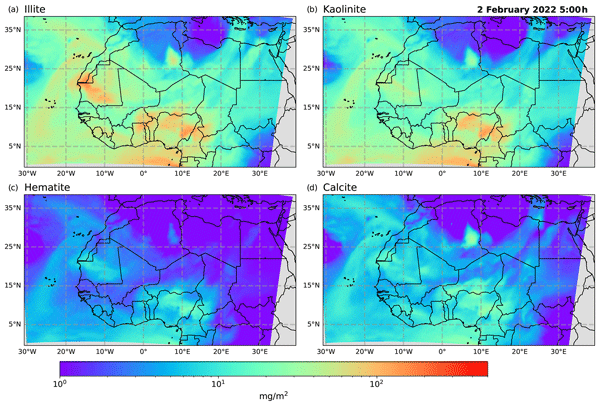
Mineral dust aerosol particles vary greatly in their composition depending on source region, which leads to different physicochemical properties. Most atmosphere–aerosol models consider mineral dust aerosols to be compositionally homogeneous, which ultimately increases model uncertainty. Here, we present an approach to explicitly consider the heterogeneity of the mineralogical composition for simulations of the Saharan atmospheric dust cycle with regard to dust transport towards the Atlantic.
Sebastian Zeppenfeld, Manuela van Pinxteren, Markus Hartmann, Moritz Zeising, Astrid Bracher, and Hartmut Herrmann
Atmos. Chem. Phys., 23, 15561–15587, https://doi.org/10.5194/acp-23-15561-2023, https://doi.org/10.5194/acp-23-15561-2023, 2023
Short summary
Short summary
Marine carbohydrates are produced in the surface of the ocean, enter the atmophere as part of sea spray aerosol particles, and potentially contribute to the formation of fog and clouds. Here, we present the results of a sea–air transfer study of marine carbohydrates conducted in the high Arctic. Besides a chemo-selective transfer, we observed a quick atmospheric aging of carbohydrates, possibly as a result of both biotic and abiotic processes.
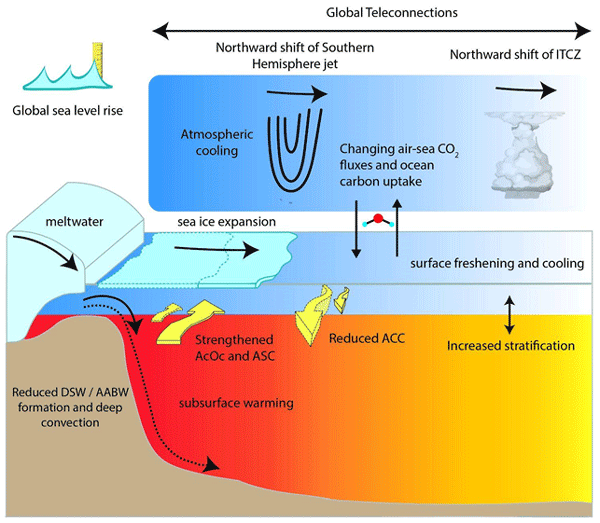
Neil C. Swart, Torge Martin, Rebecca Beadling, Jia-Jia Chen, Christopher Danek, Matthew H. England, Riccardo Farneti, Stephen M. Griffies, Tore Hattermann, Judith Hauck, F. Alexander Haumann, André Jüling, Qian Li, John Marshall, Morven Muilwijk, Andrew G. Pauling, Ariaan Purich, Inga J. Smith, and Max Thomas
Geosci. Model Dev., 16, 7289–7309, https://doi.org/10.5194/gmd-16-7289-2023, https://doi.org/10.5194/gmd-16-7289-2023, 2023
Short summary
Short summary
Current climate models typically do not include full representation of ice sheets. As the climate warms and the ice sheets melt, they add freshwater to the ocean. This freshwater can influence climate change, for example by causing more sea ice to form. In this paper we propose a set of experiments to test the influence of this missing meltwater from Antarctica using multiple different climate models.
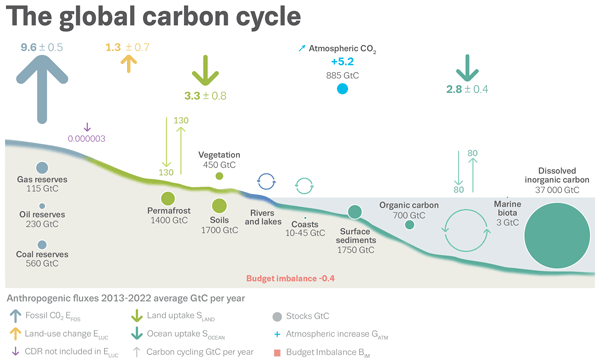
Pierre Friedlingstein, Michael O'Sullivan, Matthew W. Jones, Robbie M. Andrew, Dorothee C. E. Bakker, Judith Hauck, Peter Landschützer, Corinne Le Quéré, Ingrid T. Luijkx, Glen P. Peters, Wouter Peters, Julia Pongratz, Clemens Schwingshackl, Stephen Sitch, Josep G. Canadell, Philippe Ciais, Robert B. Jackson, Simone R. Alin, Peter Anthoni, Leticia Barbero, Nicholas R. Bates, Meike Becker, Nicolas Bellouin, Bertrand Decharme, Laurent Bopp, Ida Bagus Mandhara Brasika, Patricia Cadule, Matthew A. Chamberlain, Naveen Chandra, Thi-Tuyet-Trang Chau, Frédéric Chevallier, Louise P. Chini, Margot Cronin, Xinyu Dou, Kazutaka Enyo, Wiley Evans, Stefanie Falk, Richard A. Feely, Liang Feng, Daniel J. Ford, Thomas Gasser, Josefine Ghattas, Thanos Gkritzalis, Giacomo Grassi, Luke Gregor, Nicolas Gruber, Özgür Gürses, Ian Harris, Matthew Hefner, Jens Heinke, Richard A. Houghton, George C. Hurtt, Yosuke Iida, Tatiana Ilyina, Andrew R. Jacobson, Atul Jain, Tereza Jarníková, Annika Jersild, Fei Jiang, Zhe Jin, Fortunat Joos, Etsushi Kato, Ralph F. Keeling, Daniel Kennedy, Kees Klein Goldewijk, Jürgen Knauer, Jan Ivar Korsbakken, Arne Körtzinger, Xin Lan, Nathalie Lefèvre, Hongmei Li, Junjie Liu, Zhiqiang Liu, Lei Ma, Greg Marland, Nicolas Mayot, Patrick C. McGuire, Galen A. McKinley, Gesa Meyer, Eric J. Morgan, David R. Munro, Shin-Ichiro Nakaoka, Yosuke Niwa, Kevin M. O'Brien, Are Olsen, Abdirahman M. Omar, Tsuneo Ono, Melf Paulsen, Denis Pierrot, Katie Pocock, Benjamin Poulter, Carter M. Powis, Gregor Rehder, Laure Resplandy, Eddy Robertson, Christian Rödenbeck, Thais M. Rosan, Jörg Schwinger, Roland Séférian, T. Luke Smallman, Stephen M. Smith, Reinel Sospedra-Alfonso, Qing Sun, Adrienne J. Sutton, Colm Sweeney, Shintaro Takao, Pieter P. Tans, Hanqin Tian, Bronte Tilbrook, Hiroyuki Tsujino, Francesco Tubiello, Guido R. van der Werf, Erik van Ooijen, Rik Wanninkhof, Michio Watanabe, Cathy Wimart-Rousseau, Dongxu Yang, Xiaojuan Yang, Wenping Yuan, Xu Yue, Sönke Zaehle, Jiye Zeng, and Bo Zheng
Earth Syst. Sci. Data, 15, 5301–5369, https://doi.org/10.5194/essd-15-5301-2023, https://doi.org/10.5194/essd-15-5301-2023, 2023
Short summary
Short summary
The Global Carbon Budget 2023 describes the methodology, main results, and data sets used to quantify the anthropogenic emissions of carbon dioxide (CO2) and their partitioning among the atmosphere, land ecosystems, and the ocean over the historical period (1750–2023). These living datasets are updated every year to provide the highest transparency and traceability in the reporting of CO2, the key driver of climate change.
Aleksandra Cherkasheva, Rustam Manurov, Piotr Kowalczuk, Alexandra N. Loginova, Monika Zabłocka, and Astrid Bracher
EGUsphere, https://doi.org/10.5194/egusphere-2023-2495, https://doi.org/10.5194/egusphere-2023-2495, 2023
Preprint archived
Short summary
Short summary
We aimed to improve the quality of regional Greenland Sea primary production estimates. Seventy two versions of primary production model setups were tested against field data. Best performing models had local biomass and light absorption profiles. Thus by using local parametrizations for these parameters we can improve Arctic primary production model performance. Annual Greenland Sea basin estimates are larger than previously reported.
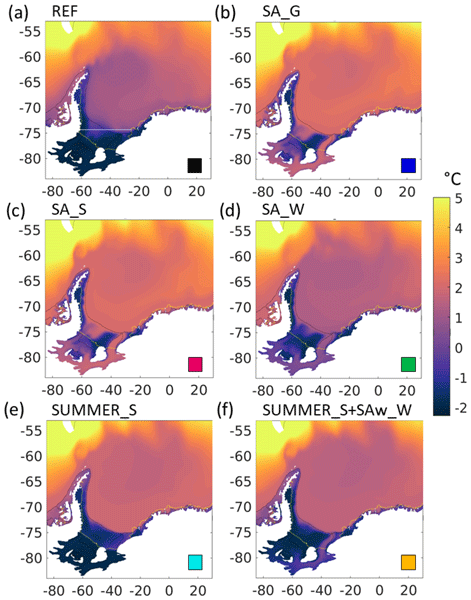
Verena Haid, Ralph Timmermann, Özgür Gürses, and Hartmut H. Hellmer
Ocean Sci., 19, 1529–1544, https://doi.org/10.5194/os-19-1529-2023, https://doi.org/10.5194/os-19-1529-2023, 2023
Short summary
Short summary
Recently, it was found that cold-to-warm changes in Antarctic shelf sea areas are possible and lead to higher ice shelf melt rates. In modelling experiments, we found that if the highest density in front of the ice shelf becomes lower than the density of the warmer water off-shelf at the deepest access to the shelf, the off-shelf water will flow onto the shelf. Our results also indicate that this change will offer some, although not much, resistance to reversal and constitutes a tipping point.
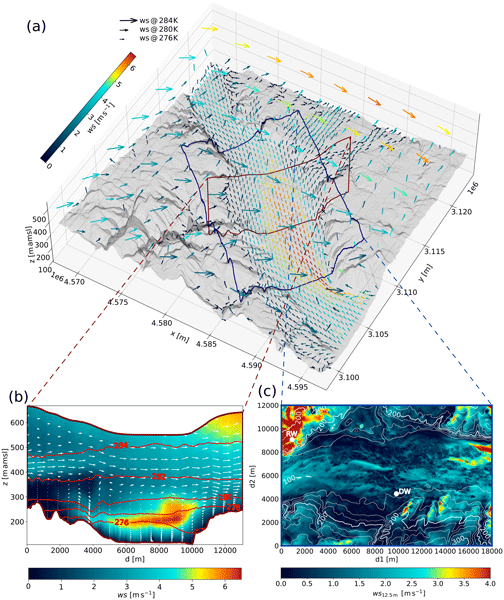
Michael Weger and Bernd Heinold
Atmos. Chem. Phys., 23, 13769–13790, https://doi.org/10.5194/acp-23-13769-2023, https://doi.org/10.5194/acp-23-13769-2023, 2023
Short summary
Short summary
This study investigates the effects of complex terrain on air pollution trapping using a numerical model which simulates the dispersion of emissions under real meteorological conditions. The additionally simulated aerosol age allows us to distinguish areas that accumulate aerosol over time from areas that are more influenced by fresh emissions. The Dresden Basin, a widened section of the Elbe Valley in eastern Germany, is selected as the target area in a case study to demonstrate the concept.
Christoph Heinze, Thorsten Blenckner, Peter Brown, Friederike Fröb, Anne Morée, Adrian L. New, Cara Nissen, Stefanie Rynders, Isabel Seguro, Yevgeny Aksenov, Yuri Artioli, Timothée Bourgeois, Friedrich Burger, Jonathan Buzan, B. B. Cael, Veli Çağlar Yumruktepe, Melissa Chierici, Christopher Danek, Ulf Dieckmann, Agneta Fransson, Thomas Frölicher, Giovanni Galli, Marion Gehlen, Aridane G. González, Melchor Gonzalez-Davila, Nicolas Gruber, Örjan Gustafsson, Judith Hauck, Mikko Heino, Stephanie Henson, Jenny Hieronymus, I. Emma Huertas, Fatma Jebri, Aurich Jeltsch-Thömmes, Fortunat Joos, Jaideep Joshi, Stephen Kelly, Nandini Menon, Precious Mongwe, Laurent Oziel, Sólveig Ólafsdottir, Julien Palmieri, Fiz F. Pérez, Rajamohanan Pillai Ranith, Juliano Ramanantsoa, Tilla Roy, Dagmara Rusiecka, J. Magdalena Santana Casiano, Yeray Santana-Falcón, Jörg Schwinger, Roland Séférian, Miriam Seifert, Anna Shchiptsova, Bablu Sinha, Christopher Somes, Reiner Steinfeldt, Dandan Tao, Jerry Tjiputra, Adam Ulfsbo, Christoph Völker, Tsuyoshi Wakamatsu, and Ying Ye
Biogeosciences Discuss., https://doi.org/10.5194/bg-2023-182, https://doi.org/10.5194/bg-2023-182, 2023
Revised manuscript not accepted
Short summary
Short summary
For assessing the consequences of human-induced climate change for the marine realm, it is necessary to not only look at gradual changes but also at abrupt changes of environmental conditions. We summarise abrupt changes in ocean warming, acidification, and oxygen concentration as the key environmental factors for ecosystems. Taking these abrupt changes into account requires greenhouse gas emissions to be reduced to a larger extent than previously thought to limit respective damage.
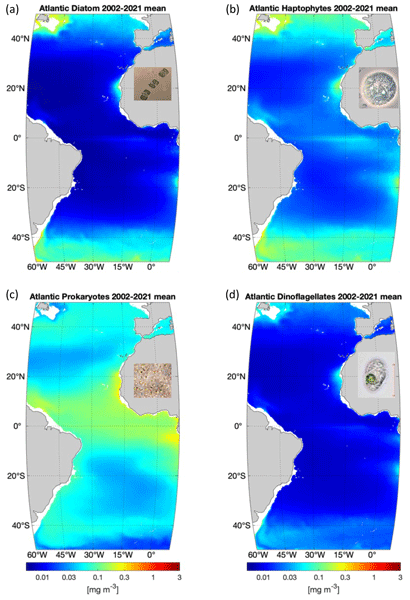
Hongyan Xi, Marine Bretagnon, Svetlana N. Losa, Vanda Brotas, Mara Gomes, Ilka Peeken, Leonardo M. A. Alvarado, Antoine Mangin, and Astrid Bracher
State Planet, 1-osr7, 5, https://doi.org/10.5194/sp-1-osr7-5-2023, https://doi.org/10.5194/sp-1-osr7-5-2023, 2023
Short summary
Short summary
Continuous monitoring of phytoplankton groups using satellite data is crucial for understanding global ocean phytoplankton variability on different scales in both space and time. This study focuses on four important phytoplankton groups in the Atlantic Ocean to investigate their trend, anomaly and phenological characteristics both over the whole region and at subscales. This study paves the way to promote potentially important ocean monitoring indicators to help sustain the ocean health.
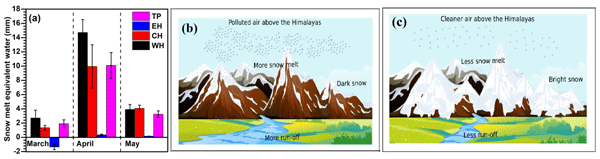
Suvarna Fadnavis, Bernd Heinold, T. P. Sabin, Anne Kubin, Katty Huang, Alexandru Rap, and Rolf Müller
Atmos. Chem. Phys., 23, 10439–10449, https://doi.org/10.5194/acp-23-10439-2023, https://doi.org/10.5194/acp-23-10439-2023, 2023
Short summary
Short summary
The influence of the COVID-19 lockdown on the Himalayas caused increases in snow cover and a decrease in runoff, ultimately leading to an enhanced snow water equivalent. Our findings highlight that, out of the two processes causing a retreat of Himalayan glaciers – (1) slow response to global climate change and (2) fast response to local air pollution – a policy action on the latter is more likely to be within the reach of possible policy action to help billions of people in southern Asia.
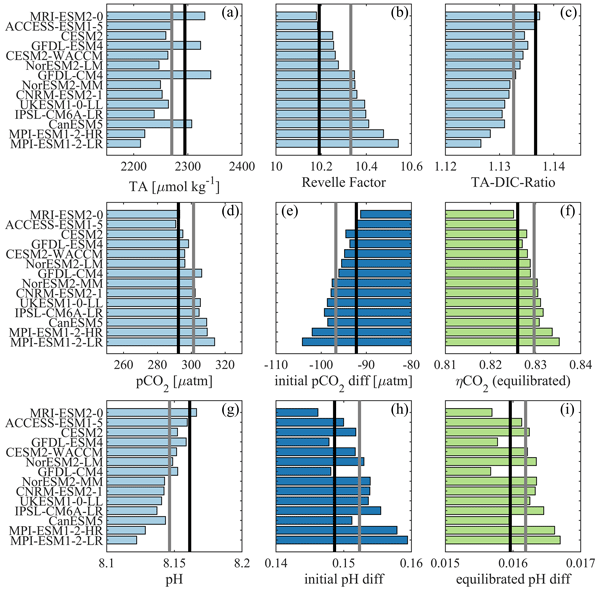
Claudia Hinrichs, Peter Köhler, Christoph Völker, and Judith Hauck
Biogeosciences, 20, 3717–3735, https://doi.org/10.5194/bg-20-3717-2023, https://doi.org/10.5194/bg-20-3717-2023, 2023
Short summary
Short summary
This study evaluated the alkalinity distribution in 14 climate models and found that most models underestimate alkalinity at the surface and overestimate it in the deeper ocean. It highlights the need for better understanding and quantification of processes driving alkalinity distribution and calcium carbonate dissolution and the importance of accounting for biases in model results when evaluating potential ocean alkalinity enhancement experiments.
Özgür Gürses, Laurent Oziel, Onur Karakuş, Dmitry Sidorenko, Christoph Völker, Ying Ye, Moritz Zeising, Martin Butzin, and Judith Hauck
Geosci. Model Dev., 16, 4883–4936, https://doi.org/10.5194/gmd-16-4883-2023, https://doi.org/10.5194/gmd-16-4883-2023, 2023
Short summary
Short summary
This paper assesses the biogeochemical model REcoM3 coupled to the ocean–sea ice model FESOM2.1. The model can be used to simulate the carbon uptake or release of the ocean on timescales of several hundred years. A detailed analysis of the nutrients, ocean productivity, and ecosystem is followed by the carbon cycle. The main conclusion is that the model performs well when simulating the observed mean biogeochemical state and variability and is comparable to other ocean–biogeochemical models.
Nicolas Stoll, Matthias Wietz, Stephan Juricke, Franziska Pausch, Corina Peter, Miriam Seifert, Jana C. Massing, Moritz Zeising, Rebecca A. McPherson, Melissa Käß, and Björn Suckow
Polarforschung, 91, 31–43, https://doi.org/10.5194/polf-91-31-2023, https://doi.org/10.5194/polf-91-31-2023, 2023
Short summary
Short summary
Global crises, such as climate change and the COVID-19 pandemic, show the importance of communicating science to the public. We introduce the YouTube channel "Wissenschaft fürs Wohnzimmer", which livestreams presentations on climate-related topics weekly and is accessible to all. The project encourages interaction between scientists and the public and has been running successfully for over 2 years. We present the concept, what we have learnt, and the challenges after 100 streamed episodes.
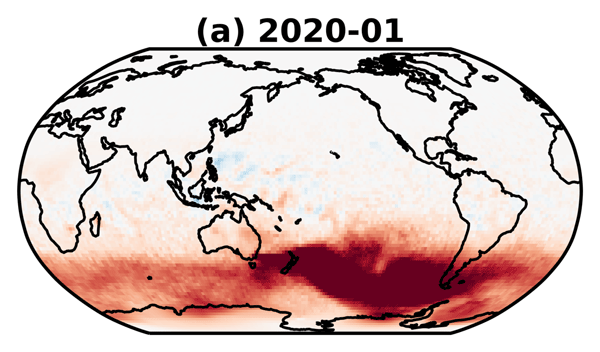
Fabian Senf, Bernd Heinold, Anne Kubin, Jason Müller, Roland Schrödner, and Ina Tegen
Atmos. Chem. Phys., 23, 8939–8958, https://doi.org/10.5194/acp-23-8939-2023, https://doi.org/10.5194/acp-23-8939-2023, 2023
Short summary
Short summary
Wildfire smoke is a significant source of airborne atmospheric particles that can absorb sunlight. Extreme fires in particular, such as those during the 2019–2020 Australian wildfire season (Black Summer fires), can considerably affect our climate system. In the present study, we investigate the various effects of Australian smoke using a global climate model to clarify how the Earth's atmosphere, including its circulation systems, adjusted to the extraordinary amount of Australian smoke.
Manuela van Pinxteren, Sebastian Zeppenfeld, Khanneh Wadinga Fomba, Nadja Triesch, Sanja Frka, and Hartmut Herrmann
Atmos. Chem. Phys., 23, 6571–6590, https://doi.org/10.5194/acp-23-6571-2023, https://doi.org/10.5194/acp-23-6571-2023, 2023
Short summary
Short summary
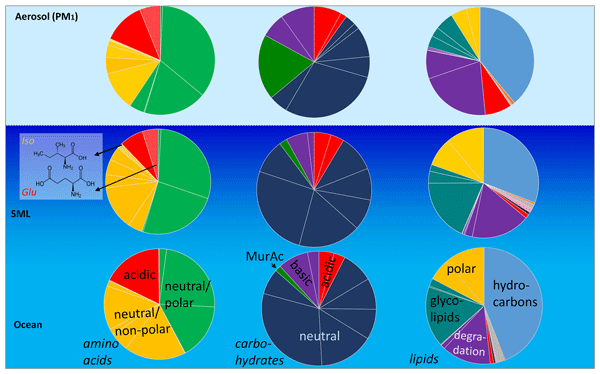
Important marine organic carbon compounds were identified in the Atlantic Ocean and marine aerosol particles. These compounds were strongly enriched in the atmosphere. Their enrichment was, however, not solely explained via sea-to-air transfer but also via atmospheric in situ formation. The identified compounds constituted about 50 % of the organic carbon on the aerosol particles, and a pronounced coupling between ocean and atmosphere for this oligotrophic region could be concluded.
Martine Lizotte, Bennet Juhls, Atsushi Matsuoka, Philippe Massicotte, Gaëlle Mével, David Obie James Anikina, Sofia Antonova, Guislain Bécu, Marine Béguin, Simon Bélanger, Thomas Bossé-Demers, Lisa Bröder, Flavienne Bruyant, Gwénaëlle Chaillou, Jérôme Comte, Raoul-Marie Couture, Emmanuel Devred, Gabrièle Deslongchamps, Thibaud Dezutter, Miles Dillon, David Doxaran, Aude Flamand, Frank Fell, Joannie Ferland, Marie-Hélène Forget, Michael Fritz, Thomas J. Gordon, Caroline Guilmette, Andrea Hilborn, Rachel Hussherr, Charlotte Irish, Fabien Joux, Lauren Kipp, Audrey Laberge-Carignan, Hugues Lantuit, Edouard Leymarie, Antonio Mannino, Juliette Maury, Paul Overduin, Laurent Oziel, Colin Stedmon, Crystal Thomas, Lucas Tisserand, Jean-Éric Tremblay, Jorien Vonk, Dustin Whalen, and Marcel Babin
Earth Syst. Sci. Data, 15, 1617–1653, https://doi.org/10.5194/essd-15-1617-2023, https://doi.org/10.5194/essd-15-1617-2023, 2023
Short summary
Short summary
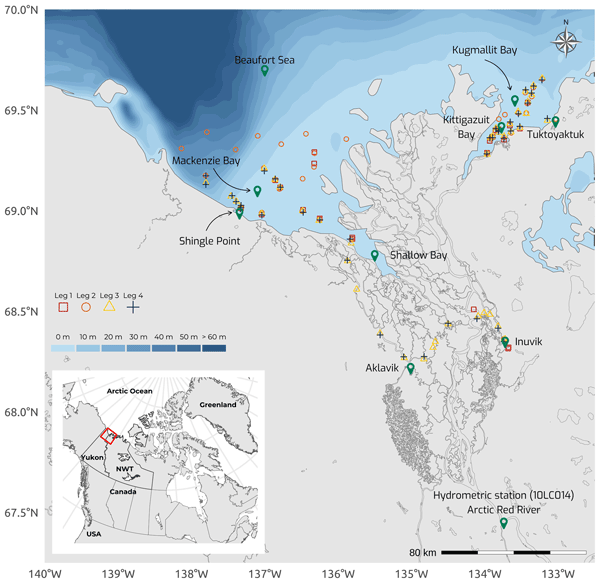
Permafrost thaw in the Mackenzie Delta region results in the release of organic matter into the coastal marine environment. What happens to this carbon-rich organic matter as it transits along the fresh to salty aquatic environments is still underdocumented. Four expeditions were conducted from April to September 2019 in the coastal area of the Beaufort Sea to study the fate of organic matter. This paper describes a rich set of data characterizing the composition and sources of organic matter.
André Valente, Shubha Sathyendranath, Vanda Brotas, Steve Groom, Michael Grant, Thomas Jackson, Andrei Chuprin, Malcolm Taberner, Ruth Airs, David Antoine, Robert Arnone, William M. Balch, Kathryn Barker, Ray Barlow, Simon Bélanger, Jean-François Berthon, Şükrü Beşiktepe, Yngve Borsheim, Astrid Bracher, Vittorio Brando, Robert J. W. Brewin, Elisabetta Canuti, Francisco P. Chavez, Andrés Cianca, Hervé Claustre, Lesley Clementson, Richard Crout, Afonso Ferreira, Scott Freeman, Robert Frouin, Carlos García-Soto, Stuart W. Gibb, Ralf Goericke, Richard Gould, Nathalie Guillocheau, Stanford B. Hooker, Chuamin Hu, Mati Kahru, Milton Kampel, Holger Klein, Susanne Kratzer, Raphael Kudela, Jesus Ledesma, Steven Lohrenz, Hubert Loisel, Antonio Mannino, Victor Martinez-Vicente, Patricia Matrai, David McKee, Brian G. Mitchell, Tiffany Moisan, Enrique Montes, Frank Muller-Karger, Aimee Neeley, Michael Novak, Leonie O'Dowd, Michael Ondrusek, Trevor Platt, Alex J. Poulton, Michel Repecaud, Rüdiger Röttgers, Thomas Schroeder, Timothy Smyth, Denise Smythe-Wright, Heidi M. Sosik, Crystal Thomas, Rob Thomas, Gavin Tilstone, Andreia Tracana, Michael Twardowski, Vincenzo Vellucci, Kenneth Voss, Jeremy Werdell, Marcel Wernand, Bozena Wojtasiewicz, Simon Wright, and Giuseppe Zibordi
Earth Syst. Sci. Data, 14, 5737–5770, https://doi.org/10.5194/essd-14-5737-2022, https://doi.org/10.5194/essd-14-5737-2022, 2022
Short summary
Short summary
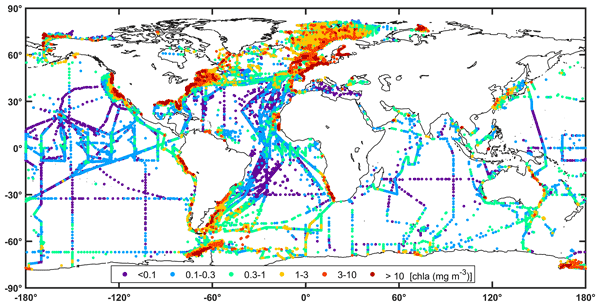
A compiled set of in situ data is vital to evaluate the quality of ocean-colour satellite data records. Here we describe the global compilation of bio-optical in situ data (spanning from 1997 to 2021) used for the validation of the ocean-colour products from the ESA Ocean Colour Climate Change Initiative (OC-CCI). The compilation merges and harmonizes several in situ data sources into a simple format that could be used directly for the evaluation of satellite-derived ocean-colour data.
Pierre Friedlingstein, Michael O'Sullivan, Matthew W. Jones, Robbie M. Andrew, Luke Gregor, Judith Hauck, Corinne Le Quéré, Ingrid T. Luijkx, Are Olsen, Glen P. Peters, Wouter Peters, Julia Pongratz, Clemens Schwingshackl, Stephen Sitch, Josep G. Canadell, Philippe Ciais, Robert B. Jackson, Simone R. Alin, Ramdane Alkama, Almut Arneth, Vivek K. Arora, Nicholas R. Bates, Meike Becker, Nicolas Bellouin, Henry C. Bittig, Laurent Bopp, Frédéric Chevallier, Louise P. Chini, Margot Cronin, Wiley Evans, Stefanie Falk, Richard A. Feely, Thomas Gasser, Marion Gehlen, Thanos Gkritzalis, Lucas Gloege, Giacomo Grassi, Nicolas Gruber, Özgür Gürses, Ian Harris, Matthew Hefner, Richard A. Houghton, George C. Hurtt, Yosuke Iida, Tatiana Ilyina, Atul K. Jain, Annika Jersild, Koji Kadono, Etsushi Kato, Daniel Kennedy, Kees Klein Goldewijk, Jürgen Knauer, Jan Ivar Korsbakken, Peter Landschützer, Nathalie Lefèvre, Keith Lindsay, Junjie Liu, Zhu Liu, Gregg Marland, Nicolas Mayot, Matthew J. McGrath, Nicolas Metzl, Natalie M. Monacci, David R. Munro, Shin-Ichiro Nakaoka, Yosuke Niwa, Kevin O'Brien, Tsuneo Ono, Paul I. Palmer, Naiqing Pan, Denis Pierrot, Katie Pocock, Benjamin Poulter, Laure Resplandy, Eddy Robertson, Christian Rödenbeck, Carmen Rodriguez, Thais M. Rosan, Jörg Schwinger, Roland Séférian, Jamie D. Shutler, Ingunn Skjelvan, Tobias Steinhoff, Qing Sun, Adrienne J. Sutton, Colm Sweeney, Shintaro Takao, Toste Tanhua, Pieter P. Tans, Xiangjun Tian, Hanqin Tian, Bronte Tilbrook, Hiroyuki Tsujino, Francesco Tubiello, Guido R. van der Werf, Anthony P. Walker, Rik Wanninkhof, Chris Whitehead, Anna Willstrand Wranne, Rebecca Wright, Wenping Yuan, Chao Yue, Xu Yue, Sönke Zaehle, Jiye Zeng, and Bo Zheng
Earth Syst. Sci. Data, 14, 4811–4900, https://doi.org/10.5194/essd-14-4811-2022, https://doi.org/10.5194/essd-14-4811-2022, 2022
Short summary
Short summary
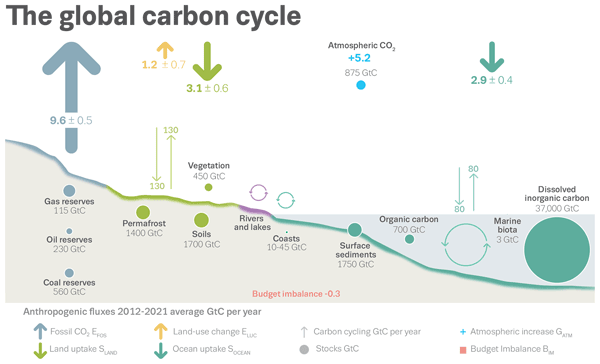
The Global Carbon Budget 2022 describes the datasets and methodology used to quantify the anthropogenic emissions of carbon dioxide (CO2) and their partitioning among the atmosphere, the land ecosystems, and the ocean. These living datasets are updated every year to provide the highest transparency and traceability in the reporting of CO2, the key driver of climate change.

Bernd Heinold, Holger Baars, Boris Barja, Matthew Christensen, Anne Kubin, Kevin Ohneiser, Kerstin Schepanski, Nick Schutgens, Fabian Senf, Roland Schrödner, Diego Villanueva, and Ina Tegen
Atmos. Chem. Phys., 22, 9969–9985, https://doi.org/10.5194/acp-22-9969-2022, https://doi.org/10.5194/acp-22-9969-2022, 2022
Short summary
Short summary
The extreme 2019–2020 Australian wildfires produced massive smoke plumes lofted into the lower stratosphere by pyrocumulonimbus convection. Most climate models do not adequately simulate the injection height of such intense fires. By combining aerosol-climate modeling with prescribed pyroconvective smoke injection and lidar observations, this study shows the importance of the representation of the most extreme wildfire events for estimating the atmospheric energy budget.
Christian Tatzelt, Silvia Henning, André Welti, Andrea Baccarini, Markus Hartmann, Martin Gysel-Beer, Manuela van Pinxteren, Robin L. Modini, Julia Schmale, and Frank Stratmann
Atmos. Chem. Phys., 22, 9721–9745, https://doi.org/10.5194/acp-22-9721-2022, https://doi.org/10.5194/acp-22-9721-2022, 2022
Short summary
Short summary
We present the abundance and origin of cloud-relevant aerosol particles in the preindustral-like conditions of the Southern Ocean (SO) during austral summer. Cloud condensation nuclei (CCN) and ice-nucleating particles (INP) were measured during a circum-Antarctic scientific cruise with in situ instrumentation and offline filter measurements, respectively. Transport processes were found to play an equally important role as local sources for both the CCN and INP population of the SO.

Lady Mateus-Fontecha, Angela Vargas-Burbano, Rodrigo Jimenez, Nestor Y. Rojas, German Rueda-Saa, Dominik van Pinxteren, Manuela van Pinxteren, Khanneh Wadinga Fomba, and Hartmut Herrmann
Atmos. Chem. Phys., 22, 8473–8495, https://doi.org/10.5194/acp-22-8473-2022, https://doi.org/10.5194/acp-22-8473-2022, 2022
Short summary
Short summary
This study reports the chemical composition of regionally representative PM2.5 in an area densely populated and substantially industrialized, located in the inter-Andean valley, with the highest sugarcane yield in the world and where sugarcane is burned and harvested year round. We found that sugarcane burning is not portrayed as a distinguishable sample composition component. Instead, the composition analysis revealed multiple associations among sugarcane burning components and other sources.
Christian Rödenbeck, Tim DeVries, Judith Hauck, Corinne Le Quéré, and Ralph F. Keeling
Biogeosciences, 19, 2627–2652, https://doi.org/10.5194/bg-19-2627-2022, https://doi.org/10.5194/bg-19-2627-2022, 2022
Short summary
Short summary
The ocean is an important part of the global carbon cycle, taking up about a quarter of the anthropogenic CO2 emitted by burning of fossil fuels and thus slowing down climate change. However, the CO2 uptake by the ocean is, in turn, affected by variability and trends in climate. Here we use carbon measurements in the surface ocean to quantify the response of the oceanic CO2 exchange to environmental conditions and discuss possible mechanisms underlying this response.
Manuela van Pinxteren, Tiera-Brandy Robinson, Sebastian Zeppenfeld, Xianda Gong, Enno Bahlmann, Khanneh Wadinga Fomba, Nadja Triesch, Frank Stratmann, Oliver Wurl, Anja Engel, Heike Wex, and Hartmut Herrmann
Atmos. Chem. Phys., 22, 5725–5742, https://doi.org/10.5194/acp-22-5725-2022, https://doi.org/10.5194/acp-22-5725-2022, 2022
Short summary
Short summary
A class of marine particles (transparent exopolymer particles, TEPs) that is ubiquitously found in the world oceans was measured for the first time in ambient marine aerosol particles and marine cloud waters in the tropical Atlantic Ocean. TEPs are likely to have good properties for influencing clouds. We show that TEPs are transferred from the ocean to the marine atmosphere via sea-spray formation and our results suggest that they can also form directly in aerosol particles and in cloud water.
Pierre Friedlingstein, Matthew W. Jones, Michael O'Sullivan, Robbie M. Andrew, Dorothee C. E. Bakker, Judith Hauck, Corinne Le Quéré, Glen P. Peters, Wouter Peters, Julia Pongratz, Stephen Sitch, Josep G. Canadell, Philippe Ciais, Rob B. Jackson, Simone R. Alin, Peter Anthoni, Nicholas R. Bates, Meike Becker, Nicolas Bellouin, Laurent Bopp, Thi Tuyet Trang Chau, Frédéric Chevallier, Louise P. Chini, Margot Cronin, Kim I. Currie, Bertrand Decharme, Laique M. Djeutchouang, Xinyu Dou, Wiley Evans, Richard A. Feely, Liang Feng, Thomas Gasser, Dennis Gilfillan, Thanos Gkritzalis, Giacomo Grassi, Luke Gregor, Nicolas Gruber, Özgür Gürses, Ian Harris, Richard A. Houghton, George C. Hurtt, Yosuke Iida, Tatiana Ilyina, Ingrid T. Luijkx, Atul Jain, Steve D. Jones, Etsushi Kato, Daniel Kennedy, Kees Klein Goldewijk, Jürgen Knauer, Jan Ivar Korsbakken, Arne Körtzinger, Peter Landschützer, Siv K. Lauvset, Nathalie Lefèvre, Sebastian Lienert, Junjie Liu, Gregg Marland, Patrick C. McGuire, Joe R. Melton, David R. Munro, Julia E. M. S. Nabel, Shin-Ichiro Nakaoka, Yosuke Niwa, Tsuneo Ono, Denis Pierrot, Benjamin Poulter, Gregor Rehder, Laure Resplandy, Eddy Robertson, Christian Rödenbeck, Thais M. Rosan, Jörg Schwinger, Clemens Schwingshackl, Roland Séférian, Adrienne J. Sutton, Colm Sweeney, Toste Tanhua, Pieter P. Tans, Hanqin Tian, Bronte Tilbrook, Francesco Tubiello, Guido R. van der Werf, Nicolas Vuichard, Chisato Wada, Rik Wanninkhof, Andrew J. Watson, David Willis, Andrew J. Wiltshire, Wenping Yuan, Chao Yue, Xu Yue, Sönke Zaehle, and Jiye Zeng
Earth Syst. Sci. Data, 14, 1917–2005, https://doi.org/10.5194/essd-14-1917-2022, https://doi.org/10.5194/essd-14-1917-2022, 2022
Short summary
Short summary
The Global Carbon Budget 2021 describes the data sets and methodology used to quantify the emissions of carbon dioxide and their partitioning among the atmosphere, land, and ocean. These living data are updated every year to provide the highest transparency and traceability in the reporting of CO2, the key driver of climate change.
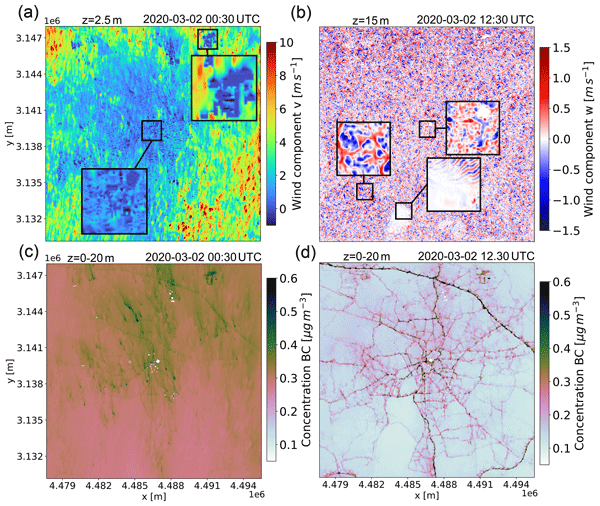
Michael Weger, Holger Baars, Henriette Gebauer, Maik Merkel, Alfred Wiedensohler, and Bernd Heinold
Geosci. Model Dev., 15, 3315–3345, https://doi.org/10.5194/gmd-15-3315-2022, https://doi.org/10.5194/gmd-15-3315-2022, 2022
Short summary
Short summary
Numerical models are an important tool to assess the air quality in cities,
as they can provide near-continouos data in time and space. In this paper,
air pollution for an entire city is simulated at a high spatial resolution of 40 m.
At this spatial scale, the effects of buildings on the atmosphere,
like channeling or blocking of the air flow, are directly represented by diffuse obstacles in the used model CAIRDIO. For model validation, measurements from air-monitoring sites are used.
M. A. Soppa, D. A. Dinh, B. Silva, F. Steinmetz, L. Alvarado, and A. Bracher
Int. Arch. Photogramm. Remote Sens. Spatial Inf. Sci., XLVI-1-W1-2021, 69–72, https://doi.org/10.5194/isprs-archives-XLVI-1-W1-2021-69-2022, https://doi.org/10.5194/isprs-archives-XLVI-1-W1-2021-69-2022, 2022
Yanan Zhao, Dennis Booge, Christa A. Marandino, Cathleen Schlundt, Astrid Bracher, Elliot L. Atlas, Jonathan Williams, and Hermann W. Bange
Biogeosciences, 19, 701–714, https://doi.org/10.5194/bg-19-701-2022, https://doi.org/10.5194/bg-19-701-2022, 2022
Short summary
Short summary
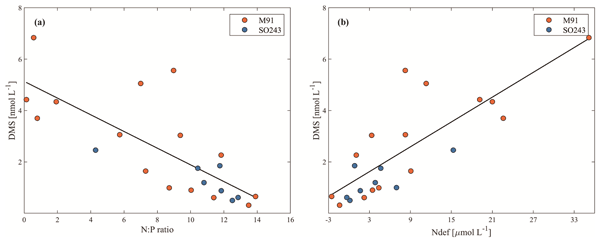
We present here, for the first time, simultaneously measured dimethylsulfide (DMS) seawater concentrations and DMS atmospheric mole fractions from the Peruvian upwelling region during two cruises in December 2012 and October 2015. Our results indicate low oceanic DMS concentrations and atmospheric DMS molar fractions in surface waters and the atmosphere, respectively. In addition, the Peruvian upwelling region was identified as an insignificant source of DMS emissions during both periods.
Stephan Krätschmer, Michèlle van der Does, Frank Lamy, Gerrit Lohmann, Christoph Völker, and Martin Werner
Clim. Past, 18, 67–87, https://doi.org/10.5194/cp-18-67-2022, https://doi.org/10.5194/cp-18-67-2022, 2022
Short summary
Short summary
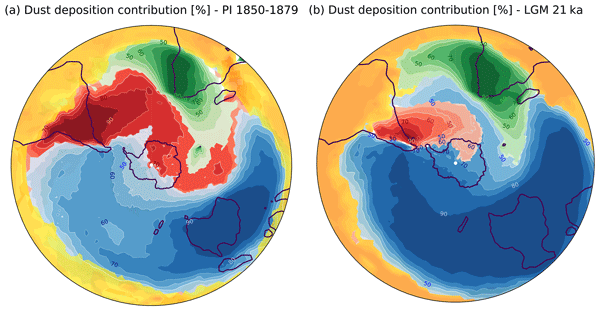
We use an atmospheric model coupled to an aerosol model to investigate the global mineral dust cycle with a focus on the Southern Hemisphere for warmer and colder climate states and compare our results to observational data. Our findings suggest that Australia is the predominant source of dust deposited over Antarctica during the last glacial maximum. In addition, we find that the southward transport of dust from all sources to Antarctica happens at lower altitudes in colder climates.
Nabil Deabji, Khanneh Wadinga Fomba, Souad El Hajjaji, Abdelwahid Mellouki, Laurent Poulain, Sebastian Zeppenfeld, and Hartmut Herrmann
Atmos. Chem. Phys., 21, 18147–18174, https://doi.org/10.5194/acp-21-18147-2021, https://doi.org/10.5194/acp-21-18147-2021, 2021
Short summary
Short summary
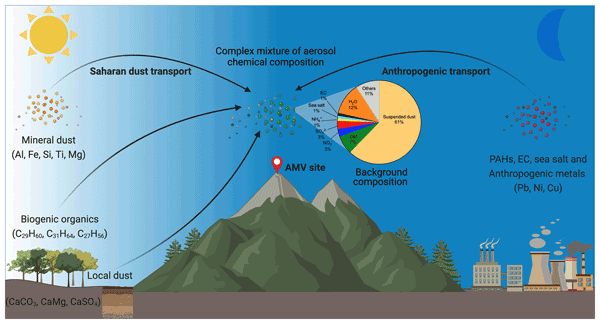
Mountain and high-altitude sites provide representative data for the lower free troposphere, various pathways for aerosol interactions, and changing boundary layer heights useful in understanding atmospheric composition. However, only few studies exist in African regions despite diversity in both natural and anthropogenic emissions. This study provides detailed atmospheric studies in the northern African high-altitude region.
Cited articles
Alldredge, A. L. and Crocker, K. M.: Why Do Sinking Mucilage Aggregates Accumulate in the Water Column?, Sci. Total Environ., 165, 15–22, https://doi.org/10.1016/0048-9697(95)04539-D, 1995. a
Alldredge, A. L., Passow, U., and Logan, B. E.: The Abundance and Significance of a Class of Large, Transparent Organic Particles in the Ocean, Deep-Sea Res. Pt. I, 40, 1131–1140, https://doi.org/10.1016/0967-0637(93)90129-Q, 1993. a, b
Álvarez, E., Thoms, S., Bracher, A., Liu, Y., and Völker, C.: Modeling Photoprotection at Global Scale: The Relative Role of Nonphotosynthetic Pigments, Physiological State, and Species Composition, Global Biogeochem. Cy., 33, https://doi.org/10.1029/2018GB006101, 2019. a
Arnosti, C., Wietz, M., Brinkhoff, T., Hehemann, J.-H., Probandt, D., Zeugner, L., and Amann, R.: The Biogeochemistry of Marine Polysaccharides: Sources, Inventories, and Bacterial Drivers of the Carbohydrate Cycle, Annu. Rev. Mar. Sci., 13, 81–108, https://doi.org/10.1146/annurev-marine-032020-012810, 2021. a, b, c
Arrigo, K. R., Perovich, D. K., Pickart, R. S., Brown, Z. W., van Dijken, G. L., Lowry, K. E., Mills, M. M., Palmer, M. A., Balch, W. M., Bates, N. R., Benitez-Nelson, C. R., Brownlee, E., Frey, K. E., Laney, S. R., Mathis, J., Matsuoka, A., Mitchell, B. G., Moore, G. W. K., Reynolds, R. A., Sosik, H. M., Swift, and J. H.: Phytoplankton Blooms beneath the Sea Ice in the Chukchi Sea, Deep-Sea Res. Pt. II, 105, 1–16, https://doi.org/10.1016/j.dsr2.2014.03.018, 2014. a
Assmy, P., Fernández-Méndez, M., Duarte, P., Meyer, A., Randelhoff, A., Mundy, C. J., Olsen, L. M., Kauko, H., Bailey, A., Chierici, M., Cohen, L., Doulgeris, A. P., Ehn, J. K., Fransson, A., Gerland, S., Hop, H., Hudson, S. R., Hughes, N., Itkin, P., Johnsen, G., King, J., Koch, B. P., Koenig, Z., Kwasniewski, S., Laney, S. R., Nicolaus, M., Pavlov, A., Polashenski, C. M., Provost, C., Rösel, A., Sandbu, M., Spreen, G., Smedsrud, L. H., Sundfjord, A., Taskjelle, T., Tatarek, A., Wiktor, J., Wagner, P. M., Wold, A., Steen, H., and Granskog, M. A.: Leads in Arctic Pack Ice Enable Early Phytoplankton Blooms below Snow-Covered Sea Ice, Sci. Rep., 7, 40850, https://doi.org/10.1038/srep40850, 2017. a
Aumont, O., Ethé, C., Tagliabue, A., Bopp, L., and Gehlen, M.: PISCES-v2: an ocean biogeochemical model for carbon and ecosystem studies, Geosci. Model Dev., 8, 2465–2513, https://doi.org/10.5194/gmd-8-2465-2015, 2015. a
Azetsu-Scott, K. and Passow, U.: Ascending Marine Particles: Significance of Transparent Exopolymer Particles (TEP) in the Upper Ocean, Limnol. Oceanogr., 49, 741–748, https://doi.org/10.4319/lo.2004.49.3.0741, 2004. a
Burrows, S. M., Ogunro, O., Frossard, A. A., Russell, L. M., Rasch, P. J., and Elliott, S. M.: A physically based framework for modeling the organic fractionation of sea spray aerosol from bubble film Langmuir equilibria, Atmos. Chem. Phys., 14, 13601–13629, https://doi.org/10.5194/acp-14-13601-2014, 2014. a
Castellani, G., Losch, M., Lange, B. A., and Flores, H.: Modeling Arctic Sea-Ice Algae: Physical Drivers of Spatial Distribution and Algae Phenology, J. Geophys. Res.-Oceans, 122, 7466–7487, https://doi.org/10.1002/2017JC012828, 2017. a, b
Chajwa, R., Flaum, E., Bidle, K. D., Van Mooy, B., and Prakash, M.: Hidden Comet Tails of Marine Snow Impede Ocean-Based Carbon Sequestration, Science, 386, eadl5767, https://doi.org/10.1126/science.adl5767, 2024. a
Cherkasheva, A., Bracher, A., Melsheimer, C., Köberle, C., Gerdes, R., Nöthig, E.-M., Bauerfeind, E., and Boetius, A.: Influence of the Physical Environment on Polar Phytoplankton Blooms: A Case Study in the Fram Strait, J. Marine Syst., 132, 196–207, https://doi.org/10.1016/j.jmarsys.2013.11.008, 2014. a
Chin, W.-C., Orellana, M. V., Quesada, I., and Verdugo, P.: Secretion in Unicellular Marine Phytoplankton: Demonstration of Regulated Exocytosis in Phaeocystis Globosa, Plant Cell Physiol., 45, 535–542, https://doi.org/10.1093/pcp/pch062, 2004. a
Corzo, A., Rodríguez-Gálvez, S., Lubian, L., Sangrá, P., Martínez, A., and Morillo, J. A.: Spatial Distribution of Transparent Exopolymer Particles in the Bransfield Strait, Antarctica, J. Plankton Res., 27, 635–646, https://doi.org/10.1093/plankt/fbi038, 2005. a
Danilov, S., Sidorenko, D., Wang, Q., and Jung, T.: The Finite-volumE Sea ice–Ocean Model (FESOM2), Geosci. Model Dev., 10, 765–789, https://doi.org/10.5194/gmd-10-765-2017, 2017. a, b
Discart, V., Bilad, M. R., and Vankelecom, I. F. J.: Critical Evaluation of the Determination Methods for Transparent Exopolymer Particles, Agents of Membrane Fouling, Crit. Rev. Env. Sci. Tec., 45, 167–192, https://doi.org/10.1080/10643389.2013.829982, 2015. a, b
Engel, A. and Händel, N.: A Novel Protocol for Determining the Concentration and Composition of Sugars in Particulate and in High Molecular Weight Dissolved Organic Matter (HMW-DOM) in Seawater, Mar. Chem., 127, 180–191, https://doi.org/10.1016/j.marchem.2011.09.004, 2011. a
Engel, A., Bange, H. W., Cunliffe, M., Burrows, S. M., Friedrichs, G., Galgani, L., Herrmann, H., Hertkorn, N., Johnson, M., Liss, P. S., Quinn, P. K., Schartau, M., Soloviev, A., Stolle, C., Upstill-Goddard, R. C., van Pinxteren, M., and Zäncker, B.: The Ocean's Vital Skin: Toward an Integrated Understanding of the Sea Surface Microlayer, Front. Mar. Sci., 4, 165, https://doi.org/10.3389/fmars.2017.00165, 2017. a, b, c
Engel, A., Bracher, A., Dinter, T., Endres, S., Grosse, J., Metfies, K., Peeken, I., Piontek, J., Salter, I., and Nöthig, E.-M.: Inter-Annual Variability of Organic Carbon Concentrations across the Fram Strait (Arctic Ocean) during Summer 2009–2017, Front. Mar. Sci., 6, https://doi.org/10.3389/fmars.2019.00187, 2019. a, b, c
E.U. Copernicus Marine Service Information, Marine Data Store: Arctic Ocean Colour Plankton Multi-Year L4 Daily Climatology and Monthly Observations, Copernicus Marine Service [data set], https://doi.org/10.48670/moi-00293, 2022. a, b
E.U. Copernicus Marine Service Information, Marine Data Store: Quality Information Document of Arctic Ocean Colour Plankton MY L4 daily climatology and monthly observations, Copernicus Marine Service [data set], https://doi.org/10.48670/moi-00293, 2023. a, b
Flanders Marine Institute: Longhurst Provinces, https://www.marineregions.org/ (last access: 1 February 2023), 2009. a
Friedlingstein, P., O'Sullivan, M., Jones, M. W., Andrew, R. M., Bakker, D. C. E., Hauck, J., Landschützer, P., Le Quéré, C., Luijkx, I. T., Peters, G. P., Peters, W., Pongratz, J., Schwingshackl, C., Sitch, S., Canadell, J. G., Ciais, P., Jackson, R. B., Alin, S. R., Anthoni, P., Barbero, L., Bates, N. R., Becker, M., Bellouin, N., Decharme, B., Bopp, L., Brasika, I. B. M., Cadule, P., Chamberlain, M. A., Chandra, N., Chau, T.-T.-T., Chevallier, F., Chini, L. P., Cronin, M., Dou, X., Enyo, K., Evans, W., Falk, S., Feely, R. A., Feng, L., Ford, D. J., Gasser, T., Ghattas, J., Gkritzalis, T., Grassi, G., Gregor, L., Gruber, N., Gürses, Ö., Harris, I., Hefner, M., Heinke, J., Houghton, R. A., Hurtt, G. C., Iida, Y., Ilyina, T., Jacobson, A. R., Jain, A., Jarníková, T., Jersild, A., Jiang, F., Jin, Z., Joos, F., Kato, E., Keeling, R. F., Kennedy, D., Klein Goldewijk, K., Knauer, J., Korsbakken, J. I., Körtzinger, A., Lan, X., Lefèvre, N., Li, H., Liu, J., Liu, Z., Ma, L., Marland, G., Mayot, N., McGuire, P. C., McKinley, G. A., Meyer, G., Morgan, E. J., Munro, D. R., Nakaoka, S.-I., Niwa, Y., O'Brien, K. M., Olsen, A., Omar, A. M., Ono, T., Paulsen, M., Pierrot, D., Pocock, K., Poulter, B., Powis, C. M., Rehder, G., Resplandy, L., Robertson, E., Rödenbeck, C., Rosan, T. M., Schwinger, J., Séférian, R., Smallman, T. L., Smith, S. M., Sospedra-Alfonso, R., Sun, Q., Sutton, A. J., Sweeney, C., Takao, S., Tans, P. P., Tian, H., Tilbrook, B., Tsujino, H., Tubiello, F., van der Werf, G. R., van Ooijen, E., Wanninkhof, R., Watanabe, M., Wimart-Rousseau, C., Yang, D., Yang, X., Yuan, W., Yue, X., Zaehle, S., Zeng, J., and Zheng, B.: Global Carbon Budget 2023, Earth Syst. Sci. Data, 15, 5301–5369, https://doi.org/10.5194/essd-15-5301-2023, 2023. a, b
Galgani, L., Piontek, J., and Engel, A.: Biopolymers Form a Gelatinous Microlayer at the Air-Sea Interface When Arctic Sea Ice Melts, Sci. Rep., 6, 29465, https://doi.org/10.1038/srep29465, 2016. a, b
Gao, Q., Leck, C., Rauschenberg, C., and Matrai, P. A.: On the chemical dynamics of extracellular polysaccharides in the high Arctic surface microlayer, Ocean Sci., 8, 401–418, https://doi.org/10.5194/os-8-401-2012, 2012. a, b, c, d
Garcia, H. E., Weathers, K. W., Paver, C. R., Smolyar, I., Boyer, T. P., Locarnini, M. M., Zweng, M. M., Mishonov, A. V., Baranova, O. K., and Seidov, D.: World Ocean Atlas 2018, Volume 3: Dissolved Oxygen, Apparent Oxygen Utilization, and Dissolved Oxygen Saturation., A. Mishonov Technical Editor, Tech. rep., NOAA Atlas NESDIS, https://doi.org/10.25923/qspr-pn52, 2019a. a
Garcia, H. E., Weathers, K. W., Paver, C. R., Smolyar, I., Boyer, T. P., Locarnini, M. M., Zweng, M. M., Mishonov, A. V., Baranova, O. K., and Seidov, D.: World Ocean Atlas 2018. Vol. 4: Dissolved Inorganic Nutrients (Phosphate, Nitrate and Nitrate+ Nitrite, Silicate), A. Mishonov Technical Editor, Tech. rep., NOAA Atlas NESDIS, https://doi.org/10.25923/ng6j-ey81, 2019b. a
Gehlen, M., Bopp, L., Emprin, N., Aumont, O., Heinze, C., and Ragueneau, O.: Reconciling surface ocean productivity, export fluxes and sediment composition in a global biogeochemical ocean model, Biogeosciences, 3, 521–537, https://doi.org/10.5194/bg-3-521-2006, 2006. a
Geider, R. J., Maclntyre, H. L., and Kana, T. M.: A Dynamic Regulatory Model of Phytoplanktonic Acclimation to Light, Nutrients, and Temperature, Limnol. Oceanogr., 43, 679–694, https://doi.org/10.4319/lo.1998.43.4.0679, 1998. a, b
Goosse, H., Kay, J. E., Armour, K. C., Bodas-Salcedo, A., Chepfer, H., Docquier, D., Jonko, A., Kushner, P. J., Lecomte, O., Massonnet, F., Park, H.-S., Pithan, F., Svensson, G., and Vancoppenolle, M.: Quantifying Climate Feedbacks in Polar Regions, Nat. Commun., 9, 1919, https://doi.org/10.1038/s41467-018-04173-0, 2018. a
Gürses, Ö., Oziel, L., Karakuş, O., Sidorenko, D., Völker, C., Ye, Y., Zeising, M., Butzin, M., and Hauck, J.: Ocean biogeochemistry in the coupled ocean–sea ice–biogeochemistry model FESOM2.1–REcoM3, Geosci. Model Dev., 16, 4883–4936, https://doi.org/10.5194/gmd-16-4883-2023, 2023. a, b, c, d, e, f, g, h, i, j, k, l, m, n, o
Hamacher-Barth, E., Leck, C., and Jansson, K.: Size-resolved morphological properties of the high Arctic summer aerosol during ASCOS-2008, Atmos. Chem. Phys., 16, 6577–6593, https://doi.org/10.5194/acp-16-6577-2016, 2016. a
Hansell, D., Carlson, C., Repeta, D., and Schlitzer, R.: Dissolved Organic Matter in the Ocean: A Controversy Stimulates New Insights, Oceanography, 22, 202–211, https://doi.org/10.5670/oceanog.2009.109, 2009. a, b
Hansell, D. A. and Orellana, M. V.: Dissolved Organic Matter in the Global Ocean: A Primer, Gels, 7, https://doi.org/10.3390/gels7030128, 2021. a
Hansell, D. A., Romera-Castillo, C., and Lopez, C. N.: Dynamics of Dissolved Organic Carbon in the Global Ocean, in: Biogeochemistry of Marine Dissolved Organic Matter, 3rd Edn., edited by: Hansell, D. A. and Carlson, C. A., 769–802, Academic Press, ISBN 978-0-443-13858-4, https://doi.org/10.1016/B978-0-443-13858-4.00004-6, 2024. a
Hartmann, M., Adachi, K., Eppers, O., Haas, C., Herber, A., Holzinger, R., Hünerbein, A., Jäkel, E., Jentzsch, C., van Pinxteren, M., Wex, H., Willmes, S., and Stratmann, F.: Wintertime Airborne Measurements of Ice Nucleating Particles in the High Arctic: A Hint to a Marine, Biogenic Source for Ice Nucleating Particles, Geophys. Res. Lett., 47, e2020GL087770, https://doi.org/10.1029/2020GL087770, 2020. a
Hauck, J., Völker, C., Wang, T., Hoppema, M., Losch, M., and Wolf-Gladrow, D. A.: Seasonally Different Carbon Flux Changes in the Southern Ocean in Response to the Southern Annular Mode, Global Biogeochem. Cy., 27, 1236–1245, https://doi.org/10.1002/2013GB004600, 2013. a
Hauck, J., Zeising, M., Le Quéré, C., Gruber, N., Bakker, D. C. E., Bopp, L., Chau, T. T. T., Gürses, Ö., Ilyina, T., Landschützer, P., Lenton, A., Resplandy, L., Rödenbeck, C., Schwinger, J., and Séférian, R.: Consistency and Challenges in the Ocean Carbon Sink Estimate for the Global Carbon Budget, Front. Mar. Sci., 7, 571720, https://doi.org/10.3389/fmars.2020.571720, 2020. a, b
Heim, B., Abramova, E., Doerffer, R., Günther, F., Hölemann, J., Kraberg, A., Lantuit, H., Loginova, A., Martynov, F., Overduin, P. P., and Wegner, C.: Ocean colour remote sensing in the southern Laptev Sea: evaluation and applications, Biogeosciences, 11, 4191–4210, https://doi.org/10.5194/bg-11-4191-2014, 2014. a
Henson, S. A., Laufkötter, C., Leung, S., Giering, S. L. C., Palevsky, H. I., and Cavan, E. L.: Uncertain Response of Ocean Biological Carbon Export in a Changing World, Nat. Geosci., 15, 248–254, https://doi.org/10.1038/s41561-022-00927-0, 2022. a
Ickes, L., Porter, G. C. E., Wagner, R., Adams, M. P., Bierbauer, S., Bertram, A. K., Bilde, M., Christiansen, S., Ekman, A. M. L., Gorokhova, E., Höhler, K., Kiselev, A. A., Leck, C., Möhler, O., Murray, B. J., Schiebel, T., Ullrich, R., and Salter, M. E.: The ice-nucleating activity of Arctic sea surface microlayer samples and marine algal cultures, Atmos. Chem. Phys., 20, 11089–11117, https://doi.org/10.5194/acp-20-11089-2020, 2020. a
Irish, V. E., Elizondo, P., Chen, J., Chou, C., Charette, J., Lizotte, M., Ladino, L. A., Wilson, T. W., Gosselin, M., Murray, B. J., Polishchuk, E., Abbatt, J. P. D., Miller, L. A., and Bertram, A. K.: Ice-nucleating particles in Canadian Arctic sea-surface microlayer and bulk seawater, Atmos. Chem. Phys., 17, 10583–10595, https://doi.org/10.5194/acp-17-10583-2017, 2017. a
Iversen, M. H.: Carbon Export in the Ocean: A Biologist' Perspective, Annu. Rev. Mar. Sci., 15, 357–381, https://doi.org/10.1146/annurev-marine-032122-035153, 2023. a, b
Iversen, M. H. and Lampitt, R. S.: Size Does Not Matter after All: No Evidence for a Size-Sinking Relationship for Marine Snow, Prog. Oceanogr., 189, 102445, https://doi.org/10.1016/j.pocean.2020.102445, 2020. a
Jokulsdottir, T. and Archer, D.: A stochastic, Lagrangian model of sinking biogenic aggregates in the ocean (SLAMS 1.0): model formulation, validation and sensitivity, Geosci. Model Dev., 9, 1455–1476, https://doi.org/10.5194/gmd-9-1455-2016, 2016. a
Jung, J., Lee, Y., Cho, K.-H., Yang, E. J., and Kang, S.-H.: Spatial Distributions of Riverine and Marine Dissolved Organic Carbon in the Western Arctic Ocean: Results From the 2018 Korean Expedition, J. Geophys. Res.-Oceans, 127, e2021JC017718, https://doi.org/10.1029/2021JC017718, 2022. a, b
Karakuş, O., Völker, C., Iversen, M., Hagen, W., Gladrow, D. W., Fach, B., and Hauck, J.: Modeling the Impact of Macrozooplankton on Carbon Export Production in the Southern Ocean, J. Geophys. Res.-Oceans, e2021JC017315, https://doi.org/10.1029/2021JC017315, 2021. a, b
Karakuş, O., Volker, C., Iversen, M., Hagen, W., and Hauck, J.: The Role of Zooplankton Grazing and Nutrient Recycling for Global Ocean Biogeochemistry and Phytoplankton Phenology, J. Geophys. Res.-Biogeo., 127, https://doi.org/10.1029/2022JG006798, 2022. a
Krembs, C. and Deming, J. W.: The Role of Exopolymers in Microbial Adaptation to Sea Ice, in: Psychrophiles: From Biodiversity to Biotechnology, 247–264, Springer, https://doi.org/10.1007/978-3-540-74335-4_15, 2008. a, b, c
Kriest, I. and Evans, G. T.: Representing Phytoplankton Aggregates in Biogeochemical Models, Deep-Sea Res. Pt. I, 46, 1841–1859, https://doi.org/10.1016/S0967-0637(99)00032-1, 1999. a
Kriest, I. and Oschlies, A.: On the treatment of particulate organic matter sinking in large-scale models of marine biogeochemical cycles, Biogeosciences, 5, 55–72, https://doi.org/10.5194/bg-5-55-2008, 2008. a
Laufkötter, C., Vogt, M., Gruber, N., Aita-Noguchi, M., Aumont, O., Bopp, L., Buitenhuis, E., Doney, S. C., Dunne, J., Hashioka, T., Hauck, J., Hirata, T., John, J., Le Quéré, C., Lima, I. D., Nakano, H., Seferian, R., Totterdell, I., Vichi, M., and Völker, C.: Drivers and uncertainties of future global marine primary production in marine ecosystem models, Biogeosciences, 12, 6955–6984, https://doi.org/10.5194/bg-12-6955-2015, 2015. a
Laufkötter, C., Vogt, M., Gruber, N., Aumont, O., Bopp, L., Doney, S. C., Dunne, J. P., Hauck, J., John, J. G., Lima, I. D., Seferian, R., and Völker, C.: Projected decreases in future marine export production: the role of the carbon flux through the upper ocean ecosystem, Biogeosciences, 13, 4023–4047, https://doi.org/10.5194/bg-13-4023-2016, 2016. a
Lauvset, S. K., Key, R. M., Olsen, A., van Heuven, S., Velo, A., Lin, X., Schirnick, C., Kozyr, A., Tanhua, T., Hoppema, M., Jutterström, S., Steinfeldt, R., Jeansson, E., Ishii, M., Perez, F. F., Suzuki, T., and Watelet, S.: A new global interior ocean mapped climatology: the 1° × 1° GLODAP version 2, Earth Syst. Sci. Data, 8, 325–340, https://doi.org/10.5194/essd-8-325-2016, 2016. a
Lawler, M. J., Saltzman, E. S., Karlsson, L., Zieger, P., Salter, M., Baccarini, A., Schmale, J., and Leck, C.: New Insights Into the Composition and Origins of Ultrafine Aerosol in the Summertime High Arctic, Geophys. Res. Lett., 48, e2021GL094395, https://doi.org/10.1029/2021GL094395, 2021. a, b
Leck, C. and Bigg, E. K.: Biogenic Particles in the Surface Microlayer and Overlaying Atmosphere in the Central Arctic Ocean during Summer, Tellus B, 57, 305–316, https://doi.org/10.3402/tellusb.v57i4.16546, 2005. a
Lennartz, S. T., Keller, D. P., Oschlies, A., Blasius, B., and Dittmar, T.: Mechanisms Underpinning the Net Removal Rates of Dissolved Organic Carbon in the Global Ocean, Global Biogeochem. Cy., 38, e2023GB007912, https://doi.org/10.1029/2023GB007912, 2024. a
Leon-Marcos, A., Zeising, M., van Pinxteren, M., Zeppenfeld, S., Bracher, A., Barbaro, E., Engel, A., Feltracco, M., Tegen, I., and Heinold, B.: Modelling emission and transport of key components of primary marine organic aerosol using the global aerosol–climate model ECHAM6.3–HAM2.3, Geosci. Model Dev., 18, 4183–4213, https://doi.org/10.5194/gmd-18-4183-2025, 2025. a, b, c, d
Levine, N. M. and DeVries, T.: Modeling DOM from the Ecosystem to Global Scales, in: Biogeochemistry of Marine Dissolved Organic Matter, 3rd Edn., edited by: Hansell, D. A. and Carlson, C. A., 803–820, Academic Press, ISBN 978-0-443-13858-4, https://doi.org/10.1016/B978-0-443-13858-4.00019-8, 2024. a
Lewis, K. M., van Dijken, G. L., and Arrigo, K. R.: Changes in Phytoplankton Concentration Now Drive Increased Arctic Ocean Primary Production, Science, 369, 198–202, https://doi.org/10.1126/science.aay8380, 2020. a, b, c
Lewis, K. M., van Dijken, G. L., and Arrigo, K. R.: Arctic Ocean Chlorophyll a based on AOReg.emp algorithm (R2018), Stanford Digital Repository [data set], https://doi.org/10.25740/kc822vj3040, 2022. a
Macke, A. and Flores, H.: The Expeditions PS106/1 and 2 of the Research Vessel POLARSTERN to the Arctic Ocean in 2017, TIB, https://doi.org/10.2312/BzPM_0719_2018, 2018. a
Maerz, J., Six, K. D., Stemmler, I., Ahmerkamp, S., and Ilyina, T.: Microstructure and composition of marine aggregates as co-determinants for vertical particulate organic carbon transfer in the global ocean, Biogeosciences, 17, 1765–1803, https://doi.org/10.5194/bg-17-1765-2020, 2020. a
Monterey, G. I. and Levitus, S.: Seasonal Variability of Mixed Layer Depth for the World Ocean, NOAA Atlas NESDIS, 14, https://repository.library.noaa.gov/view/noaa/49153 (last access: 5 March 2026), 1997. a
Mustapha, S. B., Simon, B., and Larouche, P.: Evaluation of Ocean Color Algorithms in the Southeastern Beaufort Sea, Canadian Arctic: New Parameterization Using SeaWiFS, MODIS, and MERIS Spectral Bands, Can. J. Remote Sens., 38, 535–556, https://doi.org/10.5589/m12-045, 2012. a
Nissen, C., Timmermann, R., Hoppema, M., Gürses, Ö., and Hauck, J.: Abruptly Attenuated Carbon Sequestration with Weddell Sea Dense Waters by 2100, Nat. Commun., 13, 3402, https://doi.org/10.1038/s41467-022-30671-3, 2022. a
Nissen, C., Timmermann, R., Hoppema, M., and Hauck, J.: A Regime Shift on Weddell Sea Continental Shelves with Local and Remote Physical and Biogeochemical Implications Is Avoidable in a 2 °C Scenario, J. Climate, 36, 6613–6630, https://doi.org/10.1175/JCLI-D-22-0926.1, 2023. a
Nissen, C., Lovenduski, N. S., Brooks, C. M., Hoppema, M., Timmermann, R., and Hauck, J.: Severe 21st-Century Ocean Acidification in Antarctic Marine Protected Areas, Nat. Commun., 15, 259, https://doi.org/10.1038/s41467-023-44438-x, 2024. a
Nöthig, E.-M., Ramondenc, S., Haas, A., Hehemann, L., Walter, A., Bracher, A., Lalande, C., Metfies, K., Peeken, I., Bauerfeind, E., and Boetius, A.: Summertime Chlorophyll a and Particulate Organic Carbon Standing Stocks in Surface Waters of the Fram Strait and the Arctic Ocean (1991–2015), Front. Mar. Sci., 7, 350, https://doi.org/10.3389/fmars.2020.00350, 2020. a, b, c, d, e, f, g, h, i, j, k, l, m, n, o, p, q
Ogawa, H. and Tanoue, E.: Dissolved Organic Matter in Oceanic Waters, J. Oceanogr., 59, 129–147, https://doi.org/10.1023/A:1025528919771, 2003. a, b, c
Olli, K., Wassmann, P., Reigstad, M., Ratkova, T. N., Arashkevich, E., Pasternak, A., Matrai, P. A., Knulst, J., Tranvik, L., Klais, R., and Jacobsen, A.: The Fate of Production in the Central Arctic Ocean – Top–down Regulation by Zooplankton Expatriates?, Prog. Oceanogr., 72, 84–113, https://doi.org/10.1016/j.pocean.2006.08.002, 2007. a, b, c, d
Orellana, M. V., Matrai, P. A., Leck, C., Rauschenberg, C. D., Lee, A. M., and Coz, E.: Marine Microgels as a Source of Cloud Condensation Nuclei in the High Arctic, P. Natl. Acad. Sci., 108, 13612–13617, https://doi.org/10.1073/pnas.1102457108, 2011. a, b
Oziel, L., Gürses, Ö., Torres-Valdés, S., Hoppe, C. J. M., Rost, B., Karakuş, O., Danek, C., Koch, B. P., Nissen, C., Koldunov, N., Wang, Q., Völker, C., Iversen, M., Juhls, B., and Hauck, J.: Climate Change and Terrigenous Inputs Decrease the Efficiency of the Future Arctic Ocean's Biological Carbon Pump, Nat. Clim. Change, https://doi.org/10.1038/s41558-024-02233-6, 2025. a, b, c, d, e, f, g
Pakulski, J. D. and Benner, R.: Abundance and Distribution of Carbohydrates in the Ocean, Limnol. Oceanogr., 39, 930–940, 1994. a
Park, J., Dall'Osto, M., Park, K., Kim, J.-H., Park, J., Park, K.-T., Hwang, C. Y., Jang, G. I., Gim, Y., Kang, S., Park, S., Jin, Y. K., Yum, S. S., Simó, R., and Yoon, Y. J.: Arctic Primary Aerosol Production Strongly Influenced by Riverine Organic Matter, Environ. Sci. Technol., 53, 8621–8630, https://doi.org/10.1021/acs.est.9b03399, 2019. a
Passow, U.: Transparent Exopolymer Particles (TEP) in Aquatic Environments, Prog. Oceanogr., 55, 287–333, https://doi.org/10.1016/S0079-6611(02)00138-6, 2002. a, b, c
Peralta-Ferriz, C. and Woodgate, R. A.: Seasonal and Interannual Variability of Pan-Arctic Surface Mixed Layer Properties from 1979 to 2012 from Hydrographic Data, and the Dominance of Stratification for Multiyear Mixed Layer Depth Shoaling, Prog. Oceanogr., 134, 19–53, https://doi.org/10.1016/j.pocean.2014.12.005, 2015. a
Porter, G. C. E., Adams, M. P., Brooks, I. M., Ickes, L., Karlsson, L., Leck, C., Salter, M. E., Schmale, J., Siegel, K., Sikora, S. N. F., Tarn, M. D., Vüllers, J., Wernli, H., Zieger, P., Zinke, J., and Murray, B. J.: Highly Active Ice-Nucleating Particles at the Summer North Pole, J. Geophys. Res.-Atmos., 127, e2021JD036059, https://doi.org/10.1029/2021JD036059, 2022. a
Randelhoff, A., Holding, J., Janout, M., Sejr, M. K., Babin, M., Tremblay, J.-É., and Alkire, M. B.: Pan-Arctic Ocean Primary Production Constrained by Turbulent Nitrate Fluxes, Front. Mar. Sci., 7, 150, https://doi.org/10.3389/fmars.2020.00150, 2020. a, b
Repeta, D. and Aluwihare, L.: Chemical Characterization and Cycling of Dissolved Organic Matter, in: Biogeochemistry of Marine Dissolved Organic Matter, 13–67, Elsevier, ISBN 978-0-443-13858-4, https://doi.org/10.1016/B978-0-443-13858-4.00011-3, 2024. a, b
Robinson, T.-B., Wurl, O., Bahlmann, E., Jürgens, K., and Stolle, C.: Rising Bubbles Enhance the Gelatinous Nature of the Air–Sea Interface, Limnol. Oceanogr., 64, 2358–2372, https://doi.org/10.1002/lno.11188, 2019. a
Schmale, J., Zieger, P., and Ekman, A. M. L.: Aerosols in Current and Future Arctic Climate, Nat. Clim. Change, 11, 95–105, https://doi.org/10.1038/s41558-020-00969-5, 2021. a
Schourup-Kristensen, V., Sidorenko, D., Wolf-Gladrow, D. A., and Völker, C.: A skill assessment of the biogeochemical model REcoM2 coupled to the Finite Element Sea Ice–Ocean Model (FESOM 1.3), Geosci. Model Dev., 7, 2769–2802, https://doi.org/10.5194/gmd-7-2769-2014, 2014. a, b, c
Schourup-Kristensen, V., Wekerle, C., Danilov, S., and Völker, C.: Seasonality of Mesoscale Phytoplankton Control in Eastern Fram Strait, J. Geophys. Res.-Oceans, 126, e2021JC017279, https://doi.org/10.1029/2021JC017279, 2021. a, b, c, d
Seegers, B. N., Stumpf, R. P., Schaeffer, B. A., Loftin, K. A., and Werdell, P. J.: Performance Metrics for the Assessment of Satellite Data Products: An Ocean Color Case Study, Opt. Express, 26, 7404, https://doi.org/10.1364/OE.26.007404, 2018. a
Seifert, M., Nissen, C., Rost, B., and Hauck, J.: Cascading Effects Augment the Direct Impact of CO2 on Phytoplankton Growth in a Biogeochemical Model, Elementa, 10, 00104, https://doi.org/10.1525/elementa.2021.00104, 2022. a
Semmler, T., Danilov, S., Gierz, P., Goessling, H. F., Hegewald, J., Hinrichs, C., Koldunov, N., Khosravi, N., Mu, L., Rackow, T., Sein, D. V., Sidorenko, D., Wang, Q., and Jung, T.: Simulations for CMIP6 With the AWI Climate Model AWI-CM-1-1, J. Adv. Model. Earth Sy., 12, e2019MS002009, https://doi.org/10.1029/2019MS002009, 2020. a
Steele, D. J., Franklin, D. J., and Underwood, G. J.: Protection of Cells from Salinity Stress by Extracellular Polymeric Substances in Diatom Biofilms, Biofouling, 30, 987–998, https://doi.org/10.1080/08927014.2014.960859, 2014. a
Steele, M., Morley, R., and Ermold, W.: PHC: A Global Ocean Hydrography with a High-Quality Arctic Ocean, J. Climate, 14, 2079–2087, https://doi.org/10.1175/1520-0442(2001)014<2079:PAGOHW>2.0.CO;2, 2001. a
Streffing, J., Sidorenko, D., Semmler, T., Zampieri, L., Scholz, P., Andrés-Martínez, M., Koldunov, N., Rackow, T., Kjellsson, J., Goessling, H., Athanase, M., Wang, Q., Hegewald, J., Sein, D. V., Mu, L., Fladrich, U., Barbi, D., Gierz, P., Danilov, S., Juricke, S., Lohmann, G., and Jung, T.: AWI-CM3 coupled climate model: description and evaluation experiments for a prototype post-CMIP6 model, Geosci. Model Dev., 15, 6399–6427, https://doi.org/10.5194/gmd-15-6399-2022, 2022. a
Tagliabue, A., Aumont, O., DeAth, R., Dunne, J. P., Dutkiewicz, S., Galbraith, E., Misumi, K., Moore, J. K., Ridgwell, A., Sherman, E., Stock, C., Vichi, M., Völker, C., and Yool, A.: How Well Do Global Ocean Biogeochemistry Models Simulate Dissolved Iron Distributions?, Global Biogeochem. Cy., 30, 149–174, https://doi.org/10.1002/2015GB005289, 2016. a
Taylor, P. C., Boeke, R. C., Boisvert, L. N., Feldl, N., Henry, M., Huang, Y., Langen, P. L., Liu, W., Pithan, F., Sejas, S. A., and Tan, I.: Process Drivers, Inter-Model Spread, and the Path Forward: A Review of Amplified Arctic Warming, Front. Earth Sci., 9, https://doi.org/10.3389/feart.2021.758361, 2022. a
Terhaar, J., Lauerwald, R., Regnier, P., Gruber, N., and Bopp, L.: Around One Third of Current Arctic Ocean Primary Production Sustained by Rivers and Coastal Erosion, Nat. Commun., 12, 169, https://doi.org/10.1038/s41467-020-20470-z, 2021. a
Thornton, D. C.: Dissolved Organic Matter (DOM) Release by Phytoplankton in the Contemporary and Future Ocean, Eur. J. Phycol., 49, 20–46, https://doi.org/10.1080/09670262.2013.875596, 2014. a
Toggweiler, J. R.: Carbon Overconsumption, Nature, 363, 210–211, https://doi.org/10.1038/363210a0, 1993. a
Tsujino, H., Urakawa, S., Nakano, H., Small, R. J., Kim, W. M., Yeager, S. G., Danabasoglu, G., Suzuki, T., Bamber, J. L., Bentsen, M., Böning, C. W., Bozec, A., Chassignet, E. P., Curchitser, E., Boeira Dias, F., Durack, P. J., Griffies, S. M., Harada, Y., Ilicak, M., Josey, S. A., Kobayashi, C., Kobayashi, S., Komuro, Y., Large, W. G., Le Sommer, J., Marsland, S. J., Masina, S., Scheinert, M., Tomita, H., Valdivieso, M., and Yamazaki, D.: JRA-55 Based Surface Dataset for Driving Ocean–Sea-Ice Models (JRA55-do), Ocean Model., 130, 79–139, https://doi.org/10.1016/j.ocemod.2018.07.002, 2018. a
van Pinxteren, M., Robinson, T.-B., Zeppenfeld, S., Gong, X., Bahlmann, E., Fomba, K. W., Triesch, N., Stratmann, F., Wurl, O., Engel, A., Wex, H., and Herrmann, H.: High number concentrations of transparent exopolymer particles in ambient aerosol particles and cloud water – a case study at the tropical Atlantic Ocean, Atmos. Chem. Phys., 22, 5725–5742, https://doi.org/10.5194/acp-22-5725-2022, 2022. a
Verdugo, P.: Marine Biopolymer Dynamics, Gel Formation, and Carbon Cycling in the Ocean, Gels, 7, https://doi.org/10.3390/gels7030136, 2021. a, b
Verdugo, P., Alldredge, A. L., Azam, F., Kirchman, D. L., Passow, U., and Santschi, P. H.: The Oceanic Gel Phase: A Bridge in the DOM–POM Continuum, Mar. Chem., 92, 67–85, https://doi.org/10.1016/j.marchem.2004.06.017, 2004. a
von Appen, W.-J., Waite, A. M., Bergmann, M., Bienhold, C., Boebel, O., Bracher, A., Cisewski, B., Hagemann, J., Hoppema, M., Iversen, M. H., Konrad, C., Krumpen, T., Lochthofen, N., Metfies, K., Niehoff, B., Nöthig, E.-M., Purser, A., Salter, I., Schaber, M., Scholz, D., Soltwedel, T., Torres-Valdes, S., Wekerle, C., Wenzhöfer, F., Wietz, M., and Boetius, A.: Sea-Ice Derived Meltwater Stratification Slows the Biological Carbon Pump: Results from Continuous Observations, Nat. Commun., 12, 7309, https://doi.org/10.1038/s41467-021-26943-z, 2021. a
von Jackowski, A., Grosse, J., Nöthig, E.-M., and Engel, A.: Organic matter and bacteria measurements of POLARSTERN cruise PS114 and Maria S. Merian cruise MSM77, PANGAEA [data set], https://doi.org/10.1594/PANGAEA.915751, 2020. a
von Jackowski, A., Becker, K. W., Wietz, M., Bienhold, C., Zäncker, B., Nöthig, E.-M., and Engel, A.: Variations of Microbial Communities and Substrate Regimes in the Eastern Fram Strait between Summer and Fall, Environ. Microbiol., https://doi.org/10.1111/1462-2920.16036, 2022. a
Von Smoluchowski, M.: Versuch Einer Mathematischen Theorie Der Koagulationskinetik Kolloider Lösungen, Z. Phys. Chem., 92, 129–168, 1917. a
Waite, A. M., Thompson, P. A., and Harrison, P. J.: Does Energy Control the Sinking Rates of Marine Diatoms?, Limnol. Oceanogr., 37, 468–477, https://doi.org/10.4319/lo.1992.37.3.0468, 1992. a
Wang, Q., Danilov, S., Jung, T., Kaleschke, L., and Wernecke, A.: Sea Ice Leads in the Arctic Ocean: Model Assessment, Interannual Variability and Trends, Geophys. Res. Lett., 43, 7019–7027, https://doi.org/10.1002/2016GL068696, 2016. a
Wang, Q., Wekerle, C., Danilov, S., Wang, X., and Jung, T.: A 4.5 km resolution Arctic Ocean simulation with the global multi-resolution model FESOM 1.4, Geosci. Model Dev., 11, 1229–1255, https://doi.org/10.5194/gmd-11-1229-2018, 2018. a
Wekerle, C., Wang, Q., Danilov, S., Schourup-Kristensen, V., von Appen, W.-J., and Jung, T.: Atlantic Water in the Nordic Seas: Locally Eddy-Permitting Ocean Simulation in a Global Setup, J. Geophys. Res.-Oceans, 122, 914–940, https://doi.org/10.1002/2016JC012121, 2017. a
Wendisch, M., Macke, A., Ehrlich, A., Lüpkes, C., Mech, M., Chechin, D., Dethloff, K., Velasco, C. B., Bozem, H., Brückner, M., Clemen, H.-C., Crewell, S., Donth, T., Dupuy, R., Ebell, K., Egerer, U., Engelmann, R., Engler, C., Eppers, O., Gehrmann, M., Gong, X., Gottschalk, M., Gourbeyre, C., Griesche, H., Hartmann, J., Hartmann, M., Heinold, B., Herber, A., Herrmann, H., Heygster, G., Hoor, P., Jafariserajehlou, S., Jäkel, E., Järvinen, E., Jourdan, O., Kästner, U., Kecorius, S., Knudsen, E. M., Köllner, F., Kretzschmar, J., Lelli, L., Leroy, D., Maturilli, M., Mei, L., Mertes, S., Mioche, G., Neuber, R., Nicolaus, M., Nomokonova, T., Notholt, J., Palm, M., van Pinxteren, M., Quaas, J., Richter, P., Ruiz-Donoso, E., Schäfer, M., Schmieder, K., Schnaiter, M., Schneider, J., Schwarzenböck, A., Seifert, P., Shupe, M. D., Siebert, H., Spreen, G., Stapf, J., Stratmann, F., Vogl, T., Welti, A., Wex, H., Wiedensohler, A., Zanatta, M., and Zeppenfeld, S.: The Arctic Cloud Puzzle: Using ACLOUD/PASCAL Multiplatform Observations to Unravel the Role of Clouds and Aerosol Particles in Arctic Amplification, B. Am. Meteorol. Soc., 100, 841–871, https://doi.org/10.1175/BAMS-D-18-0072.1, 2019. a
Wilson, J. D., Andrews, O., Katavouta, A., de Melo Viríssimo, F., Death, R. M., Adloff, M., Baker, C. A., Blackledge, B., Goldsworth, F. W., Kennedy-Asser, A. T., Liu, Q., Sieradzan, K. R., Vosper, E., and Ying, R.: The Biological Carbon Pump in CMIP6 Models: 21st Century Trends and Uncertainties, P. Natl. Acad. Sci., 119, e2204369119, https://doi.org/10.1073/pnas.2204369119, 2022. a
Wilson, T. W., Ladino, L. A., Alpert, P. A., Breckels, M. N., Brooks, I. M., Browse, J., Burrows, S. M., Carslaw, K. S., Huffman, J. A., Judd, C., Kilthau, W. P., Mason, R. H., Mcfiggans, G., Miller, L. A., Nájera, J. J., Polishchuk, E., Rae, S., Schiller, C. L., Si, M., Vergara Temprado, J., Whale, T. F., Wong, J. P. S., Wurl, O., Yakobi-Hancock, J. D., Abbatt, J. P. D., Aller, J. Y., Bertram, A. K., Knopf, D. A., and Murray, B. J.: A Marine Biogenic Source of Atmospheric Ice-Nucleating Particles, Nature, 525, 234–238, https://doi.org/10.1038/nature14986, 2015. a
Xi, H., Losa, S. N., Mangin, A., Garnesson, P., Bretagnon, M., Demaria, J., Soppa, M. A., Hembise Fanton d'Andon, O., and Bracher, A.: Global Chlorophyll a Concentrations of Phytoplankton Functional Types With Detailed Uncertainty Assessment Using Multisensor Ocean Color and Sea Surface Temperature Satellite Products, J. Geophys. Res.-Oceans, 126, e2020JC017127, https://doi.org/10.1029/2020JC017127, 2021. a
Yamada, Y., Fukuda, H., Uchimiya, M., Motegi, C., Nishino, S., Kikuchi, T., and Nagata, T.: Localized Accumulation and a Shelf-Basin Gradient of Particles in the Chukchi Sea and Canada Basin, Western Arctic, J. Geophys. Res.-Oceans, 120, 4638–4653, https://doi.org/10.1002/2015JC010794, 2015. a, b, c, d, e
Zamanillo, M., Ortega-Retuerta, E., Nunes, S., Rodríguez-Ros, P., Dall'Osto, M., Estrada, M., Montserrat Sala, M., and Simó, R.: Main drivers of transparent exopolymer particle distribution across the surface Atlantic Ocean, Biogeosciences, 16, 733–749, https://doi.org/10.5194/bg-16-733-2019, 2019. a, b, c, d, e, f
Zampieri, L., Kauker, F., Fröhle, J., Sumata, H., Hunke, E. C., and Goessling, H. F.: Impact of Sea-Ice Model Complexity on the Performance of an Unstructured-Mesh Sea-Ice/Ocean Model under Different Atmospheric Forcings, J. Adv. Model. Earth Sy., 13, e2020MS002438, https://doi.org/10.1029/2020MS002438, 2021. a
Zeising, M., Oziel, L., Gürses, Ö., Hauck, J., Losa, S., Thoms, S., Völker, C., and Bracher, A.: Curated Model Results of TEP Simulation in FESOM2.1-REcoM3, Zenodo [data set], https://doi.org/10.5281/zenodo.15174190, 2025. a
Zeising, M., Oziel, L., Gürses, Ö., Hauck, J., Losa, S., Thoms, S., Voelker, C., and Bracher, A.: Curated Model Results of Control Simulation in FESOM2.1-REcoM3, Zenodo [data set], https://doi.org/10.5281/ZENODO.18433195, 2026. a
Zeppenfeld, S., van Pinxteren, M., Engel, A., and Herrmann, H.: A protocol for quantifying mono- and polysaccharides in seawater and related saline matrices by electro-dialysis (ED) – combined with HPAEC-PAD, Ocean Sci., 16, 817–830, https://doi.org/10.5194/os-16-817-2020, 2020. a, b
Zeppenfeld, S., Van Pinxteren, M., Van Pinxteren, D., Wex, H., Berdalet, E., Vaqué, D., Dall'Osto, M., and Herrmann, H.: Aerosol Marine Primary Carbohydrates and Atmospheric Transformation in the Western Antarctic Peninsula, ACS Earth Space Chem., 5, 1032–1047, https://doi.org/10.1021/acsearthspacechem.0c00351, 2021. a
Zeppenfeld, S., Bracher, A., Wiegmann, S., Zeising, M., Fuchs, S., van Pinxteren, M., and Herrmann, H.: Dissolved and Particulate Combined Carbohydrates, pH, Inorganic Ions, CDOM and Particulate Absorption of SML and Bulk Water in Arctic Surface Seawater and Melt Ponds, PANGAEA [data set], https://doi.org/10.1594/PANGAEA.961004, 2023a. a, b
Zeppenfeld, S., van Pinxteren, M., Hartmann, M., Zeising, M., Bracher, A., and Herrmann, H.: Marine carbohydrates in Arctic aerosol particles and fog – diversity of oceanic sources and atmospheric transformations, Atmos. Chem. Phys., 23, 15561–15587, https://doi.org/10.5194/acp-23-15561-2023, 2023b. a
Zhao, X., Liu, X., Burrows, S. M., and Shi, Y.: Effects of marine organic aerosols as sources of immersion-mode ice-nucleating particles on high-latitude mixed-phase clouds, Atmos. Chem. Phys., 21, 2305–2327, https://doi.org/10.5194/acp-21-2305-2021, 2021. a
Zhou, J., Mopper, K., and Passow, U.: The Role of Surface-Active Carbohydrates in the Formation of Transparent Exopolymer Particles by Bubble Adsorption of Seawater, Limnol. Oceanogr., 43, 1860–1871, https://doi.org/10.4319/lo.1998.43.8.1860, 1998. a
Ziff, R. M. and Stell, G.: Kinetics of Polymer Gelation, J. Chem. Phys., 73, 3492–3499, https://doi.org/10.1063/1.440502, 1980. a
Short summary
We assess the implementation of additional organic carbon pathways into a global setup of a numerical model, which simulates the ocean circulation, sea ice, and biogeochemical processes. With a focus on the Arctic Ocean, this model tracks the temporal and spatial dynamics of phytoplankton, exudation of organic carbon, and its aggregation to so-called transparent exopolymer particles. We evaluate the simulation using measurements from ship-based and remote-sensing campaigns in the Arctic Ocean.
We assess the implementation of additional organic carbon pathways into a global setup of a...


