
Articles | Volume 19, issue 21
https://doi.org/10.5194/gmd-19-10345-2026
© Author(s) 2026. This work is distributed under
the Creative Commons Attribution 4.0 License.
the Creative Commons Attribution 4.0 License.
Special issue:
https://doi.org/10.5194/gmd-19-10345-2026
© Author(s) 2026. This work is distributed under
the Creative Commons Attribution 4.0 License.
the Creative Commons Attribution 4.0 License.
Development and technical paper
| 
30 Oct 2026
Development and technical paper |
| 30 Oct 2026
| 30 Oct 2026
Deploying machine learning components coupled to Earth System Models with OASIS3-MCT (v6) and Eophis (v1.1)
Alexis Barge
CORRESPONDING AUTHOR

Univ. Grenoble Alpes, CNRS, INRAE, IRD, Grenoble INP, IGE, Grenoble, France
Julien Le Sommer
CORRESPONDING AUTHOR
Univ. Grenoble Alpes, CNRS, INRAE, IRD, Grenoble INP, IGE, Grenoble, France
Andrea Storto
National Research Council of Italy (CNR), Institute of Marine Sciences (ISMAR), Roma, Italy
Sophie Valcke
CECI UMR 5318, CERFACS, CNRS, IRD, Toulouse, France
Related authors
No articles found.
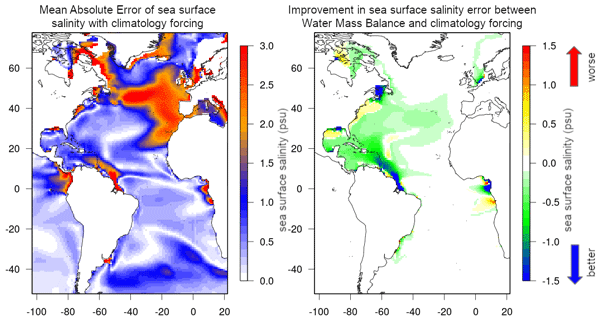
Louis Kern, Thomas Vaujour, Julia Pfeffer, Andrea Storto, Camille Szczypta, Gilles Garric, Claire Sirere, Gilles Larnicol, Chunxue Yang, Romain Bourdalle-Badie, and Stéphanie Guinehut
Ocean Sci., 22, 3457–3477, https://doi.org/10.5194/os-22-3457-2026, https://doi.org/10.5194/os-22-3457-2026, 2026
Short summary
Short summary
Freshwater fluxes, despite their importance, are often poorly represented in ocean models. The impact of river discharge is evaluated from the Water Mass Balance approach, combining gravimetry and atmospheric reanalyses data. These estimates are assessed against river gauges, highlighting good agreement over South American rivers. Compared to climatological data, when used as inputs for ocean model simulations, this technique improves salinity and upper ocean circulation representation.
Vincenzo de Toma, Andrea Storto, Ronan McAdam, Antonietta Capotondi, and Chunxue Yang
EGUsphere, https://doi.org/10.5194/egusphere-2026-5747, https://doi.org/10.5194/egusphere-2026-5747, 2026
This preprint is open for discussion and under review for Ocean Science (OS).
Short summary
Short summary
Marine heatwaves, prolonged spells of unusually warm seawater, can harm marine life and the people who depend on it, yet we know little about what happens beneath the surface. We compared three reconstructions of past ocean conditions and found they reliably capture famous surface events seen by satellites. Warm water often extends 100 to 150 metres down, and events reaching deeper last longer. Our results show that combining several products adds value to the results.
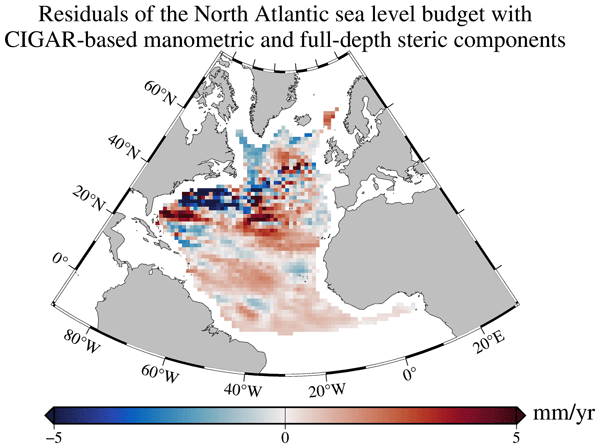
Zhe Song, Anny Cazenave, William Llovel, Andrea Storto, and Marie Bouih
Ocean Sci., 22, 2903–2914, https://doi.org/10.5194/os-22-2903-2026, https://doi.org/10.5194/os-22-2903-2026, 2026
Short summary
Short summary
The objective of this study is to understand why the North Atlantic sea level budget is not closed over the Argo and Gravity Recovery and Climate Experiment (GRACE) era. We show that using an ocean reanalysis for the ocean mass component instead of GRACE, and accounting for deep ocean warming allows quasi-closure of the North Atlantic sea level budget within data uncertainties.
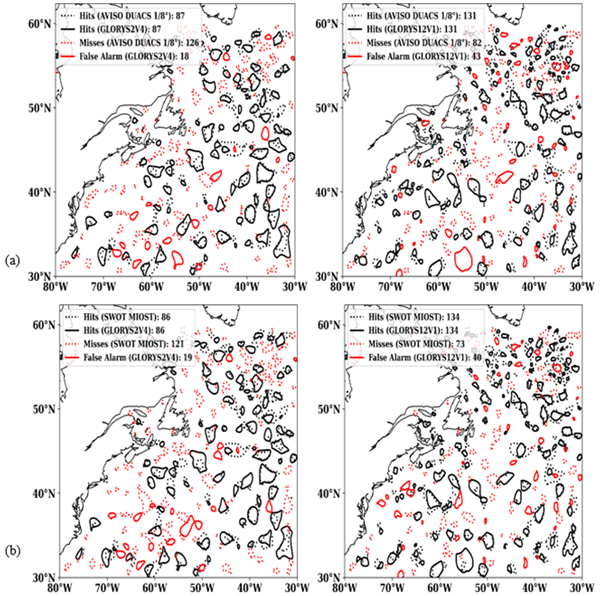
Paolo Mauriello, Gregory C. Smith, Andrea Storto, and Chunxue Yang
Ocean Sci., 22, 2863–2902, https://doi.org/10.5194/os-22-2863-2026, https://doi.org/10.5194/os-22-2863-2026, 2026
Short summary
Short summary
This article evaluates two ocean reanalyses with spatial resolutions of 1/4° and 1/12° by comparing them with two satellite observation products, both at 1/8° resolution. The results show the added value of higher model resolution for representing mesoscale eddies and highlight the value of wide-swath satellite altimetry for model verification in the North Atlantic.
Susanna Winkelbauer, Gaël Forget, Michael Mayer, Romain Bourdalle-Badie, Andrea Cipollone, Leopold Haimberger, Keith Haines, Satoshi Osafune, Yuanyuan Song, Andrea Storto, Chunxue Yang, and Hao Zuo
EGUsphere, https://doi.org/10.5194/egusphere-2026-5435, https://doi.org/10.5194/egusphere-2026-5435, 2026
This preprint is open for discussion and under review for Ocean Science (OS).
Short summary
Short summary
Ocean currents carry vast amounts of heat through the Atlantic and strongly influence climate. We compared estimates from 17 global ocean reanalyses with observations to assess how well they reproduce this heat transport and its changes over time. Most reanalyses capture the main patterns and variations, but important differences remain. The reanalyses also suggest a decrease in northward heat transport since the early 1990s, although its magnitude remains uncertain.
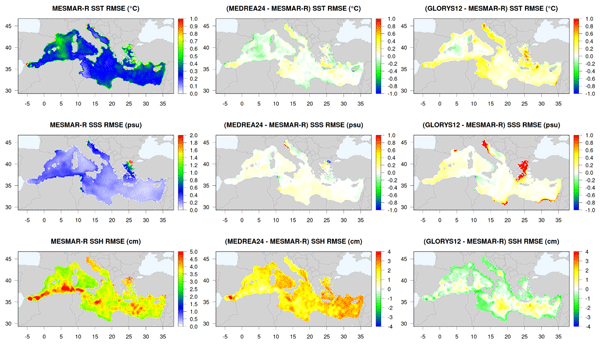
Andrea Storto, Vincenzo de Toma, and Chunxue Yang
Ocean Sci., 22, 2809–2834, https://doi.org/10.5194/os-22-2809-2026, https://doi.org/10.5194/os-22-2809-2026, 2026
Short summary
Short summary
The Mediterranean region is one of the fastest-warming areas on Earth, and understanding its changes is thus crucial. We produced a new reconstruction of the Mediterranean climate for the 1993–2024 period, using a modelling system that combines weather, ocean, and hydrology information with observations. This new reanalysis offers a clearer picture of how the region has been warming, drying, and changing over the past 30 years, supporting better studies of extreme events and climate impacts.
Yushi Morioka, Doroteaciro Iovino, Andrea Cipollone, Andrea Storto, Takeshi Doi, Masami Nonaka, and Swadhin K. Behera
EGUsphere, https://doi.org/10.5194/egusphere-2026-5070, https://doi.org/10.5194/egusphere-2026-5070, 2026
Preprint archived
Short summary
Short summary
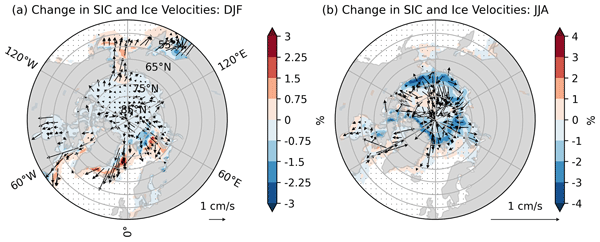
Arctic sea ice has been shrinking for the last four decades. As global warming continues, predicting summer sea ice is becoming more important. Here we create a seasonal forecast system using the SINTEX-F3 model. Results show that summer sea ice in the Barents-Kara Sea is best predicted when accurate sea ice and snow conditions are provided from spring. It is found that initial sea ice thickness acts as a memory for the climate system, enabling accurate summer sea ice prediction from spring.
Kristian Strommen, Michael Mayer, Andrea Storto, Jonas Spaeth, and Steffen Tietsche
Weather Clim. Dynam., 7, 1593–1618, https://doi.org/10.5194/wcd-7-1593-2026, https://doi.org/10.5194/wcd-7-1593-2026, 2026
Short summary
Short summary
Numerical weather forecasts of sea ice are unreliable, exhibiting an overly narrow range of plausible sea ice evolutions. Stochastic perturbations introduce randomness to the forecast in order to alleviate this by representing uncertainties in the representation of sea ice physics. We show that including such perturbations in a forecast model improves the reliability of sea ice forecasts, and furthermore results in improved seasonal forecasts of the northern European winter circulation.
Alejandro Blazquez, Benoit Meyssignac, Robin Fraudeau, Michael Ablain, Jonathan Bamber, Antonio Bonaduce, Marie Bouih, Anny Cazenave, Thorben Döhne, Ines Dussaillant, Ramiro Ferrari, Martin Horwath, Nicolas Kolodziejczyk, Hugo Lecomte, Stephanie Leroux, William Llovel, Daniele Melini, Erwan Oulhen, Thierry Penduff, Roshin P. Raj, Giorgio Spada, Marius Schlaak, Papasarafianou Stamatia, Andrea Storto, Chunxue Yang, and Sarah Connors
Earth Syst. Sci. Data Discuss., https://doi.org/10.5194/essd-2026-627, https://doi.org/10.5194/essd-2026-627, 2026
Preprint under review for ESSD
Short summary
Short summary
Closing the sea‑level budget on annual and longer time scales is a cornerstone of physical oceanography because sea‑level rise is one of the best indicators of climate change, and a closed budget shows we have identified and quantified all major drivers. We examined it from 1993 to 2022, finding an accelerated rise that matched ice melt and warm water until 2015. Afterwards an unexplained gap appears. Better deep‑ocean observations and refined gravity processing are needed to close the budget.
Erwan Le Roux, Pierre Tandeo, Carlos Granero Belinchon, Melika Baklouti, Julien Le Sommer, Florence Sevault, Samuel Somot, Antoine Doury, and Mahmoud Al Najar
EGUsphere, https://doi.org/10.5194/egusphere-2026-1991, https://doi.org/10.5194/egusphere-2026-1991, 2026
Short summary
Short summary
Projected impacts of climate change are assessed with impact models driven by climate projections. However, impact models can have a high computational cost. Here, we design statistical emulators of impact models based on automatic equation discovery. To our knowledge, this approach is a promising innovation that could pave the way to develop simple and interpretable emulators for various climate impact studies, but also to validate existing knowledge and to understand novel links.
Vadim Bertrand, Julien Le Sommer, Victor Vianna Zaia De Almeida, Adeline Samson, and Emmanuel Cosme
Ocean Sci., 22, 241–255, https://doi.org/10.5194/os-22-241-2026, https://doi.org/10.5194/os-22-241-2026, 2026
Short summary
Short summary
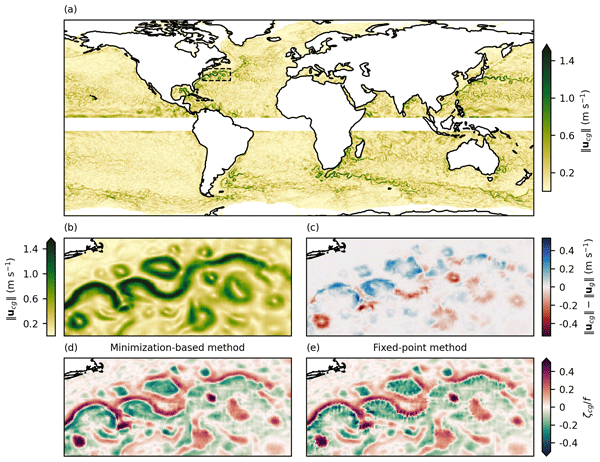
Understanding ocean surface currents is essential for navigation and environmental monitoring. Traditionally, currents are estimated from satellite sea surface height using a simplified balance. We developed a new method that goes beyond this approximation, providing more accurate currents estimates. Using a model simulation, satellite observations, and drifters data, we show that these corrections become increasingly important at finer spatial scales, especially in energetic regions.
Haohao Zhang, Andrea Storto, Xuezhi Bai, and Chunxue Yang
The Cryosphere, 19, 6807–6826, https://doi.org/10.5194/tc-19-6807-2025, https://doi.org/10.5194/tc-19-6807-2025, 2025
Short summary
Short summary
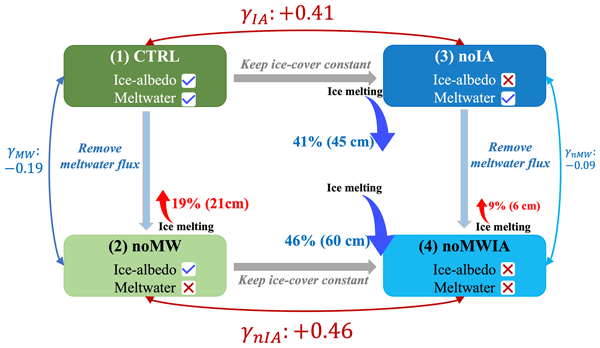
Using a 1D coupled ice-ocean model, we quantified the effects of meltwater and ice-albedo feedback independently. The meltwater reduces melting by 19 % through thermal isolation, while ice-albedo feedback increases melting by 41 %, with nonlinear coupling between them. In winter, meltwater protects ice in weakly stratified areas by blocking Atlantic heat. Our study provides new insights into the relative importance of different components in the Arctic ice-ocean system.
Andrea Storto, Sergey Frolov, Laura Slivinski, and Chunxue Yang
Geosci. Model Dev., 18, 4789–4804, https://doi.org/10.5194/gmd-18-4789-2025, https://doi.org/10.5194/gmd-18-4789-2025, 2025
Short summary
Short summary
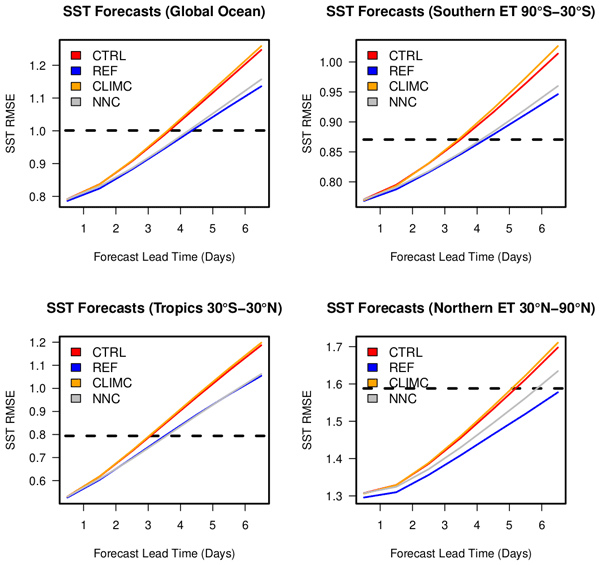
Inaccuracies in air–sea heat fluxes severely degrade the accuracy of ocean numerical simulations. Here, we use artificial neural networks to correct air–sea heat fluxes as a function of oceanic and atmospheric state predictors. The correction successfully improves surface and subsurface ocean temperatures beyond the training period and in prediction experiments.
Marie Bouih, Anne Barnoud, Chunxue Yang, Andrea Storto, Alejandro Blazquez, William Llovel, Robin Fraudeau, and Anny Cazenave
Ocean Sci., 21, 1425–1440, https://doi.org/10.5194/os-21-1425-2025, https://doi.org/10.5194/os-21-1425-2025, 2025
Short summary
Short summary
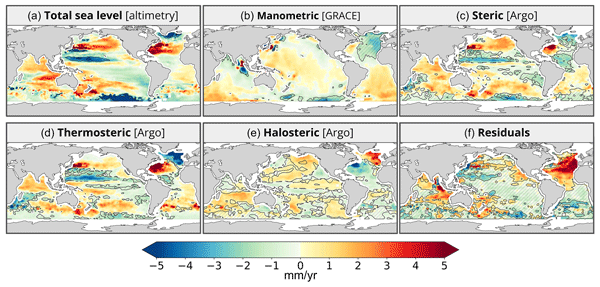
Present-day sea level rise is not uniform regionally. For better understanding of regional sea level variations, a classical approach is to compare the observed sea level trend patterns with those of the sum of the contributions. If the regional sea level trend budget is not closed, this allows the detection of errors in the observing systems. Our study shows that the trend budget is not closed in the North Atlantic Ocean and identifies errors in Argo-based salinity data as the main suspect.
Andrea Storto, Giulia Chierici, Julia Pfeffer, Anne Barnoud, Romain Bourdalle-Badie, Alejandro Blazquez, Davide Cavaliere, Noémie Lalau, Benjamin Coupry, Marie Drevillon, Sebastien Fourest, Gilles Larnicol, and Chunxue Yang
State Planet, 4-osr8, 12, https://doi.org/10.5194/sp-4-osr8-12-2024, https://doi.org/10.5194/sp-4-osr8-12-2024, 2024
Short summary
Short summary
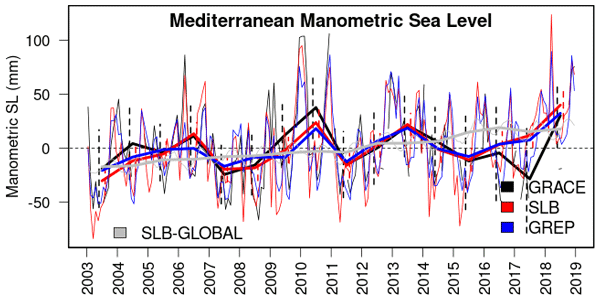
The variability in the manometric sea level (i.e. the sea level mass component) in three ocean basins is investigated in this study using three different methods (reanalyses, gravimetry, and altimetry in combination with in situ observations). We identify the emerging long-term signals, the consistency of the datasets, and the influence of large-scale climate modes on the regional manometric sea level variations at both seasonal and interannual timescales.
Vincenzo de Toma, Daniele Ciani, Yassmin Hesham Essa, Chunxue Yang, Vincenzo Artale, Andrea Pisano, Davide Cavaliere, Rosalia Santoleri, and Andrea Storto
Geosci. Model Dev., 17, 5145–5165, https://doi.org/10.5194/gmd-17-5145-2024, https://doi.org/10.5194/gmd-17-5145-2024, 2024
Short summary
Short summary
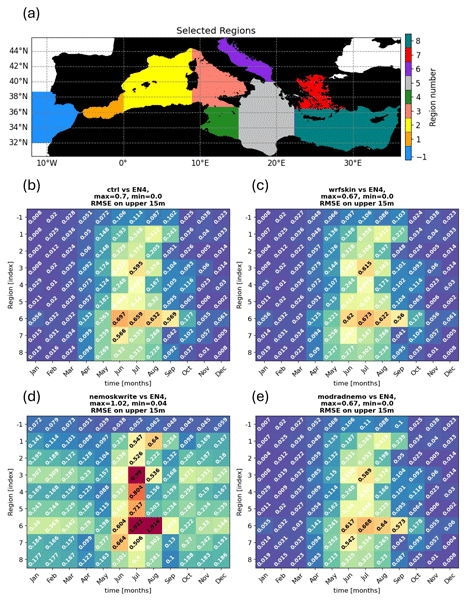
This study explores methods to reconstruct diurnal variations in skin sea surface temperature in a model of the Mediterranean Sea. Our new approach, considering chlorophyll concentration, enhances spatial and temporal variations in the warm layer. Comparative analysis shows context-dependent improvements. The proposed "chlorophyll-interactive" method brings the surface net total heat flux closer to zero annually, despite a net heat loss from the ocean to the atmosphere.
Mario C. Acosta, Sergi Palomas, Stella V. Paronuzzi Ticco, Gladys Utrera, Joachim Biercamp, Pierre-Antoine Bretonniere, Reinhard Budich, Miguel Castrillo, Arnaud Caubel, Francisco Doblas-Reyes, Italo Epicoco, Uwe Fladrich, Sylvie Joussaume, Alok Kumar Gupta, Bryan Lawrence, Philippe Le Sager, Grenville Lister, Marie-Pierre Moine, Jean-Christophe Rioual, Sophie Valcke, Niki Zadeh, and Venkatramani Balaji
Geosci. Model Dev., 17, 3081–3098, https://doi.org/10.5194/gmd-17-3081-2024, https://doi.org/10.5194/gmd-17-3081-2024, 2024
Short summary
Short summary
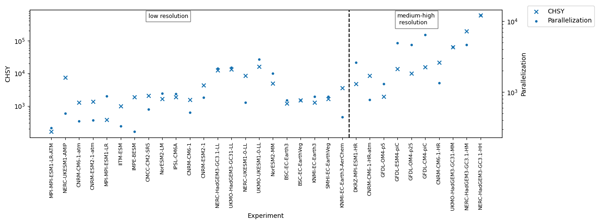
We present a collection of performance metrics gathered during the Coupled Model Intercomparison Project Phase 6 (CMIP6), a worldwide initiative to study climate change. We analyse the metrics that resulted from collaboration efforts among many partners and models and describe our findings to demonstrate the utility of our study for the scientific community. The research contributes to understanding climate modelling performance on the current high-performance computing (HPC) architectures.
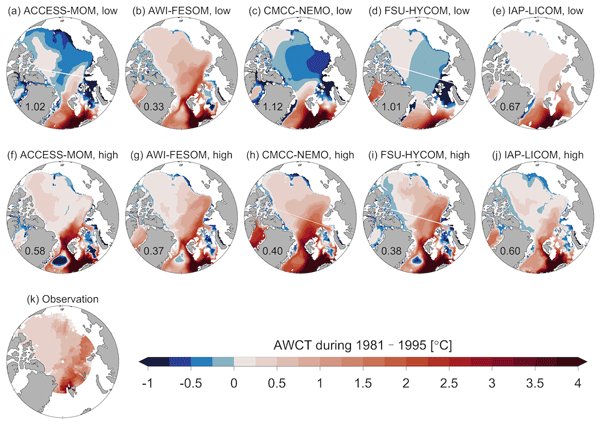
Qiang Wang, Qi Shu, Alexandra Bozec, Eric P. Chassignet, Pier Giuseppe Fogli, Baylor Fox-Kemper, Andy McC. Hogg, Doroteaciro Iovino, Andrew E. Kiss, Nikolay Koldunov, Julien Le Sommer, Yiwen Li, Pengfei Lin, Hailong Liu, Igor Polyakov, Patrick Scholz, Dmitry Sidorenko, Shizhu Wang, and Xiaobiao Xu
Geosci. Model Dev., 17, 347–379, https://doi.org/10.5194/gmd-17-347-2024, https://doi.org/10.5194/gmd-17-347-2024, 2024
Short summary
Short summary
Increasing resolution improves model skills in simulating the Arctic Ocean, but other factors such as parameterizations and numerics are at least of the same importance for obtaining reliable simulations.
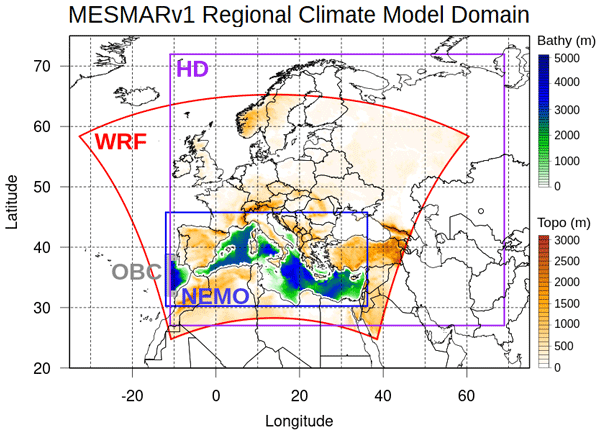
Andrea Storto, Yassmin Hesham Essa, Vincenzo de Toma, Alessandro Anav, Gianmaria Sannino, Rosalia Santoleri, and Chunxue Yang
Geosci. Model Dev., 16, 4811–4833, https://doi.org/10.5194/gmd-16-4811-2023, https://doi.org/10.5194/gmd-16-4811-2023, 2023
Short summary
Short summary
Regional climate models are a fundamental tool for a very large number of applications and are being increasingly used within climate services, together with other complementary approaches. Here, we introduce a new regional coupled model, intended to be later extended to a full Earth system model, for climate investigations within the Mediterranean region, coupled data assimilation experiments, and several downscaling exercises (reanalyses and long-range predictions).
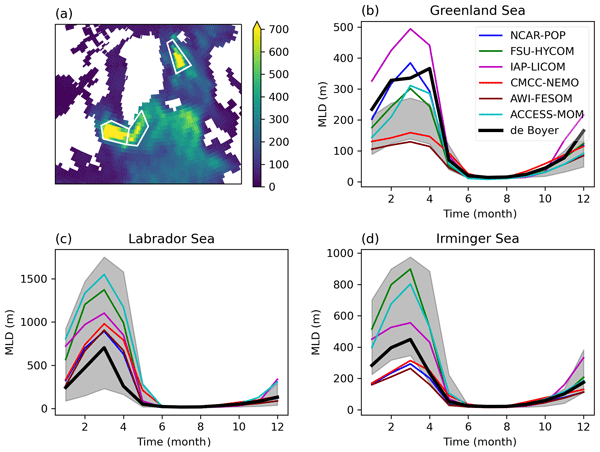
Anne Marie Treguier, Clement de Boyer Montégut, Alexandra Bozec, Eric P. Chassignet, Baylor Fox-Kemper, Andy McC. Hogg, Doroteaciro Iovino, Andrew E. Kiss, Julien Le Sommer, Yiwen Li, Pengfei Lin, Camille Lique, Hailong Liu, Guillaume Serazin, Dmitry Sidorenko, Qiang Wang, Xiaobio Xu, and Steve Yeager
Geosci. Model Dev., 16, 3849–3872, https://doi.org/10.5194/gmd-16-3849-2023, https://doi.org/10.5194/gmd-16-3849-2023, 2023
Short summary
Short summary
The ocean mixed layer is the interface between the ocean interior and the atmosphere and plays a key role in climate variability. We evaluate the performance of the new generation of ocean models for climate studies, designed to resolve
ocean eddies, which are the largest source of ocean variability and modulate the mixed-layer properties. We find that the mixed-layer depth is better represented in eddy-rich models but, unfortunately, not uniformly across the globe and not in all models.

Stephanie Leroux, Jean-Michel Brankart, Aurélie Albert, Laurent Brodeau, Jean-Marc Molines, Quentin Jamet, Julien Le Sommer, Thierry Penduff, and Pierre Brasseur
Ocean Sci., 18, 1619–1644, https://doi.org/10.5194/os-18-1619-2022, https://doi.org/10.5194/os-18-1619-2022, 2022
Short summary
Short summary
The goal of the study is to evaluate the predictability of the ocean circulation
at a kilometric scale, in order to anticipate the requirements of the future operational forecasting systems. For that purpose, ensemble experiments have been performed with a regional model for the Western Mediterranean (at 1/60° horizontal resolution). From these ensemble experiments, we show that it is possible to compute targeted predictability scores, which depend on initial and model uncertainties.
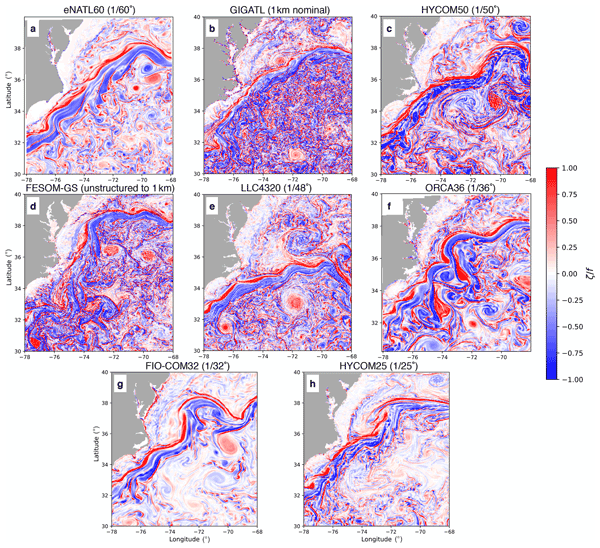
Takaya Uchida, Julien Le Sommer, Charles Stern, Ryan P. Abernathey, Chris Holdgraf, Aurélie Albert, Laurent Brodeau, Eric P. Chassignet, Xiaobiao Xu, Jonathan Gula, Guillaume Roullet, Nikolay Koldunov, Sergey Danilov, Qiang Wang, Dimitris Menemenlis, Clément Bricaud, Brian K. Arbic, Jay F. Shriver, Fangli Qiao, Bin Xiao, Arne Biastoch, René Schubert, Baylor Fox-Kemper, William K. Dewar, and Alan Wallcraft
Geosci. Model Dev., 15, 5829–5856, https://doi.org/10.5194/gmd-15-5829-2022, https://doi.org/10.5194/gmd-15-5829-2022, 2022
Short summary
Short summary
Ocean and climate scientists have used numerical simulations as a tool to examine the ocean and climate system since the 1970s. Since then, owing to the continuous increase in computational power and advances in numerical methods, we have been able to simulate increasing complex phenomena. However, the fidelity of the simulations in representing the phenomena remains a core issue in the ocean science community. Here we propose a cloud-based framework to inter-compare and assess such simulations.
Cited articles
Alexeev, D.: pytorch-fortran: PyTorch bindings for Fortran, https://github.com/alexeedm/pytorch-fortran (last access: 27 October 2026), 2023. a
Arnold, C., Sharma, S., Weigel, T., and Greenberg, D. S.: Efficient and stable coupling of the SuperdropNet deep-learning-based cloud microphysics (v0.1.0) with the ICON climate and weather model (v2.6.5), Geosci. Model Dev., 17, 4017–4029, https://doi.org/10.5194/gmd-17-4017-2024, 2024. a, b, c
Atkinson, J., Clifford, S., Orchard, D., and Edsall, C.: fortran-TF-lib, GitHub [code], https://github.com/Cambridge-ICCS/fortran-tf-lib (last access: 27 October 2026), 2023. a
Atkinson, J., Elafrou, A., Kasoar, E., Wallwork, J. G., Meltzer, T., Clifford, S., Orchard, D., and Edsall, C.: FTorch: a library for coupling PyTorch models to Fortran, J. Open Source Softw., 10, 7602, https://doi.org/10.21105/joss.07602, 2025. a
Baker, N., Alexander, F., Bremer, T., Hagberg, A., Kevrekidis, Y., Najm, H., Parashar, M., Patra, A., Sethian, J., Wild, S., Willcox, K., and Lee, S.: Workshop Report on Basic Research Needs for Scientific Machine Learning: Core Technologies for Artificial Intelligence, USDOE Office of Science, Washington, D.C., USA, https://doi.org/10.2172/1478744, 2019. a
Balogh, B., Saint-Martin, D., and Geoffroy, O.: Online Test of a Neural Network Deep Convection Parameterization in ARP-GEM1, arXiv [preprint], https://doi.org/10.48550/arXiv.2410.21920, 2024. a
Barge, A.: morays-container, Zenodo [code], https://doi.org/10.5281/zenodo.23696121, 2026. a
Barge, A. and Le Sommer, J.: eophis_v1.1.0, Zenodo [code], https://doi.org/10.5281/zenodo.17736834, 2025. a
Barge, A. and Le Sommer, J.: morays-community/NEMO-eORCA025_Subgrid_Density, Zenodo [code], https://doi.org/10.5281/zenodo.18244389, 2026. a
Barge, A., Contreras, M., Bodner, A., Balwada, D., and Le Sommer, J.: morays-community/NEMO-eORCA025_MLE, Zenodo [code], https://doi.org/10.5281/zenodo.18244386, 2026a. a
Barge, A., Storto, A., and Le Sommer, J.: morays-community/NEMO-ORCA1_AirSeaHeat, Zenodo [code], https://doi.org/10.5281/zenodo.18744705, 2026b. a
Beucler, T.: Towards Hybrid Earth System Modeling: A Living Review, Zenodo [data set], https://doi.org/10.5281/zenodo.16967530, 2025. a
Bodner, A., Balwada, D., and Zanna, L.: A Data-Driven Approach for Parameterizing Submesoscale Vertical Buoyancy Fluxes in the Ocean Mixed Layer, arXiv [preprint], https://doi.org/10.48550/arXiv.2312.06972, 2025. a, b
Bodner, A. S., Fox-Kemper, B., Johnson, L., Roekel, L. P. V., McWilliams, J. C., Sullivan, P. P., Hall, P. S., and Dong, J.: Modifying the Mixed Layer Eddy Parameterization to Include Frontogenesis Arrest by Boundary Layer Turbulence, J. Phys. Oceanogr., 53, 323–339, https://doi.org/10.1175/JPO-D-21-0297.1, 2023. a
Brenowitz, N. D.: call_py_fort, https://github.com/nbren12/call_py_fort, Zenodo [code], https://doi.org/10.5281/zenodo.7779572, 2023. a
Craig, A., Valcke, S., and Coquart, L.: Development and performance of a new version of the OASIS coupler, OASIS3-MCT_3.0, Geosci. Model Dev., 10, 3297–3308, https://doi.org/10.5194/gmd-10-3297-2017, 2017. a, b, c
Curcic, M.: A parallel Fortran framework for neural networks and deep learning, ACM SIGPLAN Fortran Forum, 38, 4–21, https://doi.org/10.1145/3323057.3323059, 2019. a
Durand, C., Botvynko, D., Frezat, H., Grande, D., Storto, A., Greenberg, D., Fablet, R., Ouala, S., and Le Sommer, J.: Learning-Based Methods and the Future of Numerical Ocean and Sea Ice Modeling, Annu. Rev. Mar. Sci., 19, in press, https://doi.org/10.1146/annurev-marine-040125-074353, 2026. a
ESCOMP: module_neural_net (PUMAS Fortran neural network module), GitHub [code], https://github.com/ESCOMP/PUMAS (last access: 27 October 2026), 2025. a
Farchi, A., Chrust, M., Bocquet, M., Laloyaux, P., and Bonavita, M.: The Fortran Neural Network (FNN) library, Zenodo [code], https://doi.org/10.5281/zenodo.7245291, 2022. a
Fox-Kemper, B., Danabasoglu, G., Ferrari, R., Griffies, S., Hallberg, R., Holland, M., Maltrud, M., Peacock, S., and Samuels, B.: Parameterization of mixed layer eddies. III: Implementation and impact in global ocean climate simulations, Ocean Model., 39, 61–78, https://doi.org/10.1016/j.ocemod.2010.09.002, 2011. a, b
Frezat, H., Le Sommer, J., Fablet, R., Balarac, G., and Lguensat, R.: A Posteriori Learning for Quasi-Geostrophic Turbulence Parametrization, J. Adv. Model. Earth Sy., 14, https://doi.org/10.1029/2022ms003124, 2022. a
Fuchs, D., Sherwood, S. C., Prasad, A., Trapeznikov, K., and Gimlett, J.: TorchClim v1.0: a deep-learning plugin for climate model physics, Geosci. Model Dev., 17, 5459–5475, https://doi.org/10.5194/gmd-17-5459-2024, 2024. a
Gelbrecht, M., White, A., Bathiany, S., and Boers, N.: Differentiable programming for Earth system modeling, Geosci. Model Dev., 16, 3123–3135, https://doi.org/10.5194/gmd-16-3123-2023, 2023. a
Gyawali, D.: Comparative Analysis of CPU and GPU Profiling for Depp Learning Models, arXiv [preprint], https://doi.org/10.48550/arXiv.2309.02521, 2023. a
Häfner, D., Nuterman, R., and Jochum, M.: Fast, Cheap, and Turbulent—Global Ocean Modeling With GPU Acceleration in Python, J. Adv. Model. Earth Sy., 13, https://doi.org/10.1029/2021ms002717, 2021. a
Hanke, M. and Redler, R.: New features with YAC 1.5.0, Deutscher Wetterdienst, 3, https://doi.org/10.5676/DWD_pub/nwv/icon_003, 2019. a, b
Irrgang, C., Boers, N., Sonnewald, M., Barnes, E. A., Kadow, C., Staneva, J., and Saynisch-Wagner, J.: Towards neural Earth system modelling by integrating artificial intelligence in Earth system science, Nature Machine Intelligence, 3, 667–674, https://doi.org/10.1038/s42256-021-00374-3, 2021. a
Karniadakis, G. E., Kevrekidis, I. G., Lu, L., Perdikaris, P., Wang, S., and Yang, L.: Physics-informed machine learning, Nature Reviews Physics, 3, 422–440, https://doi.org/10.1038/s42254-021-00314-5, 2021. a
Keith, B., O’Leary-Roseberry, T., Sanderse, B., Scheichl, R., and van Bloemen Waanders, B.: Scientific Machine Learning: A Symbiosis, Foundations of Data Science, 7, i–x, https://doi.org/10.3934/fods.2024051, 2025. a
Klöwer, M., Gelbrecht, M., Hotta, D., Willmert, J., Silvestri, S., Wagner, G. L., White, A., Hatfield, S., Kimpson, T., Constantinou, N. C., and Hill, C.: SpeedyWeather.jl: Reinventing atmospheric general circulation models towards interactivity and extensibility, J. Open Source Softw., 9, 6323, https://doi.org/10.21105/joss.06323, 2024. a
Kochkov, D., Yuval, J., Langmore, I., Norgaard, P., Smith, J., Mooers, G., Klöwer, M., Lottes, J., Rasp, S., Düben, P., Hatfield, S., Battaglia, P., Sanchez-Gonzalez, A., Willson, M., Brenner, M. P., and Hoyer, S.: Neural general circulation models for weather and climate, Nature, 632, 1060–1066, https://doi.org/10.1038/s41586-024-07744-y, 2024. a
McGibbon, J., Brenowitz, N. D., Cheeseman, M., Clark, S. K., Dahm, J. P. S., Davis, E. C., Elbert, O. D., George, R. C., Harris, L. M., Henn, B., Kwa, A., Perkins, W. A., Watt-Meyer, O., Wicky, T. F., Bretherton, C. S., and Fuhrer, O.: fv3gfs-wrapper: a Python wrapper of the FV3GFS atmospheric model, Geosci. Model Dev., 14, 4401–4409, https://doi.org/10.5194/gmd-14-4401-2021, 2021. a
Meunier, E., Ouala, S., Frezat, H., Sommer, J. L., and Fablet, R.: Towards fully differentiable neural ocean model with Veros, arXiv [preprint], https://doi.org/10.48550/arxiv.2511.17427, 2025. a
Ott, J., Pritchard, M., Best, N., Linstead, E., Curcic, M., and Baldi, P.: A Fortran-Keras Deep Learning Bridge for Scientific Computing, arXiv [preprint], https://doi.org/10.48550/arXiv.2004.10652, 2020. a
Partee, S., Ellis, M., Rigazzi, A., Shao, A. E., Bachman, S., Marques, G., and Robbins, B.: Using Machine Learning at scale in numerical simulations with SmartSim: An application to ocean climate modeling, J. Comput. Sci., 62, 101707, https://doi.org/10.1016/j.jocs.2022.101707, 2022. a
Rabel, E.: Forpy: a library for fortran-Python interoperability, GitHub [code], https://github.com/ylikx/forpy (last access: 27 October 2026), 2020. a
Reichstein, M., Camps-Valls, G., Stevens, B., Jung, M., Denzler, J., Carvalhais, N., and Prabhat: Deep learning and process understanding for data-driven Earth system science, Nature, 566, 195–204, https://doi.org/10.1038/s41586-019-0912-1, 2019. a
Romero, J., Thorsten, K., Meltzer, T., and Loppi, N.: An Online Deep Learning Interface for HPC programs on NVIDIA GPUs, GitHub [code], https://github.com/NVIDIA/TorchFort (last access: 27 October 2026), 2024. a
Rouson, D., Bonachea, D., Richardson, B., Welsman, J. A., Bailey, J., Gutmann, E. D., Torres, D., Rasmussen, K., Dibba, B., Zhang, Y., Weaver, K., Bai, Z., and Nguyen, T.: Fiats: Functional inference and training for surrogates, J. Open Source Softw., 10, 8785, https://doi.org/10.21105/joss.08785, 2025. a
Schouler, M., Caulk, R. A., Meyer, L., Terraz, T., Conrads, C., Friedemann, S., Agarwal, A., Baldonado, J. M., Pogodziński, B., Sekuła, A., Ribes, A., and Raffin, B.: Melissa: coordinating large-scale ensemble runs for deep learning and sensitivity analyses, J. Open Source Softw., 8, 5291, https://doi.org/10.21105/joss.05291, 2023. a
Serhani, A.: PhyDLL, https://gitlab.com/cerfacs/phydll (last access: 27 October 2026), 2023. a
Shaw, T. A. and Stevens, B.: The other climate crisis, Nature, 639, 877–887, https://doi.org/10.1038/s41586-025-08680-1, 2025. a
Shen, C., Appling, A. P., Gentine, P., Bandai, T., Gupta, H., Tartakovsky, A., Baity-Jesi, M., Fenicia, F., Kifer, D., Li, L., Liu, X., Ren, W., Zheng, Y., Harman, C. J., Clark, M., Farthing, M., Feng, D., Kumar, P., Aboelyazeed, D., Rahmani, F., Song, Y., Beck, H. E., Bindas, T., Dwivedi, D., Fang, K., Höge, M., Rackauckas, C., Mohanty, B., Roy, T., Xu, C., and Lawson, K.: Differentiable modelling to unify machine learning and physical models for geosciences, Nature Reviews Earth & Environment, 4, 552–567, https://doi.org/10.1038/s43017-023-00450-9, 2023. a
Silvestri, S., Wagner, G. L., Constantinou, N. C., Hill, C. N., Campin, J., Souza, A. N., Bishnu, S., Churavy, V., Marshall, J., and Ferrari, R.: A GPU-Based Ocean Dynamical Core for Routine Mesoscale-Resolving Climate Simulations, J. Adv. Model. Earth Sy., 17, https://doi.org/10.1029/2024ms004465, 2025. a
Stanley, Z., Grooms, I., Kleiber, S., Bachman, S., Castruccio, F., and Adcroft, A.: Parameterizing the impact of unresolved temperature variability on the large-scale density field: Part 1. Theory, JAMES, 12, https://doi.org/10.1029/2020MS002185, 2020. a
Valcke, S., Piacentini, A., Craig, A., and Jonville, G.: OASIS3-MCT_6.0, Zenodo [code], https://doi.org/10.5281/zenodo.18020824, 2025. a, b
Wang, X., Han, Y., Xue, W., Yang, G., and Zhang, G. J.: Stable climate simulations using a realistic general circulation model with neural network parameterizations for atmospheric moist physics and radiation processes, Geosci. Model Dev., 15, 3923–3940, https://doi.org/10.5194/gmd-15-3923-2022, 2022. a
Watt-Meyer, O., Brenowitz, N. D., Clark, S. K., Henn, B., Kwa, A., McGibbon, J., Perkins, W. A., Harris, L., and Bretherton, C. S.: Neural Network Parameterization of Subgrid-Scale Physics From a Realistic Geography Global Storm-Resolving Simulation, J. Adv. Model. Earth Sy., 16, https://doi.org/10.1029/2023ms003668, 2024. a
Zanna, L., Gregory, W., Perezhogin, P., Sane, A., Zhang, C., Adcroft, A., Bushuk, M., Fernandez-Granda, C., Reichl, B., Balwada, D., Busecke, J., Chapman, W., Connolly, A., Du, D., Everard, K., Falasca, F., Falga, R., Kamm, D., Meunier, E., Liu, Q., Nasser, A., Pudig, M., Shao, A., Simpson, J. L., Vogt, L., and Wu, J.: A Framework for Hybrid Physics-AI Coupled Ocean Models, arXiv [preprint], https://doi.org/10.48550/arXiv.2510.22676, 2025. a
Zhang, C., Perezhogin, P., Gultekin, C., Adcroft, A., Fernandez-Granda, C., and Zanna, L.: Implementation and Evaluation of a Machine Learned Mesoscale Eddy Parameterization Into a Numerical Ocean Circulation Model, J. Adv. Model. Earth Sy., 15, e2023MS003697, https://doi.org/10.1029/2023MS003697, 2023a. a, b
Zhang, J., Zhang, Z., and Qiu, B.: Parameterizing Submesoscale Vertical Buoyancy Flux by Simultaneously Considering Baroclinic Instability and Strain-Induced Frontogenesis, Geophys. Res. Lett., 50, e2022GL102292, https://doi.org/10.1029/2022GL102292, 2023b. a
Zhang, T., Morcrette, C., Zhang, M., Lin, W., Xie, S., Liu, Y., Van Weverberg, K., and Rodrigues, J.: A Fortran–Python interface for integrating machine learning parameterization into earth system models, Geosci. Model Dev., 18, 1917–1928, https://doi.org/10.5194/gmd-18-1917-2025, 2025. a
Zhong, X., Ma, Z., Yao, Y., Xu, L., Wu, Y., and Wang, Z.: WRF–ML v1.0: a bridge between WRF v4.3 and machine learning parameterizations and its application to atmospheric radiative transfer, Geosci. Model Dev., 16, 199–209, https://doi.org/10.5194/gmd-16-199-2023, 2023. a
Short summary
Scientists use programs, called Earth System Models, to study and predict climate. These models are based on physical theories but can be completed with AI tools. However, combining these tools with traditional models is difficult due to their different nature. Our research introduces a new method that connects these AI tools with existing climate models. We tested this method by integrating it with an ocean model. This work should help scientists explore new ways of making climate predictions.
Scientists use programs, called Earth System Models, to study and predict climate. These models...


Special issue
Altmetrics
Final-revised paper
Preprint