
Articles | Volume 19, issue 19
https://doi.org/10.5194/gmd-19-9325-2026
© Author(s) 2026. This work is distributed under
the Creative Commons Attribution 4.0 License.
the Creative Commons Attribution 4.0 License.
https://doi.org/10.5194/gmd-19-9325-2026
© Author(s) 2026. This work is distributed under
the Creative Commons Attribution 4.0 License.
the Creative Commons Attribution 4.0 License.
Development and technical paper
| 
05 Oct 2026
Development and technical paper |
| 05 Oct 2026
| 05 Oct 2026
Short-lived halogen sources and chemistry in the Community Earth System Model v2 (CESM2-SLH)
Rafael P. Fernandez
CORRESPONDING AUTHOR

Department of Atmospheric Chemistry and Climate, Institute of Physical Chemistry Blas Cabrera, CSIC, 28006 Madrid, Spain
Institute for Interdisciplinary Science, National Research Council (ICB-CONICET/UNCUYO), School of Natural Sciences, National University of Cuyo (FCEN/UNCUYO), 5501 Mendoza, Argentina
Carlos A. Cuevas
Department of Atmospheric Chemistry and Climate, Institute of Physical Chemistry Blas Cabrera, CSIC, 28006 Madrid, Spain
Julián Villamayor
Department of Atmospheric Chemistry and Climate, Institute of Physical Chemistry Blas Cabrera, CSIC, 28006 Madrid, Spain
Aryeh Feinberg
Department of Atmospheric Chemistry and Climate, Institute of Physical Chemistry Blas Cabrera, CSIC, 28006 Madrid, Spain
Douglas E. Kinnison
Atmospheric Chemistry, Observations & Modeling Laboratory (ACOM), NSF National Center for Atmospheric Research (NCAR), Boulder, CO 80301, USA
Francis Vitt
Atmospheric Chemistry, Observations & Modeling Laboratory (ACOM), NSF National Center for Atmospheric Research (NCAR), Boulder, CO 80301, USA
Adriana Bossolasco
Department of Atmospheric Chemistry and Climate, Institute of Physical Chemistry Blas Cabrera, CSIC, 28006 Madrid, Spain
Physics Institute of Northwest Argentina (INFINOA-CONICET/UNT), Tucumán, Argentina
Javier A. Barrera
Department of Atmospheric Chemistry and Climate, Institute of Physical Chemistry Blas Cabrera, CSIC, 28006 Madrid, Spain
Research Institute for Physical Chemistry of Córdoba, National Research Council (INFIQC-CONICET/UNC), Department of Physical Chemistry, School of Chemical Sciences, National University of Córdoba (FCQ/UNC), Córdoba, Argentina
Amelia Reynoso
Institute for Interdisciplinary Science, National Research Council (ICB-CONICET/UNCUYO), School of Natural Sciences, National University of Cuyo (FCEN/UNCUYO), 5501 Mendoza, Argentina
Orlando G. Tomazzeli
Institute for Interdisciplinary Science, National Research Council (ICB-CONICET/UNCUYO), School of Natural Sciences, National University of Cuyo (FCEN/UNCUYO), 5501 Mendoza, Argentina
Environment Research Institute, Shandong University, Qingdao, China
Department of Atmospheric Chemistry and Climate, Institute of Physical Chemistry Blas Cabrera, CSIC, 28006 Madrid, Spain
Related authors
Benjamin Gaubert, Mohammad Amin Mirrezaei, Rafael P. Fernandez, Ivan Ortega, Louisa K. Emmons, John Orlando, Youmi Oh, Lori Bruhwiler, Shuo Chen, Gabrielle Petron, Xin Lan, Claire Granier, Nicolas Zilbermann, Idir Bouarar, Guy P. Brasseur, Chuan Feng, Yangyang Xu, Alfonso Saiz-Lopez, Carlos Cuevas, and Avelino Arellano Jr.
EGUsphere, https://doi.org/10.5194/egusphere-2026-4883, https://doi.org/10.5194/egusphere-2026-4883, 2026
Short summary
Short summary
Atmospheric methane levels have been rising in ways scientists struggle to explain. Much of the uncertainty lies in a chemical that removes methane from the air. Using a detailed model of the Earth, we found that chemistry plays an important role in the fate of methane in the atmosphere, even small variations need to be included to track methane accurately.

Heesung Chong, Gonzalo González Abad, Caroline R. Nowlan, Christopher Chan Miller, Alfonso Saiz-Lopez, Rafael P. Fernandez, Hyeong-Ahn Kwon, Zolal Ayazpour, Huiqun Wang, Amir H. Souri, Xiong Liu, Kelly Chance, Ewan O'Sullivan, Jhoon Kim, Ja-Ho Koo, William R. Simpson, François Hendrick, Richard Querel, Glen Jaross, Colin Seftor, and Raid M. Suleiman
Atmos. Meas. Tech., 17, 2873–2916, https://doi.org/10.5194/amt-17-2873-2024, https://doi.org/10.5194/amt-17-2873-2024, 2024
Short summary
Short summary
We present a new bromine monoxide (BrO) product derived using radiances measured from OMPS-NM on board the Suomi-NPP satellite. This product provides nearly a decade of global stratospheric and tropospheric column retrievals, a feature that is currently rare in publicly accessible datasets. Both stratospheric and tropospheric columns from OMPS-NM demonstrate robust performance, exhibiting good agreement with ground-based observations collected at three stations (Lauder, Utqiagvik, and Harestua).
François Burgay, Rafael Pedro Fernández, Delia Segato, Clara Turetta, Christopher S. Blaszczak-Boxe, Rachael H. Rhodes, Claudio Scarchilli, Virginia Ciardini, Carlo Barbante, Alfonso Saiz-Lopez, and Andrea Spolaor
The Cryosphere, 17, 391–405, https://doi.org/10.5194/tc-17-391-2023, https://doi.org/10.5194/tc-17-391-2023, 2023
Short summary
Short summary
The paper presents the first ice-core record of bromine (Br) in the Antarctic plateau. By the observation of the ice core and the application of atmospheric chemical models, we investigate the behaviour of bromine after its deposition into the snowpack, with interest in the effect of UV radiation change connected to the formation of the ozone hole, the role of volcanic deposition, and the possible use of Br to reconstruct past sea ice changes from ice core collect in the inner Antarctic plateau.
Markus Jesswein, Rafael P. Fernandez, Lucas Berná, Alfonso Saiz-Lopez, Jens-Uwe Grooß, Ryan Hossaini, Eric C. Apel, Rebecca S. Hornbrook, Elliot L. Atlas, Donald R. Blake, Stephen Montzka, Timo Keber, Tanja Schuck, Thomas Wagenhäuser, and Andreas Engel
Atmos. Chem. Phys., 22, 15049–15070, https://doi.org/10.5194/acp-22-15049-2022, https://doi.org/10.5194/acp-22-15049-2022, 2022
Short summary
Short summary
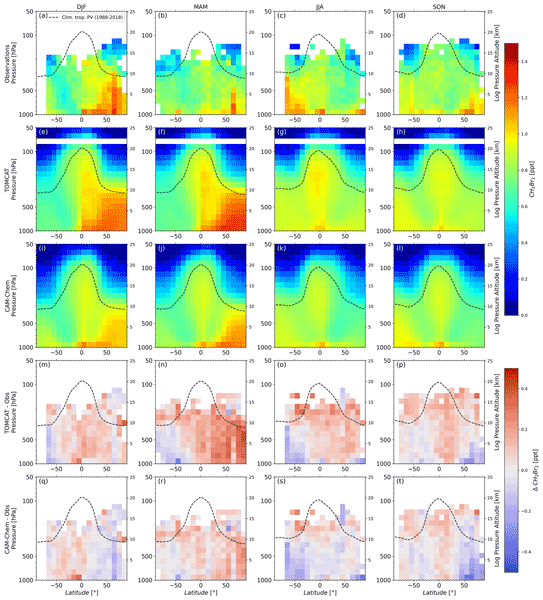
This study presents the global and seasonal distribution of the two major brominated short-lived substances CH2Br2 and CHBr3 in the upper troposphere and lower stratosphere based on observations from several aircraft campaigns. They show similar seasonality for both hemispheres, except in the respective hemispheric autumn lower stratosphere. A comparison with the TOMCAT and CAM-Chem models shows good agreement in the annual mean but larger differences in the seasonal consideration.
S. Enrique Puliafito, Tomás R. Bolaño-Ortiz, Rafael P. Fernandez, Lucas L. Berná, Romina M. Pascual-Flores, Josefina Urquiza, Ana I. López-Noreña, and María F. Tames
Earth Syst. Sci. Data, 13, 5027–5069, https://doi.org/10.5194/essd-13-5027-2021, https://doi.org/10.5194/essd-13-5027-2021, 2021
Short summary
Short summary
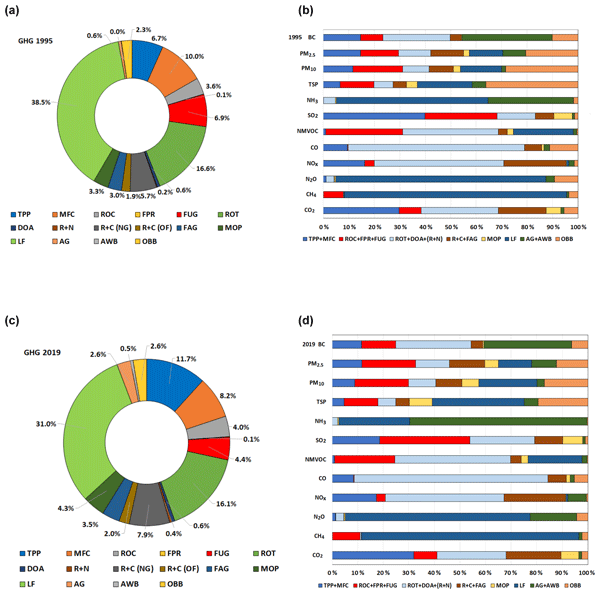
GEAA-AEIv3.0M atmospheric emissions inventory is the first high-spatial-resolution inventory (approx. 2.5 km × 2.5 km) with monthly variability from 1995 to 2020, including greenhouse gases, ozone precursors, acidifying gases, and particulate matter, from all Argentine productive activities. The main benefit of GEAA-AEIv3.0M is to map emissions with better temporal resolution to support air quality and climate modeling, to evaluate pollutant mitigation strategies by Argentine decision makers.
Arseniy Karagodin-Doyennel, Eugene Rozanov, Timofei Sukhodolov, Tatiana Egorova, Alfonso Saiz-Lopez, Carlos A. Cuevas, Rafael P. Fernandez, Tomás Sherwen, Rainer Volkamer, Theodore K. Koenig, Tanguy Giroud, and Thomas Peter
Geosci. Model Dev., 14, 6623–6645, https://doi.org/10.5194/gmd-14-6623-2021, https://doi.org/10.5194/gmd-14-6623-2021, 2021
Short summary
Short summary
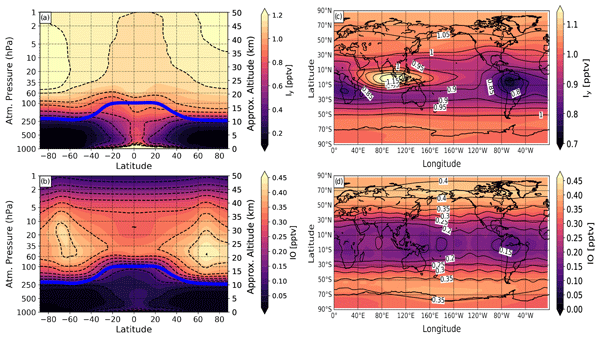
Here, we present the iodine chemistry module in the SOCOL-AERv2 model. The obtained iodine distribution demonstrated a good agreement when validated against other simulations and available observations. We also estimated the iodine influence on ozone in the case of present-day iodine emissions, the sensitivity of ozone to doubled iodine emissions, and when considering only organic or inorganic iodine sources. The new model can be used as a tool for further studies of iodine effects on ozone.
Benjamin Gaubert, Mohammad Amin Mirrezaei, Rafael P. Fernandez, Ivan Ortega, Louisa K. Emmons, John Orlando, Youmi Oh, Lori Bruhwiler, Shuo Chen, Gabrielle Petron, Xin Lan, Claire Granier, Nicolas Zilbermann, Idir Bouarar, Guy P. Brasseur, Chuan Feng, Yangyang Xu, Alfonso Saiz-Lopez, Carlos Cuevas, and Avelino Arellano Jr.
EGUsphere, https://doi.org/10.5194/egusphere-2026-4883, https://doi.org/10.5194/egusphere-2026-4883, 2026
Short summary
Short summary
Atmospheric methane levels have been rising in ways scientists struggle to explain. Much of the uncertainty lies in a chemical that removes methane from the air. Using a detailed model of the Earth, we found that chemistry plays an important role in the fate of methane in the atmosphere, even small variations need to be included to track methane accurately.
Lucien Froidevaux, Michael J. Schwartz, Douglas E. Kinnison, Nathaniel J. Livesey, Gloria L. Manney, Michelle L. Santee, William G. Read, and Ryan A. Fuller
EGUsphere, https://doi.org/10.5194/egusphere-2026-2273, https://doi.org/10.5194/egusphere-2026-2273, 2026
Short summary
Short summary
We examine 20 years (2004–2023) of vertical profiles of winter/spring lower stratospheric ozone inside the Antarctic vortex, based on satellite observations and a chemistry climate model. The observations show increases in the smallest ozone values, as well as trends consistent with a slow recovery from the long-term impact of ozone-depleting substances. The model also shows some reductions in lower stratospheric seasonal Antarctic ozone losses, in broad agreement with the observations.
Charikleia Gournia, Noelle E. Selin, and Aryeh Feinberg
Atmos. Chem. Phys., 26, 5039–5061, https://doi.org/10.5194/acp-26-5039-2026, https://doi.org/10.5194/acp-26-5039-2026, 2026
Short summary
Short summary
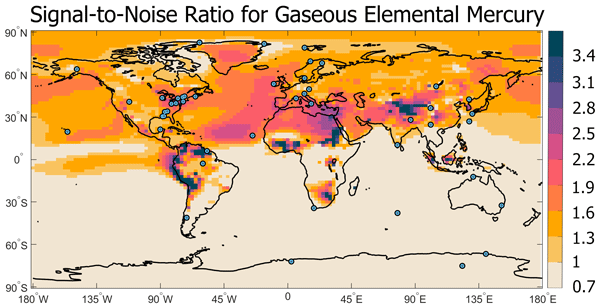
Human activities release mercury into the air, but current estimates of these emissions vary widely. Our study examines how the uncertainty in global anthropogenic mercury emission estimates impacts the model's ability to reproduce observations. We found that differences in emissions inventories significantly change results, especially in Asia. The work highlights where increased monitoring is needed to improve estimates and better inform global mercury reduction policies.
Yunqian Zhu, Cheng-Cheng Liu, Charles Bardeen, Lu Wang, Simone Tilmes, Ilaria Quaglia, Christopher M. Maloney, Francis Vitt, and Owen Brian Toon
EGUsphere, https://doi.org/10.22541/essoar.177135577.71771059/v1, https://doi.org/10.22541/essoar.177135577.71771059/v1, 2026
Short summary
Short summary
The Community Aerosol and Radiation Model for Atmospheres (CARMA) is a sectional microphysical model widely used to study the formation of aerosols and clouds. This paper presents an update to the CARMA model algorithms since Toon et al. 1988, with a focus on the newly developed CARMA Cloud model.
Simone Tilmes, Daniele Visioni, Ilaria Quaglia, Yunqian Zhu, Charles G. Bardeen, Francis Vitt, and Pengfei Yu
Atmos. Chem. Phys., 26, 2649–2666, https://doi.org/10.5194/acp-26-2649-2026, https://doi.org/10.5194/acp-26-2649-2026, 2026
Short summary
Short summary
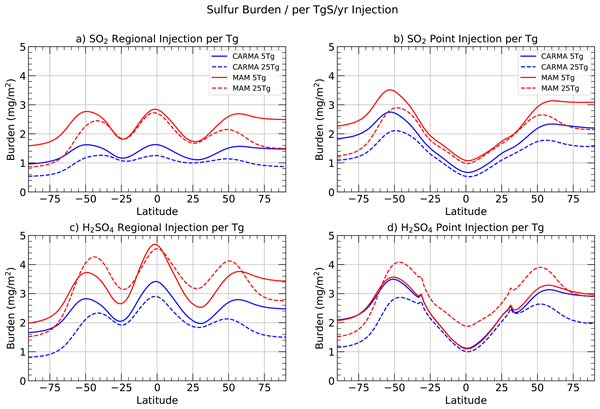
This study compares two sets of stratospheric aerosol injection (SAI) experiments using the same modeling framework, differing only in their aerosol microphysical schemes. Results show that these two schemes can yield substantially different aerosol burdens, radiative changes, and impacts when simulating the same injection scenarios. These findings suggest that more sophisticated aerosol models may be necessary to accurately assess the efficacy, side effects, and climate impacts of SAI.
Allison R. Moon, Leyang Liu, Xuan Wang, Yuk-Chun Chan, Alyson Fritzmann, Ryan Pound, Amy Lees, Lewis Marden, Mat Evans, Lucy J. Carpenter, Jochen Stutz, Joel A. Thornton, Gordon Novak, Andrew Rollins, Gregory P. Schill, Xu-Cheng He, Henning Finkenzeller, Mago Reza, Rainer Volkamer, Kelvin H. Bates, Alfonso Saiz-Lopez, Anoop S. Mahajan, and Becky Alexander
Atmos. Chem. Phys., 26, 2353–2389, https://doi.org/10.5194/acp-26-2353-2026, https://doi.org/10.5194/acp-26-2353-2026, 2026
Short summary
Short summary
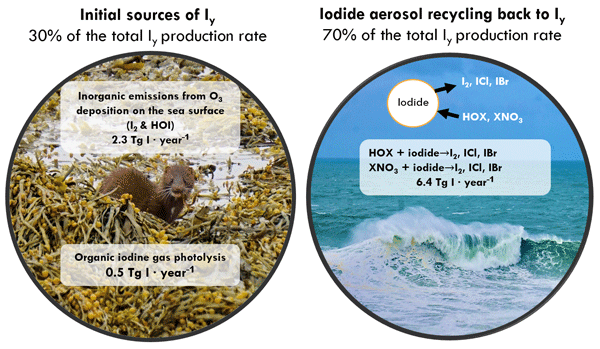
Global chemical transport models previously treated aerosols as a sink for reactive iodine (Iy); however, aerosol iodide is also a source of Iy via heterogeneous reactions involving hypohalous acids and halogen nitrates. We implemented this chemistry into GEOS-Chem, in addition to explicitly representing three aerosol iodine types: soluble organic iodine (SOI), iodide, and iodate. We found that aerosol recycling of iodide to form Iy is more than twice as fast as the other Iy sources combined.
William J. Collins, John S. Daniel, Martyn P. Chipperfield, Martin Cussac, Makoto Deushi, Gregory Faluvegi, Paul Griffiths, Øivind Hodnebrog, Larry W. Horowitz, James Keeble, Douglas Kinnison, Vaishali Naik, Fiona M. O'Connor, Drew Shindell, Simone Tilmes, Kostas Tsigaridis, Zihao Wang, and James Weber
EGUsphere, https://doi.org/10.5194/egusphere-2025-6033, https://doi.org/10.5194/egusphere-2025-6033, 2026
Short summary
Short summary
Ozone depleting substances (ODSs) are also greenhouse gases that cause global warming. However, their destruction of ozone contributes a global cooling. We have used results from climate models that include atmospheric chemistry and found that the cooling effect of the ozone depletion diagnosed in the models was larger than that calculated using a standard method. We find that some ODSs have a net cooling effect whereas for others the warming effect is significantly reduced.
Yugo Kanaya, Roberto Sommariva, Alfonso Saiz-Lopez, Andrea Mazzeo, Theodore K. Koenig, Kaori Kawana, James E. Johnson, Aurélie Colomb, Pierre Tulet, Suzie Molloy, Ian E. Galbally, Rainer Volkamer, Anoop Mahajan, John W. Halfacre, Paul B. Shepson, Julia Schmale, Hélène Angot, Byron Blomquist, Matthew D. Shupe, Detlev Helmig, Junsu Gil, Meehye Lee, Sean C. Coburn, Ivan Ortega, Gao Chen, James Lee, Kenneth C. Aikin, David D. Parrish, John S. Holloway, Thomas B. Ryerson, Ilana B. Pollack, Eric J. Williams, Brian M. Lerner, Andrew J. Weinheimer, Teresa Campos, Frank M. Flocke, J. Ryan Spackman, Ilann Bourgeois, Jeff Peischl, Chelsea R. Thompson, Ralf M. Staebler, Amir A. Aliabadi, Wanmin Gong, Roeland Van Malderen, Anne M. Thompson, Ryan M. Stauffer, Debra E. Kollonige, Juan Carlos Gómez Martin, Masatomo Fujiwara, Katie Read, Matthew Rowlinson, Keiichi Sato, Junichi Kurokawa, Yoko Iwamoto, Fumikazu Taketani, Hisahiro Takashima, Mónica Navarro-Comas, Marios Panagi, and Martin G. Schultz
Earth Syst. Sci. Data, 17, 4901–4932, https://doi.org/10.5194/essd-17-4901-2025, https://doi.org/10.5194/essd-17-4901-2025, 2025
Short summary
Short summary
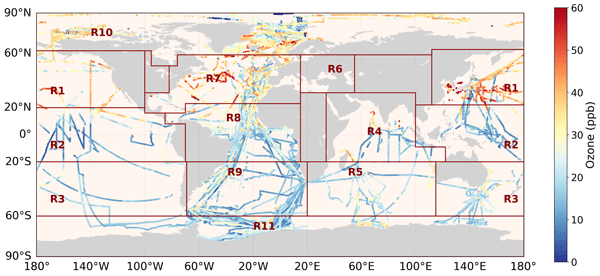
The first comprehensive dataset of tropospheric ozone over oceans/polar regions is presented, including 77 ship/buoy and 48 aircraft campaign observations (1977–2022, 0–5000 m altitude), supplemented by ozonesonde and surface data. Air masses isolated from land for 72+ hours are systematically selected as essentially oceanic. Among the 11 global regions, they show daytime decreases of 11–16 % in the tropics, while near-zero depletions are rare, unlike in the Arctic, implying different mechanisms.
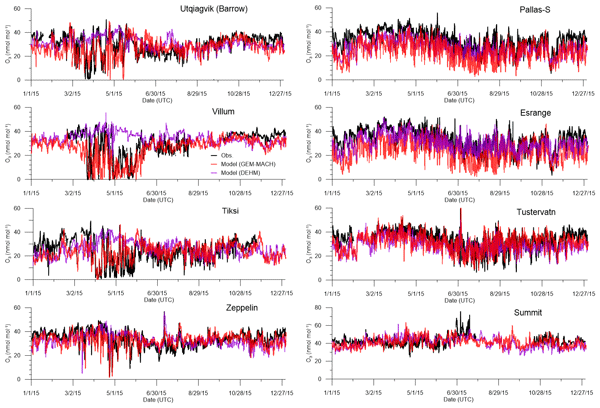
Wanmin Gong, Stephen R. Beagley, Kenjiro Toyota, Henrik Skov, Jesper Heile Christensen, Alex Lupu, Diane Pendlebury, Junhua Zhang, Ulas Im, Yugo Kanaya, Alfonso Saiz-Lopez, Roberto Sommariva, Peter Effertz, John W. Halfacre, Nis Jepsen, Rigel Kivi, Theodore K. Koenig, Katrin Müller, Claus Nordstrøm, Irina Petropavlovskikh, Paul B. Shepson, William R. Simpson, Sverre Solberg, Ralf M. Staebler, David W. Tarasick, Roeland Van Malderen, and Mika Vestenius
Atmos. Chem. Phys., 25, 8355–8405, https://doi.org/10.5194/acp-25-8355-2025, https://doi.org/10.5194/acp-25-8355-2025, 2025
Short summary
Short summary
This study showed that the springtime O3 depletion plays a critical role in driving the surface O3 seasonal cycle in the central Arctic. The O3 depletion events, while occurring most notably within the lowest few hundred metres above the Arctic Ocean, can induce a 5–7 % loss in the pan-Arctic tropospheric O3 burden during springtime. The study also found enhancements in O3 and NOy (mostly peroxyacetyl nitrate) concentrations in the Arctic due to northern boreal wildfires, particularly at higher altitudes.
Kane Stone, Susan Solomon, Pengfei Yu, Daniel M. Murphy, Douglas Kinnison, and Jian Guan
Atmos. Chem. Phys., 25, 7683–7697, https://doi.org/10.5194/acp-25-7683-2025, https://doi.org/10.5194/acp-25-7683-2025, 2025
Short summary
Short summary
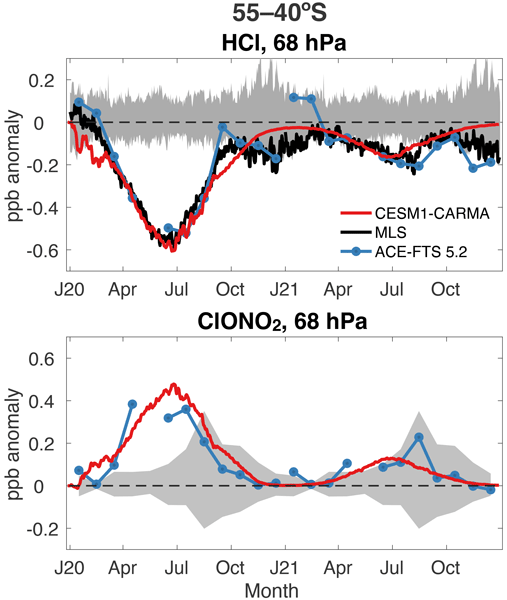
The Australian 2019–2020 wildfires injected a substantial amount of smoke into the upper atmosphere, causing unusual chemical reactions that altered the chemical makeup of the upper atmosphere. This led to ozone depletion in the Southern Hemisphere midlatitudes that likely did not fully recover until 2 years after the initial event due to the persistent chemical effects of the smoke.
Yue Sun, Yujiao Zhu, Hengde Liu, Lanxiadi Chen, Hongyong Li, Yujian Bi, Di Wu, Xiangkun Yin, Can Cui, Ping Liu, Yu Yang, Jisheng Zhang, Yanqiu Nie, Lanxin Zhang, Jiangshan Mu, Yuhong Liu, Zhaoxin Guo, Qinyi Li, Yuqiang Zhang, Xinfeng Wang, Mingjin Tang, Wenxing Wang, and Likun Xue
EGUsphere, https://doi.org/10.5194/egusphere-2025-2855, https://doi.org/10.5194/egusphere-2025-2855, 2025
Preprint archived
Short summary
Short summary
Rainwater samples collected at the summit of Mount Tai were analyzed for ice-nucleating particles (INPs). Our findings revealed that INP concentrations peaked in spring, driven predominantly by long-range transport of dust aerosols. Mineral dust contributed 43.6 % of annual INPs, with its contribution rising sharply to 71.7 % in spring. Satellite observations further revealed that the long-range transport of dust in spring promotes large-scale cloud formation over the NCP region.
Simone Tilmes, Ewa M. Bednarz, Andrin Jörimann, Daniele Visioni, Douglas E. Kinnison, Gabriel Chiodo, and David Plummer
Atmos. Chem. Phys., 25, 6001–6023, https://doi.org/10.5194/acp-25-6001-2025, https://doi.org/10.5194/acp-25-6001-2025, 2025
Short summary
Short summary
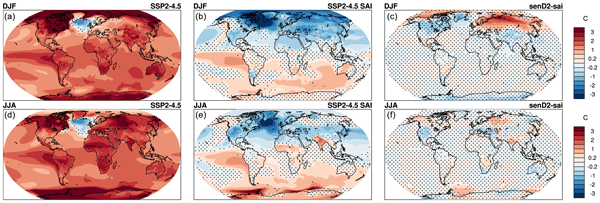
In this paper, we describe the details of a new multi-model intercomparison experiment to assess the effects of Stratospheric Aerosol Intervention (SAI) on stratospheric chemistry and dynamics and, therefore, ozone. Second, we discuss the advantages and differences of the more constrained experiment compared to fully interactive model experiments. This way, we advance the process-level understanding of the drivers of SAI-induced atmospheric responses.
Juan A. Añel, Juan-Carlos Antuña-Marrero, Antonio Cid Samamed, Celia Pérez-Souto, Laura de la Torre, Maria Antonia Valente, Yuri Brugnara, Alfonso Saiz-Lopez, and Luis Gimeno
Earth Syst. Sci. Data, 17, 2437–2446, https://doi.org/10.5194/essd-17-2437-2025, https://doi.org/10.5194/essd-17-2437-2025, 2025
Short summary
Short summary
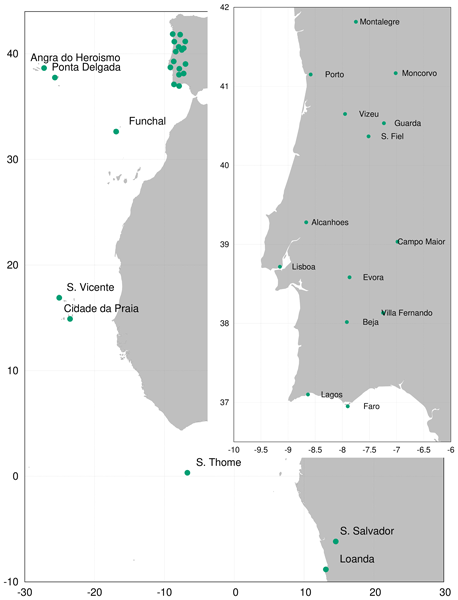
Ozone (discovered in 1837) was first measured in 1847 using paper strips that reacted with ozone, providing an indication of its concentration based on colour changes. Here, we present the data, covering over 60 years of daily observations conducted along the eastern Atlantic coast, spanning from the tropics to the northern extratropics.
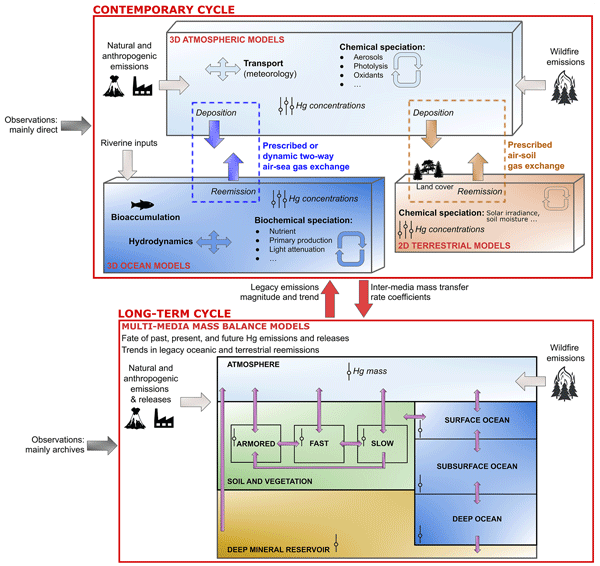
Ashu Dastoor, Hélène Angot, Johannes Bieser, Flora Brocza, Brock Edwards, Aryeh Feinberg, Xinbin Feng, Benjamin Geyman, Charikleia Gournia, Yipeng He, Ian M. Hedgecock, Ilia Ilyin, Jane Kirk, Che-Jen Lin, Igor Lehnherr, Robert Mason, David McLagan, Marilena Muntean, Peter Rafaj, Eric M. Roy, Andrei Ryjkov, Noelle E. Selin, Francesco De Simone, Anne L. Soerensen, Frits Steenhuisen, Oleg Travnikov, Shuxiao Wang, Xun Wang, Simon Wilson, Rosa Wu, Qingru Wu, Yanxu Zhang, Jun Zhou, Wei Zhu, and Scott Zolkos
Geosci. Model Dev., 18, 2747–2860, https://doi.org/10.5194/gmd-18-2747-2025, https://doi.org/10.5194/gmd-18-2747-2025, 2025
Short summary
Short summary
This paper introduces the Multi-Compartment Mercury (Hg) Modeling and Analysis Project (MCHgMAP) aimed at informing the effectiveness evaluations of two multilateral environmental agreements: the Minamata Convention on Mercury and the Convention on Long-Range Transboundary Air Pollution. The experimental design exploits a variety of models (atmospheric, land, oceanic ,and multimedia mass balance models) to assess the short- and long-term influences of anthropogenic Hg releases into the environment.
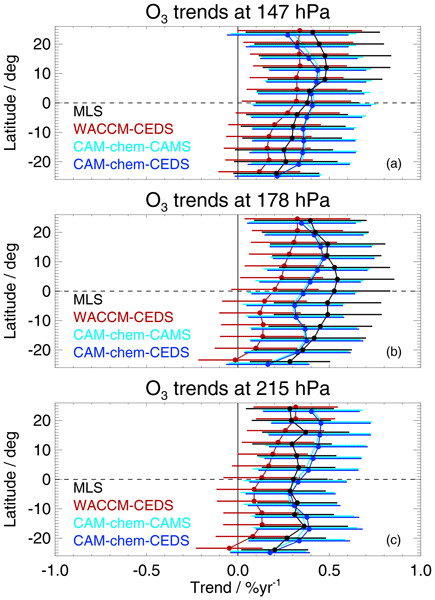
Lucien Froidevaux, Douglas E. Kinnison, Benjamin Gaubert, Michael J. Schwartz, Nathaniel J. Livesey, William G. Read, Charles G. Bardeen, Jerry R. Ziemke, and Ryan A. Fuller
Atmos. Chem. Phys., 25, 597–624, https://doi.org/10.5194/acp-25-597-2025, https://doi.org/10.5194/acp-25-597-2025, 2025
Short summary
Short summary
We compare observed changes in ozone (O3) and carbon monoxide (CO) in the tropical upper troposphere (10–15 km altitude) for 2005–2020 to predictions from model simulations that track the evolution of natural and industrial emissions transported to this region. An increasing trend in measured upper-tropospheric O3 is well matched by model trends. We find that changes in modeled industrial CO surface emissions lead to better model agreement with observed slight decreases in upper-tropospheric CO.
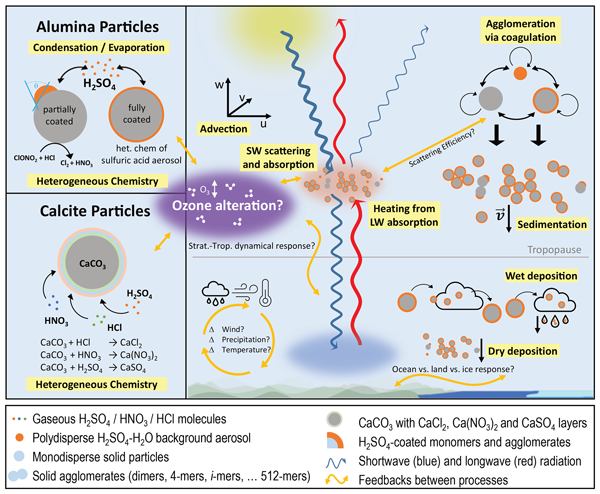
Sandro Vattioni, Rahel Weber, Aryeh Feinberg, Andrea Stenke, John A. Dykema, Beiping Luo, Georgios A. Kelesidis, Christian A. Bruun, Timofei Sukhodolov, Frank N. Keutsch, Thomas Peter, and Gabriel Chiodo
Geosci. Model Dev., 17, 7767–7793, https://doi.org/10.5194/gmd-17-7767-2024, https://doi.org/10.5194/gmd-17-7767-2024, 2024
Short summary
Short summary
We quantified impacts and efficiency of stratospheric solar climate intervention via solid particle injection. Microphysical interactions of solid particles with the sulfur cycle were interactively coupled to the heterogeneous chemistry scheme and the radiative transfer code of an aerosol–chemistry–climate model. Compared to injection of SO2 we only find a stronger cooling efficiency for solid particles when normalizing to the aerosol load but not when normalizing to the injection rate.
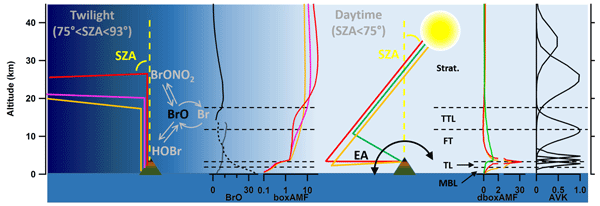
Theodore K. Koenig, François Hendrick, Douglas Kinnison, Christopher F. Lee, Michel Van Roozendael, and Rainer Volkamer
Atmos. Meas. Tech., 17, 5911–5934, https://doi.org/10.5194/amt-17-5911-2024, https://doi.org/10.5194/amt-17-5911-2024, 2024
Short summary
Short summary
Atmospheric bromine destroys ozone, impacts oxidation capacity, and oxidizes mercury into its toxic form. We constrain bromine by remote sensing of BrO from a mountaintop. Previous measurements retrieved two to three pieces of information vertically; we apply new methods to get five and a half vertically and two more in time. We compare with aircraft measurements to validate the methods and look at variations in BrO over the Pacific.
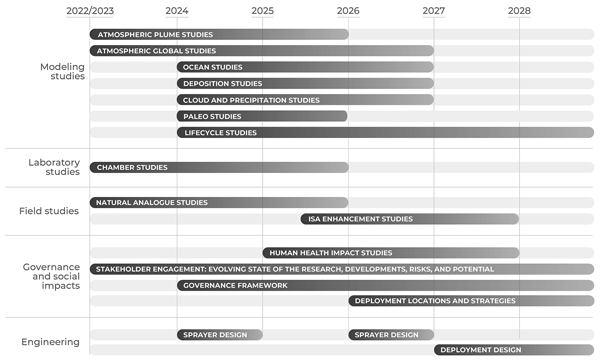
Katrine A. Gorham, Sam Abernethy, Tyler R. Jones, Peter Hess, Natalie M. Mahowald, Daphne Meidan, Matthew S. Johnson, Maarten M. J. W. van Herpen, Yangyang Xu, Alfonso Saiz-Lopez, Thomas Röckmann, Chloe A. Brashear, Erika Reinhardt, and David Mann
Atmos. Chem. Phys., 24, 5659–5670, https://doi.org/10.5194/acp-24-5659-2024, https://doi.org/10.5194/acp-24-5659-2024, 2024
Short summary
Short summary
Rapid reduction in atmospheric methane is needed to slow the rate of global warming. Reducing anthropogenic methane emissions is a top priority. However, atmospheric methane is also impacted by rising natural emissions and changing sinks. Studies of possible atmospheric methane removal approaches, such as iron salt aerosols to increase the chlorine radical sink, benefit from a roadmapped approach to understand if there may be viable and socially acceptable ways to decrease future risk.
Heesung Chong, Gonzalo González Abad, Caroline R. Nowlan, Christopher Chan Miller, Alfonso Saiz-Lopez, Rafael P. Fernandez, Hyeong-Ahn Kwon, Zolal Ayazpour, Huiqun Wang, Amir H. Souri, Xiong Liu, Kelly Chance, Ewan O'Sullivan, Jhoon Kim, Ja-Ho Koo, William R. Simpson, François Hendrick, Richard Querel, Glen Jaross, Colin Seftor, and Raid M. Suleiman
Atmos. Meas. Tech., 17, 2873–2916, https://doi.org/10.5194/amt-17-2873-2024, https://doi.org/10.5194/amt-17-2873-2024, 2024
Short summary
Short summary
We present a new bromine monoxide (BrO) product derived using radiances measured from OMPS-NM on board the Suomi-NPP satellite. This product provides nearly a decade of global stratospheric and tropospheric column retrievals, a feature that is currently rare in publicly accessible datasets. Both stratospheric and tropospheric columns from OMPS-NM demonstrate robust performance, exhibiting good agreement with ground-based observations collected at three stations (Lauder, Utqiagvik, and Harestua).
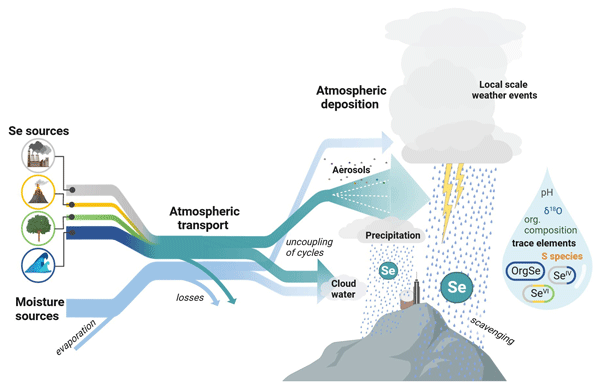
Esther S. Breuninger, Julie Tolu, Iris Thurnherr, Franziska Aemisegger, Aryeh Feinberg, Sylvain Bouchet, Jeroen E. Sonke, Véronique Pont, Heini Wernli, and Lenny H. E. Winkel
Atmos. Chem. Phys., 24, 2491–2510, https://doi.org/10.5194/acp-24-2491-2024, https://doi.org/10.5194/acp-24-2491-2024, 2024
Short summary
Short summary
Atmospheric deposition is an important source of selenium (Se) and other health-relevant trace elements in surface environments. We found that the variability in elemental concentrations in atmospheric deposition reflects not only changes in emission sources but also weather conditions during atmospheric removal. Depending on the sources and if Se is derived more locally or from further away, the Se forms can be different, affecting the bioavailability of Se atmospherically supplied to soils.
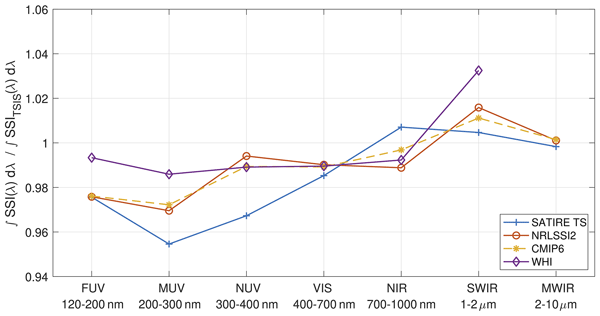
Bernd Funke, Thierry Dudok de Wit, Ilaria Ermolli, Margit Haberreiter, Doug Kinnison, Daniel Marsh, Hilde Nesse, Annika Seppälä, Miriam Sinnhuber, and Ilya Usoskin
Geosci. Model Dev., 17, 1217–1227, https://doi.org/10.5194/gmd-17-1217-2024, https://doi.org/10.5194/gmd-17-1217-2024, 2024
Short summary
Short summary
We outline a road map for the preparation of a solar forcing dataset for the upcoming Phase 7 of the Coupled Model Intercomparison Project (CMIP7), considering the latest scientific advances made in the reconstruction of solar forcing and in the understanding of climate response while also addressing the issues that were raised during CMIP6.
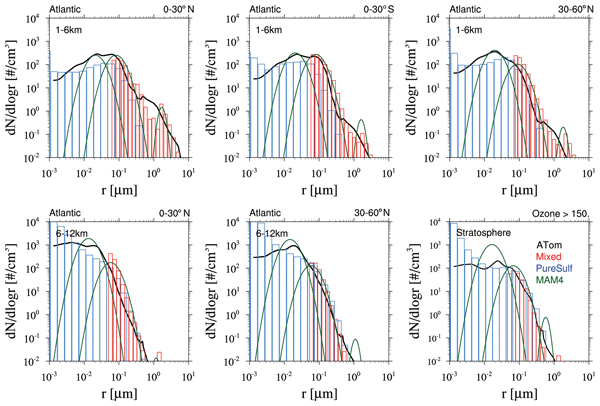
Simone Tilmes, Michael J. Mills, Yunqian Zhu, Charles G. Bardeen, Francis Vitt, Pengfei Yu, David Fillmore, Xiaohong Liu, Brian Toon, and Terry Deshler
Geosci. Model Dev., 16, 6087–6125, https://doi.org/10.5194/gmd-16-6087-2023, https://doi.org/10.5194/gmd-16-6087-2023, 2023
Short summary
Short summary
We implemented an alternative aerosol scheme in the high- and low-top model versions of the Community Earth System Model Version 2 (CESM2) with a more detailed description of tropospheric and stratospheric aerosol size distributions than the existing aerosol model. This development enables the comparison of different aerosol schemes with different complexity in the same model framework. It identifies improvements compared to a range of observations in both the troposphere and stratosphere.
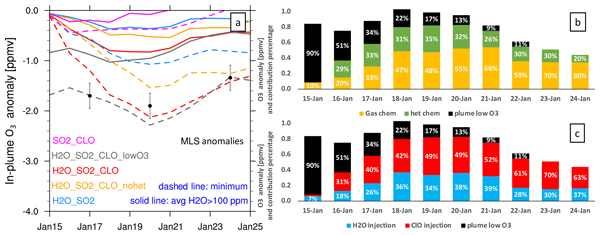
Yunqian Zhu, Robert W. Portmann, Douglas Kinnison, Owen Brian Toon, Luis Millán, Jun Zhang, Holger Vömel, Simone Tilmes, Charles G. Bardeen, Xinyue Wang, Stephanie Evan, William J. Randel, and Karen H. Rosenlof
Atmos. Chem. Phys., 23, 13355–13367, https://doi.org/10.5194/acp-23-13355-2023, https://doi.org/10.5194/acp-23-13355-2023, 2023
Short summary
Short summary
The 2022 Hunga Tonga eruption injected a large amount of water into the stratosphere. Ozone depletion was observed inside the volcanic plume. Chlorine and water vapor injected by this eruption exceeded the normal range, which made the ozone chemistry during this event occur at a higher temperature than polar ozone depletion. Unlike polar ozone chemistry where chlorine nitrate is more important, hypochlorous acid plays a large role in the in-plume chlorine balance and heterogeneous processes.
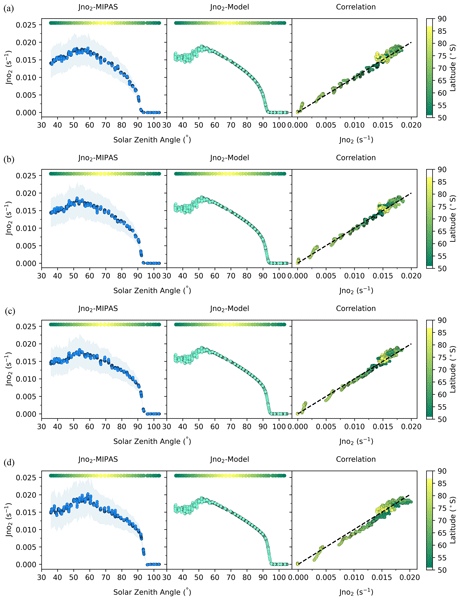
Jian Guan, Susan Solomon, Sasha Madronich, and Douglas Kinnison
Atmos. Chem. Phys., 23, 10413–10422, https://doi.org/10.5194/acp-23-10413-2023, https://doi.org/10.5194/acp-23-10413-2023, 2023
Short summary
Short summary
This paper provides a novel method to obtain a global and accurate photodissociation coefficient for NO2 (J(NO2)) based on satellite data, and the results are shown to be consistent with model results. The J(NO2) value decreases as the solar zenith angle increases and has a weak altitude dependence. A key finding is that the satellite-derived J(NO2) increases in the polar regions, in good agreement with model predictions, due to the effects of ice and snow on surface albedo.
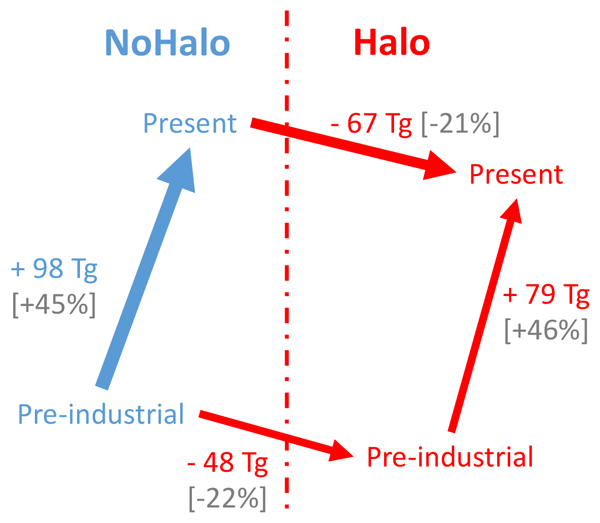
Cyril Caram, Sophie Szopa, Anne Cozic, Slimane Bekki, Carlos A. Cuevas, and Alfonso Saiz-Lopez
Geosci. Model Dev., 16, 4041–4062, https://doi.org/10.5194/gmd-16-4041-2023, https://doi.org/10.5194/gmd-16-4041-2023, 2023
Short summary
Short summary
We studied the role of halogenated compounds (containing chlorine, bromine and iodine), emitted by natural processes (mainly above the oceans), in the chemistry of the lower layers of the atmosphere. We introduced this relatively new chemistry in a three-dimensional climate–chemistry model and looked at how this chemistry will disrupt the ozone. We showed that the concentration of ozone decreases by 22 % worldwide and that of the atmospheric detergent, OH, by 8 %.
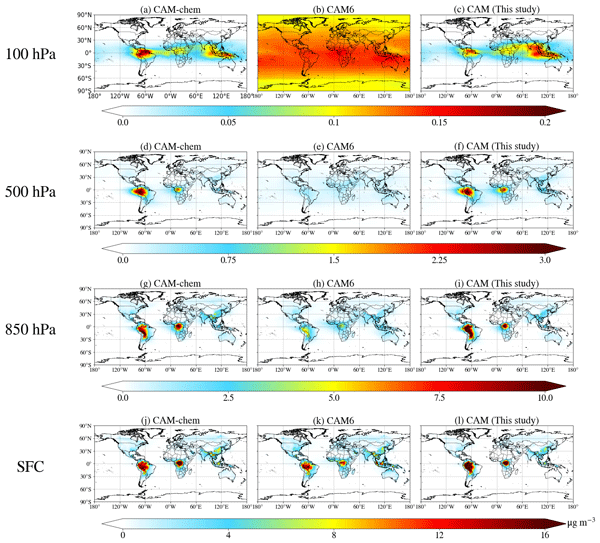
Duseong S. Jo, Simone Tilmes, Louisa K. Emmons, Siyuan Wang, and Francis Vitt
Geosci. Model Dev., 16, 3893–3906, https://doi.org/10.5194/gmd-16-3893-2023, https://doi.org/10.5194/gmd-16-3893-2023, 2023
Short summary
Short summary
A new simple secondary organic aerosol (SOA) scheme has been developed for the Community Atmosphere Model (CAM) based on the complex SOA scheme in CAM with detailed chemistry (CAM-chem). The CAM with the new SOA scheme shows better agreements with CAM-chem in terms of aerosol concentrations and radiative fluxes, which ensures more consistent results between different compsets in the Community Earth System Model. The new SOA scheme also has technical advantages for future developments.
Michael Weimer, Douglas E. Kinnison, Catherine Wilka, and Susan Solomon
Atmos. Chem. Phys., 23, 6849–6861, https://doi.org/10.5194/acp-23-6849-2023, https://doi.org/10.5194/acp-23-6849-2023, 2023
Short summary
Short summary
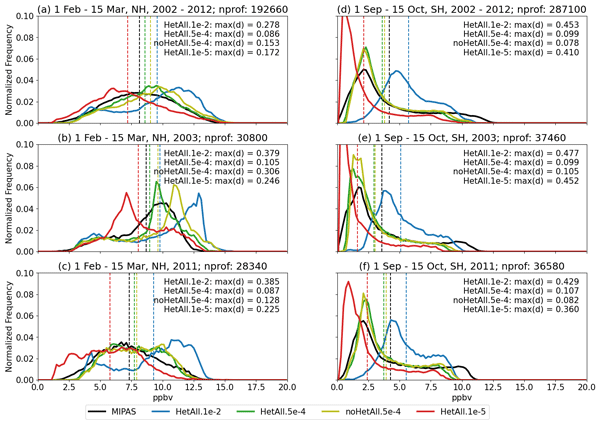
We investigate the influence of the number density of nitric acid trihydrate (NAT) particles on associated trace gases in the lower stratosphere using data from a satellite, ozonesondes and simulations by a community chemistry climate model. By comparing probability density functions between observations and the model, we find that the standard NAT number density should be reduced for future simulations with the model.
Manon Rocco, Erin Dunne, Alexia Saint-Macary, Maija Peltola, Theresa Barthelmeß, Neill Barr, Karl Safi, Andrew Marriner, Stacy Deppeler, James Harnwell, Anja Engel, Aurélie Colomb, Alfonso Saiz-Lopez, Mike Harvey, Cliff S. Law, and Karine Sellegri
EGUsphere, https://doi.org/10.5194/egusphere-2023-516, https://doi.org/10.5194/egusphere-2023-516, 2023
Preprint archived
Short summary
Short summary
During the Sea2cloud campaign in the Southern Pacific Ocean, we measured air-sea emissions from phytopankton of two key atmospheric compounds: DMS and MeSH. These compounds are well-known to play a great role in atmospheric chemistry and climate. We see in this paper that these compounds are most emited by the nanophytoplankton population. We provide here parameters for climate models to predict future trends of the emissions of these compounds and their roles and impacts on the global warming.
Thomas Berkemeier, Matteo Krüger, Aryeh Feinberg, Marcel Müller, Ulrich Pöschl, and Ulrich K. Krieger
Geosci. Model Dev., 16, 2037–2054, https://doi.org/10.5194/gmd-16-2037-2023, https://doi.org/10.5194/gmd-16-2037-2023, 2023
Short summary
Short summary
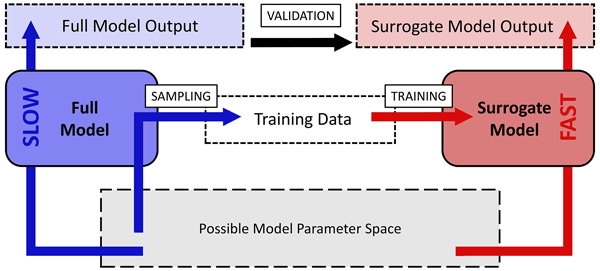
Kinetic multi-layer models (KMs) successfully describe heterogeneous and multiphase atmospheric chemistry. In applications requiring repeated execution, however, these models can be too expensive. We trained machine learning surrogate models on output of the model KM-SUB and achieved high correlations. The surrogate models run orders of magnitude faster, which suggests potential applicability in global optimization tasks and as sub-modules in large-scale atmospheric models.
François Burgay, Rafael Pedro Fernández, Delia Segato, Clara Turetta, Christopher S. Blaszczak-Boxe, Rachael H. Rhodes, Claudio Scarchilli, Virginia Ciardini, Carlo Barbante, Alfonso Saiz-Lopez, and Andrea Spolaor
The Cryosphere, 17, 391–405, https://doi.org/10.5194/tc-17-391-2023, https://doi.org/10.5194/tc-17-391-2023, 2023
Short summary
Short summary
The paper presents the first ice-core record of bromine (Br) in the Antarctic plateau. By the observation of the ice core and the application of atmospheric chemical models, we investigate the behaviour of bromine after its deposition into the snowpack, with interest in the effect of UV radiation change connected to the formation of the ozone hole, the role of volcanic deposition, and the possible use of Br to reconstruct past sea ice changes from ice core collect in the inner Antarctic plateau.
Markus Jesswein, Rafael P. Fernandez, Lucas Berná, Alfonso Saiz-Lopez, Jens-Uwe Grooß, Ryan Hossaini, Eric C. Apel, Rebecca S. Hornbrook, Elliot L. Atlas, Donald R. Blake, Stephen Montzka, Timo Keber, Tanja Schuck, Thomas Wagenhäuser, and Andreas Engel
Atmos. Chem. Phys., 22, 15049–15070, https://doi.org/10.5194/acp-22-15049-2022, https://doi.org/10.5194/acp-22-15049-2022, 2022
Short summary
Short summary
This study presents the global and seasonal distribution of the two major brominated short-lived substances CH2Br2 and CHBr3 in the upper troposphere and lower stratosphere based on observations from several aircraft campaigns. They show similar seasonality for both hemispheres, except in the respective hemispheric autumn lower stratosphere. A comparison with the TOMCAT and CAM-Chem models shows good agreement in the annual mean but larger differences in the seasonal consideration.
Lucien Froidevaux, Douglas E. Kinnison, Michelle L. Santee, Luis F. Millán, Nathaniel J. Livesey, William G. Read, Charles G. Bardeen, John J. Orlando, and Ryan A. Fuller
Atmos. Chem. Phys., 22, 4779–4799, https://doi.org/10.5194/acp-22-4779-2022, https://doi.org/10.5194/acp-22-4779-2022, 2022
Short summary
Short summary
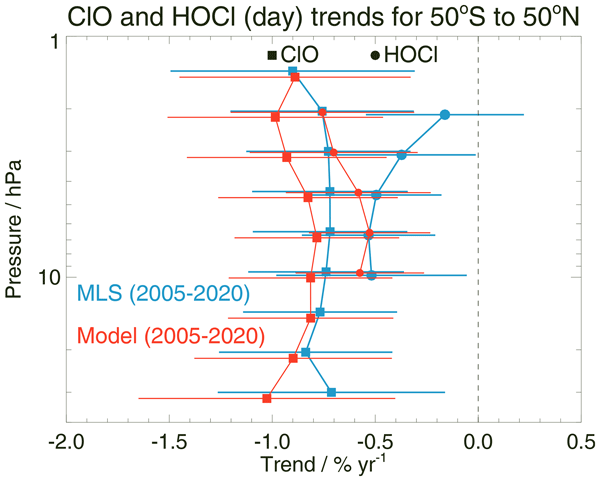
We analyze satellite-derived distributions of chlorine monoxide (ClO) and hypochlorous acid (HOCl) in the upper atmosphere. For 2005–2020, from 50°S to 50°N and over ~30 to 45 km, ClO and HOCl decreased by −0.7 % and −0.4 % per year, respectively. A detailed model of chemistry and dynamics agrees with the results. These decreases confirm the effectiveness of the 1987 Montreal Protocol, which limited emissions of chlorine- and bromine-containing source gases, in order to protect the ozone layer.

Hisahiro Takashima, Yugo Kanaya, Saki Kato, Martina M. Friedrich, Michel Van Roozendael, Fumikazu Taketani, Takuma Miyakawa, Yuichi Komazaki, Carlos A. Cuevas, Alfonso Saiz-Lopez, and Takashi Sekiya
Atmos. Chem. Phys., 22, 4005–4018, https://doi.org/10.5194/acp-22-4005-2022, https://doi.org/10.5194/acp-22-4005-2022, 2022
Short summary
Short summary
We have undertaken atmospheric iodine monoxide (IO) observations in the global marine boundary layer with a wide latitudinal coverage and sea surface temperature (SST) range. We conclude that atmospheric iodine is abundant over the Western Pacific warm pool, appearing as an iodine fountain, where ozone (O3) minima occur. Our study also found negative correlations between IO and O3 concentrations over IO maxima, which requires reconsideration of the initiation process of halogen activation.
Matthias Schneider, Benjamin Ertl, Christopher J. Diekmann, Farahnaz Khosrawi, Andreas Weber, Frank Hase, Michael Höpfner, Omaira E. García, Eliezer Sepúlveda, and Douglas Kinnison
Earth Syst. Sci. Data, 14, 709–742, https://doi.org/10.5194/essd-14-709-2022, https://doi.org/10.5194/essd-14-709-2022, 2022
Short summary
Short summary
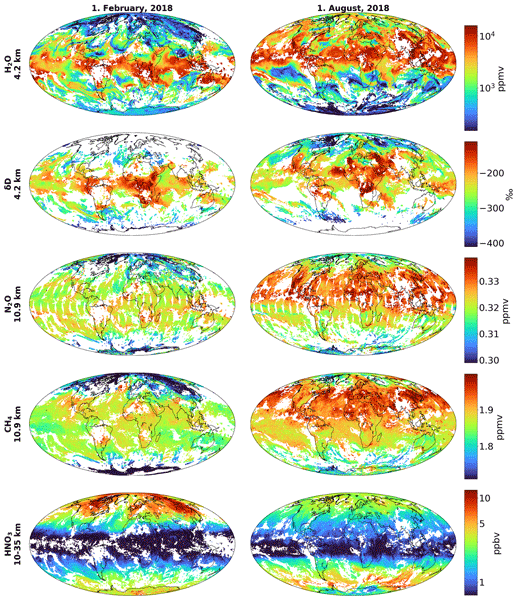
We present atmospheric H2O, HDO / H2O ratio, N2O, CH4, and HNO3 data generated by the MUSICA IASI processor using thermal nadir spectra measured by the IASI satellite instrument. The data have global daily coverage and are available for the period between October 2014 and June 2021. Multiple possibilities of data reuse are offered by providing each individual data product together with information about retrieval settings and the products' uncertainty and vertical representativeness.
Zhiyuan Gao, Nicolas-Xavier Geilfus, Alfonso Saiz-Lopez, and Feiyue Wang
Atmos. Chem. Phys., 22, 1811–1824, https://doi.org/10.5194/acp-22-1811-2022, https://doi.org/10.5194/acp-22-1811-2022, 2022
Short summary
Short summary
Every spring in the Arctic, a series of photochemical events occur over the ice-covered ocean, known as bromine explosion events, ozone depletion events, and mercury depletion events. Here we report the re-creation of these events at an outdoor sea ice facility in Winnipeg, Canada, far away from the Arctic. The success provides a new platform with new opportunities to uncover fundamental mechanisms of these Arctic springtime phenomena and how they may change in a changing climate.
Arseniy Karagodin-Doyennel, Eugene Rozanov, Timofei Sukhodolov, Tatiana Egorova, Alfonso Saiz-Lopez, Carlos A. Cuevas, Rafael P. Fernandez, Tomás Sherwen, Rainer Volkamer, Theodore K. Koenig, Tanguy Giroud, and Thomas Peter
Geosci. Model Dev., 14, 6623–6645, https://doi.org/10.5194/gmd-14-6623-2021, https://doi.org/10.5194/gmd-14-6623-2021, 2021
Short summary
Short summary
Here, we present the iodine chemistry module in the SOCOL-AERv2 model. The obtained iodine distribution demonstrated a good agreement when validated against other simulations and available observations. We also estimated the iodine influence on ozone in the case of present-day iodine emissions, the sensitivity of ozone to doubled iodine emissions, and when considering only organic or inorganic iodine sources. The new model can be used as a tool for further studies of iodine effects on ozone.
S. Enrique Puliafito, Tomás R. Bolaño-Ortiz, Rafael P. Fernandez, Lucas L. Berná, Romina M. Pascual-Flores, Josefina Urquiza, Ana I. López-Noreña, and María F. Tames
Earth Syst. Sci. Data, 13, 5027–5069, https://doi.org/10.5194/essd-13-5027-2021, https://doi.org/10.5194/essd-13-5027-2021, 2021
Short summary
Short summary
GEAA-AEIv3.0M atmospheric emissions inventory is the first high-spatial-resolution inventory (approx. 2.5 km × 2.5 km) with monthly variability from 1995 to 2020, including greenhouse gases, ozone precursors, acidifying gases, and particulate matter, from all Argentine productive activities. The main benefit of GEAA-AEIv3.0M is to map emissions with better temporal resolution to support air quality and climate modeling, to evaluate pollutant mitigation strategies by Argentine decision makers.
Catherine Wilka, Susan Solomon, Doug Kinnison, and David Tarasick
Atmos. Chem. Phys., 21, 15771–15781, https://doi.org/10.5194/acp-21-15771-2021, https://doi.org/10.5194/acp-21-15771-2021, 2021
Short summary
Short summary
We use satellite and balloon measurements to evaluate modeled ozone loss seen in the unusually cold Arctic of 2020 in the real world and compare it to simulations of a world avoided. We show that extensive denitrification in 2020 provides an important test case for stratospheric model process representations. If the Montreal Protocol had not banned ozone-depleting substances, an Arctic ozone hole would have emerged for the first time in spring 2020 that is comparable to those in the Antarctic.
Cited articles
Abrahamsson, K., Granfors, A., Ahnoff, M., Cuevas, C. A., and Saiz-Lopez, A.: Organic bromine compounds produced in sea ice in Antarctic winter, Nat. Commun., 9, https://doi.org/10.1038/s41467-018-07062-8, 2018.
Alicke, B., Hebestreit, K., Stutz, J., and Platt, U.: Iodine oxide in the marine boundary layer, Nature, 397, 572–573, https://doi.org/10.1038/17508, 1999.
Aschmann, J. and Sinnhuber, B.-M.: Contribution of very short-lived substances to stratospheric bromine loading: uncertainties and constraints, Atmos. Chem. Phys., 13, 1203–1219, https://doi.org/10.5194/acp-13-1203-2013, 2013.
Aschmann, J., Sinnhuber, B.-M., Chipperfield, M. P., and Hossaini, R.: Impact of deep convection and dehydration on bromine loading in the upper troposphere and lower stratosphere, Atmos. Chem. Phys., 11, 2671–2687, https://doi.org/10.5194/acp-11-2671-2011, 2011.
Atkinson, R., Baulch, D. L., Cox, R. A., Crowley, J. N., Hampson, R. F., Hynes, R. G., Jenkin, M. E., Rossi, M. J., and Troe, J.: Evaluated kinetic and photochemical data for atmospheric chemistry: Volume III – gas phase reactions of inorganic halogens, Atmos. Chem. Phys., 7, 981–1191, https://doi.org/10.5194/acp-7-981-2007, 2007.
Atkinson, R., Baulch, D. L., Cox, R. A., Crowley, J. N., Hampson, R. F., Hynes, R. G., Jenkin, M. E., Rossi, M. J., Troe, J., and Wallington, T. J.: Evaluated kinetic and photochemical data for atmospheric chemistry: Volume IV – gas phase reactions of organic halogen species, Atmos. Chem. Phys., 8, 4141–4496, https://doi.org/10.5194/acp-8-4141-2008, 2008.
Badia, A., Reeves, C. E., Baker, A. R., Saiz-Lopez, A., Volkamer, R., Koenig, T. K., Apel, E. C., Hornbrook, R. S., Carpenter, L. J., Andrews, S. J., Sherwen, T., and Von Glasow, R.: Importance of reactive halogens in the tropical marine atmosphere: A regional modelling study using WRF-Chem, Atmos. Chem. Phys., 19, 3161–3189, https://doi.org/10.5194/acp-19-3161-2019, 2019.
Badia, A., Iglesias-Suarez, F., Fernandez, R. P., Cuevas, C. A., Kinnison, D. E., Lamarque, J.-F., Griffiths, P. T., Tarasick, D. W., Liu, J., and Saiz-Lopez, A.: The Role of Natural Halogens in Global Tropospheric Ozone Chemistry and Budget Under Different 21st Century Climate Scenarios, J. Geophys. Res.-Atmos., 126, e2021JD034859, https://doi.org/10.1029/2021JD034859, 2021.
Bange, H. (Ed.): FS Poseidon Fahrtbericht/Cruise Report P399 – 2&3: Eastern tropical North Atlantic; P399-2: 31.04.2010–17.06.2010 Las Palmas – Las Palmas (Canary Islands), P399-3: 18.–24.06.2010 Las Palmas (Canary Islands) – Vigo (Spain) ; DRIVE (Diurnal and RegIonal Variability of Halogen Emmissions), SOPRAN, Open Access, IFM-GEOMAR Report, 48, IFM-GEOMAR, Kiel, 74 pp., https://oceanrep.geomar.de/id/eprint/12032/ (last access: 4 May 2026), 2011.
Barrera, J. A., Fernandez, R. P., Iglesias-Suarez, F., Cuevas, C. A., Lamarque, J.-F., and Saiz-Lopez, A.: Seasonal impact of biogenic very short-lived bromocarbons on lowermost stratospheric ozone between 60° N and 60° S during the 21st century, Atmos. Chem. Phys., 20, 8083–8102, https://doi.org/10.5194/acp-20-8083-2020, 2020.
Barrera, J. A., Kinnison, D. E., Fernandez, R. P., Lamarque, J., Cuevas, C. A., Tilmes, S., and Saiz‐Lopez, A.: Comparing the Effect of Anthropogenically Amplified Halogen Natural Emissions on Tropospheric Ozone Chemistry Between Pre‐Industrial and Present‐Day, J. Geophys. Res.-Atmos., 128, e2022JD038283, https://doi.org/10.1029/2022JD038283, 2023.
Benavent, N., Mahajan, A. S., Li, Q., Cuevas, C. A., Schmale, J., Angot, H., Jokinen, T., Quélëver, L. L. J., Blechschmidt, A. M., Zilker, B., Richter, A., Serna, J. A., Garcia-Nieto, D., Fernandez, R. P., Skov, H., Dumitrascu, A., Simões Pereira, P., Abrahamsson, K., Bucci, S., Duetsch, M., Stohl, A., Beck, I., Laurila, T., Blomquist, B., Howard, D., Archer, S. D., Bariteau, L., Helmig, D., Hueber, J., Jacobi, H. W., Posman, K., Dada, L., Daellenbach, K. R., and Saiz-Lopez, A.: Substantial contribution of iodine to Arctic ozone destruction, Nat. Geosci., 15, 770–773, https://doi.org/10.1038/s41561-022-01018-w, 2022.
Bossolasco, A., Fernandez, R., Li, Q., Mahajan, A., Villamayor, J., Barrera, J., Heard, D. E., Cuevas, C., Caram, C., Szopa, S., and Saiz-Lopez, A.: Key role of short-lived halogens on global atmospheric oxidation during historical periods, Environ. Sci. Atmos., 5, 547–562, https://doi.org/10.1039/D4EA00141A, 2025.
Burkholder, J. B., Sander, S. P., Abbatt, J. P. D., Barker, J. R., Cappa, C., Crounse, J. D., Dibble, T. S., Huie, R. E., Kolb, C. E., Kurylo, M., Orkin, V., Percival, C., Wilmouth, D., and Wine, P. H.: Chemical Kinetics and Photochemical Data for Use in Atmospheric Studies Evaluation Number 19 – Publication 19-5, JPL_NASA, https://jpldataeval.jpl.nasa.gov/ (last access: 4 May 2026), 2020.
Butler, J. H., King, D. B., Lobert, J. M., Montzka, S. a., Yvon-Lewis, S. a., Hall, B. D., Warwick, N. J., Mondeel, D. J., Aydin, M., and Elkins, J. W.: Oceanic distributions and emissions of short-lived halocarbons, Global Biogeochem. Cy., 21, https://doi.org/10.1029/2006GB002732, 2007.
Caram, C., Szopa, S., Cozic, A., Bekki, S., Cuevas, C. A., and Saiz-Lopez, A.: Sensitivity of tropospheric ozone to halogen chemistry in the chemistry-climate model LMDZ-INCA vNMHC, Geosci. Model Dev., 16, 4041–4062, https://doi.org/10.5194/gmd-16-4041-2023, 2023.
Carpenter, L. J. and Liss, P. S.: On temperate sources of bromoform and other reactive organic bromine gases, J. Geophys. Res., 105, 20539–20547, https://doi.org/10.1029/2000JD900242, 2000.
Carpenter, L. J., Malin, G., Liss, P. S., and Küpper, F. C.: Novel biogenic iodine-containing trihalomethanes and other short-lived halocarbons in the coastal East Atlantic, Global Biogeochem. Cy., 14, 1191–1204, https://doi.org/10.1029/2000GB001257, 2000.
Carpenter, L. J., Liss, P. S., and Penkett, S. A.: Marine organohalogens in the atmosphere over the Atlantic and Southern Oceans, J. Geophys. Res.-Atmos., 108, https://doi.org/10.1029/2002JD002769, 2003.
Carpenter, L. J., MacDonald, S. M., Shaw, M. D., Kumar, R., Saunders, R. W., Parthipan, R., Wilson, J., and Plane, J. M. C.: Atmospheric iodine levels influenced by sea surface emissions of inorganic iodine, Nat. Geosci., 6, 108–111, https://doi.org/10.1038/ngeo1687, 2013.
Chance, K.: Analysis of BrO measurements from the Global Ozone Monitoring Experiment, Geophys. Res. Lett., 25, 3335–3338, https://doi.org/10.1029/98GL52359, 1998.
Chang, D., Li, Q., Wang, Z., Dai, J., Fu, X., Guo, J., Zhu, L., Pu, D., Cuevas, C. A., Fernandez, R. P., Wang, W., Ge, M., Fung, J. C. H., Lau, A. K. H., Granier, C., Brasseur, G., Pozzer, A., Saiz-Lopez, A., Song, Y., and Wang, T.: Significant chlorine emissions from biomass burning affect the long-term atmospheric chemistry in Asia, Natl. Sci. Rev., 11, https://doi.org/10.1093/nsr/nwae285, 2024.
Chen, Q., Sherwen, T., Evans, M., and Alexander, B.: DMS oxidation and sulfur aerosol formation in the marine troposphere: A focus on reactive halogen and multiphase chemistry, Atmos. Chem. Phys., 18, 13617–13637, https://doi.org/10.5194/acp-18-13617-2018, 2018.
CISL (Computational and Information Systems Laboratory): Derecho: HPE Cray EX System (University Community Computing), Boulder, CO: NSF National Center for Atmospheric Research, https://doi.org/10.5065/qx9a-pg09, 2023.
Claxton, T., Hossaini, R., Wilson, C., Montzka, S. A., Chipperfield, M. P., Wild, O., Bednarz, E. M., Carpenter, L. J., Andrews, S. J., Hackenberg, S. C., Mühle, J., Oram, D., Park, S., Park, M., Atlas, E., Navarro, M., Schauffler, S., Sherry, D., Vollmer, M., Schuck, T., Engel, A., Krummel, P. B., Maione, M., Arduini, J., Saito, T., Yokouchi, Y., O'Doherty, S., Young, D., and Lunder, C.: A Synthesis Inversion to Constrain Global Emissions of Two Very Short Lived Chlorocarbons: Dichloromethane, and Perchloroethylene, J. Geophys. Res.-Atmos., 125, e2019JD031818, https://doi.org/10.1029/2019JD031818, 2020.
Cuevas, C. A., Maffezzoli, N., Corella, J. P., Spolaor, A., Vallelonga, P., Kjær, H. A., Simonsen, M., Winstrup, M., Vinther, B., Horvat, C., Fernandez, R. P., Kinnison, D., Lamarque, J., Barbante, C., and Saiz-lopez, A.: Rapid increase in atmospheric iodine levels in the North Atlantic since the mid-20th century, Nat. Commun., 9, 1452, https://doi.org/10.1038/s41467-018-03756-1, 2018.
Cuevas, C. A., Fernandez, R. P., Kinnison, D. E., Li, Q., Lamarque, J. F., Trabelsi, T., Francisco, J. S., Solomon, S., and Saiz-Lopez, A.: The influence of iodine on the Antarctic stratospheric ozone hole, P. Natl. Acad. Sci. USA, 119, e2110864119, https://doi.org/10.1073/pnas.2110864119, 2022.
Danabasoglu, G., Lamarque, J. F., Bacmeister, J., Bailey, D. A., DuVivier, A. K., Edwards, J., Emmons, L. K., Fasullo, J., Garcia, R., Gettelman, A., Hannay, C., Holland, M. M., Large, W. G., Lauritzen, P. H., Lawrence, D. M., Lenaerts, J. T. M., Lindsay, K., Lipscomb, W. H., Mills, M. J., Neale, R., Oleson, K. W., Otto-Bliesner, B., Phillips, A. S., Sacks, W., Tilmes, S., van Kampenhout, L., Vertenstein, M., Bertini, A., Dennis, J., Deser, C., Fischer, C., Fox-Kemper, B., Kay, J. E., Kinnison, D., Kushner, P. J., Larson, V. E., Long, M. C., Mickelson, S., Moore, J. K., Nienhouse, E., Polvani, L., Rasch, P. J., and Strand, W. G.: The Community Earth System Model Version 2 (CESM2), J. Adv. Model. Earth Syst., 12, 1–35, https://doi.org/10.1029/2019MS001916, 2020.
Davis, N. A., Callaghan, P., Simpson, I. R., and Tilmes, S.: Specified dynamics scheme impacts on wave-mean flow dynamics, convection, and tracer transport in CESM2 (WACCM6), Atmos. Chem. Phys., 22, 197–214, https://doi.org/10.5194/acp-22-197-2022, 2022.
Emmons, L. K., Schwantes, R. H., Orlando, J. J., Tyndall, G., Kinnison, D., Lamarque, J. F., Marsh, D., Mills, M. J., Tilmes, S., Bardeen, C., Buchholz, R. R., Conley, A., Gettelman, A., Garcia, R., Simpson, I., Blake, D. R., Meinardi, S., and Pétron, G.: The Chemistry Mechanism in the Community Earth System Model Version 2 (CESM2), J. Adv. Model. Earth Syst., 12, 1–21, https://doi.org/10.1029/2019MS001882, 2020.
ERA5, Hersbach, H., Bell, B., Berrisford, P., Biavati, G., Horányi, A., Muñoz Sabater, J., Nicolas, J., Peubey, C., Radu, R., Rozum, I., Schepers, D., Simmons, A., Soci, C., Dee, D., and Thépaut, J.-N.: ERA5 hourly data on single levels from 1940 to present, Copernicus Clim. Chang. Serv. Clim. Data Store [data set], https://doi.org/10.24381/cds.adbb2d47, 2023.
Eyring, V., Lamarque, J.-F., Hess, P., Arfeuille, F., Bowman, K., Chipperfield, M. P., Duncan, B., Fiore, A., Gettelman, A., Giorgetta, M. A., Granier, C., Hegglin, M., Kinnison, D., Kunze, M., Langematz, U., Luo, B., Martin, R., Matthes, K., Newman, P. A., Peter, T., Robock, A., Ryerson, T., Saiz-Lopez, A., Salawitch, R., Schultz, M., Shepherd, T. G., Shindell, D., Stähelin, J., Tegtmeier, S., Thomason, L., Tilmes, S., Vernier, J.-P., Waugh, D. W., and Young, P. J.: Overview of IGAC/SPARC Chemistry-Climate Model Initiative (CCMI) Community Simulations in Support of Upcoming Ozone and Climate Assessments, SPARC Newsl. 40, 48–66, http://www.met.reading.ac.uk/ccmi/?page_id=15 (last access: 4 May 2026), 2013.
Eyring, V., Bony, S., Meehl, G. A., Senior, C. A., Stevens, B., Stouffer, R. J., and Taylor, K. E.: Overview of the Coupled Model Intercomparison Project Phase 6 (CMIP6) experimental design and organization, Geosci. Model Dev., 9, 1937–1958, https://doi.org/10.5194/gmd-9-1937-2016, 2016.
Fernandez, R. P., Salawitch, R. J. J., Kinnison, D. E. E., Lamarque, J.-F., and Saiz-Lopez, A.: Bromine partitioning in the tropical tropopause layer: implications for stratospheric injection, Atmos. Chem. Phys., 14, 13391–13410, https://doi.org/10.5194/acp-14-13391-2014, 2014.
Fernandez, R. P., Kinnison, D. E., Lamarque, J. F., Tilmes, S., and Saiz-Lopez, A.: Impact of biogenic very short-lived bromine on the Antarctic ozone hole during the 21st century, Atmos. Chem. Phys., 17, 1673–1688, https://doi.org/10.5194/acp-17-1673-2017, 2017.
Fernandez, R. P., Carmona-Balea, A., Cuevas, C. A., Barrera, J. A., Kinnison, D. E., Lamarque, J., Blaszczak‐Boxe, C., Kim, K., Choi, W., Hay, T., Blechschmidt, A., Schönhardt, A., Burrows, J. P., and Saiz-Lopez, A.: Modeling the Sources and Chemistry of Polar Tropospheric Halogens (Cl, Br, and I) Using the CAM‐Chem Global Chemistry‐Climate Model, J. Adv. Model. Earth Syst., 11, 2259–2289, https://doi.org/10.1029/2019ms001655, 2019.
Fernandez, R. P., Barrera, J. A., López-Noreña, A. I., Kinnison, D. E., Nicely, J., Salawitch, R. J., Wales, P. A., Toselli, B. M., Tilmes, S., Lamarque, J. F., Cuevas, C. A., and Saiz-Lopez, A.: Intercomparison Between Surrogate, Explicit, and Full Treatments of VSL Bromine Chemistry Within the CAM-Chem Chemistry-Climate Model, Geophys. Res. Lett., 48, 1–10, https://doi.org/10.1029/2020GL091125, 2021.
Fernandez, R. P., Berná, L., Tomazzeli, O. G., Mahajan, A. S., Li, Q., Kinnison, D. E., Wang, S., Lamarque, J.-F., Tilmes, S., Skov, H., Cuevas, C. A.m and Saiz-Lopez, A.: Arctic halogens reduce ozone in the northern mid-latitudes, P. Natl. Acad. Sci. USA, 121, 2017, https://doi.org/10.1073/pnas.2401975121, 2024.
Fernandez, R. P., Cuevas, C. A., Villamayor, J., Feinberg, A., Kinnison, D., Vitt, F., Bossolasco, A., Barrera, J. A., Reynoso, A., Tomazzeli, O. G., Li, Q., and Saiz-Lopez, A.: RafaPedroFernandez/CESM: CESM2-SLH release (Version cesm2.2-asdbranch_slh_tag), Zenodo [computer software], https://doi.org/10.5281/zenodo.21738917, 2026a.
Fernandez, R. P., Cuevas, C., Villamayor, J., Feinberg, A., Kinnison, D., Vitt, F., Bossolasco, A., Barrera, J. A., Reynoso, A., Tomazzeli, O., Li, Q., and Saiz-Lopez, A.: CESM2-SLH Public Repository: Code and Data, V2, Mendeley Data [data set], https://doi.org/10.17632/f87hvrv25v.3, 2026b.
Fu, X., Sun, X., Travnikov, O., Li, Q., Qin, C., Cuevas, C. A., Fernandez, R. P., Mahajan, A. S., Wang, S., Wang, T., and Saiz-Lopez, A.: Anthropogenic short-lived halogens increase human exposure to mercury contamination due to enhanced mercury oxidation over continents, P. Natl. Acad. Sci. USA, 121, e2315058121, https://doi.org/10.1073/pnas.2315058121, 2024.
Ge, W., Liu, J., Xiang, S., Zhou, Y., Zhou, J., Hu, X., Ma, J., Wang, X., Wan, Y., Hu, J., Zhang, Z., Wang, X., and Tao, S.: Improvement and Uncertainties of Global Simulation of Sulfate Concentration and Radiative Forcing in CESM2, J. Geophys. Res.-Atmos., 127, e2022JD037623, https://doi.org/10.1029/2022JD037623, 2022.
Gettelman, A., Hannay, C., Bacmeister, J. T., Neale, R. B., Pendergrass, A. G., Danabasoglu, G., Lamarque, J. ‐F., Fasullo, J. T., Bailey, D. A., Lawrence, D. M., and Mills, M. J.: High Climate Sensitivity in the Community Earth System Model Version 2 (CESM2), Geophys. Res. Lett., 46, 8329–8337, https://doi.org/10.1029/2019GL083978, 2019a.
Gettelman, A., Mills, M. J., Kinnison, D. E., Garcia, R. R., Smith, A. K., Marsh, D. R., Tilmes, S., Vitt, F., Bardeen, C. G., McInerny, J., Liu, H. L., Solomon, S. C., Polvani, L. M., Emmons, L. K., Lamarque, J. F., Richter, J. H., Glanville, A. S., Bacmeister, J. T., Phillips, A. S., Neale, R. B., Simpson, I. R., DuVivier, A. K., Hodzic, A., and Randel, W. J.: The Whole Atmosphere Community Climate Model Version 6 (WACCM6), J. Geophys. Res.-Atmos., 124, 12380–12403, https://doi.org/10.1029/2019JD030943, 2019b.
Gómez Martín, J. C., Spietz, P., and Burrows, J. P.: Spectroscopic studies of the I2/O3 photochemistry. Part 1: Determination of the absolute absorption cross sections of iodine oxides of atmospheric relevance, J. Photochem. Photobiol. A, 176, 15–38, https://doi.org/10.1016/j.jphotochem.2005.09.024, 2005.
Graedel, T. E. and Keene, W. C.: Tropospheric budget of reactive chlorine, Global Biogeochem. Cy., 9, 47–77, https://doi.org/10.1029/94GB03103, 1995.
Großmann, K., Frieß, U., Peters, E., Wittrock, F., Lampel, J., Yilmaz, S., Tschritter, J., Sommariva, R., von Glasow, R., Quack, B., Krüger, K., Pfeilsticker, K., and Platt, U.: Iodine monoxide in the Western Pacific marine boundary layer, Atmos. Chem. Phys., 13, 3363–3378, https://doi.org/10.5194/acp-13-3363-2013, 2013.
Hegglin, M. I., Lamarque, J.-F., Eyring, V., Hess, P., Young, P. J., Fiore, A. M., Myhre, G., Nagashima, T., Ryerson, T., Shepherd, T. G., and Waugh, D. W.: IGAC/SPARC Chemistry-Climate Model Initiative (CCMI) 2014 Science Workshop, SPARC Newsl. 43, 32–35, http://www.met.reading.ac.uk/ccmi/?page_id=15 (last access: 4 May 2026), 2014.
Hoesly, R. M., Smith, S. J., Feng, L., Klimont, Z., Janssens-Maenhout, G., Pitkanen, T., Seibert, J. J., Vu, L., Andres, R. J., Bolt, R. M., Bond, T. C., Dawidowski, L., Kholod, N., Kurokawa, J. I., Li, M., Liu, L., Lu, Z., Moura, M. C. P., O'Rourke, P. R., and Zhang, Q.: Historical (1750–2014) anthropogenic emissions of reactive gases and aerosols from the Community Emissions Data System (CEDS), Geosci. Model Dev., 11, 369–408, https://doi.org/10.5194/gmd-11-369-2018, 2018.
Hossaini, R., Chipperfield, M. P., Saiz-Lopez, A., Fernandez, R., Monks, S., Brauer, P., and von Glasow, R.: A global model of tropospheric chlorine chemistry: organic versus inorganic sources and impact on methane oxidation, J. Geophys. Res.-Atmos., 121, 1–27, https://doi.org/10.1002/2016JD025756, 2016.
Hossaini, R., Atlas, E., Dhomse, S. S., Chipperfield, M. P., Bernath, P. F., Fernando, A. M., Mühle, J., Leeson, A. A., Montzka, S. A., Feng, W., Harrison, J. J., Krummel, P., Vollmer, M. K., Reimann, S., O'Doherty, S., Young, D., Maione, M., Arduini, J., and Lunder, C. R.: Recent Trends in Stratospheric Chlorine From Very Short‐Lived Substances, J. Geophys. Res.-Atmos., 124, 2318–2335, https://doi.org/10.1029/2018JD029400, 2019.
Hossaini, R., Sherry, D., Wang, Z., Chipperfield, M. P., Feng, W., Oram, D. E., Adcock, K. E., Montzka, S. A., Simpson, I. J., Mazzeo, A., Leeson, A. A., Atlas, E., and Chou, C. C. K.: On the atmospheric budget of 1,2-dichloroethane and its impact on stratospheric chlorine and ozone (2002–2020), Atmos. Chem. Phys., 24, 13457–13475, https://doi.org/10.5194/acp-24-13457-2024, 2024.
Huang, B., Thorne, P. W., Banzon, V. F., Boyer, T., Chepurin, G., Lawrimore, J. H., Menne, M. J., Smith, T. M., Vose, R. S., and Zhang, H. M.: Extended reconstructed Sea surface temperature, Version 5 (ERSSTv5): Upgrades, validations, and intercomparisons, J. Climate, 30, 8179–8205, https://doi.org/10.1175/JCLI-D-16-0836.1, 2017.
Iglesias-Suarez, F., Badia, A., Fernandez, R. P. R. P., Cuevas, C. A. C. A., Kinnison, D. E. D. E., Tilmes, S., Lamarque, J.-F. J. F., Long, M. C. M. C., Hossaini, R., and Saiz-Lopez, A.: Natural halogens buffer tropospheric ozone in a changing climate, Nat. Clim. Change, 10, 147–154, https://doi.org/10.1038/s41558-019-0675-6, 2020.
Inamdar, S., Tinel, L., Chance, R., Carpenter, L. J., Sabu, P., Chacko, R., Tripathy, S. C., Kerkar, A. U., Sinha, A. K., Venkateswaran Bhaskar, P., Sarkar, A., Roy, R., Sherwen, T., Cuevas, C., Saiz-Lopez, A., Ram, K., and Mahajan, A. S.: Estimation of reactive inorganic iodine fluxes in the Indian and Southern Ocean marine boundary layer, Atmos. Chem. Phys., 20, 12093–12114, https://doi.org/10.5194/acp-20-12093-2020, 2020.
IPCC: Climate Change 2022: Impacts, Adaptation, and Vulnerability, in: Contribution of Working Group II to the Sixth Assessment Report of the Intergovernmental Panel on Climate Change, edited by: Pörtner, B. R. H.-O., Roberts, D. C., Tignor, M., Poloczanska, E. S., Mintenbeck, K., Alegría, A., Craig, M., Langsdorf, S., Löschke, S., Möller, V., and Okem, A., Cambridge University Press, Cambridge University Press, Cambridge, UK and New York, https://doi.org/10.1017/9781009325844, 2022.
Jesswein, M., Fernandez, R. P., Berná, L., Saiz-Lopez, A., Grooß, J.-U., Hossaini, R., Apel, E. C., Hornbrook, R. S., Atlas, E. L., Blake, D. R., Montzka, S., Keber, T., Schuck, T., Wagenhäuser, T., and Engel, A.: Global seasonal distribution of CH2Br2 and CHBr3 in the upper troposphere and lower stratosphere, Atmos. Chem. Phys., 22, 15049–15070, https://doi.org/10.5194/acp-22-15049-2022, 2022.
Jia, Y., Hahn, J., Quack, B., Jones, E., Brehon, M., and Tegtmeier, S.: Anthropogenic Bromoform at the Extratropical Tropopause, Geophys. Res. Lett., 50, e2023GL102894, https://doi.org/10.1029/2023GL102894, 2023.
Jones, C. E., Hornsby, K. E., Sommariva, R., Dunk, R. M., von Glasow, R., McFiggans, G., and Carpenter, L. J.: Quantifying the contribution of marine organic gases to atmospheric iodine, Geophys. Res. Lett., 37, L18804, https://doi.org/10.1029/2010GL043990, 2010.
Karagodin-Doyennel, A., Rozanov, E., Sukhodolov, T., Egorova, T., Saiz-Lopez, A., Cuevas, C. A., Fernandez, R. P., Sherwen, T., Volkamer, R., Koenig, T. K., Giroud, T., and Peter, T.: Iodine chemistry in the chemistry-climate model SOCOL-AERv2-I, Geosci. Model Dev., 14, 6623–6645, https://doi.org/10.5194/gmd-14-6623-2021, 2021.
Keber, T., Bönisch, H., Hartick, C., Hauck, M., Lefrancois, F., Obersteiner, F., Ringsdorf, A., Schohl, N., Schuck, T., Hossaini, R., Graf, P., Jöckel, P., and Engel, A.: Bromine from short-lived source gases in the extratropical northern hemispheric upper troposphere and lower stratosphere (UTLS), Atmos. Chem. Phys., 20, 4105–4132, https://doi.org/10.5194/acp-20-4105-2020, 2020.
Keller-Rudek, H., Moortgat, G. K., Sander, R., and Sörensen, R.: The MPI-Mainz UV/VIS spectral atlas of gaseous molecules of atmospheric interest, Earth Syst. Sci. Data, 5, 365–373, https://doi.org/10.5194/essd-5-365-2013, 2013.
Kinnison, D. E., Brasseur, G. P., Walters, S., Garcia, R. R., Marsh, D. R., Sassi, F., Harvey, V. L., Randall, C. E., Emmons, L., Lamarque, J. F., Hess, P., Orlando, J. J., Tie, X. X., Randel, W., Pan, L. L., Gettelman, A., Granier, C., Diehl, T., Niemeier, U., and Simmons, A. J.: Sensitivity of chemical tracers to meteorological parameters in the MOZART-3 chemical transport model, J. Geophys. Res., 112, D20302, https://doi.org/10.1029/2006JD007879, 2007.
Knipping, E. M. and Dabdub, D.: Impact of chlorine emissions from sea-salt aerosol on coastal urban ozone, Environ. Sci. Technol., 37, 275–284, https://doi.org/10.1021/es025793z, 2003.
Koenig, T. K., Volkamer, R., Baidar, S., Dix, B., Wang, S., Anderson, D. C., Salawitch, R. J., Wales, P. A., Cuevas, C. A., Fernandez, R. P., Saiz-Lopez, A., Evans, M. J., Sherwen, T., Jacob, D. J., Schmidt, J., Kinnison, D., Lamarque, J. F., Apel, E. C., Bresch, J. C., Campos, T., Flocke, F. M., Hall, S. R., Honomichl, S. B., Hornbrook, R., Jensen, J. B., Lueb, R., Montzka, D. D., Pan, L. L., Michael Reeves, J., Schauffler, S. M., Ullmann, K., Weinheimer, A. J., Atlas, E. L., Donets, V., Navarro, M. A., Riemer, D., Blake, N. J., Chen, D., Gregory Huey, L., Tanner, D. J., Hanisco, T. F., and Wolfe, G. M.: BrO and inferred Bryprofiles over the western Pacific: Relevance of inorganic bromine sources and a Bryminimum in the aged tropical tropopause layer, Atmos. Chem. Phys., 17, 15245–15270, https://doi.org/10.5194/acp-17-15245-2017, 2017.
Koenig, T. K., Baidar, S., Campuzano-Jost, P., Cuevas, C. A., Dix, B., Fernandez, R. P., Guo, H., Hall, S. R., Kinnison, D., Nault, B. A., Ullmann, K., Jimenez, J. L., Saiz-Lopez, A., and Volkamer, R.: Quantitative detection of iodine in the stratosphere, P. Natl. Acad. Sci. USA, 117, https://doi.org/10.1073/pnas.1916828117, 2020.
Koenig, T. K., Volkamer, R., Apel, E. C., Bresch, J. F., Cuevas, C. A., Dix, B., Eloranta, E. W., Fernandez, R. P., Hall, S. R., Hornbrook, R. S., Pierce, R. B., Reeves, J. M., Saiz-Lopez, A., and Ullmann, K.: Ozone depletion due to dust release of iodine in the free troposphere, Sci. Adv., 7, 6544, https://doi.org/10.1126/sciadv.abj6544, 2021.
Kunz, A., Pan, L. L., Konopka, P., Kinnison, D. E., and Tilmes, S.: Chemical and dynamical discontinuity at the extratropical tropopause based on START08 and WACCM analyses, J. Geophys. Res.-Atmos., 116, 1–15, https://doi.org/10.1029/2011JD016686, 2011.
Lamarque, J.-F., Emmons, L. K., Hess, P. G., Kinnison, D. E., Tilmes, S., Vitt, F., Heald, C. L., Holland, E. A., Lauritzen, P. H., Neu, J., Orlando, J. J., Rasch, P. J., and Tyndall, G. K.: CAM-chem: description and evaluation of interactive atmospheric chemistry in the Community Earth System Model, Geosci. Model Dev., 5, 369–411, https://doi.org/10.5194/gmd-5-369-2012, 2012.
Leedham, E. C., Hughes, C., Keng, F. S. L., Phang, S.-M., Malin, G., and Sturges, W. T.: Emission of atmospherically significant halocarbons by naturally occurring and farmed tropical macroalgae, Biogeosciences, 10, 3615–3633, https://doi.org/10.5194/bg-10-3615-2013, 2013.
Lelieveld, J., Gromov, S., Pozzer, A., and Taraborrelli, D.: Global tropospheric hydroxyl distribution, budget and reactivity, Atmos. Chem. Phys., 16, 12477–12493, https://doi.org/10.5194/acp-16-12477-2016, 2016.
Lewis, T. R., Martín, J. C. G., Blitz, M. A., Cuevas, C. A., Plane, J. M. C., and Saiz-Lopez, A.: Determination of the absorption cross sections of higher-order iodine oxides at 355 and 532 nm, Atmos. Chem. Phys., 20, 10865–10887, https://doi.org/10.5194/acp-20-10865-2020, 2020.
Li, Q., Fernandez, R. P., Hossaini, R., Iglesias-Suarez, F., Cuevas, C. A., Apel, E. C., Kinnison, D. E., Lamarque, J. F., and Saiz-Lopez, A.: Reactive halogens increase the global methane lifetime and radiative forcing in the 21st century, Nat. Commun., 13, 1–11, https://doi.org/10.1038/s41467-022-30456-8, 2022.
Li, Q., Meidan, D., Hess, P., Añel, J. A., Cuevas, C. A., Doney, S., Fernandez, R. P., van Herpen, M., Höglund-Isaksson, L., Johnson, M. S., Kinnison, D. E., Lamarque, J.-F., Röckmann, T., Mahowald, N. M., and Saiz-Lopez, A.: Global environmental implications of atmospheric methane removal through chlorine-mediated chemistry-climate interactions, Nat. Commun., 14, 1–10, https://doi.org/10.1038/s41467-023-39794-7, 2023.
Liu, X., Ma, P. L., Wang, H., Tilmes, S., Singh, B., Easter, R. C., Ghan, S. J., and Rasch, P. J.: Description and evaluation of a new four-mode version of the Modal Aerosol Module (MAM4) within version 5.3 of the Community Atmosphere Model, Geosci. Model Dev., 9, 505–522, https://doi.org/10.5194/gmd-9-505-2016, 2016.
MacDonald, S. M., Gómez Martín, J. C., Chance, R., Warriner, S., Saiz-Lopez, A., Carpenter, L. J., and Plane, J. M. C.: A laboratory characterisation of inorganic iodine emissions from the sea surface: dependence on oceanic variables and parameterisation for global modelling, Atmos. Chem. Phys., 14, 5841–5852, https://doi.org/10.5194/acp-14-5841-2014, 2014.
Mahajan, A. S., Plane, J. M. C., Oetjen, H., Mendes, L., Saunders, R. W., Saiz-Lopez, A., Jones, C. E., Carpenter, L. J., and McFiggans, G. B.: Measurement and modelling of tropospheric reactive halogen species over the tropical Atlantic Ocean, Atmos. Chem. Phys., 10, 4611–4624, https://doi.org/10.5194/acp-10-4611-2010, 2010.
Marsh, D. R., Mills, M. J., Kinnison, D. E., Lamarque, J.-F., Calvo, N., and Polvani, L. M.: Climate change from 1850 to 2005 simulated in CESM1 (WACCM), J. Climate, 26, 7372–7391, https://doi.org/10.1175/JCLI-D-12-00558.1, 2013.
McDuffie, E. E., Fibiger, D. L., Dubé, W. P., Lopez Hilfiker, F., Lee, B. H., Jaeglé, L., Guo, H., Weber, R. J., Reeves, J. M., Weinheimer, A. J., Schroder, J. C., Campuzano‐Jost, P., Jimenez, J. L., Dibb, J. E., Veres, P., Ebben, C., Sparks, T. L., Wooldridge, P. J., Cohen, R. C., Campos, T., Hall, S. R., Ullmann, K., Roberts, J. M., Thornton, J. A., and Brown, S. S.: ClNO2 Yields From Aircraft Measurements During the 2015 WINTER Campaign and Critical Evaluation of the Current Parameterization, J. Geophys. Res.-Atmos., 123, 12994–13015, https://doi.org/10.1029/2018JD029358, 2018.
McDuffie, E. E., Womack, C. C., Fibiger, D. L., Dube, W. P., Franchin, A., Middlebrook, A. M., Goldberger, L., Lee, B. H., Thornton, J. A., Moravek, A., Murphy, J. G., Baasandorj, M., and Brown, S. S.: On the contribution of nocturnal heterogeneous reactive nitrogen chemistry to particulate matter formation during wintertime pollution events in Northern Utah, Atmos. Chem. Phys., 19, 9287–9308, https://doi.org/10.5194/acp-19-9287-2019, 2019.
McFiggans, G., Plane, J. M. C., Allan, B. J., Carpenter, L. J., Coe, H., and O'Dowd, C.: A modeling study of iodine chemistry in the marine boundary layer, J. Geophys. Res., 105, 14371–14385, https://doi.org/10.1029/1999JD901187, 2000.
Meidan, D., Li, Q., Cuevas, C. A., Doney, S. C., Fernandez, R. P., van Herpen, M. M. J. W., Johnson, M. S., Kinnison, D. E., Li, L., Hamilton, D. S., Saiz-Lopez, A., Hess, P., and Mahowald, N. M.: Evaluating the potential of iron-based interventions in methane reduction and climate mitigation, Environ. Res. Lett., 19, 54023, https://doi.org/10.1088/1748-9326/ad3d72, 2024.
Meinshausen, M., Vogel, E., Nauels, A., Lorbacher, K., Meinshausen, N., Etheridge, D. M., Fraser, P. J., Montzka, S. A., Rayner, P. J., Trudinger, C. M., Krummel, P. B., Beyerle, U., Canadell, J. G., Daniel, J. S., Enting, I. G., Law, R. M., Lunder, C. R., O'Doherty, S., Prinn, R. G., Reimann, S., Rubino, M., Velders, G. J. M., Vollmer, M. K., Wang, R. H. J., and Weiss, R.: Historical greenhouse gas concentrations for climate modelling (CMIP6), Geosci. Model Dev., 10, 2057–2116, https://doi.org/10.5194/gmd-10-2057-2017, 2017.
Meinshausen, M., Nicholls, Z. R. J., Lewis, J., Gidden, M. J., Vogel, E., Freund, M., Beyerle, U., Gessner, C., Nauels, A., Bauer, N., Canadell, J. G., Daniel, J. S., John, A., Krummel, P. B., Luderer, G., Meinshausen, N., Montzka, S. A., Rayner, P. J., Reimann, S., Smith, S. J., Van Den Berg, M., Velders, G. J. M., Vollmer, M. K., and Wang, R. H. J.: The shared socio-economic pathway (SSP) greenhouse gas concentrations and their extensions to 2500, Geosci. Model Dev., 13, 3571–3605, https://doi.org/10.5194/gmd-13-3571-2020, 2020.
Melin, F.: GMIS – SeaWiFS Monthly climatology sea surface Chlorophyll-a concentration (9 km) in mg.m−3, http://data.europa.eu/89h/d6f9abd9-777c-4a0c-a5f7-669612f83307 (last access: 4 May 2026), 2013.
Mills, M. J., Schmidt, A., Easter, R., Solomon, S., Kinnison, D. E., Ghan, S. J., Neely, R. R., Marsh, D. R., Conley, A., Bardeen, C. G., and Gettelman, A.: Global volcanic aerosol properties derived from emissions, 1990–2014, using CESM1 (WACCM), J. Geophys. Res.-Atmos., 121, 2332–2348, https://doi.org/10.1002/2015JD024290, 2016.
Mirrezaei, M. A., Gaubert, B., Arellano, A. F., Fernandez, R. P., Ortega, I., Emmons, L. K., Kinnison, D., Roozitalab, B., McKain, K., Bruhwiler, L., Oh, Y., Saiz-Lopez, A., Cuevas, C. A., Feng, C., Xu, Y., and Brasseur, G. P.: Toward Realistic Prognostic Modeling of the Methane Chemical Loss, J. Geophys. Res.-Atmos., 131, e2025JD045079, https://doi.org/10.1029/2025JD045079, 2026.
Neu, J. L. and Prather, M. J.: Toward a more physical representation of precipitation scavenging in global chemistry models: cloud overlap and ice physics and their impact on tropospheric ozone, Atmos. Chem. Phys., 12, 3289–3310, https://doi.org/10.5194/acp-12-3289-2012, 2012.
Ordóñez, C., Lamarque, J.-F., Tilmes, S., Kinnison, D. E., Atlas, E. L., Blake, D. R., Sousa Santos, G., Brasseur, G., and Saiz-Lopez, A.: Bromine and iodine chemistry in a global chemistry-climate model: description and evaluation of very short-lived oceanic sources, Atmos. Chem. Phys., 12, 1423–1447, https://doi.org/10.5194/acp-12-1423-2012, 2012.
Osthoff, H. D., Roberts, J. M., Ravishankara, a. R., Williams, E. J., Lerner, B. M., Sommariva, R., Bates, T. S., Coffman, D., Quinn, P. K., Dibb, J. E., Stark, H., Burkholder, J. B., Talukdar, R. K., Meagher, J., Fehsenfeld, F. C., and Brown, S. S.: High levels of nitryl chloride in the polluted subtropical marine boundary layer, Nat. Geosci., 1, 324–328, https://doi.org/10.1038/ngeo177, 2008.
Prados-Roman, C., Cuevas, C. A. a., Hay, T., Fernandez, R. P. P., Mahajan, A. S. S., Royer, S.-J., Galí, M., Simó, R., Dachs, J., Großmann, K., Kinnison, D. E. E., Lamarque, J.-F., and Saiz-Lopez, A.: Iodine oxide in the global marine boundary layer, Atmos. Chem. Phys., 15, 583–593, https://doi.org/10.5194/acp-15-583-2015, 2015a.
Prados-Roman, C., Cuevas, C. A., Fernandez, R. P., Kinnison, D. E., Lamarque, J.-F., and Saiz-Lopez, A.: A negative feedback between anthropogenic ozone pollution and enhanced ocean emissions of iodine, Atmos. Chem. Phys., 15, 2215–2224, https://doi.org/10.5194/acp-15-2215-2015, 2015b.
Read, K. A., Mahajan, A. S., Carpenter, L. J., Evans, M. J., Faria, B. V. E., Heard, D. E., Hopkins, J. R., Lee, J. D., Moller, S. J., Lewis, A. C., Mendes, L., McQuaid, J. B., Oetjen, H., Saiz-Lopez, A., Pilling, M. J., and Plane, J. M. C.: Extensive halogen-mediated ozone destruction over the tropical Atlantic Ocean, Nature, 453, 1232–1235, https://doi.org/10.1038/nature07035, 2008.
Rienecker, M. M., Suarez, M. J., Gelaro, R., Todling, R., Bacmeister, J., Liu, E., Bosilovich, M. G., Schubert, S. D., Takacs, L., Kim, G. K., Bloom, S., Chen, J., Collins, D., Conaty, A., Da Silva, A., Gu, W., Joiner, J., Koster, R. D., Lucchesi, R., Molod, A., Owens, T., Pawson, S., Pegion, P., Redder, C. R., Reichle, R., Robertson, F. R., Ruddick, A. G., Sienkiewicz, M., and Woollen, J.: MERRA: NASA's modern-era retrospective analysis for research and applications, J. Climate, 24, 3624–3648, https://doi.org/10.1175/JCLI-D-11-00015.1, 2011.
Riese, M., Ploeger, F., Rap, A., Vogel, B., Konopka, P., Dameris, M., and Forster, P.: Impact of uncertainties in atmospheric mixing on simulated UTLS composition and related radiative effects, J. Geophys. Res.-Atmos., 117, 1–10, https://doi.org/10.1029/2012JD017751, 2012.
Roozitalab, B., Emmons, L. K., Hornbrook, R. S., Kinnison, D. E., Fernandez, R. P., Li, Q., Saiz‐Lopez, A., Hossaini, R., Cuevas, C. A., Hills, A. J., Montzka, S. A., Blake, D. R., Brune, W. H., Veres, P. R., and Apel, E. C.: Measurements and Modeling of the Interhemispheric Differences of Atmospheric Chlorinated Very Short‐Lived Substances, J. Geophys. Res.-Atmos., 129, e2023JD039518, https://doi.org/10.1029/2023JD039518, 2024.
Saiz-Lopez, A. and Fernandez, R. P.: On the formation of tropical rings of atomic halogens: Causes and implications, Geophys. Res. Lett., 43, https://doi.org/10.1002/2015GL067608, 2016.
Saiz-Lopez, A. and von Glasow, R.: Reactive halogen chemistry in the troposphere, Chem. Soc. Rev., 41, 6448–6472, https://doi.org/10.1039/c2cs35208g, 2012.
Saiz-Lopez, A., Mahajan, A. S., Salmon, R. A., Bauguitte, S. J.-B., Jones, A. E., Roscoe, H. K., and Plane, J. M. C.: Boundary Layer Halogens in Coastal Antarctica, Science, 317, 348–351, https://doi.org/10.1126/science.1141408, 2007.
Saiz-Lopez, A., Lamarque, J.-F., Kinnison, D. E., Tilmes, S., Ordóñez, C., Orlando, J. J., Conley, A. J., Plane, J. M. C., Mahajan, A. S., Sousa Santos, G., Atlas, E. L., Blake, D. R., Sander, S. P., Schauffler, S., Thompson, A. M., and Brasseur, G.: Estimating the climate significance of halogen-driven ozone loss in the tropical marine troposphere, Atmos. Chem. Phys., 12, 3939–3949, https://doi.org/10.5194/acp-12-3939-2012, 2012.
Saiz-Lopez, A., Fernandez, R. P., Ordóñez, C., Kinnison, D. E., Gómez Martín, J. C., Lamarque, J.-F., and Tilmes, S.: Iodine chemistry in the troposphere and its effect on ozone, Atmos. Chem. Phys., 14, 13119–13143, https://doi.org/10.5194/acp-14-13119-2014, 2014.
Saiz-Lopez, A., Baidar, S., Cuevas, C. A., Koenig, T. K., Fernandez, R. P., Dix, B., Kinnison, D. E., Lamarque, J., Campos, T. L., and Volkamer, R.: Injection of iodine to the stratosphere, Geophys. Res. Lett., 42, 6852–6859, https://doi.org/10.1002/2015GL064796, 2015.
Saiz-Lopez, A., Fernandez, R. P., Li, Q., Cuevas, C. A., Fu, X., Kinnison, D. E., Tilmes, S., Mahajan, A. S., Gómez Martín, J. C., Iglesias-Suarez, F., Hossaini, R., Plane, J. M. C., Myhre, G., and Lamarque, J.-F.: Natural short-lived halogens exert an indirect cooling effect on climate, Nature, 618, 967–973, https://doi.org/10.1038/s41586-023-06119-z, 2023.
Saiz-Lopez, A., Cuevas, C. A., Acuña, A. U., Añel, J. A., Mahajan, A. S., de la Torre, L., Feng, W., Dávalos, J. Z., Roca-Sanjuán, D., Kinnison, D. E., Carmona-García, J., Fernandez, R. P., Li, Q., Sonke, J. E., Feinberg, A., Martín, J. C. G., Villamayor, J., Zhang, P., Zhang, Y., Blaszczak-Boxe, C. S., Travnikov, O., Wang, F., Bieser, J., Francisco, J. S., and Plane, J. M. C.: Role of the stratosphere in the global mercury cycle, Sci. Adv., 11, 1459, https://doi.org/10.1126/sciadv.ads1459, 2025a.
Saiz-Lopez, A., Mahajan, A. S., Abbatt, J., Bobrowski, N., Brown, S. S., Burrows, J. P., Carpenter, L. J., Chipperfield, M. P., Cuevas, C. A., Fernandez, R. P., Hossaini, R., Kinnison, D. E., Lamarque, J. F., Finlayson-Pitts, B. J., Plane, J. M. C., Platt, U., Pratt, K. A., Ravishankara, A. R., Salawitch, R. J., Saltzman, E. S., Simpson, W. R., Solomon, S., Thornton, J. A., and Wang, T.: The influence of short-lived halogens on atmospheric chemistry and climate, Nature, 648, 289–299, https://doi.org/10.1038/s41586-025-09753-x, 2025b.
Salawitch, R. J., Weisenstein, D. K., Kovalenko, L. J., Sioris, C. E., Wennberg, P. O., Chance, K., Ko, M. K. W., and McLinden, C. A.: Sensitivity of ozone to bromine in the lower stratosphere, Geophys. Res. Lett., 32, L05811, https://doi.org/10.1029/2004GL021504, 2005.
Sander, R.: Compilation of Henry's law constants (version 4.0) for water as solvent, Atmos. Chem. Phys., 15, 4399–4981, https://doi.org/10.5194/acp-15-4399-2015, 2015.
Sarwar, G., Gantt, B., Schwede, D., Foley, K., Mathur, R., and Saiz-Lopez, A.: Impact of Enhanced Ozone Deposition and Halogen Chemistry on Tropospheric Ozone over the Northern Hemisphere, Environ. Sci. Technol., 49, 9203–9211, 2015.
Schultz, M. G., Schröder, S., Lyapina, O., Cooper, O. R., Galbally, I., Petropavlovskikh, I., Von Schneidemesser, E., Tanimoto, H., Elshorbany, Y., Naja, M., Seguel, R. J., Dauert, U., Eckhardt, P., Feigenspan, S., Fiebig, M., Hjellbrekke, A. G., Hong, Y. D., Kjeld, P. C., Koide, H., Lear, G., Tarasick, D., Ueno, M., Wallasch, M., Baumgardner, D., Chuang, M. T., Gillett, R., Lee, M., Molloy, S., Moolla, R., Wang, T., Sharps, K., Adame, J. A., Ancellet, G., Apadula, F., Artaxo, P., Barlasina, M. E., Bogucka, M., Bonasoni, P., Chang, L., Colomb, A., Cuevas-Agulló, E., Cupeiro, M., Degorska, A., Ding, A., Fröhlich, M., Frolova, M., Gadhavi, H., Gheusi, F., Gilge, S., Gonzalez, M. Y., Gros, V., Hamad, S. H., Helmig, D., Henriques, D., Hermansen, O., Holla, R., Hueber, J., Im, U., Jaffe, D. A., Komala, N., Kubistin, D., Lam, K. S., Laurila, T., Lee, H., Levy, I., Mazzoleni, C., Mazzoleni, L. R., McClure-Begley, A., Mohamad, M., Murovec, M., Navarro-Comas, M., Nicodim, F., Parrish, D., Read, K. A., Reid, N., Ries, L., Saxena, P., Schwab, J. J., Scorgie, Y., Senik, I., Simmonds, P., Sinha, V., Skorokhod, A. I., Spain, G., Spangl, W., Spoor, R., Springston, S. R., Steer, K., Steinbacher, M., Suharguniyawan, E., Torre, P., Trickl, T., Weili, L., Weller, R., Xiaobin, X., Xue, L., and Zhiqiang, M.: Tropospheric Ozone Assessment Report: Database and metrics data of global surface ozone observations, Elementa, 5, 43, https://doi.org/10.1525/elementa.244, 2017.
Sherwen, T., Evans, M. J., Carpenter, L. J., Andrews, S. J., Lidster, R. T., Dix, B., Koenig, T. K., Sinreich, R., Ortega, I., Volkamer, R., Saiz-Lopez, A., Prados-Roman, C., Mahajan, A. S., and Ordóñez, C.: Iodine's impact on tropospheric oxidants: A global model study in GEOS-Chem, Atmos. Chem. Phys., 16, 1161–1186, https://doi.org/10.5194/acp-16-1161-2016, 2016a.
Sherwen, T., Schmidt, J. A., Evans, M. J., Carpenter, L. J., Großmann, K., Eastham, S. D., Jacob, D. J., Dix, B., Koenig, T. K., Sinreich, R., Ortega, I., Volkamer, R., Saiz-Lopez, A., Prados-Roman, C., Mahajan, A. S., and Ordóñez, C.: Global impacts of tropospheric halogens (Cl, Br, I) on oxidants and composition in GEOS-Chem, Atmos. Chem. Phys., 16, 12239–12271, https://doi.org/10.5194/acp-16-12239-2016, 2016b.
Simpson, I. R., Bacmeister, J., Neale, R. B., Hannay, C., Gettelman, A., Garcia, R. R., Lauritzen, P. H., Marsh, D. R., Mills, M. J., Medeiros, B., and Richter, J. H.: An Evaluation of the Large-Scale Atmospheric Circulation and Its Variability in CESM2 and Other CMIP Models, J. Geophys. Res.-Atmos., 125, e2020JD032835, https://doi.org/10.1029/2020JD032835, 2020.
Simpson, I. R., Rosenbloom, N., Danabasoglu, G., Deser, C., Yeager, S. G., McCluskey, C. S., Yamaguchi, R., Lamarque, J. F., Tilmes, S., Mills, M. J., and Rodgers, K. B.: The CESM2 Single-Forcing Large Ensemble and Comparison to CESM1: Implications for Experimental Design, J. Climate, 36, 5687–5711, https://doi.org/10.1175/JCLI-D-22-0666.1, 2023.
Simpson, W. R., Brown, S. S., Saiz-Lopez, A., Thornton, J. A., and Glasow, R. Von: Tropospheric Halogen Chemistry: Sources, Cycling, and Impacts, Chem. Rev., 115, 4035–4062, https://doi.org/10.1021/cr5006638, 2015.
Sinnhuber, B.-M. and Meul, S.: Simulating the impact of emissions of brominated very short lived substances on past stratospheric ozone trends, Geophys. Res. Lett., 2449–2456, https://doi.org/10.1002/2014GL062975, 2015.
Sinnhuber, B.-M., Sheode, N., Sinnhuber, M., Chipperfield, M. P., and Feng, W.: The contribution of anthropogenic bromine emissions to past stratospheric ozone trends: a modelling study, Atmos. Chem. Phys., 9, 2863–2871, https://doi.org/10.5194/acp-9-2863-2009, 2009.
Solomon, S., Garcia, R. R., and Ravishankara, A. R.: On the role of iodine in ozone depletion, J. Geophys. Res., 99, 20491, https://doi.org/10.1029/94JD02028, 1994.
Solomon, S., Kinnison, D., Bandoro, J., and Garcia, R.: Simulation of polar ozone depletion: An update, J. Geophys. Res.-Atmos., 120, 7958–7974, https://doi.org/10.1002/2015JD023365, 2015.
Tilmes, S., Hodzic, A., Emmons, L. K., Mills, M. J., Gettelman, A., Kinnison, D. E., Park, M., Lamarque, J. ‐F., Vitt, F., Shrivastava, M., Campuzano‐Jost, P., Jimenez, J. L., and Liu, X.: Climate Forcing and Trends of Organic Aerosols in the Community Earth System Model (CESM2), J. Adv. Model. Earth Syst., 11, 4323–4351, https://doi.org/10.1029/2019MS001827, 2019.
Tilmes, S., Mills, M. J., Zhu, Y., Bardeen, C. G., Vitt, F., Yu, P., Fillmore, D., Liu, X., Toon, B., and Deshler, T.: Description and performance of a sectional aerosol microphysical model in the Community Earth System Model (CESM2), Geosci. Model Dev., 16, 6087–6125, https://doi.org/10.5194/gmd-16-6087-2023, 2023.
Tinel, L., Abbatt, J., Saltzman, E., Engel, A., Fernandez, R., Li, Q., Mahajan, A. S., Nicewonger, M., Novak, G., Saiz-Lopez, A., Schneider, S., and Wang, S.: Impacts of ocean biogeochemistry on atmospheric chemistry, Elem. Sci. Anthr., 11, 1–26, https://doi.org/10.1525/elementa.2023.00032, 2023.
van Herpen, M. M. J. W., Li, Q., Saiz-Lopez, A., Liisberg, J. B., Röckmann, T., Cuevas, C. A., Fernandez, R. P., Mak, J. E., Mahowald, N. M., Hess, P., Meidan, D., Stuut, J. B. W., and Johnson, M. S.: Photocatalytic chlorine atom production on mineral dust–sea spray aerosols over the North Atlantic, P. Natl. Acad. Sci. USA, 120, e2303974120, https://doi.org/10.1073/PNAS.2303974120, 2023.
Van Marle, M. J. E., Kloster, S., Magi, B. I., Marlon, J. R., Daniau, A. L., Field, R. D., Arneth, A., Forrest, M., Hantson, S., Kehrwald, N. M., Knorr, W., Lasslop, G., Li, F., Mangeon, S., Yue, C., Kaiser, J. W., and Van Der Werf, G. R.: Historic global biomass burning emissions for CMIP6 (BB4CMIP) based on merging satellite observations with proxies and fire models (1750–2015), Geosci. Model Dev., 10, 3329–3357, https://doi.org/10.5194/gmd-10-3329-2017, 2017.
Veres, P. R., Andrew Neuman, J., Bertram, T. H., Assaf, E., Wolfe, G. M., Williamson, C. J., Weinzierl, B., Tilmes, S., Thompson, C. R., Thames, A. B., Schroder, J. C., Saiz-Lopez, A., Rollins, A. W., Roberts, J. M., Price, D., Peischl, J., Nault, B. A., Møller, K. H., Miller, D. O., Meinardi, S., Li, Q., Lamarque, J. F., Kupc, A., Kjaergaard, H. G., Kinnison, D., Jimenez, J. L., Jernigan, C. M., Hornbrook, R. S., Hills, A., Dollner, M., Day, D. A., Cuevas, C. A., Campuzano-Jost, P., Burkholder, J., Paul Bui, T., Brune, W. H., Brown, S. S., Brock, C. A., Bourgeois, I., Blake, D. R., Apel, E. C., and Ryerson, T. B.: Global airborne sampling reveals a previously unobserved dimethyl sulfide oxidation mechanism in the marine atmosphere, P. Natl. Acad. Sci. USA, 117, 4505–4510, https://doi.org/10.1073/pnas.1919344117, 2020.
Villamayor, J., Iglesias-Suarez, F., Cuevas, C. A., Fernandez, R. P., Li, Q., Abalos, M., Hossaini, R., Chipperfield, M. P., Kinnison, D. E., Tilmes, S., Lamarque, J. F., and Saiz-Lopez, A.: Very short-lived halogens amplify ozone depletion trends in the tropical lower stratosphere, Nat. Clim. Change, 13, 554–560, https://doi.org/10.1038/s41558-023-01671-y, 2023.
von Glasow, R., Sander, R., Bott, A., and Crutzen, P. J.: Modeling halogen chemistry in the marine boundary layer 1. Cloud‐free MBL, J. Geophys. Res.-Atmos., 107, ACH 9-1–ACH 9-16, https://doi.org/10.1029/2001JD000942, 2002.
Voulgarakis, A., Naik, V., Lamarque, J. F., Shindell, D. T., Young, P. J., Prather, M. J., Wild, O., Field, R. D., Bergmann, D., Cameron-Smith, P., Cionni, I., Collins, W. J., Dalsøren, S. B., Doherty, R. M., Eyring, V., Faluvegi, G., Folberth, G. A., Horowitz, L. W., Josse, B., MacKenzie, I. A., Nagashima, T., Plummer, D. A., Righi, M., Rumbold, S. T., Stevenson, D. S., Strode, S. A., Sudo, K., Szopa, S., and Zeng, G.: Analysis of present day and future OH and methane lifetime in the ACCMIP simulations, Atmos. Chem. Phys., 13, 2563–2587, https://doi.org/10.5194/acp-13-2563-2013, 2013.
Wang, X., Jacob, D. J., Eastham, S. D., Sulprizio, M. P., Zhu, L., Chen, Q., Alexander, B., Sherwen, T., Evans, M. J., Lee, B. H., Haskins, J. D., Lopez-Hilfiker, F. D., Thornton, J. A., Huey, G. L., and Liao, H.: The role of chlorine in global tropospheric chemistry, Atmos. Chem. Phys., 19, 3981–4003, https://doi.org/10.5194/acp-19-3981-2019, 2019.
Wang, X., Jacob, D. J., Downs, W., Zhai, S., Zhu, L., Shah, V., Holmes, C. D., Sherwen, T., Alexander, B., Evans, M. J., Eastham, S. D., Neuman, J. A., Veres, P. R., Koenig, T. K., Volkamer, R., Huey, L. G., Bannan, T. J., Percival, C. J., Lee, B. H., and Thornton, J. A.: Global tropospheric halogen (Cl, Br, I) chemistry and its impact on oxidants, Atmos. Chem. Phys., 21, 13973–13996, https://doi.org/10.5194/acp-21-13973-2021, 2021.
Warwick, N. J., Pyle, J. A., Carver, G. D., Yang, X., Savage, N. H., O'Connor, F. M., and Cox, R. A.: Global modeling of biogenic bromocarbons, J. Geophys. Res., 111, D24305, https://doi.org/10.1029/2006JD007264, 2006a.
Warwick, N. J., Pyle, J. A., and Shallcross, D. E.: Global Modelling of the Atmospheric Methyl Bromide Budget, J. Atmos. Chem., 54, 133–159, https://doi.org/10.1007/s10874-006-9020-3, 2006b.
Wild, O., Voulgarakis, A., O'Connor, F., Lamarque, J. F., Ryan, E. M., and Lee, L.: Global sensitivity analysis of chemistry-climate model budgets of tropospheric ozone and OH: Exploring model diversity, Atmos. Chem. Phys., 20, 4047–4058, https://doi.org/10.5194/acp-20-4047-2020, 2020.
WMO: Scientific Assessment of Ozone Depletion: 2018, Global Ozone Research and Monitoring Project-Report No. 58, Geneva, Switzerland, https://ozone.unep.org/sites/default/files/2019-05/SAP-2018-Assessment-report.pdf (last access: 4 May 2026), 2018.
WMO: Scientific Assessment of Ozone Depletion: 2022, Global Atmospheric Watch Report No. 278, Geneva, Switzerland, https://ozone.unep.org/sites/default/files/2023-02/Scientific-Assessment-of-Ozone-Depletion-2022.pdf (last access: 4 May 2026), 2022.
Wohl, C., Villamayor, J., Galí, M., Mahajan, A. S., Fernández, R. P., Cuevas, C. A., Bossolasco, A., Li, Q., Kettle, A. J., Williams, T., Sarda-Esteve, R., Gros, V., Simó, R., and Saiz-Lopez, A.: Marine emissions of methanethiol increase aerosol cooling in the Southern Ocean, Sci. Adv., 10, 2465, https://doi.org/10.1126/sciadv.adq2465, 2024.
Yang, X., Cox, R. A., Warwick, N. J., Pyle, J. A., Carver, G. D., O'Connor, F. M., and Savage, N. H.: Tropospheric bromine chemistry and its impacts on ozone: A model study, J. Geophys. Res., 110, D23311, https://doi.org/10.1029/2005JD006244, 2005.
Zhu, L., Jacob, D. J., Eastham, S. D., Sulprizio, M. P., Wang, X., Sherwen, T., Evans, M. J., Chen, Q., Alexander, B., Koenig, T. K., Volkamer, R., Huey, L. G., Le Breton, M., Bannan, T. J., and Percival, C. J.: Effect of sea salt aerosol on tropospheric bromine chemistry, Atmos. Chem. Phys., 19, 6497–6507, https://doi.org/10.5194/acp-19-6497-2019, 2019.
Short summary
In this work we summarize 15 years of research and developments of short-lived halogens (SLH) using the Community Earth System Model (CESM) and present a complete description of the implementation and capabilities achieved with the latest version v2. The CESM2-SLH release includes specific namelist options, input files and technical notes detailing the most important SLH updates that must be considered for the different model configurations and resolutions.
In this work we summarize 15 years of research and developments of short-lived halogens (SLH)...


