
Articles | Volume 19, issue 17
https://doi.org/10.5194/gmd-19-8367-2026
© Author(s) 2026. This work is distributed under
the Creative Commons Attribution 4.0 License.
the Creative Commons Attribution 4.0 License.
https://doi.org/10.5194/gmd-19-8367-2026
© Author(s) 2026. This work is distributed under
the Creative Commons Attribution 4.0 License.
the Creative Commons Attribution 4.0 License.
Methods for assessment of models
| 
09 Sep 2026
Methods for assessment of models |
| 09 Sep 2026
| 09 Sep 2026
Leveraging JEDI for atmospheric composition: a unified framework for evaluating observations and model forecasts
Shih-Wei Wei
CORRESPONDING AUTHOR

Joint Center for Satellite Data Assimilation, University Corporation for Atmospheric Research, Boulder, Colorado, USA
University at Albany, Albany, New York, USA
Jérôme Barré
Global Modeling and Assimilation Office, NASA Goddard Space Flight Center, Greenbelt, Maryland, USA
Goddard Earth Sciences Technology and Research II, Morgan State University, Baltimore, Maryland, USA
Mesoscale and Microscale Meteorology Laboratory, National Center for Atmospheric Research, Boulder, Colorado, USA
Maryam Abdi-Oskouei
Global Modeling and Assimilation Office, NASA Goddard Space Flight Center, Greenbelt, Maryland, USA
Goddard Earth Sciences Technology and Research II, Morgan State University, Baltimore, Maryland, USA
Benjamin Ménétrier
Norwegian Meteorological Institute, Oslo, Norway
Cheng Dang
Joint Center for Satellite Data Assimilation, University Corporation for Atmospheric Research, Boulder, Colorado, USA
Cheng-Hsuan Lu
Joint Center for Satellite Data Assimilation, University Corporation for Atmospheric Research, Boulder, Colorado, USA
University at Albany, Albany, New York, USA
Related authors
No articles found.
Vishal Bagadia and Cheng-Hsuan Lu
EGUsphere, https://doi.org/10.5194/egusphere-2026-2377, https://doi.org/10.5194/egusphere-2026-2377, 2026
Short summary
Short summary
A new approach to retrieve stratospheric aerosol size distributions is developed to characterize smoke aerosol properties. Pyrocumulonimbus can strongly perturb stratospheric aerosol concentrations. Simulations are conducted to describe stratospheric aerosol properties for bimodal lognormal distributions. Observations from SAGEIII/ISS are used to determined stratospheric smoke aerosol size distributions and optical and microphysical properties and are validated against in situ measurements.
Hongli Wang, Cory Martin, Jérôme Barré, Ruifang Li, Steve Weygandt, Jianping Huang, Youhua Tang, Hyundeok Choi, Andrew Tangborn, Kai Wang, Haixia Liu, and Jeffrey Lee
Geosci. Model Dev., 19, 2479–2495, https://doi.org/10.5194/gmd-19-2479-2026, https://doi.org/10.5194/gmd-19-2479-2026, 2026
Short summary
Short summary
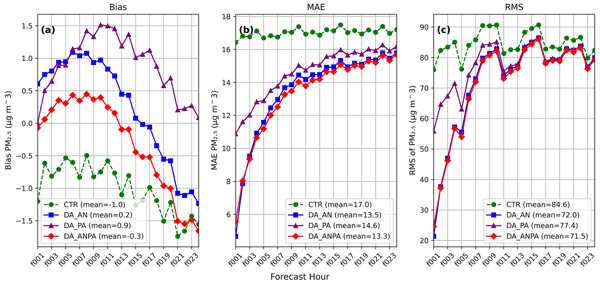
This paper describes efforts to develop aerosol data assimilation capabilities for NOAA’s regional air quality modeling system by assimilating PM2.5 observations within the Joint Effort for Data Assimilation Integration framework. Results from the September 2020 Western U.S. wildfires show that assimilating AirNow and/or PurpleAir PM2.5 data reduces mean absolute errors of 1–24 h PM2.5 forecasts over the continental United States on average relative to a control without data assimilation.
Soyoung Ha, Jonathan J. Guerrette, Ivette Hernández Baños, William C. Skamarock, and Michael G. Duda
Geosci. Model Dev., 17, 4199–4211, https://doi.org/10.5194/gmd-17-4199-2024, https://doi.org/10.5194/gmd-17-4199-2024, 2024
Short summary
Short summary
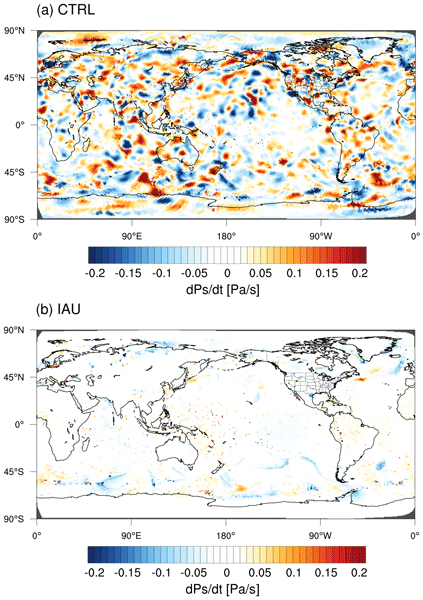
To mitigate the imbalances in the initial conditions, this study introduces our recent implementation of the incremental analysis update (IAU) in the Model for Prediction Across Scales – Atmospheric (MPAS-A) component coupled with the Joint Effort for Data assimilation Integration (JEDI) through the cycling system. A month-long cycling run demonstrates the successful implementation of the IAU capability in the MPAS–JEDI cycling system.
Shih-Wei Wei, Mariusz Pagowski, Arlindo da Silva, Cheng-Hsuan Lu, and Bo Huang
Geosci. Model Dev., 17, 795–813, https://doi.org/10.5194/gmd-17-795-2024, https://doi.org/10.5194/gmd-17-795-2024, 2024
Short summary
Short summary
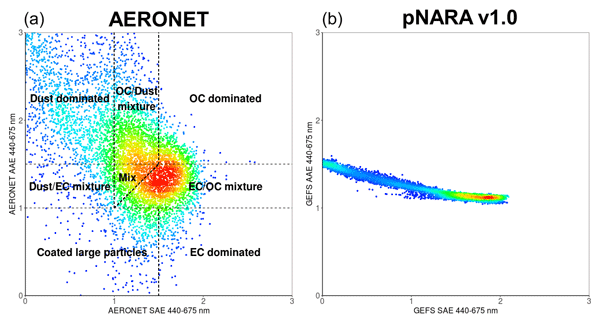
This study describes the modeling system and the evaluation results for the first prototype version of a global aerosol reanalysis product at NOAA, prototype NOAA Aerosol ReAnalysis version 1.0 (pNARA v1.0). We evaluated pNARA v1.0 against independent datasets and compared it with other reanalyses. We identified deficiencies in the system (both in the forecast model and in the data assimilation system) and the uncertainties that exist in our reanalysis.
Jonathan J. Guerrette, Zhiquan Liu, Chris Snyder, Byoung-Joo Jung, Craig S. Schwartz, Junmei Ban, Steven Vahl, Yali Wu, Ivette Hernández Baños, Yonggang G. Yu, Soyoung Ha, Yannick Trémolet, Thomas Auligné, Clementine Gas, Benjamin Ménétrier, Anna Shlyaeva, Mark Miesch, Stephen Herbener, Emily Liu, Daniel Holdaway, and Benjamin T. Johnson
Geosci. Model Dev., 16, 7123–7142, https://doi.org/10.5194/gmd-16-7123-2023, https://doi.org/10.5194/gmd-16-7123-2023, 2023
Short summary
Short summary
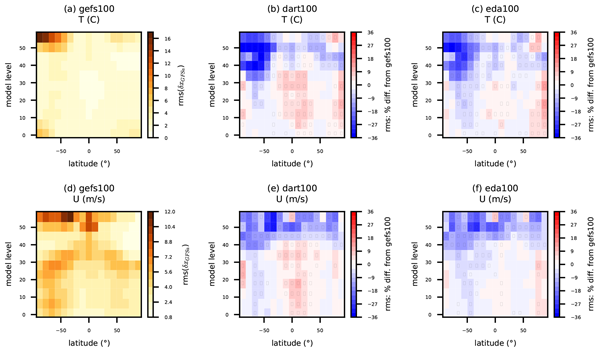
We demonstrate an ensemble of variational data assimilations (EDA) with the Model for Prediction Across Scales and the Joint Effort for Data assimilation Integration (JEDI) software framework. When compared to 20-member ensemble forecasts from operational initial conditions, those from 80-member EDA-generated initial conditions improve flow-dependent error covariances and subsequent 10 d forecasts. These experiments are repeatable for any atmospheric model with a JEDI interface.
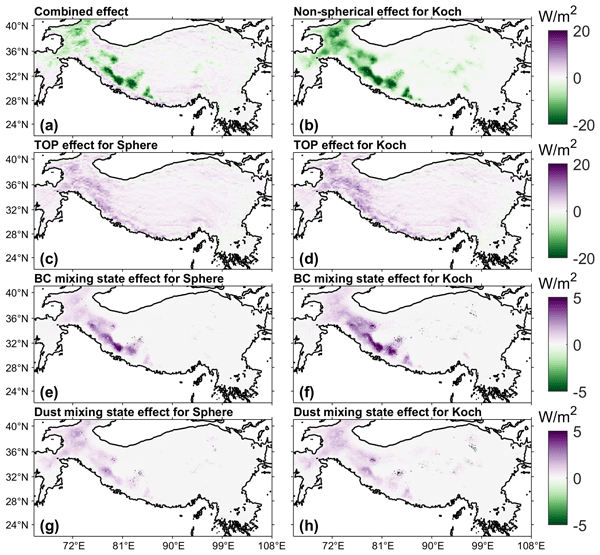
Dalei Hao, Gautam Bisht, Karl Rittger, Edward Bair, Cenlin He, Huilin Huang, Cheng Dang, Timbo Stillinger, Yu Gu, Hailong Wang, Yun Qian, and L. Ruby Leung
Geosci. Model Dev., 16, 75–94, https://doi.org/10.5194/gmd-16-75-2023, https://doi.org/10.5194/gmd-16-75-2023, 2023
Short summary
Short summary
Snow with the highest albedo of land surface plays a vital role in Earth’s surface energy budget and water cycle. This study accounts for the impacts of snow grain shape and mixing state of light-absorbing particles with snow on snow albedo in the E3SM land model. The findings advance our understanding of the role of snow grain shape and mixing state of LAP–snow in land surface processes and offer guidance for improving snow simulations and radiative forcing estimates in Earth system models.
Soyoung Ha
EGUsphere, https://doi.org/10.5194/egusphere-2022-371, https://doi.org/10.5194/egusphere-2022-371, 2022
Preprint withdrawn
Short summary
Short summary
Heavy pollution events often occur in cloudy conditions, which is hard to observe. This study introduces a new 3D-Var analysis that can facilitate aerosol-cloud interactions through weakly coupled data assimilation using WRF-Chem/WRFDA.
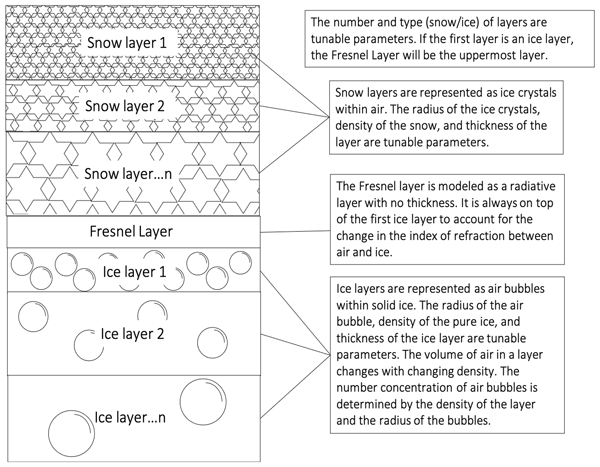
Chloe A. Whicker, Mark G. Flanner, Cheng Dang, Charles S. Zender, Joseph M. Cook, and Alex S. Gardner
The Cryosphere, 16, 1197–1220, https://doi.org/10.5194/tc-16-1197-2022, https://doi.org/10.5194/tc-16-1197-2022, 2022
Short summary
Short summary
Snow and ice surfaces are important to the global climate. Current climate models use measurements to determine the reflectivity of ice. This model uses physical properties to determine the reflectivity of snow, ice, and darkly pigmented impurities that reside within the snow and ice. Therefore, the modeled reflectivity is more accurate for snow/ice columns under varying climate conditions. This model paves the way for improvements in the portrayal of snow and ice within global climate models.
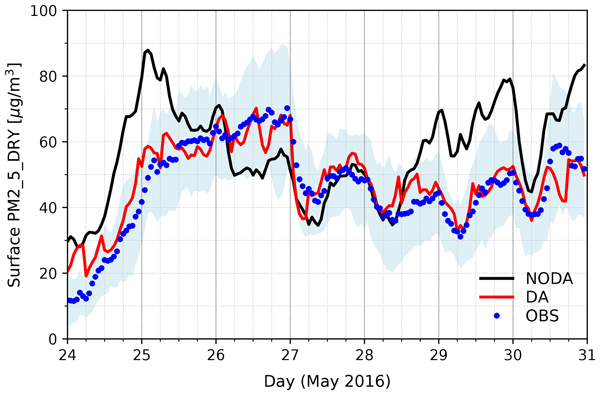
Soyoung Ha
Geosci. Model Dev., 15, 1769–1788, https://doi.org/10.5194/gmd-15-1769-2022, https://doi.org/10.5194/gmd-15-1769-2022, 2022
Short summary
Short summary
In an effort to improve air quality forecasting, the WRFDA 3D-Var system is newly extended for the assimilation of surface PM2.5 and PM10 using the RACM/MADE-VBS chemistry in the WRF-Chem model. Through a case study during the Korea–United States Air Quality (KORUS-AQ) period, it is demonstrated that the analysis can lead to improving the prediction of surface PM concentrations up to 26 % for 24 h, diminishing most bias errors.
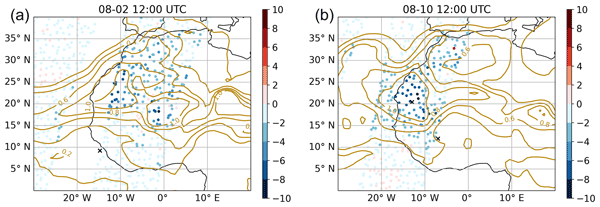
Dustin Francis Phillip Grogan, Cheng-Hsuan Lu, Shih-Wei Wei, and Sheng-Po Chen
Atmos. Chem. Phys., 22, 2385–2398, https://doi.org/10.5194/acp-22-2385-2022, https://doi.org/10.5194/acp-22-2385-2022, 2022
Short summary
Short summary
This study shows that incorporating aerosols into satellite radiance calculations affects the representation of African easterly waves (AEWs), and their environment, over North Africa and the eastern Atlantic in a numerical weather model. These changes are driven by radiative effects of Saharan dust captured by the aerosol-affected radiances, which modify the initial fields and can improve the forecasting of AEWs.
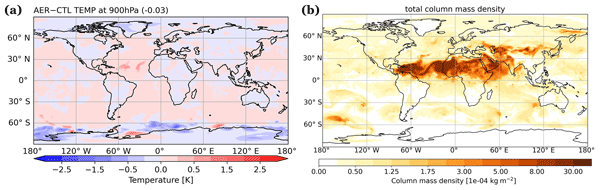
Cheng-Hsuan Lu, Quanhua Liu, Shih-Wei Wei, Benjamin T. Johnson, Cheng Dang, Patrick G. Stegmann, Dustin Grogan, Guoqing Ge, Ming Hu, and Michael Lueken
Geosci. Model Dev., 15, 1317–1329, https://doi.org/10.5194/gmd-15-1317-2022, https://doi.org/10.5194/gmd-15-1317-2022, 2022
Short summary
Short summary
This article is a technical note on the aerosol absorption and scattering calculations of the Community Radiative Transfer Model (CRTM) v2.2 and v2.3. It also provides guidance for prospective users of the CRTM aerosol option and Gridpoint Statistical Interpolation (GSI) aerosol-aware radiance assimilation. Scientific aspects of aerosol-affected BT in atmospheric data assimilation are also briefly discussed.
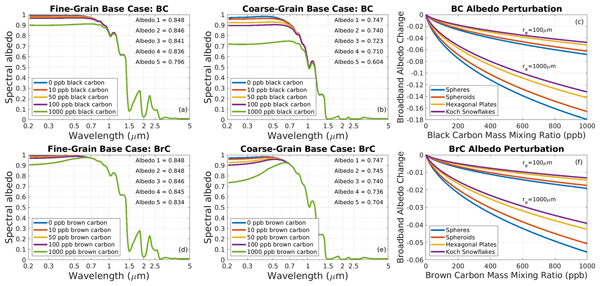
Mark G. Flanner, Julian B. Arnheim, Joseph M. Cook, Cheng Dang, Cenlin He, Xianglei Huang, Deepak Singh, S. McKenzie Skiles, Chloe A. Whicker, and Charles S. Zender
Geosci. Model Dev., 14, 7673–7704, https://doi.org/10.5194/gmd-14-7673-2021, https://doi.org/10.5194/gmd-14-7673-2021, 2021
Short summary
Short summary
We present the technical formulation and evaluation of a publicly available code and web-based model to simulate the spectral albedo of snow. Our model accounts for numerous features of the snow state and ambient conditions, including the the presence of light-absorbing matter like black and brown carbon, mineral dust, volcanic ash, and snow algae. Carbon dioxide snow, found on Mars, is also represented. The model accurately reproduces spectral measurements of clean and contaminated snow.
Cited articles
Abdi-Oskouei, M., Barré, J., Wei, S.-W., Lu, S., Griffin, A., Gas, C. H., Hebert, F., Herbener, S., Lingerfelt, E., Parker, E., Sampson, C., Vahl, S., Diniz, F., Johnson, B., Dang, C., Tremolet, Y., Ruston, B., Shah, V., Knowland, E., Todling, R., Gelaro, R., Nowlan, C., Abad, G. G., Liu, X., McDonald, B., Waxman, E., Rollins, A., Zuraski, K., Peischl, J., Judd, L., Valin, L., Hanisco, T., Menetrier, B., Martin, C., Holdaway, D., Shlyaeva, A., Heinzeller, D., Pawson, S., and Auligne, T.: Capability demonstration of a JEDI-based system for TEMPO assimilation: system description and evaluation, ESS Open Archive [preprint], https://doi.org/10.22541/essoar.175767264.40932217/v1, 2025.
Baker, B. and Pan, L.: Overview of the Model and Observation Evaluation Toolkit (MONET) Version 1.0 for Evaluating Atmospheric Transport Models, Atmosphere, 8, 210, https://doi.org/10.3390/atmos8110210, 2017.
Bannister, R. N.: A review of operational methods of variational and ensemble-variational data assimilation, Q. J. Roy. Meteor. Soc., 143, 607–633, https://doi.org/10.1002/qj.2982, 2017.
Bocquet, M., Pires, C. A., and Wu, L.: Beyond Gaussian statistical modeling in geophysical data assimilation, Mon. Weather Rev., 138, 2997–3023, https://doi.org/10.1175/2010MWR3164.1, 2010.
Brotzge, J. A., Wang, J., Thorncroft, C. D., Joseph, E., Bain, N., Bassill, N., Farruggio, N., Freedman, J. M., Hemker, K., Jr., Johnston, D., Kane, E., McKim, S., Miller, S. D., Minder, J. R., Naple, P., Perez, S., Schwab, J. J., Schwab, M. J., and Sicker, J.: A Technical Overview of the New York State Mesonet Standard Network, J. Atmos. Ocean. Tech., 37, 1827–1845, https://doi.org/10.1175/JTECH-D-19-0220.1, 2020.
Brown, B., Jensen, T., Gotway, J. H., Bullock, R., Gilleland, E., Fowler, T., Newman, K., Adriaansen, D., Blank, L., Burek, T., Harrold, M., Hertneky, T., Kalb, C., Kucera, P., Nance, L., Opatz, J., Vigh, J., and Wolff, J.: The Model Evaluation Tools (MET): More than a decade of community-supported forecast verification, B. Am. Meteorol. Soc., 102, E782–E807, https://doi.org/10.1175/BAMS-D-19-0093.1, 2021.
Carrassi, A., Bocquet, M., Bertino, L., and Evensen, G.: Data assimilation in the geosciences: an overview of methods, issues, and perspectives, WIREs Clim. Change, 9, e535, https://doi.org/10.1002/wcc.535, 2018.
Chin, M., Ginoux, P., Kinne, S., Torres, O., Holben, B. N., Duncan, B. N., Martin, R. V., Logan, J. A., Higurashi, A., and Nakajima, T.: Tropospheric Aerosol Optical Thickness from the GOCART Model and Comparisons with Satellite and Sun Photometer Measurements, J. Atmos. Sci., 59, 461–483, https://doi.org/10.1175/1520-0469(2002)059<0461:TAOTFT>2.0.CO;2, 2002.
Colarco, P. R., Chin, M., Bian, H., Diehl, T., and Yu, H.: Multiyear simulation of global aerosol distributions in the NASA GEOS-4 model and comparisons with satellite and ground-based aerosol optical depth, J. Geophys. Res., 115, D14207, https://doi.org/10.1029/2009JD012820, 2010.
Colarco, P. R., Nowottnick, E. P., Randles, C. A., Yi, B., Yang, P., Kim, K.-M., Smith, J. A., and Bardeen, C. G.: Impact of radiatively interactive dust aerosols in the NASA GEOS-5 climate model: Sensitivity to dust particle shape and refractive index, J. Geophys. Res.-Atmos., 119, 753–786, https://doi.org/10.1002/2013JD020046, 2014.
Computational and Information Systems Laboratory: Derecho: HPE Cray EX System (University Community Computing), Boulder, CO: NSF National Center for Atmospheric Research, https://doi.org/10.5065/qx9a-pg09, 2023.
Copernicus Sentinel-5P: TROPOMI Level 2 Nitrogen Dioxide total column products, Version 02, European Space Agency [data set], https://doi.org/10.5270/S5P-9bnp8q8, 2021.
Courtier, P., Thépaut, J.-N., and Hollingsworth, A.: A strategy for operational implementation of 4D-Var, using an incremental approach, Q. J. Roy. Meteor. Soc., 120, 1367–1387, https://doi.org/10.1002/qj.49712051912, 1994.
Deconinck, W., Bauer, P., Diamantakis, M., Hamrud, M., Kühnlein, C., Maciel, P., Mengaldo, G., Quintino, T., Raoult, B., Smolarkiewicz, P. K., and Wedi, N. P.: Atlas: a library for numerical weather prediction and climate modelling, Comput. Phys. Commun., 220, 188–204, https://doi.org/10.1016/j.cpc.2017.07.006, 2017.
Emmons, L. K., Schwantes, R. H., Orlando, J. J., Tyndall, G., Kinnison, D., Lamarque, J.-F., Marsh, D., Mills, M. J., Tilmes, S., Bardeen, C., Buchholz, R. R., Conley, A., Gettelman, A., Garcia, R., Simpson, I., Blake, D. R., Meinardi, S., and Pétron, G.: The chemistry mechanism in the Community Earth System Model version 2 (CESM2), J. Adv. Model. Earth Sy., 12, e2019MS001882, https://doi.org/10.1029/2019MS001882, 2020.
Eskes, H., van Geffen, J., Boersma, F., Eichmann, K.-U., Apituley, A., Pedergnana, M., Sneep, M., Veefkind, J. P., and Loyola, D.: Sentinel-5 precursor/TROPOMI Level 2 Product User Manual – Nitrogen dioxide, KNMI, https://sentinels.copernicus.eu/documents/247904/2474726/Sentinel-5P-Level-2-Product-User-Manual-Nitrogen-Dioxide.pdf (last access: 15 August 2025), 2022.
Gelaro, R., McCarty, W., Suárez, M. J., Todling, R., Molod, A., Takacs, L., Randles, C. A., Darmenov, A., Bosilovich, M. G., Reichle, R., Wargan, K., Coy, L., Cullather, R., Draper, C., Akella, S., Buchard, V., Conaty, A., da Silva, A. M., Gu, W., Kim, G., Koster, R., Lucchesi, R., Merkova, D., Nielsen, J. E., Partyka, G., Pawson, S., Putman, W., Rienecker, M., Schubert, S. D., Sienkiewicz, M., and Zhao, B.: The Modern-Era Retrospective Analysis for Research and Applications, Version 2 (MERRA-2), J. Climate, 30, 5419–5454, https://doi.org/10.1175/JCLI-D-16-0758.1, 2017.
Gettelman, A., Mills, M. J., Kinnison, D. E., Garcia, R. R., Smith, A. K., Marsh, D. R., Tilmes, S., Vitt, F., Bardeen, C. G., Polvani, L., and Solomon, S.: The Whole Atmosphere Community Climate Model Version 6 (WACCM6), J. Geophys. Res.-Atmos., 124, 12388–12403, https://doi.org/10.1029/2019JD030943, 2019.
Giles, D. M., Sinyuk, A., Sorokin, M. G., Schafer, J. S., Smirnov, A., Slutsker, I., Eck, T. F., Holben, B. N., Lewis, J. R., Campbell, J. R., Welton, E. J., Korkin, S. V., and Lyapustin, A. I.: Advancements in the Aerosol Robotic Network (AERONET) Version 3 database – automated near-real-time quality control algorithm with improved cloud screening for Sun photometer aerosol optical depth (AOD) measurements, Atmos. Meas. Tech., 12, 169–209, https://doi.org/10.5194/amt-12-169-2019, 2019.
Global Modeling and Assimilation Office (GMAO): MERRA-2 inst3_3d_asm_Nv: 3d,3-Hourly,Instantaneous,Model-Level,Assimilation,Assimilated Meteorological Fields V5.12.4, Greenbelt, MD, USA, Goddard Earth Sciences Data and Information Services Center (GES DISC) [data set], https://doi.org/10.5067/WWQSXQ8IVFW8, 2015a.
Global Modeling and Assimilation Office (GMAO): MERRA-2 inst3_3d_aer_Nv: 3d,3-Hourly,Instantaneous,Model-Level,Assimilation,Aerosol Mixing Ratio V5.12.4, Greenbelt, MD, USA, Goddard Earth Sciences Data and Information Services Center (GES DISC) [data set], https://doi.org/10.5067/LTVB4GPCOTK2, 2015b.
Grell, G. A., Peckham, S. E., Schmitz, R., McKeen, S. A., Frost, G., Skamarock, W. C., and Eder, B.: Fully coupled “online” chemistry within the WRF model, Atmos. Environ., 39, 6957–6975, https://doi.org/10.1016/j.atmosenv.2005.04.027, 2005.
Guenther, A., Karl, T., Harley, P., Wiedinmyer, C., Palmer, P. I., and Geron, C.: Estimates of global terrestrial isoprene emissions using MEGAN (Model of Emissions of Gases and Aerosols from Nature), Atmos. Chem. Phys., 6, 3181–3210, https://doi.org/10.5194/acp-6-3181-2006, 2006.
Guerrette, J. J., Liu, Z., Snyder, C., Jung, B.-J., Schwartz, C. S., Ban, J., Vahl, S., Wu, Y., Baños, I. H., Yu, Y. G., Ha, S., Trémolet, Y., Auligné, T., Gas, C., Ménétrier, B., Shlyaeva, A., Miesch, M., Herbener, S., Liu, E., Holdaway, D., and Johnson, B. T.: Data assimilation for the Model for Prediction Across Scales – Atmosphere with the Joint Effort for Data assimilation Integration (JEDI-MPAS 2.0.0-beta): ensemble of 3D ensemble-variational (En-3DEnVar) assimilations, Geosci. Model Dev., 16, 7123–7142, https://doi.org/10.5194/gmd-16-7123-2023, 2023.
Ha, S., Guerrette, J. J., Hernández Baños, I., Skamarock, W. C., and Duda, M. G.: Incremental analysis update (IAU) in the Model for Prediction Across Scales coupled with the Joint Effort for Data assimilation Integration (MPAS–JEDI 2.0.0), Geosci. Model Dev., 17, 4199–4211, https://doi.org/10.5194/gmd-17-4199-2024, 2024.
Herman, J., Cede, A., Spinei, E., Mount, G., Tzortziou, M., and Abuhassan, N.: NO2 column amounts from ground-based Pandora and MFDOAS spectrometers using the direct-sun DOAS technique: intercomparisons and application to OMI validation, J. Geophys. Res., 114, D13307, https://doi.org/10.1029/2009JD011848, 2009.
Hsu, N. C., Jeong, M. J., Bettenhausen, C., Sayer, A. M., Hansell, R., Seftor, C. S., Huang, J., and Tsay, S. C.: Enhanced Deep Blue aerosol retrieval algorithm: the second generation, J. Geophys. Res.-Atmos., 118, 9296–9315, https://doi.org/10.1002/jgrd.50712, 2013.
Huang, B., Pagowski, M., Trahan, S., Martin, C. R., Tangborn, A., Kongdragunta, S., and Kleist, D. T.: JEDI-Based Three-Dimensional Ensemble-Variational Data Assimilation System for Global Aerosol Forecasting at NCEP, J. Adv. Model. Earth Sy., 15, e2022MS003232, https://doi.org/10.1029/2022MS003232, 2023.
Jensen, T., Halley Gotway, J., Harrold, M., Vigh, J., Row, M., Kalb, C., Fisher, H., Goodrich, L., Adriaansen, D., Win-Gildenmeister, M., McCabe, G., Prestopnik, J., Opatz, J., Frimel, J., Blank, L., and Arbetter, T.: The METplus Version 6.0.0 User's Guide, Developmental Testbed Center, https://github.com/dtcenter/METplus/releases (last access: 22 July 2026), 2024.
Jung, B.-J., Ménétrier, B., Snyder, C., Liu, Z., Guerrette, J. J., Ban, J., Baños, I. H., Yu, Y. G., and Skamarock, W. C.: Three-dimensional variational assimilation with a multivariate background error covariance for the Model for Prediction Across Scales – Atmosphere with the Joint Effort for Data assimilation Integration (JEDI-MPAS 2.0.0-beta), Geosci. Model Dev., 17, 3879–3895, https://doi.org/10.5194/gmd-17-3879-2024, 2024.
Kalnay, E.: Atmospheric Modeling, Data Assimilation and Predictability, Cambridge University Press, Cambridge, UK, 341 pp., ISBN 9780511802270, 2003.
Kleist, D. T., Parrish, D. F., Derber, J. C., Treadon, R., Wu, W., and Lord, S.: Introduction of the GSI into the NCEP Global Data Assimilation System, Weather Forecast., 24, 1691–1705, https://doi.org/10.1175/2009WAF2222201.1, 2009.
Lee, J., Hsu, N. C., Kim, W. V., Sayer, A. M., and Tsay, S. C.: VIIRS version 2 Deep Blue aerosol products, J. Geophys. Res.-Atmos., 129, e2023JD040082, https://doi.org/10.1029/2023JD040082, 2024.
Levy, R. C., Mattoo, S., Munchak, L. A., Remer, L. A., Sayer, A. M., Patadia, F., and Hsu, N. C.: The Collection 6 MODIS aerosol products over land and ocean, Atmos. Meas. Tech., 6, 2989–3034, https://doi.org/10.5194/amt-6-2989-2013, 2013.
Levy, R. C., Munchak, L. A., Mattoo, S., Patadia, F., Remer, L. A., and Holz, R. E.: Towards a long-term global aerosol optical depth record: applying a consistent aerosol retrieval algorithm to MODIS and VIIRS-observed reflectance, Atmos. Meas. Tech., 8, 4083–4110, https://doi.org/10.5194/amt-8-4083-2015, 2015a.
Levy, R., Hsu, C., et al.: MODIS Atmosphere L2 Aerosol Product, NASA MODIS Adaptive Processing System, Goddard Space Flight Center, USA [data set], https://doi.org/10.5067/MODIS/MOD04_L2.061, 2015b.
Levy, R. C., Mattoo, S., Sawyer, V., Kiliyanpilakkil, P., Shi, Y., Gupta, P., Remer, L., Kim, M., Zhou, Y., Kleidman, R., Remer, L. A., Tanré, D., and Kaufman, Y. J.: Algorithm for remote sensing of tropospheric aerosol over dark targets, NASA Goddard Space Flight Center, Greenbelt, MD, USA, https://darktarget.gsfc.nasa.gov/sites/default/files/users/user9/ATBD_DarkTarget_April3.pdf (last access: 9 September 2025), 2024.
Liu, X.: TEMPO NO2 tropospheric and stratospheric columns V03 (PROVISIONAL), NASA Langley Atmospheric Science Data Center Distributed Active Archive Center [data set], https://doi.org/10.5067/IS-40E/TEMPO/NO2_L2.003, 2026.
Liu, Z., Snyder, C., Guerrette, J. J., Jung, B.-J., Ban, J., Vahl, S., Wu, Y., Trémolet, Y., Auligné, T., Ménétrier, B., Shlyaeva, A., Herbener, S., Liu, E., Holdaway, D., and Johnson, B. T.: Data assimilation for the Model for Prediction Across Scales – Atmosphere with the Joint Effort for Data assimilation Integration (JEDI-MPAS 1.0.0): EnVar implementation and evaluation, Geosci. Model Dev., 15, 7859–7878, https://doi.org/10.5194/gmd-15-7859-2022, 2022.
Ménétrier, B., Piacentini, A., and Barré J.: benjaminmenetrier/vind: VIND release 1.0.1, Zenodo [code], https://doi.org/10.5281/zenodo.18156822, 2026.
NASA Ocean Biology Processing Group: PACE OCI Level-2 Regional Aerosol Optical Properties, Unified Aerosol Algorithm (UAA) Algorithm Data, version 3.1, NASA Ocean Biology Distributed Active Archive Center [data set], https://doi.org/10.5067/PACE/OCI/L2/AER_UAA/3.1, 2025.
Nowlan, C. R., Abad, G. G., Liu, X., Wang, H., and Chance, K.: TEMPO nitrogen dioxide retrieval algorithm theoretical basis document, NASA Algorithm Publication Tool, https://www.earthdata.nasa.gov/apt/documents/tempo-nitrogen-dioxide-retrieval/v1.0 (last access: 9 September 2025), 2025.
Nowlan, C. R., Liu, X., Leitch, J. W., Chance, K., González Abad, G., Liu, C., Zoogman, P., Cole, J., Delker, T., Good, W., Murcray, F., Ruppert, L., Soo, D., Follette-Cook, M. B., Janz, S. J., Kowalewski, M. G., Loughner, C. P., Pickering, K. E., Herman, J. R., Beaver, M. R., Long, R. W., Szykman, J. J., Judd, L. M., Kelley, P., Luke, W. T., Ren, X., and Al-Saadi, J. A.: Nitrogen dioxide observations from the Geostationary Trace gas and Aerosol Sensor Optimization (GeoTASO) airborne instrument: Retrieval algorithm and measurements during DISCOVER-AQ Texas 2013, Atmos. Meas. Tech., 9, 2647–2668, https://doi.org/10.5194/amt-9-2647-2016, 2016.
NSF National Center for Atmospheric Research Mesoscale & Microscale Meteorology: WRF v4.5.2, Github [code], https://github.com/wrf-model/WRF/releases#release-v4.5.2, last access: 22 July 2026.
Nystrom, R. G., Snyder, C., Liu, Z., Jung, B. J., Ban, J., and Banos, I. H.: A hybrid four-dimensional variational data assimilation system for the Model for Prediction Across Scales (MPAS-atmosphere): Leveraging the Joint Effort for Data assimilation Integration (JEDI), J. Adv. Model. Earth Sy., 17, e2025MS005183. https://doi.org/10.1029/2025MS005183, 2025
Park, J., Liu, C., and Xue, M.: Development and Testing of Ensemble-Variational Data Assimilation Capabilities for Radar Data within JEDI coupled with FV3-LAM Model, EGUsphere [preprint], https://doi.org/10.5194/egusphere-2025-5411, 2025.
Powers, J. G., Klemp, J. B., Skamarock, W. C., Davis, C. A., Dudhia, J., Gill, D. O., Coen, J. L., Gochis, D. J., Ahmadov, R., Peckham, S. E., Grell, G. A., Michalakes, J., Trahan, S., Benjamin, S. G., Alexander, C. R., Dimego, G. J., Wang, W., Schwartz, C. S., Romine, G. S., Liu, Z., Snyder, C., Chen, F., Barlage, M. J., Yu, W., and Duda, M. G.: The Weather Research and Forecasting Model: Overview, System Efforts, and Future Directions, B. Am. Meteorol. Soc., 98, 1717–1737, https://doi.org/10.1175/BAMS-D-15-00308.1, 2017.
Prestopnik, J., Soh, H., Goodrich, L., Brown, B., Bullock, R., Halley Gotway, J., Newman, K., Opatz, J., and Jensen, T.: The MET Version 12.1.1 User's Guide, Developmental Testbed Center, https://github.com/dtcenter/MET/releases (last access: 22 July 2026), 2025.
Randles, C. A., da Silva, A. M., Buchard, V., Colarco, P. R., Darmenov, A., Govindaraju, R., Smirnov, A., Holben, B., Ferrare, R., Hair, J., Shinozuka, Y., and Flynn, C. J.: The MERRA-2 Aerosol Reanalysis, 1980 Onward. Part I: System Description and Data Assimilation Evaluation, J. Climate, 30, 6823–6850, https://doi.org/10.1175/JCLI-D-16-0609.1, 2017.
Remer, L. A., Davis, A. B., Mattoo, S., Levy, R. C., Kalashnikova, O. V., Coddington, O., Chowdhary, J., Knobelspiesse, K., Xu, X., Ahmad, Z., Boss, E., Cairns, B., Dierssen, H. M., Diner, D. J., Franz, B., Frouin, R., Gao, B.-C., Ibrahim, A., Martins, J. V., Omar, A. H., Torres, O., Xu, F., and Zhai, P.-W.: Retrieving aerosol characteristics from the PACE mission, Part 1: Ocean Color Instrument, Front. Earth Sci., 7, 152, https://doi.org/10.3389/feart.2019.00152, 2019a.
Remer, L. A., Knobelspiesse, K., Zhai, P.-W., Xu, F., Kalashnikova, O. V., Chowdhary, J., Hasekamp, O., Dubovik, O., Wu, L., Ahmad, Z., Boss, E., Cairns, B., Coddington, O., Davis, A. B., Dierssen, H. M., Diner, D. J., Franz, B., Frouin, R., Gao, B.-C., Ibrahim, A., Levy, R. C., Martins, J. V., Omar, A. H., and Torres, O.: Retrieving aerosol characteristics from the PACE mission, Part 2: Multi-angle and polarimetry, Front. Environ. Sci., 7, 94, https://doi.org/10.3389/fenvs.2019.00094, 2019b.
Sawyer, V., Levy, R. C., Mattoo, S., Cureton, G., Shi, Y., and Remer, L. A.: Continuing the MODIS Dark Target aerosol time series with VIIRS, Remote Sens., 12, 308, https://doi.org/10.3390/rs12020308, 2020.
Shrestha, B., Brotzge, J. A., Wang, J., Bain, N., Thorncroft, C. D., Joseph, E., Freedman, J., and Perez, S.: Overview and Applications of the New York State Mesonet Profiler Network, J. Appl. Meteorol. Clim., 60, 1591–1611, https://doi.org/10.1175/JAMC-D-21-0104.1, 2021.
Skamarock, W., Klemp, J., Dudhia, J., Gill, D. O., Liu, Z., Berner, J., Wang, W., Powers, J. G., Duda, M. G., Barker, D., and Huang, X.-Y.: A description of the Advanced Research WRF model version 4.3, NCAR, https://doi.org/10.5065/1dfh-6p97, 2021.
Sun, T., Guerrette, J. J., Liu, Z., Ban, J., Jung, B.-J., Hernandez Banos, I., and Snyder, C.: All-sky AMSU-A radiance data assimilation using the gain-form of Local Ensemble Transform Kalman filter within MPAS-JEDI-2.1.0: implementation, tuning, and evaluation, Geosci. Model Dev., 18, 8569–8587, https://doi.org/10.5194/gmd-18-8569-2025, 2025.
Trémolet, Y. and Auligné, T.: The Joint Effort for Data Assimilation Integration (JEDI), JCSDA Q. Newsl., 66, 1–5, https://doi.org/10.25923/RB19-0Q26, 2020.
Veefkind, J., Aben, I., McMullan, K., Förster, H., De Vries, J., Otter, G., and Levelt, P.: TROPOMI on the ESA Sentinel-5 Precursor: a GMES mission for global observations of the atmospheric composition for climate, air quality and ozone layer applications, Remote Sens. Environ., 120, 70–83, https://doi.org/10.1016/j.rse.2011.09.027, 2012.
VIIRS Atmosphere Science Team, S. S. E. C.: VIIRS/SNPP Dark Target Aerosol L2 6-Min Swath 6 km, NASA Level 1 and Atmosphere Archive and Distribution System Distributed Active Archive Center [data set], https://doi.org/10.5067/VIIRS/AERDT_L2_VIIRS_SNPP.002, 2023a.
VIIRS Atmosphere Science Team, S. S. E. C.: VIIRS/NOAA20 Dark Target Aerosol 6-Min L2 Swath 6 km, NASA Level 1 and Atmosphere Archive and Distribution System Distributed Active Archive Center [data set], https://doi.org/10.5067/VIIRS/AERDT_L2_VIIRS_NOAA20.002, 2023b.
VIIRS Atmosphere Science Team, S. S. E. C.: VIIRS/SNPP Deep Blue Aerosol L2 6-Min Swath 6 km, NASA Level 1 and Atmosphere Archive and Distribution System Distributed Active Archive Center [data set], https://doi.org/10.5067/VIIRS/AERDB_L2_VIIRS_SNPP.002, 2023c.
VIIRS Atmosphere Science Team, S. S. E. C.: VIIRS/NOAA20 Deep Blue Aerosol L2 6-Min Swath 6 km, NASA Level 1 and Atmosphere Archive and Distribution System Distributed Active Archive Center [data set], https://doi.org/10.5067/VIIRS/AERDB_L2_VIIRS_NOAA20.002, 2023d.
Wang, H., Martin, C., Barré, J., Li, R., Weygandt, S., Huang, J., Tang, Y., Choi, H., Tangborn, A., Wang, K., Liu, H., and Lee, J.: PM2.5 assimilation within JEDI for NOAA's regional Air Quality Model (AQMv7): application to the September 2020 Western US wildfires, Geosci. Model Dev., 19, 2479–2495, https://doi.org/10.5194/gmd-19-2479-2026, 2026
Werdell, P. J., Behrenfeld, M. J., Bontempi, P. S., Boss, E., Cairns, B., Davis, G. T., Franz, B. A., Gliese, U. B., Gorman, E. T., Hasekamp, O., Knobelspiesse, K. D., Mannino, A., Martins, J. V., McClain, C. R., Meister, G., and Remer, L. A.: The Plankton, Aerosol, Cloud, Ocean Ecosystem (PACE) mission: status, science, advances, B. Am. Meteorol. Soc., 100, 1775–1794, https://doi.org/10.1175/BAMS-D-18-0056.1, 2019.
Wei, S.-W., Pagowski, M., da Silva, A., Lu, C.-H., and Huang, B.: The prototype NOAA Aerosol Reanalysis version 1.0: description of the modeling system and its evaluation, Geosci. Model Dev., 17, 795–813, https://doi.org/10.5194/gmd-17-795-2024, 2024.
Wei, S.-W., Barré, J., Ha, S., Lu, C.-H., Abdi-Oskouei, M., Ménétrier, B., and Dang, C.: Sample input and output data of “Leveraging JEDI for Atmospheric Composition: A unified framework for evaluating observations and model forecast”, Zenodo [data set], https://doi.org/10.5281/zenodo.17058099, 2025.
Wiedinmyer, C., Kimura, Y., McDonald-Buller, E. C., Emmons, L. K., Buchholz, R. R., Tang, W., Seto, K., Joseph, M. B., Barsanti, K. C., Carlton, A. G., and Yokelson, R.: The Fire Inventory from NCAR version 2.5: an updated global fire emissions model for climate and chemistry applications, Geosci. Model Dev., 16, 3873–3891, https://doi.org/10.5194/gmd-16-3873-2023, 2023.
Zoogman, P., Liu, X., Suleiman, R., Pennington, W., Flittner, D., Al-Saadi, J., and Chance, K.: Tropospheric emissions: Monitoring of pollution (TEMPO), J. Quant. Spectrosc. Ra., 186, 17–39, https://doi.org/10.1016/j.jqsrt.2016.05.008, 2017.
Short summary
This paper presents a flexible workflow using a unified data assimilation framework to evaluate atmospheric composition models. It enables comparison of observations with forecasts of trace gases and aerosols from different models. The system is consistent and adaptable, reducing repetitive work, supporting model validation and observation assessment, and aligning evaluation with operational data assimilation for research and practical applications.
This paper presents a flexible workflow using a unified data assimilation framework to evaluate...


