
Articles | Volume 19, issue 2
https://doi.org/10.5194/gmd-19-755-2026
© Author(s) 2026. This work is distributed under
the Creative Commons Attribution 4.0 License.
the Creative Commons Attribution 4.0 License.
https://doi.org/10.5194/gmd-19-755-2026
© Author(s) 2026. This work is distributed under
the Creative Commons Attribution 4.0 License.
the Creative Commons Attribution 4.0 License.
Development and technical paper
| Highlight paper
| 
23 Jan 2026
Development and technical paper | Highlight paper |
| 23 Jan 2026
| 23 Jan 2026
Operational numerical weather prediction with ICON on GPUs (version 2024.10)
Xavier Lapillonne
CORRESPONDING AUTHOR

Federal Office of Meteorology and Climatology MeteoSwiss, Zurich, Switzerland
Daniel Hupp
Federal Office of Meteorology and Climatology MeteoSwiss, Zurich, Switzerland
Fabian Gessler
Center for Climate Systems Modeling C2SM, ETH Zurich, Zürich, Switzerland
André Walser
Federal Office of Meteorology and Climatology MeteoSwiss, Zurich, Switzerland
deceased, 19 February 2025
Andreas Pauling
Federal Office of Meteorology and Climatology MeteoSwiss, Zurich, Switzerland
Annika Lauber
Center for Climate Systems Modeling C2SM, ETH Zurich, Zürich, Switzerland
Benjamin Cumming
Swiss National Supercomputing Centre, ETH Zurich, Zürich, Switzerland
Carlos Osuna
Federal Office of Meteorology and Climatology MeteoSwiss, Zurich, Switzerland
Christoph Müller
Federal Office of Meteorology and Climatology MeteoSwiss, Zurich, Switzerland
Claire Merker
Federal Office of Meteorology and Climatology MeteoSwiss, Zurich, Switzerland
Daniel Leuenberger
Federal Office of Meteorology and Climatology MeteoSwiss, Zurich, Switzerland
David Leutwyler
Federal Office of Meteorology and Climatology MeteoSwiss, Zurich, Switzerland
Dmitry Alexeev
NVIDIA, Zürich, Switzerland
Gabriel Vollenweider
Federal Office of Meteorology and Climatology MeteoSwiss, Zurich, Switzerland
Guillaume Van Parys
Federal Office of Meteorology and Climatology MeteoSwiss, Zurich, Switzerland
Jonas Jucker
Center for Climate Systems Modeling C2SM, ETH Zurich, Zürich, Switzerland
Lukas Jansing
Federal Office of Meteorology and Climatology MeteoSwiss, Zurich, Switzerland
Marco Arpagaus
Federal Office of Meteorology and Climatology MeteoSwiss, Zurich, Switzerland
Marco Induni
Swiss National Supercomputing Centre, ETH Zurich, Zürich, Switzerland
Marek Jacob
Deutscher Wetterdienst, Offenbach am Main, Germany
Matthias Kraushaar
Swiss National Supercomputing Centre, ETH Zurich, Zürich, Switzerland
Michael Jähn
Center for Climate Systems Modeling C2SM, ETH Zurich, Zürich, Switzerland
Mikael Stellio
Center for Climate Systems Modeling C2SM, ETH Zurich, Zürich, Switzerland
Oliver Fuhrer
Federal Office of Meteorology and Climatology MeteoSwiss, Zurich, Switzerland
Petra Baumann
Federal Office of Meteorology and Climatology MeteoSwiss, Zurich, Switzerland
Philippe Steiner
Federal Office of Meteorology and Climatology MeteoSwiss, Zurich, Switzerland
Pirmin Kaufmann
Federal Office of Meteorology and Climatology MeteoSwiss, Zurich, Switzerland
Remo Dietlicher
Center for Climate Systems Modeling C2SM, ETH Zurich, Zürich, Switzerland
Ralf Müller
Deutsches Klimarechenzentrum, Hamburg, Germany
Sergey Kosukhin
Max Planck Institute for Meteorology, Hamburg, Germany
Thomas C. Schulthess
Swiss National Supercomputing Centre, ETH Zurich, Zürich, Switzerland
Ulrich Schättler
Deutscher Wetterdienst, Offenbach am Main, Germany
Victoria Cherkas
Center for Climate Systems Modeling C2SM, ETH Zurich, Zürich, Switzerland
William Sawyer
Swiss National Supercomputing Centre, ETH Zurich, Zürich, Switzerland
Related authors
Arash Hamzehloo, Erik F. M. Koene, Nikolai Ponomarev, Michael Steiner, Sven Werchner, Xavier Lapillonne, William B. Sawyer, Michael Jähn, Lukas Emmenegger, and Dominik Brunner
EGUsphere, https://doi.org/10.5194/egusphere-2026-2531, https://doi.org/10.5194/egusphere-2026-2531, 2026
This preprint is open for discussion and under review for Geoscientific Model Development (GMD).
Short summary
Short summary
Tracking where greenhouse gases and air pollutants come from, and where plants absorb carbon dioxide, requires demanding computer simulations of the atmosphere. We rewrote key parts of a widely used atmospheric model so that they run efficiently on graphics processors. The new code runs six times faster than before and uses energy more efficiently. This supports air-quality monitoring, climate research, and combining satellite data with high-resolution simulations of cities and ecosystems.
Anurag Dipankar, Mauro Bianco, Mona Bukenberger, Till Ehrengruber, Nicoletta Farabullini, Oliver Fuhrer, Abishek Gopal, Daniel Hupp, Andreas Jocksch, Samuel Kellerhals, Clarissa A. Kroll, Xavier Lapillonne, Matthieu Leclair, Magdalena Luz, Christoph Müller, Chia Rui Ong, Carlos Osuna, Praveen Pothapakula, Andreas Prein, Matthias Röthlin, William Sawyer, Christoph Schär, Sebastian Schemm, Giacomo Serafini, Hannes Vogt, Ben Weber, Robert C. Jnglin Wills, Nicolas Gruber, and Thomas C. Schulthess
Geosci. Model Dev., 19, 713–729, https://doi.org/10.5194/gmd-19-713-2026, https://doi.org/10.5194/gmd-19-713-2026, 2026
Short summary
Short summary
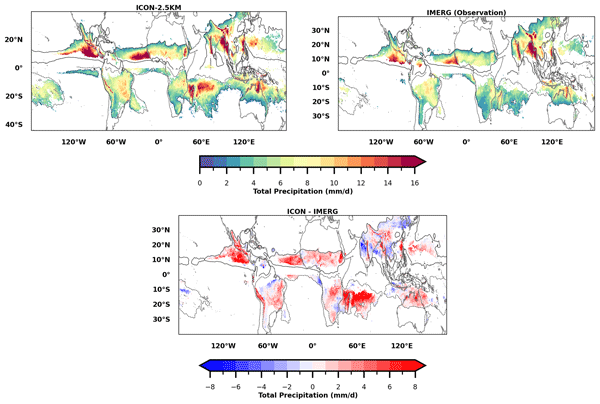
Climate models are becoming more detailed and accurate by simulating weather at scales of just a few kilometers. Simulating at km-scale is computationally demanding requiring powerful supercomputers and efficient code. This work presents a refactored dynamical core of a state-of-the-art climate model using a Python-based approach. The refactored code has passed through a sequence of verification and validation demonstrating its usability in performing km-scale global simulations.
Ruoyi Cui, Nikolina Ban, Marie-Estelle Demory, Raffael Aellig, Oliver Fuhrer, Jonas Jucker, Xavier Lapillonne, and Christoph Schär
Weather Clim. Dynam., 4, 905–926, https://doi.org/10.5194/wcd-4-905-2023, https://doi.org/10.5194/wcd-4-905-2023, 2023
Short summary
Short summary
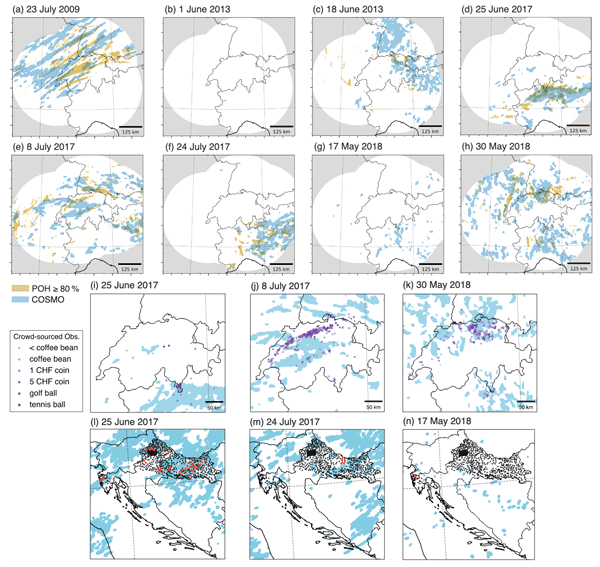
Our study focuses on severe convective storms that occur over the Alpine-Adriatic region. By running simulations for eight real cases and evaluating them against available observations, we found our models did a good job of simulating total precipitation, hail, and lightning. Overall, this research identified important meteorological factors for hail and lightning, and the results indicate that both HAILCAST and LPI diagnostics are promising candidates for future climate research.
Marco A. Giorgetta, William Sawyer, Xavier Lapillonne, Panagiotis Adamidis, Dmitry Alexeev, Valentin Clément, Remo Dietlicher, Jan Frederik Engels, Monika Esch, Henning Franke, Claudia Frauen, Walter M. Hannah, Benjamin R. Hillman, Luis Kornblueh, Philippe Marti, Matthew R. Norman, Robert Pincus, Sebastian Rast, Daniel Reinert, Reiner Schnur, Uwe Schulzweida, and Bjorn Stevens
Geosci. Model Dev., 15, 6985–7016, https://doi.org/10.5194/gmd-15-6985-2022, https://doi.org/10.5194/gmd-15-6985-2022, 2022
Short summary
Short summary
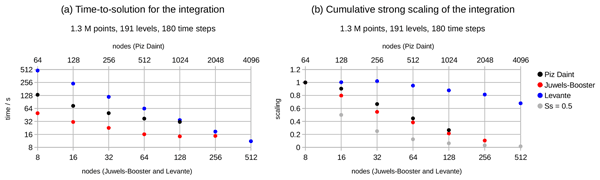
This work presents a first version of the ICON atmosphere model that works not only on CPUs, but also on GPUs. This GPU-enabled ICON version is benchmarked on two GPU machines and a CPU machine. While the weak scaling is very good on CPUs and GPUs, the strong scaling is poor on GPUs. But the high performance of GPU machines allowed for first simulations of a short period of the quasi-biennial oscillation at very high resolution with explicit convection and gravity wave forcing.
Arash Hamzehloo, Erik F. M. Koene, Nikolai Ponomarev, Michael Steiner, Sven Werchner, Xavier Lapillonne, William B. Sawyer, Michael Jähn, Lukas Emmenegger, and Dominik Brunner
EGUsphere, https://doi.org/10.5194/egusphere-2026-2531, https://doi.org/10.5194/egusphere-2026-2531, 2026
This preprint is open for discussion and under review for Geoscientific Model Development (GMD).
Short summary
Short summary
Tracking where greenhouse gases and air pollutants come from, and where plants absorb carbon dioxide, requires demanding computer simulations of the atmosphere. We rewrote key parts of a widely used atmospheric model so that they run efficiently on graphics processors. The new code runs six times faster than before and uses energy more efficiently. This supports air-quality monitoring, climate research, and combining satellite data with high-resolution simulations of cities and ecosystems.
Francisco J. Doblas-Reyes, Jenni Kontkanen, Irina Sandu, Mario Acosta, Mohammed Hussam Al Turjmam, Ivan Alsina-Ferrer, Miguel Andrés-Martínez, Costanza Anerdi, Leo Arriola, Marvin Axness, Marc Batlle Martín, Peter Bauer, Tobias Becker, Daniel Beltrán, Sebastian Beyer, Hendryk Bockelmann, Pierre-Antoine Bretonnière, Sebastien Cabaniols, Silvia Caprioli, Miguel Castrillo, Aparna Chandrasekar, Suvarchal Cheedela, Victor Correal, Emanuele Danovaro, Paolo Davini, Jussi Enkovaara, Claudia Frauen, Barbara Früh, Aina Gaya Àvila, Paolo Ghinassi, Rohit Ghosh, Supriyo Ghosh, Iker González, Katherine Grayson, Matthew Griffith, Ioan Hadade, Christopher Haine, Carl Hartick, Utz-Uwe Haus, Shane Hearne, Heikki Järvinen, Bernat Jiménez, Amal John, Marlin Juchem, Thomas Jung, Jessica Kegel, Matthias Kelbling, Kai Keller, Bruno Kinoshita, Theresa Kiszler, Daniel Klocke, Lukas Kluft, Nikolay Koldunov, Tobias Kölling, Joonas Kolstela, Luis Kornblueh, Sergey Kosukhin, Aleksander Lacima-Nadolnik, Jeisson Javier Leal Rojas, Jonni Lehtiranta, Tuomas Lunttila, Anna Luoma, Pekka Manninen, Alexey Medvedev, Sebastian Milinski, Ali Mohammed, Sebastian Müller, Devaraju Naryanappa, Natalia Nazarova, Sami Niemelä, Bimochan Niraula, Henrik Nortamo, Aleksi Nummelin, Matteo Nurisso, Pablo Ortega, Stella Paronuzzi, Xabier Pedruzo-Bagazgoitia, Charles Pelletier, Carlos Peña, Suraj Polade, Himansu Kesari Pradhan, Rommel Quintanilla, Tiago Quintino, Thomas Rackow, Jouni Räisänen, Maqsood Mubarak Rajput, René Redler, Balthasar Reuter, Nuno Rocha Monteiro, Francesc Roura-Adserias, Silva Ruppert, Susan Sayed, Reiner Schnur, Tanvi Sharma, Dmitry Sidorenko, Outi Sievi-Korte, Albert Soret, Christian Steger, Bjorn Stevens, Jan Streffing, Jaleena Sunny, Luiggi Tenorio, Stephan Thober, Ulf Tigerstedt, Oriol Tinto, Juha Tonttila, Heikki Tuomenvirta, Lauri Tuppi, Ginka Van Thielen, Emanuele Vitali, Jost von Hardenberg, Ingo Wagner, Nils Wedi, Jan Wehner, Sven Willner, Xavier Yepes-Arbós, Florian Ziemen, and Janos Zimmermann
Geosci. Model Dev., 19, 2821–2848, https://doi.org/10.5194/gmd-19-2821-2026, https://doi.org/10.5194/gmd-19-2821-2026, 2026
Short summary
Short summary
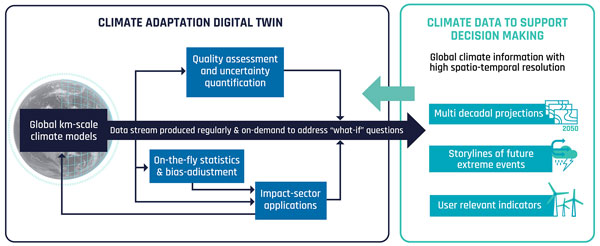
The Climate Change Adaptation Digital Twin (Climate DT) pioneers the operationalisation of global climate projections. It produces global simulations with local granularity for adaptation decision-making. Applications are embedded to generate tailored indicators. A unified workflow orchestrates all components in several supercomputers. Data management ensures consistency and streaming enables real-time use. It is a complementary innovation to initiatives like CMIP, CORDEX, and climate services.
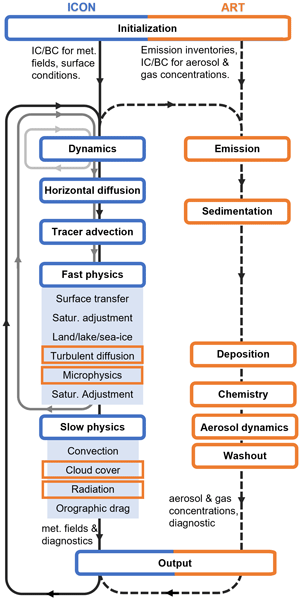
Gholam Ali Hoshyaripour, Andreas Baer, Sascha Bierbauer, Julia Bruckert, Dominik Brunner, Jochen Förstner, Arash Hamzehloo, Valentin Hanft, Corina Keller, Martina Klose, Pankaj Kumar, Patrick Ludwig, Enrico Metzner, Lisa Muth, Andreas Pauling, Nikolas Porz, Maryam Ramezani Ziarani, Thomas Reddmann, Luca Reißig, Roland Ruhnke, Khompat Satitkovitchai, Axel Seifert, Miriam Sinnhuber, Michael Steiner, Stefan Versick, Heike Vogel, Michael Weimer, Sven Werchner, and Corinna Hoose
Geosci. Model Dev., 19, 1645–1681, https://doi.org/10.5194/gmd-19-1645-2026, https://doi.org/10.5194/gmd-19-1645-2026, 2026
Short summary
Short summary
This paper presents recent advances in ICON-ART, a modeling system that simulates atmospheric composition – such as gases and particles – and their interactions with weather and climate. By integrating updated chemistry, emissions, and aerosol processes, ICON-ART enables detailed, scale-spanning simulations. It supports both scientific research and operational forecasts, contributing to improved air quality, weather and climate predictions.
Anurag Dipankar, Mauro Bianco, Mona Bukenberger, Till Ehrengruber, Nicoletta Farabullini, Oliver Fuhrer, Abishek Gopal, Daniel Hupp, Andreas Jocksch, Samuel Kellerhals, Clarissa A. Kroll, Xavier Lapillonne, Matthieu Leclair, Magdalena Luz, Christoph Müller, Chia Rui Ong, Carlos Osuna, Praveen Pothapakula, Andreas Prein, Matthias Röthlin, William Sawyer, Christoph Schär, Sebastian Schemm, Giacomo Serafini, Hannes Vogt, Ben Weber, Robert C. Jnglin Wills, Nicolas Gruber, and Thomas C. Schulthess
Geosci. Model Dev., 19, 713–729, https://doi.org/10.5194/gmd-19-713-2026, https://doi.org/10.5194/gmd-19-713-2026, 2026
Short summary
Short summary
Climate models are becoming more detailed and accurate by simulating weather at scales of just a few kilometers. Simulating at km-scale is computationally demanding requiring powerful supercomputers and efficient code. This work presents a refactored dynamical core of a state-of-the-art climate model using a Python-based approach. The refactored code has passed through a sequence of verification and validation demonstrating its usability in performing km-scale global simulations.
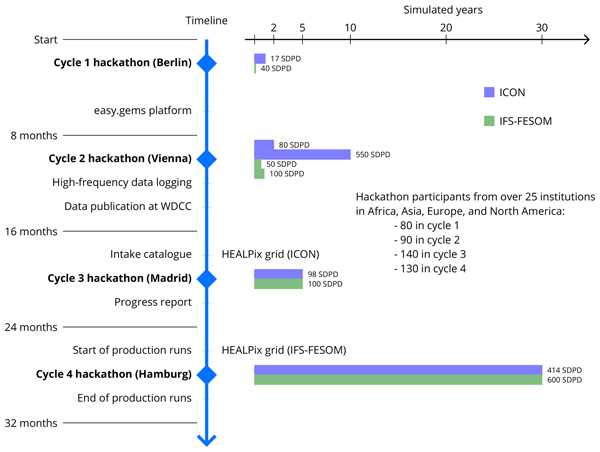
Hans Segura, Xabier Pedruzo-Bagazgoitia, Philipp Weiss, Sebastian K. Müller, Thomas Rackow, Junhong Lee, Edgar Dolores-Tesillos, Imme Benedict, Matthias Aengenheyster, Razvan Aguridan, Gabriele Arduini, Alexander J. Baker, Jiawei Bao, Swantje Bastin, Eulàlia Baulenas, Tobias Becker, Sebastian Beyer, Hendryk Bockelmann, Nils Brüggemann, Lukas Brunner, Suvarchal K. Cheedela, Sushant Das, Jasper Denissen, Ian Dragaud, Piotr Dziekan, Madeleine Ekblom, Jan Frederik Engels, Monika Esch, Richard Forbes, Claudia Frauen, Lilli Freischem, Diego García-Maroto, Philipp Geier, Paul Gierz, Álvaro González-Cervera, Katherine Grayson, Matthew Griffith, Oliver Gutjahr, Helmuth Haak, Ioan Hadade, Kerstin Haslehner, Shabeh ul Hasson, Jan Hegewald, Lukas Kluft, Aleksei Koldunov, Nikolay Koldunov, Tobias Kölling, Shunya Koseki, Sergey Kosukhin, Josh Kousal, Peter Kuma, Arjun U. Kumar, Rumeng Li, Nicolas Maury, Maximilian Meindl, Sebastian Milinski, Kristian Mogensen, Bimochan Niraula, Jakub Nowak, Divya Sri Praturi, Ulrike Proske, Dian Putrasahan, René Redler, David Santuy, Domokos Sármány, Reiner Schnur, Patrick Scholz, Dmitry Sidorenko, Dorian Spät, Birgit Sützl, Daisuke Takasuka, Adrian Tompkins, Alejandro Uribe, Mirco Valentini, Menno Veerman, Aiko Voigt, Sarah Warnau, Fabian Wachsmann, Marta Wacławczyk, Nils Wedi, Karl-Hermann Wieners, Jonathan Wille, Marius Winkler, Yuting Wu, Florian Ziemen, Janos Zimmermann, Frida A.-M. Bender, Dragana Bojovic, Sandrine Bony, Simona Bordoni, Patrice Brehmer, Marcus Dengler, Emanuel Dutra, Saliou Faye, Erich Fischer, Chiel van Heerwaarden, Cathy Hohenegger, Heikki Järvinen, Markus Jochum, Thomas Jung, Johann H. Jungclaus, Noel S. Keenlyside, Daniel Klocke, Heike Konow, Martina Klose, Szymon Malinowski, Olivia Martius, Thorsten Mauritsen, Juan Pedro Mellado, Theresa Mieslinger, Elsa Mohino, Hanna Pawłowska, Karsten Peters-von Gehlen, Abdoulaye Sarré, Pajam Sobhani, Philip Stier, Lauri Tuppi, Pier Luigi Vidale, Irina Sandu, and Bjorn Stevens
Geosci. Model Dev., 18, 7735–7761, https://doi.org/10.5194/gmd-18-7735-2025, https://doi.org/10.5194/gmd-18-7735-2025, 2025
Short summary
Short summary
The Next Generation of Earth Modeling Systems project (nextGEMS) developed two Earth system models that use horizontal grid spacing of 10 km and finer, giving more fidelity to the representation of local phenomena, globally. In its fourth cycle, nextGEMS simulated the Earth System climate over the 2020–2049 period under the SSP3-7.0 scenario. Here, we provide an overview of nextGEMS, insights into the model development, and the realism of multi-decadal, kilometer-scale simulations.
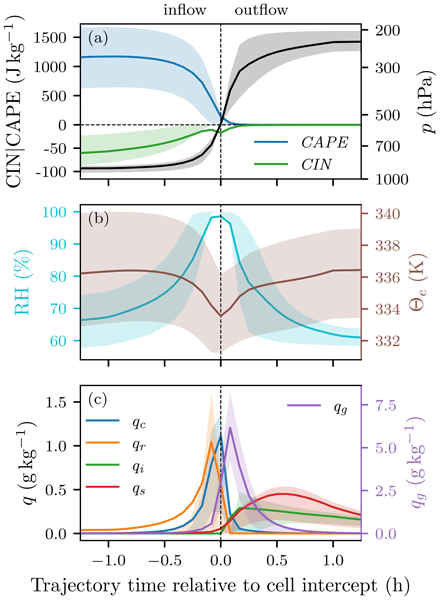
Killian P. Brennan, Michael Sprenger, André Walser, Marco Arpagaus, and Heini Wernli
Weather Clim. Dynam., 6, 645–668, https://doi.org/10.5194/wcd-6-645-2025, https://doi.org/10.5194/wcd-6-645-2025, 2025
Short summary
Short summary
We studied severe hailstorms that occurred in Switzerland on 28 June 2021 using a weather prediction model to understand how they evolved. We found that the storms moved toward areas with more storm energy. Hailfall was quickly followed by heavy rain. Just before the storms died out, the air feeding them stopped coming from near the ground. We also observed a delay between different types of precipitation forming in the incoming air.

Alexandre Bugnard, Martine Collaud Coen, Maxime Hervo, Daniel Leuenberger, Marco Arpagaus, and Samuel Monhart
Atmos. Meas. Tech., 18, 1039–1061, https://doi.org/10.5194/amt-18-1039-2025, https://doi.org/10.5194/amt-18-1039-2025, 2025
Short summary
Short summary
Temperature (T) and wind profiles were measured by a Doppler wind lidar and a microwave radiometer in Meiringen in a medium-sized Alpine valley. Ground-based T inversions and thermal winds were studied during the 10 months of the campaign. The comparison between the observations and the COSMO-1E model provides good model performance for monthly climatologies. T inversions are however frequently missed, and important differences for particular cases are found, especially for foehn events.
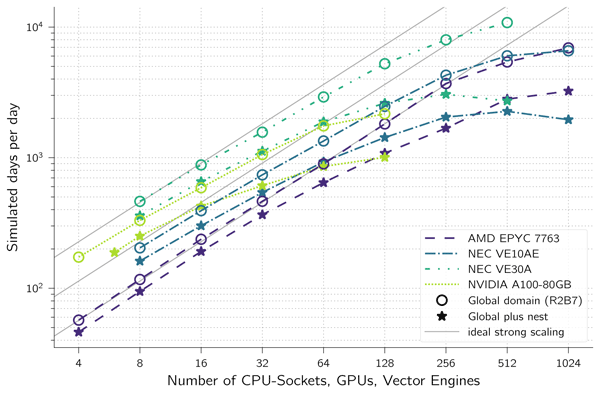
Panagiotis Adamidis, Erik Pfister, Hendryk Bockelmann, Dominik Zobel, Jens-Olaf Beismann, and Marek Jacob
Geosci. Model Dev., 18, 905–919, https://doi.org/10.5194/gmd-18-905-2025, https://doi.org/10.5194/gmd-18-905-2025, 2025
Short summary
Short summary
In this paper, we investigated performance indicators of the climate model ICON (ICOsahedral Nonhydrostatic) on different compute architectures to answer the question of how to generate high-resolution climate simulations. Evidently, it is not enough to use more computing units of the conventionally used architectures; higher memory throughput is the most promising approach. More potential can be gained from single-node optimization rather than simply increasing the number of compute nodes.
Stefano Ubbiali, Christian Kühnlein, Christoph Schär, Linda Schlemmer, Thomas C. Schulthess, Michael Staneker, and Heini Wernli
Geosci. Model Dev., 18, 529–546, https://doi.org/10.5194/gmd-18-529-2025, https://doi.org/10.5194/gmd-18-529-2025, 2025
Short summary
Short summary
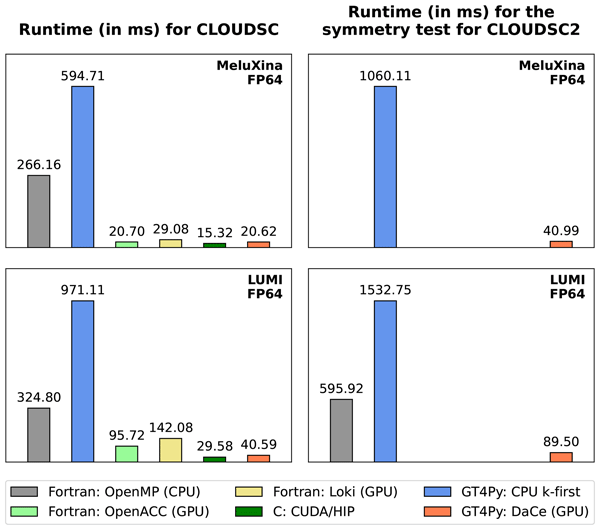
We explore a high-level programming model for porting numerical weather prediction (NWP) model codes to graphics processing units (GPUs). We present a Python rewrite with the domain-specific library GT4Py (GridTools for Python) of two renowned cloud microphysics schemes and the associated tangent-linear and adjoint algorithms. We find excellent portability, competitive GPU performance, robust execution on diverse computing architectures, and enhanced code maintainability and user productivity.
Lucie Bakels, Daria Tatsii, Anne Tipka, Rona Thompson, Marina Dütsch, Michael Blaschek, Petra Seibert, Katharina Baier, Silvia Bucci, Massimo Cassiani, Sabine Eckhardt, Christine Groot Zwaaftink, Stephan Henne, Pirmin Kaufmann, Vincent Lechner, Christian Maurer, Marie D. Mulder, Ignacio Pisso, Andreas Plach, Rakesh Subramanian, Martin Vojta, and Andreas Stohl
Geosci. Model Dev., 17, 7595–7627, https://doi.org/10.5194/gmd-17-7595-2024, https://doi.org/10.5194/gmd-17-7595-2024, 2024
Short summary
Short summary
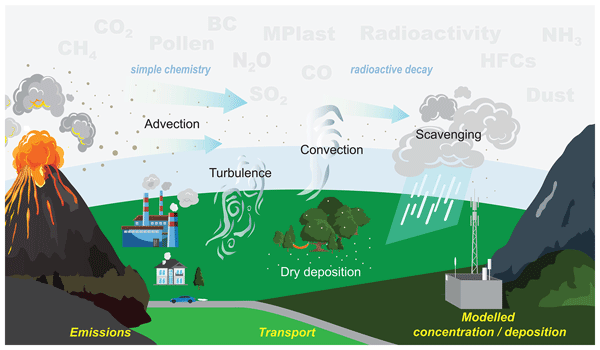
Computer models are essential for improving our understanding of how gases and particles move in the atmosphere. We present an update of the atmospheric transport model FLEXPART. FLEXPART 11 is more accurate due to a reduced number of interpolations and a new scheme for wet deposition. It can simulate non-spherical aerosols and includes linear chemical reactions. It is parallelised using OpenMP and includes new user options. A new user manual details how to use FLEXPART 11.
Hugo Banderier, Christian Zeman, David Leutwyler, Stefan Rüdisühli, and Christoph Schär
Geosci. Model Dev., 17, 5573–5586, https://doi.org/10.5194/gmd-17-5573-2024, https://doi.org/10.5194/gmd-17-5573-2024, 2024
Short summary
Short summary
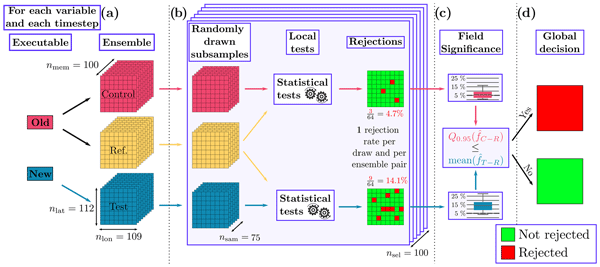
We investigate the effects of reduced-precision arithmetic in a state-of-the-art regional climate model by studying the results of 10-year-long simulations. After this time, the results of the reduced precision and the standard implementation are hardly different. This should encourage the use of reduced precision in climate models to exploit the speedup and memory savings it brings. The methodology used in this work can help researchers verify reduced-precision implementations of their model.
Bjorn Stevens, Stefan Adami, Tariq Ali, Hartwig Anzt, Zafer Aslan, Sabine Attinger, Jaana Bäck, Johanna Baehr, Peter Bauer, Natacha Bernier, Bob Bishop, Hendryk Bockelmann, Sandrine Bony, Guy Brasseur, David N. Bresch, Sean Breyer, Gilbert Brunet, Pier Luigi Buttigieg, Junji Cao, Christelle Castet, Yafang Cheng, Ayantika Dey Choudhury, Deborah Coen, Susanne Crewell, Atish Dabholkar, Qing Dai, Francisco Doblas-Reyes, Dale Durran, Ayoub El Gaidi, Charlie Ewen, Eleftheria Exarchou, Veronika Eyring, Florencia Falkinhoff, David Farrell, Piers M. Forster, Ariane Frassoni, Claudia Frauen, Oliver Fuhrer, Shahzad Gani, Edwin Gerber, Debra Goldfarb, Jens Grieger, Nicolas Gruber, Wilco Hazeleger, Rolf Herken, Chris Hewitt, Torsten Hoefler, Huang-Hsiung Hsu, Daniela Jacob, Alexandra Jahn, Christian Jakob, Thomas Jung, Christopher Kadow, In-Sik Kang, Sarah Kang, Karthik Kashinath, Katharina Kleinen-von Königslöw, Daniel Klocke, Uta Kloenne, Milan Klöwer, Chihiro Kodama, Stefan Kollet, Tobias Kölling, Jenni Kontkanen, Steve Kopp, Michal Koran, Markku Kulmala, Hanna Lappalainen, Fakhria Latifi, Bryan Lawrence, June Yi Lee, Quentin Lejeun, Christian Lessig, Chao Li, Thomas Lippert, Jürg Luterbacher, Pekka Manninen, Jochem Marotzke, Satoshi Matsouoka, Charlotte Merchant, Peter Messmer, Gero Michel, Kristel Michielsen, Tomoki Miyakawa, Jens Müller, Ramsha Munir, Sandeep Narayanasetti, Ousmane Ndiaye, Carlos Nobre, Achim Oberg, Riko Oki, Tuba Özkan-Haller, Tim Palmer, Stan Posey, Andreas Prein, Odessa Primus, Mike Pritchard, Julie Pullen, Dian Putrasahan, Johannes Quaas, Krishnan Raghavan, Venkatachalam Ramaswamy, Markus Rapp, Florian Rauser, Markus Reichstein, Aromar Revi, Sonakshi Saluja, Masaki Satoh, Vera Schemann, Sebastian Schemm, Christina Schnadt Poberaj, Thomas Schulthess, Cath Senior, Jagadish Shukla, Manmeet Singh, Julia Slingo, Adam Sobel, Silvina Solman, Jenna Spitzer, Philip Stier, Thomas Stocker, Sarah Strock, Hang Su, Petteri Taalas, John Taylor, Susann Tegtmeier, Georg Teutsch, Adrian Tompkins, Uwe Ulbrich, Pier-Luigi Vidale, Chien-Ming Wu, Hao Xu, Najibullah Zaki, Laure Zanna, Tianjun Zhou, and Florian Ziemen
Earth Syst. Sci. Data, 16, 2113–2122, https://doi.org/10.5194/essd-16-2113-2024, https://doi.org/10.5194/essd-16-2113-2024, 2024
Short summary
Short summary
To manage Earth in the Anthropocene, new tools, new institutions, and new forms of international cooperation will be required. Earth Virtualization Engines is proposed as an international federation of centers of excellence to empower all people to respond to the immense and urgent challenges posed by climate change.
Ruoyi Cui, Nikolina Ban, Marie-Estelle Demory, Raffael Aellig, Oliver Fuhrer, Jonas Jucker, Xavier Lapillonne, and Christoph Schär
Weather Clim. Dynam., 4, 905–926, https://doi.org/10.5194/wcd-4-905-2023, https://doi.org/10.5194/wcd-4-905-2023, 2023
Short summary
Short summary
Our study focuses on severe convective storms that occur over the Alpine-Adriatic region. By running simulations for eight real cases and evaluating them against available observations, we found our models did a good job of simulating total precipitation, hail, and lightning. Overall, this research identified important meteorological factors for hail and lightning, and the results indicate that both HAILCAST and LPI diagnostics are promising candidates for future climate research.
Johann Dahm, Eddie Davis, Florian Deconinck, Oliver Elbert, Rhea George, Jeremy McGibbon, Tobias Wicky, Elynn Wu, Christopher Kung, Tal Ben-Nun, Lucas Harris, Linus Groner, and Oliver Fuhrer
Geosci. Model Dev., 16, 2719–2736, https://doi.org/10.5194/gmd-16-2719-2023, https://doi.org/10.5194/gmd-16-2719-2023, 2023
Short summary
Short summary
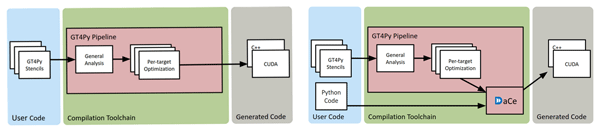
It is hard for scientists to write code which is efficient on different kinds of supercomputers. Python is popular for its user-friendliness. We converted a Fortran code, simulating Earth's atmosphere, into Python. This new code auto-converts to a faster language for processors or graphic cards. Our code runs 3.5–4 times faster on graphic cards than the original on processors in a specific supercomputer system.
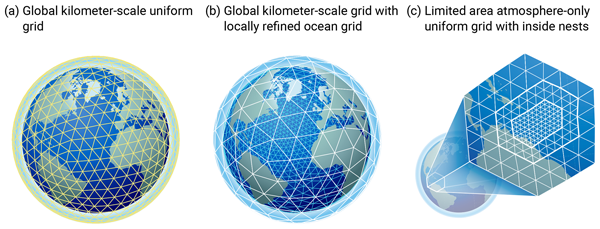
Cathy Hohenegger, Peter Korn, Leonidas Linardakis, René Redler, Reiner Schnur, Panagiotis Adamidis, Jiawei Bao, Swantje Bastin, Milad Behravesh, Martin Bergemann, Joachim Biercamp, Hendryk Bockelmann, Renate Brokopf, Nils Brüggemann, Lucas Casaroli, Fatemeh Chegini, George Datseris, Monika Esch, Geet George, Marco Giorgetta, Oliver Gutjahr, Helmuth Haak, Moritz Hanke, Tatiana Ilyina, Thomas Jahns, Johann Jungclaus, Marcel Kern, Daniel Klocke, Lukas Kluft, Tobias Kölling, Luis Kornblueh, Sergey Kosukhin, Clarissa Kroll, Junhong Lee, Thorsten Mauritsen, Carolin Mehlmann, Theresa Mieslinger, Ann Kristin Naumann, Laura Paccini, Angel Peinado, Divya Sri Praturi, Dian Putrasahan, Sebastian Rast, Thomas Riddick, Niklas Roeber, Hauke Schmidt, Uwe Schulzweida, Florian Schütte, Hans Segura, Radomyra Shevchenko, Vikram Singh, Mia Specht, Claudia Christine Stephan, Jin-Song von Storch, Raphaela Vogel, Christian Wengel, Marius Winkler, Florian Ziemen, Jochem Marotzke, and Bjorn Stevens
Geosci. Model Dev., 16, 779–811, https://doi.org/10.5194/gmd-16-779-2023, https://doi.org/10.5194/gmd-16-779-2023, 2023
Short summary
Short summary
Models of the Earth system used to understand climate and predict its change typically employ a grid spacing of about 100 km. Yet, many atmospheric and oceanic processes occur on much smaller scales. In this study, we present a new model configuration designed for the simulation of the components of the Earth system and their interactions at kilometer and smaller scales, allowing an explicit representation of the main drivers of the flow of energy and matter by solving the underlying equations.
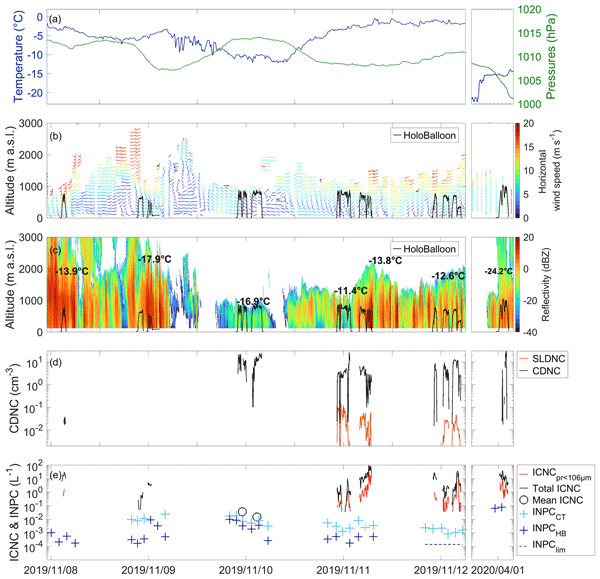
Julie Thérèse Pasquier, Jan Henneberger, Fabiola Ramelli, Annika Lauber, Robert Oscar David, Jörg Wieder, Tim Carlsen, Rosa Gierens, Marion Maturilli, and Ulrike Lohmann
Atmos. Chem. Phys., 22, 15579–15601, https://doi.org/10.5194/acp-22-15579-2022, https://doi.org/10.5194/acp-22-15579-2022, 2022
Short summary
Short summary
It is important to understand how ice crystals and cloud droplets form in clouds, as their concentrations and sizes determine the exact radiative properties of the clouds. Normally, ice crystals form from aerosols, but we found evidence for the formation of additional ice crystals from the original ones over a large temperature range within Arctic clouds. In particular, additional ice crystals were formed during collisions of several ice crystals or during the freezing of large cloud droplets.
Marco A. Giorgetta, William Sawyer, Xavier Lapillonne, Panagiotis Adamidis, Dmitry Alexeev, Valentin Clément, Remo Dietlicher, Jan Frederik Engels, Monika Esch, Henning Franke, Claudia Frauen, Walter M. Hannah, Benjamin R. Hillman, Luis Kornblueh, Philippe Marti, Matthew R. Norman, Robert Pincus, Sebastian Rast, Daniel Reinert, Reiner Schnur, Uwe Schulzweida, and Bjorn Stevens
Geosci. Model Dev., 15, 6985–7016, https://doi.org/10.5194/gmd-15-6985-2022, https://doi.org/10.5194/gmd-15-6985-2022, 2022
Short summary
Short summary
This work presents a first version of the ICON atmosphere model that works not only on CPUs, but also on GPUs. This GPU-enabled ICON version is benchmarked on two GPU machines and a CPU machine. While the weak scaling is very good on CPUs and GPUs, the strong scaling is poor on GPUs. But the high performance of GPU machines allowed for first simulations of a short period of the quasi-biennial oscillation at very high resolution with explicit convection and gravity wave forcing.
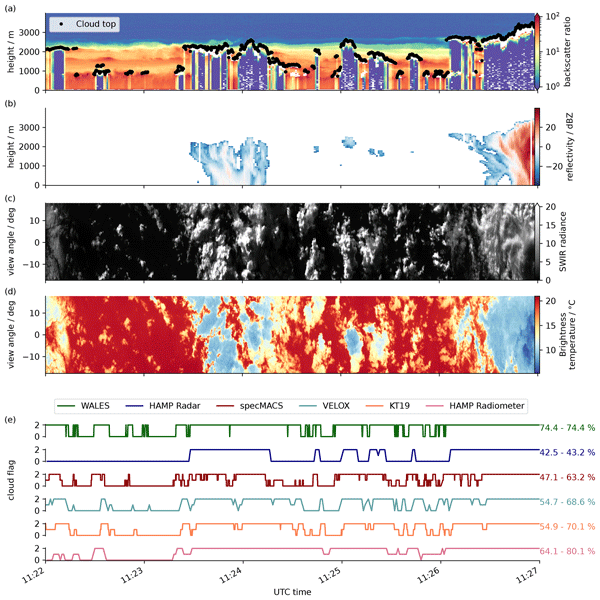
Heike Konow, Florian Ewald, Geet George, Marek Jacob, Marcus Klingebiel, Tobias Kölling, Anna E. Luebke, Theresa Mieslinger, Veronika Pörtge, Jule Radtke, Michael Schäfer, Hauke Schulz, Raphaela Vogel, Martin Wirth, Sandrine Bony, Susanne Crewell, André Ehrlich, Linda Forster, Andreas Giez, Felix Gödde, Silke Groß, Manuel Gutleben, Martin Hagen, Lutz Hirsch, Friedhelm Jansen, Theresa Lang, Bernhard Mayer, Mario Mech, Marc Prange, Sabrina Schnitt, Jessica Vial, Andreas Walbröl, Manfred Wendisch, Kevin Wolf, Tobias Zinner, Martin Zöger, Felix Ament, and Bjorn Stevens
Earth Syst. Sci. Data, 13, 5545–5563, https://doi.org/10.5194/essd-13-5545-2021, https://doi.org/10.5194/essd-13-5545-2021, 2021
Short summary
Short summary
The German research aircraft HALO took part in the research campaign EUREC4A in January and February 2020. The focus area was the tropical Atlantic east of the island of Barbados. We describe the characteristics of the 15 research flights, provide auxiliary information, derive combined cloud mask products from all instruments that observe clouds on board the aircraft, and provide code examples that help new users of the data to get started.
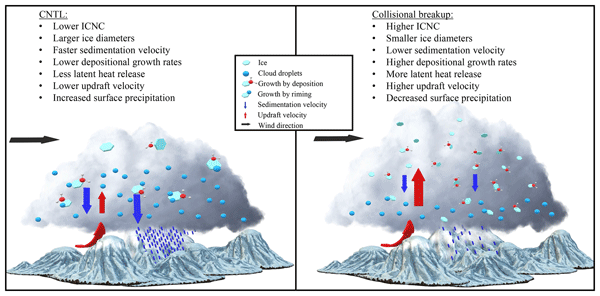
Zane Dedekind, Annika Lauber, Sylvaine Ferrachat, and Ulrike Lohmann
Atmos. Chem. Phys., 21, 15115–15134, https://doi.org/10.5194/acp-21-15115-2021, https://doi.org/10.5194/acp-21-15115-2021, 2021
Short summary
Short summary
The RACLETS campaign combined cloud and snow research to improve the understanding of precipitation formation in clouds. A numerical weather prediction model, COSMO, was used to assess the importance of ice crystal enhancement by ice–ice collisions for cloud properties. We found that the number of ice crystals increased by 1 to 3 orders of magnitude when ice–ice collisions were permitted to occur, reducing localized regions of high precipitation and, thereby, improving the model performance.
Cited articles
Adamidis, P., Pfister, E., Bockelmann, H., Zobel, D., Beismann, J.-O., and Jacob, M.: The real challenges for climate and weather modelling on its way to sustained exascale performance: a case study using ICON (v2.6.6), Geosci. Model Dev., 18, 905–919, https://doi.org/10.5194/gmd-18-905-2025, 2025. a, b
Adams, S., Ford, R., Hambley, M., Hobson, J., Kavčič, I., Maynard, C., Melvin, T., Müller, E., Mullerworth, S., Porter, A., Rezny, M., Shipway, B., and Wong, R.: LFRic: Meeting the challenges of scalability and performance portability in Weather and Climate models, Journal of Parallel and Distributed Computing, 132, 383–396, https://doi.org/10.1016/j.jpdc.2019.02.007, 2019. a
Alps: Alps CSCS, https://www.cscs.ch/computers/alps (last access: 1 October 2025), 2025. a
Baldauf, M., Seifert, A., Förstner, J., Majewski, D., Raschendorfer, M., and Reinhardt, T.: Operational convective-scale numerical weather prediction with the COSMO model: Description and sensitivities, Mon. Weather Rev., 139, 3887–3905, https://doi.org/10.1175/MWR-D-10-05013.1, 2011. a
Bauer, P., Thorpe, A., and Brunet, G.: The quiet revolution of numerical weather prediction, Nature, 525, 47–55, 2015. a
Cumming, B., Fourestey, G., Fuhrer, O., Gysi, T., Fatica, M., and Schulthess, T. C.: Application Centric Energy-Efficiency Study of Distributed Multi-Core and Hybrid CPU-GPU Systems, in: SC '14: Proceedings of the International Conference for High Performance Computing, Networking, Storage and Analysis, 819–829, https://doi.org/10.1109/SC.2014.72, 2014. a
Dahm, J., Davis, E., Deconinck, F., Elbert, O., George, R., McGibbon, J., Wicky, T., Wu, E., Kung, C., Ben-Nun, T., Harris, L., Groner, L., and Fuhrer, O.: Pace v0.2: a Python-based performance-portable atmospheric model, Geosci. Model Dev., 16, 2719–2736, https://doi.org/10.5194/gmd-16-2719-2023, 2023. a
Dipankar, A., Bianco, M., Bukenberger, M., Ehrengruber, T., Farabullini, N., Gopal, A., Hupp, D., Jocksch, A., Kellerhals, S., Kroll, C. A., Lapillonne, X., Leclair, M., Luz, M., Müller, C., Ong, C. R., Osuna, C., Pothapakula, P., Röthlin, M., Sawyer, W., Serafini, G., Vogt, H., Weber, B., and Schulthess, T.: Toward Exascale Climate Modelling: A Python DSL Approach to ICON’s (Icosahedral Non-hydrostatic) Dynamical Core (icon-exclaim v0.2.0), EGUsphere [preprint], https://doi.org/10.5194/egusphere-2025-4808, 2025. a, b
Donahue, A. S., Caldwell, P. M., Bertagna, L., Beydoun, H., Bogenschutz, P. A., Bradley, A. M., Clevenger, T. C., Foucar, J., Golaz, C., Guba, O., Hannah, W., Hillman, B. R., Johnson, J. N., Keen, N., Lin, W., Singh, B., Sreepathi, S., Taylor, M. A., Tian, J., Terai, C. R., Ullrich, P. A., Yuan, X., and Zhang, Y.: To Exascale and Beyond – The Simple Cloud-Resolving E3SM Atmosphere Model (SCREAM), a Performance Portable Global Atmosphere Model for Cloud-Resolving Scales, Journal of Advances in Modeling Earth Systems, 16, e2024MS004314, https://doi.org/10.1029/2024MS004314, 2024. a
Escobar, J., Wautelet, P., Pianezze, J., Pantillon, F., Dauhut, T., Barthe, C., and Chaboureau, J.-P.: Porting the Meso-NH atmospheric model on different GPU architectures for the next generation of supercomputers (version MESONH-v55-OpenACC), Geosci. Model Dev., 18, 2679–2700, https://doi.org/10.5194/gmd-18-2679-2025, 2025. a
Federal Office of Meteorology and Climatology MeteoSwiss: ICON-CH1-EPS input and verification data, Zenodo [data set], https://doi.org/10.5281/zenodo.16760638, 2024. a
Fuhrer, O., Osuna, C., Lapillonne, X., Gysi, T., Cumming, B., Bianco, M., Arteaga, A., and Schulthess, T. C.: Towards a performance portable, architecture agnostic implementation strategy for weather and climate models, Supercomputing Frontiers and Innovations, 1, 45–62, 2014. a
Giorgetta, M. A., Sawyer, W., Lapillonne, X., Adamidis, P., Alexeev, D., Clément, V., Dietlicher, R., Engels, J. F., Esch, M., Franke, H., Frauen, C., Hannah, W. M., Hillman, B. R., Kornblueh, L., Marti, P., Norman, M. R., Pincus, R., Rast, S., Reinert, D., Schnur, R., Schulzweida, U., and Stevens, B.: The ICON-A model for direct QBO simulations on GPUs (version icon-cscs:baf28a514), Geosci. Model Dev., 15, 6985–7016, https://doi.org/10.5194/gmd-15-6985-2022, 2022. a, b, c, d
Hogan, R. J. and Bozzo, A.: ECRAD: A new radiation scheme for the IFS, vol. 787, European Centre for Medium-Range Weather Forecasts Reading, UK, https://www.ecmwf.int/sites/default/files/elibrary/2016/16901-ecrad-new-radiation-scheme-ifs.pdf (last access: 15 November 2016), 2016. a
Hunt, B. R., Kostelich, E. J., and Szunyogh, I.: Efficient data assimilation for spatiotemporal chaos: A local ensemble transform Kalman filter, Physica D: Nonlinear Phenomena, 230, 112–126, https://doi.org/10.1016/j.physd.2006.11.008, 2007. a
ICON partnership: ICON model, 2024.10, World Data Center for Climate [code], https://doi.org/10.35089/WDCC/IconRelease2024.10, 2024a. a
ICON partnership: ICON model with Data Assimilation, 2024.10_withDA, Zenodo [code], https://doi.org/10.5281/zenodo.15674269, 2024b. a
Lapillonne, X. and Fuhrer, O.: Using compiler directives to port large scientific applications to GPUs: An example from atmospheric science, Parallel Processing Letters, 24, 1450003, https://doi.org/10.1142/S0129626414500030, 2014. a
Martinasso, M., Klein, M., Cumming, B., Gila, M., Cruz, F., Madonna, A., Ballesteros, M. S., Alam, S. R., and Schulthess, T. C.: Versatile Software-Defined Cluster for HPC Using Cloud Abstractions, Computing in Science & Engineering, 26, 20–29, https://doi.org/10.1109/MCSE.2024.3394164, 2024. a
Nickolls, J., Buck, I., Garland, M., and Skadron, K.: Scalable parallel programming with cuda: Is cuda the parallel programming model that application developers have been waiting for?, Queue, 6, 40–53, 2008. a
Palmer, T.: Climate forecasting: Build high-resolution global climate models, Nature, 515, 338–339, 2014. a
Paredes, E. G., Groner, L., Ubbiali, S., Vogt, H., Madonna, A., Mariotti, K., Cruz, F., Benedicic, L., Bianco, M., VandeVondele, J., and Schulthess, T. C.: GT4Py: High Performance Stencils for Weather and Climate Applications using Python, arXiv [preprint], https://doi.org/10.48550/arXiv.2311.08322, 2023. a
Probtest: Probability testing, GitHub [code], https://github.com/MeteoSwiss/probtest (last access: 29 September 2024), 2023. a
Reinert, D.: The Tracer Transport Module Part I: A Mass Consistent Finite Volume Approach with Fractional Steps, Tech. rep., Deutscher Wetterdienst, https://doi.org/10.5676/DWD_pub/nwv/icon_005, 2020. a
Reinert, D. and Zängl, G.: The Tracer Transport Module Part II: Description and Validation of the Vertical Transport Operator, Tech. rep., Deutscher Wetterdienst, https://doi.org/10.5676/DWD_pub/nwv/icon_007, 2021. a
Rieger, D., Bangert, M., Bischoff-Gauss, I., Förstner, J., Lundgren, K., Reinert, D., Schröter, J., Vogel, H., Zängl, G., Ruhnke, R., and Vogel, B.: ICON–ART 1.0 – a new online-coupled model system from the global to regional scale, Geosci. Model Dev., 8, 1659–1676, https://doi.org/10.5194/gmd-8-1659-2015, 2015. a
Schraff, C., Reich, H., Rhodin, A., Schomburg, A., Stephan, K., Periáñez, A., and Potthast, R.: Kilometre-scale ensemble data assimilation for the COSMO model (KENDA), Quarterly Journal of the Royal Meteorological Society, 142, 1453–1472, https://doi.org/10.1002/qj.2748, 2016. a
Schröter, J., Rieger, D., Stassen, C., Vogel, H., Weimer, M., Werchner, S., Förstner, J., Prill, F., Reinert, D., Zängl, G., Giorgetta, M., Ruhnke, R., Vogel, B., and Braesicke, P.: ICON-ART 2.1: a flexible tracer framework and its application for composition studies in numerical weather forecasting and climate simulations, Geosci. Model Dev., 11, 4043–4068, https://doi.org/10.5194/gmd-11-4043-2018, 2018. a
Shimokawabe, T., Aoki, T., Ishida, J., Kawano, K., and Muroi, C.: 145 TFlops Performance on 3990 GPUs of TSUBAME 2.0 Supercomputer for an Operational Weather Prediction, Procedia Computer Science, 4, 1535–1544, https://doi.org/10.1016/j.procs.2011.04.166, 2011. a
Steppeler, J., Doms, G., Schättler, U., Bitzer, H. W., Gassmann, A., Damrath, U., and Gregoric, G.: Meso-gamma scale forecasts using the nonhydrostatic model LM, Meteorol. Atmos. Phys., 82, 75–96, https://doi.org/10.1007/s00703-001-0592-9, 2003. a
Ubbiali, S., Kühnlein, C., Schär, C., Schlemmer, L., Schulthess, T. C., Staneker, M., and Wernli, H.: Exploring a high-level programming model for the NWP domain using ECMWF microphysics schemes, Geosci. Model Dev., 18, 529–546, https://doi.org/10.5194/gmd-18-529-2025, 2025. a
Editorial statement
Increasingly, new supercomputers depend on GPUs for the vast bulk of their processing power. This makes the effective exploitation of GPUs an imperative across geoscientific modelling. This paper presents the port of a full numerical weather prediction system to GPU. It provides an excellent example of how such a port can be achieved in practice while delivering significant performance benefits. As such, this work offers particularly valuable guidance for the wider modelling community.
Increasingly, new supercomputers depend on GPUs for the vast bulk of their processing power....
Short summary
The ICON climate and numerical weather prediction model was fully ported to Graphical Processing Units (GPUs) using OpenACC compiler directives, covering all components required for operational weather prediction. The GPU port together with several performance optimizations led to a speed-up of 5.6× when comparing to traditional Central Processing Units (CPUs) . Thanks to this adaptation effort, MeteoSwiss became the first national weather service to run the ICON model operationally on GPUs.
The ICON climate and numerical weather prediction model was fully ported to Graphical Processing...


