
Articles | Volume 19, issue 10
https://doi.org/10.5194/gmd-19-4205-2026
© Author(s) 2026. This work is distributed under
the Creative Commons Attribution 4.0 License.
the Creative Commons Attribution 4.0 License.
https://doi.org/10.5194/gmd-19-4205-2026
© Author(s) 2026. This work is distributed under
the Creative Commons Attribution 4.0 License.
the Creative Commons Attribution 4.0 License.
Model evaluation paper
| 
20 May 2026
Model evaluation paper |
| 20 May 2026
| 20 May 2026
Operational chemical weather forecasting with the ECCC online Regional Air Quality Deterministic Prediction System version 023 (RAQDPS023) – Part 2: Multi-year prospective and retrospective performance evaluation

Air Quality Research Division, Environment and Climate Change Canada (ECCC), Toronto, Ontario, Canada
retired, ECCC Scientist Emerit
Air Quality Research Division, Environment and Climate Change Canada (ECCC), Toronto, Ontario, Canada
Verica Savic-Jovcic
Air Quality Research Division, Environment and Climate Change Canada (ECCC), Toronto, Ontario, Canada
Junhua Zhang
Air Quality Research Division, Environment and Climate Change Canada (ECCC), Toronto, Ontario, Canada
Qiong Zheng
Air Quality Research Division, Environment and Climate Change Canada (ECCC), Toronto, Ontario, Canada
Elisa I. Boutzis
Air Quality Research Division, Environment and Climate Change Canada (ECCC), Toronto, Ontario, Canada
Rabab Mashayekhi
Canadian Centre for Meteorological and Environmental Prediction, ECCC, Montreal, Quebec, Canada
Craig A. Stroud
CORRESPONDING AUTHOR
Air Quality Research Division, Environment and Climate Change Canada (ECCC), Toronto, Ontario, Canada
Sylvain Ménard
Canadian Centre for Meteorological and Environmental Prediction, ECCC, Montreal, Quebec, Canada
Jack Chen
Air Quality Research Division, Environment and Climate Change Canada (ECCC), Toronto, Ontario, Canada
Konstantinos Menelaou
Canadian Centre for Meteorological and Environmental Prediction, ECCC, Montreal, Quebec, Canada
Rodrigo Munoz-Alpizar
Canadian Centre for Meteorological and Environmental Prediction, ECCC, Montreal, Quebec, Canada
Dragana Kornic
Canadian Centre for Meteorological and Environmental Prediction, ECCC, Montreal, Quebec, Canada
Patrick M. Manseau
Canadian Centre for Meteorological and Environmental Prediction, ECCC, Montreal, Quebec, Canada
Related authors
Michael D. Moran, Verica Savic-Jovcic, Craig A. Stroud, Sylvain Ménard, Wanmin Gong, Junhua Zhang, Qiong Zheng, Jack Chen, Ayodeji Akingunola, Alexandru Lupu, Konstantinos Menelaou, and Rodrigo Munoz-Alpizar
Geosci. Model Dev., 19, 4137–4203, https://doi.org/10.5194/gmd-19-4137-2026, https://doi.org/10.5194/gmd-19-4137-2026, 2026
Short summary
Short summary
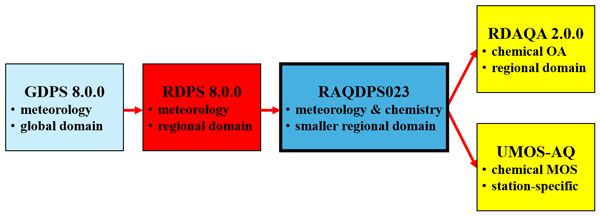
Canada's weather agency uses an online chemical weather forecast system to produce forecasts of key air pollutants over North America. Here we describe two recent versions of this Regional Air Quality Deterministic Prediction System (RAQDPS), including the meteorological host model, embedded chemistry module, and two downstream systems. Three simplifications to reduce run time are also described. A companion paper presents results from a comprehensive, 5-year evaluation of RAQDPS predictions.
Diego Guizzardi, Monica Crippa, Tim Butler, Terry Keating, Rosa Wu, Jacek Kaminski, Jeroen Kuenen, Junichi Kurokawa, Satoru Chatani, Tazuko Morikawa, George Pouliot, Jacinthe Racine, Michael D. Moran, Zbigniew Klimont, Patrick M. Manseau, Rabab Mashayekhi, Barron H. Henderson, Steven J. Smith, Rachel Hoesly, Marilena Muntean, Manjola Banja, Edwin Schaaf, Federico Pagani, Jung-Hun Woo, Jinseok Kim, Enrico Pisoni, Junhua Zhang, David Niemi, Mourad Sassi, Annie Duhamel, Tabish Ansari, Kristen Foley, Guannan Geng, Yifei Chen, and Qiang Zhang
Earth Syst. Sci. Data, 17, 5915–5950, https://doi.org/10.5194/essd-17-5915-2025, https://doi.org/10.5194/essd-17-5915-2025, 2025
Short summary
Short summary
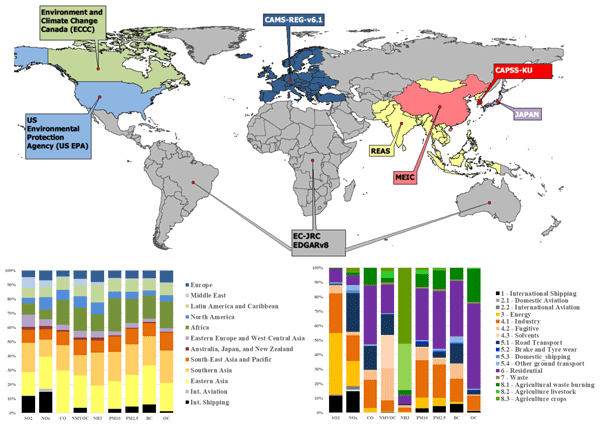
The global air pollution emission mosaic HTAP_v3.2 is the state-of-the-art inventory to address the evolution of a set of policy-relevant pollutants over the past 2 decades. The mosaic is made harmonising and blending seven regional inventories, gapfilled with the most recent release of the Emissions Database for Global Atmospheric Research. By incorporating the best available local information, the HTAP_v3.2 emission mosaic can be used for policy-relevant studies at regional and global level.
Hazel Cathcart, Julian Aherne, Michael D. Moran, Verica Savic-Jovcic, Paul A. Makar, and Amanda Cole
Biogeosciences, 22, 535–554, https://doi.org/10.5194/bg-22-535-2025, https://doi.org/10.5194/bg-22-535-2025, 2025
Short summary
Short summary
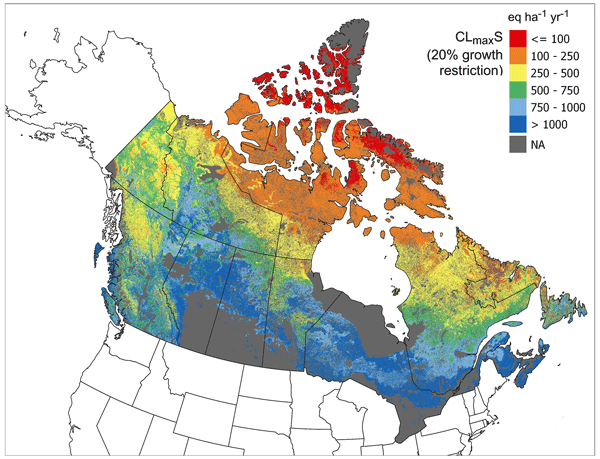
Deposition from sulfur and nitrogen pollution can harm ecosystems, and recovery from this type of pollution can take decades or longer. To identify risk to Canadian soils, we created maps showing sensitivity to sulfur and nitrogen pollution. Results show that some ecosystems are at risk from acid and nutrient nitrogen deposition: 10 % of protected areas are receiving acid deposition beyond their damage threshold, and 70 % may be receiving nitrogen deposition that could cause biodiversity loss.
Monica Crippa, Diego Guizzardi, Tim Butler, Terry Keating, Rosa Wu, Jacek Kaminski, Jeroen Kuenen, Junichi Kurokawa, Satoru Chatani, Tazuko Morikawa, George Pouliot, Jacinthe Racine, Michael D. Moran, Zbigniew Klimont, Patrick M. Manseau, Rabab Mashayekhi, Barron H. Henderson, Steven J. Smith, Harrison Suchyta, Marilena Muntean, Efisio Solazzo, Manjola Banja, Edwin Schaaf, Federico Pagani, Jung-Hun Woo, Jinseok Kim, Fabio Monforti-Ferrario, Enrico Pisoni, Junhua Zhang, David Niemi, Mourad Sassi, Tabish Ansari, and Kristen Foley
Earth Syst. Sci. Data, 15, 2667–2694, https://doi.org/10.5194/essd-15-2667-2023, https://doi.org/10.5194/essd-15-2667-2023, 2023
Short summary
Short summary
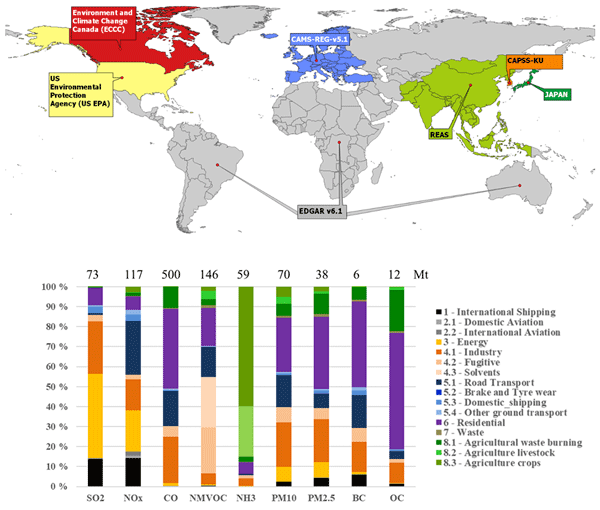
This study responds to the global and regional atmospheric modelling community's need for a mosaic of air pollutant emissions with global coverage, long time series, spatially distributed data at a high time resolution, and a high sectoral resolution in order to enhance the understanding of transboundary air pollution. The mosaic approach to integrating official regional emission inventories with a global inventory based on a consistent methodology ensures policy-relevant results.
Mahtab Majdzadeh, Craig A. Stroud, Christopher Sioris, Paul A. Makar, Ayodeji Akingunola, Chris McLinden, Xiaoyi Zhao, Michael D. Moran, Ihab Abboud, and Jack Chen
Geosci. Model Dev., 15, 219–249, https://doi.org/10.5194/gmd-15-219-2022, https://doi.org/10.5194/gmd-15-219-2022, 2022
Short summary
Short summary
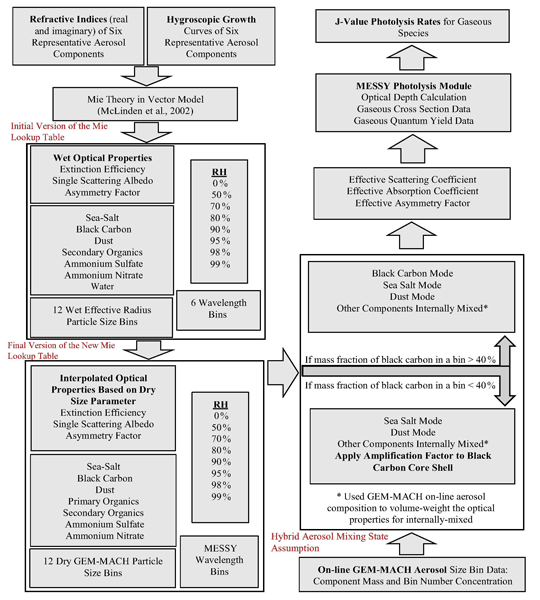
A new lookup table for aerosol optical properties based on a Mie scattering code was calculated and adopted within an improved version of the photolysis module in the GEM-MACH in-line chemical transport model. The modified version of the photolysis module makes use of online interactive aerosol feedback and applies core-shell parameterizations to the black carbon absorption efficiency based on Bond et al. (2006) to the size bins with black carbon mass fraction of less than 40 %.

Xiao Lu, Daniel J. Jacob, Haolin Wang, Joannes D. Maasakkers, Yuzhong Zhang, Tia R. Scarpelli, Lu Shen, Zhen Qu, Melissa P. Sulprizio, Hannah Nesser, A. Anthony Bloom, Shuang Ma, John R. Worden, Shaojia Fan, Robert J. Parker, Hartmut Boesch, Ritesh Gautam, Deborah Gordon, Michael D. Moran, Frances Reuland, Claudia A. Octaviano Villasana, and Arlyn Andrews
Atmos. Chem. Phys., 22, 395–418, https://doi.org/10.5194/acp-22-395-2022, https://doi.org/10.5194/acp-22-395-2022, 2022
Short summary
Short summary
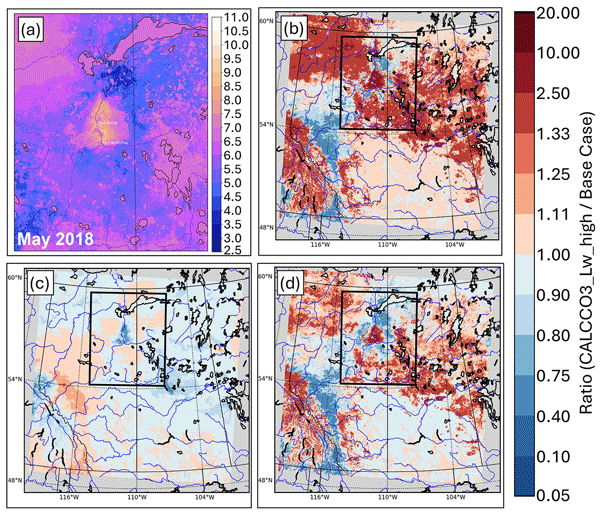
We evaluate methane emissions and trends for 2010–2017 in the gridded national emission inventories for the United States, Canada, and Mexico by inversion of in situ and satellite methane observations. We find that anthropogenic methane emissions for all three countries are underestimated in the national inventories, largely driven by oil emissions. Anthropogenic methane emissions in the US peak in 2014, in contrast to the report of a steadily decreasing trend over 2010–2017 from the US EPA.
Stefan Miller, Paul A. Makar, Kenjiro Toyota, Colin Lee, Verica Savic-Jovcic, Sepehr Fathi, Mahtab Majdzadeh, and Katherine Hayden
Atmos. Chem. Phys., 26, 9997–10027, https://doi.org/10.5194/acp-26-9997-2026, https://doi.org/10.5194/acp-26-9997-2026, 2026
Short summary
Short summary
This work identifies an important and hitherto unsuspected controlling factor influencing the rate of deposition of atmospheric gases to foliage surfaces. We show base cation-containing dust that settles on foliage can raise the pH of thin water films on leaves, significantly increasing sulphur dioxide dry deposition rates (often by more than 1 cm s-1), and lowering concentrations (by up to 60%), near sources of alkaline dust emissions, changing sulphur deposition fluxes' spatial distribution.
Annika Vogel, Richard Ménard, James Abu, and Jack Chen
Nonlin. Processes Geophys., 33, 347–371, https://doi.org/10.5194/npg-33-347-2026, https://doi.org/10.5194/npg-33-347-2026, 2026
Short summary
Short summary
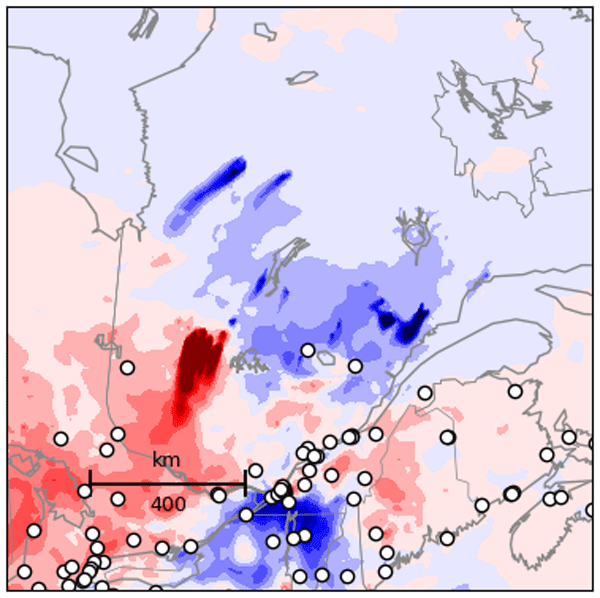
Recent wildfire activity in Canada has been rising the public demand for fast, yet accurate operational air quality forecasts along with related forecast uncertainties. This study explores the potential of an efficient process-based approach to estimate forecast uncertainties of operational air quality models. Our results show its potential for understanding how uncertainties of operational forecast evolve over time and an improved use of sparse observation signals at remote wildfire regions.
Michael D. Moran, Verica Savic-Jovcic, Craig A. Stroud, Sylvain Ménard, Wanmin Gong, Junhua Zhang, Qiong Zheng, Jack Chen, Ayodeji Akingunola, Alexandru Lupu, Konstantinos Menelaou, and Rodrigo Munoz-Alpizar
Geosci. Model Dev., 19, 4137–4203, https://doi.org/10.5194/gmd-19-4137-2026, https://doi.org/10.5194/gmd-19-4137-2026, 2026
Short summary
Short summary
Canada's weather agency uses an online chemical weather forecast system to produce forecasts of key air pollutants over North America. Here we describe two recent versions of this Regional Air Quality Deterministic Prediction System (RAQDPS), including the meteorological host model, embedded chemistry module, and two downstream systems. Three simplifications to reduce run time are also described. A companion paper presents results from a comprehensive, 5-year evaluation of RAQDPS predictions.
Sina Voshtani, Dylan B. A. Jones, Debra Wunch, Drew C. Pendergrass, Paul O. Wennberg, David F. Pollard, Isamu Morino, Hirofumi Ohyama, Nicholas M. Deutscher, Frank Hase, Ralf Sussmann, Damien Weidmann, Rigel Kivi, Omaira García, Yao Té, Jack Chen, Kerry Anderson, Robin Stevens, Shobha Kondragunta, Aihua Zhu, Douglas Worthy, Senen Racki, Kathryn McKain, Maria V. Makarova, Nicholas Jones, Emmanuel Mahieu, Andrea Cadena-Caicedo, Paolo Cristofanelli, Casper Labuschagne, Elena Kozlova, Thomas Seitz, Martin Steinbacher, Reza Mahdi, and Isao Murata
Atmos. Chem. Phys., 25, 15527–15565, https://doi.org/10.5194/acp-25-15527-2025, https://doi.org/10.5194/acp-25-15527-2025, 2025
Short summary
Short summary
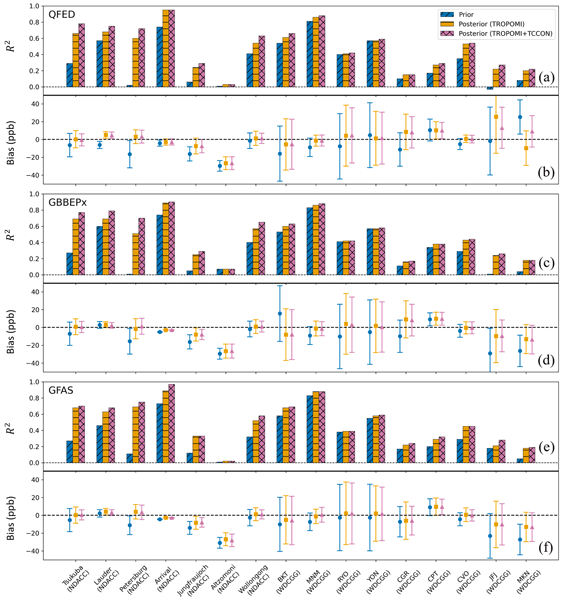
We assess the complementarity of the greater temporal coverage provided by ground-based remote sensing data with the spatial coverage of satellite observations when these data are used together to quantify CO emissions from extreme wildfires in 2023. Our results reveal that the commonly used biomass burning emission inventories significantly underestimate the fire emissions and emphasize the importance of the ground-based remote sensing data in reducing uncertainties in the estimated emissions.
Diego Guizzardi, Monica Crippa, Tim Butler, Terry Keating, Rosa Wu, Jacek Kaminski, Jeroen Kuenen, Junichi Kurokawa, Satoru Chatani, Tazuko Morikawa, George Pouliot, Jacinthe Racine, Michael D. Moran, Zbigniew Klimont, Patrick M. Manseau, Rabab Mashayekhi, Barron H. Henderson, Steven J. Smith, Rachel Hoesly, Marilena Muntean, Manjola Banja, Edwin Schaaf, Federico Pagani, Jung-Hun Woo, Jinseok Kim, Enrico Pisoni, Junhua Zhang, David Niemi, Mourad Sassi, Annie Duhamel, Tabish Ansari, Kristen Foley, Guannan Geng, Yifei Chen, and Qiang Zhang
Earth Syst. Sci. Data, 17, 5915–5950, https://doi.org/10.5194/essd-17-5915-2025, https://doi.org/10.5194/essd-17-5915-2025, 2025
Short summary
Short summary
The global air pollution emission mosaic HTAP_v3.2 is the state-of-the-art inventory to address the evolution of a set of policy-relevant pollutants over the past 2 decades. The mosaic is made harmonising and blending seven regional inventories, gapfilled with the most recent release of the Emissions Database for Global Atmospheric Research. By incorporating the best available local information, the HTAP_v3.2 emission mosaic can be used for policy-relevant studies at regional and global level.
Kirill Semeniuk, Ashu Dastoor, and Alex Lupu
Geosci. Model Dev., 18, 6479–6515, https://doi.org/10.5194/gmd-18-6479-2025, https://doi.org/10.5194/gmd-18-6479-2025, 2025
Short summary
Short summary
The Model for Simulating Aerosol Interactions and Chemistry (MOSAIC) inorganic aerosol sub-model has been implemented in the Global Environmental Multiscale – Modeling Air Quality and Chemistry (GEM-MACH) air quality model. MOSAIC includes metal cation reactions and is a non-equilibrium, double-moment scheme that conserves aerosol number. Compared to the current aerosol sub-model, MOSAIC produces a more accurate size distribution and aerosol number concentration. It also improves the simulated nitrate and ammonium distribution. This work serves to expand the capacity of GEM-MACH for chemistry and weather coupling.
Wanmin Gong, Stephen R. Beagley, Kenjiro Toyota, Henrik Skov, Jesper Heile Christensen, Alex Lupu, Diane Pendlebury, Junhua Zhang, Ulas Im, Yugo Kanaya, Alfonso Saiz-Lopez, Roberto Sommariva, Peter Effertz, John W. Halfacre, Nis Jepsen, Rigel Kivi, Theodore K. Koenig, Katrin Müller, Claus Nordstrøm, Irina Petropavlovskikh, Paul B. Shepson, William R. Simpson, Sverre Solberg, Ralf M. Staebler, David W. Tarasick, Roeland Van Malderen, and Mika Vestenius
Atmos. Chem. Phys., 25, 8355–8405, https://doi.org/10.5194/acp-25-8355-2025, https://doi.org/10.5194/acp-25-8355-2025, 2025
Short summary
Short summary
This study showed that the springtime O3 depletion plays a critical role in driving the surface O3 seasonal cycle in the central Arctic. The O3 depletion events, while occurring most notably within the lowest few hundred metres above the Arctic Ocean, can induce a 5–7 % loss in the pan-Arctic tropospheric O3 burden during springtime. The study also found enhancements in O3 and NOy (mostly peroxyacetyl nitrate) concentrations in the Arctic due to northern boreal wildfires, particularly at higher altitudes.
Chris A. McLinden, Debora Griffin, Vitali Fioletov, Junhua Zhang, Enrico Dammers, Cristen Adams, Mallory Loria, Nickolay Krotkov, and Lok N. Lamsal
Atmos. Chem. Phys., 25, 6093–6120, https://doi.org/10.5194/acp-25-6093-2025, https://doi.org/10.5194/acp-25-6093-2025, 2025
Short summary
Short summary
The Ozone Monitoring Instrument (OMI) was used to understand the evolution of NOx emissions from the Canadian oil sands. OMI NO2 combined with winds and reported stack emissions found emissions from the heavy-hauler mine fleet have remained flat since 2005, whereas the total oil sands mined have more than doubled. This difference is a result of emissions standards that limit NOx emissions becoming more stringent over this period, confirming the efficacy of the policy enacting these standards.
Ramina Alwarda, Kristof Bognar, Xiaoyi Zhao, Vitali Fioletov, Jonathan Davies, Sum Chi Lee, Debora Griffin, Alexandru Lupu, Udo Frieß, Alexander Cede, Yushan Su, and Kimberly Strong
Atmos. Meas. Tech., 18, 2397–2423, https://doi.org/10.5194/amt-18-2397-2025, https://doi.org/10.5194/amt-18-2397-2025, 2025
Short summary
Short summary
Nitrogen dioxide (NO2) is a pollutant with a short lifetime and large variability, but there are limited measurements of its distribution in the lower atmosphere. We present a new 3-year dataset of NO2 vertical profiles in Toronto, Canada, and evaluate it using NO2 from satellite and surface monitoring networks and simulations by an air quality forecast model. We quantify and explain the differences among the datasets to provide information that can be used to understand NO2 variability.
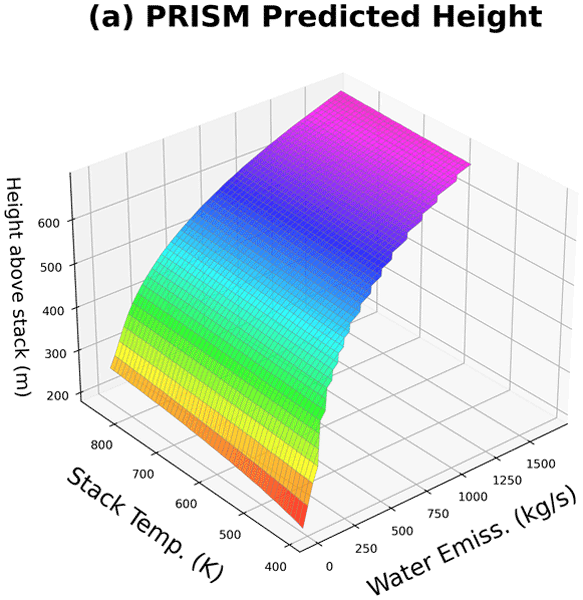
Sepehr Fathi, Paul Makar, Wanmin Gong, Junhua Zhang, Katherine Hayden, and Mark Gordon
Atmos. Chem. Phys., 25, 2385–2405, https://doi.org/10.5194/acp-25-2385-2025, https://doi.org/10.5194/acp-25-2385-2025, 2025
Short summary
Short summary
Our study explores the influence of water phase changes in plumes from industrial sources on atmospheric dispersion of emitted pollutants and air quality. Employing PRISM (Plume-Rise-Iterative-Stratified-Moist), a new method, we found that considering these effects significantly improves predictions of pollutant dispersion. This insight enhances our understanding of environmental impacts, enabling more accurate air quality modelling and fostering more effective pollution management strategies.
Hazel Cathcart, Julian Aherne, Michael D. Moran, Verica Savic-Jovcic, Paul A. Makar, and Amanda Cole
Biogeosciences, 22, 535–554, https://doi.org/10.5194/bg-22-535-2025, https://doi.org/10.5194/bg-22-535-2025, 2025
Short summary
Short summary
Deposition from sulfur and nitrogen pollution can harm ecosystems, and recovery from this type of pollution can take decades or longer. To identify risk to Canadian soils, we created maps showing sensitivity to sulfur and nitrogen pollution. Results show that some ecosystems are at risk from acid and nutrient nitrogen deposition: 10 % of protected areas are receiving acid deposition beyond their damage threshold, and 70 % may be receiving nitrogen deposition that could cause biodiversity loss.
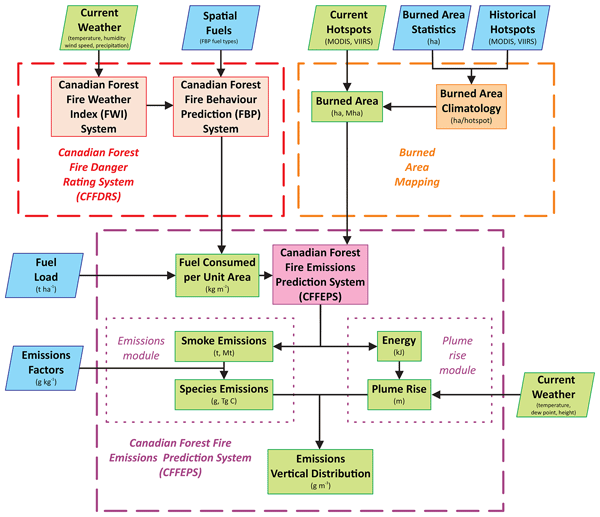
Kerry Anderson, Jack Chen, Peter Englefield, Debora Griffin, Paul A. Makar, and Dan Thompson
Geosci. Model Dev., 17, 7713–7749, https://doi.org/10.5194/gmd-17-7713-2024, https://doi.org/10.5194/gmd-17-7713-2024, 2024
Short summary
Short summary
The Global Forest Fire Emissions Prediction System (GFFEPS) is a model that predicts smoke and carbon emissions from wildland fires. The model calculates emissions from the ground up based on satellite-detected fires, modelled weather and fire characteristics. Unlike other global models, GFFEPS uses daily weather conditions to capture changing burning conditions on a day-to-day basis. GFFEPS produced lower carbon emissions due to the changing weather not captured by the other models.
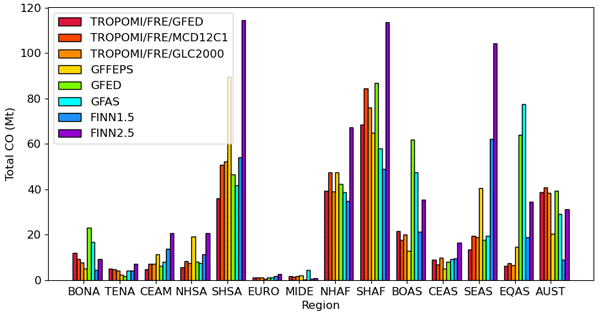
Debora Griffin, Jack Chen, Kerry Anderson, Paul Makar, Chris A. McLinden, Enrico Dammers, and Andre Fogal
Atmos. Chem. Phys., 24, 10159–10186, https://doi.org/10.5194/acp-24-10159-2024, https://doi.org/10.5194/acp-24-10159-2024, 2024
Short summary
Short summary
Satellite-derived CO emissions provide new insights into the understanding of global CO emission rates from wildfires. We use TROPOMI satellite data to create a global inventory database of wildfire CO emissions. These satellite-derived wildfire emissions are used for the evaluation and improvement of existing fire emission inventories and to examine how the wildfire CO emissions have changed over the past 2 decades.
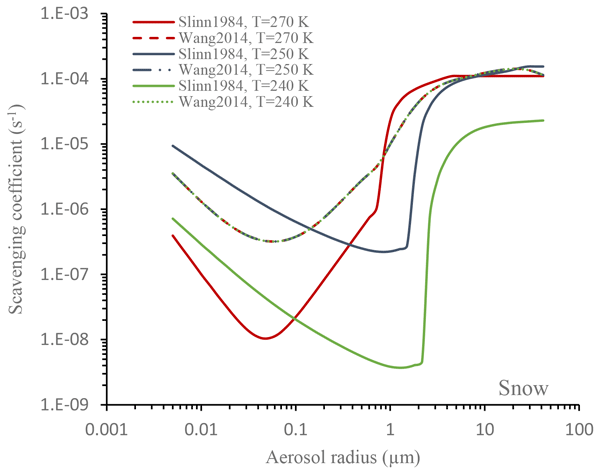
Roya Ghahreman, Wanmin Gong, Paul A. Makar, Alexandru Lupu, Amanda Cole, Kulbir Banwait, Colin Lee, and Ayodeji Akingunola
Geosci. Model Dev., 17, 685–707, https://doi.org/10.5194/gmd-17-685-2024, https://doi.org/10.5194/gmd-17-685-2024, 2024
Short summary
Short summary
The article explores the impact of different representations of below-cloud scavenging on model biases. A new scavenging scheme and precipitation-phase partitioning improve the model's performance, with better SO42- scavenging and wet deposition of NO3- and NH4+.
Monica Crippa, Diego Guizzardi, Tim Butler, Terry Keating, Rosa Wu, Jacek Kaminski, Jeroen Kuenen, Junichi Kurokawa, Satoru Chatani, Tazuko Morikawa, George Pouliot, Jacinthe Racine, Michael D. Moran, Zbigniew Klimont, Patrick M. Manseau, Rabab Mashayekhi, Barron H. Henderson, Steven J. Smith, Harrison Suchyta, Marilena Muntean, Efisio Solazzo, Manjola Banja, Edwin Schaaf, Federico Pagani, Jung-Hun Woo, Jinseok Kim, Fabio Monforti-Ferrario, Enrico Pisoni, Junhua Zhang, David Niemi, Mourad Sassi, Tabish Ansari, and Kristen Foley
Earth Syst. Sci. Data, 15, 2667–2694, https://doi.org/10.5194/essd-15-2667-2023, https://doi.org/10.5194/essd-15-2667-2023, 2023
Short summary
Short summary
This study responds to the global and regional atmospheric modelling community's need for a mosaic of air pollutant emissions with global coverage, long time series, spatially distributed data at a high time resolution, and a high sectoral resolution in order to enhance the understanding of transboundary air pollution. The mosaic approach to integrating official regional emission inventories with a global inventory based on a consistent methodology ensures policy-relevant results.
Shuzhan Ren and Craig A. Stroud
Atmos. Chem. Phys. Discuss., https://doi.org/10.5194/acp-2023-37, https://doi.org/10.5194/acp-2023-37, 2023
Revised manuscript not accepted
Short summary
Short summary
The atmospheric boundary layer height is involved in the turbulence parameterization scheme employed in numerical models. It affects the concentration of chemical species by changing the vertical diffusivity and the volume of tracer in the atmosphere. There exists large uncertainties in the boundary layer height. The impacts of the uncertainties on the model simulation of concentration of chemical species are examined. The results show different impacts in different parameterization scheme.
Katherine L. Hayden, Shao-Meng Li, John Liggio, Michael J. Wheeler, Jeremy J. B. Wentzell, Amy Leithead, Peter Brickell, Richard L. Mittermeier, Zachary Oldham, Cristian M. Mihele, Ralf M. Staebler, Samar G. Moussa, Andrea Darlington, Mengistu Wolde, Daniel Thompson, Jack Chen, Debora Griffin, Ellen Eckert, Jenna C. Ditto, Megan He, and Drew R. Gentner
Atmos. Chem. Phys., 22, 12493–12523, https://doi.org/10.5194/acp-22-12493-2022, https://doi.org/10.5194/acp-22-12493-2022, 2022
Short summary
Short summary
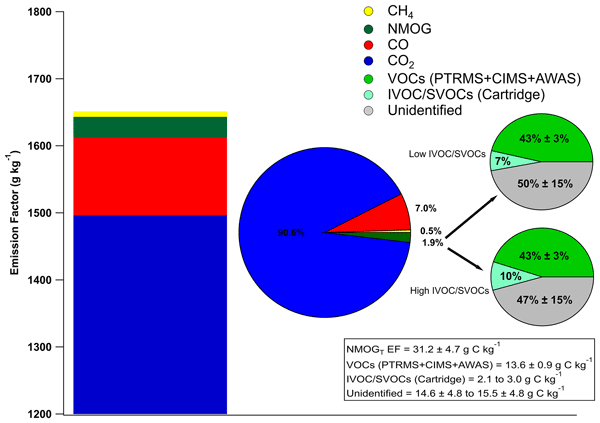
In this study, airborne measurements provided the most detailed characterization, to date, of boreal forest wildfire emissions. Measurements showed a large diversity of air pollutants expanding the volatility range typically reported. A large portion of organic species was unidentified, likely comprised of complex organic compounds. Aircraft-derived emissions improve wildfire chemical speciation and can support reliable model predictions of pollution from boreal forest wildfires.
Xiao Lu, Daniel J. Jacob, Haolin Wang, Joannes D. Maasakkers, Yuzhong Zhang, Tia R. Scarpelli, Lu Shen, Zhen Qu, Melissa P. Sulprizio, Hannah Nesser, A. Anthony Bloom, Shuang Ma, John R. Worden, Shaojia Fan, Robert J. Parker, Hartmut Boesch, Ritesh Gautam, Deborah Gordon, Michael D. Moran, Frances Reuland, Claudia A. Octaviano Villasana, and Arlyn Andrews
Atmos. Chem. Phys., 22, 395–418, https://doi.org/10.5194/acp-22-395-2022, https://doi.org/10.5194/acp-22-395-2022, 2022
Short summary
Short summary
We evaluate methane emissions and trends for 2010–2017 in the gridded national emission inventories for the United States, Canada, and Mexico by inversion of in situ and satellite methane observations. We find that anthropogenic methane emissions for all three countries are underestimated in the national inventories, largely driven by oil emissions. Anthropogenic methane emissions in the US peak in 2014, in contrast to the report of a steadily decreasing trend over 2010–2017 from the US EPA.
Mahtab Majdzadeh, Craig A. Stroud, Christopher Sioris, Paul A. Makar, Ayodeji Akingunola, Chris McLinden, Xiaoyi Zhao, Michael D. Moran, Ihab Abboud, and Jack Chen
Geosci. Model Dev., 15, 219–249, https://doi.org/10.5194/gmd-15-219-2022, https://doi.org/10.5194/gmd-15-219-2022, 2022
Short summary
Short summary
A new lookup table for aerosol optical properties based on a Mie scattering code was calculated and adopted within an improved version of the photolysis module in the GEM-MACH in-line chemical transport model. The modified version of the photolysis module makes use of online interactive aerosol feedback and applies core-shell parameterizations to the black carbon absorption efficiency based on Bond et al. (2006) to the size bins with black carbon mass fraction of less than 40 %.
Debora Griffin, Chris A. McLinden, Enrico Dammers, Cristen Adams, Chelsea E. Stockwell, Carsten Warneke, Ilann Bourgeois, Jeff Peischl, Thomas B. Ryerson, Kyle J. Zarzana, Jake P. Rowe, Rainer Volkamer, Christoph Knote, Natalie Kille, Theodore K. Koenig, Christopher F. Lee, Drew Rollins, Pamela S. Rickly, Jack Chen, Lukas Fehr, Adam Bourassa, Doug Degenstein, Katherine Hayden, Cristian Mihele, Sumi N. Wren, John Liggio, Ayodeji Akingunola, and Paul Makar
Atmos. Meas. Tech., 14, 7929–7957, https://doi.org/10.5194/amt-14-7929-2021, https://doi.org/10.5194/amt-14-7929-2021, 2021
Short summary
Short summary
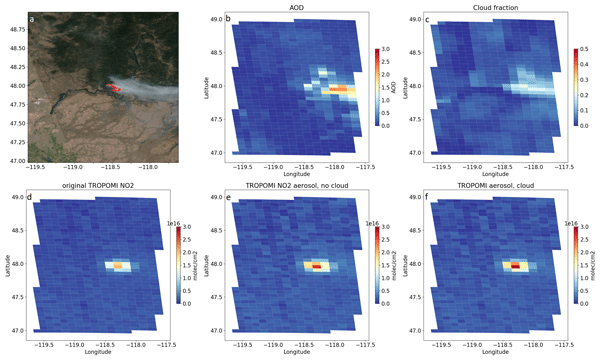
Satellite-derived NOx emissions from biomass burning are estimated with TROPOMI observations. Two common emission estimation methods are applied, and sensitivity tests with model output were performed to determine the accuracy of these methods. The effect of smoke aerosols on TROPOMI NO2 columns is estimated and compared to aircraft observations from four different aircraft campaigns measuring biomass burning plumes in 2018 and 2019 in North America.
Xinxin Ye, Pargoal Arab, Ravan Ahmadov, Eric James, Georg A. Grell, Bradley Pierce, Aditya Kumar, Paul Makar, Jack Chen, Didier Davignon, Greg R. Carmichael, Gonzalo Ferrada, Jeff McQueen, Jianping Huang, Rajesh Kumar, Louisa Emmons, Farren L. Herron-Thorpe, Mark Parrington, Richard Engelen, Vincent-Henri Peuch, Arlindo da Silva, Amber Soja, Emily Gargulinski, Elizabeth Wiggins, Johnathan W. Hair, Marta Fenn, Taylor Shingler, Shobha Kondragunta, Alexei Lyapustin, Yujie Wang, Brent Holben, David M. Giles, and Pablo E. Saide
Atmos. Chem. Phys., 21, 14427–14469, https://doi.org/10.5194/acp-21-14427-2021, https://doi.org/10.5194/acp-21-14427-2021, 2021
Short summary
Short summary
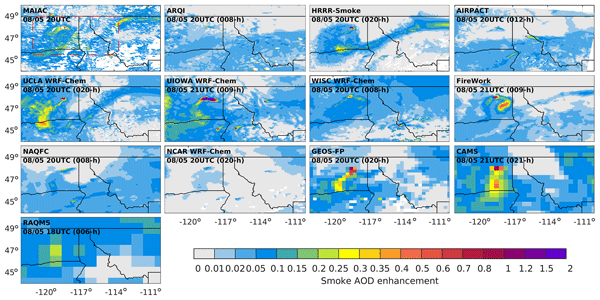
Wildfire smoke has crucial impacts on air quality, while uncertainties in the numerical forecasts remain significant. We present an evaluation of 12 real-time forecasting systems. Comparison of predicted smoke emissions suggests a large spread in magnitudes, with temporal patterns deviating from satellite detections. The performance for AOD and surface PM2.5 and their discrepancies highlighted the role of accurately represented spatiotemporal emission profiles in improving smoke forecasts.
Cited articles
Ames, R. B. and Malm, W. C.: Comparison of sulfate and nitrate particle mass concentrations measured by IMPROVE and the CDN, Atmos. Environ., 35, 905–916, https://doi.org/10.1016/S1352-2310(00)00369-1, 2001.
Anderson, K. and Chen, J.: Canadian Fire Emissions Prediction System (CFFEPS) v4.1, Environment and Climate Change Canada, Zenodo [code], https://doi.org/10.5281/zenodo.15305591, 2021.
Ansari, A. S. and Pandis, S. N.: Response of inorganic PM to precursor concentrations, Environ. Sci. Technol., 32, 2706–2714, https://doi.org/10.1021/es971130j, 1998.
Appel, K. W., Bhave, P. V., Gilliland, A. B., Sarwar, G., and Roselle, S. J.: Evaluation of the Community Multiscale Air Quality (CMAQ) model version 4.5: Sensitivities impacting model performance; Part II – particulate matter, Atmos. Environ., 42, 6057–6066, https://doi.org/10.1016/j.atmosenv.2008.03.036, 2008.
Appel, K. W., Foley, K. M., Bash, J. O., Pinder, R. W., Dennis, R. L., Allen, D. J., and Pickering, K.: A multi-resolution assessment of the Community Multiscale Air Quality (CMAQ) model v4.7 wet deposition estimates for 2002–2006, Geosci. Model Dev., 4, 357–371, https://doi.org/10.5194/gmd-4-357-2011, 2011.
Appel, K. W., Pouliot, G. A., Simon, H., Sarwar, G., Pye, H. O. T., Napelenok, S. L., Akhtar, F., and Roselle, S. J.: Evaluation of dust and trace metal estimates from the Community Multiscale Air Quality (CMAQ) model version 5.0, Geosci. Model Dev., 6, 883–899, https://doi.org/10.5194/gmd-6-883-2013, 2013.
Appel, K. W., Napelenok, S. L., Foley, K. M., Pye, H. O. T., Hogrefe, C., Luecken, D. J., Bash, J. O., Roselle, S. J., Pleim, J. E., Foroutan, H., Hutzell, W. T., Pouliot, G. A., Sarwar, G., Fahey, K. M., Gantt, B., Gilliam, R. C., Heath, N. K., Kang, D., Mathur, R., Schwede, D. B., Spero, T. L., Wong, D. C., and Young, J. O.: Description and evaluation of the Community Multiscale Air Quality (CMAQ) modeling system version 5.1, Geosci. Model Dev., 10, 1703–1732, https://doi.org/10.5194/gmd-10-1703-2017, 2017.
Appel, K. W., Bash, J. O., Fahey, K. M., Foley, K. M., Gilliam, R. C., Hogrefe, C., Hutzell, W. T., Kang, D., Mathur, R., Murphy, B. N., Napelenok, S. L., Nolte, C. G., Pleim, J. E., Pouliot, G. A., Pye, H. O. T., Ran, L., Roselle, S. J., Sarwar, G., Schwede, D. B., Sidi, F. I., Spero, T. L., and Wong, D. C.: The Community Multiscale Air Quality (CMAQ) model versions 5.3 and 5.3.1: system updates and evaluation, Geosci. Model Dev., 14, 2867–2897, https://doi.org/10.5194/gmd-14-2867-2021, 2021.
Astitha, M., Kioutsioukis, I., Fisseha, G. A., Bianconi, R., Bieser, J., Christensen, J. H., Cooper, O. R., Galmarini, S., Hogrefe, C., Im, U., Johnson, B., Liu, P., Nopmongcol, U., Petropavlovskikh, I., Solazzo, E., Tarasick, D. W., and Yarwood, G.: Seasonal ozone vertical profiles over North America using the AQMEII3 group of air quality models: model inter-comparison and stratospheric intrusions, Atmos. Chem. Phys., 18, 13925–13945, https://doi.org/10.5194/acp-18-13925-2018, 2018.
Bachmann, J. D.: Tackling multi-pollutant particles, EM Air Waste Manag. Assoc. Mag. Environ. Manag., 6–9, https://www.researchgate.net/publication/268280224_Tackling_Multi-pollutant_Particles (last access: 6 April 2026), 2013.
Bencala, K. E. and Seinfeld, J. H.: An air quality model performance assessment package, Atmos. Environ., 13, 1181–1185, https://doi.org/10.1016/0004-6981(79)90043-X, 1979.
Benish, S. E., Bash, J. O., Foley, K. M., Appel, K. W., Hogrefe, C., Gilliam, R., and Pouliot, G.: Long-term regional trends of nitrogen and sulfur deposition in the United States from 2002 to 2017, Atmos. Chem. Phys., 22, 12749–12767, https://doi.org/10.5194/acp-22-12749-2022, 2022.
Bermejo, R. and Conde, J.: A conservative quasi-monotone semi-Lagrangian scheme, Mon. Weather Rev., 130, 423–430, https://doi.org/10.1175/1520-0493(2002)130<0423:ACQMSL>2.0.CO;2, 2002.
Biswas, J., Hogrefe, C., Rao, S. T., Hao, W., and Sistla, G.: Evaluating the performance of regional-scale photochemical modeling systems. Part III – Precursor predictions, Atmos. Environ., 35, 6129–6149, https://doi.org/10.1016/S1352-2310(01)00401-0, 2001.
Bloom, S. C., Takacs, L. L., da Silva, A. M., and Ledvina, D.: Data assimilation using incremental analysis updates, Mon. Weather Rev., 124, 1256–1271, https://doi.org/10.1175/1520-0493(1996)124<1256:DAUIAU>2.0.CO;2, 1996.
Borrego, C., Monteiro, A., Ferreira, J., Miranda, A. I., Costa, A. M., Carvalho, A. C., and Lopes, M.: Procedures for estimation of modelling uncertainty in air quality assessment, Environ. Int., 34, 613–620, https://doi.org/10.1016/j.envint.2007.12.005, 2008.
Brasseur, G. P. and Kumar, R.: Chemical weather and chemical climate, AGU Adv., 2, e2021AV000399, https://doi.org/10.1029/2021AV000399, 2021.
Cai, C., Hogrefe, C., Katsafados, P., Kallos, G., Beauharnois, M., Schwab, J. J., Ren, X., Brune, W. H., Zhou, X., He, Y., and Demerjian, K. L.: Performance evaluation of an air quality forecast modeling system for a summer and winter season – Photochemical oxidants and their precursors, Atmos. Environ., 42, 8585–8599, https://doi.org/10.1016/j.atmosenv.2008.08.029, 2008.
Campbell, P. C., Tang, Y., Lee, P., Baker, B., Tong, D., Saylor, R., Stein, A., Huang, J., Huang, H.-C., Strobach, E., McQueen, J., Pan, L., Stajner, I., Sims, J., Tirado-Delgado, J., Jung, Y., Yang, F., Spero, T. L., and Gilliam, R. C.: Development and evaluation of an advanced National Air Quality Forecasting Capability using the NOAA Global Forecast System version 16, Geosci. Model Dev., 15, 3281–3313, https://doi.org/10.5194/gmd-15-3281-2022, 2022.
Canadian Interagency Forest Fire Centre: Canada Report 2022, 15 pp., https://ciffc.ca/publications/canada-reports/ (last access: 6 April 2026), 2023.
Caron, J.-F., Milewski, T., Buehner, M., Fillion, L., Reszka, M., Macpherson, S., and St-James, J.: Implementation of deterministic weather forecasting systems based on ensemble–variational data assimilation at Environment Canada. Part II: The regional system, Mon. Weather Rev., 143, 2560–2580, https://doi.org/10.1175/MWR-D-14-00353.1, 2015.
Cathcart, H., Aherne, J., Moran, M. D., Savic-Jovcic, V., Makar, P. A., and Cole, A.: Estimates of critical loads and exceedances of acidity and nutrient nitrogen for mineral soils in Canada for 2014–2016 average annual sulfur and nitrogen atmospheric deposition, Biogeosciences, 22, 535–554, https://doi.org/10.5194/bg-22-535-2025, 2025.
Chai, T., Kim, H.-C., Lee, P., Tong, D., Pan, L., Tang, Y., Huang, J., McQueen, J., Tsidulko, M., and Stajner, I.: Evaluation of the United States National Air Quality Forecast Capability experimental real-time predictions in 2010 using Air Quality System ozone and NO2 measurements, Geosci. Model Dev., 6, 1831–1850, https://doi.org/10.5194/gmd-6-1831-2013, 2013.
Chan, E. A. W., Gantt, B., and McDow, S.: The reduction of summer sulfate and switch from summertime to wintertime PM2.5 concentration maxima in the United States, Atmos. Environ., 175, 25–32, https://doi.org/10.1016/j.atmosenv.2017.11.055, 2018.
Chang, J. C. and Hanna, S. R.: Air quality model performance evaluation, Meteorol. Atmos. Phys., 87, https://doi.org/10.1007/s00703-003-0070-7, 2004.
Chen, J. and Menelaou, K.: Regional Air Quality Deterministic Prediction System with near-real-time wildfire emissions (RAQDPSFW): Upgrade to version 023, Technical note, November, Canadian Centre for Meteorological and Environmental Prediction, Montreal, 31 pp., https://collaboration.cmc.ec.gc.ca/cmc/CMOI/product_guide/docs/tech_notes/technote_raqdpsfw_e.pdf (last access: 6 April 2026), 2021.
Chen, J., Anderson, K., Pavlovic, R., Moran, M. D., Englefield, P., Thompson, D. K., Munoz-Alpizar, R., and Landry, H.: The FireWork v2.0 air quality forecast system with biomass burning emissions from the Canadian Forest Fire Emissions Prediction System v2.03, Geosci. Model Dev., 12, 3283–3310, https://doi.org/10.5194/gmd-12-3283-2019, 2019.
Chen, X., Zhang, Y., Wang, K., Tong, D., Lee, P., Tang, Y., Huang, J., Campbell, P. C., Mcqueen, J., Pye, H. O. T., Murphy, B. N., and Kang, D.: Evaluation of the offline-coupled GFSv15–FV3–CMAQv5.0.2 in support of the next-generation National Air Quality Forecast Capability over the contiguous United States, Geosci. Model Dev., 14, 3969–3993, https://doi.org/10.5194/gmd-14-3969-2021, 2021.
Chow, J. C.: Measurement methods to determine compliance with ambient air quality standards for suspended particles, J. Air Waste Manage. Assoc., 45, 320–382, https://doi.org/10.1080/10473289.1995.10467369, 1995.
Chow, J. C., Lowenthal, D. H., Chen, L.-W. A., Wang, X., and Watson, J. G.: Mass reconstruction methods for PM2.5: a review, Air Qual. Atmos. Health, 8, 243–263, https://doi.org/10.1007/s11869-015-0338-3, 2015.
Chuang, M.-T., Zhang, Y., and Kang, D.: Application of WRF/Chem-MADRID for real-time air quality forecasting over the southeastern United States, Atmos. Environ., 45, 6241–6250, https://doi.org/10.1016/j.atmosenv.2011.06.071, 2011.
Clifton, O. E., Schwede, D., Hogrefe, C., Bash, J. O., Bland, S., Cheung, P., Coyle, M., Emberson, L., Flemming, J., Fredj, E., Galmarini, S., Ganzeveld, L., Gazetas, O., Goded, I., Holmes, C. D., Horváth, L., Huijnen, V., Li, Q., Makar, P. A., Mammarella, I., Manca, G., Munger, J. W., Pérez-Camanyo, J. L., Pleim, J., Ran, L., San Jose, R., Silva, S. J., Staebler, R., Sun, S., Tai, A. P. K., Tas, E., Vesala, T., Weidinger, T., Wu, Z., and Zhang, L.: A single-point modeling approach for the intercomparison and evaluation of ozone dry deposition across chemical transport models (Activity 2 of AQMEII4), Atmos. Chem. Phys., 23, 9911–9961, https://doi.org/10.5194/acp-23-9911-2023, 2023.
CMC-RAQDPS-023: The Regional Air Quality Deterministic Prediction System (RAQDPS) version 023 and the Regional Air Quality Deterministic Prediction System with Near-Real-Time Wildfire Emissions (RAQDPSFW) version 023 of the Meteorological Service of Canada (MSC): Technical Specifications Document, November, Canadian Centre for Meteorological and Environmental Prediction, Montreal, 19 pp., https://collaboration.cmc.ec.gc.ca/cmc/cmoi/product_guide/docs/tech_specifications/tech_specifications_RAQDPS_023_e.pdf (last access: 6 April 2026), 2021.
CMC-RAQDPS-025: The Regional Air Quality Deterministic Prediction System (RAQDPS): Upgrade from version 024 to version 025, June, Canadian Centre for Meteorological and Environmental Prediction, Montreal, 89 pp., https://collaboration.cmc.ec.gc.ca/cmc/cmoi/product_guide/docs/tech_notes/technote_raqdps-v25_e.pdf (last access: 6 April 2026), 2024.
CMC-RDPS-8.0.0: The Regional Deterministic Prediction System (RDPS) version 8.0.0 of the Meteorological Service of Canada (MSC): Technical specifications document, December, Canadian Centre for Meteorological and Environmental Prediction, Montreal, 10 pp., https://collaboration.cmc.ec.gc.ca/cmc/cmoi/product_guide/docs/tech_specifications/tech_specifications_RDPS_8.0.0_e.pdf (last access: 6 April 2026), 2021.
Colette, A., Andersson, C., Manders, A., Mar, K., Mircea, M., Pay, M.-T., Raffort, V., Tsyro, S., Cuvelier, C., Adani, M., Bessagnet, B., Bergström, R., Briganti, G., Butler, T., Cappelletti, A., Couvidat, F., D'Isidoro, M., Doumbia, T., Fagerli, H., Granier, C., Heyes, C., Klimont, Z., Ojha, N., Otero, N., Schaap, M., Sindelarova, K., Stegehuis, A. I., Roustan, Y., Vautard, R., Van Meijgaard, E., Vivanco, M. G., and Wind, P.: EURODELTA-Trends, a multi-model experiment of air quality hindcast in Europe over 1990–2010, Geosci. Model Dev., 10, 3255–3276, https://doi.org/10.5194/gmd-10-3255-2017, 2017.
Colette, A., Collin, G., Besson, F., Blot, E., Guidard, V., Meleux, F., Royer, A., Petiot, V., Miller, C., Fermond, O., Jeant, A., Adani, M., Arteta, J., Benedictow, A., Bergström, R., Bowdalo, D., Brandt, J., Briganti, G., Carvalho, A. C., Christensen, J. H., Couvidat, F., D'Elia, I., D'Isidoro, M., Denier Van Der Gon, H., Descombes, G., Di Tomaso, E., Douros, J., Escribano, J., Eskes, H., Fagerli, H., Fatahi, Y., Flemming, J., Friese, E., Frohn, L., Gauss, M., Geels, C., Guarnieri, G., Guevara, M., Guion, A., Guth, J., Hänninen, R., Hansen, K., Im, U., Janssen, R., Jeoffrion, M., Joly, M., Jones, L., Jorba, O., Kadantsev, E., Kahnert, M., Kaminski, J. W., Kouznetsov, R., Kranenburg, R., Kuenen, J., Lange, A. C., Langner, J., Lannuque, V., Macchia, F., Manders, A., Mircea, M., Nyiri, A., Olid, M., Pérez García-Pando, C., Palamarchuk, Y., Piersanti, A., Raux, B., Razinger, M., Robertson, L., Segers, A., Schaap, M., Siljamo, P., Simpson, D., Sofiev, M., Stangel, A., Struzewska, J., Tena, C., Timmermans, R., Tsikerdekis, T., Tsyro, S., Tyuryakov, S., Ung, A., Uppstu, A., Valdebenito, A., Van Velthoven, P., Vitali, L., Ye, Z., Peuch, V.-H., and Rouïl, L.: Copernicus Atmosphere Monitoring Service – Regional Air Quality Production System v1.0, Geosci. Model Dev., 18, 6835–6883, https://doi.org/10.5194/gmd-18-6835-2025, 2025.
Crameri, F., Shephard, G. E., and Heron, P. J.: The misuse of colour in science communication, Nat. Commun., 11, 5444, https://doi.org/10.1038/s41467-020-19160-7, 2020.
Dabek-Zlotorzynska, E., Dann, T. F., Kalyani Martinelango, P., Celo, V., Brook, J. R., Mathieu, D., Ding, L., and Austin, C. C.: Canadian National Air Pollution Surveillance (NAPS) PM2.5 speciation program: Methodology and PM2.5 chemical composition for the years 2003–2008, Atmos. Environ., 45, 673–686, https://doi.org/10.1016/j.atmosenv.2010.10.024, 2011.
Demerjian, K.: A review of national monitoring networks in North America, Atmos. Environ., 34, 1861–1884, https://doi.org/10.1016/S1352-2310(99)00452-5, 2000.
Dennis, R., Fox, T., Fuentes, M., Gilliland, A., Hanna, S., Hogrefe, C., Irwin, J., Rao, S. T., Scheffe, R., Schere, K., Steyn, D., and Venkatram, A.: A framework for evaluating regional-scale numerical photochemical modeling systems, Environ. Fluid Mech., 10, 471–489, https://doi.org/10.1007/s10652-009-9163-2, 2010.
Dennis, R. L. and Downton, M. W.: Evaluation of urban photochemical models for regulatory use, Atmos. Environ. 1967, 18, 2055–2069, https://doi.org/10.1016/0004-6981(84)90192-6, 1984.
Dennis, R. L., McHenry, J. N., Barchet, W. R., Binkowski, F. S., and Byun, D. W.: Correcting RADM's sulfate underprediction: Discovery and correction of model errors and testing the corrections through comparisons against field data, Atmos. Environ. Part Gen. Top., 27, 975–997, https://doi.org/10.1016/0960-1686(93)90012-N, 1993.
Derwent, R., Fraser, A., Abbot, J., Jenkin, M., Willis, P., and Murrells, T.: Evaluating the Performance of Air Quality Models, Department for Environment Food and Rural Affairs, United Kingdom, https://uk-air.defra.gov.uk/assets/documents/reports/cat05/1006241607_100608_MIP_Final_Version.pdf (last access: 6 April 2026), 2010.
Dickerson, R. R., Anderson, D. C., and Ren, X.: On the use of data from commercial NOx analyzers for air pollution studies, Atmos. Environ., 214, 116873, https://doi.org/10.1016/j.atmosenv.2019.116873, 2019.
Dickson, R. J. and Oliver, W. R.: Emissions models for regional air quality studies, Environ. Sci. Technol., 25, 1533–1535, https://doi.org/10.1021/es00021a003, 1991.
Dunlea, E. J., Herndon, S. C., Nelson, D. D., Volkamer, R. M., San Martini, F., Sheehy, P. M., Zahniser, M. S., Shorter, J. H., Wormhoudt, J. C., Lamb, B. K., Allwine, E. J., Gaffney, J. S., Marley, N. A., Grutter, M., Marquez, C., Blanco, S., Cardenas, B., Retama, A., Ramos Villegas, C. R., Kolb, C. E., Molina, L. T., and Molina, M. J.: Evaluation of nitrogen dioxide chemiluminescence monitors in a polluted urban environment, Atmos. Chem. Phys., 7, 2691–2704, https://doi.org/10.5194/acp-7-2691-2007, 2007.
Dye, T. S., Chan, A. C., Anderson, C. B., Strohm, D. E. B., Wayland, R. A., and White, J. E.: From raw air quality data to the nightly news: an overview of how EPA's AirNow program operates, Sixth Conference on Atmospheric Chemistry, 12–14 January 2004, Seattle, Washington, American Meteorological Society, https://ams.confex.com/ams/pdfpapers/72477.pdf (last access: 6 April 2026), 2004.
ECCC: 1990–2016 Air Pollutant Emission Inventory Report, Environment and Climate Change Canada, Gatineau, Quebec, 92 pp., https://publications.gc.ca/collections/collection_2018/eccc/En81-26-2016-eng.pdf (last access: 6 April 2026), 2018.
ECCC: Canada's Air Pollutant Emissions Inventory Report 1990–2023, Environment and Climate Change Canada, Gatineau, Quebec, 72 pp., https://publications.gc.ca/collections/collection_2025/eccc/En81-30-2023-eng.pdf (last access: 6 April 2026), 2025a.
ECCC: Version 5.1 package for the Global Environmental Multiscale (GEM) model (ECCC-ASTD-MRD/gem: 5.1.0), Environment and Climate Change Canada, Zenodo [code], https://doi.org/10.5281/zenodo.17782580, 2025b.
Eder, B., Kang, D., Mathur, R., Yu, S., and Schere, K.: An operational evaluation of the Eta–CMAQ air quality forecast model, Atmos. Environ., 40, 4894–4905, https://doi.org/10.1016/j.atmosenv.2005.12.062, 2006.
Eder, B., Kang, D., Mathur, R., Pleim, J., Yu, S., Otte, T., and Pouliot, G.: A performance evaluation of the National Air Quality Forecast Capability for the summer of 2007, Atmos. Environ., 43, 2312–2320, https://doi.org/10.1016/j.atmosenv.2009.01.033, 2009.
Eder, B., Kang, D., Rao, S. T., Mathur, R., Yu, S., Otte, T., Schere, K., Wayland, R., Jackson, S., Davidson, P., McQueen, J., and Bridgers, G.: Using National Air Quality Forecast Guidance to develop local Air Quality Index forecasts, B. Am. Meteorol. Soc., 91, 313–326, https://doi.org/10.1175/2009BAMS2734.1, 2010.
Emery, C., Liu, Z., Russell, A. G., Odman, M. T., Yarwood, G., and Kumar, N.: Recommendations on statistics and benchmarks to assess photochemical model performance, J. Air Waste Manage. Assoc., 67, 582–598, https://doi.org/10.1080/10962247.2016.1265027, 2017.
Entekhabi, D., Reichle, R. H., Koster, R. D., and Crow, W. T.: Performance metrics for soil moisture retrievals and application requirements, J. Hydrometeorol., 11, 832–840, https://doi.org/10.1175/2010JHM1223.1, 2010.
Feng, J., Chan, E., and Vet, R.: Air quality in the eastern United States and eastern Canada for 1990–2015: 25 years of change in response to emission reductions of SO2 and NOx in the region, Atmos. Chem. Phys., 20, 3107–3134, https://doi.org/10.5194/acp-20-3107-2020, 2020.
Feng, J., Cole, A., Wetherbee, G. A., and Banwait, K.: Inter-comparison of measurements of inorganic chemical components in precipitation from NADP and CAPMoN at collocated sites in the USA and Canada during 1986–2019, Environ. Monit. Assess., 195, 1333, https://doi.org/10.1007/s10661-023-11771-z, 2023.
Fillion, L., Mitchell, H. L., Ritchie, H., and Staniforth, A.: The impact of a digital filter finalization technique in a global data assimilation system, Tellus A, 47, 304–323, https://doi.org/10.1034/j.1600-0870.1995.t01-2-00002.x, 1995.
Fillion, L., Tanguay, M., Lapalme, E., Denis, B., Desgagné, M., Lee, V., Ek, N., Liu, Z., Lajoie, M., Caron, J.-F., and Pagé, C.: The Canadian Regional Data Assimilation and Forecasting System, Weather Forecast., 25, 1645–1669, https://doi.org/10.1175/2010WAF2222401.1, 2010.
Foley, K. M., Hogrefe, C., Pouliot, G., Possiel, N., Roselle, S. J., Simon, H., and Timin, B.: Dynamic evaluation of CMAQ part I: Separating the effects of changing emissions and changing meteorology on ozone levels between 2002 and 2005 in the eastern US, Atmos. Environ., 103, 247–255, https://doi.org/10.1016/j.atmosenv.2014.12.038, 2015.
Foley, K. M., Pouliot, G. A., Eyth, A., Aldridge, M. F., Allen, C., Appel, K. W., Bash, J. O., Beardsley, M., Beidler, J., Choi, D., Farkas, C., Gilliam, R. C., Godfrey, J., Henderson, B. H., Hogrefe, C., Koplitz, S. N., Mason, R., Mathur, R., Misenis, C., Possiel, N., Pye, H. O. T., Reynolds, L., Roark, M., Roberts, S., Schwede, D. B., Seltzer, K. M., Sonntag, D., Talgo, K., Toro, C., Vukovich, J., Xing, J., and Adams, E.: 2002–2017 anthropogenic emissions data for air quality modeling over the United States, Data Brief, 47, 109022, https://doi.org/10.1016/j.dib.2023.109022, 2023.
Foroutan, H., Young, J., Napelenok, S., Ran, L., Appel, K. W., Gilliam, R. C., and Pleim, J. E.: Development and evaluation of a physics-based windblown dust emission scheme implemented in the CMAQ modeling system, J. Adv. Model. Earth Syst., 9, 585–608, https://doi.org/10.1002/2016MS000823, 2017.
Frank, N. H.: Retained nitrate, hydrated sulfates, and carbonaceous mass in Federal Reference Method fine particulate matter for six eastern U.S. cities, J. Air Waste Manage. Assoc., 56, 500–511, https://doi.org/10.1080/10473289.2006.10464517, 2006.
Fruin, S., Urman, R., Lurmann, F., McConnell, R., Gauderman, J., Rappaport, E., Franklin, M., Gilliland, F. D., Shafer, M., Gorski, P., and Avol, E.: Spatial variation in particulate matter components over a large urban area, Atmos. Environ., 83, 211–219, https://doi.org/10.1016/j.atmosenv.2013.10.063, 2014.
Galmarini, S., Bonnardot, F., Jones, A., Potempski, S., Robertson, L., and Martet, M.: Multi-model vs. EPS-based ensemble atmospheric dispersion simulations: A quantitative assessment on the ETEX-1 tracer experiment case, Atmos. Environ., 44, 3558–3567, https://doi.org/10.1016/j.atmosenv.2010.06.003, 2010.
Galmarini, S., Makar, P., Clifton, O. E., Hogrefe, C., Bash, J. O., Bellasio, R., Bianconi, R., Bieser, J., Butler, T., Ducker, J., Flemming, J., Hodzic, A., Holmes, C. D., Kioutsioukis, I., Kranenburg, R., Lupascu, A., Perez-Camanyo, J. L., Pleim, J., Ryu, Y.-H., San Jose, R., Schwede, D., Silva, S., and Wolke, R.: Technical note: AQMEII4 Activity 1: evaluation of wet and dry deposition schemes as an integral part of regional-scale air quality models, Atmos. Chem. Phys., 21, 15663–15697, https://doi.org/10.5194/acp-21-15663-2021, 2021.
Gan, C. M., Binkowski, F., Pleim, J., Xing, J., Wong, D., Mathur, R., and Gilliam, R.: Assessment of the aerosol optics component of the coupled WRF–CMAQ model using CARES field campaign data and a single column model, Atmos. Environ., 115, 670–682, https://doi.org/10.1016/j.atmosenv.2014.11.028, 2015.
Gantt, B.: 10 Years (2011–2020) of the NCore Network: FEMs vs FRMs, 2022 National Ambient Air Monitoring Conference, 22–25 August 2022, Pittsburgh, Pennsylvania, https://www.epa.gov/system/files/documents/2022-10/Gantt_Brett_Wed1030.pdf (last access: 6 April 2026), 2022.
Gaudel, A., Cooper, O. R., Ancellet, G., Barret, B., Boynard, A., Burrows, J. P., Clerbaux, C., Coheur, P.-F., Cuesta, J., Cuevas, E., Doniki, S., Dufour, G., Ebojie, F., Foret, G., Garcia, O., Granados-Muñoz, M. J., Hannigan, J. W., Hase, F., Hassler, B., Huang, G., Hurtmans, D., Jaffe, D., Jones, N., Kalabokas, P., Kerridge, B., Kulawik, S., Latter, B., Leblanc, T., Le Flochmoën, E., Lin, W., Liu, J., Liu, X., Mahieu, E., McClure-Begley, A., Neu, J. L., Osman, M., Palm, M., Petetin, H., Petropavlovskikh, I., Querel, R., Rahpoe, N., Rozanov, A., Schultz, M. G., Schwab, J., Siddans, R., Smale, D., Steinbacher, M., Tanimoto, H., Tarasick, D. W., Thouret, V., Thompson, A. M., Trickl, T., Weatherhead, E., Wespes, C., Worden, H. M., Vigouroux, C., Xu, X., Zeng, G., and Ziemke, J.: Tropospheric Ozone Assessment Report: Present-day distribution and trends of tropospheric ozone relevant to climate and global atmospheric chemistry model evaluation, Elem. Sci. Anthr., 6, 39, https://doi.org/10.1525/elementa.291, 2018.
GEM-MACH development team: GEM-MACHv3.1.1.2, Zenodo [code], https://doi.org/10.5281/zenodo.13952893, 2022.
Gilliam, R. C., Hogrefe, C., Godowitch, J. M., Napelenok, S., Mathur, R., and Rao, S. T.: Impact of inherent meteorology uncertainty on air quality model predictions, J. Geophys. Res.-Atmos., 120, https://doi.org/10.1002/2015JD023674, 2015.
Gilliam, R. C., Herwehe, J. A., Bullock, O. R., Pleim, J. E., Ran, L., Campbell, P. C., and Foroutan, H.: Establishing the suitability of the Model for Prediction Across Scales for global retrospective air quality modeling, J. Geophys. Res.-Atmos., 126, e2020JD033588, https://doi.org/10.1029/2020JD033588, 2021.
Gilliland, A. B., Hogrefe, C., Pinder, R. W., Godowitch, J. M., Foley, K. L., and Rao, S. T.: Dynamic evaluation of regional air quality models: Assessing changes in O3 stemming from changes in emissions and meteorology, Atmos. Environ., 42, 5110–5123, https://doi.org/10.1016/j.atmosenv.2008.02.018, 2008.
Godowitch, J. M., Pouliot, G. A., and Trivikrama Rao, S.: Assessing multi-year changes in modeled and observed urban NOx concentrations from a dynamic model evaluation perspective, Atmos. Environ., 44, 2894–2901, https://doi.org/10.1016/j.atmosenv.2010.04.040, 2010.
Godowitch, J. M., Gilliam, R. C., and Rao, S. T.: Diagnostic evaluation of ozone production and horizontal transport in a regional photochemical air quality modeling system, Atmos. Environ., 45, 3977–3987, https://doi.org/10.1016/j.atmosenv.2011.04.062, 2011.
Hand, J. L., Schichtel, B. A., Pitchford, M., Malm, W. C., and Frank, N. H.: Seasonal composition of remote and urban fine particulate matter in the United States, J. Geophys. Res.-Atmos., 117, https://doi.org/10.1029/2011JD017122, 2012.
Hand, J. L., Schichtel, B. A., Malm, W. C., and Frank, N. H.: Spatial and temporal trends in PM 2.5 organic and elemental carbon across the United States, Adv. Meteorol., 2013, 1–13, https://doi.org/10.1155/2013/367674, 2013.
Hand, J. L., Prenni, A. J., Schichtel, B. A., Malm, W. C., and Chow, J. C.: Trends in remote PM2.5 residual mass across the United States: Implications for aerosol mass reconstruction in the IMPROVE network, Atmos. Environ., 203, 141–152, https://doi.org/10.1016/j.atmosenv.2019.01.049, 2019.
Hand, J. L., Prenni, A. J., and Schichtel, B. A.: Trends in seasonal mean speciated aerosol composition in remote areas of the United States from 2000 through 2021, J. Geophys. Res.-Atmos., 129, e2023JD039902, https://doi.org/10.1029/2023JD039902, 2024.
Hanna, S. R., Russell, A. G., Wilkinson, J. G., Vukovich, J., and Hansen, D. A.: Monte Carlo estimation of uncertainties in BEIS3 emission outputs and their effects on uncertainties in chemical transport model predictions, J. Geophys. Res., 110, D01302, https://doi.org/10.1029/2004JD004986, 2005.
He, H., Vinnikov, K. Y., Krotkov, N. A., Edgerton, E. S., Schwab, J. J., and Dickerson, R. R.: Chemical climatology of atmospheric pollutants in the eastern United States: Seasonal/diurnal cycles and contrast under clear/cloudy conditions for remote sensing, Atmos. Environ., 206, 85–107, https://doi.org/10.1016/j.atmosenv.2019.03.003, 2019.
Hogrefe, C., Rao, S. T., Kasibhatla, P., Hao, W., Sistla, G., Mathur, R., and McHenry, J.: Evaluating the performance of regional-scale photochemical modeling systems: Part II – ozone predictions, Atmos. Environ., 35, 4175–4188, https://doi.org/10.1016/S1352-2310(01)00183-2, 2001a.
Hogrefe, C., Rao, S. T., Kasibhatla, P., Kallos, G., Tremback, C. J., Hao, W., Olerud, D., Xiu, A., McHenry, J., and Alapaty, K.: Evaluating the performance of regional-scale photochemical modeling systems: Part I – meteorological predictions, Atmos. Environ., 35, 4159–4174, https://doi.org/10.1016/S1352-2310(01)00182-0, 2001b.
Hogrefe, C., Pouliot, G., Wong, D., Torian, A., Roselle, S., Pleim, J., and Mathur, R.: Annual application and evaluation of the online coupled WRF–CMAQ system over North America under AQMEII phase 2, Atmos. Environ., 115, 683–694, https://doi.org/10.1016/j.atmosenv.2014.12.034, 2015.
Hogrefe, C., Galmarini, S., Makar, P. A., Kioutsioukis, I., Clifton, O. E., Alyuz, U., Bash, J. O., Bellasio, R., Bianconi, R., Butler, T., Cheung, P., Hodzic, A., Kranenburg, R., Lupascu, A., Momoh, K., Perez-Camanyo, J. L., Pleim, J. E., Ryu, Y.-H., San Jose, R., Schaap, M., Schwede, D. B., and Sokhi, R.: A diagnostic intercomparison of modeled ozone dry deposition over North America and Europe using AQMEII4 regional-scale simulations, Atmos. Chem. Phys., 25, 12629–12656, https://doi.org/10.5194/acp-25-12629-2025, 2025.
Holden, A. S., Sullivan, A. P., Munchak, L. A., Kreidenweis, S. M., Schichtel, B. A., Malm, W. C., and Collett, J. L.: Determining contributions of biomass burning and other sources to fine particle contemporary carbon in the western United States, Atmos. Environ., 45, 1986–1993, https://doi.org/10.1016/j.atmosenv.2011.01.021, 2011.
Houyoux, M. R., Vukovich, J. M., Coats, C. J., Wheeler, N. J. M., and Kasibhatla, P. S.: Emission inventory development and processing for the Seasonal Model for Regional Air Quality (SMRAQ) project, J. Geophys. Res.-Atmos., 105, 9079–9090, https://doi.org/10.1029/1999JD900975, 2000.
Huang, J., McQueen, J., Wilczak, J., Djalalova, I., Stajner, I., Shafran, P., Allured, D., Lee, P., Pan, L., Tong, D., Huang, H.-C., DiMego, G., Upadhayay, S., and Delle Monache, L.: Improving NOAA NAQFC PM2.5 predictions with a bias correction approach, Weather Forecast., 32, 407–421, https://doi.org/10.1175/WAF-D-16-0118.1, 2017.
Huang, L., Zhu, Y., Zhai, H., Xue, S., Zhu, T., Shao, Y., Liu, Z., Emery, C., Yarwood, G., Wang, Y., Fu, J., Zhang, K., and Li, L.: Recommendations on benchmarks for numerical air quality model applications in China – Part 1: PM2.5 and chemical species, Atmos. Chem. Phys., 21, 2725–2743, https://doi.org/10.5194/acp-21-2725-2021, 2021.
Hystad, P., Setton, E., Cervantes, A., Poplawski, K., Deschenes, S., Brauer, M., Van Donkelaar, A., Lamsal, L., Martin, R., Jerrett, M., and Demers, P.: Creating national air pollution models for population exposure assessment in Canada, Environ. Health Perspect., 119, 1123–1129, https://doi.org/10.1289/ehp.1002976, 2011.
Im, U., Bianconi, R., Solazzo, E., Kioutsioukis, I., Badia, A., Balzarini, A., Baró, R., Bellasio, R., Brunner, D., Chemel, C., Curci, G., Flemming, J., Forkel, R., Giordano, L., Jiménez-Guerrero, P., Hirtl, M., Hodzic, A., Honzak, L., Jorba, O., Knote, C., Kuenen, J. J. P., Makar, P. A., Manders-Groot, A., Neal, L., Pérez, J. L., Pirovano, G., Pouliot, G., San Jose, R., Savage, N., Schroder, W., Sokhi, R. S., Syrakov, D., Torian, A., Tuccella, P., Werhahn, J., Wolke, R., Yahya, K., Zabkar, R., Zhang, Y., Zhang, J., Hogrefe, C., and Galmarini, S.: Evaluation of operational on-line-coupled regional air quality models over Europe and North America in the context of AQMEII phase 2. Part I: Ozone, Atmos. Environ., 115, 404–420, https://doi.org/10.1016/j.atmosenv.2014.09.042, 2015a.
Im, U., Bianconi, R., Solazzo, E., Kioutsioukis, I., Badia, A., Balzarini, A., Baró, R., Bellasio, R., Brunner, D., Chemel, C., Curci, G., Denier Van Der Gon, H., Flemming, J., Forkel, R., Giordano, L., Jiménez-Guerrero, P., Hirtl, M., Hodzic, A., Honzak, L., Jorba, O., Knote, C., Makar, P. A., Manders-Groot, A., Neal, L., Pérez, J. L., Pirovano, G., Pouliot, G., San Jose, R., Savage, N., Schroder, W., Sokhi, R. S., Syrakov, D., Torian, A., Tuccella, P., Wang, K., Werhahn, J., Wolke, R., Zabkar, R., Zhang, Y., Zhang, J., Hogrefe, C., and Galmarini, S.: Evaluation of operational online-coupled regional air quality models over Europe and North America in the context of AQMEII phase 2. Part II: Particulate matter, Atmos. Environ., 115, 421–441, https://doi.org/10.1016/j.atmosenv.2014.08.072, 2015b.
Jaeglé, L., Shah, V., Thornton, J. A., Lopez-Hilfiker, F. D., Lee, B. H., McDuffie, E. E., Fibiger, D., Brown, S. S., Veres, P., Sparks, T. L., Ebben, C. J., Wooldridge, P. J., Kenagy, H. S., Cohen, R. C., Weinheimer, A. J., Campos, T. L., Montzka, D. D., Digangi, J. P., Wolfe, G. M., Hanisco, T., Schroder, J. C., Campuzano-Jost, P., Day, D. A., Jimenez, J. L., Sullivan, A. P., Guo, H., and Weber, R. J.: Nitrogen oxides, emissions, chemistry, deposition, and export over the northeast United States during the WINTER aircraft campaign, J. Geophys. Res.-Atmos., 123, https://doi.org/10.1029/2018JD029133, 2018.
Jaffe, D., Bertschi, I., Jaegle, L., Novelli, P., Reid, J. S., Tanimoto, H., Vingarzan, R., and Westphal, D. L.: Long-range transport of Siberian biomass burning emissions and impact on surface ozone in western North America, Geophys. Res. Lett., 31, L16106, https://doi.org/10.1029/2004GL020093, 2004.
Jain, P., Sharma, A. R., Acuna, D. C., Abatzoglou, J. T., and Flannigan, M.: Record-breaking fire weather in North America in 2021 was initiated by the Pacific northwest heat dome, Commun. Earth Environ., 5, 202, https://doi.org/10.1038/s43247-024-01346-2, 2024.
Jerrett, M., Arain, A., Kanaroglou, P., Beckerman, B., Potoglou, D., Sahsuvaroglu, T., Morrison, J., and Giovis, C.: A review and evaluation of intraurban air pollution exposure models, J. Exp. Sci. Environ. Epidemiol., 15, 185–204, https://doi.org/10.1038/sj.jea.7500388, 2005.
Kajino, M., Deushi, M., Sekiyama, T. T., Oshima, N., Yumimoto, K., Tanaka, T. Y., Ching, J., Hashimoto, A., Yamamoto, T., Ikegami, M., Kamada, A., Miyashita, M., Inomata, Y., Shima, S., Adachi, K., Zaizen, Y., Igarashi, Y., Ueda, H., Maki, T., and Mikami, M.: NHM-Chem, the Japan MeteorologicalAgency's regional meteorology – chemistry model (v1.0): model description and aerosol representations, Geosci. Model Dev. Discuss. [preprint], https://doi.org/10.5194/gmd-2018-128, 2018.
Kelly, J. T., Koplitz, S. N., Baker, K. R., Holder, A. L., Pye, H. O. T., Murphy, B. N., Bash, J. O., Henderson, B. H., Possiel, N. C., Simon, H., Eyth, A. M., Jang, C., Phillips, S., and Timin, B.: Assessing PM2.5 model performance for the conterminous U.S. with comparison to model performance statistics from 2007–2015, Atmos. Environ., 214, 116872, https://doi.org/10.1016/j.atmosenv.2019.116872, 2019.
Kioutsioukis, I., Hogrefe, C., Makar, P. A., Alyuz, U., Bash, J. O., Bellasio, R., Bianconi, R., Butler, T., Clifton, O. E., Cheung, P., Hodzic, A., Kranenburg, R., Lupascu, A., Momoh, K., Perez-Camaño, J. L., Pleim, J., Ryu, Y.-H., San Jose, R., Schwede, D., Sokhi, R., and Galmarini, S.: Operational, diagnostic, and probabilistic evaluation of AQMEII-4 regional-scale ozone dry deposition: time to harmonize our LULC masks, Atmos. Chem. Phys., 25, 12923–12953, https://doi.org/10.5194/acp-25-12923-2025, 2025.
Knote, C., Tuccella, P., Curci, G., Emmons, L., Orlando, J. J., Madronich, S., Baró, R., Jiménez-Guerrero, P., Luecken, D., Hogrefe, C., Forkel, R., Werhahn, J., Hirtl, M., Pérez, J. L., San José, R., Giordano, L., Brunner, D., Yahya, K., and Zhang, Y.: Influence of the choice of gas-phase mechanism on predictions of key gaseous pollutants during the AQMEII phase-2 intercomparison, Atmos. Environ., 115, 553–568, https://doi.org/10.1016/j.atmosenv.2014.11.066, 2015.
Koo, B., Kumar, N., Knipping, E., Nopmongcol, U., Sakulyanontvittaya, T., Odman, M. T., Russell, A. G., and Yarwood, G.: Chemical transport model consistency in simulating regulatory outcomes and the relationship to model performance, Atmos. Environ., 116, 159–171, https://doi.org/10.1016/j.atmosenv.2015.06.036, 2015.
Kukkonen, J., Olsson, T., Schultz, D. M., Baklanov, A., Klein, T., Miranda, A. I., Monteiro, A., Hirtl, M., Tarvainen, V., Boy, M., Peuch, V.-H., Poupkou, A., Kioutsioukis, I., Finardi, S., Sofiev, M., Sokhi, R., Lehtinen, K. E. J., Karatzas, K., San José, R., Astitha, M., Kallos, G., Schaap, M., Reimer, E., Jakobs, H., and Eben, K.: A review of operational, regional-scale, chemical weather forecasting models in Europe, Atmos. Chem. Phys., 12, 1–87, https://doi.org/10.5194/acp-12-1-2012, 2012.
Lamsal, L. N., Duncan, B. N., Yoshida, Y., Krotkov, N. A., Pickering, K. E., Streets, D. G., and Lu, Z.: U.S. NO2 trends (2005–2013): EPA Air Quality System (AQS) data versus improved observations from the Ozone Monitoring Instrument (OMI), Atmos. Environ., 110, 130–143, https://doi.org/10.1016/j.atmosenv.2015.03.055, 2015.
Lavery, T. F., Rogers, C. M., Baumgardner, R., and Mishoe, K. P.: Intercomparison of Clean Air Status and Trends Network nitrate and nitric acid measurements with data from other monitoring programs, J. Air Waste Manage. Assoc., 59, 214–226, https://doi.org/10.3155/1047-3289.59.2.214, 2009.
Lee, H. J., Chatfield, R. B., and Bell, M. L.: Spatial analysis of concentrations of multiple air pollutants using NASA DISCOVER-AQ aircraft measurements: Implications for exposure assessment, Environ. Res., 160, 487–498, https://doi.org/10.1016/j.envres.2017.10.017, 2018.
Lee, P., McQueen, J., Stajner, I., Huang, J., Pan, L., Tong, D., Kim, H., Tang, Y., Kondragunta, S., Ruminski, M., Lu, S., Rogers, E., Saylor, R., Shafran, P., Huang, H.-C., Gorline, J., Upadhayay, S., and Artz, R.: NAQFC developmental forecast guidance for fine particulate matter (PM2.5), Weather Forecast., 32, 343–360, https://doi.org/10.1175/WAF-D-15-0163.1, 2017.
Li, Q., Borge, R., Sarwar, G., de la Paz, D., Gantt, B., Domingo, J., Cuevas, C. A., and Saiz-Lopez, A.: Impact of halogen chemistry on summertime air quality in coastal and continental Europe: application of the CMAQ model and implications for regulation, Atmos. Chem. Phys., 19, 15321–15337, https://doi.org/10.5194/acp-19-15321-2019, 2019.
Li, W., Tang, B., Campbell, P. C., Tang, Y., Baker, B., Moon, Z., Tong, D., Huang, J., Wang, K., Stajner, I., and Montuoro, R.: Updates and evaluation of NOAA's online-coupled air quality model version 7 (AQMv7) within the Unified Forecast System, Geosci. Model Dev., 18, 1635–1660, https://doi.org/10.5194/gmd-18-1635-2025, 2025.
Liu, J. C., Pereira, G., Uhl, S. A., Bravo, M. A., and Bell, M. L.: A systematic review of the physical health impacts from non-occupational exposure to wildfire smoke, Environ. Res., 136, 120–132, https://doi.org/10.1016/j.envres.2014.10.015, 2015.
Liudchik, A., Pakatashkin, V., Umreika, S., and Girgzdiene, R.: Role of ozone deposition in the occurrence of the spring maximum, Atmos.-Ocean, 53, 42–49, https://doi.org/10.1080/07055900.2013.853284, 2015.
Lupu, A. and Moran, M. D.: Operational GEM-MACH model evaluation against air quality surface observation networks across Canada and the United States for 2013-16 and 2021/22, Zenodo [data set], https://doi.org/10.5281/zenodo.16944371, 2025.
Ma, S., Tong, D., Lamsal, L., Wang, J., Zhang, X., Tang, Y., Saylor, R., Chai, T., Lee, P., Campbell, P., Baker, B., Kondragunta, S., Judd, L., Berkoff, T. A., Janz, S. J., and Stajner, I.: Improving predictability of high-ozone episodes through dynamic boundary conditions, emission refresh and chemical data assimilation during the Long Island Sound Tropospheric Ozone Study (LISTOS) field campaign, Atmos. Chem. Phys., 21, 16531–16553, https://doi.org/10.5194/acp-21-16531-2021, 2021.
Makar, P. A., Nissen, R., Teakles, A., Zhang, J., Zheng, Q., Moran, M. D., Yau, H., and diCenzo, C.: Turbulent transport, emissions and the role of compensating errors in chemical transport models, Geosci. Model Dev., 7, 1001–1024, https://doi.org/10.5194/gmd-7-1001-2014, 2014.
Makar, P. A., Akingunola, A., Aherne, J., Cole, A. S., Aklilu, Y., Zhang, J., Wong, I., Hayden, K., Li, S.-M., Kirk, J., Scott, K., Moran, M. D., Robichaud, A., Cathcart, H., Baratzedah, P., Pabla, B., Cheung, P., Zheng, Q., and Jeffries, D. S.: Estimates of exceedances of critical loads for acidifying deposition in Alberta and Saskatchewan, Atmos. Chem. Phys., 18, 9897–9927, https://doi.org/10.5194/acp-18-9897-2018, 2018.
Makar, P. A., Stroud, C., Akingunola, A., Zhang, J., Ren, S., Cheung, P., and Zheng, Q.: Vehicle-induced turbulence and atmospheric pollution, Atmos. Chem. Phys., 21, 12291–12316, https://doi.org/10.5194/acp-21-12291-2021, 2021.
Mallet, V. and Sportisse, B.: Ensemble-based air quality forecasts: A multimodel approach applied to ozone, J. Geophys. Res.-Atmos., 111, 2005JD006675, https://doi.org/10.1029/2005JD006675, 2006.
Malm, W. C., Schichtel, B. A., Pitchford, M. L., Ashbaugh, L. L., and Eldred, R. A.: Spatial and monthly trends in speciated fine particle concentration in the United States, J. Geophys. Res.-Atmos., 109, D03306, https://doi.org/10.1029/2003JD003739, 2004.
Malm, W. C., Schichtel, B. A., and Pitchford, M. L.: Uncertainties in PM2.5 gravimetric and speciation measurements and what we can learn from them, J. Air Waste Manage. Assoc., 61, 1131–1149, https://doi.org/10.1080/10473289.2011.603998, 2011.
Manseau, P. M., Peng, S. J., Stroud, C., Savic-Jovcic, V., and Lupu, A.: AQ Multi Model Verification for North America: 2022/04–2022/06, Environment and Climate Change Canada, July 2022, 11 pp., https://hpfx.collab.science.gc.ca/~svfs000/na-aq-mm-fe/reports/2022/na-aq-mm-fe_reports_2022_Q2.pdf (last access: 6 April 2026), 2022.
Mao, Y. H., Li, Q. B., Zhang, L., Chen, Y., Randerson, J. T., Chen, D., and Liou, K. N.: Biomass burning contribution to black carbon in the western United States mountain ranges, Atmos. Chem. Phys., 11, 11253–11266, https://doi.org/10.5194/acp-11-11253-2011, 2011.
Marécal, V., Peuch, V.-H., Andersson, C., Andersson, S., Arteta, J., Beekmann, M., Benedictow, A., Bergström, R., Bessagnet, B., Cansado, A., Chéroux, F., Colette, A., Coman, A., Curier, R. L., Denier Van Der Gon, H. A. C., Drouin, A., Elbern, H., Emili, E., Engelen, R. J., Eskes, H. J., Foret, G., Friese, E., Gauss, M., Giannaros, C., Guth, J., Joly, M., Jaumouillé, E., Josse, B., Kadygrov, N., Kaiser, J. W., Krajsek, K., Kuenen, J., Kumar, U., Liora, N., Lopez, E., Malherbe, L., Martinez, I., Melas, D., Meleux, F., Menut, L., Moinat, P., Morales, T., Parmentier, J., Piacentini, A., Plu, M., Poupkou, A., Queguiner, S., Robertson, L., Rouïl, L., Schaap, M., Segers, A., Sofiev, M., Tarasson, L., Thomas, M., Timmermans, R., Valdebenito, Á., Van Velthoven, P., Van Versendaal, R., Vira, J., and Ung, A.: A regional air quality forecasting system over Europe: the MACC-II daily ensemble production, Geosci. Model Dev., 8, 2777–2813, https://doi.org/10.5194/gmd-8-2777-2015, 2015.
Mashayekhi, R., Pavlovic, R., Racine, J., Moran, M. D., Manseau, P. M., Duhamel, A., Katal, A., Miville, J., Niemi, D., Peng, S. J., Sassi, M., Griffin, D., and McLinden, C. A.: Isolating the impact of COVID-19 lockdown measures on urban air quality in Canada, Air Qual. Atmos. Health, 14, 1549–1570, https://doi.org/10.1007/s11869-021-01039-1, 2021.
Mathur, R., Yu, S., Kang, D., and Schere, K. L.: Assessment of the wintertime performance of developmental particulate matter forecasts with the Eta-Community Multiscale Air Quality modeling system, J. Geophys. Res.-Atmos., 113, 2007JD008580, https://doi.org/10.1029/2007JD008580, 2008.
Matthias, V., Arndt, J. A., Aulinger, A., Bieser, J., Denier Van Der Gon, H., Kranenburg, R., Kuenen, J., Neumann, D., Pouliot, G., and Quante, M.: Modeling emissions for three-dimensional atmospheric chemistry transport models, J. Air Waste Manage. Assoc., 68, 763–800, https://doi.org/10.1080/10962247.2018.1424057, 2018.
McKeen, S., Wilczak, J., Grell, G., Djalalova, I., Peckham, S., Hsie, E.-Y., Gong, W., Bouchet, V., Menard, S., Moffet, R., McHenry, J., McQueen, J., Tang, Y., Carmichael, G. R., Pagowski, M., Chan, A., Dye, T., Frost, G., Lee, P., and Mathur, R.: Assessment of an ensemble of seven real-time ozone forecasts over eastern North America during the summer of 2004, J. Geophys. Res.-Atmos., 110, 2005JD005858, https://doi.org/10.1029/2005JD005858, 2005.
McKeen, S., Chung, S. H., Wilczak, J., Grell, G., Djalalova, I., Peckham, S., Gong, W., Bouchet, V., Moffet, R., Tang, Y., Carmichael, G. R., Mathur, R., and Yu, S.: Evaluation of several PM2.5 forecast models using data collected during the ICARTT/NEAQS 2004 field study, J. Geophys. Res.-Atmos., 112, 2006JD007608, https://doi.org/10.1029/2006JD007608, 2007.
McKeen, S., Grell, G., Peckham, S., Wilczak, J., Djalalova, I., Hsie, E.-Y., Frost, G., Peischl, J., Schwarz, J., Spackman, R., Holloway, J., De Gouw, J., Warneke, C., Gong, W., Bouchet, V., Gaudreault, S., Racine, J., McHenry, J., McQueen, J., Lee, P., Tang, Y., Carmichael, G. R., and Mathur, R.: An evaluation of real-time air quality forecasts and their urban emissions over eastern Texas during the summer of 2006 Second Texas Air Quality Study field study, J. Geophys. Res.-Atmos., 114, 2008JD011697, https://doi.org/10.1029/2008JD011697, 2009.
McNair, L. A., Harley, R. A., and Russell, A. G.: Spatial inhomogeneity in pollutant concentrations, and their implications for air quality model evaluation, Atmos. Environ., 30, 4291–4301, https://doi.org/10.1016/1352-2310(96)00098-2, 1996.
McNider, R. T. and Pour-Biazar, A.: Meteorological modeling relevant to mesoscale and regional air quality applications: a review, J. Air Waste Manage. Assoc., 70, 2–43, https://doi.org/10.1080/10962247.2019.1694602, 2020.
McTaggart-Cowan, R., Vaillancourt, P. A., Zadra, A., Chamberland, S., Charron, M., Corvec, S., Milbrandt, J. A., Paquin-Ricard, D., Patoine, A., Roch, M., Separovic, L., and Yang, J.: Modernization of atmospheric physics parameterization in Canadian NWP, J. Adv. Model. Earth Syst., 11, 3593–3635, https://doi.org/10.1029/2019MS001781, 2019.
Meng, Z., Dabdub, D., and Seinfeld, J. H.: Chemical coupling between atmospheric ozone and particulate matter, Science, 277, 116–119, https://doi.org/10.1126/science.277.5322.116, 1997.
Miller, S. J., Makar, P. A., and Lee, C. J.: HETerogeneous vectorized or Parallel (HETPv1.0): an updated inorganic heterogeneous chemistry solver for the metastable-state NH
Momeni, M., Kashfi Yeganeh, A., Zanganeh Kia, H., Ghahremanloo, M., Mousavinezhad, S., De Guzman, H. J., Shephard, M. W., Jacobson, M. Z., and Choi, Y.: Using multi-satellite observations to constrain ammonia emissions and unlock their potential over open water, Sci. Rep., 15, https://doi.org/10.1038/s41598-025-09933-9, 2025.
Monks, P. S.: A review of the observations and origins of the spring ozone maximum, Atmos. Environ., 34, 3545–3561, https://doi.org/10.1016/S1352-2310(00)00129-1, 2000.
Moran, M. D. and Lupu, A.: Supplementary material for paper “Operational chemical weather forecasting with the ECCC online Regional Air Quality Deterministic Prediction System version 023 (RAQDPS023) – Part 2: Multi-year prospective and retrospective performance evaluation” by Moran et al. (2026), Zenodo [supplement], https://doi.org/10.5281/zenodo.19489036, 2026.
Moran, M. D. and Savic-Jovcic, V.: RAQDPS023 Predicted 2013–2016 and 2021/22 Seasonal and Annual Dry, Wet, and Total Acidic Deposition Fields and Related Concentration Fields for North America, Zenodo [data set], https://doi.org/10.5281/zenodo.16970403, 2025.
Moran, M., Zhang, J., Pavlovic, R., Savic-Jovcic, V., Ménard, S., Landry, H., Zheng, Q., Lupu, A., Gilbert, S., Peng, S. J., and Manseau, P. M.: Evolution of the performance of the Canadian operational Regional Air Quality Deterministic Prediction System from 2010 to 2019, in: Air Pollution Modeling and its Application XXVII, edited by: Mensink, C. and Matthias, V., Springer, Berlin. Heidelberg, 157–166, https://doi.org/10.1007/978-3-662-63760-9_24, 2021a.
Moran, M. D., Ménard, S., and Kornic, D.: Regional Air Quality Deterministic Prediction System (RAQDPS): Upgrade from version 022 to version 023, Technical note, December, Canadian Centre for Meteorological and Environmental Prediction, Montreal, 48 pp., https://collaboration.cmc.ec.gc.ca/cmc/cmoi/product_guide/docs/lib/technote_raqdps023_20211130_e.pdf (last access: 6 April 2026), 2021b.
Moran, M. D., Savic-Jovcic, V., Stroud, C. A., Ménard, S., Gong, W., Zhang, J., Zheng, Q., Chen, J., Akingunola, A., Lupu, A., Menelaou, K., and Munoz-Alpizar, R.: Operational chemical weather forecasting with the ECCC online Regional Air Quality Deterministic Prediction System version 023 (RAQDPS023) – Part 1: system description, Geosci. Model Dev., 19, 4137–4203, https://doi.org/10.5194/gmd-19-4137-2026, 2026.
Munoz-Alpizar, R., Pavlovic, R., Moran, M., Chen, J., Gravel, S., Henderson, S., Ménard, S., Racine, J., Duhamel, A., Gilbert, S., Beaulieu, P.-A., Landry, H., Davignon, D., Cousineau, S., and Bouchet, V.: Multi-year (2013–2016) PM2.5 wildfire pollution exposure over North America as determined from operational air quality forecasts, Atmosphere, 8, 179–202, https://doi.org/10.3390/atmos8090179, 2017.
Nappo, C. J., Caneill, J. Y., Furman, R. W., Gifford, F. W., Kaimal, J. C., Kramer, M. L., Lockhart, T. J., Pendergast, M. M., Pielke, R. A., Randerson, D., Shreffler, J. H., and Wyngaard, J. C.: The workshop on the representativeness of meteorological observations, June 1981, Boulder, Colo., B. Am. Meteorol. Soc., 63, 761–764, 1982.
National Atmospheric Deposition Program: National Atmospheric Deposition Program 2013 Annual Summary, Illinois State Water Survey, University of Illinois at Urbana-Champaign, Illinois, 28 pp., https://nadp.slh.wisc.edu/wp-content/uploads/2021/05/2013as.pdf (last access: 6 April 2026), 2014.
National Atmospheric Deposition Program: National Atmospheric Deposition Program 2016 Annual Summary, Illinois State Water Survey, University of Illinois at Urbana-Champaign, Illinois, 28 pp., https://nadp.slh.wisc.edu/wp-content/uploads/2021/05/2016as.pdf (last access: 6 April 2026), 2017.
Nguyen, T. K. V., Zhang, Q., Jimenez, J. L., Pike, M., and Carlton, A. G.: Liquid water: ubiquitous contributor to aerosol mass, Environ. Sci. Technol. Lett., 3, 257–263, https://doi.org/10.1021/acs.estlett.6b00167, 2016.
NOAA National Centers for Environmental Information: Monthly Wildfires Report for Annual 2022, WWW Document, https://www.ncei.noaa.gov/access/monitoring/monthly-report/fire/202213 (last access: 6 April 2026), 2023.
Noble, C. A., Vanderpool, R. W., Peters, T. M., McElroy, F. F., Gemmill, D. B., and Wiener, R. W.: Federal reference and equivalent methods for measuring fine particulate matter, Aerosol Sci. Tech., 34, 457–464, https://doi.org/10.1080/02786820121582, 2001.
Pagowski, M., Grell, G. A., McKeen, S. A., Peckham, S. E., and Devenyi, D.: Three-dimensional variational data assimilation of ozone and fine particulate matter observations: some results using the Weather Research and Forecasting – Chemistry model and Grid-Point Statistical Interpolation, Q. J. Roy. Meteorol. Soc., 136, 2013–2024, https://doi.org/10.1002/qj.700, 2010.
Pan, L., Tong, D., Lee, P., Kim, H.-C., and Chai, T.: Assessment of NOx and O3 forecasting performances in the U.S. National Air Quality Forecasting Capability before and after the 2012 major emissions updates, Atmos. Environ., 95, 610–619, https://doi.org/10.1016/j.atmosenv.2014.06.020, 2014.
Park, S. H., Gong, S. L., Gong, W., Makar, P. A., Moran, M. D., Zhang, J., and Stroud, C. A.: Relative impact of windblown dust versus anthropogenic fugitive dust in PM2.5 on air quality in North America, J. Geophys. Res.-Atmos., 115, 2009JD013144, https://doi.org/10.1029/2009JD013144, 2010.
Parrish, D. D. and Fehsenfeld, F. C.: Methods for gas-phase measurements of ozone, ozone precursors and aerosol precursors, Atmos. Environ., 34, 1921–1957, https://doi.org/10.1016/S1352-2310(99)00454-9, 2000.
Pavlovic, R., Chen, J., Anderson, K., Moran, M. D., Beaulieu, P.-A., Davignon, D., and Cousineau, S.: The FireWork air quality forecast system with near-real-time biomass burning emissions: Recent developments and evaluation of performance for the 2015 North American wildfire season, J. Air Waste Manage. Assoc., 66, 819–841, https://doi.org/10.1080/10962247.2016.1158214, 2016.
Pendlebury, D., Gravel, S., Moran, M. D., and Lupu, A.: Impact of chemical lateral boundary conditions in a regional air quality forecast model on surface ozone predictions during stratospheric intrusions, Atmos. Environ., 174, 148–170, https://doi.org/10.1016/j.atmosenv.2017.10.052, 2018.
Penkett, S. A. and Brice, K. A.: The spring maximum in photo-oxidants in the Northern Hemisphere troposphere, Nature, 319, 655–657, https://doi.org/10.1038/319655a0, 1986.
Puchalski, M. A., Sather, M. E., Walker, J. T., Lehmann, C. M. B., Gay, D. A., Mathew, J., and Robarge, W. P.: Passive ammonia monitoring in the United States: Comparing three different sampling devices, J. Environ. Monit., 13, 3156, https://doi.org/10.1039/c1em10553a, 2011.
Pun, B. K., Seigneur, C., Bailey, E. M., Gautney, L. L., Douglas, S. G., Haney, J. L., and Kumar, N.: Response of atmospheric particulate matter to changes in precursor emissions: A comparison of three air quality models, Environ. Sci. Technol., 42, 831–837, https://doi.org/10.1021/es702333d, 2008.
Pye, H. O. T., Murphy, B. N., Xu, L., Ng, N. L., Carlton, A. G., Guo, H., Weber, R., Vasilakos, P., Appel, K. W., Budisulistiorini, S. H., Surratt, J. D., Nenes, A., Hu, W., Jimenez, J. L., Isaacman-VanWertz, G., Misztal, P. K., and Goldstein, A. H.: On the implications of aerosol liquid water and phase separation for organic aerosol mass, Atmos. Chem. Phys., 17, 343–369, https://doi.org/10.5194/acp-17-343-2017, 2017.
Rappold, A. G., Reyes, J., Pouliot, G., Cascio, W. E., and Diaz-Sanchez, D.: Community vulnerability to health impacts of wildland fire smoke exposure, Environ. Sci. Technol., 51, 6674–6682, https://doi.org/10.1021/acs.est.6b06200, 2017.
Ren, S., Stroud, C., Belair, S., Leroyer, S., Munoz-Alpizar, R., Moran, M., Zhang, J., Akingunola, A., and Makar, P.: Impact of urbanization on the predictions of urban meteorology and air pollutants over four major North American cities, Atmosphere, 11, 969, https://doi.org/10.3390/atmos11090969, 2020.
Robichaud, A. and Ménard, R.: Multi-year objective analyses of warm season ground-level ozone and PM2.5 over North America using real-time observations and Canadian operational air quality models, Atmos. Chem. Phys., 14, 1769–1800, https://doi.org/10.5194/acp-14-1769-2014, 2014.
Robichaud, A., Ménard, R., Zaïtseva, Y., and Anselmo, D.: Multi-pollutant surface objective analyses and mapping of air quality health index over North America, Air Qual. Atmos. Health, 9, 743–759, https://doi.org/10.1007/s11869-015-0385-9, 2016.
Robichaud, A., Cole, A., Cheng, I., Cathcart, H., Feng, J., and Hou, A.: Data fusion of modelled and-measured deposition in the U.S. and Canada, Part I: description of methodology and validation of wet deposition of sulfur and nitrogen, Atmos. Environ., 347, 121074, https://doi.org/10.1016/j.atmosenv.2025.121074, 2025.
Robichaud, A., Cole, A., Cheng, I., Cathcart, H., Feng, J., Hou, A., Griffin, D., and Shephard, M. W.: Data fusion of modelled and measured deposition in the US and Canada, part II: Dry deposition of sulfur, nitrogen and ozone, Atmos. Environ., 364, 121656, https://doi.org/10.1016/j.atmosenv.2025.121656, 2026.
Sakaguchi, K., Zeng, X., and Brunke, M. A.: The hindcast skill of the CMIP ensembles for the surface air temperature trend, J. Geophys. Res.-Atmos., 117, 2012JD017765, https://doi.org/10.1029/2012JD017765, 2012.
Sarwar, G., Gantt, B., Schwede, D., Foley, K., Mathur, R., and Saiz-Lopez, A.: Impact of enhanced ozone deposition and halogen chemistry on tropospheric ozone over the Northern Hemisphere, Environ. Sci. Technol., 49, 9203–9211, https://doi.org/10.1021/acs.est.5b01657, 2015.
Savage, N. H., Agnew, P., Davis, L. S., Ordóñez, C., Thorpe, R., Johnson, C. E., O'Connor, F. M., and Dalvi, M.: Air quality modelling using the Met Office Unified Model (AQUM OS24-26): model description and initial evaluation, Geosci. Model Dev., 6, 353–372, https://doi.org/10.5194/gmd-6-353-2013, 2013.
Savic-Jovcic, V., Moran, M. D., and GEM-MACH Development Team: Global Environmental Multiscale model-Modelling Atmospheric CHemistry (GEM-MACH) version 3.1.0.0, Zenodo [code], https://doi.org/10.5281/zenodo.15330612, 2025.
Saylor, R. D. and Stein, A. F.: Identifying the causes of differences in ozone production from the CB05 and CBMIV chemical mechanisms, Geosci. Model Dev., 5, 257–268, https://doi.org/10.5194/gmd-5-257-2012, 2012.
Schichtel, B. A., Hand, J. L., Barna, M. G., Gebhart, K. A., Copeland, S., Vimont, J., and Malm, W. C.: Origin of fine particulate carbon in the rural United States, Environ. Sci. Technol., 51, 9846–9855, https://doi.org/10.1021/acs.est.7b00645, 2017.
Schutgens, N. A. J., Gryspeerdt, E., Weigum, N., Tsyro, S., Goto, D., Schulz, M., and Stier, P.: Will a perfect model agree with perfect observations? The impact of spatial sampling, Atmos. Chem. Phys., 16, 6335–6353, https://doi.org/10.5194/acp-16-6335-2016, 2016.
Schwede, D., Zhang, L., Vet, R., and Lear, G.: An intercomparison of the deposition models used in the CASTNET and CAPMoN networks, Atmos. Environ., 45, 1337–1346, https://doi.org/10.1016/j.atmosenv.2010.11.050, 2011.
Seigneur, C. and Moran, M. D.: Chemical transport models, in: Particulate Matter Science for Policy Makers: A NARSTO Assessment, Cambridge University Press, Cambridge, 283–323, ISBN 0-521-84287-5, 2004.
Semeniuk, K., Dastoor, A., and Lupu, A.: Implementation of the MOSAIC aerosol module (v1.0) in the Canadian air quality model GEM-MACH (v3.1), Geosci. Model Dev., 18, 6479–6515, https://doi.org/10.5194/gmd-18-6479-2025, 2025.
Sillman, S.: The relation between ozone, NOx and hydrocarbons in urban and polluted rural environments, Atmos. Environ., 33, 1821–1845, https://doi.org/10.1016/S1352-2310(98)00345-8, 1999.
Simon, H., Baker, K. R., and Phillips, S.: Compilation and interpretation of photochemical model performance statistics published between 2006 and 2012, Atmos. Environ., 61, 124–139, https://doi.org/10.1016/j.atmosenv.2012.07.012, 2012.
Sirois, A., Vet, R., and Lamb, D.: A comparison of the precipitation chemistry measurements obtained by the CAPMoN and NADP/NTN networks, Environ. Monit. Assess., 62, 273–303, https://doi.org/10.1023/A:1006272609744, 2000.
Smyth, S. C., Jiang, W., Roth, H., Moran, M. D., Makar, P. A., Yang, F., Bouchet, V. S., and Landry, H.: A comparative performance evaluation of the AURAMS and CMAQ air-quality modelling systems, Atmos. Environ., 43, 1059–1070, https://doi.org/10.1016/j.atmosenv.2008.11.027, 2009.
Solazzo, E., Bianconi, R., Vautard, R., Appel, K. W., Moran, M. D., Hogrefe, C., Bessagnet, B., Brandt, J., Christensen, J. H., Chemel, C., Coll, I., Denier Van Der Gon, H., Ferreira, J., Forkel, R., Francis, X. V., Grell, G., Grossi, P., Hansen, A. B., Jeričević, A., Kraljević, L., Miranda, A. I., Nopmongcol, U., Pirovano, G., Prank, M., Riccio, A., Sartelet, K. N., Schaap, M., Silver, J. D., Sokhi, R. S., Vira, J., Werhahn, J., Wolke, R., Yarwood, G., Zhang, J., Rao, S. T., and Galmarini, S.: Model evaluation and ensemble modelling of surface-level ozone in Europe and North America in the context of AQMEII, Atmos. Environ., 53, 60–74, https://doi.org/10.1016/j.atmosenv.2012.01.003, 2012a.
Solazzo, E., Bianconi, R., Pirovano, G., Matthias, V., Vautard, R., Moran, M. D., Wyat Appel, K., Bessagnet, B., Brandt, J., Christensen, J. H., Chemel, C., Coll, I., Ferreira, J., Forkel, R., Francis, X. V., Grell, G., Grossi, P., Hansen, A. B., Miranda, A. I., Nopmongcol, U., Prank, M., Sartelet, K. N., Schaap, M., Silver, J. D., Sokhi, R. S., Vira, J., Werhahn, J., Wolke, R., Yarwood, G., Zhang, J., Rao, S. T., and Galmarini, S.: Operational model evaluation for particulate matter in Europe and North America in the context of AQMEII, Atmos. Environ., 53, 75–92, https://doi.org/10.1016/j.atmosenv.2012.02.045, 2012b.
Solazzo, E., Bianconi, R., Pirovano, G., Moran, M. D., Vautard, R., Hogrefe, C., Appel, K. W., Matthias, V., Grossi, P., Bessagnet, B., Brandt, J., Chemel, C., Christensen, J. H., Forkel, R., Francis, X. V., Hansen, A. B., McKeen, S., Nopmongcol, U., Prank, M., Sartelet, K. N., Segers, A., Silver, J. D., Yarwood, G., Werhahn, J., Zhang, J., Rao, S. T., and Galmarini, S.: Evaluating the capability of regional-scale air quality models to capture the vertical distribution of pollutants, Geosci. Model Dev., 6, 791–818, https://doi.org/10.5194/gmd-6-791-2013, 2013.
Solomon, P. A., Crumpler, D., Flanagan, J. B., Jayanty, R. K. M., Rickman, E. E., and McDade, C. E.: U.S. national PM2.5 chemical speciation monitoring networks – CSN and IMPROVE: Description of networks, J. Air Waste Manage. Assoc., 64, 1410–1438, https://doi.org/10.1080/10962247.2014.956904, 2014.
Spicer, C. W., Buxton, B. E., Holdren, M. W., Smith, D. L., Kelly, T. J., Rust, S. W., Pate, A. D., Sverdrup, G. M., and Chuang, J. C.: Variability of hazardous air pollutants in an urban area, Atmos. Environ., 30, 3443–3456, https://doi.org/10.1016/1352-2310(95)00200-6, 1996.
Stanski, H. R., Wilson, L. J., and Burrows, W. R.: Survey of Common Verification Methods in Meteorology, World Weather Watch Technical Report No. 8, World Meteorological Organization, Geneva, 81 pp., https://www.cawcr.gov.au/projects/verification/Stanski_et_al/Stanski_et_al.html (last access: 6 April 2026), 1989.
Steyn, D. G. and Galmarini, S.: Evaluating the predictive and explanatory value of atmospheric numerical models: Between relativism and objectivism, Open Atmos. Sci. J., 2, 38–45, https://doi.org/10.2174/1874282300802010038, 2008.
Stroud, C. A., Morneau, G., Makar, P. A., Moran, M. D., Gong, W., Pabla, B., Zhang, J., Bouchet, V. S., Fox, D., Venkatesh, S., Wang, D., and Dann, T.: OH-reactivity of volatile organic compounds at urban and rural sites across Canada: Evaluation of air quality model predictions using speciated VOC measurements, Atmos. Environ., 42, 7746–7756, https://doi.org/10.1016/j.atmosenv.2008.05.054, 2008.
Stroud, C. A., Makar, P. A., Moran, M. D., Gong, W., Gong, S., Zhang, J., Hayden, K., Mihele, C., Brook, J. R., Abbatt, J. P. D., and Slowik, J. G.: Impact of model grid spacing on regional- and urban- scale air quality predictions of organic aerosol, Atmos. Chem. Phys., 11, 3107–3118, https://doi.org/10.5194/acp-11-3107-2011, 2011.
Su, Y., Sofowote, U., Debosz, J., White, L., and Munoz, A.: Multi-year continuous PM2.5 measurements with the Federal Equivalent Method SHARP 5030 and comparisons to filter-based and TEOM measurements in Ontario, Canada, Atmosphere, 9, 191, https://doi.org/10.3390/atmos9050191, 2018.
Swall, J. L. and Foley, K. M.: The impact of spatial correlation and incommensurability on model evaluation, Atmos. Environ., 43, 1204–1217, https://doi.org/10.1016/j.atmosenv.2008.10.057, 2009.
Taylor, K. E.: Summarizing multiple aspects of model performance in a single diagram, J. Geophys. Res.-Atmos., 106, 7183–7192, https://doi.org/10.1029/2000JD900719, 2001.
Tesche, T. W., Morris, R., Tonnesen, G., McNally, D., Boylan, J., and Brewer, P.: CMAQ/CAMx annual 2002 performance evaluation over the eastern US, Atmos. Environ., 40, 4906–4919, https://doi.org/10.1016/j.atmosenv.2005.08.046, 2006.
Tessum, C. W., Hill, J. D., and Marshall, J. D.: Twelve-month, 12 km resolution North American WRF-Chem v3.4 air quality simulation: performance evaluation, Geosci. Model Dev., 8, 957–973, https://doi.org/10.5194/gmd-8-957-2015, 2015.
Thunis, P., Pederzoli, A., and Pernigotti, D.: Performance criteria to evaluate air quality modeling applications, Atmos. Environ., 59, 476–482, https://doi.org/10.1016/j.atmosenv.2012.05.043, 2012.
Toro, C., Foley, K., Simon, H., Henderson, B., Baker, K. R., Eyth, A., Timin, B., Appel, W., Luecken, D., Beardsley, M., Sonntag, D., Possiel, N., and Roberts, S.: Evaluation of 15 years of modeled atmospheric oxidized nitrogen compounds across the contiguous United States, Elem. Sci. Anthr., 9, 00158, https://doi.org/10.1525/elementa.2020.00158, 2021.
Toro, C., Sonntag, D., Bash, J., Burke, G., Murphy, B., Seltzer, K. M., Simon, H., Shephard, M., and Cady-Pereira, K. E.: Sensitivity of air quality to vehicle ammonia emissions in the United States, Atmos. Environ., 327, 120484, https://doi.org/10.1016/j.atmosenv.2024.120484, 2024.
US EPA: Air Pollutant Emissions Trends Data: Criteria pollutants National Tier 1 for 1970–2024, Data set, US Environmental Protection Agency, Research Triangle Park, North Carolina, https://www.epa.gov/system/files/other-files/2025-04/national_tier1_caps_21feb2025.xlsx (last access: 6 April 2026), 2025.
Van Loon, M., Vautard, R., Schaap, M., Bergström, R., Bessagnet, B., Brandt, J., Builtjes, P. J. H., Christensen, J. H., Cuvelier, C., Graff, A., Jonson, J. E., Krol, M., Langner, J., Roberts, P., Rouil, L., Stern, R., Tarrasón, L., Thunis, P., Vignati, E., White, L., and Wind, P.: Evaluation of long-term ozone simulations from seven regional air quality models and their ensemble, Atmos. Environ., 41, 2083–2097, https://doi.org/10.1016/j.atmosenv.2006.10.073, 2007.
Vasilakos, P., Russell, A., Weber, R., and Nenes, A.: Understanding nitrate formation in a world with less sulfate, Atmos. Chem. Phys., 18, 12765–12775, https://doi.org/10.5194/acp-18-12765-2018, 2018.
Vautard, R., Moran, M. D., Solazzo, E., Gilliam, R. C., Matthias, V., Bianconi, R., Chemel, C., Ferreira, J., Geyer, B., Hansen, A. B., Jericevic, A., Prank, M., Segers, A., Silver, J. D., Werhahn, J., Wolke, R., Rao, S. T., and Galmarini, S.: Evaluation of the meteorological forcing used for the Air Quality Model Evaluation International Initiative (AQMEII) air quality simulations, Atmos. Environ., 53, 15–37, https://doi.org/10.1016/j.atmosenv.2011.10.065, 2012.
Venkatram, A.: Inherent uncertainty in air quality modeling, Atmos. Environ., 22, 1221–1227, https://doi.org/10.1016/0004-6981(88)90352-6, 1988.
Venkatram, A., Karamchandani, P. K., and Misra, P. K.: Testing a comprehensive acid deposition model, Atmos. Environ., 22, 737–747, https://doi.org/10.1016/0004-6981(88)90011-X, 1988.
Wagner, A., Blechschmidt, A.-M., Bouarar, I., Brunke, E.-G., Clerbaux, C., Cupeiro, M., Cristofanelli, P., Eskes, H., Flemming, J., Flentje, H., George, M., Gilge, S., Hilboll, A., Inness, A., Kapsomenakis, J., Richter, A., Ries, L., Spangl, W., Stein, O., Weller, R., and Zerefos, C.: Evaluation of the MACC operational forecast system – potential and challenges of global near-real-time modelling with respect to reactive gases in the troposphere, Atmospheric Chem. Phys., 15, 14005–14030, https://doi.org/10.5194/acp-15-14005-2015, 2015.
Wang, H., Zhang, X. Y., Wang, P., Peng, Y., Zhang, W. J., Liu, Z. D., Han, C., Li, S. T., Wang, Y. Q., Che, H. Z., Huang, L. P., Liu, H. L., Zhang, L., Zhou, C. H., Ma, Z. S., Chen, F. F., Ma, X., Wu, X. J., Zhang, B. H., and Shen, X. S.: Chemistry-weather interacted model system GRAPES_Meso5.1/CUACE CW V1.0: Development, evaluation and application in better haze/fog prediction in China, J. Adv. Model. Earth Syst., 14, e2022MS003222, https://doi.org/10.1029/2022MS003222, 2022.
Wang, K., Zhang, Y., and Yahya, K.: Decadal application of WRF/Chem over the continental U.S.: Simulation design, sensitivity simulations, and climatological model evaluation, Atmos. Environ., 253, 118331, https://doi.org/10.1016/j.atmosenv.2021.118331, 2021.
Watson, J. G., Chow, J. C., Chen, L.-W. A., and Frank, N. H.: Methods to assess carbonaceous aerosol sampling artifacts for IMPROVE and other long-term networks, J. Air Waste Manage. Assoc., 59, 898–911, https://doi.org/10.3155/1047-3289.59.8.898, 2009.
Wayland, R. A., White, J. E., Dye, T. S., Anderson, C. B., Chan, A. C., and Strohm, D. E. B.: Future of AirNow and the Air Quality Index: beyond ozone mapping and forecasting, Sixth Conference on Atmospheric Chemistry, 12–14 January 2004, Seattle, Washington, American Meteorological Society, https://ams.confex.com/ams/pdfpapers/72556.pdf (last access: 6 April 2026), 2004.
Wetherbee, G. A., Shaw, M. J., Latysh, N. E., Lehmann, C. M. B., and Rothert, J. E.: Comparison of precipitation chemistry measurements obtained by the Canadian Air and Precipitation Monitoring Network and National Atmospheric Deposition Program for the period 1995–2004, Environ. Monit. Assess., 164, 111–132, https://doi.org/10.1007/s10661-009-0879-8, 2010.
Widziewicz-Rzońca, K. and Tytła, M.: First systematic review on PM-bound water: exploring the existing knowledge domain using the CiteSpace software, Scientometrics, 124, 1945–2008, https://doi.org/10.1007/s11192-020-03547-w, 2020.
Williams, J. E., Huijnen, V., Bouarar, I., Meziane, M., Schreurs, T., Pelletier, S., Marécal, V., Josse, B., and Flemming, J.: Regional evaluation of the performance of the global CAMS chemical modeling system over the United States (IFS cycle 47r1), Geosci. Model Dev., 15, 4657–4687, https://doi.org/10.5194/gmd-15-4657-2022, 2022.
Willmott, C. J.: On the validation of models, Phys. Geogr., 2, 184–194, https://doi.org/10.1080/02723646.1981.10642213, 1981.
WMO: Training Materials and Best Practices for Chemical Weather/Air Quality Forecasting, Report no. ETR-26, World Meteorological Organization, Geneva, 576 pp., https://library.wmo.int/idurl/4/54300 (last access: 6 April 2026), 2020.
Yahya, K., Zhang, Y., and Vukovich, J. M.: Real-time air quality forecasting over the southeastern United States using WRF/Chem-MADRID: Multiple-year assessment and sensitivity studies, Atmos. Environ., 92, 318–338, https://doi.org/10.1016/j.atmosenv.2014.04.024, 2014.
Yahya, K., Wang, K., Gudoshava, M., Glotfelty, T., and Zhang, Y.: Application of WRF/Chem over North America under the AQMEII Phase 2: Part I. Comprehensive evaluation of 2006 simulation, Atmos. Environ., 115, 733–755, https://doi.org/10.1016/j.atmosenv.2014.08.063, 2015.
Yu, S., Dennis, R., Roselle, S., Nenes, A., Walker, J., Eder, B., Schere, K., Swall, J., and Robarge, W.: An assessment of the ability of three-dimensional air quality models with current thermodynamic equilibrium models to predict aerosol NO
Yu, S., Mathur, R., Schere, K., Kang, D., Pleim, J., Young, J., Tong, D., Pouliot, G., McKeen, S. A., and Rao, S. T.: Evaluation of real-time PM2.5 forecasts and process analysis for PM 2.5 formation over the eastern United States using the Eta-CMAQ forecast model during the 2004 ICARTT study, J. Geophys. Res.-Atmos., 113, 2007JD009226, https://doi.org/10.1029/2007JD009226, 2008.
Zhai, H., Huang, L., Emery, C., Zhang, X., Wang, Y., Yarwood, G., Fu, J. S., and Li, L.: Recommendations on benchmarks for photochemical air quality model applications in China – NO2, SO2, CO and PM10, Atmos. Environ., 319, 120290, https://doi.org/10.1016/j.atmosenv.2023.120290, 2024.
Zhang, H., Yee, L. D., Lee, B. H., Curtis, M. P., Worton, D. R., Isaacman-VanWertz, G., Offenberg, J. H., Lewandowski, M., Kleindienst, T. E., Beaver, M. R., Holder, A. L., Lonneman, W. A., Docherty, K. S., Jaoui, M., Pye, H. O. T., Hu, W., Day, D. A., Campuzano-Jost, P., Jimenez, J. L., Guo, H., Weber, R. J., De Gouw, J., Koss, A. R., Edgerton, E. S., Brune, W., Mohr, C., Lopez-Hilfiker, F. D., Lutz, A., Kreisberg, N. M., Spielman, S. R., Hering, S. V., Wilson, K. R., Thornton, J. A., and Goldstein, A. H.: Monoterpenes are the largest source of summertime organic aerosol in the southeastern United States, P. Natl. Acad. Sci. USA, 115, 2038–2043, https://doi.org/10.1073/pnas.1717513115, 2018a.
Zhang, J., Moran, M. D., Zheng, Q., Makar, P. A., Baratzadeh, P., Marson, G., Liu, P., and Li, S.-M.: Emissions preparation and analysis for multiscale air quality modeling over the Athabasca Oil Sands Region of Alberta, Canada, Atmos. Chem. Phys., 18, 10459–10481, https://doi.org/10.5194/acp-18-10459-2018, 2018b.
Zhang, L., Moran, M. D., Makar, P. A., Brook, J. R., and Gong, S.: Modelling gaseous dry deposition in AURAMS: a unified regional air-quality modelling system, Atmos. Environ., 36, 537–560, https://doi.org/10.1016/S1352-2310(01)00447-2, 2002.
Zhang, Y., Liu, P., Pun, B., and Seigneur, C.: A comprehensive performance evaluation of MM5-CMAQ for the summer 1999 southern oxidants study episode, Part III: Diagnostic and mechanistic evaluations, Atmos. Environ., 40, 4856–4873, https://doi.org/10.1016/j.atmosenv.2005.12.046, 2006a.
Zhang, Y., Liu, P., Pun, B., and Seigneur, C.: A comprehensive performance evaluation of MM5-CMAQ for the Summer 1999 Southern Oxidants Study episode – Part I: Evaluation protocols, databases, and meteorological predictions, Atmos. Environ., 40, 4825–4838, https://doi.org/10.1016/j.atmosenv.2005.12.043, 2006b.
Zhang, Y., Liu, P., Queen, A., Misenis, C., Pun, B., Seigneur, C., and Wu, S.-Y.: A comprehensive performance evaluation of MM5-CMAQ for the Summer 1999 Southern Oxidants Study episode – Part II: Gas and aerosol predictions, Atmos. Environ., 40, 4839–4855, https://doi.org/10.1016/j.atmosenv.2005.12.048, 2006c.
Zhang, Y., Wen, X., Wang, K., Vijayaraghavan, K., and Jacobson, M. Z.: Probing into regional O3 and particulate matter pollution in the United States: 2. An examination of formation mechanisms through a process analysis technique and sensitivity study, J. Geophys. Res.-Atmos., 114, 2009JD011900, https://doi.org/10.1029/2009JD011900, 2009a.
Zhang, Y., Vijayaraghavan, K., Wen, X., Snell, H. E., and Jacobson, M. Z.: Probing into regional ozone and particulate matter pollution in the United States: 1. A 1 year CMAQ simulation and evaluation using surface and satellite data, J. Geophys. Res.-Atmos., 114, 2009JD011898, https://doi.org/10.1029/2009JD011898, 2009b.
Zhang, Y., Bocquet, M., Mallet, V., Seigneur, C., and Baklanov, A.: Real-time air quality forecasting, part I: History, techniques, and current status, Atmos. Environ., 60, 632–655, https://doi.org/10.1016/j.atmosenv.2012.06.031, 2012a.
Zhang, Y., Bocquet, M., Mallet, V., Seigneur, C., and Baklanov, A.: Real-time air quality forecasting, part II: State of the science, current research needs, and future prospects, Atmos. Environ., 60, 656–676, https://doi.org/10.1016/j.atmosenv.2012.02.041, 2012b.
Zhang, Y., Hong, C., Yahya, K., Li, Q., Zhang, Q., and He, K.: Comprehensive evaluation of multi-year real-time air quality forecasting using an online-coupled meteorology-chemistry model over southeastern United States, Atmos. Environ., 138, 162–182, https://doi.org/10.1016/j.atmosenv.2016.05.006, 2016.
Zhang, Y., Mathur, R., Bash, J. O., Hogrefe, C., Xing, J., and Roselle, S. J.: Long-term trends in total inorganic nitrogen and sulfur deposition in the US from 1990 to 2010, Atmos. Chem. Phys., 18, 9091–9106, https://doi.org/10.5194/acp-18-9091-2018, 2018c.
Short summary
We present an evaluation of 6 annual runs made with the Regional Air Quality Deterministic Prediction System, an operational chemical weather forecast system for North America. Measurements used included NO2, O3, and PM2.5, 8 other gas-phase species, 7 PM2.5 species, and 3 ions in precipitation. Routine scores were augmented by many stratified analyses, and the results pointed to some model components where improvements are desirable. A companion paper provides a full description of the system.
We present an evaluation of 6 annual runs made with the Regional Air Quality Deterministic...


