
Articles | Volume 19, issue 10
https://doi.org/10.5194/gmd-19-4031-2026
© Author(s) 2026. This work is distributed under
the Creative Commons Attribution 4.0 License.
the Creative Commons Attribution 4.0 License.
https://doi.org/10.5194/gmd-19-4031-2026
© Author(s) 2026. This work is distributed under
the Creative Commons Attribution 4.0 License.
the Creative Commons Attribution 4.0 License.
Development and technical paper
| Highlight paper
| 
18 May 2026
Development and technical paper | Highlight paper |
| 18 May 2026
| 18 May 2026
Love number computation within the Ice-sheet and Sea-level System Model (ISSM v4.24)

Jet Propulsion Laboratory, California Institute of Technology, Pasadena, CA 91011, USA
Erik Ivins
Jet Propulsion Laboratory, California Institute of Technology, Pasadena, CA 91011, USA
Eric Larour
Jet Propulsion Laboratory, California Institute of Technology, Pasadena, CA 91011, USA
Surendra Adhikari
Jet Propulsion Laboratory, California Institute of Technology, Pasadena, CA 91011, USA
Laurent Métivier
Université Paris Cité, Institut de physique du globe de Paris, CNRS, 75005 Paris, France
Univ Gustave Eiffel, ENSG, IGN, 75238 Paris, France
Related authors
Surendra Adhikari, Lambert Caron, Erik R. Ivins, Holly K. Han, Luc Houriez, and Eric Larour
The Cryosphere, 20, 5041–5060, https://doi.org/10.5194/tc-20-5041-2026, https://doi.org/10.5194/tc-20-5041-2026, 2026
Short summary
Short summary
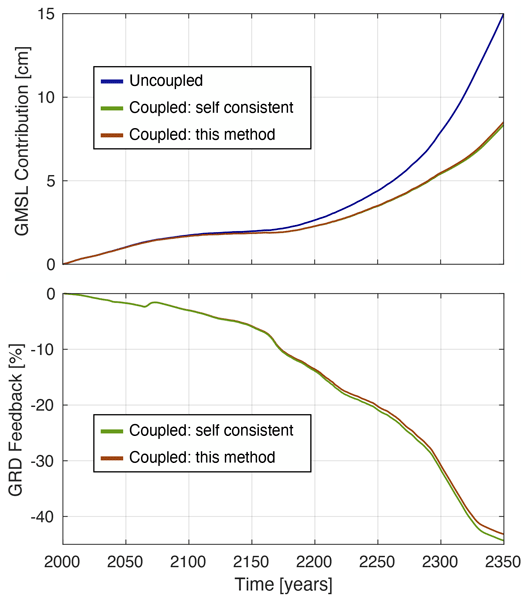
We present an efficient approach for coupling ice sheet and solid Earth models, bringing realistic gravitational and deformational processes into mainstream ice sheet modeling. Earth responses are encoded in precomputed Green’s functions and applied to modeled ice mass change through matrix multiplication. By removing a major computational and technical barrier, the approach could accelerate adoption within the Ice Sheet Model Intercomparison Project (ISMIP) to improve sea level projections.
Mirko Scheinert, Weisen Shen, Richard C. Aster, Lambert Caron, Michael D. Hartinger, Matt A. King, Andrew Lloyd, Anya M. Reading, J. Paul Winberry, Terry Wilson, Lucilla Alfonsi, Michael J. Bentley, Eric Buchta, Thomas Y. Chen, Peter J. Clarke, Jörg Ebbing, Olaf Eisen, Natalya Gomez, Esra Günaydın, Samantha Hansen, Erik R. Ivins, Achraf Koulali, Grace A. Nield, Frederick Richards, Mahmut O. Selbesoglu, Stephanie Sherman, Pippa L. Whitehouse, and Matthias Willen
EGUsphere, https://doi.org/10.5194/egusphere-2025-6370, https://doi.org/10.5194/egusphere-2025-6370, 2026
Short summary
Short summary
With an ongoing mass loss the Antarctic Ice Sheet contributes to global-mean sea level rise at a rate of 0.4 mm/a. Thus, it plays a key role in global climate and provides a natural laboratory to study processes that interlink cryosphere, solid Earth, atmosphere and ocean. We discuss how GNSS and seismic networks in Antarctica were used to significantly advance our understanding of these processes, and how they should be maintained and extended to answer key science questions in the future.
Luc Houriez, Eric Larour, Lambert Caron, Nicole-Jeanne Schlegel, Surendra Adhikari, Erik Ivins, Tyler Pelle, Hélène Seroussi, Eric Darve, and Martin Fischer
The Cryosphere, 19, 4355–4372, https://doi.org/10.5194/tc-19-4355-2025, https://doi.org/10.5194/tc-19-4355-2025, 2025
Short summary
Short summary
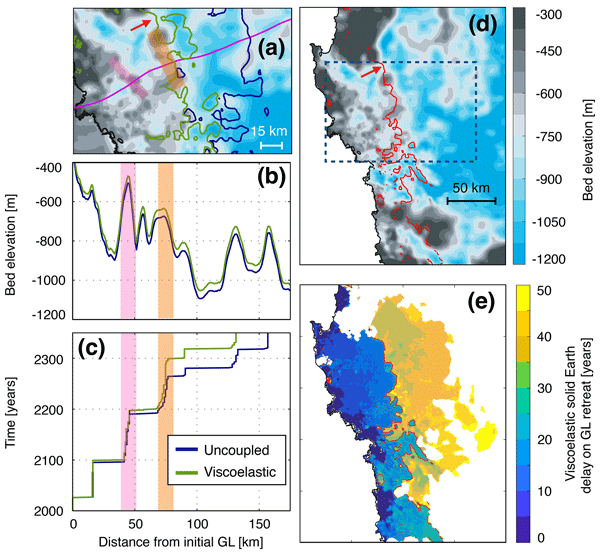
This work examines how interactions between the ice sheet and the Earth’s evolving surface affect the future of Thwaites Glacier in Antarctica. We find that small features in the bedrock play a major role in these interactions which can delay the glacier’s retreat by decades or even centuries. This can significantly reduce sea-level rise projections. Our study highlights resolution requirements for similar ice–earth models and the importance of bedrock mapping efforts in Antarctica.
Blake A. Castleman, Nicole-Jeanne Schlegel, Lambert Caron, Eric Larour, and Ala Khazendar
The Cryosphere, 16, 761–778, https://doi.org/10.5194/tc-16-761-2022, https://doi.org/10.5194/tc-16-761-2022, 2022
Short summary
Short summary
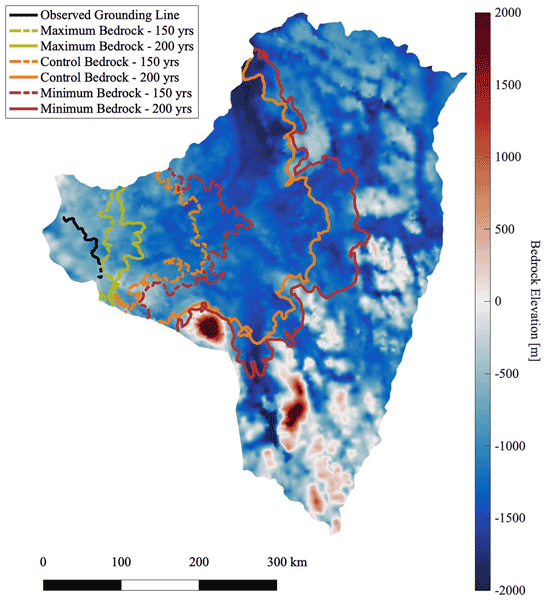
In the described study, we derive an uncertainty range for global mean sea level rise (SLR) contribution from Thwaites Glacier in a 200-year period under an extreme ocean warming scenario. We derive the spatial and vertical resolutions needed for bedrock data acquisition missions in order to limit global mean SLR contribution from Thwaites Glacier to ±2 cm in a 200-year period. We conduct sensitivity experiments in order to present the locations of critical regions in need of accurate mapping.
Surendra Adhikari, Lambert Caron, Erik R. Ivins, Holly K. Han, Luc Houriez, and Eric Larour
The Cryosphere, 20, 5041–5060, https://doi.org/10.5194/tc-20-5041-2026, https://doi.org/10.5194/tc-20-5041-2026, 2026
Short summary
Short summary
We present an efficient approach for coupling ice sheet and solid Earth models, bringing realistic gravitational and deformational processes into mainstream ice sheet modeling. Earth responses are encoded in precomputed Green’s functions and applied to modeled ice mass change through matrix multiplication. By removing a major computational and technical barrier, the approach could accelerate adoption within the Ice Sheet Model Intercomparison Project (ISMIP) to improve sea level projections.
Mirko Scheinert, Weisen Shen, Richard C. Aster, Lambert Caron, Michael D. Hartinger, Matt A. King, Andrew Lloyd, Anya M. Reading, J. Paul Winberry, Terry Wilson, Lucilla Alfonsi, Michael J. Bentley, Eric Buchta, Thomas Y. Chen, Peter J. Clarke, Jörg Ebbing, Olaf Eisen, Natalya Gomez, Esra Günaydın, Samantha Hansen, Erik R. Ivins, Achraf Koulali, Grace A. Nield, Frederick Richards, Mahmut O. Selbesoglu, Stephanie Sherman, Pippa L. Whitehouse, and Matthias Willen
EGUsphere, https://doi.org/10.5194/egusphere-2025-6370, https://doi.org/10.5194/egusphere-2025-6370, 2026
Short summary
Short summary
With an ongoing mass loss the Antarctic Ice Sheet contributes to global-mean sea level rise at a rate of 0.4 mm/a. Thus, it plays a key role in global climate and provides a natural laboratory to study processes that interlink cryosphere, solid Earth, atmosphere and ocean. We discuss how GNSS and seismic networks in Antarctica were used to significantly advance our understanding of these processes, and how they should be maintained and extended to answer key science questions in the future.
Luc Houriez, Eric Larour, Lambert Caron, Nicole-Jeanne Schlegel, Surendra Adhikari, Erik Ivins, Tyler Pelle, Hélène Seroussi, Eric Darve, and Martin Fischer
The Cryosphere, 19, 4355–4372, https://doi.org/10.5194/tc-19-4355-2025, https://doi.org/10.5194/tc-19-4355-2025, 2025
Short summary
Short summary
This work examines how interactions between the ice sheet and the Earth’s evolving surface affect the future of Thwaites Glacier in Antarctica. We find that small features in the bedrock play a major role in these interactions which can delay the glacier’s retreat by decades or even centuries. This can significantly reduce sea-level rise projections. Our study highlights resolution requirements for similar ice–earth models and the importance of bedrock mapping efforts in Antarctica.
Hélène Seroussi, Vincent Verjans, Sophie Nowicki, Antony J. Payne, Heiko Goelzer, William H. Lipscomb, Ayako Abe-Ouchi, Cécile Agosta, Torsten Albrecht, Xylar Asay-Davis, Alice Barthel, Reinhard Calov, Richard Cullather, Christophe Dumas, Benjamin K. Galton-Fenzi, Rupert Gladstone, Nicholas R. Golledge, Jonathan M. Gregory, Ralf Greve, Tore Hattermann, Matthew J. Hoffman, Angelika Humbert, Philippe Huybrechts, Nicolas C. Jourdain, Thomas Kleiner, Eric Larour, Gunter R. Leguy, Daniel P. Lowry, Chistopher M. Little, Mathieu Morlighem, Frank Pattyn, Tyler Pelle, Stephen F. Price, Aurélien Quiquet, Ronja Reese, Nicole-Jeanne Schlegel, Andrew Shepherd, Erika Simon, Robin S. Smith, Fiammetta Straneo, Sainan Sun, Luke D. Trusel, Jonas Van Breedam, Peter Van Katwyk, Roderik S. W. van de Wal, Ricarda Winkelmann, Chen Zhao, Tong Zhang, and Thomas Zwinger
The Cryosphere, 17, 5197–5217, https://doi.org/10.5194/tc-17-5197-2023, https://doi.org/10.5194/tc-17-5197-2023, 2023
Short summary
Short summary
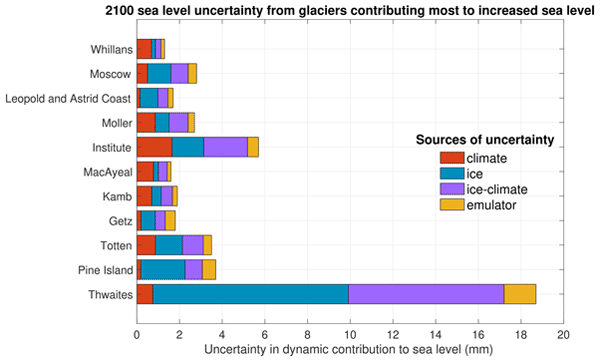
Mass loss from Antarctica is a key contributor to sea level rise over the 21st century, and the associated uncertainty dominates sea level projections. We highlight here the Antarctic glaciers showing the largest changes and quantify the main sources of uncertainty in their future evolution using an ensemble of ice flow models. We show that on top of Pine Island and Thwaites glaciers, Totten and Moscow University glaciers show rapid changes and a strong sensitivity to warmer ocean conditions.
Mattia Poinelli, Michael Schodlok, Eric Larour, Miren Vizcaino, and Riccardo Riva
The Cryosphere, 17, 2261–2283, https://doi.org/10.5194/tc-17-2261-2023, https://doi.org/10.5194/tc-17-2261-2023, 2023
Short summary
Short summary
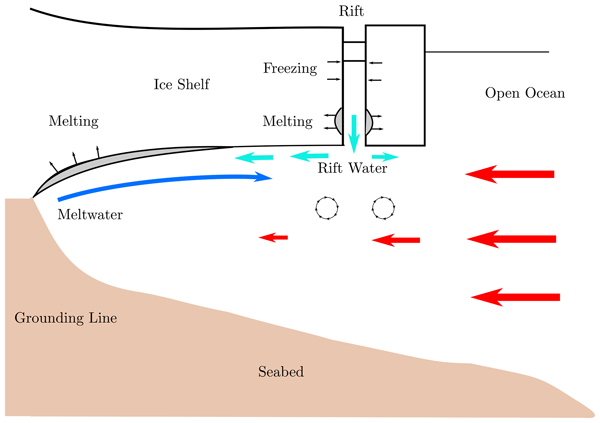
Rifts are fractures on ice shelves that connect the ice on top to the ocean below. The impact of rifts on ocean circulation below Antarctic ice shelves has been largely unexplored as ocean models are commonly run at resolutions that are too coarse to resolve the presence of rifts. Our model simulations show that a kilometer-wide rift near the ice-shelf front modulates heat intrusion beneath the ice and inhibits basal melt. These processes are therefore worthy of further investigation.
Alex S. Gardner, Nicole-Jeanne Schlegel, and Eric Larour
Geosci. Model Dev., 16, 2277–2302, https://doi.org/10.5194/gmd-16-2277-2023, https://doi.org/10.5194/gmd-16-2277-2023, 2023
Short summary
Short summary
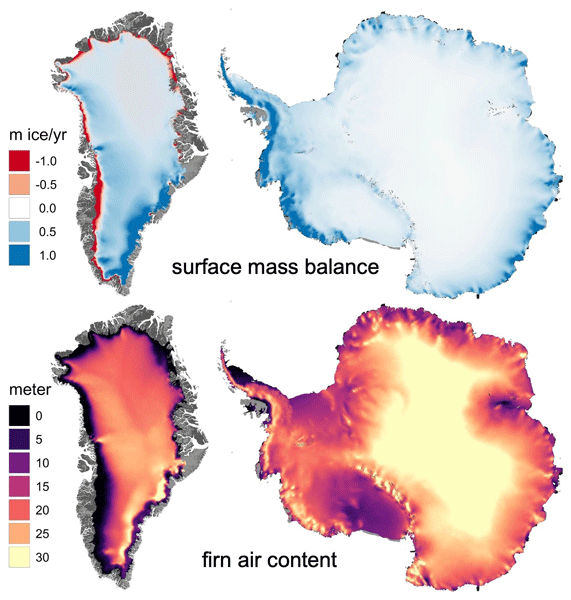
This is the first description of the open-source Glacier Energy and Mass Balance (GEMB) model. GEMB models the ice sheet and glacier surface–atmospheric energy and mass exchange, as well as the firn state. The model is evaluated against the current state of the art and in situ observations and is shown to perform well.

Flavien Beaud, Saif Aati, Ian Delaney, Surendra Adhikari, and Jean-Philippe Avouac
The Cryosphere, 16, 3123–3148, https://doi.org/10.5194/tc-16-3123-2022, https://doi.org/10.5194/tc-16-3123-2022, 2022
Short summary
Short summary
Understanding sliding at the bed of glaciers is essential to understand the future of sea-level rise and glacier-related hazards. Yet there is currently no universal law to describe this mechanism. We propose a universal glacier sliding law and a method to qualitatively constrain it. We use satellite remote sensing to create velocity maps over 6 years at Shisper Glacier, Pakistan, including its recent surge, and show that the observations corroborate the generalized theory.
Blake A. Castleman, Nicole-Jeanne Schlegel, Lambert Caron, Eric Larour, and Ala Khazendar
The Cryosphere, 16, 761–778, https://doi.org/10.5194/tc-16-761-2022, https://doi.org/10.5194/tc-16-761-2022, 2022
Short summary
Short summary
In the described study, we derive an uncertainty range for global mean sea level rise (SLR) contribution from Thwaites Glacier in a 200-year period under an extreme ocean warming scenario. We derive the spatial and vertical resolutions needed for bedrock data acquisition missions in order to limit global mean SLR contribution from Thwaites Glacier to ±2 cm in a 200-year period. We conduct sensitivity experiments in order to present the locations of critical regions in need of accurate mapping.
Kevin Bulthuis and Eric Larour
Geosci. Model Dev., 15, 1195–1217, https://doi.org/10.5194/gmd-15-1195-2022, https://doi.org/10.5194/gmd-15-1195-2022, 2022
Short summary
Short summary
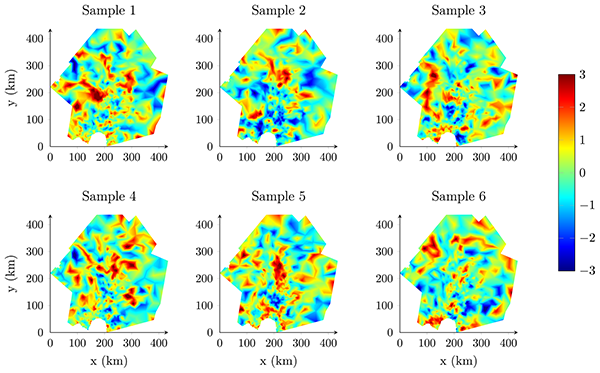
We present and implement a stochastic solver to sample spatially and temporal varying uncertain input parameters in the Ice-sheet and Sea-level System Model, such as ice thickness or surface mass balance. We represent these sources of uncertainty using Gaussian random fields with Matérn covariance function. We generate random samples of this random field using an efficient computational approach based on solving a stochastic partial differential equation.
Cited articles
Abate, J. and Valkó, P. P.: Multi-precision Laplace transform inversion, International Journal for Numerical Methods in Engineering, 60, 979–993, https://doi.org/10.1002/nme.995, 2004. a
Adhikari, S., Ivins, E. R., and Larour, E.: ISSM-SESAW v1.0: mesh-based computation of gravitationally consistent sea-level and geodetic signatures caused by cryosphere and climate driven mass change, Geosci. Model Dev., 9, 1087–1109, https://doi.org/10.5194/gmd-9-1087-2016, 2016. a
Adhikari, S., Ivins, E. R., Frederikse, T., Landerer, F. W., and Caron, L.: Sea-level fingerprints emergent from GRACE mission data, Earth Syst. Sci. Data, 11, 629–646, https://doi.org/10.5194/essd-11-629-2019, 2019. a
Alterman, Z., Jarosch, H., and Pekeris, C.: Oscillations of the Earth, Proceedings of the Royal Society of London. Series A. Mathematical and Physical Sciences, 252, 80–95, https://doi.org/10.1098/rspa.1959.0138, 1959. a, b, c
Arfken, G.: Mathematical Methods for Physicists, Academic Press, ISBN-10 0120598515, ISBN-13 978-0120598519, 1970. a
Bierson, C. J.: The impact of rheology model choices on tidal heating studies, Icarus, 414, 116026, https://doi.org/10.1016/j.icarus.2024.116026, 2024. a, b
Book, C., Hoffman, M. J., Kachuck, S. B., Hillebrand, T. R., Price, S. F., Perego, M., and Bassis, J. N.: Stabilizing effect of bedrock uplift on retreat of Thwaites Glacier, Antarctica, at centennial timescales, Earth and Planetary Science Letters, 597, 117798, https://doi.org/10.1016/j.epsl.2022.117798, 2022. a
Broerse, T., Riva, R., Simons, W., Govers, R., and Vermeersen, B.: Postseismic GRACE and GPS observations indicate a rheology contrast above and below the Sumatra slab, J. Geophys. Res. Solid Earth, 120, 5343–5361, https://doi.org/10.1002/2015JB011951, 2015. a
Caron, L.: ISSM Love number core: Initial release, Zenodo [code], https://doi.org/10.5281/zenodo.13984073, 2024. a, b
Caron, L., Métivier, L., Greff-Lefftz, M., Fleitout, L., and Rouby, H.: Inverting Glacial Isostatic Adjustment signal using Bayesian framework and two linearly relaxing rheologies, Geophysical Journal International, 209, 1126–1147, https://doi.org/10.1093/gji/ggx083, 2017. a
Caron, L., Ivins, E., Larour, E., Adhikari, S., Nilsson, J., and Blewitt, G.: GIA model statistics for GRACE hydrology, cryosphere, and ocean science, Geophysical Research Letters, 45, 2203–2212, https://doi.org/10.1002/2017GL076644, 2018. a, b, c, d
Castillo-Rogez, J. C., Efroimsky, M., and Lainey, V.: The tidal history of Iapetus: Spin dynamics in the light of a refined dissipation model, Journal of Geophysical Research: Planets, 116, https://doi.org/10.1029/2010JE003664, 2011. a
Cederberg, G., Jaeger, N., Kiam, L., Powell, R., Stoller, P., Valencic, N., Latychev, K., Lickley, M., and Mitrovica, J. X.: Consistency in the fingerprints of projected sea level change 2015–2100CE, Geophysical Journal International, 235, 353–365, https://doi.org/10.1093/gji/ggad214, 2023. a
Chinnery, M. A.: The static deformation of an Earth with a fluid core: a physical approach, Geophysical Journal International, 42, 461–475, https://doi.org/10.1111/j.1365-246X.1975.tb05872.x, 1975. a
Chopra, P. and Paterson, M.: The experimental deformation of dunite, Tectonophysics, 78, 453–473, https://doi.org/10.1016/0040-1951(81)90024-X, 1981. a
Chopra, P. N.: High temperature transient creep in olivine, Tectonophysics, 297, 93–111, https://doi.org/10.1016/S0040-1951(97)00134-0, 1997. a
Cooper, R. F.: Seismic wave attenuation: Energy dissipation in viscoelastic crystalline solids, Reviews in Mineralogy and Geochemistry, 51, 253–290, https://doi.org/10.2138/gsrmg.51.1.253, 2002. a
Dahlen, F. and Tromp, J.: Theoretical Global Seismology, Princeton University Press, ISBN 9780691001241, 1998. a
Dziewonski, A. M. and Anderson, D. L.: Preliminary reference Earth model, Physics of the Earth and Planetary Interiors, 25, 297–356, https://doi.org/10.1016/0031-9201(81)90046-7, 1981. a, b
Gevorgyan, Y., Boué, G., Ragazzo, C., Ruiz, L. S., and Correia, A. C.: Andrade rheology in time-domain, Application to Enceladus' dissipation of energy due to forced libration, Icarus, 343, 113610, https://doi.org/10.1016/j.icarus.2019.113610, 2020. a
Goldreich, P.: On the eccentricity of satellite orbits in the solar system, Mon. Not. Royal Astronomical Soc, 126, 257–288, https://doi.org/10.1093/mnras/126.3.257, 1963. a
Goldreich, P. and Soter, S.: Q in the solar system, Icarus, 5, 375–389, https://doi.org/10.1016/0019-1035(66)90051-0, 1966. a
Gomez, N., Pollard, D., and Holland, D.: Sea-level feedback lowers projections of future Antarctic Ice-Sheet mass loss, Nature Communications, 6, 8798, https://doi.org/10.1038/ncomms9798, 2015. a
Gowan, E. J., Zhang, X., Khosravi, S., Rovere, A., Stocchi, P., Hughes, A. L., Gyllencreutz, R., Mangerud, J., Svendsen, J.-I., and Lohmann, G.: A new global ice sheet reconstruction for the past 80 000 years, Nature communications, 12, 1199, https://doi.org/10.1038/s41467-021-21469-w, 2021. a
Gregory, J. M., Griffies, S. M., Hughes, C. W., Lowe, J. A., Church, J. A., Fukimori, I., Gomez, N., Kopp, R. E., Landerer, F., Cozannet, G. L., and Ponte, R. M.: Concepts and terminology for sea level: Mean, variability and change, both local and global, Surveys in Geophysics, 40, 1251–1289, https://doi.org/10.1007/s10712-019-09525-z, 2019. a
Gunter, B., Ries, J., Bettadpur, S., and Tapley, B.: A simulation study of the errors of omission and commission for GRACE RL01 gravity fields, Journal of Geodesy, 80, 341–351, https://doi.org/10.1007/s00190-006-0083-3, 2006. a
Hager, B. and Clayton, R.: Constraints on the structure of mantle convection using seismic observations, flow models and the geoid, in: Fluid Mechanics of Astrophysics and Geophysics, Volume 4: Mantle Convection, edited by: Peltier, W. R., Gordon and Breach Sci. Pub., New York, 657–764, ISBN-10 0677221207, ISBN-13 978-0677221205, 1989. a
Han, S.-C., Sauber, J., and Pollitz, F.: Broadscale postseismic gravity change following the 2011 Tohoku-Oki earthquake and implication for deformation by viscoelastic relaxation and afterslip, Geophys. Res. Lett., 41, 5797–5805, https://doi.org/10.1002/2014GL060905, 2014. a
Hanyk, L., Matyska, C., and Yuen, D. A.: Secular gravitational instability of a compressible viscoelastic sphere, Geophysical Research Letters, 26, 557–560, https://doi.org/10.1029/1999GL900024, 1999. a, b
Hazzard, J., Richards, F., Goes, S., and Roberts, G.: Probabilistic assessment of Antarctic thermomechanical structure: Impacts on Ice Sheet stability, Journal of Geophysical Research: Solid Earth, 128, e2023JB026653, https://doi.org/10.1029/2023JB026653, 2023. a, b, c
Heki, K. and Jin, S.: Geodetic study on Earth surface loading with GNSS and GRACE, Satellite Navigation, 4, 24, https://doi.org/10.1186/s43020-023-00113-6, 2023. a
Herglotz, G.: Über die Elastizität der Erde bei Berücksichtigung ihrer variablen Dichte, Zeitschrift für Mathematik und Physik, 52, 275–299, 1905. a
Hines, T. T. and Hetland, E. A.: Rheologic constraints on the upper mantle from 5 years of postseismic deformation following the El Mayor-Cucapah earthquake, Journal of Geophysical Research: Solid Earth, 121, 6809–6827, https://doi.org/10.1002/2016JB013114, 2016. a, b
Huang, P., Steffen, R., Steffen, H., Klemann, V., Wu, P., Van Der Wal, W., Martinec, Z., and Tanaka, Y.: A commercial finite element approach to modelling Glacial Isostatic Adjustment on spherical self-gravitating compressible earth models, Geophysical Journal International, 235, 2231–2256, https://doi.org/10.1093/gji/ggad354, 2023. a
Ivins, E., Caron, L., Adhikari, S., Larour, E., and Scheinert, M.: A linear viscoelasticity for decadal to centennial time scale mantle deformation, Reports on Progress in Physics, 83, 106 801, https://doi.org/10.1088/1361-6633/aba346, 2020. a, b, c, d
Ivins, E. R., Caron, L., Adhikari, S., and Larour, E.: Notes on a compressible extended Burgers model of rheology, Geophysical Journal International, 228, 1975–1991, https://doi.org/10.1093/gji/ggab452, 2022. a, b, c, d
Ivins, E. R., van der Wal, W., Wiens, D. A., Lloyd, A. J., and Caron, L.: Antarctic upper mantle rheology, Geological Society, London, Memoirs, 56, 267–294, https://doi.org/10.1144/M56-2020-19, 2023b. a
Jackson, I. and Faul, U. H.: Grainsize-sensitive viscoelastic relaxation in olivine: Towards a robust laboratory-based model for seismological application, Phys. Earth Planet. Int., 183, 151–163, https://doi.org/10.1016/j.pepi.2010.09.005, 2010. a
Kachuck, S. B. and Cathles, L M, I.: Benchmarked computation of time-domain viscoelastic Love numbers for adiabatic mantles, Geophysical Journal International, 218, 2136–2149, https://doi.org/10.1093/gji/ggz276, 2019. a
Kierulf, H. P., Kohler, J., Boy, J.-P., Geyman, E. C., Mémin, A., Omang, O. C. D., Steffen, H., and Steffen, R.: Time-varying uplift in Svalbard—an effect of glacial changes, Geophysical Journal International, 231, 1518–1534, https://doi.org/10.1093/gji/ggac264, 2022. a, b
Klein, E., Fleitout, L., Vigny, C., and Garaud, J.: Afterslip and viscoelastic relaxation model inferred from the large-scale post-seismic deformation following the 2010 Mw 8.8 Maule earthquake (Chile), Geophysical Journal International, 205, 1455–1472, https://doi.org/10.1093/gji/ggw086, 2016. a
Lambeck, K.: The Earth’s variable rotation: Geophysical Causes and Consequences, Cambridge University Press, https://doi.org/10.1017/CBO9780511569579, ISBN-13 978-0521227698, ISBN-10 0521227690, 1980. a
Larour, E., Seroussi, H., Adhikari, S., Ivins, E., Caron, L., Morlighem, M., and Schlegel, N.: Slowdown in Antarctic mass loss from solid Earth and sea-level feedbacks, Science, 364, eaav7908, https://doi.org/10.1126/science.aav7908, 2019. a, b
Larour, E., Caron, L., Morlighem, M., Adhikari, S., Frederikse, T., Schlegel, N.-J., Ivins, E., Hamlington, B., Kopp, R., and Nowicki, S.: ISSM-SLPS: geodetically compliant Sea-Level Projection System for the Ice-sheet and Sea-level System Model v4.17, Geosci. Model Dev., 13, 4925–4941, https://doi.org/10.5194/gmd-13-4925-2020, 2020. a, b, c
Latychev, K., Mitrovica, J. X., Tromp, J., Tamisiea, M. E., Komatitsch, D., and Christara, C. C.: Glacial isostatic adjustment on 3-D Earth models: a finite-volume formulation, Geophysical Journal International, 161, 421–444, https://doi.org/10.1111/j.1365-246X.2005.02536.x, 2005. a
Lau, H. C.: Transient rheology in sea level change: implications for meltwater pulse 1A, Earth and Planetary Science Letters, 609, 118106, https://doi.org/10.1016/j.epsl.2023.118106, 2023. a
Lau, H. C. and Faul, U. H.: Anelasticity from seismic to tidal timescales: Theory and observations, Earth and Planetary Science Letters, 508, 18–29, https://doi.org/10.1016/j.epsl.2018.12.009, 2019. a, b, c, d
Lau, H. C. and Schindelegger, M.: Solid Earth tides, in: A Journey Through Tides, Elsevier, 365–387, https://doi.org/10.1016/B978-0-323-90851-1.00016-9, 2023. a
Lau, H. C. P.: Surface Loading on a self-gravitating, linear viscoelastic Earth: moving beyond Maxwell, Geophysical Journal International, ggae149, https://doi.org/10.1093/gji/ggae149, 2024. a, b
Lau, H. C. P., Holtzman, B. K., and Havlin, C.: Toward a self-consistent characterization of lithospheric plates using full-spectrum viscoelasticity, AGU Advances, 1, e2020AV000205, https://doi.org/10.1029/2020AV000205, 2020. a
Lau, H. C. P., Austermann, J., Holtzman, B. K., Havlin, C., Lloyd, A. J., Book, C., and Hopper, E.: Frequency dependent mantle viscoelasticity via the complex viscosity: cases From Antarctica, Journal of Geophysical Research: Solid Earth, 126, e2021JB022622, https://doi.org/10.1029/2021JB022622, 2021. a
Lin, Y., Whitehouse, P. L., Valentine, A. P., and Woodroffe, S. A.: GEORGIA: A graph neural network based EmulatOR for glacial isostatic adjustment, Geophysical Research Letters, 50, e2023GL103672, https://doi.org/10.1029/2023GL103672, 2023. a
Lloyd, A. J., Crawford, O., Al-Attar, D., Austermann, J., Hoggard, M. J., Richards, F. D., and Syvret, F.: GIA imaging of 3-D mantle viscosity based on palaeo sea level observations–Part I: Sensitivity kernels for an Earth with laterally varying viscosity, Geophysical Journal International, 236, 1139–1171, https://doi.org/10.1093/gji/ggad455, 2024. a, b
Longman, I. M.: A Green's function for determining the deformation of the Earth under surface mass loads: 1. Theory, Journal of Geophysical Research, 67, 845–850, https://doi.org/10.1029/JZ067i002p00845, 1962. a
Love, A. E. H.: Some Problems of Geodynamics: Being an Essay to which the Adams Prize in the University of Cambridge was Adjudged in 1911, University Press, https://doi.org/10.1017/CBO9781316225011, 1911. a
Love, R., Milne, G. A., Ajourlou, P., Parang, S., Tarasov, L., and Latychev, K.: A fast surrogate model for 3D Earth glacial isostatic adjustment using Tensorflow (v2.8.0) artificial neural networks, Geosci. Model Dev., 17, 8535–8551, https://doi.org/10.5194/gmd-17-8535-2024, 2024. a
Martinec, Z. and Hagedoorn, J.: The rotational feedback on linear-momentum balance in glacial isostatic adjustment, Geophysical Journal International, 199, 1823–1846, https://doi.org/10.1093/gji/ggu369, 2014. a
Masuti, S. and Barbot, S.: MCMC inversion of the transient and steady-state creep flow law parameters of dunite under dry and wet conditions, Earth, Planets and Space, 73, https://doi.org/10.1186/s40623-021-01543-9, 2021. a, b, c
McCarthy, C., Takei, Y., and Hiraga, T.: Experimental study of attenuation and dispersion over a broad frequency range: 2. The universal scaling of polycrystalline materials, J. Geophys. Res., 126, https://doi.org/10.1029/2011JB008384, 2011. a
McConnell Jr., R. K.: Isostatic adjustment in a layered earth, J. Geophys. Res., 70, 5171–5188, https://doi.org/10.1029/JZ070i020p05171, 1965. a
Melini, D. and Spada, G.: Some remarks on Glacial Isostatic Adjustment modelling uncertainties, Geophysical Journal International, 218, 401–413, https://doi.org/10.1093/gji/ggz158, 2019. a, b
Melini, D., Saliby, C., and Spada, G.: On computing viscoelastic Love numbers for general planetary models: the ALMA3 code, Geophysical Journal International, 231, 1502–1517, https://doi.org/10.1093/gji/ggac263, 2022. a
Métivier, L., Rouby, H., Rebischung, P., and Altamimi, Z.: ITRF2014, Earth figure changes, and geocenter velocity: Implications for GIA and recent ice melting, Journal of Geophysical Research: Solid Earth, 125, e2019JB018333, https://doi.org/10.1029/2019JB018333, 2020. a
Michel, A. and Boy, J.-P.: Viscoelastic Love numbers and long-period geophysical effects, Geophysical Journal International, 228, 1191–1212, https://doi.org/10.1093/gji/ggab369, 2022. a, b
Mitrovica, J. and Forte, A.: A new inference of mantle viscosity based upon joint inversion of convection and glacial isostatic adjustment data, Earth and Planetary Science Letters, 225, 177–189, https://doi.org/10.1016/j.epsl.2004.06.005, 2004. a
Mitrovica, J. X., Wahr, J., Matsuyama, I., and Paulson, A.: The rotational stability of an ice-age Earth, Geophysical Journal International, 161, 491–506, https://doi.org/10.1111/j.1365-246X.2005.02609.x, 2005. a
Nield, G. A., Barletta, V. R., Bordoni, A., King, M. A., Whitehouse, P. L., Clarke, P. J., Domack, E., Scambos, T. A., and Berthier, E.: Rapid bedrock uplift in the Antarctic Peninsula explained by viscoelastic response to recent ice unloading, Earth and Planetary Science Letters, 397, 32–41, https://doi.org/10.1016/j.epsl.2014.04.019, 2014. a
Pekeris, C. and Jarosch, H.: The free oscillations of the Earth, Contributions in Geophysics in Honor of Beno Gutenberg, 1, 171–192, 1958. a
Peltier, W.: The impulse response of a Maxwell Earth, Reviews of Geophysics, 12, 649–669, https://doi.org/10.1029/RG012i004p00649, 1974. a, b, c, d
Peltier, W. R., Argus, D., and Drummond, R.: Space geodesy constrains ice age terminal deglaciation: The global ICE-6G_C (VM5a) model, Journal of Geophysical Research: Solid Earth, 120, 450–487, https://doi.org/10.1002/2014JB011176, 2015. a, b
Plag, H.-P. and Jüttner, H.-U.: Rayleigh-Taylor instabilities of a self-gravitating Earth, Journal of Geodynamics, 20, 267–288, https://doi.org/10.1016/0264-3707(95)00008-W, 1995. a
Pollitz, F. F.: Transient rheology of the uppermost mantle beneath the Mojave Desert, California, Earth Planet. Sci. Lett., 215, 89–104, https://doi.org/10.1016/S0012-821X(03)00432-1, 2003. a
Pollitz, F. F., Bürgmann, R., and Banerjee, P.: Post-seismic relaxation following the great 2004 Sumatra-Andaman earthquake on a compressible self-gravitating Earth, Geophysical Journal International, 167, 397–420, https://doi.org/10.1111/j.1365-246X.2006.03018.x, 2006. a
Qu, T., Jackson, I., and Faul, U. H.: Low-frequency seismic properties of olivine-orthopyroxene mixtures, J. Geophys. Res. Solid Earth, 126, e2021JB022504, https://doi.org/10.1029/2021JB022504, 2021. a, b
Ray, R. D., Eanes, R. J., and Lemoine, F. G.: Constraints on energy dissipation in the Earth's body tide from satellite tracking and altimetry, Geophysical Journal International, 144, 471–480, https://doi.org/10.1046/j.1365-246x.2001.00356.x, 2001. a
Simon, K. M., Riva, R. E., and Broerse, T.: Identifying geographical patterns of transient deformation in the geological sea level record, Journal of Geophysical Research: Solid Earth, 127, e2021JB023693, https://doi.org/10.1029/2021JB023693, 2022. a, b
Spada, G. and Boschi, L.: Using the Post – Widder formula to compute the Earth's viscoelastic Love numbers, Geophysical Journal International, 166, 309–321, https://doi.org/10.1111/j.1365-246X.2006.02995.x, 2006. a, b, c, d
Spada, G. and Melini, D.: New estimates of ongoing sea level change and land movements caused by Glacial Isostatic Adjustment in the Mediterranean region, Geophysical Journal International, 229, 984–998, https://doi.org/10.1093/gji/ggab508, 2022. a
Spada, G., Barletta, V. R., Klemann, V., Riva, R., Martinec, Z., Gasperini, P., Lund, B., Wolf, D., Vermeersen, L., and King, M.: A benchmark study for glacial isostatic adjustment codes, Geophysical Journal International, 185, 106–132, https://doi.org/10.1111/j.1365-246X.2011.04952.x, 2011. a, b, c, d, e, f, g, h, i, j, k, l, m
Takeuchi, H. and Saito, M.: Seismic surface waves, Methods in computational physics, 11, 217–295, https://doi.org/10.1016/B978-0-12-460811-5.50010-6, 1972. a
Valkó, P. P. and Abate, J.: Comparison of sequence accelerators for the Gaver method of numerical Laplace transform inversion, Computers & Mathematics with Applications, 48, 629–636, https://doi.org/10.1016/j.camwa.2002.10.017, 2004. a
van Calcar, C. J., van de Wal, R. S. W., Blank, B., de Boer, B., and van der Wal, W.: Simulation of a fully coupled 3D glacial isostatic adjustment – ice sheet model for the Antarctic ice sheet over a glacial cycle, Geosci. Model Dev., 16, 5473–5492, https://doi.org/10.5194/gmd-16-5473-2023, 2023. a
Vermeersen, L. and Mitrovica, J.: Gravitational stability of spherical self-gravitating relaxation models, Geophysical Journal International, 142, 351–360, https://doi.org/10.1046/j.1365-246x.2000.00159.x, 2000. a, b
Wahr, J., Molenaar, M., and Bryan, F.: Time variability of the Earth's gravity field: Hydrological and oceanic effects and their possible detection using GRACE, Journal of Geophysical Research: Solid Earth, 103, 30205–30229, https://doi.org/10.1029/98JB02844, 1998. a
Wake, L. M., Lecavalier, B. S., and Bevis, M.: Glacial isostatic adjustment (GIA) in Greenland: A review, Current Climate Change Reports, 2, 101–111, https://doi.org/10.1007/s40641-016-0040-z, 2016. a
Whitehouse, P. L.: Glacial isostatic adjustment modelling: historical perspectives, recent advances, and future directions, Earth Surf. Dynam., 6, 401–429, https://doi.org/10.5194/esurf-6-401-2018, 2018. a
Whitehouse, P. L., Gomez, N., King, M. A., and Wiens, D. A.: Solid Earth change and the evolution of the Antarctic Ice Sheet, Nature Communications, 10, https://doi.org/10.1038/s41467-018-08068-y, 2019. a
Yamauchi, H. and Takei, Y.: Polycrystal anelasticity at near-solidus temperatures, Journal of Geophysical Research: Solid Earth, 121, 7790–7820, https://doi.org/10.1002/2016JB013316, 2016. a
Yousefi, M., Milne, G. A., Love, R., and Tarasov, L.: Glacial isostatic adjustment along the Pacific coast of central North America, Quaternary Science Reviews, 193, 288–311, https://doi.org/10.1016/j.quascirev.2018.06.017, 2018. a
Zhong, S., Kang, K., A, G., and Qin, C.: CitcomSVE: A three‐dimensional finite element software package for modeling planetary mantle's viscoelastic deformation in response to surface and tidal loads, Geochem. Geophys. Geosyst., 23, e2022GC010359, https://doi.org/10.1029/2022GC010359, 2022. a
Editorial statement
The viscoelastic Love Numbers underlie our ability to simulate spatially variable sea-level change. They are indeed the "secret sauce" in any such modeling effort. This paper, while technical, takes us to the back of the kitchen to share how the next-generation sauce is made. The resultant Love Numbers will be used to predict sea-level changes and glacial isostatic adjustment with more realistic mantle rheologies.
The viscoelastic Love Numbers underlie our ability to simulate spatially variable sea-level...
Short summary
Presented here is a new model of the solid-Earth response to tides and mass changes in ice sheets, oceans, and groundwater, in of terms of gravity change and bedrock motion. The model is capable simulating mantle deformation including elasticity, transient and steady-state viscous flow. We detail our approach to numerical optimization, and report the accuracy of results with respect to community benchmarks. The resulting coupled system features kilometer-scale resolution and fast computation.
Presented here is a new model of the solid-Earth response to tides and mass changes in ice...


