
Articles | Volume 19, issue 8
https://doi.org/10.5194/gmd-19-3427-2026
© Author(s) 2026. This work is distributed under
the Creative Commons Attribution 4.0 License.
the Creative Commons Attribution 4.0 License.
https://doi.org/10.5194/gmd-19-3427-2026
© Author(s) 2026. This work is distributed under
the Creative Commons Attribution 4.0 License.
the Creative Commons Attribution 4.0 License.
Model evaluation paper
| 
27 Apr 2026
Model evaluation paper |
| 27 Apr 2026
| 27 Apr 2026
Benchmarking soil moisture and its relationship to ecohydrologic variables in Earth System Models

Oak Ridge National Laboratory, Oak Ridge, TN 37830, USA
Nathan Collier
Oak Ridge National Laboratory, Oak Ridge, TN 37830, USA
Yaoping Wang
Oak Ridge National Laboratory, Oak Ridge, TN 37830, USA
Jiafu Mao
Oak Ridge National Laboratory, Oak Ridge, TN 37830, USA
Adrian Harpold
University of Nevada, Reno, Reno, NV 89557, USA
Steven A. Kannenberg
Department of Biology, West Virginia University, Morgantown, WV 26506, USA
Gerbrand Koren
Copernicus Institute of Sustainable Development, Utrecht University, Princetonlaan 8a, 3584 CB Utrecht, the Netherlands
Mukesh Kumar
Department of Civil, Construction, and Environmental Engineering, University of Alabama, Tuscaloosa, AL 35487, USA
Pushpendra Raghav
Department of Civil, Construction, and Environmental Engineering, University of Alabama, Tuscaloosa, AL 35487, USA
Pallav Ray
Florida Institute of Technology, Melbourne, FL 32901, USA
Mingjie Shi
Pacific Northwest National Laboratory, Richland, WA 99352, USA
Lawrence Berkeley National Laboratory, Berkeley, CA 94720, USA
Sreedevi P. Vasu
Florida Institute of Technology, Melbourne, FL 32901, USA
Huiqi Wang
University of California, Berkeley, Berkeley, CA 94720, USA
Qing Zhu
Lawrence Berkeley National Laboratory, Berkeley, CA 94720, USA
Forrest M. Hoffman
Oak Ridge National Laboratory, Oak Ridge, TN 37830, USA
Related authors
Moetasim Ashfaq, Erika Coppola, Chris Lennard, Claas Teichmann, Deeksha Rastogi, Elias Massoud, Erasmo Buonomo, Eun-Soon Im, George Zittis, Jason P. Evans, Jesus Fernandez, Katherine J. Evans, Maria Leidinice da Silva, Marianna Adinolfi, Melissa Bukovsky, Rosmeri Porfirio da Rocha, Shabeh ul Hasson, Silvina A. Solman, Stefan Sobolowski, Sushant Das, Swen Brands, Tereza Cavazos, Thanh Ngo-Duc, and Xuejie Gao
EGUsphere, https://doi.org/10.5194/egusphere-2026-2649, https://doi.org/10.5194/egusphere-2026-2649, 2026
Short summary
Short summary
Producing reliable regional climate projections requires carefully selecting which global climate models drive them. We developed a transparent and reproducible framework to identify a balanced, representative subset of models for the Coordinated Regional Climate Downscaling Experiment, a major international effort to generate high-resolution climate projections worldwide. While designed for this initiative, the framework is broadly applicable to other models sub-selection efforts.
Elias C. Massoud, Lauren Andrews, Rolf Reichle, Andrea Molod, Jongmin Park, Sophie Ruehr, and Manuela Girotto
Earth Syst. Dynam., 14, 147–171, https://doi.org/10.5194/esd-14-147-2023, https://doi.org/10.5194/esd-14-147-2023, 2023
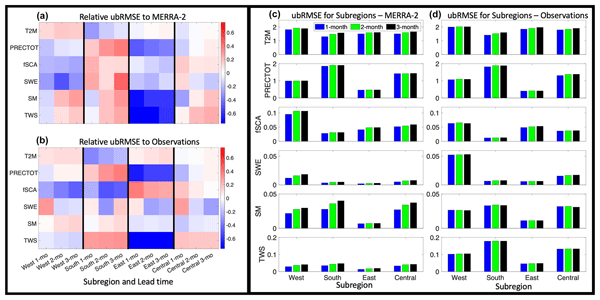
Short summary
Short summary
In this study, we benchmark the forecast skill of the NASA’s Goddard Earth Observing System subseasonal-to-seasonal (GEOS-S2S version 2) hydrometeorological forecasts in the High Mountain Asia (HMA) region. Hydrometeorological forecast skill is dependent on the forecast lead time, the memory of the variable within the physical system, and the validation dataset used. Overall, these results benchmark the GEOS-S2S system’s ability to forecast HMA hydrometeorology on the seasonal timescale.
Adrienne M. Wootten, Elias C. Massoud, Duane E. Waliser, and Huikyo Lee
Earth Syst. Dynam., 14, 121–145, https://doi.org/10.5194/esd-14-121-2023, https://doi.org/10.5194/esd-14-121-2023, 2023
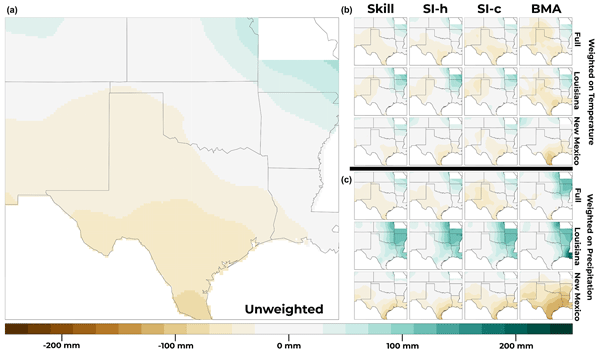
Short summary
Short summary
Climate projections and multi-model ensemble weighting are increasingly used for climate assessments. This study examines the sensitivity of projections to multi-model ensemble weighting strategies in the south-central United States. Model weighting and ensemble means are sensitive to the domain and variable used. There are numerous findings regarding the improvement in skill with model weighting and the sensitivity associated with various strategies.

Elias C. Massoud, A. Anthony Bloom, Marcos Longo, John T. Reager, Paul A. Levine, and John R. Worden
Hydrol. Earth Syst. Sci., 26, 1407–1423, https://doi.org/10.5194/hess-26-1407-2022, https://doi.org/10.5194/hess-26-1407-2022, 2022
Short summary
Short summary
The water balance on river basin scales depends on a number of soil physical processes. Gaining information on these quantities using observations is a key step toward improving the skill of land surface hydrology models. In this study, we use data from the Gravity Recovery and Climate Experiment (NASA-GRACE) to inform and constrain these hydrologic processes. We show that our model is able to simulate the land hydrologic cycle for a watershed in the Amazon from January 2003 to December 2012.
Li Xu, Qi Tang, Qing Zhu, William J. Riley, Guido R. van der Werf, Yang Chen, Michael J. Prather, and James T. Randerson
EGUsphere, https://doi.org/10.5194/egusphere-2026-4288, https://doi.org/10.5194/egusphere-2026-4288, 2026
This preprint is open for discussion and under review for Atmospheric Chemistry and Physics (ACP).
Short summary
Short summary
Using the E3SM version 3 model with interactive chemistry, this study shows that wildfires substantially perturb global and regional tropospheric chemistry and modify radiative effects through aerosol and ozone interactions, with particularly strong impacts in tropical fire regions. By connecting wildfire emissions with changes in atmospheric composition, radiation, and climate, this study provides important insights on how the atmosphere responds to changing fire activities.
Xiaoying Shi, Daniel M. Ricciuto, Yaoping Wang, Joe R. Melton, Fortunat Joos, Yiqi Luo, Xiaofeng Xu, Dafeng Hui, Qianlai Zhuang, Chunjing Qiu, Hongxing He, Siya Shao, Xingjie Lu, Yongjiu Dai, Akihiko Ito, Qing Sun, Nitin Chaudhary, Ayesha Hussain, Mousong Wu, Jian Zhou, Jingwei Zhang, Ye Yuan, Rachael H. Turton, Eleanor J. Burke, Jiafu Mao, Yuefeng Hao, Natalie A. Griffiths, Verity Salmon, Paul J. Hanson, Melanie A. Mayes, and Peter E. Thornton
EGUsphere, https://doi.org/10.5194/egusphere-2026-5193, https://doi.org/10.5194/egusphere-2026-5193, 2026
This preprint is open for discussion and under review for Biogeosciences (BG).
Short summary
Short summary
Northern peatlands store vast amounts of carbon, but their response to climate change remains uncertain. We compared 15 ecosystem models with observations from a long-term warming and elevated carbon dioxide experiment in Minnesota. Models differed widely in their carbon responses, reflecting differences in ecosystem processes and model parameters. The results identify priorities for improving peatland models and projections of future carbon–climate feedbacks.
Elijah N. Boardman, Karen L. Boardman, Christopher A. Jones, Sean D. Shipman, John A. Whiting, Joseph W. Boardman, and Adrian A. Harpold
The Cryosphere, 20, 4877–4910, https://doi.org/10.5194/tc-20-4877-2026, https://doi.org/10.5194/tc-20-4877-2026, 2026
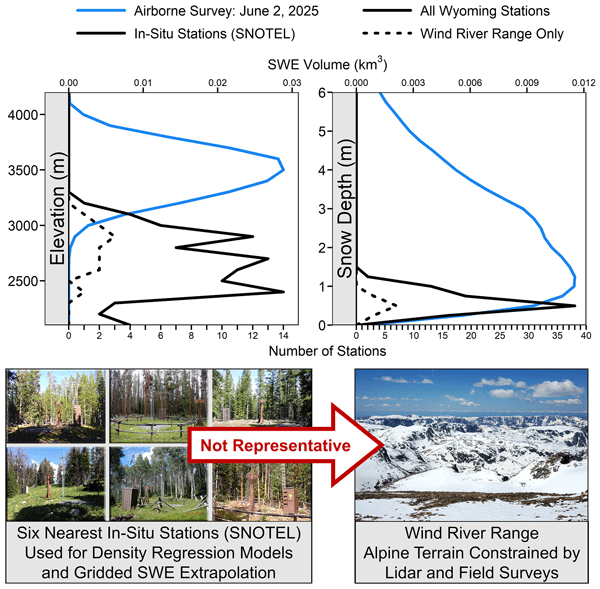
Short summary
Short summary
Deep wind drifts are an important component of the mountain snowpack, but drifts are underrepresented by most datasets. Our synthesis of field surveys, statistical modeling, and remote sensing quantifies the contribution of drift depth and bulk density to snowpack heterogeneity across scales, from the vertical structure at a single location to the kilometer-scale patterning of snow across a mountain range.
William J. M. Seviour, Justin Finkel, Philip Rupp, Regan Mudhar, Amy H. Butler, Chaim I. Garfinkel, Peter Hitchcock, Blanca Ayarzagüena, Dong-Chan Hong, Yu-Kyung Hyun, Hera Kim, Eun-Pa Lim, Daniel De Maeseneire, Gabriele Messori, Gerbrand Koren, Michael Sigmond, Isla R. Simpson, and Seok-Woo Son
Weather Clim. Dynam., 7, 1405–1423, https://doi.org/10.5194/wcd-7-1405-2026, https://doi.org/10.5194/wcd-7-1405-2026, 2026
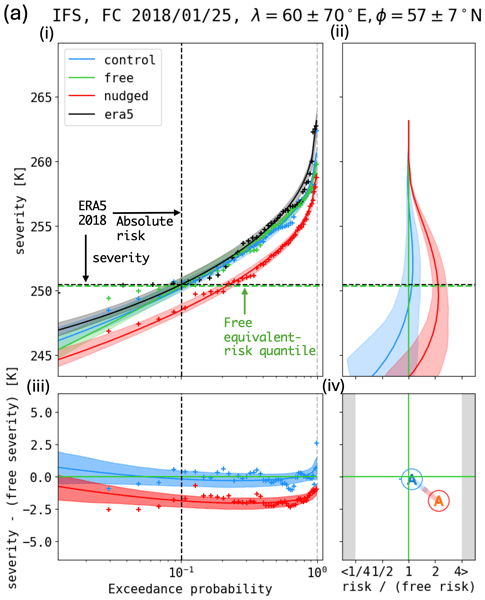
Short summary
Short summary
Variability of the stratospheric polar vortex is thought to play a role in driving weather extremes, but quantifying this role for a given event has proved challenging. Using a new set of perturbed subseasonal forecast experiments from 7 modelling centres, we determine the stratospheric contribution to the risk and severity of three recent extreme weather events. The forecast-based methodology that we develop is applicable to understanding a range of other drivers of weather extremes.
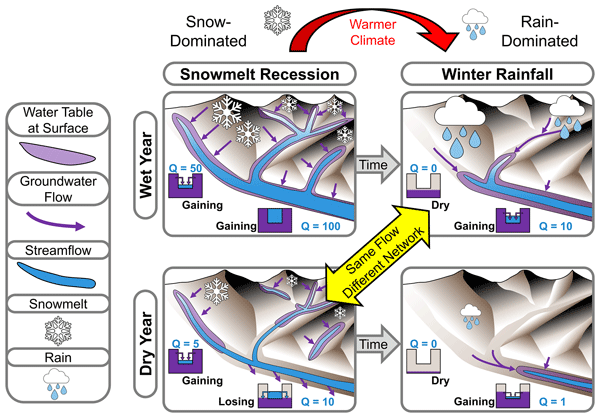
Elijah N. Boardman, Mark S. Wigmosta, Nicole M. Fernandez, John A. Whiting, and Adrian A. Harpold
Hydrol. Earth Syst. Sci., 30, 5145–5171, https://doi.org/10.5194/hess-30-5145-2026, https://doi.org/10.5194/hess-30-5145-2026, 2026
Short summary
Short summary
Distributed simulations and geochemical data indicate that groundwater hysteresis dampens the elasticity of flowing stream networks. This effect is expected to become more important as intense rainfall events replace gradual snowmelt in a warmer climate.
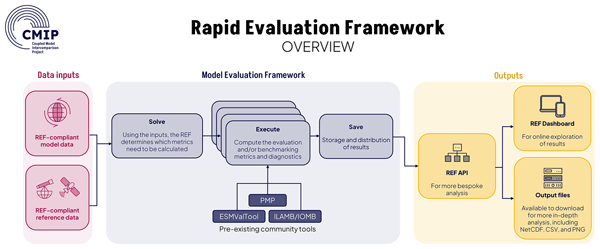
Forrest M. Hoffman, Birgit Hassler, Ranjini Swaminathan, Jared Lewis, Bouwe Andela, Nathan Collier, Dóra Hegedűs, Jiwoo Lee, Charlotte Pascoe, Mika Pflüger, Martina Stockhause, Paul Ullrich, Min Xu, Lisa Bock, Felicity Chun, Bettina K. Gier, Douglas I. Kelley, Axel Lauer, Julien Lenhardt, Manuel Schlund, Mohanan G. Sreeush, Katja Weigel, Ed Blockley, Rebecca Beadling, Romain Beucher, Demiso D. Dugassa, Valerio Lembo, Jianhua Lu, Swen Brands, Jerry Tjiputra, Elizaveta Malinina, Brian Medeiros, Enrico Scoccimarro, Jeremy Walton, Phil Kershaw, André Lanfer Marquez, Malcolm J. Roberts, Eleanor O'Rourke, Beth Dingley, Briony Turner, Helene Hewitt, and John P. Dunne
Geosci. Model Dev., 19, 7415–7455, https://doi.org/10.5194/gmd-19-7415-2026, https://doi.org/10.5194/gmd-19-7415-2026, 2026
Short summary
Short summary
The Rapid Evaluation Framework (REF) is a community-driven platform for benchmarking and performance assessment of Earth system models. Built upon four disparate community evaluation tools, the REF is designed to provide model-data comparisons for the Assessment Fast Track for the Seventh Phase of the Coupled Model Intercomparison Project. The REF will be run at the Earth System Grid Federation to enable model devleopers and scientists to quickly identify model biases and performance issues.
Bin Wang, M. Luke McCormack, Daniel M. Ricciuto, Xiaojuan Yang, Min Xu, and Forrest M. Hoffman
EGUsphere, https://doi.org/10.5194/egusphere-2026-2759, https://doi.org/10.5194/egusphere-2026-2759, 2026
This preprint is open for discussion and under review for Geoscientific Model Development (GMD).
Short summary
Short summary
Plants send about a third of their captured carbon below ground, to roots and soil fungi that take up water and nutrients. Most climate models still treat the entire root system as one uniform mass. We built a new land-model version that separates roots into three types: transport roots, absorptive roots, and fungal partners. Tested at twenty sites worldwide, it cut errors in simulated ecosystem carbon exchange by more than half, sharpening projections of how land will respond to climate change.
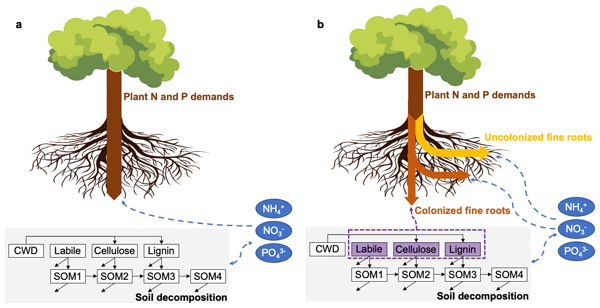
Yaoping Wang, Daniel M. Ricciuto, Jiafu Mao, Sören E. Weber, Verity G. Salmon, Xiaoying Shi, Xiaojuan Yang, Natalie A. Griffiths, Paul J. Hanson, Anthony P. Walker, Jonathan Stelling, Katherine Duchesneau, Camille E. Defrenne, Jeffrey M. Warren, Stephen D. Sebestyen, Kyle J. Pearson, Keith Oleheiser, Joshua M. Birkebak, Mark Guilliams, Misha B. Krassovski, Melanie A. Mayes, and Peter E. Thornton
Geosci. Model Dev., 19, 5827–5855, https://doi.org/10.5194/gmd-19-5827-2026, https://doi.org/10.5194/gmd-19-5827-2026, 2026
Short summary
Short summary
Boreal peatlands store much of the global soil carbon and the service is closely related to nutrient cycling. This study improved a major land surface model to better represent how plants gain nitrogen and phosphorus through fine roots and mycorrhizal association. The new model more accurately captured observed carbon fluxes than the default model at an experimental site in Minnesota, and suggests shifts in nutrient uptake strategy mitigates transition from carbon sink to source under warming.
Nikola Besic, Philippe Ciais, Fa Li, Robert Jackson, Kunxiaojia Yuan, Shushi Peng, Benjamin Poulter, Zhen Zhang, and Qing Zhu
EGUsphere, https://doi.org/10.5194/egusphere-2026-2604, https://doi.org/10.5194/egusphere-2026-2604, 2026
This preprint is open for discussion and under review for Geoscientific Model Development (GMD).
Short summary
Short summary
Wetlands are the largest natural source of methane, an important greenhouse gas, but current estimates of their emissions remain highly uncertain because models often disagree. We combined field measurements from wetlands around the world with advanced statistical methods to identify where different models perform best. Our results show that accounting for regional differences in model skill can substantially change local methane estimates and potentially improve future climate assessments.
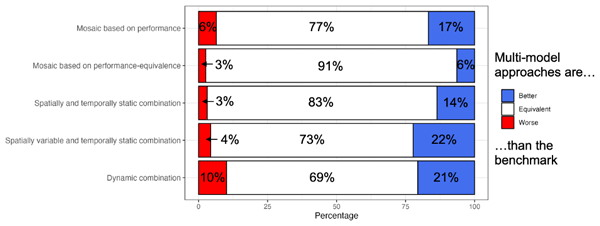
Cyril Thébault, Wouter J. M. Knoben, Nans Addor, Andrew J. Newman, Diana Spieler, Nicolás A. Vásquez, Yalan Song, Gaby J. Gründemann, Shaun Carney, Mukesh Kumar, Katie van Werkhoven, Chaopeng Shen, Andrew W. Wood, and Martyn P. Clark
Hydrol. Earth Syst. Sci., 30, 3945–3977, https://doi.org/10.5194/hess-30-3945-2026, https://doi.org/10.5194/hess-30-3945-2026, 2026
Short summary
Short summary
Reliable river flow prediction guide water supply planning and flood protection. We tested whether selecting or combining multiple models improves accuracy compared with a single model. 78 models were used and tested in 559 river basins across the United States. A carefully chosen single model nearly matched more complex multi-model approaches, while combining models gave slightly higher accuracy and lower uncertainty. However, no approach worked best everywhere.
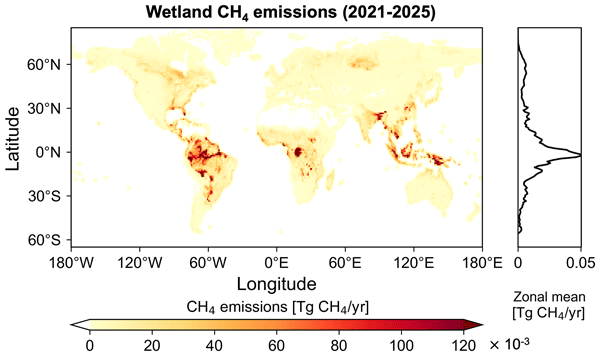
Mengze Li, Robert B. Jackson, Marielle Saunois, Philippe Ciais, Ben Poulter, Josep G. Canadell, Prabir K. Patra, Hanqin Tian, Zhen Zhang, Etienne Fluet-Chouinard, Zutao Ouyang, Ting Zhang, David J. Beerling, Dmitry A. Belikov, Philippe Bousquet, Danilo Custodio, Naveen Chandra, Xinyu Dou, Nicola Gedney, Peter O. Hopcroft, Alison M. Hoyt, Kazuhito Ichii, Akihito Ito, Atul K. Jain, Katherine Jensen, Fortunat Joos, Thomas Kleinen, Masayuki Kondo, Fa Li, Tingting Li, Xiangyu Liu, Shamil Maksyutov, Avni Malhotra, Adrien Martinez, Kyle McDonald, Joe R. Melton, Jurek Müller, Yosuke Niwa, Shufen Pan, Shushi Peng, Changhui Peng, Zhangcai Qin, Peter Raymond, William Riley, Arjo Segers, Rona L. Thompson, Aki Tsuruta, Yi Xi, Kunxiaojia Yuan, Wenxin Zhang, Bo Zheng, Qing Zhu, Qiuan Zhu, and Qianlai Zhuang
Earth Syst. Sci. Data, 18, 3507–3524, https://doi.org/10.5194/essd-18-3507-2026, https://doi.org/10.5194/essd-18-3507-2026, 2026
Short summary
Short summary
We proposed a framework that combines machine-learning and climate data to predict global natural vegetated wetland methane emissions for 2000–2025. We found that although total global emissions remained stable in the post-2020s, Northern Hemisphere emissions surged whilst tropical emissions fell. This approach allows us to rapidly monitor emissions and provides early warnings for climate impacts.
Moetasim Ashfaq, Erika Coppola, Chris Lennard, Claas Teichmann, Deeksha Rastogi, Elias Massoud, Erasmo Buonomo, Eun-Soon Im, George Zittis, Jason P. Evans, Jesus Fernandez, Katherine J. Evans, Maria Leidinice da Silva, Marianna Adinolfi, Melissa Bukovsky, Rosmeri Porfirio da Rocha, Shabeh ul Hasson, Silvina A. Solman, Stefan Sobolowski, Sushant Das, Swen Brands, Tereza Cavazos, Thanh Ngo-Duc, and Xuejie Gao
EGUsphere, https://doi.org/10.5194/egusphere-2026-2649, https://doi.org/10.5194/egusphere-2026-2649, 2026
Short summary
Short summary
Producing reliable regional climate projections requires carefully selecting which global climate models drive them. We developed a transparent and reproducible framework to identify a balanced, representative subset of models for the Coordinated Regional Climate Downscaling Experiment, a major international effort to generate high-resolution climate projections worldwide. While designed for this initiative, the framework is broadly applicable to other models sub-selection efforts.
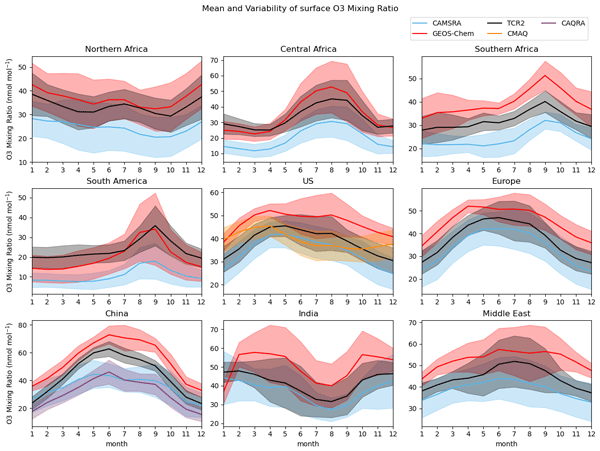
Dylan B. A. Jones, Lucas Prates, Zhen Qu, William Y. Y. Cheng, Kazuyuki Miyazaki, Takashi Sekiya, Antje Inness, Rajesh Kumar, Xiao Tang, Helen Worden, Gerbrand Koren, and Vincent Huijnen
Atmos. Chem. Phys., 26, 6655–6682, https://doi.org/10.5194/acp-26-6655-2026, https://doi.org/10.5194/acp-26-6655-2026, 2026
Short summary
Short summary
We evaluate five chemical reanalysis products to assess their potential to provide useful information on tropospheric ozone variability. We find that the reanalyses produce consistent information on ozone variations in the free troposphere, but have large discrepancies at the surface. The results suggests that improvements in the reanalyses are needed to better exploit the assimilated observations to enhance the utility of the reanalysis products at the surface.
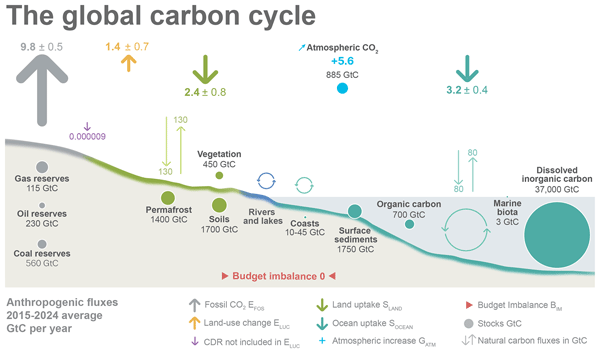
Pierre Friedlingstein, Michael O'Sullivan, Matthew W. Jones, Robbie M. Andrew, Dorothee C. E. Bakker, Judith Hauck, Peter Landschützer, Corinne Le Quéré, Hongmei Li, Ingrid T. Luijkx, Glen P. Peters, Wouter Peters, Julia Pongratz, Clemens Schwingshackl, Stephen Sitch, Josep G. Canadell, Philippe Ciais, Kjetil Aas, Simone R. Alin, Peter Anthoni, Leticia Barbero, Nicholas R. Bates, Nicolas Bellouin, Alice Benoit-Cattin, Carla F. Berghoff, Raffaele Bernardello, Laurent Bopp, Ida Bagus Mandhara Brasika, Matthew A. Chamberlain, Naveen Chandra, Frédéric Chevallier, Louise P. Chini, Nathan O. Collier, Thomas H. Colligan, Margot Cronin, Laique M. Djeutchouang, Xinyu Dou, Matt P. Enright, Kazutaka Enyo, Michael Erb, Wiley Evans, Richard A. Feely, Liang Feng, Daniel J. Ford, Adrianna Foster, Filippa Fransner, Thomas Gasser, Marion Gehlen, Thanos Gkritzalis, Jefferson Goncalves De Souza, Giacomo Grassi, Luke Gregor, Nicolas Gruber, Bertrand Guenet, Özgür Gürses, Kirsty Harrington, Ian Harris, Jens Heinke, George C. Hurtt, Yosuke Iida, Tatiana Ilyina, Akihiko Ito, Andrew R. Jacobson, Atul K. Jain, Tereza Jarníková, Annika Jersild, Fei Jiang, Steve D. Jones, Etsushi Kato, Ralph F. Keeling, Kees Klein Goldewijk, Jürgen Knauer, Yawen Kong, Jan Ivar Korsbakken, Charles Koven, Taro Kunimitsu, Xin Lan, Junjie Liu, Zhiqiang Liu, Zhu Liu, Claire Lo Monaco, Lei Ma, Gregg Marland, Patrick C. McGuire, Galen A. McKinley, Joe R. Melton, Natalie Monacci, Erwan Monier, Eric J. Morgan, David R. Munro, Jens D. Müller, Shin-Ichiro Nakaoka, Lorna R. Nayagam, Yosuke Niwa, Tobias Nutzel, Are Olsen, Abdirahman M. Omar, Naiqing Pan, Sudhanshu Pandey, Denis Pierrot, Zhangcai Qin, Pierre Regnier, Gregor Rehder, Laure Resplandy, Alizée Roobaert, Thais M. Rosan, Christian Rödenbeck, Jörg Schwinger, Ingunn Skjelvan, T. Luke Smallman, Victoria Spada, Mohanan G. Sreeush, Qing Sun, Adrienne J. Sutton, Colm Sweeney, Didier Swingedouw, Roland Séférian, Shintaro Takao, Hiroaki Tatebe, Hanqin Tian, Xiangjun Tian, Bronte Tilbrook, Hiroyuki Tsujino, Francesco Tubiello, Erik van Ooijen, Guido R. van der Werf, Sebastiaan J. van de Velde, Anthony P. Walker, Rik Wanninkhof, Xiaojuan Yang, Wenping Yuan, Xu Yue, and Jiye Zeng
Earth Syst. Sci. Data, 18, 3211–3288, https://doi.org/10.5194/essd-18-3211-2026, https://doi.org/10.5194/essd-18-3211-2026, 2026
Short summary
Short summary
The Global Carbon Budget 2025 describes the methodology, main results, and datasets used to quantify the anthropogenic emissions of carbon dioxide (CO2) and their partitioning among the atmosphere, land ecosystems, and the ocean over the historical period (1750–2025). These living datasets are updated every year to provide the highest transparency and traceability in the reporting of CO2, the key driver of climate change.
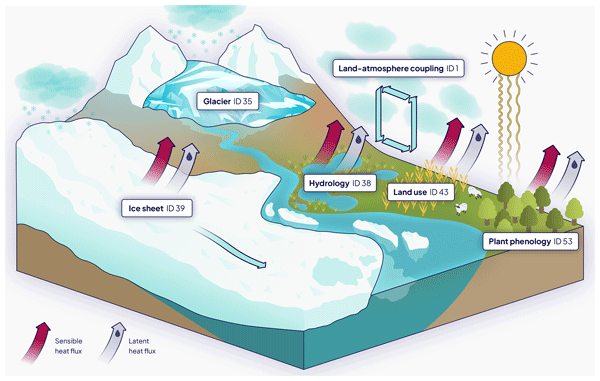
Yue Li, Gang Tang, Eleanor O'Rourke, Samar Minallah, Martim Mas e Braga, Sophie Nowicki, Robin S. Smith, David M. Lawrence, George C. Hurtt, Daniele Peano, Gesa Meyer, Birgit Hassler, Jiafu Mao, Yongkang Xue, and Martin Juckes
Geosci. Model Dev., 19, 3129–3155, https://doi.org/10.5194/gmd-19-3129-2026, https://doi.org/10.5194/gmd-19-3129-2026, 2026
Short summary
Short summary
Land and Land Ice Theme Opportunities describe a list that contains 25 variable groups with 716 variables, which are potentially available to the broad scientific audience for performing analysis in land–atmosphere coupling, hydrological processes and freshwater systems, glacier and ice sheet mass balance and their influence on the sea levels, land use, and plant phenology.
Tim Butler, Tabish Ansari, Claudio A. Belis, Elisa Bergas-Masso, Willem van Caspel, Hilde Fagerli, Johannes Flemming, Marta Garcia Vivanco, Paul Griffiths, Douglas S. Hamilton, Coralina Hernandez Trujillo, Lena Höglund-Isaksson, Vincent Huijnen, Matthew Kasoar, Johannes W. Kaiser, Gerbrand Koren, Zbigniew Klimont, Florian Lindl, Aura Lupascu, Mariano Mertens, Martijn Schaap, Steven T. Turnock, Oliver Wild, Philipp Weiss, Jacek Kaminski, Rosa Wu, and Terry Keating
EGUsphere, https://doi.org/10.5194/egusphere-2026-1367, https://doi.org/10.5194/egusphere-2026-1367, 2026
Short summary
Short summary
Air pollution travels across continents, meaning emissions in one region can affect air quality far away. To better understand this, scientists from many groups are planning to run coordinated computer simulations of the atmosphere. By comparing results across models and emission scenarios, the planned study will show how pollution moves between regions and which sources matter most, helping governments design more effective air quality policies.
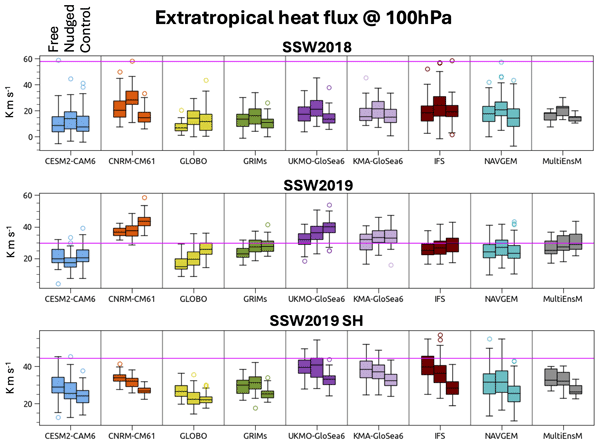
Blanca Ayarzagüena, Amy H. Butler, Peter Hitchcock, Chaim I. Garfinkel, Zac D. Lawrence, Wuhan Ning, Philip Rupp, Zheng Wu, Hilla Afargan-Gerstman, Natalia Calvo, Alvaro de la Cámara, Martin Jucker, Gerbrand Koren, Daniel De Maeseneire, Gloria L. Manney, Marisol Osman, Masakazu Taguchi, Cory Barton, Dong-Chan Hong, Yu-Kyung Hyun, Hera Kim, Jeff Knight, Piero Malguzzi, Daniele Mastrangelo, Jiyoung Oh, Inna Polichtchouk, Jadwiga H. Richter, Isla R. Simpson, Seok-Woo Son, Damien Specq, and Tim Stockdale
Weather Clim. Dynam., 7, 411–437, https://doi.org/10.5194/wcd-7-411-2026, https://doi.org/10.5194/wcd-7-411-2026, 2026
Short summary
Short summary
Sudden Stratospheric Warmings (SSWs) are known to follow a sustained wave dissipation in the stratosphere, which depends on both the tropospheric and stratospheric states. However, the relative role of each state is still unclear. Using a new set of subseasonal to seasonal forecasts, we show that the stratospheric state does not drastically affect the precursors of three recent SSWs, but modulates the stratospheric wave activity, with impacts depending on SSW features.
Delanie Williams, Mukesh Kumar, Katie van Werkhoven, Martyn Clark, Christopher Wilson, and Paul Miller
EGUsphere, https://doi.org/10.5194/egusphere-2026-583, https://doi.org/10.5194/egusphere-2026-583, 2026
Preprint archived
Short summary
Short summary
Machine learning (ML) models have potential within water resource management to be used in place of traditional models. However, there is hesitance for many agencies and institutions to pursue ML models, due to existing familiarity, reliability, interpretability, resources, and workflows. Thus, instead of opting for complete retention of traditional models, or complete replacement by ML models, this perspective argues for the selective integration of ML within existing models.
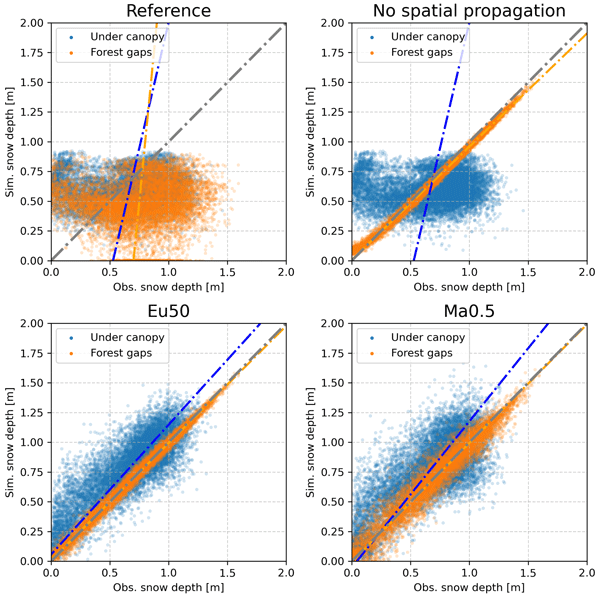
Esteban Alonso-González, Adrian Harpold, Jessica D. Lundquist, Cara Piske, Laura Sourp, Kristoffer Aalstad, and Simon Gascoin
The Cryosphere, 20, 209–225, https://doi.org/10.5194/tc-20-209-2026, https://doi.org/10.5194/tc-20-209-2026, 2026
Short summary
Short summary
Simulating the snowpack is challenging, as there are several sources of uncertainty due to e.g. the meteorological forcing. Using data assimilation techniques, it is possible to improve the simulations by fusing models and snow observations. However in forests, observations are difficult to obtain, because they cannot be retrieved through the canopy. Here, we explore the possibility of propagating the information obtained in forest clearings to areas covered by the canopy.
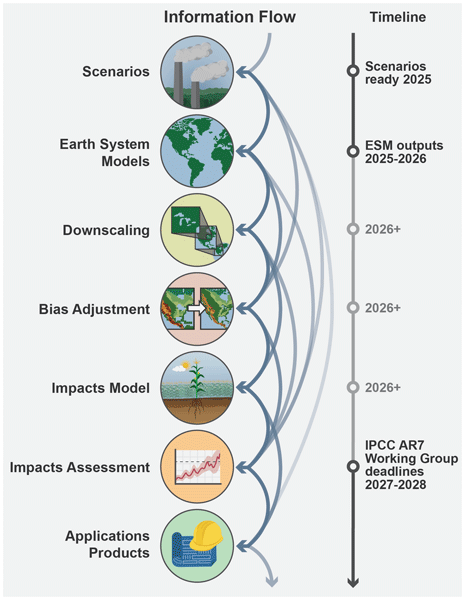
Alex C. Ruane, Charlotte L. Pascoe, Claas Teichmann, David J. Brayshaw, Carlo Buontempo, Ibrahima Diouf, Jesus Fernandez, Paula L. M. Gonzalez, Birgit Hassler, Vanessa Hernaman, Ulas Im, Doroteaciro Iovino, Martin Juckes, Iréne L. Lake, Timothy Lam, Xiaomao Lin, Jiafu Mao, Negin Nazarian, Sylvie Parey, Indrani Roy, Wan-Ling Tseng, Briony Turner, Andrew Wiebe, Lei Zhao, and Damaris Zurell
Geosci. Model Dev., 18, 9497–9540, https://doi.org/10.5194/gmd-18-9497-2025, https://doi.org/10.5194/gmd-18-9497-2025, 2025
Short summary
Short summary
This paper describes how the Coupled Model Intercomparison Project organized its 7th phase (CMIP7) to encourage the production of Earth system model outputs relevant for impacts and adaptation. Community engagement identified 13 opportunities for application across human and natural systems, 60 variable groups and 539 unique variables. We also show how simulations can more efficiently meet applications needs by targeting appropriate resolution, time slices, experiments and variable groups.
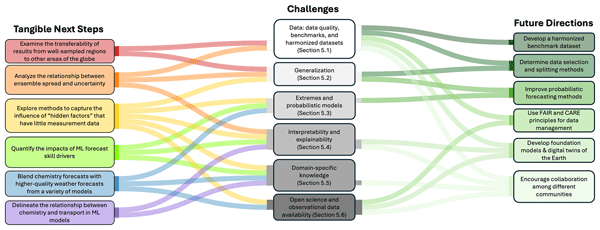
Sebastian H. M. Hickman, Makoto M. Kelp, Paul T. Griffiths, Kelsey Doerksen, Kazuyuki Miyazaki, Elyse A. Pennington, Gerbrand Koren, Fernando Iglesias-Suarez, Martin G. Schultz, Kai-Lan Chang, Owen R. Cooper, Alex Archibald, Roberto Sommariva, David Carlson, Hantao Wang, J. Jason West, and Zhenze Liu
Geosci. Model Dev., 18, 8777–8800, https://doi.org/10.5194/gmd-18-8777-2025, https://doi.org/10.5194/gmd-18-8777-2025, 2025
Short summary
Short summary
Machine learning is being more widely used across environmental and climate science. This work reviews the use of machine learning in tropospheric ozone research, focusing on three main application areas in which significant progress has been made. Common challenges in using machine learning across the three areas are highlighted, and future directions for the field are indicated.
Elijah N. Boardman, Gabrielle F. S. Boisramé, Mark S. Wigmosta, Robert K. Shriver, and Adrian A. Harpold
Hydrol. Earth Syst. Sci., 29, 6333–6352, https://doi.org/10.5194/hess-29-6333-2025, https://doi.org/10.5194/hess-29-6333-2025, 2025
Short summary
Short summary
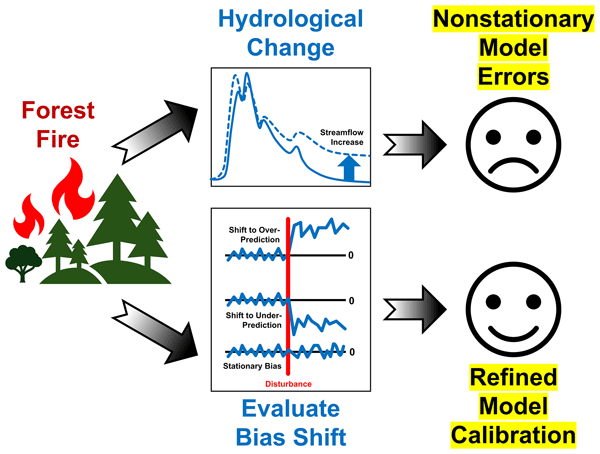
Environmental changes can cause hydrological model biases that vary over time (nonstationarity). We demonstrate a new calibration framework to detect and correct nonstationary streamflow biases after a large wildfire, which reduces predictive uncertainty and constrains parameter equifinality.
Marco M. Lehmann, Josie Geris, Ilja van Meerveld, Daniele Penna, Youri Rothfuss, Matteo Verdone, Pertti Ala-Aho, Matyas Arvai, Alise Babre, Philippe Balandier, Fabian Bernhard, Lukrecija Butorac, Simon D. Carrière, Natalie C. Ceperley, Zuosinan Chen, Alicia Correa, Haoyu Diao, David Dubbert, Maren Dubbert, Fabio Ercoli, Marius G. Floriancic, Alligin Ghazoul, Teresa E. Gimeno, Damien Gounelle, Frank Hagedorn, Christophe Hissler, Frédéric Huneau, Alberto Iraheta, Tamara Jakovljević, Nerantzis Kazakis, Zoltan Kern, Laura Kinzinger, Karl Knaebel, Johannes Kobler, Jiri Kocum, Charlotte Koeber, Gerbrand Koren, Angelika Kübert, Dawid Kupka, Samuel Le Gall, Aleksi Lehtonen, Thomas Leydier, Philippe Malagoli, Francesca Sofia Manca di Villahermosa, Chiara Marchina, Núria Martínez-Carreras, Nicolas Martin-StPaul, Hannu Marttila, Aline Meyer Oliveira, Gael Monvoisin, Natalie Orlowski, Kadi Palmik-Das, Aurel Persoiu, Andrei Popa, Egor Prikaziuk, Cécile Quantin, Katja T. Rinne-Garmston, Clara Rohde, Martin Sanda, Matthias Saurer, Daniel Schulz, Michael P. Stockinger, Christine Stumpp, Jean-Stéphane Vénisse, Lukas Vlcek, Stylianos Voudouris, Björn Weeser, Mark E. Wilkinson, Giulia Zuecco, and Katrin Meusburger
Earth Syst. Sci. Data, 17, 6129–6147, https://doi.org/10.5194/essd-17-6129-2025, https://doi.org/10.5194/essd-17-6129-2025, 2025
Short summary
Short summary
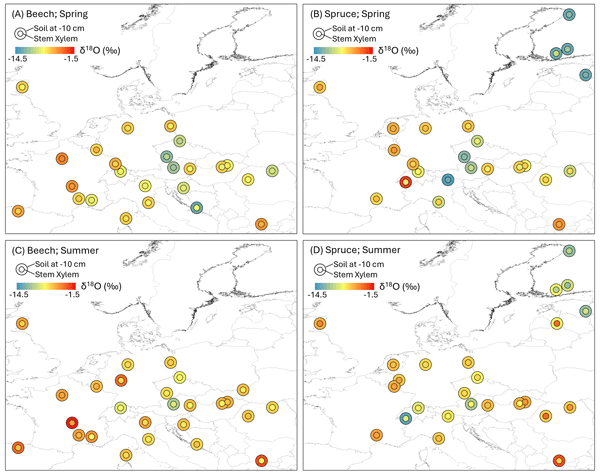
This study describes a unique large-scale isotope dataset to study water dynamics in European forests. Researchers collected data from 40 beech and spruce forest sites in spring and summer 2023, using a standardized method to ensure consistency. The results show that water sources for trees change between seasons and vary by tree species. This large dataset offers valuable information for understanding plant water use, improving ecohydrological models, and mapping water cycles across Europe.
Ashley Brereton, Zelalem A. Mekonnen, Bhavna Arora, William J. Riley, Kunxiaojia Yuan, Yi Xu, Yu Zhang, Qing Zhu, Tyler L. Anthony, and Adina Paytan
Geosci. Model Dev., 18, 8157–8173, https://doi.org/10.5194/gmd-18-8157-2025, https://doi.org/10.5194/gmd-18-8157-2025, 2025
Short summary
Short summary
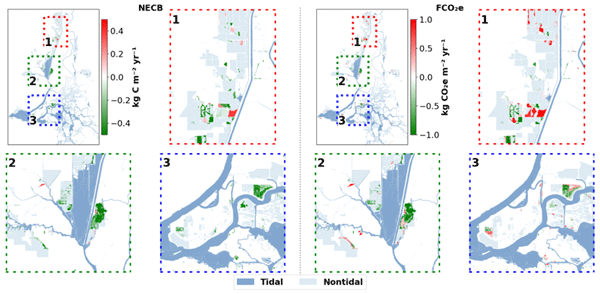
Wetlands absorb carbon dioxide (CO2), helping slow climate change, but they also release methane, a potent warming gas. We developed a collection of AI-based models to estimate magnitudes of CO2 and methane exchanged between the land and the atmosphere, for wetlands on a regional scale. This approach helps to inform land-use planning, restoration, and greenhouse gas accounting, while also creating a foundation for future advancements in prediction accuracy.
Tamara Emmerichs, Abdulla Al Mamun, Lisa Emberson, Huiting Mao, Leiming Zhang, Limei Ran, Clara Betancourt, Anthony Wong, Gerbrand Koren, Giacomo Gerosa, Min Huang, and Pierluigi Guaita
Biogeosciences, 22, 4823–4849, https://doi.org/10.5194/bg-22-4823-2025, https://doi.org/10.5194/bg-22-4823-2025, 2025
Short summary
Short summary
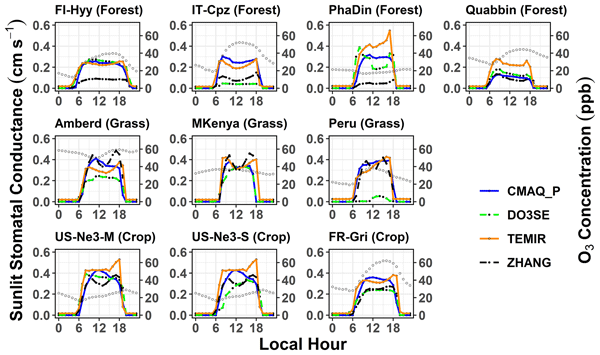
The risk of ozone pollution to plants is estimated based on the flux through the plant pores which still has uncertainties. In this study, we estimate this quantity with nine models at different land types worldwide, driven by measurement data. The models mostly estimated reasonable summertime ozone flux to plants. The model results varied by land cover, mainly related to the a lack of moisture in the soil. This work is an important step for assessing the ozone impact on vegetation.
Yunqian Zhu, Hideharu Akiyoshi, Valentina Aquila, Elizabeth Asher, Ewa M. Bednarz, Slimane Bekki, Christoph Brühl, Amy H. Butler, Parker Case, Simon Chabrillat, Gabriel Chiodo, Margot Clyne, Peter R. Colarco, Sandip Dhomse, Lola Falletti, Eric Fleming, Ben Johnson, Andrin Jörimann, Mahesh Kovilakam, Gerbrand Koren, Ales Kuchar, Nicolas Lebas, Qing Liang, Cheng-Cheng Liu, Graham Mann, Michael Manyin, Marion Marchand, Olaf Morgenstern, Paul Newman, Luke D. Oman, Freja F. Østerstrøm, Yifeng Peng, David Plummer, Ilaria Quaglia, William Randel, Samuel Rémy, Takashi Sekiya, Stephen Steenrod, Timofei Sukhodolov, Simone Tilmes, Kostas Tsigaridis, Rei Ueyama, Daniele Visioni, Xinyue Wang, Shingo Watanabe, Yousuke Yamashita, Pengfei Yu, Wandi Yu, Jun Zhang, and Zhihong Zhuo
Geosci. Model Dev., 18, 5487–5512, https://doi.org/10.5194/gmd-18-5487-2025, https://doi.org/10.5194/gmd-18-5487-2025, 2025
Short summary
Short summary
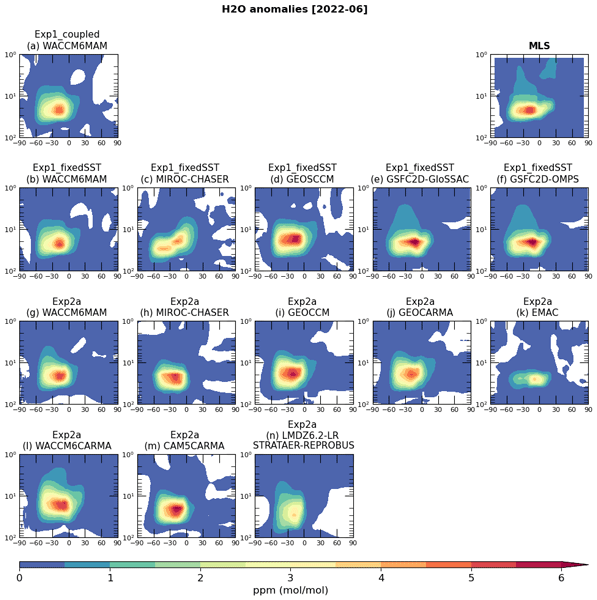
To understand the climate impact of the 2022 Hunga volcanic eruption, we developed a climate model–observation comparison project. The paper describes the protocols and models that participate in the experiments. We designed several experiments to achieve our goals of this activity: (1) to evaluate the climate model performance and (2) to understand the Earth system responses to this eruption.
Elijah N. Boardman, Andrew G. Fountain, Joseph W. Boardman, Thomas H. Painter, Evan W. Burgess, Laura Wilson, and Adrian A. Harpold
The Cryosphere, 19, 3193–3225, https://doi.org/10.5194/tc-19-3193-2025, https://doi.org/10.5194/tc-19-3193-2025, 2025
Short summary
Short summary
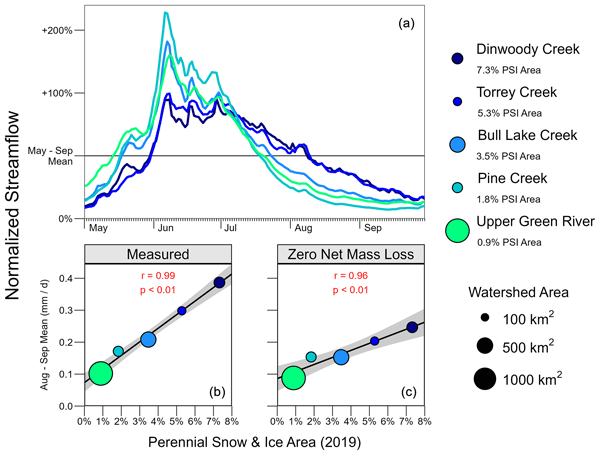
Watersheds on the downwind side of a mountain range have deeper seasonal snow and more abundant glaciers due to topographic controls that favor wind drifting. Despite receiving less total snow, these drift-prone watersheds produce relatively more late-summer streamflow due to a combination of slow-melting snow drifts and mass loss from glaciers (and other perennial snow/ice features).
Santiago Botía, Saqr Munassar, Thomas Koch, Danilo Custodio, Luana S. Basso, Shujiro Komiya, Jost V. Lavric, David Walter, Manuel Gloor, Giordane Martins, Stijn Naus, Gerbrand Koren, Ingrid T. Luijkx, Stijn Hantson, John B. Miller, Wouter Peters, Christian Rödenbeck, and Christoph Gerbig
Atmos. Chem. Phys., 25, 6219–6255, https://doi.org/10.5194/acp-25-6219-2025, https://doi.org/10.5194/acp-25-6219-2025, 2025
Short summary
Short summary
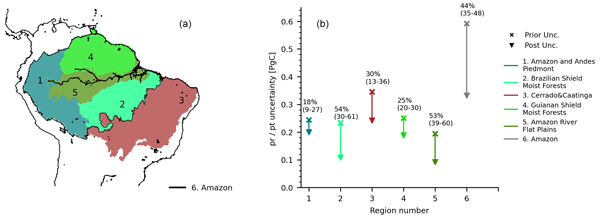
This study uses dry CO2 mole fractions from the Amazon Tall Tower Observatory together with airborne profiles to estimate net carbon exchange in tropical South America. We found that the biogeographic Amazon is a net carbon sink, while the Cerrado and Caatinga biomes are net carbon sources, resulting in an overall neutral balance. Finally, to further reduce the uncertainty in our estimates we call for an expansion of the monitoring capacity, especially in the Amazon–Andes foothills.
Getachew Agmuas Adnew, Gerbrand Koren, Neha Mehendale, Sergey Gromov, Maarten Krol, and Thomas Röckmann
Atmos. Meas. Tech., 18, 2701–2719, https://doi.org/10.5194/amt-18-2701-2025, https://doi.org/10.5194/amt-18-2701-2025, 2025
Short summary
Short summary
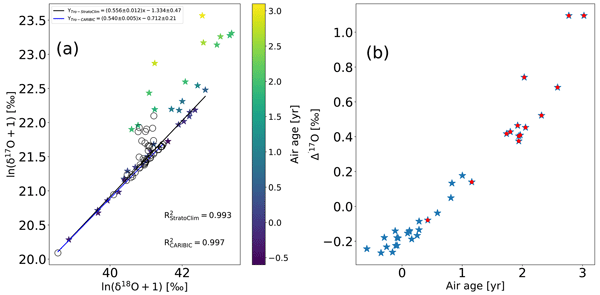
This study presents high-precision measurements of ∆′17O(CO2). Key findings include the extension of the N2O–∆′17O correlation to the upper troposphere and the identification of significant differences in the N2O–∆′17O slope in StratoClim samples. Additionally, the ∆′17O measurements are used to estimate global stratospheric production and surface removal of ∆′17O, providing an independent estimate of global vegetation CO2 exchange.
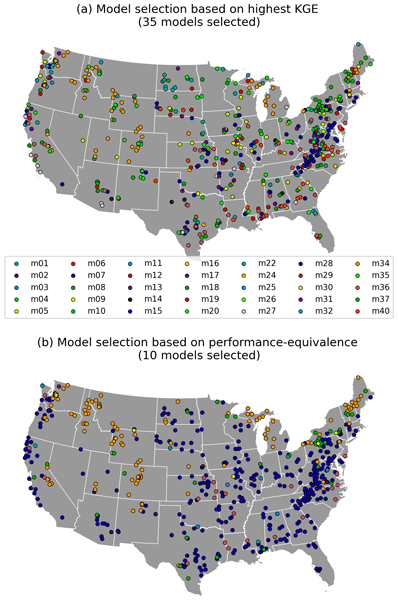
Wouter J. M. Knoben, Ashwin Raman, Gaby J. Gründemann, Mukesh Kumar, Alain Pietroniro, Chaopeng Shen, Yalan Song, Cyril Thébault, Katie van Werkhoven, Andrew W. Wood, and Martyn P. Clark
Hydrol. Earth Syst. Sci., 29, 2361–2375, https://doi.org/10.5194/hess-29-2361-2025, https://doi.org/10.5194/hess-29-2361-2025, 2025
Short summary
Short summary
Hydrologic models are needed to provide simulations of water availability, floods, and droughts. The accuracy of these simulations is often quantified with so-called performance scores. A common thought is that different models are more or less applicable to different landscapes, depending on how the model works. We show that performance scores are not helpful in distinguishing between different models and thus cannot easily be used to select an appropriate model for a specific place.
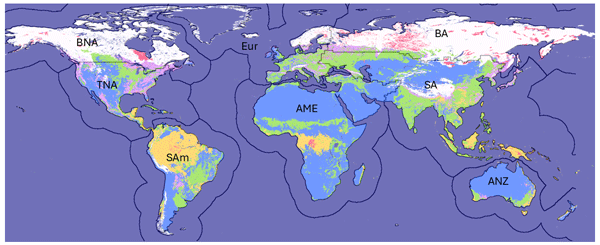
Cynthia H. Whaley, Tim Butler, Jose A. Adame, Rupal Ambulkar, Steve R. Arnold, Rebecca R. Buchholz, Benjamin Gaubert, Douglas S. Hamilton, Min Huang, Hayley Hung, Johannes W. Kaiser, Jacek W. Kaminski, Christoph Knote, Gerbrand Koren, Jean-Luc Kouassi, Meiyun Lin, Tianjia Liu, Jianmin Ma, Kasemsan Manomaiphiboon, Elisa Bergas Masso, Jessica L. McCarty, Mariano Mertens, Mark Parrington, Helene Peiro, Pallavi Saxena, Saurabh Sonwani, Vanisa Surapipith, Damaris Y. T. Tan, Wenfu Tang, Veerachai Tanpipat, Kostas Tsigaridis, Christine Wiedinmyer, Oliver Wild, Yuanyu Xie, and Paquita Zuidema
Geosci. Model Dev., 18, 3265–3309, https://doi.org/10.5194/gmd-18-3265-2025, https://doi.org/10.5194/gmd-18-3265-2025, 2025
Short summary
Short summary
The multi-model experiment design of the HTAP3 Fires project takes a multi-pollutant approach to improving our understanding of transboundary transport of wildland fire and agricultural burning emissions and their impacts. The experiments are designed with the goal of answering science policy questions related to fires. The options for the multi-model approach, including inputs, outputs, and model setup, are discussed, and the official recommendations for the project are presented.
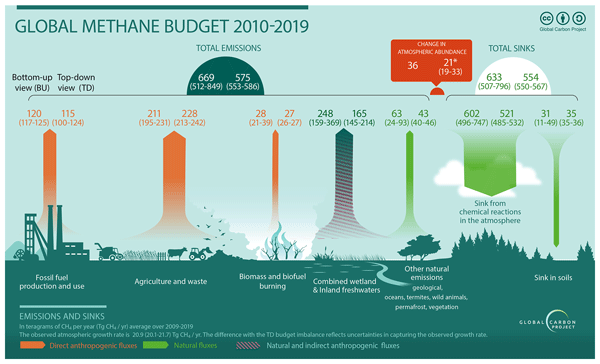
Marielle Saunois, Adrien Martinez, Benjamin Poulter, Zhen Zhang, Peter A. Raymond, Pierre Regnier, Josep G. Canadell, Robert B. Jackson, Prabir K. Patra, Philippe Bousquet, Philippe Ciais, Edward J. Dlugokencky, Xin Lan, George H. Allen, David Bastviken, David J. Beerling, Dmitry A. Belikov, Donald R. Blake, Simona Castaldi, Monica Crippa, Bridget R. Deemer, Fraser Dennison, Giuseppe Etiope, Nicola Gedney, Lena Höglund-Isaksson, Meredith A. Holgerson, Peter O. Hopcroft, Gustaf Hugelius, Akihiko Ito, Atul K. Jain, Rajesh Janardanan, Matthew S. Johnson, Thomas Kleinen, Paul B. Krummel, Ronny Lauerwald, Tingting Li, Xiangyu Liu, Kyle C. McDonald, Joe R. Melton, Jens Mühle, Jurek Müller, Fabiola Murguia-Flores, Yosuke Niwa, Sergio Noce, Shufen Pan, Robert J. Parker, Changhui Peng, Michel Ramonet, William J. Riley, Gerard Rocher-Ros, Judith A. Rosentreter, Motoki Sasakawa, Arjo Segers, Steven J. Smith, Emily H. Stanley, Joël Thanwerdas, Hanqin Tian, Aki Tsuruta, Francesco N. Tubiello, Thomas S. Weber, Guido R. van der Werf, Douglas E. J. Worthy, Yi Xi, Yukio Yoshida, Wenxin Zhang, Bo Zheng, Qing Zhu, Qiuan Zhu, and Qianlai Zhuang
Earth Syst. Sci. Data, 17, 1873–1958, https://doi.org/10.5194/essd-17-1873-2025, https://doi.org/10.5194/essd-17-1873-2025, 2025
Short summary
Short summary
Methane (CH4) is the second most important human-influenced greenhouse gas in terms of climate forcing after carbon dioxide (CO2). A consortium of multi-disciplinary scientists synthesise and update the budget of the sources and sinks of CH4. This edition benefits from important progress in estimating emissions from lakes and ponds, reservoirs, and streams and rivers. For the 2010s decade, global CH4 emissions are estimated at 575 Tg CH4 yr-1, including ~65 % from anthropogenic sources.
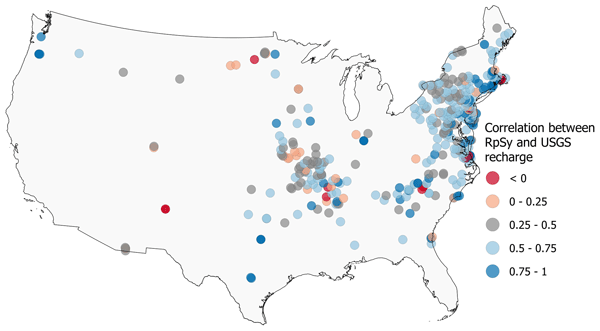
Pragnaditya Malakar, Aatish Anshuman, Mukesh Kumar, Georgios Boumis, T. Prabhakar Clement, Arik Tashie, Hitesh Thakur, Nagaraj Bhat, and Lokendra Rathore
Earth Syst. Sci. Data, 17, 1515–1528, https://doi.org/10.5194/essd-17-1515-2025, https://doi.org/10.5194/essd-17-1515-2025, 2025
Short summary
Short summary
Groundwater dynamics depend on groundwater recharge, but daily benchmark data of recharge are scarce. Here we present a daily groundwater recharge per unit specified yield (RpSy) data at 485 US groundwater monitoring wells. RpSy can be used to validate the temporal consistency of recharge products from land surface and hydrologic models and facilitate assessment of recharge-driver functional relationships in them.
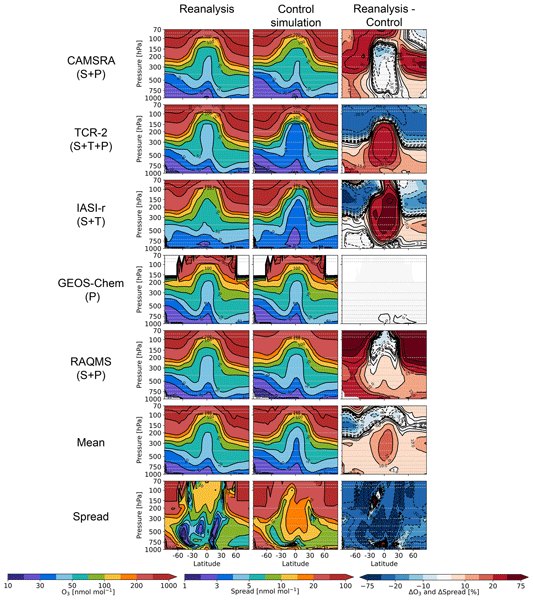
Takashi Sekiya, Emanuele Emili, Kazuyuki Miyazaki, Antje Inness, Zhen Qu, R. Bradley Pierce, Dylan Jones, Helen Worden, William Y. Y. Cheng, Vincent Huijnen, and Gerbrand Koren
Atmos. Chem. Phys., 25, 2243–2268, https://doi.org/10.5194/acp-25-2243-2025, https://doi.org/10.5194/acp-25-2243-2025, 2025
Short summary
Short summary
Five global chemical reanalysis datasets were used to assess the relative impacts of assimilating satellite ozone and its precursor measurements on tropospheric ozone analyses for 2010. The multiple reanalysis system comparison allows an evaluation of the dependency of the impacts on different reanalysis systems. The results suggested the importance of satellite ozone and its precursor measurements for improving ozone analysis in the whole troposphere, with varying magnitudes among the systems.
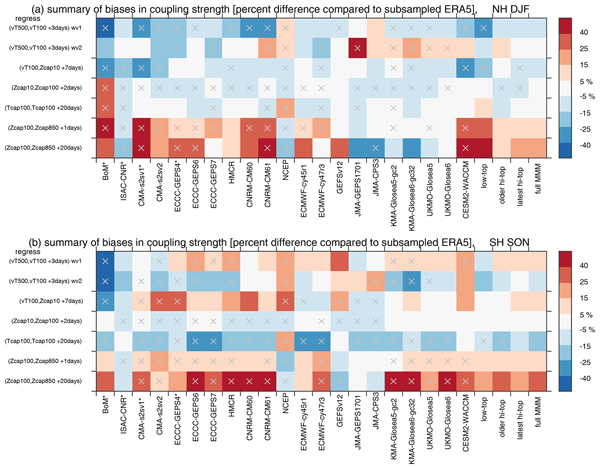
Chaim I. Garfinkel, Zachary D. Lawrence, Amy H. Butler, Etienne Dunn-Sigouin, Irene Erner, Alexey Y. Karpechko, Gerbrand Koren, Marta Abalos, Blanca Ayarzagüena, David Barriopedro, Natalia Calvo, Alvaro de la Cámara, Andrew Charlton-Perez, Judah Cohen, Daniela I. V. Domeisen, Javier García-Serrano, Neil P. Hindley, Martin Jucker, Hera Kim, Robert W. Lee, Simon H. Lee, Marisol Osman, Froila M. Palmeiro, Inna Polichtchouk, Jian Rao, Jadwiga H. Richter, Chen Schwartz, Seok-Woo Son, Masakazu Taguchi, Nicholas L. Tyrrell, Corwin J. Wright, and Rachel W.-Y. Wu
Weather Clim. Dynam., 6, 171–195, https://doi.org/10.5194/wcd-6-171-2025, https://doi.org/10.5194/wcd-6-171-2025, 2025
Short summary
Short summary
Variability in the extratropical stratosphere and troposphere is coupled, and because of the longer timescales characteristic of the stratosphere, this allows for a window of opportunity for surface prediction. This paper assesses whether models used for operational prediction capture these coupling processes accurately. We find that most processes are too weak; however downward coupling from the lower stratosphere to the near surface is too strong.
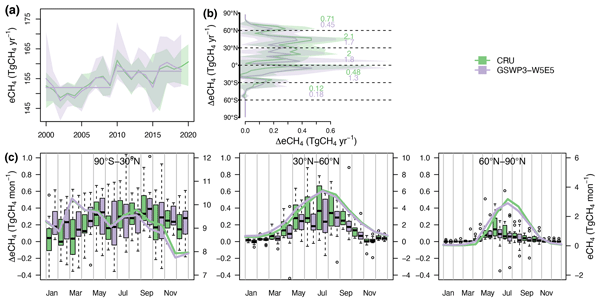
Zhen Zhang, Benjamin Poulter, Joe R. Melton, William J. Riley, George H. Allen, David J. Beerling, Philippe Bousquet, Josep G. Canadell, Etienne Fluet-Chouinard, Philippe Ciais, Nicola Gedney, Peter O. Hopcroft, Akihiko Ito, Robert B. Jackson, Atul K. Jain, Katherine Jensen, Fortunat Joos, Thomas Kleinen, Sara H. Knox, Tingting Li, Xin Li, Xiangyu Liu, Kyle McDonald, Gavin McNicol, Paul A. Miller, Jurek Müller, Prabir K. Patra, Changhui Peng, Shushi Peng, Zhangcai Qin, Ryan M. Riggs, Marielle Saunois, Qing Sun, Hanqin Tian, Xiaoming Xu, Yuanzhi Yao, Yi Xi, Wenxin Zhang, Qing Zhu, Qiuan Zhu, and Qianlai Zhuang
Biogeosciences, 22, 305–321, https://doi.org/10.5194/bg-22-305-2025, https://doi.org/10.5194/bg-22-305-2025, 2025
Short summary
Short summary
This study assesses global methane emissions from wetlands between 2000 and 2020 using multiple models. We found that wetland emissions increased by 6–7 Tg CH4 yr-1 in the 2010s compared to the 2000s. Rising temperatures primarily drove this increase, while changes in precipitation and CO2 levels also played roles. Our findings highlight the importance of wetlands in the global methane budget and the need for continuous monitoring to understand their impact on climate change.
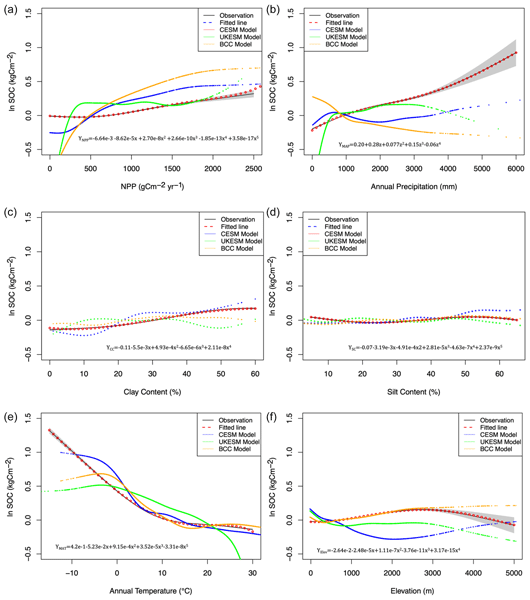
Kamal Nyaupane, Umakant Mishra, Feng Tao, Kyongmin Yeo, William J. Riley, Forrest M. Hoffman, and Sagar Gautam
Biogeosciences, 21, 5173–5183, https://doi.org/10.5194/bg-21-5173-2024, https://doi.org/10.5194/bg-21-5173-2024, 2024
Short summary
Short summary
Representing soil organic carbon (SOC) dynamics in Earth system models (ESMs) is a key source of uncertainty in predicting carbon–climate feedbacks. Using machine learning, we develop and compare predictive relationships in observations (Obs) and ESMs. We find different relationships between environmental factors and SOC stocks in Obs and ESMs. SOC prediction in ESMs may be improved by representing the functional relationships of environmental controllers in a way consistent with observations.
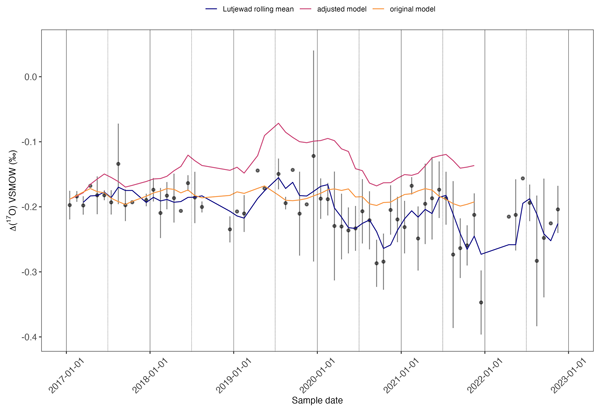
Pharahilda M. Steur, Hubertus A. Scheeren, Gerbrand Koren, Getachew A. Adnew, Wouter Peters, and Harro A. J. Meijer
Atmos. Chem. Phys., 24, 11005–11027, https://doi.org/10.5194/acp-24-11005-2024, https://doi.org/10.5194/acp-24-11005-2024, 2024
Short summary
Short summary
We present records of the triple oxygen isotope signature (Δ(17O)) of atmospheric CO2 obtained with laser absorption spectroscopy from two mid-latitude stations. Significant interannual variability is observed in both records. A model sensitivity study suggests that stratosphere–troposphere exchange, which carries high-Δ(17O) CO2 from the stratosphere into the troposphere, causes most of the variability. This makes Δ(17O) a potential tracer for stratospheric intrusions into the troposphere.
Pierluigi Renan Guaita, Riccardo Marzuoli, Leiming Zhang, Steven Turnock, Gerbrand Koren, Oliver Wild, Paola Crippa, and Giacomo Alessandro Gerosa
EGUsphere, https://doi.org/10.5194/egusphere-2024-2573, https://doi.org/10.5194/egusphere-2024-2573, 2024
Preprint archived
Short summary
Short summary
This study assesses the global impact of tropospheric ozone on wheat crops in the 21st century under various climate scenarios. The research highlights that ozone damage to wheat varies by region and depends on both ozone levels and climate. Vulnerable regions include East Asia, Northern Europe, and the Southern and Eastern edges of the Tibetan Plateau. Our results emphasize the need of policies to reduce ozone levels and mitigate climate change to protect global food security.

Hanqin Tian, Naiqing Pan, Rona L. Thompson, Josep G. Canadell, Parvadha Suntharalingam, Pierre Regnier, Eric A. Davidson, Michael Prather, Philippe Ciais, Marilena Muntean, Shufen Pan, Wilfried Winiwarter, Sönke Zaehle, Feng Zhou, Robert B. Jackson, Hermann W. Bange, Sarah Berthet, Zihao Bian, Daniele Bianchi, Alexander F. Bouwman, Erik T. Buitenhuis, Geoffrey Dutton, Minpeng Hu, Akihiko Ito, Atul K. Jain, Aurich Jeltsch-Thömmes, Fortunat Joos, Sian Kou-Giesbrecht, Paul B. Krummel, Xin Lan, Angela Landolfi, Ronny Lauerwald, Ya Li, Chaoqun Lu, Taylor Maavara, Manfredi Manizza, Dylan B. Millet, Jens Mühle, Prabir K. Patra, Glen P. Peters, Xiaoyu Qin, Peter Raymond, Laure Resplandy, Judith A. Rosentreter, Hao Shi, Qing Sun, Daniele Tonina, Francesco N. Tubiello, Guido R. van der Werf, Nicolas Vuichard, Junjie Wang, Kelley C. Wells, Luke M. Western, Chris Wilson, Jia Yang, Yuanzhi Yao, Yongfa You, and Qing Zhu
Earth Syst. Sci. Data, 16, 2543–2604, https://doi.org/10.5194/essd-16-2543-2024, https://doi.org/10.5194/essd-16-2543-2024, 2024
Short summary
Short summary
Atmospheric concentrations of nitrous oxide (N2O), a greenhouse gas 273 times more potent than carbon dioxide, have increased by 25 % since the preindustrial period, with the highest observed growth rate in 2020 and 2021. This rapid growth rate has primarily been due to a 40 % increase in anthropogenic emissions since 1980. Observed atmospheric N2O concentrations in recent years have exceeded the worst-case climate scenario, underscoring the importance of reducing anthropogenic N2O emissions.
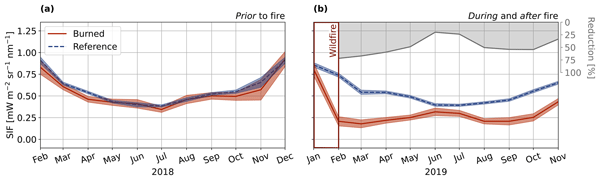
Juliëtte C. S. Anema, Klaas Folkert Boersma, Piet Stammes, Gerbrand Koren, William Woodgate, Philipp Köhler, Christian Frankenberg, and Jacqui Stol
Biogeosciences, 21, 2297–2311, https://doi.org/10.5194/bg-21-2297-2024, https://doi.org/10.5194/bg-21-2297-2024, 2024
Short summary
Short summary
To keep the Paris agreement goals within reach, negative emissions are necessary. They can be achieved with mitigation techniques, such as reforestation, which remove CO2 from the atmosphere. While governments have pinned their hopes on them, there is not yet a good set of tools to objectively determine whether negative emissions do what they promise. Here we show how satellite measurements of plant fluorescence are useful in detecting carbon uptake due to reforestation and vegetation regrowth.
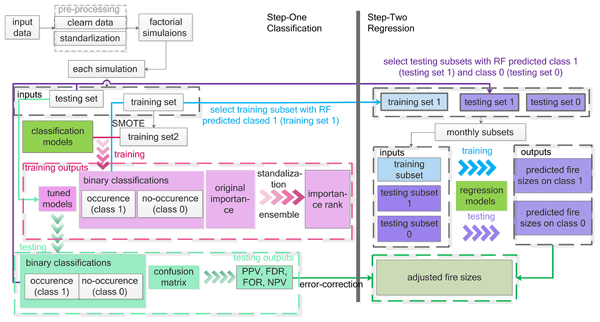
Rongyun Tang, Mingzhou Jin, Jiafu Mao, Daniel M. Ricciuto, Anping Chen, and Yulong Zhang
Geosci. Model Dev., 17, 1525–1542, https://doi.org/10.5194/gmd-17-1525-2024, https://doi.org/10.5194/gmd-17-1525-2024, 2024
Short summary
Short summary
Carbon-rich boreal peatlands are at risk of burning. The reproducibility and predictability of rare peatland fire events are investigated by constructing a two-step error-correcting machine learning framework to tackle such complex systems. Fire occurrence and impacts are highly predictable with our approach. Factor-controlling simulations revealed that temperature, moisture, and freeze–thaw cycles control boreal peatland fires, indicating thermal impacts on causing peat fires.
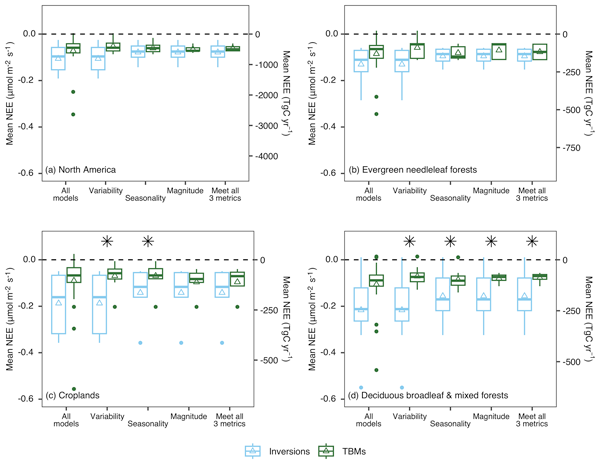
Kelsey T. Foster, Wu Sun, Yoichi P. Shiga, Jiafu Mao, and Anna M. Michalak
Biogeosciences, 21, 869–891, https://doi.org/10.5194/bg-21-869-2024, https://doi.org/10.5194/bg-21-869-2024, 2024
Short summary
Short summary
Assessing agreement between bottom-up and top-down methods across spatial scales can provide insights into the relationship between ensemble spread (difference across models) and model accuracy (difference between model estimates and reality). We find that ensemble spread is unlikely to be a good indicator of actual uncertainty in the North American carbon balance. However, models that are consistent with atmospheric constraints show stronger agreement between top-down and bottom-up estimates.
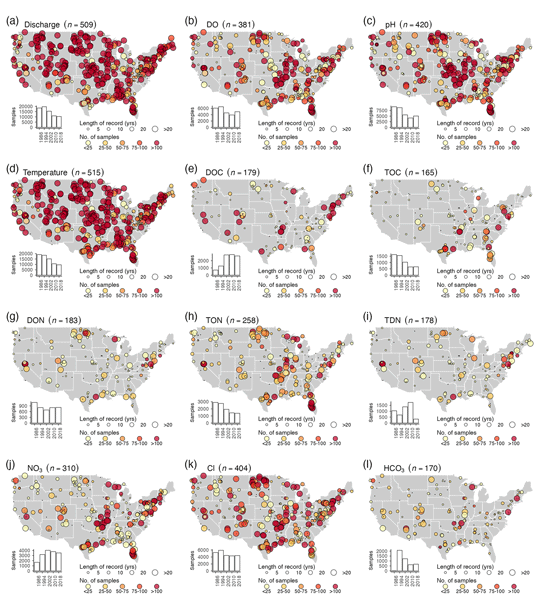
Gary Sterle, Julia Perdrial, Dustin W. Kincaid, Kristen L. Underwood, Donna M. Rizzo, Ijaz Ul Haq, Li Li, Byung Suk Lee, Thomas Adler, Hang Wen, Helena Middleton, and Adrian A. Harpold
Hydrol. Earth Syst. Sci., 28, 611–630, https://doi.org/10.5194/hess-28-611-2024, https://doi.org/10.5194/hess-28-611-2024, 2024
Short summary
Short summary
We develop stream water chemistry to pair with the existing CAMELS (Catchment Attributes and Meteorology for Large-sample Studies) dataset. The newly developed dataset, termed CAMELS-Chem, includes common stream water chemistry constituents and wet deposition chemistry in 516 catchments. Examples show the value of CAMELS-Chem to trend and spatial analyses, as well as its limitations in sampling length and consistency.
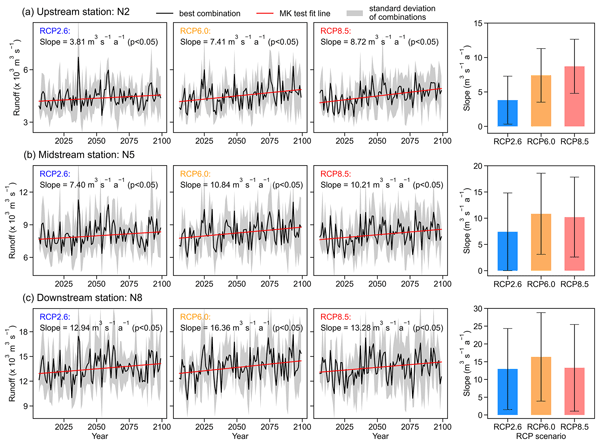
Chao Wang, Stephen Leisz, Li Li, Xiaoying Shi, Jiafu Mao, Yi Zheng, and Anping Chen
Earth Syst. Dynam., 15, 75–90, https://doi.org/10.5194/esd-15-75-2024, https://doi.org/10.5194/esd-15-75-2024, 2024
Short summary
Short summary
Climate change can significantly impact river runoff; however, predicting future runoff is challenging. Using historical runoff gauge data to evaluate model performances in runoff simulations for the Mekong River, we quantify future runoff changes in the Mekong River with the best simulation combination. Results suggest a significant increase in the annual runoff, along with varied seasonal distributions, thus heightening the need for adapted water resource management measures.
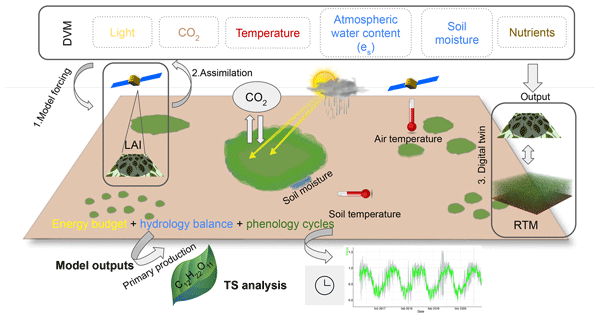
Lammert Kooistra, Katja Berger, Benjamin Brede, Lukas Valentin Graf, Helge Aasen, Jean-Louis Roujean, Miriam Machwitz, Martin Schlerf, Clement Atzberger, Egor Prikaziuk, Dessislava Ganeva, Enrico Tomelleri, Holly Croft, Pablo Reyes Muñoz, Virginia Garcia Millan, Roshanak Darvishzadeh, Gerbrand Koren, Ittai Herrmann, Offer Rozenstein, Santiago Belda, Miina Rautiainen, Stein Rune Karlsen, Cláudio Figueira Silva, Sofia Cerasoli, Jon Pierre, Emine Tanır Kayıkçı, Andrej Halabuk, Esra Tunc Gormus, Frank Fluit, Zhanzhang Cai, Marlena Kycko, Thomas Udelhoven, and Jochem Verrelst
Biogeosciences, 21, 473–511, https://doi.org/10.5194/bg-21-473-2024, https://doi.org/10.5194/bg-21-473-2024, 2024
Short summary
Short summary
We reviewed optical remote sensing time series (TS) studies for monitoring vegetation productivity across ecosystems. Methods were categorized into trend analysis, land surface phenology, and assimilation into statistical or dynamic vegetation models. Due to progress in machine learning, TS processing methods will diversify, while modelling strategies will advance towards holistic processing. We propose integrating methods into a digital twin to improve the understanding of vegetation dynamics.
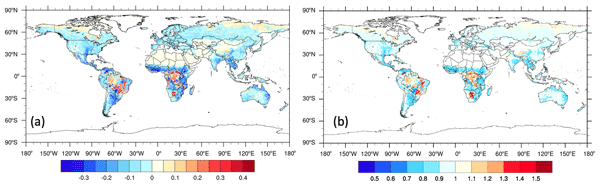
Xiaojuan Yang, Peter Thornton, Daniel Ricciuto, Yilong Wang, and Forrest Hoffman
Biogeosciences, 20, 2813–2836, https://doi.org/10.5194/bg-20-2813-2023, https://doi.org/10.5194/bg-20-2813-2023, 2023
Short summary
Short summary
We evaluated the performance of a land surface model (ELMv1-CNP) that includes both nitrogen (N) and phosphorus (P) limitation on carbon cycle processes. We show that ELMv1-CNP produces realistic estimates of present-day carbon pools and fluxes. We show that global C sources and sinks are significantly affected by P limitation. Our study suggests that introduction of P limitation in land surface models is likely to have substantial consequences for projections of future carbon uptake.
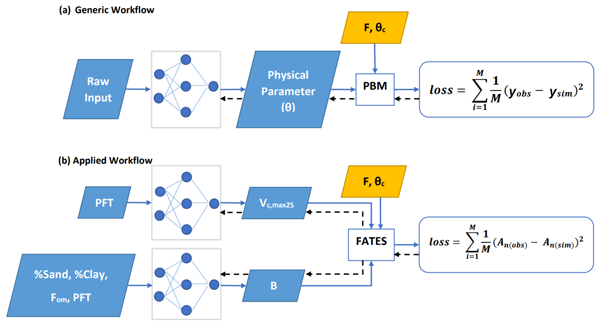
Doaa Aboelyazeed, Chonggang Xu, Forrest M. Hoffman, Jiangtao Liu, Alex W. Jones, Chris Rackauckas, Kathryn Lawson, and Chaopeng Shen
Biogeosciences, 20, 2671–2692, https://doi.org/10.5194/bg-20-2671-2023, https://doi.org/10.5194/bg-20-2671-2023, 2023
Short summary
Short summary
Photosynthesis is critical for life and has been affected by the changing climate. Many parameters come into play while modeling, but traditional calibration approaches face many issues. Our framework trains coupled neural networks to provide parameters to a photosynthesis model. Using big data, we independently found parameter values that were correlated with those in the literature while giving higher correlation and reduced biases in photosynthesis rates.
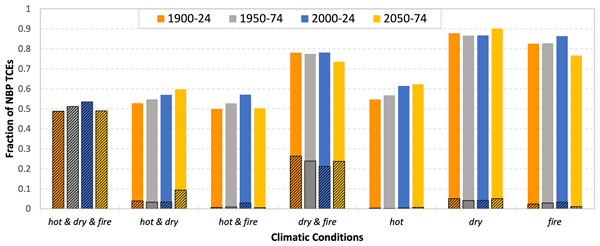
Bharat Sharma, Jitendra Kumar, Auroop R. Ganguly, and Forrest M. Hoffman
Biogeosciences, 20, 1829–1841, https://doi.org/10.5194/bg-20-1829-2023, https://doi.org/10.5194/bg-20-1829-2023, 2023
Short summary
Short summary
Rising atmospheric carbon dioxide increases vegetation growth and causes more heatwaves and droughts. The impact of such climate extremes is detrimental to terrestrial carbon uptake capacity. We found that due to overall climate warming, about 88 % of the world's regions towards the end of 2100 will show anomalous losses in net biospheric productivity (NBP) rather than gains. More than 50 % of all negative NBP extremes were driven by the compound effect of dry, hot, and fire conditions.
Elias C. Massoud, Lauren Andrews, Rolf Reichle, Andrea Molod, Jongmin Park, Sophie Ruehr, and Manuela Girotto
Earth Syst. Dynam., 14, 147–171, https://doi.org/10.5194/esd-14-147-2023, https://doi.org/10.5194/esd-14-147-2023, 2023
Short summary
Short summary
In this study, we benchmark the forecast skill of the NASA’s Goddard Earth Observing System subseasonal-to-seasonal (GEOS-S2S version 2) hydrometeorological forecasts in the High Mountain Asia (HMA) region. Hydrometeorological forecast skill is dependent on the forecast lead time, the memory of the variable within the physical system, and the validation dataset used. Overall, these results benchmark the GEOS-S2S system’s ability to forecast HMA hydrometeorology on the seasonal timescale.
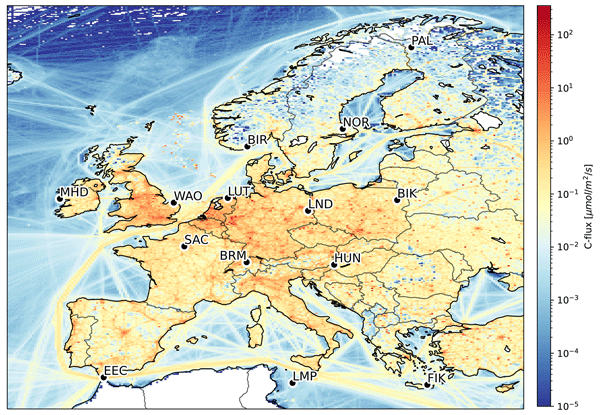
Auke M. van der Woude, Remco de Kok, Naomi Smith, Ingrid T. Luijkx, Santiago Botía, Ute Karstens, Linda M. J. Kooijmans, Gerbrand Koren, Harro A. J. Meijer, Gert-Jan Steeneveld, Ida Storm, Ingrid Super, Hubertus A. Scheeren, Alex Vermeulen, and Wouter Peters
Earth Syst. Sci. Data, 15, 579–605, https://doi.org/10.5194/essd-15-579-2023, https://doi.org/10.5194/essd-15-579-2023, 2023
Short summary
Short summary
To monitor the progress towards the CO2 emission goals set out in the Paris Agreement, the European Union requires an independent validation of emitted CO2. For this validation, atmospheric measurements of CO2 can be used, together with first-guess estimates of CO2 emissions and uptake. To quickly inform end users, it is imperative that this happens in near real-time. To aid these efforts, we create estimates of European CO2 exchange at high resolution in near real time.
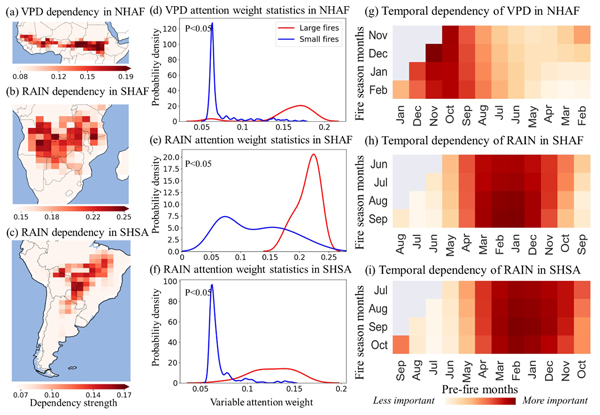
Fa Li, Qing Zhu, William J. Riley, Lei Zhao, Li Xu, Kunxiaojia Yuan, Min Chen, Huayi Wu, Zhipeng Gui, Jianya Gong, and James T. Randerson
Geosci. Model Dev., 16, 869–884, https://doi.org/10.5194/gmd-16-869-2023, https://doi.org/10.5194/gmd-16-869-2023, 2023
Short summary
Short summary
We developed an interpretable machine learning model to predict sub-seasonal and near-future wildfire-burned area over African and South American regions. We found strong time-lagged controls (up to 6–8 months) of local climate wetness on burned areas. A skillful use of such time-lagged controls in machine learning models results in highly accurate predictions of wildfire-burned areas; this will also help develop relevant early-warning and management systems for tropical wildfires.
Adrienne M. Wootten, Elias C. Massoud, Duane E. Waliser, and Huikyo Lee
Earth Syst. Dynam., 14, 121–145, https://doi.org/10.5194/esd-14-121-2023, https://doi.org/10.5194/esd-14-121-2023, 2023
Short summary
Short summary
Climate projections and multi-model ensemble weighting are increasingly used for climate assessments. This study examines the sensitivity of projections to multi-model ensemble weighting strategies in the south-central United States. Model weighting and ensemble means are sensitive to the domain and variable used. There are numerous findings regarding the improvement in skill with model weighting and the sensitivity associated with various strategies.
Stijn Naus, Lucas G. Domingues, Maarten Krol, Ingrid T. Luijkx, Luciana V. Gatti, John B. Miller, Emanuel Gloor, Sourish Basu, Caio Correia, Gerbrand Koren, Helen M. Worden, Johannes Flemming, Gabrielle Pétron, and Wouter Peters
Atmos. Chem. Phys., 22, 14735–14750, https://doi.org/10.5194/acp-22-14735-2022, https://doi.org/10.5194/acp-22-14735-2022, 2022
Short summary
Short summary
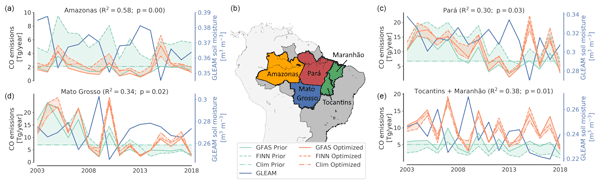
We assimilate MOPITT CO satellite data in the TM5-4D-Var inverse modelling framework to estimate Amazon fire CO emissions for 2003–2018. We show that fire emissions have decreased over the analysis period, coincident with a decrease in deforestation rates. However, interannual variations in fire emissions are large, and they correlate strongly with soil moisture. Our results reveal an important role for robust, top-down fire CO emissions in quantifying and attributing Amazon fire intensity.
Sebastian A. Krogh, Lucia Scaff, James W. Kirchner, Beatrice Gordon, Gary Sterle, and Adrian Harpold
Hydrol. Earth Syst. Sci., 26, 3393–3417, https://doi.org/10.5194/hess-26-3393-2022, https://doi.org/10.5194/hess-26-3393-2022, 2022
Short summary
Short summary
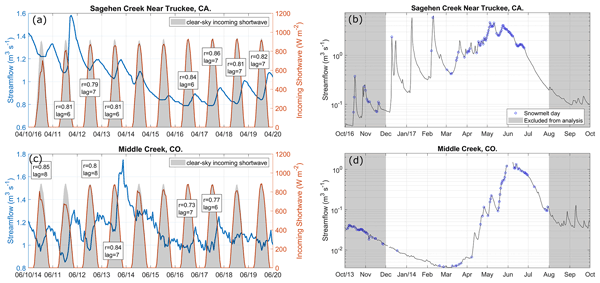
We present a new way to detect snowmelt using daily cycles in streamflow driven by solar radiation. Results show that warmer sites have earlier and more intermittent snowmelt than colder sites, and the timing of early snowmelt events is strongly correlated with the timing of streamflow volume. A space-for-time substitution shows greater sensitivity of streamflow timing to climate change in colder rather than in warmer places, which is then contrasted with land surface simulations.
Elias C. Massoud, A. Anthony Bloom, Marcos Longo, John T. Reager, Paul A. Levine, and John R. Worden
Hydrol. Earth Syst. Sci., 26, 1407–1423, https://doi.org/10.5194/hess-26-1407-2022, https://doi.org/10.5194/hess-26-1407-2022, 2022
Short summary
Short summary
The water balance on river basin scales depends on a number of soil physical processes. Gaining information on these quantities using observations is a key step toward improving the skill of land surface hydrology models. In this study, we use data from the Gravity Recovery and Climate Experiment (NASA-GRACE) to inform and constrain these hydrologic processes. We show that our model is able to simulate the land hydrologic cycle for a watershed in the Amazon from January 2003 to December 2012.
Qing Zhu, Fa Li, William J. Riley, Li Xu, Lei Zhao, Kunxiaojia Yuan, Huayi Wu, Jianya Gong, and James Randerson
Geosci. Model Dev., 15, 1899–1911, https://doi.org/10.5194/gmd-15-1899-2022, https://doi.org/10.5194/gmd-15-1899-2022, 2022
Short summary
Short summary
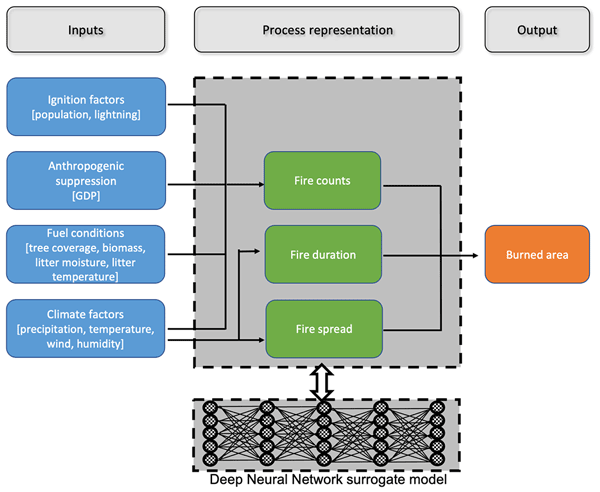
Wildfire is a devastating Earth system process that burns about 500 million hectares of land each year. It wipes out vegetation including trees, shrubs, and grasses and causes large losses of economic assets. However, modeling the spatial distribution and temporal changes of wildfire activities at a global scale is challenging. This study built a machine-learning-based wildfire surrogate model within an existing Earth system model and achieved high accuracy.
Jinyun Tang, William J. Riley, and Qing Zhu
Geosci. Model Dev., 15, 1619–1632, https://doi.org/10.5194/gmd-15-1619-2022, https://doi.org/10.5194/gmd-15-1619-2022, 2022
Short summary
Short summary
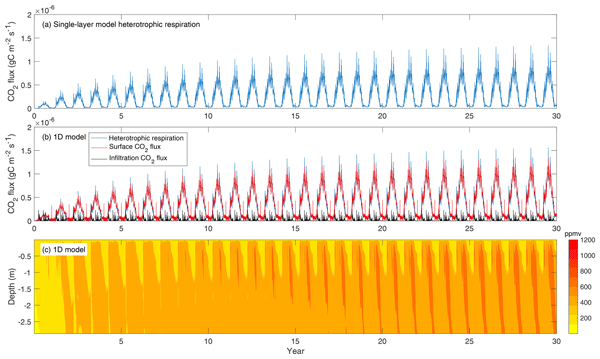
We here describe version 2 of BeTR, a reactive transport model created to help ease the development of biogeochemical capability in Earth system models that are used for quantifying ecosystem–climate feedbacks. We then coupled BeTR-v2 to the Energy Exascale Earth System Model to quantify how different numerical couplings of plants and soils affect simulated ecosystem biogeochemistry. We found that different couplings lead to significant uncertainty that is not correctable by tuning parameters.
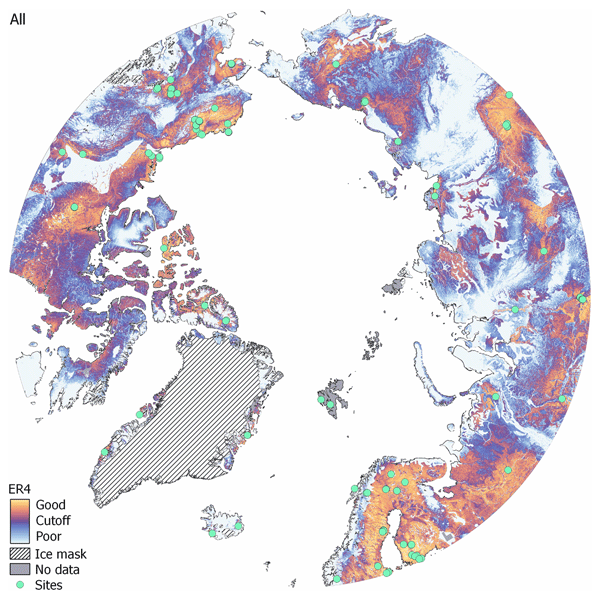
Martijn M. T. A. Pallandt, Jitendra Kumar, Marguerite Mauritz, Edward A. G. Schuur, Anna-Maria Virkkala, Gerardo Celis, Forrest M. Hoffman, and Mathias Göckede
Biogeosciences, 19, 559–583, https://doi.org/10.5194/bg-19-559-2022, https://doi.org/10.5194/bg-19-559-2022, 2022
Short summary
Short summary
Thawing of Arctic permafrost soils could trigger the release of vast amounts of carbon to the atmosphere, thus enhancing climate change. Our study investigated how well the current network of eddy covariance sites to monitor greenhouse gas exchange at local scales captures pan-Arctic flux patterns. We identified large coverage gaps, e.g., in Siberia, but also demonstrated that a targeted addition of relatively few sites can significantly improve network performance.
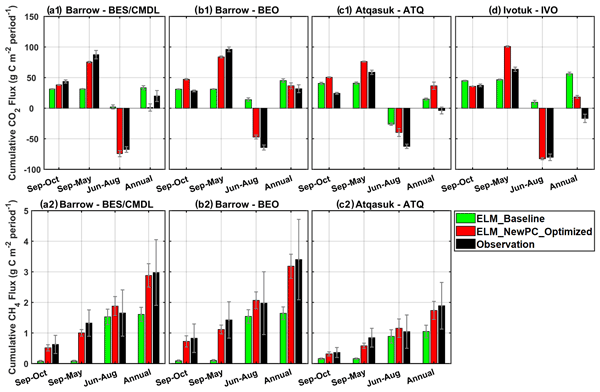
Jing Tao, Qing Zhu, William J. Riley, and Rebecca B. Neumann
The Cryosphere, 15, 5281–5307, https://doi.org/10.5194/tc-15-5281-2021, https://doi.org/10.5194/tc-15-5281-2021, 2021
Short summary
Short summary
We improved the DOE's E3SM land model (ELMv1-ECA) simulations of soil temperature, zero-curtain period durations, cold-season CH4, and CO2 emissions at several Alaskan Arctic tundra sites. We demonstrated that simulated CH4 emissions during zero-curtain periods accounted for more than 50 % of total emissions throughout the entire cold season (Sep to May). We also found that cold-season CO2 emissions largely offset warm-season net uptake currently and showed increasing trends from 1950 to 2017.

Thomas Luke Smallman, David Thomas Milodowski, Eráclito Sousa Neto, Gerbrand Koren, Jean Ometto, and Mathew Williams
Earth Syst. Dynam., 12, 1191–1237, https://doi.org/10.5194/esd-12-1191-2021, https://doi.org/10.5194/esd-12-1191-2021, 2021
Short summary
Short summary
Our study provides a novel assessment of model parameter, structure and climate change scenario uncertainty contribution to future predictions of the Brazilian terrestrial carbon stocks to 2100. We calibrated (2001–2017) five models of the terrestrial C cycle of varied structure. The calibrated models were then projected to 2100 under multiple climate change scenarios. Parameter uncertainty dominates overall uncertainty, being ~ 40 times that of either model structure or climate change scenario.
Cited articles
Alemohammad, S. H., Fang, B., Konings, A. G., Aires, F., Green, J. K., Kolassa, J., Miralles, D., Prigent, C., and Gentine, P.: Water, Energy, and Carbon with Artificial Neural Networks (WECANN): a statistically based estimate of global surface turbulent fluxes and gross primary productivity using solar-induced fluorescence, Biogeosciences, 14, 4101–4124, https://doi.org/10.5194/bg-14-4101-2017, 2017.
An, R., Zhang, L., Wang, Z., Quaye-Ballard, J. A., You, J., Shen, X., Gao, W., Huang, L., Zhao, Y., and Ke, Z.: Validation of the ESA CCI soil moisture product in China, Int. J. Appl. Earth Obs. Geoinf., 48, 28–36, https://doi.org/10.1016/j.jag.2015.09.009, 2016.
Best, M. J., Pryor, M., Clark, D. B., Rooney, G. G., Essery, R. L. H., Ménard, C. B., Edwards, J. M., Hendry, M. A., Porson, A., Gedney, N., Mercado, L. M., Sitch, S., Blyth, E., Boucher, O., Cox, P. M., Grimmond, C. S. B., and Harding, R. J.: The Joint UK Land Environment Simulator (JULES), model description – Part 1: Energy and water fluxes, Geosci. Model Dev., 4, 677–699, https://doi.org/10.5194/gmd-4-677-2011, 2011.
Clark, D. B., Mercado, L. M., Sitch, S., Jones, C. D., Gedney, N., Best, M. J., Pryor, M., Rooney, G. G., Essery, R. L. H., Blyth, E., Boucher, O., Harding, R. J., Huntingford, C., and Cox, P. M.: The Joint UK Land Environment Simulator (JULES), model description – Part 2: Carbon fluxes and vegetation dynamics, Geosci. Model Dev., 4, 701–722, https://doi.org/10.5194/gmd-4-701-2011, 2011.
Clark, M. P., Fan, Y., Lawrence, D. M., Adam, J. C., Bolster, D., Gochis, D. J., and Hooper, R. P.: Improving the representation of hydrologic processes in Earth System Models, Water Resour. Res., 51, 5929–5956, https://doi.org/10.1002/2015WR017096, 2015.
Caen, A., Smallman, T. L., de Castro, A. A., Robertson, E., von Randow, C., Cardoso, M., and Williams, M.: Evaluating two land surface models for Brazil using a full carbon cycle benchmark with uncertainties, Climate Res. Sustain., 1, e10, https://doi.org/10.1002/cli2.10, 2022.
Claverie, M., Matthews, J., Vermote, E., and Justice, C.: A 30+ Year AVHRR LAI and FAPAR Climate Data Record: Algorithm Description and Validation, Remote Sens., 8, 263, https://doi.org/10.3390/rs8030263, 2016.
Ciabatta, L., Massari, C., Brocca, L., Gruber, A., Reimer, C., Hahn, S., Paulik, C., Dorigo, W., Kidd, R., and Wagner, W.: SM2RAIN-CCI: a new global long-term rainfall data set derived from ESA CCI soil moisture, Earth Syst. Sci. Data, 10, 267–280, https://doi.org/10.5194/essd-10-267-2018, 2018.
Collier, N., Hoffman, F. M., Lawrence, D. M., Keppel-Aleks, G., Koven, C. D., Riley, W. J., Mu, M., and Randerson, J. T.: The International Land Model Benchmarking (ILAMB) system: design, theory, and implementation, J. Adv. Model. Earth Sy., 10, 2731–2754, https://doi.org/10.1029/2018MS001354, 2018.
Collier, N., Hoffman, F. M., Mu, M., Randerson, J. T., Riley, W. J., Koven, C. D., Keppel-Aleks, G., and Lawrence, D. M.: International Land Model Benchmarking (ILAMB) Package (v002.00), RUBISCO Science Focus Area [code], https://doi.org/10.18139/ILAMB.v002.00/1251621, 2023.
Dai, Y., Shangguan, W., Wei, N., Xin, Q., Yuan, H., Zhang, S., Liu, S., Lu, X., Wang, D., and Yan, F.: A review of the global soil property maps for Earth system models, SOIL, 5, 137–158, https://doi.org/10.5194/soil-5-137-2019, 2019.
Dorigo, W. A., Gruber, A., De Jeu, R. A. M., Wagner, W., Stacke, T., Loew, A., Albergel, C., Brocca, L., Chung, D., Parinussa, R. M., and Kidd, R.: Evaluation of the ESA CCI soil moisture product using ground-based observations, Remote Sens. Environ., 162, 380–395, https://doi.org/10.1016/j.rse.2014.07.023, 2015.
Dorigo, W., Wagner, W., Albergel, C., Albrecht, F., Balsamo, G., Brocca, L., Chung, D., Ertl, M., Forkel, M., Gruber, A., and Haas, E.: ESA CCI Soil Moisture for improved Earth system understanding: State-of-the art and future directions, Remote Sens. Environ., 203, 185–215, https://doi.org/10.1016/j.rse.2017.07.001, 2017.
Eyring, V., Bony, S., Meehl, G. A., Senior, C. A., Stevens, B., Stouffer, R. J., and Taylor, K. E.: Overview of the Coupled Model Intercomparison Project Phase 6 (CMIP6) experimental design and organization, Geosci. Model Dev., 9, 1937–1958, https://doi.org/10.5194/gmd-9-1937-2016, 2016.
FAO: The Digitized Soil Map of the World Including Derived Soil Properties (version 3.6), FAO Land and Water Digital Media Series #1, FAO, Rome, Italy, ISBN 978-92-3-103889-1, 2003.
Green, J. K., Seneviratne, S. I., Berg, A. M., Findell, K. L., Hagemann, S., Lawrence, D. M., and Gentine, P.: Large influence of soil moisture on long-term terrestrial carbon uptake, Nature, 565, 476–479, https://doi.org/10.1038/s41586-018-0848-x, 2019.
Gruber, A., Scanlon, T., van der Schalie, R., Wagner, W., and Dorigo, W.: Evolution of the ESA CCI Soil Moisture climate data records and their underlying merging methodology, Earth Syst. Sci. Data, 11, 717–739, https://doi.org/10.5194/essd-11-717-2019, 2019.
Guswa, A. J., Celia, M. A., and Rodriguez-Iturbe, I.: Models of soil moisture dynamics in ecohydrology: A comparative study, Water Resour. Res., 38, 5-1, https://doi.org/10.1029/2001WR000826, 2002.
Harpold, A. A. and Molotch, N. P.: Sensitivity of soil water availability to changing snowmelt timing in the western US, Geophys. Res. Lett., 42, 8011–8020, https://doi.org/10.1002/2015GL065855, 2015.
Hauser, M., Orth, R., and Seneviratne, S. I.: Role of soil moisture versus recent climate change for the 2010 heat wave in western Russia, Geophys. Res. Lett., 43, 2819–2826, https://doi.org/10.1002/2016GL068036, 2016.
Hengl, T., De Jesus, J. M., MacMillan, R. A., Batjes, N. H., Heuvelink, G. B., Ribeiro, E., Samuel-Rosa, A., Kempen, B., Leenaars, J. G., Walsh, M. G., and Gonzalez, M. R.: SoilGrids1km – global soil information based on automated mapping, PloS one, 9, e105992, https://doi.org/10.1371/journal.pone.0105992, 2014.
Humphrey, V., Berg, A., Ciais, P., Gentine, P., Jung, M., Reichstein, M., Seneviratne, S. I., and Frankenberg, C.: Soil moisture–atmosphere feedback dominates land carbon uptake variability, Nature, 592, 65–69, https://doi.org/10.1038/s41586-021-03325-5, 2021.
Kühnhammer, K., van Haren, J., Kübert, A., Bailey, K., Dubbert, M., Hu, J., and Beyer, M.: Deep roots mitigate drought impacts on tropical trees despite limited quantitative contribution to transpiration, Sci. Total Environ., 893, 164763, https://doi.org/10.1016/j.scitotenv.2023.164763, 2023.
Lawrence, D. M., Fisher, R. A., Koven, C. D., Oleson, K. W., Swenson, S. C., Bonan, G., and Zeng, X.: The Community Land Model version 5: Description of new features, benchmarking, and impact of forcing uncertainty, J. Adv. Model. Earth Sy.s, 11, 4245–4287, https://doi.org/10.1029/2018MS001583, 2019.
Levine, P. A., Randerson, J. T., Swenson, S. C., and Lawrence, D. M.: Evaluating the strength of the land–atmosphere moisture feedback in Earth system models using satellite observations, Hydrol. Earth Syst. Sci., 20, 4837–4856, https://doi.org/10.5194/hess-20-4837-2016, 2016.
Li, L., Lin, X., Fang, Y., Hou, Z. J., Leung, L. R., Wang, Y., Mao, J., Xu, Y., Massoud, E., and Shi, M.: A unified ensemble soil moisture dataset across the continental United States, Sci. Data, 12, 546, https://doi.org/10.1038/s41597-025-04657-x, 2025a.
Li, W., Migliavacca, M., Miralles, D. G., Reichstein, M., Anderegg, W. R., Yang, H., and Orth, R.: Disentangling Effects of Vegetation Structure and Physiology on Land–Atmosphere Coupling, Glob. Change Biol., 31, e70035, https://doi.org/10.1111/gcb.70035, 2025b.
Lu, X., Du, Z., Huang, Y., Lawrence, D., Kluzek, E., Collier, N., Lombardozzi, D., Sobhani, N., Schuur, E. A., and Luo, Y.: Full implementation of matrix approach to biogeochemistry module of CLM5, J. Adv. Model. Earth Sy., 12, e2020MS002105, https://doi.org/10.1029/2020MS002105, 2020.
Martens, B., Miralles, D. G., Lievens, H., van der Schalie, R., de Jeu, R. A. M., Fernández-Prieto, D., Beck, H. E., Dorigo, W. A., and Verhoest, N. E. C.: GLEAM v3: satellite-based land evaporation and root-zone soil moisture, Geosci. Model Dev., 10, 1903–1925, https://doi.org/10.5194/gmd-10-1903-2017, 2017.
Massoud, E., Turmon, M., Reager, J., Hobbs, J., Liu, Z., and David, C. H.: Cascading dynamics of the hydrologic cycle in California explored through observations and model simulations, Geosciences, 10, 71, https://doi.org/10.3390/geosciences10020071, 2020.
Massoud, E. C., Xu, C., Fisher, R. A., Knox, R. G., Walker, A. P., Serbin, S. P., Christoffersen, B. O., Holm, J. A., Kueppers, L. M., Ricciuto, D. M., Wei, L., Johnson, D. J., Chambers, J. Q., Koven, C. D., McDowell, N. G., and Vrugt, J. A.: Identification of key parameters controlling demographically structured vegetation dynamics in a land surface model: CLM4.5(FATES), Geosci. Model Dev., 12, 4133–4164, https://doi.org/10.5194/gmd-12-4133-2019, 2019.
Massoud, E. C., Andrews, L., Reichle, R., Molod, A., Park, J., Ruehr, S., and Girotto, M.: Seasonal forecasting skill for the High Mountain Asia region in the Goddard Earth Observing System, Earth Syst. Dynam., 14, 147–171, https://doi.org/10.5194/esd-14-147-2023, 2023.
Massoud, E. C., Collier, N. O., Xu, M., Shi, M., and Hoffman, F. M.: Diagnosing the representation of surface and layered soil moisture in Earth system models, Environ. Res. Lett., 21, 024032, https://doi.org/10.1088/1748-9326/ae2f72, 2026.
McNally, A., Shukla, S., Arsenault, K. R., Wang, S., Peters-Lidard, C. D., and Verdin, J. P.: Evaluating ESA CCI soil moisture in East Africa, Int. J. Appl. Earth Obs. Geoinf., 48, 96–109, https://doi.org/10.1016/j.jag.2016.01.001, 2016.
Miralles, D. G., Holmes, T. R. H., De Jeu, R. A. M., Gash, J. H., Meesters, A. G. C. A., and Dolman, A. J.: Global land-surface evaporation estimated from satellite-based observations, Hydrol. Earth Syst. Sci., 15, 453–469, https://doi.org/10.5194/hess-15-453-2011, 2011.
Nachtergaele, F., van Velthuizen, H., Verelst, L., Wiberg, D., Henry, M., Chiozza, F., Yigini, Y., Aksoy, E., Batjes, N., Boateng, E., and Fischer, G.: Harmonized World Soil Database version 2.0, FAO and IIASA, Rome, Italy and Laxenburg, Austria, https://doi.org/10.4060/cc3823en, 2023.
Oleson, K. W., Lawrence, D. M., Bonan, G. B., Fisher, R. A., Lawrence, P. J., and Muszala, S. P.: Technical description of version 4.5 of the Community Land Model (CLM), NCAR/TN-503+ STR, 503, https://doi.org/10.5065/D6RR1W7M, 2013.
Peel, M. C., Finlayson, B. L., and McMahon, T. A.: Updated world map of the Köppen–Geiger climate classification, Hydrol. Earth Syst. Sci., 11, 1633–1644, https://doi.org/10.5194/hess-11-1633-2007, 2007.
Preimesberger, W., Scanlon, T., Su, C. -H., Gruber, A., and Dorigo, W.: Homogenization of Structural Breaks in the Global ESA CCI Soil Moisture Multisatellite Climate Data Record, IEEE T. Geosci. Remote Sens., 59, 2845–2862, https://doi.org/10.1109/TGRS.2020.3012896, 2021.
Preimesberger, W., Stradiotti, P., and Dorigo, W.: ESA CCI Soil Moisture GAPFILLED: an independent global gap-free satellite climate data record with uncertainty estimates, Earth Syst. Sci. Data, 17, 4305–4329, https://doi.org/10.5194/essd-17-4305-2025, 2025.
Purdy, A. J., Fisher, J. B., Goulden, M. L., Colliander, A., Halverson, G., Tu, K., and Famiglietti, J. S.: SMAP soil moisture improves global evapotranspiration, Remote Sens. Environ., 219, 1–14, https://doi.org/10.1016/j.rse.2018.09.023, 2018.
Qiao, L., Zuo, Z., and Xiao, D.: Evaluation of soil moisture in CMIP6 simulations, J. Climate, 35, 779–800, https://doi.org/10.1175/JCLI-D-20-0827.1, 2022.
Reick, C. H., Gayler, V., Goll, D., Hagemann, S., Heidkamp, M., Nabel, J. E. M. S., Raddatz, T., Roeckner, E., Schnur, R., and Wilkenskjeld, S.: JSBACH 3 – The land component of the MPI Earth System Model: Documentation of version 3.2, Berichte zur Erdsystemforschung, 240, Max-Planck-Institut für Meteorologie, https://doi.org/10.17617/2.3279802, 2021.
Robock, A., Schlosser, C. A., Vinnikov, K. Y., Speranskaya, N. A., Entin, J. K., and Qiu, S.: Evaluation of the AMIP soil moisture simulations, Global Planet. Change, 19, 181–208, https://doi.org/10.1016/S0921-8181(98)00047-2, 1998.
Schumacher, D. L., Keune, J., Dirmeyer, P., and Miralles, D. G.: Drought self-propagation in drylands due to land–atmosphere feedbacks, Nat. Geosci., 15, 262–268, https://doi.org/10.1038/s41561-022-00912-7, 2022.
Seneviratne, S. I., Corti, T., Davin, E. L., Hirschi, M., Jaeger, E. B., Lehner, I., Orlowsky, B., and Teuling, A. J.: Investigating soil moisture–climate interactions in a changing climate: A review, Earth-Sci. Rev., 99, 125–161, https://doi.org/10.1016/j.earscirev.2010.02.004, 2010.
Shangguan, W., Dai, Y., Duan, Q., Liu, B., and Yuan, H.: A global soil data set for earth system modeling, J. Adv. Model. Earth Sy., 6, 249–263, https://doi.org/10.1002/2013MS000293, 2014.
Stocker, B. D., Tumber-Dávila, S. J., Konings, A. G., Anderson, M. C., Hain, C., and Jackson, R. B.: Global patterns of water storage in the rooting zones of vegetation, Nat. Geosci., 16, 250–256, https://doi.org/10.1038/s41561-023-01125-2, 2023.
Talib, J., Müller, O. V., Barton, E. J., Taylor, C. M., and Vidale, P. L.: The Representation of Soil Moisture-Atmosphere Feedbacks across the Tibetan Plateau in CMIP6, Adv. Atmos. Sci., 40, 2063–2081, https://doi.org/10.1007/s00376-023-2296-2, 2023.
Tapiador, F. J., Navarro, A., Jiménez, A., Moreno, R., and García-Ortega, E.: Discrepancies with satellite observations in the spatial structure of global precipitation as derived from global climate models, Q. J. Roy. Meteor. Soc., 144, 419–435, https://doi.org/10.1002/qj.3289, 2018.
Trugman, A. T., Medvigy, D., Mankin, J. S., and Anderegg, W. R. L.: Soil moisture stress as a major driver of carbon cycle uncertainty, Geophys. Res. Lett., 45, 6495–6503, https://doi.org/10.1029/2018GL078131, 2018.
Vogel, M. M., Zscheischler, J., and Seneviratne, S. I.: Varying soil moisture–atmosphere feedbacks explain divergent temperature extremes and precipitation projections in central Europe, Earth Syst. Dynam., 9, 1107–1125, https://doi.org/10.5194/esd-9-1107-2018, 2018.
Wang, A., Kong, X., Chen, Y., and Ma, X.: Evaluation of soil moisture in CMIP6 multi model simulations over conterminous China, J. Geophys. Res.-Atmos., 127, e2022JD037072, https://doi.org/10.1029/2022JD037072, 2022.
Wang, C., Fu, B., Zhang, L., and Xu, Z.: Soil moisture–plant interactions: an ecohydrological review, J. Soil. Sediment., 19, 1–9, https://doi.org/10.1007/s11368-018-2167-0, 2019.
Wang, Y., Mao, J., Jin, M., Hoffman, F. M., Shi, X., Wullschleger, S. D., and Dai, Y.: Development of observation-based global multilayer soil moisture products for 1970 to 2016, Earth Syst. Sci. Data, 13, 4385–4405, https://doi.org/10.5194/essd-13-4385-2021, 2021.
Wu, G., Cai, X., Keenan, T. F., Li, S., Luo, X., Fisher, J. B., Cao, R., Li, F., Purdy, A. J., Zhao, W., and Sun, X.: Evaluating three evapotranspiration estimates from model of different complexity over China using the ILAMB benchmarking system, J. Hydrol., 590, 125553, https://doi.org/10.1016/j.jhydrol.2020.125553, 2020.
Yamaguchi, M., Lang, S. T., Leutbecher, M., Rodwell, M. J., Radnoti, G., and Bormann, N.: Observation-based evaluation of ensemble reliability, Q. J. Roy. Meteor. Soc., 142, 506–514, https://doi.org/10.1002/qj.2675, 2016.
Yang, X., Thornton, P., Ricciuto, D., Wang, Y., and Hoffman, F.: Global evaluation of terrestrial biogeochemistry in the Energy Exascale Earth System Model (E3SM) and the role of the phosphorus cycle in the historical terrestrial carbon balance, Biogeosciences, 20, 2813–2836, https://doi.org/10.5194/bg-20-2813-2023, 2023.
Yuan, S., Quiring, S. M., and Leasor, Z. T.: Historical changes in surface soil moisture over the contiguous United States: An assessment of CMIP6, Geophys. Res. Lett., 48, e2020GL089991, https://doi.org/10.1029/2020GL089991, 2021.
Zeng, J., Peng, J., Zhao, W., Ma, C., and Ma, H.: Microwave remote sensing of soil moisture, Remote Sens., 15, 4243, https://doi.org/10.3390/rs15174243, 2023.
Zuo, Z., Qiao, L., Zhang, R., Chen, D., Piao, S., Xiao, D., and Zhang, K.: Importance of soil moisture conservation in mitigating climate change, Sci. Bull., 69, 1332–1341, https://doi.org/10.1016/j.scib.2024.02.033, 2024.
Short summary
Soil moisture helps control how plants grow and how land exchanges water and energy with the atmosphere. We evaluated how well 16 Earth System Models represent soil moisture and its links to plant activity using a benchmarking system and observational data. Many models simulate surface soil moisture well but show larger errors deeper in the soil and in colder regions. Models that represent plant–soil water interactions more directly better capture how ecosystems respond to water availability.
Soil moisture helps control how plants grow and how land exchanges water and energy with the...


