
Articles | Volume 19, issue 5
https://doi.org/10.5194/gmd-19-1809-2026
© Author(s) 2026. This work is distributed under
the Creative Commons Attribution 4.0 License.
the Creative Commons Attribution 4.0 License.
https://doi.org/10.5194/gmd-19-1809-2026
© Author(s) 2026. This work is distributed under
the Creative Commons Attribution 4.0 License.
the Creative Commons Attribution 4.0 License.
Development and technical paper
| 
04 Mar 2026
Development and technical paper |
| 04 Mar 2026
| 04 Mar 2026
A Climate Intervention Dynamical Emulator (CIDER) for scenario space exploration

Sibley School of Mechanical and Aerospace Engineering, Cornell University, Ithaca, NY 14850, USA
Douglas G. MacMartin
Sibley School of Mechanical and Aerospace Engineering, Cornell University, Ithaca, NY 14850, USA
Daniele Visioni
Department of Earth and Atmospheric Sciences, Cornell University, Ithaca, NY 14850, USA
Ben Kravitz
Department of Earth and Atmospheric Sciences, Indiana University Bloomington, Bloomington, IN 47405, USA
Atmospheric Sciences and Global Change Division, Pacific Northwest National Laboratory, Richland, WA 99354, USA
Ewa M. Bednarz
Cooperative Institute for Research in Environmental Sciences (CIRES), University of Colorado Boulder, Boulder, CO 80309, USA
NOAA Chemical Sciences Laboratory, Boulder, CO 80309, USA
Alistair Duffey
Department of Earth Sciences, University College London, London, WC1E 6BS, United Kingdom
Reflective, San Francisco, CA 94105, USA
Matthew Henry
Department of Mathematics, University of Exeter, Exeter, EX4 4PY, United Kingdom
Ali Akherati
Reflective, San Francisco, CA 94105, USA
Related authors
No articles found.
Cuini Qi, Chloe Yuchao Gao, Ben Kravitz, Hyemi Kim, Xiaohan Sally Li, and Lili Xia
EGUsphere, https://doi.org/10.5194/egusphere-2026-5613, https://doi.org/10.5194/egusphere-2026-5613, 2026
This preprint is open for discussion and under review for Atmospheric Chemistry and Physics (ACP).
Short summary
Short summary
Stratospheric aerosol injection can mitigate global warming, but its impacts on combined heat and drought extremes are uneven. Using climate models, we show this intervention broadly decreases the frequency and severity of these events globally. However, Central Africa experiences the opposite, where reduced rainfall drives more persistent extremes. This highlights that lowering global temperatures does not guarantee uniform reductions in severe climate risks everywhere.
Sean M. Davis, William T. Ball, Yue Jia, Gabriel Chiodo, Justin A. Alsing, James Keeble, Hideharu Akiyoshi, Carlo Arosio, Ewa M. Bednarz, Andreas Chrysanthou, Melanie Coldewey-Egbers, Robert Damadeo, Sandip Dhomse, Mohamadou A. Diallo, Simone Dietmuller, Roland Eichinger, Stacey Frith, Birgit Hassler, Michaela I. Hegglin, Daan Hubert, Patrick Jöckel, Béatrice Josse, Natalya Kramarova, Diego Loyola, Eliane Maillard Barras, Marion Marchand, Olaf Morgenstern, David Plummer, Robert W. Portmann, Karen H. Rosenlof, Alexei Rozanov, Viktoria F. Sofieva, Johannes Staehelin, Timofei Sukhodolov, Kleareti Tourpali, Ronald J. Van der A, H. J. Ray Wang, Krzysztof Wargan, Shingo Watanabe, Mark Weber, Jeannette D. Wild, Yousuke Yamashita, and Jerry Ziemke
Atmos. Chem. Phys., 26, 13817–13843, https://doi.org/10.5194/acp-26-13817-2026, https://doi.org/10.5194/acp-26-13817-2026, 2026
Short summary
Short summary
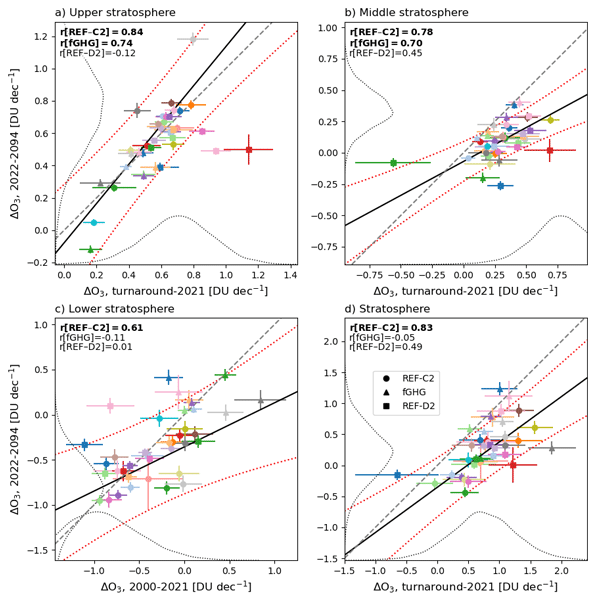
This study investigates tropical ozone changes in models and satellite observations to determine how well they agree and whether observations can constrain model projections. At some levels, satellite records disagree significantly on the magnitude of ozone changes. While early and late 21st century trends are correlated across models, suggesting a potential emergent constraint, the spread in observations means they are unable to provide guidance on the credibility of model projections.

Juliette Lavoie, Aude Carreric, Alistair Duffey, Giovanni Chellini, and Elisa Ziegler
Geosci. Model Dev., 19, 8977–8994, https://doi.org/10.5194/gmd-19-8977-2026, https://doi.org/10.5194/gmd-19-8977-2026, 2026
Short summary
Short summary
The Coupled Model Intercomparison Project (CMIP) is a large collaborative project to better understand the Earth’s climate system. The data produced through this project is downloaded by users around the world. In this paper, we analyze the patterns of downloads and the usage of this massive dataset. From this analysis, we make some recommendations for future data production and usage tracking.
Haruki Hirasawa, Knut von Salzen, Matthew Henry, Josh Smith, Frida A.-M. Bender, Cindy Wang, Sarah Doherty, Robert Wood, Philip J. Rasch, and James Haywood
EGUsphere, https://doi.org/10.5194/egusphere-2026-5460, https://doi.org/10.5194/egusphere-2026-5460, 2026
This preprint is open for discussion and under review for Atmospheric Chemistry and Physics (ACP).
Short summary
Short summary
Marine cloud brightening (MCB) is a solar climate intervention proposal to spray sea salt aerosol (SSA) to increase sunlight reflection by low marine clouds. Earth System Models (ESMs) are our main tool for studying potential MCB climate impacts, but there is a large range across ESMs in the MCB sunlight reflection. Comparing MCB in ten ESMs, we find that much of this range is from the size of the SSA and cloud droplet formation from the SSA, both relatively well understood processes.
Martin B. Andrews, Neal Butchart, James A. Anstey, Ewa Bednarz, Dillon Elsbury, Jorge L. García-Franco, Vinay Kumar, Froila M. Palmeiro, Natasha E. Trencham, Kohei Yoshida, Zhaoyang Chai, Dong-Chan Hong, Kai Huang, Aleena M. Jaison, Yoshio Kawatani, Jeff R. Knight, Pu Lin, François Lott, Yixiong Lu, Hiroaki Naoe, Scott M. Osprey, Jadwiga H. Richter, Federico Serva, Seok-Woo Son, Qi Tang, Shingo Watanabe, and Jinbo Xie
Weather Clim. Dynam., 7, 1797–1820, https://doi.org/10.5194/wcd-7-1797-2026, https://doi.org/10.5194/wcd-7-1797-2026, 2026
Short summary
Short summary
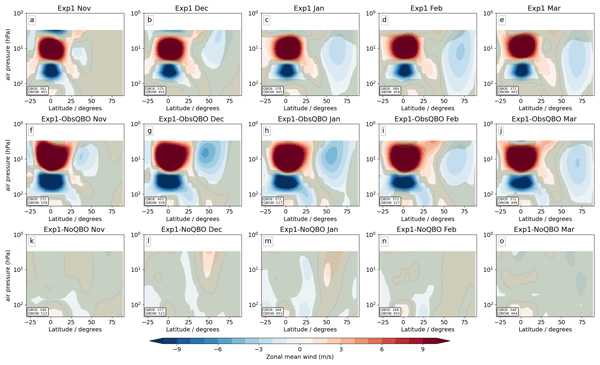
The observed winds in the upper atmosphere over the equator have alternating easterly and westerly regions that descend towards the lower atmosphere before dissipating, with a period of approximately 28 months. This is known as the Quasi-Biennial Oscillation (QBO). The QBO is known to influence remote regions of the atmosphere. This paper details the results of multi-model experiments where the QBO is nudged towards the observed QBO allowing the assessment of these remote connections.

Daniele Visioni, Alan Robock, Alistair Duffey, Matthew Henry, Haruki Hirasawa, Walker Raymond Lee, Cindy Wang, Kelsey Roberts, Shingo Watanabe, Michelle Simões Reboita, Masahiro Sugiyama, Ben Kravitz, Jim Haywood, Simone Tilmes, Frédéric K. Bonou, Jack Chen, Timofei Sukhodolov, Sandro Vattioni, Andrin Jörimann, Diego Villanueva, Ryan Vella, Paul Farron, Ewa Bednarz, Ulrike Niemeier, Colleen Golja, and Juan A. Añel
Geosci. Model Dev., 19, 8469–8499, https://doi.org/10.5194/gmd-19-8469-2026, https://doi.org/10.5194/gmd-19-8469-2026, 2026
Short summary
Short summary
The Geoengineering Model Intercomparison Project is a coordinated international model intercomparison effort aiming to provide robust experimental protocols for simulations of various Solar Radiation Modification (SRM) methods. In this manuscript, we describe a list of novel experiments decided by the community, to be run by climate models to better understand sources of uncertainty in SRM. We also show and discuss some preliminary results from a few climate models.
Ewa M. Bednarz, Amy H. Butler, James M. Haywood, Matthew Henry, Andy Jones, Ben Kravitz, Walker R. Lee, Douglas G. MacMartin, Amanda C. Maycock, Takashi Sekiya, Shingo Watanabe, and Daniele Visioni
Atmos. Chem. Phys., 26, 12751–12770, https://doi.org/10.5194/acp-26-12751-2026, https://doi.org/10.5194/acp-26-12751-2026, 2026
Short summary
Short summary
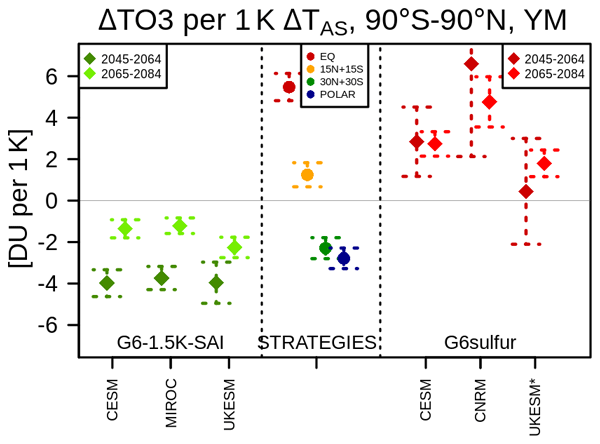
An assessment of the potential impacts of Stratospheric Aerosol Injection, a proposed method to offset global warming, on stratospheric ozone projections over the 21st century using the new multi-model GeoMIP (Geoengineering Model Intercomparison Project) G6-1.5K-SAI (Stratospheric Aerosol Injection) experiment. We discuss drivers of the responses, identify areas of model agreement and disagreement and sources of uncertainty. Our results highlight the need to assess any projected SAI impacts in wider strategy and scenario dimension using a multi-model framework.
Walker Raymond Lee, Simone Tilmes, and Ewa M. Bednarz
Earth Syst. Dynam., 17, 1117–1134, https://doi.org/10.5194/esd-17-1117-2026, https://doi.org/10.5194/esd-17-1117-2026, 2026
Short summary
Short summary
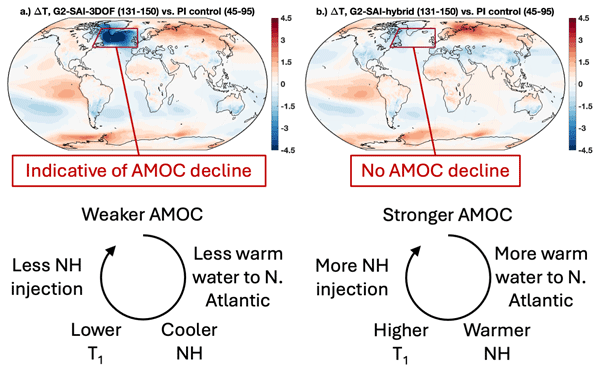
We present climate model simulation of stratospheric aerosol injection, a proposed method of climate intervention where reflective particles are placed in the stratosphere to cool the planet. We design our simulated interventions to maintain certain surface temperature patterns, and show that the same temperatures can be maintained in different ways because of how the ocean transports heat. This has implications for how climate intervention model experiments are designed in the future.
Ewa M. Bednarz, Valentina Aquila, Amy H. Butler, Peter Colarco, Eric Fleming, Freja F. Østerstrøm, David Plummer, Ilaria Quaglia, William Randel, Michelle L. Santee, Takashi Sekiya, Simone Tilmes, Xinyue Wang, Shingo Watanabe, Wandi Yu, Jun Zhang, Yunqian Zhu, and Zhihong Zhuo
Atmos. Chem. Phys., 26, 11355–11370, https://doi.org/10.5194/acp-26-11355-2026, https://doi.org/10.5194/acp-26-11355-2026, 2026
Short summary
Short summary
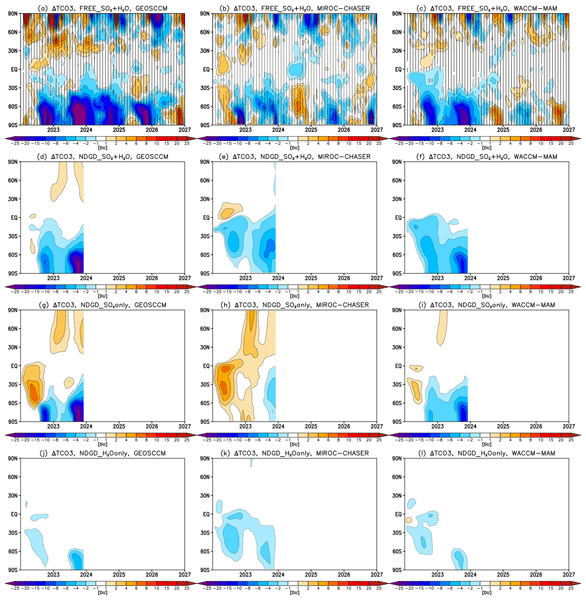
The 2022 Hunga eruption injected unprecedented quantities of water vapor into the stratosphere, alongside modest amounts of aerosol precursors. We assess its impacts on stratospheric ozone layer using a multi-model ensemble of chemistry-climate simulations. The results confirm the eruption's role in modulating SH (Southern Hemisphere) mid and high latitudes ozone abundances in the short term, and discuss the different chemical and dynamical processes driving those changes as well as the role of natural variability.
Anna Lange, Ilaria Quaglia, Daniele Visioni, Alexei Rozanov, and Christian von Savigny
EGUsphere, https://doi.org/10.5194/egusphere-2026-3347, https://doi.org/10.5194/egusphere-2026-3347, 2026
This preprint is open for discussion and under review for Atmospheric Chemistry and Physics (ACP).
Short summary
Short summary
What happens to the colours of the sky when a volcano erupts during an ongoing stratospheric aerosol injection deployment? This study is the first to tackle this question, combining climate model simulations, radiative transfer calculations, and colour modelling. The results show several optical phenomena, including Bishop's Rings, unusual greenish twilight colours, and purple light.
Andrin Jörimann, Timofei Sukhodolov, Simone Tilmes, David Plummer, Shingo Watanabe, Hideharu Akiyoshi, Gabriel Chiodo, Daniele Visioni, Sandro Vattioni, Eugene Rozanov, Ewa Monika Bednarz, Béatrice Josse, Yousuke Yamashita, and Thomas Peter
Atmos. Chem. Phys., 26, 11207–11234, https://doi.org/10.5194/acp-26-11207-2026, https://doi.org/10.5194/acp-26-11207-2026, 2026
Short summary
Short summary
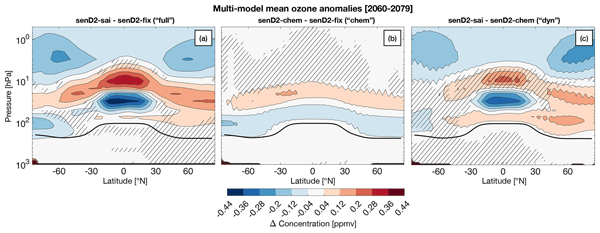
We study a future scenario where artificial stratospheric aerosol injections counter medium climate change, to understand possible negative side effects like ozone depletion. The injected aerosol layer is implemented uniformly in five climate models, which eliminates some uncertainty from model-specific aerosol evolution. The models agree well on where and how key thermodynamical (heating, circulation) and chemical processes change, however, the strength of the changes varies considerably.
Katharina Perny, Timofei Sukhodolov, Ales Kuchar, Pavle Arsenovic, Bernadette Rosati, Christoph Brühl, Sandip S. Dhomse, Andrin Jörimann, Anton Laakso, Graham Mann, Ulrike Niemeier, Giovanni Pitari, Ilaria Quaglia, Takashi Sekiya, Kengo Sudo, Claudia Timmreck, Simone Tilmes, Daniele Visioni, and Harald E. Rieder
Atmos. Chem. Phys., 26, 10997–11025, https://doi.org/10.5194/acp-26-10997-2026, https://doi.org/10.5194/acp-26-10997-2026, 2026
Short summary
Short summary
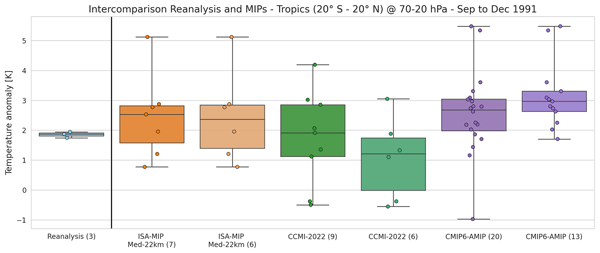
Major volcanic eruptions, such as the one of Mt. Pinatubo in 1991, can inject large amounts of sulfur dioxide into the stratosphere. The resulting aerosol cloud affects stratospheric temperature and thereby middle atmospheric dynamics and chemistry. Here we investigate similarities and differences across an ensemble of climate models in reproducing the stratospheric temperature signal following the Mt. Pinatubo eruption.
Alex M. Mason, Matthew Henry, Haruki Hirasawa, Fiona M. O'Connor, and James Haywood
Atmos. Chem. Phys., 26, 10861–10879, https://doi.org/10.5194/acp-26-10861-2026, https://doi.org/10.5194/acp-26-10861-2026, 2026
Short summary
Short summary
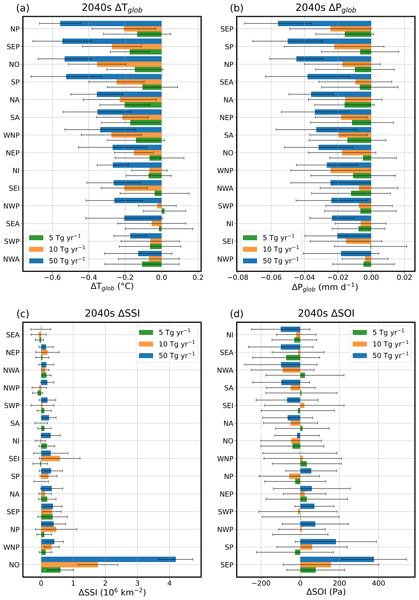
Marine Cloud Brightening (MCB) proposes the spraying of sea salt particles into marine clouds to cool the planet. MCB in midlatitude regions in models gave a relatively even climate response. We use 42 simulations of MCB to target several climate responses. Two optimised combinations are compared to a midlatitude MCB simulation, which improved sea ice restoration and the temperature response pattern, highlighting the importance of high latitude MCB for MCB optimisation in this model.
Colleen Marie Golja, Marianna Linz, Ewa Monika Bednarz, Daniele Visioni, Ben Kravitz, John A. Dykema, Michelle E. Frazer, Anthony C. Jones, Isla R. Simpson, and Shingo Watanabe
EGUsphere, https://doi.org/10.5194/egusphere-2026-4200, https://doi.org/10.5194/egusphere-2026-4200, 2026
Short summary
Short summary
Adding reflective particles to the stratosphere has been proposed to cool the planet, but how the resulting lower-stratospheric heating affects the broader climate remains unclear. This study simulates idealized lower-stratospheric heating across five climate models finding large inter-model differences in the stratospheric and surface response. The results highlight ways in which these differences may be explained by biases in the stratospheric climatological mean state.
Azfar Hussain, Huizing Liu, Abolfazl Rezaei, Ping Zhu, Daniele Visioni, Guanglang Xu, Chao Yang, Yan Ma, Tianye Cao, and Qingquan Li
EGUsphere, https://doi.org/10.5194/egusphere-2026-3008, https://doi.org/10.5194/egusphere-2026-3008, 2026
Short summary
Short summary
Central–South Asia and the Tibetan Plateau depend on fragile water systems shaped by rain, snow, ice, and heat. We used future climate model results to test how warming and sunlight-reflecting climate intervention could affect water, plants, snow, and seasonal timing. Warming greatly increases water extremes and shifts seasons earlier. Intervention reduces heat and some extremes, but cannot fully prevent water stress, and its effects vary strongly by region and design.
Temitope S. Egbebiyi, Temitope S. Fafure, Daniele Visioni, Romaric C. Odoulami, Babatunde J. Abiodun, Simone Tilmes, Chris Lennard, and Mark G. New
EGUsphere, https://doi.org/10.5194/egusphere-2026-3436, https://doi.org/10.5194/egusphere-2026-3436, 2026
Short summary
Short summary
Exceeding the global warming thresholds of 1.5 & 2.0 °C before potential mitigation efforts and Carbon dioxide removal are possible future trajectories. While Climate Intervention could reduce peak warming in future, however, their impact in Africa is unknown. We show this intervention may reduce temperature extremes while its impact on precipitation varies across Africa. The result has implications for agricultural planning and water resource management during potential overshoot periods.
Ilaria Quaglia, Daniele Visioni, Ewa M. Bednarz, Yunqian Zhu, Georgiy Stenchikov, Valentina Aquila, Cheng-Cheng Liu, Graham W. Mann, Yifeng Peng, Takashi Sekiya, Simone Tilmes, Xinyue Wang, Shingo Watanabe, Pengfei Yu, Jun Zhang, Wandi Yu, and Zhihong Zhuo
Atmos. Chem. Phys., 26, 7677–7704, https://doi.org/10.5194/acp-26-7677-2026, https://doi.org/10.5194/acp-26-7677-2026, 2026
Short summary
Short summary
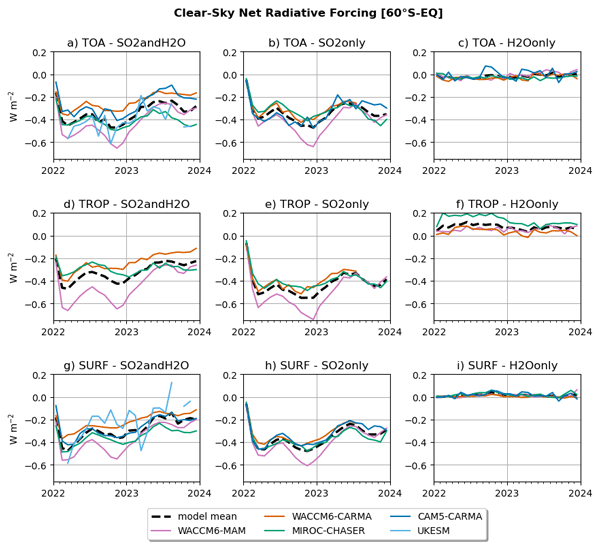
On January 15, 2022, the Hunga volcano eruption released unprecedented amounts of water vapor into the atmosphere alongside a modest amount of SO2. In this work we analyse results from multiple Earth system models. The models agree that the eruption led to small negative radiative forcing from sulfate aerosols and that the contribution from water vapor was minimal. Therefore, the Hunga eruption cannot explain the exceptional surface warming observed in 2023.
Anthony C. Jones, James M. Haywood, Matthew Henry, and Alistair Duffey
Atmos. Chem. Phys., 26, 7589–7605, https://doi.org/10.5194/acp-26-7589-2026, https://doi.org/10.5194/acp-26-7589-2026, 2026
Short summary
Short summary
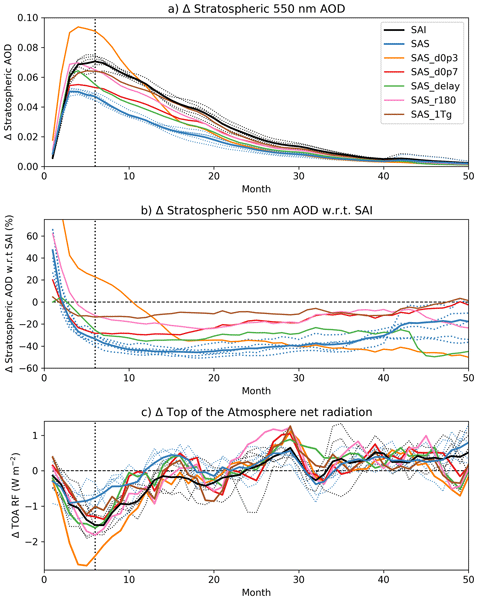
Injecting aerosol into the stratosphere has been suggested to rapidly cool the planet and counter climate change. Rival actors who oppose deployment may seek to counter stratospheric aerosol injection. Using a climate model, we investigate whether stratospheric aerosol removal could be hastened by injecting coarse aerosol which promote aerosol growth and gravitational settling. We find that this could be effective, reducing aerosol impacts by 30 % in simulations, and warrants further research.
Walker Raymond Lee, Daniele Visioni, Benjamin Moore Wagman, Christopher Robert Wentland, Ben Kravitz, Shingo Watanabe, Takashi Sekiya, Andy Jones, Jim Haywood, Matthew Henry, and Ewa Monika Bednarz
Atmos. Chem. Phys., 26, 7463–7483, https://doi.org/10.5194/acp-26-7463-2026, https://doi.org/10.5194/acp-26-7463-2026, 2026
Short summary
Short summary
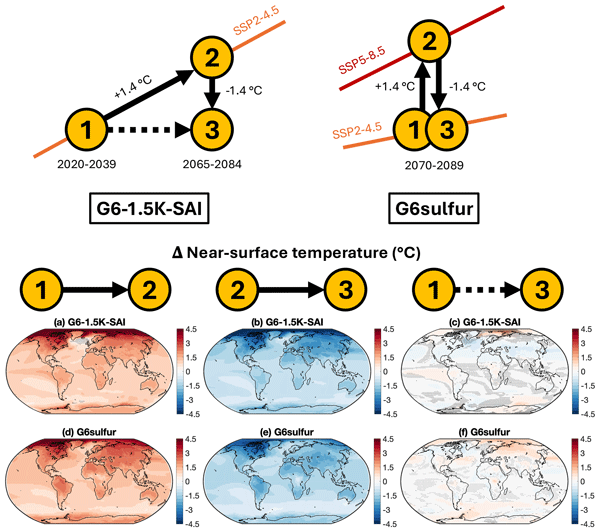
Stratospheric aerosol injection (SAI) is a proposed method of cooling the planet by introducing reflective particles called aerosols into the middle atmosphere to reflect sunlight back into space. We consider recent simulations of SAI from four different climate models. SAI cools the planet effectively in all four models; we examine the impacts on temperature and precipitation in each model and compare to previous experiments. Our simulations will help inform future research and policy.
Josh Smith, Matthew Henry, Masaru Yoshioka, Ben Johnson, and Jim Haywood
EGUsphere, https://doi.org/10.5194/egusphere-2026-2654, https://doi.org/10.5194/egusphere-2026-2654, 2026
Short summary
Short summary
In 2020, new international rules cut sulphur in shipping fuels by roughly eighty percent, removing particles that had been brightening clouds over the oceans and reflecting sunlight. Using a climate model, we tested how this loss of cooling has been calculated and found that recent studies have
likely underestimated the resulting warming by a factor of two to four. This means cleaner shipping fuels may be contributing more to recent global warming than previously recognised.
likely underestimated the resulting warming by a factor of two to four. This means cleaner shipping fuels may be contributing more to recent global warming than previously recognised.
Haruki Hirasawa, Matthew Henry, Philip J. Rasch, Robert Wood, Sarah J. Doherty, James Haywood, Alex Wong, Jean-Francois Lamarque, Ezra Brody, and Hailong Wang
Geosci. Model Dev., 19, 3257–3283, https://doi.org/10.5194/gmd-19-3257-2026, https://doi.org/10.5194/gmd-19-3257-2026, 2026
Short summary
Short summary
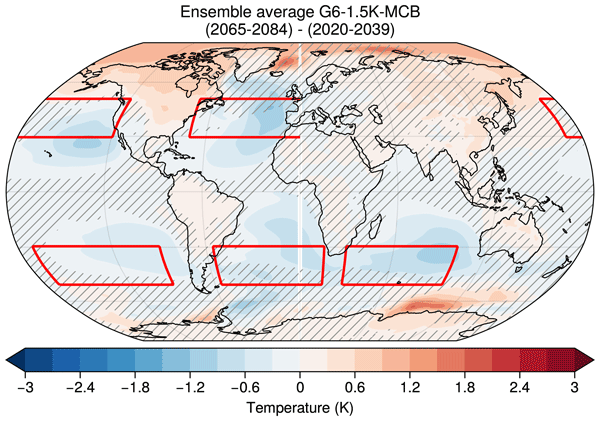
Marine cloud brightening (MCB) is a proposal to emit sea salt aerosols to make clouds more reflective and cool the climate. Here, we use three climate models to study a hypothetical future where MCB is used to maintain temperatures near 2020–2039 conditions. The simulation results indicate that using MCB in midlatitude ocean regions can keep the climate close to present day conditions. This reduces many of the negative impacts shown in previous studies, informing future modeling efforts.
Isobel M. Parry, Paul D. L. Ritchie, Olivier Boucher, Peter M. Cox, James M. Haywood, Ulrike Niemeier, Roland Séférian, Simone Tilmes, and Daniele Visioni
Earth Syst. Dynam., 17, 387–414, https://doi.org/10.5194/esd-17-387-2026, https://doi.org/10.5194/esd-17-387-2026, 2026
Short summary
Short summary
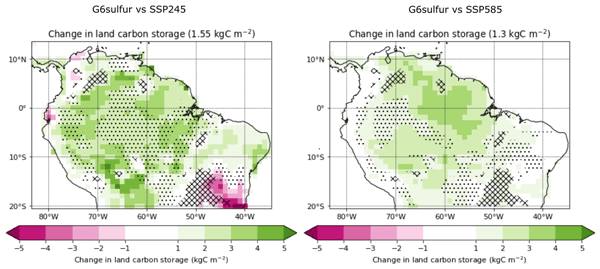
Contrary to some expectations, results from the latest Earth System Models suggest that Solar Radiation Geoengineering could protect the Amazon rainforest from climate-driven dieback. Under Stratospheric Aerosol Injection, carbon storage in Amazonia was projected to increase by a mean of 10.8 % relative to a high CO2 emissions scenario, and even by 8.6% compared to a more conventional medium CO2 emissions scenario.
Alistair Duffey, Walker Lee, Lauren Wheeler, Peter Irvine, Benjamin Wagman, Matthew Henry, Daniele Visioni, Michel Tsamados, and Douglas MacMartin
Earth Syst. Dynam., 17, 353–385, https://doi.org/10.5194/esd-17-353-2026, https://doi.org/10.5194/esd-17-353-2026, 2026
Short summary
Short summary
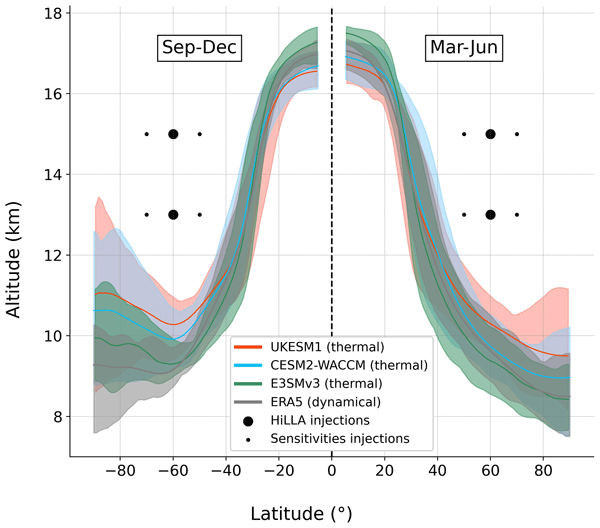
Adding a layer of reflective particles high in the atmosphere is one suggested way of cooling the planet and reducing the impacts of climate change. This technique might be less logistically difficult in the high latitudes, because the material could be released at lower altitude there. Here, we use new simulations in three earth system models to assess how this form of intervention, High-Latitude Low-Altitude Stratospheric Aerosol Injection (HiLLA-SAI), would impact the global climate.
Lantao Sun, James W. Hurrell, Kristen L. Rasmussen, Bali Summers, Erin A. Sherman, and Ben Kravitz
Geosci. Model Dev., 19, 2239–2256, https://doi.org/10.5194/gmd-19-2239-2026, https://doi.org/10.5194/gmd-19-2239-2026, 2026
Short summary
Short summary
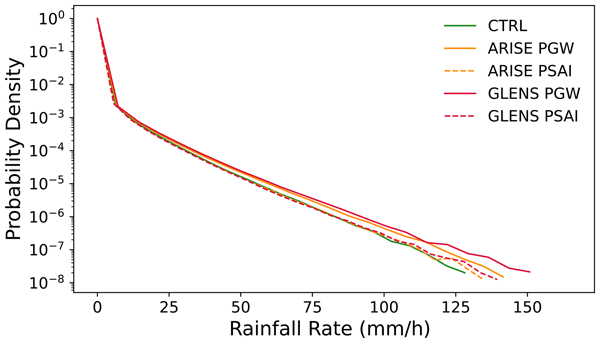
We develop a novel framework using the convection-permitting Weather Research and Forecasting (WRF) model to assess how stratospheric aerosol injection, a solar climate intervention strategy, affects future convective weather over the contiguous U.S. Results demonstrate the feasibility and scientific potential of this approach for evaluating weather-scale impacts and suggest that such intervention may mitigate changes in temperature, precipitation, and convective activity due to warming.
Simone Tilmes, Daniele Visioni, Ilaria Quaglia, Yunqian Zhu, Charles G. Bardeen, Francis Vitt, and Pengfei Yu
Atmos. Chem. Phys., 26, 2649–2666, https://doi.org/10.5194/acp-26-2649-2026, https://doi.org/10.5194/acp-26-2649-2026, 2026
Short summary
Short summary
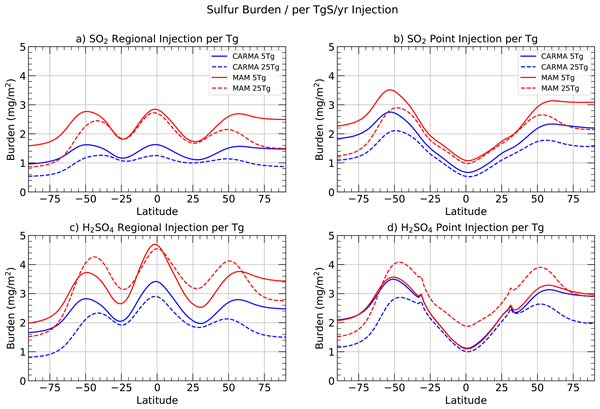
This study compares two sets of stratospheric aerosol injection (SAI) experiments using the same modeling framework, differing only in their aerosol microphysical schemes. Results show that these two schemes can yield substantially different aerosol burdens, radiative changes, and impacts when simulating the same injection scenarios. These findings suggest that more sophisticated aerosol models may be necessary to accurately assess the efficacy, side effects, and climate impacts of SAI.
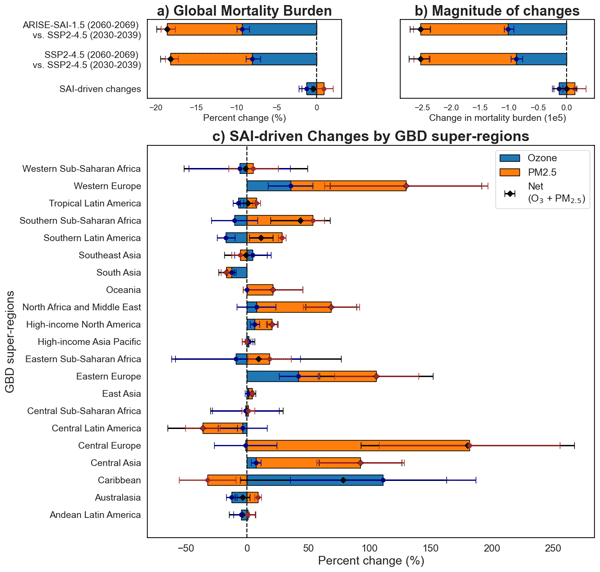
Cindy Wang, Daniele Visioni, Glen Chua, and Ewa M. Bednarz
Atmos. Chem. Phys., 26, 1339–1357, https://doi.org/10.5194/acp-26-1339-2026, https://doi.org/10.5194/acp-26-1339-2026, 2026
Short summary
Short summary
Stratospheric aerosol injection is a proposed method to slow global warming by adding tiny reflective particles high up in the atmosphere to cool the planet. We study how this proposed method might affect air quality and human health using climate models. We find that the health impacts would likely be small and are mainly driven by changes in climate, not by the particles themselves.
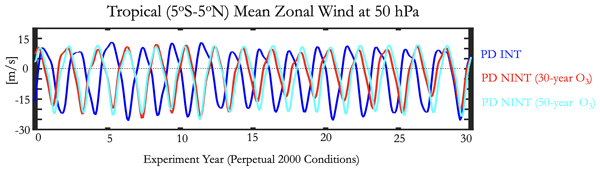
Clara Orbe, Alison Ming, Gabriel Chiodo, Michael Prather, Mohamadou Diallo, Qi Tang, Andreas Chrysanthou, Hiroaki Naoe, Xin Zhou, Irina Thaler, Dillon Elsbury, Ewa Bednarz, Jonathon S. Wright, Aaron Match, Shingo Watanabe, James Anstey, Tobias Kerzenmacher, Stefan Versick, Marion Marchand, Feng Li, and James Keeble
Geosci. Model Dev., 19, 773–794, https://doi.org/10.5194/gmd-19-773-2026, https://doi.org/10.5194/gmd-19-773-2026, 2026
Short summary
Short summary
The quasi-biennial oscillation (QBO) is the main source of wind fluctuations in the tropical stratosphere, which can couple to surface climate. However, models do a poor job of simulating the QBO in the lower stratosphere, for reasons that remain unclear. One possibility is that models do not completely represent how ozone influences the QBO-associated wind variations. Here we propose a multi-model framework for assessing how ozone influences the QBO in recent past and future climates.
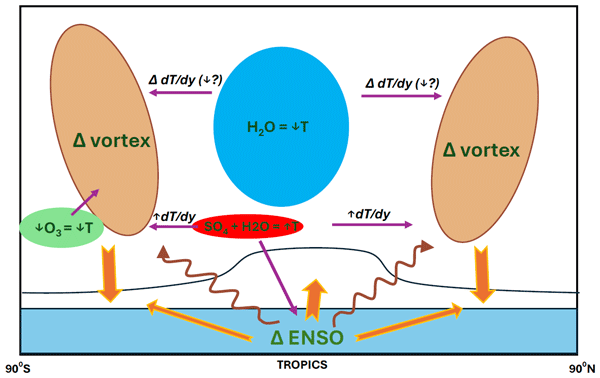
Ewa M. Bednarz, Amy H. Butler, Xinyue Wang, Zhihong Zhuo, Wandi Yu, Georgiy Stenchikov, Matthew Toohey, and Yunqian Zhu
Atmos. Chem. Phys., 26, 197–215, https://doi.org/10.5194/acp-26-197-2026, https://doi.org/10.5194/acp-26-197-2026, 2026
Short summary
Short summary
We investigate whether the 2022 Hunga eruption could affect surface climate via indirect pathways using large ensembles of Earth System Model simulations. These suggest that the eruption could have a non-negligible influence on regional surface climate, and we discuss the mechanisms via which such an influence could occur but also highlight that the forcing is relatively weak compared to natural climate variability which significantly hinders the detection of such impacts in the real world.
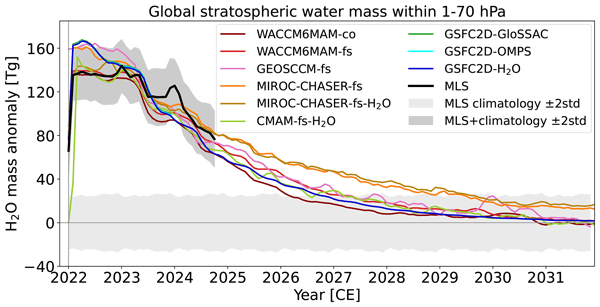
Zhihong Zhuo, Xinyue Wang, Yunqian Zhu, Wandi Yu, Ewa M. Bednarz, Eric Fleming, Peter R. Colarco, Shingo Watanabe, David Plummer, Georgiy Stenchikov, William Randel, Adam Bourassa, Valentina Aquila, Takashi Sekiya, Mark R. Schoeberl, Simone Tilmes, Jun Zhang, Paul J. Kushner, and Francesco S. R. Pausata
Atmos. Chem. Phys., 25, 13161–13176, https://doi.org/10.5194/acp-25-13161-2025, https://doi.org/10.5194/acp-25-13161-2025, 2025
Short summary
Short summary
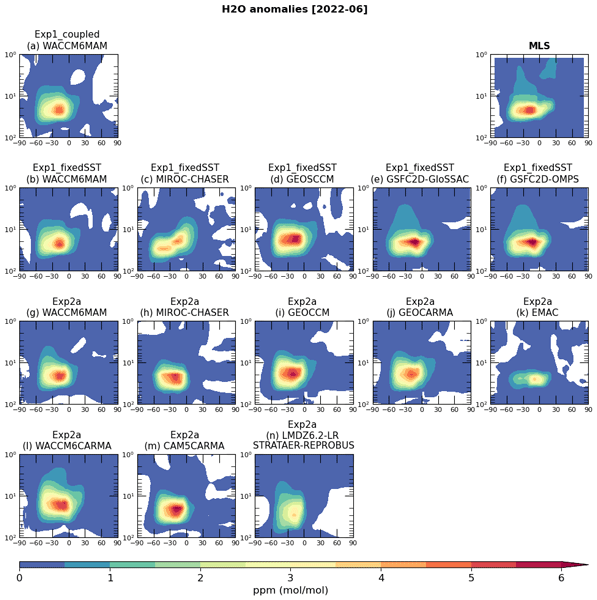
The 2022 Hunga eruption caused unprecedented stratospheric water injection, triggering unique atmospheric impacts. This study combines observations and model simulations, projecting a stratospheric water vapor anomaly lasting 4–7 years, with significant temperature variations and ozone depletion in the upper atmosphere lasting 7–10 years. These findings offer critical insights into the role of stratospheric water vapor in shaping climate and atmospheric chemistry.
Yunqian Zhu, Hideharu Akiyoshi, Valentina Aquila, Elizabeth Asher, Ewa M. Bednarz, Slimane Bekki, Christoph Brühl, Amy H. Butler, Parker Case, Simon Chabrillat, Gabriel Chiodo, Margot Clyne, Peter R. Colarco, Sandip Dhomse, Lola Falletti, Eric Fleming, Ben Johnson, Andrin Jörimann, Mahesh Kovilakam, Gerbrand Koren, Ales Kuchar, Nicolas Lebas, Qing Liang, Cheng-Cheng Liu, Graham Mann, Michael Manyin, Marion Marchand, Olaf Morgenstern, Paul Newman, Luke D. Oman, Freja F. Østerstrøm, Yifeng Peng, David Plummer, Ilaria Quaglia, William Randel, Samuel Rémy, Takashi Sekiya, Stephen Steenrod, Timofei Sukhodolov, Simone Tilmes, Kostas Tsigaridis, Rei Ueyama, Daniele Visioni, Xinyue Wang, Shingo Watanabe, Yousuke Yamashita, Pengfei Yu, Wandi Yu, Jun Zhang, and Zhihong Zhuo
Geosci. Model Dev., 18, 5487–5512, https://doi.org/10.5194/gmd-18-5487-2025, https://doi.org/10.5194/gmd-18-5487-2025, 2025
Short summary
Short summary
To understand the climate impact of the 2022 Hunga volcanic eruption, we developed a climate model–observation comparison project. The paper describes the protocols and models that participate in the experiments. We designed several experiments to achieve our goals of this activity: (1) to evaluate the climate model performance and (2) to understand the Earth system responses to this eruption.
Ezra Brody, Yan Zhang, Douglas G. MacMartin, Daniele Visioni, Ben Kravitz, and Ewa M. Bednarz
Earth Syst. Dynam., 16, 1325–1341, https://doi.org/10.5194/esd-16-1325-2025, https://doi.org/10.5194/esd-16-1325-2025, 2025
Short summary
Short summary
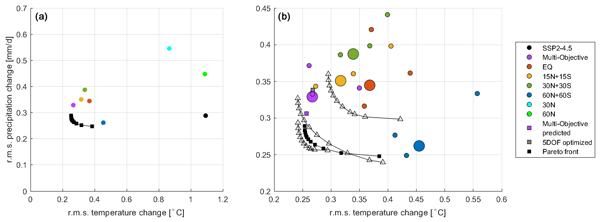
Stratospheric aerosol injection (SAI) is being studied as a possible supplement to emission reduction to temporarily mitigate some of the risks associated with climate change. The latitudes at which SAI is done determine the effect on the climate. We try to find if there are combinations of latitudes that do a better job of counteracting climate change than existing strategies. We found that there are, but just how significant these improvements are depends on the amount of cooling.
Gideon Futerman, Mira Adhikari, Alistair Duffey, Yuanchao Fan, Jessica Gurevitch, Peter Irvine, and Claudia Wieners
Earth Syst. Dynam., 16, 939–978, https://doi.org/10.5194/esd-16-939-2025, https://doi.org/10.5194/esd-16-939-2025, 2025
Short summary
Short summary
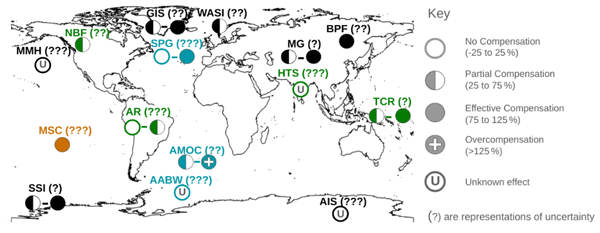
This review assesses the interaction of solar radiation modification (SRM), a technology to reduce the impacts of climate change by reflecting sunlight and earth system tipping elements. We find that SRM at least partially reduces the risk of hitting most (9 out of 15) of the tipping points we studied relative to the same emission pathway and did not overall worsen the risk for any. Uncertainties for all tipping elements studied were high, so we also lay out suggestions for future research.
Simone Tilmes, Ewa M. Bednarz, Andrin Jörimann, Daniele Visioni, Douglas E. Kinnison, Gabriel Chiodo, and David Plummer
Atmos. Chem. Phys., 25, 6001–6023, https://doi.org/10.5194/acp-25-6001-2025, https://doi.org/10.5194/acp-25-6001-2025, 2025
Short summary
Short summary
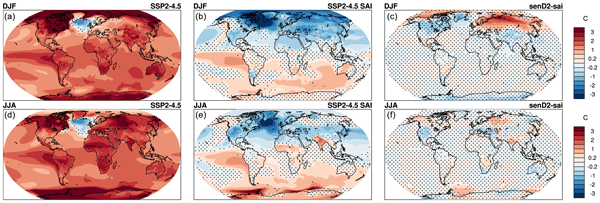
In this paper, we describe the details of a new multi-model intercomparison experiment to assess the effects of Stratospheric Aerosol Intervention (SAI) on stratospheric chemistry and dynamics and, therefore, ozone. Second, we discuss the advantages and differences of the more constrained experiment compared to fully interactive model experiments. This way, we advance the process-level understanding of the drivers of SAI-induced atmospheric responses.
Martin Juckes, Karl E. Taylor, Fabrizio Antonio, David Brayshaw, Carlo Buontempo, Jian Cao, Paul J. Durack, Michio Kawamiya, Hyungjun Kim, Tomas Lovato, Chloe Mackallah, Matthew Mizielinski, Alessandra Nuzzo, Martina Stockhause, Daniele Visioni, Jeremy Walton, Briony Turner, Eleanor O'Rourke, and Beth Dingley
Geosci. Model Dev., 18, 2639–2663, https://doi.org/10.5194/gmd-18-2639-2025, https://doi.org/10.5194/gmd-18-2639-2025, 2025
Short summary
Short summary
The Baseline Climate Variables for Earth System Modelling (ESM-BCVs) are defined as a list of 135 variables which have high utility for the evaluation and exploitation of climate simulations. The list reflects the most frequently used variables from Earth system models based on an assessment of data publication and download records from the largest archive of global climate projects.
Matthew Henry, Ewa M. Bednarz, and Jim Haywood
Atmos. Chem. Phys., 24, 13253–13268, https://doi.org/10.5194/acp-24-13253-2024, https://doi.org/10.5194/acp-24-13253-2024, 2024
Short summary
Short summary
Stratospheric aerosol injection (SAI) refers to a climate intervention by which aerosols are intentionally added to the high atmosphere to increase the amount of reflected sunlight and reduce Earth's temperature. The climate outcomes of SAI depend on the latitude of injection. While injecting aerosols at the Equator has undesirable side effects, injecting away from the Equator has different effects on temperature, rainfall, ozone, and atmospheric circulation, which are analysed in this work.
Ilaria Quaglia and Daniele Visioni
Earth Syst. Dynam., 15, 1527–1541, https://doi.org/10.5194/esd-15-1527-2024, https://doi.org/10.5194/esd-15-1527-2024, 2024
Short summary
Short summary
On 1 January 2020, international shipping vessels were required to substantially reduce the amount of particulate they emit to improve air quality. In this work we demonstrate how this regulatory change contributed to the anomalous warming observed in recent months using climate model simulations that include such a change. Future policies should also perhaps consider their impact on climate, and climate modelers should promptly include those changes in future modeling efforts.

Christina V. Brodowsky, Timofei Sukhodolov, Gabriel Chiodo, Valentina Aquila, Slimane Bekki, Sandip S. Dhomse, Michael Höpfner, Anton Laakso, Graham W. Mann, Ulrike Niemeier, Giovanni Pitari, Ilaria Quaglia, Eugene Rozanov, Anja Schmidt, Takashi Sekiya, Simone Tilmes, Claudia Timmreck, Sandro Vattioni, Daniele Visioni, Pengfei Yu, Yunqian Zhu, and Thomas Peter
Atmos. Chem. Phys., 24, 5513–5548, https://doi.org/10.5194/acp-24-5513-2024, https://doi.org/10.5194/acp-24-5513-2024, 2024
Short summary
Short summary
The aerosol layer is an essential part of the climate system. We characterize the sulfur budget in a volcanically quiescent (background) setting, with a special focus on the sulfate aerosol layer using, for the first time, a multi-model approach. The aim is to identify weak points in the representation of the atmospheric sulfur budget in an intercomparison of nine state-of-the-art coupled global circulation models.
Anton Laakso, Daniele Visioni, Ulrike Niemeier, Simone Tilmes, and Harri Kokkola
Earth Syst. Dynam., 15, 405–427, https://doi.org/10.5194/esd-15-405-2024, https://doi.org/10.5194/esd-15-405-2024, 2024
Short summary
Short summary
This study is the second in a two-part series in which we explore the dependency of the impacts of stratospheric sulfur injections on both the model employed and the strategy of injection utilized. The study uncovers uncertainties associated with these techniques to cool climate, highlighting how the simulated climate impacts are dependent on both the selected model and the magnitude of the injections. We also show that estimating precipitation impacts of aerosol injection is a complex task.
Daniele Visioni, Alan Robock, Jim Haywood, Matthew Henry, Simone Tilmes, Douglas G. MacMartin, Ben Kravitz, Sarah J. Doherty, John Moore, Chris Lennard, Shingo Watanabe, Helene Muri, Ulrike Niemeier, Olivier Boucher, Abu Syed, Temitope S. Egbebiyi, Roland Séférian, and Ilaria Quaglia
Geosci. Model Dev., 17, 2583–2596, https://doi.org/10.5194/gmd-17-2583-2024, https://doi.org/10.5194/gmd-17-2583-2024, 2024
Short summary
Short summary
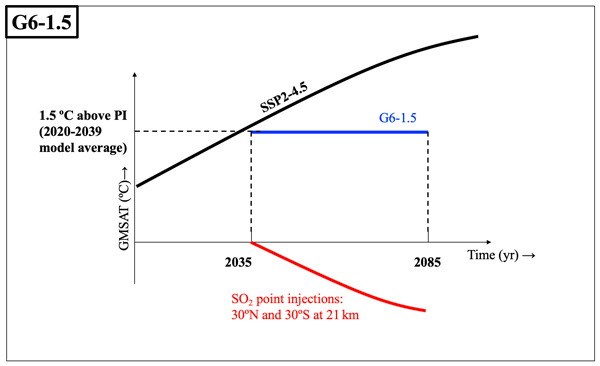
This paper describes a new experimental protocol for the Geoengineering Model Intercomparison Project (GeoMIP). In it, we describe the details of a new simulation of sunlight reflection using the stratospheric aerosols that climate models are supposed to run, and we explain the reasons behind each choice we made when defining the protocol.
Yan Zhang, Douglas G. MacMartin, Daniele Visioni, Ewa M. Bednarz, and Ben Kravitz
Earth Syst. Dynam., 15, 191–213, https://doi.org/10.5194/esd-15-191-2024, https://doi.org/10.5194/esd-15-191-2024, 2024
Short summary
Short summary
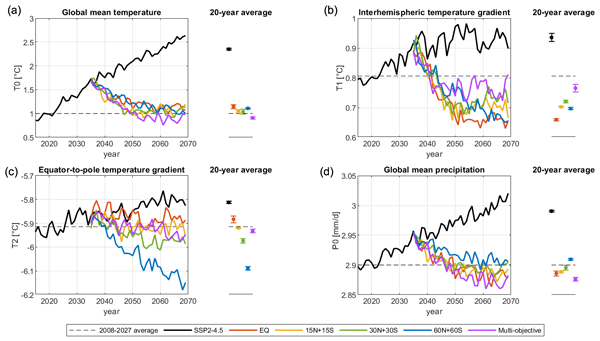
Injecting SO2 into the lower stratosphere can temporarily reduce global mean temperature and mitigate some risks associated with climate change, but injecting it at different latitudes and seasons would have different impacts. This study introduces new stratospheric aerosol injection (SAI) strategies and explores the importance of the choice of SAI strategy, demonstrating that it notably affects the distribution of aerosol cloud, injection efficiency, and various surface climate impacts.
Alistair Duffey, Robbie Mallett, Peter J. Irvine, Michel Tsamados, and Julienne Stroeve
Earth Syst. Dynam., 14, 1165–1169, https://doi.org/10.5194/esd-14-1165-2023, https://doi.org/10.5194/esd-14-1165-2023, 2023
Short summary
Short summary
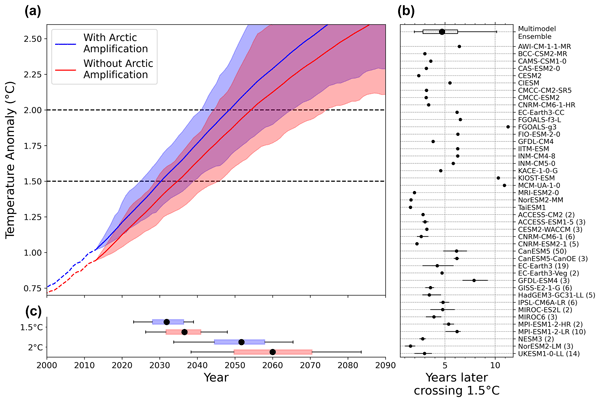
The Arctic is warming several times faster than the rest of the planet. Here, we use climate model projections to quantify for the first time how this faster warming in the Arctic impacts the timing of crossing the 1.5 °C and 2 °C thresholds defined in the Paris Agreement. We show that under plausible emissions scenarios that fail to meet the Paris 1.5 °C target, a hypothetical world without faster warming in the Arctic would breach that 1.5 °C target around 5 years later.
Ewa M. Bednarz, Ryan Hossaini, and Martyn P. Chipperfield
Atmos. Chem. Phys., 23, 13701–13711, https://doi.org/10.5194/acp-23-13701-2023, https://doi.org/10.5194/acp-23-13701-2023, 2023
Short summary
Short summary
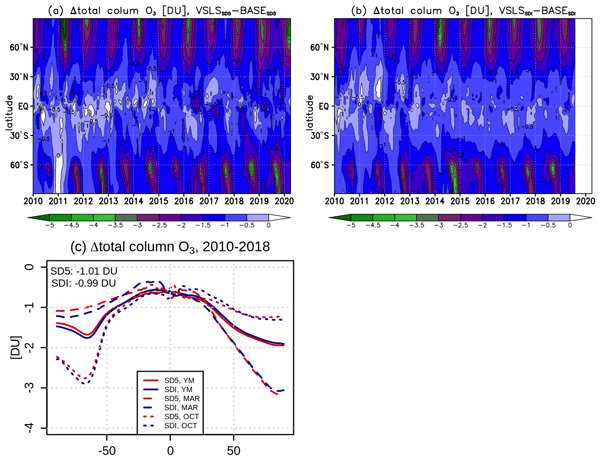
We quantify, for the first time, the time-varying impact of uncontrolled emissions of chlorinated very short-lived substances (Cl-VSLSs) on stratospheric ozone using a state-of-the-art chemistry-climate model. We demonstrate that Cl-VSLSs already have a non-negligible impact on stratospheric ozone, including a local reduction of up to ~7 DU in Arctic ozone in the cold winter of 2019/20, and any so future growth in emissions will continue to offset some of the benefits of the Montreal Protocol.
Ewa M. Bednarz, Amy H. Butler, Daniele Visioni, Yan Zhang, Ben Kravitz, and Douglas G. MacMartin
Atmos. Chem. Phys., 23, 13665–13684, https://doi.org/10.5194/acp-23-13665-2023, https://doi.org/10.5194/acp-23-13665-2023, 2023
Short summary
Short summary
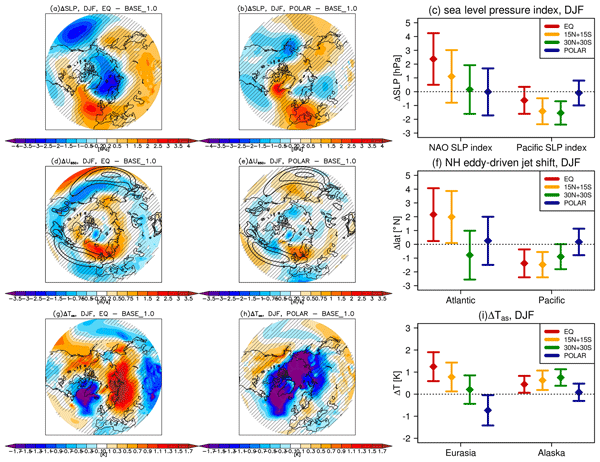
We use a state-of-the-art Earth system model and a set of stratospheric aerosol injection (SAI) strategies to achieve the same level of global mean surface cooling through different combinations of location and/or timing of the injection. We demonstrate that the choice of SAI strategy can lead to contrasting impacts on stratospheric and tropospheric temperatures, circulation, and chemistry (including stratospheric ozone), thereby leading to different impacts on regional surface climate.
Ewa M. Bednarz, Ryan Hossaini, N. Luke Abraham, and Martyn P. Chipperfield
Geosci. Model Dev., 16, 6187–6209, https://doi.org/10.5194/gmd-16-6187-2023, https://doi.org/10.5194/gmd-16-6187-2023, 2023
Short summary
Short summary
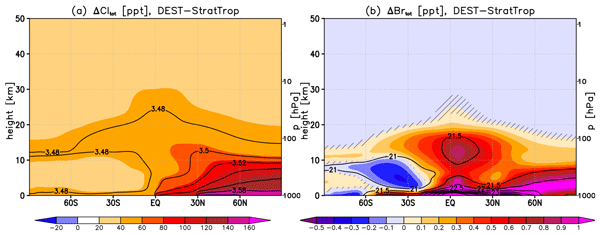
Development and performance of the new DEST chemistry scheme of UM–UKCA is described. The scheme extends the standard StratTrop scheme by including important updates to the halogen chemistry, thus allowing process-oriented studies of stratospheric ozone depletion and recovery, including impacts from both controlled long-lived ozone-depleting substances and emerging issues around uncontrolled, very short-lived substances. It will thus aid studies in support of future ozone assessment reports.
Matthew Henry, Jim Haywood, Andy Jones, Mohit Dalvi, Alice Wells, Daniele Visioni, Ewa M. Bednarz, Douglas G. MacMartin, Walker Lee, and Mari R. Tye
Atmos. Chem. Phys., 23, 13369–13385, https://doi.org/10.5194/acp-23-13369-2023, https://doi.org/10.5194/acp-23-13369-2023, 2023
Short summary
Short summary
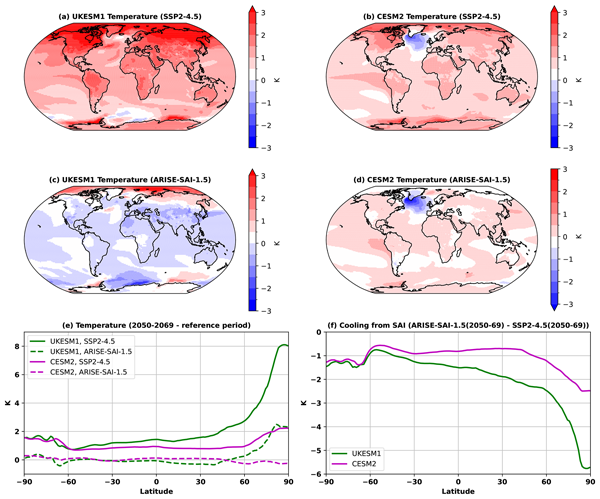
Solar climate interventions, such as injecting sulfur in the stratosphere, may be used to offset some of the adverse impacts of global warming. We use two independently developed Earth system models to assess the uncertainties around stratospheric sulfur injections. The injection locations and amounts are optimized to maintain the same pattern of surface temperature. While both models show reduced warming, the change in rainfall patterns (even without sulfur injections) is uncertain.
Daniele Visioni, Ben Kravitz, Alan Robock, Simone Tilmes, Jim Haywood, Olivier Boucher, Mark Lawrence, Peter Irvine, Ulrike Niemeier, Lili Xia, Gabriel Chiodo, Chris Lennard, Shingo Watanabe, John C. Moore, and Helene Muri
Atmos. Chem. Phys., 23, 5149–5176, https://doi.org/10.5194/acp-23-5149-2023, https://doi.org/10.5194/acp-23-5149-2023, 2023
Short summary
Short summary
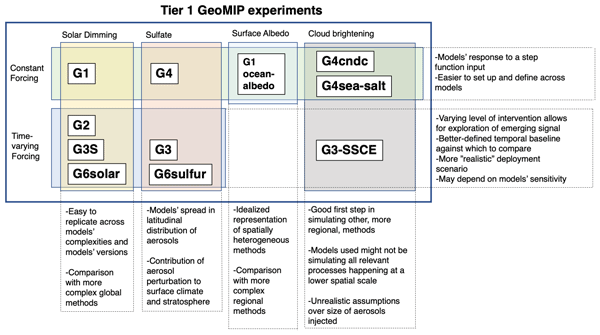
Geoengineering indicates methods aiming to reduce the temperature of the planet by means of reflecting back a part of the incoming radiation before it reaches the surface or allowing more of the planetary radiation to escape into space. It aims to produce modelling experiments that are easy to reproduce and compare with different climate models, in order to understand the potential impacts of these techniques. Here we assess its past successes and failures and talk about its future.
Ilaria Quaglia, Claudia Timmreck, Ulrike Niemeier, Daniele Visioni, Giovanni Pitari, Christina Brodowsky, Christoph Brühl, Sandip S. Dhomse, Henning Franke, Anton Laakso, Graham W. Mann, Eugene Rozanov, and Timofei Sukhodolov
Atmos. Chem. Phys., 23, 921–948, https://doi.org/10.5194/acp-23-921-2023, https://doi.org/10.5194/acp-23-921-2023, 2023
Short summary
Short summary
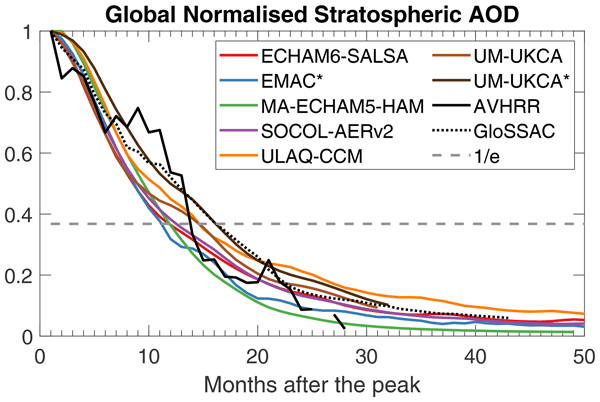
The last very large explosive volcanic eruption we have measurements for is the eruption of Mt. Pinatubo in 1991. It is therefore often used as a benchmark for climate models' ability to reproduce these kinds of events. Here, we compare available measurements with the results from multiple experiments conducted with climate models interactively simulating the aerosol cloud formation.
Ewa M. Bednarz, Daniele Visioni, Ben Kravitz, Andy Jones, James M. Haywood, Jadwiga Richter, Douglas G. MacMartin, and Peter Braesicke
Atmos. Chem. Phys., 23, 687–709, https://doi.org/10.5194/acp-23-687-2023, https://doi.org/10.5194/acp-23-687-2023, 2023
Short summary
Short summary
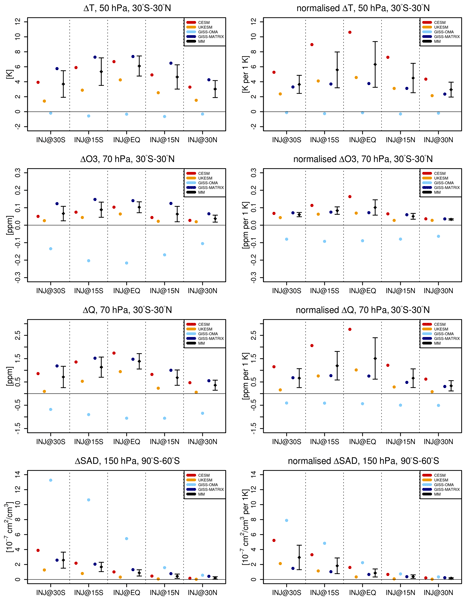
Building on Part 1 of this two-part study, we demonstrate the role of biases in climatological circulation and specific aspects of model microphysics in driving the differences in simulated sulfate distributions amongst three Earth system models. We then characterize the simulated changes in stratospheric and free-tropospheric temperatures, ozone, water vapor, and large-scale circulation, elucidating the role of the above aspects in the surface responses discussed in Part 1.

Daniele Visioni, Ewa M. Bednarz, Walker R. Lee, Ben Kravitz, Andy Jones, Jim M. Haywood, and Douglas G. MacMartin
Atmos. Chem. Phys., 23, 663–685, https://doi.org/10.5194/acp-23-663-2023, https://doi.org/10.5194/acp-23-663-2023, 2023
Short summary
Short summary
The paper constitutes Part 1 of a study performing a first systematic inter-model comparison of the atmospheric responses to stratospheric sulfate aerosol injections (SAIs) at various latitudes as simulated by three state-of-the-art Earth system models. We identify similarities and differences in the modeled aerosol burden, investigate the differences in the aerosol approaches between the models, and ultimately show the differences produced in surface climate, temperature and precipitation.
Jadwiga H. Richter, Daniele Visioni, Douglas G. MacMartin, David A. Bailey, Nan Rosenbloom, Brian Dobbins, Walker R. Lee, Mari Tye, and Jean-Francois Lamarque
Geosci. Model Dev., 15, 8221–8243, https://doi.org/10.5194/gmd-15-8221-2022, https://doi.org/10.5194/gmd-15-8221-2022, 2022
Short summary
Short summary
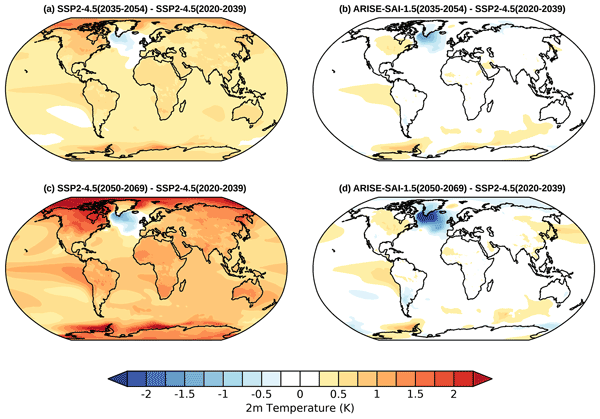
Solar climate intervention using stratospheric aerosol injection is a proposed method of reducing global mean temperatures to reduce the worst consequences of climate change. We present a new modeling protocol aimed at simulating a plausible deployment of stratospheric aerosol injection and reproducibility of simulations using other Earth system models: Assessing Responses and Impacts of Solar climate intervention on the Earth system with stratospheric aerosol injection (ARISE-SAI).
Mari R. Tye, Katherine Dagon, Maria J. Molina, Jadwiga H. Richter, Daniele Visioni, Ben Kravitz, and Simone Tilmes
Earth Syst. Dynam., 13, 1233–1257, https://doi.org/10.5194/esd-13-1233-2022, https://doi.org/10.5194/esd-13-1233-2022, 2022
Short summary
Short summary
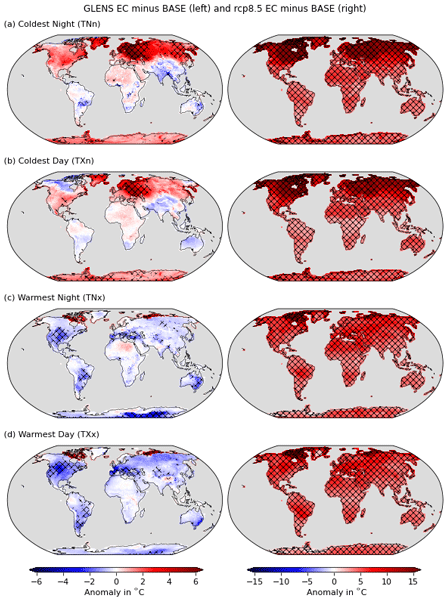
We examined the potential effect of stratospheric aerosol injection (SAI) on extreme temperature and precipitation. SAI may cause daytime temperatures to cool but nighttime to warm. Daytime cooling may occur in all seasons across the globe, with the largest decreases in summer. In contrast, nighttime warming may be greatest at high latitudes in winter. SAI may reduce the frequency and intensity of extreme rainfall. The combined changes may exacerbate drying over parts of the global south.
Ewa M. Bednarz, Ryan Hossaini, Martyn P. Chipperfield, N. Luke Abraham, and Peter Braesicke
Atmos. Chem. Phys., 22, 10657–10676, https://doi.org/10.5194/acp-22-10657-2022, https://doi.org/10.5194/acp-22-10657-2022, 2022
Short summary
Short summary
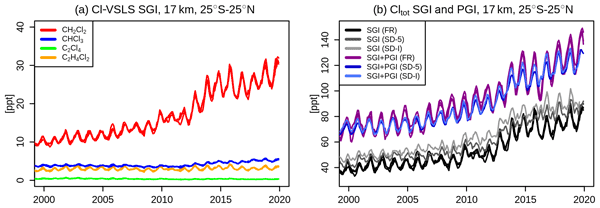
Atmospheric impacts of chlorinated very short-lived substances (Cl-VSLS) over the first two decades of the 21st century are assessed using the UM-UKCA chemistry–climate model. Stratospheric input of Cl from Cl-VSLS is estimated at ~130 ppt in 2019. The use of model set-up with constrained meteorology significantly increases the abundance of Cl-VSLS in the lower stratosphere relative to the free-running set-up. The growth in Cl-VSLS emissions significantly impacted recent HCl and COCl2 trends.
Ilaria Quaglia, Daniele Visioni, Giovanni Pitari, and Ben Kravitz
Atmos. Chem. Phys., 22, 5757–5773, https://doi.org/10.5194/acp-22-5757-2022, https://doi.org/10.5194/acp-22-5757-2022, 2022
Short summary
Short summary
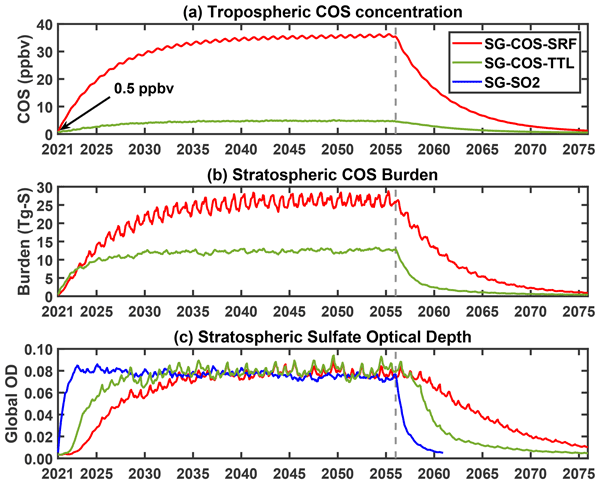
Carbonyl sulfide is a gas that mixes very well in the atmosphere and can reach the stratosphere, where it reacts with sunlight and produces aerosol. Here we propose that, by increasing surface fluxes by an order of magnitude, the number of stratospheric aerosols produced may be enough to partially offset the warming produced by greenhouse gases. We explore what effect this would have on the atmospheric composition.
Simone Tilmes, Daniele Visioni, Andy Jones, James Haywood, Roland Séférian, Pierre Nabat, Olivier Boucher, Ewa Monica Bednarz, and Ulrike Niemeier
Atmos. Chem. Phys., 22, 4557–4579, https://doi.org/10.5194/acp-22-4557-2022, https://doi.org/10.5194/acp-22-4557-2022, 2022
Short summary
Short summary
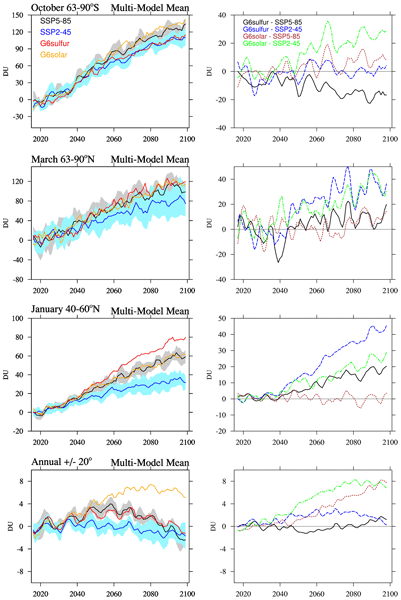
This study assesses the impacts of climate interventions, using stratospheric sulfate aerosol and solar dimming on stratospheric ozone, based on three Earth system models with interactive stratospheric chemistry. The climate interventions have been applied to a high emission (baseline) scenario in order to reach global surface temperatures of a medium emission scenario. We find significant increases and decreases in total column ozone, depending on regions and seasons.
Huiying Ren, Erol Cromwell, Ben Kravitz, and Xingyuan Chen
Hydrol. Earth Syst. Sci., 26, 1727–1743, https://doi.org/10.5194/hess-26-1727-2022, https://doi.org/10.5194/hess-26-1727-2022, 2022
Short summary
Short summary
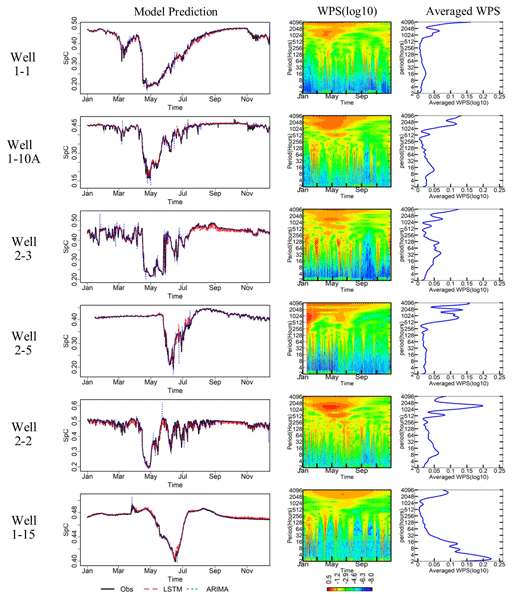
We used a deep learning method called long short-term memory (LSTM) to fill gaps in data collected by hydrologic monitoring networks. LSTM accounted for correlations in space and time and nonlinear trends in data. Compared to a traditional regression-based time-series method, LSTM performed comparably when filling gaps in data with smooth patterns, while it better captured highly dynamic patterns in data. Capturing such dynamics is critical for understanding dynamic complex system behaviors.
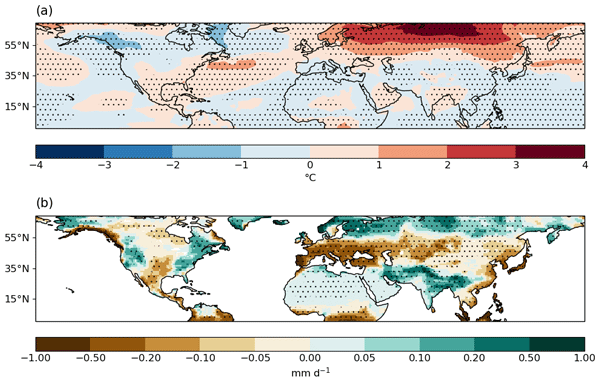
Andy Jones, Jim M. Haywood, Adam A. Scaife, Olivier Boucher, Matthew Henry, Ben Kravitz, Thibaut Lurton, Pierre Nabat, Ulrike Niemeier, Roland Séférian, Simone Tilmes, and Daniele Visioni
Atmos. Chem. Phys., 22, 2999–3016, https://doi.org/10.5194/acp-22-2999-2022, https://doi.org/10.5194/acp-22-2999-2022, 2022
Short summary
Short summary
Simulations by six Earth-system models of geoengineering by introducing sulfuric acid aerosols into the tropical stratosphere are compared. A robust impact on the northern wintertime North Atlantic Oscillation is found, exacerbating precipitation reduction over parts of southern Europe. In contrast, the models show no consistency with regard to impacts on the Quasi-Biennial Oscillation, although results do indicate a risk that the oscillation could become locked into a permanent westerly phase.
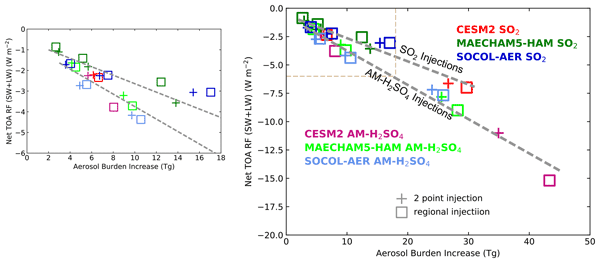
Debra K. Weisenstein, Daniele Visioni, Henning Franke, Ulrike Niemeier, Sandro Vattioni, Gabriel Chiodo, Thomas Peter, and David W. Keith
Atmos. Chem. Phys., 22, 2955–2973, https://doi.org/10.5194/acp-22-2955-2022, https://doi.org/10.5194/acp-22-2955-2022, 2022
Short summary
Short summary
This paper explores a potential method of geoengineering that could be used to slow the rate of change of climate over decadal scales. We use three climate models to explore how injections of accumulation-mode sulfuric acid aerosol change the large-scale stratospheric particle size distribution and radiative forcing response for the chosen scenarios. Radiative forcing per unit sulfur injected and relative to the change in aerosol burden is larger with particulate than with SO2 injections.
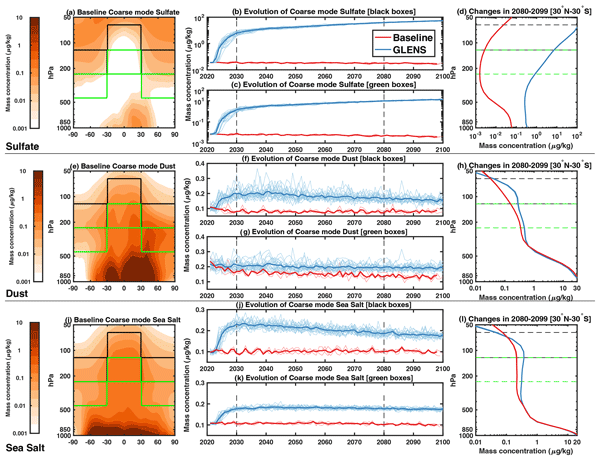
Daniele Visioni, Simone Tilmes, Charles Bardeen, Michael Mills, Douglas G. MacMartin, Ben Kravitz, and Jadwiga H. Richter
Atmos. Chem. Phys., 22, 1739–1756, https://doi.org/10.5194/acp-22-1739-2022, https://doi.org/10.5194/acp-22-1739-2022, 2022
Short summary
Short summary
Aerosols are simulated in a simplified way in climate models: in the model analyzed here, they are represented in every grid as described by three simple logarithmic distributions, mixing all different species together. The size can evolve when new particles are formed, particles merge together to create a larger one or particles are deposited to the surface. This approximation normally works fairly well. Here we show however that when large amounts of sulfate are simulated, there are problems.
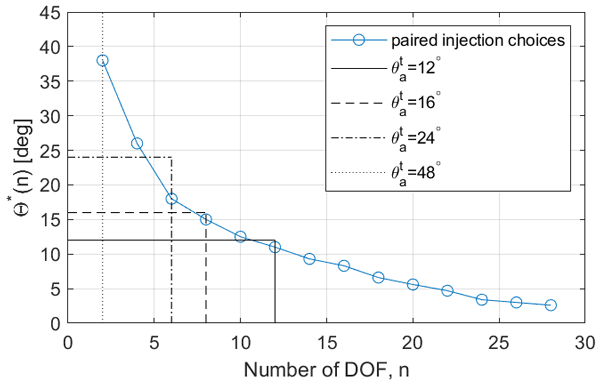
Yan Zhang, Douglas G. MacMartin, Daniele Visioni, and Ben Kravitz
Earth Syst. Dynam., 13, 201–217, https://doi.org/10.5194/esd-13-201-2022, https://doi.org/10.5194/esd-13-201-2022, 2022
Short summary
Short summary
Adding SO2 to the stratosphere could temporarily cool the planet by reflecting more sunlight back to space. However, adding SO2 at different latitude(s) and season(s) leads to significant differences in regional surface climate. This study shows that, to cool the planet by 1–1.5 °C, there are likely six to eight choices of injection latitude(s) and season(s) that lead to meaningfully different distributions of climate impacts.

Anton Laakso, Ulrike Niemeier, Daniele Visioni, Simone Tilmes, and Harri Kokkola
Atmos. Chem. Phys., 22, 93–118, https://doi.org/10.5194/acp-22-93-2022, https://doi.org/10.5194/acp-22-93-2022, 2022
Short summary
Short summary
The use of different spatio-temporal sulfur injection strategies with different magnitudes to create an artificial reflective aerosol layer to cool the climate is studied using sectional and modal aerosol schemes in a climate model. There are significant differences in the results depending on the aerosol microphysical module used. Different spatio-temporal injection strategies have a significant impact on the magnitude and zonal distribution of radiative forcing and atmospheric dynamics.
Cited articles
Archibald, A. T., O'Connor, F. M., Abraham, N. L., Archer-Nicholls, S., Chipperfield, M. P., Dalvi, M., Folberth, G. A., Dennison, F., Dhomse, S. S., Griffiths, P. T., Hardacre, C., Hewitt, A. J., Hill, R. S., Johnson, C. E., Keeble, J., Köhler, M. O., Morgenstern, O., Mulcahy, J. P., Ordóñez, C., Pope, R. J., Rumbold, S. T., Russo, M. R., Savage, N. H., Sellar, A., Stringer, M., Turnock, S. T., Wild, O., and Zeng, G.: Description and evaluation of the UKCA stratosphere–troposphere chemistry scheme (StratTrop vn 1.0) implemented in UKESM1, Geoscientific Model Development, 13, 1223–1266, https://doi.org/10.5194/gmd-13-1223-2020, 2020.
Aubry, T. J., Toohey, M., Marshall, L., Schmidt, A., and Jellinek, A. M.: A New Volcanic Stratospheric Sulfate Aerosol Forcing Emulator (EVA_H): Comparison With Interactive Stratospheric Aerosol Models, Journal of Geophysical Research: Atmospheres, 125, e2019JD031303, https://doi.org/10.1029/2019JD031303, 2020.
Bassetti, S., Hutchinson, B., Tebaldi, C., and Kravitz, B.: DiffESM: Conditional Emulation of Temperature and Precipitation in Earth System Models With 3D Diffusion Models, Journal of Advances in Modeling Earth Systems, 16, e2023MS004194, https://doi.org/10.1029/2023MS004194, 2024.
Bednarz, E. M., Visioni, D., Richter, J. H., Butler, A. H., and MacMartin, D. G.: Impact of the Latitude of Stratospheric Aerosol Injection on the Southern Annular Mode, Geophysical Research Letters, 49, e2022GL100353, https://doi.org/10.1029/2022GL100353, 2022.
Bednarz, E. M., Visioni, D., Butler, A. H., Kravitz, B., MacMartin, D. G., and Tilmes, S.: Potential Non-Linearities in the High Latitude Circulation and Ozone Response to Stratospheric Aerosol Injection, Geophysical Research Letters, 50, e2023GL104726, https://doi.org/10.1029/2023GL104726, 2023a.
Bednarz, E. M., Visioni, D., Kravitz, B., Jones, A., Haywood, J. M., Richter, J., MacMartin, D. G., and Braesicke, P.: Climate response to off-equatorial stratospheric sulfur injections in three Earth system models – Part 2: Stratospheric and free-tropospheric response, Atmospheric Chemistry and Physics, 23, 687–709, https://doi.org/10.5194/acp-23-687-2023, 2023b.
Bednarz, E. M., Goddard, P. B., MacMartin, D. G., Visioni, D., Bailey, D. A., and Danabasoglu, G.: Stratospheric Aerosol Injection Could Prevent Future Atlantic Meridional Overturning Circulation Decline, But Injection Location is Key, Earth's Future, 13, e2025EF005919, https://doi.org/10.1029/2025EF005919, 2025.
Bell, C. M. and Keys, P. W.: Strategic logic of unilateral climate intervention, Environmental Research Letters, 18, 104045, https://doi.org/10.1088/1748-9326/acf94b, 2023.
Bouabid, S., Sejdinovic, D., and Watson-Parris, D.: FaIRGP: A Bayesian Energy Balance Model for Surface Temperatures Emulation, Journal of Advances in Modeling Earth Systems, 16, e2023MS003926, https://doi.org/10.1029/2023MS003926, 2024.
Brody, E., Visioni, D., Bednarz, E. M., Kravitz, B., MacMartin, D. G., Richter, J. H., and Tye, M. R.: Kicking the can down the road: understanding the effects of delaying the deployment of stratospheric aerosol injection, Environmental Research: Climate, 3, 035011, https://doi.org/10.1088/2752-5295/ad53f3, 2024.
Brody, E., Zhang, Y., MacMartin, D. G., Visioni, D., Kravitz, B., and Bednarz, E. M.: Using optimization tools to explore stratospheric aerosol injection strategies, Earth System Dynamics, 16, 1325–1341, https://doi.org/10.5194/esd-16-1325-2025, 2025.
Budyko, M. I.: Climatic changes, American Geophysical Union, Washington, ISBN 978-0-87590-206-7, https://doi.org/10.1029/SP010, 1977.
Burgess, M. G., Ritchie, J., Shapland, J., and Pielke, R.: IPCC baseline scenarios have over-projected CO2 emissions and economic growth, Environmental Research Letters, 16, 014016, https://doi.org/10.1088/1748-9326/abcdd2, 2020.
Caldeira, K. and Myhrvold, N. P.: Projections of the pace of warming following an abrupt increase in atmospheric carbon dioxide concentration, Environmental Research Letters, 8, 034039, https://doi.org/10.1088/1748-9326/8/3/034039, 2013.
Computational and Information Systems Laboratory: Cheyenne: HPE/SGI ICE XA System (NCAR Community Computing), National Center for Atmospheric Research, Boulder, CO, https://doi.org/10.5065/D6RX99HX, 2019.
Crutzen, P. J.: Albedo Enhancement by Stratospheric Sulfur Injections: A Contribution to Resolve a Policy Dilemma?, Climatic Change, 77, 211, https://doi.org/10.1007/s10584-006-9101-y, 2006.
Dai, Z., Weisenstein, D. K., and Keith, D. W.: Tailoring Meridional and Seasonal Radiative Forcing by Sulfate Aerosol Solar Geoengineering, Geophysical Research Letters, 45, 1030–1039, https://doi.org/10.1002/2017GL076472, 2018.
Danabasoglu, G., Lamarque, J.-F., Bacmeister, J., Bailey, D. A., DuVivier, A. K., Edwards, J., Emmons, L. K., Fasullo, J., Garcia, R., Gettelman, A., Hannay, C., Holland, M. M., Large, W. G., Lauritzen, P. H., Lawrence, D. M., Lenaerts, J. T. M., Lindsay, K., Lipscomb, W. H., Mills, M. J., Neale, R., Oleson, K. W., Otto-Bliesner, B., Phillips, A. S., Sacks, W., Tilmes, S., van Kampenhout, L., Vertenstein, M., Bertini, A., Dennis, J., Deser, C., Fischer, C., Fox-Kemper, B., Kay, J. E., Kinnison, D., Kushner, P. J., Larson, V. E., Long, M. C., Mickelson, S., Moore, J. K., Nienhouse, E., Polvani, L., Rasch, P. J., and Strand, W. G.: The Community Earth System Model Version 2 (CESM2), Journal of Advances in Modeling Earth Systems, 12, e2019MS001916, https://doi.org/10.1029/2019MS001916, 2020.
Davis, N. A., Visioni, D., Garcia, R. R., Kinnison, D. E., Marsh, D. R., Mills, M., Richter, J. H., Tilmes, S., Bardeen, C. G., Gettelman, A., Glanville, A. A., MacMartin, D. G., Smith, A. K., and Vitt, F.: Climate, Variability, and Climate Sensitivity of “Middle Atmosphere” Chemistry Configurations of the Community Earth System Model Version 2, Whole Atmosphere Community Climate Model Version 6 (CESM2(WACCM6)), Journal of Advances in Modeling Earth Systems, 15, e2022MS003579, https://doi.org/10.1029/2022MS003579, 2023.
Diao, C., Keys, P., Bell, C. M., Barnes, E. A., and Hurrell, J. W.: A model study exploring the decision loop between unilateral stratospheric aerosol injection scenario design and Earth system simulations, ESS Open Archive [data set], https://doi.org/10.22541/essoar.172901451.16665121/v1, 2024.
Dorheim, K., Link, R., Hartin, C., Kravitz, B., and Snyder, A.: Calibrating Simple Climate Models to Individual Earth System Models: Lessons Learned From Calibrating Hector, Earth and Space Science, 7, e2019EA000980, https://doi.org/10.1029/2019EA000980, 2020.
Farley, J. and Visioni, D.: Uncoordinated SAI Dataset and Figure Replication Code, Zenodo [data set], https://doi.org/10.5281/zenodo.15277104, 2025.
Farley, J., MacMartin, D. G., Visioni, D., and Kravitz, B.: Emulating inconsistencies in stratospheric aerosol injection, Environmental Research: Climate, 3, 035012, https://doi.org/10.1088/2752-5295/ad519c, 2024.
Farley, J., Akherati, A., Visioni, D., MacMartin, D. G., Kravitz, B., Duffey, A., and Henry, M.: jf678-cornell/CIDER: Post-Review CIDER Release, Zenodo [code], https://doi.org/10.5281/zenodo.15277177, 2025.
Farley, J., Akherati, A., Visioni, D., MacMartin, D. G., Kravitz, B., Duffey, A., and Henry, M.: jf678-cornell/CIDER: Post-Review CIDER Release, Zenodo [code], https://doi.org/10.5281/zenodo.17553537, 2025.
Goddard, P. B., Kravitz, B., MacMartin, D. G., Visioni, D., Bednarz, E. M., and Lee, W. R.: Stratospheric Aerosol Injection Can Reduce Risks to Antarctic Ice Loss Depending on Injection Location and Amount, Journal of Geophysical Research: Atmospheres, 128, e2023JD039434, https://doi.org/10.1029/2023JD039434, 2023.
Hansen, J., Lacis, A., Rind, D., Russell, G., Stone, P., Fung, I., Ruedy, R., and Lerner, J.: Climate sensitivity: Analysis of feedback mechanisms, AGU Geophysical Monograph 29, Maurice Ewing Vol. 5, American Geophysical Union, Washington, D.C., 130–163, https://www.giss.nasa.gov/pubs/abs/ha07600n.html (last access: 27 February 2026), 1984.
Henry, M., Haywood, J., Jones, A., Dalvi, M., Wells, A., Visioni, D., Bednarz, E. M., MacMartin, D. G., Lee, W., and Tye, M. R.: Comparison of UKESM1 and CESM2 simulations using the same multi-target stratospheric aerosol injection strategy, Atmospheric Chemistry and Physics, 23, 13369–13385, https://doi.org/10.5194/acp-23-13369-2023, 2023.
Henry, M., Bednarz, E. M., and Haywood, J.: How does the latitude of stratospheric aerosol injection affect the climate in UKESM1?, Atmospheric Chemistry and Physics, 24, 13253–13268, https://doi.org/10.5194/acp-24-13253-2024, 2024.
Heyen, D., Horton, J., and Moreno-Cruz, J.: Strategic implications of counter-geoengineering: Clash or cooperation?, Journal of Environmental Economics and Management, 95, 153–177, https://doi.org/10.1016/j.jeem.2019.03.005, 2019.
Jones, A., Haywood, J. M., Alterskjær, K., Boucher, O., Cole, J. N. S., Curry, C. L., Irvine, P. J., Ji, D., Kravitz, B., Egill Kristjánsson, J., Moore, J. C., Niemeier, U., Robock, A., Schmidt, H., Singh, B., Tilmes, S., Watanabe, S., and Yoon, J.: The impact of abrupt suspension of solar radiation management (termination effect) in experiment G2 of the Geoengineering Model Intercomparison Project (GeoMIP), Journal of Geophysical Research: Atmospheres, 118, 9743–9752, https://doi.org/10.1002/jgrd.50762, 2013.
Keith, D. W. and MacMartin, D. G.: A temporary, moderate and responsive scenario for solar geoengineering, Nature Climate Change, 5, 201–206, https://doi.org/10.1038/nclimate2493, 2015.
Keys, P. and Bell, C.: Designing a scenario of unilateral climate intervention, Earth ArXiv [preprint], https://doi.org/10.31223/X56T3P, 2024.
Keys, P. W., Barnes, E. A., Diffenbaugh, N. S., Hurrell, J. W., and Bell, C. M.: Potential for perceived failure of stratospheric aerosol injection deployment, Proceedings of the National Academy of Sciences, 119, e2210036 119, https://doi.org/10.1073/pnas.2210036119, 2022.
Kravitz, B., Robock, A., Tilmes, S., Boucher, O., English, J. M., Irvine, P. J., Jones, A., Lawrence, M. G., MacCracken, M., Muri, H., Moore, J. C., Niemeier, U., Phipps, S. J., Sillmann, J., Storelvmo, T., Wang, H., and Watanabe, S.: The Geoengineering Model Intercomparison Project Phase 6 (GeoMIP6): simulation design and preliminary results, Geoscientific Model Development, 8, 3379–3392, https://doi.org/10.5194/gmd-8-3379-2015, 2015.
Kravitz, B., MacMartin, D. G., Wang, H., and Rasch, P. J.: Geoengineering as a design problem, Earth System Dynamics, 7, 469–497, https://doi.org/10.5194/esd-7-469-2016, 2016.
Kravitz, B., MacMartin, D. G., Mills, M. J., Richter, J. H., Tilmes, S., Lamarque, J.-F., Tribbia, J. J., and Vitt, F.: First Simulations of Designing Stratospheric Sulfate Aerosol Geoengineering to Meet Multiple Simultaneous Climate Objectives, Journal of Geophysical Research: Atmospheres, 122, 12616–12634, https://doi.org/10.1002/2017JD026874, 2017.
Kuhlbrodt, T., Jones, C. G., Sellar, A., Storkey, D., Blockley, E., Stringer, M., Hill, R., Graham, T., Ridley, J., Blaker, A., Calvert, D., Copsey, D., Ellis, R., Hewitt, H., Hyder, P., Ineson, S., Mulcahy, J., Siahaan, A., and Walton, J.: The Low-Resolution Version of HadGEM3 GC3.1: Development and Evaluation for Global Climate, Journal of Advances in Modeling Earth Systems, 10, 2865–2888, https://doi.org/10.1029/2018MS001370, 2018.
Laakso, A., Kokkola, H., Partanen, A.-I., Niemeier, U., Timmreck, C., Lehtinen, K. E. J., Hakkarainen, H., and Korhonen, H.: Radiative and climate impacts of a large volcanic eruption during stratospheric sulfur geoengineering, Atmospheric Chemistry and Physics, 16, 305–323, https://doi.org/10.5194/acp-16-305-2016, 2016.
Lee, W., MacMartin, D., Visioni, D., and Kravitz, B.: Expanding the design space of stratospheric aerosol geoengineering to include precipitation-based objectives and explore trade-offs, Earth System Dynamics, 11, 1051–1072, https://doi.org/10.5194/esd-11-1051-2020, 2020.
Lee, W. R., MacMartin, D. G., Visioni, D., Kravitz, B., Chen, Y., Moore, J. C., Leguy, G., Lawrence, D. M., and Bailey, D. A.: High-Latitude Stratospheric Aerosol Injection to Preserve the Arctic, Earth's Future, 11, e2022EF003052, https://doi.org/10.1029/2022EF003052, 2023.
Link, R., Snyder, A., Lynch, C., Hartin, C., Kravitz, B., and Bond-Lamberty, B.: Fldgen v1.0: an emulator with internal variability and space–time correlation for Earth system models, Geoscientific Model Development, 12, 1477–1489, https://doi.org/10.5194/gmd-12-1477-2019, 2019.
MacMartin, D. G. and Kravitz, B.: Dynamic climate emulators for solar geoengineering, Atmospheric Chemistry and Physics, 16, 15789–15799, https://doi.org/10.5194/acp-16-15789-2016, 2016.
MacMartin, D. G., Kravitz, B., Keith, D. W., and Jarvis, A.: Dynamics of the coupled human–climate system resulting from closed-loop control of solar geoengineering, Climate Dynamics, 43, 243–258, https://doi.org/10.1007/s00382-013-1822-9, 2014.
MacMartin, D. G., Kravitz, B., Tilmes, S., Richter, J. H., Mills, M. J., Lamarque, J.-F., Tribbia, J. J., and Vitt, F.: The Climate Response to Stratospheric Aerosol Geoengineering Can Be Tailored Using Multiple Injection Locations, Journal of Geophysical Research: Atmospheres, 122, 12574–12590, https://doi.org/10.1002/2017JD026868, 2017.
MacMartin, D. G., Visioni, D., Kravitz, B., Richter, J., Felgenhauer, T., Lee, W. R., Morrow, D. R., Parson, E. A., and Sugiyama, M.: Scenarios for modeling solar radiation modification, Proceedings of the National Academy of Sciences, 119, e2202230119, https://doi.org/10.1073/pnas.2202230119, 2022.
MacMynowski, D. G., Keith, D. W., Caldeira, K., and Shin, H.-J.: Can we test geoengineering?, Energy & Environmental Science, 4, 5044–5052, https://doi.org/10.1039/C1EE01256H, 2011.
Mann, G. W., Carslaw, K. S., Spracklen, D. V., Ridley, D. A., Manktelow, P. T., Chipperfield, M. P., Pickering, S. J., and Johnson, C. E.: Description and evaluation of GLOMAP-mode: a modal global aerosol microphysics model for the UKCA composition-climate model, Geoscientific Model Development, 3, 519–551, https://doi.org/10.5194/gmd-3-519-2010, 2010.
McLaren, D.: “It's Not the Climate, Stupid”: Exploring Nonideal Scenarios for Solar Geoengineering Development, Ethics & International Affairs, 38, 255–274, https://doi.org/10.1017/S089267942400025X, 2024.
Meier, F. and Traeger, C. P.: SolACE – Solar Geoengineering in an Analytic Climate Economy (August 6, 2022), SSRN, https://doi.org/10.2139/ssrn.3958821, 2022.
Morrissey, W.: Avoiding atmospheric anarchy: Geoengineering as a source of interstate tension, Environment and Security, 2, 291–315, https://doi.org/10.1177/27538796231221597, 2024.
Mulcahy, J. P., Jones, C., Sellar, A., Johnson, B., Boutle, I. A., Jones, A., Andrews, T., Rumbold, S. T., Mollard, J., Bellouin, N., Johnson, C. E., Williams, K. D., Grosvenor, D. P., and McCoy, D. T.: Improved Aerosol Processes and Effective Radiative Forcing in HadGEM3 and UKESM1, Journal of Advances in Modeling Earth Systems, 10, 2786–2805, https://doi.org/10.1029/2018MS001464, 2018.
Nath, S., Lejeune, Q., Beusch, L., Seneviratne, S. I., and Schleussner, C.-F.: MESMER-M: an Earth system model emulator for spatially resolved monthly temperature, Earth System Dynamics, 13, 851–877, https://doi.org/10.5194/esd-13-851-2022, 2022.
Notz, D. and SIMIP Community: Arctic Sea Ice in CMIP6, Geophysical Research Letters, 47, e2019GL086749, https://doi.org/10.1029/2019GL086749, 2020.
Pereira, L. M., Morrow, D. R., Aquila, V., Beckage, B., Beckbesinger, S., Beukes, L., Buck, H. J., Carlson, C. J., Geden, O., Jones, A. P., Keller, D. P., Mach, K. J., Mashigo, M., Moreno-Cruz, J. B., Visioni, D., Nicholson, S., and Trisos, C. H.: From fAIrplay to climate wars: making climate change scenarios more dynamic, creative, and integrative, Ecology and Society, 26, 30, https://doi.org/10.5751/ES-12856-260430, 2021.
Quaglia, I., Visioni, D., Bednarz, E. M., MacMartin, D. G., and Kravitz, B.: The Potential of Stratospheric Aerosol Injection to Reduce the Climatic Risks of Explosive Volcanic Eruptions, Geophysical Research Letters, 51, e2023GL107702, https://doi.org/10.1029/2023GL107702, 2024.
Reflective: reflective-org/sai-simulator: Custom injection, pre-industrial t-test, misc improvements, Zenodo [code], https://doi.org/10.5281/zenodo.14510645, 2026.
Riahi, K., van Vuuren, D. P., Kriegler, E., Edmonds, J., O'Neill, B. C., Fujimori, S., Bauer, N., Calvin, K., Dellink, R., Fricko, O., Lutz, W., Popp, A., Cuaresma, J. C., KC, S., Leimbach, M., Jiang, L., Kram, T., Rao, S., Emmerling, J., Ebi, K., Hasegawa, T., Havlik, P., Humpenöder, F., Silva, L. A. D., Smith, S., Stehfest, E., Bosetti, V., Eom, J., Gernaat, D., Masui, T., Rogelj, J., Strefler, J., Drouet, L., Krey, V., Luderer, G., Harmsen, M., Takahashi, K., Baumstark, L., Doelman, J. C., Kainuma, M., Klimont, Z., Marangoni, G., Lotze-Campen, H., Obersteiner, M., Tabeau, A., and Tavoni, M.: The Shared Socioeconomic Pathways and their energy, land use, and greenhouse gas emissions implications: An overview, Global Environmental Change, 42, 153–168, https://doi.org/10.1016/j.gloenvcha.2016.05.009, 2017.
Richter, J. H., Visioni, D., MacMartin, D. G., Bailey, D. A., Rosenbloom, N., Dobbins, B., Lee, W. R., Tye, M., and Lamarque, J.-F.: Assessing Responses and Impacts of Solar climate intervention on the Earth system with stratospheric aerosol injection (ARISE-SAI): protocol and initial results from the first simulations, Geoscientific Model Development, 15, 8221–8243, https://doi.org/10.5194/gmd-15-8221-2022, 2022.
Rooney-Varga, J. N., Kapmeier, F., Sterman, J. D., Jones, A. P., Putko, M., and Rath, K.: The Climate Action Simulation, Simulation & Gaming, 51, 114–140, https://doi.org/10.1177/1046878119890643, 2020.
Santer, B. D., Wigley, T. M. L., Schlesinger, M. E., and Mitchell, J. F. B.: Developing Climate Scenarios From Equilibrium GCM Results, Max Planck Institut fur Meteorologie Technical, Hamburg, Germany, Report no. 47, https://pure.mpg.de/rest/items/item_2566446/component/file_2566445/content (last access: 27 February 2026), 1990.
Sellar, A. A., Jones, C. G., Mulcahy, J. P., Tang, Y., Yool, A., Wiltshire, A., O'Connor, F. M., Stringer, M., Hill, R., Palmieri, J., Woodward, S., de Mora, L., Kuhlbrodt, T., Rumbold, S. T., Kelley, D. I., Ellis, R., Johnson, C. E., Walton, J., Abraham, N. L., Andrews, M. B., Andrews, T., Archibald, A. T., Berthou, S., Burke, E., Blockley, E., Carslaw, K., Dalvi, M., Edwards, J., Folberth, G. A., Gedney, N., Griffiths, P. T., Harper, A. B., Hendry, M. A., Hewitt, A. J., Johnson, B., Jones, A., Jones, C. D., Keeble, J., Liddicoat, S., Morgenstern, O., Parker, R. J., Predoi, V., Robertson, E., Siahaan, A., Smith, R. S., Swaminathan, R., Woodhouse, M. T., Zeng, G., and Zerroukat, M.: UKESM1: Description and Evaluation of the U.K. Earth System Model, Journal of Advances in Modeling Earth Systems, 11, 4513–4558, https://doi.org/10.1029/2019MS001739, 2019.
Smith, C. J., Forster, P. M., Allen, M., Leach, N., Millar, R. J., Passerello, G. A., and Regayre, L. A.: FAIR v1.3: a simple emissions-based impulse response and carbon cycle model, Geoscientific Model Development, 11, 2273–2297, https://doi.org/10.5194/gmd-11-2273-2018, 2018.
Smith, W., Bhattarai, U., MacMartin, D. G., Lee, W. R., Visioni, D., Kravitz, B., and Rice, C. V.: A subpolar-focused stratospheric aerosol injection deployment scenario, Environmental Research Communications, 4, 095009, https://doi.org/10.1088/2515-7620/ac8cd3, 2022.
Sovacool, B. K., Baum, C., and Low, S.: The next climate war? Statecraft, security, and weaponization in the geopolitics of a low-carbon future, Energy Strategy Reviews, 45, 101031, https://doi.org/10.1016/j.esr.2022.101031, 2023.
Tebaldi, C., Snyder, A., and Dorheim, K.: STITCHES: creating new scenarios of climate model output by stitching together pieces of existing simulations, Earth System Dynamics, 13, 1557–1609, https://doi.org/10.5194/esd-13-1557-2022, 2022.
Tebaldi, C., Selin, N. E., Ferrari, R., and Flierl, G.: Emulators of Climate Model Output, Annual Reviews, https://doi.org/10.1146/annurev-environ-012125-085838, 2025.
Tilmes, S., Richter, J. H., Mills, M. J., Kravitz, B., MacMartin, D. G., Vitt, F., Tribbia, J. J., and Lamarque, J.: Sensitivity of Aerosol Distribution and Climate Response to Stratospheric SO2 Injection Locations, Journal of Geophysical Research: Atmospheres, 122, https://doi.org/10.1002/2017JD026888, 2017.
Tilmes, S., Richter, J. H., Kravitz, B., MacMartin, D. G., Mills, M. J., Simpson, I. R., Glanville, A. S., Fasullo, J. T., Phillips, A. S., Lamarque, J.-F., Tribbia, J., Edwards, J., Mickelson, S., and Ghosh, S.: CESM1(WACCM) Stratospheric Aerosol Geoengineering Large Ensemble Project, Bulletin of the American Meteorological Society, 99, 2361–2371, https://doi.org/10.1175/BAMS-D-17-0267.1, 2018.
Tilmes, S., MacMartin, D. G., Lenaerts, J. T. M., van Kampenhout, L., Muntjewerf, L., Xia, L., Harrison, C. S., Krumhardt, K. M., Mills, M. J., Kravitz, B., and Robock, A.: Reaching 1.5 and 2.0 °C global surface temperature targets using stratospheric aerosol geoengineering, Earth System Dynamics, 11, 579–601, https://doi.org/10.5194/esd-11-579-2020, 2020.
Toohey, M., Jia, Y., Khanal, S., and Tegtmeier, S.: Stratospheric residence time and the lifetime of volcanic stratospheric aerosols, Atmospheric Chemistry and Physics, 25, 3821–3839, https://doi.org/10.5194/acp-25-3821-2025, 2025.
Trisos, C. H., Amatulli, G., Gurevitch, J., Robock, A., Xia, L., and Zambri, B.: Potentially dangerous consequences for biodiversity of solar geoengineering implementation and termination, Nature Ecology & Evolution, 2, 475–482, https://doi.org/10.1038/s41559-017-0431-0, 2018.
Visioni, D., Bednarz, E. M., Lee, W. R., Kravitz, B., Jones, A., Haywood, J. M., and MacMartin, D. G.: Climate response to off-equatorial stratospheric sulfur injections in three Earth system models – Part 1: Experimental protocols and surface changes, Atmospheric Chemistry and Physics, 23, 663–685, https://doi.org/10.5194/acp-23-663-2023, 2023a.
Visioni, D., Bednarz, E. M., MacMartin, D. G., Kravitz, B., and Goddard, P. B.: The Choice of Baseline Period Influences the Assessments of the Outcomes of Stratospheric Aerosol Injection, Earth's Future, 11, e2023EF003851, https://doi.org/10.1029/2023EF003851, 2023b.
Weitzman, M. L.: A Voting Architecture for the Governance of Free-Driver Externalities, with Application to Geoengineering, The Scandinavian Journal of Economics, 117, 1049–1068, https://doi.org/10.1111/sjoe.12120, 2015.
Wheeler, L., Wagman, B., Smith, W., Davies, P., Cook, B., Brunell, S., Glen, A., Hackenburg, D., Lien, J., Shand, L., and Zeitler, T.: Design and simulation of a logistically constrained high-latitude, low-altitude stratospheric aerosol injection scenario in the Energy Exascale Earth System Model (E3SM), Environmental Research Letters, 20, 044011, https://doi.org/10.1088/1748-9326/adba01, 2025.
Zhang, Y., MacMartin, D. G., Visioni, D., and Kravitz, B.: How large is the design space for stratospheric aerosol geoengineering?, Earth System Dynamics, 13, 201–217, https://doi.org/10.5194/esd-13-201-2022, 2022.
Zhang, Y., MacMartin, D. G., Visioni, D., Bednarz, E. M., and Kravitz, B.: Hemispherically symmetric strategies for stratospheric aerosol injection, Earth System Dynamics, 15, 191–213, https://doi.org/10.5194/esd-15-191-2024, 2024.
Short summary
As the climate changes, many are studying sunlight reflection as a potential method of cooling. Such climate intervention could be deployed in many possible ways, including in scenarios where not every actor agrees on the strategy of cooling. These scenarios are so diverse that to explore all of them using earth system models proves to be too costly. In this paper, we develop a simplified climate model that allows users to easily explore climate intervention scenarios of their choice.
As the climate changes, many are studying sunlight reflection as a potential method of cooling....


