
Articles | Volume 19, issue 3
https://doi.org/10.5194/gmd-19-1281-2026
© Author(s) 2026. This work is distributed under
the Creative Commons Attribution 4.0 License.
the Creative Commons Attribution 4.0 License.
https://doi.org/10.5194/gmd-19-1281-2026
© Author(s) 2026. This work is distributed under
the Creative Commons Attribution 4.0 License.
the Creative Commons Attribution 4.0 License.
Model description paper
| 
11 Feb 2026
Model description paper |
| 11 Feb 2026
| 11 Feb 2026
TChem-atm (v2.0.0): scalable performance-portable multiphase atmospheric chemistry
Oscar H. Díaz-Ibarra
CORRESPONDING AUTHOR

Center for Computing Research, Sandia National Laboratories, Albuquerque, NM, USA
Samuel G. Frederick
Department of Climate, Meteorology, and Atmospheric Sciences University of Illinois Urbana-Champaign, Urbana, IL, USA
Jeffrey H. Curtis
Department of Climate, Meteorology, and Atmospheric Sciences University of Illinois Urbana-Champaign, Urbana, IL, USA
Zachary D'Aquino
Department of Climate, Meteorology, and Atmospheric Sciences University of Illinois Urbana-Champaign, Urbana, IL, USA
Peter A. Bosler
Center for Computing Research, Sandia National Laboratories, Albuquerque, NM, USA
Lekha Patel
Center for Computing Research, Sandia National Laboratories, Albuquerque, NM, USA
Cosmin Safta
Data Sciences and Computing, Sandia National Laboratories, Livermore, CA, USA
Matthew West
Department of Mechanical Science and Engineering, University of Illinois Urbana-Champaign, Urbana, IL, USA
Department of Climate, Meteorology, and Atmospheric Sciences University of Illinois Urbana-Champaign, Urbana, IL, USA
Related authors
Jerome D. Fast, Balwinder Singh, Oscar Diaz-Ibarra, Jeff Johnson, Chandru Dhandapani, Brian Gaudet, Taufiq Hassan, Meng Huang, Jaelyn Litzinger, James Overfelt, Kyle Pressel, Michael Schmidt, Shuaiqi Tang, Adam C. Varble, Hui Wan, Mingxuan Wu, Kai Zhang, and Po-Lun Ma
EGUsphere, https://doi.org/10.5194/egusphere-2026-1538, https://doi.org/10.5194/egusphere-2026-1538, 2026
Short summary
Short summary
We ported a prognostic representation of aerosols to C++ and integrated it into an Earth system model that runs on powerful GPU supercomputers. The code conversion approach keeps the same detailed physics as the Fortran version, was carefully tested, and results show that new code produces aerosol simulations consistent with real‑world data over the central U.S. in spring 2016. Future work will optimize the code for GPUs so to reduce the overall computational time.
Yicen Liu, Jian Wang, and Nicole Riemer
Atmos. Chem. Phys., 26, 10965–10978, https://doi.org/10.5194/acp-26-10965-2026, https://doi.org/10.5194/acp-26-10965-2026, 2026
Short summary
Short summary
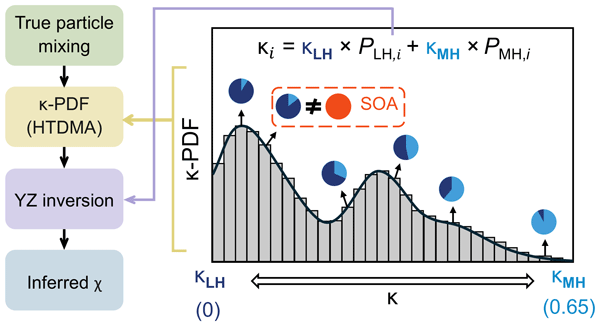
Airborne particles affect clouds, climate, and air quality, but it is difficult to determine how their chemical components are mixed within individual particles. We tested a method that estimates this mixing from water-uptake measurements using detailed computer simulations. The method works well in many cases, but can overestimate particle mixing when moderately water-attracting material exists in separate particle types. We then applied this uncertainty framework to long-term observations.
Xiaotian Xu, Jeffrey H. Curtis, Matthew West, and Nicole Riemer
Atmos. Chem. Phys., 26, 10647–10659, https://doi.org/10.5194/acp-26-10647-2026, https://doi.org/10.5194/acp-26-10647-2026, 2026
Short summary
Short summary
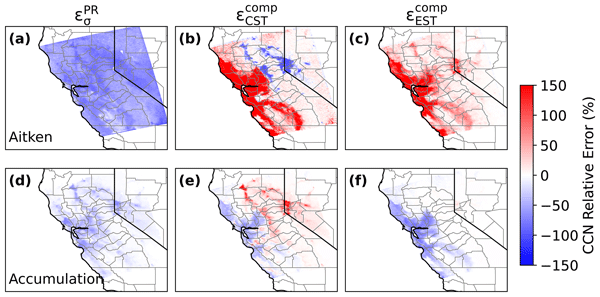
This study examines how common simplifications in atmospheric models affect predictions of particles that form cloud droplets. Using a detailed simulation that tracks individual particles, we compare it with simplified approaches. We find that these simplifications can produce seemingly accurate results because different errors cancel each other. However, this masks incorrect physical processes. Including surfactants effect improves predictions, highlighting a pathway to better climate modeling.
Yicen Liu, Shengqian Zhou, Jian Wang, and Nicole Riemer
EGUsphere, https://doi.org/10.5194/egusphere-2026-4216, https://doi.org/10.5194/egusphere-2026-4216, 2026
Short summary
Short summary
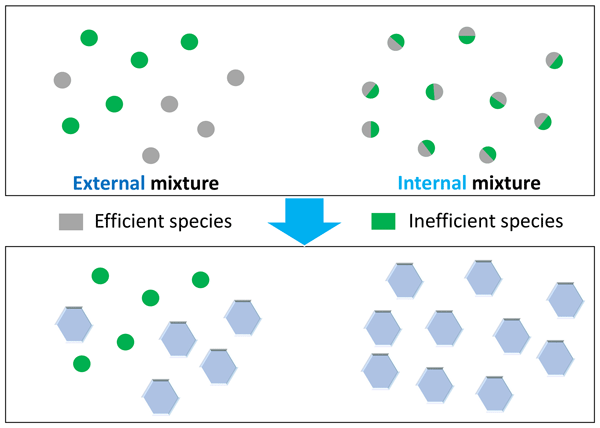
Airborne particles contain different chemicals, and their distribution among particles influences cloud formation and climate. Given limited long-term evidence, we combined measurements from eight locations to examine changes across particle sizes, seasons, and environments. Larger particles were more similar in composition, while smaller particles and those influenced by urban or marine air varied more. The results provide observational benchmarks for improving atmospheric and climate models.
Wenhan Tang, Sylwester Arabas, Jeffrey H. Curtis, Daniel A. Knopf, Matthew West, and Nicole Riemer
Atmos. Chem. Phys., 26, 9221–9255, https://doi.org/10.5194/acp-26-9221-2026, https://doi.org/10.5194/acp-26-9221-2026, 2026
Short summary
Short summary
We studied how aerosol particles help form ice in clouds. Using new theory and detailed computer simulations, we found that the way different materials are mixed within these particles has a strong impact on how much ice forms. When ice-forming material is spread across all particles, more droplets freeze than when it is only in a few. This result means that to better predict clouds and climate, models need to account for how particle materials are mixed.
Oksana Guba, Arjun Sharma, Mark A. Taylor, Christopher Eldred, Peter A. Bosler, and Erika L. Roesler
Geosci. Model Dev., 19, 3375–3394, https://doi.org/10.5194/gmd-19-3375-2026, https://doi.org/10.5194/gmd-19-3375-2026, 2026
Short summary
Short summary
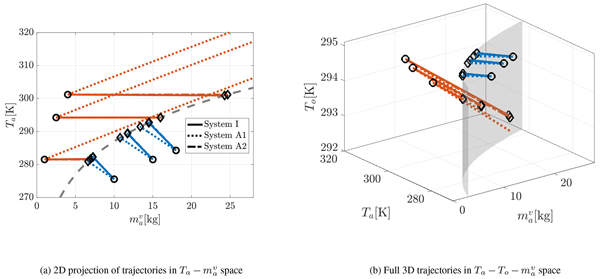
It is important for computational Earth system models to capture interactions between the ocean and the atmosphere accurately. Because of incredible complexity of these interactions, computational models contain simplifications, which may hinder the models' capabilities. Here we focus on detailed analysis of thermodynamic interactions between the ocean and the atmosphere in computational Earth system models. We also provide a framework to show how modeling these interactions can be improved.
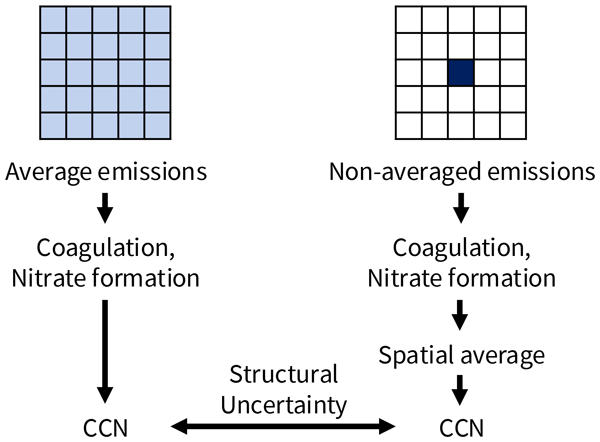
Samuel G. Frederick, Matin Mohebalhojeh, Jeffrey H. Curtis, Matthew West, and Nicole Riemer
Atmos. Chem. Phys., 26, 4863–4883, https://doi.org/10.5194/acp-26-4863-2026, https://doi.org/10.5194/acp-26-4863-2026, 2026
Short summary
Short summary
We show with detailed computer simulations that spatial patterns of emissions strongly affect aerosols and their ability to seed clouds. Highly variable emissions can raise cloud-forming particle concentrations in the boundary layer by up to 25 %. Because clouds regulate climate and precipitation, these findings underscore the need to represent realistic emission patterns to improve climate predictions.
Jerome D. Fast, Balwinder Singh, Oscar Diaz-Ibarra, Jeff Johnson, Chandru Dhandapani, Brian Gaudet, Taufiq Hassan, Meng Huang, Jaelyn Litzinger, James Overfelt, Kyle Pressel, Michael Schmidt, Shuaiqi Tang, Adam C. Varble, Hui Wan, Mingxuan Wu, Kai Zhang, and Po-Lun Ma
EGUsphere, https://doi.org/10.5194/egusphere-2026-1538, https://doi.org/10.5194/egusphere-2026-1538, 2026
Short summary
Short summary
We ported a prognostic representation of aerosols to C++ and integrated it into an Earth system model that runs on powerful GPU supercomputers. The code conversion approach keeps the same detailed physics as the Fortran version, was carefully tested, and results show that new code produces aerosol simulations consistent with real‑world data over the central U.S. in spring 2016. Future work will optimize the code for GPUs so to reduce the overall computational time.
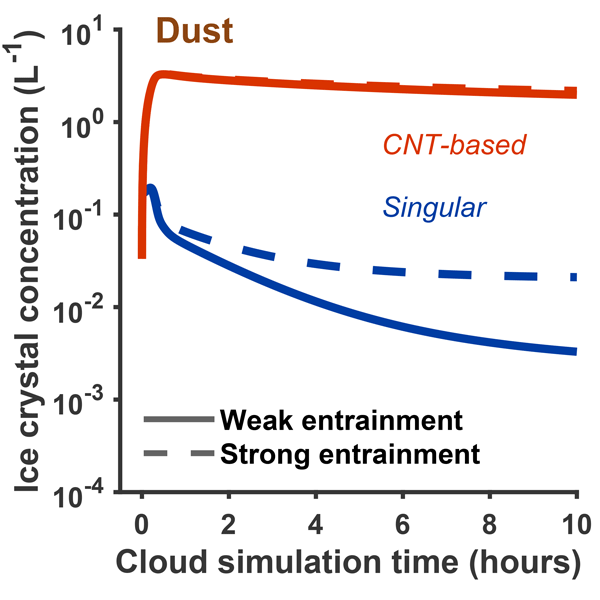
Yijia Sun, Ann M. Fridlind, Israel Silber, Nicole Riemer, and Daniel A. Knopf
Geosci. Model Dev., 19, 1581–1617, https://doi.org/10.5194/gmd-19-1581-2026, https://doi.org/10.5194/gmd-19-1581-2026, 2026
Short summary
Short summary
The role of Arctic clouds in the regional climate remains uncertain due to insufficient understanding of the amount of liquid droplets and ice crystals present in these clouds. An aerosol-cloud model is employed to examine the role of different aerosol types and freezing parameterizations on the number of ice crystals. The choice of freezing parameterization significantly changes the number of ice crystals impacting the interpretation of the evolution and warming effect of Arctic clouds.
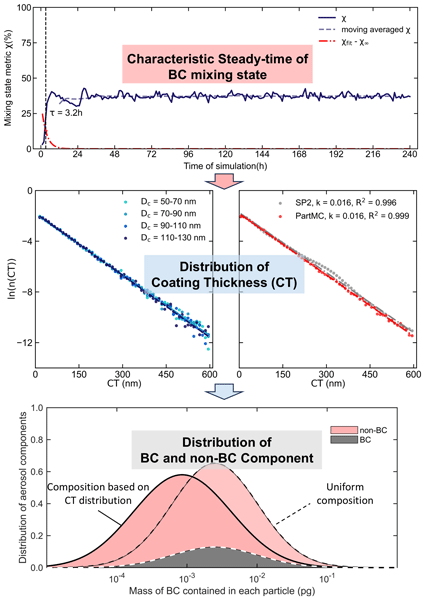
Zhouyang Zhang, Jiandong Wang, Jiaping Wang, Nicole Riemer, Chao Liu, Yuzhi Jin, Zeyuan Tian, Jing Cai, Yueyue Cheng, Ganzhen Chen, Bin Wang, Shuxiao Wang, and Aijun Ding
Atmos. Chem. Phys., 25, 1869–1881, https://doi.org/10.5194/acp-25-1869-2025, https://doi.org/10.5194/acp-25-1869-2025, 2025
Short summary
Short summary
Black carbon (BC) exerts notable warming effects. We use a particle-resolved model to investigate the long-term behavior of the BC mixing state, revealing its compositions, coating thickness distribution, and optical properties all stabilize with a characteristic time of less than 1 d. This study can effectively simplify the description of the BC mixing state, which facilitates the precise assessment of the optical properties of BC aerosols in global and chemical transport models.
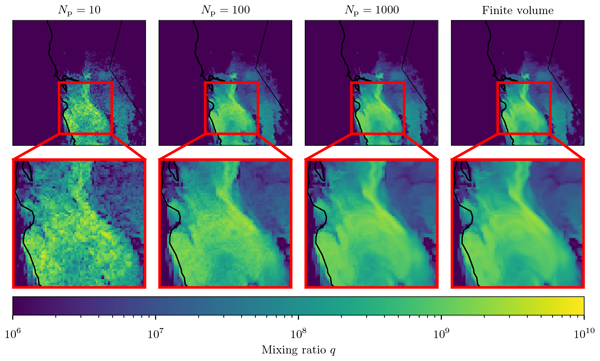
Jeffrey H. Curtis, Nicole Riemer, and Matthew West
Geosci. Model Dev., 17, 8399–8420, https://doi.org/10.5194/gmd-17-8399-2024, https://doi.org/10.5194/gmd-17-8399-2024, 2024
Short summary
Short summary
This paper introduces a numerical method for simulating particle-based aerosol transport in atmospheric models. We detail the various numerical properties of the advection order method and demonstrate its implementation in a 3D weather prediction model (WRF) for the first time. Particle-based techniques improve the accuracy of aerosol size and composition predictions, which are key for aerosol–cloud and aerosol–radiation interactions.
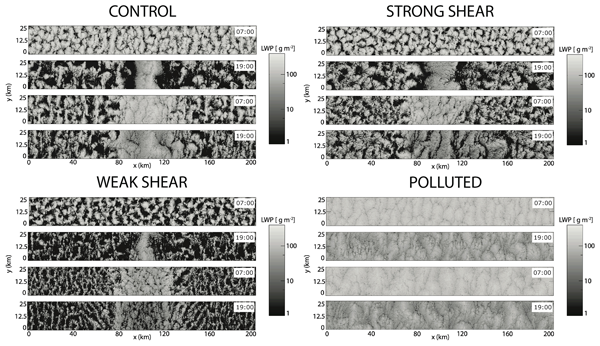
Lucas A. McMichael, Michael J. Schmidt, Robert Wood, Peter N. Blossey, and Lekha Patel
Geosci. Model Dev., 17, 7867–7888, https://doi.org/10.5194/gmd-17-7867-2024, https://doi.org/10.5194/gmd-17-7867-2024, 2024
Short summary
Short summary
Marine cloud brightening (MCB) is a climate intervention technique to potentially cool the climate. Climate models used to gauge regional climate impacts associated with MCB often assume large areas of the ocean are uniformly perturbed. However, a more realistic representation of MCB application would require information about how an injected particle plume spreads. This work aims to develop such a plume-spreading model.
Oksana Guba, Mark A. Taylor, Peter A. Bosler, Christopher Eldred, and Peter H. Lauritzen
Geosci. Model Dev., 17, 1429–1442, https://doi.org/10.5194/gmd-17-1429-2024, https://doi.org/10.5194/gmd-17-1429-2024, 2024
Short summary
Short summary
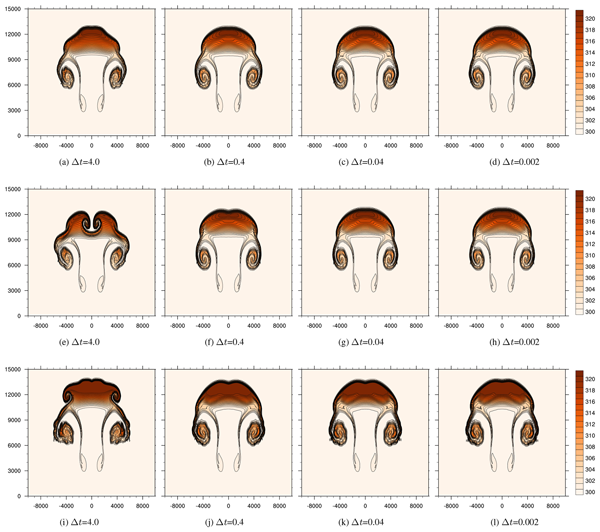
We want to reduce errors in the moist energy budget in numerical atmospheric models. We study a few common assumptions and mechanisms that are used for the moist physics. Some mechanisms are more consistent with the underlying equations. Separately, we study how assumptions about models' thermodynamics affect the modeled energy of precipitation. We also explain how to conserve energy in the moist physics for nonhydrostatic models.
Sudipta Ghosh, Sagnik Dey, Sushant Das, Nicole Riemer, Graziano Giuliani, Dilip Ganguly, Chandra Venkataraman, Filippo Giorgi, Sachchida Nand Tripathi, Srikanthan Ramachandran, Thazhathakal Ayyappen Rajesh, Harish Gadhavi, and Atul Kumar Srivastava
Geosci. Model Dev., 16, 1–15, https://doi.org/10.5194/gmd-16-1-2023, https://doi.org/10.5194/gmd-16-1-2023, 2023
Short summary
Short summary
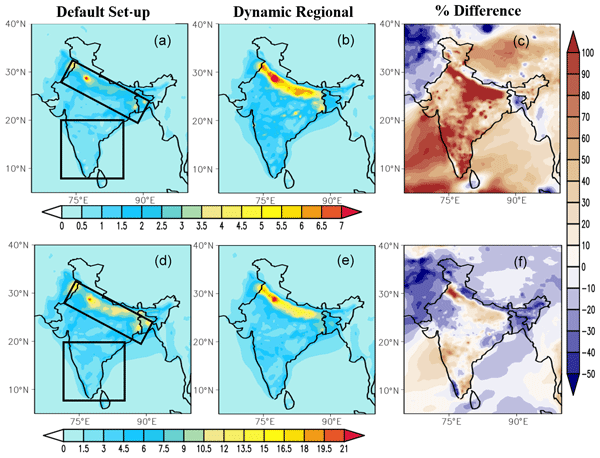
Accurate representation of aerosols in climate models is critical for minimizing the uncertainty in climate projections. Here, we implement region-specific emission fluxes and a more accurate scheme for carbonaceous aerosol ageing processes in a regional climate model (RegCM4) and show that it improves model performance significantly against in situ, reanalysis, and satellite data over the Indian subcontinent. We recommend improving the model performance before using them for climate studies.
Andrew M. Bradley, Peter A. Bosler, and Oksana Guba
Geosci. Model Dev., 15, 6285–6310, https://doi.org/10.5194/gmd-15-6285-2022, https://doi.org/10.5194/gmd-15-6285-2022, 2022
Short summary
Short summary
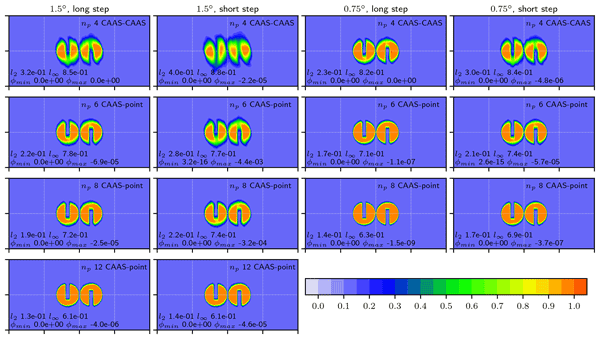
Tracer transport in atmosphere models can be computationally expensive. We describe a flexible and efficient interpolation semi-Lagrangian method, the Islet method. It permits using up to three grids that share an element grid: a dynamics grid for computing quantities such as the wind velocity; a physics parameterizations grid; and a tracer grid. The Islet method performs well on a number of verification problems and achieves high performance in the E3SM Atmosphere Model version 2.
Yu Yao, Jeffrey H. Curtis, Joseph Ching, Zhonghua Zheng, and Nicole Riemer
Atmos. Chem. Phys., 22, 9265–9282, https://doi.org/10.5194/acp-22-9265-2022, https://doi.org/10.5194/acp-22-9265-2022, 2022
Short summary
Short summary
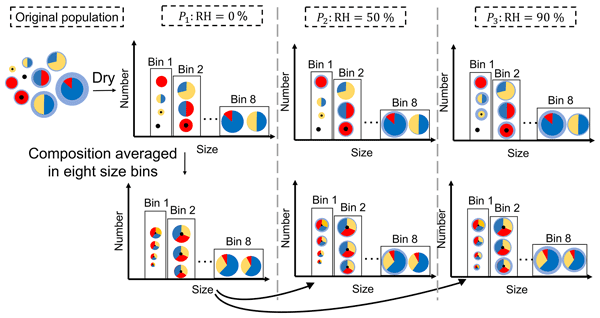
Investigating the impacts of aerosol mixing state on aerosol optical properties has a long history from both the modeling and experimental perspective. In this study, we used particle-resolved simulations as a benchmark to determine the error in optical properties when using simplified aerosol representations. We found that errors in single scattering albedo due to the internal mixture assumptions can have substantial effects on calculating aerosol direct radiative forcing.
Matthew L. Dawson, Christian Guzman, Jeffrey H. Curtis, Mario Acosta, Shupeng Zhu, Donald Dabdub, Andrew Conley, Matthew West, Nicole Riemer, and Oriol Jorba
Geosci. Model Dev., 15, 3663–3689, https://doi.org/10.5194/gmd-15-3663-2022, https://doi.org/10.5194/gmd-15-3663-2022, 2022
Short summary
Short summary
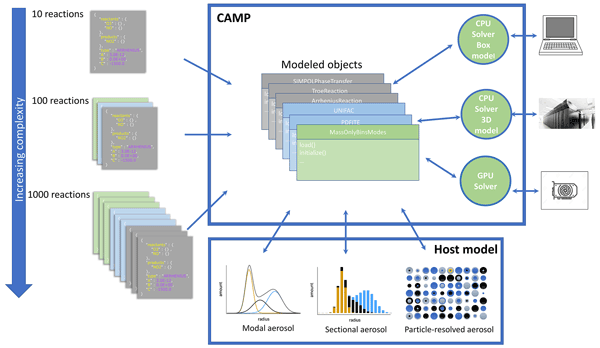
Progress in identifying complex, mixed-phase physicochemical processes has resulted in an advanced understanding of the evolution of atmospheric systems but has also introduced a level of complexity that few atmospheric models were designed to handle. We present a flexible treatment for multiphase chemical processes for models of diverse scale, from box up to global models. This enables users to build a customized multiphase mechanism that is accessible to a much wider community.
Zhonghua Zheng, Matthew West, Lei Zhao, Po-Lun Ma, Xiaohong Liu, and Nicole Riemer
Atmos. Chem. Phys., 21, 17727–17741, https://doi.org/10.5194/acp-21-17727-2021, https://doi.org/10.5194/acp-21-17727-2021, 2021
Short summary
Short summary
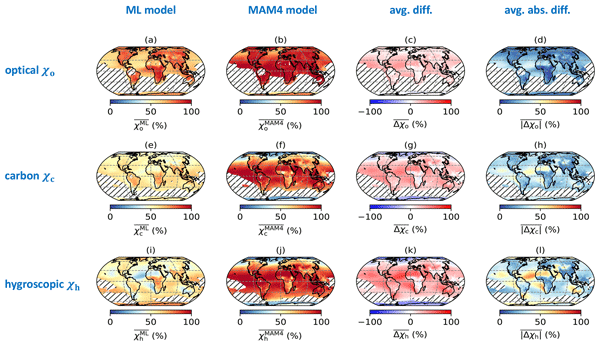
Aerosol mixing state is an important emergent property that affects aerosol radiative forcing and aerosol–cloud interactions, but it has not been easy to constrain this property globally. We present a framework for evaluating the error in aerosol mixing state induced by aerosol representation assumptions, which is one of the important contributors to structural uncertainty in aerosol models. Our study provides insights into potential improvements to model process representation for aerosols.
Cited articles
Alvanos, M. and Christoudias, T.: GPU-accelerated atmospheric chemical kinetics in the ECHAM/MESSy (EMAC) Earth system model (version 2.52), Geoscientific Model Development, 10, 3679–3693, https://doi.org/10.5194/gmd-10-3679-2017, 2017. a
Appel, K. W., Bash, J. O., Fahey, K. M., Foley, K. M., Gilliam, R. C., Hogrefe, C., Hutzell, W. T., Kang, D., Mathur, R., Murphy, B. N., Napelenok, S. L., Nolte, C. G., Pleim, J. E., Pouliot, G. A., Pye, H. O. T., Ran, L., Roselle, S. J., Sarwar, G., Schwede, D. B., Sidi, F. I., Spero, T. L., and Wong, D. C.: The Community Multiscale Air Quality (CMAQ) model versions 5.3 and 5.3.1: system updates and evaluation, Geoscientific Model Development, 14, 2867–2897, https://doi.org/10.5194/gmd-14-2867-2021, 2021. a
Balos, C. J., Gardner, D. J., Woodward, C. S., and Reynolds, D. R.: Enabling GPU accelerated computing in the SUNDIALS time integration library, Parallel Computing, 108, 102836, https://doi.org/10.1016/j.parco.2021.102836, 2021. a, b
Bank, R. E., Coughran, W. M., Fichtner, W., Grosse, E. H., Rose, D. J., and Smith, R. K.: Transient Simulation of Silicon Devices and Circuits, IEEE Transactions on Computer-Aided Design of Integrated Circuits and Systems, 4, 436–451, 1985. a
Bey, I., Jacob, D. J., Yantosca, R. M., Logan, J. A., Field, R. B., Fiore, A. M., Li, Q., Liu, H., Mickley, L. J., and Schultz, M. G.: Global modeling of tropospheric chemistry with assimilated meteorology: Model description and evaluation, Journal of Geophysical Research: Atmospheres, 106, 23073–23095, https://doi.org/10.1029/2001JD000807, 2001. a
Byun, D. W. and Schere, K. L.: Review of the governing equations, computational algorithms, and other components of the Models-3 Community Multiscale Air Quality (CMAQ) modeling system, Applied Mechanics Reviews, 59, 51–77, https://doi.org/10.1115/1.2128636, 2006. a
Cao, K., Wu, Q., Wang, L., Wang, N., Cheng, H., Tang, X., Li, D., and Wang, L.: GPU-HADVPPM V1.0: a high-efficiency parallel GPU design of the piecewise parabolic method (PPM) for horizontal advection in an air quality model (CAMx V6.10), Geoscientific Model Development, 16, 4367–4383, https://doi.org/10.5194/gmd-16-4367-2023, 2023. a
Curtis, J. H., Michelotti, M. D., Riemer, N., Heath, M. T., and West, M.: Accelerated simulation of stochastic particle removal processes in particle-resolved aerosol models, J. Comput. Phys., 322, 21–32, 2016. a
Dawson, M. L., Guzman, C., Curtis, J. H., Acosta, M., Zhu, S., Dabdub, D., Conley, A., West, M., Riemer, N., and Jorba, O.: Chemistry Across Multiple Phases (CAMP) version 1.0: an integrated multiphase chemistry model, Geoscientific Model Development, 15, 3663–3689, https://doi.org/10.5194/gmd-15-3663-2022, 2022. a, b, c, d, e, f
DeVille, L., Riemer, N., and West, M.: Convergence of a generalized Weighted Flow Algorithm for stochastic particle coagulation, Journal of Computational Dynamics, 1–18, https://doi.org/10.3934/jcd.2019003, 2019. a
DeVille, R. E. L., Riemer, N., and West, M.: Weighted Flow Algorithms (WFA) for stochastic particle coagulation, J. Comput. Phys., 230, 8427–8451, 2011. a
Diaz-Ibarra, O. H., Frederick, S., Curtis, J., D'Aquino, Z., Safta, C., West, M., and Riemer, N.: TChem-atm version 2.0.0, Zenodo [code], https://doi.org/10.5281/zenodo.17058144, 2025a. a, b, c, d
Diaz-Ibarra, O. H., Frederick, S., Curtis, J., D'Aquino, Z., Bosler, P., Patel, L., Safta, C., West, M., and Riemer, N.: Data for TChem-atm (v2.0.0): Scalable Performance-Portable Multiphase Atmospheric Chemistry, Zenodo [data set], https://doi.org/10.5281/zenodo.17362352, 2025b. a, b, c, d
Diaz-Ibarra, O. H., Frederick, S., Curtis, J., D'Aquino, Z., Safta, C., West, M., and Riemer, N.: PartMC-TChem-atm, Zenodo [code], https://doi.org/10.5281/zenodo.17309370, 2025c. a, b, c, d
Eastham, S. D., Long, M. S., Keller, C. A., Lundgren, E., Yantosca, R. M., Zhuang, J., Li, C., Lee, C. J., Yannetti, M., Auer, B. M., Clune, T. L., Kouatchou, J., Putman, W. M., Thompson, M. A., Trayanov, A. L., Molod, A. M., Martin, R. V., and Jacob, D. J.: GEOS-Chem High Performance (GCHP v11-02c): a next-generation implementation of the GEOS-Chem chemical transport model for massively parallel applications, Geoscientific Model Development, 11, 2941–2953, https://doi.org/10.5194/gmd-11-2941-2018, 2018. a
Edwards, H. C., Trott, C. R., and Sunderland, D.: Kokkos: Enabling manycore performance portability through polymorphic memory access patterns, Journal of Parallel and Distributed Computing, 74, 3202–3216, 2014. a
Gardner, D. J., Reynolds, D. R., Woodward, C. S., and Balos, C. J.: Enabling new flexibility in the SUNDIALS suite of nonlinear and differential/algebraic equation solvers, ACM Transactions on Mathematical Software (TOMS), 48, 1–24, https://doi.org/10.1145/3539801, 2022. a, b
GitHub: GitHub Actions, https://github.com/features/actions (last access: 30 January 2026), 2025. a
Golaz, J. C., Caldwell, P. M., Van Roekel, L. P., Petersen, M. R., Tang, Q., Wolfe, J. D., Abeshu, G., Anantharaj, V., Asay-Davis, X. S., Bader, D. C., Baldwin, S. A., Bisht, G., Bogenschutz, P. A., Branstetter, M., Brunke, M. A., Brus, S. R., Burrows, S. M., Cameron-Smith, P. J., Donahue, A. S., Deakin, M., Easter, R. C., Evans, K. J., Feng, Y., Flanner, M., Foucar, J. G., Fyke, J. G., Griffin, B. M., Hannay, C., Harrop, B. E., Hoffman, M. J., Hunke, E. C., Jacob, R. L., Jacobsen, D. W., Jeffery, N., Jones, P. W., Keen, N. D., Klein, S. A., Larson, V. E., Leung, L. R., Li, H. Y., Lin, W. Y., Lipscomb, W. H., Ma, P. L., Mahajan, S., Maltrud, M. E., Mametjanov, A., McClean, J. L., McCoy, R. B., Neale, R. B., Price, S. F., Qian, Y., Rasch, P. J., Eyre, J. E. J. R., Riley, W. J., Ringler, T. D., Roberts, A. F., Roesler, E. L., Salinger, A. G., Shaheen, Z., Shi, X. Y., Singh, B., Tang, J. Y., Taylor, M. A., Thornton, P. E., Turner, A. K., Veneziani, M., Wan, H., Wang, H. L., Wang, S. L., Williams, D. N., Wolfram, P. J., Worley, P. H., Xie, S. C., Yang, Y., Yoon, J. H., Zelinka, M. D., Zender, C. S., Zeng, X. B., Zhang, C. Z., Zhang, K., Zhang, Y., Zheng, X., Zhou, T., and Zhu, Q.: The DOE E3SM Coupled Model Version 1: Overview and Evaluation at Standard Resolution, Journal of Advances in Modeling Earth Systems, 11, 2089–2129, https://doi.org/10.1029/2018MS001603, 2019. a
Hindmarsh, A. C., Brown, P. N., Grant, K. E., Lee, S. L., Serban, R., Shumaker, D. E., and Woodward, C. S.: SUNDIALS: Suite of nonlinear and differential/algebraic equation solvers, ACM Transactions on Mathematical Software (TOMS), 31, 363–396, https://doi.org/10.1145/1089014.1089020, 2005. a, b
Hodzic, A., Mahowald, N., Dawson, M., Johnson, J., Bernardet, L., Bosler, P. A., Fast, J. D., Fierce, L., Liu, X., Ma, P.-L., Murphy, B., Riemer, N., and Schulz, M.: Generalized Aerosol/Chemistry Interface (GIANT): A Community Effort to Advance Collaborative Science across Weather and Climate Models, Bulletin of the American Meteorological Society, 104, E2065–E2080, 2023. a, b
Kim, K., Díaz-Ibarra, O. H., Najm, H. N., Zádor, J., and Safta, C.: TChem: A performance portable parallel software toolkit for complex kinetic mechanisms, Computer Physics Communications, 285, 108628, https://doi.org/10.1016/j.cpc.2022.108628, 2023. a, b, c, d
Phipps, E. T., Pawlowski, R. P., and Trott, C. R.: Automatic Differentiation of C++ Codes on Emerging Manycore Architectures with Sacado, Tech. Rep. SAND2020-8010C, Sandia National Laboratories, https://doi.org/10.1145/3560262, 2020. a, b
Pye, H. O. T., Place, B. K., Murphy, B. N., Seltzer, K. M., D'Ambro, E. L., Allen, C., Piletic, I. R., Farrell, S., Schwantes, R. H., Coggon, M. M., Saunders, E., Xu, L., Sarwar, G., Hutzell, W. T., Foley, K. M., Pouliot, G., Bash, J., and Stockwell, W. R.: Linking gas, particulate, and toxic endpoints to air emissions in the Community Regional Atmospheric Chemistry Multiphase Mechanism (CRACMM), Atmospheric Chemistry and Physics, 23, 5043–5099, https://doi.org/10.5194/acp-23-5043-2023, 2023. a
Quevedo, D., Do, K., Delic, G., Rodríguez-Borbón, J., Wong, B. M., and Ivey, C. E.: GPU Implementation of a Gas-Phase Chemistry Solver in the CMAQ Chemical Transport Model, ACS ES&T Air, https://doi.org/10.1021/acsestair.4c00181, 2025. a
Rasch, P., Xie, S., Ma, P.-L., Lin, W., Wang, H., Tang, Q., Burrows, S., Caldwell, P., Zhang, K., Easter, R., Cameron-Smith, P., Singh, B., Wan, H., Golaz, J.-C., Harrop, B. E., Roesler, E., Bacmeister, J., Larson, V. E., Evans, K. J., Qian, Y., Taylor, M., Leung, L. R., Zhang, Y., Brent, L., Branstetter, M., Hannay, C., Mahajan, S., Mametjanov, A., Neale, R., Richter, J. H., Yoon, J.-H., Zender, C. S., Bader, D., Flanner, M., Foucar, J. G., Jacob, R., Keen, N., Klein, S. A., Liu, X., Salinger, A., Shrivastava, M., and Yang, Y.: An Overview of the Atmospheric Component of the Energy Exascale Earth System Model (E3SM), Journal of Advances in Modeling Earth Systems, 11, 2377–2410, https://doi.org/10.1029/2019MS001629, 2019. a
Riemer, N., West, M., Zaveri, R. A., and Easter, R. C.: Simulating the evolution of soot mixing state with a particle-resolved aerosol model, Journal of Geophysical Research: Atmospheres, 114, D09202, https://doi.org/10.1029/2008JD011073, 2009. a
Ruiz, C. G., Acosta, M., Jorba, O., Galobardes, E. C., Dawson, M., Oyarzun, G., García-Pando, C. P., and Serradell, K.: Optimized thread-block arrangement in a GPU implementation of a linear solver for atmospheric chemistry mechanisms, Computer Physics Communications, 302, 109240, https://doi.org/10.1016/j.cpc.2024.109240, 2024. a
Salane, D. E.: Adaptive routines for forming Jacobians numerically, SAND86, https://www.osti.gov/biblio/5271352 (last access: 30 January 2026), 1986. a
Sun, J., Fu, J. S., Drake, J. B., Zhu, Q., Haidar, A., Gates, M., Tomov, S., and Dongarra, J.: Computational benefit of GPU optimization for the atmospheric chemistry modeling, Journal of Advances in Modeling Earth Systems, 10, 1952–1969, 2018. a
Taylor, M., Caldwell, P. M., Bertagna, L., Clevenger, C., Donahue, A., Foucar, J., Guba, O., Hillman, B., Keen, N., Krishna, J., Norman, M., Sreepathi, S., Terai, C., White, J. B., Salinger, A. G., McCoy, R. B., Leung, L.-Y. R., Bader, D. C., and Wu, D.: The simple cloud-resolving E3SM atmosphere model running on the Frontier exascale system, in: Proceedings of the International Conference for High Performance Computing, Networking, Storage and Analysis, 1–11, 2023. a
Trott, C. R., Lebrun-Grandié, D., Arndt, D., Ciesko, J., Dang, V., Ellingwood, N., Gayatri, R., Harvey, E., Hollman, D. S., Ibanez, D., Liber, N., Madsen, J., Miles, J., Poliakoff, D., Powell, A., Rajamanickam, S., Simberg, M., Sunderland, D., Turcksin, B., and Wilke, J.: Kokkos 3: Programming model extensions for the exascale era, IEEE Transactions on Parallel and Distributed Systems, 33, 805–817, 2021. a
Trott, C. R., Lebrun-Grandié, D., Arndt, D., Ciesko, J., Dang, V., Ellingwood, N., Gayatri, R., Harvey, E., Hollman, D. S., Ibanez, D., Liber, N., Madsen, J., Miles, J., Poliakoff, D., Powell, A., Rajamanickam, S., Simberg, M., Sunderland, D., Turcksin, B., and Wilke, J.: Kokkos 3: Programming Model Extensions for the Exascale Era, IEEE Transactions on Parallel and Distributed Systems, 33, 805–817, https://doi.org/10.1109/TPDS.2021.3097283, 2022. a
Tsigaridis, K. and Kanakidou, M.: Secondary organic aerosol importance in the future atmosphere, Atmospheric Environment, 41, 4682–4692, https://doi.org/10.1016/j.atmosenv.2007.03.045, 2007.
Whitby, E. R. and McMurry, P. H.: Modal aerosol dynamics modeling, Aerosol Science and Technology, 27, 673–688, 1997. a
Short summary
We developed TChem-atm, a new open-source tool for simulating atmospheric chemistry and aerosols. As models become more detailed, traditional methods are too slow. TChem-atm runs on both standard processors and graphics processors, making these simulations faster and more efficient. The tool provides a foundation for next-generation models that improve predictions of air quality and climate.
We developed TChem-atm, a new open-source tool for simulating atmospheric chemistry and...


