Articles | Volume 19, issue 22
https://doi.org/10.5194/gmd-19-11337-2026
© Author(s) 2026. This work is distributed under
the Creative Commons Attribution 4.0 License.
https://doi.org/10.5194/gmd-19-11337-2026
© Author(s) 2026. This work is distributed under
the Creative Commons Attribution 4.0 License.
Convolution based techniques for computing self attraction and loading in MOM6

Department of Mathematics, University of Michigan, Ann Arbor, MI, USA
Department of Mathematics, National University of Singapore, Singapore
He Wang
Department of Earth and Environmental Sciences, University of Michigan, Ann Arbor, MI, USA
UCAR, Boulder, CO, USA
NOAA-GFDL, Princeton, NJ, USA
Brian K. Arbic
Department of Earth and Environmental Sciences, University of Michigan, Ann Arbor, MI, USA
Research School of Earth Sciences, Australian National University, Canberra, ACT, Australia
Robert Krasny
Department of Mathematics, University of Michigan, Ann Arbor, MI, USA
Related authors
No articles found.
Joseph K. Ansong, Brian K. Arbic, Romain Bourdalle-Badié, Clément Bricaud, Jérôme Chanut, Dimitris Menemenlis, Richard D. Ray, Michael Schindelegger, Alan J. Wallcraft, He Wang, Alistair J. Adcroft, Frédéric Briol, Maarten C. Buijsman, Loren Carrère, Eric P. Chassignet, Gerald Dibarboure, Robert W. Hallberg, Christopher N. Hill, Ariane Koch-Larrouy, Florent Lyard, Matthew R. Mazloff, An T. Nguyen, Nicolas Picot, Rui M. Ponte, and Jay F. Shriver
EGUsphere, https://doi.org/10.5194/egusphere-2026-5064, https://doi.org/10.5194/egusphere-2026-5064, 2026
Short summary
Short summary
We assess how well four high-resolution global ocean models reproduce surface and internal tides compared with satellite observations. Some models produce internal tides that are too strong, but including energy loss over rough seafloor improves their accuracy. Longer model records and higher resolution also improve agreement with observations. We further identify errors in the tidal forcing of widely used MITgcm simulations that reduce the accuracy of their simulated tides.
Rémi Laxenaire, Eric P. Chassignet, Xiaobiao Xu, Alan J. Wallcraft, Luna Hiron, Brian K. Arbic, Maarten C. Buijsman, Miguel Solano, and Shane Elipot
Geosci. Model Dev., 19, 5571–5599, https://doi.org/10.5194/gmd-19-5571-2026, https://doi.org/10.5194/gmd-19-5571-2026, 2026
Short summary
Short summary
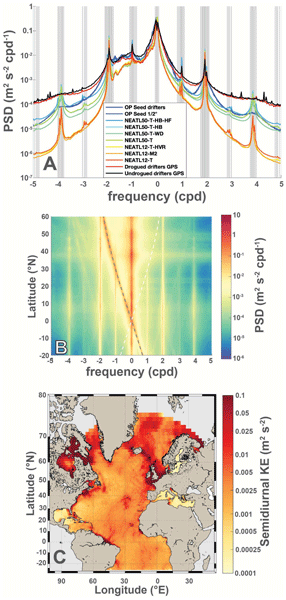
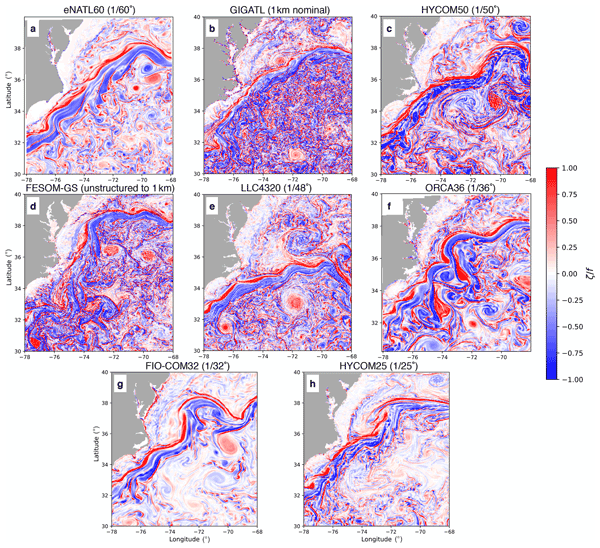
Surface kinetic energy reflects the distribution of ocean circulation across temporal and spatial scales, shaping energy transfer and mixing in the upper ocean. In a series of North and Equatorial Atlantic numerical simulations, we show that the surface kinetic energy is sensitive to the model's choices in grid and seafloor resolution and to the tides and wind variability, offering guidance for the configuration of future ocean simulations.
Meena Raju, David J. Cannon, Peter Alsip, He Wang, Jia Wang, Theresa Cordero, Robert W. Hallberg, Charles A. Stock, and Joseph A. Langan
Geosci. Model Dev., 19, 4331–4356, https://doi.org/10.5194/gmd-19-4331-2026, https://doi.org/10.5194/gmd-19-4331-2026, 2026
Short summary
Short summary
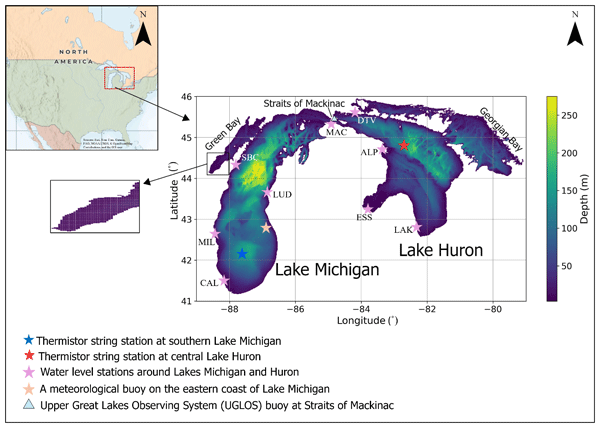
This study developed the Modular Ocean Model version 6.0 coupled with Sea Ice Simulator version 2.0 for the Great Lakes, validated against observations and an operational model. This study also tested two vertical coordinate systems, z* and hybrid. The model reproduced lake physics with good skill. The hybrid vertical coordinate improved thermocline representation and preserved deep cold-water during stratification, demonstrating the model’s suitability for large freshwater systems.
Michel Tchilibou, Loren Carrere, Florent Lyard, Clément Ubelmann, Gérald Dibarboure, Edward D. Zaron, and Brian K. Arbic
Ocean Sci., 21, 325–342, https://doi.org/10.5194/os-21-325-2025, https://doi.org/10.5194/os-21-325-2025, 2025
Short summary
Short summary
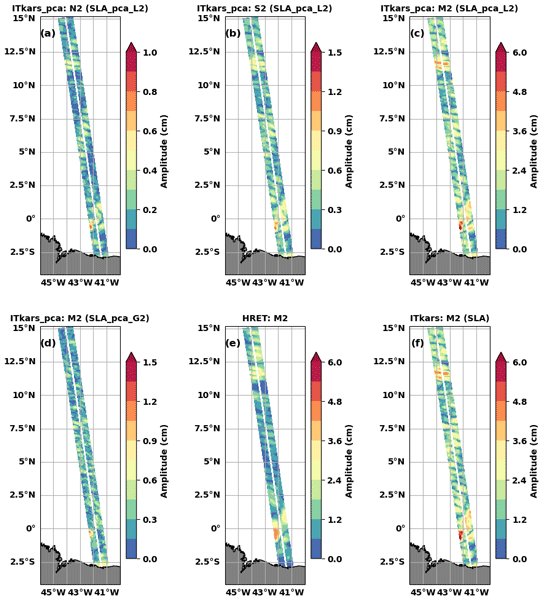
Sea level observations along the swaths of the new SWOT (Surface Water and Ocean Topography) mission were used to characterize internal tides at three semidiurnal frequencies off the Amazon shelf in the tropical Atlantic during the SWOT calibration/validation period. The atlases were derived using harmonic analysis and principal component analysis. The SWOT-derived internal tide atlas outperforms the reference atlas previously used to correct SWOT observations.
Gaspard Geoffroy, Jonas Nycander, Maarten C. Buijsman, Jay F. Shriver, and Brian K. Arbic
Ocean Sci., 19, 811–835, https://doi.org/10.5194/os-19-811-2023, https://doi.org/10.5194/os-19-811-2023, 2023
Short summary
Short summary
The ocean state is sensitive to the mixing originating from internal tides (ITs). To date, our knowledge of the magnitude and spatial distribution of this mixing mostly relies on uncertain modeling. Here, we use novel observations from autonomous floats to validate the spatial variability in the semidiurnal IT in a realistic ocean simulation. The numerical simulation is found to correctly reproduce the main spatial patterns of the observed tidal energy but to be biased low at the global scale.
Nairita Pal, Kristin N. Barton, Mark R. Petersen, Steven R. Brus, Darren Engwirda, Brian K. Arbic, Andrew F. Roberts, Joannes J. Westerink, and Damrongsak Wirasaet
Geosci. Model Dev., 16, 1297–1314, https://doi.org/10.5194/gmd-16-1297-2023, https://doi.org/10.5194/gmd-16-1297-2023, 2023
Short summary
Short summary
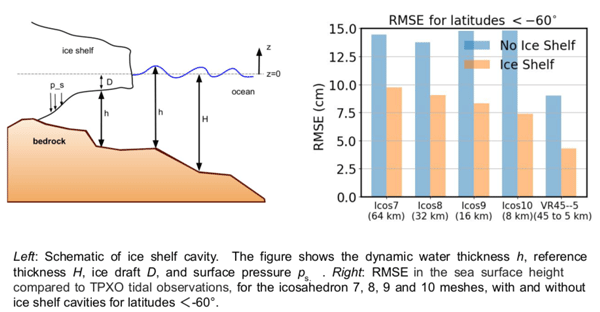
Understanding tides is essential to accurately predict ocean currents. Over the next several decades coastal processes such as flooding and erosion will be severely impacted due to climate change. Tides affect currents along the coastal regions the most. In this paper we show the results of implementing tides in a global ocean model known as MPAS–Ocean. We also show how Antarctic ice shelf cavities affect global tides. Our work points towards future research with tide–ice interactions.
Takaya Uchida, Julien Le Sommer, Charles Stern, Ryan P. Abernathey, Chris Holdgraf, Aurélie Albert, Laurent Brodeau, Eric P. Chassignet, Xiaobiao Xu, Jonathan Gula, Guillaume Roullet, Nikolay Koldunov, Sergey Danilov, Qiang Wang, Dimitris Menemenlis, Clément Bricaud, Brian K. Arbic, Jay F. Shriver, Fangli Qiao, Bin Xiao, Arne Biastoch, René Schubert, Baylor Fox-Kemper, William K. Dewar, and Alan Wallcraft
Geosci. Model Dev., 15, 5829–5856, https://doi.org/10.5194/gmd-15-5829-2022, https://doi.org/10.5194/gmd-15-5829-2022, 2022
Short summary
Short summary
Ocean and climate scientists have used numerical simulations as a tool to examine the ocean and climate system since the 1970s. Since then, owing to the continuous increase in computational power and advances in numerical methods, we have been able to simulate increasing complex phenomena. However, the fidelity of the simulations in representing the phenomena remains a core issue in the ocean science community. Here we propose a cloud-based framework to inter-compare and assess such simulations.
Cited articles
Accad, Y. and Pekeris, C. L.: Solution of the tidal equations for the M2 and S2 tides in the world oceans from a knowledge of the tidal potential alone, Philos. T. R. Soc. S.-A, 290, 235–266, 1978. a
Adcroft, A., Anderson, W., Balaji, V., Blanton, C., Bushuk, M., Dufour, C. O., Dunne, J. P., Griffies, S. M., Hallberg, R., Harrison, M. J., and Held, I. M.: The GFDL global ocean and sea ice model OM4.0: Model description and simulation features, J. Adv. Model. Earth Sy., 11, 3167–3211, 2019. a
Arbic, B. K.: Incorporating tides and internal gravity waves within global ocean general circulation models: A review, Prog. Oceanogr., 206, 102824, https://doi.org/10.1016/j.pocean.2022.102824, 2022. a
Arbic, B. K., St-Laurent, P., Sutherland, G., and Garrett, C.: On the resonance and influence of the tides in Ungava Bay and Hudson Strait, Geophys. Res. Lett., 34, https://doi.org/10.1029/2007GL030845, 2007. a, b
Arbic, B. K., Wallcraft, A. J., and Metzger, E. J.: Concurrent simulation of the eddying general circulation and tides in a global ocean model, Ocean Model., 32, 175–187, 2010. a
Barnes, J. and Hut, P.: A hierarchical O(NlogN) force-calculation algorithm, Nature, 324, 446–449, 1986. a
Barton, K. N., Pal, N., Brus, S. R., Petersen, M. R., Arbic, B. K., Engwirda, D., Roberts, A. F., Westerink, J. J., Wirasaet, D., and Schindelegger, M.: Global barotropic tide modeling using inline self-attraction and loading in MPAS-Ocean, J. Adv. Model. Earth Sy., 14, e2022MS003207, https://doi.org/10.1029/2022MS003207, 2022. a, b, c
Berrut, J.-P. and Trefethen, L. N.: Barycentric Lagrange interpolation, SIAM Rev., 46, 501–517, 2004. a
Brus, S. R., Barton, K. N., Pal, N., Roberts, A. F., Engwirda, D., Petersen, M. R., Arbic, B. K., Wirasaet, D., Westerink, J. J., and Schindelegger, M.: Scalable self attraction and loading calculations for unstructured ocean tide models, Ocean Model., 182, 102160, https://doi.org/10.1016/j.ocemod.2023.102160, 2023. a, b, c, d
Buijsman, M. C., Arbic, B. K., Green, J., Helber, R. W., Richman, J. G., Shriver, J. F., Timko, P., and Wallcraft, A.: Optimizing internal wave drag in a forward barotropic model with semidiurnal tides, Ocean Model., 85, 42–55, 2015. a
Chen, A. and Krasny, R.: A Cubed Sphere Fast Multipole Method, arXiv [preprint], https://doi.org/10.48550/arXiv.2508.13550, 2025. a, b, c
Chen, A. and Wang, H.: Convolution Based Self Attraction and Loading in MOM6, Zenodo [code], https://doi.org/10.5281/zenodo.18445619, 2026. a
Computational and Information Systems Laboratory: Derecho: HPE Cray EX System (University Community Computing), NSF: National Center for Atmospheric Research, Boulder, CO, https://doi.org/10.5065/qx9a-pg09, 2023. a
Cummins, P. F. and Oey, L.-Y.: Simulation of barotropic and baroclinic tides off northern British Columbia, J. Phys. Oceanogr., 27, 762–781, 1997. a
Desai, S. D. and Ray, R. D.: Consideration of tidal variations in the geocenter on satellite altimeter observations of ocean tides, Geophys. Res. Lett., 41, 2454–2459, 2014. a
Egbert, G. D., Bennett, A. F., and Foreman, M. G.: TOPEX/POSEIDON tides estimated using a global inverse model, J. Geophys. Res.-Oceans, 99, 24821–24852, 1994. a
Egbert, G. D., Ray, R. D., and Bills, B. G.: Numerical modeling of the global semidiurnal tide in the present day and in the last glacial maximum, J. Geophys. Res., 109, C03003, https://doi.org/10.1029/2003JC001973, 2004. a
Erofeeva, S. and Egbert, G. D.: TPXO9 – a new global tidal model in TPXO series, in: Ocean Sciences Meeting, American Geophysical Union, PL34C-186, 2018. a
Farrell, W. E.: A discussion on the measurement and interpretation of changes of strain in the Earth-Earth tides, ocean tides and tidal loading, Philos. T. R. Soc. S.-A, 274, 253–259, 1973. a
Gordeev, R., Kagan, B., and Polyakov, E.: The effects of loading and self-attraction on global ocean tides: The model and the results of a numerical experiment, J. Phys. Oceanogr., 7, 161–170, 1977. a
Gottlieb, D. and Shu, C.-W.: On the Gibbs phenomenon and its resolution, SIAM Rev., 39, 644–668, 1997. a
Gradshteyn, I. S. and Ryzhik, I. M.: Table of integrals, series, and products, Academic press, ISBN 9781483265643, 2014. a
Greengard, L. and Rokhlin, V.: A fast algorithm for particle simulations, J. Comput. Phys., 73, 325–348, 1987. a
Irazoqui Apecechea, M., Verlaan, M., Zijl, F., Le Coz, C., and Kernkamp, H.: Effects of self-attraction and loading at a regional scale: a test case for the Northwest European Shelf, Ocean Dynam., 67, 729–749, 2017. a
Jayne, S. R. and St. Laurent, L. C.: Parameterizing tidal dissipation over rough topography, Geophys. Res. Lett., 28, 811–814, 2001. a
Jekeli, C.: Spherical harmonic analysis, aliasing, and filtering, J. Geodesy, 70, 214–223, 1996. a
Kang, S. K., Foreman, M. G., Lie, H.-J., Lee, J.-H., Cherniawsky, J., and Yum, K.-D.: Two-layer tidal modeling of the Yellow and East China Seas with application to seasonal variability of the M2 tide, J. Geophys. Res.-Oceans, 107, 6-1–6-19, https://doi.org/10.1029/2001JC000838, 2002. a
Le Provost, C., Genco, M., Lyard, F., Vincent, P., and Canceil, P.: Spectroscopy of the world ocean tides from a finite element hydrodynamic model, J. Geophys. Res.-Oceans, 99, 24777–24797, 1994. a
Merriam, J.: The series computation of the gravitational perturbation due to an ocean tide, Phys. Earth Planet. In., 23, 81–86, 1980. a
Merrifield, M. A., Holloway, P. E., and Johnston, T. S.: The generation of internal tides at the Hawaiian Ridge, Geophys. Res. Lett., 28, 559–562, 2001. a
Müller, M., Haak, H., Jungclaus, J. H., Sündermann, J., and Thomas, M.: The effect of ocean tides on a climate model simulation, Ocean Model., 35, 304–313, 2010. a
Munk, W. and Wunsch, C.: Abyssal recipes II: Energetics of tidal and wind mixing, Deep-Sea Res. Pt. I, 45, 1977–2010, 1998. a
Pagiatakis, S. D.: The response of a realistic Earth to ocean tide loading, Geophys. J. Int., 103, 541–560, 1990. a
Parke, M. E. and Hendershott, M. C.: M2, S2, K1 models of the global ocean tide on an elastic Earth, Mar. Geod., 3, 379–408, 1980. a
Ray, R. D.: Global ocean tide models on the eve of TOPEX/POSEIDON, IEEE T. Geosci. Remote Sens., 31, 355–364, 1993. a
Ray, R. D.: Ocean self-attraction and loading in numerical tidal models, Mar. Geod., 21, 181–192, 1998. a
Rocha, C. B., Chereskin, T. K., Gille, S. T., and Menemenlis, D.: Mesoscale to submesoscale wavenumber spectra in Drake Passage, J. Phys. Oceanogr., 46, 601–620, 2016. a
Sansò, F.: On the aliasing problem in the spherical harmonic analysis, B. Géod., 64, 313–330, 1990. a
Scherneck, H.-G.: A parametrized solid Earth tide model and ocean tide loading effects for global geodetic baseline measurements, Geophys. J. Int., 106, 677–694, 1991. a
Schiller, A. and Fiedler, R.: Explicit tidal forcing in an ocean general circulation model, Geophys. Res. Lett., 34, https://doi.org/10.1029/2006GL028363, 2007. a
Schwiderski, E. W.: On charting global ocean tides, Rev. Geophys., 18, 243–268, https://doi.org/10.1029/RG018i001p00243, 1980. a
Shriver, J., Arbic, B. K., Richman, J., Ray, R. D., Metzger, E., Wallcraft, A., and Timko, P.: An evaluation of the barotropic and internal tides in a high-resolution global ocean circulation model, J. Geophys. Res.-Oceans, 117, https://doi.org/10.1029/2012JC008170, 2012. a
Shum, C., Woodworth, P., Andersen, O., Egbert, G. D., Francis, O., King, C., Klosko, S., Le Provost, C., Li, X., Molines, J.-M., and Parke, M. E.: Accuracy assessment of recent ocean tide models, J. Geophys. Res.-Oceans, 102, 25173–25194, 1997. a
Simpson, J. H. and Hunter, J.: Fronts in the Irish sea, Nature, 250, 404–406, 1974. a
Stepanov, V. N. and Hughes, C. W.: Parameterization of ocean self-attraction and loading in numerical models of the ocean circulation, J. Geophys. Res.-Oceans, 109, https://doi.org/10.1029/2003JC002034, 2004. a, b
Thomas, M., Sündermann, J., and Maier-Reimer, E.: Consideration of ocean tides in an OGCM and impacts on subseasonal to decadal polar motion excitation, Geophys. Res. Lett., 28, 2457–2460, 2001. a
Wang, H., Hallberg, R., Wallcraft, A. J., Arbic, B. K., and Chassignet, E. P.: Improving global barotropic tides with sub-grid scale topography, J. Adv. Model. Earth Syst., 16, e2023MS004056, https://doi.org/10.1029/2023MS004056, 2024. a, b, c
Waterhouse, A. F., MacKinnon, J. A., Nash, J. D., Alford, M. H., Kunze, E., Simmons, H. L., Polzin, K. L., St. Laurent, L. C., Sun, O. M., Pinkel, R., and Talley, L. D.: Global patterns of diapycnal mixing from measurements of the turbulent dissipation rate, J. Phys. Oceanogr., 44, 1854–1872, 2014. a
Weyl, H.: Die gibbs'sche erscheinung in der theorie der kugelfunktionen, Rendiconti del Circolo Matematico di Palermo (1884–1940), 29, 308–323, 1910. a
Short summary
Self Attraction and Loading (SAL) is an important force that affects many oceanic motions, including tides. Computing SAL is challenging and ocean models neglected to include the impacts of SAL for a long time. Recent work has proposed a method for incorporating the effects of SAL, but the method has several limitations that limit the accuracy. This work proposes an alternative method. Tests of this new method in an ocean model indicate that it reduces the amount of error in the modeled tides.
Self Attraction and Loading (SAL) is an important force that affects many oceanic motions,...
Altmetrics
Final-revised paper
Preprint