
Articles | Volume 19, issue 20
https://doi.org/10.5194/gmd-19-10185-2026
© Author(s) 2026. This work is distributed under
the Creative Commons Attribution 4.0 License.
the Creative Commons Attribution 4.0 License.
Special issue:
https://doi.org/10.5194/gmd-19-10185-2026
© Author(s) 2026. This work is distributed under
the Creative Commons Attribution 4.0 License.
the Creative Commons Attribution 4.0 License.
Model description paper
| 
27 Oct 2026
Model description paper |
| 27 Oct 2026
| 27 Oct 2026
Stochastic homogeneous freezing of supercooled droplets in mixed-phase clouds in particle-based idealised microphysics framework (exemplified with PySDM v3.0)
Tim Lüttmer
CORRESPONDING AUTHOR

Institute for Atmospheric Physics, Johannes Gutenberg University Mainz, Mainz, Germany
Sylwester Arabas
Faculty of Physics and Applied Computer Science, AGH University of Krakow, Kraków, Poland
Peter Spichtinger
Institute for Atmospheric Physics, Johannes Gutenberg University Mainz, Mainz, Germany
Related authors
Tim Lüttmer, Annette Miltenberger, and Peter Spichtinger
EGUsphere, https://doi.org/10.5194/egusphere-2026-5375, https://doi.org/10.5194/egusphere-2026-5375, 2026
This preprint is open for discussion and under review for Atmospheric Chemistry and Physics (ACP).
Short summary
Short summary
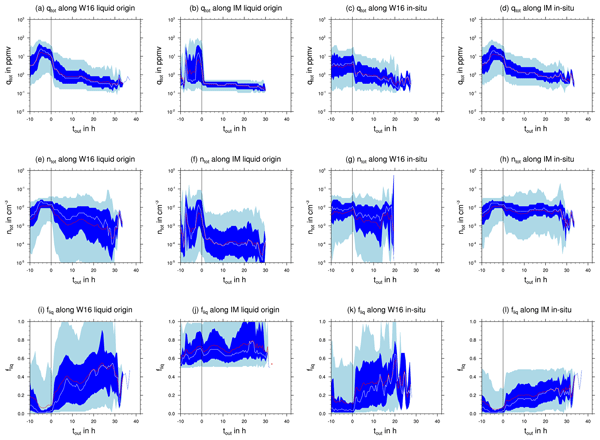
Moist air rising rapidly in cyclones produces ice clouds. Uncertain assumptions about ice-nucleating particles strongly affect ice formation. Ice formed by freezing of droplets and ice formed directly from vapor mix as they fall.
Tim Lüttmer, Annette Miltenberger, and Peter Spichtinger
Atmos. Chem. Phys., 25, 10245–10265, https://doi.org/10.5194/acp-25-10245-2025, https://doi.org/10.5194/acp-25-10245-2025, 2025
Short summary
Short summary
We investigate ice formation pathways in a warm conveyor belt case study. We employ a multi-phase microphysics scheme that distinguishes between ice from different nucleation processes. Ice crystals in the cirrus outflow mostly stem from in situ formation. Hence, they were formed directly from the vapor phase. Sedimentational redistribution modulates cirrus properties and leads to disagreement between cirrus origin classifications based on thermodynamic history and nucleation processes.
Tim Lüttmer, Peter Spichtinger, and Axel Seifert
Atmos. Chem. Phys., 25, 4505–4529, https://doi.org/10.5194/acp-25-4505-2025, https://doi.org/10.5194/acp-25-4505-2025, 2025
Short summary
Short summary
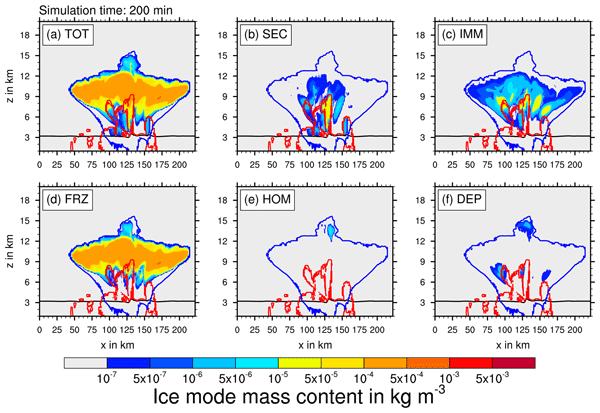
We investigate ice formation pathways in idealized convective clouds using a novel microphysics scheme that distinguishes between five ice classes each with their own unique formation mechanism. Ice crystals from rime splintering form the lowermost layer of ice crystals around the updraft core. The majority of ice crystals in the anvil of the convective cloud stems from frozen droplets. Ice stemming from homogeneous and deposition nucleation was only relevant in the overshoot.
Tim Lüttmer, Annette Miltenberger, and Peter Spichtinger
EGUsphere, https://doi.org/10.5194/egusphere-2026-5375, https://doi.org/10.5194/egusphere-2026-5375, 2026
This preprint is open for discussion and under review for Atmospheric Chemistry and Physics (ACP).
Short summary
Short summary
Moist air rising rapidly in cyclones produces ice clouds. Uncertain assumptions about ice-nucleating particles strongly affect ice formation. Ice formed by freezing of droplets and ice formed directly from vapor mix as they fall.
Helena Zoe Schuh, Philipp Reutter, Stefan Niebler, and Peter Spichtinger
Atmos. Chem. Phys., 26, 11235–11253, https://doi.org/10.5194/acp-26-11235-2026, https://doi.org/10.5194/acp-26-11235-2026, 2026
Short summary
Short summary
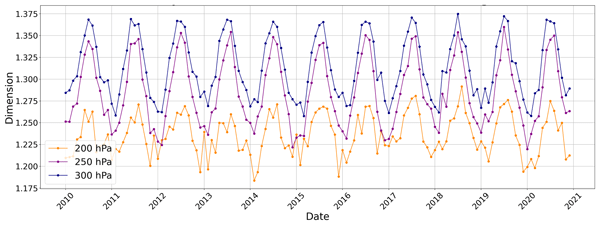
We studied ice-supersaturated regions in the upper troposphere and lower stratosphere where high humidity can lead to cloud and contrail formation. Using data from 2010 to 2020, we found these regions to have fractal characteristics by applying an area-perimeter method. The fractal dimension follows a seasonal cycle. Our results can help evaluate climate models and have possible implications on contrail mitigation.
Sylwester Arabas, Agnieszka Żaba, Daria Klimaszewska, Emma C. Ware, Clare E. Singer, Manhal Alhilali, Jason Barr, Daniel G. Partridge, Shin-ichiro Shima, and Robert Wood
EGUsphere, https://doi.org/10.5194/egusphere-2026-3906, https://doi.org/10.5194/egusphere-2026-3906, 2026
This preprint is open for discussion and under review for Geoscientific Model Development (GMD).
Short summary
Short summary
The paper focuses on the use of Python and its package ecosystem for modeling the dynamics of atmospheric aerosol and cloud droplets. We highlight that concise code and high-level abstractions (incl. programmatic expression of physical units) can be used without performance tradeoffs. The paper features two cloud-microphysics classics: an adiabatic parcel model and a Monte-Carlo coagulation solver. The presented code constitutes a single Jupyter notebook that can be executed "in the cloud".
Wenhan Tang, Sylwester Arabas, Jeffrey H. Curtis, Daniel A. Knopf, Matthew West, and Nicole Riemer
Atmos. Chem. Phys., 26, 9221–9255, https://doi.org/10.5194/acp-26-9221-2026, https://doi.org/10.5194/acp-26-9221-2026, 2026
Short summary
Short summary
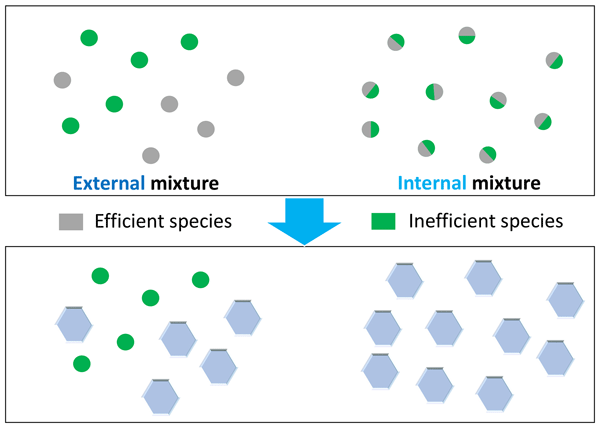
We studied how aerosol particles help form ice in clouds. Using new theory and detailed computer simulations, we found that the way different materials are mixed within these particles has a strong impact on how much ice forms. When ice-forming material is spread across all particles, more droplets freeze than when it is only in a few. This result means that to better predict clouds and climate, models need to account for how particle materials are mixed.
Philipp Reutter and Peter Spichtinger
Atmos. Chem. Phys., 25, 16303–16314, https://doi.org/10.5194/acp-25-16303-2025, https://doi.org/10.5194/acp-25-16303-2025, 2025
Short summary
Short summary
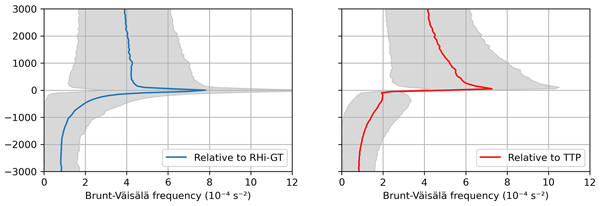
We present a new technique to determine the tropopause based on the gradient of relative humidity over ice. This approach captures the character of the tropopause remarkably well, both in individual vertical profiles and in long-term averages, providing a consistent and physically meaningful representation of the transition between the troposphere and the stratosphere.
Alena Kosareva, Stamen Dolaptchiev, Peter Spichtinger, and Ulrich Achatz
Geosci. Model Dev., 18, 6117–6133, https://doi.org/10.5194/gmd-18-6117-2025, https://doi.org/10.5194/gmd-18-6117-2025, 2025
Short summary
Short summary
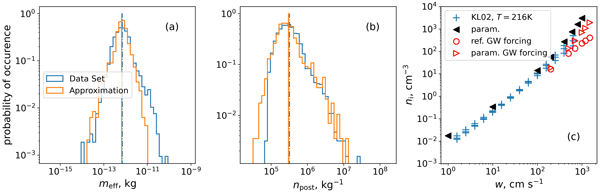
This study improves how we predict ice formation in clouds by accounting for variable ice sizes and different weather conditions. Using simulations, we developed a more accurate method that works efficiently, making it suitable for application in weather and climate prediction models. The new approach is numerically verified and provides precise predictions of ice formation events and reliable estimates of key parameters.
Tim Lüttmer, Annette Miltenberger, and Peter Spichtinger
Atmos. Chem. Phys., 25, 10245–10265, https://doi.org/10.5194/acp-25-10245-2025, https://doi.org/10.5194/acp-25-10245-2025, 2025
Short summary
Short summary
We investigate ice formation pathways in a warm conveyor belt case study. We employ a multi-phase microphysics scheme that distinguishes between ice from different nucleation processes. Ice crystals in the cirrus outflow mostly stem from in situ formation. Hence, they were formed directly from the vapor phase. Sedimentational redistribution modulates cirrus properties and leads to disagreement between cirrus origin classifications based on thermodynamic history and nucleation processes.
Tim Lüttmer, Peter Spichtinger, and Axel Seifert
Atmos. Chem. Phys., 25, 4505–4529, https://doi.org/10.5194/acp-25-4505-2025, https://doi.org/10.5194/acp-25-4505-2025, 2025
Short summary
Short summary
We investigate ice formation pathways in idealized convective clouds using a novel microphysics scheme that distinguishes between five ice classes each with their own unique formation mechanism. Ice crystals from rime splintering form the lowermost layer of ice crystals around the updraft core. The majority of ice crystals in the anvil of the convective cloud stems from frozen droplets. Ice stemming from homogeneous and deposition nucleation was only relevant in the overshoot.
Daniel Köhler, Philipp Reutter, and Peter Spichtinger
Atmos. Chem. Phys., 24, 10055–10072, https://doi.org/10.5194/acp-24-10055-2024, https://doi.org/10.5194/acp-24-10055-2024, 2024
Short summary
Short summary
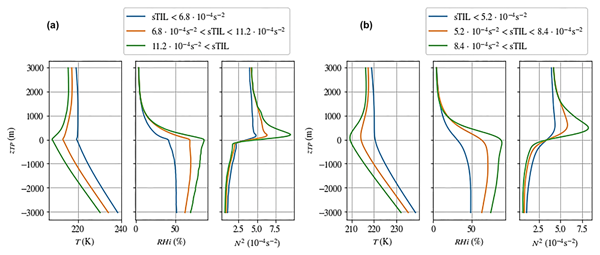
In this work, the influence of humidity on the properties of the tropopause is studied. The tropopause is the interface between the troposphere and the stratosphere and represents a barrier for the transport of air masses between the troposphere and the stratosphere. We consider not only the tropopause itself, but also a layer around it called the tropopause inversion layer (TIL). It is shown that the moister the underlying atmosphere is, the more this layer acts as a barrier.
Emily de Jong, John Ben Mackay, Oleksii Bulenok, Anna Jaruga, and Sylwester Arabas
Geosci. Model Dev., 16, 4193–4211, https://doi.org/10.5194/gmd-16-4193-2023, https://doi.org/10.5194/gmd-16-4193-2023, 2023
Short summary
Short summary
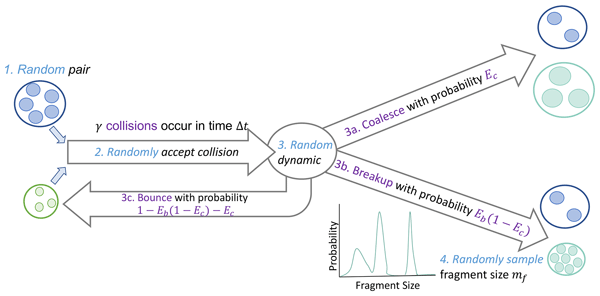
In clouds, collisional breakup occurs when two colliding droplets splinter into new, smaller fragments. Particle-based modeling approaches often do not represent breakup because of the computational demands of creating new droplets. We present a particle-based breakup method that preserves the computational efficiency of these methods. In a series of simple demonstrations, we show that this representation alters cloud processes in reasonable and expected ways.
Peter Spichtinger, Patrik Marschalik, and Manuel Baumgartner
Atmos. Chem. Phys., 23, 2035–2060, https://doi.org/10.5194/acp-23-2035-2023, https://doi.org/10.5194/acp-23-2035-2023, 2023
Short summary
Short summary
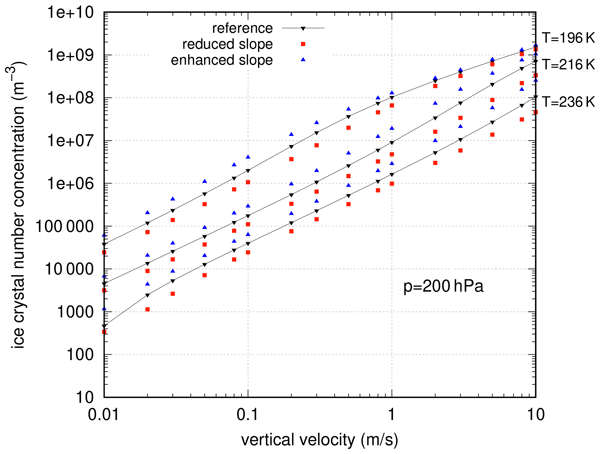
We investigate the impact of the homogeneous nucleation rate on nucleation events in cirrus. As long as the slope of the rate is represented sufficiently well, the resulting ice crystal number concentrations are not crucially affected. Even a change in the prefactor over orders of magnitude does not change the results. However, the maximum supersaturation during nucleation events shows strong changes. This quantity should be used for diagnostics instead of the popular nucleation threshold.

Michael A. Olesik, Jakub Banaśkiewicz, Piotr Bartman, Manuel Baumgartner, Simon Unterstrasser, and Sylwester Arabas
Geosci. Model Dev., 15, 3879–3899, https://doi.org/10.5194/gmd-15-3879-2022, https://doi.org/10.5194/gmd-15-3879-2022, 2022
Short summary
Short summary
In systems such as atmospheric clouds, droplets undergo growth through condensation of vapor. The broadness of the resultant size spectrum of droplets influences precipitation likelihood and the radiative properties of clouds. One of the inherent limitations of simulations of the problem is the so-called numerical diffusion causing overestimation of the spectrum width, hence the term numerical broadening. In the paper, we take a closer look at one of the algorithms used in this context: MPDATA.
Stefan Niebler, Annette Miltenberger, Bertil Schmidt, and Peter Spichtinger
Weather Clim. Dynam., 3, 113–137, https://doi.org/10.5194/wcd-3-113-2022, https://doi.org/10.5194/wcd-3-113-2022, 2022
Short summary
Short summary
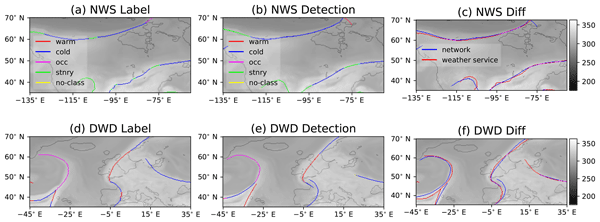
We use machine learning to create a network that detects and classifies four types of synoptic-scale weather fronts from ERA5 atmospheric reanalysis data. We present an application of our method, showing its use case in a scientific context. Additionally, our results show that multiple sources of training data are necessary to perform well on different regions, implying differences within those regions. Qualitative evaluation shows that the results are physically plausible.
Manuel Baumgartner, Christian Rolf, Jens-Uwe Grooß, Julia Schneider, Tobias Schorr, Ottmar Möhler, Peter Spichtinger, and Martina Krämer
Atmos. Chem. Phys., 22, 65–91, https://doi.org/10.5194/acp-22-65-2022, https://doi.org/10.5194/acp-22-65-2022, 2022
Short summary
Short summary
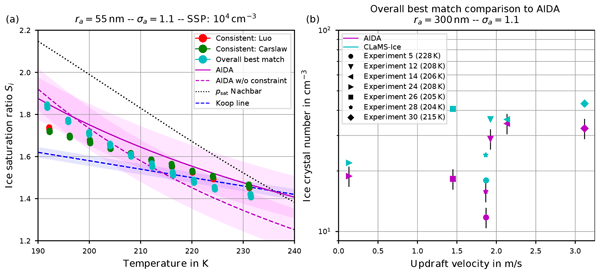
An important mechanism for the appearance of ice particles in the upper troposphere at low temperatures is homogeneous nucleation. This process is commonly described by the
Koop line, predicting the humidity at freezing. However, laboratory measurements suggest that the freezing humidities are above the Koop line, motivating the present study to investigate the influence of different physical parameterizations on the homogeneous freezing with the help of a detailed numerical model.
Cited articles
Abade, G. C. and Albuquerque, D. G.: Persistent mixed-phase states in adiabatic cloud parcels under idealised conditions, Q. J. Roy. Meteor. Soc., 150, 3450–3474, https://doi.org/10.1002/qj.4775, 2024. a
Alpert, P. A. and Knopf, D. A.: Analysis of isothermal and cooling-rate-dependent immersion freezing by a unifying stochastic ice nucleation model, Atmos. Chem. Phys., 16, 2083–2107, https://doi.org/10.5194/acp-16-2083-2016, 2016. a
Arabas, S., Jaruga, A., Pawlowska, H., and Grabowski, W. W.: libcloudph
Arabas, S., Curtis, J. H., Silber, I., Fridlind, A. M., Knopf, D. A., West, M., and Riemer, N.: Immersion Freezing in Particle-Based Aerosol-Cloud Microphysics: A Probabilistic Perspective on Singular and Time-Dependent Models, J. Adv. Model. Earth Sy., 17, https://doi.org/10.1029/2024MS004770, 2025. a, b
Bartman, P., Bulenok, O., Górski, K., Jaruga, A., Łazarski, G., Olesik, M. A., Piasecki, B., Singer, C. E., Talar, A., and Arabas, S.: PySDM v1: particle-based cloud modeling package for warm-rain microphysics and aqueous chemistry, Journal of Open Source Software, 7, 3219, https://doi.org/10.21105/joss.03219, 2022. a
Bigg, E. K.: The Supercooling of Water, P. Phys. Soc. Lond. B, 66, 688, https://doi.org/10.1088/0370-1301/66/8/309, 1953. a
Choudhury, G. and Tesche, M.: A first global height-resolved cloud condensation nuclei data set derived from spaceborne lidar measurements, Earth Syst. Sci. Data, 15, 3747–3760, https://doi.org/10.5194/essd-15-3747-2023, 2023. a
Costa-Surós, M., Gonçalves Ageitos, M., Chatziparaschos, M., Georgakaki, P., Thomas, M. A., Montané Pinto, G., Myriokefalitakis, S., van Noije, T., Le Sager, P., Kanakidou, M., Nenes, A., and Pérez García-Pando, C.: Implementation of primary and secondary ice production in EC-Earth3-AerChem: global impacts and insights, Atmos. Chem. Phys., 26, 2667–2690, https://doi.org/10.5194/acp-26-2667-2026, 2026. a, b
de Jong, E. K., Singer, C. E., Azimi, S., Bartman, P., Bulenok, O., Derlatka, K., Dula, I., Jaruga, A., Mackay, J. B., Ward, R. X., and Arabas, S.: New developments in PySDM and PySDM-examples v2: collisional breakup, immersion freezing, dry aerosol initialization, and adaptive time-stepping, Journal of Open Source Software, 8, 4968, https://doi.org/10.21105/joss.04968, 2023. a
ECMWF: IFS Documentation CY48R1 – Part IV: Physical Processes, 4, ECMWF, https://doi.org/10.21957/02054f0fbf, 2023. a, b
Field, P. R., Hill, A., Shipway, B., Furtado, K., Wilkinson, J., Miltenberger, A., Gordon, H., Grosvenor, D. P., Stevens, R., and Van Weverberg, K.: Implementation of a double moment cloud microphysics scheme in the UK met office regional numerical weather prediction model, Q. J. Roy. Meteor. Soc., 149, 703–739, https://doi.org/10.1002/qj.4414, 2023. a, b
Fusina, F., Spichtinger, P., and Lohmann, U.: Impact of ice supersaturated regions and thin cirrus on radiation in the midlatitudes, J. Geophys. Res.-Atmos., 112, https://doi.org/10.1029/2007JD008449, 2007. a
Gasparini, B., Meyer, A., Neubauer, D., Münch, S., and Lohmann, U.: Cirrus Cloud Properties as Seen by the CALIPSO Satellite and ECHAM-HAM Global Climate Model, J. Climate, 31, 1983–2003, https://doi.org/10.1175/JCLI-D-16-0608.1, 2018. a
Hande, L. B., Engler, C., Hoose, C., and Tegen, I.: Seasonal variability of Saharan desert dust and ice nucleating particles over Europe, Atmos. Chem. Phys., 15, 4389–4397, https://doi.org/10.5194/acp-15-4389-2015, 2015. a
Hande, L. B., Engler, C., Hoose, C., and Tegen, I.: Parameterizing cloud condensation nuclei concentrations during HOPE, Atmos. Chem. Phys., 16, 12059–12079, https://doi.org/10.5194/acp-16-12059-2016, 2016. a
Hoshyaripour, G. A., Baer, A., Bierbauer, S., Bruckert, J., Brunner, D., Förstner, J., Hamzehloo, A., Hanft, V., Keller, C., Klose, M., Kumar, P., Ludwig, P., Metzner, E., Muth, L., Pauling, A., Porz, N., Ramezani Ziarani, M., Reddmann, T., Reißig, L., Ruhnke, R., Satitkovitchai, K., Seifert, A., Sinnhuber, M., Steiner, M., Versick, S., Vogel, H., Weimer, M., Werchner, S., and Hoose, C.: The atmospheric composition component of the ICON modeling framework: ICON-ART version 2025.10, Geosci. Model Dev., 19, 1645–1681, https://doi.org/10.5194/gmd-19-1645-2026, 2026. a, b
Howell, W. E.: The Growth of Cloud Drops in Uniformly Cooled Air, J. Atmos. Sci., 6, 134–149, https://doi.org/10.1175/1520-0469(1949)006<0134:TGOCDI>2.0.CO;2, 1949. a
Ickes, L., Welti, A., Hoose, C., and Lohmann, U.: Classical nucleation theory of homogeneous freezing of water: thermodynamic and kinetic parameters, Phys. Chem. Chem. Phys., 17, 5514–5537, https://doi.org/10.1039/C4CP04184D, 2015. a, b, c, d
Joos, H., Spichtinger, P., Reutter, P., and Fusina, F.: Influence of heterogeneous freezing on the microphysical and radiative properties of orographic cirrus clouds, Atmos. Chem. Phys., 14, 6835–6852, https://doi.org/10.5194/acp-14-6835-2014, 2014. a
Jurányi, Z., Gysel, M., Weingartner, E., DeCarlo, P. F., Kammermann, L., and Baltensperger, U.: Measured and modelled cloud condensation nuclei number concentration at the high alpine site Jungfraujoch, Atmos. Chem. Phys., 10, 7891–7906, https://doi.org/10.5194/acp-10-7891-2010, 2010. a
Kärcher, B. and Lohmann, U.: A parameterization of cirrus cloud formation: Homogeneous freezing of supercooled aerosols, J. Geophys. Res.-Atmos., 107, https://doi.org/10.1029/2001JD000470, 2002. a
Koop, T., Luo, B., Tsias, A., and Peter, T.: Water activity as the determinant for homogeneous ice nucleation in aqueous solutions, Nature, 406, 611–614, https://doi.org/10.1038/35020537, 2000. a
Krämer, M., Rolf, C., Luebke, A., Afchine, A., Spelten, N., Costa, A., Meyer, J., Zöger, M., Smith, J., Herman, R. L., Buchholz, B., Ebert, V., Baumgardner, D., Borrmann, S., Klingebiel, M., and Avallone, L.: A microphysics guide to cirrus clouds – Part 1: Cirrus types, Atmos. Chem. Phys., 16, 3463–3483, https://doi.org/10.5194/acp-16-3463-2016, 2016. a
Krämer, M., Rolf, C., Spelten, N., Afchine, A., Fahey, D., Jensen, E., Khaykin, S., Kuhn, T., Lawson, P., Lykov, A., Pan, L. L., Riese, M., Rollins, A., Stroh, F., Thornberry, T., Wolf, V., Woods, S., Spichtinger, P., Quaas, J., and Sourdeval, O.: A microphysics guide to cirrus – Part 2: Climatologies of clouds and humidity from observations, Atmos. Chem. Phys., 20, 12569–12608, https://doi.org/10.5194/acp-20-12569-2020, 2020. a, b
Lamb, D. and Verlinde, J.: Physics and chemistry of clouds, Cambridge University Press, https://doi.org/10.1017/CBO9780511976377, 2011. a
Luebke, A. E., Afchine, A., Costa, A., Grooß, J.-U., Meyer, J., Rolf, C., Spelten, N., Avallone, L. M., Baumgardner, D., and Krämer, M.: The origin of midlatitude ice clouds and the resulting influence on their microphysical properties, Atmos. Chem. Phys., 16, 5793–5809, https://doi.org/10.5194/acp-16-5793-2016, 2016. a
Lüttmer, T., Miltenberger, A., and Spichtinger, P.: On the impact of ice formation processes and sedimentation on cirrus origin classification in warm conveyor belt outflow, Atmos. Chem. Phys., 25, 10245–10265, https://doi.org/10.5194/acp-25-10245-2025, 2025a. a
Lüttmer, T., Spichtinger, P., and Seifert, A.: Investigating ice formation pathways using a novel two-moment multi-class cloud microphysics scheme, Atmos. Chem. Phys., 25, 4505–4529, https://doi.org/10.5194/acp-25-4505-2025, 2025b. a, b
Lüttmer, T.: Stochastic homogeneous freezing of supercooled droplets in mixed-phase clouds in particle-based idealised microphysics framework (exemplified with PySDM v3.0), Zenodo [code, data set], https://doi.org/10.5281/zenodo.22080761, 2026. a
Morrison, H. and Milbrandt, J. A.: Parameterization of Cloud Microphysics Based on the Prediction of Bulk Ice Particle Properties. Part I: Scheme Description and Idealized Tests, J. Atmos. Sci., 72, 287–311, https://doi.org/10.1175/JAS-D-14-0065.1, 2015. a
Murray, B. J., Broadley, S. L., Wilson, T. W., Bull, S. J., Wills, R. H., Christenson, H. K., and Murray, E. J.: Kinetics of the homogeneous freezing of water, Phys. Chem. Chem. Phys., 12, 10380–10387, https://doi.org/10.1039/C003297B, 2010. a
Petters, M. D. and Kreidenweis, S. M.: A single parameter representation of hygroscopic growth and cloud condensation nucleus activity, Atmos. Chem. Phys., 7, 1961–1971, https://doi.org/10.5194/acp-7-1961-2007, 2007. a
Phillips, V. T., DeMott, P. J., and Andronache, C.: An empirical parameterization of heterogeneous ice nucleation for multiple chemical species of aerosol, J. Atmos. Sci., 65, 2757–2783, https://doi.org/10.1175/2007JAS2546.1, 2008. a
Pruppacher, H., Klett, J., Pruppacher, H., and Klett, J.: Microstructure of atmospheric clouds and precipitation, Springer, https://doi.org/10.1007/978-0-306-48100-0, 2010. a, b, c
Seifert, A. and Beheng, K. D.: A two-moment cloud microphysics parameterization for mixed-phase clouds. Part 1: Model description, Meteorol. Atmos. Phys., 92, 45–66, https://doi.org/10.1007/s00703-005-0112-4, 2006. a, b
Shima, S., Sato, Y., Hashimoto, A., and Misumi, R.: Predicting the morphology of ice particles in deep convection using the super-droplet method: development and evaluation of SCALE-SDM 0.2.5-2.2.0, -2.2.1, and -2.2.2, Geosci. Model Dev., 13, 4107–4157, https://doi.org/10.5194/gmd-13-4107-2020, 2020. a, b
Skrotzki, J., Connolly, P., Schnaiter, M., Saathoff, H., Möhler, O., Wagner, R., Niemand, M., Ebert, V., and Leisner, T.: The accommodation coefficient of water molecules on ice – cirrus cloud studies at the AIDA simulation chamber, Atmos. Chem. Phys., 13, 4451–4466, https://doi.org/10.5194/acp-13-4451-2013, 2013. a, b
Spichtinger, P. and Gierens, K. M.: Modelling of cirrus clouds – Part 1a: Model description and validation, Atmos. Chem. Phys., 9, 685–706, https://doi.org/10.5194/acp-9-685-2009, 2009. a, b, c
Ullrich, R., Hoose, C., Möhler, O., Niemand, M., Wagner, R., Höhler, K., Hiranuma, N., Saathoff, H., and Leisner, T.: A New Ice Nucleation Active Site Parameterization for Desert Dust and Soot, J. Atmos. Sci., 74, 699–717, https://doi.org/10.1175/JAS-D-16-0074.1, 2017. a
Vali, G., DeMott, P. J., Möhler, O., and Whale, T. F.: Technical Note: A proposal for ice nucleation terminology, Atmos. Chem. Phys., 15, 10263–10270, https://doi.org/10.5194/acp-15-10263-2015, 2015. a
Welss, J.-N., Siewert, C., and Seifert, A.: Explicit Habit-Prediction in the Lagrangian Super-Particle Ice Microphysics Model McSnow, J. Adv. Model. Earth Sy., 16, e2023MS003805, https://doi.org/10.1029/2023MS003805, 2024. a
Zhang, Y., Macke, A., and Albers, F.: Effect of crystal size spectrum and crystal shape on stratiform cirrus radiative forcing, Atmos. Res., 52, 59–75, https://doi.org/10.1016/S0169-8095(99)00026-5, 1999. a
Short summary
Homogeneous freezing describes the spontaneous freezing of supercooled droplets, with the probability depending on temperature, droplet size, and elapsed time. Droplets freeze across a range of temperatures rather than all at once, and faster updrafts and larger droplets lead to freezing at warmer temperatures. Once some droplets freeze, the growing ice crystals deplete the surrounding vapour, causing the remaining droplets to evaporate. This affects the number of ice crystals in the cloud.
Homogeneous freezing describes the spontaneous freezing of supercooled droplets, with the...


