
Articles | Volume 19, issue 20
https://doi.org/10.5194/gmd-19-10103-2026
© Author(s) 2026. This work is distributed under
the Creative Commons Attribution 4.0 License.
the Creative Commons Attribution 4.0 License.
https://doi.org/10.5194/gmd-19-10103-2026
© Author(s) 2026. This work is distributed under
the Creative Commons Attribution 4.0 License.
the Creative Commons Attribution 4.0 License.
Development and technical paper
| 
23 Oct 2026
Development and technical paper |
| 23 Oct 2026
| 23 Oct 2026
Process-based upgrades to the WRF multi-layer green-roof scheme (WRF-MLGR v2.0) and evaluation against field observations

School of Environmental Sciences, University of Guelph, Guelph, Ontario, Canada
Maria Martinez Mendoza
Department of Geography and Environment, The University of Western Ontario, London, Ontario, Canada
Eric Scott Krayenhoff
CORRESPONDING AUTHOR
School of Environmental Sciences, University of Guelph, Guelph, Ontario, Canada
James Voogt
Department of Geography and Environment, The University of Western Ontario, London, Ontario, Canada
School of Environmental Sciences, University of Guelph, Guelph, Ontario, Canada
Andrea Zonato
CIMA Research Foundation, Savona, Italy
Sylvie Leroyer
Meteorological Research Division, Environment and Climate Change Canada, Dorval, Quebec, Canada
Claudia Wagner-Riddle
School of Environmental Sciences, University of Guelph, Guelph, Ontario, Canada
Related authors
Maria Martinez Mendoza, Alireza Saeedi, James A. Voogt, and E. Scott Krayenhoff
Geosci. Model Dev., 19, 9729–9749, https://doi.org/10.5194/gmd-19-9729-2026, https://doi.org/10.5194/gmd-19-9729-2026, 2026
Short summary
Short summary
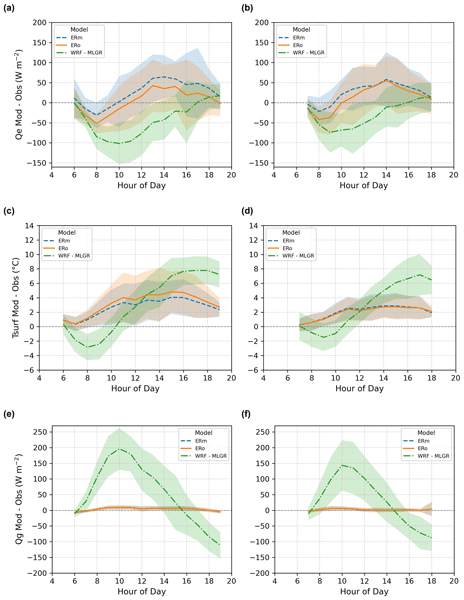
Green roofs can help cool cities, but models must represent them accurately to quantify this potential. Yet few studies evaluate green roof models against real data. We evaluated two versions of EcoRoof, the green roof module in EnergyPlus, and a green roof option for WRF (Weather and Research Forecasting model) using measurements from London, Ontario. EcoRoof generally matched observed heat fluxes, surface temperature, and soil moisture, while WRF overestimated heat and underestimated cooling.
Francesco De Martin, Christopher Rozoff, Andrea Zonato, Stefano Alessandrini, and Silvana Di Sabatino
Weather Clim. Dynam., 7, 2015–2042, https://doi.org/10.5194/wcd-7-2015-2026, https://doi.org/10.5194/wcd-7-2015-2026, 2026
Short summary
Short summary
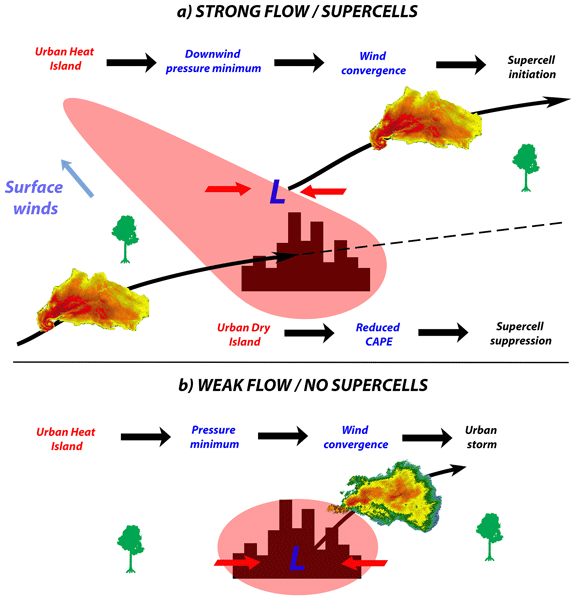
Most convective storm losses occur in urban areas, raising the question of whether cities can intensify severe storms, such as supercells. We found that cities can weaken an approaching supercell by reducing low-level moisture, but can also trigger a new one downwind. More urban vegetation reduces city effects on storm evolution, while building height has little impact. This conceptual model improves understanding of supercell–city interactions and supports advances in early warning systems.
Maria Martinez Mendoza, Alireza Saeedi, James A. Voogt, and E. Scott Krayenhoff
Geosci. Model Dev., 19, 9729–9749, https://doi.org/10.5194/gmd-19-9729-2026, https://doi.org/10.5194/gmd-19-9729-2026, 2026
Short summary
Short summary
Green roofs can help cool cities, but models must represent them accurately to quantify this potential. Yet few studies evaluate green roof models against real data. We evaluated two versions of EcoRoof, the green roof module in EnergyPlus, and a green roof option for WRF (Weather and Research Forecasting model) using measurements from London, Ontario. EcoRoof generally matched observed heat fluxes, surface temperature, and soil moisture, while WRF overestimated heat and underestimated cooling.
Andrea Zonato, Harsh G. Kamath, Naveen Sudharsan, Luca Monaco, Jonas Kittner, Luise Wolf, Matthias Demuzere, Ariane Middel, Benjamin Bechtel, and Massimo Milelli
Geosci. Model Dev., 19, 7389–7413, https://doi.org/10.5194/gmd-19-7389-2026, https://doi.org/10.5194/gmd-19-7389-2026, 2026
Short summary
Short summary
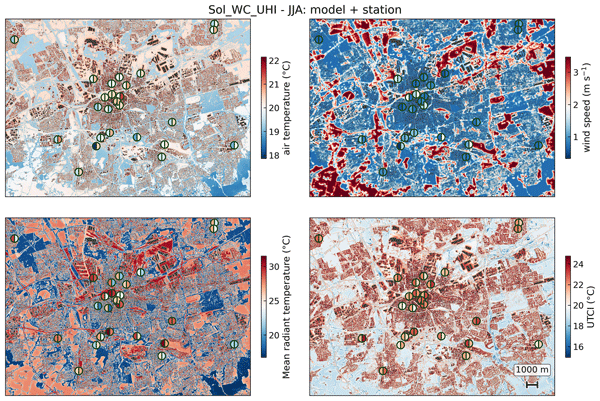
Cities need fast, reliable heat-stress maps to plan cooling measures and protect people. We built an automated workflow that gathers global public data, runs an outdoor comfort model much faster on graphics processing units, and adds simple corrections for wind and night-time warming. Tested in Dortmund against many sensors, errors fell from about ten to under three °C.
Emma G. Cochran, Claudia Wagner-Riddle, and Elke Eichelmann
Biogeosciences, 23, 5313–5357, https://doi.org/10.5194/bg-23-5313-2026, https://doi.org/10.5194/bg-23-5313-2026, 2026
Short summary
Short summary
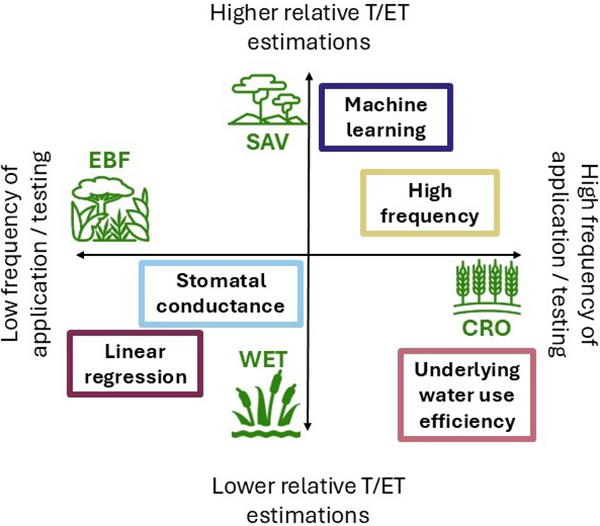
It is important to understand how much water is lost from plant processes to better understand ecosystem dynamics and the global water cycle. This review summarizes methods developed to partition plant water loss from total ecosystem water loss measurements. Eleven independent methods were identified, each reliant on various ecosystem assumptions. The methods were applied across 129 independent studies, reporting that globally, plant water loss accounts for 57 % of total ecosystem water loss.
Naeim Mijani, James Voogt, Mohammad Karimi Firozjaei, and Majid Kiavarz
Int. Arch. Photogramm. Remote Sens. Spatial Inf. Sci., XLIX-B3-2026, 405–410, https://doi.org/10.5194/isprs-archives-XLIX-B3-2026-405-2026, https://doi.org/10.5194/isprs-archives-XLIX-B3-2026-405-2026, 2026
Gianluca Pappaccogli, Andrea Zonato, Alberto Martilli, Riccardo Buccolieri, and Piero Lionello
Geosci. Model Dev., 18, 7129–7145, https://doi.org/10.5194/gmd-18-7129-2025, https://doi.org/10.5194/gmd-18-7129-2025, 2025
Short summary
Short summary
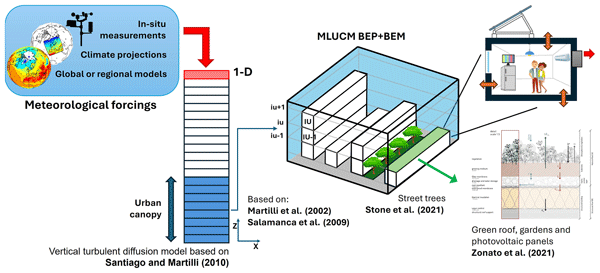
We present a multilayer urban model, named MLUCM BEP+BEM, able to represent detailed urban geometry and vegetation, while simulating their interactions and feedback with the atmosphere. Its accuracy and low computational cost make it ideal for offline climate projections assessing urban impacts under various emission scenarios. Its features enable analysis of urban overheating, energy demand, thermal comfort, and evaluation of strategies like green/cool roofs and photovoltaic panels.
Alberto Martilli, Negin Nazarian, E. Scott Krayenhoff, Jacob Lachapelle, Jiachen Lu, Esther Rivas, Alejandro Rodriguez-Sanchez, Beatriz Sanchez, and José Luis Santiago
Geosci. Model Dev., 17, 5023–5039, https://doi.org/10.5194/gmd-17-5023-2024, https://doi.org/10.5194/gmd-17-5023-2024, 2024
Short summary
Short summary
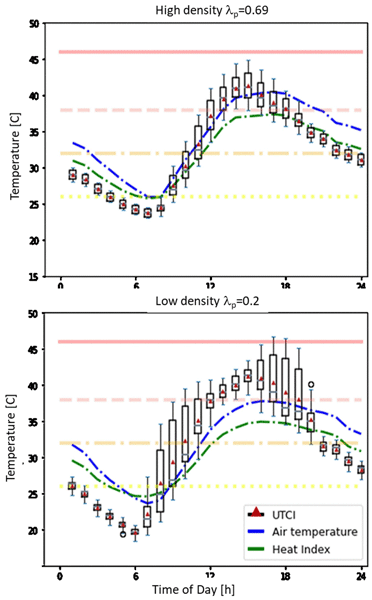
Here, we present a model that quantifies the thermal stress and its microscale variability at a city scale with a mesoscale model. This tool can have multiple applications, from early warnings of extreme heat to the vulnerable population to the evaluation of the effectiveness of heat mitigation strategies. It is the first model that includes information on microscale variability in a mesoscale model, something that is essential for fully evaluating heat stress.
Jiachen Lu, Negin Nazarian, Melissa Anne Hart, E. Scott Krayenhoff, and Alberto Martilli
Geosci. Model Dev., 17, 2525–2545, https://doi.org/10.5194/gmd-17-2525-2024, https://doi.org/10.5194/gmd-17-2525-2024, 2024
Short summary
Short summary
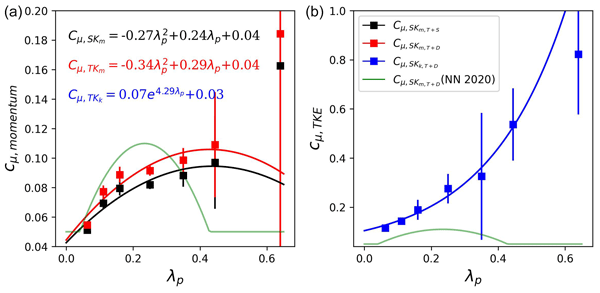
This study enhances urban canopy models by refining key assumptions. Simulations for various urban scenarios indicate discrepancies in turbulent transport efficiency for flow properties. We propose two modifications that involve characterizing diffusion coefficients for momentum and turbulent kinetic energy separately and introducing a physics-based
mass-fluxterm. These adjustments enhance the model's performance, offering more reliable temperature and surface flux estimates.
Alfonso Ferrone, Étienne Vignon, Andrea Zonato, and Alexis Berne
The Cryosphere, 17, 4937–4956, https://doi.org/10.5194/tc-17-4937-2023, https://doi.org/10.5194/tc-17-4937-2023, 2023
Short summary
Short summary
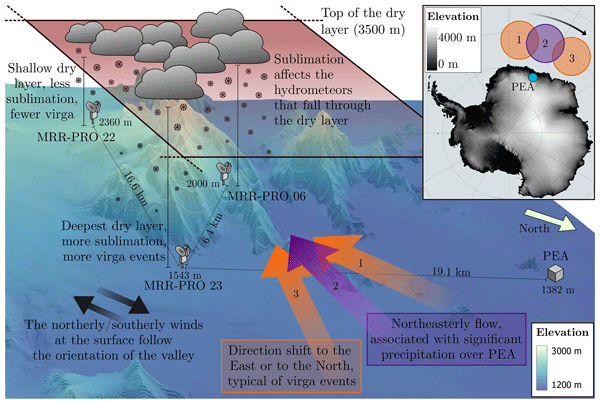
In austral summer 2019/2020, three K-band Doppler profilers were deployed across the Sør Rondane Mountains, south of the Belgian base Princess Elisabeth Antarctica. Their measurements, along with atmospheric simulations and reanalyses, have been used to study the spatial variability in precipitation over the region, as well as investigate the interaction between the complex terrain and the typical flow associated with precipitating systems.
Hang Yin, Jing Dou, Liviana Klein, Ulrich K. Krieger, Alison Bain, Brandon J. Wallace, Thomas C. Preston, and Andreas Zuend
Atmos. Chem. Phys., 22, 973–1013, https://doi.org/10.5194/acp-22-973-2022, https://doi.org/10.5194/acp-22-973-2022, 2022
Short summary
Short summary
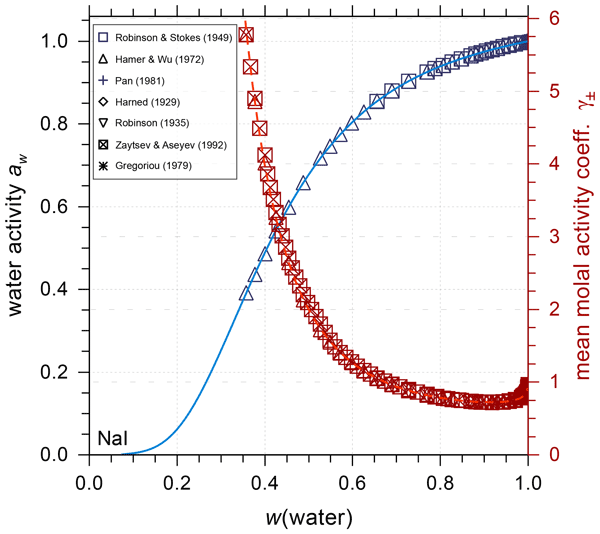
Iodine and carbonate species are important components in marine and dust aerosols, respectively. We introduce an extended version of the AIOMFAC thermodynamic mixing model, which includes the ions I−, IO3−, HCO3−, CO32−, OH−, and CO2(aq) as new species, and we discuss two methods for solving the carbonate dissociation equilibria numerically. We also present new experimental water activity data for aqueous iodide and iodate systems.
Cited articles
Arnfield, A. J.: Two decades of urban climate research: a review of turbulence, exchanges of energy and water, and the urban heat island, Int. J. Climatol., 23, 1–26, https://doi.org/10.1002/joc.859, 2003.
Barozzi, B., Bellazzi, A., Maffè, C., and Pollastro, M. C.: Measurement of thermal properties of growing media for green roofs: assessment of a laboratory procedure and experimental results, Buildings, 7, 99, https://doi.org/10.3390/buildings7040099, 2017.
Berardi, U., GhaffarianHoseini, A., and GhaffarianHoseini, A.: State-of-the-art analysis of the environmental benefits of green roofs, Appl. Energ., 115, 411–428, https://doi.org/10.1016/j.apenergy.2013.10.047, 2014.
Berndtsson, J. C.: Green roof performance towards management of runoff water quantity and quality: A review, Ecol. Eng., 36, 351–360, https://doi.org/10.1016/j.ecoleng.2009.12.014, 2010.
Cammalleri, C., Agnese, C., Ciraolo, G., Minacapilli, M., Provenzano, G., and Rallo, G.: Actual evapotranspiration assessment by means of a coupled energy/hydrologic balance model: Validation over an olive grove by means of scintillometry and measurements of soil water contents, J. Hydrol., 392, 70–82, https://doi.org/10.1016/j.jhydrol.2010.07.046, 2010.
de Munck, C., Lemonsu, A., Masson, V., Le Bras, J., Bonhomme, M., and Kounkou-Arnaud, R.: Evaluating the impacts of greening scenarios on thermal comfort and energy and water consumptions for adapting Paris city to climate change, Urban Climate, 23, 260–286, https://doi.org/10.1016/j.uclim.2017.01.003, 2018.
de Munck, C. S., Lemonsu, A., Bouzouidja, R., Masson, V., and Claverie, R.: The GREENROOF module (v7.3) for modelling green roof hydrological and energetic performances within TEB, Geosci. Model Dev., 6, 1941–1960, https://doi.org/10.5194/gmd-6-1941-2013, 2013.
Ek, M. B., Mitchell, K. E., Lin, Y., Rogers, E., Grunmann, P., Koren, V., Gayno, G., and Tarpley, J. D.: Implementation of Noah land surface model advances in the National Centers for Environmental Prediction operational mesoscale Eta model, J. Geophys. Res., 108, 8851, https://doi.org/10.1029/2002JD003296, 2003.
Grimmond, C. S. B. and Oke, T. R.: Heat Storage in Urban Areas: Local-Scale Observations and Evaluation of a Simple Model, J. Appl. Meteorol., 38, 922–940, https://doi.org/10.1175/1520-0450(1999)038<0922:HSIUAL>2.0.CO;2, 1999.
Hamdi, R. and Masson, V.: Inclusion of a drag approach in the Town Energy Balance (TEB) scheme: Offline 1D evaluation in a street canyon, J. Appl. Meteorol. Clim., 47, 2627–2644, https://doi.org/10.1175/2008JAMC1865.1, 2008.
Heusinger, J. and Weber, S.: Surface energy balance of an extensive green roof as quantified by full year eddy-covariance measurements, Sci. Total Environ., 577, 220–230, https://doi.org/10.1016/j.scitotenv.2016.10.168, 2017.
Heusinger, J., Sailor, D. J., and Weber, S.: Modeling the reduction of urban excess heat by green roofs with respect to different irrigation scenarios, Build. Environ., 131, 174–183, https://doi.org/10.1016/j.buildenv.2018.01.003, 2018.
Jiang, T., Krayenhoff, E. S., Martilli, A., Nazarian, N., Stone Jr., B., and Voogt, J. A.: Prioritizing urban heat adaptation infrastructure based on multiple outcomes: Comfort, health, and energy, P. Natl. Acad. Sci. USA, 122, e2411144122, https://doi.org/10.1073/pnas.2411144122, 2025.
Kusaka, H., Kondo, H., Kikegawa, Y., and Kimura, F.: A simple single-layer urban canopy model for atmospheric models: Comparison with multi-layer and slab models, Bound.-Lay. Meteorol., 101, 329–358, https://doi.org/10.1023/A:1019207923078, 2001.
Li, D. and Bou-Zeid, E.: Synergistic Interactions between Urban Heat Islands and Heat Waves: The Impact in Cities Is Larger than the Sum of Its Parts, J. Appl. Meteorol. Clim., 52, 2051–2064, https://doi.org/10.1175/JAMC-D-13-02.1, 2013.
Li, D., Bou-Zeid, E., and Oppenheimer, M.: The effectiveness of cool and green roofs as urban heat island mitigation strategies, Environ. Res. Lett., 9, 055002, https://doi.org/10.1088/1748-9326/9/5/055002, 2014.
Li, Y. and Babcock, R. W.: Green roof hydrologic performance and modeling: a review, Water Sci. Technol., 69, 727–738, https://doi.org/10.2166/wst.2013.770, 2014.
Lipson, M. J., Grimmond, S., Best, M., Abramowitz, G., Coutts, A., Tapper, N., Baik, J.-J., Beyers, M., Blunn, L., Boussetta, S., Bou-Zeid, E., De Kauwe, M. G., de Munck, C., Demuzere, M., Fatichi, S., Fortuniak, K., Han, B.-S., Hendry, M. A., Kikegawa, Y., Kondo, H., Lee, D.-I., Lee, S.-H., Lemonsu, A., Machado, T., Manoli, G., Martilli, A., Masson, V., McNorton, J., Meili, N., Meyer, D., Nice, K. A., Oleson, K. W., Park, S.-B., Roth, M., Schoetter, R., Simón-Moral, A., Steeneveld, G.-J., Sun, T., Takane, Y., Thatcher, M., Tsiringakis, A., Varentsov, M., Wang, C., Wang, Z.-H., and Pitman, A. J.: Evaluation of 30 urban land surface models in the Urban-PLUMBER project: Phase 1 results, Q. J. Roy. Meteor. Soc., 150, 126–169, https://doi.org/10.1002/qj.4589, 2024.
Louis, J.-F.: A parametric model of vertical eddy fluxes in the atmosphere, Bound.-Lay. Meteorol., 17, 187–202, https://doi.org/10.1007/BF00117978, 1979.
Martilli, A., Clappier, A., and Rotach, M. W.: An urban surface exchange parameterisation for mesoscale models, Bound.-Lay. Meteorol., 104, 261–304, https://doi.org/10.1023/A:1016099921195, 2002.
Martinez Mendoza, M., Saeedi, A., Voogt, J. A., and Krayenhoff, E. S.: Process-based evaluation of green roof models for assessment of heat mitigation efficacy in WRF (v4.3.1) and EnergyPlus (v8.6.0), Geosci. Model Dev., 19, 9729–9749, https://doi.org/10.5194/gmd-19-9729-2026, 2026.
Masson, V.: A physically-based scheme for the urban energy budget in atmospheric models, Bound.-Lay. Meteorol., 94, 357–397, https://doi.org/10.1023/A:1002463829265, 2000.
Mirebeau, A., de Munck, C., Bonan, B., Delire, C., Lemonsu, A., Masson, V., and Weber, S.: Modelling extensive green roof CO2 exchanges in the Town Energy Balance urban canopy model, Geosci. Model Dev., 18, 5329–5349, https://doi.org/10.5194/gmd-18-5329-2025, 2025.
Nash, J. E. and Sutcliffe, J. V.: River flow forecasting through conceptual models, Part I – A discussion of principles, J. Hydrol., 10, 282–290, https://doi.org/10.1016/0022-1694(70)90255-6, 1970.
Oberndorfer, E., Lundholm, J., Bass, B., Coffman, R. R., Doshi, H., Dunnett, N., Gaffin, S., Köhler, M., Liu, K. K. Y., and Rowe, B.: Green Roofs as Urban Ecosystems: Ecological Structures, Functions, and Services, BioScience, 57, 823–833, https://doi.org/10.1641/B571005, 2007.
Oke, T. R.: The energetic basis of the urban heat island, Q. J. Roy. Meteor. Soc., 108, 1–24, https://doi.org/10.1002/qj.49710845502, 1982.
Oke, T. R., Mills, G., Christen, A., and Voogt, J. A.: Urban Climates, Cambridge University Press, https://doi.org/10.1017/9781139016476, 2017.
Onyutha, C.: A hydrological model skill score and revised R-squared, Hydrol. Res., 53, 51–64, https://doi.org/10.2166/nh.2021.071, 2022.
Perelli, G. A.: Characterization of the Green Roof Growth Media, M. Eng. Sci. thesis, The University of Western Ontario, London, Ontario, Canada, Electronic Thesis and Dissertation Repository, 2205, https://ir.lib.uwo.ca/etd/2205 (last access: 10 October 2025), 2014.
Peters-Lidard, C. D., Zion, M. S., and Wood, E. F.: A soil-vegetation-atmosphere transfer scheme for modeling spatially variable water and energy balance processes, J. Geophys. Res., 102, 4303–4324,https://doi.org/10.1029/96JD02948, 1997.
Peters-Lidard, C. D., Blackburn, E., Liang, X., and Wood, E. F.: The effect of soil thermal conductivity parameterization on surface energy fluxes and temperatures, J. Atmos. Sci., 55, 1209–1224, https://doi.org/10.1175/1520-0469(1998)055<1209:TEOSTC>2.0.CO;2, 1998.
Ribeiro, I., Martilli, A., Falls, M., Zonato, A., and Villalba, G.: Highly resolved WRF-BEP/BEM simulations over Barcelona urban area with LCZ, Atmos. Res., 248, 105220, https://doi.org/10.1016/j.atmosres.2020.105220, 2021.
Rowe, D. B.: Green roofs as a means of pollution abatement, Environ. Pollut., 159, 2100–2110, https://doi.org/10.1016/j.envpol.2010.10.029, 2011.
Saeedi, A., Martinez Mendoza, M., Krayenhoff, E. S., Voogt, J., Zonato, A., Leroyer, S., and Wagner-Riddle, C.: WRF-MLGR v2.0: Process-based upgrades to the WRF multi-layer green roof scheme implemented in WRF-BEP+BEM, Zenodo [code and data set], https://doi.org/10.5281/zenodo.18704671, 2026.
Sailor, D. J.: A green roof model for building energy simulation programs, Energ. Buildings, 40, 1466–1478, https://doi.org/10.1016/j.enbuild.2008.02.001, 2008.
Sailor, D. J., Hutchinson, D., and Bokovoy, L.: Thermal property measurements for ecoroof soils common in the western U. S., Energ. Buildings, 40, 1246–1251, https://doi.org/10.1016/j.enbuild.2007.11.004, 2008.
Salamanca, F., Martilli, A., Tewari, M., and Chen, F.: A Study of the Urban Boundary Layer Using Different Urban Parameterizations and High-Resolution Urban Canopy Parameters with WRF, J. Appl. Meteorol. Clim., 50, 1107–1128, https://doi.org/10.1175/2010JAMC2538.1, 2011.
Santamouris, M.: Cooling the cities – A review of reflective and green roof mitigation technologies to fight heat island and improve comfort in urban environments, Sol. Energy, 103, 682–703, https://doi.org/10.1016/j.solener.2012.07.003, 2014.
Shao, B., Valeo, C., Mukhopadhyaya, P., and He, J.: Influence of temperature and moisture content on thermal performance of green roof media, Energies, 14, 2421, https://doi.org/10.3390/en14092421, 2021.
Stovin, V.: The potential of green roofs to manage urban stormwater, Water Environ. J., 24, 192–199, https://doi.org/10.1111/j.1747-6593.2009.00174.x, 2010.
Sun, T., Grimmond, C. S. B., and Ni, G.-H.: How do green roofs mitigate urban thermal stress under heat waves?, J. Geophys. Res.-Atmos., 121, 5320–5335, https://doi.org/10.1002/2016JD024873, 2016.
Tabares-Velasco, P. C. and Srebric, J.: A heat transfer model for assessment of plant based roofing systems in summer conditions, Build. Environ., 49, 310–323, https://doi.org/10.1016/j.buildenv.2011.07.019, 2012.
Tabares-Velasco, P. C., Zhao, M., Peterson, N., Srebric, J., and Berghage, R.: Validation of predictive heat and mass transfer green roof model with extensive green roof field data, Ecol. Eng., 47, 165–173, https://doi.org/10.1016/j.ecoleng.2012.06.012, 2012.
Tsiringakis, A., Steeneveld, G.-J., Holtslag, A. A. M., Kotthaus, S., and Grimmond, S.: On- and off-line evaluation of the single-layer urban canopy model in London summertime conditions, Q. J. Roy. Meteor. Soc., 145, 1474–1489, https://doi.org/10.1002/qj.3505, 2019.
Viterbo, P. and Beljaars, A. C. M.: An improved land surface parameterization scheme in the ECMWF model and its validation, J. Climate, 8, 2716–2748, https://doi.org/10.1175/1520-0442(1995)008<2716:AILSPS>2.0.CO;2, 1995.
Willmott, C. J., Robeson, S. M., and Matsuura, K.: A refined index of model performance, Int. J. Climatol., 32, 2088–2094, https://doi.org/10.1002/joc.2419, 2012.
Wohlfahrt, G., Bianchi, K., and Cernusca, A.: Leaf and stem maximum water storage capacity of herbaceous plants in a mountain meadow, J. Hydrol., 319, 383–390, https://doi.org/10.1016/j.jhydrol.2005.06.036, 2006.
Yang, J., Wang, Z.-H., Chen, F., Miao, S., Tewari, M., Voogt, J. A., and Myint, S.: Enhancing hydrologic modelling in the coupled Weather Research and Forecasting–urban modelling system, Bound.-Lay. Meteorol., 155, 87–109, https://doi.org/10.1007/s10546-014-9991-6, 2015.
Zonato, A., Martilli, A., Gutierrez, E., Chen, F., He, C., Barlage, M., Zardi, D., and Giovannini, L.: Exploring the effects of rooftop mitigation strategies on urban temperatures and energy consumption, J. Geophys. Res.-Atmos., 126, e2021JD035002, https://doi.org/10.1029/2021JD035002, 2021.
Short summary
Green roofs can help cool hot cities, and the Weather Research and Forecasting model lets us test how much. We upgraded its multi-layer green-roof scheme, adding plant shading, realistic heat flow in wet soil, evaporation from soil and wet leaves, and water uptake from deeper soil. Tested on a green roof in London, Canada, the new scheme cut errors in heat entering the roof by about three-quarters and captured bursts of evaporation after rain, improving how we study green-roof cooling.
Green roofs can help cool hot cities, and the Weather Research and Forecasting model lets us...


