
Articles | Volume 18, issue 5
https://doi.org/10.5194/gmd-18-1545-2025
© Author(s) 2025. This work is distributed under
the Creative Commons Attribution 4.0 License.
the Creative Commons Attribution 4.0 License.
https://doi.org/10.5194/gmd-18-1545-2025
© Author(s) 2025. This work is distributed under
the Creative Commons Attribution 4.0 License.
the Creative Commons Attribution 4.0 License.
Development and technical paper
| 
10 Mar 2025
Development and technical paper |
| 10 Mar 2025
| 10 Mar 2025
Quantifying the analysis uncertainty for nowcasting application
Yanwei Zhu
School of Atmospheric Science, Nanjing University of Information Science and Technology, Nanjing, China
HuaFeng Research Lab for Weather Science and Applications, Nanjing University of Information Science and Technology, Nanjing, China
Aitor Atencia
GeoSphere Austria, Vienna, Austria
Markus Dabernig
GeoSphere Austria, Vienna, Austria
School of Atmospheric Science, Nanjing University of Information Science and Technology, Nanjing, China
CMA Earth System Modelling and Prediction Centre, China Meteorological Administration, Beijing, China
Related authors
Yanwei Zhu, Aitor Atencia, Markus Dabernig, Yong Wang, and Shuyan Zhou
Geosci. Model Dev., 19, 7835–7853, https://doi.org/10.5194/gmd-19-7835-2026, https://doi.org/10.5194/gmd-19-7835-2026, 2026
Short summary
Short summary
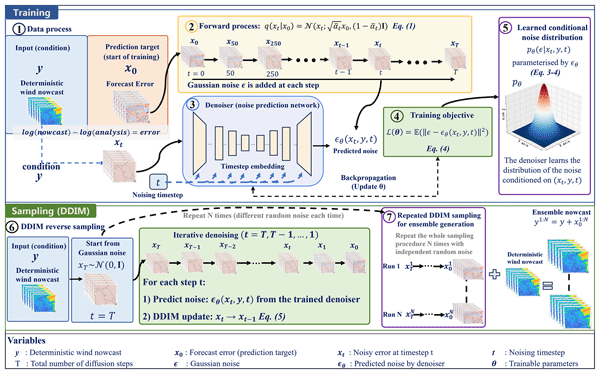
The study proposes a diffusion-based framework for uncertainty quantification in wind speed nowcasting by learning forecast error distributions. By randomly generating errors and adding them to a physics-based wind nowcast, multiple forecast scenarios can be produced. The results improve forecast accuracy and provide reliable estimates of forecast uncertainty.
Yanwei Zhu, Aitor Atencia, Markus Dabernig, Yong Wang, and Shuyan Zhou
Geosci. Model Dev., 19, 7835–7853, https://doi.org/10.5194/gmd-19-7835-2026, https://doi.org/10.5194/gmd-19-7835-2026, 2026
Short summary
Short summary
The study proposes a diffusion-based framework for uncertainty quantification in wind speed nowcasting by learning forecast error distributions. By randomly generating errors and adding them to a physics-based wind nowcast, multiple forecast scenarios can be produced. The results improve forecast accuracy and provide reliable estimates of forecast uncertainty.
Loris Foresti, Bernat Puigdomènech Treserras, Daniele Nerini, Aitor Atencia, Marco Gabella, Ioannis V. Sideris, Urs Germann, and Isztar Zawadzki
Nonlin. Processes Geophys., 31, 259–286, https://doi.org/10.5194/npg-31-259-2024, https://doi.org/10.5194/npg-31-259-2024, 2024
Short summary
Short summary
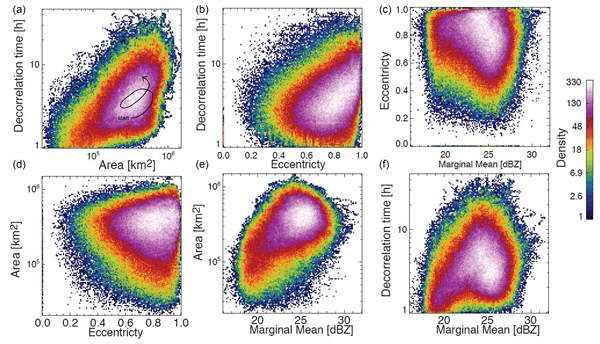
We compared two ways of defining the phase space of low-dimensional attractors describing the evolution of radar precipitation fields. The first defines the phase space by the domain-scale statistics of precipitation fields, such as their mean, spatial and temporal correlations. The second uses principal component analysis to account for the spatial distribution of precipitation. To represent different climates, radar archives over the United States and the Swiss Alpine region were used.
Jonathan Demaeyer, Jonas Bhend, Sebastian Lerch, Cristina Primo, Bert Van Schaeybroeck, Aitor Atencia, Zied Ben Bouallègue, Jieyu Chen, Markus Dabernig, Gavin Evans, Jana Faganeli Pucer, Ben Hooper, Nina Horat, David Jobst, Janko Merše, Peter Mlakar, Annette Möller, Olivier Mestre, Maxime Taillardat, and Stéphane Vannitsem
Earth Syst. Sci. Data, 15, 2635–2653, https://doi.org/10.5194/essd-15-2635-2023, https://doi.org/10.5194/essd-15-2635-2023, 2023
Short summary
Short summary
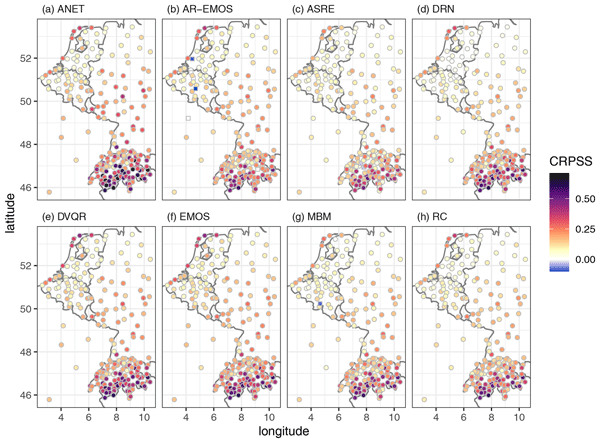
A benchmark dataset is proposed to compare different statistical postprocessing methods used in forecasting centers to properly calibrate ensemble weather forecasts. This dataset is based on ensemble forecasts covering a portion of central Europe and includes the corresponding observations. Examples on how to download and use the data are provided, a set of evaluation methods is proposed, and a first benchmark of several methods for the correction of 2 m temperature forecasts is performed.

Linye Song, Shangfeng Chen, Wen Chen, Jianping Guo, Conglan Cheng, and Yong Wang
Atmos. Chem. Phys., 22, 1669–1688, https://doi.org/10.5194/acp-22-1669-2022, https://doi.org/10.5194/acp-22-1669-2022, 2022
Short summary
Short summary
This study shows that in most years when haze pollution (HP) over the North China Plain (NCP) is more (less) serious in winter, air conditions in the following spring are also worse (better) than normal. Conversely, there are some years when HP in the following spring is opposed to that in winter. It is found that North Atlantic sea surface temperature (SST) anomalies play important roles in HP evolution over the NCP. Thus North Atlantic SST is an important preceding signal for NCP HP evolution.
Cited articles
Bellus, M., Wang, Y., and Meier, F.: Perturbing Surface Initial Conditions in a Regional Ensemble Prediction System, Mon. Weather Rev., 144, 3377–3390, https://doi.org/10.1175/MWR-D-16-0038.1, 2016.
Bellus, M., Weidle, F., Wittmann, C., Wang, Y., Tasku, S., and Tudor, M.: Aire Limitée Adaptation dynamique Développement InterNational-Limited Area Ensemble Forecasting (ALADIN-LAEF), Adv. Sci. Res., 16, 63–68, https://doi.org/10.5194/asr-16-63-2019, 2019.
Bouttier, F.: The ensemble forecasting, Encyclopedia of the Environment, https://www.encyclopedie-environnement.org/en/air-en/overall-forecast/ (last access: 13 March 2024), 2019.
Bouttier, F., Raynaud, L., Nuissier, O., and Ménétrier, B.: Sensitivity of the AROME ensemble to initial and surface perturbations during HyMeX, Q. J. Roy. Meteor. Soc., 142, 390–403, https://doi.org/10.1002/qj.2622, 2016.
Buizza, R., Houtekamer, P. L., Pellerin, G., Toth, Z., Zhu, Y.-J., and Wei, M.-Z.: A Comparison of the ECMWF, MSC, and NCEP Global Ensemble Prediction Systems, Mon. Weather Rev., 133, 1076–1097, https://doi.org/10.1175/MWR2905.1, 2005.
Casellas, E., Bech, J., Veciana, R., Pineda, N., Miró, J., Moré, J., Rigo, T., and Sairoui, A.: Nowcasting the precipitation phase combining weather radar data, surface observations and NWP model forecasts, Q. J. Roy. Meteor. Soc., 147, 3135–3153, https://doi.org/10.1002/qj.4121, 2021.
Chen, X.-C., Zhao, K., Sun, J.-Z., Zhou, B.-W., and Lee, W.-C.: Assimilating Surface Observations in a Four-Dimensional Variational Doppler Radar Data Assimilation System to Improve the Analysis and Forecast of a Squall Line Case, Adv. Atmos. Sci., 33, 1106–1119, https://doi.org/10.1007/s00376-016-5290-0, 2016.
Eibl, B. and Steinacker, R.: Treatment of deterministic perturbations and stochastic processes within a quality control scheme, Geosci. Instrum. Method. Data Syst. Discuss. [preprint], https://doi.org/10.5194/gi-2017-42, in review, 2017.
Feng, J., Toth, Z., Peña, M., and Zhang, J.: Partition of Analysis and Forecast Error Variance into Growing and Decaying Components, Q. J. Roy. Meteor. Soc., 146, 1302–1321, https://doi.org/10.1002/qj.3738, 2020.
Fortin, V., Abaza, M., Anctil, F., and Turcotte, R.: Why should ensemble spread match the RMSE of the ensemble mean?, J. Hydrometeorol., 15, 1708–1713, https://doi.org/10.1175/JHM-D-14-0008.1, 2014.
Glahn, B. and Im, J.-S.: Error estimation of objective analysis of surface observations, J. Oper. Meteorol., 1, 114–127, https://doi.org/10.15191/nwajom.2013.0111, 2013.
Haiden, T., Kann, A., Pistotnik, G., Stadlbacher, K., and Wittmann, C.: Integrated Nowcasting through Comprehensive Analysis (INCA) System description, ZAMG report, 61 pp., http://www.zamg.ac.at/fix/INCA_system.pdf (last access: 28 February 2025), 2010.
Haiden, T., Kann, A., Wittmann, C., Pistotnik, G., Bica, B., and Gruber, C.: The Integrated Nowcasting through Comprehensive Analysis (INCA) System and Its Validation over the Eastern Alpine Region, Weather Forecast., 26, 166–183, https://doi.org/10.1175/2010WAF2222451.1, 2011.
Hamill, T.: Interpretation of rank histograms for verifying ensemble forecasts. Mon. Weather Rev., 129, 550–560, https://doi.org/10.1175/1520-0493(2001)129<0550:IORHFV>2.0.CO;2, 2001.
Hamill, T., Snyder, M., and Morss, R.: A comparison of probabilistic forecasts from Bred, Singular-Vector, and Perturbed Observation Ensembles, Mon. Weather Rev., 128, 1835–1851, https://doi.org/10.1175/1520-0493(2000)128<1835:ACOPFF>2.0.CO;2, 2000.
Horányi, A., Mile, M., and Szucs, M.: Latest developments around the ALADIN operational short-range ensemble prediction system in Hungary, Tellus A, 63, 642–651, https://doi.org/10.1111/j.1600-0870.2011.00518.x, 2011.
Hoteit, I., Pham, D.-T., Gharamti, M. E., and Luo, X.: Mitigating Observation Perturbation Sampling Errors in the Stochastic EnKF, Mon. Weather Rev., 143, 2918–2936, https://doi.org/10.1175/MWR-D-14-00088.1, 2015.
Kann, A., Wittmann, C., Wang, Y., and Ma, X.-L.: Calibrating 2-m Temperature of Limited-Area Ensemble Forecasts Using High-Resolution Analysis, Mon. Weather Rev., 137, 3373–3387, https://doi.org/10.1175/2009MWR2793.1, 2009.
Kann, A., Pistotnik, G., and Bica, B.: INCA-CE: a Central European initiative in nowcasting severe weather and its applications, Adv. Sci. Res., 8, 67–75, https://doi.org/10.5194/asr-8-67-2012, 2012.
Keresturi, E., Wang, Y., Meier, F., Weidle, F., Wittmann, C., and Atencia, A.: Improving initial condition perturbations in a convection-permitting ensemble prediction system, Q. J. Roy. Meteor. Soc., 145, 993–1012, https://doi.org/10.1002/qj.3473, 2019.
Leith, C. E.: Theoretical Skill of Monte Carlo Forecasts, Mon. Weather Rev., 102, 409–418, https://doi.org/10.1175/1520-0493(1974)102<0409:TSOMCF>2.0.CO;2, 1974.
Leutbecher, M. and Palmer, T. N.: Ensemble forecasting, J. Comput. Phys., 227, 3515–3539, https://doi.org/10.1016/j.jcp.2007.02.014, 2008.
Leutbecher, M., Buizza, R., and Isaksen, L.: Ensemble forecasting and flow-dependent estimates of initial uncertainty. ECMWF Workshop on Flow-Dependent Aspects of Data Assimilation, Reading, United Kingdom, ECMWF, 185–201, https://www.ecmwf.int/sites/default/files/elibrary/2007/10731-ensemble-forecasting-and-flow-dependent-estimates-initial-uncertainty.pdf (last access: 7 December 2024), 2007.
Lin, X.-X., Feng, Y.-R., Xu, D.-S., Jian, Y.-T., Huang, F., and Huang, J.-C.: Improving the Nowcasting of Strong Convection by Assimilating Both Wind and Reflectivity Observations of Phased Array Radar: A Case Study, J. Meteorol. Res., 36, 61–78, https://doi.org/10.1007/s13351-022-1034-5, 2022.
Lorenz, E. N.: A study of the predictability of a 28-variable atmospheric model, Tellus A, 17, 321–333, https://doi.org/10.3402/tellusa.v17i3.9076, 1965.
Randriamampianina, R. and Storto, A.: ALADIN-HARMONIE/Norway and its assimilation system – the implementation phase, HIRLAM Newsletter, 54, 20–30, https://api.semanticscholar.org/CorpusID:59364871 (last access: 4 December 2024), 2008.
Saetra, Ø., Hersbach, H., Bidlot, J., and Richardson, D. S.: Effects of Observation Errors on the Statistics for Ensemble Spread and Reliability, Mon. Weather Rev., 132, 1487–1501, https://doi.org/10.1175/1520-0493(2004)132<1487:EOOEOT>2.0.CO;2, 2004.
Schmid, F., Bañon, L., Agersten, S., Atencia, A., Coning, E., Kann, A., Wang, Y., and Wapler, K.: Conference Report: Third European Nowcasting Conference, Meteorol. Z., 28, 447–450, https://doi.org/10.1127/metz/2019/0983, 2019.
Shen, X.-S., Wang, J.-J., Li, Z.-C., Chen, D.-H., and Gong, J.-D.: China's independent and innovative development of numerical weather prediction, Acta Meteorol. Sin., 78, 451–476, https://doi.org/10.11676/qxxb2020.030, 2020 (in Chinese).
Suklitsch, M., Kann, A., and Bica, B.: Towards an integrated probabilistic nowcasting system (En-INCA), Adv. Sci. Res., 12, 51–55, https://doi.org/10.5194/asr-12-51-2015, 2015.
Sun, J.-Z., Xue, M., Wilson, J., Zawadzki, I., Ballard, S., Onvlee-Hooimeyer, J., Joe, P., Barker, D., Li, P., Golding, B., Xu, M., and Pinto, J.: Use of NWP for Nowcasting Convective Precipitation: Recent Progress and Challenges, B. Am. Meteorol. Soc., 95, 409–426, https://doi.org/10.1175/BAMS-D-11-00263.1, 2014.
Taylor, C., Klein, C., Dione, C., Parker, D., Marsham, J., Diop, C., Fletcher, J., Chaibou, A., Nafissa, D., and Semeena, V.: Nowcasting Tracks of Severe Convective Storms in West Africa from Observations of Land Surface State, Environ. Res. Lett., 17, 034016, https://doi.org/10.1088/1748-9326/ac536d, 2022.
Thiruvengadam, P., Indu, J., and Ghosh, S.: Significance of 4DVAR Radar Data Assimilation in Weather Research and Forecast Model-Based Nowcasting System, J. Geophys. Res.-Atmos., 125, e2019JD031369, https://doi.org/10.1029/2019JD031369, 2020.
Wang, J.-Z., Chen, J., Zhang, H.-B., Tian, H., and Shi, Y.-N.: Initial Perturbatioéns Based on Ensemble Transform Kalman Filter with Rescaling Method for Ensemble Forecasting, Weather Forecast., 36, 823–842, https://doi.org/10.1175/WAF-D-20-0176.1, 2021.
Wang, Y., Haiden, T., and Kann, A.: The operational limited area modelling system at ZAMG: ALADIN-AUSTRIA. Österreichische Beiträge zu Meteorologie und Geophysik, vol. 37, Zentralanstalt für Meteorologie und Geodynamik, 33 pp., https://opac.geologie.ac.at/ais312/dokumente/OEBMG_37.pdf (last access: 25 November 2024), 2006.
Wang, Y., Bellus, M., Wittmann, C., Steinheimer, M., Weidle, F., Kann, A., Ivatek-Šahdan, S., Tian, W.-H., Ma, X.-L., Tascu, S., and Bazile, E.: The Central European limited-area ensemble forecasting system: ALADIN–LAEF, Q. J. Roy. Meteor. Soc., 137, 483–502, https://doi.org/10.1002/qj.751, 2011.
Wang, Y., Bellus, M., Geleyn, J., Ma, X.-L., Tian, W.-H., and Weidle, F.: A New Method for Generating Initial Condition Perturbations in a Regional Ensemble Prediction System: Blending, Mon. Weather Rev., 142, 2043–2059, https://doi.org/10.1175/MWR-D-12-00354.1, 2014.
Wang, Y., Coning, E., Harou, A., Jacobs, W., Joe, P., Nikitina, L., Roberts, R., Wang, J.-J., Wilson, J., Atencia, A., Bica, B., Brown, B., Goodmann, S., Kann, A., Li, P., Monterio, I., Schmid, F., Seed, A., and Sun, J.: Guidelines for Nowcasting Techniques, World Meteorological Organization, 82 pp., https://library.wmo.int/viewer/55666?medianame=1198_en_#page=65&viewer=picture&o=bookmark&n=0&q= (last access: 23 October 2024), 2017a.
Wang, Y., Meirold-Mautner, I., Kann, A., Šajn Slak, A., Simon, A., Vivoda, J., Bica, B., Böcskör, E., Brezková, L., and Dantinger, J.: Integrating nowcasting with crisis management and risk prevention in a transnational and interdisciplinary framework, Meteorol. Z., 26, 459–473, https://doi.org/10.1127/metz/2017/0843, 2017b.
Wastl, C., Simon, A., Wang, Y., Kulmer, M., Baár, P., Bölöni, G., Dantinger, J., Ehrlich, A., Fischer, A., and Heizler, Z.: A seamless probabilistic forecasting system for decision making in Civil Protection, Meteorol. Z., 27, 417–430, https://doi.org/10.1127/metz/2018/902, 2018.
Wastl, C., Wang, Y., Atencia, A., and Wittmann, C.: Independent perturbations for physics parametrization tendencies in a convection-permitting ensemble (pSPPT), Geosci. Model Dev., 12, 261–273, https://doi.org/10.5194/gmd-12-261-2019, 2019.
Wastl, C., Wang, Y., Atencia, A., Weidle, F., Wittmann, C., Zingerle, C., and Keresturi, E.: C-LAEF: Convection-permitting Limited-Area Ensemble Forecasting system, Q. J. Roy. Meteor. Soc., 147, 1431–1451, https://doi.org/10.1002/qj.3986, 2021.
Yang, L., Cheng, C.-L., Xia, Y., Chen, M., Chen, M.-X., Zhang, H.-B., and Huang, X.-Y.: Evaluation of the added value of probabilistic nowcasting ensemble forecasts on regional ensemble forecasts, Adv. Atmos. Sci., 40, 937–951, https://doi.org/10.1007/s00376-022-2056-8, 2023.
Zhu, Y.-J.: Ensemble forecast: A new approach to uncertainty and predictability, Adv. Atmos. Sci., 22, 781–788, https://doi.org/10.1007/BF02918678, 2005.
Zhu, Y.-W.: Information for generating perturbation for ensemble analysis and ensemble nowcasting, Zenodo [code and data set], https://doi.org/10.5281/zenodo.11243716, 2024.
Short summary
Most works have delved into convective weather nowcasting, and only a few works have discussed the nowcasting uncertainty for variables at the surface level. Hence, we proposed a method to estimate uncertainty. Generating appropriate noises associated with the characteristic of the error in analysis can simulate the uncertainty of nowcasting. This method can contribute to the estimation of near–surface analysis uncertainty in both nowcasting applications and ensemble nowcasting development.
Most works have delved into convective weather nowcasting, and only a few works have discussed...


