
Articles | Volume 18, issue 24
https://doi.org/10.5194/gmd-18-10119-2025
© Author(s) 2025. This work is distributed under
the Creative Commons Attribution 4.0 License.
the Creative Commons Attribution 4.0 License.
https://doi.org/10.5194/gmd-18-10119-2025
© Author(s) 2025. This work is distributed under
the Creative Commons Attribution 4.0 License.
the Creative Commons Attribution 4.0 License.
Development and technical paper
| 
18 Dec 2025
Development and technical paper |
| 18 Dec 2025
| 18 Dec 2025
Incorporation of lumped IVOC emissions into the ORACLE model (V1.1): a multi-product framework for assessing global SOA formation from internal combustion engines
Susanne M. C. Scholz
Institute of Energy and Climate Research: Troposphere (ICE-3), Forschungszentrum Jülich GmbH, 52428 Jülich, Germany
Vlassis A. Karydis
Institute of Energy and Climate Research: Troposphere (ICE-3), Forschungszentrum Jülich GmbH, 52428 Jülich, Germany
Georgios I. Gkatzelis
Institute of Energy and Climate Research: Troposphere (ICE-3), Forschungszentrum Jülich GmbH, 52428 Jülich, Germany
Hendrik Fuchs
Institute of Energy and Climate Research: Troposphere (ICE-3), Forschungszentrum Jülich GmbH, 52428 Jülich, Germany
Department of Physics, University of Cologne, Cologne, Germany
Spyros N. Pandis
Department of Chemical Engineering, University of Patras, Patras, Greece
Institute of Chemical Engineering Sciences (ICE-HT), FORTH, Patras, Greece
Alexandra P. Tsimpidi
CORRESPONDING AUTHOR

Institute of Energy and Climate Research: Troposphere (ICE-3), Forschungszentrum Jülich GmbH, 52428 Jülich, Germany
Related authors

Alexandros Milousis, Susanne M. C. Scholz, Hendrik Fuchs, Alexandra P. Tsimpidi, and Vlassis A. Karydis
Atmos. Chem. Phys., 26, 571–605, https://doi.org/10.5194/acp-26-571-2026, https://doi.org/10.5194/acp-26-571-2026, 2026
Short summary
Short summary
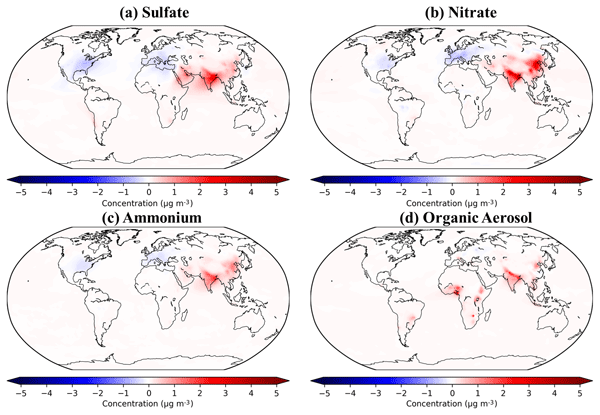
Nitrate aerosol has become a dominant atmospheric component, surpassing sulfate in aerosol composition. However, its simulation remains challenging due to complex formation processes and regional variability. We use the EMAC model to assess key factors in nitrate predictions. Increasing grid resolution, reducing dinitrogen pentoxide hydrolysis uptake, and refining emissions improve model performance, although seasonal and diurnal discrepancies persist, requiring further refinement.
Alexandra P. Tsimpidi, Susanne M. C. Scholz, Alexandros Milousis, Nikolaos Mihalopoulos, and Vlassis A. Karydis
Atmos. Chem. Phys., 25, 10183–10213, https://doi.org/10.5194/acp-25-10183-2025, https://doi.org/10.5194/acp-25-10183-2025, 2025
Short summary
Short summary
This study examines global changes in air pollution from 2000 to 2020, focusing on fine aerosols that impact climate and health. Using models and global data, it finds that organic aerosols dominate in many regions, especially with wildfires or natural emissions. Pollution from sulfate and nitrate has decreased in Europe and North America due to regulations, while trends in Asia are more complex. The findings improve understanding and support policies for cleaner air and healthier environments.
Magesh Mohan, Amy Sullivan, Emily Lill, Ilana Pollack, Alison Piasecki, Sarah Albertin, Ann Middlebrook, Wyndom Chace, Andrew Rollins, Carsten Warneke, Steven Brown, Lu Xu, Katherine Ball, John Crounse, Paul Wennberg, Stelios Kakavas, Spyros Pandis, Athanasios Nenes, and Rodney Weber
EGUsphere, https://doi.org/10.5194/egusphere-2026-4960, https://doi.org/10.5194/egusphere-2026-4960, 2026
This preprint is open for discussion and under review for Atmospheric Chemistry and Physics (ACP).
Short summary
Short summary
Atmospheric fine particles contain liquid water and can be highly acidic. The amount of water and the acidity affect how these particles impact human health, ecosystems, and climate. Flying an aircraft across the continental United States in summer 2023, with a focus on four North American cities, we measured the properties needed to model particle water and acidity. We found the particles were consistently strongly acidic, even within wildfire smoke, and verified the model against observations.
Duong H. Do, Astrid Kerkweg, Yarê Baker, Birger Bohn, Hendrik Fuchs, Quanfu He, Thorsten Hohaus, Sungah Kang, Timo Kirfel, Finja Löher, Niklas Diepenthal, Anke C. Nölscher, Anna Novelli, Alexander Pschera, Felix Wieser, Sören R. Zorn, Andreas Wahner, and Domenico Taraborrelli
EGUsphere, https://doi.org/10.5194/egusphere-2026-4522, https://doi.org/10.5194/egusphere-2026-4522, 2026
Short summary
Short summary
This work builds a chamber simulation tool that mimics how air chemistry changes inside laboratory reactors, including injected gases, changing light, gas and liquid reactions, wall effects, and dilution. Tests in several chambers reproduced measured changes in reactive species, nitrogen compounds, and ozone, and helped capture how organic particles form. The same chemistry can be reused in larger, global air simulations to assess real-world impact.
Yuwei Wang, Aristeidis Voliotis, Emily Matthews, Rongrong Wu, Milan Roska, Max Gerrit Adam, René Dubus, Lukas Kesper, Franz Rohrer, Robert Wegener, Benjamin Winter, Kelvin H. Bates, Quanfu He, Thorsten Hohaus, Achim Grasse, Ralf Tillmann, Andreas Wahner, Hui Wang, Christian Wesolek, Sergej Wedel, Yizhen Wu, Sören R. Zorn, Manjula Canagaratna, Douglas Worsnop, Felipe Lopez-Hilfiker, Georgios I. Gkatzelis, Hugh Coe, and Thomas J. Bannan
Atmos. Meas. Tech., 19, 4583–4599, https://doi.org/10.5194/amt-19-4583-2026, https://doi.org/10.5194/amt-19-4583-2026, 2026
Short summary
Short summary
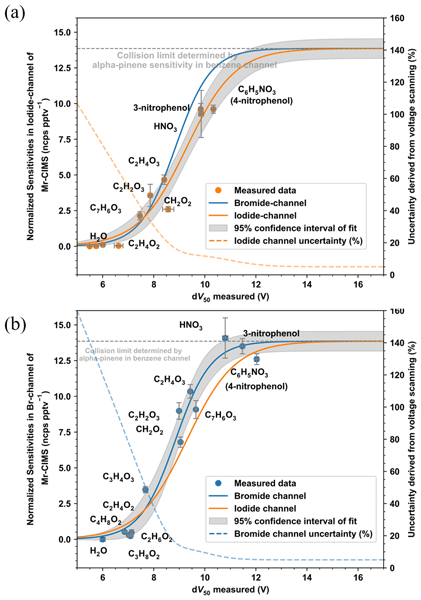
This work developed voltage scanning based calibration approach for a multi-reagent chemical ionization mass spectrometry. This approach improves sensitivity determination for gas-phase compounds. It does not require a calibrant for the target analyte and can estimate sensitivity with acceptable uncertainty based on the experimentally established relationship between binding energies and measured sensitivities. This work is broadly relevant to mass-spectrometric calibration strategies.
Matthias Kohl, Christoph Brühl, Holger Tost, Christos Xenofontos, Theodoros Christoudias, Sergey Gromov, Oliver Appel, Stephan Borrmann, Adam Bourassa, Pedro Campunzano-Jost, Yafang Cheng, Oliver Eppers, Karl D. Froyd, Bruna A. Holanda, Jose L. Jimenez, Patrick Jöckel, Philipp Joppe, Katharina Kaiser, Joseph M. Katich, Klaus Klingmüller, Franziska Köllner, Agnieszka Kupc, Anna Martin, Christopher Pöhlker, Mira L. Pöhlker, Ulrich Pöschl, Landon Rieger, Samuel Ruhl, Gregory P. Schill, Johannes Schneider, Christiane Schulz, Joshua P. Schwarz, Alexandra P. Tsimpidi, Ryan Vella, Christina J. Williamson, Yifan Yang, Daniel Zawada, Jos Lelieveld, and Andrea Pozzer
EGUsphere, https://doi.org/10.5194/egusphere-2026-3649, https://doi.org/10.5194/egusphere-2026-3649, 2026
Short summary
Short summary
Aerosols are crucial for Earth's climate, yet their vertical distribution remains poorly understood. We present first consistent global simulations of aerosol distributions and composition from the Earth's surface to the stratosphere, validated by extensive observations. Key findings include a global minimum in aerosol mass in the free troposphere, a significant contribution of organic aerosol in the lower stratosphere, and limited transport of primary particles to the stratosphere.
Hendrik Fuchs, Niklas Illmann, Amalia Muñoz, Mila Ródenas, Bénédicte Picquet-Varrault, M. Rami Alfarra, Cecilia Arsene, Iustinian G. Bejan, David M. Bell, Merete Bilde, Alexander Böhmländer, Mixtli Campos-Pineda, Mathieu Cazaunau, Patrice Coll, Véronique Daële, Claudia Di Biagio, Michael Flynn, Paola Formenti, Hartmut Herrmann, Kristina Höhler, Thorsten Hohaus, Matthew S. Johnson, Eija Juurola, Niku Kivekäs, Jan Kaiser, Christos Kaltsonoudis, Paolo Laj, Dario Massabò, Federico Mazzei, Gordon McFiggans, Max R. McGillen, Abdelwahid Mellouki, Peter Mettke, Ottmar Möhler, Falk Mothes, Dennis Niedermeier, Anna Novelli, Romeo I. Olariu, Spyros N. Pandis, Iulia Patroescu-Klotz, Rosa Maria Petracca Altieri, Paolo Prati, Claudiu Roman, Albert A. Ruth, Harald Saathoff, Silvio Schmalfuß, Frank Stratmann, Virginia Vernocchi, Aristeidis Voliotis, Jens Voigtländer, Annele Virtanen, Andreas Wahner, Robert Wagner, John Wenger, Sören Zorn, Peter Wiesen, and Jean-Francois Doussin
Atmos. Meas. Tech., 19, 4165–4199, https://doi.org/10.5194/amt-19-4165-2026, https://doi.org/10.5194/amt-19-4165-2026, 2026
Short summary
Short summary
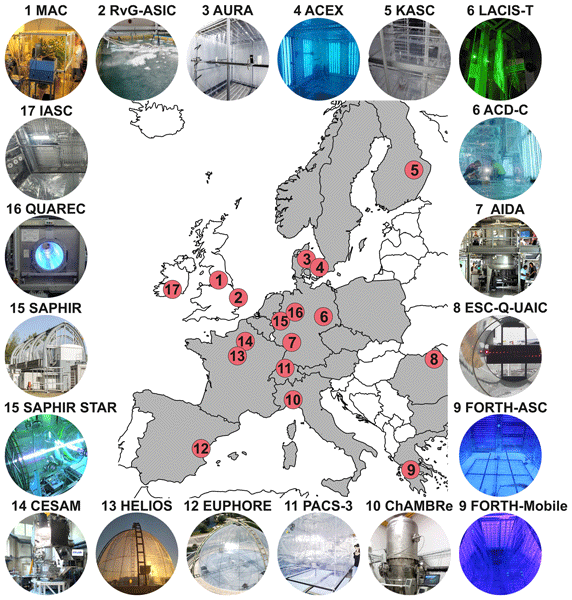
Atmospheric simulation chambers enable experiments to be conducted under controlled conditions, improving our understanding of, and ability to predict, changes in the composition of the atmosphere. This is important for assessing air quality and its effects on human health, climate, the environment, and the economy. This paper describes the chambers of the European ACTRIS research infrastructure and discusses topics and directions that can be addressed in future chamber experiments.
Linyu Gao, Stella E. I. Manavi, Claudia Mohr, Junwei Song, Cheng Wu, Thomas Leisner, Spyros N. Pandis, and Harald Saathoff
Atmos. Chem. Phys., 26, 8875–8892, https://doi.org/10.5194/acp-26-8875-2026, https://doi.org/10.5194/acp-26-8875-2026, 2026
Short summary
Short summary
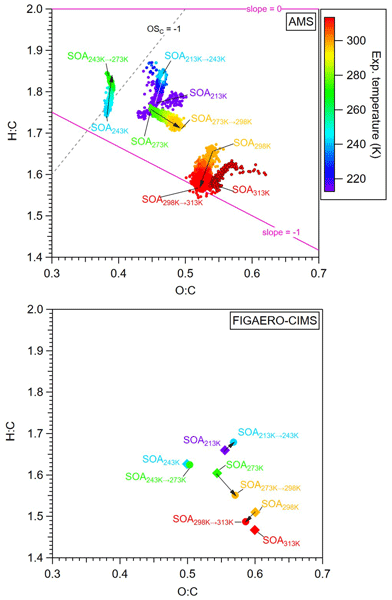
We investigate how temperature (213–313K) affects secondary organic aerosol (SOA) particles derived from isoprene and α-pinene mixtures. Isoprene's suppression on α-pinene dimer formation varied with temperatures. Particles formed at higher temperatures are more oxidized yet more volatile than those formed at lower temperatures and then warmed. This work highlights the need to consider both temperature and biogenic vapor interaction to accurately describe SOA formation, aging, and global burden.
Ruqian Miao, Ruochong Xu, Shan Huang, Sihan Xiao, Hao Wang, Yan Zheng, Siyi Liu, Jingxian Li, Guannan Geng, Manish Shrivastava, Xu Dao, Claire Granier, Guy Brasseur, Vlassis A. Karydis, Alexandra P. Tsimpidi, Jianhui Jiang, Kaspar R. Daellenbach, Imad El Haddad, André S. H. Prévôt, and Qi Chen
EGUsphere, https://doi.org/10.5194/egusphere-2026-3160, https://doi.org/10.5194/egusphere-2026-3160, 2026
Short summary
Short summary
Primary and secondary organic aerosols (POA and SOA) have distinct climate and human health impacts. We develop an OA simulation framework resolving the full volatility spectrum of organic precursor emissions, which improves global POA and SOA characterization. Reassessing their global distributions and budgets, this study shows greater POA and SOA burdens than previous estimates and presents region-dependent OA sources and variability to guide health-oriented pollution mitigation strategies.
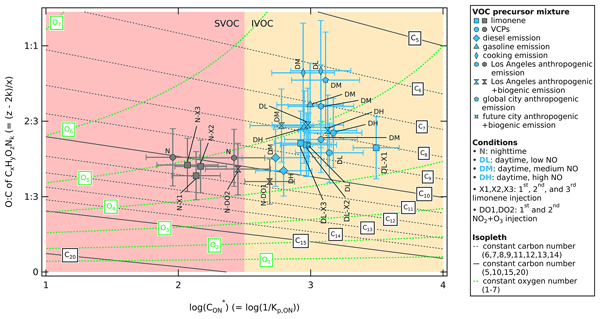
Farhan R. Nursanto, Quanfu He, Sophia van de Wouw, Annika Zanders, Thorsten Hohaus, Willem S. J. Kroese, Robert Wegener, Max Gerrit Adam, Benjamin Winter, René Dubus, Lukas Kesper, Franz Rohrer, Yuwei Wang, Emily Matthews, Aristeidis Voliotis, Thomas J. Bannan, Gordon McFiggans, Hugh Coe, Yizhen Wu, Milan Roska, Manjula Canagaratna, Mitch Alton, Matthew M. Coggon, Chelsea E. Stockwell, Kelvin H. Bates, Eva Y. Pfannerstill, Sören R. Zorn, Hui Wang, Matthieu Riva, Sebastien Perrier, Boxing Yang, Lu Liu, Anna Novelli, Michelle Färber, Hendrik Fuchs, Andrea Carolina Marcillo Lara, Achim Grasse, Christian Wesolek, Ralf Tillmann, Rupert Holzinger, Maarten C. Krol, Georgios I. Gkatzelis, and Juliane L. Fry
Atmos. Chem. Phys., 26, 8425–8453, https://doi.org/10.5194/acp-26-8425-2026, https://doi.org/10.5194/acp-26-8425-2026, 2026
Short summary
Short summary
Urban air contains reactive gases that can form organic nitrate particles and carry nitrogen oxides pollution far from cities. We recreated urban emissions in a large atmospheric chamber and observed their reactions under day and night conditions. We found that these emissions form organic nitrate particles similar to those from natural sources, with higher amounts and heavier particles at night, making nitrogen pollution longer lived and likely to travel further before depositing on ecosystems.
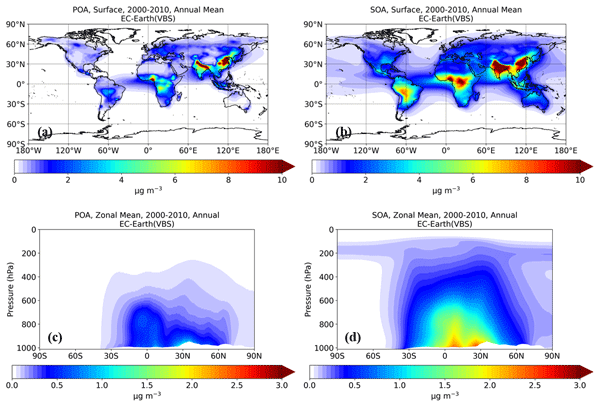
Stylianos Kakavas, Stelios Myriokefalitakis, Alexandra P. Tsimpidi, Vlassis A. Karydis, and Spyros N. Pandis
Geosci. Model Dev., 19, 4271–4288, https://doi.org/10.5194/gmd-19-4271-2026, https://doi.org/10.5194/gmd-19-4271-2026, 2026
Short summary
Short summary
The computationally efficient configuration of the ORACLE v1.0 module (ORACLE-lite) is implemented into the TM5-MP global chemical transport model, which represents the chemistry-transport component of the EC-Earth3-AerChem model. The models bias is reduced by approximately half in the standalone TM5-MP simulation and by a factor of three in EC-Earth3-AerChem when ORACLE-lite is implemented.
Julieta F. Juncosa Calahorrano, Dylan B. Millet, Kelley C. Wells, Chengyuan Hu, Jared F. Brewer, Vivienne H. Payne, Wade Permar, Lu Hu, Amy P. Sullivan, I.-Ting Ku, Emily V. Fischer, Vanessa Selimovic, Kanako Sekimoto, Aaron Lamplugh, Georgios Gkatzelis, Jessica B. Gilman, Matthew Coggon, and Carsten Warneke
EGUsphere, https://doi.org/10.5194/egusphere-2026-1669, https://doi.org/10.5194/egusphere-2026-1669, 2026
Short summary
Short summary
We use thermal infrared satellite observations to study trace gases emitted by fires. We observe large enhancements in smoke and strong relationships among key species. These relationships are consistent with aircraft observations but show greater variability than models predict. This variability is linked to pyrolysis temperatures within fires. Our results show satellite data can improve understanding of fire processes and help refine emission parameterizations in models.
Alexandra P. Tsimpidi and Vlassis A. Karydis
EGUsphere, https://doi.org/10.5194/egusphere-2026-1709, https://doi.org/10.5194/egusphere-2026-1709, 2026
Short summary
Short summary
We developed a simplified representation of organic aerosol formation and evolution for long-term climate simulations. Organic aerosol affects air quality, human health, and climate but is difficult to model due to its complexity. Our approach preserves the key physical and chemical processes while reducing computational cost by about 14%. The model reproduces observed global patterns reasonably well, enabling more efficient and reliable studies of long-term changes in air pollution and climate.
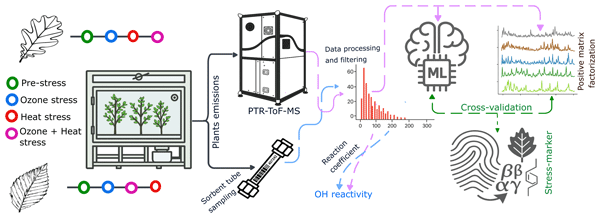
Biplob Dey, Toke Due Sjøgren, Peeyush Khare, Georgios I. Gkatzelis, Yizhen Wu, Sindhu Vasireddy, Martin Schultz, Alexander Knohl, Riikka Rinnan, Thorsten Hohaus, and Eva Y. Pfannerstill
Biogeosciences, 23, 1423–1457, https://doi.org/10.5194/bg-23-1423-2026, https://doi.org/10.5194/bg-23-1423-2026, 2026
Short summary
Short summary
Trees release reactive gases that affect air quality and climate. We studied how these emissions from European beech and English oak change under realistic scenarios of combined and single heat and ozone stress. Heat increased emissions, while ozone reduced most of them. When stressors were combined, the effects were complex and varied by species. Machine learning identified key stress-related compounds. Our findings show that future tree stress may alter air quality and climate interactions.
Alexandros Milousis, Susanne M. C. Scholz, Hendrik Fuchs, Alexandra P. Tsimpidi, and Vlassis A. Karydis
Atmos. Chem. Phys., 26, 571–605, https://doi.org/10.5194/acp-26-571-2026, https://doi.org/10.5194/acp-26-571-2026, 2026
Short summary
Short summary
Nitrate aerosol has become a dominant atmospheric component, surpassing sulfate in aerosol composition. However, its simulation remains challenging due to complex formation processes and regional variability. We use the EMAC model to assess key factors in nitrate predictions. Increasing grid resolution, reducing dinitrogen pentoxide hydrolysis uptake, and refining emissions improve model performance, although seasonal and diurnal discrepancies persist, requiring further refinement.
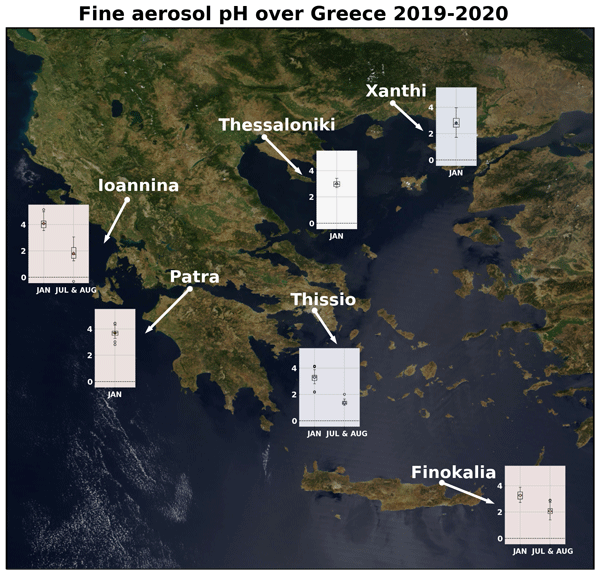
Anna Maria Neroladaki, Maria Tsagkaraki, Kyriaki Papoutsidaki, Kalliopi Tavernaraki, Filothei Boufidou, Pavlos Zarmpas, Irini Tsiodra, Eleni Liakakou, Aikaterini Bougiatioti, Giorgos Kouvarakis, Nikos Kalivitis, Christos Kaltsonoudis, Athanasios Karagioras, Dimitrios Balis, Konstantinos Michailidis, Konstantinos Kourtidis, Stelios Myriokefalitakis, Nikos Hatzianastassiou, Spyros N. Pandis, Athanasios Nenes, Nikolaos Mihalopoulos, and Maria Kanakidou
Atmos. Chem. Phys., 25, 17953–17971, https://doi.org/10.5194/acp-25-17953-2025, https://doi.org/10.5194/acp-25-17953-2025, 2025
Short summary
Short summary
Aerosol acidity affects aerosol composition and properties, and therefore climate, human health and ecosystems. We use summer and winter fine aerosol observations at 6 sites across Greece, and a thermodynamic model to calculate the spatial and seasonal variability of aerosol acidity. Aerosols were acidic to moderately acidic and more acidic during summer than winter. The importance of organics for aerosol acidity was small. Depending on location different factors controlled aerosol acidity.
Alexander Hermanns, Anne Caroline Lange, Julia Kowalski, Hendrik Fuchs, and Philipp Franke
Geosci. Model Dev., 18, 9417–9432, https://doi.org/10.5194/gmd-18-9417-2025, https://doi.org/10.5194/gmd-18-9417-2025, 2025
Short summary
Short summary
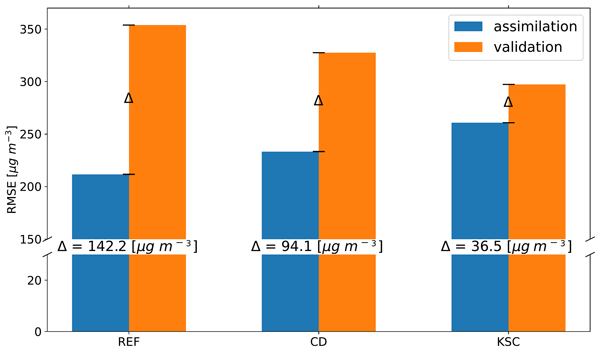
For air quality analyses, data assimilation models split available data into assimilation and validation data sets. The former is used to generate the analysis, the latter to verify the simulations. A preprocessor classifying the observations by the data characteristics is developed based on clustering algorithms. The assimilation and validation data sets are compiled by equally allocating data of each cluster. The resulting improvement of the analysis is evaluated with an air quality model.
Joseph O. Palmo, Colette L. Heald, Donald R. Blake, Ilann Bourgeois, Matthew Coggon, Jeff Collett, Frank Flocke, Alan Fried, Georgios Gkatzelis, Samuel Hall, Lu Hu, Jose L. Jimenez, Pedro Campuzano-Jost, I-Ting Ku, Benjamin Nault, Brett Palm, Jeff Peischl, Ilana Pollack, Amy Sullivan, Joel Thornton, Carsten Warneke, Armin Wisthaler, and Lu Xu
Atmos. Chem. Phys., 25, 17107–17124, https://doi.org/10.5194/acp-25-17107-2025, https://doi.org/10.5194/acp-25-17107-2025, 2025
Short summary
Short summary
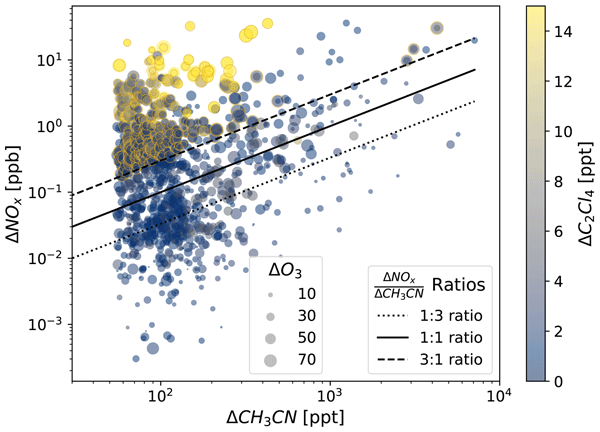
This study investigates ozone production within wildfire smoke plumes as they age, using both aircraft observations and models. We find that the chemical environment and resulting ozone production within smoke changes as plumes evolve, with implications for climate and public health.
Lu Liu, Thorsten Hohaus, Andreas Hofzumahaus, Frank Holland, Hendrik Fuchs, Ralf Tillmann, Birger Bohn, Stefanie Andres, Zhaofeng Tan, Franz Rohrer, Vlassis A. Karydis, Vaishali Vardhan, Philipp Franke, Anne C. Lange, Anna Novelli, Benjamin Winter, Changmin Cho, Iulia Gensch, Sergej Wedel, Andreas Wahner, and Astrid Kiendler-Scharr
Atmos. Chem. Phys., 25, 16189–16213, https://doi.org/10.5194/acp-25-16189-2025, https://doi.org/10.5194/acp-25-16189-2025, 2025
Short summary
Short summary
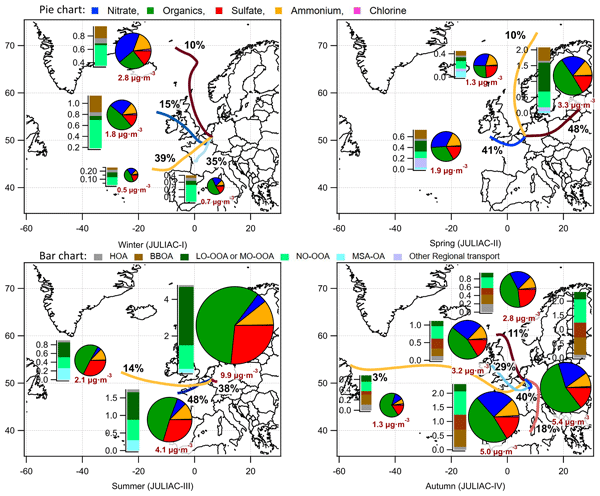
We measured air particles at a rural site in Germany over a year to understand how their sources and properties change with the seasons. Particles from natural sources peaked in summer, especially during heatwaves, while those from burning activities like residential heating and wildfires dominated in colder months. Winds carrying air from other regions also influenced particle levels. These findings link air quality to climate change and energy transitions.
Maria P. Georgopoulou, Kalliopi Florou, Angeliki Matrali, Georgia Starida, Christos Kaltsonoudis, Athanasios Nenes, and Spyros N. Pandis
Atmos. Chem. Phys., 25, 15835–15855, https://doi.org/10.5194/acp-25-15835-2025, https://doi.org/10.5194/acp-25-15835-2025, 2025
Short summary
Short summary
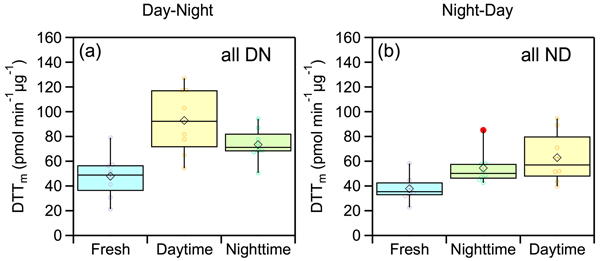
Residential biomass burning is an important wintertime source of aerosols. This study examined the complex diurnal aging cycles on biomass burning aerosol composition and oxidative potential, a key toxicity metric. Additional organic aerosol (OA) mass was produced after the two (day/night and night/day) cycles, varying from 35 to 90 % of the initial OA. The aging of the emissions led to a final oxidative potential increase of 60 % for both cycles.
Konstantinos Mataras, Evangelia Siouti, David Patoulias, and Spyros N. Pandis
Atmos. Chem. Phys., 25, 15785–15799, https://doi.org/10.5194/acp-25-15785-2025, https://doi.org/10.5194/acp-25-15785-2025, 2025
Short summary
Short summary
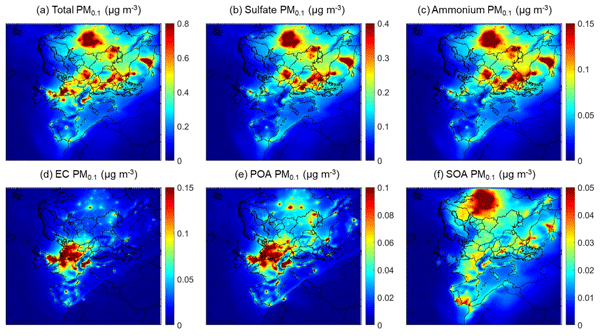
Predicted levels of ultrafine particle mass (PM0.1) vary substantially over Europe with higher values in the summer than in the winter. In summer, PM0.1 was mostly comprised of sulfate (38 %) and secondary organics (32 %). During winter the sulfate fraction increased to 47 % and primary organics contributed 23 %. Correlations between PM0.1 and the regulated PM2.5 were low. This suggests that there are significant differences between the dominant sources and processes of PM0.1 and PM2.5.
Georgia A. Argyropoulou, Kalliopi Florou, and Spyros N. Pandis
Atmos. Meas. Tech., 18, 4969–4983, https://doi.org/10.5194/amt-18-4969-2025, https://doi.org/10.5194/amt-18-4969-2025, 2025
Short summary
Short summary
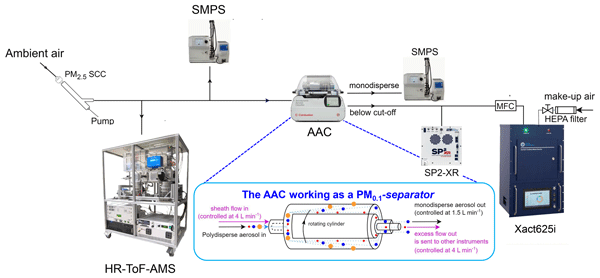
Ultrafine particles (diameter of less than 100 nm) are suspected to cause significant health effects. Accurately measuring their chemical composition and physical properties in real time is challenging due to their low mass and interference from larger particles. This study proposes a method for the continuous, automated measurement of their composition, tested in a pilot field study to explore their chemical characteristics, physical properties, and sources.
Xurong Wang, Alexandra P. Tsimpidi, Zhenqi Luo, Benedikt Steil, Andrea Pozzer, Jos Lelieveld, and Vlassis A. Karydis
Atmos. Chem. Phys., 25, 10559–10586, https://doi.org/10.5194/acp-25-10559-2025, https://doi.org/10.5194/acp-25-10559-2025, 2025
Short summary
Short summary
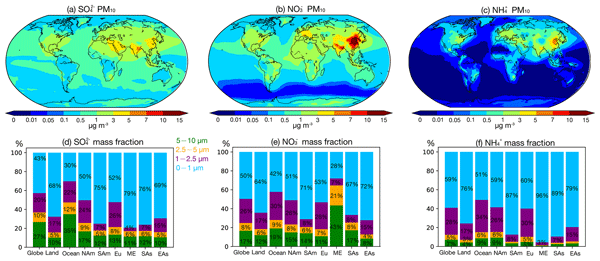
Ammonia (NH3) is an abundant alkaline gas and key precursor in particulate matter formation. While SO2 and NOx emissions have decreased, global NH3 emissions are stable or rising. This study investigates NH3 emission impacts on size-resolved aerosol composition and acidity using the EMAC (ECHAM5/MESSy Atmospheric Chemistry) model, analyzing three emission schemes. Sulfate–nitrate–ammonium aerosols in fine-mode sizes are most sensitive to NH3 changes. Regional responses vary. NH3 buffers aerosol acidity, mitigating pH shifts.
Alexandra P. Tsimpidi, Susanne M. C. Scholz, Alexandros Milousis, Nikolaos Mihalopoulos, and Vlassis A. Karydis
Atmos. Chem. Phys., 25, 10183–10213, https://doi.org/10.5194/acp-25-10183-2025, https://doi.org/10.5194/acp-25-10183-2025, 2025
Short summary
Short summary
This study examines global changes in air pollution from 2000 to 2020, focusing on fine aerosols that impact climate and health. Using models and global data, it finds that organic aerosols dominate in many regions, especially with wildfires or natural emissions. Pollution from sulfate and nitrate has decreased in Europe and North America due to regulations, while trends in Asia are more complex. The findings improve understanding and support policies for cleaner air and healthier environments.
Mingxuan Wu, Hailong Wang, Zheng Lu, Xiaohong Liu, Huisheng Bian, David D. Cohen, Yan Feng, Mian Chin, Didier A. Hauglustaine, Vlassis A. Karydis, Marianne T. Lund, Gunnar Myhre, Andrea Pozzer, Michael Schulz, Ragnhild B. Skeie, Alexandra P. Tsimpidi, Svetlana G. Tsyro, and Shaocheng Xie
Atmos. Chem. Phys., 25, 10049–10074, https://doi.org/10.5194/acp-25-10049-2025, https://doi.org/10.5194/acp-25-10049-2025, 2025
Short summary
Short summary
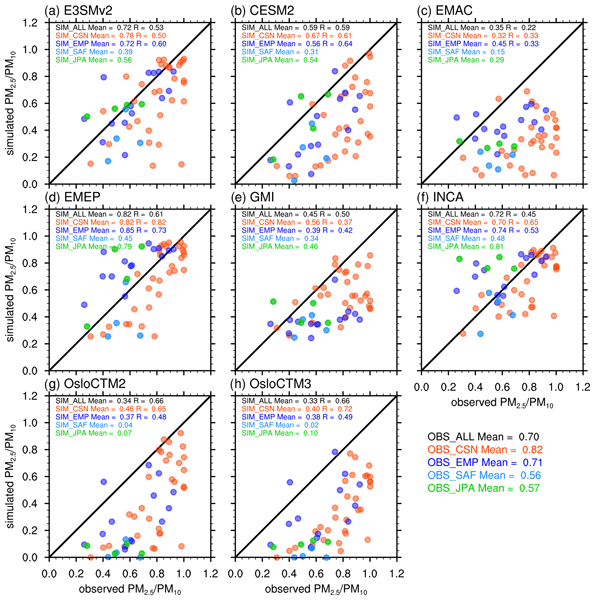
A key challenge in simulating the life cycle of nitrate aerosol in global models is accurately representing the mass size distribution of nitrate aerosol, which lacks sufficient observational constraints. We found that most global models underestimate the mass fraction of fine-mode nitrate at the surface in all regions. Our study highlights the importance of gas–aerosol partitioning parameterization and the simulation of dust and sea salt in correctly simulating the mass size distribution of nitrate.
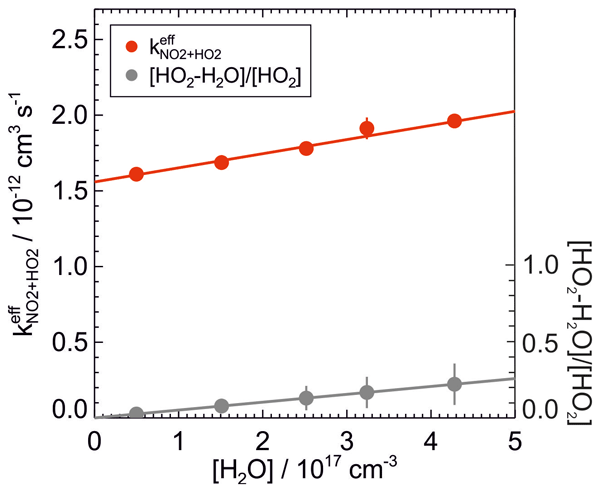
Michael Rolletter, Andreas Hofzumahaus, Anna Novelli, Andreas Wahner, and Hendrik Fuchs
Atmos. Chem. Phys., 25, 3481–3502, https://doi.org/10.5194/acp-25-3481-2025, https://doi.org/10.5194/acp-25-3481-2025, 2025
Short summary
Short summary
Highly accurate rate coefficients of termolecular reactions between OH and HO2 radicals and reactive nitrogen oxides were measured for conditions in the lower troposphere, providing improved constraints on recommended values. No dependence on water vapour was found except for the HO2+NO2 reaction, which can be explained by an enhanced rate coefficient of the NO2 reaction with the water complex of the HO2 radical.
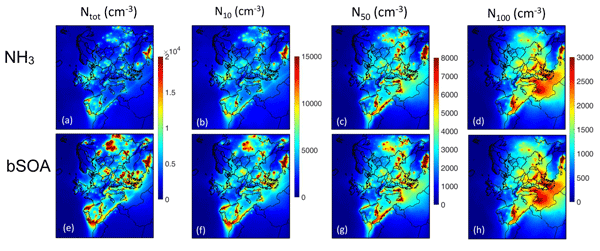
David Patoulias, Kalliopi Florou, and Spyros N. Pandis
Geosci. Model Dev., 18, 1103–1118, https://doi.org/10.5194/gmd-18-1103-2025, https://doi.org/10.5194/gmd-18-1103-2025, 2025
Short summary
Short summary
The effect of the assumed atmospheric nucleation mechanism on particle number concentrations and size distribution was investigated. Two quite different mechanisms involving sulfuric acid and ammonia or a biogenic organic vapor gave quite similar results which were consistent with measurements at 26 measurement stations across Europe. The number of larger particles that serve as cloud condensation nuclei showed little sensitivity to the assumed nucleation mechanism.
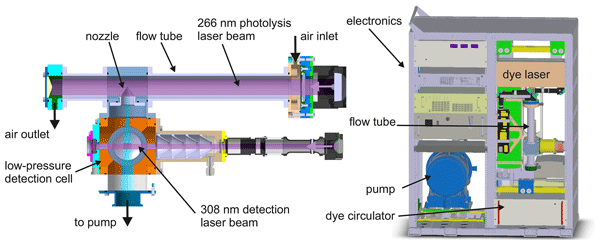
Hendrik Fuchs, Aaron Stainsby, Florian Berg, René Dubus, Michelle Färber, Andreas Hofzumahaus, Frank Holland, Kelvin H. Bates, Steven S. Brown, Matthew M. Coggon, Glenn S. Diskin, Georgios I. Gkatzelis, Christopher M. Jernigan, Jeff Peischl, Michael A. Robinson, Andrew W. Rollins, Nell B. Schafer, Rebecca H. Schwantes, Chelsea E. Stockwell, Patrick R. Veres, Carsten Warneke, Eleanor M. Waxman, Lu Xu, Kristen Zuraski, Andreas Wahner, and Anna Novelli
Atmos. Meas. Tech., 18, 881–895, https://doi.org/10.5194/amt-18-881-2025, https://doi.org/10.5194/amt-18-881-2025, 2025
Short summary
Short summary
Significant improvements have been made to the instruments used to measure OH reactivity, which is equivalent to the sum of air pollutant concentrations. Accurate and precise measurements with a high time resolution have been achieved, allowing use on aircraft, as demonstrated during flights in the USA.
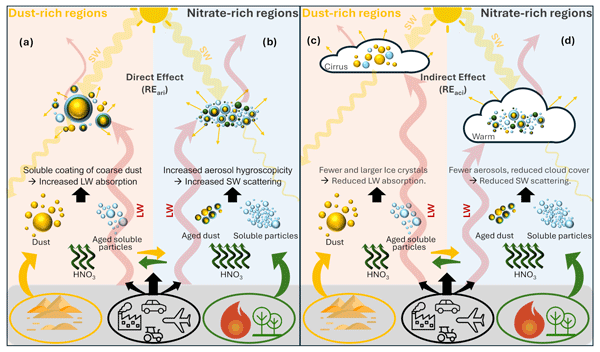
Alexandros Milousis, Klaus Klingmüller, Alexandra P. Tsimpidi, Jasper F. Kok, Maria Kanakidou, Athanasios Nenes, and Vlassis A. Karydis
Atmos. Chem. Phys., 25, 1333–1351, https://doi.org/10.5194/acp-25-1333-2025, https://doi.org/10.5194/acp-25-1333-2025, 2025
Short summary
Short summary
This study investigates the impact of dust on the global radiative effect of nitrate aerosols. The results indicate both positive and negative regional shortwave and longwave radiative effects due to aerosol–radiation interactions and cloud adjustments. The global average net REari and REaci of nitrate aerosols are −0.11 and +0.17 W m−2, respectively, mainly affecting the shortwave spectrum. Sensitivity simulations evaluated the influence of mineral dust composition and emissions on the results.
Ryan Vella, Matthew Forrest, Andrea Pozzer, Alexandra P. Tsimpidi, Thomas Hickler, Jos Lelieveld, and Holger Tost
Atmos. Chem. Phys., 25, 243–262, https://doi.org/10.5194/acp-25-243-2025, https://doi.org/10.5194/acp-25-243-2025, 2025
Short summary
Short summary
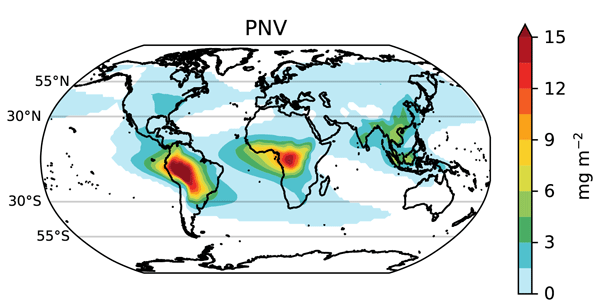
This study examines how land cover changes influence biogenic volatile organic compound (BVOC) emissions and atmospheric states. Using a coupled chemistry–climate–vegetation model, we compare present-day land cover (deforested for crops and grazing) with natural vegetation and an extreme reforestation scenario. We find that vegetation changes significantly impact global BVOC emissions and organic aerosols but have a relatively small effect on total aerosols, clouds, and radiative effects.
Florian Berg, Anna Novelli, René Dubus, Andreas Hofzumahaus, Frank Holland, Andreas Wahner, and Hendrik Fuchs
Atmos. Chem. Phys., 24, 13715–13731, https://doi.org/10.5194/acp-24-13715-2024, https://doi.org/10.5194/acp-24-13715-2024, 2024
Short summary
Short summary
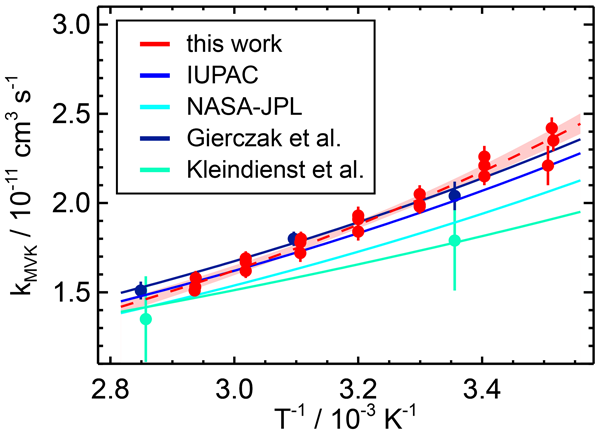
This study reports temperature-dependent rate coefficients of the reaction of atmospherically relevant hydrocarbons from biogenic sources (methyl vinyl ketones and monoterpenes) and anthropogenic sources (alkanes and aromatics). Measurements were done at atmospheric conditions (ambient pressure and temperature range) in air.
Andreas Aktypis, Dontavious J. Sippial, Christina N. Vasilakopoulou, Angeliki Matrali, Christos Kaltsonoudis, Andrea Simonati, Marco Paglione, Matteo Rinaldi, Stefano Decesari, and Spyros N. Pandis
Atmos. Chem. Phys., 24, 13769–13791, https://doi.org/10.5194/acp-24-13769-2024, https://doi.org/10.5194/acp-24-13769-2024, 2024
Short summary
Short summary
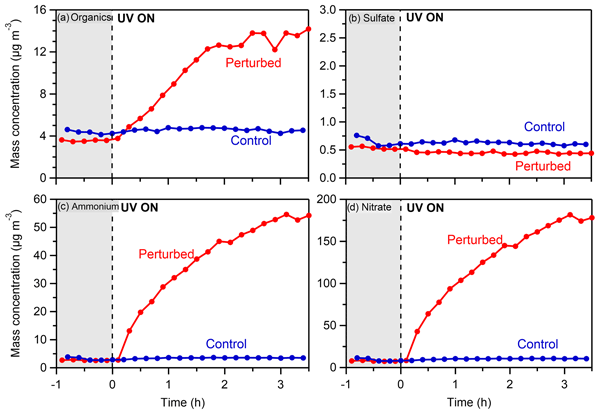
A dual-chamber system was deployed in two different environments (Po Valley, Italy, and Pertouli forest, Greece) to study the potential of ambient air directly injected into the chambers, to form secondary organic aerosol (SOA). In the Po Valley, the system reacts rapidly, forming large amounts of SOA, while in Pertouli the SOA formation chemistry appears to have been practically terminated before the beginning of most experiments, so there is little additional SOA formation potential left.
Junwei Song, Georgios I. Gkatzelis, Ralf Tillmann, Nicolas Brüggemann, Thomas Leisner, and Harald Saathoff
Atmos. Chem. Phys., 24, 13199–13217, https://doi.org/10.5194/acp-24-13199-2024, https://doi.org/10.5194/acp-24-13199-2024, 2024
Short summary
Short summary
Biogenic volatile organic compounds (BVOCs) and organic aerosol (OA) particles were measured online in a stressed spruce-dominated forest. OA was mainly attributed to the monoterpene oxidation products. The mixing ratios of BVOCs were higher than the values previously measured in other temperate forests. The results demonstrate that BVOCs are influenced not only by meteorology and biogenic emissions but also by local anthropogenic emissions and subsequent chemical transformation processes.
Andrew O. Langford, Raul J. Alvarez II, Kenneth C. Aikin, Sunil Baidar, W. Alan Brewer, Steven S. Brown, Matthew M. Coggan, Patrick D. Cullis, Jessica Gilman, Georgios I. Gkatzelis, Detlev Helmig, Bryan J. Johnson, K. Emma Knowland, Rajesh Kumar, Aaron D. Lamplugh, Audra McClure-Begley, Brandi J. McCarty, Ann M. Middlebrook, Gabriele Pfister, Jeff Peischl, Irina Petropavlovskikh, Pamela S. Rickley, Andrew W. Rollins, Scott P. Sandberg, Christoph J. Senff, and Carsten Warneke
EGUsphere, https://doi.org/10.5194/egusphere-2024-1938, https://doi.org/10.5194/egusphere-2024-1938, 2024
Preprint withdrawn
Short summary
Short summary
High ozone (O3) formed by reactions of nitrogen oxides (NOx) and volatile organic compounds (VOCs) can harm human health and welfare. High O3 is usually associated with hot summer days, but under certain conditions, high O3 can also form under winter conditions. In this study, we describe a high O3 event that occurred in Colorado during the COVID-19 quarantine that was caused in part by the decrease in traffic, and in part by a shallow inversion created by descent of stratospheric air.
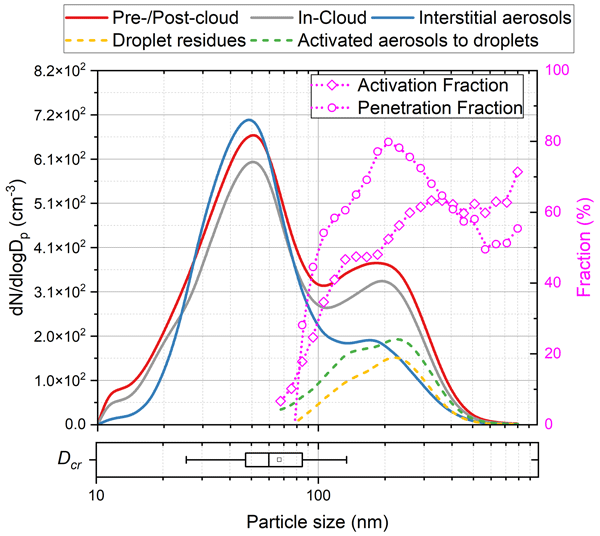
Romanos Foskinis, Ghislain Motos, Maria I. Gini, Olga Zografou, Kunfeng Gao, Stergios Vratolis, Konstantinos Granakis, Ville Vakkari, Kalliopi Violaki, Andreas Aktypis, Christos Kaltsonoudis, Zongbo Shi, Mika Komppula, Spyros N. Pandis, Konstantinos Eleftheriadis, Alexandros Papayannis, and Athanasios Nenes
Atmos. Chem. Phys., 24, 9827–9842, https://doi.org/10.5194/acp-24-9827-2024, https://doi.org/10.5194/acp-24-9827-2024, 2024
Short summary
Short summary
Analysis of modeling, in situ, and remote sensing measurements reveals the microphysical state of orographic clouds and their response to aerosol from the boundary layer and free troposphere. We show that cloud response to aerosol is robust, as predicted supersaturation and cloud droplet number levels agree with those determined from in-cloud measurements. The ability to determine if clouds are velocity- or aerosol-limited allows for novel model constraints and remote sensing products.
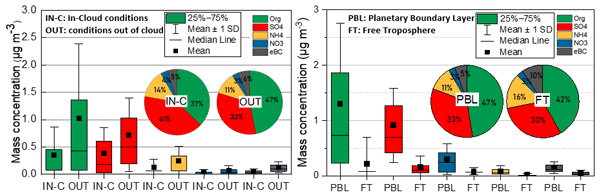
Olga Zografou, Maria Gini, Prodromos Fetfatzis, Konstantinos Granakis, Romanos Foskinis, Manousos Ioannis Manousakas, Fotios Tsopelas, Evangelia Diapouli, Eleni Dovrou, Christina N. Vasilakopoulou, Alexandros Papayannis, Spyros N. Pandis, Athanasios Nenes, and Konstantinos Eleftheriadis
Atmos. Chem. Phys., 24, 8911–8926, https://doi.org/10.5194/acp-24-8911-2024, https://doi.org/10.5194/acp-24-8911-2024, 2024
Short summary
Short summary
Characterization of PM1 and positive matrix factorization (PMF) source apportionment of organic and inorganic fractions were conducted at the high-altitude station (HAC)2. Cloud presence reduced PM1, affecting sulfate more than organics. Free-troposphere (FT) conditions showed more black carbon (eBC) than planetary boundary layer (PBL) conditions.
Olga Zografou, Christos Kaltsonoudis, Maria Gini, Angeliki Matrali, Elias Panagiotopoulos, Alexandros Lekkas, Dimitris Papanastasiou, Spyros N. Pandis, and Konstantinos Eleftheriadis
EGUsphere, https://doi.org/10.5194/egusphere-2024-2126, https://doi.org/10.5194/egusphere-2024-2126, 2024
Preprint archived
Short summary
Short summary
A novel charge transfer ionization orthogonal Time-of-Flight Mass Spectrometer (oToF-MS) was field evaluated for the first time during a field campaign at the suburban DEM station in Athens, Greece from May to August 2023 focusing on key ambient Volatile Organic Compounds (VOCs). The results demonstrate the strengths of the new instrument in performing online, real time measurements of ambient VOCs.
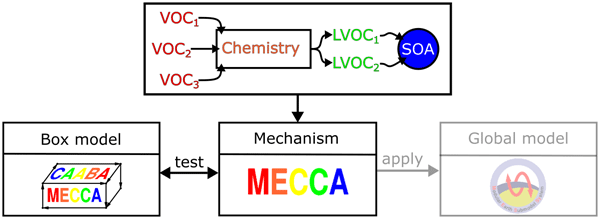
Felix Wieser, Rolf Sander, Changmin Cho, Hendrik Fuchs, Thorsten Hohaus, Anna Novelli, Ralf Tillmann, and Domenico Taraborrelli
Geosci. Model Dev., 17, 4311–4330, https://doi.org/10.5194/gmd-17-4311-2024, https://doi.org/10.5194/gmd-17-4311-2024, 2024
Short summary
Short summary
The chemistry scheme of the atmospheric box model CAABA/MECCA is expanded to achieve an improved aerosol formation from emitted organic compounds. In addition to newly added reactions, temperature-dependent partitioning of all new species between the gas and aqueous phases is estimated and included in the pre-existing scheme. Sensitivity runs show an overestimation of key compounds from isoprene, which can be explained by a lack of aqueous-phase degradation reactions and box model limitations.
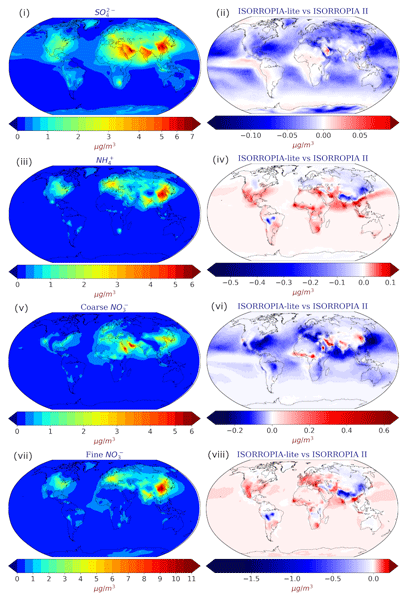
Alexandros Milousis, Alexandra P. Tsimpidi, Holger Tost, Spyros N. Pandis, Athanasios Nenes, Astrid Kiendler-Scharr, and Vlassis A. Karydis
Geosci. Model Dev., 17, 1111–1131, https://doi.org/10.5194/gmd-17-1111-2024, https://doi.org/10.5194/gmd-17-1111-2024, 2024
Short summary
Short summary
This study aims to evaluate the newly developed ISORROPIA-lite aerosol thermodynamic module within the EMAC model and explore discrepancies in global atmospheric simulations of aerosol composition and acidity by utilizing different aerosol phase states. Even though local differences were found in regions where the RH ranged from 20 % to 60 %, on a global scale the results are similar. Therefore, ISORROPIA-lite can be a reliable and computationally effective alternative to ISORROPIA II in EMAC.
Matthew M. Coggon, Chelsea E. Stockwell, Megan S. Claflin, Eva Y. Pfannerstill, Lu Xu, Jessica B. Gilman, Julia Marcantonio, Cong Cao, Kelvin Bates, Georgios I. Gkatzelis, Aaron Lamplugh, Erin F. Katz, Caleb Arata, Eric C. Apel, Rebecca S. Hornbrook, Felix Piel, Francesca Majluf, Donald R. Blake, Armin Wisthaler, Manjula Canagaratna, Brian M. Lerner, Allen H. Goldstein, John E. Mak, and Carsten Warneke
Atmos. Meas. Tech., 17, 801–825, https://doi.org/10.5194/amt-17-801-2024, https://doi.org/10.5194/amt-17-801-2024, 2024
Short summary
Short summary
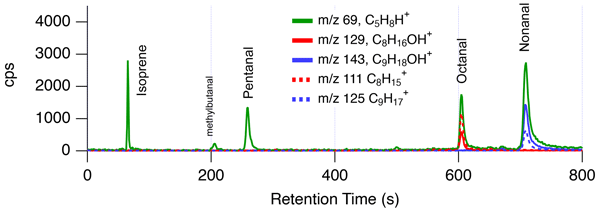
Mass spectrometry is a tool commonly used to measure air pollutants. This study evaluates measurement artifacts produced in the proton-transfer-reaction mass spectrometer. We provide methods to correct these biases and better measure compounds that degrade air quality.
Georgios I. Gkatzelis, Matthew M. Coggon, Chelsea E. Stockwell, Rebecca S. Hornbrook, Hannah Allen, Eric C. Apel, Megan M. Bela, Donald R. Blake, Ilann Bourgeois, Steven S. Brown, Pedro Campuzano-Jost, Jason M. St. Clair, James H. Crawford, John D. Crounse, Douglas A. Day, Joshua P. DiGangi, Glenn S. Diskin, Alan Fried, Jessica B. Gilman, Hongyu Guo, Johnathan W. Hair, Hannah S. Halliday, Thomas F. Hanisco, Reem Hannun, Alan Hills, L. Gregory Huey, Jose L. Jimenez, Joseph M. Katich, Aaron Lamplugh, Young Ro Lee, Jin Liao, Jakob Lindaas, Stuart A. McKeen, Tomas Mikoviny, Benjamin A. Nault, J. Andrew Neuman, John B. Nowak, Demetrios Pagonis, Jeff Peischl, Anne E. Perring, Felix Piel, Pamela S. Rickly, Michael A. Robinson, Andrew W. Rollins, Thomas B. Ryerson, Melinda K. Schueneman, Rebecca H. Schwantes, Joshua P. Schwarz, Kanako Sekimoto, Vanessa Selimovic, Taylor Shingler, David J. Tanner, Laura Tomsche, Krystal T. Vasquez, Patrick R. Veres, Rebecca Washenfelder, Petter Weibring, Paul O. Wennberg, Armin Wisthaler, Glenn M. Wolfe, Caroline C. Womack, Lu Xu, Katherine Ball, Robert J. Yokelson, and Carsten Warneke
Atmos. Chem. Phys., 24, 929–956, https://doi.org/10.5194/acp-24-929-2024, https://doi.org/10.5194/acp-24-929-2024, 2024
Short summary
Short summary
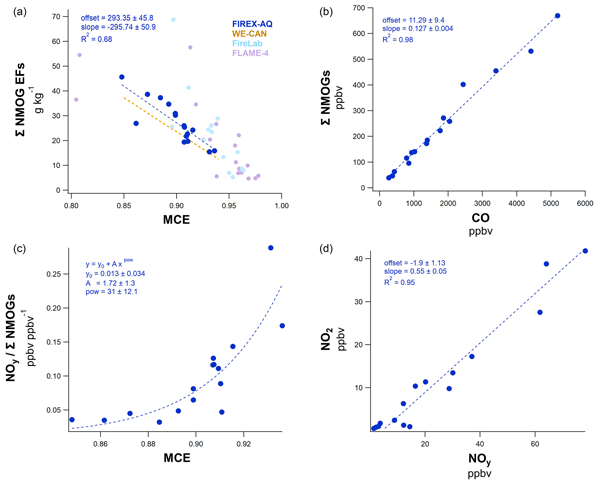
This study reports emissions of gases and particles from wildfires. These emissions are related to chemical proxies that can be measured by satellite and incorporated into models to improve predictions of wildfire impacts on air quality and climate.
Stella E. I. Manavi and Spyros N. Pandis
Atmos. Chem. Phys., 24, 891–909, https://doi.org/10.5194/acp-24-891-2024, https://doi.org/10.5194/acp-24-891-2024, 2024
Short summary
Short summary
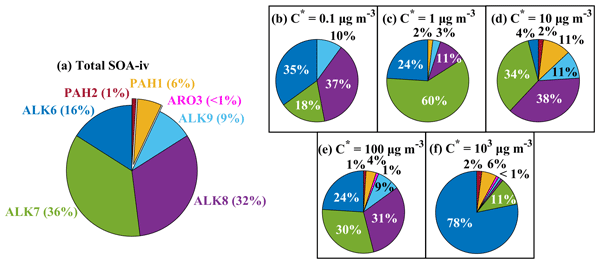
Organic vapors of intermediate volatility have often been neglected as sources of atmospheric organic aerosol. In this work we use a new approach for their simulation and quantify the contribution of these compounds emitted by transportation sources (gasoline and diesel vehicles) to particulate matter over Europe. The estimated secondary organic aerosol levels are on average 60 % higher than predicted by previous approaches. However, these estimates are probably lower limits.
Andreas Aktypis, Christos Kaltsonoudis, David Patoulias, Panayiotis Kalkavouras, Angeliki Matrali, Christina N. Vasilakopoulou, Evangelia Kostenidou, Kalliopi Florou, Nikos Kalivitis, Aikaterini Bougiatioti, Konstantinos Eleftheriadis, Stergios Vratolis, Maria I. Gini, Athanasios Kouras, Constantini Samara, Mihalis Lazaridis, Sofia-Eirini Chatoutsidou, Nikolaos Mihalopoulos, and Spyros N. Pandis
Atmos. Chem. Phys., 24, 65–84, https://doi.org/10.5194/acp-24-65-2024, https://doi.org/10.5194/acp-24-65-2024, 2024
Short summary
Short summary
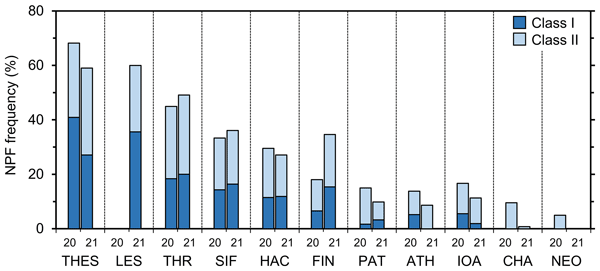
Extensive continuous particle number size distribution measurements took place during two summers (2020 and 2021) at 11 sites in Greece for the investigation of the frequency and the spatial extent of new particle formation. The frequency during summer varied from close to zero in southwestern Greece to more than 60 % in the northern, central, and eastern regions. The spatial variability can be explained by the proximity of the sites to coal-fired power plants and agricultural areas.
Stylianos Kakavas, Spyros N. Pandis, and Athanasios Nenes
Atmos. Chem. Phys., 23, 13555–13564, https://doi.org/10.5194/acp-23-13555-2023, https://doi.org/10.5194/acp-23-13555-2023, 2023
Short summary
Short summary
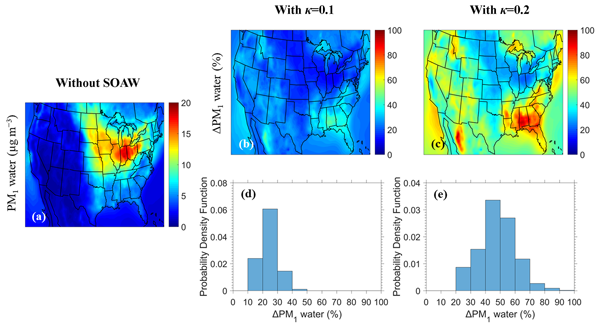
Water uptake from organic species in aerosol can affect the partitioning of semi-volatile inorganic compounds but are not considered in global and chemical transport models. We address this with a version of the PM-CAMx model that considers such organic water effects and use it to carry out 1-year aerosol simulations over the continental US. We show that such organic water impacts can increase dry PM1 levels by up to 2 μg m-3 when RH levels and PM1 concentrations are high.
Jacky Y. S. Pang, Florian Berg, Anna Novelli, Birger Bohn, Michelle Färber, Philip T. M. Carlsson, René Dubus, Georgios I. Gkatzelis, Franz Rohrer, Sergej Wedel, Andreas Wahner, and Hendrik Fuchs
Atmos. Chem. Phys., 23, 12631–12649, https://doi.org/10.5194/acp-23-12631-2023, https://doi.org/10.5194/acp-23-12631-2023, 2023
Short summary
Short summary
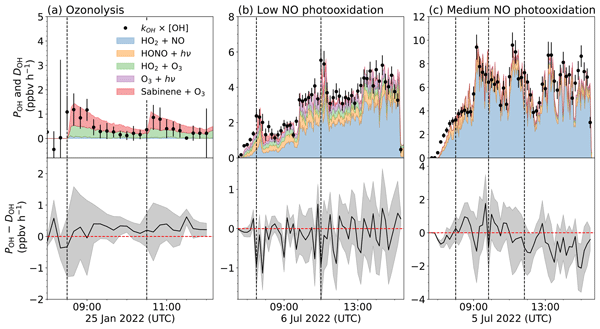
In this study, the oxidations of sabinene by OH radicals and ozone were investigated with an atmospheric simulation chamber. Reaction rate coefficients of the OH-oxidation reaction at temperatures between 284 to 340 K were determined for the first time in the laboratory by measuring the OH reactivity. Product yields determined in chamber experiments had good agreement with literature values, but discrepancies were found between experimental yields and expected yields from oxidation mechanisms.
Marc von Hobe, Domenico Taraborrelli, Sascha Alber, Birger Bohn, Hans-Peter Dorn, Hendrik Fuchs, Yun Li, Chenxi Qiu, Franz Rohrer, Roberto Sommariva, Fred Stroh, Zhaofeng Tan, Sergej Wedel, and Anna Novelli
Atmos. Chem. Phys., 23, 10609–10623, https://doi.org/10.5194/acp-23-10609-2023, https://doi.org/10.5194/acp-23-10609-2023, 2023
Short summary
Short summary
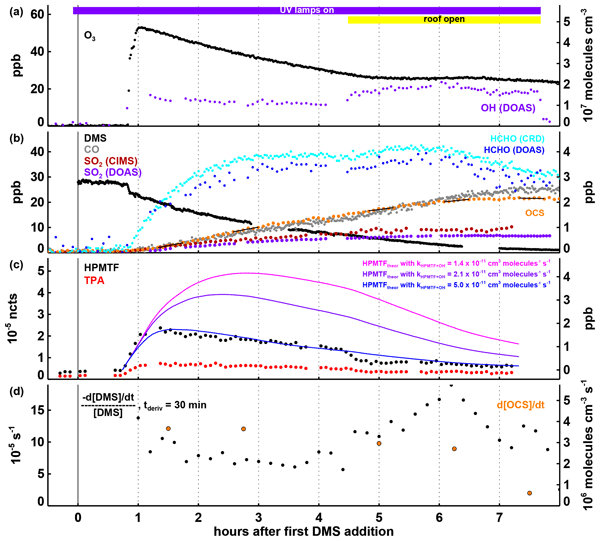
The trace gas carbonyl sulfide (OCS) transports sulfur from the troposphere to the stratosphere, where sulfate aerosols are formed that influence climate and stratospheric chemistry. An uncertain OCS source in the troposphere is chemical production form dimethyl sulfide (DMS), a gas released in large quantities from the oceans. We carried out experiments in a large atmospheric simulation chamber to further elucidate the chemical mechanism of OCS production from DMS.
Amir Yazdani, Satoshi Takahama, John K. Kodros, Marco Paglione, Mauro Masiol, Stefania Squizzato, Kalliopi Florou, Christos Kaltsonoudis, Spiro D. Jorga, Spyros N. Pandis, and Athanasios Nenes
Atmos. Chem. Phys., 23, 7461–7477, https://doi.org/10.5194/acp-23-7461-2023, https://doi.org/10.5194/acp-23-7461-2023, 2023
Short summary
Short summary
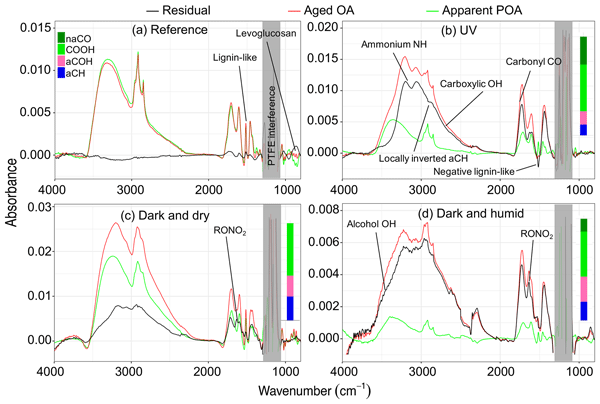
Organic aerosols directly emitted from wood and pellet stove combustion are found to chemically transform (approximately 15 %–35 % by mass) under daytime aging conditions simulated in an environmental chamber. A new marker for lignin-like compounds is found to degrade at a different rate than previously identified biomass burning markers and can potentially provide indication of aging time in ambient samples.
Hao Luo, Luc Vereecken, Hongru Shen, Sungah Kang, Iida Pullinen, Mattias Hallquist, Hendrik Fuchs, Andreas Wahner, Astrid Kiendler-Scharr, Thomas F. Mentel, and Defeng Zhao
Atmos. Chem. Phys., 23, 7297–7319, https://doi.org/10.5194/acp-23-7297-2023, https://doi.org/10.5194/acp-23-7297-2023, 2023
Short summary
Short summary
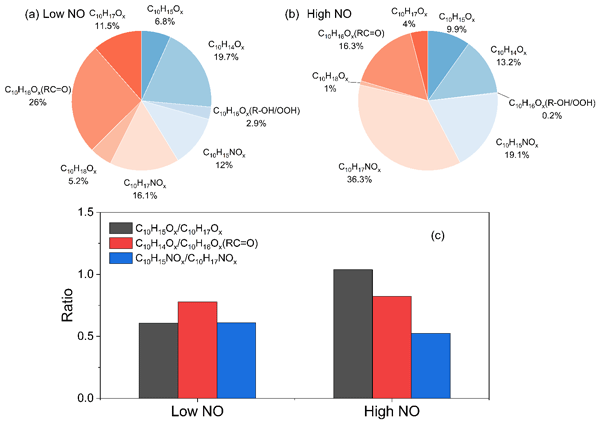
Oxidation of limonene, an element emitted by trees and chemical products, by OH, a daytime oxidant, forms many highly oxygenated organic molecules (HOMs), including C10-20 compounds. HOMs play an important role in new particle formation and growth. HOM formation can be explained by the chemistry of peroxy radicals. We found that a minor branching ratio initial pathway plays an unexpected, significant role. Considering this pathway enables accurate simulations of HOMs and other concentrations.
Petro Uruci, Dontavious Sippial, Anthoula Drosatou, and Spyros N. Pandis
Atmos. Meas. Tech., 16, 3155–3172, https://doi.org/10.5194/amt-16-3155-2023, https://doi.org/10.5194/amt-16-3155-2023, 2023
Short summary
Short summary
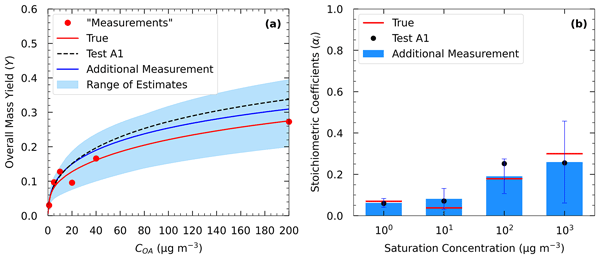
In this work we develop an algorithm for the synthesis of the measurements performed in atmospheric simulation chambers regarding the formation of secondary organic aerosol (SOA). Novel features of the algorithm are its ability to use measurements of SOA yields, thermodenuders, and isothermal dilution; its estimation of parameters that can be used directly in atmospheric chemical transport models; and finally its estimates of the uncertainty in SOA formation yields.
Christina N. Vasilakopoulou, Kalliopi Florou, Christos Kaltsonoudis, Iasonas Stavroulas, Nikolaos Mihalopoulos, and Spyros N. Pandis
Atmos. Meas. Tech., 16, 2837–2850, https://doi.org/10.5194/amt-16-2837-2023, https://doi.org/10.5194/amt-16-2837-2023, 2023
Short summary
Short summary
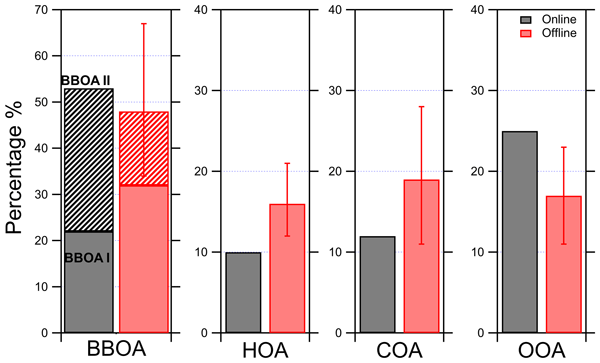
The offline aerosol mass spectrometry technique is a useful tool for the source apportionment of organic aerosol in areas and periods during which an aerosol mass spectrometer is not available. In this work, an improved offline technique was developed and evaluated in an effort to capture most of the partially soluble and insoluble organic aerosol material, reducing the uncertainty of the corresponding source apportionment significantly.
Lixu Jin, Wade Permar, Vanessa Selimovic, Damien Ketcherside, Robert J. Yokelson, Rebecca S. Hornbrook, Eric C. Apel, I-Ting Ku, Jeffrey L. Collett Jr., Amy P. Sullivan, Daniel A. Jaffe, Jeffrey R. Pierce, Alan Fried, Matthew M. Coggon, Georgios I. Gkatzelis, Carsten Warneke, Emily V. Fischer, and Lu Hu
Atmos. Chem. Phys., 23, 5969–5991, https://doi.org/10.5194/acp-23-5969-2023, https://doi.org/10.5194/acp-23-5969-2023, 2023
Short summary
Short summary
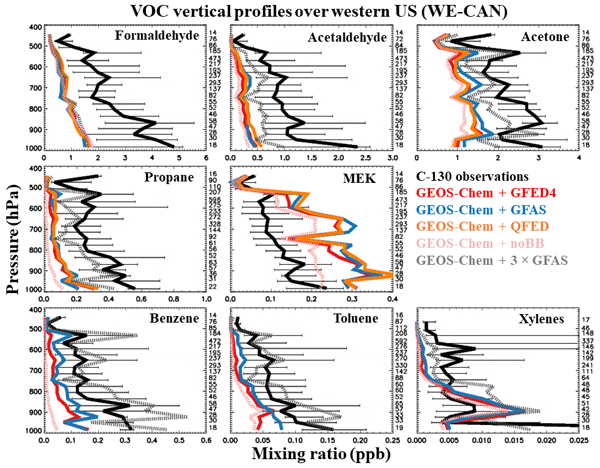
Air quality in the USA has been improving since 1970 due to anthropogenic emission reduction. Those gains have been partly offset by increased wildfire pollution in the western USA in the past 20 years. Still, we do not understand wildfire emissions well due to limited measurements. Here, we used a global transport model to evaluate and constrain current knowledge of wildfire emissions with recent observational constraints, showing the underestimation of wildfire emissions in the western USA.
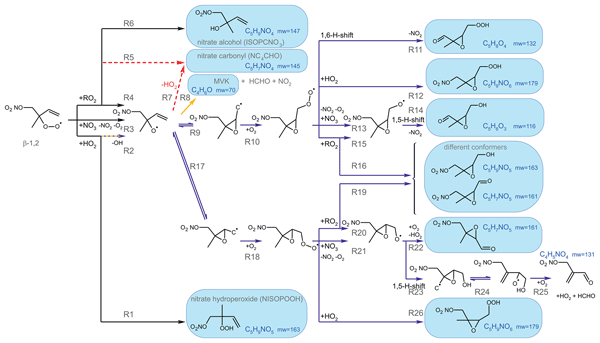
Philip T. M. Carlsson, Luc Vereecken, Anna Novelli, François Bernard, Steven S. Brown, Bellamy Brownwood, Changmin Cho, John N. Crowley, Patrick Dewald, Peter M. Edwards, Nils Friedrich, Juliane L. Fry, Mattias Hallquist, Luisa Hantschke, Thorsten Hohaus, Sungah Kang, Jonathan Liebmann, Alfred W. Mayhew, Thomas Mentel, David Reimer, Franz Rohrer, Justin Shenolikar, Ralf Tillmann, Epameinondas Tsiligiannis, Rongrong Wu, Andreas Wahner, Astrid Kiendler-Scharr, and Hendrik Fuchs
Atmos. Chem. Phys., 23, 3147–3180, https://doi.org/10.5194/acp-23-3147-2023, https://doi.org/10.5194/acp-23-3147-2023, 2023
Short summary
Short summary
The investigation of the night-time oxidation of the most abundant hydrocarbon, isoprene, in chamber experiments shows the importance of reaction pathways leading to epoxy products, which could enhance particle formation, that have so far not been accounted for. The chemical lifetime of organic nitrates from isoprene is long enough for the majority to be further oxidized the next day by daytime oxidants.
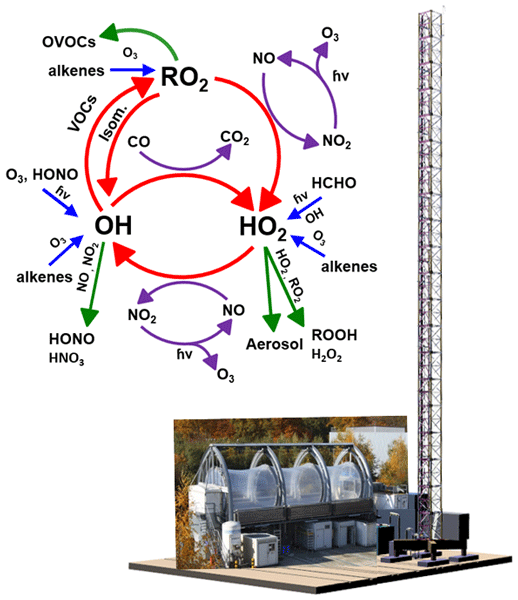
Changmin Cho, Hendrik Fuchs, Andreas Hofzumahaus, Frank Holland, William J. Bloss, Birger Bohn, Hans-Peter Dorn, Marvin Glowania, Thorsten Hohaus, Lu Liu, Paul S. Monks, Doreen Niether, Franz Rohrer, Roberto Sommariva, Zhaofeng Tan, Ralf Tillmann, Astrid Kiendler-Scharr, Andreas Wahner, and Anna Novelli
Atmos. Chem. Phys., 23, 2003–2033, https://doi.org/10.5194/acp-23-2003-2023, https://doi.org/10.5194/acp-23-2003-2023, 2023
Short summary
Short summary
With this study, we investigated the processes leading to the formation, destruction, and recycling of radicals for four seasons in a rural environment. Complete knowledge of their chemistry is needed if we are to predict the formation of secondary pollutants from primary emissions. The results highlight a still incomplete understanding of the paths leading to the formation of the OH radical, which has been observed in several other environments as well and needs to be further investigated.

Tobias Schuldt, Georgios I. Gkatzelis, Christian Wesolek, Franz Rohrer, Benjamin Winter, Thomas A. J. Kuhlbusch, Astrid Kiendler-Scharr, and Ralf Tillmann
Atmos. Meas. Tech., 16, 373–386, https://doi.org/10.5194/amt-16-373-2023, https://doi.org/10.5194/amt-16-373-2023, 2023
Short summary
Short summary
We report in situ measurements of air pollutant concentrations within the planetary boundary layer on board a Zeppelin NT in Germany. We highlight the in-flight evaluation of electrochemical sensors that were installed inside a hatch box located on the bottom of the Zeppelin. Results from this work emphasize the potential of these sensors for other in situ airborne applications, e.g., on board unmanned aerial vehicles (UAVs).

Spiro D. Jorga, Kalliopi Florou, David Patoulias, and Spyros N. Pandis
Atmos. Chem. Phys., 23, 85–97, https://doi.org/10.5194/acp-23-85-2023, https://doi.org/10.5194/acp-23-85-2023, 2023
Short summary
Short summary
We take advantage of this unexpected low, new particle formation frequency in Greece and use a dual atmospheric simulation chamber system with starting point ambient air in an effort to gain insight about the chemical species that is limiting nucleation in this area. A potential nucleation precursor, ammonia, was added in one of the chambers while the other one was used as a reference. The addition of ammonia assisted new particle formation in almost 50 % of the experiments conducted.
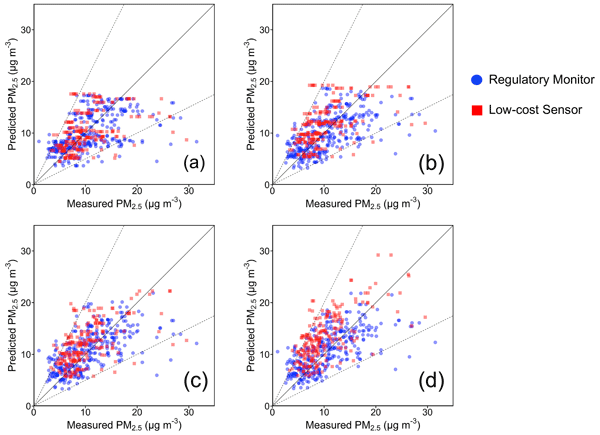
Brian T. Dinkelacker, Pablo Garcia Rivera, Ioannis Kioutsioukis, Peter J. Adams, and Spyros N. Pandis
Geosci. Model Dev., 15, 8899–8912, https://doi.org/10.5194/gmd-15-8899-2022, https://doi.org/10.5194/gmd-15-8899-2022, 2022
Short summary
Short summary
The performance of a chemical transport model in reproducing PM2.5 concentrations and composition was evaluated at the finest scale using measurements from regulatory sites as well as a network of low-cost monitors. Total PM2.5 mass is reproduced well by the model during the winter when compared to regulatory measurements, but in the summer PM2.5 is underpredicted, mainly due to difficulties in reproducing regional secondary organic aerosol levels.
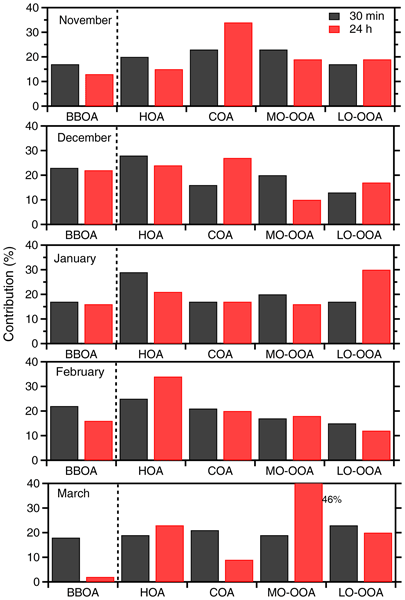
Christina Vasilakopoulou, Iasonas Stavroulas, Nikolaos Mihalopoulos, and Spyros N. Pandis
Atmos. Meas. Tech., 15, 6419–6431, https://doi.org/10.5194/amt-15-6419-2022, https://doi.org/10.5194/amt-15-6419-2022, 2022
Short summary
Short summary
Offline aerosol mass spectrometer (AMS) measurements can provide valuable information about ambient organic aerosols when online AMS measurements are not available. In this study, we examine whether and how the low time resolution (usually 24 h) of the offline technique affects source apportionment results. We concluded that use of the daily averages resulted in estimated average contributions that were within 8 % of the total OA compared with the high-resolution analysis.
Aristeidis Voliotis, Mao Du, Yu Wang, Yunqi Shao, Thomas J. Bannan, Michael Flynn, Spyros N. Pandis, Carl J. Percival, M. Rami Alfarra, and Gordon McFiggans
Atmos. Chem. Phys., 22, 13677–13693, https://doi.org/10.5194/acp-22-13677-2022, https://doi.org/10.5194/acp-22-13677-2022, 2022
Short summary
Short summary
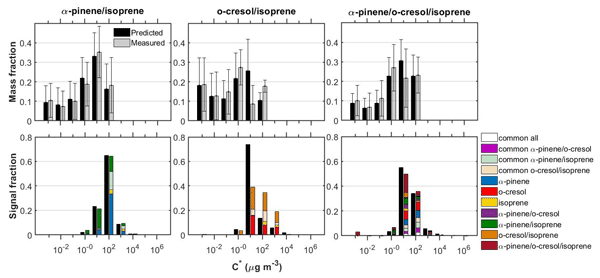
The addition of a low-yield precursor to the reactive mixture of aVOC and bVOC can increase or decrease the SOA volatility that is system-dependent. Therefore, the SOA volatility of the mixtures cannot always be predicted based on the additivity. In complex mixtures the formation of lower-volatility products likely outweighs the formation of products with higher volatility. The unique products of each mixture contribute significantly to the signal, suggesting interactions can be important.
Stella E. I. Manavi and Spyros N. Pandis
Geosci. Model Dev., 15, 7731–7749, https://doi.org/10.5194/gmd-15-7731-2022, https://doi.org/10.5194/gmd-15-7731-2022, 2022
Short summary
Short summary
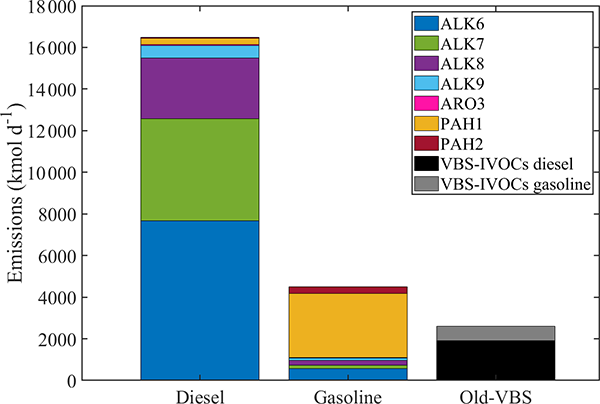
The paper describes the first step towards the development of a simulation framework for the chemistry and secondary organic aerosol production of intermediate-volatility organic compounds (IVOCs). These compounds can be a significant source of organic particulate matter. Our approach treats IVOCs as lumped compounds that retain their chemical characteristics. Estimated IVOC emissions from road transport were a factor of 8 higher than emissions used in previous applications.

Zhaofeng Tan, Hendrik Fuchs, Andreas Hofzumahaus, William J. Bloss, Birger Bohn, Changmin Cho, Thorsten Hohaus, Frank Holland, Chandrakiran Lakshmisha, Lu Liu, Paul S. Monks, Anna Novelli, Doreen Niether, Franz Rohrer, Ralf Tillmann, Thalassa S. E. Valkenburg, Vaishali Vardhan, Astrid Kiendler-Scharr, Andreas Wahner, and Roberto Sommariva
Atmos. Chem. Phys., 22, 13137–13152, https://doi.org/10.5194/acp-22-13137-2022, https://doi.org/10.5194/acp-22-13137-2022, 2022
Short summary
Short summary
During the 2019 JULIAC campaign, ClNO2 was measured at a rural site in Germany in different seasons. The highest ClNO2 level was 1.6 ppbv in September. ClNO2 production was more sensitive to the availability of NO2 than O3. The average ClNO2 production efficiency was up to 18 % in February and September and down to 3 % in December. These numbers are at the high end of the values reported in the literature, indicating the importance of ClNO2 chemistry in rural environments in midwestern Europe.
Brian T. Dinkelacker, Pablo Garcia Rivera, Ksakousti Skyllakou, Peter J. Adams, and Spyros N. Pandis
Atmos. Chem. Phys. Discuss., https://doi.org/10.5194/acp-2022-648, https://doi.org/10.5194/acp-2022-648, 2022
Revised manuscript not accepted
Short summary
Short summary
A number of factors have influenced the biogenic secondary organic aerosol (SOA) levels in the southeastern US from 2001 to 2010. The increases in temperature have led to an increase of the emissions of biogenic volatile organic compounds by trees and a corresponding increase of the SOA. However, this increase has been balanced by the reductions in the anthropogenic emissions of organic gases and particulate matter as well as of the oxides of nitrogen keeping the biogenic SOA roughly constant.
Therese S. Carter, Colette L. Heald, Jesse H. Kroll, Eric C. Apel, Donald Blake, Matthew Coggon, Achim Edtbauer, Georgios Gkatzelis, Rebecca S. Hornbrook, Jeff Peischl, Eva Y. Pfannerstill, Felix Piel, Nina G. Reijrink, Akima Ringsdorf, Carsten Warneke, Jonathan Williams, Armin Wisthaler, and Lu Xu
Atmos. Chem. Phys., 22, 12093–12111, https://doi.org/10.5194/acp-22-12093-2022, https://doi.org/10.5194/acp-22-12093-2022, 2022
Short summary
Short summary
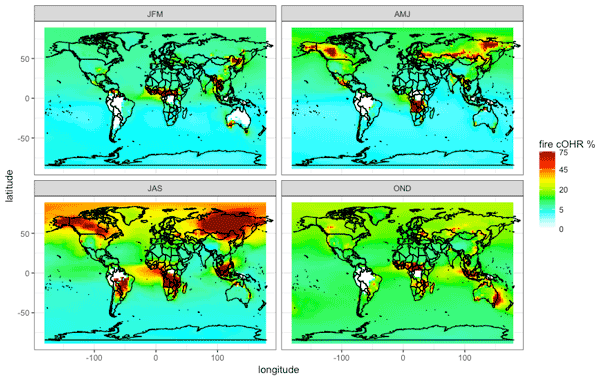
Fires emit many gases which can contribute to smog and air pollution. However, the amount and properties of these chemicals are not well understood, so this work updates and expands their representation in a global atmospheric model, including by adding new chemicals. We confirm that this updated representation generally matches measurements taken in several fire regions. We then show that fires provide ~15 % of atmospheric reactivity globally and more than 75 % over fire source regions.
Yindong Guo, Hongru Shen, Iida Pullinen, Hao Luo, Sungah Kang, Luc Vereecken, Hendrik Fuchs, Mattias Hallquist, Ismail-Hakki Acir, Ralf Tillmann, Franz Rohrer, Jürgen Wildt, Astrid Kiendler-Scharr, Andreas Wahner, Defeng Zhao, and Thomas F. Mentel
Atmos. Chem. Phys., 22, 11323–11346, https://doi.org/10.5194/acp-22-11323-2022, https://doi.org/10.5194/acp-22-11323-2022, 2022
Short summary
Short summary
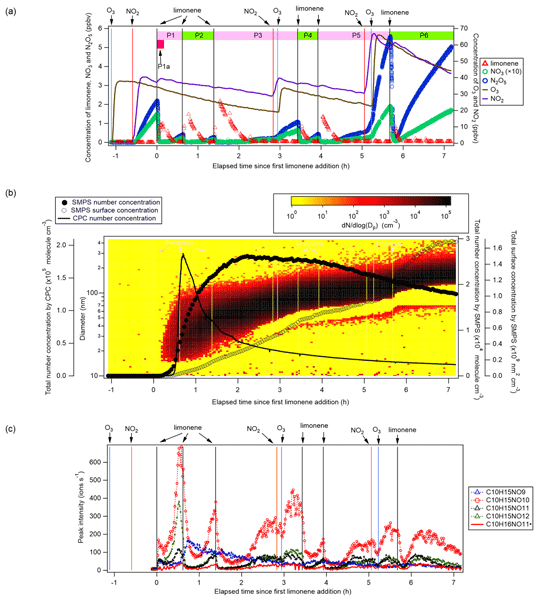
The oxidation of limonene, a common volatile emitted by trees and chemical products, by NO3, a nighttime oxidant, forms many highly oxygenated organic molecules (HOM), including C10-30 compounds. Most of the HOM are second-generation organic nitrates, in which carbonyl-substituted C10 nitrates accounted for a major fraction. Their formation can be explained by chemistry of peroxy radicals. HOM, especially low-volatile ones, play an important role in nighttime new particle formation and growth.
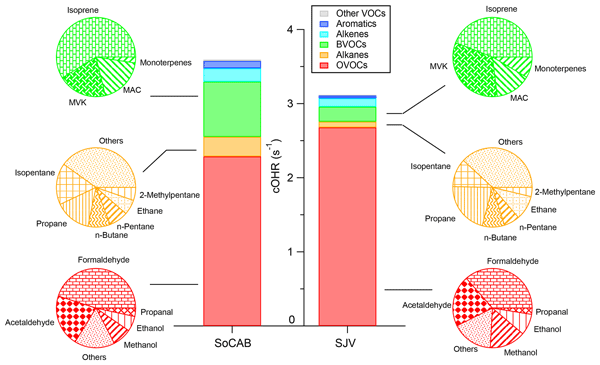
Shang Liu, Barbara Barletta, Rebecca S. Hornbrook, Alan Fried, Jeff Peischl, Simone Meinardi, Matthew Coggon, Aaron Lamplugh, Jessica B. Gilman, Georgios I. Gkatzelis, Carsten Warneke, Eric C. Apel, Alan J. Hills, Ilann Bourgeois, James Walega, Petter Weibring, Dirk Richter, Toshihiro Kuwayama, Michael FitzGibbon, and Donald Blake
Atmos. Chem. Phys., 22, 10937–10954, https://doi.org/10.5194/acp-22-10937-2022, https://doi.org/10.5194/acp-22-10937-2022, 2022
Short summary
Short summary
California’s ozone persistently exceeds the air quality standards. We studied the spatial distribution of volatile organic compounds (VOCs) that produce ozone over the most polluted regions in California using aircraft measurements. We find that the oxygenated VOCs have the highest ozone formation potential. Spatially, biogenic VOCs are important during high ozone episodes in the South Coast Air Basin, while dairy emissions may be critical for ozone production in San Joaquin Valley.
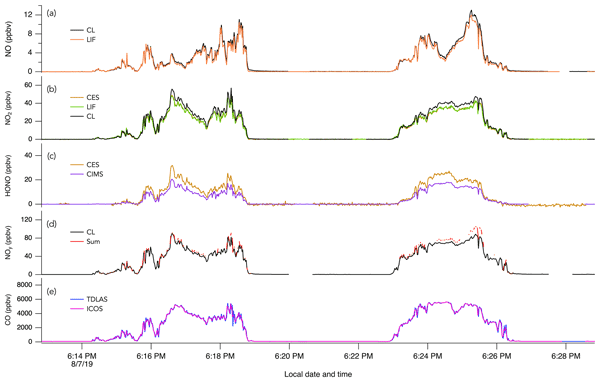
Ilann Bourgeois, Jeff Peischl, J. Andrew Neuman, Steven S. Brown, Hannah M. Allen, Pedro Campuzano-Jost, Matthew M. Coggon, Joshua P. DiGangi, Glenn S. Diskin, Jessica B. Gilman, Georgios I. Gkatzelis, Hongyu Guo, Hannah A. Halliday, Thomas F. Hanisco, Christopher D. Holmes, L. Gregory Huey, Jose L. Jimenez, Aaron D. Lamplugh, Young Ro Lee, Jakob Lindaas, Richard H. Moore, Benjamin A. Nault, John B. Nowak, Demetrios Pagonis, Pamela S. Rickly, Michael A. Robinson, Andrew W. Rollins, Vanessa Selimovic, Jason M. St. Clair, David Tanner, Krystal T. Vasquez, Patrick R. Veres, Carsten Warneke, Paul O. Wennberg, Rebecca A. Washenfelder, Elizabeth B. Wiggins, Caroline C. Womack, Lu Xu, Kyle J. Zarzana, and Thomas B. Ryerson
Atmos. Meas. Tech., 15, 4901–4930, https://doi.org/10.5194/amt-15-4901-2022, https://doi.org/10.5194/amt-15-4901-2022, 2022
Short summary
Short summary
Understanding fire emission impacts on the atmosphere is key to effective air quality management and requires accurate measurements. We present a comparison of airborne measurements of key atmospheric species in ambient air and in fire smoke. We show that most instruments performed within instrument uncertainties. In some cases, further work is needed to fully characterize instrument performance. Comparing independent measurements using different techniques is important to assess their accuracy.
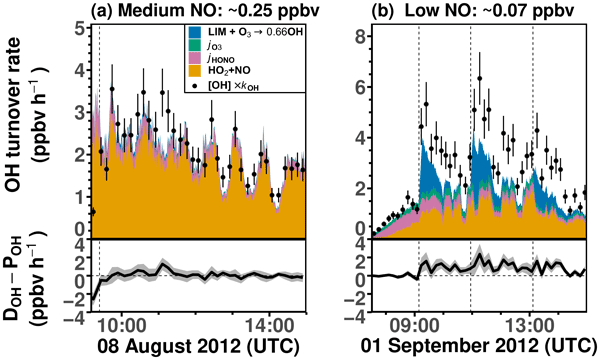
Jacky Yat Sing Pang, Anna Novelli, Martin Kaminski, Ismail-Hakki Acir, Birger Bohn, Philip T. M. Carlsson, Changmin Cho, Hans-Peter Dorn, Andreas Hofzumahaus, Xin Li, Anna Lutz, Sascha Nehr, David Reimer, Franz Rohrer, Ralf Tillmann, Robert Wegener, Astrid Kiendler-Scharr, Andreas Wahner, and Hendrik Fuchs
Atmos. Chem. Phys., 22, 8497–8527, https://doi.org/10.5194/acp-22-8497-2022, https://doi.org/10.5194/acp-22-8497-2022, 2022
Short summary
Short summary
This study investigates the radical chemical budget during the limonene oxidation at different atmospheric-relevant NO concentrations in chamber experiments under atmospheric conditions. It is found that the model–measurement discrepancies of HO2 and RO2 are very large at low NO concentrations that are typical for forested environments. Possible additional processes impacting HO2 and RO2 concentrations are discussed.
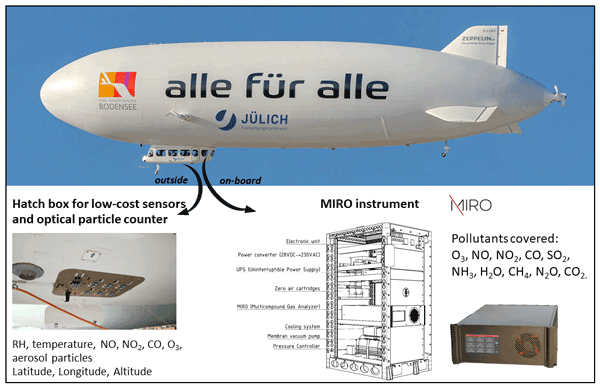
Ralf Tillmann, Georgios I. Gkatzelis, Franz Rohrer, Benjamin Winter, Christian Wesolek, Tobias Schuldt, Anne C. Lange, Philipp Franke, Elmar Friese, Michael Decker, Robert Wegener, Morten Hundt, Oleg Aseev, and Astrid Kiendler-Scharr
Atmos. Meas. Tech., 15, 3827–3842, https://doi.org/10.5194/amt-15-3827-2022, https://doi.org/10.5194/amt-15-3827-2022, 2022
Short summary
Short summary
We report in situ measurements of air pollutant concentrations within the planetary boundary layer on board a Zeppelin in Germany. The low costs of commercial flights provide an affordable and efficient method to improve our understanding of changes in emissions in space and time. The experimental setup expands the capabilities of this platform and provides insights into primary and secondary pollution observations and planetary boundary layer dynamics which determine air quality significantly.
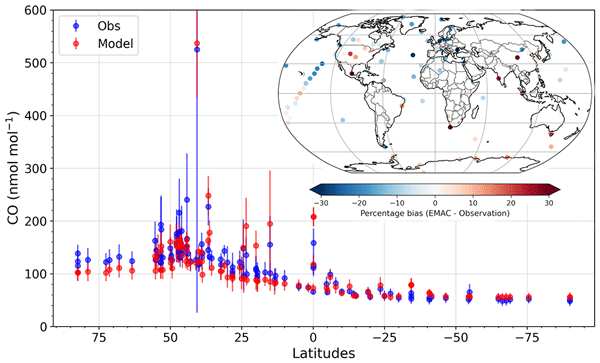
Andrea Pozzer, Simon F. Reifenberg, Vinod Kumar, Bruno Franco, Matthias Kohl, Domenico Taraborrelli, Sergey Gromov, Sebastian Ehrhart, Patrick Jöckel, Rolf Sander, Veronica Fall, Simon Rosanka, Vlassis Karydis, Dimitris Akritidis, Tamara Emmerichs, Monica Crippa, Diego Guizzardi, Johannes W. Kaiser, Lieven Clarisse, Astrid Kiendler-Scharr, Holger Tost, and Alexandra Tsimpidi
Geosci. Model Dev., 15, 2673–2710, https://doi.org/10.5194/gmd-15-2673-2022, https://doi.org/10.5194/gmd-15-2673-2022, 2022
Short summary
Short summary
A newly developed setup of the chemistry general circulation model EMAC (ECHAM5/MESSy for Atmospheric Chemistry) is evaluated here. A comprehensive organic degradation mechanism is used and coupled with a volatility base model.
The results show that the model reproduces most of the tracers and aerosols satisfactorily but shows discrepancies for oxygenated organic gases. It is also shown that this model configuration can be used for further research in atmospheric chemistry.
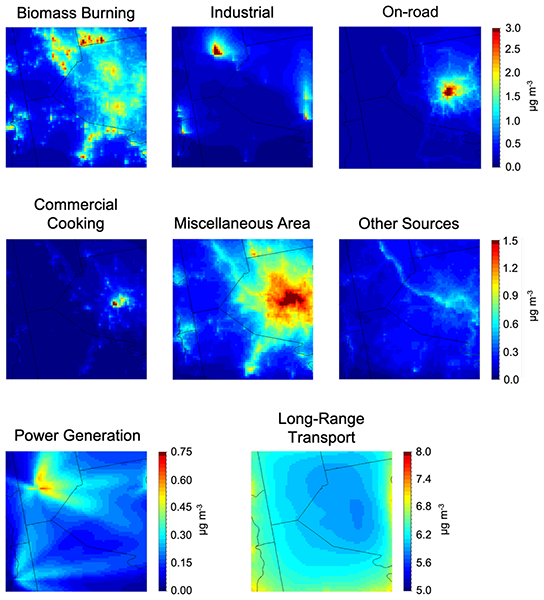
Pablo Garcia Rivera, Brian T. Dinkelacker, Ioannis Kioutsioukis, Peter J. Adams, and Spyros N. Pandis
Atmos. Chem. Phys., 22, 2011–2027, https://doi.org/10.5194/acp-22-2011-2022, https://doi.org/10.5194/acp-22-2011-2022, 2022
Short summary
Short summary
The contribution of various pollution sources to the variability of fine PM in an urban area was examined using as an example the city of Pittsburgh. Biomass burning aerosol shows the largest variability during the winter with local maxima within the city and in the suburbs. During both periods the largest contributing source to the average PM2.5 is particles from outside the modeling domain. The average population-weighted PM2.5 concentration does not change significantly with resolution.
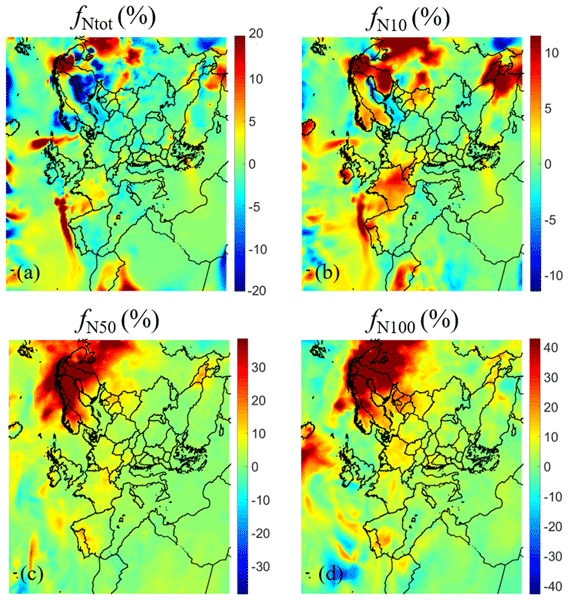
David Patoulias and Spyros N. Pandis
Atmos. Chem. Phys., 22, 1689–1706, https://doi.org/10.5194/acp-22-1689-2022, https://doi.org/10.5194/acp-22-1689-2022, 2022
Short summary
Short summary
Our simulations indicate that the recently identified production and subsequent condensation effect of extremely low-volatility organic compounds have a smaller-than-expected effect on the total concentration of atmospheric particles. On the other hand, the oxidation of intermediate-volatility organic compounds leads to decreases in the ultrafine-particle concentrations. These results improve our understanding of the links between secondary organic aerosol formation and ultrafine particles.
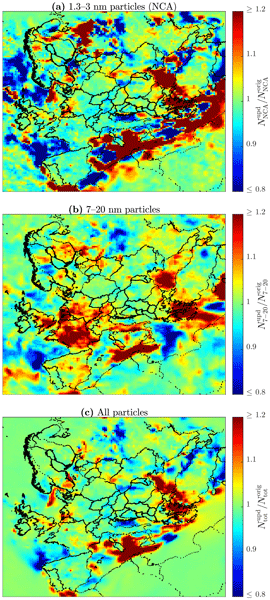
Miska Olin, David Patoulias, Heino Kuuluvainen, Jarkko V. Niemi, Topi Rönkkö, Spyros N. Pandis, Ilona Riipinen, and Miikka Dal Maso
Atmos. Chem. Phys., 22, 1131–1148, https://doi.org/10.5194/acp-22-1131-2022, https://doi.org/10.5194/acp-22-1131-2022, 2022
Short summary
Short summary
An emission factor particle size distribution was determined from the measurements at an urban traffic site. It was used in updating a pre-existing emission inventory, and regional modeling was performed after the update. Emission inventories typically underestimate nanoparticle emissions due to challenges in determining them with high certainty. This update reveals that the simulated aerosol levels have previously been underestimated especially for urban areas and for sub-50 nm particles.
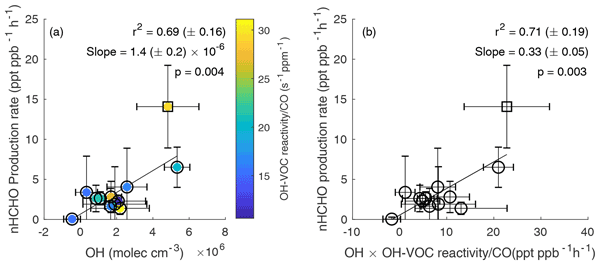
Jin Liao, Glenn M. Wolfe, Reem A. Hannun, Jason M. St. Clair, Thomas F. Hanisco, Jessica B. Gilman, Aaron Lamplugh, Vanessa Selimovic, Glenn S. Diskin, John B. Nowak, Hannah S. Halliday, Joshua P. DiGangi, Samuel R. Hall, Kirk Ullmann, Christopher D. Holmes, Charles H. Fite, Anxhelo Agastra, Thomas B. Ryerson, Jeff Peischl, Ilann Bourgeois, Carsten Warneke, Matthew M. Coggon, Georgios I. Gkatzelis, Kanako Sekimoto, Alan Fried, Dirk Richter, Petter Weibring, Eric C. Apel, Rebecca S. Hornbrook, Steven S. Brown, Caroline C. Womack, Michael A. Robinson, Rebecca A. Washenfelder, Patrick R. Veres, and J. Andrew Neuman
Atmos. Chem. Phys., 21, 18319–18331, https://doi.org/10.5194/acp-21-18319-2021, https://doi.org/10.5194/acp-21-18319-2021, 2021
Short summary
Short summary
Formaldehyde (HCHO) is an important oxidant precursor and affects the formation of O3 and other secondary pollutants in wildfire plumes. We disentangle the processes controlling HCHO evolution from wildfire plumes sampled by NASA DC-8 during FIREX-AQ. We find that OH abundance rather than normalized OH reactivity is the main driver of fire-to-fire variability in HCHO secondary production and estimate an effective HCHO yield per volatile organic compound molecule oxidized in wildfire plumes.
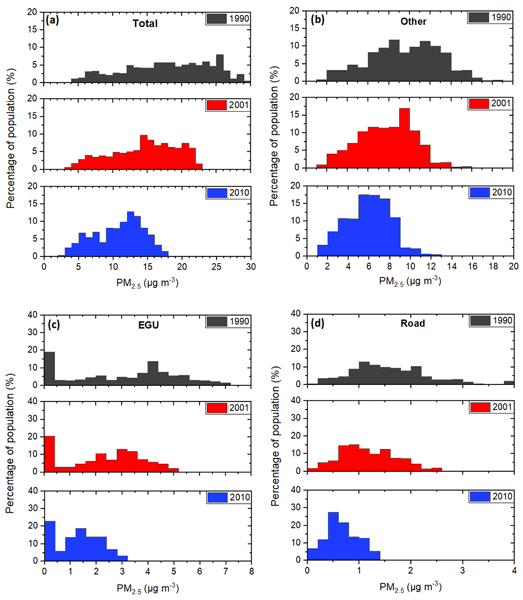
Ksakousti Skyllakou, Pablo Garcia Rivera, Brian Dinkelacker, Eleni Karnezi, Ioannis Kioutsioukis, Carlos Hernandez, Peter J. Adams, and Spyros N. Pandis
Atmos. Chem. Phys., 21, 17115–17132, https://doi.org/10.5194/acp-21-17115-2021, https://doi.org/10.5194/acp-21-17115-2021, 2021
Short summary
Short summary
Significant reductions in pollutant emissions took place in the US from 1990 to 2010. The reductions in sulfur dioxide emissions from electric-generating units have dominated the reductions in fine particle mass. The reductions in transportation emissions have led to a 30 % reduction of elemental concentrations and of organic particulate matter by a factor of 3. On the other hand, changes in biomass burning and biogenic secondary organic aerosol have been modest.
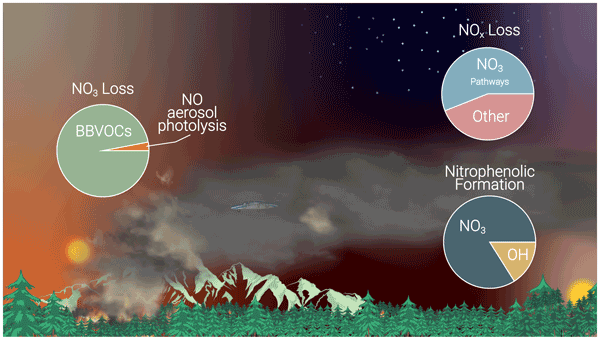
Zachary C. J. Decker, Michael A. Robinson, Kelley C. Barsanti, Ilann Bourgeois, Matthew M. Coggon, Joshua P. DiGangi, Glenn S. Diskin, Frank M. Flocke, Alessandro Franchin, Carley D. Fredrickson, Georgios I. Gkatzelis, Samuel R. Hall, Hannah Halliday, Christopher D. Holmes, L. Gregory Huey, Young Ro Lee, Jakob Lindaas, Ann M. Middlebrook, Denise D. Montzka, Richard Moore, J. Andrew Neuman, John B. Nowak, Brett B. Palm, Jeff Peischl, Felix Piel, Pamela S. Rickly, Andrew W. Rollins, Thomas B. Ryerson, Rebecca H. Schwantes, Kanako Sekimoto, Lee Thornhill, Joel A. Thornton, Geoffrey S. Tyndall, Kirk Ullmann, Paul Van Rooy, Patrick R. Veres, Carsten Warneke, Rebecca A. Washenfelder, Andrew J. Weinheimer, Elizabeth Wiggins, Edward Winstead, Armin Wisthaler, Caroline Womack, and Steven S. Brown
Atmos. Chem. Phys., 21, 16293–16317, https://doi.org/10.5194/acp-21-16293-2021, https://doi.org/10.5194/acp-21-16293-2021, 2021
Short summary
Short summary
To understand air quality impacts from wildfires, we need an accurate picture of how wildfire smoke changes chemically both day and night as sunlight changes the chemistry of smoke. We present a chemical analysis of wildfire smoke as it changes from midday through the night. We use aircraft observations from the FIREX-AQ field campaign with a chemical box model. We find that even under sunlight typical
nighttimechemistry thrives and controls the fate of key smoke plume chemical processes.
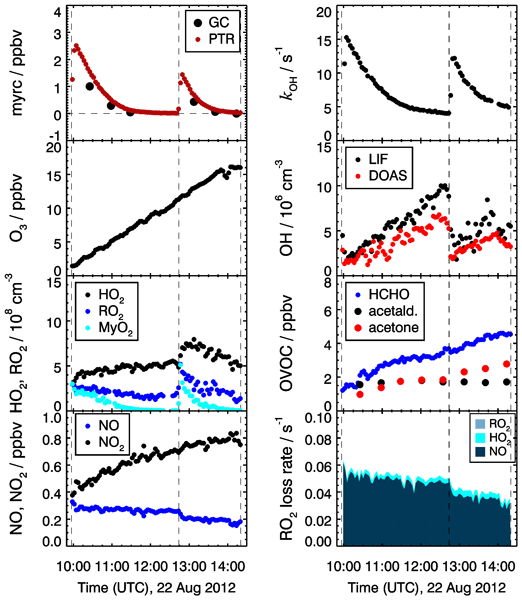
Zhaofeng Tan, Luisa Hantschke, Martin Kaminski, Ismail-Hakki Acir, Birger Bohn, Changmin Cho, Hans-Peter Dorn, Xin Li, Anna Novelli, Sascha Nehr, Franz Rohrer, Ralf Tillmann, Robert Wegener, Andreas Hofzumahaus, Astrid Kiendler-Scharr, Andreas Wahner, and Hendrik Fuchs
Atmos. Chem. Phys., 21, 16067–16091, https://doi.org/10.5194/acp-21-16067-2021, https://doi.org/10.5194/acp-21-16067-2021, 2021
Short summary
Short summary
The photo-oxidation of myrcene, a monoterpene species emitted by plants, was investigated at atmospheric conditions in the outdoor simulation chamber SAPHIR. The chemical structure of myrcene is partly similar to isoprene. Therefore, it can be expected that hydrogen shift reactions could play a role as observed for isoprene. In this work, their potential impact on the regeneration efficiency of hydroxyl radicals is investigated.
Vlassis A. Karydis, Alexandra P. Tsimpidi, Andrea Pozzer, and Jos Lelieveld
Atmos. Chem. Phys., 21, 14983–15001, https://doi.org/10.5194/acp-21-14983-2021, https://doi.org/10.5194/acp-21-14983-2021, 2021
Short summary
Short summary
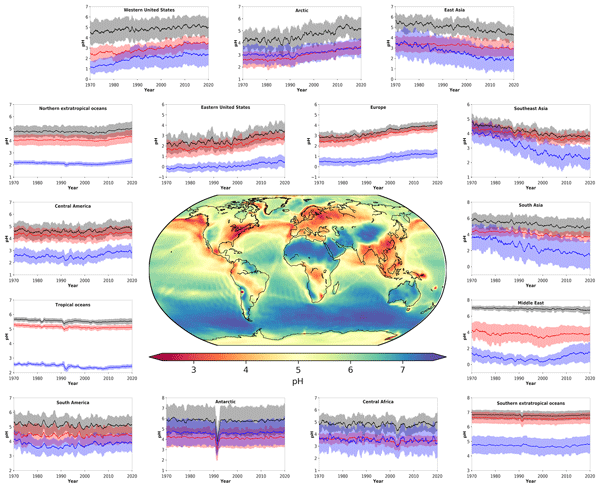
Aerosol particle pH is well-buffered by alkaline compounds, notably NH3 and crustal elements. NH3 is found to supply remarkable buffering capacity on a global scale, from the polluted continents to the remote oceans. Potential future changes in agricultural NH3 must be accompanied by strong reductions of SO2 and NOx to avoid particles becoming highly acidic, with implications for human health (aerosol toxicity), ecosystems (acid deposition), clouds, and climate (aerosol hygroscopicity).
Spiro D. Jorga, Kalliopi Florou, Christos Kaltsonoudis, John K. Kodros, Christina Vasilakopoulou, Manuela Cirtog, Axel Fouqueau, Bénédicte Picquet-Varrault, Athanasios Nenes, and Spyros N. Pandis
Atmos. Chem. Phys., 21, 15337–15349, https://doi.org/10.5194/acp-21-15337-2021, https://doi.org/10.5194/acp-21-15337-2021, 2021
Short summary
Short summary
We test the hypothesis that significant secondary organic aerosol production can take place even during winter nights through the oxidation of the emitted organic vapors by the nitrate radicals produced during the reaction of ozone and nitrogen oxides. Our experiments, using as a starting point the ambient air of an urban area with high biomass burning activity, demonstrate that, even with sunlight, there is 20 %–70 % additional organic aerosol formed in a few hours.
Cited articles
Alvarez, D.: JUWELS Cluster and Booster: Exascale Pathfinder with Modular Supercomputing Architecture at Juelich Supercomputing Centre, Journal of large-scale research facilities JLSRF, 7, https://doi.org/10.17815/jlsrf-7-183, 2021.
Atkinson, R. and Arey, J.: Atmospheric degradation of volatile organic compounds, Chemical reviews, 103, 4605–4638, https://doi.org/10.1002/chin.200410285, 2003.
Australian Bureau of Statistics: Survey of Motor Vehicle Use, Australia – 12 months-ended-30-june-2020, ABS website, https://www.abs.gov.au/statistics/industry/tourism-and-transport/survey-motor-vehicle-use-australia/latest-release (last access: 2 December 2025), 2020.
Baulig, A., Garlatti, M., Bonvallot, V., Marchand, A., Barouki, R., Marano, F., and Baeza-Squiban, A.: Involvement of reactive oxygen species in the metabolic pathways triggered by diesel exhaust particles in human airway epithelial cells, American Journal of Physiology-Lung Cellular and Molecular Physiology, 285, L671–L679, https://doi.org/10.1152/ajplung.00419.2002, 2003.
Bessagnet, B., Allemand, N., Putaud, J.-P., Couvidat, F., André, J.-M., Simpson, D., Pisoni, E., Murphy, B. N., and Thunis, P.: Emissions of carbonaceous particulate matter and ultrafine particles from vehicles – a scientific review in a cross-cutting context of air pollution and climate change, Applied Sciences, 12, 3623, https://doi.org/10.3390/app12073623, 2022.
Bhatt, Y.: Share of Road Transport and the Consumption of Diesel and Petrol in India, https://www.kapsarc.org/our-offerings/publications/share-of-road-transport-and-the-consumption-of-diesel-and-petrol-in-india (last access: 2 December 2025), 2021.
Boucher, O., Randall, D., Artaxo, P., Bretherton, C., Feingold, G., Forster, P., Kerminen, V.-M., Kondo, Y., Liao, H., Lohmann, U., Rasch, P., Satheesh, S. K., Sherwood, S., Stevens, B., and Zhang, X. Y.: Clouds and Aerosols, edited by: Stocker, T. F., Qin, D., Plattner, G.-K., Tignor, M., Allen, S. K., Boschung, J., Nauels, A., Xia, Y., Bex, V., and Midgley, P. M., Climate Change 2013: The Physical Science Basis. Contribution of Working Group I to the Fifth Assessment Report of the Intergovernmental Panel on Climate Change, 571–658, https://doi.org/10.1017/CBO9781107415324.016, 2013.
Cai, S., Zhu, L., Wang, S., Wisthaler, A., Li, Q., Jiang, J., and Hao, J.: Time-resolved intermediate-volatility and semivolatile organic compound emissions from household coal combustion in Northern China, Environmental Science & Technology, 53, 9269–9278, https://doi.org/10.1021/acs.est.9b00734, 2019.
Chakraborty, T., Beig, G., Dentener, F., and Wild, O.: Atmospheric transport of ozone between Southern and Eastern Asia, Science of the Total Environment, 523, 28–39, https://doi.org/10.1016/j.scitotenv.2015.03.066, 2015.
Chameides, W. L., Fehsenfeld, F., Rodgers, M. O., Cardelino, C., Martinez, J., Parrish, D., Lonneman, W., Lawson, D. R., Rasmussen, R. A., Zimmerman, P., Greenberg, J., Mlddleton, P., and Wang, T.: Ozone precursor relationships in the ambient atmosphere, Journal of Geophysical Research: Atmospheres, 97, 6037–6055, https://doi.org/10.1029/91jd03014, 1992.
Chang, X., Zhao, B., Zheng, H., Wang, S., Cai, S., Guo, F., Gui, P., Huang, G., Wu, D., Han, L., Xing, J., Man, H., Hu, R., Liang, C., Xu, Q., Qiu, X., Ding, D., Liu, K., Han, R., Robinson, A. L., and Donahue, N. M.: Full-volatility emission framework corrects missing and underestimated secondary organic aerosol sources, One Earth, 5, 403–412, https://doi.org/10.1016/j.oneear.2022.03.015, 2022.
Crameri, F., Shephard, G. E., and Heron, P. J.: The Misuse of Colour in Science Communication, Nat. Commun., 11, 5444, https://doi.org/10.1038/s41467-020-19160-7, 2020.
De Gouw, J. A., Middlebrook, A. M., Warneke, C., Ahmadov, R., Atlas, E. L., Bahreini, R., Blake, D. R., Brock, C. A., Brioude, J., Fahey, D. W., Fehsenfeld, F. C., Holloway, J. S., Le Henaff, M., Lueb, R. A., McKeen, S. A., Meagher, J. F., Murphy, D. M., Paris, C., Parrish, D. D., Perring, A. E., Pollack, I. B., Ravishankara, A. R., Robinson, A. L., Ryerson, T. B., Schwarz, J. P., Spackman, J. R., Srinivasan, A., and Watts, L. A.: Organic aerosol formation downwind from the Deepwater Horizon oil spill, Science, 331, 1295–1299, https://doi.org/10.1126/science.1200320, 2011.
Docherty, K. S., Yaga, R., Preston, W. T., Jaoui, M., Reidel, T. P., Offenberg, J. H., Kleindienst, T. E., and Lewandowski, M.: Relative contributions of selected multigeneration products to chamber SOA formed from photooxidation of a range (C10–C17) of n-alkanes under high NOx conditions, Atmospheric Environment, 244, 117976, https://doi.org/10.1016/j.atmosenv.2020.117976, 2021.
Donahue, N. M., Robinson, A., Stanier, C., and Pandis, S.: Coupled partitioning, dilution, and chemical aging of semivolatile organics, Environmental Science & Technology, 40, 2635–2643, https://doi.org/10.1021/es052297c, 2006.
Donahue, N. M., Robinson, A. L., and Pandis, S. N.: Atmospheric organic particulate matter: From smoke to secondary organic aerosol, Atmospheric Environment, 43, 94–106, https://doi.org/10.1016/j.atmosenv.2008.09.055, 2009.
Drozd, G. T., Zhao, Y., Saliba, G., Frodin, B., Maddox, C., Oliver Chang, M.-C., Maldonado, H., Sardar, S., Weber, R. J., Robinson, A. L., and Goldstein, A. H.: Detailed speciation of intermediate volatility and semivolatile organic compound emissions from gasoline vehicles: Effects of cold-starts and implications for secondary organic aerosol formation, Environmental Science & Technology, 53, 1706–1714, https://doi.org/10.1021/acs.est.8b05600, 2018.
Drozd, G. T., Weber, R. J., and Goldstein, A. H.: Highly resolved composition during diesel evaporation with modeled ozone and secondary aerosol formation: Insights into pollutant formation from evaporative intermediate volatility organic compound sources, Environmental Science & Technology, 55, 5742–5751, https://doi.org/10.1021/acs.est.0c08832, 2021.
EIA: Consumption of motor gasoline and distillate fuel oil by the transportation sector in the United States in selected years from 1950 to 2024, Statista, https://www.statista.com/statistics/189410/us-gasoline-and-diesel-consumption-for-highway-vehicles-since (last access: 2 December 2025), 2025.
Fang, H., Huang, X., Xiao, S., Lowther, S., Fu, X., Zhang, Y., Wu, T., Hu, W., Zhang, G., Ding, X., Tang, M., Bi, X., Jones, K. C., and Wang, X.: Intermediate-volatility organic compounds observed in a coastal megacity: Importance of non-road source emissions, Journal of Geophysical Research: Atmospheres, 127, e2022JD037301, https://doi.org/10.1029/2022JD037301, 2022.
Fraser, M. P., Cass, G. R., Simoneit, B. R. T., and Rasmussen, R. A.: Air Quality Model Evaluation Data for Organics. 4. C2–C36 Non-Aromatic Hydrocarbons, Environmental Science & Technology, 31, 2356–2367, https://doi.org/10.1021/es960980g, 1997.
Fuels Europe: Statistical Report, https://fuelseurope.eu/uploads/files/modules/documents/file/1678433400_WxQUX2Y235pcnRjaPDaRBqeCQ0PtFizSE5iYFZRb.pdf (last access: 2 December 2025), 2022.
Fujitani, Y., Sato, K., Tanabe, K., Takahashi, K., Hoshi, J., Wang, X., Chow, J. C., and Watson, J. G.: Volatility distribution of organic compounds in sewage incineration emissions, Environmental Science & Technology, 54, 14235–14245, https://doi.org/10.1021/acs.est.0c04534, 2020.
Fujitani, Y., Sato, K., Tanabe, K., Morino, Y., Takahashi, K., and Hoshi, J.: Characteristics of different volatility classes of organic compounds emitted by a municipal solid waste incineration plant, Atmospheric Environment: X, 17, 100197, https://doi.org/10.1016/j.aeaoa.2022.100197, 2023.
Gentner, D. R., Isaacman, G., Worton, D. R., Chan, A. W. H., Dallmann, T. R., Davis, L., Liu, S., Day, D. A., Russell, L. M., Wilson, K. R., Weber, R., Guha, A., Harley, R. A., and Goldstein, A. H.: Elucidating secondary organic aerosol from diesel and gasoline vehicles through detailed characterization of organic carbon emissions, Proceedings of the National Academy of Sciences, 109, 18318–18323, https://doi.org/10.1073/pnas.1212272109, 2012.
Gentner, D. R., Jathar, S. H., Gordon, T. D., Bahreini, R., Day, D. A., El Haddad, I., Hayes, P. L., Pieber, S. M., Platt, S. M., de Gouw, J., Goldstein, A. H., Harley, R. A., Jimenez, J. L., Prévôt, A. S. H., and Robinson, A. L.: Review of urban secondary organic aerosol formation from gasoline and diesel motor vehicle emissions, Environmental Science & Technology, 51, 1074–1093, https://doi.org/10.1021/acs.est.6b04509, 2017.
Ghorbani, A., Rahimpour, M. R., Ghasemi, Y., and Raeissi, S.: The biodiesel of microalgae as a solution for diesel demand in Iran, Energies, 11, 950, https://doi.org/10.3390/en11040950, 2018.
Goldstein, A. H. and Galbally, I. E.: Known and unexplored organic constituents in the earth's atmosphere, Environmental Science & Technology, 41, 1514–1521, https://doi.org/10.1021/es072476p, 2007.
Gordon, T. D., Presto, A. A., Nguyen, N. T., Robertson, W. H., Na, K., Sahay, K. N., Zhang, M., Maddox, C., Rieger, P., Chattopadhyay, S., Maldonado, H., Maricq, M. M., and Robinson, A. L.: Secondary organic aerosol production from diesel vehicle exhaust: impact of aftertreatment, fuel chemistry and driving cycle, Atmos. Chem. Phys., 14, 4643–4659, https://doi.org/10.5194/acp-14-4643-2014, 2014.
Grushevenko, D., Grushevenko, E., and Kulagin, V.: Energy consumption of the Russian road transportation sector: Prospects for inter-fuel competition in terms of technological innovation, Foresight and STI Governance, 12, 35–44, https://doi.org/10.17323/2500-2597.2018.4.35.44, 2018.
Hartikainen, A. H., Ihalainen, M., Yli-Pirilä, P., Hao, L., Kortelainen, M., Pieber, S. M., and Sippula, O.: Photochemical transformation and secondary aerosol formation potential of Euro6 gasoline and diesel passenger car exhaust emissions, Journal of Aerosol Science, 171, 106159, https://doi.org/10.2139/ssrn.4199864, 2023.
Hassan, M. A., Mehmood, T., Liu, J., Luo, X., Li, X., Tanveer, M., Faheem, M., Shakoor, A., Dar, A. A., and Abid, M.: A review of particulate pollution over Himalaya region: Characteristics and salient factors contributing ambient PM pollution, Atmospheric Environment, 294, 119472, https://doi.org/10.1016/j.atmosenv.2022.119472, 2023.
Hatch, L. E., Luo, W., Pankow, J. F., Yokelson, R. J., Stockwell, C. E., and Barsanti, K. C.: Identification and quantification of gaseous organic compounds emitted from biomass burning using two-dimensional gas chromatography–time-of-flight mass spectrometry, Atmos. Chem. Phys., 15, 1865–1899, https://doi.org/10.5194/acp-15-1865-2015, 2015.
Hatch, L. E., Yokelson, R. J., Stockwell, C. E., Veres, P. R., Simpson, I. J., Blake, D. R., Orlando, J. J., and Barsanti, K. C.: Multi-instrument comparison and compilation of non-methane organic gas emissions from biomass burning and implications for smoke-derived secondary organic aerosol precursors, Atmos. Chem. Phys., 17, 1471–1489, https://doi.org/10.5194/acp-17-1471-2017, 2017.
He, L.-Y., Yang, S., and Chang, D.: Oil price uncertainty, transport fuel demand and public health, International journal of environmental research and public health, 14, 245, https://doi.org/10.3390/ijerph14030245, 2017.
Hodzic, A., Jimenez, J. L., Madronich, S., Canagaratna, M. R., DeCarlo, P. F., Kleinman, L., and Fast, J.: Modeling organic aerosols in a megacity: potential contribution of semi-volatile and intermediate volatility primary organic compounds to secondary organic aerosol formation, Atmos. Chem. Phys., 10, 5491–5514, https://doi.org/10.5194/acp-10-5491-2010, 2010.
Hodzic, A., Aumont, B., Knote, C., Lee-Taylor, J., Madronich, S., and Tyndall, G.: Volatility dependence of Henry's law constants of condensable organics: Application to estimate depositional loss of secondary organic aerosols, Geophysical Research Letters, 41, 4795–4804, https://doi.org/10.1002/2014GL060649, 2014.
Huang, C., Hu, Q., Li, Y., Tian, J., Ma, Y., Zhao, Y., Feng, J., An, J., Qiao, L., Wang, H., Jing, S., Huang, D., Lou, S., Zhou, M., Zhu, S., Tao, S., and Li, L.: Intermediate volatility organic compound emissions from a large cargo vessel operated under real-world conditions, Environmental Science & Technology, 52, 12934–12942, https://doi.org/10.1021/acs.est.8b04418, 2018.
Huang, G., Wang, S., Chang, X., Cai, S., Zhu, L., Li, Q., and Jiang, J.: Emission factors and chemical profile of I/SVOCs emitted from household biomass stove in China, Science of the Total Environment, 842, 156940, https://doi.org/10.1016/j.scitotenv.2022.156940, 2022.
Huang, L., Zhao, B., Wang, S., Chang, X., Klimont, Z., Huang, G., Zheng, H., and Hao, J.: Global anthropogenic emissions of full-volatility organic compounds, Environmental Science & Technology, 57, 16435–16445, https://doi.org/10.1021/acs.est.3c04106, 2023.
Jathar, S. H., Farina, S. C., Robinson, A. L., and Adams, P. J.: The influence of semi-volatile and reactive primary emissions on the abundance and properties of global organic aerosol, Atmos. Chem. Phys., 11, 7727–7746, https://doi.org/10.5194/acp-11-7727-2011, 2011.
Jathar, S. H., Gordon, T. D., Hennigan, C. J., Pye, H. O., Pouliot, G., Adams, P. J., Donahue, N. M., and Robinson, A. L.: Unspeciated organic emissions from combustion sources and their influence on the secondary organic aerosol budget in the United States, Proceedings of the National Academy of Sciences, 111, 10473–10478, https://doi.org/10.1073/pnas.1323740111, 2014.
Jathar, S. H., Woody, M., Pye, H. O. T., Baker, K. R., and Robinson, A. L.: Chemical transport model simulations of organic aerosol in southern California: model evaluation and gasoline and diesel source contributions, Atmos. Chem. Phys., 17, 4305–4318, https://doi.org/10.5194/acp-17-4305-2017, 2017.
Jimenez, J. L., Canagaratna, M. R., Donahue, N. M., Prevot, A. S. H., Zhang, Q., Kroll, J. H., DeCarlo, P. F., Allan, J. D., Coe, H., Ng, N. L., Aiken, A. C., Docherty, K. S., Ulbrich, I. M., Grieshop, A. P., Robinson, A. L., Duplissy, J., Smith, J. D., Wilson, K. R., Lanz, V. A., Hueglin, C., Sun, Y. L., Tian, J., Laaksonen, A., Raatikainen, T., Rautiainen, J., Vaattovaara, P., Ehn, M., Kulmala, M., Tomlinson, J. M., Collins, D. R., Cubison, M. J., Dunlea, E. J., Huffman, J. A., Onasch, T. B., Alfarra, M. R., Williams, P. I., Bower, K., Kondo, Y., Schneider, J., Drewnick, F., Borrmann, S., Weimer, S., Demerjian, K., Salcedo, D., Cottrell, L., Griffin, R., Takami, A., Miyoshi, T., Hatakeyama, S., Shimono, A., Sun, J. Y., Zhang, Y. M., Dzepina, K., and Worsnop, D. R.: Evolution of Organic Aerosols in the Atmosphere, Science, 326, 1525–1529, https://doi.org/10.1126/science.1180353, 2009.
Jöckel, P., Sander, R., Kerkweg, A., Tost, H., and Lelieveld, J.: Technical Note: The Modular Earth Submodel System (MESSy) – a new approach towards Earth System Modeling, Atmos. Chem. Phys., 5, 433–444, https://doi.org/10.5194/acp-5-433-2005, 2005.
Jorga, S. D., Kaltsonoudis, C., Liangou, A., and Pandis, S. N.: Measurement of formation rates of secondary aerosol in the ambient urban atmosphere using a dual smog chamber system, Environmental Science & Technology, 54, 1336–1343, https://doi.org/10.1021/acs.est.9b03479, 2019.
Kanakidou, M., Seinfeld, J. H., Pandis, S. N., Barnes, I., Dentener, F. J., Facchini, M. C., Van Dingenen, R., Ervens, B., Nenes, A., Nielsen, C. J., Swietlicki, E., Putaud, J. P., Balkanski, Y., Fuzzi, S., Horth, J., Moortgat, G. K., Winterhalter, R., Myhre, C. E. L., Tsigaridis, K., Vignati, E., Stephanou, E. G., and Wilson, J.: Organic aerosol and global climate modelling: a review, Atmos. Chem. Phys., 5, 1053–1123, https://doi.org/10.5194/acp-5-1053-2005, 2005.
Kangasniemi, O., Simonen, P., Moldanová, J., Timonen, H., Barreira, L. M. F., Hellén, H., Jalkanen, J.-P., Majamäki, E., D'Anna, B., Lanzafame, G., Temime-Roussel, B., Mellqvist, J., Keskinen, J., and Dal Maso, M.: Volatility of a Ship's Emissions in the Baltic Sea Using Modelling and Measurements in Real-World Conditions, Atmosphere, 14, 1175, https://doi.org/10.3390/atmos14071175, 2023.
Khare, P., Machesky, J., Soto, R., He, M., Presto, A. A., and Gentner, D. R.: Asphalt-related emissions are a major missing nontraditional source of secondary organic aerosol precursors, Science Advances, 6, eabb9785, https://doi.org/10.1126/sciadv.abb9785, 2020.
Kling, M. M. and Ackerly, D. D.: Global wind patterns and the vulnerability of wind-dispersed species to climate change, Nature Climate Change, 10, 868–875, https://doi.org/10.1038/s41558-020-0848-3, 2020.
Koss, A. R., Sekimoto, K., Gilman, J. B., Selimovic, V., Coggon, M. M., Zarzana, K. J., Yuan, B., Lerner, B. M., Brown, S. S., Jimenez, J. L., Krechmer, J., Roberts, J. M., Warneke, C., Yokelson, R. J., and de Gouw, J.: Non-methane organic gas emissions from biomass burning: identification, quantification, and emission factors from PTR-ToF during the FIREX 2016 laboratory experiment, Atmos. Chem. Phys., 18, 3299–3319, https://doi.org/10.5194/acp-18-3299-2018, 2018.
Li, N., Sioutas, C., Cho, A., Schmitz, D., Misra, C., Sempf, J., Wang, M., Oberley, T., Froines, J., and Nel, A.: Ultrafine particulate pollutants induce oxidative stress and mitochondrial damage, Environmental health perspectives, 111, 455–460, 2003.
Li, W., Li, L., Chen, C., Kacarab, M., Peng, W., Price, D., Xu, J., and Cocker III, D. R.: Potential of select intermediate-volatility organic compounds and consumer products for secondary organic aerosol and ozone formation under relevant urban conditions, Atmospheric environment, 178, 109–117, https://doi.org/10.1016/j.atmosenv.2017.12.019, 2018.
Li, Z., Sun, R., Qin, M., and Hu, D.: Gasoline to diesel consumption ratio: A new socioeconomic indicator of carbon dioxide emissions in China, Sustainability, 12, 5608, https://doi.org/10.3390/su12145608, 2020.
Liddle, B. and Huntington, H.: “On the Road Again”: A 118 country panel analysis of gasoline and diesel demand, Transportation Research Part A: Policy and Practice, 142, 151–167, https://doi.org/10.1016/j.tra.2020.10.015, 2020.
Liggio, J., Li, S.-M., Hayden, K., Taha, Y. M., Stroud, C., Darlington, A., Drollette, B. D., Gordon, M., Lee, P., Liu, P., Leithead, A., Moussa, S. G., Wang, D., O'Brien, J., Mittermeier, R. L., Brook, J. R., Lu, G., Staebler, R. M., Han, Y., Tokarek, T. W., Osthoff, H. D., Makar, P. A., Zhang, J., L. Plata, D., and Gentner, D. R.: Oil sands operations as a large source of secondary organic aerosols, Nature, 534, 91–94, https://doi.org/10.1038/nature17646, 2016.
Liu, H., Man, H., Tschantz, M., Wu, Y., He, K., and Hao, J.: VOC from vehicular evaporation emissions: status and control strategy, Environmental Science & Technology, 49, 14424–14431, https://doi.org/10.1021/acs.est.5b04064, 2015.
Liu, W.-H. and Lin, K.-J.: Demand for ground transportation fuels in 10 Asian countries: An application of the autoregressive distributed lag bounds testing approach, Pacific Economic Review, 24, 606–627, https://doi.org/10.1111/1468-0106.12245, 2019.
Liu, Y., Li, Y., Yuan, Z., Wang, H., Sha, Q., Lou, S., Liu, Y., Hao, Y., Duan, L., Ye, P., Zheng, J., Yuan, B., and Shao, M.: Identification of two main origins of intermediate-volatility organic compound emissions from vehicles in China through two-phase simultaneous characterization, Environmental Pollution, 281, 117020, https://doi.org/10.1016/j.envpol.2021.117020, 2021.
Lu, Q., Zhao, Y., and Robinson, A. L.: Comprehensive organic emission profiles for gasoline, diesel, and gas-turbine engines including intermediate and semi-volatile organic compound emissions, Atmos. Chem. Phys., 18, 17637–17654, https://doi.org/10.5194/acp-18-17637-2018, 2018.
Lu, Q., Murphy, B. N., Qin, M., Adams, P. J., Zhao, Y., Pye, H. O. T., Efstathiou, C., Allen, C., and Robinson, A. L.: Simulation of organic aerosol formation during the CalNex study: updated mobile emissions and secondary organic aerosol parameterization for intermediate-volatility organic compounds, Atmos. Chem. Phys., 20, 4313–4332, https://doi.org/10.5194/acp-20-4313-2020, 2020.
Maduekwe, M., Akpan, U., and Isihak, S.: Road transport energy consumption and vehicular emissions in Lagos, Nigeria: An application of the LEAP model, Transportation Research Interdisciplinary Perspectives, 6, 100172, https://doi.org/10.1016/j.trip.2020.100172, 2020.
Manavi, S. E. I. and Pandis, S. N.: A lumped species approach for the simulation of secondary organic aerosol production from intermediate-volatility organic compounds (IVOCs): application to road transport in PMCAMx-iv (v1.0), Geosci. Model Dev., 15, 7731–7749, https://doi.org/10.5194/gmd-15-7731-2022, 2022.
Marques, B., Kostenidou, E., Valiente, A. M., Vansevenant, B., Sarica, T., Fine, L., Temime-Roussel, B., Tassel, P., Perret, P., Liu, Y., Sartelet, K., Ferronato, C., and D'Anna, B.: Detailed speciation of non-methane volatile organic compounds in exhaust emissions from diesel and gasoline Euro 5 vehicles using online and offline measurements, Toxics, 10, 184, https://doi.org/10.3390/toxics10040184, 2022.
May, A. A., Nguyen, N. T., Presto, A. A., Gordon, T. D., Lipsky, E. M., Karve, M., Gutierrez, A., Robertson, W. H., Zhang, M., Brandow, C., Chang, O., Chen, S., Cicero-Fernandez, P., Dinkins, L., Fuentes, M., Huang, S.-M., Ling, R., Long, J., Maddox, C., Massetti, J., McCauley, E., Miguel, A., Na, K., Ong, R., Pang, Y., Rieger, P., Sax, T., Truong, T., Vo, T., Chattopadhyay, S., Maldonado, H., Maricq, M. M., and Robinson, A. L.: Gas-and particle-phase primary emissions from in-use, on-road gasoline and diesel vehicles, Atmospheric Environment, 88, 247–260, https://doi.org/10.1016/j.atmosenv.2014.01.046, 2014.
McDonald, B. C., de Gouw, J. A., Gilman, J. B., Jathar, S. H., Akherati, A., Cappa, C. D., Jimenez, J. L., Lee-Taylor, J., Hayes, P. L., McKeen, S. A., Cui, Y. Y., Kim, S.-W., Gentner, D. R., Isaacman-VanWertz, G., Goldstein, A. H., Harley, R. A., Frost, G. J., Roberts, J. M., Ryerson, T. B., and Trainer, M.: Volatile chemical products emerging as largest petrochemical source of urban organic emissions, Science, 359, 760–764, https://doi.org/10.1126/science.aaq0524, 2018.
MESSy Consortium: The Modular Earth Submodel System (2.55.2_1009-IVOC_12ff6f14), Zenodo [code], https://doi.org/10.5281/zenodo.15474860, 2025.
Morino, Y., Li, Y., Fujitani, Y., Sato, K., Inomata, S., Tanabe, K., Jathar, S. H., Kondo, Y., Nakayama, T., Fushimi, A., Takami, A., and Kobayashi, S.: Secondary organic aerosol formation from gasoline and diesel vehicle exhaust under light and dark conditions, Environmental Science: Atmospheres, 2, 46–64, https://doi.org/10.1039/d1ea00045d, 2022.
Murphy, B. N. and Pandis, S. N.: Simulating the Formation of Semivolatile Primary and Secondary Organic Aerosol in a Regional Chemical Transport Model, Environmental Science & Technology, 43, 4722–4728, https://doi.org/10.1021/es803168a, 2009.
NASA with Center For International Earth Science Information Network-CIESIN-Columbia University: Gridded Population of the World, Version 4 (GPWv4): Population Count, NASA Socioeconomic Data and Applications Center (SEDAC), Palisades, NY, Revision 11. 4.11, https://doi.org/10.7927/H4JW8BX5, 2018.
Odum, J. R., Hoffmann, T., Bowman, F., Collins, D., Flagan, R. C., and Seinfeld, J. H.: Gas/particle partitioning and secondary organic aerosol yields, Environmental Science & Technology, 30, 2580–2585, https://doi.org/10.1021/es950943+, 1996.
Ots, R., Young, D. E., Vieno, M., Xu, L., Dunmore, R. E., Allan, J. D., Coe, H., Williams, L. R., Herndon, S. C., Ng, N. L., Hamilton, J. F., Bergström, R., Di Marco, C., Nemitz, E., Mackenzie, I. A., Kuenen, J. J. P., Green, D. C., Reis, S., and Heal, M. R.: Simulating secondary organic aerosol from missing diesel-related intermediate-volatility organic compound emissions during the Clean Air for London (ClearfLo) campaign, Atmos. Chem. Phys., 16, 6453–6473, https://doi.org/10.5194/acp-16-6453-2016, 2016.
Pandis, S. N., Harley, R. A., Cass, G. R., and Seinfeld, J. H.: Secondary organic aerosol formation and transport, Atmospheric Environment. Part A. General Topics, 26, 2269–2282, https://doi.org/10.1016/0960-1686(92)90358-r, 1992.
Paul, A., Fang, Z., Martens, P., Mukherjee, A., Jakobi, G., Ihalainen, M., Kortelainen, M., Somero, M., Yli-Pirilä, P., Hohaus, T., Czech, H., Kalberer, M., Sippula, O., Rudich, Y., Zimmermann, R., and Kiendler-Scharr, A.: Formation of secondary aerosol from emissions of a Euro 6d-compliant gasoline vehicle with particle filter, Environmental Science: Atmospheres, https://doi.org/10.1039/d3ea00165b, 2024.
Pope, C. A., Thun, M. J., Namboodiri, M. M., Dockery, D. W., Evans, J. S., Speizer, F. E., and Heath, C. W.: Particulate air pollution as a predictor of mortality in a prospective study of US adults, American journal of respiratory and critical care medicine, 151, 669–674, https://doi.org/10.1164/ajrccm.151.3.7881654, 1995.
Pye, H. O. T. and Seinfeld, J. H.: A global perspective on aerosol from low-volatility organic compounds, Atmos. Chem. Phys., 10, 4377–4401, https://doi.org/10.5194/acp-10-4377-2010, 2010.
Pye, H. O. T., Ward-Caviness, C. K., Murphy, B. N., Appel, K. W., and Seltzer, K. M.: Secondary organic aerosol association with cardiorespiratory disease mortality in the United States, Nature Communications, 12, 7215, https://doi.org/10.1038/s41467-021-27484-1, 2021.
Pye, H. O. T., Place, B. K., Murphy, B. N., Seltzer, K. M., D'Ambro, E. L., Allen, C., Piletic, I. R., Farrell, S., Schwantes, R. H., Coggon, M. M., Saunders, E., Xu, L., Sarwar, G., Hutzell, W. T., Foley, K. M., Pouliot, G., Bash, J., and Stockwell, W. R.: Linking gas, particulate, and toxic endpoints to air emissions in the Community Regional Atmospheric Chemistry Multiphase Mechanism (CRACMM), Atmos. Chem. Phys., 23, 5043–5099, https://doi.org/10.5194/acp-23-5043-2023, 2023.
Qian, Z., Chen, Y., Liu, Z., Han, Y., Zhang, Y., Feng, Y., Shang, Y., Guo, H., Li, Q., Shen, G., Chen, J., and Tao, S.: Intermediate volatile organic compound emissions from residential solid fuel combustion based on field measurements in rural China, Environmental Science & Technology, 55, 5689–5700, https://doi.org/10.1021/acs.est.0c07908, 2021.
Rahman, M. M., Rahman, S. M., Shafiullah, M., Hasan, M. A., Gazder, U., Al Mamun, A., Mansoor, U., Kashifi, M. T., Reshi, O., Arifuzzaman, M., Islam, M. K., and Al-Ismail, F. S.: Energy Demand of the Road Transport Sector of Saudi Arabia – Application of a Causality-Based Machine Learning Model to Ensure Sustainable Environment, Sustainability, 14, 16064, https://doi.org/10.3390/su142316064, 2022.
Robinson, A. L., Donahue, N. M., Shrivastava, M. K., Weitkamp, E. A., Sage, A. M., Grieshop, A. P., Lane, T. E., Pierce, J. R., and Pandis, S. N.: Rethinking organic aerosols: Semivolatile emissions and photochemical aging, Science, 315, 1259–1262, https://doi.org/10.1126/science.1133061, 2007.
Robinson, A. L., Grieshop, A. P., Donahue, N. M., and Hunt, S. W.: Updating the conceptual model for fine particle mass emissions from combustion systems Allen L. Robinson, Journal of the Air & Waste Management Association, 60, 1204–1222, https://doi.org/10.3155/1047-3289.60.10.1204, 2010.
Sarica, T., Sartelet, K., Roustan, Y., Kim, Y., Lugon, L., Marques, B., D'Anna, B., Chaillou, C., and Larrieu, C.: Sensitivity of pollutant concentrations in urban streets to asphalt and traffic-related emissions, Environmental Pollution, 332, 121955, https://doi.org/10.1016/j.envpol.2023.121955, 2023.
Sartelet, K., Zhu, S., Moukhtar, S., André, M., André, J., Gros, V., Favez, O., Brasseur, A., and Redaelli, M.: Emission of intermediate, semi and low volatile organic compounds from traffic and their impact on secondary organic aerosol concentrations over Greater Paris, Atmospheric Environment, 180, 126–137, https://doi.org/10.1016/j.atmosenv.2018.02.031, 2018.
Schauer, J. J., Kleeman, M. J., Cass, G. R., and Simoneit, B. R.: Measurement of emissions from air pollution sources. 2. C1 through C30 organic compounds from medium duty diesel trucks, Environmental Science & Technology, 33, 1578–1587, https://doi.org/10.1021/es980081n, 1999.
Schauer, J. J., Kleeman, M. J., Cass, G. R., and Simoneit, B. R.: Measurement of emissions from air pollution sources. 3. C1–C29 organic compounds from fireplace combustion of wood, Environmental Science & Technology, 35, 1716–1728, https://doi.org/10.1021/es001331e, 2001.
Seltzer, K. M., Pennington, E., Rao, V., Murphy, B. N., Strum, M., Isaacs, K. K., and Pye, H. O. T.: Reactive organic carbon emissions from volatile chemical products, Atmos. Chem. Phys., 21, 5079–5100, https://doi.org/10.5194/acp-21-5079-2021, 2021.
Shrivastava, M., Fast, J., Easter, R., Gustafson Jr., W. I., Zaveri, R. A., Jimenez, J. L., Saide, P., and Hodzic, A.: Modeling organic aerosols in a megacity: comparison of simple and complex representations of the volatility basis set approach, Atmos. Chem. Phys., 11, 6639–6662, https://doi.org/10.5194/acp-11-6639-2011, 2011.
Shrivastava, M. K., Lane, T. E., Donahue, N. M., Pandis, S. N., and Robinson, A. L.: Effects of gas particle partitioning and aging of primary emissions on urban and regional organic aerosol concentrations, Journal of Geophysical Research: Atmospheres, 113, https://doi.org/10.1029/2007jd009735, 2008.
Sommers, J. M., Stroud, C. A., Adam, M. G., O'Brien, J., Brook, J. R., Hayden, K., Lee, A. K. Y., Li, K., Liggio, J., Mihele, C., Mittermeier, R. L., Stevens, R. G., Wolde, M., Zuend, A., and Hayes, P. L.: Evaluating SOA formation from different sources of semi-and intermediate-volatility organic compounds from the Athabasca oil sands, Environmental Science: Atmospheres, 2, 469–490, https://doi.org/10.1039/d1ea00053e, 2022.
Song, K., Guo, S., Gong, Y., Lv, D., Zhang, Y., Wan, Z., Li, T., Zhu, W., Wang, H., Yu, Y., Tan, R., Shen, R., Lu, S., Li, S., Chen, Y., and Hu, M.: Impact of cooking style and oil on semi-volatile and intermediate volatility organic compound emissions from Chinese domestic cooking, Atmos. Chem. Phys., 22, 9827–9841, https://doi.org/10.5194/acp-22-9827-2022, 2022.
Soulie, A., Granier, C., Darras, S., Zilbermann, N., Doumbia, T., Guevara, M., Jalkanen, J.-P., Keita, S., Liousse, C., Crippa, M., Guizzardi, D., Hoesly, R., and Smith, S. J.: Global anthropogenic emissions (CAMS-GLOB-ANT) for the Copernicus Atmosphere Monitoring Service simulations of air quality forecasts and reanalyses, Earth Syst. Sci. Data, 16, 2261–2279, https://doi.org/10.5194/essd-16-2261-2024, 2024.
Srivastava, D., Vu, T. V., Tong, S., Shi, Z., and Harrison, R. M.: Formation of secondary organic aerosols from anthropogenic precursors in laboratory studies, NPJ Climate and Atmospheric Science, 5, https://doi.org/10.1038/s41612-022-00238-6, 2022.
Stanier, C. O., Donahue, N., and Pandis, S. N.: Parameterization of secondary organic aerosol mass fractions from smog chamber data, Atmospheric Environment, 42, 2276–2299, https://doi.org/10.1016/j.atmosenv.2007.12.042, 2008.
Szopa, S., Naik, V., Adhikary, B., Artaxo, P., Berntsen, T., Collins, W. D., Fuzzi, S., Gallardo, L., Kiendler-Scharr, A., Klimont, Z., Liao, H., Unger, N., and Zanis, P.: Short-Lived Climate Forcers (Chapter 6), Climate Change 2021: The Physical Science Basis. Contribution of Working Group I to the Sixth Assessment Report of the Intergovernmental Panel on Climate Change, https://doi.org/10.1017/9781009157896.008, 2021.
Tang, T., Cheng, Z., Xu, B., Zhang, B., Li, J., Zhang, W., Wang, K., and Zhang, G.: Source Diversity of Intermediate Volatility n-Alkanes Revealed by Compound-Specific δ13C-δD Isotopes, Environmental Science & Technology, 56, 14262–14271, https://doi.org/10.1021/acs.est.2c02156, 2022.
Tsimpidi, A. P., Karydis, V. A., Zavala, M., Lei, W., Molina, L., Ulbrich, I. M., Jimenez, J. L., and Pandis, S. N.: Evaluation of the volatility basis-set approach for the simulation of organic aerosol formation in the Mexico City metropolitan area, Atmos. Chem. Phys., 10, 525–546, https://doi.org/10.5194/acp-10-525-2010, 2010.
Tsimpidi, A. P., Karydis, V. A., Zavala, M., Lei, W., Bei, N., Molina, L., and Pandis, S. N.: Sources and production of organic aerosol in Mexico City: insights from the combination of a chemical transport model (PMCAMx-2008) and measurements during MILAGRO, Atmos. Chem. Phys., 11, 5153–5168, https://doi.org/10.5194/acp-11-5153-2011, 2011.
Tsimpidi, A. P., Karydis, V. A., Pozzer, A., Pandis, S. N., and Lelieveld, J.: ORACLE (v1.0): module to simulate the organic aerosol composition and evolution in the atmosphere, Geosci. Model Dev., 7, 3153–3172, https://doi.org/10.5194/gmd-7-3153-2014, 2014.
Tsimpidi, A. P., Karydis, V. A., Pandis, S. N., and Lelieveld, J.: Global combustion sources of organic aerosols: model comparison with 84 AMS factor-analysis data sets, Atmos. Chem. Phys., 16, 8939–8962, https://doi.org/10.5194/acp-16-8939-2016, 2016.
Tsimpidi, A. P., Karydis, V. A., Pandis, S. N., and Lelieveld, J.: Global-scale combustion sources of organic aerosols: sensitivity to formation and removal mechanisms, Atmos. Chem. Phys., 17, 7345–7364, https://doi.org/10.5194/acp-17-7345-2017, 2017.
Tsimpidi, A. P., Scholz, S. M. C., Milousis, A., Mihalopoulos, N., and Karydis, V. A.: Aerosol composition trends during 2000–2020: in-depth insights from model predictions and multiple worldwide near-surface observation datasets, Atmos. Chem. Phys., 25, 10183–10213, https://doi.org/10.5194/acp-25-10183-2025, 2025.
USDA Foreign Agricultural Service: Domestic demand of diesel fuel in Japan from fiscal year 2011 to 2019 with a forecast for 2020, Statista, https://www.statista.com/statistics/749818/japan-diesel-fuel-demand (last access: 2 December 2025), 2020a.
USDA Foreign Agricultural Service: Domestic demand of gasoline in Japan from fiscal year 2011 to 2019 with a forecast for 2020, Statista, https://www.statista.com/statistics/749793/japan-gasoline-demand (last access: 2 December 2025), 2020b.
World Health Organization: WHO global air quality guidelines: Particulate matter (PM2.5 and PM10), ozone, nitrogen dioxide, sulfur dioxide and carbon monoxide, World Health Organization, Geneva, ISBN 978-92-4-003422-8, 2021.
Worton, D. R., Isaacman, G., Gentner, D. R., Dallmann, T. R., Chan, A. W., Ruehl, C., Kirchstetter, T. W., Wilson, K. R., Harley, R. A., and Goldstein, A. H.: Lubricating oil dominates primary organic aerosol emissions from motor vehicles, Environmental Science & Technology, 48, 3698–3706, https://doi.org/10.1021/es405375j, 2014.
Xie, Y. and Harjono, M.: A review of motor vehicle fuel demand and supply in Indonesia, International Council on Clean Transportation, working paper 2020-20, https://theicct.org/wp-content/uploads/2021/06/Indonesia-fuel-supply-demand-sept2020.pdf (last access: 2 December 2025), 2020.
Zhang, Q., Jimenez, J. L., Canagaratna, M., Allan, J. D., Coe, H., Ulbrich, I., Alfarra, M., Takami, A., Middlebrook, A., Sun, Y., Dzepina, K., Dunlea, E., Docherty, K., DeCarlo, P. F., Salcedo, D., Onasch, T., Jayne, J. T., Miyoshi, T., Shimono, A., Hatakeyama, S., Takegawa, N., Kondo, Y., Schneider, J., Drewnick, F., Borrmann, S., Weimer, S., Demerjian, K., Williams, P., Bower, K., Bahreini, R., Cottrell, L., Griffin, R. J., Rautiainen, J., Sun, J. Y., Zhang, Y. M., and Worsnop, D. R.: Ubiquity and dominance of oxygenated species in organic aerosols in anthropogenically-influenced Northern Hemisphere midlatitudes, Geophysical Research Letters, 34, https://doi.org/10.1029/2007GL029979, 2007.
Zhang, Y., Deng, W., Hu, Q., Wu, Z., Yang, W., Zhang, H., Wang, Z., Fang, Z., Zhu, M., Li, S., Song, W., Ding, X., and Wang, X.: Comparison between idling and cruising gasoline vehicles in primary emissions and secondary organic aerosol formation during photochemical ageing, Science of the Total Environment, 722, 137934, https://doi.org/10.1016/j.scitotenv.2020.137934, 2020.
Zhang, Y., Fan, J., Song, K., Gong, Y., Lv, D., Wan, Z., Li, T., Zhang, C., Lu, S., Chen, S., Zeng, L., and Guo, S.: Secondary Organic Aerosol Formation from Semi-Volatile and Intermediate Volatility Organic Compounds in the Fall in Beijing, Atmosphere, 14, 94, https://doi.org/10.3390/atmos14010094, 2022a.
Zhang, Z., Man, H., Zhao, J., Jiang, Y., Zeng, M., Cai, Z., Huang, C., Huang, W., Zhao, H., Jing, S., Shi, X., He, K., and Liu, H.: Primary organic gas emissions in vehicle cold start events: Rates, compositions and temperature effects, Journal of Hazardous Materials, 435, 128979, https://doi.org/10.1016/j.jhazmat.2022.128979, 2022b.
Zhao, Y., Hennigan, C. J., May, A. A., Tkacik, D. S., de Gouw, J. A., Gilman, J. B., Kuster, W. C., Borbon, A., and Robinson, A. L.: Intermediate-volatility organic compounds: a large source of secondary organic aerosol, Environmental Science & Technology, 48, 13743–13750, https://doi.org/10.1021/es5035188, 2014.
Zhao, Y., Nguyen, N. T., Presto, A. A., Hennigan, C. J., May, A. A., and Robinson, A. L.: Intermediate volatility organic compound emissions from on-road diesel vehicles: chemical composition, emission factors, and estimated secondary organic aerosol production, Environmental Science & Technology, 49, 11516–11526, https://doi.org/10.1021/acs.est.5b02841, 2015.
Zhao, Y., Nguyen, N. T., Presto, A. A., Hennigan, C. J., May, A. A., and Robinson, A. L.: Intermediate volatility organic compound emissions from on-road gasoline vehicles and small off-road gasoline engines, Environmental Science & Technology, 50, 4554–4563, https://doi.org/10.1021/acs.est.5b06247, 2016.
Short summary
We studied how pollution from cars and trucks contributes to tiny airborne particles that affect air quality and climate. These particles, called secondary organic aerosols, were often underestimated in global models. By improving how certain overlooked emissions from fuel use are represented in our model, we found that their impact is much larger than previously thought. Our results suggest that road traffic plays a far greater role in global air pollution than earlier estimates showed.
We studied how pollution from cars and trucks contributes to tiny airborne particles that affect...


