
Articles | Volume 19, issue 19
https://doi.org/10.5194/gmd-19-9729-2026
© Author(s) 2026. This work is distributed under
the Creative Commons Attribution 4.0 License.
the Creative Commons Attribution 4.0 License.
https://doi.org/10.5194/gmd-19-9729-2026
© Author(s) 2026. This work is distributed under
the Creative Commons Attribution 4.0 License.
the Creative Commons Attribution 4.0 License.
Model evaluation paper
| 
12 Oct 2026
Model evaluation paper |
| 12 Oct 2026
| 12 Oct 2026
Process-based evaluation of green roof models for assessment of heat mitigation efficacy in WRF (v4.3.1) and EnergyPlus (v8.6.0)

Department of Geography and Environment, The University of Western Ontario, London, Ontario, Canada
Alireza Saeedi
School of Environmental Sciences, University of Guelph, Guelph, Ontario, Canada
James A. Voogt
Department of Geography and Environment, The University of Western Ontario, London, Ontario, Canada
E. Scott Krayenhoff
School of Environmental Sciences, University of Guelph, Guelph, Ontario, Canada
Related authors
Alireza Saeedi, Maria Martinez Mendoza, Eric Scott Krayenhoff, James Voogt, Andrea Zonato, Sylvie Leroyer, and Claudia Wagner-Riddle
EGUsphere, https://doi.org/10.5194/egusphere-2026-984, https://doi.org/10.5194/egusphere-2026-984, 2026
Short summary
Short summary
Green roofs can help cool cities, but models must represent how heat and water move through soil and plants correctly. We improved the green roof part of the WRF multi-layer weather model by adding more realistic descriptions of evaporation, heat storage, and plant water uptake. When tested against real measurements from a roof in London, Ontario, Canada, the updated model more accurately matched observed ground heat and latent heat fluxes.
Naeim Mijani, James Voogt, Mohammad Karimi Firozjaei, and Majid Kiavarz
Int. Arch. Photogramm. Remote Sens. Spatial Inf. Sci., XLIX-B3-2026, 405–410, https://doi.org/10.5194/isprs-archives-XLIX-B3-2026-405-2026, https://doi.org/10.5194/isprs-archives-XLIX-B3-2026-405-2026, 2026
Alireza Saeedi, Maria Martinez Mendoza, Eric Scott Krayenhoff, James Voogt, Andrea Zonato, Sylvie Leroyer, and Claudia Wagner-Riddle
EGUsphere, https://doi.org/10.5194/egusphere-2026-984, https://doi.org/10.5194/egusphere-2026-984, 2026
Short summary
Short summary
Green roofs can help cool cities, but models must represent how heat and water move through soil and plants correctly. We improved the green roof part of the WRF multi-layer weather model by adding more realistic descriptions of evaporation, heat storage, and plant water uptake. When tested against real measurements from a roof in London, Ontario, Canada, the updated model more accurately matched observed ground heat and latent heat fluxes.
Alberto Martilli, Negin Nazarian, E. Scott Krayenhoff, Jacob Lachapelle, Jiachen Lu, Esther Rivas, Alejandro Rodriguez-Sanchez, Beatriz Sanchez, and José Luis Santiago
Geosci. Model Dev., 17, 5023–5039, https://doi.org/10.5194/gmd-17-5023-2024, https://doi.org/10.5194/gmd-17-5023-2024, 2024
Short summary
Short summary
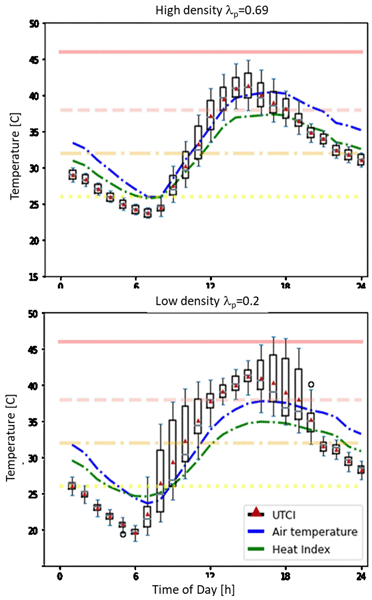
Here, we present a model that quantifies the thermal stress and its microscale variability at a city scale with a mesoscale model. This tool can have multiple applications, from early warnings of extreme heat to the vulnerable population to the evaluation of the effectiveness of heat mitigation strategies. It is the first model that includes information on microscale variability in a mesoscale model, something that is essential for fully evaluating heat stress.
Jiachen Lu, Negin Nazarian, Melissa Anne Hart, E. Scott Krayenhoff, and Alberto Martilli
Geosci. Model Dev., 17, 2525–2545, https://doi.org/10.5194/gmd-17-2525-2024, https://doi.org/10.5194/gmd-17-2525-2024, 2024
Short summary
Short summary
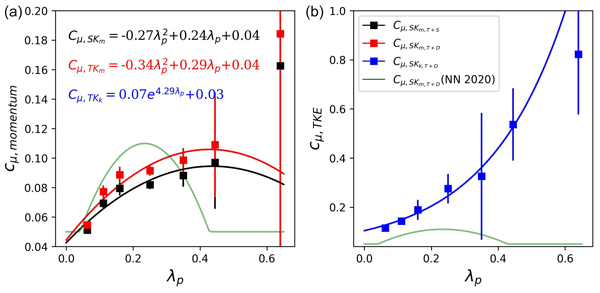
This study enhances urban canopy models by refining key assumptions. Simulations for various urban scenarios indicate discrepancies in turbulent transport efficiency for flow properties. We propose two modifications that involve characterizing diffusion coefficients for momentum and turbulent kinetic energy separately and introducing a physics-based
mass-fluxterm. These adjustments enhance the model's performance, offering more reliable temperature and surface flux estimates.
Cited articles
Berardi, U.: The outdoor microclimate benefits and energy saving resulting from green roofs retrofits, Energ. Buildings, 121, 217–229, https://doi.org/10.1016/j.enbuild.2016.03.021, 2016.
Berardi, U., GhaffarianHoseini, A., and GhaffarianHoseini, A.: State-of-the-art analysis of the environmental benefits of green roofs, Appl. Energ., 115, 411–428, https://doi.org/10.1016/j.apenergy.2013.10.047, 2014.
Brousse, O., Simpson, C., Zonato, A., Martilli, A., Taylor, J., Davies, M., and Heaviside, C.: Cool Roofs Could Be Most Effective at Reducing Outdoor Urban Temperatures in London (United Kingdom) Compared With Other Roof Top and Vegetation Interventions: A Mesoscale Urban Climate Modeling Study, Geophys. Res. Lett., 51, https://doi.org/10.1029/2024gl109634, 2024.
Cascone, S., Catania, F., Gagliano, A., and Sciuto, G.: A comprehensive study on green roof performance for retrofitting existing buildings, Build. Environ., 136, 227–239, https://doi.org/10.1016/j.buildenv.2018.03.052, 2018.
Chen, B., Wang, W., You, Y., Zhu, W., Dong, Y., Xu, Y., Chang, M., and Wang, X.: Influence of rooftop mitigation strategies on the thermal environment in a subtropical city, Urban Climate, 49, 101450, https://doi.org/10.1016/j.uclim.2023.101450, 2023.
Comer, N. T., Lafleur, P. M., Roulet, N. T., Letts, M. G., Skarupa, M., and Verseghy, D.: A test of the Canadian land surface scheme (class) for a variety of wetland types, Atmos. Ocean, 38, 161–179, https://doi.org/10.1080/07055900.2000.9649644, 2000.
Costanzo, V., Evola, G., and Marletta, L.: Energy savings in buildings or UHI mitigation? Comparison between green roofs and cool roofs, Energ. Buildings, 114, 247–255, https://doi.org/10.1016/j.enbuild.2015.04.053, 2016.
Curtis, O. F.: Leaf Temperatures and the Cooling of Leaves By Radiation, Plant Physiol., 11, 343–364, https://doi.org/10.1104/pp.11.2.343, 1936.
de Munck, C. S., Lemonsu, A., Bouzouidja, R., Masson, V., and Claverie, R.: The GREENROOF module (v7.3) for modelling green roof hydrological and energetic performances within TEB, Geosci. Model Dev., 6, 1941–1960, https://doi.org/10.5194/gmd-6-1941-2013, 2013.
Dong, X., Feng, X., and He, B.-J.: Dual potential of Garden Rooftop Farms for heat island mitigation and spatial productivity, Build. Environ., 274, 112768, https://doi.org/10.1016/j.buildenv.2025.112768, 2025.
Gößner, D., Kunle, M., and Mohri, M.: Green roof performance monitoring: Insights on physical properties of 4 extensive green roof types after 2 years of microclimatic measurements, Build. Environ., 269, 112356, https://doi.org/10.1016/j.buildenv.2024.112356, 2025.
Gravatt, D. A. and Martin, C. E.: Comparative ecophysiology of five species of Sedum (Crassulaceae) under well-watered and drought-stressed conditions, Oecologia, 92, 532–541, https://doi.org/10.1007/bf00317845, 1992.
He, Y., Yu, H., Ozaki, A., and Dong, N.: Thermal and energy performance of green roof and cool roof: A comparison study in Shanghai area, J. Clean. Prod., 267, 122205, https://doi.org/10.1016/j.jclepro.2020.122205, 2020.
Heusinger, J. and Weber, S.: Surface energy balance of an extensive green roof as quantified by full year eddy-covariance measurements, Sci. Total Environ., 577, 220–230, https://doi.org/10.1016/j.scitotenv.2016.10.168, 2017.
Heusinger, J., Sailor, D. J., and Weber, S.: Modeling the reduction of urban excess heat by green roofs with respect to different irrigation scenarios, Build. Environ., 131, 174–183, https://doi.org/10.1016/j.buildenv.2018.01.003, 2018.
Huang, J., Kong, F., Yin, H., Middel, A., Green, J. K., and Liu, H.: Green roof plant physiological water demand for transpiration under extreme heat, Urban For. Urban Gree., 98, 128411, https://doi.org/10.1016/j.ufug.2024.128411, 2024.
Imran, H. M., Kala, J., Ng, A. W. M., and Muthukumaran, S.: Effectiveness of green and cool roofs in mitigating urban heat island effects during a heatwave event in the city of Melbourne in southeast Australia, J. Clean. Prod., 197, 393–405, https://doi.org/10.1016/j.jclepro.2018.06.179, 2018.
Jaffal, I., Ouldboukhitine, S.-E., and Belarbi, R.: A comprehensive study of the impact of green roofs on building energy performance, Renew. Energ., 43, 157–164, https://doi.org/10.1016/j.renene.2011.12.004, 2012.
Kalogeri, C., Spyrou, C., Koukoula, M., Saviolakis, P. M., Pappa, A., Loupis, M., Masouras, C., and Katsafados, P.: Modeling the Impact of the Green Roofs as a Nature-Based Solution to Mitigate the Urban Heat Island Effects over Attica, Greece, in: 16th International Conference on Meteorology, Climatology and Atmospheric Physics–COMECAP 2023, International Conference on Meteorology, Climatology and Atmospheric Physics, Basel Switzerland, 174, https://doi.org/10.3390/environsciproc2023026174, 2023.
Karachaliou, P., Santamouris, M., and Pangalou, H.: Experimental and numerical analysis of the energy performance of a large scale intensive green roof system installed on an office building in Athens, Energ. Buildings, 114, 256–264, https://doi.org/10.1016/j.enbuild.2015.04.055, 2016.
Khan, A., Khorat, S., Doan, Q., Khatun, R., Das, D., Hamdi, R., Carlosena, L., Santamouris, M., Georgescu, M., and Niyogi, D.: Exploring the Meteorological Impacts of Surface and Rooftop Heat Mitigation Strategies Over a Tropical City, J. Geophys. Res.-Atmos., 128, https://doi.org/10.1029/2022jd038099, 2023.
Kim, S. H., Park, C. Y., Choi, J. Y., and Park, C.: Exploring maladaptive patterns of small-scale green roofs through evaluation in a capacity of heat mitigation: A case study in seoul, Build. Environ., 266, 112052, https://doi.org/10.1016/j.buildenv.2024.112052, 2024.
Krayenhoff, E. S., Martilli, A., Bass, B., and Stull, R. B.: Mesoscale simulation of urban heat mitigation strategies in Toronto, Canada, paper presented at the Fifth International Conference on Urban Climate, Lodz, Poland, 1–5 September 2003.
Krayenhoff, E. S., Broadbent, A. M., Zhao, L., Georgescu, M., Middel, A., Voogt, J. A., Martilli, A., Sailor, D. J., and Erell, E.: Cooling hot cities: a systematic and critical review of the numerical modelling literature, Environ. Res. Lett., 16, 053007, https://doi.org/10.1088/1748-9326/abdcf1, 2021.
Kurukulaarachchi, D. C.: Temporal Variability In The Daytime Green Roof Energy Balance During Drying Periods, MSc Thesis, The University of Western Ontario, https://hdl.handle.net/20.500.14721/27407 (last access: 22 August 2025), 2017.
Li, D., Bou-Zeid, E., and Oppenheimer, M.: The effectiveness of cool and green roofs as urban heat island mitigation strategies, Environ. Res. Lett., 9, 055002, https://doi.org/10.1088/1748-9326/9/5/055002, 2014.
Liu, K. and Minor, J.: Performance Evaluation of an Extensive Green Roof, NRCC-48204, National Research Council Canada, 2005.
Males, J. and Griffiths, H.: Stomatal Biology of CAM Plants, Plant Physiol., 174, 550–560, https://doi.org/10.1104/pp.17.00114, 2017.
Marasco, D. E., Culligan, P. J., and McGillis, W. R.: Evaluation of common evapotranspiration models based on measurements from two extensive green roofs in New York City, Ecol. Eng., 84, 451–462, https://doi.org/10.1016/j.ecoleng.2015.09.001, 2015.
Martens, R., Bass, B., and Alcazar, S. S.: Roof–envelope ratio impact on green roof energy performance, Urban Ecosyst., 11, 399–408, https://doi.org/10.1007/s11252-008-0053-z, 2008.
Martilli, A., Clappier, A., and Rotach, M. W.: An Urban Surface Exchange Parameterisation for Mesoscale Models, Bound.-Lay. Meteorol., 104, 261–304, https://doi.org/10.1023/A:1016099921195, 2002.
Martinez Mendoza, M., Saeedi, A., Voogt, J. A., and Krayenhoff, E. S.: Stand-alone EcoRoof (ERo, ERm) and WRF-MLGR model codes and evaluation datasets for “Process-based evaluation of green roof models for assessment of heat mitigation efficacy in WRF (v4.3.1) and EnergyPlus (v8.6.0)”, Zenodo [code and data set], https://doi.org/10.5281/zenodo.18688590, 2026.
Oberndorfer, E., Lundholm, J., Bass, B., Coffman, R. R., Doshi, H., Dunnett, N., Gaffin, S., Köhler, M., Liu, K. K. Y., and Rowe, B.: Green Roofs as Urban Ecosystems: Ecological Structures, Functions, and Services, BioScience, 57, 823–833, https://doi.org/10.1641/B571005, 2007.
Perelli, G. A.: Characterization of the Green Roof Growth Media, MSc Thesis, The University of Western Ontario, https://hdl.handle.net/20.500.14721/35037 (last access: 2 December 2025), 2014.
Piccinini Scolaro, T., Ghisi, E., and Silva, C. M.: Assessing the impact of evapotranspiration from green roofs on reducing surface temperatures, Journal of Building Engineering, 95, 110095, https://doi.org/10.1016/j.jobe.2024.110095, 2024.
Saeedi, A., Martinez Mendoza, M., Krayenhoff, E. S., Voogt, J., Zonato, A., Leroyer, S., and Wagner-Riddle, C.: Process-based upgrades to the WRF multi-layer green-roof scheme (WRF-MLGR v2.0) and evaluation against field observations, EGUsphere [preprint], https://doi.org/10.5194/egusphere-2026-984, 2026.
Sailor, D. J.: A green roof model for building energy simulation programs, Energ. Buildings, 40, 1466–1478, https://doi.org/10.1016/j.enbuild.2008.02.001, 2008.
Salamanca, F., Krpo, A., Martilli, A., and Clappier, A.: A new building energy model coupled with an urban canopy parameterization for urban climate simulations – part I. formulation, verification, and sensitivity analysis of the model, Theor. Appl. Climatol., 99, 331–344, https://doi.org/10.1007/s00704-009-0142-9, 2010.
Seo, Y., Kwon, Y., Hwang, J. S., and Woo, D. K.: A Comparative Experimental Study of Green Roofs Based on Radiation Budget and Surface Energy Balance, KSCE J. Civ. Eng., 27, 1866–1880, https://doi.org/10.1007/s12205-023-1491-0, 2023.
Shafique, M., Kim, R., and Rafiq, M.: Green roof benefits, opportunities and challenges – A review, Renewable and Sustainable Energy Reviews, 90, 757–773, https://doi.org/10.1016/j.rser.2018.04.006, 2018.
Sia, M. E.: Evapotranspiration from extensive green roofs: influence of climatological conditions, vegetation type, and substrate depth, MSc Thesis, The University of Western Ontario, https://hdl.handle.net/20.500.14721/34186 (last access: 26 June 2025), 2016.
Siddiqui, K., Way, D., Bisuamlak, G., Peerhossaini, H., Voogt, J., Grolinger, K., Cechetto, L., Capretz, M., Aliabadi, A., Krayenhoff, S., Hangan, H., and Moffatt, M.: Improved multi-scale GHG emissions modeling from urban environments to enhance mitigation strategies, Environment and Climate Change Canada, Advancing Climate Change Science and Technology 2021/2022, project description (2022–2026), 2022.
Silva, C. M., Gomes, M. G., and Silva, M.: Green roofs energy performance in Mediterranean climate, Energ. Buildings, 116, 318–325, https://doi.org/10.1016/j.enbuild.2016.01.012, 2016.
Sims, A. W.: Stormwater Management Performance of Green Roofs, MSc Thesis, The University of Western Ontario, https://hdl.handle.net/20.500.14721/35793 (last access: 14 January 2026), 2016.
Sun, T., Grimmond, C. S. B., and Ni, G.: How do green roofs mitigate urban thermal stress under heat waves?, J. Geophys. Res.-Atmos., 121, 5320–5335, https://doi.org/10.1002/2016jd024873, 2016.
Tabares-Velasco, P. C. and Srebric, J.: A heat transfer model for assessment of plant based roofing systems in summer conditions, Build. Environ., 49, 310–323, https://doi.org/10.1016/j.buildenv.2011.07.019, 2012.
Tadeu, A., Škerget, L., Almeida, J., and Simões, N.: Canopy contribution to the energy balance of a building's roof, Energ. Buildings, 244, 111000, https://doi.org/10.1016/j.enbuild.2021.111000, 2021.
Taylor, J. R.: An Introduction to Error Analysis. The Study of Uncertainties in Physical Measurements, 2nd edn., University Science Books, Sausalito, California, USA, 1997.
Tran, S., Lundholm, J. T., Staniec, M., Robinson, C. E., Smart, C. C., Voogt, J. A., and O'Carroll, D. M.: Plant survival and growth on extensive green roofs: A distributed experiment in three climate regions, Ecol. Eng., 127, 494–503, https://doi.org/10.1016/j.ecoleng.2018.09.027, 2019.
Willmott, C., Ackleso, S., Davis, O., Feddema, J., Klink, K., Legate, D., and Rowe, A.: Statistics for the Evaluation and Comparison of Models, J. Geophys. Res., 90, 8995–9005, 1985.
Willmott, C. J.: Some Comments on the Evaluation of Model Performance, B. Am. Meteorol. Soc., 63, 1309–1313, https://doi.org/10.1175/1520-0477(1982)063<1309:SCOTEO>2.0.CO;2, 1982.
Willmott, C. J., Robeson, S. M., and Matsuura, K.: A refined index of model performance, Int. J. Climatol., 32, 2088–2094, https://doi.org/10.1002/joc.2419, 2012.
Zhao, M., Tabares-Velasco, P. C., Srebric, J., Komarneni, S., and Berghage, R.: Effects of plant and substrate selection on thermal performance of green roofs during the summer, Build. Environ., 78, 199–211, https://doi.org/10.1016/j.buildenv.2014.02.011, 2014.
Zheng, X., Yang, Z., Yang, J., Tang, M., and Feng, C.: An experimental study on the thermal and energy performance of self-sustaining green roofs under severe drought conditions in summer, Energ. Buildings, 261, 111953, https://doi.org/10.1016/j.enbuild.2022.111953, 2022.
Zheng, Y. and Weng, Q.: Modeling the Effect of Green Roof Systems and Photovoltaic Panels for Building Energy Savings to Mitigate Climate Change, Remote Sens., 12, 2402, https://doi.org/10.3390/rs12152402, 2020.
Zonato, A., Martilli, A., Gutierrez, E., Chen, F., He, C., Barlage, M., Zardi, D., and Giovannini, L.: Exploring the Effects of Rooftop Mitigation Strategies on Urban Temperatures and Energy Consumption, J. Geophys. Res.-Atmos., 126, e2021JD035002, https://doi.org/10.1029/2021JD035002, 2021.
Short summary
Green roofs can help cool cities, but models must represent them accurately to quantify this potential. Yet few studies evaluate green roof models against real data. We evaluated two versions of EcoRoof, the green roof module in EnergyPlus, and a green roof option for WRF (Weather and Research Forecasting model) using measurements from London, Ontario. EcoRoof generally matched observed heat fluxes, surface temperature, and soil moisture, while WRF overestimated heat and underestimated cooling.
Green roofs can help cool cities, but models must represent them accurately to quantify this...


