
Articles | Volume 19, issue 19
https://doi.org/10.5194/gmd-19-9301-2026
© Author(s) 2026. This work is distributed under
the Creative Commons Attribution 4.0 License.
the Creative Commons Attribution 4.0 License.
https://doi.org/10.5194/gmd-19-9301-2026
© Author(s) 2026. This work is distributed under
the Creative Commons Attribution 4.0 License.
the Creative Commons Attribution 4.0 License.
Model description paper
| 
02 Oct 2026
Model description paper |
| 02 Oct 2026
| 02 Oct 2026
ShyBFM v1.0: unstructured grid advection-diffusion-reaction modelling for coastal biogeochemical processes
Jacopo Alessandri
CORRESPONDING AUTHOR

CMCC Foundation – Euro-Mediterranean Center on Climate Change, Lecce, Italy
Giulia Bonino
CMCC Foundation – Euro-Mediterranean Center on Climate Change, Lecce, Italy
Tomas Lovato
CMCC Foundation – Euro-Mediterranean Center on Climate Change, Lecce, Italy
Momme Butenschön
CMCC Foundation – Euro-Mediterranean Center on Climate Change, Lecce, Italy
Lorenzo Mentaschi
Department of Physics and Astronomy (DIFA), University of Bologna, Bologna, Italy
Giorgia Verri
CMCC Foundation – Euro-Mediterranean Center on Climate Change, Lecce, Italy
Ivan Federico
CMCC Foundation – Euro-Mediterranean Center on Climate Change, Lecce, Italy
Nadia Pinardi
Department of Physics and Astronomy (DIFA), University of Bologna, Bologna, Italy
Related authors
Seimur Shirinov, Ivan Federico, Simone Bonamano, Salvatore Causio, Nicolás Biocca, Viviana Piermattei, Daniele Piazzolla, Jacopo Alessandri, Lorenzo Mentaschi, Giovanni Coppini, Marco Marcelli, and Nadia Pinardi
Nat. Hazards Earth Syst. Sci., 25, 3737–3758, https://doi.org/10.5194/nhess-25-3737-2025, https://doi.org/10.5194/nhess-25-3737-2025, 2025
Short summary
Short summary
This research investigates how seagrass meadows attenuate coastal waves. Our methodology integrates site measurements with numerical simulations, revealing that plant flexibility and seasonal growth cycles are crucial factors that enhance model fidelity for predicting wave damping. These insights aid ecosystem-based coastal protection and conservation of these vital habitats. Future work should address current–sediment–vegetation interactions for a more complete hydrodynamic understanding.
Rodrigo Campos-Caba, Jacopo Alessandri, Paula Camus, Andrea Mazzino, Francesco Ferrari, Ivan Federico, Michalis Vousdoukas, Massimo Tondello, and Lorenzo Mentaschi
Ocean Sci., 20, 1513–1526, https://doi.org/10.5194/os-20-1513-2024, https://doi.org/10.5194/os-20-1513-2024, 2024
Short summary
Short summary
Here we show the development of high-resolution simulations of storm surge in the northern Adriatic Sea employing different atmospheric forcing data and physical configurations. Traditional metrics favor a simulation forced by a coarser database and employing a less sophisticated setup. Closer examination allows us to identify a baroclinic model forced by a high-resolution dataset as being better able to capture the variability and peak values of the storm surge.
Alex Hayward, Nishka Dasgupta, Ronan McAdam, Mark R. Payne, Roshin P. Raj, Giulia Bonino, Sourav Chatterjee, Vincent Combes, Dimitra Denaxa, Francesco De Rovere, Pia Englyst, Veera Haapaniemi, Paul Hargous, Jacob Høyer, K. Ajith Joseph, Beatriz Lopes, Ana Oliveira, João Paixão, Fabiola Silva, Saradhy Surendran, Artemis Zegna-Rata, and Steffen M. Olsen
Earth Syst. Sci. Data, 18, 7181–7197, https://doi.org/10.5194/essd-18-7181-2026, https://doi.org/10.5194/essd-18-7181-2026, 2026
Short summary
Short summary
We present a global marine heatwave and cold spell dataset (1982–2024) based on satellite sea surface temperature. The dataset applies multiple definitions in parallel, varying baselines, thresholds, detrending, and event durations. It enables consistent comparisons of marine heatwave characterisation across methods and supports climate monitoring, and ecological impact studies.
Jörg Schwinger, Leon Merfort, Nico Bauer, Raffaele Bernardello, Momme Butenschön, Timothée Bourgeois, Matthew J. Gidden, Shraddha Gupta, Hanna Lee, Nadine Mengis, Yiannis Moustakis, Helene Muri, Lars Nieradzik, Daniele Peano, Julia Pongratz, Pascal Sauer, Etienne Tourigny, and David Wårlind
Earth Syst. Dynam., 17, 1341–1363, https://doi.org/10.5194/esd-17-1341-2026, https://doi.org/10.5194/esd-17-1341-2026, 2026
Short summary
Short summary
Earth system models can simulate CO2 removal by representing the activity that draws down atmospheric CO2, e.g. growing bioenergy crops for energy production with carbon capture and storage or enhancing the oceans’ alkalinity. We describe a simulation framework, spanning the modeling chain from integrated assessment to Earth system models, that allows separating the intrinsic efficiency of CO2 removal and the overall atmospheric CO2 reduction, the latter being affected by Earth system feedbacks.
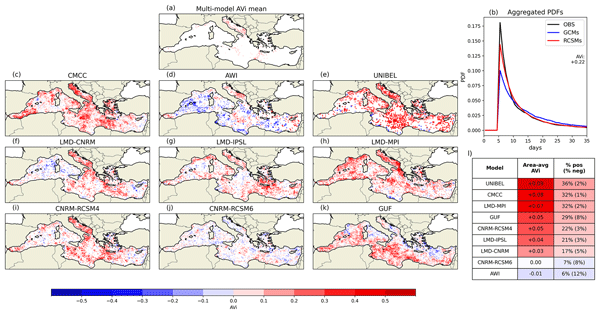
Francesco De Rovere, Giulia Bonino, Ronan McAdam, Enrico Scoccimarro, Samuel Somot, Iván M. Parras-Berrocal, Bodo Ahrens, Vladimir Djurdjevic, Laurent Li, and Simona Masina
Ocean Sci., 22, 2725–2742, https://doi.org/10.5194/os-22-2725-2026, https://doi.org/10.5194/os-22-2725-2026, 2026
Short summary
Short summary
Marine heatwaves in the Mediterranean Sea are intensifying, posing growing threats to marine life and coastal communities. We evaluated if high-resolution regional climate models better capture these extremes compared to the global models driving them. Regional models reliably improve sea surface temperature patterns and marine heatwave duration, but struggle more with heatwave intensity. Higher horizontal resolution alone is not enough, advances in other model components are equally needed.
Ronan McAdam, Antonella Sanna, Giulia Bonino, and Enrico Scoccimarro
EGUsphere, https://doi.org/10.5194/egusphere-2026-5138, https://doi.org/10.5194/egusphere-2026-5138, 2026
This preprint is open for discussion and under review for Ocean Science (OS).
Short summary
Short summary
Wind-driven upwelling brings nutrient-rich water to the surface, supporting rich ecosystems and fisheries. In 2025, the Gulf of Panama's upwelling collapsed, causing unusually warm water with little chlorophyll. We tested whether seasonal forecasts could have predicted this event. Forecasts captured the weak winds and warm temperatures a season ahead. This shows seasonal forecasting can give early warning of upwelling collapse, helping coastal communities and authorities prepare.
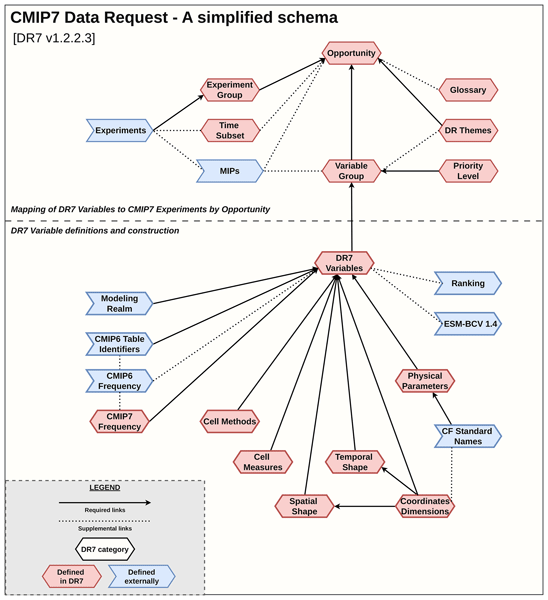
Chloe Mackallah, Martin Juckes, James Anstey, Beth Dingley, Charlotte Pascoe, Gaëlle Rigoudy, Marie-Pierre Moine, Tomas Lovato, Alison Pamment, Martin Schupfner, Michio Kawamiya, Tommi Bergman, Charles Koven, Eleanor O'Rourke, Briony Turner, Daniel Ellis, and Matthew Mizielinski
Geosci. Model Dev., 19, 8053–8079, https://doi.org/10.5194/gmd-19-8053-2026, https://doi.org/10.5194/gmd-19-8053-2026, 2026
Short summary
Short summary
This paper describes the creation of a new set of output data requirements for upcoming global climate model experiments performed for CMIP7, an international climate modelling activity. Experts from the community helped to co-create a database that describes which data should be produced, and the scientific justifications behind these choices. It supports growing climate research and policy needs by linking experiments and variables to scientific objectives and real‑world applications.
Francesco Maicu, Seimur Shirinov, Charikleia L. G. Oikonomou, Vitalii Sharmar, Lucia Gualtieri, Anna Chiara Goglio, Ehsan Sadighrad, Dimitra Denaxa, Aimie Moulin, Bethany McDonagh, Salvatore Causio, Emanuela Clementi, Gerasimos Korres, Ivan Federico, and Enrico Scoccimarro
State Planet Discuss., https://doi.org/10.5194/sp-2026-12, https://doi.org/10.5194/sp-2026-12, 2026
Preprint under review for SP
Short summary
Short summary
In January 2026, an exceptional storm brought record waves, flooding, and strong currents to the Mediterranean Sea. To understand its coastal impact, we combined data from Europe's ocean monitoring service with a detailed coastal computer model, tracking the storm from open sea to shore. We found unusually high waves, raised sea levels, and strong changes in currents and saltiness. Combining wide-area forecasts with local models improves flood prediction, supporting earlier coastal warning.
Anna Chiara Goglio, Emanuela Clementi, Nadia Pinardi, Giulio Boccaletti, Paolo Oddo, and Lorenzo Mentaschi
EGUsphere, https://doi.org/10.5194/egusphere-2026-4734, https://doi.org/10.5194/egusphere-2026-4734, 2026
This preprint is open for discussion and under review for Natural Hazards and Earth System Sciences (NHESS).
Short summary
Short summary
Venice, one of the world's most famous cities, is threatened by flooding, locally known as Acqua Alta. Based on numerical results from the Copernicus Marine Mediterranean Analysis and Forecasting System, we investigate each process involved in the dynamics of these events to improve their predictability. For the first time, we identify processes occurring within the water column that contribute to the sea level peak, providing new insight into the understanding and modeling of Acqua Alta events.
Archit Shirish Wadalkar, Michalis I. Vousdoukas, Massimo Tondello, Vitali Sharmar, Evangelos Voukouvalas, Salvatore Causio, Ivan Federico, Giovanni Coppini, and Lorenzo Mentaschi
Earth Syst. Sci. Data Discuss., https://doi.org/10.5194/essd-2026-598, https://doi.org/10.5194/essd-2026-598, 2026
Preprint under review for ESSD
Short summary
Short summary
We present a global hazard-oriented dataset of storm surges and significant wave heights, including bulk and spectral peak wave parameters, spanning 1950–2023 on a high-resolution in coastal areas. Significant wave heights are bias-corrected using satellite altimetry, while storm surges are derived from sea surface heights through frequency-based filtering. The dataset is tailor made for regional downscaling and assessment of compound-events for multi hazard mapping.
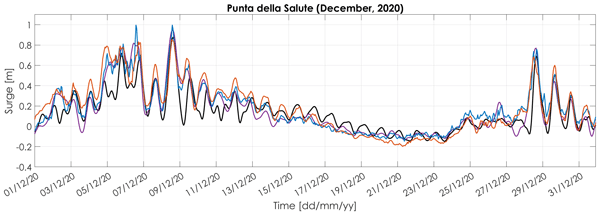
Rodrigo Campos-Caba, Paula Camus, Andrea Mazzino, Michalis Vousdoukas, Massimo Tondello, Ivan Federico, Salvatore Causio, and Lorenzo Mentaschi
Nat. Hazards Earth Syst. Sci., 26, 3683–3706, https://doi.org/10.5194/nhess-26-3683-2026, https://doi.org/10.5194/nhess-26-3683-2026, 2026
Short summary
Short summary
We assess the ability of machine learning emulators, from Multivariate Linear Regression to Long Short-Term Memory (LSTM) networks, to reproduce storm surge dynamics in the northern Adriatic Sea. Using the corrected Mean Absolute Deviation squared (MADc²) loss function, we demonstrate that data-driven models can match high-resolution hydrodynamic simulations in representing extreme surge events with greatly reduced computational cost.
Milad Niroumand-Jadidi, Lorenzo Mentaschi, and Sonia Silvestri
Int. Arch. Photogramm. Remote Sens. Spatial Inf. Sci., XLIX-B3-2026, 825–830, https://doi.org/10.5194/isprs-archives-XLIX-B3-2026-825-2026, https://doi.org/10.5194/isprs-archives-XLIX-B3-2026-825-2026, 2026
Anna Chiara Goglio, Lorenzo Mentaschi, Begoña Pérez Gómez, Paolo Oddo, Emanuela Clementi, and Federica Borile
State Planet Discuss., https://doi.org/10.5194/sp-2026-7, https://doi.org/10.5194/sp-2026-7, 2026
Preprint under review for SP
Short summary
Short summary
Mediterranean coastal communities are increasingly threatened by extreme sea level events. We built an indicator combining model and observed data to summarize their changes. The analysis of their evolution revealed that the associated hazard is rising along the entire coastline, especially in the northern Adriatic, the Aegean Sea, and along Turkish and Cypriot coasts. This trend is mostly driven by sea level rise, except for the Adriatic Sea, where strong storm effects play a bigger role.
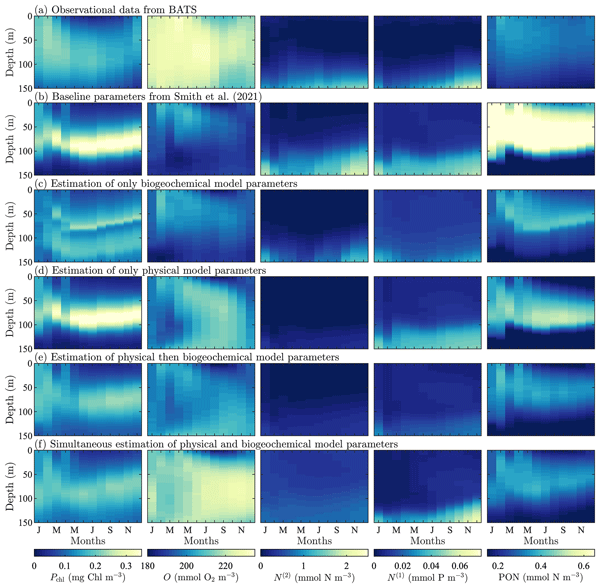
Skyler Kern, Mary E. McGuinn, Katherine M. Smith, Nadia Pinardi, Kyle E. Niemeyer, Nicole S. Lovenduski, and Peter E. Hamlington
Geosci. Model Dev., 19, 5601–5622, https://doi.org/10.5194/gmd-19-5601-2026, https://doi.org/10.5194/gmd-19-5601-2026, 2026
Short summary
Short summary
The parameters that control a model's behavior determine its ability to represent a system. In this work, multiple cases test how to estimate the parameters of a model with components corresponding to both the physics and the chemical and biological processes (i.e. the biogeochemistry) of the ocean. While demonstrating how to approach this problem type, the results show estimating both sets of parameters simultaneously is better than estimating the physics then the biogeochemistry separately.
Jozef Skákala, Shubha Sathyendranath, Yuri Artioli, Deep S. Banerjee, Heather Bouman, Robert J. W. Brewin, Momme Butenschön, Stefano Ciavatta, Stephanie Dutkiewicz, Yanna Fidai, David Ford, Grinson George, Karen Guihou, Bror Jönsson, Marija Bačeković Koloper, Žarko Kovač, Lekshmi Krishnakumary, Gemma Kulk, Charlotte Laufkötter, Gennadi Lessin, Jann Paul Mattern, Angélique Melet, Alexandre Mignot, David Moffat, Fanny Monteiro, Mayra Rodriguez Bennadji, Cécile S. Rousseaux, Ranjini Swaminathan, Osvaldo Ulloa, and Jerry Tjiputra
Ocean Sci., 22, 1457–1481, https://doi.org/10.5194/os-22-1457-2026, https://doi.org/10.5194/os-22-1457-2026, 2026
Short summary
Short summary
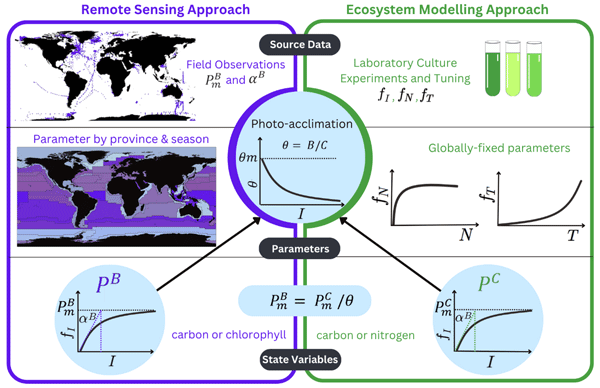
Marine primary production (PP) is a key component of the Earth's climate system, but its current estimates and future projections are highly uncertain. We review the PP uncertainties and discuss their sources both across the ecosystem and satellite models. We propose to reduce the PP uncertainties by better addressing the PP model structures and parametrizations. We also argue that for many models it is desirable to consider spatial and temporal variability in the model parameter values.
Mohammad Hadi Bahmanpour, Alois Tilloy, Michalis Vousdoukas, Ivan Federico, Giovanni Coppini, Luc Feyen, and Lorenzo Mentaschi
Hydrol. Earth Syst. Sci., 30, 2301–2314, https://doi.org/10.5194/hess-30-2301-2026, https://doi.org/10.5194/hess-30-2301-2026, 2026
Short summary
Short summary
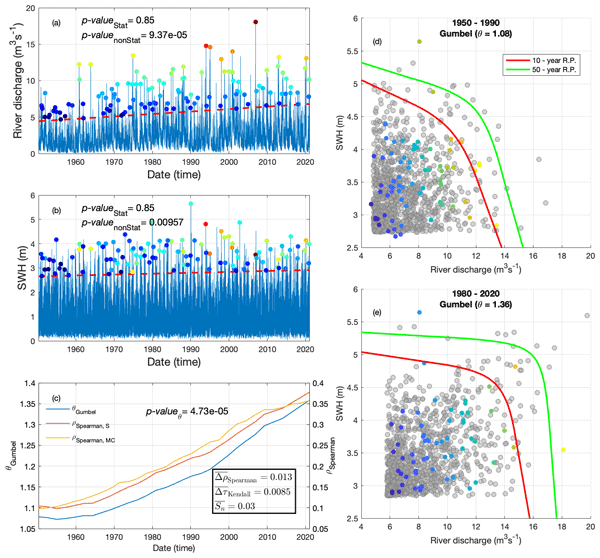
As natural hazards evolve, understanding how extreme events interact over time is crucial. While single extremes have been widely studied, joint extremes remain challenging to analyze. We present a framework that combines advanced statistical modeling with copula theory to capture changing dependencies. Applying it to historical data reveals dynamic patterns in extreme events. To support broader use, we provide an open-source tool for improved hazard assessment.
Rita Lecci, Robyn Gwee, Kun Yan, Sanne Muis, Nadia Pinardi, Jun She, Martin Verlaan, Simona Masina, Wenshan Li, Hui Wang, Salvatore Causio, Antonio Novellino, Marco Alba, Etiënne Kras, Sandra Gaytan Aguilar, and Jan-Bart Calewaert
Nat. Hazards Earth Syst. Sci., 26, 1767–1783, https://doi.org/10.5194/nhess-26-1767-2026, https://doi.org/10.5194/nhess-26-1767-2026, 2026
Short summary
Short summary
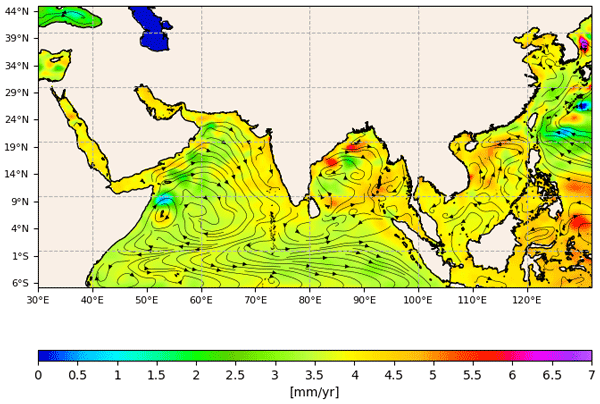
This study explored how sea level is changing along the China-Europe Sea Route. By combining satellite and in-situ observations with advanced modeling, the research identified ongoing sea level rise and an increasing frequency of extreme water level events in some regions. These findings underscore the importance of continued monitoring and provide useful knowledge to support long-term planning, coastal resilience, and informed decision-making.
Mara Y. McPartland, Tomas Lovato, Charles Koven, Jamie D. Wilson, Briony Turner, Colleen M. Petrik, José Licón-Saláiz, Fang Li, Fanny Lhardy, Jaclyn Clement Kinney, Michio Kawamiya, Birgit Hassler, Nathan P. Gillett, Cheikh Modou Noreyni Fall, Christopher Danek, Chris M. Brierley, Ana Bastos, and Oliver Andrews
Geosci. Model Dev., 19, 2849–2880, https://doi.org/10.5194/gmd-19-2849-2026, https://doi.org/10.5194/gmd-19-2849-2026, 2026
Short summary
Short summary
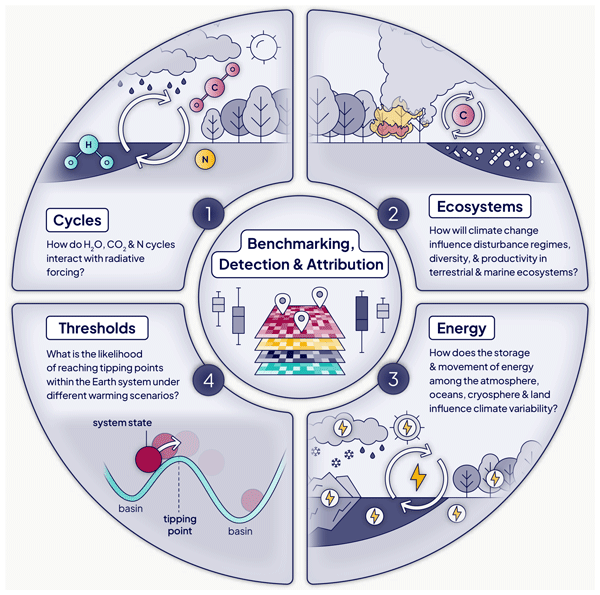
The Coupled Model Intercomparison Project (CMIP) is an international consortium of climate modeling groups that produce coordinated experiments in order to evaluate human influence on the climate and test knowledge of Earth systems. This paper describes the data requested for Earth systems research in CMIP7. We detail the request for model output of the carbon cycle, the flows of energy among the atmosphere, land and the oceans, and interactions between these and the global climate.

Italo dos Reis Lopes, Ivan Federico, Michalis Vousdoukas, Luisa Perini, Salvatore Causio, Giovanni Coppini, Maurilio Milella, Nadia Pinardi, and Lorenzo Mentaschi
Nat. Hazards Earth Syst. Sci., 26, 811–825, https://doi.org/10.5194/nhess-26-811-2026, https://doi.org/10.5194/nhess-26-811-2026, 2026
Short summary
Short summary
We improved a computer model to simulate coastal flooding by including temporary barriers like sand dunes. We tested it where sand dunes are built seasonally to protect the shoreline for two real storms: one that broke through the dunes and another where dunes held strong. Our model showed how important it is to design these defenses carefully since even if a small part of a dune fails, a major flooding can happen. Overall, our work helps create better tools to manage and protect coastal areas.

Mahmud Hasan Ghani, Nadia Pinardi, Antonio Navarra, Lorenzo Mentaschi, Silvia Bianconcini, Francesco Maicu, and Francesco Trotta
Ocean Sci., 22, 427–441, https://doi.org/10.5194/os-22-427-2026, https://doi.org/10.5194/os-22-427-2026, 2026
Short summary
Short summary
Using the same sea surface temperature and the same bulk formula but different atmospheric reanalysis and analysis surface-variable datasets, we show that a higher-resolution dataset is crucial for evaluating the heat-budget closure hypothesis in the Mediterranean Sea. For the first time, we investigate the impact of extreme heat-loss events in the Mediterranean Sea by computing the long-term, basin-averaged mean heat budget.

Paolo Oddo, Mario Adani, Francesco Carere, Andrea Cipollone, Anna Chiara Goglio, Eric Jansen, Ali Aydogdu, Francesca Mele, Italo Epicoco, Jenny Pistoia, Emanuela Clementi, Nadia Pinardi, and Simona Masina
Geosci. Model Dev., 19, 423–445, https://doi.org/10.5194/gmd-19-423-2026, https://doi.org/10.5194/gmd-19-423-2026, 2026
Short summary
Short summary
This study present a data assimilation system that combines ocean observational data with ocean model results to better understand the ocean and predict its future state. The method uses a three dimensional incremental variational approach focusing on the physical relationships between all the state vector variables errors. Testing in the Mediterranean Sea showed that a complex sea level operator based on a barotropic model works best.
Seimur Shirinov, Ivan Federico, Simone Bonamano, Salvatore Causio, Nicolás Biocca, Viviana Piermattei, Daniele Piazzolla, Jacopo Alessandri, Lorenzo Mentaschi, Giovanni Coppini, Marco Marcelli, and Nadia Pinardi
Nat. Hazards Earth Syst. Sci., 25, 3737–3758, https://doi.org/10.5194/nhess-25-3737-2025, https://doi.org/10.5194/nhess-25-3737-2025, 2025
Short summary
Short summary
This research investigates how seagrass meadows attenuate coastal waves. Our methodology integrates site measurements with numerical simulations, revealing that plant flexibility and seasonal growth cycles are crucial factors that enhance model fidelity for predicting wave damping. These insights aid ecosystem-based coastal protection and conservation of these vital habitats. Future work should address current–sediment–vegetation interactions for a more complete hydrodynamic understanding.
Salvatore Causio, Seimur Shirinov, Ivan Federico, Giovanni De Cillis, Emanuela Clementi, Lorenzo Mentaschi, and Giovanni Coppini
Ocean Sci., 21, 1105–1123, https://doi.org/10.5194/os-21-1105-2025, https://doi.org/10.5194/os-21-1105-2025, 2025
Short summary
Short summary
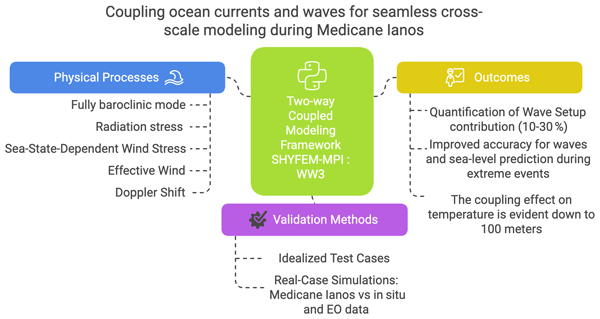
This study examines how waves and ocean currents interact during severe weather, focusing on Medicane Ianos, one of the strongest storms in the Mediterranean. Using advanced modeling, we created a unique system to simulate these interactions, capturing effects like wave-induced water levels and wave-induced effects on the vertical structure of the ocean. We validated our approach with ideal tests and real data from the storm.
Martin Juckes, Karl E. Taylor, Fabrizio Antonio, David Brayshaw, Carlo Buontempo, Jian Cao, Paul J. Durack, Michio Kawamiya, Hyungjun Kim, Tomas Lovato, Chloe Mackallah, Matthew Mizielinski, Alessandra Nuzzo, Martina Stockhause, Daniele Visioni, Jeremy Walton, Briony Turner, Eleanor O'Rourke, and Beth Dingley
Geosci. Model Dev., 18, 2639–2663, https://doi.org/10.5194/gmd-18-2639-2025, https://doi.org/10.5194/gmd-18-2639-2025, 2025
Short summary
Short summary
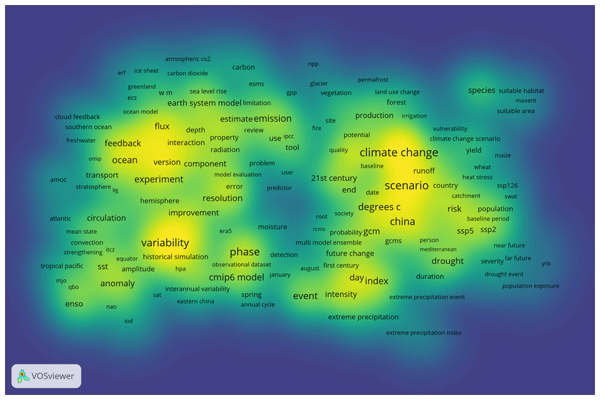
The Baseline Climate Variables for Earth System Modelling (ESM-BCVs) are defined as a list of 135 variables which have high utility for the evaluation and exploitation of climate simulations. The list reflects the most frequently used variables from Earth system models based on an assessment of data publication and download records from the largest archive of global climate projects.
Rodrigo Campos-Caba, Jacopo Alessandri, Paula Camus, Andrea Mazzino, Francesco Ferrari, Ivan Federico, Michalis Vousdoukas, Massimo Tondello, and Lorenzo Mentaschi
Ocean Sci., 20, 1513–1526, https://doi.org/10.5194/os-20-1513-2024, https://doi.org/10.5194/os-20-1513-2024, 2024
Short summary
Short summary
Here we show the development of high-resolution simulations of storm surge in the northern Adriatic Sea employing different atmospheric forcing data and physical configurations. Traditional metrics favor a simulation forced by a coarser database and employing a less sophisticated setup. Closer examination allows us to identify a baroclinic model forced by a high-resolution dataset as being better able to capture the variability and peak values of the storm surge.
Bart van den Hurk, Nadia Pinardi, Alexander Bisaro, Giulia Galluccio, José A. Jiménez, Kate Larkin, Angélique Melet, Lavinia Giulia Pomarico, Kristin Richter, Kanika Singh, Roderik van de Wal, and Gundula Winter
State Planet, 3-slre1, 1, https://doi.org/10.5194/sp-3-slre1-1-2024, https://doi.org/10.5194/sp-3-slre1-1-2024, 2024
Short summary
Short summary
The Summary for Policymakers compiles findings from “Sea Level Rise in Europe: 1st Assessment Report of the Knowledge Hub on Sea Level Rise”. It covers knowledge gaps, observations, projections, impacts, adaptation measures, decision-making principles, and governance challenges. It provides information for each European basin (Mediterranean, Black Sea, North Sea, Baltic Sea, Atlantic, and Arctic) and aims to assist policymakers in enhancing the preparedness of European coasts for sea level rise.
Nadia Pinardi, Bart van den Hurk, Michael Depuydt, Thorsten Kiefer, Petra Manderscheid, Lavinia Giulia Pomarico, and Kanika Singh
State Planet, 3-slre1, 2, https://doi.org/10.5194/sp-3-slre1-2-2024, https://doi.org/10.5194/sp-3-slre1-2-2024, 2024
Short summary
Short summary
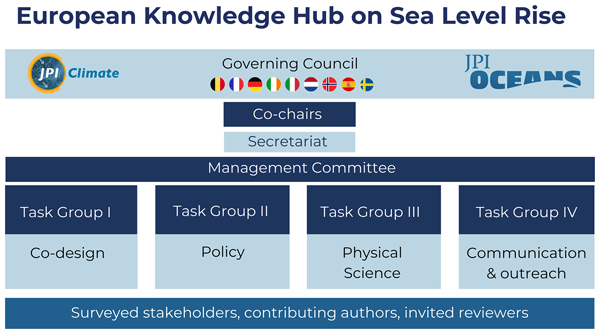
The Knowledge Hub on Sea Level Rise (KH-SLR), a joint effort between JPI Climate and JPI Oceans, addresses the critical need for science-based information on sea level changes in Europe. The KH-SLR actively involves stakeholders through a co-design process discussing the impacts, adaptation planning, and policy requirements related to SLR in Europe. Its primary output is the KH Assessment Report (KH-AR), which is described in this volume.
José A. Jiménez, Gundula Winter, Antonio Bonaduce, Michael Depuydt, Giulia Galluccio, Bart van den Hurk, H. E. Markus Meier, Nadia Pinardi, Lavinia G. Pomarico, and Natalia Vazquez Riveiros
State Planet, 3-slre1, 3, https://doi.org/10.5194/sp-3-slre1-3-2024, https://doi.org/10.5194/sp-3-slre1-3-2024, 2024
Short summary
Short summary
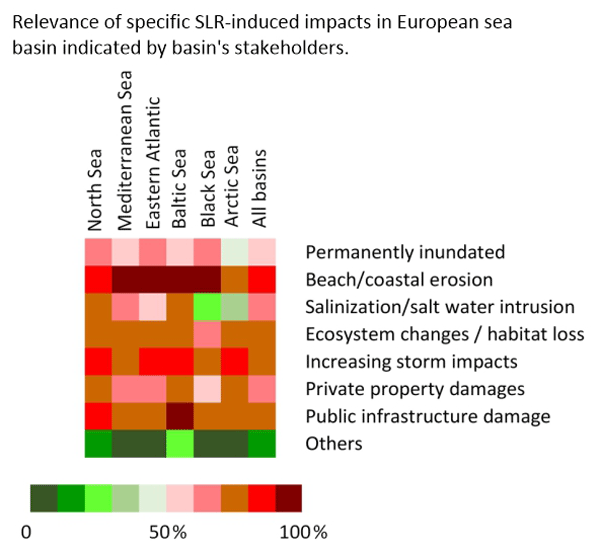
The Knowledge Hub on Sea Level Rise (SLR) has done a scoping study involving stakeholders from government and academia to identify gaps and needs in SLR information, impacts, and policies across Europe. Gaps in regional SLR projections and uncertainties were found, while concerns were raised about shoreline erosion and emerging problems like saltwater intrusion and ineffective adaptation plans. The need for improved communication to make better decisions on SLR adaptation was highlighted.
Dimitra Denaxa, Gerasimos Korres, Giulia Bonino, Simona Masina, and Maria Hatzaki
State Planet, 4-osr8, 11, https://doi.org/10.5194/sp-4-osr8-11-2024, https://doi.org/10.5194/sp-4-osr8-11-2024, 2024
Short summary
Short summary
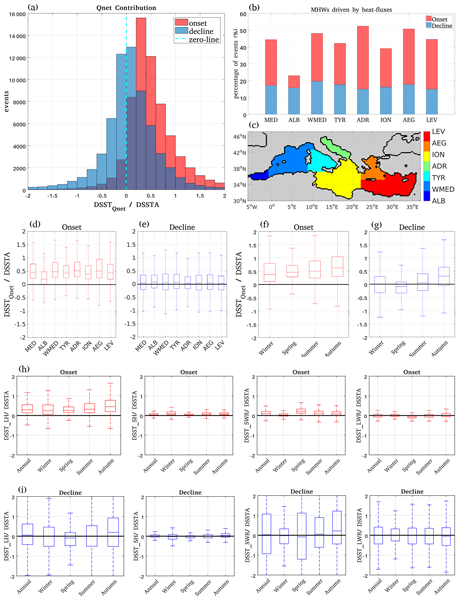
We investigate the air–sea heat flux during marine heatwaves (MHWs) in the Mediterranean Sea. Surface heat flux drives 44 % of the onset and only 17 % of the declining MHW phases, suggesting a key role of oceanic processes. Heat flux is more important in warmer months and onset phases, with latent heat dominating. Shorter events show a weaker heat flux contribution. In most cases, mixed layer shoaling occurs over the entire MHW duration, followed by vertical mixing after the MHW end day.
Ronan McAdam, Giulia Bonino, Emanuela Clementi, and Simona Masina
State Planet, 4-osr8, 13, https://doi.org/10.5194/sp-4-osr8-13-2024, https://doi.org/10.5194/sp-4-osr8-13-2024, 2024
Short summary
Short summary
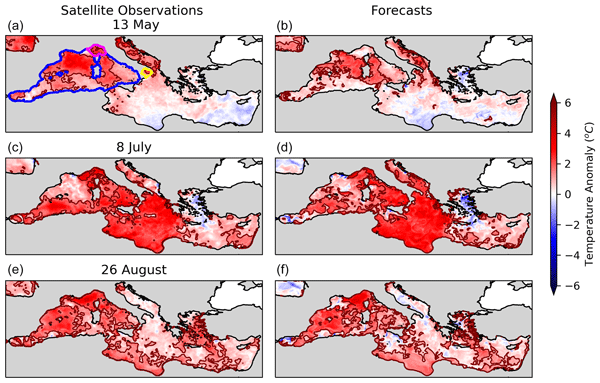
In the summer of 2022, a regional short-term forecasting system was able to predict the onset, spread, peaks, and decay of a record-breaking marine heatwave in the Mediterranean Sea up to 10 d in advance. Satellite data show that the event was record-breaking in terms of basin-wide intensity and duration. This study demonstrates the potential of state-of-the-art forecasting systems to provide early warning of marine heatwaves for marine activities (e.g. conservation and aquaculture).
Bethany McDonagh, Emanuela Clementi, Anna Chiara Goglio, and Nadia Pinardi
Ocean Sci., 20, 1051–1066, https://doi.org/10.5194/os-20-1051-2024, https://doi.org/10.5194/os-20-1051-2024, 2024
Short summary
Short summary
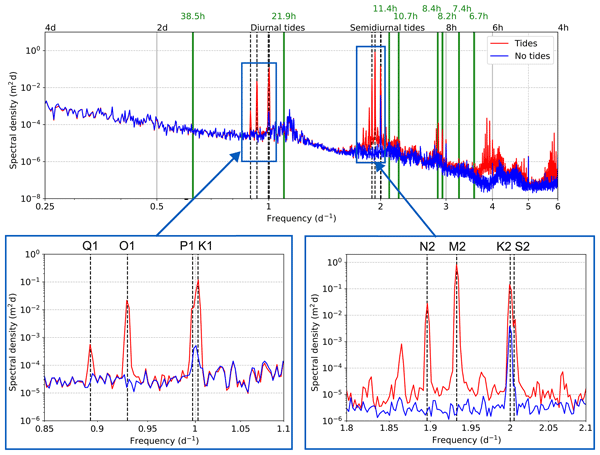
Tides in the Mediterranean Sea are typically of low amplitude, but twin experiments with and without tides demonstrate that tides affect the circulation directly at scales away from those of the tides. Analysis of the energy changes due to tides shows that they enhance existing oscillations, and internal tides interact with other internal waves. Tides also increase the mixed layer depth and enhance deep water formation in key regions. Internal tides are widespread in the Mediterranean Sea.
Roberta Benincasa, Giovanni Liguori, Nadia Pinardi, and Hans von Storch
Ocean Sci., 20, 1003–1012, https://doi.org/10.5194/os-20-1003-2024, https://doi.org/10.5194/os-20-1003-2024, 2024
Short summary
Short summary
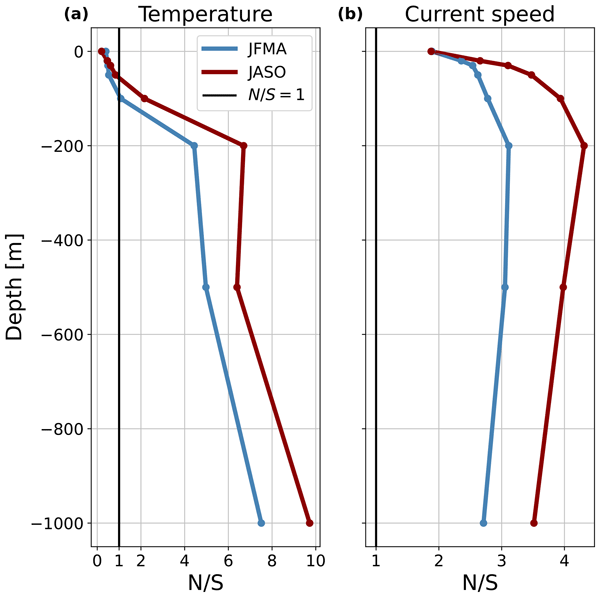
Ocean dynamics result from the interplay of internal processes and external inputs, primarily from the atmosphere. It is crucial to discern between these factors to gauge the ocean's intrinsic predictability and to be able to attribute a signal under study to either external factors or internal variability. Employing a simple analysis, we successfully characterized this variability in the Mediterranean Sea and compared it with the oceanic response induced by atmospheric conditions.
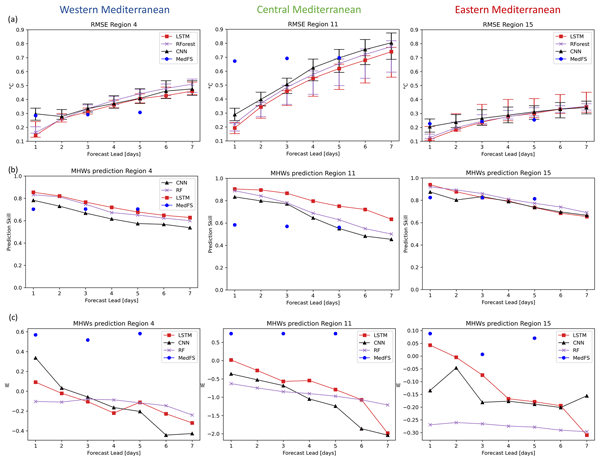
Giulia Bonino, Giuliano Galimberti, Simona Masina, Ronan McAdam, and Emanuela Clementi
Ocean Sci., 20, 417–432, https://doi.org/10.5194/os-20-417-2024, https://doi.org/10.5194/os-20-417-2024, 2024
Short summary
Short summary
This study employs machine learning to predict marine heatwaves (MHWs) in the Mediterranean Sea. MHWs have far-reaching impacts on society and ecosystems. Using data from ESA and ECMWF, the research develops accurate prediction models for sea surface temperature (SST) and MHWs across the region. Notably, machine learning methods outperform existing forecasting systems, showing promise in early MHW predictions. The study also highlights the importance of solar radiation as a predictor of SST.
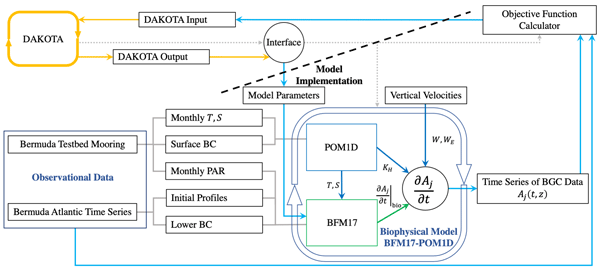
Skyler Kern, Mary E. McGuinn, Katherine M. Smith, Nadia Pinardi, Kyle E. Niemeyer, Nicole S. Lovenduski, and Peter E. Hamlington
Geosci. Model Dev., 17, 621–649, https://doi.org/10.5194/gmd-17-621-2024, https://doi.org/10.5194/gmd-17-621-2024, 2024
Short summary
Short summary
Computational models are used to simulate the behavior of marine ecosystems. The models often have unknown parameters that need to be calibrated to accurately represent observational data. Here, we propose a novel approach to simultaneously determine a large set of parameters for a one-dimensional model of a marine ecosystem in the surface ocean at two contrasting sites. By utilizing global and local optimization techniques, we estimate many parameters in a computationally efficient manner.
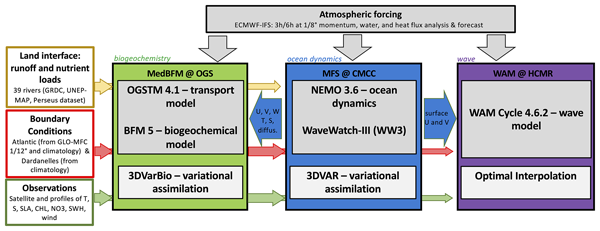
Giovanni Coppini, Emanuela Clementi, Gianpiero Cossarini, Stefano Salon, Gerasimos Korres, Michalis Ravdas, Rita Lecci, Jenny Pistoia, Anna Chiara Goglio, Massimiliano Drudi, Alessandro Grandi, Ali Aydogdu, Romain Escudier, Andrea Cipollone, Vladyslav Lyubartsev, Antonio Mariani, Sergio Cretì, Francesco Palermo, Matteo Scuro, Simona Masina, Nadia Pinardi, Antonio Navarra, Damiano Delrosso, Anna Teruzzi, Valeria Di Biagio, Giorgio Bolzon, Laura Feudale, Gianluca Coidessa, Carolina Amadio, Alberto Brosich, Arnau Miró, Eva Alvarez, Paolo Lazzari, Cosimo Solidoro, Charikleia Oikonomou, and Anna Zacharioudaki
Ocean Sci., 19, 1483–1516, https://doi.org/10.5194/os-19-1483-2023, https://doi.org/10.5194/os-19-1483-2023, 2023
Short summary
Short summary
The paper presents the Mediterranean Forecasting System evolution and performance developed in the framework of the Copernicus Marine Service.
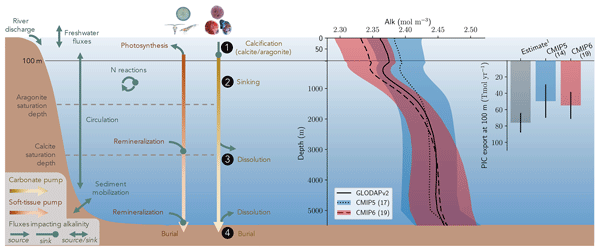
Alban Planchat, Lester Kwiatkowski, Laurent Bopp, Olivier Torres, James R. Christian, Momme Butenschön, Tomas Lovato, Roland Séférian, Matthew A. Chamberlain, Olivier Aumont, Michio Watanabe, Akitomo Yamamoto, Andrew Yool, Tatiana Ilyina, Hiroyuki Tsujino, Kristen M. Krumhardt, Jörg Schwinger, Jerry Tjiputra, John P. Dunne, and Charles Stock
Biogeosciences, 20, 1195–1257, https://doi.org/10.5194/bg-20-1195-2023, https://doi.org/10.5194/bg-20-1195-2023, 2023
Short summary
Short summary
Ocean alkalinity is critical to the uptake of atmospheric carbon and acidification in surface waters. We review the representation of alkalinity and the associated calcium carbonate cycle in Earth system models. While many parameterizations remain present in the latest generation of models, there is a general improvement in the simulated alkalinity distribution. This improvement is related to an increase in the export of biotic calcium carbonate, which closer resembles observations.
Giulia Bonino, Simona Masina, Giuliano Galimberti, and Matteo Moretti
Earth Syst. Sci. Data, 15, 1269–1285, https://doi.org/10.5194/essd-15-1269-2023, https://doi.org/10.5194/essd-15-1269-2023, 2023
Short summary
Short summary
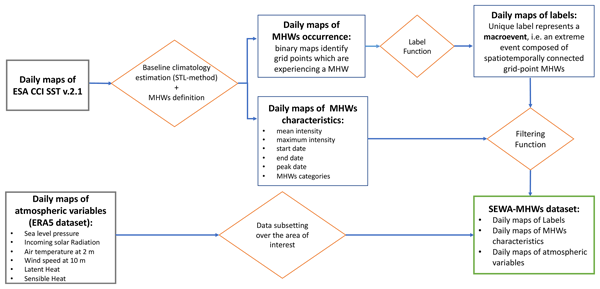
We present a unique observational dataset of marine heat wave (MHW) macroevents and their characteristics over southern Europe and western Asian (SEWA) basins in the SEWA-MHW dataset. This dataset is the first effort in the literature to archive extremely hot sea surface temperature macroevents. The advantages of the availability of SEWA-MHWs are avoiding the waste of computational resources to detect MHWs and building a consistent framework which would increase comparability among MHW studies.

Umesh Pranavam Ayyappan Pillai, Nadia Pinardi, Ivan Federico, Salvatore Causio, Francesco Trotta, Silvia Unguendoli, and Andrea Valentini
Nat. Hazards Earth Syst. Sci., 22, 3413–3433, https://doi.org/10.5194/nhess-22-3413-2022, https://doi.org/10.5194/nhess-22-3413-2022, 2022
Short summary
Short summary
The study presents the application of high-resolution coastal modelling for wave hindcasting on the Emilia-Romagna coastal belt. The generated coastal databases which provide an understanding of the prevailing wind-wave characteristics can aid in predicting coastal impacts.

Giulia Bonino, Doroteaciro Iovino, Laurent Brodeau, and Simona Masina
Geosci. Model Dev., 15, 6873–6889, https://doi.org/10.5194/gmd-15-6873-2022, https://doi.org/10.5194/gmd-15-6873-2022, 2022
Short summary
Short summary
The sea surface temperature (SST) is highly influenced by the transfer of energy driven by turbulent air–sea fluxes (TASFs). In the NEMO ocean general circulation model, TASFs are computed by means of bulk formulas. Bulk formulas require the choice of a given bulk parameterization, which influences the magnitudes of the TASFs. Our results show that parameterization-related SST differences are primarily sensitive to the wind stress differences across parameterizations.
Marco Reale, Gianpiero Cossarini, Paolo Lazzari, Tomas Lovato, Giorgio Bolzon, Simona Masina, Cosimo Solidoro, and Stefano Salon
Biogeosciences, 19, 4035–4065, https://doi.org/10.5194/bg-19-4035-2022, https://doi.org/10.5194/bg-19-4035-2022, 2022
Short summary
Short summary
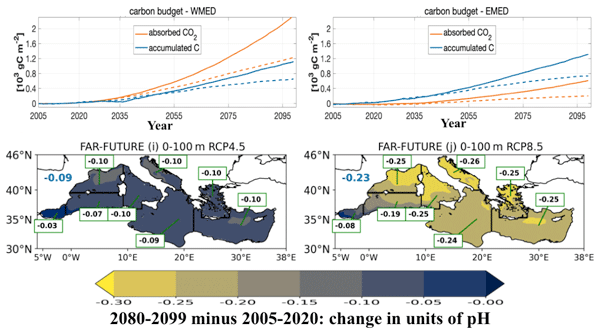
Future projections under the RCP8.5 and RCP4.5 emission scenarios of the Mediterranean Sea biogeochemistry at the end of the 21st century show different levels of decline in nutrients, oxygen and biomasses and an acidification of the water column. The signal intensity is stronger under RCP8.5 and in the eastern Mediterranean. Under RCP4.5, after the second half of the 21st century, biogeochemical variables show a recovery of the values observed at the beginning of the investigated period.
Giorgio Micaletto, Ivano Barletta, Silvia Mocavero, Ivan Federico, Italo Epicoco, Giorgia Verri, Giovanni Coppini, Pasquale Schiano, Giovanni Aloisio, and Nadia Pinardi
Geosci. Model Dev., 15, 6025–6046, https://doi.org/10.5194/gmd-15-6025-2022, https://doi.org/10.5194/gmd-15-6025-2022, 2022
Short summary
Short summary
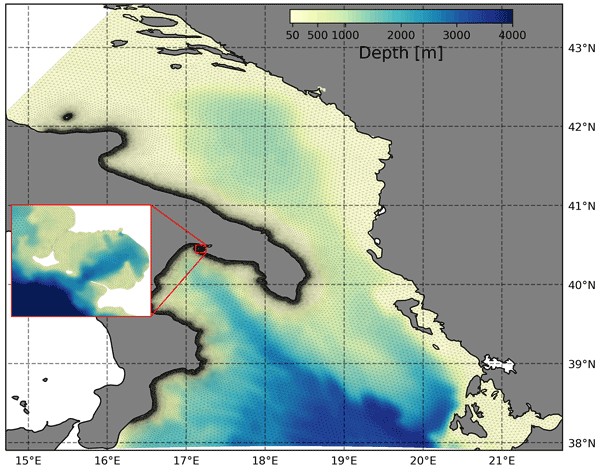
The full exploitation of supercomputing architectures requires a deep revision of the current climate models. This paper presents the parallelization of the three-dimensional hydrodynamic model SHYFEM (System of HydrodYnamic Finite Element Modules). Optimized numerical libraries were used to partition the model domain and solve the sparse linear system of equations in parallel. The performance assessment demonstrates a good level of scalability with a realistic configuration used as a benchmark.
Enrico Scoccimarro, Daniele Peano, Silvio Gualdi, Alessio Bellucci, Tomas Lovato, Pier Giuseppe Fogli, and Antonio Navarra
Geosci. Model Dev., 15, 1841–1854, https://doi.org/10.5194/gmd-15-1841-2022, https://doi.org/10.5194/gmd-15-1841-2022, 2022
Short summary
Short summary
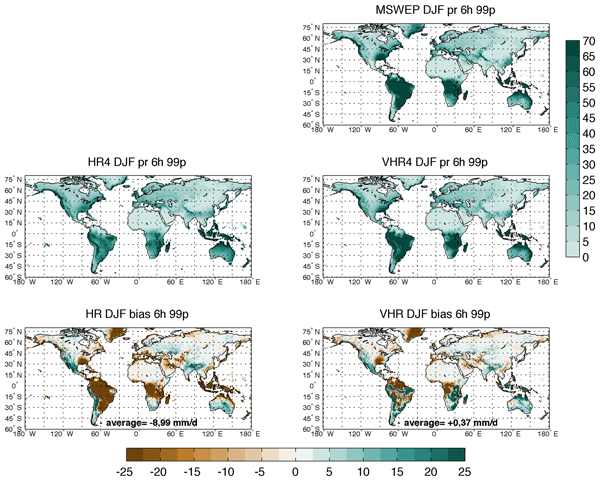
This study evaluated the ability of the CMCC-CM2 climate model participating to the last CMIP6 effort, in representing extreme events of precipitation and temperature at the daily and 6-hourly frequencies. The 1/4° resolution version of the atmospheric model provides better results than the version at 1° resolution for temperature extremes, at both time frequencies. For precipitation extremes, especially at the daily time frequency, the higher resolution does not improve model results.
Cited articles
Alessandri, J.: Testcase ShyBFM v1.0 (1.0.0), Zenodo [data set], https://doi.org/10.5281/zenodo.21453931, 2026.
Alessandri, J., Pinardi, N., Federico, I., and Valentini, A.: Storm Surge Ensemble Prediction System for Lagoons and Transitional Environments, Weather Forecast., 38, 1791–1806, https://doi.org/10.1175/WAF-D-23-0040.1, 2023.
Alessandri, J., Bonino, G., Lovato, T., Butenschön, M., Mentaschi, L., Verri, G., Federico, I., and Pinardi, N.: ShyBFM v1.0 (1.0.0), Zenodo [code], https://doi.org/10.5281/zenodo.21359516, 2026.
Álvarez, E., Cossarini, G., Teruzzi, A., Bruggeman, J., Bolding, K., Ciavatta, S., Vellucci, V., D'Ortenzio, F., Antoine, D., and Lazzari, P.: Chromophoric dissolved organic matter dynamics revealed through the optimization of an optical–biogeochemical model in the northwestern Mediterranean Sea, Biogeosciences, 20, 4591–4624, https://doi.org/10.5194/bg-20-4591-2023, 2023.
Ambrose, R. B., Wool, T. A., and Martin, J. L.: The water quality analysis simulation program, WASP5: Model documentation, Environmental Research Laboratory, Athens, Georgia, https://www.researchgate.net/publication/26991027_Water_Quality_Analysis_Simulation_Program_WASP (last access: 12 October 2025), 1993.
Aragão, L., Mentaschi, L., Pinardi, N., Verri, G., Senatore, A., and Di Sabatino, S.: The freshwater discharge into the Adriatic Sea revisited, Front. Clim., 6, 1368456, https://doi.org/10.3389/fclim.2024.1368456, 2024.
Aumont, O., Ethé, C., Tagliabue, A., Bopp, L., and Gehlen, M.: PISCES-v2: an ocean biogeochemical model for carbon and ecosystem studies, Geosci. Model Dev., 8, 2465–2513, https://doi.org/10.5194/gmd-8-2465-2015, 2015.
Bauer, J. E., Cai, W.-J., Raymond, P. A., Bianchi, T. S., Hopkinson, C. S., and Regnier, P. A. G.: The changing carbon cycle of the coastal ocean, Nature, 504, 61–70, https://doi.org/10.1038/nature12857, 2013.
Bellafiore, D. and Umgiesser, G.: Hydrodynamic coastal processes in the North Adriatic investigated with a 3D finite element model, Ocean Dynam., 60, 255–273, https://doi.org/10.1007/s10236-009-0254-x, 2010.
Bignami, F., Sciarra, R., Carniel, S., and Santoleri, R.: Variability of Adriatic Sea coastal turbid waters from SeaWiFS imagery, J. Geophys. Res.-Oceans, 112, 2006JC003518, https://doi.org/10.1029/2006JC003518, 2007.
Bissett, W. P., De Bra, S., and Dye, D.: Ecological Simulation (EcoSim) 2.0 Technical Description, Florida Environmental Research Institute, Tampa, https://feri.s3.amazonaws.com/pubs_ppts/FERI_2004_0002_U_D.pdf (last access: 12 October 2025), 2004.
Bonamano, S., Federico, I., Causio, S., Piermattei, V., Piazzolla, D., Scanu, S., Madonia, A., Madonia, N., De Cillis, G., Jansen, E., Fersini, G., Coppini, G., and Marcelli, M.: River–coastal–ocean continuum modeling along the Lazio coast (Tyrrhenian Sea, Italy): Assessment of near river dynamics in the Tiber delta, Estuar. Coast. Shelf S., 297, 108618, https://doi.org/10.1016/j.ecss.2024.108618, 2024.
Buchanan, P. J., Reddy, P. J., Matear, R. J., Chamberlain, M. A., Rohr, T., Squire, D., and Shadwick, E. H.: Optimization of the World Ocean Model of Biogeochemistry and Trophic dynamics (WOMBAT) using surrogate machine learning methods, Biogeosciences, 22, 5349–5385, https://doi.org/10.5194/bg-22-5349-2025, 2025.
Buga, L., Sarbu, G., Eilola, K., Wesslander, K., Fryberg, L., Magnus, W., Gatti, J., Leroy, D., Iona, S., Tsompanou, M., Karagevrekis, P., Koefoed Rømer, J., Larsen, Østrem, A. k., Lipizer, M., and Giorgetti, A.: EMODnet Chemistry Regional climatologies produced with Data-Interpolating Variational Analysis (DIVA). Release 2018, https://doi.org/10.6092/A8CFB472-10DB-4225-9737-5A60DA9AF523, 2019.
Burchard, H., Bolding, K., and Villarreal, M. R.: GOTM – a general ocean turbulence model. Theory, applications and test cases, Tech. Rep. EUR 18745 EN, European Commission, https://getm.eu/files/GETM/doc/GOTM1999.pdf (last access: 14 November 2025), 1999.
Butenschön, M., Zavatarelli, M., and Vichi, M.: Sensitivity of a marine coupled physical biogeochemical model to time resolution, integration scheme and time splitting method, Ocean Model., 52–53, 36–53, https://doi.org/10.1016/j.ocemod.2012.04.008, 2012.
Butenschön, M., Clark, J., Aldridge, J. N., Allen, J. I., Artioli, Y., Blackford, J., Bruggeman, J., Cazenave, P., Ciavatta, S., Kay, S., Lessin, G., van Leeuwen, S., van der Molen, J., de Mora, L., Polimene, L., Sailley, S., Stephens, N., and Torres, R.: ERSEM 15.06: a generic model for marine biogeochemistry and the ecosystem dynamics of the lower trophic levels, Geosci. Model Dev., 9, 1293–1339, https://doi.org/10.5194/gmd-9-1293-2016, 2016.
Campanelli, A., Pascucci, S., Betti, M., Grilli, F., Marini, M., Pignatti, S., and Guicciardi, S.: An Empirical Ocean Colour Algorithm for Estimating the Contribution of Coloured Dissolved Organic Matter in North-Central Western Adriatic Sea, Remote Sens.-Basel, 9, 180, https://doi.org/10.3390/rs9020180, 2017.
Campin, J.-M., Adcroft, A., Hill, C., and Marshall, J.: Conservation of properties in a free-surface model, Ocean Model., 6, 221–244, https://doi.org/10.1016/S1463-5003(03)00009-X, 2004.
Chai, F., Dugdale, R. C., Peng, T.-H., Wilkerson, F. P., and Barber, R. T.: One-dimensional ecosystem model of the equatorial Pacific upwelling system. Part I: model development and silicon and nitrogen cycle, Deep-Sea Res. Pt. II, 49, 2713–2745, https://doi.org/10.1016/S0967-0645(02)00055-3, 2002.
Chen, C., Liu, H., and Beardsley, R. C.: An Unstructured Grid, Finite-Volume, Three-Dimensional, Primitive Equations Ocean Model: Application to Coastal Ocean and Estuaries, J. Atmos. Ocean. Tech., 20, 159–186, https://doi.org/10.1175/1520-0426(2003)020<0159:AUGFVT>2.0.CO;2, 2003.
Cravo, A., Jacob, J., Rosa, A., and Correia, C.: Integrating physical and biogeochemical processes and oceanic exchanges at a coastal lagoon in Southern West Europe, Estuar. Coast. Shelf S., 310, 108987, https://doi.org/10.1016/j.ecss.2024.108987, 2024.
Cucco, A., Sinerchia, M., Lefrançois, C., Magni, P., Ghezzo, M., Umgiesser, G., Perilli, A., and Domenici, P.: A metabolic scope based model of fish response to environmental changes, Ecol. Model., 237–238, 132–141, https://doi.org/10.1016/j.ecolmodel.2012.04.019, 2012.
Degobbis, D. and Gilmartin, M.: Nitrogen, phosphorus, and biogenic silicon budgets for the northern Adriatic Sea, Oceanol. Acta, 13, 31–45, 1990.
Degobbis, D., Precali, R., Ivancic, I., Smodlaka, N., Fuks, D., and Kveder, S.: Long-term changes in the northern Adriatic ecosystem related to anthropogenic eutrophication, Int. J. Environ. Pollut., 13, 495, https://doi.org/10.1504/IJEP.2000.002332, 2000.
Denamiel, C., Pranić, P., Ivanković, D., Tojčić, I., and Vilibić, I.: Performance of the Adriatic Sea and Coast (AdriSC) climate component – a COAWST V3.3-based coupled atmosphere–ocean modelling suite: atmospheric dataset, Geosci. Model Dev., 14, 3995–4017, https://doi.org/10.5194/gmd-14-3995-2021, 2021.
Diaz, R. J. and Rosenberg, R.: Marine benthic hypoxia: a review of its ecological effects and the behavioural responses of benthic macrofauna, in: Oceanography and marine biology: an annual review, vol. 33, UCL Press, London, 245–303, ISBN 1857283635, 1995.
Diaz, R. J. and Rosenberg, R.: Spreading Dead Zones and Consequences for Marine Ecosystems, Science, 321, 926–929, https://doi.org/10.1126/science.1156401, 2008.
Egbert, G. D. and Erofeeva, S. Y.: Efficient Inverse Modeling of Barotropic Ocean Tides, J. Atmos. Ocean. Tech., 19, 183–204, https://doi.org/10.1175/1520-0426(2002)019<0183:EIMOBO>2.0.CO;2, 2002.
Federico, I., Pinardi, N., Coppini, G., Oddo, P., Lecci, R., and Mossa, M.: Coastal ocean forecasting with an unstructured grid model in the southern Adriatic and northern Ionian seas, Nat. Hazards Earth Syst. Sci., 17, 45–59, https://doi.org/10.5194/nhess-17-45-2017, 2017.
Fennel, K., Wilkin, J., Levin, J., Moisan, J., O'Reilly, J., and Haidvogel, D.: Nitrogen cycling in the Middle Atlantic Bight: Results from a three-dimensional model and implications for the North Atlantic nitrogen budget, Global Biogeochem. Cy., 20, 2005GB002456, https://doi.org/10.1029/2005GB002456, 2006.
Fennel, K., Hetland, R., Feng, Y., and DiMarco, S.: A coupled physical-biological model of the Northern Gulf of Mexico shelf: model description, validation and analysis of phytoplankton variability, Biogeosciences, 8, 1881–1899, https://doi.org/10.5194/bg-8-1881-2011, 2011.
Ferrarin, C., Umgiesser, G., Bajo, M., Bellafiore, D., De Pascalis, F., Ghezzo, M., Mattassi, G., and Scroccaro, I.: Hydraulic zonation of the lagoons of Marano and Grado, Italy. A modelling approach, Estuar. Coast. Shelf S., 87, 561–572, https://doi.org/10.1016/j.ecss.2010.02.012, 2010.
Gattuso, J.-P., Frankignoulle, M., and Wollast, R.: Carbon and carbonate metabolism in coastal aquatic ecosystems, Annu. Rev. Ecol. Syst., 29, 405–434, https://doi.org/10.1146/annurev.ecolsys.29.1.405, 1998.
Ge, J., Torres, R., Chen, C., Liu, J., Xu, Y., Bellerby, R., Shen, F., Bruggeman, J., and Ding, P.: Influence of suspended sediment front on nutrients and phytoplankton dynamics off the Changjiang Estuary: A FVCOM-ERSEM coupled model experiment, J. Marine Syst., 204, 103292, https://doi.org/10.1016/j.jmarsys.2019.103292, 2020.
Geyer, W. R. and MacCready, P.: The Estuarine Circulation, Annu. Rev. Fluid Mech., 46, 175–197, https://doi.org/10.1146/annurev-fluid-010313-141302, 2014.
Giani, M., Djakovac, T., Degobbis, D., Cozzi, S., Solidoro, C., and Umani, S. F.: Recent changes in the marine ecosystems of the northern Adriatic Sea, Estuar. Coast. Shelf S., 115, 1–13, https://doi.org/10.1016/j.ecss.2012.08.023, 2012.
Glenn, S., Boicourt, W., Parker, B., and Dickey, T.: Operational Observation Networks for Ports, a Large Estuary and an Open Shelf, Oceanography, 13, 12–23, https://doi.org/10.5670/oceanog.2000.49, 2000.
Gochis, D., Dugger, A., Cabell, R., RafieeiNasab, A., Rasmussen, S., Eidhammer, T., Zhang, Y., Sampson, K., Read, L., Yates, D., McCreight, J., Barlage, M., Casali, M., Dunlap, R., Fanfarillo, A., Fersch, B., FitzGerald, K., Heldmyer, A., Johnson, D., Karsten, L., Lahmers, T., Mattern, D., McAllister, M., Rosen, D., and Valayamkunnath, P.: WRF-Hydro (v5.4.0), Zenodo [code], https://doi.org/10.5281/ZENODO.15040873, 2025.
Griffies, S. M., Pacanowski, R. C., Schmidt, M., and Balaji, V.: Tracer Conservation with an Explicit Free Surface Method for z-Coordinate Ocean Models, Mon. Weather Rev., 129, 1081–1098, https://doi.org/10.1175/1520-0493(2001)129<1081:TCWAEF>2.0.CO;2, 2001.
Hu, C., Chen, Z., Clayton, T. D., Swarzenski, P., Brock, J. C., and Muller–Karger, F. E.: Assessment of estuarine water-quality indicators using MODIS medium-resolution bands: Initial results from Tampa Bay, FL, Remote Sens. Environ., 93, 423–441, https://doi.org/10.1016/j.rse.2004.08.007, 2004.
Jeffries, M. A. and Lee, C. M.: A climatology of the northern Adriatic Sea's response to bora and river forcing, J. Geophys. Res.-Oceans, 112, 2006JC003664, https://doi.org/10.1029/2006JC003664, 2007.
Ji, R., Davis, C., Chen, C., and Beardsley, R.: Influence of local and external processes on the annual nitrogen cycle and primary productivity on Georges Bank: A 3-D biological–physical modeling study, J. Marine Syst., 73, 31–47, https://doi.org/10.1016/j.jmarsys.2007.08.002, 2008.
Justić, D., Legović, T., and Rottini-Sandrini, L.: Trends in oxygen content 1911–1984 and occurrence of benthic mortality in the northern Adriatic Sea, Estuar. Coast. Shelf S., 25, 435–445, https://doi.org/10.1016/0272-7714(87)90035-7, 1987.
Knjaz, M., Baricevic, A., Tankovic, M. S., Kuzat, N., Vlasicek, I., Grizancic, L., Podolsak, I., Pfannkuchen, M., Kogovsek, T., and Pfannkuchen, D. M.: First regional reference database of northern Adriatic diatom transcriptomes, Sci. Rep.-UK, 14, 16209, https://doi.org/10.1038/s41598-024-67043-4, 2024.
Krause, J. W., Schulz, I. K., Rowe, K. A., Dobbins, W., Winding, M. H. S., Sejr, M. K., Duarte, C. M., and Agustí, S.: Silicic acid limitation drives bloom termination and potential carbon sequestration in an Arctic bloom, Sci. Rep.-UK, 9, 8149, https://doi.org/10.1038/s41598-019-44587-4, 2019.
Levin, L. A., Boesch, D. F., Covich, A., Dahm, C., Erséus, C., Ewel, K. C., Kneib, R. T., Moldenke, A., Palmer, M. A., Snelgrove, P., Strayer, D., and Weslawski, J. M.: The Function of Marine Critical Transition Zones and the Importance of Sediment Biodiversity, Ecosystems, 4, 430–451, https://doi.org/10.1007/s10021-001-0021-4, 2001.
Libralato, S.: Numerical models for monitoring and forecasting ocean ecosystems: a short description of the present status, in: Ocean prediction: present status and state of the art (OPSR), edited by: Álvarez Fanjul, E., Ciliberti, S. A., Pearlman, J., Wilmer-Becker, K., and Behera, S., Copernicus Publications, State Planet, 5-opsr, 13, https://doi.org/10.5194/sp-5-opsr-13-2025, 2025.
Lindsay, K., Bonan, G. B., Doney, S. C., Hoffman, F. M., Lawrence, D. M., Long, M. C., Mahowald, N. M., Keith Moore, J., Randerson, J. T., and Thornton, P. E.: Preindustrial-Control and Twentieth-Century Carbon Cycle Experiments with the Earth System Model CESM1(BGC), J. Climate, 27, 8981–9005, https://doi.org/10.1175/JCLI-D-12-00565.1, 2014.
Liu, K.-K., Atkinson, L., Quiñones, R., and Talaue-McManus, L. (Eds.): Carbon and Nutrient Fluxes in Continental Margins, Global Change – The IGBP Series, Springer Berlin Heidelberg, Berlin, Heidelberg, https://doi.org/10.1007/978-3-540-92735-8, 2010.
Liu, Q., Chai, F., Dugdale, R., Chao, Y., Xue, H., Rao, S., Wilkerson, F., Farrara, J., Zhang, H., Wang, Z., and Zhang, Y.: San Francisco Bay nutrients and plankton dynamics as simulated by a coupled hydrodynamic-ecosystem model, Cont. Shelf Res., 161, 29–48, https://doi.org/10.1016/j.csr.2018.03.008, 2018.
Liu, X., Stock, C. A., Dunne, J. P., Lee, M., Shevliakova, E., Malyshev, S., and Milly, P. C. D.: Simulated Global Coastal Ecosystem Responses to a Half-Century Increase in River Nitrogen Loads, Geophys. Res. Lett., 48, e2021GL094367, https://doi.org/10.1029/2021GL094367, 2021.
Lovato, T., Peano, D., Butenschön, M., Materia, S., Iovino, D., Scoccimarro, E., Fogli, P. G., Cherchi, A., Bellucci, A., Gualdi, S., Masina, S., and Navarra, A.: CMIP6 Simulations With the CMCC Earth System Model (CMCC-ESM2), J. Adv. Model. Earth Sy., 14, e2021MS002814, https://doi.org/10.1029/2021MS002814, 2022.
Ludwig, W., Dumont, E., Meybeck, M., and Heussner, S.: River discharges of water and nutrients to the Mediterranean and Black Sea: Major drivers for ecosystem changes during past and future decades?, Prog. Oceanogr., 80, 199–217, https://doi.org/10.1016/j.pocean.2009.02.001, 2009.
Mackenzie, F. T., De Carlo, E. H., and Lerman, A.: Coupled C, N, P, and O Biogeochemical Cycling at the Land–Ocean Interface, in: Treatise on Estuarine and Coastal Science, Elsevier, 317–342, https://doi.org/10.1016/B978-0-12-374711-2.00512-X, 2011.
Madec, G., Bell, M., Benshila, R., Blaker, A., Bourdallé-Badie, R., Bricaud, C., Bruciaferri, D., Carneiro, D., Castrillo, M., Calvert, D., Chanut, J., Clementi, E., Coward, A., De Lavergne, C., Dobricic, S., Epicoco, I., Éthé, C., Fiedler, E., Ford, D., Furner, R., Ganderton, J., Graham, T., Harle, J., Hutchinson, K., Iovino, D., King, R., Lea, D., Levy, C., Lovato, T., Maisonnave, E., Mak, J., Sanchez, J. M. C., Martin, M., Martin, N., Martins, D., Masson, S., Mathiot, P., Mele, F., Mocavero, S., Moulin, A., Müller, S., Nurser, G., Oddo, P., Paronuzzi, S., Paul, J., Peltier, M., Person, R., Rousset, C., Rynders, S., Samson, G., Schroeder, D., Storkey, D., Storto, A., Téchené, S., Vancoppenolle, M., and Wilson, C.: NEMO Ocean Engine Reference Manual, Zenodo, https://doi.org/10.5281/Zenodo.1464816, 2024.
Maicu, F., Alessandri, J., Pinardi, N., Verri, G., Umgiesser, G., Lovo, S., Turolla, S., Paccagnella, T., and Valentini, A.: Downscaling With an Unstructured Coastal-Ocean Model to the Goro Lagoon and the Po River Delta Branches, Front. Mar. Sci., 8, 647781, https://doi.org/10.3389/fmars.2021.647781, 2021a.
Maicu, F., Abdellaoui, B., Bajo, M., Chair, A., Hilmi, K., and Umgiesser, G.: Modelling the water dynamics of a tidal lagoon: The impact of human intervention in the Nador Lagoon (Morocco), Cont. Shelf Res., 228, 104535, https://doi.org/10.1016/j.csr.2021.104535, 2021b.
Marchetti, R. and Verna, N.: Quantification of the phosphorus and nitrogen loads in the minor rivers of the Emilia-Romagna coast (Italy). A methodological study on the use of theoretical coefficients in calculating the loads, in: Marine Coastal Eutrophication, Elsevier, 315–336, https://doi.org/10.1016/B978-0-444-89990-3.50028-6, 1992.
Marini, M. and Grilli, F.: The Role of Nitrogen and Phosphorus in Eutrophication of the Northern Adriatic Sea: History and Future Scenarios, Appl. Sci.-Basel, 13, 9267, https://doi.org/10.3390/app13169267, 2023.
McKiver, W. J., Sannino, G., Braga, F., and Bellafiore, D.: Investigation of model capability in capturing vertical hydrodynamic coastal processes: a case study in the north Adriatic Sea, Ocean Sci., 12, 51–69, https://doi.org/10.5194/os-12-51-2016, 2016.
Mentaschi, L., Lovato, T., Butenschön, M., Alessandri, J., Aragão, L., Verri, G., Guerra, R., Coppini, G., and Pinardi, N.: Projected climate oligotrophication of the Adriatic marine ecosystems, Front. Clim., 6, 1338374, https://doi.org/10.3389/fclim.2024.1338374, 2024.
Micaletto, G., Barletta, I., Mocavero, S., Federico, I., Epicoco, I., Verri, G., Coppini, G., Schiano, P., Aloisio, G., and Pinardi, N.: Parallel implementation of the SHYFEM (System of HydrodYnamic Finite Element Modules) model, Geosci. Model Dev., 15, 6025–6046, https://doi.org/10.5194/gmd-15-6025-2022, 2022.
NEMO TOP WG: TOP – Tracers in Ocean Paradigm – The NEMO Tracers engine, In Notes du Pôle de modélisation de l'Institut Pierre-Simon Laplace (IPSL) (v4.2.0, Number 28), Zenodo, https://doi.org/10.5281/ZENODO.1471700, 2018.
Newton, A., Icely, J., Cristina, S., Brito, A., Cardoso, A. C., Colijn, F., Riva, S. D., Gertz, F., Hansen, J. W., Holmer, M., Ivanova, K., Leppäkoski, E., Canu, D. M., Mocenni, C., Mudge, S., Murray, N., Pejrup, M., Razinkovas, A., Reizopoulou, S., Pérez-Ruzafa, A., Schernewski, G., Schubert, H., Carr, L., Solidoro, C., Viaroli, P., and Zaldívar, J.-M.: An overview of ecological status, vulnerability and future perspectives of European large shallow, semi-enclosed coastal systems, lagoons and transitional waters, Estuar. Coast. Shelf S., 140, 95–122, https://doi.org/10.1016/j.ecss.2013.05.023, 2014.
Nixon, S. W.: Remineralization and Nutrient Cycling in Coastal Marine Ecosystems, in: Estuaries and Nutrients, edited by: Neilson, B. J. and Cronin, L. E., Humana Press, Totowa, NJ, 111–138, https://doi.org/10.1007/978-1-4612-5826-1_6, 1981.
Oddo, P. and Pinardi, N.: Lateral open boundary conditions for nested limited area models: A scale selective approach, Ocean Model., 20, 134–156, https://doi.org/10.1016/j.ocemod.2007.08.001, 2008.
Paraska, D. W., Hipsey, M. R., and Salmon, S. U.: Sediment diagenesis models: Review of approaches, challenges and opportunities, Environ. Modell. Softw., 61, 297–325, https://doi.org/10.1016/j.envsoft.2014.05.011, 2014.
Park, K., Federico, I., Di Lorenzo, E., Ezer, T., Cobb, K. M., Pinardi, N., and Coppini, G.: The contribution of hurricane remote ocean forcing to storm surge along the Southeastern U. S. coast, Coast. Eng., 173, 104098, https://doi.org/10.1016/j.coastaleng.2022.104098, 2022.
Peña, M. A., Katsev, S., Oguz, T., and Gilbert, D.: Modeling dissolved oxygen dynamics and hypoxia, Biogeosciences, 7, 933–957, https://doi.org/10.5194/bg-7-933-2010, 2010.
Penna, N., Capellacci, S., and Ricci, F.: The influence of the Po River discharge on phytoplankton bloom dynamics along the coastline of Pesaro (Italy) in the Adriatic Sea, Mar. Pollut. Bull., 48, 321–326, https://doi.org/10.1016/j.marpolbul.2003.08.007, 2004.
Pettenuzzo, D., Large, W. G., and Pinardi, N.: On the corrections of ERA-40 surface flux products consistent with the Mediterranean heat and water budgets and the connection between basin surface total heat flux and NAO, J. Geophys. Res.-Oceans, 115, 2009JC005631, https://doi.org/10.1029/2009JC005631, 2010.
Polimene, L., Pinardi, N., Zavatarelli, M., and Colella, S.: The Adriatic Sea ecosystem seasonal cycle: Validation of a three-dimensional numerical model, J. Geophys. Res.-Oceans, 111, 2005JC003260, https://doi.org/10.1029/2005JC003260, 2006.
Polimene, L., Pinardi, N., Zavatarelli, M., Allen, J. I., Giani, M., and Vichi, M.: A numerical simulation study of dissolved organic carbon accumulation in the northern Adriatic Sea, J. Geophys. Res.-Oceans, 112, 2006JC003529, https://doi.org/10.1029/2006JC003529, 2007.
Precali, R., Giani, M., Marini, M., Grilli, F., Ferrari, C. R., Pečar, O., and Paschini, E.: Mucilaginous aggregates in the northern Adriatic in the period 1999–2002: Typology and distribution, Sci. Total Environ., 353, 10–23, https://doi.org/10.1016/j.scitotenv.2005.09.066, 2005.
Rabalais, N. N., Díaz, R. J., Levin, L. A., Turner, R. E., Gilbert, D., and Zhang, J.: Dynamics and distribution of natural and human-caused hypoxia, Biogeosciences, 7, 585–619, https://doi.org/10.5194/bg-7-585-2010, 2010.
Ramirez-Romero, E., Jordà, G., Amores, A., Kay, S., Segura-Noguera, M., Macias, D. M., Maynou, F., Sabatés, A., and Catalán, I. A.: Assessment of the Skill of Coupled Physical–Biogeochemical Models in the NW Mediterranean, Front. Mar. Sci., 7, 497, https://doi.org/10.3389/fmars.2020.00497, 2020.
Ricci, F., Capellacci, S., Campanelli, A., Grilli, F., Marini, M., and Penna, A.: Long-term dynamics of annual and seasonal physical and biogeochemical properties: Role of minor river discharges in the North-western Adriatic coast, Estuar. Coast. Shelf S., 272, 107902, https://doi.org/10.1016/j.ecss.2022.107902, 2022.
Rodrigues, M., Oliveira, A., Queiroga, H., Fortunato, A. B., and Zhang, Y. J.: Three-dimensional modeling of the lower trophic levels in the Ria de Aveiro (Portugal), Ecol. Model., 220, 1274–1290, https://doi.org/10.1016/j.ecolmodel.2009.02.002, 2009.
Russo, A., Maccaferri, S., Djakovac, T., Precali, R., Degobbis, D., Deserti, M., Paschini, E., and Lyons, D. M.: Meteorological and oceanographic conditions in the northern Adriatic Sea during the period June 1999–July 2002: Influence on the mucilage phenomenon, Sci. Total Environ., 353, 24–38, https://doi.org/10.1016/j.scitotenv.2005.09.058, 2005.
Salon, S., Cossarini, G., Bolzon, G., Feudale, L., Lazzari, P., Teruzzi, A., Solidoro, C., and Crise, A.: Novel metrics based on Biogeochemical Argo data to improve the model uncertainty evaluation of the CMEMS Mediterranean marine ecosystem forecasts, Ocean Sci., 15, 997–1022, https://doi.org/10.5194/os-15-997-2019, 2019.
Scroccaro, I., Zavatarelli, M., Lovato, T., Lanucara, P., and Valentini, A.: The Northern Adriatic Forecasting System for Circulation and Biogeochemistry: Implementation and Preliminary Results, Water-Sui, 14, 2729, https://doi.org/10.3390/w14172729, 2022.
Seitaj, D., Sulu-Gambari, F., Burdorf, L. D. W., Romero-Ramirez, A., Maire, O., Malkin, S. Y., Slomp, C. P., and Meysman, F. J. R.: Sedimentary oxygen dynamics in a seasonally hypoxic basin, Limnol. Oceanogr., 62, 452–473, https://doi.org/10.1002/lno.10434, 2017.
Seitzinger, S. P., Mayorga, E., Bouwman, A. F., Kroeze, C., Beusen, A. H. W., Billen, G., Van Drecht, G., Dumont, E., Fekete, B. M., Garnier, J., and Harrison, J. A.: Global river nutrient export: A scenario analysis of past and future trends, Global Biogeochem. Cy., 24, 2009GB003587, https://doi.org/10.1029/2009GB003587, 2010.
Shchepetkin, A. F. and McWilliams, J. C.: The regional oceanic modeling system (ROMS): a split-explicit, free-surface, topography-following-coordinate oceanic model, Ocean Model., 9, 347–404, https://doi.org/10.1016/j.ocemod.2004.08.002, 2005.
Skamarock, W. C. and Klemp, J. B.: A time-split nonhydrostatic atmospheric model for weather research and forecasting applications, J. Comput. Phys., 227, 3465–3485, https://doi.org/10.1016/j.jcp.2007.01.037, 2008.
Thomas, L. H.: Elliptic problems in linear differential equations over a network, Watson Scientific Computing Laboratory Report, Columbia University, https://itts023d.itts.ttu.edu/ORDB/Data/142102/?db=4 (last access: 15 November 2025), 1949.
Toller, S., Riminucci, F., Böhm, E., Capotondi, L., Correggiari, A., Lapucci, C., Organelli, E., Ravaioli, M., Santoleri, R., Stanghellini, G., and Bergami, C.: Decadal analysis of chlorophyll fluorescence, algal blooms and driving factors from a fixed-point observing system in the Northern Adriatic Sea, Estuar. Coast. Shelf S., 323, 109423, https://doi.org/10.1016/j.ecss.2025.109423, 2025.
Tong, Y., Feng, L., Zhao, D., Xu, W., and Zheng, C.: Remote sensing of chlorophyll a concentrations in coastal oceans of the Greater Bay Area in China: Algorithm development and long-term changes, Int. J. Appl. Earth, 112, 102922, https://doi.org/10.1016/j.jag.2022.102922, 2022.
Totti, C., Romagnoli, T., Accoroni, S., Coluccelli, A., Pellegrini, M., Campanelli, A., Grilli, F., and Marini, M.: Phytoplankton communities in the northwestern Adriatic Sea: Interdecadal variability over a 30-years period (1988–2016) and relationships with meteoclimatic drivers, J. Marine Syst., 193, 137–153, https://doi.org/10.1016/j.jmarsys.2019.01.007, 2019.
Trégarot, E., D'Olivo, J. P., Botelho, A. Z., Cabrito, A., Cardoso, G. O., Casal, G., Cornet, C. C., Cragg, S. M., Degia, A. K., Fredriksen, S., Furlan, E., Heiss, G., Kersting, D. K., Maréchal, J.-P., Meesters, E., O'Leary, B. C., Pérez, G., Seijo-Núñez, C., Simide, R., Van Der Geest, M., and De Juan, S.: Effects of climate change on marine coastal ecosystems – A review to guide research and management, Biol. Conserv., 289, 110394, https://doi.org/10.1016/j.biocon.2023.110394, 2024.
Umgiesser, G., Melaku Canu, D., Solidoro, C., and Ambrose, R.: A finite element ecological model: a first application to the Venice Lagoon, Environ. Modell. Softw., 18, 131–145, https://doi.org/10.1016/S1364-8152(02)00056-7, 2003.
Umgiesser, G., Sclavo, M., Carniel, S., and Bergamasco, A.: Exploring the bottom stress variability in the Venice Lagoon, J. Marine Syst., 51, 161–178, https://doi.org/10.1016/j.jmarsys.2004.05.023, 2004.
Umgiesser, G., Zemlys, P., Erturk, A., Razinkova-Baziukas, A., Mėžinė, J., and Ferrarin, C.: Seasonal renewal time variability in the Curonian Lagoon caused by atmospheric and hydrographical forcing, Ocean Sci., 12, 391–402, https://doi.org/10.5194/os-12-391-2016, 2016.
Verri, G., Pinardi, N., Oddo, P., Ciliberti, S. A., and Coppini, G.: River runoff influences on the Central Mediterranean overturning circulation, Clim. Dynam., 50, 1675–1703, https://doi.org/10.1007/s00382-017-3715-9, 2018.
Verri, G., Pinardi, N., Bryan, F., Tseng, Y., Coppini, G., and Clementi, E.: A box model to represent estuarine dynamics in mesoscale resolution ocean models, Ocean Model., 148, 101587, https://doi.org/10.1016/j.ocemod.2020.101587, 2020.
Verri, G., Barletta, I., Pinardi, N., Federico, I., Alessandri, J., and Coppini, G.: Shelf slope, estuarine dynamics and river plumes in a z* vertical coordinate, unstructured grid model, Ocean Model., 184, 102235, https://doi.org/10.1016/j.ocemod.2023.102235, 2023.
Verri, G., Furnari, L., Gunduz, M., Senatore, A., Santos Da Costa, V., De Lorenzis, A., Fedele, G., Manco, I., Mentaschi, L., Clementi, E., Coppini, G., Mercogliano, P., Mendicino, G., and Pinardi, N.: Climate projections of the Adriatic Sea: role of river release, Front. Clim., 6, 1368413, https://doi.org/10.3389/fclim.2024.1368413, 2024.
Vichi, M. and Masina, S.: Skill assessment of the PELAGOS global ocean biogeochemistry model over the period 1980–2000, Biogeosciences, 6, 2333–2353, https://doi.org/10.5194/bg-6-2333-2009, 2009.
Vichi, M., Oddo, P., Zavatarelli, M., Coluccelli, A., Coppini, G., Celio, M., Fonda Umani, S., and Pinardi, N.: Calibration and validation of a one-dimensional complex marine biogeochemical flux model in different areas of the northern Adriatic shelf, Ann. Geophys., 21, 413–436, https://doi.org/10.5194/angeo-21-413-2003, 2003.
Vichi, M., Lovato, T., Butenschön, M., Tedesco, L., Lazzari, P., Cossarini, G., Masina, S., Pinardi, N., Solidoro, C., and Zavatarelli, M.: The Biogeochemical Flux Model (BFM): Equation Description and User Manual. BFM version 5.3. Release 1.3, Bologna, Italy, http://bfm-community.eu (last access: 7 May 2025), 2023.
Ward, N. D., Megonigal, J. P., Bond-Lamberty, B., Bailey, V. L., Butman, D., Canuel, E. A., Diefenderfer, H., Ganju, N. K., Goñi, M. A., Graham, E. B., Hopkinson, C. S., Khangaonkar, T., Langley, J. A., McDowell, N. G., Myers-Pigg, A. N., Neumann, R. B., Osburn, C. L., Price, R. M., Rowland, J., Sengupta, A., Simard, M., Thornton, P. E., Tzortziou, M., Vargas, R., Weisenhorn, P. B., and Windham-Myers, L.: Representing the function and sensitivity of coastal interfaces in Earth system models, Nat. Commun., 11, 2458, https://doi.org/10.1038/s41467-020-16236-2, 2020.
Ward, N. D., Hinson, K. E., Pagès, R., Cross, J. N., Friedrichs, M. A. M., Hauri, C., MacCready, P., Subban, C. V., Xiong, J., St-Laurent, P., and Yang, Z.: Regional ocean biogeochemical modeling challenges for predicting the effectiveness of marine carbon dioxide removal, Front. Clim., 7, 1640617, https://doi.org/10.3389/fclim.2025.1640617, 2025.
Zang, Z., Xue, Z. G., Xu, K., Bentley, S. J., Chen, Q., D'Sa, E. J., Zhang, L., and Ou, Y.: The role of sediment-induced light attenuation on primary production during Hurricane Gustav (2008), Biogeosciences, 17, 5043–5055, https://doi.org/10.5194/bg-17-5043-2020, 2020.
Zavatarelli, M. and Pinardi, N.: The Adriatic Sea modelling system: a nested approach, Ann. Geophys., 21, 345–364, https://doi.org/10.5194/angeo-21-345-2003, 2003.
Zavatarelli, M., Raicich, F., Bregant, D., Russo, A., and Artegiani, A.: Climatological biogeochemical characteristics of the Adriatic Sea, J. Marine Syst., 18, 227–263, https://doi.org/10.1016/S0924-7963(98)00014-1, 1998.
Zavatarelli, M., Baretta, J. W., Baretta-Bekker, J. G., and Pinardi, N.: The dynamics of the Adriatic Sea ecosystem, Deep-Sea Res. Pt. I, 47, 937–970, https://doi.org/10.1016/S0967-0637(99)00086-2, 2000.
Zemlys, P., Ertürk, A., and Razinkovas, A.: 2D finite element ecological model for the Curonian lagoon, Hydrobiologia, 611, 167–179, https://doi.org/10.1007/s10750-008-9452-7, 2008.
Zennaro, F., Furlan, E., Canu, D., Aveytua Alcazar, L., Rosati, G., Solidoro, C., Aslan, S., and Critto, A.: Venice lagoon chlorophyll a evaluation under climate change conditions: A hybrid water quality machine learning and biogeochemical-based framework, Ecol. Indic., 157, 111245, https://doi.org/10.1016/j.ecolind.2023.111245, 2023.
Zennaro, F., Furlan, E., Canu, D., Alcazar, L. A., Rosati, G., Solidoro, C., and Critto, A.: Hypoxia extreme events in a changing climate: Machine learning methods and deterministic simulations for future scenarios development in the Venice Lagoon, Mar. Pollut. Bull., 208, 117028, https://doi.org/10.1016/j.marpolbul.2024.117028, 2024.
Zhang, Y. J., Ye, F., Stanev, E. V., and Grashorn, S.: Seamless cross-scale modeling with SCHISM, Ocean Model., 102, 64–81, https://doi.org/10.1016/j.ocemod.2016.05.002, 2016.
Short summary
Coastal seas are strongly shaped by complex coastlines, shallow depths, and inputs from rivers, which influence marine life and water quality. This study introduces a new high-resolution modelling system that combines ocean circulation and marine ecosystem processes on unstructured grids. Applied to the northern Adriatic Sea, the model realistically captures seasonal changes in key biogeochemical variables, offering improved tools to support coastal environmental management.
Coastal seas are strongly shaped by complex coastlines, shallow depths, and inputs from rivers,...


