Articles | Volume 19, issue 18
https://doi.org/10.5194/gmd-19-9235-2026
© Author(s) 2026. This work is distributed under
the Creative Commons Attribution 4.0 License.
https://doi.org/10.5194/gmd-19-9235-2026
© Author(s) 2026. This work is distributed under
the Creative Commons Attribution 4.0 License.
China regional 3 km downscaling based on residual Corrective Diffusion model

Honglu Sun
State Key Laboratory of Severe Weather Meteorological Science and Technology (LaSW), CMA Earth System Modeling and Prediction Centre (CEMC), Beijing, China
CMA Earth System Modeling and Prediction Centre (CEMC), Beijing, China
Key Laboratory of Earth System Modeling and Prediction, China Meteorological Administration, Beijing, China
Hao Jing
CORRESPONDING AUTHOR
State Key Laboratory of Severe Weather Meteorological Science and Technology (LaSW), CMA Earth System Modeling and Prediction Centre (CEMC), Beijing, China
CMA Earth System Modeling and Prediction Centre (CEMC), Beijing, China
Key Laboratory of Earth System Modeling and Prediction, China Meteorological Administration, Beijing, China
Zhixiang Dai
NVIDIA, Shanghai, China
Sa Xiao
State Key Laboratory of Severe Weather Meteorological Science and Technology (LaSW), CMA Earth System Modeling and Prediction Centre (CEMC), Beijing, China
CMA Earth System Modeling and Prediction Centre (CEMC), Beijing, China
Key Laboratory of Earth System Modeling and Prediction, China Meteorological Administration, Beijing, China
Wei Xue
Department of Computer Science and Technology, Tsinghua University, Beijing, China
Jian Sun
State Key Laboratory of Severe Weather Meteorological Science and Technology (LaSW), CMA Earth System Modeling and Prediction Centre (CEMC), Beijing, China
CMA Earth System Modeling and Prediction Centre (CEMC), Beijing, China
Key Laboratory of Earth System Modeling and Prediction, China Meteorological Administration, Beijing, China
Qifeng Lu
State Key Laboratory of Severe Weather Meteorological Science and Technology (LaSW), CMA Earth System Modeling and Prediction Centre (CEMC), Beijing, China
CMA Earth System Modeling and Prediction Centre (CEMC), Beijing, China
Key Laboratory of Earth System Modeling and Prediction, China Meteorological Administration, Beijing, China
Related authors
No articles found.
Yong Su, Jincheng Wang, Xueshun Shen, Couhua Liu, Xingliang Li, Jin Zhang, Hao Jing, and Yingying Hu
Geosci. Model Dev., 19, 8673–8691, https://doi.org/10.5194/gmd-19-8673-2026, https://doi.org/10.5194/gmd-19-8673-2026, 2026
Short summary
Short summary
The traditional weather prediction models improve slowly, while machine learning models struggle with extreme weather and fine details. To address these gaps, we developed an online Spectral Nudging-based correction system that leverages a machine learning model's skillful large-scale circulation to guide a physical model. This hybrid model enhances large-scale skill while preserving small-scale features, providing a viable pathway for improving operational weather forecasting.
Hao Jing, Sa Xiao, Haoyu Li, Huadong Xiao, and Wei Xue
EGUsphere, https://doi.org/10.5194/egusphere-2026-1735, https://doi.org/10.5194/egusphere-2026-1735, 2026
This preprint is open for discussion and under review for Geoscientific Model Development (GMD).
Short summary
Short summary
A machine learning-based parameterization scheme for radiation is proposed for the operational Global Forecasting System of the China Meteorological Administration. We analyze and address the numerical instability issues inherent in hybrid physical–machine learning models, and propose robust coupling strategies compatible with real-time execution. A systematic performance evaluation of the hybrid model is also presented.
Yiming Wang, Yi Zhang, Yilun Han, Wei Xue, Tianru Chen, Yihui Zhou, Xiaohan Li, and Haishan Chen
Geosci. Model Dev., 19, 5553–5570, https://doi.org/10.5194/gmd-19-5553-2026, https://doi.org/10.5194/gmd-19-5553-2026, 2026
Short summary
Short summary
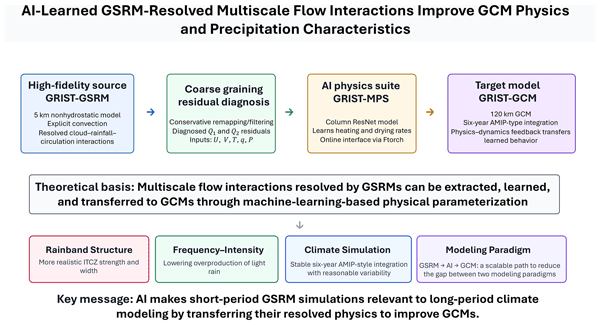
This study demonstrates that short-period Global Storm Resolving Model (GSRM) simulations can inform long-term Global Climate Model (GCM) integrations through a machine-learning-based physics suite. With 80 d of GSRM-derived training data, the hybrid model achieves stable multiyear climate simulations and improved precipitation climatic characteristics.
Lilong Zhou, Wei Xue, and Xueshun Shen
Geosci. Model Dev., 18, 8175–8201, https://doi.org/10.5194/gmd-18-8175-2025, https://doi.org/10.5194/gmd-18-8175-2025, 2025
Short summary
Short summary
This study develops a novel physics-based weather prediction model using artificial intelligence development platform, achieving high accuracy while maintaining strict physical conservation laws. Our algorithms are optimized for modern super computers, enabling efficient large-scale weather simulations. A key innovation is the model's inherent differentiable nature, allowing seamless integration with AI systems to enhance predictive capabilities through machine learning techniques.
Siyuan Chen, Yi Zhang, Yiming Wang, Zhuang Liu, Xiaohan Li, and Wei Xue
Geosci. Model Dev., 17, 6301–6318, https://doi.org/10.5194/gmd-17-6301-2024, https://doi.org/10.5194/gmd-17-6301-2024, 2024
Short summary
Short summary
This study explores strategies and techniques for implementing mixed-precision code optimization within an atmosphere model dynamical core. The coded equation terms in the governing equations that are sensitive (or insensitive) to the precision level have been identified. The performance of mixed-precision computing in weather and climate simulations was analyzed.
Hong Li, Yi Yang, Jian Sun, Yuan Jiang, Ruhui Gan, and Qian Xie
Geosci. Model Dev., 17, 5883–5896, https://doi.org/10.5194/gmd-17-5883-2024, https://doi.org/10.5194/gmd-17-5883-2024, 2024
Short summary
Short summary
Vertical atmospheric motions play a vital role in convective-scale precipitation forecasts by connecting atmospheric dynamics with cloud development. A three-dimensional variational vertical velocity assimilation scheme is developed within the high-resolution CMA-MESO model, utilizing the adiabatic Richardson equation as the observation operator. A 10 d continuous run and an individual case study demonstrate improved forecasts, confirming the scheme's effectiveness.
Jiaxu Guo, Juepeng Zheng, Yidan Xu, Haohuan Fu, Wei Xue, Lanning Wang, Lin Gan, Ping Gao, Wubing Wan, Xianwei Wu, Zhitao Zhang, Liang Hu, Gaochao Xu, and Xilong Che
Geosci. Model Dev., 17, 3975–3992, https://doi.org/10.5194/gmd-17-3975-2024, https://doi.org/10.5194/gmd-17-3975-2024, 2024
Short summary
Short summary
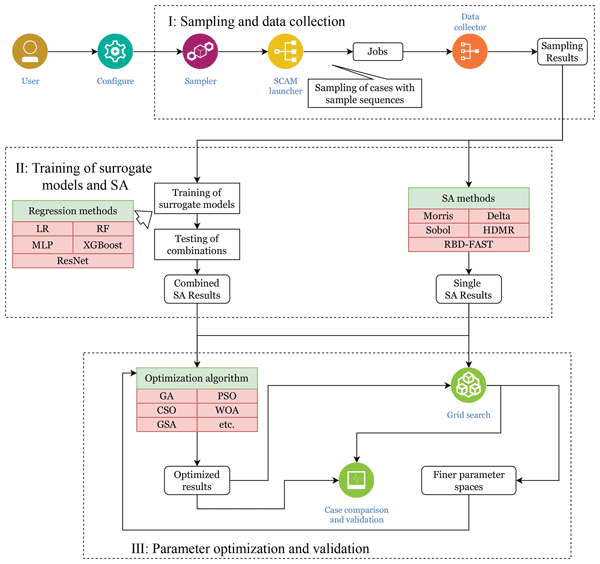
To enhance the efficiency of experiments using SCAM, we train a learning-based surrogate model to facilitate large-scale sensitivity analysis and tuning of combinations of multiple parameters. Employing a hybrid method, we investigate the joint sensitivity of multi-parameter combinations across typical cases, identifying the most sensitive three-parameter combination out of 11. Subsequently, we conduct a tuning process aimed at reducing output errors in these cases.
Xin Wang, Yilun Han, Wei Xue, Guangwen Yang, and Guang J. Zhang
Geosci. Model Dev., 15, 3923–3940, https://doi.org/10.5194/gmd-15-3923-2022, https://doi.org/10.5194/gmd-15-3923-2022, 2022
Short summary
Short summary
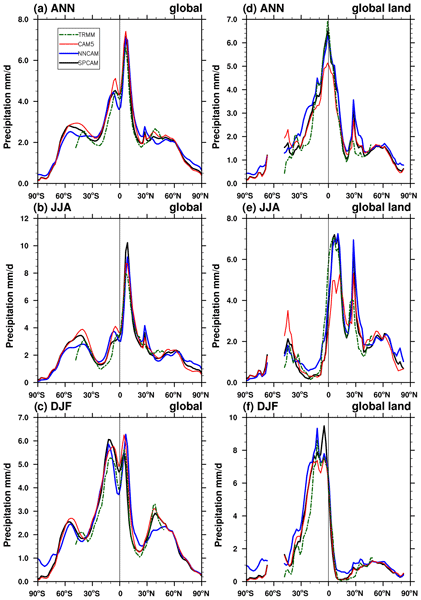
This study uses a set of deep neural networks to learn a parameterization scheme from a superparameterized general circulation model (GCM). After being embedded in a realistically configurated GCM, the parameterization scheme performs stably in long-term climate simulations and reproduces reasonable climatology and climate variability. This success is the first for long-term stable climate simulations using machine learning parameterization under real geographical boundary conditions.
Cited articles
Addison, H., Kendon, E., Ravuri, S., Aitchison, L., and Watson, P. A.: Machine learning emulation of a local-scale UK climate model, arXiv [preprint], https://doi.org/10.48550/arXiv.2211.16116, 2022. a
Bi, K., Xie, L., Zhang, H., Chen, X., Gu, X., and Tian, Q.: Pangu-weather: A 3d high-resolution model for fast and accurate global weather forecast, arXiv [preprint], https://doi.org/10.48550/arXiv.2211.02556, 2022. a
Bonev, B., Kurth, T., Hundt, C., Pathak, J., Baust, M., Kashinath, K., and Anandkumar, A.: Spherical fourier neural operators: Learning stable dynamics on the sphere, in: International conference on machine learning, PMLR, 2806–2823, https://proceedings.mlr.press/v202/bonev23a.html (last access: 23 September 2026), 2023. a
Chen, D., Xue, J., Yang, X., Zhang, H., Shen, X., Hu, J., Wang, Y., Ji, L., and Chen, J.: New generation of multi-scale NWP system (GRAPES): General scientific design, Chinese Sci. Bull., 53, 3433–3445, https://doi.org/10.1007/s11434-008-0494-z, 2008. a
Chen, H., Guo, J., Xiong, W., Guo, S., and Xu, C.-Y.: Downscaling GCMs using the Smooth Support Vector Machine method to predict daily precipitation in the Hanjiang Basin, Adv. Atmos. Sci., 27, 274–284, https://doi.org/10.1007/s00376-009-8071-1, 2010. a
Chen, L., Zhong, X., Zhang, F., Cheng, Y., Xu, Y., Qi, Y., and Li, H.: FuXi: a cascade machine learning forecasting system for 15-day global weather forecast, npj Clim. Atmos. Sci., 6, 190, https://doi.org/10.1038/s41612-023-00512-1, 2023. a
Davy, R. J., Woods, M. J., Russell, C. J., and Coppin, P. A.: Statistical downscaling of wind variability from meteorological fields, Bound.-Lay. Meteorol., 135, 161–175, https://doi.org/10.1007/s10546-009-9462-7, 2010. a
Diez, E., Primo, C., Garcia-Moya, J., Gutiérrez, J., and Orfila, B.: Statistical and dynamical downscaling of precipitation over Spain from DEMETER seasonal forecasts, Tellus A, 57, 409–423, https://doi.org/10.1111/j.1600-0870.2005.00130.x, 2005. a
Hersbach, H.: Decomposition of the continuous ranked probability score for ensemble prediction systems, Weather Forecast., 15, 559–570, https://doi.org/10.1175/1520-0434(2000)015<0559:DOTCRP>2.0.CO;2, 2000. a
Hersbach, H., Bell, B., Berrisford, P., Hirahara, S., Horányi, A., Muñoz-Sabater, J., Nicolas, J., Peubey, C., Radu, R., Schepers, D., Simmons, A., Soci, C., Abdalla, S., Abellan, X., Balsamo, G., Bechtold, P., Biavati, G., Bidlot, J., Bonavita, M., De Chiara, G., Dahlgren, P., Dee, D., Diamantakis, M., Dragani, R., Flemming, J., Forbes, R., Fuentes, M., Geer, A., Haimberger, L., Healy, S., Hogan, R. J., Hólm, E., Janisková, M., Keeley, S., Laloyaux, P., Lopez, P., Lupu, C., Radnoti, G., de Rosnay, P., Rozum, I., Vamborg, F., Villaume, S., and Thépaut, J.-N.: The ERA5 global reanalysis, Q. J. Roy. Meteor. Soc., 146, 1999–2049, https://doi.org/10.1002/qj.3803, 2020. a
Hersbach, H., Bell, B., Berrisford, P., Biavati, G., Horányi, A., Muñoz Sabater, J., Nicolas, J., Peubey, C., Radu, R., Rozum, I., Schepers, D., Simmons, A., Soci, C., Dee, D., and Thépaut, J.-N.: ERA5 hourly data on single levels from 1940 to present, Copernicus Climate Change Service (C3S) Climate Data Store (CDS) [data set], https://doi.org/10.24381/cds.adbb2d47, 2023a. a
Hersbach, H., Bell, B., Berrisford, P., Biavati, G., Horányi, A., Muñoz Sabater, J., Nicolas, J., Peubey, C., Radu, R., Rozum, I., Schepers, D., Simmons, A., Soci, C., Dee, D., and Thépaut, J.-N.: ERA5 hourly data on pressure levels from 1940 to present, Copernicus Climate Change Service (C3S) Climate Data Store (CDS) [data set], https://doi.org/10.24381/cds.bd0915c6, 2023b. a
Ho, J., Jain, A., and Abbeel, P.: Denoising diffusion probabilistic models, Adv. Neur. In., 33, 6840–6851, 2020. a
Karras, T., Aittala, M., Aila, T., and Laine, S.: Elucidating the design space of diffusion-based generative models, Adv. Neur. In., 35, 26565–26577, https://doi.org/10.52202/068431-1926, 2022. a, b
Laddimath, R. S. and Patil, N. S.: Artificial neural network technique for statistical downscaling of global climate model, Mapan, 34, 121–127, https://doi.org/10.1007/s12647-018-00299-0, 2019. a
Lam, R., Sanchez-Gonzalez, A., Willson, M., Wirnsberger, P., Fortunato, M., Alet, F., Ravuri, S., Ewalds, T., Eaton-Rosen, Z., Hu, W., Merose, A., Hoyer, S., Holland, G., Vinyals, O., Stott, J., Pritzel, A., Mohamed, S., and Battaglia, P.: Learning skillful medium-range global weather forecasting, Science, 382, 1416–1421, https://doi.org/10.1126/science.adi2336, 2023. a
Legasa Rios, M. N., Casanueva Vicente, A., and Manzanas, R.: Strengths and limitations of statistical and dynamical downscaling for the representation of compound dry and hot events over Spain, Int. J. Climatol., 46, e70183, https://doi.org/10.1002/joc.70183, 2026. a
Li, B., Zhu, Z., Zhong, X., Tan, R., Wang, Y., Lan, W., and Li, H.: One-kilometer resolution forecasts of hourly precipitation over China using machine learning models, Atmos. Sci. Lett., 26, e1297, https://doi.org/10.1002/asl.1297, 2025. a
Liang, J., Cao, J., Sun, G., Zhang, K., Van Gool, L., and Timofte, R.: Swinir: Image restoration using swin transformer, in: Proceedings of the IEEE/CVF international conference on computer vision, 1833–1844, https://doi.org/10.1109/ICCVW54120.2021.00210, 2021. a
Liu, Z., Lin, Y., Cao, Y., Hu, H., Wei, Y., Zhang, Z., Lin, S., and Guo, B.: Swin transformer: Hierarchical vision transformer using shifted windows, in: Proceedings of the IEEE/CVF international conference on computer vision, 10012–10022, https://doi.org/10.1109/ICCV48922.2021.00986, 2021. a
Mardani, M., Brenowitz, N., Cohen, Y., Pathak, J., Chen, C.-Y., Liu, C.-C., Vahdat, A., Nabian, M. A., Ge, T., Subramaniam, A., Kashinath, K., Kautz, J., and Pritchard, M.: Residual corrective diffusion modeling for km-scale atmospheric downscaling, Commun. Earth Environ., 6, 124, https://doi.org/10.1038/s43247-025-02042-5, 2025. a, b, c, d, e, f, g, h, i, j, k, l, m
Pathak, J., Subramanian, S., Harrington, P., Raja, S., Chattopadhyay, A., Mardani, M., Kurth, T., Hall, D., Li, Z., Azizzadenesheli, K., Hassanzadeh, P., Kashinath, K., and Anandkumar, A.: Fourcastnet: A global data-driven high-resolution weather model using adaptive fourier neural operators, arXiv [preprint], https://doi.org/10.48550/arXiv.2202.11214, 2022. a
Schoof, J. T. and Pryor, S.: Downscaling temperature and precipitation: A comparison of regression-based methods and artificial neural networks, Int. J. Climatol., 21, 773–790, https://doi.org/10.1002/joc.655, 2001. a
Simonyan, K., Vedaldi, A., and Zisserman, A.: Deep inside convolutional networks: Visualising image classification models and saliency maps, arXiv [preprint], https://doi.org/10.48550/arXiv.1312.6034, 2013. a
Sun, H.: Downscaling model based on CorrDiff, Zenodo [code], https://doi.org/10.5281/zenodo.19244294, 2026. a
Sun, Y., Deng, K., Ren, K., Liu, J., Deng, C., and Jin, Y.: Deep learning in statistical downscaling for deriving high spatial resolution gridded meteorological data: A systematic review, ISPRS J. Photogramm., 208, 14–38, https://doi.org/10.1016/j.isprsjprs.2023.12.011, 2024. a
Sundararajan, M., Taly, A., and Yan, Q.: Axiomatic attribution for deep networks, in: International conference on machine learning, PMLR, 3319–3328, https://proceedings.mlr.press/v70/sundararajan17a.html (last access: 23 September 2026), 2017. a
Vandal, T., Kodra, E., Ganguly, S., Michaelis, A., Nemani, R., and Ganguly, A. R.: Deepsd: Generating high resolution climate change projections through single image super-resolution, in: Proceedings of the 23rd acm sigkdd international conference on knowledge discovery and data mining, 1663–1672, https://doi.org/10.1145/3097983.3098004, 2017. a
Vandal, T., Kodra, E., and Ganguly, A. R.: Intercomparison of machine learning methods for statistical downscaling: the case of daily and extreme precipitation, Theor. Appl. Climatol., 137, 557–570, https://doi.org/10.1007/s00704-018-2613-3, 2019. a
Watt, R. A. and Mansfield, L. A.: Generative diffusion-based downscaling for climate, arXiv [preprint], https://doi.org/10.48550/arXiv.2404.17752, 2024. a
Wedi, N. P., Polichtchouk, I., Dueben, P., Anantharaj, V. G., Bauer, P., Boussetta, S., Browne, P., Deconinck, W., Gaudin, W., Hadade, I., Hatfield, S., Iffrig, O., Lopez, P., Maciel, P., Mueller, A., Saarinen, S., Sandu, I., Quintino, T., and Vitart, F.: A baseline for global weather and climate simulations at 1 km resolution, J. Adv. Model. Earth Sy., 12, e2020MS002192, https://doi.org/10.1029/2020MS002192, 2020. a
Wu, X., Zhao, R., Chen, H., Wang, Z., Yu, C., Jiang, X., Liu, W., and Song, Z.: GSDNet: A deep learning model for downscaling the significant wave height based on NAFNet, J. Sea Res., 198, 102482, https://doi.org/10.1016/j.seares.2024.102482, 2024. a
Xu, Z., Wang, J., Jiang, L., Lu, Q., Gong, J., Wang, R., Wang, M., Zhu, L., Zhu, T., Sun, J., Wang, R., Liu, X., Zhang, L., Jiang, Y., Wang, D., Liu, Y., Wan, X., Jing, Y., Wang, Y., Tong, H., Li, Y., and Hao, M.: CMA Regional Re-Analysis (CMA-RRA): A 3-km Resolution, 1-h Cycling Analysis for China, J. Meteorol. Res., 40, 1–20, https://jmr.cmsjournal.net/article/doi/10.1007/s13351-026-5285-4 (last access: 23 September 2026), 2026. a, b
Zhang, Y., Tiňo, P., Leonardis, A., and Tang, K.: A survey on neural network interpretability, Ieee Transactions on Emerging Topics in Computational Intelligence, 5, 726–742, https://doi.org/10.1109/TETCI.2021.3100641, 2021. a
Zhong, X., Du, F., Chen, L., Wang, Z., and Li, H.: Investigating transformer-based models for spatial downscaling and correcting biases of near-surface temperature and wind-speed forecasts, Q. J. Roy. Meteor. Soc., 150, 275–289, https://doi.org/10.1002/qj.4596, 2024. a
Short summary
This study represents the first application of CorrDiff (Corrective Diffusion), a diffusion-based model, to achieve 3 km resolution statistical downscaling over China by integrating various variables at multiple levels. Through structural improvements to CorrDiff, our methods produce forecasts that outperform the China Meteorological Administration Mesoscale Model for almost all target variables. Our results show that for radar reflectivity prediction, CorrDiff yields more realistic outputs than regression models.
This study represents the first application of CorrDiff (Corrective Diffusion), a...