
Articles | Volume 19, issue 18
https://doi.org/10.5194/gmd-19-9077-2026
© Author(s) 2026. This work is distributed under
the Creative Commons Attribution 4.0 License.
the Creative Commons Attribution 4.0 License.
https://doi.org/10.5194/gmd-19-9077-2026
© Author(s) 2026. This work is distributed under
the Creative Commons Attribution 4.0 License.
the Creative Commons Attribution 4.0 License.
Model description paper
| 
24 Sep 2026
Model description paper |
| 24 Sep 2026
| 24 Sep 2026
Three-stream modelling of radiative transfer for the simulation of Black Sea biogeochemistry in a NEMO framework
Loïc Macé
CORRESPONDING AUTHOR

MAST-FOCUS research group, Department of Astrophysics, Geophysics and Oceanography, University of Liège, Liège, Belgium
Univ. Grenoble Alpes, CNRS, INRAE, IRD, Grenoble INP, IGE, Grenoble, France
current address: Institute of Oceanology Polish Academy of Sciences, Sopot, Poland
Luc Vandenbulcke
MAST-FOCUS research group, Department of Astrophysics, Geophysics and Oceanography, University of Liège, Liège, Belgium
Jean-Michel Brankart
Univ. Grenoble Alpes, CNRS, INRAE, IRD, Grenoble INP, IGE, Grenoble, France
Jean-François Grailet
MAST-FOCUS research group, Department of Astrophysics, Geophysics and Oceanography, University of Liège, Liège, Belgium
Pierre Brasseur
Univ. Grenoble Alpes, CNRS, INRAE, IRD, Grenoble INP, IGE, Grenoble, France
Marilaure Grégoire
MAST-FOCUS research group, Department of Astrophysics, Geophysics and Oceanography, University of Liège, Liège, Belgium
Related authors
No articles found.
Yutong Zhang, Pierre Brasseur, Melika Baklouti, and Jean-Michel Brankart
EGUsphere, https://doi.org/10.5194/egusphere-2026-5134, https://doi.org/10.5194/egusphere-2026-5134, 2026
This preprint is open for discussion and under review for Ocean Science (OS).
Short summary
Short summary
This study examines how parameter-induced uncertainty affects marine biogeochemical model outputs and whether simplified model versions preserve these uncertainty distributions. Parameter-induced uncertainty is concentrated during the spring bloom and near the nutricline and deep chlorophyll maximum. Simplification affects oxygen, plankton, and carbon export differently, while using annual or depth-integrated ecosystem indicators may mask changes occurring at specific times or depths.
Lohenn Fiol, Stephanie Leroux, Pierre Rampal, and Jean-Michel Brankart
The Cryosphere, 20, 4655–4680, https://doi.org/10.5194/tc-20-4655-2026, https://doi.org/10.5194/tc-20-4655-2026, 2026
Short summary
Short summary
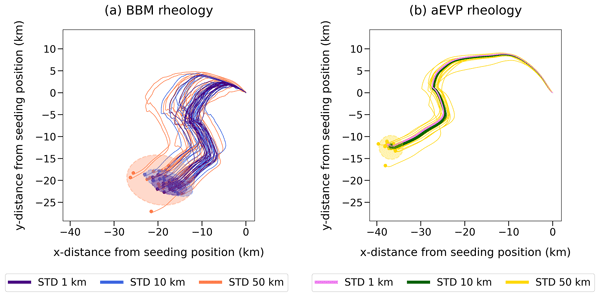
We examine how uncertainty in the initial position of sea ice features (leads, ridges), affects daily-to-weekly winter sea-ice forecasts. Using ensemble simulations with a sea ice–ocean model, we compare two formulations of sea ice mechanics. We show that pack-ice dynamics are highly sensitive to this choice: one formulation strongly amplifies small initial errors, while the other damps them. Our results highlight the need for ensemble forecasts to capture uncertainty and risks in the Arctic.
Jean-Michel Brankart, Damien Héron, Lisa Weiss, Thierry Penduff, and Pierre Brasseur
EGUsphere, https://doi.org/10.5194/egusphere-2026-3237, https://doi.org/10.5194/egusphere-2026-3237, 2026
Short summary
Short summary
In this paper, a method is proposed to estimate directly the low-frequency component of the ocean variability from native observations using statistics from a prior long-term ensemble simulation. The approach is illustrated by the reconstruction of the low-frequency variability of the Mediterranean sea level. The resulting ensemble estimate is assessed against independent observations, showing good reliability.
Marilaure Grégoire, Gianpiero Cossarini, Corinne Derval, Elodie Gutknecht, Susan Kay, Julien Lamouroux, Helen Morrison, Coralie Perruche, Annette Samuelsen, Lena Spruch, Anna Teruzzi, Luc Vandenbulcke, Karina Von Schuckmann, and Tsuyoshi Wakamatsu
EGUsphere, https://doi.org/10.5194/egusphere-2026-813, https://doi.org/10.5194/egusphere-2026-813, 2026
Short summary
Short summary
We review the advancements in our capabilities to predict the green ocean in the frame of the European Copernicus Marine Service since its start in 2015 and for the five European seas, the Arctic and Global oceans. The evolutions of the prediction systems, delivered products and computing resources requirements are reviewed. Recommendations for future developments are proposed based on a SWOT analysis of current CMEMS green ocean prediction systems and products.
Marilaure Grégoire, Luc Vandenbulcke, Séverine Chevalier, Mathurin Choblet, Ilya Drozd, Jean-François Grailet, Evgeny Ivanov, Loïc Macé, Polina Verezemskaya, Haolin Yu, Lauranne Alaerts, Ny Riana Randresihaja, Victor Mangeleer, Guillaume Maertens de Noordhout, Arthur Capet, Catherine Meulders, Anne Mouchet, Guy Munhoven, and Karline Soetaert
Geosci. Model Dev., 19, 2137–2175, https://doi.org/10.5194/gmd-19-2137-2026, https://doi.org/10.5194/gmd-19-2137-2026, 2026
Short summary
Short summary
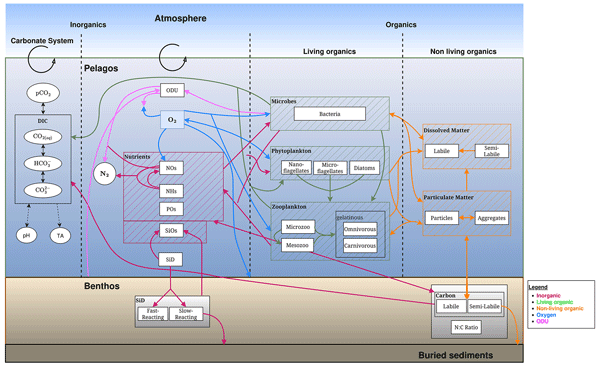
This paper describes the ocean BiogeochemicAl Model for Hypoxic and Benthic Influenced areas (BAMHBI). BAMHBI is a moderate complexity marine biogeochemical model that describes the cycling of carbon, nitrogen, phosphorus, silicon and oxygen through the marine foodweb. BAMHBI is a stand-alone biogeochemical model that can be coupled to any hydrodynamical model and is particularly appropriate for modelling low oxygen environments and the generation of sulfidic waters.

Damien Héron, Thierry Penduff, Jean-Michel Brankart, Pierre Brasseur, Samuel Somot, Robin Waldman, and Romain Pennel
Ocean Sci., 22, 531–547, https://doi.org/10.5194/os-22-531-2026, https://doi.org/10.5194/os-22-531-2026, 2026
Short summary
Short summary
Our study used realistic ocean simulations to determine how much of the Mediterranean’s circulation is due to natural randomness rather than atmospheric forcing. We found that spontaneous ocean variability is strong in several regions and can persist for years or even decades. This randomness influences how well models and observations can capture the Mediterranean’s response to climate change.

Loïc Macé, Luc Vandenbulcke, Jean-Michel Brankart, Pierre Brasseur, and Marilaure Grégoire
Biogeosciences, 22, 3747–3768, https://doi.org/10.5194/bg-22-3747-2025, https://doi.org/10.5194/bg-22-3747-2025, 2025
Short summary
Short summary
The representation of light propagation in seawater is critical for modelling marine biogeochemistry. We analyse results from a radiative transfer model that accounts for the absorption and scattering of light in the ocean with their respective uncertainties. We compare these results with in situ and remote-sensed data. Our analysis highlights the benefits of accounting for model uncertainties while using advanced representations of light in modelling frameworks.

Lauranne Alaerts, Jonathan Lambrechts, Ny Riana Randresihaja, Luc Vandenbulcke, Olivier Gourgue, Emmanuel Hanert, and Marilaure Grégoire
Earth Syst. Sci. Data, 17, 3125–3140, https://doi.org/10.5194/essd-17-3125-2025, https://doi.org/10.5194/essd-17-3125-2025, 2025
Short summary
Short summary
We created the first comprehensive, high-resolution, and easily accessible bathymetry dataset for the three main branches of the Danube Delta. By combining four data sources, we obtained a detailed representation of the riverbed, with resolutions ranging from 2 to 100 m. This dataset will support future studies on water and nutrient exchanges between the Danube and the Black Sea and provide insights into the delta's buffer role within the understudied Danube–Black Sea continuum.
Jean-François Grailet, Robin J. Hogan, Nicolas Ghilain, David Bolsée, Xavier Fettweis, and Marilaure Grégoire
Geosci. Model Dev., 18, 1965–1988, https://doi.org/10.5194/gmd-18-1965-2025, https://doi.org/10.5194/gmd-18-1965-2025, 2025
Short summary
Short summary
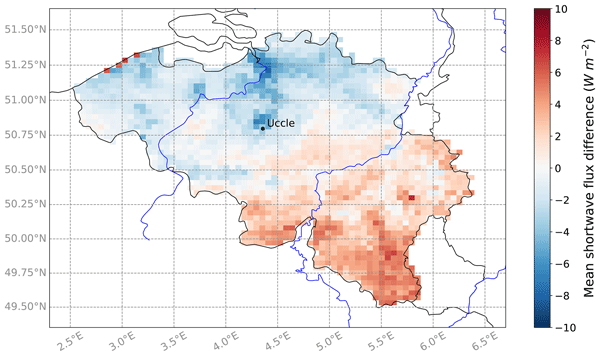
The MAR (Modèle Régional Atmosphérique) is a regional climate model used for weather forecasting and studying the climate over various regions. This paper presents an update of MAR thanks to which it can precisely decompose solar radiation, in particular in the UV (ultraviolet) and photosynthesis ranges, both being critical to human health and ecosystems. As a first application of this new capability, this paper presents a method for predicting UV indices with MAR.
Ny Riana Randresihaja, Olivier Gourgue, Lauranne Alaerts, Xavier Fettweis, Jonathan Lambrechts, Miguel De Le Court, Marilaure Grégoire, and Emmanuel Hanert
EGUsphere, https://doi.org/10.5194/egusphere-2025-634, https://doi.org/10.5194/egusphere-2025-634, 2025
Preprint archived
Short summary
Short summary
Coastal areas face rising flood threats as storms intensifies with climate change. With an advanced model of the Scheldt Estuary-North Sea, we studied how detailed atmospheric data must be to predict storm surge peaks in estuaries. We found that high-resolution atmospheric data gives the best results, and coarser data with same resolution as current global climate models give poorer results. We show that investing in localized, high-resolution atmospheric data can significantly improve results.
Mikhail Popov, Jean-Michel Brankart, Arthur Capet, Emmanuel Cosme, and Pierre Brasseur
Ocean Sci., 20, 155–180, https://doi.org/10.5194/os-20-155-2024, https://doi.org/10.5194/os-20-155-2024, 2024
Short summary
Short summary
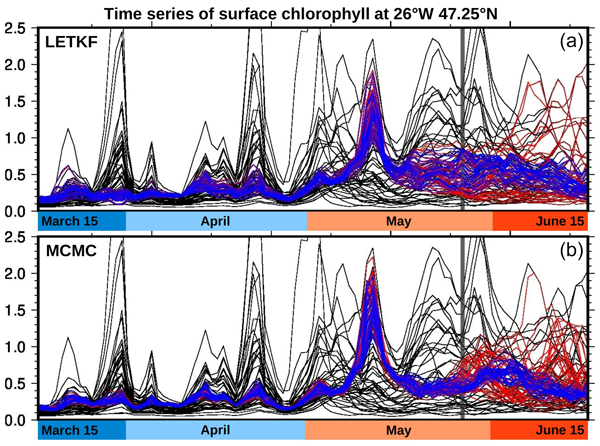
This study contributes to the development of methods to estimate targeted ocean ecosystem indicators, including their uncertainty, in the framework of the Copernicus Marine Service. A simplified approach is introduced to perform a 4D ensemble analysis and forecast, directly targeting selected biogeochemical variables and indicators (phenology, trophic efficiency, downward flux of organic matter). Care is taken to present the methods and discuss the reliability of the solution proposed.

Stephanie Leroux, Jean-Michel Brankart, Aurélie Albert, Laurent Brodeau, Jean-Marc Molines, Quentin Jamet, Julien Le Sommer, Thierry Penduff, and Pierre Brasseur
Ocean Sci., 18, 1619–1644, https://doi.org/10.5194/os-18-1619-2022, https://doi.org/10.5194/os-18-1619-2022, 2022
Short summary
Short summary
The goal of the study is to evaluate the predictability of the ocean circulation
at a kilometric scale, in order to anticipate the requirements of the future operational forecasting systems. For that purpose, ensemble experiments have been performed with a regional model for the Western Mediterranean (at 1/60° horizontal resolution). From these ensemble experiments, we show that it is possible to compute targeted predictability scores, which depend on initial and model uncertainties.
Estrella Olmedo, Verónica González-Gambau, Antonio Turiel, Cristina González-Haro, Aina García-Espriu, Marilaure Gregoire, Aida Álvera-Azcárate, Luminita Buga, and Marie-Hélène Rio
Earth Syst. Sci. Data Discuss., https://doi.org/10.5194/essd-2021-364, https://doi.org/10.5194/essd-2021-364, 2021
Revised manuscript not accepted
Short summary
Short summary
We present the first dedicated satellite salinity product in the Black Sea. We use the measurements provided by the European Soil Moisture and Ocean Salinity mission. We introduce enhanced algorithms for dealing with the contamination produced by the Radio Frequency Interferences that strongly affect this basin. We also provide a complete quality assessment of the new product and give an estimated accuracy of it.
Cited articles
Ackleson, S., Balch, W., and Holligan, P.: Response of water-leaving radiance to particulate calcite and chlorophyll a concentrations: A model for Gulf of Maine coccolithophore blooms, J. Geophys. Res., 99, 7483–7499, https://doi.org/10.1029/93JC02150, 1994. a
Álvarez, E., Cossarini, G., Teruzzi, A., Bruggeman, J., Bolding, K., Ciavatta, S., Vellucci, V., D'Ortenzio, F., Antoine, D., and Lazzari, P.: Chromophoric dissolved organic matter dynamics revealed through the optimization of an optical–biogeochemical model in the northwestern Mediterranean Sea, Biogeosciences, 20, 4591–4624, https://doi.org/10.5194/bg-20-4591-2023, 2023. a
Aumont, O., Ethé, C., Tagliabue, A., Bopp, L., and Gehlen, M.: PISCES-v2: an ocean biogeochemical model for carbon and ecosystem studies, Geosci. Model Dev., 8, 2465–2513, https://doi.org/10.5194/gmd-8-2465-2015, 2015. a
Bai, R., He, X., Bai, Y., Li, T., Zhu, Q., and Gong, F.: Characteristics of water leaving reflectance at ultraviolet wavelengths: radiative transfer simulations, Opt. Express, 28, 29714–29729, https://doi.org/10.1364/oe.401855, 2020. a
Baird, M., Cherukuru, N., Jones, E., Margvelashvili, N., Mongin, M., Oubelkheir, K., Ralph, P., Rizwi, F., Robson, B., Schroeder, T., Skerratt, J., Steven, A., and Wild-Allen, K.: Remote-sensing reflectance and true colour produced by a coupled hydrodynamic, optical, sediment, biogeochemical model of the Great Barrier Reef, Australia: Comparison with satellite data, Environ. Modell. Softw., 78, 79–96, https://doi.org/10.1016/j.envsoft.2015.11.025, 2016. a
Begouen Demeaux, C. and Boss, E.: Validation of Remote-Sensing Algorithms for Diffuse Attenuation of Downward Irradiance Using BGC-Argo Floats, Remote Sens.-Basel, 14, https://doi.org/10.3390/rs14184500, 2022. a
Berthet, S., Jouanno, J., Séférian, R., Gehlen, M., and Llovel, W.: How does the phytoplankton–light feedback affect the marine N2O inventory?, Earth Syst. Dynam., 14, 399–412, https://doi.org/10.5194/esd-14-399-2023, 2023. a
Bissett, W., Carder, K., Walsh, J., and Dieterle, D.: Carbon cycling in the upper waters of the Sargasso Sea: II. Numerical simulation of apparent and inherent optical properties, Deep-Sea Res., 46, 271–317, https://doi.org/10.1016/S0967-0637(98)00063-6, 1999. a
Bozzo, A., Rémy, S., Benedetti, A., Flemming, J., Bechtold, P., Rodwell, M., and Morcrette, J.-J.: Implementation of a CAMS-based aerosol climatology in the IFS, Tech. Rep. 1, European Centre for Medium-Range Weather Forecasts, https://doi.org/10.21957/84ya94mls, 2017. a
Brankart, J.-M., Candille, G., Garnier, F., Calone, C., Melet, A., Bouttier, P.-A., Brasseur, P., and Verron, J.: A generic approach to explicit simulation of uncertainty in the NEMO ocean model, Geosci. Model Dev., 8, 1285–1297, https://doi.org/10.5194/gmd-8-1285-2015, 2015. a
Cahill, B. E., Kowalczuk, P., Kritten, L., Gräwe, U., Wilkin, J., and Fischer, J.: Estimating the seasonal impact of optically significant water constituents on surface heating rates in the western Baltic Sea, Biogeosciences, 20, 2743–2768, https://doi.org/10.5194/bg-20-2743-2023, 2023. a
Capet, A., Stanev, E. V., Beckers, J.-M., Murray, J. W., and Grégoire, M.: Decline of the Black Sea oxygen inventory, Biogeosciences, 13, 1287–1297, https://doi.org/10.5194/bg-13-1287-2016, 2016. a
Chami, M., Lafrance, B., Fougnie, B., Chowdhary, J., Harmel, T., and Waquet, F.: OSOAA: a vector radiative transfer model of coupled atmosphere-ocean system for a rough sea surface application to the estimates of the directional variations of the water leaving reflectance to better process multi-angular satellite sensors data over the ocean, Opt. Express, 23, 27829–27852, https://doi.org/10.1364/OE.23.027829, 2015. a
Chowdhary, J., Zhai, P.-W., Boss, E., Dierssen, H., Frouin, R., Ibrahim, A., Lee, Z., Remer, L. A., Twardowski, M., Xu, F., Zhang, X., Ottaviani, M., Espinosa, W. R., and Ramon, D.: Modeling Atmosphere-Ocean Radiative Transfer: A PACE Mission Perspective, Front. Earth Sci., 7, https://doi.org/10.3389/feart.2019.00100, 2019. a
Ciavatta, S., Torres, R., Martinez-Vicente, V., Smyth, T., Dall’Olmo, G., Polimene, L., and Allen, J. I.: Assimilation of remotely-sensed optical properties to improve marine biogeochemistry modelling, Prog. Oceanogr., 127, 74–95, https://doi.org/10.1016/j.pocean.2014.06.002, 2014. a
CMEMS: Black Sea, Bio-Geo-Chemical, L3, daily Satellite Observations (1997–ongoing), Marine Data Store (MDS) [data set], https://doi.org/10.48670/moi-00303, 2025. a
Copernicus Marine In Situ TAC: In Situ tac Partners: Product User Manual for In Situ Products, Copernicus Marine In Situ TAC [data set], https://doi.org/10.13155/43494, 2024. a
De Nodrest, E., Homrani, S., Jourdin, F., Viellefon, P., Vient, J.-M., De Madron, X. D., De Fommervault, O. P., and Bourrin, F.: In situ glider and remote-sensing satellite data synergy for the estimation of the PAR diffuse attenuation coefficient, in: OCEANS 2022, Hampton Roads, 1–9, https://doi.org/10.1109/OCEANS47191.2022.9977221, 2022. a
Del Vecchio, R. and Blough, N. V.: Photobleaching of chromophoric dissolved organic matter in natural waters: kinetics and modeling, Mar. Chem., 78, 231–253, https://doi.org/10.1016/S0304-4203(02)00036-1, 2002. a
Dutkiewicz, S., Hickman, A. E., Jahn, O., Gregg, W. W., Mouw, C. B., and Follows, M. J.: Capturing optically important constituents and properties in a marine biogeochemical and ecosystem model, Biogeosciences, 12, 4447–4481, https://doi.org/10.5194/bg-12-4447-2015, 2015. a, b, c, d, e, f, g, h, i, j, k, l, m, n, o, p, q, r
Dutkiewicz, S., Hickman, A. E., and Jahn, O.: Modelling ocean-colour-derived chlorophyll a, Biogeosciences, 15, 613–630, https://doi.org/10.5194/bg-15-613-2018, 2018. a
Fujii, M., Boss, E., and Chai, F.: The value of adding optics to ecosystem models: a case study, Biogeosciences, 4, 817–835, https://doi.org/10.5194/bg-4-817-2007, 2007. a
Gallée, H., Trouvilliez, A., Agosta, C., Genthon, C., Favier, V., and Naaim-Bouvet, F.: Transport of Snow by the Wind: A Comparison Between Observations in Adélie Land, Antarctica, and Simulations Made with the Regional Climate Model MAR, Bound.-Lay. Meteorol., 146, 133–147, https://doi.org/10.1007/s10546-012-9764-z, 2013. a
Gallegos, C., Werdell, P., and McClain, C.: Long-term changes in light scattering in Chesapeake Bay inferred from Secchi depth, light attenuation, and remote sensing measurements, J. Geophys. Res., 116, https://doi.org/10.1029/2011JC007160, 2011. a, b
Garnier, F., Brankart, J.-M., Brasseur, P., and Cosme, E.: Stochastic parameterizations of biogeochemical uncertainties in a
Grailet, J.-F., Hogan, R. J., Ghilain, N., Bolsée, D., Fettweis, X., and Grégoire, M.: Inclusion of the ECMWF ecRad radiation scheme (v1.5.0) in the MAR (v3.14), regional evaluation for Belgium, and assessment of surface shortwave spectral fluxes at Uccle, Geosci. Model Dev., 18, 1965–1988, https://doi.org/10.5194/gmd-18-1965-2025, 2025. a, b, c
Gregg, W. and Carder, K.: A simple spectral solar irradiance model for cloudless maritime atmospheres, Limnol. Oceanogr., 35, 1657–1675, https://doi.org/10.4319/lo.1990.35.8.1657, 1990. a
Gregg, W. and Rousseaux, C.: Directional and Spectral Irradiance in Ocean Models: Effects on Simulated Global Phytoplankton, Nutrients, and Primary Production, Front. Mar. Sci., 3, 240, https://doi.org/10.3389/fmars.2016.00240, 2016. a, b, c
Gregg, W. and Rousseaux, C.: Simulating PACE Global Ocean Radiances, Front. Mar. Sci., 4, https://doi.org/10.3389/fmars.2017.00060, 2017. a
Gregg, W. W. and Casey, N. W.: Modeling coccolithophores in the global oceans, Deep-Sea Res. Pt. II, 54, 447–477, https://doi.org/10.1016/j.dsr2.2006.12.007, 2007. a
Grégoire, M. and Soetart, K.: Carbon, nitrogen, oxygen and sulfide budgets in the Black Sea: A biogeochemical model of the whole water column coupling the oxic and anoxic parts, Ecol. Model., 221, 2287–2301, https://doi.org/10.1016/j.ecolmodel.2010.06.007, 2010. a, b
Grégoire, M., Raick, C., and Soetart, K.: Numerical modeling of the central Black Sea ecosystem functioning during the eutrophication phase, Prog. Oceanogr., 76, 286–333, https://doi.org/10.1016/j.pocean.2008.01.002, 2008. a, b
Grégoire, M., Alvera-Azcaráte, A., Buga, L., Capet, A., Constantin, S., D’Ortenzio, F., Doxaran, D., Faugeras, Y., Garcia-Espriu, A., Golumbeanu, M., González-Haro, C., González-Gambau, V., Kasprzyk, J.-P., Ivanov, E., Mason, E., Mateescu, R., Meulders, C., Olmedo, E., Pons, L., Pujol, M.-I., Sarbu, G., Turiel, A., Vandenbulcke, L., and Rio, M.-H.: Monitoring Black Sea environmental changes from space: New products for altimetry, ocean colour and salinity. Potentialities and requirements for a dedicated in-situ observing system, Front. Mar. Sci., 9, https://doi.org/10.3389/fmars.2022.998970, 2023. a
Grégoire, M., Vandenbulcke, L., Chevalier, S., Choblet, M., Drozd, I., Grailet, J.-F., Ivanov, E., Macé, L., Verezemskaya, P., Yu, H., Alaerts, L., Randresihaja, N. R., Mangeleer, V., Maertens de Noordhout, G., Capet, A., Meulders, C., Mouchet, A., Munhoven, G., and Soetaert, K.: The BiogeochemicAl Model for Hypoxic and Benthic Influenced areas: BAMHBI v1.0, Geosci. Model Dev., 19, 2137–2175, https://doi.org/10.5194/gmd-19-2137-2026, 2026. a, b, c, d, e
Hersbach, H., Bell, B., Berrisford, P., Hirahara, S., Horányi, A., Muñoz Sabater, J., Nicolas, J., Peubey, C., Radu, R., Schepers, D., Simmons, A., Soci, C., Abdalla, S., Abellan, X., Balsamo, G., Bechtold, P., Biavati, G., Bidlot, J., Bonavita, M., and Thépaut, J.-N.: The ERA5 global reanalysis, Q. J. Roy. Meteor. Soc., https://doi.org/10.1002/qj.3803, 2020. a
Hogan, R. and Bozzo, A.: A Flexible and Efficient Radiation Scheme for the ECMWF Model, J. Adv. Model. Earth Sy., 10, 1990–2008, https://doi.org/10.1029/2018MS001364, 2018. a
Hogan, R. and Matricardi, M.: A Tool for Generating Fast k-Distribution Gas-Optics Models for Weather and Climate Applications, J. Adv. Model. Earth Sy., 14, https://doi.org/10.1029/2022MS003033, 2022. a
Hordoir, R., Axell, L., Höglund, A., Dieterich, C., Fransner, F., Gröger, M., Liu, Y., Pemberton, P., Schimanke, S., Andersson, H., Ljungemyr, P., Nygren, P., Falahat, S., Nord, A., Jönsson, A., Lake, I., Döös, K., Hieronymus, M., Dietze, H., Löptien, U., Kuznetsov, I., Westerlund, A., Tuomi, L., and Haapala, J.: Nemo-Nordic 1.0: a NEMO-based ocean model for the Baltic and North seas – research and operational applications, Geosci. Model Dev., 12, 363–386, https://doi.org/10.5194/gmd-12-363-2019, 2019. a
Horrigan, S. G., Carlucci, A. F., and Williams, P. M.: Light inhibition of nitrification in sea-surface films, J. Mar. Res., 39, 557–565, 1981. a
Jones, E. M., Baird, M. E., Mongin, M., Parslow, J., Skerratt, J., Lovell, J., Margvelashvili, N., Matear, R. J., Wild-Allen, K., Robson, B., Rizwi, F., Oke, P., King, E., Schroeder, T., Steven, A., and Taylor, J.: Use of remote-sensing reflectance to constrain a data assimilating marine biogeochemical model of the Great Barrier Reef, Biogeosciences, 13, 6441–6469, https://doi.org/10.5194/bg-13-6441-2016, 2016. a
Kajiyama, T., D'Alimonte, D., and Zibordi, G.: Algorithms Merging for the Determination of Chlorophyll a Concentration in the Black Sea, IEEE Geosci. Remote S., 16, 677–681, https://doi.org/10.1109/LGRS.2018.2883539, 2018. a, b, c
Kettle, H. and Merchant, C.: Modeling ocean primary production: sensitivity to spectral resolution of attenuation and absorption of light, Prog. Oceanogr., 78, 135–146, https://doi.org/10.1016/j.pocean.2008.04.002, 2008. a
Kitidis, V., Stubbins, A., Uher, G., Upstill Goddard, R., Law, C., and Woodward, E.: Variability of chromophoric organic matter in surface waters of the Atlantic Ocean, Deep-Sea Res. Pt. II, 53, 1666–1684, https://doi.org/10.1016/j.dsr2.2006.05.009, 2006. a
Kubryakov, A., Mikaelyan, A., and Stanichny, S.: Extremely strong coccolithophore blooms in the Black Sea: The decisive role of winter vertical entrainment of deep water, Deep-Sea Res. Pt. I, 173, https://doi.org/10.1016/j.dsr.2021.103554, 2021. a
Lazzari, P., Salon, S., Terzić, E., Gregg, W. W., D'Ortenzio, F., Vellucci, V., Organelli, E., and Antoine, D.: Assessment of the spectral downward irradiance at the surface of the Mediterranean Sea using the radiative Ocean-Atmosphere Spectral Irradiance Model (OASIM), Ocean Sci., 17, 675–697, https://doi.org/10.5194/os-17-675-2021, 2021. a
Lee, Z., Carder, K., and Arnone, R.: Deriving inherent optical properties from water color: a multi-band quasi-analytical algorithm for optically deep waters, Appl. Optics, 41, 5755–5772, https://doi.org/10.1364/AO.41.005755, 2002. a, b, c, d
Lengaigne, M., Menkes, C., Aumont, O., Gorgues, T., Bopp, L., André, J.-M., and Madec, G.: Influence of the oceanic biology on the tropical Pacific climate in a coupled general circulation model, Clim. Dynam., 28, 503–516, https://doi.org/10.1007/s00382-006-0200-2, 2007. a, b
Macé, L.: Stochastic BAMHBI-RT, Zenodo archive, https://doi.org/10.5281/zenodo.17288299, 2025a. a, b
Macé, L.: 1D three-stream radiative transfer model – Testing Notebook, Zenodo archive, https://doi.org/10.5281/zenodo.17288457, 2025b. a, b
Madec, G. and the NEMO System Team: NEMO Ocean Engine Reference Manual (v4.2.0), Zenodo, https://doi.org/10.5281/zenodo.1464816, 2022. a
Mason, J., Cone, M., and Fry, E.: Ultraviolet (250–550 nm) absorption spectrum of pure water, Appl. Optics, 55, 7163–7172, https://doi.org/10.1364/AO.55.007163, 2016. a
Mobley, C. D.: A numerical model for the computation of radiance distributions in natural waters with wind-roughened surfaces, Limnol. Oceanogr., 34, 1473–1483, 1989. a
Mobley, C. D.: The Oceanic Optics Book, International Ocean Colour Coordinating Group (IOCCG), https://doi.org/10.25607/OBP-1710, 2022. a
Mobley, C. D., Sundman, L. K., Bissett, W. P., and Cahill, B.: Fast and accurate irradiance calculations for ecosystem models, Biogeosciences Discuss., 6, 10625–10662, https://doi.org/10.5194/bgd-6-10625-2009, 2009. a
Mobley, C. D., Chai, F., Xiu, P., and Sundman, L. K.: Impact of improved light calculations on predicted phytoplankton growth and heating in an idealized upwelling-downwelling channel geometry, J. Geophys. Res.-Oceans, 120, 875–892, https://doi.org/10.1002/2014JC010588, 2015. a
Morel, A.: Optical modeling of the upper ocean in relation to its biogenous matter content (case I waters), J. Geophys. Res., 10749–10768, https://doi.org/10.1029/JC093iC09p10749, 1988. a
Morel, A. and Gentili, B.: Diffuse reflectance of oceanic waters II Bidirectional aspects, Appl. Optics, 32, https://doi.org/10.1364/AO.32.006864, 1993. a
Morel, A. and Maritorena, S.: Bio-optical properties of oceanic waters: A reappraisal, J. Geophys. Res., 106, 7163–7180, https://doi.org/10.1029/2000JC000319, 2001. a
Morel, A., Antoine, D., and Gentili, B.: Bidirectional reflectance of oceanic waters: accounting for Raman emission and varying particle scattering phase function, Appl. Optics, 41, 6289–6306, https://doi.org/10.1364/AO.41.006289, 2002. a
Morel, A., Claustre, H., Antoine, D., and Gentili, B.: Natural variability of bio-optical properties in Case 1 waters: attenuation and reflectance within the visible and near-UV spectral domains, as observed in South Pacific and Mediterranean waters, Biogeosciences, 4, 913–925, https://doi.org/10.5194/bg-4-913-2007, 2007. a
Patara, L., Vichi, M., Masina, S., Fogli, P., and Manzini, E.: Global response to solar radiation absorbed by phytoplankton in a coupled climate model, Clim. Dynam., 39, 1951–1968, https://doi.org/10.1007/s00382-012-1300-9, 2012. a
Paulson, C. and Simpson, J.: Irradiance Measurements in the Upper Ocean, J. Phys. Oceanogr., 7, 952–956, https://doi.org/10.1175/1520-0485(1977)007<0952:IMITUO>2.0.CO;2, 1977. a
Paulson, C. and Simpson, J.: The temperature difference across the cool skin of the ocean, J. Geophys. Res.-Oceans, 86, 11044–11054, https://doi.org/10.1029/JC086iC11p11044, 1981. a
Payne, R.: Albedo of the sea surface, J. Atmos. Sci., 29, 959–970, https://doi.org/10.1175/1520-0469(1972)029<0959:AOTSS>2.0.CO;2, 1972. a
Peneva, E. and Stips, A.: Numerical Simulations of Black Sea and Adjoined Azov Sea, Forced with Climatological and Meteorological Reanalysis Data, Tech. Rep. EUR 21504 EN, CEC JRC, Institute of Environment and Sustainability, https://doi.org/10.13140/RG.2.1.1830.4722, 2005. a
Pope, R. and Fry, E.: Absorption spectrum 380–700 nm of pure water. II. Integrating cavity measurements, Appl. Optics, 36, https://doi.org/10.1364/ao.36.008710, 1997. a, b, c
Popov, M., Brankart, J.-M., Capet, A., Cosme, E., and Brasseur, P.: Ensemble analysis and forecast of ecosystem indicators in the North Atlantic using ocean colour observations and prior statistics from a stochastic NEMO–PISCES simulator, Ocean Sci., 20, 155–180, https://doi.org/10.5194/os-20-155-2024, 2024. a
Ricour, F., Capet, A., D'Ortenzio, F., Delille, B., and Grégoire, M.: Dynamics of the deep chlorophyll maximum in the Black Sea as depicted by BGC-Argo floats, Biogeosciences, 18, 755–774, https://doi.org/10.5194/bg-18-755-2021, 2021. a
Santana-Falcón, Y., Brasseur, P., Brankart, J. M., and Garnier, F.: Assimilation of chlorophyll data into a stochastic ensemble simulation for the North Atlantic Ocean, Ocean Sci., 16, 1297–1315, https://doi.org/10.5194/os-16-1297-2020, 2020. a
Silkin, V., Mikaelyan, S., Pautova, L., and Fedorov, A.: Annual Dynamics of Phytoplankton in the Black Sea in Relation to Wind Exposure, J. Mar. Sci. Eng., 9, 1435, https://doi.org/10.3390/jmse9121435, 2021. a
Skákala, J., Bruggeman, J., Brewin, R., Ford, D., and Ciavatta, S.: Improved Representation of Underwater Light Field and Its Impact on Ecosystem Dynamics: A Study in the North Sea, J Geophys. Res.-Oceans, 125, e2020JC016122, https://doi.org/10.1029/2020JC016122, 2020. a, b
Skákala, J., Bruggeman, J., Ford, D., Wakelin, S., Akpinar, A., Hull, T., Kaiser, J., Loveday, B., O'Dea, E., Williams, C., and Ciavatta, S.: The impact of ocean biogeochemistry on physics and its consequences for modelling shelf seas, Ocean Model., 172, https://doi.org/10.1016/j.ocemod.2022.101976, 2022. a, b
Soto López, C. E., Gharbi Dit Kacem, M., Anselmi, F., and Lazzari, P.: Data-Informed Inversion Model (DIIM): a framework to retrieve marine optical constituents using a three-stream irradiance model, Geosci. Model Dev., 18, 7575–7602, https://doi.org/10.5194/gmd-18-7575-2025, 2025. a
Stanev, E. and Beckers, J.-M.: Barotropic and baroclinic oscillations in strongly stratified ocean basins: Numerical study of the Black Sea, J. Marine Syst., 19, 65–112, https://doi.org/10.1016/S0924-7963(98)00024-4, 1999. a
Teruzzi, A., Bolzon, G., Feudale, L., and Cossarini, G.: Deep chlorophyll maximum and nutricline in the Mediterranean Sea: emerging properties from a multi-platform assimilated biogeochemical model experiment, Biogeosciences, 18, 6147–6166, https://doi.org/10.5194/bg-18-6147-2021, 2021. a
Terzić, E., Miró, A., Organelli, E., Kowalczuk, P., D'Ortenzio, F., and Lazzari, P.: Radiative transfer modeling with biogeochemical Argo float data in the Mediterranean Sea, J. Geophys. Res.-Oceans, 126, https://doi.org/10.1029/2021JC017690, 2021. a, b, c, d
Thimijan, R. and Heins, R.: Photometric, Radiometric, and Quantum Light Units of Measure: A Review of Procedures for Interconversion, Hortic. Sci., 18, 818–822, https://doi.org/10.21273/HORTSCI.18.6.818, 1983. a
Twardowski, M., Boss, E., Sullivan, J., and Donaghay, P.: Ocean Color Analytical Model Explicitly Dependent on the Volume Scattering Function, Mar. Chem., 89, 69–88, https://doi.org/10.3390/app8122684, 2004. a
Vandenbulcke, L. and Grailet, J.-F.: BAMHBI stable, GitLab repository, https://gitlab.uliege.be/ESPECES/MAST/bamhbi-stable (last access: 6 October 2025), 2025. a
Vervatis, V. D., De Mey-Frémaux, P., Ayoub, N., Karagiorgos, J., Ghantous, M., Kailas, M., Testut, C.-E., and Sofianos, S.: Assessment of a regional physical–biogeochemical stochastic ocean model. Part 1: Ensemble generation, Ocean Model., 160, 101781, https://doi.org/10.1016/j.ocemod.2021.101781, 2021. a
Vichi, M., Lovato, T., Guterrez Mlot, E., and McKiver, W.: Coupling BFM with Ocean Models, Nucleus for the European Modelling of the Ocean, Release 1.0, BFM Report series N. 2, Release 1.0, Bologna, Italy, https://doi.org/10.13140/RG.2.1.1652.6566, 2015. a
Xiu, P. and Chai, F.: Connections between physical, optical and biogeochemical processes in the Pacific Ocean, Prog. Oceanogr., 122, 30–53, https://doi.org/10.1016/j.pocean.2013.11.008, 2014. a
Yang, M., Qiu, S., Wang, L., Chen, Z., Hu, Y., Guo, J., and Ge, S.: Effect of short-term light irradiation with varying energy densities on the activities of nitrifiers in wastewater, Water Res., 216, 118291, https://doi.org/10.1016/j.watres.2022.118291, 2022. a
Zibordi, G., Holben, B., Hooker, S. B., Mélin, F., Berthon, J.-F., Slutsker, I., Giles, D., Vandemark, D., Feng, H., Rutledge, K., Schuster, G., and Al Mandoos, A.: A network for standardized ocean color validation measurements, Eos T. Am. Geophys. Un., 87, 293–297, https://doi.org/10.1029/2006EO300001, 2006. a
Zibordi, G., Mélin, F., Berthon, J.-F., Holben, B., Slutsker, I., Giles, D., D’Alimonte, D., Vandemark, D., Feng, H., Schuster, G., Fabbri, B. E., Kaitala, S., and Seppälä, J.: AERONET-OC: A Network for the Validation of Ocean Color Primary Products, J. Atmos. Ocean. Tech., 26, 1634–1651, https://doi.org/10.1175/2009JTECHO654.1, 2009. a
Zibordi, G., Mélin, F., Berthon, J.-F., and Talone, M.: In situ autonomous optical radiometry measurements for satellite ocean color validation in the Western Black Sea, Ocean Sci., 11, 275–286, https://doi.org/10.5194/os-11-275-2015, 2015. a
Short summary
We present a three-stream radiative transfer model within the NEMO (Nucleus for European Modelling of the Ocean) framework and a use case for the Black Sea. The model is able to simulate in-water irradiance and sea surface reflectance in a wide spectral range. When coupled with an ecosystem model, the simulated irradiances are used to compute water temperature and primary production. A stochastic version of this model is also proposed to inform on uncertainties in the optical properties of seawater.
We present a three-stream radiative transfer model within the NEMO (Nucleus for European...


