
Articles | Volume 19, issue 17
https://doi.org/10.5194/gmd-19-8269-2026
© Author(s) 2026. This work is distributed under
the Creative Commons Attribution 4.0 License.
the Creative Commons Attribution 4.0 License.
https://doi.org/10.5194/gmd-19-8269-2026
© Author(s) 2026. This work is distributed under
the Creative Commons Attribution 4.0 License.
the Creative Commons Attribution 4.0 License.
Model description paper
| 
08 Sep 2026
Model description paper |
| 08 Sep 2026
| 08 Sep 2026
A semi-Lagrangian advection scheme in Elmer (v26.1): benchmarking against discontinuous Galerkin and application to ice-damage transport
Cyrille Mosbeux
CORRESPONDING AUTHOR

Univ. Grenoble Alpes, CNRS, IRD, Grenoble INP, INRAE, IGE, 38000 Grenoble, France
Peter Råback
CSC-IT Center for Science, Espoo, Finland
Adrien Gilbert
Univ. Grenoble Alpes, CNRS, IRD, Grenoble INP, INRAE, IGE, 38000 Grenoble, France
Julien Brondex
Univ. Grenoble Alpes, CNRS, IRD, Grenoble INP, INRAE, IGE, 38000 Grenoble, France
Fabien Gillet-Chaulet
Univ. Grenoble Alpes, CNRS, IRD, Grenoble INP, INRAE, IGE, 38000 Grenoble, France
Nicolas C. Jourdain
Univ. Grenoble Alpes, CNRS, IRD, Grenoble INP, INRAE, IGE, 38000 Grenoble, France
Mondher Chekki
Univ. Grenoble Alpes, CNRS, IRD, Grenoble INP, INRAE, IGE, 38000 Grenoble, France
Olivier Gagliardini
Univ. Grenoble Alpes, CNRS, IRD, Grenoble INP, INRAE, IGE, 38000 Grenoble, France
Gaël Durand
Univ. Grenoble Alpes, CNRS, IRD, Grenoble INP, INRAE, IGE, 38000 Grenoble, France
Related authors
Cyrille Mosbeux, Laurie Padman, Emilie Klein, Peter D. Bromirski, and Helen A. Fricker
The Cryosphere, 17, 2585–2606, https://doi.org/10.5194/tc-17-2585-2023, https://doi.org/10.5194/tc-17-2585-2023, 2023
Short summary
Short summary
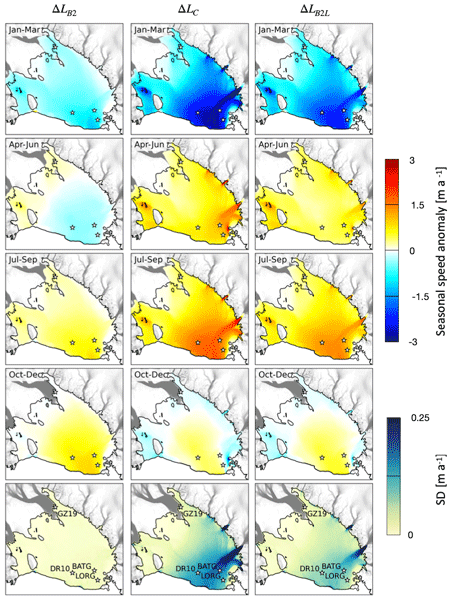
Antarctica's ice shelves (the floating extension of the ice sheet) help regulate ice flow. As ice shelves thin or lose contact with the bedrock, the upstream ice tends to accelerate, resulting in increased mass loss. Here, we use an ice sheet model to simulate the effect of seasonal sea surface height variations and see if we can reproduce observed seasonal variability of ice velocity on the ice shelf. When correctly parameterised, the model fits the observations well.
María Santolaria-Otín, Charles Amory, Martin Ménégoz, Fanny Brun, Xavier Faïn, Xavier Fettweis, Mondher Chekki, Patrick Wagnon, Dibas Shrestha, and Arbindra Khadka
EGUsphere, https://doi.org/10.5194/egusphere-2026-4572, https://doi.org/10.5194/egusphere-2026-4572, 2026
This preprint is open for discussion and under review for Geoscientific Model Development (GMD).
Short summary
Short summary
High Mountain Asia contains the largest concentration of glacier ice outside the polar regions and supplies water to hundreds of millions of people, yet its climate remains poorly understood because of its complex terrain and limited observations. We produced a high-resolution climate dataset for the Pamir and Central Himalaya covering 1950–2025. It captures seasonal climate and snow changes and will support studies of water resources, glaciers, and natural hazards.
Ronja Reese, Nicolas C. Jourdain, Xylar S. Asay-Davis, Clara Burgard, Erwin Lambert, Yoshihiro Nakayama, Paul R. Holland, Kaitlin A. Naughten, Ralph Timmermann, Pierre Dutrieux, Shenjie Zhou, Golsa Talebigheshlaghi, and Yanmei Tian
EGUsphere, https://doi.org/10.5194/egusphere-2026-5337, https://doi.org/10.5194/egusphere-2026-5337, 2026
This preprint is open for discussion and under review for The Cryosphere (TC).
Short summary
Short summary
An important factor in projections of the Antarctic contribution to future sea level rise is the Southern Ocean. The Ice Sheet Model Intercomparison Project for CMIP7 aims to provide ice sheet projections, and here we introduce the protocol for handling the ocean in Antarctica. It describes how ocean changes from global atmosphere-ocean models can be used in Antarctic simulations and how ocean conditions can be translated into melt rates, taking into account oceanographic knowledge.
Neige Calonne, Pascal Hagenmuller, Rémi Granger, Lisa Bouvet, Kévin Fourteau, Julien Brondex, François Tuzet, Yves Lejeune, Anne Dufour, Mathieu Fructus, Teruo Aoki, and Marie Dumont
Earth Syst. Sci. Data Discuss., https://doi.org/10.5194/essd-2026-718, https://doi.org/10.5194/essd-2026-718, 2026
Preprint under review for ESSD
Short summary
Short summary
We collected weekly measurements of snow microstructural properties over two winters at Col de Porte in the French Alps, a relatively warm alpine site, using complementary techniques including X-ray tomography, the SnowMicroPen, and optical instruments. The dataset captures snowpack evolution at fine vertical resolution and is a valuable resource for snow model evaluation and instrument comparisons. It also provides guidance for future snow monitoring campaigns in warm mountain environments.
Helen Ockenden, Clara Burgard, Pierre Mathiot, Christoph Kittel, Achille Gellens, Cécile Agosta, and Nicolas C. Jourdain
Geosci. Model Dev., 19, 7979–8002, https://doi.org/10.5194/gmd-19-7979-2026, https://doi.org/10.5194/gmd-19-7979-2026, 2026
Short summary
Short summary
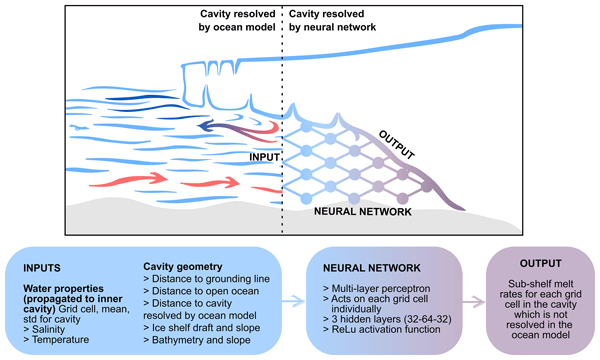
Since numerical computing is expensive, climate models must decide between having a high spatial resolution or running for long time periods. Here, we develop a simple neural network to emulate small-scale processes occurring beneath Antarctic ice shelves, which allows sub-shelf melt and ice–ocean interactions to be included in global ocean models which can run for multiple centuries. This neural network will help us to understand how ocean circulation may change in the future.
Adrien Gilbert, Fabrizio Troilo, Olivier Gagliardini, Christian Vincent, Paolo Perret, Luca Mondardini, Luc Piard, Olivier Laarman, and Emmanuel Le Meur
EGUsphere, https://doi.org/10.5194/egusphere-2026-4058, https://doi.org/10.5194/egusphere-2026-4058, 2026
This preprint is open for discussion and under review for The Cryosphere (TC).
Short summary
Short summary
This study reports on long-term temperature changes observed on the Whymper hanging glacier in Italy from 1997 to 2021, which are interpreted using a numerical modeling approach. Our results show that recent surface warming, driven by increased melting, has raised the glacier's basal temperature significantly, which could reach its melting point by 2050. However, this warming is partially offset by cooling from the mountain's cold north face, which may keep the glacier frozen and stable.

Christophe Ogier, Mauro A. Werder, Olivier Gagliardini, Ilaria Santin, Raphael Moser, Romain Hugonnet, Antoine Blanc, and Daniel Farinotti
Nat. Hazards Earth Syst. Sci., 26, 3901–3917, https://doi.org/10.5194/nhess-26-3901-2026, https://doi.org/10.5194/nhess-26-3901-2026, 2026
Short summary
Short summary
In June 2024, a destructive flood impacted the village of La Bérarde in the French Alps. Rain, snowmelt, and the drainage of a surface lake on a glacier cannot fully explain the flood magnitude. We used glacier topography to estimate how much water could also have been stored beneath the glacier before the event. Our results show that large volumes of hidden water may have existed and could have amplified the flood, highlighting an overlooked hazard in debris-covered mountain glaciers.
Matthieu Lafaysse, Marie Dumont, Basile De Fleurian, Mathieu Fructus, Rafife Nheili, Léo Viallon-Galinier, Matthieu Baron, Aaron Boone, Axel Bouchet, Julien Brondex, Carlo Carmagnola, Bertrand Cluzet, Kévin Fourteau, Ange Haddjeri, Pascal Hagenmuller, Giulia Mazzotti, Marie Minvielle, Samuel Morin, Louis Quéno, Léon Roussel, Pierre Spandre, François Tuzet, and Vincent Vionnet
Geosci. Model Dev., 19, 6273–6334, https://doi.org/10.5194/gmd-19-6273-2026, https://doi.org/10.5194/gmd-19-6273-2026, 2026
Short summary
Short summary
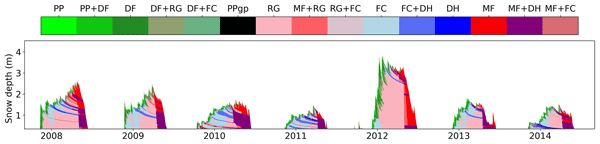
This article is a comprehensive description of the 3.0.2 stable release of the Crocus snowpack model. It describes various new implementations since the last reference article in 2012 and a review of the available scientific evaluations and applications of the model. This provides guidance for the future of numerical snow modelling.
Anna Olivé Abelló, Pierre Mathiot, Nicolas C. Jourdain, Yavor Kostov, and Paul R. Holland
EGUsphere, https://doi.org/10.5194/egusphere-2026-3422, https://doi.org/10.5194/egusphere-2026-3422, 2026
Short summary
Short summary
Antarctic icebergs release large amounts of freshwater, but models often add it entirely at the ocean surface. Using simulations with drifting icebergs, we assessed whether releasing meltwater at depth alters the Southern Ocean's response. Most meltwater remained in the surface mixed layer, and deeper release caused only weak, local changes in the ocean, sea ice and ice shelf melting. Hence, surface release remains a reasonable approach for large-scale studies, though depth matters regionally.
Anuar Togaibekov, Adrien Gilbert, Florent Gimbert, and Andrea Walpersdorf
The Cryosphere, 20, 3257–3270, https://doi.org/10.5194/tc-20-3257-2026, https://doi.org/10.5194/tc-20-3257-2026, 2026
Short summary
Short summary
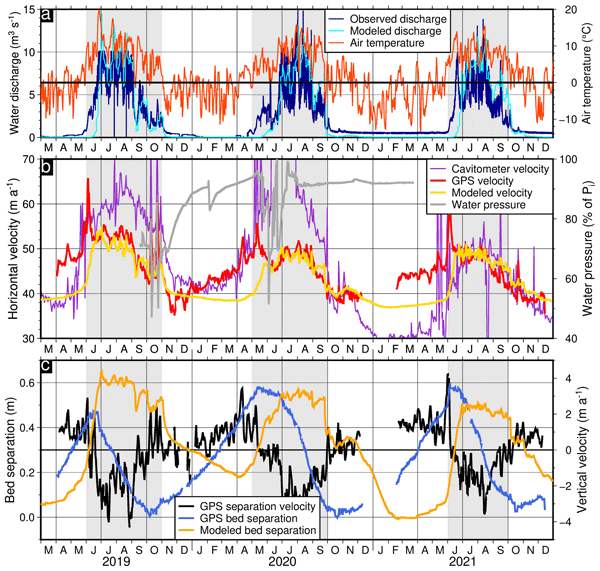
Changes in water reaching the base of glaciers strongly affect their sliding speed by altering water pressure beneath the ice. High water pressure is often thought to develop during summer melt, enlarging cavities at the glacier base and increasing sliding speed. Our observations show instead that the cavities mainly grow during winter, when water pressure builds up in isolated cavities. As the cavities become connected during the melt season, water pressure decreases and the glacier slows down.
Nicolás Acuña Reyes, Léo Martin, Adrien Gilbert, Vincent Jomelli, Antoine Rabatel, Simon Filhol, Deborah Verfaillie, Pierre-Henri Blard, and Jérôme Lavé
EGUsphere, https://doi.org/10.5194/egusphere-2026-2638, https://doi.org/10.5194/egusphere-2026-2638, 2026
Short summary
Short summary
Glacier landforms are often used to reconstruct past climate, but the same glacier shape can result from different combinations of temperature and snowfall. Using computer simulations of glaciers in the Bolivian Andes, we show that climate reconstructions based on a single glacier can lead to large uncertainties. By combining several neighboring glaciers, we estimate temperatures about 0.8°C cooler during the Little Ice Age and 1.3°C cooler during the Early Holocene (~10,000 years ago).
James R. Jordan, Frank Pattyn, Daniel Abele, Torsten Albrecht, Jorge Alvarez-Solas, Jowan M. Barnes, Tijn Berends, Jorge A. Bernales, Javier Blasco, Gong Cheng, Youngmin Choi, Stephen L. Cornford, Cruz Garcia-Molina, Fabien Gillet-Chaulet, G. Hilmar Gudmundsson, Angelika Humbert, Gunter R. Leguy, William H. Lipscomb, Marisa Montoya, Daniel Moreno-Parada, Mathieu Morlighem, Tyler Pelle, Alexander Robinson, Martin Rückamp, Hélène Seroussi, Yanmei Tian, Luisa Wagner, Roderick S. W. van de Wal, Liyun Zhao, and Thomas Zwinger
EGUsphere, https://doi.org/10.5194/egusphere-2026-1962, https://doi.org/10.5194/egusphere-2026-1962, 2026
Short summary
Short summary
Ice calving is a recent inclusion in ice sheet models and there has not been a systematic test of how well it has been implemented. We show that models can accurately represent a given rate of ice calving, properties at the ice front evolve smoothly during calving, and that there are no consistent differences in ice behaviour between various approaches to representing calving in numerical ice models. This gives us confidence in their ability for use in sea level rise prediction simulations.
Kévin Fourteau, Julien Brondex, Clément Cancès, and Marie Dumont
Geosci. Model Dev., 19, 3193–3212, https://doi.org/10.5194/gmd-19-3193-2026, https://doi.org/10.5194/gmd-19-3193-2026, 2026
Short summary
Short summary
The percolation of liquid water down snowpacks is a complex phenomenon, and its representation can sometimes be complicated for snowpack models. The goal of this article is to transpose some state-of-the-art strategies used for modeling liquid percolation in other media (such as rocks or soil) into snowpack models. With this, snowpack models can be made more efficient, requiring less time and power to perform their computation.
Claire K. Yung, Xylar S. Asay-Davis, Alistair Adcroft, Christopher Y. S. Bull, Jan De Rydt, Michael S. Dinniman, Benjamin K. Galton-Fenzi, Daniel Goldberg, David E. Gwyther, Robert Hallberg, Matthew Harrison, Tore Hattermann, David M. Holland, Denise Holland, Paul R. Holland, James R. Jordan, Nicolas C. Jourdain, Kazuya Kusahara, Gustavo Marques, Pierre Mathiot, Dimitris Menemenlis, Adele K. Morrison, Yoshihiro Nakayama, Olga Sergienko, Robin S. Smith, Alon Stern, Ralph Timmermann, and Qin Zhou
The Cryosphere, 20, 2053–2088, https://doi.org/10.5194/tc-20-2053-2026, https://doi.org/10.5194/tc-20-2053-2026, 2026
Short summary
Short summary
The second Ice Shelf-Ocean Model Intercomparison Project, ISOMIP+, compares 12 ice shelf-ocean models with a common, idealised, static configuration, aiming to assess inter-model variability. Models show similar basal melt rate patterns, ocean profiles and circulation but differ in ice-ocean boundary layer properties. Ice-ocean boundary layer representation is a key area for future work, as are realistic-domain ice sheet-ocean model intercomparisons.
Dorothée Vallot, Nicolas C. Jourdain, and Pierre Mathiot
The Cryosphere, 20, 1997–2016, https://doi.org/10.5194/tc-20-1997-2026, https://doi.org/10.5194/tc-20-1997-2026, 2026
Short summary
Short summary
Some recent studies show that the topography at the base of an ice shelf has consequences for its interaction with the ocean. To describe friction velocity in the melt parameterisation, we use a drag coefficient dependent on the distance of the first wet cell to the ice and the basal topography rather than a fixed-tuned parameter. We find that it is less dependent on the choice of vertical resolution and, while providing similar total melt, it gives more weight to highly crevassed areas.
Pierre Mathiot, Nicolas C. Jourdain, Benoit Urruty, Fabien Gillet-Chaulet, Olivier Gagliardini, and Gaël Durand
EGUsphere, https://doi.org/10.5194/egusphere-2026-927, https://doi.org/10.5194/egusphere-2026-927, 2026
Short summary
Short summary
How the Antarctic ice sheet responds to rapid ocean warming remains uncertain. To explore this, we used a coupled ocean–ice sheet model. We compared simulations under present-day conditions with simulations under strong future warming for 50 years, then returned to today’s climate. The ocean warmed quickly but recovered within decades. In contrast, several ice streams continued to retreat for centuries. This shows that even brief warming could cause lasting ice loss and sea-level rise.
Julien Brondex, Olivier Gagliardini, Adrien Gilbert, and Emmanuel Thibert
The Cryosphere, 20, 1655–1677, https://doi.org/10.5194/tc-20-1655-2026, https://doi.org/10.5194/tc-20-1655-2026, 2026
Short summary
Short summary
We investigate crevasse initiation by analyzing the artificial drainage of a water-filled cavity at Tête Rousse Glacier (Mont Blanc, France). Using a numerical model, we compute stress fields in response to water level variations in the cavity and compare them to observed crevasse patterns. Results show that a non-linear viscous rheology and a maximum principal stress criterion (with a stress threshold of 100–130 kPa) best predict crevasse occurrence.
Andrew Nolan, Gwenn E. Flowers, Andy Aschwanden, and Adrien Gilbert
EGUsphere, https://doi.org/10.5194/egusphere-2026-913, https://doi.org/10.5194/egusphere-2026-913, 2026
Short summary
Short summary
We used a computer model to study the effects of glacier "surges", or unusual fast-flow events, on the distribution of ice temperature in a glacier. The purpose of the study was to examine feedbacks that might influence the form and flow of these glaciers in a stable climate. We found surging glaciers to be smaller and colder than their ordinary counterparts, while strong regular surges induced an oscillation in glacier temperature and flow speed much longer than the interval between surges.
Simon Filhol, Clément Misset, Noélie Bontemps, Diego Cusicanqui, Emmanuel Paquet, Marie Dumont, Olivier Gagliardini, Pascal Lacroix, Simon Gascoin, Guillaume Thirel, Julien Brondex, Pascal Hagenmuller, Eric Larose, Philipp Schoeneich, Denis Roy, Emmanuel Thibert, Nicolas Eckert, Félix de Montety, Robin Mainieri, Alexandre Hauet, Frédéric Gottardi, Johan Berthet, Alexandre Baratier, Frédéric Liébault, Małgorzata Chmiel, Guillaume Piton, Guillaume Chambon, Guillaume James, Philippe Frey, Philip Deline, Laurent Astrade, Christian Vincent, Dominique Laigle, Alain Recking, Fatima Karbou, Adrien Mauss, Mylène Bonnefoy-Demongeot, Firmin Fontaine, Mickael Langlais, Etienne Berthier, and Antoine Blanc
EGUsphere, https://doi.org/10.5194/egusphere-2026-971, https://doi.org/10.5194/egusphere-2026-971, 2026
Short summary
Short summary
On June 21 2024, the village of La Bérarde, in the French Alps, was devastated by a flood destroying centuries old buildings. This study is an interdisciplinary work to decipher the causes and chronology of the event. The flood started with decadal rain falling on a thick snowpack. A lake observed on top of a glacier few days prior, had drained post event. With climate change, should we expect more similar compound events for alpine communities?
Benjamin Heurgue, Charles Amory, Christoph Kittel, Fredrik Boberg, Gaël Durand, Vincent Favier, Xavier Fettweis, Quentin Glaude, Heiko Goelzer, Nicolaj Hansen, Nicolas C. Jourdain, Ruth Mottram, Martin Olesen, Willem Jan Van de Berg, Michiel R. Van den Broeke, and René R. Wijngaard
EGUsphere, https://doi.org/10.5194/egusphere-2026-624, https://doi.org/10.5194/egusphere-2026-624, 2026
Short summary
Short summary
We studied how the Antarctic ice sheet surface mass balance may change by 2100 using three high-resolution climate models forced by the same future climate scenario. While the models agree for present-day conditions, they project very different futures, especially over floating ice shelves. These differences mainly come from how melting, refreezing, and temperature are represented. Our results show that future sea level projections strongly depend on how well models simulate today’s climate.
Yavor Kostov, Paul R. Holland, Kelly A. Hogan, James A. Smith, Nicolas C. Jourdain, Pierre Mathiot, Anna Olivé Abelló, Andrew H. Fleming, and Andrew J. S. Meijers
The Cryosphere, 20, 135–169, https://doi.org/10.5194/tc-20-135-2026, https://doi.org/10.5194/tc-20-135-2026, 2026
Short summary
Short summary
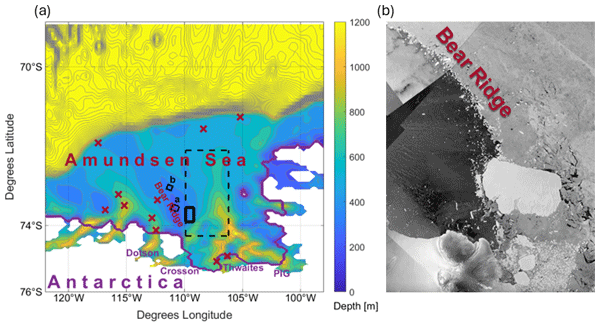
Icebergs ground when they reach shallow topography such as Bear Ridge in the Amundsen Sea. Grounded icebergs can block the transport of sea-ice and create areas of higher and lower sea-ice concentration. We introduce a physically and observationally motivated representation of grounding in an ocean model. In addition, we improve the way simulated icebergs respond to winds, ocean currents, and density differences in sea water. We analyse the forces acting on freely floating and grounded icebergs.
Thomas Chauve, Florent Gimbert, Adrien Gilbert, Olivier Gagliardini, Luc Piard, Arnaud Reboud, Olivier Laarman, Paolo Perret, William Boffelli, Pietro Di Sopra, Luca Mondardini, and Fabrizio Troilo
EGUsphere, https://doi.org/10.5194/egusphere-2025-5714, https://doi.org/10.5194/egusphere-2025-5714, 2025
Short summary
Short summary
A field campaign on the Planpincieux Glacier investigated how hidden heterogeneities inside the ice affect its deformation. A borehole logged with optical and acoustic tools and equipped with tilt sensors revealed that these heterogeneities cause strong deformation localization. Such weak zones significantly influence glacier motion, showing that internal structure is key to understanding how glaciers flow.

Heiko Goelzer, Constantijn J. Berends, Fredrik Boberg, Gael Durand, Tamsin L. Edwards, Xavier Fettweis, Fabien Gillet-Chaulet, Quentin Glaude, Philippe Huybrechts, Sébastien Le clec'h, Ruth Mottram, Brice Noël, Martin Olesen, Charlotte Rahlves, Jeremy Rohmer, Michiel van den Broeke, and Roderik S. W. van de Wal
The Cryosphere, 19, 6887–6906, https://doi.org/10.5194/tc-19-6887-2025, https://doi.org/10.5194/tc-19-6887-2025, 2025
Short summary
Short summary
We present an ensemble of ice sheet model projections for the Greenland ice sheet. The focus is on providing projections that improve our understanding of the range future sea-level rise and the inherent uncertainties over the next 100 to 300 years. Compared to earlier work we more fully account for some of the uncertainties in sea-level projections. We include a wider range of climate model output, more climate change scenarios and we extend projections schematically up to year 2300.
Jeremy Rohmer, Heiko Goelzer, Tamsin L. Edwards, Goneri Le Cozannet, and Gael Durand
The Cryosphere, 19, 6421–6444, https://doi.org/10.5194/tc-19-6421-2025, https://doi.org/10.5194/tc-19-6421-2025, 2025
Short summary
Short summary
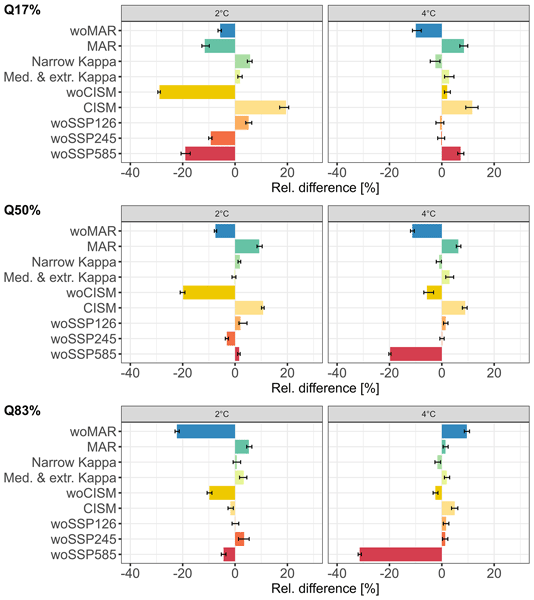
Developing robust protocols to design multi-model ensembles is of primary importance for the uncertainty quantification of sea level projections. Here, we set up a series of computer experiments to reflect design decisions for the prediction of future sea level contribution of the Greenland ice sheet in 2100. We show the importance of including the most extreme climate scenario and the implications of using a single type of numerical model for ice sheets or regional climate.
Gavin A. Schmidt, Kenneth D. Mankoff, Jonathan L. Bamber, Clara Burgard, Dustin Carroll, David M. Chandler, Violaine Coulon, Benjamin J. Davison, Matthew H. England, Paul R. Holland, Nicolas C. Jourdain, Qian Li, Juliana M. Marson, Pierre Mathiot, Clive R. McMahon, Twila A. Moon, Ruth Mottram, Sophie Nowicki, Anna Olivé Abelló, Andrew G. Pauling, Thomas Rackow, and Damien Ringeisen
Geosci. Model Dev., 18, 8333–8361, https://doi.org/10.5194/gmd-18-8333-2025, https://doi.org/10.5194/gmd-18-8333-2025, 2025
Short summary
Short summary
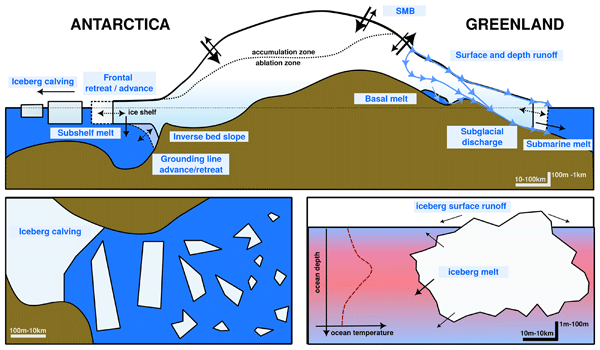
The impact of increasing mass loss from the Greenland and Antarctic ice sheets has not so far been included in historical climate model simulations. This paper describes the protocols and data available for modeling groups to add this anomalous freshwater to their ocean modules to better represent the impacts of these fluxes on ocean circulation, sea ice, salinity and sea level.
Johanna Beckmann, Ronja Reese, Felicity S. McCormack, Sue Cook, Lawrence Bird, Dawid Gwyther, Daniel Richards, Matthias Scheiter, Yu Wang, Hélène Seroussi, Ayako Abe‐Ouchi, Torsten Albrecht, Jorge Alvarez‐Solas, Xylar S. Asay‐Davis, Jean‐Baptiste Barre, Constantijn J. Berends, Jorge Bernales, Javier Blasco, Justine Caillet, David M. Chandler, Violaine Coulon, Richard Cullather, Christophe Dumas, Benjamin K. Galton‐Fenzi, Julius Garbe, Fabien Gillet‐Chaulet, Rupert Gladstone, Heiko Goelzer, Nicholas R. Golledge, Ralf Greve, G. Hilmar Gudmundsson, Holly Kyeore Han, Trevor R. Hillebrand, Matthew J. Hoffman, Philippe Huybrechts, Nicolas C. Jourdain, Ann Kristin Klose, Petra M. Langebroek, Gunter R. Leguy, William H. Lipscomb, Daniel P. Lowry, Pierre Mathiot, Marisa Montoya, Mathieu Morlighem, Sophie Nowicki, Frank Pattyn, Antony J. Payne, Tyler Pelle, Aurélien Quiquet, Alexander Robinson, Leopekka Saraste, Erika G. Simon, Sainan Sun, Jake P. Twarog, Luke D. Trusel, Benoit Urruty, Jonas Van Breedam, Roderik S. W. van de Wal, Chen Zhao, and Thomas Zwinger
EGUsphere, https://doi.org/10.5194/egusphere-2025-4069, https://doi.org/10.5194/egusphere-2025-4069, 2025
Short summary
Short summary
Antarctica holds enough ice to raise sea levels by many meters, but its future is uncertain. Warm ocean water melts ice shelves from below, letting inland ice flow faster into the sea. By 2300, Antarctica could add 0.6–4.4 m to sea levels. Our study identifies two key factors—how strongly shelves melt and how the ice responds. These explain much of the range, and refining them in models may improve future predictions.
Jonathan Wiskandt and Nicolas C. Jourdain
The Cryosphere, 19, 3253–3258, https://doi.org/10.5194/tc-19-3253-2025, https://doi.org/10.5194/tc-19-3253-2025, 2025
Short summary
Short summary
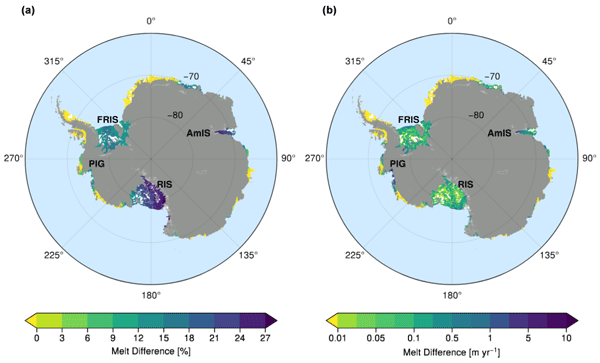
In ocean models, submarine melt of ice shelves is parameterized based on the heat budget at the ice–ocean interface. The heat budget includes the ocean heat transport, the heat conducted into the ice, and the heat available for melting. Here we compare three different approaches to estimating the heat conduction into the ice. We show that the most used approximation is not the most accurate one: it overestimates the melt by up to 25 % compared to the more accurate approximations.
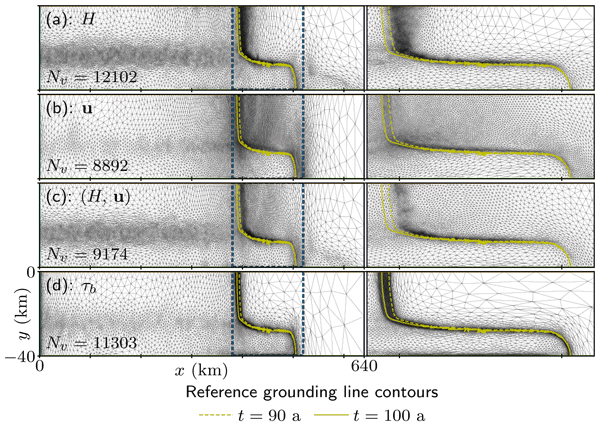
Davor Dundovic, Joseph G. Wallwork, Stephan C. Kramer, Fabien Gillet-Chaulet, Regine Hock, and Matthew D. Piggott
Geosci. Model Dev., 18, 4023–4044, https://doi.org/10.5194/gmd-18-4023-2025, https://doi.org/10.5194/gmd-18-4023-2025, 2025
Short summary
Short summary
Accurate numerical studies of glaciers often require high-resolution simulations, which often prove too demanding even for modern computers. In this paper we develop a method that identifies whether different parts of a glacier require high or low resolution based on its physical features, such as its thickness and velocity. We show that by doing so we can achieve a more optimal simulation accuracy for the available computing resources compared to uniform-resolution simulations.
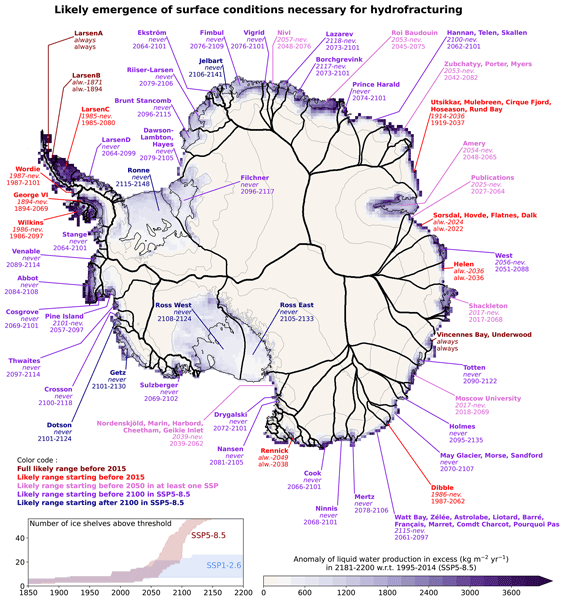
Nicolas C. Jourdain, Charles Amory, Christoph Kittel, and Gaël Durand
The Cryosphere, 19, 1641–1674, https://doi.org/10.5194/tc-19-1641-2025, https://doi.org/10.5194/tc-19-1641-2025, 2025
Short summary
Short summary
A mixed statistical–physical approach is used to reproduce the behaviour of a regional climate model. From that, we estimate the contribution of snowfall and melting at the surface of the Antarctic Ice Sheet to changes in global mean sea level. We also investigate the impact of surface melting in a warmer climate on the stability of the Antarctic ice shelves that provide back stress on the ice flow to the ocean.
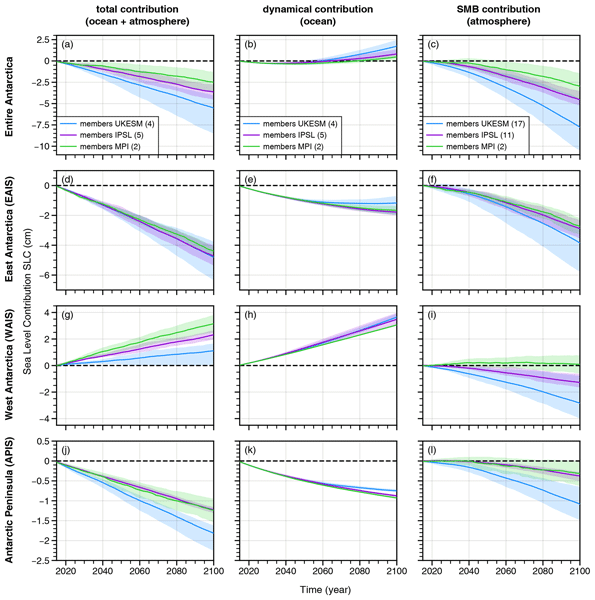
Justine Caillet, Nicolas C. Jourdain, Pierre Mathiot, Fabien Gillet-Chaulet, Benoit Urruty, Clara Burgard, Charles Amory, Mondher Chekki, and Christoph Kittel
Earth Syst. Dynam., 16, 293–315, https://doi.org/10.5194/esd-16-293-2025, https://doi.org/10.5194/esd-16-293-2025, 2025
Short summary
Short summary
Internal climate variability, resulting from processes intrinsic to the climate system, modulates the Antarctic response to climate change by delaying or offsetting its effects. Using climate and ice-sheet models, we highlight that irreducible internal climate variability significantly enlarges the likely range of Antarctic contribution to sea-level rise until 2100. Thus, we recommend considering internal climate variability as a source of uncertainty for future ice-sheet projections.
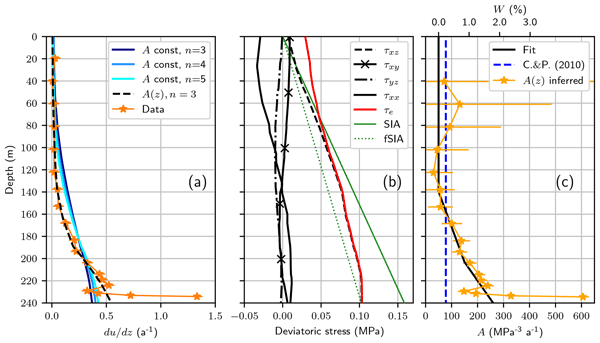
Juan-Pedro Roldán-Blasco, Adrien Gilbert, Luc Piard, Florent Gimbert, Christian Vincent, Olivier Gagliardini, Anuar Togaibekov, Andrea Walpersdorf, and Nathan Maier
The Cryosphere, 19, 267–282, https://doi.org/10.5194/tc-19-267-2025, https://doi.org/10.5194/tc-19-267-2025, 2025
Short summary
Short summary
The flow of glaciers and ice sheets results from ice deformation and basal sliding driven by gravitational forces. Quantifying the rate at which ice deforms under its own weight is critical for assessing glacier evolution. This study uses borehole instrumentation in an Alpine glacier to quantify ice deformation and constrain ice viscosity in a natural setting. Our results show that the viscosity of ice at 0 °C is largely influenced by interstitial liquid water, which enhances ice deformation.
Marin Kneib, Amaury Dehecq, Adrien Gilbert, Auguste Basset, Evan S. Miles, Guillaume Jouvet, Bruno Jourdain, Etienne Ducasse, Luc Beraud, Antoine Rabatel, Jérémie Mouginot, Guillem Carcanade, Olivier Laarman, Fanny Brun, and Delphine Six
The Cryosphere, 18, 5965–5983, https://doi.org/10.5194/tc-18-5965-2024, https://doi.org/10.5194/tc-18-5965-2024, 2024
Short summary
Short summary
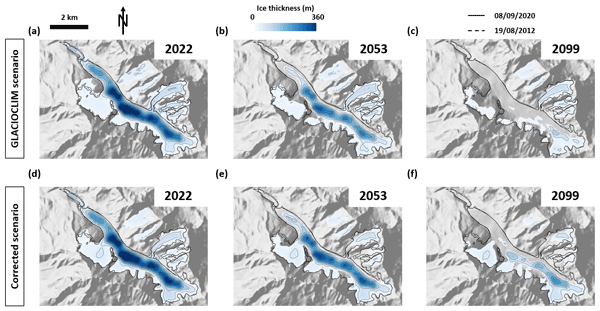
Avalanches contribute to increasing the accumulation on mountain glaciers by redistributing snow from surrounding mountains slopes. Here we quantified the contribution of avalanches to the mass balance of Argentière Glacier in the French Alps, by combining satellite and field observations to model the glacier dynamics. We show that the contribution of avalanches locally increases the accumulation by 60–70 % and that accounting for this effect results in less ice loss by the end of the century.
Eliot Jager, Fabien Gillet-Chaulet, Nicolas Champollion, Romain Millan, Heiko Goelzer, and Jérémie Mouginot
The Cryosphere, 18, 5519–5550, https://doi.org/10.5194/tc-18-5519-2024, https://doi.org/10.5194/tc-18-5519-2024, 2024
Short summary
Short summary
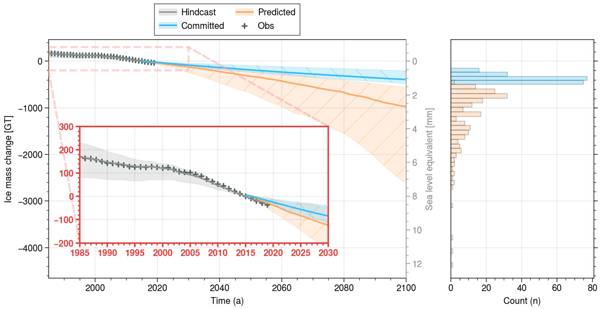
Inspired by a previous intercomparison framework, our study better constrains uncertainties in glacier evolution using an innovative method to validate Bayesian calibration. Upernavik Isstrøm, one of Greenland's largest glaciers, has lost significant mass since 1985. By integrating observational data, climate models, human emissions, and internal model parameters, we project its evolution until 2100. We show that future human emissions are the main source of uncertainty in 2100, making up half.
Jan De Rydt, Nicolas C. Jourdain, Yoshihiro Nakayama, Mathias van Caspel, Ralph Timmermann, Pierre Mathiot, Xylar S. Asay-Davis, Hélène Seroussi, Pierre Dutrieux, Ben Galton-Fenzi, David Holland, and Ronja Reese
Geosci. Model Dev., 17, 7105–7139, https://doi.org/10.5194/gmd-17-7105-2024, https://doi.org/10.5194/gmd-17-7105-2024, 2024
Short summary
Short summary
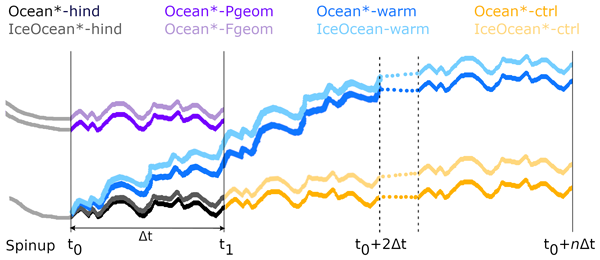
Global climate models do not reliably simulate sea-level change due to ice-sheet–ocean interactions. We propose a community modelling effort to conduct a series of well-defined experiments to compare models with observations and study how models respond to a range of perturbations in climate and ice-sheet geometry. The second Marine Ice Sheet–Ocean Model Intercomparison Project will continue to lay the groundwork for including ice-sheet–ocean interactions in global-scale IPCC-class models.
André Löfgren, Thomas Zwinger, Peter Råback, Christian Helanow, and Josefin Ahlkrona
The Cryosphere, 18, 3453–3470, https://doi.org/10.5194/tc-18-3453-2024, https://doi.org/10.5194/tc-18-3453-2024, 2024
Short summary
Short summary
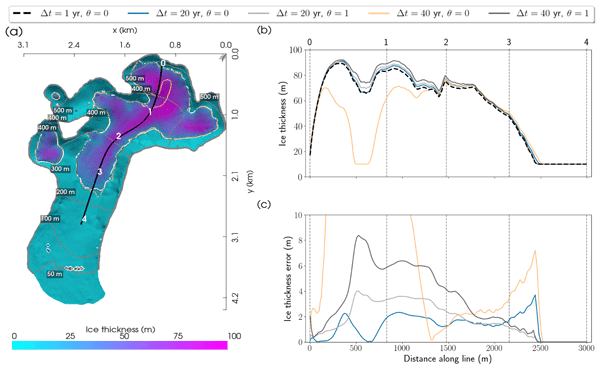
This paper investigates a stabilization method for free-surface flows in the context of glacier simulations. Previous applications of the stabilization on ice flows have only considered simple ice-sheet benchmark problems; in particular the method had not been tested on real-world glacier domains. This work addresses this shortcoming by demonstrating that the stabilization works well also in this case and increases stability and robustness without negatively impacting computation times.
Susanne Preunkert, Pascal Bohleber, Michel Legrand, Adrien Gilbert, Tobias Erhardt, Roland Purtschert, Lars Zipf, Astrid Waldner, Joseph R. McConnell, and Hubertus Fischer
The Cryosphere, 18, 2177–2194, https://doi.org/10.5194/tc-18-2177-2024, https://doi.org/10.5194/tc-18-2177-2024, 2024
Short summary
Short summary
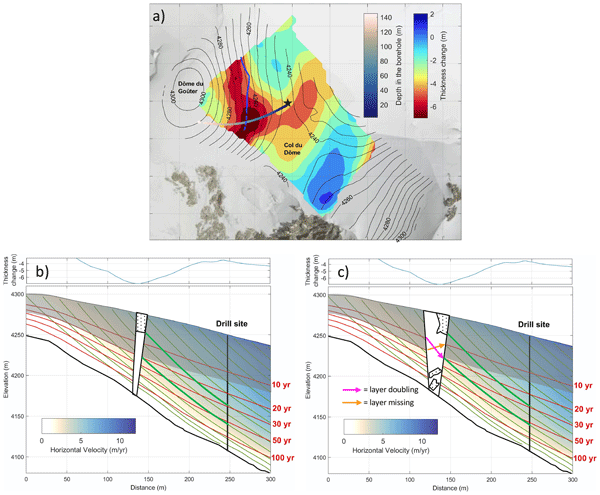
Ice cores from high-elevation Alpine glaciers are an important tool to reconstruct the past atmosphere. However, since crevasses are common at these glacier sites, rigorous investigations of glaciological conditions upstream of drill sites are needed before interpreting such ice cores. On the basis of three ice cores extracted at Col du Dôme (4250 m a.s.l; French Alps), an overall picture of a dynamic crevasse formation is drawn, which disturbs the depth–age relation of two of the three cores.
Kévin Fourteau, Julien Brondex, Fanny Brun, and Marie Dumont
Geosci. Model Dev., 17, 1903–1929, https://doi.org/10.5194/gmd-17-1903-2024, https://doi.org/10.5194/gmd-17-1903-2024, 2024
Short summary
Short summary
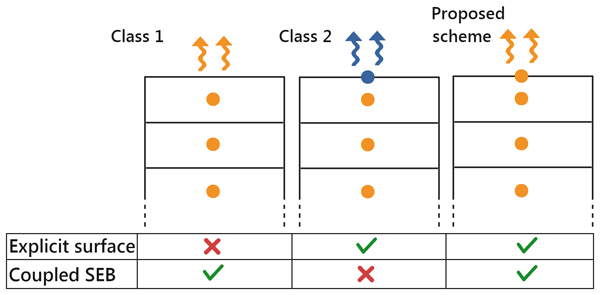
In this paper, we provide a novel numerical implementation for solving the energy exchanges at the surface of snow and ice. By combining the strong points of previous models, our solution leads to more accurate and robust simulations of the energy exchanges, surface temperature, and melt while preserving a reasonable computation time.
Hélène Seroussi, Vincent Verjans, Sophie Nowicki, Antony J. Payne, Heiko Goelzer, William H. Lipscomb, Ayako Abe-Ouchi, Cécile Agosta, Torsten Albrecht, Xylar Asay-Davis, Alice Barthel, Reinhard Calov, Richard Cullather, Christophe Dumas, Benjamin K. Galton-Fenzi, Rupert Gladstone, Nicholas R. Golledge, Jonathan M. Gregory, Ralf Greve, Tore Hattermann, Matthew J. Hoffman, Angelika Humbert, Philippe Huybrechts, Nicolas C. Jourdain, Thomas Kleiner, Eric Larour, Gunter R. Leguy, Daniel P. Lowry, Chistopher M. Little, Mathieu Morlighem, Frank Pattyn, Tyler Pelle, Stephen F. Price, Aurélien Quiquet, Ronja Reese, Nicole-Jeanne Schlegel, Andrew Shepherd, Erika Simon, Robin S. Smith, Fiammetta Straneo, Sainan Sun, Luke D. Trusel, Jonas Van Breedam, Peter Van Katwyk, Roderik S. W. van de Wal, Ricarda Winkelmann, Chen Zhao, Tong Zhang, and Thomas Zwinger
The Cryosphere, 17, 5197–5217, https://doi.org/10.5194/tc-17-5197-2023, https://doi.org/10.5194/tc-17-5197-2023, 2023
Short summary
Short summary
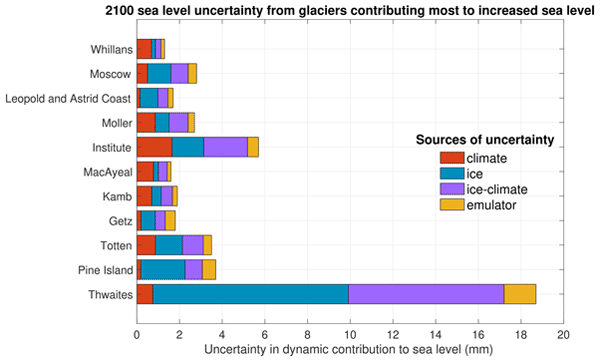
Mass loss from Antarctica is a key contributor to sea level rise over the 21st century, and the associated uncertainty dominates sea level projections. We highlight here the Antarctic glaciers showing the largest changes and quantify the main sources of uncertainty in their future evolution using an ensemble of ice flow models. We show that on top of Pine Island and Thwaites glaciers, Totten and Moscow University glaciers show rapid changes and a strong sensitivity to warmer ocean conditions.
Julien Brondex, Kévin Fourteau, Marie Dumont, Pascal Hagenmuller, Neige Calonne, François Tuzet, and Henning Löwe
Geosci. Model Dev., 16, 7075–7106, https://doi.org/10.5194/gmd-16-7075-2023, https://doi.org/10.5194/gmd-16-7075-2023, 2023
Short summary
Short summary
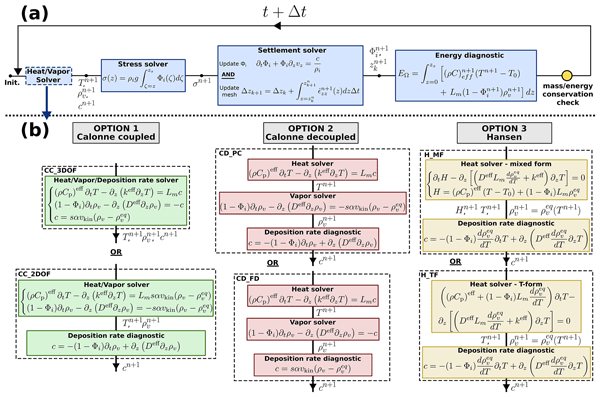
Vapor diffusion is one of the main processes governing snowpack evolution, and it must be accounted for in models. Recent attempts to represent vapor diffusion in numerical models have faced several difficulties regarding computational cost and mass and energy conservation. Here, we develop our own finite-element software to explore numerical approaches and enable us to overcome these difficulties. We illustrate the capability of these approaches on established numerical benchmarks.
Pierre Mathiot and Nicolas C. Jourdain
Ocean Sci., 19, 1595–1615, https://doi.org/10.5194/os-19-1595-2023, https://doi.org/10.5194/os-19-1595-2023, 2023
Short summary
Short summary
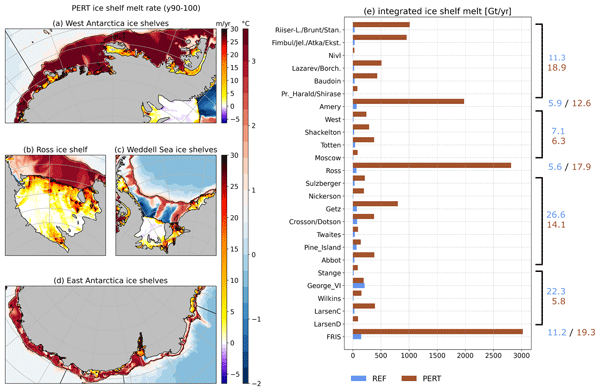
How much the Antarctic ice shelf basal melt rate can increase in response to global warming remains an open question. To achieve this, we compared an ocean simulation under present-day atmospheric condition to a one under late 23rd century atmospheric conditions. The ocean response to the perturbation includes a decrease in the production of cold dense water and an increased intrusion of warmer water onto the continental shelves. This induces a substantial increase in ice shelf basal melt rates.
Ronja Reese, Julius Garbe, Emily A. Hill, Benoît Urruty, Kaitlin A. Naughten, Olivier Gagliardini, Gaël Durand, Fabien Gillet-Chaulet, G. Hilmar Gudmundsson, David Chandler, Petra M. Langebroek, and Ricarda Winkelmann
The Cryosphere, 17, 3761–3783, https://doi.org/10.5194/tc-17-3761-2023, https://doi.org/10.5194/tc-17-3761-2023, 2023
Short summary
Short summary
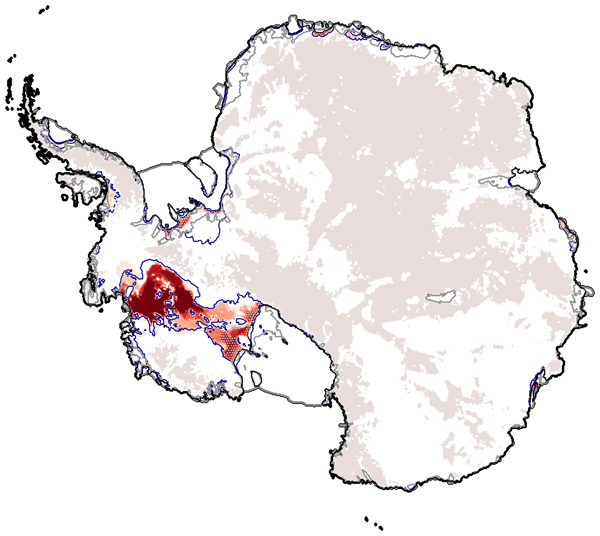
We use an ice sheet model to test where current climate conditions in Antarctica might lead. We find that present-day ocean and atmosphere conditions might commit an irreversible collapse of parts of West Antarctica which evolves over centuries to millennia. Importantly, this collapse is not irreversible yet.
Emily A. Hill, Benoît Urruty, Ronja Reese, Julius Garbe, Olivier Gagliardini, Gaël Durand, Fabien Gillet-Chaulet, G. Hilmar Gudmundsson, Ricarda Winkelmann, Mondher Chekki, David Chandler, and Petra M. Langebroek
The Cryosphere, 17, 3739–3759, https://doi.org/10.5194/tc-17-3739-2023, https://doi.org/10.5194/tc-17-3739-2023, 2023
Short summary
Short summary
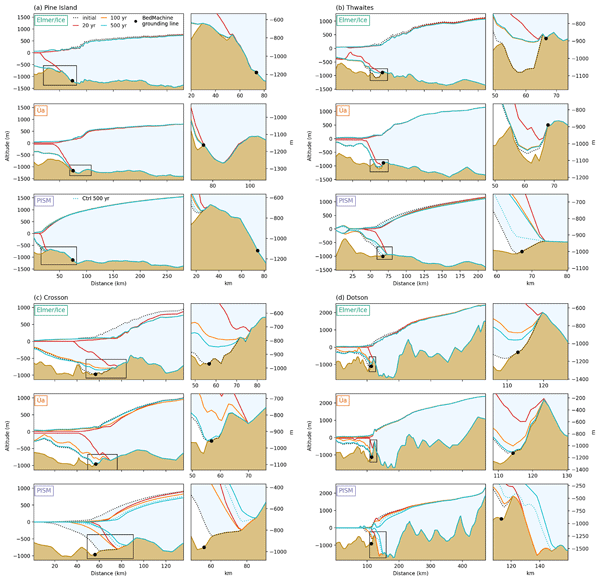
The grounding lines of the Antarctic Ice Sheet could enter phases of irreversible retreat or advance. We use three ice sheet models to show that the present-day locations of Antarctic grounding lines are reversible with respect to a small perturbation away from their current position. This indicates that present-day retreat of the grounding lines is not yet irreversible or self-enhancing.
Fanny Brun, Owen King, Marion Réveillet, Charles Amory, Anton Planchot, Etienne Berthier, Amaury Dehecq, Tobias Bolch, Kévin Fourteau, Julien Brondex, Marie Dumont, Christoph Mayer, Silvan Leinss, Romain Hugonnet, and Patrick Wagnon
The Cryosphere, 17, 3251–3268, https://doi.org/10.5194/tc-17-3251-2023, https://doi.org/10.5194/tc-17-3251-2023, 2023
Short summary
Short summary
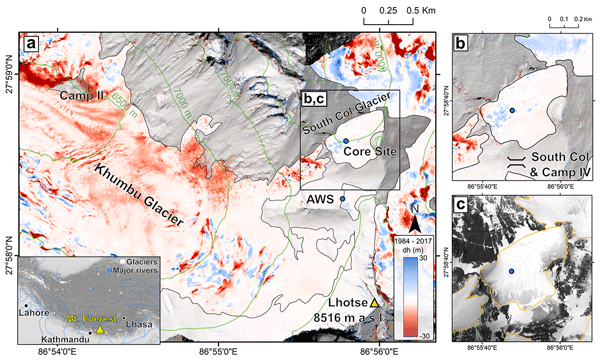
The South Col Glacier is a small body of ice and snow located on the southern ridge of Mt. Everest. A recent study proposed that South Col Glacier is rapidly losing mass. In this study, we examined the glacier thickness change for the period 1984–2017 and found no thickness change. To reconcile these results, we investigate wind erosion and surface energy and mass balance and find that melt is unlikely a dominant process, contrary to previous findings.
Cyrille Mosbeux, Laurie Padman, Emilie Klein, Peter D. Bromirski, and Helen A. Fricker
The Cryosphere, 17, 2585–2606, https://doi.org/10.5194/tc-17-2585-2023, https://doi.org/10.5194/tc-17-2585-2023, 2023
Short summary
Short summary
Antarctica's ice shelves (the floating extension of the ice sheet) help regulate ice flow. As ice shelves thin or lose contact with the bedrock, the upstream ice tends to accelerate, resulting in increased mass loss. Here, we use an ice sheet model to simulate the effect of seasonal sea surface height variations and see if we can reproduce observed seasonal variability of ice velocity on the ice shelf. When correctly parameterised, the model fits the observations well.
Katherine Hutchinson, Julie Deshayes, Christian Éthé, Clément Rousset, Casimir de Lavergne, Martin Vancoppenolle, Nicolas C. Jourdain, and Pierre Mathiot
Geosci. Model Dev., 16, 3629–3650, https://doi.org/10.5194/gmd-16-3629-2023, https://doi.org/10.5194/gmd-16-3629-2023, 2023
Short summary
Short summary
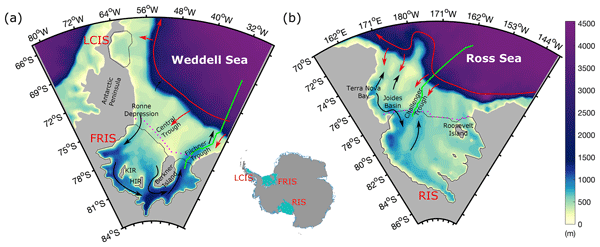
Bottom Water constitutes the lower half of the ocean’s overturning system and is primarily formed in the Weddell and Ross Sea in the Antarctic due to interactions between the atmosphere, ocean, sea ice and ice shelves. Here we use a global ocean 1° resolution model with explicit representation of the three large ice shelves important for the formation of the parent waters of Bottom Water. We find doing so reduces salt biases, improves water mass realism and gives realistic ice shelf melt rates.
Clara Burgard, Nicolas C. Jourdain, Ronja Reese, Adrian Jenkins, and Pierre Mathiot
The Cryosphere, 16, 4931–4975, https://doi.org/10.5194/tc-16-4931-2022, https://doi.org/10.5194/tc-16-4931-2022, 2022
Short summary
Short summary
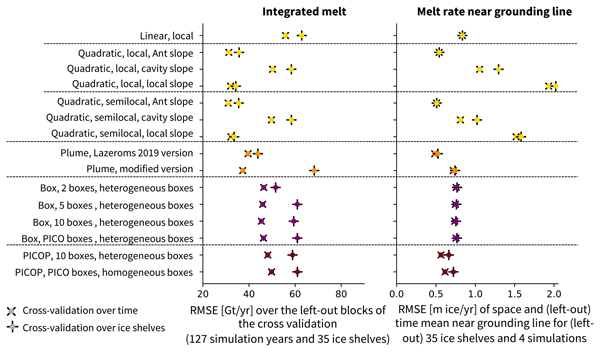
The ocean-induced melt at the base of the floating ice shelves around Antarctica is one of the largest uncertainty factors in the Antarctic contribution to future sea-level rise. We assess the performance of several existing parameterisations in simulating basal melt rates on a circum-Antarctic scale, using an ocean simulation resolving the cavities below the shelves as our reference. We find that the simple quadratic slope-independent and plume parameterisations yield the best compromise.
Jeremy Rohmer, Remi Thieblemont, Goneri Le Cozannet, Heiko Goelzer, and Gael Durand
The Cryosphere, 16, 4637–4657, https://doi.org/10.5194/tc-16-4637-2022, https://doi.org/10.5194/tc-16-4637-2022, 2022
Short summary
Short summary
To improve the interpretability of process-based projections of the sea-level contribution from land ice components, we apply the machine-learning-based
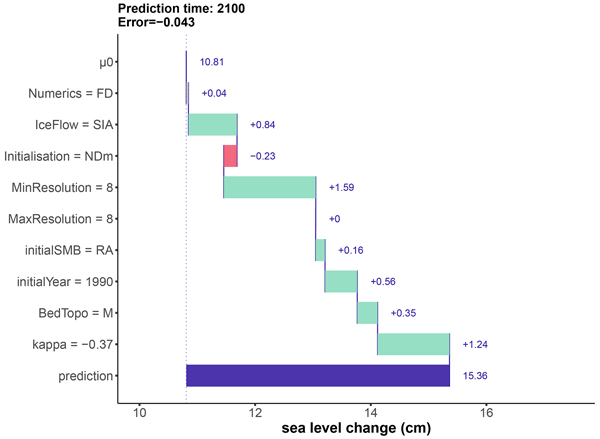
SHapley Additive exPlanationsapproach to a subset of a multi-model ensemble study for the Greenland ice sheet. This allows us to quantify the influence of particular modelling decisions (related to numerical implementation, initial conditions, or parametrisation of ice-sheet processes) directly in terms of sea-level change contribution.
Christoph Kittel, Charles Amory, Stefan Hofer, Cécile Agosta, Nicolas C. Jourdain, Ella Gilbert, Louis Le Toumelin, Étienne Vignon, Hubert Gallée, and Xavier Fettweis
The Cryosphere, 16, 2655–2669, https://doi.org/10.5194/tc-16-2655-2022, https://doi.org/10.5194/tc-16-2655-2022, 2022
Short summary
Short summary
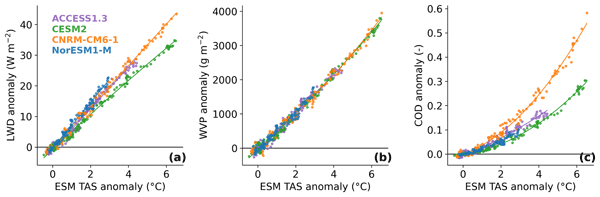
Model projections suggest large differences in future Antarctic surface melting even for similar greenhouse gas scenarios and warming rates. We show that clouds containing a larger amount of liquid water lead to stronger melt. As surface melt can trigger the collapse of the ice shelves (the safety band of the Antarctic Ice Sheet), clouds could be a major source of uncertainties in projections of sea level rise.
Anna Derkacheva, Fabien Gillet-Chaulet, Jeremie Mouginot, Eliot Jager, Nathan Maier, and Samuel Cook
The Cryosphere, 15, 5675–5704, https://doi.org/10.5194/tc-15-5675-2021, https://doi.org/10.5194/tc-15-5675-2021, 2021
Short summary
Short summary
Along the edges of the Greenland Ice Sheet surface melt lubricates the bed and causes large seasonal fluctuations in ice speeds during summer. Accurately understanding how these ice speed changes occur is difficult due to the inaccessibility of the glacier bed. We show that by using surface velocity maps with high temporal resolution and numerical modelling we can infer the basal conditions that control seasonal fluctuations in ice speed and gain insight into seasonal dynamics over large areas.
Cited articles
Albrecht, T. and Levermann, A.: Fracture field for large-scale ice dynamics, J. Glaciol., 58, 165–176, https://doi.org/10.3189/2012JoG11J191, 2012. a
Alley, K. E., Scambos, T. A., Alley, R. B., and Holschuh, N.: Troughs developed in ice-stream shear margins precondition ice shelves for ocean-driven breakup, Science Advances, 5, eaax2215, https://doi.org/10.1126/sciadv.aax2215, 2019. a
Berg, B. and Bassis, J.: Crevasse advection increases glacier calving, J. Glaciol., 68, 977–986, https://doi.org/10.1017/jog.2022.10, 2022. a
Brezzi, F., Marini, L. D., and Süli, E.: Discontinuous galerkin methods for first-order hyperbolic problems, Math. Mod. Meth. Appl. S., 14, 1893–1903, https://doi.org/10.1142/S0218202504003866, 2004. a, b
Brondex, J., Gillet-Chaulet, F., and Gagliardini, O.: Sensitivity of centennial mass loss projections of the Amundsen basin to the friction law, The Cryosphere, 13, 177–195, https://doi.org/10.5194/tc-13-177-2019, 2019. a
Brus, S. R., Wirasaet, D., Westerink, J. J., and Dawson, C.: Performance and scalability improvements for discontinuous Galerkin solutions to conservation laws on unstructured grids, J. Sci. Comput., 70, 210–242, https://doi.org/10.1007/s10915-016-0249-y, 2017. a
Cheng, G., Morlighem, M., and Gudmundsson, G. H.: Numerical stabilization methods for level-set-based ice front migration, Geosci. Model Dev., 17, 6227–6247, https://doi.org/10.5194/gmd-17-6227-2024, 2024. a
Cuffey, K. M. and Paterson, W. S. B.: The Physics of Glaciers, Academic Press, New York, ISBN 978-0-12-369461-4, 2010. a
Côté, J. and Staniforth, A.: A two-time-level semi-Lagrangian semi-implicit scheme for spectral models, Mon. Weather Rev., 116, 2003–2012, https://doi.org/10.1175/1520-0493(1988)116<2003:ATTLSL>2.0.CO;2, 1988. a
Dapogny, C., Dobrzynski, C., and Frey, P.: Three-dimensional adaptive domain remeshing, implicit domain meshing, and applications to free and moving boundary problems, J. Comput. Phys., 262, 358–378, https://doi.org/10.1016/j.jcp.2014.01.005, 2014. a
Gagliardini, O. and Meyssonnier, J.: Flow simulation of a firn-covered cold glacier, Ann. Glaciol., 24, 242–248, https://doi.org/10.3189/S0260305500012246, 1997. a
Gagliardini, O., Zwinger, T., Gillet-Chaulet, F., Durand, G., Favier, L., de Fleurian, B., Greve, R., Malinen, M., Martín, C., Råback, P., Ruokolainen, J., Sacchettini, M., Schäfer, M., Seddik, H., and Thies, J.: Capabilities and performance of Elmer/Ice, a new-generation ice sheet model, Geosci. Model Dev., 6, 1299–1318, https://doi.org/10.5194/gmd-6-1299-2013, 2013. a, b
Gilbert, A., Gagliardini, O., Vincent, C., and Wagnon, P.: A 3-D thermal regime model suitable for cold accumulation zones of polythermal mountain glaciers, J. Geophys. Res.-Earth, 119, 1876–1893, https://doi.org/10.1002/2014JF003199, 2014. a
Gilbert, A., Vincent, C., Gagliardini, O., Krug, J., and Berthier, E.: Assessment of thermal change in cold avalanching glaciers in relation to climate warming, Geophys. Res. Lett., 42, 6382–6390, https://doi.org/10.1002/2015GL064838, 2015. a
Gillet-Chaulet, F., Gagliardini, O., Meyssonnier, J., Zwinger, T., and Ruokolainen, J.: Flow-induced anisotropy in polar ice and related ice-sheet flow modelling, J. Non-Newton. Fluid, 134, 33–43, https://doi.org/10.1016/j.jnnfm.2005.11.005, 2006. a
Gillet-Chaulet, F., Hindmarsh, R. C. A., Corr, H. F. J., King, E. C., and Jenkins, A.: In-situquantification of ice rheology and direct measurement of the Raymond Effect at Summit, Greenland using a phase-sensitive radar, Geophys. Res. Lett., 38, L24503, https://doi.org/10.1029/2011GL049843, 2011. a
Gillet-Chaulet, F., Gagliardini, O., Seddik, H., Nodet, M., Durand, G., Ritz, C., Zwinger, T., Greve, R., and Vaughan, D. G.: Greenland ice sheet contribution to sea-level rise from a new-generation ice-sheet model, The Cryosphere, 6, 1561–1576, https://doi.org/10.5194/tc-6-1561-2012, 2012. a, b, c
Glen, J. W.: The creep of polycrystalline ice, P. Roy. Soc. A-Math. Phy., 228, 519–538, https://doi.org/10.1098/rspa.1955.0066, 1955. a
Grinsted, A., Rathmann, N. M., Mottram, R., Solgaard, A. M., Mathiesen, J., and Hvidberg, C. S.: Failure strength of glacier ice inferred from Greenland crevasses, The Cryosphere, 18, 1947–1957, https://doi.org/10.5194/tc-18-1947-2024, 2024. a
Haselbacher, A., Najjar, F. M., and Ferry, J. P.: An efficient and robust particle-localization algorithm for unstructured grids, J. Comput. Phys., 225, 2198–2213, https://doi.org/10.1016/j.jcp.2007.03.018, 2007. a
Hill, E. A., Urruty, B., Reese, R., Garbe, J., Gagliardini, O., Durand, G., Gillet-Chaulet, F., Gudmundsson, G. H., Winkelmann, R., Chekki, M., Chandler, D., and Langebroek, P. M.: The stability of present-day Antarctic grounding lines – Part 1: No indication of marine ice sheet instability in the current geometry, The Cryosphere, 17, 3739–3759, https://doi.org/10.5194/tc-17-3739-2023, 2023. a, b
Hughes, T. J. R.: Recent progress in the development and understanding of SUPG methods with special reference to the compressible Euler and Navier-Stokes equations, Int. J. Numer. Meth. Fl., 7, 1261–1275, https://doi.org/10.1002/fld.1650071108, 1987. a
Huth, A., Duddu, R., and Smith, B.: A generalized interpolation material point method for shallow ice shelves. 1: Shallow shelf approximation and ice thickness evolution, J. Adv. Model. Earth Sy., 13, e2020MS002277, https://doi.org/10.1029/2020MS002277, 2021a. a
Huth, A., Duddu, R., and Smith, B.: A generalized interpolation material point method for shallow ice shelves. 2: Anisotropic nonlocal damage mechanics and rift propagation, J. Adv. Model. Earth Sy., 13, e2020MS002292, https://doi.org/10.1029/2020MS002292, 2021b. a
Huth, A., Duddu, R., Smith, B., and Sergienko, O.: Simulating the processes controlling ice-shelf rift paths using damage mechanics, J. Glaciol., 69, 1915–1928, https://doi.org/10.1017/jog.2023.71, 2023. a
Jiménez, S., Duddu, R., and Bassis, J.: An updated-Lagrangian damage mechanics formulation for modeling the creeping flow and fracture of ice sheets, Comput. Method. Appl. M., 313, 406–432, https://doi.org/10.1016/j.cma.2016.09.034, 2017. a
Jouvet, G., Röllin, S., Sahli, H., Corcho, J., Gnägi, L., Compagno, L., Sidler, D., Schwikowski, M., Bauder, A., and Funk, M.: Mapping the age of ice of Gauligletscher combining surface radionuclide contamination and ice flow modeling, The Cryosphere, 14, 4233–4251, https://doi.org/10.5194/tc-14-4233-2020, 2020. a
Ketefian, G. S., Gross, E. S., and Stelling, G. S.: Accurate and consistent particle tracking on unstructured grids, Int. J. Numer. Meth. Fl., 80, 648–665, https://doi.org/10.1002/fld.4168, 2016. a, b
Klein, E., Mosbeux, C., Bromirski, P. D., Padman, L., Bock, Y., Springer, S. R., and Fricker, H. A.: Annual cycle in flow of Ross Ice Shelf, Antarctica: contribution of variable basal melting, J. Glaciol., 66, 861–875, https://doi.org/10.1017/jog.2020.61, 2020. a
Krug, J., Weiss, J., Gagliardini, O., and Durand, G.: Combining damage and fracture mechanics to model calving, The Cryosphere, 8, 2101–2117, https://doi.org/10.5194/tc-8-2101-2014, 2014. a, b, c
Kuzmin, D.: On the design of general-purpose flux limiters for finite element schemes. I. Scalar convection, J. Comput. Phys., 219, 513–531, https://doi.org/10.1016/j.jcp.2006.03.034, 2006. a
Kuzmin, D.: A vertex-based hierarchical slope limiter for p-adaptive discontinuous Galerkin methods, J. Comput. Appl. Math., 233, 3077–3085, https://doi.org/10.1016/j.cam.2009.05.028, 2010. a
Lhermitte, S., Sun, S., Shuman, C., Wouters, B., Pattyn, F., Wuite, J., Berthier, E., and Nagler, T.: Damage accelerates ice shelf instability and mass loss in Amundsen Sea Embayment, P. Natl. Acad. Sci. USA, 117, 24735–24741, https://doi.org/10.1073/pnas.1912890117, 2020. a, b, c, d
Li, Y., Coulon, V., Blasco, J., Qiao, G., Yang, Q., and Pattyn, F.: Damage intensity increases ice mass loss from Thwaites Glacier, Antarctica, The Cryosphere, 19, 4373–4390, https://doi.org/10.5194/tc-19-4373-2025, 2025. a
Löfgren, A., Ahlkrona, J., and Helanow, C.: Increasing stable time-step sizes of the free-surface problem arising in ice-sheet simulations, Journal of Computational Physics: X, 16, 100114, https://doi.org/10.1016/j.jcpx.2022.100114, 2022. a
Macayeal, D. R.: A tutorial on the use of control methods in ice-sheet modeling, J. Glaciol., 39, 91–98, https://doi.org/10.3189/S0022143000015744, 1993. a
Macpherson, G. B., Nordin, N., and Weller, H. G.: Particle tracking in unstructured, arbitrary polyhedral meshes for use in CFD and molecular dynamics, Commun. Numer. Meth. En., 25, 263–273, https://doi.org/10.1002/cnm.1128, 2009. a, b, c, d
Masud, A. and Khurram, R. A.: A multiscale/stabilized finite element method for the advection–diffusion equation, Comput. Method. Appl. M., 193, 1997–2018, https://doi.org/10.1016/j.cma.2003.12.047, 2004. a
Mercenier, R., Lüthi, M. P., and Vieli, A.: Calving relation for tidewater glaciers based on detailed stress field analysis, The Cryosphere, 12, 721–739, https://doi.org/10.5194/tc-12-721-2018, 2018. a
Mercenier, R., Lüthi, M. P., and Vieli, A.: A transient coupled ice flow-damage model to simulate iceberg calving from tidewater outlet glaciers, J. Adv. Model. Earth Sy., 11, 3057–3072, https://doi.org/10.1029/2018MS001567, 2019. a
Mortezazadeh, M., Cossette, J.-F., Dastoor, A., de Grandpré, J., Ivanova, I., and Qaddouri, A.: Sweep interpolation: a cost-effective semi-Lagrangian scheme in the Global Environmental Multiscale model, Geosci. Model Dev., 17, 335–346, https://doi.org/10.5194/gmd-17-335-2024, 2024. a
Mosbeux, C.: Semi-Lagrangian Advection Scheme in Elmer/Ice – Benchmark and Damage Tests, Zenodo [code, data set, video], https://doi.org/10.5281/zenodo.15741827, 2025a. a, b
Mosbeux, C.: Semi-Lagrangian Advection Scheme in Elmer/Ice – Benchmark and Damage Tests, GitHub [data set], https://github.com/cmosbeux/SEMI-LAGRANGIAN-PUBLICATION (last access: 15 June 2026), 2025b. a
Mosbeux, C., Gillet-Chaulet, F., and Gagliardini, O.: Comparison of adjoint and nudging methods to initialise ice sheet model basal conditions, Geosci. Model Dev., 9, 2549–2562, https://doi.org/10.5194/gmd-9-2549-2016, 2016. a
Mosbeux, C., Wagner, T. J. W., Becker, M. K., and Fricker, H. A.: Viscous and elastic buoyancy stresses as drivers of ice-shelf calving, J. Glaciol., 66, 643–657, https://doi.org/10.1017/jog.2020.35, 2020. a
Mosbeux, C., Padman, L., Klein, E., Bromirski, P. D., and Fricker, H. A.: Seasonal variability in Antarctic ice shelf velocities forced by sea surface height variations, The Cryosphere, 17, 2585–2606, https://doi.org/10.5194/tc-17-2585-2023, 2023. a
Ouardghi, A., El-Amrani, M., and Seaid, M.: An adaptive enriched semi-Lagrangian finite element method for coupled flow-transport problems, Comput. Fluids, 240, 105474, https://doi.org/10.1016/j.compfluid.2022.105474, 2022. a, b
Priestley, A.: A quasi-conservative version of the semi-Lagrangian advection scheme, Mon. Weather Rev., 121, 621–629, https://doi.org/10.1175/1520-0493(1993)121<0621:AQCVOT>2.0.CO;2, 1993. a
Ranganathan, M., Robel, A. A., Huth, A., and Duddu, R.: Glacier damage evolution over ice flow timescales, The Cryosphere, 19, 1599–1619, https://doi.org/10.5194/tc-19-1599-2025, 2025. a, b
Reed, W. H. andHill, T. R.: Triangular Mesh Methods for the Neutron Transport Equation, Los Alamos Scientific Laboratory Report LA-UR-73-479, OSTI 4491151, presented at the American Nuclear Society Topical Meeting on Mathematical Models and Computational Techniques for Analysis of Nuclear Systems, Ann Arbor, Michigan, 1973. a
Ruokolainen, J., Råback, P., Malinen, M., Zwinger, T., Kataja, J., Ilvonen, S., Lyly, M., Byckling, M., Takala, E., Gillet-Chaulet, F., Gagliardini, O., Todd, J., Gladstone, R., Gong, C., Cook, S., Robertsen, F., Wheel, I., Chekki, M., Ponomarev, P., van Dongen, E., Thies, J., Saeki, T., Löfgren, A., Rodenberg, B., and Schannwell, C.: ElmerFEM, Zenodo [code], https://doi.org/10.5281/zenodo.19888172, 2026. a
Samelson, R. M. and Wiggins, S.: Lagrangian Transport in Geophysical Jets and Waves: The Dynamical Systems Approach, in: Interdisciplinary Applied Mathematics, Vol. 31, Springer, New York, https://doi.org/10.1007/978-0-387-46213-4, 2006. a
Seroussi, H., Morlighem, M., Rignot, E., Larour, E., Aubry, D., Ben Dhia, H., and Kristensen, S. S.: Ice flux divergence anomalies on 79north Glacier, Greenland, Geophys. Res. Lett., 38, L09501, https://doi.org/10.1029/2011GL047338, 2011. a
Smith, B., Fricker, H. A., Gardner, A. S., Medley, B., Nilsson, J., Paolo, F. S., Holschuh, N., Adusumilli, S., Brunt, K., Csatho, B., Harbeck, K., Markus, T., Neumann, T., Siegfried, M. R., and Zwally, H. J.: Pervasive ice sheet mass loss reflects competing ocean and atmosphere processes, Science, 368, 1239–1242, https://doi.org/10.1126/science.aaz5845, 2020. a
Sun, S. and Gudmundsson, G. H.: The speedup of Pine Island Ice Shelf between 2017 and 2020: revaluating the importance of ice damage, J. Glaciol., 69, 1983–1991, https://doi.org/10.1017/jog.2023.76, 2023. a
Sun, S., Cornford, S. L., Moore, J. C., Gladstone, R., and Zhao, L.: Ice shelf fracture parameterization in an ice sheet model, The Cryosphere, 11, 2543–2554, https://doi.org/10.5194/tc-11-2543-2017, 2017. a, b
Van Liefferinge, B. and Pattyn, F.: Using ice-flow models to evaluate potential sites of million year-old ice in Antarctica, Clim. Past, 9, 2335–2345, https://doi.org/10.5194/cp-9-2335-2013, 2013. a
Weertman, J.: Creep deformation of ice, Annu. Rev. Earth Pl. Sc., 11, 215–240, https://doi.org/10.1146/annurev.ea.11.050183.001243, 1983. a
Wirbel, A., Jarosch, A. H., and Nicholson, L.: Modelling debris transport within glaciers by advection in a full-Stokes ice flow model, The Cryosphere, 12, 189–204, https://doi.org/10.5194/tc-12-189-2018, 2018. a, b
Zalesak, S. T.: Fully multidimensional flux-corrected transport algorithms for fluids, J. Comput. Phys., 31, 335–362, https://doi.org/10.1016/0021-9991(79)90051-2, 1979. a
Zienkiewicz, O. C., Taylor, R. L., Sherwin, S. J., and Peiró, J.: On discontinuous Galerkin methods, Int. J. Numer. Meth. Eng., 58, 1119–1148, https://doi.org/10.1002/nme.884, 2003. a
Short summary
Transport processes like rocks carried by ice flow and damage evolution – a proxy for crevasses – are key in ice sheet modeling and should occur without diffusion. Yet, standard numerical methods often blur these features. We explore a particle-based Semi-Lagrangian approach, comparing it to a Discontinuous Galerkin method, and show it can accurately simulate such transport when run at high enough resolution.
Transport processes like rocks carried by ice flow and damage evolution – a proxy for crevasses...


