
Articles | Volume 19, issue 17
https://doi.org/10.5194/gmd-19-8115-2026
© Author(s) 2026. This work is distributed under
the Creative Commons Attribution 4.0 License.
the Creative Commons Attribution 4.0 License.
https://doi.org/10.5194/gmd-19-8115-2026
© Author(s) 2026. This work is distributed under
the Creative Commons Attribution 4.0 License.
the Creative Commons Attribution 4.0 License.
Model evaluation paper
| 
02 Sep 2026
Model evaluation paper |
| 02 Sep 2026
| 02 Sep 2026
Modelling wind farm effects in HARMONIE-AROME (cycle 43.2.2) – Part 2: wind turbine database and application to Europe

DTU Wind and Energy Systems, Frederiksborgvej 399, 4000 Roskilde, Denmark
Bjarke T. E. Olsen
DTU Wind and Energy Systems, Frederiksborgvej 399, 4000 Roskilde, Denmark
Marc Imberger
DTU Wind and Energy Systems, Frederiksborgvej 399, 4000 Roskilde, Denmark
Henrik Vedel
Danish Meteorological Institute, Sankt Kjelds Plads 11, 2100 København Ø, Copenhagen, Denmark
Kristian H. Møller
Danish Meteorological Institute, Sankt Kjelds Plads 11, 2100 København Ø, Copenhagen, Denmark
Andrea N. Hahmann
DTU Wind and Energy Systems, Frederiksborgvej 399, 4000 Roskilde, Denmark
Xiaoli Guo Larsén
DTU Wind and Energy Systems, Frederiksborgvej 399, 4000 Roskilde, Denmark
Related authors
Sima Hamzeloo, Xiaoli Guo Larsén, Alfredo Peña, Jana Fischereit, and Oscar García-Santiago
Wind Energ. Sci. Discuss., https://doi.org/10.5194/wes-2025-267, https://doi.org/10.5194/wes-2025-267, 2026
Revised manuscript accepted for WES
Short summary
Short summary
We studied how winds and ocean waves affect each other during a North Sea storm. Using a multiscale approach that captures processes from kilometers down to meters, we linked wind and wave models and compared the results with real measurements. Our aim was to improve current simulation methods, and the findings show that this detailed approach provides more accurate storm predictions up to 100 m height.
Jana Fischereit, Henrik Vedel, Xiaoli Guo Larsén, Natalie E. Theeuwes, Gregor Giebel, and Eigil Kaas
Geosci. Model Dev., 17, 2855–2875, https://doi.org/10.5194/gmd-17-2855-2024, https://doi.org/10.5194/gmd-17-2855-2024, 2024
Short summary
Short summary
Wind farms impact local wind and turbulence. To incorporate these effects in weather forecasting, the explicit wake parameterization (EWP) is added to the forecasting model HARMONIE–AROME. We evaluate EWP using flight data above and downstream of wind farms, comparing it with an alternative wind farm parameterization and another weather model. Results affirm the correct implementation of EWP, emphasizing the necessity of accounting for wind farm effects in accurate weather forecasting.
Jana Fischereit, Kurt Schaldemose Hansen, Xiaoli Guo Larsén, Maarten Paul van der Laan, Pierre-Elouan Réthoré, and Juan Pablo Murcia Leon
Wind Energ. Sci., 7, 1069–1091, https://doi.org/10.5194/wes-7-1069-2022, https://doi.org/10.5194/wes-7-1069-2022, 2022
Short summary
Short summary
Wind turbines extract kinetic energy from the flow to create electricity. This induces a wake of reduced wind speed downstream of a turbine and consequently downstream of a wind farm. Different types of numerical models have been developed to calculate this effect. In this study, we compared models of different complexity, together with measurements over two wind farms. We found that higher-fidelity models perform better and the considered rapid models cannot fully capture the wake effect.
Nicolas G. Alonso-de-Linaje, Andrea N. Hahmann, and Alfredo Peña
Wind Energ. Sci. Discuss., https://doi.org/10.5194/wes-2026-143, https://doi.org/10.5194/wes-2026-143, 2026
Preprint under review for WES
Short summary
Short summary
Offshore wind farms create wind shadows that reduce energy for nearby farms. Traditional weather simulations require weeks of computing time, making extensive testing impractical. We developed a fast tool that estimates these wind shadows in seconds using turbine positions and local wind data. It closely matches detailed simulations for current and future North Sea layouts and is applicable in the Baltic Sea, enabling planners to evaluate many options quickly.
Nathalia Correa-Sánchez, Xiaoli Guo Larsén, Eleonora Dallan, Marco Borga, and Francesco Marra
Wind Energ. Sci., 11, 2961–2985, https://doi.org/10.5194/wes-11-2961-2026, https://doi.org/10.5194/wes-11-2961-2026, 2026
Short summary
Short summary
This research presents the first use of the simplified metastatistical extreme value approach for wind extremes, extending it to wind energy applications. We use a categorical framework that combines climate, roughness, and topography to evaluate convection-permitted models. We find that model formulation drives inter-model uncertainties, rather than surface conditions. Convection-permitted models' uncertainty analysis improves the reliability of extreme wind estimates for design parameters.
Georgios Deskos, Jiali Wang, Sanjay Arwade, Murray Fisher, Brian Hirth, Xiaoli Guo Larsén, Julie K. Lundquist, Andrew Myers, Weichiang Pang, William J. Pringle, Robert Rogers, Miguel Sanchez-Gomez, Chao Sun, Atsushi Yamaguchi, and Paul Veers
Wind Energ. Sci., 11, 2749–2782, https://doi.org/10.5194/wes-11-2749-2026, https://doi.org/10.5194/wes-11-2749-2026, 2026
Short summary
Short summary
Wind energy is expanding into regions exposed to tropical cyclones, where extreme winds and waves can damage turbines and disrupt energy production. We reviewed observations, simulations, engineering standards, and risk quantification frameworks to identify the most important gaps. Today's design rules, originally built for milder storms, do not capture cyclone hazards. Closing these gaps requires better offshore measurements, improved models, and risk-informed design standards.
Keeta Chapman-Smith, Xiaoli Guo Larsén, and Mark Laier Brodersen
Wind Energ. Sci., 11, 1889–1912, https://doi.org/10.5194/wes-11-1889-2026, https://doi.org/10.5194/wes-11-1889-2026, 2026
Short summary
Short summary
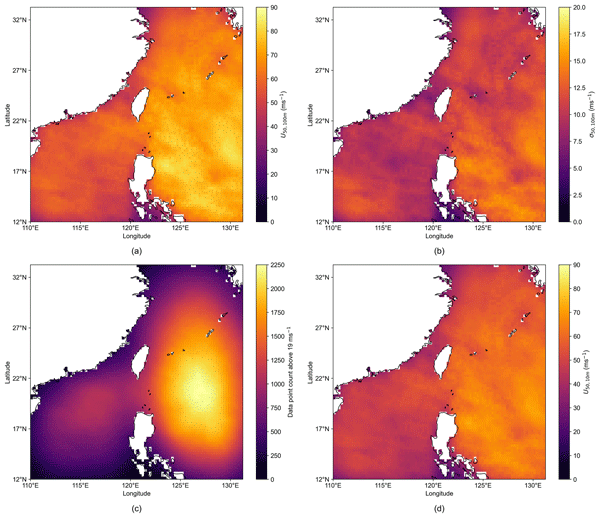
This study presents a method to estimate wind speeds that could occur in a 50-year period. The 50-year wind speed is calculated for three regions: Taiwan, Japan, and the east coast of the US. The method performs well in Taiwan and Japan, which can be attributed to the large dataset size located in a limited spatial area. The east coast of the US performs less well due to the smaller dataset size and wider spatial region that they cover.
Xiaoli Guo Larsén, Marc Imberger, and Rogier Floors
Wind Energ. Sci., 11, 1853–1869, https://doi.org/10.5194/wes-11-1853-2026, https://doi.org/10.5194/wes-11-1853-2026, 2026
Short summary
Short summary
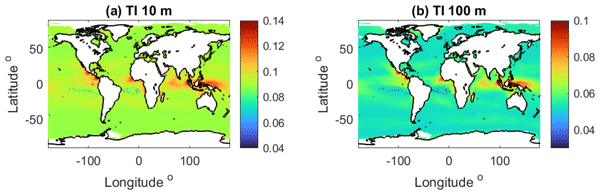
This study delivers a method and datasets for a global offshore atlas for turbulence intensity from a height of 10 m to 200 m. The method innovatively includes both two-dimensional and three-dimensional turbulence, along with stability, wave age and height. Results show satisfactory agreement with measurements and data from the literature.
Oscar García-Santiago, Jake Badger, Andrea N. Hahmann, Patrick J. H. Volker, Søren Ott, M. Paul van der Laan, and Mark Kelly
EGUsphere, https://doi.org/10.5194/egusphere-2026-2144, https://doi.org/10.5194/egusphere-2026-2144, 2026
Short summary
Short summary
We improve how weather models represent the turbulence generated by wind turbines within and behind wind farms. Rather than adding this turbulence only at grid squares with turbine locations, the new method transports it through the wake as it moves downwind. Tests against high-resolution simulations of an idealised wind farm showed better agreement in wake turbulence and more accurate reductions in wind speed, providing a more realistic picture of wake effects across the wind farm.
Sara Müller, Xiaoli Guo Larsén, and Fei Hu
Wind Energ. Sci., 11, 961–981, https://doi.org/10.5194/wes-11-961-2026, https://doi.org/10.5194/wes-11-961-2026, 2026
Short summary
Short summary
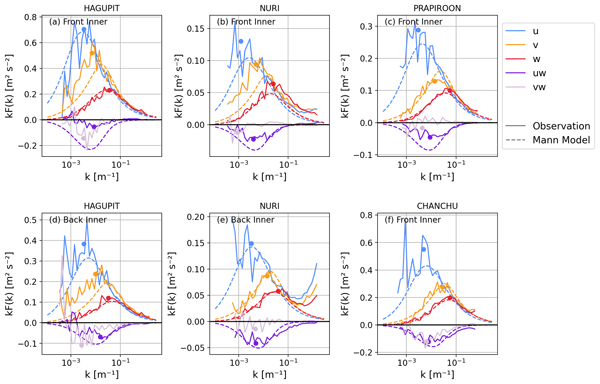
Wind farms are being developed in areas prone to tropical cyclones. However, it remains unclear whether turbulence models in current design standards, such as the Mann uniform shear model, are suitable for these conditions. For the first time, the Mann model is assessed in depth using high-frequency measurements from four typhoons. Larger-than-predicted spectral energy is found at small wavenumbers in the outer cyclone and, in some cases, in the crosswind component in the inner cyclone.
Johanne Kristine Haandbæk Øelund, Jens Hesselbjerg Christensen, Rune Magnus Koktvedgaard Zeitzen, Henrik Vedel, and Henrik Feddersen
Nat. Hazards Earth Syst. Sci., 26, 1039–1057, https://doi.org/10.5194/nhess-26-1039-2026, https://doi.org/10.5194/nhess-26-1039-2026, 2026
Short summary
Short summary
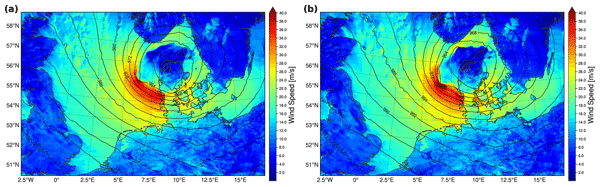
This study explores how a powerful storm like Anatol, which hit Denmark in 1999, could change in a warmer future climate. Using a weather model, the storm was simulated under future temperature conditions. Results show stronger winds affecting larger areas for longer periods. A new index was introduced to measure storm severity. The findings highlight the growing risks to infrastructure and the need for better storm preparedness.

Branko Kosović, Sukanta Basu, Jacob Berg, Larry K. Berg, Sue E. Haupt, Xiaoli G. Larsén, Joachim Peinke, Richard J. A. M. Stevens, Paul Veers, and Simon Watson
Wind Energ. Sci., 11, 509–555, https://doi.org/10.5194/wes-11-509-2026, https://doi.org/10.5194/wes-11-509-2026, 2026
Short summary
Short summary
Most human activity happens in the layer of the atmosphere which extends a few hundred meters to a couple of kilometers above the surface of the Earth. The flow in this layer is turbulent. Turbulence impacts wind power production and turbine lifespan. Optimizing wind turbine performance requires understanding how turbulence affects both wind turbine efficiency and reliability. This paper points to gaps in our knowledge that need to be addressed to effectively utilize wind resources.
Maksims Pogumirskis, Tija Sīle, Lasse Svenningsen, and Andrea N. Hahmann
Wind Energ. Sci. Discuss., https://doi.org/10.5194/wes-2026-24, https://doi.org/10.5194/wes-2026-24, 2026
Preprint under review for WES
Short summary
Short summary
We validate seven atmospheric model datasets against wind observations at turbine heights from more than 500 observation campaigns in Europe. We use principal component analysis to show that wind speed and direction have similar spatial and temporal patterns of biases in all seven model datasets. We link these biases to the terrain elevation differences between model and real-world. Two WRF model runs are performed and compared to provide a more robust support to the hypothesis.
Sima Hamzeloo, Xiaoli Guo Larsén, Alfredo Peña, Jana Fischereit, and Oscar García-Santiago
Wind Energ. Sci. Discuss., https://doi.org/10.5194/wes-2025-267, https://doi.org/10.5194/wes-2025-267, 2026
Revised manuscript accepted for WES
Short summary
Short summary
We studied how winds and ocean waves affect each other during a North Sea storm. Using a multiscale approach that captures processes from kilometers down to meters, we linked wind and wave models and compared the results with real measurements. Our aim was to improve current simulation methods, and the findings show that this detailed approach provides more accurate storm predictions up to 100 m height.
Stefan Ivanell, Bjarke T. Olsen, Antoine Mathieu, Cristina Mulet-Benzo, Abdul Haseeb Syed, Warit Chanprasert, Mikael Sjöholm, Jakob Mann, and Julia Gottschall
Wind Energ. Sci. Discuss., https://doi.org/10.5194/wes-2025-286, https://doi.org/10.5194/wes-2025-286, 2026
Preprint under review for WES
Short summary
Short summary
Modern GW-scale offshore wind farms face challenges from atmospheric dynamics. This study examines how boundary layer height (BLH) and large-scale turbulence affect efficiency and loads. Using WRF simulations, lidar data, and CFD modeling for a 100-turbine, 15 MW wind farm at three representative sites, we show that low BLH reduces performance. Turbulence-induced low-frequency fluctuations increase fatigue loads, underscoring the need to include BLH and turbulence in design models.
Nathalia Correa-Sánchez, Xiaoli Guo Larsén, Giorgia Fosser, Eleonora Dallan, Marco Borga, and Francesco Marra
Wind Energ. Sci., 10, 2551–2561, https://doi.org/10.5194/wes-10-2551-2025, https://doi.org/10.5194/wes-10-2551-2025, 2025
Short summary
Short summary
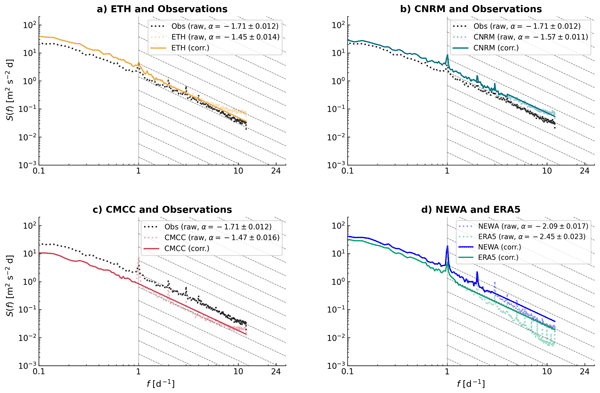
We examined the power spectra of wind speed in three convection-permitting models in central Europe and found that these models have a better representation of wind variability characteristics than standard wind datasets like the New European Wind Atlas, due to different simulation approaches, providing more reliable extreme wind predictions.
Bjarke T. E. Olsen, Andrea N. Hahmann, Nicolas G. Alonso-de-Linaje, Mark Žagar, and Martin Dörenkämper
Geosci. Model Dev., 18, 4499–4533, https://doi.org/10.5194/gmd-18-4499-2025, https://doi.org/10.5194/gmd-18-4499-2025, 2025
Short summary
Short summary
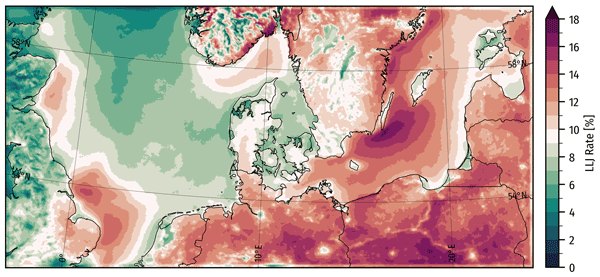
Low-level jets (LLJs) are strong winds in the lower atmosphere that are important for wind energy as turbines get taller. This study compares a weather model (WRF) with real data across five North and Baltic Sea sites. Adjusting the model improved accuracy over the widely used ERA5. In key offshore regions, LLJs occur 10–15 % of the time and significantly boost wind power, especially in spring and summer, contributing up to 30 % of total capacity in some areas.
Sara Müller, Xiaoli Guo Larsén, and David Robert Verelst
Wind Energ. Sci., 9, 1153–1171, https://doi.org/10.5194/wes-9-1153-2024, https://doi.org/10.5194/wes-9-1153-2024, 2024
Short summary
Short summary
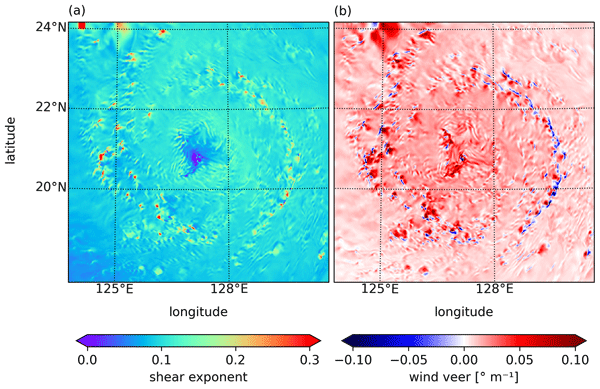
Tropical cyclone winds are challenging for wind turbines. We analyze a tropical cyclone before landfall in a mesoscale model. The simulated wind speeds and storm structure are sensitive to the boundary parametrization. However, independent of the boundary layer parametrization, the median change in wind speed and wind direction with height is small relative to wind turbine design standards. Strong spatial organization of wind shear and veer along the rainbands may increase wind turbine loads.
Oscar García-Santiago, Andrea N. Hahmann, Jake Badger, and Alfredo Peña
Wind Energ. Sci., 9, 963–979, https://doi.org/10.5194/wes-9-963-2024, https://doi.org/10.5194/wes-9-963-2024, 2024
Short summary
Short summary
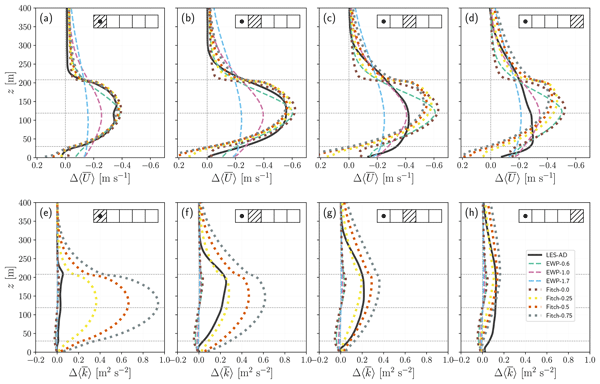
This study compares the results of two wind farm parameterizations (WFPs) in the Weather Research and Forecasting model, simulating a two-turbine array under three atmospheric stabilities with large-eddy simulations. We show that the WFPs accurately depict wind speeds either near turbines or in the far-wake areas, but not both. The parameterizations’ performance varies by variable (wind speed or turbulent kinetic energy) and atmospheric stability, with reduced accuracy in stable conditions.
Jana Fischereit, Henrik Vedel, Xiaoli Guo Larsén, Natalie E. Theeuwes, Gregor Giebel, and Eigil Kaas
Geosci. Model Dev., 17, 2855–2875, https://doi.org/10.5194/gmd-17-2855-2024, https://doi.org/10.5194/gmd-17-2855-2024, 2024
Short summary
Short summary
Wind farms impact local wind and turbulence. To incorporate these effects in weather forecasting, the explicit wake parameterization (EWP) is added to the forecasting model HARMONIE–AROME. We evaluate EWP using flight data above and downstream of wind farms, comparing it with an alternative wind farm parameterization and another weather model. Results affirm the correct implementation of EWP, emphasizing the necessity of accounting for wind farm effects in accurate weather forecasting.

Maarten Paul van der Laan, Oscar García-Santiago, Mark Kelly, Alexander Meyer Forsting, Camille Dubreuil-Boisclair, Knut Sponheim Seim, Marc Imberger, Alfredo Peña, Niels Nørmark Sørensen, and Pierre-Elouan Réthoré
Wind Energ. Sci., 8, 819–848, https://doi.org/10.5194/wes-8-819-2023, https://doi.org/10.5194/wes-8-819-2023, 2023
Short summary
Short summary
Offshore wind farms are more commonly installed in wind farm clusters, where wind farm interaction can lead to energy losses. In this work, an efficient numerical method is presented that can be used to estimate these energy losses. The novel method is verified with higher-fidelity numerical models and validated with measurements of an existing wind farm cluster.
Xiaoli Guo Larsén, Marc Imberger, Ásta Hannesdóttir, and Andrea N. Hahmann
Wind Energ. Sci. Discuss., https://doi.org/10.5194/wes-2022-102, https://doi.org/10.5194/wes-2022-102, 2023
Revised manuscript not accepted
Short summary
Short summary
We study how climate change will impact extreme winds and choice of turbine class. We use data from 18 CMIP6 members from a historic and a future period to access the change in the extreme winds. The analysis shows an overall increase in the extreme winds in the North Sea and the southern Baltic Sea, but a decrease over the Scandinavian Peninsula and most of the Baltic Sea. The analysis is inconclusive to whether higher or lower classes of turbines will be installed in the future.
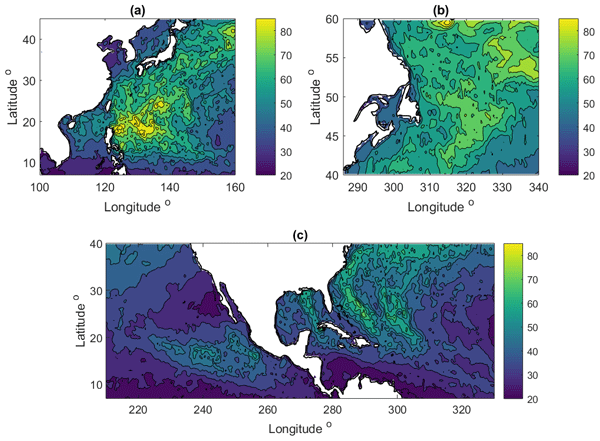
Xiaoli Guo Larsén and Søren Ott
Wind Energ. Sci., 7, 2457–2468, https://doi.org/10.5194/wes-7-2457-2022, https://doi.org/10.5194/wes-7-2457-2022, 2022
Short summary
Short summary
A method is developed for calculating the extreme wind in tropical-cyclone-affected water areas. The method is based on the spectral correction method that fills in the missing wind variability to the modeled time series, guided by best track data. The paper provides a detailed recipe for applying the method and the 50-year winds of equivalent 10 min temporal resolution from 10 to 150 m in several tropical-cyclone-affected regions.

Andrea N. Hahmann, Oscar García-Santiago, and Alfredo Peña
Wind Energ. Sci., 7, 2373–2391, https://doi.org/10.5194/wes-7-2373-2022, https://doi.org/10.5194/wes-7-2373-2022, 2022
Short summary
Short summary
We explore the changes in wind energy resources in northern Europe using output from simulations from the Climate Model Intercomparison Project (CMIP6) under the high-emission scenario. Our results show that climate change does not particularly alter annual energy production in the North Sea but could affect the seasonal distribution of these resources, significantly reducing energy production during the summer from 2031 to 2050.
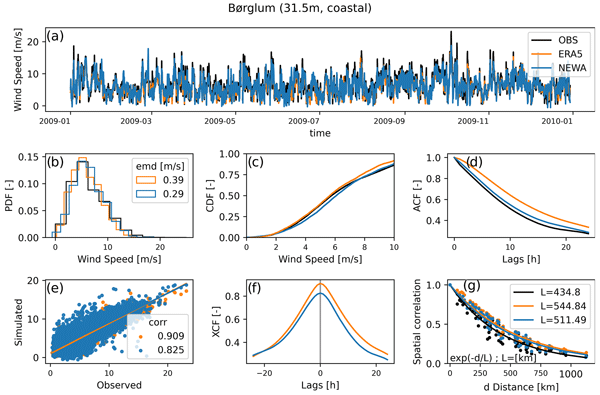
Graziela Luzia, Andrea N. Hahmann, and Matti Juhani Koivisto
Wind Energ. Sci., 7, 2255–2270, https://doi.org/10.5194/wes-7-2255-2022, https://doi.org/10.5194/wes-7-2255-2022, 2022
Short summary
Short summary
This paper presents a comprehensive validation of time series produced by a mesoscale numerical weather model, a global reanalysis, and a wind atlas against observations by using a set of metrics that we present as requirements for wind energy integration studies. We perform a sensitivity analysis on the numerical weather model in multiple configurations, such as related to model grid spacing and nesting arrangements, to define the model setup that outperforms in various time series aspects.
Jana Fischereit, Kurt Schaldemose Hansen, Xiaoli Guo Larsén, Maarten Paul van der Laan, Pierre-Elouan Réthoré, and Juan Pablo Murcia Leon
Wind Energ. Sci., 7, 1069–1091, https://doi.org/10.5194/wes-7-1069-2022, https://doi.org/10.5194/wes-7-1069-2022, 2022
Short summary
Short summary
Wind turbines extract kinetic energy from the flow to create electricity. This induces a wake of reduced wind speed downstream of a turbine and consequently downstream of a wind farm. Different types of numerical models have been developed to calculate this effect. In this study, we compared models of different complexity, together with measurements over two wind farms. We found that higher-fidelity models perform better and the considered rapid models cannot fully capture the wake effect.
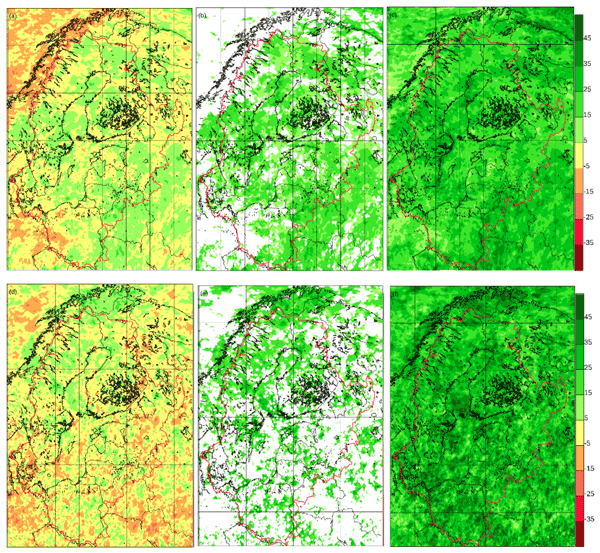
Anna Rutgersson, Erik Kjellström, Jari Haapala, Martin Stendel, Irina Danilovich, Martin Drews, Kirsti Jylhä, Pentti Kujala, Xiaoli Guo Larsén, Kirsten Halsnæs, Ilari Lehtonen, Anna Luomaranta, Erik Nilsson, Taru Olsson, Jani Särkkä, Laura Tuomi, and Norbert Wasmund
Earth Syst. Dynam., 13, 251–301, https://doi.org/10.5194/esd-13-251-2022, https://doi.org/10.5194/esd-13-251-2022, 2022
Short summary
Short summary
A natural hazard is a naturally occurring extreme event with a negative effect on people, society, or the environment; major events in the study area include wind storms, extreme waves, high and low sea level, ice ridging, heavy precipitation, sea-effect snowfall, river floods, heat waves, ice seasons, and drought. In the future, an increase in sea level, extreme precipitation, heat waves, and phytoplankton blooms is expected, and a decrease in cold spells and severe ice winters is anticipated.
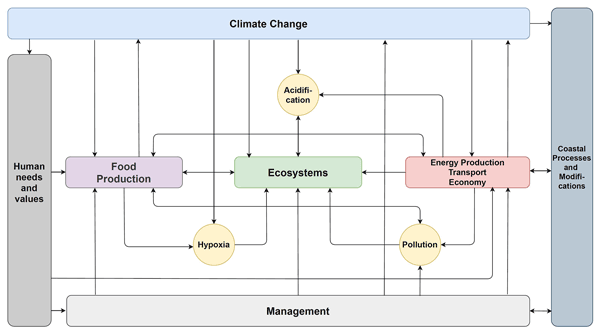
Marcus Reckermann, Anders Omstedt, Tarmo Soomere, Juris Aigars, Naveed Akhtar, Magdalena Bełdowska, Jacek Bełdowski, Tom Cronin, Michał Czub, Margit Eero, Kari Petri Hyytiäinen, Jukka-Pekka Jalkanen, Anders Kiessling, Erik Kjellström, Karol Kuliński, Xiaoli Guo Larsén, Michelle McCrackin, H. E. Markus Meier, Sonja Oberbeckmann, Kevin Parnell, Cristian Pons-Seres de Brauwer, Anneli Poska, Jarkko Saarinen, Beata Szymczycha, Emma Undeman, Anders Wörman, and Eduardo Zorita
Earth Syst. Dynam., 13, 1–80, https://doi.org/10.5194/esd-13-1-2022, https://doi.org/10.5194/esd-13-1-2022, 2022
Short summary
Short summary
As part of the Baltic Earth Assessment Reports (BEAR), we present an inventory and discussion of different human-induced factors and processes affecting the environment of the Baltic Sea region and their interrelations. Some are naturally occurring and modified by human activities, others are completely human-induced, and they are all interrelated to different degrees. The findings from this study can largely be transferred to other comparable marginal and coastal seas in the world.
Marc Imberger, Xiaoli Guo Larsén, and Neil Davis
Adv. Geosci., 56, 77–87, https://doi.org/10.5194/adgeo-56-77-2021, https://doi.org/10.5194/adgeo-56-77-2021, 2021
Short summary
Short summary
Events like mid-latitude storms with their high winds have an impact on wind energy production and forecasting of such events is crucial. This study investigates the capabilities of a global weather prediction model MPAS and looks at how key parameters like storm intensity, arrival time and duration are represented compared to measurements and traditional methods. It is found that storm intensity is represented well while model drifts negatively influence estimation of arrival time and duration.
Cited articles
Agarwal, N. J., Lundquist, J. K., Juliano, T. W., and Rybchuk, A.: A North Sea in situ evaluation of the Fitch wind farm parameterization within the Mellor–Yamada–Nakanishi–Niino and 3D planetary boundary layer schemes, Wind Energ. Sci., 11, 2369–2403, https://doi.org/10.5194/wes-11-2369-2026, 2026. a
Ali, K., Schultz, D. M., Revell, A., Stallard, T., and Ouro, P.: Assessment of Five Wind-Farm Parameterizations in the Weather Research and Forecasting Model: A Case Study of Wind Farms in the North Sea, Mon. Weather Rev., 151, 2333–2359, https://doi.org/10.1175/MWR-D-23-0006.1, 2023. a
Archer, C. L., Wu, S., Ma, Y., and Jiménez, P. A.: Two Corrections for Turbulent Kinetic Energy Generated by Wind Farms in the WRF Model, Mon. Weather Rev., 148, 4823–4835, https://doi.org/10.1175/MWR-D-20-0097.1, 2020. a
Breiman, L., Friedman, J. H., Olshen, R. A., and Stone, C. J.: Classification And Regression Trees, Routledge, https://doi.org/10.1201/9781315139470, 2017. a
Brümmer, B., Lange, I., and Konow, H.: Atmospheric boundary layer measurements at the 280 m high Hamburg weather mast 1995–2011: mean annual and diurnal cycles, Meteorol. Z., 21, 319–335, https://doi.org/10.1127/0941-2948/2012/0338, 2012. a, b
Cañadillas, B., Foreman, R., Barth, V., Siedersleben, S., Lampert, A., Platis, A., Djath, B., Schulz-Stellenfleth, J., Bange, J., Emeis, S., and Neumann, T.: Offshore wind farm wake recovery: Airborne measurements and its representation in engineering models, Wind Energy, 23, 1249–1265, https://doi.org/10.1002/we.2484, 2020. a
Christiansen, M. B. and Hasager, C. B.: Wake effects of large offshore wind farms identified from satellite SAR, Remote Sens. Environ., 98, 251–268, https://doi.org/10.1016/J.RSE.2005.07.009, 2005. a
Dirksen, M., Wijnant, I., Siebesma, P., Baas, P., and Theeuwes, N. E.: Validation of wind farm parameterisation in Weather Forecast Model HARMONIE-AROME, Tech. rep., Delft University of Technology, https://wins50.nl/downloads/dirksen_etal_validationreport.pdf (last access: 14 January 2025), 2022. a, b
Dunnett, S., Sorichetta, A., Taylor, G., and Eigenbrod, F.: Harmonised global datasets of wind and solar farm locations and power, Scientific Data, 7, 130, https://doi.org/10.1038/s41597-020-0469-8, 2020. a, b
ECMWF: ERA5: How to calculate Obukhov Length, ECMWF, https://confluence.ecmwf.int/display/CKB/ERA5%3A+How+to+calculate+Obukhov+Length (last access: 26 November 2024), 2024. a
EMD International: windPRO 4.0 User Manual – BASIS, EMD international, https://help.emd.dk/knowledgebase/content/windPRO4.0/c2-UK_windPRO4.0-BASIS.pdf (last access: 21 January 2025), 2023. a
Fischereit, J., Brown, R., Guo Larsén, X., Badger, J., and Hawkes, G.: Review of Mesoscale Wind-Farm Parametrizations and Their Applications, Bound.-Lay. Meteorol., 182, 175–224, https://doi.org/10.1007/s10546-021-00652-y, 2022a. a, b, c
Fischereit, J., Imberger, M., and Guo Larsén, X.: Cost-effective mesoscale modeling methods for offshore wind resource assessment with farm wake effect, in: Wind Europe – Technology Workshop, Brussels, https://windeurope.org/tech2022/programme/posters/PO062/ (last access: 27 November 2024), 2022b. a
Fischereit, J., Vedel, H., Larsén, X. G., Theeuwes, N. E., Giebel, G., and Kaas, E.: Modelling wind farm effects in HARMONIE–AROME (cycle 43.2.2) – Part 1: Implementation and evaluation, Geosci. Model Dev., 17, 2855–2875, https://doi.org/10.5194/gmd-17-2855-2024, 2024. a, b, c, d, e, f, g, h, i, j, k
Fischereit, J., Olsen, B. T. E., Hahmann, A. N., and Imberger, M.: Code and data for “Modelling wind farm effects in HARMONIE-AROME (cycle 43.2.2) – part 2: Wind turbine database and application to Europe”, Zenodo [code], https://doi.org/10.5281/zenodo.17495821, 2025. a
Fitch, A. C., Olson, J. B., Lundquist, J. K., Dudhia, J., Gupta, A. K., Michalakes, J., and Barstad, I.: Local and Mesoscale Impacts of Wind Farms as Parameterized in a Mesoscale NWP Model, Mon. Weather Rev., 140, 3017–3038, https://doi.org/10.1175/MWR-D-11-00352.1, 2012. a, b, c, d, e, f, g, h, i, j, k, l
Golbazi, M., Archer, C. L., and Alessandrini, S.: Surface impacts of large offshore wind farms, Environ. Res. Lett., 17, 064021, https://doi.org/10.1088/1748-9326/ac6e49, 2022. a, b, c
Hersbach, H., Bell, B., Berrisford, P., Biavati, G., Horányi, A., Muñoz Sabater, J., Nicolas, J., Peubey, C., Radu, R., Rozum, I., Schepers, D., Simmons, A., Soci, C., Dee, D., and Thépaut, J.-N.: ERA5 hourly data on single levels from 1979 to present, Copernicus Climate Change Service (C3S) Climate Data Store (CDS), https://doi.org/10.24381/cds.adbb2d47, 2018. a
Ho, T. K.: Random decision forests, in: Proceedings of 3rd International Conference on Document Analysis and Recognition, vol. 1, pp. 278–282, 1995. a
Hoeser, T. and Kuenzer, C.: DeepOWT: A global offshore wind turbine data set, Zenodo [data set], https://doi.org/10.5281/zenodo.5933967, 2022. a, b, c
Holtslag, M. C., Bierbooms, W. A. A. M., and Bussel, G. J. W. v.: Estimating atmospheric stability from observations and correcting wind shear models accordingly, J. Phys. Conf. Ser., 555, 012052, https://doi.org/10.1088/1742-6596/555/1/012052, 2014. a
Kalverla, P., Steeneveld, G. J., Ronda, R., and Holtslag, A. A.: Evaluation of three mainstream numerical weather prediction models with observations from meteorological mast IJmuiden at the North Sea, Wind Energy, 22, 34–48, https://doi.org/10.1002/WE.2267, 2019. a
Kangas, M., Rontu, L., Fortelius, C., Aurela, M., and Poikonen, A.: Weather model verification using Sodankylä mast measurements, Geosci. Instrum. Method. Data Syst., 5, 75–84, https://doi.org/10.5194/gi-5-75-2016, 2016. a
Kleebauer, M., Braun, A., Horst, D., and Pape, C.: Enhancing Wind Turbine Location Accuracy: A Deep Learning-Based Object Regression Approach for Validating Wind Turbine Geo-Coordinates, in: International Geoscience and Remote Sensing Symposium (IGARSS), pp. 7863–7867, https://doi.org/10.1109/IGARSS53475.2024.10641018, 2024. a
Larsén, X. G. and Fischereit, J.: A case study of wind farm effects using two wake parameterizations in the Weather Research and Forecasting (WRF) model (V3.7.1) in the presence of low-level jets, Geosci. Model Dev., 14, 3141–3158, https://doi.org/10.5194/gmd-14-3141-2021, 2021. a
Larsén, X. G., Fischereit, J., Hamzeloo, S., Bärfuss, K., and Lampert, A.: Investigation of wind farm impacts on surface waves using coupled numerical simulations, Renew. Energ., 237, 121671, https://doi.org/10.1016/j.renene.2024.121671, 2024. a
Lundquist, J. K., DuVivier, K. K., Kaffine, D., and Tomaszewski, J. M.: Costs and consequences of wind turbine wake effects arising from uncoordinated wind energy development, Nature Energy, 4, 26–34, https://doi.org/10.1038/s41560-018-0281-2, 2019. a
Marchand, R., Beagley, N., Thompson, S. E., Ackerman, T. P., and Schultz, D. M.: A Bootstrap Technique for Testing the Relationship between Local-Scale Radar Observations of Cloud Occurrence and Large-Scale Atmospheric Fields, J. Atmos. Sci., 63, 2813–2830, https://doi.org/10.1175/JAS3772.1, 2006. a, b, c, d
Mikovits, C. and Öberseder, T.: Land Cover analysis of European wind park development, AGIT Conference, (2025) Issue 1. Shaping Geospatial Futures, 76–81, https://doi.org/10.25598/agit/2025-13, 2025. a, b
Neumann, T., Cañadillas, B., Trujillo, J., and Frühmann, R.: Report on Meteorological Measurements, Tech. rep., BSH, https://pinta.bsh.de/N-3.7?lang=en/1000&tab=daten&typen=Bericht&themen=Wind (last access: 1 April 2026), 2020. a
Open Power System Data: Data Package Renewable power plants, https://doi.org/10.25832/renewable_power_plants/2020-08-25, 2020. a
Peña, A., Floors, R., Sathe, A., Gryning, S.-E., Wagner, R., Courtney, M. S., Larsén, X. G., Hahmann, A. N., and Hasager, C. B.: Ten Years of Boundary-Layer and Wind-Power Meteorology at Høvsøre, Denmark, Bound.-Lay. Meteorol., 158, 1–26, https://doi.org/10.1007/s10546-015-0079-8, 2016. a, b
Perkins, S. E., Pitman, A. J., Holbrook, N. J., and McAneney, J.: Evaluation of the AR4 climate models' simulated daily maximum temperature, minimum temperature, and precipitation over Australia using probability density functions, J. Climate, 20, 4356–4376, https://doi.org/10.1175/JCLI4253.1, 2007. a, b
Platis, A., Siedersleben, S. K., Bange, J., Lampert, A., Bärfuss, K., Hankers, R., Cañadillas, B., Foreman, R., Schulz-Stellenfleth, J., Djath, B., Neumann, T., and Emeis, S.: First in situ evidence of wakes in the far field behind offshore wind farms, Sci. Rep., 8, 2163, https://doi.org/10.1038/s41598-018-20389-y, 2018. a
Platis, A., Bange, J., Bärfuss, K., Cañadillas, B., Hundhausen, M., Djath, B., Lampert, A., Schulz-Stellenfleth, J., Siedersleben, S., Neumann, T., and Emeis, S.: Long-range modifications of the wind field by offshore wind parks – results of the project WIPAFF, Meteorol. Z., 29, 355–376, https://doi.org/10.1127/metz/2020/1023, 2020. a, b, c, d
Platis, A., Hundhausen, M., Lampert, A., Emeis, S., and Bange, J.: The Role of Atmospheric Stability and Turbulence in Offshore Wind-Farm Wakes in the German Bight, Bound.-Lay. Meteorol., 182, 441–469, https://doi.org/10.1007/s10546-021-00668-4, 2022. a
Platis, A., Büchau, Y., Zuluaga, S., and Bange, J.: The impact of offshore wind farms on the latent heat flux, Meteorol. Z., 32, 261–277, https://doi.org/10.1127/metz/2023/1171, 2023. a
Pryor, S. C., Shepherd, T. J., Volker, P. J. H., Hahmann, A. N., and Barthelmie, R. J.: “Wind Theft” from Onshore Wind Turbine Arrays: Sensitivity to Wind Farm Parameterization and Resolution, J. Appl. Meteorol. Clim., 59, 153–174, https://doi.org/10.1175/jamc-d-19-0235.1, 2020. a, b, c
Quint, D., Lundquist, J. K., Bodini, N., and Rosencrans, D.: Simulated meteorological impacts of offshore wind turbines and sensitivity to the amount of added turbulence kinetic energy, Wind Energ. Sci., 10, 1269–1301, https://doi.org/10.5194/wes-10-1269-2025, 2025. a, b, c, d
Ramon, J., Lledó, L., Pérez-Zanón, N., Soret, A., and Doblas-Reyes, F. J.: The Tall Tower Dataset: a unique initiative to boost wind energy research, Earth Syst. Sci. Data, 12, 429–439, https://doi.org/10.5194/essd-12-429-2020, 2020. a
Technical University of Denmark: Sophia HPC Cluster, Research Computing at DTU, https://doi.org/10.57940/FAFC-6M81, 2019. a
Technical University of Denmark and Max-Planck-Institute: Making the Most of Offshore Wind: Re-Evaluating the Potential of Offshore Wind in the German North Sea. Study commissioned by Agora Energiewende and Agora Verkehrswende., in: Making the Most of Offshore Wind: Re-Evaluating the Potential of Offshore Wind in the German North Sea, edited by: Agora Energiewende, Agora Verkehrswende, Technical University of Denmark, and Max-Planck-Institute for Biogeochemistry, 84 pp., https://www.agora-energiewende.org/fileadmin/Projekte/2019/Offshore_Potentials/176_A-EW_A-VW_Offshore-Potentials_Publication_WEB.pdf (last access: 26 August 2026), 2020. a
Tomaszewski, J. M. and Lundquist, J. K.: Simulated wind farm wake sensitivity to configuration choices in the Weather Research and Forecasting model version 3.8.1, Geosci. Model Dev., 13, 2645–2662, https://doi.org/10.5194/gmd-13-2645-2020, 2020. a, b, c
Volker, P. J. H., Badger, J., Hahmann, A. N., and Ott, S.: The Explicit Wake Parametrisation V1.0: a wind farm parametrisation in the mesoscale model WRF, Geosci. Model Dev., 8, 3715–3731, https://doi.org/10.5194/gmd-8-3715-2015, 2015. a, b, c
Wilks, D. S.: Resampling Hypothesis Tests for Autocorrelated Fields, J. Climate, 10, 65–82, https://doi.org/10.1175/1520-0442(1997)010<0065:RHTFAF>2.0.CO;2, 1997. a, b, c, d
Xia, G., Zhou, L., Minder, J. R., Fovell, R. G., and Jimenez, P. A.: Simulating impacts of real-world wind farms on land surface temperature using the WRF model: physical mechanisms, Clim. Dynam., 53, 1723–1739, https://doi.org/10.1007/S00382-019-04725-0, 2019. a, b, c, d
Zhang, T., Tian, B., Sengupta, D., Zhang, L., and Si, Y.: Global offshore wind turbine dataset, Scientific Data, 8, 191, https://doi.org/10.1038/s41597-021-00982-z, 2021. a
Short summary
We evaluated how operating wind farms influence the atmosphere in numerical weather prediction using two wind farm parameterizations in the HARMONIE-AROME model, applied by over 10 European weather services. Accurate yield forecasts require including both onshore and offshore turbines. Wind turbines slightly alter near-surface temperature (<1 K on average). We also present an open-access European wind turbine dataset combining multiple data sources.
We evaluated how operating wind farms influence the atmosphere in numerical weather prediction...


