Articles | Volume 19, issue 16
https://doi.org/10.5194/gmd-19-7545-2026
© Author(s) 2026. This work is distributed under
the Creative Commons Attribution 4.0 License.
https://doi.org/10.5194/gmd-19-7545-2026
© Author(s) 2026. This work is distributed under
the Creative Commons Attribution 4.0 License.
Comprehensive inter-comparison of generative AI models for super-resolution precipitation downscaling across hydroclimatic regimes
Environmental Institute, University of Virginia, Charlottesville, VA, USA
Department of Environmental Sciences, University of Virginia, Charlottesville, VA, USA
Simon Michael Papalexiou
Institute for Global Water Security, Hamburg University of Technology, Hamburg, Germany
Faculty of Environmental Sciences, Czech University of Life Sciences Prague, Prague, Czech Republic
Hebatallah M. Abdelmoaty
Department of Civil Engineering, Schulich School of Engineering, University of Calgary, Calgary, Canada
Irrigation and Hydraulics Department, Faculty of Engineering, Cairo University, Cairo, Egypt
Tom Hartvigsen
School of Data Science, University of Virginia, Charlottesville, VA, USA
Antonios Mamalakis
CORRESPONDING AUTHOR
Department of Environmental Sciences, University of Virginia, Charlottesville, VA, USA
School of Data Science, University of Virginia, Charlottesville, VA, USA
Related authors
No articles found.
Rajani Kumar Pradhan, Yannis Markonis, Francesco Marra, Efthymios I. Nikolopoulos, Simon Michael Papalexiou, and Vincenzo Levizzani
Hydrol. Earth Syst. Sci., 29, 4929–4949, https://doi.org/10.5194/hess-29-4929-2025, https://doi.org/10.5194/hess-29-4929-2025, 2025
Short summary
Short summary
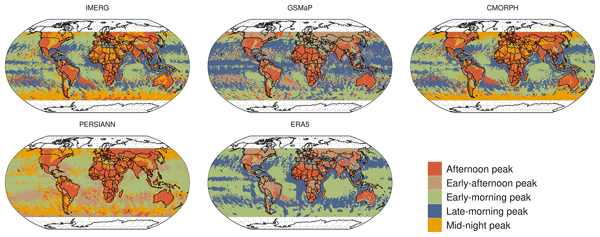
This study compared global satellite and reanalysis precipitation datasets to assess diurnal variability. We found that all datasets capture key diurnal precipitation patterns, with maximum precipitation in the afternoon over land and early morning over the ocean. However, there are differences in the exact timing and amount of precipitation. This suggests that it is better to use a combination of datasets for potential applications rather than relying on a single dataset.
Guoqiang Tang, Andrew W. Wood, Andrew J. Newman, Martyn P. Clark, and Simon Michael Papalexiou
Geosci. Model Dev., 17, 1153–1173, https://doi.org/10.5194/gmd-17-1153-2024, https://doi.org/10.5194/gmd-17-1153-2024, 2024
Short summary
Short summary
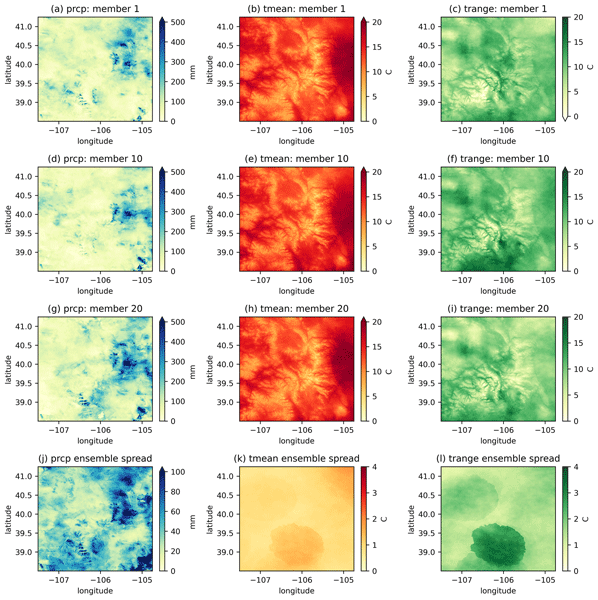
Ensemble geophysical datasets are crucial for understanding uncertainties and supporting probabilistic estimation/prediction. However, open-access tools for creating these datasets are limited. We have developed the Python-based Geospatial Probabilistic Estimation Package (GPEP). Through several experiments, we demonstrate GPEP's ability to estimate precipitation, temperature, and snow water equivalent. GPEP will be a useful tool to support uncertainty analysis in Earth science applications.
Mijael Rodrigo Vargas Godoy, Yannis Markonis, Oldrich Rakovec, Michal Jenicek, Riya Dutta, Rajani Kumar Pradhan, Zuzana Bešťáková, Jan Kyselý, Roman Juras, Simon Michael Papalexiou, and Martin Hanel
Hydrol. Earth Syst. Sci., 28, 1–19, https://doi.org/10.5194/hess-28-1-2024, https://doi.org/10.5194/hess-28-1-2024, 2024
Short summary
Short summary
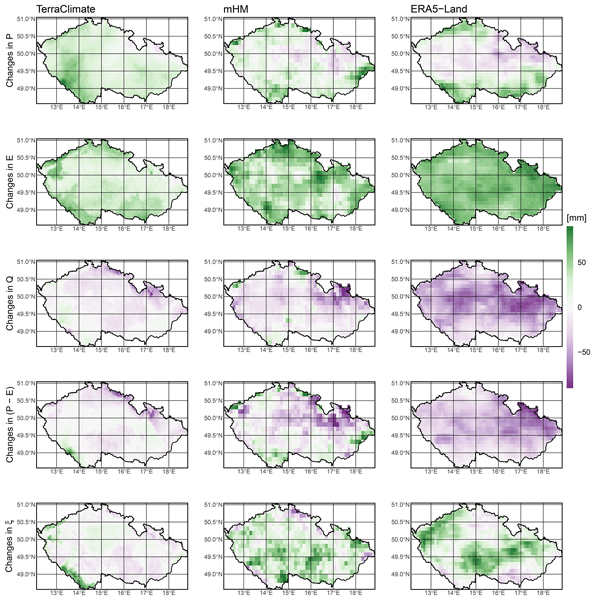
The study introduces a novel benchmarking method based on the water cycle budget for hydroclimate data fusion. Using this method and multiple state-of-the-art datasets to assess the spatiotemporal patterns of water cycle changes in Czechia, we found that differences in water availability distribution are dominated by evapotranspiration. Furthermore, while the most significant temporal changes in Czechia occur during spring, the median spatial patterns stem from summer changes in the water cycle.
Cited articles
Abdelmoaty, H. M., Papalexiou, S. M., Mamalakis, A., Singh, S., Coia, V., Hairabedian, M., Szeftel, P., and Grover, P.: Generative Adversarial Networks for Downscaling Hourly Precipitation in the Canadian Prairies, Journal of Geophysical Research: Machine Learning and Computation, 2, https://doi.org/10.1029/2025JH000678, 2025.
Abdelmoaty, H. M., Papalexiou, S. M., Mamalakis, A., Singh, S., Coia, V., Hairabedian, M., Szeftel, P., and Grover, P.: Does Non-Stationarity Affect GAN-Based Downscaling? Insights from High-Resolution WRF Simulations over the Canadian Prairies, Artificial Intelligence for the Earth Systems, (Under Review), 2026.
Arjovsky, M., Chintala, S., and Bottou, L.: Wasserstein GAN, 2017.
Baño-Medina, J., Manzanas, R., and Gutiérrez, J. M.: Configuration and intercomparison of deep learning neural models for statistical downscaling, Geosci. Model Dev., 13, 2109–2124, https://doi.org/10.5194/gmd-13-2109-2020, 2020.
Bednarz, T. and Cherukuri, R.: Use of Physics-Based AI for Simulations and Modeling in the Era of Digital Twins, in: SIGGRAPH Asia 2023 Courses, 1–45, https://doi.org/10.1145/3610538.3614627, 2023.
Coppola, E., Sobolowski, S., Pichelli, E., Raffaele, F., Ahrens, B., Anders, I., Ban, N., Bastin, S., Belda, M., Belusic, D., Caldas-Alvarez, A., Cardoso, R. M., Davolio, S., Dobler, A., Fernandez, J., Fita, L., Fumiere, Q., Giorgi, F., Goergen, K., Güttler, I., Halenka, T., Heinzeller, D., Hodnebrog, Ø., Jacob, D., Kartsios, S., Katragkou, E., Kendon, E., Khodayar, S., Kunstmann, H., Knist, S., Lavín-Gullón, A., Lind, P., Lorenz, T., Maraun, D., Marelle, L., van Meijgaard, E., Milovac, J., Myhre, G., Panitz, H.-J., Piazza, M., Raffa, M., Raub, T., Rockel, B., Schär, C., Sieck, K., Soares, P. M. M., Somot, S., Srnec, L., Stocchi, P., Tölle, M. H., Truhetz, H., Vautard, R., de Vries, H., and Warrach-Sagi, K.: A first-of-its-kind multi-model convection permitting ensemble for investigating convective phenomena over Europe and the Mediterranean, Clim. Dynam., 55, 3–34, https://doi.org/10.1007/s00382-018-4521-8, 2020.
Deser, C., Phillips, A., Bourdette, V., and Teng, H.: Uncertainty in climate change projections: the role of internal variability, Clim. Dynam., 38, 527–546, https://doi.org/10.1007/s00382-010-0977-x, 2012.
Feser, F., Rockel, B., von Storch, H., Winterfeldt, J., and Zahn, M.: Regional Climate Models Add Value to Global Model Data: A Review and Selected Examples, B. Am. Meteorol. Soc., 92, 1181–1192, https://doi.org/10.1175/2011BAMS3061.1, 2011.
Gao, X. J., Shi, Y., Zhang, D., Wu, J., Giorgi, F., Ji, Z., and Wang, Y.: Uncertainties in monsoon precipitation projections over China: Results from two high-resolution RCM simulations, Clim. Res., 52, https://doi.org/10.3354/cr01084, 2012.
Gilleland, E., Ahijevych, D., Brown, B. G., Casati, B., and Ebert, E. E.: Intercomparison of Spatial Forecast Verification Methods, Weather Forecast., 24, 1416–1430, https://doi.org/10.1175/2009WAF2222269.1, 2009.
Giorgi, F. and Gutowski, W. J.: Regional dynamical downscaling and the CORDEX initiative, Annu. Rev. Environ. Resour., 40, https://doi.org/10.1146/annurev-environ-102014-021217, 2015.
Giorgi, F. and Mearns, L. O.: Approaches to the simulation of regional climate change: A review, Rev. Geophys., 29, 191–216, https://doi.org/10.1029/90RG02636, 1991.
Gulrajani, I., Ahmed, F., Arjovsky, M., Dumoulin, V., and Courville, A.: Improved Training of Wasserstein GANs, Adv. Neural Inf. Process. Syst., 30, 5767–5777, 2017.
Harris, L., McRae, A. T. T., Chantry, M., Dueben, P. D., and Palmer, T. N.: A Generative Deep Learning Approach to Stochastic Downscaling of Precipitation Forecasts, J. Adv. Model. Earth Sy., 14, https://doi.org/10.1029/2022MS003120, 2022.
Harrison, D. R., McGovern, A., Karstens, C. D., Bostrom, A., Demuth, J. L., Jirak, I. L., and Marsh, P. T.: An Assessment of How Domain Experts Evaluate Machine Learning in Operational Meteorology, Weather Forecast., 40, 393–410, https://doi.org/10.1175/WAF-D-24-0144.1, 2025.
Ho, J., Jain, A., and Abbeel, P.: Denoising Diffusion Probabilistic Models, in: Advances in Neural Information Processing Systems, 6840–6851, 2020.
Hobeichi, S., Nishant, N., Shao, Y., Abramowitz, G., Pitman, A., Sherwood, S., Bishop, C., and Green, S.: Using Machine Learning to Cut the Cost of Dynamical Downscaling, Earths Future, 11, https://doi.org/10.1029/2022EF003291, 2023.
Höhlein, K., Kern, M., Hewson, T., and Westermann, R.: A comparative study of convolutional neural network models for wind field downscaling, Meteorol. Appl., 27, https://doi.org/10.1002/met.1961, 2020.
Hsu, L.-H., Chiang, C.-C., Lin, K.-L., Lin, H.-H., Chu, J.-L., Yu, Y.-C., and Fahn, C.-S.: Downscaling Taiwan precipitation with a residual deep learning approach, Geosci. Lett., 11, 23, https://doi.org/10.1186/s40562-024-00340-y, 2024.
Hunt, K. M. R.: Stop using root-mean-square error as a precipitation target!, Artif. Intel. Earth Syst., https://doi.org/10.1175/AIES-D-25-0083.1, in press, 2026.
Khader, F., Müller-Franzes, G., Tayebi Arasteh, S., Han, T., Haarburger, C., Schulze-Hagen, M., Schad, P., Engelhardt, S., Baeßler, B., Foersch, S., Stegmaier, J., Kuhl, C., Nebelung, S., Kather, J. N., and Truhn, D.: Denoising diffusion probabilistic models for 3D medical image generation, Sci. Rep., 13, 7303, https://doi.org/10.1038/s41598-023-34341-2, 2023.
Kumar, B., Atey, K., Singh, B. B., Chattopadhyay, R., Acharya, N., Singh, M., Nanjundiah, R. S., and Rao, S. A.: On the modern deep learning approaches for precipitation downscaling, Earth Sci. Inform., 16, 1459–1472, https://doi.org/10.1007/s12145-023-00970-4, 2023.
Lakshminarayanan, B., Pritzel, A., and Blundell, C.: Simple and Scalable Predictive Uncertainty Estimation using Deep Ensembles, in: Advances in Neural Information Processing Systems, 2017.
Lange, S.: Trend-preserving bias adjustment and statistical downscaling with ISIMIP3BASD (v1.0), Geosci. Model Dev., 12, 3055–3070, https://doi.org/10.5194/gmd-12-3055-2019, 2019.
Lucas-Picher, P., Argüeso, D., Brisson, E., Tramblay, Y., Berg, P., Lemonsu, A., Kotlarski, S., and Caillaud, C.: Convection-permitting modeling with regional climate models: Latest developments and next steps, WIREs Clim. Change, 12, https://doi.org/10.1002/wcc.731, 2021.
Lyu, R., Wang, L., Sun, Y., Bai, H., and Lu, C.-T.: Downscaling Precipitation with Bias-informed Conditional Diffusion Model, in: 2024 IEEE International Conference on Big Data (BigData), 8768–8770, https://doi.org/10.1109/BigData62323.2024.10825056, 2024.
Mamalakis, A., Langousis, A., Deidda, R., and Marrocu, M.: A parametric approach for simultaneous bias correction and high-resolution downscaling of climate model rainfall, Water Resour. Res., 53, 2149–2170, https://doi.org/10.1002/2016WR019578, 2017.
Maraun, D., Wetterhall, F., Ireson, A. M., Chandler, R. E., Kendon, E. J., Widmann, M., Brienen, S., Rust, H. W., Sauter, T., Themeßl, M., Venema, V. K. C., Chun, K. P., Goodess, C. M., Jones, R. G., Onof, C., Vrac, M., and Thiele-Eich, I.: Precipitation downscaling under climate change: Recent developments to bridge the gap between dynamical models and the end user, Rev. Geophys., 48, RG3003, https://doi.org/10.1029/2009RG000314, 2010.
Mardani, M., Brenowitz, N., Cohen, Y., Pathak, J., Chen, C.-Y., Liu, C.-C., Vahdat, A., Nabian, M. A., Ge, T., Subramaniam, A., Kashinath, K., Kautz, J., and Pritchard, M.: Residual corrective diffusion modeling for km-scale atmospheric downscaling, Commun. Earth Environ., 6, 124, https://doi.org/10.1038/s43247-025-02042-5, 2025.
Muñoz-Sabater, J., Dutra, E., Agustí-Panareda, A., Albergel, C., Arduini, G., Balsamo, G., Boussetta, S., Choulga, M., Harrigan, S., Hersbach, H., Martens, B., Miralles, D. G., Piles, M., Rodríguez-Fernández, N. J., Zsoter, E., Buontempo, C., and Thépaut, J.-N.: ERA5-Land: a state-of-the-art global reanalysis dataset for land applications, Earth Syst. Sci. Data, 13, 4349–4383, https://doi.org/10.5194/essd-13-4349-2021, 2021.
Nishant, N., Hobeichi, S., Sherwood, S., Abramowitz, G., Shao, Y., Bishop, C., and Pitman, A.: Comparison of a novel machine learning approach with dynamical downscaling for Australian precipitation, Environ. Res. Lett., 18, 094006, https://doi.org/10.1088/1748-9326/ace463, 2023.
Palmer, T.: Build high-resolution global climate models, Nature, 515, https://doi.org/10.1038/515338a, 2014.
Papalexiou, S. M. and Mamalakis, A.: Machine unlearning: bias correction in neural network downscaled storms, J. Hydrol. (Amst.), 134689, https://doi.org/10.1016/j.jhydrol.2025.134689, 2025.
Papalexiou, S. M., Serinaldi, F., and Porcu, E.: Advancing Space-Time Simulation of Random Fields: From Storms to Cyclones and Beyond, Water Resour. Res., 57, https://doi.org/10.1029/2020WR029466, 2021.
Perez, E., Strub, F., De Vries, H., Dumoulin, V., and Courville, A.: FiLM: Visual Reasoning with a General Conditioning Layer, in: Proceedings of the AAAI Conference on Artificial Intelligence, 32, https://doi.org/10.1609/aaai.v32i1.11671, 2018.
Piani, C., Haerter, J. O., and Coppola, E.: Statistical bias correction for daily precipitation in regional climate models over Europe, Theor. Appl. Climatol., 99, 187–192, https://doi.org/10.1007/s00704-009-0134-9, 2010.
Rampal, N., Hobeichi, S., Gibson, P. B., Baño-Medina, J., Abramowitz, G., Beucler, T., González-Abad, J., Chapman, W., Harder, P., and Gutiérrez, J. M.: Enhancing Regional Climate Downscaling through Advances in Machine Learning, Artificial Intelligence for the Earth Systems, 3, https://doi.org/10.1175/aies-d-23-0066.1, 2024.
Rastogi, D., Niu, H., Passarella, L., Mahajan, S., Kao, S., Vahmani, P., and Jones, A. D.: Complementing Dynamical Downscaling With Super-Resolution Convolutional Neural Networks, Geophys. Res. Lett., 52, https://doi.org/10.1029/2024GL111828, 2025.
Ravuri, S., Lenc, K., Willson, M., Kangin, D., Lam, R., Mirowski, P., Fitzsimons, M., Athanassiadou, M., Kashem, S., Madge, S., Prudden, R., Mandhane, A., Clark, A., Brock, A., Simonyan, K., Hadsell, R., Robinson, N., Clancy, E., Arribas, A., and Mohamed, S.: Skilful precipitation nowcasting using deep generative models of radar, Nature, 597, 672–677, https://doi.org/10.1038/s41586-021-03854-z, 2021.
Roberts, N. M. and Lean, H. W.: Scale-Selective Verification of Rainfall Accumulations from High-Resolution Forecasts of Convective Events, Mon. Weather Rev., 136, 78–97, https://doi.org/10.1175/2007MWR2123.1, 2008.
Schär, C., Fuhrer, O., Arteaga, A., Ban, N., Charpilloz, C., Girolamo, S. Di, Hentgen, L., Hoefler, T., Lapillonne, X., Leutwyler, D., Osterried, K., Panosetti, D., Rüdisühli, S., Schlemmer, L., Schulthess, T. C., Sprenger, M., Ubbiali, S., and Wernli, H.: Kilometer-Scale Climate Models: Prospects and Challenges, B. Am. Meteorol. Soc., 101, E567–E587, https://doi.org/10.1175/BAMS-D-18-0167.1, 2020.
Singh, S.: Reproducibility Data and Models for Generative Precipitation Downscaling, Zenodo [data set], https://doi.org/10.5281/zenodo.19324377, 2026a.
Singh, S.: shivamsinghhada/precipitation-downscaling: v1.1.0 – Revised GMD code release, Zenodo [code], https://doi.org/10.5281/zenodo.20549613, 2026b (code also available at: https://github.com/shivamsinghhada/precipitation-downscaling, last access: 7 August 2026).
Singh, S., Papalexiou, S. M., Abdelmoaty, H. M., Hartvigsen, T., and Mamalakis, A.: Correcting dry/wet classification bias in precipitation downscaling via generative adversarial networks, Environmental Data Science, 5, e12, https://doi.org/10.1017/eds.2026.10039, 2026.
Skamarock, W. C.: Evaluating Mesoscale NWP Models Using Kinetic Energy Spectra, Mon. Weather Rev., 132, 3019–3032, https://doi.org/10.1175/MWR2830.1, 2004.
Song, Y. and Dhariwal, P.: Improved Techniques for Training Consistency Models, in: International Conference on Learning Representations, WNzy9bRDvG, 15078–15097, 2024.
Stengel, K., Glaws, A., Hettinger, D., and King, R. N.: Adversarial super-resolution of climatological wind and solar data, P. Natl. Acad. Sci. USA, 117, 16805–16815, https://doi.org/10.1073/pnas.1918964117, 2020.
Stephens, G.: Challenges and Advances in Convection-Permitting Climate Modeling, B. Am. Meteorol. Soc., 98, 1027–1030, https://doi.org/10.1175/BAMS-D-16-0263.1, 2017.
Tabari, H., Paz, S. M., Buekenhout, D., and Willems, P.: Comparison of statistical downscaling methods for climate change impact analysis on precipitation-driven drought, Hydrol. Earth Syst. Sci., 25, 3493–3517, https://doi.org/10.5194/hess-25-3493-2021, 2021.
Teutschbein, C. and Seibert, J.: Bias correction of regional climate model simulations for hydrological climate-change impact studies: Review and evaluation of different methods, J. Hydrol. (Amst.), 456–457, 12–29, https://doi.org/10.1016/j.jhydrol.2012.05.052, 2012.
Tomasi, E., Franch, G., and Cristoforetti, M.: Can AI be enabled to perform dynamical downscaling? A latent diffusion model to mimic kilometer-scale COSMO5.0_CLM9 simulations, Geosci. Model Dev., 18, 2051–2078, https://doi.org/10.5194/gmd-18-2051-2025, 2025.
Trenberth, K. E., Fasullo, J. T., and Shepherd, T. G.: Attribution of climate extreme events, Nat. Clim. Change, 5, 725–730, https://doi.org/10.1038/nclimate2657, 2015.
Vandal, T., Kodra, E., Ganguly, S., Michaelis, A., Nemani, R., and Ganguly, A. R.: DeepSD: Generating High Resolution Climate Change Projections through Single Image Super-Resolution, in: Proceedings of the 23rd ACM SIGKDD International Conference on Knowledge Discovery and Data Mining, 1663–1672, https://doi.org/10.1145/3097983.3098004, 2017.
Vrac, M., Stein, M. L., Hayhoe, K., and Liang, X. Z.: A general method for validating statistical downscaling methods under future climate change, Geophys. Res. Lett., 34, https://doi.org/10.1029/2007GL030295, 2007.
Wang, F., Tian, D., Lowe, L., Kalin, L., and Lehrter, J.: Deep Learning for Daily Precipitation and Temperature Downscaling, Water Resour. Res., 57, https://doi.org/10.1029/2020WR029308, 2021.
Wang, X., Li, Y., Zuo, Y., Zhu, J., Zhuo, J., Li, X., Liu, L., and Niu, S.: A rapid downscaling approach for meteorological wind fields using diffusion models and attention mechanisms, J. Wind Eng. Indust. Aerodynam., 266, 106215, https://doi.org/10.1016/j.jweia.2025.106215, 2025.
Wood, A. W., Leung, L. R., Sridhar, V., and Lettenmaier, D. P.: Hydrologic Implications of Dynamical and Statistical Approaches to Downscaling Climate Model Outputs, Climatic Change, 62, 189–216, https://doi.org/10.1023/B:CLIM.0000013685.99609.9e, 2004.
Yan, W., Wang, Y., Gu, S., Huang, L., Yan, F., Xia, L., and Tao, Q.: The Domain Shift Problem of Medical Image Segmentation and Vendor-Adaptation by Unet-GAN, Springer, 623–631, https://doi.org/10.1007/978-3-030-32245-8_69, 2019.
Short summary
High-resolution precipitation is critical for hydrologic and climate-risk applications, but climate models are too coarse to resolve storm-scale extremes. We compare a deterministic U-NET with two generative models, a Wasserstein Generative Adversarial Network (WGAN) and a diffusion model, for 8× and 16× precipitation downscaling using ERA5-Land. U-NET is stable but smooths extremes, whereas generative models better capture variability and heavy tails while introducing greater uncertainty.
High-resolution precipitation is critical for hydrologic and climate-risk applications, but...