
Articles | Volume 19, issue 13
https://doi.org/10.5194/gmd-19-6357-2026
© Author(s) 2026. This work is distributed under
the Creative Commons Attribution 4.0 License.
the Creative Commons Attribution 4.0 License.
https://doi.org/10.5194/gmd-19-6357-2026
© Author(s) 2026. This work is distributed under
the Creative Commons Attribution 4.0 License.
the Creative Commons Attribution 4.0 License.
Development and technical paper
| 
16 Jul 2026
Development and technical paper |
| 16 Jul 2026
| 16 Jul 2026
The new plant functional diversity model JeDi-BACH (version 1.0) in the ICON Earth System Model (version 1.0)

Max Planck Institute for Biogeochemistry, Jena, Germany
Max Planck Institute for Meteorology, Hamburg, Germany
Christian H. Reick
Max Planck Institute for Meteorology, Hamburg, Germany
Reiner Schnur
Max Planck Institute for Meteorology, Hamburg, Germany
Axel Kleidon
Max Planck Institute for Biogeochemistry, Jena, Germany
Martin Claussen
Max Planck Institute for Meteorology, Hamburg, Germany
Center for Earth System Research and Sustainability (CEN), Universität Hamburg, Hamburg, Germany
Related authors
No articles found.
Sarosh Alam Ghausi, Tejasvi Ashish Chauhan, and Axel Kleidon
EGUsphere, https://doi.org/10.5194/egusphere-2026-3930, https://doi.org/10.5194/egusphere-2026-3930, 2026
This preprint is open for discussion and under review for Earth System Dynamics (ESD).
Short summary
Short summary
The dryness of the air during the day is widely used to monitor drought and understand plant responses to climate change, but what controls it is not fully understood. We show that much of its variation is linked to the diurnal air temperature range, which reflects heating of the lower atmosphere rather than changes in moisture. Using a simple physical model, we reproduced these patterns globally and showed how sunlight and dry soils together regulate air dryness and influences the atmosphere.
Anne Dallmeyer, Nils Weitzel, Laura Schild, Ulrike Herzschuh, Thomas Kleinen, and Martin Claussen
Clim. Past, 22, 1125–1157, https://doi.org/10.5194/cp-22-1125-2026, https://doi.org/10.5194/cp-22-1125-2026, 2026
Short summary
Short summary
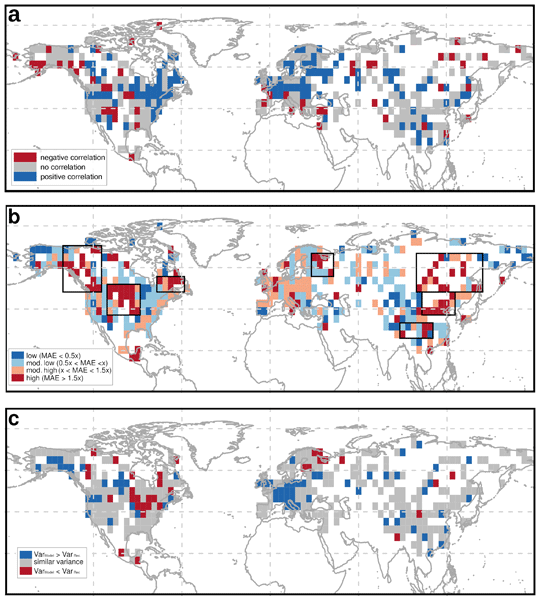
We compare pollen-based reconstructions of Northern Hemisphere tree cover over the last 20 000 years with simulations from the Max-Planck-Institute Earth System Model (MPI-ESM). The model captures broad forest trends but misses key regional patterns and the mid-Holocene forest peak. Testing climate drivers reveals mismatches in how temperature, water, and CO2 control forests, pointing to structural limits and the need for improved vegetation processes in models.
Martin Claussen, Anne Dallmeyer, Frank Darius, Philipp Hoelzmann, and Michèle Dinies
EGUsphere, https://doi.org/10.5194/egusphere-2026-2587, https://doi.org/10.5194/egusphere-2026-2587, 2026
Short summary
Short summary
The abrupt termination of humid conditions and vegetation changes in the Sahara during the last 8000 years is an important issue as it presumably affected the time frame for human adaption. Our analysis suggests that there was no “collapse” of the green Sahara. Gradual changes in some proxy records and abrupt shifts in others are not necessarily contradictory and a gradual expansion of the Sahara may have been accompanied by abrupt changes within the ecosystems.
Francisco J. Doblas-Reyes, Jenni Kontkanen, Irina Sandu, Mario Acosta, Mohammed Hussam Al Turjmam, Ivan Alsina-Ferrer, Miguel Andrés-Martínez, Costanza Anerdi, Leo Arriola, Marvin Axness, Marc Batlle Martín, Peter Bauer, Tobias Becker, Daniel Beltrán, Sebastian Beyer, Hendryk Bockelmann, Pierre-Antoine Bretonnière, Sebastien Cabaniols, Silvia Caprioli, Miguel Castrillo, Aparna Chandrasekar, Suvarchal Cheedela, Victor Correal, Emanuele Danovaro, Paolo Davini, Jussi Enkovaara, Claudia Frauen, Barbara Früh, Aina Gaya Àvila, Paolo Ghinassi, Rohit Ghosh, Supriyo Ghosh, Iker González, Katherine Grayson, Matthew Griffith, Ioan Hadade, Christopher Haine, Carl Hartick, Utz-Uwe Haus, Shane Hearne, Heikki Järvinen, Bernat Jiménez, Amal John, Marlin Juchem, Thomas Jung, Jessica Kegel, Matthias Kelbling, Kai Keller, Bruno Kinoshita, Theresa Kiszler, Daniel Klocke, Lukas Kluft, Nikolay Koldunov, Tobias Kölling, Joonas Kolstela, Luis Kornblueh, Sergey Kosukhin, Aleksander Lacima-Nadolnik, Jeisson Javier Leal Rojas, Jonni Lehtiranta, Tuomas Lunttila, Anna Luoma, Pekka Manninen, Alexey Medvedev, Sebastian Milinski, Ali Mohammed, Sebastian Müller, Devaraju Naryanappa, Natalia Nazarova, Sami Niemelä, Bimochan Niraula, Henrik Nortamo, Aleksi Nummelin, Matteo Nurisso, Pablo Ortega, Stella Paronuzzi, Xabier Pedruzo-Bagazgoitia, Charles Pelletier, Carlos Peña, Suraj Polade, Himansu Kesari Pradhan, Rommel Quintanilla, Tiago Quintino, Thomas Rackow, Jouni Räisänen, Maqsood Mubarak Rajput, René Redler, Balthasar Reuter, Nuno Rocha Monteiro, Francesc Roura-Adserias, Silva Ruppert, Susan Sayed, Reiner Schnur, Tanvi Sharma, Dmitry Sidorenko, Outi Sievi-Korte, Albert Soret, Christian Steger, Bjorn Stevens, Jan Streffing, Jaleena Sunny, Luiggi Tenorio, Stephan Thober, Ulf Tigerstedt, Oriol Tinto, Juha Tonttila, Heikki Tuomenvirta, Lauri Tuppi, Ginka Van Thielen, Emanuele Vitali, Jost von Hardenberg, Ingo Wagner, Nils Wedi, Jan Wehner, Sven Willner, Xavier Yepes-Arbós, Florian Ziemen, and Janos Zimmermann
Geosci. Model Dev., 19, 2821–2848, https://doi.org/10.5194/gmd-19-2821-2026, https://doi.org/10.5194/gmd-19-2821-2026, 2026
Short summary
Short summary
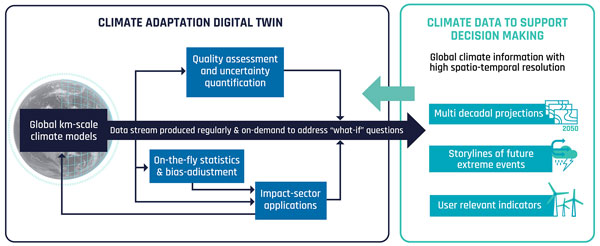
The Climate Change Adaptation Digital Twin (Climate DT) pioneers the operationalisation of global climate projections. It produces global simulations with local granularity for adaptation decision-making. Applications are embedded to generate tailored indicators. A unified workflow orchestrates all components in several supercomputers. Data management ensures consistency and streaming enables real-time use. It is a complementary innovation to initiatives like CMIP, CORDEX, and climate services.
Konstantin Gregor, Benjamin F. Meyer, Tillmann Gaida, Victor Justo Vasquez, Karina Bett-Williams, Matthew Forrest, João P. Darela-Filho, Sam Rabin, Marcos Longo, Joe R. Melton, Johan Nord, Peter Anthoni, Vladislav Bastrikov, Thomas Colligan, Christine Delire, Michael C. Dietze, George Hurtt, Akihiko Ito, Lasse T. Keetz, Jürgen Knauer, Johannes Köster, Tzu-Shun Lin, Lei Ma, Marie Minvielle, Stefan Olin, Sebastian Ostberg, Hao Shi, Reiner Schnur, Qing Sun, Peter E. Thornton, and Anja Rammig
Geosci. Model Dev., 19, 2407–2436, https://doi.org/10.5194/gmd-19-2407-2026, https://doi.org/10.5194/gmd-19-2407-2026, 2026
Short summary
Short summary
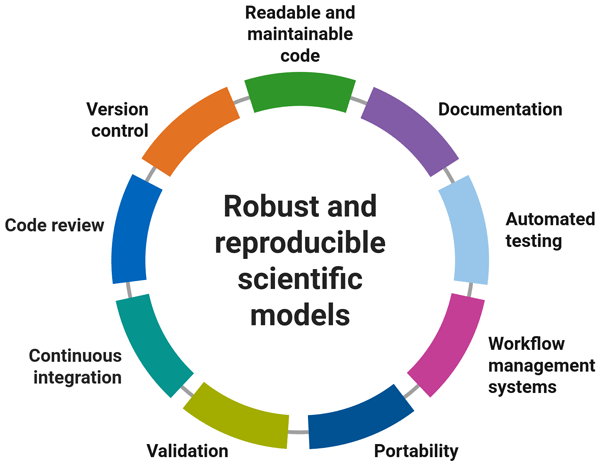
Geoscientific models are crucial for understanding Earth’s processes. However, they sometimes do not adhere to highest software quality standards, and scientific results are often hard to reproduce due to the complexity of the workflows. Here we gather the expertise of 20 modeling groups and software engineers to define best practices for making geoscientific models maintainable, usable, and reproducible. We conclude with an open-source example serving as a reference for modeling communities.
Christian H. Reick and Guilherme L. Torres Mendonça
EGUsphere, https://doi.org/https://hdl.handle.net/21.11116/0000-0011-F3E7-6, https://doi.org/https://hdl.handle.net/21.11116/0000-0011-F3E7-6, 2025
Short summary
Short summary
To quantify the strengths of feedbacks between climate and carbon cycle, commonly the α-β-γ formalism is applied to data from Earth system simulations, where CO2 rises strongly until year 2100. We show that the formalism cannot be justified by a linear expansion in the rising CO2. This explains why the calculated feedback is not a proper system characteristics, but depends on the scenario. But by a suitable re-interpretation the formalism can be justified without such a linearity assumption.
Hans Segura, Xabier Pedruzo-Bagazgoitia, Philipp Weiss, Sebastian K. Müller, Thomas Rackow, Junhong Lee, Edgar Dolores-Tesillos, Imme Benedict, Matthias Aengenheyster, Razvan Aguridan, Gabriele Arduini, Alexander J. Baker, Jiawei Bao, Swantje Bastin, Eulàlia Baulenas, Tobias Becker, Sebastian Beyer, Hendryk Bockelmann, Nils Brüggemann, Lukas Brunner, Suvarchal K. Cheedela, Sushant Das, Jasper Denissen, Ian Dragaud, Piotr Dziekan, Madeleine Ekblom, Jan Frederik Engels, Monika Esch, Richard Forbes, Claudia Frauen, Lilli Freischem, Diego García-Maroto, Philipp Geier, Paul Gierz, Álvaro González-Cervera, Katherine Grayson, Matthew Griffith, Oliver Gutjahr, Helmuth Haak, Ioan Hadade, Kerstin Haslehner, Shabeh ul Hasson, Jan Hegewald, Lukas Kluft, Aleksei Koldunov, Nikolay Koldunov, Tobias Kölling, Shunya Koseki, Sergey Kosukhin, Josh Kousal, Peter Kuma, Arjun U. Kumar, Rumeng Li, Nicolas Maury, Maximilian Meindl, Sebastian Milinski, Kristian Mogensen, Bimochan Niraula, Jakub Nowak, Divya Sri Praturi, Ulrike Proske, Dian Putrasahan, René Redler, David Santuy, Domokos Sármány, Reiner Schnur, Patrick Scholz, Dmitry Sidorenko, Dorian Spät, Birgit Sützl, Daisuke Takasuka, Adrian Tompkins, Alejandro Uribe, Mirco Valentini, Menno Veerman, Aiko Voigt, Sarah Warnau, Fabian Wachsmann, Marta Wacławczyk, Nils Wedi, Karl-Hermann Wieners, Jonathan Wille, Marius Winkler, Yuting Wu, Florian Ziemen, Janos Zimmermann, Frida A.-M. Bender, Dragana Bojovic, Sandrine Bony, Simona Bordoni, Patrice Brehmer, Marcus Dengler, Emanuel Dutra, Saliou Faye, Erich Fischer, Chiel van Heerwaarden, Cathy Hohenegger, Heikki Järvinen, Markus Jochum, Thomas Jung, Johann H. Jungclaus, Noel S. Keenlyside, Daniel Klocke, Heike Konow, Martina Klose, Szymon Malinowski, Olivia Martius, Thorsten Mauritsen, Juan Pedro Mellado, Theresa Mieslinger, Elsa Mohino, Hanna Pawłowska, Karsten Peters-von Gehlen, Abdoulaye Sarré, Pajam Sobhani, Philip Stier, Lauri Tuppi, Pier Luigi Vidale, Irina Sandu, and Bjorn Stevens
Geosci. Model Dev., 18, 7735–7761, https://doi.org/10.5194/gmd-18-7735-2025, https://doi.org/10.5194/gmd-18-7735-2025, 2025
Short summary
Short summary
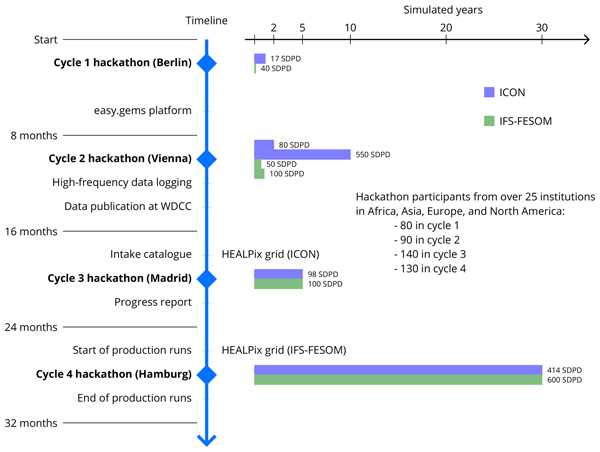
The Next Generation of Earth Modeling Systems project (nextGEMS) developed two Earth system models that use horizontal grid spacing of 10 km and finer, giving more fidelity to the representation of local phenomena, globally. In its fourth cycle, nextGEMS simulated the Earth System climate over the 2020–2049 period under the SSP3-7.0 scenario. Here, we provide an overview of nextGEMS, insights into the model development, and the realism of multi-decadal, kilometer-scale simulations.
Mateo Duque-Villegas, Martin Claussen, Thomas Kleinen, Jürgen Bader, and Christian H. Reick
Clim. Past, 21, 773–794, https://doi.org/10.5194/cp-21-773-2025, https://doi.org/10.5194/cp-21-773-2025, 2025
Short summary
Short summary
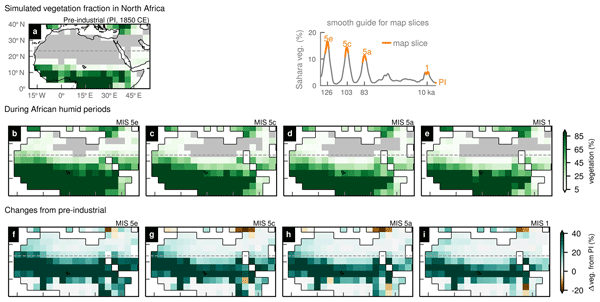
We simulate the last glacial cycle with a comprehensive model of the Earth system and investigate vegetation cover change in northern Africa during the last four African Humid Periods (AHPs). We find a common pattern of vegetation change and relate it with climatic factors in order to discuss how vegetation might have evolved during even older AHPs. This scaling relationship we find according to past AHPs fails to account for projected changes in northern Africa under strong greenhouse gas warming.

Jonathan Minz, Axel Kleidon, and Nsilulu T. Mbungu
Wind Energ. Sci., 9, 2147–2169, https://doi.org/10.5194/wes-9-2147-2024, https://doi.org/10.5194/wes-9-2147-2024, 2024
Short summary
Short summary
Estimates of power output from regional wind turbine deployments in energy scenarios assume that the impact of the atmospheric feedback on them is minimal. But numerical models show that the impact is large at the proposed scales of future deployment. We show that this impact can be captured by accounting only for the kinetic energy removed by turbines from the atmosphere. This can be easily applied to energy scenarios and leads to more physically representative estimates.
Nora Farina Specht, Martin Claussen, and Thomas Kleinen
Clim. Past, 20, 1595–1613, https://doi.org/10.5194/cp-20-1595-2024, https://doi.org/10.5194/cp-20-1595-2024, 2024
Short summary
Short summary
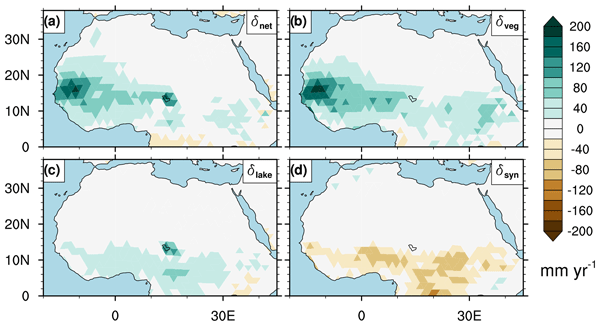
We close the terrestrial water cycle across the Sahara and Sahel by integrating a new endorheic-lake model into a climate model. A factor analysis of mid-Holocene simulations shows that both dynamic lakes and dynamic vegetation individually contribute to a precipitation increase over northern Africa that is collectively greater than that caused by the interaction between lake and vegetation dynamics. Thus, the lake–vegetation interaction causes a relative drying response across the entire Sahel.
Guilherme L. Torres Mendonça, Julia Pongratz, and Christian H. Reick
Biogeosciences, 21, 1923–1960, https://doi.org/10.5194/bg-21-1923-2024, https://doi.org/10.5194/bg-21-1923-2024, 2024
Short summary
Short summary
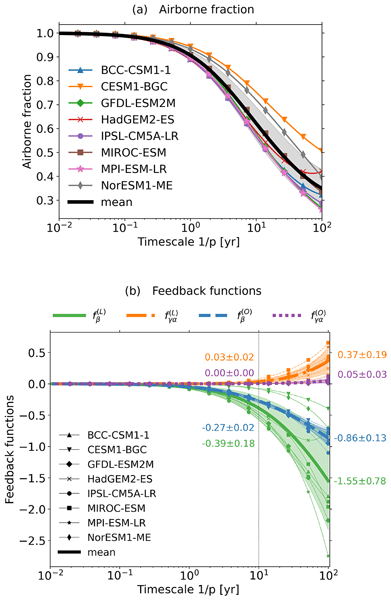
We study the timescale dependence of airborne fraction and underlying feedbacks by a theory of the climate–carbon system. Using simulations we show the predictive power of this theory and find that (1) this fraction generally decreases for increasing timescales and (2) at all timescales the total feedback is negative and the model spread in a single feedback causes the spread in the airborne fraction. Our study indicates that those are properties of the system, independently of the scenario.
Yinglin Tian, Deyu Zhong, Sarosh Alam Ghausi, Guangqian Wang, and Axel Kleidon
Earth Syst. Dynam., 14, 1363–1374, https://doi.org/10.5194/esd-14-1363-2023, https://doi.org/10.5194/esd-14-1363-2023, 2023
Short summary
Short summary
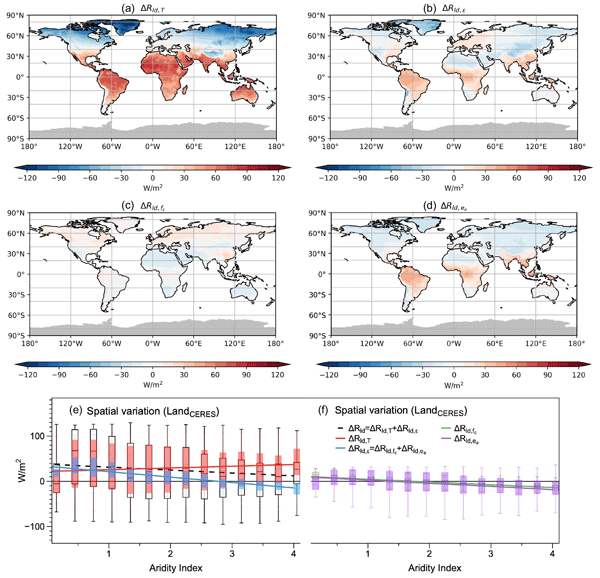
Downward longwave radiation (Rld) is critical for the surface energy budget, but its climatological variation on a global scale is not yet well understood physically. We use a semi-empirical equation derived by Brutsaert (1975) to identify the controlling role that atmospheric heat storage plays in spatiotemporal variations of Rld. Our work helps us to better understand aspects of climate variability, extreme events, and global warming by linking these to the mechanistic contributions of Rld.
Axel Kleidon
Earth Syst. Dynam., 14, 861–896, https://doi.org/10.5194/esd-14-861-2023, https://doi.org/10.5194/esd-14-861-2023, 2023
Short summary
Short summary
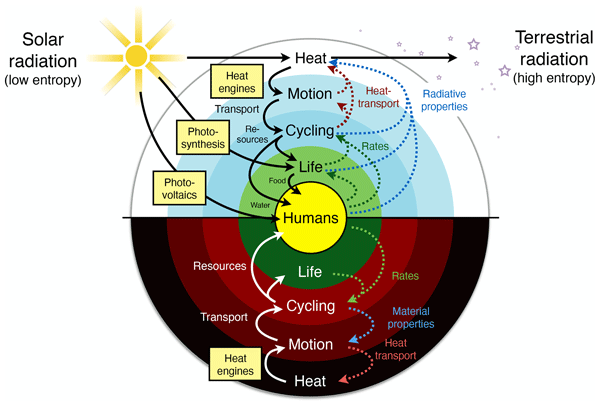
The second law of thermodynamics has long intrigued scientists, but what role does it play in the Earth system? This review shows that its main role is that it shapes the conversion of sunlight into work. This work can then maintain the dynamics of the physical climate system, the biosphere, and human societies. The relevance of it is that apparently many processes work at their limits, directly or indirectly, so they become predictable by simple means.
Leonore Jungandreas, Cathy Hohenegger, and Martin Claussen
Clim. Past, 19, 637–664, https://doi.org/10.5194/cp-19-637-2023, https://doi.org/10.5194/cp-19-637-2023, 2023
Short summary
Short summary
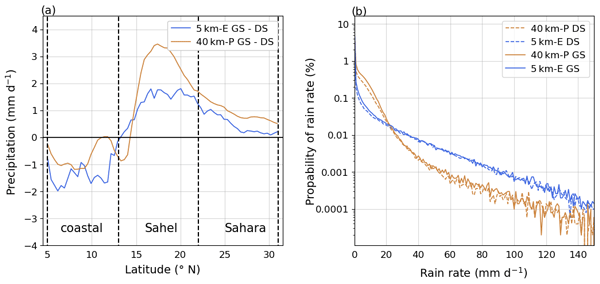
Increasing the vegetation cover over mid-Holcocene North Africa expands the West African monsoon ∼ 4–5° further north. This northward shift of monsoonal precipitation is caused by interactions of the land surface with large-scale monsoon circulation and the coupling of soil moisture to precipitation. We highlight the importance of considering not only how soil moisture influences precipitation but also how different precipitation characteristics alter the soil hydrology via runoff generation.
Axel Kleidon, Gabriele Messori, Somnath Baidya Roy, Ira Didenkulova, and Ning Zeng
Earth Syst. Dynam., 14, 241–242, https://doi.org/10.5194/esd-14-241-2023, https://doi.org/10.5194/esd-14-241-2023, 2023
Cathy Hohenegger, Peter Korn, Leonidas Linardakis, René Redler, Reiner Schnur, Panagiotis Adamidis, Jiawei Bao, Swantje Bastin, Milad Behravesh, Martin Bergemann, Joachim Biercamp, Hendryk Bockelmann, Renate Brokopf, Nils Brüggemann, Lucas Casaroli, Fatemeh Chegini, George Datseris, Monika Esch, Geet George, Marco Giorgetta, Oliver Gutjahr, Helmuth Haak, Moritz Hanke, Tatiana Ilyina, Thomas Jahns, Johann Jungclaus, Marcel Kern, Daniel Klocke, Lukas Kluft, Tobias Kölling, Luis Kornblueh, Sergey Kosukhin, Clarissa Kroll, Junhong Lee, Thorsten Mauritsen, Carolin Mehlmann, Theresa Mieslinger, Ann Kristin Naumann, Laura Paccini, Angel Peinado, Divya Sri Praturi, Dian Putrasahan, Sebastian Rast, Thomas Riddick, Niklas Roeber, Hauke Schmidt, Uwe Schulzweida, Florian Schütte, Hans Segura, Radomyra Shevchenko, Vikram Singh, Mia Specht, Claudia Christine Stephan, Jin-Song von Storch, Raphaela Vogel, Christian Wengel, Marius Winkler, Florian Ziemen, Jochem Marotzke, and Bjorn Stevens
Geosci. Model Dev., 16, 779–811, https://doi.org/10.5194/gmd-16-779-2023, https://doi.org/10.5194/gmd-16-779-2023, 2023
Short summary
Short summary
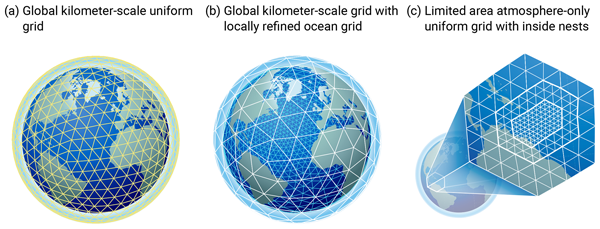
Models of the Earth system used to understand climate and predict its change typically employ a grid spacing of about 100 km. Yet, many atmospheric and oceanic processes occur on much smaller scales. In this study, we present a new model configuration designed for the simulation of the components of the Earth system and their interactions at kilometer and smaller scales, allowing an explicit representation of the main drivers of the flow of energy and matter by solving the underlying equations.

Rainer Schneck, Veronika Gayler, Julia E. M. S. Nabel, Thomas Raddatz, Christian H. Reick, and Reiner Schnur
Geosci. Model Dev., 15, 8581–8611, https://doi.org/10.5194/gmd-15-8581-2022, https://doi.org/10.5194/gmd-15-8581-2022, 2022
Short summary
Short summary
The versions of ICON-A and ICON-Land/JSBACHv4 used for this study constitute the first milestone in the development of the new ICON Earth System Model ICON-ESM. JSBACHv4 is the successor of JSBACHv3, and most of the parameterizations of JSBACHv4 are re-implementations from JSBACHv3. We assess and compare the performance of JSBACHv4 and JSBACHv3. Overall, the JSBACHv4 results are as good as JSBACHv3, but both models reveal the same main shortcomings, e.g. the depiction of the leaf area index.
Marco A. Giorgetta, William Sawyer, Xavier Lapillonne, Panagiotis Adamidis, Dmitry Alexeev, Valentin Clément, Remo Dietlicher, Jan Frederik Engels, Monika Esch, Henning Franke, Claudia Frauen, Walter M. Hannah, Benjamin R. Hillman, Luis Kornblueh, Philippe Marti, Matthew R. Norman, Robert Pincus, Sebastian Rast, Daniel Reinert, Reiner Schnur, Uwe Schulzweida, and Bjorn Stevens
Geosci. Model Dev., 15, 6985–7016, https://doi.org/10.5194/gmd-15-6985-2022, https://doi.org/10.5194/gmd-15-6985-2022, 2022
Short summary
Short summary
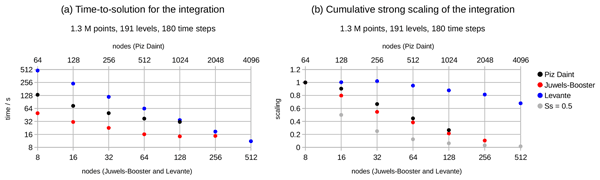
This work presents a first version of the ICON atmosphere model that works not only on CPUs, but also on GPUs. This GPU-enabled ICON version is benchmarked on two GPU machines and a CPU machine. While the weak scaling is very good on CPUs and GPUs, the strong scaling is poor on GPUs. But the high performance of GPU machines allowed for first simulations of a short period of the quasi-biennial oscillation at very high resolution with explicit convection and gravity wave forcing.
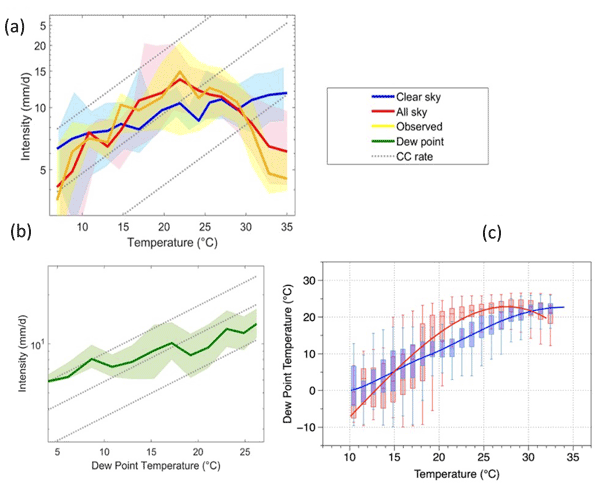
Sarosh Alam Ghausi, Subimal Ghosh, and Axel Kleidon
Hydrol. Earth Syst. Sci., 26, 4431–4446, https://doi.org/10.5194/hess-26-4431-2022, https://doi.org/10.5194/hess-26-4431-2022, 2022
Short summary
Short summary
The observed response of extreme precipitation to global warming remains unclear with significant regional variations. We show that a large part of this uncertainty can be removed when the imprint of clouds in surface temperatures is removed. We used a thermodynamic systems approach to remove the cloud radiative effect from temperatures. We then found that precipitation extremes intensified with global warming at positive rates which is consistent with physical arguments and model simulations.
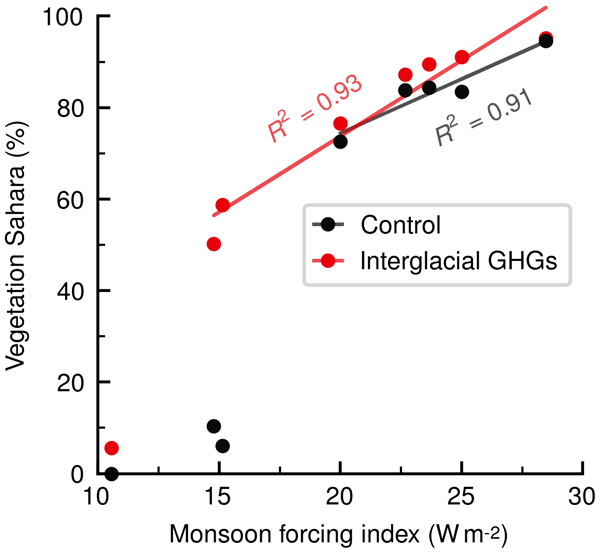
Mateo Duque-Villegas, Martin Claussen, Victor Brovkin, and Thomas Kleinen
Clim. Past, 18, 1897–1914, https://doi.org/10.5194/cp-18-1897-2022, https://doi.org/10.5194/cp-18-1897-2022, 2022
Short summary
Short summary
Using an Earth system model of intermediate complexity, we quantify contributions of the Earth's orbit, greenhouse gases (GHGs) and ice sheets to the strength of Saharan greening during late Quaternary African humid periods (AHPs). Orbital forcing is found as the dominant factor, having a critical threshold and accounting for most of the changes in the vegetation response. However, results suggest that GHGs may influence the orbital threshold and thus may play a pivotal role for future AHPs.
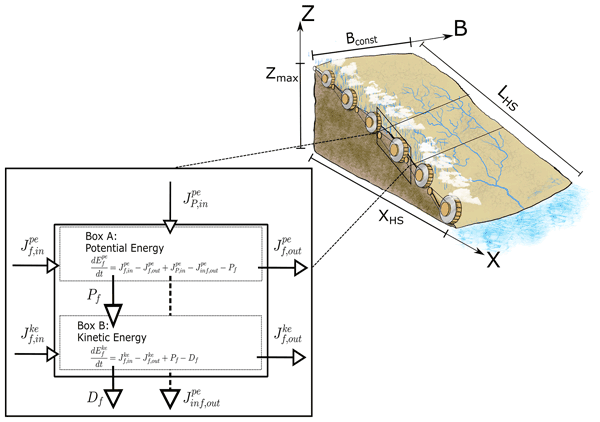
Samuel Schroers, Olivier Eiff, Axel Kleidon, Ulrike Scherer, Jan Wienhöfer, and Erwin Zehe
Hydrol. Earth Syst. Sci., 26, 3125–3150, https://doi.org/10.5194/hess-26-3125-2022, https://doi.org/10.5194/hess-26-3125-2022, 2022
Short summary
Short summary
In hydrology the formation of landform patterns is of special interest as changing forcings of the natural systems, such as climate or land use, will change these structures. In our study we developed a thermodynamic framework for surface runoff on hillslopes and highlight the differences of energy conversion patterns on two related spatial and temporal scales. The results indicate that surface runoff on hillslopes approaches a maximum power state.
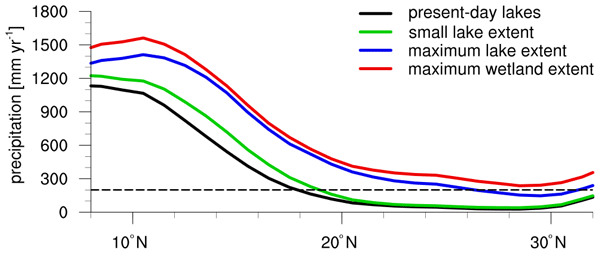
Nora Farina Specht, Martin Claussen, and Thomas Kleinen
Clim. Past, 18, 1035–1046, https://doi.org/10.5194/cp-18-1035-2022, https://doi.org/10.5194/cp-18-1035-2022, 2022
Short summary
Short summary
Palaeoenvironmental records only provide a fragmentary picture of the lake and wetland extent in North Africa during the mid-Holocene. Therefore, we investigate the possible range of mid-Holocene precipitation changes caused by an estimated small and maximum lake extent and a maximum wetland extent. Results show a particularly strong monsoon precipitation response to lakes and wetlands over the Western Sahara and an increased monsoon precipitation when replacing lakes with vegetated wetlands.
Jooyeop Lee, Martin Claussen, Jeongwon Kim, Je-Woo Hong, In-Sun Song, and Jinkyu Hong
Clim. Past, 18, 313–326, https://doi.org/10.5194/cp-18-313-2022, https://doi.org/10.5194/cp-18-313-2022, 2022
Short summary
Short summary
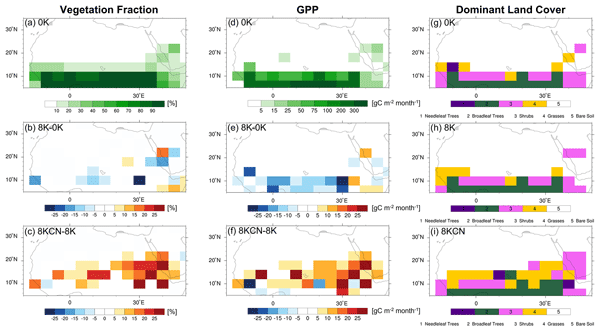
It is still a challenge to simulate the so–called Green Sahara (GS), which was a wet and vegetative Sahara region in the mid–Holocene, using current climate models. Our analysis shows that Holocene greening is simulated better if the amount of soil nitrogen and soil texture is properly modified for the humid and vegetative GS period. Future climate simulation needs to consider consequent changes in soil nitrogen and texture with changes in vegetation cover for proper climate simulations.

Anne Dallmeyer, Martin Claussen, Stephan J. Lorenz, Michael Sigl, Matthew Toohey, and Ulrike Herzschuh
Clim. Past, 17, 2481–2513, https://doi.org/10.5194/cp-17-2481-2021, https://doi.org/10.5194/cp-17-2481-2021, 2021
Short summary
Short summary
Using the comprehensive Earth system model, MPI-ESM1.2, we explore the global Holocene vegetation changes and interpret them in terms of the Holocene climate change. The model results reveal that most of the Holocene vegetation transitions seen outside the high northern latitudes can be attributed to modifications in the intensity of the global summer monsoons.

Guilherme L. Torres Mendonça, Julia Pongratz, and Christian H. Reick
Nonlin. Processes Geophys., 28, 501–532, https://doi.org/10.5194/npg-28-501-2021, https://doi.org/10.5194/npg-28-501-2021, 2021
Short summary
Short summary
Linear response functions are a powerful tool to both predict and investigate the dynamics of a system when subjected to small perturbations. In practice, these functions must often be derived from perturbation experiment data. Nevertheless, current methods for this identification require a tailored perturbation experiment, often with many realizations. We present a method that instead derives these functions from a single realization of an experiment driven by any type of perturbation.
Guilherme L. Torres Mendonça, Julia Pongratz, and Christian H. Reick
Nonlin. Processes Geophys., 28, 533–564, https://doi.org/10.5194/npg-28-533-2021, https://doi.org/10.5194/npg-28-533-2021, 2021
Short summary
Short summary
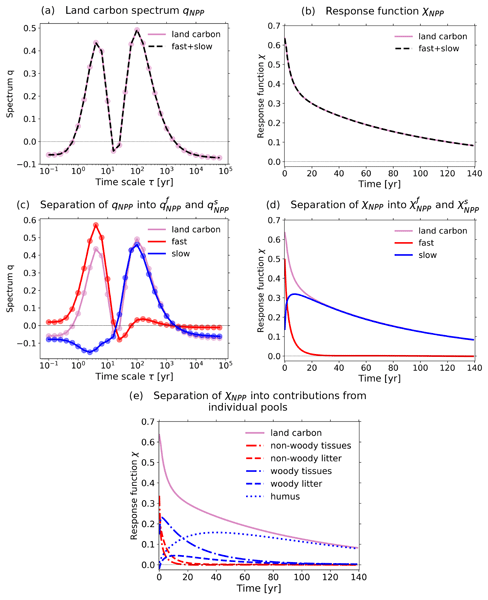
We apply a new identification method to derive the response functions that characterize the sensitivity of the land carbon cycle to CO2 perturbations in an Earth system model. By means of these response functions, which generalize the usually employed single-valued sensitivities, we can reliably predict the response of the land carbon to weak perturbations. Further, we demonstrate how by this new method one can robustly derive and interpret internal spectra of timescales of the system.
Cited articles
Adler, R. F., Sapiano, M. R. P., Huffman, G. J., Wang, J.-J., Gu, G., Bolvin, D., Chiu, L., Schneider, U., Becker, A., Nelkin, E., Xie, P., Ferraro, R., and Shin, D.-B.: The Global Precipitation Climatology Project (GPCP) Monthly Analysis (New Version 2.3) and a Review of 2017 Global Precipitation, Atmosphere, 9, https://doi.org/10.3390/atmos9040138, 2018. a, b
Ali, A.: Biodiversity–ecosystem functioning research: Brief history, major trends and perspectives, Biol. Conserv., 285, 110210, https://doi.org/10.1016/j.biocon.2023.110210, 2023. a
Alton, P. B.: How useful are plant functional types in global simulations of the carbon, water, and energy cycles?, J. Geophys. Res.-Biogeo., 116, 1–13, https://doi.org/10.1029/2010JG001430, 2011. a
Atkin, O. K. and Tjoelker, M. G.: Thermal acclimation and the dynamic response of plant respiration to temperature, Trends Plant Sci., 8, 343–351, https://doi.org/10.1016/S1360-1385(03)00136-5, 2003. a
Atkin, O. K., Bruhn, D., Hurry, V. M., and Tjoelker, M. G.: Evans Review No. 2: The hot and the cold: unravelling the variable response of plant respiration to temperature, Funct. Plant Biol., 32, 87–105, https://doi.org/10.1071/FP03176, 2005. a
Barthlott, W., Lauer, W., and Placke, A.: Global distribution of species diversity in vascular plants: Towards a world map of phytodiversity (globale verteilung der artenvielfalt höherer pflanzen: Vorarbeiten zu einer weltkarte der phytodiversität), Erdkunde, 317–327, https://doi.org/10.3112/erdkunde.1996.04.03, 1996. a
Becking, L. G. M. B.: Geobiologie of inleiding tot de milieukunde, 18–19, WP Van Stockum & Zoon, 1934. a
Berzaghi, F., Wright, I. J., Kramer, K., Oddou-Muratorio, S., Bohn, F. J., Reyer, C. P. O., Sabaté, S., Sanders, T. G. M., and Hartig, F.: Towards a New Generation of Trait-Flexible Vegetation Models, Trends Ecol. Evol., 35, 191–205, https://doi.org/10.1016/j.tree.2019.11.006, 2020. a, b
Betts, R., Cox, P., Collins, M., Harris, P., Huntingford, C., and Jones, C.: The role of ecosystem-atmosphere interactions in simulated Amazonian precipitation decrease and forest dieback under global climate warming, Theor. Appl. Climatol., 78, 157–175, https://doi.org/10.1007/s00704-004-0050-y, 2004. a
Biggs, C. R., Yeager, L. A., Bolser, D. G., Bonsell, C., Dichiera, A. M., Hou, Z., Keyser, S. R., Khursigara, A. J., Lu, K., Muth, A. F., Negrete Jr., B., and Erisman, B. E.: Does functional redundancy affect ecological stability and resilience? A review and meta-analysis, Ecosphere, 11, e03184, https://doi.org/10.1002/ecs2.3184, 2020. a
Bonan, G. B.: Forests and climate change: forcings, feedbacks, and the climate benefits of forests, Science, 320, 1444–1449, https://doi.org/10.1126/science.1155121, 2008. a
Brovkin, V., Levis, S., Loutre, M.-F., Crucifix, M., Claussen, M., Ganopolski, A., Kubatzki, C., and Petoukhov, V.: Stability analysis of the climate-vegetation system in the northern high latitudes, Climatic Change, 57, 119–138, https://doi.org/10.1023/A:1022168609525, 2003. a
Brovkin, V., Raddatz, T., Reick, C. H., Claussen, M., and Gayler, V.: Global biogeophysical interactions between forest and climate, Geophys. Res. Lett., 36, https://doi.org/10.1029/2009GL037543, 2009. a
Cardinale, B. J., Duffy, J. E., Gonzalez, A., Hooper, D. U., Perrings, C., Venail, P., Narwani, A., Mace, G. M., Tilman, D., Wardle, D. A., Kinzig, A. P., Daily, G. C., Loreau, M., Grace, J. B., Larigauderie, A., Srivastava, D. S., and Naeem, S.: Biodiversity loss and its impact on humanity, Nature, 486, 59–67, https://doi.org/10.1038/nature11148, 2012. a
Chen, R., Liu, L., and Liu, X.: The negative impact of excessive moisture contributes to the seasonal dynamics of photosynthesis in Amazon moist forests, Earth's Future, 10, e2021EF002306, https://doi.org/10.1029/2021EF002306, 2022. a
Collatz, G. J., Ribas-Carbo, M., and Berry, J.: Coupled photosynthesis-stomatal conductance model for leaves of C4 plants, Funct. Plant Biol., 19, 519–538, https://doi.org/10.1071/PP9920519, 1992. a, b, c
Cox, P. M., Betts, R., Collins, M., Harris, P. P., Huntingford, C., and Jones, C.: Amazonian forest dieback under climate-carbon cycle projections for the 21st century, Theor. Appl. Climatol., 78, 137–156, https://doi.org/10.1007/s00704-004-0049-4, 2004. a
Crameri, F., Shephard, G. E., and Heron, P. J.: The misuse of colour in science communication, Nat. Commun., 11, 5444, https://doi.org/10.1038/s41467-020-19160-7, 2020. a
Crueger, T., Giorgetta, M. A., Brokopf, R., Esch, M., Fiedler, S., Hohenegger, C., Kornblueh, L., Mauritsen, T., Nam, C., Naumann, A. K., Peters, K., Rast, S., Roeckner, E., Sakradzija, M., Schmidt, H., Vial, J., Vogel, R., and Stevens, B.: ICON-A, The Atmosphere Component of the ICON Earth System Model: II. Model Evaluation, J. Adv. Model. Earth Sy., 10, 1638–1662, https://doi.org/10.1029/2017MS001233, 2018. a
Cunningham, S. C.: Stomatal sensitivity to vapour pressure deficit of temperate and tropical evergreen rainforest trees of Australia, Trees, 18, 399–407, https://doi.org/10.1007/s00468-004-0318-y, 2004. a
De Wit, R. and Bouvier, T.: `Everything is everywhere, but, the environment selects'; what did Baas Becking and Beijerinck really say?, Environ. Microbiol., 8, 755–758, https://doi.org/10.1111/j.1462-2920.2006.01017.x, 2006. a
Díaz, S. and Cabido, M.: Vive la différence: plant functional diversity matters to ecosystem processes, Trends Ecol. Evol., 16, 646–655, https://doi.org/10.1016/S0169-5347(01)02283-2, 2001. a
Díaz, S., Lavorel, S., Chapin, F. S., Tecco, P. A., Gurvich, D. E., and Grigulis, K.: Functional diversity – at the crossroads between ecosystem functioning and environmental filters, in: Terrestrial ecosystems in a changing world, edited by: Canadell, J. G., Pataki, D. E., and Pitelka, L. F., Global Change, chap. 7, 81–91, Springer, https://doi.org/10.1007/978-3-540-32730-1_7, 2007. a, b, c
Eyring, V., Bony, S., Meehl, G. A., Senior, C. A., Stevens, B., Stouffer, R. J., and Taylor, K. E.: Overview of the Coupled Model Intercomparison Project Phase 6 (CMIP6) experimental design and organization, Geosci. Model Dev., 9, 1937–1958, https://doi.org/10.5194/gmd-9-1937-2016, 2016. a, b
Farquhar, G. D., von Caemmerer, S. v., and Berry, J. A.: A biochemical model of photosynthetic CO2 assimilation in leaves of C3 species, Planta, 149, 78–90, https://doi.org/10.1007/BF00386231, 1980. a, b
Federer, C. A.: Transpirational supply and demand: plant, soil, and atmospheric effects evaluated by simulation, Water Resour. Res., 18, 355–362, https://doi.org/10.1029/WR018i002p00355, 1982. a, b
Freschet, G. T., Dias, A. T. C., Ackerly, D. D., Aerts, R., van Bodegom, P. M., Cornwell, W. K., Dong, M., Kurokawa, H., Liu, G., Onipchenko, V. G., Ordoñez, J. C., Peltzer, D. A., Richardson, S. J., Shidakov, I. I., Soudzilovskaia, N. A., Tao, J., and Cornelissen, J. H. C.: Global to community scale differences in the prevalence of convergent over divergent leaf trait distributions in plant assemblages, Global Ecol. Biogeogr., 20, 755–765, https://doi.org/10.1111/j.1466-8238.2011.00651.x, 2011. a
Fyllas, N. M., Gloor, E., Mercado, L. M., Sitch, S., Quesada, C. A., Domingues, T. F., Galbraith, D. R., Torre-Lezama, A., Vilanova, E., Ramírez-Angulo, H., Higuchi, N., Neill, D. A., Silveira, M., Ferreira, L., Aymard C., G. A., Malhi, Y., Phillips, O. L., and Lloyd, J.: Analysing Amazonian forest productivity using a new individual and trait-based model (TFS v.1), Geosci. Model Dev., 7, 1251–1269, https://doi.org/10.5194/gmd-7-1251-2014, 2014. a
Gates, W. L., Boyle, J. S., Covey, C., Dease, C. G., Doutriaux, C. M., Drach, R. S., Fiorino, M., Gleckler, P. J., Hnilo, J. J., Marlais, S. M., Phillips, T. J., Potter, G. L., Santer, B. D., Sperber, K. R., Taylor, K. E., and Williams, D. N.: An Overview of the Results of the Atmospheric Model Intercomparison Project (AMIP I)., B. Am. Meteorol. Soc., 80, 29–56, https://doi.org/10.1175/1520-0477(1999)080<0029:AOOTRO>2.0.CO;2, 1999. a
Giorgetta, M. A., Brokopf, R., Crueger, T., Esch, M., Fiedler, S., Helmert, J., Hohenegger, C., Kornblueh, L., Köhler, M., Manzini, E., Mauritsen, T., Nam, C., Raddatz, T., Rast, S., Reinert, D., Sakradzija, M., Schmidt, H., Schneck, R., Schnur, R., Silvers, L., Wan, H., Zängl, G., and Stevens, B.: ICON-A, the Atmosphere Component of the ICON Earth System Model: I. Model Description, J. Adv. Model. Earth Sy., 10, 1613–1637, https://doi.org/10.1029/2017MS001242, 2018. a, b
Groner, V. P., Raddatz, T., Reick, C. H., and Claussen, M.: Plant functional diversity affects climate–vegetation interaction, Biogeosciences, 15, 1947–1968, https://doi.org/10.5194/bg-15-1947-2018, 2018. a, b, c
Habibullah, M. S., Din, B. H., Tan, S.-H., and Zahid, H.: Impact of climate change on biodiversity loss: global evidence, Environ. Sci. Pollut. R., 29, 1073–1086, https://doi.org/10.1007/s11356-021-15702-8, 2022. a
Hagemann, S.: An improved land surface parameter dataset for global and regional climate models, Max-Planck-Institut für Meteorologie, 336, pp. 22, https://doi.org/10.17617/2.2344576, 2002. a
Harris, R. W.: Root-shoot ratios, J. Arboric., 18, 39–42, https://doi.org/10.48044/jauf.1992.009, 1992. a
Hollinger, D. Y., Ollingerw, S. V., Richardsonw, A. D., Meyersz, T. P., Dail, D. B., Martinw, M. E., Scott, N. A., Arkebauerk, T. J., Baldocchi, D. D., Clark, K. L., Curtis, P. S., Davis, K. J., Desai, A. R., Dragonikk, D., Goulden, M. L., Gu, L., Katulzzz, G. G., Pallardy, S. G., Pawu, K. T., Schmid, H. P., Stoy, P. C., Suyker, A. E., and Verma, S. B.: Albedo estimates for land surface models and support for a new paradigm based on foliage nitrogen concentration, Glob. Chang. Biol., 16, 696–710, https://doi.org/10.1111/j.1365-2486.2009.02028.x, 2010. a, b
Hu, P.-H.: Code and scripts for “The new plant functional diversity model JeDi-BACH in the ICON Earth System Model”, Edmond [code], https://doi.org/10.17617/3.JOQFAN, 2024. a
Huntingford, C., Fisher, R. A., Mercado, L., Booth, B. B. B., Sitch, S., Harris, P. P., Cox, P. M., Jones, C. D., Betts, R. A., Malhi, Y., Harris, G. R., Collins, M., and Moorcroft, P.: Towards Quantifying Uncertainty in Predictions of Amazon `Dieback', Phil. Trans. R. Soc. B., 363, 1857–1864, https://doi.org/10.1098/rstb.2007.0028, 2008. a
Hutchinson, G. E.: Concluding remarks, in: Cold Spring Harbor symposia on quantitative biology, vol. 22, pp. 415–427, Cold Spring Harbor Symposia on Quantitative Biology, 22, 415–427. https://doi.org/10.1101/SQB.1957.022.01.039, 1957. a
Jungclaus, J. H., Lorenz, S. J., Schmidt, H., Brovkin, V., Brüggemann, N., Chegini, F., Crüger, T., De-Vrese, P., Gayler, V., Giorgetta, M. A., Gutjahr, O., Haak, H., Hagemann, S., Hanke, M., Ilyina, T., Korn, P., Kröger, J., Linardakis, L., Mehlmann, C., Mikolajewicz, U., Müller, W. A., Nabel, J. E. M. S., Notz, D., Pohlmann, H., Putrasahan, D. A., Raddatz, T., Ramme, L., Redler, R., Reick, C. H., Riddick, T., Sam, T., Schneck, R., Schnur, R., Schupfner, M., von Storch, J.-S., Wachsmann, F., Wieners, K.-H., Ziemen, F., Stevens, B., Marotzke, J., and Claussen, M.: The ICON Earth System Model Version 1.0, J. Adv. Model. Earth Sy., 14, e2021MS002813, https://doi.org/10.1029/2021MS002813, 2022. a, b, c, d
Kattge, J. and Knorr, W.: Temperature acclimation in a biochemical model of photosynthesis: a reanalysis of data from 36 species, Plant Cell Environ., 30, 1176–1190, https://doi.org/10.1111/j.1365-3040.2007.01690.x, 2007. a, b
Kattge, J., Knorr, W., Raddatz, T., and Wirth, C.: Quantifying photosynthetic capacity and its relationship to leaf nitrogen content for global-scale terrestrial biosphere models, Glob. Change Biol., 15, 976–991, https://doi.org/10.1111/j.1365-2486.2008.01744.x, 2009. a, b
Kattge, J., Bönisch, G., Díaz, S., Lavorel, S., Prentice, I. C., Leadley, P., Tautenhahn, S., Werner, G. D. A., Aakala, T., Abedi, M., Acosta, A. T. R., Adamidis, G. C., et al.: TRY plant trait database – enhanced coverage and open access, Glob. Change Biol., 26, 119–188, https://doi.org/10.1111/gcb.14904, 2020. a
Kikuzawa, K. and Lechowicz, M. J.: Ecology of leaf longevity, Springer Science & Business Media, https://doi.org/10.1007/978-4-431-53918-6, 2011. a
Kleidon, A., Adams, J., Pavlick, R., and Reu, B.: Simulated geographic variations of plant species richness, evenness and abundance using climatic constraints on plant functional diversity, Environ. Res. Lett., 4, https://doi.org/10.1088/1748-9326/4/1/014007, 2009. a
Knauer, J., Werner, C., and Zaehle, S.: Evaluating stomatal models and their atmospheric drought response in a land surface scheme: A multibiome analysis, J. Geophys. Res.-Biogeo., 120, 1894–1911, https://doi.org/10.1002/2015JG003114, 2015. a
Kraft, N. J., Valencia, R., and Ackerly, D. D.: Functional traits and niche-based tree community assembly in an Amazonian forest, Science, 322, 580–582, https://doi.org/10.1126/science.1160662, 2008. a
Kraft, N. J. B., Comita, L. S., Chase, J. M., Sanders, N. J., Swenson, N. G., Crist, T. O., Stegen, J. C., Vellend, M., Boyle, B., Anderson, M. J., Cornell, H. V., Davies, K. F., Freestone, A. L., Inouye, B. D., Harrison, S. P., and Myers, J. A.: Disentangling the drivers of β diversity along latitudinal and elevational gradients, Science, 333, 1755–1758, https://doi.org/10.1126/science.1208584, 2011. a
Laliberté, E. and Legendre, P.: A distance-based framework for measuring functional diversity from multiple traits, Ecology, 91, 299–305, https://doi.org/10.1890/08-2244.1, 2010. a
Lehnebach, R., Beyer, R., Letort, V., and Heuret, P.: The pipe model theory half a century on: a review, Ann. Bot.-London, 121, 773–795, 2018. a
Lieth, H.: Purposes of a Phenology Book, in: Phenology and Seasonality Modeling – Ecological Studies, edited by: Lieth, H., vol. 8, 3–19, Springer, Berlin, Heidelberg, https://doi.org/10.1007/978-3-642-51863-8_1, 1974. a
Loranty, M. M., Berner, L. T., Goetz, S. J., Jin, Y., and Randerson, J. T.: Vegetation controls on northern high latitude snow-albedo feedback: observations and CMIP 5 model simulations, Glob. Change Biol., 20, 594–606, https://doi.org/10.1111/gcb.12391, 2014. a
Mauritsen, T., Stevens, B., Roeckner, E., Crueger, T., Esch, M., Giorgetta, M., Haak, H., Jungclaus, J., Klocke, D., Matei, D., Mikolajewicz, U., Notz, D., Pincus, R., Schmidt, H., and Tomassini, L.: Tuning the climate of a global model, J. Adv. Model. Earth Sy., 4, https://doi.org/10.1029/2012MS000154, 2012. a
Monteith, J. L.: How do crops manipulate water supply and demand?, Philosophical Transactions of the Royal Society of London, Series A, Mathematical and Physical Sciences, 316, 245–259, https://doi.org/10.1098/rsta.1986.0007, 1986. a
Murray, M., Cannell, M., and Smith, R.: Date of budburst of fifteen tree species in Britain following climatic warming, J. Appl. Ecol., 693–700, https://doi.org/10.2307/2404093, 1989. a
Niklas, K. J. and Enquist, B. J.: On the vegetative biomass partitioning of seed plant leaves, stems, and roots, The American Naturalist, 159, 482–497, https://doi.org/10.1086/339459, 2002. a
O'Malley, M. A.: The nineteenth century roots of `everything is everywhere', Nat. Rev. Microbiol., 5, 647–651, https://doi.org/10.1038/nrmicro1711, 2007. a
Paul, M. J. and Foyer, C. H.: Sink regulation of photosynthesis, J. Exp. Bot., 52, 1383–400, https://doi.org/10.1093/jexbot/52.360.1383, 2001. a
Pavlick, R., Drewry, D. T., Bohn, K., Reu, B., and Kleidon, A.: The Jena Diversity-Dynamic Global Vegetation Model (JeDi-DGVM): a diverse approach to representing terrestrial biogeography and biogeochemistry based on plant functional trade-offs, Biogeosciences, 10, 4137–4177, https://doi.org/10.5194/bg-10-4137-2013, 2013. a, b, c, d, e, f, g, h, i, j, k, l, m, n, o, p, q, r, s, t, u, v, w, x, y, z
Pitman, A.: The evolution of, and revolution in, land surface schemes designed for climate models, Int. J. Climatol., 23, 479–510, https://doi.org/10.1002/joc.893, 2003. a
Prentice, I. C. and Cowling, S. A.: Dynamic Global Vegetation Models, in: Encyclopedia of Biodiversity, edited by: Levin, S., 370–689, Academic Press, Waltham, MA, 2nd edn., https://doi.org/10.1016/B978-0-12-384719-5.00412-3, 2013. a
Qi, Y., Wei, W., Chen, C., and Chen, L.: Plant root-shoot biomass allocation over diverse biomes: A global synthesis, Glob. Ecol. Conserv., 18, e00606, https://doi.org/10.1016/j.gecco.2019.e00606, 2019. a
Reich, P. B., Walters, M. B., and Ellsworth, D. S.: From tropics to tundra: global convergence in plant functioning, Proc. Natl. Acad. Sci., 94, 13730–13734, https://doi.org/10.1073/pnas.94.25.13730, 1997. a, b, c, d
Reich, P. B., Walters, M. B., Ellsworth, D. S., Vose, J. M., Volin, J. C., Gresham, C., and Bowman, W. D.: Relationships of leaf dark respiration to leaf nitrogen, specific leaf area and leaf life-span: a test across biomes and functional groups, Oecologia, 114, 471–482, https://doi.org/10.1007/s004420050471, 1998. a
Reich, P. B., Tjoelker, M. G., Pregitzer, K. S., Wright, I. J., Oleksyn, J., and Machado, J. L.: Scaling of respiration to nitrogen in leaves, stems and roots of higher land plants, Ecol. Lett., 11, 793–801, https://doi.org/10.1111/j.1461-0248.2008.01185.x, 2008. a, b, c
Reick, C. H., Gayler, V., Goll, D., Hagemann, S., Heidkamp, M., Nabel, J. E., Raddatz, T., Roeckner, E., Schnur, R., and Wilkenskjeld, S.: JSBACH 3 – The land component of the MPI Earth System Model: documentation of version 3.2, Ber. Erdsystemforsch., 240, https://doi.org/10.17617/2.3279802, 2021. a, b, c, d, e, f
Reu, B., Proulx, R., Bohn, K., Dyke, J. G., Kleidon, A., Pavlick, R., and Schmidtlein, S.: The role of climate and plant functional trade-offs in shaping global biome and biodiversity patterns, Glob. Ecol. Biogeogr., 20, 570–581, https://doi.org/10.1111/j.1466-8238.2010.00621.x, 2011. a
Rius, B. F., Darela Filho, J. P., Fleischer, K., Hofhansl, F., Blanco, C. C., Rammig, A., Domingues, T. F., and Lapola, D. M.: Higher functional diversity improves modeling of Amazon forest carbon storage, Ecol. Model., 481, 110323, https://doi.org/10.1016/j.ecolmodel.2023.110323, 2023. a, b, c, d, e, f
Ryan, M. G.: A simple method for estimating gross carbon budgets for vegetation in forest ecosystems, Tree Physiol., 9, 255–266, https://doi.org/10.1093/treephys/9.1-2.255, 1991. a, b
Sakschewski, B., von Bloh, W., Boit, A., Rammig, A., Kattge, J., Poorter, L., Peñuelas, J., and Thonicke, K.: Leaf and stem economics spectra drive diversity of functional plant traits in a dynamic global vegetation model, Glob. Change Biol., 21, 2711–2725, https://doi.org/10.1111/gcb.12870, 2015. a
Sakschewski, B., Von Bloh, W., Boit, A., Poorter, L., Peña-Claros, M., Heinke, J., Joshi, J., Thonicke, K., Bloh, W. V., Boit, A., Poorter, L., Peña-Claros, M., Heinke, J., Joshi, J., and Thonicke, K.: Resilience of Amazon forests emerges from plant trait diversity, Nat. Clim. Change, 6, 1032–1036, https://doi.org/10.1038/nclimate3109, 2016. a
Scheiter, S., Langan, L., and Higgins, S. I.: Next-generation dynamic global vegetation models: learning from community ecology, New Phytol., 198, 957–969, https://doi.org/10.1111/nph.12210, 2013. a
Schneck, R., Gayler, V., Nabel, J. E. M. S., Raddatz, T., Reick, C. H., and Schnur, R.: Assessment of JSBACHv4.30 as a land component of ICON-ESM-V1 in comparison to its predecessor JSBACHv3.2 of MPI-ESM1.2, Geosci. Model Dev., 15, 8581–8611, https://doi.org/10.5194/gmd-15-8581-2022, 2022. a, b, c, d
Schneider, F. D., Fichtmueller, D., Gossner, M. M., Güntsch, A., Jochum, M., König-Ries, B., Le Provost, G., Manning, P., Ostrowski, A., and Penone, C.: Towards an ecological trait-data standard, Methods Ecol. Evol., 10, 2006–2019, https://doi.org/10.1111/2041-210X.13288, 2019. a
Schulze, E.-D., Beck, E., Buchmann, N., Clemens, S., Müller-Hohenstein, K., and Scherer-Lorenzen, M.: Plant Ecology, Springer, https://doi.org/10.1007/978-3-662-56233-8, 2019. a
Sellers, P.: Canopy reflectance, photosynthesis, and transpiration, II. The role of biophysics in the linearity of their interdependence, Remote Sens. Environ., 21, 143–183, https://doi.org/10.1016/0034-4257(87)90051-4, 1987. a
Shinozaki, K., Yoda, K., Hozumi, K., and Kira, T.: A quantitative analysis of plant form-the pipe model theory: I. Basic analyses, Jpn. J. Ecol., 14, 97–105, https://doi.org/10.18960/seitai.14.3_97, 1964. a
Shukla, P. R., Skea, J., Calvo Buendía, E., Masson-Delmotte, V., Pörtner, H.-O., Roberts, D. C., Zhai, P., Slade, R., Connors, S., van Diemen, R., Ferrat, M., Haughey, E., Luz, S., Neogi, S., Pathak, M., Petzold, J., Portugal Pereira, J., Vyas, P., Huntley, E., Kissick, K., Belkacemi, M., and Malley, J.: Climate Change and Land: An IPCC Special Report on Climate Change, Desertification, Land Degradation, Sustainable Land Management, Food Security, and Greenhouse Gas Fluxes in Terrestrial Ecosystems, Intergovernmental Panel on Climate Change (IPCC), https://doi.org/10.25561/76618, 2019. a
Stein, M.: Large sample properties of simulations using Latin hypercube sampling, Technometrics, 29, 143–151, 1987. a
Swenson, N. G. and Weiser, M. D.: Plant geography upon the basis of functional traits: an example from eastern North American trees, Ecology, 91, 2234–2241, https://doi.org/10.1890/09-1743.1, 2010. a
Thornley, J. and Cannell, M.: Modelling the components of plant respiration: representation and realism, Ann. Bot.-London, 85, 55–67, https://doi.org/10.1006/anbo.1999.0997, 2000. a, b
Thornley, J. H.: Respiration, growth and maintenance in plants, Nature, 227, 304–305, https://doi.org/10.1038/227304b0, 1970. a
Verheijen, L. M., Brovkin, V., Aerts, R., Bönisch, G., Cornelissen, J. H. C., Kattge, J., Reich, P. B., Wright, I. J., and van Bodegom, P. M.: Impacts of trait variation through observed trait–climate relationships on performance of an Earth system model: a conceptual analysis, Biogeosciences, 10, 5497–5515, https://doi.org/10.5194/bg-10-5497-2013, 2013. a, b
Violle, C., Navas, M. L., Vile, D., Kazakou, E., Fortunel, C., Hummel, I., and Garnier, E.: Let the concept of trait be functional!, Oikos, 116, 882–892, https://doi.org/10.1111/j.0030-1299.2007.15559.x, 2007. a
Vitousek, P. M. and Howarth, R. W.: Nitrogen limitation on land and in the sea: how can it occur?, Biogeochemistry, 13, 87–115, https://doi.org/10.1007/BF00002772, 1991. a
Walker, A. P., Beckerman, A. P., Gu, L., Kattge, J., Cernusak, L. A., Domingues, T. F., Scales, J. C., Wohlfahrt, G., Wullschleger, S. D., and Woodward, F. I.: The relationship of leaf photosynthetic traits – Vcmax and Jmax – to leaf nitrogen, leaf phosphorus, and specific leaf area: a meta-analysis and modeling study, Ecol. Evol., 4, 3218–3235, https://doi.org/10.1002/ece3.1173, 2014. a
Walker, B. H.: Biodiversity and ecological redundancy, Conserv. Biol., 6, 18–23, https://doi.org/10.1046/j.1523-1739.1992.610018.x, 1992. a
Westoby, M. and Wright, I. J.: Land-plant ecology on the basis of functional traits, Trends Ecol. Evol., 21, 261–268, https://doi.org/10.1016/j.tree.2006.02.004, 2006. a
Wiens, J. J. and Zelinka, J.: How many species will Earth lose to climate change?, Glob. Change Biol., 30, e17125, https://doi.org/10.1111/gcb.17125, 2024. a
Wright, I. J., Reich, P. B., Westoby, M., Ackerly, D. D., Baruch, Z., Bongers, F., Cavender-Bares, J., Chapin, F. S., Cornelissen, J. H. C., Diemer, M., Flexas, J., Garnier, E., Groom, P. K., Gulias, J., Hikosaka, K., Lamont, B. B., Lee, T., Lee, W., Lusk, C., Midgley, J. J., Navas, M.-L., Niinemets, Ã., Oleksyn, J., Osada, N., Poorter, H., Poot, P., Prior, L., Pyankov, V. I., Roumet, C., Thomas, S. C., Tjoelker, M. G., Veneklaas, E. J., and Villar, R.: The worldwide leaf economics spectrum, Nature, 428, 821–827, https://doi.org/10.1038/nature02403, 2004. a, b, c
Wullschleger, S. D.: Biochemical limitations to carbon assimilation in C3 plants – a retrospective analysis of the
Short summary
We introduce the new plant functional diversity model JeDi-BACH, a novel tool that integrates the Jena Diversity Model (JeDi) within the land component of the ICON Earth System Model. JeDi-BACH captures a richer set of plant trait variations based on environmental filtering and functional tradeoffs without a priori knowledge of the vegetation types. JeDi-BACH represents a significant advancement in modeling the complex interactions between plant functional diversity and climate.
We introduce the new plant functional diversity model JeDi-BACH, a novel tool that integrates...


