
Articles | Volume 19, issue 10
https://doi.org/10.5194/gmd-19-4567-2026
© Author(s) 2026. This work is distributed under
the Creative Commons Attribution 4.0 License.
the Creative Commons Attribution 4.0 License.
https://doi.org/10.5194/gmd-19-4567-2026
© Author(s) 2026. This work is distributed under
the Creative Commons Attribution 4.0 License.
the Creative Commons Attribution 4.0 License.
Model experiment description paper
| 
28 May 2026
Model experiment description paper |
| 28 May 2026
| 28 May 2026
An improved modelling chain for bias-adjusted high-resolution climate and hydrological projections for Norway

Department of Hydrology, Norwegian Water Resources and Energy Directorate, Oslo, 0301, Norway
Wai Kwok Wong
Department of Hydrology, Norwegian Water Resources and Energy Directorate, Oslo, 0301, Norway
Andreas Dobler
Department of Climate and Environment, Norwegian Meteorological Institute, Oslo, 0371, Norway
Sigrid Jørgensen Bakke
Department of Hydrology, Norwegian Water Resources and Energy Directorate, Oslo, 0301, Norway
Stein Beldring
Department of Hydrology, Norwegian Water Resources and Energy Directorate, Oslo, 0301, Norway
Ingjerd Haddeland
Department of Hydrology, Norwegian Water Resources and Energy Directorate, Oslo, 0301, Norway
now at: Lyse AS, Stavanger, 4018, Norway
Hans Olav Hygen
Department of Climate and Environment, Norwegian Meteorological Institute, Oslo, 0371, Norway
Tyge Løvset
NORCE Research AS, and Bjerknes Centre for Climate Research, Bergen, 5008, Norway
Stephanie Mayer
NORCE Research AS, and Bjerknes Centre for Climate Research, Bergen, 5008, Norway
Kjetil Melvold
Department of Hydrology, Norwegian Water Resources and Energy Directorate, Oslo, 0301, Norway
Irene Brox Nilsen
Department of Hydrology, Norwegian Water Resources and Energy Directorate, Oslo, 0301, Norway
Gusong Ruan
Department of Hydrology, Norwegian Water Resources and Energy Directorate, Oslo, 0301, Norway
Silje Lund Sørland
NORCE Research AS, and Bjerknes Centre for Climate Research, Bergen, 5008, Norway
now at: SWECO AS, Bergen, Norway
Anita Verpe Dyrrdal
Department of Climate and Environment, Norwegian Meteorological Institute, Oslo, 0371, Norway
Related authors
Tuomo Mikael Saloranta, Graziella Devoli, Shaochun Huang, and Wai Kwok Wong
EGUsphere, https://doi.org/10.5194/egusphere-2026-2932, https://doi.org/10.5194/egusphere-2026-2932, 2026
This preprint is open for discussion and under review for Natural Hazards and Earth System Sciences (NHESS).
Short summary
Short summary
Understanding how natural hazards may evolve under future climate conditions is essential for land-use planning and design of hazard mitigation measures, among others. This study provides the first nationwide, quantitative assessment of how climate change may affect the hazard of landslides and slushflows in Norway. It indicates that climate change will likely intensify landslide hazard and redistribute slushflow hazard with elevation rather than uniformly increasing it.
Olga Silantyeva, Shaochun Huang, and Chong-Yu Xu
EGUsphere, https://doi.org/10.5194/egusphere-2025-4071, https://doi.org/10.5194/egusphere-2025-4071, 2025
Preprint archived
Short summary
Short summary
Hydrological models forecast river flow, but no single model works everywhere. The open-source Shyft framework provides flexible configurations suitable for various climates and landscapes. We benchmarked five Shyft configurations across 109 Norwegian catchments (1981–2021) using ten goal functions and three evaluation criteria. All models outperformed climatological baselines. Precipitation correction had strongest impact , while goal function and model choice also influenced performance.
Helga Therese Tilley Tajet, Reidun Gangstø, Andreas Dobler, Inger Hanssen-Bauer, and Hans Olav Hygen
Adv. Sci. Res., 23, 33–47, https://doi.org/10.5194/asr-23-33-2026, https://doi.org/10.5194/asr-23-33-2026, 2026
Short summary
Short summary
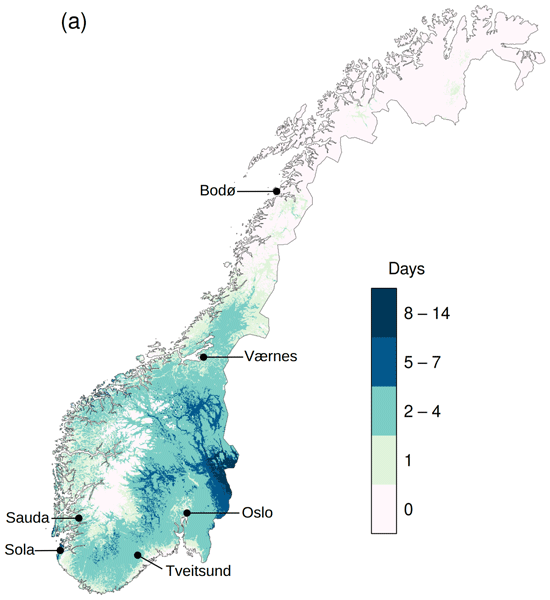
Frost early in the growing season affects many crops and plant species. In Norway, warm early springs can trigger early flowering, followed by cold spells causing frost damage. Although warming extends the growing season, frost risk may increase at its start or end. At present, the early-season risk is highest in lowland South Norway, especially the southeast, and has increased most along the west coast. Future projections indicate an increasing risk along the coast, but decreasing risk inland.
Sigrid Jørgensen Bakke, Danielle Marie Barna, Kolbjørn Engeland, Sjur Anders Kolberg, and Sunniva Nordeide
Hydrol. Earth Syst. Sci., 30, 6207–6233, https://doi.org/10.5194/hess-30-6207-2026, https://doi.org/10.5194/hess-30-6207-2026, 2026
Short summary
Short summary
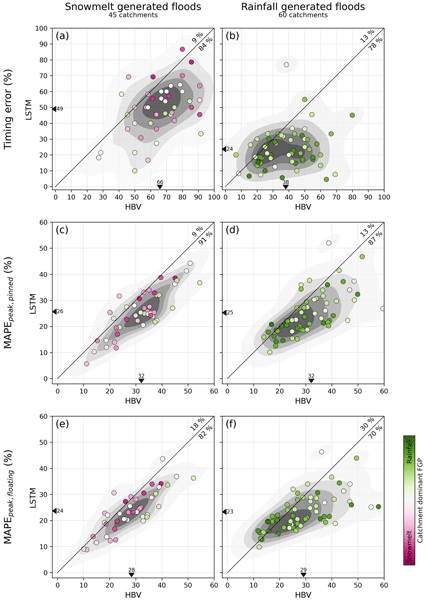
Hydrological models need to simulate both rainfall and snowmelt generated floods in regions with snow. We evaluated a deep learning model’s ability to capture timing and magnitude of floods generated by snowmelt and rainfall separately. Timing was better simulated for rainfall than snowmelt generated floods, whereas results for flood peak magnitudes were similar. Compared to an operational model, the deep learning model was better at simulating both flood types in the majority of the catchments.
Elin Lundstad, Andreas Dobler, Michael Taylor, and Magnus Joelsson
EGUsphere, https://doi.org/10.5194/egusphere-2026-3936, https://doi.org/10.5194/egusphere-2026-3936, 2026
This preprint is open for discussion and under review for Climate of the Past (CP).
Short summary
Short summary
Early weather records help us understand how climate has changed over the past centuries, but many contain gaps and inconsistencies. We compared three automated methods for improving these records using a global collection of historical temperature observations. Although the methods differed in how they treated incomplete data, all successfully recovered the main climate signal. The results provide a stronger foundation for reconstructing past climate and improving future climate research.
Tuomo Mikael Saloranta, Graziella Devoli, Shaochun Huang, and Wai Kwok Wong
EGUsphere, https://doi.org/10.5194/egusphere-2026-2932, https://doi.org/10.5194/egusphere-2026-2932, 2026
This preprint is open for discussion and under review for Natural Hazards and Earth System Sciences (NHESS).
Short summary
Short summary
Understanding how natural hazards may evolve under future climate conditions is essential for land-use planning and design of hazard mitigation measures, among others. This study provides the first nationwide, quantitative assessment of how climate change may affect the hazard of landslides and slushflows in Norway. It indicates that climate change will likely intensify landslide hazard and redistribute slushflow hazard with elevation rather than uniformly increasing it.
Andreas Dobler, Rasmus Benestad, Julia Lutz, and Kajsa Maria Parding
EGUsphere, https://doi.org/10.5194/egusphere-2026-207, https://doi.org/10.5194/egusphere-2026-207, 2026
Short summary
Short summary
We propose a framework summarising the scaling of sub-daily to daily wet-spell frequencies and intensities in two single parameters. Results show a shift towards fewer but more intense precipitation hours on rainy days. Our study further demonstrates the values of high-resolution regional climate model simulations for testing hypotheses in contexts where long-term observational networks are lacking, and how empirical-statistical and dynamical downscaling results can be used together.
Riccardo Biella, Anastasiya Shyrokaya, Monica Ionita, Raffaele Vignola, Samuel J. Sutanto, Andrijana Todorovic, Claudia Teutschbein, Daniela Cid, Maria Carmen Llasat, Pedro Alencar, Alessia Matanó, Elena Ridolfi, Benedetta Moccia, Ilias Pechlivanidis, Anne van Loon, Doris E. Wendt, Elin Stenfors, Fabio Russo, Jean-Philippe Vidal, Lucy Barker, Mariana Madruga de Brito, Marleen Lam, Monika Bláhová, Patricia Trambauer, Raed Hamed, Scott J. McGrane, Serena Ceola, Sigrid J. Bakke, Svitlana Krakovska, Viorica Nagavciuc, Faranak Tootoonchi, Giuliano Di Baldassarre, Sandra Hauswirth, Shreedhar Maskey, Svitlana Zubkovych, Marthe Wens, and Lena M. Tallaksen
Nat. Hazards Earth Syst. Sci., 25, 4475–4501, https://doi.org/10.5194/nhess-25-4475-2025, https://doi.org/10.5194/nhess-25-4475-2025, 2025
Short summary
Short summary
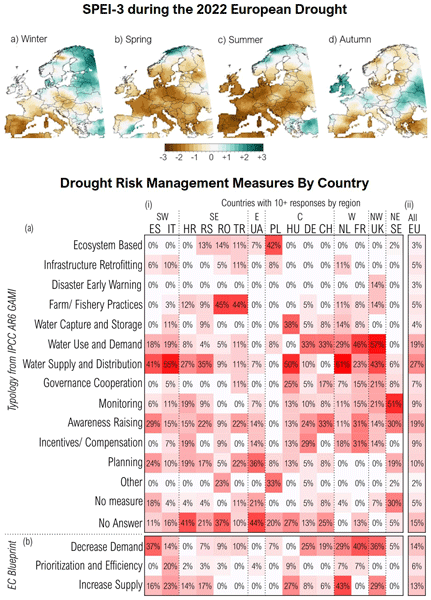
The DitA (Drought in the Anthropocene) network's study on the 2022 European drought reveals growing risks, varied impacts, and fragmented, short-term management. Based on a survey of water managers, it explores risk, impacts, strategies, and their evolution. While challenges persist, signs of improvement show readiness for change. The authors call for a European Drought Directive to unify and guide future drought risk management.
Olga Silantyeva, Shaochun Huang, and Chong-Yu Xu
EGUsphere, https://doi.org/10.5194/egusphere-2025-4071, https://doi.org/10.5194/egusphere-2025-4071, 2025
Preprint archived
Short summary
Short summary
Hydrological models forecast river flow, but no single model works everywhere. The open-source Shyft framework provides flexible configurations suitable for various climates and landscapes. We benchmarked five Shyft configurations across 109 Norwegian catchments (1981–2021) using ten goal functions and three evaluation criteria. All models outperformed climatological baselines. Precipitation correction had strongest impact , while goal function and model choice also influenced performance.
Kun Xie, Lu Li, Hua Chen, Stephanie Mayer, Andreas Dobler, Chong-Yu Xu, and Ozan Mert Göktürk
Hydrol. Earth Syst. Sci., 29, 2133–2152, https://doi.org/10.5194/hess-29-2133-2025, https://doi.org/10.5194/hess-29-2133-2025, 2025
Short summary
Short summary
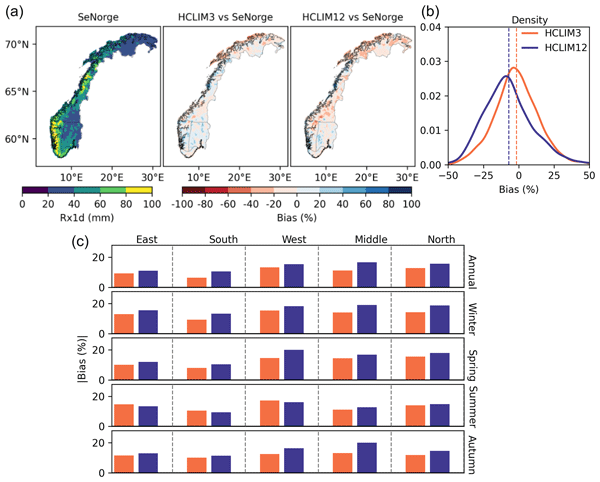
We compared hourly and daily extreme precipitation across Norway from HARMONIE Climate models at convection-permitting 3 km (HCLIM3) and 12 km (HCLIM12) resolutions. HCLIM3 more accurately captures the extremes in most regions and seasons (except in summer). Its advantages are more pronounced for hourly extremes than for daily extremes. The results highlight the value of convection-permitting models in improving extreme-precipitation predictions and in helping the local society brace for extreme weather.
Rasmus E. Benestad, Kajsa M. Parding, and Andreas Dobler
Hydrol. Earth Syst. Sci., 29, 45–65, https://doi.org/10.5194/hess-29-45-2025, https://doi.org/10.5194/hess-29-45-2025, 2025
Short summary
Short summary
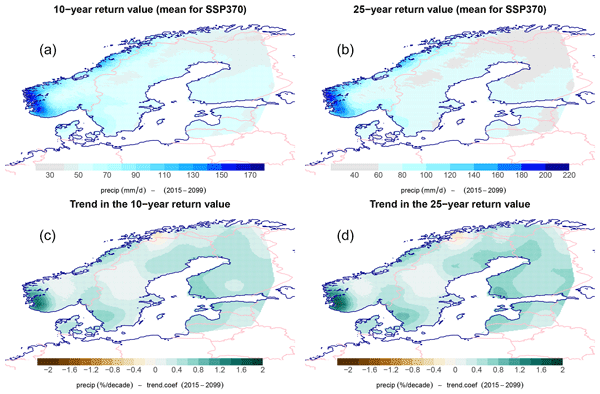
We present a new method to calculate the chance of heavy downpour and the maximum rainfall expected over a 25-year period. It is designed to analyse global climate models' reproduction of past and future climates. For the Nordic countries, it projects a wetter climate in the future with increased intensity but not necessarily more wet days. The analysis also shows that rainfall intensity is sensitive to future greenhouse gas emissions, while the number of wet days appears to be less affected.

Mette K. Gillespie, Liss M. Andreassen, Matthias Huss, Simon de Villiers, Kamilla H. Sjursen, Jostein Aasen, Jostein Bakke, Jan M. Cederstrøm, Hallgeir Elvehøy, Bjarne Kjøllmoen, Even Loe, Marte Meland, Kjetil Melvold, Sigurd D. Nerhus, Torgeir O. Røthe, Eivind W. N. Støren, Kåre Øst, and Jacob C. Yde
Earth Syst. Sci. Data, 16, 5799–5825, https://doi.org/10.5194/essd-16-5799-2024, https://doi.org/10.5194/essd-16-5799-2024, 2024
Short summary
Short summary
We present an extensive ice thickness dataset from Jostedalsbreen ice cap that will serve as a baseline for future studies of regional climate-induced change. Results show that Jostedalsbreen currently (~2020) has a maximum ice thickness of ~630 m, a mean ice thickness of 154 ± 22 m and an ice volume of 70.6 ±10.2 km3. Ice of less than 50 m thickness covers two narrow regions of Jostedalsbreen, and the ice cap is likely to separate into three parts in a warming climate.
Kajsa Maria Parding, Rasmus Emil Benestad, Anita Verpe Dyrrdal, and Julia Lutz
Hydrol. Earth Syst. Sci., 27, 3719–3732, https://doi.org/10.5194/hess-27-3719-2023, https://doi.org/10.5194/hess-27-3719-2023, 2023
Short summary
Short summary
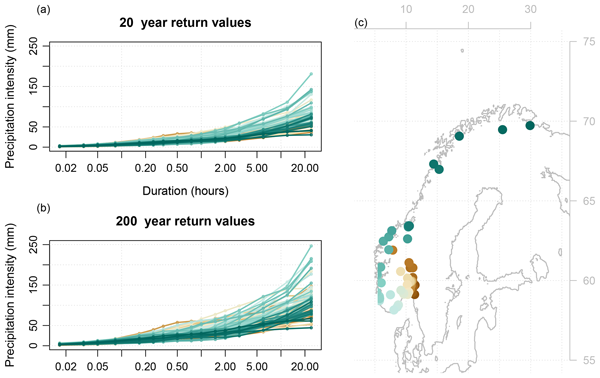
Intensity–duration–frequency (IDF) curves describe the likelihood of extreme rainfall and are used in hydrology and engineering, for example, for flood forecasting and water management. We develop a model to estimate IDF curves from daily meteorological observations, which are more widely available than the observations on finer timescales (minutes to hours) that are needed for IDF calculations. The method is applied to all data at once, making it efficient and robust to individual errors.
Rasmus E. Benestad, Abdelkader Mezghani, Julia Lutz, Andreas Dobler, Kajsa M. Parding, and Oskar A. Landgren
Geosci. Model Dev., 16, 2899–2913, https://doi.org/10.5194/gmd-16-2899-2023, https://doi.org/10.5194/gmd-16-2899-2023, 2023
Short summary
Short summary
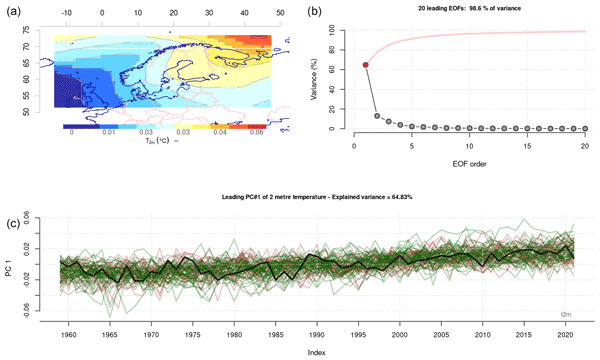
A mathematical method known as common EOFs is not widely used within the climate research community, but it offers innovative ways of evaluating climate models. We show how common EOFs can be used to evaluate large ensembles of global climate model simulations and distill information about their ability to reproduce salient features of the regional climate. We can say that they represent a kind of machine learning (ML) for dealing with big data.
Roman Brogli, Christoph Heim, Jonas Mensch, Silje Lund Sørland, and Christoph Schär
Geosci. Model Dev., 16, 907–926, https://doi.org/10.5194/gmd-16-907-2023, https://doi.org/10.5194/gmd-16-907-2023, 2023
Short summary
Short summary
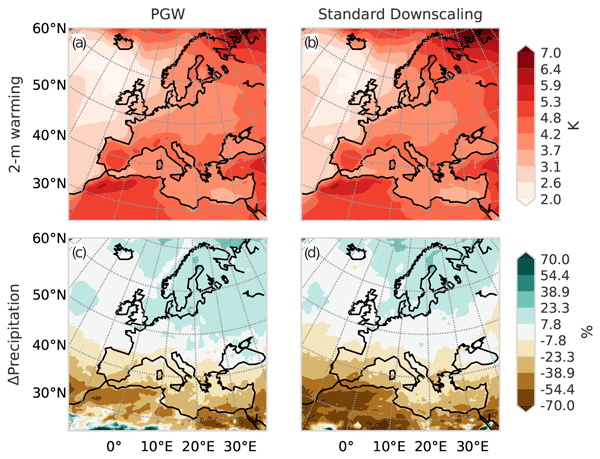
The pseudo-global-warming (PGW) approach is a downscaling methodology that imposes the large-scale GCM-based climate change signal on the boundary conditions of a regional climate simulation. It offers several benefits in comparison to conventional downscaling. We present a detailed description of the methodology, provide companion software to facilitate the preparation of PGW simulations, and present validation and sensitivity studies.
Sigrid Jørgensen Bakke, Niko Wanders, Karin van der Wiel, and Lena Merete Tallaksen
Nat. Hazards Earth Syst. Sci., 23, 65–89, https://doi.org/10.5194/nhess-23-65-2023, https://doi.org/10.5194/nhess-23-65-2023, 2023
Short summary
Short summary
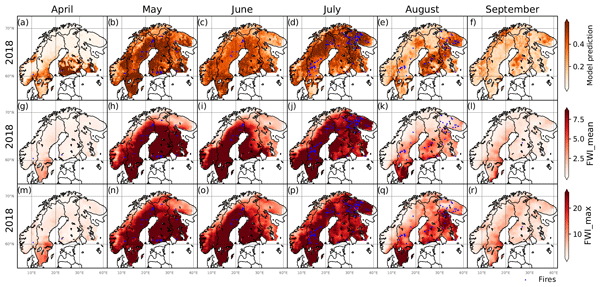
In this study, we developed a machine learning model to identify dominant controls of wildfire in Fennoscandia and produce monthly fire danger probability maps. The dominant control was shallow-soil water anomaly, followed by air temperature and deep soil water. The model proved skilful with a similar performance as the existing Canadian Forest Fire Weather Index (FWI). We highlight the benefit of using data-driven models jointly with other fire models to improve fire monitoring and prediction.
Veit Blauhut, Michael Stoelzle, Lauri Ahopelto, Manuela I. Brunner, Claudia Teutschbein, Doris E. Wendt, Vytautas Akstinas, Sigrid J. Bakke, Lucy J. Barker, Lenka Bartošová, Agrita Briede, Carmelo Cammalleri, Ksenija Cindrić Kalin, Lucia De Stefano, Miriam Fendeková, David C. Finger, Marijke Huysmans, Mirjana Ivanov, Jaak Jaagus, Jiří Jakubínský, Svitlana Krakovska, Gregor Laaha, Monika Lakatos, Kiril Manevski, Mathias Neumann Andersen, Nina Nikolova, Marzena Osuch, Pieter van Oel, Kalina Radeva, Renata J. Romanowicz, Elena Toth, Mirek Trnka, Marko Urošev, Julia Urquijo Reguera, Eric Sauquet, Aleksandra Stevkov, Lena M. Tallaksen, Iryna Trofimova, Anne F. Van Loon, Michelle T. H. van Vliet, Jean-Philippe Vidal, Niko Wanders, Micha Werner, Patrick Willems, and Nenad Živković
Nat. Hazards Earth Syst. Sci., 22, 2201–2217, https://doi.org/10.5194/nhess-22-2201-2022, https://doi.org/10.5194/nhess-22-2201-2022, 2022
Short summary
Short summary
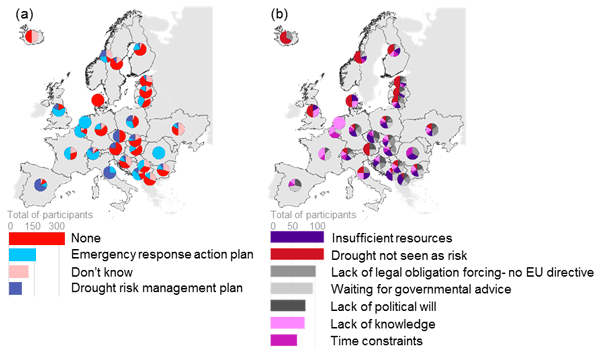
Recent drought events caused enormous damage in Europe. We therefore questioned the existence and effect of current drought management strategies on the actual impacts and how drought is perceived by relevant stakeholders. Over 700 participants from 28 European countries provided insights into drought hazard and impact perception and current management strategies. The study concludes with an urgent need to collectively combat drought risk via a European macro-level drought governance approach.
Erika Médus, Emma D. Thomassen, Danijel Belušić, Petter Lind, Peter Berg, Jens H. Christensen, Ole B. Christensen, Andreas Dobler, Erik Kjellström, Jonas Olsson, and Wei Yang
Nat. Hazards Earth Syst. Sci., 22, 693–711, https://doi.org/10.5194/nhess-22-693-2022, https://doi.org/10.5194/nhess-22-693-2022, 2022
Short summary
Short summary
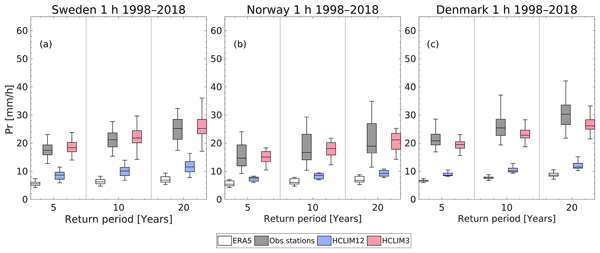
We evaluate the skill of a regional climate model, HARMONIE-Climate, to capture the present-day characteristics of heavy precipitation in the Nordic region and investigate the added value provided by a convection-permitting model version. The higher model resolution improves the representation of hourly heavy- and extreme-precipitation events and their diurnal cycle. The results indicate the benefits of convection-permitting models for constructing climate change projections over the region.
Roman Brogli, Silje Lund Sørland, Nico Kröner, and Christoph Schär
Weather Clim. Dynam., 2, 1093–1110, https://doi.org/10.5194/wcd-2-1093-2021, https://doi.org/10.5194/wcd-2-1093-2021, 2021
Short summary
Short summary
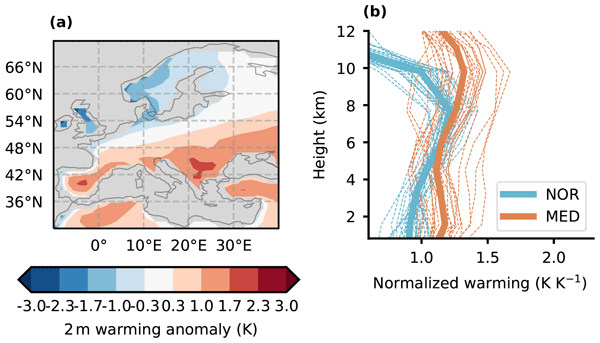
In a warmer future climate, climate simulations predict that some land areas will experience excessive warming during summer. We show that the excessive summer warming is related to the vertical distribution of warming within the atmosphere. In regions characterized by excessive warming, much of the warming occurs close to the surface. In other regions, most of the warming is redistributed to higher levels in the atmosphere, which weakens the surface warming.
Cited articles
Ahlstrøm, A., Bjørkelo, K., and Frydenlund, J.: AR5 klassifikasjonssystem – klassifikasjon av arealressurser, Skog og landskap, rapport nr. 6/2014, 38 pp., Norwegian Institute of Bioeconomy Research, http://hdl.handle.net/11250/2440173 (last access: 28 April 2026), 2014.
Alifu, H., Hirabayashi, Y., Imada, Y., and Shiogama, H.: Enhancement of river flooding due to global warming, Sci. Rep., 12, 20687, https://doi.org/10.1038/s41598-022-25182-6, 2022.
Andreassen, L. M., Huss, M., Melvold, K., Elvehøy, H., and Winsvold, S. H.: Ice thickness measurements and volume estimates for glaciers in Norway, J. Glaciol., 61, 763–775, https://doi.org/10.3189/2015JoG14J161, 2015.
Astagneau, P. C., Wood, R. R., Vrac, M., Kotlarski, S., Vaittinada Ayar, P., François, B., and Brunner, M. I.: Impact of bias adjustment strategy on ensemble projections of hydrological extremes, Hydrol. Earth Syst. Sci., 29, 5695–5718, https://doi.org/10.5194/hess-29-5695-2025, 2025.
Beck, H. E., Zimmermann, N. E., McVicar, T. R., Vergopolan, N., Berg, A., and Wood, E. F.: Present and future Köppen-Geiger climate classification maps at 1-km resolution, Sci. Data, 5, 180214, https://doi.org/10.1038/sdata.2018.214, 2018.
Beldring, S.: Distributed element water balance model system, Norwegian Water Resources and Energy Directorate, Report no. 4/2008, 40 pp., https://publikasjoner.nve.no/report/2008/report2008_04.pdf, https://github.com/DistributedElementWaterModel/Version_3.03 (last access: 28 April 2026), 2008.
Beldring, S.: nve-sbe/DistributedHbv: v_1 (v_1), Zenodo [code], https://doi.org/10.5281/zenodo.17531118, 2025a.
Beldring, S.: DistributedElementWaterModel/Version_3.03: v_1 (v_1), Zenodo [code], https://doi.org/10.5281/zenodo.17530242, 2025b.
Beldring, S., Engeland, K., Roald, L. A., Sælthun, N. R., and Voksø, A.: Estimation of parameters in a distributed precipitation-runoff model for Norway, Hydrol. Earth Syst. Sci., 7, 304–316, https://doi.org/10.5194/hess-7-304-2003, 2003.
Benestad, R. E., Parding, K. M., and Dobler, A.: Downscaling the probability of heavy rainfall over the Nordic countries, Hydrol. Earth Syst. Sci., 29, 45–65, https://doi.org/10.5194/hess-29-45-2025, 2025.
Bremnes, J. B.: Probabilistic wind power forecasts using local quantile regression, Wind Energy, 7, 47–54, https://doi.org/10.1002/we.107, 2004.
Bright, R. M., Eisner, S., Lund, M. T., Majasalmi, T., Myhre, G., and Astrup, R.: Inferring Surface Albedo Prediction Error Linked to Forest Structure at High Latitudes, J. Geophys. Res.-Atmos., 123, 4910–4925, https://doi.org/10.1029/2018JD028293, 2018.
Bürger, G., Sobie, S. R., Cannon, A. J., Werner, A. T., and Murdock, T. Q.: Downscaling Extremes: An Intercomparison of Multiple Methods for Future Climate, J. Climate, 26, 3429–3449, https://doi.org/10.1175/JCLI-D-12-00249.1, 2013.
Carr, S., Lawrence, D., Skaugen, T., and Wong, W. K.: Projected future changes in peak flows and implications for climate change allowances, NVE report nr. 26/2023, The Norwegian Water Resources and Energy Directorate, Oslo, Norway, https://publikasjoner.nve.no/rapport/2023/rapport2023_26.pdf (last access: 28 April 2026), 2023.
Cannon, A. J.: Multivariate quantile mapping bias correction: an N-dimensional probability density function transform for climate model simulations of multiple variables, Clim. Dynam., 50, 31–49, https://doi.org/10.1007/s00382-017-3580-6, 2018.
Cannon, A. J., Sobie, S. R., and Murdock, T. Q.: Bias Correction of GCM Precipitation by Quantile Mapping: How Well Do Methods Preserve Changes in Quantiles and Extremes?, J. Climate, 28, 6938–6959, https://doi.org/10.1175/JCLI-D-14-00754.1, 2015.
CH2018: CH2018 – Climate Scenarios for Switzerland, Technical Report, National Centre for Climate Services, Zürich, 271 pp., ISBN 978-3-9525031-4-0, 2018.
Chinita, M. J., Richardson, M., Teixeira, J., and Miranda, P. M. A.: Global mean frequency increases of daily and sub-daily heavy precipitation in ERA5, Environ. Res. Lett., 16, 074035, https://doi.org/10.1088/1748-9326/ac0caa, 2021.
Dalelane, C., Früh, B., Steger, C., and Walter, A.: A Pragmatic Approach to Build a Reduced Regional Climate Projection Ensemble for Germany Using the EURO-CORDEX 8.5 Ensemble, J. Appl. Meteorol. Clim., https://doi.org/10.1175/JAMC-D-17-0141.1, 2018.
DCCEEW: National Climate Risk Assessment: Methodology, Department of Climate Change, Energy, the Environment and Water, https://www.dcceew.gov.au/climate-change/publications/national-climate-risk-assessment (last access: 28 April 2026), 2023.
Dobler, A.: doblerone/3DBC: Version 2023 (Versjon v2023), Zenodo [code], https://doi.org/10.5281/zenodo.15260335, 2025.
Dobrowski, S. Z., Abatzoglou, J. T., Greenberg, J. A., and Schladow, S. G.: How much influence does landscape-scale physiography have on air temperature in a mountain environment?, Agr. Forest Meteorol., 149, 1751–1758, https://doi.org/10.1016/j.agrformet.2009.06.006, 2009.
Doherty, J. and Skahill, B. E.: An advanced regularization methodology for use in watershed model calibration, J. Hydrol., 327, 564–577, https://doi.org/10.1016/j.jhydrol.2005.11.058, 2006.
Dunn, R. J. H., Alexander, L. V., Donat, M. G., Zhang, X., Bador, M., Herold, N., Lippmann, T., Allan, R., Aguilar, E., Barry, A. A., Brunet, M., Caesar, J., Chagnaud, G., Cheng, V., Cinco, T., Durre, I., de Guzman, R., Htay, T. M., Wan Ibadullah, W. M., Bin Ibrahim, M. K. I., Khoshkam, M., Kruger, A., Kubota, H., Leng, T. W., Lim, G., Li-Sha, L., Marengo, J., Mbatha, S., McGree, S., Menne, M., de los Milagros Skansi, M., Ngwenya, S., Nkrumah, F., Oonariya, C., Pabon-Caicedo, J. D., Panthou, G., Pham, C., Rahimzadeh, F., Ramos, A., Salgado, E., Salinger, J., Sané, Y., Sopaheluwakan, A., Srivastava, A., Sun, Y., Timbal, B., Trachow, N., Trewin, B., van der Schrier, G., Vazquez-Aguirre, J., Vasquez, R., Villarroel, C., Vincent, L., Vischel, T., Vose, R., and Bin Hj Yussof, M. N.: Development of an Updated Global Land In Situ-Based Data Set of Temperature and Precipitation Extremes: HadEX3, J. Geophys. Res.-Atmos., 125, e2019JD032263, https://doi.org/10.1029/2019JD032263, 2020.
Dyrrdal, A. V., Bakke, S. J., Hanssen-Bauer, I., Mayer, S., Nilsen, I. B., Nilsen, J. E. Ø., Paasche, Ø., Saloranta, T., and Årthun, M. (Eds.): Klima i Norge – kunnskapsgrunnlag for klimatilpasning oppdatert i 2025 (“Climate in Norway – knowledge base for climate adaptation updated in 2025”), NCCS Report 1/2025, Norwegian Centre for Climate Services, Oslo, Norway, https://doi.org/10.60839/4rgq-nn84, 2025 (in Norwegian).
Eaton, B., Gregory, J., Drach, B., Taylor, K., Hankin, S., Caron, J., Signell, R., Bentley, P., Rappa, G., Höck, H., Pamment, A., Juckes, M., Raspaud, M., Blower, J., Horne, R., Whiteaker, T., Blodgett, D., Zender, C., Lee, D., Hassell, D., Snow, A. D., Kölling, T., Allured, D., Jelenak, A. Soerensen, A. M., Gaultier, L., Herlédan, S.: NetCDF Climate and Forecast (CF) Metadata Conventions (1.10), CF Community, Zenodo, https://doi.org/10.5281/zenodo.14275561, 2022.
EEA (European Environment Agency): Energy Performance of Buildings Directive, https://energy.ec.europa.eu/topics/energy-efficiency/energy-performance-buildings/energy-performance-buildings-directive_en (last access: 19 August 2025).
Erlandsen, H. B., Beldring, S., Eisner, S., Hisdal, H., Huang, S., and Tallaksen, L. M.: Constraining the HBV model for robust water balance assessments in a cold climate, Hydrol. Res., 52, 356–372, https://doi.org/10.2166/nh.2021.132, 2021.
Eum, H.-I., Gupta, A., and Dibike, Y.: Effects of univariate and multivariate statistical downscaling methods on climatic and hydrologic indicators for Alberta, Canada, J. Hydrol., 588, 125065, https://doi.org/10.1016/j.jhydrol.2020.125065, 2020.
Eyring, V., Bony, S., Meehl, G. A., Senior, C. A., Stevens, B., Stouffer, R. J., and Taylor, K. E.: Overview of the Coupled Model Intercomparison Project Phase 6 (CMIP6) experimental design and organization, Geosci. Model Dev., 9, 1937–1958, https://doi.org/10.5194/gmd-9-1937-2016, 2016.
Fischer, A. M., Strassmann, K. M., Croci-Maspoli, M., Hama, A. M., Knutti, R., Kotlarski, S., Schär, C., Schnadt Poberaj, C., Ban, N., Bavay, M., Beyerle, U., Bresch, D. N., Brönnimann, S., Burlando, P., Casanueva, A., Fatichi, S., Feigenwinter, I., Fischer, E. M., Hirschi, M., Liniger, M. A., Marty, C., Medhaug, I., Peleg, N., Pickl, M., Raible, C. C., Rajczak, J., Rössler, O., Scherrer, S. C., Schwierz, C., Seneviratne, S. I., Skelton, M., Sørland, S. L., Spirig, C., Tschurr, F., Zeder, J., and Zubler, E. M.: Climate Scenarios for Switzerland CH2018 – Approach and Implications, Climate Services, 26, 100288, https://doi.org/10.1016/j.cliser.2022.100288, 2022.
François, B., Vrac, M., Cannon, A. J., Robin, Y., and Allard, D.: Multivariate bias corrections of climate simulations: which benefits for which losses?, Earth Syst. Dynam., 11, 537–562, https://doi.org/10.5194/esd-11-537-2020, 2020.
Franke, J.: Rainfall complexity in mountains, Nat. Clim. Change, 14, 1223–1223, https://doi.org/10.1038/s41558-024-02209-6, 2024.
Gaarder, J. E., Tajet, H. T. T., Dobler, A., Hygen, H. O., and Kvande, T.: Future Climate Projections and Uncertainty Evaluations for Frost Decay Exposure Index in Norway, Buildings, 14, https://doi.org/10.3390/buildings14092873, 2024.
Golding, N., Lambkin, K., Wilson, L., Troch, R. D., Fischer, A. M., Hygen, H. O., Hama, A. M., Dyrrdal, A. V., Jamsin, E., Termonia, P., and Hewitt, C.: Developing national frameworks for climate services: Experiences, challenges and learnings from across Europe, Climate Services, 37, 100530, https://doi.org/10.1016/j.cliser.2024.100530, 2025.
Gjertsen, A. K. and Nilsen, J. E.: SAT-SKOG: Et skogkart basert på tolking av satellittbilder, Skog og landskap, rapport nr. 23/2012, 54 pp., Norwegian Institute of Bioeconomy Research, http://hdl.handle.net/11250/2453917 (last access: 28 April 2026), 2012.
Gu, G. and Adler, R. F.: Spatial Patterns of Global Precipitation Change and Variability during 1901–2010, J. Climate, https://doi.org/10.1175/JCLI-D-14-00201.1, 2015.
Gudmundsson, L.: qmap: Statistical Transformations for Post-Processing Climate Model Output, R-package version 1.0-6, The Comprehensive R Archive Network (CRAN) [code], https://doi.org/10.32614/CRAN.package.qmap, 2025.
Gudmundsson, L., Bremnes, J. B., Haugen, J. E., and Engen-Skaugen, T.: Technical Note: Downscaling RCM precipitation to the station scale using statistical transformations – a comparison of methods, Hydrol. Earth Syst. Sci., 16, 3383–3390, https://doi.org/10.5194/hess-16-3383-2012, 2012.
Gudmundsson, L., Boulange, J., Do, H. X., Gosling, S. N., Grillakis, M. G., Koutroulis, A. G., Leonard, M., Liu, J., Müller Schmied, H., Papadimitriou, L., Pokhrel, Y., Seneviratne, S. I., Satoh, Y., Thiery, W., Westra, S., Zhang, X., and Zhao, F.: Globally observed trends in mean and extreme river flow attributed to climate change, Science, 371, 1159–1162, https://doi.org/10.1126/science.aba3996, 2021.
Gutiérrez, J. M., Maraun, D., Widmann, M., Huth, R., Hertig, E., Benestad, R., Roessler, O., Wibig, J., Wilcke, R., Kotlarski, S., San Martín, D., Herrera, S., Bedia, J., Casanueva, A., Manzanas, R., Iturbide, M., Vrac, M., Dubrovsky, M., Ribalaygua, J., Pórtoles, J., Räty, O., Räisänen, J., Hingray, B., Raynaud, D., Casado, M. J., Ramos, P., Zerenner, T., Turco, M., Bosshard, T., Štěpánek, P., Bartholy, J., Pongracz, R., Keller, D. E., Fischer, A. M., Cardoso, R. M., Soares, P. M. M., Czernecki, B., and Pagé, C.: An intercomparison of a large ensemble of statistical downscaling methods over Europe: Results from the VALUE perfect predictor cross-validation experiment, Int. J. Climatol., 39, 3750–3785, https://doi.org/10.1002/joc.5462, 2019.
Hanssen-Bauer, I., Førland, E. J., Haddeland, I., Hisdal, H., Mayer, S., Nesje, A., Nilsen, J. E. Ø., Sandven, S., Sandø, A. B., Sorteberg, A., and Ådlandsvik, B.: Klima i Norge 2100 – Kunnskapsgrunnlag for klimatilpasning oppdatert i 2015, Norsk Klimaservicesenter, NCCS Report 2/2015, 203 pp., ISSN 2387-3027, 2015.
Hanssen-Bauer, I., Benestad, R. E., Lutz, J., Vikhamar-Schuler, D., Svyashchennikov, P., and Førland, E. J.: Comparative Analyses of Local Historical and Future Climate Conditions Important for Reindeer Herding in Finnmark, Norway and the Yamal Nenets Autonomous Okrug, Russia, in: Reindeer Husbandry, edited by: Mathiesen, S. D., Eira, I. M. G., Turi, E. I., Oskal, A., Pogodaev, M., Tonkopeeva, M., Springer Polar Sciences, Springer, Cham, https://doi.org/10.1007/978-3-031-17625-8_8, 2022.
Hawkins, E. and Sutton, R.: The potential to narrow uncertainty in projections of regional precipitation change, Clim. Dynam., 37, 407–418, https://doi.org/10.1007/s00382-010-0810-6, 2011.
Hersbach, H., Bell, B., Berrisford, P., Hirahara, S., Horányi, A., Muñoz-Sabater, J., Nicolas, J., Peubey, C., Radu, R., Schepers, D., Simmons, A., Soci, C., Abdalla, S., Abellan, X., Balsamo, G., Bechtold, P., Biavati, G., Bidlot, J., Bonavita, M., De Chiara, G., Dahlgren, P., Dee, D., Diamantakis, M., Dragani, R., Flemming, J., Forbes, R., Fuentes, M., Geer, A., Haimberger, L., Healy, S., Hogan, R. J., Hólm, E., Janisková, M., Keeley, S., Laloyaux, P., Lopez, P., Lupu, C., Radnoti, G., de Rosnay, P., Rozum, I., Vamborg, F., Villaume, S., and Thépaut, J.-N.: The ERA5 global reanalysis, Q. J. Roy. Meteor. Soc., 146, 1999–2049, https://doi.org/10.1002/qj.3803, 2020.
Hisdal, H., Vikhamar-Schuler, D., Førland, E., and Nilsen, I.: Klimaprofiler for fylker (“Climate factsheets for counties”), NCCS Report 2/2021, Norwegian Centre for Climate Services, Oslo, Norway, https://klimaservicesenter.no/kss/rapporter/rapporter-og-publikasjoner_2 (last access: 28 April 2026), 2021 (in Norwegian).
Huang, S., Eisner, S., Magnusson, J. O., Lussana, C., Yang, X., and Beldring, S.: Improvements of the spatially distributed hydrological modelling using the HBV model at 1 km resolution for Norway, J. Hydrol., 577, 123585, https://doi.org/10.1016/j.jhydrol.2019.03.051, 2019.
Huang, S., Eisner, S., Haddeland, I., and Tadege Mengistu, Z.: Evaluation of two new-generation global soil databases for macro-scale hydrological modelling in Norway, J. Hydrol., 610, 127895, https://doi.org/10.1016/j.jhydrol.2022.127895, 2022.
Huang, S., Eisner, S., Wong, W. K., and Cattaneo, N.: The potential impacts of climate and forest changes on streamflow for micro-, meso- and macro-scale catchments in Norway, Journal of Hydrology: Regional Studies, 57, 102147, https://doi.org/10.1016/j.ejrh.2024.102147, 2025a.
Huang, S., Haddeland, I., Lussana, C., Dobler, A., and Tveito, O. E.: Daily climate and hydrological reference data for Norway, Norwegian Meteorological Institute [data set], https://doi.org/10.21343/gbq0-4t97, 2025b.
Huang, S., Wong, W. K., Tveito, O. E., and Haddeland, I.: Impacts of empirical and physical evaporation methods on changes in hydrological components and drought indices under climate change scenarios, Hydrol. Res., https://doi.org/10.2166/nh.2026.220, 2026.
Huebener, H., Hoffmann, P., Keuler, K., Pfeifer, S., Ramthun, H., Spekat, A., Steger, C., and Warrach-Sagi, K.: Deriving user-informed climate information from climate model ensemble results, Adv. Sci. Res., 14, 261–269, https://doi.org/10.5194/asr-14-261-2017, 2017.
Hundecha, Y., Sunyer, M. A., Lawrence, D., Madsen, H., Willems, P., Bürger, G., Kriaučiūnienė, J., Loukas, A., Martinkova, M., Osuch, M., Vasiliades, L., von Christierson, B., Vormoor, K., and Yücel, I.: Inter-comparison of statistical downscaling methods for projection of extreme flow indices across Europe, J. Hydrol., 541, 1273–1286, https://doi.org/10.1016/j.jhydrol.2016.08.033, 2016.
Huss, M., Jouvet, G., Farinotti, D., and Bauder, A.: Future high-mountain hydrology: a new parameterization of glacier retreat, Hydrol. Earth Syst. Sci., 14, 815–829, https://doi.org/10.5194/hess-14-815-2010, 2010.
IPCC (Intergovernmental Panel on Climate Change): Climate Change 2021 – The Physical Science Basis: Working Group I Contribution to the Sixth Assessment Report of the Intergovernmental Panel on Climate Change, Cambridge University Press, https://doi.org/10.1017/9781009157896, 2023.
Jacob, D., Petersen, J., Eggert, B., Alias, A., Christensen, O. B., Bouwer, L. M., Braun, A., Colette, A., Déqué, M., Georgievski, G., Georgopoulou, E., Gobiet, A., Menut, L., Nikulin, G., Haensler, A., Hempelmann, N., Jones, C., Keuler, K., Kovats, S., Kröner, N., Kotlarski, S., Kriegsmann, A., Martin, E., van Meijgaard, E., Moseley, C., Pfeifer, S., Preuschmann, S., Radermacher, C., Radtke, K., Rechid, D., Rounsevell, M., Samuelsson, P., Somot, S., Soussana, J.-F., Teichmann, C., Valentini, R., Vautard, R., Weber, B., and Yiou, P.: EURO-CORDEX: new high-resolution climate change projections for European impact research, Reg. Environ. Change, 14, 563–578, https://doi.org/10.1007/s10113-013-0499-2, 2014.
Jacob, D., Teichmann, C., Sobolowski, S., Katragkou, E., Anders, I., Belda, M., Benestad, R., Boberg, F., Buonomo, E., Cardoso, R. M., Casanueva, A., Christensen, O. B., Christensen, J. H., Coppola, E., De Cruz, L., Davin, E. L., Dobler, A., Domínguez, M., Fealy, R., Fernandez, J., Gaertner, M. A., García-Díez, M., Giorgi, F., Gobiet, A., Goergen, K., Gómez-Navarro, J. J., Alemán, J. J. G., Gutiérrez, C., Gutiérrez, J. M., Güttler, I., Haensler, A., Halenka, T., Jerez, S., Jiménez-Guerrero, P., Jones, R. G., Keuler, K., Kjellström, E., Knist, S., Kotlarski, S., Maraun, D., van Meijgaard, E., Mercogliano, P., Montávez, J. P., Navarra, A., Nikulin, G., de Noblet-Ducoudré, N., Panitz, H.-J., Pfeifer, S., Piazza, M., Pichelli, E., Pietikäinen, J.-P., Prein, A. F., Preuschmann, S., Rechid, D., Rockel, B., Romera, R., Sánchez, E., Sieck, K., Soares, P. M. M., Somot, S., Srnec, L., Sørland, S. L., Termonia, P., Truhetz, H., Vautard, R., Warrach-Sagi, K., and Wulfmeyer, V.: Regional climate downscaling over Europe: perspectives from the EURO-CORDEX community, Reg. Environ. Change, 20, 51, https://doi.org/10.1007/s10113-020-01606-9, 2020.
Katragkou, E., Sobolowski, S. P., Teichmann, C., Solmon, F., Pavlidis, V., Rechid, D., Hoffmann, P., Fernández, J., Nikulin, G., and Jacob, D.: Delivering an improved framework for the new generation of CMIP6-driven EURO-CORDEX regional climate simulations, B. Am. Meteorol. Soc., 105, E962–E974, https://doi.org/10.1175/BAMS-D-23-0131.1, 2024.
Kay, A. L.: A comparison of hydrological impacts from two ensembles of regional climate projections with a range of climate sensitivities, Reg. Environ. Change, 25, 89, https://doi.org/10.1007/s10113-025-02426-5, 2025.
Kundzewicz, Z. W., Krysanova, V., Dankers, R., Hirabayashi, Y., Kanae, S., Hattermann, F. F., Huang, S., Milly, P. C. D., Stoffel, M., Driessen, P. P. J., Matczak, P., Quevauviller, P., and Schellnhuber, H.-J.: Differences in flood hazard projections in Europe – their causes and consequences for decision making, Hydrolog. Sci. J., 62, 1–14, https://doi.org/10.1080/02626667.2016.1241398, 2017.
Kuya, E. K., Hanssen-Bauer, I., Mayer, S., and Heiberg, H.: Projected changes of rain, sleet, and snowfall in Norway, Norsk Geogr. Tidsskr., 78, 73–87, https://doi.org/10.1080/00291951.2024.2360409, 2024.
Lafferty, D. C. and Sriver, R. L.: Downscaling and bias-correction contribute considerable uncertainty to local climate projections in CMIP6, npj Clim. Atmos. Sci., 6, 158, https://doi.org/10.1038/s41612-023-00486-0, 2023.
Lawrence, D.: Uncertainty introduced by flood frequency analysis in projections for changes in flood magnitudes under a future climate in Norway, Journal of Hydrology: Regional Studies, 28, 100675, https://doi.org/10.1016/j.ejrh.2020.100675, 2020.
Lhotka, O., Plavcová, E., and Beranová, R.: Future Changes in Day-to-Day Precipitation Variability in Europe, J. Hydrometeorol., 25, 8, https://doi.org/10.1175/JHM-D-23-0206.1, 2024.
Li, H., Beldring, S., Xu, C.-Y., Huss, M., Melvold, K., and Jain, S. K.: Integrating a glacier retreat model into a hydrological model – Case studies of three glacierised catchments in Norway and Himalayan region, J. Hydrol., 527, 656–667, https://doi.org/10.1016/j.jhydrol.2015.05.017, 2015.
Li, L., Wang, B., Feng, P., Jägermeyr, J., Asseng, S., Müller, C., Macadam, I., Liu, D. L., Waters, C., Zhang, Y., He, Q., Shi, Y., Chen, S., Guo, X., Li, Y., He, J., Feng, H., Yang, G., Tian, H., and Yu, Q.: The optimization of model ensemble composition and size can enhance the robustness of crop yield projections, Commun. Earth Environ., 4, 362, https://doi.org/10.1038/s43247-023-01016-9, 2023.
Liersch, S., Drews, M., Pilz, T., Salack, S., Sietz, D., Aich, V., A D Larsen, M., Gädeke, A., Halsnæ s, K., Thiery, W., Huang, S., Lobanova, A., Koch, H., and Hattermann, F. F.: One simulation, different conclusions – the baseline period makes the difference!, Environ. Res. Lett., 15, 104014, https://doi.org/10.1088/1748-9326/aba3d7, 2020.
Lussana, C.: seNorge observational gridded datasets, MET report 7-2020, Norwegian Meteorological Institute, https://www.met.no/publikasjoner/met-report/met-report-2020/_/attachment/download/9f79d391-62d8-4fc1-a61a-9f0e7f1de389:8c74ebf2118593aa75272e6aff416ce66f86e73f/MET-report-07-2020.pdf (last access: 28 April 2026), 2020.
Lussana, C., Tveito, O. E., Dobler, A., and Tunheim, K.: seNorge_2018, daily precipitation, and temperature datasets over Norway, Earth Syst. Sci. Data, 11, 1531–1551, https://doi.org/10.5194/essd-11-1531-2019, 2019.
Lutz, J., Hanssen-Bauer, I., Tveito, O. E., and Dobler, A.: Precipitation variability in Norway 1961–2020, MET-report 01-2024, Norwegian Meteorological Institute, https://www.met.no/publikasjoner/met-report/_/attachment/download/f5ba4d69-dba2-4eb6-bed9-0189178b5e7a:ba4f4974e503f9509d33f101efc40145b47a59e6/MET%20report%201%202024.pdf (last access: 28 April 2026), 2024.
Majasalmi, T., Eisner, S., Astrup, R., Fridman, J., and Bright, R. M.: An enhanced forest classification scheme for modeling vegetation–climate interactions based on national forest inventory data, Biogeosciences, 15, 399–412, https://doi.org/10.5194/bg-15-399-2018, 2018.
Maraun, D.: Bias Correction, Quantile Mapping, and Downscaling: Revisiting the Inflation Issue, J. Climate, 26, 2137–2143, https://doi.org/10.1175/jcli-d-12-00821.1, 2013.
Maraun, D. and Widmann, M.: Statistical Downscaling and Bias Correction for Climate Research, Cambridge University Press, 347 pp., https://doi.org/10.1017/9781107588783, 2018.
Martinich, J. and Crimmins, A.: Climate damages and adaptation potential across diverse sectors of the United States, Nat. Clim. Change, 9, 397–404, 2019.
Matiu, M., Napoli, A., Kotlarski, S., Zardi, D., Bellin, A., and Majone, B.: Elevation-dependent biases of raw and bias-adjusted EURO-CORDEX regional climate models in the European Alps, Clim. Dynam., https://doi.org/10.1007/s00382-024-07376-y, 2024.
Mayer, S., Khasandi Kuya, E., Antonsen, K., Abegg, B., and Hanssen-Bauer, I.: Warmer and wetter: Outlining climate services for snow-dependent tourism in Norway – The case of Lofoten, Climate Services, 32, 100405, https://doi.org/10.1016/j.cliser.2023.100405, 2023.
McAfee, S. A.: Methodological differences in projected potential evapotranspiration, Climatic Change, 120, 915–930, https://doi.org/10.1007/s10584-013-0864-7, 2013.
McSweeney, C. F., Jones, R. G., Lee, R. W., and Rowell, D. P.: Selecting CMIP5 GCMs for downscaling over multiple regions, Clim. Dynam., 44, 3237–3260, https://doi.org/10.1007/s00382-014-2418-8, 2015.
Mehrotra, R. and Sharma, A.: A Resampling Approach for Correcting Systematic Spatiotemporal Biases for Multiple Variables in a Changing Climate, Water Resour. Res., 55, 754–770, https://doi.org/10.1029/2018WR023270, 2019.
Meyer, J., Kohn, I., Stahl, K., Hakala, K., Seibert, J., and Cannon, A. J.: Effects of univariate and multivariate bias correction on hydrological impact projections in alpine catchments, Hydrol. Earth Syst. Sci., 23, 1339–1354, https://doi.org/10.5194/hess-23-1339-2019, 2019.
Moriasi, D. N., Arnold, J. G., Liew, M. W. V., Bingner, R. L., Harmel, R. D., and Veith, T. L.: Model Evaluation Guidelines for Systematic Quantification of Accuracy in Watershed Simulations, T. ASABE, 50, 885–900, https://doi.org/10.13031/2013.23153, 2007.
Müller, M., Homleid, M., Ivarsson, K.-I., Køltzow, M. A. Ø., Lindskog, M., Midtbø, K. H., Andrae, U., Aspelien, T., Berggren, L., Bjørge, D., Dahlgren, P., Kristiansen, J., Randriamampianina, R., Ridal, M., and Vignes, O.: AROME-MetCoOp: A Nordic Convective-Scale Operational Weather Prediction Model, Weather Forecast., https://doi.org/10.1175/WAF-D-16-0099.1, 2017.
Nash, J. E. and Sutcliffe, J. V.: River flow forecasting through conceptual models part I – A discussion of principles, J. Hydrol., 10, 282–290, 1970.
Nilsen, I. B., Hanssen-Bauer, I., Tveito, O. E., and Wong, W. K.: Projected changes in days with zero-crossings for Norway, Int. J. Climatol., 41, 2173–2188, https://doi.org/10.1002/joc.6913, 2021.
Nilsen, I. B., Hanssen-Bauer, I., Dyrrdal, A. V., Hisdal, H., Lawrence, D., Haddeland, I., and Wong, W. K.: From Climate Model Output to Actionable Climate Information in Norway, Front. Clim., 4, https://doi.org/10.3389/fclim.2022.866563, 2022.
Norwegian Government: Statlige Planretningslinjer for klima og energi (“government guidelines on climate and renergy”), https://lovdata.no/dokument/SF/forskrift/2024-12-20-3359 (last access: 6 October 2025), 2024.
Padrón, R. S., Gudmundsson, L., Decharme, B., Ducharne, A., Lawrence, D. M., Mao, J., Peano, D., Krinner, G., Kim, H., and Seneviratne, S. I.: Observed changes in dry-season water availability attributed to human-induced climate change, Nat. Geosci., 13, 477–481, https://doi.org/10.1038/s41561-020-0594-1, 2020.
Paz, S. M. and Willems, P.: Uncovering the strengths and weaknesses of an ensemble of quantile mapping methods for downscaling precipitation change in Southern Africa, Journal of Hydrology: Regional Studies, 41, 101104, https://doi.org/10.1016/j.ejrh.2022.101104, 2022.
Peter, J., Vogel, E., Sharples, W., Bende-Michl, U., Wilson, L., Hope, P., Dowdy, A., Kociuba, G., Srikanthan, S., Duong, V. C., Roussis, J., Matic, V., Khan, Z., Oke, A., Turner, M., Baron-Hay, S., Johnson, F., Mehrotra, R., Sharma, A., Thatcher, M., Azarvinand, A., Thomas, S., Boschat, G., Donnelly, C., and Argent, R.: Continental-scale bias-corrected climate and hydrological projections for Australia, Geosci. Model Dev., 17, 2755–2781, https://doi.org/10.5194/gmd-17-2755-2024, 2024.
Pirk, N., Aalstad, K., Yilmaz, Y. A., Vatne, A., Popp, A. L., Horvath, P., Bryn, A., Vollsnes, A. V., Westermann, S., Berntsen, T. K., Stordal, F., and Tallaksen, L. M.: Snow–vegetation–atmosphere interactions in alpine tundra, Biogeosciences, 20, 2031–2047, https://doi.org/10.5194/bg-20-2031-2023, 2023.
Pourmokhtarian, A., Driscoll, C. T., Campbell, J. L., Hayhoe, K., and Stoner, A. M. K.: The effects of climate downscaling technique and observational data set on modeled ecological responses, Ecol. Appl., 26, 1321–1337, https://doi.org/10.1890/15-0745, 2016.
Reistad, M., Øyvind Breivik, Haakenstad, H., Aarnes, O. J., Furevik, B. R., and Bidlot, J.-R.: A high-resolution hindcast of wind and waves for the North Sea, the Norwegian Sea, and the Barents Sea, J. Geophys. Res., 116, https://doi.org/10.1029/2010JC006402, 2011.
Reyniers, N., Zha, Q., Addor, N., Osborn, T. J., Forstenhäusler, N., and He, Y.: Two sets of bias-corrected regional UK Climate Projections 2018 (UKCP18) of temperature, precipitation and potential evapotranspiration for Great Britain, Earth Syst. Sci. Data, 17, 2113–2133, https://doi.org/10.5194/essd-17-2113-2025, 2025.
Rössler, O., Fischer, A. M., Huebener, H., Maraun, D., Benestad, R. E., Christodoulides, P., Soares, P. M. M., Cardoso, R. M., Pagé, C., Kanamaru, H., Kreienkamp, F., and Vlachogiannis, D.: Challenges to link climate change data provision and user needs: Perspective from the COST-action VALUE, Int. J. Climatol., 39, 3704–3716, https://doi.org/10.1002/joc.5060, 2019.
Statistics Norway: Land use and land cover – SSB, Statistics Norway, https://www.ssb.no/en/natur-og-miljo/areal/statistikk/arealbruk-og-arealressurser (last access: 27 March 2025), 2025.
Schumacher, D. L., Singh, J., Hauser, M., Fischer, E. M., Wild, M., and Seneviratne, S. I.: Exacerbated summer European warming not captured by climate models neglecting long-term aerosol changes, Commun. Earth Environ., 5, https://doi.org/10.1038/s43247-024-01332-8, 2024.
Sobolowski, S., Somot, S., Fernandez, J., Evin, G., Brands, S., Maraun, D., Kotlarski, S., Jury, M., Benestad, R. E., Teichmann, C., and Christensen, O. B.: GCM Selection and Ensemble Design: Best Practices and Recommendations from the EURO-CORDEX Community, B. Am. Meteorol. Soc., 106, E1834–E1850, https://doi.org/10.1175/BAMS-D-23-0189.1, 2025.
Tam, B., Bonsal, B., Zhang, X., Zhang, Q., and Rong, R.: Assessing Potential Evapotranspiration Methods in Future Drought Projections across Canada, Atmosphere-Ocean, 62, 193–205, https://doi.org/10.1080/07055900.2023.2288632, 2024.
Tang, J., Niu, X., Wang, S., Gao, H., Wang, X., and Wu, J.: Statistical downscaling and dynamical downscaling of regional climate in China: Present climate evaluations and future climate projections, J. Geophys. Res.-Atmos., 121, 2110–2129, https://doi.org/10.1002/2015JD023977, 2016.
Taylor, K. E., Stouffer, R. J., and Meehl, G. A.: An overview of CMIP5 and the experiment design, B. Am. Meteorol. Soc., 93, 485–498, https://doi.org/10.1175/BAMS-D-11-00094.1, 2012.
Thorarinsdottir, T. L., Gneiting, T., and Gissibl, N.: Using proper divergence functions to evaluate climate models, SIAM-ASA J. Uncertainty Quantif., 1, 522–534, https://doi.org/10.1137/130907550, 2013.
Tong, Y., Gao, X., Han, Z., Xu, Y., and Giorgi, F.: Bias correction of temperature and precipitation over China for RCM simulations using the QM and QDM methods, Clim. Dynam., 57, 1425–1443, https://doi.org/10.1007/s00382-020-05447-4, 2021.
Tveito, O. E.: Norwegian standard climate normals 1991–2020 – the methodological approach, MET report 5 2021, Norwegian Meteorological Institute, https://www.met.no/publikasjoner/met-report/met-report-2021/_/attachment/download/31bb0160-d8cf-4a2b-9646-4df6f5904059:3ac4fec6cf3fb7919aefe42db2b63ad8e8b9e6a6/METreport%2005_2021_New_Norwegian_standard_climate_normals_1991_2020-signert.pdf (last access: 28 April 2026), 2021.
Vautard, R., Kadygrov, N., Iles, C., Boberg, F., Buonomo, E., Bülow, K., Coppola, E., Corre, L., van Meijgaard, E., Nogherotto, R., Sandstad, M., Schwingshackl, C., Somot, S., Aalbers, E., Christensen, O. B., Ciarlo, J. M., Demory, M.-E., Giorgi, F., Jacob, D., Jones, R. G., Keuler, K., Kjellström, E., Lenderink, G., Levavasseur, G., Nikulin, G., Sillmann, J., Solidoro, C., Sørland, S. L., Steger, C., Teichmann, C., Warrach-Sagi, K., and Wulfmeyer, V.: Evaluation of the Large EURO-CORDEX Regional Climate Model Ensemble, J. Geophys. Res.-Atmos., 126, e2019JD032344, https://doi.org/10.1029/2019JD032344, 2021.
Vetter, T., Reinhardt, J., Flörke, M., van Griensven, A., Hattermann, F., Huang, S., Koch, H., Pechlivanidis, I. G., Plötner, S., Seidou, O., Su, B., Vervoort, R. W., and Krysanova, V.: Evaluation of sources of uncertainty in projected hydrological changes under climate change in 12 large-scale river basins, Climatic Change, 141, 419–433, https://doi.org/10.1007/s10584-016-1794-y, 2017.
Wang, X. and Liu, L.: The Impacts of Climate Change on the Hydrological Cycle and Water Resource Management, Water, 15, 2342, https://doi.org/10.3390/w15132342, 2023.
Wilkinson, M. D., Dumontier, M., Aalbersberg, Ij. J., Appleton, G., Axton, M., Baak, A., Blomberg, N., Boiten, J.-W., da Silva Santos, L. B., Bourne, P. E., Bouwman, J., Brookes, A. J., Clark, T., Crosas, M., Dillo, I., Dumon, O., Edmunds, S., Evelo, C. T., Finkers, R., Gonzalez-Beltran, A., Gray, A. J. G., Groth, P., Goble, C., Grethe, J. S., Heringa, J., 't Hoen, P. A. C., Hooft, R., Kuhn, T., Kok, R., Kok, J., Lusher, S. J., Martone, M. E., Mons, A., Packer, A. L., Persson, B., Rocca-Serra, P., Roos, M., van Schaik, R., Sansone, S.-A., Schultes, E., Sengstag, T., Slater, T., Strawn, G., Swertz, M. A., Thompson, M., van der Lei, J., van Mulligen, E., Velterop, J., Waagmeester, A., Wittenburg, P., Wolstencroft, K., Zhao, J., and Mons, B.: The FAIR Guiding Principles for scientific data management and stewardship, Sci. Data, 3, 160018, https://doi.org/10.1038/sdata.2016.18, 2016.
Wolff, M. A., Isaksen, K., Petersen-Øverleir, A., Ødemark, K., Reitan, T., and Brækkan, R.: Derivation of a new continuous adjustment function for correcting wind-induced loss of solid precipitation: results of a Norwegian field study, Hydrol. Earth Syst. Sci., 19, 951–967, https://doi.org/10.5194/hess-19-951-2015, 2015.
Wong, W. K., Haddeland, I., Lawrence, D., and Beldring, S.: Gridded 1 × 1 km climate and hydrological projections for Norway, NVE Report No. 59, Norwegian Water Resources and Energy Directorate, Oslo, Norway, 2016.
Wong, W. K., Dobler, A., Huang, S., Beldring, S., Melvold, K., and Ruan, G.: Daily bias-adjusted climate (COR-BA-2025) and hydrological (distHBV-COR-BA-2025) projections for Norway, Norwegian Meteorological Institute [data set], https://doi.org/10.21343/0k90-6w67, 2025.
Yilmaz, K. K., Gupta, H. V., and Wagener, T.: A process-based diagnostic approach to model evaluation: Application to the NWS distributed hydrologic model, Water Resour. Res., 44, https://doi.org/10.1029/2007WR006716, 2008.
Yuan, Q., Thorarinsdottir, T. L., Beldring, S., Wong, W. K., Huang, S., and Xu, C.-Y.: New Approach for Bias Correction and Stochastic Downscaling of Future Projections for Daily Mean Temperatures to a High-Resolution Grid, J. Appl. Meteorol. Clim., 58, 2617–2632, https://doi.org/10.1175/JAMC-D-19-0086.1, 2019.
Yuan, Q., Thorarinsdottir, T. L., Beldring, S., Wong, W. K., and Xu, C.-Y.: Bridging the scale gap: obtaining high-resolution stochastic simulations of gridded daily precipitation in a future climate, Hydrol. Earth Syst. Sci., 25, 5259–5275, https://doi.org/10.5194/hess-25-5259-2021, 2021.
Zhang, H., Chapman, S., Trancoso, R., Toombs, N., and Syktus, J.: Assessing the impact of bias correction approaches on climate extremes and the climate change signal, Meteorol. Appl., 31, 1–18, https://doi.org/10.1002/met.2204, 2024.
Zhang, L., Xu, Y., Meng, C., Li, X., Liu, H., and Wang, C.: Comparison of Statistical and Dynamic Downscaling Techniques in Generating High-Resolution Temperatures in China from CMIP5 GCMs, J. Appl. Meteorol. and Clim., https://doi.org/10.1175/JAMC-D-19-0048.1, 2020.
Short summary
This paper documents the improved model experiment, which is used to generate the most updated, comprehensive and detailed climate and hydrological projections for the national climate assessment report for Norway published in October 2025. The new bias-adjusted daily high-resolution climate and hydrological projections are openly accessible and will serve as a knowledge base for climate change adaptation to decision makers at various administrative levels in Norway.
This paper documents the improved model experiment, which is used to generate the most updated,...


