
Articles | Volume 19, issue 10
https://doi.org/10.5194/gmd-19-4289-2026
© Author(s) 2026. This work is distributed under
the Creative Commons Attribution 4.0 License.
the Creative Commons Attribution 4.0 License.
https://doi.org/10.5194/gmd-19-4289-2026
© Author(s) 2026. This work is distributed under
the Creative Commons Attribution 4.0 License.
the Creative Commons Attribution 4.0 License.
Model description paper
| 
21 May 2026
Model description paper |
| 21 May 2026
| 21 May 2026
Eradiate: an accurate and flexible radiative transfer model for earth observation and atmospheric science
Vincent Leroy
CORRESPONDING AUTHOR
Rayference, Brussels, Belgium
Nicolae Marton
Rayference, Brussels, Belgium
Claudia Emde
Rayference, Brussels, Belgium
Nicolas Misk
Rayference, Brussels, Belgium
Misael Gonzalez Almeida
Rayference, Brussels, Belgium
Sebastian Schunke
Formerly Rayference, Brussels, Belgium
Noelle Cremer
Formerly Serco SpA c/o European Space Agency (ESA), European Space Research Institute (ESRIN), Frascati, Italy
Ferran Gascon
European Space Agency (ESA), European Space Research Institute (ESRIN), Frascati, Italy
Yves Govaerts
Rayference, Brussels, Belgium
Related authors
No articles found.
Marta Luffarelli, Nicolas Misk, Analy Baltodano, Thomas Popp, Stefan Kinne, Ulrike Stöffelmair, Michael Schulz, Jan Griesfeller, Ove W. Haugvalstad, Martin Stengel, Sarah Brüning, Gareth Thomas, Elisa Carboni, Daniel Robbins, and Michael Eisinger
Earth Syst. Sci. Data Discuss., https://doi.org/10.5194/essd-2026-327, https://doi.org/10.5194/essd-2026-327, 2026
Preprint under review for ESSD
Short summary
Short summary
Understanding how aerosol particles affect clouds is essential for improving climate predictions, yet current satellite data are not always reliable or suitable for this purpose. This study evaluates major datasets for analysing aerosol effects on liquid clouds, dust-driven cloud glaciation, and a potential climate indicator to monitor aerosol-cloud interactions.
Merlijn I. Dingemanse, Daniele Cerra, Ferran Gascon, and Tobias Storch
ISPRS Ann. Photogramm. Remote Sens. Spatial Inf. Sci., XI-3-2026, 359–366, https://doi.org/10.5194/isprs-annals-XI-3-2026-359-2026, https://doi.org/10.5194/isprs-annals-XI-3-2026-359-2026, 2026
Anna Weber, Veronika Pörtge, Claudia Emde, and Bernhard Mayer
Atmos. Meas. Tech., 18, 7581–7601, https://doi.org/10.5194/amt-18-7581-2025, https://doi.org/10.5194/amt-18-7581-2025, 2025
Short summary
Short summary
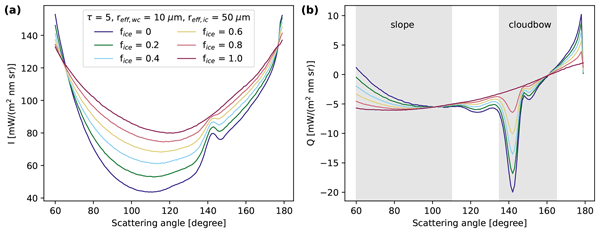
In this work, a new quantitative retrieval of cloud thermodynamic phase partitioning based on multi-angle polarimetric imaging is presented. The retrieval is validated using synthetic data for idealized and realistic cloud cases and applied to measurements of the airborne specMACS instrument during the HALO-(AC)3 campaign. It provides high spatial resolution information about phase partitioning at cloud top and allows for example to study phase transitions in Arctic mixed-phase clouds.

Claudia Emde, Veronika Pörtge, Mihail Manev, and Bernhard Mayer
Atmos. Meas. Tech., 17, 6769–6789, https://doi.org/10.5194/amt-17-6769-2024, https://doi.org/10.5194/amt-17-6769-2024, 2024
Short summary
Short summary
We introduce an innovative method to retrieve the cloud fraction and optical thickness of liquid water clouds over the ocean based on polarimetry. This is well suited for satellite observations providing multi-angle polarization measurements. Cloud fraction and cloud optical thickness can be derived from measurements at two viewing angles: one within the cloudbow and one in the sun glint region.
Giulia Roccetti, Luca Bugliaro, Felix Gödde, Claudia Emde, Ulrich Hamann, Mihail Manev, Michael Fritz Sterzik, and Cedric Wehrum
Atmos. Meas. Tech., 17, 6025–6046, https://doi.org/10.5194/amt-17-6025-2024, https://doi.org/10.5194/amt-17-6025-2024, 2024
Short summary
Short summary
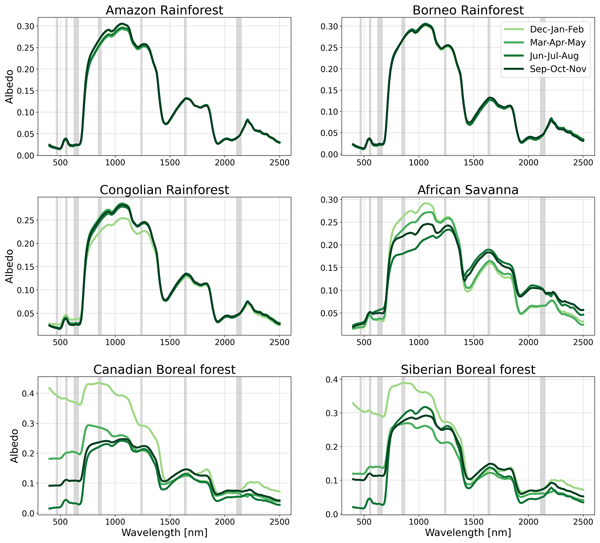
The amount of sunlight reflected by the Earth’s surface (albedo) is vital for the Earth's radiative system. While satellite instruments offer detailed spatial and temporal albedo maps, they only cover seven wavelength bands. We generate albedo maps that fully span the visible and near-infrared range using a machine learning algorithm. These maps reveal how the reflectivity of different land surfaces varies throughout the year. Our dataset enhances the understanding of the Earth's energy balance.
Richard Maier, Fabian Jakub, Claudia Emde, Mihail Manev, Aiko Voigt, and Bernhard Mayer
Geosci. Model Dev., 17, 3357–3383, https://doi.org/10.5194/gmd-17-3357-2024, https://doi.org/10.5194/gmd-17-3357-2024, 2024
Short summary
Short summary
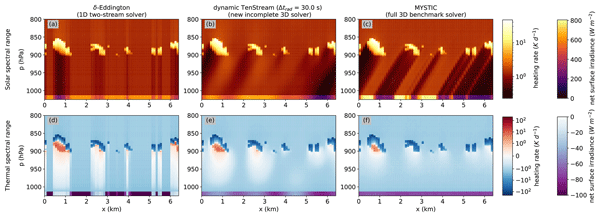
Based on the TenStream solver, we present a new method to accelerate 3D radiative transfer towards the speed of currently used 1D solvers. Using a shallow-cumulus-cloud time series, we evaluate the performance of this new solver in terms of both speed and accuracy. Compared to a 3D benchmark simulation, we show that our new solver is able to determine much more accurate irradiances and heating rates than a 1D δ-Eddington solver, even when operated with a similar computational demand.
Ilias Fountoulakis, Alexandra Tsekeri, Stelios Kazadzis, Vassilis Amiridis, Angelos Nersesian, Maria Tsichla, Emmanouil Proestakis, Antonis Gkikas, Kyriakoula Papachristopoulou, Vasileios Barlakas, Claudia Emde, and Bernhard Mayer
Atmos. Chem. Phys., 24, 4915–4948, https://doi.org/10.5194/acp-24-4915-2024, https://doi.org/10.5194/acp-24-4915-2024, 2024
Short summary
Short summary
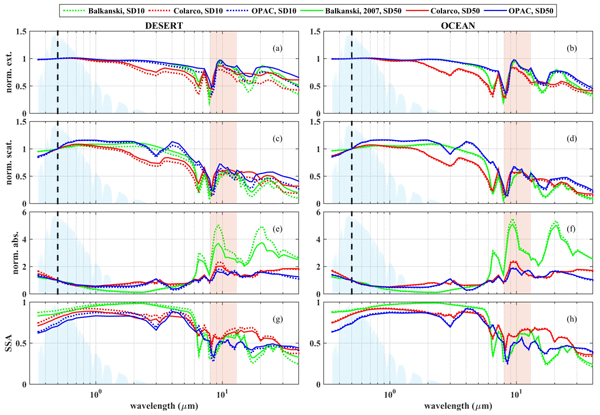
In our study we provide an assessment, through a sensitivity study, of the limitations of models to calculate the dust direct radiative effect (DRE) due to the underrepresentation of its size, refractive index (RI), and shape. Our results indicate the necessity of including more realistic sizes and RIs for dust particles in dust models, in order to derive better estimations of the dust direct radiative effects.
James Barry, Stefanie Meilinger, Klaus Pfeilsticker, Anna Herman-Czezuch, Nicola Kimiaie, Christopher Schirrmeister, Rone Yousif, Tina Buchmann, Johannes Grabenstein, Hartwig Deneke, Jonas Witthuhn, Claudia Emde, Felix Gödde, Bernhard Mayer, Leonhard Scheck, Marion Schroedter-Homscheidt, Philipp Hofbauer, and Matthias Struck
Atmos. Meas. Tech., 16, 4975–5007, https://doi.org/10.5194/amt-16-4975-2023, https://doi.org/10.5194/amt-16-4975-2023, 2023
Short summary
Short summary
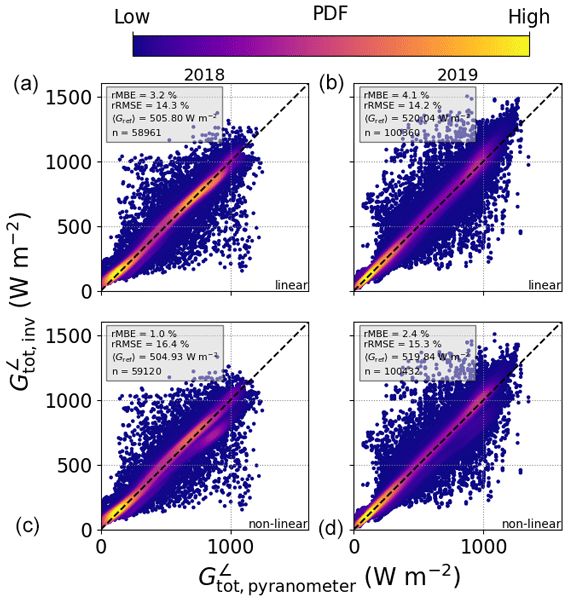
Measured power data from solar photovoltaic (PV) systems contain information about the state of the atmosphere. In this work, power data from PV systems in the Allgäu region in Germany were used to determine the solar irradiance at each location, using state-of-the-art simulation and modelling. The results were validated using concurrent measurements of the incoming solar radiation in each case. If applied on a wider scale, this algorithm could help improve weather and climate models.
Veronika Pörtge, Tobias Kölling, Anna Weber, Lea Volkmer, Claudia Emde, Tobias Zinner, Linda Forster, and Bernhard Mayer
Atmos. Meas. Tech., 16, 645–667, https://doi.org/10.5194/amt-16-645-2023, https://doi.org/10.5194/amt-16-645-2023, 2023
Short summary
Short summary
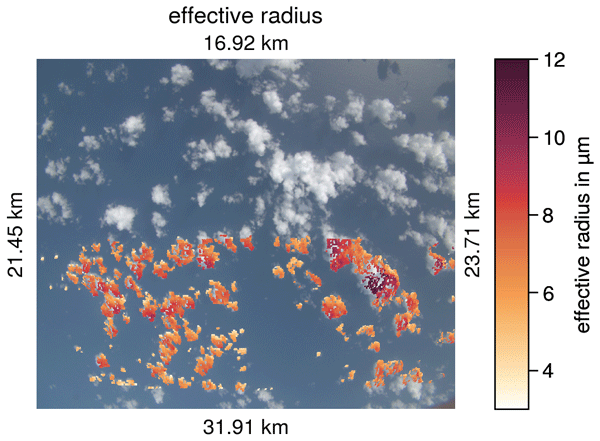
In this work, we analyze polarized cloudbow observations by the airborne camera system specMACS to retrieve the cloud droplet size distribution defined by the effective radius (reff) and the effective variance (veff). Two case studies of trade-wind cumulus clouds observed during the EUREC4A field campaign are presented. The results are combined into maps of reff and veff with a very high spatial resolution (100 m × 100 m) that allow new insights into cloud microphysics.
Huan Yu, Claudia Emde, Arve Kylling, Ben Veihelmann, Bernhard Mayer, Kerstin Stebel, and Michel Van Roozendael
Atmos. Meas. Tech., 15, 5743–5768, https://doi.org/10.5194/amt-15-5743-2022, https://doi.org/10.5194/amt-15-5743-2022, 2022
Short summary
Short summary
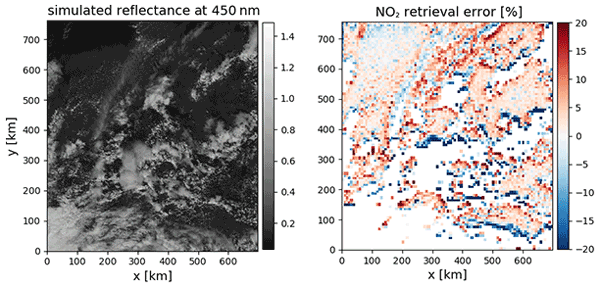
In this study, we have investigated the impact of 3D clouds on the tropospheric NO2 retrieval from UV–visible sensors. We applied standard NO2 retrieval methods including cloud corrections to synthetic data generated by the 3D radiative transfer model. A sensitivity study was done for synthetic data, and dependencies on various parameters were investigated. Possible mitigation strategies were investigated and compared based on 3D simulations and observed data.

Arve Kylling, Claudia Emde, Huan Yu, Michel van Roozendael, Kerstin Stebel, Ben Veihelmann, and Bernhard Mayer
Atmos. Meas. Tech., 15, 3481–3495, https://doi.org/10.5194/amt-15-3481-2022, https://doi.org/10.5194/amt-15-3481-2022, 2022
Short summary
Short summary
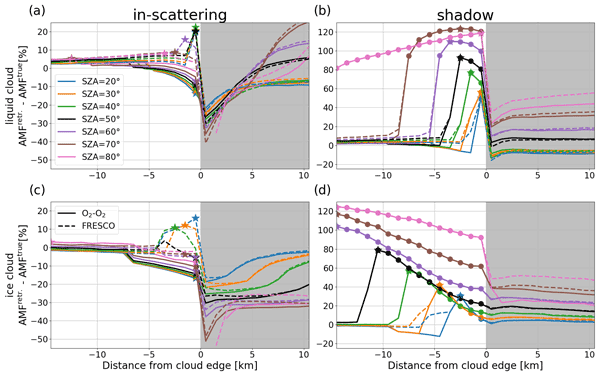
Atmospheric trace gases such as nitrogen dioxide (NO2) may be measured by satellite instruments sensitive to solar ultraviolet–visible radiation reflected from Earth and its atmosphere. For a single pixel, clouds in neighbouring pixels may affect the radiation and hence the retrieved trace gas amount. We found that for a solar zenith angle less than about 40° this cloud-related NO2 bias is typically below 10 %, while for larger solar zenith angles the NO2 bias is on the order of tens of percent.
Claudia Emde, Huan Yu, Arve Kylling, Michel van Roozendael, Kerstin Stebel, Ben Veihelmann, and Bernhard Mayer
Atmos. Meas. Tech., 15, 1587–1608, https://doi.org/10.5194/amt-15-1587-2022, https://doi.org/10.5194/amt-15-1587-2022, 2022
Short summary
Short summary
Retrievals of trace gas concentrations from satellite observations can be affected by clouds in the vicinity, either by shadowing or by scattering of radiation from clouds in the clear region. We used a Monte Carlo radiative transfer model to generate synthetic satellite observations, which we used to test retrieval algorithms and to quantify the error of retrieved NO2 vertical column density due to cloud scattering.
Marc Schwaerzel, Dominik Brunner, Fabian Jakub, Claudia Emde, Brigitte Buchmann, Alexis Berne, and Gerrit Kuhlmann
Atmos. Meas. Tech., 14, 6469–6482, https://doi.org/10.5194/amt-14-6469-2021, https://doi.org/10.5194/amt-14-6469-2021, 2021
Short summary
Short summary
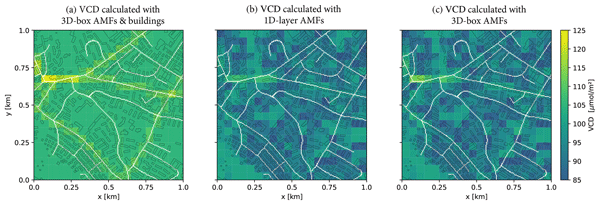
NO2 maps from airborne imaging remote sensing often appear much smoother than one would expect from high-resolution model simulations of NO2 over cities, despite the small ground-pixel size of the sensors. Our case study over Zurich, using the newly implemented building module of the MYSTIC radiative transfer solver, shows that the 3D effect can explain part of the smearing and that building shadows cause a noticeable underestimation and noise in the measured NO2 columns.
Cited articles
André, F.: The ℓ-distribution method for modeling non-gray absorption in uniform and non-uniform gaseous media, J. Quant. Spectrosc. Ra., 179, 19–32, https://doi.org/10.1016/j.jqsrt.2016.02.034, 2016. a
André, F., Cornet, C., Galtier, M., and Dubuisson, P.: Radiative transfer in the O2 A-band – a fast and accurate forward model based on the ℓ-distribution approach, J. Quant. Spectrosc. Ra., 260, 107470, https://doi.org/10.1016/j.jqsrt.2020.107470, 2021. a
Berk, A., Conforti, P., Kennett, R., Perkins, T., Hawes, F., and van den Bosch, J.: MODTRAN6: a major upgrade of the MODTRAN radiative transfer code, Proceedings of SPIE, the International Society for Optical Engineering/Proceedings of SPIE, 9088, 90880H, https://doi.org/10.1117/12.2050433, 2014. a
Bucciarelli, D., Wendsche, S., and Klemm, M.: LuxCoreRender/LuxCore: 2.10, https://luxcorerender.org (last access: 18 May 2026), 2025. a
Buehler, S. A., Larsson, R., Lemke, O., Pfreundschuh, S., Brath, M., Adams, I., Fox, S., Roemer, F. E., Czarnecki, P., and Eriksson, P.: The Atmospheric Radiative Transfer Simulator ARTS, Version 2.6 – Deep Python Integration, J. Quant. Spectrosc. Ra., 341, 109443, https://doi.org/10.1016/j.jqsrt.2025.109443, 2025. a
Buras, R. and Mayer, B.: Efficient Unbiased Variance Reduction Techniques for Monte Carlo Simulations of Radiative Transfer in Cloudy Atmospheres: The Solution, J. Quant. Spectrosc. Ra., 112, 434–447, https://doi.org/10.1016/j.jqsrt.2010.10.005, 2011. a
Calders, K., Origo, N., Burt, A., Disney, M., Nightingale, J., Raumonen, P., Åkerblom, M., Malhi, Y., and Lewis, P.: Realistic Forest Stand Reconstruction from Terrestrial LiDAR for Radiative Transfer Modelling, Remote Sens.-Basel, 10, 933, https://doi.org/10.3390/rs10060933, 2018. a
Clough, S.: Line-By-Line Radiative Transfer Model, https://github.com/AER-RC/LBLRTM (last access: 18 May 2026), 1991. a
Clough, S. A., Shephard, M. W., Mlawer, E. J., Delamere, J. S., Iacono, M. J., Cady-Pereira, K., Boukabara, S., and Brown, P. D.: Atmospheric Radiative Transfer Modeling: A Summary of the AER Codes, J. Quant. Spectrosc. Ra., 91, 233–244, https://doi.org/10.1016/j.jqsrt.2004.05.058, 2005. a
Coddington, O. M., Richard, E. C., Coddington, O., Harber, D., Pilewkie, P., Richard, E., Pilewskie, P., Woods, T. N., Chance, K., Liu, X., and Sun, K.: The TSIS-1 Hybrid Solar Reference Spectrum, Geophys. Res. Lett., 48, https://doi.org/10.1029/2020GL091709, 2021. a, b
Compiègne, M., C-Labonnote, L., and Dubuisson, P.: The Phase Matrix Truncation Impact on Polarized Radiance, AIP Conf. Proc., 1531, 95–98, https://doi.org/10.1063/1.4804716, 2013. a
Cornet, C., Labonnote, L. C., and Szczap, F.: Three-Dimensional Polarized Monte Carlo Atmospheric Radiative Transfer Model (3DMCPOL): 3D Effects on Polarized Visible Reflectances of a Cirrus Cloud, J. Quant. Spectrosc. Ra., 111, 174–186, https://doi.org/10.1016/j.jqsrt.2009.06.013, 2010. a, b
de Boissieu, F., Chraibi, E., Lavalley, C., and Féret, J.-B.: pytools4dart: Python API to DART Radiative Transfer Simulator, https://gitlab.com/pytools4dart/pytools4dart (last access: 18 May 2026), 2019. a
De Vis, P., Howes, A., Vanhellemont, Q., Bialek, A., Morris, H., Sinclair, M., and Ruddick, K.: Feasibility of Satellite Vicarious Calibration Using HYPERNETS Surface Reflectances from Gobabeb and Princess Elisabeth Antarctica Sites, Frontiers in Remote Sensing, 5, https://doi.org/10.3389/frsen.2024.1323998, 2024. a
Delahaye, T., Armante, R., Scott, N. A., Jacquinet-Husson, N., Chédin, A., Crépeau, L., Crevoisier, C., Douet, V., Perrin, A., Barbe, A., Boudon, V., Campargue, A., Coudert, L. H., Ebert, V., Flaud, J. M., Gamache, R. R., Jacquemart, D., Jolly, A., Kwabia Tchana, F., Kyuberis, A., Li, G., Lyulin, O. M., Manceron, L., Mikhailenko, S., Moazzen-Ahmadi, N., Müller, H. S. P., Naumenko, O. V., Nikitin, A., Perevalov, V. I., Richard, C., Starikova, E., Tashkun, S. A., Tyuterev, Vl. G., Vander Auwera, J., Vispoel, B., Yachmenev, A., and Yurchenko, S.: The 2020 Edition of the GEISA Spectroscopic Database, J. Mol. Spectrosc., 380, 111510, https://doi.org/10.1016/j.jms.2021.111510, 2021. a
Disney, M. I., Lewis, P., Gomez-Dans, J., Roy, D., Wooster, M. J., and Lajas, D.: 3D Radiative Transfer Modelling of Fire Impacts on a Two-Layer Savanna System, Remote Sens. Environ., 115, 1866–1881, https://doi.org/10.1016/j.rse.2011.03.010, 2011. a
Emde, C. and Mayer, B.: Errors Induced by the Neglect of Polarization in Radiance Calculations for Three-Dimensional Cloudy Atmospheres, J. Quant. Spectrosc. Ra., 218, 151–160, https://doi.org/10.1016/j.jqsrt.2018.07.001, 2018. a
Emde, C., Buras, R., Mayer, B., and Blumthaler, M.: The impact of aerosols on polarized sky radiance: model development, validation, and applications, Atmos. Chem. Phys., 10, 383–396, https://doi.org/10.5194/acp-10-383-2010, 2010. a
Emde, C., Buras, R., and Mayer, B.: ALIS: An efficient method to compute high spectral resolution polarized solar radiances using the Monte Carlo approach, J. Quant. Spectrosc. Ra., 112, 1622–1631, https://doi.org/10.1016/j.jqsrt.2011.03.018, 2011. a
Emde, C., Barlakas, V., Cornet, C., Evans, F., Korkin, S., Ota, Y., Labonnote, L. C., Lyapustin, A., Macke, A., Mayer, B., and Wendisch, M.: IPRT polarized radiative transfer model intercomparison project – Phase A, J. Quant. Spectrosc. Ra., 164, 8–36, https://doi.org/10.1016/j.jqsrt.2015.05.007, 2015. a, b, c, d
Emde, C., Buras-Schnell, R., Kylling, A., Mayer, B., Gasteiger, J., Hamann, U., Kylling, J., Richter, B., Pause, C., Dowling, T., and Bugliaro, L.: The libRadtran software package for radiative transfer calculations (version 2.0.1), Geosci. Model Dev., 9, 1647–1672, https://doi.org/10.5194/gmd-9-1647-2016, 2016. a, b, c
Fox, N. and Green, P.: Traceable Radiometry Underpinning Terrestrial- and Helio-Studies (TRUTHS): An Element of a Space-Based Climate and Calibration Observatory, Remote Sens.-Basel, 12, 2400, https://doi.org/10.3390/rs12152400, 2020. a
Galtier, M., Blanco, S., Caliot, C., Coustet, C., Dauchet, J., El Hafi, M., Eymet, V., Fournier, R., Gautrais, J., Khuong, A., Piaud, B., and Terrée, G.: Integral formulation of null-collision Monte Carlo algorithms, J. Quant. Spectrosc. Ra., 125, 57–68, https://doi.org/10.1016/j.jqsrt.2013.04.001, 2013. a, b
Gasteiger, J. and Wiegner, M.: MOPSMAP v1.0: a versatile tool for the modeling of aerosol optical properties, Geosci. Model Dev., 11, 2739–2762, https://doi.org/10.5194/gmd-11-2739-2018, 2018. a
Gasteiger, J., Emde, C., Mayer, B., Buras, R., Buehler, S., and Lemke, O.: Representative wavelengths absorption parameterization applied to satellite channels and spectral bands, J. Quant. Spectrosc. Ra., https://doi.org/10.1016/j.jqsrt.2014.06.024, 2014. a
Gobron, N., Pinty, B., Verstraete, M. M., and Govaerts, Y.: A semidiscrete model for the scattering of light by vegetation, J. Geophys. Res.-Atmos., 102, 9431–9446, https://doi.org/10.1029/96JD04013, 1997. a
Goodenough, A. A. and Brown, S. D.: DIRSIG5: Next-Generation Remote Sensing Data and Image Simulation Framework, IEEE J. Sel. Top. Appl., 10, 4818–4833, https://doi.org/10.1109/JSTARS.2017.2758964, 2017. a
Goody, R., West, R., Chen, L., and Crisp, D.: The correlated-k method for radiation calculations in nonhomogeneous atmospheres, J. Quant. Spectrosc. Ra., 42, 539–550, https://doi.org/10.1016/0022-4073(89)90044-7, 1989. a
Gordon, I., Rothman, L., Hargreaves, R., Hashemi, R., Karlovets, E., Skinner, F., Conway, E., Hill, C., Kochanov, R., Tan, Y., Wcisło, P., Finenko, A., Nelson, K., Bernath, P., Birk, M., Boudon, V., Campargue, A., Chance, K., Coustenis, A., Drouin, B., Flaud, J.-M., Gamache, R., Hodges, J., Jacquemart, D., Mlawer, E., Nikitin, A., Perevalov, V., Rotger, M., Tennyson, J., Toon, G., Tran, H., Tyuterev, V., Adkins, E., Baker, A., Barbe, A., Canè, E., Császár, A., Dudaryonok, A., Egorov, O., Fleisher, A., Fleurbaey, H., Foltynowicz, A., Furtenbacher, T., Harrison, J., Hartmann, J.-M., Horneman, V.-M., Huang, X., Karman, T., Karns, J., Kassi, S., Kleiner, I., Kofman, V., Kwabia-Tchana, F., Lavrentieva, N., Lee, T., Long, D., Lukashevskaya, A., Lyulin, O., Makhnev, V., Matt, W., Massie, S., Melosso, M., Mikhailenko, S., Mondelain, D., Müller, H., Naumenko, O., Perrin, A., Polyansky, O., Raddaoui, E., Raston, P., Reed, Z., Rey, M., Richard, C., Tóbiás, R., Sadiek, I., Schwenke, D., Starikova, E., Sung, K., Tamassia, F., Tashkun, S., Vander Auwera, J., Vasilenko, I., Vigasin, A., Villanueva, G., Vispoel, B., Wagner, G., Yachmenev, A., and Yurchenko, S.: The HITRAN2020 molecular spectroscopic database, J. Quant. Spectrosc. Ra., 277, 107949, https://doi.org/10.1016/j.jqsrt.2021.107949, 2022. a, b
Gorshelev, V., Serdyuchenko, A., Weber, M., Chehade, W., and Burrows, J. P.: High spectral resolution ozone absorption cross-sections – Part 1: Measurements, data analysis and comparison with previous measurements around 293 K, Atmos. Meas. Tech., 7, 609–624, https://doi.org/10.5194/amt-7-609-2014, 2014. a
Govaerts, Y.: Sand Dune Ridge Alignment Effects on Surface BRF over the Libya-4 CEOS Calibration Site, Sensors-Basel, 15, 3453–3470, https://doi.org/10.3390/s150203453, 2015. a
Govaerts, Y., Nollet, Y., and Leroy, V.: Radiative Transfer Model Comparison with satellite Observations over CEOS Calibration Site libya-4, Atmosphere-Basel, 13, https://doi.org/10.3390/atmos13111759, 2022. a
Grecco, H.: hgrecco/pint: 0.19.2, https://github.com/hgrecco/pint (last access: 18 May 2026), 2022. a
Haberreiter, M., Schöll, M., Dudok de Wit, T., Kretzschmar, M., Misios, S., Tourpali, K., and Schmutz, W.: A New Observational Solar Irradiance Composite, J. Geophys. Res.-Space, 122, 5910–5930, https://doi.org/10.1002/2016JA023492, 2017. a
Hansen, J. E. and Travis, L. D.: Light Scattering in Planetary Atmospheres, Space Sci. Rev., 16, 527–610, https://doi.org/10.1007/BF00168069, 1974. a
Hapke, B.: Bidirectional Reflectance Spectroscopy: 3. Correction for Macroscopic Roughness, Icarus, 59, 41–59, 1984. a
Hapke, B.: Theory of Reflectance and Emittance Spectroscopy, Cambridge University Press, ISBN 9781139025683, https://doi.org/10.1017/CBO9781139025683, 2012. a
Hapke, B. W.: A theoretical photometric function for the lunar surface, J. Geophys. Res., 68, 4571–4586, https://doi.org/10.1029/JZ068i015p04571, 1963. a
Hess, M. W., Koepke, P., and Schult, I.: Optical Properties of Aerosols and Clouds: The Software Package OPAC, B. Am. Meteorol. Soc., 79, 831–844, 1998. a
Hogan, R. J. and Matricardi, M.: Evaluating and improving the treatment of gases in radiation schemes: the Correlated K-Distribution Model Intercomparison Project (CKDMIP), Geosci. Model Dev., 13, 6501–6521, https://doi.org/10.5194/gmd-13-6501-2020, 2020. a
Holben, B. N., Eck, T. F., Slutsker, I., Tanré, D., Buis, J. P., Setzer, A., Vermote, E., Reagan, J. A., Kaufman, Y. J., Nakajima, T., Lavenu, F., Jankowiak, I., and Smirnov, A.: AERONET – A Federated Instrument Network and Data Archive for Aerosol Characterization, Remote Sens. Environ., 66, 1–16, https://doi.org/10.1016/S0034-4257(98)00031-5, 1998. a
Hoyer, S. and Hamman, J.: xarray: N-D labeled arrays and datasets in Python, Journal of Open Research Software, 5, https://doi.org/10.5334/jors.148, 2017. a
Inness, A., Ades, M., Agustí-Panareda, A., Barré, J., Benedictow, A., Blechschmidt, A.-M., Dominguez, J. J., Engelen, R., Eskes, H., Flemming, J., Huijnen, V., Jones, L., Kipling, Z., Massart, S., Parrington, M., Peuch, V.-H., Razinger, M., Remy, S., Schulz, M., and Suttie, M.: The CAMS reanalysis of atmospheric composition, Atmos. Chem. Phys., 19, 3515–3556, https://doi.org/10.5194/acp-19-3515-2019, 2019. a
Jakob, W.: Mitsuba renderer, https://mitsuba-renderer.org/index_old.html (last access: 18 May 2026), 2010. a
Jakob, W., Speierer, S., Roussel, N., and Vicini, D.: Dr.Jit: A Just-In-Time Compiler for Differentiable Rendering, Transactions on Graphics (Proceedings of SIGGRAPH), 41, https://doi.org/10.1145/3528223.3530099, 2022b. a, b
Joint Research Centre: The new RAMI4ATM, https://rami-benchmark.jrc.ec.europa.eu/_www/phase_descr.php?strPhase=RAMI4ATM, last access: 25 August 2025. a
Kajiya, J. T.: The Rendering Equation, in: ACM SIGGRAPH Computer Graphics, vol. 20, ACM, 143–150, https://doi.org/10.1145/15886.15902, 1986. a
Kluyver, T., Ragan-Kelley, B., Pérez, F., Granger, B., Bussonnier, M., Frederic, J., Kelley, K., Hamrick, J., Grout, J., Corlay, S., Ivanov, P., Avila, D., Abdalla, S., Willing, C., and Jupyter development team: Jupyter Notebooks – a publishing format for reproducible computational workflows, in: Positioning and Power in Academic Publishing: Players, Agents and Agendas, edited by: Loizides, F. and Scmidt, B., IOS Press, the Netherlands, 87–90, https://doi.org/10.3233/978-1-61499-649-1-87, 2016. a
Korkin, S., Yang, E.-S., Spurr, R., Emde, C., Zhai, P., Krotkov, N., Vasilkov, A., and Lyapustin, A.: Numerical results for polarized light scattering in a spherical atmosphere, J. Quant. Spectrosc. Ra., 287, 108194, https://doi.org/10.1016/j.jqsrt.2022.108194, 2022. a
Kotchenova, S. Y., Vermote, E. F., Matarrese, R., and Klemm Jr., F. J.: Validation of a vector version of the 6S radiative transfer code for atmospheric correction of satellite data. Part I: Path radiance, Appl. Optics, 45, 6762, https://doi.org/10.1364/AO.45.006762, 2006. a, b, c
Lacis, A. A. and Oinas, V.: A description of the correlated k distribution method for modeling nongray gaseous absorption, thermal emission, and multiple scattering in vertically inhomogeneous atmospheres, J. Geophys. Res., 96, 9027, https://doi.org/10.1029/90JD01945, 1991. a, b
Lanconelli, C., Gobron, N., Robustelli, M., Adams, J. S., Calders, K., Disney, M., Gastellu-Etchegorry, J.-P., Goodenough, A., Govaerts, Y., Hogan, R. J., Huang, H., Kobayashi, H., Kuusk, A., Leroy, V., Origo, N., Qi, J., Schunke, S., Leeuwen, M., Wang, Y., Xie, D., Zeng, Y., and Zhao, F.: The Fifth Phase of the Radiation Transfer Model Intercomparison Exercise (RAMI-V): Experiment Description and Results on Actual Canopy Scenarios, Journal of Remote Sensing, 5, 0663, https://doi.org/10.34133/remotesensing.0663, 2025. a
Leroy, V.: rayference/paper-eradiate-v100: Paper release, Zenodo [code], https://doi.org/10.5281/zenodo.20274685, 2026. a
Leroy, V., Aschan, R., Woolliams, P., Schunke, S., Manoocheri, F., and Govaerts, Y.: An SI-Traceable Protocol for the Validation of Radiative Transfer Model-Based Reflectance Simulation, IEEE T. Geosci. Remote, 63, 1–22, https://doi.org/10.1109/TGRS.2025.3547305, 2025a. a
Leroy, V., Nollet, Y., Schunke, S., Misk, N., Marton, N., Emde, C., and Govaerts, Y.: Eradiate radiative transfer model, Zenodo [code], https://doi.org/10.5281/zenodo.17226380, 2025b. a
Lewis, P.: Three-dimensional plant modelling for remote sensing simulation studies using the Botanical Plant Modelling System, Agronomie, 19, 185–210, https://doi.org/10.1051/agro:19990302, 1999. a
Litvinov, P., Chen, C., Dubovik, O., Bindreiter, L., Matar, C., Fuertes, D., Lopatin, A., Lapyonok, T., Lanzinger, V., Hangler, A., Aspetsberger, M., de Graaf, M., Tilstra, L. G., Stammes, P., Dandocsi, A., Gasbarra, D., Fluck, E., Zehner, C., and Retscher, C.: Extended aerosol and surface characterization from S5P/TROPOMI with GRASP algorithm. Part I: Conditions, approaches, performance and new possibilities, Remote Sens. Environ., 313, 114355, https://doi.org/10.1016/j.rse.2024.114355, 2024. a, b
Lucht, W., Schaaf, C., and Strahler, A.: An algorithm for the retrieval of albedo from space using semiempirical BRDF models, IEEE T. Geosci. Remote, 38, 977–998, https://doi.org/10.1109/36.841980, 2000. a
Luffarelli, M., Misk, N., Leroy, V., and Govaerts, Y.: Elaboration of Simulated Hyperspectral Calibration Reference over Pseudo-Invariant Calibration Reference, Atmosphere-Basel, 16, 583, https://doi.org/10.3390/atmos16050583, 2025. a
Mayer, B.: Radiative Transfer in the Cloudy Atmosphere, in: European Physical Journal Conferences, vol. 1, EDP Sciences, 75–99, https://doi.org/10.1140/epjconf/e2009-00912-1, 2009. a, b
Mayer, B. and Kylling, A.: Technical note: The libRadtran software package for radiative transfer calculations – description and examples of use, Atmos. Chem. Phys., 5, 1855–1877, https://doi.org/10.5194/acp-5-1855-2005, 2005. a
Meftah, M., Damé, L., Bolsée, D., Hauchecorne, A., Pereira, N., Sluse, D., Cessateur, G., Irbah, A., Bureau, J., Weber, M., Bramstedt, K., Hilbig, T., Thiéblemont, R., Marchand, M., Lefèvre, F., Sarkissian, A., and Bekki, S.: SOLAR-ISS: A New Reference Spectrum Based on SOLAR/SOLSPEC Observations, Astron. Astrophys., 611, A1, https://doi.org/10.1051/0004-6361/201731316, 2018. a
Mei, L., Rozanov, V., Jiao, Z., and Burrows, J. P.: A new snow bidirectional reflectance distribution function model in spectral regions from UV to SWIR: Model development and application to ground-based, aircraft and satellite observations, ISPRS J. Photogramm., 188, 269–285, https://doi.org/10.1016/j.isprsjprs.2022.04.010, 2022. a
Miller, B., Georgiev, I., and Jarosz, W.: A null-scattering path integral formulation of light transport, ACM T. Graphic., 38, 1–13, https://doi.org/10.1145/3306346.3323025, 2019. a, b
Minnaert, M.: The Reciprocity Principle in Lunar Photometry, Astrophys. J., 403–410, https://doi.org/10.1086/144279, 1941. a
Mishchenko, M. I. and Travis, L. D.: Satellite retrieval of aerosol properties over the ocean using polarization as well as intensity of reflected sunlight, J. Geophys. Res.-Atmos., 102, 16989–17013, https://doi.org/10.1029/96JD02425, 1997. a, b
Mishchenko, M. I., Lacis, A. A., and Travis, L. D.: Errors Induced by the Neglect of Polarization in Radiance Calculations for Rayleigh-Scattering Atmospheres, J. Quant. Spectrosc. Ra., 51, 491–510, https://doi.org/10.1016/0022-4073(94)90149-X, 1994. a, b
Museth, K.: VDB, ACM T. Graphic., 32, 1–22, https://doi.org/10.1145/2487228.2487235, 2013. a
Museth, K.: NanoVDB: A GPU-Friendly and Portable VDB Data Structure For Real-Time Rendering And Simulation, in: ACM SIGGRAPH 2021 Talks, ACM, 1–2, https://doi.org/10.1145/3450623.3464653, 2021. a
Nicodemus, F. E., Richmond, J. C., Hsia, J. J., Ginsberg, I. W., and Limperis, T.: Geometrical Considerations and Nomenclature for Reflectance, vol. 160, US Department of Commerce, National Bureau of Standards, https://doi.org/10.6028/NBS.MONO.160, 1977. a, b, c
Nimier-David, M., Vicini, D., Zeltner, T., and Jakob, W.: Mitsuba 2, ACM T. Graphic., 38, 1–17, https://doi.org/10.1145/3355089.3356498, 2019. a
Nollet, Y. and Leroy, V.: Joseki, https://github.com/rayference/joseki (last access: 18 May 2026), 2024. a
Novák, J., Georgiev, I., Hanika, J., and Jarosz, W.: Monte Carlo Methods for Volumetric Light Transport Simulation, Comput. Graph. Forum, 37, 551–576, https://doi.org/10.1111/cgf.13383, 2018. a, b
Pannier, E. and Laux, C. O.: RADIS: A nonequilibrium line-by-line radiative code for CO2 and HITRAN-like database species, J. Quant. Spectrosc. Ra., 222–223, 12–25, https://doi.org/10.1016/j.jqsrt.2018.09.027, 2019. a, b
Pinty, B., Roveda, F., Verstraete, M. M., Gobron, N., Govaerts, Y., Martonchik, J. V., Diner, D. J., and Kahn, R. A.: Surface albedo retrieval from Meteosat: 1. Theory, J. Geophys. Res.-Atmos., 105, 18099–18112, https://doi.org/10.1029/2000JD900113, 2000. a, b
Pinty, B., Gobron, N., Widlowski, J.-L., Gerstl, S. A. W., Verstraete, M. M., Antunes, M., Bacour, C., Gascon, F., Gastellu, J.-P., Goel, N., Jacquemoud, S., North, P., Qin, W., and Thompson, R.: Radiation transfer model intercomparison (RAMI) exercise, J. Geophys. Res.-Atmos., 106, 11937–11956, https://doi.org/10.1029/2000JD900493, 2001. a
Pinty, B., Widlowski, J.-L., Taberner, M., Gobron, N., Verstraete, M. M., Disney, M., Gascon, F., Gastellu, J.-P., Jiang, L., Kuusk, A., Lewis, P., Li, X., Ni-Meister, W., Nilson, T., North, P., Qin, W., Su, L., Tang, S., Thompson, R., Verhoef, W., Wang, H., Wang, J., Yan, G., and Zang, H.: Radiation Transfer Model Intercomparison (RAMI) exercise: Results from the second phase, J. Geophys. Res.-Atmos., 109, https://doi.org/10.1029/2003JD004252, 2004. a
Qi, J., Xie, D., Yin, T., Yan, G., Gastellu-Etchegorry, J.-P., Li, L., Zhang, W., Mu, X., and Norford, L. K.: LESS: LargE-Scale remote sensing data and image simulation framework over heterogeneous 3D scenes, Remote Sens. Environ., 221, 695–706, https://doi.org/10.1016/j.rse.2018.11.036, 2019. a
Rahman, H., Pinty, B., and Verstraete, M. M.: Coupled surface-atmosphere reflectance (CSAR) model: 2. Semiempirical surface model usable with NOAA advanced very high resolution radiometer data, J. Geophys. Res., 98, 20791, https://doi.org/10.1029/93JD02072, 1993. a, b
Ramon, D., Steinmetz, F., Jolivet, D., Compiègne, M., and Frouin, R.: Modeling polarized radiative transfer in the ocean-atmosphere system with the GPU-accelerated SMART-G Monte Carlo code, J. Quant. Spectrosc. Ra., 222–223, 89–107, https://doi.org/10.1016/j.jqsrt.2018.10.017, 2019. a
Roccetti, G., Bugliaro, L., Gödde, F., Emde, C., Hamann, U., Manev, M., Sterzik, M. F., and Wehrum, C.: HAMSTER: Hyperspectral Albedo Maps dataset with high Spatial and TEmporal Resolution, Atmos. Meas. Tech., 17, 6025–6046, https://doi.org/10.5194/amt-17-6025-2024, 2024. a, b
Rozanov, V., Rozanov, A., Kokhanovsky, A., and Burrows, J.: Radiative transfer through terrestrial atmosphere and ocean: Software package SCIATRAN, J. Quant. Spectrosc. Ra., 133, 13–71, https://doi.org/10.1016/j.jqsrt.2013.07.004, 2014. a
Salehi, F., Thome, K., Wenny, B. N., Lockwood, R., and Wang, Z.: Band-Averaged Response Sensitivity Study of an Imaging Spectrometer for the CLARREO Pathfinder Mission, Remote Sens.-Basel, 14, 2302, https://doi.org/10.3390/rs14102302, 2022. a
Salesin, K., Knobelspiesse, K. D., Chowdhary, J., Zhai, P.-W., and Jarosz, W.: Unifying Radiative Transfer Models in Computer Graphics and Remote Sensing, Part I: A Survey, J. Quant. Spectrosc. Ra., 314, 108847, https://doi.org/10.1016/j.jqsrt.2023.108847, 2024. a
Schlawack, H.: attrs, https://github.com/python-attrs/attrs (last access: 18 May 2026), 2024. a
Schunke, S., Leroy, V., and Govaerts, Y.: Retrieving BRDFs from UAV-based Radiometers for Fiducial Reference Measurements: Caveats and Recommendations, Frontiers in Remote Sensing, 4, https://doi.org/10.3389/frsen.2023.1285800, 2023. a
Serdyuchenko, A., Gorshelev, V., Weber, M., Chehade, W., and Burrows, J. P.: High spectral resolution ozone absorption cross-sections – Part 2: Temperature dependence, Atmos. Meas. Tech., 7, 625–636, https://doi.org/10.5194/amt-7-625-2014, 2014. a
Shettle, E. P.: Optical and radiative properties of a desert aerosol model, Tech. Rep. AFGL-TR-86-0003, Air Force Geophysics Lab Hanscom AFB MA, https://apps.dtic.mil/sti/html/tr/ADA163181/ (last access 18 May 2026), 1986. a
Somers, B., Delalieux, S., Verstraeten, W. W., and Coppin, P.: A Conceptual Framework for the Simultaneous Extraction of Sub-Pixel Spatial Extent and Spectral Characteristics of Crops, Photogramm. Eng. Rem. S., 75, 57–68, 2009. a
Stamnes, K., Tsay, S.-C., Wiscombe, W., and Laszlo, I.: DISORT, a general-purpose Fortran program for discrete-ordinate-method radiative transfer in scattering and emitting layered media: documentation of methodology, http://www.rtatmocn.com/disort/docs/DISORTReport1.1.pdf (last access: 18 May 2026), 2000. a
Strahler, A. H., Muller, J.-P., Lucht, W., Barker Schaaf, C., Trevor, T., Gao, F., Li, X., Muller, J.-P., Lewis, P., and Barnsley, M. J.: MODIS BRDF/Albedo Product: Algorithm Theoretical Basis Document Version 5.0, https://modis.gsfc.nasa.gov/data/atbd/atbd_mod09.pdf (last access: 18 May 2026), 1999. a
Strobl, P.: The new Copernicus digital elevation model, in: GSICS Quarterly, vol. 14, edited by: Szantoi, Z., Boccia, V., and Quang, C., https://doi.org/10.25923/enp8-6w06, 2020. a
Stuckens, J., Somers, B., Delalieux, S., Verstraeten, W. W., and Coppin, P.: The Impact of Common Assumptions on Canopy Radiative Transfer Simulations: A Case Study in Citrus Orchards, J. Quant. Spectrosc. Ra., 110, 1–21, https://doi.org/10.1016/j.jqsrt.2008.09.001, 2009. a
Thuillier, G., Hersé, M., Labs, D., Foujols, T., Peetermans, W., Gillotay, D., Simon, P., and Mandel, H.: The Solar Spectral Irradiance from 200 to 2400 Nm as Measured by the SOLSPEC Spectrometer from the Atlas and Eureca Missions, Sol. Phys., 214, 1–22, https://doi.org/10.1023/A:1024048429145, 2003. a
Tong, C., Bao, Y., Zhao, F., Fan, C., Li, Z., and Huang, Q.: Evaluation of the FluorWPS Model and Study of the Parameter Sensitivity for Simulating Solar-Induced Chlorophyll Fluorescence, Remote Sens.-Basel, 13, 1091, https://doi.org/10.3390/rs13061091, 2021. a
Villefranque, N., Fournier, R., Couvreux, F., Blanco, S., Cornet, C., Eymet, V., Forest, V., and Tregan, J.-M.: A Path Tracing Monte Carlo Library for 3D Radiative Transfer in Highly Resolved Cloudy Atmospheres, J. Adv. Model. Earth Sy., 11, 2449–2473, https://doi.org/10.1029/2018MS001602, 2019. a, b
Wang, Y., Kallel, A., Yang, X., Regaieg, O., Lauret, N., Guilleux, J., Chavanon, E., and Gastellu-Etchegorry, J.-P.: DART-Lux: An unbiased and rapid Monte Carlo radiative transfer method for simulating remote sensing images, Remote Sens. Environ., 274, 112973, https://doi.org/10.1016/j.rse.2022.112973, 2022. a
Widlowski, J.-L., Taberner, M., Pinty, B., Bruniquel-Pinel, V., Disney, M., Fernandes, R., Gastellu-Etchegorry, J.-P., Gobron, N., Kuusk, A., Lavergne, T., Leblanc, S., Lewis, P. E., Martin, E., Mõttus, M., North, P. R. J., Qin, W., Robustelli, M., Rochdi, N., Ruiloba, R., Soler, C., Thompson, R., Verhoef, W., Verstraete, M. M., and Xie, D.: Third Radiation Transfer Model Intercomparison (RAMI) exercise: Documenting progress in canopy reflectance models, J. Geophys. Res., 112, https://doi.org/10.1029/2006JD007821, 2007. a, b, c
Widlowski, J.-L., Robustelli, M., Disney, M., Gastellu-Etchegorry, J.-P., Lavergne, T., Lewis, P., North, P., Pinty, B., Thompson, R., and Verstraete, M.: The RAMI On-line Model Checker (ROMC): A web-based benchmarking facility for canopy reflectance models, Remote Sens. Environ., 112, 1144–1150, https://doi.org/10.1016/j.rse.2007.07.016, 2008. a, b
Widlowski, J.-L., Mio, C., Disney, M., Adams, J., Andredakis, I., Atzberger, C., Brennan, J., Busetto, L., Chelle, M., Ceccherini, G., Colombo, R., Côté, J.-F., Eenmäe, A., Essery, R., Gastellu-Etchegorry, J.-P., Gobron, N., Grau, E., Haverd, V., Homolová, L., Huang, H., Hunt, L., Kobayashi, H., Koetz, B., Kuusk, A., Kuusk, J., Lang, M., Lewis, P. E., Lovell, J. L., Malenovský, Z., Meroni, M., Morsdorf, F., Mõttus, M., Ni-Meister, W., Pinty, B., Rautiainen, M., Schlerf, M., Somers, B., Stuckens, J., Verstraete, M. M., Yang, W., Zhao, F., and Zenone, T.: The fourth phase of the radiative transfer model intercomparison (RAMI) exercise: Actual canopy scenarios and conformity testing, Remote Sens. Environ., 169, 418–437, https://doi.org/10.1016/j.rse.2015.08.016, 2015. a
Wilkie, A., Vevoda, P., Bashford-Rogers, T., Hošek, L., Iser, T., Kolářová, M., Rittig, T., and Křivánek, J.: A fitted radiance and attenuation model for realistic atmospheres, ACM T. Graphic., 40, 1–14, https://doi.org/10.1145/3450626.3459758, 2021. a
Wilson, R. T.: Py6S: A Python interface to the 6S radiative transfer model, Comput. Geosci., 51, 166–171, https://doi.org/10.1016/j.cageo.2012.08.002, 2013. a
Woods, T. N., Chamberlin, P. C., Harder, J. W., Hock, R. A., Snow, M., Eparvier, F. G., Fontenla, J., McClintock, W. E., and Richard, E. C.: Solar Irradiance Reference Spectra (SIRS) for the 2008 Whole Heliosphere Interval (WHI), Geophys. Res. Lett., 36, https://doi.org/10.1029/2008GL036373, 2009. a
Short summary
Eradiate is open-source software that models how light travels through Earth's atmosphere and reflects off its surface. Using computer graphics rendering technology, it simulates satellite observations by accurately representing both surface and atmosphere in a unified framework. This bridges otherwise separate scientific communities, enabling the generation of accurate synthetic reference data to improve satellite products used for pollution tracking, climate monitoring, or land use assessment.
Eradiate is open-source software that models how light travels through Earth's atmosphere and...


