
Articles | Volume 19, issue 9
https://doi.org/10.5194/gmd-19-3689-2026
© Author(s) 2026. This work is distributed under
the Creative Commons Attribution 4.0 License.
the Creative Commons Attribution 4.0 License.
https://doi.org/10.5194/gmd-19-3689-2026
© Author(s) 2026. This work is distributed under
the Creative Commons Attribution 4.0 License.
the Creative Commons Attribution 4.0 License.
Methods for assessment of models
| 
05 May 2026
Methods for assessment of models |
| 05 May 2026
| 05 May 2026
The Atlantic ocean's decadal variability in mid-Holocene simulations using Shannon's entropy

Departamento de Oceanografia Física, Intituto Oceanográfico, Universidade de São Paulo, São Paulo, SP, Brazil
Ilana Wainer
Departamento de Oceanografia Física, Intituto Oceanográfico, Universidade de São Paulo, São Paulo, SP, Brazil
Francesco S. R. Pausata
Centre ESCER (Etude et la Simulation du Climat à l’Echelle Regionale) and GEOTOP (Research Center on the Dynamics of the Earth System), Department of Earth and Atmospheric Sciences, University of Quebec at Montreal, Montreal, QC, Canada
Luciana F. Prado
Faculdade de Oceanografia, Universidade do Estado do Rio de Janeiro, Rio de Janeiro, Brazil
Pedro L. Silva Dias
Instituto de Astronomia, Geofísica e Ciências Atmosféricas, Universidade de São Paulo, Departamento de Ciências Atmosféricas, São Paulo, Brazil
Allegra N. LeGrande
NASA Goddard Institute for Space Studies, and Center for Climate Systems Research, Columbia University, New York, USA
Clay R. Tabor
Department of Earth Sciences, University of Connecticut, Storrs, USA
William R. Peltier
Department of Physics, University of Toronto, Toronto, Canada
Related authors
No articles found.
Natalie J. Burls, Nicky M. Wright, R. Paul Acosta, Catherine D. Bradshaw, Edward Gasson, Lennert B. Stap, Gilles Ramstein, Anna Ruth W. Halberstadt, Agatha M. De Boer, Funda Akgün, David J. Cantrill, Manuel Casas-Gallego, Nela Doláková, Boglarka Erdei, Alex Farnsworth, Sarah Feakins, Ran Feng, Tamara Fletcher, Frédéric Fluteau, J. A. Mattias Green, Anna S. von der Heydt, Matthew Huber, David K. Hutchinson, Dimiter Ivanov, Mine Sezgül Kayseri-Özer, Gregor Knorr, Marianna Kováčová, Caroline H. Lear, Allegra N. LeGrande, Shufeng Li, Xiaoqing Liu, Daniel J. Lunt, Katrin Meissner, Yunfa Miao, Trusha J. Naik, Javier B. Navarro, Joseph B. Novak, Diana Ochoa, Guy J.G. Paxman, Matthew J. Pound, James W. B. Rae, Tammo Reichgelt, Martin Renoult, Francesca Sangiorgi, Anta-Clarisse Sarr, Diane Segalla, Pierre Sepulchre, Amelia Shevenell, Sebastian Steinig, Eivind Straume, Caroline A. E. Strömberg, Clay Tabor, Torsten Utescher, Julia E. Weiffenbach, Elżbieta Worobiec, Yurui Zhang, Feng Zhu, Jiang Zhu, Alexandra Auderset, Florence Colleoni, Aisling Dolan, Rachel Havranek, Ann Holbourn, Nicholas Herold, Daeun Lee, James W. Marschalek, Bryce Mitsunaga, Sevi Modestou, Lina Perez-Angel, Mae Saslaw, Sinda Sosdian, Elena Stiles, Yong Sun, Ning Tan, Zhongshi Zhang, and Yan Zhao
EGUsphere, https://doi.org/10.5194/egusphere-2026-3595, https://doi.org/10.5194/egusphere-2026-3595, 2026
This preprint is open for discussion and under review for Geoscientific Model Development (GMD).
Short summary
Short summary
Simulating warm paleoclimates increases our understanding of the mechanisms that drive climatic change and tipping points. The Miocene Epoch, specifically the Miocene Climatic Optimum, has been identified as a particularly valuable past warm climate to simulate, meriting the design of a coordinated Miocene Model Intercomparison Project. Here we synthesize the latest available literature and present the experimental design for coordinated Miocene simulations and sensitivity studies.
Louise C. Sime, Rachel Diamond, Christian Stepanek, Chris Brierley, David Schroeder, Masa Kageyama, Matthew Pollock, Irene Malmierca-Vallet, Ed Blockley, Alex West, Danny Feltham, Jeff Ridley, Pascale Braconnot, Charles J. R. Williams, Xiaoxu Shi, Bette L. Otto-Bliesner, Sophia I. Macarewich, Silvana Ramos Buarque, Qiong Zhang, Allegra LeGrande, Weipeng Zheng, Dabang Jiang, Polina Morozova, Chuncheng Guo, Zhongshi Zhang, Nicholas Yeung, Laurie Menviel, Sandeep Narayanasetti, Masakazu Yoshimori, Olivia Reeves, and Anni Zhao
Geosci. Model Dev., 19, 5881–5905, https://doi.org/10.5194/gmd-19-5881-2026, https://doi.org/10.5194/gmd-19-5881-2026, 2026
Short summary
Short summary
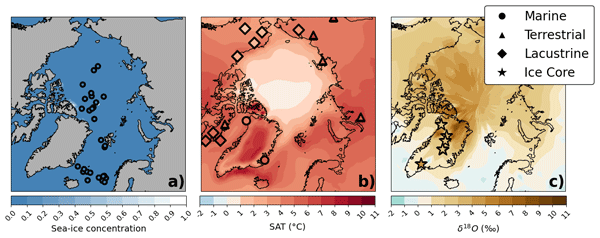
The Arctic may have lost its summer sea ice 127,000 years ago during a naturally warm period in Earth’s past. Climate models can be tested by recreating those conditions, with similar sunlight and greenhouse gas levels. Analysing the large sea ice changes in these simulations helps us understand how the Arctic might respond in the near future and improves how we test and trust our climate models.
Hamida Ngoma Nadoya, Clay R. Tabor, Ran Feng, Xiaoqing Liu, Daniel E. Ibarra, Tammo Reichgelt, and Amber Laskos
EGUsphere, https://doi.org/10.5194/egusphere-2026-899, https://doi.org/10.5194/egusphere-2026-899, 2026
Short summary
Short summary
The Miocene Climatic Optimum (MCO; ~17–14 Ma) may provide a window into the future of Earth’s climate. Our study employs the water isotope tracer version of CESM1 to simulate and evaluate climate during the MCO under three different CO2 concentrations. Our findings show warmer conditions during the MCO with increase in precipitation in the mid and high latitudes, southward shift of the intertropical convergence zone and enriched isotopes.
Ram Singh, Alexander Koch, Allegra N. LeGrande, Kostas Tsigaridis, Riovie D. Ramos, Francis Ludlow, Igor Aleinov, Reto Ruedy, and Jed O. Kaplan
Geosci. Model Dev., 19, 1405–1428, https://doi.org/10.5194/gmd-19-1405-2026, https://doi.org/10.5194/gmd-19-1405-2026, 2026
Short summary
Short summary
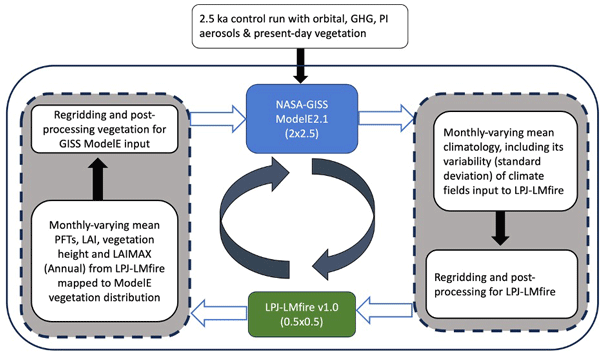
This study presents an experimental framework for asynchronous land-atmosphere coupling to include biogeophysical feedbacks using a dynamic vegetation model with an Earth system model that lacks a fully dynamic vegetation component. The framework is implemented for the 2.5 ka period and also illustrates the role of model performance metrics (bias, variability), while evaluating the simulated climate against the multi-proxy paleoclimate reconstructions.
Anson Ka Hei Cheung, Paul J. Kushner, Francesco S. R. Pausata, Zhihong Zhuo, and Marguerite L. Brown
EGUsphere, https://doi.org/10.5194/egusphere-2025-5650, https://doi.org/10.5194/egusphere-2025-5650, 2025
Short summary
Short summary
If a nuclear war happened, firestorms induced by nuclear detonations in urban areas could inject black carbon (BC) into the upper atmosphere, disrupting global climate. We simulated the climate impacts of low-to-moderate forcing scenarios using an Earth system model. In all scenarios, BC blocks sunlight, causes global cooling, and decreases precipitation for more than a decade. However, a drastic global warming emerges midway through the first year and lasts until the year's end.
Aude Garin, Francesco S. R. Pausata, Mathieu Boudreault, and Roberto Ingrosso
Weather Clim. Dynam., 6, 1379–1397, https://doi.org/10.5194/wcd-6-1379-2025, https://doi.org/10.5194/wcd-6-1379-2025, 2025
Short summary
Short summary
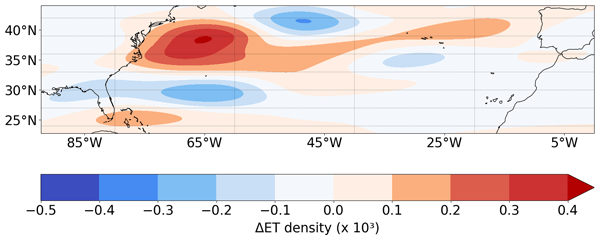
As tropical cyclones move poleward, they can transform into extratropical cyclones, a process known as extratropical transition. These storms can pose serious risks to human lives and cause damage to infrastructure along the northeastern coasts of the US and Canada. Our study investigates the impacts of climate change on the frequency, intensity, and location of extratropical transitions, revealing that transitioning storms may become more destructive in the future but may not be more frequent.
Joshua Coupe, Nicole S. Lovenduski, Luise S. Gleason, Michael N. Levy, Kristen Krumhardt, Keith Lindsay, Charles Bardeen, Clay Tabor, Cheryl Harrison, Kenneth G. MacLeod, Siddhartha Mitra, and Julio Sepúlveda
Geosci. Model Dev., 18, 8217–8234, https://doi.org/10.5194/gmd-18-8217-2025, https://doi.org/10.5194/gmd-18-8217-2025, 2025
Short summary
Short summary
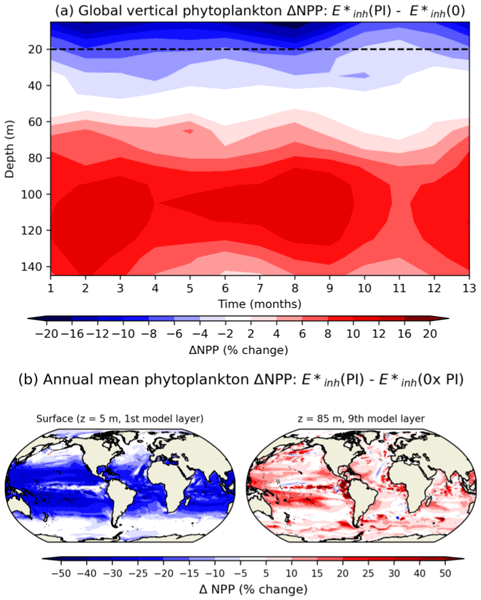
We have developed a new feature in the atmosphere and ocean components of the Community Earth System Model version 2 by implementing ultraviolet (UV) radiation inhibition of photosynthesis of four marine phytoplankton functional groups represented in the Marine Biogeochemistry Library. The new feature is tested with varying levels of UV radiation, and it will enable an analysis of an asteroid impact’s effect on the ozone layer and how that affects the base of the marine food web.
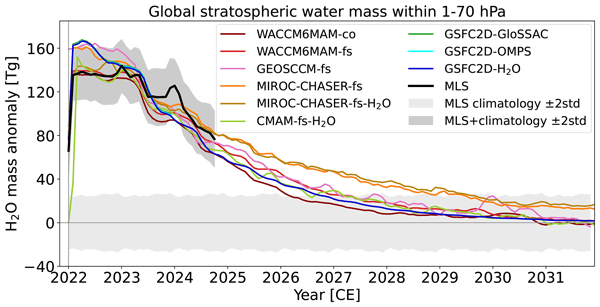
Zhihong Zhuo, Xinyue Wang, Yunqian Zhu, Wandi Yu, Ewa M. Bednarz, Eric Fleming, Peter R. Colarco, Shingo Watanabe, David Plummer, Georgiy Stenchikov, William Randel, Adam Bourassa, Valentina Aquila, Takashi Sekiya, Mark R. Schoeberl, Simone Tilmes, Jun Zhang, Paul J. Kushner, and Francesco S. R. Pausata
Atmos. Chem. Phys., 25, 13161–13176, https://doi.org/10.5194/acp-25-13161-2025, https://doi.org/10.5194/acp-25-13161-2025, 2025
Short summary
Short summary
The 2022 Hunga eruption caused unprecedented stratospheric water injection, triggering unique atmospheric impacts. This study combines observations and model simulations, projecting a stratospheric water vapor anomaly lasting 4–7 years, with significant temperature variations and ozone depletion in the upper atmosphere lasting 7–10 years. These findings offer critical insights into the role of stratospheric water vapor in shaping climate and atmospheric chemistry.
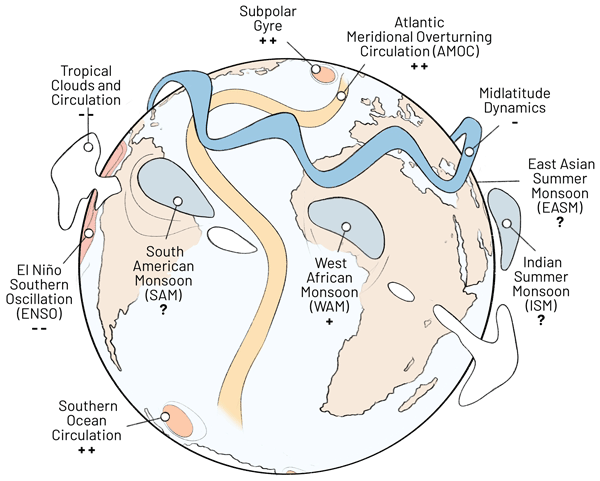
Sina Loriani, Yevgeny Aksenov, David I. Armstrong McKay, Govindasamy Bala, Andreas Born, Cristiano Mazur Chiessi, Henk A. Dijkstra, Jonathan F. Donges, Sybren Drijfhout, Matthew H. England, Alexey V. Fedorov, Laura C. Jackson, Kai Kornhuber, Gabriele Messori, Francesco S. R. Pausata, Stefanie Rynders, Jean-Baptiste Sallée, Bablu Sinha, Steven C. Sherwood, Didier Swingedouw, and Thejna Tharammal
Earth Syst. Dynam., 16, 1611–1653, https://doi.org/10.5194/esd-16-1611-2025, https://doi.org/10.5194/esd-16-1611-2025, 2025
Short summary
Short summary
In this work, we draw on palaeo-records, observations, and modelling studies to review tipping points in the ocean overturning circulations, monsoon systems, and global atmospheric circulations. We find indications for tipping in the ocean overturning circulations and the West African monsoon, with potentially severe impacts on the Earth system and humans. Tipping in the other considered systems is regarded as conceivable but is currently not sufficiently supported by evidence.
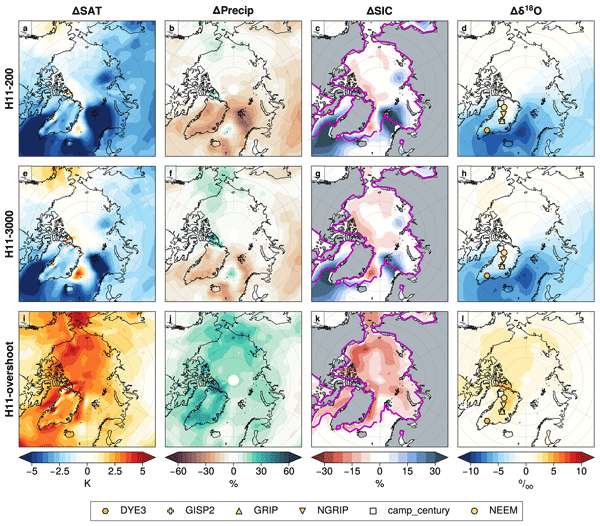
Louise C. Sime, Rahul Sivankutty, Irene Malmierca-Vallet, Sentia Goursaud Oger, Allegra N. LeGrande, Erin L. McClymont, Agatha de Boer, Alexandre Cauquoin, and Martin Werner
Clim. Past, 21, 1725–1753, https://doi.org/10.5194/cp-21-1725-2025, https://doi.org/10.5194/cp-21-1725-2025, 2025
Short summary
Short summary
We used climate models to study how stable water isotopes in ice cores changed in the Arctic and Antarctica during the warm Last Interglacial (LIG) period. Whilst standard simulations underestimate polar warming, when the effects of ice sheet meltwater from the preceding deglaciation are included, there is a much better match with observations. Findings suggest that previous estimates of LIG Arctic warming were too high. Understanding these past polar changes can help improve future predictions.
Fengyi Xie, Deepak Chandan, and William Richard Peltier
EGUsphere, https://doi.org/10.5194/egusphere-2025-2957, https://doi.org/10.5194/egusphere-2025-2957, 2025
Preprint archived
Short summary
Short summary
We present two ensembles of regional climate simulations for Mid-Holocene climate over the Middle East, Mediterranean and North Africa, using a prescribed Green Sahara (GS) surface. Our results show that the removal of GS reduces precipitation over the Middle East below a threshold that triggers replacement of forest by grassland. This finding agrees with earlier findings that showed retreat of vegetation over the Middle East after Mid-Holocene.
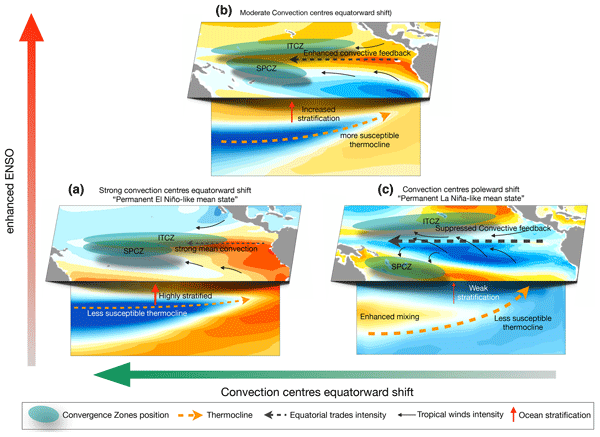
Gabriel M. Pontes, Pedro L. da Silva Dias, and Laurie Menviel
Clim. Past, 21, 1079–1091, https://doi.org/10.5194/cp-21-1079-2025, https://doi.org/10.5194/cp-21-1079-2025, 2025
Short summary
Short summary
El Niño events are the main drivers of year-to-year climate variability. Understanding how El Niño activity is affected by different climate states is of great relevance to agriculture, water, ecosystem, and climate risk management. Through analysis of past and future climate simulations, we show that the El Niño–Southern Oscillation (ENSO) sensitivity to mean state changes is nonlinear and, to some extent, shaped by atmospheric CO2 levels.
Ricarda Winkelmann, Donovan P. Dennis, Jonathan F. Donges, Sina Loriani, Ann Kristin Klose, Jesse F. Abrams, Jorge Alvarez-Solas, Torsten Albrecht, David Armstrong McKay, Sebastian Bathiany, Javier Blasco Navarro, Victor Brovkin, Eleanor Burke, Gokhan Danabasoglu, Reik V. Donner, Markus Drüke, Goran Georgievski, Heiko Goelzer, Anna B. Harper, Gabriele Hegerl, Marina Hirota, Aixue Hu, Laura C. Jackson, Colin Jones, Hyungjun Kim, Torben Koenigk, Peter Lawrence, Timothy M. Lenton, Hannah Liddy, José Licón-Saláiz, Maxence Menthon, Marisa Montoya, Jan Nitzbon, Sophie Nowicki, Bette Otto-Bliesner, Francesco Pausata, Stefan Rahmstorf, Karoline Ramin, Alexander Robinson, Johan Rockström, Anastasia Romanou, Boris Sakschewski, Christina Schädel, Steven Sherwood, Robin S. Smith, Norman J. Steinert, Didier Swingedouw, Matteo Willeit, Wilbert Weijer, Richard Wood, Klaus Wyser, and Shuting Yang
EGUsphere, https://doi.org/10.5194/egusphere-2025-1899, https://doi.org/10.5194/egusphere-2025-1899, 2025
Short summary
Short summary
The Tipping Points Modelling Intercomparison Project (TIPMIP) is an international collaborative effort to systematically assess tipping point risks in the Earth system using state-of-the-art coupled and stand-alone domain models. TIPMIP will provide a first global atlas of potential tipping dynamics, respective critical thresholds and key uncertainties, generating an important building block towards a comprehensive scientific basis for policy- and decision-making.
Marco Gaetani, Gabriele Messori, Francesco S. R. Pausata, Shivangi Tiwari, M. Carmen Alvarez Castro, and Qiong Zhang
Clim. Past, 20, 1735–1759, https://doi.org/10.5194/cp-20-1735-2024, https://doi.org/10.5194/cp-20-1735-2024, 2024
Short summary
Short summary
Palaeoclimate reconstructions suggest that, around 6000 years ago, a greening of the Sahara took place, accompanied by climate changes in the Northern Hemisphere at middle to high latitudes. In this study, a climate model is used to investigate how this drastic environmental change in the Sahara impacted remote regions. Specifically, climate simulations reveal significant modifications in atmospheric circulation over the North Atlantic, affecting North American and European climates.
Julia E. Weiffenbach, Henk A. Dijkstra, Anna S. von der Heydt, Ayako Abe-Ouchi, Wing-Le Chan, Deepak Chandan, Ran Feng, Alan M. Haywood, Stephen J. Hunter, Xiangyu Li, Bette L. Otto-Bliesner, W. Richard Peltier, Christian Stepanek, Ning Tan, Julia C. Tindall, and Zhongshi Zhang
Clim. Past, 20, 1067–1086, https://doi.org/10.5194/cp-20-1067-2024, https://doi.org/10.5194/cp-20-1067-2024, 2024
Short summary
Short summary
Elevated atmospheric CO2 concentrations and a smaller Antarctic Ice Sheet during the mid-Pliocene (~ 3 million years ago) cause the Southern Ocean surface to become fresher and warmer, which affects the global ocean circulation. The CO2 concentration and the smaller Antarctic Ice Sheet both have a similar and approximately equal impact on the Southern Ocean. The conditions of the Southern Ocean in the mid-Pliocene could therefore be analogous to those in a future climate with smaller ice sheets.
Helen Weierbach, Allegra N. LeGrande, and Kostas Tsigaridis
Atmos. Chem. Phys., 23, 15491–15505, https://doi.org/10.5194/acp-23-15491-2023, https://doi.org/10.5194/acp-23-15491-2023, 2023
Short summary
Short summary
Volcanic aerosols impact global and regional climate conditions but can vary depending on pre-existing initial climate conditions. We ran an ensemble of volcanic aerosol simulations under varying ENSO and NAO initial conditions to understand how initial climate states impact the modeled response to volcanic forcing. Overall we found that initial NAO conditions can impact the strength of the first winter post-eruptive response but are also affected by the choice of anomaly and sampling routine.
Xin Ren, Daniel J. Lunt, Erica Hendy, Anna von der Heydt, Ayako Abe-Ouchi, Bette Otto-Bliesner, Charles J. R. Williams, Christian Stepanek, Chuncheng Guo, Deepak Chandan, Gerrit Lohmann, Julia C. Tindall, Linda E. Sohl, Mark A. Chandler, Masa Kageyama, Michiel L. J. Baatsen, Ning Tan, Qiong Zhang, Ran Feng, Stephen Hunter, Wing-Le Chan, W. Richard Peltier, Xiangyu Li, Youichi Kamae, Zhongshi Zhang, and Alan M. Haywood
Clim. Past, 19, 2053–2077, https://doi.org/10.5194/cp-19-2053-2023, https://doi.org/10.5194/cp-19-2053-2023, 2023
Short summary
Short summary
We investigate the Maritime Continent climate in the mid-Piacenzian warm period and find it is warmer and wetter and the sea surface salinity is lower compared with preindustrial period. Besides, the fresh and warm water transfer through the Maritime Continent was stronger. In order to avoid undue influence from closely related models in the multimodel results, we introduce a new metric, the multi-cluster mean, which could reveal spatial signals that are not captured by the multimodel mean.
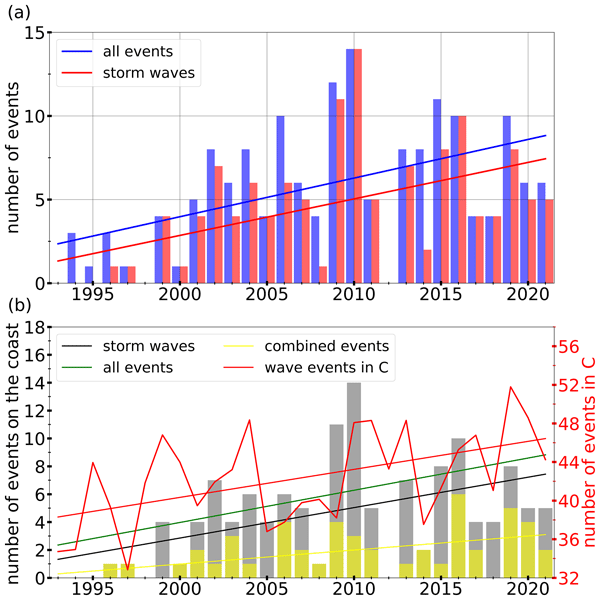
Carolina B. Gramcianinov, Joanna Staneva, Celia R. G. Souza, Priscila Linhares, Ricardo de Camargo, and Pedro L. da Silva Dias
State Planet, 1-osr7, 12, https://doi.org/10.5194/sp-1-osr7-12-2023, https://doi.org/10.5194/sp-1-osr7-12-2023, 2023
Short summary
Short summary
We analyse extreme wave event trends in the south-western South Atlantic in the last 29 years using wave products and coastal hazard records. The results show important regional changes associated with increased mean sea wave height, wave period, and wave power. We also find a rise in the number of coastal hazards related to waves affecting the state of São Paulo, Brazil, which partially agrees with the increase in extreme waves in the adjacent ocean sector but is also driven by local factors.
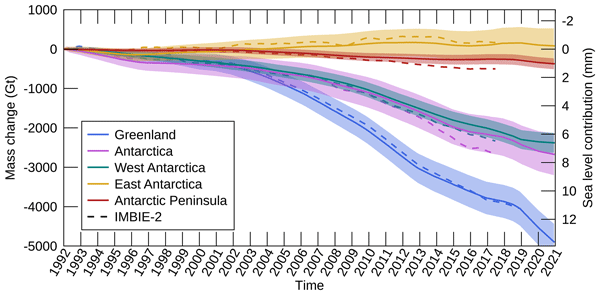
Inès N. Otosaka, Andrew Shepherd, Erik R. Ivins, Nicole-Jeanne Schlegel, Charles Amory, Michiel R. van den Broeke, Martin Horwath, Ian Joughin, Michalea D. King, Gerhard Krinner, Sophie Nowicki, Anthony J. Payne, Eric Rignot, Ted Scambos, Karen M. Simon, Benjamin E. Smith, Louise S. Sørensen, Isabella Velicogna, Pippa L. Whitehouse, Geruo A, Cécile Agosta, Andreas P. Ahlstrøm, Alejandro Blazquez, William Colgan, Marcus E. Engdahl, Xavier Fettweis, Rene Forsberg, Hubert Gallée, Alex Gardner, Lin Gilbert, Noel Gourmelen, Andreas Groh, Brian C. Gunter, Christopher Harig, Veit Helm, Shfaqat Abbas Khan, Christoph Kittel, Hannes Konrad, Peter L. Langen, Benoit S. Lecavalier, Chia-Chun Liang, Bryant D. Loomis, Malcolm McMillan, Daniele Melini, Sebastian H. Mernild, Ruth Mottram, Jeremie Mouginot, Johan Nilsson, Brice Noël, Mark E. Pattle, William R. Peltier, Nadege Pie, Mònica Roca, Ingo Sasgen, Himanshu V. Save, Ki-Weon Seo, Bernd Scheuchl, Ernst J. O. Schrama, Ludwig Schröder, Sebastian B. Simonsen, Thomas Slater, Giorgio Spada, Tyler C. Sutterley, Bramha Dutt Vishwakarma, Jan Melchior van Wessem, David Wiese, Wouter van der Wal, and Bert Wouters
Earth Syst. Sci. Data, 15, 1597–1616, https://doi.org/10.5194/essd-15-1597-2023, https://doi.org/10.5194/essd-15-1597-2023, 2023
Short summary
Short summary
By measuring changes in the volume, gravitational attraction, and ice flow of Greenland and Antarctica from space, we can monitor their mass gain and loss over time. Here, we present a new record of the Earth’s polar ice sheet mass balance produced by aggregating 50 satellite-based estimates of ice sheet mass change. This new assessment shows that the ice sheets have lost (7.5 x 10¹²) t of ice between 1992 and 2020, contributing 21 mm to sea level rise.
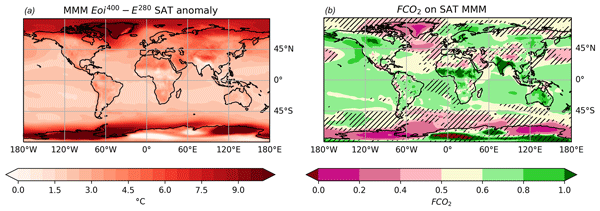
Lauren E. Burton, Alan M. Haywood, Julia C. Tindall, Aisling M. Dolan, Daniel J. Hill, Ayako Abe-Ouchi, Wing-Le Chan, Deepak Chandan, Ran Feng, Stephen J. Hunter, Xiangyu Li, W. Richard Peltier, Ning Tan, Christian Stepanek, and Zhongshi Zhang
Clim. Past, 19, 747–764, https://doi.org/10.5194/cp-19-747-2023, https://doi.org/10.5194/cp-19-747-2023, 2023
Short summary
Short summary
Warm climates of the Pliocene (~ 3 million years ago) are similar to projections of the near future. We find elevated concentrations of atmospheric carbon dioxide to be the most important forcing for driving changes in Pliocene surface air temperature, sea surface temperature, and precipitation. However, changes caused by the nature of Pliocene ice sheets and orography are also important, affecting the extent to which we can use the Pliocene as an analogue for our warmer future.

Ram Singh, Kostas Tsigaridis, Allegra N. LeGrande, Francis Ludlow, and Joseph G. Manning
Clim. Past, 19, 249–275, https://doi.org/10.5194/cp-19-249-2023, https://doi.org/10.5194/cp-19-249-2023, 2023
Short summary
Short summary
This work is a modeling effort to investigate the hydroclimatic impacts of a volcanic
quartetduring 168–158 BCE over the Nile River basin in the context of Ancient Egypt's Ptolemaic era (305–30 BCE). The model simulated a robust surface cooling (~ 1.0–1.5 °C), suppressing the African monsoon (deficit of > 1 mm d−1 over East Africa) and agriculturally vital Nile summer flooding. Our result supports the hypothesized relation between volcanic eruptions, hydroclimatic shocks, and societal impacts.
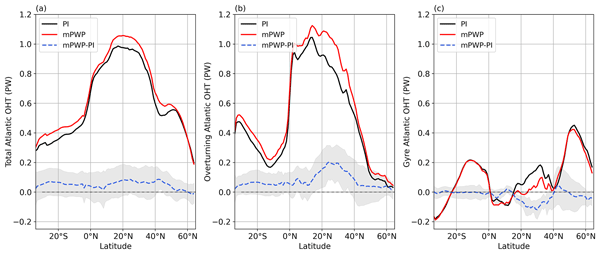
Julia E. Weiffenbach, Michiel L. J. Baatsen, Henk A. Dijkstra, Anna S. von der Heydt, Ayako Abe-Ouchi, Esther C. Brady, Wing-Le Chan, Deepak Chandan, Mark A. Chandler, Camille Contoux, Ran Feng, Chuncheng Guo, Zixuan Han, Alan M. Haywood, Qiang Li, Xiangyu Li, Gerrit Lohmann, Daniel J. Lunt, Kerim H. Nisancioglu, Bette L. Otto-Bliesner, W. Richard Peltier, Gilles Ramstein, Linda E. Sohl, Christian Stepanek, Ning Tan, Julia C. Tindall, Charles J. R. Williams, Qiong Zhang, and Zhongshi Zhang
Clim. Past, 19, 61–85, https://doi.org/10.5194/cp-19-61-2023, https://doi.org/10.5194/cp-19-61-2023, 2023
Short summary
Short summary
We study the behavior of the Atlantic Meridional Overturning Circulation (AMOC) in the mid-Pliocene. The mid-Pliocene was about 3 million years ago and had a similar CO2 concentration to today. We show that the stronger AMOC during this period relates to changes in geography and that this has a significant influence on ocean temperatures and heat transported northwards by the Atlantic Ocean. Understanding the behavior of the mid-Pliocene AMOC can help us to learn more about our future climate.
Yiling Huo, William Richard Peltier, and Deepak Chandan
Clim. Past, 18, 2401–2420, https://doi.org/10.5194/cp-18-2401-2022, https://doi.org/10.5194/cp-18-2401-2022, 2022
Short summary
Short summary
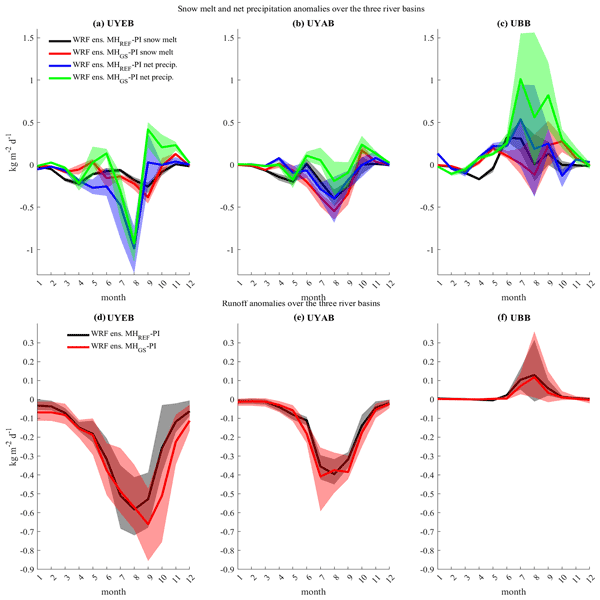
Understanding the hydrological changes on the Tibetan Plateau (TP) during the mid-Holocene (MH; a period with warmer summers than today) will help us understand expected future changes. This study analyses the hydroclimates over the headwater regions of three major rivers originating on the TP using dynamically downscaled climate simulations. Model–data comparisons show that the dynamic downscaling significantly improves both the present-day and MH regional climate simulations of the TP.
Janica C. Bühler, Josefine Axelsson, Franziska A. Lechleitner, Jens Fohlmeister, Allegra N. LeGrande, Madhavan Midhun, Jesper Sjolte, Martin Werner, Kei Yoshimura, and Kira Rehfeld
Clim. Past, 18, 1625–1654, https://doi.org/10.5194/cp-18-1625-2022, https://doi.org/10.5194/cp-18-1625-2022, 2022
Short summary
Short summary
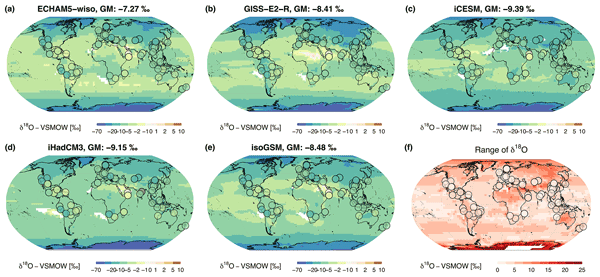
We collected and standardized the output of five isotope-enabled simulations for the last millennium and assess differences and similarities to records from a global speleothem database. Modeled isotope variations mostly arise from temperature differences. While lower-resolution speleothems do not capture extreme changes to the extent of models, they show higher variability on multi-decadal timescales. As no model excels in all comparisons, we advise a multi-model approach where possible.
Ryan A. Green, Laurie Menviel, Katrin J. Meissner, Xavier Crosta, Deepak Chandan, Gerrit Lohmann, W. Richard Peltier, Xiaoxu Shi, and Jiang Zhu
Clim. Past, 18, 845–862, https://doi.org/10.5194/cp-18-845-2022, https://doi.org/10.5194/cp-18-845-2022, 2022
Short summary
Short summary
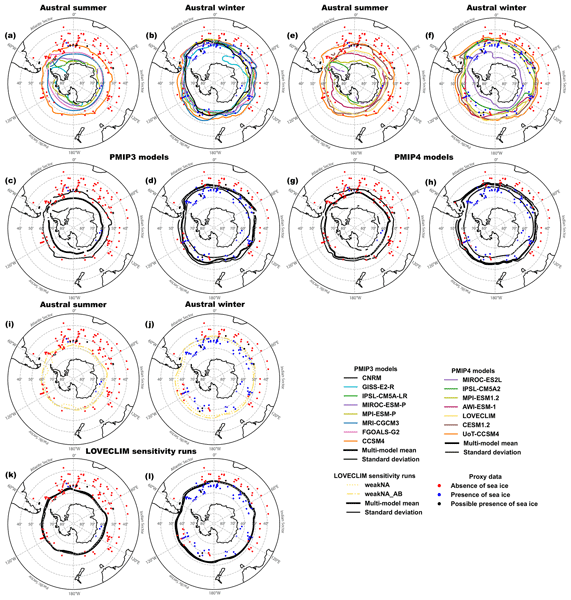
Climate models are used to predict future climate changes and as such, it is important to assess their performance in simulating past climate changes. We analyze seasonal sea-ice cover over the Southern Ocean simulated from numerical PMIP3, PMIP4 and LOVECLIM simulations during the Last Glacial Maximum (LGM). Comparing these simulations to proxy data, we provide improved estimates of LGM seasonal sea-ice cover. Our estimate of summer sea-ice extent is 20 %–30 % larger than previous estimates.
Davide Zanchettin, Claudia Timmreck, Myriam Khodri, Anja Schmidt, Matthew Toohey, Manabu Abe, Slimane Bekki, Jason Cole, Shih-Wei Fang, Wuhu Feng, Gabriele Hegerl, Ben Johnson, Nicolas Lebas, Allegra N. LeGrande, Graham W. Mann, Lauren Marshall, Landon Rieger, Alan Robock, Sara Rubinetti, Kostas Tsigaridis, and Helen Weierbach
Geosci. Model Dev., 15, 2265–2292, https://doi.org/10.5194/gmd-15-2265-2022, https://doi.org/10.5194/gmd-15-2265-2022, 2022
Short summary
Short summary
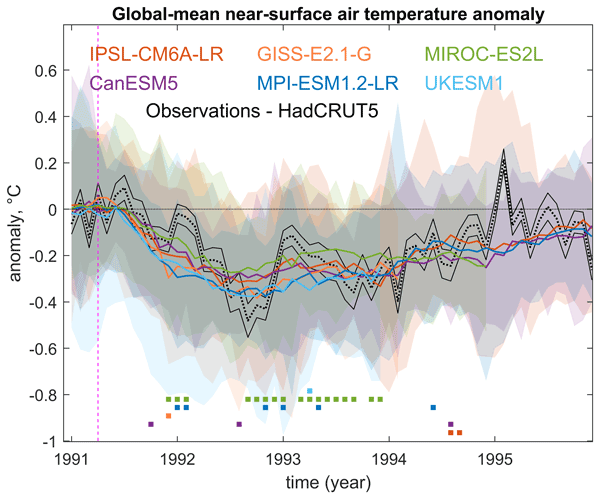
This paper provides metadata and first analyses of the volc-pinatubo-full experiment of CMIP6-VolMIP. Results from six Earth system models reveal significant differences in radiative flux anomalies that trace back to different implementations of volcanic forcing. Surface responses are in contrast overall consistent across models, reflecting the large spread due to internal variability. A second phase of VolMIP shall consider both aspects toward improved protocol for volc-pinatubo-full.
Zixuan Han, Qiong Zhang, Qiang Li, Ran Feng, Alan M. Haywood, Julia C. Tindall, Stephen J. Hunter, Bette L. Otto-Bliesner, Esther C. Brady, Nan Rosenbloom, Zhongshi Zhang, Xiangyu Li, Chuncheng Guo, Kerim H. Nisancioglu, Christian Stepanek, Gerrit Lohmann, Linda E. Sohl, Mark A. Chandler, Ning Tan, Gilles Ramstein, Michiel L. J. Baatsen, Anna S. von der Heydt, Deepak Chandan, W. Richard Peltier, Charles J. R. Williams, Daniel J. Lunt, Jianbo Cheng, Qin Wen, and Natalie J. Burls
Clim. Past, 17, 2537–2558, https://doi.org/10.5194/cp-17-2537-2021, https://doi.org/10.5194/cp-17-2537-2021, 2021
Short summary
Short summary
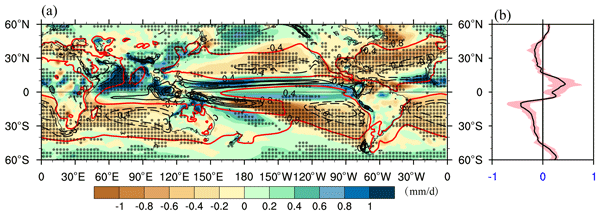
Understanding the potential processes responsible for large-scale hydrological cycle changes in a warmer climate is of great importance. Our study implies that an imbalance in interhemispheric atmospheric energy during the mid-Pliocene could have led to changes in the dynamic effect, offsetting the thermodynamic effect and, hence, altering mid-Pliocene hydroclimate cycling. Moreover, a robust westward shift in the Pacific Walker circulation can moisten the northern Indian Ocean.
Arthur M. Oldeman, Michiel L. J. Baatsen, Anna S. von der Heydt, Henk A. Dijkstra, Julia C. Tindall, Ayako Abe-Ouchi, Alice R. Booth, Esther C. Brady, Wing-Le Chan, Deepak Chandan, Mark A. Chandler, Camille Contoux, Ran Feng, Chuncheng Guo, Alan M. Haywood, Stephen J. Hunter, Youichi Kamae, Qiang Li, Xiangyu Li, Gerrit Lohmann, Daniel J. Lunt, Kerim H. Nisancioglu, Bette L. Otto-Bliesner, W. Richard Peltier, Gabriel M. Pontes, Gilles Ramstein, Linda E. Sohl, Christian Stepanek, Ning Tan, Qiong Zhang, Zhongshi Zhang, Ilana Wainer, and Charles J. R. Williams
Clim. Past, 17, 2427–2450, https://doi.org/10.5194/cp-17-2427-2021, https://doi.org/10.5194/cp-17-2427-2021, 2021
Short summary
Short summary
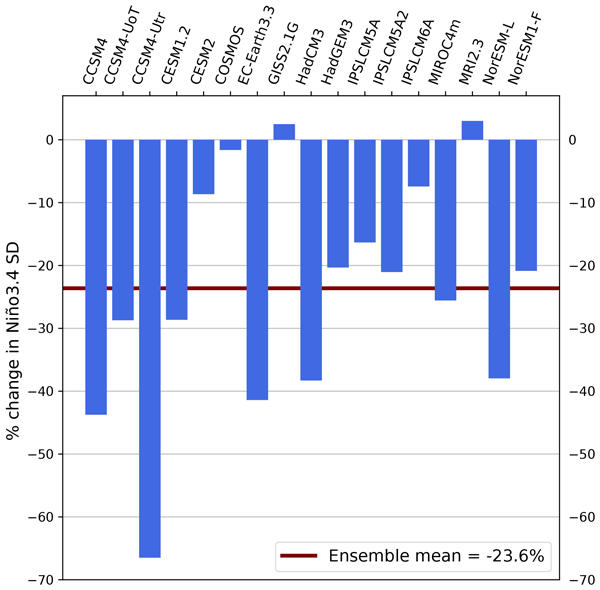
In this work, we have studied the behaviour of El Niño events in the mid-Pliocene, a period of around 3 million years ago, using a collection of 17 climate models. It is an interesting period to study, as it saw similar atmospheric carbon dioxide levels to the present day. We find that the El Niño events were less strong in the mid-Pliocene simulations, when compared to pre-industrial climate. Our results could help to interpret El Niño behaviour in future climate projections.
Cited articles
Adler, R., Huffman, G., Chang, A., Ferraro, R., Xie, P., Janowiak, J., Rudolf, B., Schneider, U., Curtis, S., Bolvin, D., Gruber, A., Susskind, J., and Arkin, P.: The Version 2 Global Precipitation Climatology Project (GPCP) Monthly Precipitation Analysis (1979–Present), American Meteorological Society, https://doi.org/10.1175/1525-7541(2003)004<1147:TVGPCP>2.0.CO;2, 2003. a, b
Anderson, W., Seager, R., Baethgen, W., and Cane, M.: Trans-Pacific ENSO teleconnections pose a correlated risk to agriculture, Agr. Forest Meteorol., 262, 298–309, 2018. a
Atwood, A. R., Donohoe, A., Battisti, D. S., Liu, X., and Pausata, F. S.: Robust longitudinally variable responses of the ITCZ to a myriad of climate forcings, Geophys. Res. Lett., 47, e2020GL088833, https://doi.org/10.1029/2020GL088833, 2020. a
Berger, A.: Milankovitch Theory and climate, AGU Ressearch Letters, https://doi.org/10.1029/RG026i004p00624, 1988. a
Bianchini, P. R., Prado, L. F., Yokoyama, E., Wainer, I., Gorenstein, I., and Pausata, F. S.: Precipitation patterns and variability in Tropical Americas during the Holocene, Palaeogeogr. Palaeocl., 669, 112935, https://doi.org/10.1016/j.palaeo.2025.112935, 2025. a
Bonfils, C. and Santer, B.: Investigating the possibility of a human component in various pacific decadal oscillation indices, Clim. Dynam., 37, 1457–1468, https://doi.org/10.1007/s00382-010-0920-1, 2011. a
Bova, S., Rosenthal, Y., Liu, Z., Godad, S. P., and Yan, M.: Seasonal origin of the thermal maxima at the Holocene and the last interglacial, Nature, 589, 548–553, https://doi.org/10.1038/s41586-020-03155-x, 2021. a
Brady, E., Stevenson, S., Bailey, D., Liu, Z., Noone, D., Nusbaumer, J., Otto-Bliesner, B., Tabor, C., Tomas, R., and Wong, T.: The connected isotopic water cycle in the Community Earth System Model version 1, J. Adv. Model. Earth Sy., 11, 2547–2566, 2019. a
Bühler, J. C., Axelsson, J., Lechleitner, F. A., Fohlmeister, J., LeGrande, A. N., Midhun, M., Sjolte, J., Werner, M., Yoshimura, K., and Rehfeld, K.: Investigating stable oxygen and carbon isotopic variability in speleothem records over the last millennium using multiple isotope-enabled climate models, Clim. Past, 18, 1625–1654, https://doi.org/10.5194/cp-18-1625-2022, 2022. a
Cai, W., Santoso, A., Collins, M., Dewitte, B., Karamperidou, C., Kug, J.-S., Lengaigne, M., McPhaden, M. J., Stuecker, M. F., and Taschetto, A. S.: Changing El Niño–Southern oscillation in a warming climate, Nature Reviews Earth & Environment, 2, 628–644, 2021. a
Chandler, R. E., Barnes, C. R., and Brierley, C. M.: Characterizing Spatial Structure in Climate Model Ensembles, J. Climate, 37, 1053–1064, 2024. a
Cheung, A. H., Sane, A., and Fox-Kemper, B.: Understanding the characteristics and drivers of Pacific decadal variability in the Community Earth System Model Last Millennium Ensemble, Clim. Dynam., 64, 35, https://doi.org/10.1007/s00382-025-07996-y, 2026. a
Colose, C. M., LeGrande, A. N., and Vuille, M.: The influence of volcanic eruptions on the climate of tropical South America during the last millennium in an isotope-enabled general circulation model, Clim. Past, 12, 961–979, https://doi.org/10.5194/cp-12-961-2016, 2016. a
Debret, M., Sebag, D., Crosta, X., Massei, N., Petit, J.-R., Chapron, E., and Bout-Roumazeilles, V.: Evidence from wavelet analysis for a mid-Holocene transition in global climate forcing, Quaternary Sci. Rev., 28, 2675–2688, 2009. a
Demenocal, P., Ortiz, J., Guilderson, T., Adkins, J., Sarnthein, M., Baker, L., and Yarusinsky, M.: Abrupt onset and termination of the African Humid Period:: rapid climate responses to gradual insolation forcing, Quaternary Sci. Rev., 19, 347–361, 2000. a
Deser, C., Alexander, M. A., Xie, S.-P., and Phillips, A. S.: Sea Surface Temperature Variability: Patterns and Mechanisms, Annu. Rev. Mar. Sci., 2, 115–143, https://doi.org/10.1146/annurev-marine-120408-151453, 2010. a, b, c, d
Deser, C., Phillips, A., Bourdette, V., and Teng, H.: Uncertainty in climate change projections: the role of internal variability, Clim. Dynam., 38, 527–546, 2012. a
Dhrubajyoti, S., Karnauskas, K. B., and Goodkin, N. F.: Tropical Pacific SST and ITCZ Biases in Climate Models: Double Trouble for Future Rainfall Projections?, Geophys. Res. Lett., https://doi.org/10.1029/2018GL081363, 2019. a, b
Diciccio, T. J. and Romano, J. P.: A review of bootstrap confidence intervals, J. Roy. Stat. Soc. B Met., 50, 338–354, 1988. a
Döscher, R., Acosta, M., Alessandri, A., Anthoni, P., Arsouze, T., Bergman, T., Bernardello, R., Boussetta, S., Caron, L.-P., Carver, G., Castrillo, M., Catalano, F., Cvijanovic, I., Davini, P., Dekker, E., Doblas-Reyes, F. J., Docquier, D., Echevarria, P., Fladrich, U., Fuentes-Franco, R., Gröger, M., v. Hardenberg, J., Hieronymus, J., Karami, M. P., Keskinen, J.-P., Koenigk, T., Makkonen, R., Massonnet, F., Ménégoz, M., Miller, P. A., Moreno-Chamarro, E., Nieradzik, L., van Noije, T., Nolan, P., O'Donnell, D., Ollinaho, P., van den Oord, G., Ortega, P., Prims, O. T., Ramos, A., Reerink, T., Rousset, C., Ruprich-Robert, Y., Le Sager, P., Schmith, T., Schrödner, R., Serva, F., Sicardi, V., Sloth Madsen, M., Smith, B., Tian, T., Tourigny, E., Uotila, P., Vancoppenolle, M., Wang, S., Wårlind, D., Willén, U., Wyser, K., Yang, S., Yepes-Arbós, X., and Zhang, Q.: The EC-Earth3 Earth system model for the Coupled Model Intercomparison Project 6, Geosci. Model Dev., 15, 2973–3020, https://doi.org/10.5194/gmd-15-2973-2022, 2022. a, b, c
Flato, G., Marotzke, J., Abiodun, B., Braconnot, P., Chou, S. C., Collins, W., Cox, P., Driouech, F., Emori, S., and Eyring, V.: Evaluation of climate models, Cambridge University Press, 741–866, https://doi.org/10.1017/CBO9781107415324.020, 2014. a
Froyland, G., Giannakis, D., Lintner, B. R., Pike, M., and Slawinska, J.: Spectral analysis of climate dynamics with operator-theoretic approaches, Nat. Commun., 12, 6570, https://doi.org/10.1017/CBO9781107415324.020, 2021. a
Ghil, M. and Lucarini, V.: The physics of climate variability and climate change, Rev. Mod. Phys., 92, 035002, https://doi.org/10.1103/RevModPhys.92.035002, 2020. a, b
Ghil, M., Allen, M. R., Dettinger, M. D., Ide, K., Kondrashov, D., Mann, M. E., Robertson, A. W., Saunders, A., Tian, Y., and Varadi, F.: Advanced spectral methods for climatic time series, Rev. Geophys., 40, 1–3, 2002. a
Gorenstein, I.: IuriGorenstein/Entropy_MH_ESM: EntropyESM_v1.0.0, Zenodo [code and data set], https://doi.org/10.5281/zenodo.19595927, 2026. a
Gorenstein, I., Prado, L. F., Bianchini, P. R., Wainer, I., Griffiths, M. L., Pausata, F. S., and Yokoyama, E.: A fully calibrated and updated mid-Holocene climate reconstruction for Eastern South America, Quaternary Sci. Rev., 292, 107646, 2022a. a
Gorenstein, I., Wainer, I., Mata, M. M., and Tonelli, M.: Revisiting Antarctic sea-ice decadal variability since 1980, Polar Sci., 31, 100743, https://doi.org/10.1016/j.polar.2021.100743, 2022b. a
Gorenstein, I., Wainer, I., Pausata, F. S., Prado, L. F., Khodri, M., and Dias, P. L. S.: A 50-year cycle of sea surface temperature regulates decadal precipitation in the tropical and South Atlantic region, Communications Earth & Environment, 4, 427, https://doi.org/10.1038/s43247-023-01073-0, 2023. a, b, c, d, e, f
Harrison, S. P. a., Kutzbach, J. E., Liu, Z., Bartlein, P. J., Otto-Bliesner, B., Muhs, D., Prentice, I. C., and Thompson, R. S.: Mid-Holocene climates of the Americas: a dynamical response to changed seasonality, Clim. Dynam., 20, 663–688, 2003. a
Haykin, S.: Neural Networks and Machine Learning, Pearson Education India, ISBN 978-0131471399, 2009. a
Hinkley, D. V.: Bootstrap methods, J. Roy. Stat. Soc. B Met., 50, 321–337, 1988. a
Hounsou-Gbo, G. A., Servain, J., Araujo, M., Caniaux, G., Bourlès, B., Fontenele, D., and Martins, E. S. P.: SST indexes in the Tropical South Atlantic for forecasting rainy seasons in Northeast Brazil, Atmosphere, 10, 335, https://doi.org/10.3390/atmos10060335, 2019. a
Hurrell, J. W., Holland, M. M., Gent, P. R., Ghan, S., Kay, J. E., Kushner, P. J., Lamarque, J.-F., Large, W. G., Lawrence, D., and Lindsay, K.: The community earth system model: a framework for collaborative research, B. Am. Meteorol. Soc., 94, 1339–1360, 2013. a
Jolliffe, I.: Principal component analysis, New York: Springer-Verlag, https://doi.org/10.1098/rsta.2015.0202, 2002. a
Kiang, N. Y.-L.: Savannas and seasonal drought: the landscape-leaf connection through optimal stomatal control, University of California, Berkeley, https://www.proquest.com/dissertations-theses/savannas-seasonal-drought-landscape-leaf/docview/304788220/se-2 (last access: 20 March 2026), 2002. a
Kwiecien, O., Braun, T., Brunello, C. F., Faulkner, P., Hausmann, N., Helle, G., Hoggarth, J. A., Ionita, M., Jazwa, C. S., Kelmelis, S., Marwan, N., Nava-Fernandez, C., Nehme, C., Opel, T., Oster, J. L., Perşoiu, A., Petrie, C., Prufer, K., Saarni, S. M., Wolf, A., and Breitenbach, S. F.: What we talk about when we talk about seasonality – A transdisciplinary review, Earth-Sci. Rev., 225, 103843, https://doi.org/10.1016/j.earscirev.2021.103843, 2022. a
Lam, H. C. Y., Haines, A., McGregor, G., Chan, E. Y. Y., and Hajat, S.: Time-series study of associations between rates of people affected by disasters and the El Niño Southern Oscillation (ENSO) cycle, Int. J. Env. Res. Pub. He., 16, 3146, https://doi.org/10.3390/ijerph16173146, 2019. a
Lewis, S. C. and LeGrande, A. N.: Stability of ENSO and its tropical Pacific teleconnections over the Last Millennium, Clim. Past, 11, 1347–1360, https://doi.org/10.5194/cp-11-1347-2015, 2015. a
Lehner, F., Deser, C., Maher, N., Marotzke, J., Fischer, E. M., Brunner, L., Knutti, R., and Hawkins, E.: Partitioning climate projection uncertainty with multiple large ensembles and CMIP5/6, Earth Syst. Dynam., 11, 491–508, https://doi.org/10.5194/esd-11-491-2020, 2020. a
Liu, Z., Harrison, S. P., Kutzbach, J., and Otto-Bliesner, B.: Global monsoons in the mid-Holocene and oceanic feedback, Clim. Dynam., 22, 157–182, https://doi.org/10.1007/s00382-003-0372-y, 2002. a
Mantua, N., Hare, S., Zhang, Y., Wallace, J., and Francis, R.: A Pacific interdecadal oscillation with impacts on salmon production, B. Am. Meteorol. Soc., 58, 1069–1079, 1997. a
McGowan, H., Marx, S., Moss, P., and Hammond, A.: Evidence of ENSO mega-drought triggered collapse of prehistory Aboriginal society in northwest Australia, Geophys. Res. Lett., 39, https://doi.org/10.1029/2012GL053916, 2012. a
Olonscheck, D. and Notz, D.: Consistently estimating internal climate variability from climate model simulations, J. Climate, 30, 9555–9573, 2017. a
Pausata, F. S. R., Messori, G., and Zhang, Q.: Impacts of dust reduction on the northward expansion of the African monsoon during the Green Sahara period, Earth Planet. Sc. Lett., 434, 298–307, https://doi.org/10.1016/j.epsl.2015.11.049, 2016. a
Pendergrass, A. G., Knutti, R., Lehner, F., Deser, C., and Sanderson, B. M.: Precipitation variability increases in a warmer climate, Sci. Rep., 7, 17966, https://doi.org/10.1038/s41598-017-17966-y, 2017. a
Pillai, P. A., Dhakate, A. R., and Ramu, D.: The predictive role of spring season Atlantic Meridional Mode (AMM) in Indian Summer Monsoon Rainfall (ISMR) variability during the recent decades, Sci. Rep., 7, 17966, https://doi.org/10.21203/rs.3.rs-1783243/v1, 2022. a
Preisendorfer, R. W. and Mobley, C. D.: Principal component analysis in meteorology and oceanography, Dev. Atmosph., 17, 425, 1988. a
Rayner, N., Parker, D., and Horton, E.: Global analyses of sea surface temperature, sea ice, and night marine air temperature since the late nineteenth century, J. Geophys. Res.-Atmos., https://doi.org/10.1029/2002JD002670, 2003a. a
Sane, A., Fox-Kemper, B., and Ullman, D. S.: Internal versus forced variability metrics for general circulation models using information theory, J. Geophys. Res.-Oceans, 129, e2023JC020101, https://doi.org/10.1029/2023JC020101, 2024. a, b
Sang, Y.-F.: Wavelet entropy-based investigation into the daily precipitation variability in the Yangtze River Delta, China, with rapid urbanizations, Theor. Appl. Climatol., 111, 361–370, 2013. a
Schneider, T., Bischoff, T., and Haug, G. H.: Migrations and dynamics of the intertropical convergence zone, Nature, 513, 45–53, 2014. a
Smith, R. and Mayle, F. E.: Impact of mid- to late Holocene precipitation changes on vegetation across lowland tropical South America: a paleo-data synthesis, Quaternary Res., 1–22, https://doi.org/10.1017/qua.2017.89, 2017. a
Smith, B., Wårlind, D., Arneth, A., Hickler, T., Leadley, P., Siltberg, J., and Zaehle, S.: Implications of incorporating N cycling and N limitations on primary production in an individual-based dynamic vegetation model, Biogeosciences, 11, 2027–2054, https://doi.org/10.5194/bg-11-2027-2014, 2014. a
Sohoulande, C.: Predictive Model for Characterizing Bioclimatic Variability within Köppen-Geiger Global Climate Classification Scheme, in: ASA, CSSA, SSSA International Annual Meeting, ASA-CSSA-SSSA, https://scisoc.confex.com/scisoc/2023am/meetingapp.cgi/Paper/148235 (last access: 20 March 2026), 2023. a
Sun, Q., Miao, C., Duan, Q., Ashouri, H., Sorooshian, S., and Hsu, K.: A Review of Global Precipitation Data Sets: Data Sources, Estimation, and Intercomparisons, Rev. Geophys., https://doi.org/10.1002/2017RG000574, 2017. a
Tabor, C., Otto‐Bliesner, B., and Liu, Z.: Speleothems of South American and Asian monsoons influenced by a Green Sahara, Geophys. Res. Lett., 47, https://doi.org/10.1029/2020GL089695, 2020. a, b, c, d
Wirtz, K. W., Lohmann, G., Bernhardt, K., and Lemmen, C.: Mid-Holocene regional reorganization of climate variability: Analyses of proxy data in the frequency domain, Palaeogeogr. Palaeocl., 298, 189–200, 2010. a
Wyser, K., van Noije, T., Yang, S., von Hardenberg, J., O'Donnell, D., and Döscher, R.: On the increased climate sensitivity in the EC-Earth model from CMIP5 to CMIP6, Geosci. Model Dev., 13, 3465–3474, https://doi.org/10.5194/gmd-13-3465-2020, 2020. a
Xie, S.-P. and Carton, J. A.: Tropical Atlantic variability: Patterns, mechanisms, and impacts, Earth’s Climate: The Ocean–Atmosphere Interaction, Geophys. Monogr. Ser., 147, 121–142, 2004. a
Zhang, Y., Wallace, J., and Battisti, D.: ENSO-like interdecadal variability: 1900–93’s, J. Climate, 10, 1004–1020, 1997. a
Zhao, Y., Braconnot, P., Harrison, S., Yiou, P., and Marti, O.: Simulated changes in the relationship between tropical ocean temperatures and the western African monsoon during the mid-Holocene, Clim. Dynam., 28, 533–551, 2007. a
Short summary
We introduce a new approach based on information theory to study climate variability using observational and model data. To showcase our methodology, we study the tropical and South Atlantic by examining broad patterns in ocean and rainfall data at decadal scales in four climate models under mid‐Holocene and pre‐industrial conditions and observations. Our findings show that large-scale patterns help explain long-term climate behavior.
We introduce a new approach based on information theory to study climate variability using...


