the Creative Commons Attribution 4.0 License.
the Creative Commons Attribution 4.0 License.
 | 04 May 2026
The ocean model for E3SM global applications: Omega version 0.1.0 – a new high-performance computing code for exascale architectures

Xylar S. Asay-Davis
Alice M. Barthel
Carolyn Branecky Begeman
Siddhartha Bishnu
Steven R. Brus
Philip W. Jones
Hyun-Gyu Kang
Youngsung Kim
Azamat Mametjanov
Brian J. O'Neill
James R. Overfelt
Kieran K. Ringel
Katherine M. Smith
Sarat Sreepathi
Luke P. Van Roekel
Maciej Waruszewski
Related authors
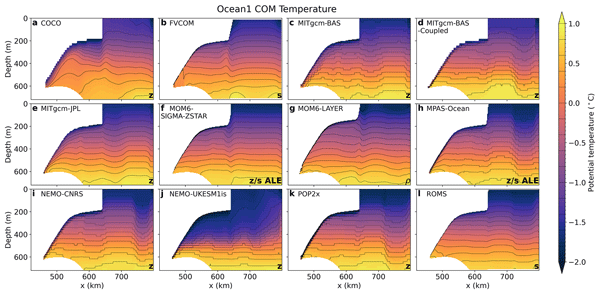
The second Ice Shelf-Ocean Model Intercomparison Project, ISOMIP+, compares 12 ice shelf-ocean models with a common, idealised, static configuration, aiming to assess inter-model variability. Models show similar basal melt rate patterns, ocean profiles and circulation but differ in ice-ocean boundary layer properties. Ice-ocean boundary layer representation is a key area for future work, as are realistic-domain ice sheet-ocean model intercomparisons.
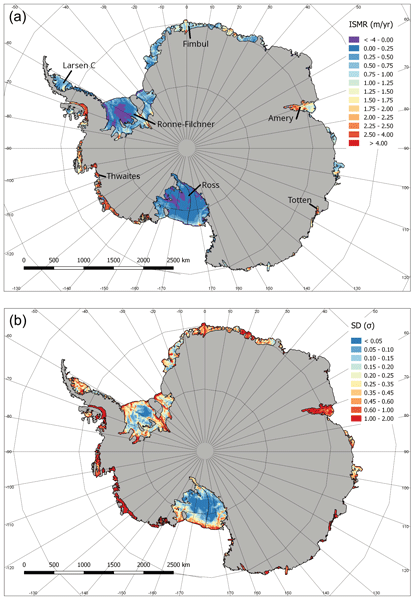
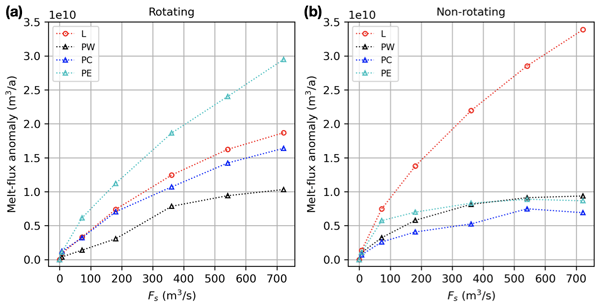
Quantifying melt and freeze beneath Antarctica’s floating ice shelves is vital to understanding present-day ice-sheet behavior and its potential to contribute to future sea-level rise. We compare 10 ice-shelf/ocean computer simulations with satellite data, providing the first multi-model estimate of melting and refreezing driven by the ocean. This new estimate offers a valuable tool for assessing ice-shelf roles in current and future ice-sheet changes, informing coastal adaptation strategies.