
Articles | Volume 19, issue 8
https://doi.org/10.5194/gmd-19-3193-2026
© Author(s) 2026. This work is distributed under
the Creative Commons Attribution 4.0 License.
the Creative Commons Attribution 4.0 License.
https://doi.org/10.5194/gmd-19-3193-2026
© Author(s) 2026. This work is distributed under
the Creative Commons Attribution 4.0 License.
the Creative Commons Attribution 4.0 License.
Development and technical paper
| 
23 Apr 2026
Development and technical paper |
| 23 Apr 2026
| 23 Apr 2026
Numerical strategies for representing Richards' equation and its couplings in snowpack models
Kévin Fourteau
Univ. Grenoble Alpes, Université de Toulouse, Météo-France, CNRS, CNRM, Centre d'Études de la Neige, Grenoble, France
Julien Brondex
Univ. Grenoble Alpes, Université de Toulouse, Météo-France, CNRS, CNRM, Centre d'Études de la Neige, Grenoble, France
Clément Cancès
Univ. Lille, CNRS, Inria, UMR 8524 – Laboratoire Paul Painlevé, 59000, Lille, France

Univ. Grenoble Alpes, Université de Toulouse, Météo-France, CNRS, CNRM, Centre d'Études de la Neige, Grenoble, France
Related authors
Neige Calonne, Pascal Hagenmuller, Rémi Granger, Lisa Bouvet, Kévin Fourteau, Julien Brondex, François Tuzet, Yves Lejeune, Anne Dufour, Mathieu Fructus, Teruo Aoki, and Marie Dumont
Earth Syst. Sci. Data Discuss., https://doi.org/10.5194/essd-2026-718, https://doi.org/10.5194/essd-2026-718, 2026
Preprint under review for ESSD
Short summary
Short summary
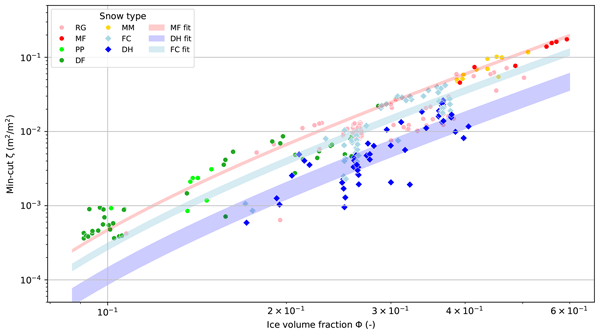
We collected weekly measurements of snow microstructural properties over two winters at Col de Porte in the French Alps, a relatively warm alpine site, using complementary techniques including X-ray tomography, the SnowMicroPen, and optical instruments. The dataset captures snowpack evolution at fine vertical resolution and is a valuable resource for snow model evaluation and instrument comparisons. It also provides guidance for future snow monitoring campaigns in warm mountain environments.
Diego Monteiro, Léo Viallon-Galinier, Kévin Fourteau, Oscar Dick, and Pascal Hagenmuller
The Cryosphere, 20, 4515–4536, https://doi.org/10.5194/tc-20-4515-2026, https://doi.org/10.5194/tc-20-4515-2026, 2026
Short summary
Short summary
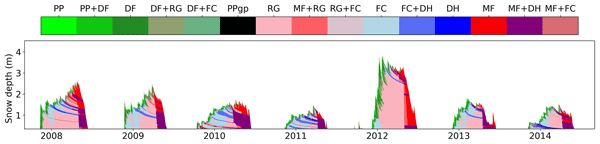
This research aims to improve dry-snow slab avalanche forecasts, particularly the propagation of cracks in weak layers, as current models rely on uncertain and difficult-to-measure parameters. We combined snowpack simulations with field measurements to link fracture energy to measurable and modelable snow properties. This new approach better reproduces observed crack lengths and allows weak layers to be tracked throughout the season, thereby improving operational avalanche risk assessment.
Matthieu Lafaysse, Marie Dumont, Basile De Fleurian, Mathieu Fructus, Rafife Nheili, Léo Viallon-Galinier, Matthieu Baron, Aaron Boone, Axel Bouchet, Julien Brondex, Carlo Carmagnola, Bertrand Cluzet, Kévin Fourteau, Ange Haddjeri, Pascal Hagenmuller, Giulia Mazzotti, Marie Minvielle, Samuel Morin, Louis Quéno, Léon Roussel, Pierre Spandre, François Tuzet, and Vincent Vionnet
Geosci. Model Dev., 19, 6273–6334, https://doi.org/10.5194/gmd-19-6273-2026, https://doi.org/10.5194/gmd-19-6273-2026, 2026
Short summary
Short summary
This article is a comprehensive description of the 3.0.2 stable release of the Crocus snowpack model. It describes various new implementations since the last reference article in 2012 and a review of the available scientific evaluations and applications of the model. This provides guidance for the future of numerical snow modelling.
Audrey Goutard, Marion Réveillet, Fanny Brun, Delphine Six, Kevin Fourteau, Charles Amory, Xavier Fettweis, Mathieu Fructus, Arbindra Khadka, and Matthieu Lafaysse
The Cryosphere, 20, 2393–2416, https://doi.org/10.5194/tc-20-2393-2026, https://doi.org/10.5194/tc-20-2393-2026, 2026
Short summary
Short summary
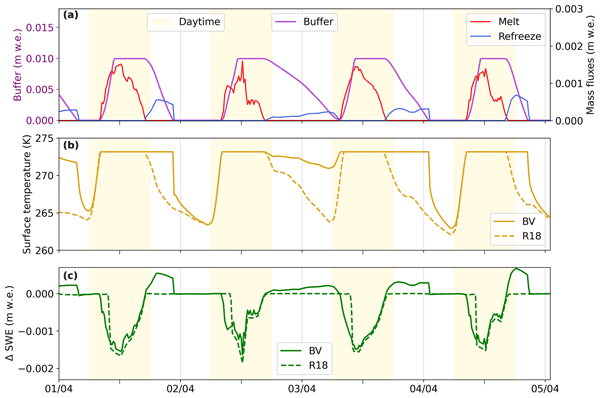
A new scheme has been developed in a snowpack model (SURFEX/ISBA-Crocus), to consider the impact of liquid water dynamics on bare ice, including albedo feedback and refreezing. When applied to the Mera Glacier in Nepal, the model reveals strong seasonal effects on the energy and mass balance, with increased melting in dry seasons and significant refreezing during the monsoon. This development improves mass balance modeling under increasing rainfall and bare ice exposure due to climate warming.
Kevin Fourteau, Kaoane Jondeau, Clément Cancès, and Marie Dumont
EGUsphere, https://doi.org/10.5194/egusphere-2026-510, https://doi.org/10.5194/egusphere-2026-510, 2026
Short summary
Short summary
In physics, entropy and the second principle of thermodynamics are related to the notion of stability. In applied mathematics, the same idea of entropy can be transposed to computer models, to ensure that they do not spontaneously oscillate or diverge. The goal of this work is to apply this type of methods to snowpack modelling. We show that entropy-consistent, and thus more robust models, can be designed following a few general criteria.
Léon Roussel, Marie Dumont, Marion Réveillet, Delphine Six, Marin Kneib, Pierre Nabat, Kévin Fourteau, Diego Monteiro, Simon Gascoin, Emmanuel Thibert, Antoine Rabatel, Jean-Emmanuel Sicart, Mylène Bonnefoy, Luc Piard, Olivier Laarman, Bruno Jourdain, Mathieu Fructus, Matthieu Vernay, and Matthieu Lafaysse
The Cryosphere, 19, 5201–5230, https://doi.org/10.5194/tc-19-5201-2025, https://doi.org/10.5194/tc-19-5201-2025, 2025
Short summary
Short summary
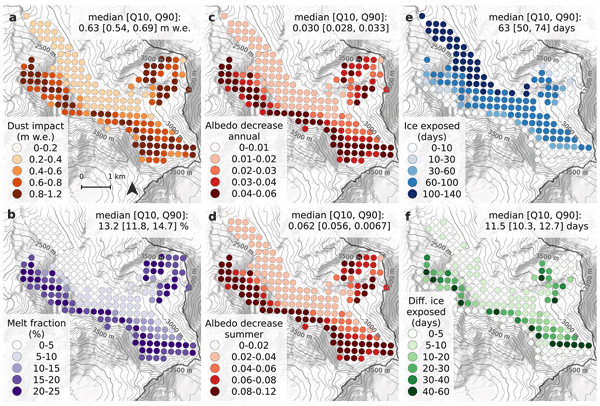
Saharan dust deposits frequently turn alpine glaciers orange. Mineral dust reduces snow albedo and increases snow and glaciers melt rate. Using physical modeling, we quantified the impact of dust on the Argentière Glacier over the period 2019–2022. We found that the contribution of mineral dust to the melt represents between 8 % and 16 % of Argentière Glacier summer melt. At specific locations, the impact of dust over one year can rise to an equivalent of 1.2 m of melted ice.
Xavier Faïn, Sophie Szopa, Vaishali Naïk, Patricia Martinerie, David M. Etheridge, Rachael H. Rhodes, Cathy M. Trudinger, Vasilii V. Petrenko, Kévin Fourteau, and Philip Place
Atmos. Chem. Phys., 25, 1105–1119, https://doi.org/10.5194/acp-25-1105-2025, https://doi.org/10.5194/acp-25-1105-2025, 2025
Short summary
Short summary
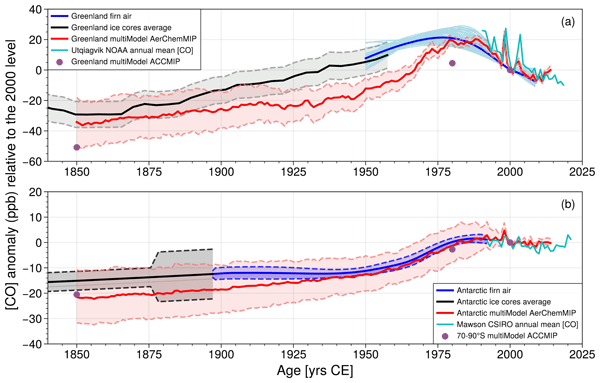
Carbon monoxide (CO) plays a crucial role in the atmosphere's oxidizing capacity. In this study, we analyse how historical (1850–2014) [CO] outputs from state-of-the-art global chemistry–climate models over Greenland and Antarctica are able to capture both absolute values and trends recorded in multi-site ice archives. A disparity in [CO] growth rates emerges in the Northern Hemisphere between models and observations from 1920–1975 CE, possibly linked to uncertainties in CO emission factors.
Julien Westhoff, Johannes Freitag, Anaïs Orsi, Patricia Martinerie, Ilka Weikusat, Michael Dyonisius, Xavier Faïn, Kevin Fourteau, and Thomas Blunier
The Cryosphere, 18, 4379–4397, https://doi.org/10.5194/tc-18-4379-2024, https://doi.org/10.5194/tc-18-4379-2024, 2024
Short summary
Short summary
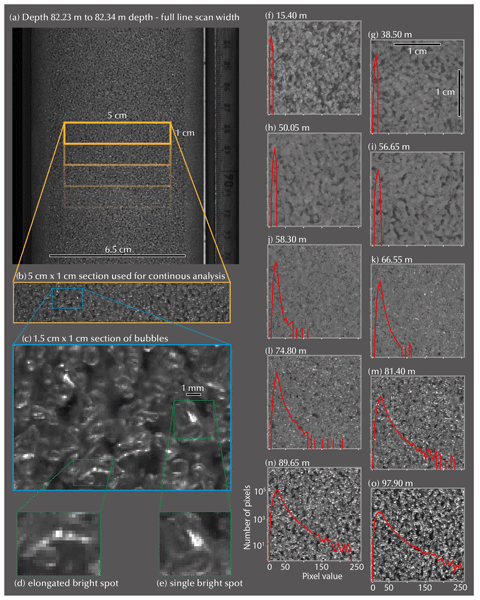
We study the EastGRIP area, Greenland, in detail with traditional and novel techniques. Due to the compaction of the ice, at a certain depth, atmospheric gases can no longer exchange, and the atmosphere is trapped in air bubbles in the ice. We find this depth by pumping air from a borehole, modeling, and using a new technique based on the optical appearance of the ice. Our results suggest that the close-off depth lies at around 58–61 m depth and more precisely at 58.3 m depth.
Kévin Fourteau, Johannes Freitag, Mika Malinen, and Henning Löwe
The Cryosphere, 18, 2831–2846, https://doi.org/10.5194/tc-18-2831-2024, https://doi.org/10.5194/tc-18-2831-2024, 2024
Short summary
Short summary
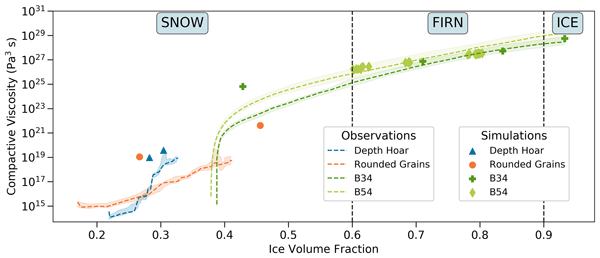
Understanding the settling of snow under its own weight has applications from avalanche forecasts to ice core interpretations. We study how this settling can be modeled using 3D images of the internal structure of snow and ice deformation mechanics. We found that classical ice mechanics, as used, for instance, in glacier flow, explain the compaction of dense polar snow but not that of lighter seasonal snow. How, exactly, the ice deforms during light snow compaction thus remains an open question.
Anna Braun, Kévin Fourteau, and Henning Löwe
The Cryosphere, 18, 1653–1668, https://doi.org/10.5194/tc-18-1653-2024, https://doi.org/10.5194/tc-18-1653-2024, 2024
Short summary
Short summary
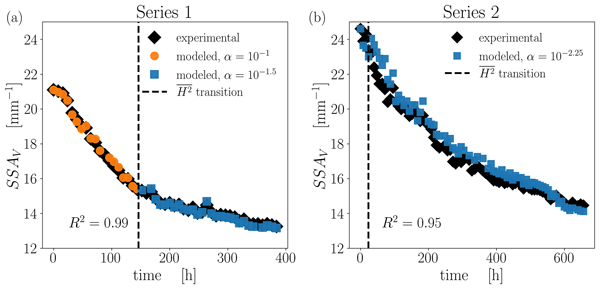
The specific surface of snow dictates key physical properties and continuously evolves in natural snowpacks. This is referred to as metamorphism. This work develops a rigorous physical model for this evolution, which is able to reproduce X-ray tomography measurements without using unphysical tuning parameters. Our results emphasize that snow crystal growth at the micrometer scale ultimately controls the pace of metamorphism.
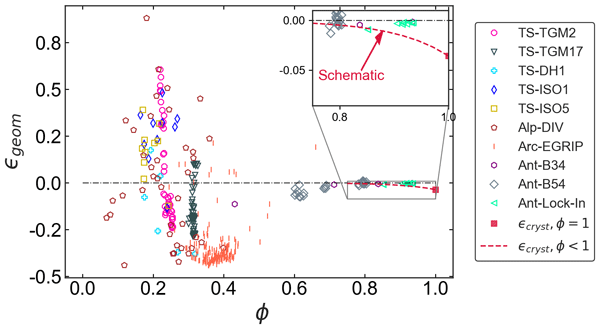
Kavitha Sundu, Johannes Freitag, Kévin Fourteau, and Henning Löwe
The Cryosphere, 18, 1579–1596, https://doi.org/10.5194/tc-18-1579-2024, https://doi.org/10.5194/tc-18-1579-2024, 2024
Short summary
Short summary
Ice crystals often show a rod-like, vertical orientation in snow and firn; they are said to be anisotropic. The stiffness in the vertical direction therefore differs from the horizontal, which, for example, impacts the propagation of seismic waves. To quantify this anisotropy, we conducted finite-element simulations of 391 snow, firn, and ice core microstructures obtained from X-ray tomography. We then derived a parameterization that may be employed for advanced seismic studies in polar regions.
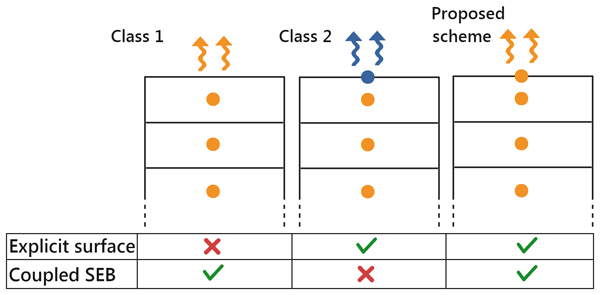
Kévin Fourteau, Julien Brondex, Fanny Brun, and Marie Dumont
Geosci. Model Dev., 17, 1903–1929, https://doi.org/10.5194/gmd-17-1903-2024, https://doi.org/10.5194/gmd-17-1903-2024, 2024
Short summary
Short summary
In this paper, we provide a novel numerical implementation for solving the energy exchanges at the surface of snow and ice. By combining the strong points of previous models, our solution leads to more accurate and robust simulations of the energy exchanges, surface temperature, and melt while preserving a reasonable computation time.
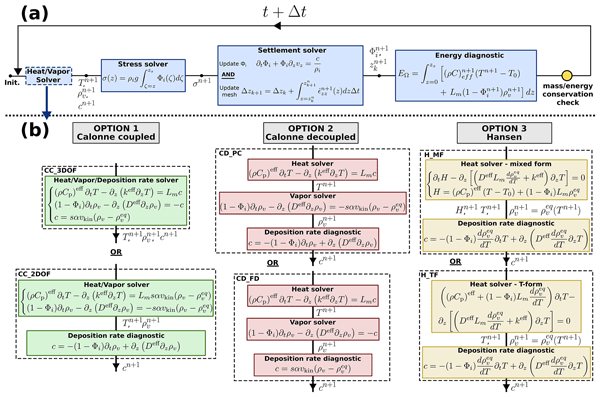
Julien Brondex, Kévin Fourteau, Marie Dumont, Pascal Hagenmuller, Neige Calonne, François Tuzet, and Henning Löwe
Geosci. Model Dev., 16, 7075–7106, https://doi.org/10.5194/gmd-16-7075-2023, https://doi.org/10.5194/gmd-16-7075-2023, 2023
Short summary
Short summary
Vapor diffusion is one of the main processes governing snowpack evolution, and it must be accounted for in models. Recent attempts to represent vapor diffusion in numerical models have faced several difficulties regarding computational cost and mass and energy conservation. Here, we develop our own finite-element software to explore numerical approaches and enable us to overcome these difficulties. We illustrate the capability of these approaches on established numerical benchmarks.
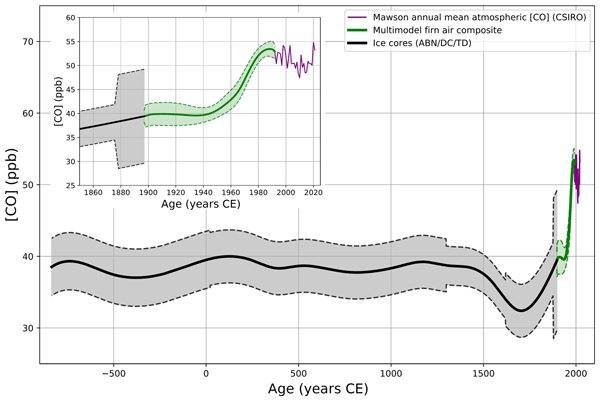
Xavier Faïn, David M. Etheridge, Kévin Fourteau, Patricia Martinerie, Cathy M. Trudinger, Rachael H. Rhodes, Nathan J. Chellman, Ray L. Langenfelds, Joseph R. McConnell, Mark A. J. Curran, Edward J. Brook, Thomas Blunier, Grégory Teste, Roberto Grilli, Anthony Lemoine, William T. Sturges, Boris Vannière, Johannes Freitag, and Jérôme Chappellaz
Clim. Past, 19, 2287–2311, https://doi.org/10.5194/cp-19-2287-2023, https://doi.org/10.5194/cp-19-2287-2023, 2023
Short summary
Short summary
We report on a 3000-year record of carbon monoxide (CO) levels in the Southern Hemisphere's high latitudes by combining ice core and firn air measurements with modern direct atmospheric samples. Antarctica [CO] remained stable (–835 to 1500 CE), decreased during the Little Ice Age, and peaked around 1985 CE. Such evolution reflects stable biomass burning CO emissions before industrialization, followed by growth from CO anthropogenic sources, which decline after 1985 due to improved combustion.
Fanny Brun, Owen King, Marion Réveillet, Charles Amory, Anton Planchot, Etienne Berthier, Amaury Dehecq, Tobias Bolch, Kévin Fourteau, Julien Brondex, Marie Dumont, Christoph Mayer, Silvan Leinss, Romain Hugonnet, and Patrick Wagnon
The Cryosphere, 17, 3251–3268, https://doi.org/10.5194/tc-17-3251-2023, https://doi.org/10.5194/tc-17-3251-2023, 2023
Short summary
Short summary
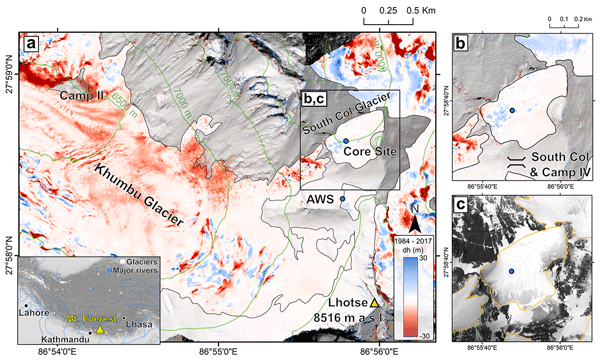
The South Col Glacier is a small body of ice and snow located on the southern ridge of Mt. Everest. A recent study proposed that South Col Glacier is rapidly losing mass. In this study, we examined the glacier thickness change for the period 1984–2017 and found no thickness change. To reconcile these results, we investigate wind erosion and surface energy and mass balance and find that melt is unlikely a dominant process, contrary to previous findings.
Xavier Faïn, Rachael H. Rhodes, Philip Place, Vasilii V. Petrenko, Kévin Fourteau, Nathan Chellman, Edward Crosier, Joseph R. McConnell, Edward J. Brook, Thomas Blunier, Michel Legrand, and Jérôme Chappellaz
Clim. Past, 18, 631–647, https://doi.org/10.5194/cp-18-631-2022, https://doi.org/10.5194/cp-18-631-2022, 2022
Short summary
Short summary
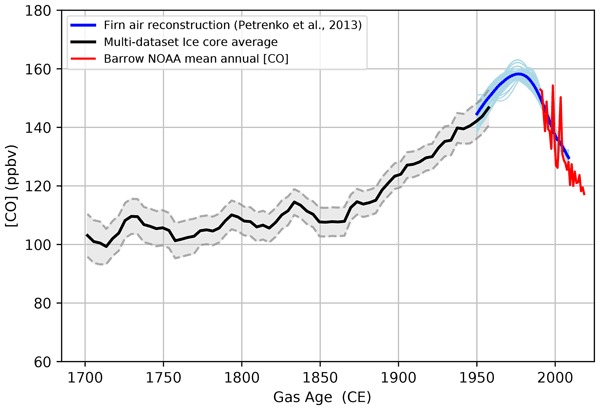
Carbon monoxide (CO) is a regulated pollutant and one of the key components determining the oxidizing capacity of the atmosphere. In this study, we analyzed five ice cores from Greenland at high resolution for CO concentrations by coupling laser spectrometry with continuous melting. By combining these new datasets, we produced an upper-bound estimate of past atmospheric CO abundance since preindustrial times for the Northern Hemisphere high latitudes, covering the period from 1700 to 1957 CE.
Neige Calonne, Pascal Hagenmuller, Rémi Granger, Lisa Bouvet, Kévin Fourteau, Julien Brondex, François Tuzet, Yves Lejeune, Anne Dufour, Mathieu Fructus, Teruo Aoki, and Marie Dumont
Earth Syst. Sci. Data Discuss., https://doi.org/10.5194/essd-2026-718, https://doi.org/10.5194/essd-2026-718, 2026
Preprint under review for ESSD
Short summary
Short summary
We collected weekly measurements of snow microstructural properties over two winters at Col de Porte in the French Alps, a relatively warm alpine site, using complementary techniques including X-ray tomography, the SnowMicroPen, and optical instruments. The dataset captures snowpack evolution at fine vertical resolution and is a valuable resource for snow model evaluation and instrument comparisons. It also provides guidance for future snow monitoring campaigns in warm mountain environments.
Cyrille Mosbeux, Peter Råback, Adrien Gilbert, Julien Brondex, Fabien Gillet-Chaulet, Nicolas C. Jourdain, Mondher Chekki, Olivier Gagliardini, and Gaël Durand
Geosci. Model Dev., 19, 8269–8288, https://doi.org/10.5194/gmd-19-8269-2026, https://doi.org/10.5194/gmd-19-8269-2026, 2026
Short summary
Short summary
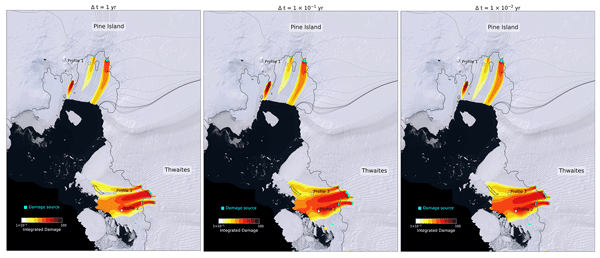
Transport processes like rocks carried by ice flow and damage evolution – a proxy for crevasses – are key in ice sheet modeling and should occur without diffusion. Yet, standard numerical methods often blur these features. We explore a particle-based Semi-Lagrangian approach, comparing it to a Discontinuous Galerkin method, and show it can accurately simulate such transport when run at high enough resolution.
Diego Monteiro, Léo Viallon-Galinier, Kévin Fourteau, Oscar Dick, and Pascal Hagenmuller
The Cryosphere, 20, 4515–4536, https://doi.org/10.5194/tc-20-4515-2026, https://doi.org/10.5194/tc-20-4515-2026, 2026
Short summary
Short summary
This research aims to improve dry-snow slab avalanche forecasts, particularly the propagation of cracks in weak layers, as current models rely on uncertain and difficult-to-measure parameters. We combined snowpack simulations with field measurements to link fracture energy to measurable and modelable snow properties. This new approach better reproduces observed crack lengths and allows weak layers to be tracked throughout the season, thereby improving operational avalanche risk assessment.
Matthieu Lafaysse, Marie Dumont, Basile De Fleurian, Mathieu Fructus, Rafife Nheili, Léo Viallon-Galinier, Matthieu Baron, Aaron Boone, Axel Bouchet, Julien Brondex, Carlo Carmagnola, Bertrand Cluzet, Kévin Fourteau, Ange Haddjeri, Pascal Hagenmuller, Giulia Mazzotti, Marie Minvielle, Samuel Morin, Louis Quéno, Léon Roussel, Pierre Spandre, François Tuzet, and Vincent Vionnet
Geosci. Model Dev., 19, 6273–6334, https://doi.org/10.5194/gmd-19-6273-2026, https://doi.org/10.5194/gmd-19-6273-2026, 2026
Short summary
Short summary
This article is a comprehensive description of the 3.0.2 stable release of the Crocus snowpack model. It describes various new implementations since the last reference article in 2012 and a review of the available scientific evaluations and applications of the model. This provides guidance for the future of numerical snow modelling.
Audrey Goutard, Marion Réveillet, Fanny Brun, Delphine Six, Kevin Fourteau, Charles Amory, Xavier Fettweis, Mathieu Fructus, Arbindra Khadka, and Matthieu Lafaysse
The Cryosphere, 20, 2393–2416, https://doi.org/10.5194/tc-20-2393-2026, https://doi.org/10.5194/tc-20-2393-2026, 2026
Short summary
Short summary
A new scheme has been developed in a snowpack model (SURFEX/ISBA-Crocus), to consider the impact of liquid water dynamics on bare ice, including albedo feedback and refreezing. When applied to the Mera Glacier in Nepal, the model reveals strong seasonal effects on the energy and mass balance, with increased melting in dry seasons and significant refreezing during the monsoon. This development improves mass balance modeling under increasing rainfall and bare ice exposure due to climate warming.
Julien Brondex, Olivier Gagliardini, Adrien Gilbert, and Emmanuel Thibert
The Cryosphere, 20, 1655–1677, https://doi.org/10.5194/tc-20-1655-2026, https://doi.org/10.5194/tc-20-1655-2026, 2026
Short summary
Short summary
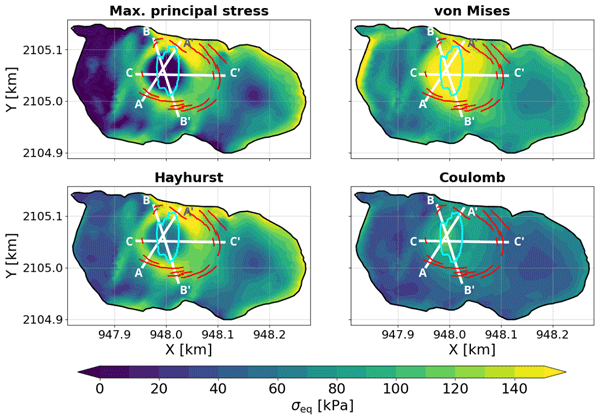
We investigate crevasse initiation by analyzing the artificial drainage of a water-filled cavity at Tête Rousse Glacier (Mont Blanc, France). Using a numerical model, we compute stress fields in response to water level variations in the cavity and compare them to observed crevasse patterns. Results show that a non-linear viscous rheology and a maximum principal stress criterion (with a stress threshold of 100–130 kPa) best predict crevasse occurrence.
Nicola Imperatore, Simon Gascoin, Matthieu Lafaysse, Marie Dumont, Adrien Mauss, Stéphane Guével, and Jean-Baptiste Hernandez
EGUsphere, https://doi.org/10.5194/egusphere-2026-1122, https://doi.org/10.5194/egusphere-2026-1122, 2026
Short summary
Short summary
Daily satellite snow cover observations are beneficial for water management in mountain regions, but it's crucial to understand their uncertainties. We evaluate the next-generation NASA constellation in mountainous terrain using higher-resolution satellite imagery as reference. We find an overall consistent performance across the platforms and combine their data to reduce cloud cover. These results support a confident transition and open new opportunities in snowpack modeling.
Simon Filhol, Clément Misset, Noélie Bontemps, Diego Cusicanqui, Emmanuel Paquet, Marie Dumont, Olivier Gagliardini, Pascal Lacroix, Simon Gascoin, Guillaume Thirel, Julien Brondex, Pascal Hagenmuller, Eric Larose, Philipp Schoeneich, Denis Roy, Emmanuel Thibert, Nicolas Eckert, Félix de Montety, Robin Mainieri, Alexandre Hauet, Frédéric Gottardi, Johan Berthet, Alexandre Baratier, Frédéric Liébault, Małgorzata Chmiel, Guillaume Piton, Guillaume Chambon, Guillaume James, Philippe Frey, Philip Deline, Laurent Astrade, Christian Vincent, Dominique Laigle, Alain Recking, Fatima Karbou, Adrien Mauss, Mylène Bonnefoy-Demongeot, Firmin Fontaine, Mickael Langlais, Etienne Berthier, and Antoine Blanc
EGUsphere, https://doi.org/10.5194/egusphere-2026-971, https://doi.org/10.5194/egusphere-2026-971, 2026
Short summary
Short summary
On June 21 2024, the village of La Bérarde, in the French Alps, was devastated by a flood destroying centuries old buildings. This study is an interdisciplinary work to decipher the causes and chronology of the event. The flood started with decadal rain falling on a thick snowpack. A lake observed on top of a glacier few days prior, had drained post event. With climate change, should we expect more similar compound events for alpine communities?
Kevin Fourteau, Kaoane Jondeau, Clément Cancès, and Marie Dumont
EGUsphere, https://doi.org/10.5194/egusphere-2026-510, https://doi.org/10.5194/egusphere-2026-510, 2026
Short summary
Short summary
In physics, entropy and the second principle of thermodynamics are related to the notion of stability. In applied mathematics, the same idea of entropy can be transposed to computer models, to ensure that they do not spontaneously oscillate or diverge. The goal of this work is to apply this type of methods to snowpack modelling. We show that entropy-consistent, and thus more robust models, can be designed following a few general criteria.
Léon Roussel, Marie Dumont, Marion Réveillet, Delphine Six, Marin Kneib, Pierre Nabat, Kévin Fourteau, Diego Monteiro, Simon Gascoin, Emmanuel Thibert, Antoine Rabatel, Jean-Emmanuel Sicart, Mylène Bonnefoy, Luc Piard, Olivier Laarman, Bruno Jourdain, Mathieu Fructus, Matthieu Vernay, and Matthieu Lafaysse
The Cryosphere, 19, 5201–5230, https://doi.org/10.5194/tc-19-5201-2025, https://doi.org/10.5194/tc-19-5201-2025, 2025
Short summary
Short summary
Saharan dust deposits frequently turn alpine glaciers orange. Mineral dust reduces snow albedo and increases snow and glaciers melt rate. Using physical modeling, we quantified the impact of dust on the Argentière Glacier over the period 2019–2022. We found that the contribution of mineral dust to the melt represents between 8 % and 16 % of Argentière Glacier summer melt. At specific locations, the impact of dust over one year can rise to an equivalent of 1.2 m of melted ice.
Manon Gaillard, Vincent Vionnet, Matthieu Lafaysse, Marie Dumont, and Paul Ginoux
The Cryosphere, 19, 769–792, https://doi.org/10.5194/tc-19-769-2025, https://doi.org/10.5194/tc-19-769-2025, 2025
Short summary
Short summary
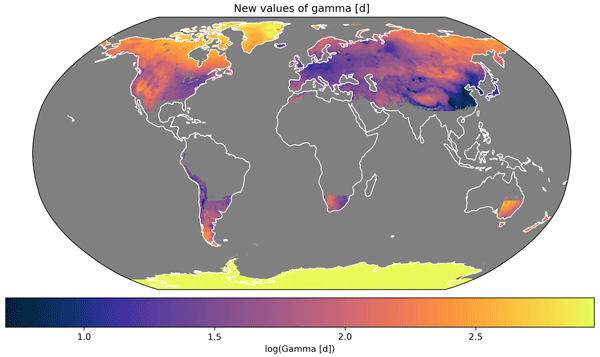
This study presents an efficient method to improve large-scale snow albedo simulations by considering the spatial variability in light-absorbing particles (LAPs) like black carbon and dust. A global climatology of LAP deposition was created and used to optimize a parameter in the Crocus snow model. Testing at 10 global sites improved albedo predictions by 10 % on average and over 25 % in the Arctic. This method can enhance other snow models' predictions without complex simulations.
Xavier Faïn, Sophie Szopa, Vaishali Naïk, Patricia Martinerie, David M. Etheridge, Rachael H. Rhodes, Cathy M. Trudinger, Vasilii V. Petrenko, Kévin Fourteau, and Philip Place
Atmos. Chem. Phys., 25, 1105–1119, https://doi.org/10.5194/acp-25-1105-2025, https://doi.org/10.5194/acp-25-1105-2025, 2025
Short summary
Short summary
Carbon monoxide (CO) plays a crucial role in the atmosphere's oxidizing capacity. In this study, we analyse how historical (1850–2014) [CO] outputs from state-of-the-art global chemistry–climate models over Greenland and Antarctica are able to capture both absolute values and trends recorded in multi-site ice archives. A disparity in [CO] growth rates emerges in the Northern Hemisphere between models and observations from 1920–1975 CE, possibly linked to uncertainties in CO emission factors.
Cecile B. Menard, Sirpa Rasmus, Ioanna Merkouriadi, Gianpaolo Balsamo, Annett Bartsch, Chris Derksen, Florent Domine, Marie Dumont, Dorothee Ehrich, Richard Essery, Bruce C. Forbes, Gerhard Krinner, David Lawrence, Glen Liston, Heidrun Matthes, Nick Rutter, Melody Sandells, Martin Schneebeli, and Sari Stark
The Cryosphere, 18, 4671–4686, https://doi.org/10.5194/tc-18-4671-2024, https://doi.org/10.5194/tc-18-4671-2024, 2024
Short summary
Short summary
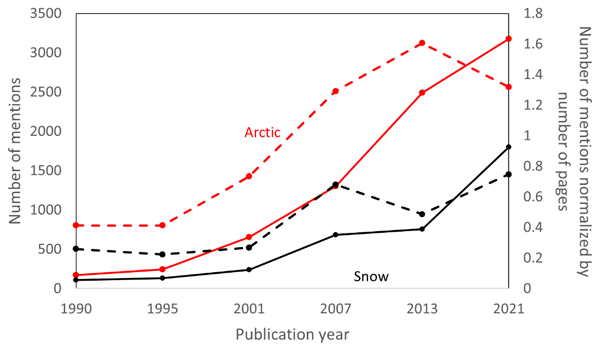
Computer models, like those used in climate change studies, are written by modellers who have to decide how best to construct the models in order to satisfy the purpose they serve. Using snow modelling as an example, we examine the process behind the decisions to understand what motivates or limits modellers in their decision-making. We find that the context in which research is undertaken is often more crucial than scientific limitations. We argue for more transparency in our research practice.
Julien Westhoff, Johannes Freitag, Anaïs Orsi, Patricia Martinerie, Ilka Weikusat, Michael Dyonisius, Xavier Faïn, Kevin Fourteau, and Thomas Blunier
The Cryosphere, 18, 4379–4397, https://doi.org/10.5194/tc-18-4379-2024, https://doi.org/10.5194/tc-18-4379-2024, 2024
Short summary
Short summary
We study the EastGRIP area, Greenland, in detail with traditional and novel techniques. Due to the compaction of the ice, at a certain depth, atmospheric gases can no longer exchange, and the atmosphere is trapped in air bubbles in the ice. We find this depth by pumping air from a borehole, modeling, and using a new technique based on the optical appearance of the ice. Our results suggest that the close-off depth lies at around 58–61 m depth and more precisely at 58.3 m depth.
Romilly Harris Stuart, Amaëlle Landais, Laurent Arnaud, Christo Buizert, Emilie Capron, Marie Dumont, Quentin Libois, Robert Mulvaney, Anaïs Orsi, Ghislain Picard, Frédéric Prié, Jeffrey Severinghaus, Barbara Stenni, and Patricia Martinerie
The Cryosphere, 18, 3741–3763, https://doi.org/10.5194/tc-18-3741-2024, https://doi.org/10.5194/tc-18-3741-2024, 2024
Short summary
Short summary
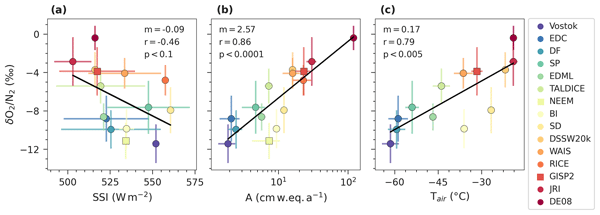
Ice core δO2/N2 records are useful dating tools due to their local insolation pacing. A precise understanding of the physical mechanism driving this relationship, however, remain ambiguous. By compiling data from 15 polar sites, we find a strong dependence of mean δO2/N2 on accumulation rate and temperature in addition to the well-documented insolation dependence. Snowpack modelling is used to investigate which physical properties drive the mechanistic dependence on these local parameters.
Ange Haddjeri, Matthieu Baron, Matthieu Lafaysse, Louis Le Toumelin, César Deschamps-Berger, Vincent Vionnet, Simon Gascoin, Matthieu Vernay, and Marie Dumont
The Cryosphere, 18, 3081–3116, https://doi.org/10.5194/tc-18-3081-2024, https://doi.org/10.5194/tc-18-3081-2024, 2024
Short summary
Short summary
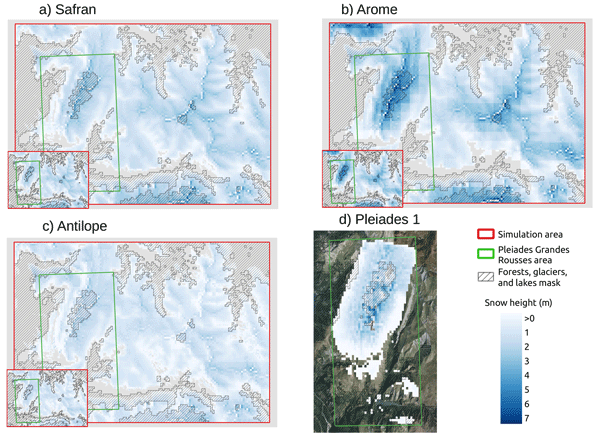
Our study addresses the complex challenge of evaluating distributed alpine snow simulations with snow transport against snow depths from Pléiades stereo imagery and snow melt-out dates from Sentinel-2 and Landsat-8 satellites. Additionally, we disentangle error contributions between blowing snow, precipitation heterogeneity, and unresolved subgrid variability. Snow transport enhances the snow simulations at high elevations, while precipitation biases are the main error source in other areas.
Kévin Fourteau, Johannes Freitag, Mika Malinen, and Henning Löwe
The Cryosphere, 18, 2831–2846, https://doi.org/10.5194/tc-18-2831-2024, https://doi.org/10.5194/tc-18-2831-2024, 2024
Short summary
Short summary
Understanding the settling of snow under its own weight has applications from avalanche forecasts to ice core interpretations. We study how this settling can be modeled using 3D images of the internal structure of snow and ice deformation mechanics. We found that classical ice mechanics, as used, for instance, in glacier flow, explain the compaction of dense polar snow but not that of lighter seasonal snow. How, exactly, the ice deforms during light snow compaction thus remains an open question.
Anna Braun, Kévin Fourteau, and Henning Löwe
The Cryosphere, 18, 1653–1668, https://doi.org/10.5194/tc-18-1653-2024, https://doi.org/10.5194/tc-18-1653-2024, 2024
Short summary
Short summary
The specific surface of snow dictates key physical properties and continuously evolves in natural snowpacks. This is referred to as metamorphism. This work develops a rigorous physical model for this evolution, which is able to reproduce X-ray tomography measurements without using unphysical tuning parameters. Our results emphasize that snow crystal growth at the micrometer scale ultimately controls the pace of metamorphism.
Kavitha Sundu, Johannes Freitag, Kévin Fourteau, and Henning Löwe
The Cryosphere, 18, 1579–1596, https://doi.org/10.5194/tc-18-1579-2024, https://doi.org/10.5194/tc-18-1579-2024, 2024
Short summary
Short summary
Ice crystals often show a rod-like, vertical orientation in snow and firn; they are said to be anisotropic. The stiffness in the vertical direction therefore differs from the horizontal, which, for example, impacts the propagation of seismic waves. To quantify this anisotropy, we conducted finite-element simulations of 391 snow, firn, and ice core microstructures obtained from X-ray tomography. We then derived a parameterization that may be employed for advanced seismic studies in polar regions.
Kévin Fourteau, Julien Brondex, Fanny Brun, and Marie Dumont
Geosci. Model Dev., 17, 1903–1929, https://doi.org/10.5194/gmd-17-1903-2024, https://doi.org/10.5194/gmd-17-1903-2024, 2024
Short summary
Short summary
In this paper, we provide a novel numerical implementation for solving the energy exchanges at the surface of snow and ice. By combining the strong points of previous models, our solution leads to more accurate and robust simulations of the energy exchanges, surface temperature, and melt while preserving a reasonable computation time.
Julien Brondex, Kévin Fourteau, Marie Dumont, Pascal Hagenmuller, Neige Calonne, François Tuzet, and Henning Löwe
Geosci. Model Dev., 16, 7075–7106, https://doi.org/10.5194/gmd-16-7075-2023, https://doi.org/10.5194/gmd-16-7075-2023, 2023
Short summary
Short summary
Vapor diffusion is one of the main processes governing snowpack evolution, and it must be accounted for in models. Recent attempts to represent vapor diffusion in numerical models have faced several difficulties regarding computational cost and mass and energy conservation. Here, we develop our own finite-element software to explore numerical approaches and enable us to overcome these difficulties. We illustrate the capability of these approaches on established numerical benchmarks.
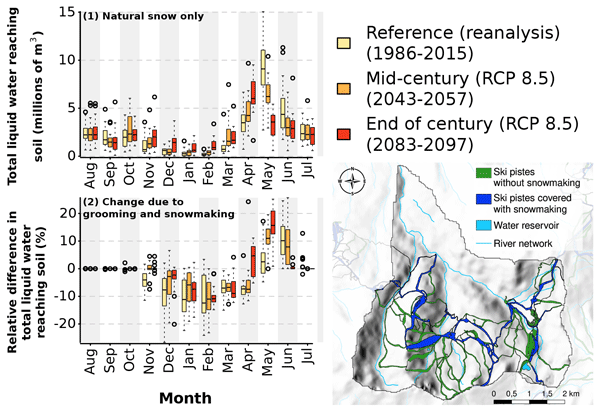
Samuel Morin, Hugues François, Marion Réveillet, Eric Sauquet, Louise Crochemore, Flora Branger, Étienne Leblois, and Marie Dumont
Hydrol. Earth Syst. Sci., 27, 4257–4277, https://doi.org/10.5194/hess-27-4257-2023, https://doi.org/10.5194/hess-27-4257-2023, 2023
Short summary
Short summary
Ski resorts are a key socio-economic asset of several mountain areas. Grooming and snowmaking are routinely used to manage the snow cover on ski pistes, but despite vivid debate, little is known about their impact on water resources downstream. This study quantifies, for the pilot ski resort La Plagne in the French Alps, the impact of grooming and snowmaking on downstream river flow. Hydrological impacts are mostly apparent at the seasonal scale and rather neutral on the annual scale.
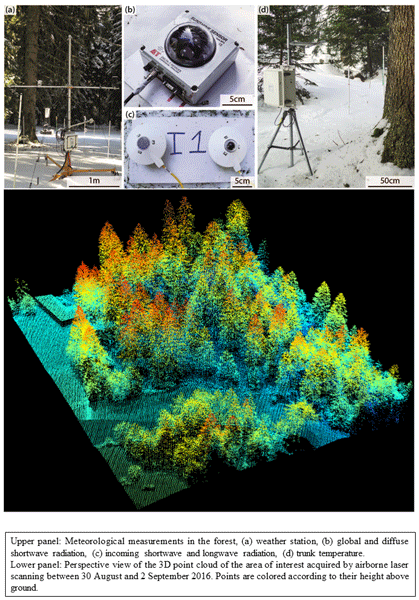
Jean Emmanuel Sicart, Victor Ramseyer, Ghislain Picard, Laurent Arnaud, Catherine Coulaud, Guilhem Freche, Damien Soubeyrand, Yves Lejeune, Marie Dumont, Isabelle Gouttevin, Erwan Le Gac, Frédéric Berger, Jean-Matthieu Monnet, Laurent Borgniet, Éric Mermin, Nick Rutter, Clare Webster, and Richard Essery
Earth Syst. Sci. Data, 15, 5121–5133, https://doi.org/10.5194/essd-15-5121-2023, https://doi.org/10.5194/essd-15-5121-2023, 2023
Short summary
Short summary
Forests strongly modify the accumulation, metamorphism and melting of snow in midlatitude and high-latitude regions. Two field campaigns during the winters 2016–17 and 2017–18 were conducted in a coniferous forest in the French Alps to study interactions between snow and vegetation. This paper presents the field site, instrumentation and collection methods. The observations include forest characteristics, meteorology, snow cover and snow interception by the canopy during precipitation events.
Xavier Faïn, David M. Etheridge, Kévin Fourteau, Patricia Martinerie, Cathy M. Trudinger, Rachael H. Rhodes, Nathan J. Chellman, Ray L. Langenfelds, Joseph R. McConnell, Mark A. J. Curran, Edward J. Brook, Thomas Blunier, Grégory Teste, Roberto Grilli, Anthony Lemoine, William T. Sturges, Boris Vannière, Johannes Freitag, and Jérôme Chappellaz
Clim. Past, 19, 2287–2311, https://doi.org/10.5194/cp-19-2287-2023, https://doi.org/10.5194/cp-19-2287-2023, 2023
Short summary
Short summary
We report on a 3000-year record of carbon monoxide (CO) levels in the Southern Hemisphere's high latitudes by combining ice core and firn air measurements with modern direct atmospheric samples. Antarctica [CO] remained stable (–835 to 1500 CE), decreased during the Little Ice Age, and peaked around 1985 CE. Such evolution reflects stable biomass burning CO emissions before industrialization, followed by growth from CO anthropogenic sources, which decline after 1985 due to improved combustion.
Fanny Brun, Owen King, Marion Réveillet, Charles Amory, Anton Planchot, Etienne Berthier, Amaury Dehecq, Tobias Bolch, Kévin Fourteau, Julien Brondex, Marie Dumont, Christoph Mayer, Silvan Leinss, Romain Hugonnet, and Patrick Wagnon
The Cryosphere, 17, 3251–3268, https://doi.org/10.5194/tc-17-3251-2023, https://doi.org/10.5194/tc-17-3251-2023, 2023
Short summary
Short summary
The South Col Glacier is a small body of ice and snow located on the southern ridge of Mt. Everest. A recent study proposed that South Col Glacier is rapidly losing mass. In this study, we examined the glacier thickness change for the period 1984–2017 and found no thickness change. To reconcile these results, we investigate wind erosion and surface energy and mass balance and find that melt is unlikely a dominant process, contrary to previous findings.
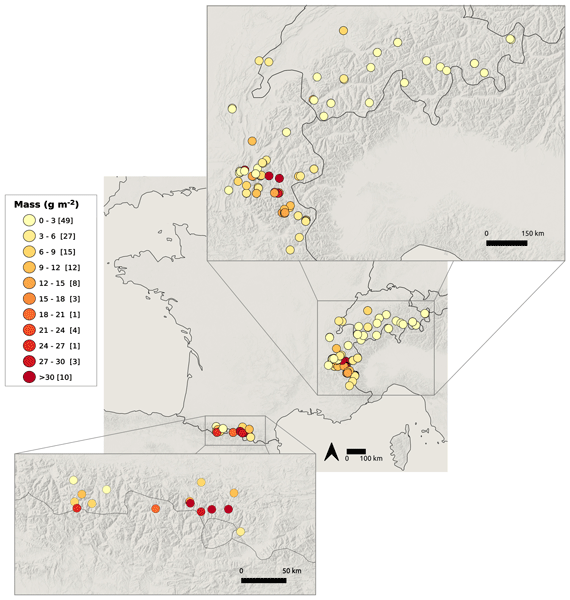
Marie Dumont, Simon Gascoin, Marion Réveillet, Didier Voisin, François Tuzet, Laurent Arnaud, Mylène Bonnefoy, Montse Bacardit Peñarroya, Carlo Carmagnola, Alexandre Deguine, Aurélie Diacre, Lukas Dürr, Olivier Evrard, Firmin Fontaine, Amaury Frankl, Mathieu Fructus, Laure Gandois, Isabelle Gouttevin, Abdelfateh Gherab, Pascal Hagenmuller, Sophia Hansson, Hervé Herbin, Béatrice Josse, Bruno Jourdain, Irene Lefevre, Gaël Le Roux, Quentin Libois, Lucie Liger, Samuel Morin, Denis Petitprez, Alvaro Robledano, Martin Schneebeli, Pascal Salze, Delphine Six, Emmanuel Thibert, Jürg Trachsel, Matthieu Vernay, Léo Viallon-Galinier, and Céline Voiron
Earth Syst. Sci. Data, 15, 3075–3094, https://doi.org/10.5194/essd-15-3075-2023, https://doi.org/10.5194/essd-15-3075-2023, 2023
Short summary
Short summary
Saharan dust outbreaks have profound effects on ecosystems, climate, health, and the cryosphere, but the spatial deposition pattern of Saharan dust is poorly known. Following the extreme dust deposition event of February 2021 across Europe, a citizen science campaign was launched to sample dust on snow over the Pyrenees and the European Alps. This campaign triggered wide interest and over 100 samples. The samples revealed the high variability of the dust properties within a single event.
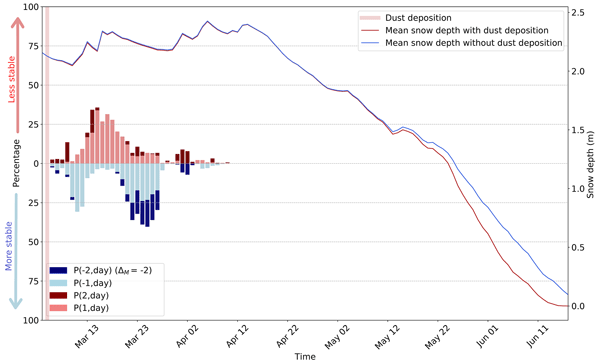
Oscar Dick, Léo Viallon-Galinier, François Tuzet, Pascal Hagenmuller, Mathieu Fructus, Benjamin Reuter, Matthieu Lafaysse, and Marie Dumont
The Cryosphere, 17, 1755–1773, https://doi.org/10.5194/tc-17-1755-2023, https://doi.org/10.5194/tc-17-1755-2023, 2023
Short summary
Short summary
Saharan dust deposition can drastically change the snow color, turning mountain landscapes into sepia scenes. Dust increases the absorption of solar energy by the snow cover and thus modifies the snow evolution and potentially the avalanche risk. Here we show that dust can lead to increased or decreased snowpack stability depending on the snow and meteorological conditions after the deposition event. We also show that wet-snow avalanches happen earlier in the season due to the presence of dust.
Leung Tsang, Michael Durand, Chris Derksen, Ana P. Barros, Do-Hyuk Kang, Hans Lievens, Hans-Peter Marshall, Jiyue Zhu, Joel Johnson, Joshua King, Juha Lemmetyinen, Melody Sandells, Nick Rutter, Paul Siqueira, Anne Nolin, Batu Osmanoglu, Carrie Vuyovich, Edward Kim, Drew Taylor, Ioanna Merkouriadi, Ludovic Brucker, Mahdi Navari, Marie Dumont, Richard Kelly, Rhae Sung Kim, Tien-Hao Liao, Firoz Borah, and Xiaolan Xu
The Cryosphere, 16, 3531–3573, https://doi.org/10.5194/tc-16-3531-2022, https://doi.org/10.5194/tc-16-3531-2022, 2022
Short summary
Short summary
Snow water equivalent (SWE) is of fundamental importance to water, energy, and geochemical cycles but is poorly observed globally. Synthetic aperture radar (SAR) measurements at X- and Ku-band can address this gap. This review serves to inform the broad snow research, monitoring, and application communities about the progress made in recent decades to move towards a new satellite mission capable of addressing the needs of the geoscience researchers and users.
Georg Lackner, Florent Domine, Daniel F. Nadeau, Matthieu Lafaysse, and Marie Dumont
The Cryosphere, 16, 3357–3373, https://doi.org/10.5194/tc-16-3357-2022, https://doi.org/10.5194/tc-16-3357-2022, 2022
Short summary
Short summary
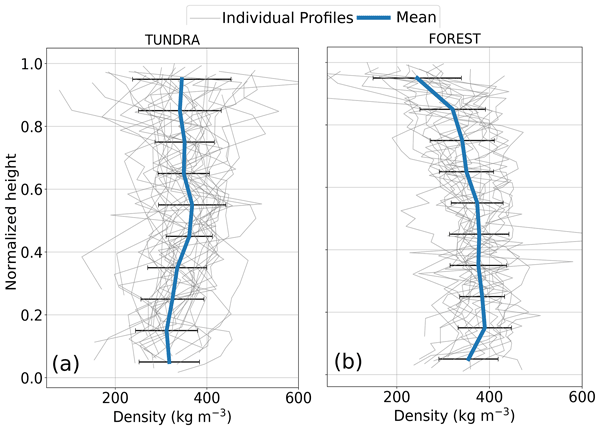
We compared the snowpack at two sites separated by less than 1 km, one in shrub tundra and the other one within the boreal forest. Even though the snowpack was twice as thick at the forested site, we found evidence that the vertical transport of water vapor from the bottom of the snowpack to its surface was important at both sites. The snow model Crocus simulates no water vapor fluxes and consequently failed to correctly simulate the observed density profiles.
Bertrand Cluzet, Matthieu Lafaysse, César Deschamps-Berger, Matthieu Vernay, and Marie Dumont
The Cryosphere, 16, 1281–1298, https://doi.org/10.5194/tc-16-1281-2022, https://doi.org/10.5194/tc-16-1281-2022, 2022
Short summary
Short summary
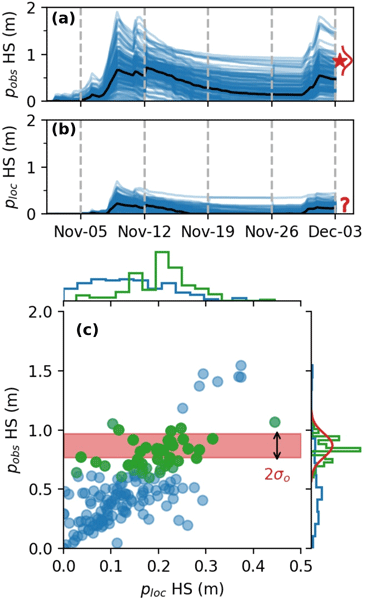
The mountainous snow cover is highly variable at all temporal and spatial scales. Snow cover models suffer from large errors, while snowpack observations are sparse. Data assimilation combines them into a better estimate of the snow cover. A major challenge is to propagate information from observed into unobserved areas. This paper presents a spatialized version of the particle filter, in which information from in situ snow depth observations is successfully used to constrain nearby simulations.
Xavier Faïn, Rachael H. Rhodes, Philip Place, Vasilii V. Petrenko, Kévin Fourteau, Nathan Chellman, Edward Crosier, Joseph R. McConnell, Edward J. Brook, Thomas Blunier, Michel Legrand, and Jérôme Chappellaz
Clim. Past, 18, 631–647, https://doi.org/10.5194/cp-18-631-2022, https://doi.org/10.5194/cp-18-631-2022, 2022
Short summary
Short summary
Carbon monoxide (CO) is a regulated pollutant and one of the key components determining the oxidizing capacity of the atmosphere. In this study, we analyzed five ice cores from Greenland at high resolution for CO concentrations by coupling laser spectrometry with continuous melting. By combining these new datasets, we produced an upper-bound estimate of past atmospheric CO abundance since preindustrial times for the Northern Hemisphere high latitudes, covering the period from 1700 to 1957 CE.
Georg Lackner, Florent Domine, Daniel F. Nadeau, Annie-Claude Parent, François Anctil, Matthieu Lafaysse, and Marie Dumont
The Cryosphere, 16, 127–142, https://doi.org/10.5194/tc-16-127-2022, https://doi.org/10.5194/tc-16-127-2022, 2022
Short summary
Short summary
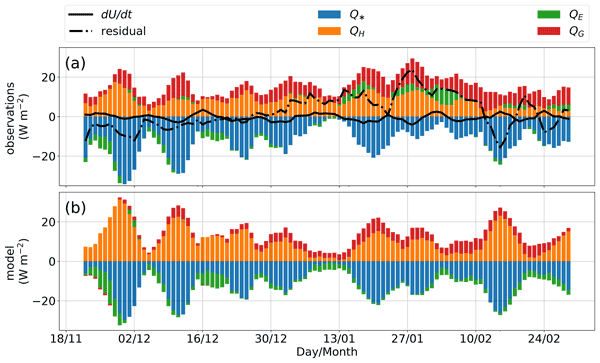
The surface energy budget is the sum of all incoming and outgoing energy fluxes at the Earth's surface and has a key role in the climate. We measured all these fluxes for an Arctic snowpack and found that most incoming energy from radiation is counterbalanced by thermal radiation and heat convection while sublimation was negligible. Overall, the snow model Crocus was able to simulate the observed energy fluxes well.
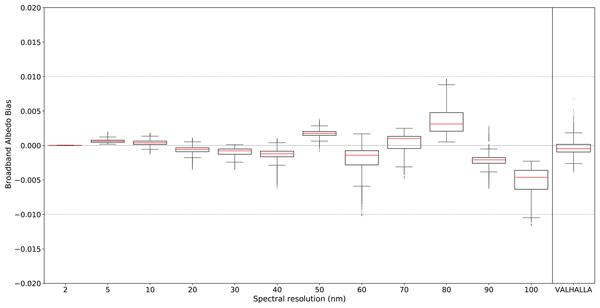
Florent Veillon, Marie Dumont, Charles Amory, and Mathieu Fructus
Geosci. Model Dev., 14, 7329–7343, https://doi.org/10.5194/gmd-14-7329-2021, https://doi.org/10.5194/gmd-14-7329-2021, 2021
Short summary
Short summary
In climate models, the snow albedo scheme generally calculates only a narrowband or broadband albedo. Therefore, we have developed the VALHALLA method to optimize snow spectral albedo calculations through the determination of spectrally fixed radiative variables. The development of VALHALLA v1.0 with the use of the snow albedo model TARTES and the spectral irradiance model SBDART indicates a considerable reduction in calculation time while maintaining an adequate accuracy of albedo values.
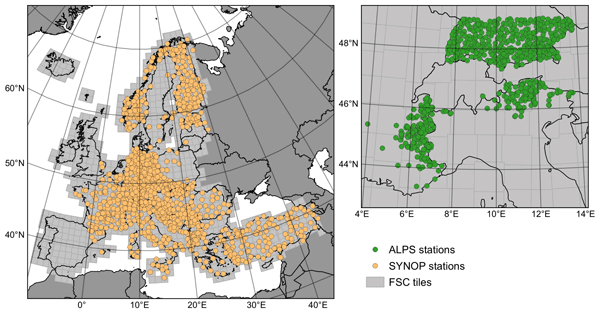
Zacharie Barrou Dumont, Simon Gascoin, Olivier Hagolle, Michaël Ablain, Rémi Jugier, Germain Salgues, Florence Marti, Aurore Dupuis, Marie Dumont, and Samuel Morin
The Cryosphere, 15, 4975–4980, https://doi.org/10.5194/tc-15-4975-2021, https://doi.org/10.5194/tc-15-4975-2021, 2021
Short summary
Short summary
Since 2020, the Copernicus High Resolution Snow & Ice Monitoring Service has distributed snow cover maps at 20 m resolution over Europe in near-real time. These products are derived from the Sentinel-2 Earth observation mission, with a revisit time of 5 d or less (cloud-permitting). Here we show the good accuracy of the snow detection over a wide range of regions in Europe, except in dense forest regions where the snow cover is hidden by the trees.
Cited articles
Amaziane, B., El Ossmani, M., and Jurak, M.: Numerical simulation of gas migration through engineered and geological barriers for a deep repository for radioactive waste, Computing and Visualization in Science, 15, 3–20, https://doi.org/10.1007/s00791-013-0196-1, 2012. a
Auriault, J.-L., Boutin, C., and Geindreau, C.: Homogenization of Coupled Phenomena in Heterogenous Media, John Wiley & Sons, Ltd, Hoboken, NJ, USA, https://doi.org/10.1002/9780470612033, 2009. a
Baggi, S. and Schweizer, J.: Characteristics of wet-snow avalanche activity: 20 years of observations from a high alpine valley (Dischma, Switzerland), Nat. Hazards, 50, 97–108, https://doi.org/10.1007/s11069-008-9322-7, 2009. a
Barnhart, T. B., Tague, C. L., and Molotch, N. P.: The Counteracting Effects of Snowmelt Rate and Timing on Runoff, Water Resour. Res., 56, e2019WR026634, https://doi.org/10.1029/2019WR026634, 2020. a
Bartelt, P. and Lehning, M.: A physical SNOWPACK model for the Swiss avalanche warning: Part I: numerical model, Cold Reg. Sci. Technol., 35, 123–145, https://doi.org/10.1016/S0165-232X(02)00074-5, 2002. a, b, c, d
Bassetto, S., Cancès, C., Enchéry, G., and Tran, Q. H.: Robust Newton Solver Based on Variable Switch for a Finite Volume Discretization of Richards Equation, in: Finite Volumes for Complex Applications IX – Methods, Theoretical Aspects, Examples, vol. 253, edited by: Klöfkorn, R., Keilegavlen, E., Radu, F. A., and Fuhrmann, J., Springer International Publishing, 385–393, https://doi.org/10.1007/978-3-030-43651-3_35, 2020. a, b
Bassetto, S., Cancès, C., Enchéry, G., and Tran, Q.-H.: On several numerical strategies to solve Richards’ equation in heterogeneous media with finite volumes, Computat. Geosci., 26, 1297–1322, https://doi.org/10.1007/s10596-022-10150-w, 2022. a, b
Beaude, L., Brenner, K., Lopez, S., Masson, R., and Smai, F.: Non-isothermal compositional liquid gas Darcy flow: formulation, soil-atmosphere boundary condition and application to high-energy geothermal simulations, Computat. Geosci., 23, 443–470, https://doi.org/10.1007/s10596-018-9794-9, 2019. a
Bourgeat, A., Jurak, M., and Smaï, F.: Two-phase, partially miscible flow and transport modeling in porous media; application to gas migration in a nuclear waste repository, Computat. Geosci., 13, 29–42, https://doi.org/10.1007/s10596-008-9102-1, 2009. a, b
Boutin, C., Auriault, J.-L., and Geindreau, C.: Homogenization of coupled phenomena in heterogenous media, vol. 149, John Wiley & Sons, https://doi.org/10.1002/9780470612033, 2010. a
Bouvet, L., Calonne, N., Flin, F., and Geindreau, C.: Multiscale modeling of heat and mass transfer in dry snow: influence of the condensation coefficient and comparison with experiments, The Cryosphere, 18, 4285–4313, https://doi.org/10.5194/tc-18-4285-2024, 2024. a, b
Bouvet, L., Allet, N., Calonne, N., Flin, F., and Geindreau, C.: Simulating liquid water distribution at the pore scale in snow: water retention curves and effective transport properties, EGUsphere [preprint], https://doi.org/10.5194/egusphere-2025-2903, 2025. a
Brenner, K. and Cancès, C.: Improving Newton's Method Performance by Parametrization: The Case of the Richards Equation, SIAM J. Numer. Anal., 55, 1760–1785, https://doi.org/10.1137/16M1083414, 2017. a, b
Brondex, J., Fourteau, K., Dumont, M., Hagenmuller, P., Calonne, N., Tuzet, F., and Löwe, H.: A finite-element framework to explore the numerical solution of the coupled problem of heat conduction, water vapor diffusion, and settlement in dry snow (IvoriFEM v0.1.0), Geosci. Model Dev., 16, 7075–7106, https://doi.org/10.5194/gmd-16-7075-2023, 2023. a, b, c, d
Brooks, R. and Corey, A. T.: Hydraulic properties of porous media, Hydrology Paper no. 3, http://hdl.handle.net/10217/61288 (last access: 22 October 2024), 1964. a
Butcher, J.: Numerical methods for ordinary differential equations, John Wiley & Sons, Ltd, Chichester, https://doi.org/10.1002/9780470753767, 2008. a
Calonne, N., Flin, F., Morin, S., Lesaffre, B., du Roscoat, S. R., and Geindreau, C.: Numerical and experimental investigations of the effective thermal conductivity of snow, Geophys. Res. Lett., 38, https://doi.org/10.1029/2011GL049234, 2011. a, b
Calonne, N., Geindreau, C., Flin, F., Morin, S., Lesaffre, B., Rolland du Roscoat, S., and Charrier, P.: 3-D image-based numerical computations of snow permeability: links to specific surface area, density, and microstructural anisotropy, The Cryosphere, 6, 939–951, https://doi.org/10.5194/tc-6-939-2012, 2012. a, b, c
Calonne, N., Geindreau, C., and Flin, F.: Macroscopic Modeling for Heat and Water Vapor Transfer in Dry Snow by Homogenization, J. Phys. Chem. B, 118, 13393–13403, https://doi.org/10.1021/jp5052535, 2014. a, b, c, d
Clark, M. P., Nijssen, B., and Luce, C. H.: An analytical test case for snow models, Water Resour. Res., 53, 909–922, https://doi.org/10.1002/2016WR019672, 2017. a
Cockett, R., Heagy, L. J., and Haber, E.: Efficient 3D inversions using the Richards equation, Comput. Geosci., 116, 91–102, https://doi.org/10.1016/j.cageo.2018.04.006, 2018. a
Colbeck, S. C.: A Theory of Water Percolation in Snow, J. Glaciol., 11, 369–385, https://doi.org/10.3189/S0022143000022346, 1972. a
Colbeck, S. C.: The capillary effects on water percolation in homogeneous snow, J. Glaciol., 13, 85–97, https://doi.org/10.3189/S002214300002339X, 1974. a
Connors, J. M., Banks, J. W., Hittinger, J. A., and Woodward, C. S.: Quantification of errors for operator-split advection–diffusion calculations, Comput. Method. Appl. M., 272, 181–197, https://doi.org/10.1016/j.cma.2014.01.005, 2014. a
D'Amboise, C. J. L., Müller, K., Oxarango, L., Morin, S., and Schuler, T. V.: Implementation of a physically based water percolation routine in the Crocus/SURFEX (V7.3) snowpack model, Geosci. Model Dev., 10, 3547–3566, https://doi.org/10.5194/gmd-10-3547-2017, 2017. a, b, c, d, e, f, g, h, i, j, k, l, m, n, o
Devoie, É. G., Gruber, S., and McKenzie, J. M.: A repository of measured soil freezing characteristic curves: 1921 to 2021, Earth Syst. Sci. Data, 14, 3365–3377, https://doi.org/10.5194/essd-14-3365-2022, 2022. a
Diersch, H.-J. and Perrochet, P.: On the primary variable switching technique for simulating unsaturated–saturated flows, Adv. Water Resour., 23, 271–301, https://doi.org/10.1016/S0309-1708(98)00057-8, 1999. a
Dutra, E., Balsamo, G., Viterbo, P., Miranda, P. M. A., Beljaars, A., Schär, C., and Elder, K.: An Improved Snow Scheme for the ECMWF Land Surface Model: Description and Offline Validation, J. Hydrometeorol., 11, 899–916, https://doi.org/10.1175/2010JHM1249.1, 2010. a
Eckert, N., Corona, C., Giacona, F., Gaume, J., Mayer, S., van Herwijnen, A., Hagenmuller, P., and Stoffel, M.: Climate change impacts on snow avalanche activity and related risks, Nature Reviews Earth & Environment, 1–21, https://doi.org/10.1038/s43017-024-00540-2, 2024. a
Farthing, M. W. and Ogden, F. L.: Numerical Solution of Richards' Equation: A Review of Advances and Challenges, Soil Sci. Soc. Am. J., 81, 1257–1269, https://doi.org/10.2136/sssaj2017.02.0058, 2017. a, b, c, d
Fazio, R.: Stiffness in numerical initial-value problems: A and L-stability of numerical methods, Int. J. Math. Educ. Sci. Tech., 32, 752–760, https://doi.org/10.1080/002073901753124619, 2001. a
Fierz, C., Armstrong, R. L., Durand, Y., Etchevers, P., Greene, E., McClung, D. M., Nishimura, K., Satyawali, P. K., and Sokratov, S. A.: The International Classificationi for Seasonal Snow on the Ground, UNESCO-IHP, Paris, https://unesdoc.unesco.org/ark:/48223/pf0000186462 (last access: 21 April 2026), 2009. a
Forsyth, P., Wu, Y., and Pruess, K.: Robust numerical methods for saturated-unsaturated flow with dry initial conditions in heterogeneous media, Adv. Water Resour., 18, 25–38, https://doi.org/10.1016/0309-1708(95)00020-J, 1995. a, b, c
Fourteau, K.: Supplementary Material to “Numerical strategies for representing Richards' equation and its couplings in snowpack models”, Zenodo [code and data set], https://doi.org/10.5281/zenodo.14753491, 2025. a
Fourteau, K., Brondex, J., Brun, F., and Dumont, M.: A novel numerical implementation for the surface energy budget of melting snowpacks and glaciers, Geosci. Model Dev., 17, 1903–1929, https://doi.org/10.5194/gmd-17-1903-2024, 2024. a
Hansen, B. B., Aanes, R., and Sæther, B.-E.: Feeding-crater selection by high-arctic reindeer facing ice-blocked pastures, Can. J. Zool., 88, 170–177, https://doi.org/10.1139/Z09-130, 2010. a
Hirashima, H., Yamaguchi, S., and Katsushima, T.: A multi-dimensional water transport model to reproduce preferential flow in the snowpack, Cold Reg. Sci. Technol., 108, 80–90, https://doi.org/10.1016/j.coldregions.2014.09.004, 2014. a, b, c
Hirashima, H., Avanzi, F., and Wever, N.: Wet-Snow Metamorphism Drives the Transition From Preferential to Matrix Flow in Snow, Geophys. Res. Lett., 46, 14548–14557, https://doi.org/10.1029/2019GL084152, 2019. a
Hock, R., Rasul, G., Adler, C., Cáceres, B., Gruber, S., Hirabayashi, Y., Jackson, M., Kääb, A., Kang, S., Kutuzov, S., Milner, A., Molau, U., Morin, S., Orlove, B., and Steltzer, H.: High Mountain Areas, in: IPCC Special Report on the Ocean and Cryosphere in a Changing Climate, edited by: Pörtner, H.-O., Roberts, D., Masson-Delmotte, V., Zhai, P., Tignor, M., Poloczanska, E., Mintenbeck, K., Alegría, A., Nicolai, M., Okem, A., Petzold, J., Rama, B., and Weyer, N., Cambridge University Press, Cambridge, UK and New York, NY, USA, 131–202, https://doi.org/10.1017/9781009157964.004, 2019. a
Illangasekare, T. H., Walter Jr., R. J., Meier, M. F., and Pfeffer, W. T.: Modeling of meltwater infiltration in subfreezing snow, Water Resour. Res., 26, 1001–1012, https://doi.org/10.1029/WR026i005p01001, 1990. a
Jafari, M., Gouttevin, I., Couttet, M., Wever, N., Michel, A., Sharma, V., Rossmann, L., Maass, N., Nicolaus, M., and Lehning, M.: The Impact of Diffusive Water Vapor Transport on Snow Profiles in Deep and Shallow Snow Covers and on Sea Ice, Front. Earth Sci., 8, https://doi.org/10.3389/feart.2020.00249, 2020. a
Kadioglu, S. Y., Nourgaliev, R. R., and Mousseau, V. A.: A Comparative Study of the Harmonic and Arithmetic Averaging of Diffusion Coefficients for Non-linear Heat Conduction Problems, Tech. rep., Idaho National Laboratory, Idaho Falls, Idaho 83415, https://doi.org/10.2172/928087, 2008. a
Keyes, D. E., McInnes, L. C., Woodward, C., Gropp, W., Myra, E., Pernice, M., Bell, J., Brown, J., Clo, A., Connors, J., Constantinescu, E., Estep, D., Evans, K., Farhat, C., Hakim, A., Hammond, G., Hansen, G., Hill, J., Isaac, T., Jiao, X., Jordan, K., Kaushik, D., Kaxiras, E., Koniges, A., Lee, K., Lott, A., Lu, Q., Magerlein, J., Maxwell, R., McCourt, M., Mehl, M., Pawlowski, R., Randles, A. P., Reynolds, D., Rivière, B., Rüde, U., Scheibe, T., Shadid, J., Sheehan, B., Shephard, M., Siegel, A., Smith, B., Tang, X., Wilson, C., and Wohlmuth, B.: Multiphysics simulations: Challenges and opportunities, Int. J. High Perform. C., 27, 4–83, https://doi.org/10.1177/1094342012468181, 2013. a, b, c, d
Krabbenhøft, K.: An alternative to primary variable switching in saturated–unsaturated flow computations, Adv. Water Resour., 30, 483–492, https://doi.org/10.1016/j.advwatres.2006.04.009, 2007. a
Lenhard, R. J., Parker, J. C., and Mishra, S.: On the Correspondence between Brooks-Corey and van Genuchten Models, J. Irrig. Drain. E., 115, 744–751, https://doi.org/10.1061/(ASCE)0733-9437(1989)115:4(744), 1989. a
Leroux, N. R. and Pomeroy, J. W.: Modelling capillary hysteresis effects on preferential flow through melting and cold layered snowpacks, Adv. Water Resour., 107, 250–264, https://doi.org/10.1016/j.advwatres.2017.06.024, 2017. a, b, c
Leroux, N. R., Marsh, C. B., and Pomeroy, J. W.: Simulation of Preferential Flow in Snow With a 2-D Non-Equilibrium Richards Model and Evaluation Against Laboratory Data, Water Resour. Res., 56, e2020WR027466, https://doi.org/10.1029/2020WR027466, 2020. a
Lewandowska, J., Szymkiewicz, A., Burzyński, K., and Vauclin, M.: Modeling of unsaturated water flow in double-porosity soils by the homogenization approach, Adv. Water Resour., 27, 283–296, https://doi.org/10.1016/j.advwatres.2003.12.004, 2004. a, b
Li, X., Zheng, S.-F., Wang, M., and Liu, A.-Q.: The prediction of the soil freezing characteristic curve using the soil water characteristic curve, Cold Reg. Sci. Technol., 212, 103880, https://doi.org/10.1016/j.coldregions.2023.103880, 2023. a
Libois, Q., Picard, G., France, J. L., Arnaud, L., Dumont, M., Carmagnola, C. M., and King, M. D.: Influence of grain shape on light penetration in snow, The Cryosphere, 7, 1803–1818, https://doi.org/10.5194/tc-7-1803-2013, 2013. a
Marsh, P. and Woo, M.-K.: Meltwater Movement in Natural Heterogeneous Snow Covers, Water Resour. Res., 21, 1710–1716, https://doi.org/10.1029/WR021i011p01710, 1985. a
Mualem, Y.: A new model for predicting the hydraulic conductivity of unsaturated porous media, Water Resour. Res., 12, 513–522, https://doi.org/10.1029/WR012i003p00513, 1976. a, b
Picard, G. and Libois, Q.: Simulation of snow albedo and solar irradiance profile with the Two-streAm Radiative TransfEr in Snow (TARTES) v2.0 model, Geosci. Model Dev., 17, 8927–8953, https://doi.org/10.5194/gmd-17-8927-2024, 2024. a
Quéno, L., Fierz, C., van Herwijnen, A., Longridge, D., and Wever, N.: Deep ice layer formation in an alpine snowpack: monitoring and modeling, The Cryosphere, 14, 3449–3464, https://doi.org/10.5194/tc-14-3449-2020, 2020. a, b, c, d
Richards, L. A.: Capillary conduction of liquids through porous mediums, Physics, 1, 318–333, https://doi.org/10.1063/1.1745010, 1931. a
Sadegh Zadeh, K.: A mass-conservative switching algorithm for modeling fluid flow in variably saturated porous media, J. Comput. Phys., 230, 664–679, https://doi.org/10.1016/j.jcp.2010.10.011, 2011. a, b
Sauter, T., Arndt, A., and Schneider, C.: COSIPY v1.3 – an open-source coupled snowpack and ice surface energy and mass balance model, Geosci. Model Dev., 13, 5645–5662, https://doi.org/10.5194/gmd-13-5645-2020, 2020. a, b, c
Sposito, G.: The statistical mechanical theory of water transport through unsaturated soil: 2. Derivation of the Buckingham-Darcy Flux Law, Water Resour. Res., 14, 479–484, https://doi.org/10.1029/WR014i003p00479, 1978. a
Steefel, C. I. and McQuarrie, K.: Approaches to modeling of reactive transport in porous media, Rev. Mineral., 34, 83–130, https://doi.org/10.1515/9781501509797-005, 1996. a
Torquato, S.: Random Heterogeneous Materials, Springer Science+Business Media New York, ISBN 0-387-95167-9, 2002. a
Tubini, N., Gruber, S., and Rigon, R.: A method for solving heat transfer with phase change in ice or soil that allows for large time steps while guaranteeing energy conservation, The Cryosphere, 15, 2541–2568, https://doi.org/10.5194/tc-15-2541-2021, 2021. a
Tyler, N. J. C.: Climate, snow, ice, crashes, and declines in populations of reindeer and caribou (Rangifer tarandus L.), Ecol. Monogr., 80, 197–219, https://doi.org/10.1890/09-1070.1, 2010. a
van Dalum, C. T., van de Berg, W. J., Libois, Q., Picard, G., and van den Broeke, M. R.: A module to convert spectral to narrowband snow albedo for use in climate models: SNOWBAL v1.2, Geosci. Model Dev., 12, 5157–5175, https://doi.org/10.5194/gmd-12-5157-2019, 2019. a
van Genuchten, M. T.: A Closed-form Equation for Predicting the Hydraulic Conductivity of Unsaturated Soils, Soil Sci. Soc. Am. J., 44, 892–898, https://doi.org/10.2136/sssaj1980.03615995004400050002x, 1980. a
Vauclin, M., Khanji, D., and Vachaud, G.: Experimental and numerical study of a transient, two-dimensional unsaturated-saturated water table recharge problem, Water Resour. Res., 15, 1089–1101, https://doi.org/10.1029/WR015i005p01089, 1979. a
Vogel, T., Gerke, H., Zhang, R., and Van Genuchten, M.: Modeling flow and transport in a two-dimensional dual-permeability system with spatially variable hydraulic properties, J. Hydrol., 238, 78–89, https://doi.org/10.1016/S0022-1694(00)00327-9, 2000. a, b
Waldner, P. A., Schneebeli, M., Schultze-Zimmermann, U., and Flühler, H.: Effect of snow structure on water flow and solute transport, Hydrol. Process., 18, 1271–1290, https://doi.org/10.1002/hyp.1401, 2004. a
Wever, N., Schmid, L., Heilig, A., Eisen, O., Fierz, C., and Lehning, M.: Verification of the multi-layer SNOWPACK model with different water transport schemes, The Cryosphere, 9, 2271–2293, https://doi.org/10.5194/tc-9-2271-2015, 2015. a, b
Yamaguchi, S., Katsushima, T., Sato, A., and Kumakura, T.: Water retention curve of snow with different grain sizes, Cold Reg. Sci. Technol., 64, 87–93, https://doi.org/10.1016/j.coldregions.2010.05.008, 2010. a
Yamaguchi, S., Watanabe, K., Katsushima, T., Sato, A., and Kumakura, T.: Dependence of the water retention curve of snow on snow characteristics, Ann. Glaciol., 53, 6–12, https://doi.org/10.3189/2012AoG61A001, 2012. a, b, c
Yamaguchi, S., Hirashima, H., and Ishii, Y.: Year-to-year changes in preferential flow development in a seasonal snowpack and their dependence on snowpack conditions, Cold Reg. Sci. Technol., 149, 95–105, https://doi.org/10.1016/j.coldregions.2018.02.009, 2018. a
Short summary
The percolation of liquid water down snowpacks is a complex phenomenon, and its representation can sometimes be complicated for snowpack models. The goal of this article is to transpose some state-of-the-art strategies used for modeling liquid percolation in other media (such as rocks or soil) into snowpack models. With this, snowpack models can be made more efficient, requiring less time and power to perform their computation.
The percolation of liquid water down snowpacks is a complex phenomenon, and its representation...


