
Articles | Volume 19, issue 8
https://doi.org/10.5194/gmd-19-3157-2026
© Author(s) 2026. This work is distributed under
the Creative Commons Attribution 4.0 License.
the Creative Commons Attribution 4.0 License.
https://doi.org/10.5194/gmd-19-3157-2026
© Author(s) 2026. This work is distributed under
the Creative Commons Attribution 4.0 License.
the Creative Commons Attribution 4.0 License.
Development and technical paper
| 
22 Apr 2026
Development and technical paper |
| 22 Apr 2026
| 22 Apr 2026
DSCALE v0.1 – an open-source algorithm for downscaling regional and global mitigation pathways to the country level
Fabio Sferra
CORRESPONDING AUTHOR

International Institute for Applied System Analysis (IIASA), Schlossplatz 1, 2361 Laxenburg, Austria
Energy Economics Group (EEG), Technische Universität Wien, Gusshausstrasse 25–29/E370-3, 1040 Wien, Austria
Bas van Ruijven
International Institute for Applied System Analysis (IIASA), Schlossplatz 1, 2361 Laxenburg, Austria
Keywan Riahi
International Institute for Applied System Analysis (IIASA), Schlossplatz 1, 2361 Laxenburg, Austria
Technische Universität Graz Institut für Wärmetechnik, Inffeldgasse 25b, 8010 Graz, Austria
Philip Hackstock
International Institute for Applied System Analysis (IIASA), Schlossplatz 1, 2361 Laxenburg, Austria
Florian Maczek
International Institute for Applied System Analysis (IIASA), Schlossplatz 1, 2361 Laxenburg, Austria
Jarmo S. Kikstra
International Institute for Applied System Analysis (IIASA), Schlossplatz 1, 2361 Laxenburg, Austria
Centre for Environmental Policy, Imperial College London, 16–18 Prince's Gardens, London SW7 1NE, United Kingdom
The Grantham Institute for Climate Change and the Environment, Imperial College London, London, United Kingdom
Reinhard Haas
Energy Economics Group (EEG), Technische Universität Wien, Gusshausstrasse 25–29/E370-3, 1040 Wien, Austria
Related authors
No articles found.
Dominik Paprotny, Maksym Bondarenko, Evgeny Noi, Andrew J. Tatem, Katja Frieler, Inga Sauer, Samir KC, Rob Dellink, Jarmo S. Kikstra, and Laurence Hawker
EGUsphere, https://doi.org/10.5194/egusphere-2026-5045, https://doi.org/10.5194/egusphere-2026-5045, 2026
This preprint is open for discussion and under review for Geoscientific Model Development (GMD).
Short summary
Short summary
Direct human forcings are important input variables for earth system and climate impact models, describing societal influence on changes to climate and related risks. Here, we present a new multisource dataset consistently describing the spatial and temporal dynamics of the two most important direct human forcings: population and economic production. It enables, for instance, process-based impact simulations across sectors, impact attribution research, risk assessment and socio-hydrology.
Alejandro Romero-Prieto, Marit Sandstad, Benjamin M. Sanderson, Zebedee R. J. Nicholls, Norman J. Steinert, Thomas Gasser, Camilla Mathison, Jarmo Kikstra, Thomas J. Aubry, Katsumasa Tanaka, Konstantin Weber, and Chris Smith
Geosci. Model Dev., 19, 7111–7133, https://doi.org/10.5194/gmd-19-7111-2026, https://doi.org/10.5194/gmd-19-7111-2026, 2026
Short summary
Short summary
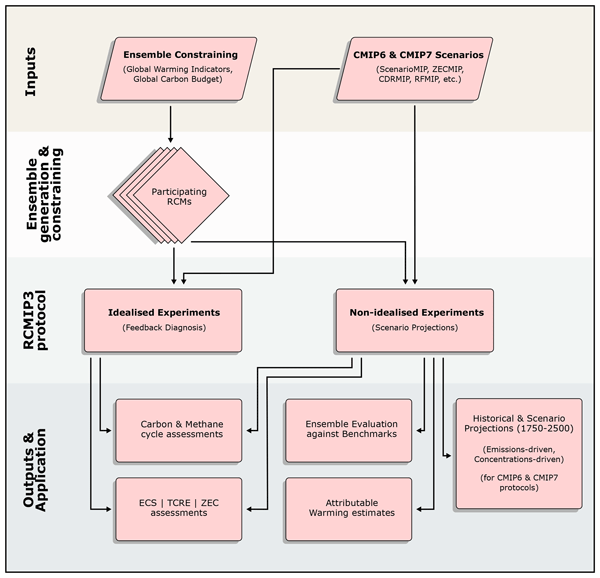
Reduced-complexity models are an important tool in climate science, helping us understand and estimate future climate change. We present the experimental protocol for the next phase of the reduced-complexity model intercomparison project, which aims to compare results from many such models to better understand their behaviour. This knowledge will guide how these models are developed and used in the future, including in the upcoming Intergovernmental Panel on Climate Change (IPCC) assessment report (AR7).
Stephanie Fiedler, Fiona M. O'Connor, Duncan Watson-Parris, Robert J. Allen, William J. Collins, Paul T. Griffiths, Matthew Kasoar, Jarmo Kikstra, Jasper F. Kok, Lee T. Murray, Fabien Paulot, Maria Sand, Steven T. Turnock, James Weber, Laura J. Wilcox, and Vaishali Naik
Geosci. Model Dev., 19, 3477–3508, https://doi.org/10.5194/gmd-19-3477-2026, https://doi.org/10.5194/gmd-19-3477-2026, 2026
Short summary
Short summary
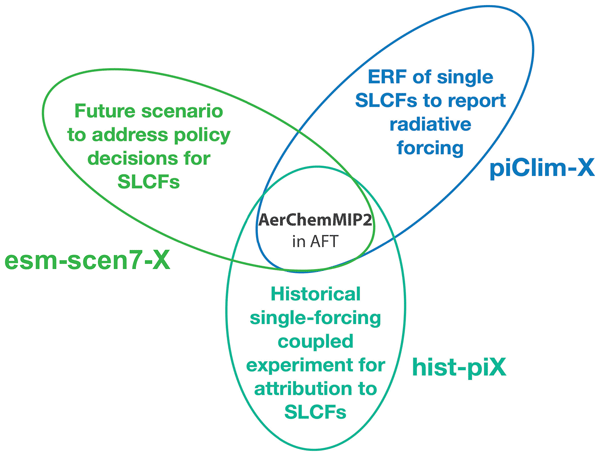
The Aerosol and Chemistry Model Intercomparison Project phase two (AerChemMIP2) allows the community to compare results from contemporary Earth system models. AerChemMIP2 is asking modelling centres to perform experiments following the same protocol. It includes experiments for enabling new science and for tracking progress. Model output will be used for addressing research and policy questions about anthropogenic and natural drivers of climate change, and the impacts on air quality.
Detlef P. Van Vuuren, Brian C. O'Neill, Claudia Tebaldi, Benjamin M. Sanderson, Louise P. Chini, Pierre Friedlingstein, Tomoko Hasegawa, Keywan Riahi, Bala Govindasamy, Nico Bauer, Veronika Eyring, Cheikh M. N. Fall, Katja Frieler, Matthew J. Gidden, Laila K. Gohar, Annika Högner, Andrew D. Jones, Jarmo Kikstra, Andrew King, Reto Knutti, Elmar Kriegler, Peter Lawrence, Chris Lennard, Jason Lowe, Camilla Mathison, Shahbaz Mehmood, Zebedee Nicholls, Luciana F. Prado, Qiang Zhang, Steven K. Rose, Alex C. Ruane, Marit Sandstad, Carl-Friedrich Schleussner, Roland Seferian, Jana Sillmann, Chris Smith, Anna A. Sörensson, Swapna Panickal, Kaoru Tachiiri, Naomi Vaughan, Saritha S. Vishwanathan, Tokuta Yokohata, Marco Zecchetto, and Tilo Ziehn
Geosci. Model Dev., 19, 2627–2656, https://doi.org/10.5194/gmd-19-2627-2026, https://doi.org/10.5194/gmd-19-2627-2026, 2026
Short summary
Short summary
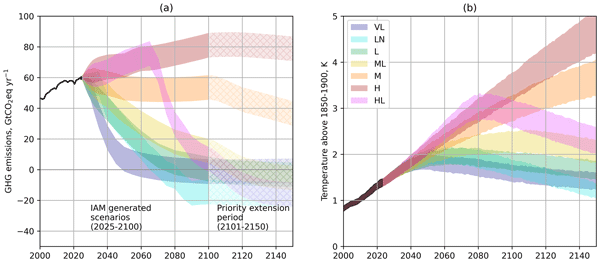
We propose a set of seven plausible 21st century emission scenarios, and their multi-century extensions, that will be used by the international community of climate modeling centers to produce the next generation of climate projections. These projections will support climate, impact and mitigation researchers, provide information to practitioners to address future risks from climate change, and contribute to policymakers’ considerations of the trade-offs among various levels of mitigation.
Benjamin M. Sanderson, Susanne Baur, Carl-Freidrich Schleussner, Glen P. Peters, Shivika Mittal, Marit Sandstad, Steffen Kallbekken, Chris Smith, Sabine Fuss, Bas van Ruijven, Rosie A. Fisher, Joeri Rogelj, Roland Séférian, Bjørn Samset, Norman J. Steinert, Laurent Terray, and Jan Fuglestvedt
EGUsphere, https://doi.org/10.5194/egusphere-2026-28, https://doi.org/10.5194/egusphere-2026-28, 2026
Preprint archived
Short summary
Short summary
Solar Radiation Modification by adding aerosols to the stratosphere could rapidly and temporarily cool the Earth, but this speed creates unprecedented risks. Fast climate responses coupled with political instability create risks of failure to decarbonise, super-rapid climate change, and conflict. Idealized scenarios or conventional modeling tools could lead to systematic ignorance of these risks. We thus introduce a framework outlining what must be represented in future modeling and assessment.
Gamze Ünlü, Florian Maczek, Jihoon Min, Stefan Frank, Fridolin Glatter, Paul Natsuo Kishimoto, Jan Streeck, Nina Eisenmenger, Dominik Wiedenhofer, and Volker Krey
Geosci. Model Dev., 17, 8321–8352, https://doi.org/10.5194/gmd-17-8321-2024, https://doi.org/10.5194/gmd-17-8321-2024, 2024
Short summary
Short summary
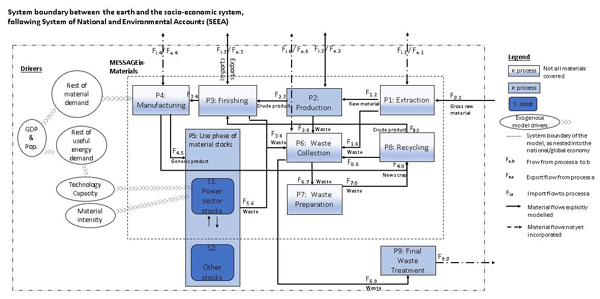
Extraction and processing of raw materials constitute a significant source of CO2 emissions in industry and so are contributors to climate change. We develop an open-source tool to assess different industry decarbonization pathways in integrated assessment models (IAMs) with a representation of material flows and stocks. We highlight the importance of expanding the scope of climate change mitigation options to include circular-economy and material efficiency measures in IAM scenario analysis.
Malte Meinshausen, Carl-Friedrich Schleussner, Kathleen Beyer, Greg Bodeker, Olivier Boucher, Josep G. Canadell, John S. Daniel, Aïda Diongue-Niang, Fatima Driouech, Erich Fischer, Piers Forster, Michael Grose, Gerrit Hansen, Zeke Hausfather, Tatiana Ilyina, Jarmo S. Kikstra, Joyce Kimutai, Andrew D. King, June-Yi Lee, Chris Lennard, Tabea Lissner, Alexander Nauels, Glen P. Peters, Anna Pirani, Gian-Kasper Plattner, Hans Pörtner, Joeri Rogelj, Maisa Rojas, Joyashree Roy, Bjørn H. Samset, Benjamin M. Sanderson, Roland Séférian, Sonia Seneviratne, Christopher J. Smith, Sophie Szopa, Adelle Thomas, Diana Urge-Vorsatz, Guus J. M. Velders, Tokuta Yokohata, Tilo Ziehn, and Zebedee Nicholls
Geosci. Model Dev., 17, 4533–4559, https://doi.org/10.5194/gmd-17-4533-2024, https://doi.org/10.5194/gmd-17-4533-2024, 2024
Short summary
Short summary
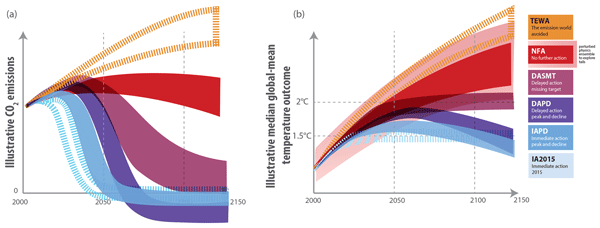
The scientific community is considering new scenarios to succeed RCPs and SSPs for the next generation of Earth system model runs to project future climate change. To contribute to that effort, we reflect on relevant policy and scientific research questions and suggest categories for representative emission pathways. These categories are tailored to the Paris Agreement long-term temperature goal, high-risk outcomes in the absence of further climate policy and worlds “that could have been”.
Muhammad Awais, Adriano Vinca, Edward Byers, Stefan Frank, Oliver Fricko, Esther Boere, Peter Burek, Miguel Poblete Cazenave, Paul Natsuo Kishimoto, Alessio Mastrucci, Yusuke Satoh, Amanda Palazzo, Madeleine McPherson, Keywan Riahi, and Volker Krey
Geosci. Model Dev., 17, 2447–2469, https://doi.org/10.5194/gmd-17-2447-2024, https://doi.org/10.5194/gmd-17-2447-2024, 2024
Short summary
Short summary
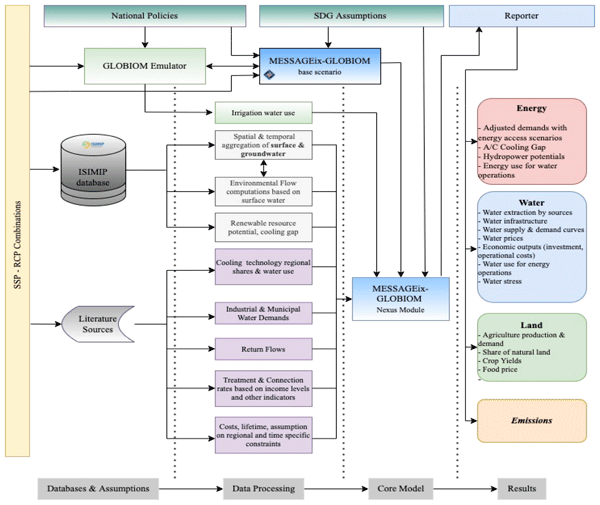
Climate change, population growth, and depletion of natural resources all pose complex and interconnected challenges. Our research offers a novel model that can help in understanding the interplay of these aspects, providing policymakers with a more robust tool for making informed future decisions. The study highlights the significance of incorporating climate impacts within large-scale global integrated assessments, which can help us in generating more climate-resilient scenarios.
Jarmo S. Kikstra, Zebedee R. J. Nicholls, Christopher J. Smith, Jared Lewis, Robin D. Lamboll, Edward Byers, Marit Sandstad, Malte Meinshausen, Matthew J. Gidden, Joeri Rogelj, Elmar Kriegler, Glen P. Peters, Jan S. Fuglestvedt, Ragnhild B. Skeie, Bjørn H. Samset, Laura Wienpahl, Detlef P. van Vuuren, Kaj-Ivar van der Wijst, Alaa Al Khourdajie, Piers M. Forster, Andy Reisinger, Roberto Schaeffer, and Keywan Riahi
Geosci. Model Dev., 15, 9075–9109, https://doi.org/10.5194/gmd-15-9075-2022, https://doi.org/10.5194/gmd-15-9075-2022, 2022
Short summary
Short summary
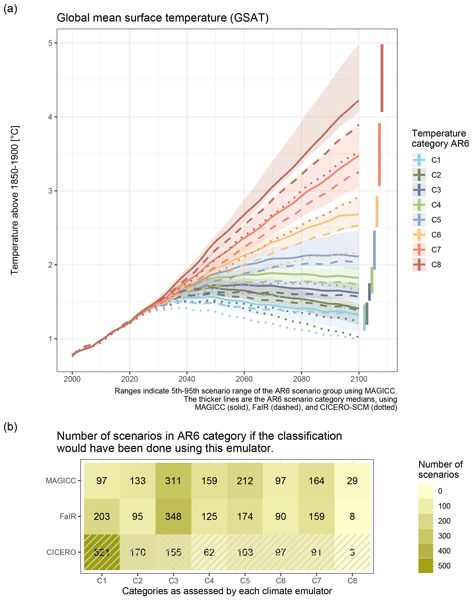
Assessing hundreds or thousands of emission scenarios in terms of their global mean temperature implications requires standardised procedures of infilling, harmonisation, and probabilistic temperature assessments. We here present the open-source
climate-assessmentworkflow that was used in the IPCC AR6 Working Group III report. The paper provides key insight for anyone wishing to understand the assessment of climate outcomes of mitigation pathways in the context of the Paris Agreement.
Cited articles
UNFCCC: Adoption of the Paris Agreement: Proposal by the President, https://unfccc.int/documents/9064 (last access: 15 March 2024), 2015.
UNFCCC: https://unfccc.int/sites/default/files/resource/cma2023_L17_adv.pdf (last access: 26 April 2024), 2023.
Agarwal, V., Akyilmaz, O., Shum, C. K., Feng, W., Yang, T.-Y., Forootan, E., Syed, T. H., Haritashya, U. K., and Uz, M.: Machine learning based downscaling of GRACE-estimated groundwater in Central Valley, California, Sci. Total Environ., 865, 161138, https://doi.org/10.1016/j.scitotenv.2022.161138, 2023.
Andrijevic, M., Crespo Cuaresma, J., Muttarak, R., and Schleussner, C.-F.: Governance in socioeconomic pathways and its role for future adaptive capacity, Nat. Sustain., 3, 35–41, https://doi.org/10.1038/s41893-019-0405-0, 2020.
Energy Inefficiency in the US Economy: A New Case for Conservation, https://pure.iiasa.ac.at/id/eprint/3220/, last access: 8 January 2024.
Baptista, L. B., Schaeffer, R., van Soest, H. L., Fragkos, P., Rochedo, P. R. R., van Vuuren, D., Dewi, R. G., Iyer, G., Jiang, K., Kannavou, M., Macaluso, N., Oshiro, K., Park, C., Reedman, L. J., Safonov, G., Shekhar, S., Siagian, U., Surana, K., and Qimin, C.: Good practice policies to bridge the emissions gap in key countries, Glob. Environ. Change, 73, 102472, https://doi.org/10.1016/j.gloenvcha.2022.102472, 2022.
Battiston, S., Monasterolo, I., Riahi, K., and van Ruijven, B. J.: Accounting for finance is key for climate mitigation pathways, Science, 372, 918–920, https://doi.org/10.1126/science.abf3877, 2021.
Bauer, N., Hilaire, J., Brecha, R. J., Edmonds, J., Jiang, K., Kriegler, E., Rogner, H.-H., and Sferra, F.: Assessing global fossil fuel availability in a scenario framework, Energy, 111, 580–592, https://doi.org/10.1016/j.energy.2016.05.088, 2016.
Bauer, N., Calvin, K., Emmerling, J., Fricko, O., Fujimori, S., Hilaire, J., Eom, J., Krey, V., Kriegler, E., Mouratiadou, I., Sytze de Boer, H., van den Berg, M., Carrara, S., Daioglou, V., Drouet, L., Edmonds, J. E., Gernaat, D., Havlik, P., Johnson, N., Klein, D., Kyle, P., Marangoni, G., Masui, T., Pietzcker, R. C., Strubegger, M., Wise, M., Riahi, K., and van Vuuren, D. P.: Shared Socio-Economic Pathways of the Energy Sector – Quantifying the Narratives, Glob. Environ. Change, 42, 316–330, https://doi.org/10.1016/j.gloenvcha.2016.07.006, 2017.
Bollen, J. C.: A trade view on climate change policies: a multi-region multi-sector approach, PhD thesis, Faculty of Economics and Business, Universiteit van Amsterdam; Amsterdam School of Economics Research Institute (ASE-RI), ISBN 9069601168 (9789069601168), https://hdl.handle.net/11245/1.252824 (last access: 17 December 2025), 2004.
Calvin, K., Bond-Lamberty, B., Clarke, L., Edmonds, J., Eom, J., Hartin, C., Kim, S., Kyle, P., Link, R., Moss, R., McJeon, H., Patel, P., Smith, S., Waldhoff, S., and Wise, M.: The SSP4: A world of deepening inequality, Glob. Environ. Change, 42, 284–296, https://doi.org/10.1016/j.gloenvcha.2016.06.010, 2017.
Calvin, K., Patel, P., Clarke, L., Asrar, G., Bond-Lamberty, B., Cui, R. Y., Di Vittorio, A., Dorheim, K., Edmonds, J., Hartin, C., Hejazi, M., Horowitz, R., Iyer, G., Kyle, P., Kim, S., Link, R., McJeon, H., Smith, S. J., Snyder, A., Waldhoff, S., and Wise, M.: GCAM v5.1: representing the linkages between energy, water, land, climate, and economic systems, Geosci. Model Dev., 12, 677–698, https://doi.org/10.5194/gmd-12-677-2019, 2019.
Carter, T. R., Fronzek, S., and Bärlund, I.: FINSKEN: a framework for developing consistent global change scenarios for Finland in the 21st century, Fin. Framew. Dev. Consistent Glob. Change Scenar. Finl. 21st Century, 9, 91–107, 2004.
Carvalho, D. V., Pereira, E. M., and Cardoso, J. S.: Machine Learning Interpretability: A Survey on Methods and Metrics, Electronics, 8, 832, https://doi.org/10.3390/electronics8080832, 2019.
Chakir, R.: Spatial Downscaling of Agricultural Land-Use Data: An Econometric Approach Using Cross Entropy, Land Econ., 85, 238–251, https://doi.org/10.3368/le.85.2.238, 2009.
Chen, H., Yang, L., and Chen, W.: Modelling national, provincial and city-level low-carbon energy transformation pathways, Energy Policy, 137, 111096, https://doi.org/10.1016/j.enpol.2019.111096, 2020a.
Chen, M., Vernon, C. R., Graham, N. T., Hejazi, M., Huang, M., Cheng, Y., and Calvin, K.: Global land use for 2015–2100 at 0.05° resolution under diverse socioeconomic and climate scenarios, Sci. Data, 7, 320, https://doi.org/10.1038/s41597-020-00669-x, 2020b.
CAT: Climate Action Tracker, https://climateactiontracker.org/, last access: 8 January 2024.
Crameri, F.: Geodynamic diagnostics, scientific visualisation and StagLab 3.0, Geosci. Model Dev., 11, 2541–2562, https://doi.org/10.5194/gmd-11-2541-2018, 2018.
Crameri, F.: Scientific colour maps, Zenodo, https://doi.org/10.5281/zenodo.8409685, 2023.
Crameri, F., Shephard, G. E., and Heron, P. J.: The misuse of colour in science communication, Nat. Commun., 11, 5444, https://doi.org/10.1038/s41467-020-19160-7, 2020.
Dafnomilis, I., den Elzen, M., and van Vuuren, D.: Paris targets within reach by aligning, broadening and strengthening net-zero pledges, Commun. Earth Environ., 5, 1–10, https://doi.org/10.1038/s43247-023-01184-8, 2024.
Dellink, R., Chateau, J., Lanzi, E., and Magné, B.: Long-term economic growth projections in the Shared Socioeconomic Pathways, Glob. Environ. Change, 42, 200–214, https://doi.org/10.1016/j.gloenvcha.2015.06.004, 2017.
Dietrich, J. P., Baumstark, L., Wirth, S., Giannousakis, A., Rodrigues, R., Bodirsky, B. L., Kreidenweis, U., Klein, D., and Führlich, P.: madrat: May All Data be Reproducible and Transparent (MADRaT), Zenodo, https://doi.org/10.5281/zenodo.7886302, 2023.
Drouet, L., Bosetti, V., Padoan, S. A., Aleluia Reis, L., Bertram, C., Dalla Longa, F., Després, J., Emmerling, J., Fosse, F., Fragkiadakis, K., Frank, S., Fricko, O., Fujimori, S., Harmsen, M., Krey, V., Oshiro, K., Nogueira, L. P., Paroussos, L., Piontek, F., Riahi, K., Rochedo, P. R. R., Schaeffer, R., Takakura, J., van der Wijst, K.-I., van der Zwaan, B., van Vuuren, D., Vrontisi, Z., Weitzel, M., Zakeri, B., and Tavoni, M.: Net zero-emission pathways reduce the physical and economic risks of climate change, Nat. Clim. Change, 11, 1070–1076, https://doi.org/10.1038/s41558-021-01218-z, 2021.
du Pont, Y. R., Jeffery, M. L., Gütschow, J., Christoff, P., and Meinshausen, M.: National contributions for decarbonizing the world economy in line with the G7 agreement, Environ. Res. Lett., 11, 054005, https://doi.org/10.1088/1748-9326/11/5/054005, 2016.
Ehrlich, P. R. and Holdren, J. P.: Impact of Population Growth, Science, 171, 1212–1217, 1971.
Ekström, M., Grose, M. R., and Whetton, P. H.: An appraisal of downscaling methods used in climate change research, WIREs Clim. Change, 6, 301–319, https://doi.org/10.1002/wcc.339, 2015.
den Elzen, M. G. J., Dafnomilis, I., Forsell, N., Fragkos, P., Fragkiadakis, K., Höhne, N., Kuramochi, T., Nascimento, L., Roelfsema, M., van Soest, H., and Sperling, F.: Updated nationally determined contributions collectively raise ambition levels but need strengthening further to keep Paris goals within reach, Mitig. Adapt. Strateg. Glob. Change, 27, 33, https://doi.org/10.1007/s11027-022-10008-7, 2022.
Emissions Gap Report 2023: Broken Record – Temperatures Hit New Highs, yet World Fails to Cut Emissions (again), http://www.unep.org/resources/emissions-gap-report-2023, last access: 8 January 2024.
Emmerling, J., Drouet, L., Reis, L. A., Bevione, M., Berger, L., Bosetti, V., Carrara, S., Cian, E. D., D'Aertrycke, G. D. M., Longden, T., Malpede, M., Marangoni, G., Sferra, F., Tavoni, M., Witajewski-Baltvilks, J., and Havlik, P.: The WITCH 2016 Model – Documentation and Implementation of the Shared Socioeconomic Pathways, FEEM Working Paper No. 42.2016, https://doi.org/10.2139/ssrn.2800970, 2016.
Energy Primer: Online Textbook based on Chapter 1 of the Global Energy Assessment (GEA), http://pure.iiasa.ac.at/id/eprint/11190/, last access: 8 October 2021.
Fransen, T., Meckling, J., Stünzi, A., Schmidt, T. S., Egli, F., Schmid, N., and Beaton, C.: Taking stock of the implementation gap in climate policy, Nat. Clim. Change, 13, 752–755, https://doi.org/10.1038/s41558-023-01755-9, 2023.
Fricko, O., Havlik, P., Rogelj, J., Klimont, Z., Gusti, M., Johnson, N., Kolp, P., Strubegger, M., Valin, H., Amann, M., Ermolieva, T., Forsell, N., Herrero, M., Heyes, C., Kindermann, G., Krey, V., McCollum, D. L., Obersteiner, M., Pachauri, S., Rao, S., Schmid, E., Schoepp, W., and Riahi, K.: The marker quantification of the Shared Socioeconomic Pathway 2: A middle-of-the-road scenario for the 21st century, Glob. Environ. Change, 42, 251–267, https://doi.org/10.1016/j.gloenvcha.2016.06.004, 2017.
Fujimori, S., Abe, M., Kinoshita, T., Hasegawa, T., Kawase, H., Kushida, K., Masui, T., Oka, K., Shiogama, H., Takahashi, K., Tatebe, H., and Yoshikawa, M.: Downscaling Global Emissions and Its Implications Derived from Climate Model Experiments, PLOS ONE, 12, e0169733, https://doi.org/10.1371/journal.pone.0169733, 2017a.
Fujimori, S., Hasegawa, T., Masui, T., Takahashi, K., Herran, D. S., Dai, H., Hijioka, Y., and Kainuma, M.: SSP3: AIM implementation of Shared Socioeconomic Pathways, Glob. Environ. Change, 42, 268–283, https://doi.org/10.1016/j.gloenvcha.2016.06.009, 2017b.
Gaffin, S. R., Rosenzweig, C., Xing, X., and Yetman, G.: Downscaling and geo-spatial gridding of socio-economic projections from the IPCC Special Report on Emissions Scenarios (SRES), Glob. Environ. Change, 14, 105–123, https://doi.org/10.1016/j.gloenvcha.2004.02.004, 2004.
Geiges, A., Nauels, A., Parra, P. Y., Andrijevic, M., Hare, W., Pfleiderer, P., Schaeffer, M., and Schleussner, C.-F.: Incremental improvements of 2030 targets insufficient to achieve the Paris Agreement goals, Earth Syst. Dynam., 11, 697–708, https://doi.org/10.5194/esd-11-697-2020, 2020.
Gernaat, D. E. H. J., de Boer, H. S., Daioglou, V., Yalew, S. G., Müller, C., and van Vuuren, D. P.: Climate change impacts on renewable energy supply, Nat. Clim. Change, 11, 119–125, https://doi.org/10.1038/s41558-020-00949-9, 2021.
Gidden, M. J., Fujimori, S., van den Berg, M., Klein, D., Smith, S. J., van Vuuren, D. P., and Riahi, K.: A methodology and implementation of automated emissions harmonization for use in Integrated Assessment Models, Environ. Model. Softw., 105, 187–200, https://doi.org/10.1016/j.envsoft.2018.04.002, 2018.
Gidden, M. J., Riahi, K., Smith, S. J., Fujimori, S., Luderer, G., Kriegler, E., van Vuuren, D. P., van den Berg, M., Feng, L., Klein, D., Calvin, K., Doelman, J. C., Frank, S., Fricko, O., Harmsen, M., Hasegawa, T., Havlik, P., Hilaire, J., Hoesly, R., Horing, J., Popp, A., Stehfest, E., and Takahashi, K.: Global emissions pathways under different socioeconomic scenarios for use in CMIP6: a dataset of harmonized emissions trajectories through the end of the century, Geosci. Model Dev., 12, 1443–1475, https://doi.org/10.5194/gmd-12-1443-2019, 2019.
Gidden, M. J., Gasser, T., Grassi, G., Forsell, N., Janssens, I., Lamb, W. F., Minx, J., Nicholls, Z., Steinhauser, J., and Riahi, K.: Aligning climate scenarios to emissions inventories shifts global benchmarks, Nature, 624, 102–108, https://doi.org/10.1038/s41586-023-06724-y, 2023.
Grassi, G., Stehfest, E., Rogelj, J., van Vuuren, D., Cescatti, A., House, J., Nabuurs, G.-J., Rossi, S., Alkama, R., Viñas, R. A., Calvin, K., Ceccherini, G., Federici, S., Fujimori, S., Gusti, M., Hasegawa, T., Havlik, P., Humpenöder, F., Korosuo, A., Perugini, L., Tubiello, F. N., and Popp, A.: Critical adjustment of land mitigation pathways for assessing countries' climate progress, Nat. Clim. Change, 11, 425–434, https://doi.org/10.1038/s41558-021-01033-6, 2021.
Grübler, A., O'Neill, B., Riahi, K., Chirkov, V., Goujon, A., Kolp, P., Prommer, I., Scherbov, S., and Slentoe, E.: Regional, national, and spatially explicit scenarios of demographic and economic change based on SRES, Technol. Forecast. Soc. Change, 74, 980–1029, https://doi.org/10.1016/j.techfore.2006.05.023, 2007.
Gütschow, J., Jeffery, M. L., Gieseke, R., Gebel, R., Stevens, D., Krapp, M., and Rocha, M.: The PRIMAP-hist national historical emissions time series, Earth Syst. Sci. Data, 8, 571–603, https://doi.org/10.5194/essd-8-571-2016, 2016.
Gütschow, J., Pflüger, M., and Busch, D.: The PRIMAP-hist national historical emissions time series (1750-2022) v2.5.1 (2.5.1), Zenodo, https://doi.org/10.5281/zenodo.10705513, 2024.
Hantzsche, A., Lopresto, M., and Young, G.: Using NiGEM in uncertain times: Introduction and overview of NiGEM, Natl. Inst. Econ. Rev., 244, R1–R14, https://doi.org/10.1177/002795011824400109, 2018.
Hasegawa, T., Fujimori, S., Ito, A., Takahashi, K., and Masui, T.: Global land-use allocation model linked to an integrated assessment model, Sci. Total Environ., 580, 787–796, https://doi.org/10.1016/j.scitotenv.2016.12.025, 2017.
Hausfather, Z. and Moore, F. C.: Net-zero commitments could limit warming to below 2 ° C, Nature, 604, 247–248, https://doi.org/10.1038/d41586-022-00874-1, 2022.
Hewitson, B. C., Daron, J., Crane, R. G., Zermoglio, M. F., and Jack, C.: Interrogating empirical-statistical downscaling, Clim. Change, 122, 539–554, https://doi.org/10.1007/s10584-013-1021-z, 2014.
Hobeichi, S., Nishant, N., Shao, Y., Abramowitz, G., Pitman, A., Sherwood, S., Bishop, C., and Green, S.: Using Machine Learning to Cut the Cost of Dynamical Downscaling, Earths Future, 11, e2022EF003291, https://doi.org/10.1029/2022EF003291, 2023.
Höglund-Isaksson, L., Gómez-Sanabria, A., Klimont, Z., Rafaj, P., and Schöpp, W.: Technical potentials and costs for reducing global anthropogenic methane emissions in the 2050 timeframe – results from the GAINS model, Environ. Res. Commun., 2, 025004, https://doi.org/10.1088/2515-7620/ab7457, 2020.
Höhne, N., Blum, H., Fuglestvedt, J., Skeie, R. B., Kurosawa, A., Hu, G., Lowe, J., Gohar, L., Matthews, B., Nioac de Salles, A. C., and Ellermann, C.: Contributions of individual countries' emissions to climate change and their uncertainty, Clim. Change, 106, 359–391, https://doi.org/10.1007/s10584-010-9930-6, 2011.
Höhne, N. and Ullrich, S.: Emission allowances under the proposal of the “South North Dialogue – equity in the greenhouse” | Climate Technology Centre & Network | Fri, 10/16/2015, https://www.ctc-n.org/resources/emission-allowances-under-proposal-south-north-dialogue-equity-greenhouse (last access: 8 January 2024), 2005.
Huppmann, D., Gidden, M., Fricko, O., Kolp, P., Orthofer, C., Pimmer, M., Kushin, N., Vinca, A., Mastrucci, A., Riahi, K., and Krey, V.: The MESSAGEix Integrated Assessment Model and the ix modeling platform (ixmp): An open framework for integrated and cross-cutting analysis of energy, climate, the environment, and sustainable development, Environ. Model. Softw., 112, 143–156, https://doi.org/10.1016/j.envsoft.2018.11.012, 2019.
IEA: World Energy Statistics and Balances, IEA [data set], https://doi.org/10.1787/data-00512-en, 2022.
IPCC: Climate Change 2022: Mitigation of Climate Change. Contribution of Working Group III to the Sixth Assessment Report of the Intergovernmental Panel on Climate Change, edited by: Shukla, P. R., Skea, J., Slade, R., Al Khourdajie, A., van Diemen, R., McCollum, D., Pathak, M., Some, S., Vyas, P., Fradera, R., Belkacemi, M., Hasija, A., Lisboa, G., Luz, S., and Malley, J., Cambridge University Press, Cambridge, UK and New York, NY, USA, https://doi.org/10.1017/9781009157926, 2022.
Iyer, G., Ou, Y., Edmonds, J., Fawcett, A. A., Hultman, N., McFarland, J., Fuhrman, J., Waldhoff, S., and McJeon, H.: Ratcheting of climate pledges needed to limit peak global warming, Nat. Clim. Change, 12, 1129–1135, https://doi.org/10.1038/s41558-022-01508-0, 2022.
Jebeile, J., Lam, V., and Räz, T.: Understanding climate change with statistical downscaling and machine learning, Synthese, 199, 1877–1897, https://doi.org/10.1007/s11229-020-02865-z, 2021.
Kaya, Y.: The role of CO2 removal and disposal, Energy Convers. Manag., 36, 375–380, https://doi.org/10.1016/0196-8904(95)00025-9, 1995.
Kheir, A. M. S., Elnashar, A., Mosad, A., and Govind, A.: An improved deep learning procedure for statistical downscaling of climate data, Heliyon, 9, e18200, https://doi.org/10.1016/j.heliyon.2023.e18200, 2023.
Khorrami, B., Pirasteh, S., Ali, S., Sahin, O. G., and Vaheddoost, B.: Statistical downscaling of GRACE TWSA estimates to a 1-km spatial resolution for a local-scale surveillance of flooding potential, J. Hydrol., 624, 129929, https://doi.org/10.1016/j.jhydrol.2023.129929, 2023.
Kuramochi, T., Nascimento, L., Moisio, M., den Elzen, M., Forsell, N., van Soest, H., Tanguy, P., Gonzales, S., Hans, F., Jeffery, M. L., Fekete, H., Schiefer, T., de Villafranca Casas, M. J., De Vivero-Serrano, G., Dafnomilis, I., Roelfsema, M., and Höhne, N.: Greenhouse gas emission scenarios in nine key non-G20 countries: An assessment of progress toward 2030 climate targets, Environ. Sci. Policy, 123, 67–81, https://doi.org/10.1016/j.envsci.2021.04.015, 2021.
Li, W., Ni, L., Li, Z.-L., Duan, S.-B., and Wu, H.: Evaluation of Machine Learning Algorithms in Spatial Downscaling of MODIS Land Surface Temperature, IEEE J. Sel. Top. Appl. Earth Obs. Remote Sens., 12, 2299–2307, https://doi.org/10.1109/JSTARS.2019.2896923, 2019.
Luderer, G., Bauer, N., Baumstark, L., Bertram, C., Leimbach, M., Pietzcker, R., Strefler, J., Aboumahboub, T., Abrahão, G., Auer, C., Benke, F., Bi, S., Dietrich, J., Dirnaichner, A., Giannousakis, A., Gong, C. C., Haller, M., Hasse, R., Hilaire, J., Hoppe, J., Klein, D., Koch, J., Körner, A., Kowalczyk, K., Kriegler, E., Levesque, A., Lorenz, A., Ludig, S., Lüken, M., Malik, A., Manger, S., Merfort, A., Merfort, L., Moreno-Leiva, S., Mouratiadou, I., Odenweller, A., Pehl, M., Piontek, F., Popin, L., Rauner, S., Richters, O., Rodrigues, R., Roming, N., Rottoli, M., Schmidt, E., Schötz, C., Schreyer, F., Schultes, A., Sörgel, B., Ueckerdt, F., Verpoort, P., and Weigmann, P.: REMIND – REgional Model of INvestments and Development, Zenodo, https://doi.org/10.5281/zenodo.6794920, 2022.
Meinshausen, M., Jeffery, L., Guetschow, J., Robiou du Pont, Y., Rogelj, J., Schaeffer, M., Höhne, N., den Elzen, M., Oberthür, S., and Meinshausen, N.: National post-2020 greenhouse gas targets and diversity-aware leadership, Nat. Clim. Change, 5, 1098–1106, https://doi.org/10.1038/nclimate2826, 2015.
Meinshausen, M., Lewis, J., McGlade, C., Gütschow, J., Nicholls, Z., Burdon, R., Cozzi, L., and Hackmann, B.: Realization of Paris Agreement pledges may limit warming just below 2 ° C, Nature, 604, 304–309, https://doi.org/10.1038/s41586-022-04553-z, 2022.
Moss, R. H., Edmonds, J. A., Hibbard, K. A., Manning, M. R., Rose, S. K., van Vuuren, D. P., Carter, T. R., Emori, S., Kainuma, M., Kram, T., Meehl, G. A., Mitchell, J. F. B., Nakicenovic, N., Riahi, K., Smith, S. J., Stouffer, R. J., Thomson, A. M., Weyant, J. P., and Wilbanks, T. J.: The next generation of scenarios for climate change research and assessment, Nature, 463, 747–756, https://doi.org/10.1038/nature08823, 2010.
Najafi, M. R., Moradkhani, H., and Wherry, S. A.: Statistical Downscaling of Precipitation Using Machine Learning with Optimal Predictor Selection, J. Hydrol. Eng., 16, 650–664, https://doi.org/10.1061/(ASCE)HE.1943-5584.0000355, 2011.
Nakicenovic, N., Grubler, A., Bodda, L., and Gilli, P. V.: Technischer Fortschritt, Strukturwandel und Effizienz der Energieanwendung: Trends weltweitund in Österreich (Technological Progress, Structural Change and Efficient Energy Use: Trends Worldwide and in Austria), Verbundgesellschaft, Vienna, Austria, 331 pp., https://pure.iiasa.ac.at/12429 (last access: 17 December 2025), 1990.
Nakićenović, N., Grübler, A., Inaba, A., Messner, S., Nilsson, S., Nishimura, Y., Rogner, H.-H., Schäfer, A., Schrattenholzer, L., and Strubegger, M.: Long-term strategies for mitigating global warming, Energy, 18, 401–609, https://doi.org/10.1016/0360-5442(93)90019-A, 1993.
Nakicenovic, N., Nakićenović, N., Grubler, A., Grübler, A., McDonald, A., and McDonald, A. T.: Global Energy Perspectives, Cambridge University Press, 322 pp., https://www.cambridge.org/as/universitypress/subjects/earth-and-environmental-science/environmental-science/global-energy-perspectives (last access: 17 December 2025), 1998.
Nakicenovic, N., Alcamo, J., Grubler, A., Riahi, K., Roehrl, R. A., Rogner, H.-H., and Victor, N.: Special Report on Emissions Scenarios (SRES), A Special Report of Working Group III of the Intergovernmental Panel on Climate Change, Cambridge University Press, Cambridge, ISBN 0-521-80493-0, 2000.
Nascimento, L., Kuramochi, T., Iacobuta, G., den Elzen, M., Fekete, H., Weishaupt, M., van Soest, H. L., Roelfsema, M., Vivero-Serrano, G. D., Lui, S., Hans, F., Jose de Villafranca Casas, M., and Höhne, N.: Twenty years of climate policy: G20 coverage and gaps, Clim. Policy, 22, 158–174, https://doi.org/10.1080/14693062.2021.1993776, 2022.
Niazkar, M., Goodarzi, M. R., Fatehifar, A., and Abedi, M. J.: Machine learning-based downscaling: application of multi-gene genetic programming for downscaling daily temperature at Dogonbadan, Iran, under CMIP6 scenarios, Theor. Appl. Climatol., 151, 153–168, https://doi.org/10.1007/s00704-022-04274-3, 2023.
O'Neill, B. C., Kriegler, E., Riahi, K., Ebi, K. L., Hallegatte, S., Carter, T. R., Mathur, R., and van Vuuren, D. P.: A new scenario framework for climate change research: the concept of shared socioeconomic pathways, Clim. Change, 122, 387–400, https://doi.org/10.1007/s10584-013-0905-2, 2014.
Peters, G. P., Andrew, R. M., Canadell, J. G., Fuss, S., Jackson, R. B., Korsbakken, J. I., Le Quéré, C., and Nakicenovic, N.: Key indicators to track current progress and future ambition of the Paris Agreement, Nat. Clim. Change, 7, 118–122, https://doi.org/10.1038/nclimate3202, 2017.
Platts: World Electric Power Plants Data Base, https://www.spglobal.com/commodity-insights/en/products-solutions/clean-energy-technology, (last access: 4 March 2025), 2019.
Riahi, K., Van Vuuren, D. P., Kriegler, E., Edmonds, J., O'neill, B. C., Fujimori, S., Bauer, N., Calvin, K., Dellink, R., and Fricko, O.: The Shared Socioeconomic Pathways and their energy, land use, and greenhouse gas emissions implications: An overview, Glob. Environ. Change, 42, 153–168, 2017a.
Riahi, K., van Vuuren, D. P., Kriegler, E., Edmonds, J., O'Neill, B. C., Fujimori, S., Bauer, N., Calvin, K., Dellink, R., Fricko, O., Lutz, W., Popp, A., Cuaresma, J. C., Kc, S., Leimbach, M., Jiang, L., Kram, T., Rao, S., Emmerling, J., Ebi, K., Hasegawa, T., Havlik, P., Humpenöder, F., Da Silva, L. A., Smith, S., Stehfest, E., Bosetti, V., Eom, J., Gernaat, D., Masui, T., Rogelj, J., Strefler, J., Drouet, L., Krey, V., Luderer, G., Harmsen, M., Takahashi, K., Baumstark, L., Doelman, J. C., Kainuma, M., Klimont, Z., Marangoni, G., Lotze-Campen, H., Obersteiner, M., Tabeau, A., and Tavoni, M.: The Shared Socioeconomic Pathways and their energy, land use, and greenhouse gas emissions implications: An overview, Glob. Environ. Change, 42, 153–168, https://doi.org/10.1016/j.gloenvcha.2016.05.009, 2017b.
Riahi, K., Bertram, C., Huppmann, D., Rogelj, J., Bosetti, V., Cabardos, A.-M., Deppermann, A., Drouet, L., Frank, S., Fricko, O., Fujimori, S., Harmsen, M., Hasegawa, T., Krey, V., Luderer, G., Paroussos, L., Schaeffer, R., Weitzel, M., van der Zwaan, B., Vrontisi, Z., Longa, F. D., Després, J., Fosse, F., Fragkiadakis, K., Gusti, M., Humpenöder, F., Keramidas, K., Kishimoto, P., Kriegler, E., Meinshausen, M., Nogueira, L. P., Oshiro, K., Popp, A., Rochedo, P. R. R., Ünlü, G., van Ruijven, B., Takakura, J., Tavoni, M., van Vuuren, D., and Zakeri, B.: Cost and attainability of meeting stringent climate targets without overshoot, Nat. Clim. Change, 11, 1063–1069, https://doi.org/10.1038/s41558-021-01215-2, 2021.
Richters, O., Kriegler, E., Al Khourdajie, A., Bertram, C., Bresch, D. N., Ciullo, A., Cornforth, E., Cui, R., Edmonds, J., Fuchs, S., Hackstock, P., Holland, D., Hurst, I., Kikstra, J., Klein, D., Kotz, M., Kropf, C. M., Lewis, J., Liadze, I., Mandaroux, R., Meinshausen, M., Min, J., Nicholls, Z., Piontek, F., Sanchez Juanino, P., Sauer, I., Sferra, F., Stevanović, M., van Ruijven, B., Weigmann, P., Westphal, M., Ian, Zhao, A., and Zwerling, M.: NGFS Climate Scenarios Data Set (4.0), Zenodo, https://doi.org/10.5281/zenodo.10070596, 2023.
Richters, O., Kriegler, E., Al Khourdajie, A., Bertram, C., Bresch, D. N., Ciullo, A., Cornforth, E., Cui, R., Edmonds, J., Fuchs, S., Hackstock, P., Holland, D., Hurst, I., Kikstra, J., Klein, D., Kotz, M., Kropf, C. M., Lewis, J., Liadze, I., Mandaroux, R., Meinshausen, M., Min, J., Nicholls, Z., Piontek, F., Sanchez Juanino, P., Sauer, I., Sferra, F., Stevanović, M., van Ruijven, B., Weigmann, P., Westphal, M., Ian, Zhao, A., and Zwerling, M.: NGFS Climate Scenarios Data Set (4.2), Zenodo [data set], https://doi.org/10.5281/zenodo.10807824, 2024.
Roelfsema, M., van Soest, H. L., Harmsen, M., van Vuuren, D. P., Bertram, C., den Elzen, M., Höhne, N., Iacobuta, G., Krey, V., Kriegler, E., Luderer, G., Riahi, K., Ueckerdt, F., Després, J., Drouet, L., Emmerling, J., Frank, S., Fricko, O., Gidden, M., Humpenöder, F., Huppmann, D., Fujimori, S., Fragkiadakis, K., Gi, K., Keramidas, K., Köberle, A. C., Aleluia Reis, L., Rochedo, P., Schaeffer, R., Oshiro, K., Vrontisi, Z., Chen, W., Iyer, G. C., Edmonds, J., Kannavou, M., Jiang, K., Mathur, R., Safonov, G., and Vishwanathan, S. S.: Taking stock of national climate policies to evaluate implementation of the Paris Agreement, Nat. Commun., 11, 2096, https://doi.org/10.1038/s41467-020-15414-6, 2020.
Rogelj, J., Fricko, O., Meinshausen, M., Krey, V., Zilliacus, J. J. J., and Riahi, K.: Understanding the origin of Paris Agreement emission uncertainties, Nat. Commun., 8, 15748, https://doi.org/10.1038/ncomms15748, 2017.
Sachindra, D. A., Ahmed, K., Rashid, M. M., Shahid, S., and Perera, B. J. C.: Statistical downscaling of precipitation using machine learning techniques, Atmospheric Res., 212, 240–258, https://doi.org/10.1016/j.atmosres.2018.05.022, 2018.
Samir, K. C. and Lutz, W.: The human core of the shared socioeconomic pathways: Population scenarios by age, sex and level of education for all countries to 2100, Glob. Environ. Change, 42, 181–192, https://doi.org/10.1016/j.gloenvcha.2014.06.004, 2017.
Sferra, F.: Input data for DSCALE, Zenodo [data set], https://doi.org/10.5281/zenodo.15169443, 2025.
Sferra, F., Krapp, M., Roming, N., Schaeffer, M., Malik, A., Hare, B., and Brecha, R.: Towards optimal 1.5° and 2° C emission pathways for individual countries: A Finland case study, Energy Policy, 133, 110705, 2019.
Sferra, F., van Ruijven, B., Riahi, K., Hackstock, P., Maczek, F., Kikstra, J., and Haas, R.: fabiosferra/DSCALE: v0.1, Zenodo [code], https://doi.org/10.5281/zenodo.14795503, 2025.
Shi, X., Matsui, T., Haga, C., Machimura, T., Hashimoto, S., and Saito, O.: A scenario- and spatial-downscaling-based land-use modeling framework to improve the projections of plausible futures: a case study of the Guangdong–Hong Kong–Macao Greater Bay Area, China, Sustain. Sci., 16, 1977–1998, https://doi.org/10.1007/s11625-021-01011-z, 2021.
Smith, H. B., Vaughan, N. E., and Forster, J.: A dataset of emissions and removals from scenarios and pathways within long-term national climate strategies – the LTS-SP dataset, Sci. Data, 12, 485, https://doi.org/10.1038/s41597-025-04804-4, 2025.
Ünlü, G., Maczek, F., Min, J., Frank, S., Glatter, F., Natsuo Kishimoto, P., Streeck, J., Eisenmenger, N., Wiedenhofer, D., and Krey, V.: MESSAGEix-Materials v1.1.0: representation of material flows and stocks in an integrated assessment model, Geosci. Model Dev., 17, 8321–8352, https://doi.org/10.5194/gmd-17-8321-2024, 2024.
Vandal, T., Kodra, E., and Ganguly, A. R.: Intercomparison of machine learning methods for statistical downscaling: the case of daily and extreme precipitation, Theor. Appl. Climatol., 137, 557–570, https://doi.org/10.1007/s00704-018-2613-3, 2019.
van Soest, H. L., den Elzen, M. G. J., and van Vuuren, D. P.: Net-zero emission targets for major emitting countries consistent with the Paris Agreement, Nat. Commun., 12, 2140, https://doi.org/10.1038/s41467-021-22294-x, 2021.
van Vuuren, D. P., Lucas, P. L., and Hilderink, H.: Downscaling drivers of global environmental change: Enabling use of global SRES scenarios at the national and grid levels, Glob. Environ. Change, 17, 114–130, 2007.
van Vuuren, D. P., Smith, S. J., and Riahi, K.: Downscaling socioeconomic and emissions scenarios for global environmental change research: a review, WIREs Clim. Change, 1, 393–404, https://doi.org/10.1002/wcc.50, 2010.
van Vuuren, D. P., Kriegler, E., O'Neill, B. C., Ebi, K. L., Riahi, K., Carter, T. R., Edmonds, J., Hallegatte, S., Kram, T., Mathur, R., and Winkler, H.: A new scenario framework for Climate Change Research: scenario matrix architecture, Clim. Change, 122, 373–386, https://doi.org/10.1007/s10584-013-0906-1, 2014.
Viguié, V., Hallegatte, S., and Rozenberg, J.: Downscaling long term socio-economic scenarios at city scale: A case study on Paris, Technol. Forecast. Soc. Change, 87, 305–324, https://doi.org/10.1016/j.techfore.2013.12.028, 2014.
von Storch, H.: Inconsistencies at the interface of climate impact studies and global climate research, Meteorol. Z., 72–80, https://doi.org/10.1127/metz/4/1992/72, 1995.
Wilby, R., Charles, S., Zorita, E., Timbal, B., Whetton, P., and Mearns, L.: Guidelines for Use of Climate Scenarios Developed from Statistical Downscaling Methods, Zenodo, https://doi.org/10.5281/zenodo.1438320, 2004.
Winiwarter, W., Höglund-Isaksson, L., Klimont, Z., Schöpp, W., and Amann, M.: Technical opportunities to reduce global anthropogenic emissions of nitrous oxide, Environ. Res. Lett., 13, 014011, https://doi.org/10.1088/1748-9326/aa9ec9, 2018.
Yang, P., Mi, Z., Wei, Y.-M., Hanssen, S. V., Liu, L.-C., Coffman, D., Sun, X., Liao, H., Yao, Y.-F., Kang, J.-N., Wang, P.-T., and Davis, S. J.: The global mismatch between equitable carbon dioxide removal liability and capacity, Natl. Sci. Rev., 10, nwad254, https://doi.org/10.1093/nsr/nwad254, 2023.
Yourek, M., Liu, M., Scarpare, F. V., Rajagopalan, K., Malek, K., Boll, J., Huang, M., Chen, M., and Adam, J. C.: Downscaling global land-use/cover change scenarios for regional analysis of food, energy, and water subsystems, Front. Environ. Sci., 11, https://doi.org/10.3389/fenvs.2023.1055771, 2023.
Zimm, C. and Nakicenovic, N.: What are the implications of the Paris Agreement for inequality?, Clim. Policy, 20, 458–467, https://doi.org/10.1080/14693062.2019.1581048, 2020.
Short summary
Integrated Assessment Models are widely used by researchers to assess future emissions and the performance of climate policies. Bringing together insights from these models with information at the country level has remained difficult, as they usually provide results for a limited number of highly aggregated regions. We address this issue by presenting a novel algorithm designed to downscale regional outcomes to the country level and show the results for a current policy and a 1.5C scenario.
Integrated Assessment Models are widely used by researchers to assess future emissions and the...


