
Articles | Volume 19, issue 5
https://doi.org/10.5194/gmd-19-2137-2026
© Author(s) 2026. This work is distributed under
the Creative Commons Attribution 4.0 License.
the Creative Commons Attribution 4.0 License.
https://doi.org/10.5194/gmd-19-2137-2026
© Author(s) 2026. This work is distributed under
the Creative Commons Attribution 4.0 License.
the Creative Commons Attribution 4.0 License.
Model description paper
| 
16 Mar 2026
Model description paper |
| 16 Mar 2026
| 16 Mar 2026
The BiogeochemicAl Model for Hypoxic and Benthic Influenced areas: BAMHBI v1.0

MAST-FOCUS, Astrophysics, Geophysics and Oceanography Department, University of Liège, B5 Sart-Tilman, 4000 Liège, Belgium
Luc Vandenbulcke
MAST-FOCUS, Astrophysics, Geophysics and Oceanography Department, University of Liège, B5 Sart-Tilman, 4000 Liège, Belgium
Séverine Chevalier
MAST-FOCUS, Astrophysics, Geophysics and Oceanography Department, University of Liège, B5 Sart-Tilman, 4000 Liège, Belgium
Mathurin Choblet
MAST-FOCUS, Astrophysics, Geophysics and Oceanography Department, University of Liège, B5 Sart-Tilman, 4000 Liège, Belgium
Ilya Drozd
MAST-FOCUS, Astrophysics, Geophysics and Oceanography Department, University of Liège, B5 Sart-Tilman, 4000 Liège, Belgium
Jean-François Grailet
MAST-FOCUS, Astrophysics, Geophysics and Oceanography Department, University of Liège, B5 Sart-Tilman, 4000 Liège, Belgium
Evgeny Ivanov
MAST-FOCUS, Astrophysics, Geophysics and Oceanography Department, University of Liège, B5 Sart-Tilman, 4000 Liège, Belgium
Loïc Macé
MAST-FOCUS, Astrophysics, Geophysics and Oceanography Department, University of Liège, B5 Sart-Tilman, 4000 Liège, Belgium
Polina Verezemskaya
MAST-FOCUS, Astrophysics, Geophysics and Oceanography Department, University of Liège, B5 Sart-Tilman, 4000 Liège, Belgium
Haolin Yu
MAST-FOCUS, Astrophysics, Geophysics and Oceanography Department, University of Liège, B5 Sart-Tilman, 4000 Liège, Belgium
Lauranne Alaerts
MAST-FOCUS, Astrophysics, Geophysics and Oceanography Department, University of Liège, B5 Sart-Tilman, 4000 Liège, Belgium
Ny Riana Randresihaja
MAST-FOCUS, Astrophysics, Geophysics and Oceanography Department, University of Liège, B5 Sart-Tilman, 4000 Liège, Belgium
Victor Mangeleer
MAST-FOCUS, Astrophysics, Geophysics and Oceanography Department, University of Liège, B5 Sart-Tilman, 4000 Liège, Belgium
Guillaume Maertens de Noordhout
MAST-FOCUS, Astrophysics, Geophysics and Oceanography Department, University of Liège, B5 Sart-Tilman, 4000 Liège, Belgium
Arthur Capet
ECOMOD, Royal Belgian Institute of Natural Sciences, Brussels, Belgium
B-Geosys, Université Libre de Bruxelles, Brussels, Belgium
Catherine Meulders
MAST-FOCUS, Astrophysics, Geophysics and Oceanography Department, University of Liège, B5 Sart-Tilman, 4000 Liège, Belgium
Anne Mouchet
MAST-FOCUS, Astrophysics, Geophysics and Oceanography Department, University of Liège, B5 Sart-Tilman, 4000 Liège, Belgium
Guy Munhoven
LPAP–SPHERES Astrophysics, Geophysics and Oceanography Department, University of Liège, 4000 Liège, Belgium
Karline Soetaert
Estuarine and Delta System, NIOZ, Yerseke, the Netherlands
Related authors
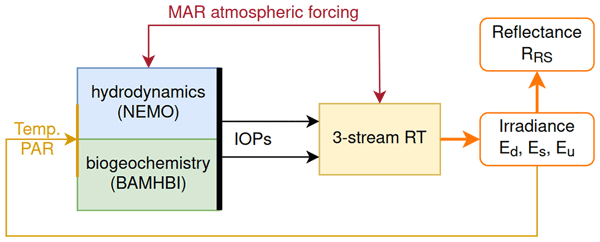
Loïc Macé, Luc Vandenbulcke, Jean-Michel Brankart, Jean-François Grailet, Pierre Brasseur, and Marilaure Grégoire
Geosci. Model Dev., 19, 9077–9102, https://doi.org/10.5194/gmd-19-9077-2026, https://doi.org/10.5194/gmd-19-9077-2026, 2026
Short summary
Short summary
We present a three-stream radiative transfer model within the NEMO (Nucleus for European Modelling of the Ocean) framework and a use case for the Black Sea. The model is able to simulate in-water irradiance and sea surface reflectance in a wide spectral range. When coupled with an ecosystem model, the simulated irradiances are used to compute water temperature and primary production. A stochastic version of this model is also proposed to inform on uncertainties in the optical properties of seawater.
Marilaure Grégoire, Gianpiero Cossarini, Corinne Derval, Elodie Gutknecht, Susan Kay, Julien Lamouroux, Helen Morrison, Coralie Perruche, Annette Samuelsen, Lena Spruch, Anna Teruzzi, Luc Vandenbulcke, Karina Von Schuckmann, and Tsuyoshi Wakamatsu
EGUsphere, https://doi.org/10.5194/egusphere-2026-813, https://doi.org/10.5194/egusphere-2026-813, 2026
Short summary
Short summary
We review the advancements in our capabilities to predict the green ocean in the frame of the European Copernicus Marine Service since its start in 2015 and for the five European seas, the Arctic and Global oceans. The evolutions of the prediction systems, delivered products and computing resources requirements are reviewed. Recommendations for future developments are proposed based on a SWOT analysis of current CMEMS green ocean prediction systems and products.

Loïc Macé, Luc Vandenbulcke, Jean-Michel Brankart, Pierre Brasseur, and Marilaure Grégoire
Biogeosciences, 22, 3747–3768, https://doi.org/10.5194/bg-22-3747-2025, https://doi.org/10.5194/bg-22-3747-2025, 2025
Short summary
Short summary
The representation of light propagation in seawater is critical for modelling marine biogeochemistry. We analyse results from a radiative transfer model that accounts for the absorption and scattering of light in the ocean with their respective uncertainties. We compare these results with in situ and remote-sensed data. Our analysis highlights the benefits of accounting for model uncertainties while using advanced representations of light in modelling frameworks.

Lauranne Alaerts, Jonathan Lambrechts, Ny Riana Randresihaja, Luc Vandenbulcke, Olivier Gourgue, Emmanuel Hanert, and Marilaure Grégoire
Earth Syst. Sci. Data, 17, 3125–3140, https://doi.org/10.5194/essd-17-3125-2025, https://doi.org/10.5194/essd-17-3125-2025, 2025
Short summary
Short summary
We created the first comprehensive, high-resolution, and easily accessible bathymetry dataset for the three main branches of the Danube Delta. By combining four data sources, we obtained a detailed representation of the riverbed, with resolutions ranging from 2 to 100 m. This dataset will support future studies on water and nutrient exchanges between the Danube and the Black Sea and provide insights into the delta's buffer role within the understudied Danube–Black Sea continuum.
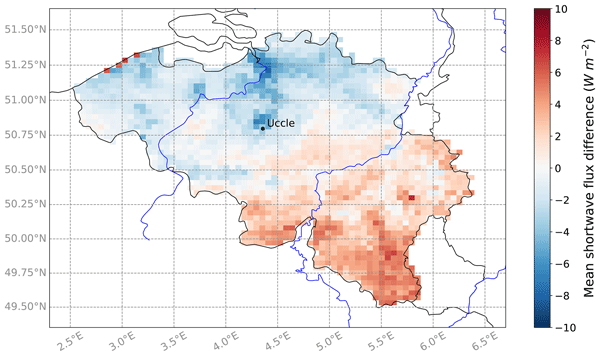
Jean-François Grailet, Robin J. Hogan, Nicolas Ghilain, David Bolsée, Xavier Fettweis, and Marilaure Grégoire
Geosci. Model Dev., 18, 1965–1988, https://doi.org/10.5194/gmd-18-1965-2025, https://doi.org/10.5194/gmd-18-1965-2025, 2025
Short summary
Short summary
The MAR (Modèle Régional Atmosphérique) is a regional climate model used for weather forecasting and studying the climate over various regions. This paper presents an update of MAR thanks to which it can precisely decompose solar radiation, in particular in the UV (ultraviolet) and photosynthesis ranges, both being critical to human health and ecosystems. As a first application of this new capability, this paper presents a method for predicting UV indices with MAR.
Ny Riana Randresihaja, Olivier Gourgue, Lauranne Alaerts, Xavier Fettweis, Jonathan Lambrechts, Miguel De Le Court, Marilaure Grégoire, and Emmanuel Hanert
EGUsphere, https://doi.org/10.5194/egusphere-2025-634, https://doi.org/10.5194/egusphere-2025-634, 2025
Preprint archived
Short summary
Short summary
Coastal areas face rising flood threats as storms intensifies with climate change. With an advanced model of the Scheldt Estuary-North Sea, we studied how detailed atmospheric data must be to predict storm surge peaks in estuaries. We found that high-resolution atmospheric data gives the best results, and coarser data with same resolution as current global climate models give poorer results. We show that investing in localized, high-resolution atmospheric data can significantly improve results.
Estrella Olmedo, Verónica González-Gambau, Antonio Turiel, Cristina González-Haro, Aina García-Espriu, Marilaure Gregoire, Aida Álvera-Azcárate, Luminita Buga, and Marie-Hélène Rio
Earth Syst. Sci. Data Discuss., https://doi.org/10.5194/essd-2021-364, https://doi.org/10.5194/essd-2021-364, 2021
Revised manuscript not accepted
Short summary
Short summary
We present the first dedicated satellite salinity product in the Black Sea. We use the measurements provided by the European Soil Moisture and Ocean Salinity mission. We introduce enhanced algorithms for dealing with the contamination produced by the Radio Frequency Interferences that strongly affect this basin. We also provide a complete quality assessment of the new product and give an estimated accuracy of it.
Loïc Macé, Luc Vandenbulcke, Jean-Michel Brankart, Jean-François Grailet, Pierre Brasseur, and Marilaure Grégoire
Geosci. Model Dev., 19, 9077–9102, https://doi.org/10.5194/gmd-19-9077-2026, https://doi.org/10.5194/gmd-19-9077-2026, 2026
Short summary
Short summary
We present a three-stream radiative transfer model within the NEMO (Nucleus for European Modelling of the Ocean) framework and a use case for the Black Sea. The model is able to simulate in-water irradiance and sea surface reflectance in a wide spectral range. When coupled with an ecosystem model, the simulated irradiances are used to compute water temperature and primary production. A stochastic version of this model is also proposed to inform on uncertainties in the optical properties of seawater.
Emil De Borger, Karline Soetaert, Esther Cepeda Gamella, Arthur Capet, Jan Vanaverbeke, and Ulrike Braeckman
EGUsphere, https://doi.org/10.5194/egusphere-2026-3576, https://doi.org/10.5194/egusphere-2026-3576, 2026
This preprint is open for discussion and under review for Biogeosciences (BG).
Short summary
Short summary
We developed a new computer model to better understand how sandy seabed sediments process organic matter. Then, we used field measurements around an offshore wind turbine in the North Sea to guide model simulations. It showed that sediments closest to turbines receive more organic material throughout the year, that is efficiently processed. This modelling approach improves our ability to quantify seabed carbon cycling in dynamic coastal environments.
Qi Liu, Karline Soetaert, Lucille Hoogerdijk, Valle Perez-Rodriguez, and Lubos Polerecky
EGUsphere, https://doi.org/10.5194/egusphere-2026-4452, https://doi.org/10.5194/egusphere-2026-4452, 2026
Short summary
Short summary
Coastal mudflats store carbon and recycle nutrients, but their functioning is strongly affected by changing environmental conditions. We developed a computer model, supported by laboratory measurements, to predict how oxygen changes under different light, temperature, and tidal conditions. Our results identify the main processes controlling oxygen cycling and provide an open-source tool for predicting how coastal ecosystems may respond to environmental change.
Olivier Beauchard and Karline Soetaert
Earth Syst. Sci. Data Discuss., https://doi.org/10.5194/essd-2026-444, https://doi.org/10.5194/essd-2026-444, 2026
Revised manuscript accepted for ESSD
Short summary
Short summary
Biological trait data often represent the bottleneck of biodiversity research. Given the growing demand for such data and the absence of worldwide data standard for the marine benthos, we propose a detailed terminology and provide a corresponding data base that covers the ecology of 1893 marine invertebrate species for 41 traits expressing life history, dwelling mode and ecosystem function.
Marilaure Grégoire, Gianpiero Cossarini, Corinne Derval, Elodie Gutknecht, Susan Kay, Julien Lamouroux, Helen Morrison, Coralie Perruche, Annette Samuelsen, Lena Spruch, Anna Teruzzi, Luc Vandenbulcke, Karina Von Schuckmann, and Tsuyoshi Wakamatsu
EGUsphere, https://doi.org/10.5194/egusphere-2026-813, https://doi.org/10.5194/egusphere-2026-813, 2026
Short summary
Short summary
We review the advancements in our capabilities to predict the green ocean in the frame of the European Copernicus Marine Service since its start in 2015 and for the five European seas, the Arctic and Global oceans. The evolutions of the prediction systems, delivered products and computing resources requirements are reviewed. Recommendations for future developments are proposed based on a SWOT analysis of current CMEMS green ocean prediction systems and products.
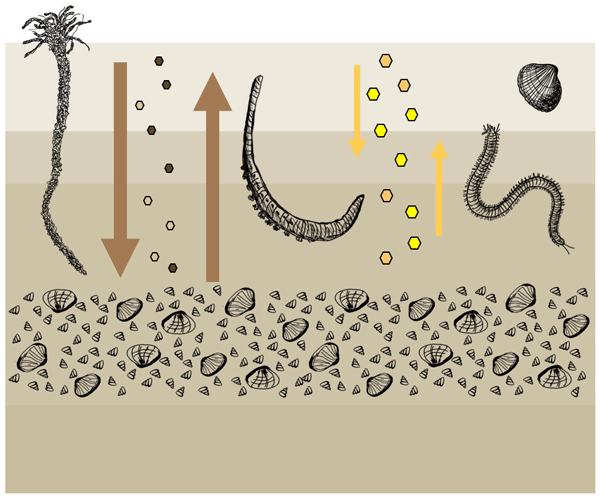
Tjitske J. Kooistra, Anna-Maartje de Boer, Tjeerd J. Bouma, Natascia Pannozzo, Stuart G. Pearson, Ad van der Spek, Henko de Stigter, Jakob Wallinga, Rob Witbaard, and Karline Soetaert
Biogeosciences, 23, 2477–2501, https://doi.org/10.5194/bg-23-2477-2026, https://doi.org/10.5194/bg-23-2477-2026, 2026
Short summary
Short summary
On intertidal flats, it is hard to distinguish sediment mixing by animals from reworking by waves and currents. We combined tracers to identify reworking of grains of different sizes on the short- and long term. Coarse (sand) grains were less mobile than fine (mud) grains, and partly kept their layering after deposition. The luminescence properties of sand grains can be used for sediment dating and can show sediment mixing, but this method needs to be tested more for young, intertidal sediments.
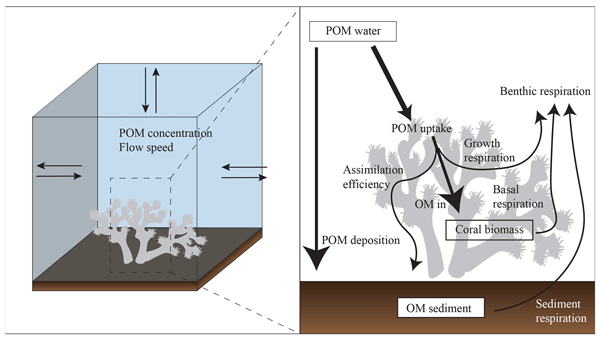
Evert de Froe, Christian Mohn, Karline Soetaert, Anna-Selma van der Kaaden, Gert-Jan Reichart, Laurence H. De Clippele, Sandra R. Maier, and Dick van Oevelen
Ocean Sci., 22, 843–870, https://doi.org/10.5194/os-22-843-2026, https://doi.org/10.5194/os-22-843-2026, 2026
Short summary
Short summary
Cold-water corals are important reef-building animals in the deep sea and are distributed globally. Until now, scientists have been mapping and predicting where cold-water corals can be found using video transects and statistical models. This study provides the first process-based model in which corals are predicted based on ocean currents and food particle movement. The results show that resupply of food by tidal currents near the seafloor is crucial for predicting where corals can grow.
Marius Buydens, Emil De Borger, Lorenz Meire, Samuel Bodé, Antonio Schirone, Karline Soetaert, Ann Vanreusel, and Ulrike Braeckman
Biogeosciences, 23, 1159–1179, https://doi.org/10.5194/bg-23-1159-2026, https://doi.org/10.5194/bg-23-1159-2026, 2026
Short summary
Short summary
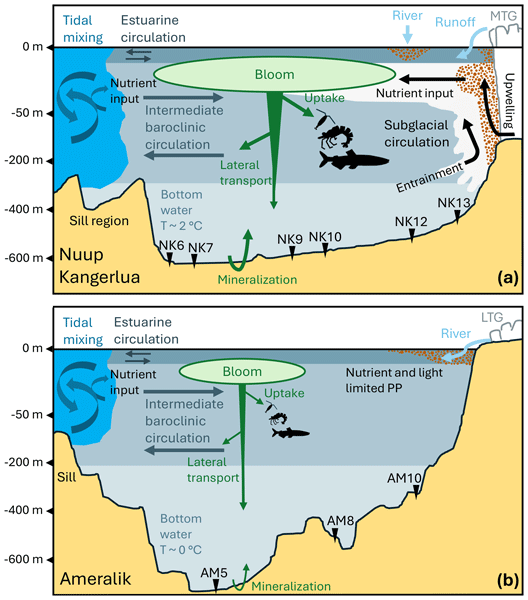
As the Greenland Ice Sheet retreats, it is crucial to understand how this affects carbon burial in fjords. Comparing a fjord influenced by marine-terminating glaciers with one fed by a land-terminating glacier shows that high productivity near marine-terminating glaciers does not necessarily enhance carbon burial. Instead, the complex interplay of physical, biological, and sedimentary processes governs fjord carbon dynamics.
Nathaelle Bouttes, Lester Kwiatkowski, Elodie Bougeot, Manon Berger, Victor Brovkin, and Guy Munhoven
Biogeosciences, 22, 4531–4544, https://doi.org/10.5194/bg-22-4531-2025, https://doi.org/10.5194/bg-22-4531-2025, 2025
Short summary
Short summary
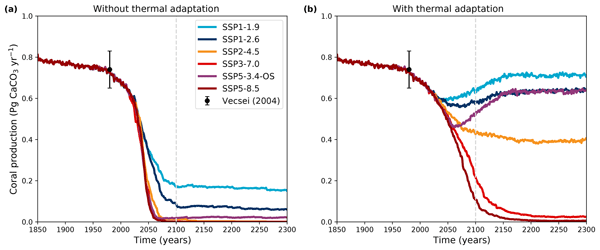
Coral reefs are under threat due to warming and ocean acidification. It is difficult to project future coral reef production due to uncertainties in climate models, socioeconomic scenarios and coral adaptation to warming. Here we have included a coral reef module within a climate model for the first time to evaluate the range of possible futures. We show that coral reef production decreases in most future scenarios, but in some cases coral reef carbonate production can persist.
Loïc Macé, Luc Vandenbulcke, Jean-Michel Brankart, Pierre Brasseur, and Marilaure Grégoire
Biogeosciences, 22, 3747–3768, https://doi.org/10.5194/bg-22-3747-2025, https://doi.org/10.5194/bg-22-3747-2025, 2025
Short summary
Short summary
The representation of light propagation in seawater is critical for modelling marine biogeochemistry. We analyse results from a radiative transfer model that accounts for the absorption and scattering of light in the ocean with their respective uncertainties. We compare these results with in situ and remote-sensed data. Our analysis highlights the benefits of accounting for model uncertainties while using advanced representations of light in modelling frameworks.
Lauranne Alaerts, Jonathan Lambrechts, Ny Riana Randresihaja, Luc Vandenbulcke, Olivier Gourgue, Emmanuel Hanert, and Marilaure Grégoire
Earth Syst. Sci. Data, 17, 3125–3140, https://doi.org/10.5194/essd-17-3125-2025, https://doi.org/10.5194/essd-17-3125-2025, 2025
Short summary
Short summary
We created the first comprehensive, high-resolution, and easily accessible bathymetry dataset for the three main branches of the Danube Delta. By combining four data sources, we obtained a detailed representation of the riverbed, with resolutions ranging from 2 to 100 m. This dataset will support future studies on water and nutrient exchanges between the Danube and the Black Sea and provide insights into the delta's buffer role within the understudied Danube–Black Sea continuum.
Mauro Cirano, Enrique Alvarez-Fanjul, Arthur Capet, Stefania Ciliberti, Emanuela Clementi, Boris Dewitte, Matias Dinápoli, Ghada El Serafy, Patrick Hogan, Sudheer Joseph, Yasumasa Miyazawa, Ivonne Montes, Diego A. Narvaez, Heather Regan, Claudia G. Simionato, Gregory C. Smith, Joanna Staneva, Clemente A. S. Tanajura, Pramod Thupaki, Claudia Urbano-Latorre, Jennifer Veitch, and Jorge Zavala Hidalgo
State Planet, 5-opsr, 5, https://doi.org/10.5194/sp-5-opsr-5-2025, https://doi.org/10.5194/sp-5-opsr-5-2025, 2025
Short summary
Short summary
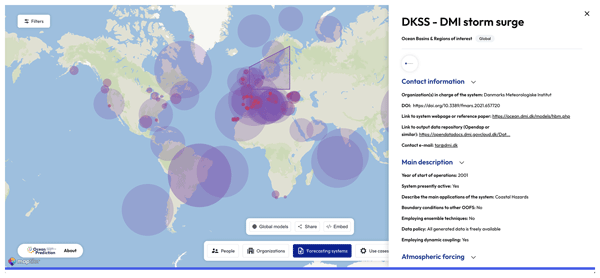
Operational ocean forecasting systems (OOFSs) are crucial for human activities, environmental monitoring, and policymaking. An assessment across eight key regions highlights strengths and gaps, particularly in coastal and biogeochemical forecasting. AI offers improvements, but collaboration, knowledge sharing, and initiatives like the OceanPrediction Decade Collaborative Centre (DCC) are key to enhancing accuracy, accessibility, and global forecasting capabilities.

Jennifer Veitch, Enrique Alvarez-Fanjul, Arthur Capet, Stefania Ciliberti, Mauro Cirano, Emanuela Clementi, Fraser Davidson, Ghada el Serafy, Guilherme Franz, Patrick Hogan, Sudheer Joseph, Svitlana Liubartseva, Yasumasa Miyazawa, Heather Regan, and Katerina Spanoudaki
State Planet, 5-opsr, 6, https://doi.org/10.5194/sp-5-opsr-6-2025, https://doi.org/10.5194/sp-5-opsr-6-2025, 2025
Short summary
Short summary
Ocean forecast systems provide information about a future state of the ocean. This information is provided in the form of decision support tools, or downstream applications, that can be accessed by various stakeholders to support livelihoods, coastal resilience and the good governance of the marine environment. This paper provides an overview of the various downstream applications of ocean forecast systems that are utilized around the world.
Uwe Mikolajewicz, Marie-Luise Kapsch, Clemens Schannwell, Katharina D. Six, Florian A. Ziemen, Meike Bagge, Jean-Philippe Baudouin, Olga Erokhina, Veronika Gayler, Volker Klemann, Virna L. Meccia, Anne Mouchet, and Thomas Riddick
Clim. Past, 21, 719–751, https://doi.org/10.5194/cp-21-719-2025, https://doi.org/10.5194/cp-21-719-2025, 2025
Short summary
Short summary
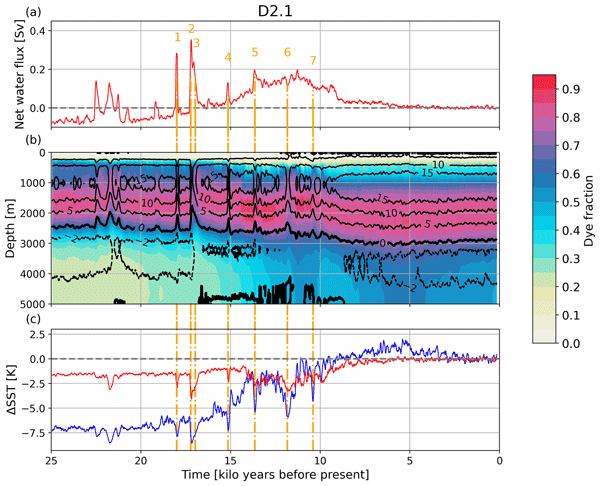
A fully coupled atmosphere–ocean–ice-sheet–solid-earth model was applied to simulate the time from the Last Glacial Maximum (about 25 000 years before the present) to the pre-industrial period. The model simulations are compared to observational estimates. During this climate transition, the model simulates several abrupt changes in the North Atlantic region, which are initiated by different processes. The underlying mechanisms are analysed and described.
Jean-François Grailet, Robin J. Hogan, Nicolas Ghilain, David Bolsée, Xavier Fettweis, and Marilaure Grégoire
Geosci. Model Dev., 18, 1965–1988, https://doi.org/10.5194/gmd-18-1965-2025, https://doi.org/10.5194/gmd-18-1965-2025, 2025
Short summary
Short summary
The MAR (Modèle Régional Atmosphérique) is a regional climate model used for weather forecasting and studying the climate over various regions. This paper presents an update of MAR thanks to which it can precisely decompose solar radiation, in particular in the UV (ultraviolet) and photosynthesis ranges, both being critical to human health and ecosystems. As a first application of this new capability, this paper presents a method for predicting UV indices with MAR.
Ying Ye, Guy Munhoven, Peter Köhler, Martin Butzin, Judith Hauck, Özgür Gürses, and Christoph Völker
Geosci. Model Dev., 18, 977–1000, https://doi.org/10.5194/gmd-18-977-2025, https://doi.org/10.5194/gmd-18-977-2025, 2025
Short summary
Short summary
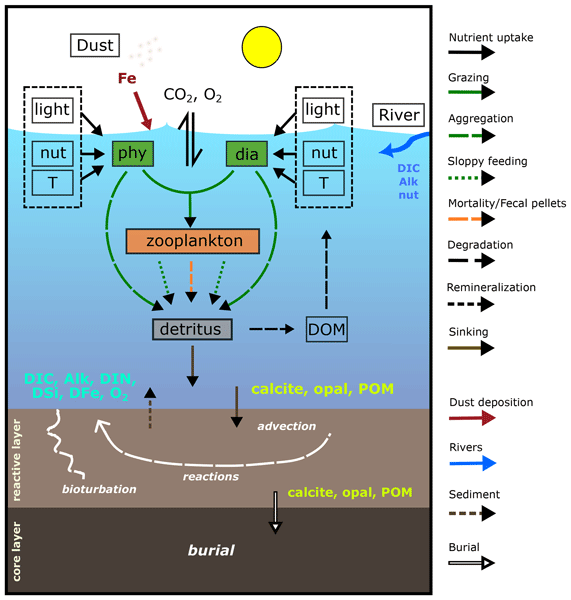
Many biogeochemistry models assume all material reaching the seafloor is remineralized and returned to solution, which is sufficient for studies on short-term climate change. Under long-term climate change, the carbon storage in sediments slows down carbon cycling and influences feedbacks in the atmosphere–ocean–sediment system. This paper describes the coupling of a sediment model to an ocean biogeochemistry model and presents results under the pre-industrial climate and under CO2 perturbation.
Ny Riana Randresihaja, Olivier Gourgue, Lauranne Alaerts, Xavier Fettweis, Jonathan Lambrechts, Miguel De Le Court, Marilaure Grégoire, and Emmanuel Hanert
EGUsphere, https://doi.org/10.5194/egusphere-2025-634, https://doi.org/10.5194/egusphere-2025-634, 2025
Preprint archived
Short summary
Short summary
Coastal areas face rising flood threats as storms intensifies with climate change. With an advanced model of the Scheldt Estuary-North Sea, we studied how detailed atmospheric data must be to predict storm surge peaks in estuaries. We found that high-resolution atmospheric data gives the best results, and coarser data with same resolution as current global climate models give poorer results. We show that investing in localized, high-resolution atmospheric data can significantly improve results.

Mohamed Ayache, Jean-Claude Dutay, Anne Mouchet, Kazuyo Tachikawa, Camille Risi, and Gilles Ramstein
Geosci. Model Dev., 17, 6627–6655, https://doi.org/10.5194/gmd-17-6627-2024, https://doi.org/10.5194/gmd-17-6627-2024, 2024
Short summary
Short summary
Water isotopes (δ18O, δD) are one of the most widely used proxies in ocean climate research. Previous studies using water isotope observations and modelling have highlighted the importance of understanding spatial and temporal isotopic variability for a quantitative interpretation of these tracers. Here we present the first results of a high-resolution regional dynamical model (at 1/12° horizontal resolution) developed for the Mediterranean Sea, one of the hotspots of ongoing climate change.

Nathaelle Bouttes, Lester Kwiatkowski, Manon Berger, Victor Brovkin, and Guy Munhoven
Geosci. Model Dev., 17, 6513–6528, https://doi.org/10.5194/gmd-17-6513-2024, https://doi.org/10.5194/gmd-17-6513-2024, 2024
Short summary
Short summary
Coral reefs are crucial for biodiversity, but they also play a role in the carbon cycle on long time scales of a few thousand years. To better simulate the future and past evolution of coral reefs and their effect on the global carbon cycle, hence on atmospheric CO2 concentration, it is necessary to include coral reefs within a climate model. Here we describe the inclusion of coral reef carbonate production in a carbon–climate model and its validation in comparison to existing modern data.
Anna-Selma van der Kaaden, Dick van Oevelen, Christian Mohn, Karline Soetaert, Max Rietkerk, Johan van de Koppel, and Theo Gerkema
Ocean Sci., 20, 569–587, https://doi.org/10.5194/os-20-569-2024, https://doi.org/10.5194/os-20-569-2024, 2024
Short summary
Short summary
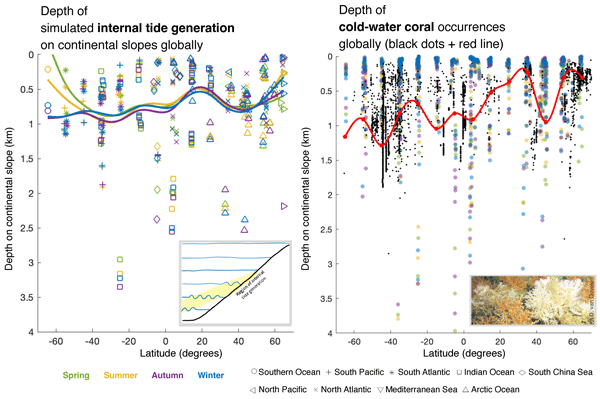
Cold-water corals (CWCs) and tidal waves in the interior of the ocean have been connected in case studies. We demonstrate this connection globally using hydrodynamic simulations and a CWC database. Internal-tide generation shows a similar depth pattern with slope steepness and latitude as CWCs. Our results suggest that internal-tide generation can be a useful predictor of CWC habitat and that current CWC habitats might change following climate-change-related shoaling of internal-tide generation.
Anna-Selma van der Kaaden, Sandra R. Maier, Siluo Chen, Laurence H. De Clippele, Evert de Froe, Theo Gerkema, Johan van de Koppel, Furu Mienis, Christian Mohn, Max Rietkerk, Karline Soetaert, and Dick van Oevelen
Biogeosciences, 21, 973–992, https://doi.org/10.5194/bg-21-973-2024, https://doi.org/10.5194/bg-21-973-2024, 2024
Short summary
Short summary
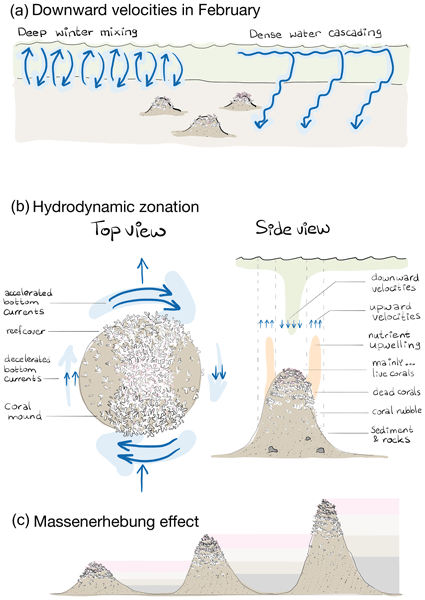
Combining hydrodynamic simulations and annotated videos, we separated which hydrodynamic variables that determine reef cover are engineered by cold-water corals and which are not. Around coral mounds, hydrodynamic zones seem to create a typical reef zonation, restricting corals from moving deeper (the expected response to climate warming). But non-engineered downward velocities in winter (e.g. deep winter mixing) seem more important for coral reef growth than coral engineering.
Mikhail Popov, Jean-Michel Brankart, Arthur Capet, Emmanuel Cosme, and Pierre Brasseur
Ocean Sci., 20, 155–180, https://doi.org/10.5194/os-20-155-2024, https://doi.org/10.5194/os-20-155-2024, 2024
Short summary
Short summary
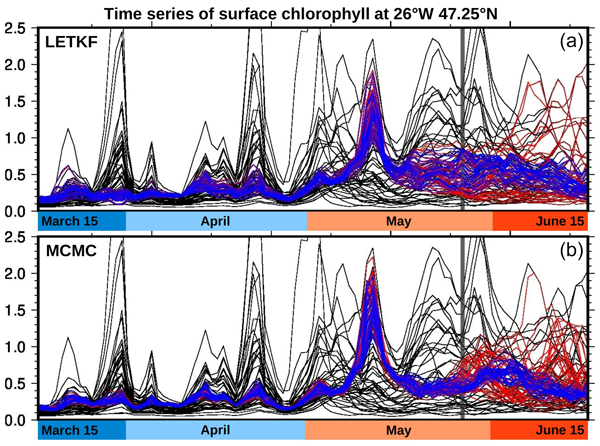
This study contributes to the development of methods to estimate targeted ocean ecosystem indicators, including their uncertainty, in the framework of the Copernicus Marine Service. A simplified approach is introduced to perform a 4D ensemble analysis and forecast, directly targeting selected biogeochemical variables and indicators (phenology, trophic efficiency, downward flux of organic matter). Care is taken to present the methods and discuss the reliability of the solution proposed.
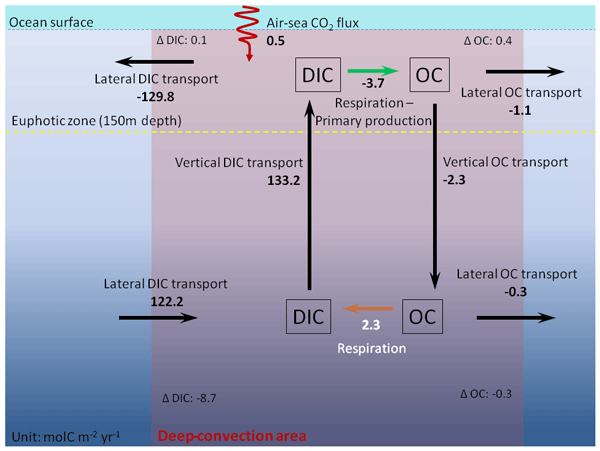
Caroline Ulses, Claude Estournel, Patrick Marsaleix, Karline Soetaert, Marine Fourrier, Laurent Coppola, Dominique Lefèvre, Franck Touratier, Catherine Goyet, Véronique Guglielmi, Fayçal Kessouri, Pierre Testor, and Xavier Durrieu de Madron
Biogeosciences, 20, 4683–4710, https://doi.org/10.5194/bg-20-4683-2023, https://doi.org/10.5194/bg-20-4683-2023, 2023
Short summary
Short summary
Deep convection plays a key role in the circulation, thermodynamics, and biogeochemical cycles in the Mediterranean Sea, considered to be a hotspot of biodiversity and climate change. In this study, we investigate the seasonal and annual budget of dissolved inorganic carbon in the deep-convection area of the northwestern Mediterranean Sea.
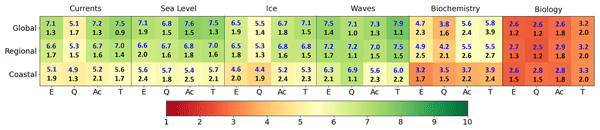
Stefania A. Ciliberti, Enrique Alvarez Fanjul, Jay Pearlman, Kirsten Wilmer-Becker, Pierre Bahurel, Fabrice Ardhuin, Alain Arnaud, Mike Bell, Segolene Berthou, Laurent Bertino, Arthur Capet, Eric Chassignet, Stefano Ciavatta, Mauro Cirano, Emanuela Clementi, Gianpiero Cossarini, Gianpaolo Coro, Stuart Corney, Fraser Davidson, Marie Drevillon, Yann Drillet, Renaud Dussurget, Ghada El Serafy, Katja Fennel, Marcos Garcia Sotillo, Patrick Heimbach, Fabrice Hernandez, Patrick Hogan, Ibrahim Hoteit, Sudheer Joseph, Simon Josey, Pierre-Yves Le Traon, Simone Libralato, Marco Mancini, Pascal Matte, Angelique Melet, Yasumasa Miyazawa, Andrew M. Moore, Antonio Novellino, Andrew Porter, Heather Regan, Laia Romero, Andreas Schiller, John Siddorn, Joanna Staneva, Cecile Thomas-Courcoux, Marina Tonani, Jose Maria Garcia-Valdecasas, Jennifer Veitch, Karina von Schuckmann, Liying Wan, John Wilkin, and Romane Zufic
State Planet, 1-osr7, 2, https://doi.org/10.5194/sp-1-osr7-2-2023, https://doi.org/10.5194/sp-1-osr7-2-2023, 2023
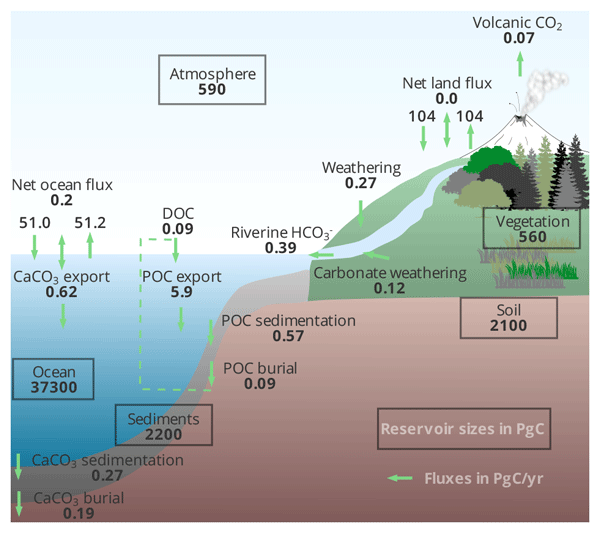
Matteo Willeit, Tatiana Ilyina, Bo Liu, Christoph Heinze, Mahé Perrette, Malte Heinemann, Daniela Dalmonech, Victor Brovkin, Guy Munhoven, Janine Börker, Jens Hartmann, Gibran Romero-Mujalli, and Andrey Ganopolski
Geosci. Model Dev., 16, 3501–3534, https://doi.org/10.5194/gmd-16-3501-2023, https://doi.org/10.5194/gmd-16-3501-2023, 2023
Short summary
Short summary
In this paper we present the carbon cycle component of the newly developed fast Earth system model CLIMBER-X. The model can be run with interactive atmospheric CO2 to investigate the feedbacks between climate and the carbon cycle on temporal scales ranging from decades to > 100 000 years. CLIMBER-X is expected to be a useful tool for studying past climate–carbon cycle changes and for the investigation of the long-term future evolution of the Earth system.
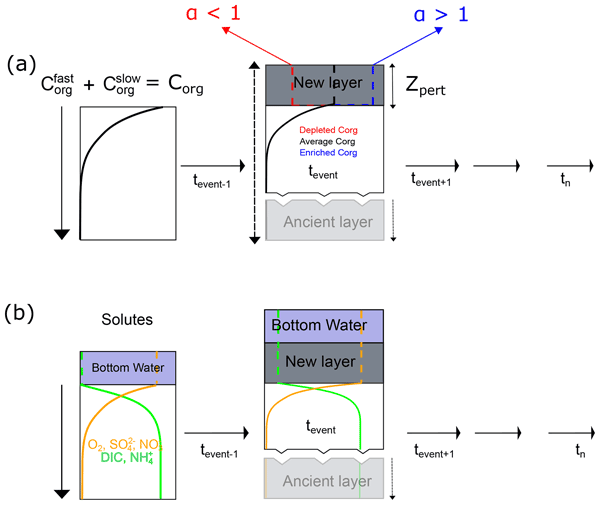
Stanley I. Nmor, Eric Viollier, Lucie Pastor, Bruno Lansard, Christophe Rabouille, and Karline Soetaert
Geosci. Model Dev., 15, 7325–7351, https://doi.org/10.5194/gmd-15-7325-2022, https://doi.org/10.5194/gmd-15-7325-2022, 2022
Short summary
Short summary
The coastal marine environment serves as a transition zone in the land–ocean continuum and is susceptible to episodic phenomena such as flash floods, which cause massive organic matter deposition. Here, we present a model of sediment early diagenesis that explicitly describes this type of deposition while also incorporating unique flood deposit characteristics. This model can be used to investigate the temporal evolution of marine sediments following abrupt changes in environmental conditions.

Justin C. Tiano, Jochen Depestele, Gert Van Hoey, João Fernandes, Pieter van Rijswijk, and Karline Soetaert
Biogeosciences, 19, 2583–2598, https://doi.org/10.5194/bg-19-2583-2022, https://doi.org/10.5194/bg-19-2583-2022, 2022
Short summary
Short summary
This study gives an assessment of bottom trawling on physical, chemical, and biological characteristics in a location known for its strong currents and variable habitats. Although trawl gears only removed the top 1 cm of the seabed surface, impacts on reef-building tubeworms significantly decreased carbon and nutrient cycling. Lighter trawls slightly reduced the impact on fauna and nutrients. Tubeworms were strongly linked to biogeochemical and faunal aspects before but not after trawling.
Alice E. Webb, Didier M. de Bakker, Karline Soetaert, Tamara da Costa, Steven M. A. C. van Heuven, Fleur C. van Duyl, Gert-Jan Reichart, and Lennart J. de Nooijer
Biogeosciences, 18, 6501–6516, https://doi.org/10.5194/bg-18-6501-2021, https://doi.org/10.5194/bg-18-6501-2021, 2021
Short summary
Short summary
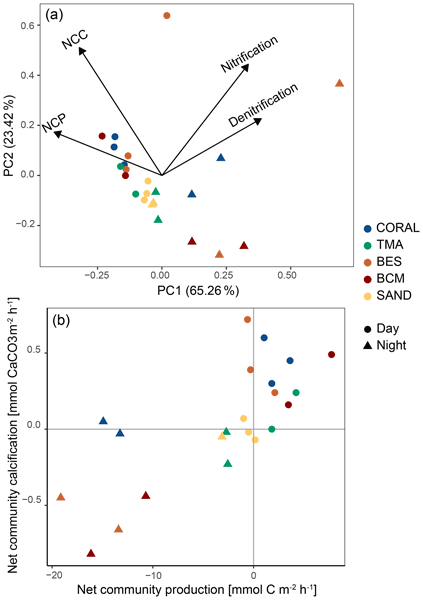
The biogeochemical behaviour of shallow reef communities is quantified to better understand the impact of habitat degradation and species composition shifts on reef functioning. The reef communities investigated barely support reef functions that are usually ascribed to conventional coral reefs, and the overall biogeochemical behaviour is found to be similar regardless of substrate type. This suggests a decrease in functional diversity which may therefore limit services provided by this reef.
Estrella Olmedo, Verónica González-Gambau, Antonio Turiel, Cristina González-Haro, Aina García-Espriu, Marilaure Gregoire, Aida Álvera-Azcárate, Luminita Buga, and Marie-Hélène Rio
Earth Syst. Sci. Data Discuss., https://doi.org/10.5194/essd-2021-364, https://doi.org/10.5194/essd-2021-364, 2021
Revised manuscript not accepted
Short summary
Short summary
We present the first dedicated satellite salinity product in the Black Sea. We use the measurements provided by the European Soil Moisture and Ocean Salinity mission. We introduce enhanced algorithms for dealing with the contamination produced by the Radio Frequency Interferences that strongly affect this basin. We also provide a complete quality assessment of the new product and give an estimated accuracy of it.
Chiu H. Cheng, Jaco C. de Smit, Greg S. Fivash, Suzanne J. M. H. Hulscher, Bas W. Borsje, and Karline Soetaert
Earth Surf. Dynam., 9, 1335–1346, https://doi.org/10.5194/esurf-9-1335-2021, https://doi.org/10.5194/esurf-9-1335-2021, 2021
Short summary
Short summary
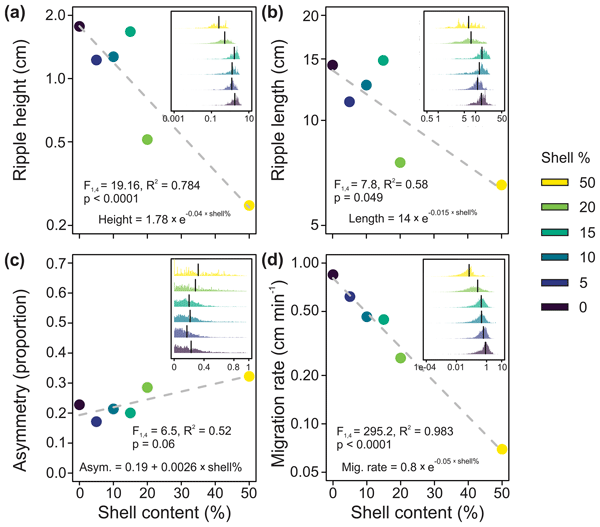
Shells are biogenic particles that are widespread throughout natural sandy environments and can affect the bed roughness and seabed erodibility. As studies are presently lacking, we experimentally measured ripple formation and migration using natural sand with increasing volumes of shell material under unidirectional flow in a racetrack flume. We show that shells expedite the onset of sediment transport, reduce ripple dimensions and slow their migration rate.
Cited articles
Aumont, O., Ethé, C., Tagliabue, A., Bopp, L., and Gehlen, M.: PISCES-v2: an ocean biogeochemical model for carbon and ecosystem studies, Geosci. Model Dev., 8, 2465–2513, https://doi.org/10.5194/gmd-8-2465-2015, 2015. a, b
Billen, G. and Fontigny, A.: Dynamics of a phaeocystis-dominated spring bloom in belgian coastal waters. II. Bacterio-plankton dynamics, Marine Ecology Progress Series, 37, 249–257, 1987. a
Butenschön, M., Clark, J., Aldridge, J. N., Allen, J. I., Artioli, Y., Blackford, J., Bruggeman, J., Cazenave, P., Ciavatta, S., Kay, S., Lessin, G., van Leeuwen, S., van der Molen, J., de Mora, L., Polimene, L., Sailley, S., Stephens, N., and Torres, R.: ERSEM 15.06: a generic model for marine biogeochemistry and the ecosystem dynamics of the lower trophic levels, Geosci. Model Dev., 9, 1293–1339, https://doi.org/10.5194/gmd-9-1293-2016, 2016. a, b
Capet, A., Beckers, J.-M., and Grégoire, M.: Drivers, mechanisms and long-term variability of seasonal hypoxia on the Black Sea northwestern shelf – is there any recovery after eutrophication?, Biogeosciences, 10, 3943–3962, https://doi.org/10.5194/bg-10-3943-2013, 2013. a, b, c, d
Capet, A., Meysman, F. J. R., Akoumianaki, I., Soetaert, K., and Grégoire, M.: Integrating sediment biogeochemistry into 3D oceanic models : A study of benthic-pelagic coupling in the Black Sea, Ocean Modelling, 101, 83–100, https://doi.org/10.1016/j.ocemod.2016.03.006, 2016. a, b, c
Choblet, M.: mchoblet/benthic_model_assessment: GMD paper figure, Zenodo [code], https://doi.org/10.5281/zenodo.18684398, 2026. a
Ciliberti, S., Grégoire, M., Staneva, J., Palazov, A., Coppini, G., Lecci, R., Peneva, E., Matreata, M., Marinova, V., Masina, S., Pinardi, N., Jansen, E., Lima, L., Aydoğdu, A., Creti, S., Stefanizzi, L., Azevedo, D., Causio, S., Vandenbulcke, L., Capet, A., Meulders, C., Ivanov, E., Behrens, A., Ricker, M., Gayer, G., Palermo, F., Ilicak, M., Gunduz, M., Valcheva, N., and Agostini, P.: Monitoring and Forecasting the Ocean State and Biogeochemical Processes in the Black Sea: Recent Developments in the Copernicus Marine Service, Journal of Marine Science and Engineering, 9, 1146, https://doi.org/10.3390/jmse9101146, 2021. a
Cossarini, G., Querin, S., Solidoro, C., Sannino, G., Lazzari, P., Di Biagio, V., and Bolzon, G.: Development of BFMCOUPLER (v1.0), the coupling scheme that links the MITgcm and BFM models for ocean biogeochemistry simulations, Geosci. Model Dev., 10, 1423–1445, https://doi.org/10.5194/gmd-10-1423-2017, 2017. a
Daewel, U., Schrum, C., and Macdonald, J. I.: Towards end-to-end (E2E) modelling in a consistent NPZD-F modelling framework (ECOSMO E2E_v1.0): application to the North Sea and Baltic Sea, Geosci. Model Dev., 12, 1765–1789, https://doi.org/10.5194/gmd-12-1765-2019, 2019. a
Dmitriev, E. V., Khomenko, G., Chami, M., Sokolov, A. A., Churilova, T. Y., and Korotaev, G. K.: Parameterization of light absorption by components of seawater in optically complex coastal waters of the Crimea Peninsula (Black Sea), Appl. Opt., 48, 1249–1261, https://doi.org/10.1364/AO.48.001249, 2009. a
Doerffer, R. and Schiller, H.: The MERIS case 2 water algorithm, International Journal of Remote Sensing, 28, 517–535, 2007. a
Droop, M.: 25 years of algal grwth linetics – personal view, Botanica Marina, 26, 99–112, 1983. a
Dutkiewicz, S., Hickman, A. E., Jahn, O., Gregg, W. W., Mouw, C. B., and Follows, M. J.: Capturing optically important constituents and properties in a marine biogeochemical and ecosystem model, Biogeosciences, 12, 4447–4481, https://doi.org/10.5194/bg-12-4447-2015, 2015. a
Gayer, G., Dick, S., Pleskachevsky, A., and Rosenthal, W.: Numerical modeling of suspended matter transport in the North Sea., Ocean Dynamics, 56, 62–77, https://doi.org/10.1007/s10236-006-0070-5, 2006. a
Geider, R., H., M., and Kana, T.: A dynamic regulatory model of phytoplankton acclimation to light, nutrients and temperature, Limnology and Oceanography, 43, 679–694, https://doi.org/10.1016/S0012-8252(00)00004-0, 1998. a
Grégoire, M. and Soetaert, K.: Carbon, nitrogen, oxygen and sulfide budgets in the Black Sea: A biogeochemical model of the whole water column coupling the oxic and anoxic parts, Ecological Modelling, 221, 2287–2301, https://doi.org/10.1016/j.ecolmodel.2010.06.007, 2010. a
Grégoire, M. and Vandenbulcke, L.: BiogeochemicAl Model for Hypoxic and Benthic Influenced areas (BAMHBI) v1.0.1, Zenodo [code], https://doi.org/10.5281/zenodo.16964655, 2025. a
Grégoire, M., Raick, C., and Soetaert, K.: Numerical modeling of the central Black Sea ecosystem functioning during the eutrophication phase, Progress in Oceanography, 76, 286–333, https://doi.org/10.1016/j.pocean.2008.01.002, 2008. a, b, c
Hedges, J., Hu, F., Devol, A., Hartnett, H., Tsamakis, E., and Keil, R.: Sedimentary organic matter preservation: A test for selective degradation under oxic conditions, Am. J. Sci., 299, 529–555, 1999. a
Hersbach, H., Bell, B., Berrisford, P., Hirahara, S., Horányi, A., Muñoz Sabater, J., Nicolas, J., Peubey, C., Radu, R., Schepers, D., Simmons, A., Soci, C., Abdalla, S., Abellan, X., Balsamo, G., Bechtold, P., Biavati, G., Bidlot, J., Bonavita, M., and Thépaut, J.-N.: The ERA5 global reanalysis, Q. J. R. Meteorol. Soc., https://doi.org/10.1002/qj.3803, 2020. a
Ho, D. T., Law, C. S., Smith, M. J., Schlosser, P., Harvey, M., and Hill, P.: Measurements of air-sea gas exchange at high wind speeds in the Southern Ocean: implications for global parameterizations, Geophys. Res. Lett., 33, 16611, https://doi.org/10.1029/2006GL026817, 2006. a
Hofmann, A. F., Meysman, F. J. R., Soetaert, K., and Middelburg, J. J.: A step-by-step procedure for pH model construction in aquatic systems, Biogeosciences, 5, 227–251, https://doi.org/10.5194/bg-5-227-2008, 2008. a
Khalil, K., Rabouille, C., Gallinari, M., Soetaert, K., DeMaster, D., and Ragueneau, O.: Constraining biogenic silica dissolution in marine sediments: A comparison between diagenetic models and experimental dissolution rates, Marine Chemistry, 106, 223–238, 2007. a
Kowalczuk, P., Cooper, W. J., Whitehead, R. F., Durako, M. J., and Sheldon, W.: Characterization of CDOM in an organic-rich river and surrounding coastal ocean in the South Atlantic Bight, Aquatic Sciences, 65, 384–401, 2003. a
Kremer, P.: Respiration and excretion by the ctenophore Mnemiopsis leidyi, Marine Biology, 44, 20–43, 1977. a
Lancelot, C., Staneva, J., Van Eeckhout, D., Beckers, J., and Stanev, E.: Modelling the Danube-influenced North-western Continental Shelf of the Black Sea. II: Ecosystem Response to Changes in Nutrient Delivery by Danube River after its damming in 1972, Estuarine, Coastal and Shelf Science, 54, 473–499, 2002. a, b
Laws, E. and Wong, D.: Studies on carbon andnitrogen metabolism by three marine phytoplankton species in nitrate-limited continuous culture, Journal of Phycology, 14, 406–416, 1978. a
Lee, Z.-P., Du, K.-P., and Arnone, R.: A model for the diffuse attenuation coefficient of downwelling irradiance, Journal of Geophysical Research, 110, C02016, https://doi.org/10.1029/2004JC002275, 2005. a, b
Lenstra, W. K., Hermans, M., Séguret, M. J. M., Witbaard, R., Behrends, T., Dijkstra, N., van Helmond, N. A. G. M., Kraal, P., Laan, P., Rijkenberg, M. J. A., Severmann, S., Teaca, A., and Slomp, C. P.: The shelf-to-basin iron shuttle in the Black Sea revisited, Chem. Geol., 511, 314–341, https://doi.org/10.1016/j.chemgeo.2018.10.024, 2019. a, b
Lewis, E. and Wallace, D. W. R.: Program Developed for CO2 System Calculations, ORNL/CDIAC-105. Carbon Dioxide Information Analysis Center, Oak Ridge National Laboratory, U.S. Department of Energy, Oak Ridge, Tennessee, https://doi.org/10.15485/1464255, 1998. a
Lichtschlag, A., Donis, D., Janssen, F., Jessen, G. L., Holtappels, M., Wenzhöfer, F., Mazlumyan, S., Sergeeva, N., Waldmann, C., and Boetius, A.: Effects of fluctuating hypoxia on benthic oxygen consumption in the Black Sea (Crimean shelf), Biogeosciences, 12, 5075–5092, https://doi.org/10.5194/bg-12-5075-2015, 2015. a, b
Macé, L., Vandenbulcke, L., Brankart, J.-M., Brasseur, P., and Grégoire, M.: Characterisation of uncertainties in an ocean radiative transfer model for the Black Sea through ensemble simulations, Biogeosciences, 22, 3747–3768, https://doi.org/10.5194/bg-22-3747-2025, 2025a. a
Macé, L., Vandenbulcke, L., Brankart, J.-M., Grailet, J.-F., Brasseur, P., and Grégoire, M.: Three-stream modelling of radiative transfer for the simulation of Black Sea biogeochemistry in a NEMO framework, EGUsphere [preprint], https://doi.org/10.5194/egusphere-2025-4973, 2025b. a
Mague, T., Friberg, E., Hughes, D., and Morris, I.: Extracellular release of carbon by marine phytoplankton: a physiological approach., Limnology and Oceanography, 25, 262–279, 1980. a
Mee, L., Friedrich, J., and Gomoiu, M.-T.: Restoring the Black Sea in times of uncertainty, Oceanography, 18, 32–43, 2005. a
Middelburg, J. and Meysman, F.: Burial at Sea, Science, 18, 1775–1810, https://doi.org/10.1126/science.1144001, 2007. a
Mishonov, A. V., Boyer, T. P., Baranova, O. K., Bouchard, C. N., Cross, S. L., Garcia, H. E., Locarnini, R. A., Paver, C. R., Reagan, J. R., Wang, Z., Seidov, D., Grodsky, A. I., and Beauchamp, J. G.: World Ocean Database 2023, National Centers for Environmental Information (U.S.), https://doi.org/10.25923/z885-h264, 2024. a, b, c, d, e, f
Muramoto, J., Honjo, S., Fry, B., Hay, B., Howarth, R., and Cisne, J.: Sulfur, iron and organic carbon fluxes in the Black Sea : sulfur isotopic evidence for origin of sulfur fluxes, Deep Sea Research II, 38, 1151–1188, 1991. a
Nakamura, Y.: Growth and grazing of a large heterotrophic dinoflagellate, Noctiluca scintillans, in laboratory cultures, Journal of Plankton Research, 20, 1711–1720, 1998. a
Raick, C., Delhez, E., Soetaert, K., and Gregoire, M.: Study of the seasonal cycle of the biogeochemical processes in the Ligurian Sea using an 1D interdisciplinary model, Journal of Marine Systems, 55, 177–203, https://doi.org/10.1016/j.jmarsys.2004.09.005, 2005. a
Raick, C., Soetaert, K., and Grégoire, M.: Model complexity and performance: how far can we simplify?, Progress in Oceanography, 70, 27–57, https://doi.org/10.1016/j.pocean.2006.03.001, 2006. a
Ricour, F., Capet, A., D'Ortenzio, F., Delille, B., and Grégoire, M.: Dynamics of the deep chlorophyll maximum in the Black Sea as depicted by BGC-Argo floats, Biogeosciences, 18, 755–774, https://doi.org/10.5194/bg-18-755-2021, 2021. a
Smith, C. and Tett, P.: A depth–resolving numerical model of physically forced microbiology at the European shelf edge, Journal of Marine Systems, 26, 1–36, 2000. a
Soetaert, K., Herman, P. M. J., Middelburg, J. J., Heip, C., Smith, C. L., Tett, P., and Wild-Allen, K.: Numerical modelling of the shelf break ecosystem: reproducing benthic and pelagic measurements, Deep Sea Research Part II: Topical Studies in Oceanography, 48, 3141–3177, https://doi.org/10.1016/S0967-0645(01)00035-2, 2001. a, b
Soulsby, R.: Dynamics of marine sands: a manual for practical applications, Oceanographic Literature Review, 9, 947, ISBN 978-0-7277-2584-X, 1997. a
Stanev, E. and Kandilarov, R.: Sediment dynamics in the Black Sea: numerical modelling and remote sensing observations, Ocean dynamics, 62, 533–553, https://doi.org/10.1007/s10236-012-0520-1, 2012. a, b
Tett, P.: Parameterising a microplankton model, Napier University, ISBN 0 902703 60 9, 1998. a
Van Cappellen, P., Dixit, S., and van Beusekom, J.: Biogenic silica dissolution in the oceans: reconciling experimental and field-based dissolution rates, Global Biogeochemical Cycles, 16, 1075, https://doi.org/10.1029/2001GB001431, 2002. a
Vandenbulcke, L. and Grailet, J.-F.: BAMHBI stable, GitLab repository [code], https://gitlab.uliege.be/ESPECES/MAST/bamhbi-stable (last access: 19 February 2026), 2025. a
Wanninkhof, R.: Relationship between wind speed and gas exchange over the ocean, Journal of Geophysical Research, 97, 7373–7382, 1992. a
Wijsman, J., Herman, P., Middelburg, J. J., and Soetaert, K. E.: A model for early diagenetic processes in sediments of the continental shelf of the Black Sea, Estuarine Coastal and Shelf Science, 54, 403–421, https://doi.org/10.1006/ecss.2000.0655, 2002. a, b
Williams, P.: The importance of losses duringn microbial growth: commentary on the physiology, measurement and ecology of the release of dissolved organic material, Marine Microbial Food Webs, 4, 175–206, 1990. a
Wolf-Gladrow, D. and Riebesell, U.: Diffusion and reactions in the vicinity of plankton: a refined model for inorganic carbon transport, Marine Chemistry, 59, 17–34, https://doi.org/10.1016/S0304-4203(97)00069-8, 1997. a
Xu, J., Hood, R. R., and Chao, S.-Y.: A simple empirical optical model for simulating light attenuation variability in a partially mixed estuary, Estuaries, 28, 572–580, 2005. a
Zaitsev, Y.: Impact of eutrophication on the Black Sea fauna, General Fisheries Council for the Mediterranean, Tech.Rep., FAO, Rome, vol. 64, 63–86, 1993. a
Short summary
This paper describes the ocean BiogeochemicAl Model for Hypoxic and Benthic Influenced areas (BAMHBI). BAMHBI is a moderate complexity marine biogeochemical model that describes the cycling of carbon, nitrogen, phosphorus, silicon and oxygen through the marine foodweb. BAMHBI is a stand-alone biogeochemical model that can be coupled to any hydrodynamical model and is particularly appropriate for modelling low oxygen environments and the generation of sulfidic waters.
This paper describes the ocean BiogeochemicAl Model for Hypoxic and Benthic Influenced areas...


