
Articles | Volume 19, issue 3
https://doi.org/10.5194/gmd-19-1157-2026
© Author(s) 2026. This work is distributed under
the Creative Commons Attribution 4.0 License.
the Creative Commons Attribution 4.0 License.
https://doi.org/10.5194/gmd-19-1157-2026
© Author(s) 2026. This work is distributed under
the Creative Commons Attribution 4.0 License.
the Creative Commons Attribution 4.0 License.
Model description paper
| 
04 Feb 2026
Model description paper |
| 04 Feb 2026
| 04 Feb 2026
The Western United States Large Forest-Fire Stochastic Simulator (WULFFSS) 1.0: a monthly gridded forest-fire model using interpretable statistics
A. Park Williams
CORRESPONDING AUTHOR

Department of Geography, University of California, Los Angeles, Los Angeles, CA, USA
Department of Atmospheric and Oceanic Sciences, University of California, Los Angeles, Los Angeles, CA, USA
Lamont-Doherty Earth Observatory of Columbia University, Palisades, NY, USA
Winslow D. Hansen
Cary Institute of Ecosystem Studies, Millbrook, NY, USA
Caroline S. Juang
Lamont-Doherty Earth Observatory of Columbia University, Palisades, NY, USA
Department of Earth and Environmental Sciences, Columbia University, New York, NY, USA
John T. Abatzoglou
Management of Complex Systems Department, University of California, Merced, Merced, CA, USA
Volker C. Radeloff
SILVIS Lab, Department of Forest and Wildlife Ecology, University of Wisconsin, Madison, Madison, Wisconsin, USA
Bowen Wang
Department of Civil and Environmental Engineering, Massachusetts Institute of Technology, Cambridge, MA, USA
Jazlynn Hall
Lamont-Doherty Earth Observatory of Columbia University, Palisades, NY, USA
Jatan Buch
Department of Earth and Environmental Engineering, Columbia University, New York, NY, USA
Gavin D. Madakumbura
Department of Geography, University of California, Los Angeles, Los Angeles, CA, USA
Related authors
A. Park Williams, John T. Abatzoglou, Gavin D. Madakumbura, Haibo Liu, Stefan Rahimi, and Christopher Daly
Earth Syst. Sci. Data Discuss., https://doi.org/10.5194/essd-2026-391, https://doi.org/10.5194/essd-2026-391, 2026
Preprint under review for ESSD
Short summary
Short summary
Here we introduce ParallelClim-WestUS-Daily, a new dataset of daily gridded climate data for the western US from 1951–2025 as well as a parallel, counterfactual realization of the observed climate but without human-caused climate change. This dataset will enable assessments of how climate change has affected complex hydroclimatic processes such as hydrology, vegetation dynamics, and wildfire.
A. Park Williams, Caroline S. Juang, and Karen C. Short
Earth Syst. Sci. Data, 17, 7359–7372, https://doi.org/10.5194/essd-17-7359-2025, https://doi.org/10.5194/essd-17-7359-2025, 2025
Short summary
Short summary
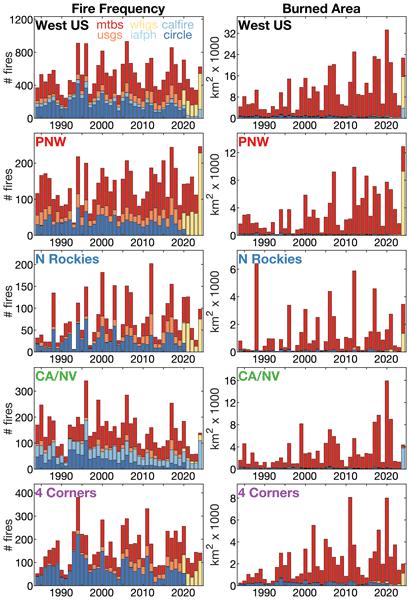
The Western United States MTBS-Interagency Database of Large Wildfires, 1984–2024 (WUMI2024a) represents more than 22000 large (≥1 km2) wildfires in the western United States from 1984 through 2024, including maps of fire perimeters and areas burned. It was compiled from seven government datasets and quality controlled. This dataset will aid research on the causes and effects of wildfire in a changing world.
Jatan Buch, A. Park Williams, Caroline S. Juang, Winslow D. Hansen, and Pierre Gentine
Geosci. Model Dev., 16, 3407–3433, https://doi.org/10.5194/gmd-16-3407-2023, https://doi.org/10.5194/gmd-16-3407-2023, 2023
Short summary
Short summary
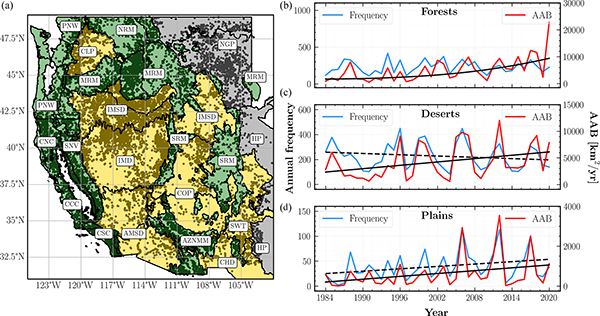
We leverage machine learning techniques to construct a statistical model of grid-scale fire frequencies and sizes using climate, vegetation, and human predictors. Our model reproduces the observed trends in fire activity across multiple regions and timescales. We provide uncertainty estimates to inform resource allocation plans for fuel treatment and fire management. Altogether the accuracy and efficiency of our model make it ideal for coupled use with large-scale dynamical vegetation models.
Chantelle Burton, Francesca Di Giuseppe, Matthew W. Jones, Douglas I. Kelley, Maria L. F. Barbosa, Joe McNorton, Robert Potts, Carlota Segura-Garcia, John T. Abatzoglou, Iulian Alin Rosu, Niels Andela, Liana O. Anderson, Sally Archibald, Esther Brambleby, Emilio Chuvieco, Andy Ciavarella, Hamish Clarke, Francisco de la Barrera, Carlos M. Di Bella, Enza Di Tomaso, Kebonye Dintwe, Tim S. Doherty, Victoria M. Donovan, Jonathan M. Eden, Paulo M. Fernandes, Lukas Fiedler, Louis Giglio, Olivia Haas, Douglas Hamilton, Stijn Hantson, Sarah Harris, Andrew J. Hartley, Theodore R. Keeping, Crystal A. Kolden, Jean-Luc Kouassi, Elena Kukavskaya, Seppe Lampe, Zhongwei Liu, Guilherme Mataveli, Sarah Meier, Duarte Oom, Mark Parrington, Yuquan Qu, Victor Resco de Dios, Julien Ruffault, Mojtaba Sadegh, Cristina Santín, Fernando Sedano, Jacquelyn K. Shuman, Patrícia S. Silva, Fiona R. Spuler, Carmen B. Steinmann, Veerachai Tanpipat, Miguel Ángel Torres-Vazquez, Marco Turco, Guido R. van der Werf, Dave van Wees, Sander Veraverbeke, Jakob B. Wessel, and Bo Zheng
Earth Syst. Sci. Data Discuss., https://doi.org/10.5194/essd-2026-587, https://doi.org/10.5194/essd-2026-587, 2026
Preprint under review for ESSD
Short summary
Short summary
The third State of Wildfires report examines extreme wildfire events from 2025 to early 2026. It analyses key regional events in Midwestern Canadian Shield Forests, Northwest Iberia, and Chilean Temperate Forests and Matorral, assessing their impacts, drivers, and attributing them to climate change. Climate change greatly increased the likelihood of these fires, and without strong mitigation, such events will become more frequent.
A. Park Williams, John T. Abatzoglou, Gavin D. Madakumbura, Haibo Liu, Stefan Rahimi, and Christopher Daly
Earth Syst. Sci. Data Discuss., https://doi.org/10.5194/essd-2026-391, https://doi.org/10.5194/essd-2026-391, 2026
Preprint under review for ESSD
Short summary
Short summary
Here we introduce ParallelClim-WestUS-Daily, a new dataset of daily gridded climate data for the western US from 1951–2025 as well as a parallel, counterfactual realization of the observed climate but without human-caused climate change. This dataset will enable assessments of how climate change has affected complex hydroclimatic processes such as hydrology, vegetation dynamics, and wildfire.
A. Park Williams, Caroline S. Juang, and Karen C. Short
Earth Syst. Sci. Data, 17, 7359–7372, https://doi.org/10.5194/essd-17-7359-2025, https://doi.org/10.5194/essd-17-7359-2025, 2025
Short summary
Short summary
The Western United States MTBS-Interagency Database of Large Wildfires, 1984–2024 (WUMI2024a) represents more than 22000 large (≥1 km2) wildfires in the western United States from 1984 through 2024, including maps of fire perimeters and areas burned. It was compiled from seven government datasets and quality controlled. This dataset will aid research on the causes and effects of wildfire in a changing world.
Douglas I. Kelley, Chantelle Burton, Francesca Di Giuseppe, Matthew W. Jones, Maria L. F. Barbosa, Esther Brambleby, Joe R. McNorton, Zhongwei Liu, Anna S. I. Bradley, Katie Blackford, Eleanor Burke, Andrew Ciavarella, Enza Di Tomaso, Jonathan Eden, Igor José M. Ferreira, Lukas Fiedler, Andrew J. Hartley, Theodore R. Keeping, Seppe Lampe, Anna Lombardi, Guilherme Mataveli, Yuquan Qu, Patrícia S. Silva, Fiona R. Spuler, Carmen B. Steinmann, Miguel Ángel Torres-Vázquez, Renata Veiga, Dave van Wees, Jakob B. Wessel, Emily Wright, Bibiana Bilbao, Mathieu Bourbonnais, Cong Gao, Carlos M. Di Bella, Kebonye Dintwe, Victoria M. Donovan, Sarah Harris, Elena A. Kukavskaya, Aya Brigitte N'Dri, Cristina Santín, Galia Selaya, Johan Sjöström, John T. Abatzoglou, Niels Andela, Rachel Carmenta, Emilio Chuvieco, Louis Giglio, Douglas S. Hamilton, Stijn Hantson, Sarah Meier, Mark Parrington, Mojtaba Sadegh, Jesus San-Miguel-Ayanz, Fernando Sedano, Marco Turco, Guido R. van der Werf, Sander Veraverbeke, Liana O. Anderson, Hamish Clarke, Paulo M. Fernandes, and Crystal A. Kolden
Earth Syst. Sci. Data, 17, 5377–5488, https://doi.org/10.5194/essd-17-5377-2025, https://doi.org/10.5194/essd-17-5377-2025, 2025
Short summary
Short summary
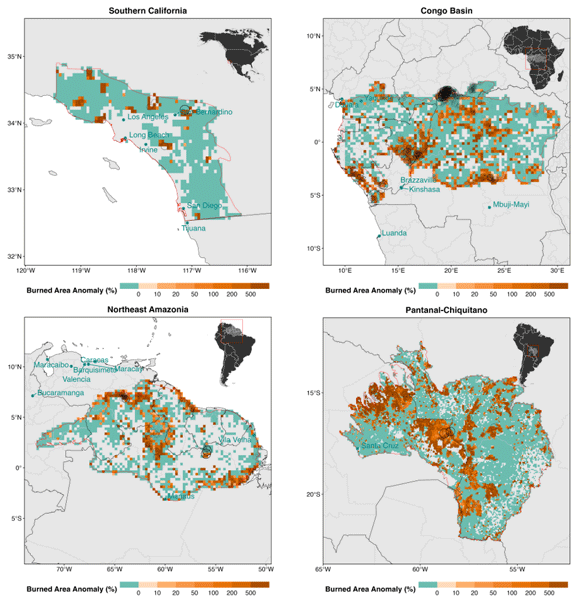
The second State of Wildfires report examines extreme wildfire events from 2024 to early 2025. It analyses key regional events in Southern California, Northeast Amazonia, Pantanal–Chiquitano, and the Congo Basin, assessing their drivers and predictability and attributing them to climate change and land use. Seasonal outlooks and decadal projections are provided. Climate change greatly increased the likelihood of these fires, and without strong mitigation, such events will become more frequent.
Bhupinderjeet Singh, Mingliang Liu, John Abatzoglou, Jennifer Adam, and Kirti Rajagopalan
EGUsphere, https://doi.org/10.5194/egusphere-2024-2284, https://doi.org/10.5194/egusphere-2024-2284, 2024
Preprint archived
Short summary
Short summary
Hydrology models rely on simplistic static approaches to precipitation phase partitioning. We evaluate model skill changes for a suite of snow metrics by transitioning to a more accurate dynamic partitioning. We found that the transition resulted in a better match between modeled and observed metrics, with a 50 % reduction in model bias, emphasizing the need for the hydrological modeling community to adopt dynamic partitioning.
Matthew W. Jones, Douglas I. Kelley, Chantelle A. Burton, Francesca Di Giuseppe, Maria Lucia F. Barbosa, Esther Brambleby, Andrew J. Hartley, Anna Lombardi, Guilherme Mataveli, Joe R. McNorton, Fiona R. Spuler, Jakob B. Wessel, John T. Abatzoglou, Liana O. Anderson, Niels Andela, Sally Archibald, Dolors Armenteras, Eleanor Burke, Rachel Carmenta, Emilio Chuvieco, Hamish Clarke, Stefan H. Doerr, Paulo M. Fernandes, Louis Giglio, Douglas S. Hamilton, Stijn Hantson, Sarah Harris, Piyush Jain, Crystal A. Kolden, Tiina Kurvits, Seppe Lampe, Sarah Meier, Stacey New, Mark Parrington, Morgane M. G. Perron, Yuquan Qu, Natasha S. Ribeiro, Bambang H. Saharjo, Jesus San-Miguel-Ayanz, Jacquelyn K. Shuman, Veerachai Tanpipat, Guido R. van der Werf, Sander Veraverbeke, and Gavriil Xanthopoulos
Earth Syst. Sci. Data, 16, 3601–3685, https://doi.org/10.5194/essd-16-3601-2024, https://doi.org/10.5194/essd-16-3601-2024, 2024
Short summary
Short summary
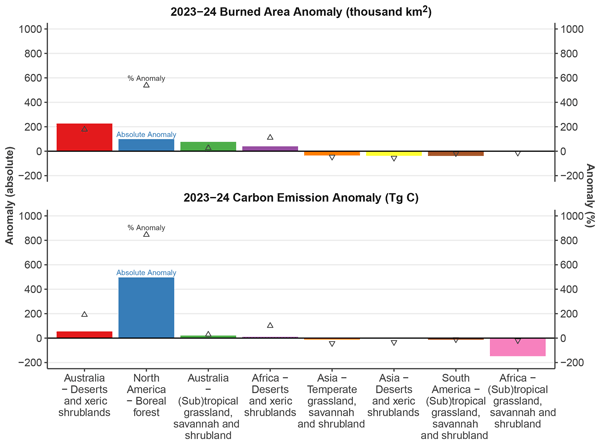
This inaugural State of Wildfires report catalogues extreme fires of the 2023–2024 fire season. For key events, we analyse their predictability and drivers and attribute them to climate change and land use. We provide a seasonal outlook and decadal projections. Key anomalies occurred in Canada, Greece, and western Amazonia, with other high-impact events catalogued worldwide. Climate change significantly increased the likelihood of extreme fires, and mitigation is required to lessen future risk.
Yavar Pourmohamad, John T. Abatzoglou, Erin J. Belval, Erica Fleishman, Karen Short, Matthew C. Reeves, Nicholas Nauslar, Philip E. Higuera, Eric Henderson, Sawyer Ball, Amir AghaKouchak, Jeffrey P. Prestemon, Julia Olszewski, and Mojtaba Sadegh
Earth Syst. Sci. Data, 16, 3045–3060, https://doi.org/10.5194/essd-16-3045-2024, https://doi.org/10.5194/essd-16-3045-2024, 2024
Short summary
Short summary
The FPA FOD-Attributes dataset provides > 300 biological, physical, social, and administrative attributes associated with > 2.3×10⁶ wildfire incidents across the US from 1992 to 2020. The dataset can be used to (1) answer numerous questions about the covariates associated with human- and lightning-caused wildfires and (2) support descriptive, diagnostic, predictive, and prescriptive wildfire analytics, including the development of machine learning models.
Jatan Buch, A. Park Williams, Caroline S. Juang, Winslow D. Hansen, and Pierre Gentine
Geosci. Model Dev., 16, 3407–3433, https://doi.org/10.5194/gmd-16-3407-2023, https://doi.org/10.5194/gmd-16-3407-2023, 2023
Short summary
Short summary
We leverage machine learning techniques to construct a statistical model of grid-scale fire frequencies and sizes using climate, vegetation, and human predictors. Our model reproduces the observed trends in fire activity across multiple regions and timescales. We provide uncertainty estimates to inform resource allocation plans for fuel treatment and fire management. Altogether the accuracy and efficiency of our model make it ideal for coupled use with large-scale dynamical vegetation models.
Winslow D. Hansen, Adrianna Foster, Benjamin Gaglioti, Rupert Seidl, and Werner Rammer
Geosci. Model Dev., 16, 2011–2036, https://doi.org/10.5194/gmd-16-2011-2023, https://doi.org/10.5194/gmd-16-2011-2023, 2023
Short summary
Short summary
Permafrost and the thick soil-surface organic layers that insulate permafrost are important controls of boreal forest dynamics and carbon cycling. However, both are rarely included in process-based vegetation models used to simulate future ecosystem trajectories. To address this challenge, we developed a computationally efficient permafrost and soil organic layer module that operates at fine spatial (1 ha) and temporal (daily) resolutions.
Abby C. Lute, John Abatzoglou, and Timothy Link
Geosci. Model Dev., 15, 5045–5071, https://doi.org/10.5194/gmd-15-5045-2022, https://doi.org/10.5194/gmd-15-5045-2022, 2022
Short summary
Short summary
We developed a snow model that can be used to quantify snowpack over large areas with a high degree of spatial detail. We ran the model over the western United States, creating a snow and climate dataset for three time periods. Compared to observations of snowpack, the model captured the key aspects of snow across time and space. The model and dataset will be useful in understanding historical and future changes in snowpack, with relevance to water resources, agriculture, and ecosystems.
Cited articles
Abatzoglou, J. T. and Kolden, C. A.: Relationships between climate and macroscale area burned in the western United States, International Journal of Wildland Fire, 22, 1003–1020, https://doi.org/10.1071/WF13019, 2013.
Abatzoglou, J. T. and Williams, A. P.: Impact of anthropogenic climate change on wildfire across western US forests, Proc. Natl. Acad. Sci. USA, 113, 11770–11775, https://doi.org/10.1073/pnas.1607171113, 2016.
Abatzoglou, J. T., Battisti, D. S., Williams, A. P., Hansen, W. D., Harvey, B. J., and Kolden, C. A.: Projected increases in western US forest fire despite growing fuel constraints, Communications Earth & Environment, 2, 1–8, https://doi.org/10.1038/s43247-021-00299-0, 2021.
Akaike, H.: A new look at the statistical model identification, IEEE T. Automat. Contr., 19, 716–723, https://doi.org/10.1109/TAC.1974.1100705, 1974.
Anderegg, W. R. L., Chegwidden, O. S., Badgley, G., Trugman, A. T., Cullenward, D., Abatzoglou, J. T., Hicke, J. A., Freeman, J., and Hamman, J. J.: Future climate risks from stress, insects and fire across US forests, Ecology Letters, 25, 1510–1520, https://doi.org/10.1111/ele.14018, 2022.
Anderegg, W. R. L., Trugman, A. T., Vargas G, G., Wu, C., and Yang, L.: Current forest carbon offset buffer pools do not adequately insure against disturbance-driven carbon losses, bioRxiv, 2024–03, https://doi.org/10.1101/2024.03.28.587000, 2024.
Andrews, P. L.: The Rothermel surface fire spread model and associated developments: A comprehensive explanation, United States Department of Agriculture, Forest Service, Rocky Mountain, Fort Collins, CO, https://doi.org/10.2737/RMRS-GTR-371, 2018.
Balch, J. K., Bradley, B. A., Abatzoglou, J. T., Nagy, R. C., Fusco, E. J., and Mahood, A. L.: Human-started wildfires expand the fire niche across the United States, Proceedings of the National Academy of Sciences USA, 114, 2946–2951, https://doi.org/10.1073/pnas.1617394114, 2017.
Balch, J. K., Iglesias, V., Mahood, A. L., Cook, M. C., Amaral, C., DeCastro, A., Leyk, S., McIntosh, T. L., Nagy, R. C., St. Denis, L., Tuff, T., Verleye, E., Williams, A. P., and Kolden, C. A.: The fastest-growing and most destructive fires in the US (2001 to 2020), Science, 386, 425–431, https://doi.org/10.1126/science.adk5737, 2024.
Bowman, D. M. J. S., Balch, J. K., Artaxo, P., Bond, W. J., Carlson, J. M., Cochrane, M. A., D'Antonio, C. M., DeFries, R. S., Doyle, J. C., Harrison, S. P., Johnston, F. H., Keeley, J. E., Krawchuk, M. E., Kull, C. A., Marston, J. B., Moritz, M. A., Prentice, I. C., Roos, C. I., Scott, A. C., Swetnam, T. W., Van Der Werf, G. R., and Pyne, S. J.: Fire in the Earth system, Science, 324, 481–484, https://doi.org/10.1126/science.1163886, 2009.
Bradstock, R. A.: A biogeographic model of fire regimes in Australia: current and future implications, Global Ecology and Biogeography, 19, 145–158, https://doi.org/10.1111/j.1466-8238.2009.00512.x, 2010.
Brey, S. J., Barnes, E. A., Pierce, J. R., Swann, A. L. S., and Fischer, E. V.: Past variance and future projections of the environmental conditions driving western US summertime wildfire burn area, Earth's Future, 9, e2020EF001645, https://doi.org/10.1029/2020EF001645, 2021.
Brown, P. T., Hanley, H., Mahesh, A., Reed, C., Strenfel, S. J., Davis, S. J., Kochanski, A. K., and Clements, C. B.: Climate warming increases extreme daily wildfire growth risk in California, Nature, 621, 760–766, https://doi.org/10.1038/s41586-023-06444-3, 2023.
Buch, J., Williams, A. P., Juang, C. S., Hansen, W. D., and Gentine, P.: SMLFire1.0: a stochastic machine learning (SML) model for wildfire activity in the western United States, Geosci. Model Dev., 16, 3407–3433, https://doi.org/10.5194/gmd-16-3407-2023, 2023.
Buotte, P. C., Levis, S., Law, B. E., Hudiburg, T. W., Rupp, D. E., and Kent, J. J.: Near-future forest vulnerability to drought and fire varies across the western United States, Global Change Biology, 25, 290–303, https://doi.org/10.1111/gcb.14490, 2019.
Burke, M., Childs, J. L., de la Cuesta, B., Qiu, M., Li, J., Gould, C. F., Heft-Neal, S., and Wara, M.: The contribution of wildfire to PM2.5 trends in the USA, Nature, 622, 761–766, https://doi.org/10.1038/s41586-023-06522-6, 2023.
Coen, J. L.: Modeling Wildland Fires: A Description of the Coupled Atmosphere-Wildland Fire Environment Model (CAWFE), National Center for Atmospheric Research, Boulder, CO, https://doi.org/10.5065/D6K64G2G, 2013.
Cohen, J. D. and Deeming, J. E.: The national fire-danger rating system: basic equations, US Department of Agriculture, Forest Service, Pacific Southwest Forest and Range Experiment Station, Berkeley, CA, 23 pp., https://doi.org/10.2737/PSW-GTR-82, 1985.
Coop, J. D., Parks, S. A., Stevens-Rumann, C. S., Crausbay, S. D., Higuera, P. E., Hurteau, M. D., Tepley, A., Whitman, E., Assal, T., and Collins, B. M.: Wildfire-driven forest conversion in western North American landscapes, BioScience, 70, 659–673, https://doi.org/10.1093/biosci/biaa061, 2020.
Cova, G., Kane, V. R., Prichard, S., North, M., and Cansler, C. A.: The outsized role of California's largest wildfires in changing forest burn patterns and coarsening ecosystem scale, Forest Ecology and Management, 528, 120620, https://doi.org/10.1016/j.foreco.2022.120620, 2023.
Daly, C., Doggett, M. K., Smith, J. I., Olson, K. V., Halbleib, M. D., Dimcovic, Z., Keon, D., Loiselle, R. A., Steinberg, B., and Ryan, A. D.: Challenges in observation-based mapping of daily precipitation across the conterminous United States, Journal of Atmospheric and Oceanic Technology, 38, 1979–1992, https://doi.org/10.1175/JTECH-D-21-0054.1, 2021.
Daum, K. L., Hansen, W. D., Gellman, J., Plantinga, A. J., Jones, C., and Trugman, A. T.: Do vegetation fuel reduction treatments alter forest fire severity and carbon stability in California forests?, Earth's Future, 12, e2023EF003763, https://doi.org/10.1029/2023EF003763, 2024.
Durre, I., Squires, M. F., Vose, R. S., Arguez, A., Gross, W. S., Rennie, J. R., and Schreck, C. J.: NOAA's nClimGrid-Daily Version 1 – Daily gridded temperature and precipitation for the Contiguous United States since 1951 (1), https://doi.org/10.25921/c4gt-r169, 2022.
Hagmann, R. K., Hessburg, P. F., Prichard, S. J., Povak, N. A., Brown, P. M., Fulé, P. Z., Keane, R. E., Knapp, E. E., Lydersen, J. M., Metlen, K. L., Sánchez Meador, A. J., Stephens, S. L., Taylor, A. H., Yocom, L. L., Battaglia, M. A., Churchill, D. J., Daniels, L. D., Falk, D. A., Henson, P., Johnston, J. D., Krawchuk, M. A., Levine, C. R., Meigs, G. W., Merschel, A. G., North, M. P., Safford, H. D., Swetnam, T. W., and Waltz, A. E.: Evidence for widespread changes in the structure, composition, and fire regimes of western North American forests, Ecological Applications, 31, e02431, https://doi.org/10.1002/eap.2431, 2021.
Hakkenberg, C. R., Clark, M. L., Bailey, T., Burns, P., and Goetz, S. J.: Ladder fuels rather than canopy volumes consistently predict wildfire severity even in extreme topographic-weather conditions, Communications Earth & Environment, 5, 721, https://doi.org/10.1038/s43247-024-01893-8, 2024.
Hansen, W. D., Krawchuk, M. A., Trugman, A. T., and Williams, A. P.: The dynamic temperate and boreal fire and forest-ecosystem simulator (DYNAFFOREST): Development and evaluation, Environmental Modeling and Software, 156, https://doi.org/10.1016/j.envsoft.2022.105473, 2022.
Harvey, B. J., Donato, D. C., and Turner, M. G.: Burn me twice, shame on who? Interactions between successive forest fires across a temperate mountain region, Ecology, 97, 2272–2282, https://doi.org/10.1002/ecy.1439, 2016.
Hastings, D. A. and Dunbar, P.: Development & assessment of the global land one-km base elevation digital elevation model (GLOBE), ISPRS Archives, 32, 218–221, 1998.
He, Q., Williams, A. P., Johnston, M. R., Juang, C. S., and Wang, B.: Influence of time-averaging of climate data on estimates of atmospheric vapor pressure deficit and inferred relationships with wildfire area in the western United States, Geophysical Research Letters, 52, e2024GL113708, https://doi.org/10.1029/2024GL113708, 2025.
Higuera, P. E., Shuman, B. N., and Wolf, K. D.: Rocky Mountain subalpine forests now burning more than any time in recent millennia, Proc. Natl. Acad. Sci. USA, 118, e2103135118, https://doi.org/10.1073/pnas.2103135118, 2021.
Higuera, P. E., Cook, M. C., Balch, J. K., Stavros, E. N., Mahood, A. L., and St. Denis, L. A.: Shifting social-ecological fire regimes explain increasing structure loss from Western wildfires, PNAS nexus, 2, pgad005, https://doi.org/10.1093/pnasnexus/pgad005, 2023.
Holden, Z. A., Swanson, A., Luce, C. H., Jolly, W. M., Maneta, M., Oyler, J. W., Warren, D. A., Parsons, R., and Affleck, D.: Decreasing fire season precipitation increased recent western US forest wildfire activity, Proc. Natl. Acad. Sci. USA, 115, E8349–E8357, https://doi.org/10.1073/pnas.1802316115, 2018.
Hudak, A. T., Fekety, P. A., Kane, V. R., Kennedy, R. E., Filippelli, S. K., Falkowski, M. J., Tinkham, W. T., Smith, A. M. S., Crookston, N. L., Domke, G. M., Corrao, M. V., Bright, B. C., Churchill, D. J., Gould, P. J., McGaughey, R. J., Kane, J. T., and Dong, J.: A carbon monitoring system for mapping regional, annual aboveground biomass across the northwestern USA, Environmental Research Letters, 15, 095003, https://doi.org/10.1088/1748-9326/ab93f9, 2020.
Hurteau, M. D., Liang, S., Westerling, A. L., and Wiedinmyer, C.: Vegetation-fire feedback reduces projected area burned under climate change, Sci. Rep.-UK, 9, 2838, https://doi.org/10.1038/s41598-019-39284-1, 2019.
Hurvich, C. M. and Tsai, C.-L.: Regression and time series model selection in small samples, Biometrika, 76, 297–307, https://doi.org/10.1093/biomet/76.2.297, 1989.
Hwang, Y.-T., Xie, S.-P., Chen, P.-J., Tseng, H.-Y., and Deser, C.: Contribution of anthropogenic aerosols to persistent La Niña-like conditions in the early 21st century, Proceedings of the National Academy of Sciences, 121, e2315124121, https://doi.org/10.1073/pnas.2315124121, 2024.
Jiang, F., Seager, R., and Cane, M. A.: A climate change signal in the tropical Pacific emerges from decadal variability, Nature Communications, 15, 8291, https://doi.org/10.1038/s41467-024-52731-6, 2024.
Jones, M. W., Veraverbeke, S., Andela, N., Doerr, S. H., Kolden, C., Mataveli, G., Pettinari, M. L., Le Quéré, C., Rosan, T. M., van der Werf, G. R., and Abatzoglou, J. T.: Global rise in forest fire emissions linked to climate change in the extratropics, Science, 386, eadl5889, https://doi.org/10.1126/science.adl5889, 2024.
Juang, C. S., Williams, A. P., Abazoglou, J. T., Balch, J. K., Hurteau, M. D., and Moritz, M. A.: Rapid growth of large forest fires drives the exponential response of annual forest-fire area to aridity in the western United States, Geophys. Res. Lett., 49, e2021GL097131, https://doi.org/10.1029/2021GL097131, 2022.
Kalashnikov, D. A., Abatzoglou, J. T., Nauslar, N. J., Swain, D. L., Touma, D., and Singh, D.: Meteorological and geographical factors associated with dry lightning in central and northern California, Environmental Research: Climate, 1, 025001, https://doi.org/10.1088/2752-5295/ac84a0, 2022.
Kampf, S. K., McGrath, D., Sears, M. G., Fassnacht, S. R., Kiewiet, L., and Hammond, J. C.: Increasing wildfire impacts on snowpack in the western US, Proceedings of the National Academy of Sciences, 119, e2200333119, https://doi.org/10.1073/pnas.2200333119, 2022.
Koshkin, A. L., Hatchett, B. J., and Nolin, A. W.: Wildfire impacts on western United States snowpacks, Frontiers in Water, 4, 971271, https://doi.org/10.3389/frwa.2022.971271, 2022.
Krawchuk, M. A. and Moritz, M. A.: Constraints on global fire activity vary across a resource gradient, Ecology, 92, 121–132, https://doi.org/10.1890/09-1843.1, 2011.
Kumar, L., Skidmore, A. K., and Knowles, E.: Modelling topographic variation in solar radiation in a GIS environment, International Journal of Geographical Information Science, 11, 475–497, https://doi.org/10.1080/136588197242266, 1997.
Kummu, M., Kosonen, M., and Masoumzadeh Sayyar, S.: Downscaled gridded global dataset for gross domestic product (GDP) per capita PPP over 1990–2022, Scientific Data, 12, 178, Scientific Data, 12, 178, https://doi.org/10.1038/s41597-025-04487-x, 2025.
Lasslop, G., Thonicke, K., and Kloster, S.: SPITFIRE within the MPI Earth system model: Model development and evaluation, Journal of Advances in Modeling Earth Systems, 6, 740–755, https://doi.org/10.1002/2013MS000284, 2014.
Lehner, F., Deser, C., Simpson, I. R., and Terray, L.: Attributing the US Southwest's recent shift into drier conditions, Geophys. Res. Lett., 45, 6251–6261, https://doi.org/10.1029/2018GL078312, 2018.
Li, F., Song, X., Harrison, S. P., Marlon, J. R., Lin, Z., Leung, L. R., Schwinger, J., Marécal, V., Wang, S., Ward, D. S., Dong, X., Lee, H., Nieradzik, L., Rabin, S. S., and Séférian, R.: Evaluation of global fire simulations in CMIP6 Earth system models, Geosci. Model Dev., 17, 8751–8771, https://doi.org/10.5194/gmd-17-8751-2024, 2024a.
Li, F., Zhu, Q., Yuan, K., Ji, F., Paul, A., Lee, P., Radeloff, V. C., and Chen, M.: Projecting large fires in the western US with an interpretable and accurate hybrid machine learning method, Earth's Future, 12, e2024EF004588, https://doi.org/10.1029/2024EF004588, 2024b.
Linn, R., Anderson, K., Winterkamp, J. L., Brooks, A., Wotton, Mi., Dupuy, J.-L., Pimont, F., and Edminster, C.: Incorporating field wind data into FIRETEC simulations of the International Crown Fire Modeling Experiment (ICFME): preliminary lessons learned, Canadian Journal of Forest Research, 42, 879–898, 2012.
Linn, R. R.: A transport model for prediction of wildfire behavior, New Mexico State University, Las Cruces, NM, 195 pp., https://doi.org/10.2172/505313, 1997.
Littell, J. S., McKenzie, D., Wan, H. Y., and Cushman, S. A.: Climate change and future wildfire in the western United States: an ecological approach to nonstationarity, Earth's Future, 6, 1097–1111, https://doi.org/10.1029/2018EF000878, 2018.
Lute, A. C., Abatzoglou, J., and Link, T.: SnowClim v1.0: high-resolution snow model and data for the western United States, Geosci. Model Dev., 15, 5045–5071, https://doi.org/10.5194/gmd-15-5045-2022, 2022.
Margolis, E. Q., Guiterman, C. H., Chavardès, R. D., Coop, J. D., Copes-Gerbitz, K., Dawe, D. A., Falk, D. A., Johnston, J. D., Larson, E., and Li, H.: The North American tree-ring fire-scar network, Ecosphere, 13, e4159, https://doi.org/10.1002/ecs2.4159, 2022.
Matthews, B. W.: Comparison of the predicted and observed secondary structure of T4 phage lysozyme, Biochimica et Biophysica Acta (BBA)-Protein Structure, 405, 442–451, https://doi.org/10.1016/0005-2795(75)90109-9, 1975.
McKee, T. B., Doesken, N. J., and Kleist, J.: The relationship of drought frequency and duration to time scales, Proceedings of the 8th Conference on Applied Climatology, 179–183, https://www.academia.edu/127253016/The_relationship_of_drought_frequency_and_duration_to_time_scales (last access: 31 January 2026), 1993.
Meddens, A. J. H., Kolden, C. A., and Lutz, J. A.: Detecting unburned areas within wildfire perimeters using Landsat and ancillary data across the northwestern United States, Remote Sensing of Environment, 186, 275–285, https://doi.org/10.1016/j.rse.2016.08.023, 2016.
Moritz, M. A., Morais, M. E., Summerell, L. A., Carlson, J. M., and Doyle, J. C.: Wildfires, complexity, and highly optimized tolerance, Proceedings of the National Academy of Sciences USA, 102, 17912–17917, https://doi.org/10.1073/pnas.0508985102, 2005.
Muñoz-Esparza, D., Kosović, B., Jiménez, P. A., and Coen, J. L.: An accurate fire-spread algorithm in the Weather Research and Forecasting model using the level-set method, Journal of Advances in Modeling Earth Systems, 10, 908–926, https://doi.org/10.1002/2017MS001108, 2018.
Oyler, J. W., Ballantyne, A., Jencso, K., Sweet, M., and Running, S. W.: Creating a topoclimatic daily air temperature dataset for the conterminous United States using homogenized station data and remotely sensed land skin temperature, Int. J. Climatol., 35, 2258–2279, https://doi.org/10.1002/joc.4127, 2015.
Parks, S. A. and Abatzoglou, J. T.: Warmer and drier fire seasons contribute to increases in area burned at high severity in western US forests from 1985 to 2017, Geophys. Res. Lett., 47, e2020GL089858, https://doi.org/10.1029/2020GL089858, 2020.
Parks, S. A., Holsinger, L. M., Miller, C., and Nelson, C. R.: Wildland fire as a self-regulating mechanism: the role of previous burns and weather in limiting fire progression, Ecol. Appl., 25, 1478–1492, https://doi.org/10.1890/14-1430.1, 2015.
Parks, S. A., Holsinger, L. M., Miller, C., and Parisien, M.-A.: Analog-based fire regime and vegetation shifts in mountainous regions of the western US, Ecography, 41, 910–921, https://doi.org/10.1111/ecog.03378, 2018a.
Parks, S. A., Parisien, M.-A., Miller, C., Holsinger, L. M., and Baggett, L. S.: Fine-scale spatial climate variation and drought mediate the likelihood of reburning, Ecological Applications, 28, 573–586, https://doi.org/10.1002/eap.1671, 2018b.
Parks, S. A., Holsinger, L. M., Blankenship, K., Dillon, G. D., Goeking, S. A., and Swaty, R.: Contemporary wildfires are more severe compared to the historical reference period in western US dry conifer forests, Forest Ecology and Management, 544, 121232, https://doi.org/10.1016/j.foreco.2023.121232, 2023.
Parks, S. A., Guiterman, C. H., Margolis, E. Q., Lonergan, M., Whitman, E., Abatzoglou, J. T., Falk, D. A., Johnston, J. D., Daniels, L. D., Lafon, C. W., Loehman, R. A., Kipfmueller, K. F., Naficy, C. E., Parisien, M.-A., Portier, J., Stambaugh, M. C., Williams, A. P., Wion, A. P., and Yocom, L. L.: A fire deficit persists across diverse North American forests despite recent increases in area burned, Nature Communications, 16, 1493, https://doi.org/10.1038/s41467-025-56333-8, 2025.
Preisler, H. K., Westerling, A. L., Gebert, K. M., Munoz-Arriola, F., and Holmes, T. P.: Spatially explicit forecasts of large wildland fire probability and suppression costs for California, International Journal of Wildland Fire, 20, 508–517, https://doi.org/10.1071/WF09087, 2011.
Radeloff, V. C., Helmers, D. P., Kramer, H. A., Mockrin, M. H., Alexandre, P. M., Bar-Massada, A., Butsic, V., Hawbaker, T. J., Martinuzzi, S., Syphard, A. D., and Stewart, S. I.: Rapid growth of the US wildland-urban interface raises wildfire risk, Proceedings of the National Academy of Sciences USA, 115, 3314–3319, https://doi.org/10.1073/pnas.1718850115, 2018.
Radeloff, V. C., Mockrin, M. H., Helmers, D., Carlson, A., Hawbaker, T. J., Martinuzzi, S., Schug, F., Alexandre, P. M., Kramer, H. A., and Pidgeon, A. M.: Rising wildfire risk to houses in the United States, especially in grasslands and shrublands, Science, 382, 702–707, https://doi.org/10.1126/science.ade9223, 2023.
Rahimi, S., Krantz, W., Lin, Y.-H., Bass, B., Goldenson, N., Hall, A., Lebo, Z. J., and Norris, J.: Evaluation of a Reanalysis-Driven Configuration of WRF4 Over the Western United States From 1980 to 2020, Journal of Geophysical Research: Atmospheres, 127, e2021JD035699, https://doi.org/10.1029/2021JD035699, 2022.
Rao, K., Williams, A. P., Diffenbaugh, N. S., Yebra, M., Bryant, C., and Konings, A. G.: Dry live fuels increase the likelihood of lightning-caused fires, Geophysical Research Letters, 50, e2022GL100975, https://doi.org/10.1029/2022GL100975, 2023.
Romps, D. M., Charn, A. B., Holzworth, R. H., Lawrence, W. E., Molinari, J., and Vollaro, D.: CAPE times P explains lightning over land but not the land-ocean contrast, Geophysical Research Letters, 45, 12–623, https://doi.org/10.1029/2018GL080267, 2018.
Rothermel, R. C.: A mathematical model for predicting fire spread in wildland fuels, U. S. Department of Agriculture, Intermountain Forest and Range Experiment Station, Ogden, UT, https://research.fs.usda.gov/treesearch/32533 (last access: 31 January 2026), 1972.
Ruefenacht, B., Finco, M. V., Nelson, M. D., Czaplewski, R., Helmer, E. H., Blackard, J. A., Holden, G. R., Lister, A. J., Salajanu, D., and Weyermann, D.: Conterminous US and Alaska forest type mapping using forest inventory and analysis data, Photogrammetric Engineering & Remote Sensing, 74, 1379–1388, https://doi.org/10.14358/PERS.74.11.1379, 2008.
Short, K. C.: Spatial wildfire occurrence data for the United States, 1992–2020 [FPA_FOD_20221014] (6), https://doi.org/10.2737/RDS-2013-0009.6, 2022.
Short, K. C., Grenfell, I. C., Riley, K. L., and Volger, K. C.: Pyromes of the conterminous United States, https://doi.org/10.2737/RDS-2020-0020, 2020.
Srock, A. F., Charney, J. J., Potter, B. E., and Goodrick, S. L.: The hot-dry-windy index: A new fire weather index, Atmosphere, 9, 279, https://doi.org/10.3390/atmos9070279, 2018.
Steel, Z. L., Safford, H. D., and Viers, J. H.: The fire frequency–severity relationship and the legacy of fire suppression in California forests, Ecosphere, 6, 1–23, https://doi.org/10.1890/ES14-00224.1, 2015.
Swetnam, T. W.: Fire history and climate change in giant sequoia groves, Science, 262, 885–889, https://doi.org/10.1126/science.262.5135.885, 1993.
Swetnam, T. W. and Baisan, C. H.: Historical fire regime patterns in the southwestern United States since AD 1700, in: Fire Effects in Southwestern Fortest: Proceedings of the 2nd La Mesa Fire Symposium, vol. General Technical Report RM-GTR-286, edited by: Allen, C. D., USDA Forest Service, Rocky Mountain Research Station, 11–32, http://digitalcommons.usu.edu/barkbeetles/85/ (last access: 31 January 2026), 1996.
Syphard, A. D., Keeley, J. E., Conlisk, E., and Gough, M.: Regional patterns in US wildfire activity: the critical role of ignition sources, Environmental Research Letters, 20, 054046, https://doi.org/10.1088/1748-9326/adc9c8, 2025.
Thonicke, K., Spessa, A., Prentice, I. C., Harrison, S. P., Dong, L., and Carmona-Moreno, C.: The influence of vegetation, fire spread and fire behaviour on biomass burning and trace gas emissions: results from a process-based model, Biogeosciences, 7, 1991–2011, https://doi.org/10.5194/bg-7-1991-2010, 2010.
USDA Forest Service: Forest Inventory and Analysis database, USDA Forest Service [data set], https://doi.org/10.2737/RDS-2001-FIADB, 2019.
Van de Water, K. M. and Safford, H. D.: A summary of fire frequency estimates for California vegetation before Euro-American settlement, Fire Ecology, 7, 26–58, https://doi.org/10.4996/fireecology.0703026, 2011.
Vose, R. S., Applequist, S., Squires, M., Durre, I., Menne, M. J., Williams Jr., C. N., Fenimore, C., Gleason, K., and Arndt, D.: Improved historical temperature and precipitation time series for US climate divisions, J. Appl. Meteorol. Clim., 53, 1232–1251, https://doi.org/10.1175/JAMC-D-13-0248.1, 2014.
Vose, R. S., Easterling, D. R., Kunkel, K. E., LeGrande, A. N., and Wehner, M. F.: Chapter 6: Temperature changes in the United States, in: Climate Science Special Report: Fourth National Climate Assessment, vol. 1, U.S. Global Change Research Program, Washington, DC, 185–206, https://ntrs.nasa.gov/api/citations/20180001314/downloads/20180001314.pdf (last access: 31 January 2026, 2017.
Wang, S. S.-C., Qian, Y., Leung, L. R., and Zhang, Y.: Identifying key drivers of wildfires in the contiguous US using machine learning and game theory interpretation, Earth's Future, e2020EF001910, https://doi.org/10.1029/2020EF001910, 2021.
Westerling, A. L., Hidalgo, H. G., Cayan, D. R., and Swetnam, T. W.: Warming and earlier spring increase western US forest wildfire activity, Science, 313, 940–943, https://doi.org/10.1126/science.1128834, 2006.
Westerling, A. L., Turner, M. G., Smithwick, E. A. H., Romme, W. H., and Ryan, M. G.: Continued warming could transform Greater Yellowstone fire regimes by mid-21st century, Proceedings of the National Academy of Sciences USA, 108, 13165–13170, https://doi.org/10.1073/pnas.1110199108, 2011.
Williams, A. P.: Data for the Western United States Large Forest-Fire Stochastic Simulator (WULFFSS) 1.0: A Monthly Gridded Forest-Fire Model Using Interpretable Statistics, Version 1.0, DRYAD [data set], https://doi.org/10.5061/dryad.63xsj3vdb, 2025a.
Williams, A. P.: Code for the Western United States Large Forest-Fire Stochastic Simulator (WULFFSS) 1.0: A Monthly Gridded Forest-Fire Model Using Interpretable Statistics, Version 1.0, Zenodo, [code] https://doi.org/10.5281/zenodo.18102839, 2025b.
Williams, A. P. and Abatzoglou, J. T.: Recent advances and remaining uncertainties in resolving past and future climate effects on global fire activity, Current Climate Change Reports, 2, 1–14, https://doi.org/10.1007/s40641-016-0031-0, 2016.
Williams, A. P., Seager, R., Macalady, A. K., Berkelhammer, M., Crimmins, M. A., Swetnam, T. W., Trugman, A. T., Buenning, N., Noone, D., McDowell, N. G., Hryniw, N., Mora, C. I., and Rahn, T.: Correlations between components of the water balance and burned area reveal new insights for predicting fire activity in the southwest US, International Journal of Wildland Fire, 24, 14–26, https://doi.org/10.1071/WF14023, 2015.
Williams, A. P., Cook, B. I., Smerdon, J. E., Bishop, D. A., Seager, R., and Mankin, J. S.: The 2016 southeastern US drought: an extreme departure from centennial wetting and cooling, J. Geophys. Res.-Atmos., 122, 10888–10905, https://doi.org/10.1002/2017JD027523, 2017.
Williams, A. P., Abatzoglou, J. T., Gershunov, A., Guzman-Morales, J., Bishop, D. A., Balch, J. K., and Lettenmaier, D. P.: Observed impacts of anthropogenic climate change on wildfire in California, Earths Future, 7, 892–910, https://doi.org/10.1029/2019EF001210, 2019.
Williams, A. P., Cook, E. R., Smerdon, J. E., Cook, B. I., Abatzoglou, J. T., Bolles, K., Baek, S. H., Badger, A., and Livneh, B.: Large contribution from anthropogenic warming to a developing North American megadrought, Science, 368, 314–318, https://doi.org/10.1126/science.aaz9600, 2020.
Williams, A. P., Livneh, B., McKinnon, K. A., Hansen, W. D., Mankin, J. S., Cook, B. I., Smerdon, J. E., Varuolo-Clarke, A. M., Bjarke, N. R., and Juang, C. S.: Growing impact of wildfire on western US water supply, Proc. Natl. Acad. Sci. USA, 119, e2114069119, https://doi.org/10.1073/pnas.2114069119, 2022.
Williams, A. P., Juang, C. S., and Short, K. C.: The Western United States MTBS-Interagency database of large wildfires, 1984–2024 (WUMI2024a), Earth Syst. Sci. Data, 17, 7359–7372, https://doi.org/10.5194/essd-17-7359-2025, 2025.
Williams, J. N., Safford, H. D., Enstice, N., Steel, Z. L., and Paulson, A. K.: High-severity burned area and proportion exceed historic conditions in Sierra Nevada, California, and adjacent ranges, Ecosphere, 14, e4397, https://doi.org/10.1002/ecs2.4397, 2023.
Short summary
The new Western United States Large Forest Fire Stochastic Simulator (WULFFSS) is a monthly gridded model to simulate forest fires across the western United States in response to vegetation, topographic, anthropogenic, and climate factors. The model is highly skillful, accounting for over 80 % of the observed variability in annual forest-fire area and capturing observed spatial, intra-annual variations, and trends.
The new Western United States Large Forest Fire Stochastic Simulator (WULFFSS) is a monthly...


