
Articles | Volume 18, issue 8
https://doi.org/10.5194/gmd-18-2427-2025
© Author(s) 2025. This work is distributed under
the Creative Commons Attribution 4.0 License.
the Creative Commons Attribution 4.0 License.
https://doi.org/10.5194/gmd-18-2427-2025
© Author(s) 2025. This work is distributed under
the Creative Commons Attribution 4.0 License.
the Creative Commons Attribution 4.0 License.
Model description paper
| 
24 Apr 2025
Model description paper |
| 24 Apr 2025
| 24 Apr 2025
TemDeep: a self-supervised framework for temporal downscaling of atmospheric fields at arbitrary time resolutions
Liwen Wang
College of Meteorology and Oceanography, National University of Defense Technology, Changsha, China

College of Meteorology and Oceanography, National University of Defense Technology, Changsha, China
High Impact Weather Key Laboratory of CMA, Changsha, China
Qi Lv
College of Meteorology and Oceanography, National University of Defense Technology, Changsha, China
High Impact Weather Key Laboratory of CMA, Changsha, China
Xuan Peng
College of Meteorology and Oceanography, National University of Defense Technology, Changsha, China
High Impact Weather Key Laboratory of CMA, Changsha, China
College of Meteorology and Oceanography, National University of Defense Technology, Changsha, China
Related authors
Yanwen Wang, Shuwen Huang, Qian Li, Xuan Peng, Haoming Chen, Kefeng Zhu, Liwen Wang, and Sheng Li
Geosci. Model Dev., 19, 6027–6041, https://doi.org/10.5194/gmd-19-6027-2026, https://doi.org/10.5194/gmd-19-6027-2026, 2026
Short summary
Short summary
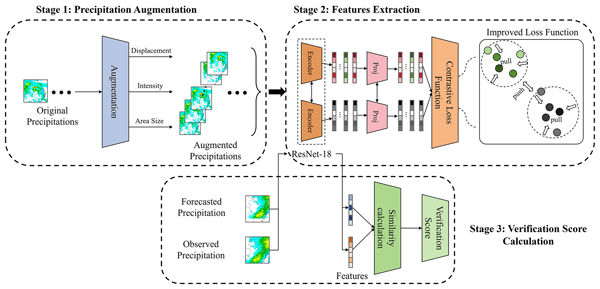
We developed a contrastive learning method (CLPFV - contrastive learning-based precipitation forecast verification) to improve the accuracy of precipitation forecast verification. The proposed method uses precipitation augmentation to simulate real-world forecast errors with gradients and then employs an improved loss function to reflect these errors in the contrastive learning. Experimental results show that the proposed method outperforms traditional and spatial verification methods across different error types and aligns better with expert judgment.
Yanwen Wang, Shuwen Huang, Qian Li, Xuan Peng, Haoming Chen, Kefeng Zhu, Liwen Wang, and Sheng Li
Geosci. Model Dev., 19, 6027–6041, https://doi.org/10.5194/gmd-19-6027-2026, https://doi.org/10.5194/gmd-19-6027-2026, 2026
Short summary
Short summary
We developed a contrastive learning method (CLPFV - contrastive learning-based precipitation forecast verification) to improve the accuracy of precipitation forecast verification. The proposed method uses precipitation augmentation to simulate real-world forecast errors with gradients and then employs an improved loss function to reflect these errors in the contrastive learning. Experimental results show that the proposed method outperforms traditional and spatial verification methods across different error types and aligns better with expert judgment.
Hancheng Ye, Zengliang Zang, Wei You, Yiwen Hu, Ning Liu, and Yi Li
EGUsphere, https://doi.org/10.5194/egusphere-2026-394, https://doi.org/10.5194/egusphere-2026-394, 2026
Short summary
Short summary
Our study pioneers a PyTorch-based atmospheric assimilation system that leverages automatic differentiation and Deep Computing Unit acceleration to achieve order-of-magnitude speedups while establishing a direct pathway for future integration with deep learning.
Yiwen Hu, Zengliang Zang, Xiaoyan Ma, Yi Li, Yanfei Liang, Wei You, Xiaobin Pan, and Zhijin Li
Atmos. Chem. Phys., 22, 13183–13200, https://doi.org/10.5194/acp-22-13183-2022, https://doi.org/10.5194/acp-22-13183-2022, 2022
Short summary
Short summary
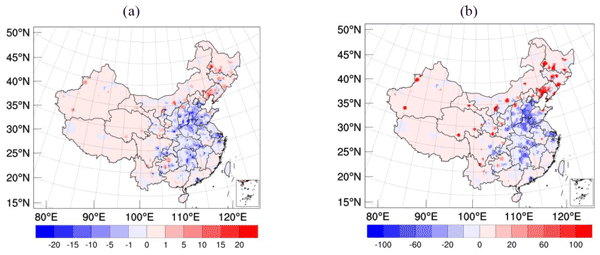
This study developed a four-dimensional variational assimilation (4DVAR) system based on WRF–Chem to optimise SO2 emissions. The 4DVAR system was applied to obtain the SO2 emissions during the early period of the COVID-19 pandemic over China. The results showed that the 4DVAR system effectively optimised emissions to describe the actual changes in SO2 emissions related to the COVID lockdown, and it can thus be used to improve the accuracy of forecasts.
Daichun Wang, Wei You, Zengliang Zang, Xiaobin Pan, Yiwen Hu, and Yanfei Liang
Geosci. Model Dev., 15, 1821–1840, https://doi.org/10.5194/gmd-15-1821-2022, https://doi.org/10.5194/gmd-15-1821-2022, 2022
Short summary
Short summary
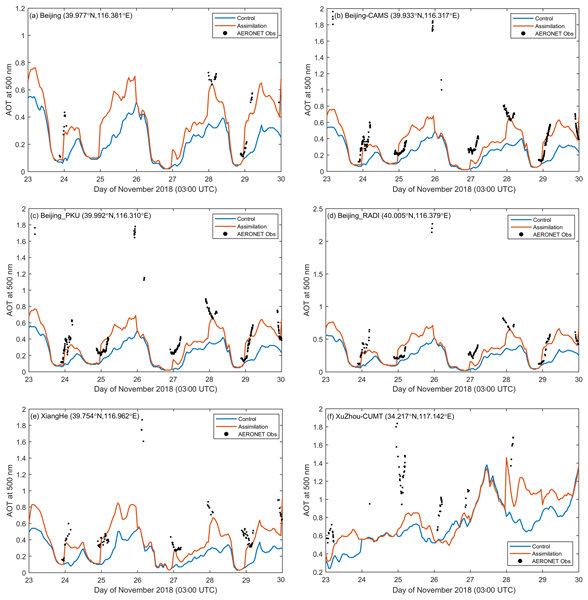
This paper presents a 3D variational data assimilation system for aerosol optical properties, including aerosol optical thickness (AOT) retrievals and lidar-based aerosol profiles, which was developed for a size-resolved sectional model in WRF-Chem. To directly assimilate aerosol optical properties, an observation operator based on the Mie scattering theory was designed. The results show that Himawari-8 AOT assimilation can significantly improve model aerosol analyses and forecasts.
Cited articles
Azad, R., Aghdam, E. K., Rauland, A., Jia, Y., Avval, A. H., Bozorgpour, A., Karimijafarbigloo, S., Cohen, J. P., Adeli, E., and Merhof, D.: Medical Image Segmentation Review: The Success of U-Net, in: IEEE Transactions on Pattern Analysis and Machine Intelligence, 46, 10076–10095, https://doi.org/10.1109/TPAMI.2024.3435571, 2024.
Bauer, P., Thorpe, A. J., and Brunet, G.: The quiet revolution of numerical weather prediction, Nature, 525, 47–55, 2015.
Benjamin, S. G., Weygandt, S. S., Brown, J. M., Hu, M., Alexander, C. R., Smirnova, T. G., Olson, J. B., James, E. P., Dowell, D. C., Grell, G., Lin, H., Peckham, S. E., Smith, T. L., Moninger, W. R., Kenyon, J. S., and Manikin, G. S.: A North American Hourly Assimilation and Model Forecast Cycle: The Rapid Refresh, Mon. Weather Rev., 144, 1669–1694, 2016.
Bolton, T. and Zanna, L.: Applications of deep learning to ocean data inference and subgrid parameterization, J. Adv. Model. Earth Sy., 11, 376–399, 2019.
Chen, G. F., Qin, D. Y., Ye, R., Guo, Y. X., and Wang, H.: A new method of rainfall temporal downscaling: a case study on sanmenxia station in the Yellow River Basin, Hydrol. Earth Syst. Sci. Discuss., 8, 2323 2344, https://doi.org/10.5194/hessd-8-2323-2011, 2011.
Chen, T., Kornblith, S., Norouzi, M., and Hinton, G. E.: A Simple Framework for Contrastive Learning of Visual Representations, arXiv [preprint], https://doi.org/10.48550/arXiv.2002.05709, 2020.
Copernicus Climate Change Service: ERA5 hourly data on single levels from 1959 to present, Copernicus Climate Data Store (CDS) [data set], https://doi.org/10.24381/cds.bd0915c6, 2024a.
Copernicus Climate Change Service: ERA5 hourly data on pressure levels from 1959 to present, Copernicus Climate Data Store (CDS) [data set], https://doi.org/10.24381/cds.adbb2d47, 2024b.
Davis, A., Marshak, A., Wiscombe, W., and Cahalan, R.: Multifractal characterizations of nonstationarity and intermittency in geophysical fields: Observed, retrieved, or simulated, J. Geophys. Res.-Atmos., 99, 8055–8072, https://doi.org/10.1029/94JD00219, 1994.
Dong, J., Xiao, X., Chen, B., Torbick, N., Jin, C., Zhang, G., and Biradar, Ç. M.: Mapping deciduous rubber plantations through integration of PALSAR and multi-temporal Landsat imagery, Remote Sens. Environ., 134, 392–402, 2013.
Eldele, E., Ragab, M., Chen, Z., Wu, M., Kwoh, C., Li, X., and Guan, C.: Self-supervised Contrastive Representation Learning for Semi-supervised Time-Series Classification, arXiv [preprint], https://doi.org/10.48550/arXiv.2208.06616, 2022.
Fowler, H. J., Blenkinsop, S., and Tebaldi, C.: Linking climate change modelling to impacts studies: recent advances in downscaling techniques for hydrological modelling, Int. J. Climatol., 27, 1547–1578, https://doi.org/10.1002/joc.1556, 2007.
Gao, L., Han, Z., Hong, D., Zhang, B., and Chanussot, J.: CyCU-Net: Cycle-Consistency Unmixing Network by Learning Cascaded Autoencoders, IEEE T. Geosci. Remote., 60, 1–14, 2022.
GeoSciLab: TemDeep – A deep learning-based temperature downscaling tool, Zenodo [code], https://doi.org/10.5281/zenodo.14062314, 2024.
Grill, J.-B., Strub, F., Altché, F., Tallec, C., Richemond, P., Buchatskaya, E., Doersch, C., Avila Pires, B., Guo, Z., and Gheshlaghi Azar, M.: Bootstrap your own latent-a new approach to self-supervised learning, Adv. Neur. In., 33, 21271–21284, 2020.
Gutmann, E. D., Rasmussen, R. M., Liu, C., Ikeda, K., Gochis, D. J., Clark, M. P., Dudhia, J., and Thompson, G.: A Comparison of Statistical and Dynamical Downscaling of Winter Precipitation over Complex Terrain, J. Climate, 25, 262–281, 2011.
Hawkins, E. and Sutton, R. T.: The potential to narrow uncertainty in projections of regional precipitation change, Clim. Dynam., 37, 407–418, 2011.
He, K., Fan, H., Wu, Y., Xie, S., and Girshick, R.: Momentum Contrast for Unsupervised Visual Representation Learning, Proceedings of the IEEE/CVF Conference on Computer Vision and Pattern Recognition (CVPR), 9729–9738, https://doi.org/10.1109/CVPR42600.2020.00975, 2020.
Hennig, T. A., Kretsch, J. L., Pessagno, C. J., Salamonowicz, P. H., and Stein, W. L.: The Shuttle Radar Topography Mission, Digital Earth Moving, Digital Earth Moving: First International Symposium, DEM 2001 Manno, Switzerland, 5–7 September 2001 Proceedings, Springer Berlin Heidelberg, Berlin, Heidelberg, 2001.
Hurrell, J. W., Holland, M. M., Gent, P. R., Ghan, S. J., Kay, J. E., Kushner, P. J., Lamarque, J. F., Large, W., Lawrence, D. M., Lindsay, K., Lipscomb, W. H., Long, M. C., Mahowald, N. M., Marsh, D. R., Neale, R. B., Rasch, P. J., Vavrus, S. J., Vertenstein, M., Bader, D. C., Collins, W. D., Hack, J. J., Kiehl, J. T., and Marshall, S. J.: The Community Earth System Model: A Framework for Collaborative Research, B. Am. Meteorol. Soc., 94, 1339–1360, 2013.
Jiang, H., Sun, D., Jampani, V., Yang, M.-H., Learned-Miller, E. G., and Kautz, J.: Super SloMo: High Quality Estimation of Multiple Intermediate Frames for Video Interpolation, 2018 IEEE/CVF Conference on Computer Vision and Pattern Recognition, Salt Lake City, UT, USA, 2018, 9000–9008, https://doi.org/10.1109/CVPR.2018.00938, 2017.
Kajbaf, A. A., Bensi, M. T., and Brubaker, K. L.: Temporal downscaling of precipitation from climate model projections using machine learning, Stoch. Env. Res. Risk A., 36, 2173–2194, 2022.
Kingma, D. P. and Ba, J.: Adam: A Method for Stochastic Optimization, arXiv [preprint], https://doi.org/10.48550/arXiv.1412.6980, 2014.
Lawrimore, J. H., Menne, M. J., Gleason, B. E., Williams, C. N., Wuertz, D. B., Vose, R. S., and Rennie, J. J.: An overview of the Global Historical Climatology Network monthly mean temperature data set, version 3, J. Geophys. Res., 116, D19121, https://doi.org/10.1029/2011JD016187, 2011.
Lee, T., Ouarda, T. B. M. J., and Jeong, C.: Nonparametric multivariate weather generator and an extreme value theory for bandwidth selection, J. Hydrol., 452, 161–171, 2012.
Liu, J., Wang, G., Li, T., Xue, H., and He, L.: Sediment yield computation of the sandy and gritty area based on the digital watershed model, Sci. China Ser. E, 49, 752–763, https://doi.org/10.1007/s11431-006-2035-9, 2006.
Liu, X., Zhang, F., Hou, Z., Wang, Z., Mian, L., Zhang, J., and Tang, J.: Self-Supervised Learning: Generative or Contrastive, IEEE T. Knowl. Data En., 35, 857–876, 2020.
Lobell, D. and Asseng, S.: Comparing estimates of climate change impacts from process-based and statistical crop models, Environ. Res. Lett., 12, 015001, https://doi.org/10.1088/1748-9326/aa518a, 2017.
Lorenz, E. N.: Deterministic nonperiodic flow, J. Atmos. Sci., 20, 130–141, 1963.
Lorenz, E. N.: The predictability of a flow which possesses many scales of motion, Tellus A, 21, 289–307, 1969.
Maraun, D., Wetterhall, F., Ireson, A. M., Chandler, R. E., Kendon, E. J., Widmann, M., Brienen, S., Rust, H. W., Sauter, T., Themessl, M., Venema, V. K. C., Chun, K. P., Goodess, C. M., Jones, R. G., Onof, C., Vrac, M., and Thiele-Eich, I.: Precipitation downscaling under climate change: Recent developments to bridge the gap between dynamical models and the end user, Rev. Geophys., 48, RG3003, https://doi.org/10.1029/2009RG000314, 2010.
McGovern, A., Elmore, K. L., Gagne, D. J., Haupt, S. E., Karstens, C. D., Lagerquist, R., Smith, T. M., and Williams, J. K.: Using Artificial Intelligence to Improve Real-Time Decision-Making for High-Impact Weather, B. Am. Meteorol. Soc., 98, 2073–2090, 2017.
Mendes, D. and Marengo, J. A.: Temporal downscaling: a comparison between artificial neural network and autocorrelation techniques over the Amazon Basin in present and future climate change scenarios, Theor. Appl. Climatol., 100, 413–421, 2010.
Michel, A., Sharma, V., Lehning, M., and Huwald, H.: Climate change scenarios at hourly time-step over Switzerland from an enhanced temporal downscaling approach, Int. J. Climatol., 41, 3503–3522, 2021.
Neukom, R., Steiger, N. J., Gómez-Navarro, J. J., Wang, J., and Werner, J. P.: No evidence for globally coherent warm and cold periods over the preindustrial Common Era, Nature, 571, 550–554, 2019.
Palmer, T. N., Doblas-Reyes, F. J., Hagedorn, R., and Weisheimer, A.: Probabilistic prediction of climate using multi-model ensembles: from basics to applications, Philos. T. Roy. Soc. B, 360, 1991–1998, 2005.
Pang, Y., Wang, W., Tay, F. E. H., Liu, W., Tian, Y., and Yuan, L.: Masked Autoencoders for Point Cloud Self-supervised Learning, in: Computer Vision ECCV 2022, ECCV 2022, edited by: Avidan, S., Brostow, G., Ciss , M., Farinella, G. M., and Hassner, T., Lecture Notes in Computer Science, vol. 13662, Springer, Cham, https://doi.org/10.1007/978-3-031-20086-1_35, 2022.
Papalexiou, S. M., Markonis, Y., Lombardo, F., Aghakouchak, A., and Foufoula-Georgiou, E.: Precise Temporal Disaggregation Preserving Marginals and Correlations (DiPMaC) for Stationary and Nonstationary Processes, Water Resour. Res., 54, 7435–7458, 2018.
Raymond, C., Singh, D., and Horton, R. M.: Spatiotemporal Patterns and Synoptics of Extreme Wet-Bulb Temperature in the Contiguous United States, J. Geophys. Res.-Atmos., 122, 13108–113124, 2017.
Reda, F. A., Sun, D., Dundar, A., Shoeybi, M., Liu, G., Shih, K. J., Tao, A., Kautz, J., and Catanzaro, B.: Unsupervised Video Interpolation Using Cycle Consistency, 2019 IEEE/CVF International Conference on Computer Vision (ICCV), Seoul, Korea (South), 892–900, https://doi.org/10.1109/ICCV.2019.00098, 2019.
Reichstein, M., Camps-Valls, G., Stevens, B., Jung, M., Denzler, J., Carvalhais, C., and Prabhat: Deep learning and process understanding for data-driven Earth system science, Nature, 566, 195–204, 2019.
Requena, A. I., Nguyen, T.-H., Burn, D. H., Coulibaly, P., and Nguyen, V. T. V.: A temporal downscaling approach for sub-daily gridded extreme rainfall intensity estimation under climate change, J. Hydrol., 597, 126206., https://doi.org/10.1016/j.jhydrol.2021.126206, 2021.
Seneviratne, S. I., Nicholls, N., Easterling, D. R., Goodess, C. M., Kanae, S., Kossin, J. P., Luo, Y., Marengo, J. A., McInnes, K. L., Rahimi, M., Reichstein, M., Sorteberg, A., Vera, C. S., and Zhang, X.: Changes in climate extremes and their impacts on the natural physical environment, in: Managing the Risks of Extreme Events and Disasters to Advance Climate Change Adaptation, edited by: Field, C. B., Barros, V., Stocker, T. F., and Dahe, Q., Cambridge University Press, 109–230, 2012.
Skamarock, C., Klemp, B., Dudhia, J., Gill, O., Barker, D. M., Duda, G., Huang, X., Wang, W., and Powers, G.: A Description of the Advanced Research WRF Version 3. NCAR Technical Note NCAR/TN-475+STR, University Corporation for Atmospheric Research, https://doi.org/10.5065/D68S4MVH, 2008.
Stanley, H. E.: Turbulence: The legacy of A. N. Kolmogorov, J. Stat. Phys., 88, 521–523, https://doi.org/10.1007/BF02508484, 1997.
van den Oord, A., Li, Y., and Vinyals, O.: Representation learning with contrastive predictive coding, arXiv [preprint], https://doi.org/10.48550/arXiv.1807.03748, 2018.
Wang, L., Li, Q., and Lv, Q.: Self-Supervised Classification of Weather Systems Based on Spatiotemporal Contrastive Learning, Geophys. Res. Lett., 49, e2022GL099131, https://doi.org/10.1029/2022GL099131, 2022.
Zhou, T., Krähenbühl, P., Aubry, M., Huang, Q., and Efros, A. A.: Learning Dense Correspondence via 3D-Guided Cycle Consistency, 2016 IEEE Conference on Computer Vision and Pattern Recognition (CVPR), Las Vegas, NV, USA, 117–126, https://doi.org/10.1109/CVPR.2016.20, 2016.
Zhu, J.-Y., Park, T., Isola, P., and Efros, A. A.: Unpaired Image-to-Image Translation Using Cycle-Consistent Adversarial Networks, 2017 IEEE International Conference on Computer Vision (ICCV), Venice, Italy, 2242–2251, https://doi.org/10.1109/ICCV.2017.244, 2017.
Short summary
Our research presents a novel deep learning approach called "TemDeep" for downscaling atmospheric variables at arbitrary time resolutions based on temporal coherence. Results show that our method can accurately recover evolution details superior to other methods, reaching 53.7 % in the restoration rate. Our findings are important for advancing weather forecasting models and enabling more precise and reliable predictions to support disaster preparedness, agriculture, and sustainable development.
Our research presents a novel deep learning approach called "TemDeep" for downscaling...


