
Articles | Volume 18, issue 24
https://doi.org/10.5194/gmd-18-10169-2025
© Author(s) 2025. This work is distributed under
the Creative Commons Attribution 4.0 License.
the Creative Commons Attribution 4.0 License.
https://doi.org/10.5194/gmd-18-10169-2025
© Author(s) 2025. This work is distributed under
the Creative Commons Attribution 4.0 License.
the Creative Commons Attribution 4.0 License.
Model description paper
| 
18 Dec 2025
Model description paper |
| 18 Dec 2025
| 18 Dec 2025
MITgcm-RN v1.0: modeling the transport and fate of radionuclides released from nuclear power plants wastewater in the global ocean using MITgcm_c65i with the radionuclide module
Mao Mao
Department of Earth and Environmental Sciences, Tulane University, New Orleans, LA, 70118, USA
School of Atmospheric Sciences, Nanjing University, Nanjing, 210023, China

School of Environmental Science and Engineering, Nanjing University of Information Science and Technology, Nanjing, 210044, China
Peipei Wu
Scripps Institution of Oceanography, University of California, San Diego, La Jolla, CA 92093, USA
Shaojian Huang
School of Atmospheric Sciences, Nanjing University, Nanjing, 210023, China
Zhengcheng Song
State Key Laboratory of Environmental Geochemistry, Institute of Geochemistry, Chinese Academy of Sciences, Guiyang, 550081, China
Department of Earth and Environmental Sciences, Tulane University, New Orleans, LA, 70118, USA
Related authors
Mao Mao, Yujuan Wang, Peng Zhang, Ling Li, Shaojian Huang, Chen Zhou, and Yanxu Zhang
EGUsphere, https://doi.org/10.5194/egusphere-2025-3880, https://doi.org/10.5194/egusphere-2025-3880, 2025
Short summary
Short summary
We developed a new global ocean model to understand how mercury moves and changes in seawater. The model closely matches observed mercury patterns, providing confidence in its results. It will serve as the ocean part of a fully coupled Earth system mercury model with air, land, and river processes, improving predictions of future mercury pollution and guiding strategies to protect marine life and human health.
Mao Mao, Yujuan Wang, Peng Zhang, Ling Li, Shaojian Huang, Chen Zhou, and Yanxu Zhang
EGUsphere, https://doi.org/10.5194/egusphere-2025-3880, https://doi.org/10.5194/egusphere-2025-3880, 2025
Short summary
Short summary
We developed a new global ocean model to understand how mercury moves and changes in seawater. The model closely matches observed mercury patterns, providing confidence in its results. It will serve as the ocean part of a fully coupled Earth system mercury model with air, land, and river processes, improving predictions of future mercury pollution and guiding strategies to protect marine life and human health.
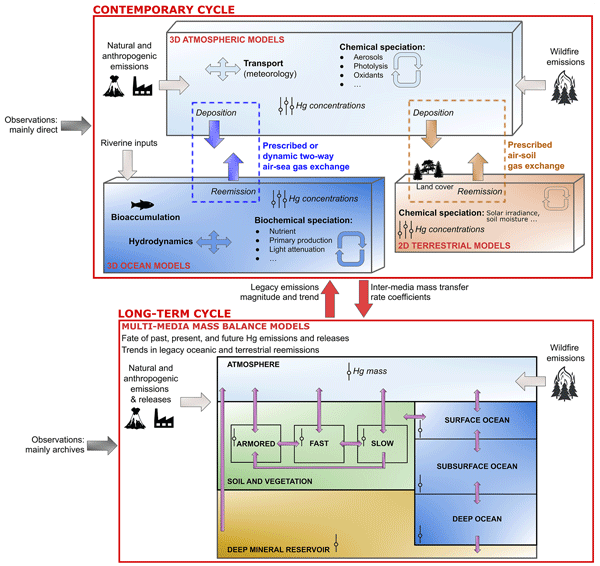
Ashu Dastoor, Hélène Angot, Johannes Bieser, Flora Brocza, Brock Edwards, Aryeh Feinberg, Xinbin Feng, Benjamin Geyman, Charikleia Gournia, Yipeng He, Ian M. Hedgecock, Ilia Ilyin, Jane Kirk, Che-Jen Lin, Igor Lehnherr, Robert Mason, David McLagan, Marilena Muntean, Peter Rafaj, Eric M. Roy, Andrei Ryjkov, Noelle E. Selin, Francesco De Simone, Anne L. Soerensen, Frits Steenhuisen, Oleg Travnikov, Shuxiao Wang, Xun Wang, Simon Wilson, Rosa Wu, Qingru Wu, Yanxu Zhang, Jun Zhou, Wei Zhu, and Scott Zolkos
Geosci. Model Dev., 18, 2747–2860, https://doi.org/10.5194/gmd-18-2747-2025, https://doi.org/10.5194/gmd-18-2747-2025, 2025
Short summary
Short summary
This paper introduces the Multi-Compartment Mercury (Hg) Modeling and Analysis Project (MCHgMAP) aimed at informing the effectiveness evaluations of two multilateral environmental agreements: the Minamata Convention on Mercury and the Convention on Long-Range Transboundary Air Pollution. The experimental design exploits a variety of models (atmospheric, land, oceanic ,and multimedia mass balance models) to assess the short- and long-term influences of anthropogenic Hg releases into the environment.
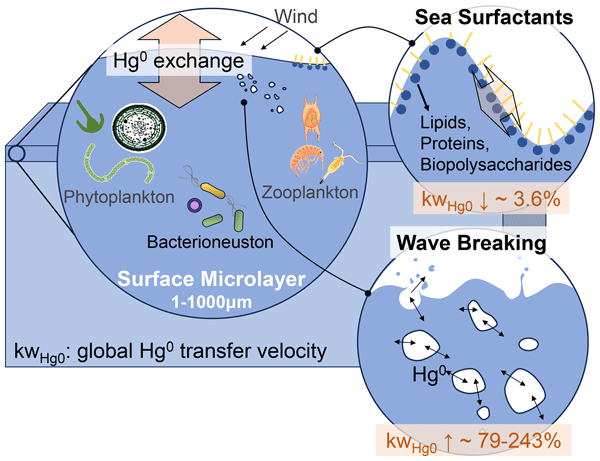
Ling Li, Peipei Wu, Peng Zhang, Shaojian Huang, and Yanxu Zhang
Geosci. Model Dev., 17, 8683–8695, https://doi.org/10.5194/gmd-17-8683-2024, https://doi.org/10.5194/gmd-17-8683-2024, 2024
Short summary
Short summary
In this study, we incorporate sea surfactants and wave-breaking processes into MITgcm-ECCOv4-Hg. The updated model shows increased fluxes in high-wind-speed and high-wave regions and vice versa, enhancing spatial heterogeneity. It shows that elemental mercury (Hg0) transfer velocity is more sensitive to wind speed. These findings may elucidate the discrepancies in previous estimations and offer insights into global Hg cycling.
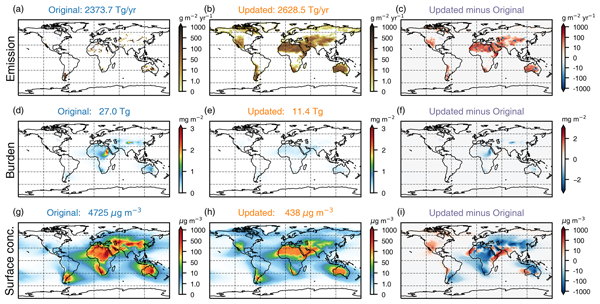
Yujuan Wang, Peng Zhang, Jie Li, Yaman Liu, Yanxu Zhang, Jiawei Li, and Zhiwei Han
Geosci. Model Dev., 17, 7995–8021, https://doi.org/10.5194/gmd-17-7995-2024, https://doi.org/10.5194/gmd-17-7995-2024, 2024
Short summary
Short summary
This study updates the CESM's aerosol schemes, focusing on dust, marine aerosol emissions, and secondary organic aerosol (SOA) . Dust emission modifications make deflation areas more continuous, improving results in North America and the sub-Arctic. Humidity correction to sea-salt emissions has a minor effect. Introducing marine organic aerosol emissions, coupled with ocean biogeochemical processes, and adding aqueous reactions for SOA formation advance the CESM's aerosol modelling results.
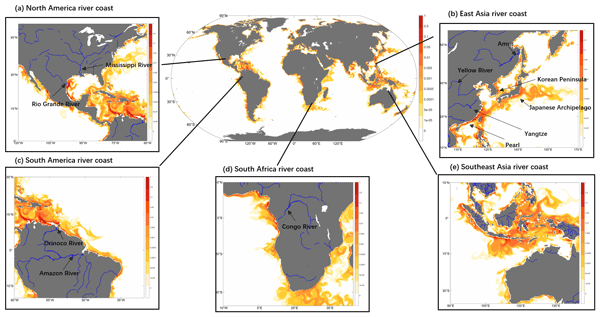
Siyu Zhu, Peipei Wu, Siyi Zhang, Oliver Jahn, Shu Li, and Yanxu Zhang
Geosci. Model Dev., 16, 5915–5929, https://doi.org/10.5194/gmd-16-5915-2023, https://doi.org/10.5194/gmd-16-5915-2023, 2023
Short summary
Short summary
In this study, we estimate the global biogeochemical cycling of Hg in a state-of-the-art physical-ecosystem ocean model (high-resolution-MITgcm/Hg), providing a more accurate portrayal of surface Hg concentrations in estuarine and coastal areas, strong western boundary flow and upwelling areas, and concentration diffusion as vortex shapes. The high-resolution model can help us better predict the transport and fate of Hg in the ocean and its impact on the global Hg cycle.

Xiaotian Xu, Xu Feng, Haipeng Lin, Peng Zhang, Shaojian Huang, Zhengcheng Song, Yiming Peng, Tzung-May Fu, and Yanxu Zhang
Geosci. Model Dev., 15, 3845–3859, https://doi.org/10.5194/gmd-15-3845-2022, https://doi.org/10.5194/gmd-15-3845-2022, 2022
Short summary
Short summary
Mercury is one of the most toxic pollutants in the environment, and wet deposition is a major process for atmospheric mercury to enter, causing ecological and human health risks. High-mercury wet deposition in the southeastern US has been a problem for many years. Here we employed a newly developed high-resolution WRF-GC model with the capability to simulate mercury to study this problem. We conclude that deep convection caused enhanced mercury wet deposition in the southeastern US.
Peng Zhang and Yanxu Zhang
Geosci. Model Dev., 15, 3587–3601, https://doi.org/10.5194/gmd-15-3587-2022, https://doi.org/10.5194/gmd-15-3587-2022, 2022
Short summary
Short summary
Mercury is a global pollutant that can be transported over long distance through the atmosphere. We develop a new online global model for atmospheric mercury. The model reproduces the observed global atmospheric mercury concentrations and deposition distributions by simulating the emissions, transport, and physicochemical processes of atmospheric mercury. And we find that the seasonal variations of atmospheric Hg are the result of multiple processes and have obvious regional characteristics.

Ruochong Xu, Joel A. Thornton, Ben H. Lee, Yanxu Zhang, Lyatt Jaeglé, Felipe D. Lopez-Hilfiker, Pekka Rantala, and Tuukka Petäjä
Atmos. Chem. Phys., 22, 5477–5494, https://doi.org/10.5194/acp-22-5477-2022, https://doi.org/10.5194/acp-22-5477-2022, 2022
Short summary
Short summary
Monoterpenes are emitted into the atmosphere by vegetation and by the use of certain consumer products. Reactions of monoterpenes in the atmosphere lead to low-volatility products that condense to grow particulate matter or participate in new particle formation and, thus, affect air quality and climate. We use a model of atmospheric chemistry and transport to evaluate the global-scale importance of recent updates to our understanding of monoterpene chemistry in particle formation and growth.
Cited articles
Aoyama, M. and Hirose, K.: Artificial Radionuclides Database in the Pacific Ocean: HAM Database, The Scientific World Journal, 4, 200–215, https://doi.org/10.1100/tsw.2004.15, 2004.
Aoyama, M., Uematsu, M., Tsumune, D., and Hamajima, Y.: Surface pathway of radioactive plume of TEPCO Fukushima NPP1 released 134Cs and 137Cs, Biogeosciences, 10, 3067–3078, https://doi.org/10.5194/bg-10-3067-2013, 2013.
Bailly du Bois, P., Laguionie, P., Boust, D., Korsakissok, I., Didier, D., and Fiévet, B.: Estimation of marine source-term following Fukushima Dai-ichi accident, J. Environ. Radioact., 114, 2–9, https://doi.org/10.1016/j.jenvrad.2011.11.015, 2012.
Behrens, E., Schwarzkopf, F. U., Lübbecke, J. F., and Böning, C. W.: Model simulations on the long-term dispersal of 137Cs released into the Pacific Ocean off Fukushima, Environ. Res. Lett., 7, 034004, https://doi.org/10.1088/1748-9326/7/3/034004, 2012.
Buesseler, K. O.: Opening the floodgates at Fukushima, Science, https://doi.org/10.1126/science.abc1507, 2020.
Buesseler, K., Dai, M., Aoyama, M., Benitez-Nelson, C., Charmasson, S., Higley, K., Maderich, V., Masqué, P., Morris, P. J., Oughton, D., and Smith, J. N.: Fukushima Daiichi–Derived Radionuclides in the Ocean: Transport, Fate, and Impacts, Annual Review of Marine Science, 9, 173–203, https://doi.org/10.1146/annurev-marine-010816-060733, 2017.
Buesseler, K. O., Jayne, S. R., Fisher, N. S., Rypina, I. I., Baumann, H., Baumann, Z., Breier, C. F., Douglass, E. M., George, J., Macdonald, A. M., Miyamoto, H., Nishikawa, J., Pike, S. M., and Yoshida, S.: Fukushima-derived radionuclides in the ocean and biota off Japan, P. Natl. Acad. Sci. USA, 109, 5984–5988, https://doi.org/10.1073/pnas.1120794109, 2012.
Carvalho, F. P.: Radionuclide concentration processes in marine organisms: A comprehensive review, Journal of Environmental Radioactivity, 186, 124–130, https://doi.org/10.1016/j.jenvrad.2017.11.002, 2018.
Carvalho, F. P., Oliveira, J. M., and Malta, M.: Radionuclides in deep-sea fish and other organisms from the North Atlantic Ocean, ICES J. Mar. Sci., 68, 333–340, https://doi.org/10.1093/icesjms/fsq088, 2011.
Cauquoin, A., Gusyev, M., Komuro, Y., Ono, J., and Yoshimura, K.: Ocean general circulation model simulations of anthropogenic tritium releases from the Fukushima Daiichi nuclear power plant site, Marine Pollution Bulletin, 220, 118294, https://doi.org/10.1016/j.marpolbul.2025.118294, 2025.
Chen, G., Wang, Q., and Chu, X.: Accelerated spread of Fukushima’s waste water by ocean circulation, Innovation, 2, https://doi.org/10.1016/j.xinn.2021.100119, 2021.
Christoudias, T. and Lelieveld, J.: Modelling the global atmospheric transport and deposition of radionuclides from the Fukushima Dai-ichi nuclear accident, Atmos. Chem. Phys., 13, 1425–1438, https://doi.org/10.5194/acp-13-1425-2013, 2013.
Draxler, R., Arnold, D., Chino, M., Galmarini, S., Hort, M., Jones, A., Leadbetter, S., Malo, A., Maurer, C., Rolph, G., Saito, K., Servranckx, R., Shimbori, T., Solazzo, E., and Wotawa, G.: World Meteorological Organization's model simulations of the radionuclide dispersion and deposition from the Fukushima Daiichi nuclear power plant accident, Journal of Environmental Radioactivity, 139, 172–184, https://doi.org/10.1016/j.jenvrad.2013.09.014, 2015.
Eckerman, K., Harrison, J., Menzel, H.-G., and Clement, C. H.: ICRP Publication 119: Compendium of Dose Coefficients based on ICRP Publication 60, Annals of the ICRP, 42, e1–e130, https://doi.org/10.1016/j.icrp.2013.05.003, 2012.
Fisher, N. S., Fowler, S. W., Boisson, F., Carroll, J., Rissanen, K., Salbu, B., Sazykina, T. G., and Sjoeblom, K.-L.: Radionuclide Bioconcentration Factors and Sediment Partition Coefficients in Arctic Seas Subject to Contamination from Dumped Nuclear Wastes, Environ. Sci. Technol., 33, 1979–1982, https://doi.org/10.1021/es9812195, 1999.
Fisher, N. S., Beaugelin-Seiller, K., Hinton, T. G., Baumann, Z., Madigan, D. J., and Garnier-Laplace, J.: Evaluation of radiation doses and associated risk from the Fukushima nuclear accident to marine biota and human consumers of seafood, P. Natl. Acad. Sci. USA, 110, 10670–10675, https://doi.org/10.1073/pnas.1221834110, 2013.
Fowler, S. W. and Fisher, N. S.: Chapter 6 Radionuclides in the biosphere, Radioactivity in the Environment, 6, 167–203, https://doi.org/10.1016/S1569-4860(05)80007-5, 2005.
Gent, P. R. and J. C. Mcwilliams: Isopycnal Mixing in Ocean Circulation Models, J. Phys. Oceanogr., 20, 150–155, https://doi.org/10.1175/1520-0485(1990)020<0150:IMIOCM>2.0.CO;2, 1990.
Giwa, A., Eniola, J. O., Salem, A. B., Alshamsi, A. A., Omar, K. A., Alnuaimi, N. S., Al-Fahad, S. G., and Rashed, L. A.: Navigating the nuclear tide: A comprehensive review of challenges, opportunities, and advances in managing marine contamination by radioactive contaminants, Marine Pollution Bulletin, 217, 118113, https://doi.org/10.1016/j.marpolbul.2025.118113, 2025.
Hasegawa, A., Tanigawa, K., Ohtsuru, A., Yabe, H., Maeda, M., Shigemura, J., Ohira, T., Tominaga, T., Akashi, M., Hirohashi, N., Ishikawa, T., Kamiya, K., Shibuya, K., Yamashita, S., and Chhem, R. K.: Health effects of radiation and other health problems in the aftermath of nuclear accidents, with an emphasis on Fukushima, Lancet, 386, 479–488, https://doi.org/10.1016/S0140-6736(15)61106-0, 2015.
Hu, X., Li, D., Huang, H., Shen, S., and Bou-Zeid, E.: Modeling and sensitivity analysis of transport and deposition of radionuclides from the Fukushima Dai-ichi accident, Atmos. Chem. Phys., 14, 11065–11092, https://doi.org/10.5194/acp-14-11065-2014, 2014.
Huestis, S.: Understanding the Origin and Meaning of the Radioactive Decay Equation, Journal of Geoscience Education, 50, 524–527, https://doi.org/10.5408/1089-9995-50.5.524, 2002.
IAEA: Sediment Distribution Coefficients and Concentration Factors for Biota in the Marine Environment, International Atomic Energy Agency, Vienna, ISBN 92–0–114403–2, https://www-pub.iaea.org/MTCD/Publications/PDF/TRS422_web.pdf (last access: 8 December 2025), 2004.
IAEA: IAEA Safety Standards for protecting people and the environment: Categorization of Radioactive Sources Safety Guide No. RS-G-1.9, International Atomic Energy Agency, Vienna, ISBN 92–0–103905–0, https://www-pub.iaea.org/MTCD/publications/PDF/Pub1227_web.pdf (last access: 8 December 2025), 2005.
IAEA: Nuclear Energy for a Net Zero World, https://www.iaea.org/sites/default/files/21/10/nuclear-energy-for-a-net-zero-world.pdf (last access: 8 December 2025), 2021.
IAEA: Nuclear Power Reactors in the World, Reference Data Series No. 2, IAEA, Vienna, ISBN 978-92-0-122224-4, 2024a.
IAEA: Energy, Electricity and Nuclear Power Estimates for the Period up to 2050, Reference Data Series No. 1, IAEA, Vienna, https://doi.org/10.61092/iaea.e3qb-hsrr, 2024b.
Jone, K: Implied doses to the population of the EU arising from reported discharges from EU nuclear power stations and reprocessing sites in the years 2004 to 2008, European Commission Publications Office, https://doi.org/10.2768/23745, 2013.
Kaeriyama, H., Ambe, D., Shimizu, Y., Fujimoto, K., Ono, T., Yonezaki, S., Kato, Y., Matsunaga, H., Minami, H., Nakatsuka, S., and Watanabe, T.: Direct observation of 134Cs and 137Cs in surface seawater in the western and central North Pacific after the Fukushima Dai-ichi nuclear power plant accident, Biogeosciences, 10, 4287–4295, https://doi.org/10.5194/bg-10-4287-2013, 2013.
Kamidaira, Y., Uchiyama, Y., Kawamura, H., Kobayashi, T., and Otosaka, S.: A modeling study on the oceanic dispersion and sedimentation of radionuclides off the coast of Fukushima, Journal of Environmental Radioactivity, 238–239, 106724, https://doi.org/10.1016/j.jenvrad.2021.106724, 2021.
Kawamura, H., Kobayashi, T., Furuno, A., In, T., Ishikawa, Y., Nakayama, T., Shima, S., and Awaji, T.: Preliminary Numerical Experiments on Oceanic Dispersion of 131I and 137Cs Discharged into the Ocean because of the Fukushima Daiichi Nuclear Power Plant Disaster, Journal of Nuclear Science and Technology, 48, 1349–1356, https://doi.org/10.1080/18811248.2011.9711826, 2011.
Kawamura, H., Kobayashi, T., Furuno, A., Usui, N., and Kamachi, M.: Numerical simulation on the long-term variation of radioactive cesium concentration in the North Pacific due to the Fukushima disaster, Journal of Environmental Radioactivity, 136, 64–75, https://doi.org/10.1016/j.jenvrad.2014.05.005, 2014.
Kenyon, J. A., Buesseler, K. O., Casacuberta, N., Castrillejo, M., Otosaka, S., Masqué, P., Drysdale, J. A., Pike, S. M., and Sanial, V.: Distribution and Evolution of Fukushima Dai-ichi derived 137Cs, 90Sr, and 129I in Surface Seawater off the Coast of Japan, Environ. Sci. Technol., 54, 15066–15075, https://doi.org/10.1021/acs.est.0c05321, 2020.
Kumamoto, Y., Yamada, M., Aoyama, M., Hamajima, Y., Kaeriyama, H., Nagai, H., Yamagata, T., Murata, A., and Masumoto, Y.: Radiocesium in North Pacific coastal and offshore areas of Japan within several months after the Fukushima accident, Journal of Environmental Radioactivity, 198, 79–88, https://doi.org/10.1016/j.jenvrad.2018.12.015, 2019.
Large, W. G., Mcwilliams, J. C., and Doney, S. C.: Oceanic Vertical Mixing – a Review and a Model with a Nonlocal Boundary-Layer Parameterization, Reviews of Geophysics, 32, 363–403, https://doi.org/10.1029/94RG01872, 1994.
Lee, B.-G. and Fisher, N. S.: Microbially mediated cobalt oxidation in seawater revealed by radiotracer experiments, Limnology and Oceanography, 38, 1593–1602, https://doi.org/10.4319/lo.1993.38.8.1593, 1993.
Lehto, J., Koivula, R., Leinonen, H., Tusa, E., and Harjula, R.: Removal of Radionuclides from Fukushima Daiichi Waste Effluents,Separation & Purification Reviews, 48, 122–142, https://doi.org/10.1080/15422119.2018.1549567, 2019.
Li, H., Chen, D., Nie, B., and Wang, D.: Numerical modeling and parameters analysis of marine radionuclide dispersion under the Fukushima Daiichi nuclear accident, Progress in Nuclear Energy, 184, 105716, https://doi.org/10.1016/j.pnucene.2025.105716, 2025.
Lumpkin, R. and Johnson, G. C.: Global ocean surface velocities from drifters: Mean, variance, El Niño–Southern Oscillation response, and seasonal cycle, Journal of Geophysical Research: Oceans, 118, 2992–3006, https://doi.org/10.1002/jgrc.20210, 2013.
Mabon, L.: Treated water releases from the Fukushima Dai'ichi nuclear power plant: An overview of the decision-making process and governing institutions, Marine Policy, 163, 106120, https://doi.org/10.1016/j.marpol.2024.106120, 2024.
Maderich, V., Jung, K. T., Bezhenar, R., de With, G., Qiao, F., Casacuberta, N., Masque, P., and Kim, Y. H.: Dispersion and fate of 90Sr in the Northwestern Pacific and adjacent seas: Global fallout and the Fukushima Dai-ichi accident, Science of The Total Environment, 494–495, 261–271, https://doi.org/10.1016/j.scitotenv.2014.06.136, 2014a.
Maderich, V., Bezhenar, R., Heling, R., de With, G., Jung, K. T., Myoung, J. G., Cho, Y.-K., Qiao, F., and Robertson, L.: Regional long-term model of radioactivity dispersion and fate in the Northwestern Pacific and adjacent seas: application to the Fukushima Dai-ichi accident, J. Environ. Radioact., 131, 4–18, https://doi.org/10.1016/j.jenvrad.2013.09.009, 2014b.
Maderich, V., Jung, K. T., Brovchenko, I., and Kim, K. O.: Migration of radioactivity in multi-fraction sediments, Environmental Fluid Mechanics, 17, 1207–1231, https://doi.org/10.1007/s10652-017-9545-9, 2017.
Mao, M., Wang, Y., Wu, P., Huang, S., Song, Z., and Zhang, Y.: Modeling the Transport and Fate of Radionuclides Released from Nuclear Power Plants Wastewater in the Global Ocean, Zenodo [code and data set], https://doi.org/10.5281/zenodo.16608895, 2025.
Marshall, J., Adcroft, A., Hill, C., Perelman, L., and Heisey, C.: A finite-volume, incompressible Navier Stokes model for studies of the ocean on parallel computers, Journal of Geophysical Research: Oceans, 102, 5753–5766, https://doi.org/10.1029/96JC02775, 1997.
Maximenko, N., Hafner, J., Kamachi, M., and MacFadyen, A.: Numerical simulations of debris drift from the Great Japan Tsunami of 2011 and their verification with observational reports, Marine Pollution Bulletin, 132, 5–25, https://doi.org/10.1016/j.marpolbul.2018.03.056, 2018.
Mclaughlin, P. D., Jones, B., and Maher, M. M.: An update on radioactive release and exposures after the Fukushima Dai-ichi nuclear disaster, Br. J. Radiol., 85, 1222–1225, https://doi.org/10.1259/bjr/27017231, 2012.
Miyazawa, Y., Masumoto, Y., Varlamov, S. M., and Miyama, T.: Transport simulation of the radionuclide from the shelf to open ocean around Fukushima, Continental Shelf Research, 50–51, 16–29, https://doi.org/10.1016/j.csr.2012.09.002, 2012.
Mori, K., Tada, K., Tawara, Y., Ohno, K., Asami, M., Kosaka, K., and Tosaka, H.: Integrated watershed modeling for simulation of spatiotemporal redistribution of post-fallout radionuclides: Application in radiocesium fate and transport processes derived from the Fukushima accidents, Environmental Modelling & Software, 72, 126–146, https://doi.org/10.1016/j.envsoft.2015.06.012, 2015.
Murray, C. C., Maximenko, N., and Lippiatt, S.: The influx of marine debris from the Great Japan Tsunami of 2011 to North American shorelines, Marine Pollution Bulletin, 132, 26–32, https://doi.org/10.1016/j.marpolbul.2018.01.004, 2018.
Nakano, M. and Povinec, P. P.: Modelling the distribution of plutonium in the Pacific Ocean, Journal of Environmental Radioactivity, 69, 85–106, https://doi.org/10.1016/S0265-931X(03)00088-2, 2003.
Nakano, M. and Povinec, P. P.: Long-term simulations of the 137Cs dispersion from the Fukushima accident in the world ocean, Journal of Environmental Radioactivity, 111, 109–115, https://doi.org/10.1016/j.jenvrad.2011.12.001, 2012.
Normile, D.: Japan plans to release Fukushima's wastewater into the ocean, Science, https://doi.org/10.1126/science.abi9880, 2021.
Normile, D.: Despite opposition, Japan may soon dump Fukushima wastewater into the Pacific, Science, https://doi.org/10.1126/science.adg8322, 2023.
Oikawa, S., Takata, H., Watabe, T., Misonoo, J., and Kusakabe, M.: Distribution of the Fukushima-derived radionuclides in seawater in the Pacific off the coast of Miyagi, Fukushima, and Ibaraki Prefectures, Japan, Biogeosciences, 10, 5031–5047, https://doi.org/10.5194/bg-10-5031-2013, 2013.
Periáñez, R., Suh, K.-S., Byung-Il, M., Casacuberta, N., and Masqué, P.: Numerical modeling of the releases of 90SR from Fukushima to the ocean: an evaluation of the source term, Environ. Sci. Technol., 47, 12305–12313, https://doi.org/10.1021/es4031408, 2013.
Periáñez, R., Bezhenar, R., Brovchenko, I., Jung, K. T., Kamidara, Y., Kim, K. O., Kobayashi, T., Liptak, L., Maderich, V., Min, B. I., and Suh, K. S.: Fukushima 137Cs releases dispersion modelling over the Pacific Ocean. Comparisons of models with water, sediment and biota data, Journal of Environmental Radioactivity, 198, 50–63, https://doi.org/10.1016/j.jenvrad.2018.12.014, 2019a.
Periáñez, R., Bezhenar, R., Brovchenko, I., Duffa, C., Iosjpe, M., Jung, K. T., Kim, K. O., Kobayashi, T., Liptak, L., Little, A., Maderich, V., McGinnity, P., Min, B. I., Nies, H., Osvath, I., Suh, K. S., and de With, G.: Marine radionuclide transport modelling: Recent developments, problems and challenges, Environmental Modelling & Software, 122, 104523, https://doi.org/10.1016/j.envsoft.2019.104523, 2019b.
Povinec, P. P., Gera, M., Holý, K., Hirose, K., Lujaniené, G., Nakano, M., Plastino, W., Sýkora, I., Bartok, J., and Gažák, M.: Dispersion of Fukushima radionuclides in the global atmosphere and the ocean, Applied Radiation and Isotopes, 81, 383–392, https://doi.org/10.1016/j.apradiso.2013.03.058, 2013.
Prandle, D. and Beechey, J.: Marine dispersion of caesium 137 released from Sellafield and Chernobyl, Geophysical Research Letters, 18, 1723–1726, https://doi.org/10.1029/91GL01336, 1991.
Prants, S. V., Budyansky, M. V., and Uleysky, M. Y.: Lagrangian simulation and tracking of the mesoscale eddies contaminated by Fukushima-derived radionuclides, Ocean Sci., 13, 453–463, https://doi.org/10.5194/os-13-453-2017, 2017.
Real, A., Sundell-Bergman, S., Knowles, J. F., Woodhead, D. S., and Zinger, I.: Effects of ionising radiation exposure on plants, fish and mammals: relevant data for environmental radiation protection, J. Radiol. Prot., 24, A123, https://doi.org/10.1088/0952-4746/24/4A/008, 2004.
Rossi, V., Van Sebille, E., Sen Gupta, A., Garçon, V., and England, M. H.: Multi-decadal projections of surface and interior pathways of the Fukushima Cesium-137 radioactive plume, Deep Sea Research Part I: Oceanographic Research Papers, 80, 37–46, https://doi.org/10.1016/j.dsr.2013.05.015, 2013.
Rypina, I. I., Jayne, S. R., Yoshida, S., Macdonald, A. M., Douglass, E., and Buesseler, K.: Short-term dispersal of Fukushima-derived radionuclides off Japan: modeling efforts and model-data intercomparison, Biogeosciences, 10, 4973–4990, https://doi.org/10.5194/bg-10-4973-2013, 2013.
Rypina, I. I., Jayne, S. R., Yoshida, S., Macdonald, A. M., and Buesseler, K.: Drifter-based estimate of the 5 year dispersal of Fukushima-derived radionuclides, Journal of Geophysical Research: Oceans, 119, 8177–8193, https://doi.org/10.1002/2014JC010306, 2014.
Saito, M. A. and Moffett, J. W.: Temporal and spatial variability of cobalt in the Atlantic Ocean, Geochimica et Cosmochimica Acta, 66, 1943–1953, https://doi.org/10.1016/S0016-7037(02)00829-3, 2002.
Sakamoto, T. T., Hasumi, H., Ishii, M., Emori, S., Suzuki, T., Nishimura, T., and Sumi, A.: Responses of the Kuroshio and the Kuroshio Extension to global warming in a high-resolution climate model, Geophysical Research Letters, 32, https://doi.org/10.1029/2005GL023384, 2005.
Salomon, J. C., Breton, M., and Guegueniat, P.: A 2D long term advection – dispersion model for the Channel and southern North Sea Part B: Transit time and transfer function from Cap de La Hague, Journal of Marine Systems, 6, 515–527, https://doi.org/10.1016/0924-7963(95)00021-G, 1995.
Sathiya, K. and Ramachandran, K.: Impacts of Radiation on Human Health: A Narrative Review, Journal of Radiology and Medical Imaging, 7, 1095, https://meddocsonline.org/journal-of-radiology-and-medical-imaging/impacts-of-radiation-on-human-health-a-narrative-review.pdf (last access: 17 December 2025), 2024.
Schneider, M., Froggatt, A., Hazemann, J., Ramana, M. V., Sailer, M., Suzuku, T., von Hirschhausen, C., and Wimmers, A. J.: The World Nuclear Industry Status Report 2022, A Mycle Schneider Consulting Project, Paris, Fig. 43, 385 pp., https://www.worldnuclearreport.org/The-World-Nuclear-Industry-Status-Report-2022-HTML (last access: 8 December 2025), 2022.
Smith, J. N., Brown, R. M., Williams, W. J., Robert, M., Nelson, R., and Moran, S. B.: Arrival of the Fukushima radioactivity plume in North American continental waters, P. Natl. Acad. Sci. USA, 112, 1310–1315, https://doi.org/10.1073/pnas.1412814112, 2015.
Sokolov, A. P., Schlosser, C. A., Dutkiewicz, S., Paltsev, S., Kicklighter, D. W., Jacoby, H. D., Prinn, R. G., Forest, C. E., Reilly, J. M., Wang, C., Felzer, B. S., Sarofim, M. C., Scott, J., Stone, P. H., Melillo, J. M., and Cohen, J. B.: MIT Integrated Global System Model (IGSM) Version 2: Model Description and Baseline Evaluation, MIT Joint Program on the Science and Policy of Global Change, https://dspace.mit.edu/handle/1721.1/29789 (last access: 8 December 2025), 2005.
Strode, S., Jaeglé, L., and Emerson, S.: Vertical transport of anthropogenic mercury in the ocean, Global Biogeochemical Cycles, 24, https://doi.org/10.1029/2009GB003728, 2010.
Takata, H., Kusakabe, M., Inatomi, N., and Ikenoue, T.: Appearances of Fukushima Daiichi Nuclear Power Plant-Derived 137Cs in Coastal Waters around Japan: Results from Marine Monitoring off Nuclear Power Plants and Facilities, 1983–2016, Environ. Sci. Technol., 52, 2629–2637, https://doi.org/10.1021/acs.est.7b03956, 2018.
TEPCO: Tank type: large-capacity tank, https://www4.tepco.co.jp/en/decommission/progress/watertreatment/images/190918_large-capacity_tank.pdf (last access: 9 July 2025), 2019.
TEPCO: Draft study responding to the subcommittee report on handling ALPS treated water, https://www.tepco.co.jp/en/decommission/progress/watertreatment/images/200324.pdf (last access: 9 July 2025), 2020a.
TEPCO: Radiation concentration estimates for each tank area (as of 31 December 2020), https://www4.tepco.co.jp/en/sp/decommission/progress/watertreatment/images/tankarea_en.pdf (last access: 9 July 2025), 2020b.
TEPCO: Characteristics of water recently treated with multi-nuclide removal equipment (ALPS) etc., 68–70, https://www.tepco.co.jp/en/decommission/progress/watertreatment/images/200131.pdf (last access: 9 July 2025), 2020c.
TEPCO: Outline of Decommissioning and Contaminated Water Management, https://www.tepco.co.jp/en/hd/decommission/information/committee/pdf/2021/roadmap_20211125_01-e.pdf (last access: 9 July 2025), 2021a.
TEPCO: New Definition of ALPS Treated Water and the Amount of Tritium in Water being stored in Tanks, https://www4.tepco.co.jp/en/decommission/progress/watertreatment/images/20210427.pdf (last access: 9 July 2025), 2021b.
TEPCO: TEPCO Holdings' Action in Response to the Government's Policy on the handling of ALPS Treated Water, https://www.tepco.co.jp/en/hd/newsroom/press/archives/2021/pdf/210416e0101.pdf (last access: 9 July 2025), 2021c.
TEPCO: Radiological Environmental Impact Assessment Report Regarding the Discharge of ALPS Treated Water into the Sea – revised version, https://www.tepco.co.jp/en/hd/newsroom/press/archives/2023/pdf/230220e0101.pdf (last access: 20 October 2025), 2023.
Tsubono, T., Misumi, K., Tsumune, D., Bryan, F. O., Hirose, K., and Aoyama, M.: Evaluation of radioactive cesium impact from atmospheric deposition and direct release fluxes into the North Pacific from the Fukushima Daiichi nuclear power plant, Deep Sea Research Part I: Oceanographic Research Papers, 115, 10–21, 2016.
Tsumune, D., Aoyama, M., and Hirose, K.: Behavior of137 Cs concentrations in the North Pacific in an ocean general circulation model, J. Geophys. Res., 108, 2002JC001434, https://doi.org/10.1029/2002JC001434, 2003.
Tsumune, D., Tsubono, T., Aoyama, M., and Hirose, K.: Distribution of oceanic 137Cs from the Fukushima Dai-ichi Nuclear Power Plant simulated numerically by a regional ocean model, Journal of Environmental Radioactivity, 111, 100–108, https://doi.org/10.1016/j.jenvrad.2011.10.007, 2012.
Tsumune, D., Tsubono, T., and Misumi, K.: Improving the estimation of direct release rates and transport processes from the Fukushima Daiichi Nuclear Power Plant accident using higher-resolution oceanic dispersion model, J. Environ. Radioact., 278, 107500, https://doi.org/10.1016/j.jenvrad.2024.107500, 2024.
Uchiyama, Y., Yamanishi, T., Tsumune, D., Miyazawa, Y., and Ishii, T.: Influences of coastal jet and mesoscale eddies on initial dispersion of the radionuclideseffects released from Fukushima Daiichi Nuclear Power Plant, Journal of Japan Society of Civil Engineers, Ser. B2 (Coastal Engineering), 69, I_1051–I_1055, https://doi.org/10.2208/kaigan.69.i_1051, 2013.
Short summary
This study examines how radionuclides released from nuclear power plants are transported and transformed in the global ocean over time. Using an advanced ocean simulation model, it focuses on radionuclides released during the Fukushima accident and from planned wastewater discharges. The findings show that some radionuclides can travel across the Pacific within a few years and gradually spread to other ocean basins by mid-century, emphasizing potential long-term environmental impacts.
This study examines how radionuclides released from nuclear power plants are transported and...


