
Articles | Volume 16, issue 21
https://doi.org/10.5194/gmd-16-6377-2023
© Author(s) 2023. This work is distributed under
the Creative Commons Attribution 4.0 License.
the Creative Commons Attribution 4.0 License.
https://doi.org/10.5194/gmd-16-6377-2023
© Author(s) 2023. This work is distributed under
the Creative Commons Attribution 4.0 License.
the Creative Commons Attribution 4.0 License.
Development and technical paper
| 
08 Nov 2023
Development and technical paper |
| 08 Nov 2023
| 08 Nov 2023
The capabilities of the adjoint of GEOS-Chem model to support HEMCO emission inventories and MERRA-2 meteorological data
Zhaojun Tang
School of Earth and Space Sciences, University of Science and Technology of China, Hefei, Anhui, 230026, China
School of Earth and Space Sciences, University of Science and Technology of China, Hefei, Anhui, 230026, China
Jiaqi Chen
School of Earth and Space Sciences, University of Science and Technology of China, Hefei, Anhui, 230026, China
Panpan Yang
School of Earth and Space Sciences, University of Science and Technology of China, Hefei, Anhui, 230026, China
Yanan Shen
School of Earth and Space Sciences, University of Science and Technology of China, Hefei, Anhui, 230026, China
Related authors
Zhaojun Tang, Panpan Yang, Kazuyuki Miyazaki, John Worden, Helen Worden, Daven K. Henze, Dylan B. A. Jones, and Zhe Jiang
Atmos. Chem. Phys., 26, 5531–5551, https://doi.org/10.5194/acp-26-5531-2026, https://doi.org/10.5194/acp-26-5531-2026, 2026
Short summary
Short summary
We provide a quantitative analysis of global CO emissions and drivers of atmospheric CO trends in 2003–2022, using GEOS-Chem adjoint model constrained by satellite CO measurements. Our results indicate a substantial decline in global anthropogenic CO emissions of 14 %–17 % over the two-decade period, as well as an important offsetting effect from biomass burning emissions on atmospheric CO decline driven by anthropogenic reductions, primarily attributable to extreme wildfire events in 2021.
Rui Zhu, Zhaojun Tang, Xiaokang Chen, Xiong Liu, and Zhe Jiang
Geosci. Model Dev., 16, 6337–6354, https://doi.org/10.5194/gmd-16-6337-2023, https://doi.org/10.5194/gmd-16-6337-2023, 2023
Short summary
Short summary
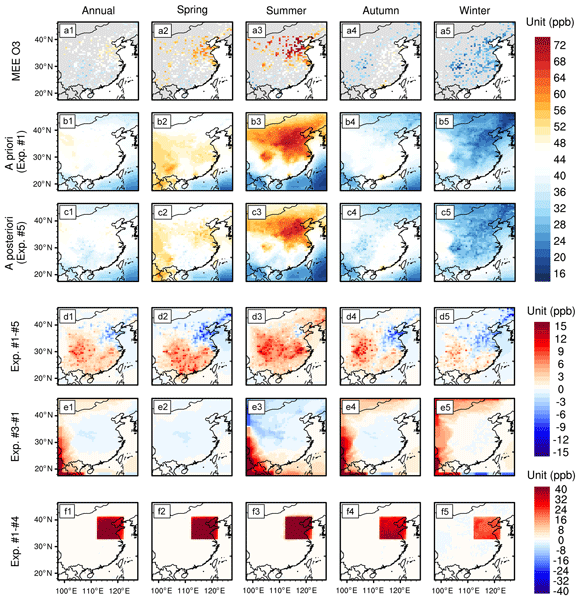
A single ozone (O3) tracer mode was developed in this work to build the capability of the GEOS-Chem model for rapid O3 simulation. It is combined with OMI and surface O3 observations to investigate the changes in tropospheric O3 in China in 2015–2020. The assimilations indicate rapid surface O3 increases that are underestimated by the a priori simulations. We find stronger increases in tropospheric O3 columns over polluted areas and a large discrepancy by assimilating different observations.
Rui Zhu, Zhaojun Tang, Xiaokang Chen, Xiong Liu, and Zhe Jiang
Atmos. Chem. Phys., 23, 9745–9763, https://doi.org/10.5194/acp-23-9745-2023, https://doi.org/10.5194/acp-23-9745-2023, 2023
Short summary
Short summary
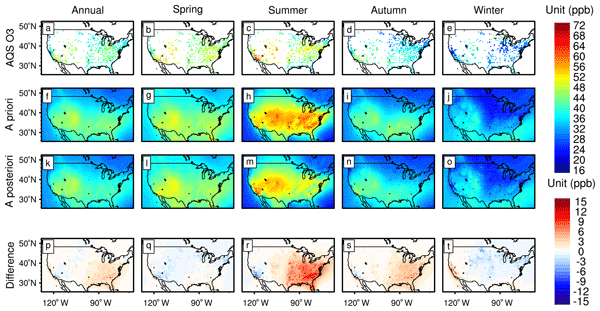
Ozone Monitoring Instrument (OMI) and surface O3 observations are used to investigate the changes in tropospheric O3 in the USA and Europe in 2005–2020. The surface-based assimilations show limited changes in surface and tropospheric column O3. The OMI-based assimilations show larger decreases in tropospheric O3 columns in 2010–2014, related to a decline in free-tropospheric NO2. Analysis suggests limited impacts of local emissions decline on tropospheric O3 over the USA and Europe in 2005–2020.
Zhaojun Tang, Jiaqi Chen, and Zhe Jiang
Atmos. Chem. Phys., 22, 7815–7826, https://doi.org/10.5194/acp-22-7815-2022, https://doi.org/10.5194/acp-22-7815-2022, 2022
Short summary
Short summary
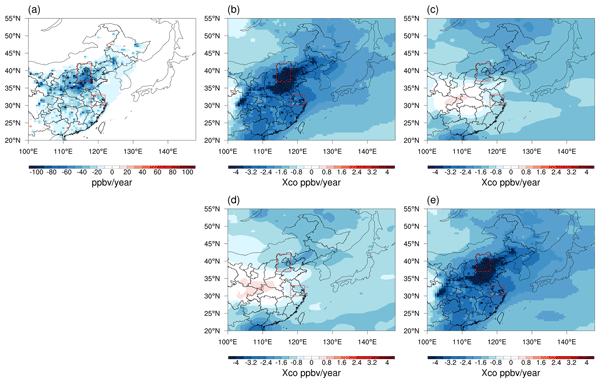
We provide a comparative analysis to explore the effects of satellite and surface measurements on atmospheric CO in data assimilations in 2015–2020 over East Asia. We find possible overestimated enhancements of atmospheric CO by assimilating surface CO measurements due to model representation errors, and a large discrepancy in the derived trends of CO columns due to different vertical sensitivities of satellite and surface observations to lower and free troposphere.
Weichao Han, Tai-Long He, Zhaojun Tang, Min Wang, Dylan Jones, and Zhe Jiang
Geosci. Model Dev., 15, 4225–4237, https://doi.org/10.5194/gmd-15-4225-2022, https://doi.org/10.5194/gmd-15-4225-2022, 2022
Short summary
Short summary
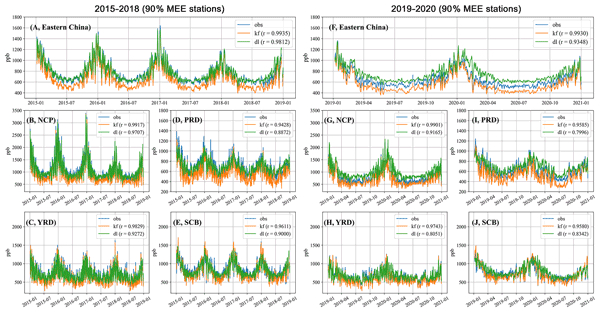
We present an application of a hybrid deep learning (DL) model on prediction of surface CO in China from 2015 to 2020, which utilizes both convolutional neural networks and long short-term memory neural networks. The DL model performance is better than a Kalman filter (KF) system in the training period (2005–2018). Furthermore, the DL model demonstrates good temporal extensibility: the mean bias and correlation coefficients are 95.7 ppb and 0.93 in the test period (2019–2020) over eastern China.
Zhuang Wang, Shanshan Liu, Congzi Xia, Yujia Chen, Chengxiao Liu, Yanfeng Huo, Xinfeng Lin, Nian Qiu, Xiaoyun Sun, Shaowei Yan, Jiaqi Chen, Nan Ge, Guanyin Yang, Zhenzhen Hua, Hao Zhang, Chune Shi, Yizhi Zhu, Kaidi Zhang, Xintong Chen, Chengzhi Xing, and Cheng Liu
EGUsphere, https://doi.org/10.5194/egusphere-2026-5807, https://doi.org/10.5194/egusphere-2026-5807, 2026
This preprint is open for discussion and under review for Atmospheric Chemistry and Physics (ACP).
Short summary
Short summary
Volcanic particles from Shinmoedake reached eastern China after several days of travel. Using two similar laser-based atmospheric instruments, satellite observations, and air-mass tracking, we found that particles observed about 200 kilometres apart had very different optical properties despite similar overall signal strength. This shows that long-travelled volcanic pollution can vary strongly over regional distances, affecting how it is identified and represented in models.
Zhuang Wang, Chengxiao Liu, Yanfeng Huo, Xinfeng Lin, Shaowei Yan, Xiaoyun Sun, Jiaqi Chen, Nan Ge, Guanyin Yang, Zhenzhen Hua, Hao Zhang, Chune Shi, Yong Zhu, Yizhi Zhu, Congzi Xia, Kaidi Zhang, Xintong Chen, Yujia Chen, Chengzhi Xing, and Cheng Liu
Earth Syst. Sci. Data Discuss., https://doi.org/10.5194/essd-2026-677, https://doi.org/10.5194/essd-2026-677, 2026
Preprint under review for ESSD
Short summary
Short summary
Airborne particles affect air quality and climate, but their distribution with height is poorly documented over central China. We used seven years of continuous ground-based lidar observations to build a detailed record of dust and other particles profiles from 2018 to 2024. Most particles were found below about two kilometres, with dust more common in spring and other particles in winter. The dataset can help track air pollution and dust transport and improve satellite and model assessments.
Zhaojun Tang, Zhe Jiang, Panpan Yang, Jiaqi Chen, Pingqing Fu, and Yanan Shen
EGUsphere, https://doi.org/10.5194/egusphere-2026-4938, https://doi.org/10.5194/egusphere-2026-4938, 2026
This preprint is open for discussion and under review for Atmospheric Chemistry and Physics (ACP).
Short summary
Short summary
This study identifies a systematic divergence between satellite and surface CO observations across China, North America, and Europe (2015–2024). We show that this discrepancy originates from different sensitivities to local emissions vs. large-scale transport. These findings reveal that relying on a single observation platform can misrepresent the true state of atmospheric CO, highlighting the need for multi-platform approaches to robustly constrain CO emission changes.
Zhaojun Tang, Panpan Yang, Kazuyuki Miyazaki, John Worden, Helen Worden, Daven K. Henze, Dylan B. A. Jones, and Zhe Jiang
Atmos. Chem. Phys., 26, 5531–5551, https://doi.org/10.5194/acp-26-5531-2026, https://doi.org/10.5194/acp-26-5531-2026, 2026
Short summary
Short summary
We provide a quantitative analysis of global CO emissions and drivers of atmospheric CO trends in 2003–2022, using GEOS-Chem adjoint model constrained by satellite CO measurements. Our results indicate a substantial decline in global anthropogenic CO emissions of 14 %–17 % over the two-decade period, as well as an important offsetting effect from biomass burning emissions on atmospheric CO decline driven by anthropogenic reductions, primarily attributable to extreme wildfire events in 2021.
Rui Zhu, Zhaojun Tang, Xiaokang Chen, Xiong Liu, and Zhe Jiang
Geosci. Model Dev., 16, 6337–6354, https://doi.org/10.5194/gmd-16-6337-2023, https://doi.org/10.5194/gmd-16-6337-2023, 2023
Short summary
Short summary
A single ozone (O3) tracer mode was developed in this work to build the capability of the GEOS-Chem model for rapid O3 simulation. It is combined with OMI and surface O3 observations to investigate the changes in tropospheric O3 in China in 2015–2020. The assimilations indicate rapid surface O3 increases that are underestimated by the a priori simulations. We find stronger increases in tropospheric O3 columns over polluted areas and a large discrepancy by assimilating different observations.
Rui Zhu, Zhaojun Tang, Xiaokang Chen, Xiong Liu, and Zhe Jiang
Atmos. Chem. Phys., 23, 9745–9763, https://doi.org/10.5194/acp-23-9745-2023, https://doi.org/10.5194/acp-23-9745-2023, 2023
Short summary
Short summary
Ozone Monitoring Instrument (OMI) and surface O3 observations are used to investigate the changes in tropospheric O3 in the USA and Europe in 2005–2020. The surface-based assimilations show limited changes in surface and tropospheric column O3. The OMI-based assimilations show larger decreases in tropospheric O3 columns in 2010–2014, related to a decline in free-tropospheric NO2. Analysis suggests limited impacts of local emissions decline on tropospheric O3 over the USA and Europe in 2005–2020.

Hongxia Zhu, Rui Li, Shuping Yang, Chun Zhao, Zhe Jiang, and Chen Huang
Atmos. Chem. Phys., 23, 2421–2437, https://doi.org/10.5194/acp-23-2421-2023, https://doi.org/10.5194/acp-23-2421-2023, 2023
Short summary
Short summary
The impacts of atmospheric dust aerosols and cloud dynamic conditions on precipitation vertical development in southeastern China were studied using multiple satellite observations. It was found that the precipitating drops under dusty conditions grow faster in the middle layer but slower in the upper and lower layers compared with their pristine counterparts. Quantitative estimation of the sensitivity of the precipitation top temperature to the dust aerosol optical depth is also provided.
Tai-Long He, Dylan B. A. Jones, Kazuyuki Miyazaki, Kevin W. Bowman, Zhe Jiang, Xiaokang Chen, Rui Li, Yuxiang Zhang, and Kunna Li
Atmos. Chem. Phys., 22, 14059–14074, https://doi.org/10.5194/acp-22-14059-2022, https://doi.org/10.5194/acp-22-14059-2022, 2022
Short summary
Short summary
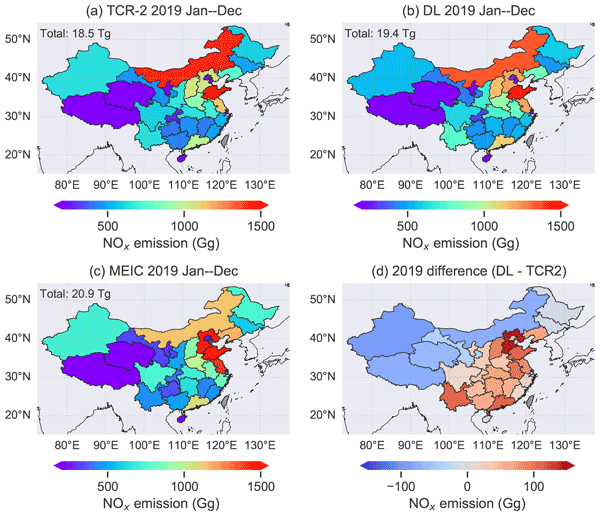
We use a deep-learning (DL) model to estimate Chinese NOx emissions by combining satellite analysis and in situ measurements. Our results are consistent with conventional analyses of Chinese NOx emissions. Comparison with mobility data shows that the DL model has a better capability to capture changes in NOx. We analyse Chinese NOx emissions during the COVID-19 pandemic lockdown period. Our results illustrate the potential use of DL as a complementary tool for conventional air quality studies.
Zhaojun Tang, Jiaqi Chen, and Zhe Jiang
Atmos. Chem. Phys., 22, 7815–7826, https://doi.org/10.5194/acp-22-7815-2022, https://doi.org/10.5194/acp-22-7815-2022, 2022
Short summary
Short summary
We provide a comparative analysis to explore the effects of satellite and surface measurements on atmospheric CO in data assimilations in 2015–2020 over East Asia. We find possible overestimated enhancements of atmospheric CO by assimilating surface CO measurements due to model representation errors, and a large discrepancy in the derived trends of CO columns due to different vertical sensitivities of satellite and surface observations to lower and free troposphere.
Weichao Han, Tai-Long He, Zhaojun Tang, Min Wang, Dylan Jones, and Zhe Jiang
Geosci. Model Dev., 15, 4225–4237, https://doi.org/10.5194/gmd-15-4225-2022, https://doi.org/10.5194/gmd-15-4225-2022, 2022
Short summary
Short summary
We present an application of a hybrid deep learning (DL) model on prediction of surface CO in China from 2015 to 2020, which utilizes both convolutional neural networks and long short-term memory neural networks. The DL model performance is better than a Kalman filter (KF) system in the training period (2005–2018). Furthermore, the DL model demonstrates good temporal extensibility: the mean bias and correlation coefficients are 95.7 ppb and 0.93 in the test period (2019–2020) over eastern China.
Yuqiang Zhang, Drew Shindell, Karl Seltzer, Lu Shen, Jean-Francois Lamarque, Qiang Zhang, Bo Zheng, Jia Xing, Zhe Jiang, and Lei Zhang
Atmos. Chem. Phys., 21, 16051–16065, https://doi.org/10.5194/acp-21-16051-2021, https://doi.org/10.5194/acp-21-16051-2021, 2021
Short summary
Short summary
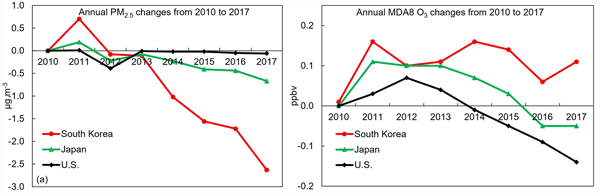
In this study, we use a global chemical transport model to simulate the effects on global air quality and human health due to emission changes in China from 2010 to 2017. By performing sensitivity analysis, we found that the air pollution control policies not only decrease the air pollutant concentration but also bring significant co-benefits in air quality to downwind regions. The benefits for the improved air pollution are dominated by PM2.5.
Cited articles
Barré, J., Edwards, D., Worden, H., Da Silva, A., and Lahoz, W.: On the feasibility of monitoring carbon monoxide in the lower troposphere from a constellation of Northern Hemisphere geostationary satellites. (Part 1), Atmos. Environ., 113, 63–77, https://doi.org/10.1016/j.atmosenv.2015.04.069, 2015.
Dedoussi, I. C., Eastham, S. D., Monier, E., and Barrett, S. R. H.: Premature mortality related to United States cross-state air pollution, Nature, 578, 261–265, https://doi.org/10.1038/s41586-020-1983-8, 2020.
Deeter, M. N., Edwards, D. P., Francis, G. L., Gille, J. C., Martínez-Alonso, S., Worden, H. M., and Sweeney, C.: A climate-scale satellite record for carbon monoxide: the MOPITT Version 7 product, Atmos. Meas. Tech., 10, 2533–2555, https://doi.org/10.5194/amt-10-2533-2017, 2017.
Fisher, J. A., Murray, L. T., Jones, D. B. A., and Deutscher, N. M.: Improved method for linear carbon monoxide simulation and source attribution in atmospheric chemistry models illustrated using GEOS-Chem v9, Geosci. Model Dev., 10, 4129–4144, https://doi.org/10.5194/gmd-10-4129-2017, 2017.
Guenther, A., Karl, T., Harley, P., Wiedinmyer, C., Palmer, P. I., and Geron, C.: Estimates of global terrestrial isoprene emissions using MEGAN (Model of Emissions of Gases and Aerosols from Nature), Atmos. Chem. Phys., 6, 3181–3210, https://doi.org/10.5194/acp-6-3181-2006, 2006.
Hammer, M. S., van Donkelaar, A., Li, C., Lyapustin, A., Sayer, A. M., Hsu, N. C., Levy, R. C., Garay, M. J., Kalashnikova, O. V., Kahn, R. A., Brauer, M., Apte, J. S., Henze, D. K., Zhang, L., Zhang, Q., Ford, B., Pierce, J. R., and Martin, R. V.: Global Estimates and Long-Term Trends of Fine Particulate Matter Concentrations (1998–2018), Environ. Sci. Technol., 54, 7879–7890, https://doi.org/10.1021/acs.est.0c01764, 2020.
Heald, C. L., Jacob, D. J., Jones, D. B. A., Palmer, P. I., Logan, J. A., Streets, D. G., Sachse, G. W., Gille, J. C., Hoffman, R. N., and Nehrkorn, T.: Comparative inverse analysis of satellite (MOPITT) and aircraft (TRACE-P) observations to estimate Asian sources of carbon monoxide, J. Geophys. Res.-Atmos., 109, D23306, https://doi.org/10.1029/2004jd005185, 2004.
Henze, D.: GEOS-Chem Adjoint, http://wiki.seas.harvard.edu/geos-chem/index.php/GEOS-Chem_Adjoint (last access: 6 November 2023), 2023.
Henze, D. K., Hakami, A., and Seinfeld, J. H.: Development of the adjoint of GEOS-Chem, Atmos. Chem. Phys., 7, 2413–2433, https://doi.org/10.5194/acp-7-2413-2007, 2007.
Hoesly, R. M., Smith, S. J., Feng, L., Klimont, Z., Janssens-Maenhout, G., Pitkanen, T., Seibert, J. J., Vu, L., Andres, R. J., Bolt, R. M., Bond, T. C., Dawidowski, L., Kholod, N., Kurokawa, J.-I., Li, M., Liu, L., Lu, Z., Moura, M. C. P., O'Rourke, P. R., and Zhang, Q.: Historical (1750–2014) anthropogenic emissions of reactive gases and aerosols from the Community Emissions Data System (CEDS), Geosci. Model Dev., 11, 369–408, https://doi.org/10.5194/gmd-11-369-2018, 2018.
Jiang, Z.: Updated version of adjoint of GEOS-Chem model, Zenodo [code], https://doi.org/10.5281/zenodo.7512111, 2023.
Jiang, Z., Jones, D. B. A., Worden, H. M., Deeter, M. N., Henze, D. K., Worden, J., Bowman, K. W., Brenninkmeijer, C. A. M., and Schuck, T. J.: Impact of model errors in convective transport on CO source estimates inferred from MOPITT CO retrievals, J. Geophys. Res.-Atmos., 118, 2073–2083, https://doi.org/10.1002/jgrd.50216, 2013.
Jiang, Z., Jones, D. B. A., Worden, J., Worden, H. M., Henze, D. K., and Wang, Y. X.: Regional data assimilation of multi-spectral MOPITT observations of CO over North America, Atmos. Chem. Phys., 15, 6801–6814, https://doi.org/10.5194/acp-15-6801-2015, 2015a.
Jiang, Z., Worden, J. R., Jones, D. B. A., Lin, J.-T., Verstraeten, W. W., and Henze, D. K.: Constraints on Asian ozone using Aura TES, OMI and Terra MOPITT, Atmos. Chem. Phys., 15, 99–112, https://doi.org/10.5194/acp-15-99-2015, 2015b.
Jiang, Z., Worden, J. R., Worden, H., Deeter, M., Jones, D. B. A., Arellano, A. F., and Henze, D. K.: A 15-year record of CO emissions constrained by MOPITT CO observations, Atmos. Chem. Phys., 17, 4565–4583, https://doi.org/10.5194/acp-17-4565-2017, 2017.
Jiang, Z., Zhu, R., Miyazaki, K., McDonald, B. C., Klimont, Z., Zheng, B., Boersma, K. F., Zhang, Q., Worden, H., Worden, J. R., Henze, D. K., Jones, D. B. A., Denier van der Gon, H. A. C., and Eskes, H.: Decadal Variabilities in Tropospheric Nitrogen Oxides Over United States, Europe, and China, J. Geophys. Res.-Atmos., 127, e2021JD035872, https://doi.org/10.1029/2021jd035872, 2022.
Jones, D. B. A., Bowman, K. W., Palmer, P. I., Worden, J. R., Jacob, D. J., Hoffman, R. N., Bey, I., and Yantosca, R. M.: Potential of observations from the Tropospheric Emission Spectrometer to constrain continental sources of carbon monoxide, J. Geophys. Res.-Atmos., 108, 2003JD003702, https://doi.org/10.1029/2003jd003702, 2003.
Keller, C. A., Long, M. S., Yantosca, R. M., Da Silva, A. M., Pawson, S., and Jacob, D. J.: HEMCO v1.0: a versatile, ESMF-compliant component for calculating emissions in atmospheric models, Geosci. Model Dev., 7, 1409–1417, https://doi.org/10.5194/gmd-7-1409-2014, 2014.
Kopacz, M., Jacob, D. J., Henze, D. K., Heald, C. L., Streets, D. G., and Zhang, Q.: Comparison of adjoint and analytical Bayesian inversion methods for constraining Asian sources of carbon monoxide using satellite (MOPITT) measurements of CO columns, J. Geophys. Res., 114, D04305, https://doi.org/10.1029/2007jd009264, 2009.
Kuhns, H., Green, M., and Etyemezian, V.: Big Bend Regional Aerosol and Visibility Observational (BRAVO) Study Emissions Inventory, Report prepared for BRAVO Steering Committee, Desert Research Institute, Las Vegas, Nevada, 2003.
Li, K., Jacob, D. J., Liao, H., Shen, L., Zhang, Q., and Bates, K. H.: Anthropogenic drivers of 2013-2017 trends in summer surface ozone in China, P. Natl. Acad. Sci. USA, 116, 422–427, https://doi.org/10.1073/pnas.1812168116, 2019.
Li, M., Zhang, Q., Kurokawa, J.-I., Woo, J.-H., He, K., Lu, Z., Ohara, T., Song, Y., Streets, D. G., Carmichael, G. R., Cheng, Y., Hong, C., Huo, H., Jiang, X., Kang, S., Liu, F., Su, H., and Zheng, B.: MIX: a mosaic Asian anthropogenic emission inventory under the international collaboration framework of the MICS-Asia and HTAP, Atmos. Chem. Phys., 17, 935–963, https://doi.org/10.5194/acp-17-935-2017, 2017.
Lin, H., Jacob, D. J., Lundgren, E. W., Sulprizio, M. P., Keller, C. A., Fritz, T. M., Eastham, S. D., Emmons, L. K., Campbell, P. C., Baker, B., Saylor, R. D., and Montuoro, R.: Harmonized Emissions Component (HEMCO) 3.0 as a versatile emissions component for atmospheric models: application in the GEOS-Chem, NASA GEOS, WRF-GC, CESM2, NOAA GEFS-Aerosol, and NOAA UFS models, Geosci. Model Dev., 14, 5487–5506, https://doi.org/10.5194/gmd-14-5487-2021, 2021.
NASA EarthData: MOPITT Derived CO (Near and Thermal Infrared Radiances) V007 [data set], https://doi.org/10.5067/TERRA/MOPITT/MOP02J_L2.007, 2021.
Qu, Z., Henze, D. K., Worden, H. M., Jiang, Z., Gaubert, B., Theys, N., and Wang, W.: Sector – Based Top – Down Estimates of NOx, SO2, and CO Emissions in East Asia, Geophys. Res. Lett., 49, e2021GL096009, https://doi.org/10.1029/2021gl096009, 2022.
Shu, L., Zhu, L., Bak, J., Zoogman, P., Han, H., Long, X., Bai, B., Liu, S., Wang, D., Sun, W., Pu, D., Chen, Y., Li, X., Sun, S., Li, J., Zuo, X., Yang, X., and Fu, T.-M.: Improved ozone simulation in East Asia via assimilating observations from the first geostationary air-quality monitoring satellite: Insights from an Observing System Simulation Experiment, Atmos. Environ., 274, 119003, https://doi.org/10.1016/j.atmosenv.2022.119003, 2022.
Tang, Z., Chen, J., and Jiang, Z.: Discrepancy in assimilated atmospheric CO over East Asia in 2015–2020 by assimilating satellite and surface CO measurements, Atmos. Chem. Phys., 22, 7815–7826, https://doi.org/10.5194/acp-22-7815-2022, 2022.
The International GEOS-Chem User Community: GEOS-Chem, Version 12.8.1, Zenodo [code], https://doi.org/10.5281/zenodo.3837666, 2020.
Todling, R. and Cohn, S. E.: Suboptimal schemes for atmospheric data assimilation based on the Kalman filter, Mon. Weather Rev., 122, 2530–2557, https://doi.org/10.1175/1520-0493(1994)122<2530:SSFADA>2.0.CO;2, 1994.
van der Werf, G. R., Randerson, J. T., Giglio, L., Collatz, G. J., Mu, M., Kasibhatla, P. S., Morton, D. C., DeFries, R. S., Jin, Y., and van Leeuwen, T. T.: Global fire emissions and the contribution of deforestation, savanna, forest, agricultural, and peat fires (1997–2009), Atmos. Chem. Phys., 10, 11707–11735, https://doi.org/10.5194/acp-10-11707-2010, 2010.
Vestreng, V. and Klein, H.: Emission data reported to UNECE/EMEP. Quality assurance and trend analysis and Presentation of WebDab, Norwegian Meteorological Institute, Oslo, Norway, 2002.
Whaley, C. H., Strong, K., Jones, D. B. A., Walker, T. W., Jiang, Z., Henze, D. K., Cooke, M. A., McLinden, C. A., Mittermeier, R. L., Pommier, M., and Fogal, P. F.: Toronto area ozone: Long-term measurements and modeled sources of poor air quality events, J. Geophys. Res.-Atmos., 120, 11368–11390, https://doi.org/10.1002/2014JD022984, 2015.
Worden, H. M., Deeter, M. N., Edwards, D. P., Gille, J. C., Drummond, J. R., and Nédélec, P.: Observations of near-surface carbon monoxide from space using MOPITT multispectral retrievals, J. Geophys. Res., 115, D18314, https://doi.org/10.1029/2010jd014242, 2010.
Zhang, L., Chen, Y., Zhao, Y., Henze, D. K., Zhu, L., Song, Y., Paulot, F., Liu, X., Pan, Y., Lin, Y., and Huang, B.: Agricultural ammonia emissions in China: reconciling bottom-up and top-down estimates, Atmos. Chem. Phys., 18, 339–355, https://doi.org/10.5194/acp-18-339-2018, 2018.
Zhang, Q., Streets, D. G., Carmichael, G. R., He, K. B., Huo, H., Kannari, A., Klimont, Z., Park, I. S., Reddy, S., Fu, J. S., Chen, D., Duan, L., Lei, Y., Wang, L. T., and Yao, Z. L.: Asian emissions in 2006 for the NASA INTEX-B mission, Atmos. Chem. Phys., 9, 5131–5153, https://doi.org/10.5194/acp-9-5131-2009, 2009.
Zhao, H., Geng, G., Zhang, Q., Davis, S. J., Li, X., Liu, Y., Peng, L., Li, M., Zheng, B., Huo, H., Zhang, L., Henze, D. K., Mi, Z., Liu, Z., Guan, D., and He, K.: Inequality of household consumption and air pollution-related deaths in China, Nat. Commun., 10, 4337, https://doi.org/10.1038/s41467-019-12254-x, 2019.
Zhu, C., Byrd, R. H., Lu, P., and Nocedal, J.: Algorithm 778: L-BFGS-B: Fortran Subroutines for Large-Scale Bound Constrained Optimization, ACM T. Math. Software, 23, 550–560, https://doi.org/10.1145/279232.279236, 1997.
Short summary
We designed a new framework to facilitate emission inventory updates in the adjoint of GEOS-Chem model. It allows us to support Harmonized Emissions Component (HEMCO) emission inventories conveniently and to easily add more emission inventories following future updates in GEOS-Chem forward simulations. Furthermore, we developed new modules to support MERRA-2 meteorological data; this allows us to perform long-term analysis with consistent meteorological data.
We designed a new framework to facilitate emission inventory updates in the adjoint of GEOS-Chem...


