
Articles | Volume 19, issue 20
https://doi.org/10.5194/gmd-19-9993-2026
© Author(s) 2026. This work is distributed under
the Creative Commons Attribution 4.0 License.
the Creative Commons Attribution 4.0 License.
https://doi.org/10.5194/gmd-19-9993-2026
© Author(s) 2026. This work is distributed under
the Creative Commons Attribution 4.0 License.
the Creative Commons Attribution 4.0 License.
Development and technical paper
| 
20 Oct 2026
Development and technical paper |
| 20 Oct 2026
| 20 Oct 2026
A Lagrangian particle tracking framework for the super-droplet method in SCALE-SDM 5.2.6-2.3.1: implementation and computational evaluation
Chongzhi Yin
China Meteorological Administration Aerosol-Cloud and Precipitation Key Laboratory/Collaborative Innovation Centre on Forecast and Evaluation of Meteorological Disasters (CIC-FEMD), Nanjing University of Information Science and Technology, Nanjing 210044, China
Shin-Ichiro Shima
CORRESPONDING AUTHOR

Graduate School of Information Science, University of Hyogo, Kobe 6500047, Japan
RIKEN Center for Computational Science, Kobe 6500047, Japan
Chunsong Lu
CORRESPONDING AUTHOR
China Meteorological Administration Aerosol-Cloud and Precipitation Key Laboratory/Collaborative Innovation Centre on Forecast and Evaluation of Meteorological Disasters (CIC-FEMD), Nanjing University of Information Science and Technology, Nanjing 210044, China
Related authors
Chongzhi Yin, Shin-ichiro Shima, Lulin Xue, and Chunsong Lu
Geosci. Model Dev., 17, 5167–5189, https://doi.org/10.5194/gmd-17-5167-2024, https://doi.org/10.5194/gmd-17-5167-2024, 2024
Short summary
Short summary
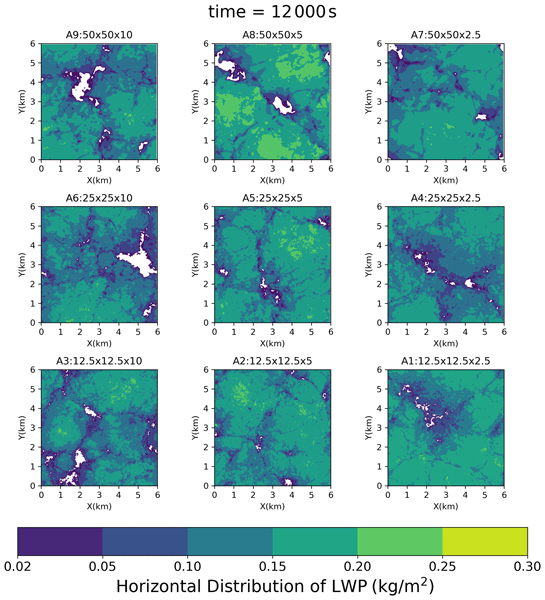
We investigate numerical convergence properties of a particle-based numerical cloud microphysics model (SDM) and a double-moment bulk scheme for simulating a marine stratocumulus case, compare their results with model intercomparison project results, and present possible explanations for the different results of the SDM and the bulk scheme. Aerosol processes can be accurately simulated using SDM, and this may be an important factor affecting the behavior and morphology of marine stratocumulus.
Timothy W. Juliano, Florian Tornow, Ann M. Fridlind, Andrew S. Ackerman, Gregory S. Elsaesser, Bart Geerts, Christian P. Lackner, David Painemal, Israel Silber, Mikhail Ovchinnikov, Gunilla Svensson, Michael Tjernström, Peng Wu, Alejandro Baró Pérez, Peter Bogenschutz, Dmitry Chechin, Kamal Kant Chandrakar, Jan Chylik, Andrey Debolskiy, Rostislav Fadeev, Anu Gupta, Luisa Ickes, Michail Karalis, Martin Köhler, Branko Kosović, Peter Kuma, Weiwei Li, Evgeny Mortikov, Hugh Morrison, Roel A. J. Neggers, Anna Possner, Tomi Raatikainen, Lea Raillard, Sami Romakkaniemi, Niklas Schnierstein, Shin-ichiro Shima, Nikita Silin, Mikhail Tolstykh, Étienne Vignon, Lulin Xue, Meng Zhang, and Xue Zheng
Atmos. Chem. Phys., 26, 13267–13302, https://doi.org/10.5194/acp-26-13267-2026, https://doi.org/10.5194/acp-26-13267-2026, 2026
Short summary
Short summary
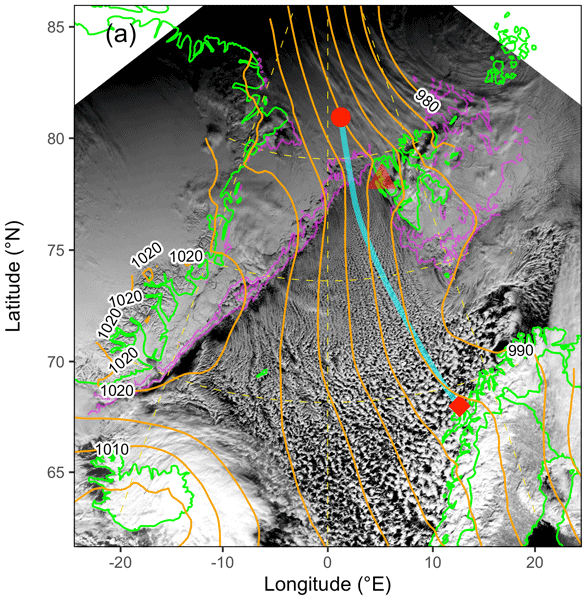
Models struggle to capture cloud and precipitation processes and their radiative effects in marine cold-air outbreaks. We use a quasi-Lagrangian framework to compare large-eddy simulation (LES) and single-column model (SCM) output with field and satellite observations. With fixed droplet and ice numbers, LES and SCM agree in liquid-only tests. In mixed-phase conditions, LES plausibly capture cloud thinning and breakup, while SCMs largely remain overcast and thereby miss cloud radiative effects.
Sylwester Arabas, Agnieszka Żaba, Daria Klimaszewska, Emma C. Ware, Clare E. Singer, Manhal Alhilali, Jason Barr, Daniel G. Partridge, Shin-ichiro Shima, and Robert Wood
EGUsphere, https://doi.org/10.5194/egusphere-2026-3906, https://doi.org/10.5194/egusphere-2026-3906, 2026
This preprint is open for discussion and under review for Geoscientific Model Development (GMD).
Short summary
Short summary
The paper focuses on the use of Python and its package ecosystem for modeling the dynamics of atmospheric aerosol and cloud droplets. We highlight that concise code and high-level abstractions (incl. programmatic expression of physical units) can be used without performance tradeoffs. The paper features two cloud-microphysics classics: an adiabatic parcel model and a Monte-Carlo coagulation solver. The presented code constitutes a single Jupyter notebook that can be executed "in the cloud".
Clara J. A. Bayley, Ann Kristin Naumann, Florian Poydenot, Raphaela Vogel, Bjorn Stevens, and Shin-Ichiro Shima
Geosci. Model Dev., 19, 6121–6142, https://doi.org/10.5194/gmd-19-6121-2026, https://doi.org/10.5194/gmd-19-6121-2026, 2026
Short summary
Short summary
We are developing a model called CLEO, a type of “Superdroplet Model” (SDM) for cloud microphysics, to try to overcome some of the issues faced by climate models which are caused by errors in cloud modelling. Here we describe the equations for cloud microphysics CLEO uses and how we solve them, such as to see how water-droplets move around and grow/shrink in the atmosphere. We also provide some demonstrations of the microphysical processes we model to show that CLEO works as intended.
Jiaxing Zhang, Suying Yang, Chunsong Lu, Yiran Peng, Guan Ming, and Jinbei Li
EGUsphere, https://doi.org/10.5194/egusphere-2026-3376, https://doi.org/10.5194/egusphere-2026-3376, 2026
Short summary
Short summary
Using aircraft measurements from three ocean field campaigns, we studied how low-level marine clouds change when the lower atmosphere becomes disconnected from the cloud layer above. This usually makes clouds thinner and less reflective. Dry air from above speeds cloud loss, while moist air helps clouds persist and form larger droplets. Depending on moisture and rainfall, clouds may dissipate, persist, or recover. These results improve understanding of how marine clouds affect climate.
Shang Wu, David C. Wong, Jiandong Wang, Yuzhi Jin, Junjun Li, and Chunsong Lu
Atmos. Chem. Phys., 26, 7261–7285, https://doi.org/10.5194/acp-26-7261-2026, https://doi.org/10.5194/acp-26-7261-2026, 2026
Short summary
Short summary
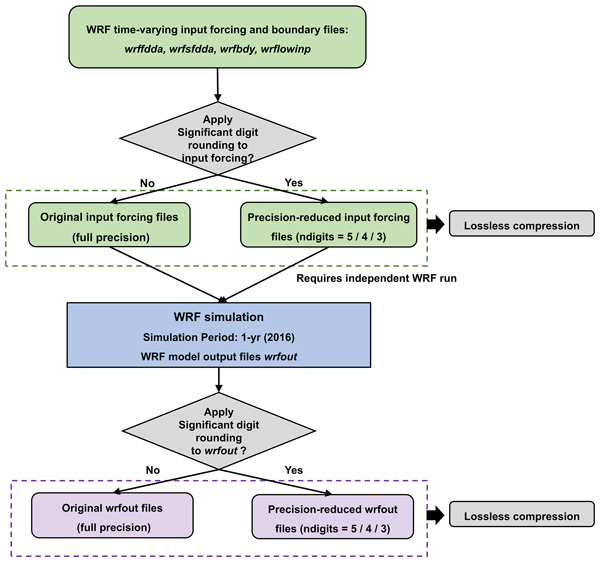
High-resolution weather and climate simulations produce massive amounts of data, creating major storage challenges. This study explores a method that reduces unnecessary numerical detail by keeping only a limited number of significant digits. The results show that substantial data reduction can be achieved while preserving key physical features.
Timothy W. Juliano, Florian Tornow, Ann M. Fridlind, Andrew S. Ackerman, Gregory S. Elsaesser, Bart Geerts, Christian P. Lackner, David Painemal, Israel Silber, Mikhail Ovchinnikov, Gunilla Svensson, Michael Tjernström, Peng Wu, Alejandro Baró Pérez, Peter Bogenschutz, Dmitry Chechin, Kamal Kant Chandrakar, Jan Chylik, Andrey Debolskiy, Rostislav Fadeev, Anu Gupta, Luisa Ickes, Michail Karalis, Martin Köhler, Branko Kosović, Peter Kuma, Weiwei Li, Evgeny Mortikov, Hugh Morrison, Roel A. J. Neggers, Anna Possner, Tomi Raatikainen, Sami Romakkaniemi, Niklas Schnierstein, Shin-ichiro Shima, Nikita Silin, Mikhail Tolstykh, Lulin Xue, Meng Zhang, and Xue Zheng
EGUsphere, https://doi.org/10.5194/egusphere-2025-6217, https://doi.org/10.5194/egusphere-2025-6217, 2026
Preprint archived
Short summary
Short summary
Models struggle to capture cloud and precipitation processes and their radiative effects in marine cold-air outbreaks. We use a quasi-Lagrangian framework to compare large-eddy simulation (LES) and single-column model (SCM) output with field and satellite observations. With fixed droplet and ice numbers, LES and SCM agree in liquid-only tests. In mixed-phase conditions, LES plausibly capture cloud thinning and breakup, while SCMs largely remain overcast and thereby miss cloud radiative effects.
Jialu Xu, Yingjie Zhang, Yuying Wang, Xing Yan, Bin Zhu, Chunsong Lu, Yuanjian Yang, Yele Sun, Junhui Zhang, Xiaofan Zuo, Zhanghanshu Han, and Rui Zhang
Atmos. Chem. Phys., 25, 18599–18616, https://doi.org/10.5194/acp-25-18599-2025, https://doi.org/10.5194/acp-25-18599-2025, 2025
Short summary
Short summary
We conducted a year-long study in Nanjing to explore how the height of the atmospheric boundary layer affects fine particle pollution. We found that low boundary layers in winter trap pollutants like nitrate and primary particles, while higher layers in summer help form secondary pollutants like sulfate and organic aerosols. These findings show that boundary layer dynamics are key to understanding and managing seasonal air pollution.
Ruiyu Song, Bin Zhu, Lina Sha, Peng Qian, Fei Wang, Chunsong Lu, Yan Yin, and Yuying Wang
EGUsphere, https://doi.org/10.5194/egusphere-2025-43, https://doi.org/10.5194/egusphere-2025-43, 2025
Preprint withdrawn
Short summary
Short summary
This study examines how anthropogenic aerosols affect rainfall during the early summer in China’s Yangtze River Delta. Using the WRF-Chem model, we found that moderate emissions increase rainfall by boosting cloud formation. However, high emissions reduce rainfall due to smaller cloud droplets, which hinder their growth. These findings highlight the complex impact of aerosol concentrations on precipitation and provide valuable data for future research on aerosol-cloud-precipitation interactions.
Ruyi Zhang, Limin Zhou, Shin-ichiro Shima, and Huawei Yang
Geosci. Model Dev., 17, 6761–6774, https://doi.org/10.5194/gmd-17-6761-2024, https://doi.org/10.5194/gmd-17-6761-2024, 2024
Short summary
Short summary
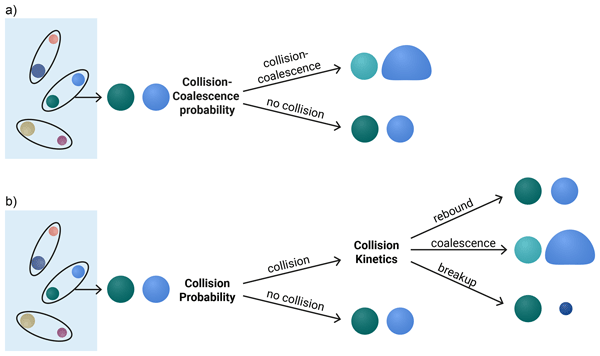
Solar activity weakly ionises Earth's atmosphere, charging cloud droplets. Electro-coalescence is when oppositely charged droplets stick together. We introduce an analytical expression of electro-coalescence probability and use it in a warm-cumulus-cloud simulation. Results show that charge cases increase rain and droplet size, with the new method outperforming older ones. The new method requires longer computation time, but its impact on rain justifies inclusion in meteorology models.
Chongzhi Yin, Shin-ichiro Shima, Lulin Xue, and Chunsong Lu
Geosci. Model Dev., 17, 5167–5189, https://doi.org/10.5194/gmd-17-5167-2024, https://doi.org/10.5194/gmd-17-5167-2024, 2024
Short summary
Short summary
We investigate numerical convergence properties of a particle-based numerical cloud microphysics model (SDM) and a double-moment bulk scheme for simulating a marine stratocumulus case, compare their results with model intercomparison project results, and present possible explanations for the different results of the SDM and the bulk scheme. Aerosol processes can be accurately simulated using SDM, and this may be an important factor affecting the behavior and morphology of marine stratocumulus.
Toshiki Matsushima, Seiya Nishizawa, and Shin-ichiro Shima
Geosci. Model Dev., 16, 6211–6245, https://doi.org/10.5194/gmd-16-6211-2023, https://doi.org/10.5194/gmd-16-6211-2023, 2023
Short summary
Short summary
A particle-based cloud model was developed for meter- to submeter-scale resolution in cloud simulations. Our new cloud model's computational performance is superior to a bin method and comparable to a two-moment bulk method. A highlight of this study is the 2 m resolution shallow cloud simulations over an area covering ∼10 km2. This model allows for studying turbulence and cloud physics at spatial scales that overlap with those covered by direct numerical simulations and field studies.
Cited articles
Abade, G. C., Grabowski, W. W., and Pawlowska, H.: Broadening of cloud droplet spectra through eddy hopping: Turbulent entraining parcel simulations, J. Atmos. Sci., 75, 3365–3379, https://doi.org/10.1175/JAS-D-18-0078.1, 2018.
Ackerman, A. S., VanZanten, M. C., Stevens, B., Savic-Jovcic, V., Bretherton, C. S., Chlond, A., Golaz, J.-C., Jiang, H., Khairoutdinov, M., and Krueger, S. K.: Large-eddy simulations of a drizzling, stratocumulus-topped marine boundary layer, Mon. Weather Rev., 137, 1083–1110, https://doi.org/10.1175/2008MWR2582.1, 2009.
Arakawa, A. and Lamb, V. R.: Computational design of the basic dynamical processes of the UCLA general circulation model, in: General Circulation Models of the Atmosphere, Methods in Computational Physics: Advances in Research and Applications, 17, edited by: Chang, J., Academic Press, 173–265, https://doi.org/10.1016/B978-0-12-460817-7.50009-4, 1977.
Ayala, O., Rosa, B., Wang, L.-P., and Grabowski, W. W.: Effects of turbulence on the geometric collision rate of sedimenting droplets. Part 1. Results from direct numerical simulation, New J. Phys., 10, 075015, https://doi.org/10.1088/1367-2630/10/7/075015, 2008a.
Ayala, O., Rosa, B., and Wang, L.-P.: Effects of turbulence on the geometric collision rate of sedimenting droplets. Part 2. Theory and parameterization, New J. Phys., 10, 075016, https://doi.org/10.1088/1367-2630/10/7/075016, 2008b.
Baker, M. B., Corbin, R. G., and Latham, J.: The influence of entrainment on the evolution of cloud droplet spectra: I. A model of inhomogeneous mixing, Q. J. Roy. Meteor. Soc., 106, 581–598, 1980.
Bott, A.: A Flux Method for the Numerical Solution of the Stochastic Collection Equation, J. Atmos. Sci., 55, 2284–2293, https://doi.org/10.1175/1520-0469(1998)055<2284:AFMFTN>2.0.CO;2, 1998.
Burnet, F. and Brenguier, J.-L.: Observational Study of the Entrainment-Mixing Process in Warm Convective Clouds, J. Atmos. Sci., 64, 1995–2011, https://doi.org/10.1175/JAS3928.1, 2007.
Chandrakar, K. K., Morrison, H., and Witte, M.: Evolution of Droplet Size Distributions During the Transition of an Ultraclean Stratocumulus Cloud System to Open Cell Structure: An LES Investigation Using Lagrangian Microphysics, Geophys. Res. Lett., 49, e2022GL100511, https://doi.org/10.1029/2022GL100511, 2022.
Chandrakar, K. K., Morrison, H., Harrington, J. Y., Pokrifka, G., and Magee, N.: What Controls Crystal Diversity and Microphysical Variability in Cirrus Clouds?, Geophys. Res. Lett., 51, e2024GL108493, https://doi.org/10.1029/2024GL108493, 2024.
Cooper, W. A.: Effects of Variable Droplet Growth Histories on Droplet Size Distributions. Part I: Theory, J. Atmos. Sci., 46, 1301–1311, 1989.
Draxler, R. and Hess, G.: An overview of the HYSPLIT_4 modeling system for trajectories, dispersion, and deposition, Aust. Meteorol. Mag., 47, 295–308, 1998.
Dziekan, P. and Pawlowska, H.: Stochastic coalescence in Lagrangian cloud microphysics, Atmos. Chem. Phys., 17, 13509–13520, https://doi.org/10.5194/acp-17-13509-2017, 2017.
Freire, J., Koop, D., Santos, E., and Silva, C. T.: Provenance for Computational Tasks: A Survey, Comput. Sci. Eng., 10, 11–21, https://doi.org/10.1109/MCSE.2008.79, 2008.
Grabowski, W. W. and Abade, G. C.: Broadening of cloud droplet spectra through eddy hopping: Turbulent adiabatic parcel simulations, J. Atmos. Sci., 74, 1485–1493, https://doi.org/10.1175/JAS-D-17-0043.1, 2017.
Hall, W. D.: A Detailed Microphysical Model Within a Two-Dimensional Dynamic Framework: Model Description and Preliminary Results, J. Atmos. Sci., 37, 2486–2507, https://doi.org/10.1175/1520-0469(1980)037<2486:ADMMWA>2.0.CO;2, 1980.
Hoffmann, F., Noh, Y., and Raasch, S.: The Route to Raindrop Formation in a Shallow Cumulus Cloud Simulated by a Lagrangian Cloud Model, J. Atmos. Sci., 74, 2125–2142, https://doi.org/10.1175/JAS-D-16-0220.1, 2017.
Khain, A., Ovtchinnikov, M., Pinsky, M., Pokrovsky, A., and Krugliak, H.: Notes on the state-of-the-art numerical modeling of cloud microphysics, Atmos.Res., 55, 159–224, https://doi.org/10.1016/S0169-8095(00)00064-8, 2000.
Khain, A. P., Beheng, K. D., Heymsfield, A., Korolev, A., Krichak, S. O., Levin, Z., Pinsky, M., Phillips, V., Prabhakaran, T., and Teller, A.: Representation of microphysical processes in cloud-resolving models: Spectral (bin) microphysics versus bulk parameterization, Rev. Geophys., 53, 247–322, https://doi.org/10.1002/2014RG000468, 2015.
Koren, B.: A robust upwind discretization method for advection, diffusion and source terms, in: Numerical Methods for Advection-Diffusion Problems, Notes on Numerical Fluid Mechanics, 45, edited by: Vreugdenhil, C. B. and Koren, B., Vieweg, Braunschweig, Wiesbaden, 117–138, ISBN 978-3-528-07645-0, 1993.
Krueger, S. K., Su, C.-W., and McMurtry, P. A.: Modeling Entrainment and Finescale Mixing in Cumulus Clouds, J. Atmos. Sci., 54, 2697–2712, https://doi.org/10.1175/1520-0469(1997)054<2697:MEAFMI>2.0.CO;2, 1997.
Li, X.-Y., Mehlig, B., Svensson, G., Brandenburg, A., and Haugen, N. E. L.: Collision Fluctuations of Lucky Droplets with Superdroplets, J. Atmos. Sci., 79, 1821–1835, https://doi.org/10.1175/JAS-D-20-0371.1, 2022.
Lilly, D. K.: On the numerical simulation of buoyant convection, Tellus, 14, 148–172, https://doi.org/10.1111/j.2153-3490.1962.tb00128.x, 1962.
Lim, J.-S. and Hoffmann, F.: Between broadening and narrowing: How mixing affects the width of the droplet size distribution, J. Geophys. Res.-Atmos., 128, e2022JD037900, https://doi.org/10.1029/2022JD037900, 2023.
Lim, J.-S. and Hoffmann, F.: Life cycle evolution of mixing in shallow cumulus clouds, J. Geophys. Res.-Atmos., 129, e2023JD040393, https://doi.org/10.1029/2023JD040393, 2024.
Matsushima, T., Nishizawa, S., and Shima, S.: Overcoming computational challenges to realize meter- to submeter-scale resolution in cloud simulations using the super-droplet method, Geosci. Model Dev., 16, 6211–6245, https://doi.org/10.5194/gmd-16-6211-2023, 2023.
Nishizawa, S., Yashiro, H., Sato, Y., Miyamoto, Y., and Tomita, H.: Influence of grid aspect ratio on planetary boundary layer turbulence in large-eddy simulations, Geosci. Model Dev., 8, 3393–3419, https://doi.org/10.5194/gmd-8-3393-2015, 2015.
Pisso, I., Sollum, E., Grythe, H., Kristiansen, N. I., Cassiani, M., Eckhardt, S., Arnold, D., Morton, D., Thompson, R. L., Groot Zwaaftink, C. D., Evangeliou, N., Sodemann, H., Haimberger, L., Henne, S., Brunner, D., Burkhart, J. F., Fouilloux, A., Brioude, J., Philipp, A., Seibert, P., and Stohl, A.: The Lagrangian particle dispersion model FLEXPART version 10.4, Geosci. Model Dev., 12, 4955–4997, https://doi.org/10.5194/gmd-12-4955-2019, 2019.
Sato, Y., Nishizawa, S., Yashiro, H., Miyamoto, Y., Kajikawa, Y., and Tomita, H.: Impacts of cloud microphysics on trade wind cumulus: which cloud microphysics processes contribute to the diversity in a large eddy simulation?, Progress in Earth & Planetary Science, 2, 23, https://doi.org/10.1186/s40645-015-0053-6, 2015.
Seeßelberg, M., Trautmann, T., and Thorn, M.: Stochastic simulations as a benchmark for mathematical methods solving the coalescence equation, Atmos. Res., 40, 33–48, https://doi.org/10.1016/0169-8095(95)00024-0, 1996.
Shima, S., Kusano, K., Kawano, A., Sugiyama, T., and Kawahara, S.: The super-droplet method for the numerical simulation of clouds and precipitation: A particle-based and probabilistic microphysics model coupled with a non-hydrostatic model, Q. J. Roy. Meteor. Soc., 135, 1307–1320, https://doi.org/10.1002/qj.441, 2009.
Shima, S., Sato, Y., Hashimoto, A., and Misumi, R.: Predicting the morphology of ice particles in deep convection using the super-droplet method: development and evaluation of SCALE-SDM 0.2.5-2.2.0, -2.2.1, and -2.2.2, Geosci. Model Dev., 13, 4107–4157, https://doi.org/10.5194/gmd-13-4107-2020, 2020.
Simmhan, Y. L., Plale, B., and Gannon, D.: A survey of data provenance in e-science, SIGMOD Rec., 34, 31–36, https://doi.org/10.1145/1084805.1084812, 2005.
Smagorinsky, J.: General circulation experiments with the primitive equations: I. The basic experiment, Mon. Weather Rev., 91, 99–164, https://doi.org/10.1175/1520-0493(1963)091%3C0099:GCEWTP%3E2.3.CO;2, 1963.
Squires, P.: The microstructure and colloidal stability of warm clouds: Part I—The relation between structure and stability, Tellus, 10, 256–261, 1958.
Stein, A. F., Draxler, R. R., Rolph, G. D., Stunder, B. J. B., Cohen, M. D., and Ngan, F.: NOAA's HYSPLIT Atmospheric Transport and Dispersion Modeling System, B. Am. Meteorol. Soc., 96, 2059–2077, https://doi.org/10.1175/BAMS-D-14-00110.1, 2015.
Stevens, B., Lenschow, D. H., Vali, G., Gerber, H., Bandy, A., Blomquist, B., Brenguier, J.-L., Bretherton, C. S., Burnet, F., and Campos, T.: Dynamics and chemistry of marine stratocumulus – DYCOMS-II, B. Am. Meteorol. Soc., 84, 579–594, 2003.
Stohl, A., Forster, C., Frank, A., Seibert, P., and Wotawa, G.: Technical note: The Lagrangian particle dispersion model FLEXPART version 6.2, Atmos. Chem. Phys., 5, 2461–2474, https://doi.org/10.5194/acp-5-2461-2005, 2005.
Telford, J. W.: A new aspect of coalescence theory, J. Atmos. Sci., 12, 436–444, 1955.
Wang, L.-P. and Maxey, M. R.: Settling velocity and concentration distribution of heavy particles in homogeneous isotropic turbulence, J. Fluid Mech., 256, 27–68, https://doi.org/10.1017/S0022112093002708, 1993.
Wicker, L. J. and Skamarock, W. C.: Time-splitting methods for elastic models using forward time schemes, Mon. Weather Rev., 130, 2088–2097, https://doi.org/10.1175/1520-0493(2002)130%3C2088:TSMFEM%3E2.0.CO;2, 2002.
Yin, C.: SCALE-SDM super-droplet tracking suite with forward/backward tracking and TPHT, Zenodo [code], https://doi.org/10.5281/zenodo.20659293, 2026a.
Yin, C.: TPHT diagnostic visualisation of selected super-droplet histories in a DYCOMS-II RF02 stratocumulus simulation, Zenodo [video], https://doi.org/10.5281/zenodo.20658816, 2026b.
Yin, C., Shima, S., Xue, L., and Lu, C.: Simulation of marine stratocumulus using the super-droplet method: numerical convergence and comparison to a double-moment bulk scheme using SCALE-SDM 5.2.6-2.3.1, Geosci. Model Dev., 17, 5167–5189, https://doi.org/10.5194/gmd-17-5167-2024, 2024.
Short summary
We developed and tested a way to trace selected cloud particles in a simulation, including how they grow and merge. One run identifies particles that meet chosen conditions, and a second reconstructs only their saved histories. In a three-dimensional test, the saved data were estimated to be one-fifth of what would be needed to keep all particle histories. Larger reductions are possible when fewer particles are selected, making such studies more practical in large simulations.
We developed and tested a way to trace selected cloud particles in a simulation, including how...


